Environmental Heterogeneity Drives Distinct Spatial Distribution Patterns of Microbial Co-Occurring Species Across Different Grassland Types

 and
and
Abstract
1. Introduction
2. Materials and Methods
2.1. Site Characteristics and Sampling
2.2. DNA Extraction, PCR Amplification and Bioinformation Analyses
2.3. Soil Physicochemical Properties
2.4. Statistical Analysis
3. Results
3.1. Soil Environmental Heterogeneity Across Different Grassland Types
3.2. Microbial Community Composition and Diversity Across Different Grassland Types
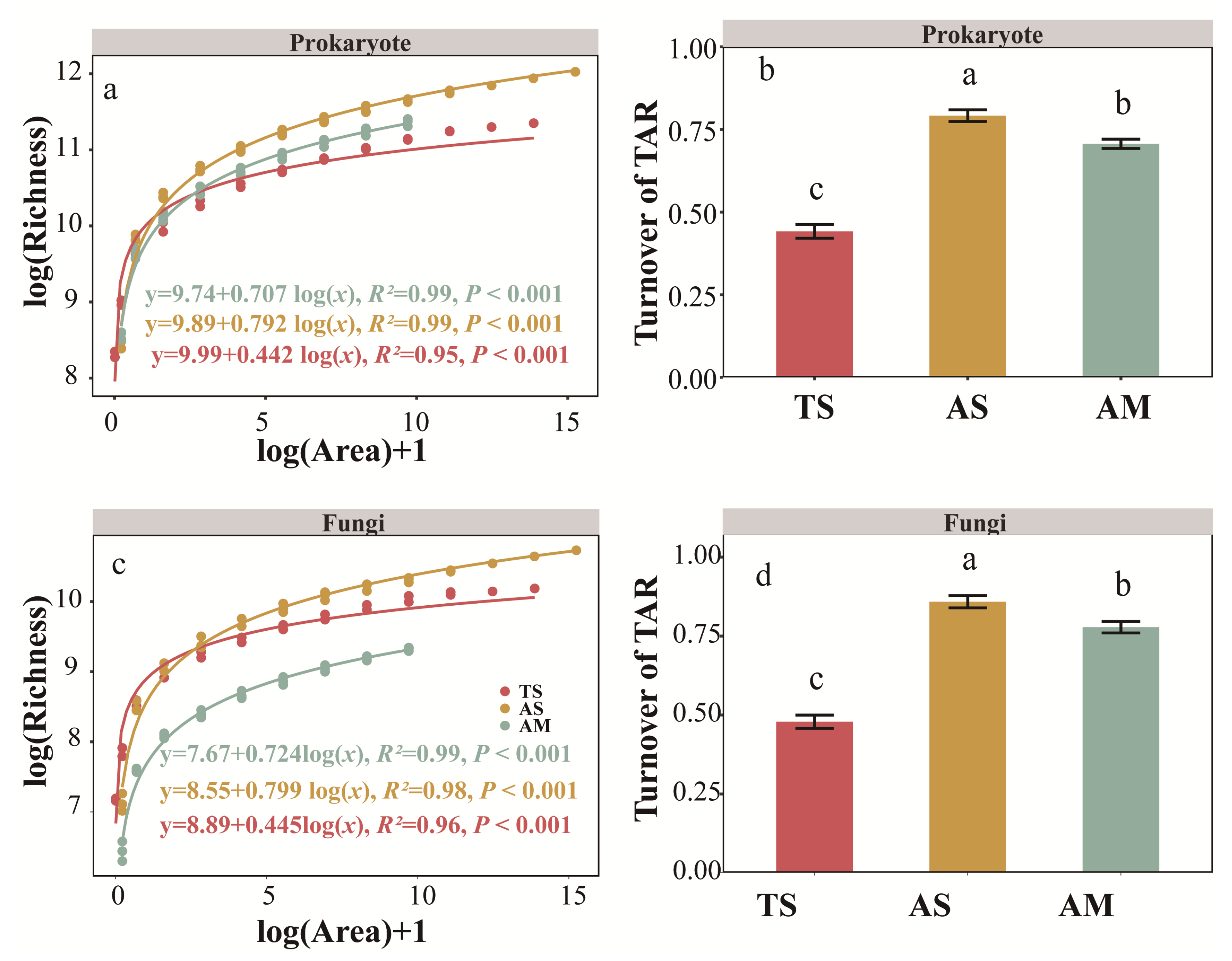
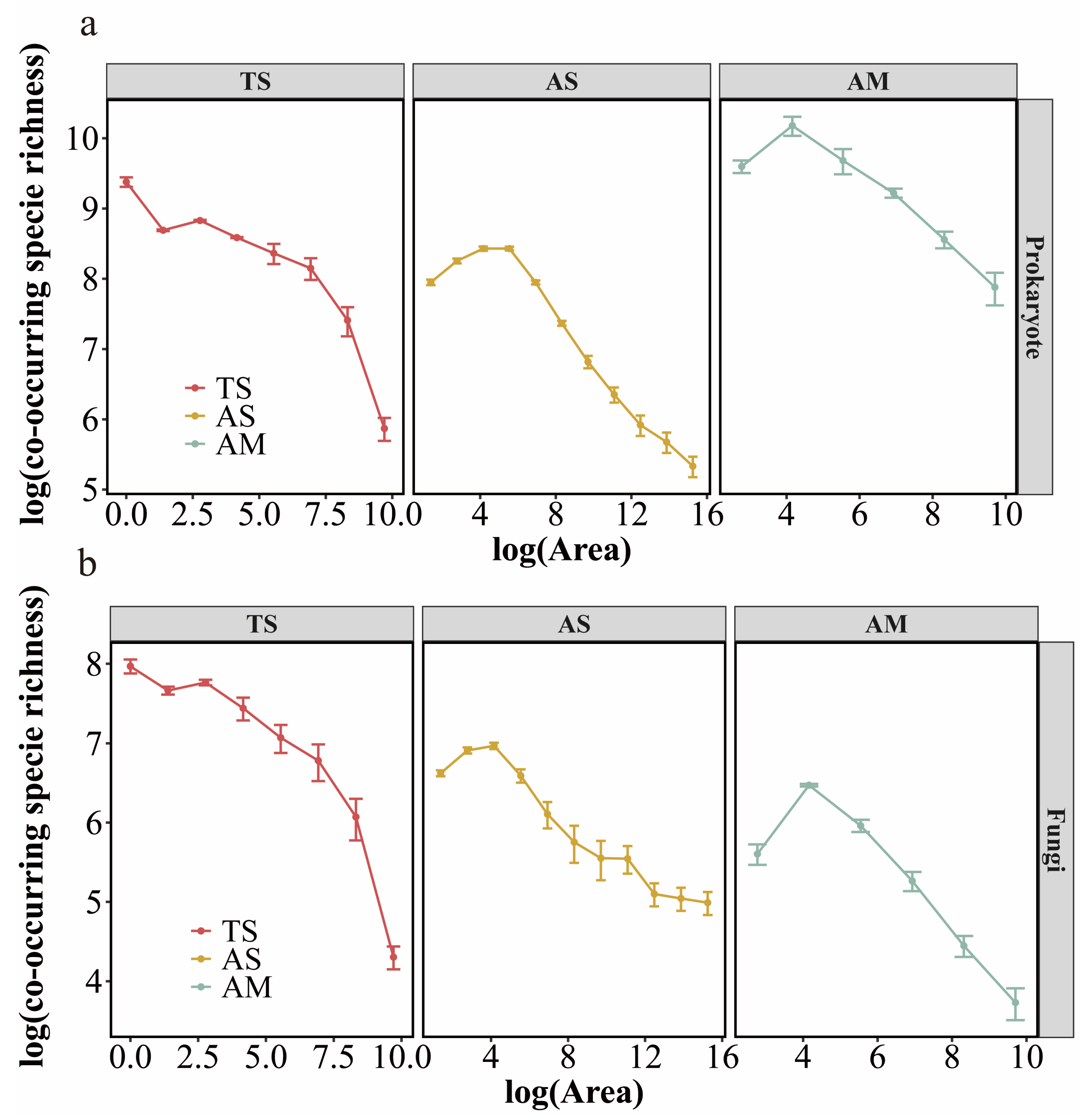
3.3. Spatial Turnover of Microbial Communities Across Different Grassland Types
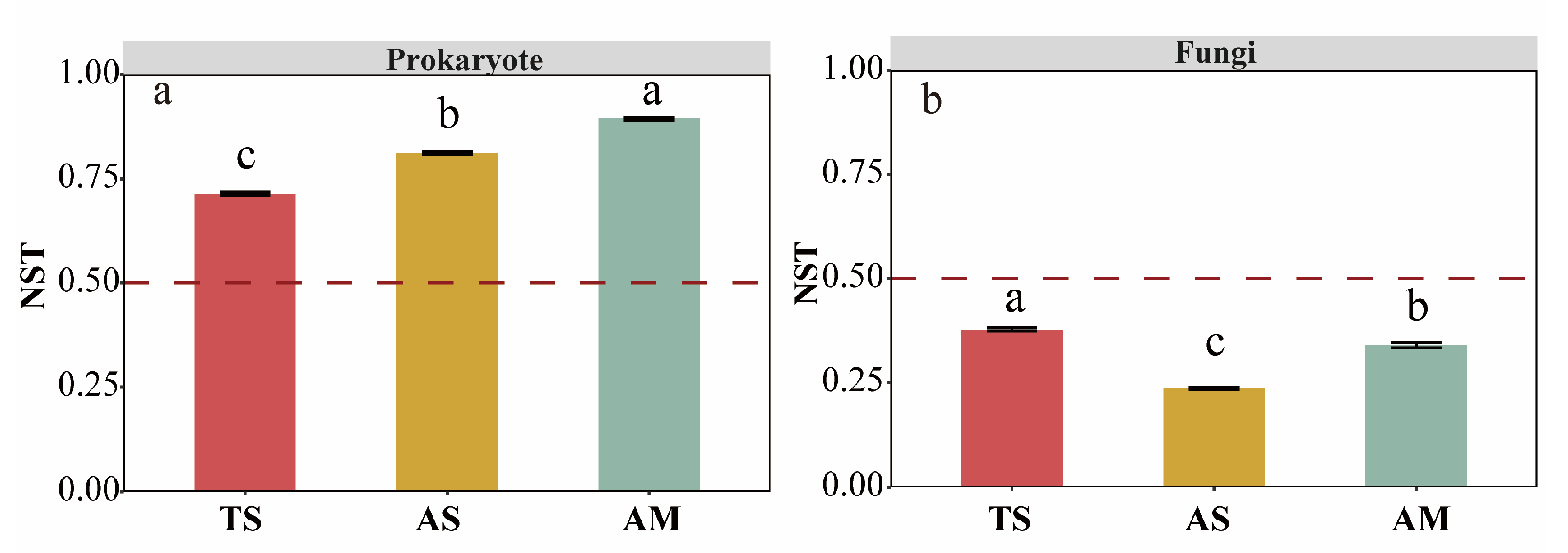
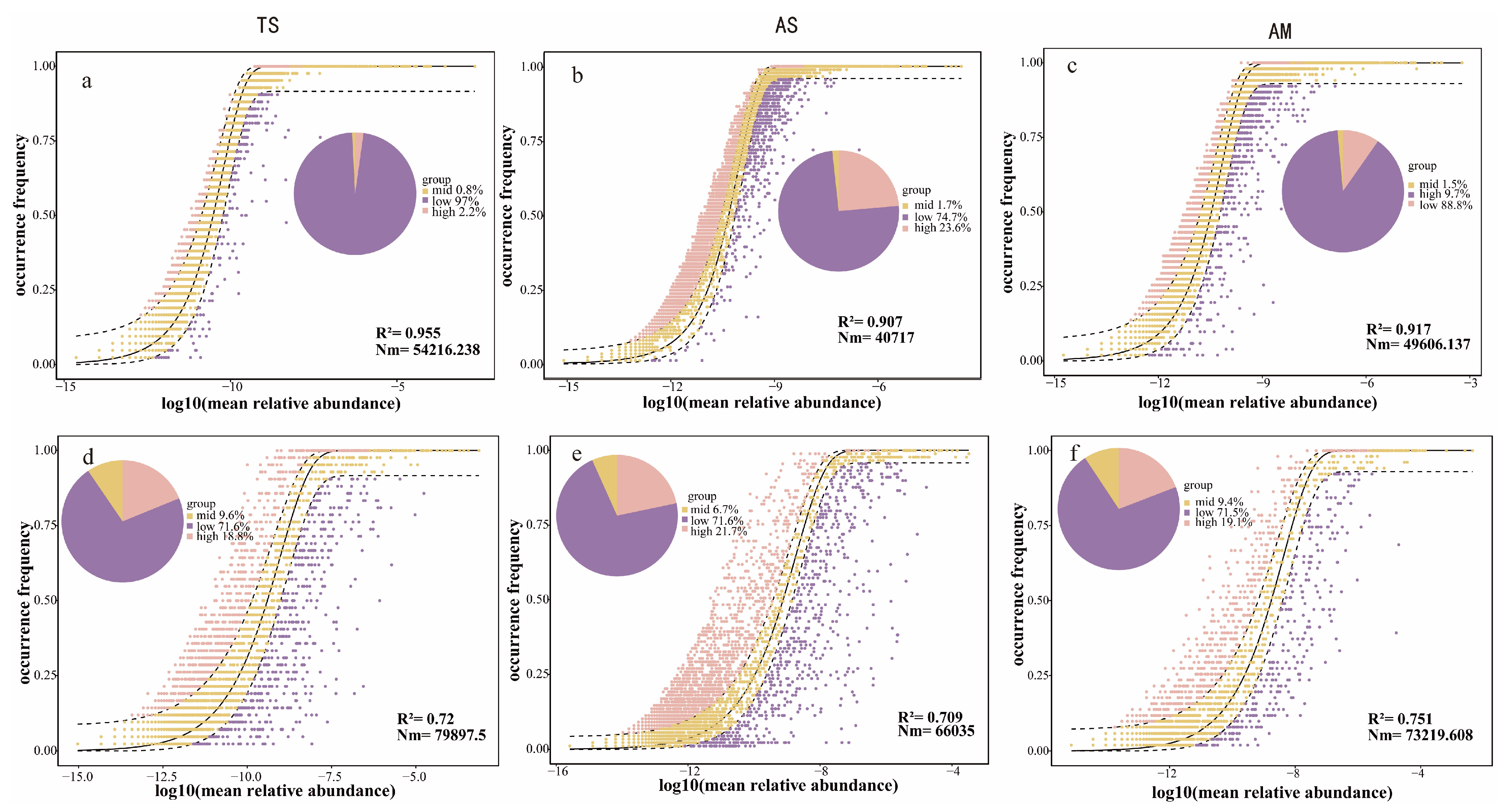
3.4. Microbial Community Assembly Across Different Grassland Types
3.5. Environmental Factors Shaping Microbial Community Structure Across Different Grassland Types
4. Discussion
4.1. The Spatial Patterns of Microbial Community Across Different Grassland Types
4.2. Niche Breadth Dominates Microbial Community Assembly
4.3. Microbial Community Composition and Diversity Across Different Grassland Types
4.4. Soil Organic Carbon and Soil Water Content Are the Main Environmental Factors Relating Community Composition
5. Conclusions
Supplementary Materials
Author Contributions
Funding
Institutional Review Board Statement
Informed Consent Statement
Data Availability Statement
Acknowledgments
Conflicts of Interest
Abbreviations
| TAR | Taxa–area relationship |
| NAR | Node–area relationship |
| NCM | Neutral community model |
| NST | Normalized stochasticity ratio |
| AS | Alpine steppe |
| AM | Alpine meadow |
| TS | Temperate steppe |
| FLASH | Fast Length Adjustment of Short reads |
| OTU | Operational taxonomic unit |
| SWC | Soil water content |
| SOC | Soil organic carbon |
| TN | Total nitrogen concentration |
| TP | Total phosphorus |
| NH4+-N | Ammonium nitrogen |
| NO3−-N | Nitrate nitrogen |
| ANOVA | One-way analysis of variance |
| LSD | Least significant difference |
| CCA | Canonical correspondence analysis |
References
- Zhou, S.J.; Dong, Y.Q.; Yang, H.L.; Yang, S.W.; Julihaiti, A.; Liu, Z.Y.; Nie, T.T.; Jiang, A.J.; Wu, Y.; An, S.Z. Effects of grazing exclusion on soil properties, fungal community structure, and diversity in different grassland types. Ecol. Evol. 2024, 14, e11056. [Google Scholar] [CrossRef] [Scilit]
- Lu, C.X.; Yu, G.; Xiao, Y.; Xie, G.D. Wind tunnel simulation and evaluation of soil conservation function of alpine grassland in Qinghai-Tibet Plateau. Ecol. Econ. 2013, 86, 16–20. [Google Scholar] [CrossRef] [Scilit]
- Wu, W.; Zhou, G.; Xu, Z. Driving mechanisms of climate-plant-soil patterns on the structure and function of different grasslands along environmental gradients in Tibetan and Inner Mongolian Plateaus in China. J. Clean. Prod. 2022, 339, 130696. [Google Scholar] [CrossRef] [Scilit]
- Maron, P.-A.; Sarr, A.; Kaisermann, A.; Leveque, J.; Mathieu, O.; Guigue, J.; Karimi, B.; Bernard, L.; Dequiedt, S.; Terrat, S.; et al. High Microbial Diversity Promotes Soil Ecosystem Functioning. Appl. Environ. Microbiol. 2018, 84, e02738-17. [Google Scholar] [CrossRef] [Scilit] [PubMed]
- Bolan, S.; Sharma, S.; Mukherjee, S.; Kumar, M.; Rao, C.S.; Nataraj, K.C.; Singh, G.; Vinu, A.; Bhowmik, A.; Sharma, H.; et al. Biochar modulating soil biological health: A review. Sci. Total Environ. 2024, 914, 169585. [Google Scholar] [CrossRef] [Scilit] [PubMed]
- Canarini, A.; Schmidt, H.; Fuchslueger, L.; Martin, V.; Herbold, C.W.; Zezula, D.; Gundler, P.; Hasibeder, R.; Jecmenica, M.; Bahn, M.; et al. Ecological memory of recurrent drought modifies soil processes via changes in soil microbial community. Nat. Commun. 2021, 12, 5308. [Google Scholar] [CrossRef] [Scilit]
- Semchenko, M.; Barry, K.E.; de Vries, F.T.; Mommer, L.; Moora, M.; Macia-Vicente, J.G. Deciphering the role of specialist and generalist plant-microbial interactions as drivers of plant-soil feedback. New Phytol. 2022, 234, 1929–1944. [Google Scholar] [CrossRef] [Scilit]
- Yang, X.M.; Feng, Q.; Zhu, M.; Yang, L.S.; Zhang, C.Q.; Zhang, J.T.; Wang, Z.Y.; Feng, Y.L. Changes in Nutrient-Regulated Soil Microbial Communities in Soils Concomitant with Grassland Restoration in the Alpine Mining Region of the Qilian Mountains. Agronomy 2023, 13, 3052. [Google Scholar] [CrossRef] [Scilit]
- Zhang, N.N.; Zhong, B.; Zhao, C.Z.; Wang, E.T.; Wang, Y.J.; Chen, D.M.; Shi, F.S. Change of soil physicochemical properties, bacterial community and aggregation during desertification of grasslands in the Tibetan Plateau. Eur. J. Soil Sci. 2021, 72, 274–288. [Google Scholar] [CrossRef] [Scilit]
- Wakelin, S.A.; Gerard, E.; van Koten, C.; Banabas, M.; O’Callaghan, M.; Nelson, P.N. Soil physicochemical properties impact more strongly on bacteria and fungi than conversion of grassland to oil palm. Pedobiologia 2016, 59, 83–91. [Google Scholar] [CrossRef] [Scilit]
- Zhang, X.F.; Zhang, C.P.; Liu, Y.Z.; Huo, L.; Yang, Z.Z.; Tong, Y.S.; Zhang, X.; Yu, Z.H.; Yang, X.X.; Cao, Q.; et al. Effects of planting patterns on physicochemical properties, metabolites and microbial community structure of rhizosphere soil in perennial cultivated grassland. Sci. Rep. 2025, 15, 12047. [Google Scholar] [CrossRef] [Scilit] [PubMed]
- Xu, A.A.; Liu, J.; Guo, Z.Y.; Wang, C.K.; Pan, K.; Zhang, F.F.; Pan, X.Z. Soil microbial community composition but not diversity is affected by land-use types in the agro-pastoral ecotone undergoing frequent conversions between cropland and grassland. Geoderma 2021, 401, 115165. [Google Scholar] [CrossRef] [Scilit]
- Han, C.L.; Liang, D.F.; Zhou, W.D.; Xu, Q.Y.; Xiang, M.X.; Gu, Y.J.; Siddique, K.H.M. Soil, Plant, and Microorganism Interactions Drive Secondary Succession in Alpine Grassland Restoration. Plants 2024, 13, 780. [Google Scholar] [CrossRef] [Scilit] [PubMed]
- Xue, K.; Zhang, B.A.; Zhou, S.T.; Ran, Q.W.; Tang, L.; Che, R.X.; Pang, Z.; Wang, F.; Wang, D.; Zhang, J.; et al. Soil microbial communities in alpine grasslands on the Tibetan Plateau and their influencing factors. Chin. Sci. Bull. 2019, 64, 2915–2927. [Google Scholar] [CrossRef] [Scilit]
- Hodel, M.; Schütz, M.; Vandegehuchte, M.L.; Frey, B.; Albrecht, M.; Busse, M.D.; Risch, A.C. Does the Aboveground Herbivore Assemblage Influence Soil Bacterial Community Composition and Richness in Subalpine Grasslands? Microb. Ecol. 2014, 68, 584–595. [Google Scholar] [CrossRef] [Scilit]
- Faust, K.; Raes, J. Microbial interactions: From networks to models. Nat. Rev. Microbiol. 2012, 10, 538–550. [Google Scholar] [CrossRef] [Scilit]
- Green, J.; Bohannan, B.J.M. Spatial scaling of microbial biodiversity. Trends Ecol. Evol. 2006, 21, 501–507. [Google Scholar] [CrossRef] [Scilit]
- Zhou, Y.Y.; Wang, J.P. The effect of land-use types on composition of abundant and rare soil microbial communities in urban areas in cyprus. Appl. Ecol. Environ. Res. 2022, 21, 243–259. [Google Scholar] [CrossRef] [Scilit]
- Wang, H.X.; Wei, S.X.; Wang, Z.H.; Tian, D.; Lu, Z.F.; Ou, H.B.; Gao, F.; Ren, S.Q.; Chen, L.J. The role of fungal keystone taxa in soil multifunctionality across subtropical forests. Appl. Soil Ecol. 2025, 211, 106108. [Google Scholar] [CrossRef] [Scilit]
- Liu, X.A.; Wang, M.X.; Liu, B.W.; Chen, X.L.; An, L.Y.; Nie, Y.; Wu, X.L. Keystone taxa mediate the trade-off between microbial community stability and performance in activated sludges. Nat. Water 2025, 3, 723–733. [Google Scholar] [CrossRef] [Scilit]
- Xue, P.P.; Minasny, B.; McBratney, A.B. Land-use affects soil microbial co-occurrence networks and their putative functions. Appl. Soil Ecol. 2022, 169, 104184. [Google Scholar] [CrossRef] [Scilit]
- Karimi, B.; Maron, P.A.; Boure, N.C.P.; Bernard, N.; Gilbert, D.; Ranjard, L. Microbial diversity and ecological networks as indicators of environmental quality. Environ. Chem. Lett. 2017, 15, 265–281. [Google Scholar] [CrossRef] [Scilit]
- Chen, W.Q.; Wang, J.Y.; Chen, X.; Meng, Z.X.; Xu, R.; Duoji, D.; Zhang, J.H.; He, J.; Wang, Z.A.; Chen, J.; et al. Soil microbial network complexity predicts ecosystem function along elevation gradients on the Tibetan Plateau. Soil Biol. Biochem. 2022, 172, 108766. [Google Scholar] [CrossRef] [Scilit]
- Chen, J.; Guo, Y.Q.; Li, F.S.; Zheng, Y.X.; Xu, D.L.; Liu, H.J.; Liu, X.Y.; Wang, X.Y.; Bao, Y.Y. Exploring the effects of volcanic eruption disturbances on the soil microbial communities in the montane meadow steppe. Environ. Pollut. 2020, 267, 115600. [Google Scholar] [CrossRef] [Scilit]
- Cornell, C.R.; Zhang, Y.; Ning, D.L.; Xiao, N.J.; Wagle, P.; Xiao, X.M.; Zhou, J.Z. Land use conversion increases network complexity and stability of soil microbial communities in a temperate grassland. Isme J. 2023, 17, 2210–2220. [Google Scholar] [CrossRef] [Scilit]
- Shaw, G.T.W.; Weng, C.Y.; Chen, C.Y.; Weng, F.C.H.; Wang, D.Y. A systematic approach re-analyzing the effects of temperature disturbance on the microbial community of mesophilic anaerobic digestion. Sci. Rep. 2019, 9, 6560. [Google Scholar] [CrossRef] [Scilit]
- Qi, X.J.; Wang, X.R.; Zheng, M.Y.; Zhao, L.J.; Chai, B.F.; Jia, T. Arbuscular mycorrhizal fungi modulate soil microbial network complexity via microbial interactions in different vegetation ecosystems. Appl. Soil Ecol. 2025, 213, 106330. [Google Scholar] [CrossRef] [Scilit]
- Williams, R.J.; Howe, A.; Hofmockel, K.S. Demonstrating microbial co-occurrence pattern analyses within and between ecosystems. Front. Microbiol. 2014, 5, 358. [Google Scholar] [CrossRef] [Scilit]
- Yao, Z.Y.; Wei, X.T.; Liu, C.Y.; Shi, L.N.; Hu, M.A.; Liu, G.H.; Shao, X.Q. Regulatory Effects of Soil Microbes and Soil Properties on Ecosystem Multifunctionality Differ Among Grassland Types in the Qinghai-Tibetan Plateau. Agriculture 2025, 15, 1410. [Google Scholar] [CrossRef] [Scilit]
- Rawstern, A.H.; Hernandez, D.J.; Afkhami, M.E. Central Taxa Are Keystone Microbes During Early Succession. Ecol. Lett. 2025, 28, e70031. [Google Scholar] [CrossRef] [Scilit]
- Liu, L.; Zhang, Z.C.; Wang, X.; Zhang, R.; Wang, M.; Wurzburger, N.; Li, J.X.; Zhang, J. Urbanization reduces soil microbial network complexity and stability in the megacity of Shanghai. Sci. Total Environ. 2023, 893, 164915. [Google Scholar] [CrossRef] [Scilit] [PubMed]
- Sun, S.J.; Qiao, Z.Y.; Tikhonenkov, D.V.; Gong, Y.C.; Li, H.; Li, R.H.; Sun, K.X.; Huo, D. Temporal Dynamics and Adaptive Mechanisms of Microbial Communities: Divergent Responses and Network Interactions. Microb. Ecol. 2025, 88, 94. [Google Scholar] [CrossRef] [Scilit] [PubMed]
- Gao, J.W.; Zhou, T.; Kang, S.H.; Han, X.; Zheng, F. Cadmium-driven restructuring of soil nematode gut microbiota: Coordinated response of reduced diversity and enhanced structural stability. J. Hazard. Mater. 2025, 499, 140204. [Google Scholar] [CrossRef] [Scilit] [PubMed]
- Hu, Y.L.; Ganjurjav, H.; Hu, G.Z.; Ji, G.X.; Han, L.; Sha, Y.B.; Liang, Y.; Gao, Q.Z. Responses of bacterial community composition and diversity to multi-level nitrogen addition at different periods of growing season driven by conditional rare taxa in an alpine meadow. Biol. Fertil. Soils 2023, 59, 939–952. [Google Scholar] [CrossRef] [Scilit]
- Horner-Devine, M.C.; Lage, M.; Hughes, J.B.; Bohannan, B.J.M. A taxa-area relationship for bacteria. Nature 2004, 432, 750–753. [Google Scholar] [CrossRef] [Scilit]
- Zhou, J.Z.; Kang, S.; Schadt, C.W.; Garten, C.T. Spatial scaling of functional gene diversity across various microbial taxa. Proc. Natl. Acad. Sci. USA 2008, 105, 7768–7773. [Google Scholar] [CrossRef] [Scilit]
- Zhang, B.; Xue, K.; Liu, W.; Zhou, S.; Nie, S.; Rui, Y.; Tang, L.; Pang, Z.; Li, L.; Dong, J.; et al. Power law in species-area relationship overestimates bacterial diversity in grassland soils at larger scales. Glob. Ecol. Biogeogr. 2024, 33, e13825. [Google Scholar] [CrossRef] [Scilit]
- Green, J.L.; Holmes, A.J.; Westoby, M.; Oliver, I.; Briscoe, D.; Dangerfield, M.; Gillings, M.; Beattie, A.J. Spatial scaling of microbial eukaryote diversity. Nature 2004, 432, 747–750. [Google Scholar] [CrossRef] [Scilit]
- Liu, Y.; Chen, X.T.; Liu, J.X.; Liu, T.T.; Cheng, J.M.; Wei, G.H.; Lin, Y.B. Temporal and spatial succession and dynamics of soil fungal communities in restored grassland on the Loess Plateau in China. Land Degrad. Dev. 2019, 30, 1273–1287. [Google Scholar] [CrossRef] [Scilit]
- Kranabetter, J.M.; Berch, S.M.; MacKinnon, J.A.; Ceska, O.; Dunn, D.E.; Ott, P.K. Species-area curve and distance-decay relationships indicate habitat thresholds of ectomycorrhizal fungi in an old-growth Pseudotsuga menziesii landscape. Divers. Distrib. 2018, 24, 755–764. [Google Scholar] [CrossRef] [Scilit]
- Schnecker, J.; Wild, B.; Takriti, M.; Alves, R.J.E.; Gentsch, N.; Gittel, A.; Hofer, A.; Klaus, K.; Knoltsch, A.; Lashchinskiy, N.; et al. Microbial community composition shapes enzyme patterns in topsoil and subsoil horizons along a latitudinal transect in Western Siberia. Soil Biol. Biochem. 2015, 83, 106–115. [Google Scholar] [CrossRef] [Scilit] [PubMed]
- Waldrop, M.P.; Chabot, C.L.; Liebner, S.; Holm, S.; Snyder, M.W.; Dillon, M.; Dudgeon, S.R.; Douglas, T.A.; Leewis, M.C.; Anthony, K.M.W.; et al. Permafrost microbial communities and functional genes are structured by latitudinal and soil geochemical gradients. Isme J. 2023, 17, 1224–1235. [Google Scholar] [CrossRef] [Scilit] [PubMed]
- Zhang, L.Y.; Delgado-Baquerizo, M.; Hotaling, S.; Li, Y.; Sun, X.X.; Xu, Y.F.; Chu, H.Y. Bacterial diversity and co-occurrence patterns differ across a world-wide spatial distribution of habitats in glacier ecosystems. Funct. Ecol. 2023, 37, 1520–1535. [Google Scholar] [CrossRef] [Scilit]
- Wang, X.B.; Lü, X.T.; Yao, J.; Wang, Z.W.; Deng, Y.; Cheng, W.X.; Zhou, J.Z.; Han, X.G. Habitat-specific patterns and drivers of bacterial β-diversity in China’s drylands. Isme J. 2017, 11, 1345–1358. [Google Scholar] [CrossRef] [Scilit]
- Luan, L.; Jiang, Y.; Cheng, M.; Dini-Andreote, F.; Sui, Y.; Xu, Q.; Geisen, S.; Sun, B. Organism body size structures the soil microbial and nematode community assembly at a continental and global scale. Nat. Commun. 2020, 11, 6406. [Google Scholar] [CrossRef] [Scilit]
- Wang, J.N.; Pan, Z.; Yu, J.S.; Zhang, Z.; Li, Y.Z. Global assembly of microbial communities. Msystems 2023, 8, e0128922. [Google Scholar] [CrossRef] [Scilit]
- Lima-Mendez, G.; Faust, K.; Henry, N.; Decelle, J.; Colin, S.; Carcillo, F.; Chaffron, S.; Ignacio-Espinosa, J.C.; Roux, S.; Vincent, F.; et al. Determinants of community structure in the global plankton interactome. Science 2015, 348, 1262073. [Google Scholar] [CrossRef] [Scilit]
- Vanwonterghem, I.; Jensen, P.D.; Dennis, P.G.; Hugenholtz, P.; Rabaey, K.; Tyson, G.W. Deterministic processes guide long-term synchronised population dynamics in replicate anaerobic digesters. Isme J. 2014, 8, 2015–2028. [Google Scholar] [CrossRef] [Scilit]
- Chave, J. Neutral theory and community ecology. Ecol. Lett. 2004, 7, 241–253. [Google Scholar] [CrossRef] [Scilit]
- Fan, K.; Weisenhorn, P.; Gilbert, J.A.; Shi, Y.; Bai, Y.; Chu, H. Soil pH correlates with the co-occurrence and assemblage process of diazotrophic communities in rhizosphere and bulk soils of wheat fields. Soil Biol. Biochem. 2018, 121, 185–192. [Google Scholar] [CrossRef] [Scilit]
- Shi, Y.; Li, Y.; Xiang, X.; Sun, R.; Yang, T.; He, D.; Zhang, K.; Ni, Y.; Zhu, Y.-G.; Adams, J.M.; et al. Spatial scale affects the relative role of stochasticity versus determinism in soil bacterial communities in wheat fields across the North China Plain. Microbiome 2018, 6, 27. [Google Scholar] [CrossRef] [Scilit]
- Li, S.X.; Li, Y.J.; Hu, C.; Zheng, X.Q.; Zhang, J.Q.; Zhang, H.L.; Bai, N.L.; Zhang, H.Y.; Tian, M.L.; Ban, S.T.; et al. Stochastic processes drive bacterial and fungal community assembly in sustainable intensive agricultural soils of Shanghai, China. Sci. Total Environ. 2021, 778, 146021. [Google Scholar] [CrossRef] [Scilit] [PubMed]
- Bottos, E.M.; Kennedy, D.W.; Romero, E.B.; Fansler, S.J.; Brown, J.M.; Bramer, L.M.; Chu, R.K.; Tfaily, M.M.; Jansson, J.K.; Stegen, J.C. Dispersal limitation and thermodynamic constraints govern spatial structure of permafrost microbial communities. Fems Microbiol. Ecol. 2018, 94, fiy110. [Google Scholar] [CrossRef] [Scilit] [PubMed]
- Hu, Y.; Yu, G.; Zhou, J.; Li, K.; Chen, M.; Abulaizi, M.; Cong, M.; Yang, Z.; Zhu, X.; Jia, H.J.C. Grazing and reclamation-induced microbiome alterations drive organic carbon stability within soil aggregates in alpine steppes. Catena 2023, 231, 107306. [Google Scholar] [CrossRef] [Scilit]
- Zhang, X.F.; Feng, Q.; Cao, J.J.; Liu, W.; Qin, Y.Y.; Zhu, M.; Han, T. Grazing practices affect soil microbial networks but not diversity and composition in alpine meadows of northeastern Qinghai-Tibetan plateau. Environ. Res. 2023, 235, 116656. [Google Scholar] [CrossRef] [Scilit]
- Wang, F.F.; Li, Z.M.; Fu, B.J.; Lu, Y.H.; Liu, G.P.; Wang, D.B.; Wu, X. Short-Term Grazing Exclusion Alters Soil Bacterial Co-occurrence Patterns Rather Than Community Diversity or Composition in Temperate Grasslands. Front. Microbiol. 2022, 13, 824192. [Google Scholar] [CrossRef] [Scilit]
- Magoc, T.; Salzberg, S.L. FLASH: Fast length adjustment of short reads to improve genome assemblies. Bioinformatics 2011, 27, 2957–2963. [Google Scholar] [CrossRef] [Scilit]
- Zhang, B.; Xue, K.; Zhou, S.T.; Wang, K.; Liu, W.J.; Xu, C.; Cui, L.Z.; Li, L.F.; Ran, Q.W.; Wang, Z.S.; et al. Environmental selection overturns the decay relationship of soil prokaryotic community over geographic distance across grassland biotas. Elife 2022, 11, e70164. [Google Scholar] [CrossRef] [Scilit]
- Edgar, R.C. UPARSE: Highly accurate OTU sequences from microbial amplicon reads. Nat. Methods 2013, 10, 996–998. [Google Scholar] [CrossRef] [Scilit]
- Edgar, R.C. Search and clustering orders of magnitude faster than BLAST. Bioinformatics 2010, 26, 2460–2461. [Google Scholar] [CrossRef] [Scilit]
- Koljalg, U.; Larsson, K.H.; Abarenkov, K.; Nilsson, R.H.; Alexander, I.J.; Eberhardt, U.; Erland, S.; Hoiland, K.; Kjoller, R.; Larsson, E.; et al. UNITE: A database providing web-based methods for the molecular identification of ectomycorrhizal fungi. New Phytol. 2005, 166, 1063–1068. [Google Scholar] [CrossRef] [Scilit]
- Hesterberg, T.C. What Teachers Should Know About the Bootstrap: Resampling in the Undergraduate Statistics Curriculum. Am. Stat. 2015, 69, 371–386. [Google Scholar] [CrossRef] [Scilit]
- Guilhaumon, F.; Mouillot, D.; Gimenez, O. mmSAR: An R-package for multimodel species-area relationship inference. Ecography 2010, 33, 420–424. [Google Scholar] [CrossRef] [Scilit]
- Faith, D.P.; Minchin, P.R.; Belbin, L. Compositional dissimilarity as a robust measure of ecological distance. Vegetatio 1987, 69, 57–68. [Google Scholar] [CrossRef] [Scilit]
- Ning, D.; Deng, Y.; Tiedje, J.M.; Zhou, J. A general framework for quantitatively assessing ecological stochasticity. Proc. Natl. Acad. Sci. USA 2019, 116, 16892–16898. [Google Scholar] [CrossRef] [Scilit]
- Sloan, W.T.; Lunn, M.; Woodcock, S.; Head, I.M.; Nee, S.; Curtis, T.P. Quantifying the roles of immigration and chance in shaping prokaryote community structure. Environ. Microbiol. 2006, 8, 732–740. [Google Scholar] [CrossRef] [Scilit] [PubMed]
- Zhang, J.; Ding, Q.; Huang, J. Spaa: Species Association Analysis. R Package Version 0.2.2. 2016. Available online: https://github.com/helixcn/spaa (accessed on 10 October 2025).
- Ranjard, L.; Dequiedt, S.; Prevost-Boure, N.C.; Thioulouse, J.; Saby, N.P.A.; Lelievre, M.; Maron, P.A.; Morin, F.E.R.; Bispo, A.; Jolivet, C.; et al. Turnover of soil bacterial diversity driven by wide-scale environmental heterogeneity. Nat. Commun. 2013, 4, 1434. [Google Scholar] [CrossRef] [Scilit]
- Deng, Y.; Jiang, Y.-H.; Yang, Y.; He, Z.; Luo, F.; Zhou, J. Molecular ecological network analyses. BMC Bioinform. 2012, 13, 113. [Google Scholar] [CrossRef] [Scilit]
- Wang, S.P.; Hong, P.B.; Adler, P.B.; Allan, E.; Hautier, Y.; Schmid, B.; Spaak, J.W.; Feng, Y.H. Towards mechanistic integration of the causes and consequences of biodiversity. Trends Ecol. Evol. 2024, 39, 689–700. [Google Scholar] [CrossRef] [Scilit]
- Adams, A.E.; Besozzi, E.M.; Shahrokhi, G.; Patten, M.A.J.E.L. A case for associational resistance: Apparent support for the stress gradient hypothesis varies with study system. Ecol. Lett. 2022, 25, 202–217. [Google Scholar] [CrossRef] [Scilit]
- Deng, Y.; Ning, D.; Qin, Y.; Xue, K.; Wu, L.; He, Z.; Yin, H.; Liang, Y.; Buzzard, V.; Michaletz, S.T.; et al. Spatial scaling of forest soil microbial communities across a temperature gradient. Environ. Microbiol. 2018, 20, 3504–3513. [Google Scholar] [CrossRef] [Scilit] [PubMed]
- Wang, X.J.; Wang, J.; Chen, J.; Bezemer, T.M.; Song, Z.L.; Wanek, W.; Liu, G.B.; Zhang, C. Environmental Stresses Constrain Soil Microbial Community Functions by Regulating Deterministic Assembly and Niche Width. Mol. Ecol. 2025, 34, e70096. [Google Scholar] [CrossRef] [Scilit] [PubMed]
- Lemoine, N.P.; Adams, B.J.; Diaz, M.; Dragone, N.B.; Franco, A.L.C.; Fierer, N.; Lyons, W.B.; Hogg, I.D.; Wall, D.H. Strong Dispersal Limitation of Microbial Communities at Shackleton Glacier, Antarctica. Msystems 2023, 8, e0125422. [Google Scholar] [CrossRef] [Scilit] [PubMed]
- Du, X.; Deng, Y.; Li, S.; Escalas, A.; Feng, K.; He, Q.; Wang, Z.; Wu, Y.; Wang, D.; Peng, X.; et al. Steeper spatial scaling patterns of subsoil microbiota are shaped by deterministic assembly process. Mol. Ecol. 2021, 30, 1072–1085. [Google Scholar] [CrossRef] [Scilit]
- Su, J.H.; Ji, W.H.; Sun, X.M.; Wang, H.F.; Kang, Y.K.; Yao, B.H. Effects of different management practices on soil microbial community structure and function in alpine grassland. J. Environ. Manag. 2023, 327, 116859. [Google Scholar] [CrossRef] [Scilit]
- Zhao, X.; Delgado-Baquerizo, M.; Song, Y.Q.; Cai, J.T.; Chang, Q.; Liu, J.S.; Zhu, H.; Li, Z.Q.; Chen, Y.; Song, X.X.; et al. Effects of livestock overgrazing on the relationships between plant and microbial diversity across the temperate steppes in northern China. Land Degrad. Dev. 2023, 34, 1197–1207. [Google Scholar] [CrossRef] [Scilit]
- Gao, Q.; Garcia-Pichel, F. Microbial ultraviolet sunscreens. Nat. Rev. Microbiol. 2011, 9, 791–802. [Google Scholar] [CrossRef] [Scilit]
- Sun, C.L.; Liu, Y.W.; Yao, Y.J.; Lu, X.Y. Plant-induced nutrient enrichment alters microbial carbon cycling gene expression in Pb-Zn contaminated rhizospheres. Plant Soil 2025, 516, 1313–1327. [Google Scholar] [CrossRef] [Scilit]
- Kang, B.T.; Bowatte, S.; Hou, F.J. Soil microbial communities and their relationships to soil properties at different depths in an alpine meadow and desert grassland in the Qilian mountain range of China. J. Arid Environ. 2021, 184, 104316. [Google Scholar] [CrossRef] [Scilit]
- Nie, X.D.; Jiao, P.P.; Yang, L.; Li, Z.W. Responses of microbial respiration rate and active bacterial communities to antecedent soil moisture on the Loess Plateau. Geoderma 2025, 458, 117348. [Google Scholar] [CrossRef] [Scilit]
- Ansari, J.; Bardhan, S.; Eivazi, F.; Anderson, S.H.; Mendis, S.S. Bacterial community diversity for three selected land use systems as affected by soil moisture regime. Appl. Soil Ecol. 2023, 192, 105100. [Google Scholar] [CrossRef] [Scilit]
- Wang, Z.; Hou, Q.; Ahmed, H.; Akram, M.I.; Iqbal, R.; Al-Ghamdi, A.A.; Al Farraj, D.A.; Yang, T.; Kong, C. Effect of different fertilization combinations on Chinese cabbage quality, amino acid content, and rhizosphere microorganisms. Appl. Ecol. Environ. Res. 2025, 23, 5699–5720. [Google Scholar] [CrossRef] [Scilit]
- Kyslynska, A.S.; Nadkernychna, O.V.; Kopylov, Y.P.; Tsekhmister, H.V. The relation between mutualistic mycorrhiza and endophytic plant-fungus associations and their effect on host plants. Agric. Sci. Pract. 2023, 10, 54–75. [Google Scholar] [CrossRef] [Scilit]
- Zakavi, M.; Askari, H.; Shahrooei, M. Bacterial diversity changes in response to an altitudinal gradient in arid and semi-arid regions and their effects on crops growth. Front. Microbiol. 2022, 13, 984925. [Google Scholar] [CrossRef] [Scilit]
- Hendershot, J.N.; Read, Q.D.; Henning, J.A.; Sanders, N.J.; Classen, A.T. Consistently inconsistent drivers of microbial diversity and abundance at macroecological scales. Ecology 2017, 98, 1757–1763. [Google Scholar] [CrossRef] [Scilit]
- Chiu, M.-C.; Ao, S.; He, F.; Resh, V.H.; Cai, Q. Elevation shapes biodiversity patterns through metacommunity-structuring processes. Sci. Total Environ. 2020, 743, 140548. [Google Scholar] [CrossRef] [Scilit]
- Zhao, Y.; Zhou, Y.; Jia, X.; Han, L.; Liu, L.; Ren, K.; Ye, X.; Qu, Z.; Pei, Y. Soil characteristics and microbial community structure on along elevation gradient in a Pinus armandii forest of the Qinling Mountains, China. For. Ecol. Manag. 2022, 503, 119793. [Google Scholar] [CrossRef] [Scilit]
- Yang, F.; Zhang, D.D.; Wu, J.J.; Chen, Q.; Long, C.Y.; Li, Y.H.; Cheng, X.L. Anti-seasonal submergence dominates the structure and composition of prokaryotic communities in the riparian zone of the Three Gorges Reservoir, China. Sci. Total Environ. 2019, 663, 662–672. [Google Scholar] [CrossRef] [Scilit]
- Xu, L.; Xu, D.D.; Wang, K.; Xiao, J.J.; Men, J.; Jin, D.C. The increasing age of facility agriculture significantly enriched microplastics and affected soil bacterial communities. J. Hazard. Mater. 2025, 495, 138865. [Google Scholar] [CrossRef] [Scilit]
- Wang, Y.F.; Li, X.Z.; Datta, R.H.; Chen, J.; Du, Y.Z.; Du, D.L. Key factors shaping prokaryotic communities in subtropical forest soils. Appl. Soil Ecol. 2022, 169, 104162. [Google Scholar] [CrossRef] [Scilit]
- Li, T.T.; Zhang, W.; Yang, L.; Guo, S.L.; Wang, R. Differentiation of prokaryotic community composition in suspended sediment size-fractionation in a small loess watershed. Catena 2024, 237, 107806. [Google Scholar] [CrossRef] [Scilit]
- Zhang, M.; Fu, L.Y.; Ma, D.L.; Wang, X.; Liu, A.W. Effects of Microtopography on Soil Microbial Community Structure and Abundance in Permafrost Peatlands. Microorganisms 2024, 12, 867. [Google Scholar] [CrossRef] [Scilit]
- Hu, X.; Yang, Z.G. Changes in Soil Microbial Community during Permafrost Collapse Process on the Northeast Qinghai-Tibetan Plateau, China. J. Soil Sci. Plant Nutr. 2023, 23, 4157–4167. [Google Scholar] [CrossRef] [Scilit]
- Li, W.; Yuan, L.C.; Lan, X.L.; Shi, R.; Chen, D.D.; Feng, D.F.; Zhao, X.Q.; Chen, H. Effects of long-term warming on soil prokaryotic communities in shrub and alpine meadows on the eastern edge of the Qinghai-Tibetan Plateau. Appl. Soil Ecol. 2023, 188, 104871. [Google Scholar] [CrossRef] [Scilit]
- Gao, X.L.; Zheng, Z.R.; Diao, Z.Y.; Zhang, Y.M.; Wang, Y.P.; Ma, L.N. The effects of litter input and increased precipitation on soil microbial communities in a temperate grassland. Front. Microbiol. 2024, 15, 1347016. [Google Scholar] [CrossRef] [Scilit]
- Lin, X.; Zhao, H.B.; Zhang, S.W.; He, Q.S.; Huete, A.; Yang, L.; Zhang, X.D.; Zhang, X.F.; Zhang, Q.D.; Cai, S.M. Grassland irrigation and grazing prohibition have significantly affected vegetation and microbial diversity by changing soil temperature and moisture, evidences from a 6 years experiment of typical temperate grassland. Agric. Ecosyst. Environ. 2025, 380, 109414. [Google Scholar] [CrossRef] [Scilit]
- Wu, X.D.; Xu, H.Y.; Liu, G.M.; Ma, X.L.; Mu, C.C.; Zhao, L. Bacterial communities in the upper soil layers in the permafrost regions on the Qinghai-Tibetan plateau. Appl. Soil Ecol. 2017, 120, 81–88. [Google Scholar] [CrossRef] [Scilit]
- He, Z.-B.; Chen, L.-F.; Zhao, W.-Z.; Liu, J.-L.; Song, M.-D.; Kong, J.-Q.; Gao, Y. Co-ordinated elevational diversity patterns for soil bacteria, fungi, and plants in alkaline soils of arid northwestern China. Eur. J. Soil Sci. 2022, 73, e13209. [Google Scholar] [CrossRef] [Scilit]
- Yang, H.; Song, J.; Hou, Q.; Yu, X. Response of soil microbial α-diversity to grazing in grassland ecosystems: A meta-analysis. Land Degrad. Dev. 2024, 35, 608–621. [Google Scholar] [CrossRef] [Scilit]




| TS | AS | AM | ||
|---|---|---|---|---|
| Prokaryote | R2 | 0.95 | 0.91 | 0.92 |
| m | 0.66 | 0.93 | 0.75 | |
| Fungi | R2 | 0.72 | 0.71 | 0.75 |
| m | 0.04 | 0.03 | 0.03 |
| TS | AS | AM | |||||
|---|---|---|---|---|---|---|---|
| r | p | r | p | r | p | ||
| Prokaryote | SWC | 0.064 | 0.206 | 0.081 | 0.062 | 0.260 | 0.001 *** |
| pH | 0.151 | 0.071 | 0.081 | 0.050 * | 0.448 | 0.001 *** | |
| NH4+-N | 0.103 | 0.104 | 0.164 | 0.008 ** | 0.345 | 0.002 *** | |
| NO3−-N | 0.369 | 0.001 *** | 0.224 | 0.001 *** | 0.021 | 0.375 | |
| SOC | 0.195 | 0.013 * | 0.392 | 0.001 *** | 0.254 | 0.001 *** | |
| TN | 0.202 | 0.005 ** | 0.273 | 0.001 *** | 0.259 | 0.001 *** | |
| TP | 0.034 | 0.267 | 0.032 | 0.253 | 0.311 | 0.001 *** | |
| Fungi | SWC | 0.111 | 0.142 | −0.042 | 0.744 | 0.323 | 0.001 *** |
| pH | −0.043 | 0.585 | 0.072 | 0.133 | 0.117 | 0.042 * | |
| NH4+-N | 0.190 | 0.035 * | −0.024 | 0.574 | 0.217 | 0.004 ** | |
| NO3−-N | 0.287 | 0.001 *** | 0.072 | 0.133 | 0.184 | 0.007 ** | |
| SOC | 0.245 | 0.003 ** | 0.142 | 0.010 ** | 0.225 | 0.001 *** | |
| TN | 0.248 | 0.002 ** | 0.054 | 0.153 | 0.265 | 0.001 *** | |
| TP | 0.108 | 0.153 | −0.024 | 0.582 | 0.285 | 0.001 *** | |
Disclaimer/Publisher’s Note: The statements, opinions and data contained in all publications are solely those of the individual author(s) and contributor(s) and not of MDPI and/or the editor(s). MDPI and/or the editor(s) disclaim responsibility for any injury to people or property resulting from any ideas, methods, instructions or products referred to in the content. |
© 2026 by the authors. Licensee MDPI, Basel, Switzerland. This article is an open access article distributed under the terms and conditions of the Creative Commons Attribution (CC BY) license.
Share and Cite
Liu, W.; Xue, K.; Zhang, B.; Zhou, S.; Cao, W.; Wang, K.; Hao, Y.; Cui, X.; Wang, Y. Environmental Heterogeneity Drives Distinct Spatial Distribution Patterns of Microbial Co-Occurring Species Across Different Grassland Types. Microorganisms 2026, 14, 156. https://doi.org/10.3390/microorganisms14010156
Liu W, Xue K, Zhang B, Zhou S, Cao W, Wang K, Hao Y, Cui X, Wang Y. Environmental Heterogeneity Drives Distinct Spatial Distribution Patterns of Microbial Co-Occurring Species Across Different Grassland Types. Microorganisms. 2026; 14(1):156. https://doi.org/10.3390/microorganisms14010156
Chicago/Turabian StyleLiu, Wenjing, Kai Xue, Biao Zhang, Shutong Zhou, Weiwei Cao, Kui Wang, Yanbin Hao, Xiaoyong Cui, and Yanfen Wang. 2026. "Environmental Heterogeneity Drives Distinct Spatial Distribution Patterns of Microbial Co-Occurring Species Across Different Grassland Types" Microorganisms 14, no. 1: 156. https://doi.org/10.3390/microorganisms14010156
APA StyleLiu, W., Xue, K., Zhang, B., Zhou, S., Cao, W., Wang, K., Hao, Y., Cui, X., & Wang, Y. (2026). Environmental Heterogeneity Drives Distinct Spatial Distribution Patterns of Microbial Co-Occurring Species Across Different Grassland Types. Microorganisms, 14(1), 156. https://doi.org/10.3390/microorganisms14010156