
You are currently viewing a new version of our website. To view the old version click .
Microorganisms
  • Article
  • Open Access

17 September 2025

Characterization of Drug Resistance Mutations in Mycobacterium tuberculosis Isolates from Moroccan Patients Using Deeplex Targeted Next-Generation Sequencing


,
,
,
,
,
,
and
1
Laboratory of Microbiology and Molecular Biology, Faculty of Sciences of Rabat, Mohammed V University, Rabat 10100, Morocco
2
Prevention & Therapeutics Center, Moroccan Foundation for Advanced Science, Innovation and Research (MAScIR), Rabat 10100, Morocco
3
Laboratory of Tuberculosis, Pasteur Institute of Morocco, Casablanca 20360, Morocco
4
Biomedical Research Institute, Hasselt University, 3500 Hasselt, Belgium
This article belongs to the Section Antimicrobial Agents and Resistance

Abstract

Tuberculosis (TB) is a major public health concern worldwide and in Morocco, particularly considering the increasing burden of drug-resistant Mycobacterium tuberculosis (MTB) strains. In this study, we report the first nationwide molecular characterization of MTB clinical isolates using the Deeplex-MycTB targeted next-generation sequencing (tNGS) assay. A total of 71 culture-derived DNA samples from Moroccan TB patients were analyzed to detect resistance-associated mutations across 18 genes and to determine phylogenetic lineages. Of the 68 interpretable samples, 75% harbored either confirmed or uncharacterized mutations linked to drug resistance. Among these, 78% were classified as multidrug-resistant TB (MDR-TB) including 25.5% that met the criteria for pre-extensively drug-resistant TB (pre-XDR-TB). Mutations were most frequently identified in rpoB, katG, inhA, and pncA, consistent with resistance to rifampicin, isoniazid, and pyrazinamide. Phylogenetic analysis revealed a predominance of Lineage 4.3 (Euro-American) with a high representation of the LAM9 and T clades, some of which showed associations with specific resistance profiles. These findings highlight the utility of tNGS as a powerful tool for rapid resistance detection and molecular surveillance, with potential implications for guiding individualized treatment and informing national TB control strategies in Morocco.

1. Introduction

Tuberculosis (TB) is a global health threat with an estimated 10.8 million new cases and 1.25 million deaths in 2023 [1]. Although TB-related mortality has slightly declined since 2022, the global incidence continues to rise, driven in part by increasing drug resistance and post-pandemic diagnostic delays [1]. In Morocco, TB is endemic, with an incidence rate of 92 cases per 100,000 people in 2023, despite the implementation of a national control program based on DOTS and molecular diagnostics [2].
The emergence of drug-resistant TB strains presents an escalating challenge [1]. Approximately 400,000 people developed multidrug-resistant or rifampicin-resistant TB (MDR/RR-TB) in 2023, yet only 44% received appropriate treatment, leaving a substantial treatment gap [1]. Globally, MDR/RR-TB comprised 3.2% of new TB cases and 16% of previously treated cases in 2023, showing slight reductions from 2015 [1]. In Morocco, the situation is particularly concerning among retreatment cases, with 20% classified as pre-XDR and almost 7% as XDR [3]. Extensively, drug-resistant tuberculosis (XDR-TB) is defined as resistance to isoniazid and rifampicin (MDR-TB), as well as resistance to any fluoroquinolone and at least to bedaquiline or linezolid. Alarmingly, 19% of global MDR/RR-TB cases in 2023 exhibited fluoroquinolone resistance, reflecting substantial progress toward pre-XDR status [1,3,4]. Together, these data emphasize the urgent need to enhance TB diagnostic, treatment, and surveillance systems to mitigate the spread of drug-resistant Mycobacterium tuberculosis strains.
Traditional phenotypic drug susceptibility tests pose delays in the detection of resistance due to the slow growth rate (from days to weeks) when culturing M. tuberculosis specimens. Thus, rapid diagnosis of drug resistance to TB is crucial for the timely initiation of effective antibiotic treatment to prevent the spread of drug-resistant strains. Therefore, molecular-based techniques such as DNA sequencing, real-time PCR, DNA microarrays, and line probe assays, have been applied to detect mutations related to TB drug resistance using clinical samples or culture isolates [5,6,7,8].
The World Health Organization (WHO) has endorsed molecular line probe assays (LPAs), such as INNO-LiPA® RIF TB, GenoType® MTBDR/MTBDRplus, and GenoType® MTBDRsl, the fully automated Xpert® MTB/RIF assay, and recently, the Xpert® MTB/RIF Ultra for the rapid determination of genetic mutations associated with resistance to rifampicin, isoniazid, and second-line anti-tuberculosis drugs [9,10,11]. Although these assays offer rapid analysis as well as high sensitivity and specificity, they have the disadvantage of being unable to cover a large panel of mutations into gene-conferring resistance and are expensive to implement in resource-limited countries.
More recently, next-generation sequencing (NGS) has emerged as a powerful tool in TB diagnostics, offering comprehensive insights into the genetic basis of drug resistance. By enabling the simultaneous detection of multiple resistance-associated mutations across the genome or within targeted gene panels, NGS provides a high-resolution approach to characterize DR-TB strains. Compared to conventional molecular tests, NGS delivers superior sensitivity and specificity and supports genomic surveillance efforts to track transmission dynamics and resistance trends [12,13,14]. More specifically, targeted NGS (tNGS) has proven effective for direct application on clinical specimens and isolates culture by targeting host spot regions. Recent studies have validated the utility of tNGS for comprehensive Drug Susceptibility Testing (DST), supporting its adoption as a complementary method in settings aiming to enhance diagnostic accuracy and precision [15,16,17].
In this study, we present the first nationwide genetic profiling of MTB strains collected from Moroccan patients. Using tNGS and especially Deeplex solution, the study objective is to characterize the spectrum of drug resistance mutations and provide insights into the circulating genetic lineages, thereby contributing relatively to the national TB control strategy through enhanced molecular surveillance and diagnosis of DR-TB.

2. Materials and Methods

2.1. Institutional Review Board Statement

The study was conducted in accordance with the Declaration of Helsinki, and the protocol was approved by the Ethics Committee of Biomedical Research, Rabat, Morocco (IRB00007914).

2.2. Informed Consent Statement

Informed consent was waived by the Ethics Committee of Biomedical Research, Rabat, Morocco, as the study involved the retrospective analysis of anonymized clinical samples collected during routine diagnostic procedures.

2.3. Samples Processing and LJ Culture

A total of 71 clinical MTB isolates were obtained from confirmed tuberculosis (TB) cases through the Tuberculosis Reference Laboratory at the Pasteur Institute of Morocco (Casablanca) between 2013 and 2016. Casablanca, as Morocco’s largest metropolitan city, reports the highest TB incidence in the country and serves as a major referral center.
The modified Petroff method was used for the decontamination process. Briefly, the sample was homogenized for 15 min in a shaker using an equal volume of NaOH (4%). The mixture was then centrifuged at 3000× g for 20 min. The resulting pellet was neutralized with 20 mL of sterile distilled water, followed by a second centrifugation step. Aliquots of decontaminated specimens were inoculated in duplicate into LJ medium. Media were then incubated at 37 °C for up to 4 weeks. All isolates were identified as MTB by their slow growth rate, colony morphology, and colony pigmentation.

2.4. Phenotypic Drug Susceptibility Testing (pDST):

pDST was performed retrospectively at the Moroccan National Reference Laboratory on Löwenstein–Jensen medium using the proportion method but was routinely available only for rifampicin (RIF) and isoniazid (INH), the two key first-line anti-tuberculosis drugs. Critical concentrations applied were 40 μg/mL for RIF and 0.2 μg/mL for INH, following WHO recommendations. For other anti-tuberculosis drugs, resistance prediction relied exclusively on genotypic data obtained using the Deeplex-MycTB assay (Genoscreen, Lille, France), complemented when available by whole-genome sequencing (WGS). Resistance-associated variants were interpreted based on the WHO Catalog of mutations in MTB [1].

2.5. Genomic DNA Extraction

Genomic DNA was extracted from cultured MTB isolates using the QIAamp DNA Mini Kit (Qiagen, Germantown, MD, USA) following the manufacturer’s protocol. DNA concentration and purity (A260/A280) were assessed with NanoDrop 2000 (Thermo Fisher Scientific, Waltham, MA, USA), and DNA quantification was performed with the Qubit dsDNA BR Assay Kit (Life Technologies, Paisley, UK). DNA integrity was confirmed using the Agilent Bioanalyzer (Agilent Technologies, Santa Clara, CA, USA). Only DNA samples presenting optimal purity (A260/A280 between 1.8 and 2.0) and intact profiles were retained for downstream applications. DNA was stored at −20 °C until use.

2.6. Targeted Sequencing and Library Preparation

Targeted sequencing was carried out using the Deeplex®-MycTB assay (GenoScreen), a multiplexed PCR-based method that amplifies 24 genomic regions in a single reaction. The assay targets 18 genes associated with drug resistance in the M. tuberculosis complex (MTBC) along with the hsp65 gene for Mycobacterial speciation and the DR/CRISPR locus for spoligotyping. Notably, two separate amplicons cover rpoB codons 384–516 and 158–335, encompassing the rifampicin resistance-determining region (RRDR) and other loci known to harbor resistance-conferring mutations. For ethA, two overlapping amplicons span the coding sequence and a portion of the upstream promoter. For genes like pncA and Rv0678, which are, respectively, linked to pyrazinamide and bedaquiline/clofazimine resistance, a single amplicon covers the entire coding region and part of the promoter.
Amplicons were purified using AMPure XP magnetic beads (Beckman Coulter, Brea, CA, USA) and quantified with the Qubit dsDNA High-Sensitivity Assay Kit on a Qubit 3.0 Fluorometer (Thermo Fisher Scientific). Sequencing libraries were prepared using the Nextera XT DNA Library Preparation Kit (Illumina Inc., San Diego, CA, USA), generating paired-end libraries with a read length of 150 bp. Library quality was verified using the High-Sensitivity DNA Kit on an Agilent Bioanalyzer (Agilent Technologies). Equimolar pooling of libraries was followed by sequencing on the Illumina MiSeq platform using standard procedures.

2.7. Bioinformatic Analysis and Interpretation of Drug Resistance

Prior to analysis, the quality of raw sequencing reads was assessed using FastQC (Babraham Institute, UK) to evaluate key quality metrics, including per-base Phred scores, GC content, and read length distribution. Only high-quality datasets that passed these checks were retained for downstream analysis.
Raw reads were analyzed using the Deeplex®-MycTB cloud-based analytical platform (GenoScreen; version 2), a dedicated tool for the standardized analysis and interpretation of tNGS data for MTB. The platform predicts drug resistance profiles based on curated reference datasets, including ReSeqTB and the WHO Catalog of Mutations in MTB Complex (1). Variant calling was performed using a validated internal pipeline with predefined quality control thresholds. Only bases with a minimum Phred quality score of 30, corresponding to a base call accuracy of ≥99.9%, were considered for variant detection.
Mutations were classified as fixed when present in ≥97% of reads at a given locus, and as unfixed when present in ≥3% but <97% of reads, reflecting potential heteroresistance. A minimum read depth of 100× per targeted locus was required for confident variant calling. Variants not listed in established resistance mutation catalogs were categorized as “uncharacterized variants” and systematically reported for transparency.

3. Results

3.1. Sequencing Quality and Sample Selection

Two successive sequencing runs were performed on 48 samples including 3 controls, using the Illumina MiSeq platform with V2 flow cells (Illumina Inc.,). Due to suboptimal quality scores in the first run, 19 samples were re-sequenced in the second run. For each of these, the dataset with the higher sequencing quality was retained for downstream analysis.
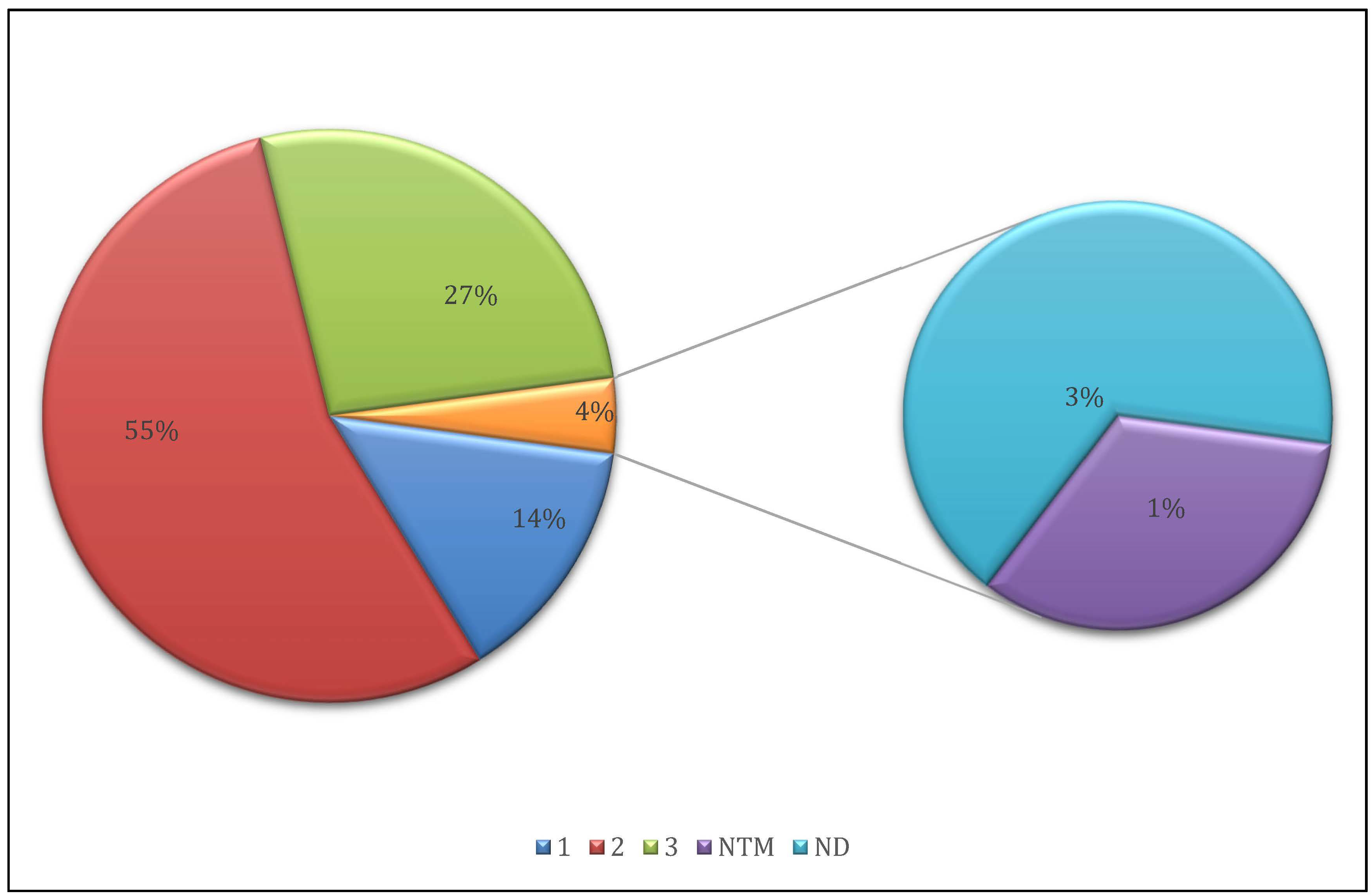
Run performance metrics showed that the percentage of clusters passing filter (PF) was 96.68% and 93.06% for runs 1 and 2, respectively, while the proportion of reads with Phred quality scores above Q30 reached 95.46% and 92.92%, respectively. FastQ files were generated for all samples and uploaded to the GenoScreen web application for automated processing. The platform assigned a sequencing quality score ranging from 1 to 3 for each sample based on data completeness and depth. Out of the 71 total samples, 39 (54.9%) were rated as quality score 2, 19 (26.8%) as score 3, and 10 (14.1%) as score 1. Three samples, 44, 49, and 51, were excluded from the final analysis due to failed MTB detection (samples 49 and 51) or the presence of non-tuberculous Mycobacteria (sample 44). Consequently, the final study cohort comprised 68 clinical samples (Figure 1).
Figure 1. The proportion of sequencing quality scores on 71 sequenced clinical samples. 1: All resistance-associated positions in the database with enough data to identify mutations from 80 to 100%; 2: All resistance-associated positions in the database with enough data to identify mutations from 10 to 100%; 3: All resistance-associated positions in the database with enough data to identify mutations from 3 to 100%; ND: Mycobacteria not detected; NTM: Non-tuberculous mycobacteria detected.

3.2. Mapping and Coverage Statistics

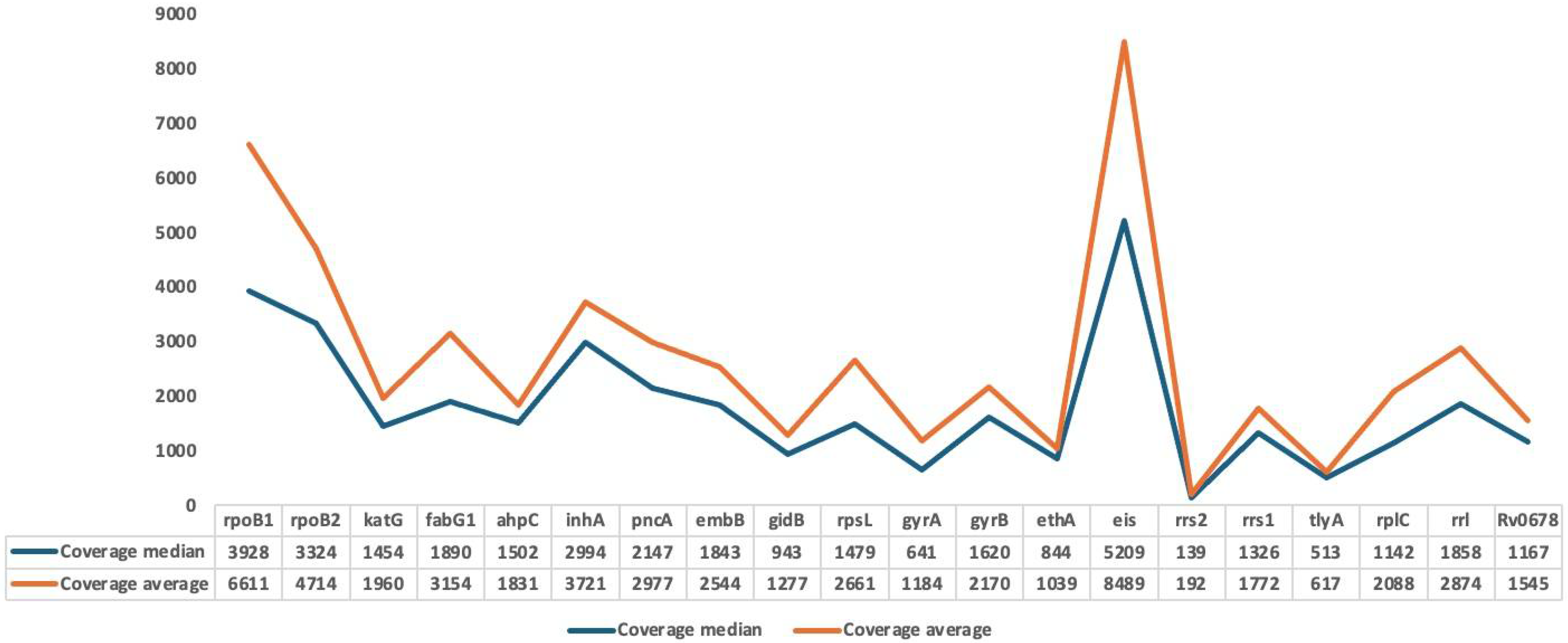
Sequence reads were aligned to the M. tuberculosis H37Rv reference genome using the GenoScreen pipeline. The mean genome coverage breadth across the 68 samples was 99.8%, indicating near-complete representation of the targeted genomic regions (Supplementary Table S1). Depth of coverage ranged from 267× to 32,724×, with a mean depth of 4123× and a median of 2263×. The three excluded samples exhibited insufficient median coverage (<50×), supporting their exclusion. Gene-specific coverage analysis showed the rrs gene had the lowest median coverage (139×) while the eis gene had the highest (5209×), with an overall median coverage of 1798× across all targeted genes (Figure 2, Supplementary Table S2).
Figure 2. Coverage depth per targeted gene in 71 sequenced clinical Mycobacterium tuberculosis isolates.

3.3. Drug Resistance Profiles

Among the 68 sequenced MTB clinical isolates, 17 (25%) were fully susceptible, with no resistance-associated or uncharacterized variants detected (Supplementary Table S3). The remaining 51 isolates (75%) harbored resistance-associated variants (RVs), with or without additional uncharacterized variants (UVs). Among these, 40 isolates (78.4%) were classified as multidrug-resistant tuberculosis (MDR-TB), including 13 isolates (32.5%) meeting the definition of pre-extensively drug-resistant TB (pre-XDR-TB). An additional 7 isolates (13.7%) carried RVs conferring resistance to one or more drugs without fulfilling the criteria for MDR or pre-XDR. In total, 47 isolates were considered drug-resistant based on the presence of RVs, affecting 11 out of the 18 resistance-associated genetic targets covered by the Deeplex-MycTB assay.

3.4. Resistance by Drug Class

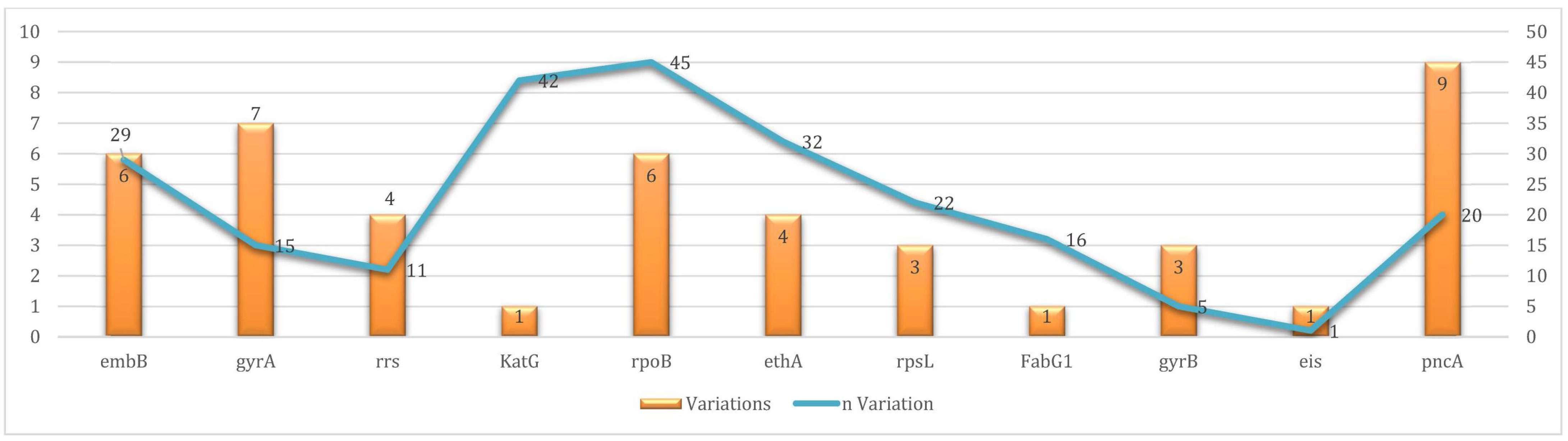
Resistance to first-line drugs, as defined by the WHO (rifampicin, isoniazid, pyrazinamide, and ethambutol), was commonly detected. Five distinct mutations were identified in the rpoB gene among 40 rifampicin-resistant isolates, with S450L being the most prevalent (31/40; 77.5%). For isoniazid, the S315T mutation in katG was detected in all 42 resistant isolates, while the C-15T mutation in fabG1 (genomic position 1,673,425) was present in 16 isolates. No RVs were observed in ahpC or inhA. Pyrazinamide resistance was linked to nine mutations in pncA and detected in 18 isolates, with D8E (5 cases) and a deletion at position 2,289,010 (6 cases) being the most frequent. Ethambutol resistance was associated with six embB mutations found in 28 isolates, including M306V (10 isolates) and Q497K (9 isolates).
For WHO Group A drugs (fluoroquinolones, bedaquiline, and linezolid), resistance was observed in 13 isolates carrying mutations in gyrA. Seven distinct mutations were identified in this gene, with D49G being the most common (4 cases). These 13 isolates were classified as pre-XDR-TB, based on resistance to both rifampicin and a Group A drug (fluoroquinolone). No resistance-associated mutations were identified in rrl, rplC, Rv0678, or atpE, and no confirmed mutations linked to bedaquiline, clofazimine, or linezolid resistance were detected.
Among WHO Group C drugs, streptomycin resistance was conferred by three mutations in rpsL, with K88R and K43R detected in 13 and 8 isolates, respectively. Ethionamide resistance was associated with four mutations in ethA, found in 32 isolates, including a delCACGTCG event in 15 isolates and a deletion at genomic position 4,327,367 in 10 isolates. The C-14T mutation in eis, which is associated with low-level kanamycin resistance, was observed in one isolate. Seven UVs were identified in the rrs gene in a single isolate, but due to low sequencing depth, resistance to high-level injectable agents such as amikacin and capreomycin could not be confirmed in this case (Figure 3, Table 1 and Table 2).
Figure 3. Prevalence of resistance variations per targeted gene in 68 sequenced clinical Mycobacterium tuberculosis isolates.
Table 1. Summary of resistance-associated variants (RVs) and uncharacterized variants (UVs) detected by the Deeplex®-MycTB assay among 68 sequenced clinical isolates.
Table 2. Detailed prediction of drug resistance-associated variants by the Deeplex-MycTB assay for 68 sequenced clinical samples.

3.5. Uncharacterized Variants (UVs)

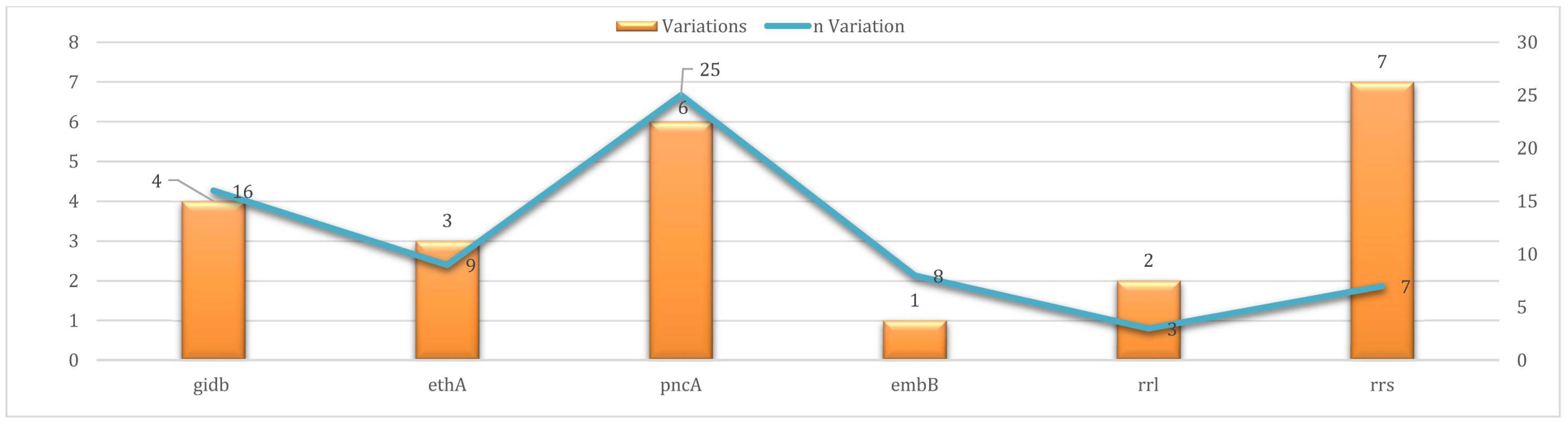
A total of 23 uncharacterized variants were identified across six resistance-associated genes: pncA, embB, gidB, ethA, rrs, and rrl. In pncA, six distinct UVs were found in 25 isolates (36.8%), with T142R being the most frequently observed (14 isolates), followed by V163G and C72Y (3 isolates each), D49Y and H57Q (2 isolates each), and A171T in 1 isolate. The embB gene harbored a single UV, N296H, which was consistently found in eight isolates. In gidB, four UVs were detected in 16 isolates, with Y22Stop being identified in 7 cases and inserC4407856 in 6. The ethA gene contained three UVs found in nine isolates, including Q271Stop in five of them. Seven UVs were also observed in the rrs gene within a single isolate, although low sequencing depth limited interpretation. Finally, two UVs were identified in the rrl gene among three isolates, at genomic positions 1,476,007 and 1,476,251. These rrl mutations have not been definitively associated with alterations in ribosomal function or with linezolid resistance. Most of the UVs were associated with genes linked to resistance to Group C drugs, particularly ethionamide, streptomycin, and aminoglycosides (Figure 4, Table 3).
Figure 4. Prevalence of uncharacterized variations per targeted gene in 68 sequenced clinical Mycobacterium tuberculosis isolates.
Table 3. Detailed prediction of uncharacterized variants by the Deeplex-MycTB assay for 68 sequenced clinical samples.

3.6. Concordance Between Phenotypic and Genotypic Testing

Phenotypic drug susceptibility testing (pDST) was performed in parallel with tNGS for all 68 isolates. A perfect concordance (100%) was observed for rifampicin and isoniazid resistance. All 40 isolates with rpoB mutations were phenotypically resistant to rifampicin, and all 42 isolates carrying mutations in katG and/or fabG1 were phenotypically resistant to isoniazid. These results confirm the strong predictive value of genotypic testing for first-line drug resistance in this cohort (Table 4).
Table 4. Concordance between phenotypic drug susceptibility testing (PDST) and targeted next-generation sequencing (tNGS) for rifampicin and isoniazid resistance in 68 Mycobacterium tuberculosis clinical isolates.

3.7. Statistical Analysis of Variant Distribution

Chi-square (Chi2) tests were conducted to assess the distribution patterns of RVs and UVs across genes and drug categories. A significant difference was found in the distribution of RVs and UVs at the gene level (Chi2 = 110.6; p < 0.0001). Genes such as katG, pncA, and embB showed the highest frequency of RVs, while pncA, embB, and ethA carried the highest burden of UVs. A statistically significant difference was also observed at the drug group level when comparing first-line, XDR-related, and Group C drugs (Chi2 = 7.53; p = 0.023). First-line drugs were predominantly associated with RVs, whereas Group C drugs showed a notable accumulation of UVs.
A highly significant association was observed between mutation type and gene (Chi2 = 958.8; p < 0.0001). Certain mutations were strongly gene-specific, including S315T in katG (42 isolates), S450L in rpoB (31 isolates), delCACTGGT in ethA (15 isolates), and K88R in rpsL (13 isolates). This gene-specific clustering of mutations supports the evolutionary and functional relevance of these canonical variants.

3.8. Phylogenetic Analysis and Lineage Distribution

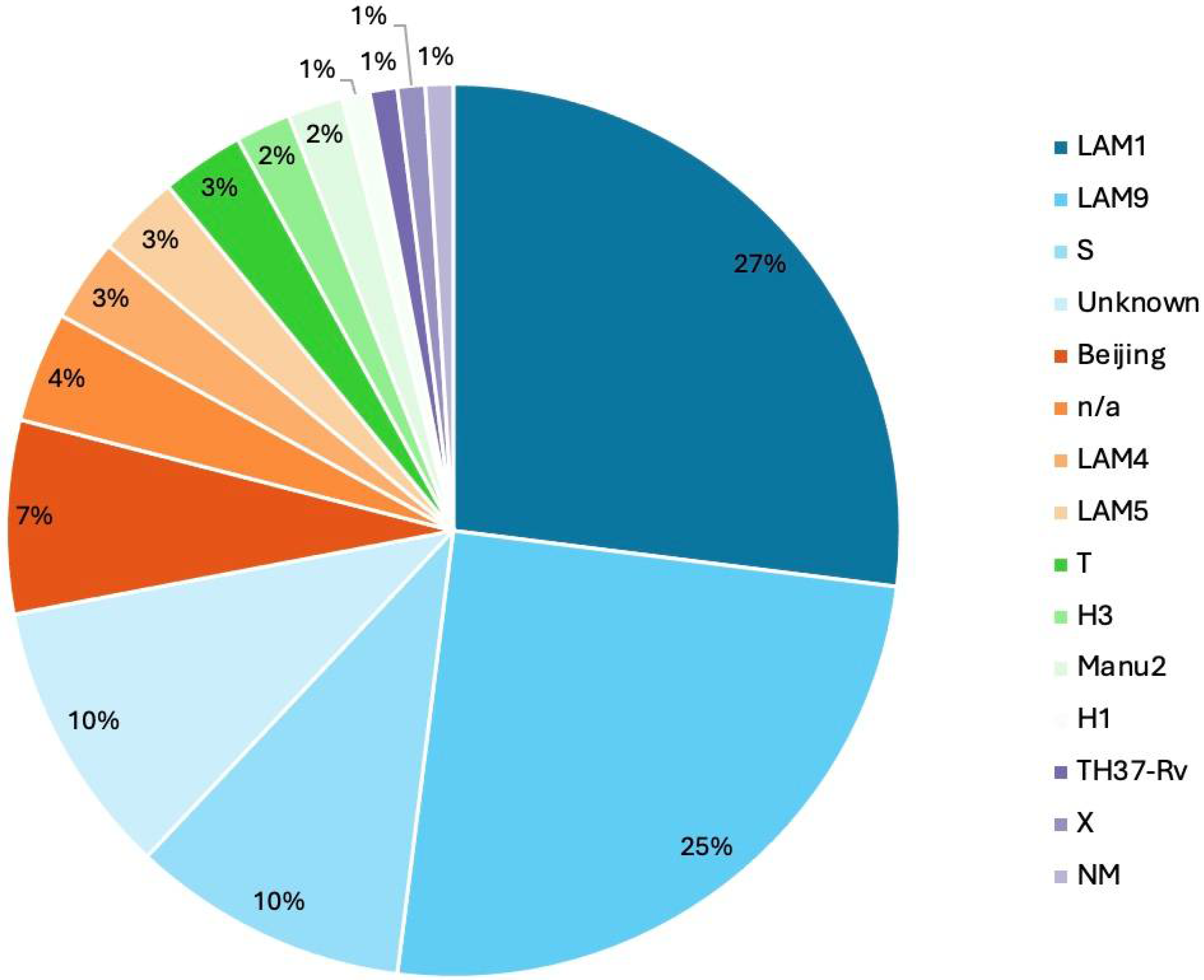
SNP-based phylogenetic analysis of the 68 clinical MTB isolates revealed 15 distinct spoligotype-defined clades. The most prevalent were clades T (26.8%) and LAM9 (25.4%), followed by clade S (9.9%). The Beijing clade was observed in 5 isolates (7.4%), while clades H1, H3, and Manu2 were each found in 2 isolates (2.9%). Single isolates belonged to the X, LAM1, LAM4, LAM5, and H37Rv clades (1.5% each). Seven isolates could not be conclusively assigned to a spoligotype-defined clade due to incomplete lineage-defining mutations (Figure 5 and Figure 6 Among the same cohort, 11 potential mixed infections (16.2%) were identified based on the detection of lineage-defining mutations with variant allele frequencies below 95% (Table 5).
Figure 5. The proportion of classification by the lineage of Mycobacterium tuberculosis isolates from 68 sequenced clinical samples.
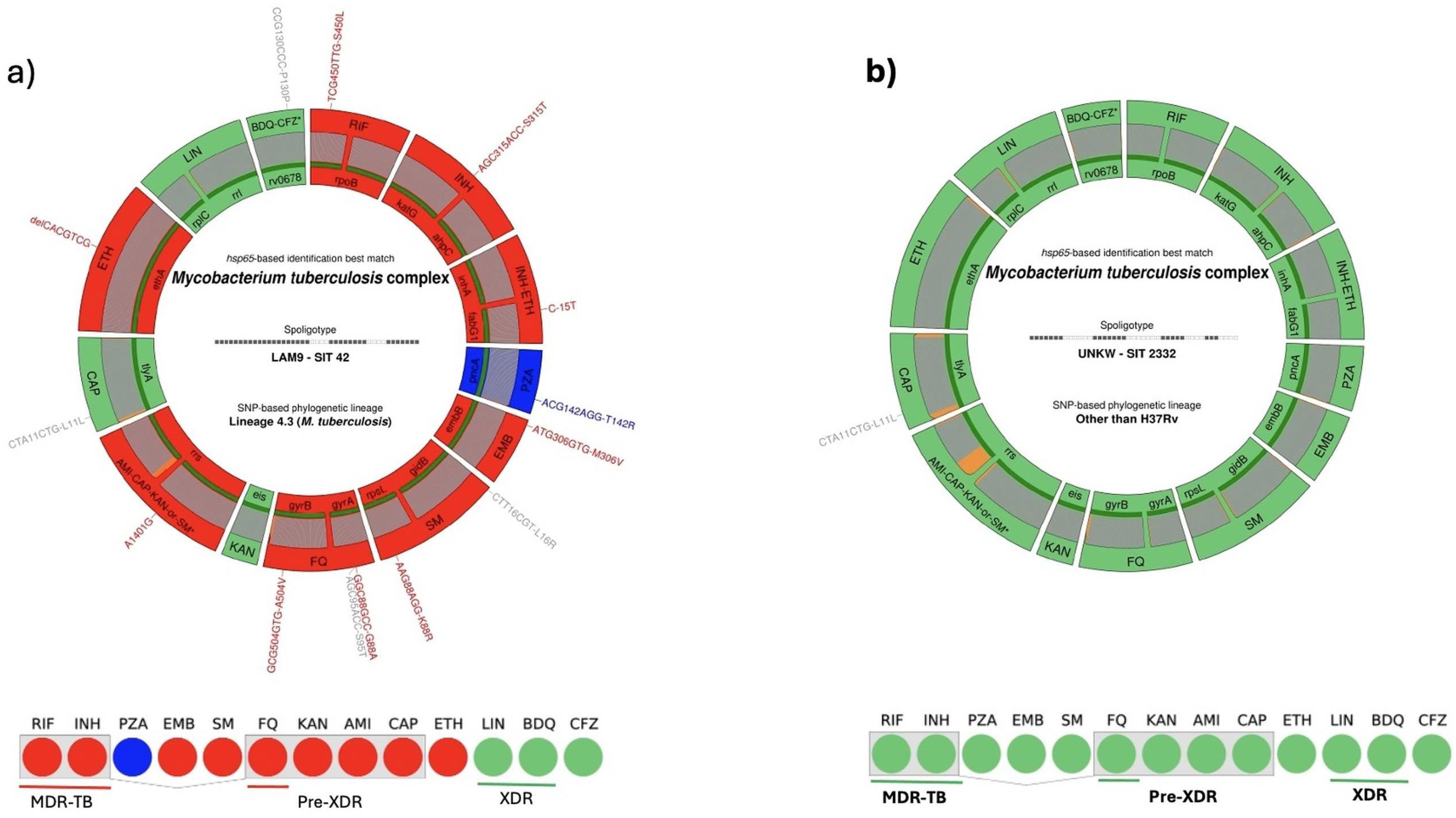
Figure 6. Drug resistance and lineage profiles of two Mycobacterium tuberculosis clinical isolates from Moroccan patients by the WHO-endorsed tNGS assay, Deeplex-MycTB (GenoScreen). Circular plots summarize for each isolate the species identity, spoligotype, phylogenetic lineage, and resistance-associated mutations across 13 anti-tuberculosis drugs. Each concentric ring represents one drug, with resistance-conferring mutations highlighted in red (high-confidence), blue (intermediate-confidence), and green (susceptible/wild-type). Bottom legends indicate MDR, Pre-XDR-TB, and XDR classification status. (a) Isolate belonging to the LAM9 sublineage (SIT 42, Lineage 4) shows mutations conferring resistance to RIF, INH, PZA, EMB, SM, FQ, KAN, and AMI, classifying it as Pre-XDR-TB. (b): Fully susceptible isolates of T1 (SIT 33) lineage, with no mutations detected in any drug-resistant genes.
Table 5. Detailed phylogeny for 40 MDR/pre-XDR clinical samples.
At the lineage level, 32 isolates (47.1%) were classified as L4.3 (Euro-American), 6 (8.8%) as L2 (Beijing), and 30 (44.1%) as belonging to other/unassigned lineages (Figure 5, Table 6).
Table 6. Spoligotype clade/lineage correlation of Mycobacterium tuberculosis isolates from 68 sequenced clinical samples.

3.9. Clade–Lineage Correlation in Drug-Resistant Samples

Among the 40 multidrug-resistant (MDR) isolates, clades T and LAM9 were most frequently observed, accounting for 12 (30.0%) and 11 (27.5%) samples, respectively. Other clades included S (12.5%), Beijing (10.0%), and Manu2 (5%). Two MDR samples had unknown clade classification, and one was unassigned. Within the MDR group, 13 isolates (32.5%) met the criteria for Pre-XDR. In this Pre-XDR subset, lineage–clade correlation showed that 5 (38.5%) belonged to the L4.3/LAM9 group and 4 (30.8%) to the S clade, with no single spoligotype or lineage predominating.
Chi2 tests revealed no statistically significant association between SNP-defined lineages and either MDR status (χ2 = 2.31, p = 0.315) or Pre-XDR status (χ2 = 1.95, p = 0.377). Observed lineage proportions deviated only slightly from expected values under the null hypothesis. Similarly, analysis of spoligotype-defined clades showed that MDR prevalence exceeded 84% across all major clades and reached 100% in Beijing, LAM1, H1, and Manu2. In contrast, the prevalence of Pre-XDR remained low overall, with the highest frequency observed in the LAM9 clade (~7.7%). Bar plots further confirmed that resistance to fluoroquinolones and Group A/B drugs (LIN/BDQ/CFZ) was sporadic across clades, supporting the absence of any dominant Pre-XDR-associated lineage or clade (Figure 6, Table 5 and Table 7, Supplementary Table S4).
Table 7. Spoligotype clade/lineage correlation of Mycobacterium tuberculosis complex among 40 mdr-tb clinical samples from 68 sequenced clinical samples.

4. Discussion

Our study provides a comprehensive molecular characterization of MTB using the Deeplex-MycTB targeted sequencing panel. The sequencing runs achieved high-quality metrics (clusters passing filter >93%, Q30 >92%), which translated into exceptional genome coverage breadth (99.8%) and depth (median XP ~2263×). This depth allowed confident detection of low-frequency alleles and mixed infections, aligning with previous targeted sequencing validation efforts. Three samples were excluded due to poor mapping metrics, reinforcing the need for strict QC in clinical sequencing workflows [18].
With 71 clinical isolates analyzed, including 68 passing rigorous quality control (QC), we observed a high prevalence of drug resistance associated with both canonical mutations and novel variants. For instance, in the rpoB gene, five distinct mutations were identified across 40 MTB isolates. The most prevalent was the S450L substitution, detected in 31 samples (77.5%) which is consistent with our earlier findings on the same cohort using High-Resolution Melting (HRM) analysis followed by Sanger sequencing confirmation [19]. Bentaleb et al. (2017) [18] study specifically targeted the most commonly mutated codons within the rifampicin resistance-determining region (RRDR), namely codons 516, 526, and 531. However, among the 45 phenotypically rifampicin-monoresistant isolates confirmed by Löwenstein–Jensen (LJ) culture, five were identified as genotypically wild-type by HRM, thus reducing the sensitivity of the HRM assay [19]. Indeed, the Deeplex-based tNGS employed in the present study successfully resolved these discrepancies, identifying 5 additional mutations: H445Y (n = 3) and V170F (n = 2). Notably, the V170F mutation, although located outside the RRDR, is a well-documented contributor to discordant rifampicin resistance cases, as previously reported by Solari et al., 2020 [19], and Merker et al., 2021 [20]. Globally, V170F was observed in approximately 1–2% of RIF-resistant strains, indicating a relatively low but regionally significant prevalence [21,22]. To our knowledge, this is the first report to describe the V170F mutation in clinical isolates from Morocco. Its detection highlights the need for expanded molecular surveillance to assess its distribution and evolutionary dynamics within the region. Large-scale, geographically diverse studies will be essential to elucidate the prevalence and potential public health impact of this SNP in North African TB settings.
Moreover, several resistance-associated mutations were identified in MTB clinical isolates. Most notably, the N296H substitution in the embB gene was frequently observed and is a well-documented mutation associated with resistance to ethambutol (EMB) [23]. This mutation has been classified as “Associated with Resistance” by the WHO mutation catalog and is frequently detected in clinical EMB-resistant strains [24]. Similarly, multiple nonsynonymous mutations were detected in the pncA gene, including T142R, V163G, A171T, D49Y, H57Q, and C72Y. These mutations are distributed throughout the gene, which is consistent with the known high diversity of pncA mutations conferring pyrazinamide (PZA) resistance, as outlined in several studies [25,26] and listed in the WHO catalog. PZA plays a pivotal role in standard TB regimens by targeting persistent bacilli; resistance undermines treatment efficacy and prognosis. Our data revealed a broad spectrum of pncA mutations, including several previously reported and others classified as uncharacterized (UVs).
The diversity and gene-specific distribution of uncharacterized variants were further analyzed statistically, revealing a significant difference across resistance-associated genes (Chi2 = 12.83, p = 0.025), with pncA and rrs harboring the highest number of UVs. Moreover, the overall gene–mutation specificity was confirmed by a highly significant chi-square test (Chi2 = 958.8; p < 0.0001), supporting a non-random and functionally structured evolution of resistance.
The recurrence of these UVs, particularly within key resistance determinants, raises critical questions about their biological significance. While their clinical impact remains uncertain, their consistent presence in resistance-associated loci suggests they may either reflect emerging resistance mechanisms, compensatory mutations, or lineage-specific polymorphisms. The WHO mutation catalog emphasizes that such variants should not be automatically linked to resistance without robust phenotypic or functional validation [24]. Nevertheless, their repeated detection across studies, including ours, highlights a potential gap in current reference databases and underscores the need for systematic reporting. Importantly, the high prevalence of UVs in pncA mirrors the gene’s intrinsic mutational diversity, known to complicate the molecular prediction of pyrazinamide resistance. This phenomenon may partially explain discordances observed between genotypic and phenotypic testing in various settings [27,28,29,30]. Similarly, UVs in genes like gidB, rrs, and rrl, although less frequent, warrant further investigation, especially considering their potential to contribute to low-level resistance or diagnostic ambiguity.
The L397P mutation in ethA, a gene involved in the activation of ethionamide (ETH), was also detected and is included in the WHO database as a resistance-associated variant. Mutations in ethA can lead to loss of prodrug activation, thereby conferring ETH resistance [31]. In addition, multiple mutations in gidB (e.g., L44P, Y22Stop, and insertC) were observed. These mutations are frequently associated with low-level resistance to streptomycin (SM) and have been previously reported in resistant strains, though often not sufficient alone to confer high-level resistance [24,32].
Furthermore, some mutations identified in rrs (e.g., A1278T and insertions) and rrl (T2350G, T2594C) were not listed in the WHO catalog. These positions lie outside the canonical hotspots known for aminoglycoside resistance (such as A1401G, C1402T, and G1484T in rrs) and thus require further investigation. Their clinical relevance remains uncertain and should be validated through functional assays or MIC correlation studies.
Several of these insertions and deletions, such as insertC, delC, and delCACTGGT, detected in pncA, ethA, and rrs, represent structural variations that may be overlooked in standard SNP-based diagnostics. Their presence highlights the need to expand predictive tools and leverage approaches such as CRISPR interference or deep mutational scanning to better understand their phenotypic impact.
Notably, all resistance-associated mutations identified by Deeplex-MycTB were also detected by a whole-genome sequencing (WGS) conducted independently on the same set of isolates, demonstrating complete concordance between the two methods. This strong agreement underscores the reliability of targeted sequencing not only for detecting resistance but also for confidently identifying uncharacterized or rare mutations. The raw WGS reads supporting this validation are publicly available in the NCBI Sequence Read Archive under BioProject accession number PRJNA1048908.
In our study, 47 out of 68 MTB isolates (69.1%) harbored resistance-associated variants (RVs) and were therefore classified as drug-resistant. This group included 40 multidrug-resistant (MDR) isolates (58.8%), of which 13 (32.5% of MDR cases) met the criteria for pre-extensively drug-resistant TB (pre-XDR-TB), and 7 isolates (10.3%) carried RVs conferring resistance to one or more drugs without meeting MDR or pre-XDR definitions. These drug-resistant variants affected 11 out of the 18 resistance-associated genetic targets covered by the Deeplex-MycTB assay. In several cases, RVs co-occurred with uncharacterized variants (UVs), whose clinical impact remains uncertain. While UVs were not used for resistance classification, their frequent co-detection with RVs in key resistance loci highlights the importance of ongoing catalog updates and functional validation efforts.
In our study, mixed MTB infections were detected in 16.2% of clinical samples, a prevalence consistent with reports from high-burden settings (Table 8) [33,34]. Mixed infections (defined as co-infection with genetically distinct MTB strains within the same host) pose important clinical and public health challenges. They may involve both drug-susceptible and drug-resistant strains, potentially undermining the efficacy of standard treatment regimens and increasing the risk of treatment failure, relapse, or acquired resistance due to selective pressure during therapy [34]. Additionally, the presence of minority resistant subpopulations can compromise both molecular and phenotypic drug susceptibility testing (DST), leading to false-negative results and inappropriate treatment decisions [34]. A recent study from Uganda demonstrated that mixed infections could reduce the sensitivity of widely used molecular assays such as GeneXpert, further complicating the clinical management of MDR-TB [35]. These infections may also modulate host immune responses, increase susceptibility to reinfection, and alter disease progression dynamics [36,37].
Table 8. The proportion of mixed infections on 68 sequenced clinical samples.
Given these complexities, the ability to detect mixed strain infections is essential for accurate diagnosis and tailored treatment. Traditional genotyping tools such as spoligotyping and MIRU-VNTR have historically provided insights into strain diversity and transmission patterns, with MIRU-VNTR being widely used for identifying mixed infections [38]. However, targeted deep sequencing technologies like the WHO-endorsed Deeplex-MycTB assay offer superior resolution, enabling detection of minority variants at frequencies as low as 1%. In our study, this approach proved instrumental in uncovering heterogeneous mutations in pncA and other genes, suggesting the coexistence of pyrazinamide-resistant and -susceptible bacilli within the same host. Such heterogeneity has significant clinical implications, as it may compromise treatment efficacy and facilitate the selection of resistant clones under drug pressure [24,39,40,41]. Although the retrospective design of our study precluded assessment of clinical outcomes, our findings underscore the relevance of high-resolution sequencing for both clinical and surveillance purposes. Future research should focus on systematically mapping mixed infection patterns across regions and timeframes in Morocco to better understand transmission dynamics and support targeted public health interventions.
The use of targeted deep sequencing in our analysis was instrumental in detecting minority variants with frequencies as low as 1%, revealing genetic heterogeneity that would likely have been missed by conventional DST or genotyping methods. In particular, we observed heterogeneous pncA mutations in several mixed infections, suggesting the simultaneous presence of both PZA-resistant and PZA-susceptible bacilli. This scenario complicates clinical decision-making, as standard regimens may not fully eradicate resistant subpopulations, thereby increasing the likelihood of selection under drug pressure [39,40].
The high concordance observed between phenotypic drug susceptibility testing (pDST) and targeted next-generation sequencing (tNGS) for rifampicin and isoniazid resistance in our study underscores the clinical relevance of mutations in rpoB, katG, and fabG1 genes. All isolates harboring mutations in these targets exhibited phenotypic resistance, supporting their role as key molecular markers for first-line drug resistance detection. These findings align with earlier reports showing a strong agreement between molecular detection of rpoB mutations and phenotypic rifampicin resistance [3,4,5]. Likewise, the frequent occurrence of the katG S315T mutation among isoniazid-resistant strains confirms its predictive value, as emphasized in the WHO mutation catalog and studies on isoniazid and ethionamide resistance [23,30]. Additionally, mutations in the fabG1-inhA promoter region, associated with low-level isoniazid resistance, further support their inclusion in resistance prediction panels [30]. Our data strengthen the role of the Deeplex-MycTB assay as a reliable tool for rapid detection of first-line drug resistance in clinical practice.
Of the 68 MTB isolates investigated in this study, 47 (69.1%) harbored resistance-associated variants (RVs) and were thus classified as drug-resistant. This included 40 MDR-TB isolates and 13 that met the pre-XDR criteria. Lineage analysis revealed a predominance of Lineage 4.3, with the LAM and T subclades collectively representing 69% (n = 36/52) of all MDR/pre-XDR isolates. The LAM9 sublineage was particularly overrepresented, suggesting local clonal expansion of resistant strains in Morocco.
However, statistical analysis failed to identify any significant association between lineage (or clade) and MDR or pre-XDR classification, suggesting that resistance acquisition in this setting is not confined to specific phylogenetic backgrounds. These results are in line with recent WHO reports [1] and studies such as Merker et al. [20] which suggest that drug resistance can emerge independently across lineages, influenced more by treatment pressure and antibiotic availability than by lineage-specific mechanisms.
Notably, only a small proportion of the sequenced isolates (5 out of 68; 7.4%) belonged to the Beijing lineage, reflecting its limited circulation in Morocco. This low prevalence contrasts with global reports associating Beijing strains with increased transmissibility and drug resistance, particularly in Asia and Eastern Europe. Our findings are consistent with previous molecular epidemiological studies conducted in Morocco, which have repeatedly shown the predominance of Euro-American lineages, especially LAM and T families, and only sporadic detection of Beijing strains. For instance, Lahlou et al. [42] and Chaoui et al. [43] reported LAM as the most prevalent lineage in both drug-susceptible and resistant TB isolates, while Beijing strains were rarely observed [42,43]. More recently, Oudghiri et al. confirmed this trend among MDR and pre-XDR isolates from Casablanca, highlighting the genotypic diversity within LAM sublineages and the persistent underrepresentation of Beijing strains in the Moroccan context [44].
Although our data contribute to the understanding of drug resistance dynamics in Morocco, several limitations must be acknowledged. First, the isolates analyzed were collected between 2013 and 2016. While this period provided a valuable historical snapshot, it may not fully reflect recent trends in drug resistance evolution, especially with the emergence of bedaquiline and linezolid resistance. Continuous and updated surveillance efforts are needed to assess the current landscape and track the emergence of new resistance patterns.
Second, although sequencing coverage was generally excellent across most targets, certain loci such as rrs exhibited relatively lower coverage. This could have limited our ability to detect low-frequency variants or structural mutations within these genes, which are important for resistance to aminoglycosides and capreomycin. Ensuring uniform target enrichment across all loci remains a technical challenge in amplicon-based sequencing platforms.
Third, our study was conducted using isolates collected at a single reference center in Casablanca, Morocco’s largest urban area and a national TB hotspot. While Casablanca reflects a high-incidence context, it may not capture the full diversity of circulating strains and resistance profiles across other Moroccan regions, including rural and peripheral settings. Moreover, as a tertiary referral center, there is potential for selection bias toward more severe or drug-resistant cases. Therefore, multicenter and prospective sampling approaches are warranted to validate our findings at the national level.
Finally, although the Deeplex-MycTB platform is a powerful tool, its interpretive capacity remains partly limited by the scope and completeness of existing mutation catalogs. As shown in our study, several recurrent mutations, particularly uncharacterized variants (UVs) and structural alterations, remain unclassified in WHO and other databases, highlighting an urgent need for curated region-specific entries and high-throughput functional validation pipelines.

5. Conclusions

Our study highlights the utility of tNGS for comprehensive characterization of drug resistance and strain diversity among MTB isolates in Morocco. Beyond its diagnostic value, tNGS holds promise for refining treatment strategies and enhancing surveillance. However, the broader implementation of such approaches in resource-limited settings like Morocco remains challenged by cost, infrastructure, and workforce training requirements. Coordinated efforts are needed to reduce costs, develop accessible platforms, and strengthen molecular surveillance capacity to facilitate the integration of tNGS into national tuberculosis control programs [45,46].
Future studies combining prospective clinical data, functional analyses of uncharacterized variants, and large-scale surveillance will be essential to fully harness the potential of targeted sequencing for tuberculosis control and patient care.

Supplementary Materials

The following supporting information can be downloaded at: https://www.mdpi.com/article/10.3390/microorganisms13092163/s1. Table S1: Sequencing metrics by samples. Table S2: Median depth of coverage per gene targeted by the Deeplex-MycTB assay across samples. Table S3. Graphical summary of resistance prediction by the Deeplex -MycTB assay for 71 sequenced clinical samples. Table S4. Detailed phylogenetic analysis of 71 clinical samples by the Deeplex®-MycTB assay.

Author Contributions

S.L. carried out the experiments, curated the data, and drafted the original manuscript. S.E.K. and E.M.B. contributed to the experimental work and participated in drafting the manuscript. M.D.E.M. supervised the sampling and experimental procedures and revised the manuscript. J.I., B.B., A.F.-M. and H.A.B. conceived and designed the study, supervised the project, and critically revised the manuscript. All authors have read and agreed to the published version of the manuscript.

Funding

This research was funded by VLIRUOS program (Belgium), Grant number MA2020SIN288A104 and the MAScIR Foundation.

Institutional Review Board Statement

The study is a retrospective study.

Data Availability Statement

The original contributions presented in this study are included in the article/Supplementary Material. Further inquiries can be directed to the corresponding authors.

Acknowledgments

The authors thank the VLIRUOS program.

Conflicts of Interest

The authors declare no conflicts of interest.

Abbreviations

The following abbreviations are used in this manuscript:
TBTuberculosis
WHO World Health Organization
NGSNext-Generation Sequencing
HRMHigh-Resolution Melting Curve
LJLöwenstein–Jensen
RRDRRifampicin Resistance-Determining Region
MTBCMycobacterium Tuberculosis Complex
XDR-TBExtensively Drug-Resistant TB
Pre- XDPre-extensively Drug-Resistant TB
MDR-TBMultidrug-Resistant
RIFRifampicin
AAAmino Acid
INHIsoniazid
PZAPyrazinamide
EMBEthambutol
SMStreptomycin
FQFluoroquinolones
ETHEthionamide
PTHProthionamide
KANKanamycin
AMIAmikacin
CAPCapreomycin
LINLinezolid
BDQBedaquiline
CFClofazimine
NTMNon-tuberculous Mycobacteria

References

  1. World Health Organization. Drug-Resistant TB. Available online: https://www.who.int/teams/global-programme-on-tuberculosis-and-lung-health/tb-reports/global-tuberculosis-report-2024/tb-disease-burden/ (accessed on 25 June 2025).
  2. Centers for Disease Control and Prevention. (n.d.); Clinical Overview of Drug-Resistant Tuberculosis Disease. Available online: https://www.cdc.gov/tb/hcp/clinical-overview/drug-resistant-tuberculosis-disease.html/ (accessed on 25 June 2025).
  3. Cho, E.H.; Bae, H.K.; Kang, S.K.; Lee, E.H. Detection of isoniazid and rifampicin resistance by sequencing of katG, inhA, and rpoB genes in Korea. Korean J. Lab. Med. 2009, 29, 455–460. [Google Scholar] [CrossRef] [PubMed][Green Version]
  4. Huang, W.-L.; Chen, H.-Y.; Kuo, Y.-M.; Jou, R. Performance assessment of the GenoType MTBDRplus test and DNA sequencing in detection of multidrug-resistant Mycobacterium tuberculosis. J. Clin. Microbiol. 2009, 47, 2520–2524. [Google Scholar] [CrossRef] [PubMed]
  5. Morgan, M.; Kalantri, S.; Flores, L.; Pai, M. A commercial line probe assay for the rapid detection of rifampicin resistance in Mycobacterium tuberculosis: A systematic review and meta-analysis. BMC Infect. Dis. 2005, 5, 62. [Google Scholar] [CrossRef] [PubMed]
  6. Tang, X.; Morris, S.L.; Langone, J.J.; Bockstahler, L.E. Microarray and allele specific PCR detection of point mutations in Mycobacterium tuberculosis genes associated with drug resistance. J. Microbiol. Methods 2005, 63, 318–330. [Google Scholar] [CrossRef]
  7. World Health Organization. The Use of Molecular Line Probe Assay for the Detection of Resistance to Isoniazid and Rifampicin. Available online: https://www.who.int/publications/i/item/9789241511261/ (accessed on 31 July 2025).
  8. World Health Organization. Xpert MTB/RIF Assay for the Diagnosis of Pulmonary and Extrapulmonary TB in Adults and Children. Available online: https://www.who.int/publications/i/item/9789241506335/ (accessed on 25 June 2025).
  9. World Health Organization. Next-Generation Xpert® MTB/RIF Ultra Assay Recommended by WHO. Available online: https://www.who.int/publications/i/item/9789240040090// (accessed on 25 June 2025).
  10. Chaudhary, R.; Bhatta, S.; Singh, A.; Pradhan, M.; Srivastava, B.; Singh, Y.I.; Sah, R.; Fathah, Z.; Mehta, R.; Rabaan, A.A.; et al. Diagnostic performance of GeneXpert MTB/RIF assay compared to conventional Mycobacterium tuberculosis culture for diagnosis of pulmonary and extrapulmonary tuberculosis, Nepal. Narra J. 2021, 1, e33. [Google Scholar] [CrossRef]
  11. Terzi, H.; Aydemir, Ö.; Karakeçe, E.; Demiray, T.; Köroğlu, M. Evaluation of the Xpert MTB/RIF test performance in the diagnosis of suspected Mycobacterium tuberculosis in pulmonary and extrapulmonary clinical specimens. Mediterr. J. Infect. Microbes Antimicrob. 2024, 13, 13. [Google Scholar] [CrossRef]
  12. El Achkar, S.; Demanche, C.; Osman, M.; Rafei, R.; Ismail, M.B.; Gaudin, C.; Duthoy, S.; De Matos, F.; Yaacoub, H.; Pinçon, C.; et al. Zoonotic tuberculosis in humans assessed by next-generation sequencing: An 18-month nationwide study in Lebanon. Eur. Respir. J. 2020, 55, 1900513. [Google Scholar] [CrossRef]
  13. Tagliani, E.; Hassan, M.O.; Waberi, Y.; De Filippo, M.R.; Falzon, D.; Dean, A.; Zignol, M.; Supply, P.; Abdoulkader, M.A.; Hassangue, H.; et al. Culture and next-generation sequencing-based drug susceptibility testing unveil high levels of drug-resistant TB in Djibouti: Results from the first national survey. Sci. Rep. 2017, 7, 17672. [Google Scholar] [CrossRef]
  14. Jouet, A.; Gaudin, C.; Badalato, N.; Allix-Béguec, C.; Duthoy, S.; Ferré, A.; Diels, M.; Laurent, Y.; Contreras, S.; Feuerriegel, S.; et al. Deep amplicon sequencing for culture-free prediction of susceptibility or resistance to 13 anti-tuberculous drugs. Eur. Respir. J. 2021, 57, 2002338. [Google Scholar] [CrossRef]
  15. Cabibbe, A.M.; Spitaleri, A.; Battaglia, S.; Colman, R.E.; Suresh, A.; Uplekar, S.; Rodwell, T.C.; Cirillo, D.M. Application of Targeted Next-Generation Sequencing Assay on a Portable Sequencing Platform for Culture-Free Detection of Drug-Resistant Tuberculosis from Clinical Samples. J. Clin. Microbiol. 2020, 58, e00632-20. [Google Scholar] [CrossRef]
  16. Meehan, C.J.; Goig, G.A.; Kohl, T.A.; Verboven, L.; Dippenaar, A.; Ezewudo, M.; Farhat, M.R.; Guthrie, J.L.; Laukens, K.; Miotto, P.; et al. Whole-genome sequencing of Mycobacterium tuberculosis: Current standards and open issues. Nat. Rev. Microbiol. 2019, 17, 533–545. [Google Scholar] [CrossRef]
  17. Centers for Disease Control and Prevention. (n.d.); Next Generation Sequencing (NGS) Quality Initiative. Available online: https://www.cdc.gov/lab-quality/php/ngs-quality-initiative/index.html (accessed on 31 July 2025).
  18. Bentaleb, E.M.; El Messaoudi, M.D.; Abid, M.; Messaoudi, M.; Yetisen, A.K.; Sefrioui, H.; Amzazi, S.; Benhassou, H.A. Plasmid-based high-resolution melting analysis for accurate detection of rpoB mutations in Mycobacterium tuberculosis isolates from Moroccan patients. BMC Infect. Dis. 2017, 17, 548. [Google Scholar] [CrossRef]
  19. Solari, L.; Santos-Lazaro, D.; Puyen, Z.M. Mutations in Mycobacterium tuberculosis isolates with discordant results for drug-susceptibility testing in Peru. Int. J. Microbiol. 2020, 2020, 8253546. [Google Scholar] [CrossRef]
  20. Merker, M.; Egbe, N.F.; Ngangue, Y.R.; Vuchas, C.; Kohl, T.A.; Dreyer, V.; Kuaban, C.; Noeske, J.; Niemann, S.; Sander, M.S. Transmission patterns of rifampicin resistant Mycobacterium tuberculosis complex strains in Cameroon: A genomic epidemiological study. BMC Infect. Dis. 2021, 21, 891. [Google Scholar] [CrossRef]
  21. Sandgren, A.; Strong, M.; Muthukrishnan, P.; Weiner, B.K.; Church, G.M.; Murray, M.B. Tuberculosis drug resistance mutation database. PLoS Med. 2009, 6, e1000002. [Google Scholar] [CrossRef] [PubMed]
  22. Zimenkov, D.V.; Kulagina, E.V.; Antonova, O.V.; Zhuravlev, V.Y.; Gryadunov, D.A. Simultaneous drug resistance detection and genotyping of Mycobacterium tuberculosis using a low-density hydrogel microarray. J. Antimicrob. Chemother. 2016, 71, 1520–1531. [Google Scholar] [CrossRef] [PubMed]
  23. World Health Organization. Catalogue of Mutations in Mycobacterium Tuberculosis Complex and Their Association with Drug Resistance (2nd ed.). Available online: https://www.who.int/publications/i/item/9789240082410 (accessed on 31 July 2025).
  24. Yadon, A.N.; Maharaj, K.; Adamson, J.H.; Lai, Y.-P.; Sacchettini, J.C.; Ioerger, T.R.; Rubin, E.J.; Pym, A.S. A comprehensive characterization of pncA polymorphisms that confer resistance to pyrazinamide. Nat. Commun. 2017, 8, 588. [Google Scholar] [CrossRef]
  25. Zignol, M.; Dean, A.S.; Alikhanova, N.; Andres, S.; Cabibbe, A.M.; Cirillo, D.M.; Dadu, A.; Dreyer, A.; Driesen, M.; Gilpin, C.; et al. Population-based resistance of Mycobacterium tuberculosis isolates to pyrazinamide and fluoroquinolones: Results from a multicountry surveillance project. Lancet Infect. Dis. 2016, 16, 1185–1192. [Google Scholar] [CrossRef]
  26. Ndawula, C.; Petra, N.P.; Wasswa, F.B.; Bazira, J. Prevalence and clinical implications of pyrazinamide resistance in newly diagnosed TB patients in Uganda. Infect. Drug Resist. 2025, 18, 1629–1635. [Google Scholar] [CrossRef]
  27. Khan, M.T.; Malik, S.I.; Ali, S.; Masood, N.; Nadeem, T.; Khan, A.S.; Afzal, M.T. Pyrazinamide resistance and mutations in pncA among isolates of Mycobacterium tuberculosis from Khyber Pakhtunkhwa, Pakistan. BMC Infect. Dis. 2019, 19, 116. [Google Scholar] [CrossRef] [PubMed]
  28. Shi, W.; Chen, J.; Zhang, S.; Zhang, W.; Zhang, Y. Identification of novel mutations in LprG (rv1411c), rv0521, rv3630, rv0010c, ppsC, and cyp128 associated with pyrazinoic acid/pyrazinamide resistance in Mycobacterium tuberculosis. Antimicrob. Agents Chemother. 2018, 62, e00430-18. [Google Scholar] [CrossRef] [PubMed]
  29. Shi, W.; Zhang, X.; Jiang, X.; Yuan, H.; Lee, J.S.; Barry, C.E., 3rd; Wang, H.; Zhang, W.; Zhang, Y. Pyrazinamide inhibits trans-translation in Mycobacterium tuberculosis. Science 2011, 333, 1630–1632. [Google Scholar] [CrossRef] [PubMed]
  30. Morlock, G.P.; Metchock, B.; Sikes, D.; Crawford, J.T.; Cooksey, R.C. ethA, inhA, and katG loci of ethionamide-resistant clinical Mycobacterium tuberculosis isolates. Antimicrob. Agents Chemother. 2003, 47, 3799–3805. [Google Scholar] [CrossRef]
  31. Wong, S.Y.; Lee, J.S.; Kwak, H.K.; Via, L.E.; Boshoff, H.I.M.; Barry, C.E., III. Mutations in gidB confer low-level streptomycin resistance in Mycobacterium tuberculosis. Antimicrob. Agents Chemother. 2011, 55, 2515–2522. [Google Scholar] [CrossRef]
  32. Zetola, N.M.; Shin, S.S.; Tumedi, K.A.; Moeti, K.; Ncube, R.; Nicol, M.; Collman, R.G.; Klausner, J.D.; Modongo, C.; Land, G.A. Mixed Mycobacterium tuberculosis complex infections and false-negative results for rifampin resistance by genexpert MTB/RIF are associated with poor clinical outcomes. J. Clin. Microbiol. 2014, 52, 2422–2429. [Google Scholar] [CrossRef]
  33. Cohen, T.; van Helden, P.D.; Wilson, D.; Colijn, C.; McLaughlin, M.M.; Abubakar, I.; Warren, R.M. Mixed-strain Mycobacterium tuberculosis infections and the implications for tuberculosis treatment and control. Clin. Microbiol. Rev. 2012, 25, 708–719. [Google Scholar] [CrossRef]
  34. Van Rie, A.; Victor, T.C.; Richardson, M.; Johnson, R.; Van Der Spuy, G.D.; Murray, E.J.; Beyers, N.; Van Pittius, N.C.G.; Van Helden, P.D.; Warren, R.M. Reinfection and Mixed Infection Cause Changing Mycobacterium tuberculosis Drug-Resistance Patterns. Am. J. Respir. Crit. Care Med. 2005, 172, 636–642. [Google Scholar] [CrossRef]
  35. Komakech, K.; Nakiyingi, L.; Fred, A.; Achan, B.; Joloba, M.; Kirenga, B.J.; Ssengooba, W. Effect of mixed Mycobacterium tuberculosis infection on rapid molecular diagnostics among patients starting MDR-TB treatment in Uganda. BMC Infect Dis. 2024, 24, 70. [Google Scholar] [CrossRef] [PubMed]
  36. Warren, R.M.; Victor, T.C.; Streicher, E.M.; Richardson, M.; van der Spuy, G.D.; Johnson, R.; Chihota, V.N.; Locht, C.; Supply, P.; van Helden, P.D.; et al. Clonal expansion of a globally disseminated lineage of Mycobacterium tuberculosis with low IS6110 copy numbers. J. Clin. Microbiol. 2004, 42, 5774–5782. [Google Scholar] [CrossRef]
  37. Thwaites, G.E.; Chau, T.T.H.; Stepniewska, K.; Phu, N.H.; Chuong, L.V.; Sinh, D.X.; White, N.J.; Parry, C.M.; Farrar, J.J. Diagnosis of adult tuberculous meningitis by use of clinical and laboratory features. Lancet 2002, 360, 1287–1292. [Google Scholar] [CrossRef]
  38. Ghosh, S.; Moonan, P.K.; Cowan, L.; Grant, J.; Kammerer, S.; Navin, T.R. Tuberculosis Genotyping Information Management System: Enhancing Tuberculosis Surveillance in the United States. Infect. Genet. Evol. 2012, 12, 782–788. [Google Scholar] [CrossRef] [PubMed]
  39. Lukoye, D.; Adatu, F.; Musisi, K.; Kasule, G.W.; Were, W.; Odeke, R.; Kalamya, J.N.; Awor, A.; Date, A.; Joloba, M.L.; et al. Anti-tuberculosis drug resistance among new and previously treated sputum smear-positive tuberculosis patients in Uganda: Results of the first national survey. PLoS ONE 2013, 8, e70763. [Google Scholar] [CrossRef]
  40. Nimmo, C.; Shaw, L.P.; Doyle, R.; Williams, R.; Brien, K.; Burgess, C.; Breuer, J.; Balloux, F.; Pym, A.S. Whole genome sequencing Mycobacterium tuberculosis directly from sputum identifies more genetic diversity than sequencing from culture. BMC Genom. 2019, 20, 389. [Google Scholar] [CrossRef]
  41. Cabibbe, A.M.; Walker, T.M.; Niemann, S.; Cirillo, D.M. Whole genome sequencing of Mycobacterium tuberculosis. Eur. Respir. J. 2018, 52, 1801163. [Google Scholar] [CrossRef]
  42. Lahlou, O.; Millet, J.; Chaoui, I.; Sabouni, R.; Filali-Maltouf, A.; Akrim, M.; El Mzibri, M.; Rastogi, N.; El Aouad, R.; Mokrousov, I. The genotypic population structure of Mycobacterium tuberculosis complex from Moroccan patients reveals a predominance of Euro-American lineages. PLoS ONE 2012, 7, e47113. [Google Scholar] [CrossRef] [PubMed]
  43. Chaoui, I.; Zozio, T.; Lahlou, O.; Sabouni, R.; Abid., M.; El Aouad, R.; Akrim, M.; Amzazi, S.; Rastogi, N.; El Mzibri, M.; et al. Contribution of spoligotyping and MIRU-VNTRs to characterize prevalent Mycobacterium tuberculosis genotypes infecting tuberculosis patients in Morocco. Infect. Genet. Evol. 2014, 21, 463–471. [Google Scholar] [CrossRef]
  44. Oudghiri, A.; Momen, G.; Aainouss, A.; Laglaoui, A.; El Messaoudi, M.D.; El Mzibri, M.; Chaoui, I. Genotypic diversity of multi- and pre-extensively drug-resistant Mycobacterium tuberculosis isolates from Morocco. PLoS ONE 2021, 16, e0253826. [Google Scholar] [CrossRef] [PubMed]
  45. WHO. WHO Consolidated Guidelines on Tuberculosis: Module 3: Diagnosis: Rapid Diagnostics for Tuberculosis Detection, 3rd ed. Available online: https://www.who.int/publications/i/item/9789240089488 (accessed on 19 July 2025).
  46. WHO. Use of Targeted Next-Generation Sequencing to Detect Drug-Resistant Tuberculosis: Rapid Communication, July 2023. Available online: https://www.who.int/publications/i/item/9789240076372 (accessed on 19 July 2025).
Disclaimer/Publisher’s Note: The statements, opinions and data contained in all publications are solely those of the individual author(s) and contributor(s) and not of MDPI and/or the editor(s). MDPI and/or the editor(s) disclaim responsibility for any injury to people or property resulting from any ideas, methods, instructions or products referred to in the content.

Article Metrics

Citations

Article Access Statistics

Multiple requests from the same IP address are counted as one view.