Abstract
Salmonellosis remains a major cause of morbidity and mortality in low- and middle-income countries, despite the availability of effective vaccines against Salmonella enterica serovar Typhi (S. Typhi). In response, substantial efforts have been underway to develop vaccines against the key serovars responsible for invasive non-typhoidal Salmonella (iNTS) disease, such as S. Typhimurium and S. Enteritidis, as well as against S. Paratyphi A, which, together with S. Typhi, is responsible for enteric fever. The O-antigens (OAg) are considered potential protective antigens; therefore, the most advanced vaccine candidates focus on these moieties. However, no correlate of protection has been identified for either iNTS or paratyphoid fever, highlighting the importance of developing robust functional assays to assess vaccine-induced immunogenicity. In this study, we present the characterization of a high-throughput luminescence-based serum bactericidal assay (L-SBA) against multiple S. enterica serovars, using human sera. The assay was evaluated for repeatability, intermediate precision, linearity, and specificity against a panel of Salmonella strains belonging to serogroups O:4, O:9, and O:2, which were selected for their epidemiological relevance and diversity in OAg expression, quantity, and glucosylation/acetylation patterns. This assay will enable testing of clinical sera from vaccine trials to evaluate the breadth of the functional activity stimulated by current Salmonella vaccine candidates. L-SBA demonstrated an acceptable performance with all the tested strains, resulting in being linear, specific, and precise. This study also provided preliminary evidence that human sera containing antibodies against serogroup-specific OAg can efficiently kill Salmonella strains expressing OAg of the matched serovar, even in the presence of variation in OAg molecular weight, glucosylation, and acetylation. The L-SBA will enable testing of clinical sera from vaccine trials to evaluate the breadth of the functional activity stimulated by current Salmonella vaccine candidates.
1. Introduction
Salmonella enterica is a Gram-negative bacterium and a significant cause of foodborne illness worldwide, which is primarily transmitted through contaminated food and water. The burden of the disease is particularly relevant in low- and middle-income countries (LMICs), making it a global health concern [1,2,3,4]. S. enterica comprises six subspecies, each containing numerous serovars distinguished by their antigenic profiles. Among these, S. enterica subsp. enterica is the most medically relevant, encompassing serovars such as Typhi and Paratyphi A, which cause enteric fever—the most common bacterial bloodstream infection in South Asia [5,6,7,8]. It also includes serovars Typhimurium and Enteritidis, the major causes of bloodstream infections in sub-Saharan Africa, which are collectively referred to as invasive non-typhoidal Salmonella (iNTS) disease [9,10].
Despite the successful development of vaccines against S. Typhi, based on the Vi capsular antigen [11,12], no vaccine exists against S. Paratyphi A, Typhimurium, and Enteritidis.
Current efforts on developing vaccines against S. enterica serovars Typhimurium, Enteritidis, and Paratyphi A are focused on targeting the O-antigen (OAg) portion of the lipopolysaccharide. OAg consists of repeated sugar units with a backbone shared by many Salmonella serovars and specific sugars that define more restricted groups (abequose, tyvelose, and parathose for O:4, O:9, and O:2, respectively) and that can be further glucosylated and O-acetylated to create immunodominant, serovar-specific determinants. OAg has been found to mediate protective immunity in animal models [13,14,15,16], with anti-OAg antibodies able to mediate pathogen killing [13,14,17,18,19]. Multiple delivery platforms are being considered, such as glycoconjugates, GMMA (Generalized Module for Membrane Antigen), and MAPS (Multiple Antigen-Presenting System) [13,20,21,22,23,24,25,26,27], or other approaches such as live-attenuated bacteria [28,29].
In addition, several vaccine combinations against multiple serovars are currently being evaluated in Phase I and Phase II clinical trials. These include bivalent glycoconjugates, targeting S. Paratyphi A OAg and S. Typhi Vi capsular polysaccharides [30]; bivalent GMMA vaccines, targeting S. Typhimurium and S. Enteritidis OAg (ISRCTN51750695, PACTR202310834458532, and NCT06213506 [31]); and trivalent iNTS-TCVs. The latter either combines NTS GMMA with the licensed Typhoid Conjugate Vaccine (TCV) Vi-CRM197 (Typhibev manufactured by Biological E; NCT05480800), or combines two glycoconjugates, composed of S. Typhimurium and S. Enteritidis OAg, with another licensed TCV Vi-TT (Typbar manufactured by Bharat Biotech; NCT03981952, NCT05525546, and NCT05784701 [32]). A four-valent pan-Salmonella vaccine against S. Typhi, Paratyphi A, Typhimurium, and Enteritidis (preclinical phase [33]) is also being developed. All of these strategies rely on the principle that inducing sustained levels of anti-O:2, O:4, and O:9 antibodies, together with anti-Vi antibodies, can provide broader protection against Salmonella by targeting multiple serovars. The presence of antibodies that bind to the bacterial surface, along with evidence of their functional activity, represents a valuable indicator of potential vaccine-mediated protection [34,35,36]. To achieve this, a qualified high-throughput luminescence-based serum bactericidal assay (L-SBA) [37,38] is employed to analyze sera from vaccinated individuals. This assay has already proven to be valuable in analyzing preclinical sera and has provided relevant information on the immunogenicity of different vaccine platforms (GMMA vs. glycoconjugates) [27] and on the role of OAg fine specificities [39,40].
L-SBA was initially qualified to assess the functionality of antibodies against selected S. Typhimurium, S. Enteritidis [37], and S. Paratyphi A strains [38].
An in-depth phenotypic characterization of a large panel of Salmonella clinical isolates was performed [40], and a certain level of heterogeneity in terms of OAg expression level, molecular weight (MW) distribution, and acetylation and glucosylation levels was observed. It has been shown that S. Typhimurium and S. Enteritidis isolates expressed, under the same in vitro conditions, comparable OAg levels at the same optical density, while S. Derby expressed a lower amount. Most strains had a single OAg population with a medium MW ~20 kDa, and some strains presented a high-MW population at ~90 kDa. S. Typhimurium strains showed >80% O-acetylation, whereas S. Enteritidis strains and S. Derby had lower levels (8–28%), and S. Dublin showed ~60% O-acetylation. The majority of the strains of O:4 and O:9 serogroups had 13–23% glucosylation, but some S. Typhimurium strains reached 62% [40]. S. Paratyphi A strains presented a large variety of OAg expression levels among isolates, with most isolates displaying two main OAg populations, a medium-MW population around ~10 kDa and a high-MW population around ~90 kDa. O-acetylation ranged from 100% to as low as 17%. Glucosylation ranged from 49% to 95% [39]. Despite these differences in OAg characteristics, preclinical sera were able to induce sustained bactericidal activity against both homologous and heterologous strains belonging to the same serovar [39,40].
In preparation to analyze human samples from ongoing Salmonella vaccine trials, the SBA qualification was extended to include isolates representing epidemiologically relevant diversity [41,42,43,44,45,46] and covering a broad range of OAg characteristics. In detail, four isolates were selected for each one of the serogroups O:2, O:4 and O:9. The assay’s performance was evaluated using human standard reference sera with known reactivity against each OAg by providing evidence that OAg-induced antibodies, generated against a specific Salmonella strain, are capable of killing other clinical isolates of the same serovar, even with different OAg characteristics, at a level comparable to that obtained against the vaccine-homologous strains.
2. Materials and Methods
2.1. Bacterial Strains, Reagents, and Sera
All bacterial strains used in this study were selected for their epidemiological relevance and diversity in OAg glucosylation/acetylation patterns (as described in Table 1). Strains were stored frozen at −80 °C in 20% glycerol stocks and were grown at 37 °C in a Luria–Bertani (LB) medium, with stirring at 180 rpm. The overnight bacterial suspensions were then diluted in fresh LB to an optical density at 600 nm (OD600) of 0.05 and incubated at 37 °C at 180 rpm agitation in an orbital shaker until they reached the log phase (0.19–0.25 OD600) and then diluted to approximately 1 × 10⁶ Colony-Forming Units (CFUs)/mL in phosphate-buffered saline (PBS) [47]. Baby (3- to 4-week-old) rabbit complement (BRC), purchased from Cederlane, was stored in frozen aliquots and thawed immediately prior to use.
Table 1.
Bacterial strains used in this study.
Two human reference standard sera were generated from subjects enrolled in two Phase I studies (NCT06213506 [31] and NCT05613205). Sera obtained 28 days after receiving two administrations of either S. Typhi-S. Paratyphi A or iNTS-TCV candidates or controls were screened by anti-OAg ELISA for anti-OAg IgG response. An equal volume of sera was pooled from subjects enrolled in NCT06213506 with anti-OAg IgG > 600 ELISA units (EUs)/mL against S. Typhimurium and S. Enteritidis (Std1) or ≥1000 EUs/mL against S. Paratyphi A from the NCT05613205 clinical study (Std2), respectively, to generate the two standards. Std1 was probed against all S. Typhimurium, S. Enteritidis, S. Derby, and S. Dublin strains, whereas Std2 was probed against S. Paratyphi A strains.
Working aliquots of the human standard sera were stored at −80 °C until use. Aliquots were heat-inactivated (HI) at 56 °C for 30 min to remove endogenous complement activity before using them in SBA.
Repeatability and intermediate precision: Twelve identical standard sera (independent dilutions) were assayed by the same operator for four different days, independently (forty-eight samples in total). Statistical analysis was performed by Minitab v22 (Minitab Inc., Chicago, IL, USA). A Mixed-Effects Model was used, considering the day as random and no fixed factor, reporting total variability of the method, the intermediate precision, and the repeatability on LogIC50-transformed values to ensure normality of the data distribution. All data were used except one outlier in the case of S. Enteritidis A1636 and three others in the case of S. Dublin ATCC39184, as determined by outlier analysis. Outlier analysis was performed using the ROUT method by GraphPad Prism 7 software.
Linearity: Standard sera were assayed neat or diluted in PBS in 2-fold steps at 1:2, 1:4, 1:8, 1:16, and 1:32. Correlation was calculated between observed Log10-transformed IC50 and the Log10-nominal IC50 divided by the dilution factor, and R2 was obtained together with confidence intervals (CIs).
Limit of detection and limit of quantification: Standard sera were diluted in PBS to generate a sample with a low, but detectable, SBA titer (expected IC50 around 100). Twelve identical samples were assayed on the same day by the same operator.
Specificity: Standard sera were diluted 1:1 (v:v) in PBS, supplemented with different quantities of homologous or heterologous antigens at different final concentrations (100, 50, 25, 10, and 1 µg/mL antigen) and compared with a sample spiked 1:1 (v:v) with PBS alone. All samples were incubated overnight (16–18 h) at 4 °C prior to being tested. The lowest concentration of a homologous competitor able to inhibit ≥70% the IC50 of the PBS-spiked samples for each strain was subsequently used in a second experiment to determine the heterologous specificity. For the heterologous specificity assessment, human standard sera diluted 1:1 (v:v) in PBS supplemented with GMMA carrying Salmonella O:4, O:9, and O:2, Shigella flexneri 1b OAg, or Vi antigen at the specific concentration determined in the initial assessment for each strain were assayed and compared with samples preincubated overnight with an equal volume of PBS alone (undepleted). The percentage of inhibition was determined by calculating the decrease in the observed SBA titers between samples pre-treated with a competitor and the undepleted control.
2.2. Luminescent SBA (L-SBA)
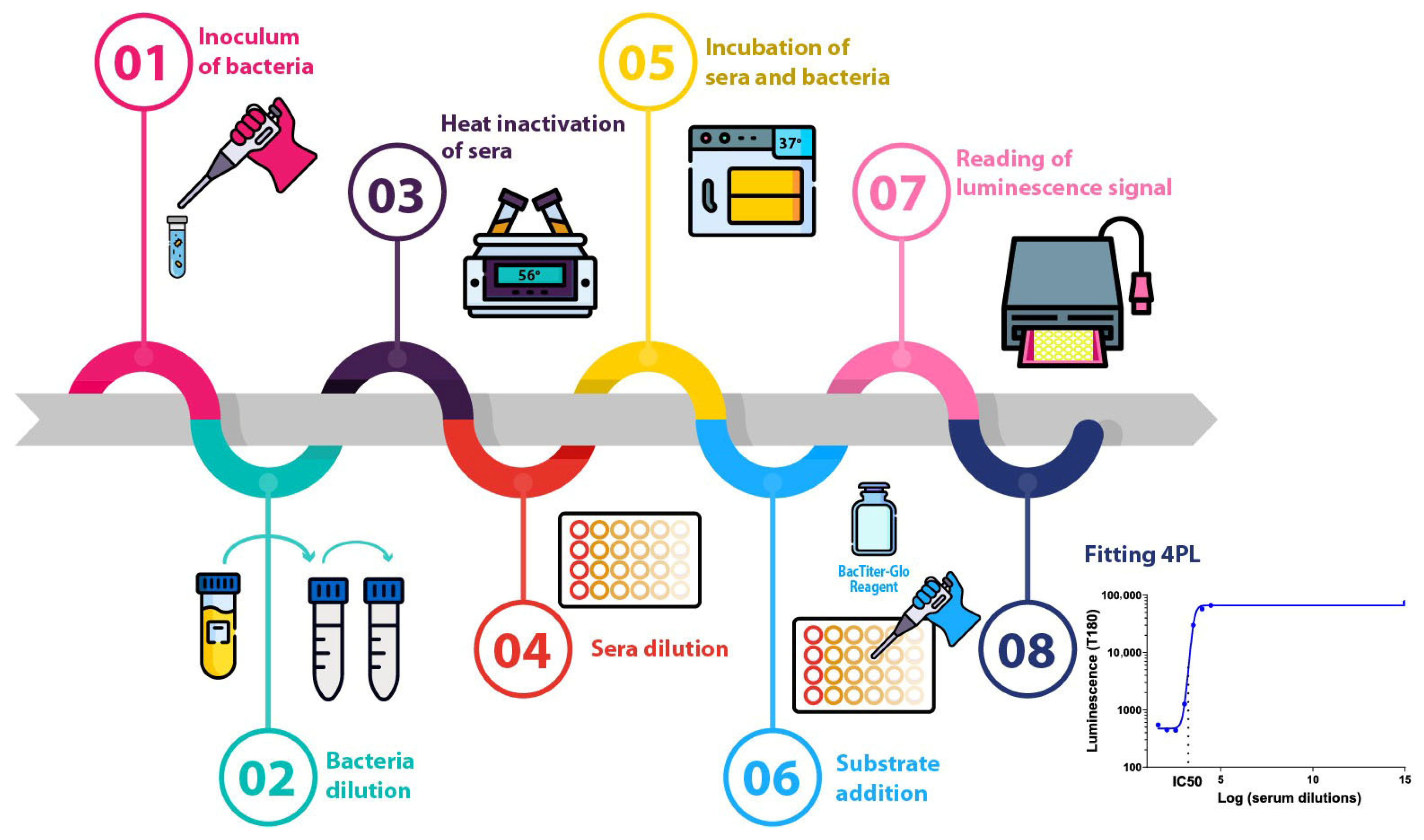
SBA based on luminescent readout (L-SBA) was performed, adapting the same protocol used to determine functionality against vaccine-homologous strains [37,38], as reported in Figure 1. Briefly, a 3-fold dilution step up to 7 dilution points of HI test sera and 1 control well with no sera were incubated in the presence of exogenous complement (BRC, 50% for all S. Typhimurium and Enteritidis strains, 5% for S. Derby, 15% for S. Dublin, and 20% for all S. Paratyphi A strains) and bacteria (approximately 2 × 10⁴ CFUs/mL from log-phase cultures stopped at OD600 = 0.22 ± 0.03 [51]) in a final reaction volume of 100 µL/well. The starting dilution of each serum in the assay was adapted on the basis of parameters assayed: 1:20 for all S. Paratyphi A strains, 1:100 for S. Derby and for all S. Typhimurium strains tested, 1:500 for S. Dublin, 1:1000 for S. Enteritidis A1636 and D7795, 1:2000 for S. Enteritidis CMCC4314 in case of repeatability and intermediate precision, linearity, and homologous and heterologous precision assessment, and 1:4 for all strains in case of limit of detection and limit of quantification assessment.
Figure 1.
L-SBA flowchart procedure. Main steps to measure the bactericidal activity of antibodies elicited by S. Typhi-S. Paratyphi A and iNTS-TCV candidates.
The final reaction mixture was mixed and incubated for 3 h at 37 °C (T180). At the end of the incubation, the SBA plate was centrifuged at room temperature for 10 min at 4000× g. The supernatant was discarded, and the bacterial pellets were resuspended in 100 µL of PBS, transferred to a white round-bottom 96-well plate (Greiner), and mixed in a 1:1 (v:v) ratio with BacTiter-Glo Reagent (Promega, Southampton, UK). The reaction was incubated for 5 min at room temperature on an orbital shaker, and the luminescence signal was measured by a luminometer (Synergy HT, Biotek, Swindon, UK).
A 4-parameter non-linear regression was applied to the raw luminescence (no normalization of the data was applied) obtained for all the serum dilutions tested for each serum; an arbitrary serum dilution of 1015 was assigned to the well containing no serum. Fitting was performed, constraining the curves to have a bottom between 0 and below a value equal to the average value of the luminescence detected at T180 for standard sera in wells in which bacteria are killed [52]. The constraining value was calculated for all the repeats of sera tested for repeatability and intermediate precision evaluation. The results of the assay are expressed as IC50, represented by the reciprocal serum dilution that results in a 50% reduction in luminescence. GraphPad Prism 7 software (GraphPad Software, La Jolla, CA, USA) was used for fitting and IC50 determination.
3. Results
In preparation to assess the bactericidal activity of vaccine-induced antibodies against Salmonella, a panel of epidemiologically relevant clinical isolates with different OAg acetylation/glucosylation profiles belonging to serogroups O:2, O:4, and O:9 [41,42,43,44,45,46] was selected, and the performance of the L-SBA was evaluated. In particular, for serogroup O:2, four S. Paratyphi A isolates with acetylation ranging from 17 to 100% and glucosylation from 51 to 20% were selected; for serogroup O:9, three S. Enteritidis isolates and one S. Dublin, with O-acetylation ranging from 8 to 60% and glucosylation from 13 to 21%; for serogroup O:4, three S. Typhimurium isolates with O-acetylation around 120% and glucosylation ranging from 18 to 62% and S. Derby, with O-acetylation <28% and a glucosylation of 18% (Table 1).
3.1. Precision, Limit of Detection, and Limit of Quantification
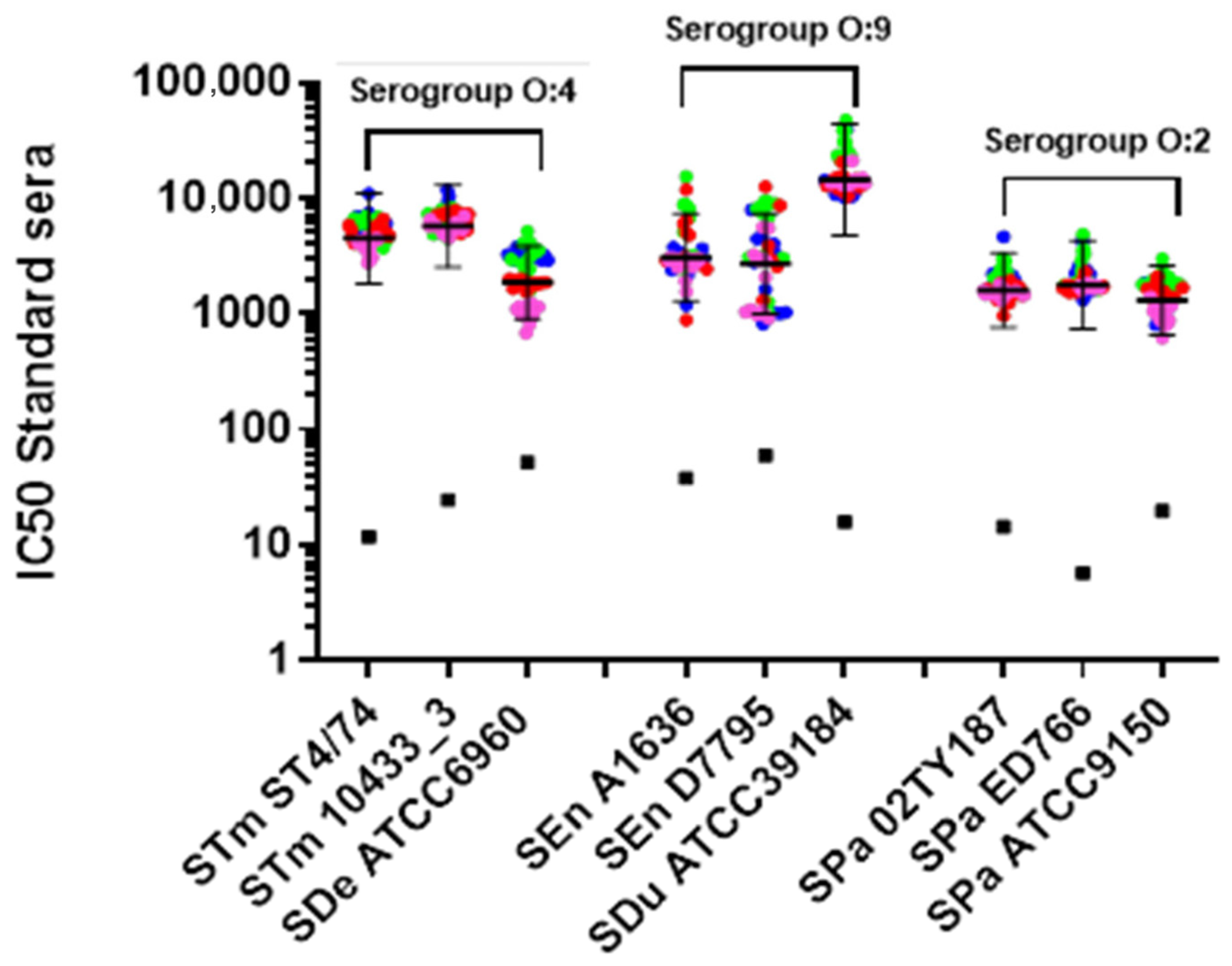
The precision of the assay was determined by testing the two human standards multiple times across multiple days against each S. enterica isolate (Figure 2). Precision against vaccine-homologous strains was previously assessed and therefore not repeated.
Figure 2.
Assay precision for strains belonging to O:4, O:9, and O:2 serogroups. A total of 48 repeated measurements of IC50 for each strain from single independently handled samples, by one operator on four different days, is shown. Repeats of each operator are represented by circle symbols (repeats on different days are shown in blue for day 1, green for day 2, red for day 3, and pink for day 4). Geometric means and 95% confidence intervals from 48 repeats are represented by the black lines and error bars for each of the tested samples. Black square symbols indicate the limit of quantification.
Repeatability was <4% coefficient of variation (CV) on Log10-transformed data for most of the strains. S. Enteritidis showed the highest variability, with repeatability values up to 9.5% CV. Intermediate precision was <10.4% CV across all strains (Table 2). No significant day-to-day effect on assay variability was observed for any strain (p-value > 0.05).
Table 2.
Repeatability and intermediate precision (CV% on Log10-transformed data).
The limit of detection and the limit of quantification of the assay were ≤10 and <60 IC50, respectively (Table 3), confirming that the assay can accurately quantify serum functional activity even at low reactivity levels.
Table 3.
Limit of detection (LoD) and limit of quantification (LoQ).
3.2. Linearity
Linearity of all assays was confirmed, as the 95% CI of the intercepts of IC50 values, obtained for each sample as a function of the initial dilution, did not differ significantly from 0, and slopes did not differ significantly from 1 for all samples (Table 4). Linearity of assays against vaccine-homologous strains was previously assessed and therefore not repeated.
Table 4.
Coefficients of regression analysis for each of the tested Salmonella strains.
3.3. Specificity
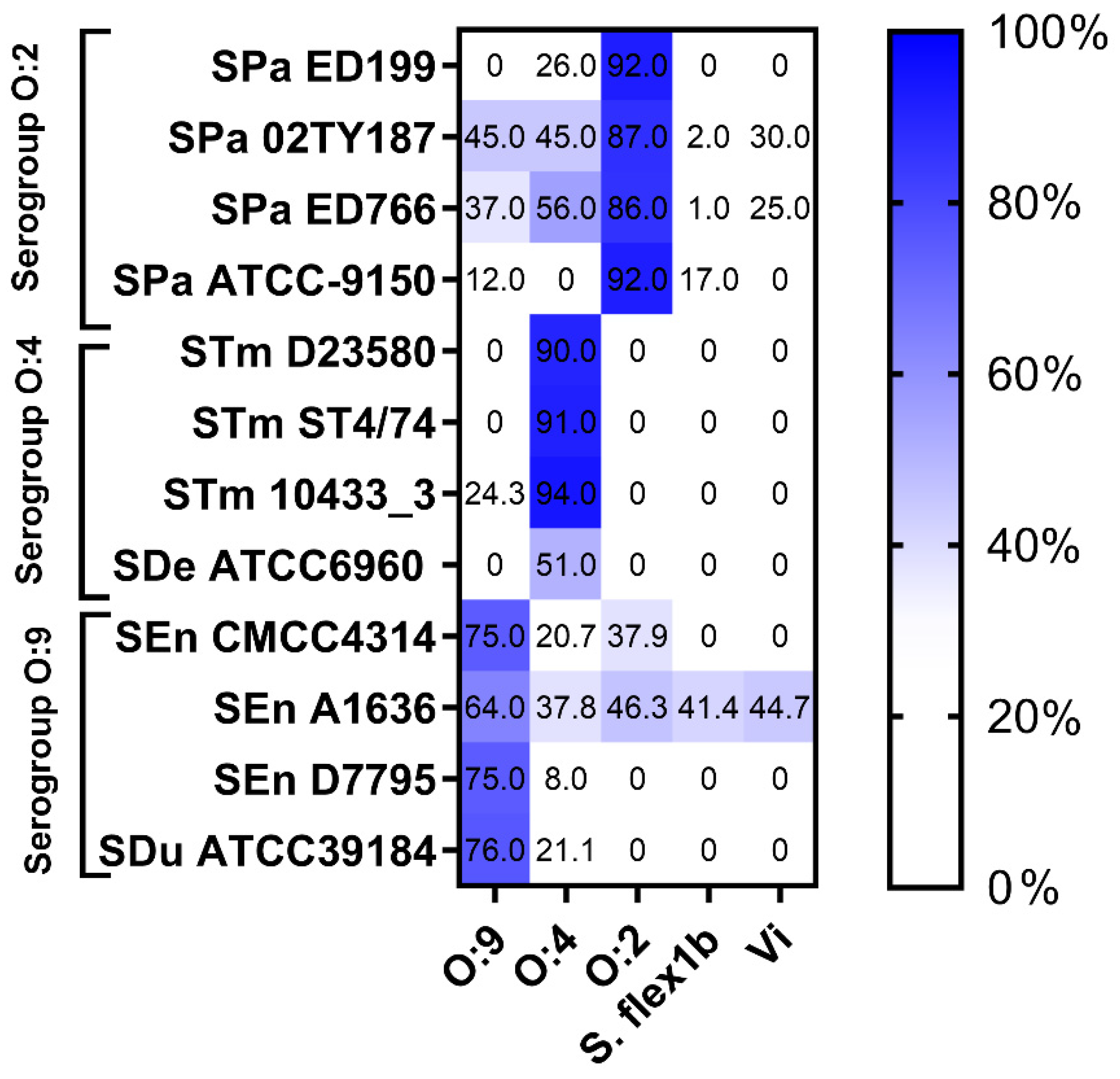
The specificity of the assay was determined by inhibition experiments performed by depleting human standard sera with varying amounts of homologous or heterologous OAg prior to testing bactericidal activity in SBA against each strain, and this was compared to the killing induced by undepleted sera. The capsular Vi polysaccharide was also included as a competitor, as this antigen is present in most Salmonella vaccine formulations that are currently in clinical testing. For each assay, the concentration of competitors was set at the lowest serogroup-matched OAg concentration capable of inhibiting ≥70% of the bactericidal activity. This was found to be 10 µg/mL for all S. Typhimurium strains, S. Enteritidis strains A1636 and D7795, and S. Dublin ATCC39184; 1000 µg/mL for S. Derby ATCC6960; 100 µg/mL for S. Enteritidis CMCC4314; and 50 µg/mL for S. Paratyphi A strains.
Depletion with serogroup-matched OAg resulted in ≥70% inhibition of IC50 in 10 out of 12 cases, confirming that the assay can effectively determine the functionality of antibodies directed against serogroup-matched OAg. Only in the cases of S. Derby ATCC6960 and S. Enteritidis A1636 was the percentage of inhibition with matched OAg below 70% (Figure 3).
Figure 3.
Heatmap of IC50 inhibition (%) with purified polysaccharides for all strains tested: the percentage of IC50 inhibition observed after depletion with a specific polysaccharide was calculated compared to the control spiked with an equal amount of PBS.
Depletion with heterologous OAg, either from Shigella flexneri 1b or from a different Salmonella serogroup, resulted in <30% inhibition of IC50 for most of the strains tested.
SBA against S. Enteritidis (strains CMCC4314 and A1636) and S. Paratyphi A (strains 02TY187 and ED766) also showed some partial inhibition when sera were spiked with heterologous polysaccharides, possibly indicating some OAg cross-reactivity.
Overall, these data indicate good specificity for the SBAs and suggest that antibodies targeting serogroup-matched OAg are primarily responsible for the bactericidal activity observed.
4. Discussion and Conclusions
Enteric fever and iNTS disease caused by S. enterica serovars Typhi, Paratyphi A, Typhimurium, and Enteritidis represent significant public health concerns, especially in LMICs. Despite the successful introduction of vaccines against Salmonella Typhi, there is still no vaccine against these other Salmonella serovars, and this has become a WHO priority [53]. Consequently, considerable efforts are underway to develop vaccines against these pathogens. Combination vaccines are considered an ideal solution to target multiple Salmonella serovars, and different candidates are currently under clinical evaluation.
No correlate of protection exists for these pathogens; therefore, functional assays, together with traditional binding assays, are considered a useful tool to better characterize the immune response elicited by Salmonella vaccines under development. In addition, by testing epidemiologically relevant clinical isolates, some indications can be obtained on the ability of a specific vaccine to protect across multiple strains. Among functional assays, the relevance of SBA as a key readout has been increasingly recognized. This is supported by evidence showing that age-related acquisition of O-antigen-specific SBA parallels the declining incidence of iNTS [54,55], which is consistent with a role for naturally acquired protective immunity.
Furthermore, maternal anti-LPS antibodies that confer protection to infants are associated with delayed NTS seroconversion, further indicating that antibody-mediated bactericidal activity contributes to early-life protection and shapes subsequent age-dependent susceptibility [56].
A high-throughput L-SBA method to determine the bactericidal activity in both preclinical [51] and clinical sera [52] was developed, and recent work was performed with sera from immunized animals, showing that multiple strains, belonging to the same serovar, can be killed, despite differences in their OAg-specific characteristics [39,40]. Demonstrating that a vaccine could theoretically protect against multiple clinical isolates, regardless of their OAg features, is important to support further clinical development, and, to our knowledge, similar information is not yet broadly available for any of the vaccines in clinical development.
Therefore, with the aim of confirming these preclinical results using clinical sera from ongoing vaccine trials, the qualification of this L-SBA [37,38] was extended. The assay, originally qualified with one strain per serovar, was expanded to include additional Salmonella strains exhibiting differences in OAg characteristics.
L-SBA demonstrated an acceptable performance with all the tested strains, similar to what was previously reported [37,38], and therefore, it was suitable to test clinical samples. The variability observed was highest for S. Enteritidis and lowest for S. Paratyphi A strains, for which intermediate precision and repeatability were consistently ≤5%. The assay was linear and specific to assess the activity of antibodies targeting serogroup-matched OAg, and day-to-day variation did not significantly impact its overall variability.
Depletion experiments using different polysaccharides demonstrated that the bactericidal activity was predominantly driven by serogroup-specific anti-OAg antibodies, with minimal killing attributed to unrelated OAg—such as that observed after depletion with S. flexneri 1b OAg—or the Vi capsular polysaccharide.
Interestingly, the specificity analysis using serogroup-unmatched OAg provided additional insights into possible cross-reactivity, which seemed more pronounced for certain serovars. Such a pattern could not be readily explained by the specific OAg characteristics described here (molecular weight, O-acetylation, and glucosylation levels), nor can it be simply assigned to the presence of the common O:12 backbone, which is shared across all OAg variants. Another factor that may contribute to cross-reactivity in these depletion assays is the functional activity of antibodies directed against Salmonella proteins [49,57], some of which are conserved across strains and could therefore mediate bactericidal activity, independently of OAg specificity. It should be noted that this analysis was limited by the use of polyclonal sera and by depletion experiments performed only with antigens containing the vaccine-homologous polysaccharide. A more detailed investigation could use monoclonal antibodies targeting defined OAg features, combined with depletion using OAg variants that differ in specific attributes. Such experiments were beyond the scope of the present study but could be addressed in future work.
Assay standardization is critical, as multiple vaccine candidates, using different OAg delivery platforms, are in clinical development. For example, in a preclinical study [27], GMMA-induced antibodies demonstrated higher functional activity than traditional conjugates, despite eliciting similar total antibody levels. This result may reflect variations in antibody quality rather than quantity. To date, a clinical head-to-head comparison between conjugate and GMMA platforms has not been attempted; however, as additional clinical programs progress into clinical phases, indirect comparison of functional responses across platforms will become increasingly feasible.
Meaningful cross-platform comparisons will require standardized assay reagents and conditions and harmonized functional assay protocols. Parameters such as incubation time, the percentage of exogenous complement used, and the inoculum growth phase can all influence the measured bactericidal activity; therefore, they must be harmonized to ensure interstudy comparability.
The standardized assay described here will facilitate the development of multicenter proficiency panels for Salmonella SBAs performed under uniform conditions, enabling more reliable cross-study comparisons.
In addition, this standardized method can support the identification of correlates of protection and the definition of protective thresholds. Studies have already been planned to test sera collected from human challenge studies and vaccine trials and to compare their reactivity profiles with those from sero-epidemiological studies.
In conclusion, this work demonstrates that human sera containing anti-OAg antibodies can efficiently kill Salmonella strains expressing OAg of the matched serovar, even in the presence of variation in OAg glucosylation and acetylation or other structural modifications. These findings increase confidence that candidate vaccines currently in development may induce broad cross-protection against circulating Salmonella strains.
Author Contributions
All authors contributed to the conception and writing of the article and approved the final version of the article. Conceived and designed the experiments: M.G.A., L.M., M.I., M.C., F.M., R.C., S.R., and O.R. Performed the experiments: L.M., D.D.S., F.B., and M.B. Analyzed the data: M.G.A., L.M., D.D.S., F.B., and M.B. Writing—original draft preparation: M.G.A., L.M. and O.R. Writing—review and editing: M.G.A., L.M., D.D.S., F.B., M.B., M.I., M.C., F.M., R.C., S.R., and O.R. All authors have read and agreed to the published version of the manuscript.
Funding
This study was undertaken at the request of and sponsored by GlaxoSmithKline Biologicals SA. The GSK Vaccines Institute for Global Health (Srl) (GVGH) is an affiliate of GlaxoSmithKline Biologicals SA.
Institutional Review Board Statement
All relevant ethical and regulatory approvals were obtained from the respective institutional and national ethics review committees (Antwerp University Hospital Ethics Committee Projects IDs 3815 and 3354, approval date: 24 October 2022 and 22 August 2022).
Informed Consent Statement
Written informed consent was obtained before enrollment from all subjects, and the trials were designed and conducted in accordance with the Good Clinical Practice Guidelines and the Declaration of Helsinki.
Data Availability Statement
The original contributions presented in this study are included in the article. Further inquiries can be directed to the corresponding author.
Conflicts of Interest
All authors were employees of the GSK Vaccines Institute for Global Health at the time the study was conducted. GSK Vaccines Institute for Global Health Srl is an affiliate of GlaxoSmithKline Biologicals SA. Some strains used in this study are GSK antigen-producing strains, for which a negotiation with GSK will be necessary in the case of material sharing. Other than this, all authors adhere to the journal’s policies on data and material sharing.
References
- Balasubramanian, R.; Im, J.; Lee, J.S.; Jeon, H.J.; Mogeni, O.D.; Kim, J.H.; Rakotozandrindrainy, R.; Baker, S.; Marks, F. The global burden and epidemiology of invasive non-typhoidal Salmonella infections. Hum. Vaccin. Immunother. 2019, 15, 1421–1426. [Google Scholar] [CrossRef]
- Typhoid, G.B.D.; Paratyphoid, C. The global burden of typhoid and paratyphoid fevers: A systematic analysis for the Global Burden of Disease Study 2017. Lancet Infect. Dis. 2019, 19, 369–381. [Google Scholar] [CrossRef]
- Manesh, A.; Meltzer, E.; Jin, C.; Britto, C.; Deodhar, D.; Radha, S.; Schwartz, E.; Rupali, P. Typhoid and paratyphoid fever: A clinical seminar. J. Travel Med. 2021, 28, taab012. [Google Scholar] [CrossRef]
- Tennant, S.M.; MacLennan, C.A.; Simon, R.; Martin, L.B.; Khan, M.I. Nontyphoidal salmonella disease: Current status of vaccine research and development. Vaccine 2016, 34, 2907–2910. [Google Scholar] [CrossRef]
- Antillon, M.; Warren, J.L.; Crawford, F.W.; Weinberger, D.M.; Kurum, E.; Pak, G.D.; Marks, F.; Pitzer, V.E. The burden of typhoid fever in low- and middle-income countries: A meta-regression approach. PLoS Negl. Trop. Dis. 2017, 11, e0005376. [Google Scholar] [CrossRef]
- Deen, J.; von Seidlein, L.; Andersen, F.; Elle, N.; White, N.J.; Lubell, Y. Community-acquired bacterial bloodstream infections in developing countries in south and southeast Asia: A systematic review. Lancet Infect. Dis. 2012, 12, 480–487. [Google Scholar] [CrossRef] [PubMed]
- Collaborators, G.T. Estimating the subnational prevalence of antimicrobial resistant Salmonella enterica serovars Typhi and Paratyphi A infections in 75 endemic countries, 1990–2019: A modelling study. Lancet Glob. Health 2024, 12, e406–e418. [Google Scholar] [CrossRef]
- Mogasale, V.; Maskery, B.; Ochiai, R.L.; Lee, J.S.; Mogasale, V.V.; Ramani, E.; Kim, Y.E.; Park, J.K.; Wierzba, T.F. Burden of typhoid fever in low-income and middle-income countries: A systematic, literature-based update with risk-factor adjustment. Lancet Glob. Health 2014, 2, e570–e580, Erratum in Lancet Glob. Health 2014, 2, e696. [Google Scholar] [CrossRef] [PubMed]
- Feasey, N.A.; Dougan, G.; Kingsley, R.A.; Heyderman, R.S.; Gordon, M.A. Invasive non-typhoidal salmonella disease: An emerging and neglected tropical disease in Africa. Lancet 2012, 379, 2489–2499. [Google Scholar] [CrossRef] [PubMed]
- Marchello, C.S.; Birkhold, M.; Crump, J.A.; Vacc-iNTS Consortium Collaborators. Complications and mortality of non-typhoidal salmonella invasive disease: A global systematic review and meta-analysis. Lancet Infect. Dis. 2022, 22, 692–705. [Google Scholar] [CrossRef]
- Robbins, J.D.; Robbins, J.B. Reexamination of the protective role of the capsular polysaccharide (Vi antigen) of Salmonella typhi. J. Infect. Dis. 1984, 150, 436–449. [Google Scholar] [CrossRef] [PubMed]
- Micoli, F.; Rondini, S.; Pisoni, I.; Proietti, D.; Berti, F.; Costantino, P.; Rappuoli, R.; Szu, S.; Saul, A.; Martin, L.B. Vi-CRM 197 as a new conjugate vaccine against Salmonella Typhi. Vaccine 2011, 29, 712–720. [Google Scholar] [CrossRef] [PubMed]
- Rondini, S.; Micoli, F.; Lanzilao, L.; Gavini, M.; Alfini, R.; Brandt, C.; Clare, S.; Mastroeni, P.; Saul, A.; MacLennan, C.A. Design of glycoconjugate vaccines against invasive African Salmonella enterica serovar Typhimurium. Infect. Immun. 2015, 83, 996–1007. [Google Scholar] [CrossRef] [PubMed]
- Goh, Y.S.; Clare, S.; Micoli, F.; Saul, A.; Mastroeni, P.; MacLennan, C.A. Monoclonal Antibodies of a Diverse Isotype Induced by an O-Antigen Glycoconjugate Vaccine Mediate In Vitro and In Vivo Killing of African Invasive Nontyphoidal Salmonella. Infect. Immun. 2015, 83, 3722–3731. [Google Scholar] [CrossRef]
- Watson, D.C.; Robbins, J.B.; Szu, S.C. Protection of mice against Salmonella typhimurium with an O-specific polysaccharide-protein conjugate vaccine. Infect. Immun. 1992, 60, 4679–4686. [Google Scholar] [CrossRef]
- Mastroeni, P.; Rossi, O. Immunology, epidemiology and mathematical modelling towards a better understanding of invasive non-typhoidal Salmonella disease and rational vaccination approaches. Expert Rev. Vaccines 2016, 15, 1545–1555. [Google Scholar] [CrossRef]
- MacLennan, C.A. Vaccines for low-income countries. Semin. Immunol. 2013, 25, 114–123. [Google Scholar] [CrossRef][Green Version]
- Rondini, S.; Lanzilao, L.; Necchi, F.; O’Shaughnessy, C.M.; Micoli, F.; Saul, A.; MacLennan, C.A. Invasive African Salmonella Typhimurium induces bactericidal antibodies against O-antigens. Microb. Pathog. 2013, 63, 19–23. [Google Scholar] [CrossRef]
- McSorley, S.J.; Jenkins, M.K. Antibody is required for protection against virulent but not attenuated Salmonella enterica serovar typhimurium. Infect. Immun. 2000, 68, 3344–3348. [Google Scholar] [CrossRef]
- Skidmore, P.D.; Canals, R.; Ramasamy, M.N. The iNTS-GMMA vaccine: A promising step in non-typhoidal Salmonella vaccine development. Expert Rev. Vaccines 2023, 22, 918–920. [Google Scholar] [CrossRef]
- Mancini, F.; Micoli, F.; Necchi, F.; Pizza, M.; Berlanda Scorza, F.; Rossi, O. GMMA-Based Vaccines: The Known and The Unknown. Front. Immunol. 2021, 12, 715393. [Google Scholar] [CrossRef]
- Boerth, E.M.; Gong, J.; Roffler, B.; Thompson, C.M.; Song, B.; Malley, S.F.; Hirsch, A.; MacLennan, C.A.; Zhang, F.; Malley, R.; et al. Induction of Broad Immunity against Invasive Salmonella Disease by a Quadrivalent Combination Salmonella MAPS Vaccine Targeting Salmonella Enterica Serovars Typhimurium, Enteritidis, Typhi, and Paratyphi A. Vaccines 2023, 11, 1671. [Google Scholar] [CrossRef]
- Zhang, F.; Boerth, E.M.; Gong, J.; Ma, N.; Lucas, K.; Ledue, O.; Malley, R.; Lu, Y.J. A Bivalent MAPS Vaccine Induces Protective Antibody Responses against Salmonella Typhi and Paratyphi A. Vaccines 2022, 11, 91. [Google Scholar] [CrossRef]
- Alfini, R.; Carducci, M.; Massai, L.; De Simone, D.; Mariti, M.; Rossi, O.; Rondini, S.; Micoli, F.; Giannelli, C. Design of a Glycoconjugate Vaccine Against Salmonella Paratyphi A. Vaccines 2024, 12, 1272. [Google Scholar] [CrossRef] [PubMed]
- Baliban, S.M.; Yang, M.; Ramachandran, G.; Curtis, B.; Shridhar, S.; Laufer, R.S.; Wang, J.Y.; Van Druff, J.; Higginson, E.E.; Hegerle, N.; et al. Development of a glycoconjugate vaccine to prevent invasive Salmonella Typhimurium infections in sub-Saharan Africa. PLoS Negl. Trop. Dis. 2017, 11, e0005493. [Google Scholar] [CrossRef]
- Baliban, S.M.; Curtis, B.; Toema, D.; Tennant, S.M.; Levine, M.M.; Pasetti, M.F.; Simon, R. Immunogenicity and efficacy following sequential parenterally-administered doses of Salmonella Enteritidis COPS:FliC glycoconjugates in infant and adult mice. PLoS Negl. Trop. Dis. 2018, 12, e0006522. [Google Scholar] [CrossRef]
- Micoli, F.; Rondini, S.; Alfini, R.; Lanzilao, L.; Necchi, F.; Negrea, A.; Rossi, O.; Brandt, C.; Clare, S.; Mastroeni, P.; et al. Comparative immunogenicity and efficacy of equivalent outer membrane vesicle and glycoconjugate vaccines against nontyphoidal Salmonella. Proc. Natl. Acad. Sci. USA 2018, 115, 10428–10433. [Google Scholar] [CrossRef] [PubMed]
- Higginson, E.E.; Panda, A.; Toapanta, F.R.; Terzi, M.C.; Jones, J.A.; Sen, S.; Permala-Booth, J.; Pasetti, M.F.; Sztein, M.B.; DeTolla, L.; et al. Immunogenicity and Efficacy of Live-Attenuated Salmonella Typhimurium Vaccine Candidate CVD 1926 in a Rhesus Macaque Model of Gastroenteritis. Infect. Immun. 2021, 89, e0008721. [Google Scholar] [CrossRef]
- Halder, P.; Maiti, S.; Banerjee, S.; Das, S.; Dutta, M.; Dutta, S.; Koley, H. Bacterial ghost cell based bivalent candidate vaccine against Salmonella Typhi and Salmonella Paratyphi A: A prophylactic study in BALB/c mice. Vaccine 2023, 41, 5994–6007. [Google Scholar] [CrossRef] [PubMed]
- Raqib, R. Bivalent conjugate vaccines for typhoid and paratyphoid fever. Lancet 2024, 403, 1516–1517. [Google Scholar] [CrossRef]
- Hanumunthadu, B.; Demissie, T.; Greenland, M.; Skidmore, P.; Tanha, K.; Crocker-Buque, T.; Owino, N.; Scire, A.S.; Crispino, C.; De Simone, D.; et al. Safety and immunogenicity of the invasive non-typhoidal Salmonella (iNTS)-GMMA vaccine: A first-in-human, randomised, dose escalation trial. eBioMedicine 2025, 119, 105903. [Google Scholar] [CrossRef]
- Chen, W.H.; Barnes, R.S.; Sikorski, M.J.; Datar, R.; Sukhavasi, R.; Liang, Y.; Rapaka, R.R.; Pasetti, M.F.; Sztein, M.B.; Wahid, R.; et al. A combination typhoid and non-typhoidal Salmonella polysaccharide conjugate vaccine in healthy adults: A randomized, placebo-controlled phase 1 trial. Nat. Med. 2025. [Google Scholar] [CrossRef]
- MacLennan, C.A.; Stanaway, J.; Grow, S.; Vannice, K.; Steele, A.D. Salmonella Combination Vaccines: Moving Beyond Typhoid. Open Forum Infect. Dis. 2023, 10, S58–S66. [Google Scholar] [CrossRef]
- McCann, N.; Paganotti Vicentine, M.; Kim, Y.C.; Pollard, A.J. The use of controlled human infection models to identify correlates of protection for invasive Salmonella vaccines. Front. Immunol. 2024, 15, 1457785. [Google Scholar] [CrossRef] [PubMed]
- Mastroeni, P.; Rossi, O. Antibodies and Protection in Systemic Salmonella Infections: Do We Still Have More Questions than Answers? Infect. Immun. 2020, 88, e00219-2. [Google Scholar] [CrossRef] [PubMed]
- Rossi, O.; Coward, C.; Goh, Y.S.; Claassens, J.W.C.; MacLennan, C.A.; Verbeek, S.J.; Mastroeni, P. The essential role of complement in antibody-mediated resistance to Salmonella. Immunology 2019, 156, 69–73. [Google Scholar] [CrossRef] [PubMed]
- Aruta, M.G.; De Simone, D.; Dale, H.; Chirwa, E.; Kadwala, I.; Mbewe, M.; Banda, H.; Gordon, M.; Pizza, M.; Berlanda Scorza, F.; et al. Development and Characterization of a Luminescence-Based High-Throughput Serum Bactericidal Assay (L-SBA) to Assess Bactericidal Activity of Human Sera against Nontyphoidal Salmonella. Methods Protoc. 2022, 5, 100. [Google Scholar] [CrossRef]
- Carducci, M.; Massai, L.; Lari, E.; Semplici, B.; Grappi, S.; Maria, N.; Jones, E.; Conti, V.; Piu, P.; Scorza, F.B.; et al. Development and characterization of high-throughput serological assays to measure magnitude and functional immune response against S. Paratyphi A in human samples. Front. Immunol. 2024, 15, 1443137. [Google Scholar] [CrossRef]
- Pinto, M.; Durante, S.; Carducci, M.; Massai, L.; Alfini, R.; Mylona, E.; Karkey, A.; Baker, S.; Micoli, F.; Giannelli, C.; et al. The Salmonella Paratyphi A O-Antigen Glycoconjugate Vaccine Is Able to Induce Antibodies with Bactericidal Activity Against a Panel of Clinical Isolates. Vaccines 2025, 13, 122. [Google Scholar] [CrossRef]
- De Simone, D.; Pinto, M.; Aruta, M.G.; Benincasa, M.; Carducci, M.; Di Benedetto, R.; Citiulo, F.; Iturriza, M.; Mylona, E.; Baker, S.; et al. GMMA-based vaccine candidates against invasive nontyphoidal salmonellosis elicit bactericidal antibodies against a panel of epidemiologically relevant Salmonellae. Front. Immunol. 2025, 16, 1610067. [Google Scholar] [CrossRef]
- Kingsley, R.A.; Msefula, C.L.; Thomson, N.R.; Kariuki, S.; Holt, K.E.; Gordon, M.A.; Harris, D.; Clarke, L.; Whitehead, S.; Sangal, V.; et al. Epidemic multiple drug resistant Salmonella Typhimurium causing invasive disease in sub-Saharan Africa have a distinct genotype. Genome Res. 2009, 19, 2279–2287. [Google Scholar] [CrossRef]
- Van Puyvelde, S.; de Block, T.; Sridhar, S.; Bawn, M.; Kingsley, R.A.; Ingelbeen, B.; Beale, M.A.; Barbe, B.; Jeon, H.J.; Mbuyi-Kalonji, L.; et al. A genomic appraisal of invasive Salmonella Typhimurium and associated antibiotic resistance in sub-Saharan Africa. Nat. Commun. 2023, 14, 6392. [Google Scholar] [CrossRef]
- Canals, R.; Hammarlof, D.L.; Kroger, C.; Owen, S.V.; Fong, W.Y.; Lacharme-Lora, L.; Zhu, X.; Wenner, N.; Carden, S.E.; Honeycutt, J.; et al. Adding function to the genome of African Salmonella Typhimurium ST313 strain D23580. PLoS Biol. 2019, 17, e3000059. [Google Scholar] [CrossRef]
- Tindall, B.J.; Grimont, P.A.D.; Garrity, G.M.; Euzeby, J.P. Nomenclature and taxonomy of the genus Salmonella. Int. J. Syst. Evol. Microbiol. 2005, 55, 521–524. [Google Scholar] [CrossRef]
- Judicial Commission Of The International Committee On Systematics Of, P. The type species of the genus Salmonella Lignieres 1900 is Salmonella enterica (ex Kauffmann and Edwards 1952) Le Minor and Popoff 1987, with the type strain LT2T, and conservation of the epithet enterica in Salmonella enterica over all earlier epithets that may be applied to this species. Opinion 80. Int. J. Syst. Evol. Microbiol. 2005, 55, 519–520. [Google Scholar] [CrossRef]
- Mylona, E.; Pereira-Dias, J.; Keane, J.A.; Karkey, A.; Dongol, S.; Khokhar, F.; Tran, T.A.; Cormie, C.; Higginson, E.; Baker, S. Phenotypic variation in the lipopolysaccharide O-antigen of Salmonella Paratyphi A and implications for vaccine development. Vaccine 2024, 42, 126404. [Google Scholar] [CrossRef]
- Rossi, O.; Caboni, M.; Negrea, A.; Necchi, F.; Alfini, R.; Micoli, F.; Saul, A.; MacLennan, C.A.; Rondini, S.; Gerke, C. Toll-Like Receptor Activation by Generalized Modules for Membrane Antigens from Lipid A Mutants of Salmonella enterica Serovars Typhimurium and Enteritidis. Clin. Vaccine Immunol. 2016, 23, 304–314. [Google Scholar] [CrossRef]
- Gasperini, G.; Alfini, R.; Arato, V.; Mancini, F.; Aruta, M.G.; Kanvatirth, P.; Pickard, D.; Necchi, F.; Saul, A.; Rossi, O.; et al. Salmonella Paratyphi A Outer Membrane Vesicles Displaying Vi Polysaccharide as a Multivalent Vaccine against Enteric Fever. Infect. Immun. 2021, 89, e00699-2. [Google Scholar] [CrossRef]
- Gasperini, G.; Massai, L.; De Simone, D.; Raso, M.M.; Palmieri, E.; Alfini, R.; Rossi, O.; Ravenscroft, N.; Kuttel, M.M.; Micoli, F. O-Antigen decorations in Salmonella enterica play a key role in eliciting functional immune responses against heterologous serovars in animal models. Front. Cell Infect. Microbiol. 2024, 14, 1347813. [Google Scholar] [CrossRef]
- De Benedetto, G.; Alfini, R.; Cescutti, P.; Caboni, M.; Lanzilao, L.; Necchi, F.; Saul, A.; MacLennan, C.A.; Rondini, S.; Micoli, F. Characterization of O-antigen delivered by Generalized Modules for Membrane Antigens (GMMA) vaccine candidates against nontyphoidal Salmonella. Vaccine 2017, 35, 419–426. [Google Scholar] [CrossRef]
- Necchi, F.; Saul, A.; Rondini, S. Development of a high-throughput method to evaluate serum bactericidal activity using bacterial ATP measurement as survival readout. PLoS ONE 2017, 12, e0172163. [Google Scholar] [CrossRef]
- Rossi, O.; Molesti, E.; Saul, A.; Giannelli, C.; Micoli, F.; Necchi, F. Intra-Laboratory Evaluation of Luminescence Based High-Throughput Serum Bactericidal Assay (L-SBA) to Determine Bactericidal Activity of Human Sera against Shigella. High-Throughput 2020, 9, 14. [Google Scholar] [CrossRef]
- Martin, L.B.; Khanam, F.; Qadri, F.; Khalil, I.; Sikorski, M.J.; Baker, S. Vaccine value profile for Salmonella enterica serovar Paratyphi A. Vaccine 2023, 41 (Suppl. 2), S114–S133. [Google Scholar] [CrossRef]
- MacLennan, C.A.; Gondwe, E.N.; Msefula, C.L.; Kingsley, R.A.; Thomson, N.R.; White, S.A.; Goodall, M.; Pickard, D.J.; Graham, S.M.; Dougan, G.; et al. The neglected role of antibody in protection against bacteremia caused by nontyphoidal strains of Salmonella in African children. J. Clin. Investig. 2008, 118, 1553–1562. [Google Scholar] [CrossRef]
- Nyirenda, T.S.; Gilchrist, J.J.; Feasey, N.A.; Glennie, S.J.; Bar-Zeev, N.; Gordon, M.A.; MacLennan, C.A.; Mandala, W.L.; Heyderman, R.S. Sequential acquisition of T cells and antibodies to nontyphoidal Salmonella in Malawian children. J. Infect. Dis. 2014, 210, 56–64. [Google Scholar] [CrossRef]
- de Alwis, R.; Tu, L.T.P.; Quynh, N.L.T.; Thompson, C.N.; Anders, K.L.; Van Thuy, N.T.; Hieu, N.T.; Vi, L.L.; Chau, N.V.V.; Duong, V.T.; et al. The Role of Maternally Acquired Antibody in Providing Protective Immunity Against Nontyphoidal Salmonella in Urban Vietnamese Infants: A Birth Cohort Study. J. Infect. Dis. 2019, 219, 295–304. [Google Scholar] [CrossRef]
- Schager, A.E.; Dominguez-Medina, C.C.; Necchi, F.; Micoli, F.; Goh, Y.S.; Goodall, M.; Flores-Langarica, A.; Bobat, S.; Cook, C.N.L.; Arcuri, M.; et al. IgG Responses to Porins and Lipopolysaccharide within an Outer Membrane-Based Vaccine against Nontyphoidal Salmonella Develop at Discordant Rates. mBio 2018, 9, e02379-1. [Google Scholar] [CrossRef]
Disclaimer/Publisher’s Note: The statements, opinions and data contained in all publications are solely those of the individual author(s) and contributor(s) and not of MDPI and/or the editor(s). MDPI and/or the editor(s) disclaim responsibility for any injury to people or property resulting from any ideas, methods, instructions or products referred to in the content. |
© 2025 by the authors. Licensee MDPI, Basel, Switzerland. This article is an open access article distributed under the terms and conditions of the Creative Commons Attribution (CC BY) license (https://creativecommons.org/licenses/by/4.0/).