1. Introduction
Soft robotic and haptic systems increasingly require actuators that can safely interact with the human body while producing controllable mechanical outputs. In contrast to rigid mechanisms, soft pneumatic actuators and compliant structures can generate large deformations, conform to complex surfaces, and reduce unsafe contact loads, which makes them attractive for biomedical devices, assistive systems, rehabilitation, and human–machine interfaces [
1,
2]. However, compliance alone is not sufficient for many tactile applications. A tactile interface intended for palpation, virtual object rendering, or medical training must also regulate the apparent stiffness felt by the user.
Existing tactile display technologies provide useful but incomplete feedback modalities. Vibrotactile devices are compact and low-cost but primarily encode dynamic cues rather than static shape or stiffness. Pin-array and MEMS-based tactile displays can render spatial information, but they often require many individually driven actuators and complex mechanical packaging [
3,
4]. Pneumatic tactile displays can deliver soft distributed pressure cues, but inflation alone does not necessarily change the intrinsic resistance of the contact surface [
5,
6]. These limitations motivate variable-stiffness tactile elements that directly modulate compliance under fingertip contact.
Granular jamming is a promising variable-stiffness mechanism because it allows a particle-filled membrane to transition reversibly from a deformable, fluid-like state to a load-bearing, solid-like state when negative pressure is applied [
7,
8,
9]. Vacuum pressure compresses the granular medium, increases interparticle normal forces and frictional constraints, and stabilizes force-chain networks within the packed bed [
7,
9,
10,
11]. Particle-jamming systems have been used in soft robotic grippers, haptic surfaces, and variable-stiffness interfaces because they are mechanically simple and compatible with compliant membranes [
9,
11,
12,
13]. Previous studies have demonstrated granular-jamming haptic interfaces and stiffness-feedback devices, including systems evaluated through indentation and palpation-based experiments [
12,
13,
14]. These studies establish the feasibility of granular jamming for controllable haptic stiffness. However, systematic characterization of how the effective stiffness of a compact tactile element varies jointly with vacuum pressure and indentation depth remains limited. Such characterization is important for defining the mechanical operating envelope and pressure-dependent control characteristics of variable-stiffness tactile elements.
This work addresses this gap by quantitatively characterizing the pressure- and depth-dependent mechanical response of a 25 mm vacuum-controlled granular-jamming tactile nodule under controlled quasi-static indentation. The study evaluates eleven discrete vacuum levels and quantifies force–displacement response, global stiffness, and depth-dependent local stiffness, providing design-oriented data for future variable-stiffness tactile displays.
Unlike previous studies [
14], that primarily demonstrated feasibility, this work provides a systematic mechanical characterization of a single tactile display unit across eleven discrete vacuum levels using a controlled finger-like indentation protocol. The study quantifies both global and depth-dependent local stiffness, providing design-oriented data for future variable-stiffness tactile displays and proof-of-concept palpation simulators.
The objective of this study was to design, fabricate, and experimentally evaluate a single granular-jamming tactile nodule actuated by vacuum pressure. The primary contributions of this paper are as follows: (1) the design and fabrication of a compact fingertip-scale granular-jamming tactile nodule using compliant membranes, commercially available plastic microbeads, and a simple vacuum actuation system; (2) a repeatable experimental methodology for characterizing pressure-dependent force-displacement behavior using a rubber finger-like indenter over a controlled post-contact displacement region; (3) a comprehensive mechanical characterization including global stiffness and depth-dependent local stiffness across eleven vacuum pressure levels, providing quantitative design data for future tactile display development.
2. Materials and Methods
2.1. Prototype Design and Fabrication
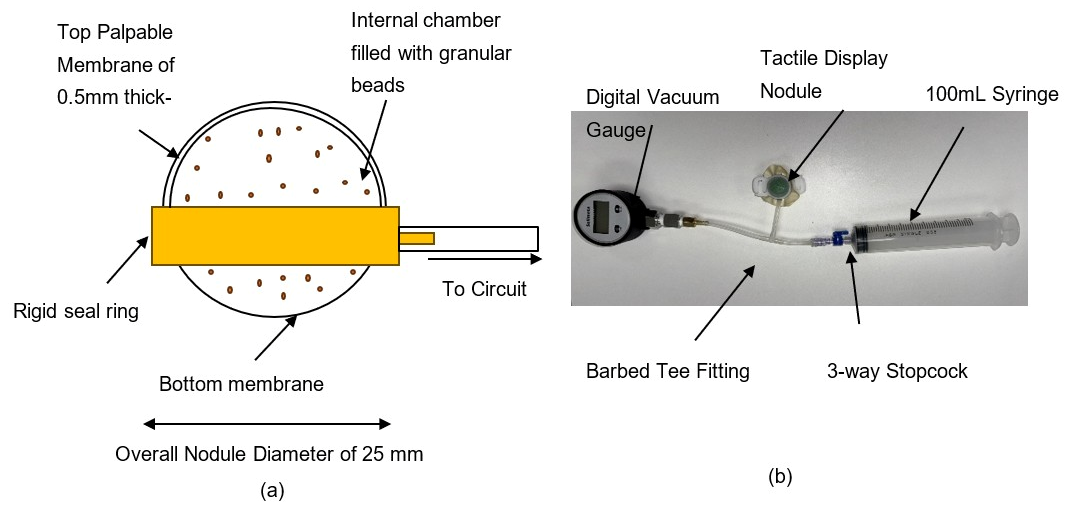
The prototype was designed as a single soft tactile nodule with an overall diameter of 25 mm. This diameter was selected to approximate a small fingertip-scale tactile element while remaining suitable for future integration into clustered arrays. The nodule consisted of a compliant top membrane, a thinner bottom elastomeric membrane, a rigid seal ring, and an internal granular chamber. The top palpable membrane was fabricated using Elastic 50A resin V2 on a Formlabs Form 4 printer and had a nominal thickness of 0.5 mm. The bottom membrane was fabricated from a thin elastomeric membrane obtained from a commercially available balloon to allow deformation under vacuum while preserving the surface shape of the top membrane.
The rigid seal ring was printed using an ABS-like resin and served as the structural interface between the two membranes and the pneumatic connection. The internal granular phase consisted of commercially available plastic microbeads with nominal diameters of 0.6–0.8 mm. Spherical microbeads were selected because preliminary testing showed more consistent particle rearrangement and recovery after vacuum release compared with irregular granular materials such as sand and coffee grounds. Although irregular particles may provide greater interlocking, repeatable transition between jammed and unjammed states was prioritized for the present tactile application. A fixed bead mass of 8 g was used to balance particle mobility in the unjammed state with sufficient fill density for stiffness generation under vacuum. All joints were sealed and reinforced to reduce leakage during negative-pressure operation.
Figure 1 shows the nodule architecture and the pneumatic circuit used for prototype characterization, and
Table 1 shows the overall test specifications.
2.2. Vacuum Actuation Circuit
Vacuum actuation was implemented using a manually operated pneumatic circuit. The nodule was connected by flexible tubing to a three-way luer-lock stopcock, an inline digital vacuum gauge, and a 100 mL luer-lock syringe. With the stopcock configured to couple the syringe to the nodule, retracting the syringe plunger removed air from the sealed volume and generated negative pressure relative to ambient. The vacuum level was adjusted in discrete setpoints from 0 to −68.95 kPa with a target step size of −6.89 kPa and an approximate tolerance of ±1.38 kPa.
Opening the stopcock to atmosphere vented the system and allowed the granular pack to unjam. This manually controlled system was selected as a low-cost proof-of-concept platform before implementing closed-loop electronic vacuum regulation. Although manual actuation limited dynamic control and transient pressure precision, it was sufficient for quasi-static mechanical characterization of pressure-dependent stiffness.
2.3. Mechanical Compression Testing
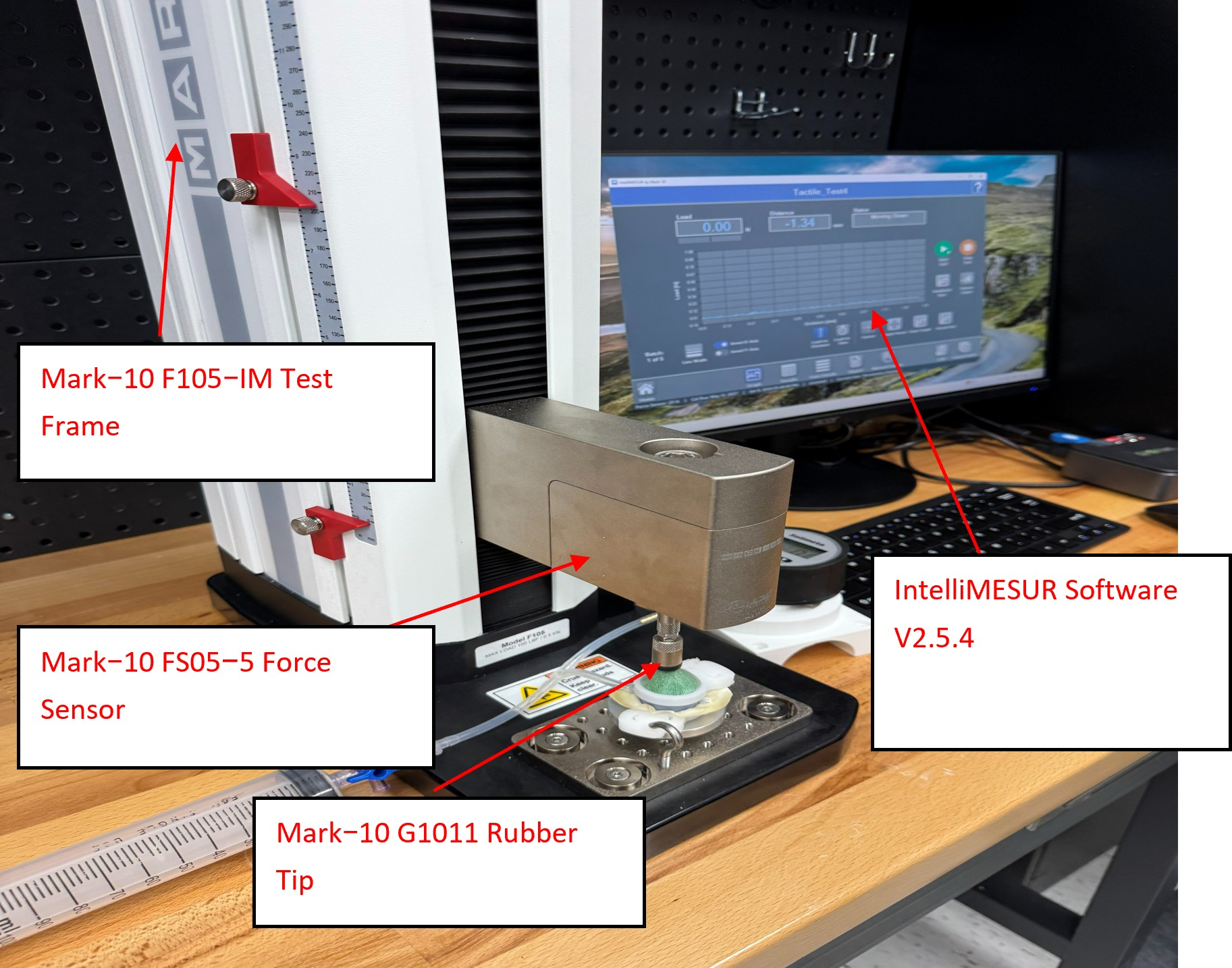
Mechanical testing was conducted using a Mark-10 F105-IM motorized test frame with a Mark-10 FS05-5 force sensor. The sensor was fitted with a Mark-10 G1011 rubber tip to provide a compliant, finger-like contact interface. The nodule was positioned with its bottom membrane resting directly on the rigid base of the test frame and was laterally restrained to reduce movement during indentation. The indenter approached the upper surface normal to the nodule until contact was established, after which force and displacement were re-zeroed to define a common contact-relative coordinate system.
For each vacuum condition, the indenter compressed the nodule over a 2.00 mm post-contact displacement range while force and displacement were recorded at 100 Hz using IntelliMESUR software V 2.5.4. Five independent compression tests (
n = 5) were performed at each vacuum pressure level to evaluate repeatability. Between successive tests, the nodule was vented to atmospheric pressure and gently agitated to redistribute the particles before the desired vacuum level was re-established. Force and displacement were re-zeroed prior to each trial to ensure a consistent contact reference. The mean response and standard deviation were calculated from the repeated measurements for all reported results. Testing was conducted at eleven pressure levels: 0, −6.89, −13.79, −20.68, −27.58, −34.47, −41.37, −48.26, −55.16, −62.05, and −68.95 kPa.
Figure 2 shows the indentation test setup.
2.4. Data Processing and Stiffness Metrics
Raw data were exported from the IntelliMESUR software V 2.5.4 as tab-delimited CSV files containing force, displacement, and time. Instrument metadata were removed during parsing, and the data columns were standardized as force F in newtons, displacement d in millimeters, and time t in seconds. Contact was identified near the beginning of the loading curve, and all trials were shifted so that F = 0 N and d = 0 mm at first contact. The analysis was restricted to the 2.00 mm post-contact region to allow consistent comparison across vacuum levels.
For each trial, an effective global stiffness
was calculated as the slope of a first-order least-squares regression applied to the 0.10–1.80 mm post-contact force-displacement window:
where
F is the measured normal force and
d is the contact-relative compression displacement. Mean force–displacement curves were obtained by interpolating repeated trials at each pressure level onto a common displacement axis with 300 uniformly spaced points. Pointwise means and standard deviations were then calculated to represent the central response and variability at each pressure level.
Local stiffness was calculated to describe depth-dependent tangent behavior. For each trial, a moving window first-order regression was applied over a 21-point window, and the resulting slope was assigned as the local stiffness
at the center of the window:
where
δ is the indentation displacement. Local stiffness values were summarized at selected target displacements and compared across vacuum pressure levels.
3. Results
3.1. Force–Displacement Response
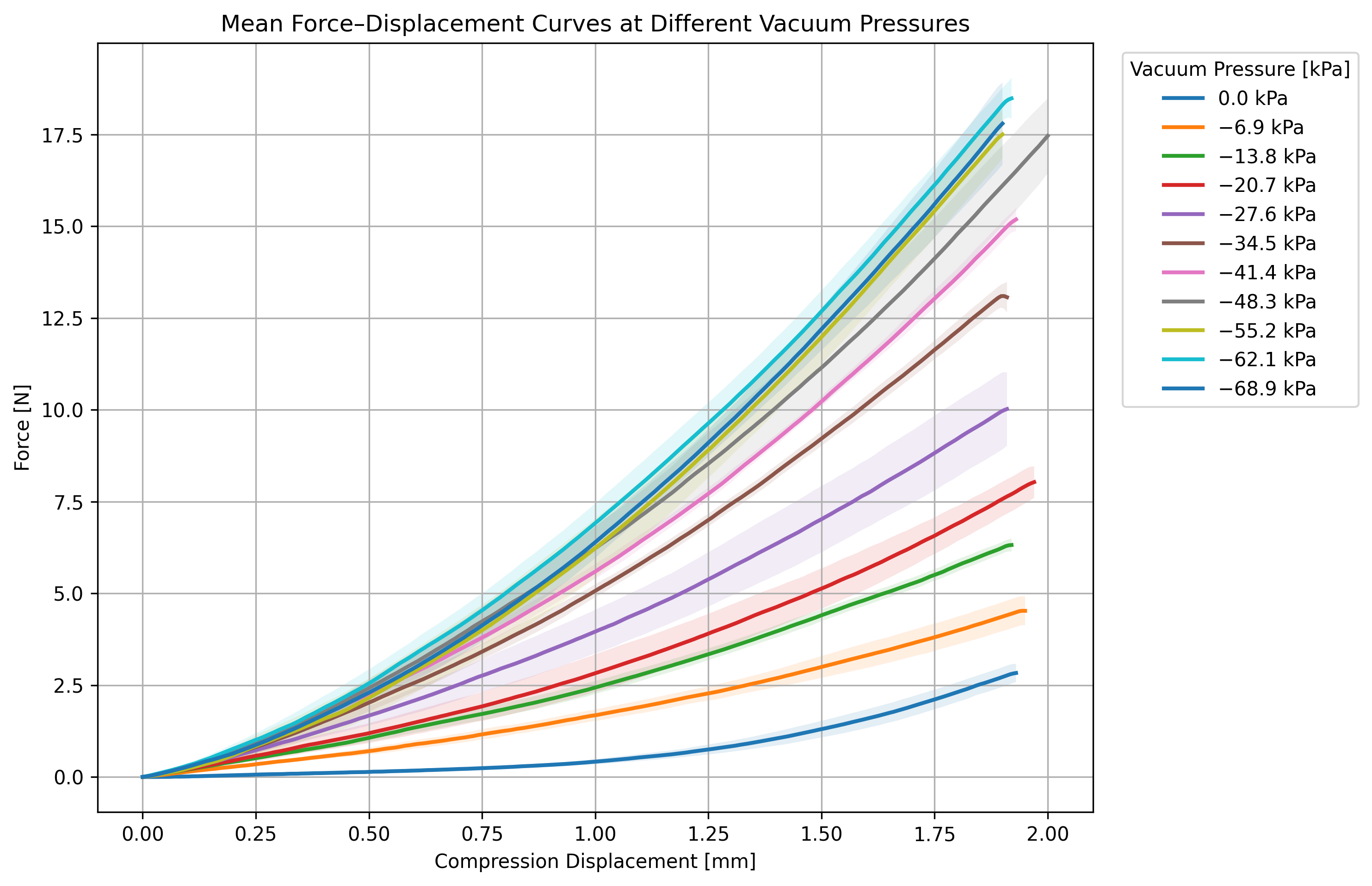
The force-displacement curves showed a clear upward shift as vacuum magnitude increased. At 0 kPa, the nodule remained in its most compliant state and required only approximately 2–3 N to reach the end of the 2.00 mm compression window. At the highest vacuum levels, the same displacement required forces approaching 18 N. The curve shape was nonlinear, indicating that the nodule did not behave as a simple linear spring. Instead, the measured force response reflected the combined effects of membrane stretching, progressive granular engagement, indenter compliance, and increasing contact area.
Figure 3 overlays the mean force-displacement curves for the eleven vacuum levels. Adjacent curves separated most strongly in the mid-vacuum region and converged near the highest vacuum levels, indicating that the stiffness increase began to saturate once the granular contact network became highly constrained.
3.2. Global Stiffness as a Function of Vacuum Pressure
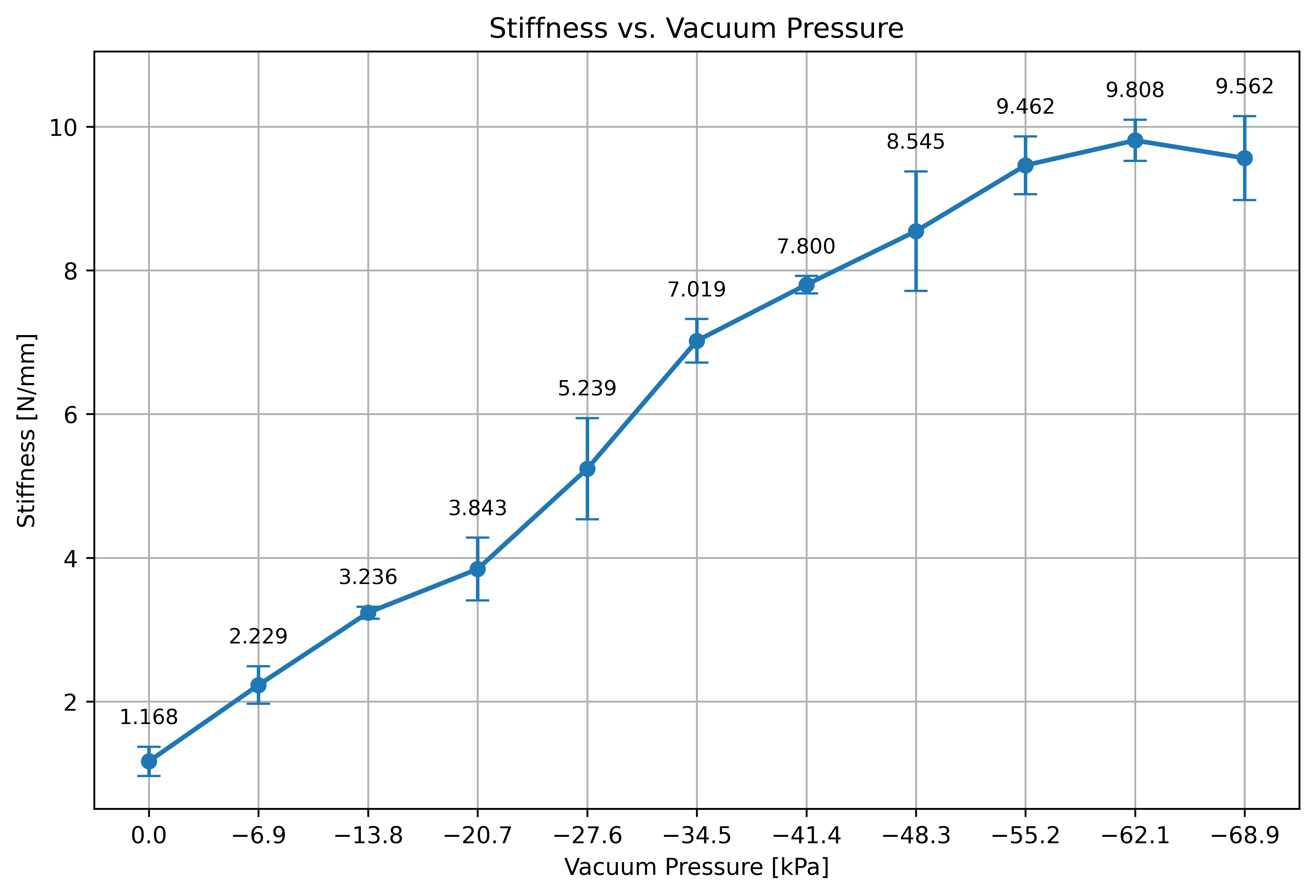
The global stiffness-pressure relationship is shown in
Figure 4. The mean global stiffness increased from 1.168 N/mm at 0 kPa to 9.562 N/mm at −68.9 kPa, representing an 8.18-fold increase relative to the unjammed condition. The maximum mean global stiffness of 9.808 N/mm occurred at −62.1 kPa, corresponding to an approximately 8.40-fold increase over the atmospheric-pressure condition. The slight decrease in stiffness observed between −62.1 kPa and −68.9 kPa was approximately 2.6% relative to the peak value. This difference was small relative to the trial-to-trial variability observed in the repeated measurements and therefore does not indicate a systematic reduction in jamming performance. Overall, the results demonstrate that increasing vacuum pressure effectively transforms the tactile nodule from a highly compliant structure into a substantially stiffer load-bearing element. This behavior is consistent with the granular jamming mechanism, where increasing confining pressure restricts particle rearrangement, strengthens interparticle frictional interactions, and promotes the formation of stable force-chain networks capable of transmitting greater compressive loads.
The rate of stiffness increase was not uniform across the tested pressure range. The largest incremental increase occurred between −27.6 kPa and −34.5 kPa, where the global stiffness increased from 5.239 N/mm to 7.019 N/mm. In comparison, stiffness increased by only 0.346 N/mm between −55.2 kPa and −62.1 kPa. This concave-down trend indicates that the tactile nodule was most responsive to changes in vacuum pressure within the mid-vacuum region, while progressively smaller stiffness gains were obtained as the particle bed approached a fully jammed state. At higher vacuum levels, the majority of particle contacts have already been established, and additional confinement produces only modest increases in overall structural rigidity. Consequently, the stiffness-pressure response exhibits diminishing returns as the system approaches its maximum achievable stiffness for the selected membrane, particle fill, and geometry.
From an engineering perspective, these findings provide practical guidance for the design and control of future granular-jamming tactile displays. Rather than simply maximizing vacuum pressure, designers should consider operating within the mid-vacuum range, where relatively small pressure adjustments produce the largest change in stiffness and therefore provide the greatest control resolution. Operating beyond approximately −60 kPa offers only limited mechanical benefit while potentially increasing pneumatic system requirements, response time, and energy consumption in actively controlled systems. The experimentally determined pressure-stiffness relationship therefore serves as a useful design reference for selecting operating pressures, sizing pneumatic hardware, and developing closed-loop control strategies for variable-stiffness tactile interfaces. More broadly, the demonstrated 8.4-fold stiffness amplification achieved using a simple membrane structure and a single pneumatic input highlights the potential of granular jamming as an effective, mechanically simple, and scalable approach for future haptic devices requiring controllable compliance.
Within-device repeatability was quantified using the coefficient of variation (CV) of global stiffness across the five repeated trials at each vacuum level. The CV ranged from 1.7% to 17.3%, with a mean of 7.8% across the eleven pressure conditions. Because all trials were performed using the same physical nodule, these values represent within-device repeatability and do not characterize fabrication-to-fabrication variability.
3.3. Local Stiffness and Depth-Dependent Behavior
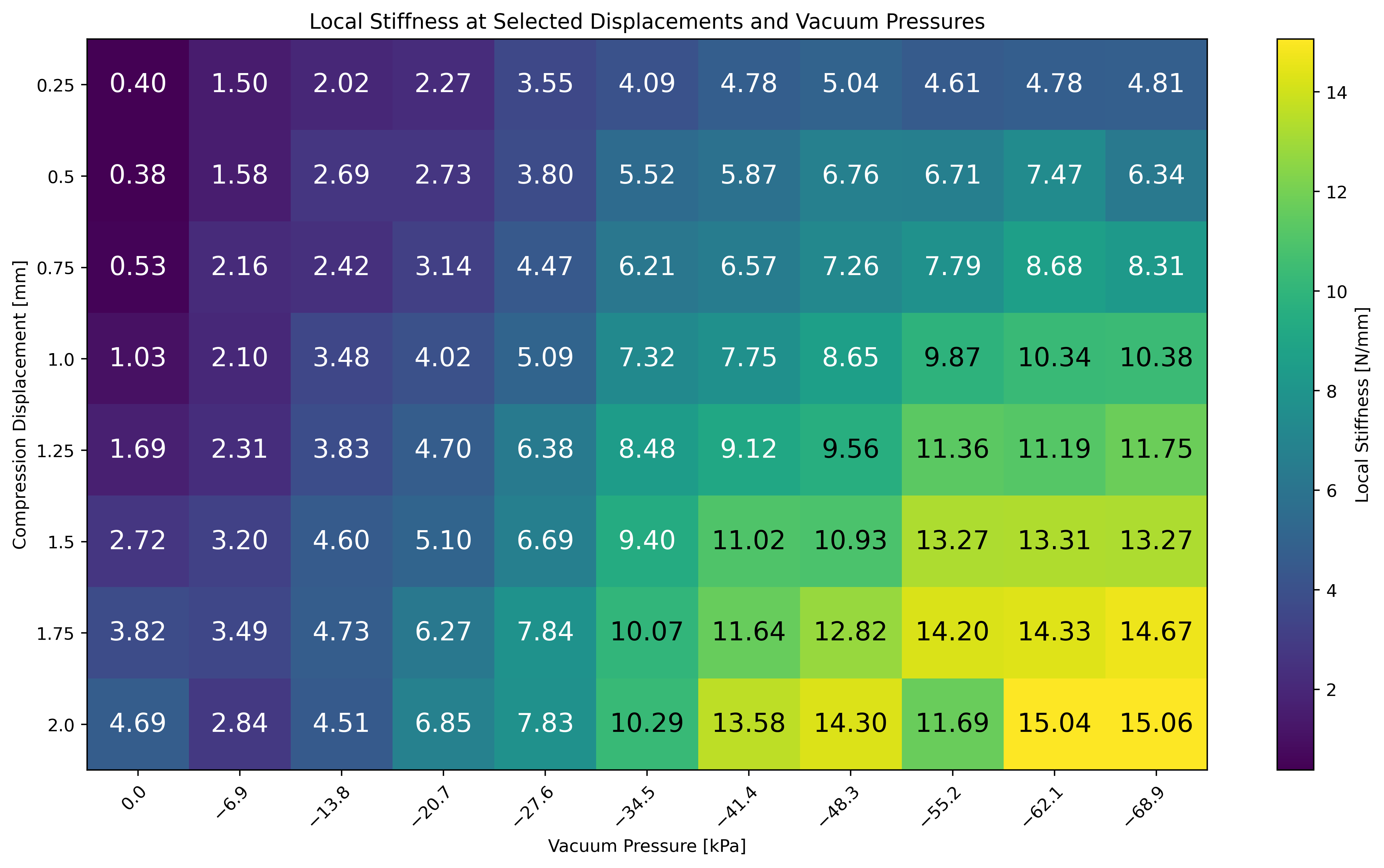
Local stiffness increased with both vacuum pressure and indentation depth. At shallow indentation depths, local stiffness increased rapidly with low-to-moderate vacuum levels before gradually approaching a plateau beyond approximately −41.4 kPa. In contrast, at deeper indentations, particularly between 1.25 mm and 2.00 mm, local stiffness continued to increase across a larger portion of the pressure range. This behavior suggests that deeper indentation progressively engages a greater volume of the granular medium, promoting the formation and stabilization of interparticle force-chain networks that increase resistance to further deformation. As the indenter compresses the membrane, additional particles are recruited into the load-bearing structure, producing a progressively stiffer response rather than a constant elastic behavior.
Across the evaluated pressure–displacement space, local stiffness ranged from 0.38 N/mm at 0.50 mm indentation and 0 kPa to 15.06 N/mm at 2.00 mm indentation and −68.9 kPa, corresponding to a 39.6-fold increase between the minimum and maximum measured values. Unlike a conventional linear spring, the tactile nodule exhibits a nonlinear mechanical response that depends on both the applied vacuum pressure and the indentation depth. Consequently, the mechanical behavior of the device cannot be adequately described by a single stiffness value. Instead, the measured response is more accurately represented as a coupled pressure-displacement stiffness field, where the effective stiffness evolves continuously as both operating pressure and user interaction change.
This nonlinear behavior is advantageous for tactile display applications because human palpation rarely occurs at a fixed indentation depth. During manual exploration, the fingertip progressively compresses tissue while continuously interpreting changes in reaction force. The observed increase in local stiffness with indentation depth therefore provides a mechanism for generating progressive resistance rather than the response of a constant-stiffness actuator. Rather than producing only discrete “soft” and “hard” states, the granular-jamming nodule is capable of generating a continuum of intermediate mechanical responses, which may be useful for rendering variable compliance in future tactile interfaces. However, the present study did not compare the measured response with tissue-specific mechanical targets and did not evaluate human perception. Therefore, the results establish a controllable nonlinear mechanical response but do not demonstrate reproduction of biological tissue mechanics or perceptual realism.
From an engineering perspective, these results indicate that vacuum pressure alone should not be considered the sole design parameter for granular-jamming tactile displays. The measured stiffness of the device depends on both the commanded pressure and the expected operating indentation depth. Consequently, future control algorithms should account for user interaction depth when selecting vacuum pressure to achieve a desired tactile response. Furthermore, the local stiffness map presented in
Figure 5 provides a practical design reference for future variable-stiffness interfaces by identifying the combinations of pressure and indentation that produce specific mechanical responses. This information can assist engineers in selecting operating ranges, developing pressure-control strategies, and optimizing membrane geometry or granular-fill characteristics for applications such as medical palpation simulators, rehabilitation devices, and human–machine interfaces. Overall, local stiffness characterization extends beyond validation of the prototype by providing quantitative design guidance for the development of next-generation granular-jamming tactile displays.
To provide a quantitative representation of the coupled pressure- and depth-dependent response, the mean local-stiffness data were fitted using a second-order bivariate polynomial. Vacuum pressure was expressed as its magnitude,
, such that increasing
represents increasing vacuum:
where
is the estimated local stiffness (N/mm),
is the vacuum-pressure magnitude (kPa), and
is the post-contact indentation displacement (mm). The empirical model achieved
and an RMSE of 0.756 N/mm over the experimentally evaluated ranges of
kPa and
mm. This relationship provides an empirical interpolation of the measured response of the present prototype and should not be interpreted as a generalized constitutive model or extrapolated beyond the tested operating range.
4. Discussion
4.1. Vacuum-Dependent Jamming and Saturation
The results demonstrate that vacuum-actuated granular jamming can produce large and repeatable stiffness modulation in a fingertip-scale tactile nodule. The increase from 1.168 N/mm at 0 kPa to a peak of 9.808 N/mm at −62.1 kPa supports the central hypothesis that increasing vacuum pressure increases the effective stiffness of the tactile unit. Mechanically, this behavior is consistent with progressive compaction of the granular medium, increased interparticle normal forces, increased frictional constraints, and formation of load-bearing force chains [
7,
8,
10,
11,
15].
The plateau at high vacuum pressure is also consistent with jamming mechanics. Once the bead pack becomes highly constrained, additional vacuum produces diminishing structural rearrangement and therefore smaller stiffness gains. For this prototype, the near-maximum response occurred at approximately −55 to −62 kPa, suggesting that future controllers may not need to operate at the maximum achievable vacuum to obtain most of the stiffness benefit. This is useful for actuator design because lower operating vacuum may reduce leakage sensitivity, improve durability, and reduce pneumatic energy demand.
The observed stiffness increase can be explained by the mechanics of granular jamming. In the unjammed state, particles have sufficient freedom to rearrange under external loading, allowing the granular medium to deform readily as contact forces are redistributed through particle motion. As vacuum pressure is applied, the flexible membrane contracts around the particle bed, increasing the confining stress acting on the particles. This confinement increases normal contact forces between neighboring particles, which in turn increases interparticle friction according to Coulomb friction principles. The higher frictional resistance limits particle rearrangement, causing the granular assembly to behave less like a flowing particulate material and more like a cohesive load-bearing structure. As additional particle contacts are established, networks of force chains develop throughout the packed bed, allowing compressive loads to be transmitted more efficiently across the nodule. Consequently, a larger indentation force is required to produce the same displacement, resulting in the observed increase in effective stiffness.
The nonlinear pressure-stiffness relationship observed in this study also agrees with established granular-jamming behavior reported in previous work. Brown et al. demonstrated that the stiffness of vacuum-jammed granular structures increases rapidly as confinement pressure is initially applied before gradually approaching saturation as the granular packing reaches a mechanically stable state [
7]. Similar trends have been reported in variable-stiffness robotic grippers and adaptive structures, where substantial increases in rigidity occur over moderate vacuum levels, followed by diminishing returns as additional particle rearrangement becomes increasingly limited [
9,
11]. The present results extend these observations to a fingertip-scale tactile display element and quantitatively characterize the pressure-stiffness relationship under controlled indentation rather than free structural loading.
4.2. Contact Mechanics Interpretation
The reported stiffness values should be interpreted as effective compressive stiffness values, not as Young’s modulus or geometry-independent material properties. During indentation, the rubber tip did not contact the nodule over a fixed area. Instead, the contact area increased with displacement and load, as expected for compliant contact [
16,
17]. In addition, the membrane stretched and developed tension under indentation and vacuum, which can alter apparent contact stiffness in soft covered systems [
18].
This distinction is important for tactile-display design. A human user does not interact with the granular material alone; the user perceives the combined response of the membrane, bead pack, vacuum state, and finger contact. Therefore, effective stiffness under finger-like indentation is an appropriate device-level metric for a tactile nodule. The depth-dependent local stiffness results strengthen this interpretation, showing that perceived resistance would likely evolve during active palpation rather than being represented by a single scalar stiffness value.
Unlike conventional compression testing of homogeneous materials, the measured stiffness represents the combined response of several interacting components such as the palpating membrane, bottom balloon membrane, and other structures, including membrane deformation, particle packing, contact geometry, and indenter compliance. Each of these factors evolves during indentation, resulting in a nonlinear mechanical response that cannot be represented by a single material constant. Consequently, reporting effective stiffness is more appropriate than attempting to extract a bulk elastic modulus from the indentation measurements. This interpretation is consistent with previous studies of soft tactile interfaces, where device-level mechanical behavior is generally more meaningful than constituent material properties because the human user perceives the integrated response of the complete tactile system rather than the individual materials comprising it.
4.3. Engineering Design Implications
The experimentally determined pressure-stiffness relationship provides useful guidance for the design of future granular-jamming tactile displays. One notable outcome is that the prototype achieved approximately an 8.4-fold increase in global stiffness using only a single pneumatic control variable, without altering the geometry, membrane configuration, or granular medium. This demonstrates that substantial stiffness modulation can be achieved through vacuum control alone, simplifying both mechanical design and system integration.
The results also identify an effective operating region for the prototype. The largest stiffness increases occurred between approximately −25 and −45 kPa, whereas relatively small increases were obtained beyond approximately −60 kPa. From a control perspective, this suggests that operating within the mid-vacuum region provides the greatest stiffness resolution because small pressure changes produce comparatively large changes in mechanical response. Operating at higher vacuum levels may therefore provide limited additional tactile benefits while increasing pneumatic demand, leakage sensitivity, and controller effort.
The local stiffness measurements further indicate that tactile response depends not only on vacuum pressure but also on indentation depth. Consequently, future control algorithms should consider both pressure and user interaction depth when rendering stiffness rather than assuming a single pressure-to-stiffness relationship. Incorporating depth-dependent control may enable more realistic simulation of compliant biological tissues, where resistance naturally increases with progressive palpation. Overall, these findings provide quantitative design guidance for selecting operating pressures, pneumatic hardware, and control strategies in future granular-jamming tactile displays.
4.4. Relevance to Palpation and Haptic Interfaces
The demonstrated stiffness range is relevant to palpation-style haptic simulation. Prior stiffness-discrimination work has used reference stiffness values of 0.25, 0.50, 1.00, and 1.25 N/mm for soft-tissue discrimination tasks [
19]. The unjammed stiffness of the present device, 1.168 N/mm, falls near this range, while the jammed states extend substantially beyond it, creating a broad mechanical contrast for simulating firm inclusions or nodular features. The high-vacuum force levels near the end of the 2.00 mm compression window are also within a palpation-relevant range, although comfort and perceptual realism must be assessed in future human-subject studies [
20].
Potential applications include medical palpation simulators, robotic-surgery training systems, wearable haptic feedback, and prosthetic or sensory substitution interfaces. In medical training, hardness-changing tactile displays can help simulate organic tissues and embedded lesions [
21]. In robotic or laparoscopic systems, reduced direct haptic feedback can impair tissue assessment, and added haptic feedback has been associated with reduced applied forces and improved task performance [
22,
23]. A granular-jamming nodule is not a sensing device by itself, but it could act as a soft tactile rendering element that maps measured or simulated tissue stiffness to vacuum-controlled contact compliance.
Several previous studies have demonstrated the feasibility of granular-jamming haptic interfaces; however, most have emphasized proof-of-concept demonstrations or system development rather than detailed mechanical characterization of a single tactile element [
12,
13,
15]. In contrast, the present work provides quantitative force-displacement, global stiffness, and depth-dependent local stiffness measurements across eleven discrete vacuum levels. These results complement existing studies by providing engineering data that can be directly incorporated into future tactile display design and control. Unlike robotic grippers, where the objective is maximizing holding force, tactile displays require controllable and repeatable compliance that can be perceived by the human finger. Therefore, characterizing the pressure-dependent stiffness response of an individual tactile nodule is particularly important because it establishes the mechanical operating envelope available for future haptic rendering.
4.5. Limitations and Future Work
Several limitations should be considered. First, vacuum pressure was generated using a manual syringe-stopcock circuit rather than an electronic closed-loop pneumatic controller. This choice simplified the proof-of-concept prototype but may have introduced pressure setpoint variability and limited dynamic modulation. Second, testing was limited to quasi-static loading, and the reported mechanical responses represent the coupled behavior of the assembled system. The effects of each contributing factor were not taken into consideration. Dynamic response time, loading-unloading hysteresis, viscoelastic relaxation, leakage over time, and cyclic durability were not quantified. Third, only one nodule geometry, bead size range, bead mass, membrane configuration, and indenter type were evaluated. Fourth, human subject experiments were not performed to validate the human palpation and its similarity to actual biological tissue palpation.
Future work should integrate a miniature vacuum pump, pressure sensor, and closed-loop control algorithm to improve setpoint accuracy and enable time-varying stiffness rendering [
24,
25]. Additional design studies should vary particle material, particle size, fill ratio, membrane thickness, and nodule diameter. Mechanical testing should be expanded to include unloading, repeated cycling, step-response experiments, and alternative indenter geometries. Finally, psychophysical testing with human participants is needed to determine just noticeable differences, perceived realism, comfort, and the ability of users to discriminate different vacuum-controlled stiffness states.
5. Conclusions
This paper presented the design, fabrication, and experimental characterization of a vacuum-actuated granular-jamming tactile nodule for variable-stiffness haptic feedback. The prototype consisted of a 25 mm membrane-based chamber filled with 8 g of 0.6–0.8 mm plastic microbeads and actuated using a simple syringe-based vacuum circuit. Mechanical compression testing demonstrated that effective global stiffness increased from 1.168 N/mm at 0 kPa to a maximum of 9.808 N/mm at −62.1 kPa, corresponding to an approximately 8.40-fold increase. At −68.9 kPa, the global stiffness remained high at 9.562 N/mm, indicating saturation-like behavior at higher vacuum levels.
The depth-dependent local stiffness analysis further showed that the mechanical response depended on both vacuum pressure and indentation depth, reaching a maximum of 15.06 N/mm at 2.00 mm indentation and −68.9 kPa. These results demonstrate that vacuum-induced granular jamming can provide a controllable and repeatable means of modulating the mechanical resistance of a compact tactile element.
Beyond validating the proposed prototype, this work provides a systematic experimental characterization of a fingertip-scale granular-jamming tactile nodule across multiple vacuum levels. The quantitative force-displacement and stiffness data establish a mechanical baseline for the design and optimization of future variable-stiffness tactile displays, enabling more informed selection of operating pressures, membrane configurations, and granular media. By demonstrating that substantial and repeatable stiffness modulation can be achieved using a simple, low-cost pneumatic architecture, this study supports continued development of granular-jamming technology for applications such as medical palpation simulation, rehabilitation, assistive devices, teleoperation, and immersive virtual and augmented reality systems where realistic compliance rendering is essential.
Future work should focus on replacing the manual vacuum system with closed-loop pneumatic control, evaluating long-term durability and dynamic response, and conducting human-subject perceptual studies to correlate measured mechanical properties with perceived tactile realism.
Author Contributions
Conceptualization, S.S.; methodology, S.S.; validation, S.A., P.P., and S.S.; formal analysis, S.A.; investigation, S.A. and P.P.; resources, S.S.; data curation, S.A., P.P., and M.K.; writing—original draft preparation, S.A. and M.K.; writing—review and editing, S.A., P.P., M.K., and S.S.; visualization, S.A. and M.K.; supervision, S.S.; project administration, S.S. All authors have read and agreed to the published version of the manuscript.
Funding
This research received no external funding.
Data Availability Statement
The dataset is available on request from the authors.
Conflicts of Interest
The authors declare no conflicts of interest.
Abbreviations
The following abbreviations are used in this manuscript:
| ABS | Acrylonitrile butadiene styrene |
| CSV | Comma-separated values |
| MEMS | Microelectromechanical systems |
| kPa | Kilopascal |
| N | Newton |
| mm | Millimeter |
| Hz | Hertz |
References
- Wang, Y.; Wang, Y.; Mushtaq, R.T.; Wei, Q. Advancements in Soft Robotics: A Comprehensive Review on Actuation Methods, Materials, and Applications. Polymers 2024, 16, 1087. [Google Scholar] [CrossRef] [Scilit]
- Xavier, M.S.; Tawk, C.D.; Zolfagharian, A.; Pinskier, J.; Howard, D.; Young, T.; Lai, J.; Harrison, S.M.; Yong, Y.K.; Fleming, A.J. Soft Pneumatic Actuators: A Review of Design, Fabrication, Modeling, Sensing, Control and Applications. IEEE Access 2022, 10, 59442–59485. [Google Scholar] [CrossRef] [Scilit]
- Ishizuka, H.; Miki, N. MEMS-based tactile displays. Displays 2015, 37, 25–32. [Google Scholar] [CrossRef] [Scilit]
- Bhatnagar, T.; Higgins, A.; Marquardt, N.; Miodownik, M.; Holloway, C. Analysis of Product Architectures of Pin Array Technologies for Tactile Displays. Proc. ACM Hum.-Comput. Interact. 2023, 7, 135–155. [Google Scholar] [CrossRef] [Scilit]
- Ly, H.H.; Tanaka, Y.; Fujiwara, M. Tumor Depth and Size Perception Using a Pneumatic Tactile Display in Laparoscopic Surgery. IEEE Access 2021, 9, 167795–167811. [Google Scholar] [CrossRef] [Scilit]
- Antfolk, C.; Björkman, A.; Frank, S.O.; Sebelius, F.; Lundborg, G.; Rosen, B. Sensory feedback from a prosthetic hand based on air-mediated pressure from the hand to the forearm skin. J. Rehabil. Med. 2012, 44, 702–707. [Google Scholar] [CrossRef] [Scilit]
- Behringer, R.P.; Chakraborty, B. The physics of jamming for granular materials: A review. Rep. Prog. Phys. 2019, 82, 012601. [Google Scholar] [CrossRef] [Scilit]
- Jaeger, H.M. Celebrating Soft Matter ’s 10th Anniversary: Toward jamming by design. Soft Matter 2014, 11, 12–27. [Google Scholar] [CrossRef] [Scilit]
- Fitzgerald, S.G.; Delaney, G.W.; Howard, D. A Review of Jamming Actuation in Soft Robotics. Actuators 2020, 9, 104. [Google Scholar] [CrossRef] [Scilit]
- Blanc, L.; François, B.; Delchambre, A.; Lambert, P. Characterization and modeling of granular jamming: Models for mechanical design. Granul. Matter 2021, 23, 6. [Google Scholar] [CrossRef] [Scilit]
- Brown, E.; Rodenberg, N.; Amend, J.; Mozeika, A.; Steltz, E.; Zakin, M.R.; Lipson, H.; Jaeger, H.M. Universal robotic gripper based on the jamming of granular material. Proc. Natl. Acad. Sci. USA 2010, 107, 18809–18814. [Google Scholar] [CrossRef] [Scilit]
- Stanley, A.A.; Okamura, A.M. Controllable Surface Haptics via Particle Jamming and Pneumatics. IEEE Trans. Haptics 2015, 8, 20–30. [Google Scholar] [CrossRef] [Scilit]
- Rørvik, S.B.; Auflem, M.; Dybvik, H.; Steinert, M. Perception by Palpation: Development and Testing of a Haptic Ferrogranular Jamming Surface. Front. Robot. AI 2021, 8, 745234. [Google Scholar] [CrossRef] [Scilit]
- Li, M.; Ranzani, T.; Sareh, S.; Seneviratne, L.D.; Dasgupta, P.; Wurdemann, H.A.; Althoefer, K. Multi-Fingered Haptic Palpation utilizing Granular Jamming Stiffness Feedback Actuators. Smart Mater. Struct. 2014, 23, 95007. [Google Scholar] [CrossRef] [Scilit]
- Goodrich, C.P.; Liu, A.J.; Sethna, J.P. Scaling ansatz for the jamming transition. Proc. Natl. Acad. Sci. USA 2016, 113, 9745–9750. [Google Scholar] [CrossRef] [Scilit]
- Hertz, H. On the Contact of Elastic Solids. J. Reine Angew. Math. 1881, 92, 156–171. [Google Scholar]
- Johnson, K.L. Contact Mechanics; Cambridge University Press: Cambridge, UK, 1985. [Google Scholar]
- Yuan, W.; Ding, Y.; Wang, G. Universal contact stiffness of elastic solids covered with tensed membranes and its application in indentation tests of biological materials. Acta Biomater. 2023, 171, 202–208. [Google Scholar] [CrossRef] [Scilit]
- Karadogan, E.; Williams, R.L.; Howell, J.N.; Conatser, R.R. A Stiffness Discrimination Experiment Including Analysis of Palpation Forces and Velocities. Simul. Healthc. J. Soc. Simul. Healthc. 2010, 5, 279–288. [Google Scholar] [CrossRef] [Scilit]
- Laufer, S.; D’Angelo, A.L.D.; Kwan, C.; Ray, R.D.; Yudkowsky, R.; Boulet, J.R.; McGaghie, W.C.; Pugh, C.M. Rescuing the Clinical Breast Examination: Advances in Classifying Technique and Assessing Physician Competency. Ann. Surg. 2017, 266, 1069. [Google Scholar]
- Brown, J.; Bello, F. Hardness changing tactile displays for simulating the feel of organic tissues. Front. Robot. AI 2024, 11, 1404543. [Google Scholar] [CrossRef] [Scilit]
- Bergholz, M.; Ferle, M.; Weber, B.M. The benefits of haptic feedback in robot assisted surgery and their moderators: A meta-analysis. Sci. Rep. 2023, 13, 19215. [Google Scholar] [CrossRef] [Scilit]
- Mir, M.; Chen, J.; Patel, A.; Pinezich, M.R.; Guenthart, B.A.; Vunjak-Novakovic, G.; Kim, J. A Minimally Invasive Robotic Tissue Palpation Device. IEEE Trans. Biomed. Eng. 2024, 71, 1958–1968. [Google Scholar] [CrossRef] [Scilit]
- Xavier, M.S.; Fleming, A.J.; Yong, Y.K. Design and Control of Pneumatic Systems for Soft Robotics: A Simulation Approach. IEEE Robot. Autom. Lett. 2021, 6, 5800–5807. [Google Scholar] [CrossRef] [Scilit]
- Xiao, X.; Huang, K.; Zhu, R.; Xue, Y.; Wang, W.; Wang, H.; Dai, J.S. Programmable Pressure Pneumatic System for Soft Robots. In Proceedings of the IEEE International Conference on Robotics and Biomimetics; IEEE: New York, NY, USA, 2023. [Google Scholar]
| Disclaimer/Publisher’s Note: The statements, opinions and data contained in all publications are solely those of the individual author(s) and contributor(s) and not of MDPI and/or the editor(s). MDPI and/or the editor(s) disclaim responsibility for any injury to people or property resulting from any ideas, methods, instructions or products referred to in the content. |