Article

Research on Hierarchical Sliding Mode–Fuzzy Combined Regenerative Braking Control Strategy Optimized by Adaptive Network-Based Fuzzy Inference System (ANFIS)

1
School of Mechanical Engineering and Mechanics, Xiangtan University, Xiangtan 411105, China
2
State Key Laboratory of Vehicle Transmission, Beijing Institute of Technology, Beijing 100081, China
*
Author to whom correspondence should be addressed.
Actuators 2026, 15(7), 373; https://doi.org/10.3390/act15070373 (registering DOI)
Submission received: 25 May 2026 / Revised: 23 June 2026 / Accepted: 30 June 2026 / Published: 4 July 2026

Abstract

The capability of recovering a portion of braking energy during vehicle deceleration is one of the distinctive advantages of new energy vehicles (EVs) over Conventional Internal Combustion Engine Vehicles (ICEVs). In existing production vehicles, regenerative braking control is commonly implemented using rule-based lookup table methods. Although such approaches are simple, reliable, and easy to implement, they lack the ability to adaptively adjust the braking force allocation according to varying driving conditions, thereby limiting the potential for high efficiency energy recovery. To improve regenerative energy recovery while simultaneously maintaining braking stability, this study introduces an ANFIS-optimized Sliding Mode–Fuzzy Joint Hierarchical Control Strategy (S-FJHCS) for regenerative braking systems. In the upper control layer, an improved tire road friction coefficient estimation algorithm is integrated with a sliding mode controller to ensure consistent slip ratio regulation between the front and rear wheels. In the lower control layer, a fuzzy control algorithm is employed to coordinate the distribution of braking torque between the hydraulic braking system and the hub motors. Furthermore, an Adaptive Neuro-Fuzzy Inference System (ANFIS) is utilized to perform offline optimization of the fuzzy controller, enabling the adaptive adjustment of fuzzy rules and membership functions based on historical operating conditions. Simulation and experimental results demonstrate that the proposed regenerative braking control strategy can improve regenerative energy recovery efficiency by approximately 5–10% compared with a conventional rule based regenerative braking strategy, while maintaining satisfactory braking performance and vehicle stability under various driving conditions.

1. Introduction

With the intensification of the global energy crisis and the increasing awareness of environmental protection among humans, people are showing a growing preference for clean, environmentally friendly, safe and efficient means of transport. Electric vehicles can primarily be divided into two types based on their drive architecture: centralized drive and distributed drive. Distributed Drive Electric Vehicles (DDEV) have become a popular research direction in the field of transportation due to their high efficiency and low emissions. DDEVs are driven independently by four wheel hub motors, allowing precise distribution of torque among the four motors, exhibiting stronger power characteristics and greater energy utilisation efficiency compared to traditional petrol vehicles. However, DDEV regenerative braking technology is also affected by factors such as four-wheel independent drive system architecture, multi-system coupling, and variable environmental disturbances, and still faces numerous difficulties and challenges in improving vehicle energy recovery efficiency. Therefore, it is essential to design a regenerative braking control strategy that can adjust in real time according to road conditions.
In the field of distributed drive electric vehicle control, extensive research has been conducted by numerous scholars. Bowei Zhang et al. [1] proposed a novel anti-rollover control strategy applicable to a center-articulated transport vehicle (CTS) equipped with all-wheel steering (AWS) distributed electric drive architecture. The results demonstrated that the AWS distributed drive configuration enables flexible regulation of the payload and vehicle attitude, thereby achieving effective rollover mitigation without significantly compromising trajectory tracking accuracy. Compared with the front-wheel steering drive (FWSD) vehicle, the path tracking error of the proposed vehicle was reduced by over 50% and 80% under two test scenarios, respectively. Xiaoxuan Yin et al. [2] developed a global coordinated control framework based on tire slip condition assessment. The results indicate that, in comparison with the model predictive control (MPC) algorithm, the proposed control scheme improved vehicle handling performance by 13% during double-lane-change maneuvers, demonstrating significant enhancement across diverse driving conditions. Yi Fan et al. [3] proposed a contribution-oriented framework termed LagCriticSAC, which introduces a novel dual-critic architecture to decouple safety assessment from reward maximization. The proposed method not only achieves superior energy efficiency—outperforming the soft actor–critic (SAC) and MPC benchmarks by 6.2% and 12.4%, respectively—but also strictly enforces the longitudinal slip ratio constraint of each wheel within the bound of ±0.1, thereby ensuring operational safety even in high-density traffic environments.
Considerable research has been conducted on regenerative braking control strategies. Regarding the investigation of key parameters, Zeyu Chen et al. [4] explored the regenerative braking control strategy for DDEVs under varying road gradients. Given the correlation between grade estimation and vehicle mass, they proposed an online co-estimation algorithm for road grade and vehicle mass based on neural networks and the least-squares method. The control strategy is adjusted according to the estimation results, and the power distribution is optimized to achieve optimal braking torque allocation among the front, rear, and hydraulic braking systems. The results demonstrate that energy recovery can be improved by up to 9.62% under certain driving conditions, underscoring the significance of parameter estimation in optimizing regenerative braking control strategies. Wei Xu et al. [5] introduced two speed optimization controllers for in-wheel motor electric vehicles to enhance braking energy recovery. Simulation results indicate that the proposed speed optimization methods not only satisfy braking requirements but also effectively promote regenerative efficiency. Bin Wang et al. [6] proposed a high-robustness slip controller for electric vehicles equipped with hydraulic antilock braking and regenerative braking systems. The controller integrates optimal predictive control with Lyapunov theory to effectively address vehicle parameter uncertainties. A novel braking torque distribution strategy is introduced to smoothly regulate hydraulic pressure, thereby alleviating the pedal pulsation effect inherent in conventional hydraulic antilock braking systems. By leveraging the broad operating range of the hydraulic braking system and the rapid response of the regenerative braking system, the wheel slip control performance is substantially enhanced. Jian Chen et al. [7] developed a mode observer to estimate the vehicle longitudinal velocity, with the estimation error proven to converge to zero via input-to-state stability (ISS) theory. Based on the estimated velocity, a feedback hierarchical controller is proposed to track the desired speed and distribute braking torque among the four wheels to improve energy recovery. Qiping Chen et al. [8] addressed the critical and challenging issue of the influence of road adhesion coefficient on vehicle regenerative braking. To effectively utilize the road adhesion coefficient and enhance braking energy recovery, a road-observer-based regenerative braking control strategy for pure electric vehicles is proposed. The control strategy identifies road conditions through an analogy concept based on real-time vehicle state information. Haoxuan Dong et al. [9] proposed an energy-optimal braking strategy (EOBS) aimed at improving the energy efficiency of electric vehicles by considering shared braking intentions. The results demonstrate that the proposed EOBS significantly enhances energy recovery efficiency compared with conventional constant-speed braking strategies.
In the study of braking torque distribution, Xudong Zhang et al. [10] proposed an energy-saving torque distribution scheme to improve traction efficiency and brake energy recovery. The proposed distribution scheme does not rely on complex online calculations. It is obtained through an offline optimisation process and distributed online via simple interpolation. Jiang Biao [11] and others proposed a regenerative braking strategy using an optimal distribution algorithm and optimally allocated braking force to the front and rear axles according to braking intensity. Bin Guo et al. [12] proposed an intention-based regenerative braking control strategy for electric vehicles to respond to different drivers’ braking intentions and road adhesion conditions. Shoeib Heydari et al. [13] proposed a novel method to efficiently distribute braking force between friction braking and regenerative braking in electric vehicles. The proposed method uses the performance map of the traction motor and its controller to define a boundary within which a mix of regenerative and friction braking is achieved, aiming to maximise energy recovery through the regenerative braking process. Shiwei Xu et al. [14] addressed the configuration characteristics of multi-motor four-wheel-drive electric vehicle composite braking systems, proposed a new composite braking control strategy based on optimising brake energy recovery. Xiaofei Pei et al. [15] proposed a coordinated electro-hydraulic braking control strategy for distributed electric vehicles. Under different braking conditions, a genetic algorithm is used to achieve optimal distribution coefficients. Moreover, the driver’s braking intention is integrated into the weight coefficients to achieve dynamic distribution. Zongjun Yin et al. [16] used a fuzzy control strategy to achieve front axle regenerative braking distribution. Mingbin Tang et al. [17] proposed an optimal regenerative braking control strategy: first, extract optimal modal features from the brake pedal signal to identify the driver’s braking intention, then estimate vehicle load using a recursive least squares algorithm with a forgetting factor; subsequently, use an artificial bee colony optimisation algorithm to allocate the optimal braking force to front and rear axles based on different braking intentions and loads, combining braking stability and energy recovery safety to formulate the strategy. Chunyu Li et al. [18] proposed a game theory-based optimisation regenerative braking control strategy for electric vehicles to improve braking performance and optimise brake energy utilisation. Fenzhu Ji et al. [19] proposed an energy recovery mode that can recover braking energy when the accelerator pedal is released, the brake pedal is pressed, or both pedals are fully released; and proposed a regenerative braking control strategy based on the driver’s intention, which is identified using a fuzzy recognition method.
In terms of regenerative braking system structure optimisation, Chun-Liang Lin et al. [20] proposed an integrated drive and brake control system suitable for electric vehicles using an active regenerative braking control system, utilising reverse electromagnetic fields controlled by pulse width modulation to charge the pump capacitor. The capacitor serves as an additional energy source, connected in series with the battery to charge the pump. This is used to enhance braking torque, thereby efficiently stopping the rotary motor during braking. Sekhar Raghu Raman et al. [21] proposed a distributed energy storage design for the integration of supercapacitors in electric vehicle bodies, overcoming design bottlenecks through special packaging and structural adaptation, improving vehicle power and regenerative braking performance, extending the life of lithium batteries, and carried out research on energy storage device modelling, converter performance analysis, and control strategies. Jose A. Ruz-Hernandez et al. [22] proposed a neural inverse optimal control method for electric vehicle regenerative braking systems, using an auxiliary energy system containing supercapacitors and boost-buck converters to recover braking energy that cannot be stored by the main energy source; by training a neural identifier with an extended Kalman filter to estimate converter dynamics, auxiliary system voltage and current regulation is achieved, and combined with a PID controller to complete DC motor speed tracking tests. Zhen Shi et al. [23] proposed a dual-disc electromagnetic–EMB composite braking structure, achieving integrated electromagnetic and friction braking, providing a structural-level redundant safety solution for EMB.
From the above research, it can be seen that many current studies focus on key parameter research, braking force distribution strategies, and regenerative braking structure optimisation to improve the energy recovery efficiency of the regenerative braking process. However, research on regenerative braking control strategies optimised considering operating condition variations is still insufficient. This study mainly focuses on the design of a regenerative braking control strategy optimised based on historical operating condition data. Section 2 of this paper establishes the vehicle dynamics model, Section 3 proposes the design of the regenerative braking control strategy, Section 4 presents simulation and hardware-in-the-loop verification of the control strategy along with result analysis, and finally, Section 5 draws the conclusions.

2. Motivation and Objective of Present Work

Based on the literature review, the following research gaps remain:
(1)
Existing regenerative braking controllers based on fuzzy logic or the adaptive neuro-fuzzy inference system (ANFIS) typically calibrate their fuzzy rules and membership functions using expert experience or local operating-condition data. This practice makes it difficult to guarantee the optimality of the control strategy across the full spectrum of operating conditions, and lacks a quantitative basis for optimality assessment.
(2)
ANFIS is predominantly employed for intention recognition rather than for control optimization, and its torque allocation method lacks closed-loop adaptive capability.
(3)
Ensuring the torque distribution between the front and rear axles and optimizing regenerative energy recovery are generally treated as mutually independent problems.
In this study, the proposed framework exhibits novelty in the following four aspects (as elaborated in three key directions): (1) ANFIS is utilized not merely as a recognizer but as a core optimization engine, which directly performs refined optimization on the fuzzy control rules and membership functions for regenerative braking torque distribution. This enables the fuzzy controller to adaptively adjust its decision-making logic based on historical driving data. (2) The ANFIS optimization is embedded within a hierarchical control framework, where the optimized fuzzy rules are updated offline based on the dynamic programming results of historical driving cycles. This allows the strategy to adapt to varying driving conditions while maintaining real time computational efficiency. (3) The regenerative braking control problem is decomposed into two functionally distinct and clearly defined levels: the upper level (sliding mode control), which ensures consistency in the slip ratios of the front and rear wheels in real time and distributes the braking force between the two axles; and the lower level (ANFIS optimized fuzzy control), which, subject to the torque distribution commanded by the upper level, maximizes regenerative braking energy recovery.

3. System Dynamics Modelling

3.1. Vehicle Structure

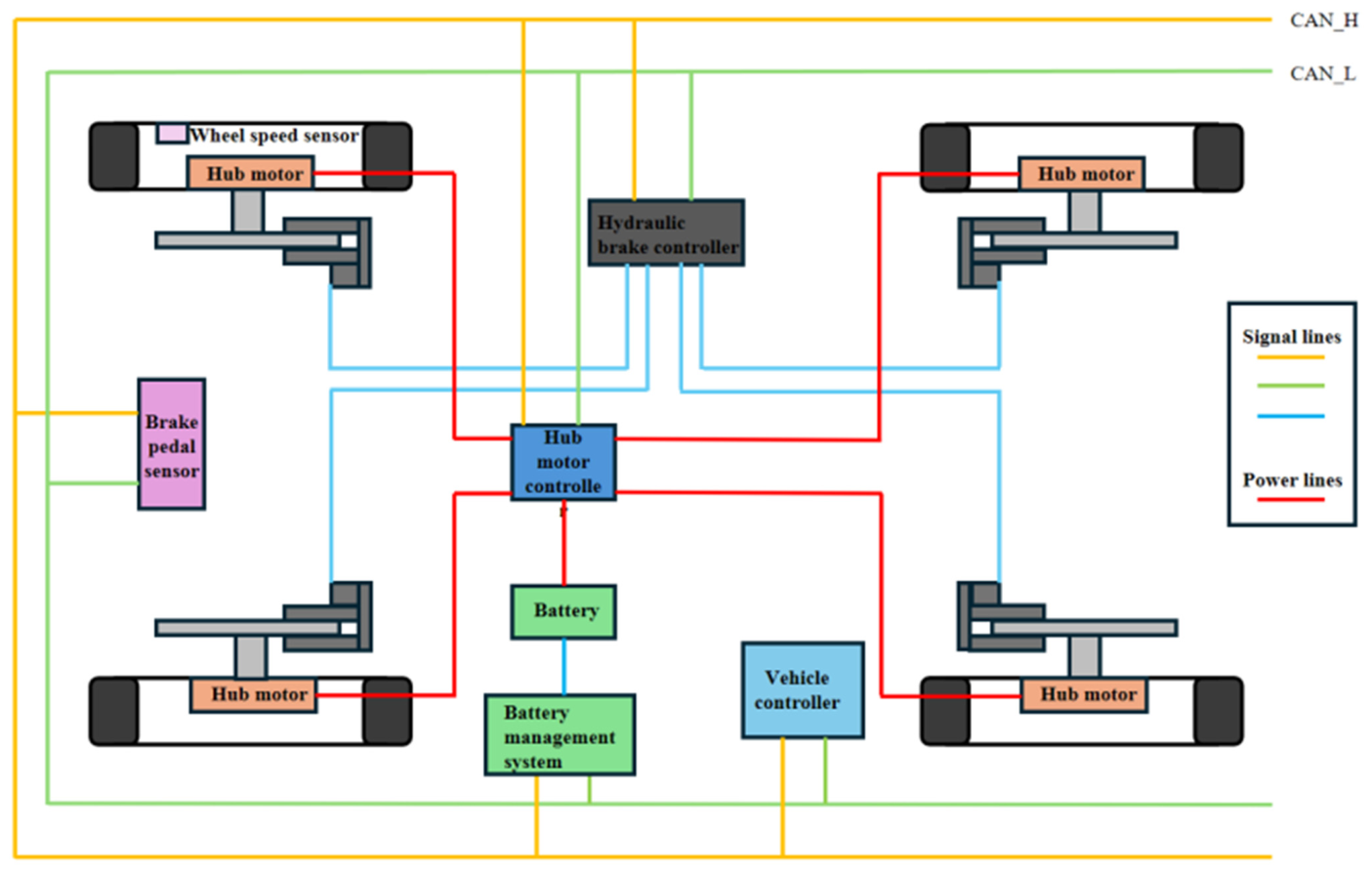
The structure of the electric vehicle studied in this paper is shown in Figure 1. The vehicle is equipped with an Electro-hydraulic Brake System (EHB) and is independently driven by four wheel hub motors. Its main components are: 1. Wheel hub motors, 2. Electro-hydraulic Brake System (EHB), 3. Motor Control Unit (MCU), 4. Vehicle Control Unit (VCU), 5. Brake Control Unit (BCU), 6. Battery Management System (BMS), etc. The specific parameters of the vehicle are shown in Table 1.

3.2. Vehicle Model

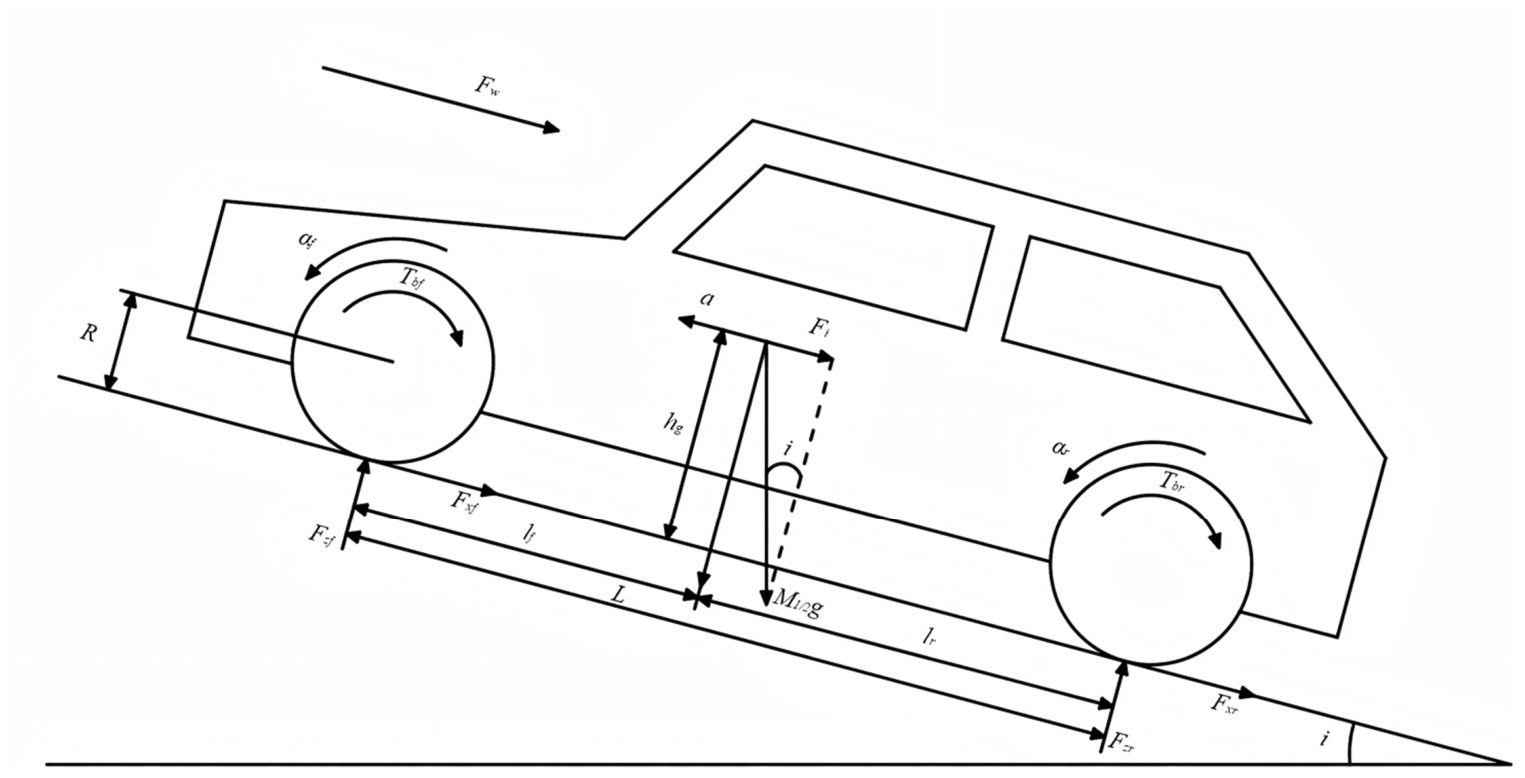
To better assess the impact of load transfer between the front and rear axles on vehicle braking force distribution, while taking into account air resistance, rolling resistance and gradient resistance, a longitudinal vehicle dynamics model based on dual wheel rotation is established, as shown in Figure 2.
The longitudinal motion of the vehicle body and the rotation process of the wheels are analysed, and their dynamic equations are as follows:
M 1 / 2 a = F x f F x r F f F w F i J α f = F x f R T f J α r = F x r R T r
In the formula: M 1 / 2 is half of the vehicle mass; a is the vehicle longitudinal acceleration; F x f , F x r , are the longitudinal tire–road forces at the front and rear axles, respectively; F w is the aerodynamic drag; F f is the rolling resistance; F i is gradient resistance; J is the wheel rotational inertia; R is the wheel rolling radius; α f , α r are the front and rear wheel rotational accelerations; T f , T r are the front and rear wheel braking torques.
The front and rear axle loads of a vehicle during driving are related to the vehicle’s acceleration and road slope, calculated as follows:
F z f = M 1 / 2 g l r L cos i g h g L sin i + a h g L F z r = M 1 / 2 g l f L cos i + g h g L sin i a h g L
In the formula, i is the road slope.
The braking torque of the front and rear wheels is provided by the regenerative braking system and the hydraulic braking system, calculated as follows:
T f = T r e g , f + T h y d , f T r = T r e g , r + T h y d , r
In the formula: T r e g , f , T r e g , r represent the regenerative braking torque of the front and rear wheels; T h y d , f , T h y d , r represent the hydraulic braking torque of the front and rear wheels.
The hub motor control uses torque closed-loop control, and its stator windings are connected in a star configuration. By using Clarke and Park transformations, the three-phase voltage is converted into d-axis and q-axis voltages, decoupling the system variables. Adjusting the d-axis and q-axis currents allows for motor torque control. Additionally, the three-phase current is transformed into d-axis and q-axis currents, enabling closed-loop control of the d-axis and q-axis currents.
Calculate the motor electromagnetic torque using the d-axis and q-axis currents:
T e m = p m ψ s d m i s q m ψ s q m i s d m
The motor’s thermal losses are as follows:
δ h m = i s d m 2 R s m + i s q m 2 R s m
p m is the number of pole pairs of the hub motor, ψ s d m and ψ s q m are the equivalent fluxes of the hub motor d-axis and q-axis, i s d m and i s q m are the equivalent currents on the hub motor d-axis and q-axis, respectively, and R s m is the resistance of the hub motor stator coil. Part of the energy received by the motor is converted into mechanical energy to drive the wheel rotation, while the other part is dissipated as heat, as shown in the following formula:
P e m = P m m + P h m
The working efficiency of a motor is related to the torque and speed of the motor, and the motor working efficiency is calculated as follows:
η m = f T e m , n m
η m is for the working efficiency of the hub motor, and n m is the speed of the hub motor.
In addition to serving as a drive motor, the motor is also used as a generator during vehicle braking, with its operating modes classified as follows:
P e m > P m m , Motoring   mode P e m < P m m , Generating   mode
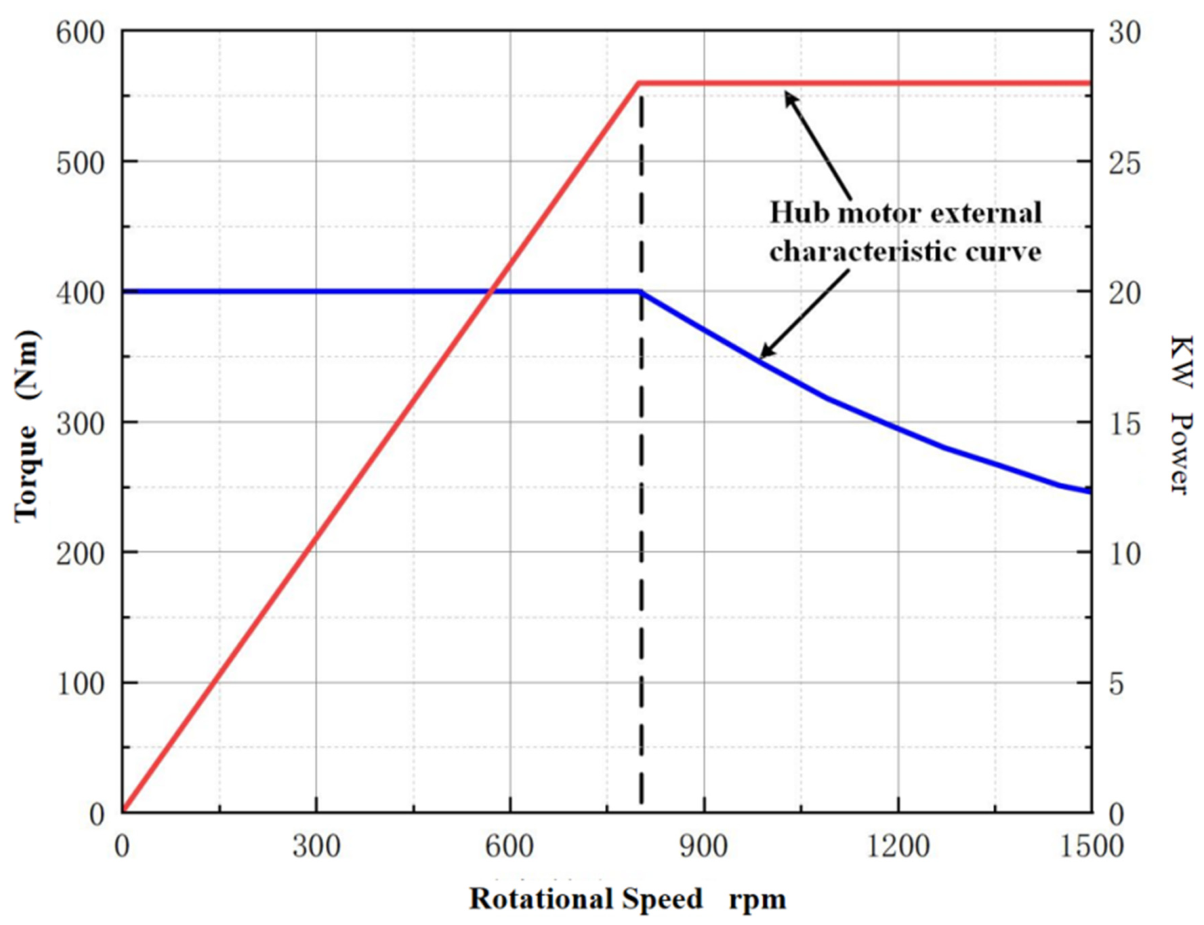
The hub motor prototype used in this study has a peak power of 35 kW, a rated power of 25 kW, and a maximum speed of 1500 r/min. Considering that this study mainly focuses on vehicle braking, which involves prolonged electric motor braking conditions, only the rated operating range of the motor is studied to ensure the motor’s service life. Its external characteristic curve is shown in Figure 3.
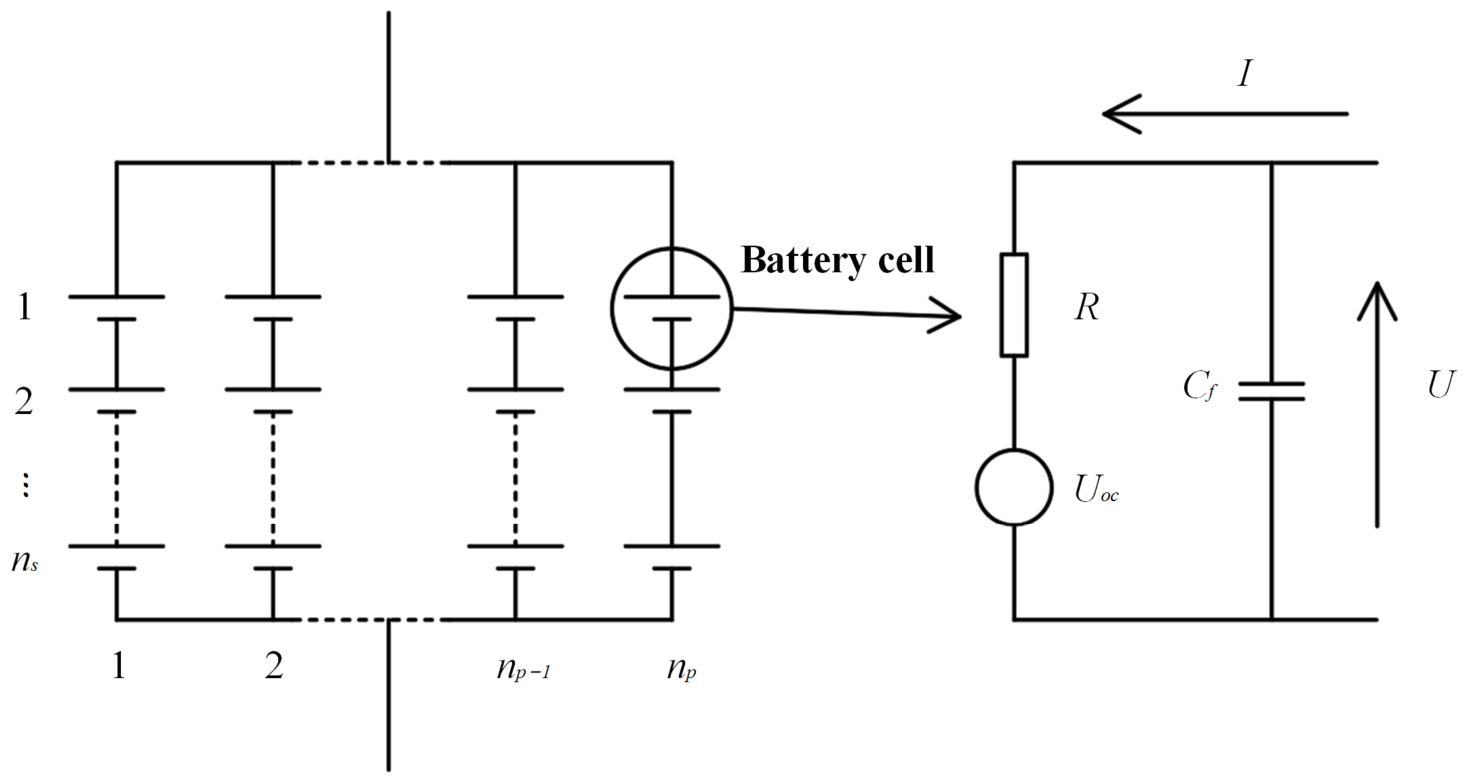
The battery serves as the energy source for the entire vehicle, supplying power to the whole vehicle while also receiving energy generated from the regenerative braking of the motor. The modelling accuracy of the battery directly affects the simulation accuracy in this study. In this paper, the battery is simplified into the structure shown in Figure 4, with the battery being equivalently simplified into a form of a voltage source in series with a resistor, and then in parallel with a capacitor. The entire battery pack is composed of a certain number of battery cells connected in series and parallel.
The equivalent capacity, equivalent capacitance, equivalent resistance and equivalent voltage of the battery can be calculated using the following formulas:
C a p b a t = C a p b a t o n e c e l l × n p
C f = C o n e c e l l × n p n s
r b a t = r o n e c e l l × n s n p
u o c = u o c o n e c e l l × n s
Considering the battery energy loss during the energy recovery process, the battery output voltage and battery energy loss power are calculated as follows:
u o c = u o c o n e c e l l × n s
P b l o s s = U b a t u o c 2 r b a t
The brakes studied in this paper are all disc brakes. Hydraulic disc brakes use Pascal’s law and the lever principle to transmit and amplify the operating force, generating braking torque on the wheels. They convert the kinetic energy of a moving vehicle into frictional heat through the friction between components, relying on the friction components to absorb and release heat to slow down the vehicle or bring it to a stop.
The brake model uses the Coulomb friction model:
f v = μ F N s i g n v
In the formula, f v represents the friction force of the brake, μ is the coefficient of friction, F N is the normal pressure, and s i g n v is the signed function of relative velocity.
For the brake model in this study, static friction and viscous properties can be introduced into the Coulomb friction model through external modules, making the brake model closer to a real brake disc.
According to Coulomb’s friction theory, once the friction pad comes into contact with the brake disc, a frictional force is generated:
F d i s c , f = F i n tan 2 V r e l d V
F i n = μ F N
In the formula, F d i s c , f is the braking disc friction force, F i n is the input for the target friction torque, V r e l is the relative speed between the friction pad and the braking disc, d V is the speed threshold value, and μ is the coefficient of friction.

3.3. Brake Control System

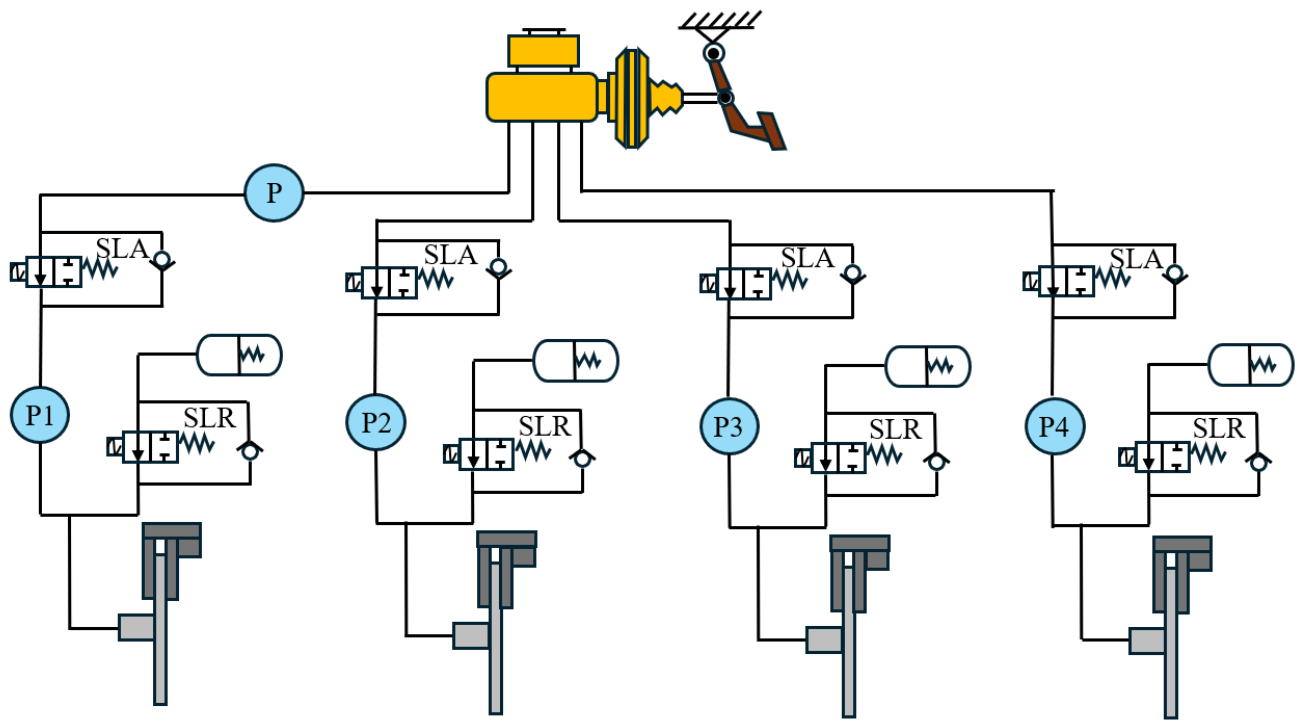
The braking system typically includes a data collection module, brake control, and corresponding execution functions. The structure of the vehicle braking system studied in this article is specifically shown in Figure 5. During the driver’s operation of the vehicle braking, the pedal position signal is obtained by the respective displacement sensor, and this signal forms the basis for brake demand recognition. Under normal conditions, the SLA solenoid valves on the four channels are all normally closed, so the liquid pressure transmission path between the four brake wheel cylinders and the master cylinder is cut off, and each brake wheel cylinder maintains an independent working state. In the pipelines connecting the SLA1 to SLA4 solenoid valves to each brake wheel cylinder, liquid pressure sensors are installed. The real-time liquid pressure signals of the wheel cylinders are detected by these sensors and fed back to the brake integrated controller, which implements closed-loop correction of the control current to each solenoid valve based on the deviation between the feedback signal and the desired braking force.
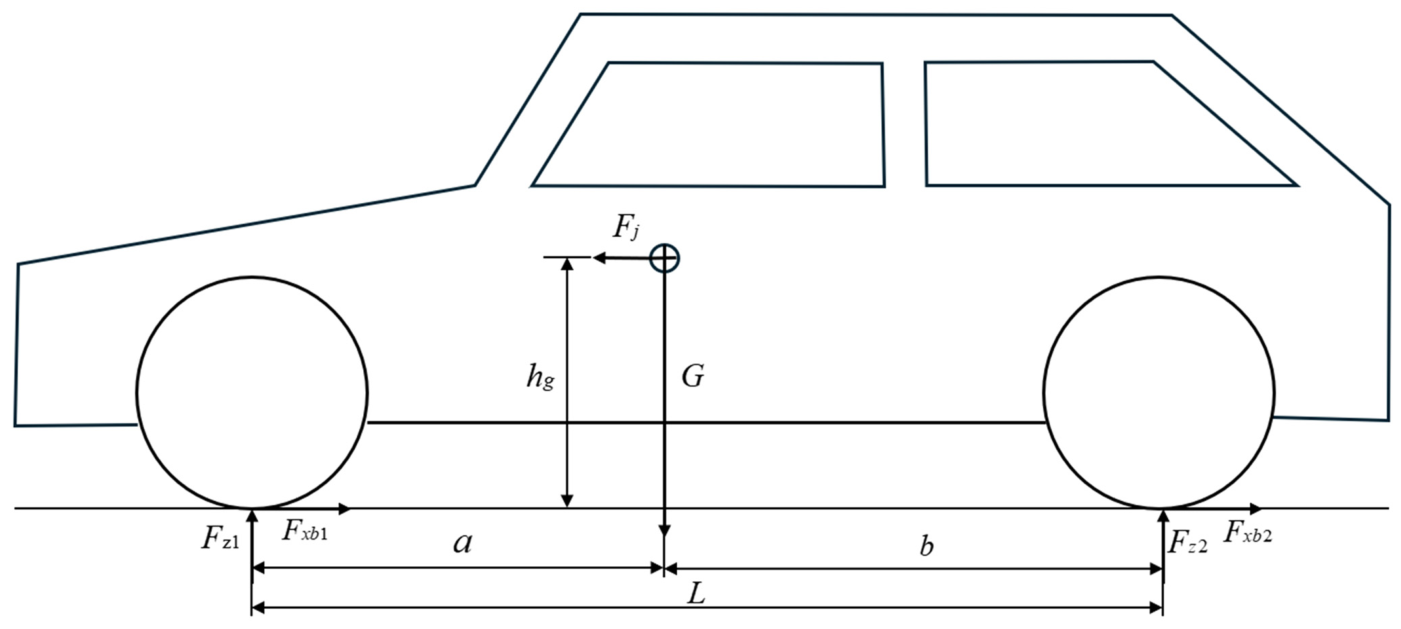
Before analysing the braking force distribution between the front and rear axles, it is necessary to first understand the normal reaction forces exerted by the ground on the front and rear axles during braking. Figure 6 shows a simplified force diagram of a car braking on a level road, where factors such as rolling resistance torque, inertial moment, and aerodynamic drag are neglected.
Among them, F z 1 is the normal ground reaction force of the front wheel; F z 2 is the normal ground reaction force of the rear wheel; F x b 1 is the braking force on the front wheel; F x b 2 is the braking force on the rear wheel; F j is the inertial force of the car; h g is the height of the centre of mass; L is the wheelbase; G is the weight of the car.
By writing the moment equilibrium equations for the contact points of the front and rear wheels, we can obtain:
F z 1 = G L b + z h g F z 2 = G L a z h g
When braking on roads with different coefficients of friction, under conditions where both the front and rear wheels lock up (whether simultaneously or sequentially), there will be:
F x b = z G = F φ = φ G
F x b = F x b 1 + F x b 2
F z 1 = G L b + φ h g F z 2 = G L a φ h g
where G represents the total braking force on the ground, and φ represents the road surface adhesion coefficient.
The condition for both the front and rear axles of a car to lock simultaneously is that the braking force of each wheel on the front and rear axles equals its respective adhesion, namely:
F u 1 + F u 2 = φ G F u 1 F z 1 = F u 2 F z 2
Substituting Equation (21) into the above expression yields:
F u = G 2 h g b 2 + 4 h g L G F u 1 F u 1 G b 2 h g
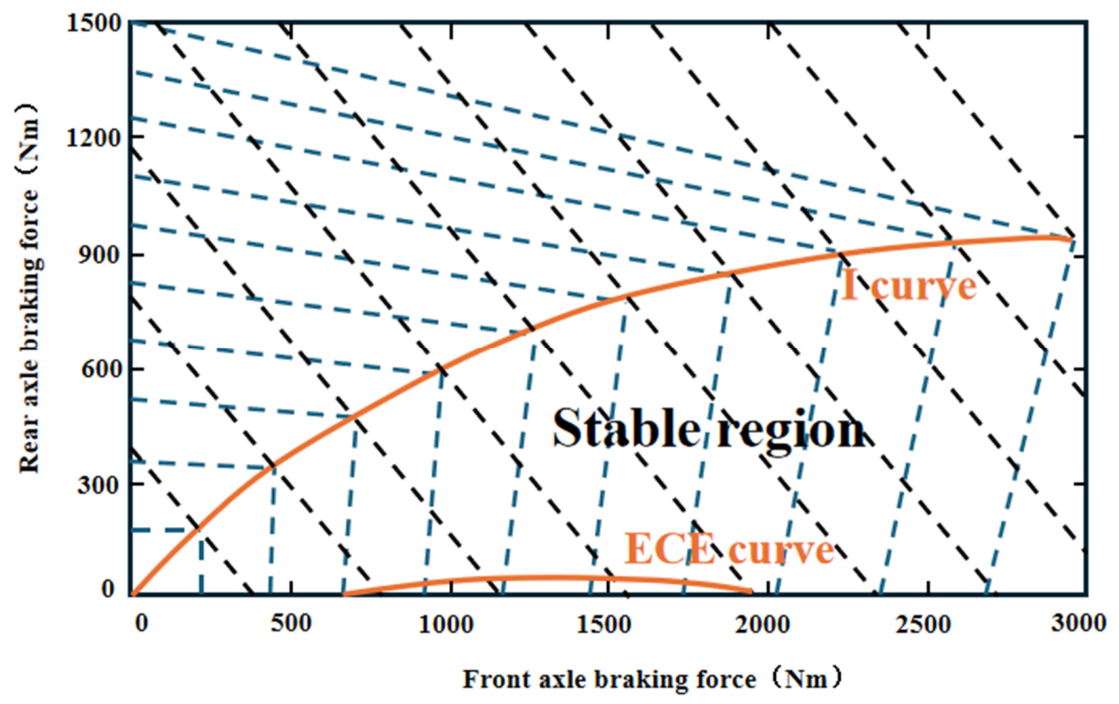
Plotting Equation (23) as a curve gives the ideal braking force distribution curve for simultaneous locking of the front and rear axles, also known as the I curve. According to ECE braking regulations, for various vehicles with a proportion in the 0.2 to 0.8 range, the braking intensity as follows:
F b f = z + 0.07 0.85 G L L b + z h g F b r = G z F b f
The ideal braking force distribution curve where the front and rear axles lock simultaneously, also known as the I curve, is shown in Figure 7 along with the ECE braking regulation line.

4. Control Strategies

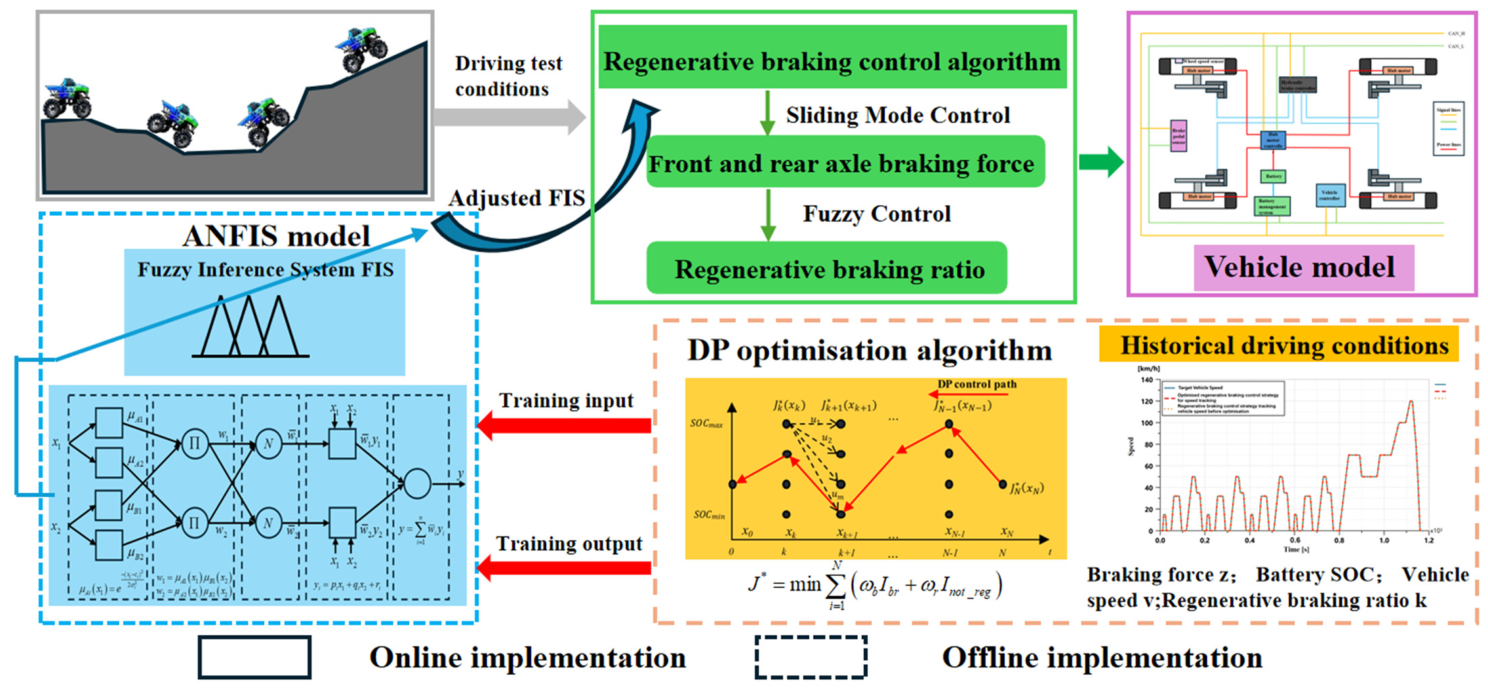
Regenerative braking is a key technology for improving the energy efficiency and driving range of new energy vehicles. This technology offers multiple significant advantages: it not only effectively extends the driving range and alleviates users’ range anxiety, but also substantially reduces frictional losses in conventional mechanical braking systems, thereby decreasing the replacement frequency of brake pads and brake discs, prolonging the service life of braking components, and reducing maintenance costs. In terms of energy recovery efficiency, the regenerative braking efficiency of passenger vehicles can generally reach 15–25% under urban congested conditions with frequent stop-and-go operation. For commercial vehicles, owing to their larger vehicle mass and greater redundant braking energy, the energy recovery efficiency can exceed 30% when combined with an optimized torque distribution strategy, resulting in particularly significant energy-saving benefits. In this paper, a regenerative braking strategy based on sliding-mode–fuzzy joint hierarchical control for distributed-drive electric vehicles, namely S-FJHCS, is proposed. In the proposed control strategy, the upper layer employs a sliding-mode algorithm to reasonably allocate the braking force between the front and rear axles, whereas the lower layer adopts a fuzzy control algorithm to distribute the regenerative braking torque of each axle. Meanwhile, an adaptive neuro-fuzzy inference system is used to offline optimize the fuzzy controller based on historical data, thereby maximizing energy recovery while maintaining vehicle braking stability. Figure 8 presents the overall control scheme of the proposed strategy.

4.1. Upper-Level Control Strategy

The upper-level control strategy ensures that the slip ratios of the front and rear wheels remain identical, thereby maximizing vehicle braking stability and preventing braking instability caused by premature lock-up of either the front or rear wheels. Considering the rapid response, strong robustness, and ease of implementation of sliding mode control, this method is adopted in the upper-level control strategy to regulate the front and rear braking forces in real time during vehicle operation, so as to ensure equality between the front- and rear-wheel slip ratios.
The switching function adopted in this study is defined as follows:
s = ω f ω r + c 0 t ω f ω r d t
where c is defined as a weighting coefficient, which determines the overshoot value of the sliding-mode curve; ω f and ω r denote the rotational speeds of the front and rear wheels, respectively.
Taking the derivative of Equation (25) yields:
s ˙ = ω ˙ f ω ˙ r + c ω f ω r
where s ˙ is defined as the reaching rate of the sliding mode control.
According to the vehicle dynamic equations, the following expression can be obtained:
ω ˙ f = F f r T f I ω ˙ r = F r r T r I
where T f and T r denote the braking torques of the front and rear wheels, respectively; F f and F r represent the longitudinal forces of the front and rear tires, respectively; I denotes the rotational inertia of the tire; and r represents the tire radius.
Substituting Equation (27) into Equation (26), the following expression can be obtained:
T r T f = s ˙ I + F r r F f r c I ω f ω r
The reaching rate determines the acceleration at which the system state approaches the sliding surface during the reaching process. In this study, the reaching rate is defined as follows:
s ˙ = ε sgn s k s ε > 0 , k > 0
s t = ε k + s 0 ε k e k t , s > 0 ε k + s 0 + ε k e k t , s < 0
s 0 represents the initial value of s .
Substituting Equation (28) into Equation (29), the new equilibrium expression can be obtained:
T r T f = s ˙ I + F r r F f r c I ω f ω r
During the braking process, the total braking torque demand can be obtained by analyzing the driver’s brake pedal opening. Therefore, the following expression can be defined:
T t o a l = δ m g z r
In this expression, T t o a l denotes the total braking torque demand of the vehicle, m represents the vehicle mass, g is the acceleration due to gravity, z denotes the brake pedal intensity, and δ represents the rotational mass coefficient. In addition, T t o a l is the sum of the front axle braking torque T f and the rear axle braking torque T r , namely:
T r = ε sgn s k s I + F r r F f r + m g z r c I ω f ω r 2 T f = m g z r + ε sgn s + k s I F r r + F f r + c I ω f ω r 2

4.2. Lower-Level Control Strategy

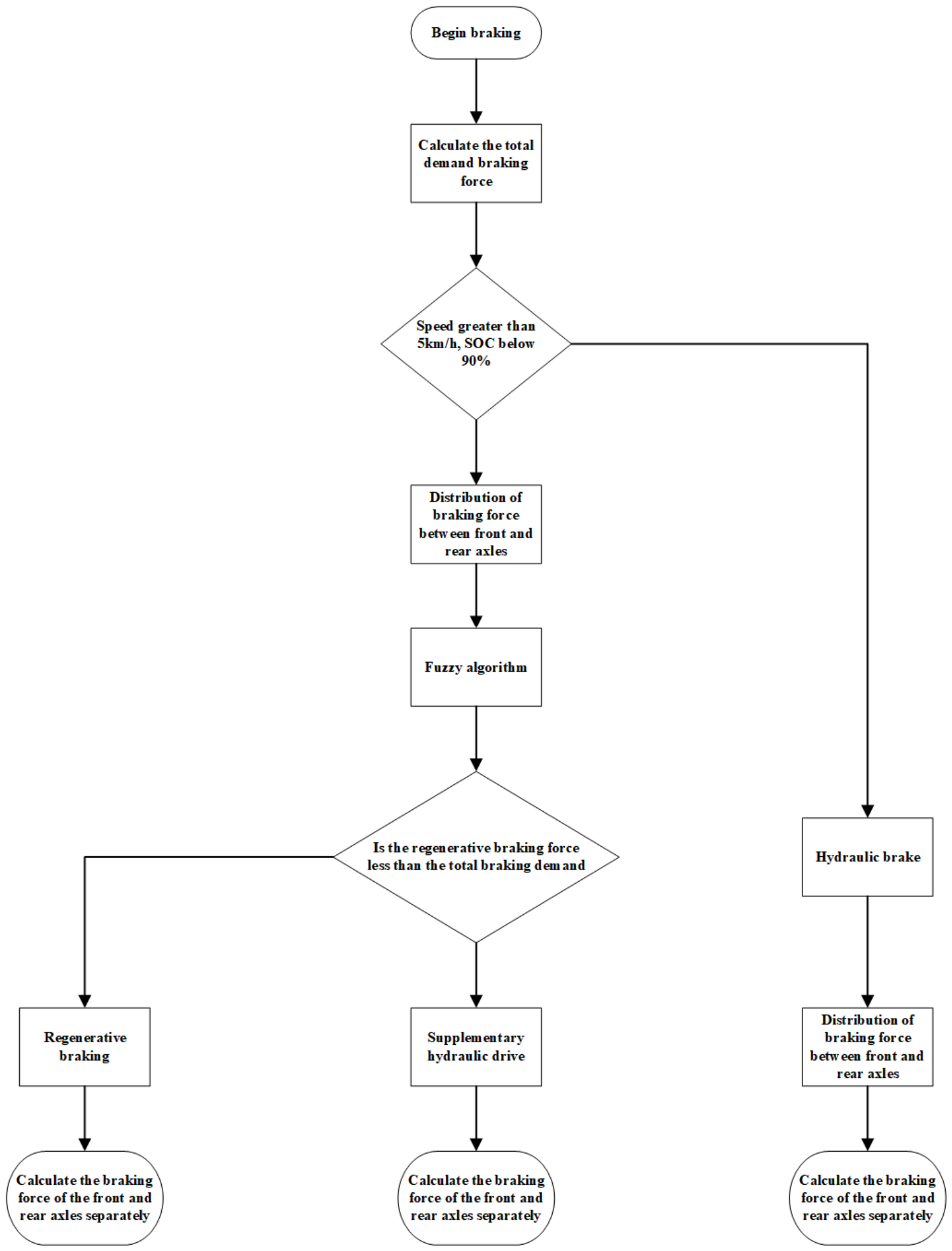
In the lower-level braking force distribution, owing to the randomness and nonlinearity of vehicle operating states, it is difficult to predict the system bahavior in advance and establish an accurate mathematical model. Therefore, a fuzzy control method is introduced to address this problem. The overall design logic of the lower-level control strategy is shown in Figure 9.
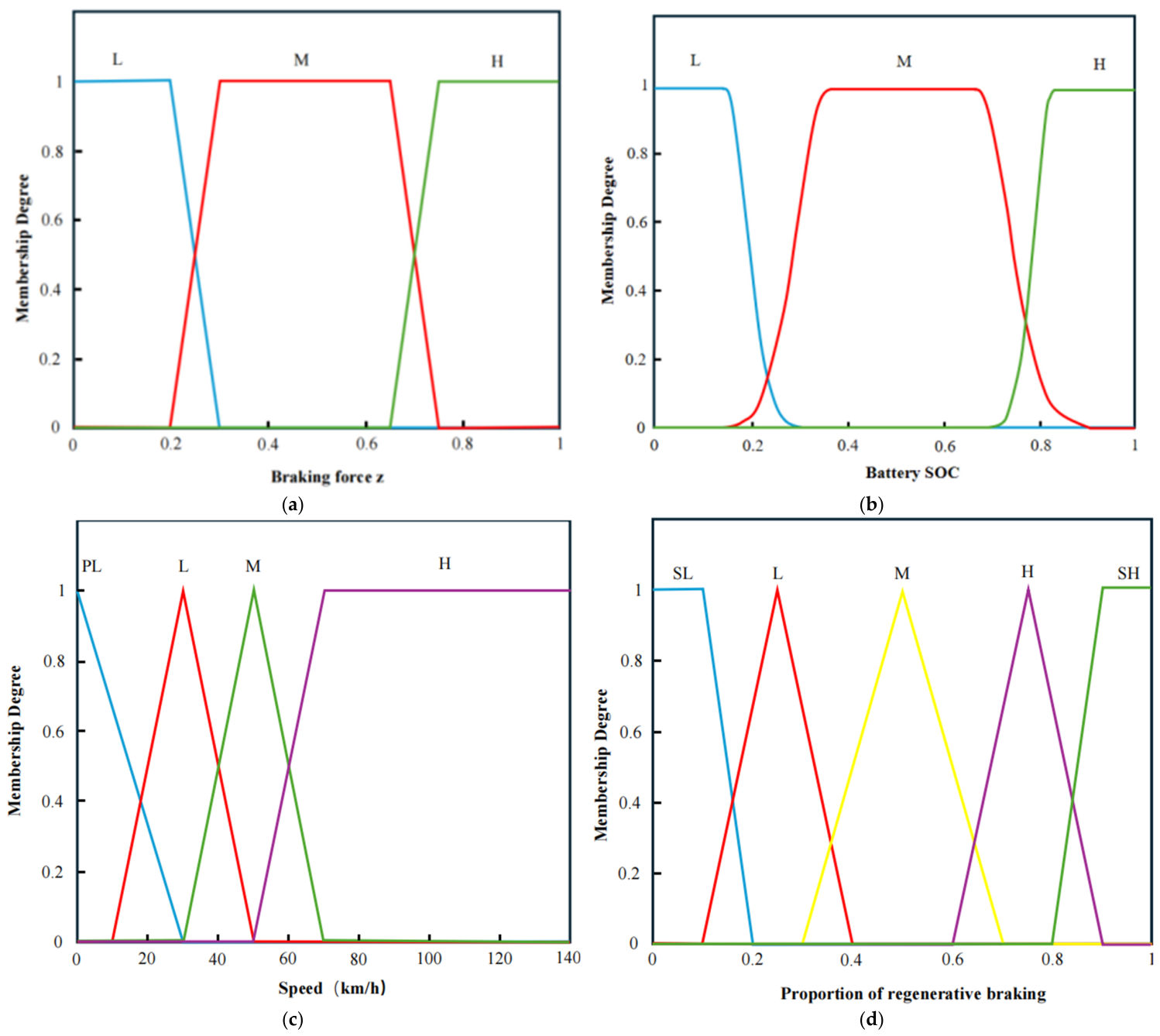
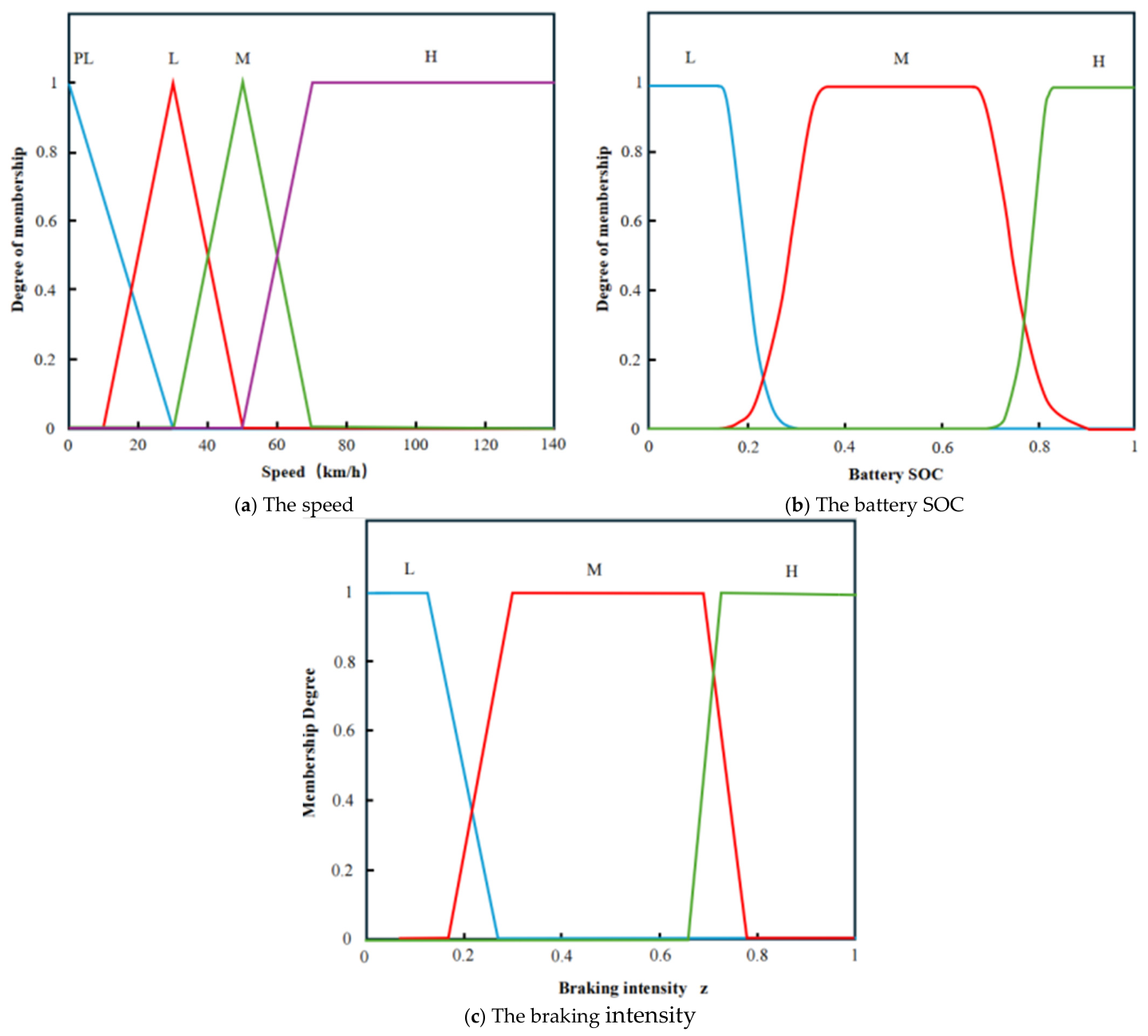
Considering the various factors affecting vehicle regenerative braking, three dominant factors are selected as the input variables, namely the braking intensity z , the battery state of charge (SOC), and the real-time vehicle speed v . The purpose of introducing fuzzy control is to achieve more appropriate regenerative braking force distribution and increase the proportion of regenerative braking force. Therefore, the output of the fuzzy controller is selected as the ratio k of the regenerative braking force to the total braking force. According to the variation characteristics of the input and output variables, two-sided trapezoidal membership functions, two-sided Gaussian membership functions, and triangular membership functions are mainly adopted. The membership functions are shown in Figure 10.
For a single sample, the input variables are the braking intensity, the battery state of charge (SOC), and the real-time vehicle speed. For vehicle speed, when the speed is lower than 5 km/h, the system exits regenerative braking, and the upper speed limit is 120 km/h. Therefore, the universe of discourse of the vehicle-speed membership function is set to ([0 , 120]), in which the values from 0 to 120 correspond to the increasing vehicle speed. In this study, the universe of discourse of the (SOC) membership function is set to ([0 , 1]), where values from 0 to 1 correspond to the change in (SOC) from low to high. The universe of discourse of the braking intensity is also set to ([0 , 1]). For the regenerative braking force distribution coefficient, the universe of discourse of the control variable, namely the motor regenerative braking force proportion coefficient, is set to ([0 , 1]).

4.3. Adaptive Fuzzy Neural Network Optimisation of the Lower-Level Fuzzy Controller

As an intelligent control method integrating adaptive control, fuzzy logic, and neural networks, adaptive neuro-fuzzy inference system control (ANFIS) is suitable for control tasks involving nonlinear, time-varying, and uncertain systems. This technique realizes offline parameter adjustment through model-reference adaptive or self-tuning mechanisms, represents expert experience by means of fuzzy logic, and optimizes fuzzy rules and membership functions using the learning capability of neural networks, thereby improving system robustness and control accuracy.
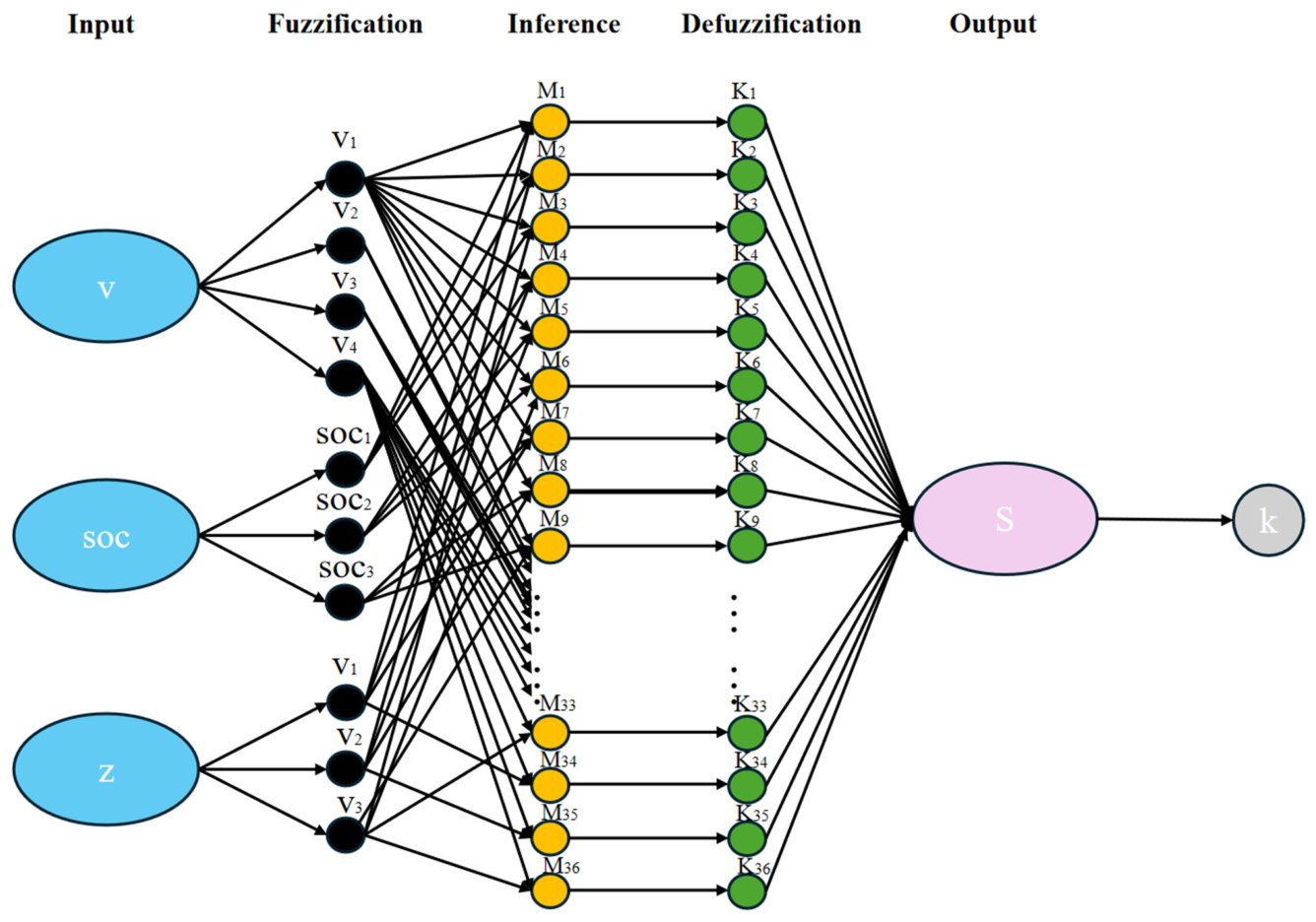
In this study, a Takagi–Sugeno (T–S)-type ANFIS is adopted, and its structure is shown in Figure 11. The ANFIS structure consists of an antecedent network and a consequent network.
The antecedent network is mainly used to match fuzzy rules and consists of four layers. The first layer is the input layer, which contains three variables, namely the braking intensity z , battery S O C , and vehicle speed v . The number of input variables corresponds to the number of neurons. Therefore, this study contains three neurons in this layer, expressed as follows:
x = x 1 , x 2 , x 3
In this expression, x 1 , x 2 , x 3 represent the actual input values of the current braking intensity z , battery SOC, and vehicle speed v , respectively.
The second layer is the fuzzification layer. The three input variables are mapped to corresponding fuzzy linguistic value sets, and each node in this layer represents one fuzzy linguistic term. Specifically, z and SOC are each divided into three linguistic variables, whereas v is divided into four linguistic variables. Therefore, this layer contains 10 neurons, expressed as follows:
μ i j = μ A i j ( x i )
In Equation (35), i = 1,2,3…, j = 1,2,…, m i , m i represents the number of fuzzy partitions of x i .
The third layer is the fuzzy inference layer. Each node represents one fuzzy rule. Since this layer contains 36 nodes, 36 fuzzy rules are generated, expressed as follows:
α j = μ 1 i 1 μ 2 i 2 μ 3 i 3
In Equation (36), i 1 = 1, 2,3,4, i 2 = 1, 2,3, i 3 = 1,2,3, j = 36.
The fourth layer performs normalization, through which the fuzzy linguistic values are converted into the corresponding control variables within the universe of discourse, expressed as follows:
α ¯ j = α j / i = 1 36 α i
The consequent network is used to generate the consequents of the fuzzy rules and mainly consists of three layers. In the first layer, in addition to the three input variables, a constant term of 1 is also introduced. The second layer is used to calculate the consequent part of each rule, expressed as follows:
y j = c j 0 + c j 1 x 1 + c j 2 x 2 + c j 3 x 3
The output of the second layer is the regenerative braking distribution coefficient k . The final output of the controller is obtained using the weighted summation method, expressed as follows:
y = i = 1 36 α ¯ i y i
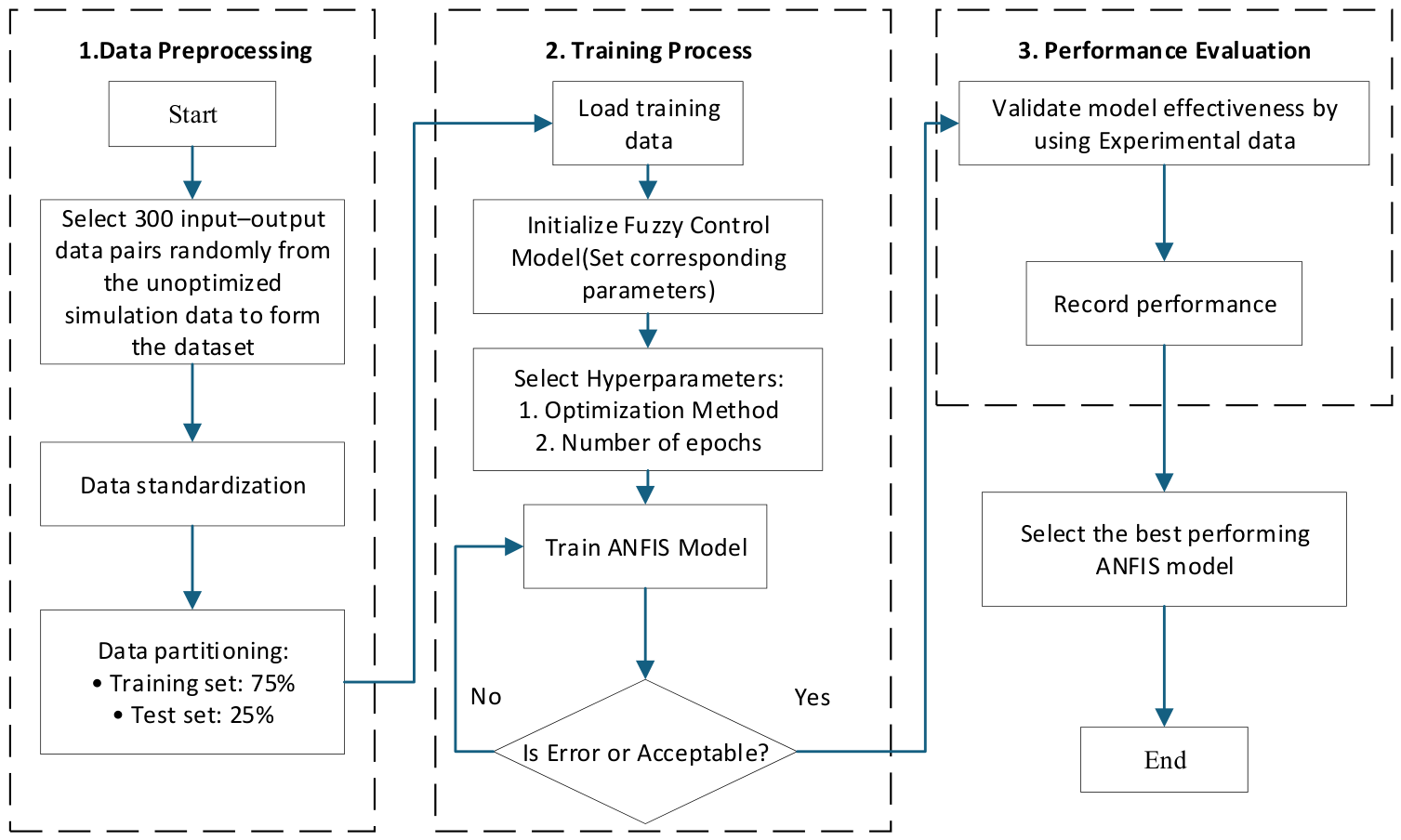
The implementation procedure of ANFIS is shown in Figure 12. A total of 300 representative sample sets were randomly selected from the simulation data before optimization, covering three typical driving cycles, namely WLTC, NEDC, and UDDS. The dataset was then divided into a testing set and a training set at a ratio of 1:3, with one quarter of the samples used for testing and the remaining three quarters used for training. After training, the ANFIS model can extract the optimal parameters and control rules of the final fuzzy inference system (FIS). Subsequently, the trained FIS is embedded into the regenerative braking strategy block for real-time implementation, as indicated by the solid-line box. The DP algorithm and ANFIS algorithm involved in this study were programmed and trained in MATLAB2017a.
At the kth discrete time instant, the system state vector is defined as follows:
x ( k ) = [ v ( k ) , S O C ( k ) ,   z ( k ) ]
In Equation (40), v ( k ) represents the real-time vehicle speed, S O C ( k ) denotes the battery state of charge, and z ( k ) represents the braking intensity. According to the lower-level control strategy, vehicle speed, battery SOC, and braking intensity are the main factors affecting the allocation of regenerative braking force. Therefore, they are selected as the core state variables for dynamic programming optimization.
The control variable is defined as the regenerative braking force distribution coefficient:
u ( k ) = k r e g ( k ) , ( k r e g ( k ) [ 0 , 1 ] )
In this expression, k r e g ( k ) represents the proportion of motor regenerative braking force in the total braking force demand at the current discrete time instant. A larger k r e g ( k ) indicates a higher contribution of regenerative braking, whereas a smaller k r e g ( k ) indicates that the hydraulic braking system provides a larger proportion of the required braking force.
The regenerative braking torque and hydraulic braking torque are expressed as follows:
T r e g ( k ) = u ( k ) T t o a l ( k )
T h y d ( k ) = T t o a l ( k ) T r e g ( k )
The instantaneous cost function at the kth stage can be defined as follows:
L ( x k , u k ) = ω b L b ( k ) + ω r L r ( k )
In this expression, L b ( k ) represents the braking performance cost, and L r ( k ) represents the energy recovery loss cost. ω b denotes the weighting coefficient for braking performance and is set to 0.7, while ω r denotes the weighting coefficient for energy recovery and is set to 0.3. These weighting coefficients are conservatively determined based on empirical calibration.
The braking-performance cost is used to quantify the deviation between the actual braking intensity and the demanded braking intensity. If the actual braking intensity cannot accurately track the braking demand imposed by the driver, both braking safety and braking comfort will be affected.
Therefore, it can be defined as follows:
L b ( k ) = [ z r e a l ( k ) z r e q ( k ) ] 2
In this expression, z r e a l ( k ) represents the actual braking intensity of the vehicle, and z r e q ( k ) represents the braking intensity demanded by the driver.
By evaluating the convergence between the actual braking intensity and the target value, I b r is used to assess the effectiveness of braking performance. The root mean square error of braking intensity is calculated as shown in Equation (46).
I b r = 1 N i = 1 N Z r e a l t Z r e q t 2
In Equation (46), Z r e a l and Z r e q represent the actual and demanded braking intensities, respectively.
E r e g ( k ) represents the recoverable regenerative braking energy at the k-th time instant, and E b r a k e ( k ) represents the theoretical braking energy at this time instant. Accordingly, the energy recovery utilization rate can be expressed as follows:
η r e g ( k ) = E r e g k E b r a k e k
The corresponding energy loss cost is given by:
L r ( k ) = 1 η r e g ( k )
From the perspective of the entire driving cycle, the regenerative braking energy utilization rate can be expressed as follows:
I n o t _ r e g = E r e g _ o n E r e g _ o f f E r e g _ o f f × 100 %
In Equation (49), E r e g _ o n and E r e g _ o f f represent the energy consumed during the driving cycle with and without regenerative braking control (RBC), respectively. I n o t _ r e g reflects the reduction in energy utilization achieved through regenerative braking. In this way, the contribution of regenerative braking to the overall reduction in energy consumption is quantified. The evaluation index of regenerative braking loss efficiency, I r e g , is derived as shown in Equation (50), thereby constructing the cost optimization problem.
I r e g = 1 I n o t _ r e g
I n o t _ r e g is a representation of the percentage of regenerative braking energy lost during the braking process.
Therefore, the comprehensive optimization objective can be written as:
J min = ω b I b r + ω r I n o t _ r e g
This objective function reflects the control principle of prioritizing braking safety while also considering energy recovery. In other words, the optimization process does not simply pursue the maximum energy recovery. Instead, it aims to increase the proportion of regenerative braking as much as possible while ensuring that the actual braking intensity can accurately track the braking demand of the driver.
After the entire driving condition is discretized into Nth, the optimal cost function from the kth stage to the terminal stage can be expressed as follows:
J k x k = min u k L x k , u k + J k + 1 x k + 1
The state transition equation is given by:
x k + 1 = f x k , u k
The terminal condition is given by:
J k x N = L N x N
Thus, dynamic programming proceeds backward recursively from the terminal time instant to the initial time instant, yielding the optimal control variable under each system state:
u * k = arg min u k L x k , u k + J k + 1 x k + 1
The final optimal control sequence is obtained as follows:
U * = u * 1 , u * 2 , , u * N
The constraints are handled as follows:
5 k m / h v k 120 k m / h S O C k 0.9 0 u k 1 0 T r e g ( k ) T r e g max v ( k ) , S O C k S O C min S O C k S O C max 0 v k 1
The optimization results obtained by the algorithm vary under different driving conditions. Taking the NEDC driving cycle as an example, the optimized membership functions of the fuzzy controller are shown in Figure 13. For the optimized vehicle-speed membership function, the universes of discourse corresponding to the low-speed and high-speed subsets are narrowed, while the right boundary of the medium-speed interval is expanded. The optimized battery SOC membership function is characterized by an enlarged universe of discourse for the subset “M” and a slight leftward shift of the universe of discourse for the subset “H”. For the improved braking intensity z membership function, the universe of discourse corresponding to medium braking intensity is narrowed, whereas the intervals corresponding to high braking intensity and emergency braking intensity are shifted leftward as a whole.

5. Simulation Analysis

A full-vehicle simulation model of a distributed electric vehicle was built based on the AMESim platform, covering key modules such as vehicle dynamics, wheels, power battery, drive motor and hydraulic brake. Subsequently, the simulation model for this regenerative braking control strategy was developed on the Simulink platform, and an AMESim Simulink joint simulation platform was constructed to carry out simulation analyses under NEDC, UDDS, and WLTC conditions. SOC, braking energy recovery amount and efficiency were selected as evaluation indicators in the simulation analysis. Among them, the braking energy recovery efficiency is the ratio of the regenerative braking recovered energy to the total energy consumed during a single braking process, calculated as shown in Formula (58).
E r e g = 0 t P b a t d t
E b r = 0 t F b r v d t
η r e g = E r e g E b r
In the equation, P b a t represents the battery charging and discharging power, F b r represents the total braking force of the vehicle, E r e g represents the energy recovered from regenerative braking, E b r represents the energy consumed by braking, and η r e g represents the braking energy recovery efficiency.
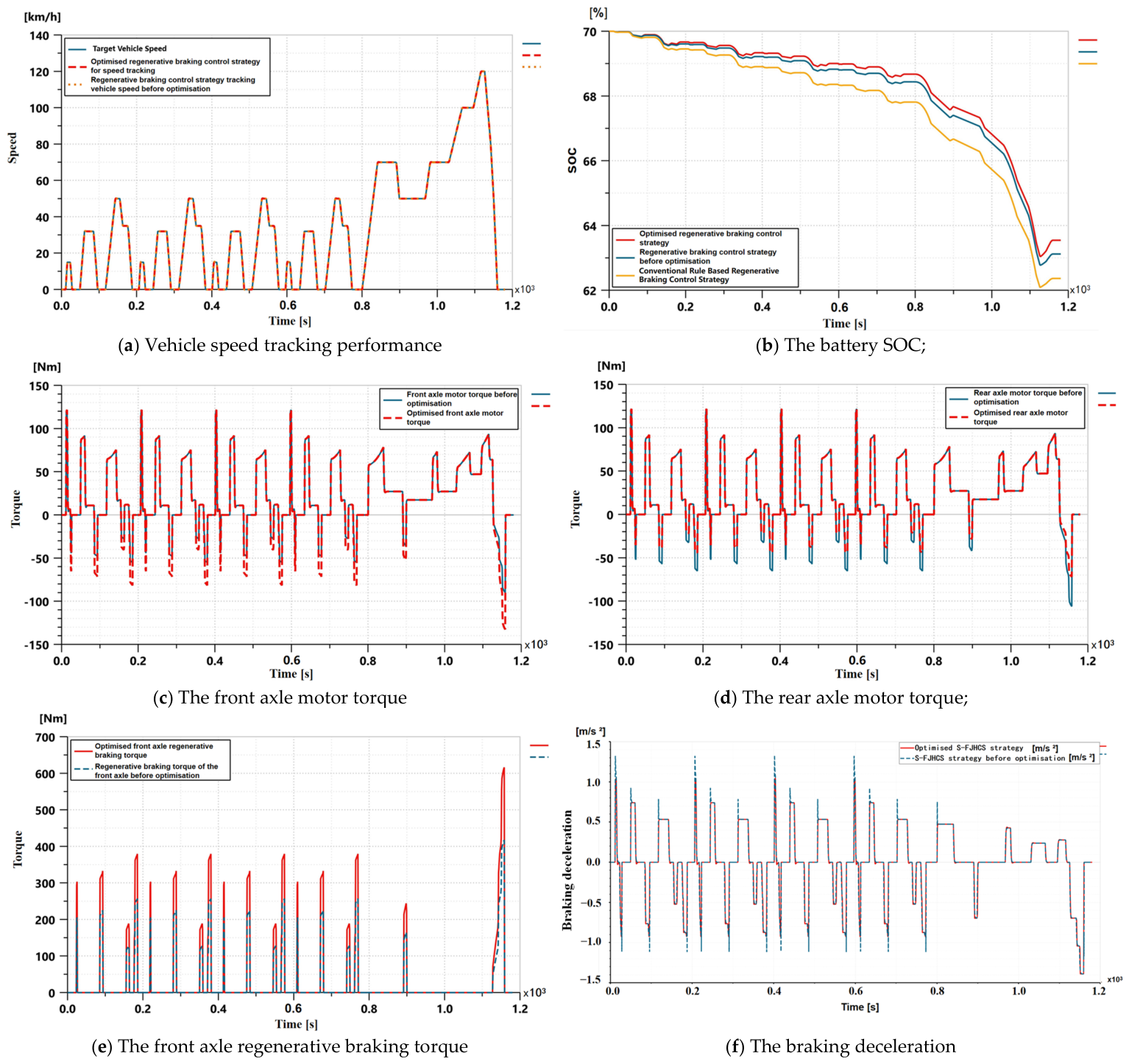
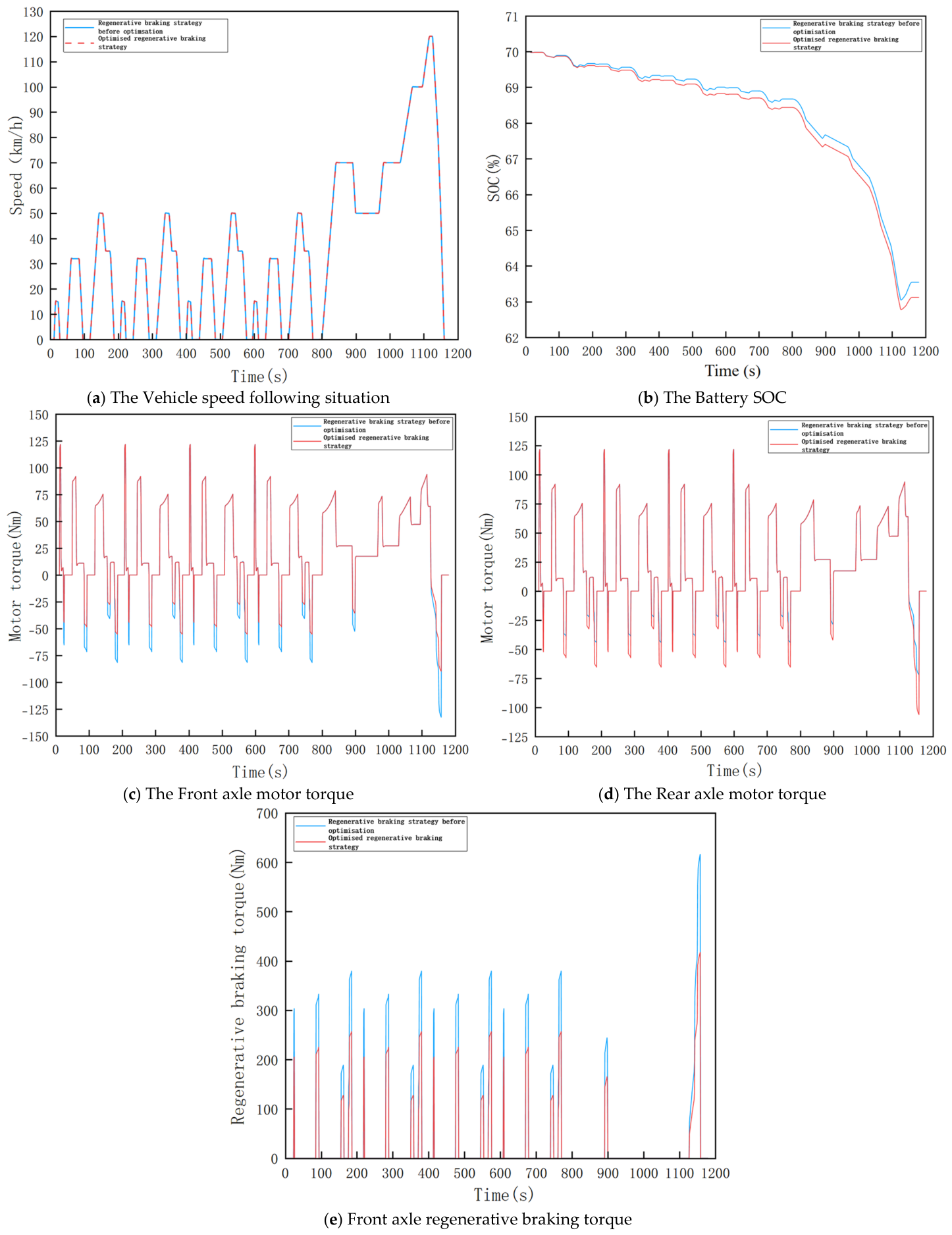
Figure 14 shows the simulation results of a 1200 s NEDC cycle with an initial battery SOC of 0.7. The simulation compares the performance of three regenerative braking control strategies under the NEDC cycle for a distributed drive electric vehicle. The results indicate that the three curves in Figure 14a change almost consistently, demonstrating that the proposed strategy can track the target vehicle speed well. As shown in Figure 14b, the SOC of the battery decreases under all three regenerative braking control strategies, while the SOC drop using the optimised S-FJHCS strategy is slower than the other two, decreasing roughly from 70% to 63.4%, 70% to 62.9%, and 70% to 62.3%, respectively. As shown in Figure 14e, at time instants of 220 s, 895 s, and 1158 s, the front-axle regenerative braking torque before optimization was 205.501 N·m, 159.033 N·m, and 417.355 N·m, respectively, whereas the optimized front-axle regenerative braking torque reached 303.384 N·m, 234.819 N·m, and 616.271 N·m, corresponding to an average improvement of 47.6% in regenerative braking torque. This indicates that the optimized S-FJHCS strategy enables substantially greater energy recovery. Furthermore, as depicted in Figure 14f, the braking deceleration profiles before and after optimization remained largely consistent, confirming that the proposed strategy effectively maintains braking stability without compromising ride comfort. Meanwhile, this study compares various evaluation indicators under the NEDC cycle for the three regenerative braking control strategies, with specific results shown in Table 2. Analysis shows that the optimised S-FJHCS strategy achieves an energy recovery rate of 24.9%, which is 2.2 percentage points and 5.4% percentage points higher than the S-FJHCS strategy before optimisation and conventional rule based regenerative braking control strategy.
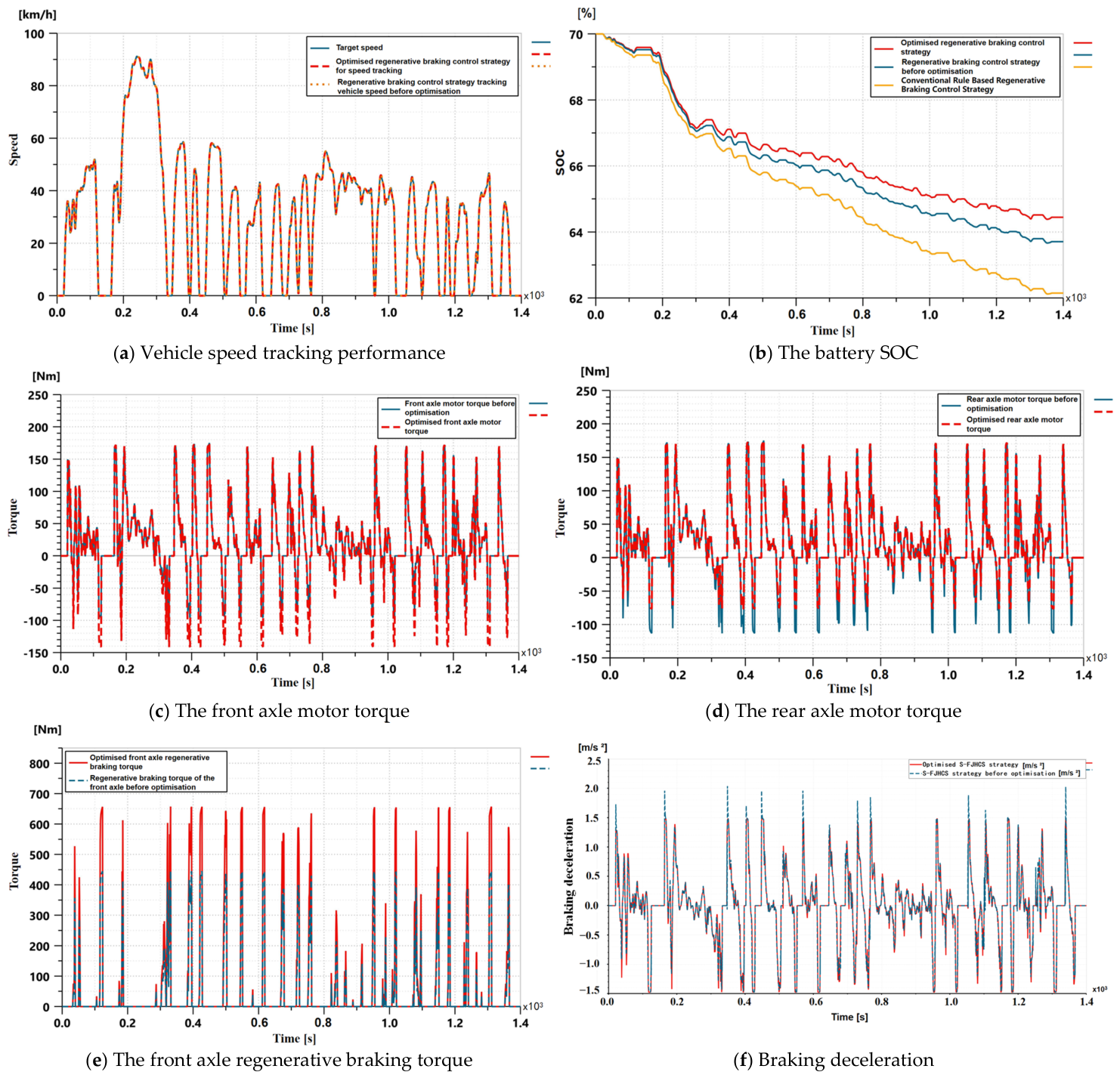
Figure 15 shows the simulation results under the UDDS cycle condition at 1400 s with an initial battery SOC of 0.7. This simulation compares the performance of three regenerative braking control strategies in a distributed drive electric vehicle under UDDS cycle conditions. The results show that in Figure 15a, the three curves change consistently, indicating that the proposed strategy can track the target speed well. As shown in Figure 15b, the SOC of the battery decreases under all three regenerative braking control strategies, while the SOC under the optimised S-FJHCS strategy decreases more slowly than the other two, roughly dropping from 70% to 64.7%, from 70% to 63.8%, and from 70% to 62.1%, respectively. As shown in Figure 15e, at time instants of 304 s, 722 s, and 1364 s, the front-axle regenerative braking torque before optimization was 69.765 N·m, 398.464 N·m, and 399.049 N·m, respectively, whereas the optimized front-axle regenerative braking torque reached 103.000 N·m, 588.324 N·m, and 589.166 N·m, corresponding to an average improvement of 47.6% in front-axle regenerative braking torque. This indicates that the optimized S-FJHCS strategy enables substantially greater energy recovery. Additionally, as depicted in Figure 15f, the braking deceleration profiles before and after optimization remained largely consistent, confirming that the proposed strategy effectively maintains braking stability without compromising ride comfort. Furthermore, this paper compares the evaluation indicators under UDDS conditions for the three regenerative braking control strategies, with detailed results shown in Table 3. Analysis shows that the optimised S-FJHCS strategy achieves an energy recovery rate of 31.7%, which is 5.3 percentage points and 10.4 percentage points higher than the S-FJHCS strategy before optimisation and conventional rule based regenerative braking control strategy.
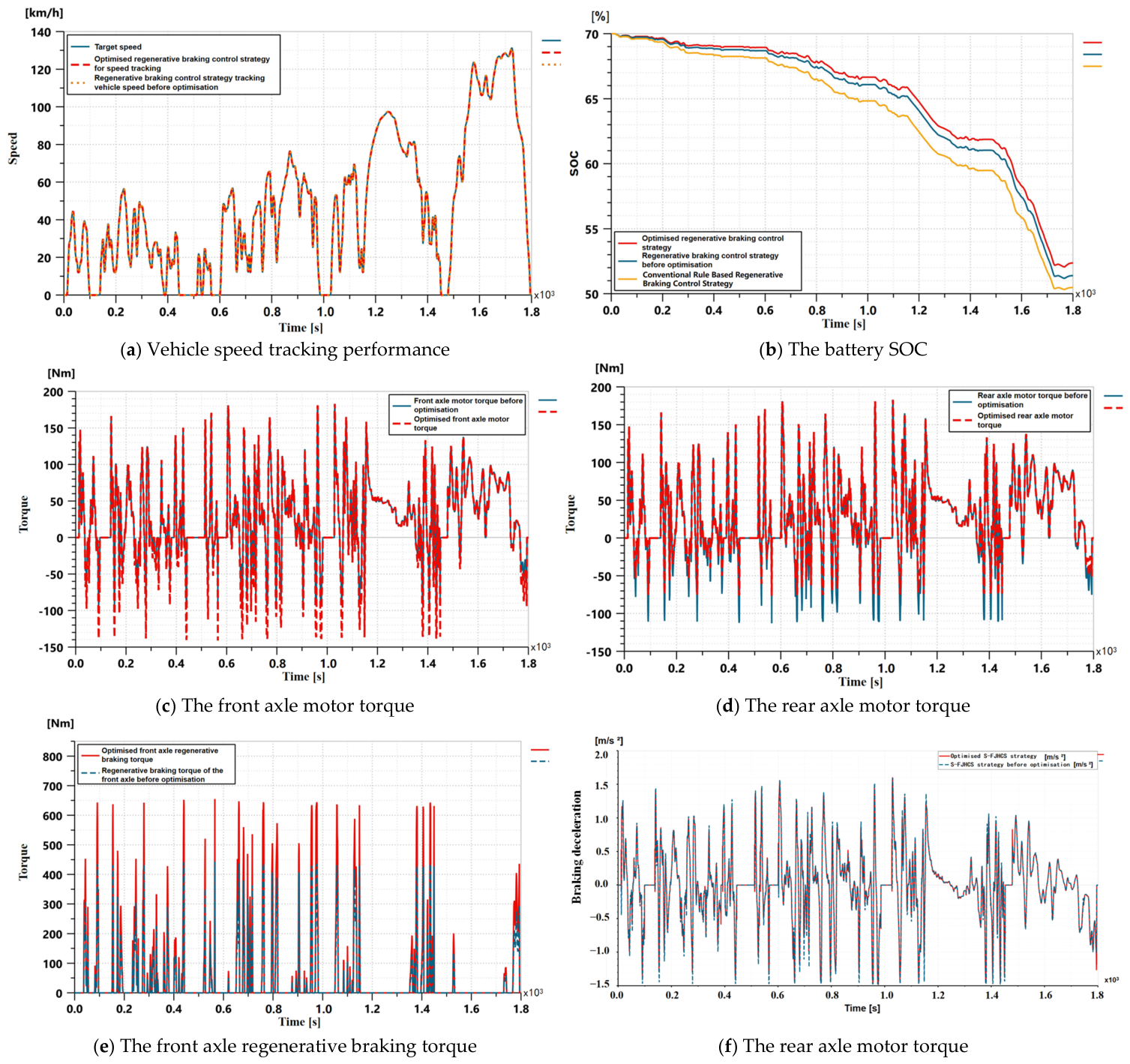
Figure 16 shows the simulation results for a battery SOC initial value of 0.7 under the 1800 s WLTC cycle condition. This simulation compares the performance of three regenerative braking control strategies in a distributed drive electric vehicle under WLTC cycle conditions. The results indicate that the three curves in Figure 16a change almost consistently, demonstrating that the proposed strategy can track the target vehicle speed well. As shown in Figure 16b, the SOC of the battery decreases under all three regenerative braking control strategies, while the SOC using the optimized S-FJHCS strategy declines more slowly compared to the other two, decreasing roughly from 70% to 52.7%, from 70% to 51.8%, and from 70% to 50.4%, respectively. As shown in Figure 16e, at time instants of 256 s, 905 s, and 1778 s, the front-axle regenerative braking torque before optimization was 124.791 N·m, 327.341 N·m, and 171.202 N·m, respectively, whereas the optimized front-axle regenerative braking torque reached 184.249 N·m, 483.282 N·m, and 252.803 N·m, corresponding to an average improvement of 47.6% in front-axle regenerative braking torque. This indicates that the optimized S-FJHCS strategy enables substantially greater energy recovery. Additionally, as depicted in Figure 16f, the braking deceleration profiles before and after optimization remained largely consistent, confirming that the proposed strategy effectively maintains braking stability without compromising ride comfort. Additionally, this study compares the evaluation indices of the three regenerative braking control strategies under WLTC conditions, with specific results shown in Table 4. Analysis shows that the energy recovery rate of the optimized S-FJHCS strategy reaches 29.8%, which is 4.6 percentage points and 8.1 percentage points higher than the S-FJHCS strategy before optimisation and conventional rule based regenerative braking control strategy.
By analysing the front and rear axle hub motors and the front axle regenerative braking torque under three operating conditions, it can be seen that in the torque distribution chart, the torque of the front and rear axle motors is similar during driving, indicating that the torque distribution between the front and rear axles remains highly consistent both before and after optimisation, and the operating conditions are uniform. After optimisation, the negative total torque of the front axle increases during braking, while the negative total torque of the rear axle decreases. This indicates that the upper-level front and rear axle torque distribution strategy applies more braking force to the front axle, increasing the proportion of braking force provided by the front axle motor and reducing the risk of rear axle lock-up and vehicle instability. By comparing the front axle regenerative braking torque before and after optimisation, it can be seen that the front axle regenerative braking torque increases after optimisation, which indicates that the lower-level regenerative braking torque distribution strategy uses a fuzzy control algorithm to precisely assign regenerative braking torque to the front axle, allocating more regenerative braking force to the front axle and thereby increasing its torque. At the same time, an adaptive fuzzy neural network algorithm is introduced to optimise the fuzzy control strategy in real time based on historical operating data during braking, allowing more kinetic energy on the front axle to be converted into electrical energy. From Table 1, Table 2, Table 3 and Table 4, it can be observed that after applying the optimized S-FJHCS strategy, the regenerative braking energy recovery efficiency reached 24.9%, 31.7% and 29.8% under NEDC cycle, UDDS cycle and WLTC conditions, significantly mitigating the decline in battery SOC and effectively maintaining braking energy recovery efficiency and braking stability.

6. Hardware-in-the-Loop Experiment

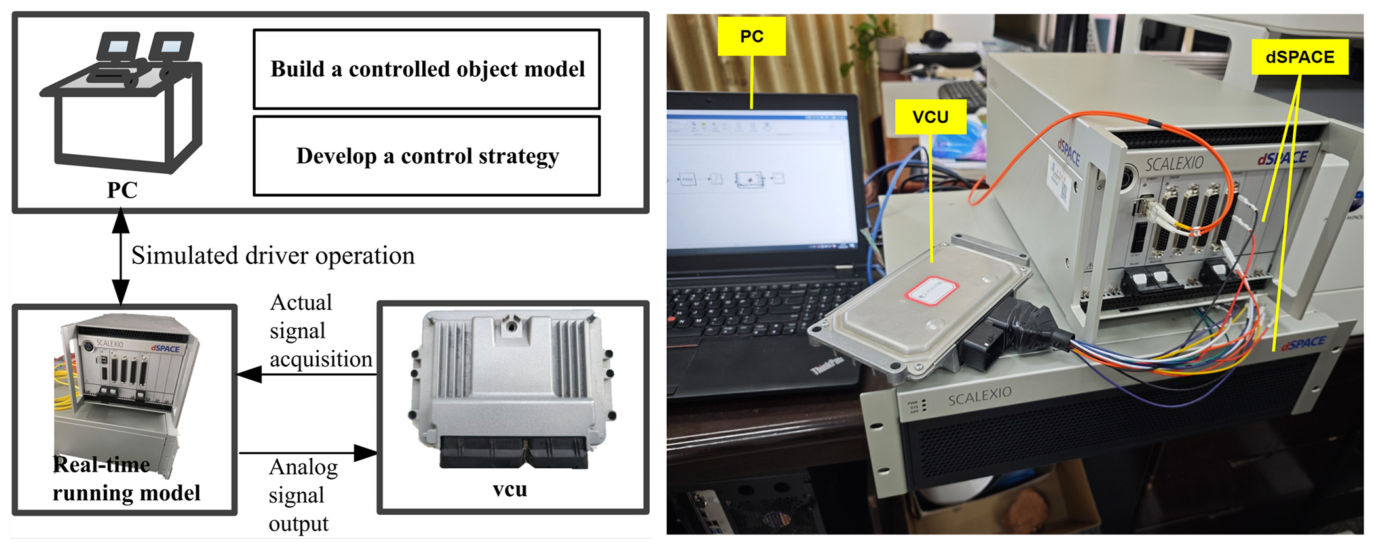
As electric vehicles incorporate more electronic components, the testing cycle for traditional vehicle tests becomes too long, requiring the completion of the development of all vehicle components before integration for real vehicle testing; the testing cost is too high, efficiency is low, and it is sometimes difficult to determine the cause of failures; the test coverage is low, the conditions that can be tested are limited, and many extreme conditions, such as high temperature, high pressure and high speed, which could pose a risk to testers’ lives, cannot be tested; test failures are difficult to reproduce. Hardware-in-the-loop (HIL) simulation testing technology can precisely compensate for the shortcomings of traditional vehicle tests. HIL testing can detect potential problems in traditional vehicle testing in advance and cover testing conditions that cannot be addressed in real vehicle tests, thereby improving the safety and reliability of electric vehicles. The HIL simulation process for the regenerative braking control strategy in this study is as follows: first, complete the configuration of the Simulink development environment and build the core control algorithm model within Simulink, including the maximum regenerative torque calculation model, road adhesion coefficient calculation model, maximum regenerative torque distribution model, fuzzy control strategy model, and torque distribution model; second, build the complete vehicle physical model in AMESim, covering functional modules such as the vehicle body, driver, motor, and power battery; finally, achieve parameter interaction between the two software platforms through a co-simulation interface, first passing the complete vehicle state parameters into Simulink to perform the control strategy simulation calculations, and then feeding the calculated control parameters such as braking torque back to the AMESim complete vehicle model, forming a complete closed-loop simulation control. In ConfigurationDesk, build the controlled vehicle model and control strategy model, calibrate the signal interfaces, compile into executable code, and download to the dSPACE SCALEXIO LabBox, while the host computer ControlDesk monitors experimental data in real time; the vehicle VCU transfers the collected vehicle state signals to the SCALEXIO LabBox via CAN, and after optimisation of control variables by the control strategy, outputs control commands back to the vehicle VCU via CAN signals. The HIL simulation schematic is shown in Figure 17.
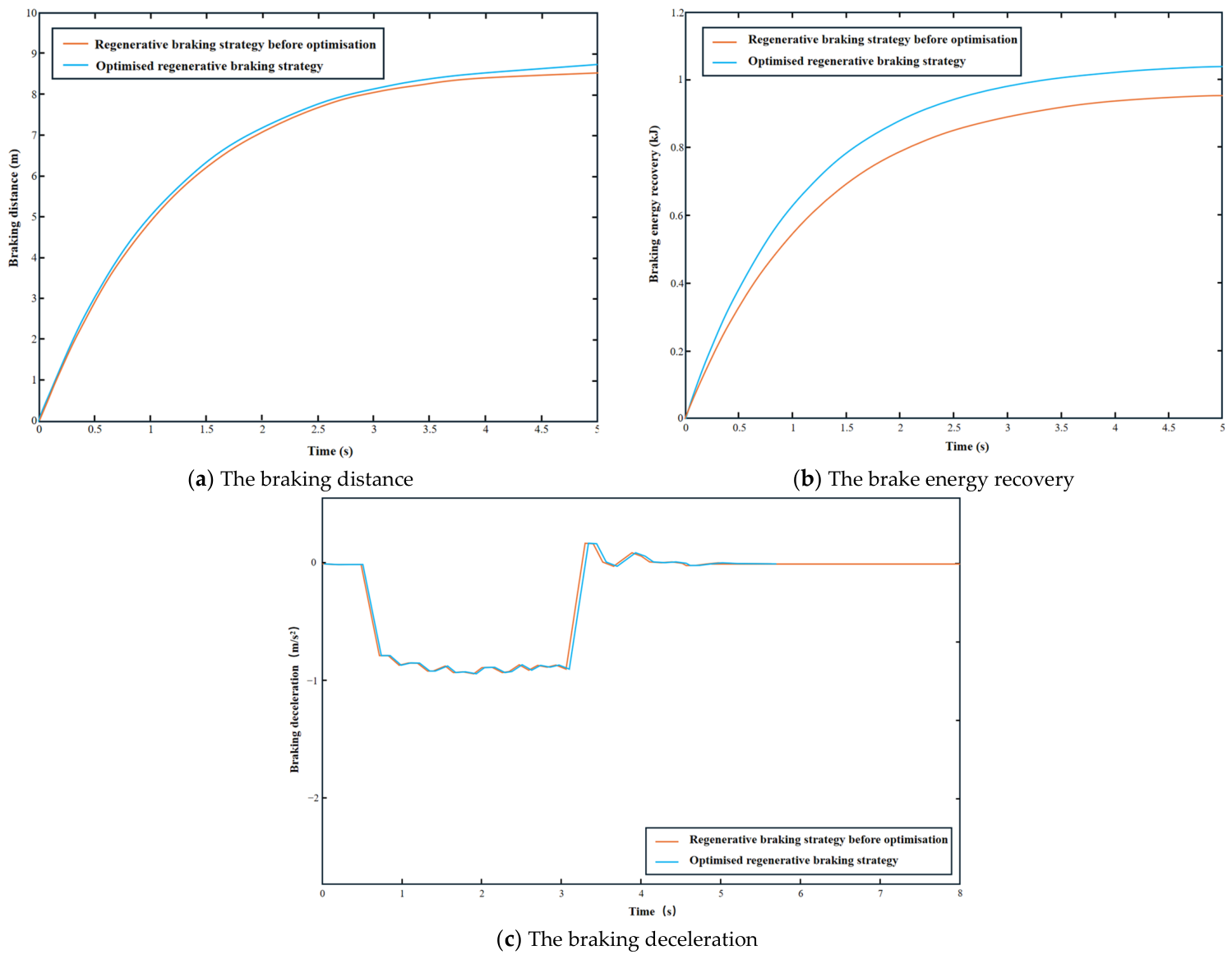
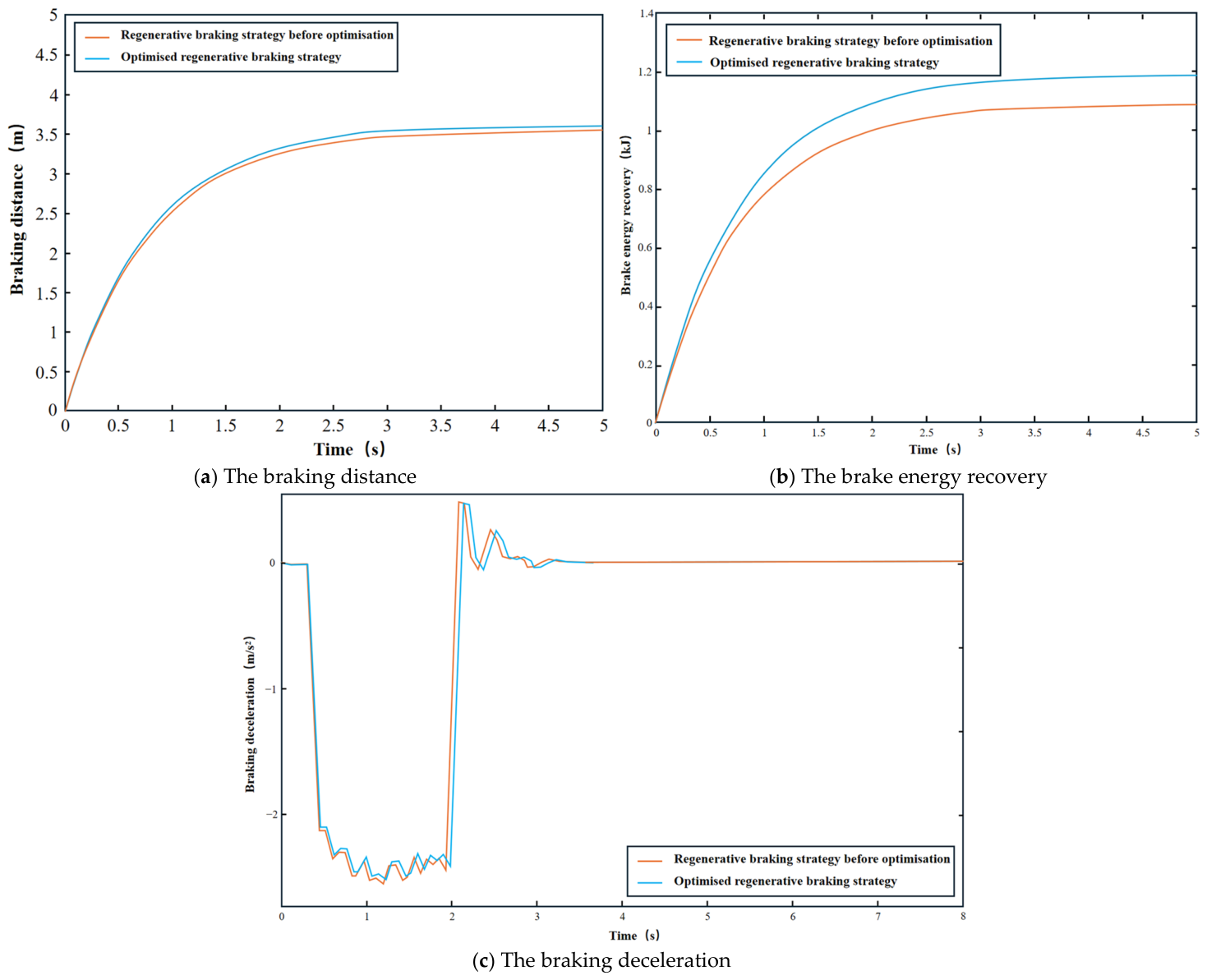
The braking simulation results are shown in Figure 18, Figure 19 and Figure 20, where the simulation compares the braking distance and energy recovery effect under low and medium braking intensities before and after the optimisation of the regenerative braking control strategy; the relevant experimental data are summarised in Table 5. The experimental results show that under low and medium braking intensities, the braking distance of the optimised regenerative braking strategy is slightly longer than that of the pre-optimised strategy, but the braking energy recovery efficiency is significantly improved. Under low braking intensity, the energy recovered by the optimised strategy is 1.05 kJ, an increase of about 8.2% compared to 0.97 kJ before optimisation; under medium braking intensity, the energy recovered by the optimised strategy is 1.19 kJ, an increase of about 9.2% compared to 1.09 kJ before optimisation. The NEDC cycle simulation results are shown in Figure 19, and the simulation results are in good agreement with the experimental results, verifying the effectiveness of the designed strategy.
In Table 5, the optimized S-FJHCS strategy improves regenerative energy recovery by 8.25% under low braking rates and by 9.17% under medium braking rates, compared with the pre-optimization S-FJHCS strategy. It can thus be concluded that the optimized strategy enhances regenerative energy recovery efficiency by approximately 5–10%. As shown in Figure 20, the comparison between the simulation results and the hardware-in-the-loop (HIL) experimental results reveals that the two curves remain largely consistent, demonstrating that the proposed strategy can effectively track the target vehicle speed. This confirms that the simulation and HIL experimental outcomes are in close agreement under the NEDC driving cycle.

7. Conclusions

This study focuses on the research of distributed electric vehicle regenerative braking control strategies, addressing energy crises and traffic environmental issues. It proposes an S-FJHCS strategy optimised based on the ANFIS algorithm, whose feasibility and superiority are verified through theoretical analysis, simulation and experiments. The main research work of this paper is summarised as follows:
This study conducted simulation verification experiments under three typical driving cycles: NEDC, UDDS and WLTC. The results indicate that the optimised regenerative braking control strategy proposed in this study can effectively achieve braking energy recovery under all conditions, with braking energy recovery rates of 24.9%, 31.7% and 29.8%. Compared with the AMEsim’s built-in braking strategy, the kinetic energy recovery rates of the proposed strategy increased by 5.4%, 10.4% and 8.1%, fully demonstrating that the proposed strategy model has a significant and considerable braking energy recovery effect and can effectively realise the recovery and utilisation of braking energy.
The hierarchical regenerative braking control strategy based on the ANFIS algorithm proposed in this paper has been proven effective through hardware-in-the-loop experiments, but there are still many aspects that can be improved. Future research will be conducted on multiple fronts: firstly, the current sliding mode control algorithm still has room for optimisation, and more advanced control theories and improved methods will be explored to effectively suppress algorithm chattering and enhance control smoothness; secondly, due to experimental constraints, cyclic condition on-road testing was not carried out this time, and the real vehicle test data obtained was relatively limited. In the future, more comprehensive and in-depth real vehicle tests will be conducted to further verify the reliability and robustness of the proposed control strategy under various operating conditions.

Author Contributions

B.F.: Writing—original draft, Validation, Methodology, Investigation, Formal analysis, Conceptualization. Y.T.: Writing—review & editing, Supervision, Methodology, Investigation, Funding acquisition, Conceptualization. W.A.: Methodology, Investigation, Formal analysis. J.L.: Methodology, Investigation, Formal analysis. L.Y.: Writing—review & editing, Methodology, Investigation. All authors have read and agreed to the published version of the manuscript.

Funding

This research was supported by Hunan Youth Talent Science and Technology Innovation Program (Grant No.2023RC3135); National Natural Science Foundation of China (Grant No.52105069); Hunan Innovative Province Construction, Project (Grant No. 2023GK2088 and 2024JK2031); Hunan Province Manufacturing Key Products “reveal the list” (Grant No. 2023GXGG018).

Institutional Review Board Statement

Not applicable.

Informed Consent Statement

Not applicable.

Data Availability Statement

The data that support the findings of this study are available upon request from the corresponding author. The data are not publicly available due to privacy or ethical restrictions.

Conflicts of Interest

The authors declare no conflicts of interest.

Abbreviations

The following abbreviations are used in this manuscript:
ANFISAdaptive Network-Based Fuzzy Inference System
S-FJHCSAlgorithm-Optimised Sliding Mode-Fuzzy Joint Layered Control
DDEVDistributed Drive Electric Vehicles
EHBElectro-hydraulic Brake System
MCUMotor Control Unit
VCUVehicle Control Unit
BCUBrake Control Unit
BMSBattery Management System
HILHardware-in-the-loop

References

  1. Zhang, B.; Cheng, K.; Huang, J.; Jiang, K.; Yang, D.; Zhong, Z. Barrier Costs-Embedded MPPI Control for Rollover-Safe Cooperative Payload Transport with All-Wheel-Steering Distributed Electric-Drive Carriers. Green Energy Intell. Transp. 2026, in press. [Google Scholar]
  2. Yin, X.; Zhang, L.; Ding, X.; Sun, F.; Dorrell, D. Global Coordinated Control Framework for Advanced All-Wheel Steering and Driving Vehicles: Unleashing Potential through Tire Slip State Assessment. Green Energy Intell. Transp. 2026, 5, 100427. [Google Scholar] [CrossRef]
  3. Fan, Y.; Peng, J.; He, H.; Yu, S.; Wu, J.; Wang, J.; Wu, C. Energy-Efficient Driving for Distributed Drive Electric Vehicles via Lagrangian-Constrained Deep Reinforcement Learning with Adaptive Safety Critics. Green Energy Intell. Transp. 2026, in press. [Google Scholar]
  4. Chen, Z.; Xiong, R.; Cai, X.; Wang, Z.; Yang, R. Regenerative braking control strategy for distributed drive electric vehicles based on slope and mass co-estimation. IEEE Trans. Intell. Transp. Syst. 2023, 24, 14610–14619. [Google Scholar] [CrossRef]
  5. Wang, B.; Huang, X.; Wang, J.; Guo, X.; Zhu, X. A robust wheel slip ratio control design combining hydraulic and regenerative braking systems for in-wheel-motors-driven electric vehicles. J. Frankl. Inst. 2015, 352, 577–602. [Google Scholar]
  6. Chen, J.; Yu, J.; Zhang, K.; Ma, Y. Control of regenerative braking systems for four-wheel-independently-actuated electric vehicles. Mechatronics 2018, 50, 394–401. [Google Scholar]
  7. Li, N.; Lin, Y.; Huang, Z.; Hong, Y.; Ning, X. Research on Speed Planning and Energy Management Strategy for Distributed-Drive Electric Vehicles Based on Deep Deterministic Policy Gradient Algorithm. Actuators 2026, 15, 248. [Google Scholar] [CrossRef]
  8. Chen, Q.; Lv, Z.; Xu, W.; Shu, Q.; Liu, S.; Xu, L. Regenerative braking control strategy based on pavement recognition controller for electric vehicle. Energy Technol. 2023, 11, 2300299. [Google Scholar] [CrossRef]
  9. Dong, H.; Zhuang, W.; Yin, G.; Xu, L.; Wang, Y.; Wang, F.A.; Lu, Y. Energy-optimal braking control using a double-layer scheme for trajectory planning and tracking of connected electric vehicles. Chin. J. Mech. Eng. 2021, 34, 83. [Google Scholar]
  10. Zhang, X.; Göhlich, D.; Li, J. Energy-efficient toque allocation design of traction and regenerative braking for distributed drive electric vehicles. IEEE Trans. Veh. Technol. 2017, 67, 285–295. [Google Scholar] [CrossRef]
  11. Biao, J.; Zhang, X.; Wang, Y.; Hu, W. Regenerative braking control strategy of electric vehicles based on braking stability requirements. Int. J. Automot. Technol. 2021, 22, 465–473. [Google Scholar] [CrossRef]
  12. Guo, B.; Zhang, H. Analysis of regenerative braking strategy for electric vehicles based on braking intention. J. Phys. Conf. Ser. 2023, 2450, 012026. [Google Scholar] [CrossRef]
  13. Heydari, S.; Fajri, P.; Sabzehgar, R.; Asrari, A. Optimal brake allocation in electric vehicles for maximizing energy harvesting during braking. IEEE Trans. Energy Convers. 2020, 35, 1806–1814. [Google Scholar] [CrossRef]
  14. Xu, S.; Li, J.; Zhang, X.; Song, J.; Zeng, X. Research on composite braking control strategy of four-wheel-drive electric vehicles with multiple motors based on braking energy recovery optimization. IEEE Access 2023, 11, 110151–110163. [Google Scholar]
  15. Pei, X.; Pan, H.; Chen, Z.; Guo, X.; Yang, B. Coordinated control strategy of electro-hydraulic braking for energy regeneration. Control Eng. Pract. 2020, 96, 104324. [Google Scholar] [CrossRef]
  16. Yin, Z.; Ma, X.; Su, R.; Huang, Z.; Zhang, C. Regenerative braking of electric vehicles based on fuzzy control strategy. Processes 2023, 11, 2985. [Google Scholar] [CrossRef]
  17. Tang, M.; Zhang, X. Optimal regenerative braking control strategy for electric vehicles based on braking intention recognition and load estimation. IEEE Trans. Veh. Technol. 2023, 73, 3378–3392. [Google Scholar] [CrossRef]
  18. Li, C.; Zhang, L.; Lian, S.; Liu, M. Research on regenerative braking control of electric vehicles based on game theory optimization. Sci. Prog. 2024, 107, 00368504241247404. [Google Scholar] [CrossRef] [PubMed]
  19. Ji, F.; Pan, Y.; Zhou, Y.; Du, F.; Zhang, Q.; Li, G. Energy recovery based on pedal situation for regenerative braking system of electric vehicle. Veh. Syst. Dyn. 2020, 58, 144–173. [Google Scholar]
  20. Lin, C.-L.; Hung, H.-C.; Li, J.-C. Active control of regenerative brake for electric vehicles. Actuators 2018, 7, 84. [Google Scholar] [CrossRef]
  21. Raman, S.R.; Cheng, K.W.; Xue, X.D.; Fong, Y.C.; Cheung, S. Hybrid energy storage system with vehicle body integrated super-capacitor and li-ion battery: Model, design and implementation, for distributed energy storage. Energies 2021, 14, 6553. [Google Scholar]
  22. Ruz-Hernandez, J.A.; Djilali, L.; Ruz Canul, M.A.; Boukhnifer, M.; Sanchez, E.N. Neural inverse optimal control of a regenerative braking system for electric vehicles. Energies 2022, 15, 8975. [Google Scholar] [CrossRef]
  23. Shi, Z.; Yan, Y.; Zhang, S. Control Strategy of Dual-Disc Electromagnetic–EMB Composite Braking System Based on Hybrid Systems. Actuators 2025, 14, 297. [Google Scholar]
Figure 1. Vehicle structure diagram.
Actuators 15 00373 g001
Figure 2. Distributed electric vehicle dynamics analysis diagram.
Actuators 15 00373 g002
Figure 3. Hub motor external characteristic curve.
Actuators 15 00373 g003
Figure 4. Battery pack equivalent circuit.
Actuators 15 00373 g004
Figure 5. Electro-hydraulic brake structure.
Actuators 15 00373 g005
Figure 6. Simplified diagram of vehicle braking forces.
Actuators 15 00373 g006
Figure 7. Front and rear axle braking force distribution curve.
Actuators 15 00373 g007
Figure 8. Overall control plan.
Actuators 15 00373 g008
Figure 9. Lower-level control strategy flowchart.
Actuators 15 00373 g009
Figure 10. Input–output membership function. (a) The braking intensity z membership function; (b) The battery SOC membership function; (c) the membership function of vehicle speed v; (d) the regenerative braking compared to k membership function.
Actuators 15 00373 g010
Figure 11. Schematic diagram of ANFIS structure.
Actuators 15 00373 g011
Figure 12. Implementation procedure of ANFIS.
Actuators 15 00373 g012
Figure 13. Optimised fuzzy control membership functions.
Actuators 15 00373 g013
Figure 14. Simulation results under NEDC cycle conditions.
Actuators 15 00373 g014
Figure 15. Simulation results under UDDS cycle conditions.
Actuators 15 00373 g015
Figure 16. Simulation results under WLTC cycle conditions.
Actuators 15 00373 g016
Figure 17. Hardware-in-the-Loop simulation schematic.
Actuators 15 00373 g017
Figure 18. Low brake force test results.
Actuators 15 00373 g018
Figure 19. Medium brake force test results.
Actuators 15 00373 g019
Figure 20. NEDC cycle hardware-in-the-loop results.
Actuators 15 00373 g020
Table 1. Vehicle model parameters.
Vehicle ParametersValue
Vehicle weight (kg)1270
Moment of inertia around the z-axis Iz (kg·m2)1535.4
Distance from the centre of mass to the front/rear axle (m)1.015/1.895
Centre of mass height (m)0.54
Distance between front/rear wheels (m)1.015/1.895
Effective wheel radius (m)0.325
Overall vehicle length (mm)3850
Wheelbase (mm)2910
Vehicle width (mm)1916
Vehicle height (mm)1610
Front track (mm)540
Rear track (mm)540
Battery voltage (V)350
Battery capacity (Ah)70
Rated power of hub motor (kW)28
Table 2. NEDC condition simulation comparison.
Control Strategy
Evaluation CriteriaOptimised S-FJHCS StrategyS-FJHCS Strategy Before OptimisationConventional Rule Based Regenerative Braking Control Strategy
Regenerative braking energy recovery (kJ)2662.22333.71964.6
Braking consumes energy (kJ)10,691.610,280.410,074.8
Braking energy recovery efficiency (%)24.922.719.5
Table 3. UDDS condition simulation comparison.
Control Strategy
Evaluation CriteriaOptimised S-FJHCS StrategyS-FJHCS Strategy Before OptimisationConventional Rule Based Regenerative Braking Control Strategy
Regenerative braking energy recovery (kJ)4202.73271.02612.7
Braking consumes energy (kJ)13,257.612,390.312,266.4
Braking energy recovery efficiency (%)31.726.421.3
Table 4. WLTC condition simulation comparison.
Control Strategy
Evaluation CriteriaOptimised S-FJHCS Strategy S-FJHCS Strategy Before OptimisationConventional Rule Based Regenerative Braking Control Strategy
Regenerative braking energy recovery (kJ)4455.53447.52909.3
Braking consumes energy (kJ)14,951.313,680.713,407.1
Braking energy recovery efficiency (%)29.825.221.7
Table 5. Summary of hardware-in-the-loop results.
Control Strategy
ProjectS-FJHCS Strategy Before OptimisationOptimised S-FJHCS Strategy
Braking ForceLowMiddleLowMiddle
Peak braking deceleration (m/s2)0.982.450.982.41
Braking distance (m)8.863.548.633.61
Disclaimer/Publisher’s Note: The statements, opinions and data contained in all publications are solely those of the individual author(s) and contributor(s) and not of MDPI and/or the editor(s). MDPI and/or the editor(s) disclaim responsibility for any injury to people or property resulting from any ideas, methods, instructions or products referred to in the content.