1. Introduction
Unmanned Aerial Vehicles (UAVs) are aircraft operated via autonomous flight systems [
1,
2]. Currently, technologies for UAV are widely used in fields such as military reconnaissance [
3], aerial photography [
4], material transport [
5], agricultural spraying [
6], and more recently, in Internet of Things networks for energy-efficient data collection [
7], etc. As one of the core issues of UAV technologies, the UAV path planning problems [
8,
9] have always been extensively studied. From the perspective of UAV trajectory tracking and flight-control execution, the quality of the planned reference path directly affects the downstream control burden. Paths with abrupt heading changes, excessive climbing-angle variations, or high curvature may increase tracking difficulty and impose larger demands on the flight-control system.
Discussions of path planning problems tend to be regarded as optimization problems. After the objective functions are defined, typically multiple, the selection of optimal paths requires the simultaneous minimization of all the objective functions. Since the minimum points of each function do not coincide, some are even conflicting, it means that a reduction in one single function may lead to an increase in another. To solve this issue, most existing studies choose to combine the functions into a single objective function by using a weighted sum approach [
10], in which different objective functions are calculated with corresponding weights. Alternatively, through the main goal method, the constraint method is transformed into selecting the most important sub-goal from a single goal as the optimization goal, and the rest of the sub-goals as constraints. Each sub-goal is constrained by setting an upper bound. Although the methods mentioned above are straightforward to implement, it is still difficult to determine appropriate weights for each function in complex optimization problems while maintaining the optimality of the solution. Therefore, this paper employs the multi-objective optimization [
11] approach to solve the UAV path planning problems.
As UAV technologies evolve towards more intelligent and interconnected paradigms, such as Digital Twin-assisted autonomous navigation [
12] and IoT-enabled cooperative sensing [
13], the operational environments for UAVs are becoming increasingly dynamic and complex. Depending on the differences of spatial dimension, the path planning problems can be categorized into two-dimensional (2D) and three-dimensional (3D) path planning [
14]. The dimensionality of the environments significantly influences path planning approaches. In traditional 2D space, the simplified environmental modeling cannot intuitively reflect the complex terrain encountered by the UAVs during the urban missions, often leading to inaccurate optimization results. Three-dimensional spatial models can incorporate real terrain data to establish terrain models for the UAV flight, which are used to test the optimization performances of path planning algorithms, thereby enhancing the path planning capabilities of UAV and improving its efficiency in exploration and transport tasks [
15]. Moreover, traditional path planning algorithms, including Artificial Potential Field Method [
16], Rapidly-exploring Random Tree (RRT) [
17], A* [
18] and Dijkstra [
19], are suitable for solving relatively simple path planning problems, such as operating obstacle avoidance on 2D maps. However, due to the difficulties handling dynamic obstacles, susceptibility to falling into local optima and high computational complexity, these methods are often difficult to apply in problems with complex 3D environments or diverse obstacle types. In contrast, meta-heuristic algorithms [
20] are intelligent optimization methods based on the cooperative mechanisms of biological populations. These algorithms treat the feasible paths as candidate solutions and improve them via swarm intelligence methods [
21], thus possessing advantages of high efficiency, flexibility and robustness when solving complex problems. Consequently, they are widely used for solving complex math problems [
22]. Typical meta-heuristic algorithms include Genetic Algorithm (GA) [
23], Particle Swarm Optimization (PSO) [
24], Simulated Annealing (SA) [
25] and Ant Colony Optimization (ACO) [
26], etc. These meta-heuristic algorithms provide new approaches for solving UAV path planning problems [
27], especially in the rather complex 3D urban environments.
In recent years, with the gradual development of related research, researchers worldwide have conducted further exploration into UAV path planning, proposing many improved path planning algorithms. Nature-based optimization techniques have been widely applied in relevant research. Among them, the Beluga Whale Optimization (BWO) algorithm [
28] is a relatively novel swarm-based meta-heuristic algorithm inspired from the behaviors of beluga whales, which was proposed by Changting Zhong, et al. in 2022. It features a simple structure, ease of implementation and insensitivity to initial values, making it widely applicable to various kinds of optimization problems like feature selection [
29], energy capacity allocation [
30] and transportation scheduling [
31] after its publication. At the same time, several variants of the algorithm have been introduced by relevant researchers. For example, SC Horng et al. have introduced an improved Beluga Whale Optimization algorithm for solving the simulation optimization problems with stochastic constraints [
32]. In 2024, a multi-strategies improved Beluga Whale Optimization algorithm was proposed by Zhaoyong Fan et al. to optimize feature selection process [
33]. Moreover, multiple Beluga Whale Optimization algorithms improved by hybrid strategies were introduced to solve engineering optimization problems [
34,
35]. However, few studies applied the BWO to UAV path planning problems, particularly in 3D urban environments. This research gap motivates our work to adapt the MEMOBWO for multi-objective path planning in 3D urban environments.
This paper proposes a novel algorithm called Multi-strategy Enhanced Multi-Objective Beluga Whale Optimization (MEMOBWO). The standard BWO is enhanced by three complementary improvement strategies. Chaotic Quasi-Opposition-Based Learning (CQOBL) is used to improve the quality and diversity of the initial population. Hybrid Adaptive Position Update (HAPU) dynamically balances global exploration and local exploitation through nonlinear energy factor. Multi-Objective Thinking Innovation (MOTI) is used as a targeted repair operator to overcome the performance defects of the solution on the weaker objective dimension. Our contributions in this work include: (i) the establishment of kinematic model of UAV, the objective function system of optimization model and the simulated complex 3D urban environments, (ii) proposal of three collaborative improvement strategies to systematically improve the performance of the algorithm in convergence, diversity and solution quality, covering the deficiency of standard BWO when dealing with more complex multi-dimensional optimization problems, (iii) verification of the effectiveness of MEMOBWO in dealing with multiple conflicting targets in simulated 3D urban environments.
To evaluate the performance of MEMOBWO in addressing UAV path planning problems, extensive experiments were conducted in simulated three-dimensional urban environments with varying obstacle configurations. The algorithm was tested against a series of multi-objective optimization algorithms, including MORBMO [
36], NMOPSO [
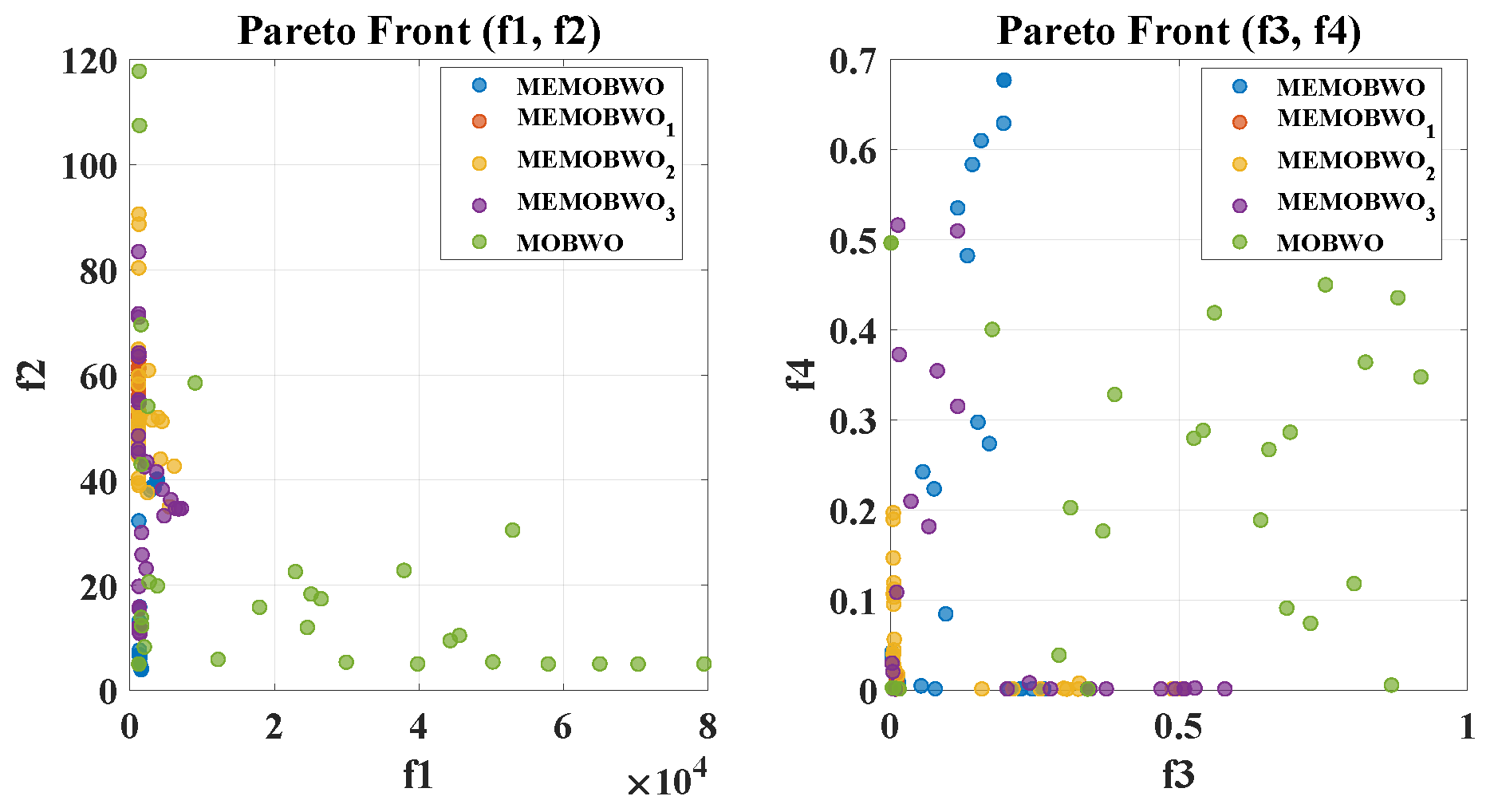
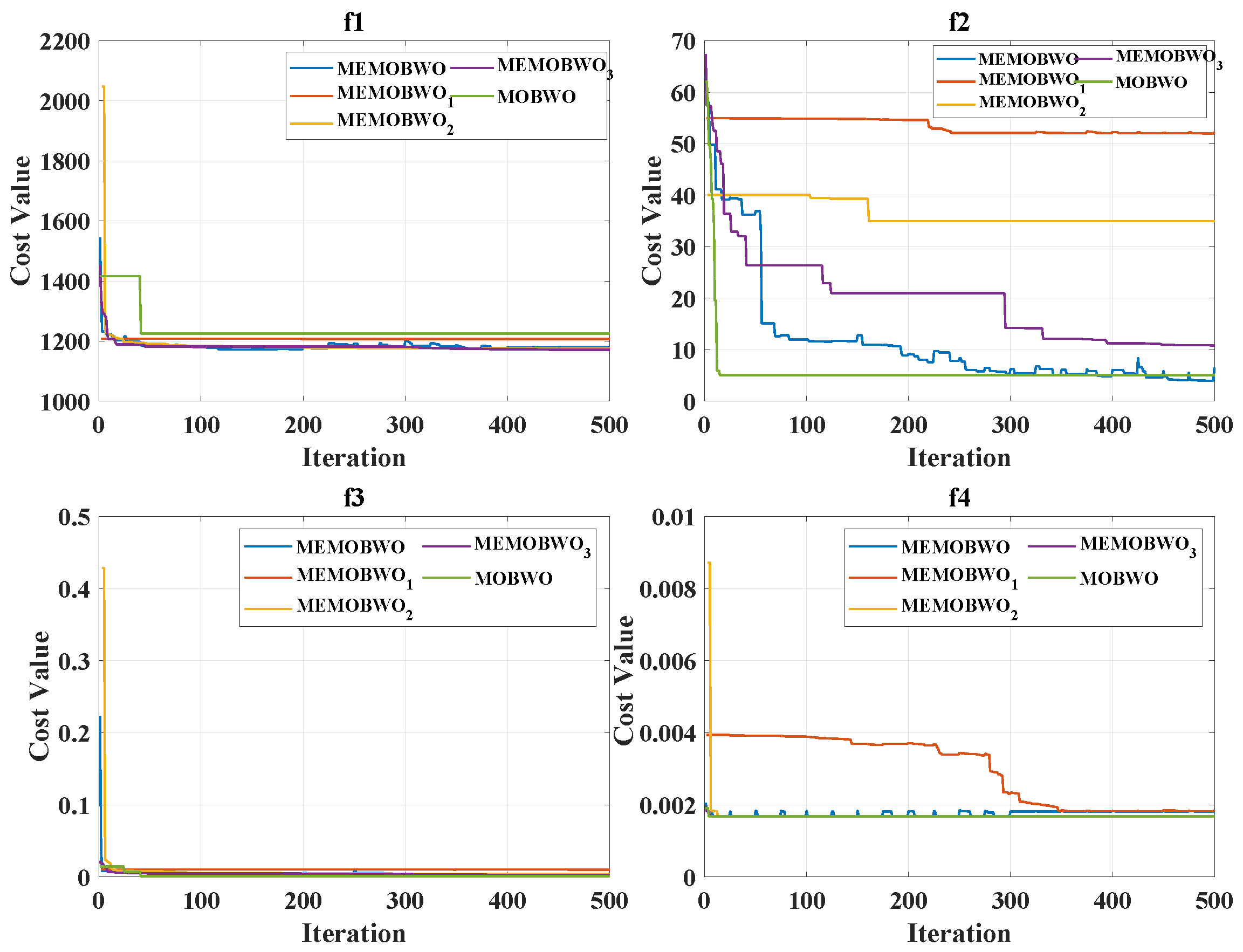
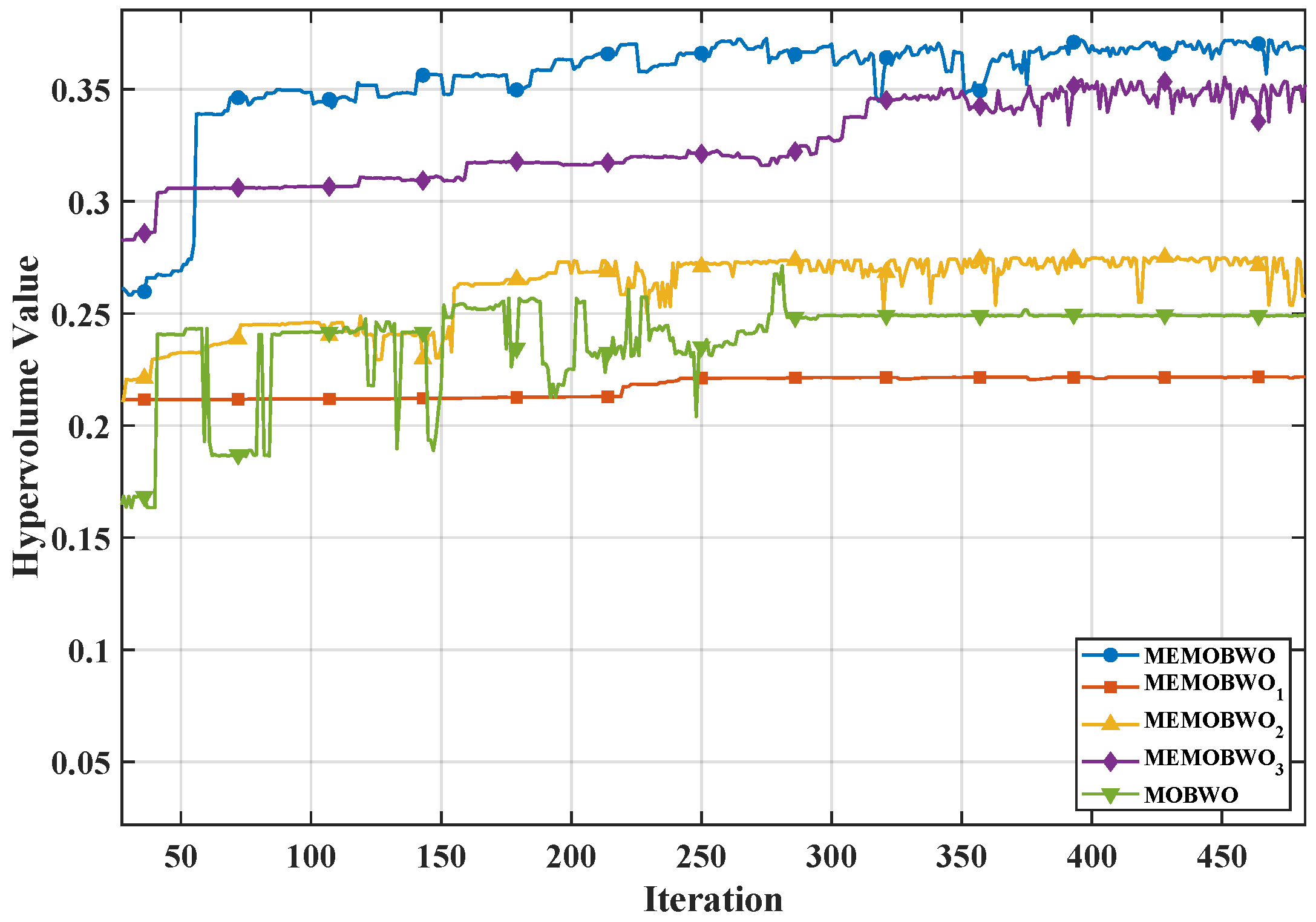
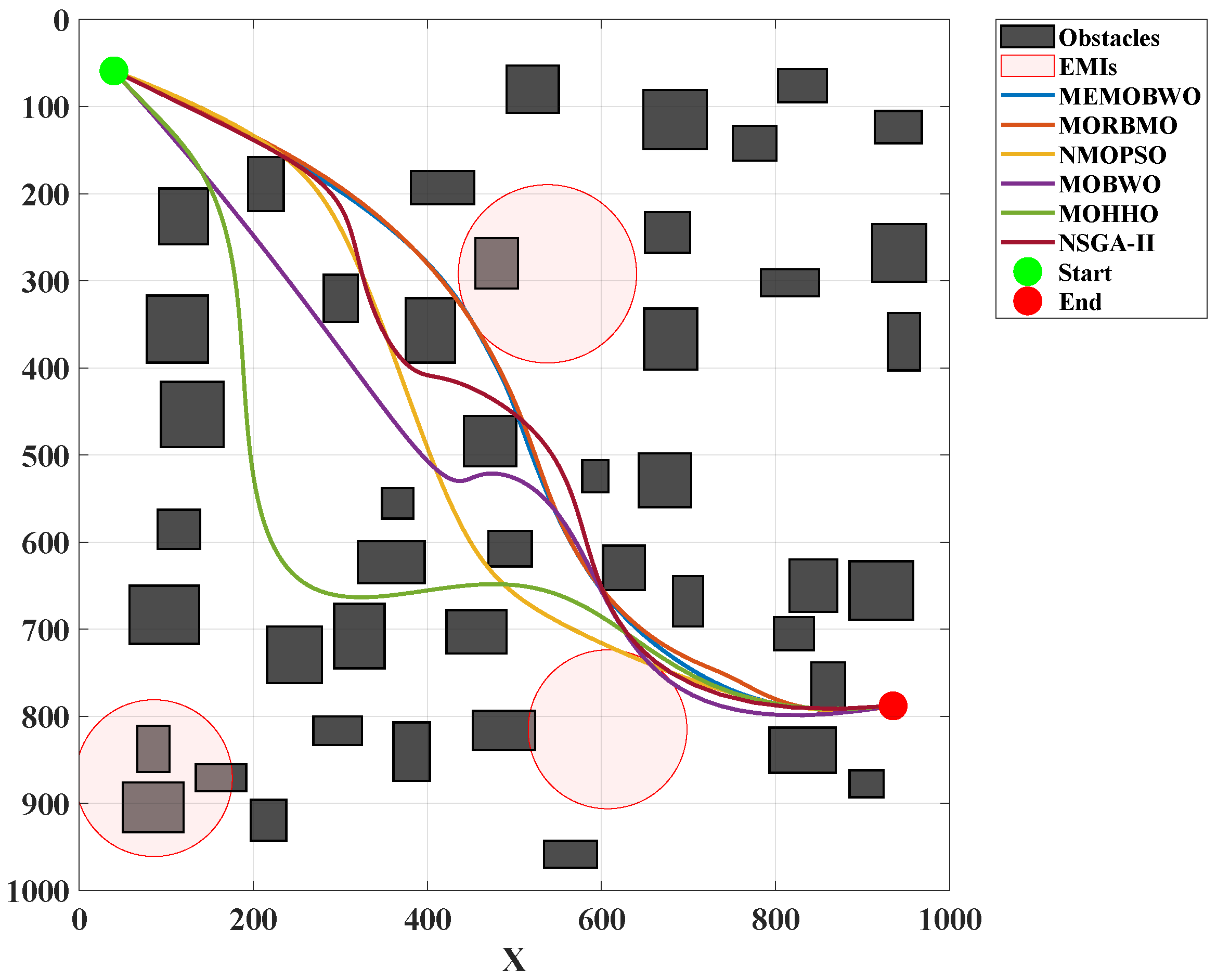
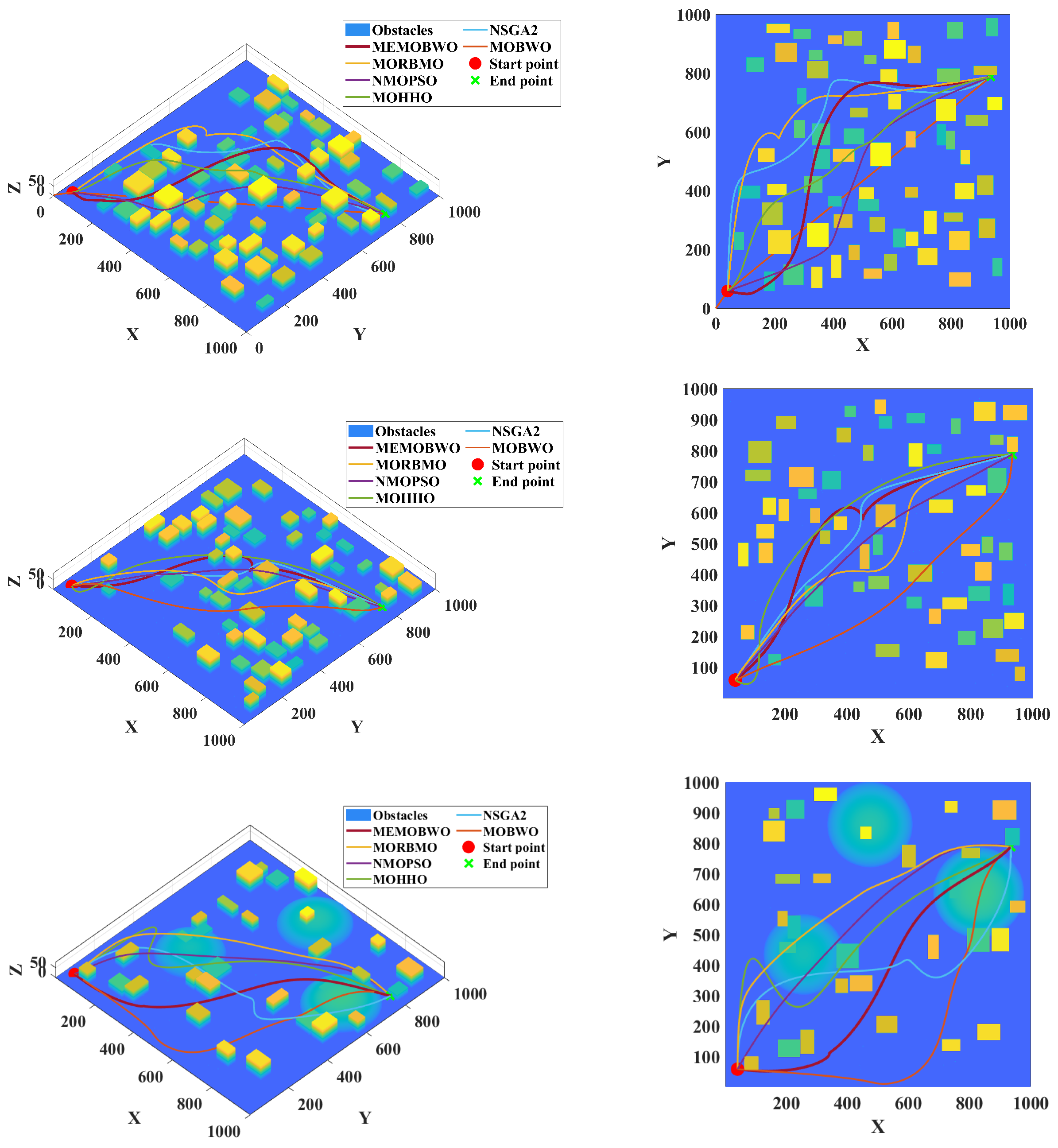
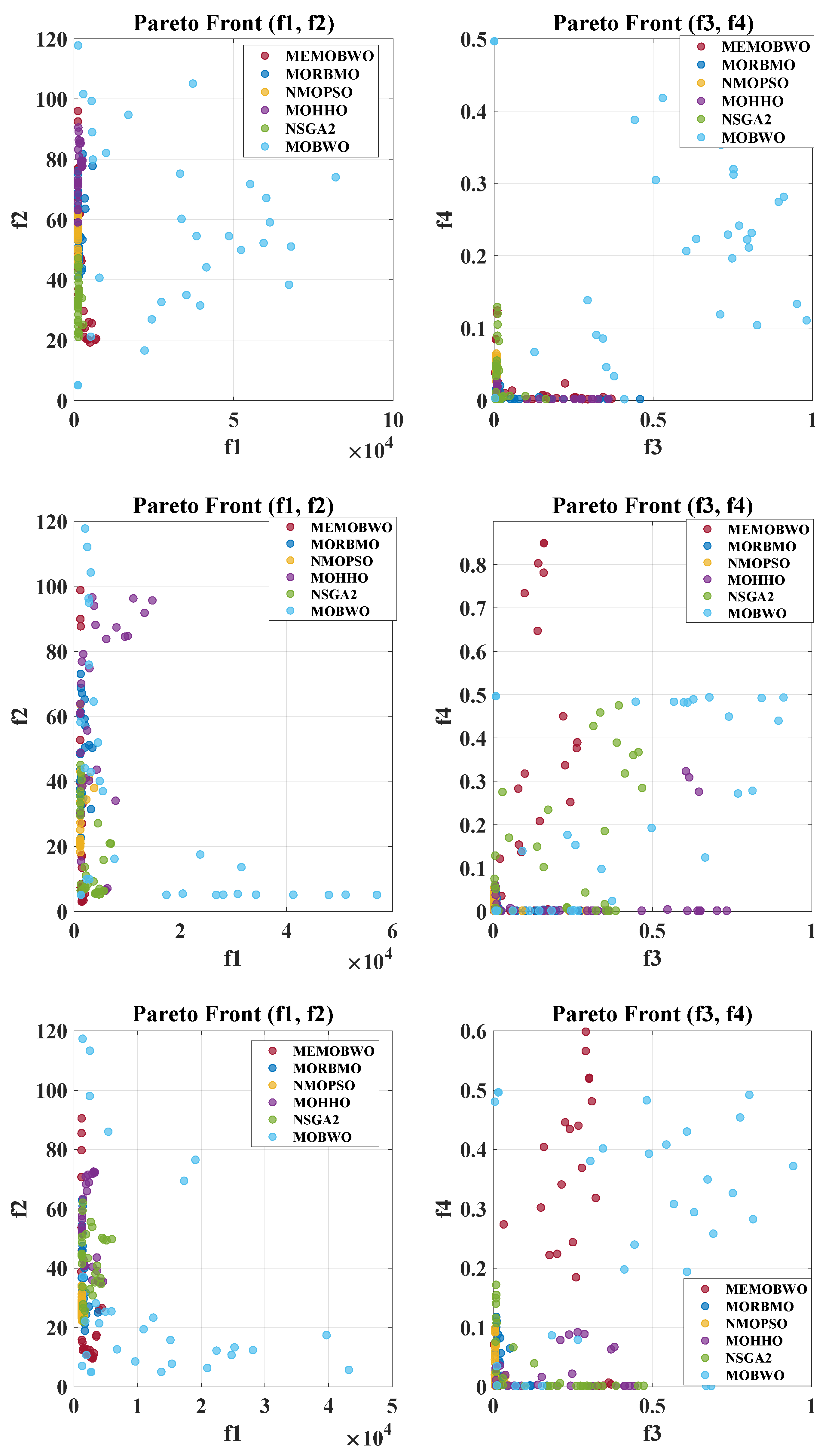
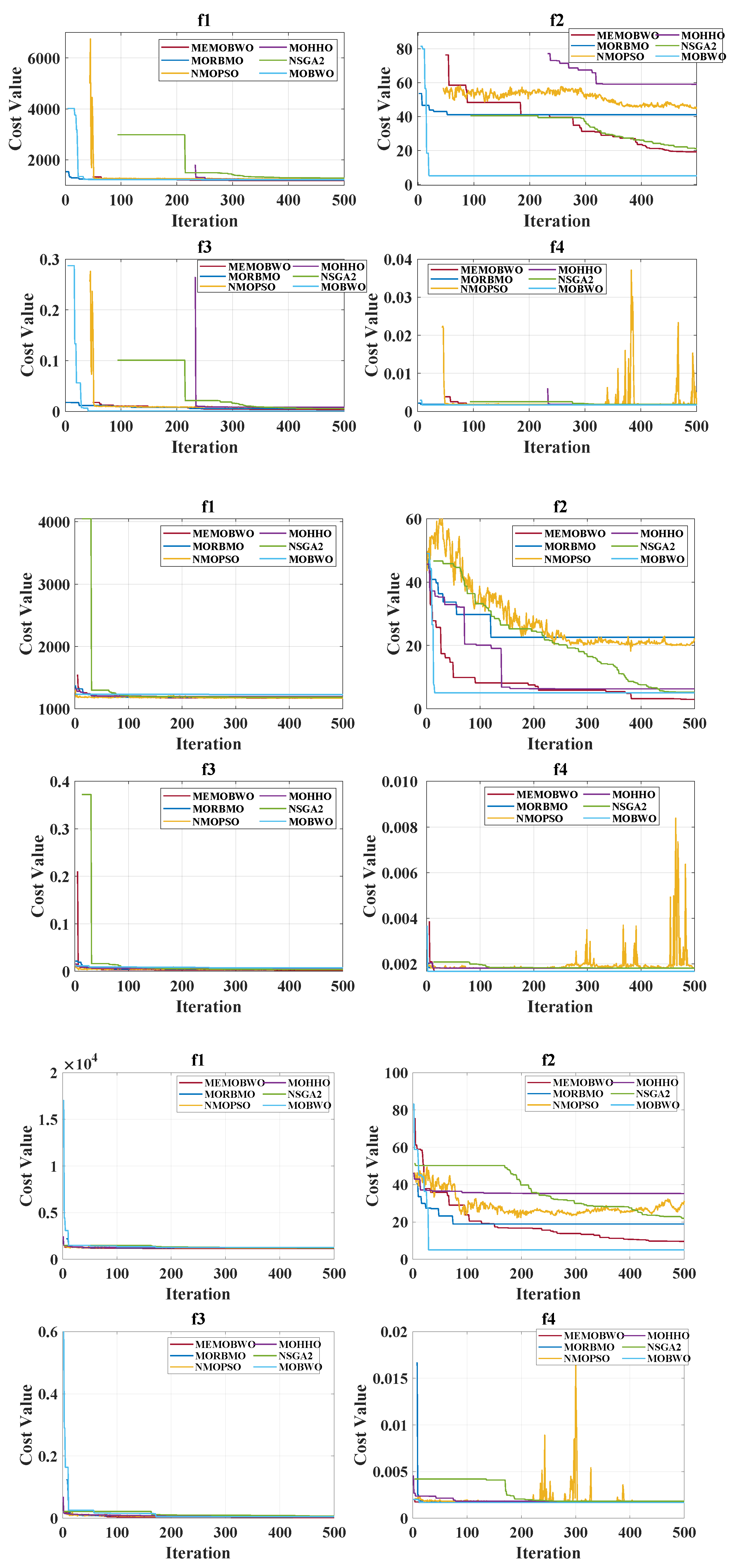
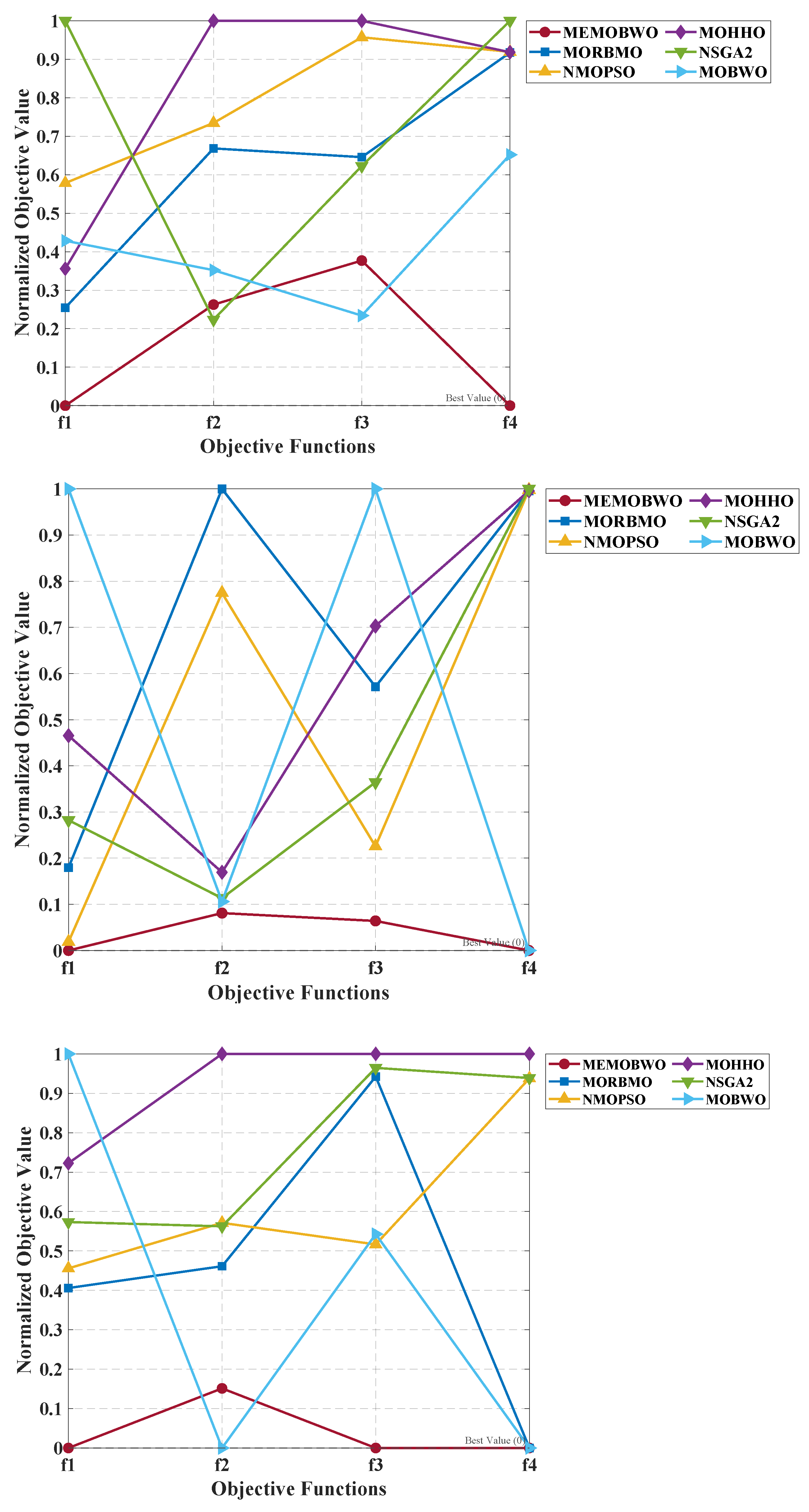
37], MOHHO, NSGA-II and standard MOBWO. NSGA-II is a classical optimization algorithm while the others are all recently published algorithms. The experimental results demonstrated that the MEMOBWO consistently generated flight paths with better performance across multiple conflicting objectives, and exhibited enhanced convergence characteristics toward the Pareto front while maintaining greater solution diversity. This underscores the effectiveness of MEMOBWO in balancing the exploration and exploitation behaviors, validating its advantages on offline path planning.
The remainder of this paper is organized as follows:
Section 2 focuses on three-dimensional environmental modeling and objective function design for the path planning problem,
Section 3 proposes the MEMOBWO algorithm based on the standard Beluga Whale Optimization algorithm and analyzes its main innovative components, and
Section 4 involves comparative experiments conducted on a simulation platform using the proposed algorithm to verify its effectiveness,
Section 5 summarizes the paper and outlines potential areas for further improvement in future research.
2. Problem Formulation
The UAV path planning problem is described as follows: under the physical and kinematic constraints of UAV, as well as the certain terrain obstacles and non-flying zones of the environments, a series of optimal flight paths of the UAV from a start point to a destination are planned. Efficient solutions to this question by optimization algorithms require three key formulations, including simulated environment modeling, kinematic modeling and the defining of objective functions.
2.1. Simulated Environment Modeling
Assuming the map constraints are known, one of the challenges in three-dimensional environment modeling is acquiring ground elevation parameters. This can be addressed by creating a 3D matrix to include the terrain size and resolution, where the value of each element indicates the elevation above ground at its corresponding position. The constraints in UAV path planning problems can be specifically categorized into physical constraints and environmental constraints. The first category includes constraints on the geometric properties of the generated paths, such as heading angle, climbing angle and curvature. The second category encompasses terrain obstacles and electromagnetic interference in urban environments. Currently, the main safety threats to flight in urban environments come from tall buildings, trees and street lights, as well as electromagnetic field interference generated by signal towers or power plants.
To represent typical urban flight constraints in a computationally tractable form, building-like obstacles are modeled as cuboids, small urban structures such as trees, street lamps, and poles are modeled as cylinders, and electromagnetic interference (EMI) risk regions are modeled as hemispherical soft-threat regions. These geometric primitives are used as planning-level obstacle and risk proxies for controllable and repeatable algorithm evaluation.
2.2. UAV Kinematic Model
On the premise that a certain safe distance is left between the UAV and the environmental obstacles, and the obstacle avoidance distance is much larger than the body size, the structure of UAV can be regarded as a particle, indicating that most of the influence of the physical conditions is ignored. However, due to the limited inertia and motor thrust of the real UAV, the generated paths still necessitates constructing mathematical models that accurately reflect the motion characteristics of UAV and fully accounting for its inherent physical performance limitations.
A point-mass kinematic model is adopted at the path geometric planning level. Its core state variables are the position
of UAV in three-dimensional space and its velocity
v. The motion is determined by the heading angle
and climbing angle
, with the fundamental kinematic equations given by:
where
v denotes the velocity scalar along the forward axis of the UAV body. Equation (
1) is defined to describe the geometric relationship between the position change rate, velocity and orientation angle of the UAV. The climbing angle
, heading-angle change
, climbing-angle change
and curvature of the generated path are constrained as:
After defining the kinematic parameters of the UAV, the minimum turning radius
of UAV is derived from the maximum roll angle
. Accordingly, the curvature
at any point on the paths must satisfy the constraint of
to ensure that the UAV has the ability to perform the turning maneuver required by the path.
where
g = 9.8 m/s
2. denotes the gravitational acceleration, variable
s should be valued between 0 and the total length of the flight path.
Additionally, the initial paths produced by discrete algorithms are polylines, which contain multiple sharp and angular turns that would be mechanically impossible for the UAV to execute at a certain speed. The MEMOBWO algorithm utilizes the continuous Bezier smoothing technique to improve geometric continuity of generated paths and reduce abrupt local direction changes. The satisfaction of the constraints above is quantitatively evaluated before and after smoothing in the experimental section.
2.3. Objective Functions Definition
To evaluate the performance of the path planning algorithm, considering the simulated environments in 3D space and the constraints mentioned in the previous sections, the following four objective functions are designed: path spatial length, path vertical maneuver cost, path smoothness and path threat degree. Let the path P be represented by a sequence of N waypoints, the objective vector is defined as . Each component is detailed below. All the objective functions and constraints are designed to guide the algorithm to generate collision-free and geometrically executable paths.
2.3.1. Path Spatial Length Function
Assuming the UAV flies at a constant speed during the flight, generated paths with shorter length implies reduced flight time and energy consumption. Therefore, the spatial length of a feasible path is one of the crucial factors for assessing the algorithm’s performance.
The path spatial length function aims to minimize the total Euclidean distance of the flight path to ensure the UAV reaches the target in a possibly minimum time, to increase its operation efficiency. Let
N be the number of waypoints and
be the coordinate of the
ith waypoint. The cost function is defined as:
where
denotes the Euclidean norm of two contiguous waypoints in the generated path. Minimizing
ensures the shortest geometrical route between the start and goal configurations. By minimizing the
function, the algorithm can gradually find a shorter path from the starting point to the end point, reducing the task consumption time.
2.3.2. Path Vertical Maneuver Cost Function
The power consumption of the UAV is non-linearly related to changes in height, where ascending actions require higher motor torque to overcome gravity compared to level flight. During UAV flight, frequent altitude variations may increase the energy demand and impose additional burden on vertical maneuvering.
Let
represent the altitude difference between two consecutive waypoints, the objective function models the asymmetrical energy cost of vertical maneuvers as:
The path vertical maneuver cost function is formulated to penalize climbing or descending:
where
and
are weighting coefficients. The parameters are set as
, typically ratio 3:1, like
= 0.3 while
= 0.1, to impose a higher penalty on climbing than on descending due to the higher energy consumption of climbing maneuvers.
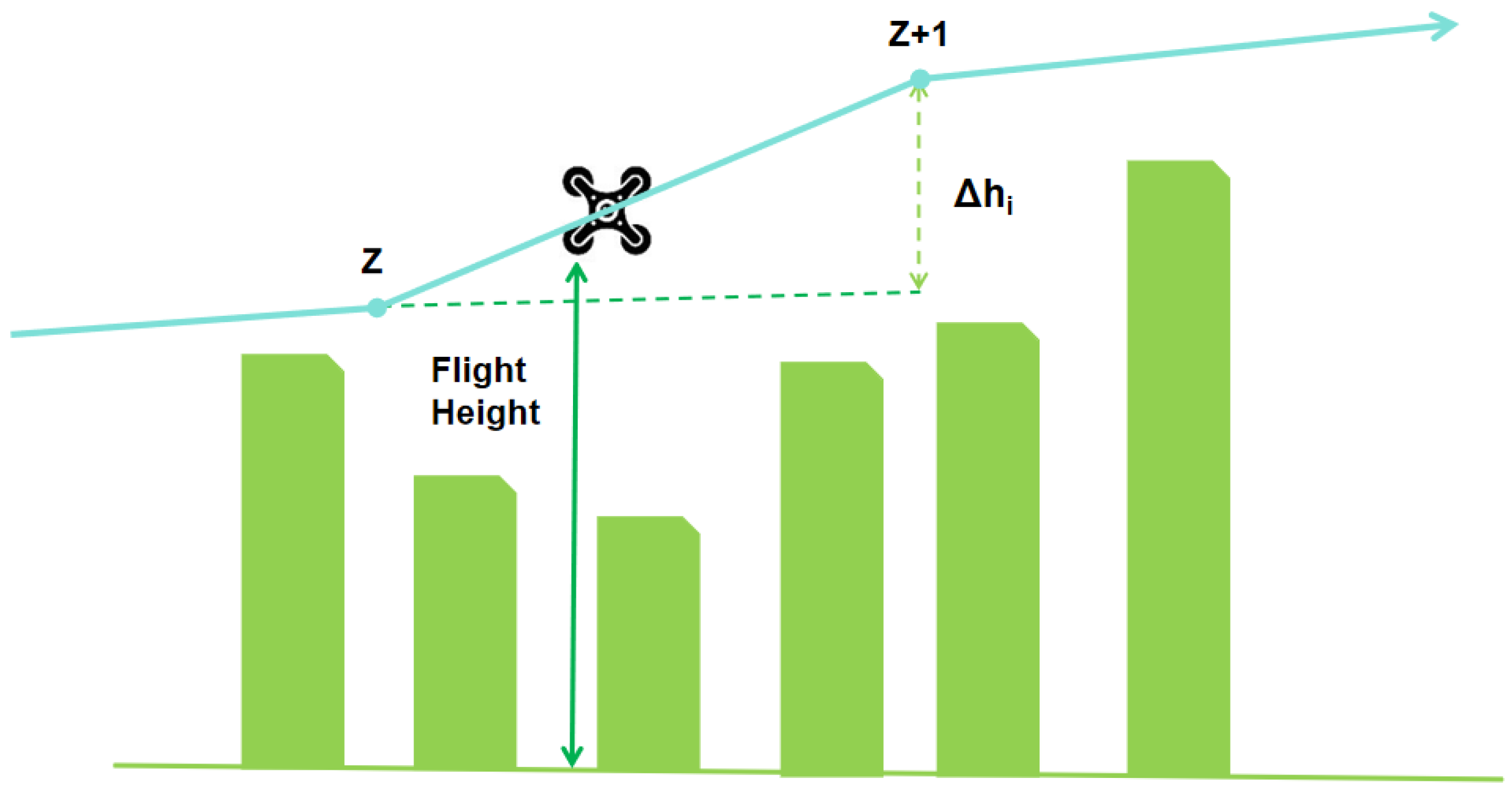
The explanation of
function is as
Figure 1. Minimizing
naturally encourages the algorithm to find paths similar to the contour type that could avoid unnecessary or sudden altitude changes in the flight.
2.3.3. Path Smoothness Function
During the flight of UAV, excessive turns and pitch maneuvers, as well as excessively large turning angles, can affect travel speed and increase energy consumption and the risk of damage. Therefore, a feasible path should minimize the number of sharp turns and reduce the maximum turning angle. The path smoothness objective function is expressed as:
where
and
represent the horizontal heading angle and vertical climbing angle of the UAV at the
ith waypoint, respectively, and
and
are the weight coefficients of turn and pitch actions of UAV, typically set as
=
= 0.5.
is defined as:
where
is the projection vector of each flight segment on the horizontal plane
,
represents the modulus length of the vector. To ensure numerical stability,
is defined to be greater than 0.
is defined as:
where
,
and
represent the changes of 3D coordinates of each flight segment in the path. This angle is the absolute value of the difference between the elevation angles of the two preceding and following flight segments, which is used to measure the changes of altitude in the vertical direction during the flight. By minimizing
, the flight path generated by the algorithm will be smoother, and the burden of UAV performing turning and pitching actions will be reduced, generating smooth flight paths that are more suitable as reference paths for subsequent trajectory tracking.
2.3.4. Path Threat Degree Function
A feasible path must guarantee avoidance of physical collision while simultaneously mitigating the risk of control link loss due to the electromagnetic interference (EMI). In this work, the urban environment contains physical obstacles and spectral threats. Let
be the physical collision risk and
be the interference risk, the composite safety objective is expressed as:
where
denotes the UAV position at sample
k, and
represents the
nth EMI source with center
and interference radius
.
The physical collision cost
is calculated based on
,
and
, which means the distance to the nearest structure, the diameter of UAV and the safety distance between it and the obstacles, respectively.
is then defined as:
A hemisphere interference is defined to simulate the potential field threat. Let
be the Euclidean distance to the EMI center, the spectral cost
is defined as:
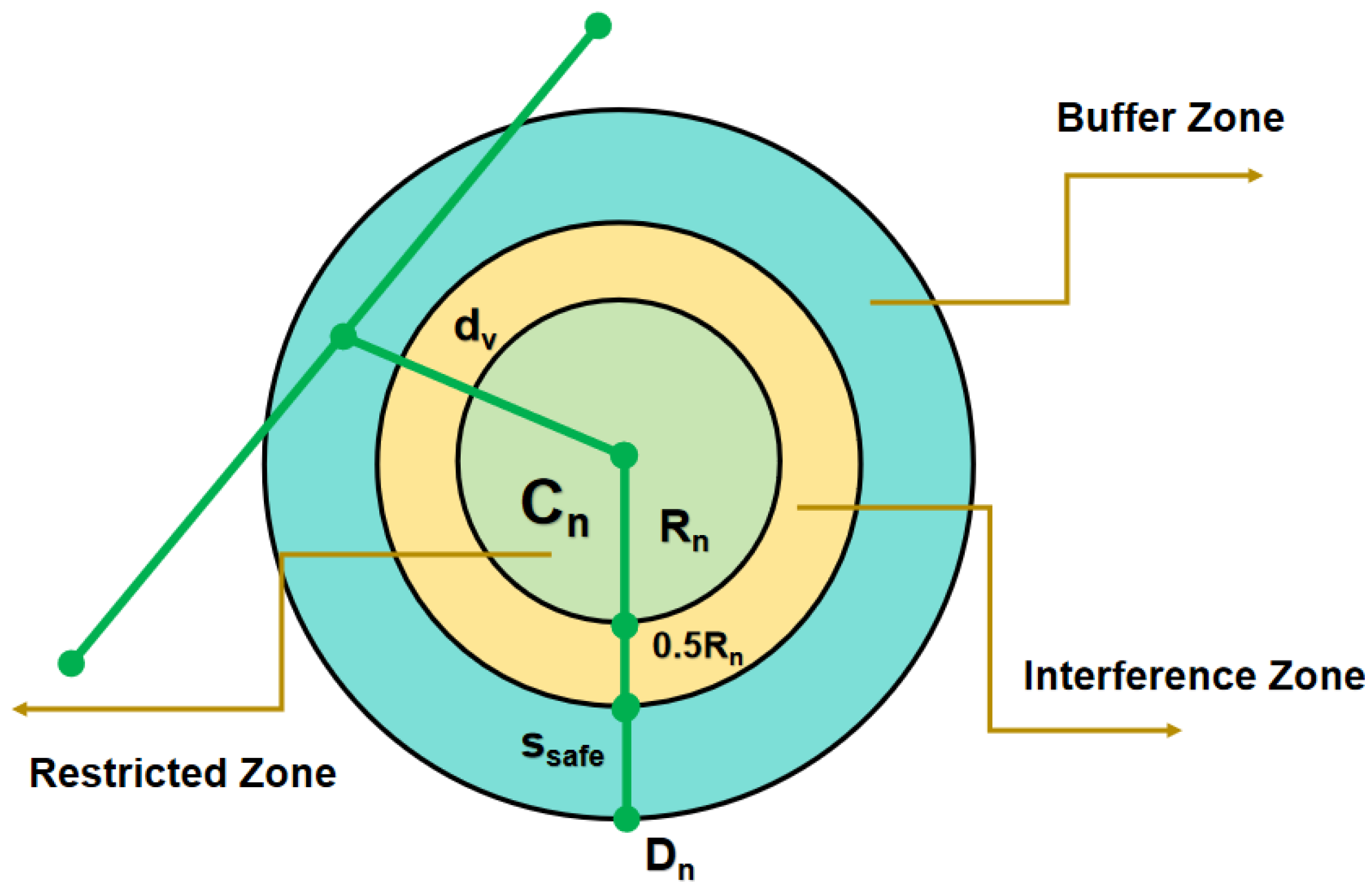
implies that the UAV perceives EMI sources as soft repulsive fields that extend 1.5 times beyond their physical radius
, hence forcing the path planner to bend the path away from high-interference zones to preserve communication integrity. The explanation of the EMI interference zone is shown in
Figure 2. Minimizing
encourages the algorithm to generate flight paths with higher safety in complex urban environment, thus ensuring the reliability and the operational safety of the UAV.
3. The Proposed Approach
3.1. Standard BWO
The Beluga Whale Optimization algorithm simulates the swimming, foraging, and the ’Whale Fall’ behaviors of a specific kind of animals called beluga whales. Belugas are highly social animals, usually gathering in groups of 2 to 25 members. When summer comes, many creatures gather in some estuaries, making the whales gather to forage. Belugas with the coordination group attack and feed the fish by guiding them into shallow water. In addition, some whales may die and fall into the deep ocean during the migration or escaping from predators, which is also known as the ’Whale Fall’ behaviors, providing plenty of food for creatures without sunlight or oxygen. The BWO algorithm process contains three certain phases, including exploration phase, exploitation phase and ’Whale Fall’ phase. The exploration phase of BWO is established by considering the swimming behavior of beluga whales. Instead of a search agent moving randomly on its own, it updates its position based on the position of a randomly selected partner whale from the population. Therefore, the positions for beluga whales are updated as:
where
T is the current iteration,
is the new position for the
ith beluga whale on the
jth dimension,
(
) is a random number selected from d-dimension,
is the position of the
ith beluga whale on
dimension,
and
are the current positions for
rth and
lth beluga whale, which are both randomly chosen,
and
are random numbers,
and
mean fins of the mirrored beluga whales are toward the surface. According to the dimension chosen by odd and even number, the updated position reflects the synchronous or mirror behaviors of pair swimming or diving.
The exploitation phase of BWO is inspired by the preying behavior of beluga whales. They prey by sharing the information of positions for each other, considering the best candidate and others. The Levy flight strategy is introduced in the exploitative phase of BWO to enhance the convergence. The mathematical model of the exploitation phase is expressed as:
where
T is the current iteration,
and
are current position for the
ith beluga whale and a random beluga whale,
is the position of new position of the
ith beluga whale,
is the best position among beluga whales,
and
are random numbers between
,
is the random jump strength that measuring the intensity of Levy flight. LF is the Levy flight function, calculated as:
where
u and
v are normally distributed random numbers,
is the default constant equal to
.
The beluga whales either migrate elsewhere or die. In order to keep the population size constant, the positions of beluga whales and step size of ’whale fall’ phase are used to establish the updated position. The formula is as:
where
are random numbers,
is the step size of ’whale fall’, which is established as:
where
is the step factor which is related to the probability of ’whale fall’ and population size,
and
are upper and lower boundary of variables, respectively. It can be seen that the step size is affected by the boundaries of design variables, iteration and maximum iterative number. The probability of ’whale fall’
is calculated as:
3.2. The Proposed MEMOBWO
The original BWO algorithm, due to its own limitations, will face problems of insufficient diversity of the solution set and be easy to fall into local optima when solving some more complex optimization problems. In order to apply BWO algorithm to multi-objective optimization problems and make it more adaptable in path planning problems, a series of corresponding improvement approaches is proposed in this section.
3.2.1. Chaotic Quasi-Opposition-Based Learning
The diversity and quality of the initial population are important for constructing a well-distributed Pareto archive in the early stage of the search.Traditional initialization methods [
38] based on random distribution often lead to an uneven exploration of the search space, potentially trapping the algorithm in local optima. To overcome these limitations, this paper proposes a Chaotic Quasi-Opposition-Based Learning (CQOBL) strategy. This strategy introduces Quasi-Opposition-Based Learning [
39] (QOBL) to evaluate both the current solution and its opposite solution simultaneously. It also introduces a Piecewise chaotic sequence to control the generation of quasi-opposite candidates between the center of the search space and the opposite point. After generating both the random population and the chaotic quasi-opposition population, non-dominated sorting and objective evaluation are used to select higher-quality individuals for the initial population. This design provides a more diverse sampling pattern while keeping the generated candidates within the feasible variable bounds.
Let
be the
jth dimension of the
ith individual in the population, bounded by
. The standard opposition solution
is defined as:
The center of the search space,
, is calculated as
. The proposed CQOBL strategy generates a candidate solution
dynamically within the interval
, governed by a chaotic sequence. The formulation is defined as:
where
, valued between
, represents the chaotic value generated by the Piecewise chaotic map at iteration
k. The Piecewise map is selected for its superior ergodicity and uniform distribution properties compared to the Logistic or Tent maps. The mathematical expression of the Piecewise map is defined as:
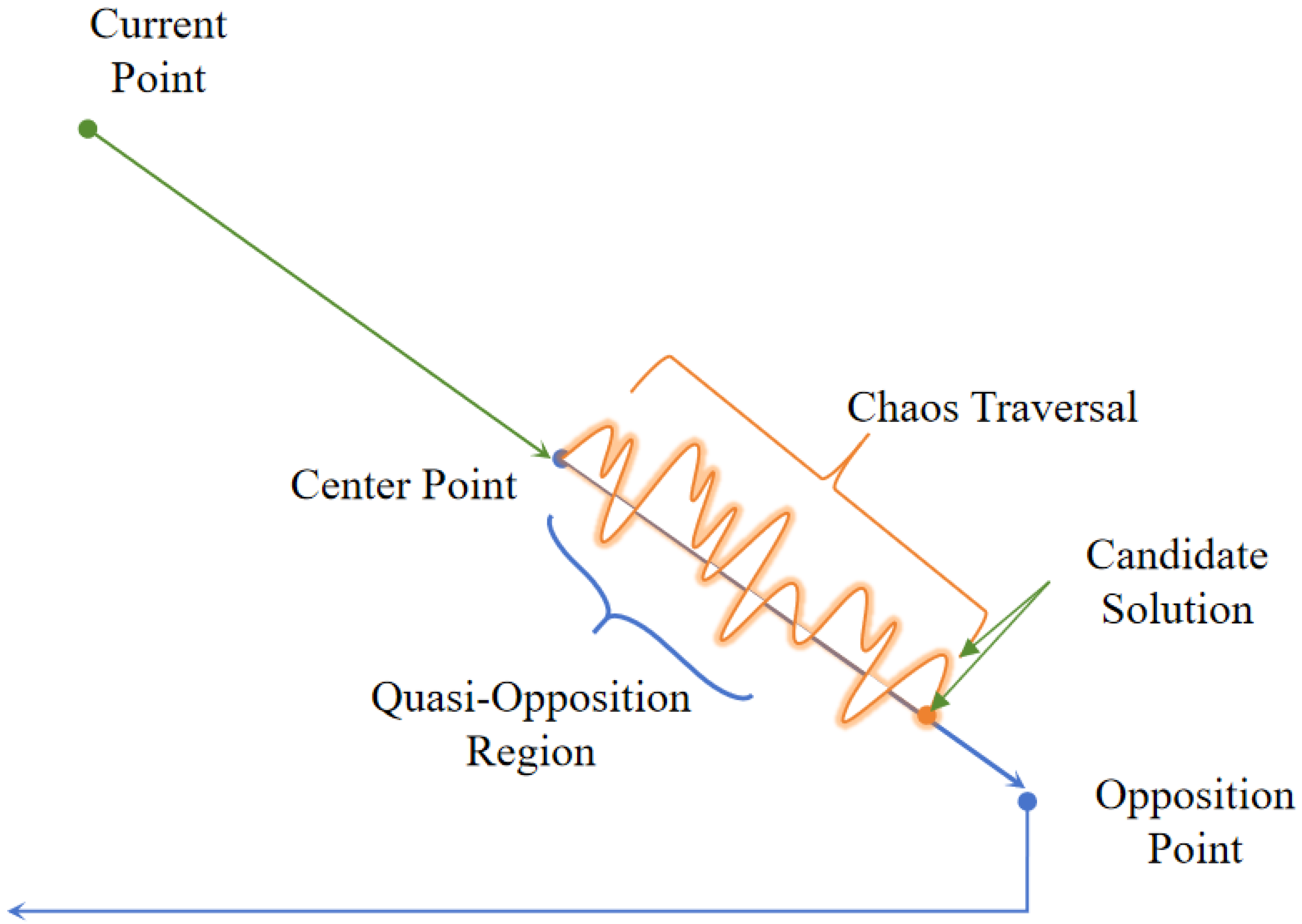
By utilizing
, the algorithm can perform a fine-grained, non-linear scan of the potential optimal region between the geometric center and the opposition point. The operation principle of CQOBL is shown in
Figure 3. This mechanism enhances the algorithm’s ability to jump out of local optima and improves the diversity of the initial population and subsequent generations.
3.2.2. Hybrid Adaptive Position Update
Existing meta-heuristic algorithms tend to introduce Lévy flight to enhance global exploration or spiral search to strengthen local exploitation. In contrast, HAPU is designed to improve the position update process of MEMOBWO by coordinating long-range exploration and local exploitation in a stage-adaptive manner. It combines three components in a unified update mechanism, including a nonlinear energy factor, an adaptive switching probability and a hybrid stochastic exploration operator.
The behavioral patterns of the beluga population are influenced by their energy states. To simulate this biological characteristic and to quantitatively describe the temporal evolution of the search process, a nonlinear adaptive energy factor
is introduced to the algorithm. Unlike linear attenuation strategies,
reflects energy fluctuations and nonlinear decay in complex environments. The formulation of
is defined as:
where
represents the initial energy state, typically set as constant 2,
t and
denote the current iteration index and the maximum number of iterations, respectively, and
is a nonlinear exponent controlling the decay rate.
The introduction of
provides the algorithm with a global evolutionary mark, whose oscillatory decay trend characterizes the overall transition of the population from broad exploration to fine-grained exploitation. Under the energy evolution governed by
, an adaptive switching probability
is introduced as the core control parameter to explicitly guide the behavioral decisions of individuals at different evolutionary stages. To achieve a smooth transition from exploration-dominated to exploitation-dominated behavior, the switching threshold
is designed as a cosine-based monotonically decreasing function of the iteration index
t defined as:
where
is a constant coefficient that controls the lower bound of the switching probability. With the introduction of
and
, the mechanism of dynamic cooperation between Lévy flight and spiral search is defined as:
where
and
denote the Lévy flight operator and the spiral search operator, respectively. During the early stages of iteration,
remains at a relatively high level, leading to a high probability of triggering the Lévy flight operator
. Leveraging its heavy-tailed distribution, Lévy flight drives individuals to perform long-distance jumps, thereby maximizing the coverage of the search space. As the iteration proceeds,
gradually decreases, causing the algorithm to favor the spiral search operator
, which guides individuals to approach the current best solution via logarithmic spiral trajectories for fine-grained exploitation.
The mathematical definition of cooperative operators is as follows. Focusing on global exploration, the position update rule is defined as:
where
represents the standard Cauchy distribution with location parameter zero and scale parameter
. The time-varying mixing weight
is given by:
where
is usually set to 3 to govern the transition speed of the weight. The scale parameter
is scaled according to the problem dimension as
, where
and
are the upper and lower bounds of the search space and
d is the dimensionality. The innovation lies in combining the heavy-tail property of the Lévy distribution, which facilitates large-step global exploration, with the broad-tail characteristic of the Cauchy distribution, which promotes fine-grained local search. Through
, the HAPU strategy forms a multi-level adaptive optimization framework.
Focusing on deep exploitation, this rule is defined as:
where
denotes the distance between the individual and the current best solution,
b is a constant defining the shape of the logarithmic spiral, and
is a random number. This equation enables search agents to scan the target region locally with a smoothly contracting path.
The proposed HAPU strategy provides a staged and probabilistic update mechanism that adjusts both the search mode and perturbation structure during the iteration process. By overcoming the limitations of single-mechanism strategies in terms of search breadth and depth, it enhances the global optimization efficiency of the algorithm.
3.2.3. Multi-Objective Thinking Innovation Strategy
The search operators in optimization algorithms usually apply uniform evolutionary pressure on all decision variables, which lacks the flexibility to repair specific performance deficiencies. Inspired by the concept of “Thinking and Innovation” [
40], the Multi-Objective Thinking Innovation (MOTI) strategy uses different elite guidance for different individuals according to their weakest objectives. The repair direction for the population is no longer uniform, but is adaptively determined by the objective-level deficiency of each individual.
Given the disparate units and magnitudes of the objective functions, direct comparisons of objective values is infeasible. At each generation
t, the objective values of the population are dynamically normalized. Let
denote the
mth objective value of the
ith whale, the normalized value
is calculated as:
where
and
denote the maximum and minimum values of the population on the
mth objective dimension, respectively, and
is a small constant introduced to avoid division by zero. Through this linear mapping, all objective functions are projected onto a dimensionless interval
, thereby eliminating the scale discrepancies among different physical quantities of the objective functions. This normalization provides a unified measurement basis for subsequent performance evaluation.
After the normalization of dynamic objectives, the algorithm identifies the performance deficiency of each individual based on the normalized objective matrix. For minimization problems, a larger normalized objective value indicates poorer performance on that dimension. Accordingly, the weakest objective index
of individual
is determined as:
This step identifies the primary performance deficiency of the current solution, providing explicit directional guidance for subsequent targeted search.
When the weakest dimension
is determined, the algorithm performs targeted refinement. Specifically, the individual
learns from the elite solution
, which exhibits the best performance on objective
within the current population. The position update rule is defined as:
where
denotes the individual with the minimum fitness value on the objective,
is a random learning rate that controls the degree of attraction toward the elite solution, and
is a disturbance coefficient. Term
represents a random difference vector, which is introduced to preserve population diversity and prevent premature convergence.
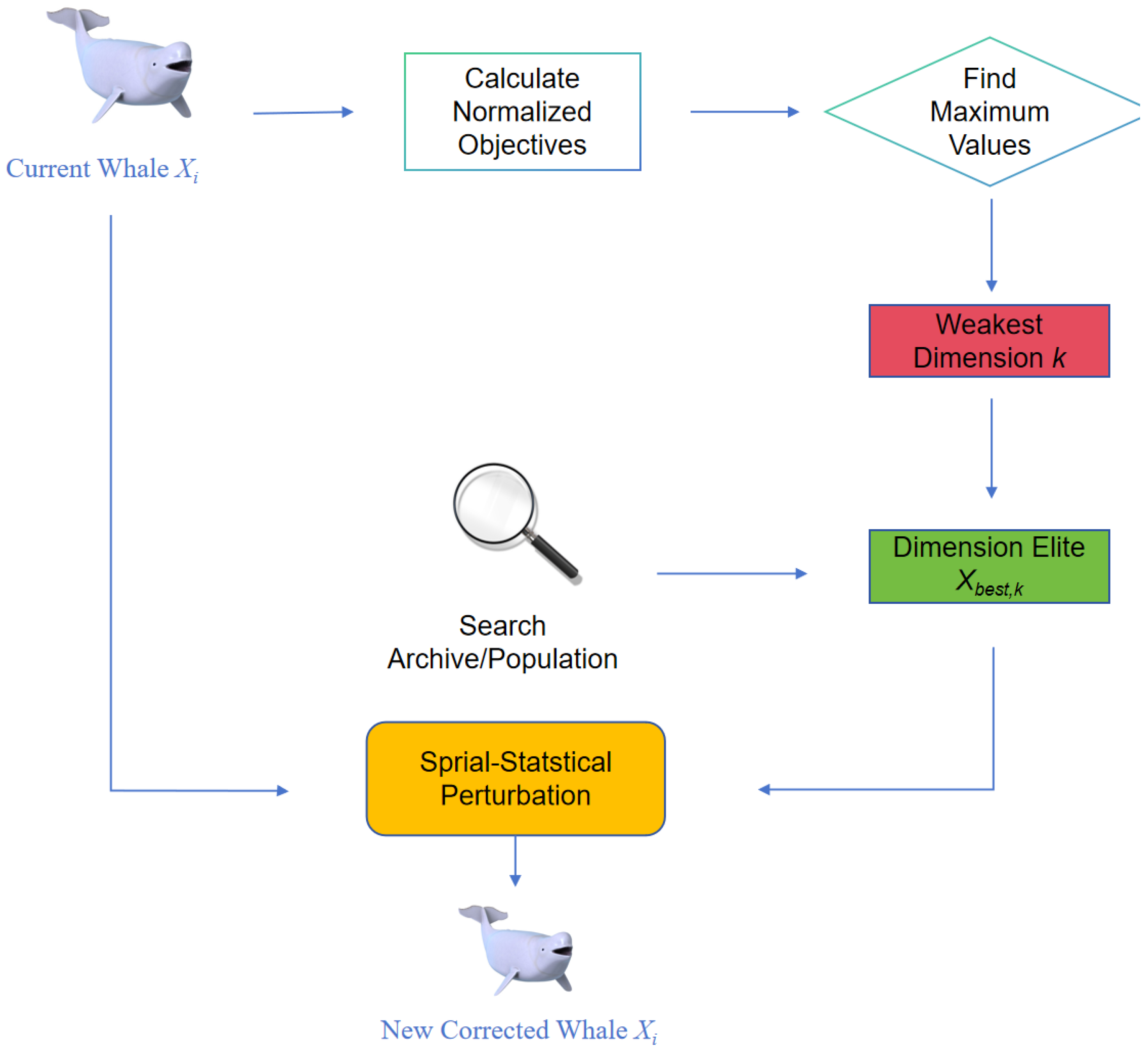
The flow chart of the MOTI strategy is shown as
Figure 4. This proposed strategy acts as a supplementary local refinement mechanism that helps individuals improve their most deficient objective while maintaining the multi-objective search framework.
3.3. Time Complexity Analysis
The time complexity of the MEMOBWO algorithm is mainly determined by the population size N, number of objectives M, the maximum number of iterations T, the problem dimension D and the objective evaluation cost of one candidate path . The original BWO algorithm has a complexity of .
The proposed MEMOBWO introduces three improvement strategies. Their complexities are analyzed by examining the mathematical formulas involved:
CQOBL: This strategy is applied only once during initialization. It generates a chaotic sequence and computes a quasi-oppositional solution for each individual. Each operation involves basic arithmetic and logic per dimension, resulting in a complexity of . Since it is not repeated iteratively, its contribution does not multiply by T.
HAPU: For each iteration, this strategy updates every individual’s position using the energy factor , the adaptive switching probability , and either the Lévy flight or spiral search operator. All calculations are performed per dimension per individual, with a complexity of per iteration. Over T iterations, the total complexity is .
MOTI: In each iteration, this strategy normalizes the objective values (Equation (
29),
, where
M is a small constant), identifies the weakest objective dimension (Equation (
30),
), and performs a targeted position update (Equation (
31),
). All operations are linear in
N and
D, leading to a per-iteration complexity of
. Thus, the total cost is
.
The objective evaluation of all individuals requires
per iteration. For UAV path planning,
includes the computation of path spatial length, vertical maneuver cost, smoothness, and safety-related threat cost, and is therefore reported separately. Archive management involves dominance comparison and crowding-distance-based pruning. During archive updating, the dominance comparison cost is
, and the crowding-distance pruning cost is approximately
. Thus, the per-iteration complexity can be expressed as:
Therefore, the overall time complexity of MEMOBWO is described as:
The analysis confirms that the proposed improvement strategies of MEMOBWO remain linear with respect to N and D, while the complete multi-objective implementation also includes objective evaluation and archive management costs. Since M and A are fixed in the experiments, and each run of path planning experiments can be completed within 1 min, the computational cost remains acceptable for offline mission planning scenarios.
3.4. Implementation of MEMOBWO
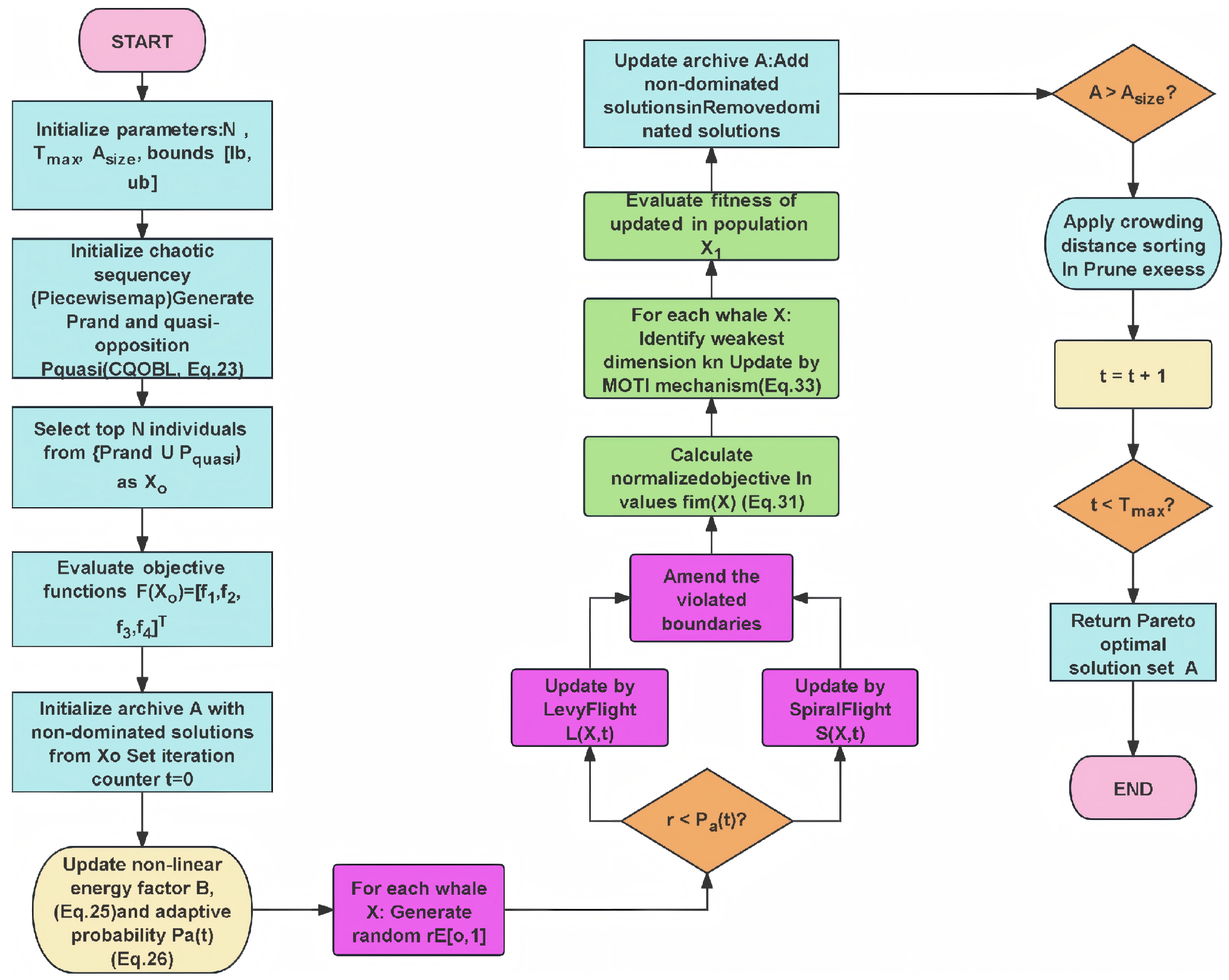
The flowchart of MEMOBWO is described as
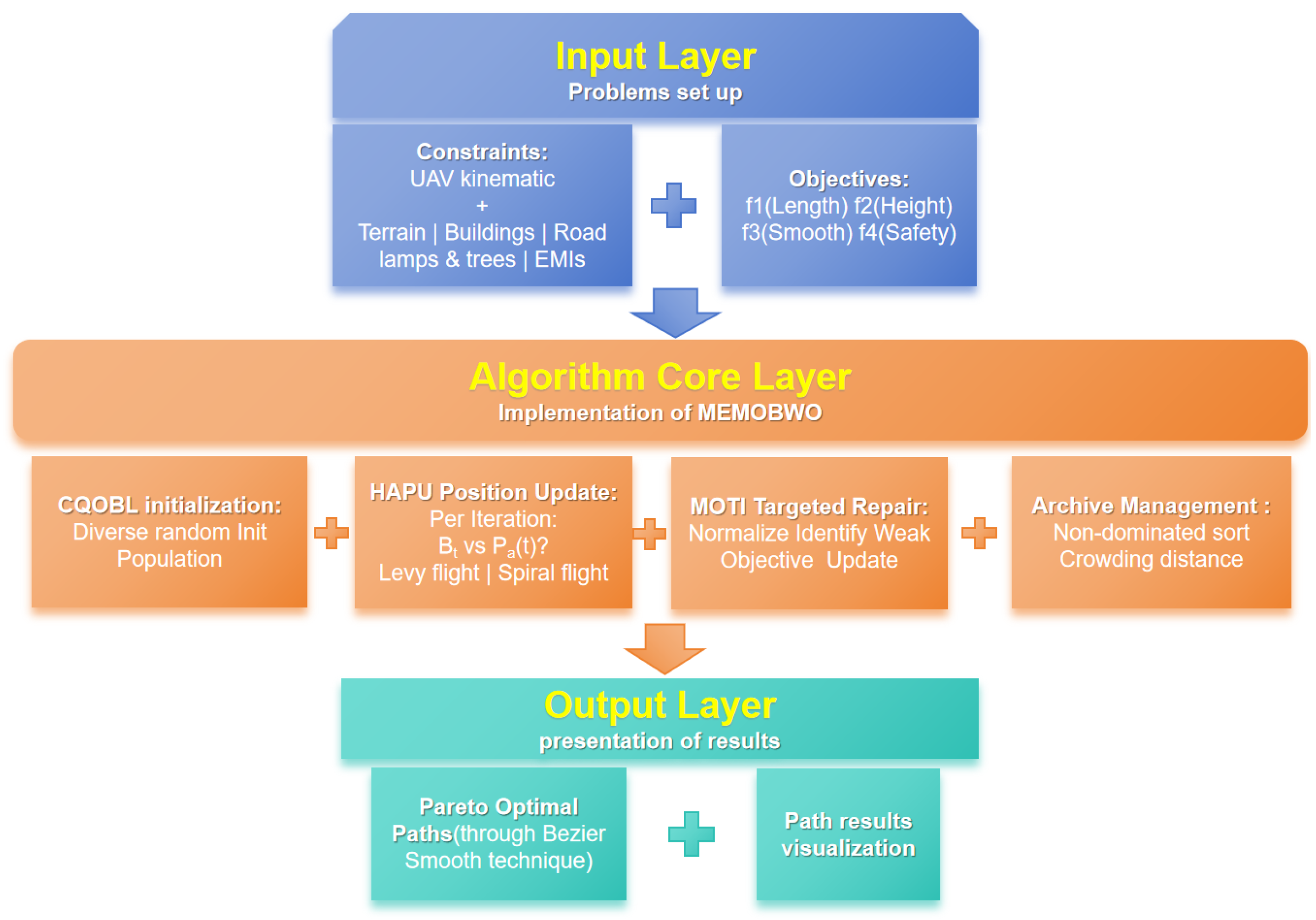
Figure 5. Furthermore,
Figure 6 shows a schematic diagram of the MEMOBWO algorithm system model, where
Figure 5 constitutes the core layer of the algorithm.
The detailed path planning steps of the proposed MEMOBWO algorithm are operated as Algorithm 1:
| Algorithm 1 Implementation of MEMOBWO |
- 1:
Initialize parameters: population size N, maximum iterations , archive size - 2:
Begin - 3:
Initialize chaotic sequence using Piecewise map - 4:
Initialize population with random positions within - 5:
Generate quasi-opposition population using CQOBL strategy by Equation ( 21). - 6:
Select top N individuals from to form initial population - 7:
Evaluate objective functions - 8:
Initialize archive A with non-dominated solutions from - 9:
Set iteration counter - 10:
while do - 11:
Update nonlinear energy factor using Equation ( 23) - 12:
Update adaptive switching probability using Equation ( 24) - 13:
for each whale in population do - 14:
if then - 15:
Update position using Lévy Flight operator by Equation ( 26) - 16:
else - 17:
Update position using Spiral Search operator by Equation ( 28) - 18:
end if - 19:
Amend violated boundaries - 20:
end for - 21:
Calculate normalized objective values by Equation ( 29) - 22:
for each whale in population do - 23:
Identify weakest dimension index - 24:
Identify dimension elite - 25:
Update position using MOTI by Equation ( 31) - 26:
end for - 27:
Evaluate fitness of updated population - 28:
Update archive A by adding non-dominated solutions from - 29:
Remove dominated solutions from A - 30:
if then - 31:
Apply crowding distance sorting - 32:
Prune excess solutions to maintain diversity - 33:
end if - 34:
- 35:
end while - 36:
Return Pareto optimal solution set A - 37:
End
|
5. Conclusions
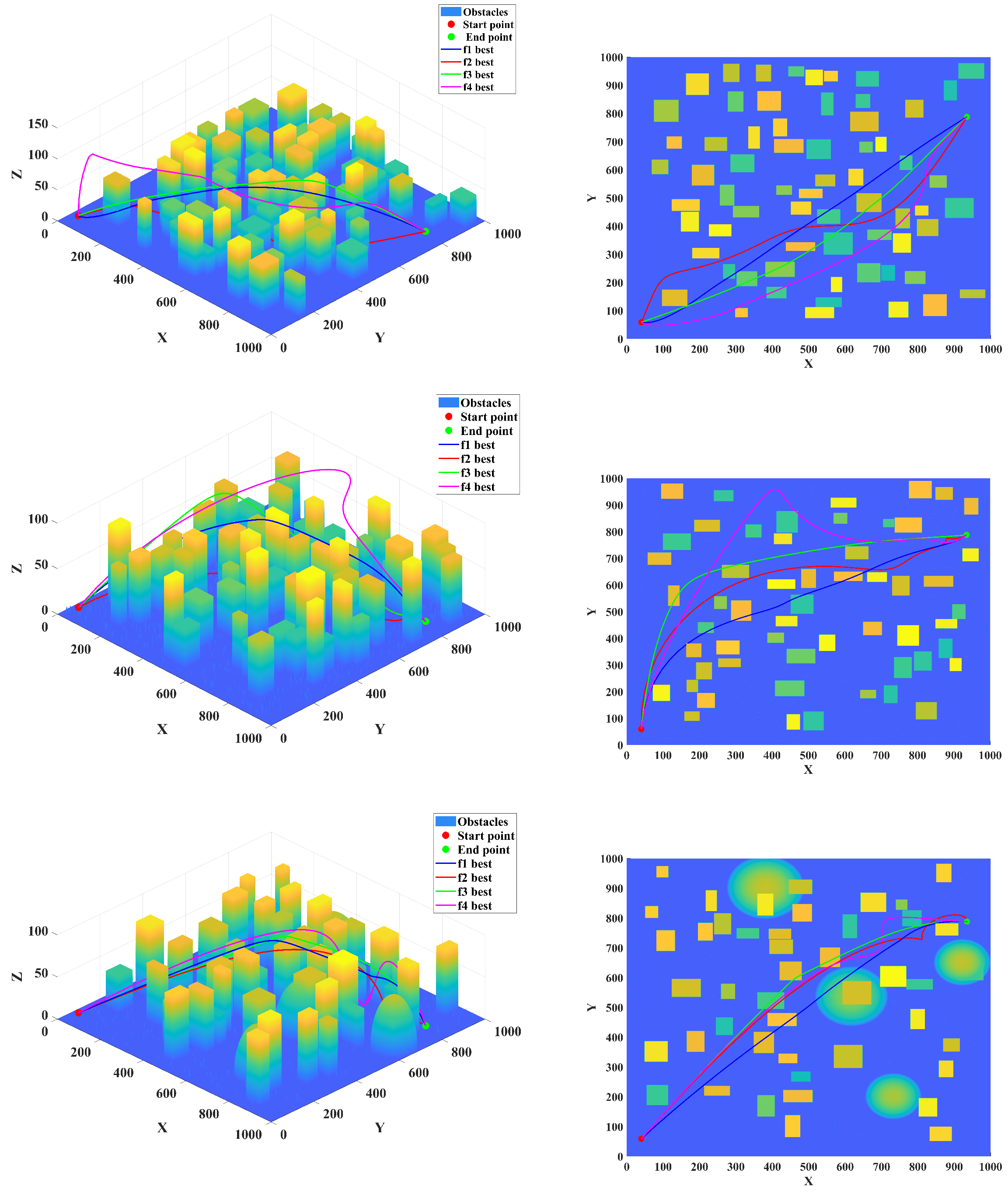
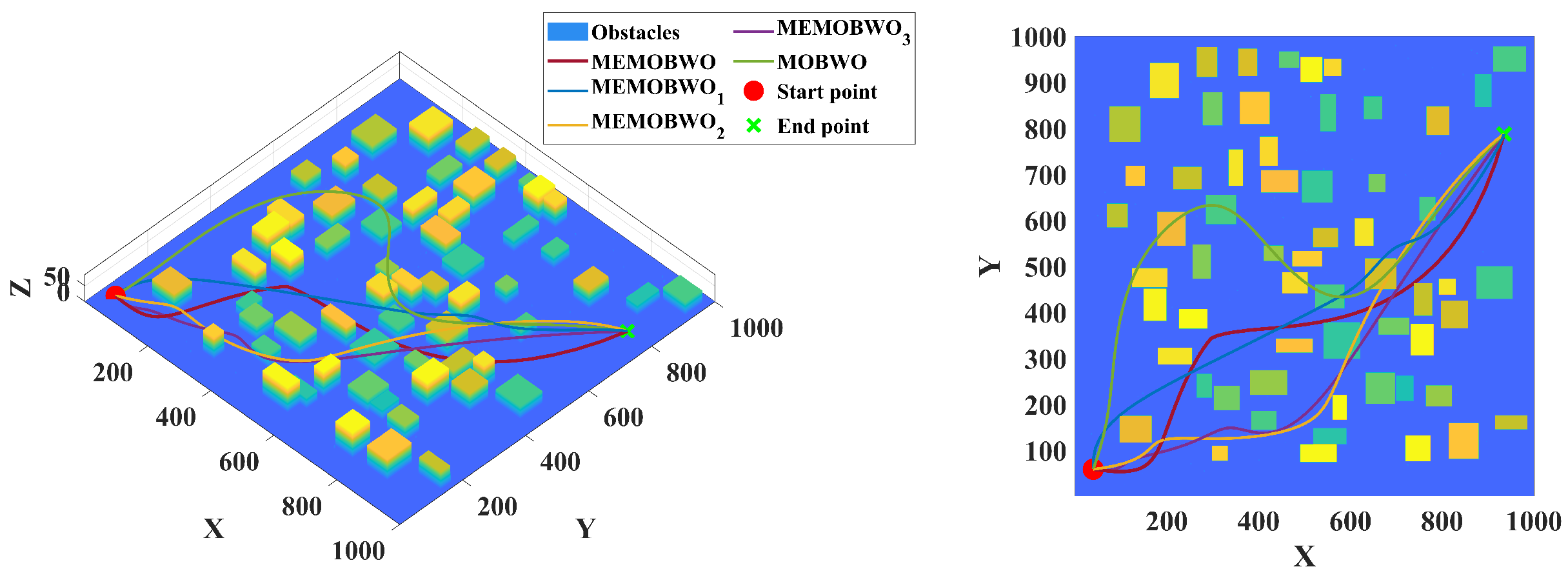
This paper proposed a novel improved algorithm called MEMOBWO, which contains a series of optimization strategies to improve its performance on the problem of the UAV path planning in urban environment. The subsequent simulation results show that MEMOBWO can effectively improve the comprehensive performance of UAV path planning algorithm while maintaining stable performance across independent runs. It can play a certain auxiliary role in UAV flight control and trajectory tracking.
However, the current MEMOBWO algorithm still has room for further improvement in terms of solution accuracy and optimization speed. In future research, more sophisticated decision-making models will be explored to solve the existing and potential problems. Exploration of hybrid frameworks, such as integrating deep learning with meta-heuristic optimization, could be a promising research direction. Combination of these complementary paradigms could sufficiently leverage the strengths of both approaches, thereby accelerating the convergence speed of population-based algorithms like MEMOBWO.
Moreover, while the experimental results demonstrate the effectiveness of MEMOBWO in solving UAV path planning problems in complex urban environments, we acknowledge that the testing scope has certain limitations that the experimental validation in this study is limited to simulated urban environments with basic geometric primitives like cubes, cylinders and hemispheres. To further strengthen the practical relevance of the results, future work should validate the proposed MEMOBWO on more realistic 3D city models based on real-world environments, or directly tested in real-world experiment fields. Such validation would provide a more comprehensive assessment of the algorithm’s strengths and limitations under realistic deployment conditions.