Article

Multi-Parameter Effects on Equi-Biaxially Pre-Stretched Dielectric Elastomer Actuators for Dynamic Design


by
Song Wu
1,2,
Matthew O. T. Cole
1,* and
Theeraphong Wongratanaphisan
1
1
Department of Mechanical Engineering, Faculty of Engineering, Chiang Mai University, Chiang Mai 50200, Thailand
2
School of Mechanical and Automotive Engineering, Guangxi University of Science and Technology, Liuzhou 545006, China
*
Author to whom correspondence should be addressed.
Actuators 2026, 15(5), 252; https://doi.org/10.3390/act15050252
Submission received: 17 March 2026 / Revised: 10 April 2026 / Accepted: 26 April 2026 / Published: 1 May 2026
(This article belongs to the Section Actuator Materials)

Abstract

Due to the strong nonlinearity and large deformation characteristics of dielectric elastomer actuators (DEAs), the dynamic performance design of their actuators faces the challenge of complex multi-parameter coupling. This paper establishes a unified parameterized dynamic equation based on analytical mechanics, focusing on the influence of electric field, excitation frequency, driving waveform, material properties, geometric dimensions, and pre-stretch ratio on their dynamic performance indicators. The study finds that the pre-stretch ratio, by changing the system’s potential energy and stiffness, not only directly affects the system’s dynamic performance. More importantly, throughout a complete driving voltage waveform cycle, the DEA exhibits alternating compression and expansion—a phenomenon rarely reported in existing studies. Accordingly, this study defines two new performance indicators: maximum stretch ratio (characterizing expansion) and minimum stretch ratio (characterizing compression). Based on this, the paper proposes a visualization design method using radar charts. By normalizing the performance indicators and plotting performance indicator radar charts, the interaction of various parameters can be intuitively presented, providing a new approach for the customized dynamic design of DEAs.

1. Introduction

DEAs are a class of actuators made of smart soft materials, known for their large deformation, high energy density and fast response. These characteristics make them very promising for applications in soft robotics, precision optics, biomedical engineering and vibration suppression [1,2], and flexible grippers [3]. Their actuation mechanism is derived from the Maxwell stress effect, that is, when an electric field is applied to the upper and lower surfaces of an elastic dielectric film, it will cause in-plane expansion [4]. However, DEAs exhibit strong nonlinear behavior under actual dynamic working conditions. The mechanism mainly stems from the hyperelasticity of the material [5], geometric nonlinearity [6], and the complex mutual coupling between the electric field and the mechanical field [7], making its dynamic performance—such as maximum displacement, transient response characteristics and stability—relatively sensitive to its design parameters [8]. Therefore, systematically clarifying the comprehensive influence of key design parameters on the nonlinear dynamic response of DEAs is the theoretical premise for realizing its high-performance design and reliable application.
In the study of dielectric elastic actuator performance, scholars around the world have conducted a large number of studies and made great progress. In terms of theoretical foundation and modeling framework, Dorfmann and Ogden made important contributions, established the basic governing equations, and established the foundation of continuous medium mechanics for analyzing the electromechanical coupling under large deformation [9]. Trimarco expounded the electrostatic theory of deformable media based on the Lagrange variational principle [10]. In addition, Suo’s research group extended the electromechanical coupling theory of dielectric elasticity [7] and modeled and numerically simulated spherical [6] and circular [11] dielectric elastic films after pre-stretching, analyzed their mechanical behavior, and pointed out that pre-stretching has an important influence on their dynamic performance. Lochmatter et al. used the hyperelastic constitutive model to establish the quasi-static and dynamic electromechanical models of unit dielectric elastic actuators [12]. The above scholars have made important contributions to the development of dielectric elastic actuators. A series of studies by Suo’s team [6,7,11] pointed out that pre-stretching is the core factor affecting the dynamic performance of dielectric elastic actuators. However, existing models mainly focus on elucidating specific physical mechanisms, and none are suitable for a wide range of parameter scans and visualization analysis architectures.
In terms of material characterization and experimental research, scholars are committed to obtaining accurate model parameters and verifying theoretical models through experiments. Kofod used uniaxial tensile tests to study acrylic-based materials and proved that their mechanical behavior can be described by the Ogden-type hyperelastic model [13]. In terms of experimental research on dynamic performance, Dubois et al. combined the Rayleigh-Ritz model with experiments and actively controlled the resonant frequency of DE films by applying bias voltage, achieving a frequency reduction of up to 77%, which shows the direct influence of electrical parameters on the dynamic characteristics of the system [14]. Domestic scholars have also made great contributions in this field. For example, Zhao et al. analyzed the dynamic behavior of DE driving units based on free energy theory [15]; however, their analysis only focused on the dynamic response without pre-stretching and did not study the dynamic behavior after pre-stretching. Zhu et al. conducted in-depth research on the electromechanical coupling characteristics of DE transducers [16], and Koh et al. invested the electro-strain mechanism of its film materials [17].
In terms of parametric simulation and influence analysis, some scholars have begun to quantify the influence of specific design factors. For example, Yin et al. analyzed the influence of geometric dimensions on the dynamic response of dielectric elastomer films through simulation [18]. Similarly, Koenigsdorff et al. investigated the effect of the active-to-passive ratio on the deformation behavior of circular dielectric elastomer actuators [19], while Meng et al. demonstrated that the pre-stretch ratio and actuator shape can enhance bending deformation and output force for flexible gripping [3]. Wang et al. verified the influence of pre-stretch ratio on the dynamic performance of DEAs through experiments, further demonstrating that pre-stretching is a key factor affecting its dynamic performance [20]. With the improvement of computing power, some new methods have also been introduced into this field, such as using neural networks to construct surrogate models based on finite simulation data to achieve efficient exploration of the parameter space [21], and multi-objective optimization approaches for design parameter improvement [22].
However, when attempting to extract systematic dynamic design knowledge from existing fragmented research results, current research still lacks a method that can integrate multiple parameter types and perform visual analysis, addressing both depth and breadth, mechanism and system. Its limitations are specifically reflected in the following aspects:
First, parameterization research remains fragmented. Most works—such as Dubois’s study on voltage-frequency relationships [14], Lv’s analysis of geometry-response correlation [18], and Wang’s exploration of pre-stretch ratio-output behavior [20]—usually focus on only a single or a few variables. Currently, there is a lack of systematic and comparable global exploration of multiple parameters such as electric field, frequency, material properties, geometry, and pre-stretch within a unified dynamic modeling framework.
Second, pre-stretch is usually treated as an independent variable, neglecting its potential as a global modulator. That is, whether it can modulate the influence and sensitivity of other parameters (such as electric field and frequency) on the dynamic response, in addition to the direct impact of pre-stretch itself on dynamic performance, has not received sufficient attention. Understanding this modulation relationship is crucial for elucidating cooperative mechanisms in nonlinear systems, but this perspective is still significantly lacking in the current research framework [23,24].
In recent years, some new progress has been made in materials design [25,26], dynamic modeling and energy harvesting [27,28,29], and system-level optimization [3,30,31], providing new perspectives for understanding the coupling mechanism between material properties, geometric configurations, and external field excitations, thus providing a broader background for parametric analysis and performance-driven design.
To address the limitations mentioned above in terms of systematicity, parameter coupling, and modeling tools, this paper aims to establish a unified research framework based on analytical mechanics. This framework, centered on the energy principle, derives dynamic equations suitable for parametric simulation. Within this framework, this study systematically examines the influence of six key parameters: electric field, excitation frequency, driving waveform, geometric dimensions, pre-stretching, and material properties, with a focus on elucidating the global modulation effect of pre-stretching. By visualizing the influence of each parameter on performance indicators using radar charts, this work aims to provide a new method for performance-driven design of DEAs.
The main contributions of this paper are reflected in the following three aspects:
First, discovery of the global modulating effect of pre-stretching and the bidirectional response characteristics of DEAs under dynamic voltage excitation. Unlike previous studies that treated pre-stretching as an independent variable, this study finds that pre-stretching not only directly affects dynamic performance but also indirectly modulates the sensitivity and influence trends of other parameters (electric field, frequency, waveform). More importantly, throughout a complete driving voltage cycle, the DEA exhibits alternating compression and elongation behavior—that is, the material undergoes expansion (thickness increase, in-plane contraction) in certain stages, a phenomenon rarely reported in existing studies. Accordingly, this study defines two new performance indicators: maximum stretch ratio (characterizing the degree of expansion) and minimum stretch ratio (characterizing the degree of compression), to more comprehensively describe the dynamic deformation behavior of DEAs. When the stretch ratio increases from 1 to 1.2, the influence of geometric nonlinearity significantly intensifies, leading to complex dynamic behaviors such as intensified oscillations, the appearance of higher-order harmonic components, and the evolution of the phase diagram from an elliptical limit cycle to a pear-shaped limit cycle.
Second, establishment of a systematic multi-parameter interaction analysis framework. Addressing the limitation of existing studies that mostly focus on isolated parameters, this paper systematically examines the interactive effects of six key parameters—electric field, excitation frequency, driving waveform, geometric dimensions, pre-stretch ratio, and material properties—within a unified analytical mechanics framework.
Third, proposal of a radar chart-based visualization method for performance-driven design. Using radar charts as a design tool, this paper integrates mutually constraining dynamic performance indicators—including maximum stretch ratio (expansion), minimum stretch ratio (compression), response speed, and stability—under different parameter combinations into a single view, providing intuitive guidance for the customized design of DEAs for specific dynamic targets.

2. Modeling and Numerical Calculation Methods of Planar DEA Based on Analytical Mechanics

2.1. Derivation of Governing Equations Under Pre-Stretch

The homogeneous deformation assumed herein is supported by the material’s uniformity and incompressibility, as described in the nonlinear theory of deformable dielectrics [7,9,10]. The active region is subjected to uniform mechanical pre-stretch and electric field via full-surface compliant electrodes [1,2], resulting in a constant deformation gradient across the body. This modeling approach is consistent with prior studies on pre-stretched DEAs [4,5,6,8,24] and the broader theoretical framework of electroelasticity [7,9,10].
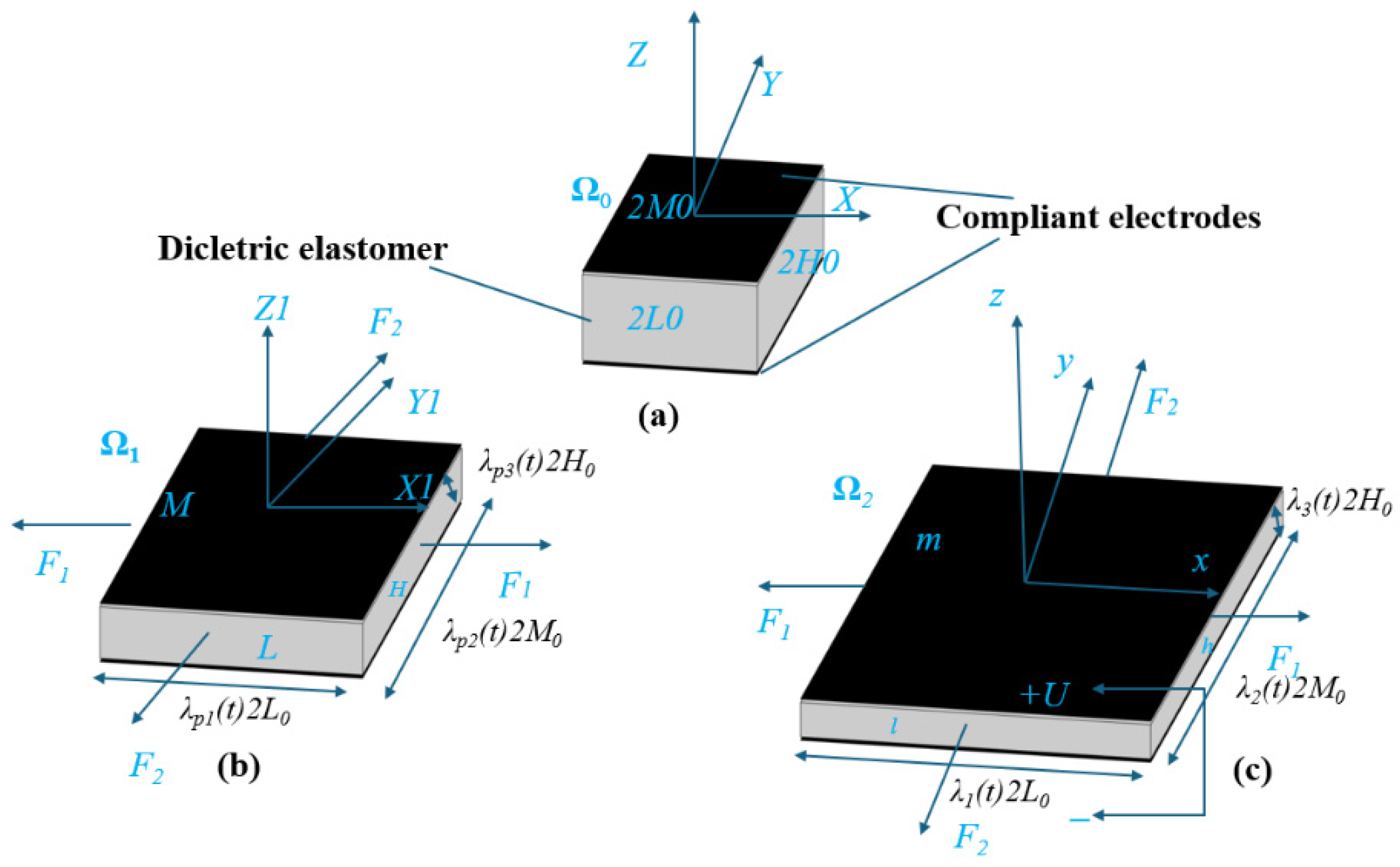
Consider an ideal planar DEA made of an incompressible material. Its initial reference configuration, denoted as Ω0, is shown in Figure 1a, with initial dimensions of 2 L 0 × 2 M 0 × 2 H 0 and material coordinates X , Y , Z . External forces F 1 and F 2 are applied along the X and Y directions, respectively, inducing biaxial uniform pre-stretch. The resulting pre-elongation ratios in the X , Y , and Z directions are λ p 1 , λ p 2 , and λ p 3 , respectively. This deformation leads to the intermediate configuration Ω1, with spatial coordinates X 1 , Y 1 , Z 1 , as illustrated in Figure 1b. Subsequently, a uniform electric field is applied to Ω1, causing the system to deform further into the current configuration Ω2, with spatial coordinates x , y , z , shown in Figure 1c. In Figure 1, the top and bottom surfaces of the DEA are coated with a very thin layer of flexible electrode material. Due to its negligible thickness, its mechanical influence is omitted in the theoretical model, and a uniform electric field distribution is assumed. To simplify the analysis, considering the geometric symmetry, one-eighth of the dielectric elastomer actuating unit is taken for analysis.
In Figure 1, the origins of the three coordinate systems are all located at the center of the actuator element and are defined with respect to the initial reference configuration Ω0. In this model, the three intermediate principal planes X = 0 , Y = 0 , Z = 0 are constrained against displacement. Since the pre-stretching process is static and uniform, it induces no change in kinetic energy and only generating initial strain energy. Based on the finite deformation theory, the relationship between the spatial coordinates, the initial material coordinates, and the displacement of the DEA after uniform pre-stretching can be expressed as:
X 1 = X + u p
In the above equation, X 1 is the spatial coordinate after pre-stretching (Eulerian coordinates), X is the material coordinate in the initial reference configuration Ω 0   (Lagrangian coordinates), and u p is the displacement after pre-stretching. Based on the spatial coordinates and the material deformation law described above, the following expression is obtained:
X 1 = φ ˜ X = X 1 Y 1 Z 1 = λ p 1 0 0 0 λ p 2 0 0 0 λ p 3 X Y Z
where λ p 1 , λ p 2 , and λ p 3 are the pre-stretches in the coordinate directions X , Y , and Z . Thus, the deformation gradient for static pre-stretching is obtained as:
F p r e = X 1 X = I + u p X = λ p 1 0 0 0 λ p 2 0 0 0 λ p 3
where I is the identity matrix.
Similarly, according to the finite deformation theory, after the DEA is pre-stretched, the relationship between the spatial coordinates in the current configuration under the dynamically applied voltage and the material coordinates and displacement in the pre-stretched state is given by:
x X 1 , t = X 1 + u
In the above formula, x represents the spatial coordinates (Eulerian coordinates), X 1 represents the material coordinates (Lagrangian coordinates) of the pre-stretched intermediate configuration, and u represents the current configuration displacement. Based on the above spatial coordinates and material deformation laws, the following expression is derived.
x X 1 , t = φ ˜ 1 X 1 , t = x X 1 , t y X 1 , t z X 1 , t = λ l 1 t 0 0 0 λ l 2 t 0 0 0 λ l 3 t X 1 Y 1 Z 1
Therefore, its deformation gradient is:
F 1 = x X 1 = I + u X 1 = λ l 1 t 0 0 0 λ l 2 t 0 0 0 λ l 3 t
where λ l 1 , λ l 2 , λ l 3 are the principal stretches from the intermediate configuration Ω 1 to the current configuration Ω 2 .
According to the chain rule, the total deformation gradient for the original reference configuration Ω 0 is:
F = x X = F pre F 1 = λ p 1 λ l 1 ( t ) 0 0 0 λ p 2 λ l 2 t 0 0 0 λ p 2 λ l 3 t = λ 1 ( t ) 0 0 0 λ 2 t 0 0 0 λ 3 t
For a mechanically coupled DEA unit, the total potential energy of the dielectric elastomer in the framework of Helmholtz free energy is:
U = V Π ( F , E ˜ ) d V V b · u d V A q · u d A
The Helmholtz free energy consists of elastic mechanical energy and electrostatic potential energy, namely:
Π F , E ˜ = Π m e c h F + Π e l e c F , E ˜
In terms of modeling strategy, the overall deformation process includes a pre-stretching stage. Theoretically, the model can be established based either on the intermediate configuration Ω1 after pre-stretching or on the original reference configuration Ω0. Since the two configurations are interrelated via the deformation gradient, ensuring that the resulting governing equations are equivalent, and because the geometry of Ω0 is more regular and thus more convenient for numerical integration, the present model is established based on Ω0. Regarding the material model, the Ogden strain energy function is adopted to describe the dielectric elastomer, and its Helmholtz free energy density function is expressed as:
Π F , E ˜ = i = 1 N u i a i λ 1 a i + λ 2 a i + λ 3 a i 3 p J 1 ε 2 J E ˜ T C 1 E ˜
This model effectively accounts for the initial strain energy generated during the pre-stretching process, which is reflected in the total stretch ratios. Furthermore, the pre-stretch is applied via two constant forces, which constitute the mechanical boundary conditions. These two constant forces, F 1 and F 2 , continue to do work during the subsequent deformation induced by electric field loading. In the above expressions, λ 1 , λ 2 , λ 3 are the principal stretches in the three principal directions as given in Equation (7). For brevity, the explicit dependence of each variable on time t is omitted. J = det F = λ 1 λ 2 λ 3 denotes the volume ratio, and C = F T F is the right Cauchy–Green tensor, which corresponds to Equation (11) below.
C = F T F = λ 1 2 0 0 0 λ 2 2 0 0 0 λ 3 2
where F is the total deformation gradient given by Equation (7). Regarding the material model, a i , u i are the material parameters of the Ogden model, characterizing the mechanical deformation behavior of the material, and p is the Lagrangian constraint multiplier. ε = ε 0 ε r denotes the dielectric permittivity, where ε 0 is the vacuum permittivity, ε r is relative permittivity. Concerning the loading and boundary conditions, b is the body force, q is the surface traction, and u is the displacement. For electric field loading, the electric field vector in the reference configuration is denoted by E ˜ = E ˜ X , E ˜ Y , E ˜ Z T . Since the electric field E ˜ is generally applied only in the Z direction, then E ˜ = 0 0 E 0 T , where E 0 is the electric field intensity in the Z direction, in the one-eighth model, the nominal electric field is defined as E 0 = V 0 / H 0 , where V 0 is the applied voltage—constant in static analysis and the amplitude in dynamic cases. This definition is numerically equivalent to the physical field 2 V 0 / 2 H 0 based on the total thickness 2 H 0 , since H 0 is the half-thickness. In all subsequent figures, the voltage labeled V 0 refers to the applied voltage in the one-eighth model, while the actual voltage across the total thickness 2 H 0 is 2 V 0 . This ensures consistency between the model and the physical system.
The free energy of the dielectric elastic body is:
U 1 = V 0 Ψ F , E ˜ d V = H 0 L 0 2 i = 1 N u i a i λ 1 a i + λ 2 a i + λ 3 a i 3 ε E 0 2 2 λ 3 2 p J 1
Since this paper mainly focuses on the effect of the electric field force and excludes the influence of other additional external forces, only the work done by the constant preload maintained after static pretension in the X and Y directions is considered. The work done by other additional external forces will be discussed in future studies. Therefore, the work done by the constant force is:
W = P pre 1 H 0 L 0 2 λ 1 1 P pre 2 H 0 L 0 2 λ 2 1
where P pre 1 is the nominal preload maintained in the X direction after pre-stretching, and P pre 2 is the nominal preload in the Y direction. Thus, the total potential energy of the system is given by:
U = U 1 + W
The kinetic energy of the dielectric elastomer is:
T = 1 2 V ρ u ˙ 2 d V = 1 6 ρ H 0 L 0 4 λ ˙ 1 2 + 1 6 ρ H 0 L 0 4 λ ˙ 2 2 + 1 6 ρ H 0 3 L 0 2 λ ˙ 3 2
To investigate the influence of various parameters on the dynamic response of the system and to simplify the calculation, the pre-stretch is assumed to be equi-biaxial, and an additional Lagrangian constraint multiplier μ is introduced. On this basis, the total Lagrangian function κ of the system is defined as:
κ = T U + H L 2 μ λ 1 λ 2
Then, according to Hamilton’s principle σ t 0 t 1 κ d t = 0 , the Lagrangian equation is given by:
κ q i d dt κ q ˙ i = 0 i = 1 , , 5
With q 1 = λ 1 , q 2 = λ 2 , q 3 = λ 3 , q 4 = p , q 5 = μ .
The governing equations are as follows:
1 3 ρ H 0 L 0 4 λ ¨ 1 + H 0 L 0 2 i = 1 2 u i λ 1 a i 1 p λ 2 λ 3 P p r e 1 μ = 0 1 3 ρ H 0 L 0 4 λ ¨ 2 + H 0 L 0 2 i = 1 2 u i λ 2 a i 1 p λ 1 λ 3 P p r e 2 + μ = 0 1 3 ρ H 0 3 L 0 2 λ ¨ 3 + H 0 L 0 2 i = 1 2 u i λ 3 a i 1 p λ 1 λ 2 + ϵ E 0 2 λ 3 3 = 0 λ 1 λ 2 λ 3 = 1 ,   λ 1 = λ 2
To simplify the calculation, it is assumed that the electric field is applied only in the Z -direction of the reference configuration, and the stretch ratio in the Z -direction is denoted as λ (i.e., λ = λ 3 ). Then, from the incompressibility condition of the material, we obtain
λ 1 = λ 2 = 1 λ
Substituting these assumptions into Equation (18) and simplifying, we finally obtain the lumped-parameter dynamic equations for λ .
λ ¨ 3 2 λ ˙ 2 λ 2 A λ 3 + 1 + B λ 3 2 A λ 3 + 1 μ 1 λ a 1 2 2 + λ a 1 1 + μ 2 λ a 2 2 2 + λ a 2 1 + ε E 0 2 λ 3 + q λ 3 2 = 0
where A = H 0 2 L 0 2 , B = 6 ρ L 0 2 , and q = P p r e 1 + P p r e 2 2 .
For equi-biaxial pre-stretch, λ 0 x = λ 0 y is defined to represent the equi-biaxial pre-stretch ratios in the X and Y directions. To simplify the description, λ 0 x is uniformly used hereafter to denote the pre-stretch ratio in both the X and Y directions, where the subscript 0 indicates the pre-stretch and x denotes the direction along the X -axis.

2.2. Numerical Solution Scheme and Parametric Simulation Design

2.2.1. Numerical Solver Configuration

To ensure the consistency and repeatability of the dynamic analysis and to avoid interference introduced by the randomness inherent in adaptive step-size algorithms, the built-in adaptive Runge–Kutta methods in MATLAB (R2023a) (e.g., ode45) were not employed in this study. Instead, a fixed-step solver based on the fourth-order Runge–Kutta (RK4) method was independently developed. During the solution process, relative tolerance (RelTol) and absolute tolerance (AbsTol) were specified to further suppress numerical errors and maintain computational accuracy. Based on the scale and accuracy requirements of the problem, RelTol = 1 × 10⁻⁴ and AbsTol = 1 × 10⁻⁶ were ultimately selected following comparative testing.

2.2.2. Systematic Parameter Space Design

The parameter space considered in this study is summarized in Table A1 (see Appendix A).

2.3. Design of Dynamic Performance Evaluation Indicators

To systematically evaluate the overall dynamic performance of DEAs under multi-parameter excitation and to quantitatively reveal the global modulation effect of pre-stretching, five core quantitative indicators are clearly defined in this section. All indicators are calculated based on the outputs of a unified dynamic model, collectively forming a complete evaluation framework that covers responses from transient to steady states, thereby ensuring the systematic nature of the analysis and the repeatability of the conclusions.

2.3.1. Steady-State Amplitude A s

The output amplitude after the system reaches steady-state periodic oscillation is defined as: A s = max ( λ ( t ) min ( λ ( t ) / 2 , t t s t e a d y , s t e a d y + T .

2.3.2. Overshoot M p

The percentage by which the first peak A max the transient stage exceeds the steady-state amplitude A s is defined as: M p = ( A max A s ) / A s × 100 % .

2.3.3. Transient Stability and Convergence Indicators

Settling Time   T s : the minimum time required for the system response to enter and remain within a ±1% error band around the steady-state value:
T s = min { t : | λ ( τ ) A s | 1 % · A s ,   τ t } .

2.3.4. Maximum Stretch Ratio λ max

Under dynamic voltage excitation, nonlinear inertia and the release of pre-stored energy may induce instantaneous stretching of the material. The maximum stretch ratio is a critical indicator for preventing material rupture and electromechanical instability, and also serves as a key actuation performance metric: λ max = max ( λ ( t ) ) .

2.3.5. Minimum Stretch Ratio λ min

The minimum stretch ratio λ min corresponds to the state of minimum thickness attained by the material during dynamic processes, reflecting the lower limit of its actuation capability: λ min = min ( λ ( t ) ) .

3. Results and Discussion

To facilitate the subsequent analysis, three materials are specified, with parameters listed in Table A2 (see Appendix A).

3.1. Validation of the Dynamic Model and Analysis of the Pre-Stretch Tuning Effect

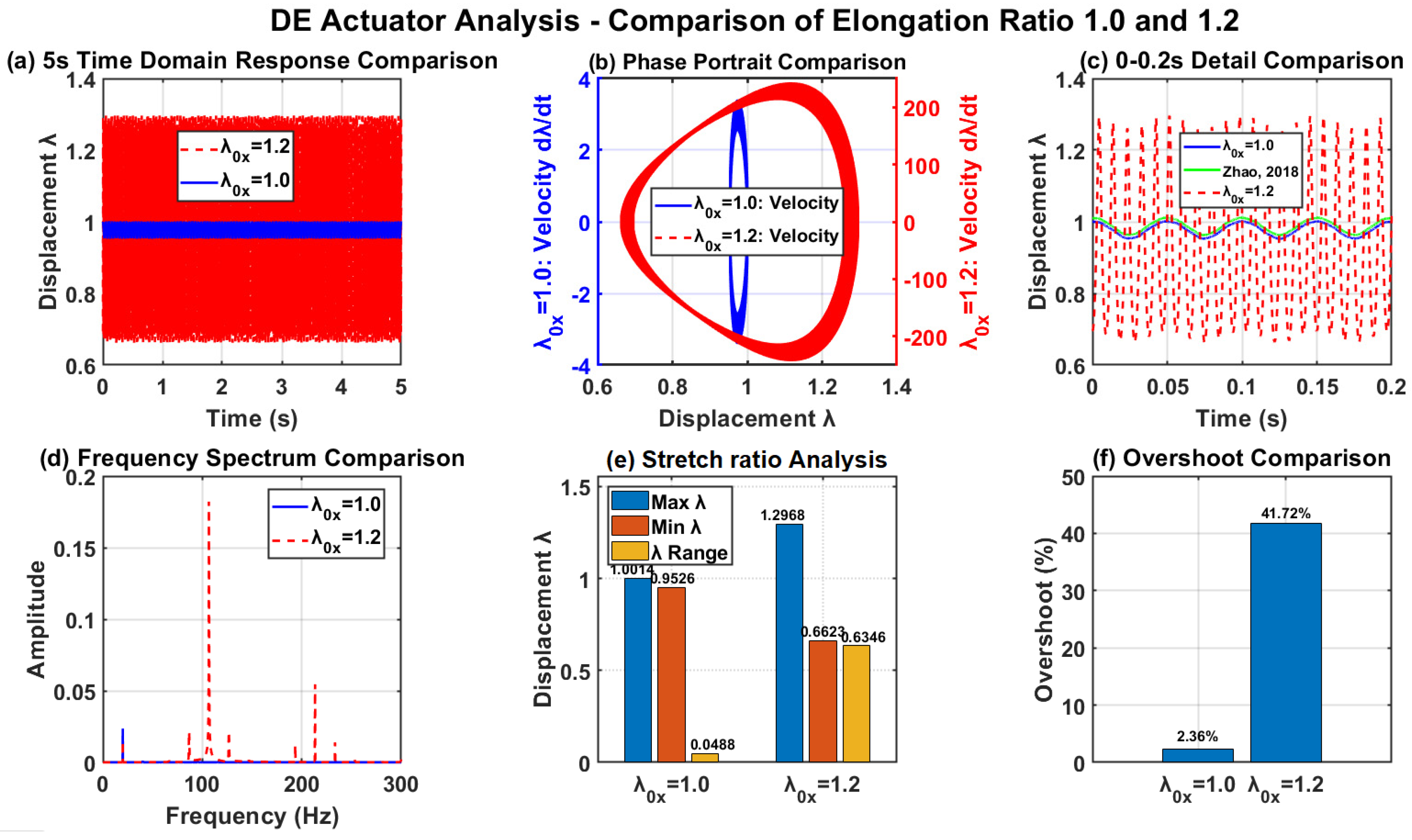
This section investigates the dynamic characteristics and key performance indicators of the system for λ 0 x = 1 and 1.2. The corresponding results are summarized in Figure 2, where Figure 2a–c present the dynamic response of the system, and Figure 2d–f depict the spectral variations and associated dynamic performance indicators.
The dynamic model established in this study based on the energy-autonomous method is theoretically rigorous. To further validate its reliability, the dynamic equation adopted in [15] is employed as a benchmark. Under the same set of baseline parameters ( L 0 = 40 mm, H 0 = 1 mm, f = 10 Hz, V 0 = 10 kV, sinusoidal excitation, material: VHB4910), with λ 0 x = 1 , the time-domain response of the system over the first 0.2 s is obtained via simulation. The comparison in Figure 2c shows that, for λ 0 x = 1 , the proposed model closely matches the results from Ref. [15]. Quantitatively, the maximum relative error in the stretch ratio amplitude is 2%, which falls within a reasonable range. When λ 0 x is stretched to 1.2, based on the material parameters of VHB4910, the nominal stress is obtained as 105.80 kPa via Newton iteration using Equation (18) with the electric field term removed and kinetic energy neglected. Multiplying this value by the lateral surface area gives the preload stresses. These stresses perform work on the external environment during the subsequent application of the electric field, thereby influencing the electromechanical coupling dynamic response of the system.
As can be seen from the overall results in Figure 2, the dynamic characteristics of the DEA change significantly under equiaxial pre-stretching in the X- and Y-directions. Since the time-domain curves within the first five seconds in Figure 2a are highly dense, only the eventual convergence to a stable periodic solution can be observed, while other dynamic details remain difficult to discern. Therefore, this section focuses on analyzing the results presented in Figure 2b–f.
Figure 2b presents the phase diagram of the system. In the absence of pre-stretch, the dielectric elastomer operates within a small deformation range with limited strain, and the phase trajectory approximates a small ellipse, indicating that the system response is nearly linear. However, when the pre-stretch ratio increases to 1.2, the shape of the phase diagram changes significantly, exhibiting a horizontal “pear-shaped” profile. This morphological feature is mainly dominated by the system’s strong geometric nonlinearity and large deformation effects. The increase in its size directly corresponds to the increase in the steady-state oscillation amplitude (see Figure 2e), indicating that the system has entered the region of strong nonlinearity and large-amplitude dynamic response.
Careful observation of Figure 2a–c reveals a unique dynamic phenomenon induced by pre-stretch. Without pre-stretch, the DEA exhibits near-sinusoidal compressive behavior throughout the entire driving voltage cycle, similar to that under static voltage actuation. In contrast, when pre-stretch is applied, the waveform becomes significantly denser, accompanied by the excitation of higher-order harmonic components. More importantly, within a single cycle, the DEA displays alternating compression and elongation—that is, the material undergoes compression and expansion in different stages. This alternating behavior represents a unique dynamic effect induced by pre-stretch, playing a crucial role in enhancing the actuation capability of DEAs, for brevity, the same phenomenon observed in the subsequent parameter analysis will not be reiterated.
Given a pre-stretch ratio of λ 0 x = λ 0 y = 1.2 , the initial stretch in the Z direction is λ = 0.6623 . Two typical stages with different dynamic characteristics can be further identified from the phase diagram. In the first stage, λ ranges from 0.6623 to 1.117, corresponding to the process of the system recovering from compression to equilibrium. Due to the geometric hardening effect induced by the pre-stretch in the initial configuration, the system exhibits higher equivalent stiffness and lower acceleration, resulting in a gradually increasing velocity. This behavior is reflected in the narrow and sharp characteristics of the trajectory in the phase diagram. In the second stage, λ ranges from 1.117 to 1.292, and the deformation is more significant. Geometric nonlinearity leads to a decrease in both equivalent stiffness and restoring force, while the inertial effect dominates, resulting in greater acceleration and a faster rate of velocity change, corresponding to the wide and smooth characteristics of the trajectory in the phase diagram.
As observed in the phase diagram, although the dynamic response intensity and evolution trajectory differ under different pre-stretch ratios, the phase trajectories all eventually form closed curves, indicating that the system converges to a periodic steady-state solution.
Furthermore, the local time-domain response in the first 0.2 s of Figure 2c shows that the system exhibits significant oscillations when the pre-stretch ratio λ 0 x = 1.2 , but not when λ 0 x = 1.0 . The spectral response in Figure 2d further indicates that multiple higher-order harmonic components are excited under pre-stretch conditions, providing direct evidence for strong geometric nonlinearity and inertial-elastic coupling. This coupling mechanism leads to a significant increase in maximum stretch and overshoot, as shown in Figure 2e,f, thereby effectively improving the overall driving performance of the system. These results collectively demonstrate that pre-stretch plays a crucial modulation role in the dynamic behavior of the system.
Based on this modulation effect, subsequent analysis will focus on the impact of other parameters on the system’s dynamic performance. It should be noted that due to the dense overlap of the time-domain curves throughout Figure 2a, making it difficult to distinguish details, the subsequent time-domain analysis will primarily rely on the detailed curves within the last 0.02 s after the system reaches steady state. Having clarified the pre-stretching modulation mechanism, the next section will compare the changes in the system’s time-domain response, overall performance, spectral characteristics, and phase diagram morphology under varying parameters, thereby elucidating the differentiated impact of each parameter on the system’s dynamic behavior.

3.2. Analysis of the Influence of Other Parameters on Dynamic Performance Under Pre-Stretch Modulation

3.2.1. Analysis of the Influence of Geometric Parameters on Dynamic Performance

Under the condition of a fixed pre-stretch ratio λ 0 x = 1.6 , this section analyzes the influence of the geometric parameters of the dielectric elastomer actuator on its dynamic performance, focusing on the effects of changes in length, width, and thickness. Based on the assumption of equal biaxial tension, the length and width are taken as equal L 0 = M 0 , and this setting applies to all subsequent analyses.
The simulation conditions are defined as follows: excitation frequency f = 10 Hz, voltage amplitude V 0 = 10 kV, excitation signal is a sine wave, and the VHB4910 material (manufactured in Jiangsu, China) is selected. To isolate the independent influence of each geometric parameter, the controlled variable method is adopted. First, to investigate the effect of length, the thickness is fixed at 1 mm while the actuator length is varied. The corresponding dynamic response results are summarized in Figure 3. Second, to analyze the effect of thickness, the length is fixed at 40 mm while the actuator thickness is varied. The resulting dynamic response results are presented in Figure 4.
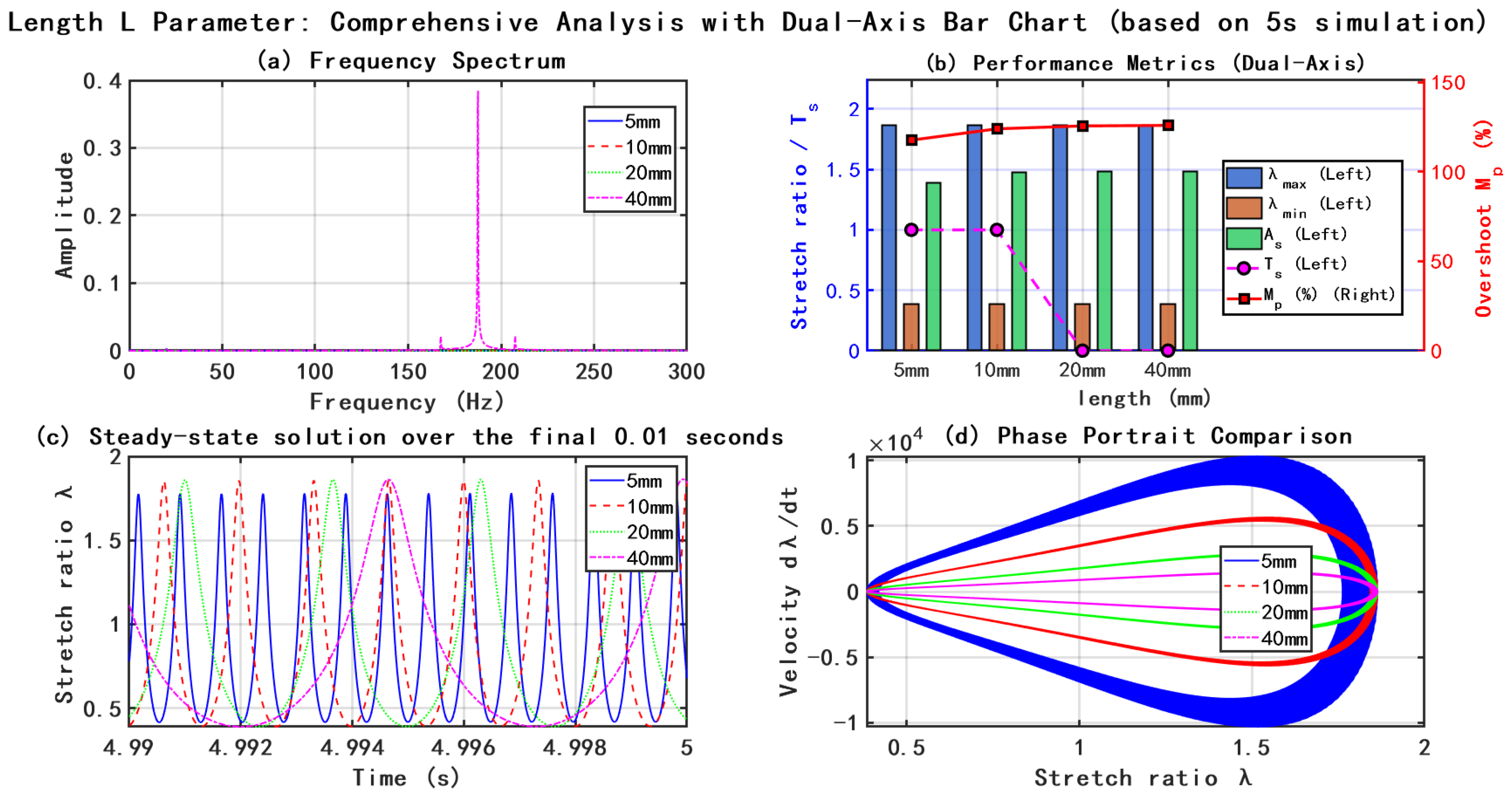
Figure 3 comprehensively analyzes the dynamic response of the DEA under pre-stretch modulation at different lengths L 0 . The transient spectrum in Figure 3a shows that significant high-order harmonics are present in the system response under all operating conditions, confirming its strongly nonlinear state. As L 0 increases, the energy in both the fundamental and high-frequency bands rises, with the most prominent high-frequency peak appearing near 200 Hz at L 0 = 40 mm, indicating the strongest transient inertial impact at this dimension.
The performance indicators in Figure 3b reveal that length has a relatively minor effect on the maximum stretch and compression. The steady-state amplitude A s s is relatively small at L 0 = 5 mm, while it becomes larger and remains comparable among L 0 = 10, 20, and 40 mm. The settling time t s is longer at L 0 = 5 mm and 10 mm, but significantly shorter at L 0 = 20 mm and 40 mm. The overshoot increases monotonically with L 0 .
The steady-state time-domain waveform in Figure 3c shows that as L 0 increases, the oscillation period becomes longer (i.e., the frequency decreases), and the displacement amplitude increases accordingly. The phase diagram in Figure 3d further consolidates the above observations: with increasing L 0 , the limit cycle expands rightward along the displacement axis λ, reaching its maximum span at L 0 = 40 mm—consistent with the largest steady-state amplitude; meanwhile, the cycle contracts upward along the velocity axis d λ d t , with the highest velocity amplitude occurring at L 0 = 5 mm. Moreover, the convergence path of the phase trajectory becomes shorter and more direct as L 0 increases, aligning with the reduction in settling time T s .
In summary, these results indicate that the length L 0 is a key parameter for regulating the displacement-velocity output characteristics of the dielectric elastomer actuator. Increasing L 0 can improve the steady-state displacement output to some extent and significantly accelerate the system convergence speed, but it also weakens the instantaneous velocity response. This behavior stems from the modulation effect of L 0 on the equivalent stiffness of the system: the larger the size, the lower the stiffness, which is conducive to generating large deformations and quickly achieving energy balance, while the high-frequency components in the spectrum reflect the differences in inertial impact intensity during transient startup under different sizes.
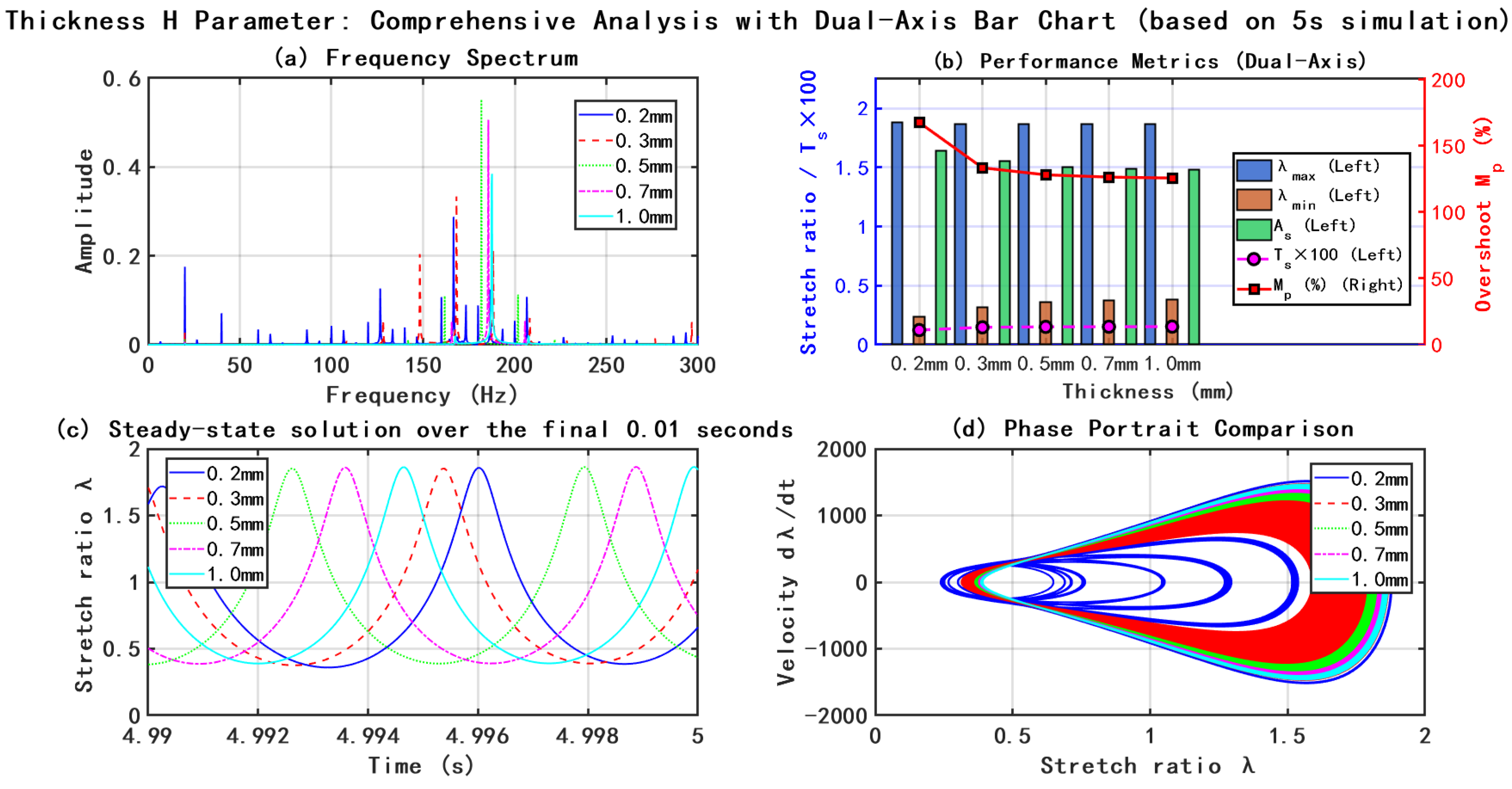
Figure 4 shows that the transient spectral characteristics caused by changes in material thickness are significantly different from those caused by changes in length. As can be seen from Figure 4a, abundant higher-order harmonic components are excited at all thickness values, and as can be seen from the phase diagram in Figure 4d, phase trajectory crossings appear in the phase diagram—exhibiting a particularly complex ring structure at a thickness of 0.2 mm—reflecting a further enhancement of the system’s nonlinearity.
As shown in Figure 4b, in terms of performance indicators, the maximum elongation is basically similar at different thicknesses, while the maximum compression reaches its peak at a thickness of 0.2 mm and drops to its lowest at 1.0 mm. The overshoot gradually decreases with increasing thickness. The local time-domain details within 0.01 s in Figure 4c further reveal significant differences in the response delay stages corresponding to different thicknesses.
Overall, material thickness has a significant impact on the dynamic performance of the system. This is mainly because changes in thickness directly alter the effective electric field strength, leading to significant changes in compressive deformation, which ultimately manifests as systematic differences in the spectrum, phase diagram, and various time-domain and performance indicators.

3.2.2. Influence of Frequency Parameters on Dynamic Performance

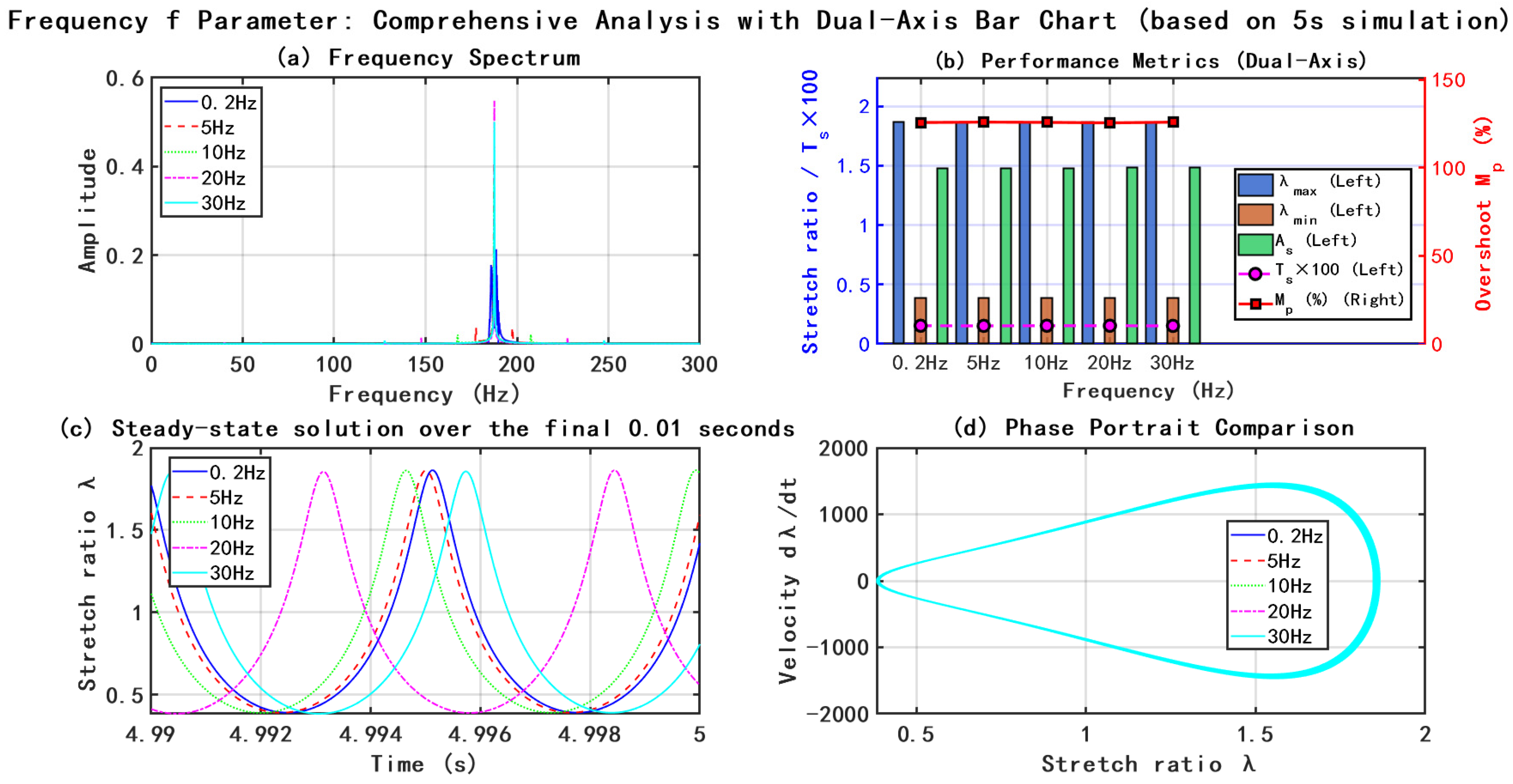
This section investigates the effect of excitation frequency on the dynamic response of the system under pre-stretch modulation λ 0 x = 1.6 . The other parameters are set as follows: length L 0 = 40 mm, thickness H 0 = 1 mm, voltage amplitude V 0 = 10 kV, excitation waveform is sinusoidal, and the material is VHB4910. The results are presented in Figure 5.
As shown in Figure 5a,d, under a fixed pre-stretch ratio of λ 0 x = 1.6 , the frequency response and phase trajectories corresponding to different excitation frequencies ( f = 0.2, 5, 10, 20, 30 Hz) nearly coincide. This indicates that, under this pre-stretch condition, the steady-state periodic motion of the system is insensitive to variations in voltage excitation frequency, and the nonlinear dynamic structure remains stable within the examined frequency range. Furthermore, Figure 5b shows that the variation in performance indicators with frequency is relatively small, while Figure 5c further demonstrates that frequency changes primarily affect the phase of the system response.

3.2.3. Influence of Material Parameters on Dynamic Performance

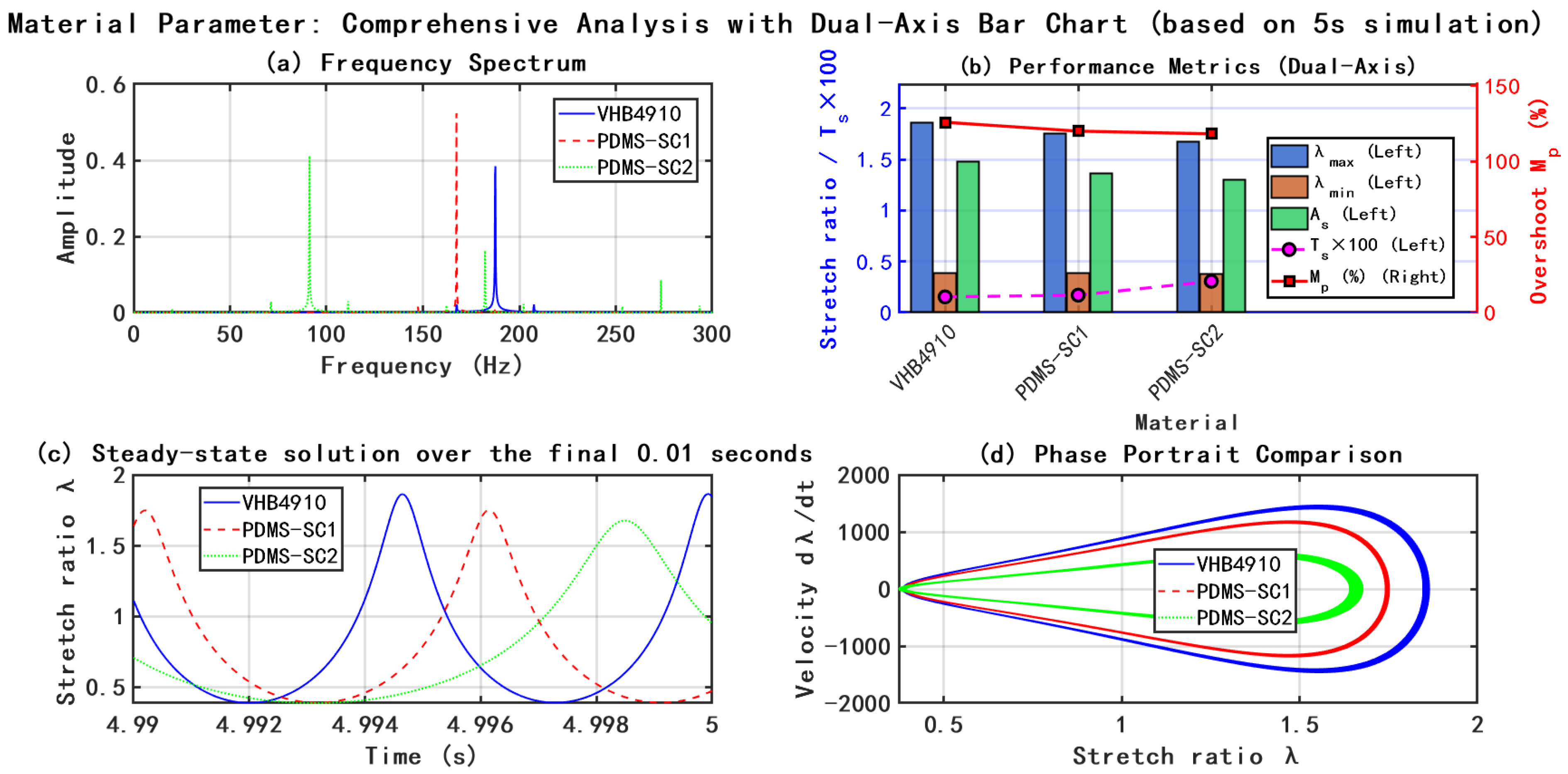
Under a pre-stretch ratio of λ 0 x = 1.6 , with fixed geometric dimensions ( L 0 = 40 mm, H 0 = 1 mm) and electrical loading conditions ( V 0 = 10 kV, f = 10 Hz, sinusoidal excitation), the dynamic responses of three dielectric elastomer materials—VHB4910, PDMS-SC1, and PDMS-SC2—were compared. The corresponding nominal pre-stresses under this pre-stretch condition were 558.32 kPa, 564.87 kPa, and 192.82 kPa, respectively. The variation trends of their dynamic performance are presented in Figure 6.
Figure 6a illustrates the significant differences in transient spectral characteristics induced by different materials. The main frequency components of PDMS-SC2 are concentrated around 100 Hz, while the main frequency components of VHB4910 and PDMS-SC1 are distributed between 150 and 200 Hz, with PDMS-SC1 exhibiting the highest amplitude.
Figure 6b shows that VHB4910 exhibits higher values for both maximum elongation and maximum compression, while the corresponding values for PDMS-SC2 are relatively lower, indicating that VHB4910 has superior driving performance. In addition, VHB4910 features a shorter settling time but a larger overshoot. From Figure 6c,d, it is further observed that VHB4910 demonstrates better overall actuation performance and faster response speed, whereas PDMS-SC2 shows comparatively weaker performance across various metrics.

3.2.4. Influence of Driving Parameters on Dynamic Performance

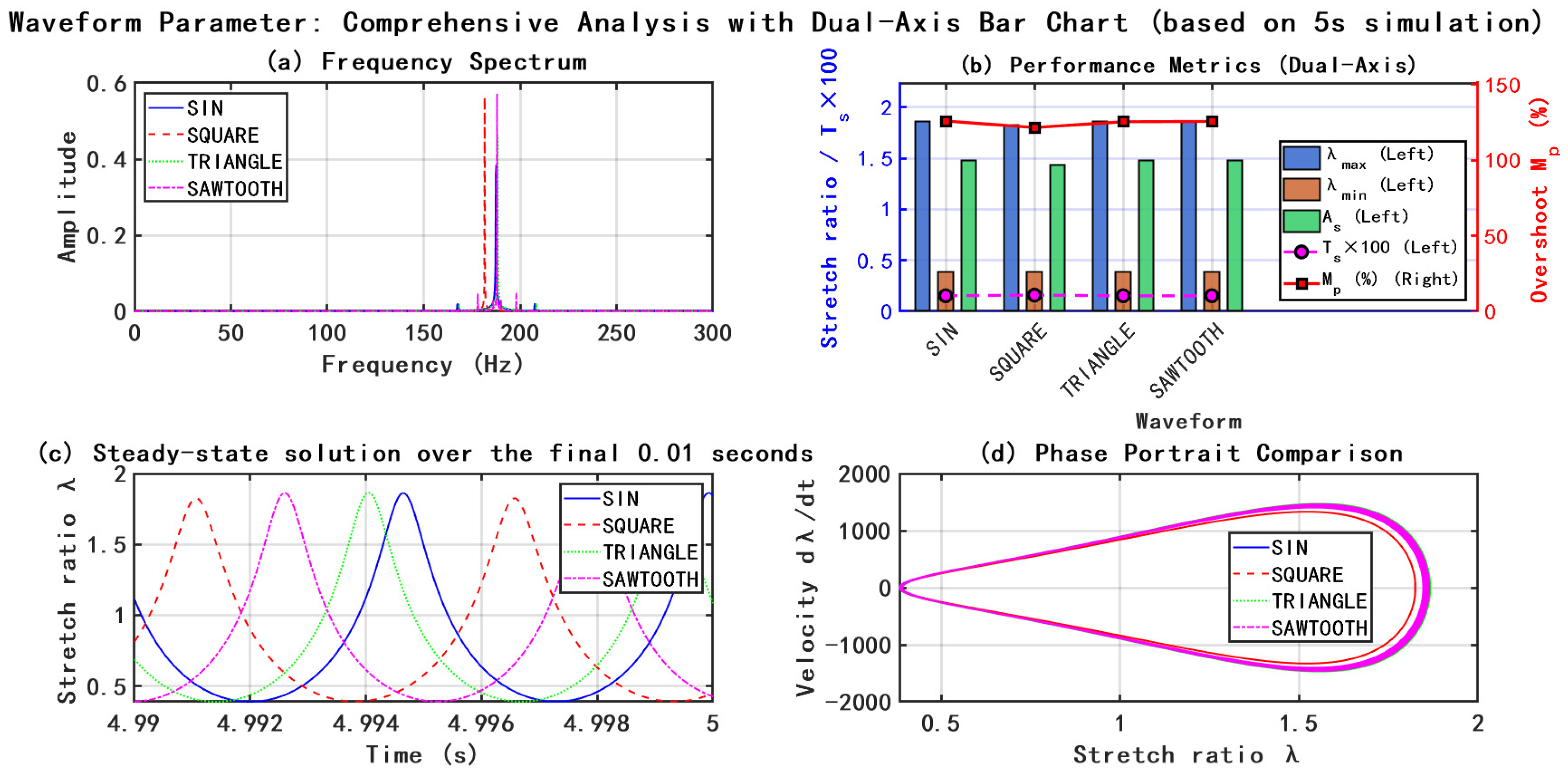
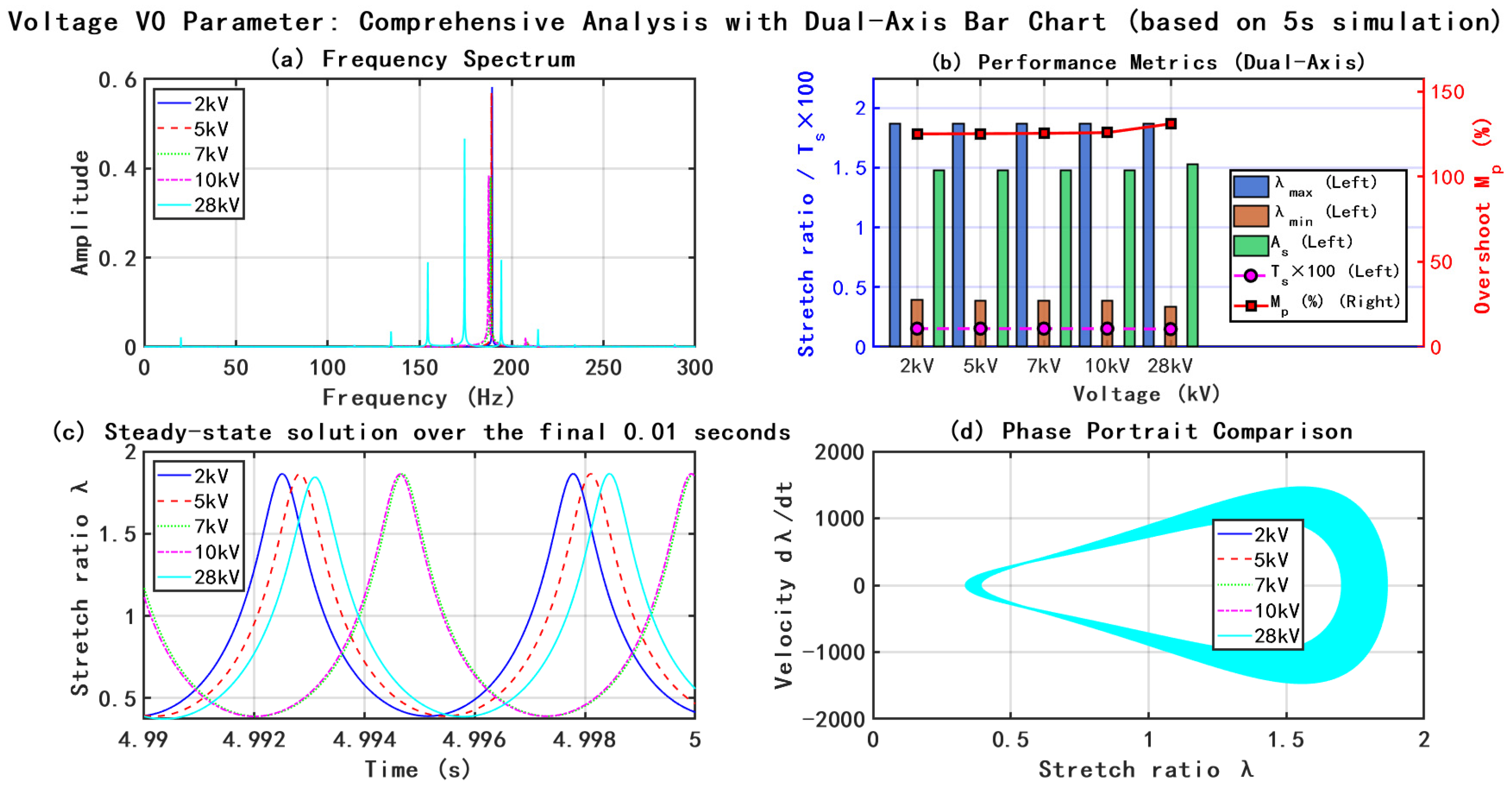
This section investigates the effects of the driving signal waveform and voltage amplitude on the dynamic response of the system under a fixed pre-stretch ratio of λ 0 x = 1.6 , with other baseline parameters held constant ( L 0 = 40 mm, H 0 = 1 mm, f = 10 Hz, material: VHB4910). The nominal pre-stress corresponding to this pre-stretch condition is 558.32 kPa. The results of the excitation waveform analysis are presented in Figure 7, and the influence of voltage amplitude is shown in Figure 8.
Overall, the results presented in Figure 7 indicate that the driving waveform does not significantly affect the dynamic performance of the system under pre-stretch modulation. Apart from certain differences in phase delay and spectral characteristics, all other performance indicators and phase portraits remain nearly identical across different waveforms, suggesting that the system’s dynamic response is largely insensitive to the specific type of driving waveform.
Figure 8 shows the relationship between the driving voltage and the dynamic response under pre-stretching conditions. It can be seen that within the voltage amplitude range of 2 kV to 10 kV, the output increases slowly with increasing voltage, exhibiting a clear nonlinear saturation characteristic, a change observed in Figure 8a–d. This is because, under high pre-stretching, strain hardening of the material leads to a sharp increase in the elastic restoring force, thereby suppressing the electrostrictive effect. When the voltage increases to 28 kV, the response amplitude jumps significantly, indicating that the system voltage is approaching the critical threshold of electromechanical instability, at which point the electrostrictive force begins to strongly compete with the nonlinear elastic force. These results define the safe linear operating region and the nonlinear critical region of the driving voltage under the given pre-stretching conditions, thus providing a crucial design range for avoiding instability and optimizing driving efficiency in practical applications. Furthermore, voltage variations also affect the spectrum and phase, and these effects are measurable.

3.2.5. Influence of Pre-Stretch Ratio on System Dynamic Response and Performance

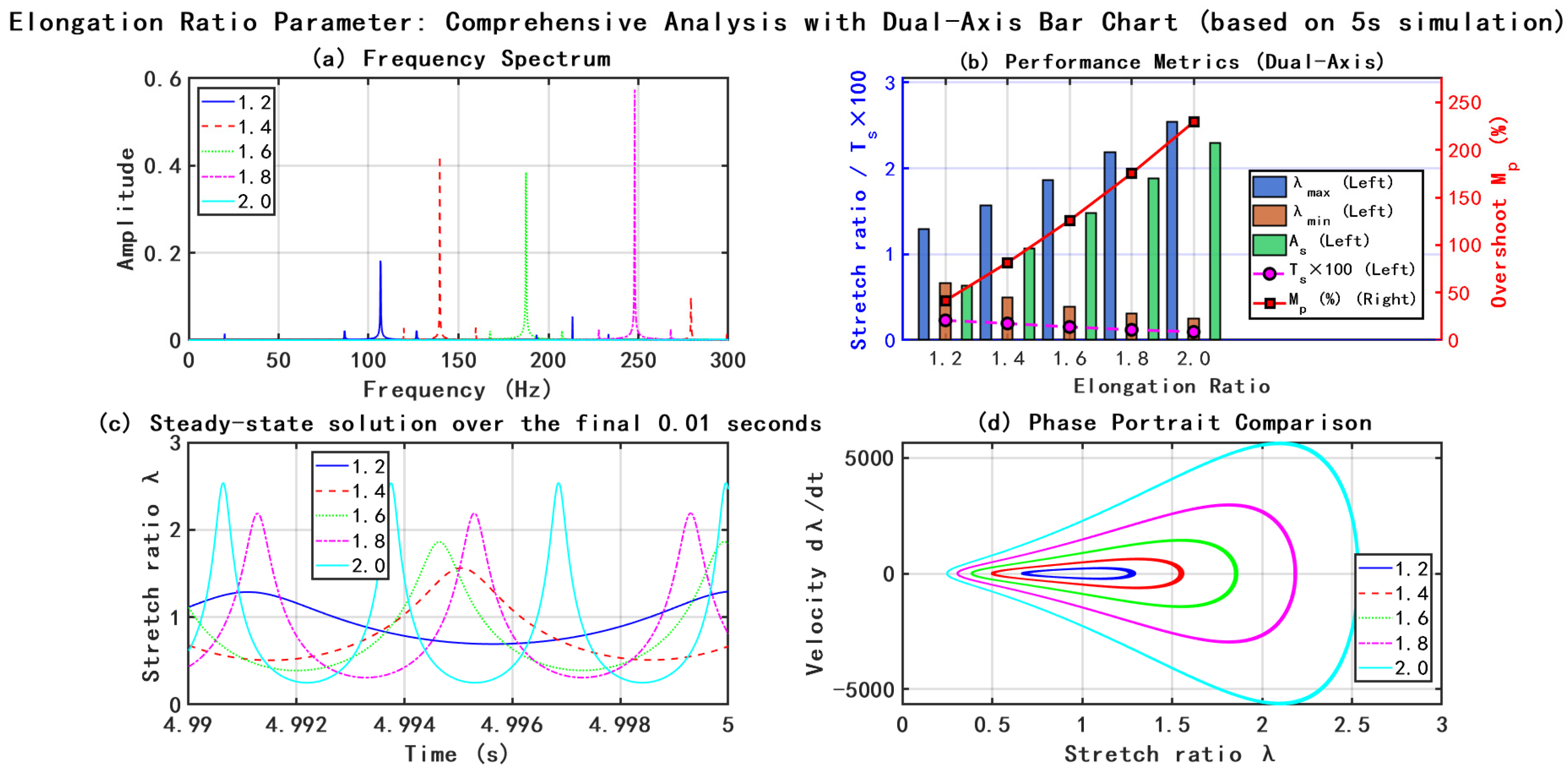
The excitation is a sinusoidal wave with f = 10 Hz and V0 = 10 kV, and the material is VHB4910. The nominal stresses corresponding to each pre-stretch ratio are 105.80 kPa, 262.11 kPa, 558.32 kPa, 1100.65 kPa, and 2045.49 kPa, respectively. The analysis results are presented in Figure 9.
As shown in Figure 9, the pre-stretch ratio has the most significant impact on the overall dynamic performance of the system. From Figure 9a, it can be seen that as the pre-stretch ratio increases, the response spectrum becomes richer, with multiple resonance phenomena appearing. Figure 9b shows that both the maximum elongation and maximum compression change significantly with the pre-stretch ratio: when the pre-stretch ratio is 1.2, the changes are relatively gradual; while when the pre-stretch ratio reaches 2.0, the changes are significantly larger. Overshoot and steady-state amplitude show the same trend, while settling time shows the opposite trend. When the pre-stretch ratio is small, the system stiffness is low and the potential energy trap is shallow, at which point the nonlinear effect is still partially activated. When the pre-stretch ratio reaches 2.0, the material becomes harder, the potential energy trap becomes deeper, and the coupling effect of the restoring force and electrostrictive force is also strengthened, resulting in a significant increase in the dynamic response amplitude.
A magnified view in Figure 9c further reveals the significant differences in amplitude and phase. Furthermore, the phase diagram in Figure 9d shows that the phase trajectory maintains a stable transverse pear-shaped structure as the pre-stretch ratio increases; however, the speed during the initiation phase increases with the pre-stretch ratio, and the overall driving capability also strengthens. This phenomenon is consistent with the trend of performance indicators in Figure 9b and is further confirmed by Figure 9c. The mechanism leading to this series of phenomena lies in the fact that pre-stretching enhances the coupling between the nonlinear restoring force and the electrostrictive force by increasing the material’s equivalent stiffness and initial strain energy reserve.

3.3. Comparative Analysis of Overall Performance Under Modulation by Other Parameters with Pre-Stretch

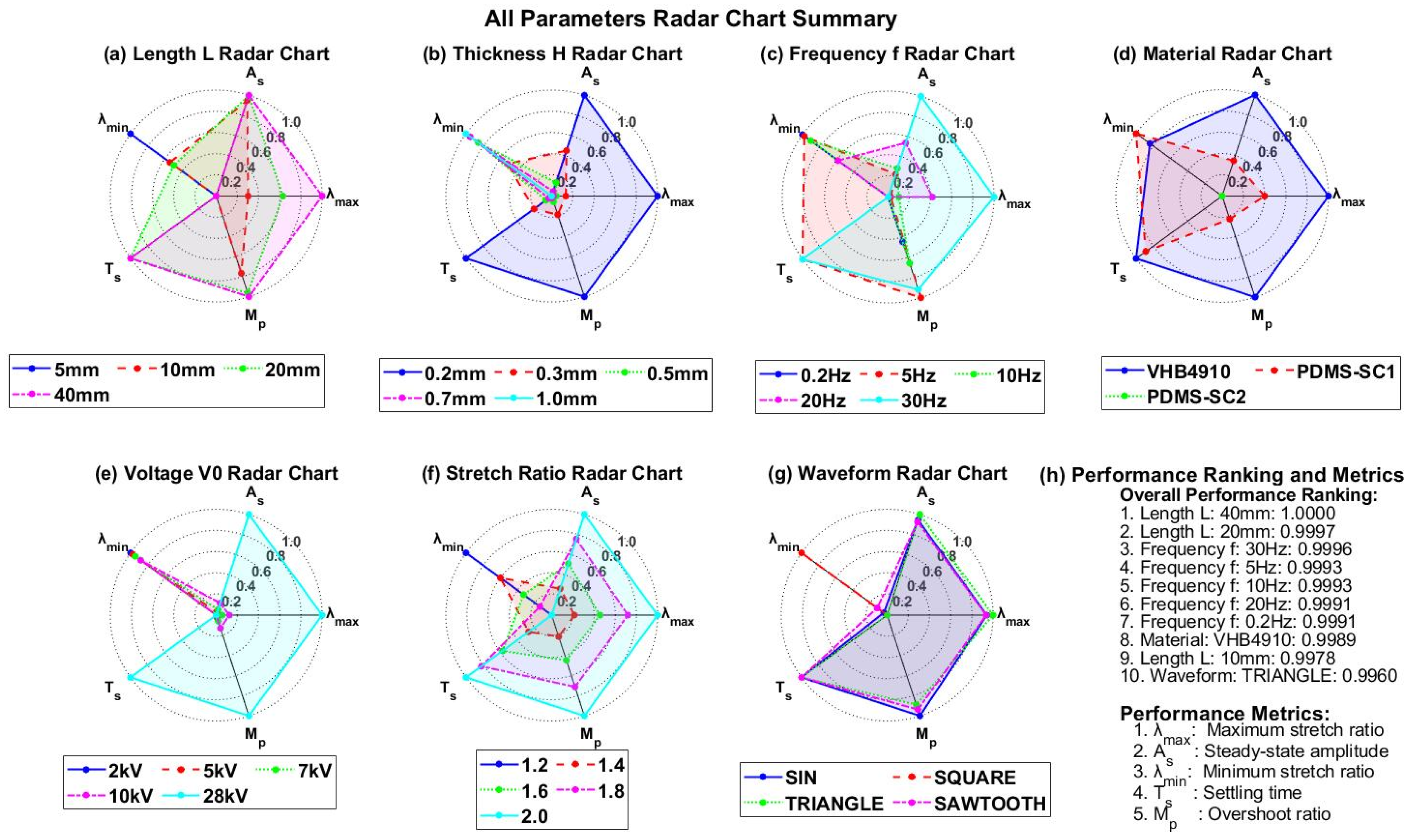
To analyze the influence of various parameters on the dynamic response under the core modulation effect of pre-stretch, five performance indices corresponding to different parameter values were normalized, and a radar chart ranking the overall performance was constructed accordingly. The results are presented in Figure 10.
As shown in Figure 10, after normalization, the different parameter values form polygons that represent the overall performance. The area of each polygon essentially reflects the comprehensive performance advantage of the corresponding parameter value and can serve as a reference criterion in design. Figure 10h lists the top 10 rankings among different parameter values. This ranking is obtained by assigning weights based on the importance of each design indicator, and the weighting scheme adopted in this paper is consistent with that used in Section 3.4.
The results indicate that, among geometric parameters, the actuator with a length of 40 mm yields the largest polygon area and thus the best overall performance; a thickness of 0.2 mm and a frequency of 30 Hz correspond to optimal performance; the material VHB4910 exhibits the most advantageous behavior; and a pre-stretch ratio of 2.0 leads to superior overall performance. Other parameters also have their respective optimal values. These findings provide a fundamental reference for the systematic design of DEAs.

3.4. Overall Performance Design Guidelines Under Full Parameter Conditions

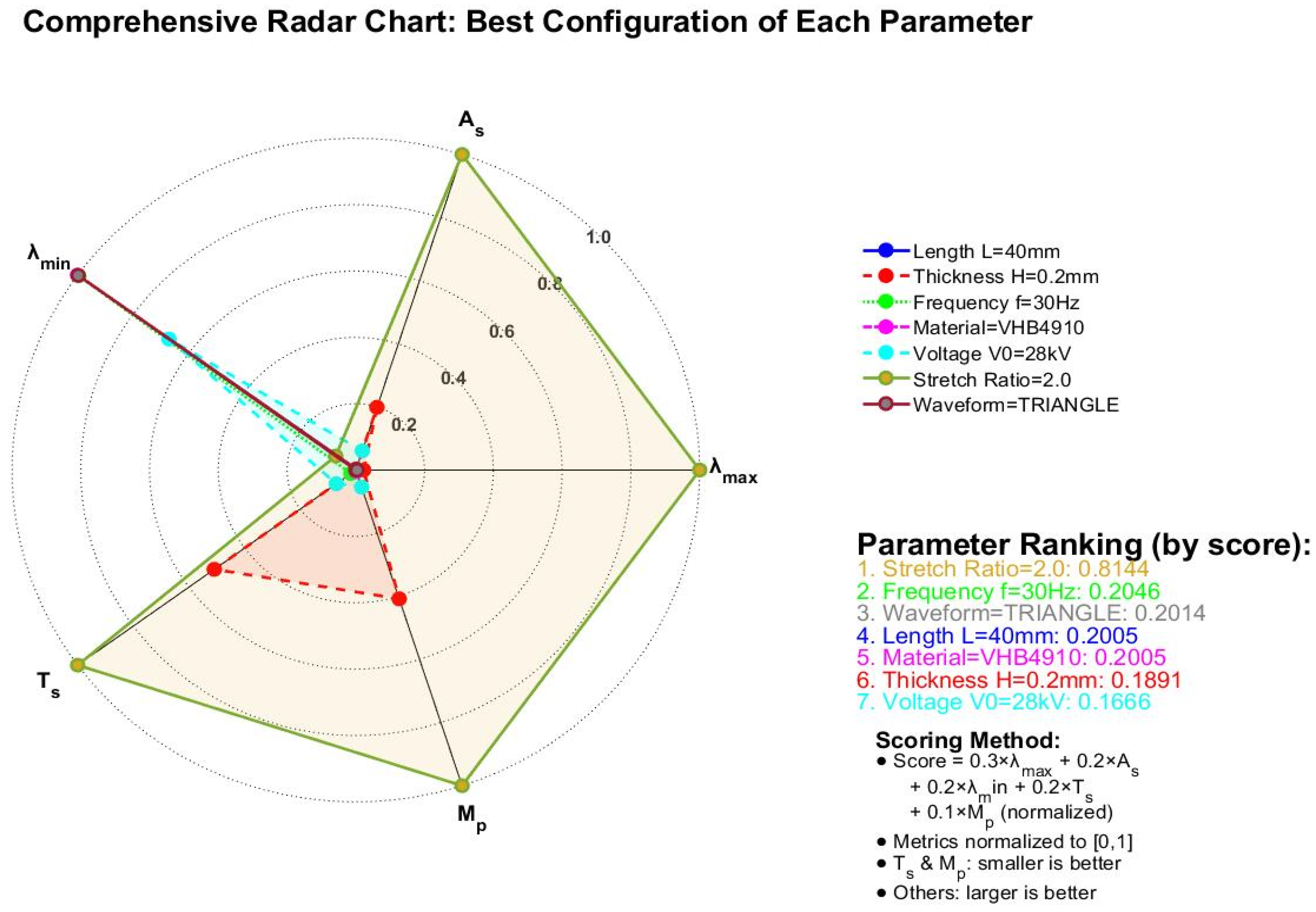
To evaluate the comprehensive impact of each parameter on the dynamic performance of the dielectric elastomer actuator, five performance index values for each parameter were extracted under optimal operating conditions and weighted according to the weighting coefficients shown in Figure 11. The weights can be flexibly allocated based on the importance of each indicator for different design objectives. If multiple indicators require synergistic optimization, further optimization algorithms may be introduced; however, this is not discussed here due to space limitations. The resulting comprehensive performance radar chart is presented in Figure 11, which also lists the score rankings of the seven parameters.
Based on this radar chart, the following design criteria can be established: when designing a DEA, key variables should be determined sequentially according to the parameter score ranking. It is recommended to first select the pre-stretch ratio ( λ 0 x = 2.0), then determine the excitation frequency, and so forth. This approach provides a systematic basis for parameter selection, helps avoid subjective arbitrariness, and thus enables more reliable achievement of the desired performance design objectives for the DEA.

4. Conclusions

This paper systematically investigates the multi-parameter influence on equi-biaxially pre-stretched DEAs under dynamic voltage excitation. A lumped-parameter dynamic model based on Hamilton’s principle is established and validated against the existing literature, providing a reliable foundation for subsequent analysis.
Research revealed that as the stretching ratio λ0x increases from 1 to 1.2, the actuator’s dynamic characteristics undergo a fundamental transformation. More importantly, throughout a complete driving voltage cycle, the DEA exhibits alternating compression and elongation—a phenomenon rarely reported in existing studies. Accordingly, this study defines two new performance indicators: maximum stretch ratio (characterizing expansion) and minimum stretch ratio (characterizing compression). The system transitions from being dominated by material nonlinearity to being dominated by geometric nonlinearity, resulting in oscillations, the appearance of higher-order harmonic components in the spectrum, and more complex dynamic phenomena such as the phase diagram evolving from an elliptical limit cycle to a pear-shaped limit cycle. Furthermore, there is a significant increase in steady-state amplitude and overshoot. These findings reveal that pre-stretch not only directly affects dynamic performance but also acts as a global modulator, indirectly regulating the sensitivity and influence trends of other parameters (electric field, frequency, waveform).
By fixing the pre-stretching ratio (λ0x = 1.6), the individual effects of parameters such as geometric dimensions, thickness, frequency, voltage, waveform, and material properties are comprehensively analyzed. The results show that the basic pre-stretching systematically alters the sensitivity and influence trends of other parameters. Further extended analysis at different pre-stretching ratios further confirms the decisive role of pre-stretching in the system’s dynamic performance.
To more scientifically evaluate the impact of each parameter on dynamic performance, this paper also proposes a multi-parameter comprehensive performance evaluation visualization method based on radar charts. This method integrates the performance indicators—including maximum stretch ratio (expansion), minimum stretch ratio (compression), response speed, and stability—that are mutually constrained under different parameter combinations into the same view, providing intuitive design guidance for the selection of parameters for DEAs for specific dynamic targets.

Author Contributions

S.W.: Conceptualization, Methodology (dynamic modeling and algorithm design), Data Analysis, Writing—Original Draft. M.O.T.C.: Supervision, Resources, Writing—Review & Editing. T.W.: Writing—Review & Editing. All authors have read and agreed to the published version of the manuscript.

Funding

This research was supported by the National Natural Science Foundation of China (Project No.: 51665006). We thank the laboratory technicians of the Department of Mechanical Engineering, Chiang Mai University for their technical support.

Institutional Review Board Statement

Not applicable.

Informed Consent Statement

Not applicable.

Data Availability Statement

The data that support the findings of this study are available from the corresponding author upon reasonable request.

Acknowledgments

The authors thank Fu Zhengqi, Guan Qingjie, and all laboratory staff who have consented to this acknowledgment for their assistance.

Conflicts of Interest

The authors declare that they have no known competing financial interests or personal relationships that could have appeared to influence the work reported in this paper.

Appendix A. Parameter Definitions and Values

Table A1. Key parameters and their value ranges considered in this study.
Parameter CategorySymbolValue/RangeResearch Purpose
Geometrical ParametersLength L[5, 10, 20, 40] mmTo investigate size effect
Thickness H[0.2, 0.5, 1.0] mmTo examine thickness influence
Electrical ParametersVoltage amplitude V0[1, 3, 5, 7, 10] kVTo explore electric field strength effect
WaveformSine, Square, Triangle, SawtoothTo examine input signal influence
Frequency f[0.2, 5, 10, 20, 30] HzTo study frequency response
Material ParametersConstitutive modelVHB4910, PDMS1, PDMS2To investigate material property effects
State ParametersPre-stretch ratio λ [1.2, 1.4, 1.6, 1.8, 2.0]To study modulating effect of pre-stretch
Table A2. Material parameters used in simulation calculations.
ParametersVHB4910PDMS-SC1PDMS-SC2UnitDescription
ρ96010201000kg·m−3Density
εr4.72.72.7 Dielectric constant
ε08.85 × 10−128.85 × 10−128.854 × 10⁻¹²F/mVacuum permittivity
μ10.3 × 1050.25 × 1050.18 × 105PaOgden parameter μ1
α15.365 Ogden exponent α1
μ2−0.15 × 10⁵−0.1 × 10⁵−0.045 × 10⁵PaOgden parameter μ2
α2−3.8−4−3.5 Ogden exponent α2

References

  1. Pelrine, R.; Kornbluh, R.; Pei, Q.; Joseph, J. High-speed electrically actuated elastomers with strain greater than 100%. Science 2000, 287, 836–839. [Google Scholar] [CrossRef] [PubMed]
  2. Brochu, P.; Pei, Q. Advances in dielectric elastomers for actuators and artificial muscles. Macromol. Rapid Commun. 2010, 31, 10–36. [Google Scholar] [CrossRef]
  3. Meng, X.; Xie, J.; Pang, H.; Wei, W.; Niu, J.; Zhu, M.; Gu, F.; Fan, X.; Fan, H. Design of dielectric elastomer actuator and its application in flexible gripper. Micromachines 2025, 16, 107. [Google Scholar] [CrossRef]
  4. Kofod, G. Dielectric Elastomer Actuators. Ph.D. Thesis, The Technical University of Denmark, Kongens Lyngby, Denmark, 2001. [Google Scholar]
  5. Zhao, X.; Suo, Z. Method to analyze electromechanical stability of dielectric elastomers. Appl. Phys. Lett. 2007, 91, 061921. [Google Scholar] [CrossRef]
  6. Zhu, J.; Cai, S.; Suo, Z. Nonlinear oscillation of a dielectric elastomer balloon. Polym. Int. 2010, 59, 378–383. [Google Scholar] [CrossRef]
  7. Suo, Z. Theory of dielectric elastomers. Acta Mech. Solida Sin. 2010, 23, 549–578. [Google Scholar] [CrossRef]
  8. Li, B.; Zhou, J.; Chen, H. Electromechanical stability in charge-controlled dielectric elastomer actuation. Appl. Phys. Lett. 2011, 99, 244101. [Google Scholar] [CrossRef]
  9. Dorfmann, A.; Ogden, R.W. Nonlinear electroelasticity. Acta Mech. 2005, 174, 167–183. [Google Scholar] [CrossRef]
  10. Trimarco, C. Material electromagnetic fields and material forces. Arch. Appl. Mech. 2007, 77, 177–184. [Google Scholar] [CrossRef]
  11. Zhu, J.; Cai, S.; Suo, Z. Resonant behavior of a membrane of a dielectric elastomer. Int. J. Solids Struct. 2010, 47, 3254–3262. [Google Scholar] [CrossRef]
  12. Lochmatter, P.; Kovacs, G.; Michel, S. Characterization of dielectric elastomer actuators based on a hyperelastic film model. Sens. Actuators A Phys. 2007, 135, 748–757. [Google Scholar] [CrossRef]
  13. Kofod, G.; Sommer-Larsen, P.; Kornbluh, R.; Pelrine, R. Actuation response of polyacrylate dielectric elastomers. J. Intell. Mater. Syst. Struct. 2003, 14, 787–793. [Google Scholar] [CrossRef]
  14. Dubois, P.; Rosset, S.; Niklaus, M.; Dadras, M.; Shea, H. Voltage control of the resonance frequency of dielectric electroactive polymer membranes. J. Microelectromechanical Syst. 2008, 17, 1072–1081. [Google Scholar] [CrossRef]
  15. Zhao, Z.H.; Shuai, C.G.; Zhang, S.K. Dynamic behavior analysis of elastomer actuating unit. J. Mater. Sci. Eng. 2018, 36, 31–34. [Google Scholar]
  16. Cohen, N.; deBotton, G. Multiscale analysis of the electromechanical coupling in dielectric elastomers. Eur. J. Mech. A-Solids 2014, 48, 48–59. [Google Scholar] [CrossRef]
  17. Koh, S.J.A.; Li, T.; Zhou, J.; Zhao, X.; Hong, W.; Zhu, J.; Suo, Z. Mechanisms of large actuation strain in dielectric elastomers. J. Polym. Sci. Pt. B-Polym. Phys. 2011, 49, 504–515. [Google Scholar] [CrossRef]
  18. Yin, Y.; Zhao, D.; Liu, J.; Xu, Z. Nonlinear dynamic analysis of dielectric elastomer membrane with electrostriction. Appl. Math. Mech.-Engl. Ed. 2022, 43, 793–812. [Google Scholar] [CrossRef]
  19. Koenigsdorff, M.; Liebscher, H.; Osipov, P.; Mersch, J.; Gerlach, G. Influence of active-to-passive ratio on the deformation in circular dielectric elastomer actuators. Micromachines 2024, 15, 125. [Google Scholar] [CrossRef] [PubMed]
  20. Wang, H.; Yang, L.; Zhang, X.; Ang, M.H., Jr. Effect of different prestretching index and preloading on actuation behaviors of dielectric elastomer actuator. J. Mater. Res. Technol.-JMRT 2021, 15, 4064–4073. [Google Scholar] [CrossRef]
  21. Ma, J.; Zhang, T.-Y.; Sun, S. Machine learning-assisted shape morphing design for soft smart beam. Int. J. Mech. Sci. 2024, 267, 108957. [Google Scholar] [CrossRef]
  22. Jo, I.H.; Kim, J.H. Multi-objective optimization of design parameters to improve dynamic performances of distributed actuation mechanism. Mathematics 2025, 13, 3773. [Google Scholar] [CrossRef]
  23. Wang, Z.; Xu, Q.; Zhou, Y.; Li, G.; He, B. Effect of temperature and pre-stretch on the dynamic performance of dielectric elastomer minimum energy structure. Sci. Rep. 2024, 14, 15411. [Google Scholar] [CrossRef]
  24. Foo, C.C.; Cai, S.; Koh, S.J.A.; Bauer, S.; Suo, Z. Model of dissipative dielectric elastomers. J. Appl. Phys. 2012, 111, 034102. [Google Scholar] [CrossRef]
  25. Zhao, Y.; Wang, Y.; Zhang, Z.L.; Zhao, S.N.; Yin, L.J.; Dang, Z.M. A large-strain and high actuation stability dielectric elastomer with a designed molecular-level hybridized network structure. Polymer 2025, 335, 128818. [Google Scholar] [CrossRef]
  26. Sung, G.; Yu, C.; Park, J.-M.; Lee, Y.H.; Park, C.S.; Lee, H.; Kwon, M.S.; Sun, J.-Y. High-k zwitterionic dielectric elastomers with internal plasticization for low-voltage actuation. Mater. Today 2025, 88, 109–116. [Google Scholar] [CrossRef]
  27. Rizzello, G. Energy-based modeling of rate-independent hysteresis and viscoelastic effects in dielectric elastomer actuators. Smart Mater. Struct. 2024, 33, 055027. [Google Scholar] [CrossRef]
  28. Zhang, J.; Liu, L. Effect of continuously-variable material parameters on dynamic stability of viscoelastic dielectric elastomers. Europhys. Lett. 2024, 146, 59901. [Google Scholar] [CrossRef]
  29. Zhang, J.; E, S.; Cai, J.; Wu, M.; Wu, H. A hybrid piezo-dielectric energy harvester with internal impact effect in vortex-induced vibrations. Int. J. Mech. Sci. 2025, 303, 110655. [Google Scholar] [CrossRef]
  30. Kumara, D.; Sarangia, S. Pre-stretching effect modeling of a dielectric elastomer under the electrical loading condition. Mater. Today Proc. 2020, 24, 290–297. [Google Scholar] [CrossRef]
  31. Xiao, A.; Zhao, D.; Gu, Z.; Liu, J.; Liu, F. Dynamic analysis and design optimization of hemispherical dielectric elastomer generator for efficient energy harvesting. Eur. J. Mech. A-Solids 2025, 114, 105787. [Google Scholar] [CrossRef]
Figure 1. Deformation Path: Reference to Current Configuration; (a) Reference configuration; (b) Intermediate configuration; (c) Current configuration.
Actuators 15 00252 g001
Figure 2. Verification of the DEA model and comparison of dynamic response and performance indices between non-pre-stretched and pre-stretched actuators: (a) time-domain response over 5 s; (b) phase diagram; (c) detailed time-domain response over 0.2 s (green line: [15]); (d) frequency spectrum comparison; (e) stretch ratio; (f) overshoot comparison.
Actuators 15 00252 g002
Figure 3. Effect of actuator length on the dynamic response of a pre-stretched DEA: (a) frequency spectrum; (b) five performance indicators; (c) detailed steady-state response; (d) phase diagram.
Actuators 15 00252 g003
Figure 4. Effect of actuator thickness on the dynamic response of a pre-stretched DEA: (a) frequency spectrum; (b) five performance indicators; (c) detailed steady-state response; (d) phase diagram.
Actuators 15 00252 g004
Figure 5. Effect of excitation frequency on the dynamic response of a pre-stretched DEA: (a) frequency spectrum; (b) five performance indicators; (c) detailed steady-state response; (d) phase diagram.
Actuators 15 00252 g005
Figure 6. Effect of material properties on the dynamic response of a pre-stretched DEA: (a) frequency spectrum; (b) five performance indicators; (c) detailed steady-state response; (d) phase diagram.
Actuators 15 00252 g006
Figure 7. Effect of driving waveform on the dynamic performance of a pre-stretched DEA: (a) frequency spectrum; (b) five performance indicators; (c) detailed steady-state response; (d) phase diagram.
Actuators 15 00252 g007
Figure 8. Influence of voltage amplitude on the dynamic behavior of a pre-stretched DEA: (a) frequency spectrum; (b) five performance indicators; (c) detailed steady-state response; (d) phase diagram.
Actuators 15 00252 g008
Figure 9. Analysis of the effect of pre-stretch ratio on system dynamic response: (a) frequency spectrum; (b) five performance indicators; (c) detailed steady-state response; (d) phase diagram.
Actuators 15 00252 g009
Figure 10. Radar Chart for Performance Evaluation of Different Parameters: (a) Radar chart of length effect; (b) Radar chart of thickness effect; (c) Radar chart of excitation frequency effect; (d) Radar chart of material effect; (e) Radar chart of excitation voltage effect; (f) Radar chart of different pre-stretch ratio effects; (g) Radar chart of different driving waveform effects; (h) Performance ranking and metrics of different parameters.
Actuators 15 00252 g010
Figure 11. Comprehensive radar chart of multi-parameter performance.
Actuators 15 00252 g011
Disclaimer/Publisher’s Note: The statements, opinions and data contained in all publications are solely those of the individual author(s) and contributor(s) and not of MDPI and/or the editor(s). MDPI and/or the editor(s) disclaim responsibility for any injury to people or property resulting from any ideas, methods, instructions or products referred to in the content.