1. Introduction
Rotor system assembly is a critical stage in aero-engine manufacturing, and its quality directly affects high-speed operational stability and service life. In modern medium- and large-scale aero-engines, the core rotor or compressor rotor is typically constructed by stacking multiple stages of disks, hubs, etc. Due to the large number of stages, manufacturing errors are inevitably present in each individual rotor stage. During the stacking and assembly process, these errors accumulate and may be further amplified, causing the assembled rotor to deviate from the required geometric and mechanical accuracy. As a result, excessive vibration can occur during operation, significantly compromising engine stability and reliability.
Traditional rotor assembly control is largely experience-based, such as deliberately staggering the high points of adjacent stages. However, as the number of rotor stages increases, the number of parameters influencing the assembly process grows rapidly. Consequently, experience-driven assembly methods tend to exhibit low efficiency, limited accuracy, poor consistency, and a low first-pass assembly success rate. In addition, inconsistencies may arise between the assembled condition of the rotor and its actual in-service performance within the complete engine [
1].
With the development of precision measurement technologies, considerable research efforts have been devoted to the prediction and optimization of rotor assembly accuracy. Existing studies primarily focus on two aspects: (1) the modeling of error propagation in rotor stacking assembly, and (2) the selection of appropriate optimization objectives for assembly control.
With regard to error propagation modeling, Whitney et al. at the Massachusetts Institute of Technology first introduced homogeneous coordinate transformation into geometric deviation prediction for multistage assemblies in 1994. By predicting dimensional tolerances of assembly planes in multistage components, the effectiveness of the proposed model was experimentally validated [
2,
3]. The homogeneous transformation matrix method, originally developed in the 1980s to describe spatial position and orientation variations, has since been widely applied in robotics and has become one of the most commonly used approaches for spatial rigid-body error modeling. In this method, assembly components are treated as rigid bodies, and their rotations and translations are represented by homogeneous transformation matrices, enabling the prediction of relative positional relationships between mating parts after assembly.
Based on this framework, numerous studies have further improved assembly accuracy prediction models. Ding Siyi transformed point cloud data on assembly surfaces into planar parametric equations using a robust eigenvalue-based method, and then constructed rotor stacking equations via homogeneous coordinate transformations. By taking the post-assembly eccentricity as the optimization objective and solving it using a genetic algorithm (GA), a significant improvement in the concentricity of multistage rotor components was achieved [
4]. Dong Xiao from Dalian University of Technology introduced a “dual-inclined-plane” method into the homogeneous transformation framework to construct component geometric models, thereby more accurately representing geometric deviations of the upper and lower end faces and improving prediction accuracy [
5].
For multistage rotor assembly, Yang et al. [
6,
7] employed Monte Carlo simulations to analyze the accumulation characteristics of error propagation during assembly and validated the proposed approach through a four-stage rotor assembly case. To address the coupled control requirements of concentricity and perpendicularity in multistage rotor assembly, Kang and Jia proposed a dual-objective optimization method based on a deep Q-network (DQN). A dedicated rotor stacking and measurement platform was established to verify that the proposed method outperforms genetic algorithms, trial assembly methods, and exhaustive search approaches in terms of both computational efficiency and prediction accuracy [
8,
9]. Liu Zewei from Harbin Institute of Technology investigated the saddle-shaped error surfaces commonly observed in aero-engine rotor components. By considering geometric errors, unbalance, tightening torque, and assembly phase angles, a neural-network-based prediction model for rotor concentricity and unbalance was developed, and a dual-objective optimization problem was solved using a genetic algorithm [
10].
Ding S. [
11] introduced a rotational joint mechanism into a unified Jacobian–Torsor model, overcoming the limitation of traditional models that are restricted to tolerance analysis only. The enhanced model enables simultaneous rotational optimization and tolerance analysis. In addition, a multistage global optimization objective—defined as minimizing the root of the sum of squared eccentricities of all stages—was proposed, addressing the drawback of conventional approaches that focus solely on optimizing the front and rear stages while neglecting the assembly accuracy of intermediate stages.
With the advancement of component error measurement techniques, increasing attention has been paid to the three-dimensional contact conditions of mating surfaces. Accordingly, several three-dimensional spatial state prediction methods have been developed. For example, Bolotov et al. from Samara National Research University constructed actual surface models of components based on Coons bicubic surfaces and cubic spline interpolation. By combining the iterative closest point (ICP) algorithm with nonlinear optimization, the clearance functions and pose parameters under rigid assembly conditions were calculated, and the prediction error of the proposed assembly model was reported to be within 10% [
12].
Chen et al. acquired three-dimensional point cloud data using a line-structured-light array scanning measurement system and proposed a weighted iterative closest point (ICP) algorithm for virtual assembly of point cloud models. By optimizing the assembly phase angles, the assembly accuracy of a toothed-coupling rotor was improved by 12.09% [
13]. Shi, Song, et al. proposed an assembly accuracy analysis method that comprehensively considers the effects of surface topography and non-uniform contact deformation during error propagation. Furthermore, a phase optimization strategy was applied to improve the assembly accuracy of multistage rotors, aiming to achieve minimum concentricity [
14]. The prediction method based on 3D point cloud data proposed by Yang is significant for simulating the actual conditions of assembly contact surfaces and improving prediction accuracy. However, the measurement process of parts is complex and the amount of data processing is large, making it difficult to carry out engineering applications at present [
15,
16].
Regarding the selection of optimization objectives, as optimization algorithms continue to with respect to the selection of optimization objectives, the continuous development of optimization algorithms has gradually shifted research focus from single-objective to multi-objective formulations. Increasing attention has also been paid to indirect performance indicators affected by assembly conditions, such as vibration response, noise, and service life. Professor Liu Yongmeng’s research group at Harbin Institute of Technology proposed a stepwise minimization method for the initial unbalance of multistage rotors based on an associative assembly model, and systematically analyzed the influence of different assembly phase angles on the initial unbalance of each rotor stage [
17]. Liu Honghui from Dalian University of Technology established a prediction model for unbalance in multistage disk–rotor assemblies and performed optimization using initial static and couple unbalance as well as mass center distribution as objectives, achieving a significant improvement in assembly quality [
18].
For multistage rotor stacking assembly, Hussain et al. initially selected appropriate assembly phase angles for each rotor stage by minimizing the root mean square (RMS) of radial runout errors at the spigot joints and the inclination angle of spigot end faces, thereby avoiding post-assembly shaft bowing [
19,
20]. Sun Chuanzhi et al. employed a neural-network-based optimization algorithm to determine the assembly phase angles of each rotor stage under the condition of minimum eccentricity error, and experimentally verified the effectiveness of eccentricity reduction [
21]. Subsequently, they proposed a dual-objective assembly optimization method targeting rotor concentricity and unbalance, enabling both objectives to simultaneously approach their respective optimal solutions to the greatest extent [
22].
Yue Chen et al. established error propagation models for geometric eccentricity and mass eccentricity in multistage rotors and incorporated them into a rotor system dynamic model. By taking the assembly phase angles of each rotor stage as optimization variables and the maximum vibration velocity at the bearings as the objective function, experimental results demonstrated that optimized assembly can significantly reduce peak bearing vibration velocity [
23]. Li et al. addressed assembly accuracy issues in high-pressure engine rotors by developing prediction models for rotor concentricity and unbalance, and further investigated system vibration responses under different assembly states. A multi-objective collaborative assembly optimization strategy integrating concentricity, unbalance, and vibration response was ultimately proposed, achieving high assembly accuracy while reducing vibration amplitudes at critical locations of the rotor system [
24].
In summary, significant progress has been made in multistage rotor stacking technologies for aero-engines in recent years. Based on assembly engineering experience, the authors believe that the following issues still need further investigation.
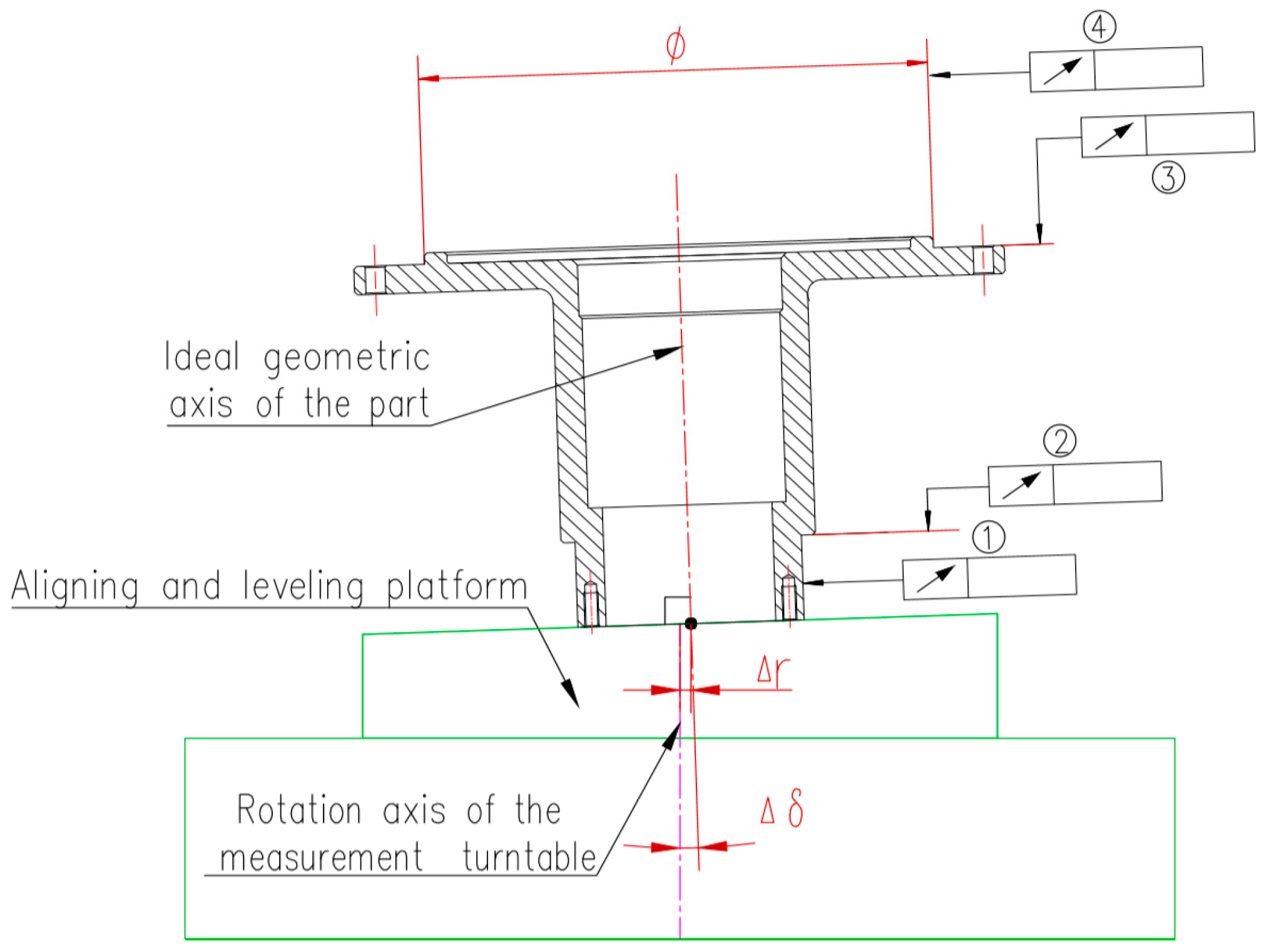
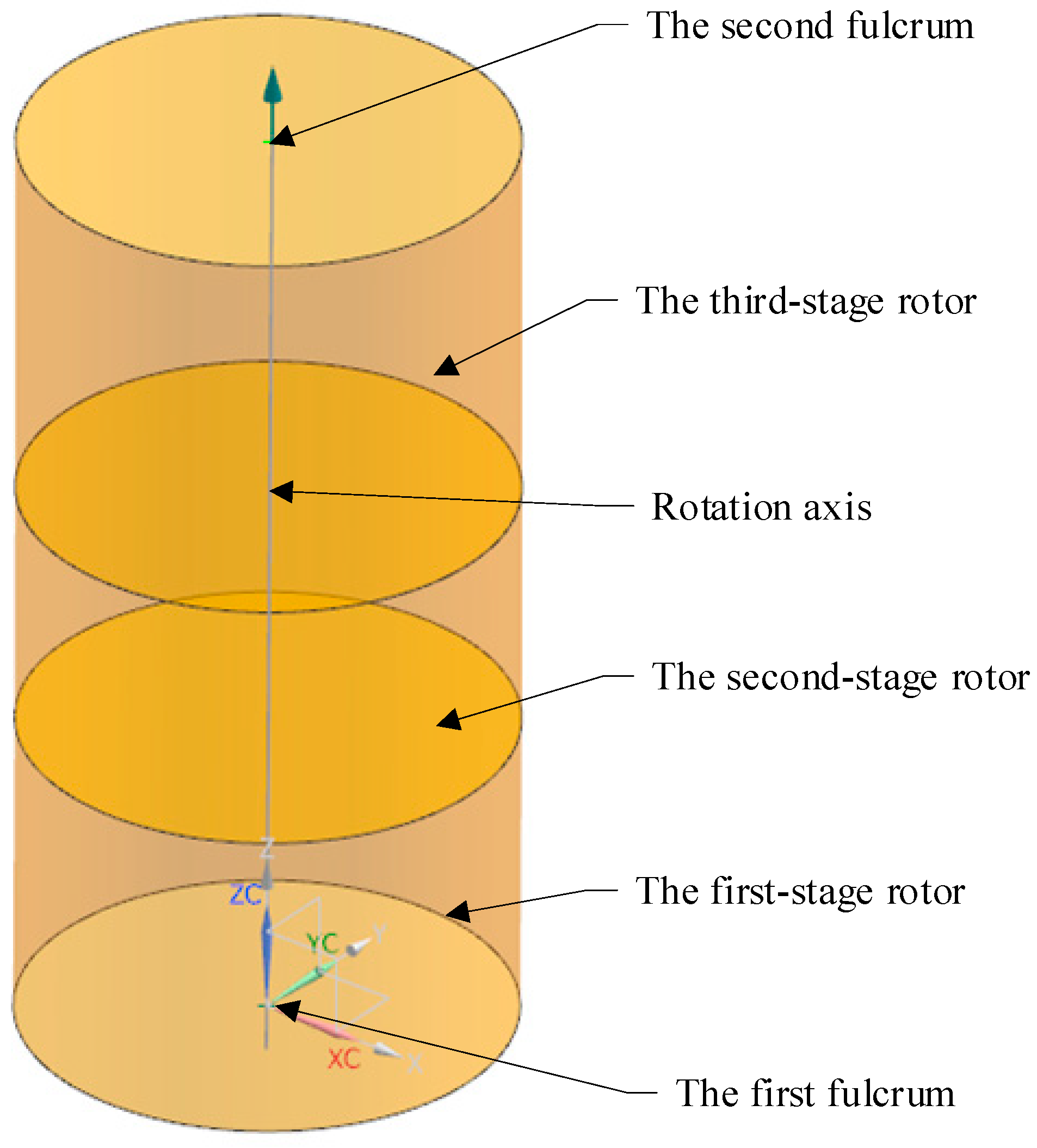
The turntable measurement system used in the rotor stacking process uses the turntable’s rotational reference axis as its measurement datum. During the assembly of a multistage rotor, the geometric parameters of each stage must first be measured individually using the turntable measurement system. After assembly, the actual geometric accuracy of the rotor assembly is verified as a whole for comparison with the predicted results. During the measurement process, an end face datum and a radial datum are first established to fit the ideal geometric axis of the rotor, ensuring it coincides as closely as possible with the turntable’s rotational axis. Subsequently, the geometric contour data of other rotor sections are measured based on this rotational axis. However, during the actual rotor assembly and alignment process, it is difficult to completely align the rotor’s ideal geometric axis with the turntable’s rotational datum using a centering and leveling platform. This limitation leads to residual alignment errors, as illustrated in
Figure 1, which include eccentricity error
and tilt error
, whose values vary in each measurement, and significantly affect the measurement results of the rotor’s spatial geometric parameters, thereby effecting the rotor stacking prediction accuracy. Therefore, it is important to compensate for these alignment errors to unify the measurement datum across multiple clamping operations, which will improve the rotor assembly prediction accuracy.
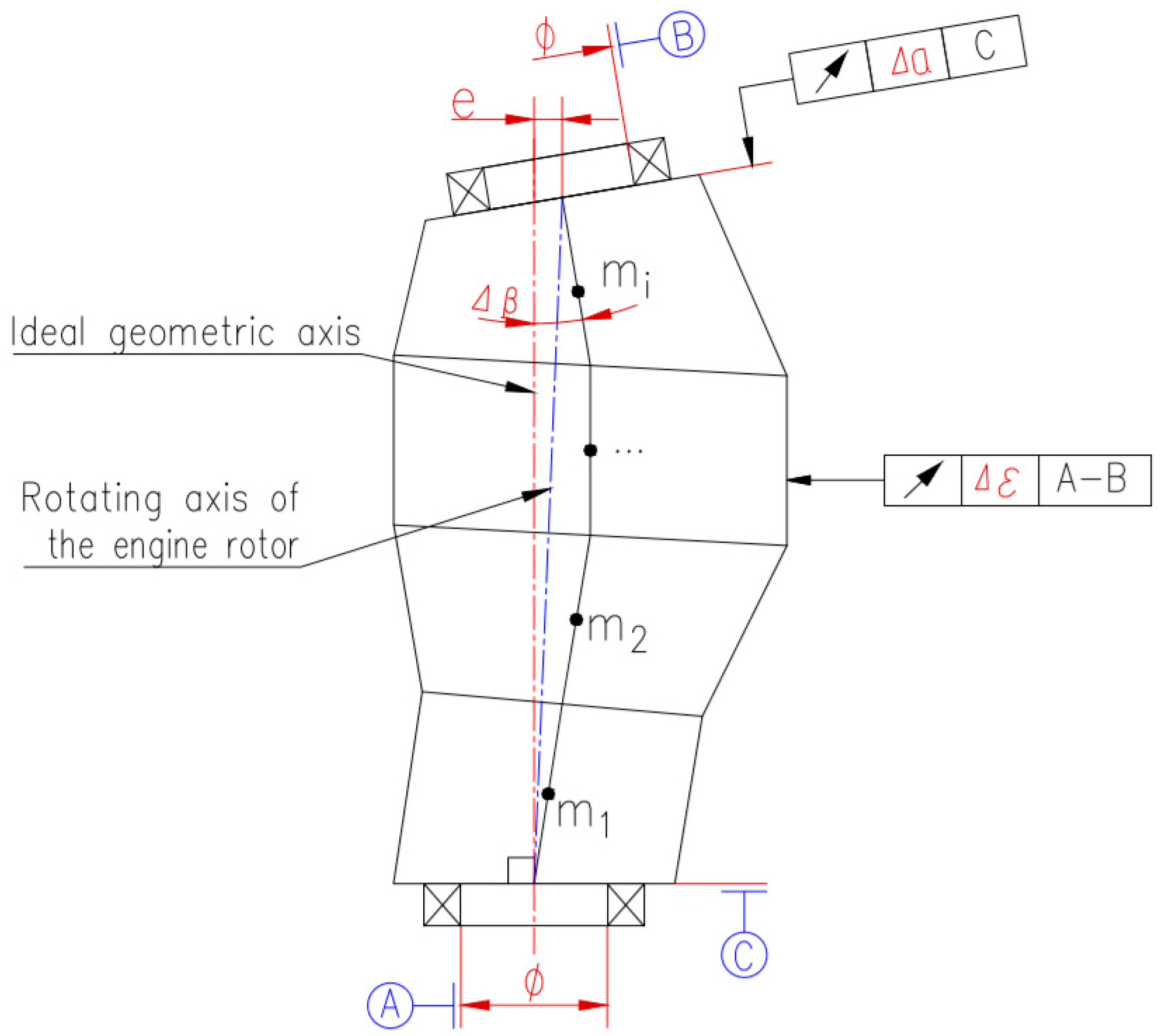
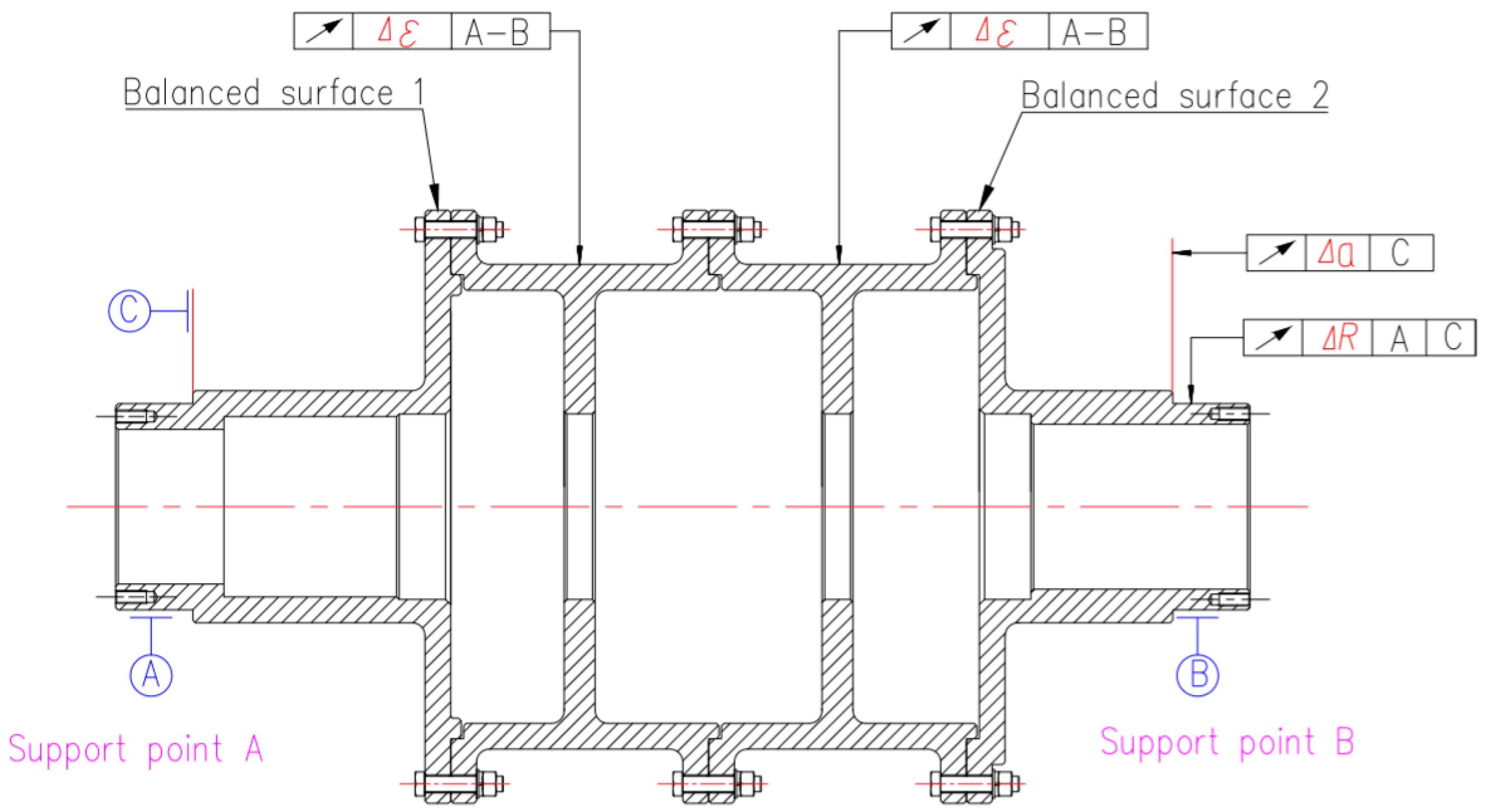
Most existing studies focus on parallel misalignment between the front and rear bearings (primarily parallel misalignment) and rotor unbalance. In these studies, the geometric prediction model typically defines the ideal geometric axis as the line passing through the geometric center of the lower end face of the first-stage rotor along the normal direction of that face, which is often assumed to coincide with the first bearing support. Rotor concentricity is then defined as twice the distance
e from the geometric center of the upper end face to the ideal geometric axis. However, during actual rotor operation, the true rotational axis is determined by the line connecting the front and rear supports. When the ideal geometric axis is used in place of the true rotational axis to control front–rear support concentricity during rotor stacking, a bowed rotor may be produced. Although acceptable concentricity at the supports may be achieved, blade-tip runout, bearing mounting end face runout, and overall rotor unbalance often deteriorate, as illustrated in
Figure 2.
However, the angular misalignment between the centerlines of the front and rear bearings (
) and the rotor blade-tip runout (
) are also critical monitoring parameters during rotor assembly. Previous studies have shown that angular misalignment has a pronounced effect on rotor vibration response. Compared with parallel misalignment, angular misalignment causes bearing life to decrease more rapidly [
25,
26]. Since angular misalignment between bearing centerlines is difficult to measure directly in engineering practice, bearing mounting end face runout (
) is commonly used as a control indicator.
Rotor blade-tip runout affects both the stability and the performance of rotor. Excessive runout can cause the rotor to rub against the stator during operation, compromising engine safety. Furthermore, runout reflects the static deflection and imbalance of the rotor after assembly. Therefore, considering the line connecting the front and rear support points as the axis of rotation, it is crucial to simultaneously strengthen the control of process parameters such as front-and-rear support concentricity, rotor blade-tip runout, front-and-rear bearing mounting face end-face runout, and the overall imbalance of the rotor during rotor stacking.
To address practical engineering issues such as the influence of residual alignment errors caused by multiple measurements of components, as well as the potential formation of bowed rotors in traditional rotor stacking methods that solely minimize misalignment, a harmonic decomposition-based registration method is proposed. This method resolves the inconsistency of measurement datums across multiple measurements, while simultaneously considering key assembly process parameters, including front-and-rear support concentricity error, front-and-rear bearing mounting face end-face runout, rotor blade-tip runout, and rotor unbalance. Taking the discrete assembly phase angles of each rotor stage as independent variable, a multi-objective genetic algorithm is employed to achieve assembly accuracy prediction and optimization for multistage flange-bolted rotors. The proposed method is validated through a four-stage simulated rotor assembly process. The residual alignment error elimination method and stacking optimization strategy presented in this study are shown to be effective in improving rotor assembly prediction accuracy and enhancing assembly reliability.
2. Assembly Accuracy Prediction Model for Multistage Connected Rotors
Due to the combined effects of manufacturing errors and assembly errors, significant deviations in both geometric accuracy and mechanical accuracy (unbalance) may occur after the assembly of multistage connected rotors, which affect rotor operational stability and reduce engine service life. Aero-engine rotors are typically constructed by sequentially stacking multiple disks, hubs, and shafts through flange-bolted connections with specified assembly phase angles. When the geometric or mechanical errors of each rotor stage are known, the rotor assembly process can be regarded as a sequence of coordinate transformations. Specifically, the errors defined in the local coordinate system of each stage are transformed into the global coordinate system of the assembled rotor, forming an error reconstruction process at the assembly level. Through these coordinate transformations, the assembly accuracy of each rotor stage and the overall assembled rotor can be obtained.
2.1. Single-Stage Rotor Geometric Model Reconstruction Based on the Least-Squares Method
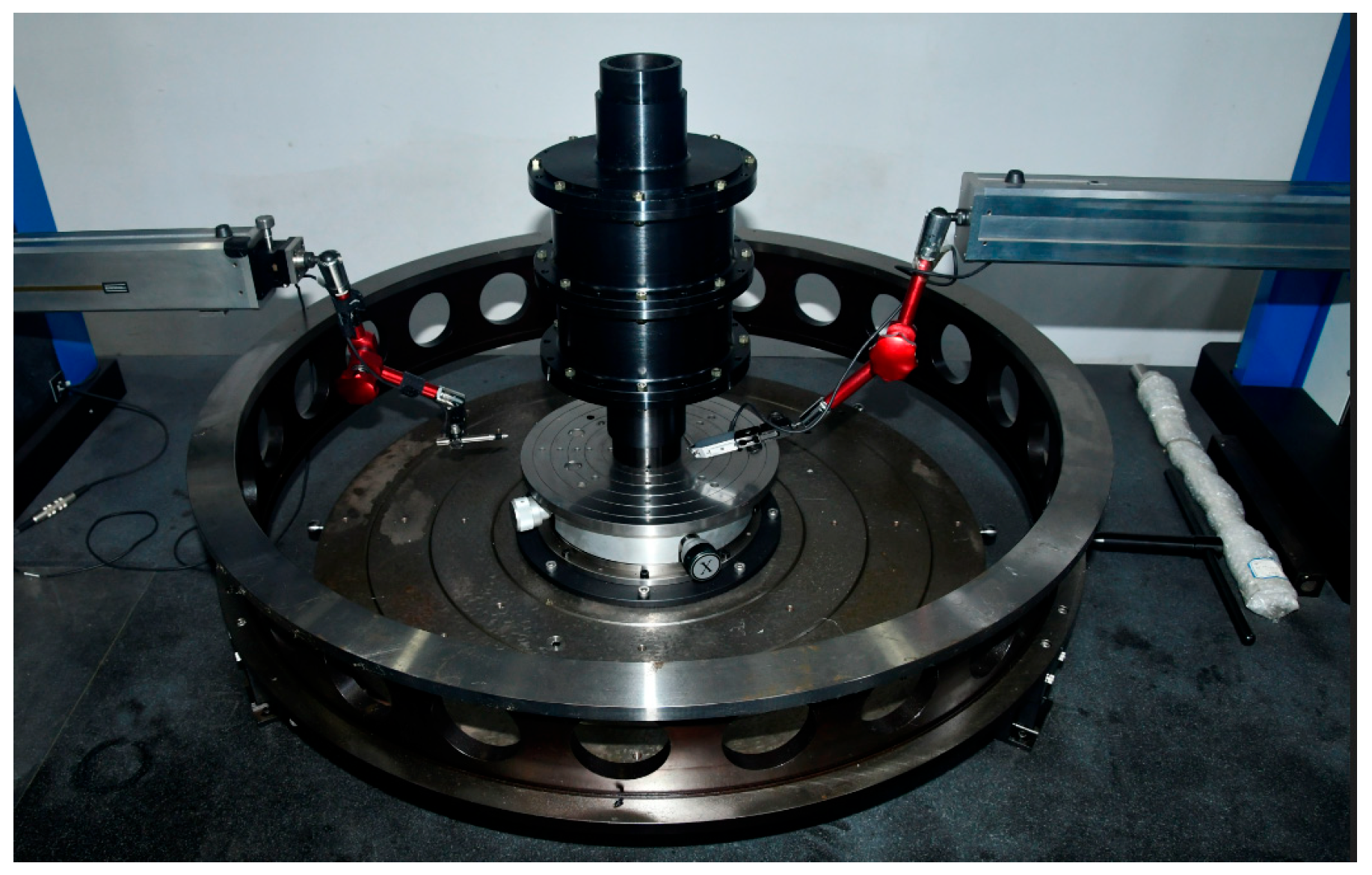
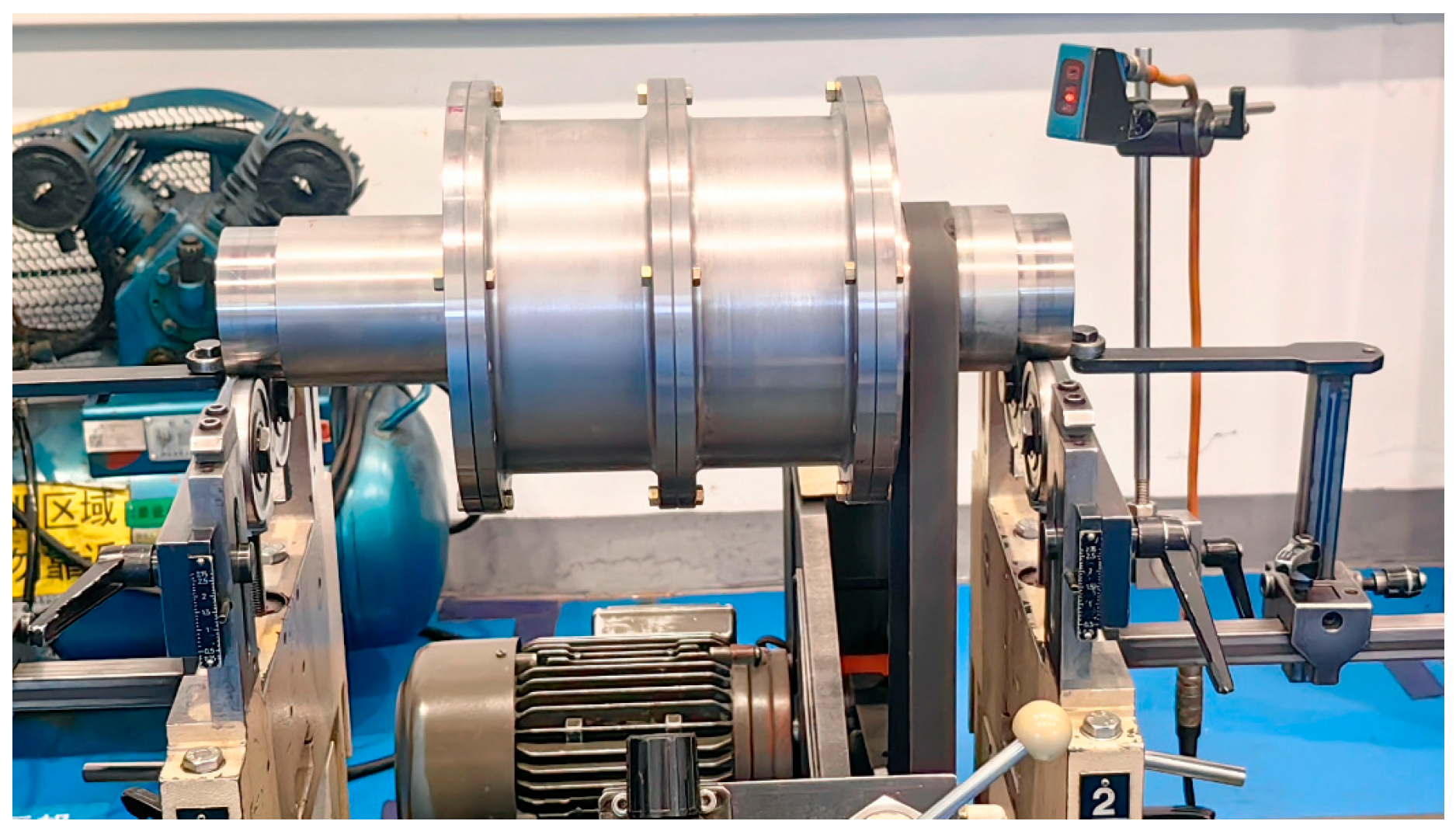
Multistage flange-connected rotors transmit assembly errors mainly through spigot fits and end-face contact. Therefore, for the geometric modeling of a single-stage rotor, the key task is to determine the deviation between the actual center of the spigot and its ideal center, as well as the angular deviation between the actual end face and the ideal end face. A single-stage rotor is measured using an air-bearing rotary table measurement system to obtain the runout of the upper and lower end faces and the runout of the upper and lower spigots. The measurement equipment is shown in
Figure 3. In addition, a rotor dynamic balancing machine is used to measure the static balance of the individual disk, yielding the eccentric mass and its phase angle.
The upper and lower end faces are fitted as inclined planes using the least-squares method. The equation of the fitted plane is assumed to be:
The error function describing the distance, in the
Z direction, between each measured point on the end face and the fitted plane is defined as:
where
k represents the number of measurement points.
When the error function reaches its minimum, the coefficients of the fitted plane can be obtained. The normal vector of the fitted plane is given by
v = [a, b, −1]. The radial measurement data of the upper and lower spigots are then orthogonally projected onto the fitted plane. The coordinates of the projected points are calculated as:
In the above equations, P denotes the radial measurement points of the upper and lower spigots, and = represents a reference point on the fitted plane.
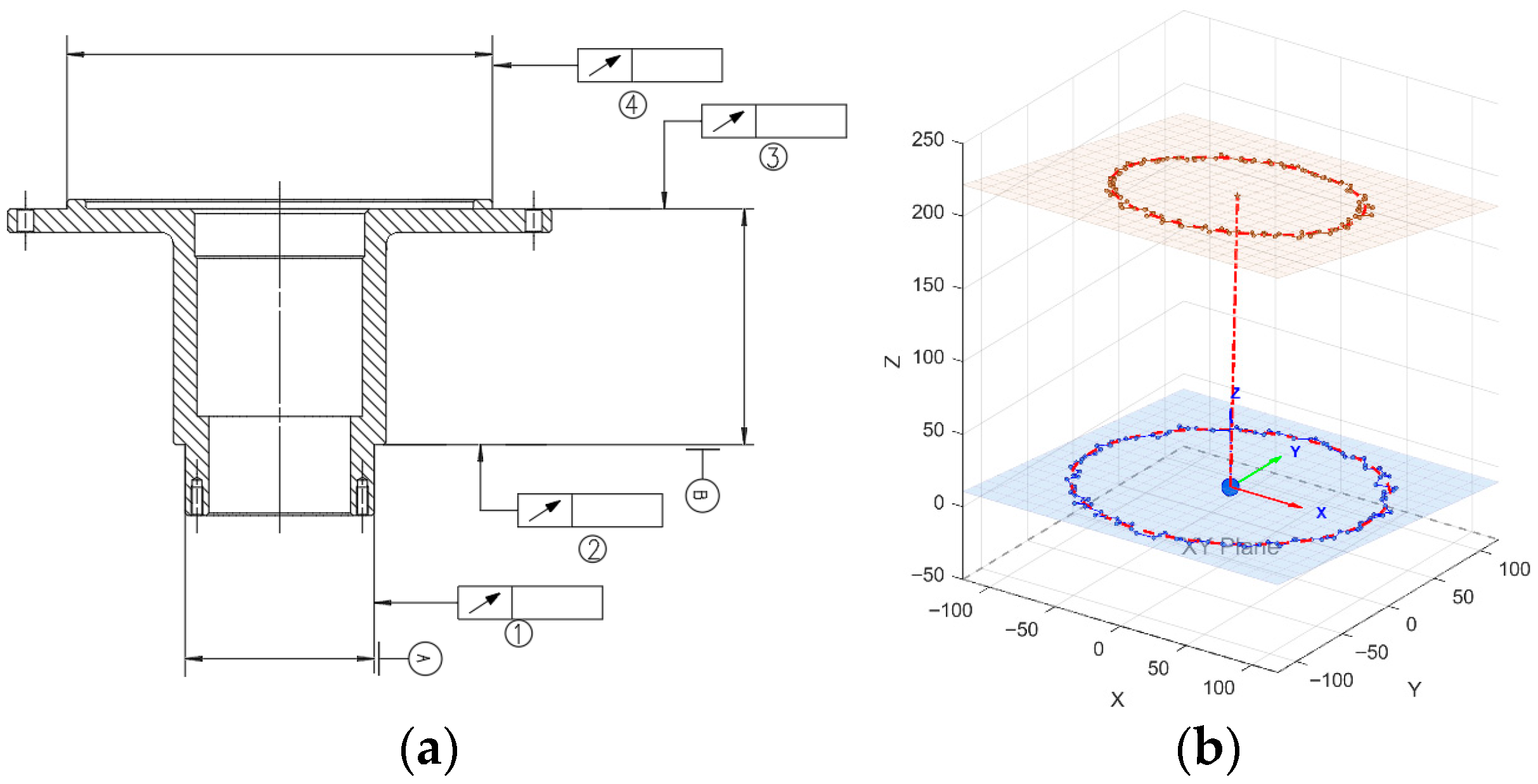
Then, the projected points are fitted into a circle using the least-squares method, thereby calculating the coordinates of the circle’s center, Finally, a rigid-body rotor model with dual inclined planes is obtained in a unified coordinate system, as shown in
Figure 4. The least-squares method is characterized by its simplicity, high computational efficiency, and robustness against random measurement noise and local defects. Therefore, the least-squares method is adopted in this paper for geometric model reconstruction.
2.2. Registration of Measurement Results Based on Harmonic Analysis
The turntable measurement system used in the rotor stacking process uses the turntable’s rotational datum as its measurement datum. However, during each rotor clamping process on the turntable, it is difficult to completely align the rotor’s ideal geometric axis with the turntable’s rotational datum using a centering and leveling platform. As shown in
Figure 1, the eccentricity error ∆r and the inclination error ∆δ of each component placed on the turntable both have certain randomness. This results in residual assembly and alignment errors, which significantly affect the measurement results of the rotor’s spatial pose parameters. Furthermore, this impact on measurement accuracy becomes more pronounced as the number of rotor stages and the overall size of the rotor increase.
Aero-engine rotor parts are generally machined by turning and grinding. Their contour errors exhibit strong periodicity, and the rotor’s geometric deviations are composed of a series of harmonic components. The Harmonic Analysis Method (HAM) is based on the Fourier series expansion principle, decomposing the geometric errors of the part’s surface contour into harmonic components of different orders for analysis and matching. The HAM can accurately determine the starting phase of part measurements. Therefore, this paper uses harmonic analysis to extract the first and second harmonics of the contour error data. The eccentricity and eccentric phase of the part’s ideal geometric axis relative to the turntable’s rotational axis are obtained through the first harmonic. The initial measurement phase of the part is determined through the second harmonic. Then, through coordinate transformation, the coordinate systems of the turntable during the measurement process of each rotor component are made consistent with the ideal coordinate system of the part, in order to eliminate the influence of eccentric error ∆r, inclination error ∆δ, eccentric phase and other assembly errors.
Assuming the highest harmonic of the geometric contour error of the part is
m, the following can be obtained from the Fourier series expansion of a periodic continuous signal [
27]:
where
is the DC component.
, are the amplitudes of the cosine and sine components of the nth harmonic, respectively.
Convert Equation (4) to
where
is the combined amplitude of the nth harmonic, and let φ
n be the phase of the
nth harmonic.
In the above equations, harmonic components of different orders correspond to specific sources of manufacturing and measurement errors and thus possess clear physical interpretations. The zero-order component (
n = 0) represents the direct current (DC) term, which is generally associated with installation offsets of the measurement probe. The first-order component corresponds to eccentricity and is mainly caused by clamping errors. The second-order component represents ellipticity, which is associated with elliptical radial runout errors or saddle-shaped end-face runout errors. Harmonic components of third order and higher are typically attributed to clamping deformation or tool-induced vibration during machining.
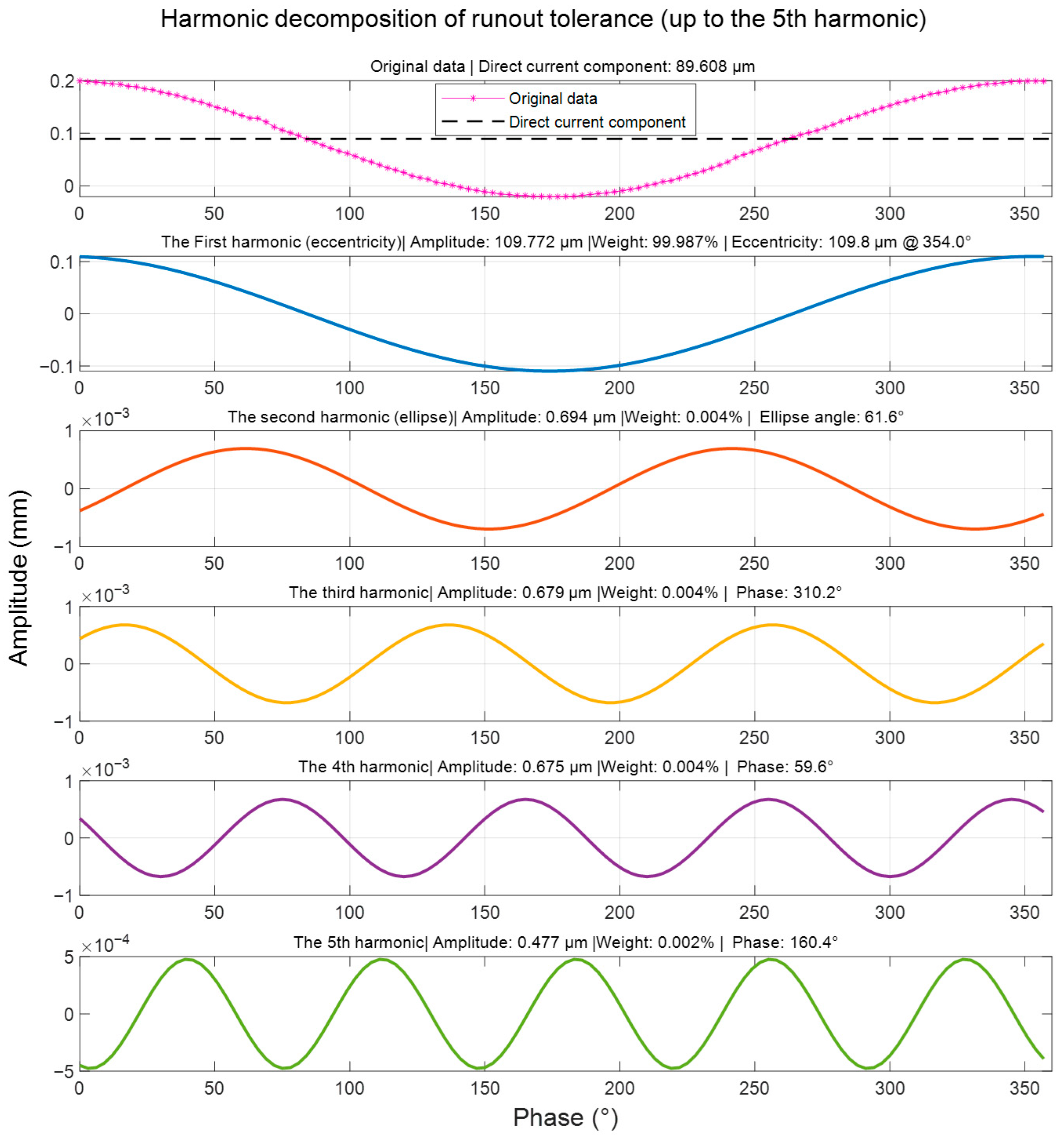
Figure 5 shows the results of decomposing the first five harmonics from a set of measured radial runout data. The amplitude of the first harmonic
reflects the eccentricity error, the phase of the second harmonic
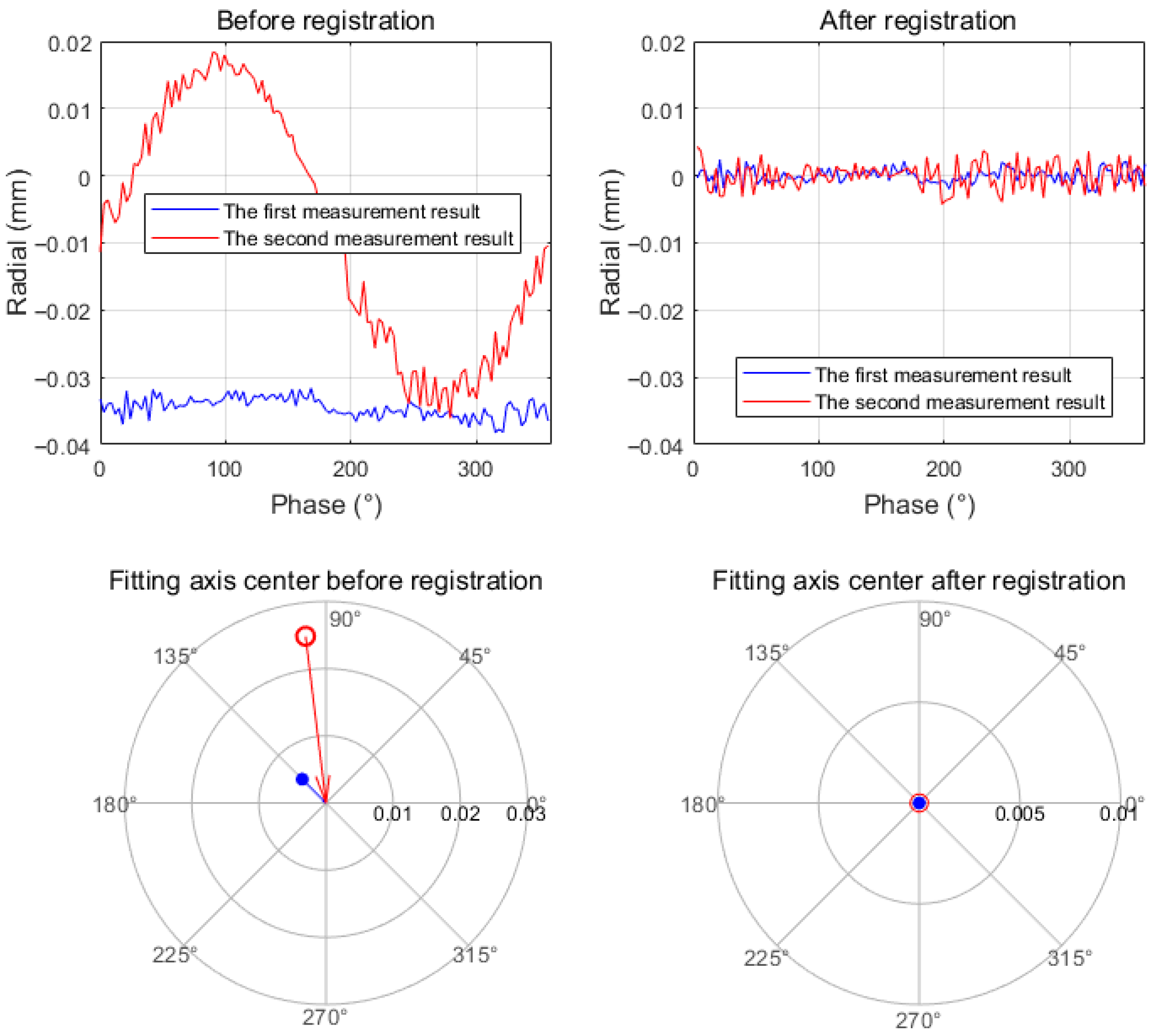
indicates the initial phase deviation of the measurement. By applying coordinate translation and rotation, the first harmonic amplitude and the second harmonic phase of the datum data used to fit the rotor’s ideal geometric axis become 0, which can effectively eliminate the residual alignment errors from the two measurements of the part, thereby unifying the measurement datum. As shown in
Figure 6 below, a comparison is presented between the raw data and the registered results of two measurements taken on the same contour surface. By performing coordinate transformation on the two sets of data, the coordinates of the turntable measurement system were unified with the ideal coordinate system of the part.
2.3. Multistage Rotor Stacking Model
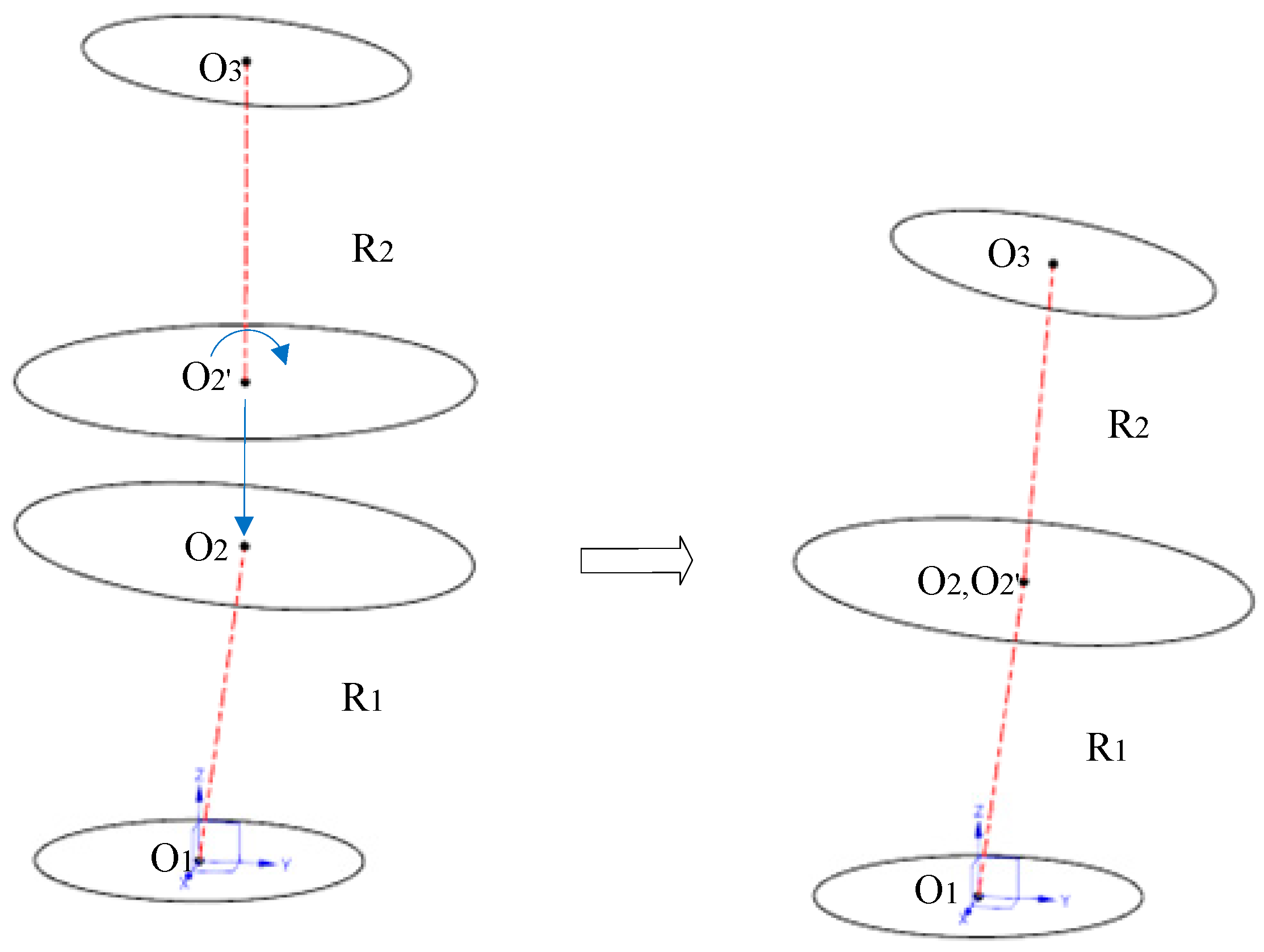
Multistage rotor assemblies are actually formed by stacking single-stage rotors sequentially according to the assembly order. The geometric and mechanical errors of the rotor after assembly are affected by assembly process parameters, such as the phase angle of each stage rotor, the tightening torque distribution, and the spigot fit relationships. To facilitate quantitative description and study, two assumptions are made: First, the radial fit relationship of the spigot at each stage is interference fit, that is, after assembly, the centers of the radial fitting circles of the two spigots will coincide; second, the rotor parts are rigid bodies, this means that the parts will not produce large deformations, only the mating surfaces will produce micro-deformations, making the mating end faces parallel to each other. As shown in
Figure 7, during assembly, the first-stage rotor is fixed first, and the second-stage rotor is then rotated. Assume that it rotates about the z-axis by
θz, about the y-axis by
θy, and about the x-axis by
θx. Make its lower end face parallel to the upper end face of the first-stage rotor. Then translate the second-stage rotor so that the center of its lower spigot coincides with the center of the upper spigot of the first-stage rotor. This will give you the assembled model data.
According to homogeneous coordinate transformation theory, the rotation matrix can be written as:
The corresponding translation matrix can be expressed as:
In the above equation,
,
denote the translational displacements along the
x-,
y-, and
z-axes, respectively. Therefore, the homogeneous coordinate transformation equation describing the geometric accuracy of each rotor stage can be expressed as:
In the above equation, P denotes the coordinate data of the stacked rotor in its own local coordinate system, while P′ represents the geometric coordinates of the assembled rotor in the assembly coordinate system.
For unbalance prediction, the unbalance mass center and its phase distribution of each individual rotor are first obtained using static balancing methods. During rotor assembly, these quantities are transformed into the assembly coordinate system through rotation and translation operations. After assembly, the actual rotational axis generally does not coincide with the ideal rotational axis. Therefore, the mass center coordinates of each rotor stage must be further transformed from the assembly coordinate system into the coordinate system defined by the actual rotational axis.
Assuming that the mass center vector of a given rotor stage in its own coordinate system is denoted as
, and the corresponding mass center vector in the coordinate system of the actual rotational axis after assembly is denoted as
, the homogeneous coordinate transformation relationship between
and
can be expressed as
In the above expression, Nr denotes the transformation matrix from the assembly coordinate system to the coordinate system defined by the actual rotational axis.
After obtaining the actual mass center positions of each rotor stage in the assembled rotor, the equivalent unbalance can be determined on the unbalance measurement plane (typically the material removal plane) by applying the force and moment equilibrium equations. In this manner, both the magnitude and phase of the unbalance on the measurement plane can be calculated.
The homogeneous coordinate transformation during the stacking process of parts is actually the process of converting the geometric contour parameters and centroid coordinates of the parts from the ideal coordinate system of the parts to the coordinate system of the assembly. After the coordinate transformation, the geometric errors and initial imbalance of the assembly rotor can be obtained.
3. Optimization of Assembly Accuracy and Unbalance in Multistage Connected Rotors
For engine rotor components that have already been machined, the control of the assembly process has a significant influence on the assembly accuracy and the resulting unbalance of the rotor system. Such influences include, but are not limited to, slip at the connection interfaces and non-uniform bolt tightening torque.
By excluding these uncontrollable factors, optimization can be achieved through controllable variables, namely, the relative assembly phasing between individual rotor stages, so as to improve both the assembly accuracy and the unbalance characteristics of the rotor assembly.
During the rotation of each rotor stage, the actual rotational axis of the assembled rotor changes. Consequently, the centroid positions of individual stages, blade-tip runout, as well as the concentricity and angular misalignment between the front and rear supports are altered, leading to variations in the overall rotor unbalance. Therefore, the assembly accuracy and unbalance of the rotor assembly can be effectively optimized by adjusting the assembly phase angles of the individual rotor stages.
Accordingly, the optimization of assembly accuracy and unbalance in multistage connected rotors constitutes a typical multi-objective optimization problem. For an
L-stage rotor, there are
L − 1 independent assembly phase variables. Since the rotor stages are connected by flanged bolted joints and the bolt hole positions are limited, each variable takes a finite number of discrete values. The objective functions are defined as the front-and-rear support concentricity, the front-and-rear bearing mounting face end-face runout, the blade-tip runout, and the rotor unbalance, expressed as:
∆R: Parallel misalignment between the front and rear fulcrums. Taking the centerline of the mounting cylinder of the lower-end bearing as the ideal geometric axis, the coaxiality of the rotor is defined as twice the distance e from the radial geometric center of the rotor upper fulcrum to the ideal geometric axis, in mm.
∆a: End-face runout of the mounting end faces of the front and rear bearings. Based on the mounting end face of the lower-end bearing, the runout of the mounting end face of the upper-end bearing is obtained, in mm.
∆ε: Rotor blade-tip runout. Based on the rotation axis (the connecting line of the centers of the front and rear bearing mounting cylinders), it is measured as the maximum radius (rmax) minus the minimum radius (rmin) at the simulated blade tip position, i.e., Δro = rmax − rmin, in mm.
D: Magnitude of the overall unbalance of the rotor. Using the two-section balancing method and based on the rotational axis, the unbalances D1 and D2 equivalent to the two sections are measured by a dynamic balancing machine, and their algebraic sum is calculated as D = D1 + D2, in g·mm. The phase of the unbalance is not considered here.
The constraints are defined as:
where
i denotes the rotor stage index;
represents the assembly phase angle between the
i-th rotor stage and the (
i − 1)-th stage. For flanged rotor connections,
corresponds to the bolt hole positions of the connecting flange and therefore takes a set of discrete values. Suppose there are
j bolt holes on the flange, then
Fitness represents the four objective functions.
Q denotes the geometric parameters of each rotor stage, and
B represents the unbalance parameters of each rotor stage.
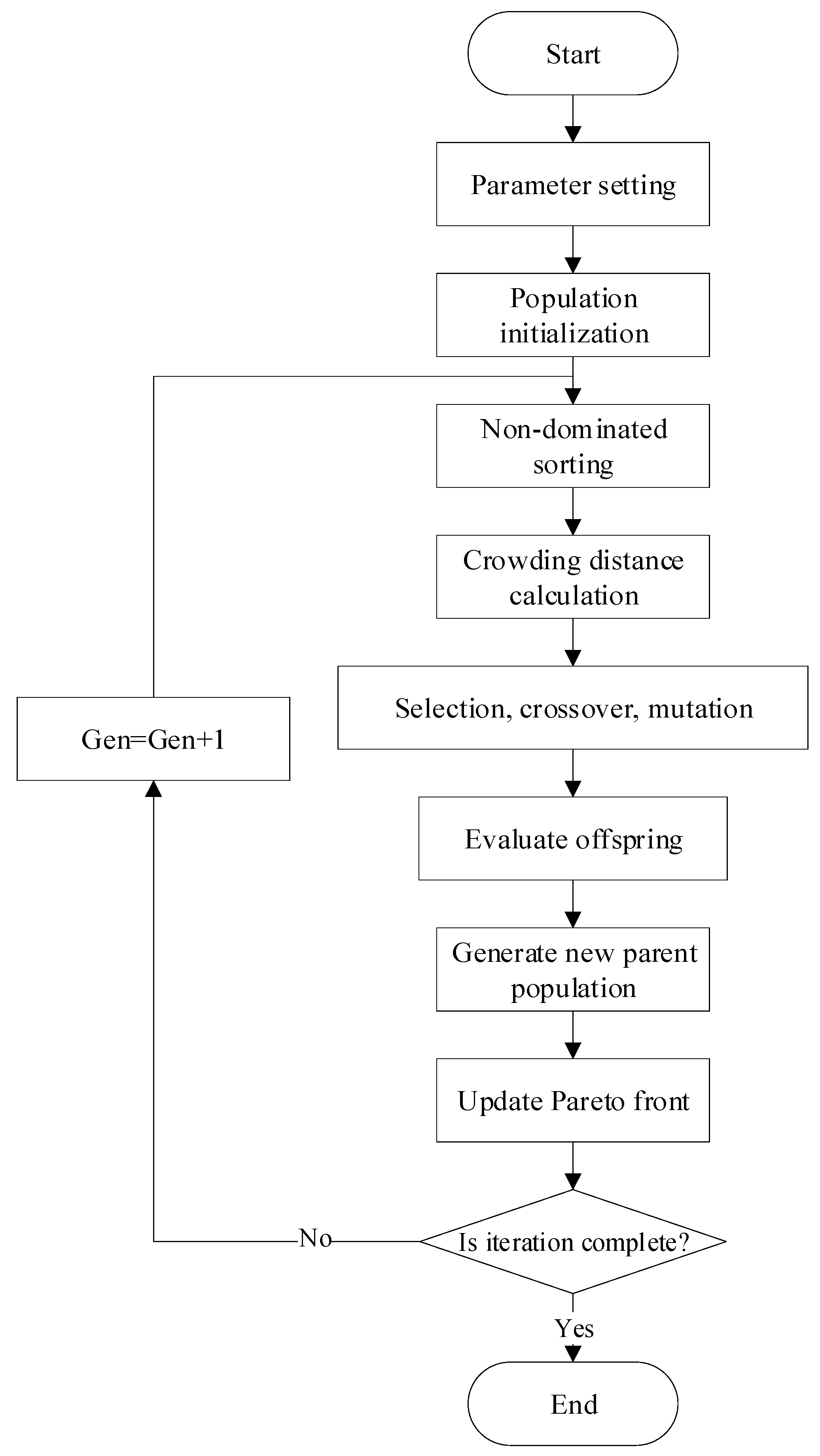
In the actual assembly process, the objective functions are often in conflict with each other; optimizing one objective may worsen the other objectives. Traditional single-objective optimization algorithms or weighted summation methods struggle to handle this contradiction. The Non-dominated Sorting Genetic Algorithm II (NSGA-II) was formally proposed by Kalyanmoy Deb et al. in 2002 [
28]. Building upon the first-generation NSGA, it solves multi-objective optimization problems by introducing three major mechanisms: Fast Non-dominated Sorting, Crowding Distance, and Elitism. Employing NSGA-II for multi-objective optimization yields a Pareto set consisting of multiple optimal solutions. This provides a series of trade-off solutions, facilitating the selection of the most suitable solution based on actual scenarios. Its elitism strategy ensures that the optimal solutions from each generation are not lost, guaranteeing that the algorithm converges to a truly high-quality Pareto front. Furthermore, considering that the independent variables in rotor bolted flange connections take discrete values and involve numerous combinations, the crowding distance mechanism in NSGA-II maintains the diversity of the optimal solutions. This prevents all optimal solutions from concentrating in a small region, thus providing engineers with a wider range of choices. The optimization algorithm flowchart is shown in
Figure 8.
5. Experimental Results
To simulate the structural form of the engine core rotor or compressor rotor, which is assembled by stacking multistage disks, hubs, and other components. A four-stage simulated rotor, as shown in
Figure 10, was designed and manufactured. The front and rear stages of the rotor serve as rotor journals for bearing installation, while the middle two stages simulate bladed disks. The four-stage rotor is positioned via spigot interference fit at the spigots and connected by flange bolts, which can represent the typical structure of multi-section connected rotors. For each stage of the rotor specimen, the radial runout of the front and rear spigots, the end-face runout, the unbalance, and the blade-tip runout of the intermediate stages were measured individually. To simplify the machining process, it is assumed that the cylindrical surfaces of the two intermediate rotor stages represent the blade tip profile surfaces. This assumption is representative of integrally machined blade disks. Based on the measured runout data, the geometric model of a single-stage rotor was reconstructed using the least-squares method, yielding the end-face normal vectors and spigot center coordinates of the front and rear connection interfaces of each rotor stage. Taking the bearing mounting cylinder surface of the first-stage rotor as the radial datum (Datum A), the bearing mounting end face as the normal datum (Datum C), and the marked zero position of the part as the circumferential datum, the second, third, and fourth-stage rotors were assembled sequentially using homogeneous coordinate transformation according to a random phase relationship (with circumferential zero alignment of each stage). After each assembly stage, the end-face and radial runout data of the spigots were measured. Upon completion of the four-stage rotor assembly, the runout at the blade-tip representative positions of the middle two rotors and the two-plane unbalance of the rotor were measured with respect to the A-B rotational axis. A comparison was then made among the predicted results from the original measured data, the predicted results from the registered data, and the actual measured results.
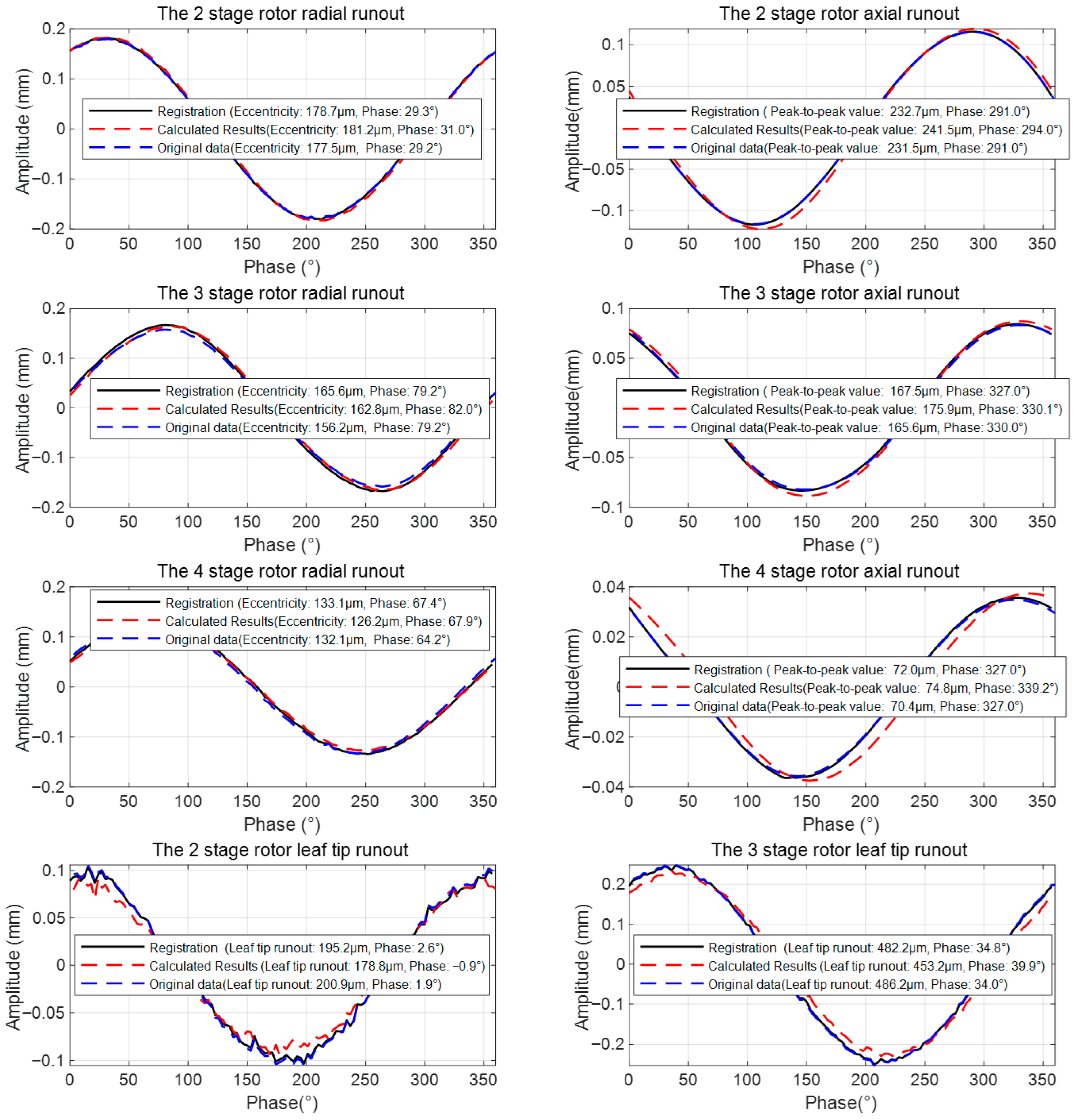
The comparison between the predicted and measured results of radial runout, end-face runout, and blade-tip runout is shown in
Figure 11, and the prediction error analysis is summarized in
Table 2. The results indicate that the prediction error of the front-and-rear support concentricity of each rotor stage does not exceed 5.2%, and the prediction error of the eccentricity phase does not exceed 2.8°. The peak-to-peak prediction error of the end-face runout at the front and rear bearing mounting surfaces is within 5.0%, with the corresponding high-point phase error not exceeding 12.2°. The prediction error of the blade-tip runout is within 6.0%, and the phase error of the blade tip high point does not exceed 5.1°. Compared with the prediction results based on the original measured data, the average prediction accuracy of rotor assembly is improved by 1.2 percentage points after the introduction of harmonic decomposition registration.
By conducting rotor unbalance tests, the unbalance results of the rotor assembly were obtained, as shown in
Figure 12. The comparison between the predicted and measured rotor unbalance is presented in
Table 3. The prediction error of the unbalance magnitude does not exceed 29.0%, while the phase prediction error of the unbalance is 32.7°.
Taking the assembly phase angles of each rotor stage as the independent variables, the front-and-rear support concentricity error and the end-face runout of the front and rear bearing mounting surfaces, referenced to the ideal geometric axis, together with the rotor unbalance and blade-tip runout, referenced to the actual rotational axis, were selected as the objective functions. A genetic algorithm (NSGA-II) was employed to perform single-objective optimization of the rotor assembly. The optimized phase angles, predicted objective values, and measured objective values are listed in
Table 4.
The results indicate that, under single-objective optimization, compared with random assembly, the concentricity error between the front-and-rear support concentricity error is reduced by 82.1%, the end-face runout of the front and rear bearing mounting surfaces is reduced by 90.4%, the blade-tip runout is reduced by 79.1%, and the rotor unbalance is reduced by 48.5%. However, there are significant differences in the optimal installation phase angles for each single objective. Under the optimal assembly scheme for a specific objective function, the results obtained for the other objective functions are often suboptimal.
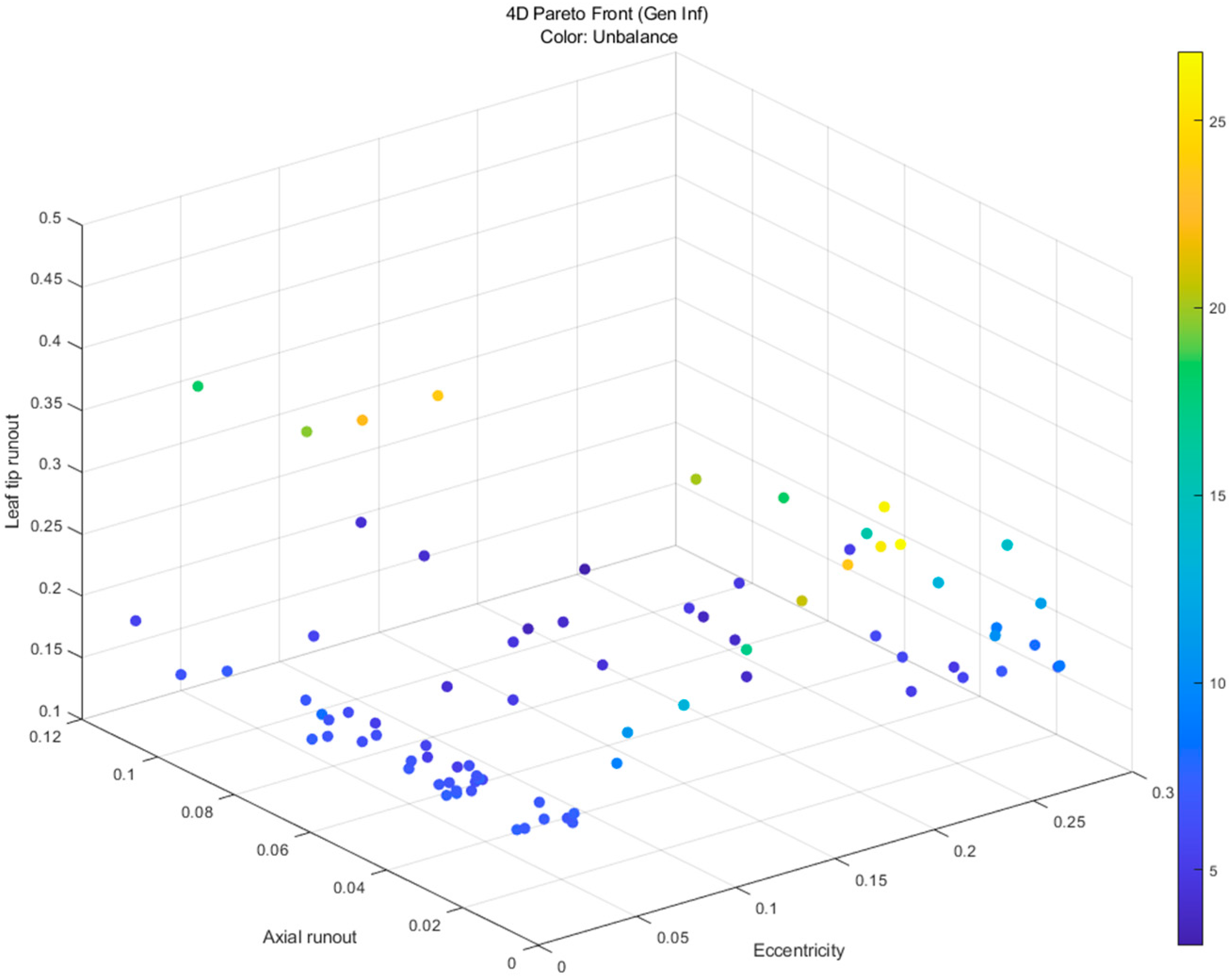
When conducting the comprehensive optimization of four objectives, the four-objective Pareto Front is obtained as shown in
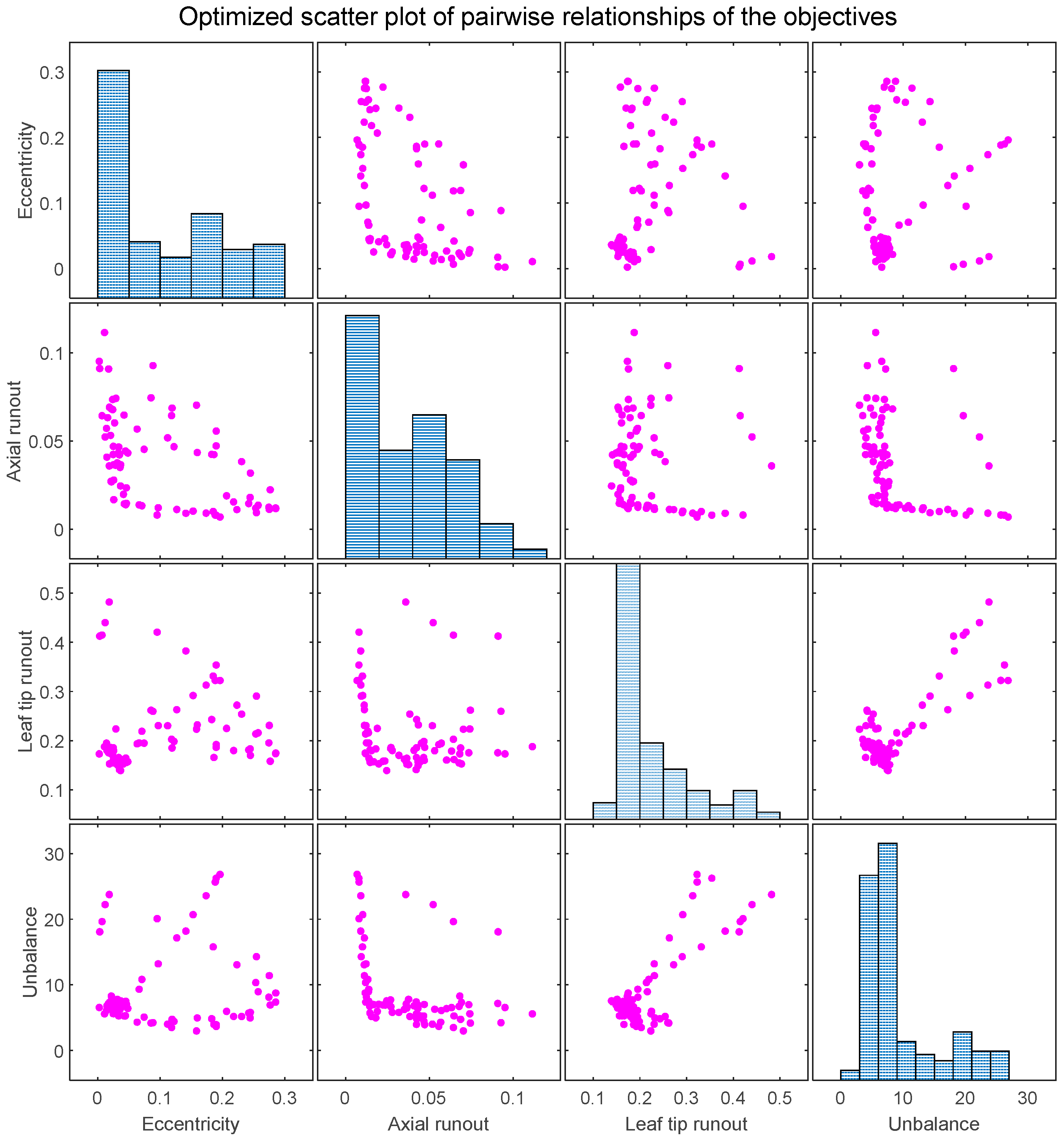
Figure 13. The scatter plot of the optimization of the inter-objective relationships is shown in
Figure 14, where the pink circles represent the scatter distribution of pairwise optimization among the four targets when the population size is 80, and the blue color indicates the distribution of each single target. By selecting the optimization strategy based on the coefficients of the weights of each objective, the values of each objective have significantly decreased. Specifically, the front-and-rear support concentricity error is reduced by 66.2%, the end-face runout of the front and rear bearing mounting surfaces is reduced by 63.9%, the blade-tip runout is reduced by 16.7%, and the rotor unbalance is reduced by 33.8%. Therefore, adopting the four-objective integrated optimization strategy is of great significance for enhancing the reliability of rotor assembly.
6. Discussions and Conclusions
An integrated approach combining the harmonic decomposition registration method with the homogeneous coordinate transformation method is proposed to perform stacking and error prediction for multistage rotors connected by flanged bolted joints. The discrete assembly phase angles of each rotor stage are taken as the design variables, while the front-and-rear support concentricity error, the end-face runout of the front and rear bearing mounting surfaces, the blade-tip runout, and the rotor unbalance are selected as the objective functions. A multi-objective genetic algorithm is employed to realize the prediction and optimization of assembly accuracy for multistage flange-bolted rotor assemblies.
Numerical simulations are conducted to verify the accuracy of the proposed method, followed by experimental validation using a four-stage simulated rotor. The results demonstrate that the introduction of the harmonic decomposition registration method effectively eliminates the influence of residual errors caused by repeated measurement and adjustment during rotor assembly, leading to an improvement of 1.2 percentage points in the assembly accuracy prediction. When all rotor stages are assembled with zero-phase alignment, the prediction errors of the front-and-rear support concentricity, the end-face runout of the front and rear bearing mounting surfaces, the blade-tip runout, and the rotor unbalance do not exceed 5.2%, 5.0%, 8.4%, and 29.0%, respectively.
Compared with random assembly, the four-objective integrated optimization results in significant reductions in all objective values. Specifically, the front-and-rear support concentricity error is reduced by 66.2%, the end-face runout of the support shoulder surfaces is reduced by 63.9%, the blade-tip runout is reduced by 16.7%, and the rotor unbalance is reduced by 33.8%. When applied to aero-engine rotor assembly, the proposed stacking optimization strategy can significantly improve both assembly accuracy and assembly efficiency.
However, certain limitations still exist. The current assembly accuracy prediction and optimization method for multistage connected rotors is based on the rigid-body assumption of rotor components and the interference-fit assumption of the spigot interfaces. Consequently, the effects of assembly torque, connection forces, and component deformation on assembly accuracy are not considered, which may affect the prediction of geometric accuracy in practical aero-engine rotor assemblies. In addition, during single-stage rotor dynamic balancing, deviations exist between the actual rotational axis and the ideal rotational axis. Since the stacking model is established with respect to the ideal rotational axis of each rotor stage, initial errors are introduced, which in turn affect the accuracy of unbalance prediction.