Article

Design and Analysis of a Compact Self-Tuning High-Voltage Controller for MFC

State Key Laboratory of Mechanics and Control for Aerospace Structures, Nanjing University of Aeronautics and Astronautics, Nanjing 210016, China
*
Author to whom correspondence should be addressed.
Actuators 2026, 15(3), 169; https://doi.org/10.3390/act15030169
Submission received: 12 February 2026 / Revised: 8 March 2026 / Accepted: 12 March 2026 / Published: 17 March 2026
(This article belongs to the Section Aerospace Actuators)

Abstract

In aerospace applications, the vibration of aircraft structures results in a reduction in their fatigue life. Vibration-suppression technology utilizing macro fiber composite (MFC) materials constitutes a significant research direction. Aiming at the specific requirements of the MFC actuator operating in the asymmetric high-voltage range of −500 V to 1500 V and the miniaturization of the drive system for aircraft, this study designs a compact self-tuning digital high-voltage controller which adopts a discontinuous conduction mode (DCM) flyback topology as the fundamental model for the switching power supply high-voltage controller, uses the STM32G431 chip as the main controller, and incorporates a Type-II digital compensator designed to enhance the system stability under constant parameters. A Backpropagation (BP) neural network is proposed to enable dynamic adjustment of the digital compensator control parameters, thereby achieving self-tuning, while also supporting program download and real-time data transmission. The high-voltage controller effectively addresses the size and weight constraints in vibration active control systems. Laboratory tests demonstrated its excellent transient response and robust load-driving capability. Vibration-suppression experiments on a high-aspect-ratio UAV wing achieved a 74% vibration attenuation rate, validating the effectiveness of the proposed high-voltage controller.

1. Introduction

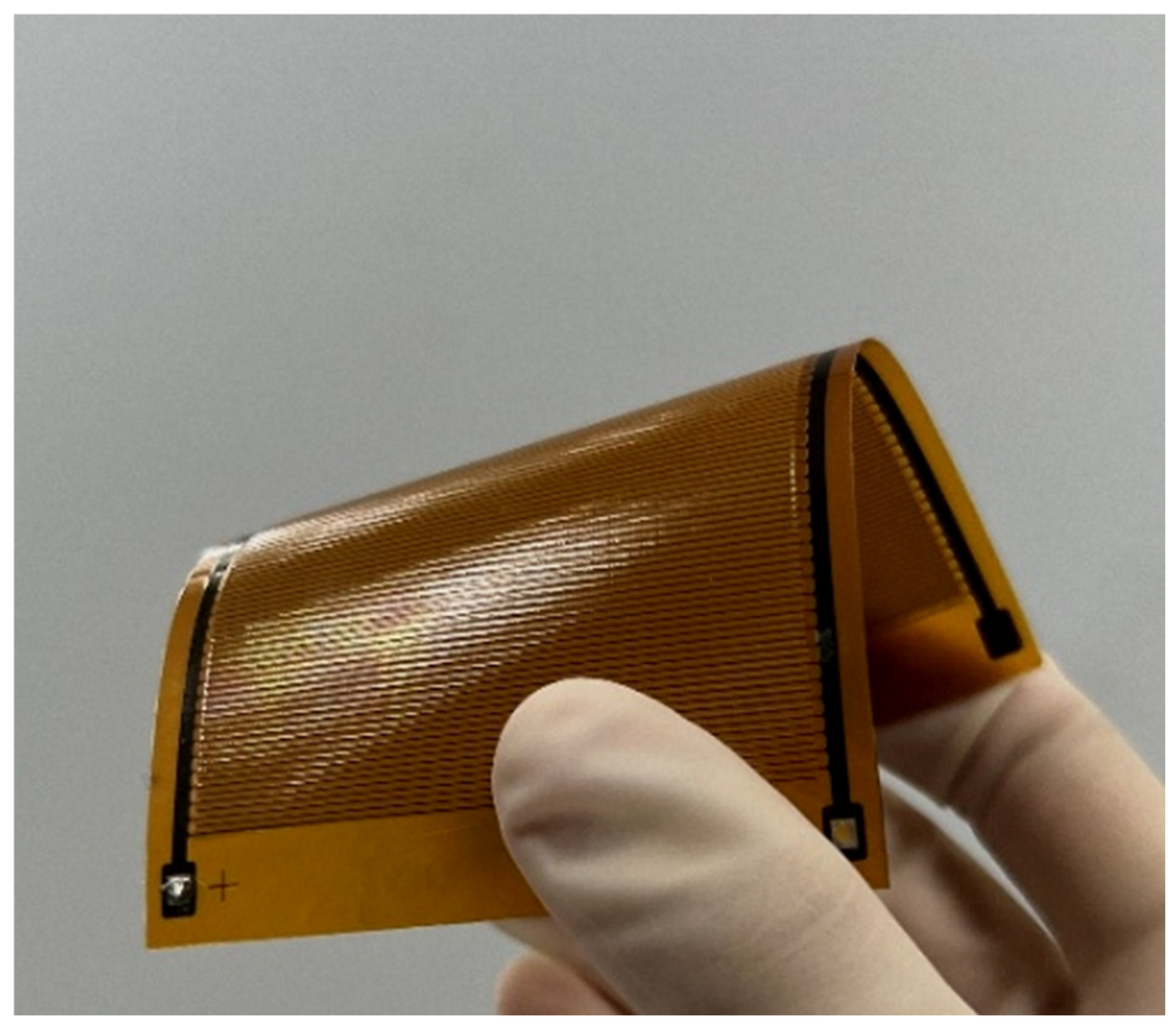
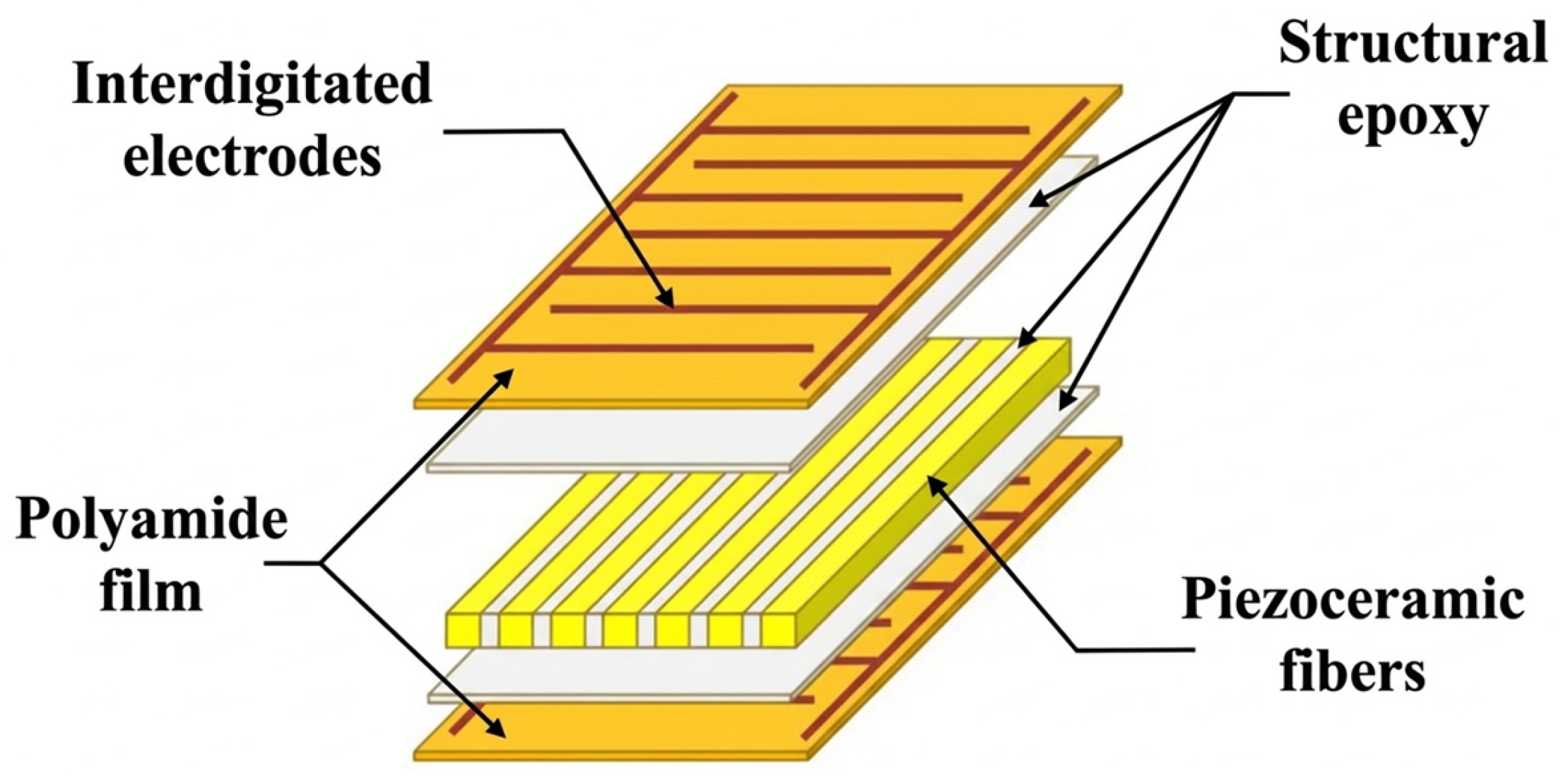
With the rapid development of aerospace technology, vibration and noise suppression has become a major challenge in ensuring stable aircraft operation [1]. The advancement of smart materials and structures offers new solutions for vibration and noise control. Piezoelectric materials can achieve mechanical-electrical energy conversion and have characteristics such as wide frequency response range and fast electromechanical response, making them suitable for vibration control [2,3,4,5]. In particular, macro fiber composite (MFC) exhibits superior flexibility, high piezoelectric constants, and strong electromechanical coupling, offering outstanding mechanical performance and reliability. Figure 1 shows the physical appearance of the MFC actuator used in this study, while Figure 2 illustrates its internal structural composition and electrode arrangement. Rectangular piezoelectric ceramic fibers are aligned parallel within an epoxy matrix, with interdigitated electrodes (IDEs) patterned on the composite surface. Alternating electrode branches arranged perpendicular to the fibers generate electric fields along the fiber direction. By utilizing the piezoelectric effect, in-plane actuation forces and strains are produced, enabling efficient electromechanical conversion.
This study investigates a control system using MFC, which consists of an MFC vibration sensor, an MFC vibration suppression actuator, and a high-voltage controller. The high-voltage controller comprises a high-voltage driving power supply equipped with active control algorithms and auxiliary circuits. When functioning as an actuator, the MFC requires an asymmetric wide-range driving voltage of −500 V to 1500 V, demanding that the driving system deliver stable, low-noise output across the full voltage range while maintaining rapid response capability. Additionally, as the MFC presents a capacitive load, the driving system must deliver high-precision output and robust load-driving capability [6]. The active control system receives and processes vibration signals from the MFC sensor in real time and generates corresponding driving signals via active control algorithms. However, conventional high-voltage controllers comprise discrete driving power supplies and controllers, resulting in larger system volume and weight, which restricts their application in the aerospace field [7]. Therefore, the design must also balance compactness and lightweight characteristics to meet the stringent space and weight requirements of aerospace applications. Consequently, designing a high-voltage controller that satisfies the above high-performance specifications has become an urgent technical challenge to address.
Current piezoelectric driving power supplies mainly fall into the following two categories: linear amplifiers and DC-DC switching power supplies. Linear amplifiers achieve voltage or current amplification through analog operational amplifier devices, featuring simple structure and straightforward driving capability, but they suffer from low efficiency, significant power loss, and require large-volume heat sinks, making them suitable for low-power scenarios [8]. Switching power supplies have garnered significant attention due to their high efficiency, compact size, and lightweight characteristics. Ye et al. [9] proposed a piezoelectric driver based on a bidirectional four-switch buck-boost converter, employing Field-Programmable Gate Array (FPGA) for feedback control, capable of outputting 80 V peak voltage when driving a 2.9 µF load and reaching 200 V when driving a 100 nF load, validating its capability for high-voltage output across large loads. However, its fixed-parameter control exhibits limited dynamic performance under varying loads or voltage requirements. To address complex control requirements, self-tuning technology can be introduced to enable adaptive controller adjustment based on load conditions, thereby optimizing dynamic output performance. Prodic et al. [10] proposed an adaptive control algorithm based on digital Pulse Width Modulation (PWM), which adjusts parameters according to load changes to improve dynamic performance. Shehada et al. [11] developed an improved relay feedback self-tuning method, and experimental results validate its excellent performance even with unknown loads or converter parameters. Neural networks, capable of approximating complex nonlinear relationships, have been widely applied in digital power supplies. Gangula et al. [12] proposed and validated an adaptive control method based on a Zernike radial basis function neural network, achieving efficient closed-loop control and excellent transient response for a DC-DC buck converter. She et al. [13] introduced a parameter identification method for buck converters based on a BP neural network [14]. By fitting time-domain responses, it achieves efficient and accurate parameter identification (error < 0.4%), suitable for multiple operating conditions and component aging monitoring, offering a novel approach for high-voltage controller design. Currently available driving power supplies for piezoelectric ceramics cannot be fully applied to MFC actuators due to their limited output voltage. The E01.A series chassis-type piezoelectric drive power supply developed by Coremorrow Company provides an output voltage range of −500 V to 1500 V, but its size is excessively large. To meet the requirements of actuators operating in an asymmetric high voltage, along with the needs for adaptive control and miniaturization, this study carries out relevant research work to address these challenges.
This study presents a high-voltage controller with a switching power supply as its basic model and proposes a method to enhance the performance of the high-voltage controller by adopting a BP neural network-optimized Type-II parameter control strategy. It enables real-time driving of MFC actuators across an asymmetric high-voltage operating range of −500 V to 1500 V for vibration suppression, and this high-voltage controller features compact size and lightweight design, high load-driving capability, and superior real-time responsiveness. Vibration suppression experiments were conducted on the wing of the high-aspect-ratio unmanned aerial vehicle (UAV), demonstrating the effectiveness of the controller.

2. High-Voltage Controller System Design

2.1. Overall Structure of Control System

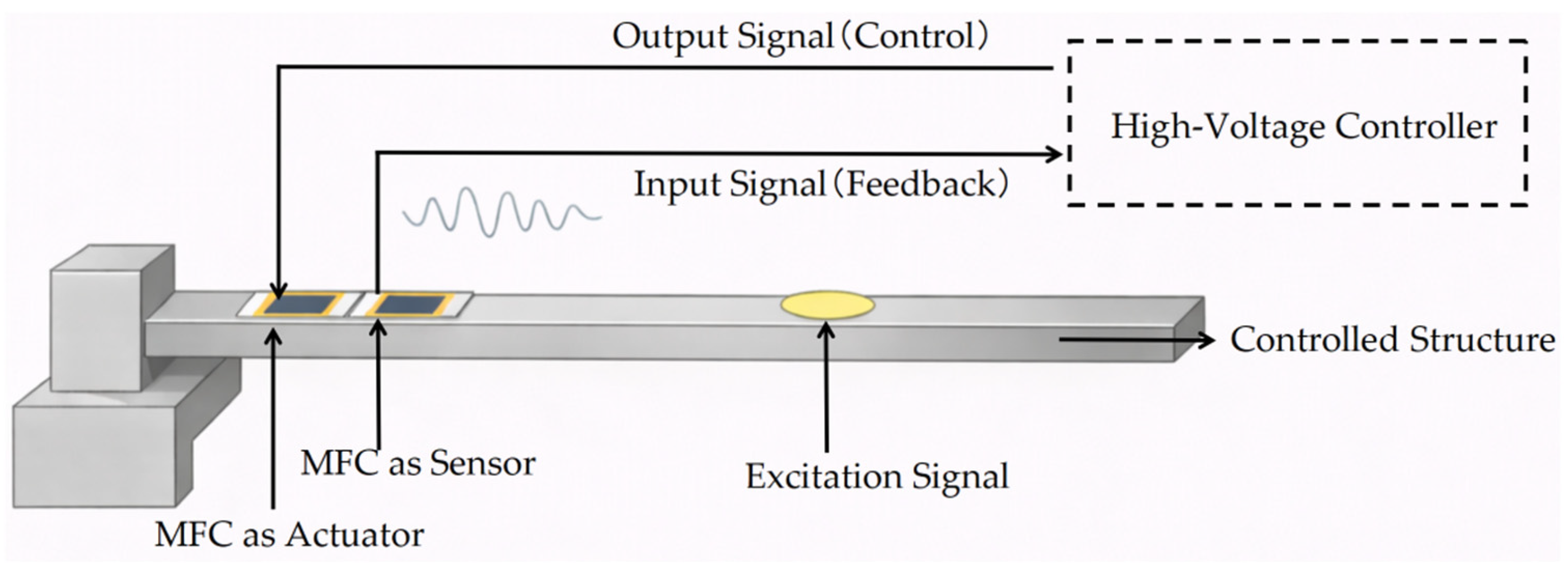
Aiming at the requirements of MFC actuators operating in the asymmetric high-voltage range of −500 V to 1500 V and the miniaturization of driving power supplies, this study designs a compact self-tuning digital high-voltage controller and applies it to a vibration active control system. The schematic diagram of the vibration active control system is shown in Figure 3.
Figure 3 illustrates the vibration active control system. In this system, the MFC sensor measures the structural vibration and transmits the feedback signal to the controller. The high-voltage controller generates the control voltage to drive the MFC actuator attached to the flexible structure. Through this closed-loop control process, the controller continuously adjusts the driving voltage to suppress the vibration of the controlled structure (e.g., a cantilever beam or a UAV wing).
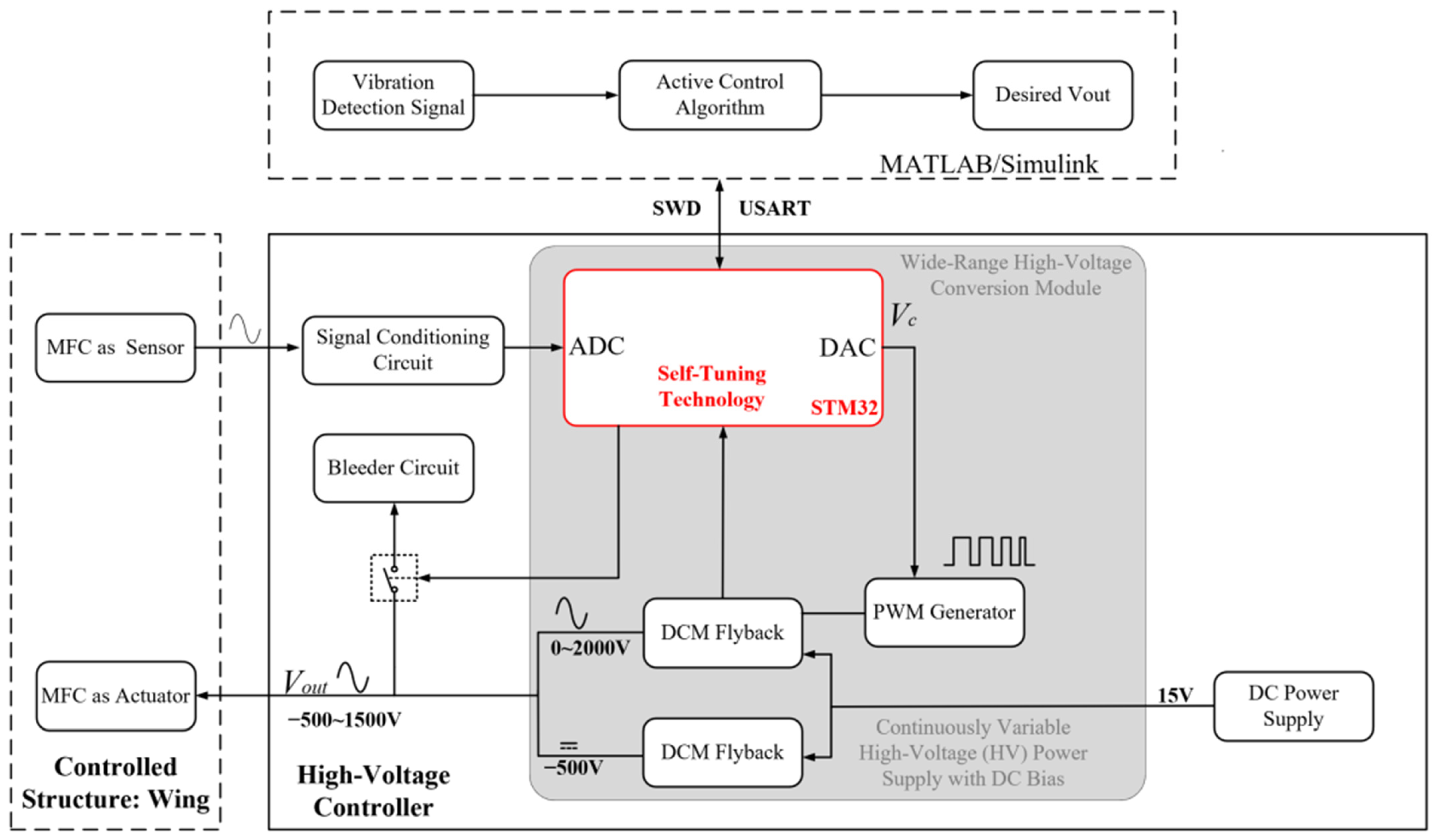
The internal architecture of the proposed high-voltage controller is shown in Figure 4. It comprises a continuously adjustable wide-range high-voltage power supply with real-time control functionality and auxiliary circuits. The control system can collect feedback signals in real time, and it incorporates vibration active control algorithms, thereby achieving a complete miniaturization solution for vibration suppression systems. The continuously adjustable wide-range high-voltage power supply employs a DCM flyback topology converter. It combines a fixed 500 V DC voltage with a 0–2000 V adjustable voltage to achieve a wide-range adjustable voltage output of −500 V to 1500 V.
A Type-II digital compensator is implemented based on the STM32 platform, with BP neural network employed for parameter self-tuning, achieving closed-loop control of the wide-range voltage driving power supply. The system is capable of identifying load variations in real time and adaptively adjusting control parameters and PWM duty cycle. Furthermore, peripheral circuits including auxiliary power supply, signal conditioning, voltage divider, and bleeder are designed to ensure high system stability and reliability.
A vibration active control system is constructed using MATLAB 2023b/Simulink and STM32. Program download and debugging are achieved via the Serial Wire Debug (SWD) protocol supported by the STM32 microcontroller. Real-time data transmission between the controller and the host computer is accomplished through the Universal Synchronous/Asynchronous Receiver/Transmitter (USART) serial port, enabling the vibration active control algorithm to be compiled and executed in real time within the controller. This approach effectively addresses the issues of large volume and weight in traditional controllers, offering both high development efficiency and superior real-time performance.

2.2. Design of Continuously Adjustable Wide-Range High-Voltage Power Supply with DC Bias

2.2.1. Modeling of Flyback Switching Power Supply System

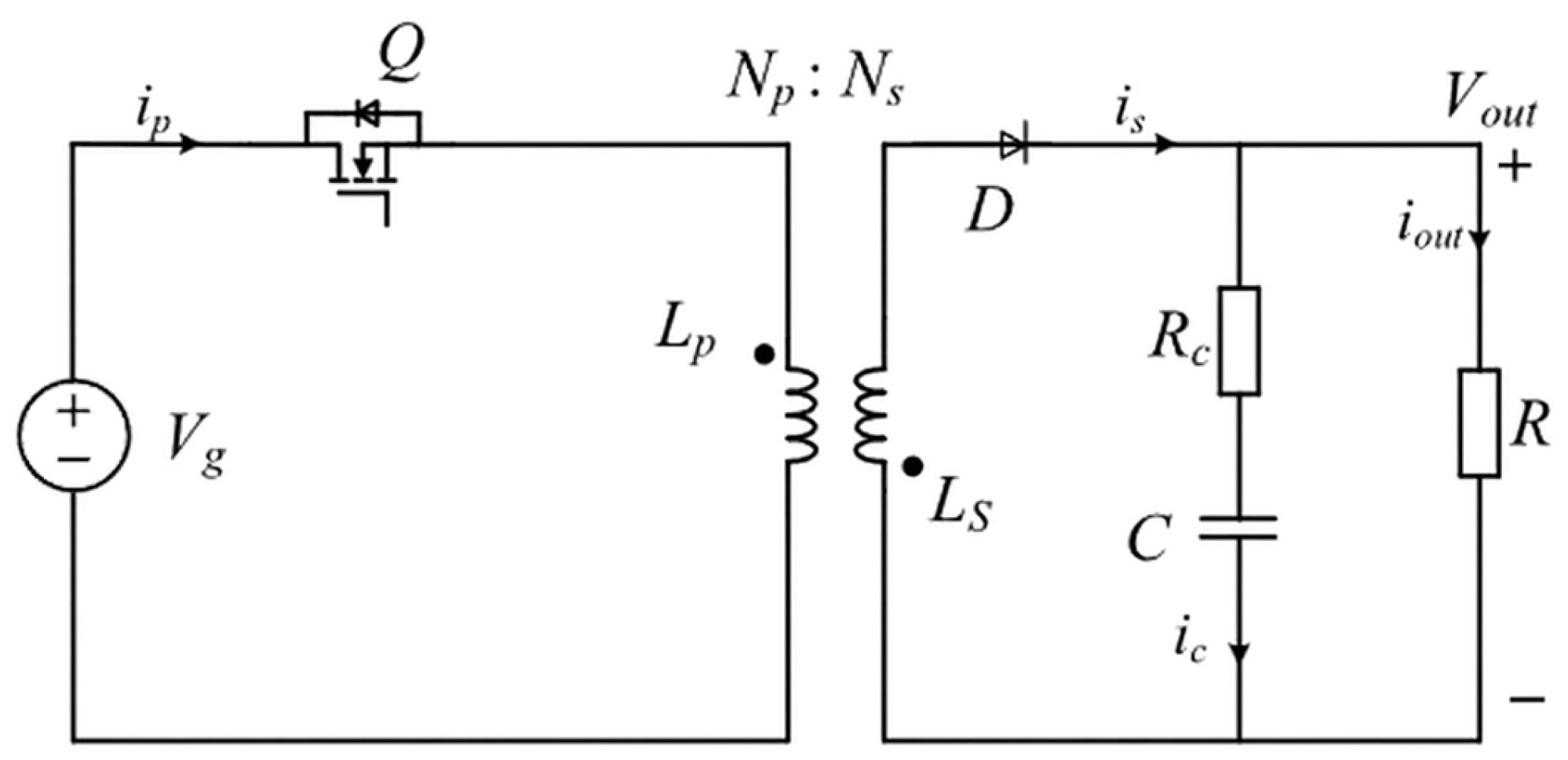
Flyback switching power supplies have advantages in the miniaturized circuit design of piezoelectric driving power supplies due to their small number of components, simple structure, and suitability for small to medium power scenarios. DCM flyback converter is adopted as the topology of the driving power supply and regulates control in current mode. The schematic diagram of the traditional DCM flyback switching power supply is shown in Figure 5. V g denotes the input voltage; L p and L s represent the inductances of the primary and secondary windings of the transformer, respectively; N p and N s denote the number of turns of the primary and secondary windings; D is the duty cycle; T s is one switching period; Q represents the switching device; C is the output filter capacitor; R is the load resistance; and V o u t is the output voltage.
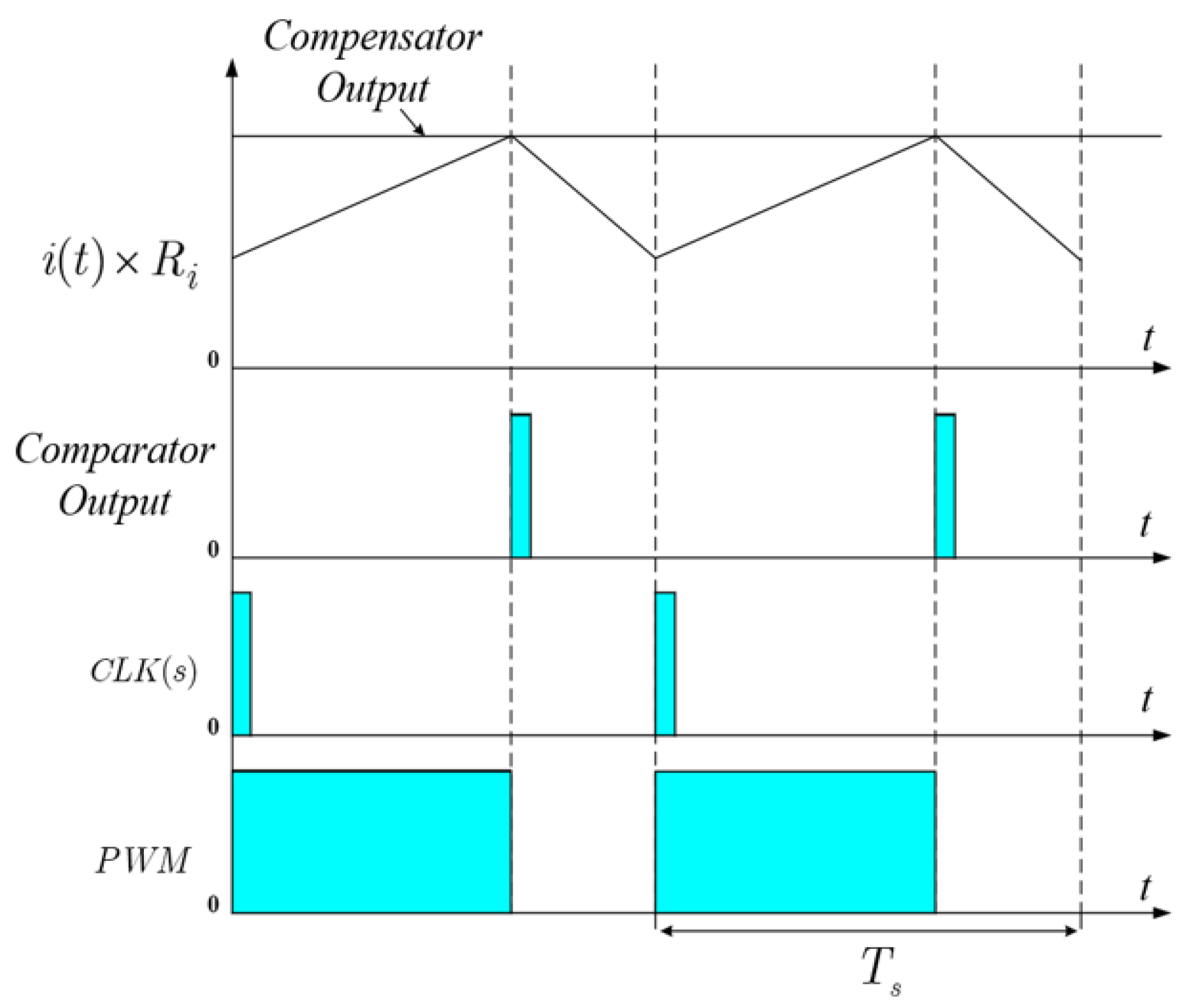
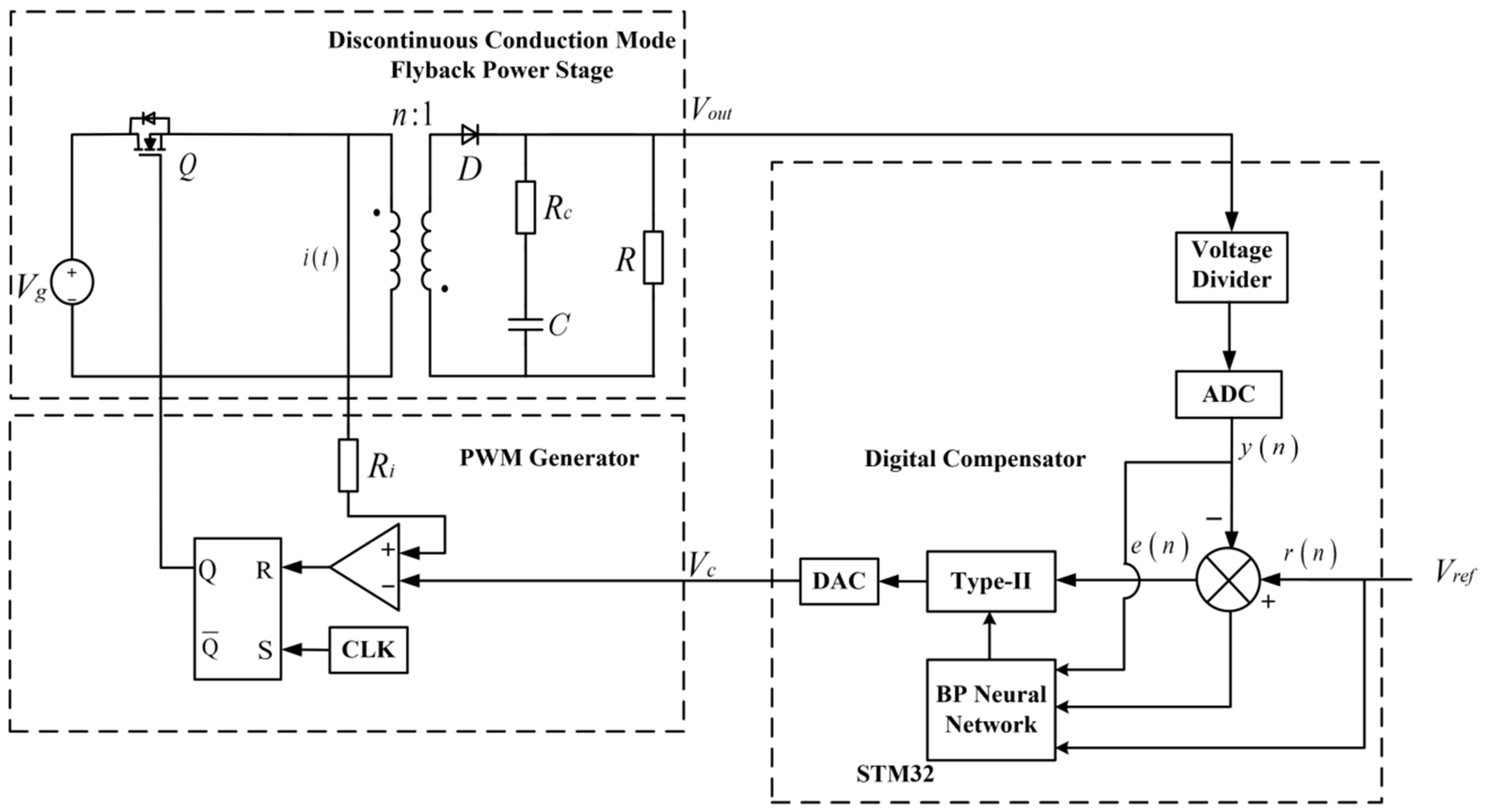
The wide-range high-voltage conversion module designed in this paper is generated by the combination of the following two output channels: one is 500 V DC, and the other is a 0–2000 V voltage-current dual closed-loop flyback adjustable power supply which is shown in Figure 6. The flyback power supply control system is a closed-loop control system, mainly composed of a compensator, PWM generator, and power stage [15]. The power stage has been presented in the previous section. Its output is denoted as V o u t , R i represents the sampling resistor, and i ( t ) denotes the transformer current. In the STM32-based controller, V r e f is the input reference voltage. The input layer of the neural network receives the reference signal r ( n ) , output signal y ( n ) , and error signal e ( n ) , while V C denotes the control signal generated by the controller. Figure 7 shows the waveform generation process of the PWM generator; T s denotes the period. In DCM, the flyback power supply has three operating stages [16,17].
This study proposes a dual closed-loop control method, in which the voltage loop sets the target current threshold, and the current loop monitors and regulates the peak inductor current. The switching transistor Q closes upon receiving the clock signal (CLK), and its turn-off timing is determined by the transformer current i ( t ) . After the switching transistor Q closes, the current i ( t ) in the transformer rises. The voltage signal i ( t ) R i , obtained with a sampling resistor R i , is compared with the compensator’s output V C through a comparator. The switching transistor turns off when i ( t ) R i V C . Therefore, the PWM switching frequency is entirely determined by the clock control part, and the PWM duty cycle is determined by the output voltage of the microcontroller. The voltage outer loop takes the output voltage as input, and the current inner loop takes the inductor current as input. Together with the control algorithm, they constitute a feedback control system to ensure system stability and dynamic characteristics. The proposed solution improves the limitations of traditional power control methods, enhancing dynamic response, disturbance rejection, and steady-state accuracy in the face of load sudden variations and input voltage fluctuations [18].
To further enhance system adaptability and stability, this paper applies digital control to flyback converters and proposes a neural network-based self-tuning method for Type-II parameters, enabling autonomous adjustment of control parameters for more efficient and accurate regulation.
The PWM generator together with the power stage, as shown on the left of Figure 6, has the following transfer function:
V ^ o u t ( s ) V ^ c ( s ) = G 0 1 + s ω z 1 1 + s ω z 2 1 + s ω p 1 1 + s ω p 2
where
G 0 = V g G F B f s R 2 L p 1 S n + S e S n = ( V g / L p ) R i ω p 1 = 2 R C ω p 2 = 2 f s 1 D 1 + 1 / M 2 ω z 1 = 1 R c C ω z 2 = n 2 R M 1 + M L p
In the above equations, V ^ o u t is the power supply output voltage; V ^ c is the compensator output voltage; G 0 is the power stage gain; ω z 1 , ω z 2 , ω p 1 , ω p 2 are the two zeros and two poles of the power stage; V g is the supply voltage; G F B is the small-signal gain of the power stage control system; f s is the switching frequency; L p is the inductance of the primary winding of the transformer; S n is the rate of change in voltage across the sampling resistor R i when the switch transistor is turned on; S e is the external ramp compensation signal used to suppress subharmonic oscillations, which is zero in this power supply; R is the power stage load; C is the filter capacitor; D is the duty cycle; R c is the equivalent series resistance of the filter capacitor; M is the voltage transfer ratio; and n is the transformer turn ratio.

2.2.2. Traditional Type-II Compensator Design

To enhance the frequency response and loop stability of flyback switching power supply systems, compensators are introduced. Compensation techniques for classic feedback circuits are typically categorized into the following three types: Type-I, Type-II, and Type-III. The Type-I compensation structure is the simplest but exhibits slower response and limited application flexibility. Type-III compensation networks are more suitable for topologies featuring LC resonance. Based on the signal model derivation for discontinuous conduction mode flyback power supplies in Section 2.2.1, this paper adopts the Type-II compensation model.
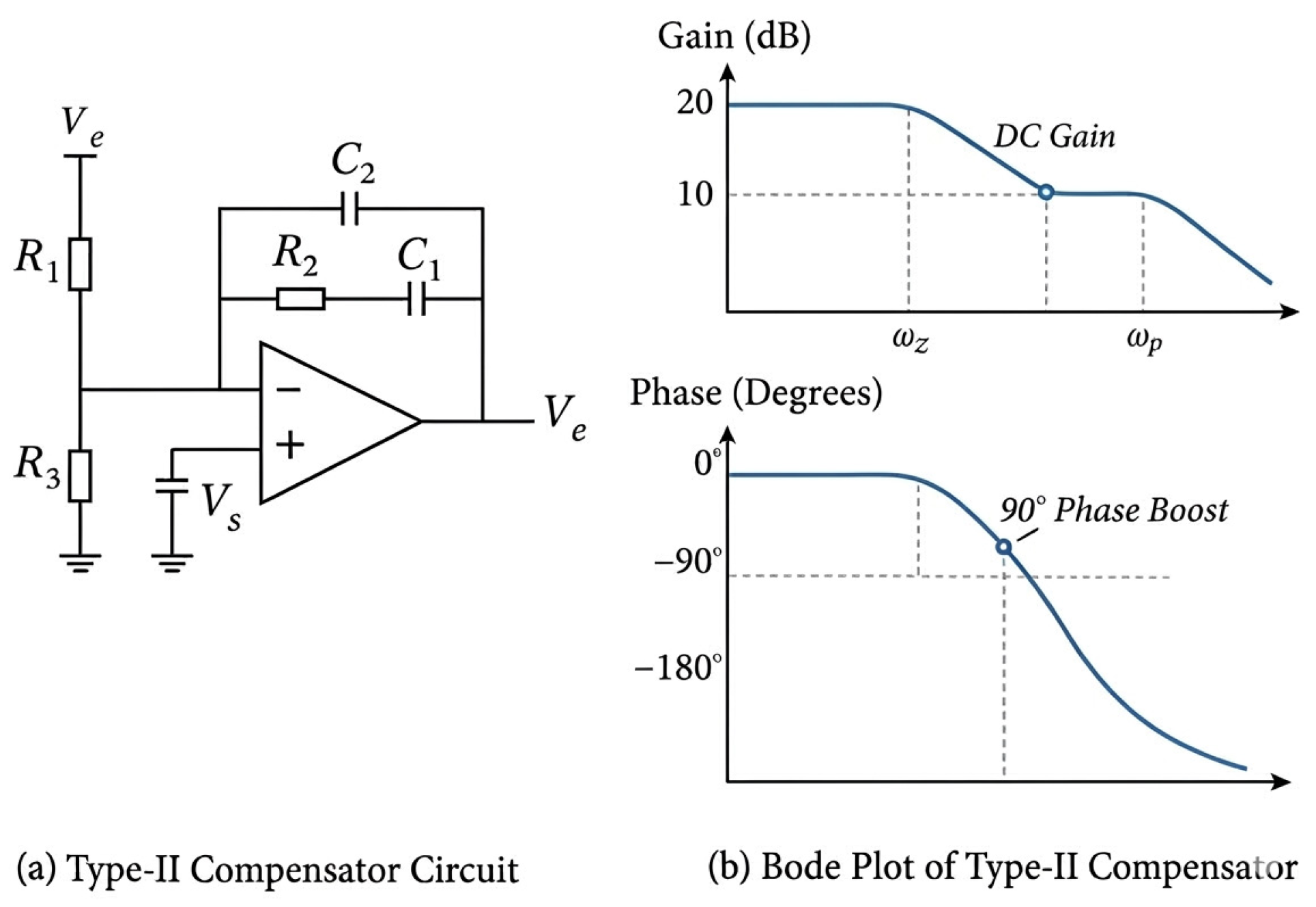
The Type-II compensator is widely employed in switching power supply control loops due to its capability to enhance phase margin while maintaining sufficient low-frequency gain. The circuit configuration is illustrated in Figure 8a.
Resistors R 1 and R 3 form the voltage feedback divider from the output voltage V O . The non-inverting terminal of the operational amplifier is connected to the reference voltage V S , while the output of the error amplifier is denoted as V e . The compensation network consists of R 2 , C 1 , and C 2 . The series combination of R 2 and C 1 introduces a compensation zero, whereas capacitor C 2 generates a high-frequency pole to attenuate switching noise. Under the assumption of an ideal operational amplifier, the transfer function of the compensator can be expressed as
H ( s ) = V e ( s ) V o ( s ) = 1 + C 1 R 2 s ( C 2 + C 1 ) R 1 s + C 1 C 2 R 1 R 2 s 2
Figure 8b presents the corresponding Bode plot. The phase response exhibits a distinct phase-boost region between the zero and the high-frequency pole, thereby improving the system phase margin and stability. The DC gain is determined by the resistor network in the compensator circuit. The figure illustrates the relationship between the circuit structure and the corresponding frequency-domain characteristics of the Type-II compensator [19]. The corresponding corner frequencies are expressed as
w z 1 = 1 R 2 × C 1 w p 1 = 1 R 2 × C 2 w p 0 = 0
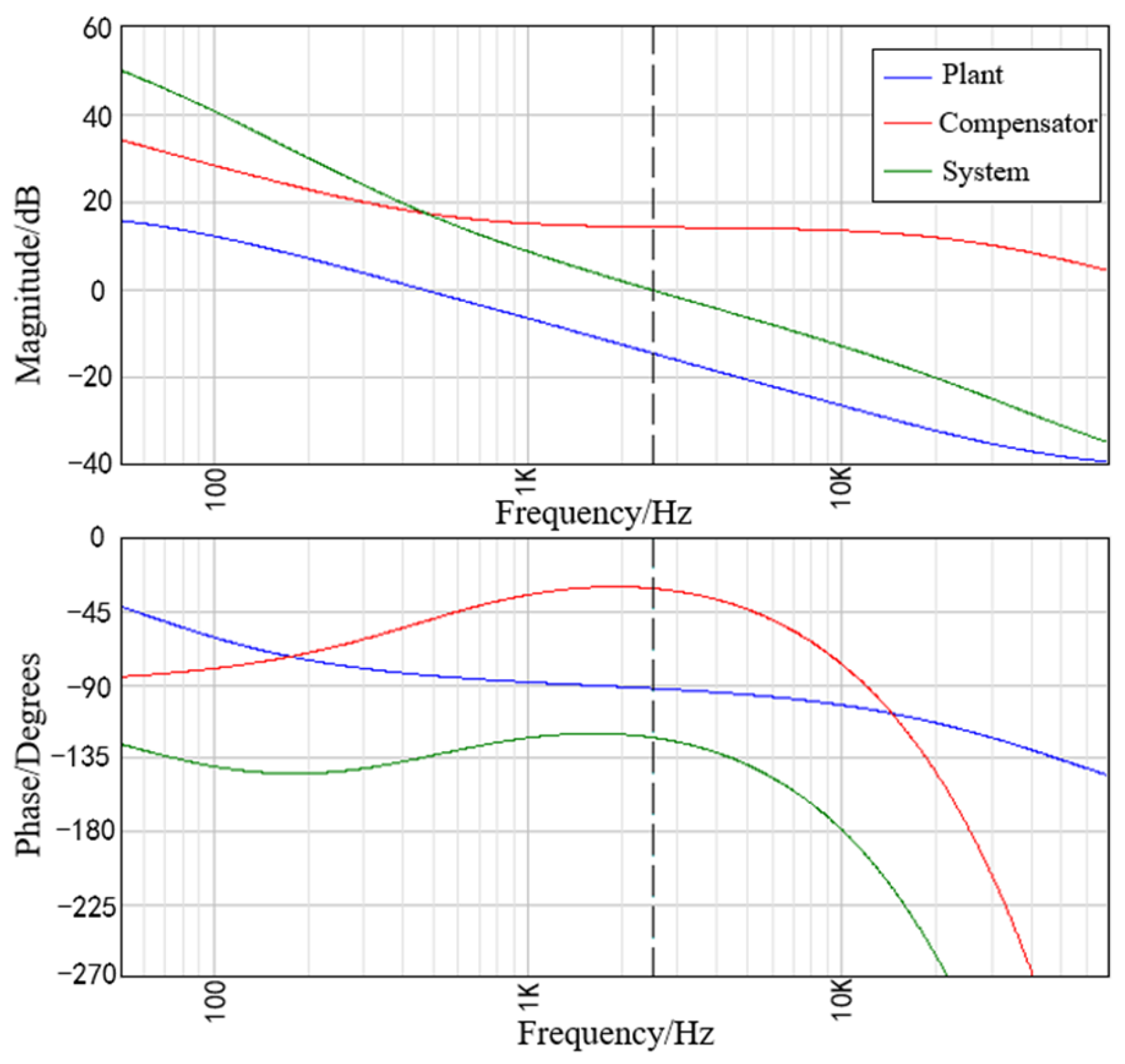
where w z and w p denote the zero and pole frequencies of the compensator, respectively (rad/s). The position of poles and zeros are optimized by rationally configuring the crossover frequency of the compensator, thereby enhancing gain in the low-frequency band and effectively arranging poles and zeros in the mid-to-high-frequency band to increase phase margin. The zero frequency is set at 1/5 of the crossover frequency to ensure low-frequency gain enhancement, while the second pole frequency is positioned above nine times the crossover frequency to attenuate high-frequency noise. Ultimately, the system achieves a crossover frequency of 2500 Hz, with a phase margin of 58° and a gain margin of 13 dB. The frequency response characteristics are shown in Figure 9.
After completing the continuous-domain compensator design, the controller was discretized to enable digital implementation on the STM32 platform. With a sampling period of T = 10 μs, the Tustin transformation was employed to map the transfer function from the s-domain to the z-domain [20]. The fundamental transformation relationship is given in Equation (5), where T denotes the sampling period, and s and z represent the Laplace-domain and z-domain variables, respectively.
s = 2 T 1 z 1 1 + z 1
By substituting this mapping into the continuous-time transfer function (Equation (3)), the discrete-time transfer function can be obtained as follows:
H [ z ] = B 2 z 2 + B 1 z 1 + B 0 A 2 z 2 A 1 z 1 + 1
Subsequently, the discrete transfer function H ( z ) was expressed as a discrete-time difference equation, representing the implementation form of the digital compensator and its corresponding discrete parameters as follows:
u [ n ] = A 1 u [ n 1 ] + A 2 u [ n 2 ] + B 0 e [ n ] + B 1 e [ n 1 ] + B 2 e [ n 2 ] A 1 = 0.938538248277 A 2 = 0.061461751723 B 0 = 0.001244000962 B 1 = 0.000082815457 B 2 = 0.001161185505
Equation (7) represents the difference equation form of the digital compensator. In this equation, u ( n ) denotes the controller output at the current sampling instant, while u ( n 1 ) and u ( n 2 ) denote the controller outputs at the previous and two-step previous sampling instants. Similarly, e ( n ) , e ( n 1 ) , and e ( n 2 ) represent the error signals at the current, previous, and two-step previous sampling instants, respectively. The coefficients A 1 ,   A 2 ,   B 0 ,   B 1 and B 2 are the parameters of the difference equation, which are obtained from the discrete transfer function derived from the continuous-time compensator transfer function using the Tustin transformation.
The Tustin transform ensures that the stability of the continuous system is maintained after discretization, allowing the digital compensator to be reliably implemented on the STM32 platform. However, during practical operation, output voltage fluctuations and variations in load capacitance may lead to changes in the power stage parameters, making it difficult for a fixed-parameter compensator to maintain optimal dynamic performance. Therefore, a BP neural network is introduced in the following subsection to perform adaptive parameter tuning of the digital compensator, thereby enhancing system performance under varying operating conditions.

2.2.3. BP Neural Network Optimization of Type-II Digital Compensator

To address control requirements under dynamic loads and complex operating conditions, a self-tuning control mechanism is introduced. It employs a Backpropagation (BP) neural network [14] to adaptively optimize the pole-zero parameters of the Type-II compensator, thereby enhancing the system’s transient response.
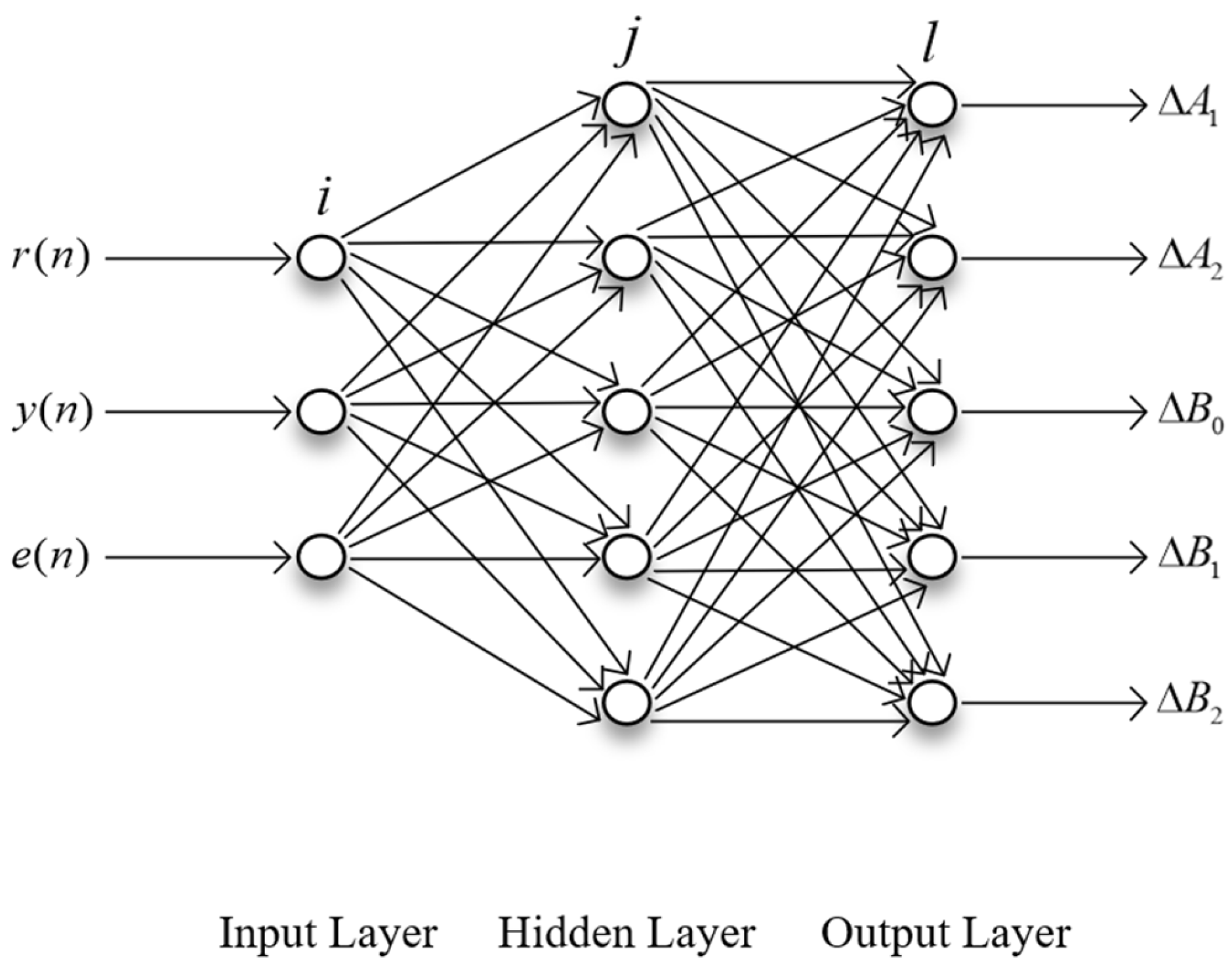
Considering both function approximation theory and computational complexity in control system implementation, a single hidden-layer structure is adopted. Based on multiple comparative experimental tests, the neural network employed in this study adopts a three-layer feedforward structure, comprising three input nodes, five hidden nodes, and five output nodes. Its specific architecture is illustrated in Figure 10.
The input layer of the network receives reference signals r ( n ) , output signals y ( n ) , and error signals e ( n ) , as shown in Figure 10. Using the gradient descent method [21], the network weights and thresholds are continuously adjusted through backpropagation to minimize the performance indicator function. The weight update rule is expressed as Δ w = η J w , where η denotes the learning rate and J represents the defined performance indicator function; w refers to the weights of the network, which are the parameters that are adjusted during training to minimize the error. The output layer Δ A 1 , Δ A 2 , Δ B 0 , Δ B 1 , Δ B 2 represents the increment of the compensator coefficients in Equation (7), thereby achieving dynamic optimization of system parameters.
The output of the input layer is as follows:
O i ( 1 ) = x ( i )       ( i = 1 , 2 , 3 )
where x ( i ) represents the input variables of the input layer.
The inputs and outputs of the hidden layer are as follows:
n e t j ( 2 ) ( n ) = i = 1 5 w i j ( 2 ) O i ( 1 )
O j ( 2 ) ( n ) = f ( n e t j ( 2 ) ( n ) ) ( j = 1 , 2 , Λ , 5 )
where w i j ( 2 ) denotes the hidden layer weights; f denotes the activation function. The L-ReLU function is adopted, expressed as follows:
f ( x ) = x x > 0 0.01 x x 0
The inputs and outputs of the output layer are as follows:
n e t l ( 3 ) ( n ) = j = 1 5 w j l ( 3 ) O j ( 2 )
O l ( 3 ) ( n ) = f ( n e t l ( 3 ) ( n ) ) ( l = 1 , 2 , Λ , 5 )
where w j l ( 3 ) denotes the output layer weights; superscripts (1), (2), and (3) represent the three layers respectively; subscripts i, j, and k denote the ith, jth, and kth node in the corresponding layer; n denotes the nth time step.
The performance indicator function is set as follows:
E ( n ) = 1 2 ( r ( n ) y ( n ) ) 2
According to the gradient descent method, the adjustment amount for the output layer weights is as follows:
Δ w j l ( 3 ) ( n ) = η E ( n ) w j l ( 3 ) + α Δ w j l ( 3 ) ( n 1 )
where
E ( n ) w j l ( 3 ) = E ( n ) y ( n ) y ( n ) Δ u ( n ) Δ u ( n ) O l ( 3 ) ( n ) O l ( 3 ) ( n ) n e t l ( 3 ) ( n ) n e t l ( 3 ) ( n ) w j l ( 3 ) ( n )
n e t l ( 3 ) ( n ) w j l ( 3 ) ( n ) = O j ( 2 ) ( n )
In Equation (15), η denotes the learning rate; α denotes the inertia coefficient. Since y ( n ) Δ u ( n ) in Equation (16) is unknown, it is approximated by the sign function sgn ( y ( n ) Δ u ( n ) ) . The resulting inaccuracies can be compensated by adjusting the learning rate η . The expression for the sgn function is as follows:
sgn ( x ) = 1 x > 0 0 x = 0 1 x < 0
From Equation (7), it is derived that:
Δ u ( n ) O 1 ( 3 ) ( n ) = u ( n 1 ) Δ u ( n ) O 2 ( 3 ) ( n ) = u ( n 2 )
Δ u ( n ) O 3 ( 3 ) ( n ) = e ( n ) Δ u ( n ) O 4 ( 3 ) ( n ) = e ( n 1 ) Δ u ( n ) O 5 ( 3 ) ( n ) = e ( n 2 )
The adjustment quantity for the output layer weight matrix is as follows:
Δ w j l ( 3 ) = η δ l ( 3 ) O j ( 2 ) ( n ) + α Δ w j l ( 3 ) ( n 1 )
where
δ l ( 3 ) = e ( n ) sgn ( y ( n ) Δ u ( n ) ) Δ u ( n ) O l ( 3 ) ( n ) f ( n e t l ( 3 ) ( n ) )   ( l = 1 , 2 , Λ , 5 )
Similarly, the adjustment quantity for the hidden layer weight matrix is as follows:
Δ w i j ( 2 ) = η δ j ( 2 ) O i ( 1 ) ( n ) + α Δ w i j ( 2 ) ( n 1 )
where
δ j ( 2 ) = f ( n e t j ( 2 ) ( n ) ) l = 1 5 δ l ( 3 ) w j l ( 3 ) ( n ) ( j = 1 , 2 , Λ , 5 )
Based on Equations (20) and (22), the network weights are iteratively corrected while the Type-II compensation control parameters are simultaneously optimized. Ultimately, through multiple adjustments, the optimal parameter configuration that satisfies the circuit’s dynamic performance requirements is achieved.
The proposed BP neural network does not rely on any offline pre-collected dataset or pre-trained model. The digital compensator algorithm and the BP neural network algorithm complete one forward propagation and one weight update during each switching period. The weight update process is embedded in the closed-loop control operation and is performed online in every control cycle based on real-time reference, output, and error signals. Therefore, no separate training stage or fixed training dataset is required, and the controller operates in an online self-tuning manner.
For embedded implementation, the controller is realized on an STM32G431 microcontroller operating at a clock frequency of 170 MHz, with a system switching frequency of 70 kHz. The adopted three-layer 3–5–5 BP neural network structure involves a limited number of multiply–accumulate operations and L-ReLU evaluations, and its computational scale remains well within the available processing capability. The use of the L-ReLU activation function avoids exponential computations and further reduces the computational burden compared with the sigmoid function. Experimental results confirm stable system operation under practical working conditions.
To realize the complete functionality of the high-voltage controller, peripheral circuits such as bleeder circuits, signal conditioning circuits, and auxiliary power supply are also designed.

3. Experimental Verification and Result Analysis

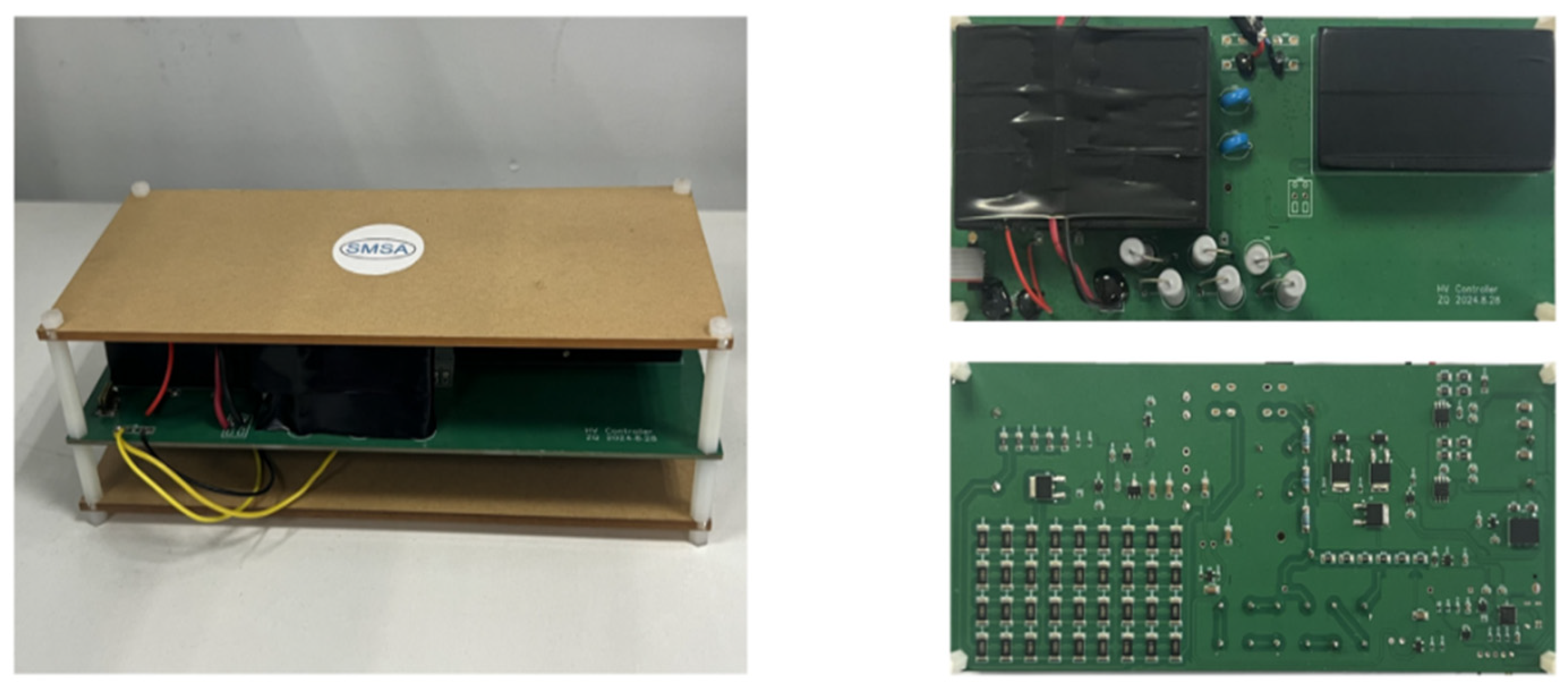
This section evaluates the performance of the developed high-voltage controller, as shown in Figure 11. In the following description, the high-voltage controller using the traditional Type-II compensator is called the traditional high-voltage controller, and the high-voltage controller using the BP neural network-optimized Type-II digital compensator is called the BP neural network-optimized type-II compensator. The key indicators such as output capability, transient response characteristics, load-driving capability, real-time control performance, and system efficiency of the two high-voltage controllers are compared. The self-tuning high-voltage controller is applied to vibration control experiments to further verify its effectiveness in vibration control application.

3.1. Step-Response Experiment

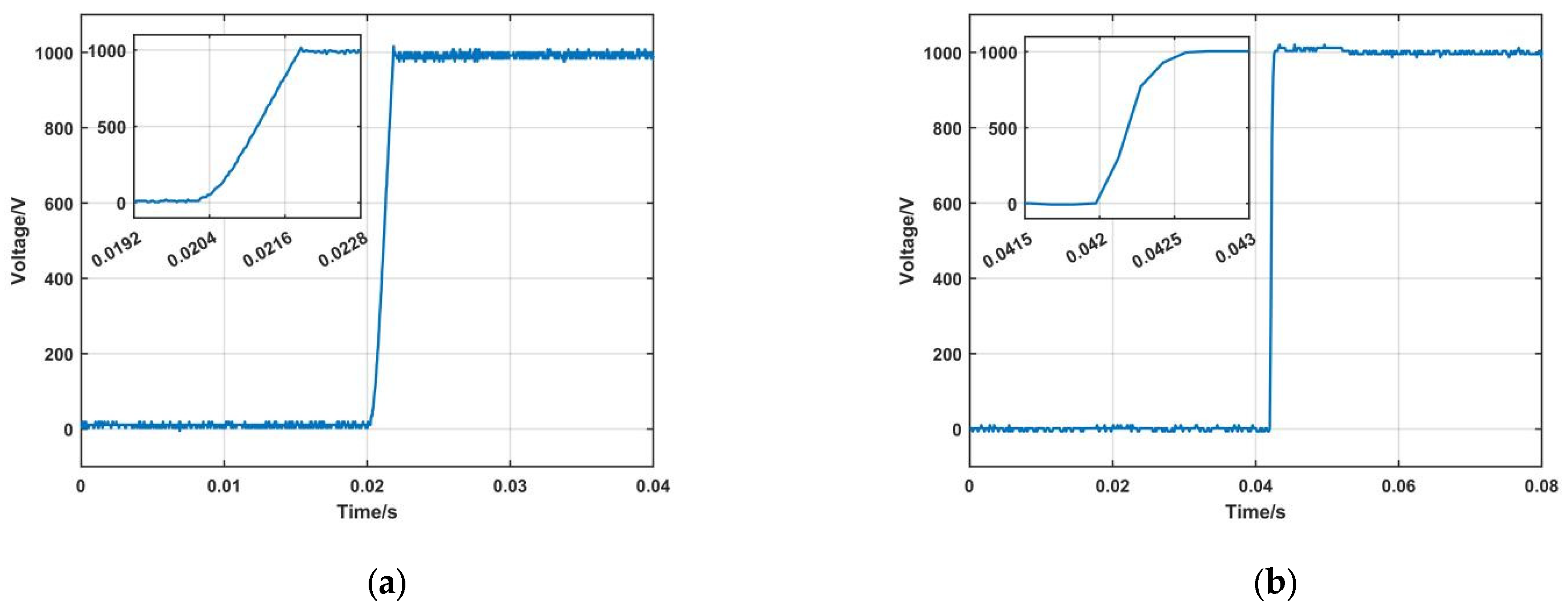
Step response is an important indicator for evaluating the dynamic performance of power supply systems, in which the step rise time directly reflects the response speed of the high-voltage driving controller. This section evaluates the dynamic performance of the high-voltage controller under no-load conditions and compares the dynamic response of the high-voltage controller under the two compensators by reading the step rise time.
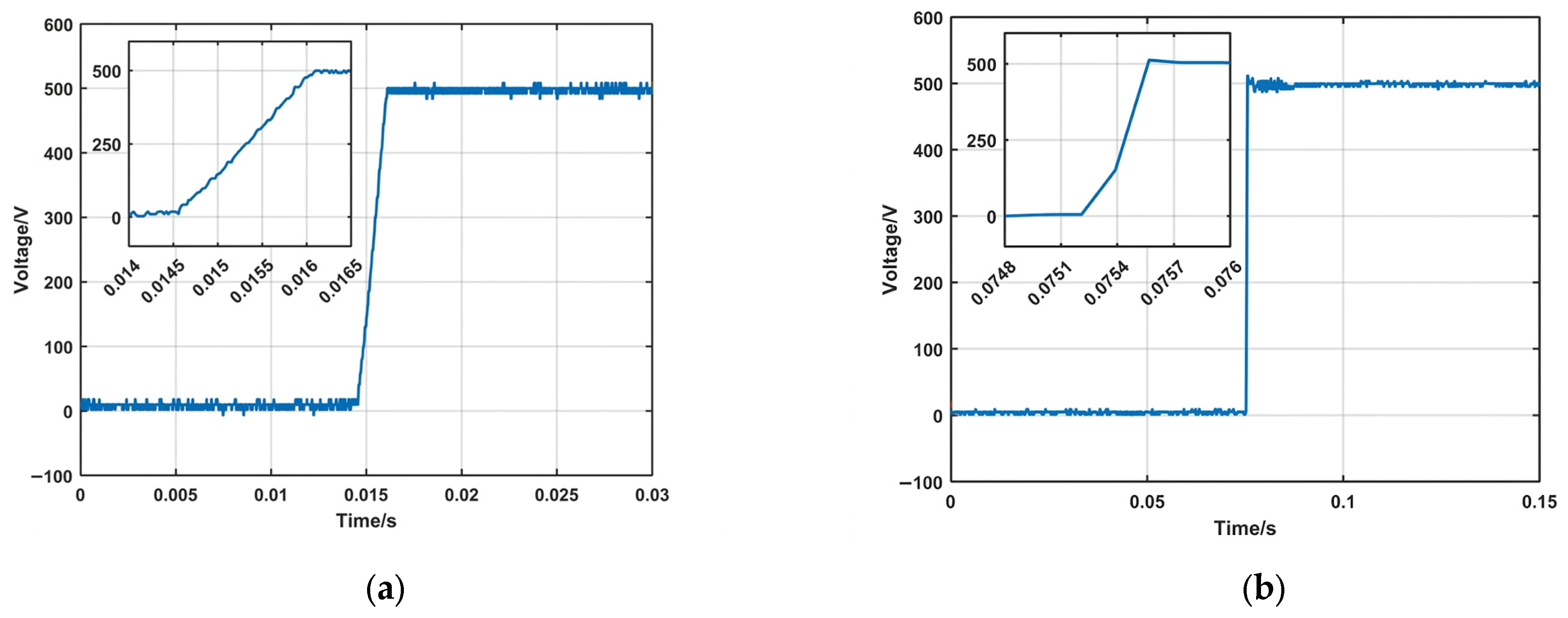
The experimental results show that, in the 0 V to 500 V step-response tests, each control strategy was evaluated through three independent repeated experiments under identical conditions. The variation among the repeated measurements was small, indicating stable system operation. For the conventional high-voltage controller, the rise times of the output voltage were 1.49 ms, 1.50 ms, and 1.53 ms, corresponding to a mean value of 1.51 ms with a standard deviation of 0.02 ms. With the proposed self-tuning control strategy, the rise times were reduced to 0.36 ms, 0.36 ms, and 0.37 ms, yielding a mean value of 0.36 ms with a standard deviation of 0.006 ms.
In the 0 V to 1000 V step-response tests, the rise times of the conventional high-voltage controller were 1.58 ms, 1.60 ms, and 1.61 ms, with a mean value of 1.60 ms and a standard deviation of 0.015 ms. By comparison, the self-tuning controller reduced the response time by 0.90 ms, 0.90 ms, and 0.93 ms, corresponding to an average reduction of 0.91 ms with a standard deviation of 0.017 ms. Figure 12a,b present the typical response waveforms and their local magnified views for the two compensators in the 0 V to 500 V step-response experiments, while Figure 13a,b show the typical response results under the 0 V to 1000 V step-response condition. The waveforms shown in the figures represent representative results obtained from the repeated experiments.
The experimental results demonstrate that the digital compensation strategy combining the BP neural network with the Type-II compensator effectively improves the system response speed, thereby enhancing control accuracy and dynamic performance.

3.2. Load-Driving Capability Test

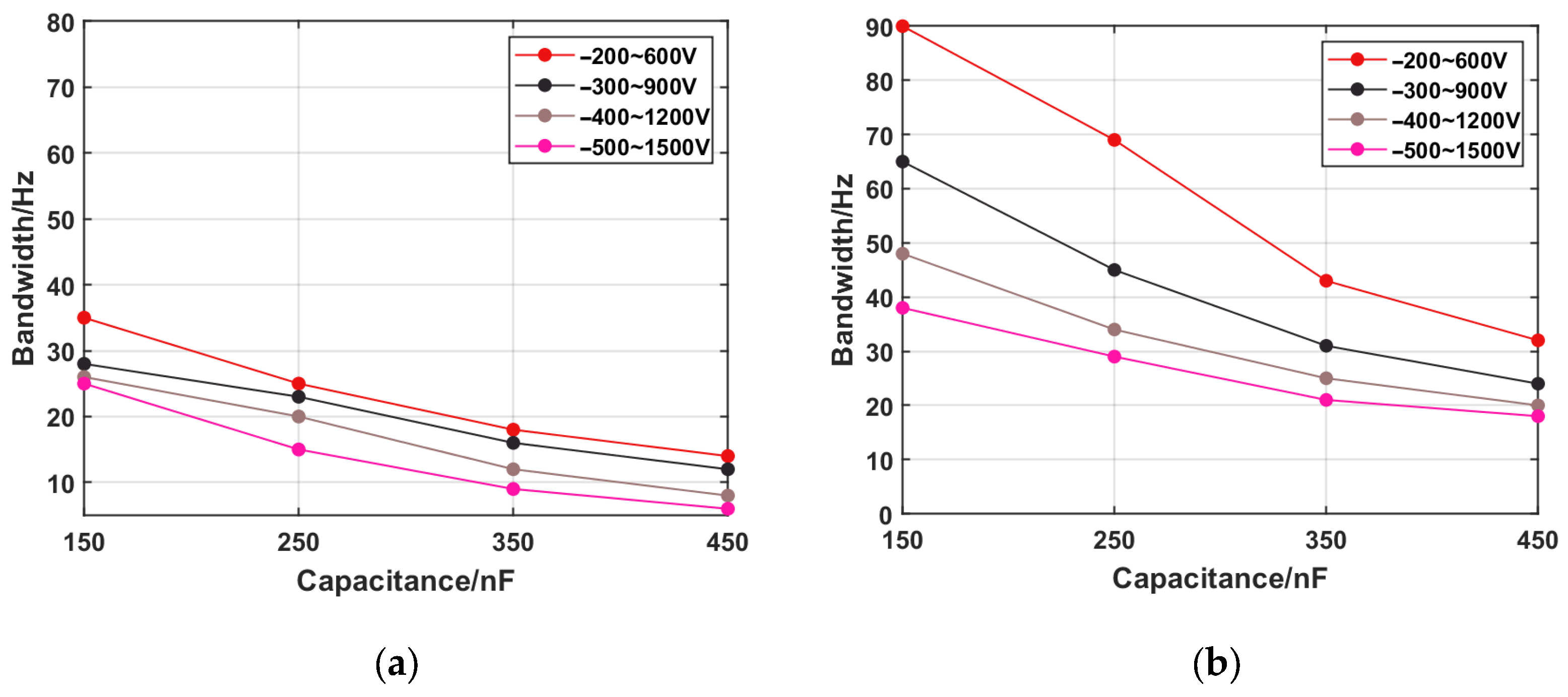
This section tests the load-driving capability of the system. The experiment uses system bandwidth as the evaluation indicator of load-driving capability. The driving voltage with an output signal frequency of 0.5 Hz and peak-to-peak voltage (Vpp) of −500 V to 1500 V was defined as the reference voltage. The signal frequency was gradually increased, and the frequency corresponding to when the output signal Vpp drops by 3 dB (approximately 70.7% of the reference voltage value) was the bandwidth value. The typical capacitance value of a single MFC is approximately 20–50 nF. To simulate the operating condition of multiple MFCs in parallel, this experiment used capacitive loads of 150 nF, 250 nF, 350 nF, and 450 nF as MFC equivalent models, and the corresponding sinusoidal driving voltage output waveforms Vpp are set to −200 V to 600 V, −300 V to 900 V, −400 V to 1200 V, and −500 V to 1500 V, respectively.
Figure 14 shows the comparison results of bandwidth under different loads and voltage conditions for the two compensators. It can be seen that when the load and expected output voltage are fixed, as the signal frequency increases, the Vpp of the output voltage of the high-voltage controller shows different degrees of attenuation. As the load capacitance increases, the bandwidth of the high-voltage controller under both compensators gradually decreases; however, the digital compensator combining BP neural network and Type-II enables the system to exhibit higher bandwidth under all load conditions, especially when the capacitive load is small, which can significantly improve system bandwidth. In addition, as the output waveform Vpp increases, the bandwidth of the high-voltage controller also shows a downward trend, but the BP neural network-optimized Type-II compensator enables the high-voltage controller to still maintain higher bandwidth under all conditions. Compared with the traditional Type-II compensator, BP neural network-optimized Type-II compensator enables the high-voltage controller to significantly improve its frequency upper limit for driving capacitive loads while maintaining the integrity of the output waveform, demonstrating its potential in high-voltage driving applications.
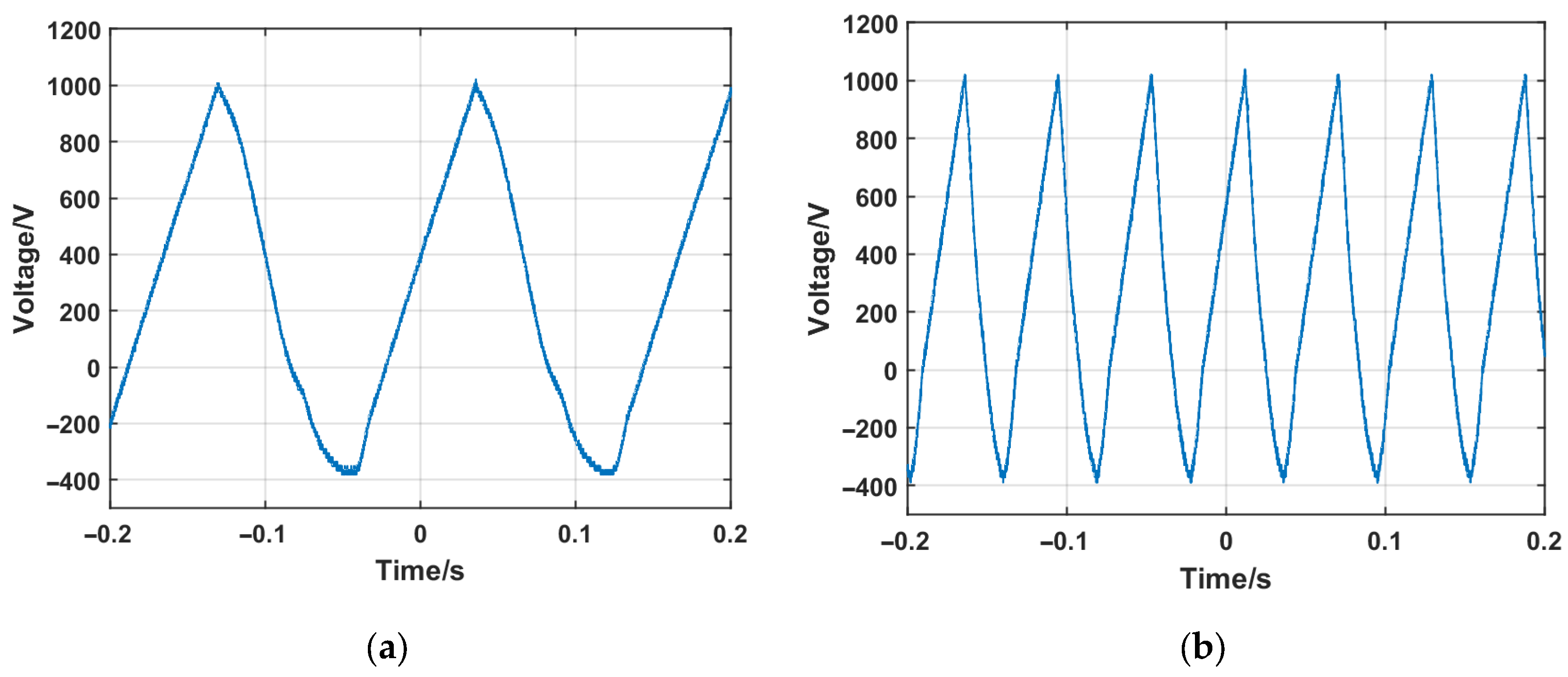
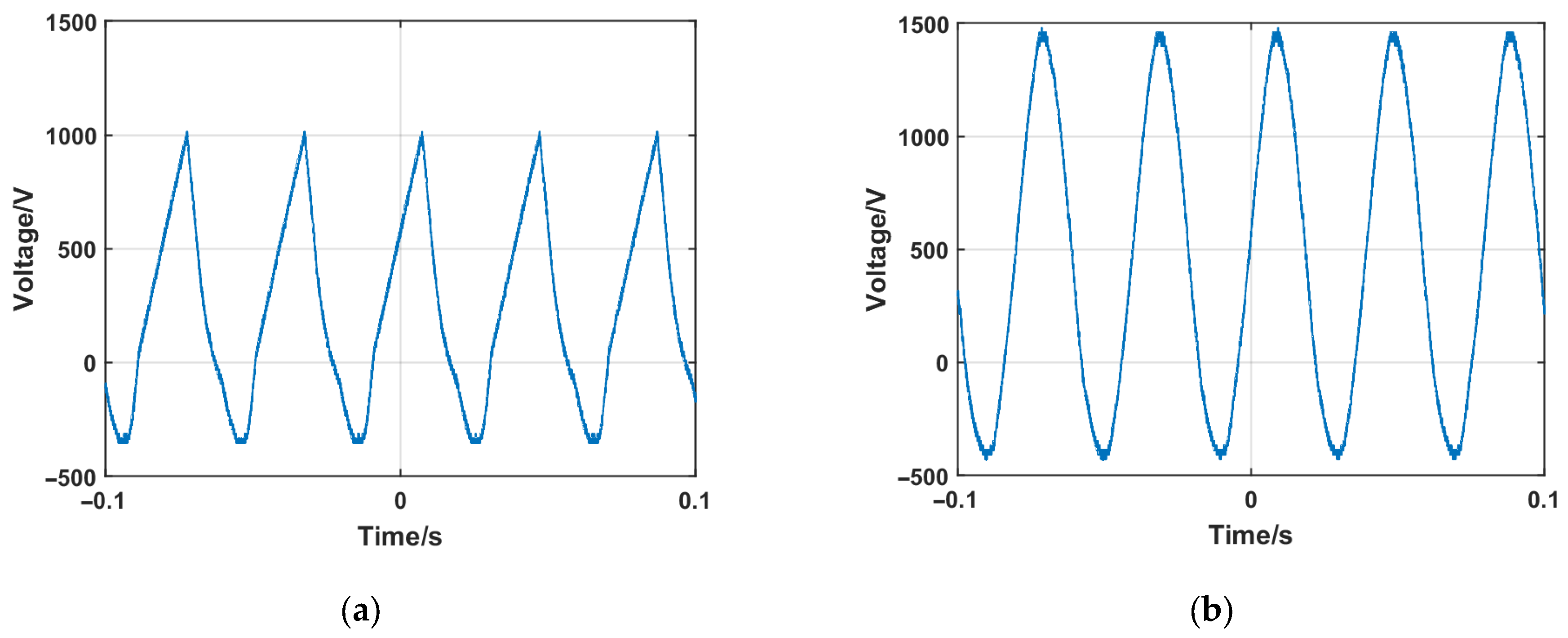
Figure 15 shows when the output voltage waveforms of the two high-voltage controllers attenuate by 3 dB when the load is 450 nF and the driving voltage is −500 V to 1500 V. The two high-voltage controllers show attenuation of the same amplitude at 6 Hz and 18 Hz, respectively, which indicates that the neural network-optimized compensator enables the high-voltage controller to effectively drive capacitive loads at higher frequencies.
Figure 16 presents the case when the load is 150 nF and the driving voltage is −500 V to 1500 V. As the frequency increases to 25 Hz, the output waveform of the high-voltage control under the traditional Type-II compensator has shown 3 dB attenuation, as shown in Figure 16a. The output waveform of the high-voltage controller optimized by BP neural network at 25 Hz is shown in Figure 16b, and its output voltage value and waveform have almost not changed, which verifies the dynamic performance advantage of this controller under light-load high-voltage conditions.

3.3. Real-Time Performance Test

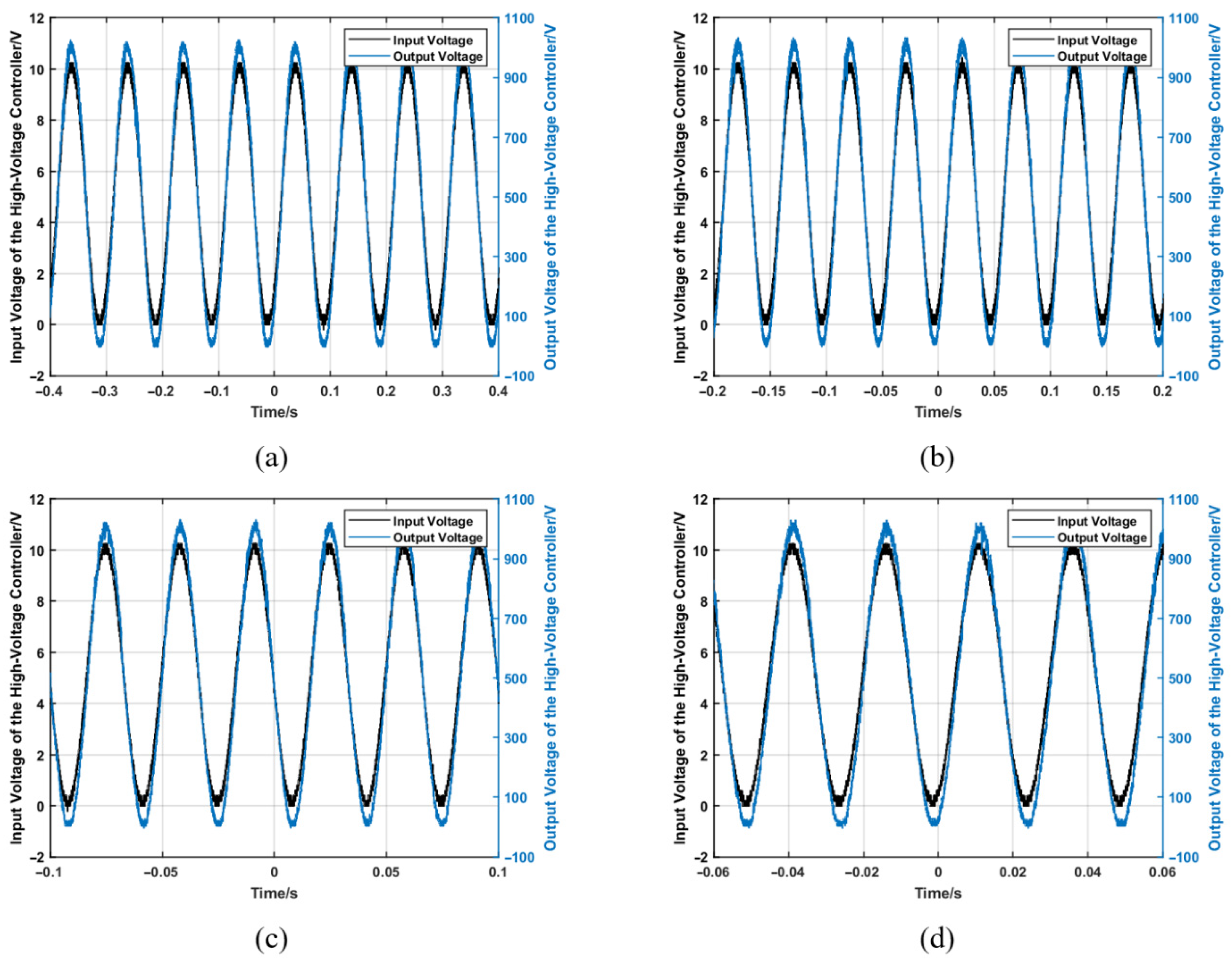
When the analog signal output by the sensor passes through hardware, digital processing is required (such as ADC sampling, signal quantization, and digital compensation), and this process may introduce delay [22]. To ensure the precision and stability of the system, this section measures and analyzes the delay introduced by hardware. The experiment was conducted under no-load conditions. A signal generator was used to generate 0–10 V sine wave signals with frequencies set to 10 Hz, 20 Hz, 30 Hz, and 40 Hz, respectively, as the input signal of the high-voltage controller. The output voltage signal of the high-voltage controller was set to 100 times gain of the input signal and finally outputted a 0–1000 V sine wave signal. The output signals of the signal generator and the high-voltage controller were collected simultaneously by an oscilloscope, and the waveform differences between the two at different frequencies were compared and analyzed to evaluate the real-time response characteristics of the hardware system. The test method and results are shown in Figure 17 and Figure 18, respectively. The test results show that compared with the input waveform, the output waveform of the high-voltage controller does not show obvious phase offset, and the waveform phase difference at different frequencies is less than 10 degrees, indicating that the delay introduced by hardware has been effectively compensated, and the system can respond to input signals quickly and accurately, improving overall control performance.

3.4. Performance Parameters

The performance parameters of the high-voltage controller are listed in Table 1. It is shown that the high-voltage controller, based on the self-tuning algorithm, exhibits asymmetric high-voltage output, excellent transient response, real-time control, strong load-driving capability, high efficiency, and the advantages of compact size and lightweight design.

3.5. Validation Experiment of High-Voltage Controller Effectiveness

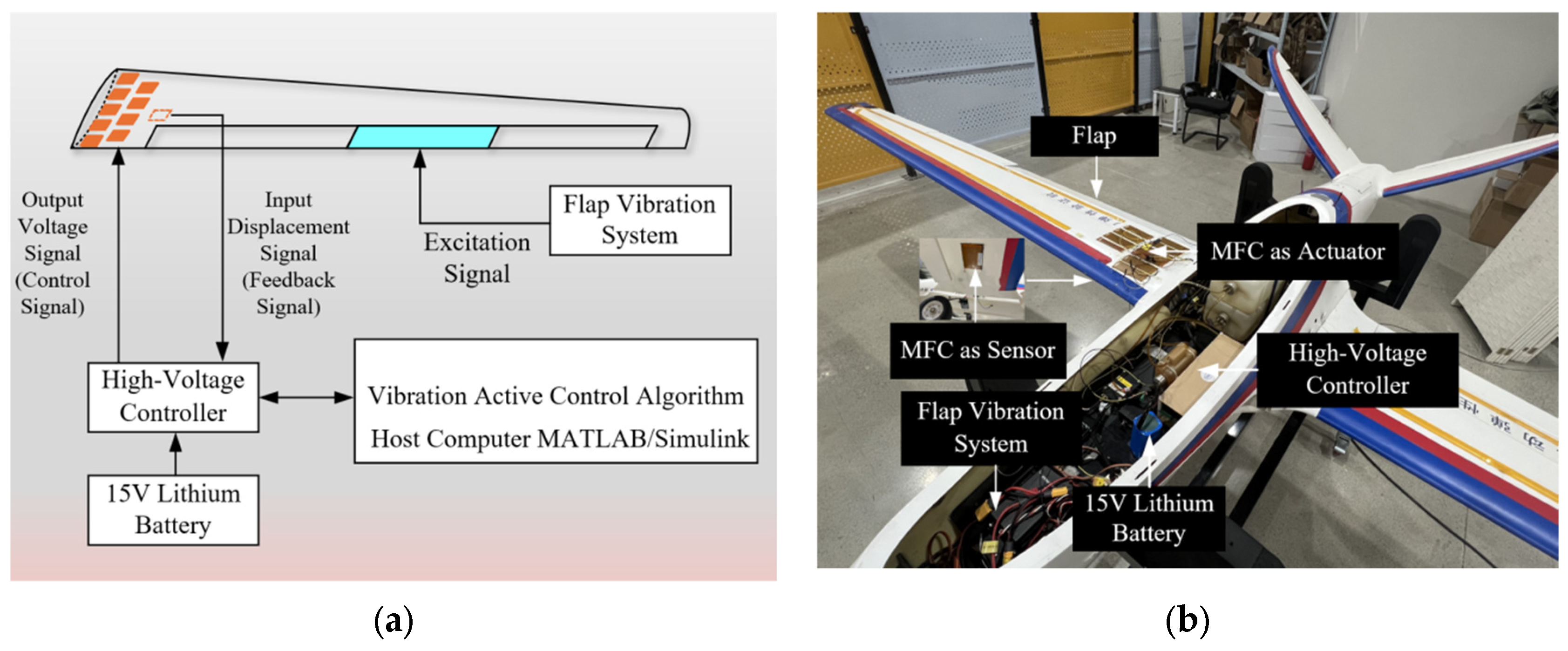
To verify the effectiveness of the designed high-voltage controller in vibration active control, this section applies it to a vibration suppression experiment of a high-aspect-ratio UAV wing based on MFC. The schematic diagram and experimental platform of the vibration control system are shown in Figure 19. Nine MFCs were pasted on the upper surface of one side of the UAV wing as actuators, and one MFC was pasted on the lower surface of the same side as a sensor. The high-voltage controller was installed inside the nacelle to fully utilize its miniaturization advantages. During the experiment, the flap excitation system applied excitation to the flaps on both sides of the UAV. The flap swung at an angle of 20°, causing periodic vibration of the wing. The MFC sensor collected wing vibration signals in real time. The high-voltage controller carrying the vibration active control algorithm generated control voltage according to the feedback signal to drive the MFC actuator to generate reverse vibration, thereby achieving vibration suppression of the wing structure.
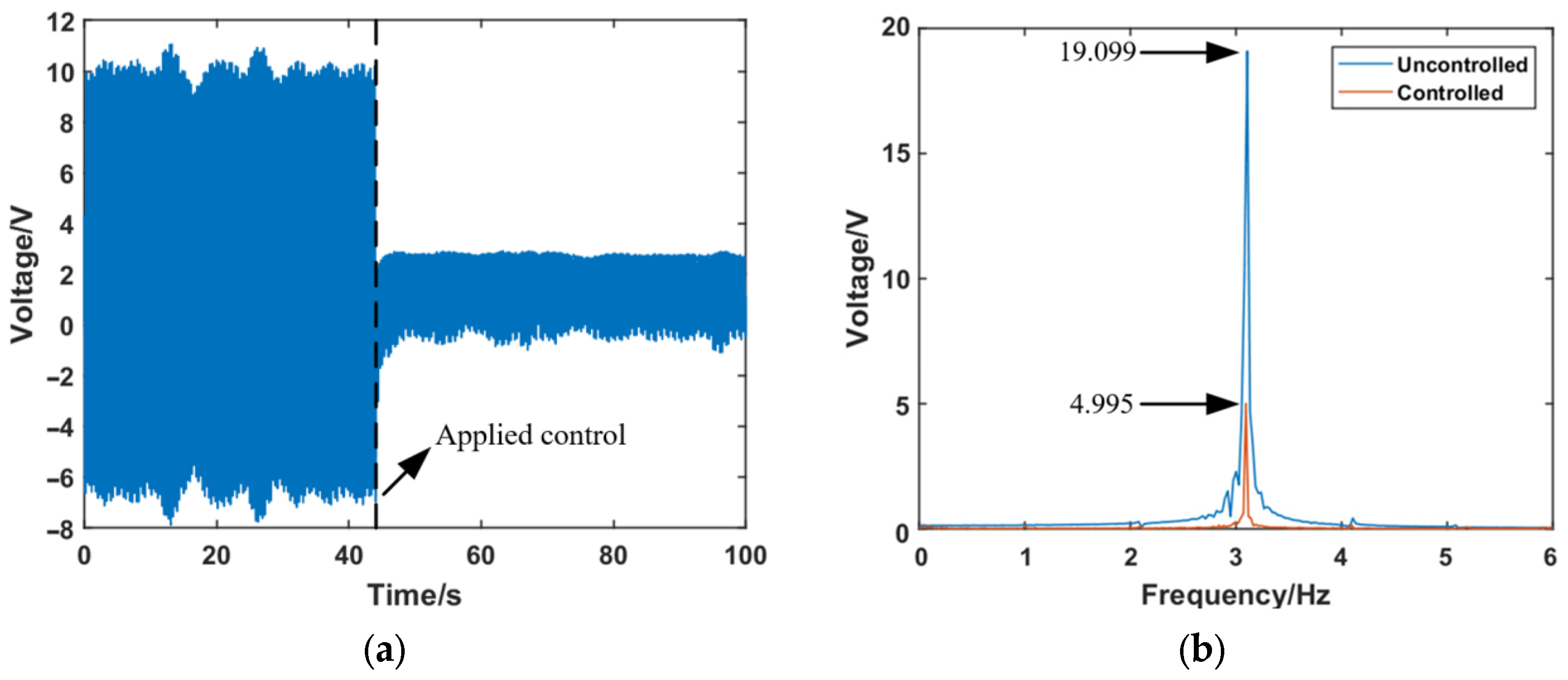
The experimental results show that under a control voltage of 1150 V peak to peak (as shown in Table 2), three independent tests were conducted under the same excitation conditions. The MFC actuator achieved vibration attenuation of approximately 71.97%, 73.85%, and 75.44%, respectively. The average attenuation rate was (73.75 ± 1.74)%, approximately 74%. Figure 20 presents a typical result from the repeated experiments, displaying the time-domain and frequency-domain plots of the MFC sensor voltage before and after control, which demonstrates the excellent performance of the high-voltage controller.

4. Conclusions

The study designs a self-tuning digital control switching power supply-based high-voltage controller for MFC. Through a BP neural network-optimized Type-II compensator, adaptive adjustment of PWM duty cycle and voltage output is achieved. Through the self-tuning algorithm, the controller can automatically adjust control parameters under different loads and operating conditions, ensuring efficient and stable operation of the system. Experimental results show that the high-voltage controller has excellent transient response, strong load capability, and high efficiency and performs well in miniaturization and lightweight.
In practical applications for vibration suppression in a high-aspect-ratio UAV wing, the developed high-voltage controller achieves a vibration attenuation rate of approximately 74%, proving its excellent vibration reduction performance. Overall, the high-voltage controller designed in this paper not only effectively solves the miniaturization challenge of MFC high-voltage driving systems but also demonstrates excellent application prospects in the field of vibration control.
This work mainly focuses on the design of the digital control strategy and the miniaturized system integration. In the power stage design, a mature flyback module was adopted without further optimization of the switching topology or key magnetic components. As a result, there remains room for improvement in terms of efficiency, power density, and wide load-range adaptability. Future work may combine the existing control strategy with optimized power-stage topology and magnetic component design to further enhance the overall system performance.
In addition, due to limitations of the current experimental platform, the number of MFC actuators employed in the large-aspect-ratio UAV vibration control experiment has not reached the theoretical load capacity of the high-voltage controller. Therefore, the full vibration suppression potential of the system has not yet been verified under higher loading conditions. Future studies will consider increasing the number of actuators and optimizing their spatial arrangement to further evaluate and improve the control performance under higher load levels.

Author Contributions

Conceptualization, Q.Z. (Qiong Zhu), Q.Z. (Qiang Zhang) and H.J.; data curation, Q.Z. (Qiong Zhu) and Q.Z. (Qiang Zhang); investigation, Q.Z. (Qiang Zhang) and Q.Z. (Qiong Zhu); methodology, Q.Z. (Qiong Zhu), Q.Z. (Qiang Zhang) and H.J.; resources, H.J. and J.Q.; software, Q.Z. (Qiang Zhang) and Q.Z. (Qiong Zhu); validation, Q.Z. (Qiong Zhu) and Q.Z. (Qiang Zhang); visualization, Q.Z. (Qiong Zhu) and Q.Z. (Qiang Zhang); writing—original draft, Q.Z. (Qiong Zhu), Q.Z. (Qiang Zhang), H.J. and J.Q. writing—review and editing, Q.Z. (Qiong Zhu), Q.Z. (Qiang Zhang), H.J. and J.Q. All authors have read and agreed to the published version of the manuscript.

Funding

This work is partially supported by the National Natural Science Foundation of China (No. U2436204 and U2241261 and 52575123), the Fundamental Research Funds for the Central Universities (NE2024002 and NP2024112).

Institutional Review Board Statement

Not applicable.

Informed Consent Statement

Not applicable.

Data Availability Statement

The data that support the findings of this study are available from the corresponding author upon reasonable request.

Conflicts of Interest

The authors declare no conflicts of interest.

References

  1. Casalino, D.; Diozzi, F.; Sannino, R.; Paonessa, A. Aircraft noise reduction technologies: A bibliographic review. Aerosp. Sci. Technol. 2008, 12, 1–17. [Google Scholar] [CrossRef]
  2. Qu, J.; Ji, H.; Qiu, J. Prediction and optimization of poling condition for PZT based-macro fiber composites with interdigitated electrodes. J. Alloys Compd. 2022, 896, 163020. [Google Scholar] [CrossRef]
  3. Zhou, J.; Zhou, J.; Chen, W.; Tian, J.; Shen, J.; Zhang, P. Macro fiber composite-based active and efficient suppression of low-frequency vibration of thin-walled composite beam. Compos. Struct. 2022, 299, 116019. [Google Scholar] [CrossRef]
  4. Pandey, A.; Arockiarajan, A. Actuation performance of macro-fiber composite (MFC): Modeling and experimental studies. Sens. Actuators A Phys. 2016, 248, 114–129. [Google Scholar] [CrossRef]
  5. Guo, H.; Wang, Y.S.; Yang, C.; Wang, X.L.; Liu, N.N.; Xu, Z.J. Vehicle interior noise active control based on piezoelectric ceramic materials and improved fuzzy control algorithm. Appl. Acoust. 2019, 150, 216–226. [Google Scholar] [CrossRef]
  6. Wang, B.; Huangfu, G.; Wang, J.; Zhang, S.; Guo, Y. Lead-free piezoceramic macro-fiber composite actuators toward active vibration control systems. J. Mater. 2024, 10, 78–85. [Google Scholar] [CrossRef]
  7. Shivashankar, P.; Gopalakrishnan, S. Review on the use of piezoelectric materials for active vibration, noise, and flow control. Smart Mater. Struct. 2020, 29, 053001. [Google Scholar] [CrossRef]
  8. Cheng, C.-A.; Cheng, H.-L.; Chang, C.-H.; Chang, E.-C.; Tsai, C.-Y.; Lan, L.-F. A Novel and Cost-Effective Drive Circuit for Supplying a Piezoelectric Ceramic Actuator with Power-Factor-Correction and Soft-Switching Features. Micromachines 2021, 12, 1229. [Google Scholar] [CrossRef] [PubMed]
  9. Ye, R.; Chen, J.; Dong, S.; Li, B. A 3-to-5 V Input, 80 Peak-to-Peak Voltage (Vpp) Output, 2.75% Total Harmonic Distortion Plus Noise (THD+N), 2.9 μF Load Piezoelectric Actuator Driver with Four-Switch Buck–Boost. Actuators 2023, 12, 345. [Google Scholar] [CrossRef]
  10. Prodic, A.; Maksimovic, D.; Erickson, R.W. Design and implementation of a digital PWM controller for a high-frequency switching DC-DC power converter. In Proceedings of the IECON’01. 27th Annual Conference of the IEEE Industrial Electronics Society, Denver, CO, USA, 29 November–2 December 2001; pp. 893–898. [Google Scholar]
  11. Shehada, A.; Yan, Y.; Beig, A.R.; Boiko, I. Auto-Tuning of DC-DC Buck Converters Through the Modified Relay Feedback Test. IEEE Access 2021, 9, 62505–62518. [Google Scholar] [CrossRef]
  12. Gangula, S.D.; Nizami, T.K.; Udumula, R.R.; Chakravarty, A.; Singh, P. Adaptive neural network control of DC–DC power converter. Expert Syst. Appl. 2023, 229, 120362. [Google Scholar] [CrossRef]
  13. She, Z.; Liu, Y.; Cao, W.; Chen, G. Full-Parameter Identification of Buck Converter Through BP-NN Fitting Explicit Time-Domain Relationships. IEEE Trans. Power Electron. 2024, 39, 7560–7571. [Google Scholar] [CrossRef]
  14. Rumelhart, D.E.; Hinton, G.E.; Williams, R.J. Learning representations by back-propagating errors. Nature 1986, 323, 533–536. [Google Scholar] [CrossRef]
  15. Tan, F.D.; Middlebrook, R.D. A unified model for current-programmed converters. IEEE Trans. Power Electron. 1995, 10, 397–408. [Google Scholar] [CrossRef]
  16. Feng, W.; Chen, Y.; Jiang, J.; Jiang, W. Modeling and Controller Design of Flyback Converter Operating in DCM for LED Constant Current Drive. IOP Conf. Ser. Earth Environ. Sci. 2020, 512, 012172. [Google Scholar] [CrossRef]
  17. Cheng, C.-H.; Chen, C.-J.; Wang, S.-S. Small-Signal Model of Flyback Converter in Continuous-Conduction Mode With Peak-Current Control at Variable Switching Frequency. IEEE Trans. Power Electron. 2018, 33, 4145–4156. [Google Scholar] [CrossRef]
  18. Li, Y.; Wu, Q.; Liu, L.; Zhu, Z. An Adaptive Constant Voltage Control Scheme for Primary-Side Controlled Flyback Converter. IEEE Trans. Ind. Electron. 2023, 70, 6776–6785. [Google Scholar] [CrossRef]
  19. Pressman, A.I.; Billings, K.; Morey, T. Switching Power Supply Design; McGraw-Hill Education: New York, NY, USA, 2009. [Google Scholar]
  20. Oppenheim, A.V.; Schafer, R.W. Discrete-Time Signal Processing; Pearson Education: Upper Saddle River, NJ, USA, 2010. [Google Scholar]
  21. Shao, H.; Zheng, G. Convergence analysis of a back-propagation algorithm with adaptive momentum. Neurocomputing 2011, 74, 749–752. [Google Scholar] [CrossRef]
  22. Napoli, A.; Mezghanni, M.M.; Rahman, T.; Rafique, D.; Palmer, R.; Spinnler, B.; Calabro, S.; Castro, C.; Kuschnerov, M.; Bohn, M. Digital Compensation of Bandwidth Limitations for High-Speed DACs and ADCs. J. Light. Technol. 2016, 34, 3053–3064. [Google Scholar] [CrossRef]
Figure 1. Macro fiber composite (MFC) actuator.
Actuators 15 00169 g001
Figure 2. Structural composition of MFC.
Actuators 15 00169 g002
Figure 3. Schematic diagram of the vibration active control system.
Actuators 15 00169 g003
Figure 4. Overall structural block diagram of the control system.
Actuators 15 00169 g004
Figure 5. Schematic diagram of a DCM flyback switching power supply, where V g denotes the input voltage, L p and L s represent the primary and secondary inductances of the transformer, N p and N s denote the numbers of turns of the primary and secondary windings, and V o u t represents the output voltage.
Actuators 15 00169 g005
Figure 6. Voltage-current dual closed-loop control system of the 0–2000 V flyback power supply. The outer loop regulates the output voltage while the inner loop controls the peak inductor current. V r e f is the input reference voltage and V C denotes the control signal. The input layer of the neural network receives the reference signal r ( n ) , output signal y ( n ) , and error signal e ( n ) .
Actuators 15 00169 g006
Figure 7. PWM waveform generation process where T s denotes the switching period.
Actuators 15 00169 g007
Figure 8. (a) Type-II compensator circuit structure. (b) Bode plot of the Type-II compensator.
Actuators 15 00169 g008
Figure 9. Frequency response.
Actuators 15 00169 g009
Figure 10. BP neural network architecture.
Actuators 15 00169 g010
Figure 11. Physical object of the high-voltage controller.
Actuators 15 00169 g011
Figure 12. Step-response waveforms of the high-voltage controller from 0 to 500 V under different compensators. (a) Traditional Type-II compensator; (b) BP neural network-optimized Type-II compensator.
Actuators 15 00169 g012
Figure 13. Step-response waveforms of the high-voltage controller from 0 to 1000 V under different compensators. (a) Traditional Type-II compensator; (b) BP neural network-optimized Type-II compensator.
Actuators 15 00169 g013
Figure 14. Bandwidth curves of the high-voltage controller under different control methods. (a) Traditional Type-II compensator. (b) BP neural network-optimized Type-II compensator.
Actuators 15 00169 g014
Figure 15. Comparison of output waveforms from two high-voltage controllers at 450 nF and −500 V to 1500 V, showing a 3 dB attenuation: (a) traditional Type-II compensator, 6 Hz; (b) BP neural network-optimized Type-II compensator, 18 Hz.
Actuators 15 00169 g015
Figure 16. Output waveforms of two high-voltage controllers under load conditions of 150 nF, −500 V to 1500 V, and 25 Hz: (a) traditional Type-II compensator, 25 Hz; (b) BP neural network-optimized Type-II compensator, 25 Hz.
Actuators 15 00169 g016
Figure 17. Schematic of real-time performance testing for high-voltage controller.
Actuators 15 00169 g017
Figure 18. Comparison of input and output waveforms for high-voltage controller: (a) frequency of 10 Hz. (b) Frequency of 20 Hz. (c) Frequency of 30 Hz. (d) Frequency of 40 Hz.
Actuators 15 00169 g018
Figure 19. Schematic diagram and hardware implementation of the vibration control system. (a) Schematic diagram. (b) Hardware implementation diagram.
Actuators 15 00169 g019
Figure 20. Time-domain and frequency-domain plots of the control effect under the first mode frequency excitation. (a) Time-domain plot. (b) Frequency-domain plot.
Actuators 15 00169 g020
Table 1. Performance parameters of the miniaturized high-voltage controller.
ParameterValue
Supply voltage15 V
Input voltage−25 V–25 V
Output voltage−500 V–1500 V
Number of channels2
Size20 cm × 8 cm × 6 cm
Weight440 g
Table 2. Voltage values across the MFC actuator during control under the first mode frequency excitation.
WaveformFrequency
(Hz)
Peak-to-Peak Voltage
(V)
Offset Voltage
(V)
Sine wave3.11150500
Disclaimer/Publisher’s Note: The statements, opinions and data contained in all publications are solely those of the individual author(s) and contributor(s) and not of MDPI and/or the editor(s). MDPI and/or the editor(s) disclaim responsibility for any injury to people or property resulting from any ideas, methods, instructions or products referred to in the content.