Article

Vacuum-Driven 3D Printable Soft Actuators with Foldable Contraction Capabilities

1
Key Laboratory of Urban Rail Transit Intelligent Operation and Maintenance Technology & Equipment of Zhejiang Province, Department of Robotics Engineering, College of Engineering, Zhejiang Normal University, Jinhua 321004, China
2
Hangzhou YiDaShi Technology Development Co., Ltd., Hangzhou 310051, China
*
Author to whom correspondence should be addressed.
Actuators 2026, 15(3), 136; https://doi.org/10.3390/act15030136
Submission received: 5 January 2026 / Revised: 17 February 2026 / Accepted: 18 February 2026 / Published: 28 February 2026
(This article belongs to the Section Actuators for Robotics)

Abstract

In nature, structures such as earwig wings and mimosa leaves exhibit remarkable folding and unfolding capabilities. Inspired by these biological mechanisms, this work investigates soft foldable and torsional actuators based on Kresling crease pattern, fabricated using soft TPE 85A material through 3D printing. These actuators enable both foldable grasping and torsional motions. An analytical geometric model is developed to characterize the relationship between structural parameters and the inscribed circle area of a single-layer soft actuator, thereby elucidating their influence on contraction magnitude and relative deflection angle. Treating the soft actuator as an equivalent spring system, a mechanical model relating vacuum pressure to contraction ratio is further established, revealing an approximately linear relationship. The actuators are subsequently integrated with suction cups to form two end-effectors, a foldable soft gripper and a torsional soft gripper, and mounted onto a UR5 robotic arm via a customized flange. Demonstration experiments show that the foldable gripper achieves gentle, adaptive grasping of diverse objects, while the torsional gripper replicates human-like twisting motion, such as opening a bottle cap. This study highlights the potential of Kresling-based soft grippers for practical deployment in automated production tasks, including precision assembly and fruit harvesting.

1. Introduction

Nature exhibits a diverse array of foldable structures that enable organisms to adapt dynamically to their environments. For instance, the leaves of Mimosa pudica fold rapidly in response to external stimuli as a self-protective mechanism [1], while the hind wings of earwigs can be intricately folded into a compact form and unfold swiftly during flight [2]. These biological morphological structures, evolved in plants and animals, have provided invaluable inspiration for the rapid advancement of advanced actuation mechanisms and contributed highly to the progress of soft robotics and embodied intelligent systems [3,4,5].
Despite a wide range of actuators developed using diverse materials and actuation principles, each category still exhibits inherent limitations. For piezoelectric actuators, Klicker et al. achieved nanometer-level positioning, but the limited output stroke remains a major constraint [6,7]. Qiao et al. presented a cascaded magneto–piezoelectric inertial actuator, yet its insufficient driving force restricts broader applicability [8]. Shape memory alloy (SMA) actuators also face challenges, Sheng et al. developed a medium-scale torsional SMA actuator for surgical applications, but its slow thermal response reduces operational efficiency [9]. Pneumatic soft actuators, proposed by Whitesides et al., offer versatile deformation but suffer from low control precision, complex fabrication, and material degradation issues [10,11]. Dielectric elastomer actuators (DEA), such as the multilayer design put forward by Fu et al., provide high power density but require high operating voltages [12]. Giant magnetostrictive actuators, including those developed by Dong et al., exhibit large output force but are limited by structural complexity and response lag [13]. Collectively, these limitations, such as restricted deformation range, slow response, or intricate design, highlight the need for simple, yet high-performance actuators suitable for diverse robotic scenarios.
To overcome these limitations, origami actuators with programmable patterns have been explored across various fields. For example, in medicine, they are used for artificial muscles and targeted drug delivery [14,15]; in marine and exploration applications, they are suitable for underwater robot propulsion and biomimetic swimming [16,17]; in mobile robotics, actuators combining flexibility and load capacity enable pipe crawling and maneuvering in confined spaces [18,19]; in grasping tasks, origami actuators allow adaptive grasping and stable holding of objects with diverse shapes [20]; furthermore, they can be applied in space exploration for missions such as solar sail deployment and space debris capture [21,22]. These studies reflect an integrated “material–structure–function” design concept, achieving a balance between compliant deformation and fast response through the deep integration of flexible materials, tunable topology, and programmable patterns. Among these, the Kresling origami pattern, which enables coupled axial contraction and torsional motion, has become a key research focus for soft actuators due to its structural simplicity and distinctive kinematic characteristics. For instance, vacuum-actuated spherical Kresling grippers exhibit high contraction ratios and shape adaptability [23], while 3D-printed vacuum-driven linear actuators achieve a balance between structural simplicity and high output force [24]. Some studies on performance optimization have focused on improving contraction ratios [25] or accurately characterizing torsional torque [26,27]. However, existing designs often face difficulties in achieving synergistic optimization across key metrics such as contraction ratio, torque, response time, and load capacity, frequently compromising one performance metric to enhance other one. Moreover, studies on functionalizing Kresling actuators and developing dedicated end-effectors for specific operational tasks, such as accurate grasping and active twisting, remain relatively rare.
Additionally, origami actuation technology advances the innovative development of soft actuators and grippers. As for soft actuators, an electrically driven origami actuator can contract when energized, but it needs high operating voltages [28]. An electrothermal origami actuator enables responsive motion through powered heating but is susceptible to external temperature interference and unsuitable for abnormally high and low temperature environments [29]. A magnetically driven origami actuator achieves multi-mode motion adopting field-responsive materials, and yet it requires an external magnetic field for control and has limited controllability [30]. A positive pressure-driven origami actuator has multimodal deformation [31]; however, fluid-driven soft actuators, including pneumatically actuated ones, generally suffer from limited control precision. In the field of soft robotics, an electrothermally actuated soft origami crawling robot mimics the multi-degree-of-freedom motions of caterpillars [32], whereas it is limited by low thermal conversion efficiency, high energy consumption, and slow response speed. Magnetically driven origami robots facilitate agile movement in narrow spaces [33,34], yet they are vulnerable to electromagnetic interference from external environment. A positive pressure-driven gripper can realize dexterous grasping of irregular objects [35], but the inclusion of rigid components leads to wear on soft parts, compromising both overall flexibility and environmental adaptability. In contrast, vacuum-driven actuators primarily undergo axial deformation with negligible radial deformation while generating relatively high driving forces [36]. Compared to previous actuators, vacuum-driven ones feature a more compact structure, more convenient storage and deployment, as well as smoother and safer operation, thereby enabling rapid and effective manipulation [37].
In this work, we develop two types of soft actuators based on the Kresling crease pattern, characterized by simple fabrication, low material cost, high contraction ratio, fast response, and high load-bearing capabilities. We comparatively analyze their foldable contraction and torsional behaviors. Based on these actuators, we further develop two functional soft grippers: (1) a foldable soft gripper capable of grasping a wide range of objects, from hard items of various sizes and shapes to delicate soft fruits; and (2) a torsional soft gripper capable of performing twisting operations such as unscrewing a bottle cap. The remainder of this paper is organized as follows: (1) the design and fabrication of the soft actuators; (2) analytical geometric modeling and mechanical modeling of soft actuators adopting an equivalent spring system; (3) grasping experiments using the developed soft grippers; and (4) conclusions and future work.

2. Materials and Methods

2.1. Design and Fabrication of the Soft Actuators

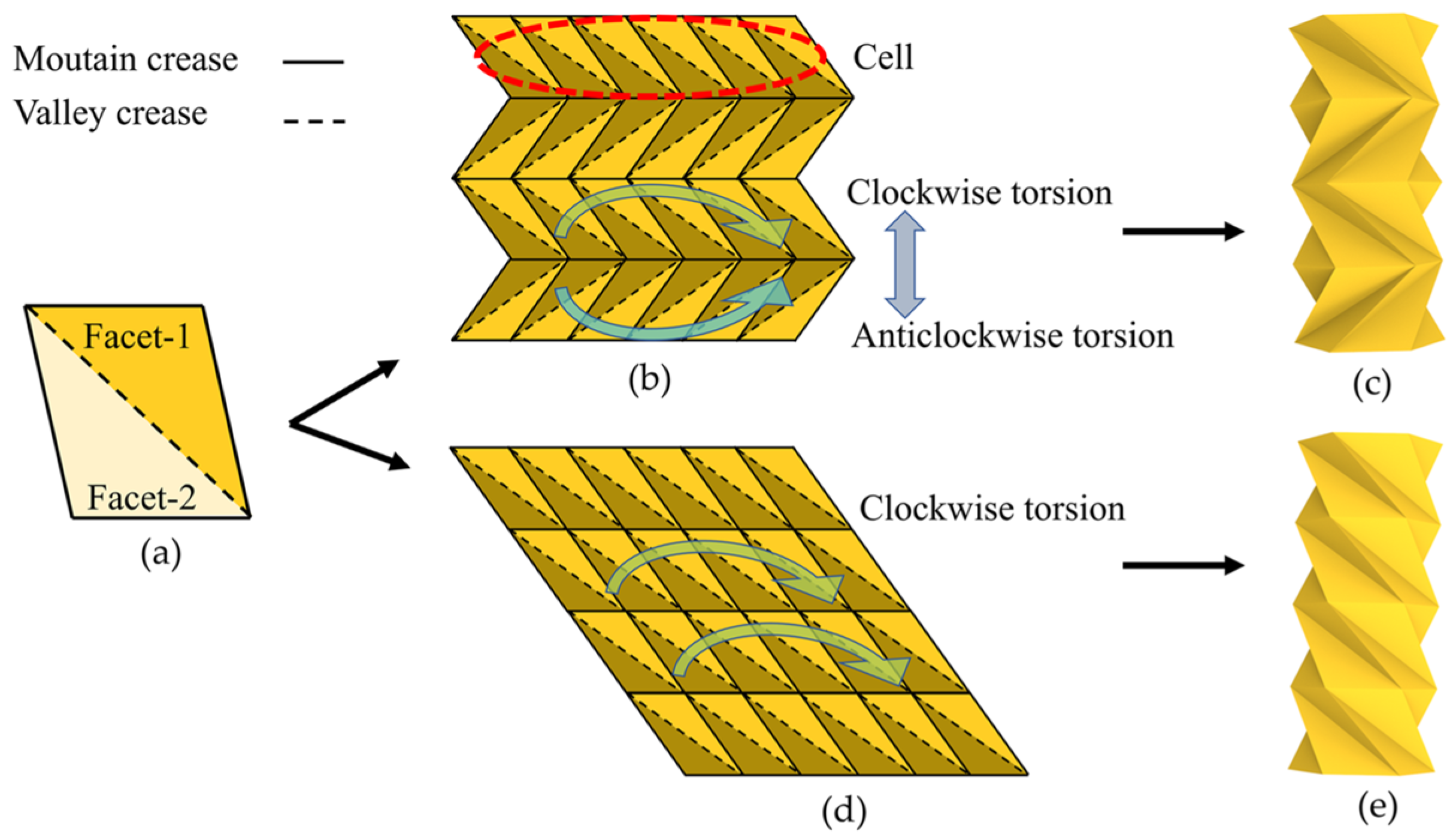
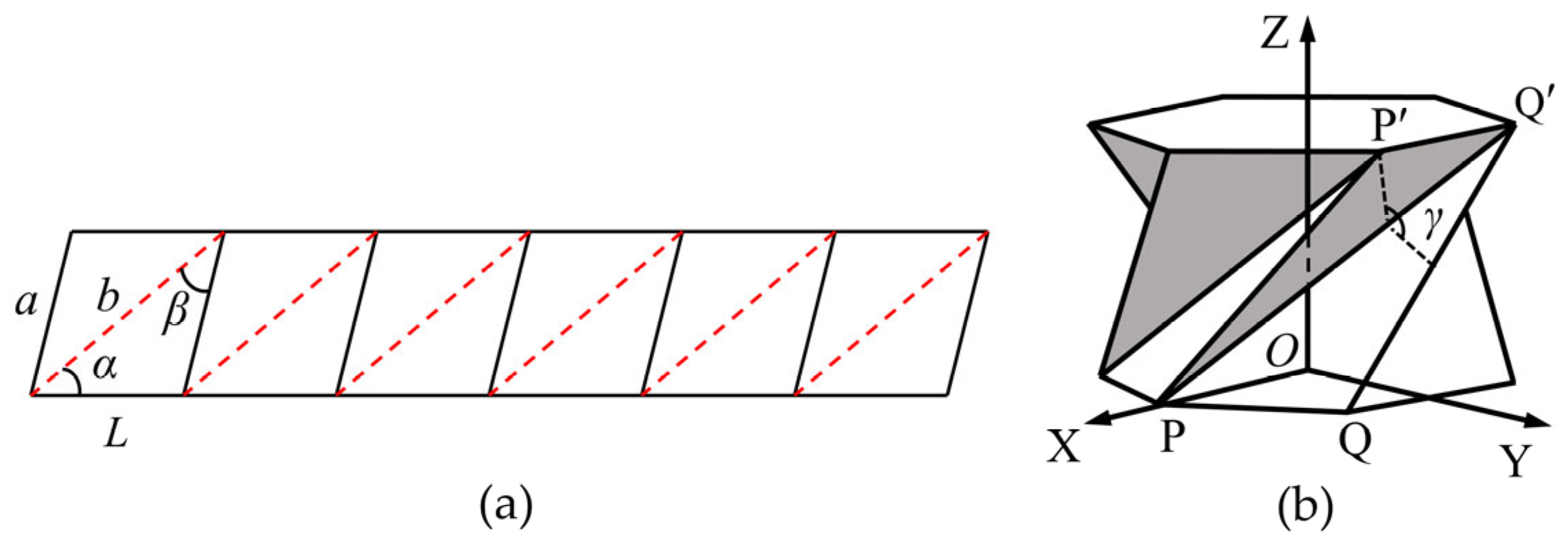
The Kresling structure is a column-shaped origami structure composed of triangular facets arranged in a spiral pattern, exhibiting compression or torsion deformation characteristics, featuring triangular facets, which is a typical non-rigid origami structure [38,39]. Based on the Kresling crease pattern, a planar basic parallelogram element was constructed (Figure 1a), and each element comprises two congruent triangular facets. The outer edges function as mountain creases, while the central dashed line serves as a valley crease. We employ a hexagonal origami structure, which offers advantages such as structural symmetry and compression or torsion behaviors [40,41]. Six such parallelogram elements are arranged in parallel to form a single cell, as indicated by the red dashed line in Figure 1b.
By mirroring four cells, a four-layer symmetric structure is created (Figure 1b), which can be folded along the preset creases to form the foldable actuator depicted in Figure 1c. The symmetrical layout of the mirrored cells precisely counteracts the torsional deformation generated during contraction and unfolding, resulting in pure axial contraction deformation. In contrast, the four cells arranged in a stacked array form a torsional structure (Figure 1d), and then can be folded along the creases to yield the torsional actuator depicted in Figure 1e. The superimposed layout of the stacked cells allows the torsional actuator to undergo torsion–contraction coupled deformations upon actuation.
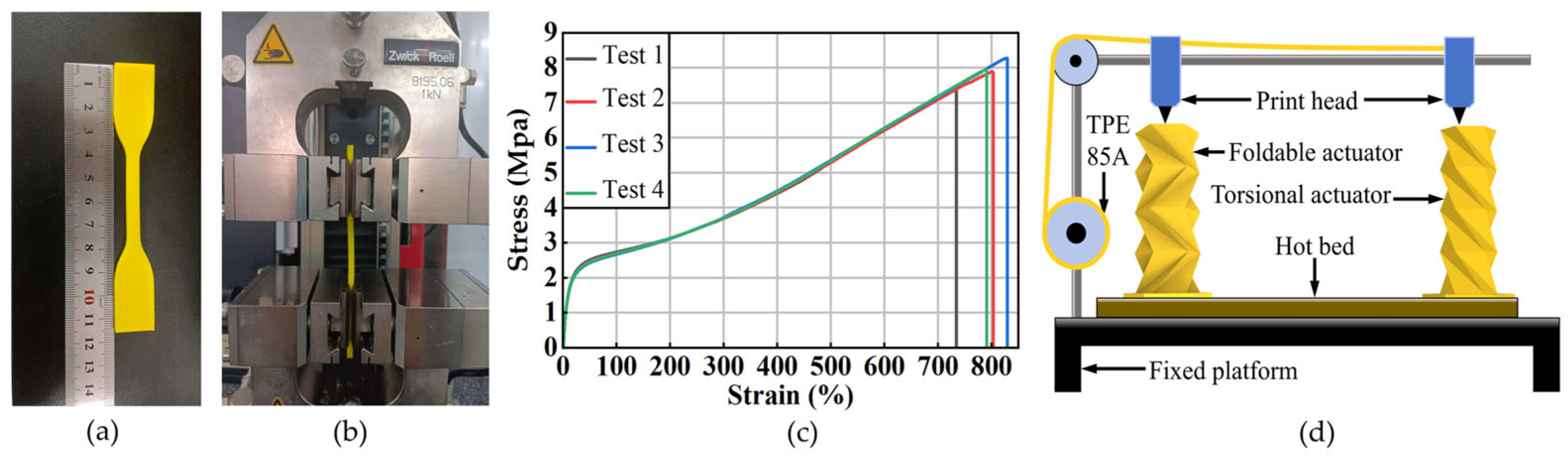
The developed origami actuator in this paper is fabricated from thermoplastic elastomer (TPE 85A), a type of high-performance thermoplastic polyester polymer material that exhibits extraordinary mechanical properties such as high strength and good toughness. To investigate the mechanical characteristics of the TPE 85A material, tensile tests were conducted in accordance with the specifications outlined in the ASTM D638 standard (ASTM International, 2006) [42]. The test specimens with specific geometry and dimensions were manufactured following requirements for dumbbell-shaped specimens in the ASTM D638 standard, and its actual structural specimen is illustrated in Figure 2a. The prepared test specimens were clamped in a universal testing machine (Figure 2b), and tensile tests were performed following standard procedures. During the tests, the stress–strain response data were recorded synchronously, and then the stress–strain curves of the TPE material were plotted, as shown in Figure 2c. It can be drawn from the stress–strain curves that the five specimens possess nearly identical mechanical characteristics.
TPE 85A was selected as the fabrication material and printed using a Bambu Lab P1P 3D printer with a 0.4 mm nozzle. This method provides rapid fabrication, flexible parameter tuning, and ensures excellent sealing performance and structural integrity. One base surface of the actuator was fully sealed, while the opposite base surface contained a 0.36 mm aperture for inserting a 4 mm air tube, enabling foldable or torsional deformation through controlling vacuum pressure.
The actuators share the following geometric parameters: side length of 15 mm, wall thickness of 0.6 mm, and single-layer height of 18 mm, forming a four-layer configuration. Both the top and bottom surfaces are hexagonal bases with a side length of 24 mm. Six 3 mm holes are positioned at the hexagonal corners to facilitate mounting on the test platform or the UR5 robotic flange. The simplified fabrication process is depicted in Figure 2d. Each actuator has an overall height of approximately 76 mm, with the foldable actuator weighing 11.84 g and the torsional actuator weighing 11.94 g.

2.2. Performance Characterization of Soft Actuators

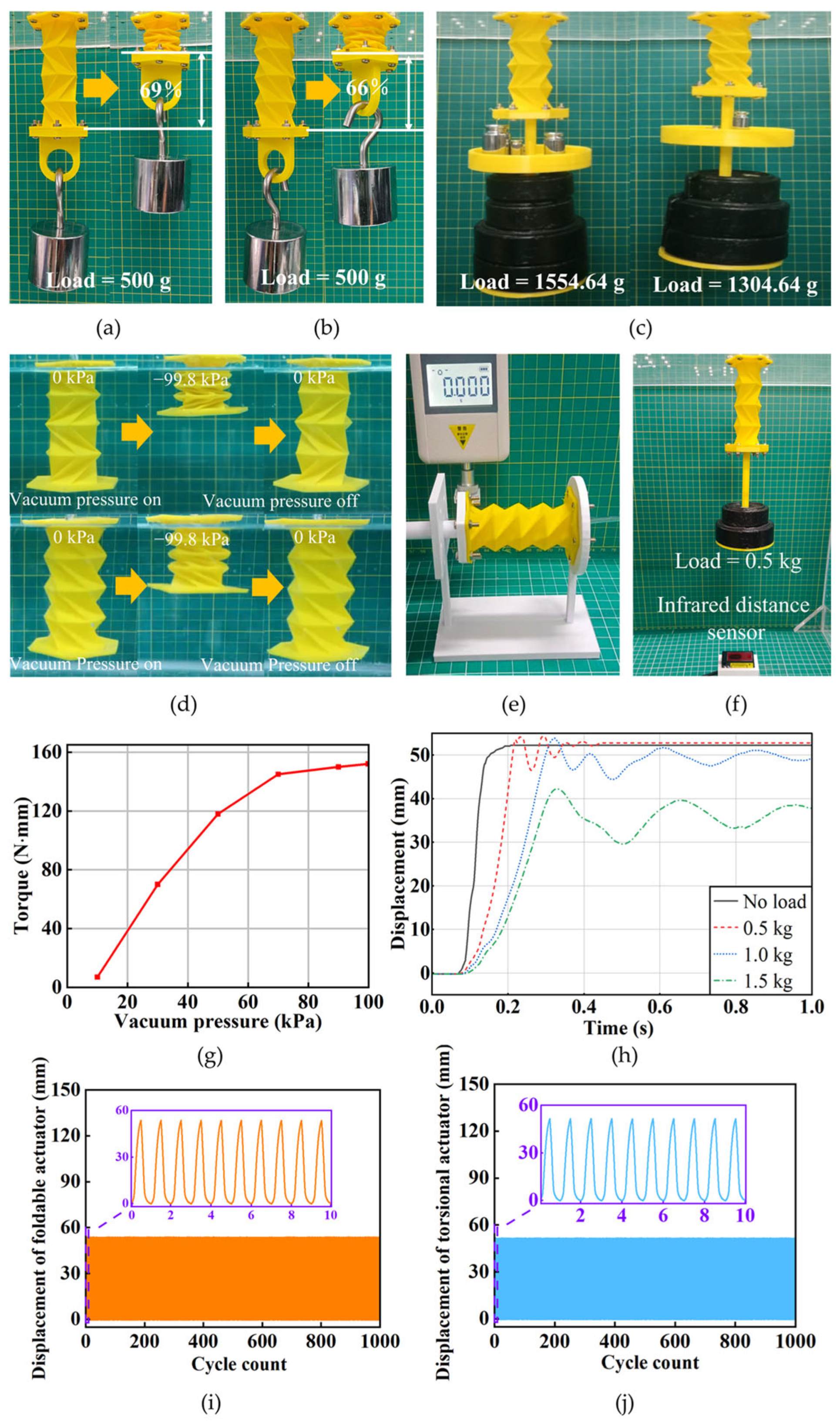
To evaluate the load-bearing capacity of soft actuators, load tests were performed on both actuators under a vacuum pressure of 99.8 kPa. From the experimental results in Figure 3a,b, the two actuators demonstrate excellent load-bearing performance. Under a load of 500 g, the foldable actuator has a slightly higher contraction ratio (69%) than that (66%) of the torsional one. This difference is attributed to the fact that the foldable actuator primarily undergoes axial folding contraction, leading to greater compression of the lateral wall than that of the torsional actuator. In addition, this study further conducted maximum load-bearing capacity tests (as shown in Figure 3c). A bracket (weighing about 34.64 g) was designed and attached to the actuator, and then the weights were placed on the bracket (see Supplementary Video S1). The maximum payloads of the foldable actuator and the torsional actuator were measured to be approximately 1554.64 g and 1304.64 g, respectively, and the foldable actuator exhibits higher load-bearing capacity. Beyond this limit, the inner walls of the two actuators will come into contact with each other.
Subsequently, a dedicated airtightness test was conducted on the actuators. During the test, the actuators were completely submerged in water, and the connection between the air tube and the actuator was kept above the water surface to prevent water from infiltrating the interior of the actuator through the connection hole (as illustrated in Figure 3d). Then, alternating evacuation and recovery cycles were performed on the actuators to achieve contraction and initial states. Real-time observations reveal that no obvious bubbles escaped from the surface of either of the two actuators throughout the entire test process. This indicates that the airtightness of the two actuators is reliable, which can meet the actuation control requirements in practical applications (see Supplementary Video S1).
To further investigate the torsional mechanical properties of the torsional actuator, a test bench for measuring torque during contraction deformation was established (as shown in Figure 3e). In the experiment, one end of the actuator was fixed, and the other end served as the movable end that can be close contact with the measuring head of the dynamometer; meanwhile ensuring that the measuring head was vertically aligned with the rod, after measuring the force and the lever arm, the torque can be calculated. As shown in Figure 3g, the torque of the torsional actuator increases significantly with rising vacuum pressure. When the vacuum pressure exceeds 70 kPa, the torque growth rate markedly slows down and finally stabilizes. This is because when this threshold is reached, the actuator has nearly reached its maximum contraction deformation, and further increases in vacuum pressure will not cause the actuator to contract any further.
Next, the displacement of the foldable actuator was analyzed using an infrared distance sensor (HG-C1200, Panasonic Industrial Automation, Shanghai, China), as shown in Figure 3f. Under unloaded conditions, the time required from the initial state to the full contraction was about 0.13 s, demonstrating the actuator’s rapid response performance (Figure 3h). When carrying weights of 0.5 kg and 1 kg, the time to reach full contraction increases; however, the contraction amount remains comparable to that under unloaded conditions. In contrast, under a load of 1.5 kg, the contraction amount decreases significantly, accompanied by an increase in vibration amplitude, which is attributed to the elastic property of soft TPE 85A material.
To evaluate the long-term operational reliability of the foldable and torsional actuators, cyclic displacement tests were carried out on the two actuators. Under a vacuum pressure of 99.8 kPa, the actuators completed 1000 times consecutive cycles at a frequency of 0.25 Hz, and the same infrared distance sensor was employed to measure the displacement variation. The experimental results demonstrate that the displacement response curves of the two actuators remain highly consistent even after 1000 times repeated contraction and recovery cycles (Figure 3i,j), verifying their excellent air tightness, fatigue resistance performance and deformation motion stability.
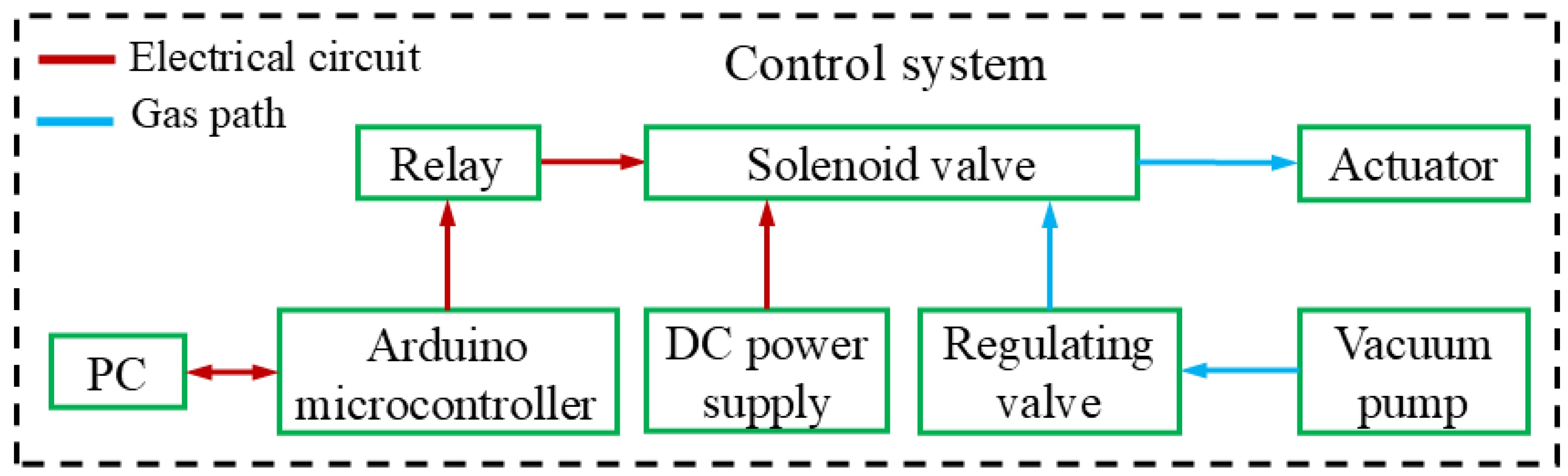
The control system primarily consists of an Arduino microcontroller, a relay, a solenoid valve, a DC power supply, and a vacuum pump. The contraction deformation of the two origami actuators is achieved through the following control program. The Arduino microcontroller controls a three-position, two-way solenoid valve (H103-DL-W, SMC Corporation, Tokyo, Japan) via a six-channel relay (HK4100F-DC5V-SHG, Jiaxing Zeyi Electronics Co., Ltd., Jiaxing, China). The solenoid valve’s input port connects to a vacuum pump (Fujiwara-1550D, Taizhou Fujiwara Tools Co., Ltd., Taizhou, China), which can generate a vacuum pressure up to 98 kPa. The solenoid valve features two outlet ports, which are selectively connected to the actuator or the atmosphere via valve switching. To ensure precise pneumatic control, the system integrates a pressure sensor (SIN-Y290, Hangzhou Liance Automation Technology Co., Ltd., Hangzhou, China) that continuously monitors the pressure delivered from the vacuum pump to the actuator (see Figure 4 for details).

2.3. Simulation of Soft Actuators

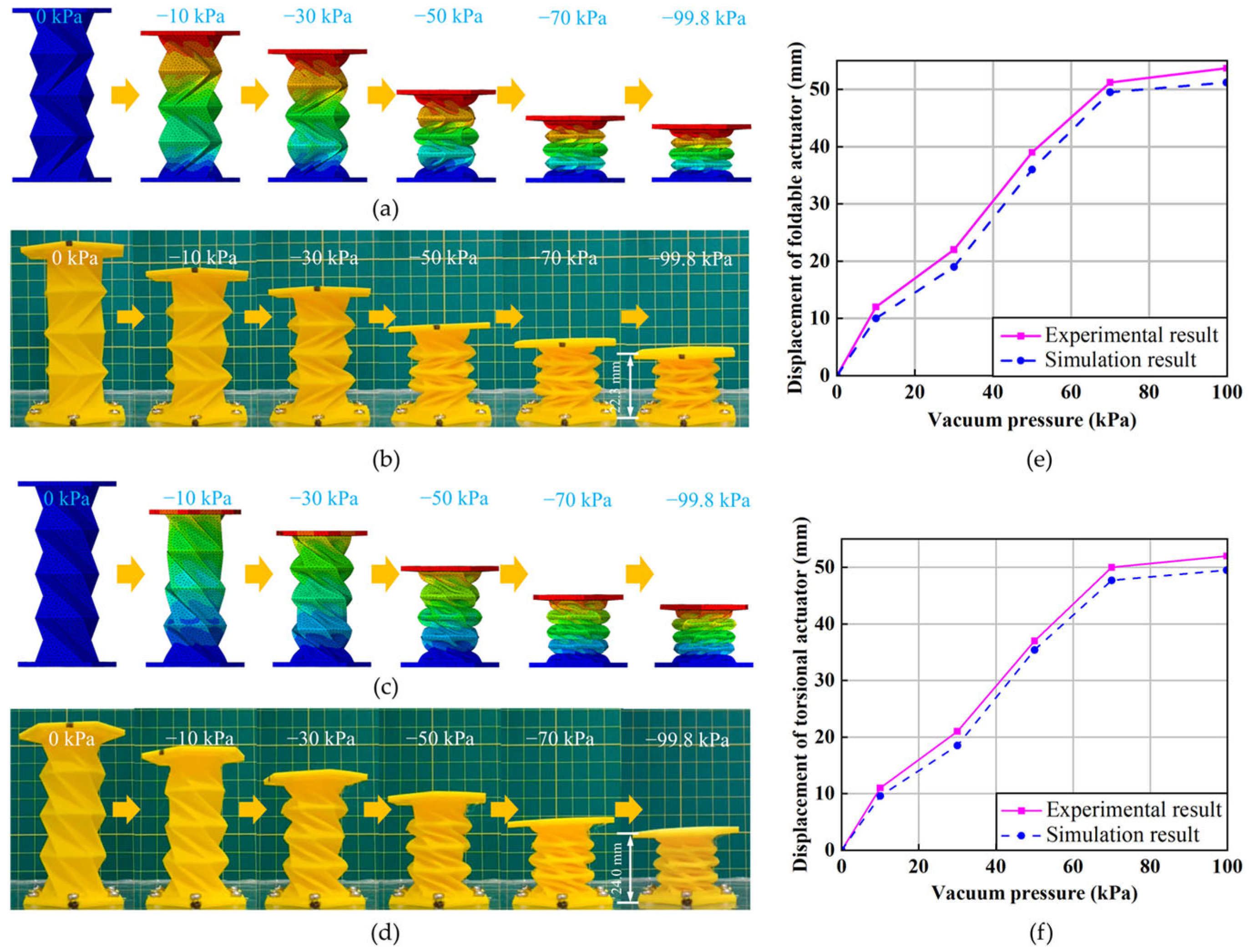
Furthermore, we explored the crease variation characteristics of soft actuators during the contraction deformation. Finite element simulations and experimental studies were conducted on two actuators under varying vacuum pressures. To quantitatively interpret and validate the experimentally observed contraction behavior of two origami actuators, a static simulation was conducted using the finite element software ABAQUS 2023 (Dassault Systèmes Inc., Vélizy-Villacoublay, France). The simulation model was established with a 10-node quadratic tetrahedral hybrid element (C3D10H), and the Yeoh hyperelastic material model was employed to characterize the stress–strain properties of the TPE 85A material [43]. All material parameters were obtained from uniaxial tensile tests (Figure 2a–c), yielding the material coefficients C10 = 29.3474, C20 = −0.0347, and C30 = 0.0002. In terms of contact settings, the inner and outer surfaces of the origami chamber were defined as inelastic normal contact and frictionless tangential contact, respectively, with vacuum pressure directly applied to the inner surface of the chamber. As the bottom face of each origami actuator was fixed to the fixture base, full constraints were imposed on this surface in the simulation (Ux = Uy = Uz = URx = URy = URz = 0).
Their folding and twisting contraction deformation behaviors are shown in Figure 5a–d. The experimentally measured displacement curves show strong overall agreement with the simulation results. The maximum relative errors for the foldable actuator and the torsional actuator are 4.6% and 4.8%, respectively, and both the simulations and experiments were conducted under a vacuum pressure of 99.8 kPa, indicating that the simulation model accurately captures the deformation behavior, which exhibits good simulation reliability (Figure 5e,f). The higher the vacuum pressure, the greater the contraction deformation degree and the contraction ratio of the foldable actuator. Specifically, when the vacuum pressure reaches 99.8 kPa, the contraction ratio reaches approximately 71%, comparable to the contraction ratio 69% measured under a load of 500 g, and this slight discrepancy lies in that the gravitational force of the load causes the contraction deformation to restore. Furthermore, throughout the experiment, the black marker points located on the upper and lower base surfaces of the foldable actuator remain nearly vertically aligned, indicating the absence of torsional deformation (Figure 5a,b). Similarly, for the torsional actuator, the magnitude of torsional deformation increases with the elevation of vacuum pressure (Figure 5c,d). The black marker point on the upper base surface exhibits obvious position offset, forming a relative angle with the black marker point on the lower base surface, and the maximum relative torsional angle between the two surfaces reaches almost 70°, accompanied by axial contraction deformation, and the corresponding contraction ratio attains 68% that is higher than that (66%) measured under a load of 500 g. In addition, it can be clearly observed that the squeezing phenomenon between the side walls is evident, resulting from the combined effects of the crease distortion deformation and the soft TPE 85A material property.
In the actuation experiment, a vacuum controller was employed to precisely regulate the magnitude of vacuum pressure, enabling real-time control of contraction deformation and crease variation in the two actuators. The simulation and experimental results collectively demonstrated that, compared with the contraction and torsion deformations of the two actuators observed at vacuum pressures of 10 kPa and 30 kPa, the corresponding deformations are much greater at 50 kPa and 70 kPa, reaching the maximum value at 99.8 kPa. Furthermore, once the vacuum pressure exceeds the critical threshold, the sidewalls of the soft actuators start to contact and compress against each other, overlapping along their creases, which not only ensures the stability of the two actuators during actuation but also facilitates the rapid real-time adjustment of contraction deformation motion.
To clarify our actuators’ superiority, we compared the foldable actuator with other linear actuators in terms of payload/self-weight, response time, and contraction ratio (see Table 1). The results show that this foldable actuator exhibits relatively light self-weight, large payload/self-weight, fast response speed, and high contraction ratio. Additionally, we compared the torsional actuator with other torsional actuators (see Table 2) and found it to have a larger torsional angle, faster response speed, and higher output torque.

2.4. Design and Fabrication of Soft Grippers

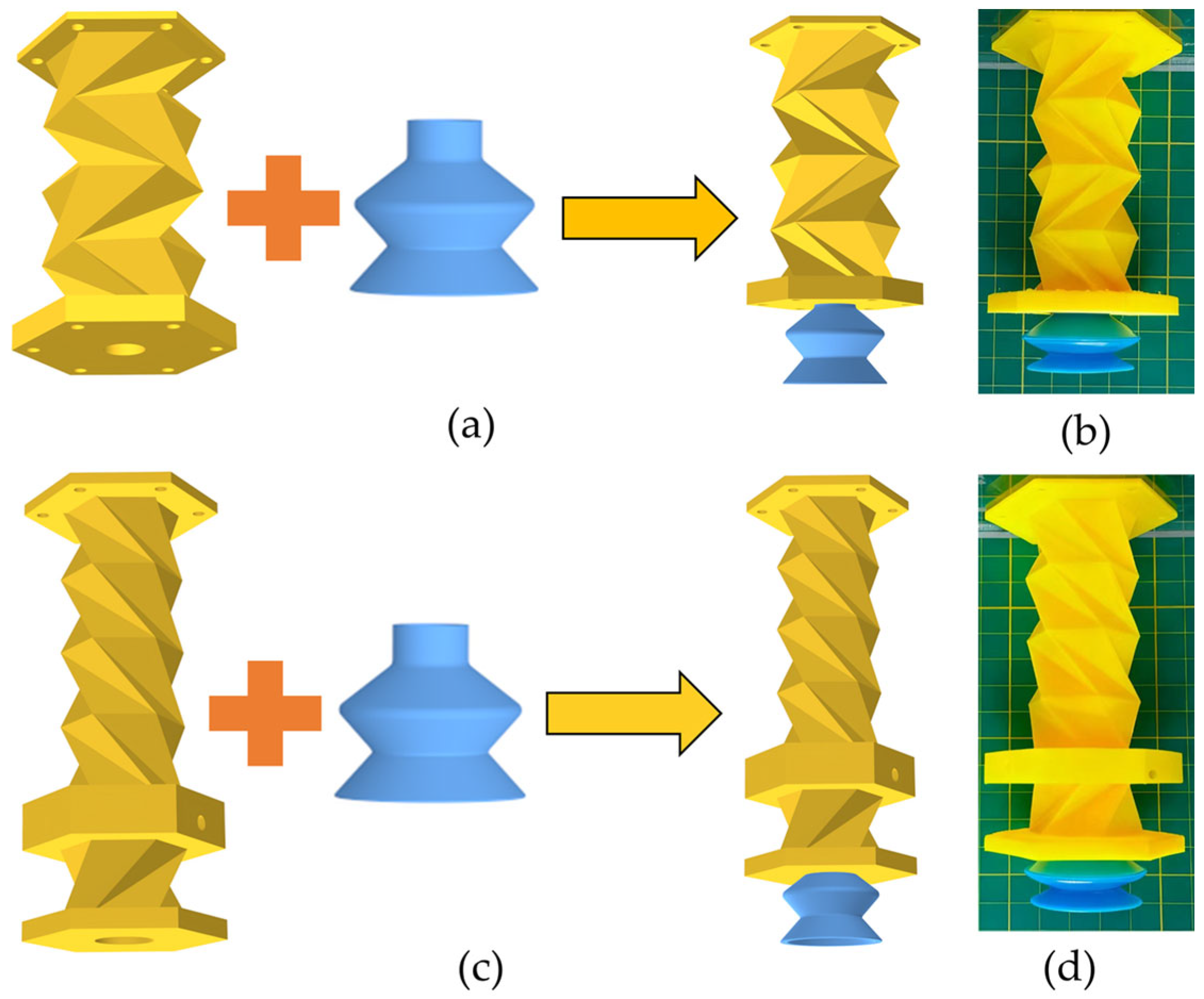
Based on the previously designed foldable and torsional actuators, we further developed two types of soft grippers. The first one is a foldable soft gripper, comprising a foldable actuator and a suction cup (Figure 6a), and it has good axial contraction performance. A properly sized circular hole is designed at the center of the hexagonal base of the foldable actuator, into which the suction cup is assembled via an interference fit. The second one is a torsional soft gripper, composed of a four-layer torsional actuator, a single-layer actuator with an opposite rotation direction, and a suction cup (Figure 6c), exhibiting coupled torsional and contraction deformation, with the suction cup assembled in the same manner as that of the foldable gripper.
To optimize the assembly between the suction cup and the actuator, two design requirements need to be satisfied: (1) the thickness (3 mm) of the actuator’s bottom hexagonal base should be slightly less than the height (5 mm) of the suction cup neck; and (2) the diameter (3.6 mm) of the central circular hole at the bottom of the actuator should be slightly smaller than the outer diameter (4 mm) of the suction cup neck. Requirement (1) makes the suction cup fully insert into the internal cavity of the actuator; requirement (2) makes the suction cup form a tight interference fit with the actuator in the radial direction, thereby improving the airtightness of the overall structure and effectively mitigating issues such as connection relaxation and air leakage. The final prototypes of the two assembled soft grippers are shown in Figure 6b,d, respectively.

3. Theoretical Modeling and Analysis of a Single-Layer Soft Actuator

3.1. Geometric Analysis of a Single-Layer Soft Actuator

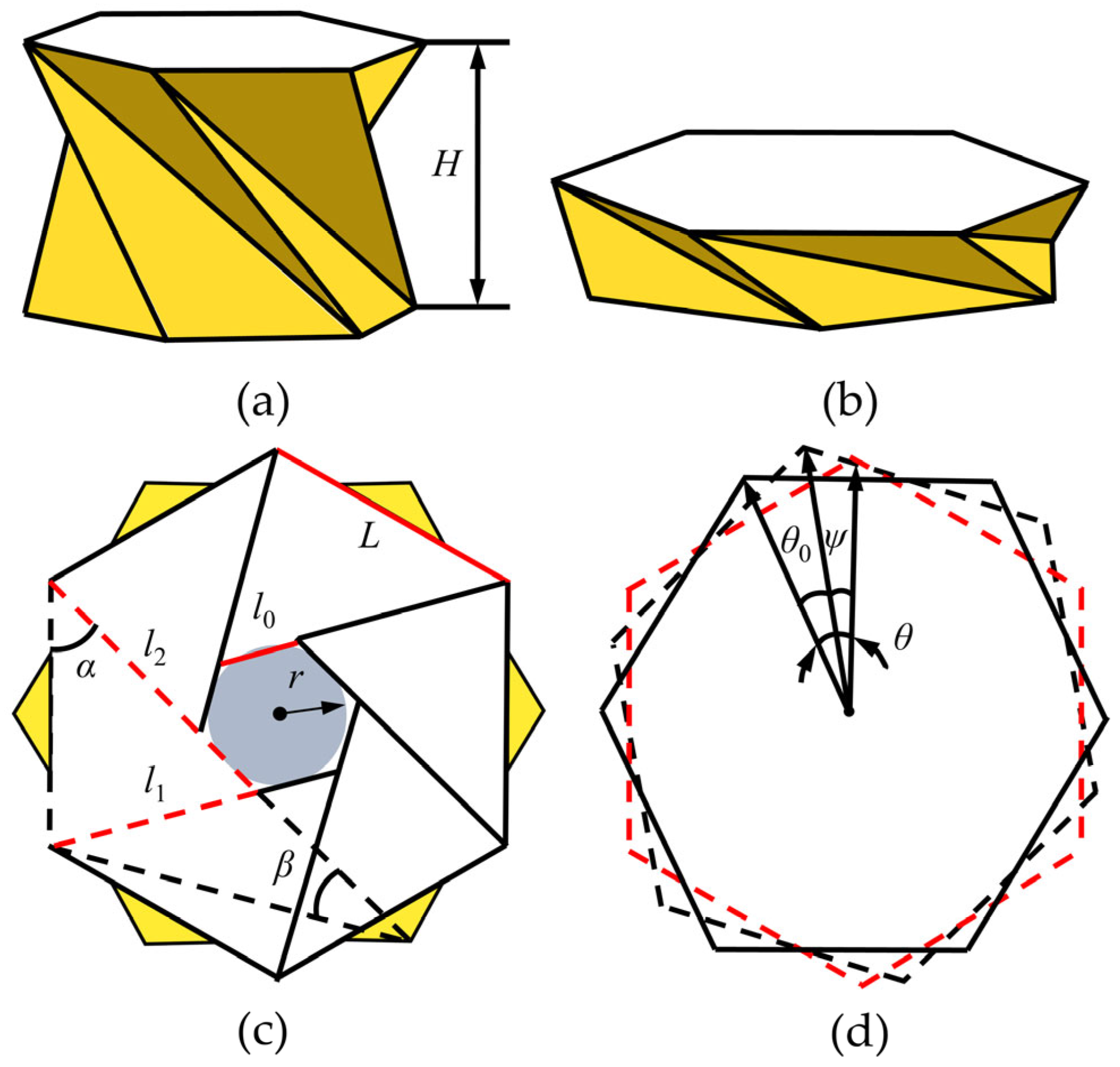
The folding performance of the actuator depends strongly on the area of the inscribed circle formed by its crease geometry. Figure 7a–c illustrates the isometric view and top view of a single-layer soft actuator. In Figure 7a, the symbol H represents the initial height of the actuator in its natural state, Figure 7b depicts the actuator contracted to a certain extent. Under ideal conditions, without considering the influence of wall thickness, the actuator will completely fold and contract.
In Figure 7c, the angles α and β severally denote the base angle and side angle of the triangular facet (the detailed meaning of angles α and β can be referred to the Appendix A), and L denotes the side length of the upper and lower base polygons, the gray section indicates the inscribed circle with a radius of r, while l0 indicates the side length of the circumscribed regular polygon of the inscribed circle. In Figure 7d, the black solid line, black dashed line, and red dashed line severally represent the lower base surface, the upper base surface of the actuator in the natural state, and the upper base surface at a certain stage during contraction, respectively. The angle θ0 denotes the initial deflection angle between two base surfaces, and θ represents the angle between them in any state; and ψ denotes the relative deflection angle, which is defined as the difference between θ and θ0.
The three-dimensional model of the actuator was built using SolidWorks software 2022 (Dassault Systèmes Inc., Vélizy-Villacoublay, France). The angle of the model can be measured using the built-in measurement tool (Measure), and the measured variation range of the actuator’s base angle is approximately from 42° to 64°. Beyond this range, the actuator transitions into a different configuration, which falls outside the scope of this study.
Here, we primarily discuss the influence of the base angle α and the number of sides n of a polygon on the area of the inscribed circle. Based on geometric relationships, the side length l0 of the inner hexagon is determined as
l 0 = l 2 l 1 = L sin α + 2 β   sin α / sin 2 β
Further, we can obtain
  r = l 0 / 2 tan ( π / n ) = L sin α + 2 β   sin α / 2 sin 2 β tan π / n
From Equations (1) and (2), the area S of the inscribed circle can be calculated, and the relationship with the number of sides n of the polygon, the base angle α and the side angle β is as follows
  S = π { L sin α + 2 β   sin α / 2 sin 2 β tan π / n } 2
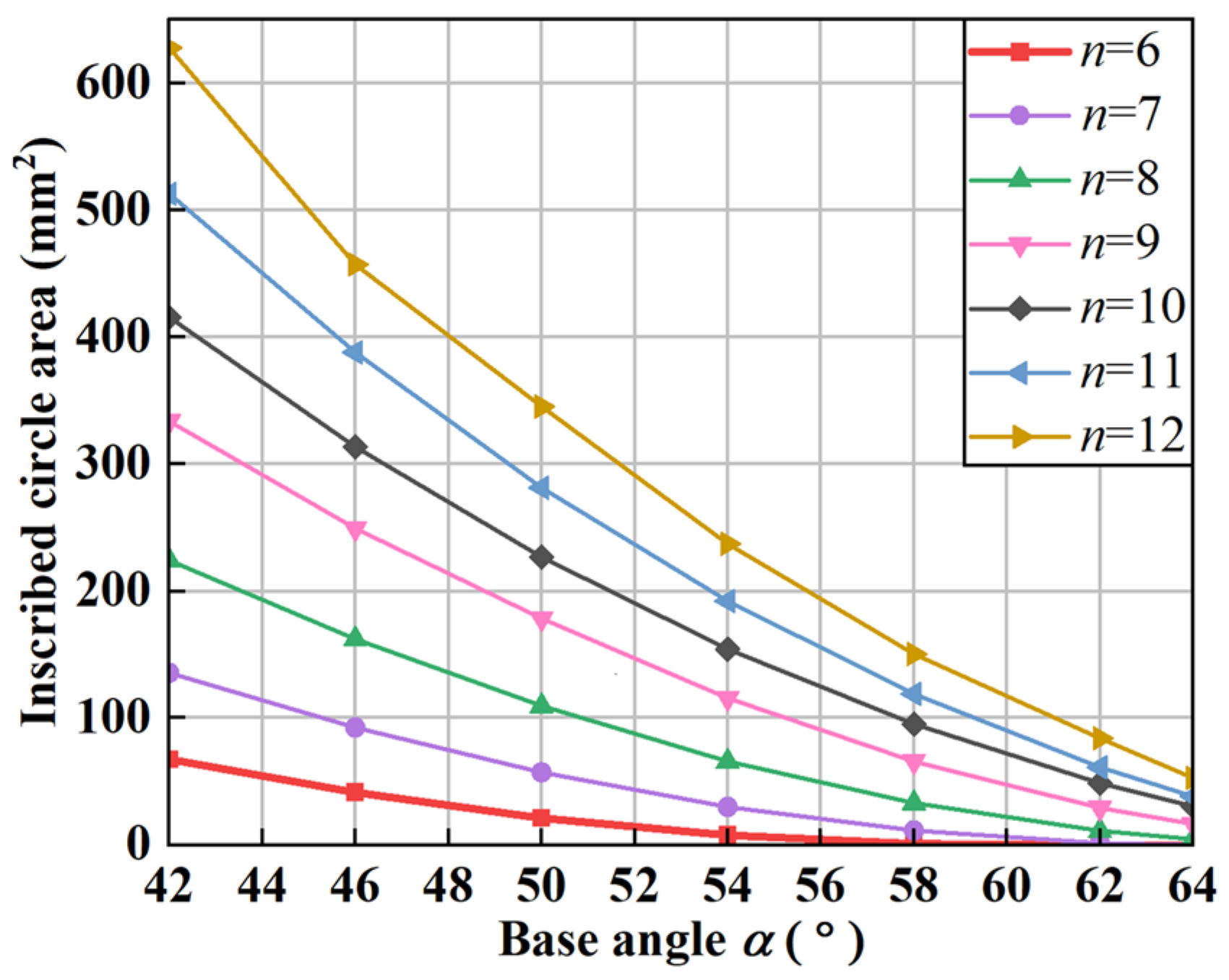
By solving Equation (3), we can obtain the relationship between the area S of the inscribed circle and the base angle α, as well as the number of sides n of the polygon, as shown in Figure 8. For a fixed number of sides n, the area S gradually decreases as the base angle α increases. Conversely, when α is held constant, S increases with the increase in the number of sides n. Specifically, as the number of sides n approaches infinity, the side length L of the polygon gradually approaches zero, and the shape of the single-layer soft actuator tends to be a cylinder, and its folding performance significantly deteriorates, eventually resulting in the inability to fold.
Furthermore, we analyzed the geometric properties of a single-layer soft actuator to clarify its deformation characteristics from a geometric standpoint and further elucidate its torsional behavior. For simplification, the thickness of the actuator can be neglected, and the base angle α and the height h of the actuator are regarded as independent variables. The angles α and β severally denote the base angle and side angle of the triangular facet, which correspond to the angles shown in Figure 7c. In this geometric model, a denotes the length of the mountain crease, b denotes the length of the valley crease, and γ represents the crease angle, defined as the dihedral angle formed between two planes PQ’P’ and PQQ’.
Through geometric modeling and analysis, the relationship between the relative deflection angle ψ between the upper and lower surfaces of the single-layer actuator, the base angle α, and the height h can be obtained (the meaning and derivation details of a, b, γ and the relative deflection angle ψ can be referred to the Appendix A).
ψ =   arccos   [ ( 2 b cos α L ) / 2 L ] θ 0 = π / 3     arccos   [ ( b 2 h 2   2 L 2 ) / 2 L 2 ]   θ 0
As indicated by Equation (4), the relative deflection angle ψ increases with increasing α and decreasing h, demonstrating that during contraction of the actuator, as the α and contraction amount increase, ψ gradually becomes larger.
Moreover, we also obtained the relationship between the base angle α and the contraction amount Δs
Δ s = H h = H b 2     2 L 2   [ 1 + cos { π / 3   arccos   [ ( 2 b cos α   L ) / 2 L ] } ]
Equation (5) indicates a direct positive correlation between the Δs and base angle α within its effective range. As α increases, Δs also increases, meaning the contraction amount of the actuator grows.
The dihedral angle γ can be used as an indicator for evaluating the contraction degree of the actuator. The dihedral angle γ can be determined (the derivation of the Δs and the analysis of dihedral angle γ can be referred to the Appendix A).
  γ = arccos n 1 n 2 / n 1 n 2
It can be concluded that a reduction in the dihedral angle γ leads to the increase in the actuator’s contraction amount.
The geometric analysis reveals that enhancing the valley crease depth is helpful to increase the actuator’s contraction ratio and deflection angle. Within the permissive range, the contraction performance can be improved by appropriately increasing either the base angle or the valley crease depth.

3.2. Mechanical Modeling

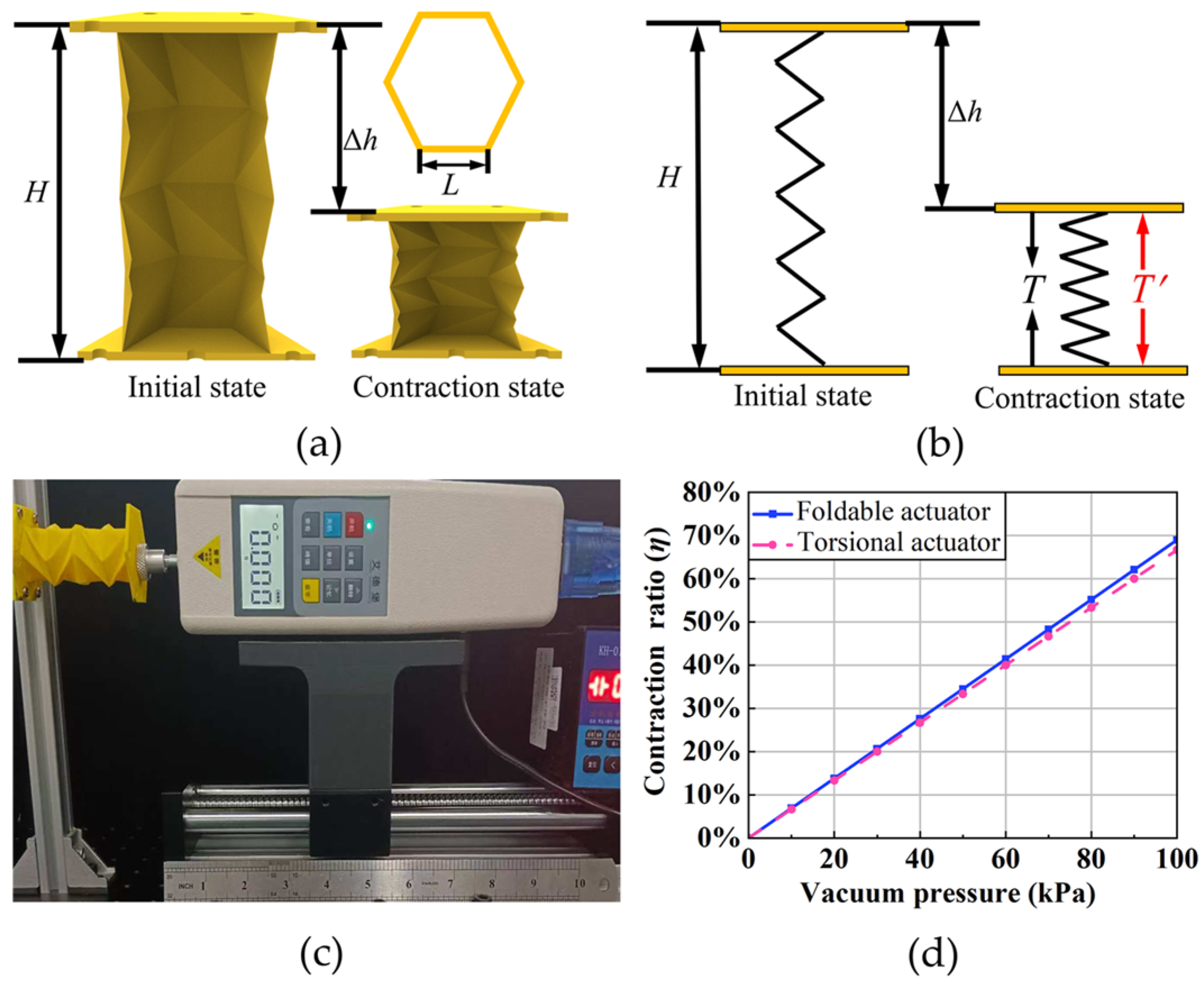
The contraction process of the soft actuator under vacuum pressure can be regarded as a quasi-static process, and thus a static model is established to characterize the relationship between vacuum pressure and contraction amount. The initial and contracted states of the soft actuator are illustrated in Figure 9a. To simplify the analysis, the soft actuator can be modeled as an equivalent spring system, with the force analysis of the spring system shown in Figure 9b. Applying vacuum pressure induces the contraction of the soft actuator. In an equilibrium state, the contraction force T generated by the vacuum pressure balances the elastic restoring force T′. The equivalent elastic coefficient k of the soft actuator can be determined by the inherent property of the TPE 85A material and obtained via experimental measurement. For uniform contraction deformation, the equivalent elastic coefficient k of the foldable actuator is measured to be approximately 1.10 N/mm, while that of the torsional actuator is about 1.13 N/mm, and the experimental measurement setup is shown in Figure 9c.
The contraction force T is equal to the product of the vacuum pressure P and the cross-sectional area S
T = P S
  S = 3 3 L 2 / 2
The elastic restoring force T′ of the soft actuator is
T = k Δ h
In the equilibrium state, the contraction force T equals the elastic restoring force T′. Therefore, from Equations (7)–(9), the relationship between the contraction ratio η and the vacuum pressure P can be obtained as follows.
  η = Δ h / H = 3 3 P L 2 / 2 k H
Equation (10) clearly reveals that the contraction ratio η shows a linear correlation with vacuum pressure P, the contraction ratio increases linearly as the vacuum pressure rises (Figure 9d). Compared with the torsional actuator, the foldable actuator has a smaller equivalent elastic coefficient, thereby yielding a higher contraction ratio and greater axial contraction deformation. At a vacuum pressure of 99.8 kPa, the theoretical contraction ratios calculated from Equation (10) for the foldable actuator and torsional actuator are 69.9% and 68.1%, respectively, which are consistent with the experimental results presented in Section 2.4.

4. Experimental Study on Two Types of Soft Grippers

4.1. Grasping Soft Fruits Using the Foldable Soft Gripper

The foldable soft gripper exhibits excellent axial folding contraction capabilities, making it particularly well-suited for grasping flat objects. Here, we first evaluate its performance in handling soft fruits. By regulating the vacuum pressure inside the gripper, when the suction cup contacts the object, a sealed space is formed at the contact area with the object. Under the effect of vacuum pressure, the gripper adheres closely to the surface and generates suction, thereby enabling stable grasping.
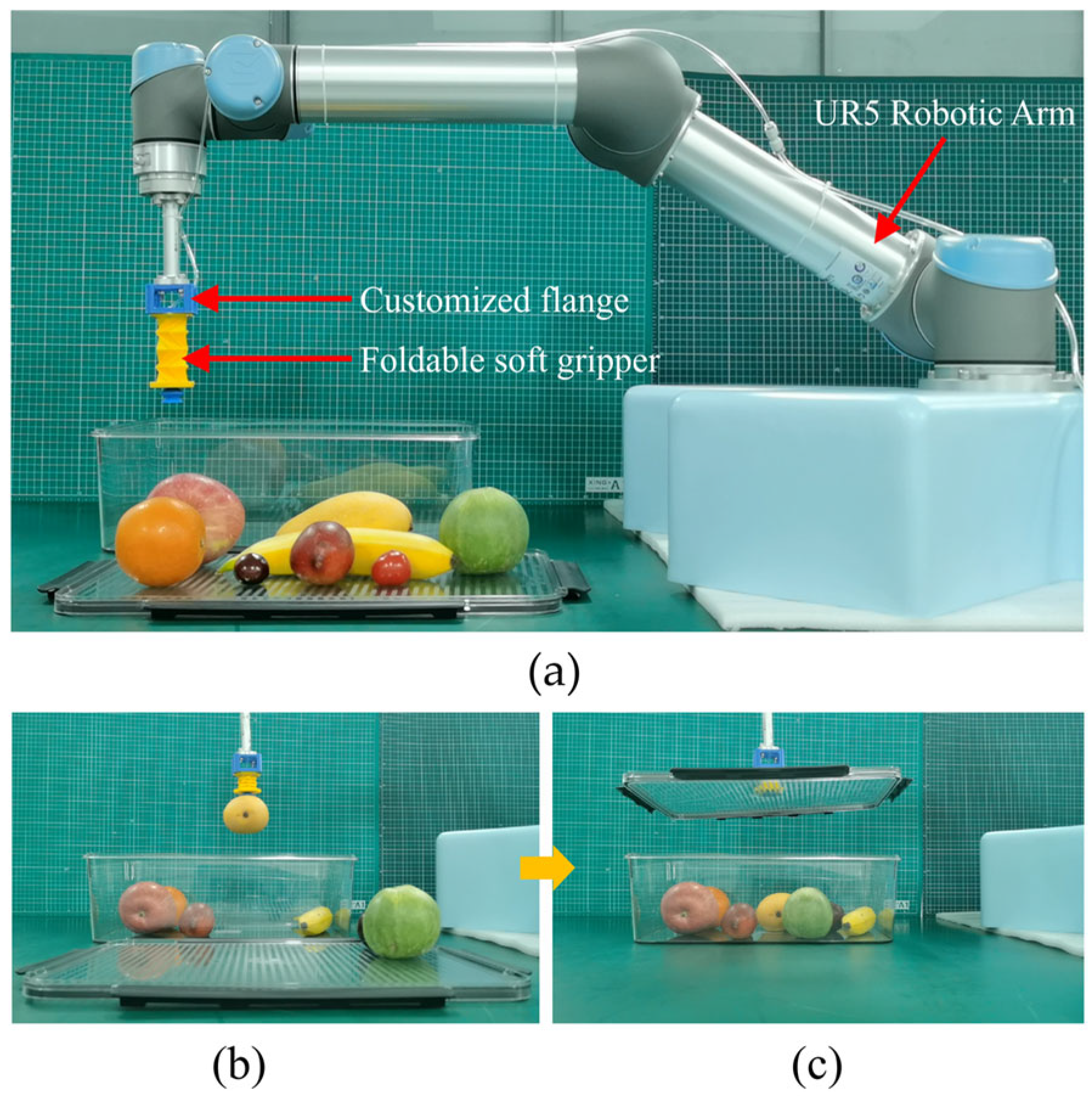
A suitable flange is designed and fabricated to integrate the gripper with the end of UR5 robotic arm, thereby forming the complete end effector as illustrated in Figure 10a. A customized flange is fabricated via 3D printing, with one end connected to a foldable soft gripper and the other end attached to the end of the UR5 robotic arm. When designing the flange, a suitable-sized space should be reserved in the middle to ensure that one end of the PU tube is connected to the hole of the gripper, and the other end is connected to the air pump. Both the air pump and the UR5 robotic arm are controlled by the same controller to ensure coordinated operation.
For fruits placed haphazardly on the box lid, as shown in Figure 10a, the foldable soft gripper is used to pick them up and arrange them systematically in different positions within the box, ensuring the fruits do not squeeze each other, as illustrated in Figure 10b. The motion trajectory of the UR5 robotic arm is programmed via the controller to coordinate the arm’s movement and control the air pump for evacuation and recovery. Upon forming full contact between the soft suction cup and the soft fruit surface, a sealed space is formed to generate vacuum suction, facilitating tight adhesion of the fruits. Driven by the vacuum suction, the actuator undergoes axial contraction deformation, allowing the gripper to grasp the soft fruits and lift them up from the table. Finally, following the planned trajectory, the robotic arm raises the fruits and places them into a box. Notably, the compliance of the suction cup endows the gripper with adaptive grasping capability when contacting soft fruits of varying sizes and surface textures. Upon completing the grasping and placing, the gripper picks up the box lid, places it accurately and steadily on the box, and finally closes it, as shown in Figure 10c, thereby completing the entire grasping operation sequence (see Supplementary Video S2).
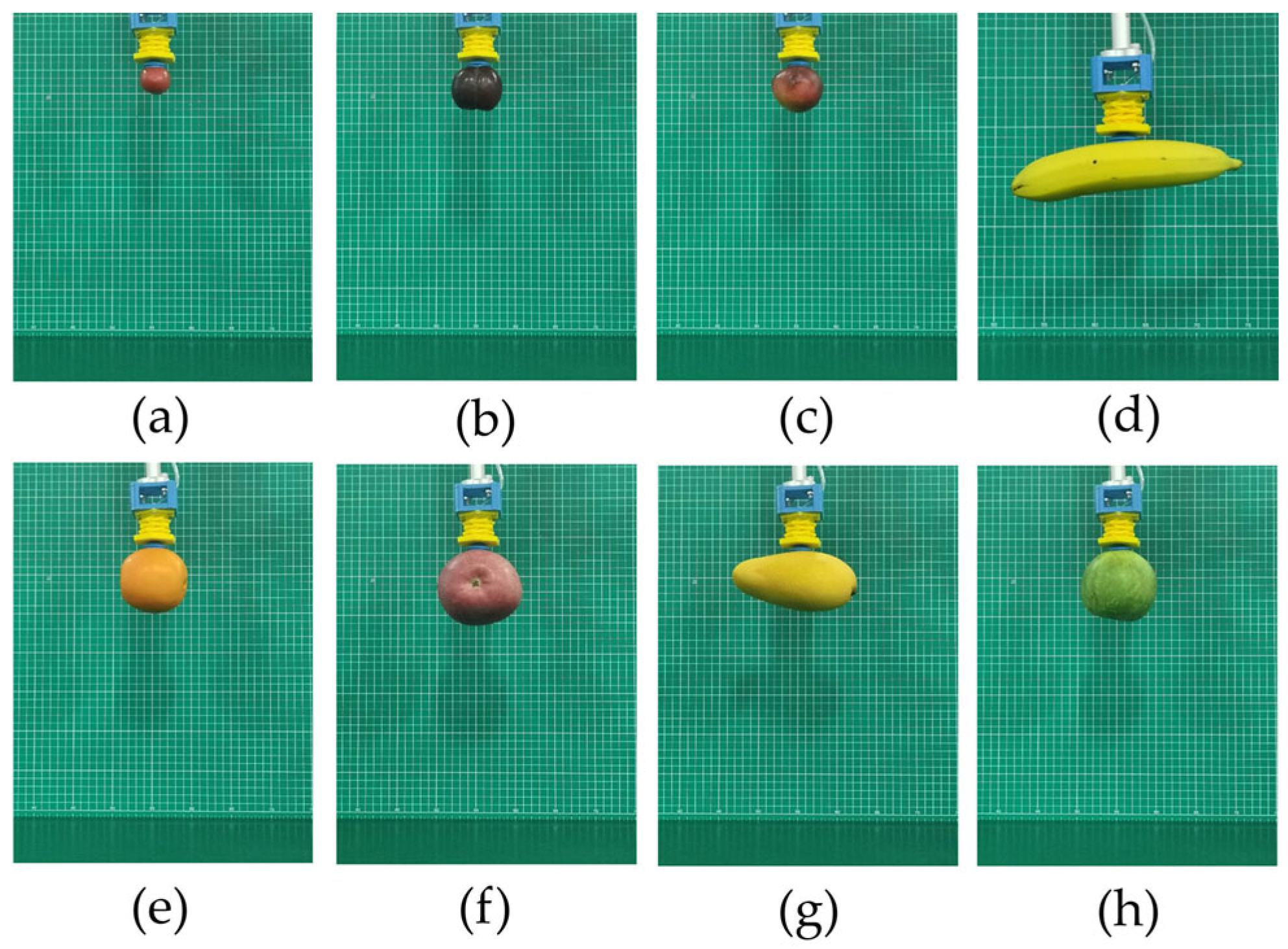
The foldable soft gripper features an entirely soft structure, endowing it with substantial contraction deformation capability, and its suction cup is also a soft funnel-shaped component, which requires minimal flatness for the objects being grasped, making it particularly suitable for handling soft and fragile items. We conducted experiments using the foldable soft gripper to grasp soft fruits of varying shapes, sizes, and weights, as shown in Figure 11. The results show that this gripper causes no surface damage when grasping delicate-skinned fruits such as tomatoes, plums, nectarines, and bananas, or when grasping heavier fruits like oranges, apples, mangoes, and melons. In addition, in the process of lifting fruits, the fruits will not fall due to the movement of the robotic arm, demonstrating good grasping stability of the gripper. Therefore, this gripper can ensure the integrity and stable operation of the target objects during the grasping operation, making it suitable for large-scale fruit picking and assembly line sorting tasks.

4.2. Grasping Hard Objects Using the Foldable Soft Gripper

The foldable soft gripper is also capable of grasping hard objects of diverse surface shapes and sizes. This gripper can lift a variety of objects and adapt to grasping objects with varying shapes and contours, indicating that the gripper does not have specific requirements for the geometrical shape of the target object. This gripper relies on vacuum pressure at the suction cup and can handle items with some smooth surfaces or lower surface roughness, yet it fails to achieve reliable adhesion on highly rough surfaces, such as sandpaper or sawn wood blocks.
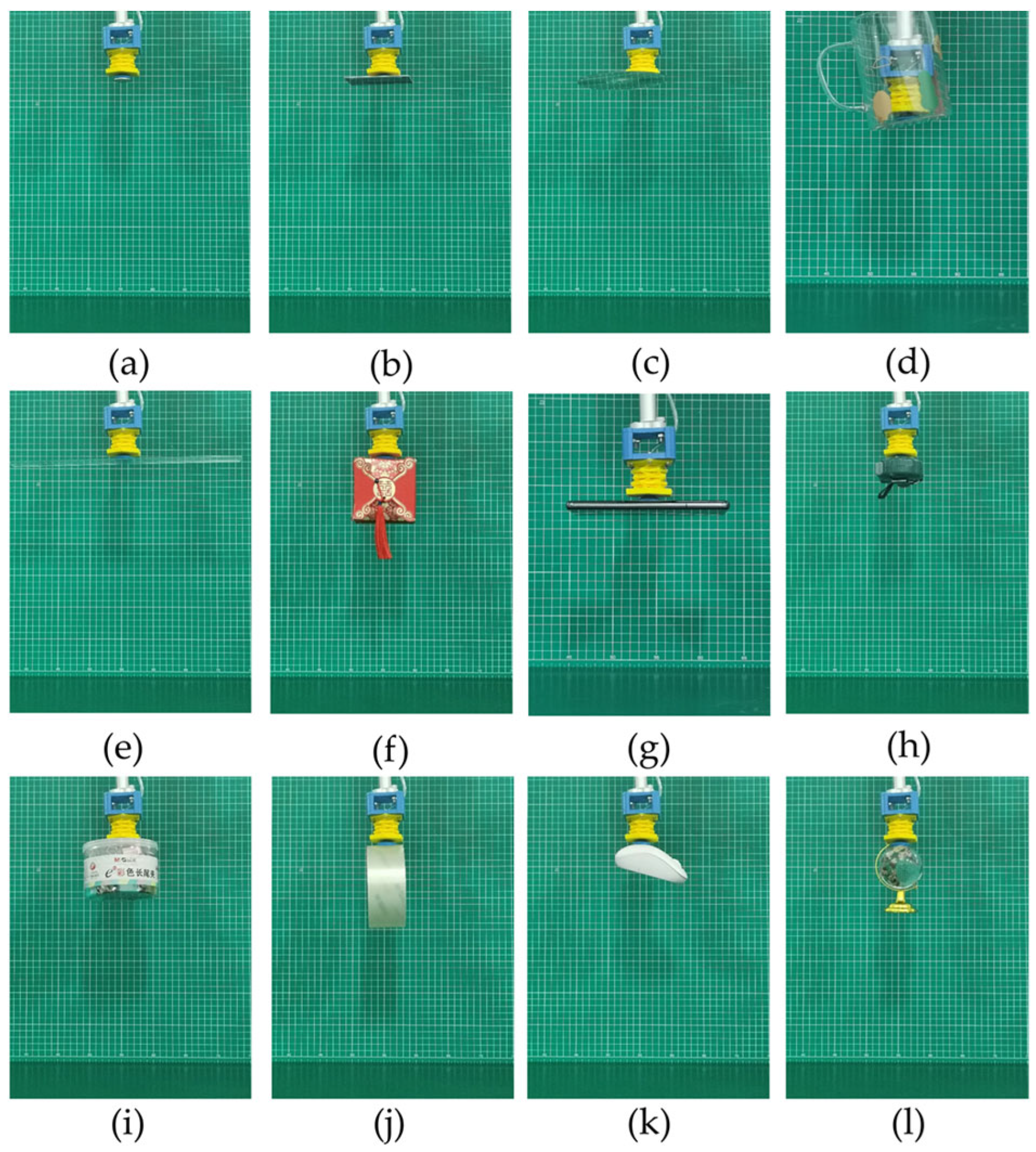
Since this gripper makes soft contact with objects during the grasping operation, it has terrific adaptability to objects with various surface shapes, such as planar objects shown in Figure 12a–i, cylindrical objects shown in Figure 12j, ellipsoidal objects shown in Figure 12k, and spherical objects shown in Figure 12l. When grasping a glass cup, the suction cup touches its bottom surface and lifts up the entire glass from the interior, as shown in Figure 12d. Similarly, it can be observed that when grasping objects of different shapes, the gripper first brings the suction cup into contact with the target. After a sealed space is formed, the object is held in place by the vacuum suction, and then the actuator contracts to complete the grasping action. To successfully perform this operation, there is a sufficiently large contact surface to allow the suction cup to establish an effective sealed space. It should be noted that the diameter of the glass cup needs to be larger than the size of the flange cross-section, ensuring that the gripper and flange can extend into the interior of the cup and come into contact with the bottom surface, thereby enabling the adsorption operation. To ensure effective suction, the object size should be no smaller than the diameter of the suction cup opening, as excessively small objects do not make sufficient surface contact, resulting in failing to form a sealed space, thereby hindering the generation of vacuum suction.
To quantitatively evaluate the reliability and operational adaptability of the soft gripper, we systematically tested and analyzed its grasping success rate. A grasping operation is defined as successful only if the object was securely adsorbed and remained stable throughout the entire lifting and moving process of the UR5 robotic arm, with no occurrence of dropping or slipping. Six representative objects were selected for grasping experiment: three soft fruits and three hard objects, with five grasping attempts for each object (see Supplementary Table S1). The statistical results show an overall grasping success rate of approximately 83.3%, which further validates that a larger effective contact area between the suction cup and the object correlates with a higher success rate.
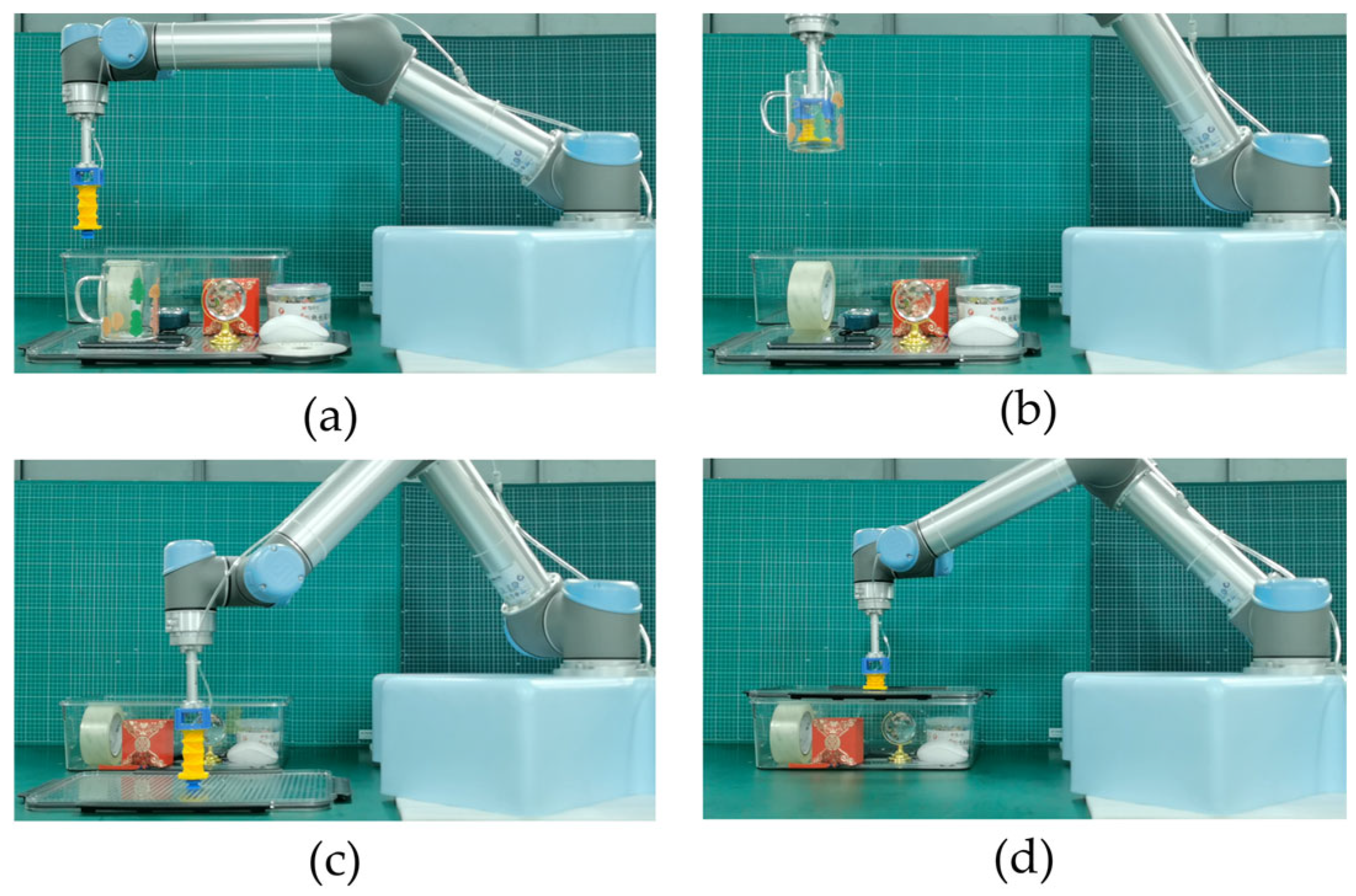
Figure 13a illustrates that several hard objects were placed randomly on the lid. Similarly, the UR5 robotic arm was programmed to plan its movement path, causing it to move along the planned path according to the preset program.
When grasping the glass cup (Figure 13b), the arm positions the gripper so that the suction cup contacts the cup’s inner base surface. After relocating the objects into the box, the gripper adheres to the lid surface and closes the box, as shown in Figure 13c,d (see Supplementary Video S2).

4.3. Twisting a Bottle Cap Using the Torsional Soft Gripper

The torsional soft actuator undergoes substantial torsional deformation under vacuum pressure actuation, generating a certain twisting force, and this functional characteristic enables the torsional soft gripper to unscrew the bottle cap (see Supplementary Video S3).
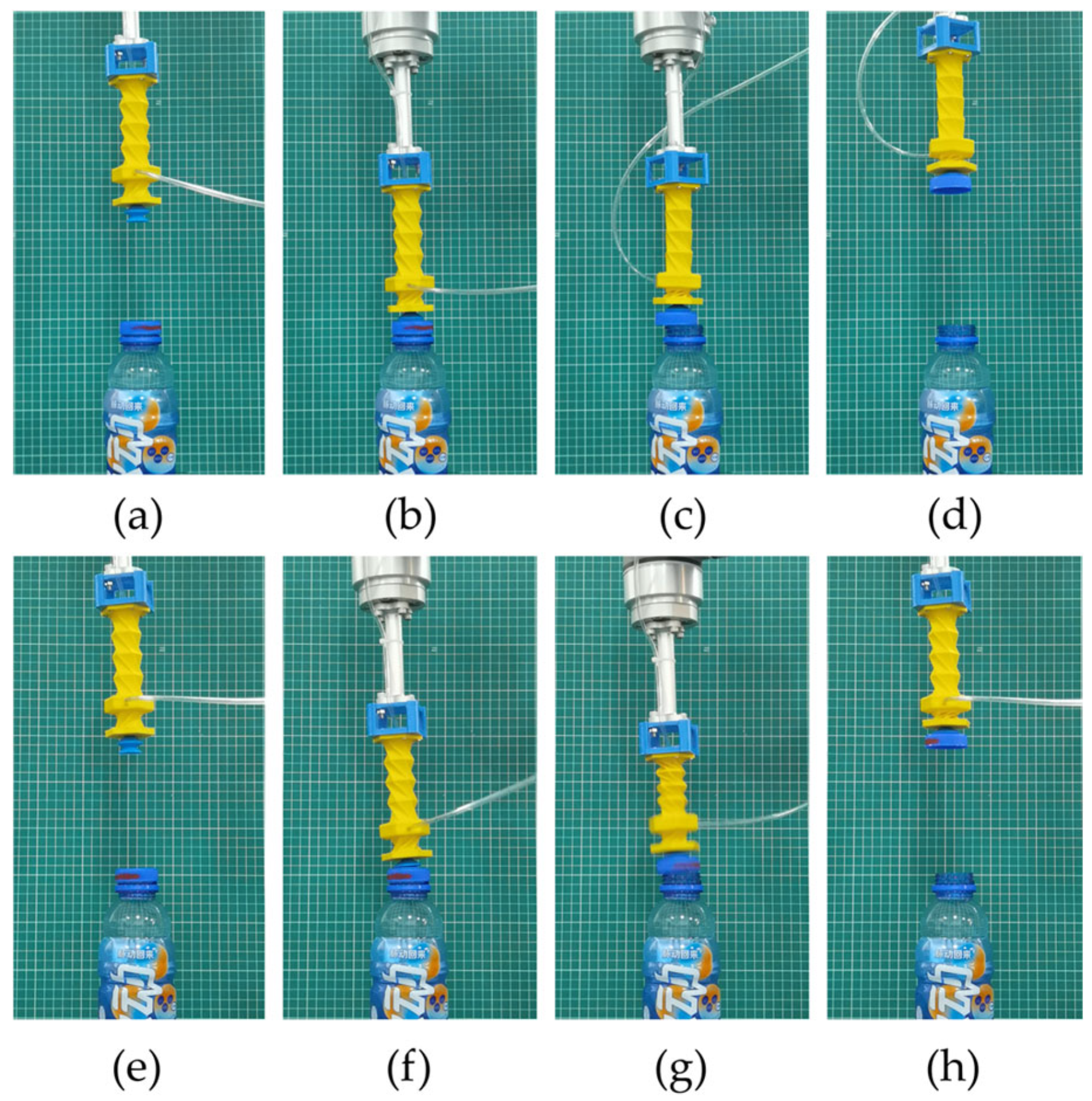
Here, two approaches were implemented to perform the bottle cap twisting task. One approach involves mounting the torsional soft gripper on the end of the UR5 robotic arm, and the robotic arm was commanded to move downward and align with the cap. Once the suction cup contacts and adheres to the bottle cap, the end joint of the robotic arm actively rotates, while the gripper itself still does not undergo torsional deformation. In this manner, the cap was twisted passively by the gripper, as illustrated in Figure 14a–d. The other approach involves the UR5 robotic arm’s end joint remaining stationary while the gripper undergoes active torsional deformation under the action of vacuum pressure, enabling the gripper to actively twist the cap, as shown in Figure 14e–h. Experimental results show that active twisting requires only 0.3 s, whereas passive twisting takes 5.9 s. The active twisting is nearly 20 times faster than the passive twisting in response time, demonstrating that the torsional gripper offers nice response speed and can be well-suited for rapid twisting operations.

5. Conclusions and Future Work

Inspired by the foldable morphological characteristics found in natural organisms, this study developed foldable and torsional actuators based on Kresling crease patterns. Fabricated through a 3D printing approach, these actuators feature simple, lightweight structures, high contraction ratios, and rapid response speed, enabling both foldable contraction and torsional deformation. Compared with the injection-molded or manually assembled actuators, the proposed origami-based actuators offer a simplified manufacturing process while effectively addressing long-standing challenges related to airtightness and structural stability.
Through theoretical modeling, finite element simulations, and comprehensive experiments, the following conclusions can be drawn: (1) The contraction amounts of both actuators increase linearly with vacuum pressure, and the torsional angle of the torsional actuator likewise rises with increasing pressure; (2) Within a certain parameter range, the larger base angle of the soft actuator, the greater contraction degree and relative deflection angle; (3) Finite element simulation results of both actuators under different vacuum pressures show good agreement with the experimental ones; (4) The foldable soft gripper and the torsional soft gripper exhibit distinct functional characteristics, enabling folding grasping and twisting manipulation, respectively.
Although the proposed soft actuators demonstrate strong folding, contraction, and torsional performances, several limitations remain, including restricted deformation modes, limited material strength, and inadequate control precision. All tests performed represent basic experimental validation and not a comprehensive assessment of long-term operational reliability. The number of repetitions in the grasping test and the scope of the cyclic test (1000 cycles) are appropriate for a proof-of-concept study, but for future practical application, it would be advisable to consider extended testing; for example, under long-term load, higher cycling frequencies, or combined mechanical stress.
Future work will focus on the development of programmable crease technologies to enable independent control of contracting, bending, and twisting deformation through designing novel crease patterns; exploring new soft materials to enhance load-bearing capability, durability, and fatigue performance; and integrating data-driven algorithms, sensor feedback, and machine vision to improve grasping accuracy and adaptability. These efforts aim to expand the application potential of soft origami actuators based on the Kresling pattern, exploring their prospects in high-end scenarios such as space debris collection and deep-sea biological sampling. However, current research remains in the laboratory validation phase. To advance toward practical application, some breakthroughs are needed in key challenges including material fatigue life, environmental robustness, and intelligent control for autonomous operations.

Supplementary Materials

The following supporting information can be downloaded at https://www.mdpi.com/article/10.3390/act15030136/s1, Supplementary Video S1: The actuators lift maximum load and air tightness test; Supplementary Video S2: The foldable soft gripper grasps fruits and different hard objects, then places them into a box; Supplementary Video S3: The torsional soft gripper passively and actively twists a bottle cap. Table S1: Success rate of multiple grasping (5 tests for each case).

Author Contributions

Conceptualization, C.E. and Q.X.; methodology, C.E., J.L. and Q.X.; software, J.L. and B.W.; validation, C.E., J.L. and B.W.; formal analysis, J.L., B.W. and D.G.; investigation, C.E., J.L., B.W. and Q.X.; resources, Q.X. and D.G.; data curation, C.E., J.L. and B.W.; writing—original draft preparation, C.E., J.L. and Q.X.; writing—review and editing, C.E. and Q.X.; visualization, C.E., J.L. and B.W.; supervision, Q.X.; project administration, Q.X.; funding acquisition, Q.X. All authors have read and agreed to the published version of the manuscript.

Funding

This research was funded by Zhejiang Provincial Natural Science Foundation of China under Grant No. LQ22A020003, and China Scholarship Council under Grant No. 202308330163.

Institutional Review Board Statement

Not applicable.

Informed Consent Statement

Not applicable.

Data Availability Statement

Data are contained within the article.

Acknowledgments

We thank Chew Chee Meng from Department of Mechanical Engineering and Cecilia Laschi from the Soft Robotics Lab at Advanced Robotics Centre of National University of Singapore for the favorable suggestions and discussions on the deformation performance, functions and applications of the soft foldable and torsional actuators. We also acknowledge the Intelligent robot Lab in College of Engineering of Zhejiang Normal University for supporting experimental facilities.

Conflicts of Interest

Author Danfang Guo was employed by the company Hangzhou YiDaShi Technology Development Co., Ltd. The remaining authors declare that the research was conducted in the absence of any commercial or financial relationships that could be construed as a potential conflict of interest.

Appendix A

As shown in Figure 7d, and the relative deflection angle ψ is
ψ = θ θ 0
The initial relative deflection angle is zero, meaning no relative deflection occurs between the upper and lower base surfaces. A spatial Cartesian coordinate system is established, as shown in Figure A1b, and the coordinates of the following four points are defined as follows
P = (L, 0, 0)
Q = ( 1 / 2 L ,   3 / 2 L ,   0 )
P = ( L cos ( π / 3 + θ ) ,   L sin ( π / 3 + θ ) ,   h )
Q = ( L cos ( π / 3 θ ) ,   L sin ( π / 3 θ ) ,   h )
Figure A1. (a) Two-dimensional planar diagram and (b) three-dimensional spatial diagram of the single-layer actuator.
Actuators 15 00136 g0a1
When the side length L of the polygon, the length a of the mountain crease, and the length b of the valley crease are specified, the geometric relationships with the base angle α and the side angle β can be derived analytically. On the basis of the two-dimensional planar diagram shown in Figure A1a, and by applying fundamental trigonometric identities, the base angle α can be calculated as
  α = arccos   [ b 2 +   L 2 a 2 / 2 b L ]
During the folding process, each triangular facet remains planar, meaning that the distances between any two points on the facet remain unchanged. Leveraging this invariance, a geometric relationship between the height h and deflection angle θ at any given moment can be established. From the distance formula between two points in space, the following relationships can be derived as
a 2 =   2 L 2 [ 1     cos ( π / 3 + θ ) ] + h 2
b 2 = 2 L 2 1 + cos ( π / 3   θ ) +   h 2
Subtracting Equation (A7) from Equation (A8) yields
a 2 b 2 =   2 L 2 cos θ
Combining Equations (A6) and (A9), we can obtain
2 b cos α = L 2 cos θ + 1
Further simplifying Equation (A10) yields
θ = arccos   [ ( 2 b cos α L ) / 2 L ]
From Equation (A8), we can obtain
θ = π / 3     arccos   [ ( b 2 h 2   2 L 2 ) / 2 L 2 ]
From Equations (A11) and (A12), we can yield the relative deflection angle ψ as
ψ = arccos   [ ( 2 b cos α L ) / 2 L ] θ 0 = π / 3     arccos   [ ( b 2 h 2   2 L 2 ) / 2 L 2 ]   θ 0
Moreover, we discussed the relationship between the base angle α and the contraction amount Δs. By combining Equations (A8) and (A11), we can obtain
Δ s = H h = H b 2     2 L 2   [ 1 + cos { π / 3   arccos   [ ( 2 b cos α   L ) / 2 L ] }
Given the coordinates of the four points P, Q, Q′, and P′, the normal vectors of the planes PQ′P′ and PQQ′ can be calculated as
n 1 = h sin θ ,   h cos θ ,   L 3 / 2   + sin θ
n 2 = 3 h ,   h ,   L ( 2 sin θ + 3 )
Then, the dihedral angle γ can be determined
  γ = arccos n 1 n 2 / n 1 n 2
n 1 = h 2 + L 2 ( 3 / 2 +   sin θ ) 2
n 2 = 4 h 2 + L 2 ( 2 sin θ   + 3 ) 2
n 1 n 2 = 3 h 2 sin θ +   h 2 cos θ +   L 2 ( 3 / 2 +   sin θ ) ( 2 sin θ + 3 )
By substituting the relevant variables into Equation (A17), the dihedral angle γ can be calculated. The variation in γ can be further examined through mathematical derivation. As indicated by Equation (A12), the angle θ increases as the height h decreases, while L remains a constant. In Equations (A18) and (A19), the magnitudes of n 1 and n 2 are dominated by the h2 term, their numerical values decrease as h decreases; in Equation (A20), the term n 1 n 2 containing h2 plays a leading role, resulting in a decrease in its corresponding value, and the decreasing rate is below that of n 1 n 2 , consequently leading to an overall increase in n 1 n 2 / n 1 n 2 . Finally, according to Equation (A17), it follows that γ decreases as h decreases.

References

  1. Wong, W.S.Y.; Li, M.; Nisbet, D.R.; Craig, V.S.J.; Wang, Z.; Tricoli, A. Mimosa origami: A nanostructure-enabled directional self-organization regime of materials. Sci. Adv. 2016, 2, e1600417. [Google Scholar] [CrossRef] [PubMed]
  2. Saito, K.; Pérez-de la Fuente, R.; Arimoto, K.; Seong, Y.A.; Aonuma, H.; Niiyama, R.; You, Z. Earwig fan designing: Biomimetic and evolutionary biology applications. Proc. Natl. Acad. Sci. USA 2020, 117, 17622–17626. [Google Scholar] [CrossRef]
  3. Wang, J.; Wang, C.; Chen, W.; Dou, Q.; Chi, W. Embracing the future: The rise of humanoid robots and embodied AI. Intell. Robot. 2024, 4, 196–199. [Google Scholar] [CrossRef]
  4. Zhao, Z.; Wu, Q.; Wang, J.; Zhang, B.; Zhong, C.; Zhilenkov, A.A. Exploring embodied intelligence in soft robotics: A review. Biomimetics 2024, 9, 248. [Google Scholar] [CrossRef]
  5. Liu, H.; Jiang, Y.; Liu, M.; Zhang, X.; Huo, J.; Su, H. Path planning with obstacle avoidance for soft robots based on improved particle swarm optimization algorithm. Intell. Robot. 2023, 3, 565–580. [Google Scholar] [CrossRef]
  6. Klicker, K.A.; Biggers, J.V.; Newnham, R.E. Composites of PZT and epoxy for hydrostatic transducer applications. J. Am. Ceram. Soc. 1981, 64, 5–9. [Google Scholar] [CrossRef]
  7. Mulling, J.; Usher, T.; Dessent, B.; Palmer, J.; Franzon, P.; Grant, E.; Kingon, A. High displacement piezoelectric actuators: Characterization at high load with controlled end conditions. In Proceedings of the 12th IEEE International Symposium on Applications of Ferroelectrics (ISAF 2000), Honolulu, HI, USA, 21 July–2 August 2000; pp. 745–748. [Google Scholar]
  8. Qiao, G.; Zhang, Y.; Cao, Q.; Wang, C.; Chen, Z.; Gong, G.; Yang, H.; Han, D. An ultradurable piezoelectric inertia actuator via wear-adaptive mechanism. IEEE Trans. Ind. Electron. 2025, 72, 7308–7319. [Google Scholar] [CrossRef]
  9. Sheng, J.; Gandhi, D.; Gullapalli, R.; Simard, J.M.; Desai, J.P. Development of a meso-scale SMA-based torsion actuator for image-guided procedures. IEEE Trans. Robot. 2017, 33, 240–248. [Google Scholar] [CrossRef] [PubMed]
  10. Martinez, R.V.; Branch, J.L.; Fish, C.R.; Jin, L.; Shepherd, R.F.; Nunes, R.M.D.; Suo, Z.; Whitesides, G.M. Robotic tentacles with three-dimensional mobility based on flexible elastomers. Adv. Mater. 2013, 25, 205–212. [Google Scholar] [CrossRef] [PubMed]
  11. Mosadegh, B.; Polygerinos, P.; Keplinger, C.; Wennstedt, S.; Shepherd, R.F.; Gupta, U.; Shim, J.; Bertoldi, K.; Walsh, C.J.; Whitesides, G.M. Pneumatic networks for soft robotics that actuate rapidly. Adv. Funct. Mater. 2014, 24, 2163–2170. [Google Scholar] [CrossRef]
  12. Fu, H.; Jiang, Y.; Lv, J.; Huang, Y.; Gai, Z.; Liu, Y.; Lee, P.S.; Xu, H.; Wu, D. Multilayer dielectric elastomer with reconfigurable electrodes for artificial muscle. Adv. Sci. 2023, 10, e2206094. [Google Scholar] [CrossRef] [PubMed]
  13. Dong, W.; Zuo, L. Giant magnetostrictive actuators for active vibration control. Smart Mater. Struct. 2004, 13, 1257–1265. [Google Scholar] [CrossRef]
  14. Li, S.; Vogt, D.M.; Rus, D.; Wood, R.J. Fluid-driven origami-inspired artificial muscles. Proc. Natl. Acad. Sci. USA 2017, 114, 13132–13137. [Google Scholar] [CrossRef]
  15. Zhang, S.; Li, Y.; Li, Z.; Chedid, N.; Zhang, P.; Cheng, K.; Fang, X. 3D-printed soft magnetoactive origami actuators. Adv. Funct. Mater. 2025, 35, 2516404. [Google Scholar] [CrossRef]
  16. Yang, Z.; Chu, D.-S.; Levine, D.J.; Sung, C. Origami-inspired robot that swims via jet propulsion. IEEE Robot. Autom. Lett. 2021, 6, 7145–7152. [Google Scholar] [CrossRef]
  17. Zhang, Y.; Chu, K.; Shu, S.; Wang, J.L.; Zhou, H.; Hu, J.F. Design and performance analysis of soft robotic fish based on water bomb origami structure. J. Eng. Des. 2025, 32, 326–333. [Google Scholar]
  18. Liu, J.; Ma, G.; Ma, Z.; Zuo, S. Origami-inspired soft-rigid hybrid contraction actuator and its application in pipe-crawling robot. Smart Mater. Struct. 2023, 32, 065015. [Google Scholar] [CrossRef]
  19. Yu, M.; Yang, W.; Yu, Y.; Cheng, X.; Jiao, Z. A crawling soft robot driven by pneumatic foldable actuators based on miura-ori. Actuators 2020, 9, 26. [Google Scholar] [CrossRef]
  20. Chen, B.; Shao, Z.; Xie, Z.; Liu, J.; Pan, F.; He, L.; Zhang, L.; Zhang, Y.; Ling, X.; Peng, F.; et al. Soft origami gripper with variable effective length. Adv. Intell. Syst. 2021, 3, 2000251. [Google Scholar] [CrossRef]
  21. Stohlman, O.R.; Hada, M.; Rouse, M.; Bickler, D.B. Advances in low-cost manufacturing and folding of solar sail membranes. In Proceedings of the 2020 AIAA Science and Technology Forum and Exposition (AIAA SciTech Forum), Orlando, FL, USA, 6–10 January 2020. [Google Scholar]
  22. Sun, C.; Wan, W.; Deng, L. Adaptive space debris capture approach based on origami principle. Int. J. Adv. Robot. Syst. 2019, 16, 53–72. [Google Scholar] [CrossRef]
  23. Li, S.; Stampfli, J.J.; Xu, H.J.; Malkin, E.; Villegas Diaz, E.; Rus, D.; Wood, R.J. A vacuum-driven origami ‘‘magic-ball’’ soft gripper. In Proceedings of the 2019 International Conference on Robotics and Automation (ICRA), Montreal, QC, Canada, 20–24 May 2019; pp. 7401–7408. [Google Scholar]
  24. Li, S.J.; Li, J.H.; Kang, H.W.; Cheng, Y.J.; Chen, Y.H. Bio-inspired origamic pouch motors with a high contraction ratio and enhanced force output. Robot. Auton. Syst. 2022, 149, 103983. [Google Scholar] [CrossRef]
  25. Fan, W.C.; Wang, J.Q.; Zhang, H.J.; Wu, Q.C.; Hu, Q.H.; Chen, G.L.; Wang, H.; Huang, X.N. SPARC: A soft, proprioceptive, agile robot for 3D climbing and exploration with precise trajectory following. Adv. Sci. 2025, 12, e10382. [Google Scholar] [CrossRef] [PubMed]
  26. Kim, H.; Kim, J.; Lee, J.; Hong, S.-W. A high-precision torque measurement system for torsional soft actuators. Mech. Syst. Signal Process. 2022, 173, 109098. [Google Scholar]
  27. Li, D.; Fan, D.; Zhu, R.; Lei, Q.; Liao, Y.; Yang, X.; Pan, Y.; Wang, Z.; Wu, Y.; Liu, S.; et al. Origami-inspired soft twisting actuator. Soft Robot. 2023, 10, 395–409. [Google Scholar] [CrossRef]
  28. Hou, N.; Wen, J.; Pan, Y.; Taghavi, M. Origami-inspired modular electro-ribbon actuator for multi-degrees of freedom motion. Adv. Intell. Syst. 2024, 6, 2300738. [Google Scholar] [CrossRef]
  29. Zhu, Y.; Birla, M.; Oldham, K.R.; Filipov, E.T. Elastically and plastically foldable electrothermal micro-origami for controllable and rapid shape morphing. Adv. Funct. Mater. 2020, 30, 2003741. [Google Scholar] [CrossRef]
  30. Novelino, L.S.; Ze, Q.; Wu, S.; Paulino, G.H.; Zhao, R. Untethered control of functional origami microrobots with distributed actuation. Proc. Natl. Acad. Sci. USA 2020, 117, 24096–24101. [Google Scholar] [CrossRef]
  31. Melancon, D.F.; Kamp, L.M.; Gorissen, B.; Bertoldi, K. Inflatable origami: Multimodal deformation via multistability. Adv. Funct. Mater. 2022, 32, 2270196. [Google Scholar] [CrossRef]
  32. Wu, S.; Zhao, T.; Zhu, Y.; Paulino, G.H. Modular multi-degree-of-freedom soft origami robots with reprogrammable electrothermal actuation. Proc. Natl. Acad. Sci. USA 2024, 121, e2322625121. [Google Scholar] [CrossRef]
  33. Ze, Q.; Wu, S.; Nishikawa, J.; Dai, J.; Sun, Y.; Leanza, S.; Zemelka, C.; Novelino, L.S.; Paulino, G.H.; Zhao, R. Soft robotic origami crawler. Sci. Adv. 2022, 8, eabm7834. [Google Scholar] [CrossRef]
  34. Huang, L.; Xie, T.C.; Yin, L.R. Magnetically-actuated intracorporeal biopsy robot based on kresling origami. Theor. Appl. Mech. Lett. 2025, 15, 100500. [Google Scholar] [CrossRef]
  35. Cheng, P.; Jia, J.; Ye, Y.; Wu, C. Modeling of a soft-rigid gripper actuated by a linear-extension soft pneumatic actuator. Sensors 2021, 21, 493. [Google Scholar] [CrossRef]
  36. Tawk, C.; Spinks, G.M.; Panhuis, M.I.H.; Alici, G. 3D printable vacuum-powered soft linear actuators. In Proceedings of the 2019 IEEE/ASME International Conference on Advanced Intelligent Mechatronics (AIM), Hong Kong, 8–12 July 2019; pp. 2118–2129. [Google Scholar]
  37. Joe, S.; Bernabei, F.; Beccai, L. A review on vacuum-powered fluidic actuators in soft robotics. In Rehabilitation of the Human Bone-Muscle System; InTechOpen: London, UK, 2022. [Google Scholar]
  38. Kresling, B. Folded and unfolded nature. In Origami, Science and Art: Proceedings of the Second International Meeting of Origami Science and Scientific Origami, Otsu, Japan, 29 November–2 December 1994; Miura, K., Ed.; Seian University of Art and Design: Otsu, Japan, 1997; pp. 93–108. [Google Scholar]
  39. Kresling, B. Natural twist buckling in shells: From the hawkmoth’s bellows to the deployable kresling-pattern and cylindrical miura-ori. In Proceedings of the 6th International Conference on Computation of Shell and Spatial Structures (IASS-IACM 2008), Ithaca, NY, USA, 28–31 May 2008; Abel, J.F., Cooke, R., Eds.; Curran Associates, Inc.: New York, NY, USA, 2008; pp. 1–4. [Google Scholar]
  40. Yuan, T.T.; Ren, K.M.; Fang, Y.Q.; Liu, J.Y. Dynamic modeling and analysis for non-rigid origami structure considering nonlinear constitutive relation. Chin. J. Theor. Appl. Mech. 2022, 54, 2552–2566. [Google Scholar]
  41. Yan, S.; Song, K.; Wang, X.; Li, J.; Ma, Z.; Zhou, X. An origami-enabled soft linear actuator and its application on a crawling robot. J. Mech. Robot. 2025, 17, 011002. [Google Scholar] [CrossRef]
  42. ASTM International. Standard Test Method for Tensile Properties of Plastics; ASTM International: West Conshohocken, PA, USA, 2006; pp. 1–15. [Google Scholar]
  43. Subramaniam, V.; Jain, S.; Agarwal, J.; Valdivia y Alvarado, P. Design and characterization of a hybrid soft gripper with active palm pose control. Int. J. Robot. Res. 2020, 39, 1668–1685. [Google Scholar] [CrossRef]
  44. Martinez, R.V.; Fish, C.R.; Chen, X.; Whitesides, G.M. Elastomeric origami: Programmable paper-elastomer composites as pneumatic actuators. Adv. Funct. Mater. 2012, 22, 1376–1384. [Google Scholar] [CrossRef]
  45. Xiao, Y.H.; Zhang, L.; Wang, T. Investigation of mechanical and electrical characteristics of self-sensing pneumatic torsional actuators. Sci. China Technol. Sci. 2024, 67, 130–142. [Google Scholar] [CrossRef]
  46. Yan, J.; Xu, B.; Zhang, X.; Zhao, J. Design and test of a new spiral driven pure torsional soft actuator. In Intelligent Robotics and Applications, ICIRA 2017, Wuhan, China, 16–18 August 2017; Lecture Notes in Computer Science; Springer International Publishing: Cham, Switzerland, 2017; pp. 127–139. [Google Scholar]
Figure 1. (a) A planar parallelogram element; (b) Four-layer symmetrical structure; (c) Foldable actuator; (d) Four-layer torsional structure; (e) Torsional actuator.
Actuators 15 00136 g001
Figure 2. (a) Standard test specimen; (b) Test specimen clamped in the universal testing machine; (c) Stress–strain curve of the TPE 85A material; (d) Schematic of 3D printing fabrication process.
Actuators 15 00136 g002
Figure 3. Experiments of (a) the foldable actuator and (b) the torsional actuator lifting a load of 500 g, respectively; (c) maximum load experiments; (d) underwater tightness test experiments; (e) torque measurement experiment; (f) displacement response experiment of foldable actuator; (g) relationship between vacuum pressure and torque; (h) displacements of carrying 0, 0.5, 1, and 1.5 kg loads when applying a vacuum pressure of 99.8 kPa; (i) the displacement of the foldable actuator during 1000 times cyclic evacuation and recovery cycles; (j) the displacement of the torsional actuator during 1000 times cyclic evacuation and recovery cycles.
Actuators 15 00136 g003
Figure 4. The control system of the actuator.
Actuators 15 00136 g004
Figure 5. Two types of actuators: (a) Simulation and (b) experiment results of folding contraction deformation of the foldable actuator under different vacuum pressures; (c) simulation and (d) experiment results of the twisting contraction deformation of the torsional actuator under different vacuum pressures; (e) relationship between vacuum pressure and displacement of the foldable actuator; (f) relationship between vacuum pressure and displacement of the torsional actuator.
Actuators 15 00136 g005
Figure 6. (a) The foldable actuator and suction cup assembly form (b) a foldable gripper; (c) the torsional actuator and suction cup assembly form (d) a torsional gripper.
Actuators 15 00136 g006
Figure 7. The single-layer actuator. (a) Natural state, (b) contraction state, (c) top view at natural state, (d) top view during contraction.
Actuators 15 00136 g007
Figure 8. The inscribed circle area S versus the base angle α and the number of polygon sides n.
Actuators 15 00136 g008
Figure 9. (a) Initial and contracted states of the soft actuator; (b) an equivalent spring system; (c) experimental set up for measuring equivalent elastic coefficient; (d) vacuum pressure versus contraction ratio.
Actuators 15 00136 g009
Figure 10. (a) The foldable soft gripper is assembled to the end of the UR5 robotic arm, (b) grasping fruits and placing them into a box, (c) grasping and closing the lid.
Actuators 15 00136 g010
Figure 11. The foldable soft gripper grasping different fruits: (a) tomato, (b) plum, (c) nectarine, (d) banana, (e) orange, (f) apple, (g) mango, (h) melon.
Actuators 15 00136 g011
Figure 12. The foldable soft gripper grasping various hard objects: (a) coin, (b) card, (c) CD, (d) cup, (e) ruler, (f) candy box, (g) mobile phone, (h) tape measure, (i) cylindrical box, (j) adhesive tape, (k) mouse, and (l) globe.
Actuators 15 00136 g012
Figure 13. The foldable soft gripper grasping different hard objects and closing the lid: (a) The initial state of the UR5 robotic arm, the soft gripper, and objects; (b) grasping the glass cup; (c) grasping the lid; (d) closing the lid.
Actuators 15 00136 g013
Figure 14. The torsional gripper twisting a bottle cap. (ad) passive twisting; (eh) active twisting.
Actuators 15 00136 g014
Table 1. A comparison of performance metrics of typical linear actuators.
ReferencesActuation
Mode
Self-Weight (g)Payload/
Self-Weight
Response
Time (s)
Contraction
Ratio (%)
This workVacuum11.84~131.3~0.1371
[14]Fluid-driven2.6~380~0.254
[18]Vacuum~80~12.5~0.259
[28]Electrical38.2~2.7Unknown56
[44]Vacuum8.3~120Unknown~67
Table 2. A comparison of performance metrics of representative torsional actuators.
ReferencesActuation
Mode
Self-Weight (g)Torsional Angle (°)Response
Time (s)
Torque (N∙mm)
This workVacuum11.94~120~0.13154.3
[26]PneumaticUnknown~78Unknown60
[27]Vacuum~15~136~0.724
[45]Vacuum~13~66~0.5424.9
[46]Cable-drivenUnknown~110Unknown26
Disclaimer/Publisher’s Note: The statements, opinions and data contained in all publications are solely those of the individual author(s) and contributor(s) and not of MDPI and/or the editor(s). MDPI and/or the editor(s) disclaim responsibility for any injury to people or property resulting from any ideas, methods, instructions or products referred to in the content.