
Article

Transient Energy Conversion and Compressed Air Recovery in Pneumatic Systems: Optimization and CFD-Based Analysis


by
Andrii Rogovyi
1,*,
Yuriy Romasevych
2,
Mariana Stryzhak
3,
Ruslan Kryvobok
4,
Gennady Krutikov
3 and
Serhiy Iglin
5
1
Department of Hydraulic Machines, National Technical University “Kharkiv Polytechnic Institute”, 61002 Kharkiv, Ukraine
2
Department of Machine and Equipment Design, The National University of Life and Environmental Sciences of Ukraine, 03041 Kyiv, Ukraine
3
Department of Machine Components and Hydropneumatic Systems, National Technical University “Kharkiv Polytechnic Institute”, 61002 Kharkiv, Ukraine
4
Scientific and Research Department, National Technical University “Kharkiv Polytechnic Institute”, 61002 Kharkiv, Ukraine
5
Department of Computer Mathematics and Data Analysis, National Technical University “Kharkiv Polytechnic Institute”, 61002 Kharkiv, Ukraine
*
Author to whom correspondence should be addressed.
Actuators 2026, 15(3), 135; https://doi.org/10.3390/act15030135
Submission received: 30 January 2026 / Revised: 22 February 2026 / Accepted: 23 February 2026 / Published: 27 February 2026
(This article belongs to the Section Actuators for Manufacturing Systems)

Abstract

Pneumatic drives remain widely used in industrial automation due to their simplicity and reliability, yet their overall energy efficiency is typically low. This study introduces an energy-efficient pneumatic drive concept that enhances braking control and enables compressed air recovery without modifying the actuator’s mechanical design. A transient one-dimensional mathematical model is developed to describe system dynamics and is combined with a particle swarm optimization (PSO) algorithm to determine optimal switching coordinates for the braking phase under constraints on piston motion and positioning accuracy. To assess the validity and limitations of simplified models, the optimized process is additionally investigated using a three-dimensional CFD model with moving mesh and valve control. The CFD model is validated experimentally using pressure measurements in the cylinder chambers. The results reveal that conventional isothermal 1D models underestimate transient pressure and energy parameters by up to 30–35% in systems with air recovery, highlighting the necessity of 3D analysis for accurate energy assessment. Optimization increases the duration of the recovery phase by a factor of 2.8 while maintaining cycle time and improving positioning accuracy. The resulting cycle energy efficiency reaches 53.4%, significantly exceeding typical industrial values. The proposed methodology provides a practical framework for designing energy-efficient pneumatic drives.

1. Introduction

Pneumatic drives are an essential component of modern automated production systems due to their high reliability, simple design, and the widespread availability of the working medium—compressed air. However, the efficiency of such systems is limited by a low overall efficiency coefficient, which results from significant energy losses during the stages of compression, transportation, and utilization of air in actuators [1,2].
Moreover, energy consumption for the production of compressed air in the industrial sector of the European Union is estimated to account for 7–10% of total industrial energy use [1,3]. The main causes of excessive energy consumption in pneumatic systems are the improper sizing of actuators, the lack of adaptive control over drive parameters, and the presence of leaks in the pipelines [2,4,5].
Studies indicate that the energy-saving potential in pneumatic systems is substantial: up to 40% under typical operating conditions and up to 80% in the case of comprehensive optimization of operational processes [4,6,7,8].
The key strategies for improving the energy efficiency of pneumatic drives during operation are: local pressure reduction and division of the power supply into two (or more) levels [9] using pressure-reducing valves (allowing energy savings of 20–50%), limiting the supply of compressed air according to pressure levels [10] (enabling actuator downsizing and energy savings of up to 71% without performance loss), and modifying switching modes during operation, which can reduce energy losses by up to 80% without altering the overall architecture of the pneumatic drive [8,11].
The study in [12] analyzes the effect of retaining and reusing exhaust air on drive dynamics; however, the authors focus solely on modifying fast-dynamic parameters and do not calculate the system’s energy balance, preventing an accurate assessment of recovery efficiency. An experimental study [13] demonstrated significant energy savings through the collection and reuse of exhaust air, but it was conducted on low-speed actuators, leaving the efficiency under highly dynamic conditions uncertain and limiting the general applicability of the approach. Study [14] showed that using a booster regulator with a recovery circuit can increase the energy efficiency of a pneumatic system by returning part of the compressed air. However, the authors consider only a local system component (the booster) and do not analyze the complete energy cycle of the drive, which prevents evaluation of the overall recovery effect. Work [15] presents an original scheme of double expansion and exhaust air collection, demonstrating a noticeable reduction in working medium consumption; however, the system has increased design complexity and high sensitivity to pressure fluctuations, limiting its applicability in fast-dynamic drives. Study [16], focused on hybrid braking systems, combines hydraulic and pneumatic recovery mechanisms, but primarily targets heavy-duty transport platforms, so the findings cannot be directly extrapolated to industrial pneumatic drives. Extending this topic, the authors in [17] performed a sensitivity analysis of the parameters of a combined hydro-pneumatic system, but focused on design dependencies and paid little attention to the dynamics of losses in compression and expansion processes, which are critical for assessing recovery efficiency.
The combination of these limitations in existing studies highlights the relevance of conducting a comprehensive analysis of energy processes in pneumatic drives with recovery. Works [5,18,19,20,21] emphasize that the implementation of energy-saving strategies should begin at the design stage, when possible operating modes are evaluated, and intelligent control algorithms are implemented.
Load-adaptive switching algorithms have demonstrated the potential to increase efficiency and reduce consumption by minimizing excess pressure in the system [22]. Implementation of such strategies relies on pressure/velocity feedback for dynamic valve switching [12]; however, these methods are difficult to implement due to the need for additional complex distribution and control equipment, significantly increasing system cost.
Based on the above, two promising directions for improving the energy efficiency of pneumatic drives emerge, which are both technically and economically feasible: modifying switching events during a single operation with subsequent recovery of part of the exhaust air, and locally reducing the supply pressure at the final stage of piston movement.
Despite extensive research on pneumatic drives and energy-saving strategies [16,17,23], most existing studies rely on simplified one-dimensional models, typically assuming isothermal or quasi-steady processes [24,25]. While such models are computationally efficient, they inherently neglect transient thermodynamic effects, spatial pressure non-uniformities, and temperature variations that become critical during braking and compressed air recovery phases [16,17,26].
In particular, the applicability of 1D models to systems with energy recuperation remains insufficiently validated, despite their widespread use for estimating air consumption and energy efficiency [16,17,23]. This creates a fundamental gap between model-based optimization results and the actual energy performance of pneumatic systems operating under highly transient conditions [24,26].
To address this limitation, the present study employs a fully transient three-dimensional CFD approach with moving boundaries and UDF-controlled valve logic, enabling direct resolution of unsteady compressible flow, heat transfer, and energy conversion mechanisms in pneumatic drives. This approach allows not only accurate quantification of recovered energy but also a rigorous assessment of the validity limits of traditional 1D isothermal models, which is essential for energy engineering applications focused on efficiency improvement and reduction in primary energy consumption.
The aim of this study is to develop a methodology for improving the energy efficiency of the working process of a pneumatic drive with braking by modifying the switching events between cylinder chambers and recovering energy at the design stage, as well as to enhance the accuracy of assessing pneumatic system efficiency using a combined approach based on one-dimensional and three-dimensional modelling.
To achieve this goal, the optimal coordinates for the start and end of the braking phase (switching events) were determined, maximizing the duration of compressed air recovery from the exhaust cavity to the network (Section 3.2); a simulation model of the pneumatic cylinder was developed in the Ansys Fluent environment and validated against experimental data; and the energy efficiency of the system with an optimized working process was calculated (Section 3.3).

2. Materials and Methods

The study was carried out in three stages: modelling the characteristics of the pneumatic drive and evaluating transient processes using rapid one-dimensional simulations; optimizing the working process with the particle swarm optimization method; and investigating the optimized system through three-dimensional numerical modelling.

2.1. Mathematical Model of the Pneumatic System

2.1.1. Structure of the Pneumatic System

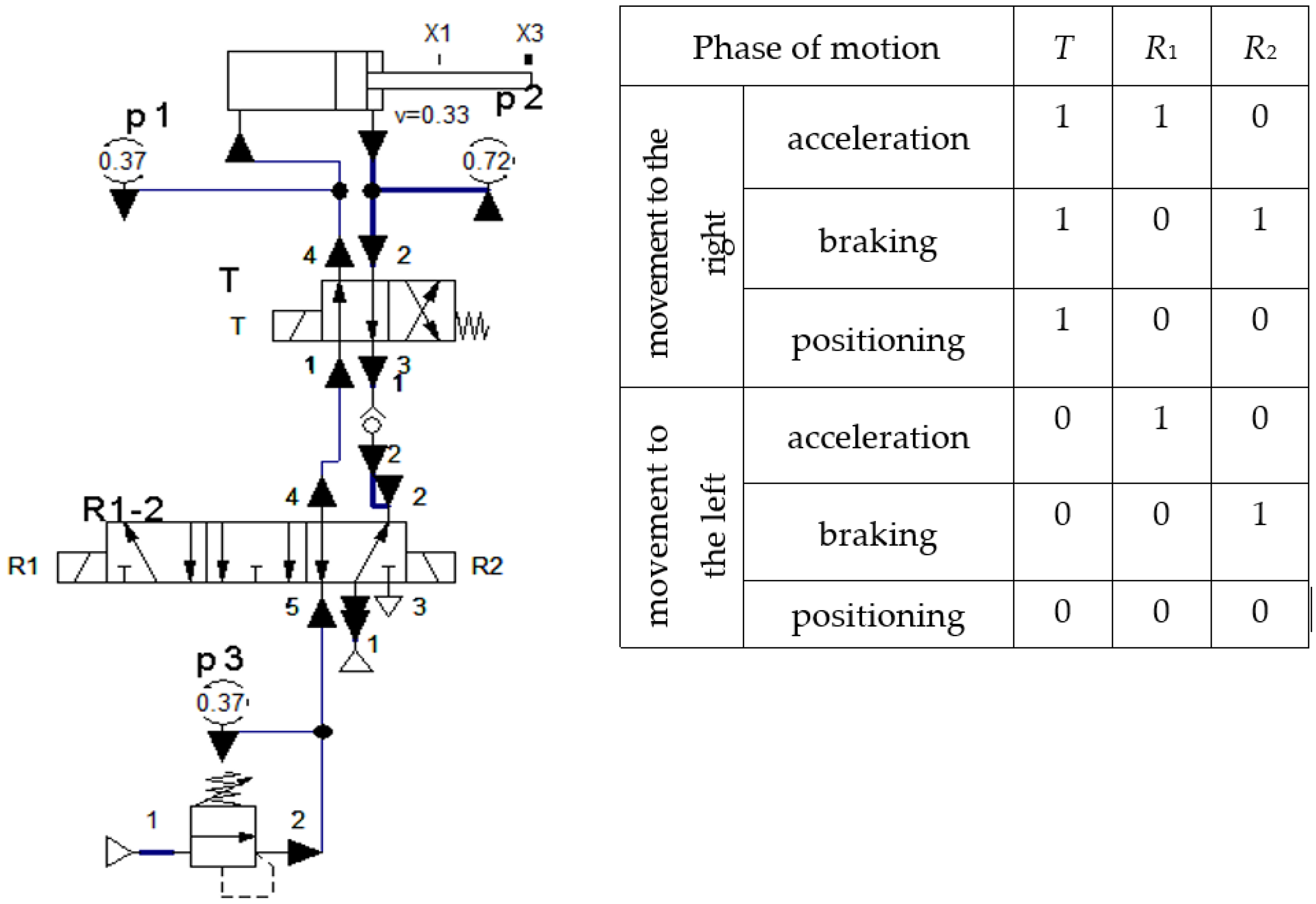
The analysis of the energy parameters of the pneumatic system (PS) was carried out using the diagram shown in Figure 1. According to the results of transient process evaluations [27], this configuration is considered the most promising in terms of meeting the requirements for pressure and speed stability, as well as positioning accuracy. This PS structure also enables the recovery of compressed air from the exhaust chamber back to the network [27,28].
The pneumatic drive (Figure 1) comprises a double-acting pneumatic cylinder controlled by a monostable 4/2 valve T and a biostable 5/3 valve R , a reduction valve that maintains a stable reduced supply pressure, and a check valve in the exhaust line. Figure 1 also presents a control map for the valves, where the electrical signals governing the valves are Boolean variables, taking the values 1 (control signal present) and 0 (control signal absent).

2.1.2. Synthesis of a Mathematical Model of the Pneumatic System

To investigate the working process of the pneumatic system, a mathematical model was developed based on the following assumptions:
In the 1D model, the thermodynamic process is approximated as isothermal by prescribing a constant air temperature inside the cylinder equal to 300 K. This value corresponds to the initial operating conditions and is maintained throughout the entire cycle to obtain a computationally efficient engineering representation of pressure dynamics. Temperature variations during compression and expansion are therefore not explicitly resolved. Such an approach is commonly applied to short-term pneumatic cycles (up to 1 s) with transient processes. According to [29,30], at pressures up to 0.6 MPa and temperatures around 300 K, the deviation in simulation results does not exceed 5%.
In the 1D formulation, heat exchange between the gas and the surrounding environment is not modeled. Considering the short operating cycle of the pneumatic drive (~1 s), significant heat transfer between the air in the cavities and the cylinder walls is limited. As reported in [31], under rapid pressure variations, this assumption reduces calculation accuracy by approximately 1–5%, while [32] demonstrates that for short cycles, the influence of heat exchange on overall accuracy is negligible (error < 1%).
The working medium is considered an ideal gas. This assumption is justified in [33], which shows that the deviation of the actual transient process from the ideal model under standard operating conditions (pressures up to 1 MPa and temperatures up to 400 K) does not exceed 1%.
The transition from subcritical to supercritical (choked) compressible flow regimes is governed by the flow function φ I , which depends on the pressure ratio I = p o u t / p i n , where p i n and p o u t are the upstream and downstream pressures across a throttling element.
The critical pressure ratio separating subcritical and choked flow is defined by classical compressible flow theory [34,35] as
I c r = 2 a + 1 a a 1 ,
which for air ( a = 1.4 ) equals approximately 0.528.
Equation (1) implements this transition in a compact analytical form using a continuous switching function. The s i g n I 0.528 operator ensures numerically stable and automatic switching between flow regimes, while also accounting for possible changes in flow direction at throttling elements:
φ I = 1 + sign I 0.528 2 2 k 1 I 2 / a I a + 1 / a + 0.579 1 sign I 0.528 2 .
Taking the above assumptions into account, the equations of thermal (energy) balance for the gas in the open (working and exhaust) cavities are expressed as relations for the rate of pressure change in these cavities d p 1 / d t and d p 2 / d t , along with the equation of dynamic equilibrium of the piston [29,36,37]:
d p 1 d t = α a p m f 1 e a R T m F 1 x 01 + x φ p 1 p m β a p 1 x 01 + x d x d t ; d p 2 d t = γ a f 2 e p 2 3 a 1 2 a a R T m F 2 L + x 02 x p k a 1 2 a φ p a p 2 + δ a p 2 L + x 02 x d x d t ; d x d t = v ; d v d t = 1 m p 1 F 1 p 2 F 2 P .

2.1.3. Calculation Algorithm Based on the Mathematical Model

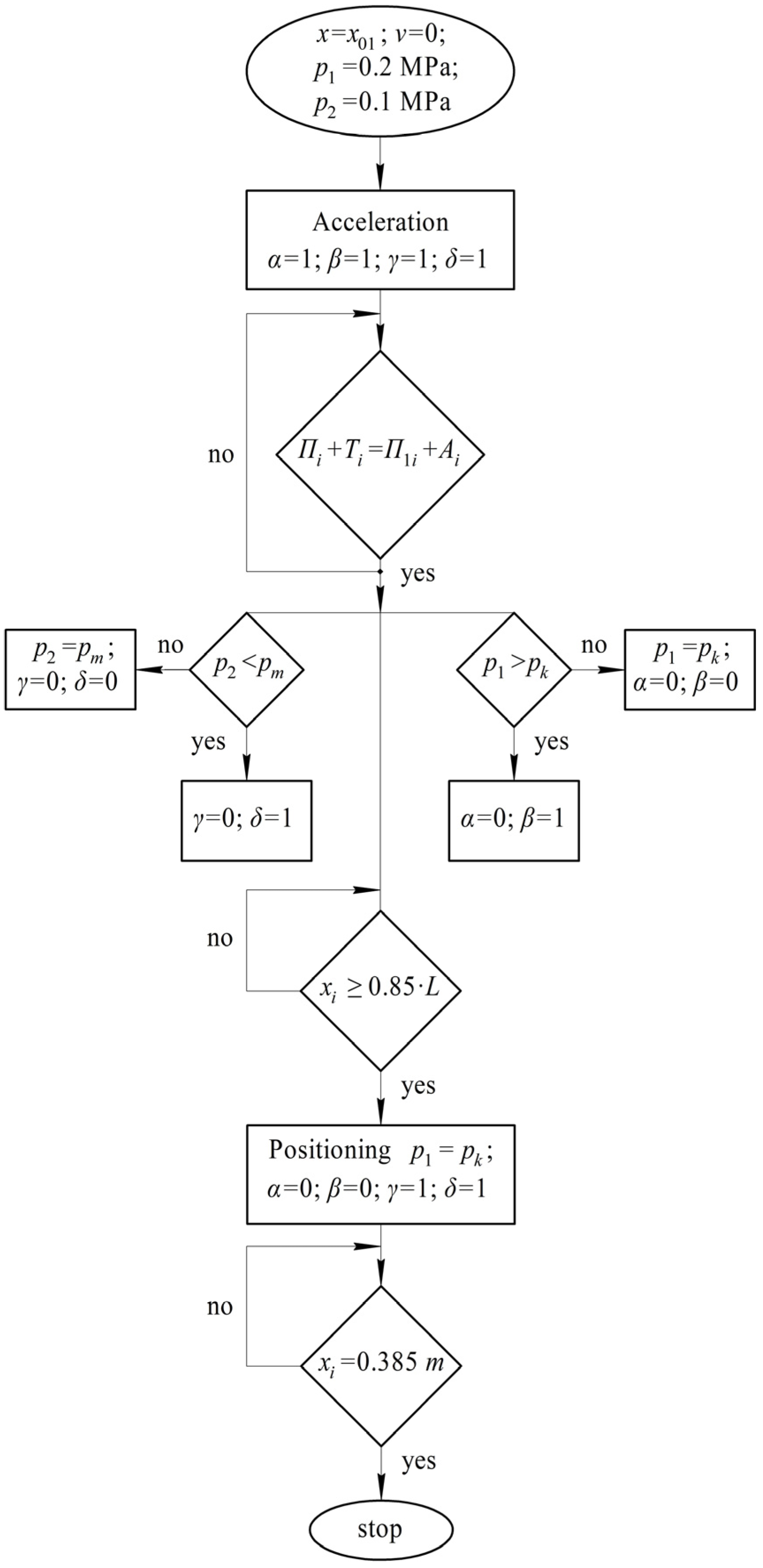
The initial conditions for each phase of motion (acceleration, deceleration, and positioning), as well as the conditions for transitions between phases, are presented in the form of an algorithm in Figure 2.
When the piston reaches the coordinate x i 0.85 L , the control signal to R 2 disappears and the distributor returns to its neutral position. At the same time, a reduced pressure, determined by the reduction valve settings, is supplied to the piston chamber, while the rod chamber is connected to the atmosphere.

2.2. Optimization of the Working Process of the Pneumatic System

To increase the energy efficiency of the pneumatic system while simultaneously achieving the prescribed motion trajectory, optimization of its working process is required.
Within the framework of the adopted one-dimensional model, the amount of compressed air returned to the supply line is primarily determined by the duration of the recovery phase. Since, under the model assumptions, the pressure in the rod-side chamber during recovery is constrained by the supply line pressure, the recovered energy becomes directly proportional to the mass of air displaced during this interval.
Therefore, the optimization criterion is formulated as the maximization of the duration of the compressed air recovery process to the supply line t r e c :
t r e c = t f t s max .
An increase in the recovery duration leads to an increase in the amount of recovered energy:
E r e c t s t f m ˙ r e c t p 2 t ρ t d t .
Equation (4) is derived under the following assumptions:
No heat exchange with the environment [33];
The working medium is an ideal gas.
The constraints imposed on the process are defined by the piston reaching the final point of its trajectory ( x f 0.385 m) and by ensuring a minimum velocity of the moving element at the end point of the stroke ( v f min ).
Thus, the optimization problem can be formulated as follows:
t r e c = t f t s max x ( 0 ) = 0 ; v ( 0 ) = 0 ; x ( t ) = 0.385 ; v ( t ) = 0 .
To solve the optimization problem (5), the following objective function is constructed:
f O F = ( t s t f ) + T e r min ; T e r = 0 , if x ( t ) Δ x     v ( t ) Δ v ; ω x ( t ) 0.385 2 + v ( t ) 2 ,   if   x ( t ) 0.385 > Δ x     v ( t ) > Δ v ,
In addition, a sensitivity study with respect to the weighting coefficient ω in the objective function (6) was performed. It was observed that for ω 10 5 [38,39,40], the minimization process led to competition between the terminal energy term and the duration term, and in several runs, the condition T e r Δ x was not fully satisfied before the reduction of t s t f began. For intermediate values ω = 10 8 , the enforcement of the terminal conditions improved, but occasional deviations from the prescribed final state were still observed. Increasing ω beyond 10 10 did not change the location of the global minimum, the obtained optimal switching times, or the convergence behavior of the optimization algorithms. Therefore, the value ω = 10 10 was selected as the minimal coefficient that guarantees strict satisfaction of the terminal conditions while preserving numerical stability and robustness of the search process.
To obtain a numerical value at the output of the objective function, its graphical representation is used (Figure 3).
Thus, problem (5) is reduced to minimizing the objective function (6), and the task becomes the determination of its global minimum.
Since the objective function may exhibit a complex, multimodal topology, an optimization algorithm with strong global search capabilities is required to reliably locate the global minimum of f O F . For this purpose, the metaheuristic multi-agent algorithm VCT-PSO [38,39,40], a zero-order method and a modified version of the particle swarm optimization (PSO) algorithm, is employed. The parameters of the VCT-PSO algorithm are listed in Table 1.
To make sure that VCT-PSO finds the objective function (6) minimum, we run it 50 times, each time with a random initial position of the particles. All the executed algorithm’s runs brought the same result.

2.3. CFD Model

To reliably reproduce non-stationary thermodynamic processes in the pneumatic cylinder, a three-dimensional flow model was solved using ANSYS Fluent 2024 R1. The model describes compressible air flow, heat and mass transfer, the dynamics of air supply to the cylinder chambers, and changes in the volumes of the working chambers caused by piston motion. Since piston movement results in significant deformation of the computational domain, a dynamic mesh approach was employed, ensuring accurate mesh updating at each time step.
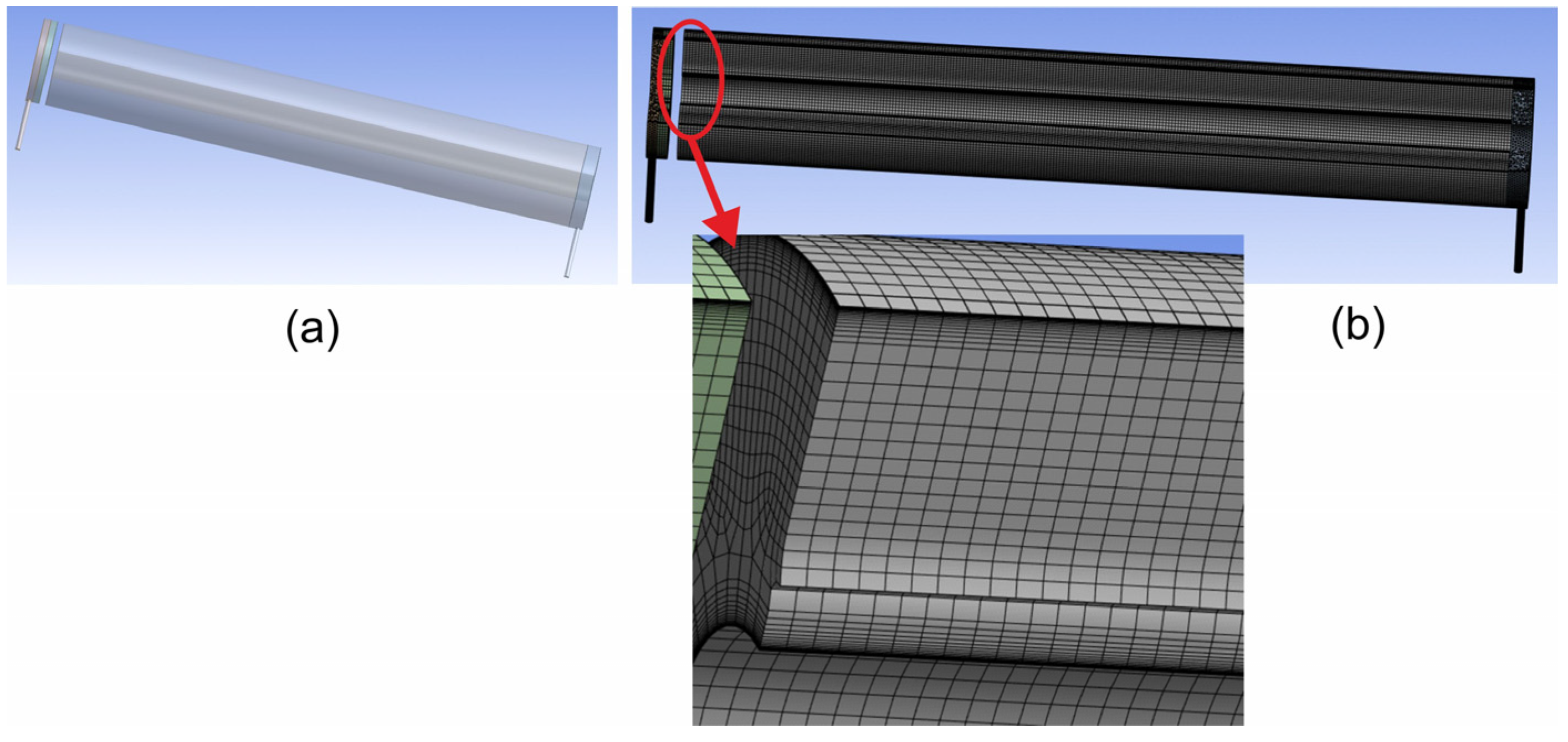
The computational domain (Figure 4) includes the piston working chamber, the rod-side exhaust chamber, dead volumes, and the regions where the supply and exhaust lines are connected. The geometry was constructed in accordance with the actual design parameters of the investigated pneumatic cylinder: piston diameter of 63 mm, rod diameter of 20 mm, and supply and exhaust port diameters of 3.74 mm.

2.3.1. Mesh Model and Dynamic Meshing

A hybrid mesh was generated, consisting of hexahedral elements in the cylindrical regions and tetrahedral elements in the inlet and outlet channels, which also represent dead-volume zones. To ensure accurate near-wall flow resolution y + 1 and to enable the use of the SST turbulence model, 15 prismatic boundary layers were applied. Given adverse pressure gradients, intermittent separation/reattachment in the intake port, and compressibility-driven transients during braking/recovery, we adopted SST, ensuring near-wall resolution in the viscous sublayer.
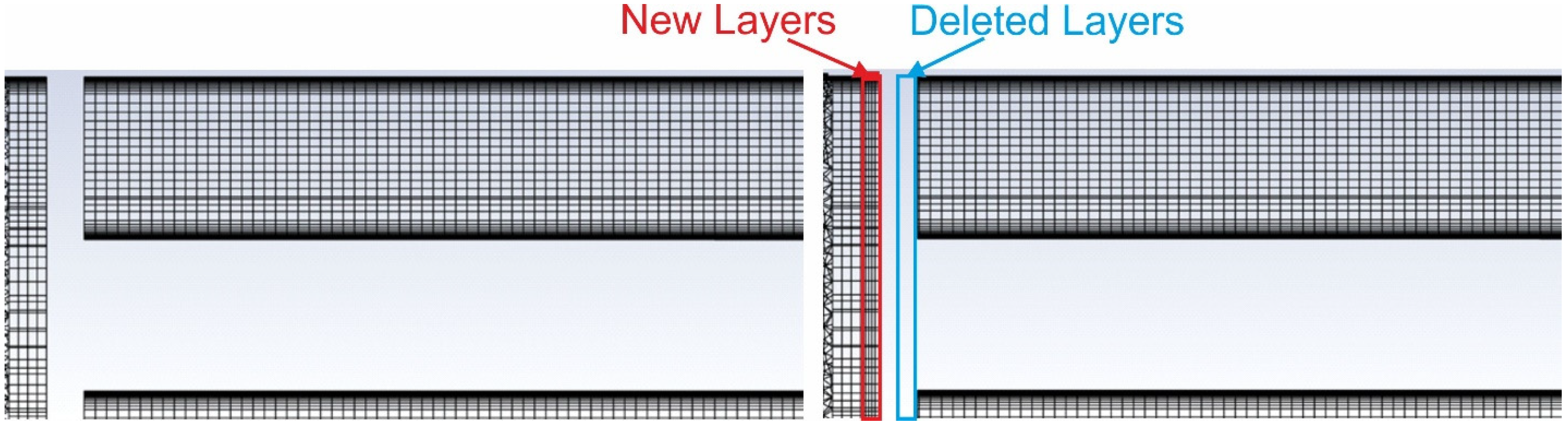
Dynamic mesh updating was performed using the Layering scheme [41], which corresponds to the addition and removal of layers of hexahedral elements in the cylinder mesh during piston motion (Figure 5).
The piston motion in 3D was prescribed from the validated 1D model as a time-tabulated profile with 101 position samples per half-stroke. The CFD time step was selected so that the dynamic-mesh layering increment remained 0.2 of the local near-wall cell height at every update, ensuring smooth wall kinematics and stable mesh quality during peak deceleration. A trajectory-sampling sensitivity study (10/30/51/101 samples) demonstrated numerical convergence: the chamber-pressure histories and cycle-integrated performance metrics differed by <0.1% between 51 and 101 samples (Figure S1). For completeness, an ODE-driven piston motion solved inside the CFD loop produced 1% trajectory differences, with short-lived pressure deviations at the onset of braking, corroborating that the tabulated-motion setup does not distort the pressure–force feedback while being more robust for the present highly transient runs.

2.3.2. Implementation of Switching Events Using UDFs (*.c)

To accurately model the three operating phases of the pneumatic drive, two user-defined functions (UDFs, *.c) were developed to control the boundary conditions based on chamber pressure, time, and the drive operating algorithm. The first UDF controlled the pressure at the inlet of the piston chamber, while the second UDF controlled the pressure at the outlet of the rod-side chamber [42,43].
The switching logic was implemented in four consecutive stages.
At Stage 1 (pre-braking phase), the inlet boundary condition was defined as a pressure inlet with a pressure of 0.6 MPa, while the outlet boundary condition of the rod-side chamber (UDF2) was set as a pressure outlet of 0.1 MPa (atmospheric pressure). These boundary conditions were maintained until time t = t 1 , where t 1 —the braking onset time was calculated by solving the system of equations of the pneumatic system mathematical model.
At Stage 2 (braking phase), the inlet boundary condition was changed to a pressure inlet of 0.2 MPa (downstream of the pressure-reducing valve). At the outlet boundary, a wall condition was imposed, preventing air from escaping from the rod-side chamber and enabling air compression during piston deceleration.
At Stage 3 (recovery phase), when the pressure in the outlet channel exceeded 0.6 MPa, the UDF2 program switched the outlet boundary condition to a pressure outlet of 0.6 MPa. This condition simulated the release of compressed air from the rod-side chamber into the compressed air supply line, allowing its reuse during the subsequent operating cycle of the pneumatic cylinder.
At Stage 4 (end of recovery), when the pressure in the rod-side chamber dropped below 0.6 MPa, the recovery process ended, and the outlet boundary condition was reset to a pressure outlet of 0.1 MPa (atmospheric pressure).
Thus, the developed UDFs implement the complete logic of switching events, accurately reproducing the experimentally observed operation of the real pneumatic drive.

2.3.3. Governing Equations

  • Mass conservation equation for a compressible fluid [44,45]:
ρ t + ( ρ u ) = 0 .
2.
Momentum conservation equation (Reynolds-averaged Navier–Stokes, RANS):
( ρ u ¯ i ) t + ( ρ u ¯ i u ¯ j ) x j = p ¯ x i + x j μ u ¯ i x j + u ¯ j x i ( ρ u i u j ¯ ) x j + ρ f i ,
where summation over repeated indices is performed according to Einstein’s summation convention.
3.
Energy conservation equation
( ρ E ) t + [ ( ρ E + p ) u ] = ( τ u ) q + ρ f u + S E .
4.
Ideal gas equation of state
p = ρ R T .
5.
Viscous stress tensor for a Newtonian fluid
τ i j = μ u i x j + u j x i 2 3   μ   δ i j   u ,
where δ i j = 1 for i = j and δ i j = 0 otherwise.
6.
Heat transfer due to thermal conductivity
q = λ T .
7.
Shear Stress Transport (SST) turbulence model [46,47]:
( ρ k ) t + ( ρ k u ) = P k β ρ k ω + ( μ + σ k μ t ) k ,
( ρ ω ) t + ( ρ ω u ) = α ω k P k β ρ ω 2 + + ( μ + σ ω μ t ) ω + 2 ( 1 F m ) ρ σ ω 2 1 ω k ω ,
where α , β , β , σ ω , σ ω 2 are model constants [48].
8.
Moving boundary conditions (piston kinematics). The piston motion is prescribed using a tabulated profile x t . The limiting velocity of the normal component at the boundary is defined as [49,50]:
u wall = x ˙ ( t )   n .

2.3.4. Numerical Calculation Parameters

The numerical simulation was performed in a non-stationary formulation. The Density-Based Coupled Solver was employed to integrate the governing equations of motion, providing stable convergence and accurate reproduction of compressibility waves under highly dynamic operating conditions. Time discretization was carried out using a Second-Order Implicit scheme, which minimizes numerical diffusion and ensures the required accuracy for small time steps. Convective terms in the governing equations were discretized using the Second-Order Upwind scheme, which provides a balanced combination of accuracy and stability in regions with steep velocity and pressure gradients.
The simulation was conducted with a time step of 5 10 4 s, allowing adequate resolution of instantaneous changes in piston motion parameters. The total integration time corresponded to the duration of a single working half-cycle, 0.75 s. The maximum number of iterations per time step was set to 20, and the residual convergence criterion was specified as 10 5 for all equations.
During the simulation, the following parameters were monitored: piston and rod-side chamber pressures, gas temperature, mass flow rates at the inlet and outlet, and the instantaneous force acting on the piston.
The flow exhibits strong adverse pressure gradients and local separation at the intake/outlet, for which SST is known to perform robustly in near-wall regions. A laminar option under-predicts mixing for local Reynolds numbers observed during most of the cycle, while a full LES (Large Eddy Simulation) under a moving, compressible mesh would be prohibitively expensive for the multi-run program (optimization/sensitivity/parametric).

2.3.5. Model Validation

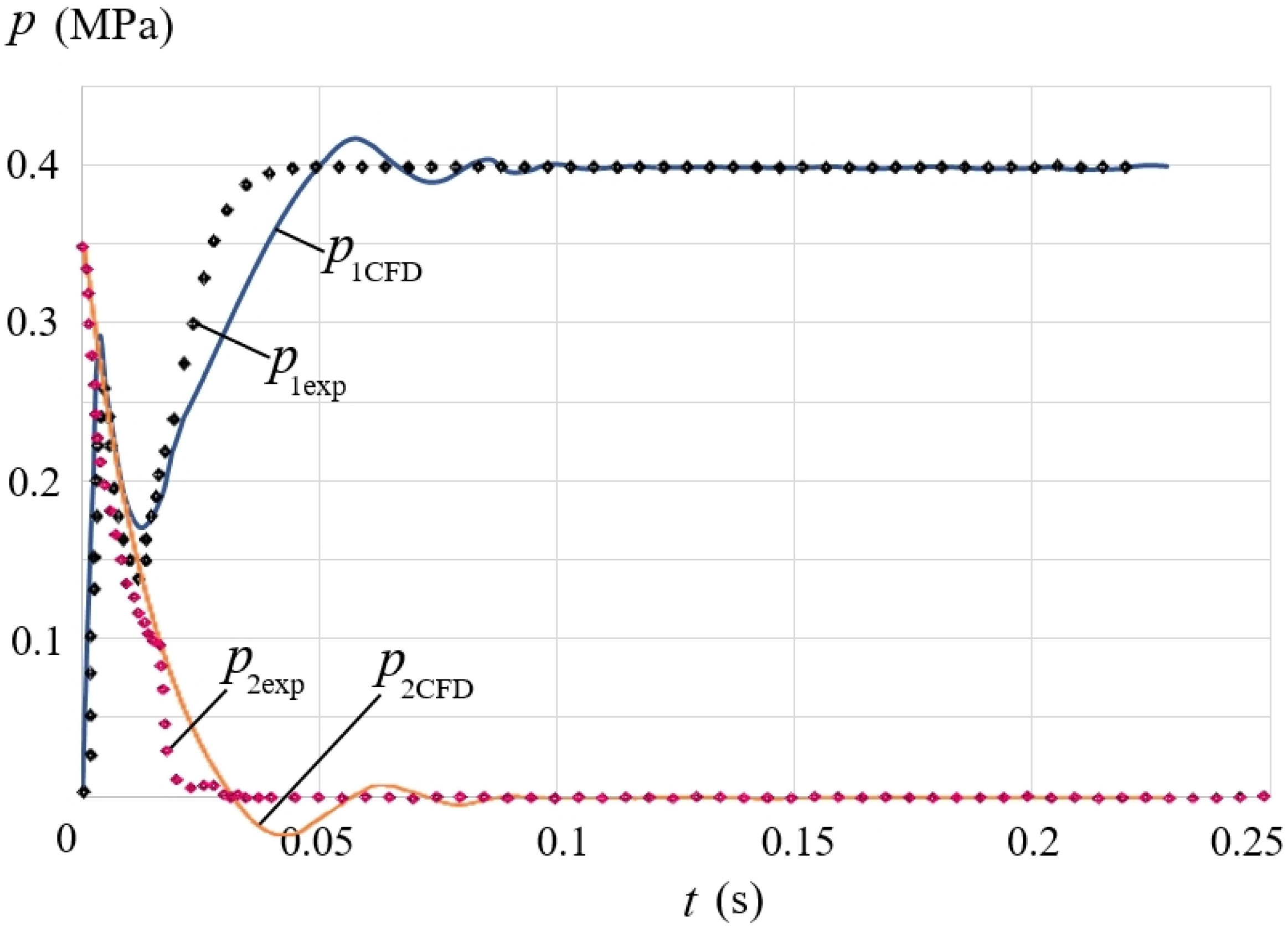
The transient pressure characteristics in the cylinder chambers obtained from the CFD model were compared with experimental data (Figure 6) recorded on the Festo D:P-GS-210-KPL test bench (Festo SE & Co. KG, Esslingen am Neckar, Germany).
The experimental validation focused primarily on pressure measurements in the cylinder chambers, as pressure was adopted as the principal validation variable. These measurements provide direct, high-accuracy information on transient pressure dynamics during acceleration, braking, and recovery phases, which is essential for verifying the CFD model’s capability to resolve unsteady compressible flow, valve-controlled switching, and associated energy conversion processes.
At the same time, the conclusions regarding energy efficiency and recovery performance are not derived from pressure data alone. They are based on a comprehensive thermodynamic evaluation combined with detailed CFD-based analysis of mass, energy, and flow processes within the system. Thus, pressure measurements serve specifically as a validation tool, whereas the assessment of recovered energy, extended recovery duration, and improved cycle efficiency results from the integrated thermodynamic and numerical analysis framework.
Pressure measurements were taken upstream of the cylinder chambers using a Festo 0–10 bar piezoresistive relative pressure sensor. The network supply pressure was 0.4 MPa.
To facilitate comparison between measured and simulated pressures, a three-dimensional CFD model of the Festo DSNU-20-100-PPV-A cylinder, Festo SE & Co. KG, Esslingen am Neckar, Germany (20 mm diameter, 100 mm stroke) was developed, in which the internal chamber geometry and inlet channels were fully reproduced.
The adequacy of the 3D model was evaluated through a comprehensive comparison of the simulated and experimental pressure profiles using statistical criteria [51,52]. The experimental curves represent the average pressure values obtained from a series of repeated measurements ( N = 20 ), with confidence intervals quantifying the statistical uncertainty of the data.
Model adequacy is confirmed by the fact that the simulated pressure curves remain within the experimental confidence intervals for 95% of the time interval, covering both the initial transient phase—where deviations between model and experiment are largest—and the subsequent steady state [53,54].
Additionally, model performance was quantitatively assessed using the coefficient of determination R 2 , which was found to be 0.8416.
These results indicate that the 3D model accurately reproduces the main variation in the experimental data without exhibiting any pronounced systematic bias. The combination of calculated pressure profiles lying predominantly within the experimental confidence intervals and the high value of the coefficient of determination R 2 confirms the validity of the physical problem formulation and the assumptions applied in the model [55].

3. Results

3.1. Calculation of the Pneumatic System’s Operating Process

To obtain the characteristics of the pneumatic system’s working process, the transient response was calculated using the mathematical model (2) and the fourth-order Runge–Kutta numerical integration method with a fixed integration step 0.5 10 3 , with respect to the relevant state variables: p 1 ,   p 2 ,   x ,   v [56,57].
The transition point from the acceleration phase to the deceleration phase was selected based on the criterion of minimizing the final piston velocity, which also satisfies the energy balance condition of the system (Figure 2):
Π i + T i = Π 1 i + A i .
Calculated and design parameters of the PS: a = 1.4 ;   f 1 e = 14 10 6 m 2 ;   f 2 e = 14 10 6 m 2 ; R = 288 J / k g deg ; T m = 300   ° K ;   F 1 = 3.115 10 3 m2 ( d p = 63 10 3 m); F 2 = 2.801 10 3 m2 ( d r = 20 10 3 m); p m = 0.6 MPa; x 01 = 0.01 m; x 02 = 0.015 m; L = 0.4 m; m = 300 kg; P = 650 N; p a = 0.1 MPa; p k = 0.2 MPa.
Initial conditions. At the moment of piston displacement from rest: x = x 01 = 0.01 m; v = 0 ;   p 1 = 0.2 MPa; p 2 = 0.1 MPa. Final operating conditions (at piston stop): x = L x 02 = 0.4 0.015 = 0.385 m; v 0 .
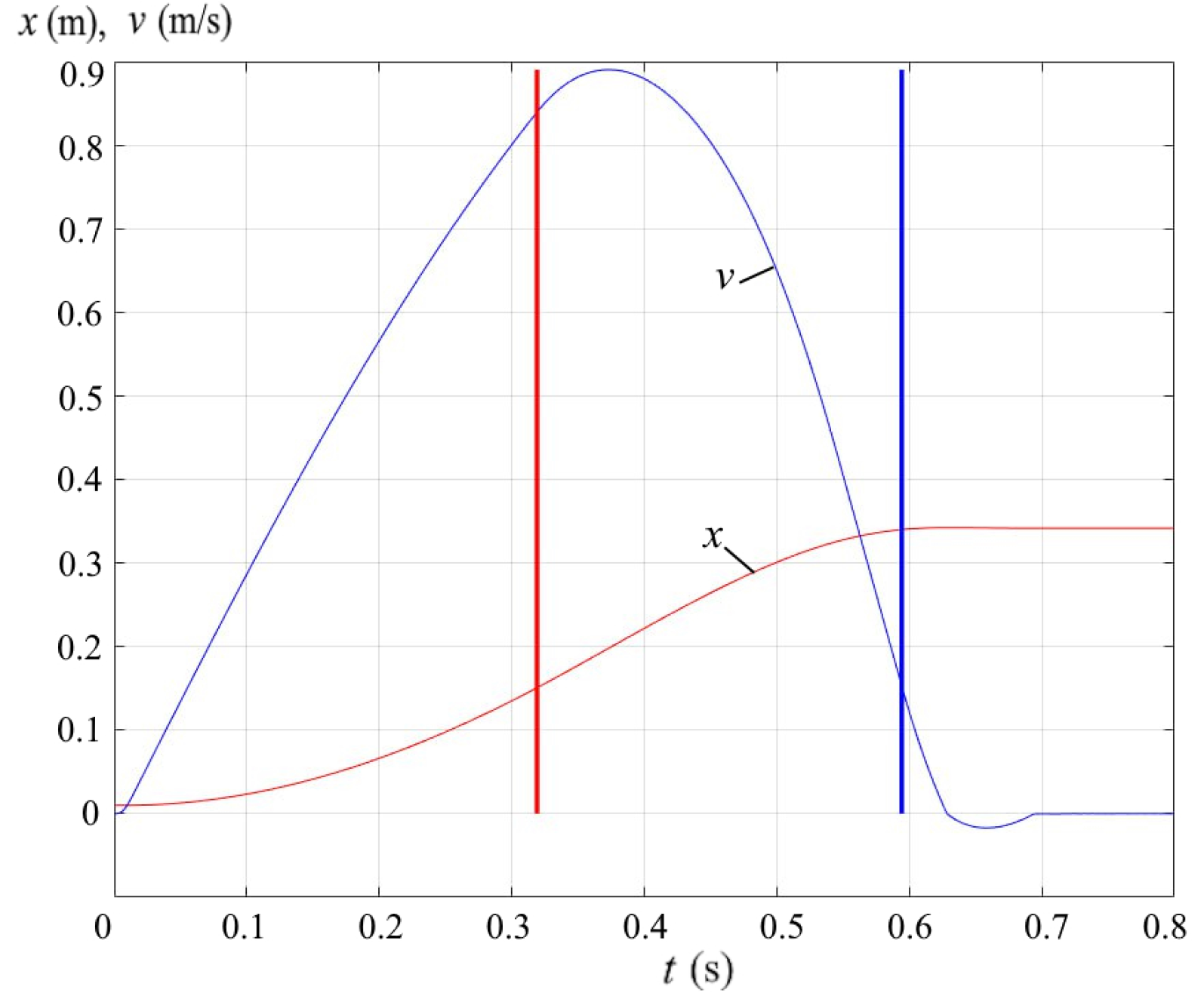
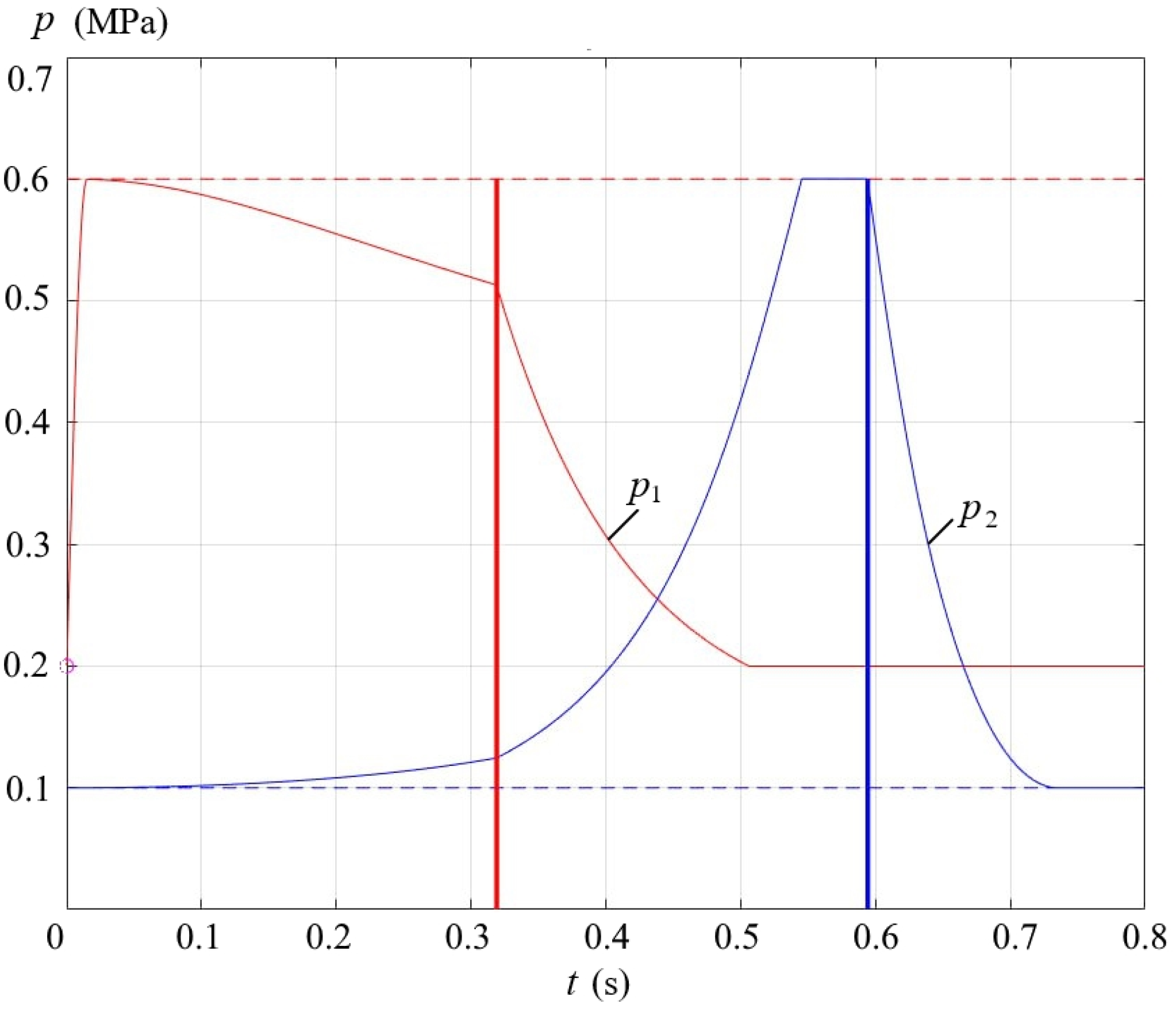
The transient characteristics calculated using the mathematical model (2) are presented in Figure 7 and Figure 8. Figure 7 shows that the piston undergoes uniform acceleration and deceleration, without sudden changes in speed or pneumatic rebound. The maximum velocity during the acceleration phase reaches approximately 0.9 m/s.
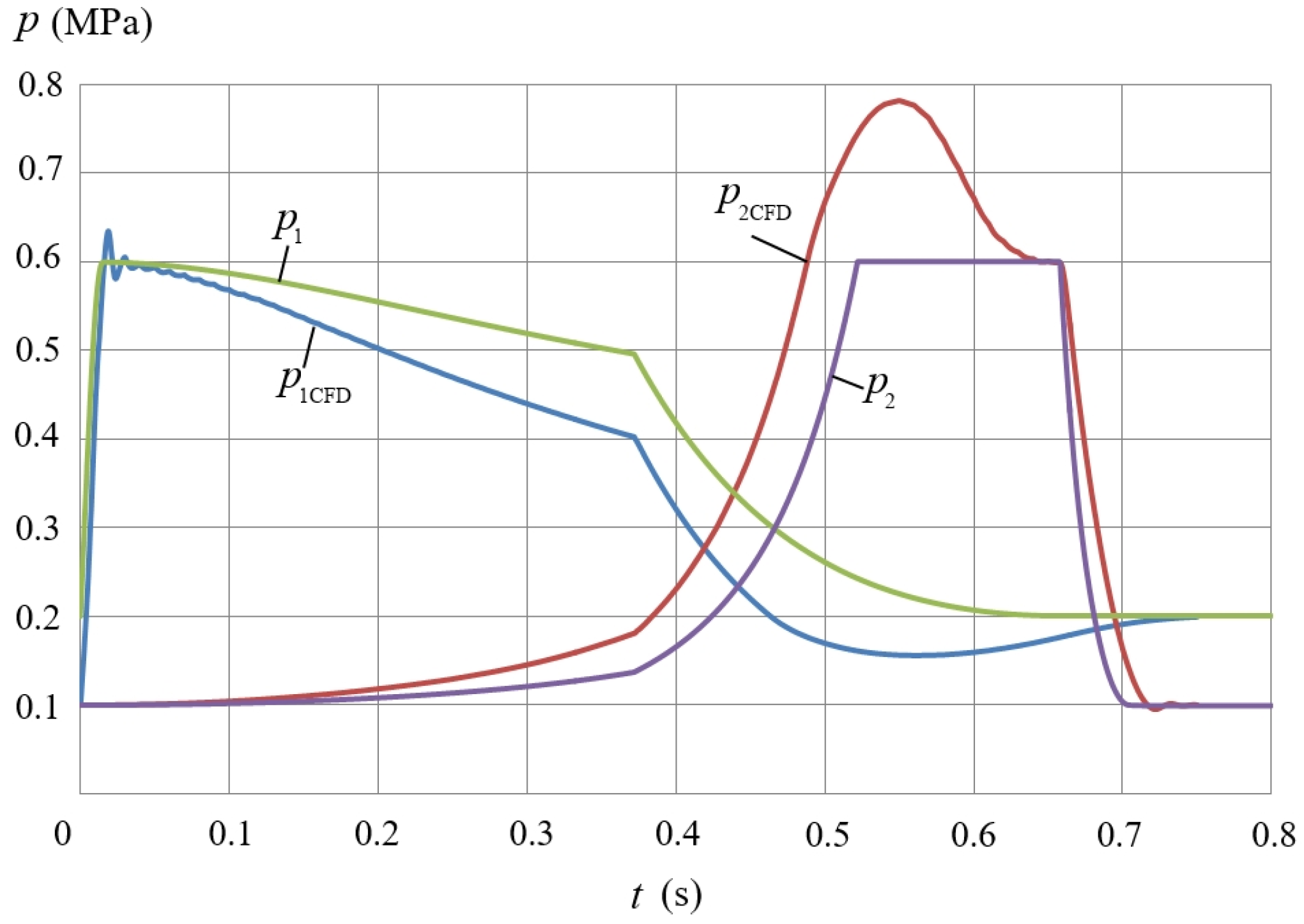
The transient pressure characteristics in the cylinder chambers (Figure 8) indicate that the working process is energy-efficient, as the potential energy of the compressed air in the piston chamber A exp is utilized during braking (Equation (17)). The pressure p 1 in the working chamber decreases smoothly, without sudden changes in piston velocity.
A exp = V 1 s V 1 f p d V = p 1 s V 1 s p 1 f V 1 f a 1 ,
where p 1 s and V 1 s are the pressure and volume of compressed air in the working chamber at the start of braking; p 1 and V 1 f are the pressure and volume at the end of braking, or when the pressure p 1 reaches the setpoint of the reduction valve ( p 1 = p k ).
The graphs in Figure 8 indicate that the potential energy of the compressed air in the piston chamber is not fully utilized, as after approximately 70% of the braking duration, the pressure p 1 reaches the main line pressure p k . Recovery of compressed air into the supply line occurs during the horizontal section of the curve, where the pressure p 2 in the rod-side chamber remains at approximately 0.6 MPa.
This phenomenon arises when the chamber pressure exceeds the supply line pressure ( p 2 > 0.6 MPa). At this point, the check valve in the exhaust line opens, allowing compressed air to flow into the main line (receiver). Once the chamber pressure falls below the supply line pressure ( p 2 0.6 MPa), the check valve closes. At this moment, the piston chamber is connected to the atmosphere, and the pressure p 2 rapidly drops to atmospheric level.
The duration of the air recovery process is very short ( t r e c = 0.5945 0.5455 = 0.049 s), corresponding to approximately 6.5% of the total working cycle (blue curve in Figure 8).
It can be concluded that the pneumatic drive configuration (Figure 1) ensures a stable and safe operation and demonstrates energy efficiency. However, its limitations include positioning inaccuracies, incomplete utilization of the potential energy of the air in the piston chamber, and the short duration of the recovery process (Figure 7 and Figure 8).
The amount of air recovered to the supply line depends directly on the duration of the recovery process. Therefore, to increase the energy efficiency of the system, this period should be maximized: t r e c = t f t s max .
At the same time, because the mathematical model imposes a constraint on the piston chamber pressure p 2 (Figure 2), it is not possible to accurately estimate the compressed air consumption during recovery. Consequently, this calculation must be performed either using a three-dimensional CFD model or experimentally.

3.2. Optimization of the Pneumatic System’s Working Process

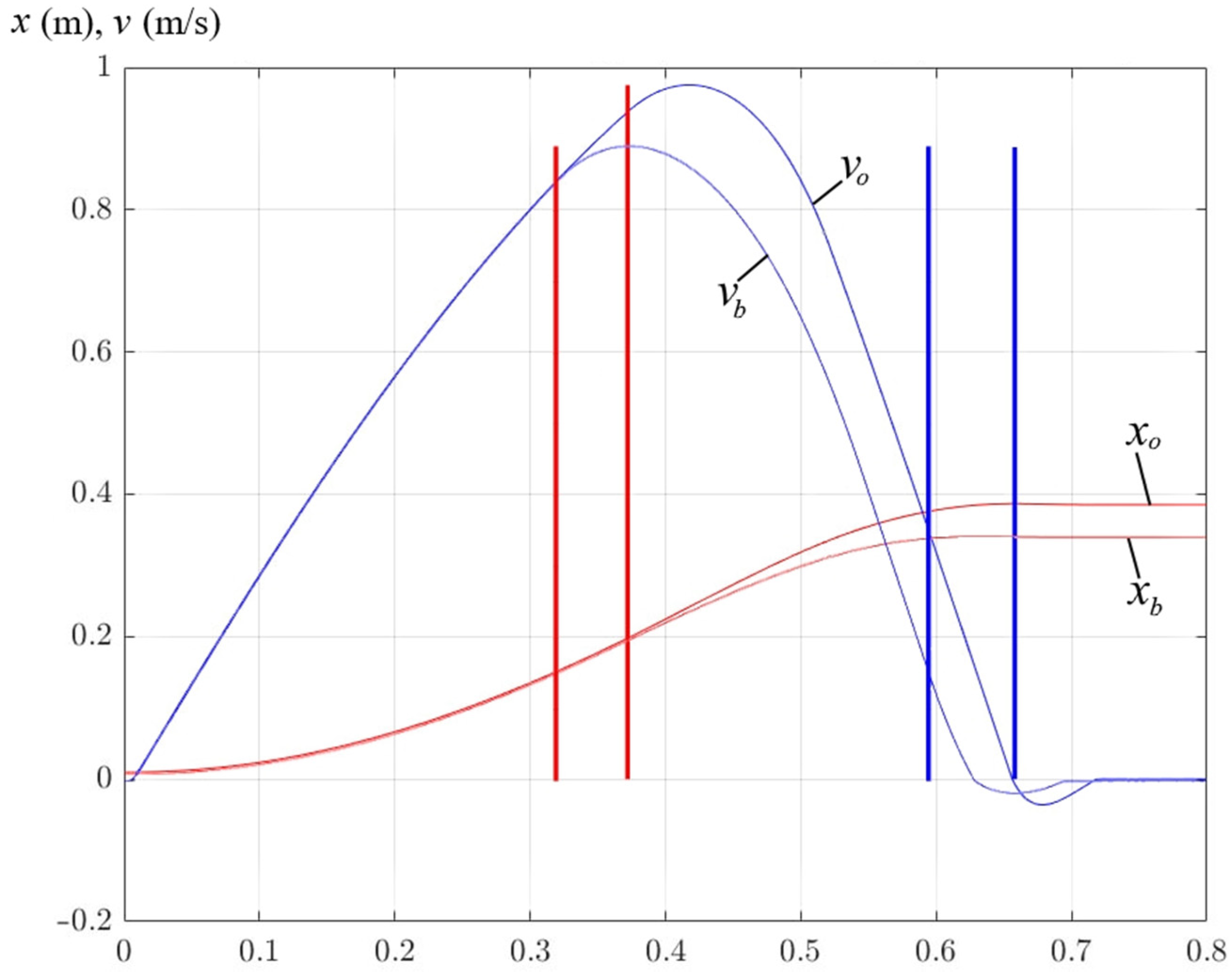
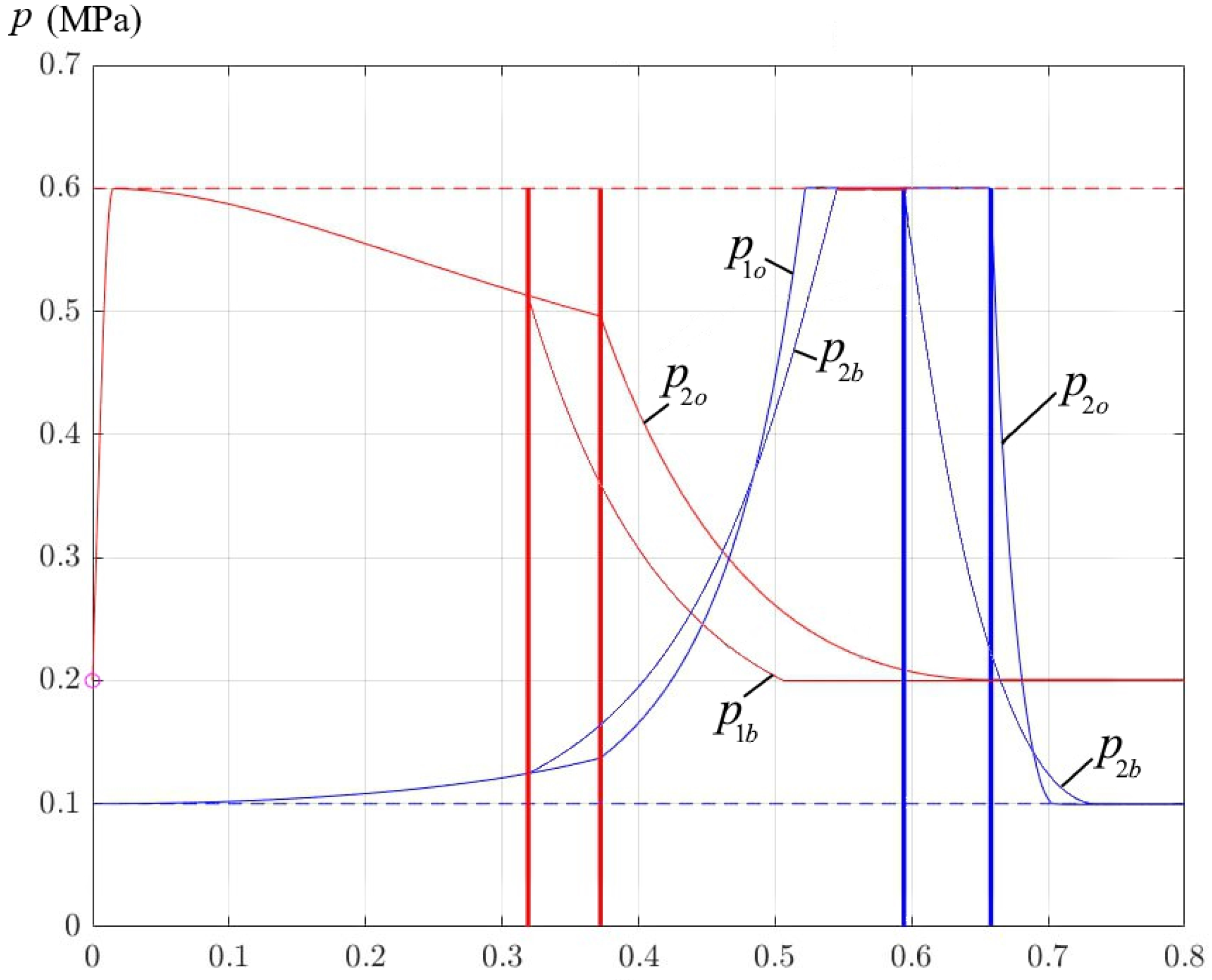
As a result of the optimization, the start t 1 = 0.372 s and end t 2 = 0.658 s times of the braking phase were determined. According to the graph in Figure 9, these times can be converted into the corresponding coordinates along the piston displacement trajectory for practical implementation.
The graph of the optimized process (Figure 10) shows that the duration of the air recovery process is t r e c   o p t = 0.6575 0.5215 = 0.136 s, which corresponds to approximately 18.1% of the total working cycle.
The results indicate that, as a consequence of the optimization, the recovery process duration increased by a factor of 2.8, while the total cycle time remained unchanged t Σ = 0.75 s. This demonstrates an improvement in the energy efficiency of the system [58].
At the same time, the positioning accuracy of the piston improved to x f 0.385 m (Figure 9). The working process remains stable and safe, as the final velocity of the piston is close to zero v f = 0.00013 m/s.
To evaluate the actual energy efficiency of the selected technical solutions, it is necessary to calculate the mass flow rates of consumed, exhausted, and recovered air over a single drive cycle, and to perform an energy analysis for each of these stages [59,60]. Previous studies have shown that mass flow rate calculations in pneumatic systems based on conventional one-dimensional mathematical models can be inaccurate [13,61,62,63,64]. Therefore, further analysis is carried out using a three-dimensional CFD simulation model of the cylinder in ANSYS.

3.3. Transient Characteristics of the Pneumatic System Determined Using the ANSYS 3-D CFD Model

Using the three-dimensional CFD simulation model developed in ANSYS, the transient processes were calculated for a single working half-cycle (piston movement from left to right under a static load). The resulting transient pressure characteristics are comparable to those obtained from the one-dimensional model (Figure 11).
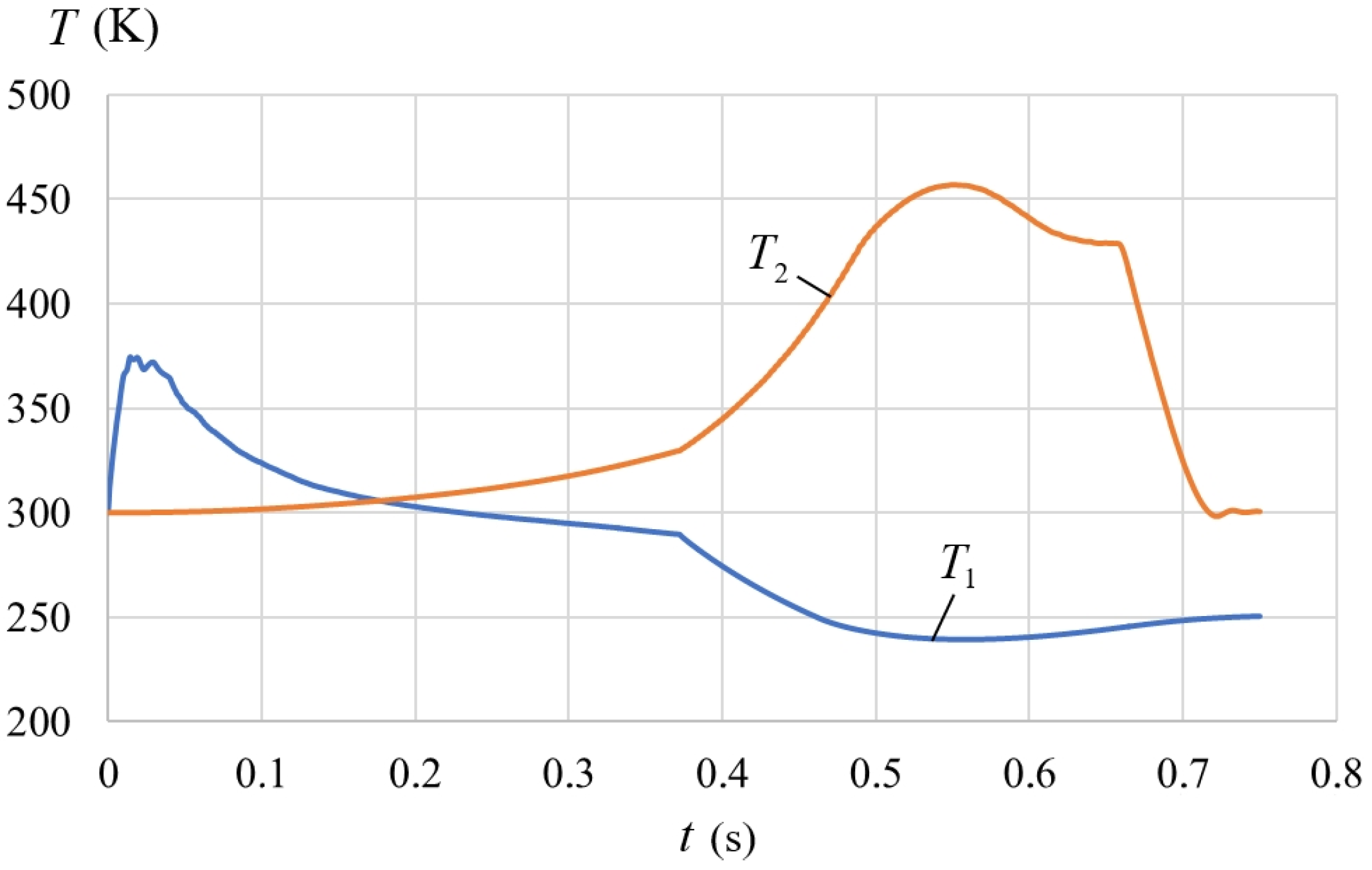
In general, the shapes of the curves coincide; however, the discrepancy between p 1 and p 1 C F D in the section corresponding to the end of the acceleration phase and during the braking phase reaches approximately 30%. This discrepancy arises from the inaccuracy introduced by the isothermal assumption in the one-dimensional mathematical model (2). The deviations in Figure 11 correlate with the temperature fluctuations observed in the cylinder chambers (Figure 12): at the moment of the greatest pressure discrepancy, the temperature in the piston chamber decreases due to the rapid piston movement and the associated increase in chamber volume. Consequently, the internal energy of the compressed air decreases, which is not accounted for in the one-dimensional model.
A similar effect is observed in the rod-side chamber: the pressure p 2 is approximately 30–35% lower than the corresponding values p 2 C F D in the 3D model. The discrepancy is greatest just before the start of the recovery process. This phenomenon is also a consequence of the limitations of the one-dimensional model (2), in which it is assumed that when the chamber pressure p 2 reaches the main line pressure ( p 2 = p m ), it remains constant.
However, as seen in Figure 11, the recovery process begins earlier than the theoretically predicted 0.035 s and occurs with a significant pressure drop in both the piston chamber and the receiver (up to 0.2 MPa), which substantially affects the volume of air recovered.
The transient characteristics of air temperature in the cylinder chambers (Figure 12) show significant fluctuations during a single operating cycle, particularly during the piston deceleration phase. The temperature in the piston chamber at the start of the acceleration phase reaches 374 K, then decreases to a value close to atmospheric ( T 1 = 290 ÷ 300 K) and drops further to T 1 = 240 K during deceleration, indicating effective utilization of the internal energy of the compressed air.
Temperature fluctuations in the rod-side chamber are even more pronounced: during acceleration, the temperature T 2 gradually rises from 300 K to 330 K, and during deceleration, it peaks at 456 K. This temperature spike is short-lived (lasting approximately 0.2 s) and occurs due to the overlap of the exhaust chamber outlet and compression of air within the chamber during deceleration. These temperature excursions are consistently reflected in the energy balance (Section 3.4), ensuring that internal-energy variations are accounted for explicitly.
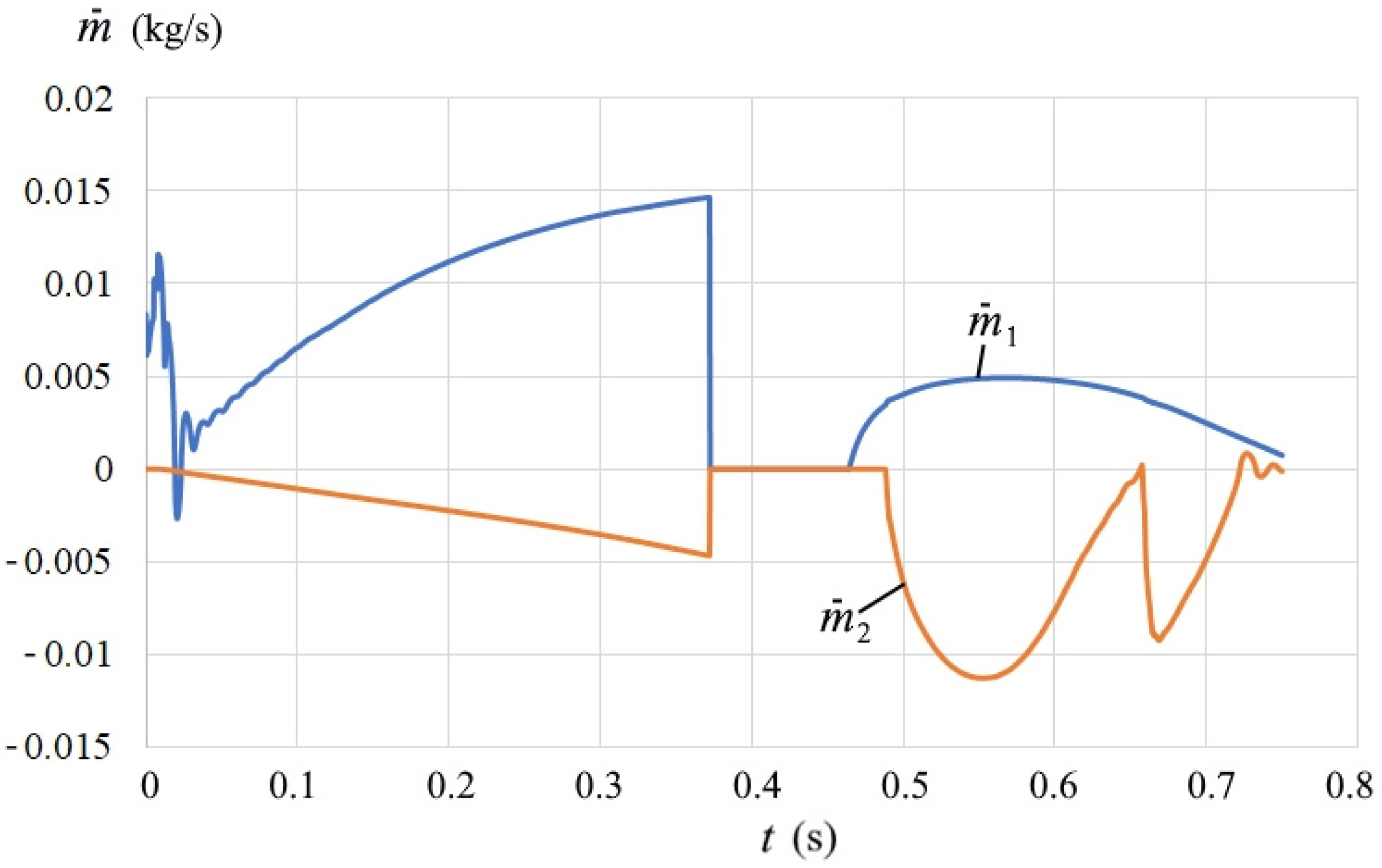
The simulation model also provides the mass flow rates of air from both cylinder chambers (Figure 13). During the interval t ( 0.38 0.48 ) s (corresponding to the braking phase), no flow occurs in the system. This is due to the blocking of the exhaust chamber, in which the flow remains zero until the pressure is sufficient to open the check valve and initiate the recovery process. Additionally, the piston (working) chamber is connected to a source of reduced supply pressure via a reduction valve ( p k = 0.2 MPa) when the chamber pressure is approximately twice this value ( p 1 0.4 MPa) (Figure 11). Consequently, the piston movement during this period occurs through the utilization of the internal energy of compressed air, which accumulates due to the conversion of the kinetic energy of the moving masses of the drive.
The graphs also confirm the occurrence of air recovery during the braking phase. It can be observed that the volume of air discharged from the exhaust chamber to the atmosphere is comparable to the amount of air recovered by the receiver (lower curve in Figure 13).

3.4. Determination of the Energy Characteristics of the System from Simulation Results

Recovery of compressed air to the supply line through the check valve during braking has important practical implications for overall system performance. By redirecting pressurized air that would otherwise be vented to the atmosphere, the demand for fresh compressed air from the compressor is reduced, lowering compressor workload, electrical energy consumption, and operating costs. This benefit is especially significant in multi-actuator or intermittent-duty systems, where recovered air can offset concurrent demand, reduce compressor cycling frequency, and help stabilize network pressure during peak loads.
Although mass flow analysis confirms the quantitative balance of the working medium and the presence of air recovery, it does not fully capture the energetic effects of this process. Therefore, alongside the mass-based assessment, a qualitative evaluation of energy performance was conducted by determining the energy consumed, expended, and recovered over a single operating cycle. This enables a comprehensive comparison of operating modes and a more accurate assessment of the overall efficiency of the pneumatic drive.
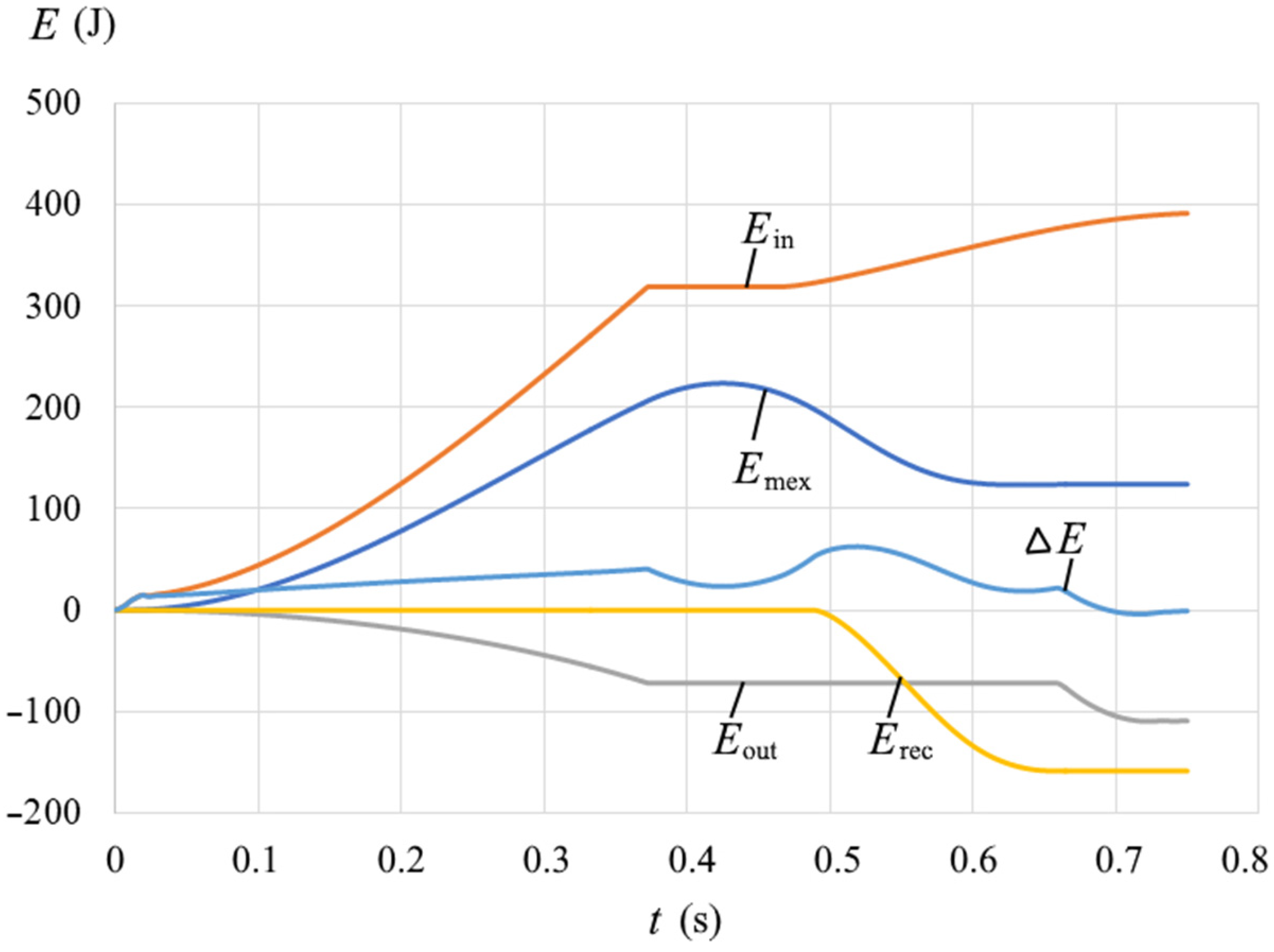
The balance of accumulated energy in the pneumatic system during a working half-cycle (piston extension under a static load) is expressed as follows [65]:
E i n E r e c = E o u t + Δ E + E m e c h
where E i n —total energy supplied to the piston chamber;
E r e c —energy recovered to the air supply network;
E o u t —energy of air expelled into the atmosphere from the rod chamber;
E m e c h —mechanical energy of useful work performed by the drive;
Δ E —change in the internal energy of the air in the cylinder chambers and exergy losses (dissipation).
The instantaneous power of the pneumatic system is given by [66]:
P t = F r e s t v t ,
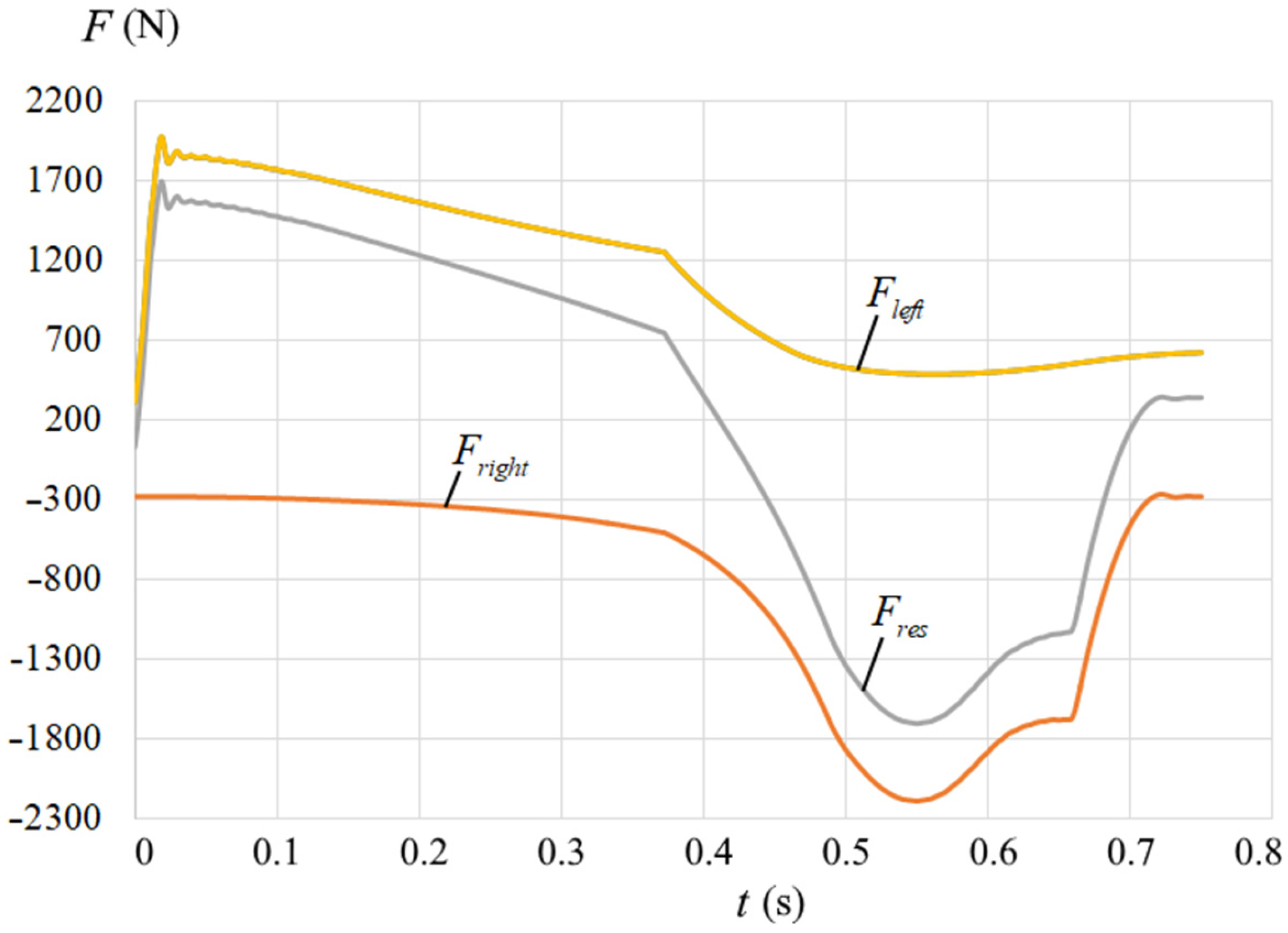
where F r e s t = F l e f t t F r i g h t t is the resulting force acting on the piston, as determined from the CFD model (Figure 14); v t = d x / d t is the piston velocity.
The graphs of the forces acting on the piston from both sides, along with the resulting force, are shown in Figure 14.
The useful component in formula (18) is the mechanical energy associated with the movement of the load E m e c h , while all other terms represent losses of the supplied energy (except for the energy returned to the air supply network through recuperation). Given the strong transient thermofluid phenomena captured by CFD (including the temperature excursions reported in Section 3.3), we explicitly include the internal-energy term in the balance. The Δ E t curve in Figure 15 represents the time-resolved variation in internal energy computed from CFD fields p t and T t and the instantaneous gas mass in each chamber, and it is accounted for in Equation (18). While Δ E t attains noticeable instantaneous values during braking and recovery, its half-cycle integral remains small relative to E i n due to cooling-heating compensation.
The energy balance of the system is illustrated in Figure 15, which shows that by the end of the process, the energy balance is fully satisfied. In other words, the total energy supplied to the working (piston) chamber and recovered to the air supply network equals the sum of the mechanical energy used to perform useful work and the energy expelled into the atmosphere.
The efficiency of the half-cycle (piston extension under a useful load), considering energy recovery to the air supply network, can be calculated using the following formula:
η s y s _ r e c = t s t f F r e s t v t d t t i n s t i n f p i n t m ˙ i n t ρ l e f t t d t t r e c s t r e c f p o u t _ r e c t m ˙ o u t _ r e c t ρ r i g h t t d t ,
The indices “left/in” correspond to the flow parameters in the piston chamber/inlet flow, while “right/out(rec)” correspond to the flow parameters in the rod chamber/outlet flow (recovered air).
Recovered energy is evaluated as the time integral of the pneumatic power at the recovery port. This definition directly quantifies the useful work delivered back to the network against its pressure and is the relevant metric for compressor-work reduction. It is consistent with an enthalpy-flux view when kinetic/potential terms are negligible, and the discharge state is close to the receiver conditions. The consistency of E r e c is further confirmed by the global balance in Equation (18), where the time-resolved internal-energy variation Δ E t (from CFD) is explicitly included (Figure 15).
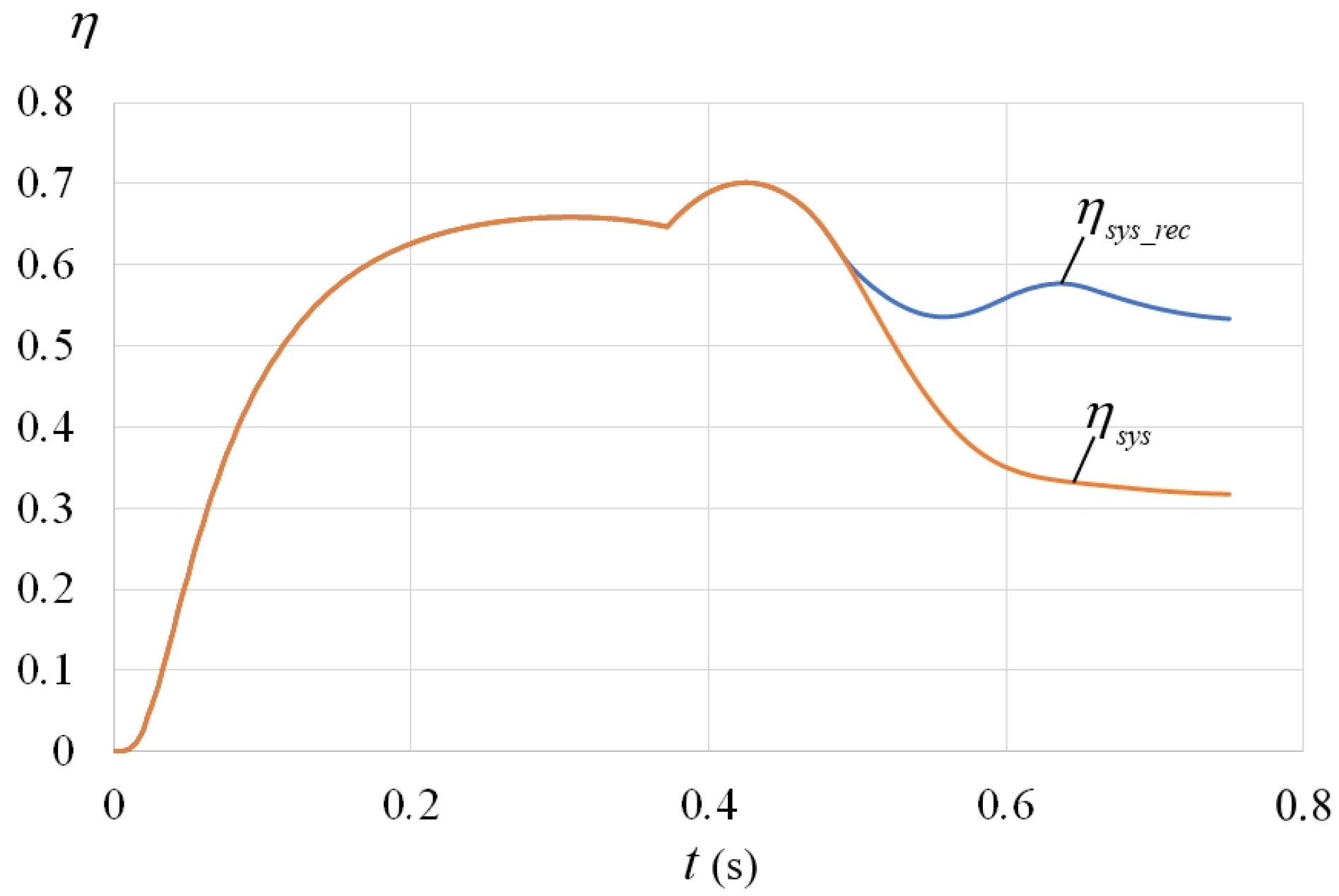
The calculated efficiency of the pneumatic system during the working process with optimized operating parameters for piston extension (Figure 16) shows that, without accounting for energy recovery, η s y s = 31.7 % , whereas with energy recovery included, η s y s _ r e c = 53.4 % , which is significantly higher than the typical efficiency of industrial pneumatic drives (20–30%).
The obtained results demonstrate the feasibility of the proposed scheme with the reutilization of excess energy and the optimization of the working process. Therefore, further improvement of pneumatic system designs to enhance their energy efficiency is promising, as energy recovery has a significant impact on system efficiency. It is also crucial to accurately determine the mass flow rate of the recovered air at the design stage.

4. Discussion

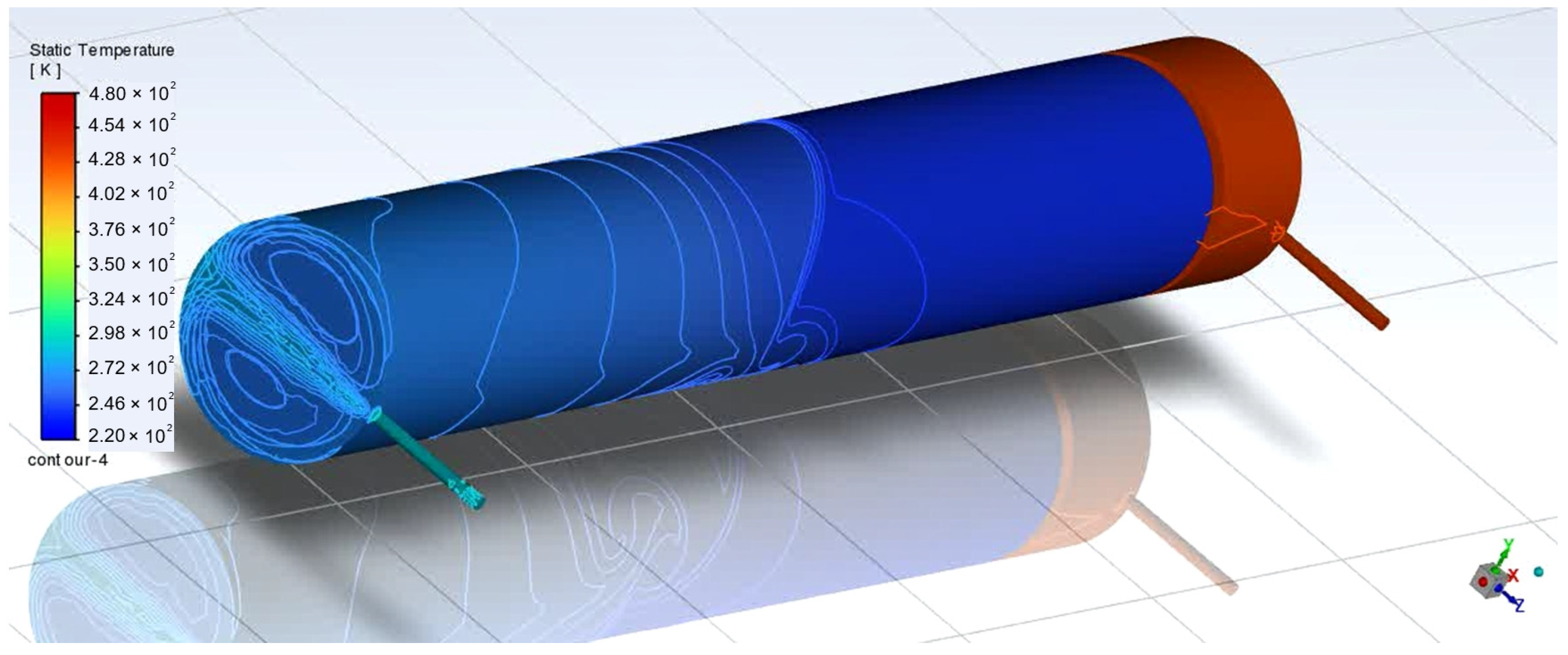
The visualization of the compressed air temperature distribution in the cylinder chambers (Figure 17) demonstrates the presence of recirculation zones and stagnant regions from the intake port to the working (piston) chamber. This phenomenon arises due to abrupt changes in the flow geometry, which cause flow separation (a high-velocity region at the edge of the intake port), accompanied by vortex formation, pressure losses, and localized sharp energy losses of the flow, which participates in performing useful work.
Furthermore, there is intense turbulence and vortex structures in the cylinder’s working chamber. As a result, turbulent mixing of the flow occurs. Viscous friction leads to the irreversible conversion of part of the compressed air’s useful energy into the internal energy of the gas.
The identification of flow separation and the associated energy losses is based on the CFD model and may depend on modelling assumptions, especially under highly unsteady flow conditions.
Further reduction in losses is potentially possible through optimization of the intake geometry (e.g., rounding edges, using diffusers) and aligning the intake jet with the cylinder’s motion axis, as well as by levelling the velocity field before the working chamber.
A direction for further research is the study of the influence of piston motion laws and the internal geometry of the cylinder on the irreversible energy losses of the flow in order to minimize them.
Beyond the baseline operating point reported in the main text, we also completed a limited set of additional runs to gauge robustness. For supply pressures of 0.6, 0.4 and 0.2 MPa, the cycle efficiencies with recovery fell within the 35–53% range; across several external loads, efficiency remained within a similar interval; and for different valve-setting combinations, it ranged from 36% to 53%. These results indicate that the proposed workflow (1D optimization combined with 3D CFD) remains applicable across operating points, whereas the absolute efficiency naturally depends on the specific conditions. A systematic parametric mapping of the influences of pressure, load and valve settings is planned for future work.
A brief cost–benefit estimate is provided in the Supplementary Materials (Note S1).

5. Conclusions

This study proposed and validated an energy-efficient pneumatic drive concept based on optimized braking control and compressed air recovery, without requiring any modification of the actuator design.
A fully transient three-dimensional CFD model with moving mesh and UDF-controlled valve logic was developed and experimentally validated. The results demonstrated that commonly used one-dimensional isothermal models introduce significant inaccuracies when applied to transient processes with energy recovery, leading to pressure estimation errors of up to 30–35%. These discrepancies fundamentally limit the reliability of simplified models for assessing energy efficiency in pneumatic systems.
The proposed optimization methodology enabled a 2.8-fold increase in the duration of the air recovery phase while maintaining cycle time and ensuring stable and safe operation. As a result, a realistic cycle energy efficiency of 53.4% was achieved, which significantly exceeds typical values reported for industrial pneumatic drives.
The efficiency value of 53.4% reported here refers to the maximum examined baseline operating point and load. Additional runs indicate efficiencies between 36% and 53% across different loads and valve settings, supply pressures, confirming the robustness of the workflow while highlighting the dependence on operating conditions. Accordingly, the present conclusions should be understood as valid for the tested ranges, whereas the proposed modelling-optimization approach is directly transferable to other pneumatic-drive configurations. A comprehensive multi-parameter study will be addressed in subsequent work.

Supplementary Materials

The following supporting information can be downloaded at: https://www.mdpi.com/article/10.3390/act15030135/s1, Figure S1. Trajectory-sampling sensitivity for the tabulated piston motion. Note S1. Illustrative Economic Estimate.

Author Contributions

Conceptualization, M.S. and A.R.; methodology, A.R., Y.R., G.K. and M.S.; software, A.R., Y.R. and S.I.; validation, A.R. and M.S.; formal analysis, R.K.; investigation, M.S. and A.R.; resources, R.K.; data curation, S.I.; writing—original draft preparation, M.S., A.R. and Y.R.; writing—review and editing, M.S.; visualization, S.I.; supervision, A.R. and G.K.; project administration, M.S. All authors have read and agreed to the published version of the manuscript.

Funding

This research was funded by the National Technical University “Kharkiv Polytechnic Institute” (No. BF1302).

Institutional Review Board Statement

Not applicable.

Informed Consent Statement

Not applicable.

Data Availability Statement

The original contributions presented in the study are included in the article; further inquiries can be directed to the corresponding author.

Acknowledgments

The authors acknowledge the use of ChatGPT 5.0 (OpenAI, San Francisco, CA, USA) for language editing and stylistic improvement. The authors have reviewed and edited the output and take full responsibility for the content of this publication.

Conflicts of Interest

The authors declare no conflicts of interest. The funders had no role in the design of the study; in the collection, analyses, or interpretation of data; in the writing of the manuscript; or in the decision to publish the results.

Nomenclature

a = C p / C V adiabatic index
A i work required to overcome the static resistance force
e internal energy
E = e + 0.5 u 2 total energy per unit mass
f i body forces
f 1 e ,   f 2 e effective cross-sectional areas of the inlet and exhaust lines, respectively
f O F objective function of the optimization process
F 1 ,   F 2 areas of the piston and rod chambers, respectively
F m blending function of the SST turbulence model
I = p o u t / p i n the pressure ratio across the throttling element
k turbulent kinetic energy
L piston stroke
m weight of moving masses (reduced to the piston inertia axis)
m ˙ r e c mass flow rate of air recovered to the supply network
n normal vector to the moving boundary
p static pressure
p 1 , p 2 pressure in the piston and rod chambers, respectively
p a atmospheric pressure
p in the upstream pressure (pressure before the restriction)
p m supply line pressure
p out the downstream pressure (pressure after the restriction)
p k pressure setting of the pressure-reducing valve
. P .load acting on the piston
P k generation of turbulent kinetic energy
q heat flux vector
R gas constant
S E source term (additional energy sources)
t time
t r e c duration of the compressed air recovery process to the supply network
t s ,   t f start and end times of the compressed air recovery process
T absolute temperature
T i kinetic energy of the moving parts of the drive at the beginning of braking
T m air temperature in the supply line
T e r terminal criterion ensuring fulfilment of the final rod motion conditions in the optimization process
v piston velocity
x current piston position
x 01 ,   x 02 reduced initial piston coordinates
u velocity vector
u i i-th component of the velocity vector u = u 1 , u 2 , u 3
u i u j ¯ Reynolds stress tensor
α , β , γ , δ switching indicators taking values “1” or “0” depending on the valve commutation state
η s y s efficiency of the pneumatic system
η s y s _ r e c efficiency of the pneumatic system with compressed air energy recovery
λ thermal conductivity
ρ air density
τ viscous stress tensor
φ I flow function accounting for the transition from subcritical to supercritical flow regimes
ψ penalty coefficient reflecting the importance of satisfying boundary motion constraints
δ i j Kronecker delta
Δ x ,   Δ v allowable boundary deviations of mechanical state variables (rod position and velocity) from the desired final state
μ dynamic viscosity
μ t = ρ k ω turbulent viscosity
Π 1 i potential energy of compressed air in the exhaust (braking) chamber of the pneumatic cylinder during braking
Π i potential energy of compressed air expansion in the working chamber of the pneumatic cylinder during braking
ω specific dissipation rate of turbulent kinetic energy

References

  1. Radgen, P.; Blaustein, E. Compressed Air Systems in the European Union: Energy, Emissions, Savings Potential and Policy Actions. Fraunhofer Institute for Systems Technology and Innovation, Stuttgart. 2001. Available online: https://publica.fraunhofer.de/entities/publication/60fbadfb-caf9-4e21-bd6e-5095fbff1964 (accessed on 27 January 2026).
  2. Šešlija, D.; Milenković, I.M.; Dudić, S.; Šulc, J. Improving energy efficiency in compressed air systems—Practical experiences. Therm. Sci. 2016, 20, 355–370. [Google Scholar] [CrossRef]
  3. Statista Research Department. Distribution of Electricity Consumption in Germany by Consumer Groups in 2014 and 2024. Statista 2025. Available online: https://de.statista.com/statistik/daten/studie/236757/umfrage/stromverbrauch-nach-sektoren-in-deutschland/ (accessed on 27 January 2026).
  4. Dindor, R. Estimating potential energy savings in compressed air systems. Procedia Eng. 2012, 39, 204–211. [Google Scholar] [CrossRef]
  5. Andrenko, P.; Hrechka, I.; Khovanskyi, S.; Rogovyi, A.; Svynarenko, M. Improving the technical level of hydraulic machines, hydraulic units and hydraulic devices using a definitive assessment criterion at the design stage. J. Mech. Eng. 2021, 18, 57–76. [Google Scholar] [CrossRef]
  6. Radermacher, T.; Merx, M.; Sitte, A.; Boyko, V.; Unger, M. Potenzialstudie Energie-/Kosteneinsparung in der Fluidtechnik; Final Report No. 37EV181030; University of Stuttgart: Stuttgart, Germany, 2021; Available online: https://www.umweltbundesamt.de/publikationen/potenzialstudie-energie-kosteneinsparung-in-der (accessed on 27 January 2026).
  7. Festo, A.G.; Co, K.G. Energy Efficiency in Production in the Drive and Handling Technology Field (EnEffAH); Final Report No. 0327484A-E; Festo AG & Co. KG: Esslingen am Neckar, Germany, 2012; Available online: https://www.eneffah.de/EnEffAH_Broschuere_engl.pdf (accessed on 27 January 2026).
  8. Rihong, Z.; Qungui, D. Dynamic simulation and optimization of cushioning performance in high speed pneumatic cylinders. Int. J. Simul. Syst. Sci. Technol. 2016, 17, 17.1. [Google Scholar] [CrossRef]
  9. Dindorf, R.; Takosoglu, J.; Wos, P. Review of Compressed Air Receiver Tanks for Improved Energy Efficiency of Various Pneumatic Systems. Energies 2023, 16, 4153. [Google Scholar] [CrossRef]
  10. Boyko, V.; Weber, J. Energy efficiency of pneumatic actuating systems with pressure-based air supply cut-off. Actuators 2024, 13, 44. [Google Scholar] [CrossRef]
  11. Gailis, M.; Rudzitis, J.; Madissoo, M.; Kreicbergs, J. Research on energy efficiency of pneumatic cylinder for pneumatic vehicle motor. Agron. Res. 2020, 18, 823–841. [Google Scholar]
  12. Novaković, M.M.; Šešlija, D.D.; Cajetinac, S.R.; Todorović, M.M. Impact of capturing used air on the dynamics of actuator drive. Procedia-Control. Eng. Appl. Inform. 2015, 17, 82–89. [Google Scholar]
  13. Huang, F.; Li, G.; Yang, F.; Yang, F.; Li, W. Research and experimental verification of cylinder energy saving based on air power. In Proceedings of the 2019 IEEE 8th International Conference on Fluid Power and Mechatronics (FPM), Wuhan, China, 10–13 April 2019. [Google Scholar]
  14. Yang, F.; Tadano, K.; Li, G.; Kagawa, T. Analysis of the energy efficiency of a pneumatic booster regulator with energy recovery. Appl. Sci. 2017, 7, 816. [Google Scholar] [CrossRef]
  15. Markowski, J.; Gryboś, D.; Leszczyński, J.; Suwa, Y. Exhaust air recovery system from the utilisation stage of pneumatic system in double transmission double expansion approach. Energies 2023, 16, 7840. [Google Scholar] [CrossRef]
  16. Bravo, R.R.S.; De Negri, V.J.; Oliveira, A.A.M. Design and analysis of a parallel hydraulic–pneumatic regenerative braking system for heavy-duty hybrid vehicles. Appl. Energy 2018, 225, 60–77. [Google Scholar] [CrossRef]
  17. Bravo, R.R.d.S.; Gama, A.T.d.C.; Oliveira, A.A.M.; De Negri, V.J. Component sizing and sensitivity analysis of design parameters of a hydraulic–pneumatic regenerative braking system for heavy-duty vehicles. Energy 2023, 264, 126021. [Google Scholar] [CrossRef]
  18. McKane, A.; Hasanbeigi, A. Motor systems energy efficiency supply curves: A methodology for assessing the energy efficiency potential of industrial motor systems. Energy Policy 2011, 39, 10. [Google Scholar] [CrossRef]
  19. Andrenko, P.; Rogovyi, A.; Hrechka, I.; Khovanskyi, S.; Svynarenko, M. The influence of the gas content in the working fluid on parameters of the hydraulic motor’s axial piston. In Design, Simulation, Manufacturing: The Innovation Exchange; Springer International Publishing: Cham, Switzerland, 2021; pp. 97–106. [Google Scholar]
  20. Panchenko, A.; Voloshina, A.; Panchenko, I.; Pashchenko, V.; Zasiadko, A. Influence of the shape of windows on the throughput of the planetary hydraulic motor’s distribution system. In Advances in Design, Simulation and Manufacturing IV; Lecture Notes in Mechanical Engineering; Springer: Cham, Switzerland, 2021; Volume 2, pp. 146–155. [Google Scholar]
  21. Panchenko, A.; Voloshina, A.; Sadullozoda, S.S.; Panchenko, I.; Mitin, V. The changes in the output parameters of planetary hydraulic machines with the increase in the gap between their rotors. In Advanced Manufacturing Processes IV; Lecture Notes in Mechanical Engineering; Springer: Cham, Switzerland, 2022; pp. 540–551. [Google Scholar]
  22. Doll, M.; Neumann, R.; Sawodny, O. Energy efficient use of compressed air in pneumatic drive systems for motion tasks. In Proceedings of the 2011 International Conference on Fluid Power and Mechatronics (FPM 2011); Curran Associates, Inc.: Red Hook, NY, USA, 2011; pp. 340–345. [Google Scholar]
  23. Cummins, J.J.; Nash, C.J.; Thomas, S.; Justice, A.; Mahadevan, S.; Adams, J.M.; Barth, E.J. Energy conservation in industrial pneumatics: A state model for predicting energetic savings using a novel pneumatic strain energy accumulator. Appl. Energy 2017, 198, 239–249. [Google Scholar] [CrossRef]
  24. Odukomaiya, A.; Abu-Heiba, A.; Graham, S.; Momen, A.M. Experimental and analytical evaluation of a hydro-pneumatic compressed-air ground-level integrated diverse energy storage (GLIDES) system. Appl. Energy 2018, 221, 75–85. [Google Scholar] [CrossRef]
  25. Zhang, X.; Xu, Y.; Zhou, X.; Zhang, Y.; Li, W.; Zuo, Q.; Guo, H.; Huang, X.; Chen, H. A near-isothermal expander for isothermal compressed air energy storage system. Appl. Energy 2018, 225, 955–964. [Google Scholar] [CrossRef]
  26. Xu, H.; Zhang, Y.; Wang, C.; Yang, H. Numerical investigation on a floating multi-chamber pneumatic wave energy conversion device with three sub-units. Appl. Energy 2025, 394, 126179. [Google Scholar] [CrossRef]
  27. Krutikov, G.; Stryzhak, M. Assessment of the influence of design parameters of a pneumatic drive on the energy efficiency of the working process. Probl. Reg. Energetics 2025, 2, 190–204. [Google Scholar] [CrossRef]
  28. Strizhak, M.; Rogovyi, A.; Iglin, S. Optimization of braking phase coordinates for energy-efficient operation of pneumatic systems. Probl. Reg. Energetics 2025, 3, 125–140. [Google Scholar] [CrossRef]
  29. Maré, J.-C.; Geider, O.; Colin, S. An improved dynamic model of pneumatic actuators. Int. J. Fluid Power 2000, 1, 39–49. [Google Scholar] [CrossRef]
  30. Kamiński, Z. Mathematical modeling of pneumatic pipes in a simulation of heterogeneous engineering systems. J. Fluids Eng. 2011, 133, 121401. [Google Scholar] [CrossRef]
  31. Borri, E.; Tafone, A.; Comodi, G.; Romagnoli, A.; Cabeza, L.F. Compressed air energy storage—An overview of research trends and gaps through a bibliometric analysis. Energies 2022, 15, 7692. [Google Scholar] [CrossRef]
  32. Kutin, J.; Bobovnik, G.; Bajsić, I. Analysis of the influence of temperature effects on gas-operated piston pressure balances. In Proceedings of the IMEKO TC9 International Conference on Flow Measurement, Paris, France, 24–26 September 2013. [Google Scholar]
  33. Shi, Y.; Cai, M.; Xu, W.; Wang, Y. Methods to evaluate and measure power of pneumatic system and their applications. Chin. J. Mech. Eng. 2019, 32, 42. [Google Scholar] [CrossRef]
  34. Koury Costa, G. Modelling air flow through pneumatic valves: A brief review with an experimental case study. Eng 2023, 4, 2601–2614. [Google Scholar] [CrossRef]
  35. Pasieka, L. The applicability of the mass-flow-model according to ISO 6358 with the parameter critical conductance C and critical pressure ratio b for gases in high-pressure range up to 300 bar. In Proceedings of the 12th International Fluid Power Conference, Dresden, Germany, 9–11 March 2020; Dresdner Verein zur Förderung der Fluidtechnik: Dresden, Germany, 2020; pp. 541–550. [Google Scholar]
  36. Lemmon, E.W.; Huber, M.L.; McLinden, M.O. NIST Reference Fluid Thermodynamic and Transport Properties—REFPROP, Version 9.1; U.S. Department of Commerce, National Institute of Standards and Technology: Gaithersburg, MD, USA, 2013; p. 190. [Google Scholar]
  37. Vestfálová, M.; Šafařík, P. Determination of the applicability limits of the ideal gas model for the calculation of moist air properties. Eur. Phys. J. Conf. 2019, 180, 02115. [Google Scholar] [CrossRef]
  38. Loveikin, V.; Romasevych, Y.; Loveikin, Y.; Kadykalo, I. Development of a PSO modification with varying cognitive term. In Proceedings of the 3rd IEEE KhPI Week on Advanced Technology (KhPIWeek’22), Kharkiv, Ukraine, 3–7 October 2022; IEEE: New York, NY, USA; pp. 55–59. [Google Scholar]
  39. Romasevych, Y.; Loveikin, V.; Bakay, B. A real-world benchmark problem for global optimization. Cybern. Inf. Technol. 2023, 23, 23–39. [Google Scholar] [CrossRef]
  40. Romasevych, Y.; Loveikin, V. A novel multi-epoch particle swarm optimization technique. Cybern. Inf. Technol. 2018, 18, 62–74. [Google Scholar] [CrossRef]
  41. Silva, J.A.D.; Silva, L.P.D.; Campos, J.C.C.; Siqueira, A.M.D.O.; Gurgel, A.; Gómez, L.C. Dynamic mesh analysis by numerical simulation of internal combustion engines. REM—Int. Eng. J. 2024, 77, 27–37. [Google Scholar] [CrossRef]
  42. ANSYS Inc. ANSYS CFX R24.1 Help Manual; ANSYS Inc.: Canonsburg, PA, USA, 2024. [Google Scholar]
  43. Wyrostkiewicz, M.; Panevnyk, D. Simulation of the working process of a dual-circuit downhole ejection system. Nafta-Gaz 2022, 78, 654–661. [Google Scholar] [CrossRef]
  44. Brazhenko, V.; Cai, J.C.; Fang, Y. Utilizing a transparent model of a semi-direct acting water solenoid valve to visualize diaphragm displacement and apply resulting data for CFD analysis. Water 2024, 16, 3385. [Google Scholar] [CrossRef]
  45. Kondus, V.; Pavlenko, I.; Kulikov, O.; Liaposhchenko, O. Development of a high-rotational submersible pump for water supply. Water 2023, 15, 3609. [Google Scholar] [CrossRef]
  46. Rogovyi, A.; Neskorozhenyi, A.; Panamariova, O.; Zoria, M.; Khovanskyi, S. Hydrodynamic characteristics of pumping bulk materials using vortex chamber ejectors. In Design, Simulation, Manufacturing: The Innovation Exchange; Springer Nature Switzerland: Cham, Switzerland, 2023; pp. 148–157. [Google Scholar]
  47. Baha, V.; Piteľ, J.; Pavlenko, I. Analytical, numerical, and experimental studies of the working process in a pneumatic abrasive installation. Appl. Sci. 2024, 14, 11728. [Google Scholar] [CrossRef]
  48. Menter, F.R.; Kuntz, M.; Langtry, R. Ten years of industrial experience with the SST turbulence model. Turbul. Heat Mass Transf. 2003, 4, 625–632. [Google Scholar]
  49. Du, Z.; Li, J. Accelerated piston problem and high order moving boundary tracking method for compressible fluid flows. SIAM J. Sci. Comput. 2020, 42, A1558–A1581. [Google Scholar] [CrossRef]
  50. Bensassi, K.; Lani, A.; Chazot, O.; Rambaud, P. Arbitrary Lagrangian–Eulerian simulation of a moving piston in hypersonic ground test facility. In Proceedings of the 42nd AIAA Fluid Dynamics Conference and Exhibit, New Orleans, LA, USA, 25–28 June 2012. [Google Scholar]
  51. Denis, P.; Radoslav, K. Investigation of the characteristics of an oil jet pump when using a group ground drive. J. Eng. Res. 2023, 11, 100004. [Google Scholar] [CrossRef]
  52. Mochalin, I.; Cai, J.; Berezhnyi, O.; Brazhenko, V. Computational approach to the turbulent boundary layer of a rotating porous cylinder with strong suction based on an algebraic turbulence model. Eng. Appl. Comput. Fluid Mech. 2020, 14, 1472–1488. [Google Scholar] [CrossRef]
  53. Gargiulo, A.; Duetsch-Patel, J.E.; Borgoltz, A.; Devenport, W.J.; Roy, C.J.; Lowe, K.T. Strategies for computational fluid dynamics validation experiments. J. Verif. Valid. Uncertain. Quantif. 2023, 8, 031004. [Google Scholar] [CrossRef]
  54. Kondus, V.; Pavlenko, I.; Ochowiak, M.; Krupińska, A.; Matuszak, M.; Włodarczak, S. Interpolation-based evaluation and prediction of vortex efficiency in torque-flow pumps. Appl. Sci. 2025, 15, 12395. [Google Scholar] [CrossRef]
  55. Nguyen, Q.K.; Jung, K.H.; Lee, G.N.; Suh, S.B.; To, P. Experimental study on pressure distribution and flow coefficient of globe valve. Processes 2020, 8, 875. [Google Scholar] [CrossRef]
  56. Xiao, H.; Lai, X.; Meng, Q.; She, J.; Fukushima, E.F.; Wu, M. Comprehensive dynamic model of vertical pneumatic bellows actuator system considering bidirectional asymmetric hysteresis. IEEE/CAA J. Autom. Sin. 2025, 12, 2115–2126. [Google Scholar] [CrossRef]
  57. Sokolov, V.; Krol, O.; Romanchenko, O.; Kharlamov, Y.; Baturin, Y. Mathematical model for dynamic characteristics of automatic electrohydraulic drive for technological equipment. J. Phys. Conf. Ser. 2020, 1553, 012013. [Google Scholar] [CrossRef]
  58. Sokolov, V.; Krol, O.; Golubenko, O.; Tsankov, P.; Marchenko, D. Dynamics of clamping pneumatic cylinder for technological equipment. In Proceedings of the Grabchenko’s International Conference on Advanced Manufacturing Processes, Odessa, Ukraine, 6–9 September 2022; Springer International Publishing: Cham, Switzerland, 2022; pp. 54–63. [Google Scholar]
  59. Arhun, S.; Borodenko, Y.; Hnatov, A.; Popova, A.; Hnatova, H.; Kunicina, N.; Ribickis, L. Choice of parameters for the electrodrive diagnostic system of hybrid vehicle traction. Latv. J. Phys. Tech. Sci. 2020, 57, 3–11. [Google Scholar] [CrossRef]
  60. Romanchenko, O.; Sokolov, V.; Krol, O.; Baturin, Y.; Stepanova, O. Automatic control of electrohydraulic drive for technological equipment. In Proceedings of the International Conference on Reliable Systems Engineering, Bucharest, Romania, 8–9 September 2022; Springer International Publishing: Cham, Switzerland, 2022; pp. 329–337. [Google Scholar]
  61. Jiang, Z.A.; Xiong, W.; Du, H.; Wang, Z.; Wang, L. Energy-saving methods in pneumatic actuator stroke using compressed air. J. Eng. 2021, 2021, 241–251. [Google Scholar] [CrossRef]
  62. Zhang, P.; Xie, H. Design and realization of a pump-valve coordinated system based on a simplified fuzzy feedfor-ward-feedback controller for truck cranes. Proc. Inst. Mech. Eng. Part C J. Mech. Eng. Sci. 2025, 239, 7253–7266. [Google Scholar] [CrossRef]
  63. Yu, Q.; Han, Z.; Yu, R.; Qin, R.; Hao, X.; Sun, G. Research on energy-saving characteristic analysis, optimization, and performance evaluation of a dual-mode pneumatic actuator system. Iran. J. Sci. Technol. Trans. Mech. Eng. 2025, 49, 2605–2621. [Google Scholar] [CrossRef]
  64. Liu, Y.; Cai, M.; Wang, Y.; Xu, W. Analysis of power matching on energy savings of a pneumatic rotary actuator servo-control system. Chin. J. Mech. Eng. 2020, 33, 46. [Google Scholar] [CrossRef]
  65. Rufer, A. Revisiting the industrial pneumatic technology—An innovative development for an increased energetic efficiency. ASME Open J. Eng. 2022, 1, 11. [Google Scholar] [CrossRef]
  66. Vigolo, V.; De Negri, V.J. Sizing optimization of pneumatic actuation systems through operating point analysis. J. Dyn. Syst. Meas. Control. 2021, 143, 051006. [Google Scholar] [CrossRef]
Figure 1. Diagram of the pneumatic system and the control map of the valves, illustrating the implementation of the energy recovery mode.
Actuators 15 00135 g001
Figure 2. Calculation algorithm of the mathematical model for the pneumatic system.
Actuators 15 00135 g002
Figure 3. Graphical representation of calculations in the objective function f O F .
Actuators 15 00135 g003
Figure 4. Computational model: (a) three-dimensional geometry; (b) computational mesh.
Actuators 15 00135 g004
Figure 5. Dynamic mesh updating during piston motion.
Actuators 15 00135 g005
Figure 6. Comparison of experimental and CFD-derived pressure variations in the piston ( p 1 exp ) and rod ( p 2 exp ) chambers. CFD results are denoted as p 1 CFD and p 2 CFD .
Actuators 15 00135 g006
Figure 7. Graph of piston velocity and displacement during a single stroke (movement from left to right): red line—transition from the acceleration phase to the braking phase; blue line—transition from the braking phase to the positioning phase.
Actuators 15 00135 g007
Figure 8. Pressure variations in the cavities of the pneumatic cylinder during a single stroke (movement from left to right): red line—transition from the acceleration phase to the braking phase; blue line—transition from the braking phase to the positioning phase.
Actuators 15 00135 g008
Figure 9. Piston velocity ( v ) and displacement ( x ) during a single cycle: values x b , v b correspond to the baseline process, while curves marked “optimized” x o , v o correspond to the working process with optimal parameters: red line—transition from the acceleration phase to the braking phase; blue line—transition from the braking phase to the positioning phase.
Actuators 15 00135 g009
Figure 10. Pressure variations in the cavities of the pneumatic cylinder during a single stroke: values p 1 b , p 2 b correspond to the baseline process, while curves marked “optimized” p 1 o , p 1 o correspond to the working process with optimal parameters: red line—transition from the acceleration phase to the braking phase; blue line—transition from the braking phase to the positioning phase.
Actuators 15 00135 g010
Figure 11. Pressure variations in the cavities of the pneumatic cylinder during a single stroke (movement from left to right): p 1 , p 2 —pressure values in the piston and rod chambers calculated using the one-dimensional model (2); p 1 CFD , p 2 CFD —pressure values calculated using the 3D model.
Actuators 15 00135 g011
Figure 12. Temperature variations in the working medium in the cavities of the pneumatic cylinder during a single stroke (movement from left to right), calculated using the 3D model: T 1 , T 2 —Piston and rod chambers, respectively.
Actuators 15 00135 g012
Figure 13. Mass flow rates from the pneumatic cylinder chambers during a single stroke (movement from left to right).
Actuators 15 00135 g013
Figure 14. Forces acting on the pneumatic cylinder piston ( F l e f t ) and on the rod-side chamber ( F r i g h t ), as well as the resulting force ( F r e s ) during a single stroke (movement from left to right).
Actuators 15 00135 g014
Figure 15. Energy variations in the pneumatic system during a single working half-cycle.
Actuators 15 00135 g015
Figure 16. Efficiency of the pneumatic system during the working process: η s y s —without accounting for energy recovery to the air supply network; η s y s _ r e c —with energy recovery included.
Actuators 15 00135 g016
Figure 17. Temperature field obtained from a three-dimensional CFD simulation in ANSYS Fluent.
Actuators 15 00135 g017
Table 1. Parameters of the VCT-PSO algorithm.
VCT-PSO Algorithm ParameterNumerical Value
Number of iterations50
Number of agents (swarm size)25
RC parameter5
Inertia coefficient ω 0.72
Cognitive coefficient c 1 1.19
Social coefficient c 2 1.19
Disclaimer/Publisher’s Note: The statements, opinions and data contained in all publications are solely those of the individual author(s) and contributor(s) and not of MDPI and/or the editor(s). MDPI and/or the editor(s) disclaim responsibility for any injury to people or property resulting from any ideas, methods, instructions or products referred to in the content.