


Abstract
Fiber actuators underpin soft robots, artificial muscles, and smart textiles. A persistent bottleneck is the fabrication of monodomain liquid crystal elastomer (LCE) microfibers with narrow size distributions while preserving axial alignment. This work establishes a melt-centrifugal spinning (MCS) route with two-step UV fixation that separates flow-induced alignment from network crosslinking. High-speed rotation creates a long extensional jet; an obliquely incident, on-the-fly UV dose at touchdown locks the director, and a post-cure consolidates the network. The obtained LCE microfiber can achieve large reversible contraction (L/L0 = 0.56), lift a weight, and trigger the tweezers. The method produces a new approach for the fabrication of device-ready LCE actuators, establishes a general design principle for diameter control via curing sequence, and opens a practical path toward artificial muscles and flexible micro robotics.
1. Introduction
Fiber actuators underlie intelligent systems such as artificial muscles, smart fabrics and soft robots [1,2,3,4,5]. Compared with bulk or thin-film actuators, fibers offer higher flexibility, larger surface-to-volume ratios, and inherent weavability, enabling architected three-dimensional deformation networks at device and textile scales. Liquid crystal elastomers (LCEs) deliver large, reversible strains, making them compelling candidates for fiber-based actuators [6,7,8,9,10,11,12].
Axially oriented LCE fibers can achieve reversible deformation upon the nematic–isotropic transition with thermal control being the most widely used stimulus [13,14]. Owing to their high surface-to-volume ratio, thinner LCE fibers are expected to accelerate heat exchange and thus response speed [15]. Therefore, further reducing fiber diameter should accelerate thermal actuation and narrow the gap to biological muscle fibrils [16], opening opportunities for miniature flexible actuators and soft robots [6,17,18].
Despite these advantages, progress on LCE microfiber actuators remains limited. One of the major blocks is the difficulty of effective production of monodomain fibers [13]. In 2003, Naciri et al. [19] prepared axially oriented LCE microfibers by melt-drawing methods, and the diameters were around 300 μm. Although subsequent researchers obtained LCE microfibers with smaller diameters, the production capacity of the melt-drawing method is limited [20,21]. Cai et al. [16] adopted the wet electrostatic spinning method to produce tens-of-micrometer fibers at scale, yet the products are typically polydomain. In 2021, Terentjev et al. [22] adapted textile-industry melt spinning to achieve mass production of axially aligned LCE microfibers with minimum diameters near 40 μm, indicating that further down-scaling is feasible.
Centrifugal spinning is a cost-effective route for massively producing microfibers [23,24,25]. During rotation, centrifugal force drives the fluidic raw material to break through the surface tension and transfer into a fiber shape extruded through the nozzle; after extrusion, solvent evaporation or melt solidification fixes the jet into micro- to submicron-diameter fibers [26]. Compared with electrospinning and melt blowing, centrifugal spinning reduces equipment complexity and accelerates production, and has been widely used for the preparation of polymer microfibers and even inorganic microfibers [27,28].
Here, we establish a melt-centrifugal spinning (MCS) route that continuously produces axially aligned LCE microfibers with diameters down to the 10–40 μm regime. The process combines high-speed rotation to thin and axially extend the jet with a two-step UV curing sequence to lock molecular alignment. The resulting microfibers directly actuate a paper hinge and tweezers in a muscle-like manner, providing a generalizable manufacturing strategy for fiber-level building blocks of soft robotic and smart-textile systems.
2. Materials and Methods
2.1. Synthesis of Liquid Crystal (LC) Oligomer Ink
The synthesis of LC oligomer ink followed our previous work [29]. 12.0 mmol 1,4-bis-[4-(3-acryloyloxypropyloxy)benzoyloxy]-2-methylbenzene (RM257, 98%, Sdynano Fine Chemicals, Shijiazhuang, China) and 9.6 mmol 2,2-(ethylenedioxy)diethanethiol (EDDET, 99%, TCI, Shanghai, China) were dissolved in 30 mL of acetone (99.5%, Beijing Tong Guang Fine Chemicals, Beijing, China). Subsequently, 1.2 mmol dipropylamine (DPA, 98%, TCI, Shanghai, China), as a catalyst, was added to the solution dropwise under stirring, and the mixture was stirred at room temperature for 20 h until the reaction was complete. The acrylate/thiol functional-group ratio was set to ~1.25:1 to retain residual acrylates for subsequent UV crosslinking. 2 wt% of photoinitiator IG651 (99%, Aladdin, Shanghai, China) pre-dissolved in ~1 mL acetone was then added. Later, the mixed solution was distilled at 85 °C under atmospheric pressure to remove most of the solvent. Finally, it was transferred to a vacuum oven at 85 °C for overnight drying to remove the residual acetone solvent to obtain high-viscosity yellowish LC oligomer ink. The ink was cooled to room temperature and then stored in the refrigerator at −18 °C from light standby.
The shear viscosity of the LC oligomer inks at different temperatures (25, 45, 65, 85 °C) as a function of shear rate was characterized using a rotational rheometer (Kinexus Pro+, Malvern, UK). The LC oligomer ink was filled into a 0.5 mm high slit between a 8 mm diameter flat-bottomed stainless steel rotor and a substrate. After the ink reached the set temperature and stabilized, the shear viscosity as a function of shear rate (0.01–100 s−1) was collected.
The endothermic curves of the LC oligomer inks during heating cycles were characterized using DSC (Q2000, TA Instruments, New Castle, DE, USA), and their Tg and TNI were calculated. The LC oligomer inks were first heated to 125 °C, then cooled to −35 °C at a rate of 10 °C min−1, and then heated back to 125 °C at a rate of 5 °C min−1. The Tg and TNI of the crosslinked LC oligomer inks were measured using the same method, except that the highest temperature was 145 °C.
2.2. Melt-Centrifugal Spinning Procedure
The obtained LC oligomer ink was loaded into the ink chamber of a homemade melt spinning machine (Figure S1) at a constant temperature of 45 °C for 1 h. The distance from the collection substrate to the axis of the spinning head was maintained at 12 cm, and the rotation axis to the nozzle tip was 6.8 cm. The spinning machine was turned on to the specified rotational speed. After the rotational speed was stabilized, fibers were collected by descending the glass collection substrate at a uniform speed of 1.5 mm s−1 while the substrate was irradiated with 365 nm UV light (25 mW cm−2 measured by a UV meter, LS125 + UVALED-X3, Linshang, Shenzhen, China). Fibers were then post-cured under UV to complete crosslinking. The rotational speed of the spinning machine and the caliber of the ink extrusion needle were adjusted according to the experimental requirements.
2.3. Characterization of LCE Microfibers
2.3.1. Morphology and Anisotropy
The diameter and polarized optical microscopic pictures of LCE microfibers were measured using a polarized optical microscope (Eclipse Ti, Nikon, Japan) with crossed polarizers (90°) and a DS-U3 camera (Nikon, Tokoy, Japan).
2.3.2. Thermal Response to Deformation
A single LCE microfiber was suspended with a 1 mg mass attached to the free end to maintain alignment and heated in a convection oven. The morphology was photographed by a camera (A7R2, Sony, Tokyo, Japan) at different temperatures and the length was measured by ImageJ software (Version 1.53a). In the thermal cycling test, fibers were alternately placed in the oven at 140 °C several times, and then taken out to cool down at room temperature, and the change in length was measured during this process.
2.4. Actuator Demonstrations
For the joint actuator, a movable paper hinge was prepared and a single LCE microfiber was fixed between the two arms. The joints was heated to 120 °C in an oven and the change of the opening angle was recorded.
For the tweezer actuator, two copper strips were fixed on a base and several LCE microfibers were twisted and bundled between them. Heating to 120 °C in an oven induced closing of the lower tips, which was recorded by a camera.
3. Results and Discussion
3.1. Melt-Centrifugal Spinning of LCE Microfibers
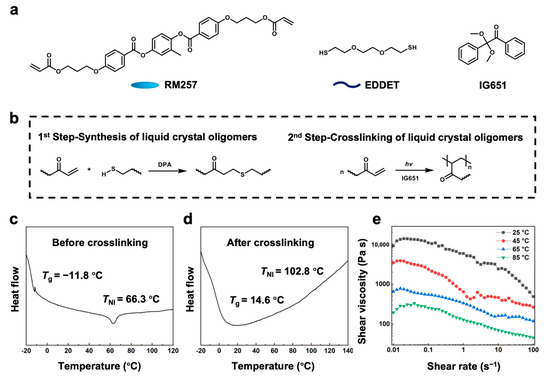
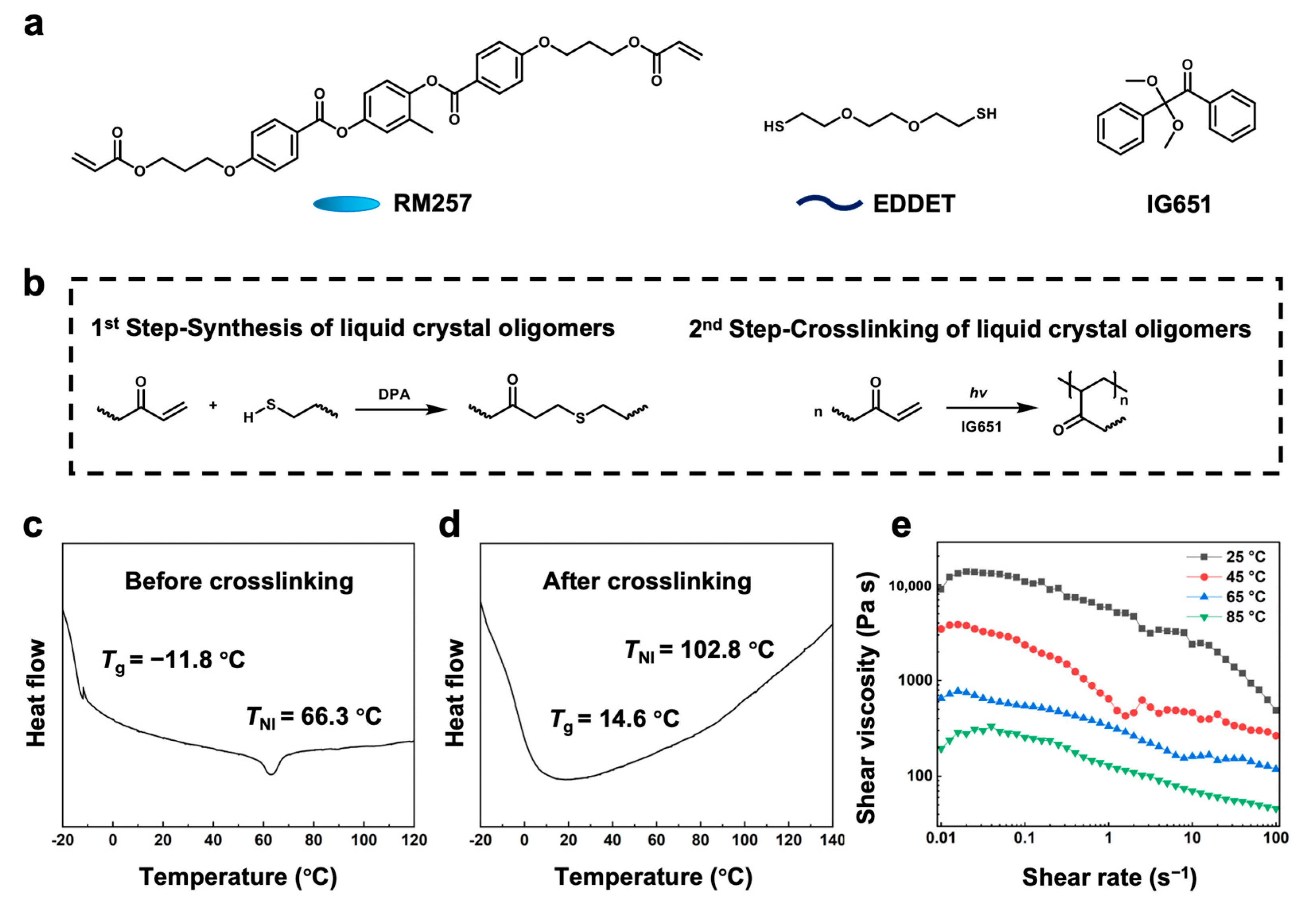
Axially aligned LCE microfibers were fabricated by combining MCS with a two-step UV curing scheme. Figure 1a shows that RM257 as the liquid crystal unit and EDDET as the flexible chain were applied to prepare liquid crystal oligomers by Michael addition reaction. We intentionally retained a small fraction of unreacted acrylates in the formulation; under subsequent UV exposure, a pre-mixed photoinitiator triggered free-radical polymerization of the pendant double bonds, thereby fixing the crosslinked network and locking the flow-induced alignment.
Figure 1.
(a) Chemical structure of RM257 as mesogen, EDDET as spacer, IG651 as photoinitiator, and (b) the reaction of synthesis and crosslinking liquid crystal oligomers; DSC curves of liquid crystal oligomer inks (c) before and (d) after crosslinking; (e) shear viscosity of LC oligomer ink at different temperatures as a function of shear rate.
We measured the Tg and TNI of the LC oligomer ink before and after UV crosslinking by differential scanning calorimetry (DSC) as a reference for selecting subsequent spinning parameters. As shown in Figure 1c,d, the uncrosslinked LC oligomer ink exhibited a Tg of −11.8 °C and a TNI of 66.3 °C. At this stage, the ink appeared milky and polydomain at room temperature, showing certain flowability with high viscosity. After UV-initiated crosslinking, the Tg increased to 14.6 °C and the TNI rose to 102.8 °C, indicating the formation of a crosslinked LCE network that behaved as an elastomer at room temperature.
Because the LC oligomer ink possessed high viscosity at room temperature, extrusion was difficult during spinning. We preheated the ink during processing to reduce viscosity. To aid the selection of spinning parameters, the shear viscosity of the LC oligomer ink was characterized at various temperatures using a rotational rheometer (Figure 1e). When the test temperature was below TNI, the ink exhibited an obvious shear-thinning behavior, which largely disappeared once the temperature exceeded TNI. With increasing temperature, the viscosity decreased sharply. When the temperature was raised slightly from 25 °C to 45 °C, the viscosity at a shear rate of 1 s−1 dropped to less than one-tenth of its original value. Taking these factors into account, we selected 45 °C as the spinning temperature. This temperature lies below TNI, allowing the extruded jet to maintain partial mesogen alignment, while substantially reducing viscosity to facilitate smooth extrusion during melt-centrifugal spinning.
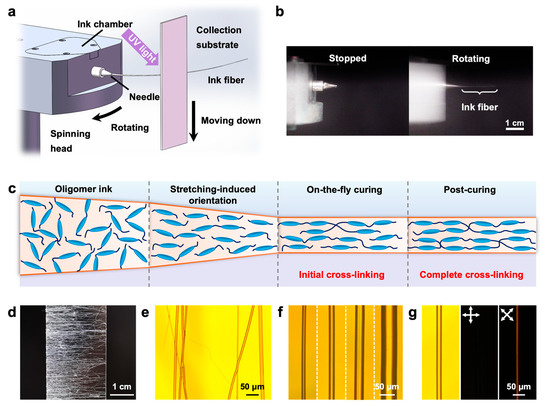
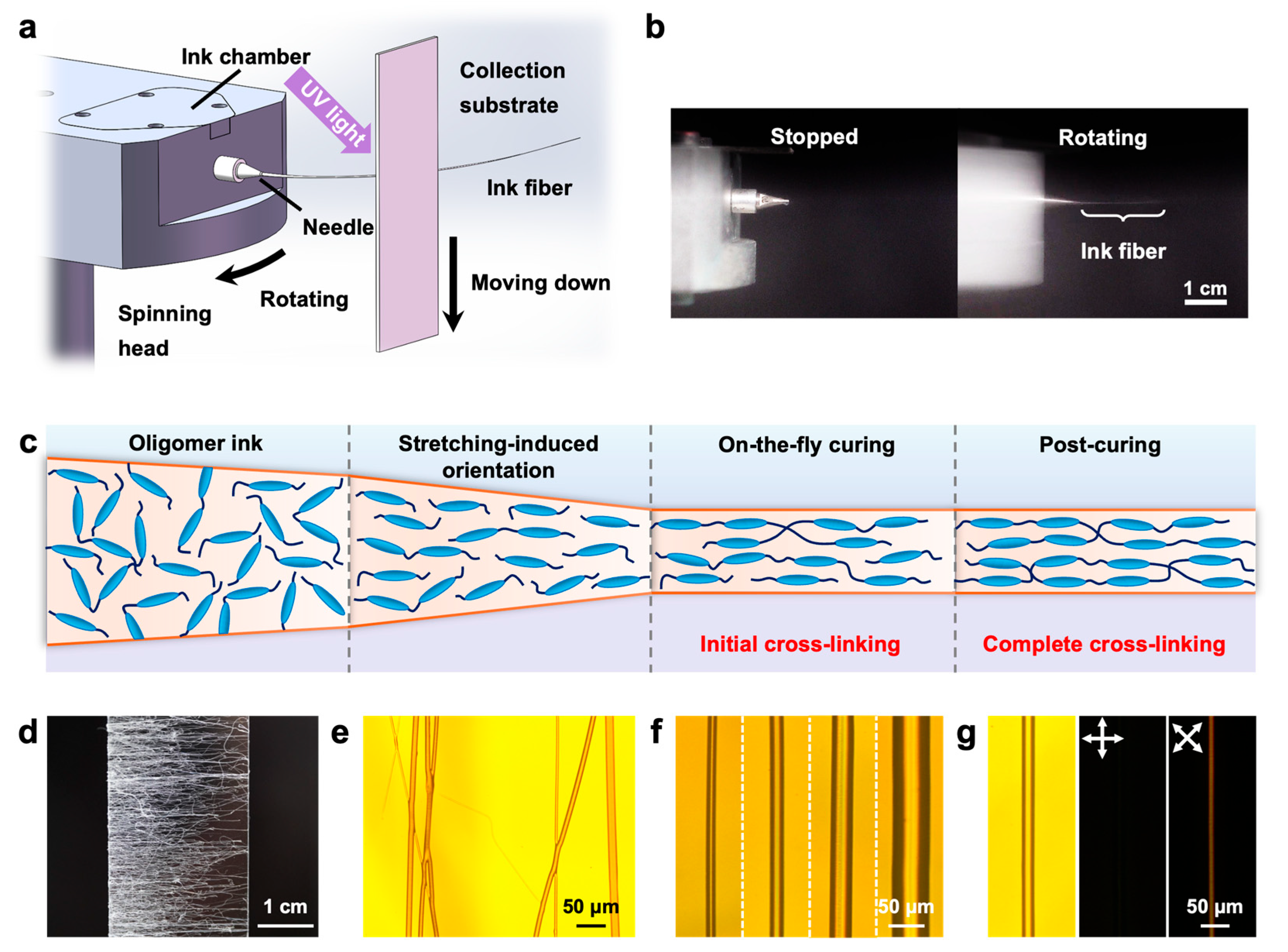
The preparation process of LCE microfibers is shown in Figure 2a. The LC oligomer ink was preheated to 45 °C to lower viscosity and loaded into a home-built rotary spinner. After the spinner reached the target speed, centrifugal force drove the ink to overcome surface tension and be flung out of the nozzle as a continuous jet, traveling parallel tangential to the plane of rotation (Figure 2b). After departing from the needle, the connected ink wire became thinner as flying away. It originated that the extruded ink further flew away towards the rotational tangent direction due to inertia and thus stretched, in which the axial orientation of the liquid crystal mesogens was established. Upon contacting the glass collector, we applied obliquely incident UV across the collecting plane to implement an on-the-fly first-stage curing; a subsequent post-curing step strengthened crosslinking and stabilized the filament geometry (Figure 2c). During collection, the substrate moves vertically downward at a linear speed of 1.5 mm s−1, which promoted uniform laydown and mitigated local stacking.
Figure 2.
Fabrication and characterization of LCE microfibers. (a) Schematic diagram of melt-centrifugal spinning. (b) Picture of the spinning head stopped and rotated. (c) Schematic diagram of the stretch-induced orientation and two-step UV curing process of LCE. (d) Photographs of fibers collected from the substrate. (e) Pictures of fibers with cross-fusion between them. (f) Pictures of fibers with different diameters. (g) POM images of fibers from a single root. Spinning conditions: rotational speed 2500 rpm, nozzle diameter 0.7 mm.
The morphology and alignment of the microfibers were initially characterized by polarized optical microscope (POM). As shown in Figure 2d, numerous LCE microfibers arranged roughly parallel to the rotation plane and densely located on one side of the collection substrate. This was because, when the length of the formed ink fibers reached the substrate position, the fibers crashed on the substrate and continued to move in the flying direction due to inertia. Figure 2e demonstrated that some fibers overlapped and crossed due to the difference in their alignment angle. Occasional fusion between fibers suggests that the jets remained flowable upon landing. Statistically, the fiber diameter primarily falls within 10–60 μm; a representative single fiber (~22 μm) displays a dark field at 0° and a bright field at 45° relative to the polarizer, consistent with uniaxial optical anisotropy (Figure 2f,g).
3.2. Effect of Collection Distance, Rotational Speed and Nozzle Diameter on LCE Microfibers
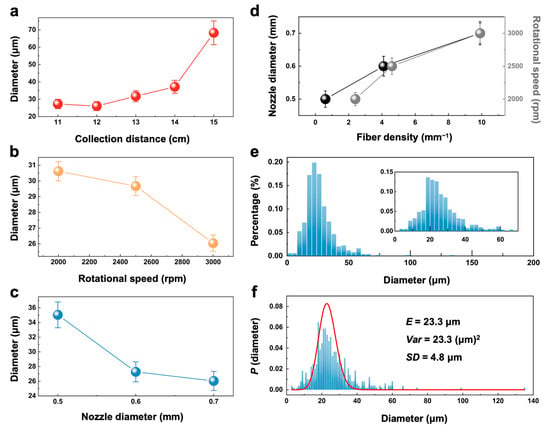
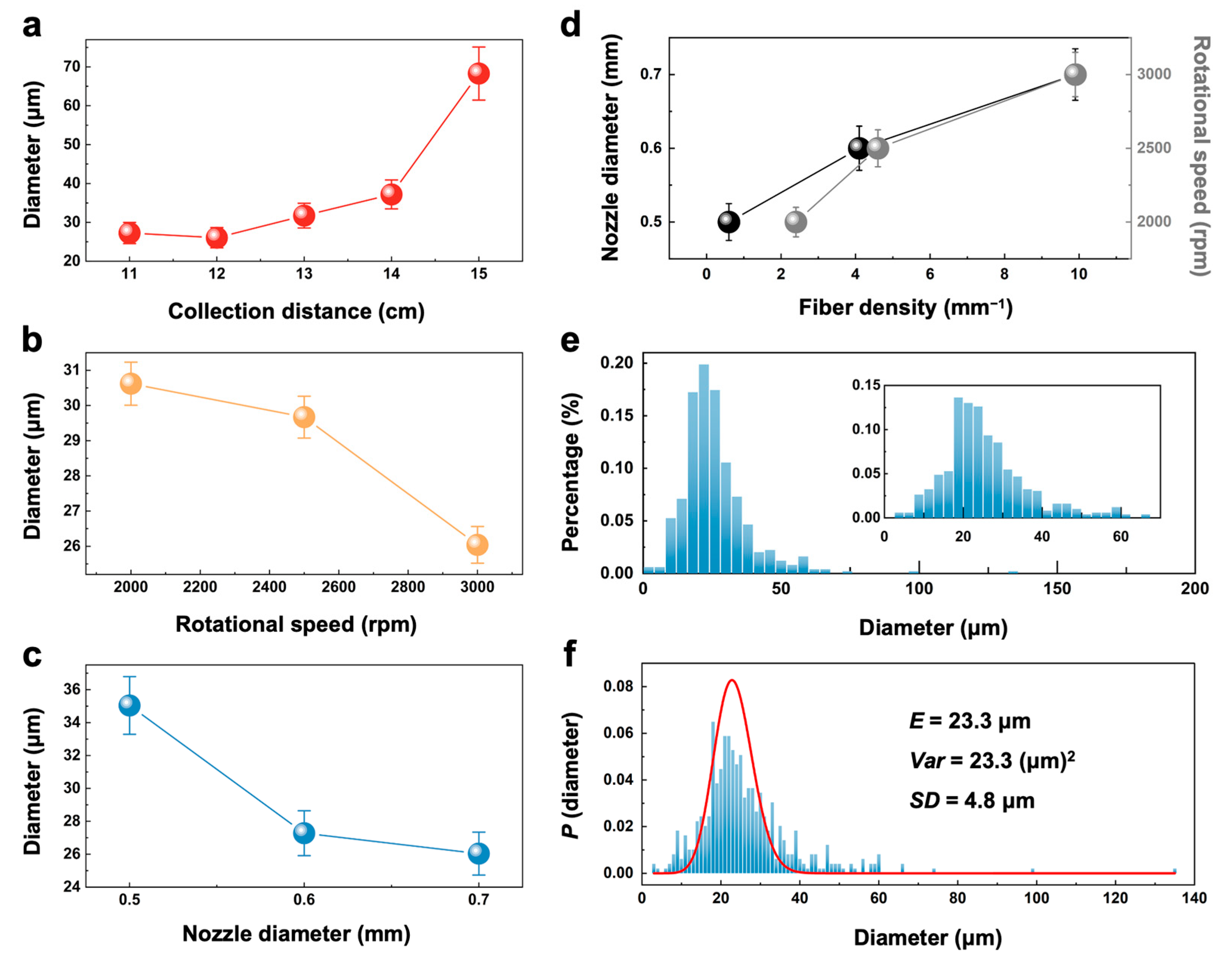
We first investigated the effects of collection distance, rotational speed, and nozzle diameter on the average diameter of the spun LCE microfibers (Figure 3a–c). The fiber diameter exhibited a non-monotonic dependence on the collection distance: as the distance increased from 11 cm to 12 cm, the diameter decreased markedly, reaching a minimum at 12 cm; increasing the distance further to 15 cm led to a pronounced rise (Figure 3a). This trend can be attributed to the competing effects of jet stretching and stabilization. At shorter distances, the jet experiences insufficient flight time, so axial elongation and molecular alignment are not fully developed before solidification, resulting in thicker fibers. In contrast, an excessively long distance allows the uncured jet to undergo surface-tension-driven coalescence, thickening, or necking instabilities during flight, thereby increasing the average diameter. A distance of 12 cm provides an optimal balance, enabling adequate jet extension and thinning. Therefore, the following comparisons were conducted at a fixed collection distance of 12 cm. We note that the distance optimum may shift with nozzle diameter; however, fixing the geometry at 12 cm provides a consistent baseline to isolate nozzle-size effects.
Figure 3.
Effect of spinning parameters on the diameter and diameter distribution of melt-centrifugally spun LCE microfibers. Average fiber diameter as a function of (a) collection distance, (b) rotational speed, and (c) nozzle diameter; (d) fiber density as a function of rotational speed and nozzle diameter; (e) histogram of fiber diameter distribution under typical spinning conditions (rotational speed of 3000 rpm and nozzle diameter of 0.7 mm), with insets highlighting the distribution of fibers with diameters less than 70 μm; (f) Poisson fit plot of fiber diameter distribution under typical spinning conditions (rotational speed of 3000 rpm and nozzle diameter of 0.7 mm).
At this baseline-optimized distance, increasing the rotational speed further reduced the fiber diameter (Figure 3b). A higher centrifugal force and ejection velocity enhanced the axial strain rate and extended the effective draw zone, producing finer and more stable fibers. In contrast, reducing the nozzle diameter did not yield thinner fibers. Instead, the average diameter decreased when the nozzle was enlarged from 0.5 mm to 0.7 mm (Figure 3c). This result suggests that decreasing nozzle diameter increases hydraulic resistance (i.e., a larger pressure drop is consumed across the nozzle for a given centrifugal pressure head), reducing volumetric throughput and exit velocity. The resulting weaker jet exhibits a shorter effective extensional draw zone and is more prone to capillary-driven coalescence prior to curing, which can lead to a larger apparent fiber diameter in Figure 3c.
We then examined the influence of rotational speed and nozzle diameter on fiber density. A schematic diagram of the density statistical method for LCE microfibers is shown in Figure S2. As shown in Figure 3d, with a fixed nozzle diameter of 0.7 mm, increasing the speed from 2000 rpm to 3000 rpm raises the collection density on the substrate from 2.4 mm−1 to 9.9 mm−1, indicating a pronounced increase. The growth is not strictly linear and can be attributed to three reasons: (i) higher rotation increases the frequency with which the jet contacts the substrate; (ii) the larger centrifugal force at higher speed boosts the volumetric extrusion rate; and (iii) higher centrifugal force and jet velocity enhance the axial strain rate and extend the effective tensile zone, allowing the jet stream to travel a longer distance in flight, which increases its probability of capture by the substrate. At a fixed rotational speed of 3000 rpm with all other parameters unchanged, we evaluated the effect of nozzle diameter on fiber density and diameter statistics (Figure 3d). The results reveal a clear trade-off between throughput and uniformity. As the nozzle diameter decreased from 0.7 mm to 0.6 mm and 0.5 mm, the linear collection density dropped significantly from 9.9 mm−1 to 4.1 mm−1 and 0.6 mm−1, respectively. This is because reducing the nozzle diameter shortens the length of the stable ink filaments formed, and shorter ink filaments are more difficult to collect on the substrate.
Fibers collected at a rotational speed of 3000 rpm and a nozzle diameter of 0.7 mm were statistically analyzed for diameter distribution, as shown in Figure 3e. Regarding size statistics, although some dispersion persists, most fibers fall within 10–40 μm, with a dominant population near ~20 μm that remains essentially unchanged with speed. As shown in Figure S3, with increasing rotational speed, the distribution narrows. The fraction of >40 μm coarse fibers markedly decreases, while the proportion of the main peak around ~20 μm increases. The narrowing of the fiber distribution may come from the fact that the increase in rotational speed leads to the forming of stabler and longer ink fiber, making it more easily collected by the substrate. With decreasing nozzle diameter, the diameter distribution widens significantly. Although the main peak still appears around ~20 μm, its proportion decreases, while the proportion of fibers > 40 μm increases. We note that a small number of larger-diameter fibers are associated with coalescence/thickening during the flight, which is consistent with the morphological evolution of the incompletely solidified jet driven by surface tension. A Poisson distribution was fitted to the fiber diameter, and the results are shown in Figure 3f. The expected value obtained from the fitting was 23.3 μm, the variance was 23.3 (μm)2, and the corresponding standard deviation was 4.8 μm, which is highly consistent with the dominant diameter observed in the experiment.
3.3. Mechanistic Analysis of Jet Stabilization and Fiber Formation
Fiber manufacturing routes differ fundamentally in their stabilization timing, as shown in Table 1. For example, in electrospinning, a polymer ink dissolved in solvent forms a Taylor cone and a fine jet. Rapid evaporation of the solvent causes the polymer to precipitate quickly, and the fine jet will be stabilized near the nozzle area to form solid fibers [30,31,32]. Strong electric field stretching and deformation counteract surface tension, making the fiber diameter mostly fall within 10–100 μm [16]. Early solidification effectively suppresses coalescence, coarsening, and breakage in air or near the collector. However, it weakens the programmability of flow orientation and the product often exhibits polydomain properties. In wet spinning, the fine jet enters the coagulation bath and immediately desolventizes to be stabilized; then, secondary crosslinking is completed to obtain reversibly actuated fibers [33,34]. Melt electrowriting (MEW) and melt spinning stabilize the jet at the nozzle outlet or near the collecting surface through rapid cooling or near-field light curing, with good diameter controllability and path programmability [22,35]. The common point of these methods is that the flight section is very short or the jet is stabilized from the beginning, which effectively suppresses the coalescence, coarsening and breakage in the air or near the plate stage. However, it also compresses the freedom of using flow-induced programmable orientation, and the product is more likely to be polydomain or require post-processing to reinforce monodomain alignment.
Table 1.
Comparison of fiber manufacturing technology.
By contrast, our two-step UV curing assisted MCS adopts a distinct stabilization timing. The oligomeric jet remains fluid during flight and up to the collector; if not fixed in time, the slender jet undergoes Rayleigh–Plateau instability, manifesting as spontaneous thickening, jet merging, or breakup (Figure S4). This explains why increasing the spinning speed primarily results in a decrease in the proportion of coarse fibers and an increase in linear density, rather than a continuous decrease in the main diameter. Furthermore, when the nozzle diameter is too small or the on-the-fly UV dose is too low, the effective extensional segment shortens, raising the probability of failure and broadening the diameter distribution, and the proportion of fibers > 40 μm increases. These trends indicate that, under our current processing conditions, the attainable diameter is already approaching the practical size limit for LCE microfibers.
Therefore, the process should (i) maximize the extensional segment and (ii) deliver sufficient on-the-fly curing at touchdown to lock the flow-induced alignment, followed by (iii) a post-cure to complete crosslinking and stabilize the cross-section. This curing chronology, rather than geometry alone, is the decisive lever for narrowing the diameter distribution and ensuring robust axial alignment without sacrificing throughput. If the goal is to approach the sub-10 μm regime, one must re-optimize stabilization timing, such as faster photochemistry, higher local irradiance, modified collector boundary layer and so on, instead of unboundedly increasing rotational speed or shrinking the orifice further.
3.4. Thermally Induced Actuation of LCE Microfibers
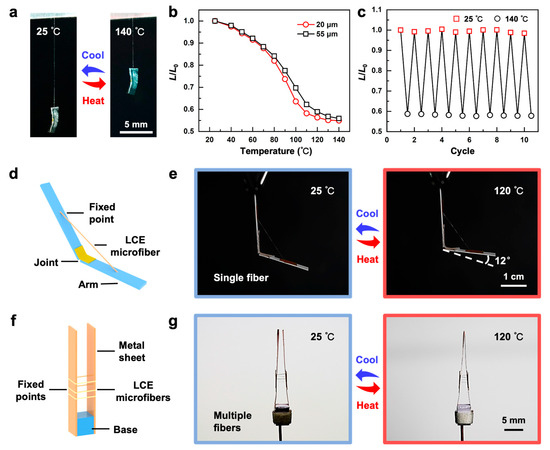
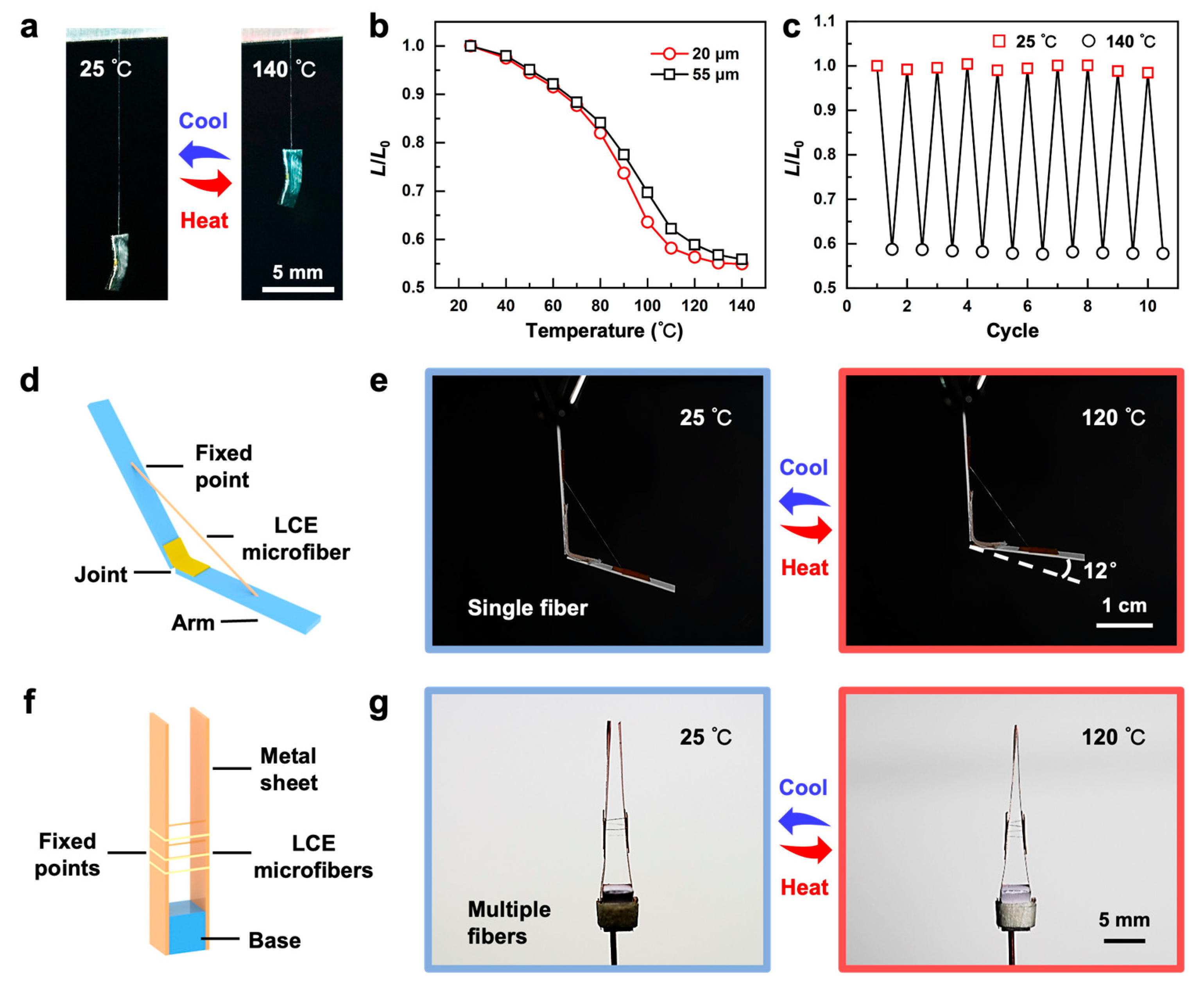
The reversible deformation of a single LCE microfiber under heating was evaluated. A single filament was suspended and loaded with a 1 mg aluminum foil at the free end to maintain axial straightening. The sample was then heated in an oven, and its length change during the heating and cooling process was recorded. Thermally induced shrinkage was characterized by the ratio L/L0 (L0 being the initial length at room temperature). Upon heating to the target temperature, the fiber contracted along the director and recovered its original length upon cooling, showing pronounced, repeatable strokes (Figure 4a). Figure 4b shows the curve of LCE microfiber length change with temperature: the microfiber reaches the maximum reversible contraction of L/L0 ≈ 0.56 at 140 °C, corresponding to an axial strain amplitude of about 44%. After 10 thermal cycles, the contraction-recovery trajectory and the terminal length at room temperature remained essentially unchanged (Figure 4c), indicating good cyclic stability of the crosslinked network and locked alignment under the applied load and UV dose used during curing.
Figure 4.
Thermally responsive deformation properties of LCE microfibers: (a) Change in length of a 20 μm diameter fiber suspended from a 1 mg weight before (25 °C) and after (140 °C) heating. (b) Change in the ratio of fiber length (L) to the original length (L0) as a function of temperature. (c) Evolution of L/L0 as a function of cycle number over 10 heating–cooling cycles. (d) Schematic diagram and (e) picture of a single microfiber-driven joint contraction. (f) Schematic diagram and (g) picture of a multi-fiber-driven forceps closure.
Although stable actuation was observed within the cycling window studied here, it is important to emphasize that the long-term durability of LCE microfibers operated at elevated temperature is expected to be limited by (i) thermo-oxidative aging accelerated by the high surface-to-volume ratio, which may cause oxidation-induced embrittlement and reduced reversible strain [39]; (ii) viscoelastic relaxation in the compliant high-temperature state under load, leading to permanent set and gradual stroke decay [40]; and (iii) fatigue damage initiated at diameter heterogeneities, occasional fusion sites, and potential crosslink gradients introduced during on-the-fly UV fixation [41,42]. Although stable actuation performance was observed within the cycle range studied in this work, indicating that the aforementioned degradation has not yet become significant within the current cycle range, these mechanisms may become the main limiting factors for applications with longer lifespans (103–105 cycles) [16,43].
We employed LCE microfibers as actuation units to drive two thermally responsive devices. As shown in Figure 4d, a single microfiber served as a miniature artificial muscle to drive a micro-joint, yielding reversible angular motions with a clear angle–time response. The microfiber with a diameter of 20 μm was connected between the two arms of a paper movable joint and heated from 25 °C to 120 °C to achieve a bending of approximately 12° (Figure 4e). In addition, multiple parallel microfibers were used to actuate a forceps-type gripper (Figure 4f,g). The fibers are twisted and bundled between two deformable metal sheets. Heating to 120 °C actuates the tweezer arms to close. Due to the size limitation of the device, the fiber body is difficult to identify in the photo, but the convergent closing action is clearly visible.
These results demonstrate that LCE microfibers with axial orientation and controlled size distribution can be used directly as component-level actuation units; a single fiber is well suited for angle/displacement tasks, while parallel bundles allow output scaling by engineering the number of filaments and the span, thereby adapting the actuator to gripping and other load-bearing operations.
4. Conclusions
In this study, we have established a melt-centrifugal spinning (MCS) route coupled with two-step UV curing that yields axially aligned LCE microfibers with hardware and without high-voltage supply. The process decouples flow-induced alignment from network fixation: high-speed rotation thins and axially extends the oligomer jet, an on-the-fly UV dose at the collector freezes geometry and director, and a post-cure consolidates crosslink density. Within this framework we have reproducibly obtained fibers in the 10–40 μm regime, strong birefringence under crossed polarizers, and high collection line densities. Functionally, the LCE-formed microfiber actuator has good heat dissipation properties due to its large specific surface area and reaches L/L0 = 0.56 at 140 °C with stable cycling. Device-ready performance is demonstrated by a single-fiber paper hinge (~12° at 120 °C) and multi-fiber tweezers.
Looking forward, the same timing perspective points to clear levers for 10–40 μm fibers without sacrificing throughput: increase optical efficiency, optimize nozzle geometry, or add auxiliary fields to lengthen the stable draw before curing. Compared with early-stabilization routes, this method favors manufacturability: robust alignment locking and direct compatibility with bundling and textile integration. This combination makes the LCE microfibers particularly suitable for application formats that inherently benefit from a slender, tendon-like actuator element. In the near term, single-fiber or small-bundle actuation can be translated into thermally addressable compliant mechanisms, such as micro-clamps, latching units, and compliant hinges, where contraction of a fiber bundle is directly converted into gripping, locking, or bending motions with minimal mechanical complexity. At the device level, bundled fibers can further serve as contractile artificial muscles to tension and reconfigure lightweight structures, and as simple pinch-actuation elements for small-scale tubes or valves in temperature-tolerant environments where localized heating is readily available. At the textile scale, yarn-level assembly (twisting, braiding, weaving, knitting, etc.) provides a direct pathway to architected fabrics [44,45]. When combined with spatially patterned stimuli, they enable distributed, programmable deformation modes beyond uniform contraction. This low-barrier methodology provides a direct pathway from LCE chemistry to deployable fiber actuators and smart-textile architectures.
Supplementary Materials
The following supporting information can be downloaded at: https://www.mdpi.com/article/10.3390/act15020093/s1, Figure S1: Schematic diagram of (a) the melt-centrifugal spinning machine and (b) the longitudinal section of the spinning head; Figure S2: Characterization and statistical schematic diagram of LCE microfibers. Figure S3: Histograms of fiber diameter distributions under representative spinning conditions: from top to bottom, 2000, 2500, and 3000 rpm at a nozzle diameter of 0.7 mm, and 3000 rpm at nozzle diameters of 0.6 and 0.5 mm; Figure S4: Ink fibers remaining on the nozzle after the spinning head stops rotating. (a) The spinning head has just stopped rotating and (b) has stopped rotating for 30 s.
Author Contributions
Conceptualization, W.L. and Z.Y.; methodology, validation, formal analysis, writing—original draft preparation, W.L. and C.J.; writing—review and editing, Z.Y. All authors have read and agreed to the published version of the manuscript.
Funding
This research was funded by the National Natural Science Foundation of China, grant number 52573036, and the Tsinghua University Dushi Program.
Institutional Review Board Statement
Not applicable.
Informed Consent Statement
Not applicable.
Data Availability Statement
Data is contained within the article or Supplementary Materials.
Acknowledgments
Yunpeng Wang, Jiahao Sun, Jiazhe Ma were acknowledged for their helpful discussion and advice in experiment.
Conflicts of Interest
The authors declare no conflicts of interest.
References
- Dong, K.; Peng, X.; Wang, Z.L. Fiber/fabric-based piezoelectric and triboelectric nanogenerators for flexible/stretchable and wearable electronics and artificial intelligence. Adv. Mater. 2020, 32, 1902549. [Google Scholar] [CrossRef] [Scilit] [PubMed]
- Xiong, J.; Chen, J.; Lee, P.S. Functional fibers and fabrics for soft robotics, wearables, and human–robot interface. Adv. Mater. 2021, 33, 2002640. [Google Scholar] [CrossRef] [Scilit]
- Fang, C.; Xu, B.; Li, M.; Han, J.; Yang, Y.; Liu, X. Advanced design of fibrous flexible actuators for smart wearable applications. Adv. Fiber Mater. 2024, 6, 622–657. [Google Scholar] [CrossRef] [Scilit]
- Yu, Y.; Zhang, F.; Liu, Y.; Leng, J. Smart polymer fibers: Promising advances in microstructures, stimuli-responsive properties and applications. Adv. Fiber Mater. 2025, 7, 1010–1041. [Google Scholar] [CrossRef] [Scilit]
- Ma, J.; Yang, Z. Smart liquid crystal elastomer fibers. Matter 2025, 8, 101950. [Google Scholar] [CrossRef] [Scilit]
- Hines, L.; Petersen, K.; Lum, G.Z.; Sitti, M. Soft actuators for small-scale robotics. Adv. Mater. 2017, 29, 1603483. [Google Scholar] [CrossRef] [Scilit]
- Kotikian, A.; Truby, R.L.; Boley, J.W.; White, T.J.; Lewis, J.A. 3D printing of liquid crystal elastomeric actuators with spatially programed nematic order. Adv. Mater. 2018, 30, 1706164. [Google Scholar] [CrossRef] [Scilit]
- Guo, Y.; Zhang, J.; Hu, W.; Khan, M.T.A.; Sitti, M. Shape-programmable liquid crystal elastomer structures with arbitrary three-dimensional director fields and geometries. Nat. Commun. 2021, 12, 5936. [Google Scholar] [CrossRef] [Scilit]
- Ni, B.; Liu, G.; Zhang, M.; Tatoulian, M.; Keller, P.; Li, M.-H. Customizable sophisticated three-dimensional shape changes of large-size liquid crystal elastomer actuators. ACS Appl. Mater. Interfaces 2021, 13, 54439–54446. [Google Scholar] [CrossRef] [Scilit]
- Hou, W.; Wang, J.; Lv, J. Bioinspired liquid crystalline spinning enables scalable fabrication of high-performing fibrous artificial muscles. Adv. Mater. 2023, 35, 2211800. [Google Scholar] [CrossRef] [Scilit] [PubMed]
- Terentjev, E.M. Liquid crystal elastomers: 30 years after. Macromolecules 2025, 58, 2792–2806. [Google Scholar] [CrossRef] [Scilit]
- Cho, J.; Lee, M.; Park, T.; Wang, Y.; Lee, H.; Cai, S.; Park, Y. Bio-inspired artificial muscle-tendon complex of liquid crystal elastomer for bidirectional afferent-efferent signaling. Adv. Mater. 2025, 38, e03094. [Google Scholar] [CrossRef] [Scilit]
- White, T.J.; Broer, D.J. Programmable and adaptive mechanics with liquid crystal polymer networks and elastomers. Nat. Mater. 2015, 14, 1087–1098. [Google Scholar] [CrossRef] [Scilit]
- Herbert, K.M.; Fowler, H.E.; McCracken, J.M.; Schlafmann, K.R.; Koch, J.A.; White, T.J. Synthesis and alignment of liquid crystalline elastomers. Nat. Rev. Mater. 2021, 7, 23–38. [Google Scholar] [CrossRef] [Scilit]
- Chen, W.; Tong, D.; Meng, L.; Tan, B.; Lan, R.; Zhang, Q.; Yang, H.; Wang, C.; Liu, K. Knotted artificial muscles for bio-mimetic actuation under deepwater. Adv. Mater. 2024, 36, 2400763. [Google Scholar] [CrossRef] [Scilit]
- He, Q.; Wang, Z.; Wang, Y.; Wang, Z.; Li, C.; Annapooranan, R.; Zeng, J.; Chen, R.; Cai, S. Electrospun liquid crystal elastomer microfiber actuator. Sci. Robot. 2021, 6, eabi9704. [Google Scholar] [CrossRef] [Scilit] [PubMed]
- Jiang, H.; Chung, C.; Dunn, M.L.; Yu, K. 4D printing of liquid crystal elastomer composites with continuous fiber reinforcement. Nat. Commun. 2024, 15, 8491. [Google Scholar] [CrossRef] [Scilit]
- Escobar, M.C.; White, T.J. Fast and slow-twitch actuation via twisted liquid crystal elastomer fibers. Adv. Mater. 2024, 36, 2401140. [Google Scholar] [CrossRef] [Scilit]
- Naciri, J.; Srinivasan, A.; Jeon, H.; Nikolov, N.; Keller, P.; Retna, B.R. Nematic elastomer fiber actuator. Macromolecules 2003, 36, 8499–8505. [Google Scholar] [CrossRef] [Scilit]
- Nocentini, S.; Martella, D.; Wiersma, D.S.; Parmeggiani, C. Beam steering by liquid crystal elastomer fibres. Soft Matter 2017, 13, 8590–8596. [Google Scholar] [CrossRef] [Scilit]
- Gelebart, A.H.; Mc Bride, M.; Schenning, A.P.H.J.; Bowman, C.N.; Broer, D.J. Photoresponsive fiber array: Toward mimicking the collective motion of cilia for transport applications. Adv. Funct. Mater. 2016, 26, 5322–5327. [Google Scholar] [CrossRef] [Scilit]
- Lin, X.; Saed, M.O.; Terentjev, E.M. Continuous spinning aligned liquid crystal elastomer fibers with a 3D printer setup. Soft Matter 2021, 17, 5436–5443. [Google Scholar] [CrossRef] [Scilit]
- Badrossamay, M.R.; McIlwee, H.A.; Goss, J.A.; Parker, K.K. Nanofiber assembly by rotary jet-spinning. Nano Lett. 2010, 10, 2257–2261. [Google Scholar] [CrossRef] [Scilit]
- Rihova, M.; Lepcio, P.; Cicmancova, V.; Frumarova, B.; Hromádko, L.; Bureš, F.; Vojtová, L.; Macak, J.M. The centrifugal spinning of vitamin doped natural gum fibers for skin regeneration. Carbohyd. Polym. 2022, 294, 119792. [Google Scholar] [CrossRef] [Scilit] [PubMed]
- Wang, X.; Qu, W.; Yu, R.; Tong, W.; Liu, C.; Liu, Y.; Zhang, Y.; Wang, M. Aligned triboelectric dipoles in fiber structure via centrifugal spinning for airflow sensing. Chem. Eng. J. 2025, 524, 169302. [Google Scholar] [CrossRef] [Scilit]
- Zannini Luz, H.; Loureiro Dos Santos, L.A. Centrifugal spinning for biomedical use: A review. Crit. Rev. Solid State Mater. Sci. 2023, 48, 519–534. [Google Scholar] [CrossRef] [Scilit]
- Xu, H.; Yagi, S.; Ashour, S.; Du, L.; Hoque, M.E.; Tan, L. A review on current nanofiber technologies: Electrospinning, centrifugal spinning, and electro-centrifugal spinning. Macromol. Mater. Eng. 2023, 308, 2200502. [Google Scholar] [CrossRef] [Scilit]
- Wen, Z.; Lyu, J.; Ding, Y.; Liu, B.; Zhang, X. Aerogel fibers made via generic sol-gel centrifugal spinning strategy enable dynamic removal of volatile organic compounds from high-flux gas. Adv. Funct. Mater. 2024, 34, 2407221. [Google Scholar] [CrossRef] [Scilit]
- Liao, W.; Yang, Z. The integration of sensing and actuating based on a simple design fiber actuator towards intelligent soft robots. Adv. Mater. Technol. 2022, 7, 2101260. [Google Scholar] [CrossRef] [Scilit]
- Krause, S.; Dersch, R.; Wendorff, J.H.; Finkelmann, H. Photocrosslinkable liquid crystal main-chain polymers: Thin films and electrospinning. Macromol. Rapid Commun. 2007, 28, 2062–2068. [Google Scholar] [CrossRef] [Scilit]
- Wu, D.; Li, X.; Zhang, Y.; Cheng, X.; Long, Z.; Ren, L.; Xia, X.; Wang, Q.; Li, J.; Lv, P.; et al. Novel biomimetic “spider web” robust, super-contractile liquid crystal elastomer active yarn soft actuator. Adv. Sci. 2024, 11, 2400557. [Google Scholar] [CrossRef] [Scilit] [PubMed]
- Reneker, D.H.; Yarin, A.L. Electrospinning jets and polymer nanofibers. Polymer 2008, 49, 2387–2425. [Google Scholar] [CrossRef] [Scilit]
- Martinez, A.P.; Ng, A.; Nah, S.H.; Yang, S. Active-textile yarns and embroidery enabled by wet-spun liquid crystalline elastomer filaments. Adv. Funct. Mater. 2024, 34, 2400742. [Google Scholar] [CrossRef] [Scilit]
- Wang, Y.; Zhou, S.; Feng, J. High-strength and fast-response liquid crystal elastomer fiber and fabric actuators. ACS Appl. Mater. Interfaces 2025, 17, 46161–46171. [Google Scholar] [CrossRef] [Scilit] [PubMed]
- Javadzadeh, M.; Del Barrio, J.; Sánchez-Somolinos, C. Melt Electrowriting of liquid crystal elastomer scaffolds with programmed mechanical response. Adv. Mater. 2023, 35, 2209244. [Google Scholar] [CrossRef] [Scilit]
- Ohm, C.; Morys, M.; Forst, F.R.; Braun, L.; Eremin, A.; Serra, C.; Stannarius, R.; Zentel, R. Preparation of actuating fibres of oriented main-chain liquid crystalline elastomers by a wetspinning process. Soft Matter 2011, 7, 3730. [Google Scholar] [CrossRef] [Scilit]
- Feng, X.; Wang, L.; Xue, Z.; Xie, C.; Han, J.; Pei, Y.; Zhang, Z.; Guo, W.; Lu, B. Melt electrowriting enabled 3D liquid crystal elastomer structures for cross-scale actuators and temperature field sensors. Sci. Adv. 2024, 10, eadk3854. [Google Scholar] [CrossRef] [Scilit]
- Liu, J.; Gao, Y.; Wang, H.; Poling-Skutvik, R.; Osuji, C.O.; Yang, S. Shaping and locomotion of soft robots using filament actuators made from liquid crystal elastomer–carbon nanotube composites. Adv. Intell. Syst. 2020, 2, 1900163. [Google Scholar] [CrossRef] [Scilit]
- Tian, R.; Li, K.; Lin, Y.; Lu, C.; Duan, X. Characterization techniques of polymer aging: From beginning to end. Chem. Rev. 2023, 123, 3007–3088. [Google Scholar] [CrossRef] [Scilit]
- Lugger, S.J.D.; Ceamanos, L.; Mulder, D.J.; Sánchez-Somolinos, C.; Schenning, A.P.H.J. 4D printing of supramolecular liquid crystal elastomer actuators fueled by light. Adv. Mater. Technol. 2023, 8, 2201472. [Google Scholar] [CrossRef] [Scilit]
- Hu, M.; Wang, L.; Wei, Z.; Xiao, R.; Qian, J. Fracture and fatigue characteristics of monodomain and polydomain liquid crystal elastomers. Soft Matter 2025, 21, 113–121. [Google Scholar] [CrossRef] [Scilit] [PubMed]
- Kim, D.S.; Lee, Y.-J.; Wang, Y.; Park, J.; Winey, K.I.; Yang, S. Self-folding liquid crystal network filaments patterned with vertically aligned mesogens. ACS Appl. Mater. Interfaces 2022, 14, 50171–50179. [Google Scholar] [CrossRef] [Scilit] [PubMed]
- Luo, J.; Liu, H.; He, Y.; Li, N.; Wang, T.; Yang, Z.; Guo, Q.; Gan, J.; Yang, Z. Biocompatible liquid crystal elastomer optical fiber actuator for in vivo endoscopic navigation and laser ablation therapy. Adv. Mater. 2025, e16047. [Google Scholar] [CrossRef] [Scilit] [PubMed]
- Wang, Y.; Sun, J.; Liao, W.; Yang, Z. Liquid crystal elastomer twist fibers toward rotating microengines. Adv. Mater. 2022, 34, 2107840. [Google Scholar] [CrossRef] [Scilit]
- Sun, J.; Liao, W.; Yang, Z. Additive manufacturing of liquid crystal elastomer actuators based on knitting technology. Adv. Mater. 2024, 36, 2400763. [Google Scholar] [CrossRef] [Scilit]

Disclaimer/Publisher’s Note: The statements, opinions and data contained in all publications are solely those of the individual author(s) and contributor(s) and not of MDPI and/or the editor(s). MDPI and/or the editor(s) disclaim responsibility for any injury to people or property resulting from any ideas, methods, instructions or products referred to in the content. |
© 2026 by the authors. Licensee MDPI, Basel, Switzerland. This article is an open access article distributed under the terms and conditions of the Creative Commons Attribution (CC BY) license.