Article

A Collaborative Dynamic Transit Scheduling Method Integrating Timetable Adjustment and Control-Oriented Trajectory Guidance


1
College of Electrical Engineering and Automation, Shandong University of Science and Technology, Qingdao 266590, China
2
School of Transportation and Logistics Engineering, Shandong Jiaotong University, Jinan 250357, China
3
College of Energy Storage Technology, Shandong University of Science and Technology, Qingdao 266590, China
*
Author to whom correspondence should be addressed.
Actuators 2026, 15(2), 112; https://doi.org/10.3390/act15020112
Submission received: 9 January 2026 / Revised: 2 February 2026 / Accepted: 10 February 2026 / Published: 12 February 2026
(This article belongs to the Section Actuators for Surface Vehicles)

Abstract

Dynamic scheduling of public transit is crucial for enhancing comprehensive operational benefits such as service quality and operating costs. However, uncertain passenger demands and the uncontrolled block effects of signalized intersections can lead to timetable deviation, significantly affecting scheduling efficiency. This paper proposes a collaborative dynamic transit scheduling method to mitigate the negative coupling effect. A passenger demand-aware dynamic timetable scheduling strategy is developed to improve timetable adherence and operational homogeneity. A control-oriented trajectory guidance strategy is established to enhance the effectiveness of the timetable scheduling strategy and reduce the operating costs considering the blocking effects of signalized intersections and transit actuator constraints. Integrating the two strategies, a collaborative optimization framework using a multi-objective nonlinear programming model is constructed to present an optimal comprehensive benefit scheduling scheme. Simulation results demonstrate that, compared to traditional methods within the same simulation scenarios, the proposed method improves the performance of operational homogeneity, timetable adherence, and energy efficiency by up to 67.6%, 71.03%, and 27.5%, respectively. In addition, it also enables the transit to pass through multiple signalized intersections without stopping, significantly enhancing the transit’s operational stability and operating cost.

1. Introduction

Public transit is an essential component of urban transport systems that has advantages in high passenger capacity and lower per capita road resource consumption [1], making significant sense in road congestion alleviation and traffic pollution reduction. In an Advanced Public Transportation System (APTS), the timetable specifies the arrival and departure times of transit at each stop on a specific route, and it can be formulated based on the spatial-temporal patterns of urban travel demand, embodying the service capacity of public transport provision [2]. A well-designed timetable can significantly enhance transit’s operational efficiency and service capacity [3].
During operating process, factors such as unpredictable real-time passenger demand and fluctuating road traffic conditions often make it difficult for transit to strictly adhere to schedules. Typically, unexpected passenger surges at stops or travel blocks at signalized intersections can result in transit bunching phenomenon [4], leading to deviations from timetable adherence and operational homogeneity of transit [5]; hence, service quality and operating costs cannot achieve optimum under a transit’s schedule pattern that solely relyies on the initial fixed timetable. To address these challenges, dynamic transit scheduling that leverages real-time vehicle and passenger flow status to adjust operational parameters is operated, enabling a dynamic equilibrium between service capacity and travel demand. The dynamic transit scheduling scheme includes two aspects: (1) real-time adjustment of departure intervals and dwell times at stops [6] and (2) dynamic transit speed modulation during in-service operations [7].
In dynamic transit scheduling, the block effects of signalized intersections and unexpected passenger surges constitute the critical determinants of system performance. The dwell time at stops caused by unexpected real-time passenger demand and the ‘stop-and-go’ motion induced by signalized intersections amplifies uncertain delay and incurs extra energy consumption. This problem tends to be amplified when there are densely spaced sequential intersections in the transit route; hence, it is a challenge to characterize the coupling mechanism between the dwell time at stops and the signalized intersection sequences and further propose an efficient, robust, and energy-conscious dynamic transit scheduling scheme under unexpected real-time passenger demand conditions.
In this paper, a collaborative dynamic transit scheduling (CDTS) method is proposed for enhancing the comprehensive operational benefits of transit. The main contributions are summarized as follows: (1) Considering the influence of uncertain passenger demand on transit operational stability, a dynamic timetable scheduling strategy is proposed to improve timetable adherence and operational homogeneity. (2) A control-oriented trajectory guidance strategy considering transit actuator constraints and the blocking effects caused by sequenced signalized intersections is developed to further enhance the dynamic scheduling effectiveness and reduce operating costs. (3) A collaborative optimization framework is established that integrates dynamic timetable scheduling and trajectory guidance to achieve the optimal comprehensive operational benefits by simulation-calibrated weighting analysis.
The remainder of this paper is organized as follows: Section 2 reviews the related studies; Section 3 presents a detailed description of the problem; the proposed CDTS method is presented in Section 4; Section 5 presents a series of simulations demonstrating the effectiveness of the proposed method; and Section 6 concludes the paper and discusses future research.

2. Literature Review

The efficiency and sustainability of urban transit systems are impacted by the complex road transportation environmental factors of road transportation [8]. Extensive research has been conducted on transit operational stability and operating costs. The related work is summarized below.
In timetable-based static transit scheduling, the initial fixed timetable is re-optimized by accounting for potential operational uncertainty factors [9]. For example, a multi-objective timetable coordination method is proposed to address transfer issues under uncertain travel time [2]. To optimize the transit’s timetable, a data-driven bi-objective optimization model is constructed, incorporating time-dependent variables such as travel time, dwell time, and passenger volume [10]. However, static scheduling lacks real-time responsiveness when confronting unexpected events such as sudden congestion at signalized intersections or instantaneous passenger surges at stops.
Real-time timetable adjustment aims to minimize deviations from the initial fixed timetable through timetable-based or headway-based control strategies, including holding control [5,11,12,13] and stop skipping [14,15,16]. However, passenger demand is often uneven at different stops. Relying solely on holding or stop skipping scheduling strategies may fail to align transit resources effectively with demand fluctuations. Therefore, an Optimized Departure Time (ODT) algorithm is proposed based on skip-stop to compute optimal scheduling, minimizing the travel time of passengers [17]. The authors propose a shuttle rerouting and rescheduling strategy that adapts to fluctuations in passenger demand by adjusting shuttle arrival and departure times and deploying additional shuttles [18]. Considering the traffic congestion scenario, an online dynamic scheduling method is proposed based on reinforcement learning [19].
To enhance operational stability and mitigate transit bunching, the authors proposed a robust dynamic speed control mechanism based on variations in congestion delays and passenger demand [20]. A shrinking-horizon model predictive controller (MPC) is proposed to solve transit bunching problems while maintaining both the schedule and the desired headway [21]. Moreover, precise speed control shows considerable potential for reducing energy consumption [22,23], offering another pathway to lower operating costs. The authors extended their model-based control strategy by adding energy efficiency objectives [24]. For the combination control strategies, a joint optimization model of departure times and speed schedules is proposed to minimize the total passenger waiting time [25]. Similar control strategies have been introduced by [26,27,28] to improve the stability and efficiency of transit operations.
Due to the blocking effects of signalized intersections, fluctuations in dwell time caused by uncertain passenger demand at upstream stops may amplify delay and increase energy consumption. With the development of vehicle-to-infrastructure (V2I) communication technology [29,30], the scheduling methods integrating traffic signal status have received widespread attention; hence, the authors proposed an optimal scheduling method for BRT that combines passive signal priority control to minimize travel time [31]. However, this remains a static scheduling strategy and struggles to adapt to uncertain passenger demand. An extended propagation model is proposed using a finite-state machine [32], which designs an anticipated average speed plan to improve headway regularity and reduce the probability of encountering red signals. The optimization of the energy-efficient control and timetables of modern trams is introduced via a proposed two-stage stochastic optimization model [33], which also belongs to the category of static scheduling.
Dynamic transit scheduling strategies are better equipped to handle unexpected disruptions than static approaches, owing to their ability to adjust the timetable and travel speed in real time. However, existing dynamic scheduling methods overlook the coupling effect between fluctuating dwell times at stops and the blocking effects of signalized intersections, imposing additional constraints on improving the overall operational efficiency of transit systems.

3. Problem Statement

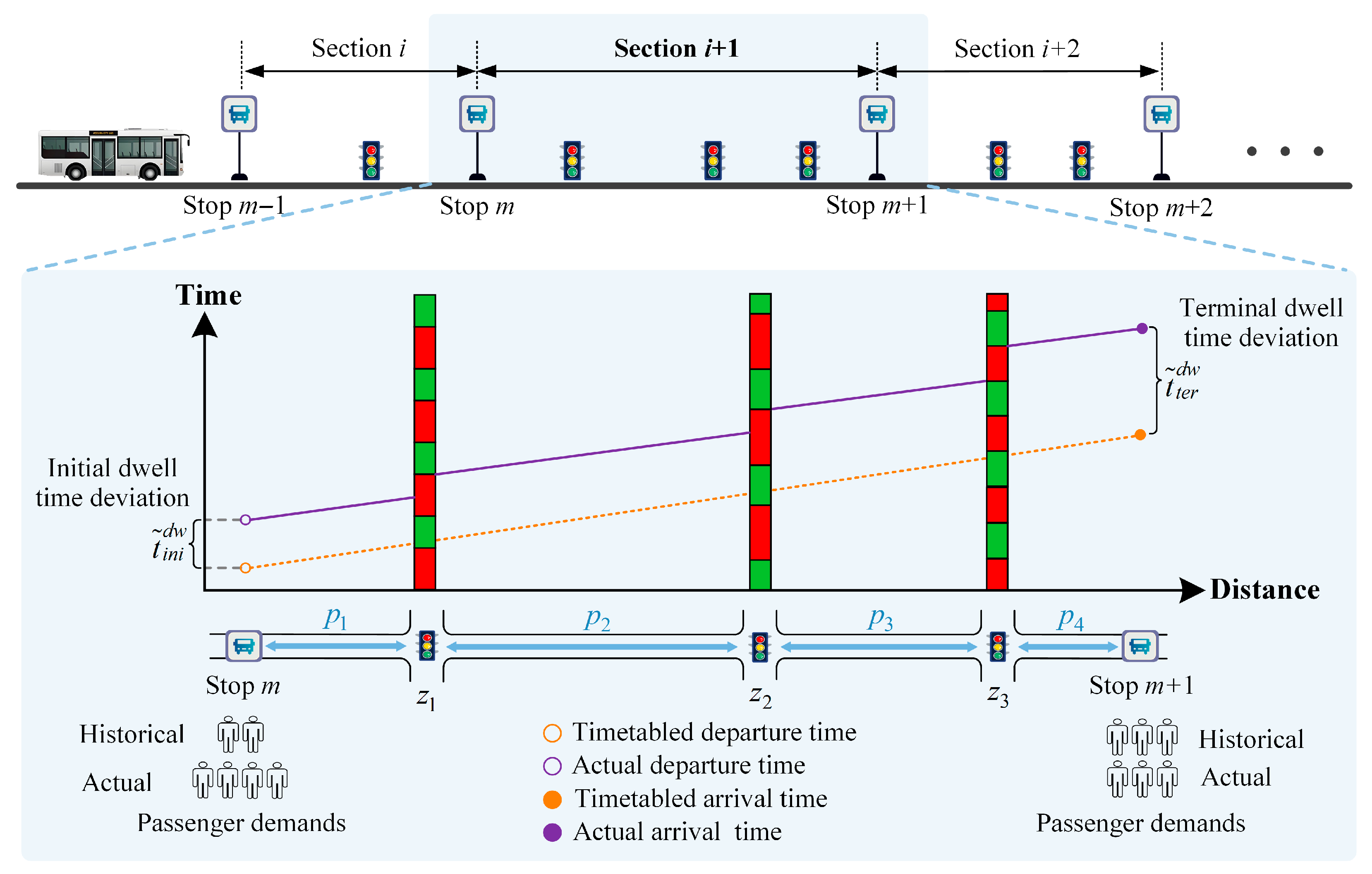
Transit vehicles operate along fixed routes, with their paths segmented by stops and intersections, both of which influence operational status. To facilitate transit scheduling modeling, this paper defines the section between two adjacent stops as the basic physical unit, which is further divided into multiple sections according to the sequenced signalized intersections. Generally, transit timetables specify the arrival and departure times at stops. However, uncertainties in passenger demand at stops and the blocking effect of traffic signals at intersections may cause deviations in operational status. Under this scenario, this paper investigates real-time transit scheduling aimed at improving stability and efficiency, as illustrated in Figure 1.
Referring to Figure 1, the transit operates based on the timetable derived from historical passenger travel demand. However, when a passenger surge occurs at stop m, the resulting extended dwell time causes a deviation t ˜ i n i d w from the initial fixed timetable. This deviation is further amplified by the cumulative blocking effects of sequenced signalized intersections, increasing the uncertainty in arrival time at the downstream stop m + 1. Especially in peak traffic periods, severe delays may occur, leading to the bunching phenomenon and unnecessary energy consumption.
Considering the aforementioned issues, this paper proposes a collaborative dynamic transit scheduling method to optimize transit operations, addressing the following issues: (1) how to dynamically adjust the timetable considering deviations caused by uncertain passenger demand; (2) how to provide real-time control-oriented trajectory guidance at intersections to reduce the blocking effects caused by traffic signals for the assurance of timetable adherence; and (3) how to coordinate timetable adjustments and the transit guidance to achieve optimal overall line operation benefits.

4. Methodology

To address the aforementioned demand for refined transit scheduling, the proposed CDTS method aims to improve comprehensive operational benefits through dynamic timetable scheduling, control-oriented transit trajectory optimization and guidance, and collaborative optimization.

4.1. Dynamic Timetable Scheduling

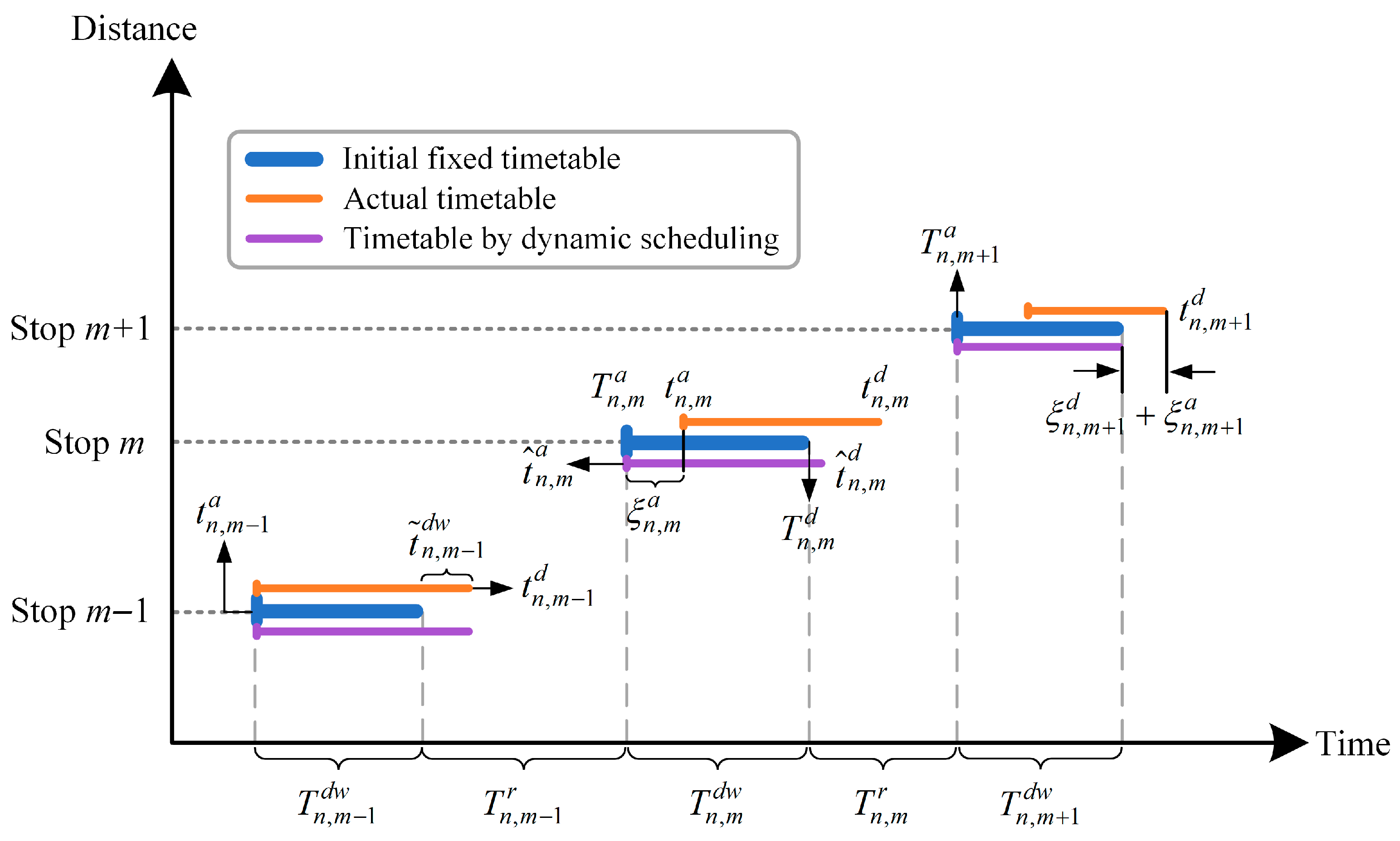
In urban transit operations, the actual timetable generally deviates from the initial fixed timetable due to the dwell time disturbances t ˜ n , m 1 d w caused by uncertain passenger demand, as shown in Figure 2. The timetable deviation can be corrected using dynamic scheduling strategies that adjust transit arrival and departure times in real time.
Considering the historical passenger travel demand, the initial fixed timetable of the n-th transit at adjacent stops m and m + 1 can be expressed as follows:
T n , m d = T n , m a + T n , m d w
T n , m + 1 a = T n , m d + T n , m r
where T n , m d is the departure time at stop m. T n , m a and T n , m + 1 a are the arrival time at stops m and m + 1 , respectively. T n , m d w is the dwell time at stop m. T n , m r is the travel time between stops m and m + 1 .
Considering the deviations from the initial fixed timetable, the actual departure and arrival times can be calculated as follows:
t n , m d = t n , m a + T n , m d w + t ˜ n , m d w
t n , m + 1 a = t n , m d + T n , m r
where t n , m d is the actual departure time at stop m. t n , m + 1 a is the actual arrival time at stop m + 1. t ˜ n , m d w is the deviation of the dwell time (s), defined as the difference between the actual dwell time (determined by stochastic passenger demand following a Poisson distribution) and the scheduled dwell time. The actual dwell time is influenced by various nonlinear factors, such as passenger crowding levels and payment methods, making it difficult to model precisely. For simplicity, a linear approximation approach [21] is adopted to calculate the dwell time based on the number of boarding and alighting passengers.
When the timetable deviation occurs, correction variables ξ n , m d and ξ n , m + 1 a are introduced to adjust the transit’s departure and arrival times for obtaining a suboptimal transit operation scheme under current deviation conditions. Referring to Equations (3) and (4), the adjusted departure and arrival times can be expressed by Equations (5) and (6).
t ^ n , m d = t n , m d + ξ n , m d
t ^ n , m + 1 a = t n , m + 1 a + ξ n , m + 1 a
In order to evaluate the rationality of the timetable, the operational homogeneity and timetable adherence are presented for further analysis and described by Equations (7) and (8), respectively.
J n H = t ^ n , m a t ^ n 1 , m a H n
J n T = t ^ n , m + 1 a T n , m + 1 a + t ^ n , m d T n , m d
where H n is the headway of adjacent transit vehicles in the initial timetable (s). J n H is applied for the description of operational homogeneity and denoted as the deviation between the headway, referring to the adjusted timetable and H n . J n T is applied for the description of timetable adherence and is denoted as the deviation between the actual departure/arrival times and the initial fixed timetable.

4.2. Control-Oriented Transit Trajectory Optimization and Guidance

The transit operates following the adjusted timetable, and it may be blocked by the signal light when passing through the intersection. This introduces uncertainty in timetable adherence to the downstream stop and impacts the effectiveness of dynamic scheduling, and is further exacerbated in a sequence of intersections. To solve this issue, this paper integrates a control-oriented transit guidance strategy between two stops based on real-time traffic signal status for further improving the performance of dynamic scheduling. The trajectory optimization usually involves interactions with other agents [34,35], which is a complex modeling process. This paper mainly focuses on maximizing the comprehensive operational benefits of transit, thereby simplifying the model by not incorporating complex social behaviors or heterogeneous interactions.
Referring to Figure 1, the basic physical unit i is further divided into P sections according to the sequenced signalized intersections, which are defined as the set Z = { 1 , 2 , , Z } . The trajectory of the transit is optimized based on the adjusted timetable and the real-time signal light status. Define the transit’s state variable x ( t p ) in section P by Equation (9).
x ( t p ) = [ s ( t p ) , v ( t p ) , a ( t p ) ] T
where p [ 1 , 2 , , P ] and P = Z + 1 . s ( t p ) , v ( t p ) , and a ( t p ) are the travel distance (m), speed (m/s), and acceleration (m/s2), respectively. t p is the travel time in section p for a basic physical unit i.
The state equation of transit can be formulated based on the kinematics of the vehicle’s motion and is expressed as follows:
x ˙ ( t p ) s ˙ ( t p ) v ˙ ( t p ) a ˙ ( t p ) = v ( t p ) a ( t p ) j ( t p ) = F [ x ( t p ) , u ( t p ) , t p ]
where j ( t p ) denotes the transit’s jerk (m/s3), which is adopted as the control variable, i.e., u ( t p ) [ j ( t p ) ] .
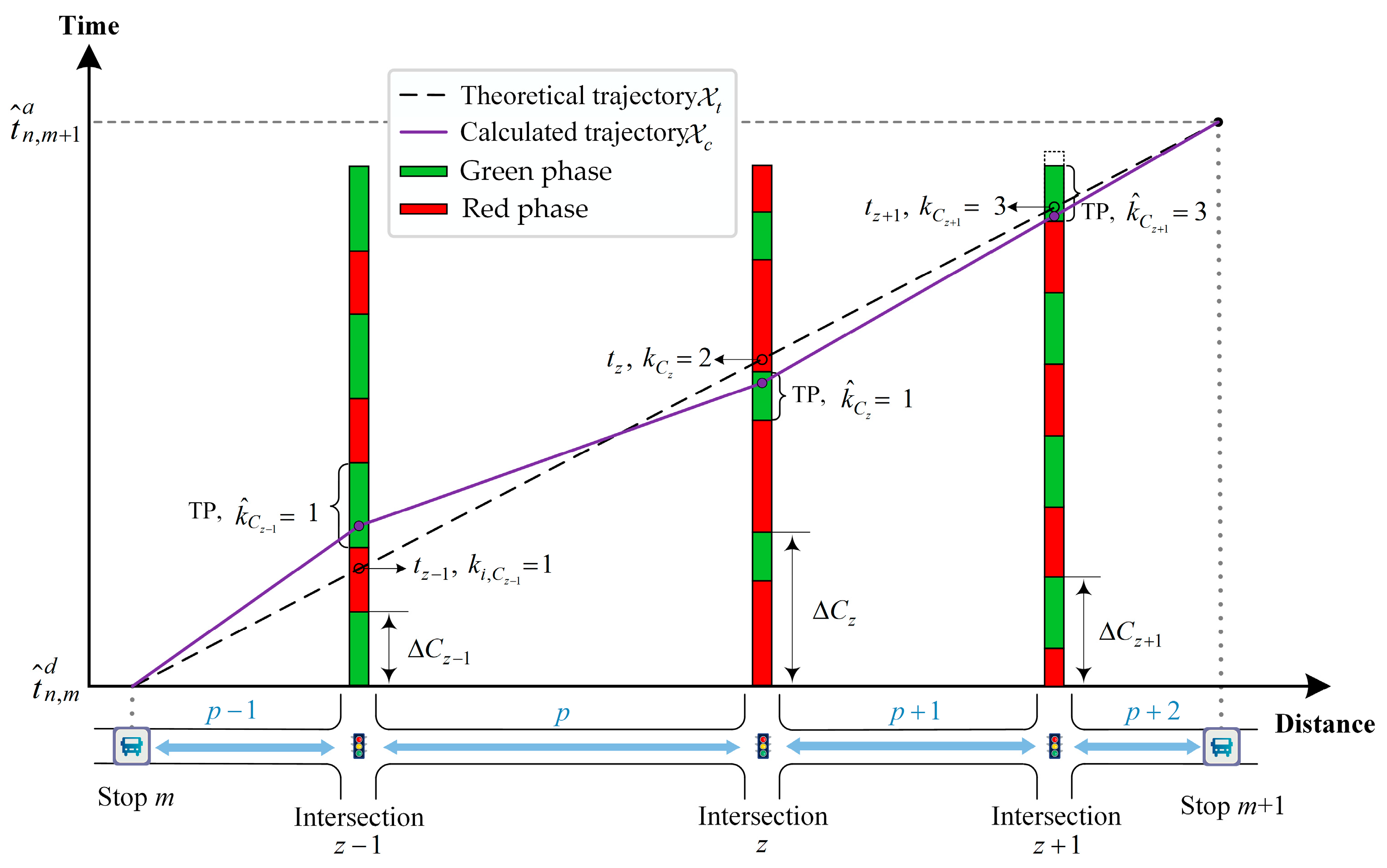
Assuming that the transit operates at a constant speed between adjacent stops in strict accordance with the adjusted timetable, the theoretical time-distance trajectory can be calculated, as shown by X t in Figure 3. To maximize the probability of consecutively passing through multiple intersections during green lights, the trajectory is replanned when it encounters a red light. This is achieved by selecting the green phase with the closest temporal intersection point as the transit phase (TP), as shown by the trajectory X c .
The moment at which the transit departs from the upstream stop and arrives at each signalized intersection z in the set Z can be expressed as follows:
t z = S m , z × t ^ n , m + 1 a t ^ n , m d S m , m + 1
where S m , m + 1 and S m , z are the distances between adjacent stops and upstream stops to the intersection z, respectively.
Following the theoretical trajectory X t , the transit arrives at the intersection z in the k C z -th signal cycle benchmarked against the time when the transit departs from the upstream stop, where k C z can be calculated by Equation (12).
k C z = ( t z Δ C z ) / C z
where C z is the signal cycle of intersection z (s). Δ C z is the remaining time of the current cycle benchmarked against the departure time t ^ n , m d (s).
To achieve the transit passing through the intersection without stopping when it meets red phase following X t , the closest green phase in the adjacent k ^ C z -th signal cycle is selected as TP; hence, the passage time range of the transit that arrives at each signalized intersection can be expressed as follows:
t ^ z max = Δ C z + k ^ C z C z
t ^ z min = t ^ z max C z ( g )
where C z ( g ) is the time length of the TP (s).
Under the premise of satisfying timetable adherence, this paper constructs an energy-consumption-based optimization objective [36,37] for the vehicle trajectory optimization.
The tractive force of transit in section p can be expressed by Equation (15).
F ( t p ) = μ m g + 0.5 ρ a i r c d A f v ( t p ) 2 + η a m a ( t p )
where the first term represents the tractive force at the wheel, the second term represents the air drag, and the last is related to acceleration. μ is the rolling resistance. m is the total mass, defined as the sum of the curb mass of transit m t and the passenger load m l . ρ a i r , c d , and A f denote the air density, drag coefficient, and frontal area, respectively. η a is an auxiliary binary variable, η a = 0 when a ( t p ) 0 and η a = 1 when a ( t p ) > 0 .
The instantaneous power consumption of the transit is calculated by Equation (16).
L ( x ( t p ) , u ( t p ) , t p ) = F ( t p ) v ( t p )
Further, the total energy consumption can be expressed by Equation (17).
J E = p t ^ n , m d t ^ n , m + 1 a L ( x ( t p ) , u ( t p ) , t p ) d t p

4.3. Collaborative Optimization Modeling

In this section, a collaborative optimization framework using a multi-objective nonlinear programming model is constructed to integrate the two aforementioned strategies for obtaining an optimal comprehensive benefit scheduling scheme.

4.3.1. Optimization Objective

In order to enhance the transit’s comprehensive benefits, the optimization objective is formulated as follows:
J   =   ρ J ˜ E + ( 1 ρ ) J ˜ S
where J ˜ E and J ˜ S are the min–max normalized results of cost and operational stability. The cost is the energy consumption, referring to Equation (17). The operational stability includes the timetable adherence and operational homogeneity. J S = J H + J T , J H and J T refer to Equations (7) and (8), respectively. ρ is the weight factor.
As mentioned in Section 4.1 and Section 4.2, the optimizing control variables include ξ n , m d and ξ n , m + 1 a , as expressed in Equations (5) and (6), and transit jerk u ( t i , p ) , as given by Equation (10).

4.3.2. Constraints

(1) Constraints of dynamic timetable scheduling: When the transit arrives at stop m, the deviations of the actual arrival time and dwell time from the initial fixed timetable can be quantified. During dynamic scheduling, the adjustments of the departure and arrival times must be confined within a range whose upper bound is the observed deviation. Therefore, the correction variables are constrained by Equations (19) and (20).
0 ξ n , m d ξ d +
ξ a ξ n , m + 1 a ξ a +
where ξ d + is the upper limit for extending the departure time at stop m. ξ a and ξ a + are the upper limits for the shortening and extension of the arrival time at stop m + 1.
(2) Constraints of transit driving conditions: When the transit is dwelling at a stop, the following constraints must be satisfied:
s ( t 0 ) = S m s ( t f ) = S m + 1 v ( t 0 ) = v ( t f ) = 0 a ( t 0 ) = a ( t f ) = 0 j ( t 0 ) = j ( t f ) = 0
where S m and S m + 1 denote the positions of the upstream and downstream stops, respectively.
The generated guidance trajectory should satisfy the actuator constraints to ensure the feasibility of executing the control actions for the transit vehicle, as follows:
0 v ( t p ) v max a min a ( t p ) a max j min j ( t p ) j max
where v max is the road speed limit. a min and a max are the tolerated minimum and maximum acceleration for traveling comfort, respectively. j min and j max are the tolerated minimum and maximum jerk for passenger ride comfort, respectively.
(3) Constraints of signal timing plan: For the transit to pass through the intersection z without stopping, its arrival time t p f at the intersection should be located during the green time of TP.
t ^ z min t p f t ^ z max
(4) Constraints of trajectory continuity at intersections: The transit’s trajectory between adjacent stations is divided into multiple segments by intersections. In each segment, the speed guidance [38] is implemented. On the premise that the transit passes through the intersection without stopping, the end of the former trajectory must be perfectly connected with the origin of the latter; hence, transit’s driving conditions should remain consistent.
L ( p ) ( p + 1 ) [ x ( t p f ) , u ( t p f ) , x ( t p + 1 0 ) , u ( t p + 1 0 ) ] = 0
where t p + 1 0 is the initial time at which the transit enters section p + 1.

4.3.3. Model Solution

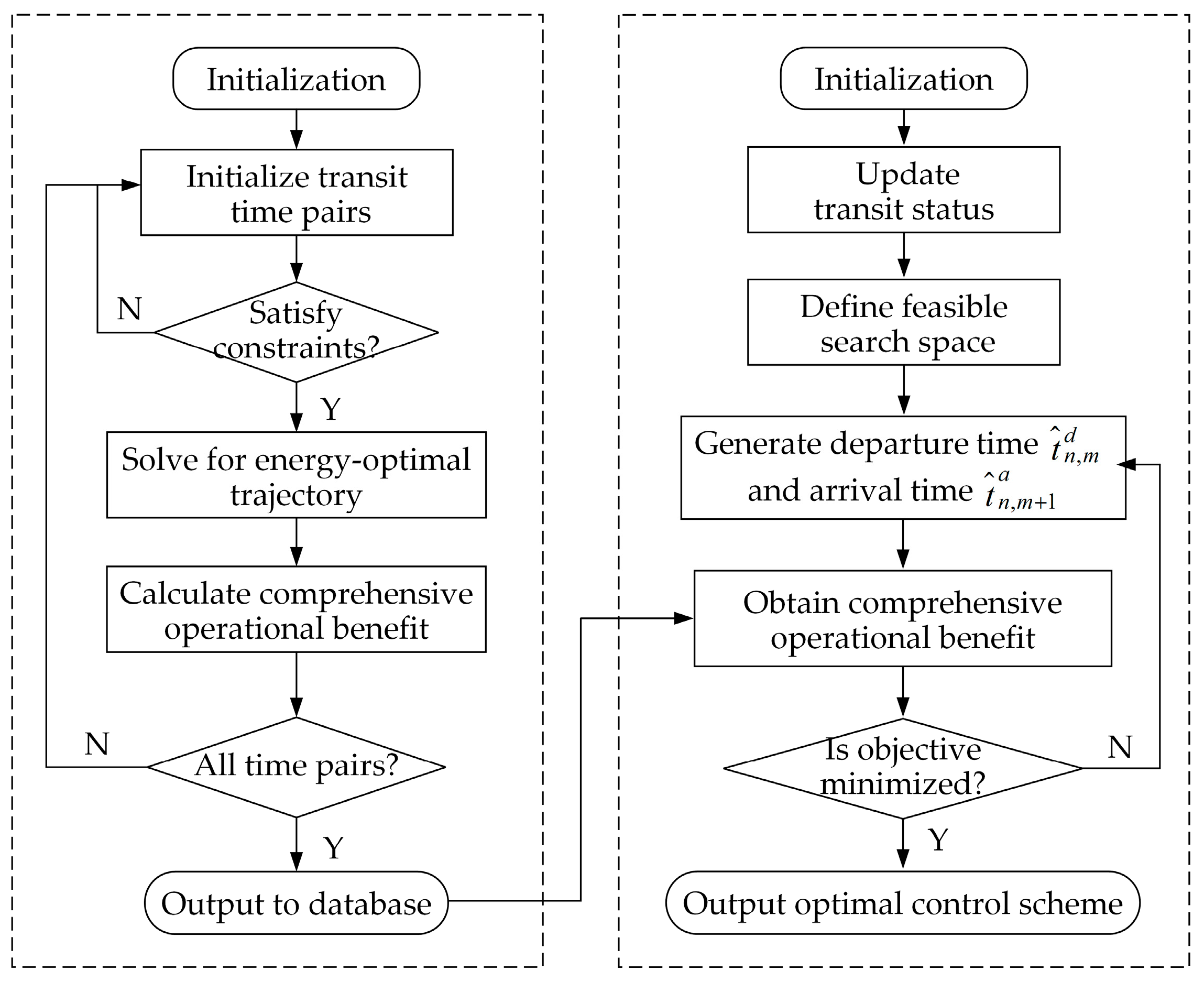
The constructed multi-objective nonlinear model exhibits nonconvexity due to the coupled operational constraints. As a result, generic nonlinear programming solvers have difficulty guaranteeing convergence to the global optimum while simultaneously meeting the real-time requirements of dynamic scheduling. Therefore, this paper proposes a two-stage calculation algorithm to address these challenges, the flow chart of which is presented in Figure 4.
First, all possible pairs of transit departure and arrival times were collected. Each time pair is defined as the initial and terminal boundary conditions, and the energy-optimal trajectory was derived using the pseudospectral method implemented via CasADi with the IPOPT solver. The problem is discretized using Legendre–Gauss–Radau (LGR) collocation, and signal constraints are handled as interior-point constraints. The convergence tolerance is set to 10−6. The comprehensive operational benefit is then evaluated according to Equation (18) and stored in a database. Second, the real-time transit status is utilized to index the database and define a feasible search space. Within this space, the algorithm rapidly compares candidate schemes and retrieves an optimal control scheme to enable low-latency decision-making for real-time transit dynamic scheduling.

5. Simulation Analysis

5.1. Simulation Scenario and Configurations

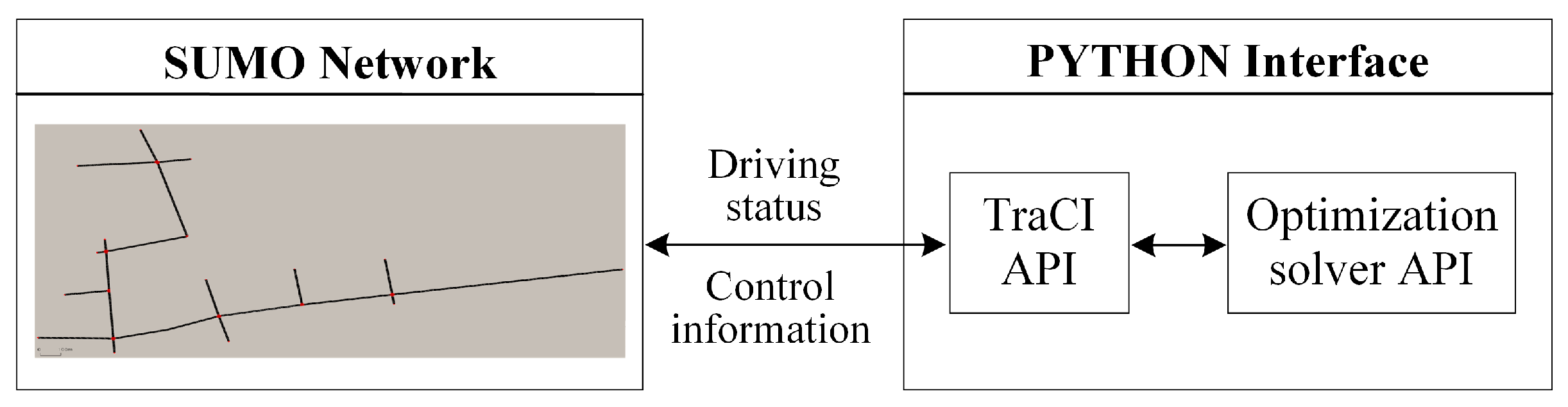
A simulation framework based on SUMO is presented for the evaluation of the proposed CDTS method, as shown in Figure 5. The transit operating and road scenario were simulated by SUMO. A Python interface including a TraCI API and an optimization solver API was further developed, where the TraCI API was used for the interaction of the transit’s real-time driving status and control information with SUMO and the optimization solver API was used to calculate the optimized dynamic transit scheduling scheme. The PC used for simulation experiments had an Intel(R) Core(TM) i7-10750H 2.60GHz processor and was purchased from msi, a manufacturer based in Taiwan, China. The real-time computation time for the optimal control scheme was less than 50 ms, achieved by computing all feasible solutions in advance using the two-stage algorithm.
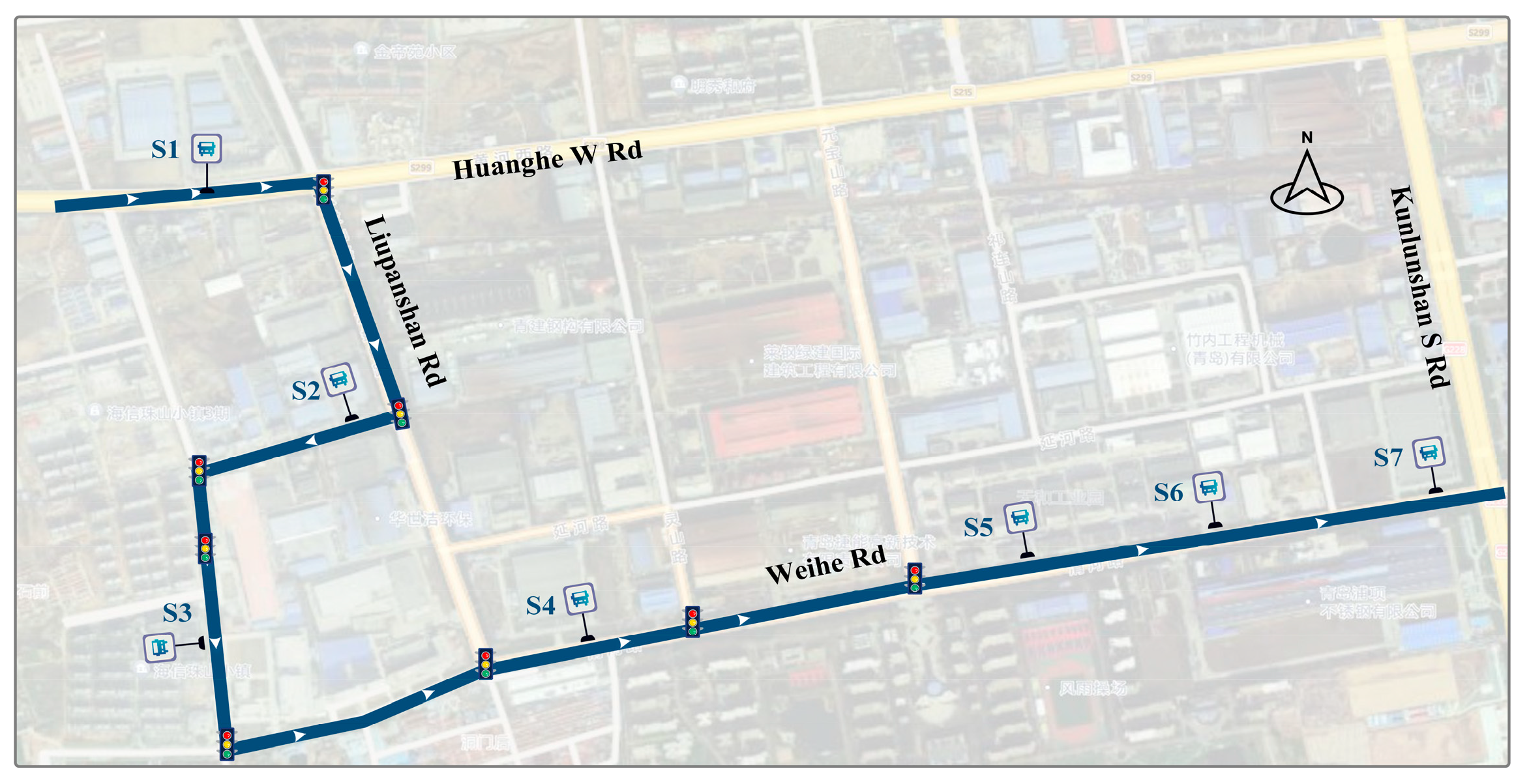
Part of Route 52 in Huangdao District, Qingdao, was selected as the simulation scenario, as shown in Figure 6. The simulation route is 4.48 km long with seven stops and eight signalized intersections.
Referring to the simulation scenario, the initial fixed timetable and the driving configurations of the transit are defined in Table 1 and Table 2, respectively.

5.2. Simulation Results and Analysis

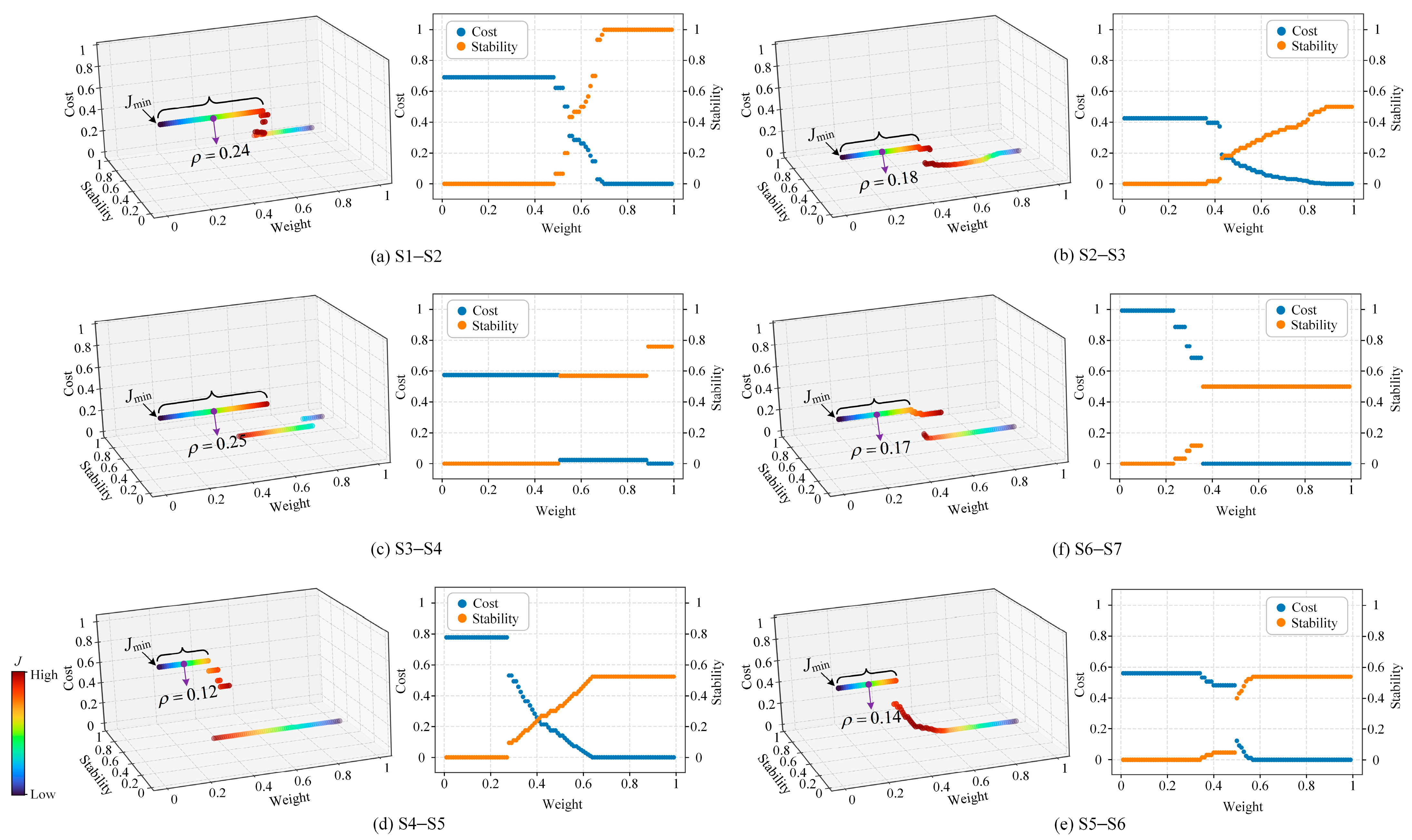
In the collaborative optimization model, the weight factor ρ is employed to reflect the transit’s operation preference and balance the cost and stability benefits in the dynamic transit scheduling. To determine the optimal value of ρ objectively and mitigate subjective bias, a sensitivity analysis was conducted for each segment. The comprehensive operational benefits J for different segments were calculated by sweeping ρ across the interval [0, 1] with a step size of 0.01, as shown in Figure 7.
Referring to Figure 7, the proposed model can yield an optimal control scheme that maximizes the comprehensive operational benefits, denoted as J min . As indicated by the braces in the figure, a parameter-insensitive region associated with J min is observed. Within this region, the cost and stability benefits remain unchanged, demonstrating that the optimized control scheme is robust to variations in ρ .
To establish a standardizable selection rule that avoids boundary effects, for each segment, the arithmetic midpoint of the insensitive region associated with J min is selected as the fixed value of ρ for all subsequent simulations. This sensitivity-based selection approach ensures a neutral and reproducible optimized scheme across different operational scenarios.
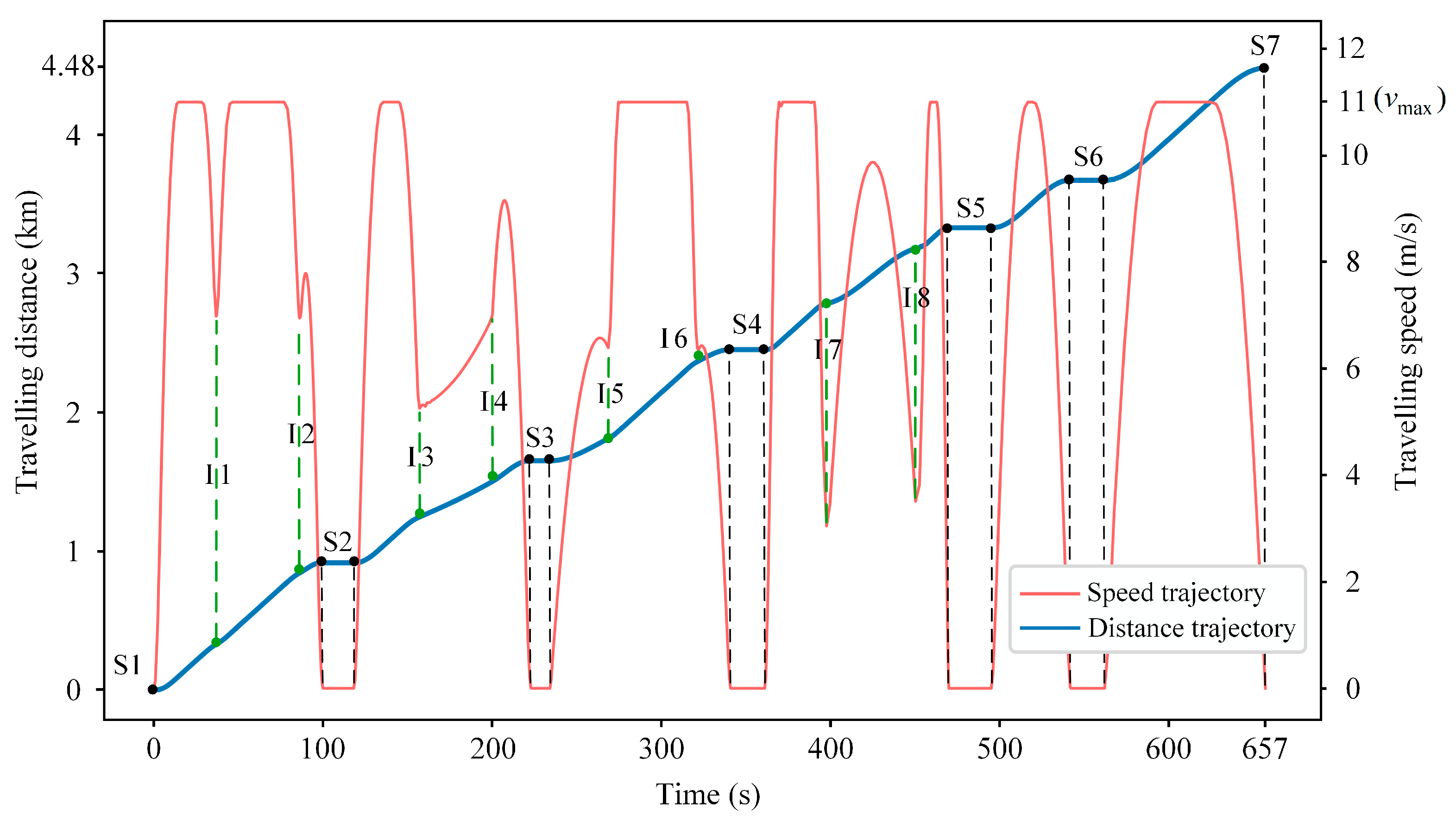
Using the weight values shown in Figure 7 and the parameters provided in Table 1 and Table 2, the optimized trajectory derived from the CDTS method addressing the traveling block caused by sequenced signalized intersections is shown in Figure 8. The results show that the optimized trajectory guides the transit across successive signalized intersections without stopping, and the smooth trajectory profile satisfies the control requirements of the transit’s actuators.
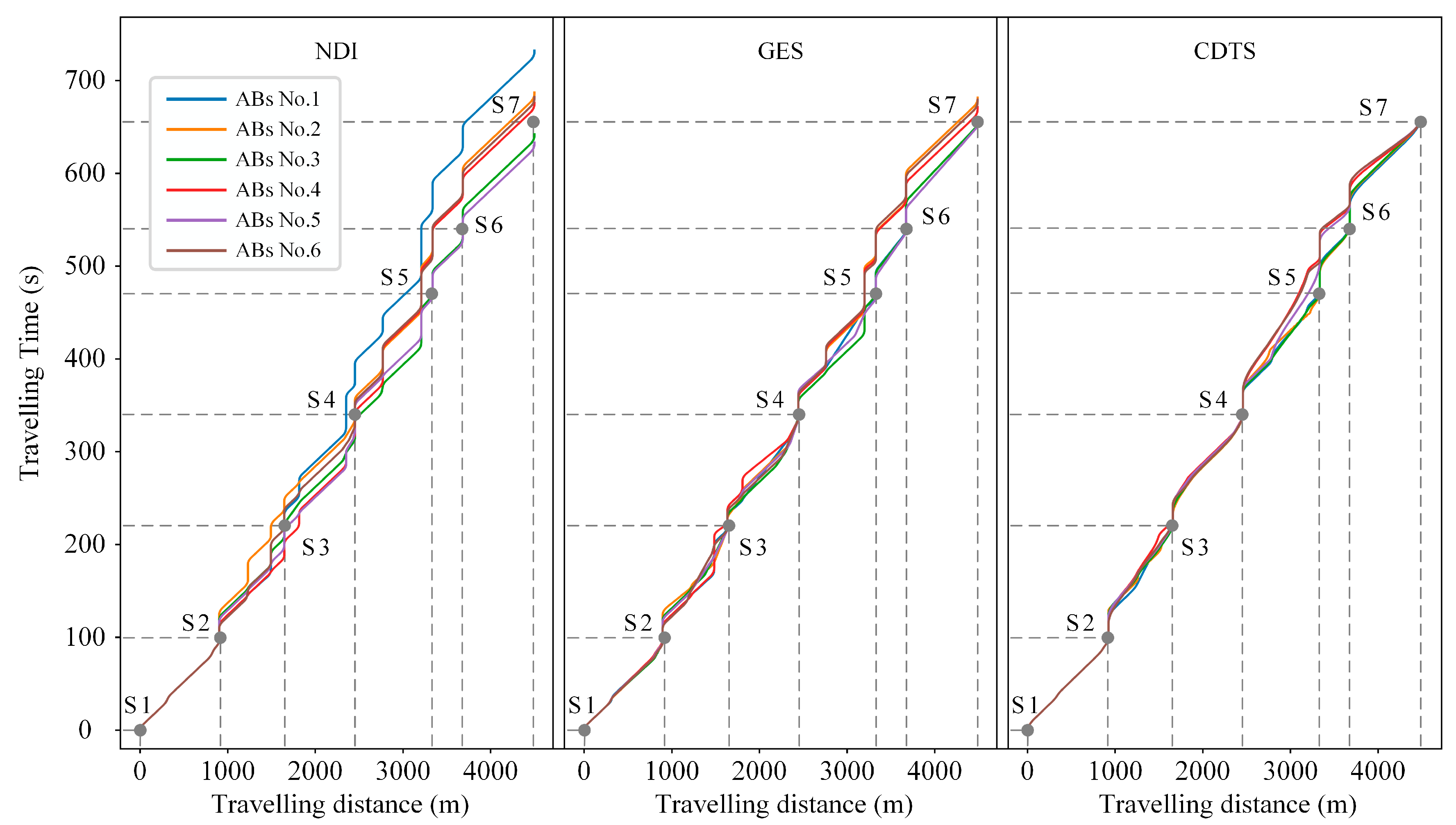
To evaluate the performance of the comprehensive operational benefits of the CDTS, two benchmark schemes were implemented for comparison: (1) the no dynamic intervention (NDI) scheme in the transit operation and (2) the guided by expected speed (GES) scheme based on the timetable [28]. The departure interval between consecutive transit vehicles was set to 480 s. Simulations were conducted with six transit vehicles, and their trajectories are superimposed through timeline alignment, as shown in Figure 9.
In Figure 9, the junction point of two gray dashed lines represents the location and the arrival time from the initial fixed timetable at each stop. Subject to uncertain passenger demand and the blocking effect of signalized intersections, the transit’s operational trajectories gradually exhibit disordered characteristics under the NDI scheme. In particular, the trajectories become increasingly dispersed as some transit vehicles fail to pass through the intersections after S4. With the implementation of the GES strategy, the operational stability is obviously improved. Compared with GES, CDTS simultaneously integrates timetable scheduling and transit trajectory through collaborative optimization, exhibiting better performance in mitigating transit operational instability. Obviously, the actual operating status after dynamic scheduling are more closely aligned with the original timetable at S5 and S6, and, finally, the transit operating status returned to normal at stop S7.
Based on the aforementioned simulation scenario, the headway deviations between adjacent transit vehicles for evaluating the operational stability under different schemes are presented in Table 3. The deviations between the actual arrival times and the initial fixed timetable for evaluating timetable adherence are presented in Table 4.
Without intervention, transit operations are influenced by random passenger demand and the blocking effect of signalized intersections. Referring to Table 3 and Table 4, it is obvious that NDI exhibits more stops and larger deviations compared to the other two schemes. For GES and CDTS, deviations are mainly concentrated at stops after S4, and CDTS generally exhibits smaller values than GES. In particular, GES performs better timetable adherence for transit No. 5 in the simulation scenario. The reason for this is that the GES optimizes the expected speed strictly adhering to the initial fixed timetable, while CDTS comprehensively considers the timetable adherence and operational homogeneity. However, CDTS still demonstrates the best performance in enhancing transit operational stability.
Table 5 summarizes the average headway deviation (AveHD), the average time difference (AveTD), and the average number of stops (AveNS) at signalized intersections based on Table 3 and Table 4. Since GES is designed to ensure transit punctuality, the AveTD differs from CDTS by only 0.64%, while the AveHD differs by 25.18%. For AveNS, CDTS enables the transit to pass through multiple signalized intersections without stopping, improving the passenger travel experience.
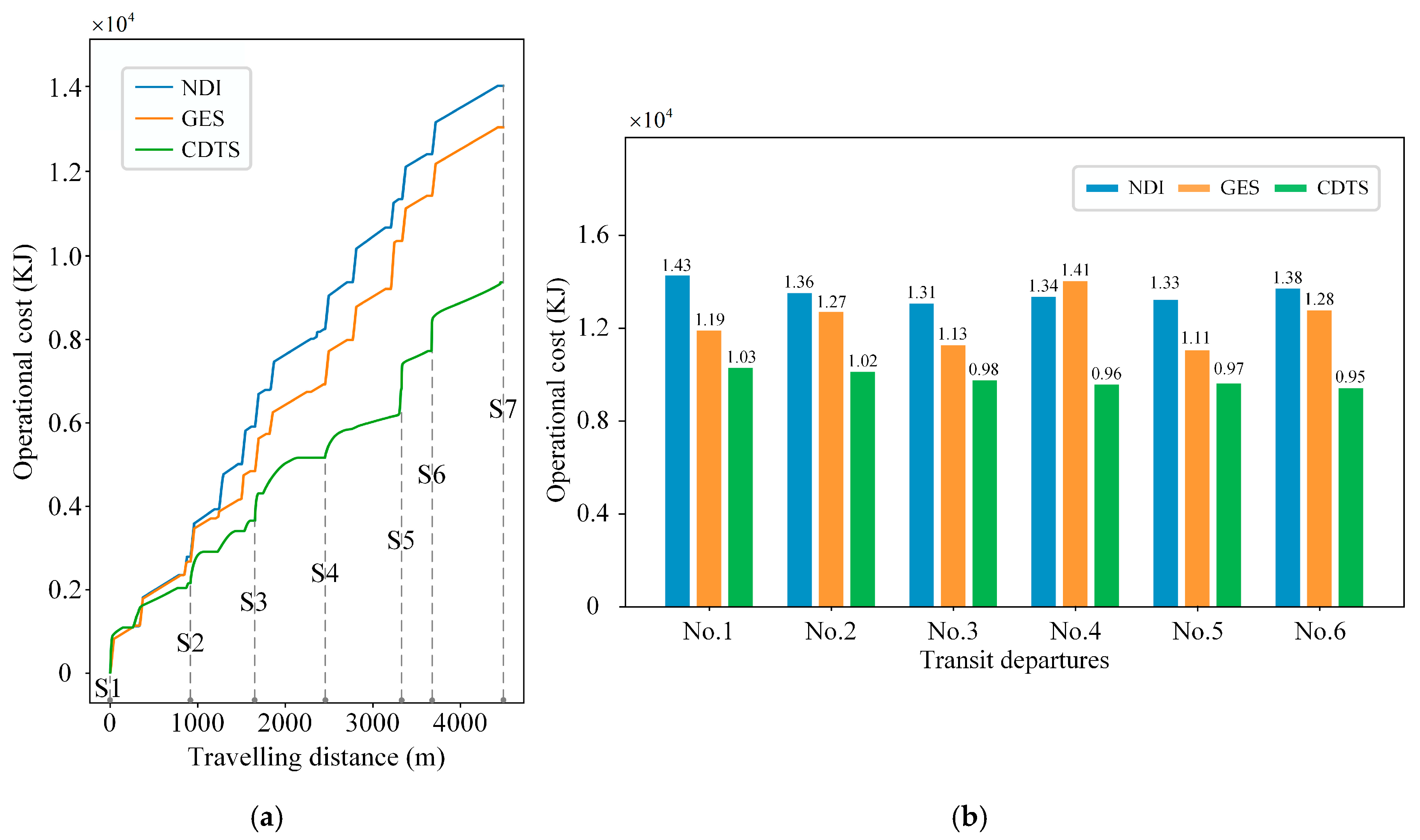
The transit’s operational costs in terms of energy consumption under different scheduling schemes were analyzed and are shown in Figure 10. In this paper, distance, rather than travel time, is selected as the analytical dimension to eliminate the influence of operating time variations caused by different scheduling schemes.
In Figure 10a, the differences before S1–S2 are relatively small because the variations in dwell time and the load caused by uncertain passenger demand have not yet accumulated to exert a significant impact on the operational status in the initial stage. In addition, the transit is unaffected by the signal timing plan since they make right turns at the two intersections in the simulation scenario. Under NDI, more stopping occurs at signalized intersections, resulting in higher operational costs. CDTS performs best compared with the other schemes, as its trajectories are optimized to incorporate operational energy consumption.
Figure 10b shows that the operational cost of each transit follows similar trends under the three schemes. The control-oriented trajectory guidance leads to minimal fluctuations in energy consumption among the transit vehicles. CDTS achieves the best performance across all six transit vehicles, with improvements of approximately 27.5% and 20.3% compared to the NDI and GES, respectively, demonstrating its effectiveness in reducing operational costs.

6. Conclusions and Future Work

This paper proposes a dynamic transit scheduling method that mitigates the influences caused by uncertain passenger demand and the blocking effect of sequenced signalized intersections. By coordinating dynamic timetable scheduling with control-oriented trajectory guidance, the proposed CDTS method can effectively correct timetable deviations through timetable adjustment and guide transit passing multiple signalized intersections without stopping. Simulation results show that CDTS exhibits better performance compared to the two benchmark schemes, NDI and GES, in terms of operational stability and operating cost. Moreover, GES reduces the number of stops by 54.95% compared to NDS, whereas CDTS offers an additional 45.05% improvement in stop reduction performance.
In the proposed CDTS method, the influence of surrounding vehicles on transit operation is not considered, and the complex nonlinear factors regarding dwell time calculation are simplified. Future work will refine the proposed method by considering more realistic operational scenarios and complex road environments to further enhance generalizability and effectiveness. In addition, CDTS will be migrated to embedded On-Board Units (OBUs) and validated via Hardware-in-the-Loop (HIL) tests, where the SUMO-based data exchange will be replaced by standard V2I messages and CAN measurements for transit vehicle states.

Author Contributions

Conceptualization, K.T.; methodology, K.T.; software, K.T.; validation, K.T. and H.L.; formal analysis, K.T.; investigation, K.T.; writing—original draft preparation, K.T.; writing—review and editing, K.T., H.L. and X.L.; supervision, X.L.; project administration, H.L.; funding acquisition, X.L. All authors have read and agreed to the published version of the manuscript.

Funding

This work was supported by the National Natural Science Foundation of China (62273213, 62472262), and the Natural Science Foundation of Shandong Province (ZR2024MF144).

Institutional Review Board Statement

Not applicable.

Informed Consent Statement

Not applicable.

Data Availability Statement

The raw data supporting the conclusions of this article will be made available by the authors on request.

Conflicts of Interest

The authors declare no conflicts of interest.

References

  1. Liu, H.; Teng, K.; Rai, L.; Xing, J. Transit Signal Priority Controlling Method Considering Non-Transit Traffic Benefits and Coordinated Phase States for Multi-Rings Timing Plan at Isolated Intersections. IEEE Trans. Intell. Transport. Syst. 2021, 22, 913–936. [Google Scholar] [CrossRef]
  2. Dou, X.; Li, T. Multi-Objective Bus Timetable Coordination Considering Travel Time Uncertainty. Processes 2023, 11, 574. [Google Scholar] [CrossRef]
  3. Mahmoudi, R.; Saidi, S.; Wirasinghe, S.C. Optimal Vehicle Capacity and Dispatching Policy Considering Crowding in Public Bus Transit Services. Transp. A Transp. Sci. 2025, 21, 2258996. [Google Scholar] [CrossRef]
  4. Hao, M.; Bie, Y.; Zhang, L.; Mao, C. Improving Schedule Adherence Based on Dynamic Signal Control and Speed Guidance in Connected Bus System. J. Intell. Connect. Veh. 2020, 3, 79–88. [Google Scholar] [CrossRef]
  5. de Souza, F.; Sebastiani, M.T. Improving Resilience of Bus Bunching Holding Strategy through a Rolling Horizon Approach. J. Transp. Eng. Part A Syst. 2021, 147, 04021074. [Google Scholar] [CrossRef]
  6. Ai, G.; Zuo, X.; Chen, G.; Wu, B. Deep Reinforcement Learning Based Dynamic Optimization of Bus Timetable. Appl. Soft Comput. 2022, 131, 109752. [Google Scholar] [CrossRef]
  7. He, S.; Dong, J.; Liang, S.; Yuan, P. An Approach to Improve the Operational Stability of a Bus Line by Adjusting Bus Speeds on the Dedicated Bus Lanes. Transp. Res. Part C Emerg. Technol. 2019, 107, 54–69. [Google Scholar] [CrossRef]
  8. He, Y.; Lv, J.; Tang, T. Communication-Based Train Control with Dynamic Headway Based on Trajectory Prediction. Actuators 2022, 11, 237. [Google Scholar] [CrossRef]
  9. Cheng, G.; He, Y. Enhancing Passenger Comfort and Operator Efficiency through Multi-Objective Bus Timetable Optimization. Electron. Res. Arch. 2024, 32, 565–583. [Google Scholar] [CrossRef]
  10. Tang, J.; Yang, Y.; Hao, W.; Liu, F.; Wang, Y. A Data-Driven Timetable Optimization of Urban Bus Line Based on Multi-Objective Genetic Algorithm. IEEE Trans. Intell. Transport. Syst. 2021, 22, 2417–2429. [Google Scholar] [CrossRef]
  11. He, S.; Liang, S.; Dong, J.; Zhang, D.; He, J.; Yuan, P. A Holding Strategy to Resist Bus Bunching with Dynamic Target Headway. Comput. Ind. Eng. 2020, 140, 106237. [Google Scholar] [CrossRef]
  12. Wang, J.; Sun, L. Dynamic Holding Control to Avoid Bus Bunching: A Multi-Agent Deep Reinforcement Learning Framework. Transp. Res. Part C Emerg. Technol. 2020, 116, 102661. [Google Scholar] [CrossRef]
  13. Liang, S.; He, S.; Zhang, H.; Ma, M. Optimal Holding Time Calculation Algorithm to Improve the Reliability of High Frequency Bus Route Considering the Bus Capacity Constraint. Reliab. Eng. Syst. Saf. 2021, 212, 107632. [Google Scholar] [CrossRef]
  14. Li, M.; Li, Y. Bus Predictive-Control Method Considering the Impact of Traffic Lights. J. Adv. Transp. 2022, 2022, 5280109. [Google Scholar] [CrossRef]
  15. Drabicki, A.; Kucharski, R.; Cats, O. Mitigating Bus Bunching with Real-Time Crowding Information. Transportation 2023, 50, 1003–1030. [Google Scholar] [CrossRef]
  16. Farrando, R.; Farhi, N.; Christoforou, Z.; Urban, A. A Max-plus Model Deriving the Effect of a Skip-Stop Policy on the Frequency of a Mass Transit Line. Transp. A Transp. Sci. 2025, 2509109. [Google Scholar] [CrossRef]
  17. Li, H.; Wu, X.; Hou, U.L.; Kou, K.P. Near-Optimal Scheduling for Crowdsourced Transit System With Skip-Stop Tactic. IEEE Trans. Knowl. Data Eng. 2023, 35, 11668–11680. [Google Scholar] [CrossRef]
  18. Wang, Y.; Shang, P. Shuttle Bus Rerouting and Rescheduling Problem Considering Daily Demand Fluctuation. Math. Probl. Eng. 2022, 2022, 2917240. [Google Scholar] [CrossRef]
  19. Liu, Y.; Zuo, X.; Ai, G.; Liu, Y. A Reinforcement Learning-Based Approach for Online Bus Scheduling. Knowl.-Based Syst. 2023, 271, 110584. [Google Scholar] [CrossRef]
  20. Li, S.; Liu, R.; Yang, L.; Gao, Z. Robust Dynamic Bus Controls Considering Delay Disturbances and Passenger Demand Uncertainty. Transp. Res. Part B Methodol. 2019, 123, 88–109. [Google Scholar] [CrossRef]
  21. Varga, B.; Tettamanti, T.; Kulcsár, B. Optimally Combined Headway and Timetable Reliable Public Transport System. Transp. Res. Part C Emerg. Technol. 2018, 92, 1–26. [Google Scholar] [CrossRef]
  22. Wang, W.; Hu, J.; Ji, Y.; Du, Y. Improving Fuel Efficiency of Connected and Automated Transit Buses on Signallised Corridors. IET Intell. Transp. Syst. 2019, 13, 870–879. [Google Scholar] [CrossRef]
  23. He, J.; Li, Y.; Long, S.; Xu, Y.; Chen, J. Energy-Efficient Tram Speed Trajectory Optimization Considering the Influence of the Traffic Light. Front. Energy Res. 2022, 10, 963275. [Google Scholar] [CrossRef]
  24. Varga, B.; Tettamanti, T.; Kulcsár, B. Energy-Aware Predictive Control for Electrified Bus Networks. Appl. Energy 2019, 252, 113477. [Google Scholar] [CrossRef]
  25. Liu, Y.; Luo, X.; Cheng, S.; Yu, Y.; Tang, J. Dynamic Bus Scheduling of Multiple Routes Based on Joint Optimization of Departure Time and Speed. Discret. Dyn. Nat. Soc. 2021, 2021, 4213837. [Google Scholar] [CrossRef]
  26. Chen, W.; Zhang, H.; Chen, C.; Wei, X. An Integrated Bus Holding and Speed Adjusting Strategy Considering Passenger’s Waiting Time Perceptions. Sustainability 2021, 13, 5529. [Google Scholar] [CrossRef]
  27. Imran, A.M.; Van Oort, N.; Cats, O.; Hoogendoorn, S.; Van Der Pot, P. Combining Speed Adjustment and Holding Control for Regularity-Based Transit Operations. In Proceedings of the Mt-Its 2019: 2019 6th International Conference on Models and Technologies for Intelligent Transportation Systems (Mt-Its), Cracow, Poland, 5–7 June 2019; IEEE: New York, NY, USA, 2019. [Google Scholar]
  28. Xue, Y.; Zhong, M.; Xue, L.; Tu, H.; Tan, C.; Kong, Q.; Guan, H. A Real-Time Control Strategy for Bus Operation to Alleviate Bus Bunching. Sustainability 2022, 14, 7870. [Google Scholar] [CrossRef]
  29. Zhu, K.; Wang, Z.; Ding, D.; Hu, J.; Dong, H. Cloud-Based Collision Avoidance Adaptive Cruise Control for Autonomous Vehicles Under External Disturbances With Token Bucket Shapers. IEEE Trans. Ind. Inf. 2025, 21, 8759–8769. [Google Scholar] [CrossRef]
  30. Zhu, K.; Wang, Z.; Li, Z.; Xu, C.-Z. Secure Observer-Based Collision-Free Control for Autonomous Vehicles Under Non-Gaussian Noises. IEEE Trans. Ind. Inf. 2025, 21, 2184–2193. [Google Scholar] [CrossRef]
  31. Ren, Y.; Zhao, J.; Zhou, X. Optimal Design of Scheduling for Bus Rapid Transit by Combining with Passive Signal Priority Control. Int. J. Sustain. Transp. 2021, 15, 407–418. [Google Scholar] [CrossRef]
  32. Xin, Q.; Fu, R.; Yu, S.; Ukkusuri, S.V.; Jiang, R. Modeling Bus Bunching and Anti-Bunching Control Accounting for Signal Control and Passenger Swapping Behavior. J. Public Transp. 2021, 23, 31–62. [Google Scholar] [CrossRef]
  33. Li, J.; Bai, Y.; Chen, Y.; Yang, L.; Wang, Q. A Two-Stage Stochastic Optimization Model for Integrated Tram Timetable and Speed Control with Uncertain Dwell Times. Energy 2022, 260, 125059. [Google Scholar] [CrossRef]
  34. Hu, W.; Deng, Z.; Yang, Y.; Zhang, P.; Cao, K.; Chu, D.; Zhang, B.; Cao, D. Socially Game-Theoretic Lane-Change for Autonomous Heavy Vehicle Based on Asymmetric Driving Aggressiveness. IEEE Trans. Veh. Technol. 2025, 74, 17005–17018. [Google Scholar] [CrossRef]
  35. Deng, Z.; Hu, W.; Sun, C.; Chu, D.; Huang, T.; Li, W.; Yu, C.; Pirani, M.; Cao, D.; Khajepour, A. Eliminating Uncertainty of Driver’s Social Preferences for Lane Change Decision-Making in Realistic Simulation Environment. IEEE Trans. Intell. Transport. Syst. 2025, 26, 1583–1597. [Google Scholar] [CrossRef]
  36. Bakibillah, A.S.M.; Kamal, M.A.S.; Imura, J.; Mukai, M.; Yamada, K. Eco-Driving on Hilly Roads in a Mixed Traffic Environment: A Model Predictive Control Approach. Actuators 2024, 13, 144. [Google Scholar] [CrossRef]
  37. Zhou, F.; Tao, K.; Chen, B.; Li, S.; Zhu, Z.; Yang, Y. Distributed Cooperative Cruise Control for High-Speed Trains with Energy-Saving Optimization. Actuators 2023, 12, 207. [Google Scholar] [CrossRef]
  38. Liu, D.; Yan, G.; Zhou, J.; Chen, B. MPC-Based Speed Tracking Control for Subway Trains Under Actuator Constraints. Actuators 2025, 14, 134. [Google Scholar] [CrossRef]
Figure 1. Illustration of section division and operational disturbances of the transit.
Actuators 15 00112 g001
Figure 2. Illustration of timetable deviation and analysis of dynamic scheduling.
Actuators 15 00112 g002
Figure 3. Illustration of the derivation for passing times of signalized intersections.
Actuators 15 00112 g003
Figure 4. Flow chart of the proposed two-step calculation algorithm.
Actuators 15 00112 g004
Figure 5. Simulation architecture.
Actuators 15 00112 g005
Figure 6. Simulation scenario.
Actuators 15 00112 g006
Figure 7. Analysis results of the weight factor ρ for each segment.
Actuators 15 00112 g007
Figure 8. Optimized trajectories for transit guidance.
Actuators 15 00112 g008
Figure 9. Distance–time diagram of six transit vehicles under different scheduling schemes.
Actuators 15 00112 g009
Figure 10. Operational cost performance under different scheduling schemes: (a) for one transit vehicle; (b) for all six transit vehicles.
Actuators 15 00112 g010
Table 1. Initial fixed timetable of the transit.
StopsLocation
(m)
Arrival
Time (s)
Departure
Time (s)
Alighting
Passenger
Boarding
Passenger
S10-0--
S2915100118P(9)P(5)
S31650223234P(6)P(3)
S42450341361P(5)P(9)
S53328470492P(11)P(6)
S63670542557P(8)P(4)
S74480657---
Note: The transit started with 20 passengers, assuming an average mass of 60 kg per person.
Table 2. Driving configurations of the transit.
ParameterValueParameterValue
μ 0.01 v max 11 (m/s)
m t 12,600 (kg) v p 7 (m/s)
g9.8 (m/s2) a max 2 (m/s2)
ρ a i r 1.29 (kg/m3) a min −2.5 (m/s2)
c d 0.79 j max 0.5 (m/s3)
A f 7.6 (m2) j min −0.5 (m/s3)
ξ n , m d [0, 30] ξ n , m + 1 a [−30, 30]
Table 3. Headway deviation between adjacent transit vehicles under different scheduling schemes.
Departure
Sequence
SchemeHeadway Deviation (s)
S2S3S4S5S6S7
No. 2–No. 1NDI01939 ↓45 ↓50 ↓45 ↓
GES000463425
CDTS000282412
No. 3–No. 2NDI029 ↓19 ↓45 ↓47 ↓45 ↓
GES00040 ↓34 ↓25 ↓
CDTS00028 ↓2616 ↓
No. 4–No. 3NDI022 ↓4424634
GES060373215
CDTS03036215
No. 5–No. 4NDI011345 ↓48 ↓43 ↓
GES06 ↓043 ↓32 ↓15 ↓
CDTS00014 ↓12 ↓8 ↓
No. 6–No. 5NDI0226425149
GES000403723
CDTS00018129
Note: ↓ represents the rear transit arriving at the stop prior to the front one at the same departure time.
Table 4. Deviation between actual arrival time and timetable under different scheduling schemes.
Departure
Sequence
SchemeTime Deviation (s)
S2S3S4S5S6S7
No. 1NDI0036968976
GES000000
CDTS000000
No. 2NDI0193 ↑513931
GES000463425
CDTS000302314
No. 3NDI010 ↑22 ↑68 ↑14 ↑
GES000600
CDTS000048
No. 4NDI032 ↑18 ↑483820
GES060433215
CDTS010382113
No. 5NDI021 ↑15 ↑310 ↑23 ↑
GES000000
CDTS00034218
No. 6NDI019 ↓454126
GES000403723
CDTS00033239
Note: ↑ indicates the transit arriving at stops ahead of timetable.
Table 5. Average values of the operation indicator under different scheduling schemes.
SchemesOperation Indicator
AveHD (s)ImprovementAveTD (s)ImprovementAveNSImprovement
NDI23.64-15.67-3.33-
GES13.61−42.42%4.64−70.39%1.5−54.95%
CDTS7.66−67.60%4.54−71.03%0−100%
Disclaimer/Publisher’s Note: The statements, opinions and data contained in all publications are solely those of the individual author(s) and contributor(s) and not of MDPI and/or the editor(s). MDPI and/or the editor(s) disclaim responsibility for any injury to people or property resulting from any ideas, methods, instructions or products referred to in the content.