
Article

Research on Modeling and Differential Steering Control System for Battery-Electric Autonomous Tractors

1
Hunan Agricultural Equipment Research Institute, Hunan Academy of Agricultural Sciences, Changsha 410125, China
2
Yuelushan Laboratory, Changsha 410128, China
3
Hunan Engineering Technology Research Center for Hilly and Mountainous Power Platform, Changsha 410125, China
*
Authors to whom correspondence should be addressed.
Actuators 2026, 15(1), 12; https://doi.org/10.3390/act15010012
Submission received: 5 October 2025 / Revised: 16 December 2025 / Accepted: 19 December 2025 / Published: 25 December 2025
(This article belongs to the Section Actuators for Surface Vehicles)

Abstract

To tackle the challenges faced by traditional wheeled tractors, whose steering systems have low flexibility and a large turning radius, and thus make turning hard in small fields and greenhouses, this paper proposes a differential steering control technology for battery-electric unmanned tractors. This innovative approach enables zero-radius turning while delivering environmental and economic advantages. Firstly, the system architecture and key components of the battery-electric unmanned tractor with differential steering are designed, including the mechanical structure, wheel-drive system, electrical system, and power battery. Based on the proposed system architecture, a multi-physics coupled model is established, covering the motor, reducer, battery, driver, vehicle body, and the relationship between tires and road surfaces. A multi-closed-loop control algorithm, regulating both the motor speed and yaw angular velocity of the tractor, is developed for differential steering control. The validation, conducted via a digital simulation platform, yields critical state curves for motor current, torque, speed, and vehicle rotation. This study establishes a novel theoretical framework for unmanned tractor control, with prototype development guided by the proposed methodology. Experimental validation of zero-radius steering confirms the efficacy of differential steering in battery-electric platforms. The research outcomes provide theoretical basis and technical references for advancing intelligent and electric agricultural equipment.

1. Introduction

The global agricultural sector is undergoing a core transformation towards greening, intellectualization, and unmanned operation [1,2]. The electrified platform serves not only as a fundamental prerequisite for achieving green and low-carbon agriculture but also provides a modular and scalable power foundation for high-precision operation and low labor-density unmanned farming [3,4]. Against this backdrop, traditional front-wheel steering tractors struggle to meet the operational demands of complex and narrow spaces, such as precision agriculture and small-scale farming scenarios (e.g., greenhouse operations). The key limitations include a large turning radius, inability to achieve zero-radius steering, and susceptibility to sideslip and skid in unstructured fields, making them a critical bottleneck restricting the implementation of precision agriculture [5,6]. Four-wheel independent drive (4WID) technology is renowned for its superior maneuverability, especially the capability to achieve zero-radius turning via differential steering [7,8], thus offering an ideal technical pathway to overcome this bottleneck.
Differential steering is a steering method without a traditional steering mechanism that achieves turning by independently regulating the driving torque and rotational speed of the wheels on both sides of the vehicle, generating a steering moment around the vehicle’s center of mass [9,10]. Its working principle is fundamentally different from traditional Ackermann steering, which relies on a mechanical steering mechanism to adjust wheel angles, and it is well-suited for independent driving platforms requiring high maneuverability. Although 4WID and differential steering technologies have achieved significant advancements in the automotive industry, including breakthroughs in robust control algorithms [11,12], efficiency optimization strategies for torque/power distribution [13,14], and modular platform designs [15] that have markedly enhanced system stability and energy efficiency on structured roads, a critical limitation persists. The core assumptions of these studies are predominantly based on structured road environments (e.g., paved surfaces or predefined paths) and often retain the steering wheels as an input device [13,15]. This constraint of application scenarios means their control strategies and physical models generally fail to account for the challenges of unstructured agricultural farmland environments. Pioneering work has introduced 4WID differential steering technology into agricultural tractors and proposed advanced hierarchical control strategies to improve handling [16]; however, the validation scenarios and control objectives of such research have not fully broken away from the framework of traditional automotive testing. Their controller design focuses on upper-layer ‘driver intent tracking’ and lower-layer ‘steering stability assurance,’ essentially enhancing the manned driving paradigm rather than redesigning control for the fundamental challenges of unmanned machinery in unstructured fields, such as autonomous navigation, disturbance rejection, and precise operation. Consequently, the central challenge in agricultural machinery is no longer “whether to apply differential steering technology” but “how to redesign, model, and experimentally validate the technology specifically for the unique characteristics of unstructured agricultural environments”.
The limitations of this cross-domain technology transfer have directly led to systematic research gaps in the development of 4WID tractors for agriculture. Firstly, the existing multi–physics models primarily focus on the dual coupling of ’motor–chassis’ in automotive systems [17], lacking dedicated agricultural machinery models that integrate motor electromagnetic characteristics, tire–soil interaction, and vehicle posture, thus failing to accurately describe the system dynamic response in unstructured environments. Secondly, the current dynamic analysis methods for vehicle equipment predominantly employ either analytical methods or finite element analysis in isolation. However, purely analytical calculations are highly complex, while finite element analysis alone struggles to reveal the underlying principles. Thirdly, control strategies in the automotive domain primarily target Ackermann steering systems [18,19]. This steering mechanism exhibits a relatively large turning radius and cannot achieve zero–radius turning, making it difficult to adapt to small plots in hilly and mountainous areas. There is an urgent need to research tractor steering control that is capable of zero–radius turning for agricultural scenarios.
To address these targeted research gaps, this study aims to construct a comprehensive technical framework for an electric 4WID tractor tailored for operation in unstructured farmland, encompassing the full development process from multi-physics modeling and specialized control algorithm design to simulation and physical prototype validation. The specific research objectives include the following:
  • Proposing a powertrain system topology for the purely electric tractor and constructing a multi-physics coupled model integrating the run motor, inverter, lithium battery pack, reduction gearboxes, tire–ground interaction, and vehicle posture;
  • Designing a multi-closed-loop feedback differential steering control algorithm to enhance path-tracking accuracy and steering stability;
  • Establishing a dedicated simulation platform by integrating analytical modeling with computational numerical analysis, focusing on analyzing motor current, torque/speed coordination characteristics, and chassis dynamic responses during zero-radius turning;
  • Developing a proof-of-concept prototype for a purely electric unmanned tractor. This prototype utilizes in-wheel permanent magnet synchronous motors, high-energy-density lithium battery packs, and a real-time industrial controller as its core hardware.
Through comparative analysis of simulation data and measured experimental data, the effectiveness and superiority of the proposed models, algorithms, and topology will be systematically validated. This research is expected to provide replicable design schemes and experimental support for the engineering application of 4WID differential steering technology in agricultural machinery, thereby facilitating the efficient advancement of green and intelligent agricultural transformation.
The structure of this paper is organized as follows: Section 2 details the mechanical, wheel-drive power, and electrical system design of the four-wheel-differential drive tractor; Section 3 derives and constructs analytical models for each system and key component; Section 4 addresses the control problem based on the established model, proposing a differential steering control strategy and developing a numerical simulation platform for performance analysis; Section 5 develops an engineering prototype of the battery-electric autonomous tractor and designs experimental tests to validate the theoretical methodology; Section 6 concludes the research.

2. System Architecture and Key Component Design

2.1. Overall System Architecture

2.1.1. Mechanical Structure

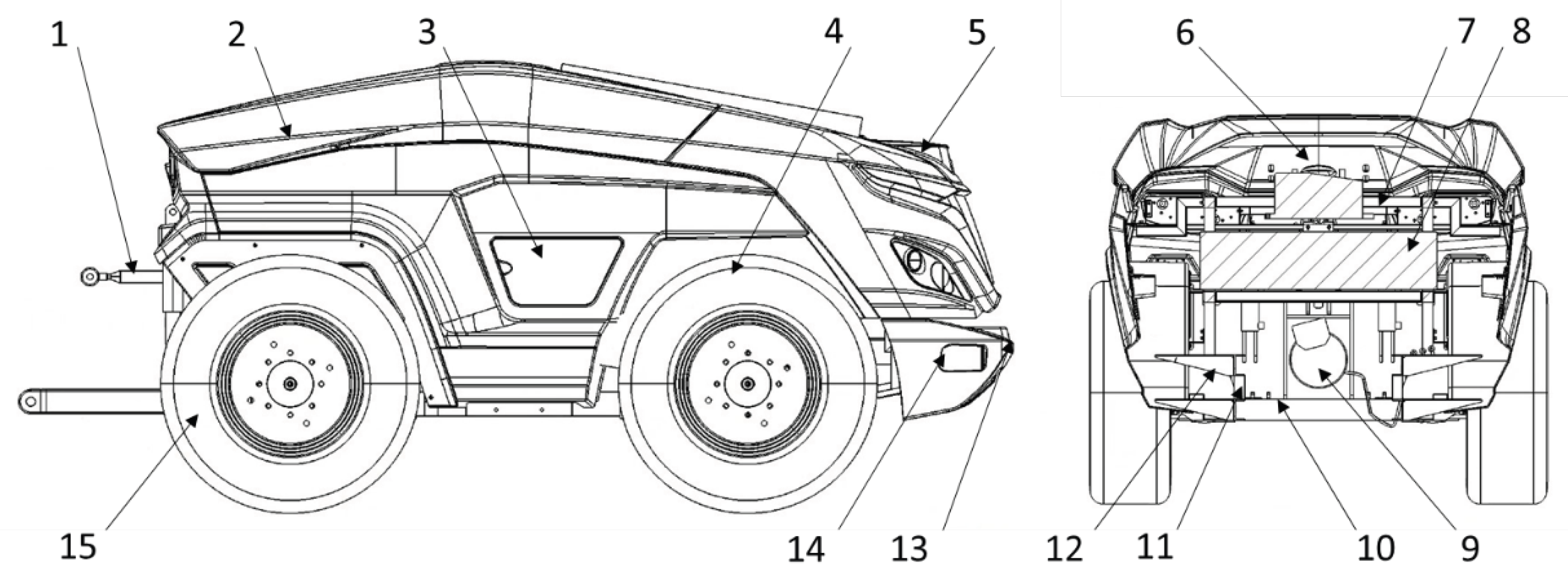
The mechanical structure diagram of the battery-electric autonomous tractor is illustrated in Figure 1. It adopts 4WID, with the same specifications and dimensions for the wheel-side run motors, run motor reducers, and tires of the four wheels. The tire radius is 0.425 m, symmetrically arranged on the chassis. The wheelbase (front–rear axle distance) is 1.5 m, and the track width (left–right wheel distance) is 1.6 m. The unloaded self-weight is 1.2 t.

2.1.2. Wheel-Drive System

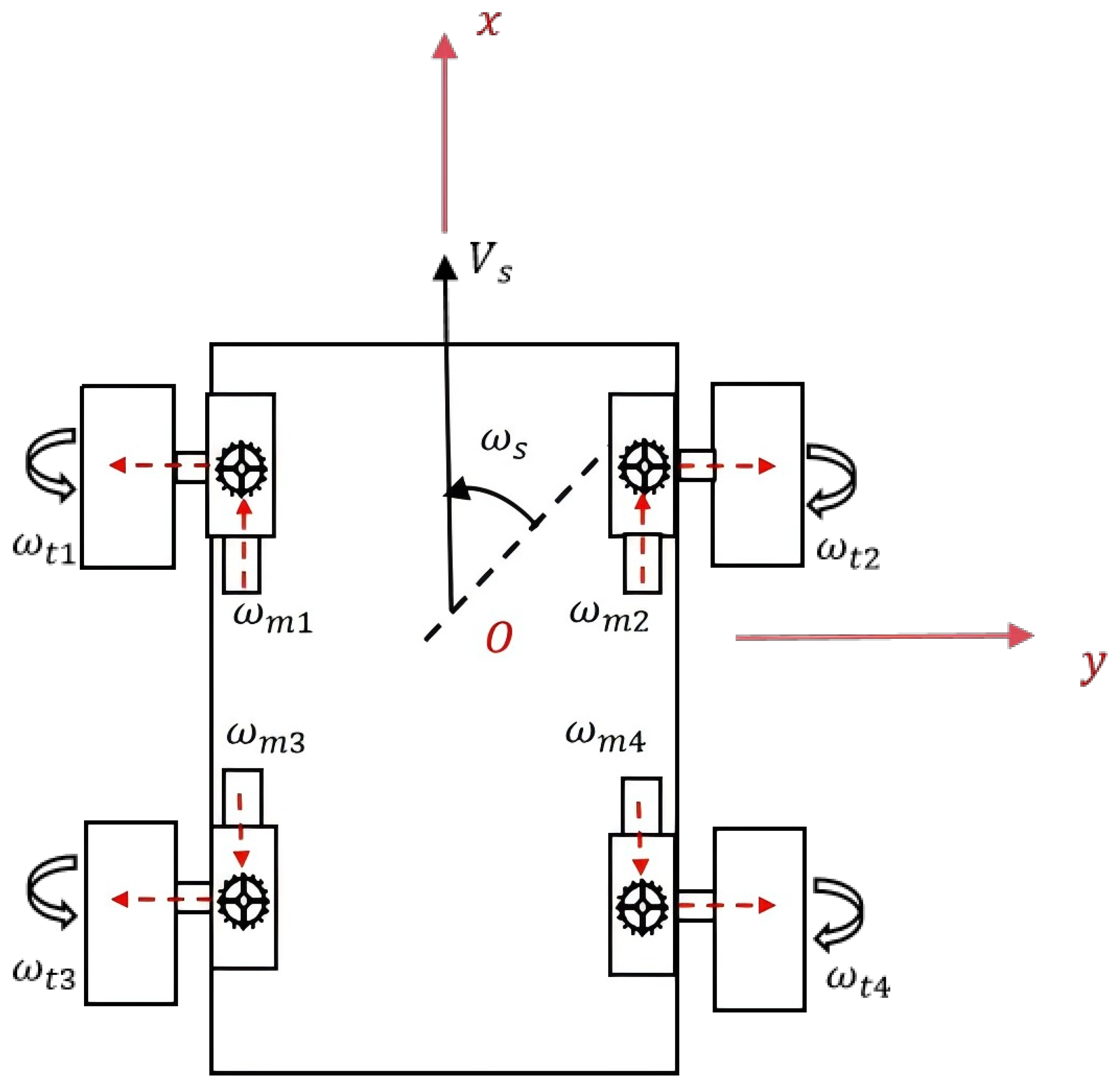
The schematic diagram of the wheel-drive power system is shown in Figure 2. The rotational speed of the left front wheel-side run motor is ω t 1 , with its output torque transmitted to the left front tire via the reduction gearbox. Similarly, the rotational speed of the right front wheel-side run motor is ω t 2 ; its output torque is delivered to the right front tire through its reduction gearbox. For the rear wheels, the rotational speed of the left rear wheel-side motor is ω t 3 , and its output torque is transmitted to the left rear tire via the reduction gearbox. The rotational speed of the right rear wheel-side motor is ω t 4 , with its output torque conveyed to the right rear tire through the reduction gearbox.

2.2. Electrical System Architecture

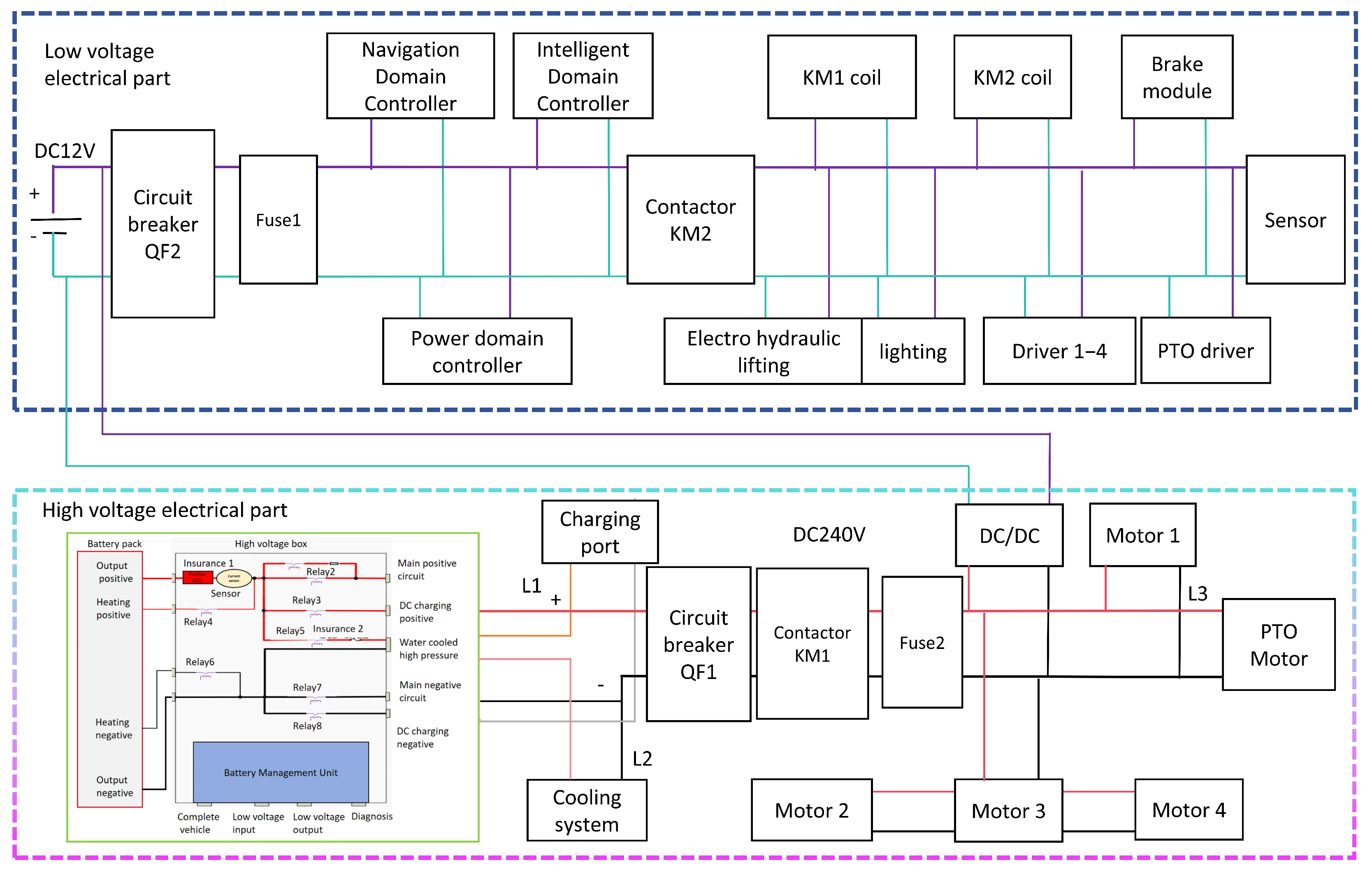
The battery-electric unmanned tractor’s electrical system shown in Figure 3 comprises low-voltage (LV) and high-voltage (HV) electrical sections.
In the LV subsystem, the positive terminal of the low-voltage electrical section is DC 12 V, while the negative terminal is 0 V. A 12 V battery supplies power through air circuit breaker QF2 protective fuse1 to contactor KM2. This protection layer safeguards against overcurrent and short-circuit conditions. When the start button activates, KM2 energizes to deliver 12 V power to critical subsystems: the brake module, electro-hydraulic lift system, lighting, and run motor drivers. Notably, domain controllers (navigation, intelligence, and power) connect between the fuse1 and KM2 contactor, receiving early power initialization to perform safety-critical system checks before other LV components activate.
The DC 240 V high-voltage system centers on a lithium-ion traction battery, with its positive terminals rated at 240 V (negative terminal at 0 V). Electrical output flows sequentially through air circuit breaker QF1 and contactor KM1 before reaching protective fuse. These protective devices (QF1 and fuse2) provide critical safeguards against overcurrent, leakage, and short-circuit conditions. From the fuse2 output, power distributes to three primary loads: (1) four independent run motors (designated motor 1 through motor 4), (2) the power take-off (PTO) motor, and (3) a DC/DC converter module. This 600 W converter accepts DC 240 V input and delivers DC 14 V output to charge the low-voltage battery, matching the lead-acid battery’s charging specifications. External charging occurs through a dedicated DC charging port connected directly to the traction battery, bypassing QF1. Similarly, the battery cooling system maintains direct thermal management connectivity, ensuring continuous thermal regulation regardless of QF1’s operational status.
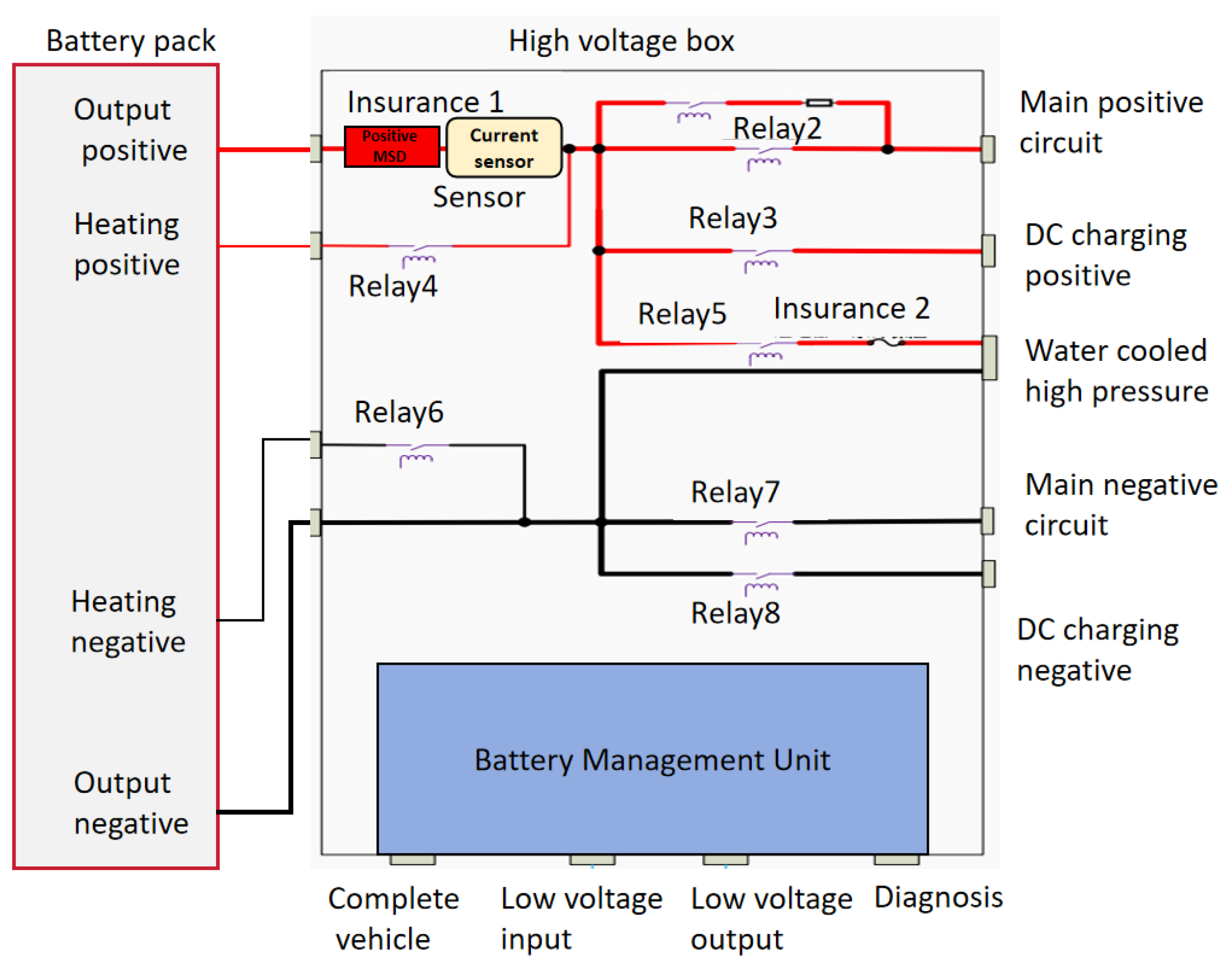
Figure 4 shows the electrical schematic of the power battery, which consists of two core components: the battery pack and the high-voltage box. The battery pack terminals (positive/negative) serve as input interfaces in charging mode and output interfaces in discharging mode. The positive terminal of the battery pack is connected to three components within the high-voltage box, insurance1, current sensor, and relay2 to relay5. In discharging operation:
  • Relay2 conducts current to the main positive circuit, while relay7 conducts current to the main negative circuit.
  • Insurance1 provides irreversible overcurrent protection, isolating faults when overcurrent occurs.
  • Current sensor enables soft protection: in case of overcurrent, it triggers the opening of relay3 through the control loop, achieving reversible disconnection.
In charging operation:
  • The positive pole of the external charger connects to the main positive circuit via relay3, and the negative pole links to the main negative circuit via relay8.
  • Current sensor enables soft protection: in case of overcurrent, it triggers the opening of relay3 through the control loop, achieving reversible disconnection.
The battery heating positive and negative terminals are the input interfaces of the battery pack. The heating port of the battery pack is internally connected to a resistance wire. When the external ambient temperature is low, the internal Battery Management Unit (BMU) drives relay4 and relay6 to operate, connecting the internal heating circuit of the battery, thereby increasing the battery temperature.

3. Multi-Physics Coupled Modeling

3.1. Powertrain Component Models

3.1.1. Motor Model

There are four motors ( n [ 1 , 2 , 3 , 4 ] ), each being a permanent magnet synchronous motors (PMSMs). For the n-th motor, electrical and torque equations are as follows:
u d _ n = R s i d _ n + L d d i d _ n d t ω d _ n L q i q _ n u q _ n = R s i q _ n + L q d i q _ n d t + ω d _ n L d i d _ n + ω d _ n φ f T e _ n = 3 2 P n ( φ d _ n i q _ n φ q _ n i d _ n )
(A comprehensive list of all symbols used in the equations is provided in the Appendix A.) where T e _ n , i d _ n , i q _ n , and  ω ˙ d _ n are the output torque, d-axis current, q-axis current and rotational angular velocity of the n-th the motor, respectively. The dynamic equation for the motor shaft is as follows:
J ¯ m _ n ω ˙ d _ n = T e _ n T m _ n
in which J ¯ m _ n represents the equivalent moment of inertia of the n-th motor shaft, and  T m _ n denotes the resistance torque applied to the n-th motor shaft.

3.1.2. Power Model

Modeling the battery charging and discharging system is complex as it involves energy management, efficiency, load demand, and energy input. A mathematical model describing the basic behavior of this system is established as follows: Equating the power battery to a second-order RC equivalent circuit [20,21,22], based on Coulomb counting and Kirchhoff’s laws, the continuous system state and output equations of the power battery equivalent circuit model are as follows:
d z ( t ) d t = η ( t ) Q i ( t ) d i R 1 ( t ) d t = 1 R 1 C 1 i R 1 ( t ) + 1 R 1 C 1 i ( t ) d i R 2 ( t ) d t = 1 R 2 C 2 i R 2 ( t ) + 1 R 2 C 2 i ( t ) v ( t ) = O C V ( z ( t ) ) R 1 i R 1 ( t ) R 2 i R 2 ( t ) R 0 i ( t )
where R 0 is the battery internal resistance, and  R i and C i ( i = 1 , 2) are the polarization resistance and polarization capacitance, respectively. O C V ( z ( t ) ) represents the battery’s open-circuit voltage, η represents the Coulombic efficiency, Q represents the total battery capacity, and  z ( t ) represents the battery’s state of charge. The battery energy increase rate is equal to the charging power multiplied by the charging efficiency, while the decrease rate is equal to the discharging power divided by the discharging efficiency. The change in battery energy can be expressed as
d E ( t ) d t = η c h a r g e · P i n ( t ) η d i s c h a r g e · P o u t ( t )
where E ( t ) represents the remaining energy of the battery (unit: Wh). P i n ( t ) denotes the power charged into the battery (unit: W), such as when a charging station charges a tractor. P o u t ( t ) signifies the power output from the battery (unit: W), which is used for tractor operation. η c h a r g e stands for the charging efficiency (between 0 and 1). η d i s c h a r g e represents the discharging efficiency (between 0 and 1).
P i n ( t ) = v i n ( t ) i i n ( t ) P o u t ( t ) = v o u t ( t ) i o u t ( t )
where v i n ( t ) is the output voltage during battery charging, i i n ( t ) is the input current during battery charging, v o u t ( t ) is the output voltage during battery charging, and  i o u t ( t ) is the input current during battery charging.
The relationship equation for charge and discharge power limits is
0 P i n ( t ) P i n , m a x 0 P o u t ( t ) P o u t , m a x
where P i n , m a x and P o u t , m a x represent the maximum charging and discharging power of the battery, respectively.

3.1.3. Motor Driver Model

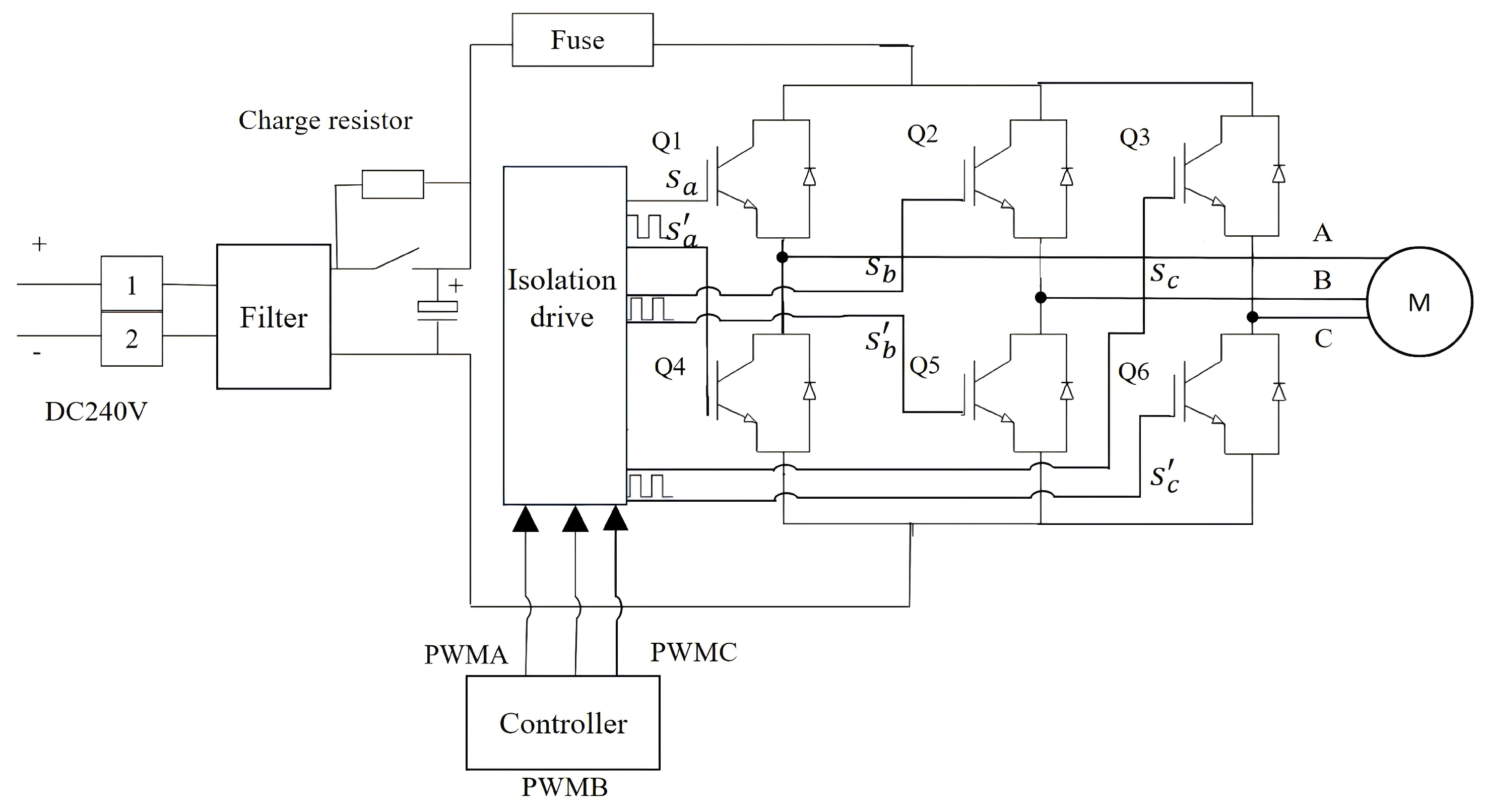
The schematic diagram of the motor driver’s main circuit is shown in Figure 5. The left end is the DC240V input interface for the motor driver power supply input. The motor driver power supply passes through the EMI filter and reaches the three-phase bridge drive busbar. The charging resistor on the motor driver busbar can limit the charging current of the busbar capacitance, preventing the power supply from impacting the junction capacitance in the power switching devices at the moment of power-on, thus avoiding malfunctions of the power switching devices. The fuse is used to prevent damage to the circuit due to excessive current.
In Figure 5, Q1, Q2, Q3, Q4, Q5, and Q6 represent power switching devices, M denotes the power motor, and Q1–Q6 constitute a three-phase inverter. When the dead zone is not considered, the upper and lower power transistors of each bridge arm output in complementary symmetry. The isolated drive module is used to isolate the electrical coupling between the controller and the chopper, preventing the controller from being punctured and damaged. The gate signals for the upper power transistors in each phase leg, denoted as S x p and S x n (where x = a , b , c ), are complementary. The switching state is defined by the signal S x : when S x = 1 , the upper transistor is conducting (ON) and the lower transistor is off, meaning S x p = 1 and S x n = 0 ; when S x = 0 , the upper transistor is off and the lower transistor is conducting (ON), meaning S x p = 0 and S x n = 1 . Therefore, the three-phase bridge arm inverter has 8 switching states, corresponding to 8 spatial voltage vectors. The resulting synthesized vector is given by [23,24,25].
U o u t = 2 U d c 3 ( S a + S b e j 2 3 π + S c e j 2 3 π )
The expression for the phase voltage of the power motor is
U a b = U a n U b n = 3 | U o u t | c o s ( θ + π 3 ) U b c = U b n U c n = 3 | U o u t | c o s ( θ π 3 ) U c a = U c n U a n = 3 | U o u t | c o s ( θ 2 π 3 )

3.2. Vehicle Kinematics and Dynamics

3.2.1. Tire–Road Interaction Model

The interaction between the tire and the road surface [26,27,28,29], the dynamic characteristics of the entire vehicle, and the slip ratio between the tire and the ground:
S = V V t i r e V × 100 if V > V t i r e , V 0 V t i r e V V t i r e × 100 if V < V t i r e , V t i r e 0
Here, V is the speed of the center of rotation of the tire relative to the ground, and  V t i r e is the speed of the edge of the tire along the line. Lateral force of the ground on the tire:
F y = k α
Here, α is the angle of slip and k is the stiffness of slip. Maximum ground adhesion of tires:
F m a x = μ m g
where μ represents the coefficient of sliding friction between the road surface and the tire.

3.2.2. Vehicle Kinematic Model

For ease of analysis, the order of the model is reduced, and the deformation and vibration of the tractor frame are ignored, thus establishing a rigid body kinematics model of the tractor.
(1) Plane motion
The real-time expression for the lateral motion speed of the tractor is:
x ˙ s = V t i r e _ r c o s θ s 2 + V t i r e _ l c o s θ s 2
Among them, x ˙ s represents the real-time value of the abscissa of the tractor, θ s represents the real-time value of the direction angle of the tractor, V t i r e _ r represents the edge linear velocity of the right wheel, and  V t i r e _ l represents the edge linear velocity of the left wheel. The edge linear velocities of the tires on the same side should be consistent. The real-time value expression for the longitudinal motion speed of the tractor is:
y ˙ s = V t i r e _ r s i n θ s 2 + V t i r e _ l s i n θ s 2
(2) Rotation motion
The real-time value expression for the yaw angular velocity of the tractor is:
w s = V t i r e _ r V t i r e _ l W
Among them, W refers to the width of the left and right wheels of the tractor. The tractor is in a zero-radius steering state when the rotational angular velocities of its left and right tires are equal in magnitude and opposite in direction. Under this condition, the relationship between ω s and the tire angular velocity ω t is:
w s = 2 R t i r e W W 2 + L 2 ω t

3.2.3. Vehicle Dynamics Model

The tractor experiences a driving torque [30,31,32,33]:
T D = T D 1 + T D 2 + T D 3 + T D 4
where T D 1 is the dynamic torque provided for the longitudinal driving friction force between the left front wheel and the ground, T D 2 is the dynamic torque provided for the longitudinal driving friction force between the right front wheel and the ground, T D 3 is the dynamic torque provided for the longitudinal driving friction force between the left rear wheel and the ground, and  T D 4 is the dynamic torque provided for the longitudinal driving friction force between the right rear wheel and the ground. The tractor experiences a drag torque:
T Z = T Z 1 + T Z 2 + T Z 3 + T Z 4
where T Z 1 is the resistance moment caused by the lateral friction between the left front wheel and the ground, T Z 2 is the resistance moment caused by the lateral friction between the right front wheel and the ground, T Z 3 is the resistance moment caused by the lateral friction between the left rear wheel and the ground, and  T Z 4 is the resistance moment caused by the lateral friction between the right rear wheel and the ground.
Under the condition of symmetrical mass distribution for the tractor and consistent ground support forces across all four wheels, while neglecting minor differences, the dynamic torque provided by the wheels is:
T D 1 = T D 2 = T D 3 = T D 4 = T e W 2 R t i r e
where T e is the motor output torque and R t i r e is the tire radius, and, assuming that the resistance is approximately equal for all four tires, the resistance torque caused by tire–ground friction is:
T Z 1 = T Z 2 = T Z 3 = T Z 4 = μ m g L 8 + f m g W 8
where f is the rolling resistance friction coefficient, m is the mass of the tractor, L is the wheelbase of the tractor, and g is the acceleration of gravity. For the tractor performing zero-radius turning at a constant angular velocity, T D = T Z at this point. Define T q as the resisting torque on the tire:
T q = m g R t i r e 4 ( L W μ + f )
Define the motor torque T e under this state as the target motor torque T e 0 . Assuming the need to achieve constant-speed steering, the target torque requirement for the combined drive motor T e 0 is given by T e 0 = T q .
When the tractor performs zero-radius turning at a certain angular acceleration T D > T Z , the ratio of the track width to the wheelbase of the combined tractor must satisfy
L W < 1

4. Zero-Radius Turning Strategy and Simulation Analysis

4.1. Zero-Radius Turning Control

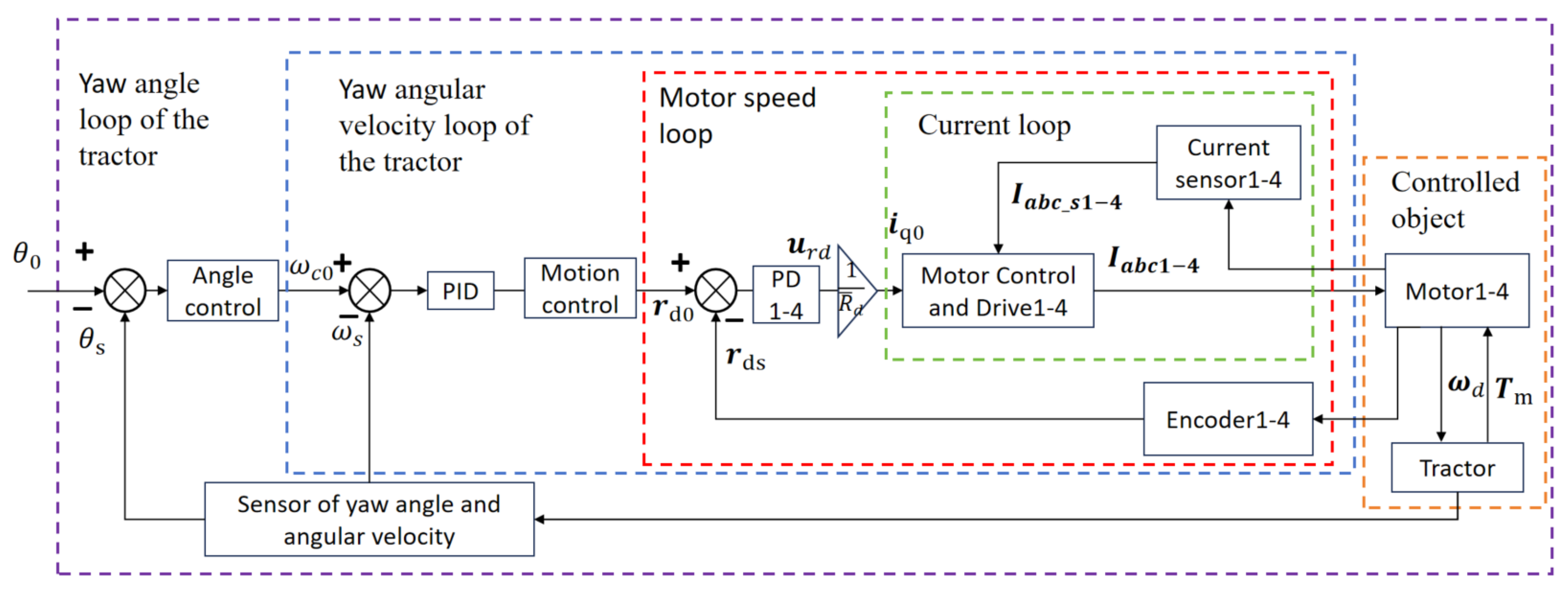
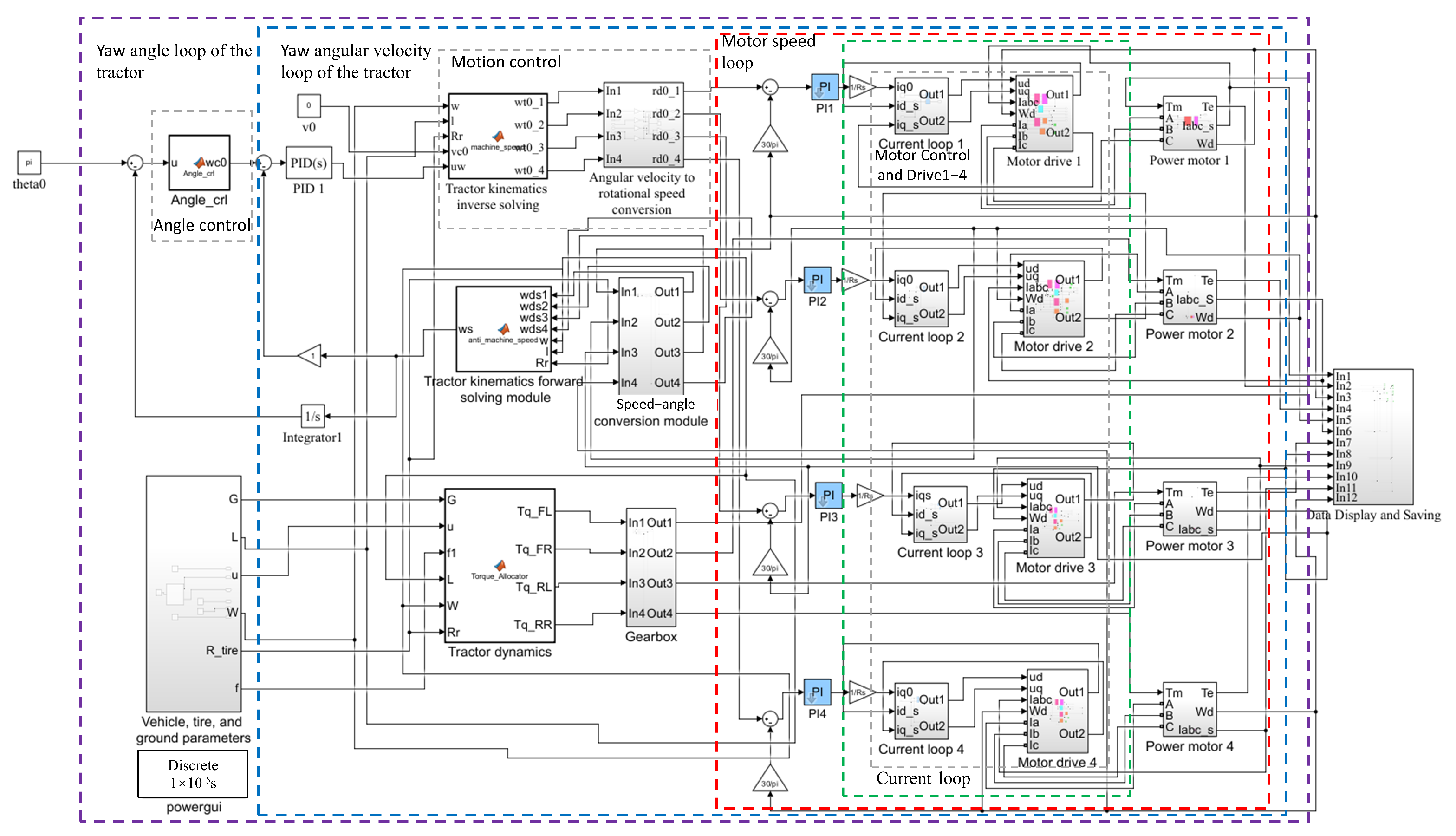
Since the tractor in this study needs to be capable of zero-radius turning, Ackermann steering, which achieves steering through front wheel deflection, is unsuitable. Instead, it is necessary to implement differential control over the speeds of the four tires to realize vehicle body steering and zero-radius turning. Achieving differential steering requires the coordinated control of multiple tractor state variables according to specific functional relationships. However, control precision is compromised by practical factors such as manufacturing tolerances, tire slip, and unmodeled high-order dynamics. To address these challenges, this paper proposes a multiple closed-loop control strategy for precise steering and zero-radius turning. The principle block diagram of the steering control system for the proposed battery-electric autonomous tractor is shown in Figure 6.
The proposed control system is a multi-state feedback loop system, consisting of a yaw angle loop of the tractor, a yaw angular velocity loop of the tractor, a motor speed loop, and a current loop. In the control block diagram, the outermost layer (indicated by the purple dashed box) represents the yaw angle loop of the tractor, the second layer (blue dashed box) is the yaw angular velocity loop of the tractor, the third layer (red dashed box) corresponds to the motor speed loop, and the innermost layer (green dashed box) denotes the current loop. The input to the control block diagram, located on the far left, is the target steering angle θ 0 for the in situ steering control system. The error Δ θ is obtained by subtracting θ s (output from the sensor of yaw angle and angular velocity) from the target angle θ 0 . The angle controller processes the error Δ θ . If the error exceeds a certain threshold C θ , it outputs a target angular velocity to adjust the vehicle’s attitude; otherwise, it outputs zero to maintain the current vehicle attitude. The control law for the angle controller is as follows:
w c 0 = θ 0 T 0 if Δ θ ( t ) C θ 0 if Δ θ ( t ) < C θ
Here, t is the time variable and T 0 is the steering target completion time.
The yaw angular velocity loop of the tractor primarily consists of a PID controller and a motion control module, which enables the vehicle’s actual angular velocity to track the target angular velocity. The error Δ ω is obtained from the difference between the target angular velocity ω c 0 (output by the angle controller) and the measured angular velocity ω s (provided by the angular velocity sensor). The control law for the PID controller is as follows:
u ω ( t ) = K P 1 Δ ω ( t ) K D 1 d ( Δ ω ( t ) ) d t + K I 1 0 t Δ ω d t
Following the control law, the motion control module processes the PID output to calculate the target motor speed vector r d 0 = [ r d 0 _ 1 , r d 0 _ 2 , r d 0 _ 3 , r d 0 _ 4 ] T .
r d 0 _ 1 = r d _ 02 = r d _ 03 = r d _ 04 = 30 k g π u ω ( t ) ( W 2 2 + L 2 2 ) R t i r e W
Here, each element r d 0 _ n is the target speed for motor n ( n [ 1 , 2 , 3 , 4 ] ), and  k g represents the gearbox reduction ratio. The motor speed loop enables the motor speed to track its target value, utilizing a PD1-4 controller with the following control law:
u rd ( t ) = K P 2 Δ r d ( t ) K D 2 d ( Δ r d ( t ) ) d t
Here, u rd ( t ) = [ u r d _ 1 ( t ) , u r d _ 2 ( t ) , u r d _ 3 ( t ) , u r d _ 4 ( t ) ] T is the control output vector of the PD controllers in the motor speed loop. Each element u r d _ n ( t ) is the output of the n-th PD controller, which is determined by the corresponding speed error. The speed error vector is defined as Δ r d ( t ) = [ r d 0 _ 1 ( t ) r d s _ 1 ( t ) , r d 0 _ 2 ( t ) r d s _ 2 ( t ) , r d 0 _ 3 ( t ) r d s _ 3 ( t ) , r d 0 _ 4 ( t ) r d s _ 4 ( t ) ] T , where Δ r d _ n ( t ) = r d 0 _ n ( t ) r d s _ n ( t ) represents the difference between the target speed and the actual speed (from the encoder) for the n-th motor. To enhance the motor’s fast-response characteristics, this error signal is used by the current loop to generate the target q-axis current I q 0 as follows:
I q 0 = u rd ( t ) R ¯ d
Among them, I q 0 = [ I q 0 _ 1 , I q 0 _ 2 , I q 0 _ 3 , I q 0 _ 4 ] T is the target q-axis current vector, with element I q 0 _ n being reference for the n-th motor. R ¯ d denotes the motor’s equivalent resistance. The target d-axis current I d 0 output by the controller is I d 0 = 0 . The control voltage u q of the q-axis in the rotating coordinate system generated based on the target current I q 0 is
u q = K P 3 ( I q 0 I qs ) + K I 3 i = 0 K ( I q 0 I qs )
Among them, K P 3 is the proportional coefficient of q-axis current closed-loop control; K I 3 is the integral coefficient of q-axis current closed-loop control. The control voltage u d of the d-axis in the rotating coordinate system generated based on the target current I d 0 is
u d = K P 4 ( I d 0 I ds ) + K I 4 i = 0 K ( I d 0 I ds )
K P 4 is the proportional coefficient of d-axis current closed-loop control; K I 4 is the integral coefficient of d-axis current closed-loop control. The current sensor measures the three-phase current flowing through the motor stator. The three-phase current vector is defined as:
I n = i a s _ n i b s _ n i c s _ n
This vector is transformed from the three-phase ( a b c ) system to the two-phase stationary ( α β ) coordinate system using the Clarke transformation:
I α s _ n I β s _ n = 2 3 1 1 2 1 2 0 3 2 3 2 I n
The I α s _ n and I β s _ n in the α β coordinate system are transformed by Park transformation into I q s _ n and I d s _ n in the d q rotating coordinate system, expressed as:
I q s _ n I d s _ n = c o s θ s i n θ s i n θ c o s θ i α s _ n i β s _ n
Generate control variables u α _ n and u β _ n in the α β coordinate system through anti-Park transformation:
u α _ n u β _ n = c o s θ s i n θ s i n θ c o s θ u q _ n u d _ n
Generate control voltages U A _ n , U B _ n , and U C _ n applied to the stator three-phase winding through anti-Clark transformation:
U n = U A _ n U B _ n U C _ n = 1 0 1 2 3 2 1 2 3 2 u α _ n u β _ n
Finally, the control voltages, U A _ n , U B _ n , and U C _ n , are applied to the three-phase windings of the n-th motor, generating the phase currents I A _ n , I B _ n , and I C _ n , respectively. These currents then produce a magnetic field that interacts with the motor stator, resulting in the electromagnetic torque T e .

4.2. Simulation Platform Setup

Based on the established model of the unmanned tractor, a digital simulation platform was built to analyze the performance of the designed tractor body and control algorithm. As shown in Figure 7, the digital simulation platform was built in MATLAB/Simulink, with the computational setup (Intel i9-12900H processor (A Lenovo Legion Y9000P laptop (Model: Legion Y9000P I AH7H, manufactured by Lenovo (Beijing) Limited, Beijing, China) with an Intel Core i9-12900H processor, NVIDIA GeForce RTX 3060 Laptop GPU, 32 GB RAM, and a 512 GB SSD), Windows 11 OS). It mainly consists of the following modules: the angle_ctrl module, the tractor kinematics solving module, the angular velocity-to-rotational speed conversion module, the vehicle/tire/ground parameters module, the tractor dynamics module, the gearbox module, four independent current loop modules, the tractor kinematics forward solving module, four power motor modules, four motor drive modules, and the speed–angle conversion module.
The input to the control system, located on the far left, is theta0 (the target angle). When executing a zero-radius turning command, the target angle is set to π . The angle_ctrl module serves as the main controller for the yaw angle loop of the tractor, responsible for adjusting the vehicle’s attitude. Its input is the error Δ θ between the target yaw angle and the actual yaw angle of the tractor, and its output is the target vehicle angular velocity ω c 0 . This module is implemented as a MATLAB (2019a) script based on the specified Equation (22). The vehicle angular velocity loop ensures that the actual vehicle angular velocity tracks the target value. PID1 is its main controller. The error Δ ω , which is the difference between the target angular velocity ω c 0 (from the angle controller) and the measured angular velocity ω s (from the angular velocity sensor), serves as the input to PID1. The expression for PID1 is given by Equation (23). u ω (the output of PID1) is processed through the tractor kinematics inverse solving and angular velocity to rotational speed conversion modules to calculate r d 0 ( i ) . These two modules correspond to the motion control block in Figure 6, which is also implemented as a MATLAB (2019a) script according to the relevant Equation (24). The motor speed loop enables the motor speed to track its target value. A separate PD ( i ) controller is used for each loop. Since each wheel is driven by an individual motor, the index i [ 1 , 2 , 3 , 4 ] . The input to PD ( i ) is the error Δ r d ( i ) , calculated as the difference between the target speed r d 0 ( i ) and the actual motor speed r d s ( i ) measured by the encoder in the motor drive ( i ) module. PD ( i ) processes this error and outputs the control signal u r d ( i ) . The expression for the PD controller is provided in Equation (25).
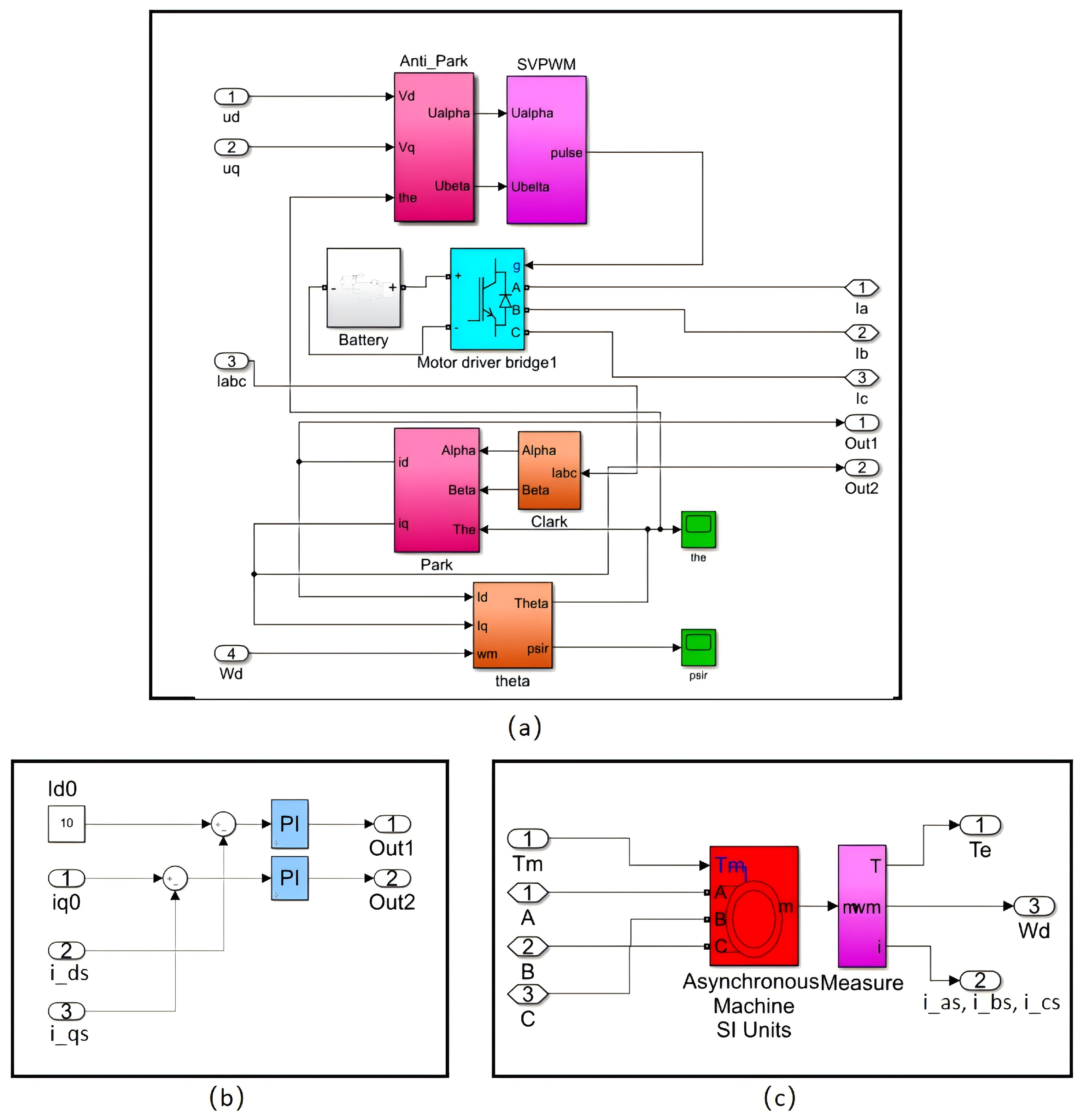
The current loop ( i ) enhances the motor’s fast-response characteristics. Its block diagram is shown in Figure 8, and it is constructed based on governing Equations (27) and (28). The current loop outputs the control signals u q and u d to the motor drive ( i ) module. The motor drive ( i ) module is built according to its specified Equations (29)–(32), and its internal structure is depicted in the corresponding Figure 8b. This module outputs the phase currents I a , I b , and I c to the power motor ( i ) module. The internal diagram of the power motor module is shown in Figure 8a. The Asynchronous Machine SI Units block within it follows the equations detailed in Equations (1) and (2). The measure block represents sensor modules, which measure signals such as I a , I b , and  I c , electromagnetic torque ( T e ), and rotor electrical speed ( w r ).
The tractor (controlled object) comprises several key sub-models: the tractor dynamics model, the gearbox module, the tractor kinematics forward solving module, and the speed–angle conversion module. The tractor dynamics model is used to generate the ground friction torque acting on each of the four tires. This module is implemented as a MATLAB script based on Equation (20). The gearbox module functions to convert the ground friction torque on the tires into the resisting torque for the motors. The motor resisting torque is then fed into the power motor ( i ) module. Based on Equation (2), the power motor ( i ) module calculates and outputs the actual rotational speed. This actual speed feeds into the speed–angle conversion module to be transformed into wheel rotational speed. The resulting wheel speed ten serves as the input for the tractor kinematics forward solving module, which computes the vehicle body’s actual rotational angular velocity. The tractor kinematics forward solving module is also implemented as a MATLAB script based on the relevant Equations (12)–(15). The actual vehicle body rotation angle is fed back to the vehicle angle loop, thereby closing the loop for vehicle steering angle control.
The Powergui is used for simulation parameter configuration. The main simulation settings are as follows: the simulation type is set to discrete, the step size is 1 × 10⁻⁵ s, and the solver type is set to auto. The vehicle, tire, and ground parameters module supplies necessary parameters to the tractor dynamics model. The main parameters of this module are L = 1.5 m, W = 1.6 m, R t i r e = 0.425 m, and m = 1200 kg. The main parameters for the controllers are K P 1 = 50 , K D 1 = 10 , K I 1 = 2 , K P 2 = 0.5 , K D 2 = 10 , K P 3 = 1 , K I 3 = 220 , K P 4 = 3 , K I 4 = 120 , and C θ = π 180 . The main parameters for the motors include a rated power of 3 kW, R s = 0.4 Ω, and L s = 10 mH.

4.3. Simulation Results and Analysis

Through the established digital simulation platform, a simulation of the battery-electric autonomous tractor’s zero-radius turning was conducted, with output results obtained. Based on these results, the tractor’s body rotation tracking performance, along with the torque, current, power, and other state variables of the four-wheel motors, were analyzed.

4.3.1. Tractor Body Status

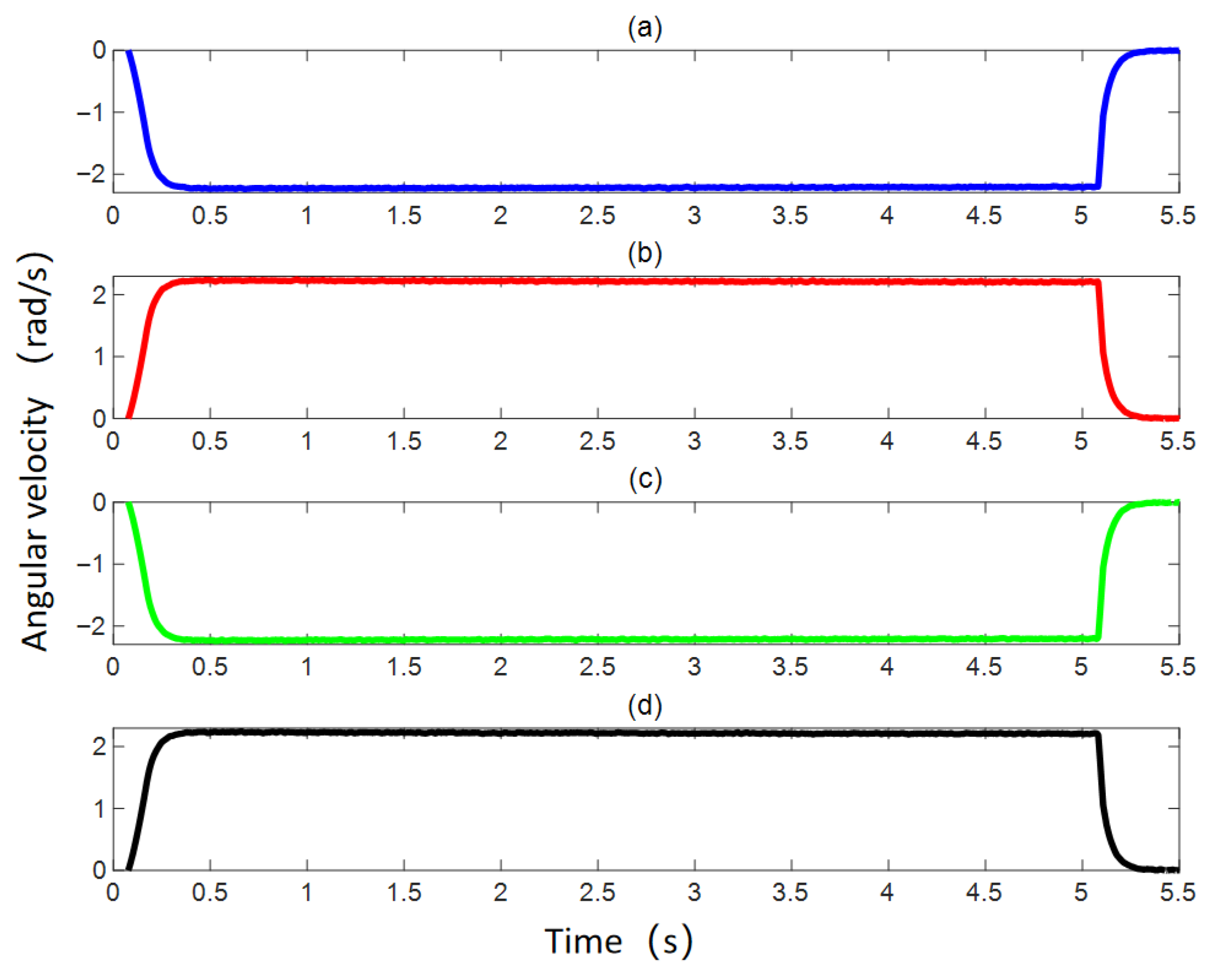
The wheel angular velocities are shown in Figure 9. In the figure, the blue curve (a) represents the angular velocity of wheel 1, the red curve (b) represents wheel 2, the green curve (c) represents wheel 3, and the black curve (d) represents wheel 4. A positive value indicates counterclockwise rotation, while a negative value indicates clockwise rotation. Accordingly, the angular velocities of wheels 1 and 3 are negative, whereas those of wheels 2 and 4 are positive. Wheels 1 and 3 exhibit identical trends. Their angular velocity decreases rapidly from 0 rad/s to −2.22 rad/s during the initial 0–0.37 s phase. It then remains constant until t = 5.08 s, when deceleration begins. The angular velocity returns to 0 rad/s after 0.22 s. Similarly, wheels 2 and 4 follow the same trend. Their angular velocity increases rapidly from 0 rad/s to 2.22 rad/s in the 0–0.37 s phase, maintains this level until t = 5.08 s, and then decelerates to 0 rad/s over the subsequent 0.22 s.
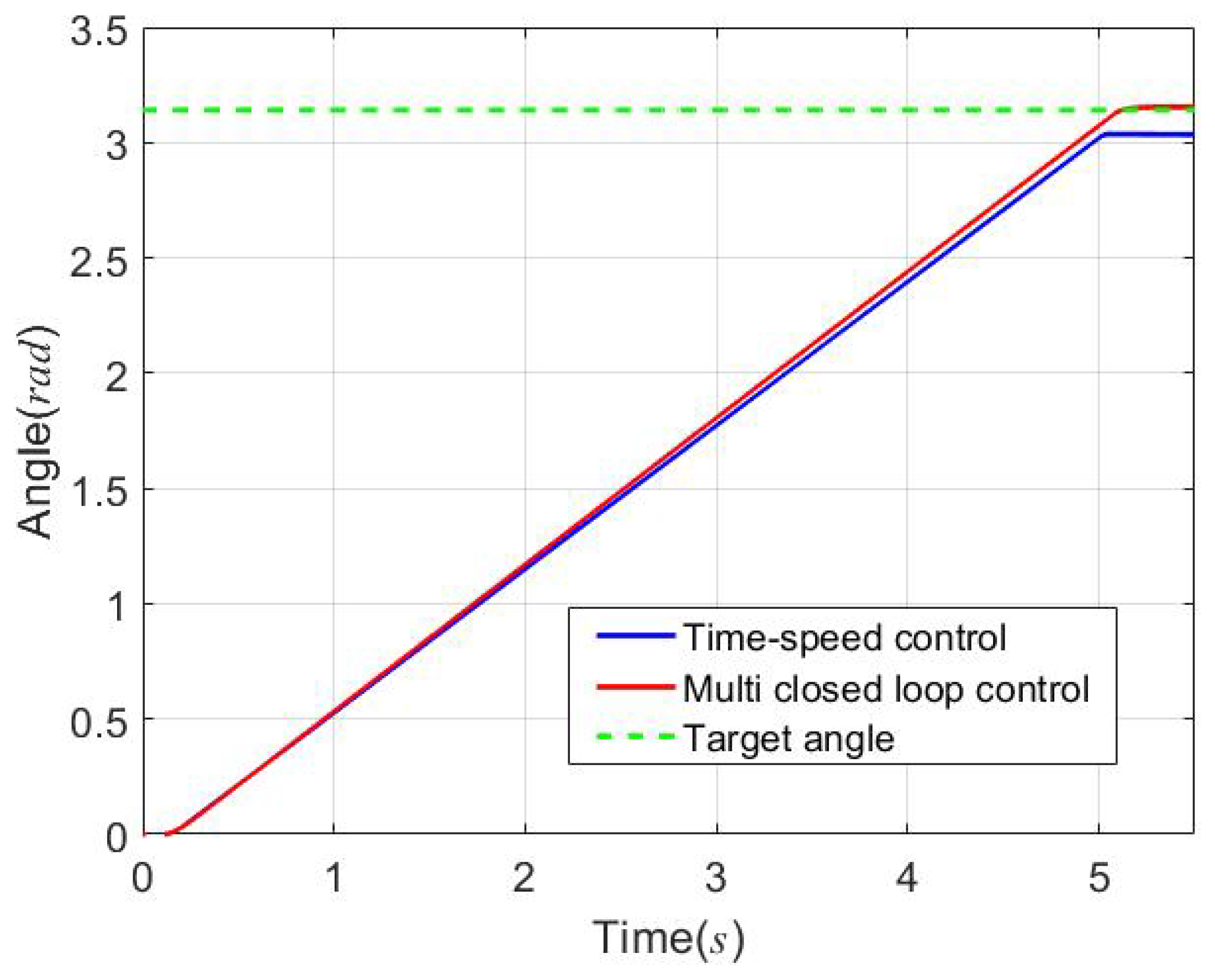
Figure 10 compares the yaw angle tracking for zero-radius turning. The 180 degree target (green dashed line) defines maneuver completion. The time–speed control (blue curve) completes the turn around 5 s with a 0.11 rad error. In contrast, the proposed multi-loop control (red curve) reaches the target at 5 s with higher precision (0.01 rad error), achieving a rise time of 5.1 s, a settling time of 5.3 s, and a steady-state error of 0.01 rad.
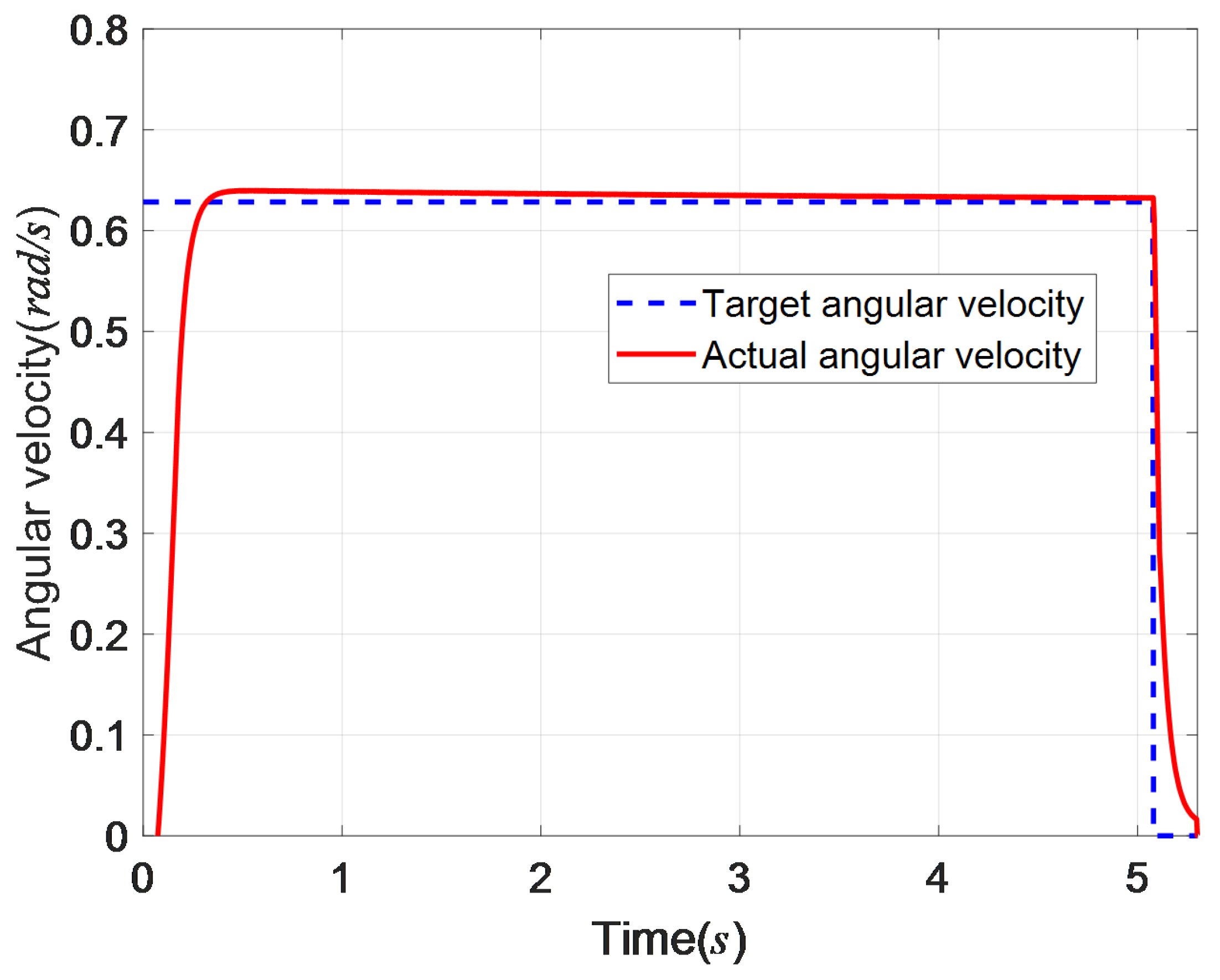
Figure 11 illustrates the yaw angular velocity of the tractor during zero-radius turning. The blue dashed line represents the target velocity profile generated by the proposed angle-velocity-current multi-closed-loop control method. The actual response, shown by the red solid line, exhibits a rapid rise time of 0.31 s, reaches steady state within 0.43 s, and maintains a steady-state error not exceeding 0.011 rad/s. The time required to decelerate from the constant target velocity to 0 rad/s in the final stage is 0.217 s.

4.3.2. Tractor Power Component Status

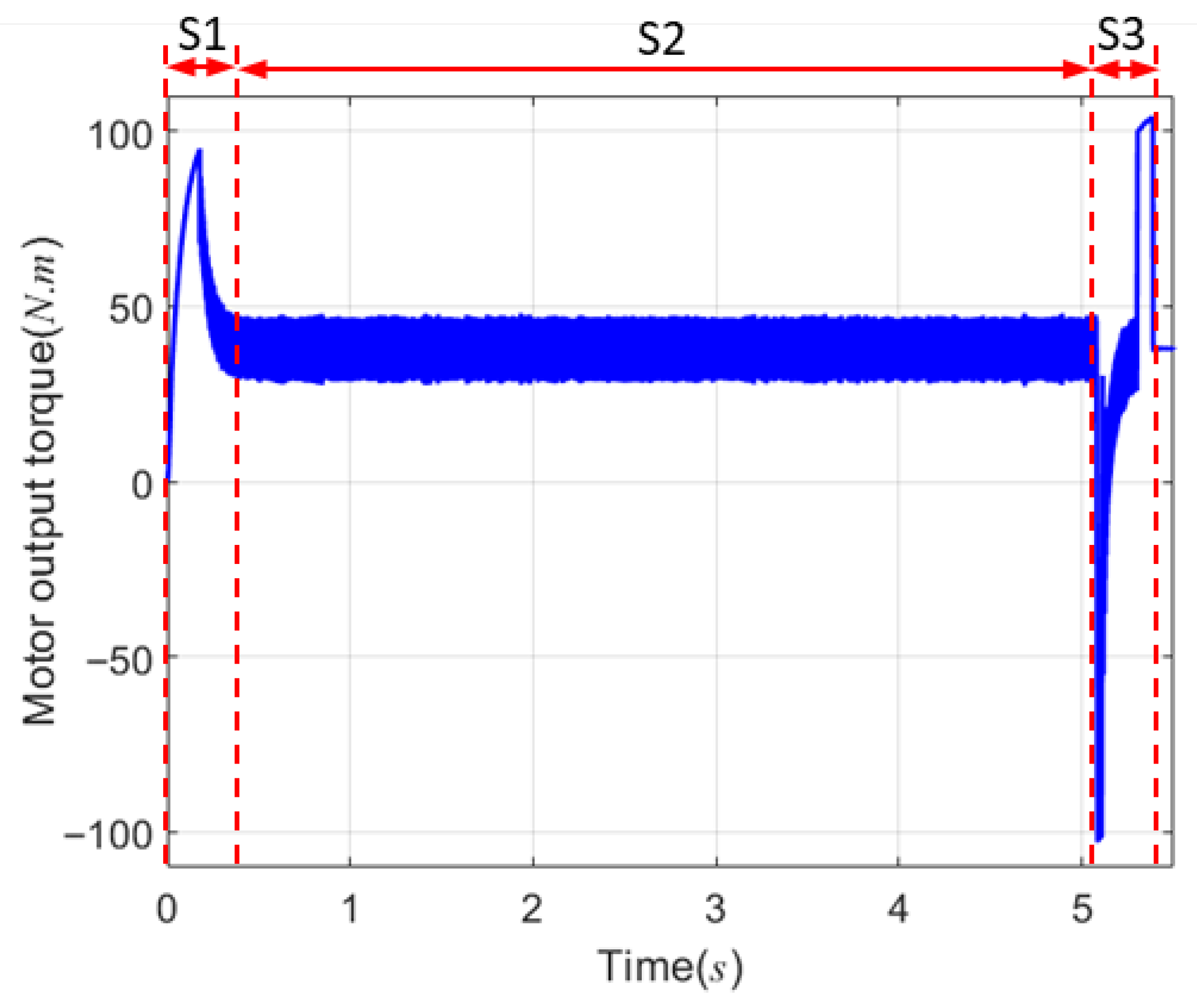
The power motor’s output torque is shown in Figure 12. The motor torque rises sharply during the initial stage (S1) until it reaches 94.9 N · m, with this stage lasting approximately 0.3 s. It subsequently decreases and stabilizes at 38.3 N · m during the steady-state stage (S2), which lasts about 4.6 s. Finally, during the braking stage (S3), the torque drops sharply to −102 N · m before quickly returning to 0 N · m, and this stage has a duration of approximately 0.25 s.
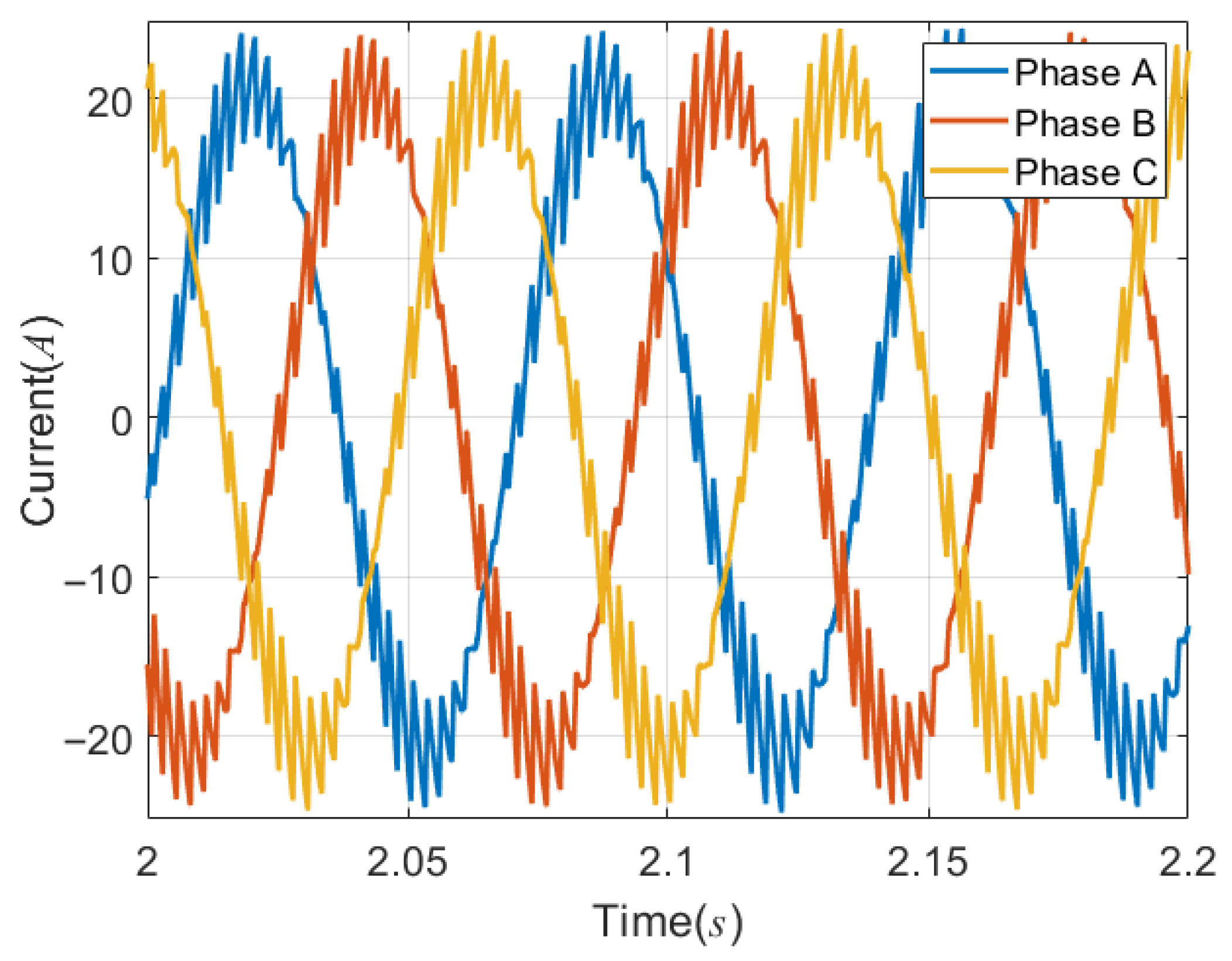
The A, B, and C phase currents of the power motor during operation are shown in Figure 13. The frequency of the A, B, and C phase currents is 15 Hz, with a peak value of 24.1 A and a trough current of −24.3 A. All three curves exhibit slight fluctuations, with a frequency of approximately 400 Hz. These minor fluctuations are influenced by factors such as the chopping frequency of the Space Vector Pulse Width Modulation (SVPWM) drive and the parameters of the current loop control.
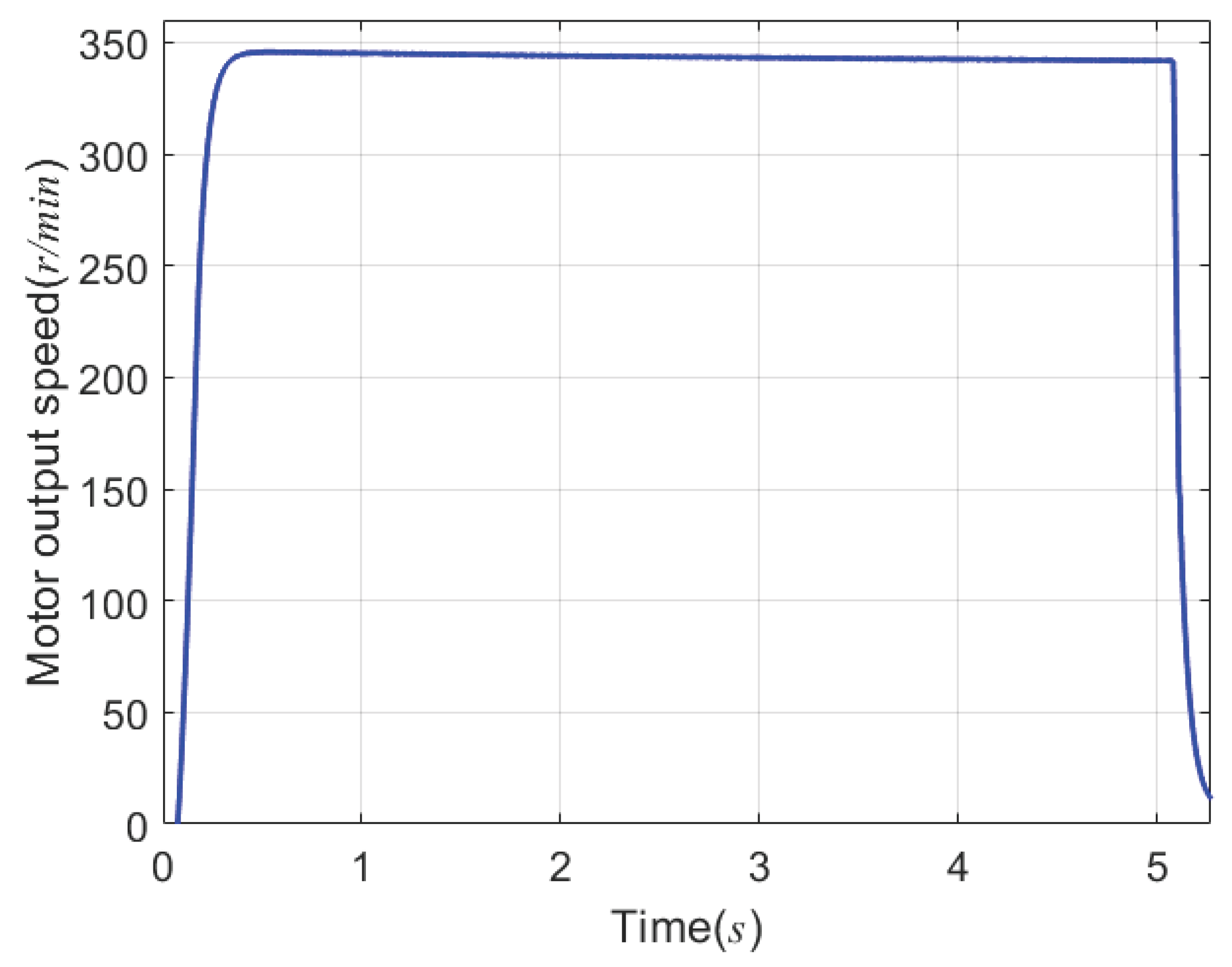
The speed curve of the power motor is shown in Figure 14. The power motor reaches a speed of 343 r/min from the initial state after 0.37 s and begins to decelerate at 5.08 s, reducing to 0 r/min after 0.22 s. The rotational motion of the power motor is transmitted to the tires through the reducer, which has a reduction ratio of 16:1. When the motor speed is 343 r/min, the tractor tire speed is 21.44 r/min.
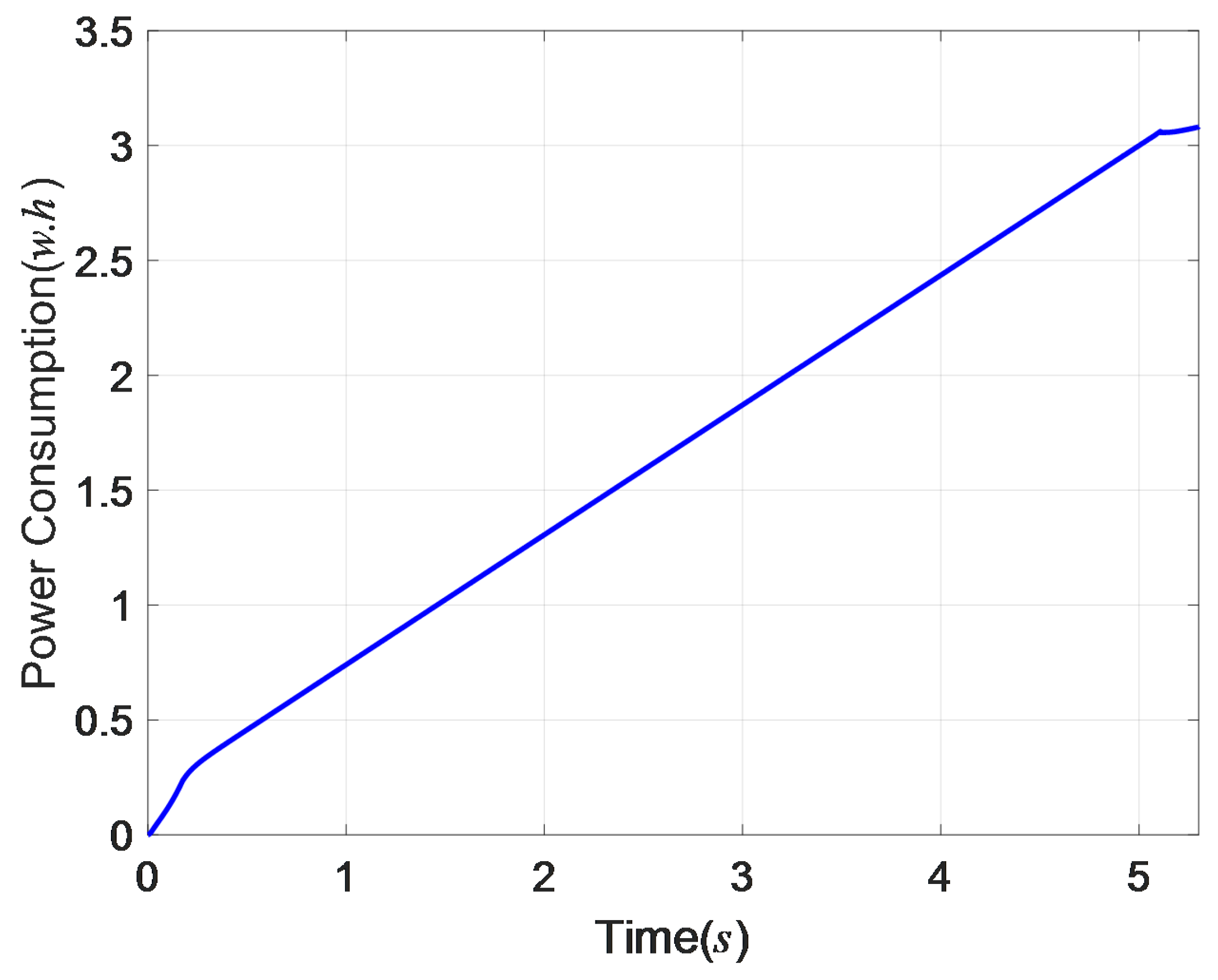
The power consumption curve of the traction battery is shown in Figure 15. The curve is mainly divided into three sections. The initial stage has a steep slope and consumes power quickly. The middle section has a flat slope but lasts the longest and consumes more power. The final stage has a gentle slope and consumes power slowly. The total power consumption for a zero-radius turning is 3.08 W · h, with an average power of 2.096 kW.

5. Experimental Validation and Results

5.1. Prototype Development

5.1.1. Controller

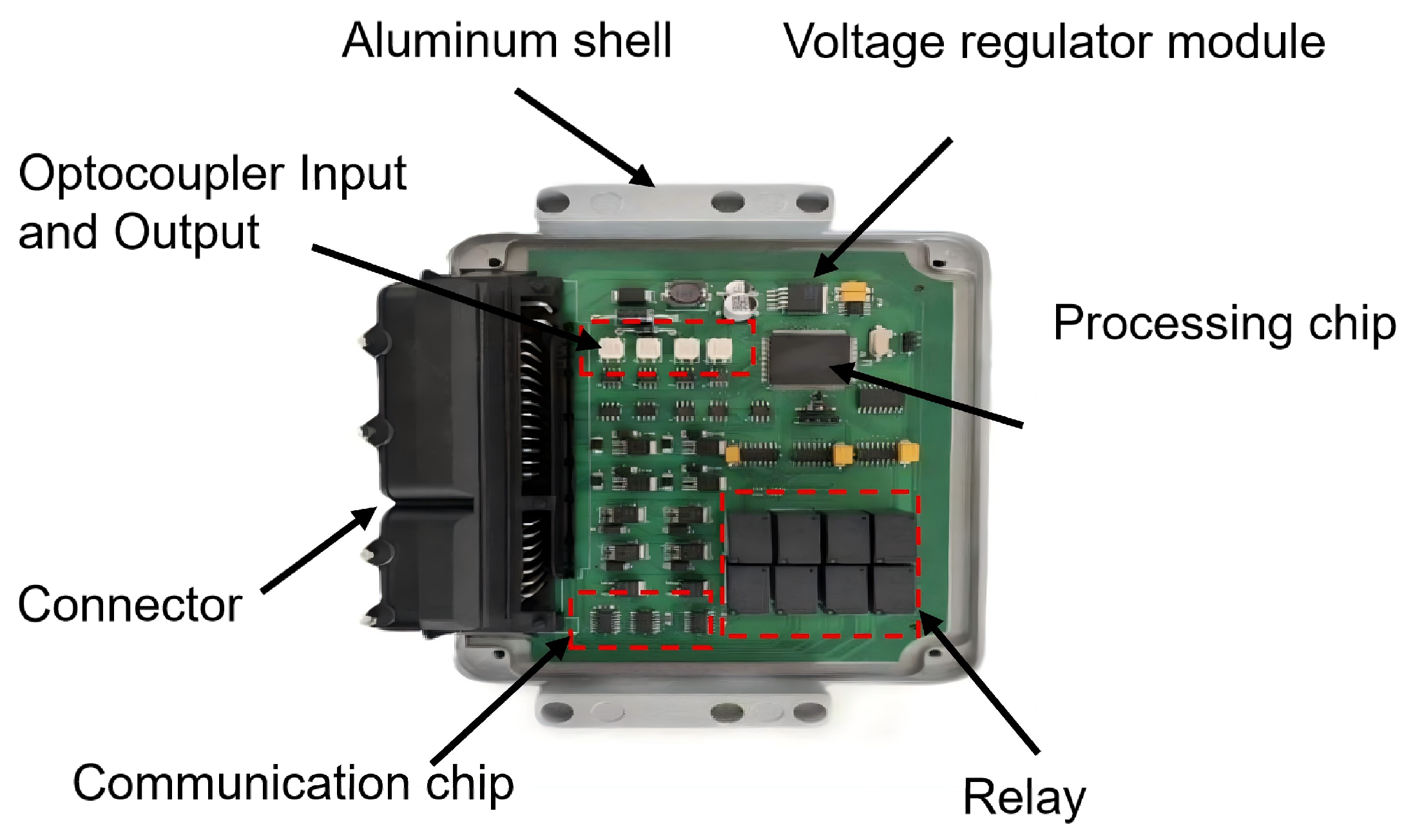
The developed battery-electric autonomous tractor controller, shown in Figure 16, has a rated voltage of DC 12V. The processing chip is a Freescale (Processing core chip (XEP100): Freescale (designed in Austin, TX, USA)) automotive-grade intelligent driving chip, featuring multi-channel CAN communication, AD sampling, digital input/output, PWM output, and other functions.
The controller can interpret driving intentions and plan operations autonomously or based on operational signals, make safety management and energy allocation decisions according to the working status of various components and the tractor, send control commands to the component drivers, and output system status information to devices such as instruments and multi-function display units. The component drivers control the corresponding components according to their commands, driving the tractor to operate normally. The basic parameters of the controller are shown in Table 1.

5.1.2. Prototype Display

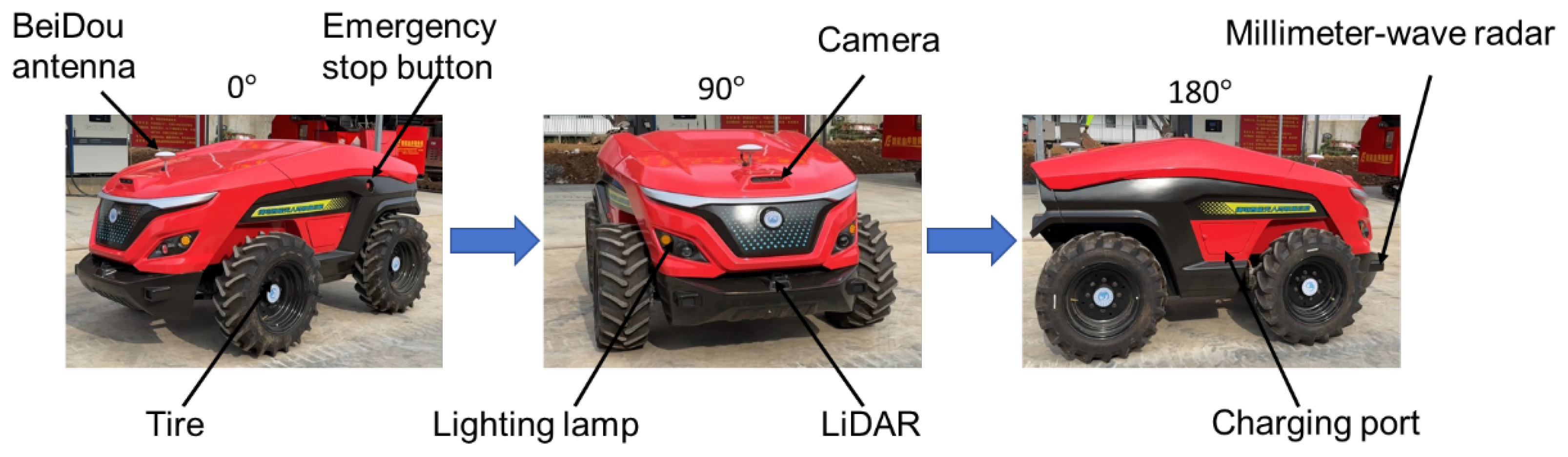
The tractor in Figure 17 is an independently developed battery-electric unmanned tractor equipped with high-performance vision, LiDAR, millimeter-wave radar, BeiDou positioning, language interaction, and other modules (Key hardware manufacturers and locations: Integrated navigation system (MGX23): Feymani Co., Ltd. (Beijing, China). Beidou antenna: Beitian Co., Ltd. (Shenzhen, China). Data parsing terminal: NVIDIA Jetson Orin NX (NVIDIA Corporation, Santa Clara, CA, USA). LiDAR (S2L): Slamtec Co., Ltd. (Shanghai, China). Depth camera (Astra Pro Plus): ORBBEC Co., Ltd. (Shenzhen, China)). It has a wheelbase of 1.6 m, a track of 1.5 m, a maximum power of 50 kW, a battery capacity of 77 kWh, and can be fully charged in just 1 h with fast charging. The battery-electric unmanned tractor underwent a test for its ability to complete a zero-radius turning. Upon receiving the command to make a zero-radius turning, the tractor completed the maneuver according to the instruction. Figure 17 shows the tractor in its initial 0-degree state, the intermediate 90-degree state, and the completed 180-degree zero-radius turning state, respectively.

5.2. Experiment Setup

A program was developed based on the proposed control law to execute the zero-radius turning function. The program flow is outlined in Algorithm 1. The navigation domain controller inputs the zero-radius turning command, and the power domain control enters a while loop to execute the program segments of states 1–4 in sequence. In state 1, signals such as motor speed, body rotation angle, and rotational angular velocity are collected. In state 2, the target speed of the four wheels is calculated based on kinematic formulas. In state 3, the control quantity is calculated and obtained according to the proposed multi-closed-loop control algorithm. In state 4, the SVPWM motor drive waveform is generated and output.
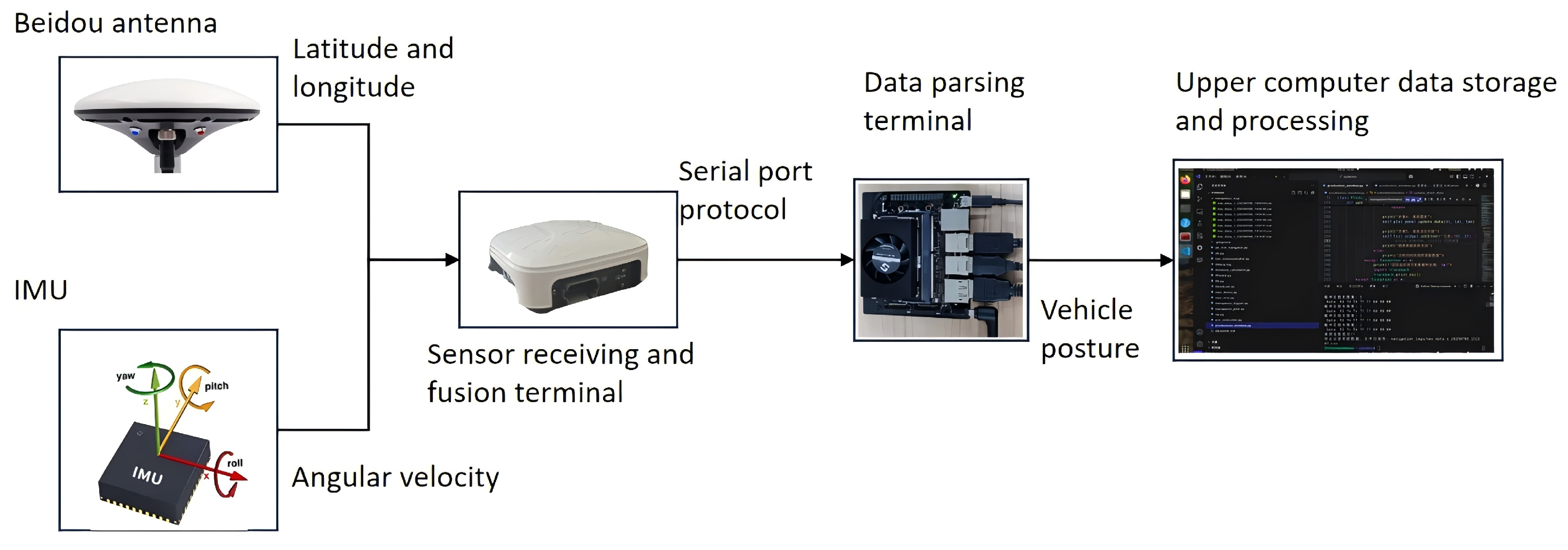
The experimental test data acquisition equipment and process are shown in Figure 18. The experimental test acquisition equipment consists of a BeiDou antenna, an IMU (Inertial Measurement Unit), a sensor receiving and fusion terminal, a data parsing terminal, and a data storage and processing software. The BeiDou antenna is a dedicated device for receiving and transmitting BeiDou satellite signals, which contain longitude and latitude information. The IMU is used to measure the three basic linear motions (acceleration) and three basic angular motions (angular velocity) of the tractor. The sensor receiving and fusion terminal is used to receive and fuse the signals from the BeiDou antenna and IMU, improving the signal-to-noise ratio. The data parsing terminal is used to search for useful data from the specific communication protocol and convert it into vehicle posture, with a resolution of 0.02 rad for the parsed vehicle posture. The data storage and processing software is used to store and preprocess the data and ultimately display it.
Algorithm 1 Zero-radius turning control processing
Require: Zero-radius Turning Instruction
   1:
While yaw angle of the tractor < 180 °   do
   2:
    Case state:
   3:
        state1: Acquire motor speed, body angle, angular velocity → state2
   4:
        state2: Compute target wheel speeds → state3
   5:
        state3: Calculate control variables → state4
   6:
        state4: Generate SVPWM drive signals → state1
   7:
End while

5.3. Experimental Results and Analysis

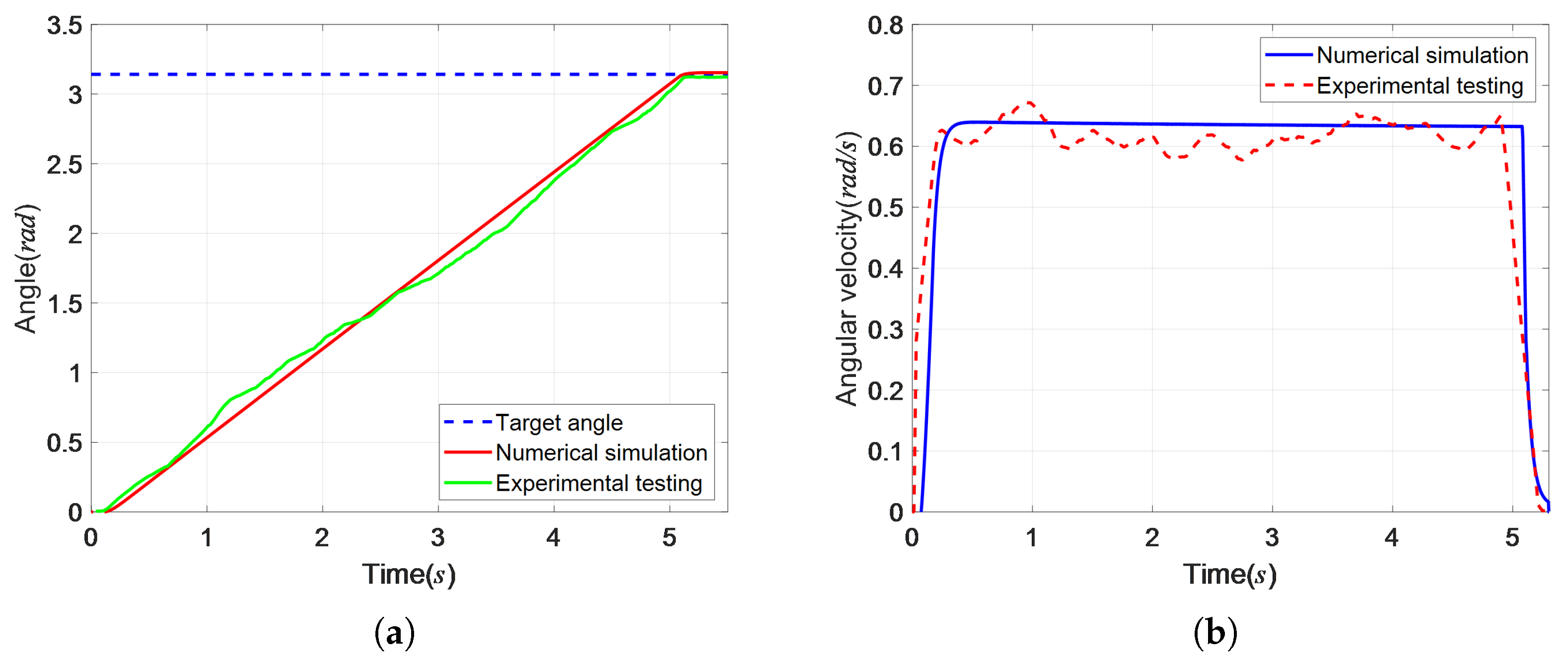
In the experimental test, the heading angle data was parsed and saved at a frequency of 50 Hz. After differentiating the obtained heading angle data, a sliding average filtering was applied to obtain the angular velocity during rotation. Figure 19a,b show comparison diagrams of the vehicle body heading angle and angular velocity, respectively, between numerical simulation and experimental testing. The red solid line represents the curve of the vehicle body heading angle varying with time obtained from numerical simulation, and the blue solid line represents the curve of the vehicle body heading angle varying with time obtained from experimental testing. The trend of the experimental testing curve is consistent with the numerical curve. Figure 19b is another comparison diagram of the vehicle body heading angle between numerical simulation and experimental testing. The red solid line represents the curve of the vehicle body heading angle varying with time obtained from numerical simulation, and the blue solid line represents the curve of the vehicle body heading angle varying with time obtained from experimental testing. The trend of the experimental testing curve is consistent with the numerical curve. The dynamic change curves of the vehicle body rotation angle and the vehicle body rotation angular velocity are similar to the simulation results, with small errors, verifying the accuracy of the model. The errors in the experimental testing results are caused by unmodeled high-order errors of the model, sensor signal noise, and other factors.
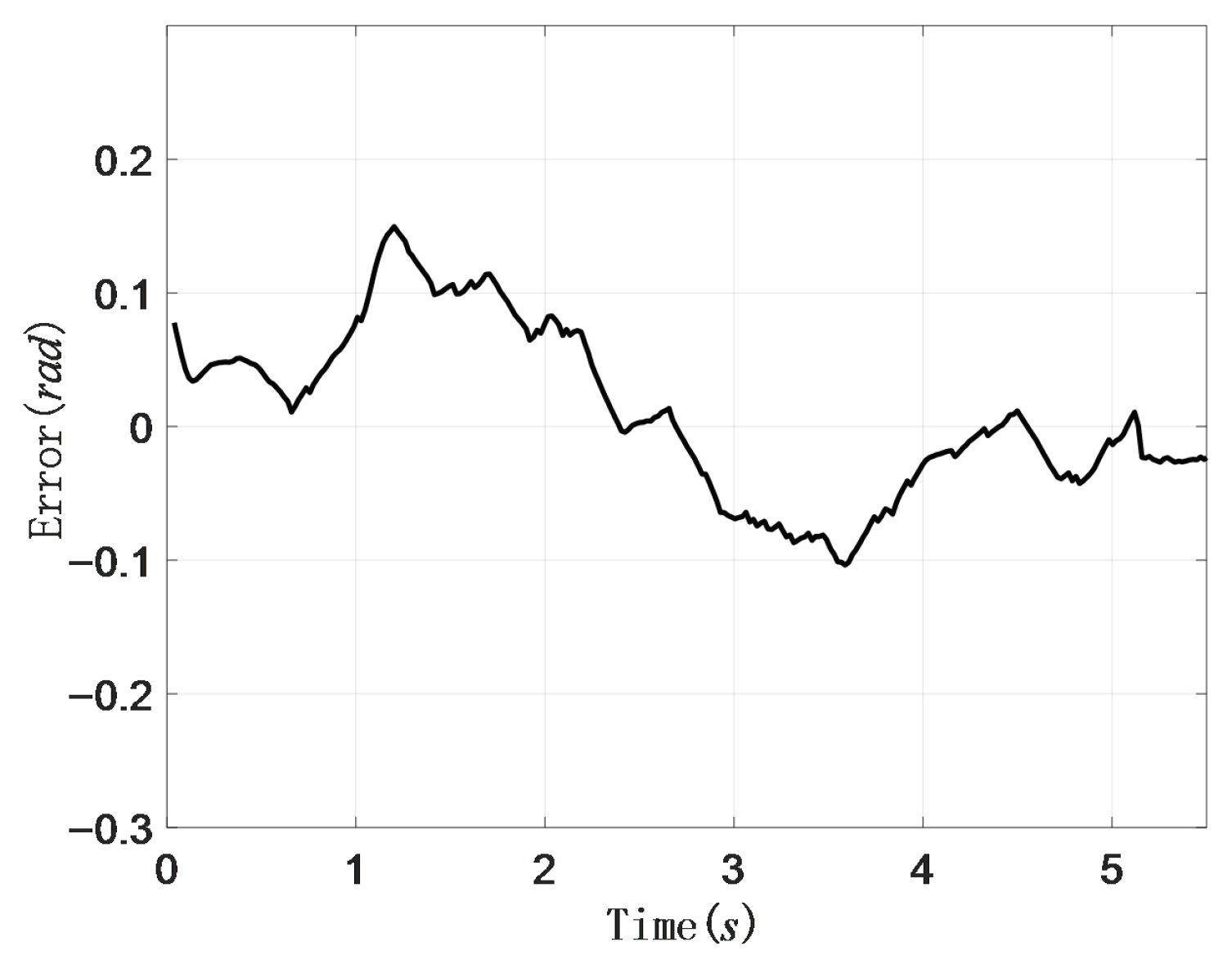
The error curve for the angle during the zero-radius turning maneuver was obtained by subtracting the simulated body angle from the actual body angle, as shown in Figure 20. The maximum absolute value of the error was 0.14 rad. Under steady-state condition S2, the maximum absolute difference in angular velocity was 0.05 rad/s.

6. Conclusions

To address the issues of low intelligence level, environmental pollution, and problems such as a large turning radius, difficulty in turning, and slipping/spinning in agricultural non-structured environments faced by traditional wheeled tractors, this paper investigates the 4WID differential steering technology for battery-electric unmanned tractors. The main conclusions drawn are as follows:
(1) The key parameters of a 4WID-based battery-electric unmanned tractor were designed, and its mechanical structure and outline drawings were developed. This work laid the foundation for the tractor’s kinematic and dynamic modeling.
(2) The electrical architecture of the fully electric autonomous tractor has been designed to connect various system components, such as the power battery, power motor, cooling system, navigation domain controller, intelligent domain controller, and power domain controller. This electrical architecture not only meets the basic operational functions of the tractor but also incorporates safety protection features, fast charging capabilities, and adaptability to high and low environmental temperatures.
(3) Analytical formulas for the tractor’s wheel motors, battery system, dynamics, and tire-road interaction were derived to establish a multi-physics coupled model for the digital simulation platform.
(4) A digital simulation platform was established to compare and analyze the steering angle control effects of the time–speed control method and the proposed angle-velocity-current multi-closed-loop control method. The analysis results showed that the accuracy of the angle-velocity-current current multi-closed-loop control was superior to that of the time–speed control, with an error within 0.01 rad. Under the proposed control, state data such as yaw angular velocity of the tractor, power motor output torque, speed, circuit, and power battery circuit consumption were analyzed, providing a reference for the development of the tractor’s engineering prototype.
(5) We developed an engineering prototype of a battery-electric unmanned tractor, wrote a controller program, and achieved a 180-degree zero-radius turning function. We set up an experimental data acquisition system to collect and analyze the yaw angle and angular velocity of the tractor during the tractor’s zero-radius turning. The experimental test curves were consistent with the numerical curves, with small errors. This verified the accuracy of the model and the feasibility of the proposed theoretical method.
The research results provide theoretical support and technical guidance for developing, promoting, and applying 4WID-based battery-electric unmanned tractors. This work contributes to advancing mechanization, intelligence, and sustainable practices in hilly areas and facility agriculture.

Author Contributions

Conceptualization, writing—original draft preparation, methodology, investigation, formal analysis, and data curation, W.X.; writing—review and editing, methodology, data curation, and prototype design, S.H.; design of principle prototype controller, B.C.; prototype manufacturing and experimental testing, M.L. (Mengrong Liu); writing—review and editing, supervision, and funding acquisition, M.L. (Ming Li). All authors have read and agreed to the published version of the manuscript.

Funding

This research was funded by the Agricultural Science and Technology Innovation Fund Project of Hunan Province (grant number 2024CX59) and General Program of the National Natural Science Foundation of China (grant number 32272000).

Informed Consent Statement

Not applicable.

Data Availability Statement

Data will be made available on request.

Acknowledgments

We would like to acknowledge Engineer Gang Yin for his valuable assistance and support with the mechanical design.

Conflicts of Interest

The authors declare no conflicts of interest.

Appendix A

A summary of the primary symbols and variables used throughout the paper is provided in Table A1 below.
Table A1. List of symbols and definitions.
SymbolDefinitionUnit
ω t 1 Angular velocity of the left front wheel-side run motorrad/s
ω t 2 Angular velocity of the right front wheel-side run motorrad/s
ω t 3 Rotational speed of the left rear wheel-side run motorrad/s
ω t 4 Rotational speed of the right rear wheel-side run motorrad/s
T e Output torque of the wheel-side run motorN · m
i d _ n n [ 1 , 2 , 3 , 4 ] d-axis current of the n-th motor (dq rotating coordinate system)A
i q _ n , n [ 1 , 2 , 3 , 4 ] q-axis current of the n-th motor (dq rotating coordinate system)A
ω d _ n , n [ 1 , 2 , 3 , 4 ] Rotational angular velocity of the n-th motor rotorrad/s
ω t _ n , n [ 1 , 2 , 3 , 4 ] Rotational angular velocity of the n-th wheelrad/s
R s Resistance of the stator winding of the permanent magnet synchronous motor Ω
L d Component of the stator inductance in the d-axis of the dq rotating coordinateH
L q Component of the stator inductance in the q-axis of the dq rotating coordinateH
φ q _ n , n [ 1 , 2 , 3 , 4 ] q-axis magnetic flux of the n-th motor (dq rotating coordinate)Wb
φ d _ n , n [ 1 , 2 , 3 , 4 ] d-axis magnetic flux of the n-th motor (dq rotating coordinate)Wb
φ f _ n , n [ 1 , 2 , 3 , 4 ] Permanent magnet magnetic flux of the n-th motorWb
R 0 Battery internal resistance Ω
R i ( i = 1 , 2 ) Battery’s polarization resistance Ω
C i ( i = 1 , 2 ) Battery’s polarization capacitanceF
O C V ( Z ( t ) ) Battery’s open-circuit voltageV
η Coulombic efficiency
QTotal battery capacityAh
z ( t ) Battery’s state of charge
i ( t ) Current of batteryA
i R 1 ( t ) Current of polarization resistance R 1 A
i R 2 ( t ) Current of polarization resistance R 2 A
E ( t ) Remaining energy of the batteryWh
P i n ( t ) Power charged into the batteryW
P o u t ( t ) Power output from the batteryW
η c h a r g e Charging efficiency
η d i s c h a r g e Discharging efficiency
v i n ( t ) Output voltage during battery chargingV
i i n ( t ) Input current during battery chargingA
v o u t ( t ) Output voltage during battery dischargingV
i o u t ( t ) Output current during battery dischargingA
P i n , m a x Maximum charging powerW
P o u t , m a x Maximum discharging powerW
S x p ( x = a , b , c ) Gate signal of the upper power transistors in phase x
S x n ( x = a , b , c ) Gate signal of the lower power transistors in phase x
VSpeed of the center of rotation of the tire relative to the groundm/s
V t i r e Speed of the edge of the tire along the linem/s
SSlip ratio between the tire and the ground%
F y Lateral force of the ground on the tireN
α Slip anglerad
kSlip stiffnessN/rad
F m a x Maximum ground adhesion of tiresN
μ Coefficient of sliding friction between the road surface and the tire
mMass of the tractorkg
x ˙ s Real-time lateral motion speed of the tractorm/s
θ s Real-time direction angle of the tractorrad
V t i r e _ r Edge linear velocity of the right wheelm/s
V t i r e _ l Edge linear velocity of the left wheelm/s
y ˙ s Real-time longitudinal motion speed of the tractorm/s
ω s Yaw angular velocity of the tractorrad/s
WWidth of the left and right wheels of the tractorm
LWheelbase of the tractorm
T D Total driving torque N · m
T D 1 Dynamic torque provided for longitudinal driving friction force between left front wheel and ground N · m
T D 2 Dynamic torque provided for longitudinal driving friction force between right front wheel and ground N · m
T D 3 Dynamic torque provided for longitudinal driving friction force between left rear wheel and ground N · m
T D 4 Dynamic torque provided for longitudinal driving friction force between right rear wheel and ground N · m
T Z Total drag torque N · m
T Z 1 Resistance moment caused by lateral friction between left front wheel and ground N · m
T Z 2 Resistance moment caused by lateral friction between right front wheel and ground N · m
T Z 3 Resistance moment caused by lateral friction between left rear wheel and ground N · m
T Z 4 Resistance moment caused by lateral friction between right rear wheel and ground N · m
R t i r e Tire radiusm
gAcceleration of gravity m / s 2
T e 0 Target motor torque N · m
fRolling resistance friction coefficient
Δ θ Deviation between actual direction angle and target direction angle of the tractorrad
d θ s ( k ) Deviation between actual direction angle and target direction angle of the tractorrad
k P 1 Proportional control parameter of the yaw angular velocity loop of the tractor
k D 1 Differential control parameter of the yaw angular velocity loop of the tractor
k I 1 Integral control parameter of the yaw angular velocity loop of the tractor
k P 2 Proportional control parameter of the motor speed loop
k D 2 Differential control parameter of the motor speed loop
k I 2 Integral control parameter of the motor speed loop
k P 3 Proportional coefficient of q-axis current closed loop
k I 3 Integral coefficient of q-axis current closed loop
k P 4 Proportional coefficient of d-axis current closed loop
k I 4 Integral control parameter of d-axis current closed-loop control
k g Reduction ratio of the reducer
ω d s ( k ) Actual angular velocity of the motorrad/s
ω d 0 ( k ) Target angular velocity of the motorrad/s
v c 0 ( k ) Target speed for the tractor to move forwardm/s
ω c 0 ( k ) Target angular speed for the tractor to rotaterad/s
θ 0 Target anglerad
T 0 Target time to complete zero-radius turnings

References

  1. Liu, X.; Wang, G.; Liu, N.; Zhang, C. Development Status and Trend Analysis of Facility Agricultural Machinery. Agric. Technol. Equip. 2022, 61–62. [Google Scholar] [CrossRef]
  2. Liu, Q. Analysis and Enlightenment of Global Agricultural Machinery and Equipment Patent Technology Information. J. Huazhong Agric. Univ. Sci. Ed. 2020, 9. [Google Scholar] [CrossRef]
  3. Zhang, S.; Ren, W.; Xie, B.; Luo, Z.; Wen, C.; Chen, Z.; Zhu, Z.; Li, T. A combined control method of traction and ballast for an electric tractor in ploughing based on load transfer. Comput. Electron. Agric. 2023, 207, 107750. [Google Scholar] [CrossRef]
  4. Scolaro, E.; Beligoj, M.; Estevez, M.P.; Alberti, L.; Renzi, M.; Mattetti, M. Electrification of agricultural machinery: A review. IEEE Access 2021, 9, 164520–164541. [Google Scholar] [CrossRef]
  5. Liao, J.; Wang, Y.; Yin, J.; Bi, L.; Zhang, S.; Zhou, H.; Zhu, D. An integrated navigation method based on an adaptive federal Kalman filter for a rice transplanter. Trans. ASABE 2021, 64, 389–399. [Google Scholar] [CrossRef]
  6. Gao, W.; Wang, J.; Lee, J. Introduction and testing of unmanned tractors and rice transplanters. Mod. Agric. Mach. 2024, 71–72. [Google Scholar] [CrossRef]
  7. Wang, R.; Chen, Y.; Feng, D.; Huang, X.; Wang, J. Development and performance characterization of an electric ground vehicle with independently actuated in-wheel motors. J. Power Sources 2011, 196, 3962–3971. [Google Scholar] [CrossRef]
  8. Zhai, L.; Dong, S. Electronic Differential Speed Steering Control for Four In-Wheel Motors Independent Drive Vehicle. Trans. Beijing Inst. Technol. 2010, 30, 5. [Google Scholar]
  9. Wu, X.; Xu, M.; Wang, L. Differential speed steering control for four-wheel independent driving electric vehicle. In Proceedings of the 2013 IEEE International Symposium on Industrial Electronics, Taipei, Taiwan, 28–31 May 2013; IEEE: New York, NY, USA, 2013; pp. 1–6. [Google Scholar]
  10. Zhu, Y.; Yuan, S.; Li, X.; Li, A.; Gao, X. Torque Differential-Based Dynamic Modeling, Validation, and Steering Characteristics Analysis of Multi-Axial Skid-Steered Wheeled Vehicle. In Proceedings of the Actuators; MDPI: Basel, Switzerland, 2025; Volume 14, p. 13. [Google Scholar]
  11. Wang, R.; Jing, H.; Hu, C.; Chadli, M.; Yan, F. Robust H output-feedback yaw control for in-wheel motor driven electric vehicles with differential steering. Neurocomputing 2016, 173, 676–684. [Google Scholar] [CrossRef]
  12. Gurbani, C.; Potluri, R. A Robust Lateral Dynamics Control Scheme for a Human-Driven Four-Wheel-Independent-Steering Electric Vehicle. J. Dyn. Syst. Meas. Control 2026, 148, 011005. [Google Scholar] [CrossRef]
  13. Zhao, X.; Yu, Q.; Yu, M.; Tang, Z. Research on an equal power allocation electronic differential system for electric vehicle with dual-wheeled-motor front drive based on a wavelet controller. Adv. Mech. Eng. 2018, 10, 1687814018760039. [Google Scholar] [CrossRef]
  14. Ren, Z. Design and Implementation of Complete Vehicle Control System for Distributed Drive Electric Vehicles. Master’s Thesis, Chang’an University, Xi’an, China, 2022. [Google Scholar]
  15. Huang, W.; Liu, D.; Chu, R.; Qiu, F.; Li, Z.; Jin, X.; Zhang, H.; Wang, Y.; Ji, S. Analysis of Resistance Influencing Factors of a Bench System Based on a Self-Developed Four-Wheel Drive Motor Vehicle Chassis Dynamometer. Machines 2024, 12, 580. [Google Scholar] [CrossRef]
  16. An, Y.; Wang, L.; Deng, X.; Chen, H.; Lu, Z.; Wang, T. Research on Differential Steering Dynamics Control of Four-Wheel Independent Drive Electric Tractor. Agriculture 2023, 13, 1758. [Google Scholar] [CrossRef]
  17. Li, D.; Ouyang, M.; Gu, J.; Li, J. Torque distribution a permanent brushless DC hub motor for four-wheel drive electric vehicles. J. Tsinghua Univ. Technol. 2012, 52, 6. [Google Scholar]
  18. Zhang, Y. Research on Intelligent Vehicle Control based on PID Algorithm. Front. Sustain. Dev. 2024, 4, 27–31. [Google Scholar] [CrossRef]
  19. Zhou, Y. Research on self-tracking car based on fuzzy-PID control algorithm. In Proceedings of the Journal of Physics: Conference Series; IOP Publishing: Bristol, UK, 2022; Volume 2170, p. 012012. [Google Scholar]
  20. Shang, Y.; Song, H.; Yang, Z.; Wu, Y.; Lu, G. Charge and Discharge Characteristics Analysis of Lithium Battery Based on Second-order RC model. High Volt. Appar. 2023, 59, 87–94. [Google Scholar]
  21. Yamashita, A.; Berg, S.; Figgemeier, E. Unsupervised learning of charge-discharge cycles from various lithium-ion battery cells to visualize dataset characteristics and to interpret model performance. Energy AI 2024, 17, 100409. [Google Scholar] [CrossRef]
  22. Shi, Q.; Qiu, D.; Wu, B.; Liu, B.; Chen, Y. A Research on Equivalent Fuel Consumption Minimization Strategy Optimization Based on Double-loop Multi-objective Particle Swarm Optimization Algorithm. Automot. Eng. 2018, 40, 1005–1013. [Google Scholar]
  23. Lei, Y. Control Principles and MATLAB Simulation of Modern Permanent Magnet Synchronous Motors; Beihang University Press: Beijing, China, 2016. [Google Scholar]
  24. Liu, L.; Xu, Z.; Ding, S.; Ma, L. Improved Multi-Step Model Predictive Control for Permanent Magnet Synchronous Motor. IEEE J. Emerg. Sel. Top. Ind. Electron. 2025, 6, 603–611. [Google Scholar] [CrossRef]
  25. Dong, J. Advanced Pulse-Width-Modulation Technologies for Power Electronics Converters; China Machine Press: Beijing, China, 2018. [Google Scholar]
  26. Bi, S.; Han, Y. Real-time Estimation Method of Tire Dynamics Parameters for Sliding Steering Robots in Orchards. Trans. Chin. Soc. Agric. Mach. 2023, 54, 110–121+192. [Google Scholar]
  27. Lourenço, M.A.d.M.; Eckert, J.J.; Silva, F.L.; Santiciolli, F.M.; Silva, L.C. Vehicle and twin-roller chassis dynamometer model considering slip tire interactions. Mech. Based Des. Struct. Mach. 2023, 51, 6166–6183. [Google Scholar] [CrossRef]
  28. Qiao, M. Research on UniTire Tire Model Modeling Test Method. Master’s Thesis, Jilin University, Changchun, China, 2024. [Google Scholar]
  29. Li, B.; Zhao, Y.; Zang, L.; Wang, J.; Zhang, M. Construction and verification of tire grip state based on combined-slip theory. Trans. Chin. Soc. Agric. Eng. 2014, 30, 7. [Google Scholar]
  30. Dong, D. Research on Slip-Steering Control of Small Four-wheel Independent Drive Vehicle. Ph.D. Thesis, Xiamen University of Technology, Xiamen, China, 2021. [Google Scholar]
  31. Guo, Y.; Huang, H. Analysis on steering resistance torque of wheeled skid loade. Min. Process. Equip. 2012, 40, 4. [Google Scholar]
  32. Zhang, Z.; Yang, C.; Zhang, W.; Xu, Y.; Peng, Y.; Chi, M. Motion Control of a 4WS4WD Path-Following Vehicle: Dynamics-Based Steering and Driving Models. Shock Vib. 2021, 2021, 8861159. [Google Scholar] [CrossRef]
  33. Zhou, Z.; Yu, X.; Liang, L.; Xiang, Y.; Chen, Y.; Luo, X. Design and Experiment of Translation and Line Feed Navigation Control System for Four Wheel Steering Sprayer. Trans. Chin. Soc. Agric. Mach. 2023, 54, 68. [Google Scholar] [CrossRef]
Figure 1. Schematic diagram of the structure of a battery-electric unmanned tractor. 1. Three-point hitch. 2. Housing. 3. Charging port. 4. Front wheel. 5. Visual sensor. 6. BeiDou positioning antenna. 7. Frame. 8. Battery pack. 9. PTO motor. 10. Chassis. 11. Wheel-side run motor. 12. Gearbox for run motor. 13. LiDAR. 14. Millimeter-wave radar. 15. Rear wheel.
Actuators 15 00012 g001
Figure 2. Schematic diagram of the wheel-drive power system. The dashed lines represent the direction of transmission and the flow of power.
Actuators 15 00012 g002
Figure 3. Electrical architecture diagram of a battery-electric unmanned tractor vehicle.
Actuators 15 00012 g003
Figure 4. Electrical schematic diagram of power battery.
Actuators 15 00012 g004
Figure 5. Schematic diagram of the three-phase inverter of the motor driver.
Actuators 15 00012 g005
Figure 6. Principle block diagram of steering control system.
Actuators 15 00012 g006
Figure 7. Schematic diagram of building a digital simulation platform for unmanned tractor models.
Actuators 15 00012 g007
Figure 8. Main subfunctional diagram of tractor simulation model. (a) Motor drive. (b) Current loop. (c) Power motor.
Actuators 15 00012 g008
Figure 9. Angular velocities of wheels 1–4. (a) Wheel 1. (b) Wheel 2. (c) Wheel 3. (d) Wheel 4.
Actuators 15 00012 g009
Figure 10. Control effect of yaw angle of the tractor.
Actuators 15 00012 g010
Figure 11. Yaw angular velocity of the tractor.
Actuators 15 00012 g011
Figure 12. Power motor output torque.
Actuators 15 00012 g012
Figure 13. Diagram of phases A, B, and C of current of power motor.
Actuators 15 00012 g013
Figure 14. Power motor output speed.
Actuators 15 00012 g014
Figure 15. Power battery consumption current.
Actuators 15 00012 g015
Figure 16. Developed battery-electric unmanned tractor controller.
Actuators 15 00012 g016
Figure 17. Experimental testing of the function of zero-radius turning.
Actuators 15 00012 g017
Figure 18. Experimental testing and collection equipment and procedures.
Actuators 15 00012 g018
Figure 19. (a) Comparison of body angles. (b) Comparison of body angular velocity.
Actuators 15 00012 g019
Figure 20. Error curve for the angle during the zero-radius turning.
Actuators 15 00012 g020
Table 1. Technical specifications of the device.
ParameterValueParameterValue
Rated Voltage12 VWorking Altitude<4000 m
Power Consumption0.2 WWeight1 kg
Operating Temperature−40 °C to 125 °CPeak Voltage36 V
Number of Pins80Shell MaterialAluminum
Disclaimer/Publisher’s Note: The statements, opinions and data contained in all publications are solely those of the individual author(s) and contributor(s) and not of MDPI and/or the editor(s). MDPI and/or the editor(s) disclaim responsibility for any injury to people or property resulting from any ideas, methods, instructions or products referred to in the content.