
Article

Molecular Detection of Bartonella henselae in Healthy Cats from Portugal (2015–2025): One Health Context and Implications for Transfusion Medicine


1
Department of Veterinary Sciences, University of Trás-os-Montes e Alto Douro (UTAD), 5000-801 Vila Real, Portugal
2
Department of Veterinary and Animal Sciences, University Institute of Health Sciences (IUCS), CESPU, 4585-116 Gandra, Portugal
3
CEDIVET Veterinary Laboratories, Lionesa Business Hub, R. Lionesa 446 C24, 4465-671 Leça do Balio, Portugal
4
Molecular Diagnostics Laboratory, Unilabs Portugal, Lionesa Business Hub, R. Lionesa, 4465-671 Leça do Balio, Portugal
5
Cytology and Hematology Diagnostic Services, Laboratory of Histology and Embryology, Department of Microscopy, ICBAS-School of Medicine and Biomedical Sciences, University of Porto (U. Porto), Rua de Jorge Viterbo Ferreira, 228, 4050-313 Porto, Portugal
6
AniCura Santa Marinha Veterinary Hospital, R. Dom Henrique de Cernache 183, 4400-625 Vila Nova de Gaia, Portugal
7
RISE-Health, Department of Community Medicine, Information and Health Decision Sciences, Faculty of Medicine, University of Porto (U. Porto), Alameda Prof. Hernâni Monteiro, 4200-319 Porto, Portugal
8
Molecular Pathology Laboratory, SYNLAB Portugal, Av. Columbano Bordalo Pinheiro, 75A, 1070-061 Lisboa, Portugal
9
PerMed Research Group, RISE-Health, Faculty of Medicine, University of Porto (U. Porto), 4200-319 Porto, Portugal
10
Centre of Study of Vectors and Infectious Diseases, National Institute of Health Dr. Ricardo Jorge, Av. da Liberdade 5, 2965-575 Águas de Moura, Portugal
11
Animal and Veterinary Research Centre (CECAV), Associate Laboratory for Animal and Veterinary Sciences (AL4AnimalS), University of Trás-os-Montes e Alto Douro (UTAD), 5000-801 Vila Real, Portugal
12
Department of Veterinary Medicine, School of Science and Technology, University of Évora, Polo da Mitra, Apartado 94, 7002-554 Évora, Portugal
13
Mediterranean Institute for Agriculture, Environment and Development (MED), Global Change and Sustainability Institute (CHANGE), University of Évora, Polo da Mitra, Apartado 94, 7002-554 Évora, Portugal
*
Author to whom correspondence should be addressed.
Pathogens 2026, 15(2), 131; https://doi.org/10.3390/pathogens15020131 (registering DOI)
Submission received: 1 January 2026 / Revised: 18 January 2026 / Accepted: 20 January 2026 / Published: 26 January 2026
(This article belongs to the Special Issue Zoonotic Vector-Borne Infectious Diseases: The One Health Perspective)

Abstract

Bartonella henselae is a flea-borne zoonotic bacterium for which domestic cats constitute the principal reservoir. However, contemporary molecular epidemiological data from Portugal remain scarce. This retrospective laboratory study analysed EDTA-stabilised blood samples from apparently healthy cats submitted for routine screening by 74 veterinary centres across mainland Portugal and autonomous regions over an 11-year period (2015–2025). DNA extracts were tested using a species-specific TaqMan qPCR assay for B. henselae with an internal extraction control, and a subset of samples was subsequently confirmed by nested PCR followed by Sanger sequencing (ribC). Among 270 cats, 47 tested positive, yielding a qPCR prevalence of 17.4% (95% confidence interval [CI] 13.1–22.5). Submissions were predominantly from Northern Portugal, and infection status was not statistically associated with the Nomenclature of Territorial Units for Statistics (NUTS) level 2 region (p = 0.478). Infection was more frequent in younger cats (median age 2 years, interquartile range [IQR] 1–5; p = 0.037), while sex (p = 0.103) and breed (p = 0.730) were not significantly associated with infection status. These findings support endemic circulation of B. henselae in Portuguese cats at levels comparable to other temperate European regions. The detection of subclinical infection in apparently healthy cats is relevant to transfusion medicine and supports the inclusion of B. henselae qPCR screening in donor selection protocols.

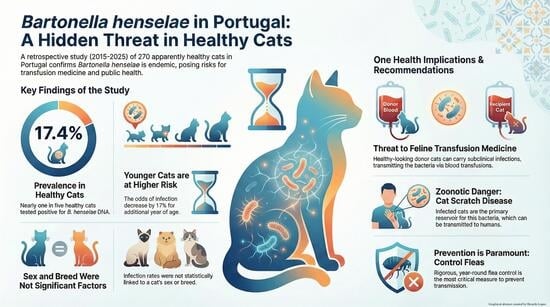
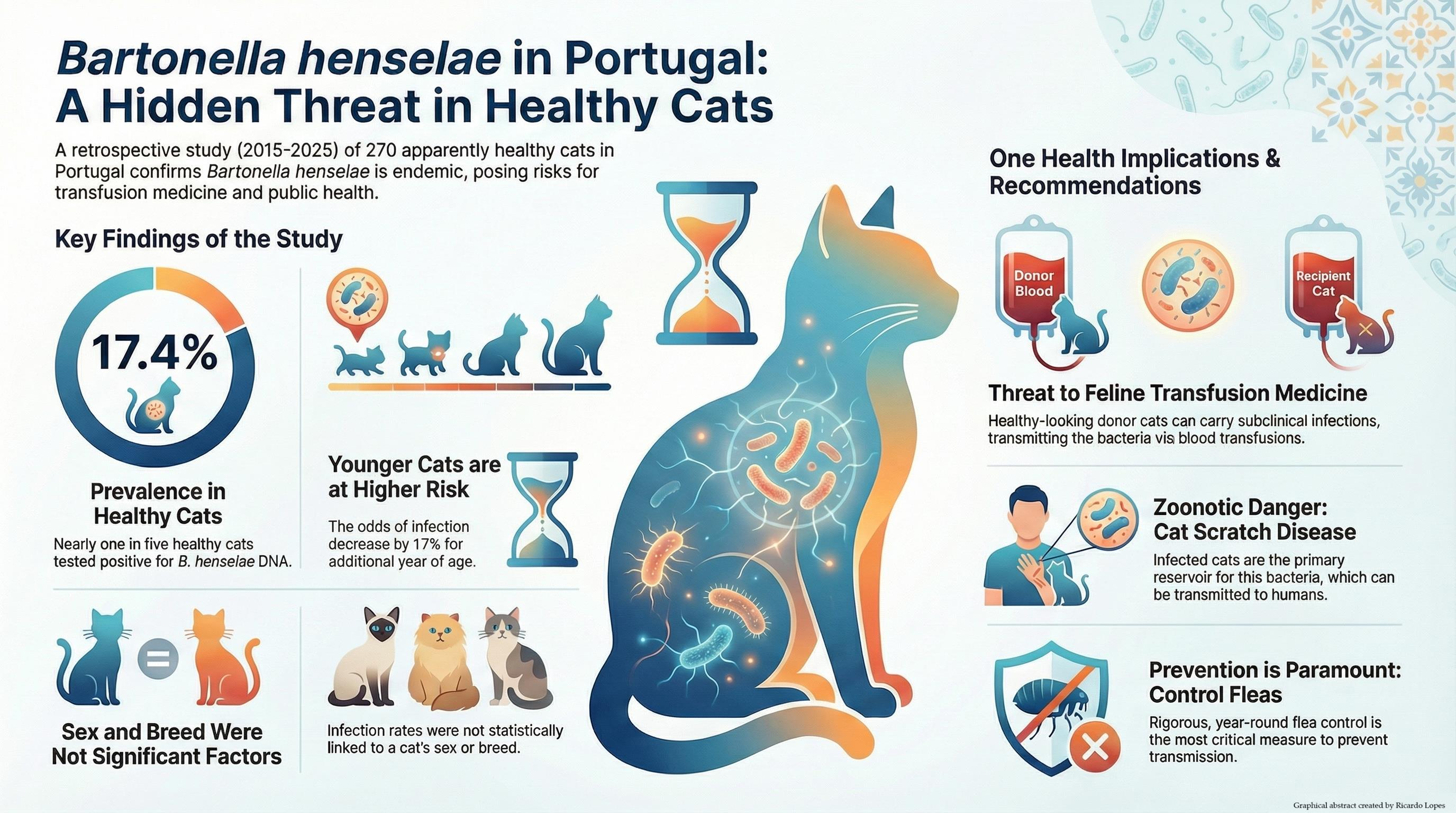
Graphical Abstract

1. Introduction

The genus Bartonella comprises fastidious, Gram-negative, facultative intracellular alphaproteobacteria with a distinctive haemotropic tropism, colonising mammalian erythrocytes and endothelial cells, and most commonly transmitted by arthropod vectors [1,2,3,4,5,6,7,8,9,10,11,12,13,14,15,16,17,18]. These organisms have a worldwide distribution and are considered important emerging zoonotic agents in both veterinary and human medicine, with more than 45 species now recognised with additional taxa continuing to be described [2,3,19,20,21,22,23,24,25,26]. Among these, Bartonella henselae and related species such as B. clarridgeiae are recognised as the most important from both a veterinary and public health perspective, serving as the primary aetiological agent of cat-scratch disease (CSD) in humans [12,17,20,27,28,29]. Domestic and stray cats (Felis catus) represent the principal natural reservoir for B. henselae, typically maintaining a persistent and subclinical bacteraemia that facilitates the pathogen’s dispersal [1,30]. Beyond bloodstream infection, Bartonella spp. DNA has been detected in feline reproductive/placental tissues, but transplacental transmission remains unproven [31].
The transmission of B. henselae within feline populations is primarily mediated by the cat flea Ctenocephalides felis through the inoculation of infected flea faeces into the skin via scratches or bites [1,32,33]. Epidemiologically, B. henselae shows marked geographic heterogeneity, with higher prevalence of feline infection reported in climatic settings that favour year-round flea survival and sustained vector pressure [21,22,23]. In North America, this pattern is reflected by substantially higher cat seroprevalence in warm, humid regions (approx. 34–55%) compared with cold and/or arid areas (approx. 4–7%) [34]. Consistently, global meta-analytic evidence indicates increased feline Bartonella spp. prevalence within warmer latitudinal belts [35]. Across studies, the overall molecular prevalence of Bartonella spp. in cats is estimated at ~15%, with B. henselae predominating (13.1%) and comparatively lower detection of B. clarridgeiae (1.7%) and B. koehlerae (0.1%) [35]. In Western Europe, pooled prevalence is ~19% [35], whereas Portuguese studies report variable PCR positivity, ranging from 2.9% in Southern Portugal with B. henselae and B. clarridgeiae confirmed [30] at 20.3% in stray cats in Lisbon, as determined by quantitative PCR [1].
In humans, CSD and related clinical syndromes have been documented in all populated continents and reported seroprevalence ranges from <1% to >40%, largely reflecting differences in exposure intensity (e.g., frequency of cat contact), occupational risk, and rural–urban context [22,23,36,37,38,39,40,41]. Although B. henselae is widely distributed in domestic cats, confirmed human cases in Portugal appear infrequent and likely under-recognised. Most molecular and serological investigations have been negative, including a 2022 study [1] at the Institute of Hygiene and Tropical Medicine (IHMT) that detected no Bartonella spp. DNA in 30 healthy, cat-exposed individuals, while data from the National Institute of Health (INSA) reports a 17% seroprevalence among 189 suspected human cases [42]. The absence of systematic surveillance and the fact that CSD is not a notifiable disease contribute to substantial under-recognition of its true incidence and public health impact [1,42,43].
Risk factors identified for feline Bartonella spp. infection in Portugal are consistent with those reported internationally, with infection being associated with younger age (particularly <2 years), outdoor access or free-roaming behaviour, flea infestation, and the absence of effective ectoparasite control [30,44,45,46,47]. In the survey in Southern Portugal [30], PCR positivity was concentrated in strays or outdoor-access cats without regular flea prevention, supporting the importance of vector exposure. Higher-density environments such as colonies, shelters, and multi-cat households also appear to increase risk, likely by facilitating flea exchange and inter-cat transmission [30,44,45,47]. In contrast, associations with sex or breed have not been consistently demonstrated across studies [44,45,46,48,49,50].
The diagnosis of Bartonella spp. infection is influenced by assay-dependent limitations that can bias epidemiological inference. In cats, infection is frequently occult and characterised by chronic, relapsing, intermittent bacteraemia with low-grade and fluctuating bacterial loads, contributing to frequent culture-negative results and reduced serological specificity due to cross-reactivity [27,51,52]. Blood PCR is, therefore, most informative during periods of active bacteraemia, but its sensitivity is suboptimal in low-burden or intermittent infection and may be further compromised by prior antimicrobial exposure and pre-analytical variables [44,47,53]. Although culture remains the diagnostic gold standard, it is technically demanding and often requires prolonged incubation, which limits routine implementation [29,54,55,56,57]. Serology is more frequently positive than PCR, consistent with previous exposure and/or latent infections, but it does not confirm active infection [27,51,52,58]. Modern methodologies (e.g., nuoG qPCR, enrichment culture such as Bartonella Alpha-Proteobacteria Growth Medium (BAPGM), and multilocus sequencing) substantially enhance detection, but are not widely available [1,35,51,59,60,61,62]. Consequently, the true prevalence in Portuguese cats and humans is likely underestimated. A multimodal strategy integrating serology and PCR, with culture when feasible, is therefore recommended, and culture pre-enrichment followed by PCR may improve sensitivity in low-level or intermittent bacteraemia [44,46,47,53].
From a One Health standpoint, Portugal seems to resemble other Southern European regions in which B. henselae circulates in feline populations, overt disease in cats is uncommon, and human CSD and endovascular infection remain sporadic. Nonetheless, the potential for severe morbidity, particularly in immunocompromised individuals, and evidence of heightened exposure among veterinarians and cat rescue workers in other regions support proportionate preventive measures, including rigorous flea control in cats, education to minimise bites and scratches, and targeted diagnostic evaluation in compatible human presentations [1,20,27,35,52,63,64,65,66].
This study aimed to characterise the molecular epidemiology of B. henselae infection in apparently healthy cats in Portugal, using a retrospective qPCR dataset (2015–2025), estimating the prevalence of qPCR-positive submissions, describing spatiotemporal patterns of positivity with a focus on geographical heterogeneity at the Nomenclature of Territorial Units for Statistics [NUTS] level 2 region, and assessing associations between PCR status and host variables (age, sex and breed), while contextualising the findings within a One Health framework, with attention given to implications for zoonotic risk awareness and evidence-informed transfusion medicine strategies, including donor-cat screening and effective ectoparasite control.

2. Materials and Methods

2.1. Sampling, Data Collection and Diagnostic Procedures

Peripheral EDTA-anticoagulated whole-blood samples from apparently healthy cats submitted for routine preventive screening were submitted to CEDIVET Veterinary Laboratories (Portugal) by 74 veterinary medical centres, including first-opinion practices and referral hospitals, across mainland Portugal and the autonomous regions. For each submission, a standard laboratory requisition provided anonymised signalment data, namely age, sex and breed. Cases were included if breed and sex were recorded. Age data were missing in 25.9% of submissions. These cases were retained for overall prevalence estimation but excluded from age-specific analyses. Age was categorised a priori into five groups: kitten (<1 year), young (1 to <2 years), adult (2 to <6 years), senior (6 to <11 years) and geriatric (≥11 years) [67,68,69,70,71,72].

2.2. Molecular Analysis

For each sample, a single genomic DNA extraction was performed from 200 µL of EDTA-stabilised sample using the Promega AX9760 protocol (Promega CorporationTM, Madison, WI, USA) for whole blood. The process was automated using the KingFisherTM Flex Purification System (Thermo Fisher ScientificTM, Waltham, MA, USA), with all reagents handled at room temperature (15–30 °C) and according to the manufacturer’s specified conditions.
The extraction workflow was conducted according to the manufacturer’s instructions. An internal extraction control (IEC) was added to each sample to monitor the efficiency and integrity of the process.
Extracted DNA was not quantified prior to real-time PCR, and no inter-sample normalisation (e.g., to total DNA mass or a host reference gene) was performed, because the study was designed to determine PCR positivity rather than to infer bacterial load. Instead, a fixed input of 5 µL of extracted DNA was used per reaction for all samples, thereby standardising the reaction template volume while the IEC monitored extraction performance.
Subsequent molecular detection of B. henselae DNA was performed using the NZYtech Bartonella henselae qPCR Kit® (NZYtechTM, Lisbon, Portugal). Real-time PCR detection of B. henselae DNA was performed using the NZYtech B. henselae qPCR Kit, a TaqMan® assay with B. henselae-specific primers targeting the gltA gene [73]. The manufacturer reports >95% homology across a broad range of B. henselae genomes and no detection of other closely related species. Under optimal conditions, the kit shows priming efficiency of >95% and a reported detection limit of at least 10 target copies per reaction.
Real-time qPCR was chosen due to its recognised status as a highly specific reference method for detecting B. henselae DNA [18,74,75,76,77,78], providing robust analytical performance in routine molecular screening.
PCR reactions were assembled with 15 µL of master mix and 5 µL of extracted DNA per well, including positive and negative controls. Reactions were loaded into a 96-well plate, sealed with optical adhesive film, centrifuged briefly to eliminate air bubbles, and processed on a QuantStudioTM 5 Real-Time PCR System (Thermo Fisher ScientificTM, Waltham, MA, USA) following the thermal cycling conditions suggested in the manufacturer’s protocol (Table 1).
Each qPCR run incorporated a positive control (the kit-supplied B. henselae DNA standard of known concentration) and a non-template negative control (NTC; nuclease-free water) to verify assay performance.
Fluorescence was monitored in real time through a fluorogenic probe system comprising a 5′ reporter dye and 3′ quencher. During the extension phase, probe cleavage by Taq polymerase resulted in increased fluorescence, directly proportional to the amount of amplified target.
For the final validation of the results, the following criteria had to be met:
  • Amplification of the internal extraction control;
  • No amplification of the negative control;
  • Amplification of the positive control.
Only results meeting these criteria were validated as negative (no amplification of the target), positive (true amplification of the target, indicated by a sigmoidal curve), or invalid (if there was no amplification of the target and no amplification of the internal extraction control, and therefore excluded from the study).
Data interpretation and analysis were performed using the Design & Analysis 2 (DA2) software, version 2.8 (Thermo Fisher ScientificTM, Waltham, MA, USA), in accordance with the manufacturer’s recommendations. The software was employed to extract both qualitative and quantitative parameters, including Ct values and amplification curve profiles, based on predefined analytical settings provided by the manufacturer. Ct values were used solely for qualitative confirmation of valid target amplification, and no quantitative interpretation or statistical comparison of Ct values was performed.

2.3. Confirmatory Nested PCR and Sanger Sequencing

To confirm the real-time PCR findings, five randomly selected blood specimens (three qPCR-positive and two qPCR-negative) were submitted to the reference Centre for the Study of Vectors and Infectious Diseases, Dr. Francisco Cambournac (CEVDI), Águas de Moura, Portugal. Genomic DNA was re-extracted from 200 µL of EDTA-anticoagulated whole blood using MagCore® Automated Extraction Kits (RBC Bioscience Corp., New Taipei City, Taiwan), according to the manufacturer’s instructions. Samples were then analysed by conventional nested PCR targeting a partial fragment of the ribC gene (riboflavin synthase), as previously described [79]. Amplicons from positive specimens were purified with ExoSAP-IT® (Affymetrix, Santa Clara, CA, USA) following the manufacturer’s protocol and sequenced bidirectionally by the Sanger method. Chromatograms were manually inspected, and sequences were aligned and trimmed using the BioEdit Sequence Alignment Editor v7.7.1.0 (Tom Hall, Ibis Biosciences, Carlsbad, CA, USA). Final sequences were compared with reference sequences available at GenBank (NCBI) using BLASTn (https://blast.ncbi.nlm.nih.gov/Blast.cgi, accessed on 29 December 2025).

2.4. Statistical Analysis

Data were extracted from Sislab® (Glintt, Global Intelligent Technologies, Lisbon, Portugal) and organised in Microsoft Excel® (Microsoft, Redmond, WA, USA). Data integrity and completeness were verified prior to analysis. All statistical procedures were conducted using JMP® v18.0.0 (SAS Institute, Cary, NC, USA) and DATAtab® (numiqo e.U., Graz, Austria, 2025).
Descriptive statistics were computed for all variables. Data normality was assessed with the Shapiro–Wilk test, and non-parametric methods were applied as assumptions of normality were not met (p < 0.05).
Associations with categorical variables (NUTS 2 region, sex and breed) and PCR result (negative/positive) were evaluated using Fisher’s exact test when more than 20% of expected cell frequencies were below five; otherwise, Pearson’s chi-squared test was applied. Pearson’s contingency coefficient (C) was calculated to quantify the effect size. For continuous variables, such as age (years), differences between PCR-positive and PCR-negative cats were assessed using the Mann–Whitney U test.
Univariable logistic regression analyses were then performed to estimate odds ratios (OR) and 95% confidence intervals (CI) for potential predictors of B. henselae DNA positivity. Variables with p < 0.10 were subsequently entered into a multivariable logistic regression model. A p-value ≤ 0.05 was considered statistically significant [80,81].

3. Results

3.1. General Positivity and Geographical Location

Of the total of 270 cats tested in this study, 47 (17.4%; 95% CI: 13.1–22.5%) were positive for B. henselae, while the remaining 223 (82.6%; 95% CI: 77.5–86.9%) yielded negative results. Three positive samples independently processed at CEVDI confirmed the identification of B. henselae by sequence analysis. All sequences were identical, and BLAST results showed 100% nucleotide identity (223/223 bp) with B. henselae strain Houston-I (GenBank accession number: CP020742.1).
Geographical location (NUTS 2) was available for all 270 cats. Most submissions originated from the North (n = 242, 89.6%), followed by the Centre (n = 18, 6.7%) regions. Smaller contributions were recorded for the Autonomous Region of Madeira (n = 3, 1.1%), the Autonomous Region of the Azores (n = 3, 1.1%), the Algarve (n = 2, 0.7%), Lisbon (n = 1, 0.4%) and Setúbal Peninsula (n = 1, 0.4%). No data were available for any other geographical regions.
PCR positivity was confined to three NUTS 2 regions, namely the North (n = 42), the Centre (n = 3) and the Autonomous Region of the Azores (n = 2). No PCR-positive cats were identified in any other regions. Despite this distribution, there was no statistically significant association between the NUTS 2 region and B. henselae DNA positivity (Fisher’s exact test, p = 0.478). To improve interpretability, regions with fewer than five observations were subsequently grouped into three categories: North, Centre, and Other regions. Yet the association remained non-significant (Fisher’s exact test, p = 0.921). Regional comparisons were limited by sampling imbalance, with most submissions originating from the North. Consequently, the absence of positives in some regions is more plausibly attributable to small sample sizes than to true absence of infection.

3.2. Age

From the 270 cats analysed for B. henselae DNA, age data were available for 200 individuals; for the remaining 70 cats (25.9%), age was not specified in the requisition file, and these were therefore excluded from age-related analyses. Age distribution among these 200 cats ranged from 0.3 years (≤1 year) to 15 years (≥11 years), with a median age of 3 years (interquartile range [IQR] 1–5 years). PCR-positive cats were significantly younger than PCR-negative cats (median age 2 years [IQR 1–5] vs. 3 years [IQR 1–6]; Mann–Whitney U = 2241.5, Z = −2.08, p = 0.037). Table 2 displays B. henselae DNA positivity according to age group.

3.3. Sex

Of the 270 cats analysed, 144 (53.3%) were females and 126 (46.7%) were males. Among females, 20 (13.9%, 95% CI 9.2–20.5) tested positive, whereas 27 (21.4%, 95% CI 15.2–29.4) of the males were positive. Although infection was more frequent in males, the difference between sexes was not statistically significant (χ2 = 2.69, df = 1, p = 0.103; C = 0.14).

3.4. Breed

European Shorthair cats predominated in the cohort (n = 254, 94.1%, 95% CI 90.6–96.3), followed by Persian (n = 6, 2.2%), Scottish Fold (n = 3, 1.1%), Siamese (n = 2, 0.7%), Scottish Straight (n = 2, 0.7%), Sphynx (n = 2, 0.7%) and Maine Coon (n = 1, 0.4%). All PCR-positive cats were European Shorthair (n = 47, 17.4%, 95% CI 13.4–22.4), with no positive results recorded in any of the remaining breeds. Although PCR positivity was observed exclusively in European Shorthair cats, no statistically significant association was found between breed and B. henselae DNA positivity (Fisher’s exact test, p = 0.730). After grouping breeds with sparse counts into broader categories, the result remained non-significant (p > 0.05).

3.5. Univariable and Multivariable Logistic Regression

Univariable logistic regression identified age as the only variable significantly associated with B. henselae DNA positivity. Each additional year of age decreased the odds of infection by approximately 17% (OR = 0.83, 95% CI 0.70–0.98, p = 0.0125). Sex (p = 0.105) and NUTS 2 region (p = 0.947) were not significant predictors.
The multivariable logistic regression model was not performed as age was the only predictor of B. henselae infection. Table 3 displays univariable logistic regression for predictors of B. henselae infection.

4. Discussion

In this study, B. henselae DNA was detected in 17.4% of tested cats, which is broadly consistent with the epidemiological range reported in similar climates [1,35,36,37,48,52,82,83,84]. Previous surveys in Portugal revealed marked variability: a large southern study reported only 2.9% PCR-positive cats [30], whereas an urban Lisbon survey of stray cats reported about 20% positivity [1]. Our finding falls between these extremes and closely aligns with the pooled Western European prevalence (~19%) and the global average (~15%) [35], suggesting that B. henselae circulates in Portuguese cats at levels comparable to other temperate European contexts. Importantly, even within Europe, B. henselae prevalence can vary widely—from as low as 2.9% in some areas of Portugal up to ~40% in certain Polish studies—a circumstance that underscores the influence of local ecology, host population and sampling factors [40,41,63].
Any apparent geographical clustering in our dataset should be interpreted cautiously. Submissions were highly unbalanced across NUTS 2 regions (North: 242/270, 89.6%), and PCR positivity being confined to the North, Centre and Autonomous Region of the Azores occurred despite no statistically significant association with region (p = 0.478; after grouping into three categories—North, Centre and Other regions—p = 0.921), which strongly suggests limited power to detect true spatial differences rather than genuine absence elsewhere. Warmer and humid climates generally favour year-round flea survival and higher cat infection prevalences [34,85,86,87,88,89]. In Portugal, the overall mild climate may permit sustained flea activity nationwide. Therefore, any apparent geographical heterogeneity in feline B. henselae is more plausibly explained by local vector pressure than by a simple “indoor vs. outdoor” dichotomy. Humid coastal microclimates can support persistent flea populations, and high urban cat density (multi-cat households and nearby colonies) may facilitate flea exchange. Differences in owner practices and access to veterinary care may further translate into variable consistency of ectoparasiticide use. Collectively, these factors provide a coherent explanation for higher urban prevalences (e.g., Lisbon city) even among predominantly owned, indoor cats, while lower observed PCR-positivity may occur in less densely populated settings where flea exposure is reduced and prevention is applied more consistently [35,40,44,89,90,91,92,93].
This spatial heterogeneity is clinically relevant for feline blood banks. Bartonella spp. infection is frequently subclinical and can be associated with prolonged bacteraemia, meaning apparently healthy donor cats, particularly from urban/coastal areas with higher flea pressure, may still harbour transfusion-transmissible infection. Donor programmes should accordingly prioritise strict year-round ectoparasite control and include Bartonella spp. PCR within routine screening panels, as serology alone cannot reliably exclude occult infection [13,27,40,94,95,96].
In terms of risk factors, our findings are consistent with international reports, with younger age being associated with PCR positivity. Each additional year of age reduced infection odds by approximately 17%, consistent with reports identifying juvenile cats (<2 years) as a key risk group, likely reflecting greater flea exposure and outdoor activity [30,44,45,46,47]. No associations were observed for sex, although infection was slightly more frequent in males (21% vs. 14%); this difference was not statistically significant, consistent with the lack of a reproducible sex predisposition across most studies [44,45,46,48,49,50]. Likewise, all infected cats in our study were European Shorthair, the predominant breed in the present sample, and no breed effect was evident, in agreement with the literature indicating no consistent breed association [40,48,90]. Taken together, these findings support the prevailing view that Bartonella spp. infection risk in cats is primarily driven by environmental exposure (flea infestation, outdoor access, and dense cat populations) rather than intrinsic host characteristics [35,40,44,64,90,91,92,93,94].

4.1. Public Health and One Health Implications

From a One Health perspective, the detection of B. henselae in apparently healthy cats has implications for both veterinary and human health. Infected cats usually remain carriers, and clinical illness in cats (e.g., endocarditis) is rare in Portugal, as in other Southern European settings [44]. However, cats serve as the reservoir for this zoonosis, and bacteraemic cats can transmit the organism to people through flea dirt that contaminates scratches or bites [27,92,97,98]. CSD in humans is generally an innocuous, self-limiting infection causing regional lymphadenopathy and fever, but it can have atypical manifestations and lead to serious complications (such as neurobartonellosis, bacillary angiomatosis or endocarditis), especially in immunocompromised individuals [27,42,96,97,98,99,100,101,102,103,104,105,106]. Indeed, the potential for severe outcomes—albeit infrequent—means that the public health risk cannot be ignored. Portugal has only sporadic official reports of human CSD and related syndromes, like other countries where feline Bartonella spp. are endemic [1,42,43]. This situation likely reflects the fact that while many cats harbour B. henselae, transmission to humans requires specific circumstances (e.g., a scratch from a flea-infested cat) and most infections in healthy people are resolved without diagnosis. Veterinary and public health professionals should collaborate to mitigate the risk of Bartonella spp. spread. Rigorous flea control in cats is paramount, as cat fleas (C. felis) are the principal vectors maintaining the bacterium in cat populations and indirectly transmitting it to humans. Nonetheless, our findings reinforce the need for vigilance and preventive measures to reduce zoonotic transmission.

4.2. Methodological Limitations and Diagnostic Considerations

In the present study, prevalence should be interpreted conservatively. We used a single EDTA-blood, species-specific (B. henselae) qPCR, which, despite high analytical specificity, has limited sensitivity for Bartonella spp. because feline infection is often occult and characterised by intermittent, low-grade bacteraemia. Infected cats may test PCR-negative at a given time point, particularly after recent antimicrobial exposure. In addition, a B. henselae-only assay will miss other feline Bartonella spp., such as B. clarridgeiae, which likely leads to underestimation of the overall Bartonella spp. burden. We did not perform culture or enrichment culture, so we could not confirm viable infection or undertake strain typing. We also did not include serology, which may capture prior exposure but cannot distinguish active bacteraemia. These constraints collectively favour under-ascertainment. Importantly, a negative blood PCR does not exclude infection at the individual level.
The study population consisted of apparently healthy cats tested as part of preventive vector-borne disease screening, which may still limit the representativeness of the broader feline population. Submissions were geographically skewed towards Northern Portugal, which reduced the ability to compare regions. Key exposure variables such as flea infestation, ectoparasite prevention, and outdoor access were not recorded.

4.3. Future Directions

Future work should adopt regionally representative sampling across owned, shelter, and free-roaming cats, with standardised recording of key exposure variables (e.g., flea infestation status, ectoparasite prevention practices, outdoor access, and household density). Methodological refinement should prioritise broader molecular assays (genus-level and/or multiplex), ideally complemented by enrichment culture to improve detection and enable isolate recovery. In parallel, focused evaluation of feline reproductive tissues may help assess the plausibility of transplacental exposure and clarify potential reproductive implications. Finally, One Health integration would be strengthened through dedicated surveys in high-risk human groups and further optimisation of feline blood bank protocols, including routine PCR screening for Bartonella spp. in donors and strict year-round ectoparasite control.

5. Conclusions

The present study provides molecular evidence that B. henselae is endemic in Portuguese cats, with a 17.4% prevalence consistent with reports from other temperate, flea-permissive European regions. Despite the North-biased, laboratory-submitted sampling frame and the use of a single-timepoint B. henselae-specific qPCR on EDTA blood, true prevalence was probably underestimated due to intermittent bacteraemia and undetected non-B. henselae species. Even so, these findings indicate sustained, subclinical circulation within the feline population. Younger age was the only independent predictor of infection, supporting an exposure-driven model in which infection risk is primarily shaped by flea pressure and preventive management rather than region, sex, breed, or intrinsic host factors.
Clinically, the identification of B. henselae DNA in clinically healthy cats has direct relevance for feline blood banks and transfusion medicine, as apparently healthy donors may remain bacteraemic for prolonged periods. Blood bank protocols should, therefore, prioritise strict year-round flea control and include PCR for Bartonella spp. in donor routine screenings, recognising that serology alone cannot reliably exclude occult infection. Future work should expand regionally balanced sampling across owned, shelter and stray cats, adopt broader molecular targets for multiple feline Bartonella spp., and link infection status to quantified vector exposure and management practices to refine risk estimates and strengthen One Health prevention at the cat–flea–human interface.

Author Contributions

Conceptualization, R.L.; methodology, R.L., A.R.S. and R.d.S.; software, R.L. and R.d.S.; validation, R.L., H.L.d.C., F.S., C.F., C.C.S., C.S., A.R.S., R.d.S., H.S., A.P.L., E.L.D., L.C. and A.C.C.; formal analysis, R.L. and C.C.S.; investigation, R.L.; resources, R.L., H.L.d.C., F.S., A.R.S., R.d.S. and H.S.; data curation, R.L. and C.C.S.; writing—original draft preparation, R.L.; writing—review and editing, R.L., H.L.d.C., F.S., C.F., C.C.S., C.S., A.R.S., R.d.S., H.S., A.P.L., E.L.D., L.C. and A.C.C.; visualisation, R.L. and L.C.; supervision, R.L. and L.C.; project administration, R.L. and L.C.; funding acquisition, R.L., H.L.d.C., C.S., A.R.S., R.d.S. and L.C. All authors have read and agreed to the published version of the manuscript.

Funding

This research received no external funding.

Institutional Review Board Statement

All procedures complied with the Portuguese legislation for the protection of animals used for scientific purposes (i.e., Decree-Law no. 113/2013 of 7 August 2013), which transposes European legislation (i.e., Directive 2010/63/EU of the European Parlia-ment and of the Council, of 22 September 2010). This study project was approved by the Institu-tional Review Board of CEDIVET Veterinary Laboratories under protocol code CEDIVET.005/2023 (registration number CEDIVET/2023/05) on 29 December 2025, which ensures that the analysed samples of veterinary medical centres can be used anonymously in studies and scientific research works related with this project.

Informed Consent Statement

Not applicable.

Data Availability Statement

The data presented in this study are available upon request from the corresponding authors.

Acknowledgments

The authors extend their sincere gratitude to CEDIVET Veterinary Laboratories (Porto, Portugal) for providing access to anonymised laboratory results that enabled the research conducted in this study. The authors also wish to thank NZYtech™ (Lisbon, Portugal) for their valuable technical support throughout this work. In addition, the authors gratefully acknowledge the National Institute of Health Dr. Ricardo Jorge (INSA) for institutional support and for fostering the scientific and public health context underpinning this research.

Conflicts of Interest

Authors R.L., H.L.d.C., and F.S. are employed by CEDIVET Veterinary Laboratories. Author H.S. is employed by Unilabs Portugal. Author C.F. is employed by AniCura Santa Marinha Veterinary Hospital. Authors C.S. and A.R.S. are employed by SYNLAB Portugal. The remaining authors declare that the research was conducted in the absence of any commercial or financial relationships that could be construed as potential conflicts of interest.

Abbreviations

The following abbreviations are used in this manuscript:
BAPGMBartonella alpha-proteobacteria growth medium
CEVDICentre for the Study of Vectors and Infectious Diseases Dr. Francisco Cambournac
CIconfidence interval
CSDcat-scratch disease
Ctcycle threshold
DA2Design and Analysis 2 (software)
DNAdeoxyribonucleic acid
EDTAethylenediaminetetraacetic acid
IECinternal extraction control
IHMTInstitute of Hygiene and Tropical Medicine
INSANational Institute of Health
IQRinterquartile range
NTCnon-template control
NUTS 2Nomenclature of Territorial Units for Statistics, level 2
PCRpolymerase chain reaction
qPCRquantitative PCR

References

  1. Torrejón, E.; Sanches, G.S.; Moerbeck, L.; Santos, L.; André, M.R.; Domingos, A.; Antunes, S. Molecular survey of Bartonella species in stray cats and dogs, humans, and questing ticks from Portugal. Pathogens 2022, 11, 749. [Google Scholar] [CrossRef] [PubMed]
  2. Jin, X.; Gou, Y.; Xin, Y.; Li, J.; Sun, J.; Li, T.; Feng, J. Advancements in understanding the molecular and immune mechanisms of Bartonella pathogenicity. Front. Microbiol. 2023, 14, 1196700. [Google Scholar] [CrossRef] [PubMed]
  3. do Amaral, R.B.; Cardozo, M.V.; Varani, A.d.M.; Furquim, M.E.C.; Dias, C.M.; Assis, W.O.d.; da Silva, A.R.; Herrera, H.M.; Machado, R.Z.; André, M.R. First report of Bartonella spp. in marsupials from Brazil, with a description of Bartonella harrusi sp. nov. and a new proposal for the taxonomic reclassification of species of the genus Bartonella. Microorganisms 2022, 10, 1609. [Google Scholar] [CrossRef] [PubMed]
  4. Fontalvo, M.C.; Favacho, A.R.d.M.; Araujo, A.d.C.; Santos, N.M.D.; Oliveira, G.M.B.d.; Aguiar, D.M.; Lemos, E.R.S.d.; Horta, M.C. Bartonella species pathogenic for humans infect pets, free-ranging wild mammals and their ectoparasites in the caatinga biome, northeastern Brazil: A serological and molecular study. Braz. J. Infect. Dis. 2017, 21, 290–296. [Google Scholar] [CrossRef]
  5. Crissiuma, A.; Favacho, A.; Gershony, L.; Mendes-de-Almeida, F.; Gomes, R.; Mares-Guia, A.; Rozental, T.; Barreira, J.; Lemos, E.; Labarthe, N. Prevalence of Bartonella species DNA and antibodies in cats (Felis catus) submitted to a spay/neuter program in Rio de Janeiro, Brazil. J. Feline Med. Surg. 2011, 13, 149–151. [Google Scholar] [CrossRef]
  6. Gutiérrez, R.; Nachum-Biala, Y.; Harrus, S. Relationship between the presence of Bartonella species and bacterial loads in cats and cat fleas (Ctenocephalides felis) under natural conditions. Appl. Environ. Microbiol. 2015, 81, 5613–5621. [Google Scholar] [CrossRef]
  7. Dias, C.M.; do Amaral, R.B.; Perles, L.; Muniz, A.L.D.S.; Rocha, T.F.G.; Machado, R.Z.; André, M.R. Multi-locus sequencing typing of Bartonella henselae isolates reveals coinfection with different variants in domestic cats from midwestern Brazil. Acta Trop. 2023, 237, 106742. [Google Scholar] [CrossRef]
  8. Alves, A.S.; Milhano, N.; Santos-Silva, M.; Santos, A.S.; Vilhena, M.; de Sousa, R. Evidence of Bartonella spp., Rickettsia spp. and Anaplasma phagocytophilum in domestic, shelter and stray cat blood and fleas, Portugal. Clin. Microbiol. Infect. 2009, 15, 1–3. [Google Scholar] [CrossRef]
  9. Braga, M.d.S.C.d.O.; Diniz, P.P.V.d.P.; André, M.R.; Bortoli, C.P.d.; Machado, R.Z. Molecular characterisation of Bartonella species in cats from São Luís, state of Maranhão, north-eastern Brazil. Mem. Inst. Oswaldo Cruz 2012, 107, 772–777. [Google Scholar] [CrossRef]
  10. Fernández-Arias, C.; Borrás-Máñez, M.; Colomina-Rodríguez, J.; Cuenca-Torres, M.; Guerrero-Espejo, A. Incidence of Bartonella henselae infection during the period 2009-2012 in the Valencian community, Spain. Rev. Esp. Salud Publica 2015, 89, 227–230. [Google Scholar] [CrossRef]
  11. Okaro, U.; George, S.; Anderson, B. What is in a cat scratch? Growth of Bartonella henselae in a biofilm. Microorganisms 2021, 9, 835. [Google Scholar] [CrossRef]
  12. Florin, T.A.; Zaoutis, T.E.; Zaoutis, L.B. Beyond cat scratch disease: Widening spectrum of Bartonella henselae infection. Pediatrics 2008, 121, e1413–e1425. [Google Scholar] [CrossRef] [PubMed]
  13. Silva, B.T.G.d.; Souza, A.M.d.; Campos, S.D.E.; Macieira, D.d.B.; Lemos, E.R.S.d.; Favacho, A.R.d.M.; Almosny, N.R.P. Bartonella henselae and Bartonella clarridgeiae infection, hematological changes and associated factors in domestic cats and dogs from an atlantic rain forest area, Brazil. Acta Trop. 2019, 193, 163–168. [Google Scholar] [CrossRef] [PubMed]
  14. Kordick, D.L.; Breitschwerdt, E.B. Intraerythrocytic presence of Bartonella henselae. J. Clin. Microbiol. 1995, 33, 1655–1656. [Google Scholar] [CrossRef] [PubMed]
  15. Kordick, D.L.; Brown, T.T.; Shin, K.; Breitschwerdt, E.B. Clinical and pathologic evaluation of chronic Bartonella henselae or Bartonella clarridgeiae infection in cats. J. Clin. Microbiol. 1999, 37, 1536–1547. [Google Scholar] [CrossRef]
  16. Drigotaitė, P.; Razgūnaitė, M.; Radzijevskaja, J.; Paulauskas, A. Bartonella spp. in cats. Biologija 2021, 67, 134–142. [Google Scholar] [CrossRef]
  17. Heller, R.; Artois, M.; Xemar, V.; De Briel, D.; Gehin, H.; Jaulhac, B.; Monteil, H.; Piemont, Y. Prevalence of Bartonella henselae and Bartonella clarridgeiae in stray cats. J. Clin. Microbiol. 1997, 35, 1327–1331. [Google Scholar] [CrossRef]
  18. Calchi, A.C.; Mongruel, A.C.B.; Cavalcanti, F.B.P.; Bartone, L.; Duarte, J.M.B.; Medici, E.P.; Kluyber, D.; Caiaffa, M.G.; Alves, M.H.; Desbiez, A.L.J.; et al. Using digital PCR to unravel the occurrence of piroplasmids, Bartonella spp., and Borrelia spp. in wild animals from Brazil. Pathogens 2025, 14, 567. [Google Scholar] [CrossRef]
  19. Okaro, U.; Addisu, A.; Casanas, B.; Anderson, B. Bartonella species, an emerging cause of blood-culture-negative endocarditis. Clin. Microbiol. Rev. 2017, 30, 709–746. [Google Scholar] [CrossRef]
  20. Chomel, B.B.; Kasten, R.W.; Henn, J.B.; Molia, S. Bartonella infection in domestic cats and wild felids. Ann. N. Y. Acad. Sci. 2006, 1078, 410–415. [Google Scholar] [CrossRef]
  21. Houpikian, P.; Raoult, D. Molecular phylogeny of the genus Bartonella: What is the current knowledge? FEMS Microbiol. Lett. 2001, 200, 1–7. [Google Scholar] [CrossRef]
  22. Petríková, K.; Halánová, M.; Babinská, I.; Logoida, M.; Kaliariková, K.; Jarčuška, P.; Dražilová, S.; Sobolová, V.; Janičko, M. Seroprevalence of Bartonella henselae and Bartonella quintana infection and impact of related risk factors in people from eastern Slovakia. Pathogens 2021, 10, 1261. [Google Scholar] [CrossRef]
  23. Tay, S.Y.; Freeman, K.; Baird, R. Clinical manifestations associated with Bartonella henselae infection in a tropical region. Am. J. Trop. Med. Hyg. 2021, 104, 198–206. [Google Scholar] [CrossRef] [PubMed]
  24. de Araujo, F.F.; Safko, J.; Bolton, J.; Jiang, L.; Cooper, E.; Jenkins, S.; Breitschwerdt, E.; Aronson, N.; Bergmann-Leitner, E. Development of a multiplex serological assay to detect immunoreactivity against a novel Bartonella species in military working dogs. Microbiol. Spectr. 2025, 13, e0071425. [Google Scholar] [CrossRef]
  25. Breitschwerdt, E.B.; Maggi, R.G.; Robveille, C.; Kingston, E. Bartonella henselae, Babesia odocoilei and Babesia divergens-like MO-1 infection in the brain of a child with seizures, mycotoxin exposure and suspected Rasmussen’s encephalitis. J. Cent. Nerv. Syst. Dis. 2025, 17, 11795735251322456. [Google Scholar] [CrossRef] [PubMed]
  26. Ernst, E.; Qurollo, B.; Olech, C.; Breitschwerdt, E.B. Bartonella rochalimae, a newly recognized pathogen in dogs. J. Vet. Intern. Med. 2020, 34, 1447–1453. [Google Scholar] [CrossRef] [PubMed]
  27. Pennisi, M.G.; Marsilio, F.; Hartmann, K.; Lloret, A.; Addie, D.; Belák, S.; Boucraut-Baralon, C.; Egberink, H.; Frymus, T.; Gruffydd-Jones, T.; et al. Bartonella species infection in cats: ABCD guidelines on prevention and management. J. Feline Med. Surg. 2013, 15, 563–569. [Google Scholar] [CrossRef]
  28. Gurfield, A.N.; Boulouis, H.J.; Chomel, B.B.; Heller, R.; Kasten, R.W.; Yamamoto, K.; Piemont, Y. Coinfection with Bartonella clarridgeiae and Bartonella henselae and with different Bartonella henselae strains in domestic cats. J. Clin. Microbiol. 1997, 35, 2120–2123. [Google Scholar] [CrossRef]
  29. Mito, T.; Hirota, Y.; Suzuki, S.; Noda, K.; Uehara, T.; Ohira, Y.; Ikusaka, M. Bartonella henselae infective endocarditis detected by a prolonged blood culture. Intern. Med. 2016, 55, 3065–3067. [Google Scholar] [CrossRef]
  30. Maia, C.; Ramos, C.; Coimbra, M.; Bastos, F.; Martins, A.; Pinto, P.; Nunes, M.; Vieira, M.L.; Cardoso, L.; Campino, L. Bacterial and protozoal agents of feline vector-borne diseases in domestic and stray cats from southern Portugal. Parasit. Vectors 2014, 7, 115. [Google Scholar] [CrossRef]
  31. Moore, C.O.; Maggi, R.; Ferris, K.; Breitschwerdt, E.B. Repeated detection of Bartonella DNA in feline placenta: Potential implications for placental and fetal development. Animals 2025, 15, 2041. [Google Scholar] [CrossRef] [PubMed]
  32. Bouhsira, E.; Franc, M.; Boulouis, H.-J.; Jacquiet, P.; Raymond-Letron, I.; Liénard, E. Assessment of persistence of Bartonella henselae in Ctenocephalides felis. Appl. Environ. Microbiol. 2013, 79, 7439–7444. [Google Scholar] [CrossRef] [PubMed]
  33. Moore, C.O.; André, M.R.; Šlapeta, J.; Breitschwerdt, E.B. Vector biology of the cat flea Ctenocephalides felis. Trends Parasitol. 2024, 40, 324–337. [Google Scholar] [CrossRef] [PubMed]
  34. Jameson, P.; Greene, C.; Regnery, R.; Dryden, M.; Marks, A.; Brown, J.; Cooper, J.; Glaus, B.; Greene, R. Prevalence of Bartonella henselae antibodies in pet cats throughout regions of North America. J. Infect. Dis. 1995, 172, 1145–1149. [Google Scholar] [CrossRef]
  35. Zarea, A.A.K.; Tempesta, M.; Odigie, A.E.; Mrenoshki, D.; Fanelli, A.; Martella, V.; Decaro, N.; Greco, G. The global molecular prevalence of Bartonella spp. in cats and dogs: A systematic review and meta-analysis. Transbound. Emerg. Dis. 2023, 2023, 7867562. [Google Scholar] [CrossRef]
  36. Tahmasebi Ashtiani, Z.; Ahmadinezhad, M.; Bagheri Amiri, F.; Esmaeili, S. Geographical distribution of Bartonella spp in the countries of the WHO eastern mediterranean region (WHO-EMRO). J. Infect. Public Health 2024, 17, 612–618. [Google Scholar] [CrossRef]
  37. Akkaya, Y.; Ergin, Ç. Investigation of Bartonella henselae seroprevalence in the northern countryside of Denizli province. Kafkas J. Med. Sci. 2023, 13, 11–17. [Google Scholar] [CrossRef]
  38. Tahmasebi Ashtiani, Z.; Bagheri Amiri, F.; Ahmadinezhad, M.; Mostafavi, E.; Esmaeili, S. Bartonellosis in world health organization eastern mediterranean region, a systematic review and meta-analysis. Eur. J. Public Health 2025, 35, i48–i54. [Google Scholar] [CrossRef]
  39. Villanueva-Saz, S.; Martínez, M.; Nijhof, A.M.; Gerst, B.; Gentil, M.; Müller, E.; Fernández, A.; González, A.; Yusuf, M.S.M.; Greco, G.; et al. Molecular survey on vector-borne pathogens in clinically healthy stray cats in Zaragoza (Spain). Parasit. Vectors 2023, 16, 428. [Google Scholar] [CrossRef]
  40. Mazurek, Ł.; Carbonero, A.; Skrzypczak, M.; Winiarczyk, S.; Adaszek, Ł. Epizootic situation of feline Bartonella infection in eastern Poland. J. Vet. Res. 2020, 64, 79–83. [Google Scholar] [CrossRef]
  41. Podsiadly, E.; Chmielewski, T.; Marczak, R.; Sochon, E.; Tylewska-Wierzbanowska, S. Bartonella henselae in the human environment in Poland. Scand. J. Infect. Dis. 2007, 39, 956–962. [Google Scholar] [CrossRef] [PubMed]
  42. Alves, M.J.; Luz, T.; Santos, A.S.; De Sousa, R.; Lopes de Carvalho, I.; Zé-Zé, L.; Amaro, F.; Parreira, P.; Núncio, M.S. Diagnóstico imunológico de doenças associadas a vectores existentes em Portugal. Bol. Epidemiol. Obs. 2013, 5, 29–30. [Google Scholar]
  43. Rodríguez Alonso, B.; Alonso-Sardón, M.; Rodrigues Almeida, H.M.; Romero-Alegria, Á.; Pardo-Lledias, J.; Velasco-Tirado, V.; López-Bernus, A.; Pérez Arellano, J.L.; Belhassen-García, M. Epidemiological of cat scratch disease among inpatients in the Spanish health system (1997–2015). Eur. J. Clin. Microbiol. Infect. Dis. 2021, 40, 849–857. [Google Scholar] [CrossRef] [PubMed]
  44. Álvarez-Fernández, A.; Breitschwerdt, E.B.; Solano-Gallego, L. Bartonella infections in cats and dogs including zoonotic aspects. Parasit. Vectors 2018, 11, 624. [Google Scholar] [CrossRef]
  45. Stützer, B.; Hartmann, K. Chronic bartonellosis in cats: What are the potential implications? J. Feline Med. Surg. 2012, 14, 612–621. [Google Scholar] [CrossRef]
  46. Iannino, F.; Salucci, S.; Di Provvido, A.; Paolini, A.; Ruggieri, E. Bartonella infections in humans dogs and cats. Vet. Ital. 2018, 54, 63–72. [Google Scholar] [CrossRef]
  47. Maggi, R.G.; Krämer, F. A Review on the occurrence of companion vector-borne diseases in pet animals in Latin America. Parasit. Vectors 2019, 12, 145. [Google Scholar] [CrossRef]
  48. Glaus, T.; Hofmann-Lehmann, R.; Greene, C.; Glaus, B.; Wolfensberger, C.; Lutz, H. Seroprevalence of Bartonella henselae infection and correlation with disease status in cats in Switzerland. J. Clin. Microbiol. 1997, 35, 2883–2885. [Google Scholar] [CrossRef]
  49. Grippi, F.; Galluzzo, P.; Guercio, A.; Blanda, V.; Santangelo, F.; Sciortino, S.; Vicari, D.; Arcuri, F.; Di Bella, S.; Torina, A. Serological and molecular evidence of Bartonella henselae in stray cats from southern Italy. Microorganisms 2021, 9, 979. [Google Scholar] [CrossRef]
  50. Haimerl, M.; Tenter, A.M.; Simon, K.; Rommel, M.; Hilger, J.; Autenrieth, I.B. Seroprevalence of Bartonella henselae in cats in Germany. J. Med. Microbiol. 1999, 48, 849–856. [Google Scholar] [CrossRef]
  51. Drummond, M.R.; Lania, B.G.; Diniz, P.P.V.d.P.; Gilioli, R.; Demolin, D.M.R.; Scorpio, D.G.; Breitschwerdt, E.B.; Velho, P.E.N.F. Improvement of Bartonella henselae DNA detection in cat blood samples by combining molecular and culture methods. J. Clin. Microbiol. 2018, 56, 1–8. [Google Scholar] [CrossRef]
  52. Oteo, J.A.; Maggi, R.; Portillo, A.; Bradley, J.; García-Álvarez, L.; San-Martín, M.; Roura, X.; Breitschwerdt, E. Prevalence of Bartonella spp. by culture, PCR and serology, in veterinary personnel from Spain. Parasit. Vectors 2017, 10, 553. [Google Scholar] [CrossRef]
  53. Breitschwerdt, E.B.; Maggi, R.G.; Chomel, B.B.; Lappin, M.R. Bartonellosis: An emerging infectious disease of zoonotic importance to animals and human beings. J. Vet. Emerg. Crit. Care 2010, 20, 8–30. [Google Scholar] [CrossRef] [PubMed]
  54. Diddi, K.; Chaudhry, R.; Sharma, N.; Dhawan, B. Strategy for identification & characterization of Bartonella henselae with conventional & molecular methods. Indian J. Med. Res. 2013, 137, 380–387. [Google Scholar] [PubMed]
  55. Chenoweth, M.R.; Somerville, G.A.; Krause, D.C.; O’Reilly, K.L.; Gherardini, F.C. Growth characteristics of Bartonella henselae in a novel liquid medium: Primary isolation, growth-phase-dependent phage induction, and metabolic studies. Appl. Environ. Microbiol. 2004, 70, 656–663. [Google Scholar] [CrossRef] [PubMed]
  56. Stepanić, M.; Duvnjak, S.; Reil, I.; Špičić, S.; Kompes, G.; Beck, R. First isolation and genotyping of Bartonella henselae from a cat living with a patient with cat scratch disease in southeast Europe. BMC Infect. Dis. 2019, 19, 299. [Google Scholar] [CrossRef]
  57. Gou, Y.; Liu, D.; Xin, Y.; Wang, T.; Li, J.; Xi, Y.; Zheng, X.; Che, T.; Zhang, Y.; Li, T.; et al. Viable but nonculturable state in the zoonotic pathogen Bartonella henselae induced by low-grade fever temperature and antibiotic treatment. Front. Cell. Infect. Microbiol. 2024, 14, 1486426. [Google Scholar] [CrossRef]
  58. Neupane, P.; Maggi, R.G.; Basnet, M.; Marconi, R.T.; Breitschwerdt, E.B. Development and validation of enzyme-linked immunosorbent assays for the serodiagnosis of canine bartonelloses. J. Clin. Microbiol. 2025, 63, e0026725. [Google Scholar] [CrossRef]
  59. Furquim, M.E.C.; do Amaral, R.; Dias, C.M.; Gonçalves, L.R.; Perles, L.; Lima, C.A.d.P.; Barros-Battesti, D.M.; Machado, R.Z.; André, M.R. Genetic diversity and multilocus sequence typing analysis of Bartonella henselae in domestic cats from southeastern Brazil. Acta Trop. 2021, 222, 106037. [Google Scholar] [CrossRef]
  60. Foil, L.; Andress, E.; Freeland, R.L.; Roy, A.F.; Rutledge, R.; Triche, P.C.; O’Reilly, K.L. Experimental infection of domestic cats with Bartonella henselae by inoculation of Ctenocephalides felis (Siphonaptera: Pulicidae) feces. J. Med. Entomol. 1998, 35, 625–628. [Google Scholar] [CrossRef]
  61. Thibau, A.; Hipp, K.; Vaca, D.J.; Chowdhury, S.; Malmström, J.; Saragliadis, A.; Ballhorn, W.; Linke, D.; Kempf, V.A.J. Long-read sequencing reveals genetic adaptation of Bartonella adhesin a among different Bartonella henselae Isolates. Front. Microbiol. 2022, 13, 838267. [Google Scholar] [CrossRef]
  62. André, M.R.; Dumler, J.S.; Herrera, H.M.; Gonçalves, L.R.; de Sousa, K.C.; Scorpio, D.G.; de Santis, A.C.G.A.; Domingos, I.H.; de Macedo, G.C.; Machado, R.Z. Assessment of a quantitative 5′ nuclease real-time polymerase chain reaction using the nicotinamide adenine dinucleotide dehydrogenase gamma subunit (NuoG) for Bartonella species in domiciled and stray cats in Brazil. J. Feline Med. Surg. 2016, 18, 783–790. [Google Scholar] [CrossRef] [PubMed]
  63. Maia, C.; Ferreira, A.; Nunes, M.; Vieira, M.L.; Campino, L.; Cardoso, L. Molecular detection of bacterial and parasitic pathogens in hard ticks from Portugal. Ticks Tick Borne Dis. 2014, 5, 409–414. [Google Scholar] [CrossRef] [PubMed]
  64. Sepúlveda-García, P.; Pérez-Macchi, S.; Gonçalves, L.R.; do Amaral, R.B.; Bittencourt, P.; André, M.R.; Muller, A. Molecular survey and genetic diversity of Bartonella spp. in domestic cats from Paraguay. Infect. Genet. Evol. 2022, 97, 105181. [Google Scholar] [CrossRef]
  65. Breitschwerdt, E.B.; Maggi, R.G.; Moore, C.O.; Robveille, C.; Greenberg, R.; Kingston, E. A One Health zoonotic vector borne infectious disease family outbreak investigation. Pathogens 2025, 14, 110. [Google Scholar] [CrossRef] [PubMed]
  66. Okrent Smolar, A.L.; Breitschwerdt, E.B.; Phillips, P.H.; Newman, N.J.; Biousse, V. Cat scratch disease: What to do with the cat? Am. J. Ophthalmol. Case Rep. 2022, 28, 101702. [Google Scholar] [CrossRef]
  67. Lopes, R.; Lima de Carvalho, H.; Garcês, A.; Fernandes, C.; Lopes, A.P.; Martins, Â.; Duarte, E.L.; Cardoso, L.; Coelho, A.C. Seroepidemiology of Rickettsia conorii in dogs in Portugal: A comprehensive 12-year retrospective study (2013–2024). Parasit. Vectors 2025, 18, 238. [Google Scholar] [CrossRef]
  68. Lopes, R.; Garcês, A.; Silva, A.; Brilhante-Simões, P.; Martins, Â.; Duarte, E.L.; Coelho, A.C.; Cardoso, L. Distribution of and relationships between epidemiological and clinicopathological parameters in canine leishmaniosis: A retrospective study of 15 years (2009–2023). Pathogens 2024, 13, 635. [Google Scholar] [CrossRef]
  69. Wallis, L.J.; Szabó, D.; Kubinyi, E. Cross-sectional age differences in canine personality traits; influence of breed, sex, previous trauma, and dog obedience tasks. Front. Vet. Sci. 2019, 6, 493. [Google Scholar] [CrossRef]
  70. Brilhante-Simões, P.; Lopes, R.; Delgado, L.; Machado, A.; Silva, A.; Martins, Â.; Marcos, R.; Queiroga, F.; Prada, J. What comes from cytology diagnosis: A comprehensive epidemiological retrospective analysis of 3068 feline cases. Vet. Sci. 2025, 12, 671. [Google Scholar] [CrossRef]
  71. Quimby, J.; Gowland, S.; Carney, H.C.; DePorter, T.; Plummer, P.; Westropp, J. 2021 AAHA/AAFP feline life stage guidelines. J. Feline Med. Surg. 2021, 23, 211–233. [Google Scholar] [CrossRef] [PubMed]
  72. Taylor, A.R.; McDonald, J.; Foreman-Worsley, R.; Hibbert, A.; Blackwell, E.J. Mortality and life table analysis in a young cohort of pet cats in the UK. J. Feline Med. Surg. 2025, 27, 1098612X251314689. [Google Scholar] [CrossRef] [PubMed]
  73. Ciervo, A.; Ciceroni, L. Rapid detection and differentiation of Bartonella spp. by a single-run real-time PCR. Mol. Cell. Probes 2004, 18, 307–312. [Google Scholar] [CrossRef] [PubMed]
  74. Costa, J.; Silva, A.R.; Sampaio, F.; Alves, A.P.; Silva, H.; de Carvalho, H.L.; Sousa, C.; Simões, M.; Fernandes, C.; Lopes, A.P.; et al. When precision matters: Bone marrow cytology meets qPCR in a pilot study quantifying Leishmania infantum load in dogs. Microorganisms 2025, 13, 2211. [Google Scholar] [CrossRef]
  75. Kralik, P.; Ricchi, M. A basic guide to real time PCR in microbial diagnostics: Definitions, parameters, and everything. Front. Microbiol. 2017, 8, 108. [Google Scholar] [CrossRef]
  76. Kreitmann, L.; Miglietta, L.; Xu, K.; Malpartida-Cardenas, K.; D’Souza, G.; Kaforou, M.; Brengel-Pesce, K.; Drazek, L.; Holmes, A.; Rodriguez-Manzano, J. Next-generation molecular diagnostics: Leveraging digital technologies to enhance multiplexing in real-time PCR. Trends Anal. Chem. 2023, 160, 116963. [Google Scholar] [CrossRef]
  77. Lopes, R.; Sampaio, F.; Carvalho, H.L.d.; Garcês, A.; Fernandes, C.; Neves, C.V.; Brito, A.S.d.; Marques, T.; Sousa, C.; Silva, A.R.; et al. Feline infectious peritonitis effusion index: A novel diagnostic method and validation of flow cytometry-based delta total nucleated cells analysis on the Sysmex XN-1000V®. Vet. Sci. 2024, 11, 563. [Google Scholar] [CrossRef]
  78. Robveille, C.; Maggi, R.G.; Lashnits, E.; Donovan, T.A.; Linder, K.E.; Regan, D.P.; Woolard, K.D.; Breitschwerdt, E.B. Molecular detection of Bartonella spp. DNA in dogs with hemangiosarcoma. PLoS ONE 2025, 20, e0321806. [Google Scholar] [CrossRef]
  79. Zeaiter, Z.; Fournier, P.-E.; Greub, G.; Raoult, D. Diagnosis of Bartonella endocarditis by a real-time nested PCR assay using serum. J. Clin. Microbiol. 2003, 41, 919–925. [Google Scholar] [CrossRef]
  80. Riffenburgh, R.H.; Gillen, D.L. Statistics in Medicine; Elsevier: Amsterdam, The Netherlands, 2020. [Google Scholar]
  81. Petrie, A.; Watson, P. Statistics for Veterinary and Animal Science, 3rd ed.; Wiley-Blackwell: Hoboken, NJ, USA, 2013. [Google Scholar]
  82. Dietrich, F.; Schmidgen, T.; Maggi, R.G.; Richter, D.; Matuschka, F.-R.; Vonthein, R.; Breitschwerdt, E.B.; Kempf, V.A.J. Prevalence of Bartonella henselae and Borrelia burgdorferi sensu lato DNA in Ixodes ricinus ticks in Europe. Appl. Environ. Microbiol. 2010, 76, 1395–1398. [Google Scholar] [CrossRef]
  83. Mylonakis, M.E.; Soubasis, N.; Balakrishnan, N.; Theodorou, K.; Kasabalis, D.; Saridomichelakis, M.; Koutinas, C.K.; Koutinas, A.F.; Breitschwerdt, E.B. Molecular identification of Bartonella species in dogs with leishmaniosis (Leishmania infantum) with or without cytological evidence of arthritis. Vet. Microbiol. 2014, 174, 272–275. [Google Scholar] [CrossRef]
  84. Rolain, J.-M.; Franc, M.; Davoust, B.; Raoult, D. Molecular detection of Bartonella quintana, B. koehlerae, B. henselae, B. clarridgeiae, Rickettsia felis, and Wolbachia pipientis in cat fleas, France. Emerg. Infect. Dis. 2003, 9, 338–342. [Google Scholar] [CrossRef] [PubMed]
  85. Billeter, S.A.; Levy, M.G.; Chomel, B.B.; Breitschwerdt, E.B. Vector transmission of Bartonella species with emphasis on the potential for tick transmission. Med. Vet. Entomol. 2008, 22, 1–15. [Google Scholar] [CrossRef] [PubMed]
  86. Barradas, P.F.; de Sousa, R.; Vilhena, H.; Oliveira, A.C.; Luz, M.F.; Granada, S.; Cardoso, L.; Lopes, A.P.; Gonçalves, H.; Mesquita, J.R.; et al. Serological and molecular evidence of Bartonella henselae in cats from Luanda city, Angola. Acta Trop. 2019, 195, 142–144. [Google Scholar] [CrossRef] [PubMed]
  87. Chomel, B.B.; Boulouis, H.-J.; Breitschwerdt, E.B.; Kasten, R.W.; Vayssier-Taussat, M.; Birtles, R.J.; Koehler, J.E.; Dehio, C. Ecological fitness and strategies of adaptation of Bartonella species to their hosts and vectors. Vet. Res. 2009, 40, 29. [Google Scholar] [CrossRef]
  88. Regier, Y.; Ballhorn, W.; Kempf, V.A.J. Molecular detection of Bartonella henselae in 11 Ixodes ricinus ticks extracted from a single cat. Parasit. Vectors 2017, 10, 105. [Google Scholar] [CrossRef]
  89. Sepúlveda-García, P.; Alabi, A.; Álvarez, K.; Rojas, L.; Mella, A.; Gonçalves, L.R.; André, M.R.; Machado, R.Z.; Müller, A.; Monti, G. Bartonella spp. in households with cats: Risk factors for infection in cats and human exposure. One Health 2023, 16, 100545. [Google Scholar] [CrossRef]
  90. Kokkinaki, K.C.G.; Saridomichelakis, M.N.; Skampardonis, V.; Mataragka, A.; Ikonomopoulos, J.; Leontides, L.; Mylonakis, M.E.; Steiner, J.M.; Suchodolski, J.S.; Xenoulis, P.G. Prevalence and risk factors for Bartonella spp. and Haemoplasma infections in cats from Greece. Vet. Sci. 2022, 9, 337. [Google Scholar] [CrossRef]
  91. Álvarez-Fernández, A.; Maggi, R.; Martín-Valls, G.E.; Baxarias, M.; Breitschwerdt, E.B.; Solano-Gallego, L. Prospective serological and molecular cross-sectional study focusing on Bartonella and other blood-borne organisms in cats from Catalonia (Spain). Parasit. Vectors 2022, 15, 6. [Google Scholar] [CrossRef]
  92. Stepanić, M.; Duvnjak, S.; Reil, I.; Hađina, S.; Kempf, V.A.J.; Špičić, S.; Mihaljević, Ž.; Beck, R. Epidemiology of Bartonella henselae infection in pet and stray cats in Croatia with risk factors analysis. Parasit. Vectors 2024, 17, 48. [Google Scholar] [CrossRef]
  93. Zarea, A.A.K.; Bezerra-Santos, M.A.; Nguyen, V.-L.; Colella, V.; Dantas-Torres, F.; Halos, L.; Beugnet, F.; Tempesta, M.; Otranto, D.; Greco, G. Occurrence and bacterial loads of Bartonella and haemotropic Mycoplasma species in privately owned cats and dogs and their fleas from east and southeast Asia. Zoonoses Public Health 2022, 69, 704–720. [Google Scholar] [CrossRef] [PubMed]
  94. Kabir, A.; Shaker Chouhan, C.; Habib, T.; Pratik Siddique, M.; Nazir, K.H.M.N.H.; Anisur Rahman, A.K.M.; Amimul Ehsan, M. Epidemiology of feline bartonellosis and molecular characteristics of Bartonella henselae in Bangladesh. Saudi J. Biol. Sci. 2024, 31, 103881. [Google Scholar] [CrossRef] [PubMed]
  95. Diniz, P.P.V.d.P.; Velho, P.E.N.F.; Pitassi, L.H.U.; Drummond, M.R.; Lania, B.G.; Barjas-Castro, M.L.; Sowy, S.; Breitschwerdt, E.B.; Scorpio, D.G. Risk factors for Bartonella species infection in blood donors from southeast Brazil. PLoS Negl. Trop. Dis. 2016, 10, e0004509. [Google Scholar] [CrossRef] [PubMed]
  96. das Neves, L.F.; Dias, C.M.; Mongruel, A.C.B.; Lopes, G.d.O.; Batista, L.M.d.R.; Araujo, F.A.A.; Pereira, G.T.; Machado, R.Z.; André, M.R. Zoonotic variants of Bartonella henselae in domesticated cats, including blood donors, in central-western Brazil. Comp. Immunol. Microbiol. Infect. Dis. 2025, 123, 102398. [Google Scholar] [CrossRef]
  97. Breitschwerdt, E.B.; Lappin, M.R. Feline bartonellosis: We’re just scratching the surface. J. Feline Med. Surg. 2012, 14, 609–610. [Google Scholar] [CrossRef]
  98. Oshima, Y.; Fujii, M.; Shiogama, K.; Miyamoto, K.; Fujita, H.; Sato, S.; Maruyama, S.; Mahara, F.; Tsutsumi, Y. Bartonella henselae infection caused by cat flea bite. Pathol. Int. 2016, 66, 177–179. [Google Scholar] [CrossRef]
  99. Kim, K.; Kim, M.; Lee, B.-Y.; Choi, C.H.; Kim, H.J.; Ro, W.B.; Lee, K.J.; Kim, S.-H.; Lee, C.-M. Exploring the zoonotic risk of Bartonella henselae: A serological and molecular investigation of veterinary personnel and companion cats in South Korea. Transbound. Emerg. Dis. 2025, 2025, 2468636. [Google Scholar] [CrossRef]
  100. León-Sosa, A.; Orlando, S.A.; Mora-Jaramillo, N.; Calderón, J.; Rodriguez-Pazmino, A.S.; Carvajal, E.; Guizado-Herrera, D.; Narváez, Y.; Sánchez, E.; Arreaga, A.; et al. First report of Bartonella henselae and Bartonella clarridgeiae carriage in stray cats from Ecuador and its link to a cat scratch disease outbreak in 2022. Acta Trop. 2024, 257, 107278. [Google Scholar] [CrossRef]
  101. Chomel, B.B.; Kasten, R.W. Bartonellosis, an increasingly recognized zoonosis. J. Appl. Microbiol. 2010, 109, 743–750. [Google Scholar] [CrossRef]
  102. Lemos, A.P.; Domingues, R.; Gouveia, C.; de Sousa, R.; Brito, M.J. Atypical bartonellosis in children: What do we know? J. Paediatr. Child Health 2021, 57, 653–658. [Google Scholar] [CrossRef]
  103. Breitschwerdt, E.B.; Maggi, R.G.; Bush, J.C.; Kingston, E. Babesia and Bartonella species DNA in blood and enrichment blood cultures from people with chronic fatigue and concurrent neurological symptoms. Pathogens 2025, 15, 2. [Google Scholar] [CrossRef]
  104. Lashnits, E.; Robveille, C.; Neupane, P.; Richardson, T.; Linder, K.; McKeon, G.; Maggi, R.; Breitschwerdt, E.B. Experimental infection of ferrets with Bartonella henselae: In search of a novel animal model for zoonotic bartonellosis. Pathogens 2025, 14, 421. [Google Scholar] [CrossRef]
  105. Bush, J.C.; Robveille, C.; Maggi, R.G.; Breitschwerdt, E.B. Neurobartonelloses: Emerging from obscurity! Parasit. Vectors 2024, 17, 416. [Google Scholar] [CrossRef]
  106. Delaney, S.; Robveille, C.; Maggi, R.G.; Lashnits, E.; Kingston, E.; Liedig, C.; Murray, L.; Fallon, B.A.; Breitschwerdt, E.B. Bartonella species bacteremia in association with adult psychosis. Front. Psychiatry 2024, 15, 1388442. [Google Scholar] [CrossRef]

Table 1. Thermal cycling conditions used for the detection of Bartonella henselae in EDTA-anticoagulated whole blood suggested in the manufacturer’s protocol.
CyclesTemperatureTimeNotes
195 °C2 minPolymerase activation
4095 °C5 sDenaturation
60 °C30 sAnnealing/Extension
Table 2. Distribution of PCR results for Bartonella henselae (DNA) among cats by age group.
Bartonella henselae (DNA)
NegativePositiveTotal
Age Groupsn% Within
Age Groups
95% CIn% Within
Age Groups
95% CIn
<1 year1979.2%59.5–90.8520.8%9.2–40.524
1 to <2 years2678.8%62.2–89.3721.2%10.7–37.833
2 to <6 years8181.8%73.1–88.21818.2%11.8–26.999
6 to <11 years3085.7%70.6–93.7514.3%6.3–29.435
≥11 years9100%70.1–100.000.0%0.0–29.99
Total16582.5%-3517.5%-200
CI, confidence interval. Age grouping was retained for descriptive purposes only. Statistical testing was based on the continuous variable.
Table 3. Univariable logistic regression for predictors of Bartonella henselae infection.
VariableCategory/UnitUnivariable OR (95% CI)Wald χ2p-Value
Age (years)Continuous0.83 (0.70–0.98)6.230.013
SexMale vs. Female (*)1.65 (0.90–3.23)2.640.105
Region (NUTS 2)Others vs. North (*)1.03 (0.33–2.68)0.0040.947
CI, confidence interval; OR, odds ratio; NUTS 2, Nomenclature of Territorial Units for Statistics level 2 region. (*) Categorical predictors were modelled with the following reference categories: female for sex, and North for region (NUTS 2).
Disclaimer/Publisher’s Note: The statements, opinions and data contained in all publications are solely those of the individual author(s) and contributor(s) and not of MDPI and/or the editor(s). MDPI and/or the editor(s) disclaim responsibility for any injury to people or property resulting from any ideas, methods, instructions or products referred to in the content.