Martha Graham’s Radical Reception of the Women of Greek Tragedy


Abstract
1. Introduction
2. Tragedy Without Words: Modern Dance and Tragic Women
3. Martha Graham’s Tragic Heroines12
3.1. Electra
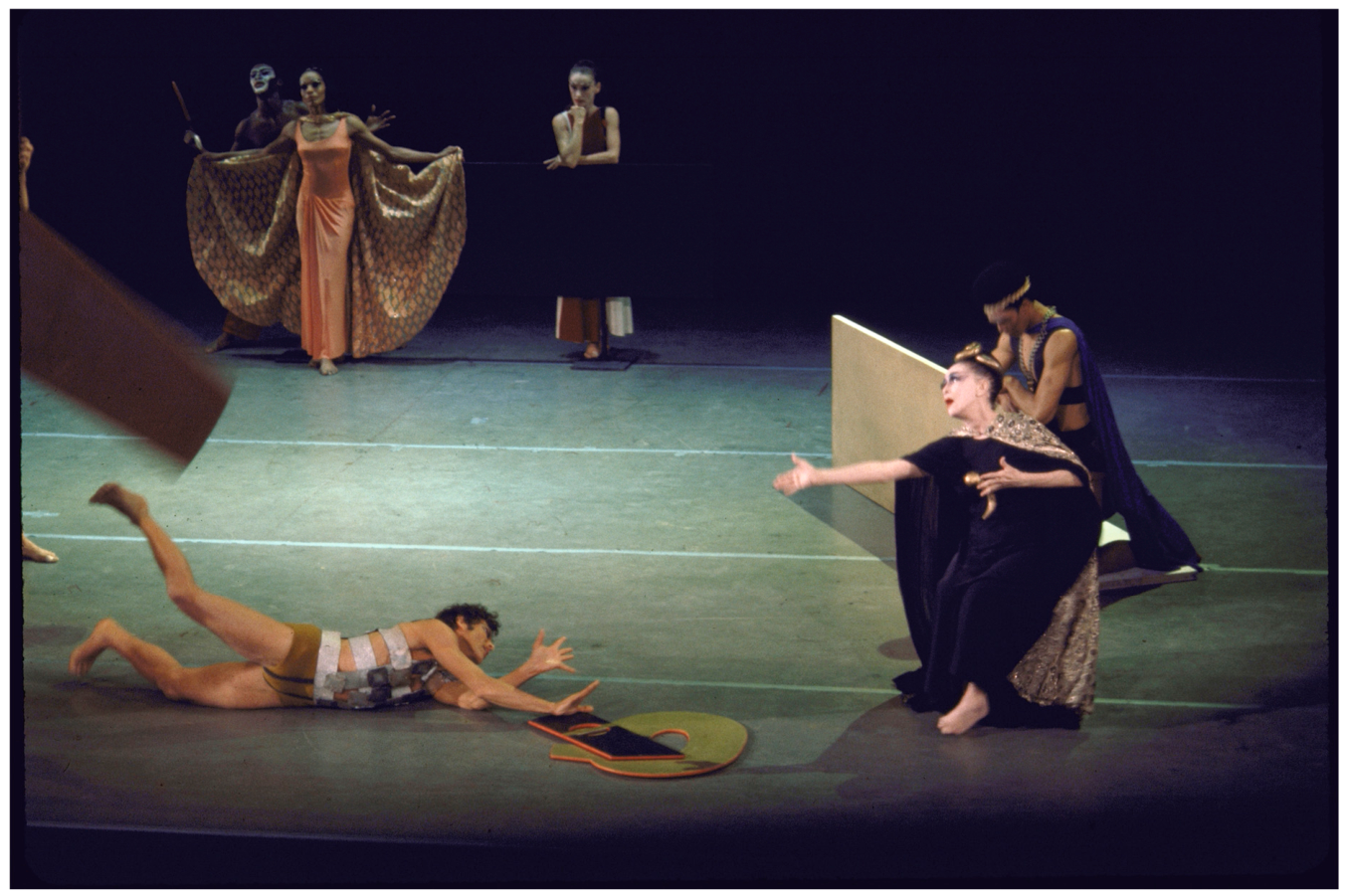
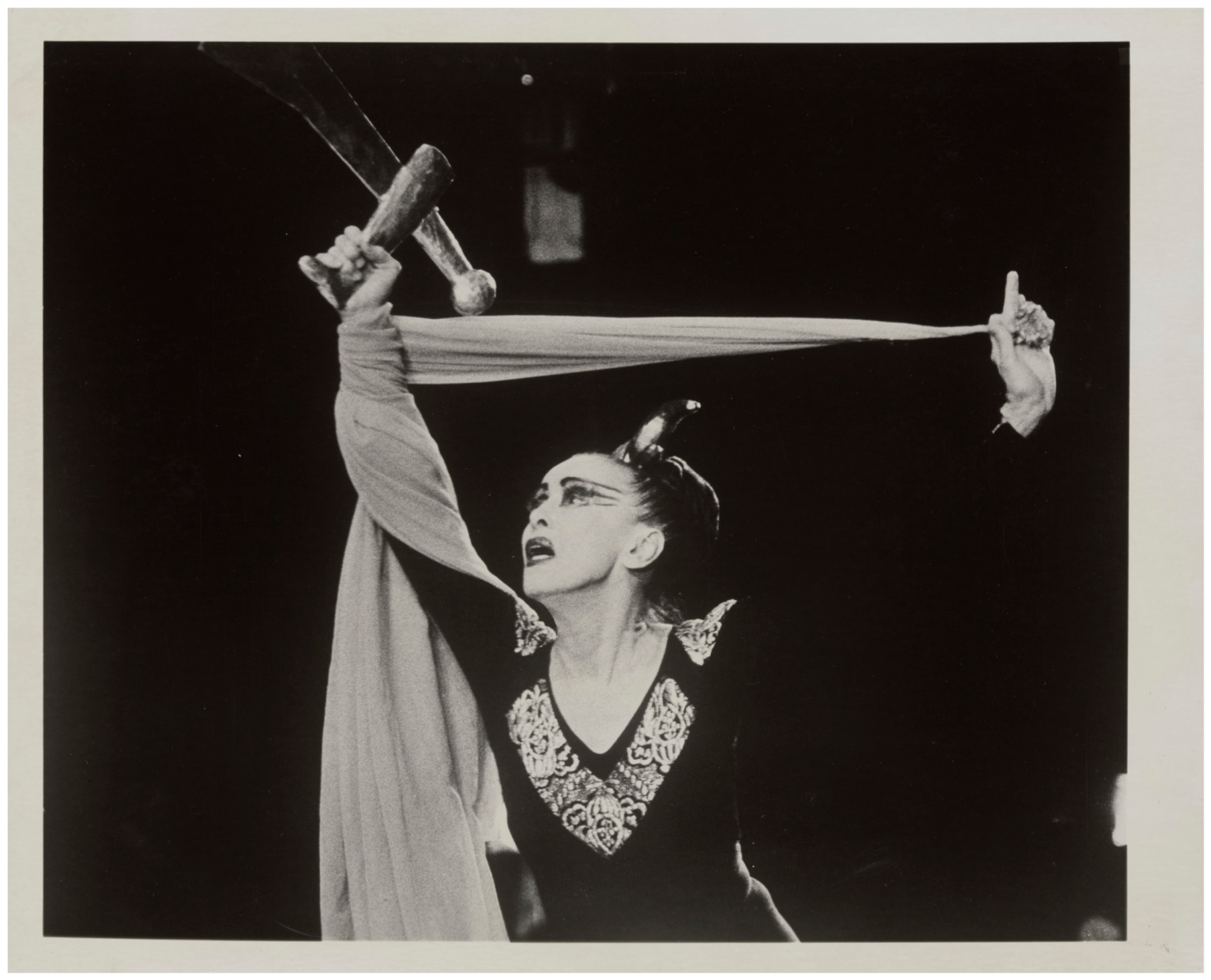
3.2. Medea
3.3. Jocasta
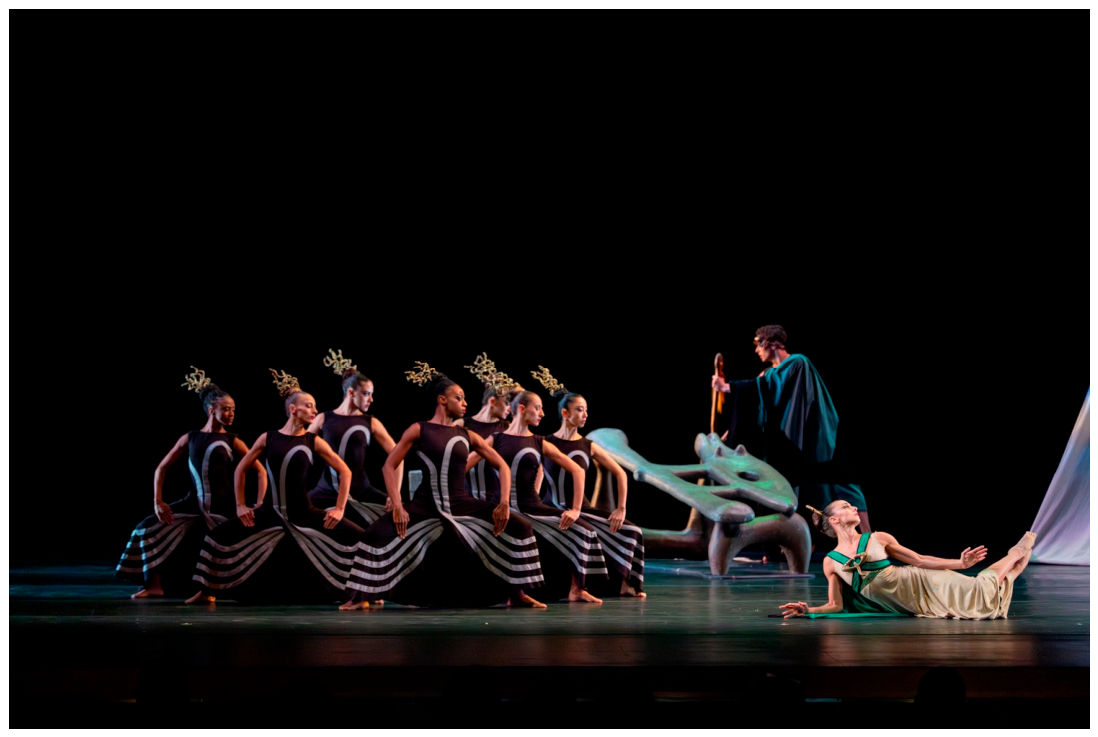
3.4. Clytemnestra
3.5. Alcestis
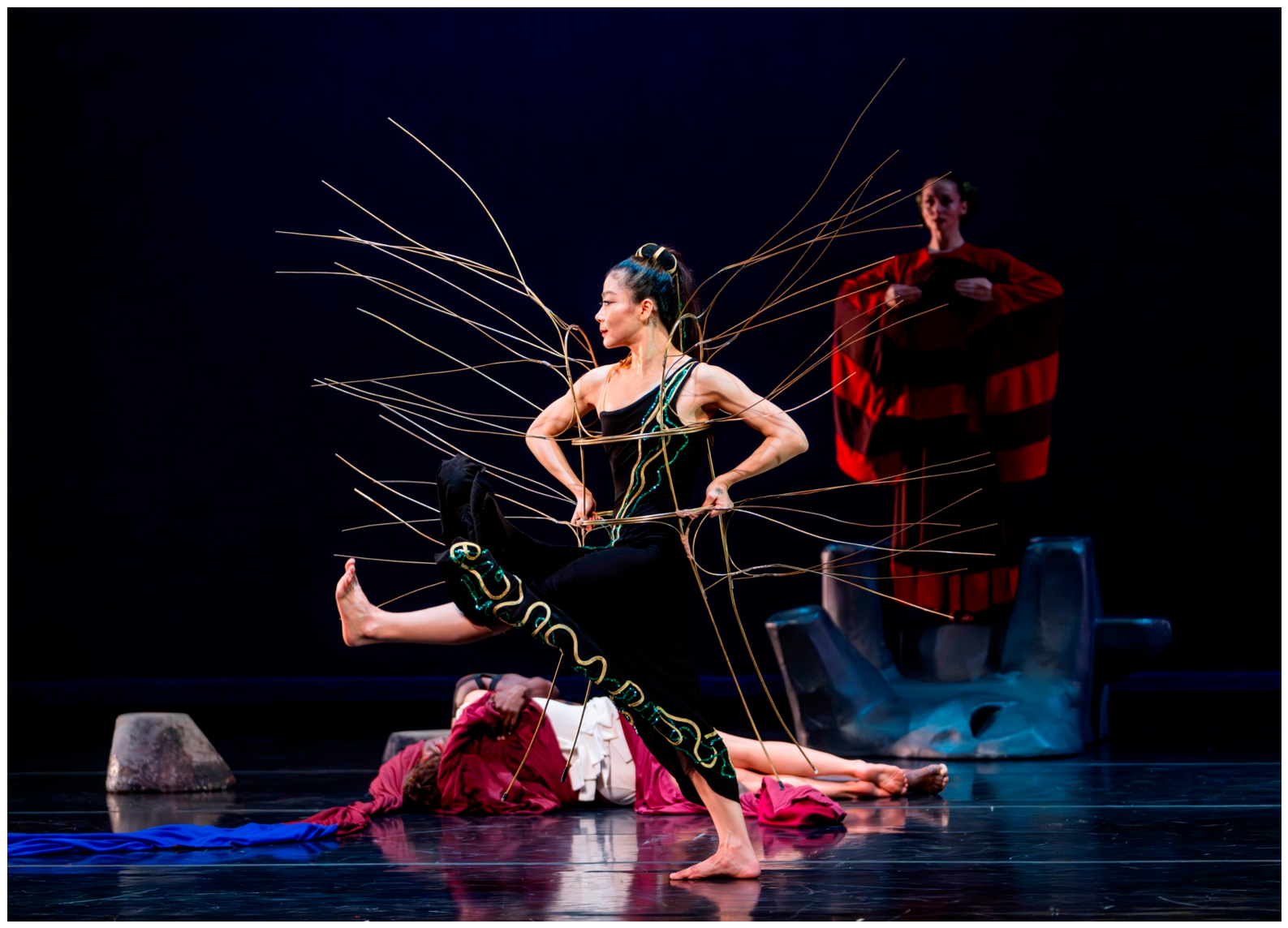
3.6. Phaedra
3.7. Hecuba
4. Conclusions: What Makes Graham’s Reception of Tragic Women Radical?
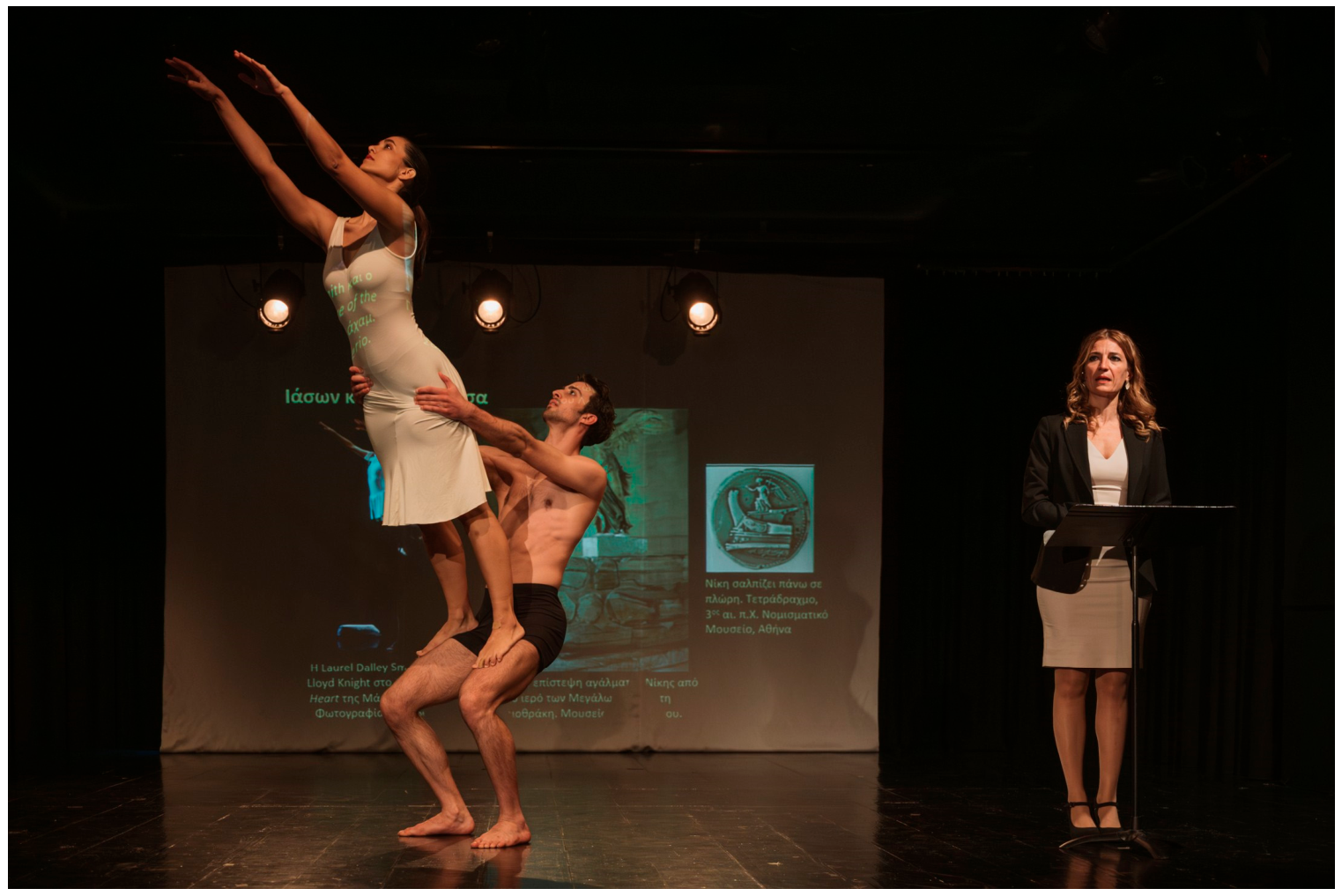
5. Coda—“Martha Graham & Greek Myth”: Making Radical Reception Accessible
Funding
Data Availability Statement
Acknowledgments
Conflicts of Interest
Appendix A

| Date | Tragic Heroine | Title of Work/Dance | Greek Tragedy |
|---|---|---|---|
| 1931 | Electra | Sophocles’ Electra theatrical production | Sophocles’ Electra (date unknown, between 420–410 BCE) |
| 1946 | Medea | Cave of the Heart | Euripides’ Medea (431 BCE) |
| 1947 | Jocasta | Night Journey | Sophocles’ Oedipus Tyrannos (date unknown, between 430–420 BCE) |
| 1958 | Clytemnestra | Clytemnestra | Aeschylus’ Oresteia (458 BCE) |
| 1960 | Alcestis | Alcestis | Euripides’ Alcestis (438 BCE) |
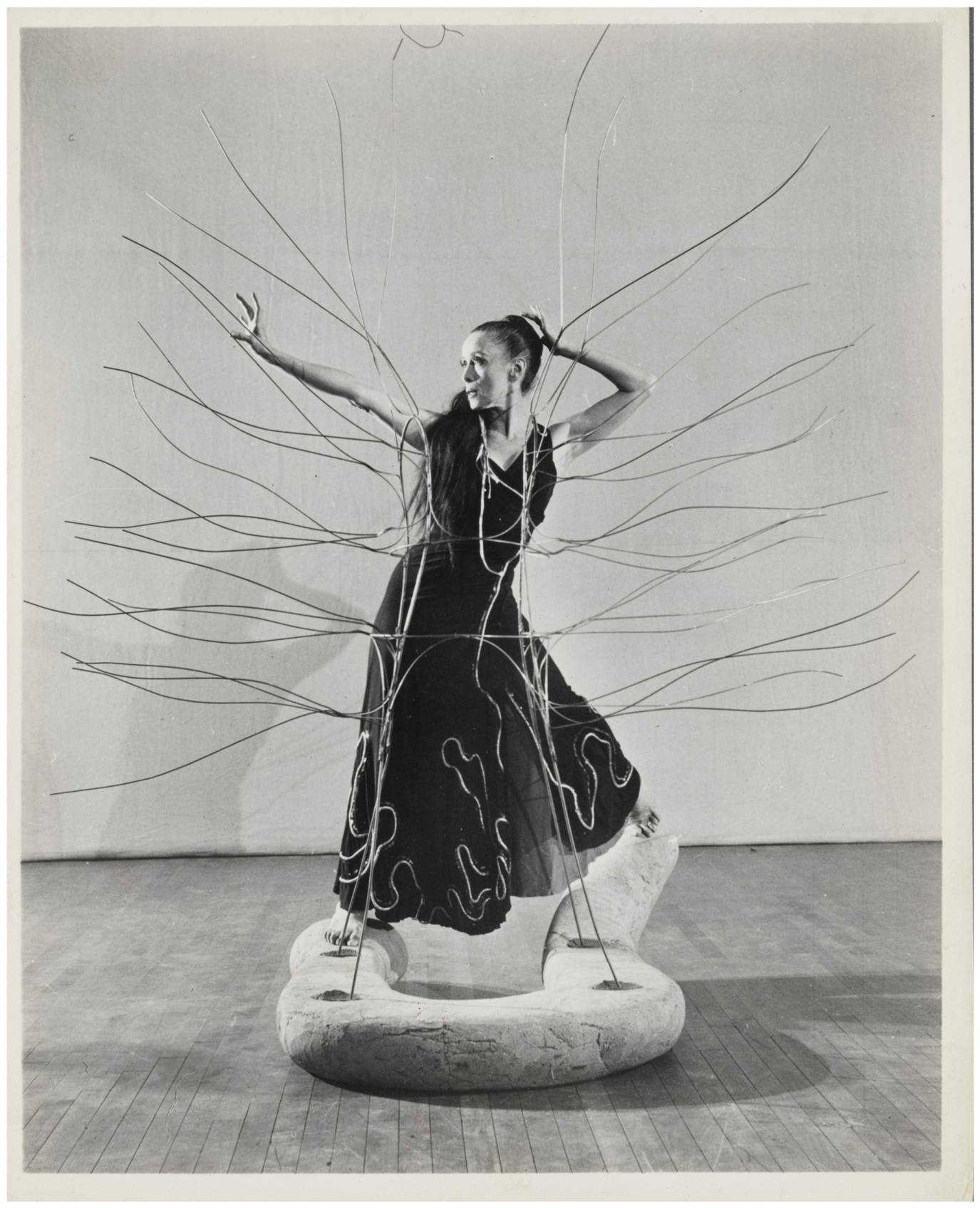
| 1962 | Phaedra | Phaedra | Euripides’ Hippolytus (428 BCE) |
| 1967 | Hecuba | Cortege of Eagles | Euripides’ Hecuba (between 425–423 BCE) & Euripides’ Trojan Women (415 BCE) |
| 1 | I call “Greek-themed” all of Graham’s dances that clearly draw inspiration from the culture, rituals, and myths of the ancient Greeks. “Tragedy-inspired” are those inspired by specifically a Greek tragedy. This article examines Graham’s “tragedy-inspired” dances, in addition to Graham’s rendering of Electra during her participation in a theatrical production of Sophocles’ Electra. For a table of the tragic heroines Graham impersonated onstage see Table A1. |
| 2 | For another survey of Graham’s Greek-themed dances, which also contextualizes her work within the wider modern dance engagement with Greek themes, see (Bannerman 2010). Unlike Yaari, Bannerman is primarily concerned with Graham’s movement vocabulary and her influence on the wider dance community rather than with Graham’s identity and self-definition. |
| 3 | (Franko 2012). Franko also includes a detailed discussion of Graham’s Greek-themed Errand into the Maze (1947). I do not deal with this dance here as it is inspired by the myth of the Minotaur more broadly and not a specific Greek tragedy. |
| 4 | In discussing Graham’s Clytemnestra, Phillips (2023) convincingly argues that “the genius of Graham’s artistry as a political message derived from her passionate drive to represent herself. She believed that by digging into herself, finding the raw essential emotions, the movement vocabulary and choreography that emanated from this quest would thus express a ‘universal’ human experience. Thus, as a masterwork, Clytemnestra contained elements of Graham’s biography that she used for her art.” Phillips (2024) discusses the personal and political aspect of Graham’s works and notes that “Graham’s highly profound, personal works about the inner working of mankind through the use of archetypes became politicized when they were staged internationally between 1955 and 1987 by the US government.” |
| 5 | This article implicitly contributes to feminist reception theory, particularly through its emphasis on female interiority, embodiment, and renewed attention to women’s emotional experience in tragedy. For feminist approaches to tragedy see (Zeitlin 1978; Loraux 1987; Rabinowitz 1993; McClure 1999; Foley 2001). |
| 6 | For tragedy’s dramatization of moments in which ordinary language proves inadequate to convey emotional extremity, see (Nooter 2017); for the association of emotional extremity with women’s experience in Greek tragedy see also (Loraux 1998; Foley 2001). |
| 7 | For the use of the body to present women’s experience in Greek tragedy, especially through gesture, ritual actions, and movement, rather than speech alone see (Llewellyn-Jones 2005; Angelopoulou 2025). |
| 8 | For dance as a nonverbal language of communication see (Foster 1986; Desmond 1997), as well as Papathanasopoulou (forthcoming). |
| 9 | Graham’s engagement with Greek tragedy grew out of extensive personal reading, as well as her relationships with Professor of Comparative Literature and Myth at Sarah Lawrence College, Joseph Campbell, and Classics graduate from Harvard, Erick Hawkins, both of whom spurred her interest in mythical archetypes and Greek myth. For Graham’s preoccupation with psychoanalysis and Jungian theory on mythic archetypes see (Franko 2012; Phillips 2023, 2024; Jowitt 2024; Παπαθανασοπούλου 2025). |
| 10 | See Graham’s autobiography (Graham 1991, pp. 20–21), as well as (Bannerman 2010, p. 264), who notes that Graham’s father studied the correlation between movement and thought and taught Graham that movement could be perceived as a significant indicator of a person’s thoughts. Graham’s (1991) autobiography should be treated with caution as (Phillips 2013) has convincingly argued that the text bears signs of substantial mediation by others. |
| 11 | For the term “tragedy-inspired” see note 1 above. |
| 12 | For an overview of the tragic heroines Graham impersonated onstage, see Appendix A. |
| 13 | For Electra’s suffering as the driving force of Sophocles’ play see (Finglass 2007; Nooter 2011; Dunn 2012; Griffiths 2012; Bakogianni 2019). |
| 14 | According to (Baldwin 2022, pp. 234–35), performances took place at three venues: the Jordan Hall in Boston sponsored by the Harvard Dramatic Club; the McCarter Theatre in Princeton; and the Lydia Mendelssohn Theatre at the University of Michigan at Ann Arbor. |
| 15 | |
| 16 | For psychoanalysis as a source of inspiration in Cave of the Heart see (Papathanasopoulou [2019] 2021). |
| 17 | From the program of the premiere on 10 May 1946. The first title of the dance was Serpent Heart, a title she changed the following year to Cave of the Heart. The original program is archived at the New York Public Library of the Performing Arts. Jerome Robbins Dance Division. Martha Graham Dance Company Collection. Box 91, Folder 10. For the evolution and meaning of the dance’s titles see (Baldwin 2022, p. 360; Ancona 2026, pp. 68–69). |
| 18 | For jealousy as the main focus of Cave of the Heart see (Παπαθανασοπούλου 2025), and (Papathanasopoulou [2019] 2021). |
| 19 | For the paradoxical and unsettling character of Euripides’ Medea see (Swift 2016; Segal 1996). Medea’s speeches invite the audience to register the magnitude of her injury—Jason’s betrayal, her exile and loss of status, and the vulnerability of a foreign woman without protection—yet the play simultaneously scrutinizes the morality of her response. |
| 20 | For the emphasis of Euripides’ Medea on jealousy see (Sanders 2013). |
| 21 | |
| 22 | Though the children are absent from Graham’s dance, they are part of the dance’s subtext; see (Noguchi 1987; Corey 1990, p. 214; Kisselgoff 1993; Power 1999, p. 68; Bannerman 2010). |
| 23 | Graham wrote this phrase in the original script for the dance, first titled Daughter of Colchis, that she sent to composer Aaron Copland on 7 July 1942. See Library of Congress, Aaron Copland Collection, item 507. Though Graham had approached Copland to compose the music for Cave of the Heart, in the end the score was created by Samuel Barber. |
| 24 | For interpretations of the red ribbon see (Stodelle 1984, pp. 141–42; Bannerman 2010, p. 270; Baldwin 2022, p. 362; Jowitt 2024, p. 300; Ancona 2026, pp. 81–83). |
| 25 | For an image of Envy consuming her own heart, see the 1540 engraving by the German Peter Flotner, which is displayed at the Walters Art Museum in Baltimore. |
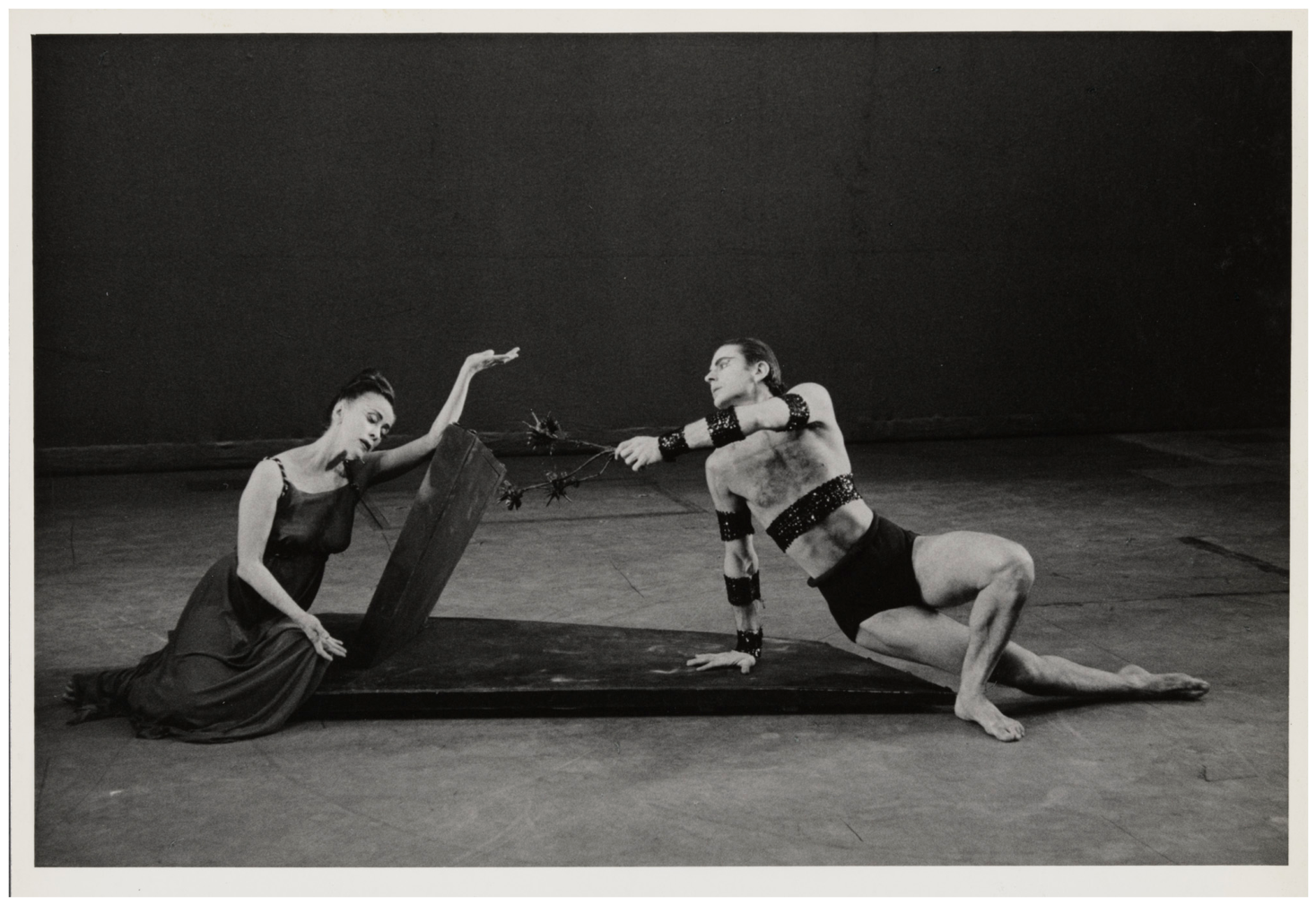
| 26 | For Noguchi’s collaboration with Graham and the integral function of the sets in Graham’s dances see (Ancona 2026). For Noguchi’s set for Cave of the Heart see (Papathanasopoulou [2019] 2021, pp. 163–64; Ancona 2020, 2026, pp. 70–86). |
| 27 | |
| 28 | I am grateful to Ancona for drawing my attention to the imagery of prison bars in this moment. |
| 29 | For the tension between Graham and Hawkins’ personal relationship see (De Mille [1956] 1991, p. 280; Aloff 2024; Jowitt 2024, pp. 245–46 and pp. 286–87), and especially (Franko 2012, pp. 84–97), who suggests that Cave of the Heart may have also been about Graham’s difficulties to self-control. |
| 30 | |
| 31 | De Mille ([1956] 1991, p. 280), includes Mark Ryder’s testimony on Hawkins’ interest in young lovers. |
| 32 | For Jocasta as a figure trying to preserve a workable human order—marriage, rule, household stability—against the unraveling that truth brings see (Cairns 2013). Jocasta seems to realize the importance of both human choices and divine structures in the horrible crime that has been committed. |
| 33 | Sophocles’ Oedipus Tyrannos 1056–57, 1060–61, and 1064–66. Champlin (1969) argues that Oedipus Tyrannus is fundamentally a play about knowledge and its limits, In contrast to Oedipus who insists on knowing even when knowledge becomes destructive, Jocasta realizes earlier than Oedipus that knowledge can be intolerable and cannot be survived. She thus attempts to halt the investigation not out of ignorance or superstition but out of practical wisdom. The tragedy thus stages a conflict between two epistemological stances: Oedipus’ belief that truth must always be spoken and managed publicly, and Jocasta’s sense that knowledge can be lethal and must sometimes be contained. Gregory (1995) also notes that Jocasta realizes the truth before Oedipus but she suggests that the play’s investigative structure is designed to lead inexorably to Oedipus’ exposure, and as a result Jocasta’s effort to stop the inquiry cannot succeed. |
| 34 | For the play’s exodos and the attention it calls on the consequences of the revelation of Oedipus’ identity see (Gregory 1995; Budelmann 2006). |
| 35 | See Papathanasopoulou (2023) on the innovative ways in which Graham draws attention to Jocasta’s last hours. |
| 36 | Burns (2010) argues that by hanging rather than stabbing herself to death, Jocasta is trying to suppress her own sexuality, to erase her married life, and to force her body back into being that of a virgin. The act of hanging reflects her wish to have died as a virgin and never committed the incestuous act. |
| 37 | |
| 38 | Oedipus feels desperation when he realizes that he is the murderer of Laius and has thus placed a curse upon himself, forcing him to self-exile (OT 1381–1385 and 1398–1411). He recognizes the horror of his actions—killing his father, marrying his mother—and understands that he has no longer a place in the city. He, however, does not dwell on his personal relationship with Jocasta, contemplating their emotional bond and what it was like to be with her. Graham’s Jocasta, by contrast, focuses on the nature of her relationship and bond with Oedipus and remembers her feelings for him. |
| 39 | A detailed description of these movements can be found in (Stodelle 1984, pp. 149–50; Papathanasopoulou 2023, pp. 71–80). |
| 40 | For Noguchi’s bed in Night Journey see also (Stodelle 1984, p. 149; Banes 1998, p. 159; Franko 2012, p. 127; Ancona 2026, pp. 123–26). |
| 41 | For the use of the rope in the dance see (Corey 1990, p. 209; Burt 1998, p. 39; Franko 2012, pp. 118–19; Papathanasopoulou 2023, p. 65; Ancona 2026, p. 110). |
| 42 | See especially pp. 71–77 where I argue that the female chorus of the Daughters of the Night represents Jocasta’s inner state: her memories, fears, and emotions. |
| 43 | From Graham’s script for Night Journey sent in her letter correspondence to composer William Schuman on 28 October 1946. Martha Graham Dance Company records. Jerome Robbins Dance Division. New York Public Library of the Performing Arts. |
| 44 | For the general tendency of dance not to narrate events straightforwardly but to conjure emotions and states of being see (Gianvittorio-Ungar and Schlapbach 2021, pp. 11–12). |
| 45 | For a more elaborate analysis of the chorus’ movements see (Stodelle 1984, pp. 149–50; Bannerman 2010, p. 271; Papathanasopoulou 2023). |
| 46 | For the emotional turmoil leading up to the separation of Graham and Hawkins in 1950 see (Franko 2012, pp. 77–79, 84–97, 125–26; Jowitt 2024, p. 304, as well as pp. 286–87; Ancona 2026, p. 113). |
| 47 | Franko (2012, p. 125) suggests that the failure in Graham’s relationship with Hawkins also came from her inability to accept her mortality and aging. “I was curious in that I preached life and talked of life and yet in some inner way I refused to recognize the laws of life” she wrote in a letter to Hawkins on 3 September 1950. Erick Hawkins Collection, Music Division, Library of Congress, box 55, folder 13. |
| 48 | Aeschylus, Agamemnon 10–11: “for such is the rule of a woman’s man-counseling, ever hopeful, heart,” ὧδε γὰρ κρατεῖ γυναικὸς ἀνδρόβουλον ἐλπίζον κέαρ. |
| 49 | |
| 50 | See also (Παπαθανασοπούλου 2024; Ancona 2026, pp. 127–48). |
| 51 | |
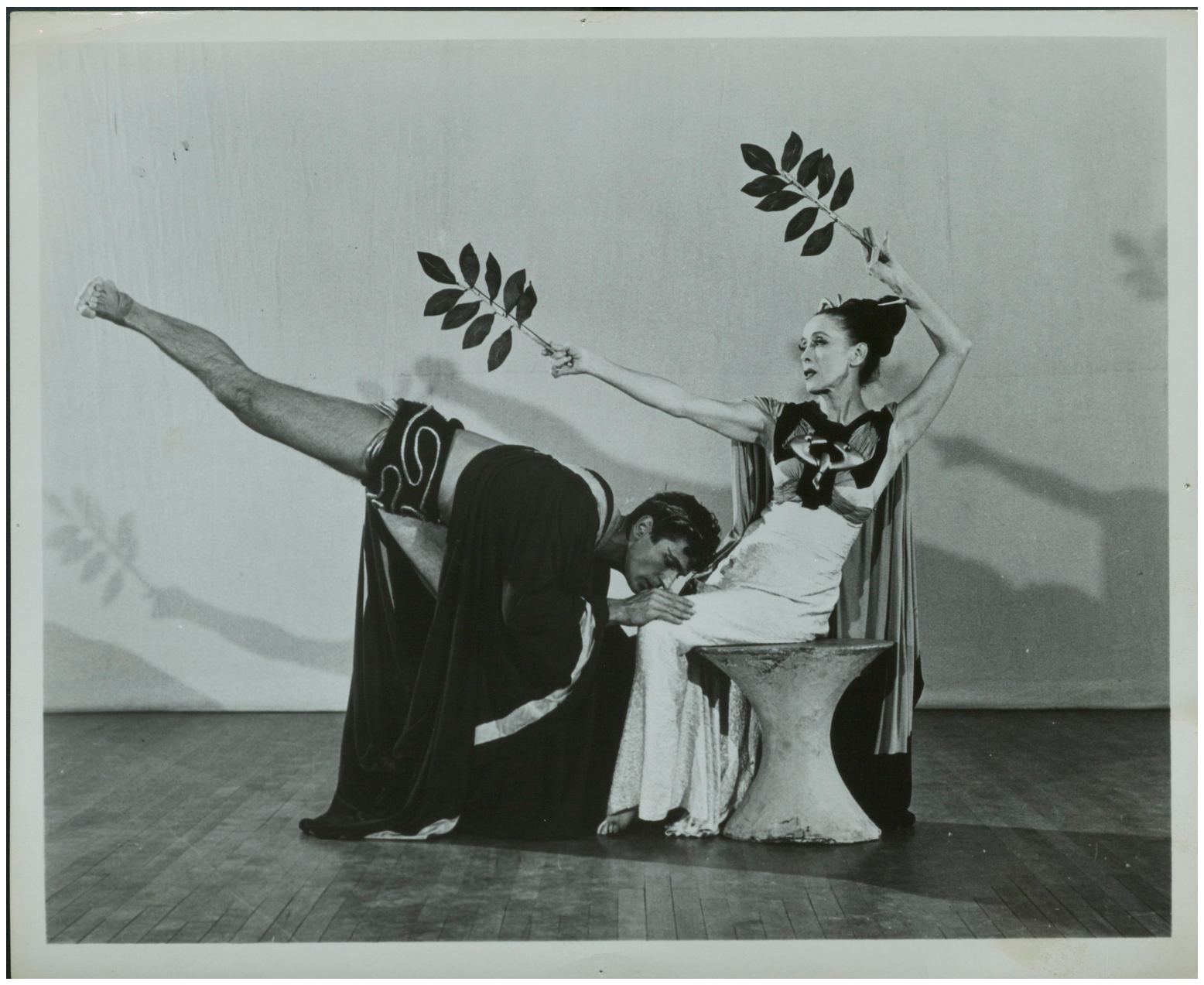
| 52 | In this scene Clytemnestra and Aegisthus walk in stumbling, with no stable footings or sense of direction, exposing their lack of control. They are drunk and want to celebrate their accomplished revenge. Aegisthus moves with perky steps, alternating his legs in a gesture that tries ineffectually to demonstrate his kingliness and authority. He bows to Clytemnestra, wrapping his cape around his arm, as if thanking her. He jumps regally in the so-called march jumps, displaying his pride and satisfaction, while he also approaches her sensually and kisses her on the mouth. Clytemnestra then picks up Agamemnon’s scepter and hands it over to Aegisthus. Aegisthus dances with it in a cocky way, imitating Agamemnon, making fun of his arrogance and his short-lived triumph, and marking his victory over Agamemnon. Aegisthus exits with Agamemnon’s scepter in hand and Clytemnestra picks up and wears Agamemnon’s cape. As she is on her way out, the Messenger of Death arrives and stabs Clytemnestra’s cape, an eerie moment for the dancer performing this role. At this moment Clytemnestra realizes that death is approaching and the moment of revelry is short-lasting: celebration flips into foreknowledge, and Clytemnestra is made to grasp that victory and death are bound together in the same gesture. |
| 53 | Phillips (2023, p. 28), makes an explicit connection between Graham’s archetypal characters and her own life: “[Graham] had been in Jungian therapy and read his works, using the idea of archetypes to connect her own life to a universalised human experience through therapy, which she used in her choreography, and the Graham Dance Technique.” |
| 54 | Phillips (2023, pp. 32–33). For Graham’s drinking see also Bertram Ross’ testimony in (Tracy 1996, p. 161–62). |
| 55 | For the 1950s as a period of emotional unrest for Graham see (Phillips 2023, pp. 28–30; Jowitt 2024, especially pp. 323–52). |
| 56 | |
| 57 | Euripides’ Alcestis 83–85: the chorus considers her “the best of wives” (Ἄλκηστις, ἐμοὶ πᾶσί τ᾽ ἀρίστη δόξασα γυνὴ πόσιν εἰς αὑτῆς γεγενῆσθαι). |
| 58 | Modern scholarship has noted the play’s resistance to presenting Alcestis as a simple paradigm of wifely devotion. Rabinowitz (1993, pp. 67–102) and Foley (2001, pp. 314–31), have both shown that Alcestis’ apparent self-sacrifice is structured by coercion and exchange, and that her deathbed speech serves as a conscious attempt to assert control over her situation that leaves the household ethically unsettled rather than restored. |
| 59 | Euripides’ Alcestis 280–325. |
| 60 | Euripides’ Alcestis 299–316. |
| 61 | Roisman (2021, pp. 180–81 and pp. 187–89). Roisman discusses how Alcestis defies genre categorizations and includes elements of a satyr play, having been performed in 438 BCE as the fourth play of the tetralogy in the position usually reserved for satyr plays. She identifies humor and comic elements especially in the characterization of Heracles and his interaction with Admetus. For Alcestis’ comic and satyr-play elements see also (Dale 1954; Parker 2007). |
| 62 | Euripides’ Alcestis 393–415. |
| 63 | From the original program notes of Alcestis. New York Public Library of the Performing Arts. Jerome Robbins Dance Division. Martha Graham Dance Company Collection. Performance Programs. Box 94, Folder 1. |
| 64 | For Noguchi’s set see (Jowitt 2024, p. 349; Ancona 2026, p. 52). |
| 65 | Tracy (1996, p. 162), quotes dancer Bertram Ross: “In Alcestis, Martha wanted me, as “Thanatos”, the figure of death, to be drop-dead seductive so that when one looked at me they would realize that to be dead would be attractive. They therefore would sleep with me and understand the reason behind suicide. At this time, Martha understood death as the end of sexuality.” |
| 66 | |
| 67 | |
| 68 | For Phaedra as calculating and even villainous see (Roisman 2021, pp. 247–64). |
| 69 | For Noguchi’s set see (Graham 1973, pp. 81–82; Jowitt 2024, pp. 358–59; McKee 2025, pp. 91–93; Ancona 2026, pp. 54–55). |
| 70 | I am thankful to Kenneth Topping, former dancer with the Martha Graham Dance Company, for discussing this scene in detail with me. |
| 71 | Graham amplifies the role of Pasiphae, Phaedra’s mother, staging her as a full character surrounded by bull dancers in a scene that frames Phaedra’s desire as hereditary fate. Cf. Euripides’ Hipp. 337–41 where Euripides’ Phaedra connects her illicit desire to that of her mother Pasiphae and sister Ariadne. |
| 72 | Euripides’ Hippolytus 413–14. |
| 73 | For a political reading of Euripides’ Hecuba that examines the queen’s transformation from victim to avenger in relation to the implications of Athenian imperial hegemony, see (Tzanetou 2020). |
| 74 | Euripides’ Hecuba 668–70: “My mistress, most wretched than I can say, you are lost, you no longer exist even though you see the light of day, childless, husbandless, cityless, utterly ruined.” ὦ παντάλαινα κἄτι μᾶλλον ἢ λέγω,/δέσποιν᾽, ὄλωλας κοὐκέτ᾽ εἶ, βλέπουσα φῶς,/ἄπαις ἄνανδρος ἄπολις ἐξεφθαρμένη. |
| 75 | Many scholars discuss how Hecuba’s suffering transforms into savage violence. Segal (1990) focuses on the erosion of boundaries—between Greek and barbarian, human and animal—showing how Hecuba’s revenge enacts a dehumanization that implicates all parties in the play’s violence. Zeitlin (1996) reads Hecuba as a play about the collapse of moral and civic order under extreme violence, tracing Hecuba’s movement from passive victim to active agent of revenge and arguing that the play refuses any simple ethical resolution. Roisman (2021, pp. 167–76), offers a more nuanced reading, arguing that Hecuba’s savagery is best understood not as moral collapse but as the eruption of a helplessness and rage that were always present in her. |
| 76 | |
| 77 | Barnes’ (1967) review in The New York Times. Barnes pointed analysis is quite illuminating: “Where the ballet reaches its peak is in this private revenge of public wrong that Miss Graham has found at the heart of the drama. Here, in the bloody act of Hecuba, the ballet finds a focus previously lacking. Hecuba accuses Polymestor, who promptly hides behind handmaidens. Hecuba, just as in “Judith,” enters a kind of murderous trance, here of justful retribution. She goes to the line of handmaidens and in a single gesture as terrible as any even Miss Graham has given gouges the king’s eyes. Grand Guignol is raised to the level of awe-inspiring truth.” |
| 78 | In describing Cortege by Baye & Asa, a new work the Graham Company has been performing, press releases and dance reviews have been framing it in dialogue with Graham’s Cortege of Eagles (1967) and specifically mention that Graham’s piece was created as a response to the Vietnam War. See for example Johnson’s (2024) review in the Dance Enthusiast. https://www.dance-enthusiast.com/features/day-in-the-life/view/Works-Process-Guggenheim-Martha-Graham-Dance-Company-Baye-Asa (accessed on 17 April 2026). |
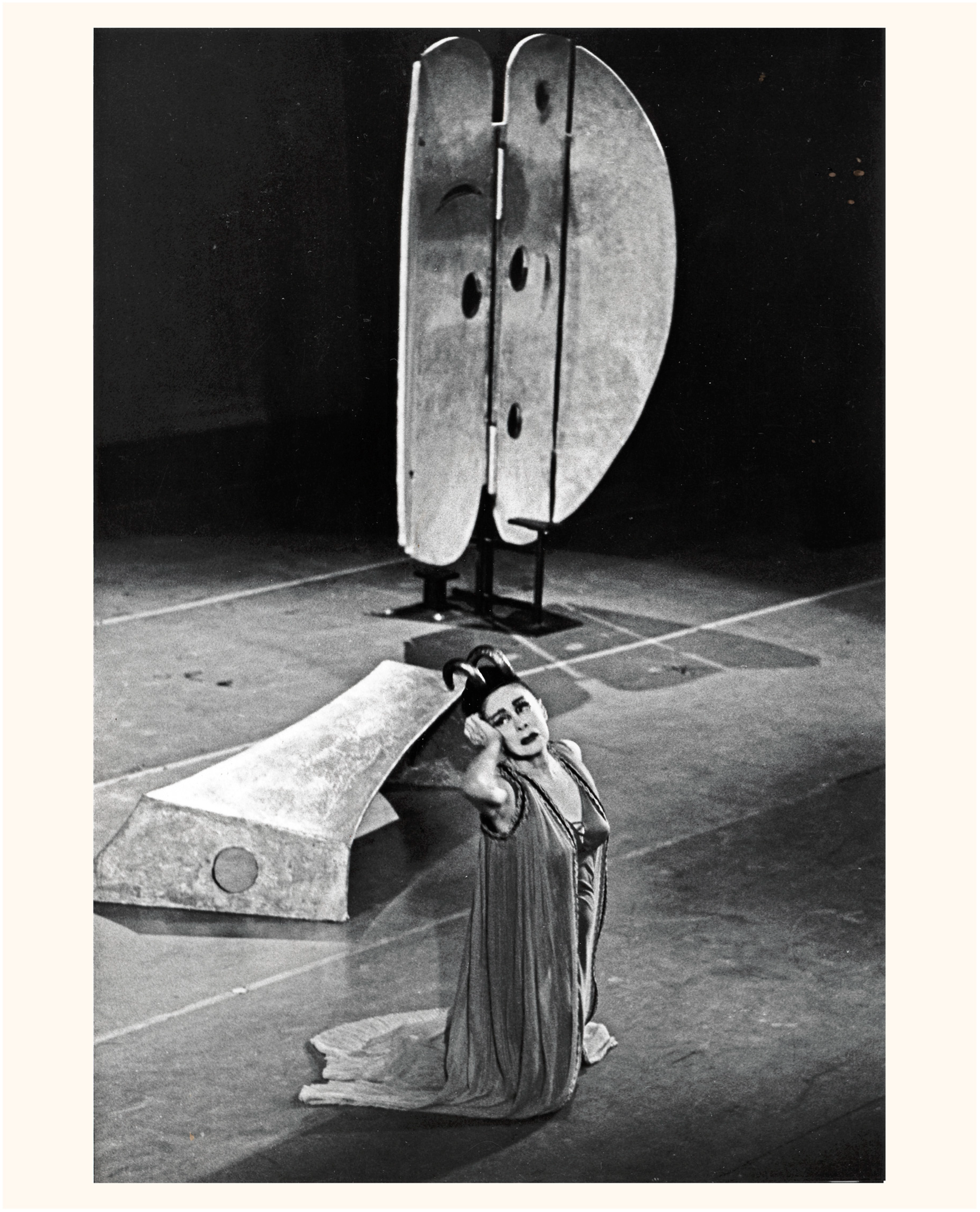
| 79 | Noguchi’s sets for Cortege of Eagles are described in (Kisselgoff 1989; Jowitt 2024, pp. 365–66; Ancona 2026, p. 60). Kisselgoff writes: “Martha Graham’s “Cortege of Eagles” from 1967 was one of her strangest collaborations with the sculptor Isamu Noguchi. The entire work is a startling cinematic flyby of images—both enhanced and obfuscated by geometric forms used as props and masks.” |
| 80 | One of Graham’s major Greek-themed works not discussed in this article is Errand into the Maze (1947). Inspired by the myth of the Minotaur, the work replaces Theseus with a female figure who confronts the monstrous creature. Widely regarded as a masterpiece, it remains a central part of the Martha Graham Dance Company’s repertory. I do not treat it here because it does not engage a tragic heroine in the sense discussed in this article, but rather reworks the figures of Ariadne and the Minotaur more broadly. |
| 81 | On the importance of teaching Classics through embodied reception, see also my 2026 op-ed piece “Awakening Compassion through the Greeks” (Papathanasopoulou [2019] 2026), which highlights contemporary projects that make the ethical and emotional stakes of ancient texts accessible to modern audiences. |
| 82 | For detailed information on the initiative, its goals, and programming, including photos, videos, and reviews see http://www.ninapapathanasopoulou.com/martha-graham-greek-myth/ (accessed on 26 April 2026). |
| 83 | The dancers who have performed in the “Martha Graham & Greek Myth” presentations are: Konstantinos Argyriou Evangeloudis, Marios-Athanasios Bozikas, Stavros Alexandros Ikbal, Eleftheria Iliopoulou, Natalia Kalogeropoulou, Maritina Katsimpraki, Vassia Kolliou, Marianna Papakonstantinou, Marianna Tsikmanli, Mara Tsourma, Ioanna Tzanimi, and Androniki Vasili. In 2024 in Venice the presentation included a group of eight international dancers: Sofia Belem, Maria Biosa, Stefania Coloru, Audrey Detexier, Berenice Heger-Hedloy, Priscila Montemayor, Laura Rivet, and Lucas Sverdlen. |
| 84 | For the project’s impact see the following two reviews: Honouring Martha Graham and Greek Myth (2023) (https://www.travel.gr/en/arts-and-culture-en/honouring-martha-graham-and-greek-myth/, accessed on 18 October 2023) (travel.gr) and Martha Graham and Greek Myth (2025) Martha Graham & Greek Myth: the Legendary Choreographer’s Work in the Spotlight (https://www.athensinsider.com/martha-graham-and-greek-myths-the-legendary-choreographers-work-in-the-spotlight/, accessed on 26 April 2026) (Athens Insider). |
| 85 | A review of the presentation at the University of Edinburgh was written by Capriotti (2025), Ph.D. Candidate in Classics at the University of Edinburgh, and can be found here: Martha Graham & Greek Myth in Review (https://classicalreception.org/martha-graham-greek-myth-in-review/, Classical Reception Studies Network. URL accessed 15 January 2026). |
References
- Aloff, Mindy. 2024. Martha Graham: A Life When Dance Became Modern by Neil Baldwin; Errand into the Maze: The Life and Works of Martha Graham by Deborah Jowitt. LIBER Review 2: 48–53. [Google Scholar]
- Ancona, Ronnie. 2020. ‘Cave of the Heart,’ The Medea of Martha Graham and Isamu Noguchi: Twentieth-Century Classical Reception in the Visual and Performance Arts. New Voices in Classical Receptions Studies 13: 1–25. [Google Scholar]
- Ancona, Ronnie. 2026. Martha Graham’s Greek Myth-Based Dances and Her Collaboration with Isamu Noguchi. London and New York: Bloomsbury Publishing. [Google Scholar]
- Angelopoulou, Afroditi. 2025. The Body and the Senses in Greek Tragedy. Oxford: Oxford University Press. [Google Scholar]
- Bakogianni, Anastasia. 2019. Performing Grief: Mourning Does Indeed Become Electra. Ancient Greek and Roman Multi-Sensory Spectacles of Grief. Thersites 9: 45–69. [Google Scholar]
- Baldwin, Neil. 2022. Martha Graham: When Dance Became Modern: A Life. New York: Alfred A. Knopf. [Google Scholar]
- Banes, Sally. 1998. Dancing Women: Female Bodies on Stage. London and New York: Knopf. [Google Scholar]
- Bannerman, Henrietta. 2010. Ancient Myths and Modern Moves: The Greek-Inspired Dance Theatre of Martha Graham. In The Ancient Dancer in the Modern World: Responses to Greek and Roman Dance. Edited by Fiona Macintosh. Oxford and New York: Oxford University Press, pp. 255–76. [Google Scholar]
- Barnes, Clive. 1967. Dance: Troy a la Graham. The New York Times, February 22.
- Budelmann, Felix. 2006. The Mediated Ending of Sophocles’ Oedipus Tyrannus. Materiali e Discussioni per L’analisi dei Testi Classici 57: 43–62. [Google Scholar]
- Burns, Krishni. 2010. To Die a Virgin’s Death: The Ramifications of Jocasta’s Suicide in Oedipus Tyrannos. SSRN Electronic Journal. [Google Scholar] [CrossRef]
- Burt, Ramsay. 1998. Dance, Gender and Psychoanalysis: Martha Graham’s Night Journey. Dance Research Journal 30: 34–53. [Google Scholar]
- Cairns, Douglas. 2013. Divine and Human Action in the Oedipus Tyrannus. In Tragedy and Archaic Greek Thought. Edited by Douglas Cairns. Swansea: Classical Press of Wales, pp. 119–72. [Google Scholar]
- Capriotti, Veronica. 2025. Martha Graham & Greek Myth in Review. Classical Reception Studies Network. Available online: https://classicalreception.org/martha-graham-greek-myth-in-review/ (accessed on 15 January 2026).
- Champlin, Marjorie W. 1969. ‘Oedipus Tyrannus’ and the Problem of Knowledge. The Classical Journal 64: 337–45. [Google Scholar]
- Corey, Frederick C. 1990. Martha Graham’s revision of Jocasta, Clytemnestra, and Medea. Text and Performance Quarterly 10: 204–17. [Google Scholar]
- Dale, Amy Marjorie. 1954. Euripides: Alcestis. Oxford: Clarendon Press. [Google Scholar]
- De Mille, Agnes. 1991. Martha: The Life and Work of Martha Graham. New York: Random House. First published 1956. [Google Scholar]
- Desmond, Jane, ed. 1997. Meaning in Motion: New Cultural Studies of Dance. Durham: Duke University Press. [Google Scholar]
- Dunn, Francis. 2012. Electra. In A Companion to Sophocles. Edited by Kirk Ormand. Chichester: Wiley-Blackwell, pp. 98–110. [Google Scholar]
- Finglass, Patrick J. 2007. Sophocles: Electra. Cambridge Classical Texts and Commentaries. Cambridge: Cambridge University Press, vol. 4. [Google Scholar]
- Fiorelli, Maia. 2023. The danger of πειθώ and codeswitching: Clytemnestra’s masculine characterization in the Agamemnon. CERES Queen’s University Graduate Journal for Classics and Archaeology V: 9–14. [Google Scholar]
- Foley, Helen P. 2001. Female Acts in Greek Tragedy. Princeton: Princeton University Press. [Google Scholar]
- Foster, Susan Leigh. 1986. Reading Dancing: Bodies and Subjects in Contemporary American Dance. Berkeley: University of California Press. [Google Scholar]
- Franko, Mark. 2012. Martha Graham in Love and War: The Life in the Work. Oxford and New York: Oxford University Press. [Google Scholar]
- Gianvittorio-Ungar, Laura, and Karin Schlapbach, eds. 2021. Choreonarratives: Dancing Stories in Greek and Roman Antiquity and Beyond. Leiden and Boston: Brill. [Google Scholar]
- Gill, Christopher M. C. 1990. The Articulation of Self in Euripidean Tragedy. In Euripides, Women, and Sexuality. Edited by Amy Richlin. Oxford: Oxford University Press, pp. 19–47. [Google Scholar]
- Graham, Martha. 1973. The Notebooks of Martha Graham. Introduction by Nancy Wilson Ross. New York: Harcourt. [Google Scholar]
- Graham, Martha. 1991. Blood Memory: An Autobiography. New York: Doubleday. [Google Scholar]
- Gregory, Justina. 1995. The Encounter at the Crossroads in Sophocles’ Oedipus Tyrannus. The Journal of Hellenic Studies 115: 141–46. [Google Scholar] [CrossRef]
- Griffiths, Emma. 2012. Electra. In Brill’s Companion to Sophocles. Edited by Andreas Markantonatos. Leiden and Boston: Brill, pp. 73–91. [Google Scholar]
- Honouring Martha Graham and Greek Myth. 2023. travel.gr. Available online: https://www.travel.gr/en/arts-and-culture-en/honouring-martha-graham-and-greek-myth/ (accessed on 18 October 2023).
- Johnson, Robert. 2024. DAY IN THE LIFE OF DANCE: Works & Process Presents Martha Graham Dance Company with Baye & Asa. The Dance Enthusiast. October 10. Available online: https://www.dance-enthusiast.com/features/day-in-the-life/view/Works-Process-Guggenheim-Martha-Graham-Dance-Company-Baye-Asa (accessed on 17 April 2026).
- Jowitt, Deborah. 2024. Errand into the Maze: The Life and Works of Martha Graham. New York: Farrar, Straus, and Giroux. [Google Scholar]
- Kisselgoff, Anna. 1985. The Dance: Martha Graham’s Cortege of Eagles. The New York Times, April 6.
- Kisselgoff, Anna. 1989. Triple Bill by Graham Company. The New York Times, October 8.
- Kisselgoff, Anna. 1993. ‘Cave of the Heart’ Martha Graham Dance Company City Center 131 West 55th Street Manhattan. The New York Times, October 11.
- Knox, Bernard M. W. 1952. The Hippolytus of Euripides. Yale Classical Studies 13: 3–31. [Google Scholar]
- Kovacs, David. 2018. Euripides: Troades. Oxford: Oxford University Press. [Google Scholar]
- Llewellyn-Jones, Lloyd. 2005. Body Language and the Female Role Player in Greek Tragedy and Japanese Kabuki Theatre. In Body Language in the Greek and Roman Worlds. Edited by Douglas L. Cairns. Swansea: The Classical Press of Wales, pp. 73–106. [Google Scholar]
- Loraux, Nicole. 1987. Tragic Ways of Killing a Woman. Translated by Anthony Forster. Cambridge, MA and London: Harvard University Press. [Google Scholar]
- Loraux, Nicole. 1998. Mothers in Mourning. Translated by Corinne Pache. Ithaca: Cornell University Press. [Google Scholar]
- Martha Graham and Greek Myth: The Legendary Choreographer’s Work in the Spotlight. 2025. Athens Insider. April 7. Available online: https://www.athensinsider.com/martha-graham-and-greek-myths-the-legendary-choreographers-work-in-the-spotlight/ (accessed on 26 April 2026).
- Martin, John. 1958. Dance: Graham; ‘Clytemnestra’, An Epic Full-Evening Work by a Modern Master. The New York Times, April 6, p. 12.
- McClure, Laura. 1999. Spoken Like a Woman: Speech and Gender in Athenian Drama. Princeton: Princeton University Press. [Google Scholar]
- McDonagh, Don. 1973. Martha Graham: A Biography. Exeter: David and Charles PLC. [Google Scholar]
- McKee, Tori. 2025. Euripides’ Hippolytus: Reception from Antiquity to the Present Day. In Looking at Hippolytus. Edited by David Stuttard. London and New York: Bloomsbury Academic. [Google Scholar]
- Michelini, Ann N. 1987. Euripides and the Tragic Tradition. Madison: University of Wisconsin Press. [Google Scholar]
- Noguchi, Isamu. 1987. The Isamu Noguchi Garden Museum. New York: Harry N. Abrams, Inc. [Google Scholar]
- Nooter, Sarah. 2011. Language, Lamentation, and Power in Sophocles’ Electra. The Classical World 104: 399–417. [Google Scholar] [CrossRef]
- Nooter, Sarah. 2017. The Mortal Voice in the Tragedies of Aeschylus. Cambridge: Cambridge University Press. [Google Scholar]
- Papathanasopoulou, Nina. 2019. Review of Martha Graham Dance Company—Graham’s Greeks. Didaskalia: The Journal for Ancient Performance 15: 158–67. [Google Scholar]
- Papathanasopoulou, Nina. 2021. Serpent Heart: Animality, Jealousy, and Transgression in Martha Graham’s Medea. International Journal of the Classical Tradition 28: 159–82. First published 2019 online. [Google Scholar]
- Papathanasopoulou, Nina. 2023. Jocasta’s Last Hours: Identity, Responsibility, and Violence in Martha Graham’s Night Journey. Classical Receptions Journal 15: 57–84. [Google Scholar] [CrossRef]
- Papathanasopoulou, Nina. 2026. Awakening Compassion Through the Greeks. Streaming Museum, February. Available online: https://www.streamingmuseum.org/post/awakening-compassion-through-the-greeks-nina-papathanasopoulou (accessed on 26 April 2026). First published in 2019 in the Connecticut College Magazine: https://www.conncoll.edu/news/cc-magazine/past-issues/2019-issues/winter-2019/awakening-compassion-through-the-greeks-/ (accessed on 26 April 2026).
- Papathanasopoulou, Nina. Forthcoming. State of Play: Dance. American Journal of Philology 148.
- Παπαθανασοπούλου, Νίνα. 2024. Πολιτικές βίας στον Αγαμέμνονα του Αισχύλου, την Ιφιγένεια εν Αυλίδι του Ευριπίδη και την Clytemnestra της Μάρθα Γκράχαμ. In Τόμο Πρακτικών “Πολιτικές Βίας και Πολιτικές Βίου στο Αρχαίο Θέατρο: από τον κλασικό πέμπτο αιώνα στον εικοστό πρώτο”. Edited by Α. Μαρκαντωνάτος and Κ. Διαμαντάκου. Psichiko: Ελληνικό Ίδρυμα Πολιτισμού, pp. 605–27. [Google Scholar]
- Παπαθανασοπούλου, Νίνα. 2025. Η Μήδεια της Μάρθα Γκράχαμ: Σεξουαλική Ζήλια και τα Όρια της Ανθρώπινης Φύσης. Παράβασις 20: 334–62. [Google Scholar] [CrossRef]
- Parker, Laetitia Parvin Erna, ed. 2007. Euripides: Alcestis. Oxford: Oxford University Press. [Google Scholar]
- Phillips, Victoria. 2013. Martha Graham’s Gilded Cage: ‘Blood Memory—An Autobiography’ (1991). Dance Research 45: 63–83. [Google Scholar]
- Phillips, Victoria. 2023. The Power of Fragility, Martha Graham, Clytemnestra, and United States Cold War Propaganda. In Annali di Ca’Foscari. Serie orientale. Edited by Giulia Baquè and Rossella Roncati. Venice: Venice University Press, vol. 59, pp. 17–41. [Google Scholar]
- Phillips, Victoria. 2024. From the Psychoanalytic Personal to Cold War Psychwar: Martha Graham’s Modern Dance, Jungian Archetypes, and Allen Dulles’ Central Intelligence Agency. Life Writing 21: 593–615. [Google Scholar] [CrossRef]
- Polcari, Stephen. 1990. Martha Graham and Abstract Expressionism. Smithsonian Studies in American Art 4: 2–27. [Google Scholar] [CrossRef]
- Power, Katharine. 1999. Raging Mothers: Maternal Subjectivity and Desire in the Dance Theater of Martha Graham. Journal of Dramatic Theory and Criticism 14: 65–78. [Google Scholar]
- Rabinowitz, Nancy Sorkin. 1993. Anxiety Veiled: Euripides and the Traffic in Women. Ithaca: Cornell University Press. [Google Scholar]
- Roisman, Hanna M. 2021. Tragic Heroines in Ancient Greek Drama. London: Bloomsbury Academic. [Google Scholar]
- Sanders, Ed. 2013. Sexual Jealousy and Erôs in Euripides’ Medea. In Erôs in Ancient Greece. Edited by Ed Sanders, Chiara Thumiger, Christopher Carey and Nick Lowe. Oxford: Oxford University Press, pp. 41–58. [Google Scholar]
- Segal, Charles. 1990. Violence and the Other: Greek, Female, and Barbarian in Euripides’ Hecuba. Transactions of the American Philological Association 120: 109–31. [Google Scholar] [CrossRef]
- Segal, Charles. 1996. Euripides’ ‘Medea’: Vengeance, Reversal and Closure. Pallas 45: 15–44. [Google Scholar] [CrossRef]
- Stodelle, Ernestine. 1984. Deep Song: The Dance Story of Martha Graham. New York: Schirmer Books. [Google Scholar]
- Swift, Laura. 2016. Medea. In A Companion to Euripides. Edited by Laura K. McClure. Hoboken: Wiley Blackwell, pp. 80–91. [Google Scholar]
- Tracy, Robert. 1996. Goddess: Martha Graham’s Dancers Remember. New York: Limelight Editions. [Google Scholar]
- Tzanetou, Angeliki. 2020. Hecuba. In Brill’s Companion to Euripides. Edited by Andreas Markantonatos. 2 vols. Leiden and Boston: Brill. [Google Scholar]
- Yaari, Nurit. 2003. Myth into Dance: Martha Graham’s Interpretation of the Classical Tradition. International Journal of the Classical Tradition 10: 221–42. [Google Scholar] [CrossRef]
- Zeitlin, Froma I. 1978. The Dynamics of Misogyny: Myth and mythmaking in the Oresteia. Arethusa 11: 149–84. [Google Scholar]
- Zeitlin, Froma I. 1996. The Body’s Revenge: Dionysus and Tragic Action in Euripides’ Hekabe. In Playing the Other: Gender and Society in Classical Greek Literature. Chicago: University of Chicago Press. [Google Scholar]




Disclaimer/Publisher’s Note: The statements, opinions and data contained in all publications are solely those of the individual author(s) and contributor(s) and not of MDPI and/or the editor(s). MDPI and/or the editor(s) disclaim responsibility for any injury to people or property resulting from any ideas, methods, instructions or products referred to in the content. |
© 2026 by the author. Licensee MDPI, Basel, Switzerland. This article is an open access article distributed under the terms and conditions of the Creative Commons Attribution (CC BY) license.
Share and Cite
Papathanasopoulou, N. Martha Graham’s Radical Reception of the Women of Greek Tragedy. Humanities 2026, 15, 87. https://doi.org/10.3390/h15070087
Papathanasopoulou N. Martha Graham’s Radical Reception of the Women of Greek Tragedy. Humanities. 2026; 15(7):87. https://doi.org/10.3390/h15070087
Chicago/Turabian StylePapathanasopoulou, Nina. 2026. "Martha Graham’s Radical Reception of the Women of Greek Tragedy" Humanities 15, no. 7: 87. https://doi.org/10.3390/h15070087
APA StylePapathanasopoulou, N. (2026). Martha Graham’s Radical Reception of the Women of Greek Tragedy. Humanities, 15(7), 87. https://doi.org/10.3390/h15070087