Article

Representing the Racial and Social “Other”: Portraits of Young Blacks at the Danish Court, 1650–1700 †

Independent Researcher, 1366 Copenhagen K, Denmark
This article develops research and ideas first presented in a paper I delivered at the GOTH (Gender and Otherness in the Humanities) symposium at the Open University, Milton Keynes, on 18–20 May 2023. I wish to express my sincere thanks to the symposium organizers, and to Michelle Moseley-Christian and M.A. Katritzky for reading drafts of this article and for their insightful and valuable comments. I am also grateful to the New Carlsberg Foundation and the Novo Nordisk Foundation for grants that supported my research, and to the Royal Danish Collection for kindly providing office facilities and a pleasant working environment during the preparation of this article.
Humanities 2026, 15(7), 101; https://doi.org/10.3390/h15070101
Submission received: 27 February 2026 / Revised: 15 June 2026 / Accepted: 8 July 2026 / Published: 22 July 2026
(This article belongs to the Special Issue Gender and Otherness in the Humanities)

Abstract

The article analyzes the constructions of the racial and social “other” in portraits of or for members of the Danish royal family held in The Royal Danish Collection at Rosenborg Castle and the Museum of National History at Frederiksborg Castle. More specifically, it examines portraits of young Blacks who served at the Danish court and who were painted by Northern European artists in the second half of the seventeenth century. In these paintings, the young people are posed with Danish royals, or with animals with whom they are contrasted or likened. The first section interrogates primary documents dating from the second half of the seventeenth century for information concerning the status and various aspects of the lives of young Blacks at the Danish court, as well as the language used to describe them. These written sources provide a frame of reference for the subsequent interpretation of four paintings in the second section. It is argued that all four paintings convey the performative nature of Black servitude and exemplify how enslaved individuals were expected to appear and behave. When displayed within royal residences, it is put forth that these works functioned to promote the “othering” of court Blacks, reinforce the boundaries separating the Danish royal family from their attendants, and visually assert the monarchy’s superiority, authority, and control.

My article analyzes the constructions of the racial and social “other” in portraits of, or for, members of the Danish royal family held in The Royal Danish Collection at Rosenborg Castle, Copenhagen, and the Museum of National History at Frederiksborg Castle, Hillerød1. More specifically, I examine four paintings (Figures 1–4) dating from the second half of the seventeenth century that depict Black children and a young Black adult associated with the Danish court. In these works, the young Black figures are posed alongside Danish royals, or with animals with whom they are contrasted or likened2. These and other compositional strategies, I suggest, play a key role in producing their “otherness,” understood here not as an inherent quality of the figures, but as something constructed through representation. The paintings present these figures as racially distinct, enslaved or otherwise subordinated, and thereby contribute to highlighting Danish royal identity, authority, and status. In this way, they transform the material conditions of Black servitude at the Danish court into visual signs of royal possession, refinement, and colonial power3.
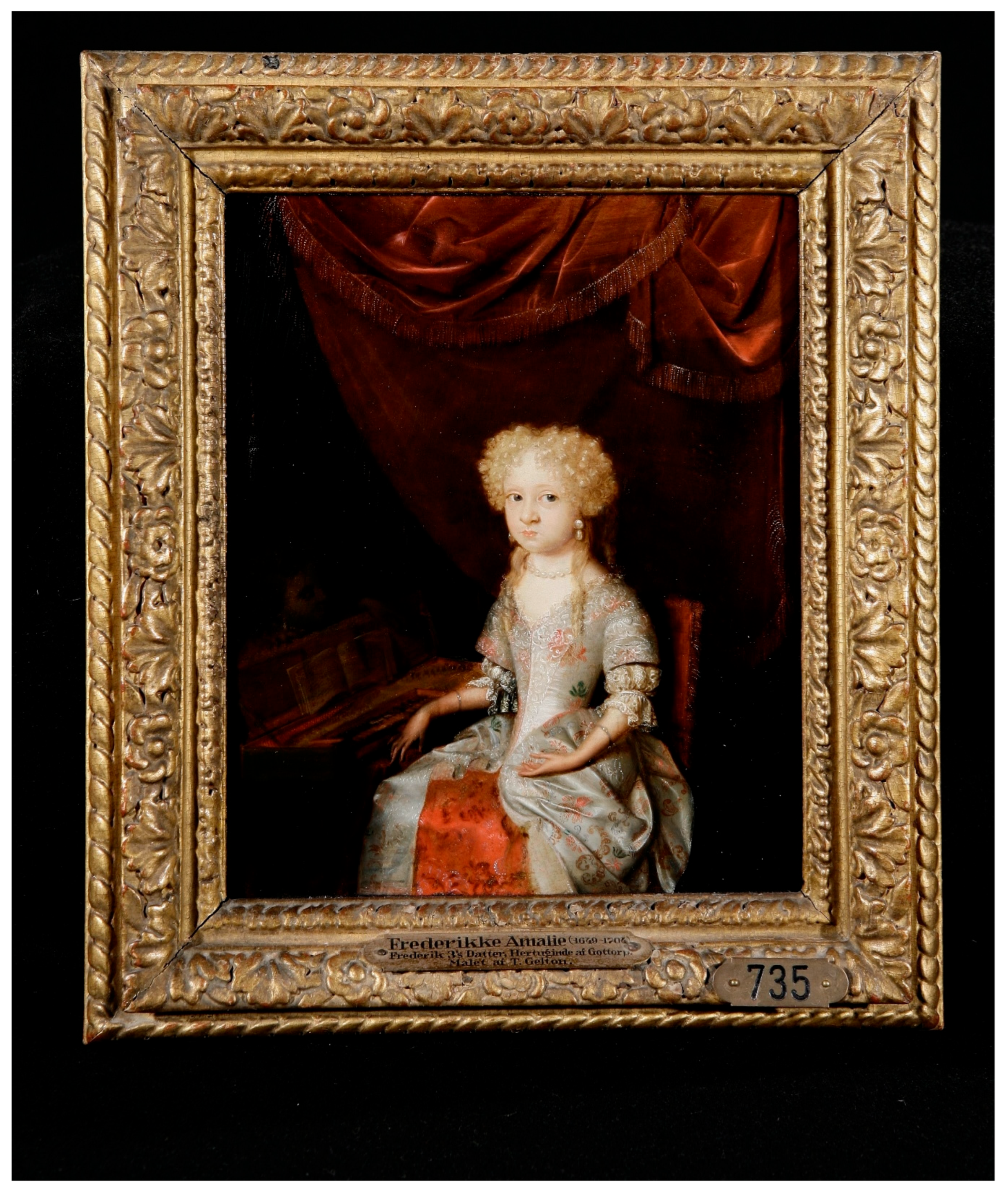
The four paintings under discussion are specifically connected to members of the household of King Frederik III of Denmark and Norway (1609–1670, reigned 1648–1670): three portray his immediate family—his queen, Sophie Amalie of Brunswick-Lüneburg (1628–1685, Figure 2), their son Jørgen (1653–1708, Figure 3), and their daughter Frederikke Amalie (1649–1704, Figure 4)—while the fourth was painted for their daughter-in-law, Charlotte Amalie of Hesse-Kassel (1650–1714, Figure 1), wife of Christian V of Denmark and Norway (1646–1699, reigned 1670–1699). Two of the works can be connected to seventeenth-century records that locate them, securely or plausibly, within royal properties: Girl and Monkey (Figure 1) can probably be identified as the painting mentioned in the royal accounts as having been placed in the queen’s garden, while the portrait of Frederikke Amalie (Figure 4) appears in an inventory of objects kept in a cabinet at Rosenborg Castle. Comparable seventeenth-century evidence for their early location is lacking for the other two portraits4. In addition to the four paintings’ links to Frederik III’s family circle, the choice to study them as a focused group rests on the availability of written sources from the reigns of Frederik III and his successor Christian V, which include references to young Black people at the Danish court, and on their close chronological range.
My first section interrogates primary documents for information concerning the status and various aspects of the lives of these young people, as well as the language used to describe them. The written sources provide a frame of reference for the subsequent interpretation of the four paintings in the second section, three of which have been convincingly ascribed to artists active at the Danish court. While documentary evidence confirms the presence of Black individuals at court, I have not been able to determine whether the young Black adult in Figure 3 or the Black children in Figures 2 and 4 correspond to actual members of the households of the royal sitters with whom they are portrayed; nor can I establish whether the girl in Figure 1 represents a specific individual.
An examination of the documents reveals ways in which Black children came to court, including as purchases and as gifts, and the types of work they were required to undertake, such as caring for animals. I argue that the circumstances and duties which were, like their slavery, forced upon them, influenced how they were represented in these paintings, and how these depictions may have been perceived by their intended audiences. Aspects of these depictions of young Black figures, such as their physical appearance, clothing, gestures, and placement within the composition, I suggest, were fashioned to construct a visual identity of race, power, nobility, and status for the members of the Danish royal family.

1. Danish Sources Concerning Young Black People at Court

Danish source documents of the time, such as the accounts of Frederik III and Christian V, most often refer to a Black person of African descent as a “male Moor” (mor or morian) or “female Moor” (morianer). However, mor, morian and morianer were also employed more broadly to describe dark-skinned individuals of Indian or Southeast Asian origin as well as Muslims in general. One account entry, dated 12 October 1691, gives unusually specific information about the region of origin of a woman identified as a “Moor”: “Morinde Christiane Amelia, som hafde opvarted Hds. M. droningen oc nu fik hiemlou til Ostindien, af naade 100 r.” (“The Moor Christiane Amelia, who had attended Her Majesty the Queen and was now released from service to travel home to the East Indies, by grace 100 r.”) (Marquard 1918, p. 402). The broad application of the term “Moor” in the records that I have examined is rooted in the etymology of the word, derived from the Greek mauros, meaning “black” or “very dark,” which in Latin became mauro (Martin 2009, p. 355). Thus, the individuals labeled as “Moors” in these documents, many or perhaps most of whom were enslaved, encompassed a wide range of peoples and cultures5.
In the period dating from 1671 to 1697, there are at least thirteen references in the royal accounts to “Moors,” five of whom are identifiable by their given names. While it is not always possible to determine the age of these individuals, five were clearly children, as they are each referred to as a “little Moor” (liden mor or liden morian). The accounts also contain two references to Black male children not described by the term “Moor” (mor) but instead called black boys: one is identified as “the black boy Carl Christian Gottlieb” (dend sorte dreng Carl Christian Gottlieb[…]) and the other as “the black boy who was at Prince Christian’s” (dend sorte dreng, som var hoes si. prince Christian)6. Evidence of the presence of Black children at the Danish court also appears in the court records (justitsprotokol) dating from 1696 to 1701 (Jørgensen 1980, pp. 104–5). They document a sixteen-year-old Black girl named Goo as a servant at the royal court in Copenhagen, brought before the Inquisition Commission on charges of theft (Jørgensen 1980, p. 104). Additional documentation comes from the recorded victims who perished in the fire in April 1689, in which the royal castle of Sophie Amalienborg and an opera house in its grounds burned down. Amongst the dead were “the queen’s moor, Kristian Karl,” (Dronningens Morian Kristian Karl), and “a little female moor at Madam Gabell’s,” (en liden Morinde hos Madam Gabell) (see Nielsen 1889, p. 396).
A few entries in the royal accounts, as well as information from additional source materials, specify or suggest that some “Moors,” including individual children, came to the Danish court via other European cities or royal households. For example, the royal accounts of 1697 record a payment (11 rigsdaler 4 m 2 s) for travel expenses to a court servant named Gerdt who fetched a “little Moor” (lille mor) from Hamburg7. Other Black children arrived at court as a result of Denmark’s emerging colonial and trading enterprises. The Danish trade in enslaved Africans was initiated in the second half of the seventeenth century after Dutch entrepreneurs and the Danish monarchy joined forces (Simonsen 2023, p. 280; Brimnes et al. 2017). In 1659, the Danish Africa Company was founded, and forts were constructed along the Gold Coast of present-day Ghana. These trading posts would later play a role in facilitating the transportation of enslaved Africans across the Atlantic. By 1672, approximately one hundred Danish colonists had settled on St. Thomas in the eastern Caribbean, where enslaved Africans were purchased by plantation owners to cultivate sugar. The Danish involvement in the transatlantic slave trade provided a channel through which enslaved individuals were also brought to Denmark. The circumstances that tied these colonial enterprises to the presence of people from Africa or of African descent at the Danish court will be examined in documents presented below.
Expenditures in the royal accounts of 1686 show that two unnamed individuals referred to as “Moors” were enslaved as they were purchased, and the amounts incurred for their acquisitions are specified. The Grand Master of the Court (Oberhofmester) Johan Frederik Geismer received 30 rigsdaler for a “male Moor” (morianen) while Commissarius (commissarien) Ernesti received 37 rigsdaler for a “female Moor” (morinde)8. To put these payments into context, the sum of thirty rigsdaler is less than a quarter of the amount paid for the purchase of the queen’s two small dogs (140 rigsdaler) in 1679 and corresponds to the then typical cost of a lackey’s uniform or a servant’s horse, or the actual cost of a monkey bought in 16929. An entry from July 1680 indicates that at least one enslaved individual was given as a gift: it records that Major Hechman was paid 50 rigsdaler for a “Moor” (morian) whom the king received and gave to Princess Anna Sophie10. Anna Sophie was King Christian V’s sister and, later that year, became Electress of Saxony through her marriage to John George III, a title she held from August 1680 to September 1691. It is also possible that a female “Moor” who was sent to Saxony in 1693 was a gift from King Christian V to her, or to a close relative11. Another source, the Danish legation accounts (gesandtskabsregnskaber) in England, indicate that Henrik Willumsen Rosenvinge, the king’s envoy from 1659 to 1660, purchased for £20 on 6 June 1659, a little circumcised “Moor” to give to Her Royal Highness the Princess, whose name is not stated in the document12. This outlay was equivalent to the typical cost at the time in England for three horses or three cows.
Other types of information concerning “Moors” who served at the Danish court that can be gleaned from written sources are the type and cost of items of apparel and accessories bought for their use13. For example, on 5 April 1660, Henrik Willumsen Rosenvinge had a silver collar made for the enslaved boy, later christened Henry, at a cost of £1414. Worn around the child’s neck, the collar would have stood out starkly against his skin, serving as a visible marker of enslavement. It symbolized the boy’s status as property rather than a free individual, while simultaneously functioning as a display of his owner’s wealth and social standing15. Six months later, on the occasion of the child’s baptism on 6 October 1660, Rosenvinge made another striking purchase. He paid £4 11 s 6 d for a robe of purple cloth with trimmings, ribbons, bonnet, stockings, shoes, and a woolen shirt16. This sum is equal to a little more than a fifth of the amount that Rosenvinge paid out for the child himself.
Source documents indicate that some of the “little Moors” attached to the courts of Frederik III and Christian V received healthcare during serious illnesses and instruction or schooling, most likely to enable them to better meet the needs of those they served (Marquard 1918, pp. 373, 389; Mejborg 1882, p. 37; Eller 1971, p. 188). Carl Christian Gottlieb, noted above, received instruction in drawing and was cared for by the court artist Bendix Grotschilling17.
Children were among the “Moors” present at court who were baptized as Christians, typically with aristocratic godparents, after whom they were often named. For example, the Black child purchased by Henrik Willumsen Rosenvinge, discussed above, was christened Henry, a derivative of his owner’s own name. The age of Kristian Karl Frederik, a “Moor” from the royal castle who was baptized in Frederiksberg in 1684, with Prince Kristian (1675–1695), Prince Frederik (1671–1730), Gehejmeraad Wibe (the Queen’s Master of the Court), and Court Marshal Lützow serving as his godfathers, is not known (Nielsen 1889, p. 357). Nor is the age recorded of “a Moor named Christina” who figures in the accounts of Queen Sophie Amalie. She had been baptized in Denmark in 1657 but only received her godparent gift in 1684 (Eller 1971, p. 188, note 207). The names Christian and Christina, derived from the Latin christianus meaning “a follower of Christ,” were common baptismal names during the period. Conversion to Christianity and baptism were regarded as essential for the salvation of enslaved individuals’ souls. However, this practice—together with the renaming of the enslaved with Christian names—also imposed upon them a new cultural and religious identity.
Written sources indicate that some individuals described in the records as “Moors,” including children, worked with animals at the Danish court, as was also the case at many other European courts18. Enslaved individuals and animals were linked because of their shared status as disposable commodities, and the physical use made of their bodies, an association that stretches back to antiquity. Pictorial sources, as we shall see in examples below, also show “Moors” working with animals, including animals kept as companions or used in hunting (Figures 1 and 2, respectively) or warfare.
Absent from the royal seventeenth-century account books is specific information about the qualities or attributes that made these children desirable as adjuncts to court life. Certainly, the sought-after traits in these individuals depended upon the context in which the enslaved children were expected to serve. Children who attended members of the royal family and were present at social and cultural activities at court were likely to have been perceived as physically attractive. Written sources, such as letters from members of European princely courts to agents, indicate that this trait was sought after by potential buyers; but for some, very dark skin was equally, if not more, desirable19. Letters from the management of the Danish West India-Guinea Company, for example, suggest that these characteristics in children were also attractive to members of the Danish court. According to written sources, Gabriel Milan, the governor of St. Thomas (7 May 1684–27 February 1686) during the island’s Danish colonial period, was supposed to bring home with him to Denmark “beautiful and well-behaved” Black children to show to the queen (Brøndsted 1953, vol. 2, p. 80). Because Milan was prevented from doing so, the new governor Christopher Heins was asked to find, if possible: “a pair of beautiful little Negro children who can somewhat take care of themselves […] They should be well formed and fairly black—energetic and well-proportioned in body and limbs, […] deformed or maimed blacks can […] stay where they are and cultivate the land”20. The attitudes and ideals of physical appearance expressed so explicitly in such correspondence find a visual resonance in the four paintings discussed below. My analysis of these works will shed further light on how young Black people were perceived and represented at the Danish court.

2. The Paintings

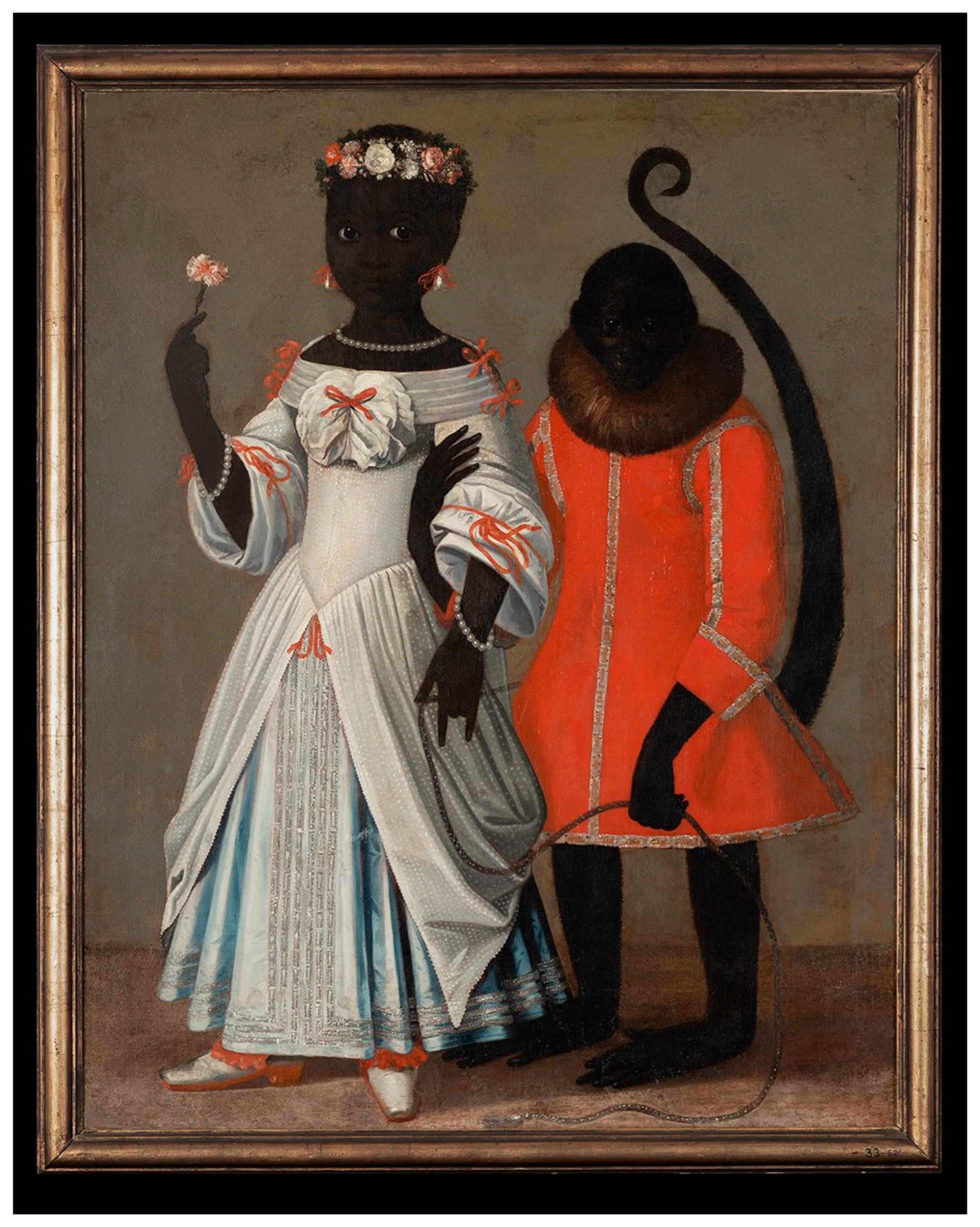
This painting (Figure 1) is, in all likelihood, the only surviving work from a series of pictures depicting “Norwegian boys, Moors, and dwarves” for which the Danish painter, Jan Jebsen, received a payment of 74 rigsdaler in 168721. According to the royal accounts of King Christian V, these paintings by Jebsen were placed in the queen’s garden. Although the accounts do not specify the exact location, seventeenth-century royal gardens in Denmark included enclosed pavilions and across Europe paintings were known to have been installed inside such structures. It is therefore plausible that Jebsen’s works were displayed in an enclosed garden pavilion22.
The Black girl is depicted full length, wearing a fashionable white dress that exposes her neck, forearms, hands, and some of her shoulders. The color of her garment, shoes and pearl jewelry, emphasizes her dark skin. This contrast underscores the importance of “Blackness” to the girl’s constructed identity. The red ribbons and red embellishments of her shoes and earrings match the color of the court costume worn by the monkey who shares the canvas with her. Because the girl holds the animal’s leash in her left hand, she is depicted as its handler23. Through her gesture of holding up and offering a flower, perhaps a nod to the garden setting, as well as her outward gaze, she establishes a connection to the viewer who occupies a position of privilege outside the picture. This direct address, together with the painting’s fairly large dimensions, her full-length presentation, her proximity to the picture plane, and the way her white dress exposes and frames her dark skin, invites the viewer to scrutinize her body.
The monkey’s placement beside her is central to the painting’s construction of her “otherness.” Animals that figured in early modern Western European portraits of children carried various meanings. Wild animals from faraway lands in portraits of young aristocrats were often companion animals, like parrots or monkeys. Because they were valuable and rare possessions, such animals appear in these types of paintings as symbols of their owners’ high social rank and, in some works, they suggest the sitters’ families’ involvements in expansions beyond Europe. These are surely two of the reasons for depicting the daughter of Philip II of Spain holding a Brazilian marmoset in the Portrait of Catalina Michaela with a Marmoset24. Portraying high-born children, like the Spanish princess, with subdued animals moreover showed that they possessed qualities that would lead to their successfully carrying out roles they would play as adults, such as their ability to dictate to or dominate individuals of lesser social status. The depicted relationship between the girl and the monkey is of a different nature than that between the princess and her pet. While the diminutive, seated marmoset’s movements are controlled by the princess’s pale white hands and the chain between her long fingers, in Jebsen’s painting, the large monkey stands side by side with the Black girl, and like her, loosely holds in his five-fingered right hand the long-woven leash to which he is attached. A further distinction between the two paintings is that in Jebsen’s the animal and the girl are visually linked by similarities in their poses and appearance, such as their dark skin color and height, and by the anthropomorphic rendering of the clothed monkey, achieved by its upright, straight-backed posture, attentive facial expression, and the positioning of its hands, particularly the right hand which intimately holds the girl under her arm. Both figures sharing this canvas are of non-European origin and dressed in European court clothes. The numerous analogies between them serve to “other” the child.
The depicted girl and the monkey would have been understood by a contemporary audience as representations of royal property that were exotic and difficult to obtain. Such possessions enhanced the pomp of court life and communicated the power of their owner25. Dwarves, who would also have been represented by Jan Jebsen in the series of paintings of which only one work appears to survive, were likewise considered prized collectibles and as such would have been perceived as having some commonalities with “Moors”26. The presence of dwarves at the Danish court is well documented, and the positions they occupied are suggested by their representation in individual and double portraits, such as the one of Christian V’s queen Charlotte Amalie with the dwarf, Elsgen (Copenhagen, The Royal Danish Collection, Rosenborg Castle), painted around 169027. The “Norwegian boys,” one of the three subjects represented in the paintings for the queen’s garden, can most likely be identified as young Sámis28. Sámi communities live in Arctic and subarctic regions, parts of which belonged in the seventeenth century to the Danish–Norwegian realm; they were perceived as distinctly different from the king’s other subjects because of their indigenous religious practices, nomadic lifestyle, appearance, and reliance on reindeer29. It is possible that Jebsen’s lost paintings depicting dwarves and “Norwegian boys” represented them as animal caretakers or trainers, thus placing them in positions comparable to those assigned to “Moors”30.
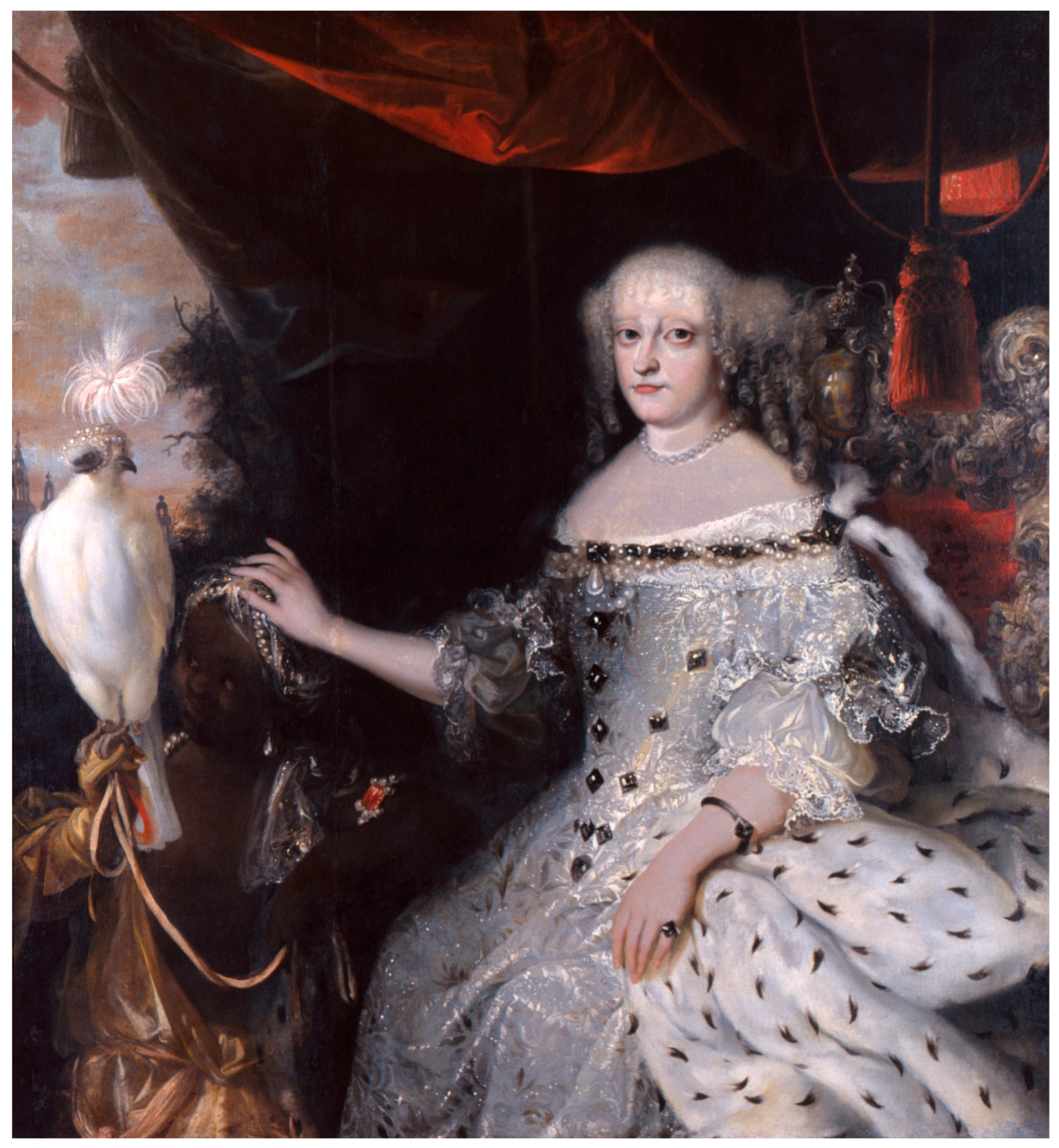
In this portrait, Queen Sophie Amalie (Figure 2), the wife of Frederik III of Denmark and Norway, is regally depicted on a silver throne upholstered in red brocade and bearing her crowned monogram “SA”31. Above her head is a tasseled red brocade canopy, a mark of privilege, and to the left of it, in the background, is a summary landscape with the towers of a castle, another symbol of her status. The white- and gray-haired, fair-skinned queen is luxuriously garbed, predominantly in white and silver32. She wears a gown of shimmering white silk, woven with silver, decorated with white lace and strands of pearls, a stomacher set with diamonds, and a regal ermine cape. Further expensive adornments for her ample body consist of a string of large white pearls around her neck, a large pearl drop earring, a bracelet, and a ring on her left hand. Overshadowed by the imposing figure of the queen is a much smaller and slimmer Black child who is relegated to the lower left part of the picture. While the exposed skin of his face, neck, chest, and right arm blend into the dark background, the white and golden yellow elements of his attire stand out and function as signifying surfaces. The belted tunic, worn open to the waist, and pearl-adorned turban, stress his non-European identity. Moreover, these elements of dress would have been understood by a contemporary audience to have been costly and provided by his mistress and therefore to reflect her wealth and status. An additional and important signifier of the queen’s authority is conveyed through her possessive gesture of laying her pale right hand on the Black child’s head.
There are further indications in the picture of the very great differences in their social ranks and levels of power. Whereas Sophie Amalie’s confident gaze is fixed directly outwards towards the beholder, the boy’s face is averted from the spectator and from the queen. With a slight smile on his lips, the child focuses his full attention on his mistress’s large white gyrfalcon which perches on his gloved hand. Tethered and wearing a hood decorated with costly pearls and an exotic ostrich plume matching its white plumage, the portrayed gyrfalcon was an example of one of the most highly prized and rare hunting birds33. Gyrfalcons were desired by Danish as well as by other European royalty because they were the largest, fastest flying species of falcon used for hunting. They were also appreciated for their white color34. Many of these precious raptors came from Greenland, a territory which Sophie Amalie’s husband claimed, and were captured for Danish kings for their own use but also for sending abroad as diplomatic gifts35. In the painting, the bird, like its caretaker, is on display as a valuable and rare royal possession. But both also reference hunting, a highly symbolic ancient rite and costly activity that was restricted to members of the aristocracy36. Sophie Amalie was an avid huntress who pursued animals in the chase with the king, but also without him37. For private as well as large hunts, her entourage included her attendants, as well as servants and hunting personnel (e.g., grooms, falconers). Hunting not only offered pleasure and excitement for the queen, the royal family, and their circle but was also designed to impress its participants and reinforce social hierarchies. The portrait of the queen with her white gyrfalcon and Black falconer would have preserved the memory of her participation in the hunt, affirmed her good health and hunting skill, and asserted the queen’s power and authority over animals and people.
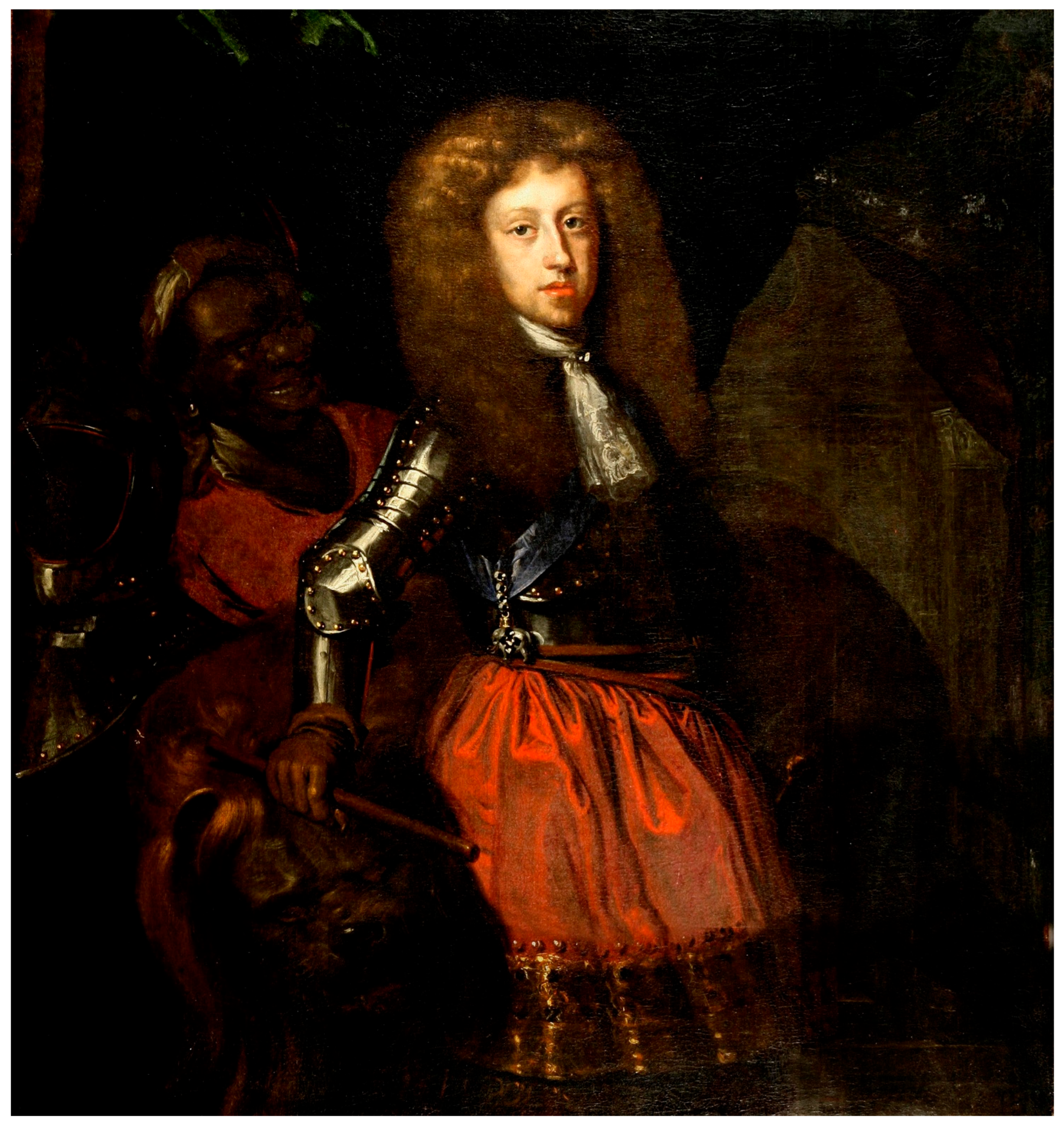
Another portrait from this period which represents a member of the royal family with a Black attendant depicts Sophie Amalie’s pre-teen son Jørgen (Figure 3)38. This painting shows the prince bareheaded except for an allonge wig and wearing shiny, highly polished, silver armor on the upper part of his body. His helmet lies nearby, a staff of command is held in his right hand, and his sword hangs at his left side. Around his waist and over his Roman-style pteruges is satiny red drapery. Jørgen’s depiction draws on aristocratic portraits, of the type in which an adult sitter wears all’antica armor and in which the classical military costume is used to suggest parallels between the sitter and ancient Roman heroes39. An additional reference to the antique as well as to military heroism and triumph is the Roman triumphal arch with a semi-engaged Corinthian column to the prince’s left. The inclusion of the lion’s pelt in the painting, moreover, links the prince to the mythical hero Hercules, who vanquished the Nemean lion and was frequently portrayed in the visual arts as a symbol of indomitable strength, courage, and perseverance. This pelt also references the lion as a symbol associated with royalty from classical times, and employed as such by Danish kings. The blue sash and insignia of the Danish royal Order of the Elephant, which Jørgen wears, emphasize the prince’s high social rank. Notably, the order’s insignia includes the image of a Black man seated on the elephant’s back, a detail that reinforces the symbolic hierarchy embedded in the picture.
The Black figure behind the prince appears to be represented as male, a reading suggested by his broad neck and shoulders, armor-bearing role, and placement within a martial portrait. As an attendant, he serves as a further indication of his master’s high status. At the same time, he functions as a foil for Jørgen. Whereas the prince is painted knee-length, standing erect and dominating the picture from the foreground center, the servant is shown bust-length, leaning off-balance and marginalized. He is indistinctly visible against the dark background, off to the left side, and partially concealed by both the prince and the lion’s pelt. In contrast to Jørgen’s long white face, bathed in light, the Black attendant’s large, round, dark face is cast in shadow. A further distinction between the two figures is that Jørgen looks out directly at the audience, exuding a sense of calm control, while the servant gazes at the prince, encouraging the viewer to do the same.
The prince’s servant, like the two children in Figure 1 and Figure 2, displays stereotypical physical features of Africans, such as a broad, flat nose and tightly curled hair. However, this young Black man, who is represented as older than the two children, has coarser and distorted features and his lips and nose are more exaggerated in size. That such attributes could carry negative associations in the period is suggested by Albrecht Dürer’s study of human proportion, in which he remarks that “the flat faces of the Moors with their flat noses and thick lips are seldom pretty”40.
As in the portrait of Queen Sophie Amalie and the Black falconer (Figure 2), the emotions Jørgen and his attendant express are linked to status and race. While the members of the white royal family are portrayed as aloof, composed, and emotionally distant, their Black servants are painted with much more emotionally expressive faces. In Prince Jørgen’s portrait, the servant’s open-mouthed toothy grin, an indication of emotion and an absence of self-control, implies a lack of knowledge or concern with standards of decorum.
The painting (Figure 4) is one of four small individual cabinet portraits on copper of King Frederik III’s three eldest daughters and his youngest son, attributed to Toussaint Gelton41. While the four works are visually linked by their subject matters, dimensions, compositions, and palettes, a diverse set of figures and objects is provided for each child, some of which serve to characterize the sitter. In the portrait of Frederikke Amalie (1649–1704), the elegantly dressed and coiffed princess is seated on a red-upholstered chair next to a spinet. Standing behind the instrument and turning a page in the princess’s book of music is a Black child whose body is almost entirely obscured by the dark background. So little of the figure is visible that gender cannot be determined securely; only a face in near-profile, dark hair, a pearl earring, one shoulder, and both hands are shown. In contrast, Frederikke Amalie is painted in three-quarter view, from the knees up, with the skin of her face, neck and chest bathed in light and her arms gracefully arranged. A physiognomic juxtaposition is also set up between the two young children. The Black child’s dark skin and hair, deep-set eyes and short turned-up nose, emphasize through contrast the whiteness of Frederikke Amalie’s skin, her light-colored hair, large blue eyes, long nose, and rosy mouth.
The presence of a Black child in the painting emphatically draws attention to the young Frederikke Amalie’s high status. The child would have been understood to be the princess’s property as much as the other represented items, like the girl’s jewelry. The presence of the spinet and book of music may indicate that the princess was proficient in music, as young noblewomen often were42. Regardless of whether or not she ever played the spinet, the inclusion of the musical instrument was intended to characterize the very young sitter as cultivated and disciplined43. Her unwavering gaze, serious and composed expression, and straight-backed posture are meant to exteriorize her noble upbringing.

3. Conclusions

Overall, the three paintings representing young Black people with Danish royals examined here (Figure 2, Figure 3 and Figure 4) employ a number of similar strategies to construct identity, articulate power, and reinforce racial and social “otherness.” As we have seen, royal sitters are emphatically distinguished from their Black servants through their body postures, physiognomies, demeanors, gestures, clothes, accessories, and surroundings. For example, the Black falconer’s skin color, pose, size, partial nudity, exotic costume, physiognomy, expression, and age are, through contrast, used to construct the adult white authority, majesty, and power of the Danish queen.
Furthermore, in contrast to the European sitters, the Black figures are often difficult to discern in these three paintings. They are placed in the backgrounds or obscured in darkness, their bodies cropped and overshadowed by those of their white masters. It can also be concluded that the portraits dramatize and accentuate the vastly different roles and statuses of their subjects. In the three portraits as well as in the painting of the girl with a court animal (Figure 1), the Black figures are shown performing acts of service: the girl and the falconer handle captive creatures, Jørgen’s attendant hands the prince his helmet, and Frederikke Amalie’s servant turns a page in her book of music.
Moreover, the Black figures are used not only to signify the high social status of the white sitters but also to underscore their accomplishments. The falconer and the page turner serve as props to contextualize the hunting or musical skill of the elegantly costumed and bejeweled queen and princess, respectively (Figure 2 and Figure 4). In the Portrait of Prince Jørgen of Denmark and Norway with a Black Attendant (Figure 3), the attendant’s subservient status is used to provide a flattering juxtaposition to the role adopted by the pre-teen prince. Here, Black male servitude is explicitly contrasted to white male military leadership and aggressiveness.
This is not to say that there were no variations in the ways in which Black figures were represented in these four paintings. While the falconer (Figure 2) and the girl (Figure 1) are dressed in outfits made of expensive materials that reflect the elevated status of their owners, the clothes worn by the attendants in the other two paintings do not detract the viewer’s gaze from the main royal subjects or their attire. The garment worn by Jørgen’s servant (Figure 3) is dull and unflattering while the clothing of the young Black child in Frederikke Amalie’s portrait (Figure 4) is barely visible. A further comparison of the paintings highlights additional differences in the depictions of the Black figures. The cut of the girl’s dress (Figure 1) reveals the shape of her upper body, and the falconer (Figure 2), who is more scantily garbed, displays his young, softly sensuous, undraped torso. Jørgen’s servant’s body (Figure 3), in contrast, is fully covered and awkwardly posed. His facial features, furthermore, are rendered in a much more unflattering manner than those of the three younger Black figures.
The Girl and the Monkey (Figure 1) is the only painting discussed here that does not depict a member of the Danish royal family. However, by offering the gift of a flower, the girl implies the presence of her intended audience in the real world, outside the spatial limits of the picture. Whereas the three paintings depicting Black attendants with Danish royals rely on dissimilarity to construct the racial and social “other,” in Jebsen’s painting, the girl and the animal are likened. They are both dressed in European court attire, are almost the same size, stand in similar poses, have the same dark skin color, and entwine arms.
In all four works, the young Black figures are depicted with very dark skin. In the Girl and the Monkey (Figure 1) and in the portrait of the queen and the falconer (Figure 2), the children’s complexions are emphasized through the use of white or gold garments and the revealing cut of their attire. The two children (Figure 1 and Figure 2) are portrayed as well-proportioned, healthy, and accepting of the roles they perform. These pictorial strategies reflect contemporary attitudes and notions of desirable traits in Black children articulated in seventeenth-century correspondence and other documents discussed here.
Although the four Black figures are endowed with the physical traits associated with specific ages, their physiognomies remain largely generic. It is therefore not possible to determine whether they portrayed actual individuals or whether they functioned as archetypes constructed to serve the ideological needs of court representation. The paintings do not merely record the presence of Black individuals at court. They convey the performative nature of Black servitude and show how Black attendants—enslaved or otherwise subordinated—were expected to appear and behave. By presenting Black servitude as orderly and compliant, they turn enslavement and subordination into visual affirmations of royal power and social hierarchy. Displayed within royal residences and collections, these images promoted the “othering” of Black attendants at court and reinforced the clear boundaries separating the Danish royal family from them. For their intended viewers, Blackness thus became one of the means through which royal status was made visible and the Danish royal family’s superiority and authority were affirmed.

Funding

This research was funded by the New Carlsberg Foundation, grant number 0003243 and by the Novo Nordisk Foundation, grant number 0087664.

Data Availability Statement

No new empirical data were created in this study. The literary and critical materials analysed are publicly available published texts cited in the references.

Conflicts of Interest

The author declares no conflict of interest.

Notes

1
On similar issues in sixteenth- and seventeenth-century Western European royal and aristocratic portraiture, see, for example, Kaplan (1982, pp. 11–18); Erickson (1993, pp. 499–527); Goodman (1994, pp. 129–43); Bestor (2003, pp. 628–73); Jordan (2005, pp. 155–80); Stoichita (2011, pp. 191–234); Bindman (2011, pp. 235–70); Massing (2011, pp. 213–60); Howie (2023, pp. 589–644).
2
For an analysis of the depiction of European aristocrats attended by Black servants in sixteenth- and seventeenth-century portraiture and a discussion of the frequency with which this subject matter occurs, see Massing (2011).
3
On the construction of Blackness, racial difference, and gender in early modern visual and literary culture, see K. F. Hall (1995, pp. 238–39). For a broader theoretical account of representation, difference, and “otherness,” see S. Hall (1997, pp. 223–90). On the need to rethink Danish art history through colonial history, see Danbolt et al. (2022). On Danish colonial visual culture and the interpretation of Black subjects in colonial collections, see Odumosu (2021); on archival silence and the limits of reconstructing enslaved lives from archives, see Hartman (2008).
4
For the provenance and early collection history of each painting, see notes 21, 31, 38, and 41 below. At the time of writing, the two paintings in the Museum of National History at Frederiksborg Castle (Figures 2 and 3) were on display, while the two works in the Royal Danish Collection at Rosenborg Castle (Figures 1 and 4) were held in storage.
5
On Danish colonial enterprises in Asia, particularly the Danish East India Company’s activities in Tranquebar and the trade in enslaved and indentured “Moors” from South Asia for aristocratic households, see Díaz (2019, pp. 194–217).
6
On Carl Christian Gottlieb and the unnamed Black child, see Marquard (1918, pp. 482, 496, 511, 522) and Marquard (1918, p. 468), respectively. In letters of the Danish West India-Guinea Company, enslaved children and adults working the plantations are also referred to as neger. See for example a quote from one such letter on p. 6 below.
7
Marquard (1918, p. 490): “Den 1. juni [1697]. Gerdt, som var til Hamborg efter dend lille mor. udlagt til vognleie efter regenskab 11 r 4 m 2 s.”
8
Marquard (1918, p. 322): “Oberhofmester Geismer for en morian 30 r” and Marquard (1918, p. 324): “Hans Voschamp til commissarien Ernesti for en morinde efter regenskab 37 r —”.
9
On the entries noting the outlays on the two small dogs and on a monkey, see Marquard (1918, pp. 212, 421), respectively. On the outlays of 30 rigsdaler for a lackey’s uniform, see Marquard (1918, pp. 130, 149, 152, 162), etc., and for a horse, see Marquard (1918, pp. 130, 135, 139, 140, 142), etc.
10
Marquard (1918, p. 228): “Den 9. juli [1680…] major Hechman blef foræret for en morian. H. K. M. bekom och gaf princess Anna Sophia, penge 50 r.” For a portrait depicting Princess Anna Sophie’s sister, Frederikke Amalie, with a Black child see Figure 4 below.
11
“Den 6. [oktober 1693] For lintøi til morindn, der kom til Saxn, efter regenskab 15 r 2 m” (For linen to a female moor who went to Saxony, after accounting 15 r 2 m).
12
Copenhagen, Royal Danish Archives, Tyske Kancelli, Udenrigske Afdeling (1597–1661), England: Forskellige gesandtskabsregnskaber (Officielt), Henrik Villumsen Rosenvinge 1651–1652, m.m. “Gesandtskabsregnskab, April 1659–November 1660,” p. 7, and Eller (1971, p. 188, note 207).
13
Amongst expenses for the attire of “Moors,” were purchases of shoes and linen. For the outlay of 3 m 8 s for the purchase of shoes for a “Moor” in 1683, see Marquard (1918, p. 278). These shoes cost less than shoes bought for lackeys and other servants.
14
“Gesandtskabsregnskab, April 1659–November 1660,” p. 18, and Eller (1971, p. 188, note 207).
15
See for example the seventeenth-century portrait of Ann De Lisle De Beauvoir (Guernsey Museum & Art Gallery) in which the enslaved child is shown wearing a silver collar.
16
“Gesandtskabsregnskab, April 1659–November 1660,” p. 29, and Eller (1971, p. 188, note 207).
17
Marquard (1918, pp. 482, 496, 511, 522). Another document, a bill from the court painter and engraver Abraham Wuchters, charges Queen Charlotte Amalie 20 rigsdaler for instruction of a “Moor” of undisclosed age for five months in “ritzen” (engraving). See Andrup (1915, p. 192).
18
There are numerous cases of Black males working for rulers or members of the aristocracy in stables. See, for example, Jordan (2005, p. 169); Duncan (2020, p. 146); and Kaufmann (2008, pp. 163–66). On the stableboy Frans Morian who served King Christian IV of Denmark and Norway during the 1620s at Frederiksborg Castle, see Steenberg (1950, pp. 114, 174).
19
For the request of Isabella d’Este, Marchioness of Mantua, to her agent in Venice to procure for her a young Black girl (una moreta) aged between 18 months and four years, and her wish that the girl should be “as black as possible,” see Kaplan (1982, p. 14). For the Black teenager Isabella d’Este acquired in 1522 and who according to a friend, was “recently captured […] apparently 16 or 17 years old and very pretty […] very well made. She has a beautiful face, except that her lower lip is thick,” see Kaplan (2005, p. 149). See also Lowe (2012, p. 19).
20
Author’s translation. For a transcription of the original text in Danish, see Brøndsted (1953, p. 80). He was also asked to send home parrots, turtle doves, flamingos, pelicans, and other exotic animals. For the trade in enslaved people and captive animals being understood in similar terms, see Norton (2024, pp. 290, 291).
21
For the entry in the royal accounts of 1687 stating: “Contrafair Jebsen for de nordske drenge, morer oc dverge, hand skilderet oc kom i Hds. M. droningens hauge, 74 r —,” see Marquard (1918, p. 340). The painting later appears in the Rosenborg Castle inventory of 1718 as “Eet Stöcke med Een liden Sort Pige, og een stoer Abe.” See Hein (2000, p. 106).
22
On the painting’s intended location, see Bencard (1993, p. 12).
23
A grateful acknowledgment of the identification of the animal as a spider monkey is owed to Bengt Holst. For a seventeenth-century watercolor which according to today’s taxonomical classification portrays a spider monkey but which according to the inscription by the artist Frans Post, identifies the animal as “Een meerkadt,” see Bruin (2016, pp. 303, 356). The royal accounts list several entries for outlays on “markatte.” For example, in 1679 the court painter Toussaint Gelton received 240 rigsdaler for “3 markatte och 2de papegojer” (3 meerkats and 2 parrots). See Marquard (1918, p. 340).
24
The painting (Private Collection) is attributed to Sofonisba Anguissola.
25
For a portrait of a monkey belonging to Queen Charlotte Amalie held in the collection of the National Gallery of Denmark, see Gundestrup (1991, vol. 1, p. 88). I am grateful to Michèle Seehafer for pointing out Charlotte Amalie’s monogram to me. For two monkeys that were purchased in 1684 and 1692 for Charlotte Amalie, see Marquard (1918, pp. 295, 421).
26
For the perception of dwarves as collectible marvels see Ghadessi (2013, pp. 491, 497). On the tradition of juxtaposing garden sculptures of dwarves, including Black dwarves, with outdoor statues of classical and heroic figures, see Ghadessi (2013, p. 504). For the dwarf’s relationship to the garden setting see O’Bryan (2012, p. 287, note 96); Lazzaro (1990, pp. 150, 292, note 30); and Morgan (2016, p. 82).
27
Numerous references in the royal accounts to expenditures related to court dwarves can be found in Marquard (1918, p. 68). These records also indicate clear distinctions between the status of dwarves and that of enslaved individuals at court. A hierarchy existed, in which dwarves occupied a significantly higher rank. For portraits of dwarves in the royal collection, see for example, Liisberg (1897, p. 142). See also Marquard (1918, p. 213).
28
Bencard (1993, p. 12). For the understanding that “Norwegian boys” had certain commonalities with dwarves, “Moors,” Turks, and exotic animals, see Mejborg (1882, p. 36); Liisberg (1897, p. 146).
29
For Sámi men and women who lived in the Swedish realm and who along with reindeer were sent by Swedish kings and aristocrats as gifts to European princes, see Persson (2020, pp. 276–77).
30
For the dwarf, Trompiil, who worked with horses, see Marquard (1918, pp. 264, 267, 268, 274, 283, 290, 298, 305, 318, 335, 339–40, 348). For the stableboy Frans Morian, see note 18 above; for the “Norwegian boy” who worked in the royal stables in 1686, see Marquard (1918, p. 319). On a painting attributed to Karel van Mander III, Giacomo Favorchi and the Dog, Raro (Copenhagen, National Gallery of Denmark), showing a dwarf holding a dog by its collar bearing the initials of Magdalena Sibylla of Saxony and recorded in the Danish king’s Kunstkammer since 1689, see Gundestrup (1991, vol. 2, p. 369). An inventory of 1732 records paintings at the king’s castle of Jægersborg of “En norsk Dreng med en Ugle, en Morian og en Hund” (a “Norwegian boy” with an Owl, [and] A Moor and a Dog); their condition at the time suggests they were old (Friis 1872–1878, p. 145).
31
This painting, purchased by the Museum of National History at Frederiksborg in 1931 from E. Ihnken in Kassel, was considered early-on possibly the work of Abraham Wuchters; see Andrup (1943, p. 92). In Hein and Johansen (1986, cat. 11), it is cataloged as attributed to Wuchters. Jørgen Hein subsequently ascribed the work to Jürgen Ovens; see Kappel (2009, p. 225). However, both attributions raise questions.
32
For white skin as the beauty ideal of the period and as a sign of rank, see for example, Rogers (1988, pp. 47–88). For whiteness as a sign of Christian virtue, see for example, Strickland (2003, pp. 83–86). For white clothes as a sign of a rarefied lifestyle, see Hills (1999, p. 192) and Lemire (2024).
33
On the gyrfalcon, see Dalby (1965, p. 255).
34
For the many qualities and admirable traits associated with the gyrfalcon, see Frederick II ([1943] 1961, p. 255). Frederick II of Hohenstaufen (Holy Roman Emperor 1220–1250) considered “the rare white varieties from remote regions are the best” (p. 121).
35
Although it was not unusual for European noblewomen to fly birds of prey—such as peregrine falcons, goshawks, and sparrow hawks—I have found little documentation of women hunting with the large gyrfalcon. A painting of Christina of Sweden on horseback by Sébastien Bourdon (Madrid, Prado, 1653–1654) depicts the queen accompanied by a falconer holding a gyrfalcon, though of a different species from Sophie Amalie’s white gyrfalcon. For the gift of gyrfalcons (no color specified) which the Danish Queen Margarethe I in 1390 sent to the Grand Master, see Voigt (1853, p. 112). For a reference in the royal accounts to the purchase of a gyrfalcon in 1557 and 1558, and to King Frederik II’s gift of four of these birds of prey to the Holy Roman emperor’s brother in 1579, see Mejborg (1882, p. 163). For Frederik III, who saw Greenland as his inheritance and possession, and laid a strong claim to sovereignty over it, see Gad (1967, pp. 286–87), and Pettersen (2013, p. 100).
36
For an analysis of the significance of the courtly hunt and the use of hunting to promote authority and enforce social distinctions, see Neighbors (2023, pp. 49–79).
37
For a reference to the queen amusing herself hunting swans in Nykøbing in 1666, see Becker (1857, p. 156). For hunting equipment belonging to Sophie Amalie—including a hunting sword, rapier, knives, scabbard and waist belt—see Hein (2009, pp. 176–80). For a painting showing Sophie Amalie and Frederik III hunting with male and female courtiers, see A Hunting Party with King Fredrick III and Queen Sophie Amalie (Gavnø Castle, 1640). For an overview of representations of noblewomen hunting in the Middle Ages and Renaissance, see Almond (2009). For the participation of King Frederik II’s wife and young daughters in the royal hunt, see Christianson (2013, pp. 165–87).
38
For the provenance and documentation indicating that the portrait was in Frederiksborg Castle before the 1859 fire, see Eller (1971, p. 320, note 17). This work is generally ascribed to Karel van Mander III. See, for example, Andrup (1943, p. 92); Eller (1971, p. 320); Roding (2020, p. 100).
39
For this type of portraiture see, for example, Francesco Primaticcio’s Portrait of Jean De Dinteville as Saint George, c. 1550 (ex-Barbara Piasecka Johnson Collection) or the Portrait of Eiler Holck with his Family and Servants (Holckenhavn Castle) in which the governor of Kronborg is depicted wearing a Roman style pteruges with a Black servant kneeling at his feet.
40
Dürer (2011, p. 229). For a negative comment on a Black teenager’s lower lip, see note 19 above. See also Korhonen (2005, p. 97), where early modern European associations between perceived African physiognomy and negative aesthetic judgment are discussed.
41
For the portrait as a work by Toussaint Gelton see Lund (1897, p. 343). This attribution is generally accepted. See, for example, Hein and Johansen (1986, cat. 41). For the entry in a 1696 inventory of Rosenborg Castle that records its placement in the castle’s Silver Cabinet, see Holck (1775, p. 125).
42
The account books from the reign of Frederikke Amalie’s father, Frederik III, contain no records of payments for the musical instruction of his children, whereas those from the reign of her brother, Christian V, do. These outlays include keyboard (claver) lessons. See Marquard (1918, pp. 400, 434, 455).
43
For the inclusion of musical instruments in portraits to signify cultural accomplishment, see Christiansen et al. (2021, p. 96).

References

  1. Primary Source

    Copenhagen, Royal Danish Archives, Tyske Kancelli, Udenrigske Afdeling (1597–1661), England: Forskellige gesandtskabsregnskaber (Officielt), Henrik Villumsen Rosenvinge 1651–1652, m.m. “Gesandtskabsregnskab, April 1659–November 1660”.
    Figure 1. Jan Jebsen (attributed). Girl and Monkey. 1680s. Oil on canvas. 98 × 78.5 cm. Copenhagen, The Royal Danish Collection, Rosenborg Castle. Inv. nr. 33–62. Photo: Mai Skou Wihlborg. Reproduced with permission from The Royal Danish Collection.
    Figure 2. Unknown painter. Queen Sophie Amalie of Denmark and Norway (1628–1685) and a Black Falconer. 1660s. Oil on canvas. 135 × 120.5 cm. Hillerød, Museum of National History, Frederiksborg Castle. Inv. nr. A 4605. Photo: Ole Haupt. Reproduced with permission from the Museum of National History.
    Figure 3. Karel van Mander III (attributed). Portrait of Prince Jørgen of Denmark and Norway (1653–1708), with a Black Attendant. c. 1665. Oil on canvas. 117 × 110 cm. Hillerød, Museum of National History, Frederiksborg Castle. Inv. nr. A 2402. Photo: Kit Weiss. Reproduced with permission from the Museum of National History.
    Figure 4. Toussaint Gelton (attributed). Portrait of Princess Frederikke Amalie of Denmark and Norway (1649–1704) with a Black Child. c. 1657. Oil on copper. 22 × 18 cm. Copenhagen, The Royal Danish Collection, Rosenborg Castle. Inv. nr. 7–30. Photo courtesy of The Royal Danish Collection. Reproduced with permission from The Royal Danish Collection.
  2. Secondary Source

  3. Almond, Richard. 2009. Daughters of Artemis: The Huntress in the Middle Ages and Renaissance. Cambridge: D.S. Brewer. [Google Scholar]
  4. Andrup, Otto. 1915. Nogle Wuchters Arkivalia. Kunstmuseets Aarsskrift 2: 190–200. [Google Scholar]
  5. Andrup, Otto. 1943. Katalog over de Udstillede Portraiter og Genstande paa Frederiksborg. Ringkøbing: Det Nationalhistoriske Museum paa Frederiksborg. [Google Scholar]
  6. Becker, Peter Willemoes. 1857. Samlinger til Danmarks Historie under Kong Frederik den Tredies Regiering af Udenlandske Archiver. Copenhagen: Gyldendal, vol. 2. [Google Scholar]
  7. Bencard, Mogens. 1993. Museerne og Verdensordenen. Kunstkammerets Opståen og Grundidé. Nordisk Museologi 1: 3–16. [Google Scholar]
  8. Bestor, Jane Fair. 2003. Titian’s Portrait of Laura Eustochia: The Decorum of Female Beauty and the Motif of the Black Page. Renaissance Studies 17: 628–73. [Google Scholar] [CrossRef]
  9. Bindman, David. 2011. The Black Presence in British Art: Sixteenth and Seventeenth Centuries. In The Image of the Black in Western Art: From the ‘Age of Discovery’ to the Age of Abolition: Artists of the Renaissance and Baroque. Edited by David Bindman and Henry Louis Gates, Jr. Cambridge, MA: Harvard University Press, vol. 3, part 1. pp. 235–70. [Google Scholar]
  10. Brimnes, Niels, Hans Christian Gulløv, Erik Gøbel, Per Oluf Hernæs, Poul Erik Olsen, and Mikkel Venborg Pedersen, eds. 2017. Danmark og Kolonierne. 5 vols. Copenhagen: Gads Forlag. [Google Scholar]
  11. Brøndsted, Johannes. 1953. Vore Gamle Tropekolonier: Dansk Vestindien. 2 vols. Copenhagen: Westermann. [Google Scholar]
  12. Bruin, Alexander de. 2016. Frans Post: Animals in Brazil. Master Drawings 54: 292–368. [Google Scholar]
  13. Christiansen, Keith, Carlo Falciani, and Andrea Bayer, eds. 2021. The Medici: Portraits and Politics 1512–1570. New York: The Metropolitan Museum of Art. [Google Scholar]
  14. Christianson, John Robert. 2013. The Hunt of King Frederik II of Denmark: Structures and Rituals. The Court Historian 18: 165–87. [Google Scholar] [CrossRef]
  15. Dalby, David. 1965. Lexicon of the Mediaeval German Hunt: A Lexicon of Middle High German Terms (1050–1500), Associated with the Chase, Hunting with Bows, Falconry, Trapping and Fowling. Berlin: Walter de Gruyter. [Google Scholar]
  16. Danbolt, Mathias, Nina Cramer, Emil Elg, Anna Vestergaard Jørgensen, and Bart Pushaw. 2022. I kontaktzonen mellem kunsthistorie og kolonihistorie. Periskop—Forum for Kunsthistorisk Debat 27: 36–57. [Google Scholar] [CrossRef]
  17. Díaz, Jorge Simón Izquierdo. 2019. The Trade in Domestic Servants (Morianer) from Tranquebar for Upper Class Danish Homes in the First Half of the Seventeenth Century. Itinerario 43: 194–217. [Google Scholar] [CrossRef]
  18. Duncan, Sarah G. 2020. Stable Design and Horse Management at the Italian Renaissance Court. In Animals and Courts: Europe, c. 1200–1800. Edited by Mark Hengerer and Nadir Weber. Berlin: De Gruyter Oldenbourg, pp. 129–52. [Google Scholar]
  19. Dürer, Albrecht. 2011. Vier Bücher von Menschlicher Proportion: (1528): Mit einem Katalog der Holzschnitte. Edited by Berthold Hinz. Berlin: Akademie Verlag. [Google Scholar]
  20. Eller, Povl. 1971. Kongelige Portrætmalere i Danmark 1630–1682: En Undersøgelse af Kilderne til Karel van Manders og Abraham Wuchters’ Virksomhed. Copenhagen: Selskabet til Udgivelse af Danske Mindesmærker: Dansk Historisk Fællesforening. [Google Scholar]
  21. Erickson, Peter. 1993. Representations of Blacks and Blackness in the Renaissance. Criticism 35: 499–527. [Google Scholar]
  22. Frederick II, Emperor. 1961. The Art of Falconry: Being the De Arte Venandi Cum Avibus of Frederick II of Hohenstaufen. Edited by Casey Albert Wood and Florence Marjorie Fyfe. Stanford: Stanford University Press. First published 1943. [Google Scholar]
  23. Friis, Frederik R. 1872–1878. Samlinger til Dansk Bygnings- og Kunsthistorie. Copenhagen: Gyldendalske Boghandel. [Google Scholar]
  24. Gad, Finn. 1967. Grønlands Historie, 1: Indtil 1700. Copenhagen: Nyt Nordisk Forlag, Arnold Busck. [Google Scholar]
  25. Ghadessi, Touba. 2013. Lords and Monsters: Visible Emblems of Rule. I Tatti Studies in the Italian Renaissance 16: 491–523. [Google Scholar] [CrossRef]
  26. Goodman, Elise. 1994. Woman’s Supremacy over Nature: Van Dyck’s Portrait of Elena Grimaldi. Artibus et Historiae 30: 129–43. [Google Scholar] [CrossRef]
  27. Gundestrup, Bente. 1991. Det Kongelige Danske Kunstkammer 1737; 3 vols. Copenhagen: Nationalmuseet, Copenhagen: Nyt Nordisk Forlag, Arnold Busck.
  28. Hall, Kim F. 1995. Things of Darkness: Economies of Race and Gender in Early Modern England. Ithaca: Cornell University Press. [Google Scholar]
  29. Hall, Stuart. 1997. Representation: Cultural Representations and Signifying Practices. London: Sage. [Google Scholar]
  30. Hartman, Saidiya. 2008. Venus in Two Acts. Small Axe 26: 1–14. [Google Scholar] [CrossRef]
  31. Hein, Jørgen. 2000. Menneske Maske Majestæt: Kongelige Portrætter i Voks. Copenhagen: Rosenborg. [Google Scholar]
  32. Hein, Jørgen. 2009. The Treasure Collection at Rosenborg Castle: The Inventories of 1696 and 1718; Royal Heritage and Collecting in Denmark-Norway 1500–1900. 3 vols. Copenhagen: Museum Tusculanum Press. [Google Scholar]
  33. Hein, Jørgen, and Katia Johansen. 1986. Sophie Amalie: Den Onde Dronning? Copenhagen: Rosenborg. [Google Scholar]
  34. Hills, Paul. 1999. Venetian Colour: Marble, Mosaic, Painting and Glass 1250–1550. New Haven: Yale University Press. [Google Scholar]
  35. Holck, Hans. 1775. Det Kongelige Konst-Kammer paa Christiansborg Slot samt Rosenborg Slots Inventarium fra Høystsalig Kong Christian den Femtes Tiïd. Copenhagen: Trykt hos Lauritz Christian Simmelkiær. [Google Scholar]
  36. Howie, Ana. 2023. Materializing the Global: Textiles, Color, and Race in a Genoese Portrait by Anthony van Dyck. Renaissance Quarterly 76: 589–644. [Google Scholar] [CrossRef]
  37. Jordan, Annemarie. 2005. Slaves in the Lisbon Household and Court of Catherine of Austria. In Black Africans in Renaissance Europe. Edited by Thomas F. Earle and Kate J. P. Lowe. Cambridge: Cambridge University Press, pp. 155–80. [Google Scholar]
  38. Jørgensen, Harald. 1980. Thi Kendes for Ret: Studier i de Civile Københavnske Domstoles Historie i Perioden. 1660 til 1919; Copenhagen: Rigsarkivet, Gad.
  39. Kaplan, Paul H. D. 1982. Titian’s Laura Dianti and the Origins of the Motif of the Black Page in Portraiture. Antichità Viva 21: 11–18. [Google Scholar]
  40. Kaplan, Paul H. D. 2005. Isabella d’Este and Black African Women. In Black Africans in Renaissance Europe. Edited by Thomas F. Earle and Kate J. P. Lowe. Cambridge: Cambridge University Press, pp. 125–54. [Google Scholar]
  41. Kappel, Jutta, ed. 2009. Mit Fortuna Übers Meer: Sachsen und Dänemark—Ehen und Allianzen im Spiegel der Kunst (1548–1709). Berlin: Deutscher Kunstverlag. [Google Scholar]
  42. Kaufmann, Miranda. 2008. Courts, Blacks at Early Modern European Aristocratic. In Encyclopedia of Blacks in European History and Culture: A–J. Edited by Eric Martone. Westport: Greenwood Press, vol. 1, pp. 163–66. [Google Scholar]
  43. Korhonen, Anu. 2005. Washing the Ethiopian White: Conceptualising Black Skin in Renaissance England. In Black Africans in Renaissance Europe. Edited by Thomas F. Earle and Kate J. P. Lowe. Cambridge: Cambridge University Press, pp. 94–112. [Google Scholar]
  44. Lazzaro, Claudia. 1990. The Italian Renaissance Garden. New Haven: Yale University Press. [Google Scholar]
  45. Lemire, Beverly. 2024. Empire and the Fashioning of Whiteness: Im/Material Culture in the British Atlantic World, c. 1660–1820. Journal of Interdisciplinary History 55: 57–87. [Google Scholar] [CrossRef]
  46. Liisberg, Henrik Carl Bering. 1897. Kunstkammeret: Dets Stiftelse og Ældste Historie. Copenhagen: Gyldendalske boghandel. [Google Scholar]
  47. Lowe, Kate. 2012. The Lives of African Slaves and People of African Descent in Renaissance Europe. In Revealing the African Presence in Renaissance Europe. Edited by Joaneath Ann Spicer, Natalie Zemon Davis and Kate J. P. Lowe. Baltimore: The Walters Art Museum, pp. 17–47. [Google Scholar]
  48. Lund, Emil Ferdinand Svitzer. 1897. Danske Malede Portrætter: En beskrivende Katalog. Miniaturesamlingen paa Rosenborg. Copenhagen: Gyldendal, vol. 2. [Google Scholar]
  49. Marquard, Emil, ed. 1918. Kongelige Kammerregnskaber fra Frederik III’s og Christian V’s Tid. Copenhagen: Gad. [Google Scholar]
  50. Martin, Thomas. 2009. Moors. In Encyclopedia of Blacks in European History and Culture: K–Z. Edited by Eric Martone. Westport: Greenwood Press, vol. 2, pp. 355–56. [Google Scholar]
  51. Massing, Jean Michel. 2011. The European Scene. In The Image of the Black in Western Art: From the ‘Age of Discovery’ to the Age of Abolition: Artists of the Renaissance and Baroque. Edited by David Bindman, Karen C. C. Dalton and Henry Louis Gates. Cambridge, MA: Harvard University Press, vol. 3, part 2. pp. 213–60. [Google Scholar]
  52. Mejborg, Reinhold Frederik Severin. 1882. Billeder af Livet ved Christian den Femtes Hof. Copenhagen: J. H. Schubothe. [Google Scholar]
  53. Morgan, Luke. 2016. The Grotesque and the Gigantic in Renaissance Landscape Design. Philadelphia: University of Pennsylvania Press. [Google Scholar]
  54. Neighbors, Dustin M. 2023. Elizabeth I, Huntress of England: Private Politics, Diplomacy, and Courtly Relations Cultivated through Hunting. The Court Historian 28: 49–79. [Google Scholar] [CrossRef]
  55. Nielsen, Oluf. 1889. Kjøbenhavns Historie og Beskrivelse Femte Del: I Aarene 1660 til 1699. Copenhagen: Gad. [Google Scholar]
  56. Norton, Marcy. 2024. The Tame and the Wild: People and Animals After 1492. Cambridge, MA and London: Harvard University Press. [Google Scholar]
  57. O’Bryan, Robin. 2012. Grotesque Bodies, Princely Delight: Dwarfs in Italian Renaissance Court Imagery. Preternature: Critical and Historical Studies on the Preternatural 1: 252–88. [Google Scholar]
  58. Odumosu, Temi. 2021. Response by Odumosu to “Representing Experiential Knowledge”. Translation Studies 14: 108–13. [Google Scholar]
  59. Persson, Fabian. 2020. Unruly Display: The Challenges of Working with Animals in Swedish Royal Spectacle. In Animals and Courts: Europe, c. 1200–1800. Edited by Mark Hengerer and Nadir Weber. Berlin: De Gruyter Oldenbourg, pp. 265–83. [Google Scholar]
  60. Pettersen, Christina. 2013. ‘Nothing Like It Was Ever Made in Any Kingdom’: The Hunt for Solomon’s Throne. In Postcolonialism and the Hebrew Bible: The Next Step. Edited by Roland Boer. Atlanta: Society of Biblical Literature, pp. 93–108. [Google Scholar]
  61. Roding, Juliette. 2020. Karel van Mander III: Library and Oeuvre. Frederiksborg: The Museum of National History at Frederiksborg. [Google Scholar]
  62. Rogers, Mary. 1988. The Decorum of Women’s Beauty: Trissino, Firenzuola, Luigini and the Representation of Women in Sixteenth-Century Painting. Renaissance Studies 2: 47–88. [Google Scholar] [CrossRef]
  63. Simonsen, Gunvor. 2023. History and Public Debates about Racial Slavery. In Cultural Heritage and Slavery: Perspectives from Europe. Edited by Stephan Conermann, Claudia Rauhut and Ulrike Schmieder. Berlin: Walter de Gruyter GmbH, pp. 279–302. [Google Scholar]
  64. Steenberg, Jan. 1950. Christian IVs Frederiksborg. Hillerød: Frederiksborg Amts Historiske Samfund. [Google Scholar]
  65. Stoichita, Victor. 2011. The Image of the Black in Spanish Art. In The Image of the Black in Western Art: From the ‘Age of Discovery’ to the Age of Abolition: Artists of the Renaissance and Baroque. Edited by David Bindman and Henry Louis Gates, Jr. Cambridge, MA: Harvard University Press, vol. 3, part 1. pp. 191–234. [Google Scholar]
  66. Strickland, Debra Higgs. 2003. Saracens, Demons & Jews: Making Monsters in Medieval Art. Princeton: Princeton University Press. [Google Scholar]
  67. Voigt, Johannes. 1853. Codex Diplomaticus Prussicus. Urkunden-Sammlung zur Ältern Geschichte Preussens aus dem Königl. Geheimen Archiv zu Königsberg. Königsberg: Verlag der Gebrüder Bornträger, vol. 4. [Google Scholar]
Figure 1. Jan Jebsen (attributed). Girl and Monkey. 1680s. Oil on canvas. 98 × 78.5 cm. Copenhagen, The Royal Danish Collection, Rosenborg Castle. Inv. nr. 33–62. Photo: Mai Skou Wihlborg.
Humanities 15 00101 g001
Figure 2. Unknown painter. Queen Sophie Amalie of Denmark and Norway (1628–1685) and a Black Falconer. 1660s. Oil on canvas. 135 × 120.5 cm. Hillerød, Museum of National History, Frederiksborg Castle. Inv. nr. A 4605. Photo: Ole Haupt.
Humanities 15 00101 g002
Figure 3. Karel van Mander III (attributed). Portrait of Prince Jørgen of Denmark and Norway (1653–1708), with a Black Attendant. c. 1665. Oil on canvas. 117 × 110 cm. Hillerød, Museum of National History, Frederiksborg Castle. Inv. nr. A 2402. Photo: Kit Weiss.
Humanities 15 00101 g003
Figure 4. Toussaint Gelton (attributed). Portrait of Princess Frederikke Amalie of Denmark and Norway (1649–1704) with a Black Child. c. 1657. Oil on copper. 22 × 18 cm. Copenhagen, The Royal Danish Collection, Rosenborg Castle. Inv. nr. 7–30. Photo courtesy of The Royal Danish Collection.
Humanities 15 00101 g004
Disclaimer/Publisher’s Note: The statements, opinions and data contained in all publications are solely those of the individual author(s) and contributor(s) and not of MDPI and/or the editor(s). MDPI and/or the editor(s) disclaim responsibility for any injury to people or property resulting from any ideas, methods, instructions or products referred to in the content.