1. Introduction
Late in the ninth month of 1620, Nichiyō 日遥 unexpectedly received a letter (hereafter Letter A) from his father, whose name he remembered as Yŏ Ch’ŏn’gap 余天甲. At that time, Nichiyō was serving as the head monk (abbot) of Honmyōji 本妙寺 in Kumamoto, Japan. (
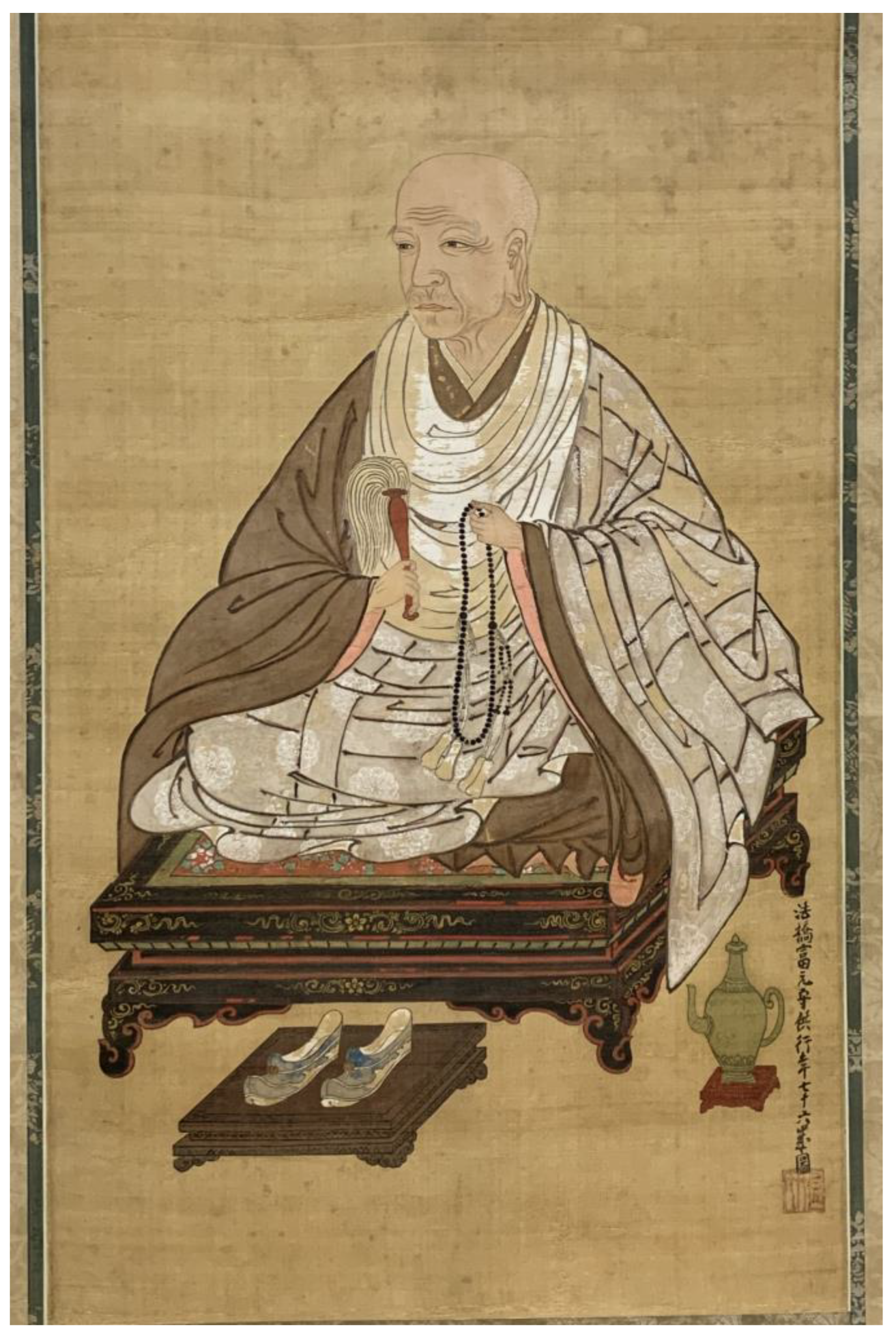
Figure 1: A photo of Nichiyō’s portrait. Photograph by the author, courtesy of Honmyōji Museum.) His father, whom he had not seen for about twenty-eight years, was in Chosŏn from where the letter had been sent across the sea. The last time Nichiyō had been with his father in their home village of Hadong, Chosŏn, was in the early seventh month of 1593, when he was thirteen years old. In 1620, Nichiyō was 40 years old.
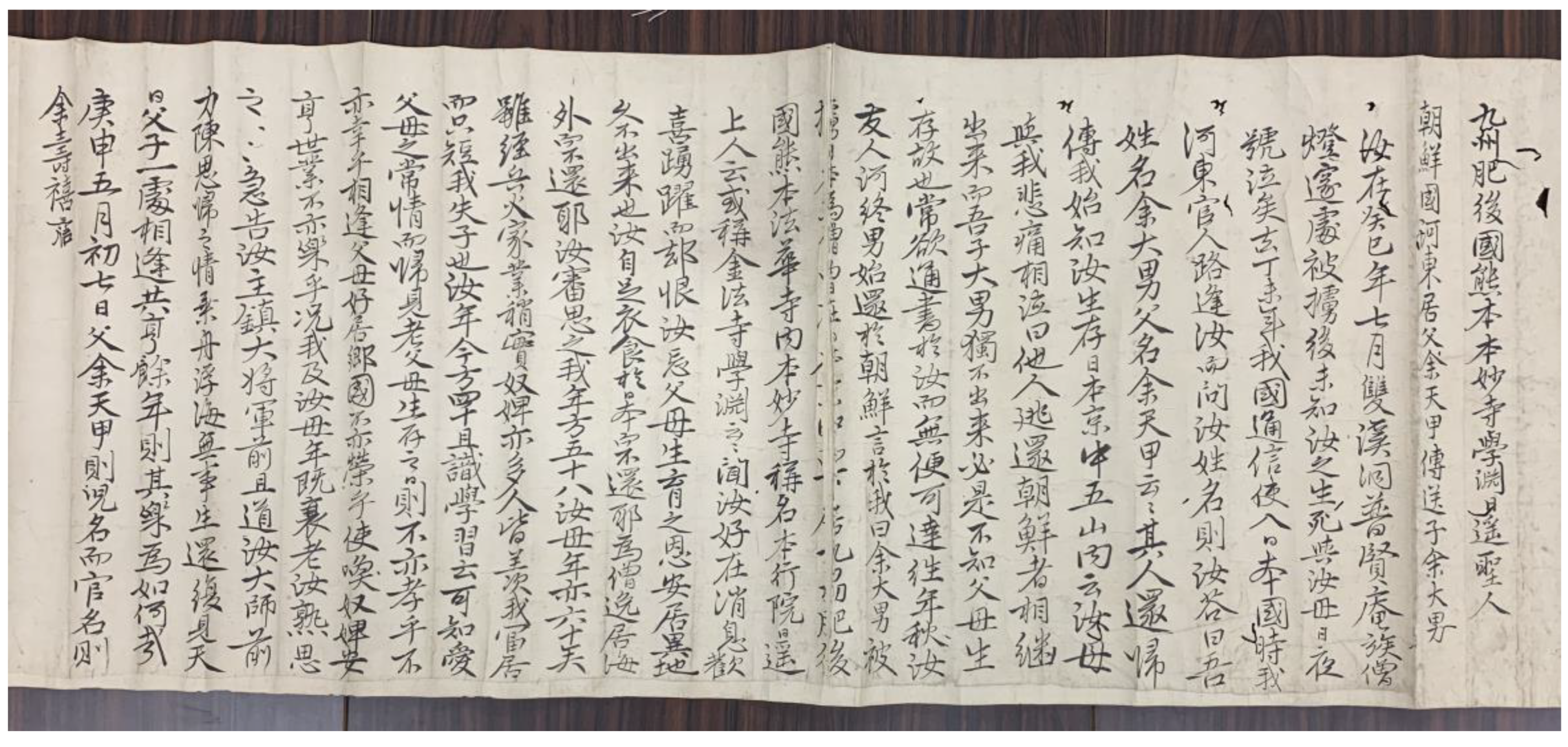
The letter was addressed to Yŏ Taenam 余大男, Nichiyō’s original Korean name, and dated the seventh day of the fifth month, 1620. In it, his father explained that he had changed his name from (Yŏ) Ch’ŏn’gap to (Yŏ) Suhŭi 壽禧 (
Yo 2012, p. 132). Yŏ Ch’ŏn’gap had been separated from his young son in 1593 and, for many years thereafter, believed that his son had been lost. Eventually, however, he learned that his son was alive in Japan. After years of searching, he finally found a Japanese intermediary who was able to deliver his letter to Kumamoto.
Upon receiving the letter from his father, Hoin 好仁, as he called himself, immediately wrote back on the third day of the tenth month, 1620. It had taken nearly five months for his father’s letter to reach him. The exact date when Nichiyō’s reply (hereafter Letter B) arrived in Hadong, Chosŏn, is unknown, but it was likely by the sixth month of 1621. His father attempted to send several more letters over the following year, but without success. Finally, on the eighth day of the seventh month, 1622, Nichiyō received his father’s second letter (Letter C). (
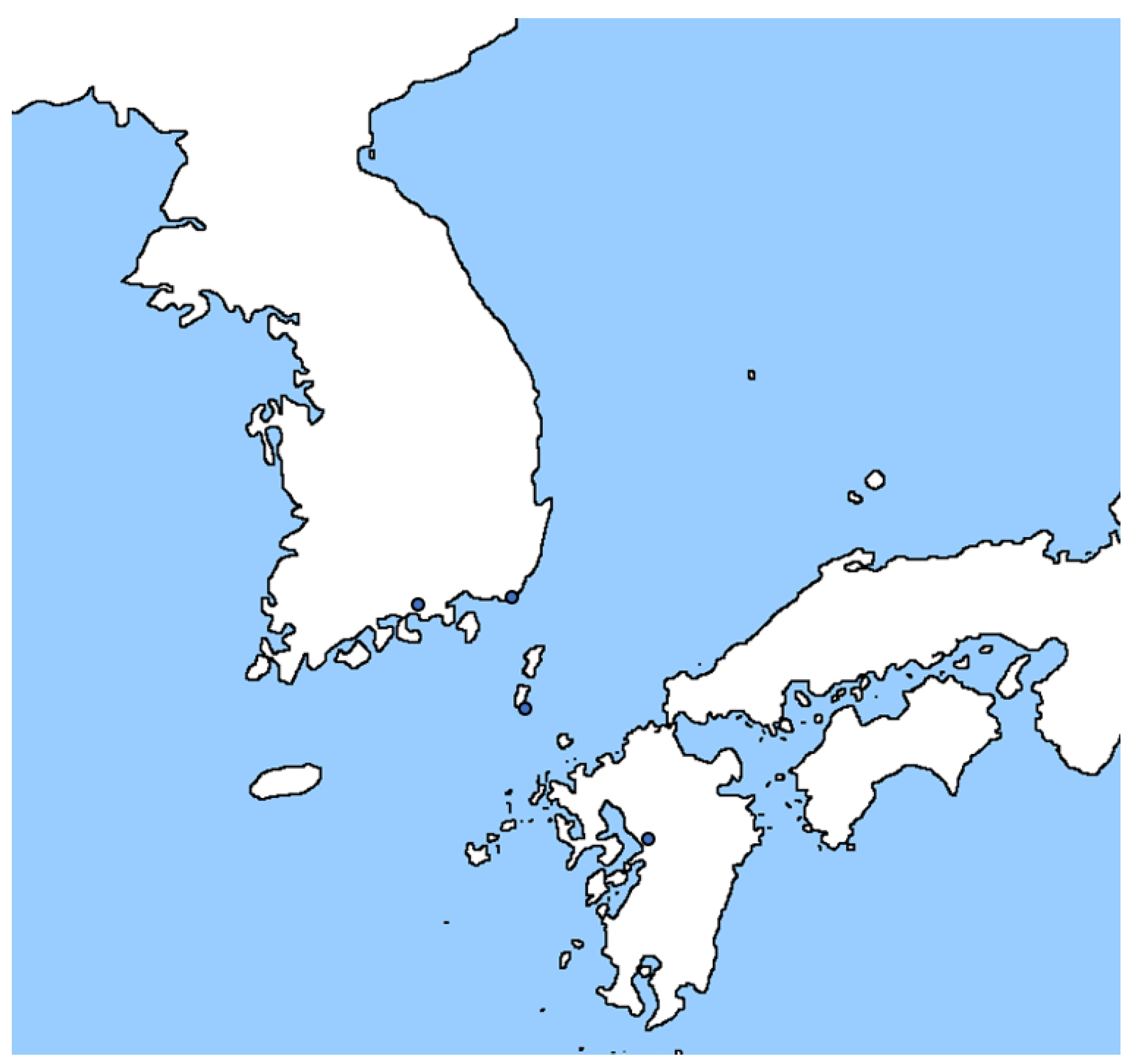
Figure 2: Map showing the locations of Hadong, Pusan, Tsushima, and Kumamoto).
The central message of the two letters from his father was clear: return home at all costs and reunite with your aging parents. In 1620, Nichiyō’s father was 58 years old and his mother 60, as noted in Letter A. Nichiyō was their only child, though his father had two additional children with his second wife (
H. Chŏng 2022, p. 339). Nichiyō, who never married and thus had no family of his own, tried for about four years to return home to Chosŏn, but to no avail. He sent several letters to his father, though not all reached their destination. Once again, in the first month of 1625, Nichiyō wrote another letter (Letter D) to his father, but without success. In this letter, he explained that despite his persistent efforts over the years, there was no way for him to return home. Moreover, increasing surveillance made it impossible for him to send further correspondence. Nichiyō died in 1659 at the age of 79 in Kumamoto, never having seen his parents in Chosŏn again.
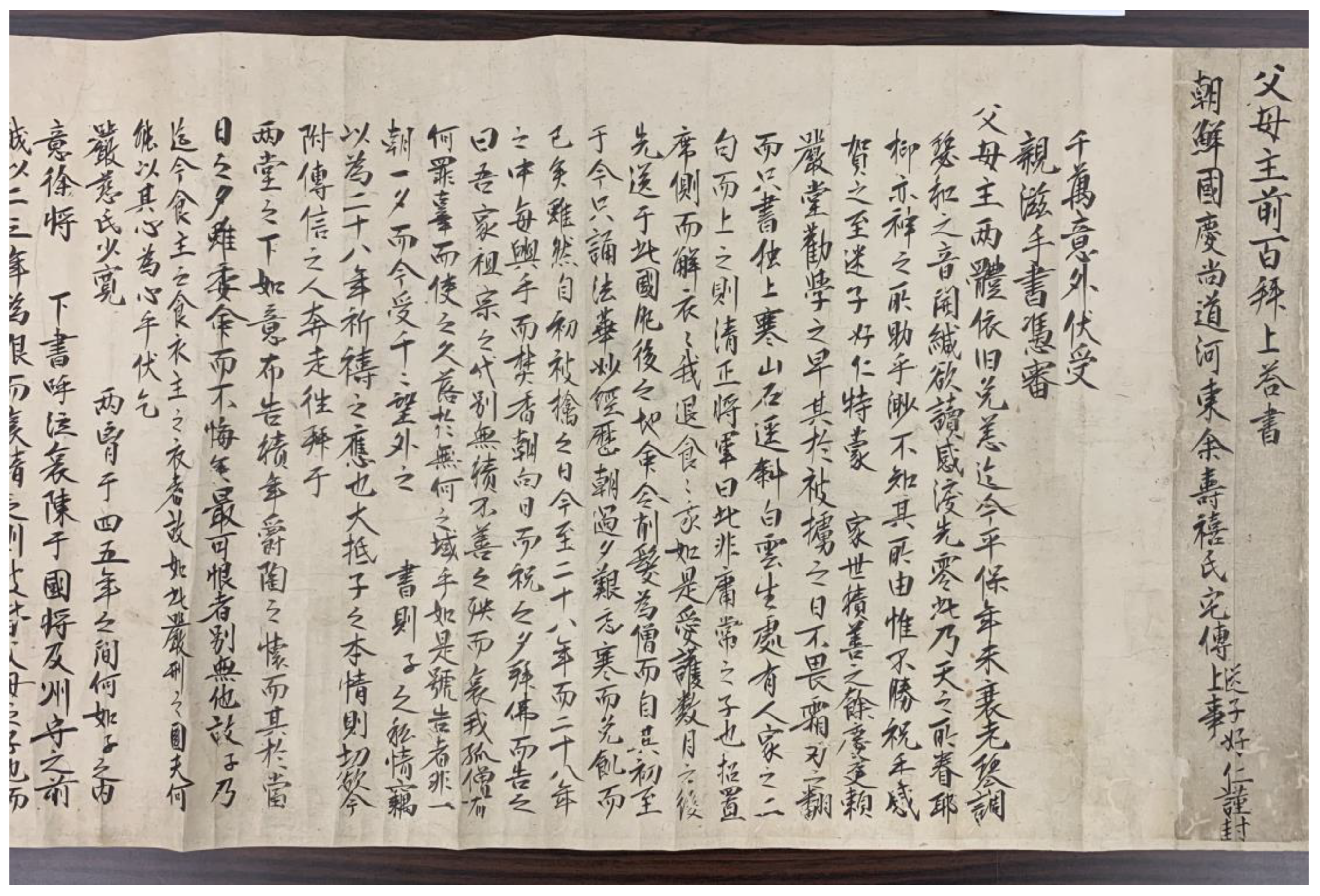
Honmyōji in Kumamoto preserves copies of four letters: two from Nichiyō’s father in Chosŏn (Letters A and C) and two from Nichiyō in Japan (Letters B and D). (
Figure 3: A photo of Letter A. Photograph by the author, courtesy of Honmyōji Museum.) These four letters, which have not yet been examined in English-language scholarship, constitute the only known example of surviving correspondence between Korean family members separated by force across the sea during the Imjin War, living apart in Chosŏn and premodern Japan.
Drawing on these letters, this article explores the following questions: What happened to Hoin/Taenam (Nichiyō) and his father in 1593 and thereafter? How were they able to communicate, albeit for only three years, across the sea? And how was a Korean boy transformed into a Buddhist monk in a foreign land, Japan? Since these questions concern identifying what happened rather than advancing arguments, the following discussion focuses on what the currently available evidence reveals.
The four letters provide vivid insights into the evolving dynamics of Japan’s invasion of Chosŏn (particularly the Japanese assault on Chinju in 1593), the life trajectory of an abducted Korean boy who underwent a dramatic transformation in status in Japan, the cross-border efforts to reunite a family torn apart by war, and the existence of an illicit, though short-lived, channel of communication across the sea between Chosŏn and Japan. Taken together, these letters constitute the rare example of a family separated by foreign abduction during the Imjin War that sought reunion, and of an abducted Korean boy who ultimately ascended to the abbot of his captor’s temple.
2. Yŏ Taenam (Nichiyō), the 1593 Japanese Attack on Chinju, and His Abduction
In Letter B, Nichiyō recounted the events that had befallen him in 1593. Drawing on his account and corroborating sources, it is now possible to understand how he came to be in Japan following its assault on Chinju. In the fifth month of 1593, Hideyoshi 秀吉 ordered a full-scale attack on Chinju, a local town located in the southwestern corner of Kyŏngsang Province, a strategic gateway to Chŏlla Province, which the Japanese had failed to penetrate despite their vigorous campaigns in the previous year.
What, then, prompted Hideyoshi to launch the assault on Chinju? In the fourth month of 1593, Hideyoshi explicitly defined the assault on Chinju, whose capture had failed in the previous year, as an “act of killing everyone without leaving a single person.” (
Toyotomi Hideyoshi monjoshū 2015–2024, vol. 6, pp. 81–83). Hideyoshi’s ultimate objective was to bring the kingdom swiftly under Japanese control and compel King Sŏnjo 宣祖 to submit to his authority in person (
Toyotomi Hideyoshi monjoshū 2015–2024, vol. 5, pp. 130–33). In the initial phase of the invasion, Japanese forces advanced with astonishing speed: after landing at Pusan, they captured Hansŏng, the Chosŏn capital, in less than three weeks. To Hideyoshi, the fall of the capital represented not merely a military success but the realization of his goal to conquer the peninsula (
Toyotomi Hideyoshi monjoshū 2015–2024, vol. 5, p. 196).
The four letters exchanged between Nichiyō and his father offer invaluable testimony to the nature of Japan’s assault on Chinju, an event that many Japanese historians have tended to portray as a tactical maneuver aimed at facilitating truce negotiations with Ming China rather than as punitive action against the Koreans. Yet the letters, written by those who directly experienced the attack, undermine such an interpretation. To grasp their significance, it is essential to revisit the circumstances that led Hideyoshi to order the assault on Chinju in the sixth month of 1593.
After seizing Hansŏng in the early fifth month of 1592, the Japanese forces dispersed throughout Chosŏn in an attempt to consolidate their control over the peninsula. However, their initial momentum soon met resistance, as counterattacks by Korean fighters broke out both on land and at sea. In addition, in the middle of the seventh month, approximately 3000 Ming troops launched an offensive on the Pyongyang fortress, which was then held by Japan’s first division of about 10,000 soldiers. The attack ultimately failed, and the Ming forces soon withdrew across the border, remaining outside Chosŏn for the rest of 1592 (
Sŏnjo sujŏng sillok 2006–, fascicle 26, year 1592, month 7, day 1, entry 14).
In the absence of Ming support, Korean forces mounted their own resistance against the Japanese with determination and growing effectiveness. Increasingly unable to sustain their troops due to overextended supply lines, Japanese forces resorted to plundering local grain stores, an act that not only exacerbated starvation among the Korean population but also intensified their resolve to fight for survival. This cycle of plundering and resistance gradually eroded Japan’s offensive momentum, forcing its armies into a more defensive posture.
Realizing that his forces were increasingly imperiled by sustained Korean resistance, Hideyoshi abandoned in the ninth month of 1592 his goal to bring King Sŏnjo to Japan for submission (
Toyotomi Hideyoshi monjoshū 2015–2024, vol. 5, p. 252). Soon thereafter, he ordered an assault on the Chinju fortress, which the Koreans, however, succeeded in defending against. From that point on, Hideyoshi came to regard Chinju as the embodiment of what he termed Korean “rebellion.” The fortress symbolized, in his eyes, the defiance that had frustrated his military ambitions. Over the preceding months, Japanese forces had repeatedly attempted to break into Chŏlla Province from multiple directions, including through Chinju, but all such efforts had failed. Finally, in the eleventh month of 1592, facing harsh winter conditions and dwindling supplies, Hideyoshi instructed his troops in Chosŏn to avoid further direct confrontation with Korean fighters (
Toyotomi Hideyoshi monjoshū 2015–2024, vol. 5, pp. 269–70).
In the first month of 1593, a force of some 30,000 troops, which Ming had newly organized and sent to Chosŏn, inflicted a devastating defeat on the Japanese troops in Pyongyang. Within two months, other Japanese troops withdrew from the northern front and regrouped in Hansŏng. Soon thereafter, Hideyoshi ordered all of them to retreat farther south toward the Pusan area, abandoning hopes of a decisive conquest. Confronted with the realities of mounting losses and logistical exhaustion, he shifted his strategy from military domination to diplomatic negotiation with Ming, which he regarded as Chosŏn’s suzerain power. The Ming leadership, for its part, also faced severe strains, including food shortages, rising casualties, and dwindling morale, which made the continuation of hostilities increasingly untenable. Despite Chosŏn’s staunch opposition, Ming ultimately sought a negotiated, nonmilitary resolution to the conflict (
Shenzong shilu 1964, 257:4787, 1593/2/29).
Hideyoshi sought an alternative in which he could substitute his initial war aims with a favorable diplomatic settlement, to be achieved through negotiation rather than continued warfare. The Ming court, by contrast, envisioned a very different outcome in which Hideyoshi would ultimately acknowledge and submit to its vision of imperial supremacy over Japan. The two sides thus entered a prolonged and ultimately futile process of negotiation. It would take years of maneuvering and mutual misperception before both parties finally recognized, by the early ninth month of 1596, how irreconcilable their goals were.
Although compelled to adopt a nonmilitary strategy in 1593, Hideyoshi could not ignore the Korean resistance that had curtailed his military authority. In ordering an assault on Chinju, he conveyed a clear sense of resolve to his forces in Chosŏn: “If we fail to destroy Chinju even once, it will bring lasting humiliation upon the Japanese.” (
Kitajima 2017, vol. 1, p. 855). Hideyoshi mobilized all available forces and ordered the complete annihilation of the Chinju fortress, repeatedly emphasizing that no inhabitant was to be spared (For details, see
Toyotomi Hideyoshi monjoshū 2015–2024, vol. 6, pp. 61–62, 65, 81–83). Furthermore, he appointed twelve inspectors, selected from among officers of his standing army, and charged with reporting every movement and activity of the troops directly to him: “Remain with the troops and observe their actions daily. Every ten days, select two inspectors from among yourselves to deliver a report signed by all inspectors to Nagoya.” (
Toyotomi Hideyoshi monjoshū 2015–2024, vol. 6, pp. 89–90) In the third month of 1592, he had dispatched an army of roughly 130,000 men with the goal of subjugating the entire Chosŏn kingdom; little more than a year later, the same campaign had been reduced to a single assault on one provincial town (
Toyotomi Hideyoshi monjoshū 2015–2024, vol. 6, pp. 85–88). This reflected the extent of regression in his military campaigns against Chosŏn.
The Japanese attack on Chinju, launched on the twenty-second day of the sixth month of 1593 and lasting nine days, was a campaign of overwhelming violence and devastation. When the fighting ended, the Chinju fortress lay in ruins. Nearly all of the approximately 2000 Koreans within, combatants and noncombatants alike, were slaughtered. It is known that only one man survived by concealing himself beneath a heap of corpses and escaping under the cover of darkness (
Sŏnjo sillok 2006–, fascicle 40, year 1593, month 7, day 16, entry 4 and
K. Chŏng 2009, p. 102). For several days afterward, the Nam River below the southern cliffs of the fortress carried the floating bodies of the dead.
Following the fall of Chinju, the majority of Japanese forces advanced into the regions of Hadong, Kurye, Hamyang, and Koch’ang that they had previously failed to penetrate. The Korean inhabitants of these areas, including Yŏ Taenam, soon faced a wave of Japanese attacks characterized by widespread killing, abduction, plunder, and arson. At the time, Yŏ resided in Paktal Village, under the jurisdiction of Yangbo Subcounty in Hadong, approximately thirty kilometers west of Chinju.
As Japanese forces swept into his village, Yŏ Taenam lost his parents amid the ensuing chaos. Seeking refuge, he fled to the small Buddhist temple called Pohyŏn’am 普賢庵 in the valley of Ssanggyeam, a familiar place where he had studied under the abbot Tŭngsu 燈邃, his relative, as he later recalled in Letter B to his father.
1 Although Yŏ gave no details of what transpired there, he noted that Japanese troops captured him and took him away. His captor was later identified as Takahashi Sanzaemon 高橋三左衛門, a member of Katō Kiyomasa’s 加藤清正 (1562–1611) division (
Kim 1986, p. 27). (
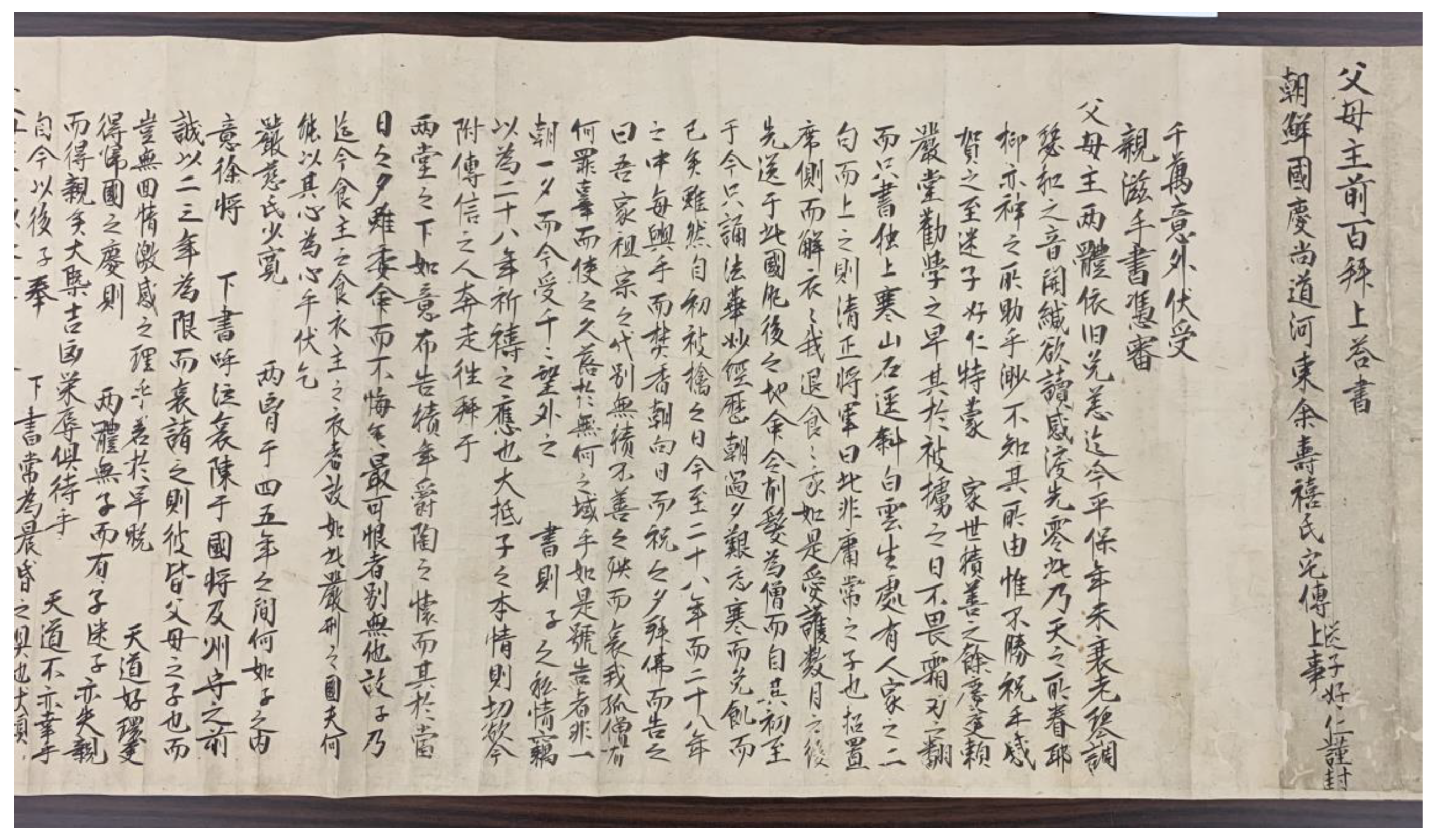
Figure 4: A photo of Letter B. Photograph by the author, courtesy of Honmyōji Museum.)
Yŏ Taenam was brought before Katō Kiyomasa. During the interrogation, Yŏ demonstrated his learning by writing two lines from Du Mu’s 杜牧 (803–852) Tang poem
“A Journey to the Mountains” (
Shanxing 山行) (
Naitō 1976, p. 302):
A lone mountain path winds upward through the chill,
2
獨上寒山石徑斜
A family dwelling lies in the place of rising white clouds.
白雲生處有人家
Yŏ’s calligraphy so impressed Katō that he reputedly remarked it was “no ordinary hand.” In his letter, Yŏ credited this skill, which spared his life, to his father’s early instruction (
Kumamoto 1971, p. 40). Katō detained him but did not harm him; a few months later, he was sent, likely from the Sŏsaengp’o fortress, to Kumamoto, the seat of Katō’s domain in northern Higo. There, Yŏ was tonsured and directed to pursue a monastic vocation.
In comparison with countless Koreans who perished or vanished into the unrecorded history of slavery in Japan, Yŏ Taenam’s fate was relatively fortunate (For details, see
Hur 2021, pp. 70–83). In Letter B, he inquired about the fates of his grandfather, Yŏ Tŭkrin, and Tŭngsu, the abbot of Pohyŏn’am. His father’s reply (Letter C) revealed that his grandfather had succumbed to injuries inflicted by Japanese soldiers on the twelfth day of the seventh month of 1593, around the time of Yŏ’s own capture. Tŭngsu, by contrast, survived the violence and lived until his natural death in 1617 (
Kumamoto 1971, pp. 41–42).
Several other sources shed light on the events that followed the Japanese assault on Chinju, tracing developments until the complete withdrawal of Japanese forces to the Pusan area by the middle of the seventh month of 1593. For two to three weeks after the destruction of Chinju, Japanese troops ravaged the surrounding regions to the west and northwest, killing, abducting, plundering, and burning villages. Among the many instances of violence and atrocity, the case of Yŏ Taenam emerges as a particularly vivid instance in the sense that it can be reconstructed in terms of name, age, and familial relations through his own testimony.
Kitajima Manji 北島万次, a Japanese historian of the Imjin War, contends that Hideyoshi sought to create a favorable climate for truce negotiations with the Ming by demolishing Chinju (
Kitajima 1990, pp. 170–72). In contrast, Nakano Hitoshi 中野 等 argues that Hideyoshi’s objective was to establish effective control over Chŏlla Province and that, in pursuit of this aim, he first sought to eliminate a major obstacle, Chinju, which impeded Japanese access to the region (
Nakano 2008, pp. 121–25). Both interpretations suggest that Hideyoshi’s intentions extended beyond a mere desire to destroy Chinju, which remained the most conspicuous symbol of Korean resistance.
Yet no extant evidence substantiates the claim that Hideyoshi linked the assault on Chinju either to his negotiations with the Ming or to any subsequent plan to occupy Chŏlla Province. The case of Yŏ Taenam, along with that of countless other victims, reveals that the Japanese attack on Chinju and the surrounding region was unrelated to truce negotiations or territorial control.
3. Yŏ Taenam (Nichiyō) and His Path to the Abbacy of Honmyōji in Kumamoto
It is unclear how Yŏ Taenam lived or what he did in Kumamoto before 1598. His master, Katō Kiyomasa, remained in Chosŏn until the fifth month of 1596, when he returned to Japan at Hideyoshi’s order. Katō’s recall was connected to Konishi Yukinaga’s 小西行長 faction, which sought a truce with the Ming but failed about four months later. Opposed to Konishi’s peace strategy, Katō adopted a more aggressive stance toward Chosŏn following the collapse of the negotiations. In the first month of 1597, he returned to the Sŏsaengp’o fortress in preparation for renewed hostilities.
During his return to Japan, which lasted a little over seven months, Katō Kiyomasa spent most of his time in the Kansai region (Kyoto, Fushimi, and Osaka). He visited his domain in Higo only briefly, and it remains unknown what he did with Yŏ Taenam during that period. In his first letter to his father (Letter B), Yŏ wrote that while in Kumamoto, he recited the
Lotus Sūtra, the principal scripture of Nichiren Buddhism, day and night to endure hardship (
Kumamoto 1971, p. 40). He eventually had the opportunity to become a Buddhist monk through the assistance of Nisshin 日真 (1558–1626), a Nichiren-sect monk who served Katō as his chief Buddhist advisor.
Katō Kiyomasa was a devoted follower of Nichiren Buddhism. Before his transfer to Higo, he held a small domain in Settsu near Osaka. In 1585, following his father’s death, Katō established a Buddhist temple, Honmyōji, in his father’s memory and invited Nisshin, a monk affiliated with Myōdenji 妙伝寺 in Kyoto, to serve as its first abbot (
Yo 2012, pp. 130–31). As the chief Buddhist monk to the Katō family, Nisshin conducted rituals for the spiritual well-being of Katō’s father, family, and domain. When Hideyoshi later appointed Katō as the daimyō of the larger Higo domain, he relocated Honmyōji to the castle compound in Kumamoto. Katō maintained his devotion to Nichiren Buddhism, through which Yŏ Taenam became connected to the religious network of Nisshin, Honmyōji, and the Nichiren sect.
While stationed at the Sŏsaengp’o fortress in Chosŏn, Katō Kiyomasa summoned Nisshin to serve as his advisor. Nisshin’s duties included maintaining contact with the Chosŏn side. When the Chosŏn monk Yujŏng 惟政 (1544–1610) visited Katō at Sŏsaengp’o for discussions in the fourth month of 1594, he met with Nisshin. Yujŏng later recalled that Nisshin was “a monk whom Katō Kiyomasa always regarded highly and trusted,” and that “Nisshin treated me quite sincerely as a fellow monk.” (
Sŏnjo sillok 2006–, 55, 1594/9/22, entry 6).
In the third month of 1595, Yujŏng visited Sŏsaengp’o again and held a second conversation with Nisshin, who warmly welcomed him.
3 However, the ensuing dialogue between Yujŏng and Katō Kiyomasa ended without agreement, after which Nisshin accompanied Yujŏng partway as he departed from Sŏsaengp’o and offered him a courteous farewell (
Sŏnjo sillok 2006–, 61, 1595/3/24, entry 2). When Yujŏng returned to the fortress in the fourth month of 1597 for a third visit, Nisshin was absent. Upon inquiry, Seikan 淸韓, another monk, explained that Nisshin would return in the fifth month, when the main Japanese forces were to cross the sea for a renewed offensive against Chosŏn (
Sŏnjo sillok 2006–, 87, 1597/4/13, entry 5). These records indicate that Nisshin was stationed at Sŏsaengp’o for most of the time from at least 1594 until the end of the war. How he interacted with or cared for Yŏ Taenam in Kumamoto during that time remains unknown.
Nevertheless, it is known that with Katō’s support, Nisshin sent Yŏ Taenam to Rokujō Kōin 六条講院, the educational center of Honkokuji 本国寺 (later 本圀寺), which was a major Nichiren Buddhist temple in Kyoto, although the exact date remains uncertain. This likely occurred soon after the war that ended in 1598. At Rokujō Kōin, Nisshin’s teacher, Nikken 日乾, oversaw Yŏ’s training as a Nichiren monk.
4 Under Nikken’s guidance, Yŏ studied the scriptures of Nichiren Buddhism and learned to perform ritual practices. After completing his training at Rokujō Kōin, he continued his studies at Minobusan Kuonji 身延山久遠寺, the resting place of Nichiren 日蓮 (1222–1282) and the central temple of the sect, and later at Iidaka Danrin 飯高檀林 in Shimōsa for advanced training (
C. Yi 1987, p. 70). During this period, Yŏ was formally ordained as a Nichiren monk and received the Buddhist name Nichiyō. He returned to Kumamoto around 1607 or 1608.
In 1605, Katō Kiyomasa sought to elevate Nisshin’s standing by leveraging his connection with Konoe Nobutada 近衛信尹 at the imperial court, who later became
kanpaku 関白 (chief advisor to the emperor). Through Katō’s efforts, Emperor Goyōzei conferred upon Nisshin the prestigious “purple robe” status, the highest distinction within the Buddhist clergy. At the same time, the emperor also designated Honmyōji as a
chokuganji 勅願寺, a temple charged with offering prayers for the emperor and the imperial family (
Yo 2012, p. 114). This elevation in status brought distinction not only to Honmyōji and its abbot but also to the Katō household.
In 1608, Nisshin retired, and his disciple Nichinyō 日繞 succeeded him as abbot of Honmyōji. However, Nichinyō passed away the following year. Consequently, Nichiyō was appointed the third “purple robe” abbot of Honmyōji in 1609—a remarkable turn of fate for a Korean who had once been taken captive. At the time, Nichiyō was 29 years old and was often referred to as
Kōrai Shōnin 高麗上人, meaning “Honorable Korean Monk.” (
Yo 2012, p. 131) Two years later, in 1611, Katō Kiyomasa, Nichiyō’s principal supporter, died, and his son, Tadahiro 忠廣, succeeded him as the second
daimyo of the domain at the age of eleven. According to Kiyomasa’s final wish, his remains were interred on Mount Nakao, at a height corresponding to the tip of the main keep of Kumamoto Castle. Located about four kilometers northwest of the castle, Mount Nakao became his chosen resting place.
In 1614, a fire destroyed both Kumamoto Castle and Honmyōji, which stood within its compound. Nichiyō devoted himself to rebuilding Honmyōji near Katō Kiyomasa’s grave on Mount Nakao. Three years later, in accordance with Nichiyō’s wish, the temple was reconstructed at its present location on Mount Nakao. The Honmyōji temple complex remained there until 1877, when it was again destroyed during the Seinan War, but it was later rebuilt. It was to this Honmyōji on Mount Nakao that a letter from Nichiyō’s father was delivered in 1620, when Nichiyō was serving as its abbot.
The glory of the Katō house was short-lived. In 1632, the Tokugawa bakufu removed Katō Tadahiro, the second daimyo of the Higo domain, and transferred the Hosokawa house from the Kokura domain to take its place. The attainder (called kaieki 改易) was carried out swiftly. Tadahiro, along with his family and a small group of retainers, was expelled to Shōnai in Dewa Province, where they were permitted to live on a modest stipend.
Amid the crisis, Nichiyō succeeded in preserving Honmyōji by appealing to the new daimyo. From that point onward, Honmyōji became a temple dedicated to the repose of Katō Kiyomasa’s soul, thereby severing its official ties with the Higo domain. In this way, initially serving as a private memorial temple (
bodaiji 菩提寺) for Kiyomasa, it gradually transformed into a popular site of worship. Over time, local people came to venerate Katō Kiyomasa, whom they affectionately called Seishoko 清正公, believing that his spirit would bring them good fortune.
5As Honmyōji’s popularity grew, Nichiyō played a crucial role as the abbot of Katō Kiyomasa’s bodaiji temple. Beyond his duties there, he actively promoted Nichiren Buddhism throughout the surrounding regions. In 1651, he founded a new temple, Gokokuji 護国寺, in Shimabara. The temple later enshrined thirty deities believed to protect the nation and became a popular destination for devotees seeking blessings and protection.
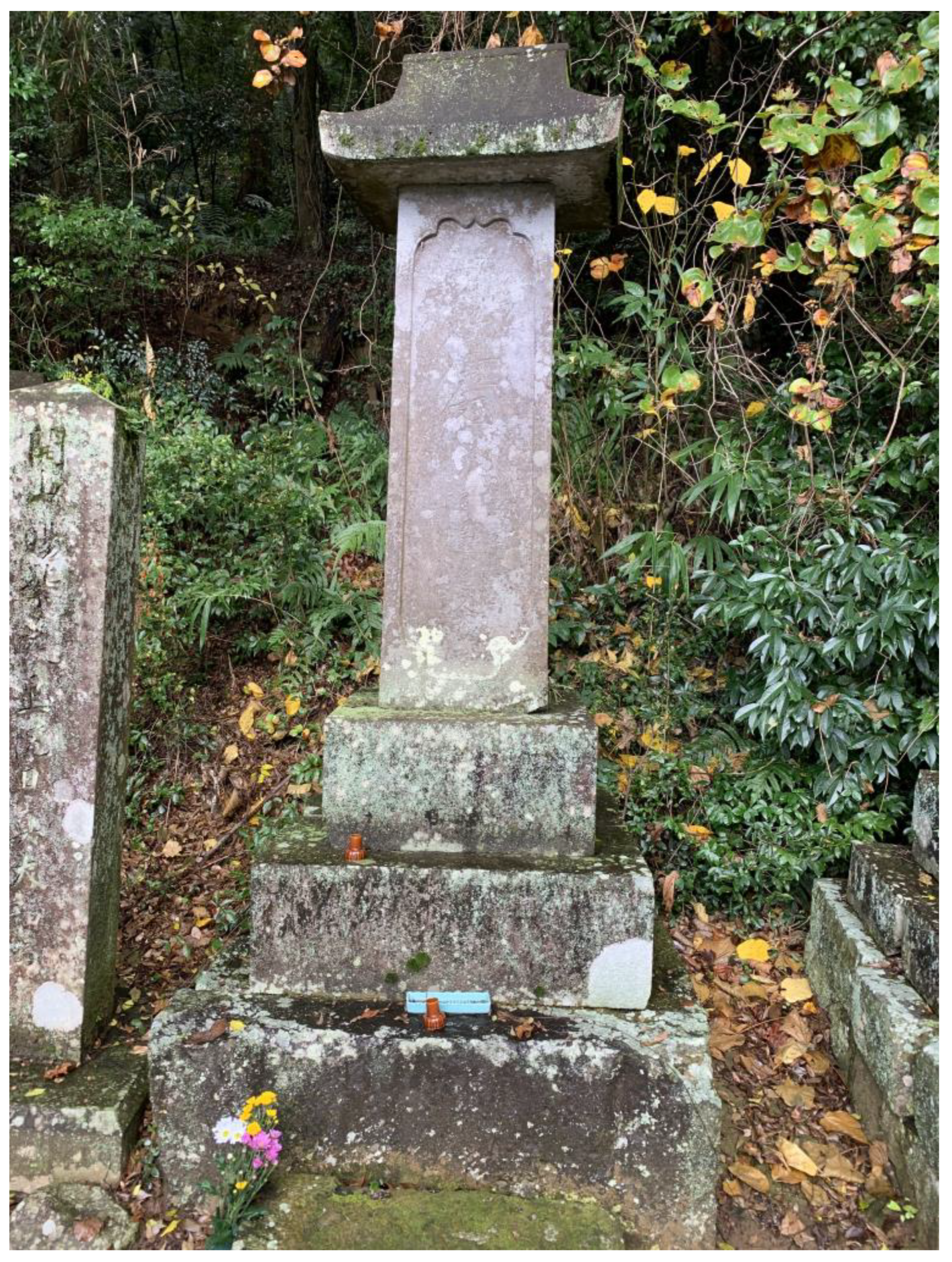
Despite his father’s wish to see him again, Yŏ Taenam was unable to return home because his master, Katō Tadahiro, the incumbent daimyo of the Katō house, refused to release him. Later, in 1659, Nichiyō died at the age of 79 and was buried near the Honmyōji complex (
Figure 5: Nichiyō’s tombstone. Photograph by the author). Although he died on foreign soil without leaving any descendants, his life in Japan appears to have been relatively comfortable, reflecting the prestige and respect accorded to Buddhist monks of high rank. Unlike in Chosŏn, where monks were socially inferior to the yangban elite, monks in Japan held higher social standing than commoners, and abbots in particular often enjoyed privileges exceeding those of lower-ranking samurai through their associations with upper-class samurai and daimyo.
4. Aborted Efforts to Reunite a Family Divided by War
Yŏ Taenam’s father, Yŏ Ch’ŏn’gap, was likewise abducted to Hiroshima, Japan, during the war (
No 2009, p. 420). It is unclear when he was taken by Japanese troops, but he somehow managed to return home in 1601 together with other
sajok 士族 (literally “scholar-gentry lineage,” referring to the yangban elite) men, including Kang Sajun and Kang Ch’ŏnch’u, though the details of their return remain unknown. By that time, it appears that he had already changed his name from Ch’ŏn’gap to Suhŭi (
Sŏnjo sillok 2006–, 136, 1601/4/25, entry 11 and 138, 1601/6/11, entry 5).
In his first letter (Letter A) to his son, written in 1620, Yŏ Suhŭi stated, “An official from Hadong who had traveled to Japan in the year of
chŏngmi 丁未 (1607) returned and informed me that he had encountered you and that you had told him your name, residence, and your father’s name. It was then that I learned for the first time that you were living at Gozan 五山 in Kyoto.” (
Kumamoto 1971, p. 41) Since that time, Yŏ Taenam’s father wrote, “I have attempted to send letters to you many times, but all in vain … In the fall of last year (1619), your friend Ha Chongnam 河終男, who had returned home [from Japan], told me, ‘Yŏ Taenam was taken to Japan and became a Buddhist monk there. He had previously been in Kyoto but has now gone to Ponmyosa (Honmyōji) within Pŏphwasa 法華寺 (Hōkkeji) in Kumamoto of the Higo domain. His [new] name, as people call him, is Hongyōin Nichiyō Shōnin 本行院日遙上人, or Kinhōzan Gakuen 金法山學淵.’ … I am now 58 years old, and your mother is 60. Please return home at all costs.” (
Kumamoto 1971, p. 41).
Some background is necessary to understand how Letter A reached Yŏ Taenam. The official from Hadong who informed Yŏ Suhŭi of his son’s whereabouts was a member of the Chosŏn embassy dispatched to Edo (present-day Tokyo) in 1607, which returned to Pusan in 1608. [Kyoto] Gozan (literally “Five Mountains”) refers to five temples (Tenryūji, Shōkokuji, Kenninji, Tōfukuji, and Manjuji) that collectively constituted the top tier of Rinzai Buddhism below Nanzenji 南禅寺. The reference to the “Five Mountains,” therefore, is somewhat ambiguous, but it is likely that the official meant one of these temples. In any case, this part of the letter indicates that the official had somehow encountered Yŏ Taenam in Kyoto and learned that he was associated with a Buddhist temple or with Buddhism.
Shortly after the war ended in 1598, Tsushima began repatriating Korean abductees to Pusan as part of its efforts to resume trade with Chosŏn. Prior to the invasion, Tsushima had depended heavily on trade with Chosŏn for its livelihood. The island’s inhabitants, who spread across two small, mountainous islands under the governance of the Sō 宗 daimyo house, sustained themselves through fishing, limited agriculture, trade, and, at times, illicit activities such as smuggling and piracy. Arable land was scarce, and fishing provided only an unstable source of income. By contrast, trade with Chosŏn not only yielded significant economic benefits but also enhanced the political standing of the Sō daimyo house and, by extension, of Tsushima itself. However, in 1592, Tsushima joined Hideyoshi’s invasion of Chosŏn, albeit unwillingly, and Hideyoshi took advantage of its familiarity with the Korean Peninsula’s geography, language, and culture to support the Japanese forces. Outraged by this betrayal, the Chosŏn government severed all ties with Tsushima, including trade relations, and vowed to punish the island.
Once the war ended, however, Tsushima was compelled to restore its relations with Chosŏn in order to sustain itself through trade. Traditionally, trade with Chosŏn did not signify unrestricted commercial exchange between Tsushima and Chosŏn merchants, but rather a privilege unilaterally granted by the Chosŏn king to the Tsushima daimyo. This arrangement consisted of two components. The first was an annual permit allowing Tsushima to bring a fixed quantity of goods, which was measured by the number and size of ships to Pusan for sale to designated Chosŏn merchants. The second was the yearly royal gift of a prescribed amount of rice and beans to the Tsushima daimyo under Chosŏn’s “policy of loose control” (kimich’aek 羈縻策). For Chosŏn, these measures functioned as a means to preempt piracy and other forms of aggression from Tsushima.
To restore this trading privilege, Tsushima gathered Korean captives in Japan and repatriated them to Pusan. The large number of Koreans abducted during the war had remained a source of deep concern for the Chosŏn government, as their continued captivity symbolized the state’s failure to protect its people. Lacking the means to secure their return independently, the Chosŏn court began to respond positively, though cautiously, as Tsushima, in coordination with the Tokugawa
bakufu, initiated the repatriation of Korean captives. At the same time, Tsushima hinted at the possibility of renewed aggression, further heightening Chosŏn’s anxiety (
Sŏnjo sillok 2006–, 139, 1601/7/4, entry 5). The Tokugawa
bakufu, for its part, sought to establish peaceful relations with Chosŏn, leading eventually to the opening of diplomatic negotiations between the two states.
In 1606, King Sŏnjo commissioned a delegation of 467 members, led by Yŏ Ugil 呂祐吉 (1567–1632), to travel to Edo and deliver his state letter to the Japanese ruler, Shogun Tokugawa Hidetada 徳川秀忠. Yŏ Ugil held the title
Envoy of Reply and Repatriation, reflecting the mission’s dual purpose: responding to Japan’s request for communication and repatriating Korean captives. Upon completing their task, the first postwar Chosŏn delegation to Japan returned to Pusan in the seventh month of 1607, bringing with them 1418 Korean repatriates and a state letter from Shogun Hidetada expressing a desire for peaceful relations between the two countries (
Kyŏng 2008, vol. 3, p. 292). Diplomatic relations between Chosŏn and Japan were thus restored, ushering in a period of peace that would endure for more than two and a half centuries. Two years later, in 1609, the Chosŏn government reinstated Tsushima’s trading privileges.
In 1607, the Chosŏn embassy stayed in Kyoto for twenty-two days en route to Edo. During their stay, they visited several renowned temples, attended banquets and entertainments hosted by Japanese officials, and met with a number of Korean captives, including Kwŏn Nip from Chinju (See
Kyŏng 2008, vol. 3, p. 219, 28). However, the delegation did not make extensive efforts to locate or recover other captives at that time. Upon their return from Edo, the Chosŏn envoys actively sought to gather Korean captives, working under the endorsement of Tokugawa Ieyasu 徳川家康, who had retired from the shogunal position and resided in Sunpu away from Edo but continued to make key decisions (
Kyŏng 2008, vol. 3, pp. 271–72 and
Yun 2020, p. 41). On their way back, the embassy stayed in Kyoto for seven days. During that time, they collected several Korean captives, including Cho Wanbyŏk of Chinju and Kim Chinsaeng of Ŭnjin. On the way to Tsushima, they gathered additional
sajok captives, including Na Taenam and Kang Yi, from various places. However, Yŏ Taenam is not mentioned in the records kept by the 1607 embassy. The official from Hadong who informed Yŏ Suhŭi about his son cannot be identified.
In 1617, the Chosŏn government dispatched its second postwar delegation to Japan, once again designated the
Embassy for Reply and Repatriation. Led by O Yun’gyŏm 吳允謙 (1559–1636), the mission met Shogun Tokugawa Hidetada in Fushimi rather than in Edo and delivered King Kwanghae’s letter, which conveyed a message of peace and congratulated the shogun on eradicating the remnants of Hideyoshi’s regime, a reference to the Osaka Campaigns of 1614–1615. The delegation later received Hidetada’s reply and returned to Pusan in the seventh month of the same year, accompanied by 321 Korean repatriates.
6The 1617 Chosŏn embassy to Japan took place at least eight years after Nichiyō had returned to Kumamoto and assumed the position of the third abbot of Honmyōji. There is no evidence indicating that he traveled to Kyoto or any other location visited by the Chosŏn delegation, or that he had any contact with its members. The records of this embassy contain no new information concerning Yŏ Taenam.
Another source of information on Yŏ Taenam mentioned in Letter A was Ha Chongnam, a friend of Yŏ and an abductee who, according to Yŏ’s father, had been able to return home from Japan. The information that Ha provided about Yŏ was more specific and reliable. Who, then, was this individual who appears to have had no connection to the 1617 Chosŏn embassy?
In the first month of 1617, Sin Ŭngch’ang 愼應昌 (?–?), a Confucian scholar from Chinju, submitted a report on Japan to the Chosŏn court, stating that he had returned home from Japan together with about twenty other captives, including Ha Chongnam. According to Sin, he had been abducted to Hyūga in Kyushu in 1597. While in Japan, he was conscripted for construction work in Edo but managed to escape to Osaka and later to Tsushima, from where he was able to return to Pusan (
Pibyŏnsa tŭngnok 2006–, 1617/1/9).
It appears that Yŏ Suhŭi was persuaded by Ha Chongnam’s account that his son was alive in Kumamoto. His efforts to contact him there finally succeeded in 1620 after several attempts. In his letter, Yŏ Suhŭi conveyed his earnest desire to bring Yŏ Taenam back from Japan, noting that the family now possessed many
nobi 奴婢 (often translated as “slave”) and that his son could live in comfort and safety as a monk upon his return home (
Kumamoto 1971, p. 41).
Upon receiving his father’s letter (dated the seventh day of the fifth month) in the late ninth month of 1620, Nichiyō (Yŏ Taenam) in Kumamoto immediately wrote a reply and entrusted it to the Japanese man who had delivered his father’s message.
7 The reply successfully reached his father in Hadong, Chosŏn. Dated the third day of the tenth month of 1620, Nichiyō’s letter (Letter B) conveyed his gratitude to the Hadong official who had contacted his father in 1607 and to his friend Ha Chongnam, who had done so in 1619 (
Kumamoto 1971, p. 40). This correspondence confirms that Nichiyō met Ha in Japan and that, upon returning home, Ha informed Yŏ Suhŭi of his son’s whereabouts.
In Letter B, Nichiyō stated that he had no one in Japan with whom he could share his thoughts except for a few fellow Korean captives. He specifically named six individuals along with their hometowns: Yi Hŭiyun 李希尹 from Kŏch’ang, Chŏng Chŏk 鄭逖 from Chinju, Pyŏn Sasun 卞思循 from Miryang, Hong Unhae 洪雲海 from San’ŭm, Kim Yŏyŏng 金汝英 from Puan, and Yi Chang 李莊 from Kwangyang.
8 All of these abductees were from Kyŏngsang or Chŏlla Province (
Kumamoto 1971, p. 40).
In the same letter, Nichiyō also wrote that, although he wished to hurry home by accompanying the man who had delivered his father’s letter, he was not permitted to leave. He stated that he would continue to petition the shogun of Japan and the domain lord for another two or three years (
Kumamoto 1971, p. 40). This indicates that the messenger who brought the letter from Hadong to Kumamoto was returning to Chosŏn, and that Nichiyō could not accompany him without the permission of the daimyo, Katō Tadahiro.
As a way to obtain the permission that was not easily forthcoming, Yŏ Taenam asked his father to send him two well-trained hawks via a Chosŏn envoy visiting Japan, explaining that Korean hawks were highly prized there. He intended to present one to the daimyo of Tsushima and the other to the daimyo of Higo (
Kumamoto 1971, p. 40). Although Yŏ hoped that someone in the next Chosŏn embassy might deliver the hawks to him in Kumamoto, its travel route was far from there. In the end, however, the third Chosŏn embassy had not yet visited Japan by the time Yŏ received a second letter from his father, dated the eighth day of the seventh month of 1622.
Why hawks? Falconry was a prestigious and exclusive pastime among the shogun and daimyo, the highest echelon of the samurai class in Japan, but it required well-trained hawks. It is well known that Tokugawa Ieyasu, when time permitted, devoted himself to falconry, which symbolized martial authority and territorial control. His successors in the Tokugawa shogunate, as well as many daimyo across their domains, likewise engaged in this practice in various forms (For details, see
Pitelka 2016, pp. 94–98).
Even during the military campaign in Chosŏn, some daimyo engaged in falconry and exchanged Korean hawks as gifts, expressing friendship and mutual respect. In the latter half of 1597, as Japanese forces advanced through Chŏlla and Ch’ungch’ŏng provinces in the campaign of pillaging, killing, and abducting civilians, Shimazu Yoshihiro 島津義弘 (1535–1619), the commander of the Satsuma troops, reportedly presented Korean hawks to fellow daimyo and even practiced falconry on the battlefield (
Omodaka Renchōbō Kōrai nikki 1926, pp. 631–54). It is therefore unsurprising that Nichiyō believed Korean hawks might help win the favor of Katō Tadahiro. Moreover, even if Tadahiro permitted his return, Nichiyō would still require the cooperation of the Tsushima daimyo to cross the sea to Chosŏn, which explains why he also considered the Tsushima daimyo a potential recipient of such a gift.
Upon receiving a reply letter from his son with great excitement, Yŏ Suhŭi wrote back soon after in 1621. He made several attempts to ask the Japanese in Pusan, who had previously delivered his first letter to Kumamoto and brought back his son’s reply, to deliver this new letter as well, but without success. The following year, the Japanese in Pusan eventually succeeded in delivering Yŏ Suhŭi’s second letter (Letter C) to Nichiyō in Kumamoto (
Figure 6: A photo of Letter C. Photograph by the author, courtesy of Honmyōji Museum). In this letter, Yŏ Suhŭi explained that he had tried to send two hawks but was unable to do so because Chosŏn law strictly prohibited sending gifts privately to Japan (
Kumamoto 1971, pp. 41–42). Instead, he advised Nichiyō to appeal directly to the Japanese king for release, believing, without knowledge of Japan’s actual political system, that the king held ultimate authority in the country.
In any case, in his letter, Yŏ Suhŭi once again urged Yŏ Taenam to return home together with other Korean captives and provided information about the families of those his son had mentioned in Letter B. He also asked his son to bring back four abductees close to him, if circumstances allowed.
9 Notably, in Letter C, Yŏ Suhŭi stated that in 1622 he was 60 years old, while his wife (Yŏ Taenam’s mother) was 65, not 62 as mentioned earlier (
Kumamoto 1971, pp. 41–42).
Upon receiving his father’s second letter, Yŏ Taenam submitted a petition to the daimyo Katō Tadahiro. However, his appeals appear to have produced the opposite effect. Thereafter, Katō, who had no intention of allowing Nichiyō’s release, placed him under closer surveillance and made it increasingly difficult for him to correspond with his father in Chosŏn. In the end, Nichiyō abandoned both the effort to send further letters and the hope of returning home. One of the letters he had attempted to send to his father is still preserved at the Honmyōji museum.
In this letter (Letter D), dated the first month of 1625, Nichiyō wrote, “In order to return home, I have appealed to the lord of the domain in various ways. But contrary to my wish, the soldiers of the domain have begun to keep [me] under watch, and as a result, I am now like a bird in a cage.” (
Kim 1986, pp. 43–44). Nichiyō stated that he was sending the letter through one of his disciples, whom he had trained, and asked his father to wait for his return while maintaining good health (
Kim 1986, pp. 43–44). However, this letter was never delivered to his father.
Forty years later, in 1665, Nichiyō died at the age of 79 and was buried at Honmyōji. Before his death, he created Buddhist posthumous names for his parents, presuming that they had already passed away, recorded those names in the
kakochō 過去帳 (registry of the deceased) at Honmyōji, and conducted prayer rituals for their posthumous well-being. He bestowed upon his father the posthumous Buddhist name
Chitokuin Hōshin 智徳院法信 and upon his mother
Jōtokuin Myōshin 常徳院妙信, both conferred with the highest honorific title of
ingō 院号 (
No 2009, p. 433).
5. Conclusions
Compared with other Korean captives whose names are known, Nichiyō was exceptional in that he rose to the position of abbot at a prominent temple in Japan. Members of the 1617 Chosŏn embassy also encountered several other Korean captives who had become Buddhist monks during their journey through Japan. These Korean monks included Yang Ŭnghae, who had received a Confucian education in Chosŏn; Kim Ŭngch’ang, who claimed to have passed the first stage of the civil service examinations in Chosŏn, though this cannot be verified in the available sources; Ha Sŏn, whose father was known to some embassy members; Yang Mongnin, who stated that he was in charge of tea preparation at his temple; Hyuam, a monk-turned-physician whose father was the former official Pak U; and T’akam, another monk-turned-physician whose father, An Mongsang, had served as a military officer (
K. Yi 2008, vol. 4, pp. 85–86, 103–4, 140–41). In all of these cases, their backgrounds in Confucian learning acquired in Chosŏn greatly facilitated their transformation into Buddhist monks in Japan. Yet none attained a status comparable to that of Nichiyō.
In Chosŏn, Buddhism was marginalized in a society dominated by Confucian values. All sajok men were raised with a Confucian education and were expected to maintain their social status by upholding Confucian ideals and cultivating literary skills. Yŏ Taenam was no exception: although somewhat familiar with Buddhism, he was educated in the Confucian tradition. According to his own account, it was his knowledge of Chinese poetry, a key element of Confucian literary culture, and his skill in calligraphy that saved him, led to his being taken to Japan, and ultimately earned him favorable treatment there.
It is not difficult to imagine that his smooth education and training at Buddhist institutions in Japan owed much to his early instruction in classical Chinese, since Buddhist scriptures and ritual manuals were available in classical Chinese and had not yet been fully translated into Japanese vernacular. Amid the tragedy of his abduction, the Confucian learning and literary skills he had acquired in Chosŏn enabled Yŏ Taenam to remake himself into a successful Buddhist monk. In this sense, Confucian learning acquired in Chosŏn paradoxically enabled his successful reinvention as a Buddhist monk in Japan. It was an ironic turn in his life’s trajectory.
As a whole, the letters exchanged between father and son across the sea in 1620–1622 (or 1625, if the undelivered Letter D is included) illuminate the efforts of a Korean family, which Japan’s invasion had disrupted, to restore itself in the postwar years. For families in Chosŏn, locating loved ones who had been taken to Japan was nearly impossible. Yet Yŏ Suhŭi managed to identify and correspond with his lost son, Yŏ Taenam (Nichiyō), in Japan. Despite his repeated efforts, however, he could not bring his son home, for the latter was no longer a free man. The correspondence thus stands out as a poignant record of the enduring dislocation produced by the war—an experience shared by many Korean families whose stories have largely disappeared from the historical record. The date of Yŏ Suhŭi’s death is not known, but he passed away without ever seeing his son again, a tragedy shared by countless other Korean families, long forgotten as time passed.
Taken together, these materials highlight three broader conclusions: the diverse postwar trajectories of Korean captives in Japan; the unexpected role of Confucian literary training in enabling cultural and institutional mobility; and the profound, long-lasting human impact of the war on families separated across national boundaries.