2. Literature Review
Social media platforms have become established as central tools for political party communication because they allow them to reach large audiences in a short time and at low cost (
Matusitz 2022;
Kreiss and McGregor 2018), driving an alternative evolution to the traditional broadcasting model. This (r)evolution has significant implications for how information, whether political or commercial, is produced, disseminated, and received (
Chadwick 2013).
Given that voters’ opinions are increasingly shaped by online content and interactions in the digital public sphere (
Allcott and Gentzkow 2017), social media are also increasingly regarded as alternative media for parties. They offer levels of micro-segmentation, narrative control, virality, and data-driven management that the traditional broadcasting model has so far been unable to achieve (
Kefford et al. 2022;
Corchia 2019).
In this context, alternative media does not refer to counter-hegemonic or radical media operating outside institutional structures, as conceptualized in classical studies of alternative and radical media (
Atton 2002;
Downing 2001). Rather, it refers to the strategic use of digital platforms by institutional political actors as alternative channels to mainstream journalistic mediation (
Wolfsfeld 2022;
Kefford et al. 2022). Within hybrid media systems (
Chadwick 2013), social networks function as parallel arenas for political communication, allowing parties to partially bypass traditional gatekeeping processes and to communicate directly with segmented audiences (
Shoemaker and Vos 2009). Unlike traditional media, such as newspapers or television, social media are much harder to censor or control, which facilitates the circulation of content without editorial mediation and can favor the amplification of more extreme political positions (
Fornasier and Borges 2022).
This structural reorganisation of political communication, also evident in Portugal (
OberCom 2025), is underpinned by an epistemological reconfiguration of the media ecosystem. The consolidation of a many-to-many techno-communicational paradigm is increasingly evident as digital platforms expand and reshape the possibilities of traditional mass media, historically organised around the one-to-many model (
Castells 2009).
This digital environment favors direct (and sometimes anonymous) interaction over traditional mediation, profoundly transforming forms of political participation and the formation of voting trends (
Trisiana 2025;
Prior and Andrade 2024). As alternative channels of information, social media platforms are particularly effective in disseminating messages quickly and interactively (
Wolfsfeld 2022). Rather than assuming an irreversible migration from traditional to social media, the hybrid media system framework conceptualizes traditional and digital media as mutually shaping political communication (
Chadwick 2013).
As part of hybrid communication systems, traditional media events continue to play a significant role in shaping the flow of political attention, even in highly digitalized environments (
Anstead and O’Loughlin 2011). In this context, televised debates remain central moments in election campaigns, often serving as focal points that concentrate public attention and stimulate online discussion (
Trilling 2015). These events tend to generate spikes in digital activity, including social media interactions and online searches, as citizens seek additional information or react to candidates’ performances in real time (
Qaisar and Riaz 2021;
Boydstun et al. 2014;
Chadwick 2013). Thus, televised debates continue to shape political attention, while social media amplify and disseminate this attention among interconnected audiences.
In Portugal, the digital environment has become structurally central: 89% of the population uses the Internet, and 72% maintain an active presence on social media (
Kemp 2025). Within this participatory ecosystem, citizens are not merely recipients of information but also producers and disseminators of political content (
Gerbaudo 2012;
Jenkins 2008). This configuration reflects processes of interdependence and media reconfiguration rather than the linear substitution of traditional media.
Faced with this scenario, marketing communication managers were compelled to re-evaluate their strategies and investment (
Kotler et al. 2016). In commercial marketing, it has become common practice to centralise budgets in digital media (
Fairuzabadi et al. 2025). This change is no longer optional and has become an unavoidable imperative, as advertising campaigns need to be present where the target audience is. The same applies to political campaigns: where voters are, campaigns must also be there, with digital political marketing, micro-segmentation and monitoring tools playing a central role (
Fornasier and Borges 2022;
Corchia 2019;
Baldwin-Philippi 2015).
In contrast to traditional media, where messages are filtered through gatekeeping and journalistic agenda-setting processes (
Shoemaker and Vos 2009), social media allows political parties greater control over their narrative (
Canavilhas and Di Fátima 2024a;
Kusche 2020), despite being shaped by platform algorithms (
Howard et al. 2018). As a result of this structural shift, parties are no longer mere sources of news for the traditional media but have become active producers of political and electoral content. Furthermore, social media facilitates the humanisation of candidates through informal, emotional and personalised formats (
Geise et al. 2024), such as vlogs, short videos, humorous content, ephemeral stories, casual photos, etc.
From a political electoral perspective, the architecture of social media has also been exploited to facilitate the sharing and replication of content (
Milli et al. 2025). Posts with high engagement (likes, shares, comments, etc.) are algorithmically prioritised, potentially reaching a vast audience at marginal cost (
Matusitz 2022). This platform-mediated mechanism enables two content dissemination strategies: (i) simple sharing, in which party supporters replicate the original content; and (ii) message remixing, in which party supporters appropriate and transform it for sharing in online communities, WhatsApp groups, and discussion forums. Memes are among the most powerful forms of this online content strategy (
López-Paredes and Carrillo-Andrade 2022), functioning as transmissions of political party culture that enhance electoral mobilisation (
Ahmed and Masood 2024).
Traditional media now appear to follow political agendas first articulated on social media (
Qaisar and Riaz 2021). This trend is evident in the digital strategies of political leaders such as Donald Trump (US), Boris Johnson (UK), Narendra Modi (India), André Ventura (Portugal), Rodrigo Duterte (Philippines), and Jair Bolsonaro (Brazil). Through sustained and often viral activity on platforms such as Facebook, X and YouTube, these political actors have succeeded in placing issues on the traditional media agenda and compelling other parties to respond. This dynamic illustrates how political actors can strategically leverage social media to impose issues within the digital public sphere (
Canavilhas and Di Fátima 2024b;
Bennett and Pfetsch 2018).
Algorithms enable the segmentation of audiences with remarkable precision, drawing on parameters such as geographical location, age, interests, online behaviour, and even social connections (
Howard et al. 2018). This practice aligns with digital marketing research, which identifies data-driven personalisation as a central determinant of campaign effectiveness (
Tufekci 2014). For instance, young urban residents concerned about climate change or rural retirees worried about the performance of the public health system can be targeted with tailored political messages.
This approach was notably employed by Cambridge Analytica (and other political marketing agencies), which relied on the psychological micro-segmentation of voters using social media data. The case became globally controversial due to the unauthorized harvesting of personal data from Facebook, raising serious ethical and legal concerns regarding privacy, consent, and the integrity of democratic processes (
Fink and Jakee 2024). More broadly, it exposed structural vulnerabilities in data-driven political campaigning. At the same time, platform algorithms enable the rapid testing of alternative messages, visuals, and target groups, allowing campaign resources to be reallocated in near–real time (
Baardman et al. 2021).
While this is a way for parties to get the right message to the right ears (
Corchia 2019), algorithmic logic also poses structural risks to democratic public debate (
Cho et al. 2020). The choice of social media platforms is the result of a strategic calculation based on concrete advantages and measurable data in real time, but it also presents problems that have already been mapped out by the specialized literature. These digital platforms, which have been appropriated by political parties as alternative media, also favour the spread of misinformation (
Allcott and Gentzkow 2017) and disinformation (
Vaccari and Chadwick 2020), the growth of hate speech as a political weapon (
Di Fátima 2023), the increase in polarisation based on ideologies (
Kubin and von Sikorski 2021) and the intensification of hostility between social groups (
Ferreira and Ferreira 2025).
Ideological extremists seem to have found a favourable environment for their strengthening on social media (
Kubin and von Sikorski 2021;
Bennett and Pfetsch 2018). Political parties are no different, and far-right forces tend to present more consolidated strategies than mainstream parties (
Canavilhas and Di Fátima 2024a;
Corchia 2019). Sometimes excluding traditional media, ideological extremist parties use social media as alternative media, where they can mobilise their supporters. Their populist strategy is favoured by algorithms in the digital public sphere: emotionally charged content, nationalism, simplification of complex social problems, and polarisation (us versus them) win out (
Prior 2024;
Cho et al. 2020).
Research on political communication increasingly suggests that parties positioned at the ideological extremes tend to generate higher levels of engagement on social media (
Prior and Andrade 2024). Empirical data also point in this direction, possibly due to the capacity of populist parties to activate and coordinate their supporters in digital environments (
Canavilhas and Di Fátima 2024a). Thus, posts function as political weapons in the competition for votes, while engagement creates viral dynamics that help mobilize supporters online.
This pattern can be explained by the emotional and confrontational nature of extremist communication styles, which are more likely to trigger reactions such as anger and outrage online (
Brady et al. 2017). Emotionally charged content spreads more effectively in digital environments (
Fan et al. 2014), particularly when it reinforces group identities and antagonism toward perceived political adversaries (
Kubin and von Sikorski 2021). As a result, actors at the ideological extremes benefit from the visibility regime introduced by platform algorithms, especially during election periods, when traditional and new media converge more intensely in the competition for votes.
3. Materials and Methods
This quantitative research mapped the digital strategies of the 11 Portuguese political parties during the 2024 Legislative Elections and analysed their audience engagement from a cross-platform perspective. The analysed dataset comprised 6251 posts and 8.5 million interactions across the parties’ official accounts on Facebook, Instagram, X, YouTube, and TikTok, as well as national Internet search trends on Google. The study aims to identify how these alternative media are used by the political parties and to assess the corresponding levels of engagement by the online audience (potential voters).
Table 1 shows the organisation of parties according to their political position, primary guiding ideology, and social orientation to support the analysis. To ensure a more fluid analysis, only party acronyms were used in the presentation of the results.
Internet search data were collected automatically using the Google Trends API, configured to cover the 18 districts of mainland Portugal, as well as the Azores and Madeira archipelagos. To account for the influence of spelling on search results, the public name of each politician was used: André Ventura (Chega), Gonçalo da Câmara Pereira (PPM), Inês Sousa Real (PAN), Luís Montenegro (PSD), Mariana Mortágua (BE), Nuno Melo (CDS-PP), Paulo Raimundo (PCP), Pedro Nuno Santos (PS), Rui Rocha (IL), and Rui Tavares (Livre). In the case of the three parties that ran in coalition (CDS-PP, PEV, PPM), the unit of analysis remained the leader’s name. Thus, online searches were attributed to the leader’s original party affiliation to ensure analytical consistency.
Google Trends provided an anonymous and aggregated sample of searches carried out in Portugal, measured on a scale from 0 to 100. These data cover searches for these ten leaders over the period from 9 November 2023 (the date of the dissolution of the Portuguese Parliament) to 19 February 2024 (the end of the televised debates). These data were cross-referenced with the five districts where each party received the most votes in the elections of 10 March 2024. The aim was to highlight the potential impact of online searches on results by geographic location, in a test of the approach’s potential to predict election outcomes (
Prado-Román et al. 2020).
Data from Facebook and Instagram were collected via the platforms’ APIs using CrowdTangle (
Fan 2023), a Meta tool deactivated on 14 August 2024. The sample represented the public activity of the accounts of the eight parties holding parliamentary seats at the time (BE, Chega, IL, Livre, PAN, PCP, PS, PSD) and the parties in coalition (CDS-PP, PEV, PPM).
The dataset covered the period from 9 November 2023 to 19 February 2024, representing the longest extraction interval made possible by the archives provided by CrowdTangle. It included 4041 posts and 3,914,040 interactions from followers, including likes, shares, comments, and other responses. The Facebook page of the Popular Monarchist Party (PPM) was private, which prevented data extraction. As this study relies exclusively on publicly accessible data to ensure transparency and replicability, no attempt was made to access non-public content.
At the time of data collection, CrowdTangle was the only officially supported tool allowing systematic extraction of public Facebook and Instagram data for research purposes. Its discontinuation occurred after the completion of the present dataset. Currently, no equivalent open-access alternative provides comparable large-scale historical access to public Meta data, which represents a structural limitation affecting the broader research community.
YouTube data were collected via the platform’s API using YouTube Data Tools (v 1.42), developed by the Digital Methods Initiative (
Rieder 2015). Due to the characteristics of the platform’s API, data were extracted weekly during the period of the televised debates, from 29 January to 19 February 2024. The dataset included information from 225 videos and 2,081,623 views, organised by party.
At the time of this research, TikTok was the newest platform and posed the greatest challenges for data collection via API. Weekly data extraction was conducted during the period of the televised debates, from 29 January to 19 February 2024, using the experimental tool Buzzlytics (v 0.0.2), available on GitHub (
cvn0va 2024). The dataset comprised 222 videos and 2,501,680 views, organised by party. It was not possible to identify an official account for the Partido Ecologista (PEV).
Data from X (formerly Twitter) were collected manually from the official accounts of the 11 parties. Data were extracted weekly during the period of the televised debates, from 29 January to 19 February 2024. The URL and username of each account were used for this purpose, for example @psocialista for the Partido Socialista (PS). The original dataset contained 1763 messages, 69.5% of which included photos or videos. The dataset was analysed using the R programming language in RStudio, with the dplyr (v 1.1.2), tidytext (v 0.4.1), tidyverse (v 2.0.0), quanteda (v 3.3.0), and lubridate (v 1.9.2) libraries (
Wickham and Grolemund 2017).
The performance of all parties with parliamentary representation at the time of the election was analysed, with particular emphasis on the communication strategies of the extremes of the national political spectrum (far-left and far-right). The analysis aimed to characterise both the online performance of these extremist parties in the electoral context and the involvement of their supporters.
The empirical analysis was guided by three theoretically grounded expectations derived from the literature on political polarization, digital engagement, and hybrid media systems. Research on digital political communication indicates that actors located at ideological extremes tend to generate higher levels of engagement due to emotionally charged and polarizing content (
Kubin and von Sikorski 2021;
Prior 2024). At the same time, engagement metrics do not necessarily reflect broader patterns of political attention, as platform interactions and search behavior capture distinct dimensions of public interest (
Cho et al. 2020;
Prado-Román et al. 2020). Moreover, within hybrid media systems (
Chadwick 2013), traditional media events continue to structure political attention flows even in highly digitalized environments. Accordingly, this study tests the following hypotheses:
H1. Ideologically extreme parties show higher levels of engagement on social media platforms.
H2. Engagement does not automatically translate into interest in the broader digital public sphere.
H3. Television debates continue to shape political attention, now redefined by digital dynamics.
All data were extracted in aggregate form, following the recommendations of the European Union’s General Data Protection Regulation (
European Union 2016). This study did not involve the mass collection of personal or sensitive data from human beings, making it impossible to correlate the profiles of social media users with their online behaviour, such as likes, comments, reactions, or shares. Although the data may be made available to other researchers upon request for future studies, they are not accessible to the public due to privacy concerns.
4. Results
Social media has become a dynamic space for political debate in many countries. Consequently, public opinion is increasingly shaped within the digital public sphere, where a significant portion of voters first engage with party programmes and the proposals of political leaders.
Table 2 shows that all Portuguese parties acknowledge the importance of these platforms, although their rates of content production varied considerably during the 2024 Legislative Elections.
Parties published 6251 posts on social media between 9 November 2023 and 19 February 2024, highlighting these platforms as alternative media for communicating with voters. Facebook was the most active platform, with a total of 2570 posts, followed by X (1763) and Instagram (1471). Specialising in audiovisual content, YouTube (225) and TikTok (222) were almost tied for last place. These findings suggest that parties’ digital activity is focused on platforms requiring less effort to produce online content, while video creation remains much lower than, for example, the frequency of text-based posts on X.
As data collection periods differed between platforms due to API restrictions, direct comparisons based on absolute publication volume may introduce distortions. To ensure proportional comparability, publication activity was standardized by calculating the average number of publications per day for each platform, based on the exact duration of the respective data collection periods.
Table 3 presents this weighting by data extraction days.
X emerges as the platform with the highest weighted intensity of posts by Portuguese parties (83.9 posts per day), far surpassing Facebook (25.1) and Instagram (14.4). This substantial difference indicates a markedly accelerated pace of communication during the period of televised debates on the microblogging platform. Although this study does not examine the content of the posts, the temporal concentration of activity suggests that X plays a structurally distinct role in the dynamics of the political campaign, likely functioning as a space for quicker responses and initial exchanges with followers. Another possible explanation is the effort required for publication, as posts on X are typically based on very short texts or a conversational logic.
There is also a tendency for more extreme parties on the ideological spectrum to be more active on social media. The PCP (left) was the most prolific during the period analysed, with 1496 posts, maintaining a significant lead over the runner-up, Chega (far-right), which posted 902 times. At the lower end of the table, both the CDS-PP (right) and PAN (centre-left) published fewer than 200 posts each. The PPM (right) made the least use of these platforms, with only six posts during the period analysed.
Table 4 shows the number of followers of the parties at the time of this study.
The parties accumulated more than 2.1 million followers across the five social media platforms analysed, yet this aggregate figure conceals significant structural asymmetries when contrasted with platform penetration rates in Portugal (
OberCom 2025). Facebook concentrates the largest share of party followers, followed by Instagram, a distribution that mirrors their broad societal reach. This correspondence suggests that parties strategically prioritise platforms with mass penetration, reinforcing their function as central arenas of political visibility within the digital public sphere.
A different pattern emerges in the case of YouTube. Although it ranks among the most widely used platforms nationally, party subscription levels remain comparatively modest. This discrepancy indicates that widespread societal adoption does not necessarily translate into sustained institutional political followership. One plausible explanation lies in the platform’s architecture. Users can access and consume video content without subscribing to a channel, meaning that political visibility and audience reach may occur independently of formal follower accumulation.
Chega (far-right) had the largest supporter base in the digital public sphere, with more than 590,000 followers. Its leading position is largely driven by the audience it has cultivated on Instagram, a platform popular among younger voters who tend to support the party, and on YouTube, where it hosts a collection of videos on controversial topics (corruption, crime, the welfare state, “gender ideology”, cultural Marxism, attacks on social minorities, etc.) recorded during parliamentary sessions.
However, Chega (far-right) does not dominate every platform. Its virtual presence is challenged by BE (far-left) on TikTok, with a difference of only 1700 followers between them. On X, Chega did not even rank among the top three. IL (centre-right) has the highest number of followers on the microblog, with 78,400; PSD (centre-right) ranks second with 69,515, and PS (centre-left) third with 62,524.
Although X is widely presented internationally as a highly polarized platform, it is there that Portuguese parties appear to display the most balanced distribution of followers. This may be explained by several factors, notably the platform’s low penetration among national Internet users. Rather than functioning as a dissemination channel, X may operate as a politically saturated environment where journalists, activists, and highly engaged users amplify political narratives.
But party followers only have real significance when their online presence translates into a multiplier effect for the political force’s ideologies and, ultimately, serves as a potential catalyst for votes. This multiplier effect can be assessed through interactions with content, such as likes, shares, and comments.
Table 5 shows the total number of interactions by parties on social media.
Parties generated over 4 million interactions (likes, shares, and comments) during the 2024 Legislative Elections. For context, the Portuguese population is approximately 11 million. Instagram (2.15 million) and Facebook (1.76 million), two platforms associated with distinct generational cohorts in the country, stand out in terms of absolute interaction numbers. Data for X and YouTube are not included in this section, and video views are analysed separately (see below).
Chega (far-right) is the party that most effectively mobilises its supporters online, generating over 2.3 million interactions. This number exceeds the combined total of all remaining parties. These interactions amplify the party’s ideological messages and may ultimately act as a catalyst for votes. While a direct causal relationship cannot be established, Chega secured 50 seats in these elections, receiving over one million votes and achieving the highest proportional performance among the parties. In the digital public sphere, this success is primarily driven by its activity on Facebook and Instagram.
Table 6 shows video views on social media, a more subtle form of interaction.
Video is a powerful tool in the electoral strategies of political parties and remains one of the most frequently produced formats throughout digital campaigns in Portugal. Voters also appear to engage with this type of institutional content. Between 9 November 2023 (the date of the dissolution of the Portuguese Parliament) and 19 February 2024 (the end of the televised debates), parties accumulated more than 4.7 million video views across social media. The highest number of views occurred on TikTok, a platform with a predominantly young audience and relatively low penetration in Portugal, reaching over 2.5 million views. YouTube followed with 2.08 million views, while Instagram trailed far behind with only 119,000 views. No data are available for Facebook or X in this section.
Chega (far-right) achieved the highest number of views, with over 1.6 million in total, but the party does not lead on all platforms. Its Achilles heel is TikTok, where BE (far-left) dominates by a wide margin, surpassing 1.3 million views. This result puts the far-left party virtually tied with the far-right party in terms of total views, reinforcing the claim that social media platforms can foster political polarisation.
The immediate goal of parties when posting on social media is to convey their messages to as many people as possible, generating engagement with the posts. This depends on several factors, including the topic of the post and the timing of the message, but primarily on the size of the party’s online supporter base.
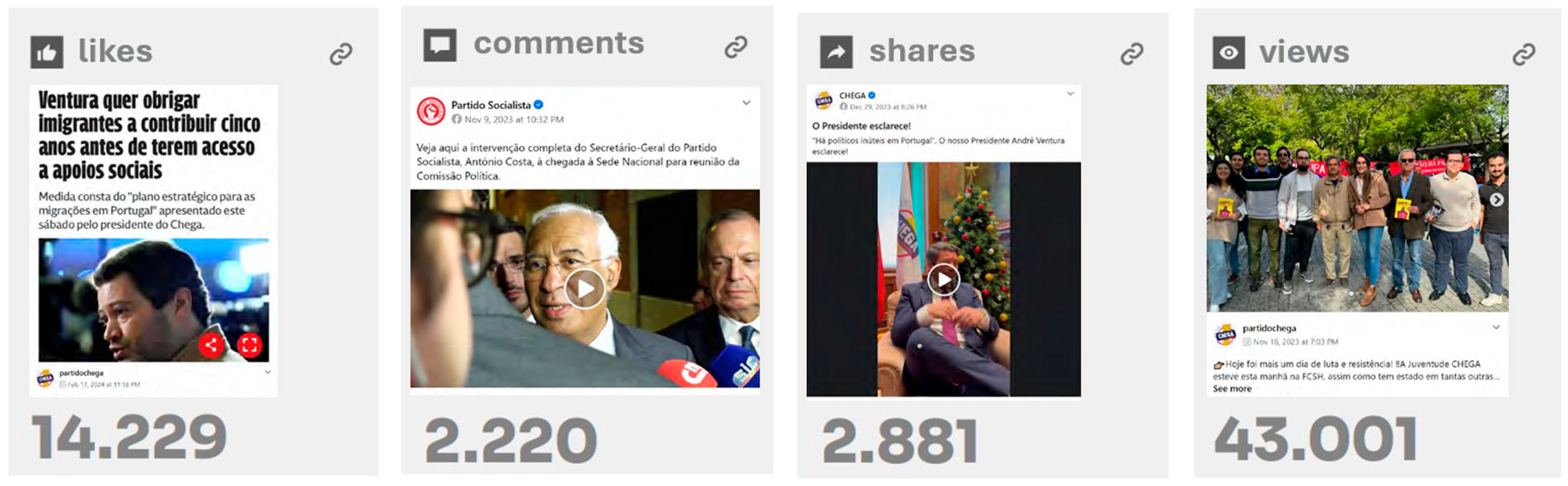
Figure 1 shows the posts that received the highest levels of engagement from followers (likes, comments, shares, and views) during the elections.
Meta Platforms hosted the posts with the highest follower engagement rates in equal proportions: Facebook (n = 2) and Instagram (n = 2). Video was the media format in which parties generally reached the highest number of followers, accounting for two of the four posts analysed. Chega (far-right) produced three of the posts with the most reactions (likes, shares, and views), revealing that it is not enough to have many followers online; they must also be willing to interact with the content.
The post with the most likes was published on 17 February 2024 on Instagram and received 14,229 reactions. It reproduces an image from a news article about Chega’s plan to control what the party calls “uncontrolled migration”. The proposed measure would require immigrants to contribute for five years before gaining access to social support. Months later, this issue resurfaced in the parliamentary debate on the proposed amendments to the new Foreigners Law and Nationality Law. The caption accompanying the image reads: “A measure of the most basic justice! 👏 #CHEGA”.
The post with the most comments is a video published on 9 November 2023 on Facebook, which received 2220 reactions. At the time, Prime Minister and Secretary-General of the Socialist Party, António Costa, answered questions from the media about the President of the Republic’s decision to dissolve parliament and call the 2024 Legislative Elections. The text accompanying the video reads, in a formal and descriptive tone: “See here the full speech by the Secretary-General of the Socialist Party upon his arrival at the National Headquarters for a meeting of the Political Commission”.
The most shared post is also a video, published on 29 December 2023 on Facebook, which received 2881 reactions. In the video, Chega leader André Ventura criticises the number of politicians in the country, with a Christmas tree in the background. The accompanying text reads: “There are useless politicians in Portugal”. Reducing the number of seats in parliament is one of the party’s key issues, which it will return to in the local and presidential elections in the coming months.
The most viewed post is an Instagram carousel (photos and videos), published on 16 November 2023, which was seen by more than 43,000 users. The images depict the tumultuous visit by Juventude Chega (the youth wing of the party) to the Nova University of Lisbon. On that day, students and climate activists prevented Rita Matias, a young deputy and one of the party’s most prominent figures, from entering the institution. An excerpt from the lengthy text accompanying the carousel reads: “Young patriots, let’s run all the universities in Portugal and throw Marxism into the dustbin of history!”.
Chega’s posts are characterised by anti-establishment discourse, disinformation, and conspiracy theories, advocating a break with established institutional rules: (i) Portugal has too many immigrants and requires more restrictive policies; (ii) the country has too many politicians and should reduce the number of parliamentary seats; (iii) public universities are controlled by communists and cultural Marxism, and these students should be expelled. Viewed today, these posts do not attract significantly more reactions than they did in the days immediately following their release. In some cases, there has even been a decline in the number of reactions, possibly due to users regretting having liked or commented on them.
In the digital public sphere, online searches also influence voters’ decisions and behaviour. Current search engines provide a list of answers to questions that inevitably help shape public opinion on a wide range of topics, including politics.
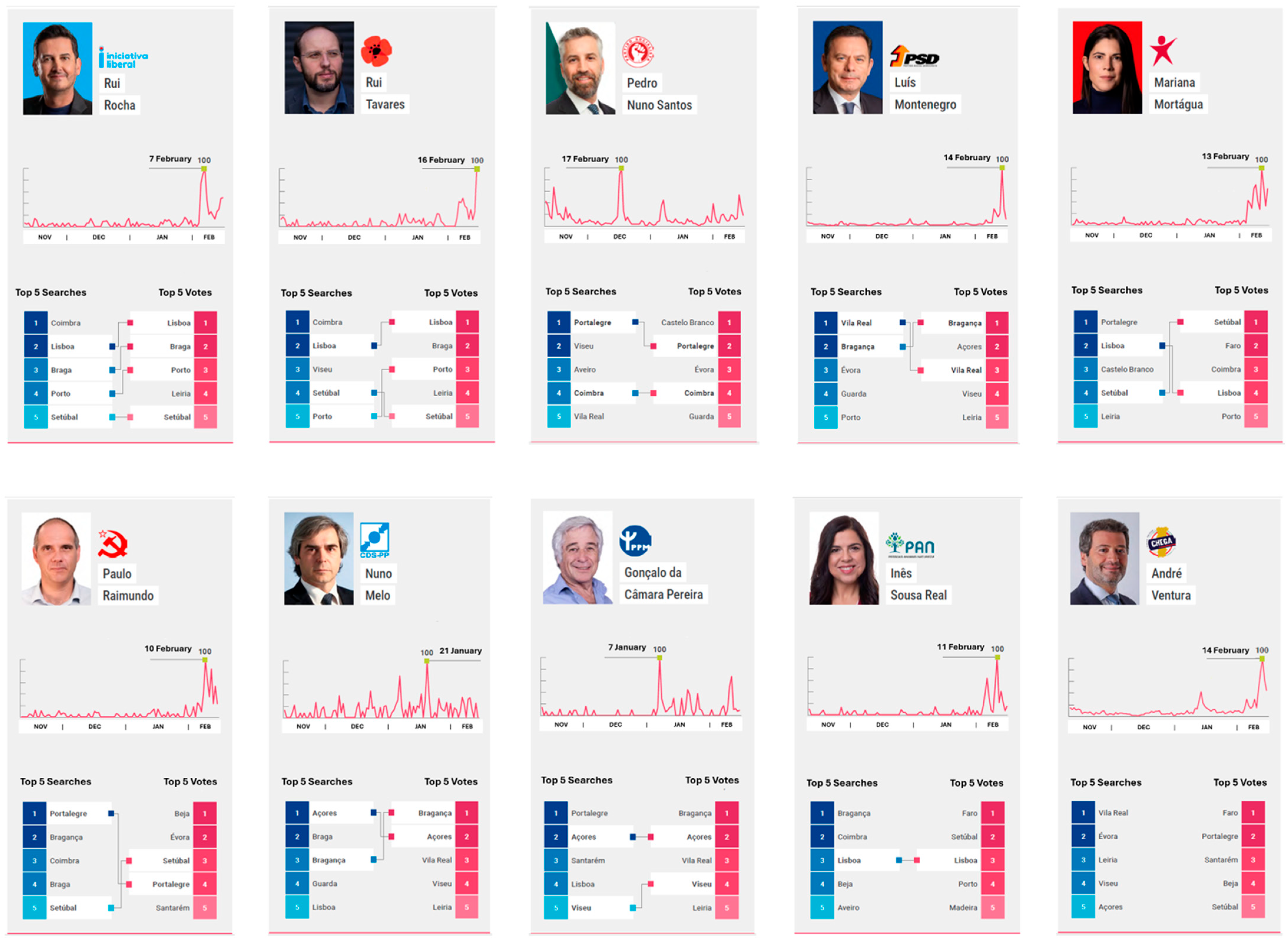
Figure 2 presents the intersection between Google search trends for the names of party leaders and the five regions of the country where their parties received the most votes.
Google search trends revealed that interest in party leaders peaked on the days when televised debates took place. These spikes illustrate the capacity of televised debates to concentrate political attention and stimulate parallel activity across digital platforms. While watching a political debate, citizens often feel the need to clarify doubts, generating a process of convergence that combines television viewing with the use of smartphones. Among four party leaders (Rui Rocha, Paulo Raimundo, Mariana Mortágua, and Rui Tavares), representing progressive parties (Livre) or parties further to the left (PCP and BE), the highest levels of search interest were reached on the day they debated the far-right leader, André Ventura. The PEV (left) adopts a collective leadership model, with no single politician representing the party’s image, which prevents mapping in this category.
When cross-referencing Google Trends data with the districts where the parties received the most votes, significant discrepancies emerged among the political forces. IL (centre-right) is the party with the highest correlation between search locations and voting locations, with four matches, and is widely searched in the country’s coastal districts. Similarly, the leader of Livre (centre-left) is searched for on the coast and had three matches between search location and highest votes. The leaders of PS (centre-left), PSD (centre-right), PCP (left), and BE (far-left) were most searched in two of the districts where their parties achieved the most votes. In contrast, Chega (far-right) is the party with the lowest correlation, with no correspondence between the most searched districts and those with the highest votes.
Based on the cross-referencing of online search and social media data, three hypotheses can be put forward to explain Chega’s surprising results. First, high levels of engagement on social media do not necessarily translate into broader patterns of public attention online. Second, Google Trends may have difficulty capturing far-right voters or those who are deeply disillusioned with traditional institutions. This social desirability bias has already been observed in voting intention polls in several countries, which tend not to measure, or to measure with less accuracy, far-right voters (
Hooghe and Reeskens 2007). Third, it is possible that voters, when exposed to extremist political proposals or very aggressive debates (characteristic of André Ventura on television), may opt for another candidate or refrain from voting for the far-right. Future studies may test these hypotheses in an electoral context.
5. Discussion and Conclusions
This quantitative research mapped the digital strategies of the 11 Portuguese political parties during the 2024 Legislative Elections. The analysed dataset comprised 6251 posts and 8.5 million interactions on the parties’ official accounts across five social media platforms (Facebook, Instagram, X, YouTube, and TikTok), complemented by national Google search trends. Data were collected through a combination of automated API extraction and manual procedures. All parties with parliamentary representation at the time were included.
The findings confirm that social media platforms have consolidated their role as alternative media, enabling more direct and less mediated forms of contact with voters. This pattern aligns with the logic of hybrid media systems described by
Chadwick (
2013), in which digital platforms reconfigure traditional media power relations. During the period analysed, Chega (far-right) stood out for having the largest follower base. This pattern is further reinforced by video consumption: despite relatively limited overall video output, Chega (far-right) and BE (far-left) accumulated almost identical volumes of total views, clearly surpassing centre-left and centre-right parties.
These results support H1, which anticipated that ideologically extreme parties would display higher levels of engagement on social media than centrist parties. Political actors located at the centre of the ideological spectrum tend to be less active, less visible, and less effective at mobilising engagement, whereas levels of activity and visibility increase as parties move towards the ideological extremes. This dynamic is particularly well known in platform environments, where algorithmic logics tend to favor emotionally resonant content, a pattern consistent with research on political polarization on social media (
Kubin and von Sikorski 2021) and on the rise of radical right populism in Portugal (
Prior 2024).
Chega (far-right) also proved to be the most effective party in mobilising its online supporters, generating more than 2.3 million interactions (likes, shares, and comments). This figure exceeds the combined total of all other parties during the electoral period and is largely driven by the party’s strong presence on Facebook and Instagram, where it also has the largest follower base. This pattern is consistent with the tendency of ideologically extreme actors to generate higher engagement dynamics on social media platforms (
Prior and Andrade 2024;
Canavilhas and Di Fátima 2024a).
Notably, Chega produced three of the four posts that received the highest number of reactions. These results underline that visibility alone is insufficient. Follower bases must be actively mobilized to generate meaningful engagement, reinforcing arguments regarding the amplification of emotionally charged and divisive content in platform environments (
Milli et al. 2025).
However, high levels of engagement on social media do not necessarily translate into broader patterns of public attention online. In this respect, the findings provide clear support for H2. When cross-referencing social media metrics with Google search trends data, important discrepancies emerge. Chega presents the weakest correspondence between the districts where it was most searched online and those where it achieved its strongest electoral results. By contrast, IL shows a higher degree of alignment between social media engagement and broader digital interest. These results highlight the limitations of engagement metrics as the sole measure of political interest within the digital public sphere. The findings also caution against assuming a linear relationship between online engagement, digital attention, and voting behaviour.
Google search trends further confirm H3, demonstrating that televised debates continue to be a determining factor in political attention, even in a media environment structured by the Internet. The findings are consistent with the hybrid media system perspective, in which traditional media events continue to structure attention flows that are subsequently amplified through digital platforms (
Trilling 2015;
Anstead and O’Loughlin 2011). Peaks in online search interest consistently coincided with televised debates. This pattern was particularly evident in confrontations involving far-right and far-left leaders, suggesting that traditional media continue to structure the flows of political attention that later circulate virally across the digital public sphere. This dynamic aligns with inter-media agenda-setting theory (
Qaisar and Riaz 2021), pointing to an increasingly reciprocal influence between traditional media and social media in today’s political communication.
Although the volume of online interactions associated with Chega suggests a potential capacity to influence public opinion, it is not possible to establish a direct causal relationship between digital engagement and individual voting decisions. Future research should therefore examine the role of social desirability bias and perceived anonymity in online political behaviour, as well as the complex pathways through which attention, engagement, and electoral outcomes intersect.
Despite its contributions, this study has several limitations. First, the methodological design does not allow for causal inferences between social media engagement and electoral behavior. Second, the analysis is based on aggregated platform metrics and Google Trends data, which, while useful indicators of digital attention, do not provide information on individual motivations or voting decisions. Third, engagement metrics are shaped by opaque algorithmic logics that may influence visibility independently of political relevance.
Furthermore, the study focuses on a single electoral period within a specific national context, which may limit the generalizability of its findings to other political systems. Additionally, data collection from YouTube, TikTok, and X was confined to the period of the televised debates due to structural API constraints that prevent large-scale historical extraction comparable to that previously available via CrowdTangle for Meta platforms, thereby reducing full temporal comparability across platforms.
Confirming a global trend, social media have become highly active arenas for political communication in Portugal. National political parties maintain substantial followings on these platforms, amplifying the reach of their messages through likes, shares, and comments. Social media have been appropriated by political actors on both the right and the left as alternative media, bypassing mainstream media intermediation and facilitating unfiltered interactions with voters.