


Emergent Bilingual Newcomers: Fostering Culturally Responsive Welcoming Practices and Integration into School and Community


Abstract
1. Introduction
2. Literature Review
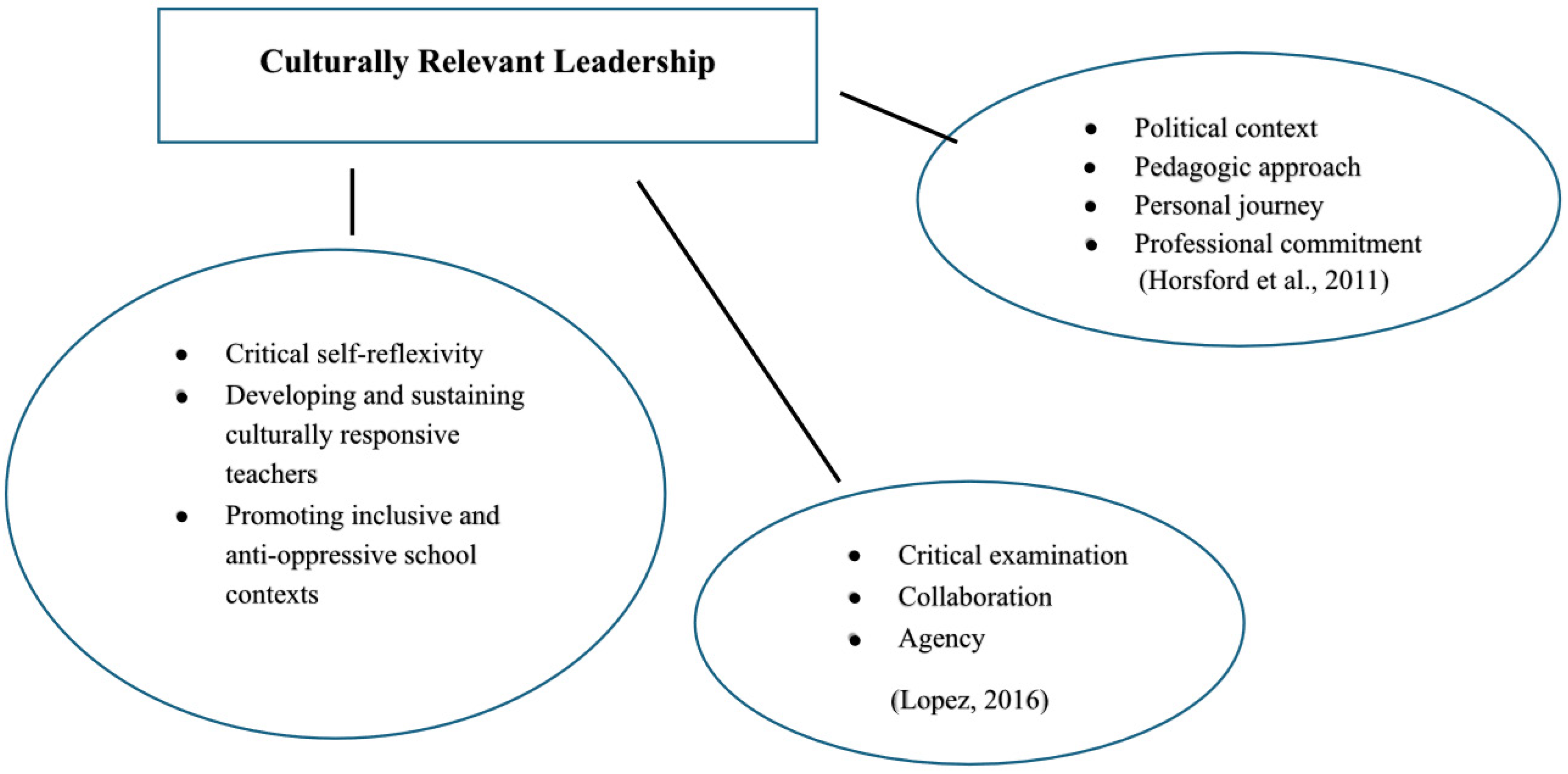
2.1. Culturally Responsive Leadership for Integration
2.2. Conceptual Perspectives
3. Research Design, Methods and Context
3.1. Texas Policy Context and Programs for Emergent Bilinguals
3.2. Galveston Independent School District
3.3. Newcomer Centers
3.4. Research Context
4. Ethics Approval and Informed Consent
4.1. Participants
4.2. Data Collection
4.3. Data Analysis
5. Findings
5.1. Challenges with Identifying Emergent Bilingual Newcomers
A newcomer who is not only learning a new language but also is a refugee is someone who had to leave their home country, as they feared to be harmed in it and cannot retrieve it. By the U.S. legislation, an asylee is one who arrives at one of the entry points of the U.S. or is already living in the country and would be harmed should he or she be required to go.
The same student would appear in our data systems as EB (emergent bilingual), SPED (special education), RTI (response to intervention), GT (gifted and talented) and McKinney Vento simultaneously. In our meetings, we sit down and people begin referring to them as the EB kid, or the SPED newcomer or that McKinney-Vento student rather than addressing them by their names.
There’s a pretty high number of refugee kids as well as immigrant kids who are basically placed in special education. Sometimes [students] needed the support; other times, it would happen because individuals would confuse or misidentify or over-identify students.
From the central office standpoint… they wanted us to immediately see where you can place these students… ‘We need you to do a pre-assessment, a post-assessment. Where can you place them?’”
5.2. Pressures to Quickly Assimilate and Test Refugee Students
5.3. Welcome Centers: Potential Places for Inclusion and Missed Opportunities
… some kind of welcoming center or school where all refugee kids can start… so they can fill in some of the gaps… and be there between a year or two years… Then they can go [to their area schools] with more confidence and they’re not so far behind.
I don’t know if you can ever give enough orientation for something like that. The school systems are intense, and there are so many rules and regulations you have to consider. So, it’s a pretty tall order to expect students to get it right away or for families to understand.
During the summer sessions, we grapple with the purpose of educating refugees… Are we primarily teaching academic content, focusing on social and behavioral skills, or simply introducing them to the routines of the school environment, like how to sit and interact with others, regardless of their background? Our approach varies widely.
This goes down further than refugees to lead one to consider what the society is and what we are doing in it. It raises the question whether the society is something to be worked on, in which every person is a participant, or it is something to follow the norms, which are established: whether a person is a Texan, American, or Dutch citizen.
5.4. Responding to Systemic Barriers: CRL and Professional Learning
Professional development emerged as a critical component of the work, particularly given that staff were not initially prepared for educational roles. Participants noted that many did not have formal backgrounds in education, as their primary responsibilities centered on providing support services, interpretation, and translation. However, through collaboration with English Learner specialist teachers, they were able to develop and deliver professional development initiatives.
5.5. Nurturing Community and Learning from Refugee Communities
Professional development became essential despite staff lacking formal educational backgrounds. Initially focused on support, interpretation, and translation, they partnered with English Learner specialists to co-develop and deliver training.
6. Discussion and Implications
6.1. Rethinking Labeling, Classification and the Construction of Student Identity
6.2. Navigating Systemic Pressures: Assimilation, Testing, and Misaligned Accountability
6.3. Culturally Responsive Leadership as Relational, Communal, and Transformative
7. Conclusions
Author Contributions
Funding
Institutional Review Board Statement
Informed Consent Statement
Data Availability Statement
Conflicts of Interest
References
- Aleghfeli, Yousef Khalifa, Joanna McIntyre, Lucy Hunt, and Chris Stone. 2025. Safety, Belonging and Success in Education for Refugees in Europe: A Systematic Review. European Journal of Education 60: e12852. [Google Scholar] [CrossRef] [Scilit]
- Anyichie, Aloysius C., Deborah L. Butler, Nancy E. Perry, and Samson M. Nashon. 2023. Examining classroom contexts in support of culturally diverse learners’ engagement: An integration of self-regulated learning and culturally responsive pedagogical practices. Frontline Learning Research 11: 1–39. [Google Scholar] [CrossRef] [Scilit]
- Arar, Khalid. 2020. School Leadership for Refugees’ Education: Social Justice Leadership for Immigrant, Migrants and Refugees. London: Routledge. [Google Scholar]
- Arar, Khalid, and Deniz Örücü. 2024. Post-migration ecology in educational leadership and policy for social justice: Welcoming refugee students in two distinct national contexts. Educational Management Administration & Leadership 52: 1410–33. [Google Scholar]
- Arar, Khalid, Corinne Brion, Eman Abo-Zaed Arar, and Anna Saiti. 2025a. Culturally proficient leadership: Equipping educators to better serve refugee students during a crisis. Equity in Education & Society 4: 300–18. [Google Scholar]
- Arar, Khalid, Emily. R. Crawford, Deniz Örücü, and Ira Bogotch, eds. 2025b. Education, Immigration and Migration: Revisiting and Re-Imagining Policy, Leadership and Praxis for a Changing World. Bingley: Emerald Publishing Limited. [Google Scholar]
- Arar, Khalid, Halil Karadaş, and Ali Culha. 2025c. Exploring the sources of success for refugee students with high academic performance: Experiences at two high schools in Southeast Turkey. Journal of Educational Administration and History, 1–17. [Google Scholar] [CrossRef] [Scilit]
- Bajaj, Monisha, Daniel Walsh, Lesley Bartlett, and Gabriela Martínez. 2023. Humanizing Education for Immigrant and Refugee Youth: 20 Strategies for the Classroom and Beyond. New York: Teachers College Press. [Google Scholar]
- Banwo, Bodunrin O., Muhammad Khalifa, and Karen Seashore Louis. 2022. Exploring trust: Culturally responsive and positive school leadership. Journal of Educational Administration 60: 323–39. [Google Scholar] [CrossRef] [Scilit]
- Beck, Kristie. 2023. Awareness of Immigration Policy Among High School Counselors in Missouri: Implications for Undocumented College-Bound Students a Mixed Methods Study. Doctoral dissertation, University of Missouri-Columbia, Columbia, MO, USA. [Google Scholar]
- Bonney, Ebenezer N., Victoria N. A. Bonney, and Helen Sweeney. 2021. Schools alone cannot educate refugees, it takes a community. In Refugee Education Across the Lifespan: Mapping Experiences of Language Learning and Use. Edited by D. S. Warner. Cham: Springer, pp. 17–34. [Google Scholar]
- Brezicha, Kristina, and Chandler Patton Miranda. 2022. Actions speak louder than words: Examining school practices that support immigrant students’ feelings of belonging. Equity & Excellence in Education 55: 133–47. [Google Scholar] [CrossRef] [Scilit]
- Bronfenbrenner, Urie. 1979. The Ecology of Human Development: Experiments by Nature and Design. Cambridge, MA: Harvard University Press. [Google Scholar]
- Brown, Martin, Herbert Altrichter, Igor Shiyan, María José Rodríguez Conde, Gerry McNamara, Barbara Herzog-Punzenberger, and Lourdes Sánchez. 2022. Challenges and opportunities for culturally responsive leadership in schools: Evidence from four European countries. Policy Futures in Education 20: 580–607. [Google Scholar] [CrossRef] [Scilit]
- Casellas Connors, Ishara, Lisa Unangst, and Kerri Evans. 2025. Navigating the tension: US refugee resettlement agency support of post-secondary access. Journal of Refugee Studies 38: 197–222. [Google Scholar] [CrossRef] [Scilit]
- Chadderton, Charlotte, and Anke Wischmann. 2025. Education policy and refugees in England and Germany: Racist nativism and the re-production of white supremacy. Race Ethnicity and Education 28: 457–77. [Google Scholar] [CrossRef] [Scilit]
- Crawford, Emily R., and Sarah L. Hairston. 2022. (Mis)Recognizing Undocumented Students & Families in a Rural School. Leadership & Policy in Schools 21: 635–56. [Google Scholar]
- Crawford, Emily R., Bryan Mann, and Khalid Arar. 2024. New country, new school: Recognizing and supporting Afghan families’ cultural and religious practices in US schools. Journal of Cases in Educational Leadership 27: 114–26. [Google Scholar] [CrossRef] [Scilit]
- Crawford, Emily R., Juan José Reyes, Oksana Kozlova, and Lisa Dorner. 2025. Navigating New Beginnings: A Study of State-Level Grant Funding Support for K-12 Refugee Education. Social Sciences 14: 46. [Google Scholar] [CrossRef] [Scilit]
- Çelik, Serkan, Dilara Saka, İlhan Polat, Cengiz Kesik, and Mahmut Ayaz. 2025. Development of a refugee education competency framework: Turkish context with Syrian refugee students. International Journal of Inclusive Education 29: 1035–61. [Google Scholar] [CrossRef] [Scilit]
- DeMatthews, David. 2018. Community Engaged Leadership for Social Justice. London: Routledge. [Google Scholar]
- Dogutas, Aysun. 2025. A Comparative Analysis of Immigrant Children’s Educational Policies: Türkiye and the United States. European Journal of Education & Language Review 1: 2. [Google Scholar] [CrossRef] [Scilit]
- Dryden-Peterson, Sarah. 2016a. Refugee education in countries of first asylum: Breaking open the black box of pre-resettlement experiences. Theory and Research in Education 14: 131–48. [Google Scholar] [CrossRef] [Scilit]
- Dryden-Peterson, Sarah. 2016b. Refugee Education: The Crossroads of Globalization. Educational Researcher 45: 473–82. [Google Scholar] [CrossRef] [Scilit]
- Galveston Independent School District (GISD). 2025. District Performance and Demographic Update 2024–2025. Galveston: GISD Research & Evaluation Office. [Google Scholar]
- García, Ofelia, Jo Anne Kleifgen, and Claudia Cervantes-Soon. 2025. Educating Emergent Bilinguals: Policies, Programs, and Practices for Multilingual Learners. New York: Teachers College Press. [Google Scholar]
- Gay, Geneva. 1975. Unfulfilled promises. The Review of Education/Pedagogy/Cultural Studies 1: 349–56. [Google Scholar] [CrossRef] [Scilit]
- Gay, Geneva. 2000. Culturally Responsive Teaching: Theory, Research, and Practice. New York: Teachers College Press. [Google Scholar]
- Guo-Brennan, Linyuan, and Michael Guo-Brennan. 2020. Global citizenship education and social justice for immigrant students: Implications for administration, leadership, and teaching in schools. In Handbook on Promoting Social Justice in Education. Edited by R. Papa. Cham: Springer. [Google Scholar]
- Guo-Brennan, Michael, and Linyuan Guo-Brennan. 2019. Civic capacity and engagement in building welcoming and inclusive communities for newcomers: Praxis, recommendations, and policy implications. Journal of Community Engagement and Scholarship 11: 5. [Google Scholar] [CrossRef] [Scilit]
- Hopkins, Megan, Hayley Weddle, Peter Bjorklund, Jr., L. Gautsch, Ilana M. Umansky, and Dafney Blanca Dabach. 2019. Nested Context of Reception for Immigrant and Refugee Newcomers: Findings from Three US School Districts. American Educational Research Association Meeting 45. Available online: https://eds.ucsd.edu/_files/grad/phd/CVs-Cohort1/CV_Peter-Bjorklund_Spring-2019.pdf (accessed on 11 November 2025).
- Horsford, Sonya Douglass, Tanetha Grosland, and Kelly Morgan Gunn. 2011. Pedagogy of the personal and professional: Toward a framework for culturally relevant leadership. Journal of School Leadership 21: 582–606. [Google Scholar] [CrossRef] [Scilit]
- Hos, Rabia. 2020. The lives, aspirations, and needs of refugee and immigrant students with interrupted formal education (SIFE) in a secondary newcomer program. Urban Education 55: 1021–44. [Google Scholar] [CrossRef] [Scilit]
- International Rescue Committee. 2023. Resettlement: A Critical Lifeline for Refugees. New York: International Rescue Committee. [Google Scholar]
- Ishimaru, Ann. 2020. Building Equitable Collaborations with Families and Communities. New York: Teachers College Press. [Google Scholar]
- Kan, Pui Fong, Morgan Jones, Christina Meyers-Denman, and Natalya Sparks. 2025. Emergent bilingual children during the silent period: A scoping review of their communication strategies and classroom environments. Journal of Child Language 52: 558–91. [Google Scholar] [CrossRef] [Scilit] [PubMed]
- Kanno, Yasuko, Cecilla Rios-Aguilar, and George C. Bynch. 2024. English Learners? Emergent bilnguals? Multilingual learners? Goals, contexts, and consequences in bilingual students. TESOL Journal 15: 1–12. [Google Scholar] [CrossRef] [Scilit]
- Kasper, Julie, Jill Koyama, and Adnan Turan. 2025. Working the ruins: Coloniality and what remains in refugee education. International Journal of Qualitative Studies in Education 38: 1186–206. [Google Scholar] [CrossRef] [Scilit]
- Kaukko, Mervi, Sarah Dryden-Peterson, Jane Wilkinson, and Stephen Kemmis. 2025. Refugee education for living well in a world worth living in. Teachers and Teaching 32: 542–61. [Google Scholar] [CrossRef] [Scilit]
- Kaur, Satinder, and Jessica Szorenyi. 2022. The Role of Educators in Supporting the Development of Refugee Students’ Sense of Belonging. Journal of Belonging, Identity, Language, and Diversity 6: 41–62. [Google Scholar]
- Khalifa, Muhammad A., Deeha Khalil, Tyson E. J. Marsh, and Clare Halloran. 2019. Toward an indigenous, decolonizing school leadership: A literature review. Educational Administration Quarterly 55: 571–614. [Google Scholar] [CrossRef] [Scilit]
- Khalifa, Muhammad A., Mark Anthony Gooden, and James Earl Davis. 2016. Culturally responsive school leadership: A synthesis of the literature. Review of Educational Research 86: 1272–311. [Google Scholar] [CrossRef] [Scilit]
- Kirksey, J. Jacob, and Carolyn Sattin-Bajaj. 2023. Immigration and customs enforcement raids the pillar of a community: Student achievement, absenteeism, and mobility following a large worksite enforcement operation in north Texas. American Behavioral Scientist, 1–23. [Google Scholar] [CrossRef] [Scilit]
- Koyama, Jill. 2024. Fabricating and positioning refugees as workers in the United States. Discourse: Studies in the Cultural Politics of Education 45: 101–17. [Google Scholar] [CrossRef] [Scilit]
- Koyama, Jill. 2025. “Cruel Optimism”: The Unmet Promises of US Schooling for Those Who Are Labeled as “Refugees. In Education, Immigration and Migration: Revisiting and Re-Imagining Policy, Leadership and Praxis for a Changing World, 2nd ed. Bingley: Emerald Publishing Limited, pp. 31–47. [Google Scholar]
- Koyama, Jill, and Adnan Turan. 2024. Coloniality and refugee education in the United States. Social Sciences 13: 314. [Google Scholar] [CrossRef] [Scilit]
- Koyama, Jill, and Julie Kasper. 2021. Pushing the Boundaries: Education Leaders, Mentors, and Refugee Students. Educational Administration Quarterly 57: 49–81. [Google Scholar] [CrossRef] [Scilit]
- Ladson-Billings, Gloria. 1995. Toward a theory of culturally relevant pedagogy. American Educational Research Journal 32: 465–91. [Google Scholar] [CrossRef]
- Lopez, Ann. 2016. Culturally Responsive and Socially Just Leadership in Diverse Contexts. New York: Palgrave. [Google Scholar]
- Lowenhaupt, Rebecca, and Todd Reeves. 2015. Toward a theory of school capacity in new immigrant destinations: Instructional and organizational considerations. Leadership & Policy in Schools 14: 308–40. [Google Scholar] [CrossRef] [Scilit]
- Marshall, Catherine, and Gretchen B. Rossman. 2012. Designing Qualitative Research, 2nd ed. Thousand Oaks: Sage Publications. [Google Scholar]
- Okilwa, Nathern S., Amanda Jo Cordova, and Kerry Haupert. 2021. Learning in a New Land: School Leadership in Support of Refugee Students. Leadership and Policy in Schools 20: 620–38. [Google Scholar] [CrossRef] [Scilit]
- Ortiz, Alba A., María E. Fránquiz, and Gilberto P. Lara. 2022. Educational equity for emergent bilinguals: What’s wrong with this picture? Bilingual Research Journal 45: 1–7. [Google Scholar] [CrossRef] [Scilit]
- Ostorga, Alcione N., and Peter Farruggio. 2020. Preparing bilingual teachers on the U.S./Mexico border: Including the voices of emergent bilinguals. International Journal of Bilingual Education and Bilingualism 23: 1225–37. [Google Scholar] [CrossRef] [Scilit]
- Palmer, Deborah K., Ramón Antontio Martínez, Suzanne G. Mateus, and Kathryn Henderson. 2014. Reframing the debate on language separation: Toward a vision for translanguaging pedagogies in the dual language classroom. The Modern Language Journal 98: 757–72. [Google Scholar] [CrossRef] [Scilit]
- Paris, Django, and H. Samy Alim, eds. 2017. Culturally Sustaining Pedagogies: Teaching and Learning for Justice in a Changing World. New York: Teachers College Press. [Google Scholar]
- Piñon, Lizdelia, Sulema Carreon-Sanchez, and Sarah Bishop. 2022. Emergent Bilingual Learner Education—Literature Review; San Antonio: Intercultural Development Research Association—EAC-South. Available online: https://files.eric.ed.gov/fulltext/ED629281.pdf (accessed on 11 November 2025).
- Strauss, Anselm L., and Juliet Corbin. 1998. Basics of Qualitative Research: Techniques and Procedures for Developing Grounded Theory, 2nd ed. Thousand Oaks: Sage. [Google Scholar]
- Texas Education Agency. 2023a. Bilingual Education Programs in Texas Fact Sheet #2. Available online: https://www.inspireacademies.com/accnt_93683/site_342015/Documents/Fact-Sheet-Program-Models-Emergent-Bilingual-Students.pdf (accessed on 11 November 2025).
- Texas Education Agency. 2023c. Senate Bill 560 Emergent Bilingual Strategic Plan. Austin: TEA Publications. [Google Scholar]
- Texas Education Code. 2021. Section 29.052—Definitions. Available online: https://statutes.capitol.texas.gov/Docs/ED/htm/ED.29.htm#29.052 (accessed on 2 March 2024).
- Tudge, Jonathan R. H., Elisa Merçon-Vargas, and Ayse Payir. 2022. Urie Bronfenbrenner’s bioecological theory: Its development, core concepts, and critical issues. In Sourcebook of Family Theories and Methodologies: A Dynamic Approach. Edited by M. J. Coleman and L. H. Ganong. Cham: Springer, pp. 235–54. [Google Scholar]
- United Nations Department of Economic and Social Affairs (UNDESA). 2025. International Migration Report 2025. New York: United Nations. Available online: https://www.un.org/development/desa (accessed on 11 November 2025).
- USA for UNHCR. 2024. Refugee Statistics. Available online: https://www.unrefugees.org/refugee-facts/statistics/#:~:text=By%20May%202024%2C%20more%20than,43.4%20million%20refugees (accessed on 11 November 2025).
- USA for UNHCR. 2025. Refugee Resettlement in the United States: Historical and Current Perspectives. Available online: www.unrefugees.org (accessed on 11 November 2025).
- Uzum, Baburhan, Bedrettin Yazan, and Netta Avineri. 2025. Becoming teachers of emergent bilinguals: Navigating ideological and identity tensions. Language Teaching Research 29: 3567–91. [Google Scholar] [CrossRef] [Scilit]
- Wang, Fei., Negar Khodarahmi, and Hanh-Thi Hannah Nguyen. 2022. Culturally responsive leadership: A critical review of literature. In Handbook of Global Leadership and Followership: Integrating the Best Leadership Theory and Practice. Cham: Springer, pp. 1–17. [Google Scholar]
- Yammine, Julie Kim, and Rebecca Lowenhaupt. 2021. educators’ perceptions of immigration policy implications on their schools: A mixed-methods exploration. Teachers College Record 123: 97–124. [Google Scholar] [CrossRef] [Scilit]
- Yin, Robert K. 2018. Case Study Research and Applications: Design & Methods, 6th ed. Thousand Oaks: SAGE Publications. [Google Scholar]


| Pseudonym (Age) | Gender | Years of Experience | Role | Type of School/Department |
|---|---|---|---|---|
| Roberts (52) | M | 19 | Principal | High School |
| Hartley (46) | M | 15 | Assistant Principal | Primary School |
| Silvia (41) | F | 16 | Counselor | High School |
| Julia (44) | F | 17 | Principal | Primary School |
| Jessica (32) | F | 11 | District Bilingual/ESL Coordinator | District/Primary |
| Liza (51) | F | 21 | Homeroom & ESL Teacher | Primary School |
| Laila (38) | F | 14 | ESL Teacher | High School |
| Mandy (37) | F | 12 | ESL Teacher | High School |
| Toni (39) | F | 13 | ESL Teacher | High School |
| Brian (44) | M | 17 | Assistant Principal & ESL Teacher | High School |
| Marcela (36) | F | 6 | Refugee Family Support Coordinator | District |
| Paula (45) | F | 15 | Director of Multilingual Education | District |
| Maya (34) | F | 10 | Community and Attendance Liaison | District |
| Edward (5) | M | 20 | Central Office Administrator | District |
| Patrick (47) | M | 18 | Administrator | District |
| Tabitha (43) | F | 16 | Professional Development Lead | District |
| Niara (30) | F | 8 | ESL Teacher | Primary School |
| Carolina (33) | F | 9 | Classroom Teacher | Primary School |
| Ronald (46) | M | 18 | Former School Counselor; Faculty | Former K–12/Higher Ed |
| Main Research Questions (MRQ) | Interview Question No. |
|---|---|
| MRQ1: What are the perceptions of K–12 school personnel about the policies, programs, and practices that shape the experiences of EB newcomer students with refugee backgrounds? | (1) How do district/state policies (e.g., LPAC, testing timelines, documentation requirements) shape the enrollment and placement of EB refugee newcomers? (2) How do accountability expectations influence decisions about assessment, placement, and course credit? (3) How do labeling and coding practices (EB, SPED, RTI, etc.) affect students’ experiences? (4) What district or school programs (e.g., welcome centers) most shape integration? |
| MRQ2: How do K–12 school personnel perceive and enact CRL to create inclusive schools for EB newcomer students with refugee backgrounds? | (5) What does culturally responsive leadership look like in your role? (6) Can you describe a time you mediated or adapted a policy to better support EB refugee newcomers? (7) How does professional learning and collaboration support inclusive practice? (8) How are refugee families and community partners engaged? |
| Themes | Subthemes/Categories |
|---|---|
| 1. Challenges With Identifying Emergent Bilingual Newcomers |
|
| |
| 2. Pressures to Quickly Assimilate and Test Refugee Students |
|
| 3. Welcome Centers: Potential and Missed Opportunities | Academic, linguistic, and psychosocial stabilization functions
|
Academic, linguistic, and psychosocial stabilization functions
| |
| 4. Enacting Culturally Responsive Leadership Through Learning and Community-Building |
|
| 5. Nurturing Community and Learning From Refugee Communities |
|
Disclaimer/Publisher’s Note: The statements, opinions and data contained in all publications are solely those of the individual author(s) and contributor(s) and not of MDPI and/or the editor(s). MDPI and/or the editor(s) disclaim responsibility for any injury to people or property resulting from any ideas, methods, instructions or products referred to in the content. |
© 2026 by the authors. Licensee MDPI, Basel, Switzerland. This article is an open access article distributed under the terms and conditions of the Creative Commons Attribution (CC BY) license.
Share and Cite
Abo-Zaed Arar, E.; Arar, K.; Crawford, E.R. Emergent Bilingual Newcomers: Fostering Culturally Responsive Welcoming Practices and Integration into School and Community. Soc. Sci. 2026, 15, 203. https://doi.org/10.3390/socsci15030203
Abo-Zaed Arar E, Arar K, Crawford ER. Emergent Bilingual Newcomers: Fostering Culturally Responsive Welcoming Practices and Integration into School and Community. Social Sciences. 2026; 15(3):203. https://doi.org/10.3390/socsci15030203
Chicago/Turabian StyleAbo-Zaed Arar, Eman, Khalid Arar, and Emily R. Crawford. 2026. "Emergent Bilingual Newcomers: Fostering Culturally Responsive Welcoming Practices and Integration into School and Community" Social Sciences 15, no. 3: 203. https://doi.org/10.3390/socsci15030203
APA StyleAbo-Zaed Arar, E., Arar, K., & Crawford, E. R. (2026). Emergent Bilingual Newcomers: Fostering Culturally Responsive Welcoming Practices and Integration into School and Community. Social Sciences, 15(3), 203. https://doi.org/10.3390/socsci15030203