1. Introduction
The social, cultural and technological transformations of recent decades have shaped educational environments marked by diversity, mobility and interdependence. In this context, preparing citizens who are able to live with difference and to act in critical, ethical and informed ways has become a central challenge for contemporary educational systems. Intercultural education, particularly in its critical orientation, calls for moving beyond the superficial coexistence of cultural groups toward processes of recognition, dialogue and mutual transformation (
Ferrão Candau 2010). From this perspective, international organizations such as
UNESCO (
2006) and the
Consejo de Europa (
2018) have emphasized the need to develop competencies that integrate knowledge, skills, attitudes and values oriented toward democratic participation in plural societies.
In parallel, complex thinking as formulated by
Morin (
1990,
1999,
2008) posits that understanding contemporary reality requires embracing uncertainty, acknowledging the interdependence among systems and bringing together diverse perspectives to address multidimensional problems. These ideas have been taken up by recent studies that conceptualize complex thinking as a set of interrelated cognitive processes that are systemic, scientific, critical and innovative, linked to deep comprehension and decision making in changing contexts (
Pacheco and Herrera 2021;
Mainzer 2007). In educational settings, this understanding implies preparing students to analyze situations from multiple lenses, ground their judgments, evaluate information rigorously and generate creative, contextually relevant solutions (
Rogers et al. 2013;
Prigogine and Stengers 1997).
Despite the theoretical relevance of both perspectives, the literature reveals a persistent disconnect between the field of complex thinking and the field of intercultural education. There are studies that focus on cognitive skills as well as works devoted to inclusion or cultural diversity. However, empirical research examining how the strengthening of complex thinking can contribute to the development of a critical intercultural citizenship remains scarce (
Banks 2007). Likewise, few studies explore how sociodemographic variables such as sex may influence the development of these competencies in Latin American contexts, where educational and cultural inequalities acquire specific characteristics (
UNESCO 2021).
Although the literature on complex thinking and on intercultural citizenship has expanded in recent years, empirical studies that directly measure both constructs within the same research design remain limited. Much of the existing work has addressed these domains separately, leaving an open space for theoretically informed analyses that explore how developments in complex thinking may be meaningfully interpreted in relation to intercultural citizenship.
In response to this gap, the present study seeks to examine within-individual changes associated with a multinational educational intervention aimed at developing complex thinking in students from Bolivia, Chile, Colombia and Mexico, articulating an analysis that links cognitive improvements with principles of intercultural citizenship. To this end, a quasi-experimental pretest–posttest design was implemented and analyzed through fixed-effects regression models (
Wooldridge 2010), which makes it possible to estimate changes attributable to the intervention while controlling for invariant individual characteristics.
It is important to clarify that this study does not directly measure intercultural attitudes, behaviors, or citizenship competencies as empirical outcomes. Instead, intercultural citizenship is adopted as a conceptual and interpretive framework through which the observed changes in complex thinking are analyzed. The underlying assumption, grounded in the literature, is that complex thinking constitutes a cognitive foundation for intercultural citizenship, insofar as it enables systemic understanding, critical reflection, openness to multiple perspectives, and ethical judgment in diverse social contexts.
Based on this framework, the following research questions are posed:
To what extent does an intervention focused on complex thinking strengthen the systemic, scientific, critical and innovative subdimensions among university students in four Latin American countries?;
What differences emerge in the impact of the intervention according to the sex of participants?;
How can the observed changes in complex thinking be interpreted in light of the principles of intercultural citizenship described in the literature?
In line with these questions, the general objective of the study is to analyze the change of the intervention on the development of complex thinking and its possible implications for training in intercultural citizenship. Specifically, the study seeks to: (a) examine within-individual changes associated with a multinational educational intervention on each cognitive subdimension; (b) identify differential patterns by sex; and (c) reinterpret the results in dialogue with the conceptual frameworks of complexity, interculturality and educational equity.
The originality and value of the study lie in integrating, for the first time in a multinational empirical analysis in Latin America, the development of complex thinking with an intercultural citizenship approach, using a robust within-individual change estimation approach and exploring gender differences that are seldom considered in this type of intervention. This approach makes it possible not only to provide evidence of observed cognitive changes associated with the program but also to offer insights for advancing toward higher education models that coherently articulate complexity, diversity and cognitive justice. It is important to note that, consistent with its quasi-experimental design, this study does not seek to establish strong causal changes in the absence of a control group. Rather, it focuses on identifying changes associated with participation in a structured educational intervention, using a fixed-effects panel approach to estimate intraindividual variation over time. This framing allows for a rigorous yet appropriately bounded interpretation of the results.
2. Theoretical Framework
2.1. Complex Thinking as a Cognitive Foundation for Understanding Social Realities
Complex thinking was presented by
Morin (
1990) as an epistemological alternative to the fragmented approaches that have traditionally prevailed in education and the social sciences. From this perspective, knowing entails articulating heterogeneous elements, recognizing the interactions among systems and accepting that human phenomena cannot be understood through linear explanations. This view is reinforced in Morin’s later works, where he emphasizes the need to embrace uncertainty, contradiction and the dynamic nature of social and educational processes (
Morin 1999,
2008). In this sense, thinking in complex terms requires not only integrating diverse information but also acknowledging the limits of knowledge and the ethical responsibility that accompanies any interpretation of the world.
The conceptual advances surrounding complexity have been expanded through developments in contemporary epistemology.
Prigogine and Stengers (
1997) argue that reality is characterized by irreversibility and emergence, which forces us to move beyond deterministic views of knowledge and to recognize the importance of openness and self-organization in human systems. Similarly,
Mainzer (
2007) maintains that human cognitive processes operate through dynamic structures in which intuition, logic and creativity interact continuously. These contributions converge in suggesting that understanding social phenomena requires thinking in terms of networks, interdependencies and nonlinear dynamics.
In the educational field, these ideas have been translated into more operational conceptual models that make it possible to approach complexity as a set of assessable cognitive processes.
Pacheco and Herrera (
2021) propose four fundamental dimensions of complex thinking: systemic, scientific, critical and innovative. Each represents a particular form of analysis and action. Systemic thinking allows individuals to identify relationships among variables and to understand the overall structure of problems. Scientific thinking guides the ability to formulate questions, test hypotheses and analyze data. Critical thinking encourages the examination of arguments, the evaluation of underlying assumptions and the questioning of taken-for-granted premises. Innovative thinking fosters the generation of creative and contextually grounded solutions. Together, these dimensions show that complexity is not an abstract idea, but an articulated set of competencies required to interpret and transform reality.
Recent literature has also underscored that complex thinking involves an intellectual and ethical stance toward knowledge.
Rogers et al. (
2013) notes that understanding complexity in education entails recognizing that learning is a relational process in which each interaction reshapes the educational system and redefines the possibilities for understanding. In the same vein, studies grounded in complexity theory have demonstrated that social phenomena emerge from multiple interactions and cannot be explained by isolated factors, which demands modes of thinking capable of integrating diverse perspectives (
Gershenson and Heylighen 2004;
Heylighen et al. 2006).
These contributions demonstrate that complex thinking constitutes a key competency for understanding contemporary social reality and for preparing students who can analyze problems at multiple levels, evaluate information rigorously and generate creative responses to uncertain scenarios. Its relevance becomes even more evident in educational contexts where diversity, conflict and interdependence are structural features, requiring cognitive capacities that are sufficiently flexible to move beyond simplistic or reductionist solutions. In this way, complexity becomes an epistemological and pedagogical principle that underpins the type of intervention analyzed in this study.
2.2. Intercultural Education and Democratic Citizenship in Diverse Contexts
Intercultural education has taken on a central role in discussions on citizenship formation in contexts marked by cultural diversity, historical inequalities and the emergence of new migratory flows. From a critical perspective, interculturality is not limited to promoting peaceful coexistence among different groups. Rather, it involves processes of recognition, dialogue and social transformation aimed at questioning the structures that reproduce exclusion and inequality (
Ferrão Candau 2010). In Latin America, this approach has been particularly relevant due to the persistence of ethnic, linguistic and socioeconomic gaps that shape both educational systems and community life.
At the international level, various organizations have proposed frameworks to guide intercultural education from a democratic perspective.
UNESCO (
2006) defines intercultural education as a process that seeks to build inclusive societies through respect for diversity, the promotion of dialogue and participation in public life. Complementarily, the
Consejo de Europa (
2018) offers a reference framework for the competencies required in a democratic culture, integrating knowledge, skills, attitudes and values that foster respectful interaction in diverse cultural contexts. These frameworks coincide in emphasizing that intercultural citizenship requires openness to others as well as a critical understanding of how power, identity and inequality operate within social relations.
Conceptually,
Banks (
2007) has been one of the most influential authors in developing multicultural citizenship as an educational project aimed at preparing individuals to participate actively in culturally diverse democracies. His approach posits that educating for citizenship involves not only transmitting normative principles but also fostering critical reflection on how identities are constructed, how opportunities are distributed and how certain groups have been historically silenced or marginalized. This perspective has shown that intercultural citizenship cannot be separated from a critical view of social justice and educational equity.
From this standpoint, intercultural education is understood as a multidimensional process that brings together knowledge about cultural diversity, communicative and interpretive skills, attitudes of openness and respect and values oriented toward democratic coexistence (
Deardorff 2009). These dimensions materialize in the ability to interact competently with people from different cultural backgrounds, interpret meanings in situated ways and reflect on one’s own frames of reference. They also involve questioning prejudice, recognizing privilege and promoting inclusive practices that transform educational and social dynamics.
Thus, the discussions on interculturality and democratic citizenship highlight that education in diverse contexts requires an approach that brings together cognitive, attitudinal and ethical elements. This framework is particularly relevant for the present study, as it helps explain how the development of complex thinking can contribute to the construction of an intercultural citizenship capable of addressing the complexity and diversity of the contemporary world. It also provides a theoretical basis for interpreting the results derived from the educational intervention analyzed in this work.
2.3. Articulation Between Complex Thinking, Intercultural Citizenship and Educational Equity
The connection between complex thinking and intercultural citizenship rests on the premise that understanding diversity and acting in socially heterogeneous contexts requires modes of thought capable of integrating multiple perspectives, acknowledging uncertainty and analyzing phenomena through their interrelationships.
Morin (
1999,
2008) argues that human understanding involves simultaneously recognizing the unity and plurality of being, which demands a form of reasoning that weaves together the cognitive and the ethical. From this perspective, developing complex thinking is not only an intellectual exercise but also a process aimed at fostering attitudes of openness, sensitivity to difference and a willingness to engage in dialogue.
This connection becomes even more evident when considering that social and cultural phenomena emerge from diverse and shifting interactions. Complexity theory maintains that these processes cannot be explained through linear relations, but must instead be understood as dynamic systems in which self-organization, emergence and interdependence shape new forms of collective behavior (
Gershenson and Heylighen 2004;
Heylighen et al. 2006). These ideas make it possible to understand intercultural citizenship not as a set of static traits but as a capacity that evolves through interaction and that requires cognitive abilities able to recognize patterns, analyze contradictions and generate flexible interpretations of cultural reality.
From an educational standpoint, promoting intercultural citizenship demands formative processes that integrate cognitive competencies with democratic attitudes.
Deardorff (
2009) notes that intercultural competence requires interpretive and relational skills that can only be consolidated through complex reflective processes. In addition, the international frameworks proposed by
UNESCO (
2006) and the
Consejo de Europa (
2018) emphasize that democratic coexistence depends on the ability to critically analyze power structures and to recognize the diverse forms of cultural participation and expression. In this sense, complex thinking provides a foundation for understanding diversity not as fragmentation but as a fabric of relationships that calls for deeper cognitive processes.
Educational equity also occupies a central place in this articulation, as preparing individuals for intercultural citizenship requires acknowledging how variables such as sex, social background or educational trajectory may generate inequalities in access to and development of cognitive competencies.
UNESCO (
2021) underscores that gender equality in education entails ensuring not only access but also real and equitable opportunities for meaningful learning. Understanding these inequalities from a complexity perspective allows us to recognize that such gaps cannot be explained by isolated factors, but rather by the interplay among social structures, cultural norms and educational practices.
Taken together, the approaches of complexity, interculturality and educational equity converge on the idea that citizenship formation requires flexible, reflective and critical cognitive processes. For this reason, the articulation between complex thinking and intercultural citizenship offers a suitable theoretical framework for explaining how certain educational interventions can strengthen the competencies needed for democratic participation in diverse societies. This conceptual framework underpins the analysis conducted in the present study and guides the interpretation of the results regarding the cognitive impact of the intervention and the differences identified according to participants’ sex.
In this study, the relationship between complex thinking and intercultural citizenship is not examined as a direct empirical association between measured outcomes. Rather, intercultural citizenship functions as a theoretical lens through which the cognitive changes observed in complex thinking are interpreted, based on prior conceptual work linking systemic, critical, and ethical reasoning to democratic and intercultural competencies.
3. Materials and Methods
The study employed a mixed-methods approach grounded in a quasi-experimental pretest–posttest design without a control or comparison group, aimed at examining within-individual changes associated with participation in an educational intervention focused on the development of complex thinking among participants from four Latin American countries. The longitudinal structure of the data allowed the information to be organized in a panel format and intraindividual variation over time to be estimated through fixed-effects regression models, a strategy suited to controlling for unobserved characteristics that remain constant across measurement points (
Wooldridge 2010;
StataCorp LLC 2024).
Complementarily, an exploratory differential analysis by sex was incorporated. While this design strengthens the analysis of observed patterns of change over time, it does not permit causal inference or the estimation of net intervention changes in the absence of a counterfactual comparison. Qualitative data were used to complement the quantitative findings and to support an interpretive understanding of participants’ formative experiences in relation to intercultural citizenship.
3.1. Population
A total of 186 students were initially invited and enrolled across the participating institutions. Of these, 160 students completed both the pre-intervention and post-intervention assessments and were therefore included in the final analytical sample, resulting in a complete-case panel dataset. This final sample consisted of university students from educational institutions in Bolivia (n = 32), Chile (n = 25), Colombia (n = 28), and Mexico (n = 75), providing a multinational dataset with cultural, institutional, and geographic diversity.
Institutions were selected through non-probabilistic, convenience-based sampling, based on existing academic collaborations and institutional willingness to participate. Within each institution, students enrolled in courses where the educational intervention was implemented were invited to participate on a voluntary basis. Participation required completion of both pre-intervention and post-intervention assessments.
The final analytical sample included only participants who completed both the pretest and posttest measures. Cases with incomplete responses at either measurement point were excluded prior to analysis, resulting in a panel dataset composed exclusively of matched observations. No additional attrition occurred between measurement points within the analytical sample.
This sampling and retention strategy ensured complete longitudinal data for each included participant; however, it also implies potential selection bias, as students who completed both measurements may differ systematically from those who did not. This limitation is acknowledged and considered when interpreting the findings. Additionally, sex was incorporated as a differentiating factor in the analysis of complex thinking subdimensions, responding to recent international calls to examine gender-related patterns in learning processes and educational equity.
3.2. Instrument
For the present study, the eComplexity instrument was used to assess self-perceived complex thinking competence. This instrument has been previously validated and described in detail in a study focused on its construction and psychometric properties (
Vázquez-Parra et al. 2024). The questionnaire consists of twenty-five statements rated on a five-point Likert scale and is structured into four subdimensions: systemic thinking, scientific thinking, critical thinking, and innovative thinking.
The version employed in this study corresponds to the one validated through a structural equation modeling approach in a large independent sample of university students (n = 1037). That validation reported high reliability and construct validity, including a McDonald’s Omega coefficient of 0.9155 and an explained variance of 76.28% for the overall competence, as well as Cronbach’s alpha values exceeding accepted thresholds for the total scale and each subdimension (
Vázquez-Parra et al. 2024).
In the present study, internal consistency estimates were recalculated for each measurement occasion to ensure the reliability of the instrument within the analyzed sample. Results indicated excellent consistency at both time points. At Moment 1, the scale showed a Cronbach’s alpha of 0.946 and a McDonald’s omega total of 0.947, while at Moment 2, reliability indices were similarly high (α = 0.974; ω = 0.974).
Together, the strong reliability evidence from both the original validation and the present sample supports the use of the instrument in this study and provides a robust basis for interpreting changes in self-perceived complex thinking over time.
Table 1 summarizes the theoretical foundation of each item in the instrument, as presented in the validation article.
This table provides a correspondence between each questionnaire statement and the conceptual foundations of the subdimensions. For example, the systemic dimension is grounded in the ability to identify relationships among variables and conditions, the scientific dimension in the formulation of questions and hypotheses, the critical dimension in the recognition of assumptions and arguments and the innovative dimension in the generation of creative solutions (
Vázquez-Parra et al. 2024).
Regarding administration, the instrument was applied online during the pre-intervention (pretest) and post-intervention (posttest) sessions, ensuring equivalent conditions of access, anonymity and clarity of instructions at both moments. Basic sociodemographic data (country, sex, age) were collected, and responses were subsequently processed for analysis in panel format. The internal consistency reported in the original validation study ensures the instrument’s suitability for use in Latin American university settings.
It is important to note that the use of the instrument in this study was authorized through the corresponding institutional procedures, and participants’ rights to confidentiality and voluntary participation were safeguarded. This study is supported by the approval of the Institutional Review Board of Tecnológico de Monterrey, protocol number P-IFE-202506-002. Since the instrument had already undergone a robust prior validation, its implementation here made it possible to focus on assessing the change of the intervention and exploring sex-based differences without the need to conduct a full validation again with this specific sample.
3.3. Data Analysis
To estimate the change of the intervention on the subdimensions of complex thinking, the data were structured in a longitudinal panel format, where each participant contributed two observations corresponding to the pretest and the posttest. This structure made it possible to analyze intraindividual changes and to isolate the differences directly associated with the intervention. The analytical approach was based on a fixed-effects regression model, a technique widely recommended for studies that follow the same individuals across multiple time points, as it controls for unobserved characteristics that remain constant over time and could otherwise introduce bias into the estimation (
Wooldridge 2010).
The basic model used for each item of the instrument was specified as follows:
where Y
it represents the response of individual
i to the corresponding item at time t; α
i is the individual fixed change; Trat
it is a dichotomous variable indicating whether the observation corresponds to the posttest (1) or the pretest (0); β
1 estimates the average within-individual change associated with the post-intervention period, and ε
it is the error term. This model made it possible to evaluate, for each of the twenty-five items, whether statistically significant increases occurred after the intervention, considering a significance level of 5 percent.
Additionally, interaction models were estimated to explore differences in observed patterns of change according to participants’ sex. A significance threshold of α = 0.10 was applied for interaction terms, reflecting the exploratory nature of these analyses rather than confirmatory hypothesis testing. Exact p-values are reported to allow transparent interpretation of the results. The extended model was expressed as follows:
The analysis of sex-based differences was conducted as an exploratory component of the study. Given the limited and inconsistent prior evidence regarding directional differences in complex thinking subdimensions, no a priori hypotheses were formulated concerning the expected direction of these changes. Accordingly, interaction terms were included to identify potential differential patterns, which were subsequently interpreted within an established theoretical framework. In this specification, womani is a dichotomous variable identifying female participants. The coefficient β3 estimates whether within-individual changes associated with the post-intervention period differ significantly between women and men, and to what extent.
Because sex is a time-invariant individual characteristic, its main change is absorbed by the fixed-effects transformation and cannot be estimated directly. Accordingly, the specification in Equation (2) includes sex only through its interaction with the post-intervention indicator, allowing the estimation of differential within-individual changes over time by sex. No standalone coefficient for sex is estimated in the fixed-effects models.
All models were estimated using a within fixed-effects estimator, exploiting within-individual variation over time. Robust standard errors clustered at the individual level were used to account for heteroskedasticity and serial correlation. The treatment indicator was coded as 0 for the pre-intervention measurement and 1 for the post-intervention measurement.
The statistical analysis was conducted using Stata version 19 (
StataCorp LLC 2024), applying fixed-effects panel regression routines with robust error estimation. For each item, the coefficients associated with the intervention (β
1), their
p values and, when applicable, the interaction coefficients (β
3) were reported. This procedure allowed for precise identification of which subdimensions of complex thinking exhibited significant changes and which showed differential variations by sex.
The use of fixed-effects models was particularly appropriate given the multinational and heterogeneous nature of the sample, as this approach controls for unobserved individual characteristics that remain stable over time, such as baseline cognitive tendencies, study habits, or prior educational experiences. In the context of a pretest–posttest design without a control group, fixed-effects estimation strengthens the analysis by accounting for time-invariant sources of individual heterogeneity, thereby allowing a more precise estimation of within-individual variation over time. However, this approach does not rule out the influence of time-varying external factors, and the results should therefore be interpreted within the inferential limits of the design.
Given the quasi-experimental pretest–posttest design without a control group, the findings of this study should be interpreted with appropriate caution. Although the fixed-changes panel models employed control for all time-invariant individual characteristics, they do not fully rule out alternative explanations such as maturation, testing changes, historical influences, or regression to the mean. Accordingly, the estimates reported in this study are interpreted as within-individual changes associated with participation in educational intervention, rather than as definitive causal changes. This analytic strategy strengthens internal validity relative to simple pre–post comparisons, while maintaining a conservative inferential scope consistent with the study design.
Because the analyses were conducted at the item level to examine fine-grained changes across the four subdimensions of complex thinking, the resulting tests are not statistically independent. In this context, applying highly conservative corrections such as Bonferroni may substantially increase Type II error and obscure meaningful patterns of change. For this reason, the results are presented without formal multiple-comparison adjustment and are interpreted in conjunction with theoretical coherence and consistency across items.
4. Results
For the data analysis, the database was structured as a panel in which each individual was identified by a unique code and contributed observations corresponding to both the pre-intervention and post-intervention moments. This approach made it possible to conduct a longitudinal follow-up of each participant, comparing responses before and after the program.
Before presenting the item-level results, it is important to note that although fixed-effects models control for all time-invariant individual characteristics, they cannot account for unobserved time-varying confounders. Accordingly, the results reported in this section reflect within-individual changes associated with participation in the intervention over time and should not be interpreted as definitive causal effects.
Based on this structure, an independent analytical cycle was applied to each of the 25 items of the assessment instrument. A fixed-effects regression model was used, in which the dependent variable was the response given to each item and the main explanatory variable corresponded to the measurement moment (before or after the intervention).
Although the fixed-effects analyses were conducted at the item level to capture fine-grained within-individual variation, the interpretation of the findings prioritizes coherent patterns at the level of theoretically defined subdimensions rather than isolated item-level effects. Accordingly, the results are discussed in terms of systemic, scientific, critical, and innovative thinking as integrated cognitive domains.
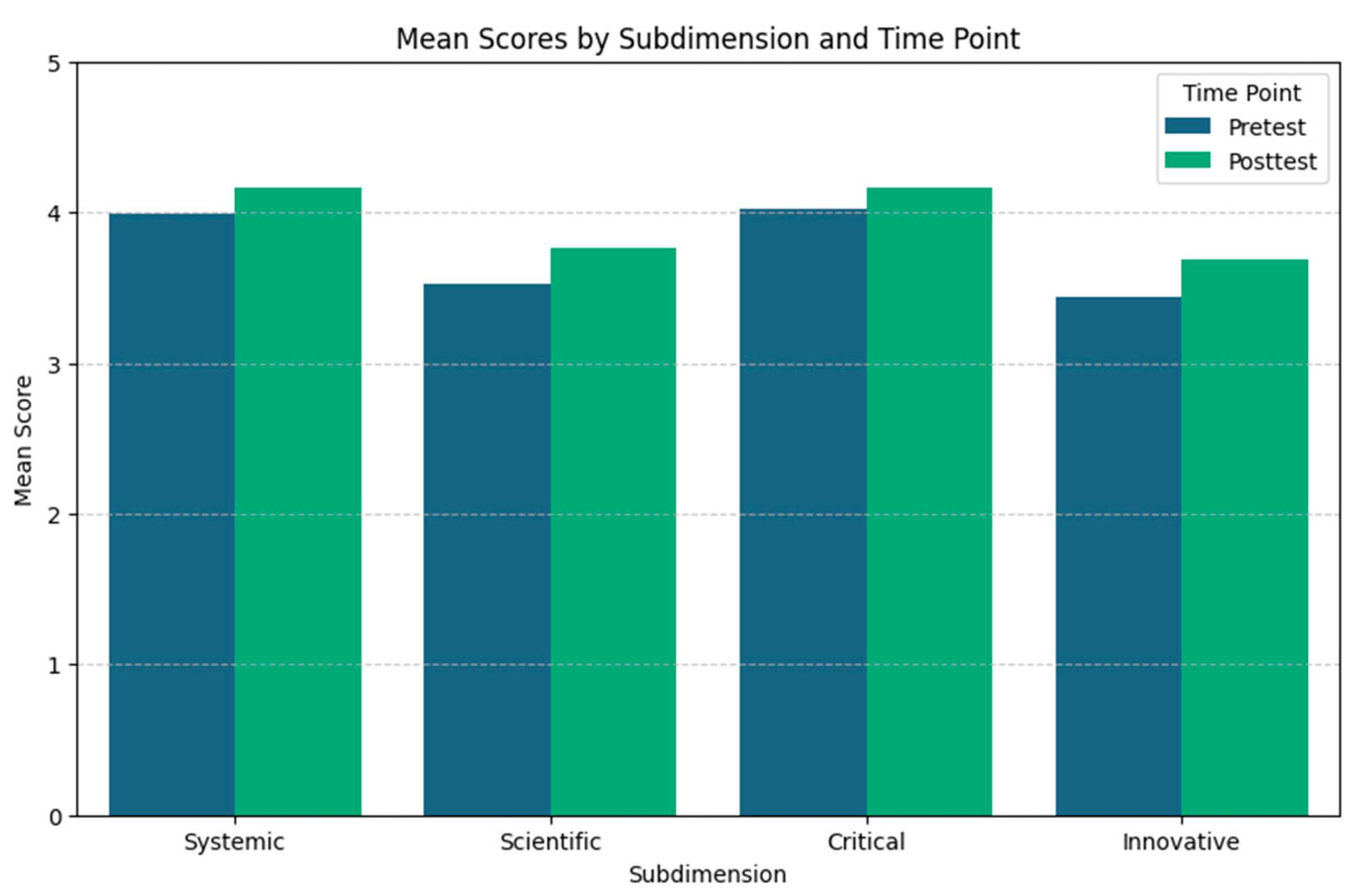
The analysis of the post-intervention data indicates that, overall, statistically significant within-individual changes were observed for most of the items comprising the complex thinking instrument. The predominance of positive coefficients across items suggests consistent directional patterns of within-individual change over time; however, not all item-level changes reached conventional levels of statistical significance, as reflected in
Table 2.
In the vast majority of cases, the p-values associated with the estimated coefficients were below 0.05, indicating statistically robust within-individual differences between pre-intervention and post-intervention measurements. These results support the consistency of the observed patterns of change over time, while remaining within the inferential limits of the study design.
The item-level analyses reveal statistically significant within-individual changes across multiple competencies associated with complex thinking, grouped within the subdimensions of systemic, scientific, critical, and innovative thinking (
Table 2).
Within the systemic thinking subdimension, statistically significant changes were observed in participants’ reported ability to identify associations among variables, conditions, and constraints (p1, coefficient = 0.19375,
p = 0.0011); to participate in projects requiring inter- or multidisciplinary perspectives (p3, coefficient = 0.1875,
p = 0.0054); and to employ strategies aimed at understanding both the parts and the whole of a problem (p6, coefficient = 0.21875,
p < 0.0001). These patterns indicate changes in self-reported systemic reasoning processes over time (
Table 2).
With respect to scientific thinking, statistically significant within-individual changes were identified in the ability to recognize essential components of a problem (p7, coefficient = 0.25625,
p < 0.0001); to understand the structure and formats of research reports (p8, coefficient = 0.1875,
p = 0.0062); to identify the structure of research articles (p9, coefficient = 0.175,
p = 0.0040); and to recognize elements necessary for formulating a research question (p10, coefficient = 0.125,
p = 0.0387). Additional changes were observed in designing research instruments aligned with methodological approaches (p11, coefficient = 0.21875,
p = 0.0008); in the formulation and testing of hypotheses (p12, coefficient = 0.21875,
p = 0.0008); and in the reported use of scientific data to analyze research problems (p13, coefficient = 0.2,
p = 0.0015) (
Table 2). Together, these results describe patterns of change in self-reported scientific reasoning competencies.
In the critical thinking dimension, statistically significant changes were observed in the reported ability to analyze problems from multiple perspectives (p14, coefficient = 0.15625,
p = 0.0091); to identify the grounding of one’s own and others’ judgments in order to recognize flawed arguments (p15, coefficient = 0.2625,
p < 0.0001); to self-evaluate progress and goal attainment (p16, coefficient = 0.2125,
p = 0.0004); to review ethical guidelines in project development (p18, coefficient = 0.28125,
p < 0.0001); and to value constructive criticism during project development (p19, coefficient = 0.175,
p = 0.0023) (
Table 2). Changes in the use of scientific reasoning to make judgments (p17) were statistically significant at the 10 percent level. Overall, these patterns reflect variation over time in self-reported critical and reflective dispositions.
Within the innovative thinking subdimension, statistically significant within-individual changes were observed in understanding criteria for defining a problem (p20, coefficient = 0.13125,
p = 0.0362); identifying variables from different disciplines relevant to research questions (p21, coefficient = 0.225,
p < 0.0001); applying innovative solutions to diverse problems (p22, coefficient = 0.15625,
p = 0.0124); solving problems through the interpretation of data from multiple disciplines (p23, coefficient = 0.18125,
p = 0.0051); analyzing research problems while considering contextual factors (p24, coefficient = 0.2,
p < 0.0002); and evaluating solutions using critical and innovative criteria (p25, coefficient = 0.15,
p = 0.0076) (
Table 2). These results describe changes in self-reported innovative reasoning processes.
Overall, the results indicate statistically significant within-individual changes across most of the competencies assessed, as reflected in the estimated coefficients and associated significance levels. Some items—such as identifying data from other fields to solve problems (p2), organizing information (p4), and expressing interest in learning about different perspectives (p5)—did not reach statistical significance, although the direction of change remained positive in all cases.
Taken together, these findings document consistent patterns of change over time in multiple dimensions of complex thinking, based on self-reported assessments, without implying definitive causal effects attributable to the intervention (
Figure 1).
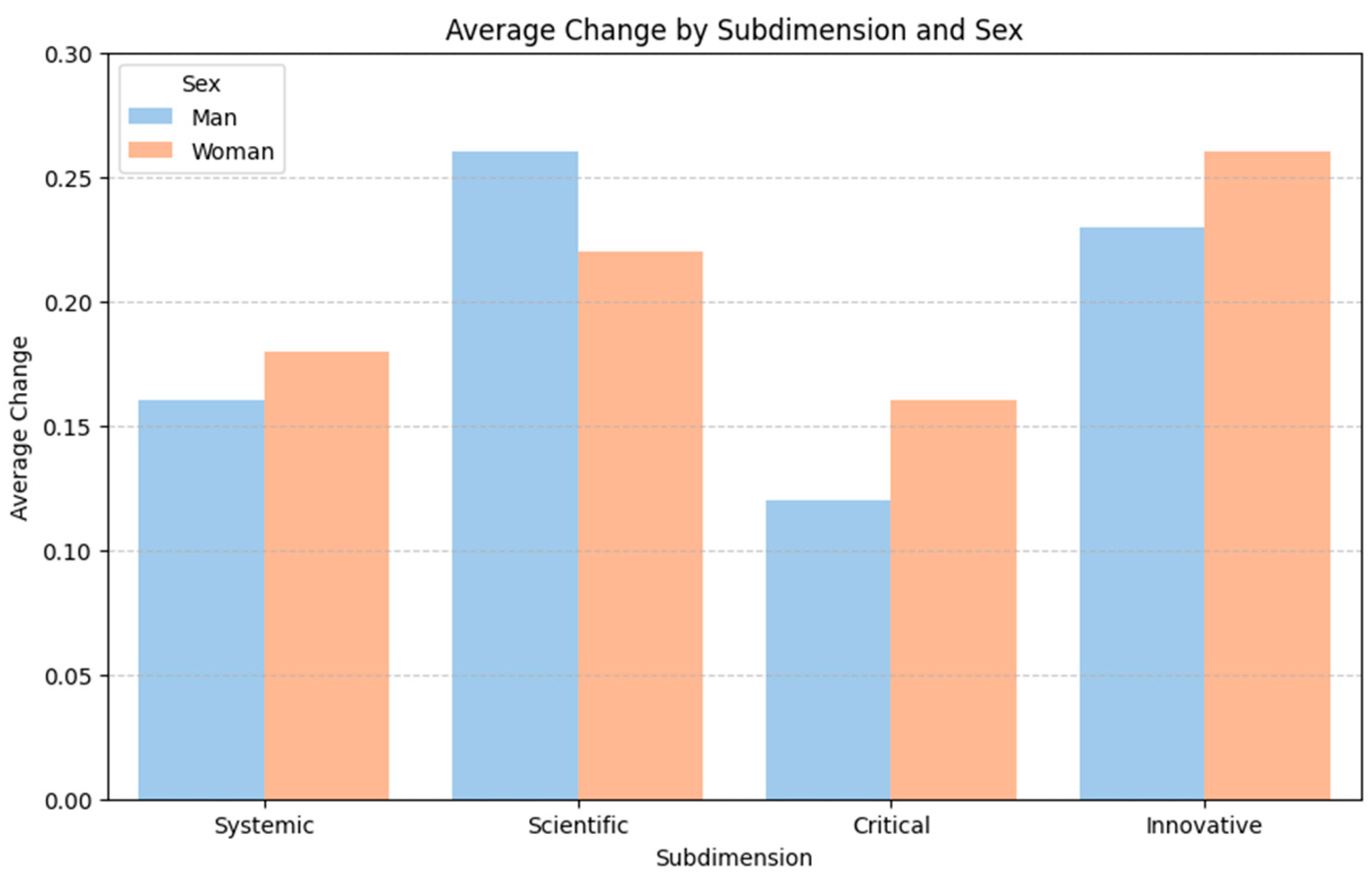
On the other hand, a differential analysis of the intervention’s impact by sex was conducted. For each item, a fixed-effects regression model was estimated that included, in addition to the main change of the intervention, an interaction between the treatment and female sex. This specification made it possible to assess whether the change of the intervention differed for women compared with the rest of the participants (
Figure 2).
Given the exploratory nature of the interaction analyses and the number of item-level tests conducted, results reaching the 10% significance level should be interpreted with caution, emphasizing change direction and consistency rather than isolated statistical thresholds.
The analysis of the interaction between female sex and the post-intervention measurement identified competencies in which patterns of within-individual change differed by sex, using a significance level of 10 percent. Of the 25 items analyzed, four showed statistically significant interaction terms, as reported in
Table 3. The interaction effects reported in
Table 3 should be interpreted as exploratory. Given that these changes are observed at the item level and are not supported by aggregated subscale analyses, their interpretation focuses on directional patterns rather than on confirmatory inference.
p5 (I enjoy learning about different perspectives on a problem). The interaction coefficient was 0.1997 (p = 0.078), indicating that women showed higher relative changes than men in self-reported openness and willingness to consider different perspectives over time. This pattern suggests differentiated trajectories in openness-related competencies across sexes.
p10 (I identify the elements needed to formulate a research question). The interaction coefficient was 0.2444 (p = 0.042), indicating higher relative changes among women compared to men in the ability to identify essential elements involved in formulating research questions.
p17 (I use reasoning based on scientific knowledge to make judgments about a problem). In this case, the interaction coefficient was negative (−0.2389, p = 0.062), indicating that the magnitude of observed change over time was smaller for women than for men with respect to the use of scientific reasoning in judgment formation. This negative interaction indicates that, although both groups exhibited positive within-individual changes over time, the magnitude of change in scientific reasoning was smaller for women than for men relative to their respective baseline levels. The main post-intervention change remained positive, while the interaction term captures the differential slope for women relative to men.
p25 (I tend to evaluate solutions derived from a problem with a critical and innovative lens). The interaction coefficient was 0.2703 (p = 0.015), indicating higher relative changes among women in self-reported critical and innovative evaluation of solutions.
Taken together, these results indicate that, while patterns of change were observed across the overall sample, differentiated trajectories by sex emerged for specific competencies related to openness to perspectives, research question formulation, scientific judgment, and critical–innovative evaluation (
Table 3).
Although the analyses were conducted at the item level to capture fine-grained variation, the interpretation of the findings emphasizes coherence across theoretically defined subdimensions rather than isolated item-level significance.
5. Discussion
In interpreting the results, emphasis is placed on consistent patterns of change observed across the four subdimensions of complex thinking rather than on isolated item-level variations. This approach aligns with the theoretical structure of the instrument and with prior conceptualizations of complex thinking as an integrated and multidimensional competence.
The contribution of this study to intercultural citizenship should therefore be understood at a theoretical and interpretive level rather than as a direct empirical assessment. While no intercultural attitudes or behaviors were measured explicitly, the observed changes in complex thinking are consistent with existing frameworks that conceptualize such cognitive competencies as relevant conditions for intercultural citizenship, democratic participation, and ethical engagement in diverse societies. Accordingly, the contribution of this study lies not in empirically establishing a direct causal link between complex thinking and intercultural citizenship, but in providing theoretically grounded evidence on how changes in complex cognitive competencies may be interpreted as meaningful foundations for intercultural citizenship formation.
Statistically significant within-individual changes in complex thinking were observed following participation in the intervention. These patterns are consistent with
Morin’s (
1990,
1999) assertions that complex thinking develops in contexts of uncertainty and diversity that require the integration of multiple perspectives. The observed changes across systemic, scientific, critical, and innovative dimensions align with the complexity approach in suggesting cognitive processes related to information integration, critical examination of assumptions, structured explanation, and creative problem framing (
Pacheco and Herrera 2021;
Prigogine and Stengers 1997).
The presence of increased analytical and reflective dispositions is also consistent with
Rogers et al. (
2013) view of learning from a complexity perspective, which conceives learning as an evolving system shaped through interaction. When comparing pretest and posttest measures, the observed intraindividual variation is compatible with the notion of cognitive emergence, understood as the development of new capacities arising from dynamic interactions among pre-existing elements (
Gershenson and Heylighen 2004;
Heylighen et al. 2006). Similarly, patterns related to the integration of multidisciplinary information and multidimensional problem analysis are consistent with
Mainzer’s (
2007) conception of cognition as a dynamic interplay of creativity, logic, and contextual interpretation.
These findings are also relevant when interpreted through the lens of intercultural education and citizenship formation. Prior literature emphasizes that intercultural citizenship requires not only openness and cultural sensitivity, but also complex cognitive competencies that enable individuals to interpret diversity, analyze power relations, and critically engage with dominant narratives (
Banks 2007;
Ferrão Candau 2010). In this regard, the observed changes in critical and innovative thinking are consistent with theoretical accounts that link such competencies to the ability to evaluate discourses, engage with diverse perspectives, and formulate contextually responsive interpretations of social complexity. This alignment is further supported by international frameworks that conceptualize interculturality as a democratic competence integrating knowledge, skills, attitudes, and values (
UNESCO 2006;
Consejo de Europa 2018).
The exploratory analyses by sex revealed differentiated patterns of cognitive change that invite reflection from an educational equity perspective. The observation that women exhibited higher relative gains in openness to perspectives, question formulation, and critical-innovative evaluation is consistent with international reports describing gender-differentiated engagement with reflective and collaborative learning processes (
UNESCO 2021). Conversely, the higher relative gains observed among men in applied scientific reasoning suggest that gender-related differences in cognitive development operate in complex and bidirectional ways. From a complexity perspective, these patterns may be interpreted as emergent outcomes of sociocultural trajectories shaped by interactions among social expectations, educational practices, and individual experiences (
Morin 2008).
Importantly, the heterogeneous patterns observed across subdimensions should not be interpreted as inconsistencies, but rather as context-dependent and emergent differences aligned with prior research on gendered cognitive and educational trajectories. Existing literature indicates that socialization processes, academic norms, and disciplinary cultures may differentially emphasize reflective, collaborative, or analytical forms of reasoning across genders, without implying uniform advantages across all cognitive domains. Future research could extend these exploratory findings by estimating standardized interaction effect sizes with confidence intervals and by examining whether sex-related differences are replicated at the subscale level.
The multinational composition of the sample adds an additional layer to the interpretation of the findings. The educational contexts of Bolivia, Chile, Colombia, and Mexico share structural challenges related to cultural diversity, inequality, and curricular tensions (
OEI 2010). The presence of consistent patterns of cognitive change across these contexts suggests that complex thinking may function as a transversal cognitive framework within diverse Latin American educational settings, without implying uniform intervention changes or generalizable efficacy.
The use of fixed-effects panel models strengthens the analysis by controlling for time-invariant individual characteristics and enabling the estimation of intraindividual variation over time (
Wooldridge 2010). At the same time, the absence of a control group and the potential influence of time-varying confounders delimit the inferential scope of the findings. The use of differentiated significance thresholds for interaction patterns reflects the exploratory nature of these analyses and the absence of a priori directional hypotheses. Complementarily, the integration of quantitative results with qualitative insights aligns with calls to apply complexity-based approaches to the analysis of multifactorial educational phenomena (
Turner and Baker 2019), supporting an interpretation of the findings as both statistically observable and experientially meaningful.
Finally, the findings contribute to ongoing discussions on the contextualized assessment of complex thinking. The psychometric robustness of the instrument, established in prior validation studies, supports the interpretation of the observed patterns and adds regionally relevant evidence to debates on the measurement of high-level cognitive competencies. Together, these insights offer guidance for the design of future educational initiatives, teacher development strategies, and policy discussions that seek to integrate complexity as a transversal educational principle.
Based on these results, the following findings can be identified:
- (a)
The study documented statistically significant within-individual changes across the four subdimensions of complex thinking, systemic, scientific, critical, and innovative, observed following participation in the educational intervention.
- (b)
Differentiated patterns by sex were identified in these observed changes, with women showing higher relative gains in openness to perspectives, research question formulation, and critical-innovative evaluation, and men showing higher relative gains in applied scientific reasoning.
- (c)
The findings support a theoretically grounded interpretation of complex thinking as a relevant cognitive foundation for intercultural citizenship, consistent with international educational frameworks addressing diversity, critical reflection, and democratic engagement.
- (d)
The fixed-effects panel approach enabled the estimation of intraindividual variation over time, strengthening the analysis of observed changes while maintaining an inferential scope consistent with the absence of a control group.
- (e)
The multinational composition of the sample suggests that the observed patterns of cognitive change are evident across diverse Latin American educational contexts, contributing contextually relevant empirical evidence without implying direct intervention changes.
These findings should be interpreted in light of the methodological constraints of the study. While the fixed-effects panel approach strengthens internal validity by controlling for stable individual differences, the absence of a control group and the potential influence of time-varying factors limit causal inference. Consequently, the observed changes are best understood as associations consistent with participation in the intervention rather than as evidence of isolated treatment changes. From a complexity perspective, such differentiated patterns are expected outcomes of non-linear developmental processes rather than stable or universal gender effects. The findings therefore highlight the importance of avoiding reductive interpretations and instead recognizing gender-related differences as context-dependent and dynamically configured within specific educational settings.
The absence of formal correction for multiple comparisons represents an additional methodological consideration. Given the number of item-level tests conducted, the risk of Type I error is increased. Accordingly, the findings are interpreted by emphasizing coherent patterns across subdimensions rather than isolated items reaching marginal levels of statistical significance. While this analytic choice enhances transparency regarding item-level variation, future studies could complement this approach by applying false discovery rate procedures or by aggregating items at the subdimension level to further mitigate the risk of spurious findings.
Theoretical and Practical Implications
The results of the study provide relevant evidence for the theoretical understanding of complex thinking as a cognitive competence linked to processes of intercultural citizenship. By showing consistent increases across the four dimensions of the instrument, the findings support the proposals of
Morin (
1999,
2008) and of
Pacheco and Herrera (
2021) regarding the multidimensional and relational nature of this competence. They also confirm that complex cognitive development not only enables the integration of information but also enhances abilities related to interpretation, ethical analysis and the understanding of diversity, which are central elements in the intercultural education frameworks developed by
UNESCO (
2006) and the
Consejo de Europa (
2018). Theoretically, the study demonstrates that complexity constitutes an effective conceptual bridge for articulating reasoning, cultural sensitivity and democratic participation.
From a practical perspective, the findings suggest that higher education institutions can strengthen complex cognitive competencies through structured interventions that integrate activities of analysis, dialogue and problem solving. The improvement in critical, scientific and innovative thinking indicates that it is possible to design learning experiences that promote skills essential for intercultural coexistence, provided that reflective and collaborative processes are activated. Moreover, the differences identified by sex highlight the need to adopt differentiated pedagogical strategies that promote cognitive equity. This includes reinforcing, among men, skills related to intercultural openness and ethical evaluation, and strengthening, among women, the use of applied scientific reasoning, in line with international recommendations on educational equality (
UNESCO 2021).
The results have implications for educational management and curriculum design in Latin America. The multinational evidence obtained shows that a pedagogical approach centered on complexity can be implemented across different educational systems and adapted to their institutional particularities. This opens the possibility of incorporating complex thinking as a transversal axis in training programs oriented toward intercultural citizenship, complemented by teacher training strategies, mechanisms for contextualized assessment and didactic resources that respond to the heterogeneity of the region. Taken together, the study offers guidance for advancing toward educational models capable of forming individuals who are critical, sensitive to diversity and prepared to face sociocultural scenarios marked by uncertainty.
6. Conclusions
The objective of the study was to examine within-individual changes associated with participation in an educational intervention aimed at developing complex thinking among students from four Latin American countries, as well as to explore their implications for intercultural citizenship formation. The results indicate that this objective was met insofar as statistically significant changes were observed across the four evaluated subdimensions of complex thinking, suggesting consistent patterns of cognitive development following the intervention. Likewise, the differential analysis by sex addressed the second research question by showing that these patterns were not homogeneous but instead displayed differentiated trajectories for women and men. Finally, the articulation of the findings with existing theory addressed the third research question by supporting the interpretation that complex thinking constitutes a relevant cognitive foundation for the competencies associated with intercultural citizenship, including critical analysis, openness to diversity, and systemic understanding of the environment.
The results must be interpreted in coherence with the reflective framework proposed in the manuscript, which understands cognitive formation and ethical formation as complementary dimensions of human development rather than as separate processes. The empirical findings are consistent with this perspective insofar as the observed changes in complex thinking were accompanied by self-reported dispositions toward dialogue, personal reflection, and openness to different ways of understanding the world. This coherence between the learning outcomes reported by participants and the formative horizon of interculturality supports the interpretation that complex thinking is not merely an academic competence, but a relevant component for engaging with diversity in a critical and responsible manner. In this sense, the intervention analyzed offers an illustrative example of how cognitive and intercultural dimensions may be articulated within an educational process that recognizes plurality and promotes deeper understanding of social phenomena.
Despite its contributions, the study presents important limitations that must be explicitly acknowledged. The primary limitation is the absence of a control group. Without a counterfactual comparison, the quasi-experimental pretest–posttest design does not allow for causal inference, as observed changes cannot be definitively attributed to the intervention rather than to time-varying or contextual factors. Although the use of fixed-effects models strengthens internal validity by controlling for time-invariant individual characteristics, it does not overcome this fundamental inferential constraint. All findings should therefore be interpreted as associational and design-consistent, reflecting within-individual variation over time rather than isolated intervention effects.
Additional limitations should also be considered. The measurement relied on a self-assessment instrument, which entails the possibility of perception or social desirability biases. Sex was addressed from a binary perspective due to data availability, limiting the analysis of other gender identities and relevant intersections. Finally, although the sample was multinational, it was drawn from specific institutions, which restricts generalization to other educational contexts. These limitations point to avenues for future research, including the use of randomized control groups, objective performance-based measures, intersectional approaches, and broader, more representative samples.
A further limitation concerns the exclusive reliance on self-perceived competence as measured by the eComplexity instrument. As with any self-report measure, post-intervention differences may partly reflect heightened confidence or awareness rather than objective improvements in task-based performance. While self-perception constitutes a meaningful dimension of cognitive development, particularly in educational contexts oriented toward reflection and metacognition, it does not fully capture actual performance. Accordingly, the results should be interpreted as changes in perceived complex thinking rather than as direct evidence of skill acquisition. Additionally, the use of convenience sampling and complete-case analysis introduces the possibility of selection bias, which may limit the generalizability of the findings.
Future research would benefit from combining self-perceived measures with objective performance-based assessments, such as problem-solving tasks, analytic writing assignments, or scenario-based evaluations, in order to triangulate cognitive change and strengthen the validity of inferences regarding skill development. Longitudinal designs incorporating such measures could also help distinguish between short-term gains in perceived competence and sustained improvements in complex thinking performance. As an additional robustness consideration, future research also could incorporate baseline-adjusted specifications analogous to difference-in-differences models to further assess the stability of within-individual change estimates.
Regarding future lines of research, it would be valuable to explore the sustainability of the effects over the medium and long term through longitudinal studies that allow for the observation of how complex thinking competencies evolve beyond the immediate intervention context. It also becomes relevant to examine how variables such as teacher training, institutional culture and students’ prior experiences interact in the development of these competencies. Comparative studies across countries could further investigate how sociocultural contexts support or hinder the emergence of complex thinking and intercultural citizenship. Future interventions could incorporate explicit components on gender equity and cognitive justice so that the differences observed become opportunities for designing more inclusive pedagogies sensitive to diversity.
This study suggests that complex thinking constitutes a viable and meaningful conceptual pathway for interpreting intercultural citizenship in Latin American educational contexts. The findings document consistent within-individual cognitive changes observed following participation in the intervention, alongside self-reported reflective dispositions related to ethical coexistence and the understanding of diversity through a complexity-oriented lens. Taken together, these patterns underscore the relevance of advancing toward educational models that articulate critical analysis, systemic understanding, and intercultural sensitivity as interconnected components for preparing students to face contemporary challenges with clarity, openness, and shared responsibility.





 ,
,