


Abstract
Disinformation has become established as a strategic tool in political communication, with the capacity to erode public trust and undermine democratic quality. In an information environment increasingly mediated by artificial intelligence, it is essential to understand how the media articulates disinformation discursively. This study analyses, using a mixed design of quantitative and qualitative content analysis, 178 articles published in the five main Spanish digital newspapers (El País, El Mundo, La Vanguardia, El Español and Eldiario.es), comparing the treatment of two cases of alleged political corruption. The results show significant differences in volume, journalistic genre, tone, framing, and use of disinformation terminology, confirming that the media do not act as neutral transmitters but rather as discursive actors that use disinformation lexicon for the purposes of attack, defence, or ideological legitimisation. There is also a predominance of emotional tones and rhetorical strategies that favour polarisation.
1. Introduction
Misinformation is now one of the main challenges facing contemporary communication, both because of its ability to erode public trust in the media and because of its influence on the quality of democracy and public debate (Crespo et al. 2022; Krotoszynski 2025).
In turn, the problem of disinformation is exacerbated by the emergence of artificial intelligence (AI), which affects not only the production and propagation of false content but also its detection and mitigation. Technologies based on machine learning and natural language generation have simplified and accelerated the processes of creating and disseminating false or manipulated content, thereby facilitating the automation of misleading narratives and the algorithmic segmentation of audiences for persuasive purposes (Vaccari and Chadwick 2020; Cools and Diakopoulos 2024). In addition to generative AI simplifying the process of creating fake content, such as deepfakes, bots and algorithms amplify the distribution of these misleading and seemingly credible messages at high speed.
In this context, Palomo et al. (2023) emphasise that the convergence between AI and disinformation not only transforms information flows but also reconfigures journalistic work, compelling newsrooms to incorporate technological and ethical competencies to manage the risk of disinformation from within the production process itself. The use of AI models for automated fact-checking, semantic news analysis, or the identification of behavioural patterns on social media is a priority area for innovation in the field of verification (Munoriyarwa and de-Lima-Santos 2025; Salih et al. 2025).
Authors such as Pennycook & Rand provide a complementary dimension of analysis by pointing out the minor role played by cognitive bias, which can lead to the validation or discrediting of content based on its origin or ideological content. According to these authors, the lack of critical analysis tends to have a greater effect. That is why media literacy becomes one of the most effective strategies for reducing society’s vulnerability to disinformation, suggesting the need to encourage reflection, reasoned scepticism and verification by citizens. From a political communication perspective, this framework is particularly relevant. If disinformation is spread less out of ideological conviction and more out of cognitive inattention, political actors find a clear incentive to integrate misleading or outright false content into their rhetoric. They do not need citizens to blindly believe every statement but rather for these pieces of information to circulate, be shared and generate enough noise to erode and muddy the public debate. This explains why certain political frameworks are consolidated as truthful, even when they are easily refutable.
Disinformation is recognised as one of the principal global risks to democratic systems, as it undermines trust in institutions and the media (World Economic Forum 2024). with this: “In the World Economic Forum 2024 Disinformation was recognised as one of the principal global risks to democratic systems, as it undermines trust in institutions and the media.” This study analyses the use of such terminology in media discourse concerning Spanish political leaders and its impact on public debate. In the era of disinformation, within the field of political communication, the use of terms such as fake news, hoax, lie, or deception is a recurring strategy employed to discredit opponents and legitimise political positions (Rodríguez Andrés 2018; Wardle and Derakhshan 2017).
Spain is among the European countries most concerned about the phenomenon of disinformation, particularly in the context of social media and political polarisation (Edelman Trust Institute 2025). The rapid spread of disinformation in digital environments intensifies polarisation (Vosoughi et al. 2018), a phenomenon further amplified by the development of artificial intelligence and its capacity to automate manipulated content (Palomo et al. 2023).
Recent academic literature has identified several lines of research on information disorders. On the one hand, the study of the social perception of disinformation has been explored, examining how citizens define and respond to the phenomenon (Valera-Ordaz et al. 2022). On the other hand, research has focused on the training and skills required by journalists and students to detect and address it (Moreno-Gil et al. 2023), as well as on analyses of the structural impact on the media industry and the strategies developed to counter manipulated narratives (Moreno-Gil et al. 2023; Palau-Sampio et al. 2022).
With regard to disinformation discourse in the media, research shows that the notion of disinformation terminology not only describes types of false content but also operates as a discursive framework with political and narrative weight (Buschman 2024). In polarised contexts and cases of corruption, disinformation is employed as a rhetorical device and a tool to delegitimise media outlets or actors. Specifically, disinformation functions as a resource for either shielding or attacking, depending on who deploys it. However, studies such as that by Swire-Thompson et al. (2020) demonstrate that the capacity of disinformation to shape attitudes is greater among neutral or adversarial audiences, but minimal among loyal followers, unless the magnitude of the falsehoods is highly evident. In this sense, understanding how disinformation is articulated discursively and the effects it produces on different audiences is key to designing effective communication interventions, which directly connects with the focus of this study.
In the context of information of questionable credibility, the processes by which the media select and organize information to ascribe specific meanings to events (framing) become a strategic tool for influencing perceptions, legitimizing narratives, and manipulating emotions (Shultziner and Stukalin 2021). The combined use of narrative and framing analysis enables researchers to unravel both the content and the structure of disinformation in news (Hellman 2024). In this regard, a survey of journalists in Belgium and the Netherlands revealed that the majority believed their media outlets favour certain parties (particularly centrist ones) and disadvantage those at the extremes, especially on the right. However, the perception of bias is associated with the ‘imagined audience’—those they believe they are addressing—rather than with the journalist’s own ideology (Soontjens et al. 2023). Partisan bias is in fact manifested through mechanisms of selection (what to cover) and description (how to cover it).
Other studies link framing to the media’s capacity to influence the issues considered important by public opinion (agenda setting). Although both theories share the objective of analysing how issues are structured within public opinion, they differ in their focus: agenda setting determines what issues are discussed, while framing examines how they should be addressed. Aruguete (2017) argues that the combination of agenda setting and disinformation transforms political communication—that is, it not only defines what is discussed but also how and to what degree of truthfulness.
Disinformation is part of a veritable war of narratives—strategic components in contemporary conflicts—in which the media, beyond merely reporting, shape perceptions, legitimize actors, and establish interpretative frameworks that can influence public opinion and political decision-making. In polarized contexts, these types of narratives not only inform but also seek to emotionally mobilize audiences (Weeks 2023). In ethnic and political conflicts, different media outlets (local, national, and international) may offer incompatible versions of the same event, each tailored to the interests of their community or state (Koijam 2025). It has been demonstrated that state media can use the ‘story’ of the conflict to project identities and values. In Russian media coverage of the war in Ukraine, for instance, a narrative of power, morality, and selective victimization is emphasized (Bradshaw et al. 2024). Therefore, combating disinformation requires the integration of agenda-setting strategies that prioritize verified information in order to neutralize false narratives before they dominate the public sphere.
In Spain, corruption within political institutions is one of the principal problems and issues of greatest public concern (Herrero-Jiménez et al. 2024). Media coverage of corruption is characterized by a strong partisan bias and exerts a significant influence on public opinion. The media not only report on scandals but also help shape the perception of corruption as a national problem, in interaction with economic factors and levels of institutional trust. Palau and Davesa (2024) found evidence of differentiated coverage according to political parties in the newspapers El País and El Mundo. These outlets reported on corruption cases differently depending on whether they involved the PP or the PSOE, reflecting their respective editorial lines. According to media professionals themselves, the traditional ‘watchdog’ role of journalism—monitoring the actions of groups that exercise influence and power in society—is constrained by the commercial logic of media companies (Herrero-Jiménez et al. 2024).
The interaction between traditional media, social networks, and political agendas has created an ecosystem that can both exacerbate divisions and, in certain contexts, help mitigate them (Wilson et al. 2020). For example, in Pakistan, it has been demonstrated that political actors manipulate the media agenda to amplify social and political divisions (Khan and Rahman 2023). In this case, it is evident that polarization does not arise solely from ideological differences but is strategically manufactured, amplified, and sustained by media dynamics and interests. In Brazil (between 2015 and 2019), the mainstream press not only reported on but also actively shaped the discourse on polarization, anchoring episodes of violence and debates surrounding democracy (Giacomozzi et al. 2023). In Spain, an analysis of the ‘Ferrerasgate’ case revealed a predominantly destructive tone on social media, with accusations directed at journalism for its lack of independence, misinformation, and unprofessionalism (Reguero-Sanz et al. 2023). It is therefore clear that the avalanche of false information erodes the essential function of political communication as an exchange of ideas. This situation poses significant regulatory challenges to maintaining a healthy media ecosystem (Sajad 2023).
The tone of media and political discourse influences not only the perception of leaders and institutions but also the quality of democracy and the role of journalism as a mediator. In the age of social media, tone is amplified, modulated, and at times distorted by media dynamics. Furthermore, although traditional media enjoy greater levels of trust than social media (Reuters Institute for the Study of Journalism 2025), discourse based on verbal confrontation has become established as a dominant style, both reflecting and fuelling a politics conceived as a state of permanent and irreconcilable conflict (Depetris and García 2013). Several studies confirm that the written press does not merely report but constructs an argumentative discourse that selects, hierarchises, and frames events, thereby becoming a political actor in its own right (González Reyna 2011; Fernández Smith 2018). Moreover, discursive strategies in media such as the press can serve as a vehicle for misinformation, undermining public confidence in the content disseminated by traditional media.
Despite the growing interest in disinformation, a significant knowledge gap remains due to the lack of empirical studies analysing how the Spanish media construct disinformation narratives around highly topical political corruption cases. Consequently, this study is justified by the need to understand how media discourse—particularly in cases of political corruption in Spain—integrates elements of disinformation and contributes to the construction of interpretative frameworks that influence public perception. This article seeks to address this gap through a comparative analysis of the digital coverage of two recent episodes with considerable media impact and socio-political significance: the cases involving Begoña Gómez (wife of the Spanish Prime Minister) and Alberto González Amador (partner of the current President of the Community of Madrid). This contribution is essential for identifying patterns and biases that can inform socially responsible public policies and journalistic practices.
2. Materials and Methods
Based on the observation that there is a knowledge gap regarding how the Spanish media construct misinformation narratives in high-profile political corruption cases, this study sets out the following general objective: to analyse the digital press coverage of alleged corruption cases involving Begoña Gómez, wife of Spanish Prime Minister Pedro Sánchez, and Alberto González Amador, partner of Madrid Regional President Isabel Díaz Ayuso.
To achieve this central objective, the following specific objectives have been defined, organized in accordance with the structure of the analysis and the presentation of results:
- SO1. Assess the role of digital media in constructing political narratives linked to disinformation.
- SO2. Identify and compare the predominant journalistic genres in the coverage of each case.
- SO3. Examine the presence, frequency, and location of disinformative terms in journalistic pieces.
- SO4. Analyze the strategic use of political statements in relation to disinformation terminology.
- SO5. Evaluate the tone of the discourse and the communicative purpose attributed to the use of terms such as ‘hoax’, ‘fake news’, ‘lie’, or ‘deception’.
- SO6. Determine the predominant informational frames in the media coverage of both cases.
- SO7. Compare the media treatment received by each case, considering the differences in the political actors involved and their party affiliation.
This study employed a mixed-methods design, using a quantitative methodology for data collection and a qualitative methodology for analyzing the results (Krippendorff and Carney 1974; Hernández Sampieri et al. 2014). The main technique used was content analysis, applied to a sample of 178 news items published in the five most widely read general newspapers in Spain. About the technique, Krippendorff (2012) asserts that one of the defining characteristics of content analysis is its reliability, since any researcher, at different times and under different circumstances, applying the same technique to the same data, should obtain results consistent with those originally achieved. Likewise, following the postulates of Hernández Sampieri et al. (2014), this instrument was employed to ensure objective and systematic data collection and to facilitate the quantification of content into categories for statistical analysis.
In the field of media studies, this methodology has been widely used to examine the representation of issues, the construction of discourses, and the influence of the media on public opinion (Lozano-Ascencio et al. 2020). In studies on political communication, according to Steppat and Castro (2023), content analysis is established as a fundamental research method for analyzing the self-presentation of political actors. This data collection technique allows for the systematic examination of both the manifest and latent content of texts, discourses, and other forms of communication, providing insights into the rhetoric and communication style of political actors (Magdy Abo Al Saoud 2020; Blassnig 2023; Pieniążek-Niemczuk 2024). Similarly, content analysis is also used to explore broader political discourses, where it helps to reveal underlying themes and variations in discourse (Tunç 2022). These parameters of knowledge underpin the objectives of this research.
The analysis was based on a systematic search of news articles using the MyNews database, a platform specializing in the collection of media content. The chosen time frame focused on the period between 1 March 2024 and 1 March 2025. The specific search was conducted using two Boolean equations that included both the names of the protagonists and five terms related to disinformation (hoax, disinformation, lie, deception and fake news):
- ((Begoña AND Gómez) OR hoax OR disinformation ORlie OR deception OR (fake AND news))
- ((Alberto AND González) OR hoax OR disinformationOR lie OR deception OR (fake AND news))
In both cases, a 50% relevance filter was applied to ensure the thematic pertinence of the selected items.
As indicated, the five digital general news outlets with the highest readership in Spain were selected to delimit the sources, according to data from the Reuters Institute’s Digital News Report and the official DKF meter: eldiario.es, elespanol.com, elmundo.es, elpais.com, and lavanguardia.com. The media outlets 20Minutos and OK Diario were excluded from the sample because they represent a different type of press, both in terms of editorial orientation and news treatment.
The final sample consisted of a total of 205 news items: 92 related to the Begoña Gómez case and 113 to the Alberto González Amador case. Of these, 15 and 11 were discarded respectively, resulting in a final total of 178 news items (77 + 101). These units constitute the corpus for both quantitative and qualitative analysis in this study.
To conduct the content analysis, a data collection form comprising a total of 12 variables was designed and validated. This instrument enables a comprehensive evaluation of the content elements under study. The reliability of the instrument was ensured through a previously validated coding book (Table 1).
Table 1.
Parameters defined for the content analysis.
In addition to descriptive analyses, Pearson’s chi-square test was applied to identify statistically significant differences in the distribution of variables such as journalistic genres and the use of disinformation terminology. This test is a widely used tool in content analysis research for verifying the robustness of the patterns identified (Krippendorff 2012; Neuendorf 2017). Likewise, in recent studies on political communication, the chi-square test has been employed to analyze the distribution of categorical differences in media discourse (Blassnig et al. 2019).
3. Results
The results obtained from the content analysis of the 178 news items provide a comparative overview of media coverage of the Begoña Gómez and Alberto González Amador cases. After applying coding procedures and conducting statistical comparisons, distinct patterns were identified in terms of news volume, journalistic genres, the use of disinformation terminology, the presence of political statements, tone and discursive purpose, as well as predominant framing. The presentation of these findings follows the sequence established in the specific objectives to facilitate the connection between the purpose of the research and the evidence obtained.
3.1. Media Coverage of the Begoña Gómez and Alberto González Amador Cases
The González Amador case received greater overall media attention (101 articles compared with 77 for Begoña Gómez). This difference can be interpreted as reflecting greater news interest, a temporary intensification of the case, or more sustained coverage over time. It may also have been influenced by the political context in which it occurred or by the editorial orientation of certain media outlets.
La Vanguardia is the outlet that provides the most extensive coverage in both cases, but especially in the González Amador case (32 articles), followed by El País (21). This suggests a strong presence of the issue in outlets with wide national circulation and more institutional editorial profiles.
In the case of Begoña Gómez, although La Vanguardia again leads (26 articles), El País shows a more limited presence (7). El País, usually associated with a progressive editorial line and close to the government, covers the two cases asymmetrically (7 on Gómez and 21 on González), which may indicate a heterogeneous information criterion. This could be consistent with an editorial strategy aimed at amplifying information that negatively affects Ayuso’s political environment to counter accusations against Begoña Gómez. However, in the following sections, these data are cross-referenced with tone, framing, and the use of statements to confirm this hypothesis.
In the cases analysed, as demonstrated in Table 2, the coverage provided by Eldiario.es, El Mundo, and El Español displays a quantitatively more balanced pattern than that observed in other media outlets, such as El País. In Eldiario.es, the difference between the coverage of Begoña Gómez (20 articles) and that of González Amador (17 articles) is minimal, indicating an almost equal distribution of media attention. A similar pattern is observed in El Mundo, with 16 articles on Gómez and 18 on González Amador. In the case of El Español, although the total volume of articles is lower, the ratio between the two cases (8 to 13) maintains a balance that, while showing a slight inclination towards González Amador, remains far from the pronounced asymmetries seen in other media outlets. In numerical terms, these outlets did not substantially prioritize one case over the other, which could be interpreted as a more balanced treatment in terms of media presence.
Table 2.
Number of references to the cases investigated by the media.
3.2. The Use of Journalistic Genres in the Cases Investigated
An analysis of the journalistic genres used in the coverage of the Begoña Gómez and González Amador cases reveals notable differences both in terms of their proportion and in the informational orientation suggested by each form of coverage.
In the case of Begoña Gómez, the news coverage focused primarily on editorials (33.8%), news items (31.2%), and opinion pieces or columns (26%), suggesting coverage with a strong evaluative and interpretative bias, dominated by editorial judgement and the construction of explicit ideological frameworks. In contrast, reports accounted for only 9.1%, indicating a lack of narrative or investigative depth in the coverage of the case.
In the coverage of the González Amador case by digital newspapers, the predominant genre was reporting, accounting for 35.6% of the total, which may indicate a greater willingness to explore the context, provide diverse sources, or present the case through a broader narrative. This was followed by editorials (31.7%), while news items (18.8%) and opinion or column articles (13.9%) had a considerably lower presence than in the previous case.
These differences are not merely descriptive but are statistically supported by a chi-square test, which reveals a significant difference in the distribution of genres between the two cases (χ2 = 18.93; p = 0.00028). This finding reinforces the interpretation that the media not only varied in the number of pieces published on each case but also in the type of journalistic genre employed to construct the media narrative.
3.3. The Presence and Use of Disinformation Terminology in Media Coverage
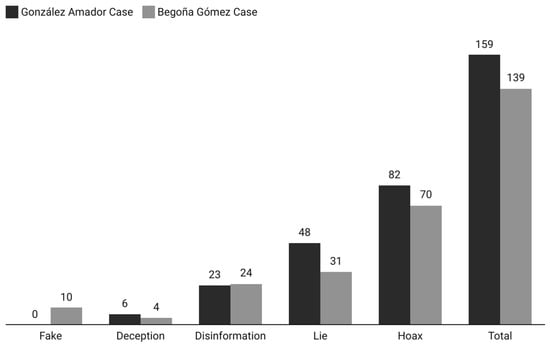
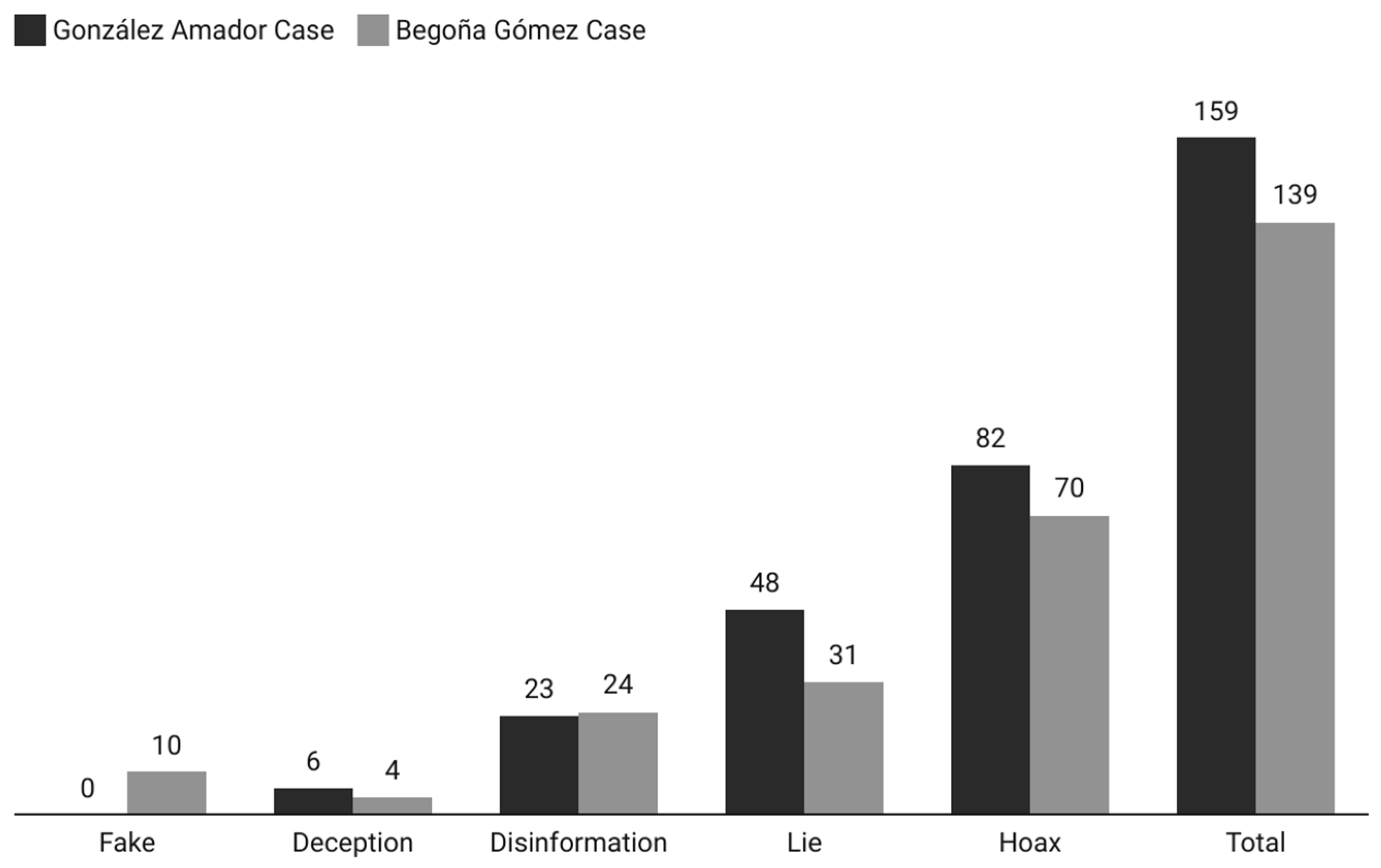
With regard to disinformation terminology, Figure 1 illustrates the intensive use of terms associated with disinformation in both cases, although with significant nuances. Overall, the five terms analysed (‘disinformation’, ‘hoax’, ‘fake’, ‘lie’, and ‘deception’) appear more frequently in the González Amador case than in the Begoña Gómez case, with a total of 159 and 139 mentions, respectively.
Figure 1.
Frequency of disinformation-related terminology in the case studies. Source: Own elaboration. Created with Datawrapper.
The term ‘fake’ stands out as the most recurrent in both cases, with 82 mentions in the González Amador case and 70 in the Begoña Gómez case. Its high frequency suggests a tendency to use Anglicisms, possibly due to their modern connotations, which can serve to give greater impact to the discourse by dissociating it from legal language. It should also be noted that the term ‘fake news’ has been widely used in political contexts to delegitimise the work of critical journalists, particularly during Donald Trump’s presidency, where it was employed as a rhetorical strategy to discredit information and media outlets that questioned his policies (Farkas and Schou 2018).
Secondly, the term ‘hoax’ appears with a balanced presence in both cases (23 mentions for González Amador and 24 for Begoña Gómez). This term, defined by Salaverría et al. (2020) as intentionally false content that appears to be true, has become established in Spanish political and media discourse as a rhetorical device used to delegitimise information without resorting to objective verification.
As for the term ‘deception’, it appears more frequently in the coverage of González Amador (48 mentions compared with 31 in the Gómez case), which could be linked to framing strategies that emphasise the ethical dimension of the behaviour rather than its potential illegality.
The term ‘misinformation’ shows a fairly balanced presence (23 versus 24), indicating that in both cases this category is used in a similar way, perhaps as part of a discursive framework employed to highlight strategies of manipulation or confusion in the political and media sphere.
Finally, it should be noted that there are clear discursive asymmetries in other terms. For example, ‘lie’ appears ten times in the case of Begoña Gómez but does not appear at all in the González Amador case. This absence can be interpreted as an attempt to avoid a direct or explicit accusation in the latter case, instead resorting to euphemisms or a more ambiguous tone.
When analysing disinformation terminology in relation to digital media, it can be observed that La Vanguardia employs such terms most frequently in both cases (26 in the case of Begoña Gómez and 32 in the case of González Amador), followed by El Mundo and Eldiario.es. This high frequency in widely circulated media outlets with a moderate editorial stance may suggest an interest in amplifying or reinforcing certain narratives aimed at delegitimising political opponents through this type of terminology. El País, on the other hand, stands out for its significantly greater use of these terms in the González Amador case (21 mentions compared with only 7 in the Begoña Gómez case), which could be linked to a more critical approach towards political actors from the opposing ideological bloc.
3.4. Analysis of Statements and the Strategic Use of Disinformation Terminology
The analysis of the presence of disinformation terms within statements reveals a consistent pattern across both cases studied. In the case of Begoña Gómez, 26 of the 77 pieces analysed (33.8%) include such terms within statements made by political or social actors. In the González Amador case, this proportion is similar, with 32 out of 101 pieces (31.7%). This indicates that the use of disinformation terminology is often conveyed through the discourse of the protagonists of the political conflict themselves or through sources cited by the media, reinforcing the hypothesis that such terminology is employed strategically.
However, some notable differences emerge between media outlets. El País shows a particularly significant pattern in the González Amador case, where all articles containing disinformation terms (21 out of 21, 100%) feature such expressions within statements. This suggests an editorial practice aimed at delegating the evaluative or controversial weight of the content to external actors. In contrast, outlets such as Eldiario.es and El Mundo present a more balanced distribution between terms included in statements and those present within the narrative produced by the media outlet itself.
In terms of the prominence of statements, the Begoña Gómez case is characterised by greater participation from ‘other political actors’ (12 out of 26 pieces containing statements), followed by the media (7) and the political leaders directly involved (7). In contrast, in the González Amador case, the media assumes a more prominent role as the source of disinformation (32 out of 101), followed by other political actors (20) and the leaders themselves (15). This reveals two discursive trends: in some instances, the media act as neutral reporters, reproducing the discourse of others, while in others they adopt a more active role as transmitters of statements with evaluative or ideological content.
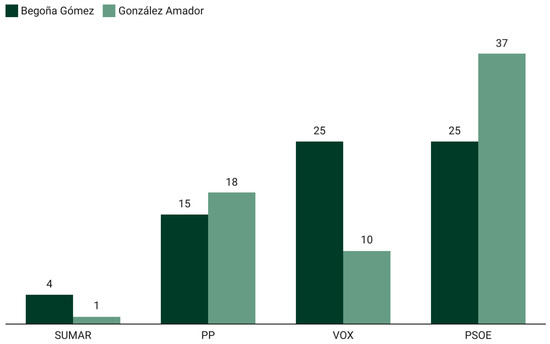
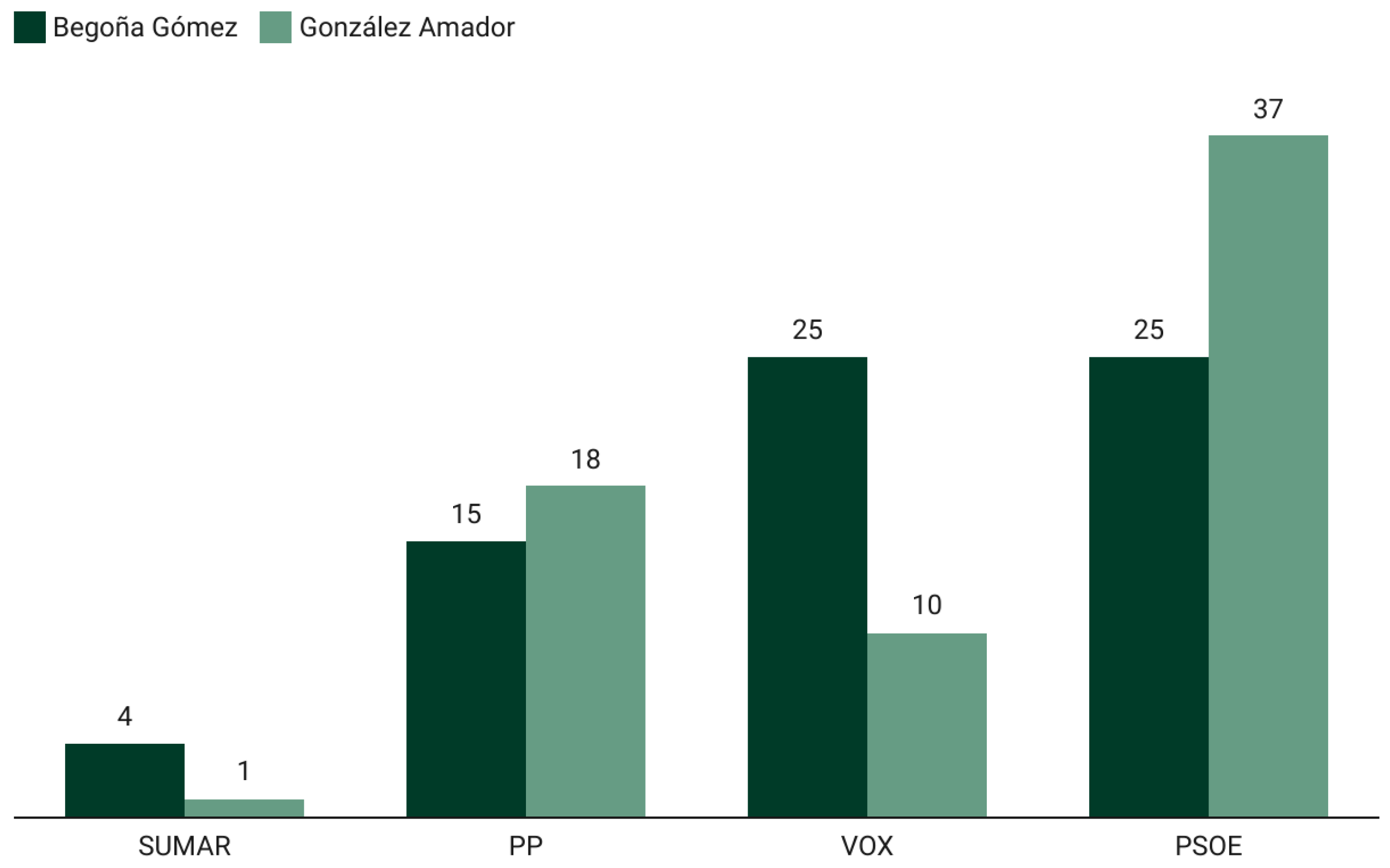
The analysis of the distribution of misinformation statements according to the political party involved reveals clear differences between the two cases studied (Figure 2). In the Begoña Gómez case, the highest frequency is concentrated in VOX and PSOE, with 25 statements each, followed by the Partido Popular (15) and SUMAR (4). This pattern reflects a balanced use of statements containing disinformation from both the opposition and the governing bloc, suggesting a context of direct confrontation between the main parties that combines attack and defence strategies.
Figure 2.
Distribution of misinformation-related statements by political party. Source: Own elaboration. Created with Datawrapper.
In the González Amador case, there is a marked predominance of statements from the PSOE (37), ahead of the Partido Popular (18) and VOX (10), while SUMAR accounts for only one case. This configuration points to a predominantly offensive use of disinformation by the government, with significant participation from the main opposition party and less involvement from the other parties.
It is therefore evident that the use of terms such as ‘fake’, ‘hoax’, ‘lie’, ‘deception’, or ‘misinformation’ is conditioned not only by the editorial stance of the media outlet but also by the identity of the actor issuing the message and the strategic purpose of the discourse. This evidence supports the view that these terms form part of a rhetorical repertoire employed to reinforce ideological positions, construct favourable interpretative frameworks, and contest control over the public narrative.
3.5. Analysis of Statements Containing Misinformation: Context, Purpose, Tone, and Framing
The analysis of the context in which statements containing disinformation are made reveals a clear preference for informal or less institutionalized settings. In both cases analysed, the category ‘Other’—which includes statements made outside parliamentary, institutional, or conventional communication events—accounts for the highest number of occurrences: 26 in the case of Begoña Gómez (33.8%) and 32 in the case of González Amador (31.7%).
This predominance of unregulated communication environments suggests a discursive strategy aimed at facilitating more direct, polarizing, or rhetorical language, far removed from the constraints of institutional discourse. Likewise, the presence of statements on social media is significant, particularly in the González Amador case (six instances), reinforcing the role of digital platforms as privileged channels for the circulation of messages with a strong symbolic or ideological charge.
The communicative purpose of the statements varies depending on the case analysed, reflecting the strategic nature of the use of disinformation terminology. In the Begoña Gómez case, defensive purposes predominate. The most frequent aims are to assert truth or transparency (13 cases), to defend against an accusation (6 cases), and to discredit an adversary or divergent opinion (7 cases).
In contrast, in the González Amador case, there is an increase in the use of these terms for offensive purposes, particularly to polarize or mobilize the audience (20 cases) and to discredit the adversary (19 cases). This pattern suggests that, while in the first case such terms are used to denounce a disinformation campaign, in the second they are employed to reinforce discursive attacks and mobilize political action through emotional framing. This association highlights the emotion–disinformation relationship, in which messages with a high emotional charge enhance the receptivity and dissemination of false or misleading content, thereby facilitating its circulation in polarized environments (Weeks 2023).
The discursive tone associated with the statements also shows significant differences between the two cases. In the Begoña Gómez case, a neutral (31 cases) and defensive (23 cases) tone predominates, reinforcing the interpretation of a discourse focused on legitimising and protecting the reputation of the person affected. The presence of an aggressive tone is limited (6 cases), and the use of a victimizing tone is almost negligible.
In contrast, the González Amador case exhibits a stronger emotional charge, with more frequent use of an aggressive tone (41 cases), accompanied by ironic (12 cases) and defensive (13 cases) tones. This tonal profile suggests that the media discourse surrounding this case is oriented towards confrontation and direct political denunciation.
In relation to news framing, the most frequent type in both cases is the reinforcement of the politician’s narrative (26 cases in Begoña Gómez and 32 in González Amador), indicating that disinformation-related terms function as discursive mechanisms that sustain the narratives constructed by the actors involved.
In addition, the framing category of questioning the politician’s credibility appears prominently in both cases (20 and 17 mentions, respectively), revealing that this terminology is also used as a tool to erode the adversary’s legitimacy. The category conflict as a war of narratives (24 cases in total) further supports this interpretation by showing that discourses on disinformation form part of a symbolic struggle for control over the media–public narrative.
The presence of disinformation terms in statements does not follow an exclusively informative logic but rather constitutes a rhetorical resource of high strategic value. Their use is conditioned by the context of the statement, the political actor issuing it, the communicative purpose, and the narrative framework in which they are embedded. Combined, these variables form a discursive pattern aimed at reinforcing the ideological position of the speaker, discrediting opponents, and contesting the public meaning of events.
This analysis therefore provides empirical evidence to support the hypothesis put forward in this study: terms linked to disinformation are used strategically as part of a political rhetoric aimed at shaping public opinion, legitimising certain positions, and delegitimising others within a highly polarized and antagonistic media ecosystem.
4. Discussion
The results obtained in this study advance our understanding of how Spanish digital media shape disinformation narratives. The interpretation of the findings from the two comparative case studies, in dialogue with the reviewed literature, reveals patterns consistent with previous research, as well as novel contributions that enrich the field of study.
The quantitative differences between the two cases analyzed confirm that media coverage does not respond solely to criteria of journalistic interest but is also conditioned by circumstantial and editorial factors. The predominance of the González Amador case in terms of information volume aligns with the idea that the media agenda can prioritize certain scandals based on their political profitability (Aruguete 2017). Likewise, the asymmetry identified in El País, which offers more extensive coverage of González Amador than of Begoña Gómez, corroborates previous findings on partisan bias in the Spanish press (Palau and Davesa 2024). In contrast, other media outlets such as Eldiario.es, El Mundo, and El Español displayed a more balanced pattern, suggesting that agenda-setting dynamics do not operate uniformly across the media ecosystem. These results reinforce the need to consider the interaction between editorial stance and political context as key determinants in shaping the public agenda.
Regarding the selection of journalistic genres and the way in which the media construct narratives about corruption, the Begoña Gómez case was addressed predominantly through editorials and opinion columns, while the González Amador case was mainly covered in the form of reportage. This difference confirms that journalistic genres function as framing mechanisms, guiding the interpretation of events towards value judgements in one case and narrative contextualization in the other (Shultziner and Stukalin 2021). The statistical evidence supporting these differences underscores that the media not only decide what to cover but also how to cover it, consistent with the notion of framing as a process of selection and emphasis (Entman 1993). These findings complement international studies highlighting the media’s capacity to modulate perceptions of corruption according to the narrative resources they employ (Giacomozzi et al. 2023).
Analysis of the use of terms linked to disinformation in media narratives reveals that such terminology is not employed neutrally but rather as part of a rhetorical repertoire with clear political aims. The high frequency of the term fake, especially in comparison with others such as hoax or deception, confirms a preference for connotative Anglicisms that enhance discursive impact and distance the message from the legal framework. This finding aligns with the literature that conceptualizes disinformation terminology as a discursive resource with ideological connotations beyond its purely descriptive function (Buschman 2024; Rodríguez Andrés 2018).
Likewise, the instrumentalization of the term fake news in international politics—as evidenced during Donald Trump’s first presidency (Farkas and Schou 2018)—finds a parallel in the Spanish context, where it is used to discredit adversaries and shield political positions. The symmetry observed in the use of certain terms, such as disinformation or hoax, also demonstrates that disinformation rhetoric is not the exclusive preserve of any single ideological bloc but rather constitutes a cross-cutting resource in the media struggle.
This observation resonates with the growing concern about the social and democratic impact of discursive manipulation. As Alonso-González and Sánchez González (2024) warn, identifying falsehoods in the verification of political discourse is a priority to maintain the integrity of public debate and preserve trust in democratic institutions.
About the analysis of political actors, emotions, and the war of narratives, the examination of statements confirms that disinformation terminology is mainly articulated through the voices of political actors, reinforcing the idea that the media delegates the evaluative weight of the discourse to these sources. However, significant differences emerge between the cases: in the Begoña Gómez case, the defensive use of disinformation terminology was shared by actors from both the government and the opposition, suggesting a balanced dynamic of confrontation. In contrast, in the González Amador case, offensive use by PSOE spokespersons predominated, pointing to a strategy aimed at eroding the legitimacy of the opposition. This evidence is consistent with studies that highlight the strategic dimension of framing as a resource for either shielding or attacking (Swire-Thompson et al. 2020).
In this vein, Fernández-Torres and Cea-Esteruelas (2025) emphasize that the use of disinformation in political communication to harm opponents is a growing problem for democratic societies, with implications that transcend the political sphere. Furthermore, the authors note that most hoaxes were designed as arguments to discredit opponents, revealing the propagandistic drift of much contemporary media and political discourse.
Likewise, tone analysis reveals a clear difference in the emotional charge of the two cases. While coverage of Begoña Gómez was characterized by defensive and neutral tones, coverage of González Amador was dominated by aggressive and ironic tones, consistent with the literature that links disinformation and emotions as catalysts for polarization (Weeks 2023; Vosoughi et al. 2018). The finding that many of these statements occur in informal contexts or on social media further reinforces the notion that the war of narratives is waged in non-institutionalized communication settings, where discursive constraints are fewer, and the potential for virality is significantly greater (Koijam 2025; Bradshaw et al. 2024). The findings of this research highlight the need to strengthen verification protocols and contextualization criteria that prevent the uncritical reproduction of misinformation terminology, especially in interpretative genres where the risk of amplification is greater. For public policy makers, the patterns detected highlight the advisability of promoting regulatory frameworks and training programmes that encourage editorial transparency and the responsible use of narratives in highly polarized contexts. These measures can help to reduce the strategic circulation of disinformation terms and strengthen the quality of public debate.
5. Conclusions
The results of this study confirm that misinformation is employed as a strategic resource in media coverage of cases of alleged political corruption in Spain. A comparison between articles published about the wife of the Spanish Prime Minister, Begoña Gómez, and the partner of the current President of the Community of Madrid, Alberto González Amador, reveals differences in volume, genre, use of terminology, tone of statements, and dominant framing. All of this demonstrates that the media do not act as mere neutral transmitters but rather as discursive actors.
About journalistic genres (OE2), a clear asymmetry can be observed: opinion genres (editorials and columns) predominate in the case of Begoña Gómez, reinforcing the interpretative weight of media discourse, whereas the prevalence of reporting in the case of González Amador suggests a greater emphasis on contextualization—albeit not without narrative bias. This difference is statistically significant, underlining that genre is employed as a framing tool.
With regard to disinformation terminology (OE3), the use of the term fake stands out as a linguistic resource with immediate rhetorical connotations and impact. As Farkas and Schou (2018) point out, the term fake news functions as a “floating signifier”, appropriated by different political actors to reinforce their positions—particularly as a strategy to delegitimize their adversaries—rather than as a descriptor of false content in the strict sense. The term hoax appears in a more balanced manner, while the term lie is linked exclusively to the Begoña Gómez case, suggesting a more direct discursive strategy. These linguistic differences highlight the strategic intent of both the media and political actors in their selection of disinformation vocabulary.
The greater media attention received by the González Amador case is reflected not only in the volume of articles published but also in the nature of the statements reported. While coverage of the Begoña Gómez case was more limited and characterized by predominantly neutral or defensive tones, the González Amador case was accompanied by a larger number of statements made in informal contexts, often with offensive purposes and more aggressive or ironic tones. This suggests that the increased media emphasis on the case involving Isabel Díaz Ayuso’s partner was associated with more confrontational and emotionally charged coverage, which in turn facilitated the circulation of polarizing frames.
In contrast, in the case of the Spanish Prime Minister’s wife, the lower level of coverage and the predominance of defensive tones point to a narrative aimed at legitimization and reputational protection. Overall, the difference between the two cases confirms that the volume of coverage is not an isolated factor but is closely linked to the way in which the media frame statements and the type of discourse they prioritize, reinforcing the role of emotions as catalysts for disinformation.
Analysis of the statements (OE4) shows that disinformation terminology is frequently conveyed through political actors. Some media outlets opt to delegate the evaluative weight of the message to external sources, thereby avoiding assuming it directly—a strategy designed to maintain an appearance of objectivity.
In terms of tone and purpose (OE5), the data reveal that the González Amador case is characterized by a more aggressive, ironic, and confrontational discourse, in contrast to the Begoña Gómez case, where a defensive or neutral tone predominates. This difference is consistent with the literature suggesting a link between intense emotions and the greater virality and influence of political discourse.
About framing (OE6), the results show that media discourse tends to reinforce narratives favourable to the protagonist, question the credibility of the adversary, and frame the conflict as a symbolic war. These patterns suggest that media coverage not only informs but also actively contributes to the construction of political meanings and ideologies.
Finally, the comparison between the two cases (OE1 and OE7) confirms the existence of substantial editorial bias: beyond the number of articles published, differences in genre, tone, terminology, and framing indicate that each case is treated not only based on its content but also in terms of what it represents politically and medially.
In a communication ecosystem increasingly mediated by artificial intelligence, the automation of information processes and algorithmic segmentation can amplify the circulation of disinformation and the visibility of emotional frames such as those observed in this study. These findings invite reflection on the need to integrate AI-based verification tools to strengthen information transparency and prevent the automated amplification of polarizing narratives.
Authors such as Pennycook and Rand add a complementary dimension to this analysis by highlighting the secondary role of cognitive bias, which may lead to the validation or discrediting of content depending on its source or ideological orientation. According to these authors, deficiencies in critical analysis exert a more substantial influence. Media literacy therefore emerges as one of the most effective strategies for reducing societal vulnerability to disinformation, underscoring the need to foster reflection, reasoned scepticism, and verification practices among citizens. From the perspective of political communication, this framework is particularly salient. If disinformation spreads less through ideological conviction than through cognitive inattention, political actors have a clear incentive to incorporate misleading or overtly false content into their rhetoric. They do not require citizens to uncritically accept every claim; rather, they rely on such information circulating, being shared, and generating sufficient noise to erode and obscure public debate. This dynamic helps to explain why certain political narratives become established as truthful, even when they are readily refutable.
Disinformation not only shapes how the media cover political cases but also has a direct impact on democratic quality. The repetition of falsehoods can normalise their acceptance and erode the credibility of institutional systems, thereby weakening public trust in the media, political institutions, and public debate itself. This process of trivialising deception poses a structural risk to the democratic sphere, as it transforms political communication into a space of emotional confrontation and symbolic manipulation rather than rational deliberation.
Disinformation reveals itself as a language of power: a rhetorical, emotional, and—increasingly—algorithmic device through which the media and political actors contest control of the public narrative. Recognising its harmful effects and combating such practices—including from within academia—is essential to strengthening democratic quality and restoring public trust in political institutions.
Author Contributions
Conceptualization, M.J.F.T., N.C. and F.M.M.-M.; methodology, M.J.F.T., N.C. and F.M.M.-M.; validation, M.J.F.T. and N.C.; formal analysis, M.J.F.T. and F.M.M.-M.; investigation, M.J.F.T., N.C. and F.M.M.-M.; resources, N.C.; data curation, N.C.; writing—original draft preparation, M.J.F.T.; writing—review and editing, M.J.F.T. and F.M.M.-M.; visualization, F.M.M.-M.; supervision, M.J.F.T., N.C. and F.M.M.-M. All authors have read and agreed to the published version of the manuscript.
Funding
PID2023-147486OB-I00. Journalistic Applications of AI to Mitigate Disinformation: Trends, Uses, and Perceptions of Professionals and Audiences (DESINFOPERIA).
Institutional Review Board Statement
This study did not require ethical review or approval, as it did not involve human participants or animals. The research was based exclusively on the content analysis of publicly available news articles published in digital media outlets. Consequently, no personal data were collected, and no interventions were carried out that could affect individual privacy or wellbeing.
Informed Consent Statement
Not applicable, as the study did not involve human participants.
Data Availability Statement
The raw data supporting the conclusions of this article will be made available by the authors upon request.
Acknowledgments
During the preparation of this manuscript, the authors used DataWrapper for the preparation of the graphs and the professional version of DeepL for an initial translation of the text into English. The authors have thoroughly reviewed, validated, and edited all content and take full responsibility for the final version of the manuscript.
Conflicts of Interest
The authors declare no conflicts of interest. The funders had no role in the design of the study; in the collection, analysis, or interpretation of data; in the writing of the manuscript; or in the decision to publish the results.
References
- Alonso-González, María, and Hada Sánchez González. 2024. Inteligencia artificial en la verificación de la información política. Herramientas y tipología. Más Poder Local 56: 27–45. [Google Scholar] [CrossRef] [Scilit]
- Aruguete, Natalia. 2017. Agenda Setting y Framing. Más Poder Local 30: 36–42. [Google Scholar]
- Blassnig, Sina. 2023. Content analysis in the research field of political communication: The self-presentation of political actors. In Standardized Content Analysis in Communication Research. Edited by Franziska Oehmer-Pedrazzi, Sabrina H. Kessler, Edda Humprecht, Katharina Sommer and Laia Castro. Wiesbaden: Springer VS, pp. 301–12. [Google Scholar] [CrossRef] [Scilit]
- Blassnig, Sina, Florin Büchel, Nicole Ernst, and Sven Engesser. 2019. Populism and informal fallacies: An analysis of right-wing populist rhetoric in election campaigns. Argumentation 33: 107–36. [Google Scholar] [CrossRef] [Scilit]
- Bradshaw, Samantha, Mona Elswah, Haque Monzima, and Dorian Quelle. 2024. Strategic storytelling: Russian state-backed media coverage of the Ukraine War. International Journal of Public Opinion Research 36: edae028. [Google Scholar] [CrossRef] [Scilit]
- Buschman, John. 2024. Fake news as systematically distorted communication: An LIS intervention. Journal of Documentation 80: 203–17. [Google Scholar] [CrossRef] [Scilit]
- Cools, Hannes, and Nicholas Diakopoulos. 2024. Uses of Generative AI in the Newsroom: Mapping Journalists’ Perceptions of Perils and Possibilities. Journalism Practice, 1–19. [Google Scholar] [CrossRef] [Scilit]
- Crespo, Miguel, Miguel Paisana, Paulo Couraceiro, Aldina Margato, António Vasconcelos, Caterina Foa, Gustavo Cardoso, and Vania Baldi. 2022. The Impact of Disinformation on the Media Industry in Spain and Portugal. Pamplona: IBERIFIER. [Google Scholar] [CrossRef] [Scilit]
- Depetris, Cielito, and María E. García. 2013. La comunicación política y el discurso polémico como tono de época en la radio y la televisión. Oficios Terrestres 1: 8. Available online: http://sedici.unlp.edu.ar/bitstream/handle/10915/33605/Documento_completo.pdf?sequence=1 (accessed on 12 July 2025).
- Edelman Trust Institute. 2025. 2025 Edelman Trust Barometer: Global Report. Edelman. Available online: https://www.edelman.com/sites/g/files/aatuss191/files/2025-01/2025%20Edelman%20Trust%20Barometer_Final.pdf (accessed on 12 July 2025).
- Entman, Robert M. 1993. Framing: Toward clarification of a fractured paradigm. Journal of Communication 43: 51–58. [Google Scholar] [CrossRef] [Scilit]
- Farkas, Johan, and Jannick Schou. 2018. Fake news as a floating signifier: Hegemony, antagonism and the politics of falsehood. Javnost—The Public: Journal of the European Institute for Communication and Culture 25: 298–314. [Google Scholar] [CrossRef] [Scilit]
- Fernández Smith, Gerard. 2018. Instrumentos lingüísticos de los discursos de odio en la prensa digital. Fragmentum 50: 99–122. [Google Scholar] [CrossRef] [Scilit]
- Fernández-Torres, María Jesús, and María Nereida Cea-Esteruelas. 2025. Estrategias de relaciones públicas frente a la desinformación en el debate político: Análisis de los desórdenes informativos en España. Revista Mediterránea de Comunicación 16: e28466. [Google Scholar] [CrossRef] [Scilit]
- Giacomozzi, Andréia, Juliana Gomes Fiorott, Raquel Bertoldo, and Alberta Contarello. 2023. Social Representations of Political Polarization through Traditional Media: A Study of the Brazilian Case between 2015 and 2019. Human Affairs 33: 67–81. [Google Scholar] [CrossRef] [Scilit]
- González Reyna, Susana. 2011. Reflexiones teórico-metodológicas para caracterizar al discurso de la prensa escrita como un discurso político. Revista Mexicana de Ciencias Políticas y Sociales 52: 97–112. [Google Scholar] [CrossRef] [Scilit]
- Hellman, María. 2024. Narrative Analysis and Framing Analysis of Disinformation. In Security, Disinformation and Harmful Narratives: RT and Sputnik News Coverage about Sweden. The Palgrave Macmillan Series in International Political Communication. Cham: Palgrave Macmillan. [Google Scholar] [CrossRef] [Scilit]
- Hernández Sampieri, Roberto, Carlos Fernández Collado, and Pilar Baptista Lucio. 2014. Metodología de Investigación. Columbus: McGraw Hill. [Google Scholar]
- Herrero-Jiménez, Beatriz, Rosa Berganza, and Alberto Ortiz-González. 2024. Journalists’ Perception of the Threats and Risks of Corruption in Institutions and the Media. Profesional de la Información 33: e330002. [Google Scholar] [CrossRef] [Scilit]
- Khan, Ali, and Aziz Ur Rahman. 2023. Role of Politicians in Creating Political Polarization through Media. Global Strategic & Security Studies Review VIII: 71–79. [Google Scholar] [CrossRef] [Scilit]
- Koijam, Surjakanta. 2025. The Battle of Narratives: The Role of Media in Shaping Manipur’s Conflict. International Journal for Multidisciplinary Research 7: 1–11. [Google Scholar] [CrossRef]
- Krippendorff, Klaus. 2012. Content Analysis: An Introduction to Its Methodology. Thousand Oaks: Sage Publications. [Google Scholar]
- Krippendorff, Klaus, and Thomas Carney. 1974. Content Analysis: A Technique for Systematic Inference from Communications. Public Opinion Quarterly 38: 155–57. [Google Scholar] [CrossRef]
- Krotoszynski, Ronald J. 2025. Disinformation, Misinformation, and Democracy: Defining the Problem, Identifying Potentially Effective Solutions, and the Merits of Using a Comparative Legal Approach. In Disinformation, Misinformation, and Democracy: Legal Approaches in Comparative Context. Edited by Ronald J. Krotoszynski, Jr., Koltay Andras and Charlotte Garden. Cambridge: Cambridge University Press, pp. 1–34. [Google Scholar]
- Lozano-Ascencio, Carlos, Juan Antonio Gaitán-Moya, Carmen Caffarel-Serra, and José Luis Piñuel-Raigada. 2020. Una década de investigación universitaria sobre Comunicación en España, 2007–2018. Profesional de la Información 29: e290412. [Google Scholar] [CrossRef] [Scilit]
- Magdy Abo Al Saoud, Monda. 2020. Political Contagion and Electoral Populism: Content Analysis of Campaign speeches in United Kingdom and United States. The Arab Journal of Media and Communication Research 2020: 188–213. [Google Scholar] [CrossRef] [Scilit]
- Moreno-Gil, Victoria, María Á. Chaparro-Domínguez, and Marta Pérez-Pereiro. 2023. Future journalists’ fight against disinformation: Analysis of university training offers and challenges in the Spanish context. Communication & Society 36: 171–85. [Google Scholar] [CrossRef] [Scilit]
- Munoriyarwa, Allen, and Mathias-Felipe de-Lima-Santos. 2025. Generative AI and the Future of News: Examining AI’s Agency, Power, and Authority. Journalism Practice 19: 2177–88. [Google Scholar] [CrossRef] [Scilit]
- Neuendorf, Kimberly. A. 2017. The Content Analysis Guidebook, 2nd ed. Thousand Oaks: Sage. [Google Scholar]
- Palau, Anna M., and Ferran Davesa. 2024. El impacto de la cobertura mediática de la corrupción en la opinión pública española. Revista Española de Investigaciones Sociológicas 144: 97–126. [Google Scholar] [CrossRef] [Scilit]
- Palau-Sampio, Dolors, Adolfo Carratalá, Raquel Tarullo, and Paz Crisóstomo. 2022. Quality recognition as a prescriber against disinformation [Reconocimiento de la calidad como prescriptor contra la desinformación]. Comunicar 72: 59–70. [Google Scholar] [CrossRef] [Scilit]
- Palomo, Bella, Edson C. Tandoc, and Rodrigo Cunha. 2023. El impacto de la desinformación en las rutinas profesionales y soluciones basadas en la inteligencia artificial. Estudios sobre el Mensaje Periodístico 29: 757–59. [Google Scholar] [CrossRef] [Scilit]
- Pieniążek-Niemczuk, Elżbieta. 2024. Application of Content Analysis in Research of Political Discourse. Language, Culture, Politics. International Journal 1: 67–77. [Google Scholar] [CrossRef] [Scilit]
- Reguero-Sanz, Itziar, Pablo Berdón-Prieto, and Jacobo Herrero-Izquierdo. 2023. Journalism in Democracy: A Discourse Analysis of Twitter Posts on the Ferrerasgate Scandal. Media and Communication 11: 176–87. [Google Scholar] [CrossRef] [Scilit]
- Reuters Institute for the Study of Journalism. 2025. Digital News Report 2025: Resumen Ejecutivo. Reuters Institute for the Study of Journalism. Available online: https://reutersinstitute.politics.ox.ac.uk/es/digital-news-report/2025/dnr-resumen-ejecutivo (accessed on 15 July 2025).
- Rodríguez Andrés, Roberto. 2018. Fundamentos del concepto de desinformación como práctica manipuladora en comunicación política y las relaciones internacionales. Historia y comunicación Social 23: 231–44. [Google Scholar] [CrossRef] [Scilit]
- Sajad, Mir Basit. 2023. Political Communications and Disinformation: The Flow of Unchecked Information and Internet Governance in the 21st Century. Rochester: Social Science Research Network. [Google Scholar] [CrossRef] [Scilit]
- Salaverría, Ramón, Nataly Buslón, Fernando López-Pan, Bienvenido León, Ignacio López-Goñi, and María-Carmen Erviti. 2020. Desinformación en tiempos de pandemia: Tipología de los bulos sobre la COVID-19. El profesional de la información 29: e290315. [Google Scholar] [CrossRef] [Scilit]
- Salih, Muhammad Huzaifa Bin, Rehman Uddin, Sana Gul, Muhammad Huzaifa Bin Salih, and Noor ul Huda. 2025. Artificial Intelligence and the Fight Against Misinformation: Analyzing the Role of Digital Media in Shaping Public Perceptions in Pakistan. Rochester: Social Science Research Network. [Google Scholar] [CrossRef] [Scilit]
- Shultziner, Doron, and Yelena Stukalin. 2021. Distorting the News? The Mechanisms of Partisan Media Bias and Its Effects on News Production. Political Behavior 43: 201–22. [Google Scholar] [CrossRef] [Scilit]
- Soontjens, Karolin, Kathleen Beckers, Stephaan Walgrave, Emma van der Goot, and Toni G. L. A. van der Meer. 2023. Not All Parties Are Treated Equally: Journalist Perceptions of Partisan News Bias. Journalism Studies 24: 1194–213. [Google Scholar] [CrossRef] [Scilit]
- Steppat, Desiree, and Laia Castro. 2023. Content Analysis in the Research Field of Election Campaign Communication. In Standardized Content Analysis in Communication Research. Edited by Franziska Oehmer-Pedrazzi, Sabrina Heike Kessler, Edda Humprecht, Sommer Katharina and Laia Castro. Wiesbaden: Springer VS, pp. 313–27. [Google Scholar] [CrossRef] [Scilit]
- Swire-Thompson, Briony, Stephan Lewandowsky, Ullrich K. H. Ecker, and Adam. J. Berinsky. 2020. They Might Be a Liar But They’re My Liar: Source Evaluation and the Prevalence of Misinformation. Political Psychology 41: 21–34. [Google Scholar] [CrossRef] [Scilit]
- Tunç, Ferit. 2022. Analysis of discourses of political actors in Turkey regarding Syrian refugees in the national press. Social Science Development Journal 7: 184–98. [Google Scholar] [CrossRef] [Scilit]
- Vaccari, Cristian, and Andrew Chadwick. 2020. Deepfakes and disinformation: Exploring the impact of synthetic political video on deception, uncertainty, and trust in news. Social Media + Society 6: 2056305120903408. [Google Scholar] [CrossRef] [Scilit]
- Valera-Ordaz, Lidia, Marina Requena-i-Mora, Dafne Calvo, and Guillermo López-García. 2022. Unraveling disinformation: Notions and discourses from the Spanish population [Desenredando la desinformación: Nociones y discursos de la población española]. Comunicar 72: 21–32. [Google Scholar] [CrossRef] [Scilit]
- Vosoughi, Soroush, Deb Roy, and Sinan Aral. 2018. The spread of true and false news online. Science 359: 1146–51. [Google Scholar] [CrossRef] [Scilit]
- Wardle, Claire, and Hossein Derakhshan. 2017. Information Disorder: Toward an Interdisciplinary Framework for Research and Policymaking. Council of Europe. Available online: https://rm.coe.int/information-disorder-report-november-2017/1680764666 (accessed on 14 July 2025).
- Weeks, Brian E. 2023. Emotion, digital media, and misinformation. In Emotions in the Digital World: Exploring Affective Experience and Expression in Online Interactions. Edited by Robin L. Nabi and Jessica Gall Myrick. Oxford: Oxford University Press, chap. 22. [Google Scholar] [CrossRef] [Scilit]
- Wilson, Anne E., Victoria A. Parker, and Matthew Feinberg. 2020. Polarization in the Contemporary Political and Media Landscape. Current Opinion in Behavioral Sciences 34: 223–28. [Google Scholar] [CrossRef] [Scilit]
- World Economic Forum. 2024. Available online: https://www.weforum.org/meetings/world-economic-forum-annual-meeting-2024/ (accessed on 30 October 2025).

Disclaimer/Publisher’s Note: The statements, opinions and data contained in all publications are solely those of the individual author(s) and contributor(s) and not of MDPI and/or the editor(s). MDPI and/or the editor(s) disclaim responsibility for any injury to people or property resulting from any ideas, methods, instructions or products referred to in the content. |
© 2026 by the authors. Licensee MDPI, Basel, Switzerland. This article is an open access article distributed under the terms and conditions of the Creative Commons Attribution (CC BY) license.