


Abstract
This study investigates research engagement among teachers specializing in language education for people with refugee and migrant backgrounds in Greece. Given the non-standardized and relatively unstructured nature of language education in such settings, it is expected that reading academic and professional publications (engagement with research) and conducting classroom-based inquiries (engagement in research) can provide structure and guidance to teaching practice. A questionnaire-based survey was conducted to document the teachers’ (N = 48) workplace conditions, personal factors, beliefs about research, as well as the features of research that they deem desirable and their actual research engagement practices. Although the data are inconclusive regarding the relative effects of each variable, they do suggest that teachers can be grouped into three profiles based on their perceived workplace conditions. Implications of this finding for providing targeted instruction are discussed.
1. Introduction
The relationship between research and teaching, and the potential of the former to inform the latter, is a topic that has fueled considerable controversy (Xerri and Pioquinto 2018). One way in which this controversy is manifested is by challenging the degree to which teachers can benefit from scholarship about education. For instance, the claim has been put forward, explicitly, that research is parasitic to education and of limited value to it (Medgyes 2017). This claim echoes older research that teachers may question the value of published scholarship if they cannot apply its findings to their everyday work (Shkedi 1998). It has also been suggested that teachers do not generally articulate the theoretical basis on which their teaching process is based, because it is deemed unnecessary (Hancock 1997).
The cumulative effect of such discourses is the generation of a research-practice ‘gap’ (Sato and Loewen 2022). In this way, teaching is reduced from an intellectual activity to a technical profession (Giroux 1988), tasked with the efficient mediation of content that is provided to teachers, top-down, by authority figures. Similarly, attempts to study and critically interrogate aspects of language education are viewed through an anti-intellectual lens, which leads to professional stagnation (Kostoulas 2018).
The perspective taken in this study aims to challenge unhelpfully polarized views such as the above, by investigating the concept of research engagement for language teachers. In this perspective, an inquisitive attitude towards professional activity and an empirically informed way of teaching are viewed as two sides of the same phenomenon, praxis. Specifically, this paper will report on an empirical study which investigated the beliefs and practices of language teachers towards research engagement. The emphasis of the paper will be on the language education of vulnerable populations, such as refugees and migrants. As will be argued in more detail later, a particular challenge in this domain of education lies in the fact that refugee and migrant education is often implemented on the ‘sidelines’ of mainstream education, where normative guidelines have not been well established, leaving teachers with a greater need to develop their own practices. By doing so, the study endeavours to produce a systematic account of research engagement in a professional space that has received limited empirical attention, and where such research engagement is, arguably, a pedagogical priority. The contribution that the study makes lies in documenting beliefs and practices in this space with clarity, and identifying patterns which will enable more precise theoretical, empirical, and comparative work in the field.
The paper itself begins with some theoretical remarks about research engagement (Section 1.1) and about the setting of the study (Section 1.2). This theoretical overview is followed by a presentation of the methodological aspects of the study (Section 2), the empirical findings (Section 3) and a discussion about how these findings can inform language teaching and language teacher education (Section 4).
1.1. Research Engagement for Language Teachers
When thinking about language education, research engagement is defined as the familiarization of teachers with published scholarship and empirical processes (Borg 2010). It is, in this sense, the enactment of research literacy, which is “the ability to locate, understand, discuss, and evaluate different types of research; to communicate accurately about them; and to use findings for academic and professional purposes” (Beaudry and Miller 2016, p. 4). Borg (2010) notes that research engagement may take two forms: (a) reading research and (b) conducting research, which can be described as ‘engaging with research’ and ‘engaging in research’.
There are multiple benefits described in the literature, which are associated with the research engagement of teachers. For instance, Sato and Loewen (2022) state that the role of research is to help teachers enhance their practice, ultimately enabling more effective learning. Furthermore, cooperation between the people who enact language teaching and those who study it appears to be associated with increased motivation among language students and teacher development (Banegas 2019; Cordingley 2015). Davari Torshizi (2018) also notes that enhanced communication among teachers and researchers, akin to what is described here, may lead to an enhanced understanding of classroom realities, enabling the meaningful transfer of findings and their application to actual classrooms. Also, and importantly, research engagement is claimed to enable teachers to assume ownership of the process through which answers to their professional questions are generated (Mercer and Xerri 2018).
As noted above, however, such research engagement is rare for a variety of reasons. Hancock (1997) notes that research engagement is a time-intensive process, which places unsustainable demands on overworked teachers. Added to this, articles are typically inaccessible to non-researchers, due to being placed behind paywalls (Rose 2019) or being written in inaccessible language (Marsden and Kasprowicz 2017). Regarding engagement in research, the prevalence of unhelpful attitudes has been noted including distrust in the teachers’ ability to usefully contribute to academic discourses about their profession (Sato and Loewen 2022) and the belief—among some teachers at least—that empirically informed development is not an important priority (Hancock 1997).
1.2. The Research Setting
The educational response to the demographic and social challenges posed by the influx of refugees in Greece has been somewhat fragmented and lacking in cohesion (Motsiou and Kostoulas 2025). As far as preschool children are concerned, the initiatives are mainly taken by NGOs within the accommodation structures. For older children, Reception Classes operate in some schools, where students with minimal or no knowledge of Greek are segregated and receive intensive instruction in Modern Greek and other subjects (Institute of Education Policy 2016). Often, these courses focus on aspects of school socialization and early literacy, as decided by the teachers (Hellenic Republic Ministry of Education, Religious Affairs and Sports n.d.). Additionally, children aged 6–15 may attend afternoon classes at the premises of schools and refugee accommodation centres (Asylum Information Database 2022). The ‘Refugee Education and Reception Facilities’, which provide these courses usually employ contingent teaching staff and operate outside the mainstream education system. Adult education is based on the initiatives of the local community and NGOs (Kyrligkitsi and Mouti 2023). Overall, the ad hoc nature of the educational provision has meant that normative traditions (Stelma and Kostoulas 2021) in curriculum design and teaching practices have been slow to develop and that teachers enjoy a lot of autonomy in designing and implementing courses (Mogli 2023)—but, equally, the lack of structure places a burden on teachers to locate resources and engage with the literature in order to develop locally appropriate practices.
Despite such a lack of constraints, it appears that teaching practices in refugee education tend to be conservative and continue to resist innovation, as is indeed the case in much of language education in Greece (Kostoulas 2014; Kostoulas and Stelma 2017). Although positive attitudes are reported towards the use of different languages, translanguaging and communicative language teaching, lessons are often based on the monolingual presentation of morphology and syntax (Mouti et al. 2021), traditional teaching practices continue to prevail (Karavas et al. 2021) and the development of intercultural communication skills is reportedly challenging (Mogli and Magos 2023). In terms of teaching methodology, methods and techniques such as Presentation-Practice-Production, the grammar-translation approach, and focus-on-form predominate, with only token use of group work and controlled role-playing activities (Fotiadou et al. 2022) and experiential and multimodal approaches (Kostoulas 2024). It should be noted that, at least on some occasions, the superficial use of methods and approaches which are recommended in the literature has a performative character (Papapostolou et al. 2020) and these activities may be re-cast to serve transmissive teaching purposes (Kostoulas 2018). Quite often, the use of languages other than Modern Greek and English as a lingua franca is discouraged (Kyrligkitsi and Mouti 2023), while traditional teaching strategies, unfamiliar to the culture of many students, such as using the board to copy Greek words, continue to be applied. Overall, educational practices appear to be constrained in a dated and pedagogically questionable teaching paradigm that focuses on transmitting formal language features (Stelma and Kostoulas 2021).
One reason for this unsatisfactory state of affairs may relate to a mismatch between the teachers’ knowledge and skills and the challenges that they have to face. A range of these challenges, as reported by Papapostolou et al. (2020), includes insufficient training and support from the school authorities, lack of suitable learning resources, heterogeneous student populations, and more. Similar difficulties are also observed in non-formal education: teachers complain about problematic communication with supervisory entities (Stamatiou 2018) and fragmented teaching materials (Mouti et al. 2021), as well as challenges associated with gender and cultural differences among students (Palaiologou et al. 2019).
While many problems, such as political hostility and prejudicial attitudes among teaching staff (Papapostolou et al. 2020), defy facile solutions, a case could be made for developing the research literacy and engagement of teachers as a means of overcoming some challenges. For example, increased familiarity with the state of the art in language teaching theory could help to highlight the limitations of the traditional, transmissive practices that are observed. University-based professional development can challenge such dated practices, and does so to a limited extent (Kostoulas 2024), but sustained engagement with the literature seems necessary to achieve lasting change. Furthermore, an inquisitive attitude and the appropriate application of empirical methods can help teachers learn about the particularities of their dynamically changing classes, thus supplementing the unavoidable limitations of teacher preparation that take place outside schools.
2. Materials and Methods
Based on the above, an opportunity emerges to better understand if and how teachers (defined inclusively to encompass pre-service teachers and people in teaching posts in non-formal education) in this setting engage with research. This opportunity has been operationalised in the following question:
“In what ways do language teachers of refugees and migrants in Greece engage with and in research?”
To add granularity to this question, the following sub-questions were formulated:
- What workplace conditions shape research engagement?
- What personal qualities shape research engagement?
- What beliefs shape research engagement?
- What qualities does research need to foster research engagement?
- What are research practices in which teachers engage?
- What other factors influence research engagement?
2.1. The Questionnaire
To answer the research questions, a questionnaire was constructed drawing on content from Borg (2010). In addition to consent and demographic questions, the questionnaire consisted of five sections, which elicited information on (a) workplace conditions, (b) personal factors, (c) beliefs about research, (d) qualities that are considered desirable for a research project, and (e) research-related practices. Table 1 summarizes this information and additional detail about the scales is presented in more detail below.
Table 1.
Overview of the questionnaire.
The first section, which focused on workplace conditions, consisted of 13 Likert-type items, where participants were invited to select one of four options ranging from “This is very true for my workplace” (1) to “This is not at all true for my workplace” (4).
The second section focused on personal factors that might impact readiness and willingness to engage in and with research. The section comprised nine Likert-type items, with four possible responses ranging from “This is very true for me” (1) to “This is not true for me at all” (4).
Similarly, in the third section (beliefs about research engagement), participants were invited to state their (dis)agreement with nine items. Again, a range of four Likert-type responses were available from “I strongly agree” (1) to “I strongly disagree” (4).
The ten items that made up the fourth section focused on qualities that would be considered desirable for a research project or qualities that might influence a person’s decision to participate in research. Possible responses to the ten items that made up this section were presented in the form of a four-option scale, ranging from “This would be very important for me” (1) to “This would not be important at all for me” (4). Additionally, an open-ended item was provided for participants to add other qualities which were not foreseen by the research team.
The final section elicited views on research-related practices, such as engaging with published works or conducting small-scale classroom inquiries. This section comprised seven items, with four possible responses from “This applies very well to me” (1) to “this does not apply to me at all” (4).
2.2. The Sample
The questionnaire was administered online to a convenience sample of teachers who were attending or had recently attended an MA programme on language education for people with a refugee or migrant background. In all, 48 teachers responded to the questionnaire, and their demographic data are presented in Table 2. By focusing on a clearly defined group within a specific national and institutional setting, the study provides a level of analytic resolution that would be difficult to achieve in broader comparative designs. Its contribution lies in supporting theoretically informed, cross-contextual dialogue, rather than in producing directly generalizable claims.
Table 2.
Participants’ demographic information.
2.3. Questionnaire Administration
Particular care was taken to ensure ethical administration of the questionnaire. The first author, who taught at the programme, facilitated access to participants, but was not directly involved in contacting them and had no access to the data. The second author, who was responsible for data generation, was not affiliated with the programme, and the third author (a graduate of the programme) was not involved in data generation.
This division of labour ensured that there was no real or perceived pressure among those participants who were still studying in the programme. It also reduced the risk of compliance driven by institutional authority, assessment relationships, or interpersonal familiarity (Miller and Boulton 2007). Participation was voluntary, informed, and non-remunerated, and participants were explicitly assured that non-participation would have no academic or professional consequences. Anonymity was built into the research design through the use of an anonymous questionnaire (Dewaele 2018). These procedural safeguards collectively supported the ethical principles of informed consent, confidentiality, and respect for participants’ agency.
2.4. Data Analysis Procedures
As a preparatory step for analysis, initial screening of the dataset took place, to identify missing data and other irregularities. Two instances of missing data in the substantive sections of the questionnaire (Sections 1–5) were resolved using imputation. Missing data in the demographic section were coded as ‘prefer not to disclose’. Items that were negatively worded were reverse-coded. The participants’ age range, which had been recorded with reference to year of birth, were recoded into four broad categories, which roughly corresponded to quartiles.
Descriptive statistics procedures took place to estimate the median and InterQuartile Range [IQR] for each item in Sections 1–5. After removing the items that had low IQR (i.e., equal to or lower than 1), a K-means cluster test was conducted to identify teachers with similar profiles. These profiles were then cross-tabulated and χ2 tests were run against individual items to better understand the characteristics of these profiles.
Following that, cross-tabulations and χ2 tests were conducted to establish whether there were any statistically significant differences in the responses to Sections 1–5 items and the participants’ gender, age, educational background and their employment place, role, and conditions. For these cross-tabulations, the responses to the items were grouped into two values (i.e., strongly positive and positive responses were grouped together, and the same happened with negative and strongly negative responses), because of the relatively small number of participants.
3. Results
The presentation of findings is divided into three sections. In the first section, readers are presented with responses to the five sections of the questionnaire (Sections 1–5). Next, the teacher profiles that were generated from the cluster analysis are presented. The final section deals with the relationships between responses and demographic factors.
3.1. Exploring the Teachers’ Perspectives
Section 1 of the questionnaire consisted of items that elicited views on working conditions. As can be seen in Table 3, participants responded that they generally had sufficient time to read professional publications about language teaching, but obtaining access to such publications was sometimes a challenge. They also mostly agreed that professional development and self-study were valued in their workplace, and they described their school environments as open and trusting workplaces. That said, the responses suggested that teachers are neither incentivized to engage with research, nor are they given many opportunities to do so. Schools were described as lacking a culture of enquiry, and reservations were expressed about their openness to change. The respondents also seemed not to agree with the statement that their attempts to conduct research were appreciated.
Table 3.
Responses to Section 1.
Responses to Section 2 (personal factors), which are summarized in Table 4, tended to be relatively homogeneous. For instance, all the participants indicated that they strongly identified (70.8%) or identified (29.2%) with the statement that it was important for them to keep developing professionally. Similar responses were given regarding the question about their self-efficacy, as they universally identified (62.5%) or strongly identified with the statement that they could produce useful insights for teaching. The participants provided less universal but nevertheless still high self-efficacy beliefs about their confidence, knowledge and readiness to take risks associated with engaging with research. When asked whether they felt apprehensive about researching their class, their responses were evenly distributed (25 positive and 24 negative responses). On the other hand, respondents almost universally stated their openness to collaboration, their feelings of job security and their positive experiences regarding research.
Table 4.
Responses to Section 2.
Section 3 examined the participants’ beliefs about research. The findings (Table 5) suggest that most participants did not hold beliefs that were incompatible with research engagement. For instance, most respondents disagreed (52.1%) or strongly disagreed (29.2%) with the statement that academics are more suitable than teachers in conducting research, and nearly unanimous agreement was expressed with the statement that teachers are capable of doing so as well (64.6% agreement; 31.3% strong agreement). Similarly, most participants expressed reservations about the statements that research involves experimental or statistical methods. On the other hand, some ambivalence was expressed regarding the necessity of research engagement: while seven out of ten participants (73%) suggested that teachers should engage with published scholarship, they nearly unanimously (47 out of 48 participants) disagreed that they should conduct research projects.
Table 5.
Responses to Section 3.
Regarding the desirable features of research, the participants’ responses were very tightly clustered (Table 6). The most important qualities, which were identified as very important or important by 47 out of 48 participants (97.9%) were “voluntary”, “democratic” and “integrated”, meaning research that does not require investing time additional to one’s teaching workload. These were followed, in order of importance, by professional relevance (93.8%), a clear sense of purpose (91.7%), and feasibility (89.6%). Support from an experienced mentor and concrete outcomes were also deemed important by most participants (87.5%). More social aspects of research engagement, such as collaboration and sharing results were deemed relatively less important (77.1% and 62.5%, respectively).
Table 6.
Responses to Section 4.
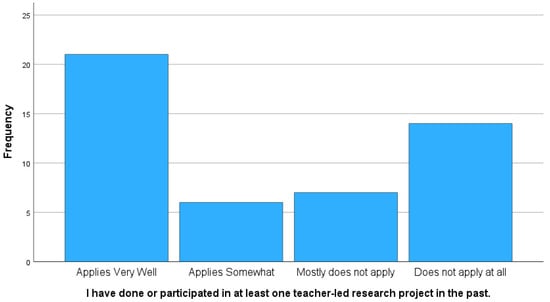
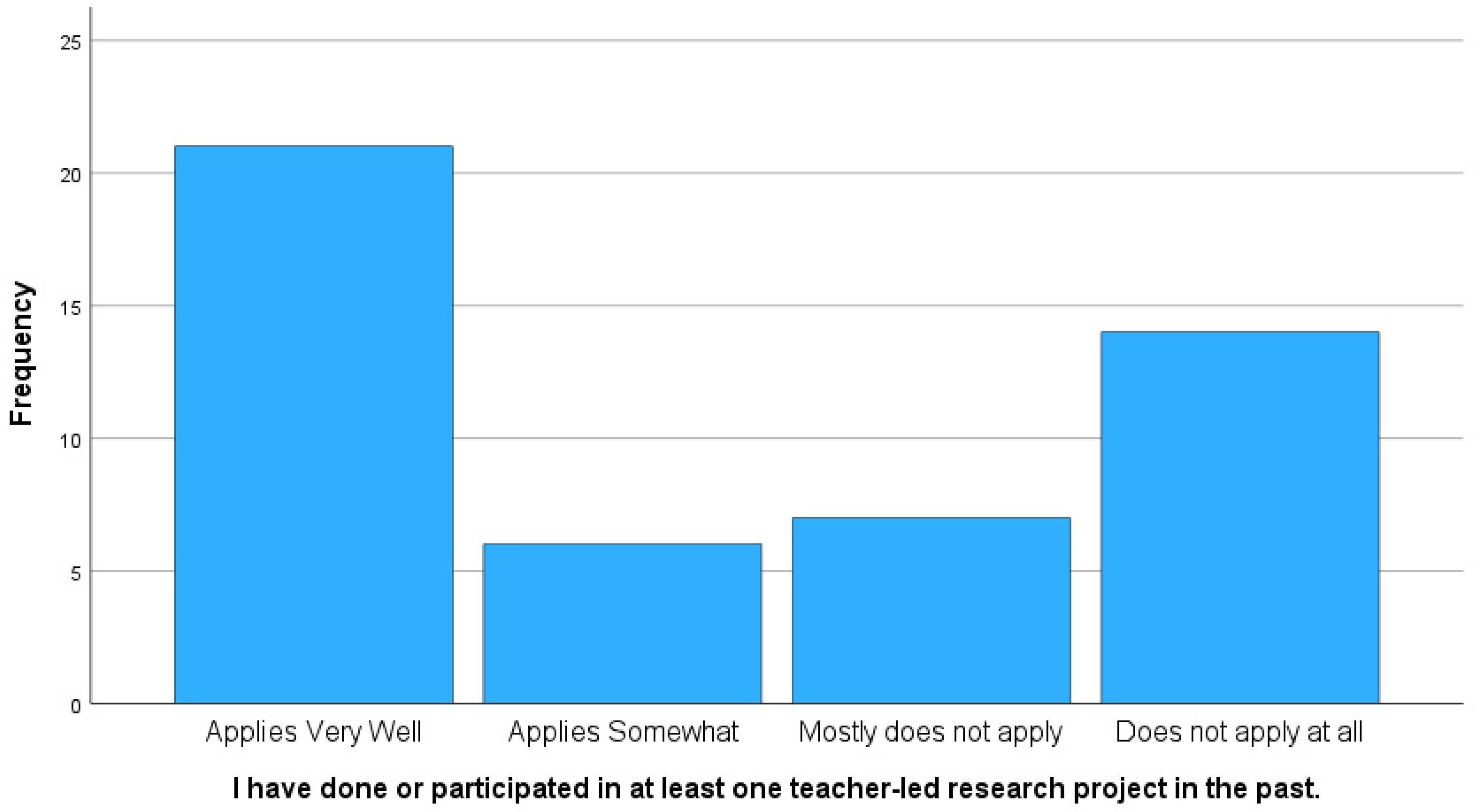
The final section of the questionnaire (Table 7) focused on research engagement practices. Participants indicated that they did engage with the published literature (both academic and professional) and that they would like to do this to an even greater degree. When it comes to actually conducting research, however, responses were distributed bimodally (Figure 1): 21 participants indicated that this applied very well to their experience, whereas 14 participants suggested that it does not apply at all, with the eleven remaining 13 responses being shared among the options in between. That said, most participants suggested that they would be interested in participating in research projects in the future.
Table 7.
Responses to Section 5.
Figure 1.
Distribution of responses for Item 5.5.
3.2. Identifying Teacher Profiles
When the items with the lowest spread of responses were removed, three distinct teacher profiles were generated through cluster analysis. These correspond to three teacher profiles that are presented below.
The first profile comprised the six teachers who were reportedly self-employed. These teachers did not have access to institutional resources or other forms of support, so they could not be readily compared to other participants.
Teachers in the second and third clusters were differentiated through their workplace conditions, with the former reporting more favourable conditions for research engagement. For example, 16 out of 18 teachers in the second cluster reported having time to read books and articles about teaching, but 17 out of 24 in the third cluster reported that this was not the case with them (χ2 = 72.063, df = 8, p < 0.001). In the second cluster, 11 out of 18 reported having easy access to such resources, but all 24 participants in the third cluster reported that this was either ‘somewhat untrue’ or ‘completely untrue’ for them (χ2 = 75.608, df = 8, p < 0.001). Similarly, 17 out of 18 participants in the second reported that their attempts to develop professionally were appreciated, but the opposite response was given by 23 out of 24 participants in the third cluster (χ2 = 88.364, df = 8, p < 0.001).
The only statistically significant difference among the three clusters was that teachers in the third profile related to their beliefs towards collaboration. Although all participants suggested that they were open to the idea of collaborating, 78.8% of the participants in the second cluster and 87.3% of the participants in the first cluster said that this was ‘very true’ for them, but participants in the first cluster were more reserved: only 37.5% stated that this was ‘very true’ and the remaining 62.5% stated that it was ‘true’ (χ2 = 12.345, df = 2, p = 0.013).
Concerning beliefs, the participants in the third profile expressed the strongest reservations about the statements that research is a highly specialized social practice. All the participants in this cluster disagreed or strongly disagreed that research is best conducted by academics, compared to 61.1% and 66.6% in the second and third clusters respectively (χ2 = 8.629, df = 6, p = 0.045). Likewise, disagreement was unanimous (100%) regarding the statement that research involves experimental methods, whereas the corresponding percentages for the other two clusters were 55.6% and 83.3% respectively (χ2 = 14.729, df = 6, p = 0.022). Lastly, 75% of the participants in this cluster disagreed or strongly disagreed that statistical procedures were a necessary component of research, compared to 33.4% for the second group, and 33.3% for the third one (χ2 = 14.944, df = 6, p = 0.021).
Moving on to the qualities that were considered desirable for research projects, statistically significant differences were few, and were often produced by single responses that differentiated small groups. One substantial difference, however, was that teachers in the first cluster tended to be more reserved about collaboration and sharing. For instance, 41.7 of the respondents in this group disagreed that research should be collaborative, as opposed to near unanimous agreement in the other two groups (94.4% and 100% respectively; χ2 = 9.631, df = 2, p = 0.008). Also, 70.8% of the participants in this cluster disagreed that research should be shared, whereas responses in both other groups were highly positive (94.4% and 100% respectively; χ2 = 22.815, df = 2, p < 0.001).
No statistically significant differences were found among the groups in terms of their reported practices.
3.3. Demographic Influences
All the demographic variables appeared to be evenly represented across the three profile clusters. Additionally, no statistically significant differences were noted connecting individual items and demographic variables.
4. Discussion
The findings of this study broadly confirm observations in the literature about the low levels of research engagement among teachers (e.g., Borg 2010). Εven though the sample of teachers who responded to this questionnaire survey was self-selected and might therefore be presumed to be relatively more interested in research than the broader teacher population, a sizeable part of the sample did not appear very keen to engage in a classroom inquiry or similar projects.
On the other hand, it is interesting to note that the overwhelming majority of the participants reported that they actively engaged in reading professional and academic literature about language teaching. This finding should be read with caution, not least because it seems to contradict anecdotal evidence and the scholarly record (e.g., Marsden and Kasprowicz 2017) and it could be attributed to the selection bias inherent in the recruitment strategy (approaching recent graduates and current students), and the social desirability bias produced by the high value associated with reading.
However, the combined effect of these observations appears to suggest a dynamic in which teachers are relegated to the role of passively consuming research output, as opposed to being equal participants in the knowledge production process. This dynamic, if present, echoes the remarks by Sato and Loewen (2019) that knowledge production is often framed as being in the domain of the academe.
Another finding that invites reflection concerns the areas where variability in the responses was observed. Building on Borg (2010), this study endeavoured to examine the role of a broad range of factors on shaping research engagement. Of these, the only area where significant variation was observed was workplace conditions. By contrast, factors associated with the individuals (beliefs, personal attributes, demographic variables) did not appear to produce much difference. This finding could, perhaps, be a statistical artefact associated with the sampling frame (the pool of potential participants, who had all attended courses on the same MA programme, might be expected to share some characteristics in terms of outlook and education). Nevertheless, the finding highlights the importance of workplace conditions in fostering the conditions for research engagement. Some steps in this direction might include providing time for teacher engagement in research (Kramsch 2015; Leite et al. 2020) and challenging what might be described as institutional indifference towards the teachers’ research activity (Rose 2019).
A contribution that this study makes is the definition of distinct teacher profiles, regarding their research engagement. Given the exploratory nature of this study, the three profiles should not be viewed as a definitive categorization, and additional work would be required both to establish the stability of the clusters and to produce more nuanced descriptions of the teacher profiles that they represent. Nevertheless, such differentiation does have a range of practical implications for teacher development, in that it casts doubt on the effectiveness of ‘one-size-fits-all’ attempts to increase research engagement (cf. McIntyre 2005). At a minimum, the findings suggest that three different strands of action are necessary.
For teachers who are independently employed (such as the ones in the first cluster), developing research engagement could involve providing institutional support, such as access to the literature (Rose 2019; Sato and Loewen 2019; Borg and Liu 2013) and opportunities to network and collaborate. Universities and professional associations can play a significant role in developing this capacity, by providing teachers with access to support and networking structures that are absent in their professional setting (Arnold 2019; Sato and Loewen 2022). Steps that are already taken in this direction include broad initiatives, such as the Research Literacy of Teachers project (Blume et al. 2025) and others.
For teachers whose profiles are similar to the second cluster, endeavours to develop research engagement might take the form of challenging unhelpful perceptions about research (for an overview, see Guilfoyle et al. 2020). At the core of this endeavour, this would involve challenging foundationalist beliefs about knowledge and research, that is, the belief that knowledge should be evaluated through a unified set of criteria, and advancing the understanding that academic and professional knowledge, while equally important, differ in scope, outlook and methods.
Finally, when it comes to teachers whose profiles resemble the third cluster, the challenge is one of reframing scepticism about research engagement, overcoming the perceived limitations of the workplace, and restoring a sense of teacher agency. This suggests the need for broadly focused, system-wide changes that foreground the role of teachers as transformative agents. McIntyre’s (2005) suggestion of ‘knowledge-creating schools’ provides an example of what such changes might involve.
5. Conclusions
Turning to the specific issue of teacher research engagement in the context of language education for people with refugee and migrant backgrounds, there are two major implications from this study. As noted in the introduction, refugee and migrant education, in the Greek context at least, tends to be relatively unstructured and top-down guidance is not always sufficient. This suggests a prima facie need for an empowered teacher corps, who will be able to produce locally appropriate practice based on situated understandings. While bearing in mind that findings from non-systematic samples should not be uncritically projected to broader populations, the findings of the study suggest that teachers whose academic background has prepared them for working in such settings (such as the respondents that made up the sampling frame for this survey) appear to engage with research in ways that can helpfully supplement gaps in top-down institutional guidance. This is a consideration that may be brought to bear in relation to teacher recruitment policies and staffing allocation decisions.
The responses provided in Section D also appear to have implications for the design of a research engagement strategy. There is strong evidence that teachers value opportunities to engage in research, provided that these are structured and supported by experienced mentors. This suggests an opportunity for joint knowledge production with the teachers who are actively involved in teaching refugees and migrants, as a means for producing teaching practices that leverage diversity (Gutiérrez and Penuel 2014). It is also important to stress that teachers appear to place a high premium on the voluntary and democratic nature of such initiatives, which could suggest that existing administrative structures in the school system might be inappropriate vehicles for designing and implementing such initiatives, on account of the power differentials that they involve.
It should be stressed that the findings presented in this study, and the implications that are discussed in this section, must be viewed as provisional. The usual caveats associated with the sample size and sampling strategy apply to this study as well. For instance, the recruitment of a convenience sample, consisting of teachers associated with a Masters’ programme may have skewed responses towards more positive attitudes regarding research engagement. Furthermore, it should be noted that these data are self-reported; triangulation with observational studies in the field would be helpful in confirming the validity of the findings. The lack of observed differences in individual factors and the unclear effect they have on research engagement practices is one area where additional research can be expected to shed more light. Replications of this study in different contexts and with more diverse populations would also provide much-needed triangulation for these findings, especially about the stability of the three teacher clusters identified. Another potentially generative direction for research would involve a qualitative study of the way research engagement is shaped, which could provide more in-depth understanding of the findings sketched out here.
This study aimed to document research engagement among language teachers who specialized in teaching students with a refugee and migrant background. The selection of this population was driven by the concern that teaching in such settings is not well supported by established practice or normative guidance. The focus of this study has been descriptive, and it deliberately avoids venturing into interpretation; and the findings are context-bound by design. This focused design allowed the study to achieve its primary aim: to document, with empirical specificity, how research engagement is configured within a particular group of language teachers working in under-theorized and weakly structured professional contexts (Kostoulas 2024). Precisely because the study is situated and delimited in the sense outlined by Flyvbjerg (2006), it was able to foreground forms of research engagement that are typically obscured in more aggregated or comparative designs.
Future work in the same context can add nuance to our understanding of research engagement among these teachers: for example, qualitative studies in similar populations can provide insights into why some answers are more homogeneous than others, or whether these findings are perceived as stable or dynamic. Similarly, cross-sectional work in other settings might help to establish commonalities globally and point towards the implications for teaching and teacher education. With these caveats in mind, this study provides a detailed empirical account of how research engagement is understood and enacted by language teachers for refugees and migrants in a specific educational ecology, offering a necessary starting point for subsequent comparative and international research.
Author Contributions
Conceptualization, A.K.; methodology, A.K. and C.N.; formal analysis, C.N.; data curation, P.D.; writing—original draft preparation, A.K., C.N. and P.D.; writing—review and editing, A.K.; supervision, A.K. All authors have read and agreed to the published version of the manuscript.
Funding
This research received no external funding.
Institutional Review Board Statement
The study was conducted in accordance with the Declaration of Helsinki, and approved by the University of Thessaly Ethics Review Board, approval code 108, approval date 12 December 2023.
Informed Consent Statement
Informed consent was obtained from all subjects involved in the study.
Data Availability Statement
The datasets presented in this article are not readily available because the data are part of an ongoing study.
Conflicts of Interest
The authors declare no conflicts of interest.
References
- Arnold, Lynette. 2019. Accompanying as Accomplices: Pedagogies for Community-Engaged Learning in Sociocultural Linguistics. Language and Linguistics Compass 13: 1–20. [Google Scholar] [CrossRef] [Scilit]
- Asylum Information Database. 2022. AIDA Country Report: Greece (2022 Update). Brussels: European Council on Refugees and Exiles (ECRE). Available online: https://asylumineurope.org/wp-content/uploads/2023/06/AIDA-GR_2022-Update.pdf (accessed on 24 February 2024).
- Banegas, Darío Luis. 2019. Language Curriculum Transformation and Motivation through Action Research. The Curriculum Journal 30: 422–40. [Google Scholar] [CrossRef] [Scilit]
- Beaudry, Jeffrey S., and Lynne D. Miller. 2016. Research Literacy: A Primer for Understanding and Using Research. New York: Guilford Press. [Google Scholar]
- Blume, Carolyn, Kenan Dikilitaş, Raul García López, Julia Hüttner, Achilleas Kostoulas, Emma Marsden, Christina Ringel, Aysel Saricaoglu, Saskia Schabio, and Yela Schauwecker. 2025. Shaping the reality of foreign language teachers’ research literacies. In Advancing CALL: New Research Agendas—EUROCALL 2025 Short Papers. Edited by Yazdan Choubsaz, Paz Díez-Arcón, Ana Gimeno-Sanz, Valentina Morgana, Amanda C. Murphy and Francesca Luisa Seracini. Valencia: Editorial Universitat Politècnica de València, pp. 361–70. [Google Scholar] [CrossRef] [Scilit]
- Borg, Simon. 2010. Language Teacher Research Engagement. Language Teaching 43: 391–429. [Google Scholar] [CrossRef] [Scilit]
- Borg, Simon, and Yi (Daphne) Liu. 2013. Chinese College English Teachers’ Research Engagement. TESOL Quarterly 47: 270–99. [Google Scholar] [CrossRef] [Scilit]
- Cordingley, Philippa. 2015. The Contribution of Research to Teachers’ Professional Learning and Development. Oxford Review of Education 41: 234–52. [Google Scholar] [CrossRef] [Scilit]
- Davari Torshizi, Mehdi. 2018. Revisiting the Form of Teacher–Researcher Collaboration in the Field of TESOL. TESOL Journal 9: 573–79. [Google Scholar] [CrossRef] [Scilit]
- Dewaele, Jean-Marc. 2018. Online Questionnaires. In The Palgrave Handbook of Applied Linguistics Research Methodology. Edited by Aek Phakiti, Peter De Costa, Luke Plonsky and Sue Starfield. London: Palgrave Macmillan, pp. 269–286. [Google Scholar]
- Flyvbjerg, Bent. 2006. Five misunderstandings about case-study research. Qualitative Inquiry 12: 219–245. [Google Scholar] [CrossRef] [Scilit]
- Fotiadou, Georgia, Alexandra Prentza, Christina Maligkoudi, Stamatia Michalopoulou, and Marina Mattheoudakis. 2022. Investigating Teacher Beliefs, Attitudes and Practices regarding the Inclusion of Refugee and Immigrant Students in Greek State Schools. Journal of Applied Linguistics 35: 36–58. [Google Scholar]
- Giroux, Henry A. 1988. Teachers as Intellectuals: Toward a Critical Pedagogy of Learning. New York: Greenwood Publishing Group. [Google Scholar]
- Guilfoyle, Liam, Orla McCormack, and Sibel Erduran. 2020. The ‘Tipping Point’ for Educational Research: The Role of Pre-Service Science Teachers’ Epistemic Beliefs in Evaluating the Professional Utility of Educational Research. Teaching and Teacher Education 90: 103033. [Google Scholar] [CrossRef] [Scilit]
- Gutiérrez, Kris D., and William R. Penuel. 2014. Relevance to Practice as a Criterion for Rigor. Educational Researcher 43: 19–23. [Google Scholar] [CrossRef] [Scilit]
- Hancock, Roger. 1997. Why Are Class Teachers Reluctant to Become Researchers? British Journal of In-Service Education 23: 85–99. [Google Scholar] [CrossRef] [Scilit]
- Hellenic Republic Ministry of Education, Religious Affairs and Sports. Προσφυγικό και Εκπαίδευση [Refugees and Education]. n.d. Available online: https://www.minedu.gov.gr/tothema-prosfigiko-m (accessed on 18 February 2024).
- Institute of Education Policy. 2016. Δομές Υποδοχής και Εκπαίδευσης Προσφύγων [Reception Facilities for Refugee Education]. Available online: https://iep.edu.gr/images/IEP/EPISTIMONIKI_YPIRESIA/Epist_Monades/A_Kyklos/Diapolitismiki/2016/2016-10-04_dt_dyep.pdf (accessed on 20 February 2024).
- Karavas, Evdokia, Maria Iakovou, and Bessie Mitsikopoulou. 2021. Responding to the Challenges of Adult Refugee Language Education through Action Research. International Journal of Learner Diversity & Identities 28: 15–30. [Google Scholar]
- Kostoulas, Achilleas. 2014. A Greek Tragedy: Using a Complexity Perspective to Understand and Challenge the Known in Greece. In Resistance to the Known: Counter-Conduct in Language Education. Edited by Damian Rivers. London: Palgrave Macmillan, pp. 47–70. [Google Scholar]
- Kostoulas, Achilleas. 2018. Developing Teacher Research Competence. In Becoming Research Literate: Supporting Teacher Research in English Language Teaching. Edited by Daniel Xerri and Ceres Pioquinto. Zurich: ETAS, pp. 13–18. [Google Scholar]
- Kostoulas, Achilleas. 2024. Challenging Normative Influences in Refugee and Migrant Language Education: Reflections of a Trainee Teacher Cohort. Teaching and Teacher Education 139: 104454. [Google Scholar] [CrossRef] [Scilit]
- Kostoulas, Achilleas, and Juup Stelma. 2017. Understanding Curriculum Change in an ELT School in Greece. ELT Journal 71: 354–63. [Google Scholar] [CrossRef] [Scilit]
- Kramsch, Claire. 2015. Applied Linguistics: A Theory of the Practice. Applied Linguistics 36: 454–65. [Google Scholar] [CrossRef] [Scilit]
- Kyrligkitsi, Argyro, and Anna Mouti. 2023. A Multi-Method Profiling of Adult Refugees and Migrants in an L2 Non-Formal Educational Setting: Language Needs Analysis, Linguistic Portraits, and Identity Texts. Societies 13: 186. [Google Scholar] [CrossRef] [Scilit]
- Leite, Carlinda, Preciosa Fernandes, and Carla Figueiredo. 2020. National Curriculum vs. Curricular Contextualisation. TechTrends 64: 470–83. [Google Scholar] [CrossRef] [Scilit]
- Marsden, Emma, and Rowena Kasprowicz. 2017. Foreign Language Educators’ Exposure to Research. The Modern Language Journal 101: 613–42. [Google Scholar] [CrossRef] [Scilit]
- McIntyre, Donald. 2005. Bridging the Gap between Research and Practice. Cambridge Journal of Education 35: 357–82. [Google Scholar] [CrossRef] [Scilit]
- Medgyes, Péter. 2017. The (Ir)Relevance of Academic Research for the Language Teacher. ELT Journal 71: 491–98. [Google Scholar] [CrossRef] [Scilit]
- Mercer, Sarah, and Daniel Xerri. 2018. Doing Research to Find Answers to Your Questions. In Malta Conference Selections 2017. Edited by Rachael Bicknell and Lasse Nikkanen. Faversham: IATEFL, pp. 7–11. [Google Scholar]
- Miller, Tina, and Mary Boulton. 2007. Changing Constructions of Informed Consent: Qualitative Research and Complex Social Worlds. Social Science & Medicine 65: 2199–211. [Google Scholar] [CrossRef] [Scilit]
- Mogli, Marina. 2023. Adult Refugees Learning Greek as L2 for Social Inclusion in Non-Formal Educational Settings: The Case of Volos Immigrant Center. European Journal of Applied Linguistics Studies 6: 168–89. [Google Scholar] [CrossRef] [Scilit]
- Mogli, Marina, and Kostas Magos. 2023. Teaching Greek as L2 in Non-Formal Educational Settings: Investigating Teachers’ Intercultural Competence. European Journal of Foreign Language Teaching 7: 48–68. [Google Scholar] [CrossRef] [Scilit]
- Motsiou, Eleni, and Achilleas Kostoulas. 2025. Emergency language policy in Greece: Insights from a decade of crisis. Paper presented at the International Conference Welcoming Allophone Migrant Students: Bridging Research & Applications Organized by the University of Poitiers, Poitiers, France, November 17. [Google Scholar]
- Mouti, Anna, Vasiliki Kantzou, and Polyxeni Manoli. 2021. Language Education to Refugee and Asylum-Seeking Children in Greece in Non-Formal Settings. In Migration and Language Education in Southern Europe. Edited by Marina Mattheoudakis, Eleni Griva and Maria Moumtzi. Newcastle-upon-Tyne: Cambridge Scholars Publishing, pp. 133–53. [Google Scholar]
- Palaiologou, Nektaria, Georgia Fountoulaki, and Maria Liontou. 2019. Refugee Education in Greece. In Intercultural and Interfaith Dialogues for Global Peacebuilding and Stability. Edited by Sharon Peleg. Hershey: IGI Global, pp. 165–97. [Google Scholar] [CrossRef] [Scilit]
- Papapostolou, Anastasia, Polyxeni Manoli, and Anna Moutı. 2020. Challenges and needs in the context of formal language education to refugee children and adolescents in Greece. Journal of Teacher Education and Educators 9: 7–22. [Google Scholar]
- Rose, Heath. 2019. Dismantling the Ivory Tower in TESOL. TESOL Quarterly 53: 895–905. [Google Scholar] [CrossRef] [Scilit]
- Sato, Masatoshi, and Shawn Loewen. 2019. Evidence-Based Second Language Pedagogy. London: Routledge. [Google Scholar]
- Sato, Masatoshi, and Shawn Loewen. 2022. The Research–Practice Dialogue in Second Language Learning and Teaching: Past, Present, and Future. The Modern Language Journal 106: 509–27. [Google Scholar] [CrossRef] [Scilit]
- Shkedi, Asher. 1998. Teachers’ Attitudes towards Research. International Journal of Qualitative Studies in Education 11: 559–77. [Google Scholar] [CrossRef] [Scilit]
- Stamatiou, Anna. 2018. Εκπαιδευτική Πολιτική για τους Πρόσφυγες: Μελέτη Περίπτωσης ζητημάτων εκπαίδευσης AΜΕA στις Δομές Φιλοξενίας Προσφύγων στο Νομό Θεσσαλονίκης. Unpublished Master’s Thesis, University of Western Macedonia, Kozani, Greece. [Google Scholar]
- Stelma, Juup, and Achilleas Kostoulas. 2021. The Intentional Dynamics of TESOL. Berlin: De Gruyter. [Google Scholar]
- Xerri, Daniel, and Ceres Pioquinto, eds. 2018. Becoming Research Literate: Supporting Teacher Research in English Language Teaching. Bern: ETAS. [Google Scholar]

Disclaimer/Publisher’s Note: The statements, opinions and data contained in all publications are solely those of the individual author(s) and contributor(s) and not of MDPI and/or the editor(s). MDPI and/or the editor(s) disclaim responsibility for any injury to people or property resulting from any ideas, methods, instructions or products referred to in the content. |
© 2026 by the authors. Licensee MDPI, Basel, Switzerland. This article is an open access article distributed under the terms and conditions of the Creative Commons Attribution (CC BY) license.