Article

Court-Managed Policy Change: A Content Analysis of Prison Healthcare Consent Decrees and Settlement Agreements


1
Department of Criminal Justice and Criminology, Loyola University Chicago, Chicago, IL 60660, USA
2
Department of Criminology, Law and Society, University of California, Irvine, Irvine, CA 92697, USA
*
Author to whom correspondence should be addressed.
Soc. Sci. 2026, 15(1), 13; https://doi.org/10.3390/socsci15010013 (registering DOI)
Submission received: 5 October 2025 / Revised: 25 November 2025 / Accepted: 15 December 2025 / Published: 26 December 2025
(This article belongs to the Special Issue Carceral Death: Failures, Crises, and Punishments)

Abstract

While most prison healthcare litigation seeks individual relief, some cases lead to broader structural reform via consent decrees—court-approved “legally binding performance improvement plans” designed to improve conditions. This study systematically analyzes 121 such settlements from 1970 to 2022 to assess their policy goals and implementation strategies. We identify the substantive areas targeted—general medical care, mental health, dental services, and treatment for specialized conditions like HIV, Hepatitis C, and COVID-19—and trace trends across time and geography. These agreements span 39 states and the federal system, with most states subject to multiple cases. They frequently mandate changes to budgets, staffing, facility infrastructure, training, and patient rights, alongside monitoring for quality improvement. Our findings suggest that consent decrees function not only as judicial remedies but as tools of policy development and institutional reform, shedding light on the role of courts in shaping correctional healthcare delivery. These findings also show how institutional responses to healthcare failures in prisons shape the conditions under which serious harm—and in some cases, preventable death—occur behind bars.

1. Introduction

People who enter prisons often do so with significant, unmet health needs—and incarceration itself compounds those risks by creating new threats to health and mortality (Favril et al. 2024; National Research Council and Institute of Medicine 2013). Incarcerated people are more likely to suffer from serious chronic conditions such as HIV, viral hepatitis, and tuberculosis; they suffer from higher rates of mental health conditions and substance use disorders; and they have higher mortality rates than the general public (Nowotny et al. 2023; Lewer and Edge 2024; Wildeman 2016). Historically, the quality of healthcare provided in carceral settings has been characterized by systemic failure, between “high inmate-to-physician ratios, incompetent … health professionals, sick calls that lasted for 30 s, underreporting of needs, lack of follow-up, and lack of any preventive or primary health care” (Reverby 2019, p. 89). Many of these same challenges persist in facilities across the United States, to say nothing of outright neglect or refusal of care as a form of carceral punishment (Pont et al. 2012; Zaitzow and Willis 2021). While scholarship has documented relative improvements in the quality of correctional care from the worst lows, that does not mean it is adequate; the effort to reduce mortality and morbidity in corrections using approaches from public health and other fields continues (Cloud et al. 2023).
As a result of this reality, prison healthcare is a frequent topic of civil litigation. Ever since the Supreme Court’s ruling in Estelle v. Gamble, holding that the Constitution’s prohibition on cruel and unusual punishment forbids “deliberate indifference” (Estelle v. Gamble 1976, p. 429) to prisoner medical needs, courts have refined a basic legal framework for the obligation to provide medical care in prisons. As a result of Estelle, incarcerated persons were given a cause of action to sue prison officials when their rights were violated by a failure to provide adequate care (Schnittker et al. 2022). While most litigation seeks to provide immediate redress for grievances of individual plaintiffs, healthcare challenges that prove more systematic and entrenched sometimes lead to a more extensive response: a consent decree—a type of “legally binding performance improvement plan” negotiated by plaintiffs and defendants and subsequently approved and supervised by a court (McCann 2023). Consent decrees are implemented in a variety of legal contexts, but they became a significant tool for reforming prison and jail conditions starting in the 1960s in response to increasing court recognition of grievous prison conditions at the state level (Feeley and Rubin 2000). While monetary damages or a loss order may persuade correctional institutions to adapt their behaviors to avoid future legal liability and manage risk, a consent decree provides a mechanism to facilitate improvements in medical care with external accountability, in principle, to both courts and plaintiffs. Given that several potential avenues exist to improving correctional healthcare, researchers, medical providers, and advocates have debated whether pursuing litigation is a cost-effective use of resources to secure quality medical care and reduce deaths compared to alternative paths—and whether courts are effective implementers of social policy at all (Baer and Bepko 2007; McCann 2023; Rosenberg 2008).
There are reasons to believe that litigation and consent decrees have played a significant role in expanding access to healthcare in U.S. prisons; however, this perception is contested. Following Estelle, subsequent litigation prompted increased awareness among incarcerated individuals of their rights and heightened pressure on correctional administrators to prioritize the quality of care in order to minimize legal liability (Rold 2008; Wright 2008). On the other hand, significant difficulties in securing care remain, and scholars have been skeptical of the utility of lawsuits in driving improvements in care (Schnittker et al. 2022). While there is an increasing amount of scholarly attention to the health impacts of incarceration, there is less empirical work on the role of litigation in facilitating or hindering this process.
While there has been some important work in socio-legal studies and criminology on litigation in the context of prison conditions broadly, few have focused on the role consent decrees play in reforming correctional healthcare. The research literature on prison conditions litigation highlights a “patchwork” of mechanisms that attempt, with mixed results, to achieve genuine accountability in securing rights, including the right to healthcare. A number of studies highlight aspects of court intervention in correctional management. Harris and Spiller’s (1977) book After Decision, a comparative case study of implementation in four early correctional consent decrees, find that noncompliance was a major struggle in each of the cases because of “an unwilling or unresponsive attitude or … an inability … to perform the various tasks that were essential to the achievement of compliance” (Harris and Spiller 1977, p. 14). Edited volumes on court intervention in jail and prison management discussed the pros and cons of judicial rulings on correctional practices but, on the whole, concluded that “generally, levels of safety, services, and basic life amenities have improved when judges have intervened” (Dilulio 1990, p. 317). Schoenfeld et al. describe how litigation, one strategy among several used to protect the civil rights of incarcerated individuals, has been employed in prison-conditions cases to overhaul medical care. However, this approach is limited by legislation such as the Prison Litigation Reform Act, budget cuts, and implementation failures. Litigation can be time-consuming and complex, even when courts rule in a plaintiff’s favor. Reforms still “need elected officials’ buy-in to maintain constitutional prison conditions” (Schoenfeld et al. 2024, p. 19). Margo Schlanger’s studies of trends in civil rights injunctions in jails and prisons both before and after the PLRA was introduced shows the new law had an impact on the size and scope of court orders “from an omnibus model to something more fine-grained” (Schlanger 2006, p. 602) focusing more on discrete issues than wholesale overhauls of everything in prison conditions. Other authors have focused on statewide prison-reform cases, prompted by litigation, in book-length studies (Anderson 2000; Smith 2003) or law review articles discussing individual cases. Some accounts come from federal judges on their own experiences with correctional reform cases and managing consent decrees (Baer and Bepko 2007). However, these typically focus on a single rather than multiple states. Feeley and Rubin’s (2000) overview of judicial policy-making draws on several case studies of prison reform to argue that courts can and have exerted their authority to make meaningful, if imperfect, reforms of correctional institutions. Feeley and Rubin’s assessment of consent decrees as “an essentially collusive agreement between the plaintiff’s attorney and [law enforcement]” (p. 366) argues that correctional stakeholders can welcome consent decrees as a way to achieve improvements, even if they do not always find them desirable. While some healthcare issues are tangentially addressed in some of the cases Feeley and Rubin analyze, the broad theoretical thrust focuses on detailing how court-managed collaboration can successfully overcome implementation barriers broadly, but not in healthcare.
This project seeks to advance insight at the intersection of correctional health policy and socio-legal studies. Socio-legal work has “virtually ceded discussions of law’s relationship to health to the field of health policy” (Levitsky 2013, p. 46) even though it should have much to say about these questions. There are no comprehensive studies of healthcare prison litigation and organizational change—most prison-litigation studies focus on relatively few cases in a single state or on a handful of comparative cases (Chilton 1991; Dilulio 1990; Feeley and Rubin 2000). This paper aims to fill the research gap by providing an exploratory yet comprehensive examination of hundreds of healthcare consent decrees and settlements. While there is certainly a difference between how these agreements are formalized and what gets implemented on the ground, the agreements articulate the normative and institutional logic through which reform is imagined and pursued. Understanding the architecture of these agreements—the “law on the books”—provides essential insight into how the state envisions and codifies responses to constitutional failure. We ask (1) what changes to health policy and services in prisons have been required by court-approved settlements or consent decrees, how these have changed over time and location, and (2) what do the features of these consent decrees tell us about court-managed reform of correctional healthcare? To answer these questions, we conduct a systematic content analysis of 121 consent decrees and settlement agreements about prison healthcare in the United States from 1970 to 2022, drawn from an online archive of civil rights litigation. We find that the consent decrees are, contrary to expectations of other major civil rights prison litigation, not primarily concentrated in the U.S. South but have been national in scope since the 1970s. Despite barriers such as the Prison Litigation Reform Act (PLRA), which limits how prisoners can make legal claims about the conditions of confinement, consent decree provisions shape the general provision of correctional medical care, as well as the treatment of specific conditions, including HIV, hepatitis C, and COVID-19. Together, these findings highlight barriers—and potential opportunities—to more effectively address health needs and reduce mortality.

2. Materials and Methods

The data for this project are drawn from 121 cases of prison healthcare lawsuits initiated in the United States between 1970 and 2022 that resulted in a consent decree or settlement agreement aimed at reforming healthcare services. We utilized the Michigan Civil Rights Litigation Clearinghouse (hereinafter “the Clearinghouse”) to identify consent decrees in the context of prison healthcare. The Clearinghouse is an online database of nationwide civil rights litigation providing case files including “complaints, filings, opinions, settlements, court orders,” and litigation summaries of 9683 cases from 68,660 dockets (Civil Rights Litigation Clearinghouse 2021, 3:29, 30). The Clearinghouse focuses on collecting cases for which settlements include not just monetary damages but “policy or operational” changes as well (4:31). We began the search in the Clearinghouse database by filtering the database to include only “prison conditions” cases where the case outcome was a “court-approved settlement or consent decree.” We also searched for the keyword “health.” This resulted in an initial return of 302 civil rights cases. We further refined this selection by reading through the case summaries produced by the Clearinghouse for each of the 302 case results. While all the preliminary results pertained to a prison civil rights issue, only some were related to healthcare. To identify cases that specifically address healthcare-related issues, we reviewed the case summaries prepared by Clearinghouse staff and selected cases that discussed healthcare services or administration specifically and excluded cases that did not discuss healthcare issues, along with a handful of other cases that discussed jail conditions rather than prison conditions. The final sample consisted of 121 consent decrees or settlement agreements from U.S. states and the federal government. For purposes of categorization, cases were classified based on the institutional authority responsible for prison administration rather than geographic location. Accordingly, consent decrees involving District of Columbia were categorized with federal cases. From these 121 cases, the Clearinghouse contained copies of the consent decree or settlement text for 96 cases. For the 25 cases in which decree texts were unavailable, we relied on docket information, summary filings, and case descriptions prepared from PACER and the Clearinghouse—which allowed us to include them in our broad analysis of consent decree trends. We code decrees and settlements based on the text as adopted by the district court. We do not analyze subsequent appellate modification, dissolution, or enforcement litigation, as these procedural developments vary widely across cases and fall outside the scope of our focus on the design and content of the agreements themselves.
We use Dedoose (version 10.0.25), a software program for mixed-methods analysis, to conduct a systematic mixed-methods content analysis of the 121 consent decrees. Systematic content analysis “[produces] both qualitative and quantitative results by enabling the researcher to compress … words of text into fewer content categories based on explicit rules of coding” (Salehijam 2018, p. 35). The research for this chapter proceeded in three steps. First, we reviewed case summaries for all 121 cases included in the analysis to identify the primary categories of healthcare issues addressed in the consent decrees and settlements. Based on this review, several broad categories emerged: each consent decree covered either general medical care issues, mental health, dental care, hepatitis C treatment, or COVID-19. Next, we developed a codebook through open coding of eight randomly selected consent decrees from the 96 agreements we had copies of, with each of the following specific categories of care: general healthcare and dental care, mental healthcare, hepatitis C treatment, and COVID-19 treatment and management. These consent decrees represent about 4.5% of the total consent decree database used in this study. Based on preliminary presentations of the research plan in various academic settings, we added additional coding categories to collect a broader range of descriptions on healthcare services and descriptive details about the prison sites. Currently, the codebook has 20 codes, including facility traits (e.g., single or multiple facilities; gender designations), the statutory basis for intervention (e.g., Civil Rights Act; Americans with Disabilities Act), and metrics to measure reform implementation (e.g., adherence to medical association guidelines for correctional care; testing regimes; hiring goals).
Next, once the initial codebook was developed, we began working with a second coder to help ensure the reliability of the subsequent coding. Training on the codebook consisted of defining each coding category and providing multiple examples of how these codes are manifested in the text of the agreements used to develop the codebook. In Table 1 below, codes pertaining to the specific policy goals of the consent decrees are listed, alongside their descriptions. We coded the first 10 cases together. We divided the remaining cases and employed an iterative coding technique, where we each independently coded cases, then met to review our results and consider whether the codebook should be updated and make adjustments accordingly. We verified agreement on 20 further cases in this manner and conducted an inter-rater reliability test to ensure continued agreement on coding practices.
Finally, we analyzed the data through exploratory, descriptive summarization and interpretive analysis (Neale 2016, p. 1096), and we qualitatively and quantitatively assessed trends across the consent decrees.

3. Results

3.1. Broad Trends in Healthcare Consent Decrees

3.1.1. Consent Decree and Settlement Health Focus and Summary Statistics

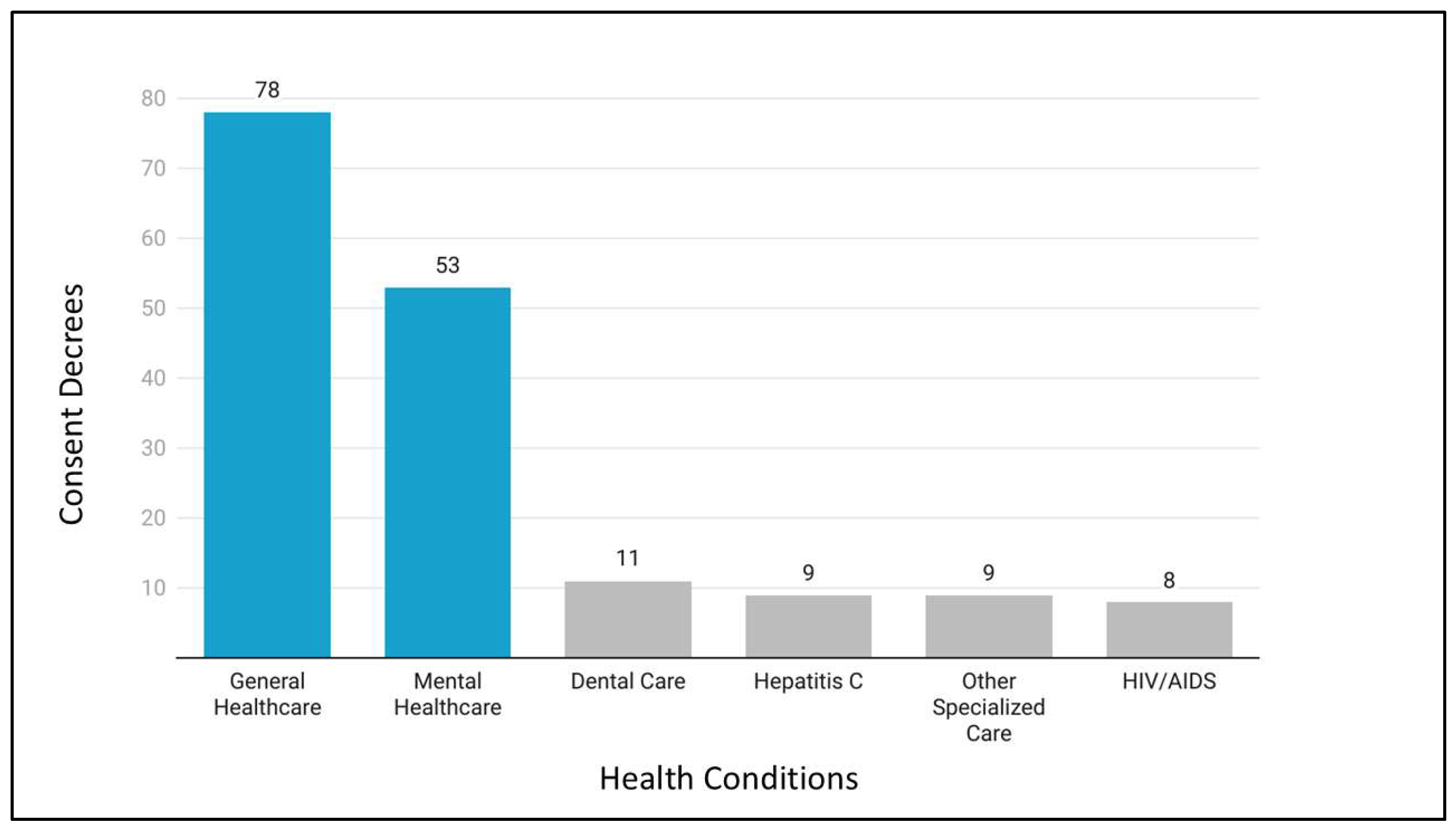
Based on our coding of consent decree/settlement from health-related litigation, we framed the following categories for medical issues addressed in each case, as shown in Figure 1: general healthcare (78), mental healthcare (53), and dental care (11) were the broadest categories of case and some cases explicitly dealt with all three. After this, hepatitis C and HIV/AIDS care each served as the basis for 9 and eight cases, respectively. The specialized-care category includes four COVID-19 cases and one case each focused on diabetes, substance use disorder, pregnancy, maternal care, and hernias. These categories are not mutually exclusive; consent decrees can focus on multiple health topics. Rather, they are counts of the major health issues addressed in each agreement. These results indicate that, overall, at the prison level, consent decrees and settlements tend to address broad healthcare concerns, such as general quality of care and access-to-care issues, and somewhat less frequently, discrete issues related to specialized conditions. This may differ from the case of jails, where reported agreements have aimed to improve access to medication-assisted treatment (MAT) to address substance-use-disorder needs (Mette 2021).
There are also interesting differences between categories of cases, as shown in Figure 1. Several consent decrees may address a combination of general healthcare, mental healthcare, and dental care, while others address each area separately. General healthcare cases, in particular, tend to be part of larger cases involving the totality of conditions in a prison, which may also include litigation on First Amendment rights, nutrition, access to exercise, and other aspects of prison conditions. The remaining categories—Hepatitis C, HIV, and specialized cases—are primarily focused exclusively on these issues and not part of agreements dealing with general healthcare, mental healthcare, or dental care. These cases stand out from the others in having somewhat different remedies. For example, given the nature of COVID-19 transmission, these agreements contain provisions on quarantine, facility sanitation, and release to home confinement that other agreements do not contain (e.g., McPherson v. Lamont 2020; Martinez-Brooks v. Easter 2020). COVID-19–related decrees represent a small subset of issue-specific agreements (four cases) and reflect litigation responding to a discrete public health crisis. While their substantive focus differs from systemic healthcare cases, their legal form, mode of adoption, and enforcement mechanisms are similar to other consent decrees in the dataset. The hepatitis C and HIV agreements emphasize testing regimes with these specific conditions in mind, while testing protocols may be mentioned but are not as much of a focus for the general medical care or mental health agreements (e.g., Mack v. Lopes 1989; Fowler v. Turco 2018).
Another important data point is the longevity of the consent decrees. Across the 121 agreements, they lasted, on average, nearly eight years, after which courts ended their supervision of the agreements. The median period of court supervision was five years. However, there may be significant variation in consent decree length, with a standard deviation of 8.62 years. Over each progressive decade, these agreements became shorter in longevity, when calculated from the decade of origin. As shown in Table 2, agreements formed in the 1970s lasted a mean of 18.68 years, falling to 8.21 and 6.83 years, on average, in the 80s and 90s. Their average longevity in the 2010s is 3.47 years. To some extent, this may be due to the fact that the agreements are younger and still ongoing, rather than an indication of their termination date. However, the broad trend has been that the agreements do not last as long as they once did.
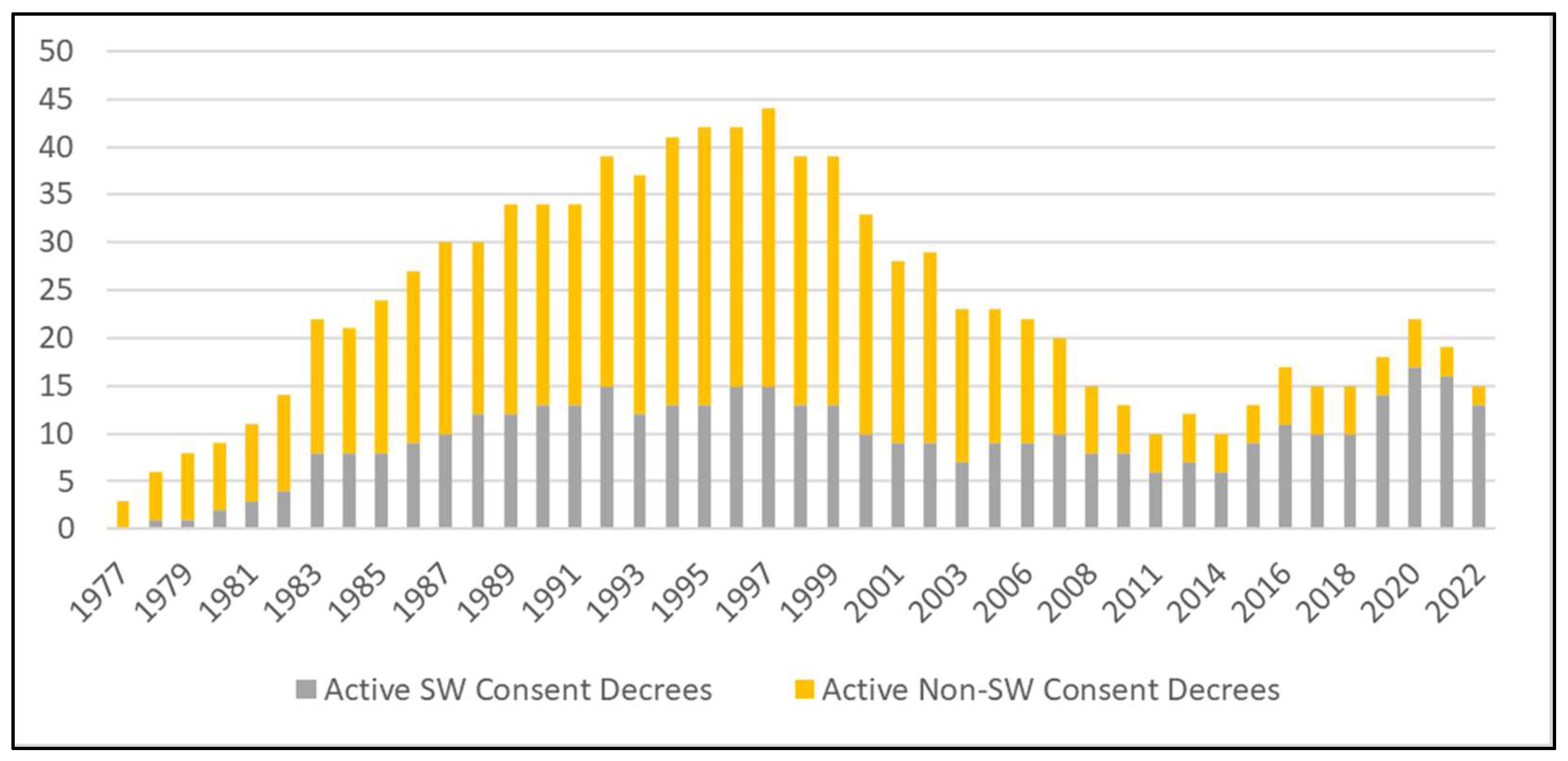
The consent decrees, settlement agreements, and stipulated injunctions studied from this database span a period from the early 1970s to the early 2020s. After a steady increase, particularly in the wake of the Supreme Court’s Estelle v. Gamble (1976) decision, the number of active agreements grew to a peak of nearly 44 in 1997. In the legal literature, there was concern that the PLRA, a 1996 law that limited the basis of prisoner civil rights litigation, would lead to a decline in successful lawsuits and consent decrees. That appears to have been borne out for healthcare-related agreements, as evidenced by the decline in active agreements following the law’s passage—most starkly for the non-statewide consent decrees.
Another important variation in the consent decrees is their scope—whether the agreements covered a single prison facility or aimed to make reforms statewide. Here, we see that the major division was between single-facility agreements (44.8%) and statewide agreements (42.4%), with a smaller portion covering more than one facility but not the entire state (12.8%).
While earlier in the history of these agreements single-facility consent decrees predominated, statewide consent decree trends hold more steady in later years, perhaps reflecting an increased priority on comprehensive reforms rather than more piecemeal action against individual or a few facilities. Figure 2 displays this information, tracking the number of statewide active and non-statewide active consent decrees overtime. Other studies of states with prisons under some court order have also shown a decline in the years following the passage and implementation of the PLRA (Schlanger 2015). However, these analyses show a steady decline in the volume of injunctions up through 2006 (Schlanger 2015, p. 169). The number of healthcare-related orders, however, remained relatively steady from there into the 2010s and even later, particularly as some COVID-19-related orders emerged in 2020.

3.1.2. Legal Characteristics: Causes of Action and Representation

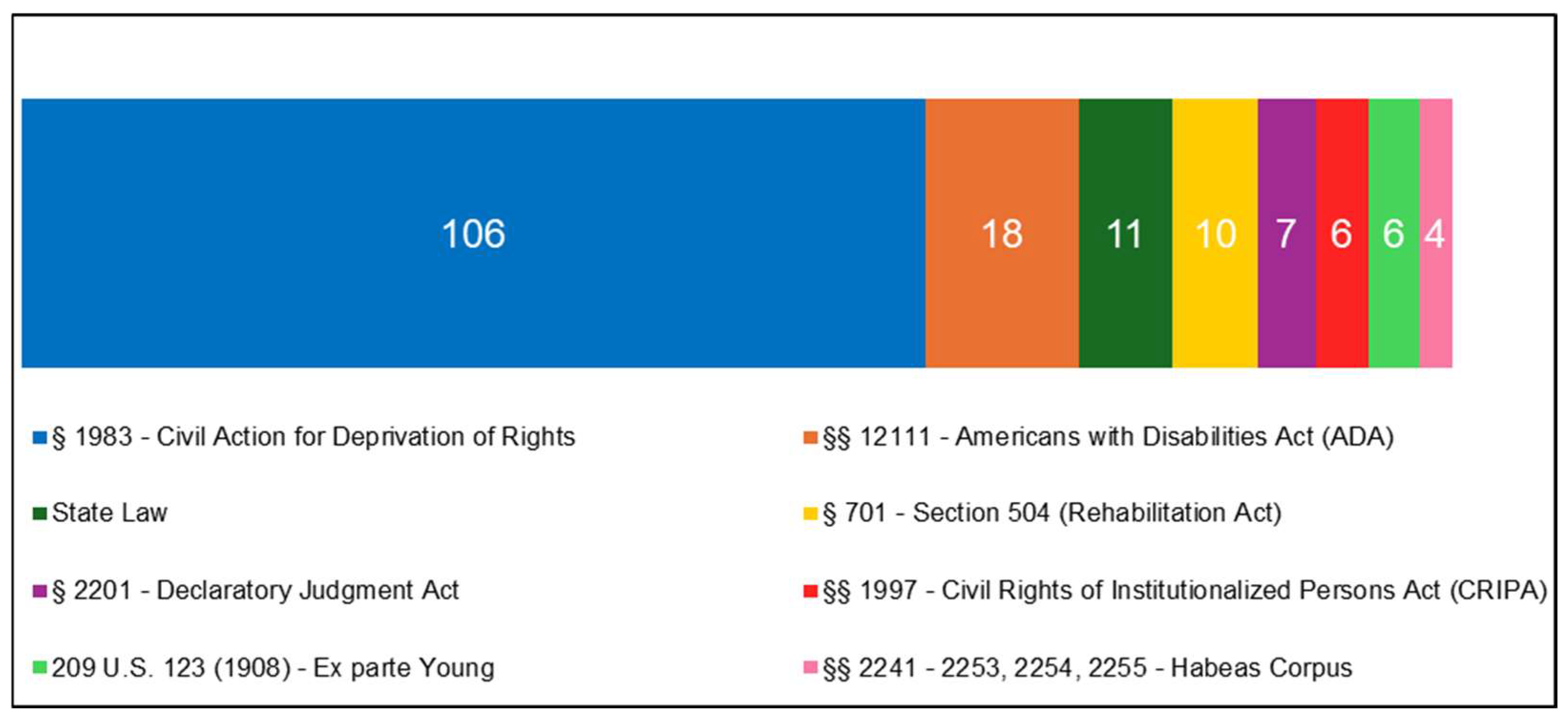
Most litigation surrounding prison conditions is based on claims from § 1983 of the U.S. Code, which allows claims against state officials who “under color of any statute, ordinance, regulation, custom, or usage … subjects … any citizen of the United States or other person within the jurisdiction thereof to the deprivation of any rights, privileges, or immunities secured by the Constitution and laws” (Civil Action for Deprivation of Rights 1871). This is also the case in prison healthcare cases. Figure 3 shows the range of causes of action used to support these cases. In at least 106 of the settlement cases, § 1983 was at least one of the causes of action. The Americans with Disabilities Act is the second most frequently cited cause of action in at least 18 cases. Since its passage in 1990, the ADA has enshrined a right to equal access to healthcare services, and these protections were later held by the U.S. Supreme Court to apply to prisons, as well (Pennsylvania Department of Corrections v. Yeskey 1998). A variety of state law claims are brought and combined with federal claims, depending on the jurisdiction in question. Section 504 of the Rehabilitation Act also provides protections for people with disabilities when they participate in programs receiving federal funding (Rehabilitation Act 1973).
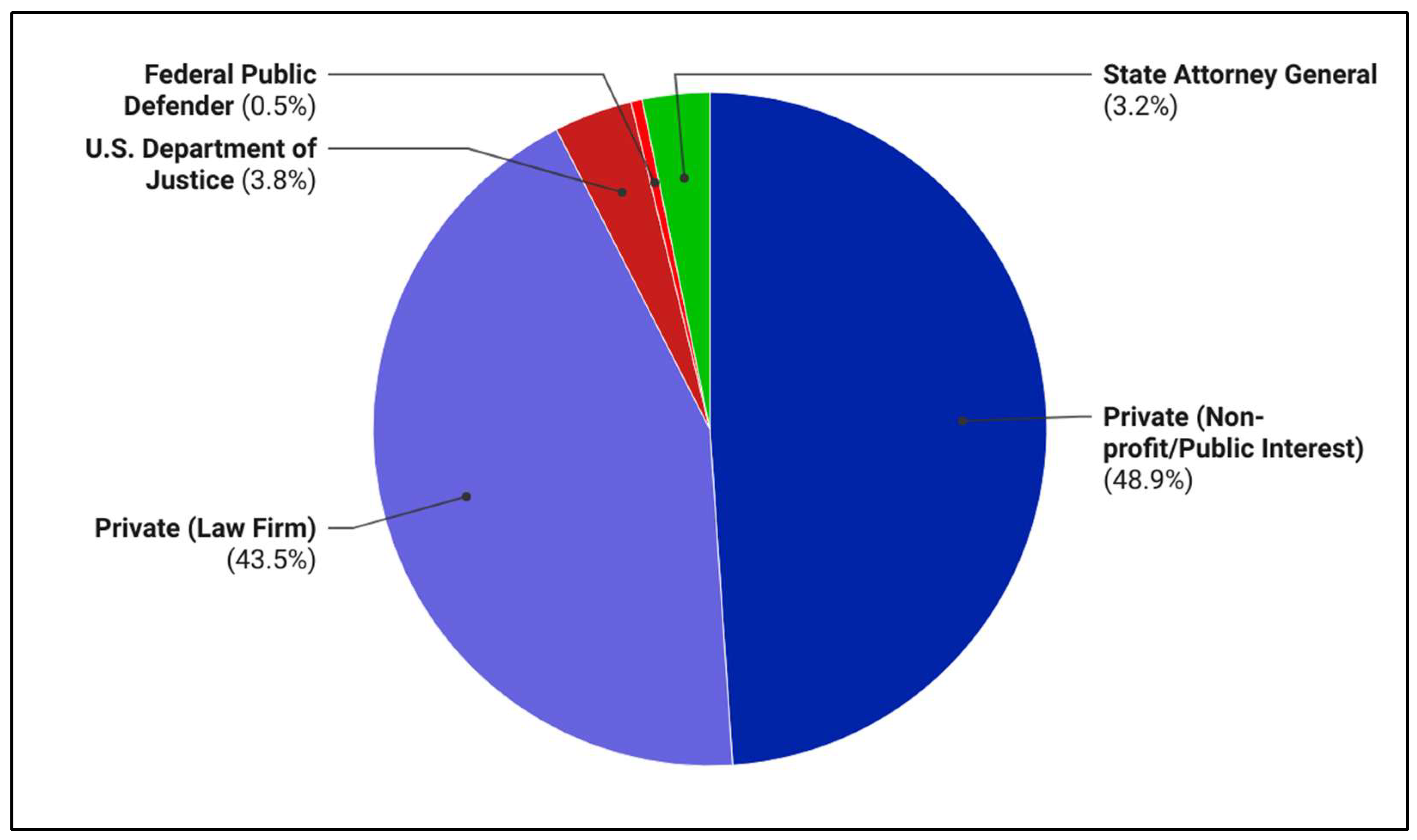
We also examined the distribution of plaintiffs’ counsel litigating the cases that eventually resulted in a settlement agreement or consent decree. While the vast majority of these lawsuits are brought pro se, these cases either started with legal counsel or eventually found counsel to represent them. In Figure 4, we see the largest category of plaintiffs to be from a private background; made of private law firms and private non-profit or public interest organizations. A large share of cases in our dataset were represented by this combination of plaintiffs (n = 52). Separately, non-profit or public interest organizations working independently represented a total of 33 cases. This is followed by private law firms alone, covering 22 cases. A smaller number of cases were litigated by the U.S. Department of Justice, state attorney generals, or by a federal public defender.

3.1.3. Geographic Distributions

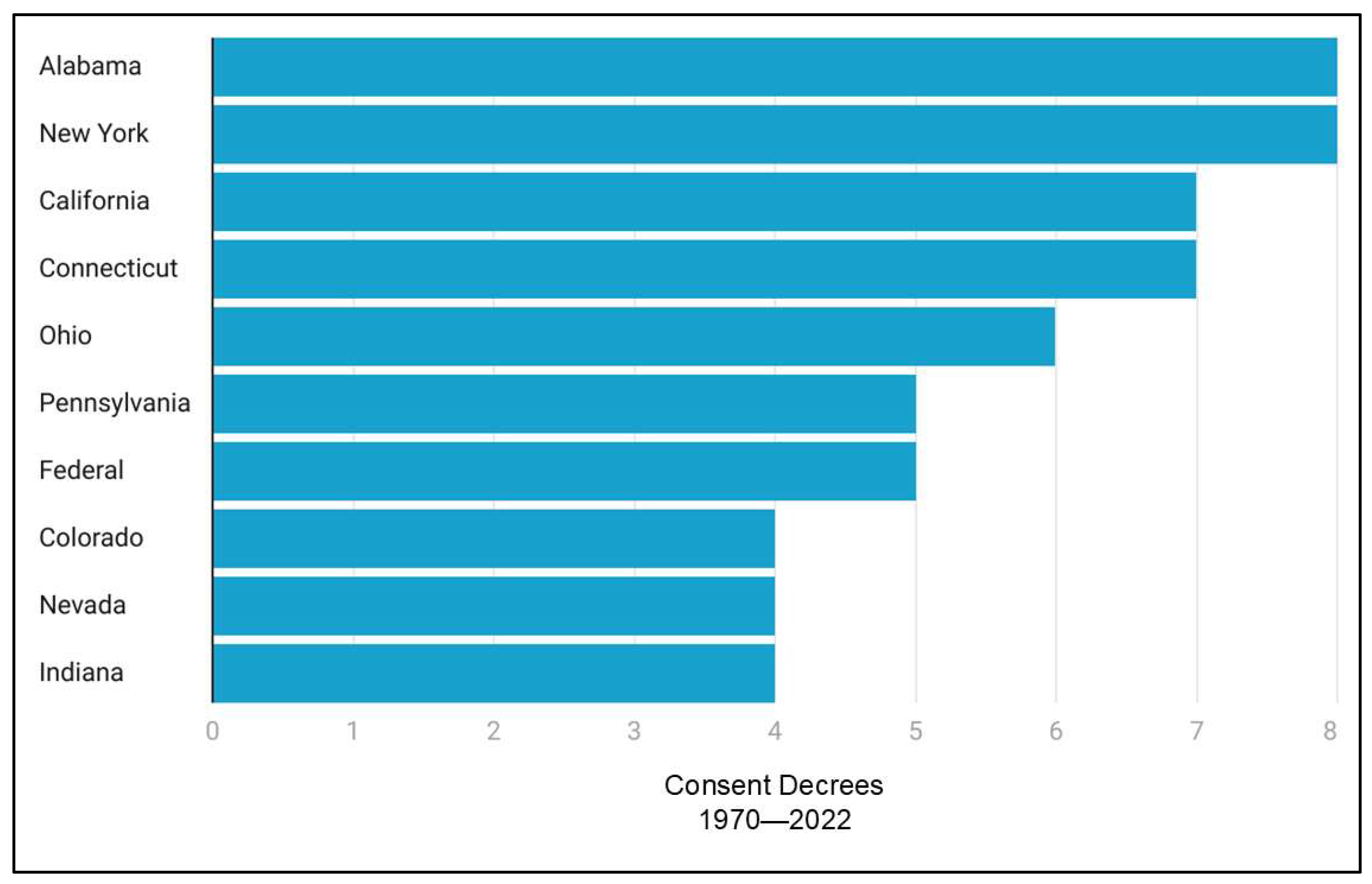
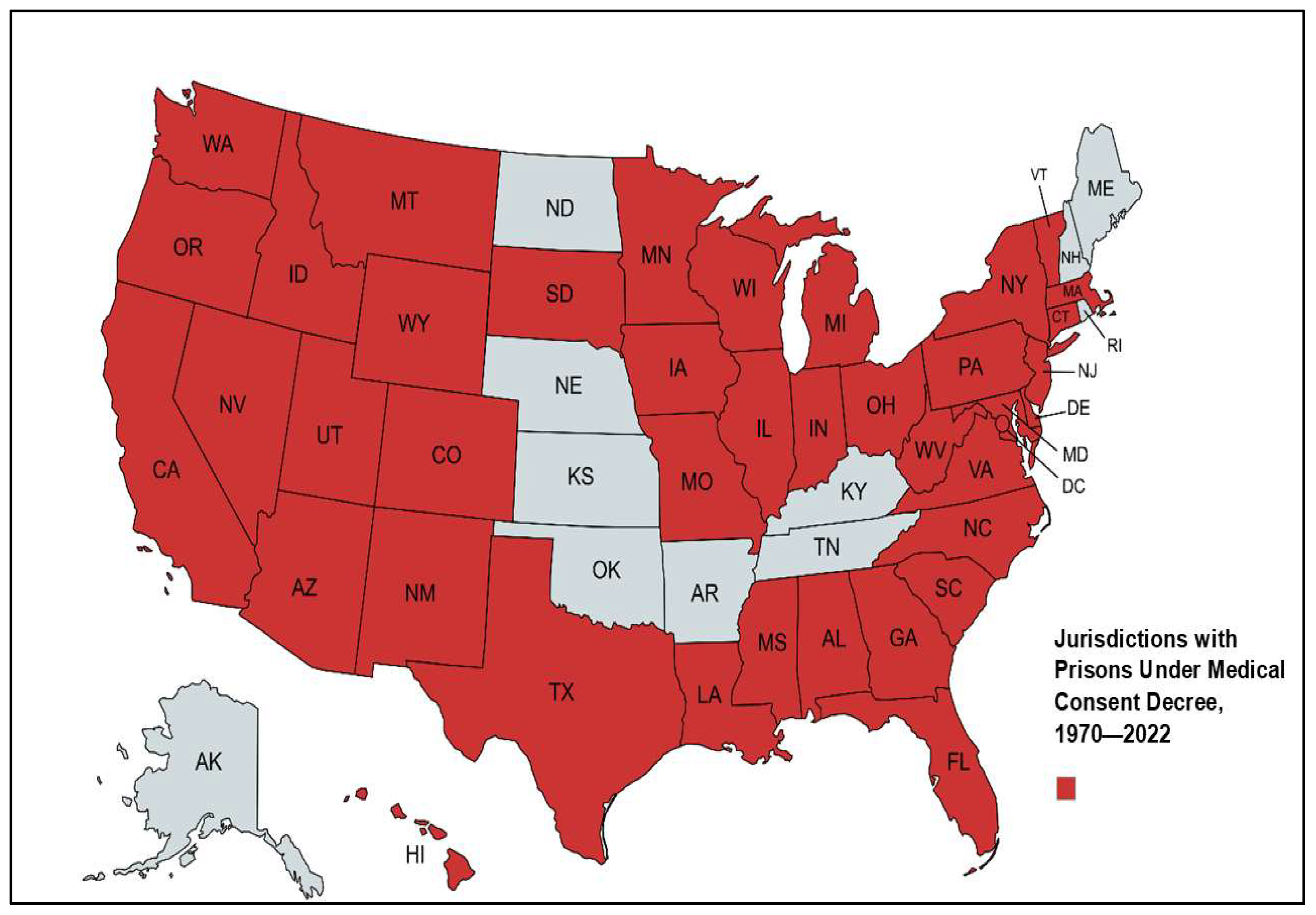
Nearly every state and the federal government are represented in this data set, with an average of three correctional health consent decrees between 1970 and 2022. Some jurisdictions, however, have more than others. New York, Alabama, and California stand out as the jurisdictions with the highest frequency, as shown by Figure 5, below. This runs contrary to the impression that primarily southern states were subject to conditions of confinement litigation. As Figure 6 shows, only 11 states in the Midwest, South, and Northeast are not represented, at least in this database. This may suggest that courts and litigants outside of these regions have been more willing to engage in negotiation to form these kinds of agreements, or simply that the litigation that does occur has not led to a consent decree or settlement.

3.2. Substantive Policy Goals and Reform Mechanisms

For the 96 cases where the text of the consent decree or settlement agreement is available, we conducted an in-depth review of each agreement, as outlined in the Section 2. This review was guided by the following codebook discussed in the Section 2. In this section, we discuss key findings regarding the policy goals of the consent decrees and settlement agreements we reviewed.

3.2.1. Budgets and Budgetary Politics

Budgetary concerns are front and center in correctional health reform, as improvements in services, from hiring staff to updating equipment, and other substantive changes require an outlay of funds. Whether those funds come from redirecting currently appropriated dollars from other correctional units or requesting higher budgets from the state legislature, more resources are almost always required to improve correctional healthcare delivery. Indeed, Feeley and Rubin’s (2000) studies suggest that some prison administrators welcome litigation as a means to leverage the executive branch and legislature into allocating more funds to prison management.
From our review of agreement provisions addressing budgetary concerns, we find strong evidence for the primacy of budgetary concerns and the challenges of securing funding increases through judicial orders alone. As much of the literature has noted, it is difficult for courts to compel spending. This is reflected in how consent decrees and settlements address budgetary concerns—largely committing to make a good faith effort to secure funding but recognizing that this depends on the willingness of the legislative branch to deliver. In Disability Law Center v. Massachusetts, the agreement limitation is made clear: “The parties acknowledge that implementation of this Settlement Agreement is subject to the availability and receipt of appropriated funds,” but “the lack of funding does not preclude the Court from entering any order to achieve compliance with this Settlement … provided that the Department reserves the right to assert that the lack of funding should be taken into account in any remedial order” (Disability Law Center, Inc. 2011, p. 19). This shows the tension between the court’s assertion of authority and the correctional capacity to undertake policy reforms. While the court may want to direct funding toward specific ends, it will inevitably be constrained by budget realities.
That does not mean, however, that the effort is hopeless. For one thing, the agreements contain evidence that negotiators actively seek executive and legislative support to secure funding to support settlement policy goals. Executive-branch budget recommendations are considered in formulating agreements. In one New Jersey settlement, it is noted that the “Governor of the State of New Jersey has recommended to the legislature that $16,000,000 be appropriated to fund additional mental health treatment service” (D.M. v. Terhune 1999, p. 10) as the agreement discusses priorities for mental health service reforms. These efforts often occur as agencies make budgetary requests for the upcoming fiscal year. A South Carolina agreement mentions that “[w]hile not guaranteed, [South Carolina Department of Corrections] (SCDC) has a good faith basis for believing additional funding in the same amount will be approved for recurring fiscal years and SCDC agrees to take steps to continue to request this … to the extent necessary to comply with the terms of this Treatment Consent Decree” (Geissler v. Stirling 2020, p. 7). At least some of the time, efforts have proved successful. This is most clearly demonstrated when settlements are acknowledged explicitly in the state budget. The D.M. v. Terhune settlement agreement states that “[f]unds currently appropriated in the Fiscal Year 1999 budget for the implementation of the Plan” with a total of “approximately $2.1 million, will be utilized to fund the Plan” (D.M. v. Terhune 1999, p. 10). This result might not always be recorded in the legislative record, but it does suggest a path for potential influence.
From the defense’s perspective, as the party best positioned to make requests as part of the executive branch, these requests both signal to the court their willingness to make an effort to comply with the substantive agreement’s goals and enable them to increase their capacity as policy actors. This logic is echoed in Gates v. Deukmejian, where in lieu of a clear funding stream, defendants commit to “request such funding for additional staffing under the budgetary processes” as part of the agreement (Gates v. Deukmejian 1990, p. 20). Prison administrators negotiating settlement agreements can use this as leverage to persuade lawmakers for budget increases and to assure courts and plaintiffs they are invested in crafting financially sustainable improvements. External pressure from the court incentivizes these efforts. Another provision in Gates provides that “[a]ny failure, however, timely to secure such funding shall not relieve the defendants of their obligations under the Consent Decree, and the Court may employ whatever means is lawfully available to it to compel timely implementation” (Gates v. Deukmejian 1990, p. 25). By agreeing to make budgetary requests proactively, defendants can avoid or mitigate subsequent court interference.
Courts exert more direct control over the budget in cases where funds have already been appropriated to a prison system. While they do not control the legislature’s funding decisions, they can influence prison administrators to adjust funding plans for what is already within their control. In Plyler v. Moore, the court initially allocated funding for security directed toward medical care, where necessary. Funds “appropriated in FY 1984–85 for additional security guards were to be diverted to address critical medical needs. Any disputes shall be submitted to the Court” (Plyler v. Moore 1985, p. 33). However, direct mandates like this are relatively rare. More often, the terms of the agreements will specify priorities for spending and hiring rather than explicitly call for general shifts in funding. There are numerous examples of provisions to increase staffing (discussed in the next section), pay for medical consultants and monitors, update facilities, or improve testing regimens.
The budgetary politics of the agreement are consequential, as funding drives a significant portion of the proposed reforms aimed at improving correctional healthcare. Budgets have a direct influence on nearly every substantive policy intervention contemplated in a consent decree or settlement agreement. Money alone does not fix all of the challenges involved in improving medical care, but it is a necessary aspect of addressing them. Insufficient correctional healthcare spending is frequently linked to poor quality correctional care, especially as the prison population ages and older residents have more complex health needs (Ahalt et al. 2013; Wallace 2012). Budgetary politics play a significant role in consent decree and settlement negotiation and implementation.

3.2.2. Equipment and Facility Upgrades

Improving the quality of healthcare facilities and equipment is also a key part of better meeting health needs. Many of the alleged constitutional violations surrounding correctional healthcare stem from outdated, malfunctioning, or nonexistent equipment. To remedy this, the agreements often contain terms outlining what equipment should be acquired or maintained, along with the creation of new facilities to enhance medical services. Common examples include cardiac resuscitation equipment (Washington v. Keller), EKG and x-ray machines (Milburn v. Coughlin), wheelchairs, bandages, and diapers (Scott v. Clark). For COVID-19 management, this focused on personal protective equipment for staff and residents (see Whorley v. Northam 2021). These expansions allow more medical care and support for those with disabilities to be provided on-site in correctional settings rather than necessitating outside trips.
New construction to expand capacity for medical care and housing is also featured in the agreements, tending to increase the correctional footprint overall. Generally speaking, prisons are overcrowded, and space is in high demand. Agreements to dedicate more physical space for medical care, either through the reallocation of current space or the construction of new units, frequently appear in consent decrees. The Goff mental health agreement, for example, includes discussion of a special needs unit to be constructed using both state and federal funding (Goff v. Harper 1999). In cases where litigation addresses care for specific medical conditions, housing and medical care may be constructed to specifically meet these needs, separate from the general population: “Acute Care Unit … for housing inmates whose individual medical condition, as determined by the HIV Specialist or another authorized medical professional, justifies special housing assignments” (Henderson v. Thomas 2013, p. 7). Likewise, in Anderson v. Cooughlin, the agreement provides for construction of a new housing unit for the physically disabled and chronically ill, separate from the general population (Anderson v. Coughlin 1989). While these extensions may allow for increased capacity to address specialized medical needs and improve care, an interesting consequence is that they also increase the size of prisons themselves.

3.2.3. Compliance, Quality Improvement, and Accreditation

One major focus of the agreements is the various tools employed to seek compliance with agreement goals, all of which intervene at different points in the medical care process in an effort to improve care and prevent unnecessary deaths. To verify what steps were taken to address medical issues, most occur after patients are seen. Audits of medical records, for example, are a common strategy to monitor compliance. The Hadix v. Caruso settlement, for example, requires physicians and administrators to “examine retrospectively all death cases and a random sample of health records, assessing the quality of medical decisions, the adequacy of medical supervision of care, and the quality of medical record documentation” (Hadix v. Caruso 1989, p. 92). Auditing is also used to retrospectively monitor care by auditing grievances. Grievances are complaints made by incarcerated people about their conditions of confinement, documented in a formal complaint process correctional facilities administer and monitor (Calavita and Jenness 2015). While there are certainly issues that do not get documented, grievances are still an important source of evidence for the quality of care since they capture issues prisoners seek administrative remedies for, including medical remedies. Additionally, the PLRA requires the prison legal grievance process be exhausted before inmates can file a complaint in district court (Prison Litigation Reform Act 1995; Schrader 1996). That means that any prison issue that eventually becomes the basis of a legal complaint will have to first go through the grievance process. Thus, many of the settlement agreements audit grievances not only to assess how complaints about access to care and the quality of care received change over time but to prevent future litigation.
Some of the agreements create Quality Improvement Committees (QICs), typically made up of correctional medical providers and administrators, to meet regularly to check the progress of implementation of agreement strategies and troubleshoot difficulties. In the Henry v. DeLand agreement, for example, the QIC was tasked to “monitor all medical services to ensure that care is administered to standard, that follow-upon inmates/failures to keep appointments and to refill prescription is documented in the medical record, and to identify trends or deficiencies within the health care program” (Henry v. DeLand 1992, p. 17). The Connecticut v. Choinsky settlement’s quality assurance team oversaw the progress of staffing levels and recruitment. These teams are also deployed to conduct the audit reviews, as mentioned above. Again, in Hadix, prison administrative staff were tasked with processing grievance audits, but in other cases, monitors and other personnel would examine grievances together in QICs.
Monitoring site visits are also a cornerstone of settlement management. Monitoring visits are often conducted by appointed agreement monitors as well as by plaintiffs’ counsel as a form of implementation oversight. The rules for the frequency of visits and what can be accessed are outlined in detail in the agreements. In Milburn v. Coughlin, for example, the plaintiffs’ counsel could conduct only four monitoring visits per year and was required to provide the prison facility with at least 72 h notice before each visit. During these visits, they receive access to the medical care centers inside the prison and can review the medical records of all plaintiff class members. In Dickerson v. Castle, plaintiffs’ attorneys were allowed to meet with up to 10 inmates at a time every month to ask about their medical care. Court-appointed monitors, however, were typically given more discretion in their inspections. The Flynn settlement permitted agreement monitors “full access to TCI (e.g., ability to speak with TCI employees, access to relevant documents, access to facilities, ability to speak confidentially with prisoners)” during site visits (Flynn v. Doyle 2010, p. 5). The visits might be set on a particular schedule, but the scope of what can be investigated, who can be questioned, and for how long is typically more expansive for agreements that have court-appointed or jointly appointed (by plaintiffs and defense) monitors than those where plaintiffs’ counsel monitor enforcement themselves.
Finally, accreditation of prison healthcare programs is also a policy focus of some consent decrees and settlements. Since the 1970s, professional certification of correctional health institutions has aimed to ensure jails and prisons meet specific standards of quality (Gibson and Phillips 2016; Headworth and Zaborenko 2021). Interestingly, while certification requirements did appear, they did not appear as frequently as initially expected. In the data set We examined, approximately 10 of the consent decrees or settlement agreements discussed correctional health accreditation. Most frequently, they mention the National Commission on Correctional Healthcare (NCCHC), but a few also cite the standards of the American Correctional Association (ACA). NCCHC guidelines provide standards for jail and prison healthcare, covering topics such as disease prevention, screening, and personnel training. NCCHC also has specialized accreditation for mental healthcare, opioid treatment, and other issues. The NCCHC website suggests that accreditation “helps our facilities follow legal and regulatory requirements related to health care, and adherence to the NCCHC standards reduces the risk of health care-related lawsuits and legal challenges” (National Commission on Correctional Health Care 2024, para. 8).
Typically, when accreditation is mentioned, the consent decrees incorporate their accreditation goals in the improvement plan, and the facilities subject to the agreement seek accreditation. For example, Ohio’s Busey v. Corrections Corp. settlement agreement requires facilities “seek and obtain ACA and NCCHC accreditation no later than 11/1/99 [1 November 1999] and shall thereafter maintain such accreditation during the life of this agreement” (Busey v. Corrections Corp. 1999, p. 6). But most agreements did not contain similar provisions. It may be that jurisdictions have elected to adopt certification plans outside of consent decree negotiations, which could be one reason they are not explicitly mentioned in most of the database’s agreements. This does not mean that accreditation is unimportant for understanding correctional health litigation or setting policy goals, but it was not a frequently occurring term in the consent decrees and settlement agreements.

3.2.4. Staff Recruitment and Training

The need for increased staffing to meet medical needs—including doctors, nurses, dentists, dental assistants, and other specialized medical professionals—was explicitly mentioned across the agreements and consent decrees. This is unsurprising, given that staff shortages, especially those of medical providers, frequently appear in the research literature on prisons (Morris and Edwards 2022). In some agreements, staff increases were set and approved in the text of the consent decree itself. In Austin v. Pennsylvania Department of Corrections, for example, specific hiring mandates were set:
[By] FY 1995–1996, the DOC will provide a minimum of 10 registered nurse (RN) positions for each 1000 prisoners in a facility. 13. By FY 1995–1996 the DOC will provide a minimum of one (1) FTE dentist for facilities with less than 1000 prisoners, two (2) FTE dentists for facilities with between 1001–2500 prisoners and three (3) FTE dentists for facilities with 2501–4000 prisoners. At facilities with up to 2000 prisoners or less, the DOC will provide one (1) FTE dental assistant.
In another example of specific hiring mandates, the Anderson v. Coughlin mental health settlement required the following: “a total of two and one-half psychiatrists, two Ph.D. Psychologists, five psychiatric social workers, 12 RN’s, 12 LPN’s, 48 attendants, one medical records administrator and one clerk-typist employed on a full-time equivalent basis in the PsychUnit beginning 1 August 1989 and thereafter” (Anderson v. Coughlin 1989, p. 7). Other agreements could be vague, perhaps deliberately to preserve implementation flexibility, about the precise staffing goals that needed to be met. Scott v. Clarke’s agreement laid out that the facility “shall establish and maintain a sufficient number of health staff of varying types or adopt such other measures as shall be necessary to provide inmates with adequate and timely evaluation and treatment, including continuity and coordination of care” (Scott v. Clarke 2015, p. 4), but gives no specific guidance on precisely what this means. In still others, staffing plans were required, but the details of what those plans entailed were subject to later review and approval by the court.
Staff training to better detect, respond to, and effectively treat patient needs was also a significant policy focus of the agreements. Some agreements focused on training staff to meet new standards and requirements of the settlement agreement and provided timetables for the training (see Langford v. Racclot). Other jurisdictions’ training regimes sought to innovate with new practices. For example, Utah’s settlement in the Henry v. DeLand litigation introduced multidisciplinary training where “medical and dental staff and correctional staff will work together to maximize appropriate medical and dental services for inmates” (Henry v. DeLand 1992, p. 9) under the logic that health responses could be improved if healthcare providers and corrections officers learned and trained together. Where agreements covered care for specific conditions, like HIV, specialized training tended to be required for clinical staff. The Henderson v. Thomas agreement required a “mandatory preceptorship” for clinical working in HIV housing units based on “the expected tasks assigned to them related to HIV-specific care” (Henderson v. Thomas 2013, p. 11). By introducing new staff training programs, the agreements provide an additional avenue to enforce compliance with the negotiated health reforms.

3.2.5. Patient Rights

Patient rights—including the rights to access care and to decide whether and how they receive care—are also a major concern of the consent decrees and settlements. Our content analysis revealed a significant emphasis on the right to receive care and access medication without undue interference, as well as patient privacy rights and, in some cases, the right to refuse care. Generally, since the litigation was prompted by a lack of timely access to quality care, several agreements emphasize issues of access. The Fussell v. Wilkinson litigation, for instance, calls for a “right to adequate dental care that shall include a program of preventive care and cleaning, oral health education, and immediate access to care for urgent or painful conditions” (Fussell v. Wilkinson 2005, p. 56). The Henry v. DeLand consent decree outlines a right to “daily on-site access to licensed health care professionals for assessment, triaging and as clinically indicated, treatment or referral of health care complaints” (Henry v. DeLand 1992, p. 14). Other provisions seek to limit potential interference between patients and receiving treatment. The McDonald v. Armantrout agreement requires medications “be dispensed within 24 h, or sooner if required by the prescription, and after that shall be dispensed at the intervals required on the prescription” (McDonald v. Armantrout 1986, p. 7). As measured by written policy, at least, access to care is a major focus of consent decrees and settlements.
Patient privacy rights are another primary focus. Patient privacy broadly encompasses protections for patient medical records, but also extends to physical privacy during exams and treatment, albeit less frequently. Codes related to both medical privacy and medical records indicate a concern with the privacy of medical records. Sometimes these start with general statements that a Department of Corrections will “comply… as to the confidentiality of mental health records” (Rasho v. Walker 2016, p. 22), but they delve into greater detail on the transfer of patient records, training, and other policies to be formulated in furtherance of implementation. Notably, updating medical records to electronic format and away from paper-only systems also came up in many agreements, both for privacy reasons and to better facilitate care. As far as physical privacy during exams, these provisions point to a need for private space to conduct medical exams and better protect confidential patient information. Since prisons are often overcrowded and space is at a premium, it makes sense that it is a policy concern. A typical instance says, “[T]o encourage full and frank disclosure … mental health screening shall take place in the most private space available at the receiving and classification facilities” (Rasho v. Walker 2016, p. 7). But besides protecting patient comfort, there are also scenarios where privacy-related clauses are meant to prevent new legal issues for patients. For example, Colorado’s Nolasco v. Romer settlement contains a passage that clarifies “any and all admissions or statements made by inmates concerning wrongful sexual behavior while participating in or applying for admission into any sex offender program will be considered to be a part of a confidential medical record and a privileged communication” (Nolasco v. Romer 1992, p. 6). Here, reinforcing privacy protections for patient communications with medical staff certainly addresses patient comfort and willingness to disclose information during therapy, but it also provides guidance for expansion of the sex offender program that accompanied the settlement.
Finally, issues surrounding forced care and the right to refuse care also come up in patient-rights sections. In some cases, these provisions protect patients from reprisals for refusing care. In Plyer v. Moore, one clause states, “[R]efusal of health evaluation or health services by any individual plaintiff, regarding non-life-threatening or non-contagious conditions, shall not be the subject of discipline or punishment or result in confinement in segregation” (Plyler v. Moore 1985, p. 32). In particular cases like the hepatitis C settlement in Chimenti v. Pennsylvania where the entire focus was on providing a particular treatment, the option to opt out was made clear: inmates “have the right to refuse [Direct Acting Antiviral] treatment [for hepatitis C], but they shall be counseled by a health care provider regarding the risks of refusing treatment and the benefits of … treatment” (Chimenti v. Pennsylvania Department of Corrections 2018, p. 6). The exceptions tend to come, however, when treatment relates to mental health conditions that supposedly put the patient or others at risk. Particular reference is made to forced medication for patients prescribed psychotropic medications. In Austin v. Pennsylvania Department of Corrections, the agreement allows the Department of Corrections to place “non-compliant with medication inmates in administrative custody” (Austin v. Pennsylvania Department of Corrections 1995, p. 16). Similarly, Illinois’s Rasho agreement discusses its “involuntary administration of psychotropic medication” policies. These policies are referenced in the agreements rather than addressed in detail, but there is at least an acknowledgment that forced medication does occur.

4. Discussion

This paper asks (1) what changes to health policy and services in prisons have been required by court-approved settlements or consent decrees, and how have these changed over time and location, and (2) what do the features of these consent decrees tell us about court-managed reform of correctional healthcare. Regarding the first question, our exploratory analysis reveals that these agreements are active in most jurisdictions, including 39 states and the federal government, between 1970 and 2022, with the majority of states having at least three active cases. The cases usually cover general medical care, mental health, dental care, or treatment for a handful of specific conditions like HIV, hepatitis C, and COVID-19. The number of active consent decrees peaked in the early 1990s. While major changes to prison-conditions litigation brought about by the PLRA caused a decline for several years, their numbers rebounded through the early 2020s, continuing up to the era of COVID-19-related cases. These findings echo studies of prison conditions litigation that the PLRA did not end consent decrees and injunctions altogether, though it did limit their formation and lead to a narrowing of their scope (Schlanger 2006, 2015). More broadly, these findings demonstrate that the policy goals outlined in settlement agreements and consent decrees employ a range of mechanisms. The most prominent are staff increases and training programs, budgetary negotiations with the legislative and executive branches, audits and inspections of healthcare operations, and investigations into patient rights. However, the success of each of these approaches is a separate question—one that might be explored in a systematic review of monitoring reports and appropriate causal studies, which match outcome data with each policy goal.
One interesting policy variation was the range in specificity in the agreement terms. For example, while some agreements provided precise details about the number of staff to be hired to meet compliance, others were quite vague, merely noting that sufficient or appropriate staff should be maintained, without offering any definition or guidance on what that might entail. Public law theorists suggest policy ambiguity facilitates compromise. In the context of legislative ambiguity, “divided government results in policy ambiguity because it creates the necessity for uneasy compromise between opposing parties who often cannot agree on policy specifics” (VanSickle-Ward 2010, p. 9). The same logic may apply here. Settlement negotiations concurrent with an adversarial litigation process may require some ambiguity to secure an agreement and avoid trial. Perhaps the ambiguity of some settlement agreements is a signal of relatively more contentious litigation or negotiation processes than those settlements with more specific provisions. If true, the specificity of agreement might also be a predictor of implementation success, to the extent that agreement between the plaintiff and defense facilitates the adoption of implementation strategies.
It is also apparent from these agreements that their tendency is to expand the scope and capacity of correctional institutions to provide healthcare services—largely increasing, rather than decreasing, carceral footprints. With the exception of the COVID-19 cases, where home releases were a strategy to mitigate the spread of contagious diseases, these agreements are not decarceral—they seek to add to correctional capacities in health services by increasing the amount and quality of resources in prison that are otherwise underfunded and understaffed, particularly when compared to security resources. This aligns with findings in other studies that correctional administrators may find these agreements desirable to the extent that increased resources for reform can facilitate improvements to prison facility conditions and services (Feeley and Rubin 2000). From a different perspective, abolitionist critiques of prison reform have emphasized that reforms intended to make incarceration more humane can entrench it (Gilmore 2007). Important here is the distinction between “reformist reforms,” which improve conditions but leave the carceral system intact, and “non-reformist reforms” which reduce the power and reach of carceral institutions (Bell 2021). With respect to healthcare, there may be opportunities to both improve care while advocating for structures that create community capacity to meet health needs outside of carceral systems, and that these kinds of care can prevent the need to use carceral institutions (Dumont et al. 2012). To the extent that prison overcrowding is itself a contributor to poor healthcare services (MacDonald 2018; Warmsley 2005), it is worth asking whether litigants, monitors, or other actors consider improvements to correctional health services as simply a matter of increasing the resources that go to healthcare versus right-sizing how healthcare services are provided as populations rise and fall. The U.S. prison population declined approximately 20% between 2009 and 2022 (Bureau of Justice Statistics 2023). Did healthcare-related litigation also fall at a similar rate? The impact of population changes on healthcare services and litigation also merits study for understanding what services are offered and how this influences health outcomes.
This study describes general trends in healthcare consent decree usage over time, as well as the policy goals and tools employed to implement them. By undertaking a systematic look at hundreds of consent decrees and settlements, we can gain a more detailed understanding of how their interventions into correctional healthcare policy and service delivery are formulated. While it is systematic, however, this study might not be exhaustive—some cases dealing with correctional healthcare are not contained in the Clearinghouse. However, it does significantly build upon prior literature that mainly described just one or a small handful of cases on correctional health reform via consent decree. To fully and fairly evaluate consent decrees and similar settlements for efficacy and impact, we must first understand what they aspire to achieve, what they do not, and how they define success before we can fully assess implementation fidelity or attempt outcome studies. Of course, since this study focuses on law and policy as it is written (or “law on the books”), the question of whether and to what extent it is implemented and becomes “law in action” remains outstanding (Pound 1910). Simply because a policy is written down does not mean that it gets enforced or carried out as intended, if at all. Future research that empirically examines the implementation of these consent decrees and the extent to which they either meet the textual commitments outlined in the agreements would be a valuable contribution.
This study does not settle the debate between those skeptical of courts’ ability to effect social change (e.g., Rosenberg 2008) and those who argue courts can, under the right conditions (e.g., Feeley & Rubin) facilitate meaningful reforms. But it does outline how, for the case of prison reform, at least, we might test the strength of these arguments. To that end, subsequent research might follow up to explore and compare implementation of these agreements across medical need type—perhaps it is easier to manage and oversee reforms to improve Hepatitis C or HIV treatments than it is to improve care for medical or mental healthcare in general, which are more complex and labor-intensive efforts. Comparative case studies that look beyond the agreements themselves to study the complete timeline of the case, from preliminary motions through settlement agreement, amendments, and monitoring reports, can give a more in-depth look at barriers and facilitators to positive outcomes. Finally, outcome studies that evaluate the effectiveness of consent decrees in changing reliably tracked health metrics should also be conducted to inform policy and practice.

Author Contributions

Conceptualization, B.J.J.-G.; methodology, B.J.J.-G., J.Y., and J.V.; software, B.J.J.-G. and J.Y.; validation, B.J.J.-G. and J.Y.; formal analysis, B.J.J.-G.; investigation, B.J.J.-G., J.Y., and J.V.; resources, B.J.J.-G.; data curation, B.J.J.-G. and J.V.; writing—original draft preparation, B.J.J.-G.; writing—review and editing, B.J.J.-G. and J.V.; visualization, B.J.J.-G. and J.V.; supervision, B.J.J.-G.; project administration, B.J.J.-G.; funding acquisition, B.J.J.-G.; All authors have read and agreed to the published version of the manuscript.

Funding

This work was supported by the Health Policy Research Scholars, a program of the Robert Wood Johnson Foundation.

Data Availability Statement

The data used in this study were compiled by the authors from publicly available court documents and case materials, primarily the Civil Rights Litigation Clearinghouse and federal court dockets. No proprietary or restricted data were used. The processed dataset and coding scheme are available from the corresponding author upon reasonable request.

Acknowledgments

The authors acknowledge and thank the Civil Rights Litigation Clearinghouse for providing access to court documents and case materials essential to this research.

Conflicts of Interest

The authors declare no conflict of interest.

References

  1. Ahalt, Cyrus, Robert L. Trestman, Josiah D. Rich, Robert B. Greifinger, and Brie A. Williams. 2013. Paying the price: The pressing need for quality, cost, and outcomes data to improve correctional health care for older prisoners. Journal of the American Geriatrics Society 61: 2013–19. [Google Scholar] [CrossRef] [PubMed]
  2. Anderson, Lloyd C. 2000. Voices from a Southern Prison. Athens: University of Georgia Press. Available online: http://www.jstor.org/stable/j.ctt46np2c (accessed on 1 October 2025).
  3. Anderson v. Coughlin. 1989. Consent Decree, No. 77-CV-0470 (S.D.N.Y.). Available online: https://clearinghouse.net/case/884/ (accessed on 1 October 2025).
  4. Austin v. Pennsylvania Department of Corrections. 1995. Consent Decree, No. 2:90-cv-07497-JD (E.D. Pa. January 6). Available online: https://clearinghouse.net/case/922/ (accessed on 1 October 2025).
  5. Baer, Harold, Jr., and Arminda Bepko. 2007. A Necessary and Proper Role for Federal Courts in Prison Reform: The Benjamin v. Malcolm Consent Decrees. New York Law School Law Review 52: 3. [Google Scholar]
  6. Bell, Mariana. 2021. Abolition: A New Paradigm for Reform. Law & Social Inquiry 46: 32–68. [Google Scholar] [CrossRef]
  7. Bureau of Justice Statistics. 2023. Prisoners in 2022—Statistical Tables; Washington, DC: Bureau of Justice Statistics, U.S. Department of Justice. Available online: https://bjs.ojp.gov/document/p22st_sum.pdf (accessed on 1 October 2025).
  8. Busey v. Corrections Corp. 1999. Settlement Agreement, No. 4:97-cv-01995 (N.D. Ohio March 1). Available online: https://clearinghouse.net/case/901/ (accessed on 1 October 2025).
  9. Calavita, Kitty, and Valerie Jenness. 2015. Appealing to Justice: Prisoner Grievances, Rights, and Carceral Logic. Berkeley: University of California Press. [Google Scholar]
  10. Chilton, Bradley S. 1991. Prisons Under the Gavel: The Federal Court Takeover of Georgia Prisons. Columbus: Ohio State University Press. [Google Scholar]
  11. Chimenti v. Pennsylvania Department of Corrections. 2018. Settlement Agreement, No. 2:15-cv-03333-JP (E.D. Pa. November 19). Available online: https://clearinghouse.net/case/15386/ (accessed on 1 October 2025).
  12. Civil Action for Deprivation of Rights, 42 U.S.C. § 1983. 1871. Available online: https://www.law.cornell.edu/uscode/text/42/1983 (accessed on 1 October 2025).
  13. Civil Rights Litigation Clearinghouse. 2021. Mission. Available online: https://clearinghouse.net/about (accessed on 1 October 2025).
  14. Cloud, David H., Ilana R. Garcia-Grossman, Andrea Armstrong, and Brie Williams. 2023. Public Health and Prisons: Priorities in the Age of Mass Incarceration. Annual Review of Public Health 44: 407–28. [Google Scholar] [CrossRef]
  15. Dilulio, John J. 1990. Courts, Corrections, and the Constitution: The Impact of Judicial Intervention on Prisons and Jails. Oxford: Oxford University Press. [Google Scholar]
  16. Disability Law Center, Inc. 2011. Disability Law Center, Inc. v. Massachusetts Department of Correction. Settlement Agreement, No. 1:07-cv-10463-MLW (D. Mass. December 12). Boston: Disability Law Center, Inc. [Google Scholar]
  17. D.M. v. Terhune. 1999. Settlement Agreement, No. 3:96-cv-01840-AET (D. N.J. July 30). Available online: https://clearinghouse.net/case/823/ (accessed on 1 October 2025).
  18. Dumont, Dora M., Brad Brockmann, Samuel Dickman, Nicole Alexander, and Josiah D. Rich. 2012. Public health and the epidemic of incarceration. Annual Review of Public Health 33: 325–39. [Google Scholar] [CrossRef]
  19. Estelle v. Gamble, 429 U.S. 97. 1976. Available online: https://supreme.justia.com/cases/federal/us/429/97/ (accessed on 1 October 2025).
  20. Favril, Louis, Josiah D. Rich, Jake Hard, and Seena Fazel. 2024. Mental and physical health morbidity among people in prisons: An umbrella review. The Lancet Public Health 9: e250–e260. [Google Scholar] [CrossRef]
  21. Feeley, Malcolm M., and Edward L. Rubin. 2000. Judicial Policy Making and the Modern State: How the Courts Reformed America’s Prisons. Cambridge: Cambridge University Press. [Google Scholar]
  22. Flynn v. Doyle. 2010. Settlement Agreement, No. 3:07-cv-00545-BBC (W.D. Wis. September 24). Available online: https://clearinghouse.net/doc/37337/ (accessed on 1 October 2025).
  23. Fowler v. Turco. 2018. No. 1:15-cv-12298-NMG (D. Mass.). Available online: https://clearinghouse.net/case/15889/ (accessed on 1 October 2025).
  24. Fussell v. Wilkinson. 2005. Settlement Agreement, No. 1:03-cv-00704-SSB, 2005 WL 3132321 (S.D. Ohio November 22). Available online: https://clearinghouse.net/case/910/ (accessed on 1 October 2025).
  25. Gates v. Deukmejian. 1990. Consent Decree, No. 2:87-cv-01636-LKK-JFM (E.D. Cal. March 8). Available online: https://clearinghouse.net/case/575/ (accessed on 1 October 2025).
  26. Geissler v. Stirling. 2020. Consent Decree, No. 4:17-cv-01746-MBS (D.S.C. June 8). Available online: https://clearinghouse.net/doc/131291/ (accessed on 1 October 2025).
  27. Gibson, Brent R., and Gary Phillips. 2016. Challenges and opportunities in correctional health care quality: A descriptive analysis of compliance with NCCHC standards. Journal of Correctional Health Care 22: 280–89. [Google Scholar] [CrossRef]
  28. Gilmore, Ruth W. 2007. Golden Gulag: Prisons, Surplus, Crisis, and Opposition in Globalizing California. Berkeley: University of California Press, vol. 21. [Google Scholar]
  29. Goff v. Harper. 1999. Consent Decree, No. 4:90-cv-30365 (S.D. Iowa). Available online: https://clearinghouse.net/case/661/ (accessed on 1 October 2025).
  30. Hadix v. Caruso. 1989. Consent Decree, No. 4:80-cv-00735 (W.D. Mich.). Available online: https://clearinghouse.net/case/5522/ (accessed on 1 October 2025).
  31. Harris, M. Kay, and Dudley P. Spiller. 1977. After Decision: Implementation of Judicial Decrees in Correctional Settings. Washington, DC: Department of Justice, Law Enforcement Assistance Administration, National Institute of Law Enforcement and Criminal Justice. [Google Scholar]
  32. Headworth, Spencer, and Callie Zaborenko. 2021. Legal reactivity: Correctional health care certifications as responses to litigation. Law & Social Inquiry 46: 1173–205. [Google Scholar] [CrossRef]
  33. Henderson v. Thomas. 2013. Settlement Agreement, No. 2:11-cv-02248-AKK (N.D. Ala. August 6). Available online: https://clearinghouse.net/case/12402/ (accessed on 1 October 2025).
  34. Henry v. DeLand. 1992. Settlement Agreement, No. 2:85-cv-01136 (D. Utah). Available online: https://clearinghouse.net/case/968/ (accessed on 1 October 2025).
  35. Levitsky, Sandra Rachel. 2013. Integrating Law and Health Policy. Annual Review of Law and Social Science 9: 33–50. [Google Scholar] [CrossRef]
  36. Lewer, Dan, and Chantal Edge. 2024. Preventing deaths after prison release. The Lancet 403: 1727–29. [Google Scholar] [CrossRef]
  37. MacDonald, Morag. 2018. Overcrowding and its impact on prison conditions and health. International Journal of Prisoner Health 14: 65–68. [Google Scholar] [CrossRef]
  38. Mack v. Lopes. 1989. No. 2:87-cv-00221 (D. Conn.). Available online: https://clearinghouse.net/doc/3020/ (accessed on 1 October 2025).
  39. Martinez-Brooks v. Easter. 2020. 459 F. Supp. 3d 411 (D. Conn.). Available online: https://clearinghouse.net/case/17532/ (accessed on 1 October 2025).
  40. McCann, Sam. 2023. Everything You Need to Know About Consent Decrees. New York: Vera Institute of Justice. Available online: https://www.vera.org/news/everything-you-need-to-know-about-consent-decrees (accessed on 1 October 2025).
  41. McDonald v. Armantrout. 1986. Consent Decree, No. 2:85-cv-04422 (W.D. Mo. May 22). Available online: https://clearinghouse-umich-production.s3.amazonaws.com/media/doc/56523.pdf (accessed on 1 October 2025).
  42. McPherson v. Lamont. 2020. 457 F. Supp. 3d 67 (D. Conn.). Available online: https://clearinghouse.net/case/17547/ (accessed on 1 October 2025).
  43. Mette, Eliza. 2021. Litigation Prompting State and Local Correctional Systems to Change Opioid Use Disorder Treatment Policies. Portland: NASHP. Available online: https://nashp.org/litigation-prompting-state-and-local-correctional-systems-to-change-opioid-use-disorder-treatment-policies/ (accessed on 1 October 2025).
  44. Morris, Nathaniel P., and Matthew L. Edwards. 2022. Addressing Shortages of Mental Health Professionals in U.S. Jails and Prisons. Journal of Correctional Health Care 28: 209–14. [Google Scholar] [CrossRef] [PubMed]
  45. National Commission on Correctional Health Care. 2024. About Us. Chicago: NCCHC. Available online: https://ncchc.org/about-us/ (accessed on 1 October 2025).
  46. National Research Council and Institute of Medicine. 2013. Health and Incarceration: A Workshop Summary. Edited by Amy Smith. Committee on Law and Justice, Division of Behavioral and Social Sciences and Education and Board on the Health of Select Populations, Institute of Medicine. Washington, DC: The National Academies Press. [Google Scholar]
  47. Neale, Joanne. 2016. Iterative categorization (IC): A systematic technique for analysing qualitative data. Addiction 111: 1096–106. [Google Scholar] [CrossRef] [PubMed]
  48. Nolasco v. Romer. 1992. Settlement Agreement, No. 1:90-cv-00340-JRC (D. Colo. June 12). Available online: https://clearinghouse.net/case/605/ (accessed on 1 October 2025).
  49. Nowotny, Kathryn, Hannah Metheny, Katherine LeMasters, and Lauren Brinkley-Rubinstein. 2023. Age and COVID-19 mortality in the United States: A comparison of the prison and general population. International Journal of Prisoner Health 19: 35–46. [Google Scholar] [CrossRef] [PubMed]
  50. Pennsylvania Department of Corrections v. Yeskey. 1998. 524 U.S. 206. Available online: https://supreme.justia.com/cases/federal/us/524/206/ (accessed on 1 October 2025).
  51. Plyler v. Moore. 1985. Consent Decree, No. 83-1120 (D.S.C. February 1). Available online: https://clearinghouse.net/case/939/ (accessed on 1 October 2025).
  52. Pont, Jörg, Heino Stöver, and Hans Wolff. 2012. Dual loyalty in prison health care. American Journal of Public Health 102: 475–80. [Google Scholar] [CrossRef]
  53. Pound, Roscoe. 1910. Law in books and law in action. American Law Review 44: 12. [Google Scholar]
  54. Prison Litigation Reform Act. 1995. Prison Litigation Reform Act of 1995, 42 U.S.C. § 1997e. Available online: https://ojjdp.ojp.gov/sites/g/files/xyckuh176/files/pubs/walls/appen-b.html (accessed on 1 October 2025).
  55. Rasho v. Walker. 2016. Amended Settlement Agreement, No. 1:07-cv-01298-HAB-JAG (C.D. Ill. May 23). Available online: https://clearinghouse.net/case/12369/ (accessed on 1 October 2025).
  56. Rehabilitation Act. 1973. Rehabilitation Act of 1973, 29 U.S.C. § 701 et seq. Available online: https://www.govinfo.gov/content/pkg/COMPS-799/pdf/COMPS-799.pdf (accessed on 1 October 2025).
  57. Reverby, Susan M. 2019. Can there be acceptable prison health care? Looking back on the 1970s. Public Health Reports 134: 89–93. [Google Scholar] [CrossRef]
  58. Rold, William J. 2008. Thirty years after Estelle v. Gamble: A legal retrospective. Journal of Correctional Health Care 14: 11–20. [Google Scholar] [CrossRef]
  59. Rosenberg, Gerald N. 2008. The Hollow Hope: Can Courts Bring About Social Change? 2nd ed. Chicago: University of Chicago Press. [Google Scholar]
  60. Salehijam, Maryam. 2018. The Value of Systematic Content Analysis in Legal Research. Tilburg Law Review 23: 34. [Google Scholar] [CrossRef]
  61. Schlanger, Margo. 2006. Civil rights injunctions over time: A case study of jail and prison court orders. New York University School of Law 81: 550. [Google Scholar]
  62. Schlanger, Margo. 2015. Trends in Prisoner Litigation, as the PLRA Enters Adulthood Symposium Issue: Prisoners’ Access to Justice: Exploring Legal, Medical, and Educational Rights. UC Irvine Law Review 5: 153–78. [Google Scholar]
  63. Schnittker, Jason, Michael Massoglia, and Christopher Uggen. 2022. Prisons and Health in the Age of Mass Incarceration. Oxford: Oxford University Press. [Google Scholar]
  64. Schoenfeld, Heather, Kimberly Rhoten, and Michael C. Campbell. 2024. Patchwork Protection: The Politics of Prisoners’ Rights Accountability in the United States. Law & Social Inquiry 50: 983–1012. [Google Scholar] [CrossRef]
  65. Schrader, Dorothy. 1996. Prison Litigation Reform Act: An Overview: CRS. Available online: https://li.proquest.com/legislativeinsight/docview?id=CRS-1996-AML-0067&p=18981698F3D&uid=1198 (accessed on 21 August 2023).
  66. Scott v. Clarke. 2015. Settlement Agreement, No. 3:12-cv-00036 (W.D. Va. September 15). Available online: https://clearinghouse.net/case/12278/ (accessed on 1 October 2025).
  67. Smith, Christopher E. 2003. The prison reform litigation era: Book-length studies and lingering research issues. The Prison Journal 83: 337–58. [Google Scholar] [CrossRef]
  68. VanSickle-Ward, Rachel. 2010. The Politics of Precision. State and Local Government Review 42: 3–84. [Google Scholar] [CrossRef]
  69. Wallace, G. Nicholas. 2012. The real lethal punishment: The inadequacy of prison health care and how it can be fixed. Faulkner Law Review 4: 265. [Google Scholar]
  70. Warmsley, Roy. 2005. Prison health care and the extent of prison overcrowding. International Journal of Prisoner Health 1: 3–12. [Google Scholar] [CrossRef]
  71. Whorley v. Northam. 2021. Settlement Agreement, No. 3:20-cv-00255-HEH (E.D. Va. June 4). Available online: https://clearinghouse.net/case/17683/ (accessed on 1 October 2025).
  72. Wildeman, Christopher. 2016. Incarceration and population health in wealthy democracies. Criminology 54: 360–82. [Google Scholar] [CrossRef]
  73. Wright, Lester N. 2008. Health care in prison thirty years after Estelle v. Gamble. Journal of Correctional Health Care 14: 31–35. [Google Scholar] [CrossRef]
  74. Zaitzow, Barbara H., and Anthony K. Willis. 2021. Behind the Wall of Indifference: Prisoner Voices About the Realities of Prison Health Care. Laws 10: 11. [Google Scholar] [CrossRef]
Figure 1. Settlement/Consent Decree Case Type. Other Specialized Care Contains four COVID-19 cases and one case each focused on diabetes, Substance Use Disorder (SUD), pregnancy, maternal care, and hernias. General and mental healthcare are highlighted in blue to further distinct their large share of consent decrees when compared to other conditions, highlighted in gray.
Socsci 15 00013 g001
Figure 2. Trends in Active Settlements/Consent Decrees by Year. SW is shorthand for statewide.
Socsci 15 00013 g002
Figure 3. Causes of Action in Prison Healthcare Consent Decrees.
Socsci 15 00013 g003
Figure 4. Plaintiffs’ Counsel Distribution. 186 total plaintiffs represented from 121 cases.
Socsci 15 00013 g004
Figure 5. Jurisdictions Ranked by Number of Consent Decrees/Settlements. Note: The federal total includes agreements involving District of Columbia prisons.
Socsci 15 00013 g005
Figure 6. Map of Jurisdictions with Prisons Under Medical Consent Decree.
Socsci 15 00013 g006
Table 1. Codes, Descriptions, and Kappa Coefficients of Policy Goals.
CodeDefinitionsKappa Coefficient
Policy Goals κ
Budget increases discussedDoes the agreement discuss steps or strategies to increase the budget for medical care?0.658
Staffing increases discussedDoes the agreement discuss steps or strategies to increase staffing for medical care?1.000
Staff training discussedDoes the agreement discuss training or education programs for staff?0.794
Compliance measurements outlinedThe agreement lists variables to measure agreement compliance0.772
Medical privacyDiscussion of patient privacy rights0.886
Right to refuse careDiscussion patient right to refuse medical care1.000
AccreditationReference made to receiving/meeting external accreditation standards;1.000
Medical recordsChanges to policy or practice regarding medical records/documentation0.765
Other medical guidelines referencedMention of medical care standards or guidelines outside of the accreditation process0.773
Discussion of outside healthcare providersAre arrangements made for outside care in emergencies, for specialized care, or other situations?0.857
Table 2. Summary Statistics of Consent Decree Trends.
Age in YearsIncarceration Trends
Decade StartednMeanMedianModeSDMinMaxTotal Prison Population in Systems (n = 40)
19701918.68202112.12<1352,169,598
1980298.218<0.505.90<0.50204,594,553
1990296.834<0.507.95<0.50309,746,205
2000214.93564.54<0.502013,310,292
2010183.47332.39<0.50813,248,675
Total1217.875<18.62<14246,251,595
Non-Statewide557.194<18.41<14229,321,088
Statewide668.446<18.75<14136,574,604
Note. Cases from 2020 to 2022 are excluded due to their small number from our sample (five total). Total Prison Population in Systems is the number of incarcerated people in jurisdictions covered by these agreements. Total, Non-Statewide, and Statewide row calculations include the five cases from 2020–2022.
Disclaimer/Publisher’s Note: The statements, opinions and data contained in all publications are solely those of the individual author(s) and contributor(s) and not of MDPI and/or the editor(s). MDPI and/or the editor(s) disclaim responsibility for any injury to people or property resulting from any ideas, methods, instructions or products referred to in the content.