
Roots of Rural Youth: A Five-Year Systematic Review of Place Attachment



Abstract
1. Introduction
“A positive affective bond between an individual and a specific place, the main characteristic of which is the tendency of the individual to maintain closeness to such a place”.
2. Material and Methods
2.1. Search Strategies and Information Sources
2.2. Eligibility Criteria
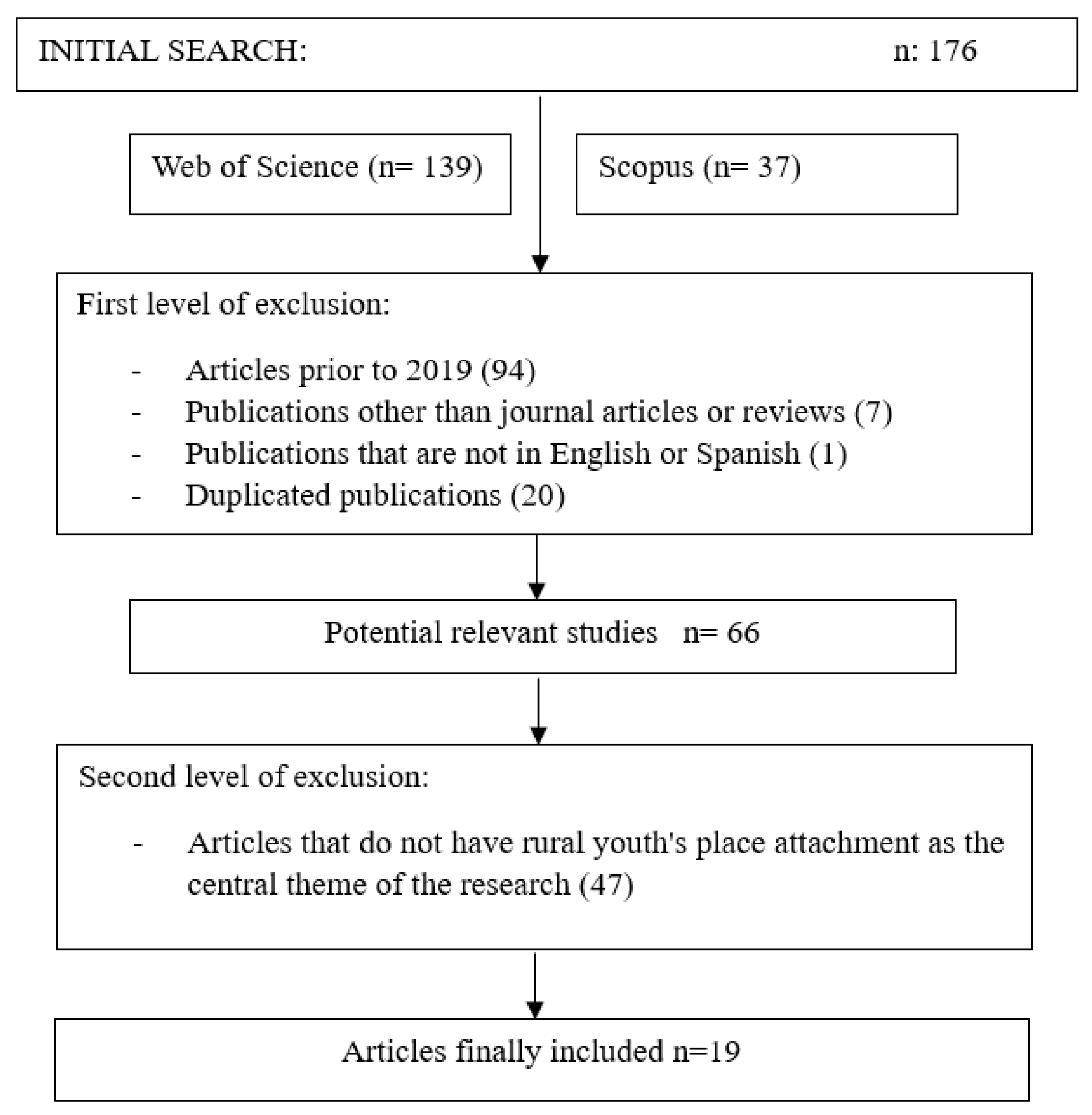
2.3. Selection Process
2.4. Data Collection and Analysis Process
2.5. Study Risk of Bias Assessment
2.6. Synthesis Methods
3. Results
3.1. Country
3.2. Participants
3.3. Methodology
3.4. Topic
3.5. Outcomes
3.6. Concept of Place Attachment
4. Discussion
5. Conclusions
Author Contributions
Funding
Institutional Review Board Statement
Informed Consent Statement
Data Availability Statement
Conflicts of Interest
References
- Ainsworth, Mary D., and Silvia Bell. 1970. Attachment, Exploration, and Separation: Illustrated by the Behavior of One-Year-Olds in a Strange Situation. Child Development 41: 49–67. [Google Scholar] [CrossRef]
- Beckwith, Lily, Sophie Warrington, and Huyen Nguyen. 2023. Listening to Experiences of Environmental Change in Rural Vietnam: An Intergenerational Approach. Progress in Development Studies 23: 461–80. [Google Scholar] [CrossRef]
- Berg, Nina Gunnerud. 2020. Geographies of Wellbeing and Place Attachment: Revisiting Urban–Rural Migrants. Journal of Rural Studies 78: 438–46. [Google Scholar] [CrossRef]
- Bernardo, Fátima, and José Palma-Oliveira. 2013. Place Identity, Place Attachment and the Scale of Place: The Impact of Place Salience. PsyEcology 4: 167–93. [Google Scholar] [CrossRef]
- Bernsen, Nick R., Max S. Crandall, Jessica E. Leahy, Jason B. Abrams, and Chris R. Colocousis. 2022. Do Rural Youth Want to Stay Rural? Influences on Residential Aspirations of Youth in Forest-Located Communities. Community Development 53: 566–84. [Google Scholar] [CrossRef]
- Bouichou, El Houssain, Tahirou Abdoulaye, Khalil Allali, Abdelghani Bouayad, and Aziz Fadlaoui. 2021. Entrepreneurial Intention among Rural Youth in Moroccan Agricultural Cooperatives: The Future of Rural Entrepreneurship. Sustainability 13: 9247. [Google Scholar] [CrossRef]
- Bowlby, John. 1969. Attachment and Loss. Vol. 1: Attachment. New York: Basic Books. [Google Scholar]
- Camarero, Luis. 2020. Despoblamiento, baja densidad y brecha rural: Un recorrido por una España desigual. Panorama Social 31: 47–73. [Google Scholar]
- Camarero, Luis. 2022. Los habitantes de los territorios de baja densidad en España. Una lectura de las diferencias urbano-rurales. Mediterráneo Económico 35: 45–66. [Google Scholar]
- Camarero, Luis, and Rosario Sampedro. 2019. Despoblación y Ruralidad Transnacional: Crisis y Arraigo Rural En Castilla y León. Article. Economía Agraria y Recursos Naturales 19: 59–82. [Google Scholar] [CrossRef]
- Camarero, Luis, Fátima Cruz, Manuel González, Julio A. del Pino, Juan Oliva, and Rosario Sampedro. 2009. La población Rural de España: De los Desequilibrios a la Sostenibilidad Social. Colección Estudios Sociales, no. 27. Barcelona: Fundación “la Caixa”. [Google Scholar]
- Caretta, Martina, Angela Brandon Anthony Rothrock, and Nicolas P Zegre. 2022. Exploring Climate Change Perspectives. An Analysis of Undergraduate Students’ Place-Based Attachment in Appalachia, USA. Rural Sociology 87: 847–72. [Google Scholar] [CrossRef]
- Carrasco-Cruz, Alba, and Fátima Cruz-Souza. 2025. Return to the rural: Ambivalent place attachment among youth in rural Spain. Journal of Rural Studies 119: 103724. [Google Scholar] [CrossRef]
- Castle, Sarah, and Ruby Grant. 2023. Belonging, Identity and Place: Middle-Class Tasmanian Rural Young People in Urban University. Journal of Rural Studies 103: 103139. [Google Scholar] [CrossRef]
- Choi, Hemin. 2023. Determinants of Internal Migration to Smaller Cities: Local Public Goods, Job Opportunities, and Lifecycle Stages. Local Government Studies 50: 617–42. [Google Scholar] [CrossRef]
- Clark, William A. V. 2017. Residential Mobility in Context: Interpreting Behavior in the Housing Market. Papers. Revista de Sociologia 102: 575–605. [Google Scholar] [CrossRef]
- Corbett, Michael. 2007. All kinds of potential: Women and out-migration in an Atlantic Canadian coastal community. Journal of Rural Studies 23: 430–42. [Google Scholar] [CrossRef]
- Cruz, Fátima. 2006. Género, Psicología y Desarrollo Rural: La Construcción de Nuevas Identidades; Edited by Pesca y Alimentación Ministerio de Agricultura. Serie Estudios; Madrid: Ministerio de Agricultura Pesca y Alimentación.
- Cruz, Fátima, and Andrea García-Bengochea. 2020. Socio-Spatial Bonds and Local Governance: Place Attachment and Participation within the Palencia Model Forest Initiative. Estudios Geograficos 81: 1–20. [Google Scholar] [CrossRef]
- Cuervo, Hernán, and Johanna Wyn. 2014. Reflections on the Use of Spatial and Relational Metaphors in Youth Studies. Journal of Youth Studies 17: 901–15. [Google Scholar] [CrossRef]
- Devine-Wright, Patrick. 2013. Think Global, Act Local? The Relevance of Place Attachments and Place Identities in a Climate Changed World. Global Environmental Change 23: 61–69. [Google Scholar] [CrossRef]
- Evans, Ceryn. 2015. Moving Away or Staying Local: The Role of Locality in Young People’s ‘Spatial Horizons’ and Career Aspirations. Journal of Youth Studies 19: 501–16. [Google Scholar] [CrossRef]
- Farrugia, David. 2016. The Mobility Imperative for Rural Youth: The Structural, Symbolic and Non-Representational Dimensions Rural Youth Mobilities. Journal of Youth Studies 19: 836–51. [Google Scholar] [CrossRef]
- Farrugia, David. 2019. Class, Place and Mobility beyond the Global City: Stigmatisation and the Cosmopolitanisation of the Local. Journal of Youth Studies 23: 237–51. [Google Scholar] [CrossRef]
- Farrugia, David, John Smyth, and Trevor Harrison. 2015. Affective Topologies of Rural Youth Embodiment. Sociologia Ruralis 56: 116–32. [Google Scholar] [CrossRef]
- Fried, Marc. 1963. Grieving for a Lost Home. In The Urban Condition: People and Policy in the Metropolis. Edited by Leonard J. Duhl. New York: Simon & Schuster, pp. 124–152. [Google Scholar]
- Fulkerson, Gregory M., and Alexander R. Thomas. 2019. Urbanormativity: Reality, Representation, and Everyday Life. Lanham: Rowman & Littlefield. [Google Scholar]
- García-Arias, Manuel Alejandro, Alfredo Tolón-Becerra, Xavier Lastra-Bravo, and Úrsula Torres-Parejo. 2021. The Out-Migration of Young People from a Region of the ‘Empty Spain’: Between a Constant Slump Cycle and a Pending Innovation Spiral. Journal of Rural Studies 87: 314–26. [Google Scholar] [CrossRef]
- Gerhardt, Alyssa, and Karen Foster. 2021. Beating broke by getting out? Examining the relationship between personal debt and community outmigration. International Journal of Child Youth & Family Studies 12: 25–47. [Google Scholar] [CrossRef]
- Giuliani, Maria Vittoria. 2003. Theory of Attachment and Place Attachment. In Psychological Theories for Environmental Issues. Edited by Mirilia Bonnes, Terence Lee and Marino Bonaiuto. Aldershot: Ashgate, pp. 137–70. [Google Scholar]
- González Fernández, Manuel T., Felipe Contreras Molotla, Enrique Contreras Suárez, and Luis Navarro Ardoy. 2021. Formación, arraigo y movilidad rural-urbana en la juventud mexicana y española. Inter Disciplina 9: 139–155. [Google Scholar] [CrossRef]
- Gustafson, Per. 2001. Meanings of place: Everyday experience and theoretical conceptualizations. Journal of Environmental Psychology 21: 5–16. [Google Scholar] [CrossRef]
- Hidalgo, María del Carmen, and Bernardo Hernández. 2001. Place attachment: Conceptual and empirical questions. Journal of Environmental Psychology 21: 273–81. [Google Scholar] [CrossRef]
- Jorgensen, Bradley S., and Richard C. Stedman. 2001. Sense of place as an attitude: Lakeshore owners attitudes toward their properties. Journal of Enviromental Psychology 21: 233–48. [Google Scholar] [CrossRef]
- Jorgensen, Bradley S., and Richard C. Stedman. 2006. A Comparative Analysis of Predictors of Sense of Place Dimensions: Attachment to, Dependence on, and Identification with Lakeshore Properties. Journal of Environmental Management 79: 316–27. [Google Scholar] [CrossRef]
- Lewicka, Maria. 2011. Place Attachment: How Far Have We Come in the Last 40 Years? Journal of Environmental Psychology 31: 207–30. [Google Scholar] [CrossRef]
- Li, Xin, Reinout Kleinhans, and Maarten van Ham. 2018. Ambivalence in Place Attachment: The Lived Experiences of Residents in Danwei Communities Facing Demolition in Shenyang, China. Housing Studies 34: 997–1020. [Google Scholar] [CrossRef]
- Low, Setha M., and Irwin Altman. 1992. Place Attachment. In Place Attachment. Edited by Irwin Altman and Setha M. Low. Boston: Springer, pp. 1–12. [Google Scholar] [CrossRef]
- Manzo, Lynne C. 2003. Beyond House and Haven: Toward a Revisioning of Emotional Relationships with Places. Journal of Environmental Psychology 23: 47–61. [Google Scholar] [CrossRef]
- Manzo, Lynne C., and Patrick Devine-Wright. 2021. Introduction. In Place Attachment: Advances in Theory, Methods, and Applications, 2nd ed. Edited by Lynne C. Manzo and Patrick Devine-Wright. Abingdon: Routledge, pp. 1–9. [Google Scholar]
- Matysiak, Ilona. 2022. Stayers or Leavers? Spatial (Im)Mobility Patterns of Young University Graduates Living in Rural Areas in Poland. Sociologia Ruralis 62: 131–48. [Google Scholar] [CrossRef]
- Moher, David, Alessandro Liberati, Jennifer Tetzlaff, and Douglas G. Altman. 2010. Preferred Reporting Items for Systematic Reviews and Meta-Analyses: The PRISMA Statement. International Journal of Surgery 8: 336–41. [Google Scholar] [CrossRef] [PubMed]
- Monka, Malene, Pia Quist, and Alexander R. Skovse. 2020. Place Attachment and Linguistic Variation: A Quantitative Analysis of Language and Local Attachment in a Rural Village and an Urban Social Housing Area. Language in Society 49: 173–205. [Google Scholar] [CrossRef]
- Nartova, Nadya A., and Yulia N. Krupets. 2019. ‘It Is Hard for Me to Live in the City’: Local Identities and Place Attachment Among Young Rural Russians. Monitoring of Public Opinion: Economic and Social Changes 149: 342–61. [Google Scholar] [CrossRef]
- Nguyen, Thuy Thu, Thi Phuong Linh Nguyen, Thi Thanh Hoa Phan, and Trong Nghia Vu. 2021. Work location choice- the perspective of graduates: Survey dataset in Vietnam. Data in Brief 35: 106788. [Google Scholar] [CrossRef]
- Park, Joonha. 2023. Nonmetropolitan Youths and Their Attachment to Hometown in Postgrowth Japan. Asian Journal of Social Science 52: 8–16. [Google Scholar] [CrossRef]
- Pedersen, Helle Dalsgaard, and Malene Gram. 2018. ‘The Brainy Ones Are Leaving’: The Subtlety of (Un)cool Places through the Eyes of Rural Youth. Journal of Youth Studies 21: 620–35. [Google Scholar] [CrossRef]
- Pedersen, Heidi Dølvik, and Anette Therkelsen. 2022. Being a Part of and Apart from: Return Migrants’ Ambivalent Attachment to Rural Place. Journal of Rural Studies 94: 91–98. [Google Scholar] [CrossRef]
- Pinto de Carvalho, Laís, and Marcela Cornejo. 2018. Por Una aproximación crítica Al Apego Al Lugar: Una revisión En Contextos De vulneración Del Derecho a Una Vivienda Adecuada. Athenea Digital. Revista De Pensamiento e Investigación Social 18: 2004. [Google Scholar] [CrossRef]
- Raymond, Christopher M., Gregory Brown, and Delene Weber. 2010. The Measurement of Place Attachment: Personal, Community, and Environmental Connections. Journal of Environmental Psychology 30: 422–34. [Google Scholar] [CrossRef]
- Riethmuller, Morgan L., Peta L. Dzidic, and Elizabeth A. Newnham. 2021. Going Rural: Qualitative Perspectives on the Role of Place Attachment in Young People’s Intentions to Return to the Country. Journal of Environmental Psychology 73: 101542. [Google Scholar] [CrossRef]
- Rodríguez-Díaz, Paulina, Rocío Almuna, Carla Marchant, Sally Heinz, Roxana Lebuy, Juan L. Celis-Diez, and Pablo Díaz-Siefer. 2022. The Future of Rurality: Place Attachment among Young Inhabitants of Two Rural Communities of Mediterranean Central Chile. Sustainability 14: 546. [Google Scholar] [CrossRef]
- Saint Onge, Jarron M., and Scott Smith. 2020. Demographics in Rural Populations. Surgical Clinics of North America 100: 823–33. [Google Scholar] [CrossRef]
- Scannell, Leila, and Robert Gifford. 2010. The Relations between Natural and Civic Place Attachment and Pro-Environmental Behavior. Journal of Environmental Psychology 30: 289–97. [Google Scholar] [CrossRef]
- Simões, Francisco, Antonella Rocca, Rita Rocha, Cátia Mateus, Elena Marta, and Jale Tosun. 2021. Time to Get Emotional: Determinants of University Students’ Intention to Return to Rural Areas. Sustainability 13: 5135. [Google Scholar] [CrossRef]
- Simões, Francisco, Rita Rocha, and Cátia Mateus. 2020. Beyond the Prophecy Success: How Place Attachment and Future Time Perspective Shape Rural University Students’ Intentions of Returning to Small Islands. Journal of Youth Studies 23: 909–25. [Google Scholar] [CrossRef]
- Smith, Jeffrey S. 2018. Explorations in Place Attachment. London: Routledge. [Google Scholar]
- Sowl, Stephanie, Rachel A. Smith, and Michael G. Brown. 2022. Rural College Graduates: Who Comes Home? Rural Sociology 87: 303–29. [Google Scholar] [CrossRef]
- Spring, Amy, Elizabeth Ackert, Kyle Crowder, and Scott J. South. 2017. Influence of Proximity to Kin on Residential Mobility and Destination Choice: Examining Local Movers in Metropolitan Areas. Demography 54: 1277–304. [Google Scholar] [CrossRef]
- Stachowski, Jakub, and Bettina Bock. 2021. Unsettled Settlement? Translocal Social Anchoring and Patterns of (Im)Mobility among Polish Families in Rural Norway. Geoforum 126: 372–82. [Google Scholar] [CrossRef]
- Stockdale, Aileen, and Susan Ferguson. 2020. Planning to Stay in the Countryside: The Insider-Advantages of Young Adults from Farm Families. Journal of Rural Studies 78: 364–71. [Google Scholar] [CrossRef]
- Turpeinen, Lauri. 2019. Sensations of Arriving and Settling in a City: Young Finnish Rural Out-migrants’ Experiences with Moving to Helsinki. Ethnologia Scandinavica 49: 40–55. [Google Scholar]
- Urry, John. 2000. Sociology Beyond Societies: Mobilities for the Twenty-First Century. London: Routledge. [Google Scholar] [CrossRef]
- Vogt, Carin D., and Adelar Fochezatto. 2023. Factors Associated with Rural Aging in Brazilian Municipalities: An Analysis Using Quantile Regressions. Bulletin of Geography: Socio-Economic Series 61: 103–20. [Google Scholar] [CrossRef]
- Wiborg, Agnete. 2004. Place, Nature and Migration: Students’ Attachment to Their Rural Home Places. Sociologia Ruralis 44: 416–32. [Google Scholar] [CrossRef]


| Author and Year | Country | Participants | Methodology | Topic | Outcomes | Concept of Place Attachment |
|---|---|---|---|---|---|---|
| Nartova and Krupets (2019) | Russia | 59 participants aged 20–35 (29 men and 30 women) | Qualitative methodology: Biographical interviews. | The paper examines how young Russians in three rural communities conceptualize their place, space and identity. | St. Petersburg, along with other major cities, serves as a primary reference point for comparing and evaluating opportunities, living standards, and other factors. Nevertheless, they tend to form relatively coherent and consistent local identities. | Place attachment is defined as a form of belonging. This is understood as a reflexive object at an emotional and rational level (Cuervo and Wyn 2014). |
| Farrugia (2019) | Australia | 74 participants aged 17–29; sic. 33 men and 44 women (inconsistent with total) | Qualitative methodology: Semi-structured in-depth interviews. | Relationship between class, sense of place attachment, and the imperative of mobility and cosmopolitanism | The valorization of mobility and cosmopolitanism among youth creates complex relationships to place rooted in social histories and class experiences. This imperative is particularly evident in the narratives of middle-class young people. | Attachment to place is conceptualized as the complex, multifaceted relationship young people develop with their localities. This relationship is influenced by social class, experiences of mobility (both real and imagined), and cultural dynamics of inequality. |
| Turpeinen (2019) | Finland | 34 participants aged between 20 and their early 30s. Gender not specified | Qualitative and ethnographic methodology: 47 semi-structured interviews, participant observation, and visual research, with 155 photographs. | The paper addresses the challenge for rural youth to migrate and settle in the city, based on the frictions that arise in everyday life. | For rural youth, the process of migration and settlement in urban areas presents a number of challenges. Unlike spatial adaptation, which can be relatively straightforward, socio-cultural elements play a significant role in the friction that arises in daily interactions. | Notion of embodied attachment, which refers to the affective relationship between individuals and their rural homes (Farrugia et al. 2015) |
| Stockdale and Ferguson (2020) | Ireland | 15 participants aged 18–30 (8 men and 7 women) | Qualitative methodology: Semi-structured in-depth interviews. | The paper examines the impact of rural housing opportunities on the immobility of rural youth and the significance of planning policies. | Attachment to place is inextricably linked with family history and exerts a positive influence on the desire to remain. Farming families facilitate the entry of young people into the housing market. | Place attachment is understood to be based on memories, family attachment, a sense of home, social ties to place, and physical factors in the environment (Lewicka 2011) |
| Simões et al. (2020) | Portugal | 337 participants aged 18–29 (123 men and 214 women) | Quantitative methodology: Questionnaire | Challenges faced by rural areas regarding the mobility of the young population. It analyzes the interaction between objective factors (indicators of socio-economic status) and subjective factors (attachment to place). | A stronger place attachment correlated more strongly with improved prospects of returning than increased income prospects. | Place attachment is the affective bond that individuals form with specific locations, including their places of origin (Bernardo and Palma-Oliveira 2013). It also considers the role of community and the role of physical space (Farrugia 2016). |
| Monka et al. (2020) | Denmark | 70 participants aged 14–16 (31 men and 39 women) | Quantitative methodology: apply a local attachment index, calculated from data obtained through ethnography and interviews. | Relationship between sense of place attachment and linguistic variations presented by young people from different rural areas in Denmark. | Differences between the two settings, rural and urban communities, as well as among individuals, can be accounted for by disparities in access to the place, life histories, and future aspirations. | Place attachment is a positive emotional bond between an individual and a specific place, primarily distinguished by the individual’s inclination to maintain spatial proximity to said place (Hidalgo and Hernández 2001) |
| García-Arias et al. (2021) | Spain | 445 participants aged 15–19 (238 men and 207 women) | Quantitative methodology: Questionnaire | Factors that influence the decision of young people to migrate or remain in rural areas, taking into account the social and human capital that shapes their choices. | Variables that most influence the decision to emigrate include the number of hours per week devoted to study or cultural activities. These activities are more common among women. In contrast, men spend more time on leisure and sports activities, which increases the possibility of staying. | Model of place attachment is composed of three dimensions: social attachment, attachment to the natural environment, and attachment to cultural and architectural heritage. |
| Gerhardt and Foster (2021) | Canada | 1277 participants aged 16 and older; women overrepresented by 8% compared to local census. | Quantitative methodology: Questionnaire | The article explores the role of debt in the mobility processes of youth in rural and peripheral regions. | Age, education, debt type, and comfort with debt are key predictors of migration intent. Personal debt emerges as a relevant economic factor, especially in Atlantic Canada, where outmigration persists. Findings support further research on youth mobility. | Place attachment is not defined. It is mentioned only generally as part of the subjective factors influencing youth migration decisions, but it is not further addressed in the analysis or discussion of results. |
| González Fernández et al. (2021) | Spain and Mexico | 70 participants, mostly aged 20–24 (34 women, 4 not specified, 32 men) | Mixed methodology: semi-structured interviews, focus groups, and questionnaires. The article focuses only on questionnaires applied at a Mexican university. | Relationship between educational pathways and young rural people’s expectations of permanence or mobility, considering gender and social origin. Aims to compare Spain and Mexico. | Preliminary results from questionnaires at a Mexican university. Mobility challenges traditional rural-urban segregation in youth trajectories. Education, permanence, and employment outcomes are influenced by gender and social origin. Academic achievement does not always guarantee access to quality, well-paid jobs in rural or urban contexts. | Place attachment is not clearly defined. In this Spanish-language article, it appears in the English title as a translation of “arraigo” (also translated as “rootedness”), a vague term used to express young people’s desire or possibility to remain in rural areas. |
| Nguyen et al. (2021) | Vietnam | 502 participants under 24 years old, all graduates (287 men and 215 women). | Quantitative methodology: Questionnaire | Determinants of graduates’ work location choices (returning to rural hometowns vs. staying in urban areas like Hanoi) in Vietnam, focusing on place attachment, job opportunities, family support, and social norms. | Only 21.5% of graduates returned to their hometowns, with most remaining in Hanoi. Strong emotional ties to place influenced return intentions, but limited rural job opportunities discouraged return. Parental presence and encouragement also shaped decisions. | Place attachment is not explicitly defined but operationalized using five items from Jorgensen and Stedman’s (2001) scale: relaxation in the hometown, happiness associated with it, preference for the home environment, frequency of visits, and nostalgia. No theoretical framework is discussed. |
| Riethmuller et al. (2021) | Australia | 11 participants aged 20–24 (3 men and 8 women) | Qualitative methodology: Semi-structured in-depth interviews. | Formation of place attachment among young people who have migrated to urban areas and their subsequent decision to return to their rural origins. | Attachment to place plays an important role in young people’s intentions to return to rural areas. The results indicate a strong attachment to rural areas, despite limited economic opportunities, whereas this factor was not as important for urban youth. | Place attachment is defined as the emotional connection of individuals to specific locations (Low and Altman 1992) |
| Simões et al. (2021) | Portugal | 349 participants aged 18–38 (129 men and 220 women) | Quantitative methodology: Questionnaire | Structural and subjective factors that influence the willingness of individuals to return to rural areas after completing their university studies. | Participants whose mothers had tertiary education, who expected higher earnings three years after graduation, and who were strongly attached to their place of study were less likely to return to their rural origins. In contrast, those more connected to their rural roots showed greater interest in returning over time. | Place attachment is an affective bond between people and specific places and communities (Raymond et al. 2010) The authors posit that place attachment is often considered an affective dimension of place identity. |
| Bernsen et al. (2022) | USA | 1495 participants aged 11–18 (50% female, 45% male, 5% other identities) | Quantitative methodology: Questionnaire | Residential aspirations of young school children in two rural forest areas with transitional economies. | The motivation of young people to remain or return to rural localities is more closely related to their connections to the community and their environment than to local economic factors. | Two distinct notions of place attachment exist. The first is an emotional and positive bond between individuals or groups and their environment (Low and Altman 1992). The second, proposed by Evans (2015), views attachment as a conflicted and dynamic relationship. |
| Rodríguez-Díaz et al. (2022) | Chile | 90 participants aged 13–24 (45 men and 45 women) | Quantitative methodology: Questionnaire | Elements of attachment to place that should be encouraged in order to curb youth depopulation in the Valparaíso area. | Significance of social connections and the importance of contact with nature as factors influencing attachment. Necessity for public policies to address not only economic and employment factors. | The concept of place attachment, as defined by Low and Altman (1992), encompasses the formation of an emotional bond with a specific location, which subsequently leads to a bond with the surrounding physical and socio-cultural environment. |
| Caretta et al. (2022) | USA | 554 participants, university students (gender and age not specified) | Mixed methodology: questionnaires, focus groups, and interviews. | The role of place attachment in the perspectives on climate change among students in Appalachia, USA. | The socioeconomic status of rural Appalachia influences students’ views on climate change. The overwhelming information exposure contributes to inaction among youth. Analyzing place-based identities reframes climate change as a critical issue impacting their communities. | Place attachment refers to the physical and/or emotional bond that an individual or group has to a particular place (Scannell and Gifford 2010). Place identity is part of place attachment. |
| Pedersen and Therkelsen (2022) | Denmark | 19 participants aged 27–40 (7 men and 12 women) | Qualitative methodology: Semi-structured in-depth interviews | Ambivalent place attachment of young individuals returning to rural areas. | Urban-rural dominant hierarchy is reversed at certain life stages, such as parenthood, when young people value rural spaces more. Symbolism plays a significant role in causing ambivalences in place attachment. The paper also highlights coping strategies for these ambivalences. | A model of attachment that takes into account the increasing mobility of people, capital, ideas, and information (Gustafson 2001; Urry 2000; Wiborg 2004). Comprised of four dimensions: social relationships, materialities, past, and memories (Berg 2020). |
| Sowl et al. (2022) | USA | 496 participants aged 34–43 (203 men and 293 women) | Quantitative methodology: Secondary source analysis | Brain drain in rural areas of the USA: The paper examines which factors experienced during adolescence and post-graduation promote return. | The university students who had higher levels of school attachment were significantly more likely to return home compared to graduates who had lower levels of school attachment. | The concept of place attachment focuses on the social aspects of attachment, which is understood as the result of the ability to connect with family and friends, and it influences migration decisions (Clark 2017; Spring et al. 2017). |
| Park (2023) | Japan | 22 participants graduated (age not specified) (8 men and 14 woman) | Qualitative methodology: Semi-structured in-depth interviews | Intentions of 22 graduates to remain in their hometowns. Place attachment as a response to changing values and lifestyle | Attachment to hometowns can be interpreted as a proactive response to the challenges posed by prolonged recession and tremendous disasters. | Place attachment is an emotional connection to places at different scales, which evolves over time (Manzo and Devine-Wright 2021). |
| Beckwith et al. (2023) | Vietnam | 114 participants aged 18–25 and 50–87 (59 men and 55 women) | Qualitative methodology: Narrative study and visual methods | How older and younger individuals perceive and experience environmental and climate change in two rural areas of Vietnam. | There are significant similarities between the generations about environmental values and concerns. Both generations have a crucial role to play in the management of natural resources and the resolution of environmental issues. | Place attachment denotes an emotional bond that connects groups or individuals to and within places. These bonds develop over time and can have a significant impact on how people make sense of the world (Devine-Wright 2013). |
Disclaimer/Publisher’s Note: The statements, opinions and data contained in all publications are solely those of the individual author(s) and contributor(s) and not of MDPI and/or the editor(s). MDPI and/or the editor(s) disclaim responsibility for any injury to people or property resulting from any ideas, methods, instructions or products referred to in the content. |
© 2025 by the authors. Licensee MDPI, Basel, Switzerland. This article is an open access article distributed under the terms and conditions of the Creative Commons Attribution (CC BY) license (https://creativecommons.org/licenses/by/4.0/).
Share and Cite
Carrasco Cruz, A.; Cruz-Souza, F.; González-Calvo, G. Roots of Rural Youth: A Five-Year Systematic Review of Place Attachment. Soc. Sci. 2025, 14, 554. https://doi.org/10.3390/socsci14090554
Carrasco Cruz A, Cruz-Souza F, González-Calvo G. Roots of Rural Youth: A Five-Year Systematic Review of Place Attachment. Social Sciences. 2025; 14(9):554. https://doi.org/10.3390/socsci14090554
Chicago/Turabian StyleCarrasco Cruz, Alba, Fátima Cruz-Souza, and Gustavo González-Calvo. 2025. "Roots of Rural Youth: A Five-Year Systematic Review of Place Attachment" Social Sciences 14, no. 9: 554. https://doi.org/10.3390/socsci14090554
APA StyleCarrasco Cruz, A., Cruz-Souza, F., & González-Calvo, G. (2025). Roots of Rural Youth: A Five-Year Systematic Review of Place Attachment. Social Sciences, 14(9), 554. https://doi.org/10.3390/socsci14090554