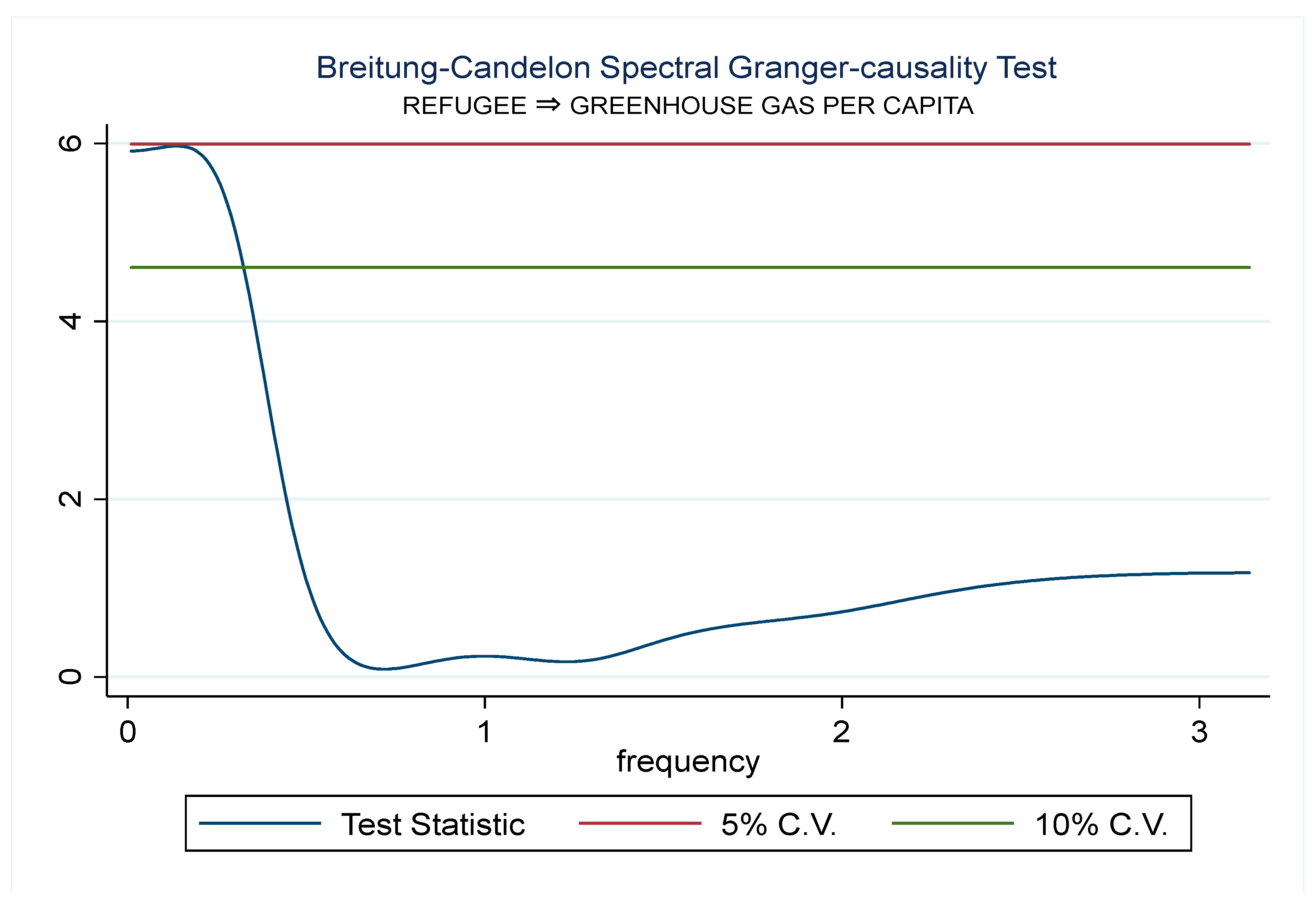
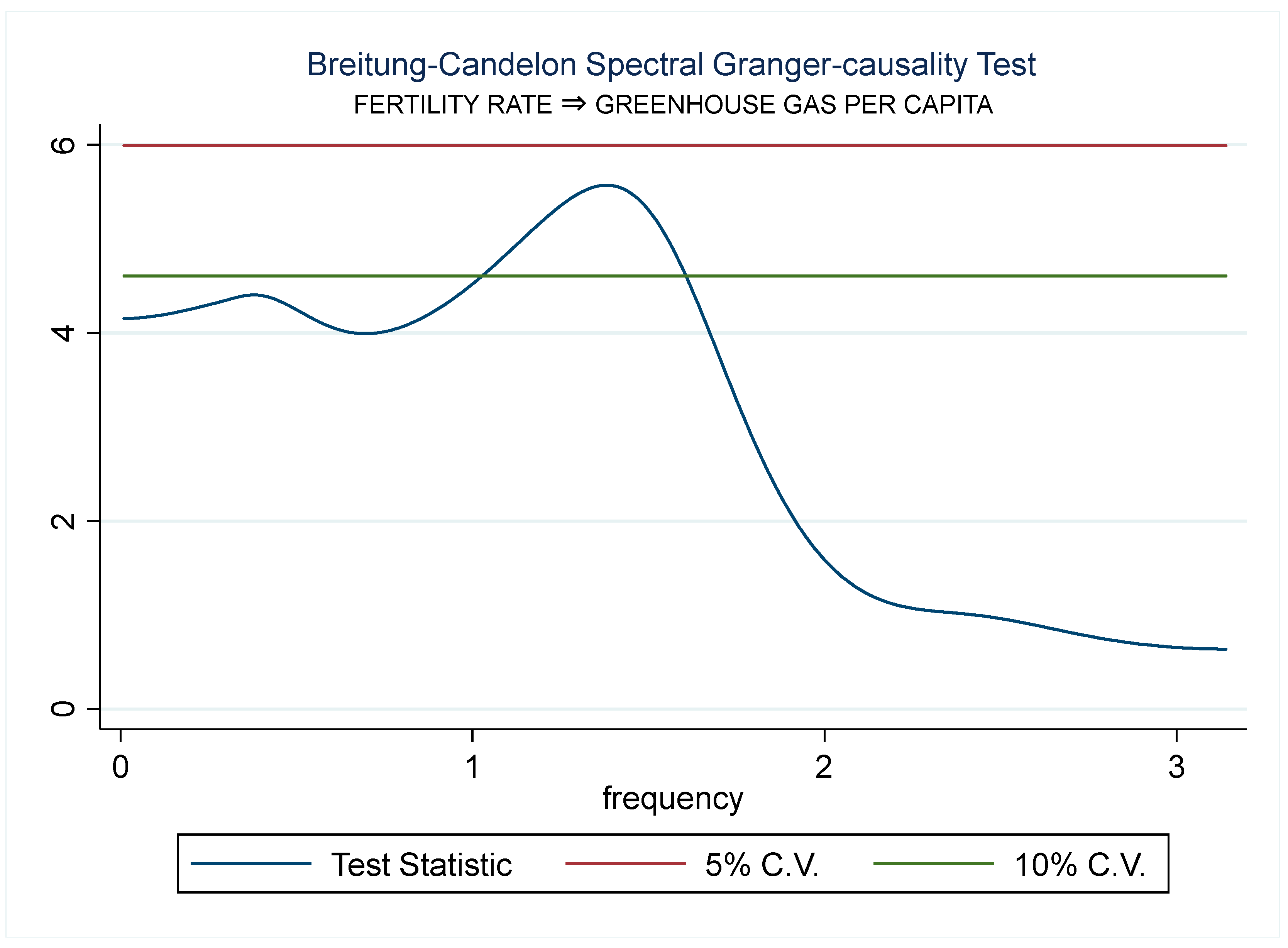
Refugee Population and Environmental Quality in Sweden and Lebanon: Is Fertility Rate Changing the Dynamics?



Abstract
1. Introduction
2. Literature: Theory and Empirical Highlights
3. Materials and Methods
3.1. Empirical Method
3.1.1. ARDL-Bound Test
3.1.2. Empirical Diagnostic Tests
4. Discussion of Findings
4.1. Greenhouse Gas Emissions and Income
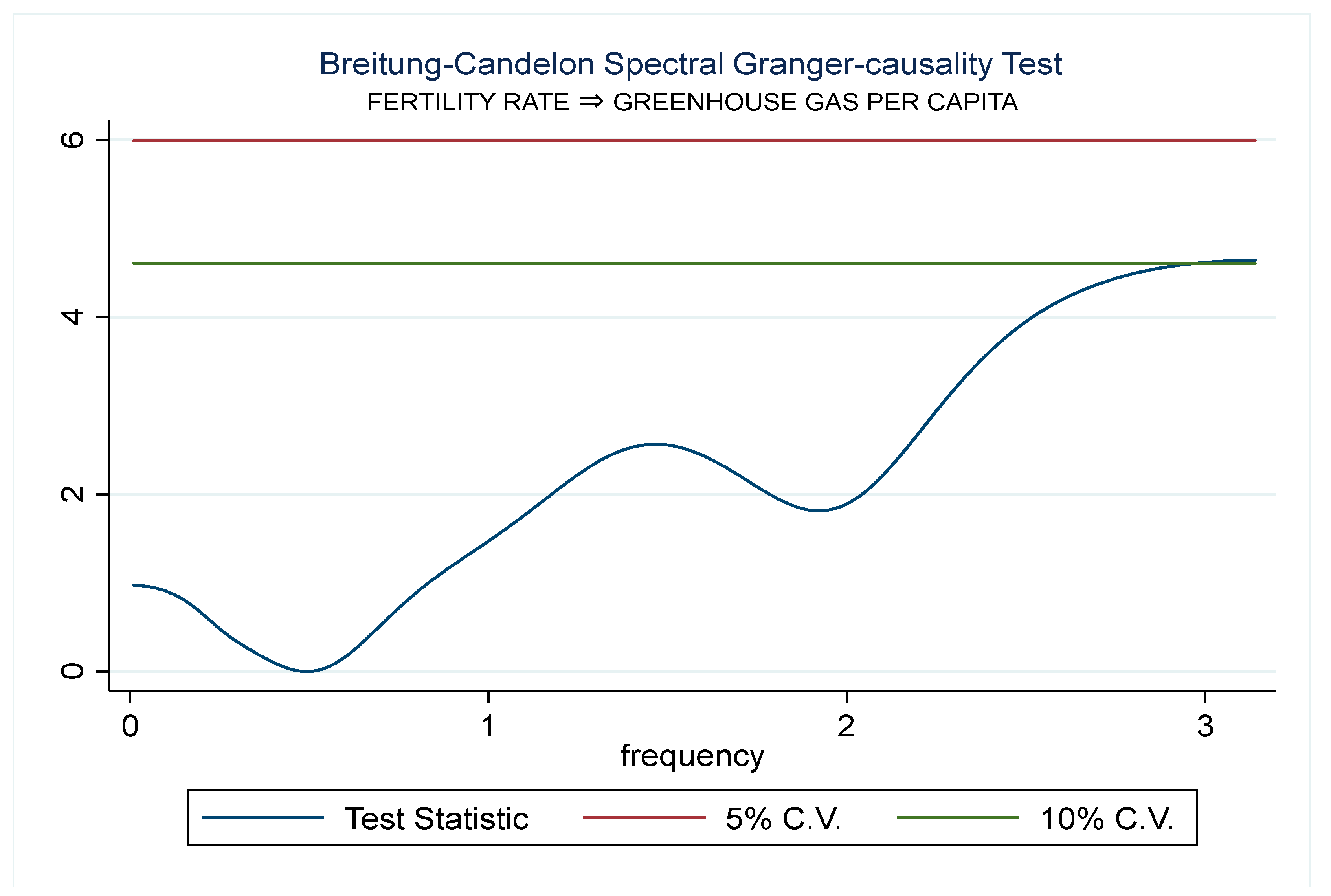
4.2. Greenhouse Gas Emissions and Fertility
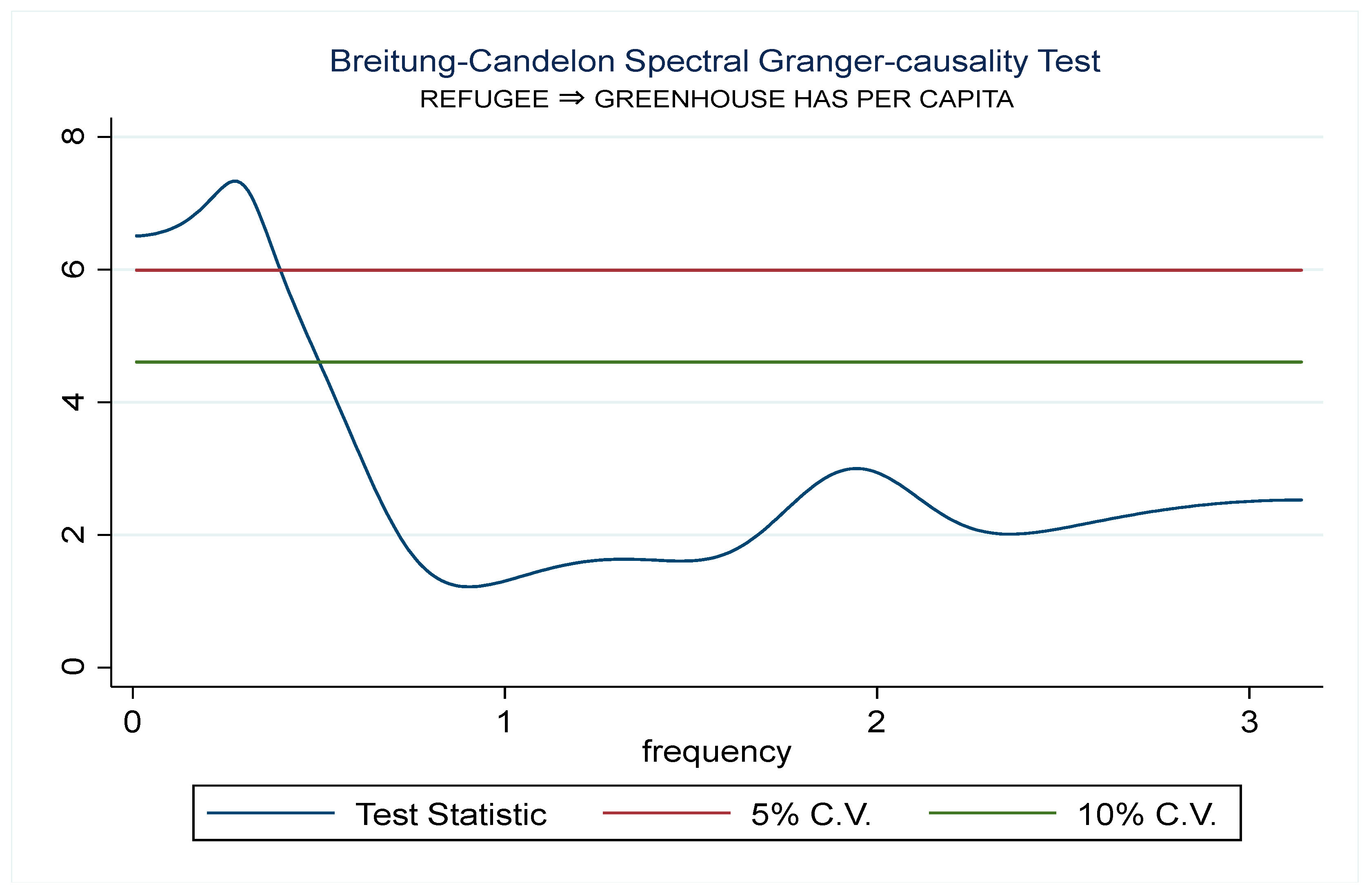
4.3. Greenhouse Gas Emissions and Refugees
4.4. Greenhouse Gas Emissions and Natural Resource Rent
4.5. Robustness Evidence
5. Conclusions and Policy Recommendation
Policy Recommendation
Author Contributions
Funding
Institutional Review Board Statement
Informed Consent Statement
Conflicts of Interest
Appendix A
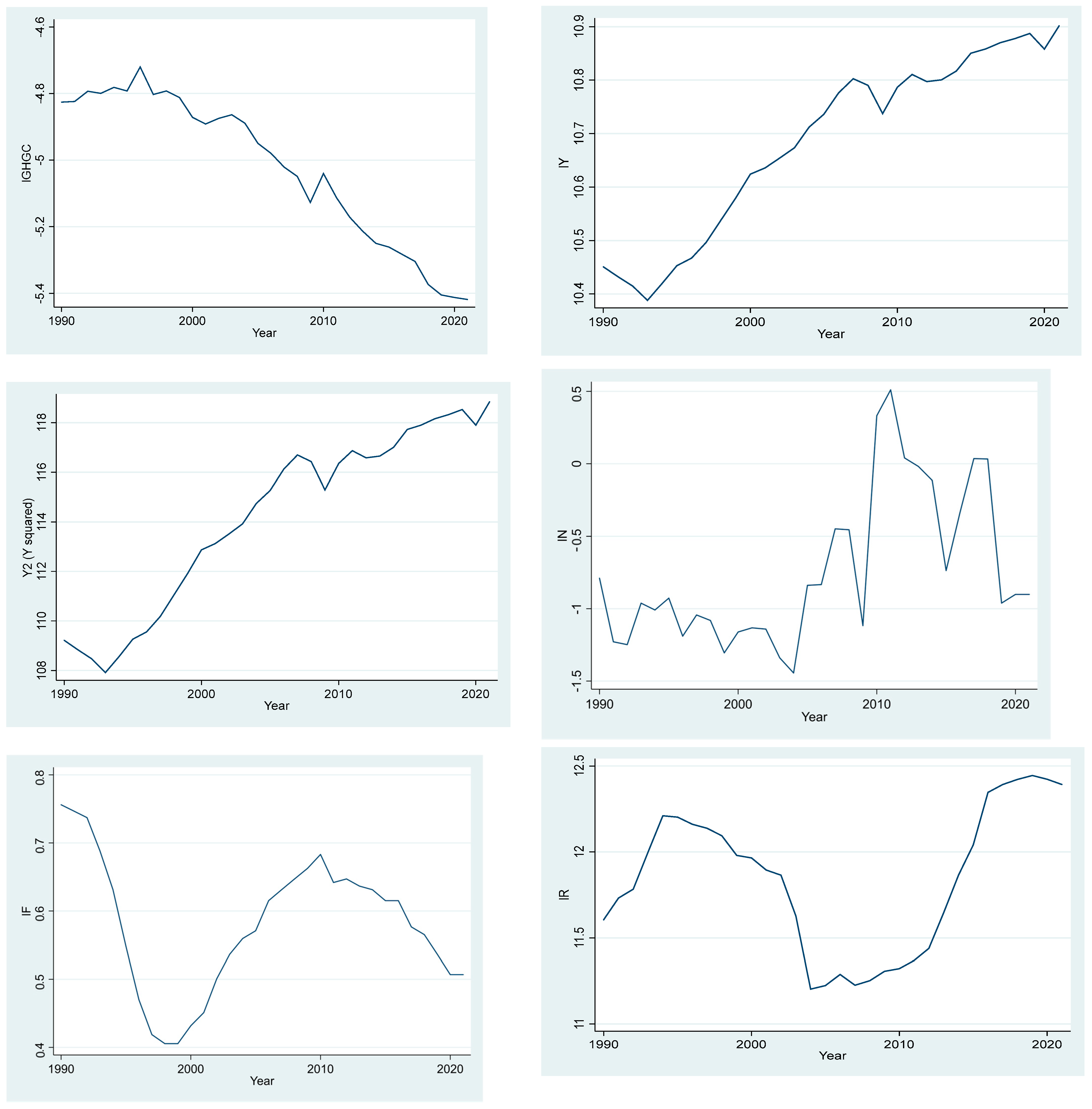
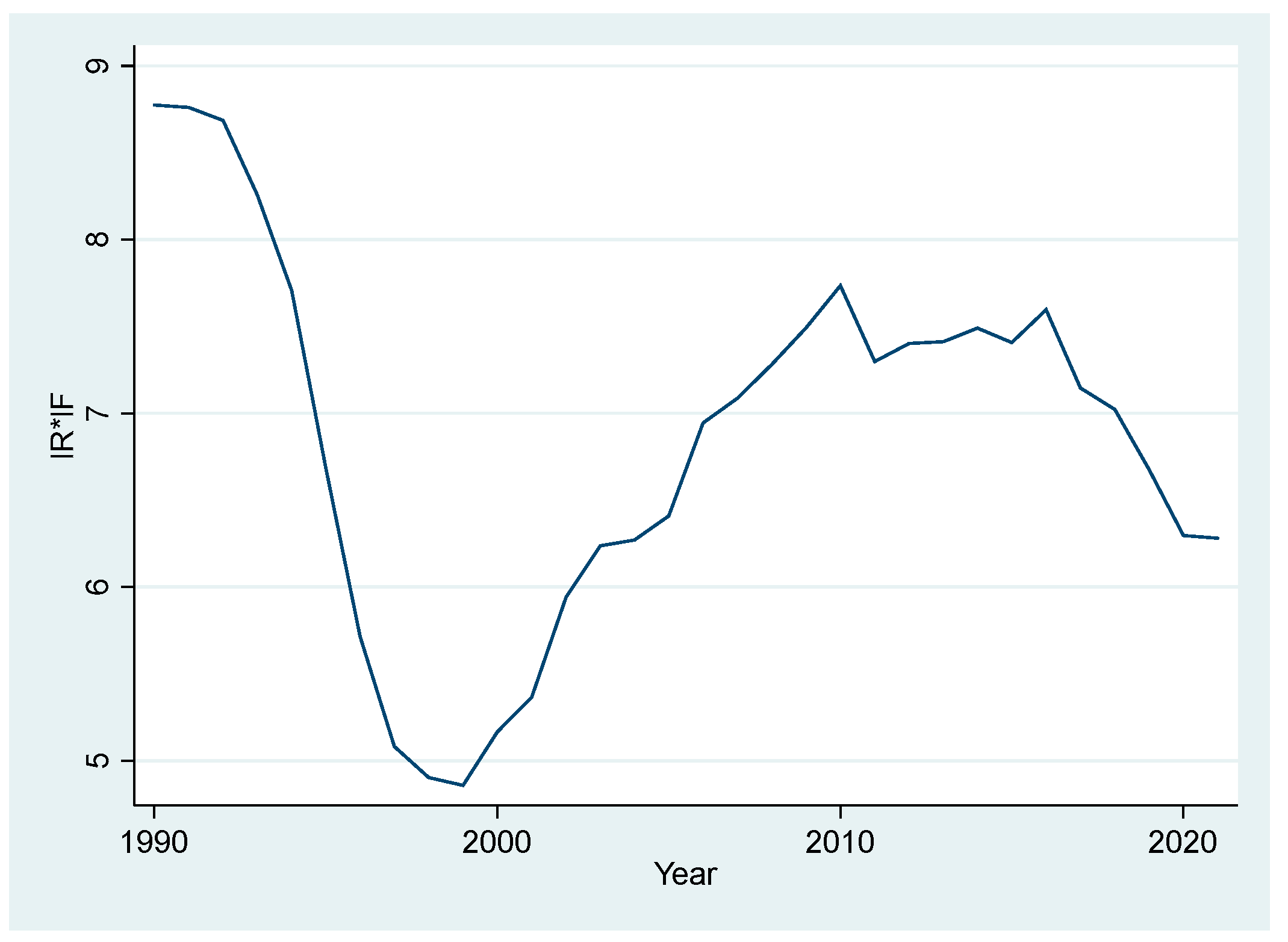
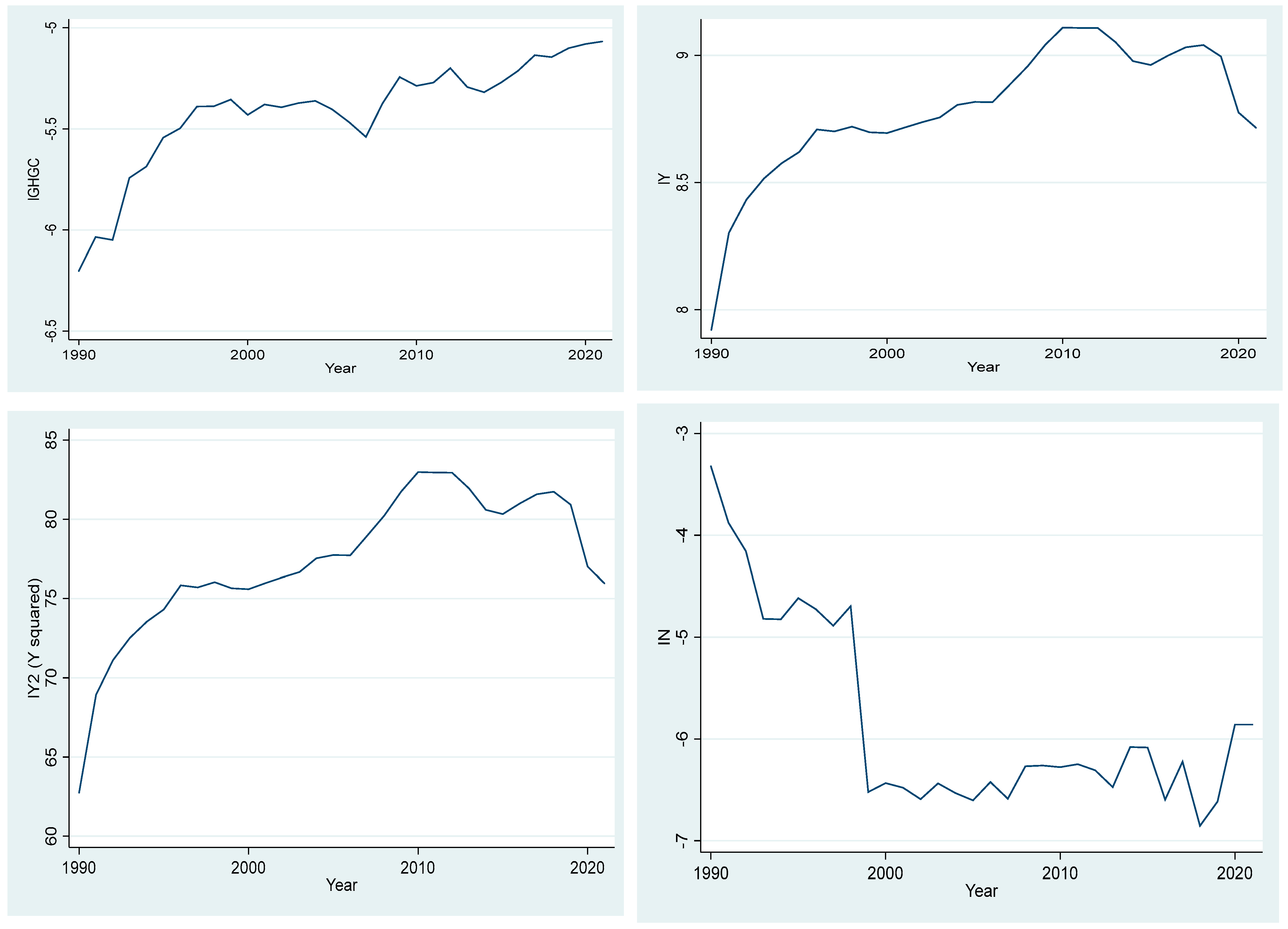
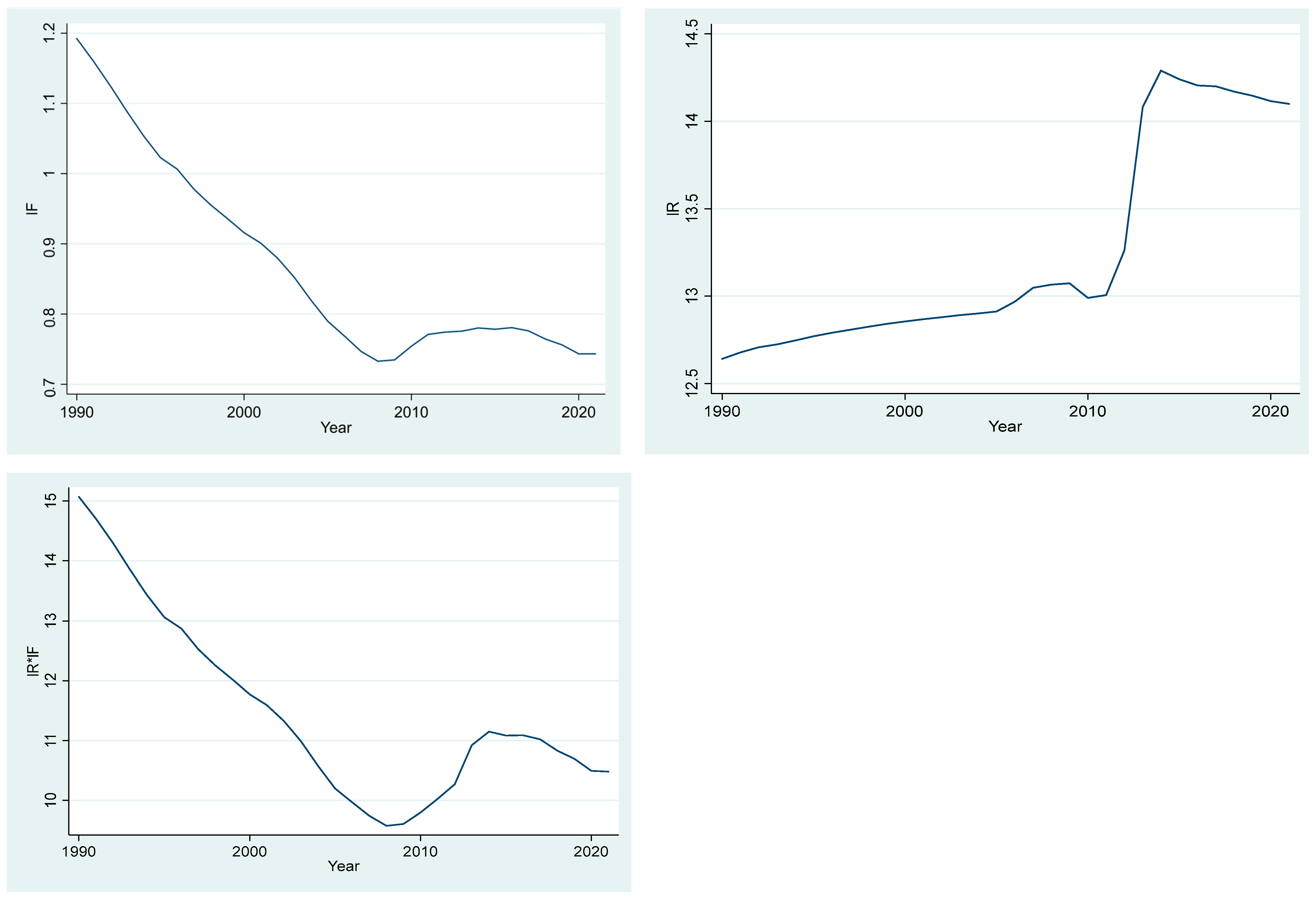
| 1 | According to the World Bank, the 1951 Convention Relating to the Status of its 1967 Protocol, and the 1969 Organization of African Unity Convention Governing the Specific Aspects of Refugee Problems in Africa, people recognized as refugees in accordance with the UNHCR statute, people granted refugee-like humanitarian status, and people provided temporary protection. Asylum seekers—people who have applied for asylum or refugee status and who have not yet received a decision, or who are registered as asylum seekers—are excluded. Palestinian refugees are people (and their descendants) whose residence was Palestine between June 1946 and May 1948, and who lost their homes and means of livelihood because of the 1948 Arab–Israeli conflict. |
References
- Abdulrahim, Sawsan, Jocelyn DeJong, Rima Mourtada, and Huda Zurayk. 2017. Estimates of Early Marriage Among Syrian Refugees in Lebanon in 2016 Compared to Syria Pre-2011. European Journal of Public Health 27: 322–23. [Google Scholar] [CrossRef]
- Al Akash, Ruba, and Morgen A. Chalmiers. 2021. Early Marriage Among Syrian Refugees in Jordan: Exploring Contested Meanings through Ethnography. Sex Reprod Health Matters 29: 1–16. [Google Scholar] [CrossRef] [PubMed]
- Alola, Andrew A., Abdugaffar Olawale Arikewuyo, Bahire Ozad, Uju Violet Alola, and Halima Oluwaseyi Arikewuyo. 2020. A drain or drench on biocapacity? Environmental account of fertility, marriage, and ICT in the USA and Canada. Environmental Science and Pollution Research 27: 4032–43. [Google Scholar] [CrossRef] [PubMed]
- Alola, Andrew Adewale, Festus Victor Bekun, and Samuel Asumadu Sarkodie. 2019a. Dynamic impact of trade policy, economic growth, fertility rate, renewable and non-renewable energy consumption on ecological footprint in Europe. Science of The Total Environment 685: 702–09. [Google Scholar] [CrossRef] [PubMed]
- Alola, Andrew Adewale, Kürşat Yalçiner, Uju Violet Alola, and Seyi Saint Akadiri. 2019b. The role of renewable energy, immigration and real income in environmental sustainability target. Evidence from Europe largest states. Science of The Total Environment 674: 307–15. [Google Scholar] [CrossRef]
- Alola, Andrew Alola, and Uju Violet Alola. 2018. The Dynamics of Tourism—Refugeeism on House Prices in Cyprus and Malta. Journal of International Migration and Integration 20: 1–16. [Google Scholar] [CrossRef]
- Amiri, Mirwais, Ieman M. El-Mowafi, Tala Chahien, Hind Yousef, and Loulou Hassan Kobeissi. 2020. An Overview of the Sexual and Reproductive Health Status and Service Delivery Among Syrian Refugees in Jordan, Nine Years since the Crisis: A Systematic Literature Review. Reproductive Health 17: 166. [Google Scholar] [CrossRef]
- Aydin, Mucahit, and Oguzhan Bozatli. 2023. The impacts of the refugee population, renewable energy consumption, carbon emissions, and economic growth on health expenditure in Turkey: New evidence from Fourier-based analyses. Environmental Science and Pollution Research 30: 41286–298. [Google Scholar] [CrossRef]
- Aye, Goodness C., and Prosper Ebruvwiyo Edoja. 2017. Effect of economic growth on CO2 emission in developing countries: Evidence from a dynamic panel threshold model. Cogent Economics & Finance 5: 1379239. [Google Scholar] [CrossRef]
- Baloch, Muhammad Awais, Nasir Mahmood, and Jian Wu Zhang. 2019. Effect of natural resources, renewable energy and economic development on CO2 emissions in BRICS countries. Science of the Total Environment 678: 632–38. [Google Scholar]
- Balsalobre-Lorente, Daniel, Muhammad Shahbaz, David Roubaud, and Sahbi Farhani. 2018. How economic growth, renewable electricity and natural resources contribute to CO2 emissions? Energy Policy 113: 356–67. [Google Scholar] [CrossRef]
- Bildirici, Melike. 2022. Refugees, governance, and sustainable environment: PQARDL method. Environmental Science and Pollution Research 29: 39295–309. [Google Scholar] [CrossRef] [PubMed]
- Bozdag, Ilgi, Celio Sierra-Paycha, and Armelle Andro. 2022. Humanitarian Assistance and Fertility Decisions: To What Extent Emergency Social Safety Net (ESSN) Targeting Criteria Had Influenced the Fertility Rates and Fertility Calendar of Syrian Refugees in Turkey. Ankara: World Food Programme. [Google Scholar]
- Brauner-Otto, Sarah R. 2014. Environmental quality and fertility: The effects of plant density, species richness, and plant diversity on fertility limitation. Population and Environment 36: 1–31. [Google Scholar] [CrossRef] [PubMed]
- Breitung, Jörg, and Bertrand Candelon. 2006. Testing for short- and long-run causality: A frequency-domain approach. Journal of Econometrics 132: 363–78. [Google Scholar] [CrossRef]
- Bu, Yan, Erda Wang, Dominik Möst, and Martin Lieberwirth. 2022. How population migration affects carbon emissions in China: Factual and counterfactual scenario analysis. Technological Forecasting and Social Change 184: 122023. [Google Scholar] [CrossRef]
- Charfeddine, Lanouar, and Zouhair Mrabet. 2017. The impact of economic development and social-political factors on ecological footprint: A panel data analysis for 15 MENA countries. Renewable and Sustainable Energy Reviews 76: 138–54. [Google Scholar] [CrossRef]
- Dickey, David A., and Wayne A. Fuller. 1979. Distribution of the estimators for autoregressive time series with a unit root. Journal of the American Statistical Association 74: 427–31. [Google Scholar]
- Fajth, Veronika, Özge Bilgili, Craig Loschmann, and Melissa Siegel. 2019. How do refugees affect social life in host communities? The case of Congolese refugees in Rwanda. Comparative Migration Studies 7: 1–21. [Google Scholar] [CrossRef]
- Fallah, Belal, Caroline Krafft, and Jackline Wahba. 2019. The impact of refugees on employment and wages in Jordan. Journal of Development Economics 139: 203–16. [Google Scholar] [CrossRef]
- Golbasi, Ceren, Tayfun Vural, Burak Bayraktar, Hakan Golbasi, and Alkim Gulsah Sahingoz Yildirim. 2022. Maternal and Neonatal Outcomes of Syrian Adolescent Refugees and Local Adolescent Turkish Citizens: A Comparative Study at a Tertiary Care Maternity Hospital in Turkey. Gynecology Obstetrics & Reproductive Medicine 28: 135–43. [Google Scholar] [CrossRef]
- Grossman, Gene M., and Alan B. Krueger. 1991. Environmental Impacts of a North American Free Trade Agreement. Cambridge, MA: National Bureau of Economic Research. [Google Scholar]
- Kar, Ashim Kumar. 2022. Environmental Kuznets curve for CO2 emissions in Baltic countries: An empirical investigation. Environmental Science and Pollution Research 29: 47189–208. [Google Scholar] [CrossRef] [PubMed]
- Kim, Jaehyeok, Hyungwoo Lim, and Ha-Hyun Jo. 2020. Do Aging and Low Fertility Reduce Carbon Emissions in Korea? Evidence from IPAT Augmented EKC Analysis. International Journal of Environmental Research and Public Health 17: 2972. [Google Scholar] [CrossRef] [PubMed]
- Korri, Rayan, Sabine Hess, Guenter Froeschl, and Olena Ivanova. 2021. Sexual and Reproductive Health of Syrian Refugee Adolescent Girls: A Qualitative Study Using Focus Group Discussions in an Urban Setting in Lebanon. Reproductive Health 18: 130. [Google Scholar] [CrossRef] [PubMed]
- Kulu, Hill. 2005. Migration and Fertility: Competing Hypotheses Re-examined. European Journal of Population 21: 51–87. [Google Scholar] [CrossRef]
- Kurt, Gulsah, İbrahim Hakkı Acar, Zeynep Ilkkursun, Taylan Yurtbakan, Busra Acar, Ersin Uygun, and Ceren Acarturk. 2021. Traumatic Experiences, Acculturation, and Psychological Distress Among Syrian Refugees in Turkey: The Mediating Role of Coping Strategies. International Journal of Intercultural Relations 81: 214–25. [Google Scholar] [CrossRef]
- Kuznets, Simon. 1955. Economic growth and income inequality. In The Gap between Rich and Poor. London: Routledge, pp. 25–37. [Google Scholar]
- Mahmalat, Mounir. 2018. Growth without Development: The Role of Lebanon’s Legislative Agenda. Houston: Rice University’s Baker Institute for Public Policy, Issue brief no. 10.10.18. [Google Scholar]
- Norwegian Refugee Council. 2022. These 10 Countries Receive the Most Refugees. Available online: https://www.nrc.no/perspectives/2020/the-10-countries-that-receive-the-most-refugees/ (accessed on 20 February 2023).
- Obekpa, Hephzibah Onyeje, and Andrew Adewale Alola. 2023. Asymmetric response of energy efficiency to research and development spending in renewables and nuclear energy usage in the United States. Progress in Nuclear Energy 156: 104522. [Google Scholar] [CrossRef]
- Onifade, Stephen Taiwo, Andrew Adewale Alola, Savaş Erdoğan, and Hakan Acet. 2021. Environmental aspect of energy transition and urbanization in the OPEC member states. Environmental Science and Pollution Research 28: 17158–169. [Google Scholar] [CrossRef]
- Pavia, Donald L., Gary M. Lampman, George S. Kriz, and James A. Vyvyan. 2014. Introduction to Spectroscopy. Boston: Cengage Learning. [Google Scholar]
- Pesaran, M. Hashem, Yongcheol Shin, and Richard J. Smith. 2001. Bounds testing approaches to the analysis of level relationships. Journal of Applied Econometrics 16: 289–326. [Google Scholar] [CrossRef]
- Phillips, Peter C. B., and Pierre Perron. 1988. Testing for a unit root in time series regression. Biometrika 75: 335–46. [Google Scholar] [CrossRef]
- Ruiz, Isabel, and Carlos Vargas-Silva. 2016. The labour market consequences of hosting refugees. Journal of Economic Geography 16: 667–94. [Google Scholar] [CrossRef]
- Sarkodie, Samuel Asumadu, and Samuel Adams. 2018. Renewable energy, nuclear energy, and environmental pollution: Accounting for political institutional quality in South Africa. Science of the Total Environment 643: 1590–601. [Google Scholar] [CrossRef] [PubMed]
- Serfraz, Ayesha. 2017. Analyzing Short-Run and Long-Run Causality between FDI Inflows, Labor Productivity and Education in Pakistan. Asian Journal of Economics and Empirical Research 5: 36–59. [Google Scholar] [CrossRef]
- Simon, Daniel H. 2017. Exploring the influence of precipitation on fertility timing in rural Mexico. Population and Environment 38: 407–23. [Google Scholar] [CrossRef]
- Squalli, Jay. 2021. Disentangling the relationship between immigration and environmental emissions. Population and Environment 43: 1–21. [Google Scholar] [CrossRef]
- Stephenson, Judith, Karen Newman, and Susannah Mayhew. 2010. Population dynamics and climate change: What are the links? Journal of Public Health 32: 150–56. [Google Scholar] [CrossRef] [PubMed]
- Subramaniam, Yogeeswari, Tajul Ariffin Masron, and Nanthakumar Loganathan. 2023. The impacts of migrants on environmental degradation in developing countries. Environmental and Ecological Statistics 30: 17–40. [Google Scholar] [CrossRef]
- Tanrıkulu, Faik. 2021. The political economy of migration and integration: Effects of immigrants on the economy in Turkey. Journal of Immigrant & Refugee Studies 19: 364–77. [Google Scholar]
- Tufail, Muhammad, Lin Song, Tomiwa Sunday Adebayo, Dervis Kirikkaleli, and Suliman Khan. 2021. Do fiscal decentralization and natural resources rent curb carbon emissions? Evidence from developed countries. Environmental Science and Pollution Research 28: 49179–90. [Google Scholar] [CrossRef]
- UNHCR. 2019. UNHCR Turkey-Fact Sheet. Available online: https://www.relief.reliefwebint/report/turkey/unhcr-turkey-fact-sheet-july-2019 (accessed on 10 February 2023).
- United Nations Environment Programme. 2021. Emissions Gap Report 2021: The Heat Is on—A World of Climate Promises Not Yet Delivered Nairobi. Nairobi: United Nations Environment Programme. [Google Scholar]
- Urban, Frauke, and Johan Nordensvärd. 2018. Low Carbon Energy Transitions in the Nordic Countries: Evidence from the Environmental Kuznets Curve. Energies 11: 2209. [Google Scholar] [CrossRef]
- World Bank. 2011. Lebanon: Country Environmental Analysis 2011. Available online: https://openknowledge.worldbank.org/entities/publication/0e7fd98e-cebc-524c-b328-37181c0d0686 (accessed on 1 April 2023).
- York, Richard, Eugene A. Rosa, and Thomas Dietz. 2003. STIRPAT, IPAT and ImPACT: Analytic tools for unpacking the driving forces of environmental impacts. Ecological Economics 46: 351–65. [Google Scholar] [CrossRef]
- Zhang, Chuanguo, and Zheng Tan. 2016. The relationships between population factors and China’s carbon emissions: Does population aging matter? Renewable and Sustainable Energy Reviews 65: 1018–25. [Google Scholar] [CrossRef]



| Study | Period | Country | Key Variables | Method | Findings |
|---|---|---|---|---|---|
| Bildirici (2022) | From 1996 to 2019 | Bangladesh, Ethiopia, Jordan, Lebanon, Pakistan, Sudan, and Uganda | Greenhouse gas (GHG) emissions, deforestation, and refugee populations | Panel quantile autoregressive distributed lag (PQARDL) | Refugee population causes a decline in forest area and an increase in greenhouse gas emissions. |
| Aydin and Bozatli (2023) | From 1979 to 2019 | Turkey | Effects of refugee population, renewable energy consumption, carbon emissions, and economic growth on health expenditure | Fourier analysis | Air pollution increases health expenditures. Refugee population is an important determinant of health expenditures. |
| Subramaniam et al. (2023) | From 1980 to 2019 | 29 developing countries | CO2 emissions, environmental degradation, the refugee population | Fully modified ordinary least squares (FMOLS); dynamic ordinary least-squares estimator (DOLS) | Migration worsens environmental degradation. Environmental degradation appears to be greater in countries with higher immigration. |
| Bu et al. (2022) | 2017 | China | Population migration affects carbon emissions | GWR (geographically weighted regression); EE MRIO (environmentally extended multi-regional input–output) | Population migration exacerbates carbon emission inequality, especially increasing provinces’ carbon emission reduction barrier with net out-migrants. |
| Squalli (2021) | From 1997 to 2014 | USA | Migration and environmental emissions. | NAICS (North American Industry Classification System); SIC (Standard Industrial Classification) | Overall population contributes to environmental emissions at the US state level. Immigration may indeed yield environmental benefits. Second, US states with lower GHG emissions are associated with a higher share of immigrants. |
| Study | Period | Countries | Key Variables | Method | Findings |
|---|---|---|---|---|---|
| Kim et al. (2020) | From 1998 to 2016 | 16 South Korean provinces | Income, CO2 emissions, and population aging | (FMOLS) | Population aging reduces carbon emissions and younger populations spur carbon emissions. |
| Alola et al. (2019a) | From 1997 to 2014 | 16 EU countries | Economic growth, fertility rate, energy indicators, and ecological footprint | Panel pool mean group autoregressive distributive lag (PMG-ARDL) | Fertility and renewable energy consumption mitigates ecological footprint, thereby promoting environmental sustainability. |
| Alola et al. (2020) | From 1990 to 2014 | USA and Canada | Biocapacity, fertility, marriage, and ICT | Autoregressive distributive lag (ARDL) | Marriage mitigates (promotes) biocapacity in Canada (USA). Fertility moderate marriage to cause a negative impact on biocapacity in the USA. |
| Zhang and Tan (2016) | From 1997 to 2016 | 29 provinces in China | Population factors and carbon emissions. | Stochastic impacts by regression on population, affluence, and technology (STIRPAT) | Population aging and population quality positively correlate with carbon emissions. Population living standard exhibits urban–rural difference in carbon emissions. Population aging–carbon emissions nexus varies across regions. |
| Brauner-Otto (2014) | From 1997 to 2013 | Chitwan, Nepal | Environmental quality and fertility. | Shannon–Weiner diversity index | The result reveals that women living in poor environmental conditions are likely to have larger families. |
| Simon (2017) | From 1971 to 2010 | Rural areas of Mexico | Precipitation and fertility | Vicious circle model (VCM) | The nexus of fertility and environmental quality depends on the climatic condition in Mexico. |
| Variable | Symbol | Measurement | Source |
|---|---|---|---|
| Greenhouse gas per capita | GHGC | kt of CO2 equivalent | Estimated from WDI |
| Gross domestic product per capita | Y | Constant 2015 USD | WDI |
| Natural resource rent | N | Total natural resource rents (% of GDP) | WDI |
| Fertility | F | Total births per woman | WDI |
| Refugee | R | as defined under the 1951 Convention Relating to the status of its 1967 Protocol1. | WDI |
| Sweden | |||||||
|---|---|---|---|---|---|---|---|
| lGHGC | lY | lY2 | lN | lF | lR | lR*lF | |
| Mean | −5.022 | 10.684 | 114.181 | −0.741 | 0.580 | 11.839 | 6.855 |
| Median | −4.964 | 10.736 | 115.278 | −0.914 | 0.595 | 11.879 | 7.054 |
| Maximum | −4.720 | 10.901 | 118.844 | 0.510 | 0.756 | 12.444 | 8.774 |
| Minimum | −5.418 | 10.388 | 107.914 | −1.444 | 0.405 | 11.203 | 4.857 |
| Std. Dev. | 0.223 | 0.168 | 3.591 | 0.531 | 0.098 | 0.418 | 1.088 |
| Skewness | −0.466 | −0.457 | −0.444 | 0.848 | −0.173 | −0.133 | −0.165 |
| Kurtosis | 1.798 | 1.740 | 1.731 | 2.551 | 2.228 | 1.701 | 2.378 |
| Jarque–Bera | 3.088 | 3.228 | 3.199 | 4.110 | 0.955 | 2.343 | 0.661 |
| Lebanon | |||||||
| Mean | −5.413 | 8.790 | 77.339 | −5.828 | 0.870 | 13.243 | 11.478 |
| Median | −5.372 | 8.790 | 77.270 | −6.264 | 0.785 | 12.940 | 11.052 |
| Maximum | −5.067 | 9.109 | 82.975 | −3.323 | 1.192 | 14.289 | 15.073 |
| Minimum | −6.203 | 7.920 | 62.738 | −6.852 | 0.732 | 12.641 | 9.575 |
| Std. Dev. | 0.273 | 0.258 | 4.459 | 0.949 | 0.139 | 0.603 | 1.531 |
| Skewness | −1.382 | −1.265 | −1.148 | 1.131 | 0.911 | 0.849 | 0.857 |
| Kurtosis | 4.574 | 5.291 | 4.875 | 3.039 | 2.536 | 1.909 | 2.764 |
| Jarque–Bera | 13.502 | 15.538 | 11.721 | 6.830 | 4.718 | 5.438 | 3.995 |
| Sweden | |||||||
| lGHGC | lY | lY2 | lN | lF | lR | lR*lF | |
| lGHGC | 1 | ||||||
| LY | −0.889 | 1 | |||||
| lY2 | −0.891 | 0.999 | 1 | ||||
| lN | −0.551 | 0.564 | 0.565 | 1 | |||
| lF | −0.087 | −0.034 | −0.032 | 0.362 | 1 | ||
| lR | −0.269 | −0.035 | −0.031 | −0.125 | −0.425 | 1 | |
| lR*lF | −0.152 | −0.045 | −0.042 | 0.357 | 0.978 | −0.230 | 1 |
| Lebanon | |||||||
| lGHGC | lY | lY2 | lN | lF | lR | lR*lF | |
| lGHGC | 1 | ||||||
| LY | 0.846 | 1 | |||||
| lY2 | 0.842 | 0.999 | 1 | ||||
| lN | −0.784 | −0.803 | −0.800 | 1 | |||
| lF | −0.867 | −0.882 | −0.882 | 0.869 | 1 | ||
| lR | 0.651 | 0.549 | 0.553 | −0.447 | −0.624 | 1 | |
| lR*lF | −0.807 | −0.854 | −0.854 | 0.870 | 0.971 | −0.423 | 1 |
| Sweden | ||||||||
| ADF | PP | |||||||
| Variables | I(0) | I(0) with Suppressed Constant | I(1) | I(1) with Suppressed Constant | I(0) | I(0) with Suppressed Constant | I(1) | I(1) with Suppressed Constant |
| t-stat | t-stat | t-stat | t-stat | t-stat | t-stat | t-stat | p-value | |
| lGHGC | 0.801 | 2.728 | −6.568 a | −5.221 a | 1.264 | 3.150 | −6.548 a | −5.324 a |
| lY | −0.573 | 3.187 | −4.473 a | −3.396 a | −0.588 | 2.973 | −4.391 a | −3.368 a |
| lY2 | −0.553 | 3.175 | −4.511 a | −3.421 a | −0.566 | 2.986 | −4.431 a | −3.396 a |
| lN | −2.315 | −1.259 | −6.460 a | −6.574 a | −2.226 | −0.996 | −6.993 a | −7.132 a |
| lF | −1.697 | −1.610 c | −2.122 | −2.106 b | −1.985 | −1.119 | −2.187 | −2.155 b |
| lR | −0.514 | 0.990 | −2.858 c | −2.896 a | −1.146 | 0.632 | −2.818 c | −2.850 a |
| lR*lF | −1.761 | −1.427 | −2.392 | −2.369 b | −2.007 | −1.031 | −2.464 | −2.428 b |
| Lebanon | ||||||||
| ADF | PP | |||||||
| Variables | I(0) | I(0) with Suppressed Constant | I(1) | I(1) with Suppressed Constant | I(0) | I(0) with Suppressed Constant | I(1) | I(1) with Suppressed Constant |
| t-stat | t-stat | t-stat | t-stat | t-stat | t-stat | t-stat | t-stat | |
| lGHGC | −3.405 b | −2.579 b | −5.538 a | −4.973 a | −3.629 b | −2.357 b | −5.530 a | −4.986 a |
| lY | −5.438 a | 1.426 | −5.362 a | −5.673 a | −4.430 a | 1.039 | −5.213 a | −5.496 a |
| lY2 | −5.105 a | 1.293 | −4.984 a | −5.273 a | −4.196 a | 0.918 | −4.885 a | −5.150 a |
| lN | −2.962 b | 0.581 | −6.341 a | −6.279 a | −3.084b | 0.650 | −6.364 a | −6.275 a |
| lF | −6.040 a | −6.484 a | −1.477 | −1.613 c | −3.944 a | −3.738 a | −1.534 | −1.623 c |
| lR | −0.346 | 1.650 | −3.317 b | −3.192 a | −0.572 | 1.367 | −3.214 b | −3.115 a |
| lR*lF | −4.167 a | −3.903 a | −1.773 | −1.760 c | −2.891 c | −2.303 b | −1.795 | −1.754 c |
| Model 1 (Fertility) | Model 2 (Refugee) | Model 3 (Refugee*Fertility) | ||||
|---|---|---|---|---|---|---|
| Indicators | Coefficient | p-Value | Coefficient | p-Value | Coefficient | p-Value |
| lY | 27.346 b | 0.035 | 0.920 b | 0.015 | 0.230 a | 0.008 |
| lY2 | −1.270 b | 0.037 | −0.030 a | 0.002 | −0.036 b | 0.017 |
| lN | 0.005 | 0.790 | 0.003 | 0.843 | 0.014 | 0.475 |
| lN−1 | −0.031 c | −0.071 | −0.030 c | 0.086 | ||
| lF | 0.178 b | 0.045 | 2.980 b | 0.023 | ||
| lR | −0.048 b | 0.046 | ||||
| lR*lF | −0.211 b | 0.043 | ||||
| Bound Test | 5.675 a | 6.045 a | 5.493 a | |||
| Het Test | 0.350 | 0.710 | 0.862 | |||
| SR | 0.050 | 0.100 | 0.121 | |||
| Stability | Stable | Stable | Stable | |||
| Model 1 (Fertility) | Model 2 (Refugee) | Model 3 (Refugee*Fertility) | ||||
|---|---|---|---|---|---|---|
| Indicators | Coefficient | p-Value | Coefficient | p-Value | Coefficient | p-Value |
| lY | −121.639 a | 0.009 | −0.522 b | 0.026 | −0.526 b | 0.037 |
| lY2 | 6.870 a | 0.009 | 0.039 b | 0.028 | 0.039 c | 0.050 |
| lN | 0.105 b | 0.042 | 0.020 | 0.437 | −0.019 | 0.521 |
| lN−1 | 0.062 | 0.208 | −0.030 c | 0.086 | ||
| lF | 0.315 | 0.894 | 2.980 b | 0.023 | ||
| lF−2 | 6.222 c | 0.075 | ||||
| lR | −0.130 | 0.139 | ||||
| lR−1 | 0.163 c | 0.065 | ||||
| lR*lF | 0.001 | 0.961 | ||||
| Bound Test | 2.800 c | 5.429 a | 4.334 a | |||
| Het Test | 1.000 | 0.124 | 0.862 | |||
| SR | 0.401 | 0.070 | 0.074 | |||
| Stability | Stable | Stable | Stable | |||
Disclaimer/Publisher’s Note: The statements, opinions and data contained in all publications are solely those of the individual author(s) and contributor(s) and not of MDPI and/or the editor(s). MDPI and/or the editor(s) disclaim responsibility for any injury to people or property resulting from any ideas, methods, instructions or products referred to in the content. |
© 2023 by the authors. Licensee MDPI, Basel, Switzerland. This article is an open access article distributed under the terms and conditions of the Creative Commons Attribution (CC BY) license (https://creativecommons.org/licenses/by/4.0/).
Share and Cite
Alola, A.A.; Aliyev, A.; Obekpa, H.O.; Olagunju, I. Refugee Population and Environmental Quality in Sweden and Lebanon: Is Fertility Rate Changing the Dynamics? Soc. Sci. 2023, 12, 243. https://doi.org/10.3390/socsci12040243
Alola AA, Aliyev A, Obekpa HO, Olagunju I. Refugee Population and Environmental Quality in Sweden and Lebanon: Is Fertility Rate Changing the Dynamics? Social Sciences. 2023; 12(4):243. https://doi.org/10.3390/socsci12040243
Chicago/Turabian StyleAlola, Andrew Adewale, Anar Aliyev, Hephzibah Onyeje Obekpa, and Ishaaqa Olagunju. 2023. "Refugee Population and Environmental Quality in Sweden and Lebanon: Is Fertility Rate Changing the Dynamics?" Social Sciences 12, no. 4: 243. https://doi.org/10.3390/socsci12040243
APA StyleAlola, A. A., Aliyev, A., Obekpa, H. O., & Olagunju, I. (2023). Refugee Population and Environmental Quality in Sweden and Lebanon: Is Fertility Rate Changing the Dynamics? Social Sciences, 12(4), 243. https://doi.org/10.3390/socsci12040243