


The Distribution and Consequences of Sexual Misconduct Perpetrated by Peacekeepers in Haiti: An Exploratory Cross-Sectional Analysis

Abstract
1. Introduction and Literature Review
1.1. Mechanism and Hypothesis for Objective 1: Geographic Distribution of Narratives That Address Sexual Misconduct
1.2. Mechanism and Hypothesis for Objective 2: Exposure to Sexual Misconduct and Future Engagement with the UN
1.3. Contribution of Research
2. Materials and Methods
2.1. Survey Implementation and Participants
2.2. Instruments and Measures
2.2.1. Geographical Distribution of Narratives about Sexual Misconduct Model
2.2.2. Consequences of Exposure to Sexual Misconduct Model
Covariates
2.3. Procedures
2.4. Ethics
3. Results
3.1. Characteristics of the Narratives Shared
3.2. Geographical Distribution of Narratives about Sexual Misconduct
3.3. Association between Sexual Misconduct and Willingness to Engage with the UN
4. Discussion
4.1. Geographic Distribution of Sexual Misconduct Perpetrated by Peacekeepers
4.2. Impact of Sexual Misconduct on the Desire to Engage with the UN
4.3. Limitations
4.4. Strengths and Contributions
5. Conclusions
Author Contributions
Funding
Institutional Review Board Statement
Informed Consent Statement
Data Availability Statement
Acknowledgments
Conflicts of Interest
Abbreviations
| CI | Confidence interval |
| CDU | Conduct and Discipline Unit |
| MINUSTAH | United Nations Stabilization Mission in Haiti |
| MoU | Memorandum of Understanding |
| PO | Peacekeeping operation |
| RR | Relative risk |
| SEA | Sexual abuse and exploitation |
| TCC | Troop Contributing Country |
| UN | United Nations |
Appendix A
- Describe the best or worst experience of a particular woman or girl in your community who has interacted with foreign UN or MINUSTAH personnel. What happened?
- Describe how living in a community with a UN or MINUSTAH presence has provided either a particular opportunity or a danger to a particular woman or girl in the community. What happened?
- Describe the negative or positive experience of a particular women or girl who requested support or assistance after interacting with foreign UN or MINUSTAH personnel. What happened?
- This story is about: 1. Financial/material security, 2. Social status, 3. Emotional needs
- In this story, the foreign UN or MINUSTAH personnel was: 1. In a position of authority, 2. Able to offer protection, 3. Wealthy and able to provide support
- Was the interaction in the story: 1. Friendly, 2. Business, 3. Relationship
- In the story, what would a fair response look like? 1. Acceptance of responsibility, 2. Justice, 3. Reparation
- In the story, it would have helped the woman or girl most to have had support from: 1. The UN or MINUSTAH, 2. NGOs or civil society organizations, 3. Haitian authorities
- In the story, barriers to the woman or girl getting a fair response were: 1. Lack of information in the community about assistance, 2. Lack of response from Haitian authorities, 3. Lack of response from the UN or MINUSTAH
- In the story, what would have helped most to make the experience more positive: 1. Material/financial support, 2. Emotional support, 3. Legal support
- Based on the events in the story, the presence of the UN or MINUSTAH led to: 1. Disrespect of Haitian values and laws, 2. Negative financial impact, 3. Anger and resentment
- About me
- About someone in my household
- About someone in my family who doesn’t live in my household
- About a friend
- Community
- Something I heard or read about
- Prefer not to say
- Very rarely
- Occasionally
- Regularly
- Very frequently
- All the time
- Not sure
- Must hear this story and take action
- Should definitely hear this story and pay attention
- Can learn some
- Family
- Friends
- Neighbours
- Haitian politicians
- The UN or MINUSTAH
- NGOs
- The military of the foreigner
- Churches
- Community leaders
- Business people
- Girls in my community
- Women in my community
- Men in my community
- Not sure
- Strongly positive
- Positive
- Neutral
- Negative
- Very negative
- Not sure
- Angry
- Disappointed
- Embarrassed
- Encouraged
- Frustrated
- Good
- Happy
- Hopeful
- Indifferent
- Relieved
- Sad
- Satisfied
- Worried
- Not sure
- Uruguay
- Sri Lanka
- Pakistan
- Nepal
- Argentina
- Bolivia
- Brazil
- Chile
- Peru
- Indonesia
- Jordan
- Nigeria
- Pakistan
- Indonesia
- Senegal
- United States
- France
- Canada
- Japan
- China
- Other
- Don’t know
- Soldier (UNPOL, MINUSTAH, or Multinational Forces)
- Civilian who works with the UN (doesn’t wear a uniform)
- Police
- Worked for an NGO rather than the UN or MINUSTAH
- Other
- Don’t know
- Female
- Male
- Prefer not to say
- 11–17 years old
- 18–24 years old
- 25–34 years old
- 35–44 years old
- 45–54 years old
- ≥55 years old
- Married or living together as if married
- Divorced/Separated from spouse
- Widowed
- Single, never married
- Prefer not to say
- No formal education
- Some primary school
- Completed primary school
- Some secondary school
- Completed secondary school
- Some post-secondary school
- Completed post-secondary school
- radio
- mobile phone
- refrigerator or freezer
- vehicle such as a truck, a car or a motorcycle
- generator, inverter or a sun panel that provides electricity to your home.
- None of the above
- 7 Strongly agree
- 6 Agree
- 5 Slightly agree
- 4 Neither agree nor disagree
- 3 Slightly disagree
- 2 Disagree
- 1 Strongly disagree
- ____In most ways my life is close to my ideal.
- ____The conditions of my life are excellent.
- ____I am satisfied with my life.
- ____So far I have gotten the important things I want in life.
- ____If I could live my life over, I would change almost nothing
- Child fathered by foreign UN or MINUSTAH personnel
- Woman or girl who had interacted with foreign UN or MINUSTAH personnel
- Family member of a woman or girl who had interacted with foreign UN or MINUSTAH personnel
- Friend of a woman or girl who had interacted with foreign UN or MINUSTAH personnel
- Community member where foreign UN or MINUSTAH personnel are hosted
- Community leader where foreign UN or MINUSTAH personnel are hosted
- Foreign UN or MINUSTAH personnel
- Haitian UN or MINUSTAH personnel
- Politician
- NGO staff
- Other
- Citè Soleil
- Charlie Log Base/Tabarre
- Gonaives
- St. Marc
- Hinche
- Leogane
- Port Salut
- Miragoane
- Morne Casse/Fort Liberté
- Cap Haitien
- No—because of the survey
- No—because of the topic
- No—because of the iPad
- No—because of the voice recording
- No—because of the SenseMaker questions
- No—because of concerns about motivations or identity of the researchers
- No—because of Voodoo related fears or concerns
- No—other
- Yes
- Not sure
- About peace baby
- Mentioned a peace baby
- About sexual abuse or exploitation by UN or MINUSTAH but not a peace baby
- No
- Not sure
- About cholera
- Mentioned cholera
- About wrongdoings committed by foreign UN or MINUSTAH personnel but not about cholera
- No
- Not sure
- Yes
- No
- Not sure
- 1st,
- 2nd,
- 3rd,
- 4th
Appendix B. Bivariate Analysis of Covariates

| Variable | Exposure (Rural, Urban, Semi-Urban) | Outcome (Sexual Misconduct) | Anticipated Effect on Model 1 |
|---|---|---|---|
| Gender | X2 (15.2183, 2) | X2 (4.3510, 1) | Potential Confounder |
| p-value = 0.0005 | p-value = 0.0370 | ||
| Relationship Status | X2(15.7667, 2) | X2 (0.6553, 1) | Covariate that predicts outcome |
| p-value = 0.0004 | p-value = 0.4182 | ||
| Education | X2 (7.7058, 6) | X2 = 30.5128, 3) | Covariate that predicts outcome |
| p-value = 0.2605 | p-value < 0.0001 | ||
| Who was the narrative about? | X2 (37.1881, 4) | X2 (229.8993, 2) | Potential Confounder |
| p-value < 0.0001 | p-value < 0.0001 | ||
| Emotional Tone | X2 (36.5457, 4) | X2 (148.9354, 2) | Potential Confounder |
| p-value < 0.0001 | p-value < 0.0001 | ||
| Income | X2 (46.8225, 4) | X2 (14.3910, 2) | Potential Confounder |
| p-value < 0.0001 | p-value = 0.0007 | ||
| Age | X2 (11.2858, 4) | X2 (8.4806, 2) | Potential Confounder |
| p-value = 0.0235 | p-value = 0.0144 |
| Variable | Exposure (Narrative Subject) | Outcome (Reject UN/MINUSTAH) | Anticipated Effect on Model 2 |
|---|---|---|---|
| Location | X2 (257.4021, 14) | X2 (48.3153, 7) | Potential Confounder |
| p-value < 0.0001 | p-value < 0.0001 | ||
| Gender | X2 (8.2778, 2) | X2 (20.4978, 1) | Potential Confounder |
| p-value = 0.0159 | p-value < 0.0001 | ||
| Relationship Status | X2 (1.5238, 2) | X2 (9.2698, 1) | Covariate that predicts outcome |
| p-value = 0.4668 | p-value = 0.0023 | ||
| Education | X2 (35.2458, 6) | X2 (5.0781, 3) | Covariate associated with exposure |
| p-value < 0.0001 | p-value = 0.1662 | ||
| Who is this story about? | X2 (308.0738, 4) | X2 (101.5441, 2) | Potential Confounder |
| p-value < 0.0001 | p-value < 0.0001 | ||
| Emotional Tone | X2 (1479.1143, 4) | X2 (474.7267, 2) | Potential Confounder |
| p-value < 0.0001 | p-value < 0.0001 | ||
| Income | X2 (23.5081, 4) | X2 (0.2003, 2) | Covariate associated with exposure |
| p-value = 0.0001 | p-value = 0.9047 | ||
| Age | X2 (17.5705, 4) | X2 (7.9189, 2) | Potential Confounder |
| p-value = 0.0015 | p-value =0.0191 |
Appendix C. Sample Triad and Dyad Questions
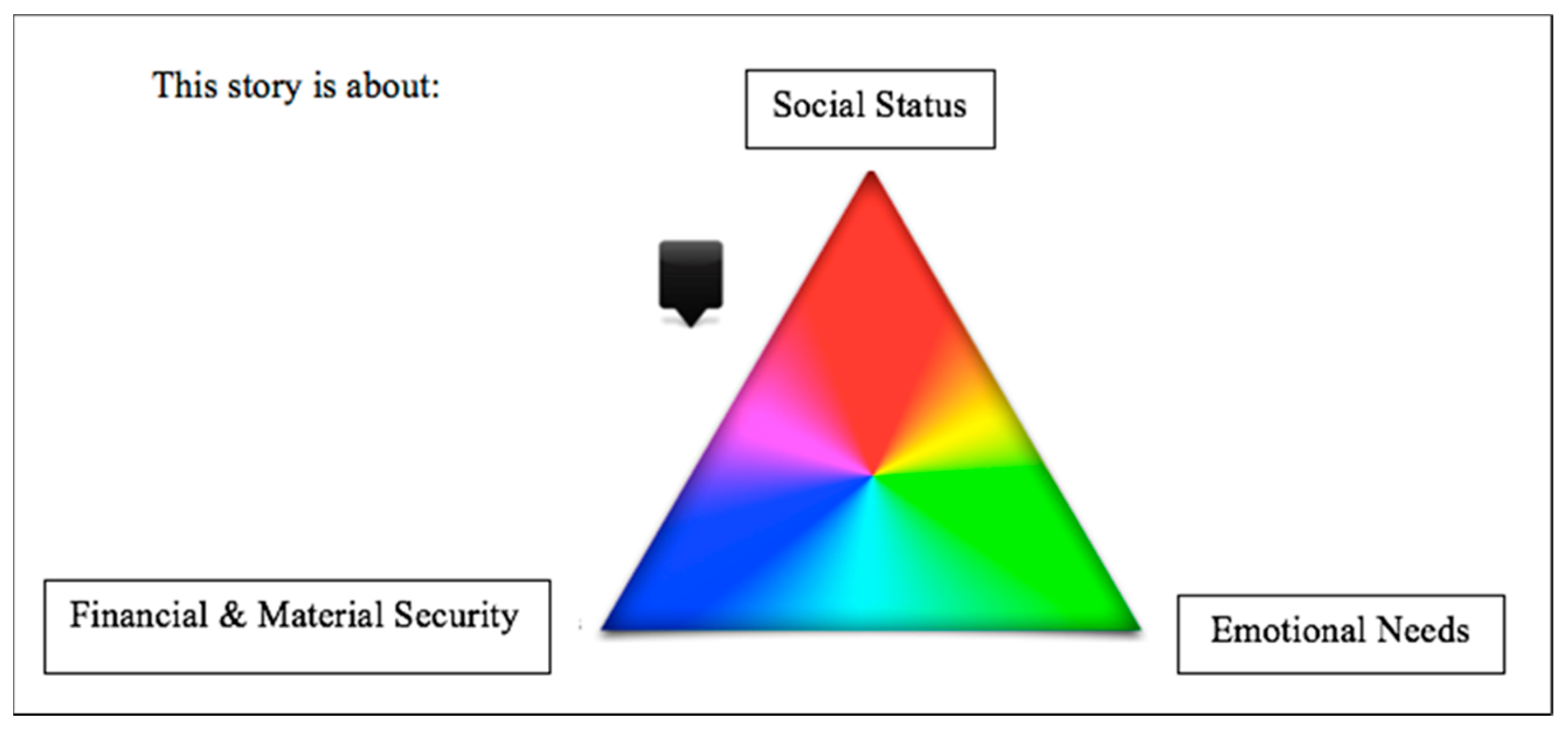
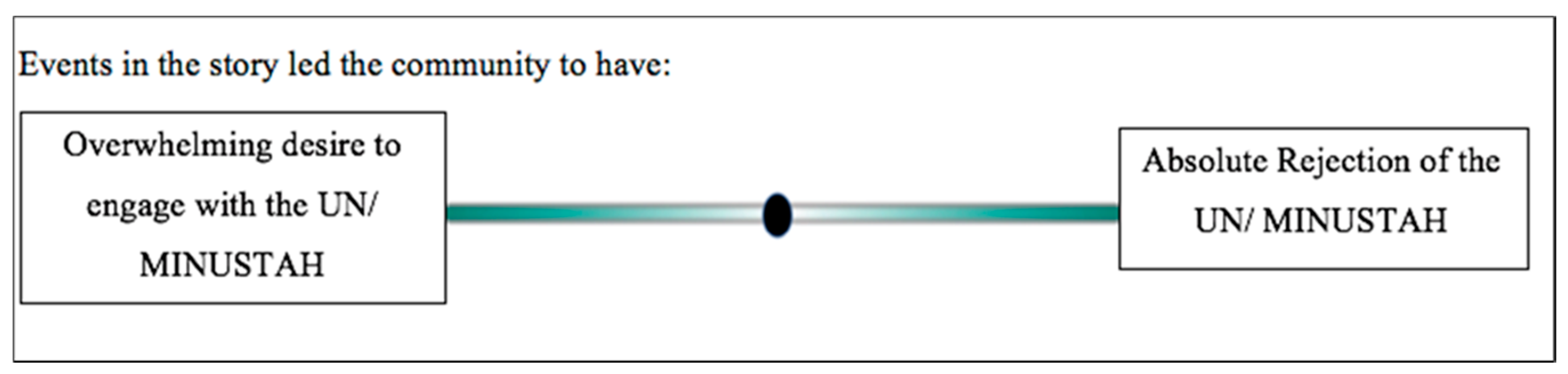
Appendix D
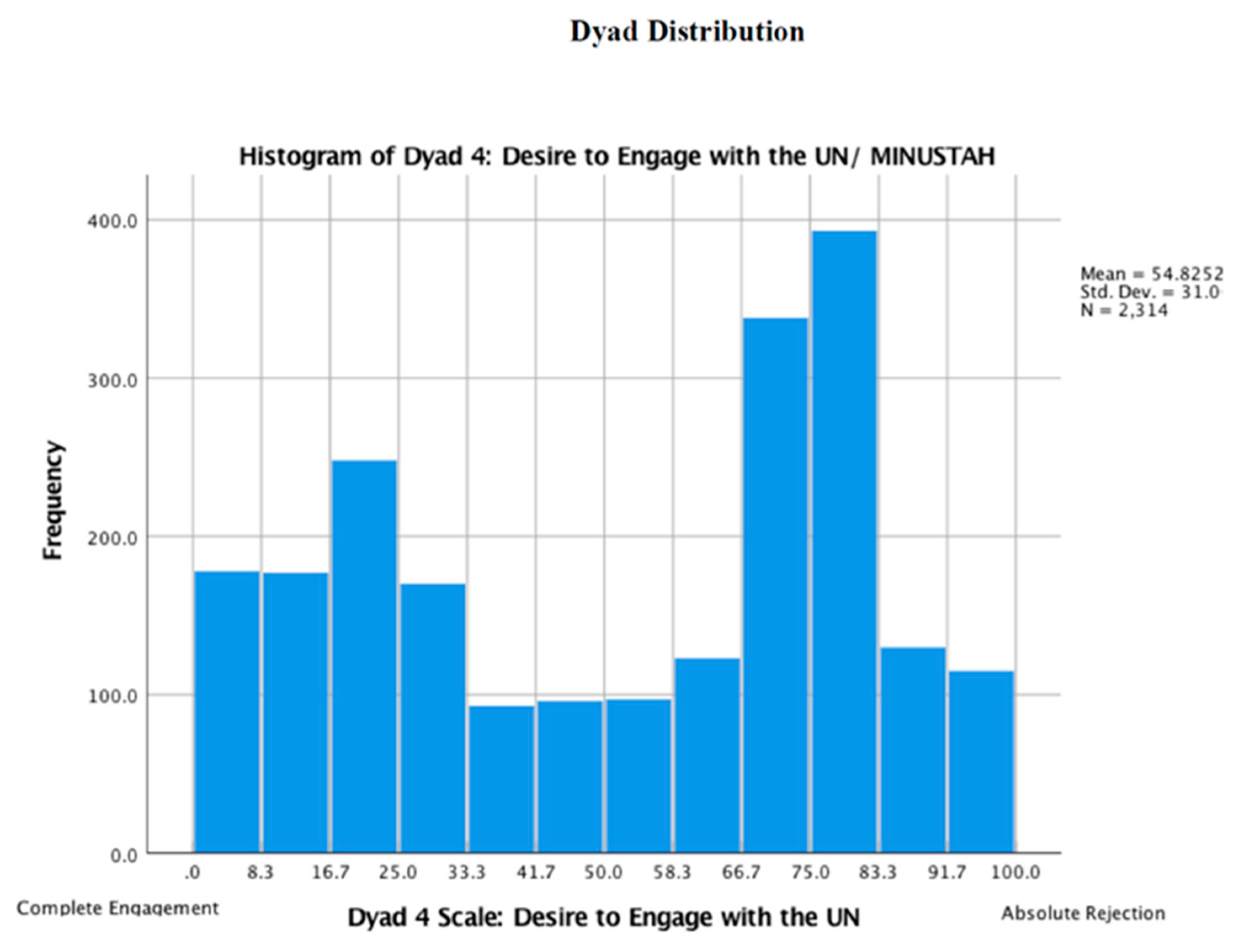
Appendix E
| Exposure Level | Inclusion & Exclusion Criteria | Example Excerpt from Narrative |
|---|---|---|
| Referent Group Positive and neutral experiences with MINUSTAH peacekeepers n = 956 | Short Version: Positive or neutral emotional tone AND not about UN/MINUSTAH wrongdoings. Detailed Version: Narrative does not identify MINUSTAH peacekeepers as perpetuating wrongdoings such as the cholera outbreak and sexual misconduct. Narrative has a positive or neutral emotional tone and describes the following experiences or circumstances: employment opportunities offered by peacekeepers, perceptions of safety, peacekeeper public service & providing humanitarian assistance, perceptions of improved safety, friendships, etc. | “My friend, to tell you the truth, when the MINUSTAH was in town, it was good for me. I don’t know about other people, but most of them were my friends. Some of them had my phone number and would even call me at to come to their house. They would give me a lot of things to take to my house. They used to give me a meal eat almost every Friday. I had some partners that when I go by, I would bring them, and they would get along with them too. (My men, this cholera business that you are talking about, I do not know about it because the MINUSTAH did not boil a pot of cholera) The MINUSTA did great things for me. You must recognize it when someone does a good thing for you. The MINUSTAH did great things for me. Yes indeed, the MINSUTAH did great things for me. They did such great thing for me that I cannot a find a Haitian person like me that did that kind of things for me beside my mother and father. If I only I could tell you what great things.” [Narrator ID 1167] |
| Exposure level of interest Sexual misconduct perpetrated by MINUSTAH peacekeepers n = 682 | Short Version: Sexual interactions between MINUSTAH peacekeepers and Haitian civilians irrespective of emotional tone. Detailed Version: Narrative mentions or describes sexual interactions or relations between Haitian women/girls and MINUSTAH peacekeepers. Examples of sexual interactions with peacekeepers include: sexual abuse, sexual exploitation, monogamous & long-term relationships, children fathered by peacekeepers, sexual harassment, and sexual assault. First-hand experiences of sexual interactions with peacekeepers as well as narratives about the experiences of family/friends, community members, and within media stories are included. Some narratives mention or discuss sexual interactions between MINUSTAH peacekeepers and Haitian men and boys; such narratives were also included in the outcome and are perceived primarily by participants as instances of sexual assault and sexual abuse. | Transactional sex “Concerning the relationship between the ladies and the MINUSTAH, there is nothing free in life and no one would give you things or do you a favor without expecting something in return. In term of the MINUSTAH, let’s assume that the MINUSTAH offers a cell phone to a woman, but this guy did not find the phone on the ground and gave it to you. In other words, he spent his money to buy the phone, so whether it is a man or a woman they’ll be sexually harassed. The women who have kids by the MINUSTAH, it’s their personal business with them and many times these women voluntarily take themselves to the base to join the soldiers. To me, I don’t think there is anything wrong with that. If two adults decide to get together, it is because there was mutual consent among them.” [Narrator ID 2260] Sexual assault of Haitian men & boys “It is possible that not all the MINUSTAH members are bad, but the ones that are not good among them should be removed. Because, the fact that they raped a young man in the area made them send all of them back instead of the one who did it. This young man was their friend. They use to give him money. He also used to sell them cigarettes at the base, this how the story went.” [Narrator ID 1464] Children fathered by peacekeepers It was a Brazilian soldier. And when I got pregnant, I told him I was pregnant but my belly hadn’t yet gotten bigger. He said he would help me with the child. Really, he left for his country and I wrote to him on facebook. I never received any news of him. He never responded. In terms of the child, in terms of school, he/she never went, … It’s only me that’s giving to the child to eat because I can’t pay for school for the child … I need someone to help me send her/him to school, to have a future. [Narrator ID 409] |
| Other Wrongdoings perpetrated by MINUSTAH peacekeepers and negative perceptions of MINUSTAH peacekeepers n = 878 | Short Version: Other wrongdoings perpetrated by MINUSTAH peacekeepers and other un-favorable perceptions of the UN/MINUSTAH that have a negative emotional tone. Detailed Version: The Micro-narrative mentions, describes, or references wrongdoings committed by MINUSTAH peacekeepers that are not related to sexual misconduct. Other wrongdoings include: peacekeepers responsible for cholera outbreak, use of violence (tear gas, beating innocent civilians) as population control, contaminating water supplies, littering, kidnapping, stealing goats, motor-vehicle collisions, improper waste disposal, etc. Unfavorable sentiments of the UN/MINUSTAH that have a negative emotional tone include micro-narratives about: colonialism, neo-colonialism, blaming Haiti’s political situation on MINUSTAH, Haitian mobilization independent of MINUSTAH, peacekeepers being financially compensated too much, etc. | Negative perceptions of MINUSTAH unrelated to wrongdoings Okay, look at how the Haitian people are dying of hunger, right now there is a big starvation in the country, people cannot eat, they cannot do anything. And then, and then the country pays MINUSTAH all that money as a salary, while the people are dying of hunger. Well, that MINUSTAH leave the country, all these money are spending in MINUSTAH, the Haitian people will be suspended to die of hunger, all these money could buy food and give to peoples. Here’s all I have to say. [Narrator ID 684] Other wrongdoings (goat stealing) It was a goat that was lost, now the goat was found. They found the goat in the forest. While it was walking, now they take it, kill it, eat it. After that they would past the house in many cars. The children would call the MINUSTAH “my goat thief”. I would tell them not to say that. I would beat them, they would insult me, sometimes, I would ignore them. But I never heard an adult speak badly of them. I have never heard where they say they were violent with a person [Narrator ID 1337] Peacekeepers responsible for the cholera outbreak I am not a victim of cholera, but my relatives are victims. My father got it, my sister and my child as well. What I have been told about cholera is that MINUSTAH brought it here. They came with a powder that gives cholera, because they weren’t welcome here. That powder they have to spread everywhere. You understand? A powder that itch. They are the one who brought it here. So, we ask for justice. [Narrator ID 1818] |
References
- Alexandra, Kylie. 2011. Peacekeepers’ Privilege and Sexual Abuse in Post-Conflict Populations. Peace Review: A Journal for Social Justice 23: 369–76. [Google Scholar] [CrossRef]
- Aning, Kwesi, and Fiifi Edu-Afful. 2013. Unintended Impacts and the Gendered Consequences of Peacekeeping Economies in Liberia. International Peacekeeping 20: 17–32. [Google Scholar] [CrossRef]
- Baranyi, Stephen. 2011. Canada and the Travail of Partnership in Haiti. In Fixing Haiti: Minustah and Beyond. Edited by Jeorge Heine and Andrew Thompson. New York: United Nations University Press, pp. 205–28. [Google Scholar]
- Barros, Aluísio J. D., and Vânia N. Hirakata. 2003. Alternatives for Logistic Regression in Cross-Sectional Studies: An Empirical Comparison of Models That Directly Estimate the Prevalence Ratio. BMC Medical Research Methodology 3: 1–13. [Google Scholar] [CrossRef] [PubMed]
- Beber, Bernd, Michael J. Gilligan, Jenny Guardado, and Sabrina Karim. 2017. Peacekeeping, Compliance with International Norms, and Transactional Sex in Monrovia, Liberia. International Organization 71: 1–30. [Google Scholar] [CrossRef]
- Catherine, Lutz, Gutmann Matthew, and Brown Keith. 2009. Conduct and Discipline in UN Peacekeeping Operations: Culture, Political Economy and Gender Report. Providene: Watson Institute for International Studies, Brown University. [Google Scholar]
- Cognitive Edge. 2010. About Us: Cognitive Edge. Available online: http://cognitive-edge.com/about-us/ (accessed on 21 June 2018).
- Connors, Jane. 2019. A Victims’ Rights Approach to the Prevention of, and Response to, Sexual Exploitation and Abuse by United Nations Personnel. Australian Journal of Human Rights 25: 498–510. [Google Scholar] [CrossRef]
- Department of Health and Human Services. 2020. International Compilation of Human Research Protections. Available online: http://www.hhs.gov/ohrp/international/ (accessed on 20 April 2020).
- Diehl, Paul F. 2008. Peace Operations (War and Conflict in the Modern World), 1st ed. Cambridge: Polity Press. [Google Scholar]
- dos Santos Parra, Mariana. 2019. Minustah’s Legitimacy and the ‘Security-First’ Approach: Reassessing Statebuilding and Its Violent Features in the Case of Haiti. Journal of Intervention and Statebuilding 2977: 480–502. [Google Scholar] [CrossRef]
- Edmond, Yanique M., Suzanne M. Randolph, and Guylaine L. Richard. 2007. The Lakou System: A Cultural, Ecological Analysis of Mothering in Rural Haiti. The Journal of Pan African Studies 2: 19–32. [Google Scholar]
- Fawzi, M. C., W. Lambert, J. M. Singler, Y. Tanagho, F. Léandre, P. Nevil, D. Bertrand, M. S. Claude, J. Bertrand, M. Louissaint, and et al. 2005. Factors Associated with Forced Sex among Women Accessing Health Services in Rural Haiti: Implications for the Prevention of HIV Infection and Other Sexually Transmitted Diseases. Social Science and Medicine 60: 679–89. [Google Scholar] [CrossRef] [PubMed][Green Version]
- Girl Hub. 2014. Using Sensemaker® to Understand Girls’ Lives: Lessons Learnt. Available online: http://old.cognitive-edge.com/wp-content/uploads/2015/04/GH-SenseMaker-brief.pdf (accessed on 20 April 2020).
- Gordon, Grant M., and Lauren E. Young. 2017. Cooperation, Information, and Keeping the Peace: Civilian Engagement with Peacekeepers in Haiti. Journal of Peace Research 54: 64–79. [Google Scholar] [CrossRef]
- Government of the Republic of Haiti. 2010. Action Plan for National Recovery and Development of Haiti: Immediate Key Initiatives for the Future. Available online: https://www.recoveryplatform.org/assets/publication/Action_Plan_12April_haiti.pdf (accessed on 20 April 2020).
- Heine, Jeorge, and Andrew Thompson. 2011. Introduction: Haiti’s Governance Challenges and the International Community. In Fixing Haiti: Minustah and Beyond. Edited by Jeorge Heine and Andrew Thompson. New York: United Nations University Press, pp. 1–21. [Google Scholar]
- Heinze, Georg, Christine Wallisch, and Daniela Dunkler. 2018. Variable Selection—A Review and Recommendations for the Practicing Statistician. Biometrical Journal 60: 431–49. [Google Scholar] [CrossRef]
- Henry, Marsha. 2015. Parades, Parties and Pests: Contradictions of Everyday Life in Peacekeeping Economies. Journal of Intervention and Statebuilding 9: 372–90. [Google Scholar] [CrossRef]
- Higate, Paul, and Marsha Henry. 2004. Engendering (in)Security in Peace Support Operations. Security Dialogue 35: 461–78. [Google Scholar] [CrossRef]
- Institut Haïtien de l’Enfance. 2018. Haïti: Enquête Mortalité, Morbidité et Utilisation Des Services (EMMUS-VI) 2016–2017. Available online: https://www.dhsprogram.com/pubs/pdf/FR326/FR326.pdf (accessed on 1 May 2021).
- Jennings, Kathleen M. 2008. Protecting Whom? Approaches to Sexual Axploitation and Abuse UN Peacekeeping Operations. Available online: http://lastradainternational.org/lsidocs/fafo_approaches_abuse_0309.pdf (accessed on 20 April 2020).
- Jennings, Kathleen M. 2014. Service, Sex, and Security: Gendered Peacekeeping Economies in Liberia and the Democratic Republic of the Congo. Security Dialogue 45: 313–30. [Google Scholar] [CrossRef]
- Jennings, Kathleen M., and Morten Bøås. 2015. Transactions and Interactions: Everyday Life in the Peacekeeping Economy. Journal of Intervention and Statebuilding 9: 281–95. [Google Scholar] [CrossRef]
- Jennings, Kathleen M., and Vesna Nikolić-Ristanović. 2009. UN Peacekeeping Economies and Local Sex Industries: Connections and Implications. MICROCON Research Working Paper 17. Brighton: Institute of Development Studies at the University of Sussex. [Google Scholar] [CrossRef]
- Karim, Sabrina, and Kyle Beardsley. 2013. Female Peacekeepers and Gender Balancing: Token Gestures or Informed Policymaking? International Interactions 39: 461–88. [Google Scholar] [CrossRef]
- Karim, Sabrina, and Kyle Beardsley. 2016. Explaining Sexual Exploitation and Abuse in Peacekeeping Missions: The Role of Female Peacekeepers and Gender Equality in Contributing Countries. Journal of Peace Research 53: 100–115. [Google Scholar] [CrossRef]
- Karim, Sabrina. 2017. Reevaluating Peacekeeping Effectiveness: Does Gender Neutrality Inhibit Progress? International Interactions 43: 822–47. [Google Scholar] [CrossRef]
- Lee, Sabine, and Susan Bartels. 2020. ‘They Put a Few Coins in Your Hand to Drop a Baby in You’: A Study of Peacekeeper-Fathered Children in Haiti. International Peacekeeping 27: 177–209. [Google Scholar] [CrossRef]
- Luo, Ji, Jiajia Zhang, and Han Sun. 2014. Estimation of Relative Risk Using a Log-Binomial Model with Constraints. Computational Statistics 29: 981–1003. [Google Scholar] [CrossRef]
- Ministère de la Santé Publique. 2020. Politique Nationale de Recherche En Santé PUBLIQUE ET DE LA POPULATION. Available online: https://mspp.gouv.ht/site/downloads/PolitiqueNationaledeRechercheenSanté-MSPP21janvier2020VF.pdf (accessed on 20 April 2020).
- Moncrief, Stephen. 2017. Military Socialization, Disciplinary Culture, and Sexual Violence in UN Peacekeeping Operations. Journal of Peace Research 54: 715–30. [Google Scholar] [CrossRef]
- Morris, Claire. 2010. Peacekeeping and the Sexual Exploitation of Women and Girls in Post-Conflict Societies: A Serious Enigma to Establishing the Rule of Law. Journal of International Peacekeeping 14: 184–212. [Google Scholar] [CrossRef]
- Neudorfer, Kelly. 2014. Reducing Sexual Exploitation and Abuse: Does Deterrence Work to Prevent SEAs in UN Peacekeeping Missions? International Peacekeeping 21: 623–41. [Google Scholar] [CrossRef]
- Nordås, Ragnhild, and Siri C. A. Rustad. 2013. Sexual Exploitation and Abuse by Peacekeepers: Understanding Variation. International Interactions 39: 511–34. [Google Scholar] [CrossRef]
- Orozco, Manuel. 2006. Understanding the Remittance Economy in Haiti. Methodology. Available online: http://archive.thedialogue.org/PublicationFiles/Understanding%20the%20remittance%20economy%20in%20Haiti.pdf (accessed on 20 April 2020).
- Padgett, Andrew, and Tonia Warnecke. 2011. Diamonds in the Rubble: The Women of Haiti. Journal of Economic Issues 45: 527–58. [Google Scholar] [CrossRef]
- Porter, Catherine, Michael Crowley, and Constant Meheut. 2021. Haiti’s President Assassinated in Nighttime Raid, Shaking a Fragile Nation. New York Times. July 7. Available online: https://www.nytimes.com/2021/07/07/world/americas/haiti-president-assassinated-killed.html?action=click&module=Top%20Sto-ries&pgtype=Homepage (accessed on 20 April 2020).
- Rivera, Juan. 2018. The Impact of Organized Crime on Peace Support Operations. In Law Enforcement within the Framework of PSO. Oxford: Martinus Nijhoff Publishers, pp. 75–104. [Google Scholar] [CrossRef]
- Romulus, Célia. 2016. Haiti: A Sociopolitical Timeline (1980–2014). In Witness to History—Témoin de l’Histoire—Thony Bélizaire. Edited by Raoul Peck. New York: Velvet Film. [Google Scholar]
- Simić, Olivera, and Melanie OBrien ’. 2014. ‘Peacekeeper Babies’: An Unintended Legacy of United Nations Peace Support Operations. International Peacekeeping 21: 345–63. [Google Scholar] [CrossRef]
- Simić, Olivera. 2009. Rethinking ‘sexual Exploitation’ in UN Peacekeeping Operations. Women’s Studies International Forum 32: 288–95. [Google Scholar] [CrossRef]
- Spangaro, Jo, Chinelo Adogu, Geetha Ranmuthugala, Gawaine Powell Davies, Léa Steinacker, and Anthony Zwi. 2013. What Evidence Exists for Initiatives to Reduce Risk and Incidence of Sexual Violence in Armed Conflict and Other Humanitarian Crises? A Systematic Review. PLoS ONE 8: e62600. [Google Scholar] [CrossRef]
- Talentino, Andrea. 2007. Perceptions of Peacebuilding: The Dynamic of Imposer and Imposed Upon. International Studies Perspectives 8: 152–71. [Google Scholar] [CrossRef]
- United Nations Secretariat. 2003. Special Measures for Protection from Sexual Exploitation and Sexual Abuse. Available online: https://www.un.org/en/ga/search/view_doc.asp?symbol=ST/SGB/2003/13 (accessed on 20 April 2020).
- United Nations Secretariat. 2005. A Comprehensive Stragety to Eliminate Future Exploitation and Abuse in United Nations Peacekeping Operations. United Nations: Geneva, Switzerland, vol. 24790. [Google Scholar]
- United Nations Security Council. Resolution 1908 (2010). New York, 2010a. Available online: https://daccess-ods.un.org/TMP/5441516.63780212.html (accessed on 20 April 2020).
- United Nations Security Council. 2010b. Resolution 1927 (2010). New York. Available online: https://undocs.org/S/RES/1927 (accessed on 20 April 2020).
- United Nations. 2019. 2017 and 2018 Report: Trust Fund in Support of Victims of Sexual Exploitation and Abuse. Available online: https://conduct.unmissions.org/remedial-trust-fund (accessed on 20 April 2020).
- United Nations. 2020a. Conduct in UN Peace Missions: Sexual Exploitation and Abuse. Available online: https://conduct.unmissions.org/sea-overview (accessed on 21 March 2020).
- United Nations. 2020b. Sexual Exploitation and AbuseConduct in UN Field Missions. Available online: https://conduct.unmissions.org/sea-victims (accessed on 21 March 2020).
- Vahedi, Luissa, Susan A. Bartels, and Sabine Lee. 2019. ‘Even Peacekeepers Expect Something in Return’: A Qualitative Analysis of Sexual Interactions between UN Peacekeepers and Female Haitians. Global Public Health 1692: 1–14. [Google Scholar] [CrossRef]
- Vahedi, Luissa, Susan Bartels, and Sabine Lee. 2020. ‘His Future Will Not Be Bright’: A Qualitative Analysis of Mothers’ Lived Experiences Raising Peacekeeper-Fathered Children in Haiti. Children and Youth Services Review 119: 105625. [Google Scholar] [CrossRef]
- Vahedi, Luissa, Heather Stuart, Stéphanie Etienne, Sabine Lee, and Susan A. Bartels. 2021. Gender-Stratified Analysis of Haitian Perceptions Related to Sexual Abuse and Exploitation Perpetrated by UN Peacekeepers during MINUSTAH. Sexes 2: 216–43. [Google Scholar] [CrossRef]
- VanderWeele, Tyler J. 2019. Principles of Confounder Selection. European Journal of Epidemiology 34: 211–19. [Google Scholar] [CrossRef] [PubMed]
- Verner, Dorte. 2008. Making Poor Haitians Count Poverty in Rural and Urban Haiti Based on the First Household Survey for Haiti. World. Available online: https://openknowledge.worldbank.org/handle/10986/6555 (accessed on 20 April 2020).
- Weir, Kirsten. 2019. Studying Adolescents without Parents’ Consent: A New APA Resolution Supports Mature Minors’ Participation in Research without Parental Permission. Washington, DC: American Psychological Association. Available online: https://www.apa.org/monitor/2019/02/parents-consent (accessed on 20 April 2020).
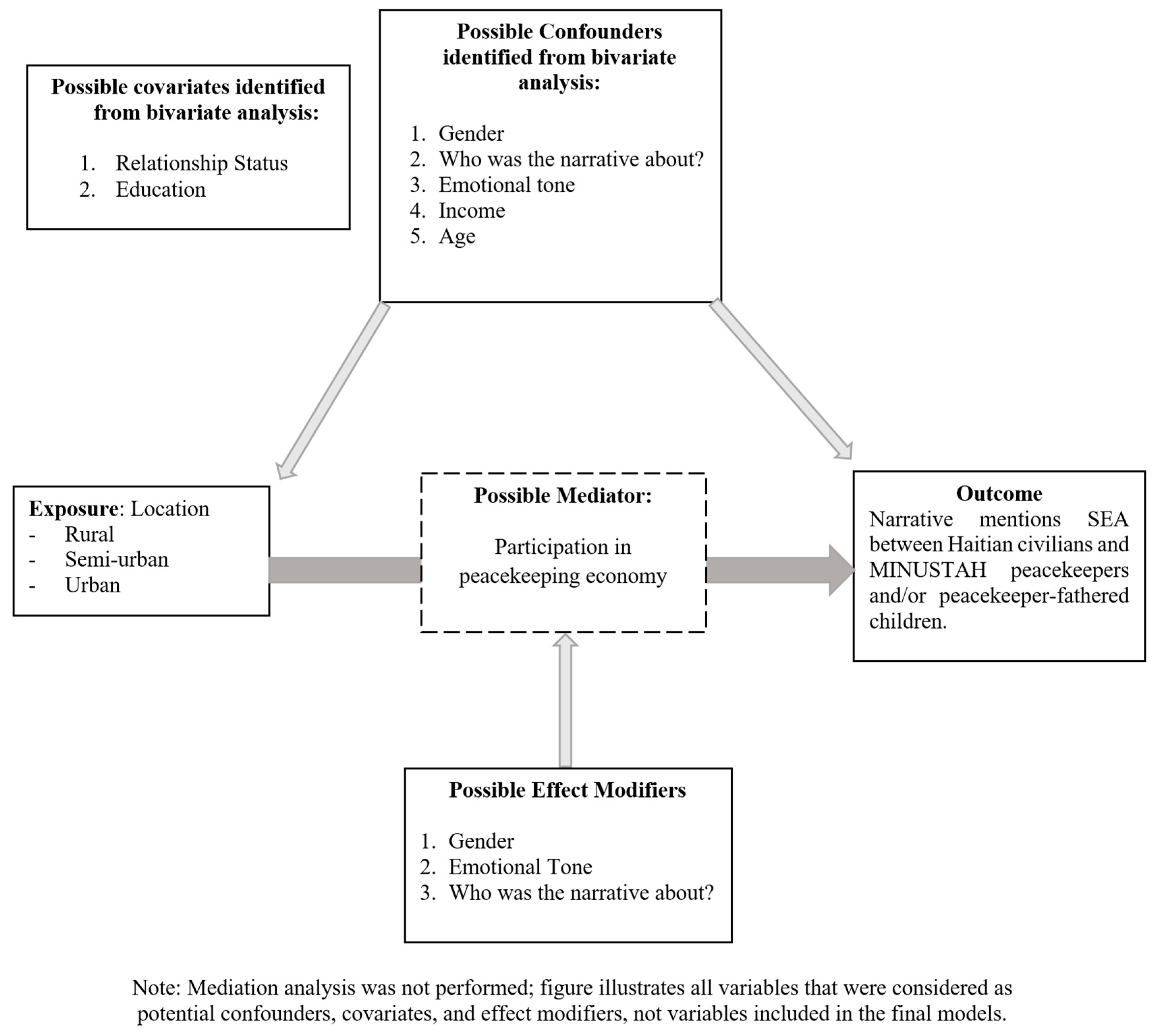
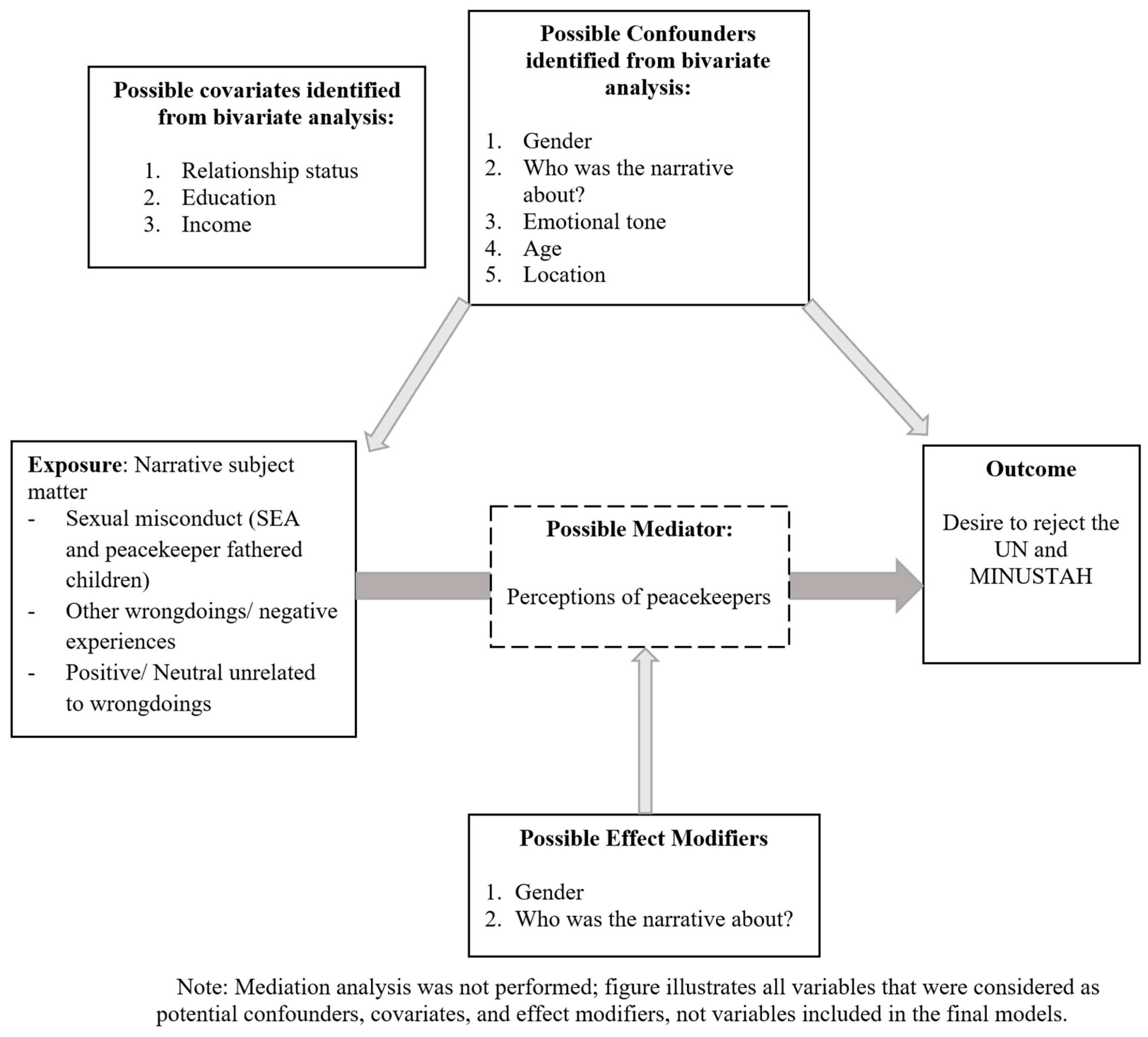
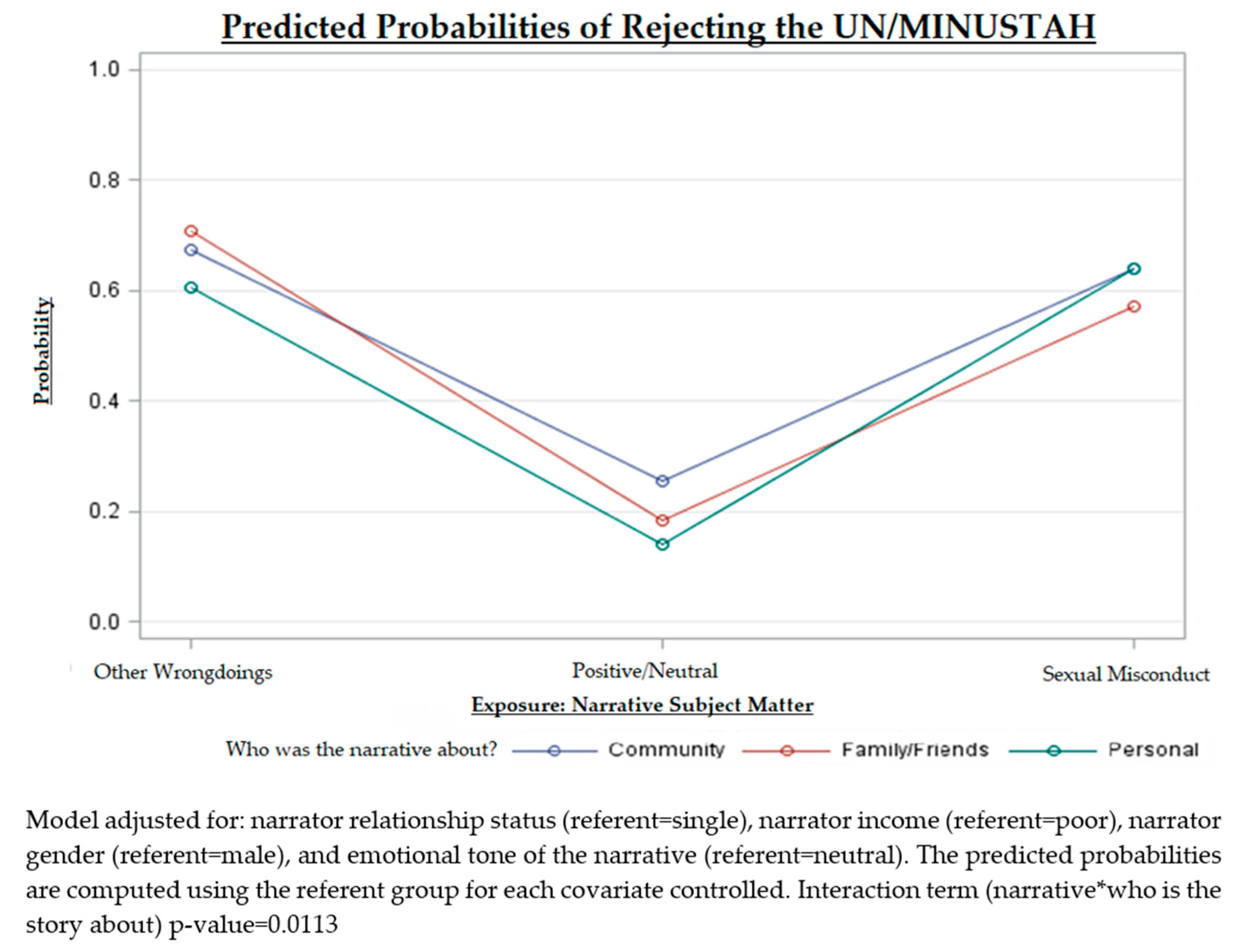
| Variable | Survey Question | Operationalization |
|---|---|---|
| Gender | What is your gender? Female Male | 0: Male 1: Female |
| Relationship Status | What is your marital status? Married or living together Divorced/Separated from spouse Widowed Single, never married | 0: Single 1: In a relationship |
| Education | What is your highest educational qualification? No formal education Some primary school Completed primary school Some secondary school Completed secondary school Some post-secondary school Completed post-secondary school | 0: No education 1: Some or completed primary school 2: Some or completed secondary school 3: Some or completed post-secondary |
| Income | Please tell me which of these you or your household owns. Your household consists of people who sleep under the same roof and eat the same meals. Chose as many as your family has: Radio Mobile phone Refrigerator or freezer Vehicle such as a truck, car, or motorcycle Generator, inverter, or a sun panel that provides electricity to your home None of the above | 0: Poor (0–1 items) 1: Average (2–3 items) 2: Well-off (4–5 items) |
| Age | How old are you: 11–17 years old 18–24 years old 25–34 years old 35–44 years old 45–54 years old ≥55 years old | 0: >45 years 1: 25–44 years 2: 11–24 years |
| Who was the narrative about? | Who is the story about? About me About someone in my household About someone in my family who doesn’t live in my household About a friend Community Something I heard or read about | 0: Personal 1: Family or friends 2: Community member |
| Emotional Tone | What is the emotional tone of this story? Strongly positive Positive Neutral Negative Very negative | 0: Neutral 1: Positive 2: Negative |
| Location | In what location was the interview conducted? [Question asked of the research assistants] Cite Soleil, Charlie Log Base/Tabarre, Gonaives, St. Marc, Hinche, Leogane, Port Salut, Miragoane, Morne Casse/Fort Liberte, Cap Haitien | Cap Haitien (0), Charlie Log Base/Tabarre (1), Cite Soleil (2), Hinche (3), Leogane (4), Morne Casse/Fort Liberte (5), Port Salut (6), Saint Marc (7) |
| Characteristic | n | % |
|---|---|---|
| Age | ||
| 11–17 years old | 216 | 9.9 |
| 18–24 years old | 508 | 23.2 |
| 25–34 years old | 724 | 33.0 |
| 35–44 years old | 360 | 16.4 |
| 45–54 years old | 206 | 9.4 |
| ≥55 years old | 127 | 5.8 |
| Prefer not to say | 48 | 2.2 |
| Missing | 2 | 0.9 |
| Gender | ||
| Male | 1526 | 69.6 |
| Female | 664 | 30.3 |
| Prefer not to say | 1 | 0.05 |
| Education | ||
| No formal education | 118 | 5.4 |
| Some primary school | 269 | 12.3 |
| Completed primary school | 250 | 11.4 |
| Some secondary school | 831 | 37.9 |
| Completed secondary school | 416 | 19.0 |
| Some post-secondary school | 217 | 9.9 |
| Completed post-secondary school | 90 | 4.1 |
| Income | ||
| Poor | 670 | 30.6 |
| Average | 1386 | 63.3 |
| Well-off | 135 | 6.2 |
| Location a | ||
| Cité Soleil | 341 | 15.6 |
| Port Salut | 313 | 14.3 |
| Saint Marc and Gonaives | 314 | 14.3 |
| Leogane | 314 | 14.3 |
| Hinche | 303 | 13.8 |
| Cap Haitien | 246 | 11.2 |
| Morne Casse and Fort Liberté | 192 | 8.8 |
| Charlie Log Base and Tabarre | 168 | 7.7 |
| Marital Status | ||
| Single never married | 1326 | 60.5 |
| Married or living together as if married | 796 | 36.3 |
| Divorced/Separated from spouse | 18 | 0.8 |
| Widowed | 15 | 0.7 |
| Prefer not to say | 36 | 1.6 |
| ntotal = 2191 Narrators/Participants | ||
| Characteristic | All Narratives n (%) | Sexual Misconduct | No Sexual Misconduct | p-Value * |
|---|---|---|---|---|
| Location | n = 2541 | n = 682 | n = 1859 | <0.0001 |
| Cité Soleil | 399 (15.7) | 129 (18.9) | 270 (14.5) | |
| Port Salut | 364 (14.3) | 180 (26.4) | 184 (9.9) | |
| Saint Marc and Gonaïves | 361 (14.2) | 102 (15) | 259 (13.9) | |
| Hinche | 359 (14.1) | 91 (13.3) | 268 (14.4) | |
| Léogâne | 355 (14.0) | 62 (9.1) | 293 (15.8) | |
| Cap Haiïtien | 287 (11.3) | 54 (7.9) | 233 (12.5) | |
| Morne Casse and Fort Liberté | 220 (8.7) | 25 (3.7) | 195 (10.5) | |
| Charlie Log Base and Tabarre | 196 (7.7) | 39 (5.7) | 157 (8.4) | |
| Gender of narrator | n = 2539 | n = 680 | n = 1859 | 0.0370 |
| Male | 1803 (71.0) | 504 (74.1) | 1299 (69.9) | |
| Female | 736 (29) | 176 (25.8) | 560 (30.1) | |
| Location by subgroup | n = 2541 | n = 682 | n = 1859 | <0.0001 |
| Urban φ | 595 (23.4) | 168 (24.6) | 427 (23.0) | |
| Semi-urban ϒ | 642 (25.2) | 116 (17.0) | 526 (28.3) | |
| Rural ⊥ | 1304 (51.3) | 398 (58.4) | 906 (48.7) | |
| Willingness to Engage with UN | n = 2314 | n = 652 | n = 1662 | <0.0001 |
| Reject UN/MINUSTAH | 1132 (48.9) | 219 (33.6) | 963 (57.4) | |
| Engage with the UN/MINUSTAH | 1182 (51.1) | 433 (66.4) | 699 (42.0) | |
| Who is this story about? | n = 2493 | n = 682 | n = 1859 | <0.0001 |
| Friend | 109 (4.3) | 62 (9.1) | 47 (2.5) | |
| Me | 890 (35.0) | 83 (12.2) | 807 (43.4) | |
| Someone else in my community | 1000 (39.4) | 395 (57.9) | 605 (32.5) | |
| Someone in my family who does not live in my household | 51 (2.0) | 19 (2.8) | 32 (1.7) | |
| Someone in my household | 55 (2.2) | 19 (2.8) | 36 (1.9) | |
| Something I heard or read | 388 (15.3) | 93 (13.6) | 295 (15.9) | |
| Prefer not to say | 48 (1.9) | 11 (1.6) | 37 (2.0) | |
| Emotional Tone | n = 2541 | n = 682 | n = 1859 | <0.0001 |
| Very negative | 257 (10.1) | 133 (19.5) | 124 (6.7) | |
| Negative | 909 (35.8) | 313 (45.9) | 596 (32.1) | |
| Neutral | 278 (10.9) | 68 (10.0) | 210 (11.3) | |
| Not sure | 44 (1.7) | 7 (1.0) | 37 (2.0) | |
| Positive | 826 (32.5) | 108 (15.8) | 718 (38.6) | |
| Strongly positive | 227 (8.93) | 53 (7.8) | 174 (9.4) | |
| How often does this situation occur? | n = 2541 | n = 682 | n = 1859 | <0.0001 |
| All the time | 408 (16.1) | 95 (13.9) | 313 (16.8) | |
| Very frequently | 943 (37.1) | 265 (38.9) | 678 (36.5) | |
| Regularly | 469 (18.5) | 137 (20.1) | 332 (17.9) | |
| Occasionally | 258 (10.2) | 95 (13.9) | 163 (8.8) | |
| Very rarely | 300 (11.8) | 75 (11) | 225 (12.1) | |
| Not sure | 163 (6.4) | 15 (2.2) | 148 (8.0) | |
| How important is it for others to hear your story? | n = 2541 | n = 682 | n = 1859 | <0.0001 |
| Must hear this story and take action | 1522 (59.9) | 515 (75.5) | 1007 (54.2) | |
| Should definitely hear this story and pay attention | 689 (27.1) | 137 (20.1) | 552 (29.7) | |
| Can learn some things but not much | 268 (10.6) | 22 (3.2) | 246 (13.2) | |
| Nothing to learn from this story | 15 (0.59) | 3 (0.4) | 12 (0.6) | |
| Not sure | 47 (1.85) | 5 (0.7) | 42 (2.3) | |
| What country was the foreigner in the story from? | n = 2541 | n = 682 | n = 1859 | <0.0001 |
| Uruguay | 395 (15.6) | 167 (24.5) | 228 (12.3) | |
| Brazil | 522 (20.5) | 150 (22.0) | 372 (20.0) | |
| Chile | 257 (10.1) | 50 (7.3) | 207 (11.1) | |
| Argentina | 182 (7.2) | 51 (7.5) | 131 (7.0) | |
| Nepal | 227 (8.9) | 49 (7.2) | 178 (9.6) | |
| Sri Lanka | 142 (5.5) | 28 (4.1) | 114 (6.1) | |
| United States | 26 (1.0) | 2 (0.3) | 24 (1.3) | |
| Canada | 12 (0.5) | 4 (0.6) | 8 (0.4) | |
| Bolivia | 9 (0.4) | 2 (0.3) | 7 (0.4) | |
| Don’t know | 517 (20.4) | 120 (17.6) | 397 (21.4) | |
| Other § | 252 (9.91) | 59 (8.65) | 193 (10.38) |
| Exposure | RR | 95% CI | p-Value |
|---|---|---|---|
| Location | <0.0001 | ||
| Urban | 1.00 | Ref | Ref |
| Rural | 1.19 | (1.03, 1.38) | 0.0195 |
| Semi-Urban | 0.70 | (0.57, 0.86) | 0.0007 |
| Who Is This Story about? | ||||||
|---|---|---|---|---|---|---|
| Community Members (n = 1388) | Family & Friends (n = 215) | Personal (n = 890) | ||||
| RR (95% CI) | p-Value | RR (95% CI) | p-Value | RR (95% CI) | p-Value | |
| Positive/Neutral | Ref | Ref | Ref | |||
| Other wrongdoings | 2.64 (2.11, 3.31) | <0.0001 | 3.84 (1.69, 8.74) | 0.0013 | 4.28 (3.22, 5.67) | <0.0001 |
| Sexual Misconduct | 2.51 (2.00, 3.14) | <0.0001 | 3.12 (1.35, 7.11) | 0.0072 | 4.52 (3.34, 6.12) | <0.0001 |
| Who Is This Narrative about? | ||||||
|---|---|---|---|---|---|---|
| Narrative Subject Matter | Community Members n = 1388 | Family & Friends n = 215 | Personal n = 890 | |||
| RR (95% CI) | p-Value | RR (95% CI) | p-Value | RR (95% CI) | p-Value | |
| Sexual Misconduct | Ref | Ref | Ref | |||
| Other wrongdoings | 1.05 (0.97, 1.14) | 0.1946 | 1.24 (1.01, 1.52) | 0.0481 | 0.95 (0.80, 1.13) | 0.5313 |
Publisher’s Note: MDPI stays neutral with regard to jurisdictional claims in published maps and institutional affiliations. |
© 2021 by the authors. Licensee MDPI, Basel, Switzerland. This article is an open access article distributed under the terms and conditions of the Creative Commons Attribution (CC BY) license (https://creativecommons.org/licenses/by/4.0/).
Share and Cite
Vahedi, L.; Stuart, H.; Etienne, S.; Lee, S.; Bartels, S.A. The Distribution and Consequences of Sexual Misconduct Perpetrated by Peacekeepers in Haiti: An Exploratory Cross-Sectional Analysis. Soc. Sci. 2021, 10, 270. https://doi.org/10.3390/socsci10070270
Vahedi L, Stuart H, Etienne S, Lee S, Bartels SA. The Distribution and Consequences of Sexual Misconduct Perpetrated by Peacekeepers in Haiti: An Exploratory Cross-Sectional Analysis. Social Sciences. 2021; 10(7):270. https://doi.org/10.3390/socsci10070270
Chicago/Turabian StyleVahedi, Luissa, Heather Stuart, Stéphanie Etienne, Sabine Lee, and Susan A Bartels. 2021. "The Distribution and Consequences of Sexual Misconduct Perpetrated by Peacekeepers in Haiti: An Exploratory Cross-Sectional Analysis" Social Sciences 10, no. 7: 270. https://doi.org/10.3390/socsci10070270
APA StyleVahedi, L., Stuart, H., Etienne, S., Lee, S., & Bartels, S. A. (2021). The Distribution and Consequences of Sexual Misconduct Perpetrated by Peacekeepers in Haiti: An Exploratory Cross-Sectional Analysis. Social Sciences, 10(7), 270. https://doi.org/10.3390/socsci10070270

