Article

“Sweet” or “Decompositional”? The Bernardine Pseudo-Plainchant in the 1761 Series Concentuum Divae Annae Sacra from the Dominican Nunnery in Święta Anna near Częstochowa (Poland)


by
Michał Jędrzejski
Department of Religious Monody and Polyphony, Institute of Arts Studies, The John Paul II Catholic University of Lublin, Al. Racławickie 14, 20-950 Lublin, Poland
Arts 2026, 15(7), 155; https://doi.org/10.3390/arts15070155
Submission received: 24 March 2026 / Revised: 15 June 2026 / Accepted: 30 June 2026 / Published: 3 July 2026
(This article belongs to the Section Musical Arts and Theatre)

Abstract

This article is devoted to the 18th-century Bernardine repertoire of pseudo-plainchant, that is, Latin liturgical monophony, which differs significantly from the style of Gregorian and Neo-Gregorian chant. The research employs methods of codicological (from Latin, codex = book) analysis of the source, as well as analysis of the repertoire, melody, text and musical notation. Melodies are also transcribed and compared with selected manuscripts from the Library of the Bernardine Province in Kraków. The research reveales that the pseudo-plainchant collection comprises 14 ordinarium missae (the Ordinary of the Mass, i.e., the fixed or invariable parts of the Mass), one Gloria and 15 Patrem (Credo, the Creed). The repertoire dedicated to St Anne, local patron saint, shares tonal language, elements of rhythm and metre, key signatures, chromatic signs, melodic sequences, the repeated use of the same musical material, alternatim technique (vocal and instrumental parts performed alternately), contrasts in performance, register and style, melodies based on Polish church songs, and geographical titles. The term “sweet” (suaves) appearing on the title page may indicate the aesthetic stance of the Bernardines from Święta Anna and their positive attitude towards the repertoire in question, although 20th-century musicological literature has attributed decompositional elements to it. In this way, the manuscript under study may serve as a basis for updating our understanding of the pseudo-plainchant repertoire as such.

1. Introduction

Pseudo-plainchant is a monophonic liturgical repertoire, consisting mainly of the ordinarium missae (the Ordinary of the Mass, i.e., the fixed or invariable parts of the Mass) and the Patrem (Credo, the Creed), composed in Poland and Europe essentially from the late 17th to the 19th centuries, drawing on Gregorian chant yet deviating significantly from its original style, as well as from late medieval neo-Gregorian chant. In recent decades, this repertoire has become the subject of inquiry by several Polish musicologists. Hieronim Feicht (1894–1967) took a critical view of the issue, identifying “decompositional elements”,1 and it is he who labelled the works as pseudo-plainchant (Feicht 1965). In this article, the terms “pseudo-plainchant” and “decompositional” are used in a historiographical sense referring to the mentioned earlier scholarship; however, the former term finds its continuation in recent research in Poland. The word “decompositional” will be confronted, as in the article’s title, with the epithet suaves [sweet] declined in the manuscript’s title, possibly reflecting the attitude of the local monastic community to the repertoire in question.
Another Polish musicologist Tadeusz Miazga (1906–1988) compiled a catalogue of 182 variants of the Vatican Edition Credo I and 701 other Credo melodies from European sources ranging from the Middle Ages to the 19th century.2 A scholar whose recent research and publications deserve particular attention is Andrzej Edward Godek, who, drawing on numerous manuscript sources, particularly from Kraków libraries and archives, characterised and catalogued a selected repertoire, still referred to as pseudo-plainchant (Godek 2017a, 2017b, 2018a, 2018b, 2021, 2023).
As indicated by Feicht and Godek, the key characteristics of pseudo-plainchant, composed and performed within the borders of the First Polish Republic largely by Bernardine monks, include: a tonal musical language, a melodic style based on spread chords and a sequential repetition of short motifs, bars, metre, fixed bar groups, key signatures, themes drawn from Polish and Latin religious songs, inspiration from secular Baroque and Classicism music (operatic and instrumental), and titles of the ordinarium missae derived from the names of cities and geographical regions (Feicht 1965, p. 226; Godek 2023, pp. 119–21, 2018b, p. 34). An additional element was the alternatim technique, which involved incorporating polyphonic sections into monophonic pieces and performing vocal and instrumental (organ) parts alternately. In European music scholarship, the pseudo-plainchant style is described as canto fratto (cantus fractus), the essence of which lies in combining cantus planus with cantus mensurabilis (Maciejewski 1999, pp. 291–93; Thannabaur 1962, pp. 102–3). Its origins are traced back to 14th-century France, from where it is thought to have spread across the continent (Gozzi and Piras 2003, p. 3). Due to a style distant from Gregorian chant, and even considered closer to “contemporary musical idioms” than the former (Dyer 2016, p. 576), pseudo-plainchant has not attracted as much interest from Polish and foreign researchers as the classical repertoire of Latin liturgical monophony.3 Further in this study, the repertoire in question is no more referred to as canto fratto, but, as up to this point after Feicht and Godek, pseudo-plainchant to emphasise the contrastive approach expressed in the title and subsequent sections.
The present article addresses research gaps in the study and understanding of a particular manuscript, as well as local pseudo-plainchant repertoire, stylistic features, and performance practice. The manuscript under discussion is a Bernardine liturgical codex (from Latin, a book) titled Series Concentuum Divae Annae Sacra (shelfmark Arch 0001) from the Archives of the (present-day) Dominican Nunnery in Święta Anna near Przyrów (further also referred to as the “Przyrów manuscript”),4 a village situated 35 km east of Częstochowa, Poland. The musical culture of this place has developed over centuries within the context of the cult of St Anne, whose local roots date back to the late 14th century. Due to the dynamic development of the local pastoral ministry and pilgrimage movement, a Bernardine monastery was founded in Święta Anna in 1609. The monks arrived from Poznań5 and remained there until November 1864, when they were expelled by the tsarist authorities for their active participation in the 1863 January Uprising. In August 1869, Dominican nuns arrived in Święta Anna from a convent that had been closed down in Piotrków Trybunalski (Stefaniak 2010, pp. 29–30), and they have remained there ever since.
Despite their centuries-old tradition, the musical sources from Święta Anna have not been the subject of comprehensive scholarly studies, but have merely been mentioned.6 One reason for this may be the significant dispersal of the Bernardine-Dominican book collection from Święta Anna, particularly in the 19th century, to other Polish libraries.7 The codex in question is one of four manuscripts of Bernardine provenance (origin) found on site and the only one containing a pseudo-plainchant mass repertoire.8 Therefore, this article is the first such comprehensive study on one musical-liturgical source from the Święta Anna monastery. It addresses the research gaps in the Święta Anna plainchant manuscripts, the local repertoire and style, as well as performing practice.

2. Methods and Materials

The author’s main aim is to analyse the repertoire and compare it with selected Bernardine sources from the Library of the Bernardine Province in Kraków (=BPBerKr),9 in order to demonstrate the originality (distinctness) and similarities (shared features) of the texts and melodies from Święta Anna, their origins and liturgical purposes in comparison with other monasteries. First, as an intermediate objective, the eponymous source of the chants under study will be presented, using methods of external codex description specific to codicology (study of codices). Subsequently, an analysis of the text and melody, their origin and liturgical purpose will be carried out, as well as a comparison for which four manuscripts from the Kraków library have been selected according to the following criteria: the presence of the pseudo-plainchant ordinarium missae and Patrem, Bernardine provenance, and a date of creation prior to 1761 (sources older than the manuscript from Święta Anna). The manuscripts selected according to these criteria originate from the Bernardine monasteries in Kraków and Alwernia (Lesser Poland), and bear the following shelfmarks beginning with BPBerKr, and further: BPBerKr 33/RL (Alwernia, 1716), BPBerKr 37/RL (Kraków, 1744), BPBerKr 42/RL (Kraków, 1650–1700), BPBerKr 82/RL (Alwernia, 1650–1700).10 The in-text photographs and musical figures, as well as comparative transcriptions of the incipits of the ordinarium missae (Figures S1–S15 in Supplementary Materials) illustrate the distinctive nature of the musical style of pseudo-plainchant in terms of repertoire, external influences, musical notation, liturgical and geographical titles, and other features. The transcriptions include only pitch but omit rhythmic and mensural elements for their irregularity, inconsistency and inaccuracy. The in-text musical figures show the sources of the melodies which were recognized in course of the research. The vertical lines do not represent bars but division into syllables. Regarding the transcriptions of comparative Bernardine manuscripts, only different fragments were marked; thus, if the melody remains identical (unchanged), there is a blank stave. However, the non-Bernardine source melodies were fully transcribed. The criteria used to identify variants are as follows: pitch, intervals, melodic style (the number of notes per syllable), and text distribution.
The examined manuscript Arch 0001 begins a series of several codices in the Święta Anna archives, designated by consecutive ordinal numbers. The style of the pencil-written lettering suggests that the shelfmarks are contemporary, whilst the numbering of the collection ends at number 4. Although there are other musical items in the archives,11 the entire collection is not systematised, and the markings were probably placed on an ad hoc basis.
The binding of the manuscript is made of leather-covered cardboard, measuring 512 mm (height) × 330 mm (width). The manuscript comprises a total of 40 paper leaves, measuring on average 495 mm × 325 mm, arranged in 10 quires, each containing four leaves, numbered with a non-original continuous foliation and intermittent pagination. The main liturgical text of the entire codex is carefully set out in a column ruled with double vertical red lines and bounded by margins averaging 30 mm (inner) × 20 mm (outer) × 15 mm (top) × 20 mm (bottom) in width. The melodies and the humanist minuscule text are notated in black on a red stave, maintaining high legibility of the entire layout and the assignment of syllables to neumes. The original text is accompanied here and there by annotations such as: additional liturgical text (dona nobis pacem, fol. 10v), liturgical designation (prima classis, fol. 22r), or performance instructions in Italian (solo and tutti; fol. 17v), Latin (organa pulsantis, fol. 33r) and Polish (To się śpiewać i grać zawsze należy [This is always to be sung and played], fol. 30r). Regarding the terms solo and tutti, the manuscript from Święta Anna does not differ from other Bernardine sources of pseudo-plainchant, in which this division was consistently notated in Italian, unlike, for example, missionary manuscripts, which used Latin for this purpose (Godek 2017b, p. 132; 2018a, p. 77). However, the originality of the Święta Anna codex compared to others lies in the use of three languages: Latin, Italian, and Polish.
The manuscript is most likely a work of a single scribe, who was a local Bernardine monk. However, his name cannot be identified from the manuscript itself, as there is no clear attribution. One of the decorative elements on the title page bears the initials FrMJ, which could refer to the scribe, or to a later owner or user of the book. A comparison with the aforementioned hymnal from 1758, starting with the layout of the title pages, suggests that the author of both books was Donulus Prudicz (d. 1785), who is signed in the hymnal. A third possible candidate is Richardus Frölich (d. 1784), a Bernardine scribe who, like Prudicz, died in Święta Anna (Żmudziński 2010, p. 153).
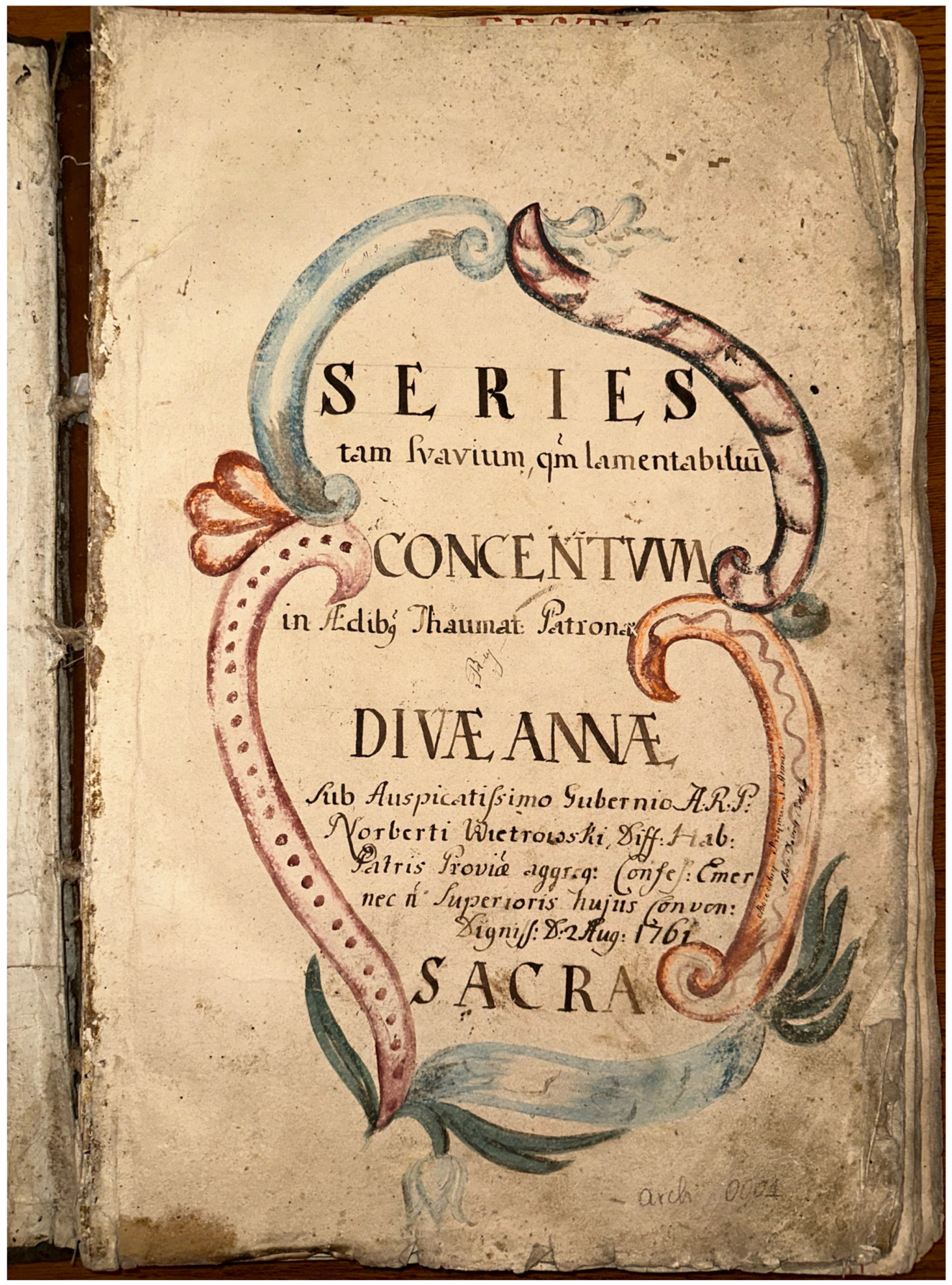
The title page of the manuscript (Figure 1) contains information regarding the type and content of the book, the time and place of its creation, the use of the recorded repertoire, and the then-guardian of the monastery in Święta Anna. The Latin text, inscribed within a floral motif, reads as follows:
SERIES|tam suavium q[ua]m lamentabiliu[m]|CONCENTUUM|in Ædib[us] Thaumat[urgæ] Patronæ|DIVÆ ANNÆ|Sub Auspicatissimo Gubernio A[dmodum] R[everendi] P[atris]|Norberti Wietrowski Diff[initoris] Hab[itualis]|Patris Provi[nti]æ aggr[e]g[ati] Confes[soris] Emer[iti]|nec n[on] Superioris hujus Conven[ti]|Digniss[imi] Die 2 Aug[usti] 1761|SACRA
In addition to the main title, the words in Polish „Boże dobry Przyrów S[więta] Anna o Boże Dobry Boże” [Good God Przyrów S[aint] Anne Oh God Good God] have been added to the page, running alongside the main text within a vertical ornament. The title inscription leaves no doubt that the manuscript was produced at the Święta Anna monastery and was intended for local use. The words regarding the chants “both sweet and mournful” (tam suavium q[ua]m lamentabiliu[m]) introduce a distinction regarding the character of the melodies, which include: ordinarium missae (fols 2r–12v), Patrem (fols 12v–32v), prosae (fols 32v–35v), lamentationes (fols 36r–40v). If we accept this classification of the repertoire, with the title lamentabilium clearly referring to the final collection of the lamentationes, then the pseudo-plainchant works are found within the suaves group. The whole is covered by the word series (row, series), rather than, for example, the traditional graduale or another established term for a book of this type, although mass chants predominate. The above data prove that the manuscript was created as an intentional “sacred series” of various chants originally belonging to the codex, over three-quarters of which consists of pseudo-plainchant repertoire. Additionally, the use of capital letters and the placement of the words SERIES CONCENTUUM DIVÆ ANNÆ SACRA on the title page indicate that the chants, and not merely the place, were dedicated to St Anne, and point to an intense cult of the “miraculous patroness” (Thaumat[urga] Patrona). We may therefore be dealing with one of the few examples of pseudo-plainchant which are dedicated to a locally chosen saint, even if these chants were widely used.

3. Results

3.1. Repertoire

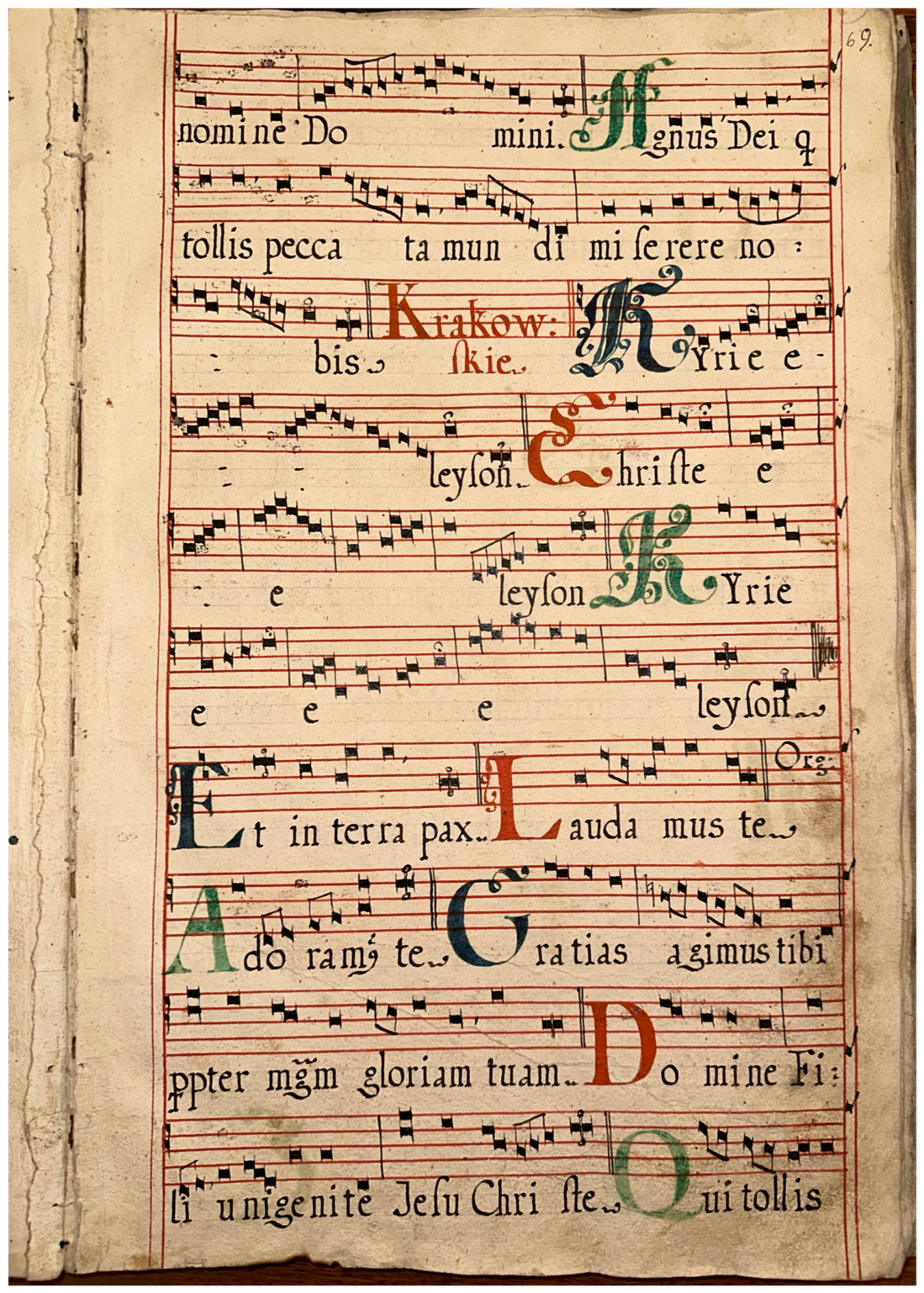
The pseudo-plainchant repertoire of the manuscript in question is entirely monophonic and comprises 14 unnumbered ordinarium missae (the Ordinary of the Mass, i.e., the fixed or invariable parts of the Mass), further referred to as a mass (=chant cycle), a single Gloria appended at the end of the ordinary, and 15 separate Patrem. The ordinary, alongside the triple Kyrie and single Agnus Dei…miserere, contains selected excerpts from the Gloria and Sanctus, indirectly indicating an alternatim performance, in accordance with the common practice of Bernardine pseudo-plainchant (Godek 2018a, p. 77). In the Gloria of the Krakowskie Mass, the annotation “Org” appears explicitly (Figure 2), indicating an organ performance of the omitted passage.
The chants of the second group, apart from the traditionally unnotated Credo in unum Deum, convey the entire text from Patrem to Amen. Both the chants of the ordinarium (Table 1) and the Patrem (Table 2) are accompanied by additional titles or information regarding their liturgical purpose. Many of the titles are named after cities, regions, countries, or even a profession (Furmanskie; pl. furman = carriage driver), and presumably after the Kaszynski family,12 in which the manuscript from Święta Anna does not differ from other Bernardine sources containing a pseudo-plainchant repertoire. Certain titles refer to the towns where there were male and female Bernardine monasteries in the First Polish Republic, such as Stradom (present-day Kraków, the first Bernardine monastery in Poland), Grodno, Tarnów, and Lublin, as well as Lithuania. In total, six mass cycles and nine Patrem chants bear such names. Furthermore, as a comparison with other sources has shown, one mass, which was not given a title in the Święta Anna manuscript, is named “Hanackie” (Hanák) in other manuscripts (Table 1, no. 7).

3.2. Musical Notation

The musical notation represents a mixed neumatic-mensural system, which combines neumes (basic signs of Western plainchant notation) and the elements of mensural notation (European vocal music notation in use from the late 13th until the early 17th centuries) or modern measure (bar) notation.13 The basic and most frequently occurring note is the rectangular brevis. The next most common is a note resembling a longa or a filled-in modern crotchet, whose stem changes position (up or down) depending on the pitch of the note on the stave, thus imitating mensural notation. Furthermore, the notes form numerous rhythmic groups connected by a beam, similar to a quaver. Vertical lines commonly appear on the stave; depending on their position, these may serve both a mensural function (bar lines) and a separating function (aligning the text and melody), much like the small lines separating syllables. Key signatures and accidentals appear frequently in certain chants (though often inconsistently), whilst in others they are rare or absent altogether. In places, fermatas also appear, along with letter symbols for notes at the beginning of selected chants and note connections resembling ligatures, the use of which can be inferred from the notation differences of the same intervals in the same direction on a single syllable within the same piece (Apel 1953, pp. 87–89; Table 3).
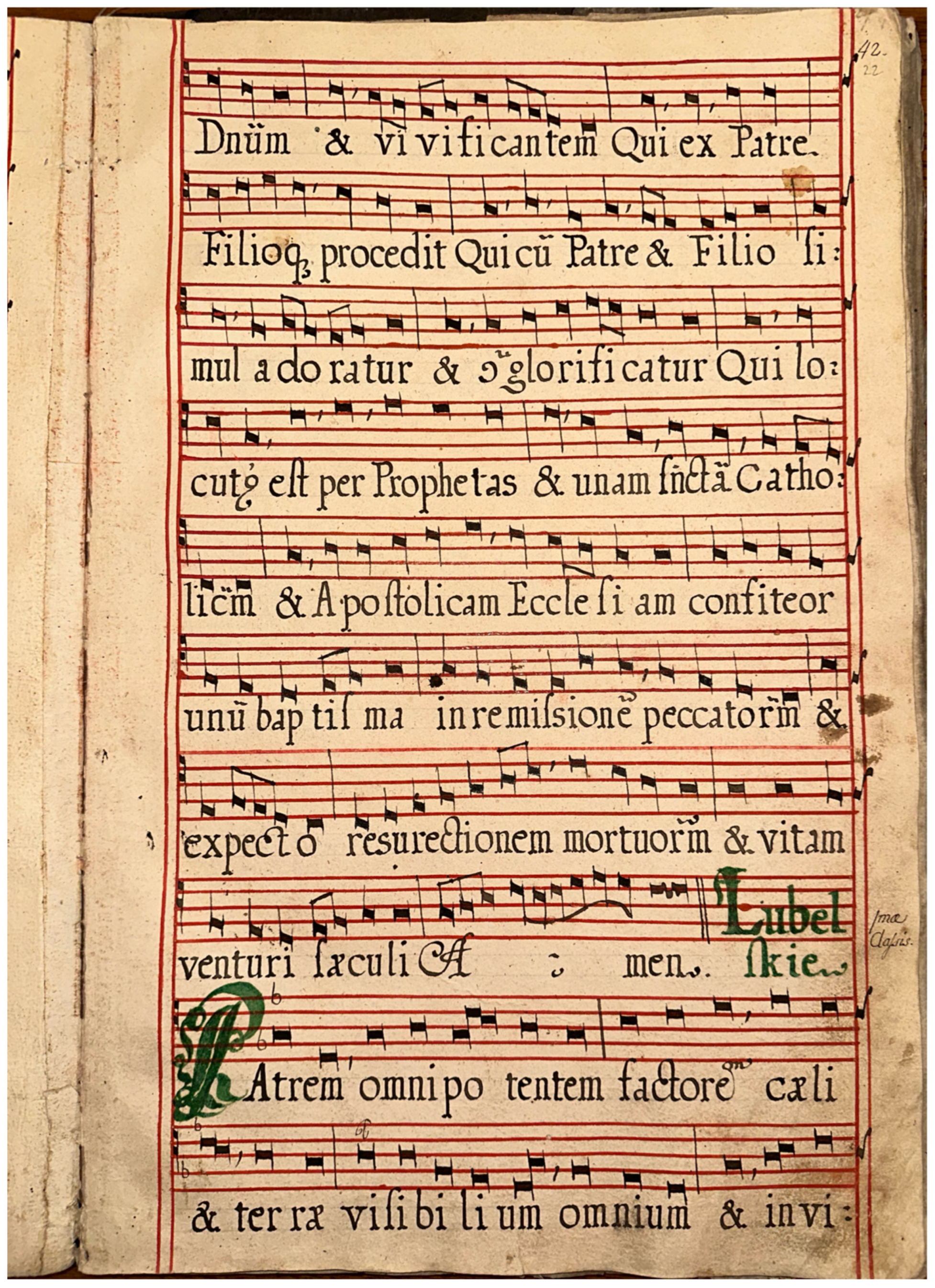
The Przyrow manuscript lacks metrical, agogic, dynamic and other markings, which liken Latin liturgical monophony to secular music of the period, and which are found in other sources of the pseudo-plainchant repertoire.14 Nevertheless, the notation of the codex imitates mensural notation, deviating from the traditional methods of notating Gregorian chant. At the same time, the mixing of different types of notation, as well as the lack of clarity and rhythmic consistency, may cause difficulties in reading note values (Figure 2 and Figure 3).

4. Discussion

4.1. Comparisons

All the chants from Święta Anna show a high degree of similarity to the repertoire of the manuscripts selected for comparison, given that all the sources analysed belong to the same Bernardine musical-liturgical tradition. This similarity may also stem from the fact that both Święta Anna and the monasteries in Kraków and Alwernia, from which the other codices originate, were located in the same province—Lesser Poland—at the time the Przyrów manuscript was produced.15 The compilation of the codex in 1761 may have been linked to the renovation and construction works, in that very same year, of new choir stalls in the Święta Anna Church, at the time when Norbert Wietrowski (1757–63), mentioned in the title inscription, held the office of guardian (Wyczawski 1985, p. 368). It was then that the initiative to compile a new liturgical book for performing the repertoire inside the newly renovated church may have arisen. Having no access to any other sources from Święta Anna with the same repertoire, at this stage of the research, it is not possible to determine whether the Przyrow manuscript was copied from another local codex or from an external source, nor whether there was more than one source used as a model.
Each ordinarium cycle and Patrem from Święta Anna has its counterpart in at least one older manuscript from Kraków or Alwernia. There is not a single melody in Ms. Arch 0001 that does not appear in the comparative material. One of the Patrem chants, whilst retaining the same melody across the sources, bears different names: “Virginale” in Święta Anna and Ms. BPBerKr 37/RL (p. 57), “Dominican” in Ms. BPBerKr 33/RL (fol. 110v). Another Patrem from Święta Anna contains a correction in the form of the word “nie” [nay] and a crossed-out inscription “Mazowieckie” [Mazovian] in green, identical colour to the initial of the neighbouring Patrem, whilst “Dupliczne Credo” [duplex Credo] has been added alongside. A comparison has shown that the melody is identical to manuscripts BPBerKr 33/RL (f. 121r), BPBerKr 37/RL (p. 99), BPBerKr 82/RL (p. 64), in which the same piece is titled “Mazowieckie”. Differences in the titles of the same pseudo-plainchant pieces are known from previous research and considered typical of this type of repertoire (Godek 2018a, p. 47).
Although the ordinary and the Patrem from Święta Anna are placed in separate groups, as in the manuscripts under comparison, in several instances we can presumably match the following chants (Table 4):
Among the chants from Święta Anna, the Hanackie Mass (Figure S7 in Supplementary Materials) is particularly noteworthy; its title refers to the musical culture of the Haná region (Moravia, Czech Republic) (Godek 2017b, p. 136). The appearance of the Hanackie Mass may result from the connections between Polish and Czech Bernardine monasteries which commenced in the second half of the 15th century.16 Although this title does not appear explicitly in the manuscript, a blank stave may have been intended for its inscription (fol. 6v), which was established by comparing the melody with Ms. BPBerKr 37/RL. The Hanackie Mass bears the distinct characteristics of pseudo-plainchant, starting with the repeated use of the same melodic material in various parts. In the Hanackie Kyrie, Gloria and Sanctus, we find the same long melisma, ranging from 15 to 17 notes, with an identical arrangement of intervals and pitches; similarly, other two- or three-note fragments are repeated in the same parts. The musical material of the incipits of the Kyrie, Et in terra pax and Sanctus is also identical, based on a descending C major chord; furthermore, the second Kyrie and the repeated verse Et in terra pax feature, respectively, identical or almost identical melodies in an ascending direction.
Another unusual feature for Gregorian chant, which links the Hanackie Kyrie, Et in terra pax and Sanctus, is the very wide ambitus (C–G2), to which the aforementioned long melisma significantly contributes. Additionally, in the Agnus Dei, on the word nobis, there is an ascending sequence combined with the repetition of the sustained note G, reminiscent of the style of Baroque instrumental music. In this context, the pseudo-plainchant Hanackie Mass is further evidence of the popularity of Hanák musical culture, and in particular of the dances to which references were made in the instrumental music of the 17th and 18th centuries. The frequent reuse of the same melodic material may also be linked to the Hanák folk practice of literal repetitions of short motivic cells, which operate in the Święta Anna Hanackie Mass (Robert 2012, pp. 577–78, 581).
In other masses of the Święta Anna collection, repetitions between various parts are not as pronounced. To a lesser extent, this feature can be observed in the ordinary of five other cycles: In Festis (Figure S1 in Supplementary Materials), Kaszynskie (Figure S3 in Supplementary Materials), Tarnowskie (Figure S5 in Supplementary Materials), Krakowskie (Figure S6 in Supplementary Materials), Paschale (Figure S13 in Supplementary Materials). As in the Hanackie Mass, descending sequences are observed in the Grodzynskie Sanctus (Figure S4 in Supplementary Materials) and the Tarnowskie Adoramus Te (Gloria). A melodic sequence is typical of the pseudo-plainchant repertoire, as well as melodies based on the notes of a spread chord in an ascending or descending direction. In the examined manuscript, the most frequently occurring chords, placed at the beginning or in the middle of many parts of the mass, are C major and F major, which introduce a tonal language into the repertoire. An example is the In Votivis Simplicibus Mass (Figure S10 in Supplementary Materials), in which, as in the Hanackie Mass, the Sanctus, Pleni sunt and Benedictus begin with the same notes of the F major chord, after which the Sanctus material returns in the Agnus Dei.

4.2. Sources of Melodies

Across the melodies recorded in the Święta Anna manuscript, we encounter, in part, the same borrowings (musical source material) already mentioned by Feicht (1958, pp. 226–27) and Godek (2018b, p. 69, footnote 14), which are confirmed in the repertoire under study. At the same time, the research has succeeded in identifying at least probable sources for several ordinary parts, which, to the best of the author’s knowledge, have not been mentioned in the available literature. Both the former and the latter are discussed below, together with the musical figures containing the source and Bernardine melodies juxtaposed, in order to demonstrate how the composer reworks the original material.
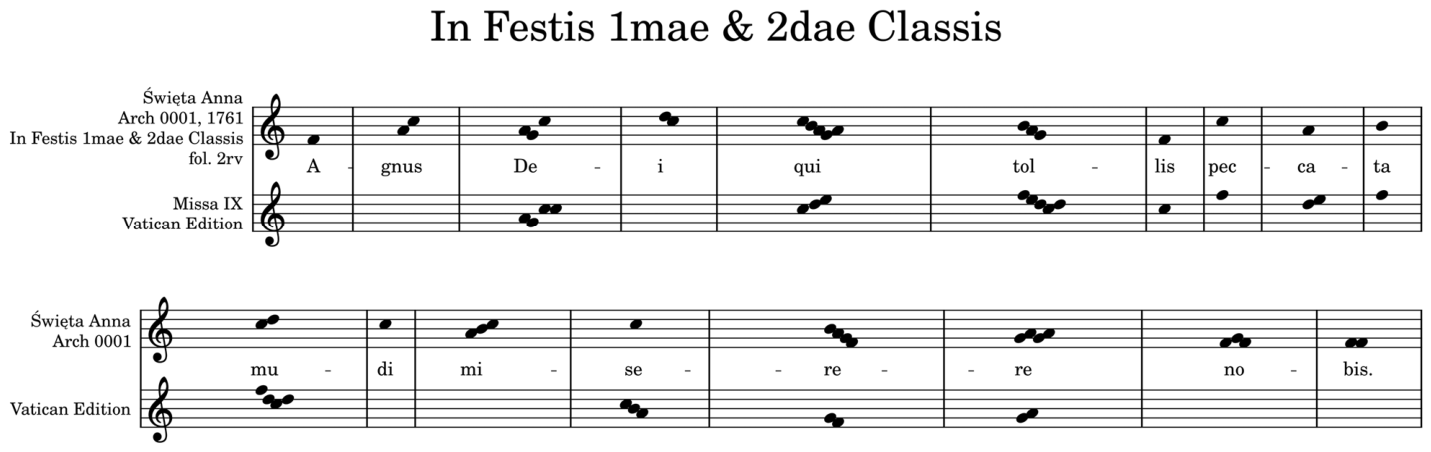
Certain melodies from the Święta Anna manuscript are consistent with the melodies which we also find in the Vatican Edition (The Liber Usualis with Introduction and Rubrics in English 1963). For example, the Agnus Dei of the In Festis 1mae et 2dae Classis Mass matches the Agnus Dei of Missa IX. The common material constitutes the vast majority of the Bernardine melody, whilst the differences result from reworking of the source material through a different arrangement of notes and syllables, a change in the direction of the melody, pitch and length of certain melismas (Figure 4).
For clarification, the 20th-century Vatican Edition neither represents a single historical tradition nor serves here as an object of a direct comparison, but is an editorial synthesis conveyor of melodies older than the Święta Anna manuscript and the other Bernardine sources selected for comparison (see Section 2). In the following transcriptions, the Vatican Edition has been used only as a practical comparative reference.
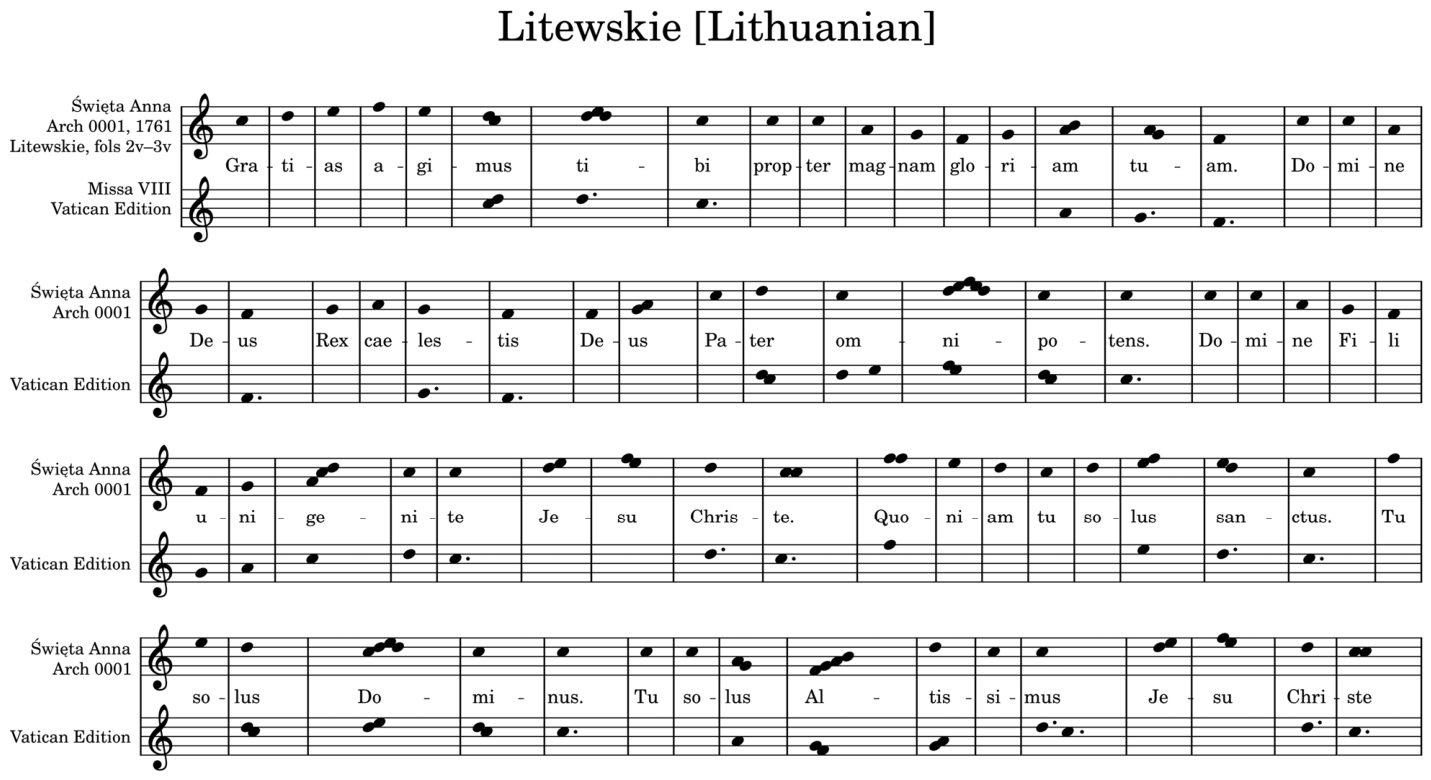
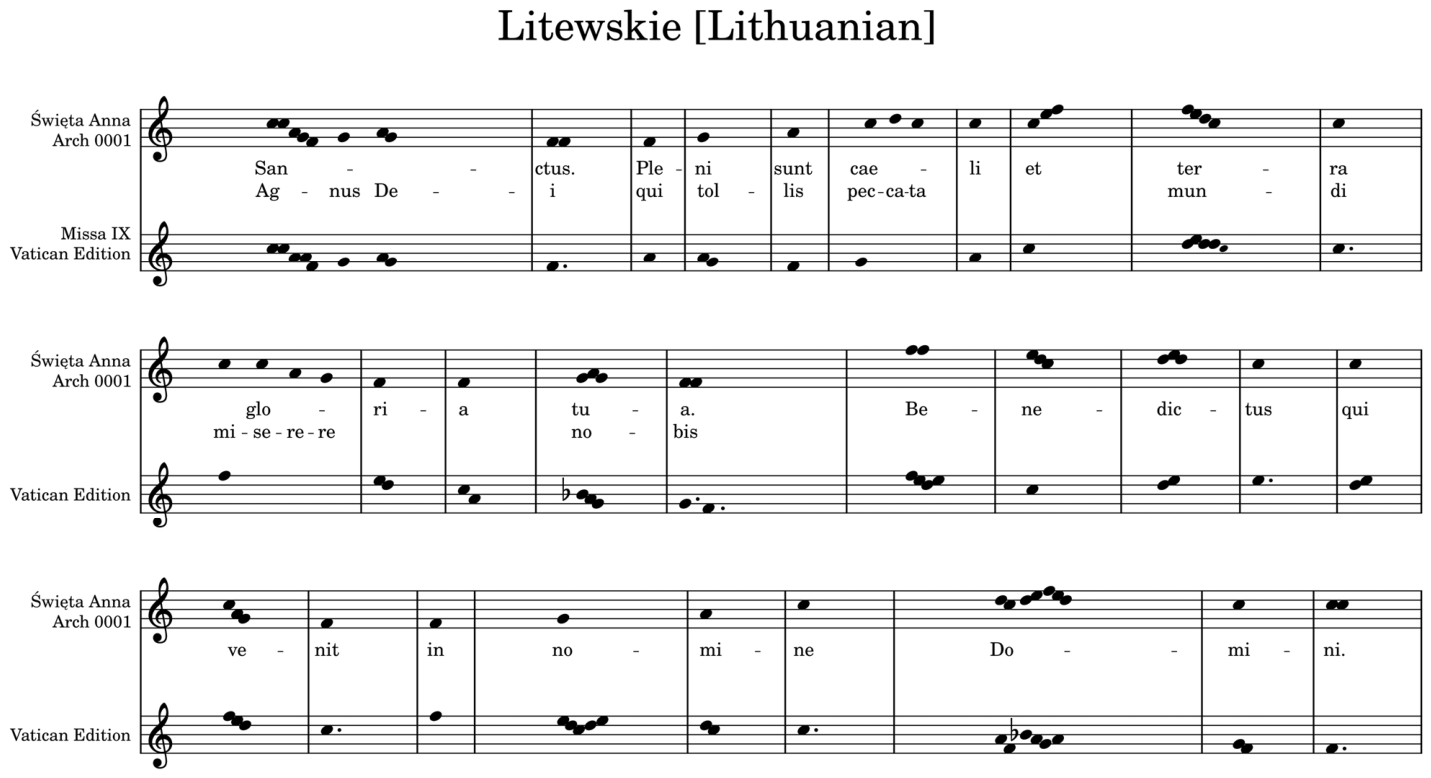
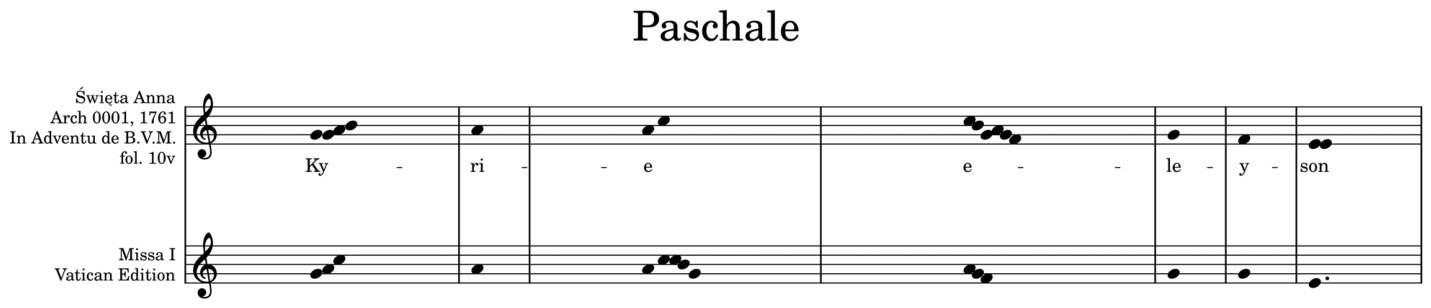
In the Litewskie Mass, there are melodies consistent with two Vatican Edition masses: Gloria VIII and Sanctus IX (Figure 5 and Figure 6). The melody of the latter is used twice in different sections, namely in the Sanctus and Agnus Dei. The composer, who, given the nature of the work, may be described as the arranger, modifies the borrowed material once again, though not deviating from the original melody. The Kyrie Paschale was arranged in the same way, using Kyrie I found in the Vatican Edition (Figure 7).
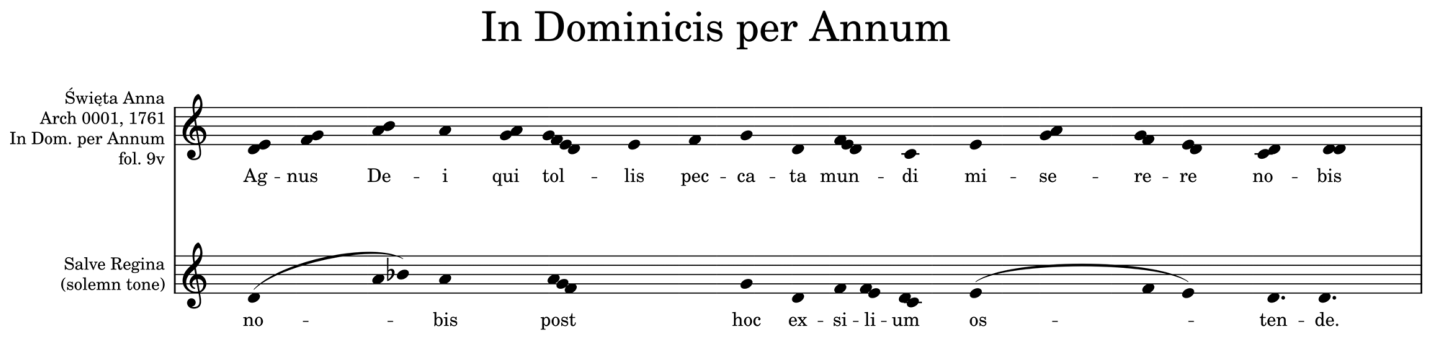
Another phenomenon is borrowing not from the repertoire found in the Vatican Edition, but in other liturgical chants. In the case of the per annum Sundays, the Agnus Dei is based on a passage from the Marian antiphon Salve Regina in the solemn tone (Figure 8). On this occasion, the composer supplements the pattern from the antiphon with numerous passing notes, resulting from the longer text, which had to be adjusted by assigning the extra syllables to the new notes. The reworking of the Salve Regina melody also resulted in the so-called Gallican cadence, approaching the final note from below C–D–D–D. Such a subtonal ending, often enhanced by repetition of the final note, differs from the original antiphon and may reflect imitation of late medieval neo-Gregorian chants (Hiley 2003, p. 8).
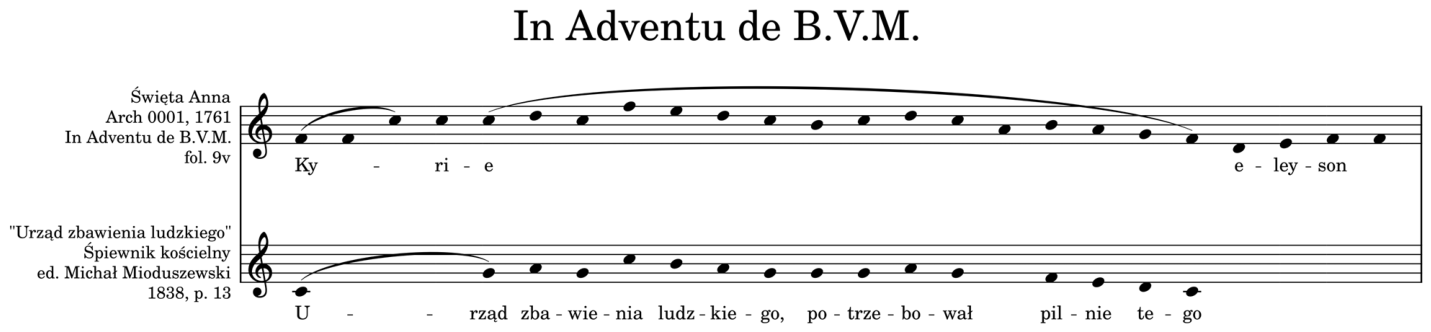
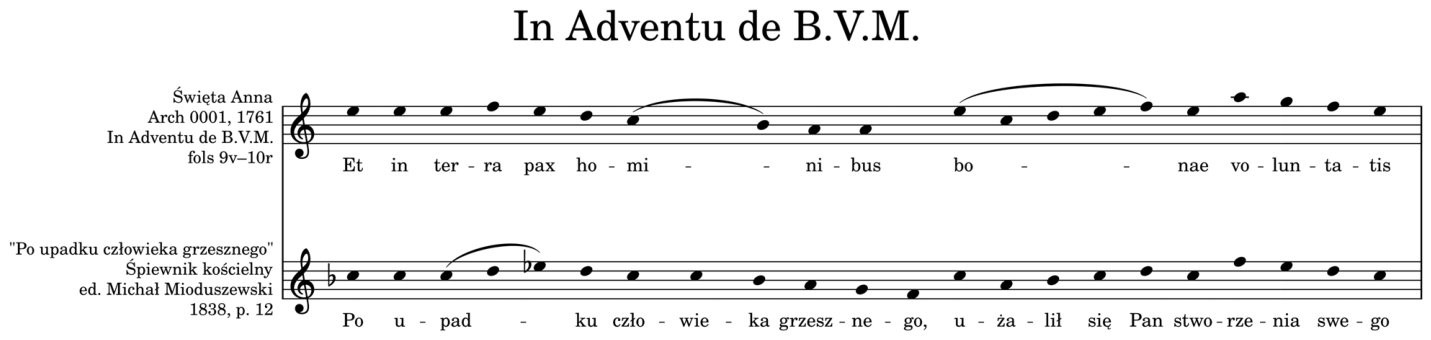
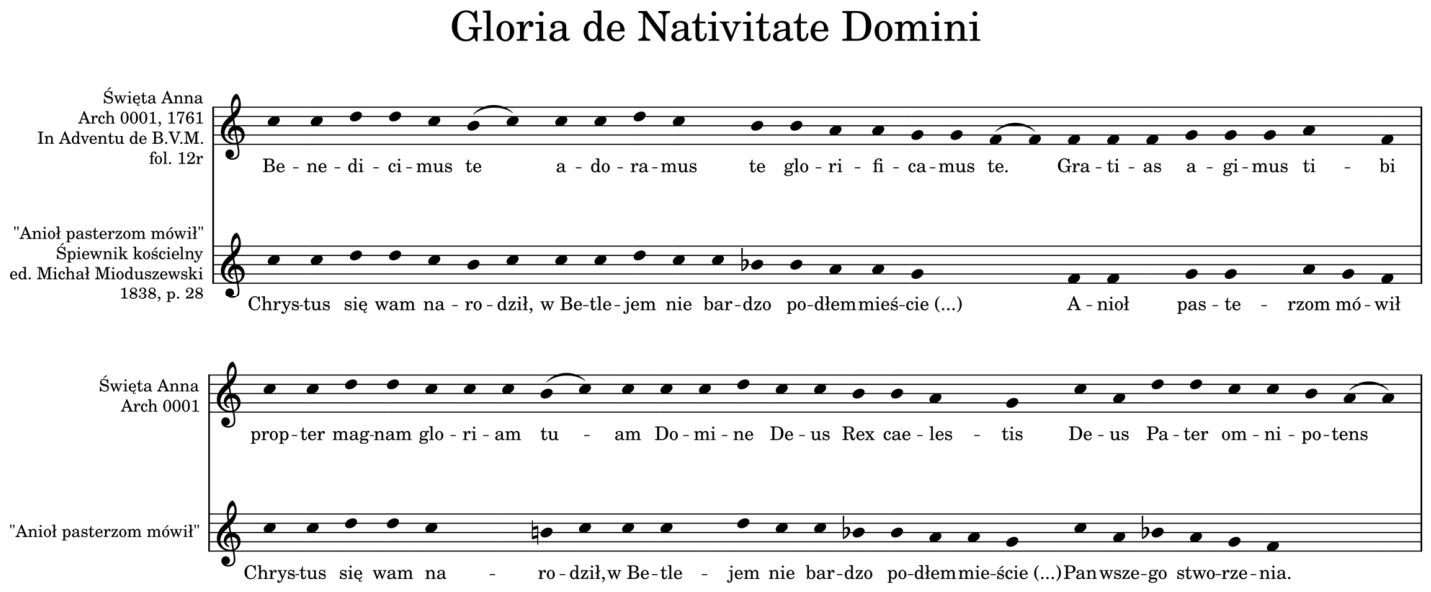
Further figures illustrate the use of Polish church songs, deriving from earlier traditions before 1761, included in the 1838 “Śpiewnik kościelny” (Mioduszewski 1838) [Church Chant Book] by Rev. Michał Mioduszewski as a source for new (or adapted) compositions. These include the Advent titles “Urząd zbawienia ludzkiego” [The Matter of Human’s Salvation] and “Po upadku człowieka grzesznego” [After the Fall of Sinful Man] present in, respectively, the Kyrie and Gloria In Adventu de B.V.M. (Figure 9 and Figure 10), and the Christmas carol “Anioł pasterzom mówił” (Angelus pastoribus dixit) in the Gloria de Nativitate Domini (Figure 11). As in the previous cases, the use of the borrowed melodies is partial—a fragment of the song appears in a fragment of one of the ordinary. In the Kyrie In Adventu and Gloria de Nativitate, the composer expands the original material with new notes, mainly due to the greater number of syllables. In the Gloria in Adventu, the original melody has been retained almost in its entirety, with minor stylistic changes introduced; for instance, a 5-note melisma on the syllable bo is based on a syllabic fragment in the source song (Figure 10). In the In Adventu Mass, both melodies were transposed up by a fourth and a third, though this did not affect the arrangement of intervals or the direction of the melodic line.
Figure 4, Figure 5, Figure 6, Figure 7, Figure 8, Figure 9, Figure 10 and Figure 11 show that, in most cases, the borrowings and adaptations of other melodies for the purposes of new compositions is carried out whilst largely preserving the original style of the source material and integrating it into a larger whole. Therefore, what may have been one of the criteria for the selection of works whose melodies were borrowed is style, alongside liturgical suitability. This made the composer’s task relatively straightforward to set a new text to a familiar melody with only minor alterations. An exception is the Kyrie in Adventu de B.V.M. (Figure 9), which illustrates a radical change in style when changing the text—from syllabic to melismatic.

4.3. Performance

The key reference points are the performance markings on the stave and the layout of the text. The aforementioned alternatim technique, typical of Bernardine pseudo-plainchant, applied in Święta Anna both to the instrumentation (following the model of Baroque liturgical performance) and to the number of performers. The alternatim of the Gloria is evidenced by a selective approach to notating the liturgical text, with certain passages omitted. In most cases, such a record does not allow for a clear statement as to whether the omitted fragments were performed on the organ alternately with singing due to the lack of direct information (organo). After the Gloria was initiated by the celebrant, the division might have been as follows: cantor (or schola) and liturgical assembly. An exception is the aforementioned Krakowskie Mass, which contains the inscription “Org[ana]” in place of the words Benedicimus te. It is possible that subsequent gaps in the text imply an organ performance by default, even though the annotation regarding the organ is not repeated.
Among the performance markings, the small yet distinct note “Vio” at the very beginning of the Kaszynskie and Tarnowskie Masses is particularly noteworthy, as it attests to the use of the violin as an accompanying instrument for liturgical chant in Święta Anna. This annotation is unique not only within this manuscript but also in others, particularly the Bernardine sources of pseudo-plainchant selected for comparison. To some extent, the use of the violin by the local Bernardines may have been the result of the influence of the strong instrumental tradition of the Dominican monastery in nearby Gidle, where a musical ensemble had been active continuously for 300 years from 1615—in parallel with the activity of the Święta Anna monks (Kusz 2013, p. 207).
The violin accompaniment is another element that brings the repertoire under study into line with the instrumental music of the period. In the Tarnowskie Mass, the violin accompaniment also corresponds to the fragmented rhythm based on beamed notes resembling quavers and sequences which, together with the tonal language, introduce a Baroque instrumental aesthetic into the melody. At the same time, the performance of the liturgical repertoire in Święta Anna, featuring not only the organ but also the violin, finds an analogy in the Bernardine women’s tradition in Kraków, where the sisters played the flute, violin, basolia, and positive organ during services (Gustaw 1947, pp. 93, 157; cited in: Godek 2018b, p. 35).
Another important performance note concerning the instrumental accompaniment is the annotation “To się śpiewać i grać zawsze należy” [This is always to be sung and played] in the Paschale 1mum Patrem (fol. 30r). No other Patrem, including the Paschale 2dum, received such a note, which, together with the aforementioned “Org[ano]” and “Vio[lino]”, attests to the enduring role of instruments in the liturgical accompaniment in Święta Anna.
In terms of performance, the Moravo Hanaticum Patrem is also noteworthy for its added division into solo and tutti, particularly from the double crucifixus through the double sub Pontio Pilato, culminating in the word passus, which is performed as many as five times (fol. 17v). Although this division itself appears in other chants from the same manuscript, its uniqueness in this case lies in its connection to the register and style of the melody. Namely, the syllabic passus in the high register is performed solo, alternating with the melismatic passus in the middle and low registers by tutti (Figure 12). The contrast in this section of the Patrem is thus intensified by the cumulative effect of differences in the solo-tutti division, style and register of the melody, whose ambitus reaches as far as a twelfth in places. Such use of the solo-tutti contrast is a further example of the influence of the Baroque aesthetic characteristic, for instance, of the instrumental concerto, which is based on frequently contrasting relationships between the soloist and the orchestra (Wilk 2012, p. 83; Lenneberg 1958, p. 82). A similar solo-tutti contrast, together with the repetition of selected words, is present in the Hanackie Mass in the Kraków manuscript BPBerKr 37/RL (pp. 153–59) selected for comparison, in which, however, the variety of performance is even greater: solo, tutti, basso, grave, gravissime.

5. Conclusions

The manuscript from Święta Anna contains a repertoire which, for the most part, is also found in other sources and has been identified in the existing literature. The exception is the Quinti Toni Patrem, which is absent from the Miazga’s catalogue and from the manuscripts selected for comparison.17 The similarity concerns both the way the repertoire is organised into two separate groups and the characteristics of the melodies, which confirm that we are dealing with chants that differ significantly from the style of classical Gregorian chant. Although no borrowings of themes from secular or instrumental music were found during the research, the following features confirm the influence of Baroque instrumental style: tonal language (e.g., spread chords, melodic sequences), elements of rhythm and metre, key signatures, accidentals, the repeated use of identical material, the alternatim technique, and performance contrast.
All things considered, the Święta Anna manuscript may suggest a new approach, preferred by the author of this study, to the repertoire known as pseudo-plainchant, describing it on the title page as “sweet” (suaves)—not merely in contrast to the aforementioned collection of the lamentationes in the same codex.18 This term may indeed reflect the aesthetic stance of the local Bernardines, characterised by a positive attitude towards these chants and an acceptance of all elements borrowed from the Baroque music into Latin liturgical monophony, despite significant deviations from Gregorian chant and the introduction of “decompositional elements” (Feicht). The “sweetness” may also refer to the character of the Polish church songs on which selected ordinary chants were based. Introducing the melodies of „Urząd zbawienia ludzkiego”, „Po upadku człowieka grzesznego”, and „Anioł pasterzom mówił” may have made the Latin repertoire seem more native, Polish—“sweet”—to the monks and participants in the liturgy. Therefore, the criterion for such borrowing may have been a musical aesthetic and liturgical purpose rather than the convenience of composing on the basis of the familiar melodies. At the same time, the multitude of external stylistic and thematic borrowings in the Series Concentuum Divæ Annæ Sacra is subordinated in an original way to the local cult of St Anne, as expressed on the title page of the manuscript.
Further studies on the collection of the liturgical sources from Święta Anna should primarily aim to involve searching for these sources in other archives and libraries to which they were transferred in past centuries.19 Locating these scattered materials would provide a far clearer image of the musical items from Święta Anna, not only the monophonic and liturgical. It would also extend the chronological scope of the research to include sources older than the codex presented here. Further analyses and comparisons would make it possible to trace the origins of the Święta Anna liturgical tradition and to follow its development in terms of pseudo-plainchant, referred to by the local monks as “sweet”.

Supplementary Materials

The following supporting information can be downloaded at: https://www.mdpi.com/article/10.3390/arts15070155/s1.

Funding

This research was funded by the Narodowe Centrum Nauki [National Science Centre], Poland, under the open call MINIATURA 9, grant number 2025/09/X/HS2/00031.

Data Availability Statement

Data is contained within the article and Supplementary Materials.

Conflicts of Interest

The author declares no conflicts of interest.

Notes

1
According to Feicht, “whilst the Patrem dating from the early 16th century (and perhaps even earlier) are still tolerable compositions (…), the entire ordinaria added to them later are a negation of the chant and introduce elements of decomposition into it”; (Feicht 1958, p. 227).
2
Miazga (1976). A reference to the Miazga’s catalogue can be found later in this article in the list of the Patrem chants (Table 2).
3
German musicologists had been interested in canto fratto since the early 20th century; however, as a result of the Cecilian Movement and prevailing prejudices against this repertoire, research was abandoned, although the subject recurred in academic publications (Gozzi 2005, p. 7).
4
The monastery in Święta Anna is today administratively situated in the village of Aleksandrówka, bordering the village of Święta Anna in the municipality of Przyrów; however, due to this proximity, the monastery’s historical location within the boundaries of Święta Anna, and the veneration of the convent’s patron saint, the term ‘in Święta Anna’ has become established in literature and common parlance.
5
Stefaniak (2010), pp. 8–12. The further development of the cult of St Anne near Przyrów under the care of the Bernardines is evidenced, for example, by special prayer books from the 17th and 18th centuries, intended for lay members of the Brotherhood of St Anne, containing, among others, hymns in honour of the saint; Wojtowicz (2018, pp. 74–75).
6
A.E. Godek mentions the monastery in Święta Anna in connection with the Bernardines’ use of ready-made arrangements in the alternatim technique, such as „Kancjonał śpiewu kościelnego w 2ch częściach z akompaniamentem organu” (no shelfmark), which, according to the author, most likely originates from Przyrów. This chant book is the only source from Święta Anna cited by the researcher, who makes no reference to the manuscript discussed here (Godek 2023, pp. 121–22).
7
Żmudziński (2010, p. 155). The academic literature on the convent in Święta Anna comprises primarily publications in the fields of history, art history, and theology. These include the aforementioned book by Żmudziński, who, from the perspective of an art historian, briefly characterises several surviving musical and liturgical manuscripts (p. 153). According to the researcher, liturgical manuscripts from Święta Anna dating from the Bernardine period are also held in the “library of the Kraków Dominicans” (Archives of the Polish Dominican Province in Kraków) and the “Library of the Higher Theological Seminary in Wrocław” (Archdiocesan Archives and Chapter Library in Wrocław). However, searches for sources from Święta Anna conducted by the author of this article in Kraków and Wrocław proved unsuccessful, no sources were found.
8
Among the Bernardine sources in the monastery archives in Święta Anna, there are also: two antiphonaries, probably from the 18th century (one of which Żmudziński mistakenly calls a gradual, dating it to the second half of the 18th century), a 1758 hymnal, a 17th-century handwritten Dominican antiphonary brought by the sisters from the convent in Piotrków Trybunalski, and a printed ritual published in Kraków in 1647 on the basis of a decree of the Piotrków provincial synod.
9
The choice of the Library of the Bernardine Province in Kraków is justified by the fact that this library has been the Central Library of the Province since November 1938, and its collections include manuscripts and early printed books up to 1800 from other Bernardine libraries; Library of the Bernardine Order in Kraków, https://biblioteka.bernardyni.pl/o-bibliotece/ [accessed: 18 February 2026].
10
The shelfmarks, physical description, provenance, contents, and other details regarding the manuscripts listed are provided by Lenart (1986), pp. 142–3, 145–6, 150–1, 187–8.
11
The music collection of the Święta Anna monastery archives, though small in comparison to the pre-19th-century holdings there, is impressive for its accumulated repertoire, which was likely partly brought from Piotrków Trybunalski and subsequently stamped with the seal of the local convent. In addition to the liturgical works mentioned, the archives also contain, among others, copies of masses by Józef Elsner (1769–1854), Jan Stefani (1746–1829), and Józef Władysław Krogulski (1815–1842), editions of works by Mikołaj Gomółka (ca. 1535–1609), G.P. Palestrina, Th. Tallis, G.M. Nanini, and T.L. de Victoria, as well as works by Wojciech Gruszkowski (b. 1798), an organist and teacher active in Gidle and Piotrków Trybunalski, Poland, and Wacław Raszek’s „Kancjonał muzyki kościelnej” from 1825 (see Bujas-Poniatowska et al. 2022, pp. 31–32).
12
According to the research by Stanisław Kaszyński published in 2022, the earliest record of the Kaszynski family (later: Kaszyński) from the late 13th century points to the Russian town of Kaszyn in the Tver Oblast, on the River Kaszynka, and to Anna (b. ca. 1279), daughter of Dmitry Rostovsky and granddaughter of Alexander Nevsky, who later took the surname Kaszynska. In the second half of the 17th century, the Kaszyński family lived in Galicia. Perhaps the composition of the Kaszynskie Mass is an expression of the Bernardine Order’s ties to this family or a recognition of their merits, for example, in the form of the foundation or support of Bernardine monasteries. A premise of this hypothesis may be the fact that both Anna Kaszyńska and later members of the family were in the habit of founding numerous churches and monasteries (Kaszyński 2022, p. 210; Marian Przybylski 2019).
13
Tadeusz Maciejewski, using the concept of mixed neumatic-mensural notation in relation to the Patrem, proposes the following assignment of values: virga = longa, punctum = brevis, punctum inclinatum = semibrevis (Maciejewski 1999, p. 299).
14
See (BPBerKr 42/RL), fol. 27r (mensural symbol: alla breve, marginal annotation on one Patrem: Na postne ss[więta] y kiedy się podoba tylko dobrze śpiewać [For Lenten feasts and whenever it pleases, just sing well]); (BPBerKr 82/RL), pp. 117–126 (mensural symbol: 3); (BPBerKr 33/RL), fols 100v–101r (mensural symbol: 3); (BPBerKr 37/RL), pp. 132–133 (tripla, alegro [!], piano, fortiter, molliter); (BPBerKr 87/RL), pp. 124 (adagio), 126 (fresco).
15
Święta Anna remained in the Lesser Poland Province until 1800, when it was incorporated into the Greater Poland Province; see Wyczawski (1985, p. 365).
16
Zyglewski (2012, p. 140). Although there were tensions between Polish and Czech Bernardine monasteries in the second half of the 15th century, later influence of Moravian-Haná musical culture on Bernardine chants may well have been a reality.
17
In Ms. BPBerKr 42/RL (fol. 21r) there is a Patrem described in two ways: the original title Roman Quinti Toni (same script as the text of the chant) and Podgórskie (a later handwritten annotation). However, a comparison of the sources revealed that the chants correspond only under the name Podgórskie.
18
On the title page of Ms. BPBerKr 37/RL from Kraków, the same repertoire is titled: symphoniae ecclesiasticae (…) gratioso modulamine, presenting an even closer connection to the Baroque instrumental music through the “pleasant (or “favourable”, “beautiful”, “popular”) modulation” of plainchant melodies following the musical style of the period.
19
Following Żmudziński’s lead, collections from Święta Anna are also held at the University Library in Warsaw, the seminary in Włocławek and libraries in Poznań (Żmudziński 2010, p. 155).

References

  1. [Antiphonarium] from the Bernardine Monastery in Kraków, second half of the 17th century, Bernardine Province Library in Kraków, Poland, shelfmark BPBerKr 42/RL.
  2. [Graduale] from the Bernardine Monastery in Alwernia, 1716, Bernardine Province Library in Kraków, Poland, shelfmark BPBerKr 33/RL.
  3. [Graduale] from the Bernardine Monastery in Alwernia, second half of the 17th century, Bernardine Province Library in Kraków, Poland, shelfmark BPBerKr 82/RL.
  4. [Graduale] from the Bernardine Monastery in Kalwaria Zebrzydowska, second half of the 18th century, Bernardine Province Library in Kraków, Poland, shelfmark BPBerKr 87/RL.
  5. [Graduale] from the Bernardine Monastery in Kraków, 1744, Bernardine Province Library in Kraków, Poland, shelfmark BPBerKr 37/RL.
  6. Apel, Willi. 1953. The Notation of Polyphonic Music 900–1600. Cambridge, MA: The Mediaeval Academy of America. [Google Scholar]
  7. Bujas-Poniatowska, Jolanta, Andrzej Edward Godek, and Kamil Poniatowski. 2022. Życie i aktywność Wacława Raszka (1764–1837) w świetle źródeł. Muzyka 1: 20–38. [Google Scholar] [CrossRef]
  8. Dyer, Joseph. 2016. A New Source for the Performance of Cantus Planus and Cantus Fractus in Eighteenth-Century Venice. The Journal of Musicology 33: 569–607. [Google Scholar] [CrossRef]
  9. Feicht, Hieronim. 1958. Muzyka w okresie polskiego baroku. In Z dziejów polskiej kultury muzycznej. Edited by Zygmunt Szweykowski. Kultura staropolska. Kraków: Polskie Wydawnictwo Muzyczne, vol. 1, pp. 157–229. [Google Scholar]
  10. Feicht, Hieronim. 1965. Dzieje polskiej muzyki religijnej w zarysie. Roczniki Teologiczno-Kanoniczne 12: 5–50. Available online: http://theo-logos.pl/xmlui/handle/123456789/7585 (accessed on 22 March 2026).
  11. Godek, Andrzej Edward. 2017a. Studia nad repertuarem pseudochorałowych opracowań ordinarium missae zachowanym w osiemnastowiecznych rękopisach z krakowskich bibliotek i archiwów. Master’s thesis, Jagiellonian University, Krakow, Poland. [Google Scholar]
  12. Godek, Andrzej Edward. 2017b. Śpiewy pseudochorałowe w XVIII-wiecznych rękopiśmiennych graduałach Zgromadzenia XX. Misjonarzy. Nasza Przeszłość 127: 109–160. [Google Scholar] [CrossRef]
  13. Godek, Andrzej Edward. 2018a. Dwugłosowe śpiewy ordinarium missae w rękopiśmiennym antyfonarzu Wileńskich bernardynek. Forum Muzykologiczne, 67–84. [Google Scholar]
  14. Godek, Andrzej Edward. 2018b. Pseudochorałowe śpiewy Benedicamus Domino w rękopiśmiennych kancjonałach krakowskich ss. bernardynek. Kwartalnik Młodych Muzykologów UJ 1: 33–52. [Google Scholar] [CrossRef]
  15. Godek, Andrzej Edward. 2021. Repertuar osiemnastowiecznych mansjonarskich ksiąg liturgicznych z Archiwum Bazyliki Mariackiej w Krakowie. In Jako serce pośrodku ciała… Kultura artystyczna kościoła mariackiego w Krakowie. Edited by Marek Walczak and Agata Wolska. Kraków: Towarzystwo Naukowe Societas Vistulana, pp. 101–8. [Google Scholar]
  16. Godek, Andrzej Edward. 2023. Osiemnastowieczna praktyka alternatim na przykładzie wielogłosowych odcinków pseudochorałowych śpiewów Patrem ze źródeł bernardyńskich. Czasopismo naukowe Salezjańskiej Szkoły Organistowskiej w Przemyślu 3: 119–138. [Google Scholar]
  17. Gozzi, Marco. 2005. Il canto fratto: Prima classificazione dei fenomeni e primi esiti del progetto RAPHAEL. In Il canto fratto: L’altro gregoriano: Atti del convengo internazionale di studi, Parma-Arezzo, 3–6 dicembre 2003. Edited by Marco Gozzi and Francesco Luisi. Rome: Torre d’Orfeo, pp. 7–58. [Google Scholar]
  18. Gozzi, Marco, and Marcello Piras. 2003. Il canto fratto nei libri liturgici del quattrocento e del primo cinquecento: L’area trentina. Rivista Italiana di Musicologia 38: 3–40. [Google Scholar]
  19. Gustaw, Romuald. 1947. Klasztor i kościół św. Józefa ss. Bernardynek w Krakowie 1646–1946. Kraków: Księgarnia Stefana Kamińskiego i Tow. Miłośników Historii i Zabytków Krakowa. [Google Scholar]
  20. Hiley, David. 2003. Chorał gregoriański i neogregoriański. Zmiany stylistyczne w śpiewach oficjów ku czci średniowiecznych świętych. Muzyka 48: 3–16. [Google Scholar]
  21. Kaszyński, Stanisław. 2022. Kaszyńscy na Huculszczyźnie. Kwartalnik Kresowy 15: 209–26. [Google Scholar]
  22. Kusz, Dawid. 2013. Muzykalia gidelskie w ujęciu historycznym, dydaktycznym i artystycznym. Pro Musica Sacra 11: 207–17. [Google Scholar] [CrossRef][Green Version]
  23. Landwehr-Melnicki, Margaretha. 1955. Das einstimmige Kyrie des lateinischen Mittelalters. Regensburg: Gustav Bosse Verlag. [Google Scholar]
  24. Lenart, Emilian. 1986. Katalog bernardyńskich rękopisów liturgicznych w Polsce od XV do XVIII wieku. Archiwa, Biblioteki i Muzea Kościelne 53: 104–274. [Google Scholar] [CrossRef]
  25. Lenneberg, Hans. 1958. Johann Mattheson on Affect and Rhetoric in Music (I). Journal of Music Theory 2: 47–84. [Google Scholar] [CrossRef]
  26. Maciejewski, Tadeusz. 1999. Elementy systemu menzuralnego w monodii chorałowej XIII–XVI wieku. In Notae musicae artis. Notacja muzyczna w źródłach polskich XI–XVI wieku. Edited by Elżebieta Witkowska-Zaremba. Kraków: Musica Iagiellonica & Instytut Sztuki Polskiej Akademii Nauk, pp. 283–347. [Google Scholar]
  27. Marian Przybylski. 2019. Historia. Z dziejów rodu. Available online: https://kaszynscy.pl/historia/ (accessed on 22 March 2026).
  28. Miazga, Tadeusz. 1976. Die Melodien des einstimmigen Credo der römisch-katholischen lateinischen Kirche: Eine Untersuchung der Melodien in den handschriftlichen Überlieferungen mit besonderer Berücksichtigung der polnischen Handschriften. Graz: Akademische Druck-u. Verlagsanstalt. [Google Scholar]
  29. Mioduszewski, Michał. 1838. Śpiewnik kościelny czyli pieśni nabożne z melodjami w kościele katolickim używane a dla wygody kościołów parafijalnych. Kraków: W drukarni Stanisława Cieszkowskiego. [Google Scholar]
  30. Robert, G. Rawson. 2012. Courtly Contexts for Moravian Hanák Music in the 17th and 18th Centuries. Early Music 40: 577–91. [Google Scholar] [CrossRef]
  31. Series Concentuum Divæ Annæ Sacra. 1761. Archives of the Dominican Nunnery in Święta Anna near Przyrów (Częstochowa), Poland, shelfmark Arch 0001.
  32. Stefaniak, Piotr. 2010. Zarys dziejów klasztoru Świętej Anny pod Przyrowem 1609–2009. Nasza Przeszłość 114: 5–64. [Google Scholar]
  33. Thannabaur, Peter Josef. 1962. Das einstimmige Sanctus der römischen Messe in der handschriftlichen Überlieferung des 11. bis 16. Jahrhunderts. München: Walter Ricke. [Google Scholar]
  34. The Liber Usualis with Introduction and Rubrics in English. 1963. The Benedictines of Solesmes, ed. Tournai and New York: Desclee Company. [Google Scholar]
  35. Wilk, Piotr. 2012. On the Question of the Baroque Instrumental Concerto Typology. Musica Iagiellonica 6: 83–103. [Google Scholar]
  36. Wojtowicz, Małgorzata. 2018. Postać świętej Anny—Matki Maryi w wybranych utworach literatury staropolskiej. Studia Ełckie 20: 69–80. [Google Scholar]
  37. Wyczawski, Hieronim. 1985. Klasztory bernardyńskie w Polsce w jej granicach historycznych. Kalwaria Zebrzydowska: Wydawnictwo Bernardynów Calvarianum. [Google Scholar]
  38. Zyglewski, Zbigniew. 2012. Związki klasztorów polskich z klasztorami czeskimi w średniowieczu. In Zwycięzcy i przegrani w dziejach średniowiecznych i wczesnonowożytnych Czech i Polsk. Edited by Wojciech Iwańczak and Dariusz Karczewski. Kraków: Księgarnia Akademicka, pp. 125–45. [Google Scholar]
  39. Żmudziński, Jerzy. 2010. Skarbnica miłosierdzia. Rzecz o św. Annie i jej sanktuarium pod Przyrowem. Opole-Święta Anna: Wydawnictwo i Drukarnia św. Krzyża. [Google Scholar]
Figure 1. The title page of the manuscript from Święta Anna near Przyrów, Poland (shelfmark Arch 0001, fol. 1r), dated 1761, containing Bernardine pseudo-plainchant. The inscription Series Concentuum Divæ Annæ Sacra (1761) indicates that the entire collection is dedicated to St Anne.
Arts 15 00155 g001
Figure 2. An excerpt from the Krakowskie Mass (Kyrie, Gloria) in the Series Concentuum Divæ Annæ Sacra from Święta Anna (fol. 6r), showing a clear predominance of a brevis, ligatures, bar groups, beamed notes resembling connected quavers, fermatas, a natural and the performance annotation “Org[ana]”, indicating the alternatim technique.
Arts 15 00155 g002
Figure 3. An excerpt from the Stradomskie Patrem (top) and the Lubelskie Patrem (bottom) in the Series Concentuum Divæ Annæ Sacra from Święta Anna (fol. 22r), showing the mixed use of a brevis and longa, as well as flats.
Arts 15 00155 g003
Figure 4. The Agnus Dei In Festis 1mae et 2dae Classis from the Święta Anna manuscript and Agnus Dei IX of the Vatican Edition.
Arts 15 00155 g004
Figure 5. The Litewskie Gloria from the Święta Anna manuscript and Gloria VIII of the Vatican Edition.
Arts 15 00155 g005
Figure 6. The Litewskie Sanctus and Agnus Dei from the Święta Anna manuscript and Sanctus IX of the Vatican Edition.
Arts 15 00155 g006
Figure 7. The Kyrie Paschale from the Święta Anna manuscript and Kyrie I of the Vatican Edition.
Arts 15 00155 g007
Figure 8. The Agnus Dei In Dominicis per Annum from the Święta Anna manuscript after the Salve Regina antiphon (solemn tone).
Arts 15 00155 g008
Figure 9. The second Kyrie In Adventu de B.V.M. in the Święta Anna manuscript after the melody of the Polish Advent song “Urząd zbawienia ludzkiego” [The Matter of Human’s Salvation].
Arts 15 00155 g009
Figure 10. Et in terra pax (Gloria) In Adventu de B.V.M. in the Święta Anna manuscript after the melody of the Polish Advent song “Po upadku człowieka grzesznego” [After the Fall of Sinful Man].
Arts 15 00155 g010
Figure 11. A fragment of the Gloria de Nativitate Domini in the Święta Anna manuscript after the melody of the Christmas carol “Anioł pasterzom mówił” (Angelus pastoribus dixit).
Arts 15 00155 g011
Figure 12. The strong contrast in the Moravo Hanaticum Patrem in the Święta Anna manuscript, based on three elements: the solo-tutti division, register, and melodic style.
Arts 15 00155 g012
Table 1. The ordinary in the Series Concentuum Divæ Annæ Sacra from Święta Anna.
No.Title/Liturgical PurposeKyrie
(Entry in Landwehr-Melnicki’s Catalogue) 1
GloriaSanctus
(Entry in Thannabaur’s Catalogue) 2
Agnus DeiFolio
[1]In Festis
1mæ Classis
+
(48)
+++2rv
2dæ Classis+
(78)
[2]Litewskie
[Lithuanian]
+
(97)
++
(29)
+2v–3v
[3]Kaszynskie++++3v–4r
[4]Grodzynskie
[Grodno]
++++4r–5r
[5]Tarnowskie
[Tarnow]
++++5r–6r
[6]Krakowskie
[Kraków]
++++6rv
[7][Hanackie]
[Hanák]
++++6v–7v
[8]In Votivis de B.V.M++++7v–8r
[9][Infra Octavas] Dupliczne
[duplex]
+
(18)
+++8rv
[10]In Votivis Simplicibus+
(58)
++
(95)
+8v–9r
[11]In Dominicis per Annum+
(16)
+++9rv
[12]In Adventu de B.V.M.+
(132)
+++9v–10v
[13]Paschale+
(55)
+++10v–11r
[14]Neo Jerosolymitanum++++11r–12r
[15]Gloria de Nativitate Domini+12rv
1 Landwehr-Melnicki 1955, The Monophonic Kyrie of the Latin Middle Ages, Regensburg. The Landwehr-Melnicki catalogue number has also been given in cases where the Kyrie from Święta Anna is not identical to the one in the catalogue, but very similar (for instance, the difference lies solely in passing notes, the transposition of a passage by a second, or the assignment of the text to the melody—with the rest being identical). If there are no similarities or they are negligible, the number has not been given. 2 Thannabaur, Das einstimmige.
Table 2. The Patrem chants in the Series Concentuum Divæ Annæ Sacra from Święta Anna.
No.Title/Liturgical PurposeEntry in Miazga’s CatalogueFolio
[1]Romanum60012v–14r
[2]Virginale8914r–15r
[3]Podgorskie
[Podgórze, Kraków]
38815r–16v
[4]Moravo Hanaticum4716v–18v
[5]Włoskie
[Italian]
3518v–19v
[6]Hyszpanskie
[Spanish]
60219v–21r
[7]Stradomskie
[Stradom, Kraków]
9721r–22r
[8]Lubelskie
[Lublin]
1mæ Classis
35822r–23v
[9]Jerozolymskie3223v–25r
[10]Quinti Toni25r–26r
[11]Dupliczne Credo
(Mazowieckie)
[Mazovia]
512
transp.
26r–27v
[12]Sexti Toni
De B.V.M. in Votivis Diebus Sabbati
27v–28v
[13]Furmanskie
2dæ Classis
53128v–30r
[14]Paschale
1mum
58430r–31r
[15]Paschale
2dum
7631r–32v
Table 3. Possible ligatures with intervals of a third and a fourth ascending within a single syllable in the Gloria of the Krakowskie Mass in the Series Concentuum Divæ Annæ Sacra from Święta Anna (fol. 6rv).
ValueThirdFourth
brevis-brevisArts 15 00155 i001Arts 15 00155 i002
brevis-longaArts 15 00155 i003Arts 15 00155 i004
Table 4. Presumed chant pairs from the ordinary and Patrem in the Series Concentuum Divæ Annæ Sacra from Święta Anna.
Ordinarium MissaePatrem
[Hanackie]Moravo Hanaticum
In Votivis de B.V.MSexti Toni
De B.V.M. in Votivis Diebus Sabbati
Infra Octavas et in DuplicibusDupliczne Credo
[Mazowieckie]
PaschalePaschale
1mum
Paschale
2dum
Disclaimer/Publisher’s Note: The statements, opinions and data contained in all publications are solely those of the individual author(s) and contributor(s) and not of MDPI and/or the editor(s). MDPI and/or the editor(s) disclaim responsibility for any injury to people or property resulting from any ideas, methods, instructions or products referred to in the content.