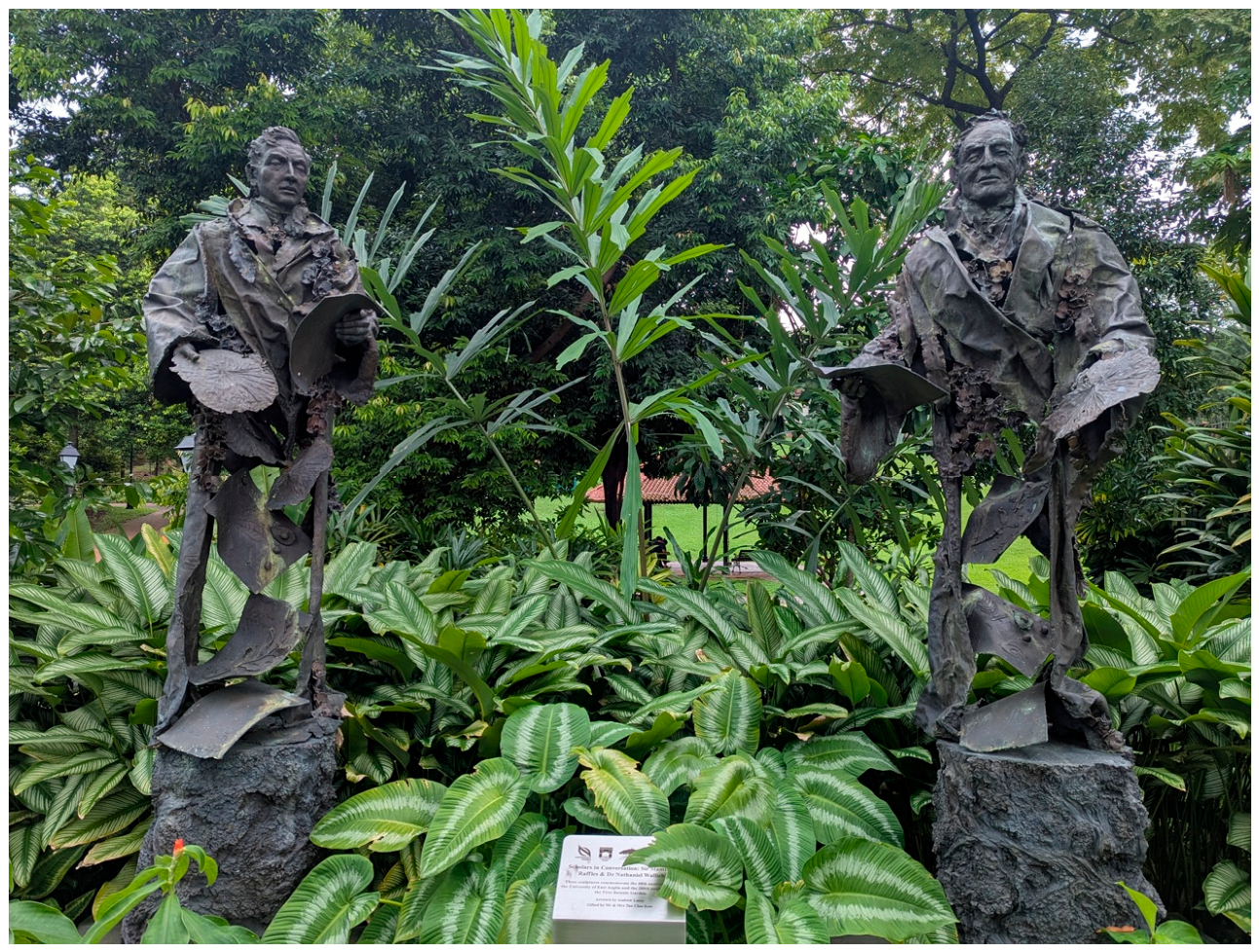
In Fort Canning Park, right behind the National Museum, there is a public monument to Singapore’s “First Botanic Garden.” It consists of the two ghostly bodies of Sir Stamford Raffles (1781–1826), the “founder of modern Singapore,” as the memorial plaque reads, and Dr. Nathanial Wallich (1786–1854), a Danish surgeon and botanist (
Figure 1). Together, these two
Scholars in Conversation transformed Raffles’ experimental spice garden at Fort Canning into Singapore’s first official botanic garden in 1822. Surprisingly, the two men have no figural body parts except for their heads and hands, with their busts suggestively shaped by their 19th-century garb and cascading orchids, the national flower of Singapore. Their legs are completely absent. As standing figures, they are braced rather by tree-trunk pillars, vine-like robes and ferns, lotus leaves, and floating papers, which offer scientific labels and illustrations of
Syzygium aromaticum, the clove, and
Myristica fragrans, the nutmeg. Even these papers mimic natural forms, with representations of the clove and nutmeg branches and seeds bursting three-dimensionally from their roughly hewn sculptural surface. British sculptor Andrew Lacey created the monument in bronze so that the material would meld even further into the tropical backdrop as it ages with a green patina. Raffles and Wallich’s bronze bodies hold an upright, imposing posture, yet they are meant to blend into the more-than-human background. With their hollowed-out bodies, they appear like colonial apparitions in the landscape.
Fort Canning Hill, with its strategically located high elevation, has a storied history. Long known as Bukit Larangan or Forbidden Hill by the Malays, it is believed that the kings of ancient Singapore resided and were laid to rest there, haunting the land that was later renamed in 1861 after the first British Viceroy of India, Charles John Canning (
Cornelius-Takahama 2018). Raffles first claimed Singapore as a British trading post in 1819, building his residence on the hill and beginning the experimental spice garden that same year, with the purpose of developing cash crop plantations on the island. Together, he and Wallich grew 600 nutmeg trees and 300 clove plants in the garden’s first five years.
1 Behind the monument, a little farther into Fort Canning Park, there is a spice garden and an outdoor exhibition that details the mostly failed attempts to establish long-term monocrop plantations in Singapore, with “nutmeg mania” crashing within a few decades of the arrival of the British East India Company, and the clove neither flowering nor fruiting in the new climate.
2 In contrast to this small spice garden and bronze memorial to Raffles and the physician Wallich, a Healing Garden in the current Singapore Botanic Gardens offers visitors extensive educational displays about 400 varieties of Southeast Asian plants that are used medicinally (many of them spices and herbs) for human respiratory, reproductive, nervous, and other corporeal systems. Thus, despite the recent controversial placement of the monument, which some have critiqued as a memorialization-cum-celebration of Singapore’s former colonial governance, there are other spaces of urban public landscaping by the National Parks Board (NParks) that, in some sense, attempt to reckon with or “heal” from such extractive histories of botanical violence.
3To view the spectral–colonial Raffles and Wallich figures as straight-backed yet somehow “sickly”—braced and patched together through their botanic components—brings to mind an image of eco-national disablement or impairment in Singapore. Singapore has long been known by its self-identified moniker of the Garden City. After razing most of the island’s primeval forests in the 19th century to make way for expedient plantations, the British and then postcolonial government in the mid-20th century began implementing reforestation programs. By 2011, vegetation covered an impressive 56% of the urbanized city-state’s ground area, leading the government to declare Singapore instead a City in the Garden (
Barnard and Heng 2014, pp. 281–82, 286). Now it has announced a new Master Plan to rebrand the country as a City in Nature, bolstered by a campaign to plant a million trees within ten years by 2030 (#OneMillionTrees campaign) and to “galvanize a whole-of-nation movement and advance [its] national agenda on sustainable development” (
Green Plan 2026). Living on a small island amid rising sea levels, the state takes global warming seriously. Tree planting may lower city temperatures, induce more rain, and decrease air pollution through oxygenation and the sequestering of carbon dioxide, all while beautifying the landscape—a key aim of the country since its independence. However, the greening and aestheticization of the environment also conceal other deeper problems for climate mitigation and sustainability in the country, from decades of vast terraforming and hyper-“development” to its large-scale oil refining industry. As urban theorist Jamie Wang outlines in her comprehensive book,
Reimagining the More-Than-Human City: Stories from Singapore (2024), the city offers a “glowing picture of an inspirational green futuristic city where the impacts of climate change appear to be actively considered and incorporated into policy and practice,” but the “affluent city-island-state is known for its materialist consumer culture with a high consumption of water and energy” (10, 12). The Singaporean government’s environmentalism has long been put into practice through what I would suggest is an ableist-capitalist approach, inherited from former colonial attitudes and behaviors geared first and foremost toward economic “development” and “progress.” The Raffles and Wallich neo-colonial monument is thus not simply a celebration of national success and modernity achieved through extractive capitalism. Rather, it reflects a deep ambivalence. The men stand triumphantly, yet ultimately assembled and braced by a spectral and precarious, more-than-human frame.
4In her book Curative Violence: Rehabilitating Disability, Gender, and Sexuality in Modern Korea (2017), disability theorist Eunjung Kim begins with evocative images of celebrities who miraculously stand up and walk away from their wheelchairs. These are, in fact, false images, doctored through the power of digital technology (1–8). To some degree, they are not unlike the standing-yet-braced, celebrated figures of Raffles and Wallich. Each creates an illusion of joyous “cure,” suggesting that these bodies have been restored to normality and able-bodiedness. As Kim explains, the medical model of disability views disability as an individual deficit or pathology to be “fixed” through professional intervention (not as a potentially valuable element of human differentiation) (6). The term “ableism” designates this set of beliefs or practices that devalues or discriminates against people with physical, intellectual, or psychiatric disabilities. Eliminating disability, or better mimicking and resembling the normative body, signifies improvement and betterment. Kim skillfully ties this to a sociopolitical context in South Korea where a “rehabilitated or cured body becomes a sign of decolonized and sovereign statehood under capitalism, for the colonized and communist state was understood as a disabled and even nonhuman body” (8). Her analysis resonates in various ways with the postcolonial, hypercapitalist formation of Singapore since its independence in 1965, yet differs also in that the Singaporean government, to a surprising and unique degree, has visually imagined its restored growth and “success” in botanical terms. National progress has been envisioned through both a top-down ecological imaginary and environmentalist policies, and these are taking a dramatic new turn as the climate crisis ups the ante for this geographically small island.
In this article, I will examine the visual culture of Singapore’s historical and contemporary, ableist-nationalist greening campaigns, alongside critical artworks by Marvin Tang and Woong Soak Teng, who challenge and crip facile notions of climate adaptation by attending to the experiences of vulnerable, gendered and sexed more-than-human bodies. In the first half of the paper, I will delve into histories of tree planting in Singapore, beginning with the first 1967 campaign by former prime minister and revered Singaporean leader Lee Kuan Yew. Marvin Tang’s sculptural artwork
A Guide to Tree Planting (2025–2026) explores the ableist gestures of this natural aesthetization program for the city. In turn, Tang’s AI-generated artwork,
Hybrids (2022), highlights Singapore’s national flower, the
Vanda Miss Joachim orchid, and the hundreds of new, hybrid species of “VIP orchids” have been artificially reproduced to serve Singapore’s colonial- and nation-building diplomatic programs (
Xiang 2025). The second half of the article will focus on artworks by Woong Soak Teng—primarily
Ways to Tie Trees (2015–16) and
Rules for Photographing a Scoliotic Patient (2021–2022)—which together explore deep parallels between the curative violence wrought in attempting to straighten, respectively, trees and humans. As someone who has lived with and been medically treated for scoliosis, Woong relates her bodily experience of surgery and healthcare to the ubiquitous straightening of tree trunks around Singapore for a more “beautiful” landscape. In her multilayered works around the violence of aestheticized, coerced straightening, Woong explores interwoven, gendered/sexed questions of domestication, reproduction, submission, and consent.
I argue that Tang and Woong both crucially highlight in their artwork issues of
adaptation against an eco-ableist vision of sustainability in Singapore.
5 A key question for the country remains: how will the hyper-technologically advanced and environmentally minded government of Singapore adapt the country (infrastructurally, politically, culturally, economically) to rising temperatures and tides in the 21st century? Over the last sixty years, as a nation-state, it has terraformed its land to increase its landmass by 25%, but this neocolonial “reclamation” of “terra nullius” may no longer be practically possible with warming seas. Singapore’s prominent role in the global oil industry may also dissolve with shifting energy markets. For Singapore, aestheticizing the landscape has been tied historically to its economic success, but its eco-ableist, patriarchal vision—as encapsulated by the mighty physical gesture of planting more straight/phallic trees—might need to adapt further as the country pivots to more precarious and pliable modes of climate resilience and sustainability.
In this sense, I draw from environmental discourse on climate adaptation, not theories of evolutionary adaptation. Climate adaptation, as defined by institutions such as the United Nations and Intergovernmental Panel on Climate Change (IPCC), refers to adjustments in ecological, social, or economic systems to actual or expected climatic stimuli and their effects. Such changes, crucially, are both human and environmental, or naturalcultural (
Haraway 2003, p. 3). In contrast, adaptations within Darwinian evolution, as eco-feminist-cultural theorist Banu Subramaniam describes it, are “heritable traits that confer an advantage to individuals possessing them, and are built up through the process of natural selection over a number of generations, causing differential survival, or relative fitness” (
Subramaniam 2014, p. 50).
6 In this scientific yet also ideological lineage of the term, adaptation holds problematic associations with the idea of “differential fitness,” or being better adapted as “fitter.” Such a valuation—with its underlying premise that there is a “normal” state of ability or ideal fitness—has long been contested within disability studies. Instead, an idea of climate adaptation holds that there is no “normal” or “natural” state anymore because climate change has upturned whole ecologies and systems in dramatic ways. As disability theorist Eli Clare observes, viewing a “restored” grassland ecosystem in the United States, “What was once
normal here? What can we consider
normal now?
Normal and
natural dance together, while
unnatural and
abnormal bully, threaten, patrol the boundaries” (
Clare 2017, p. 243). The terms “mitigation” and “adaptation” are also often paired together, yet mitigation means limiting the effects of climate change through measures such as reducing emissions, while adaptation focuses on living with the changes, for better or worse.
Adaptation, specifically in this sense of climate adaptation, is a notion that artists such as Tang and Woong deeply engage with in their artworks. Of course, climate adaptation is not a universal cure-all, and difficulties arise in actual practice when technical strategies ignore and potentially magnify power imbalances. As geographer Kasia Paprocki and climate change scientist Saleemul Huq forcefully charge, “When it comes to climate justice, from coastal Bangladesh to downtown Manhattan and beyond, adaptation measures which do not first and foremost address power and equity are part of the problem, not the solution” (
Paprocki and Huq 2016, p. 2). With this in mind, and with its emphasis on climatic effects in naturalcultural flux and its unsettling of categories of “normal” and “natural,” adaptation might help bridge analyses of imbricated human and more-than-human harm at the emerging intersection of disability studies and the environmental humanities. It is not a concept that I have seen explored yet in disability studies, perhaps due to lingering problematic associations with ideas of Darwinian evolution, or even eugenics. Likewise, the field of art history—which has remained largely silent in this nascent discourse between environmental justice and disability studies—has an opportunity to probe an ableist visual culture of ecological sustainability through this new critical lens of such art on climate adaptation, as it attends to enduring, more-than-human impairment and ecosystemic vulnerability. Let me now turn to specters of ableist-capitalist growth and assemblages of disabled ecologies in Singapore.
1. An Eco-Ableist Vision: Beautifying and Disciplining the Nation
By 1900, most of Singapore’s primeval forests had been decimated. In the first half of the twentieth century, trees were still being cut for industrialization in the municipal area and for agricultural food production and rubber plantations in the rural areas. After WWII, British colonials realized that they needed to counteract such widespread deforestation if Singapore were not to become a desolate “concrete jungle,” according to environmental historians Timothy P. Barnard and Corinne Heng (
Barnard and Heng 2014, p. 286). Thus, in the 1950s, the British government began a tree-planting campaign in Singapore, with the belief (informed by the urban theories of Ebenezer Howard and Lewis Mumford) that a more livable green space would also alleviate social problems and lead to a more sustainable, modern city. With Singapore’s declaration of independence in 1963, then Prime Minister Lee Kuan Yew further initiated a tree-planting campaign; and while a significant number of trees were planted, the public did not immediately buy into the idea. (Vividly, Lee even proposed that saplings be wrapped in barbed wire to protect them.) Hence, a new campaign was launched in 1967—the city’s foundational Garden City program—which doubled down on its planting of tens of thousands of trees and also opened commercial nurseries for people to buy their own plants and “beautify the Republic,” combining both top-down and grassroots gestures (285–290).
To garner even more public participation, the government launched Tree Planting Day on 7 November 1971 and issued an instructional book,
A Guide to Tree Planting. The national day coincided with the start of the rainy season, which would help facilitate the growth of the trees. Then Deputy Prime Minister Goh Keng See symbolically planted the first tree, and 30,000 more plants (trees, shrubs, creepers, etc.) were added to the Singaporean landscape that day, including by other prominent ministers and members of parliament (291).
7 As Barnard and Heng point out, the role of officials as well as the quantification of results “reflected the bureaucratic and administrative approach” of the government with regard to its natural environment (295). Although former Prime Minister Lee was unable to plant a tree that day due to diplomatic travel, he declared it “Singapore’s most important day” and planted a tree when he returned, continuing to do so every year thereafter until stepping down as prime minister in 1990 (
Pwee 2015). Marvin Tang’s first exhibition of the artwork
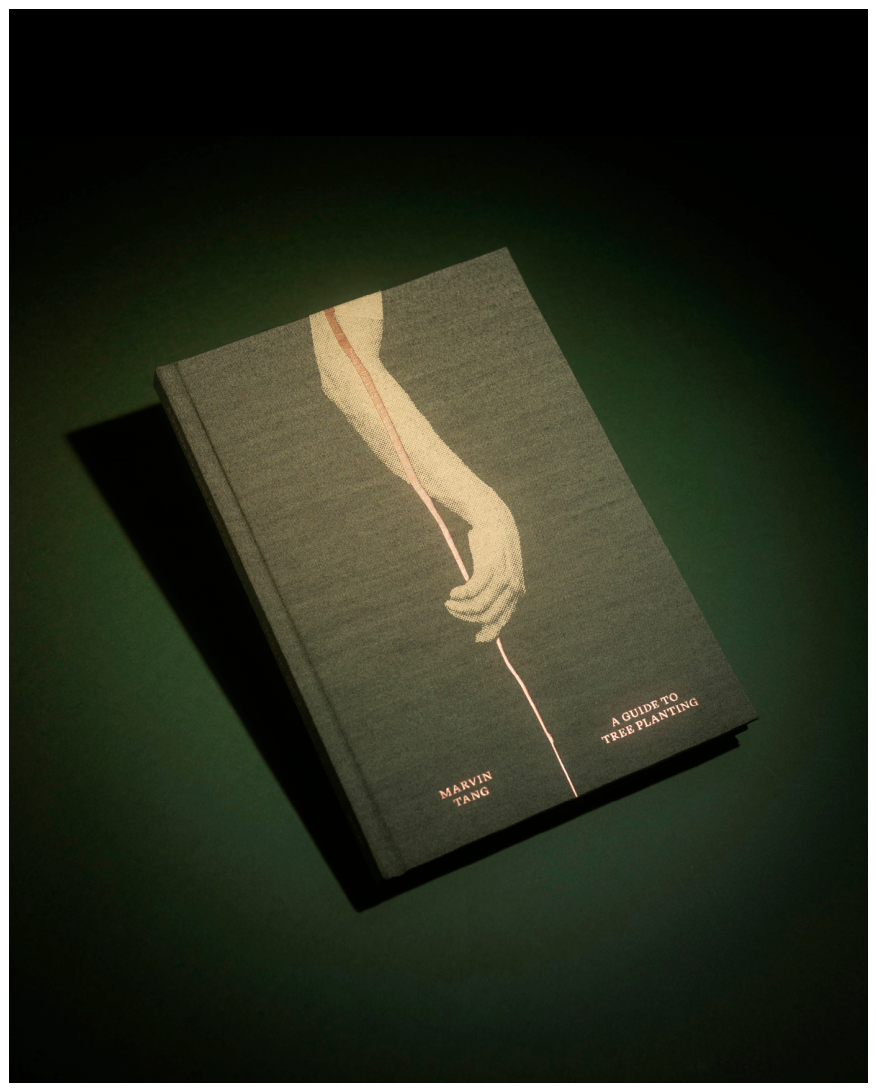
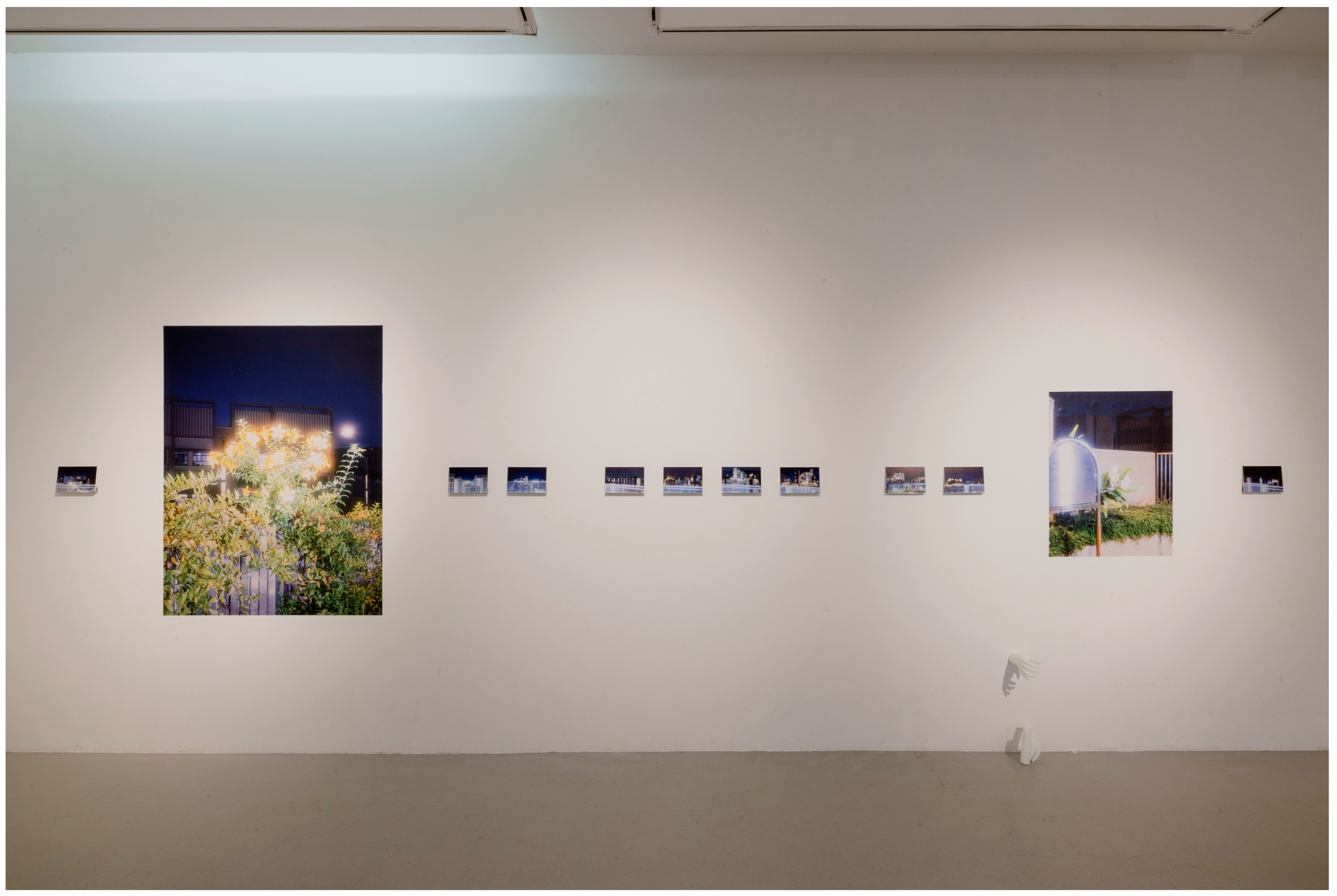
A Guide to Tree Planting included an eponymous photobook as well as enlarged and cropped archival photographs from this day (
Tang 2025)
8 (
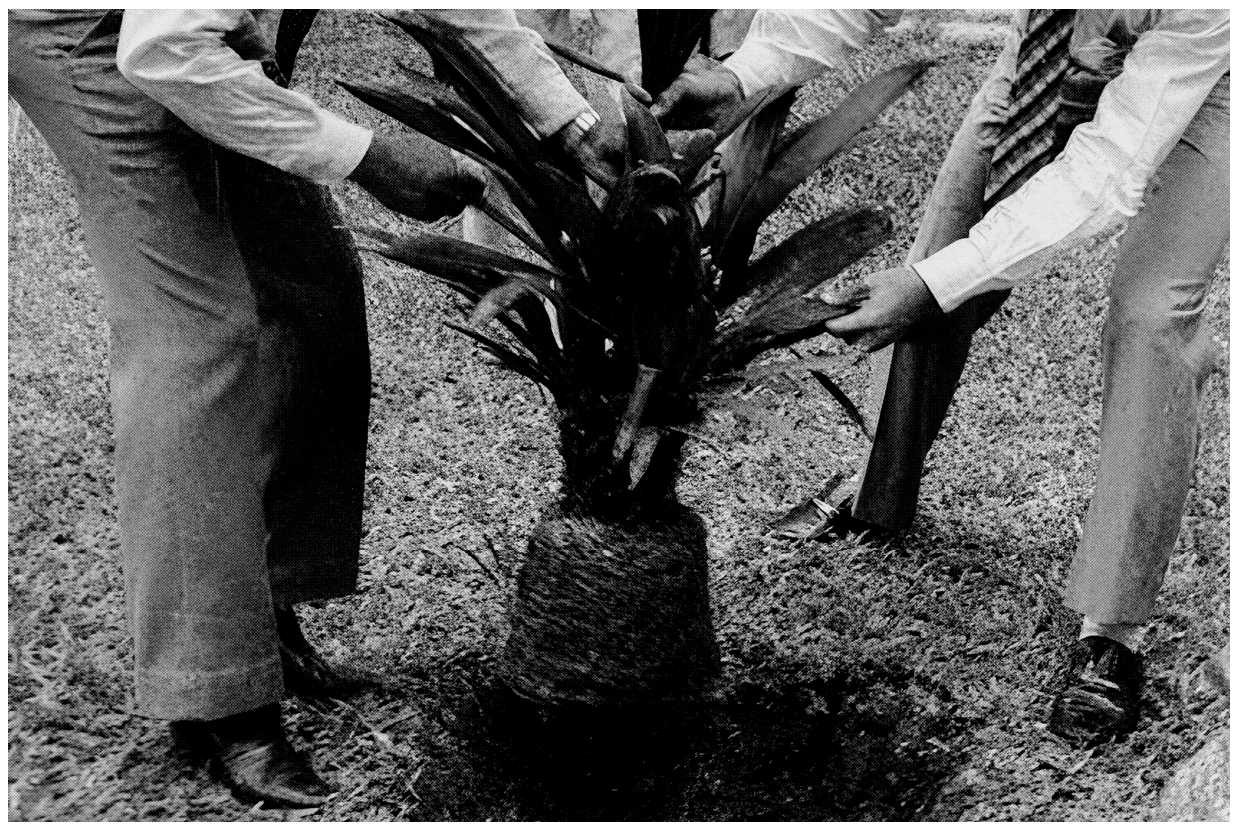
Figure 2). Several grainy black-and-white images, for instance, show the cut-off limbs of men in suits and ties collaboratively planting leafy fronds and saplings, their collective hands accentuated as they place the young plants in the ground (
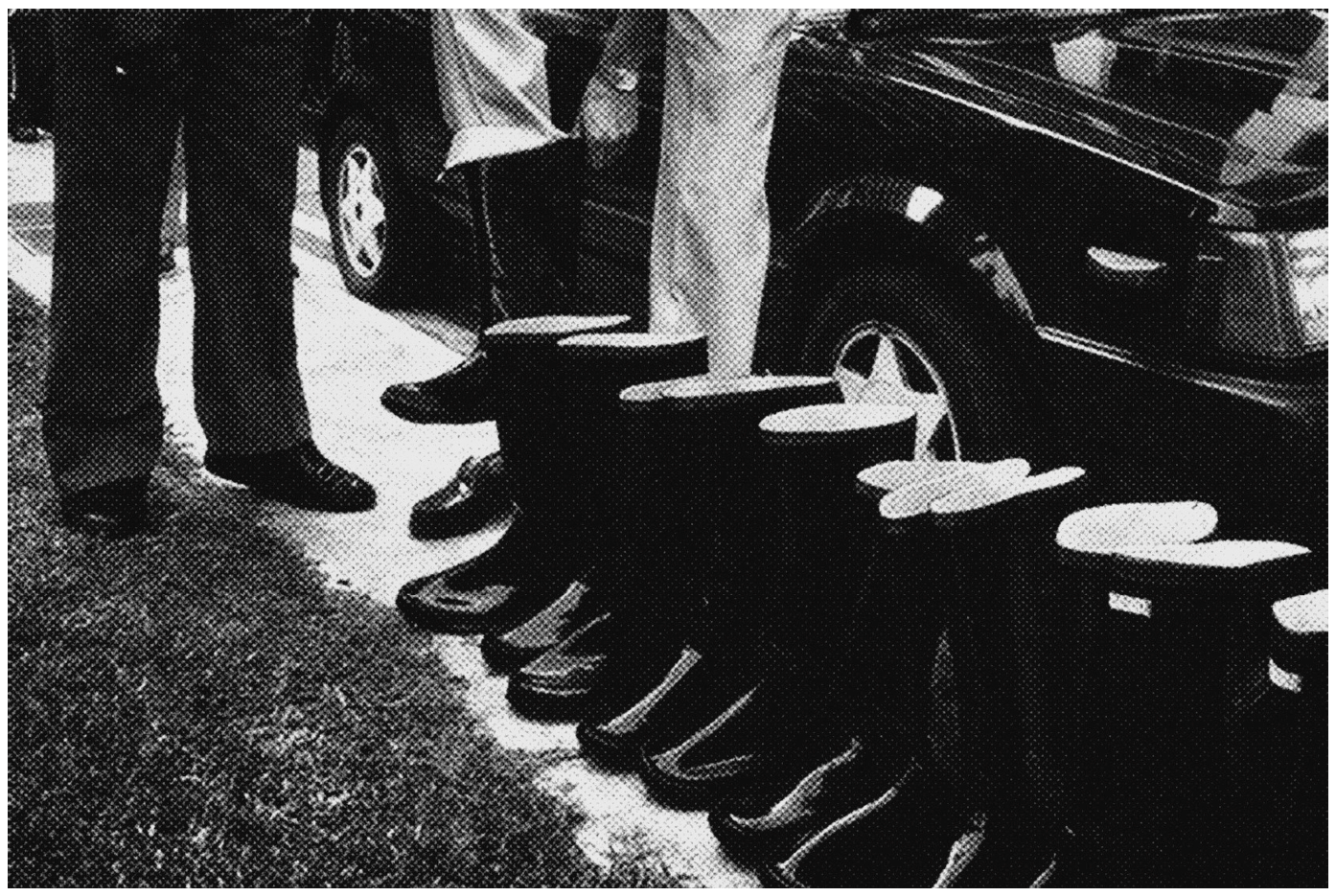
Figure 3). Other photographs depict rows of potted, flowering trees; hands about to unveil a plaque from a velvet covering; large palm leaves being watered, obscuring a man with a large video camera who documents the occasion; and images of tree saplings tied up to help them grow straight (a recurring theme that I will return to with Woong Soak Teng’s artworks). One of the most striking archival images, however, is that of a perfectly uniform row of black rainboots lined along a sidewalk, in front of a modern, gleaming car and three sets of trousered, presumably male legs (
Figure 4). One of the legs steps into a rainboot, gearing up to get out into the dirt and do his national duty. It suggests that all citizens, like these government officials, should mimic their important steps and gestures to contribute to the growth of the nation. And the Singaporean populace has largely taken this call to heart, still observing Tree Planting Day every year on the first Sunday in November.
9The national day is an important annual reminder of the self-fashioned Chief Gardener Lee’s deliberate aims to cultivate a green, clean, and beautiful country (
Barnard and Heng 2014, p. 295). “Clean and green” has been the mantra of the city for many decades (
Pwee 2015). Lee Kuan Yew believed that a polished and orderly environment would attract investors, offering the image of an “economically vibrant and disciplined” nation (
Barnard and Heng 2014, pp. 296–97). In his own words, his aim was to transform the small country into a “First World oasis in a Third World region […] from which to do business” (
Lee 1999): every tree would be maintained, offering beautifully canopied, major boulevards (particularly to and from the airport). The 1967 Garden City program, however, also distributed dustbins to homes throughout the country and dramatically increased fines for littering. The urban greening campaigns were meant to cultivate orderly behavior and habits from its citizens as well (
Barnard and Heng 2014, pp. 290, 298). Such discipline, however, reached a fever pitch in the 1990s with controversies surrounding gum and caning. In 1992, the country banned chewing gum in public (adding to bans on litter, graffiti, jaywalking, spitting, smelly durian fruit, and urinating anywhere but in a toilet, which legally requires flushing) (
Metz 2015). Whereas gum became a global media punchline about the “nanny state” of Singapore, the caning (four cane strokes) of American teenager Michael Fay in 1994 under the Vandalism Act (1966), for stealing road signs and spray painting cars, was seen as an extreme reaction to Singapore’s disciplining efforts (
Chew 2021). Moreover, the cane here assumes an unusual symbolism, as a punitive tool crafted from rattan vines, themselves straightened from their own curving, organic growth along tree trunks and branches. The act of caning also mimics the same overhanded gesture used for breaking ground with a hoe, which I will return to in the next section.
2. Producing and Reproducing the Botanic Nation in Marvin Tang’s Art
In 2025, in the exhibition
Second Nature, Tang displayed a new sculptural component of
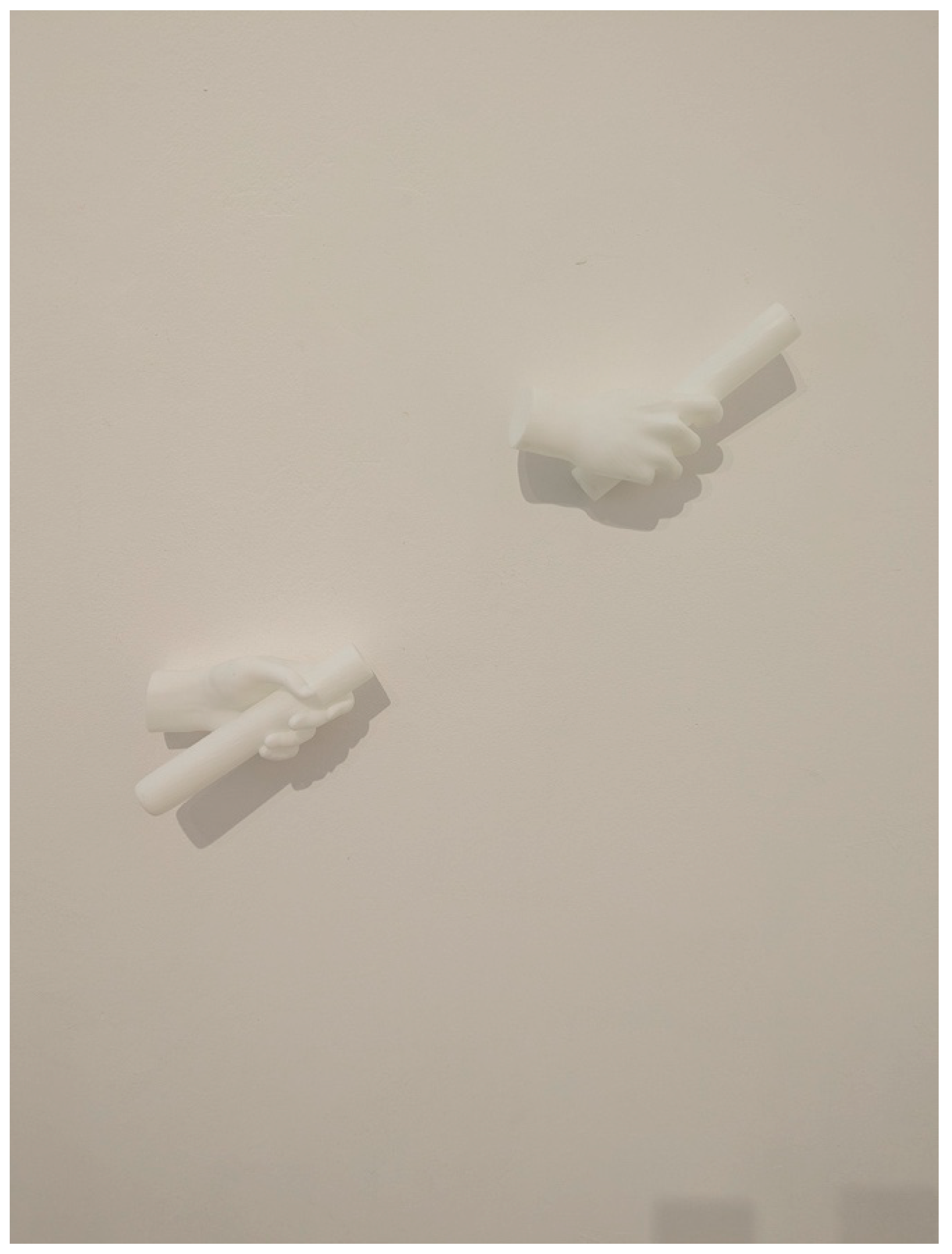
A Guide to Tree Planting: four sets of fragmented hands, each frozen in the performance of a certain gesture. Not surprisingly, each displays a key movement in the act of tree planting, including upturning earth with a hoe, laying the plant in the ground, holding the sapling’s trunk upright, and pouring water on it by holding and tilting a watering can. The sculpted hands are life-sized and placed in relation to the ground or on the wall, where they most spatially approximate and mimic such gestures in real life (
Figure 5). Additionally, they are all white and anonymous, even though they were 3D-printed and modeled after ministers’ hands performing those actions in archival photographs. They are cast from resin, but not a tree’s resin—rather a photopolymer resin that “cures,” or hardens into a solid, with UV light, e.g., a synthetic plastic. Besides 3D imaging, photopolymer resin is most often used for biomedical purposes: to craft dental sealants and protective coatings, for example, or as medical tools such as hearing aids, catheters, and more. The disembodied, unusually scattered sets of hands are laid on the floor or hung oddly on the wall, looking as if they belonged in a sterilized medical environment.
Such clean, “pure” hands symbolize the founding gestures of seeding and growing the nation. Yet they presume a certain type of ableism, or what cultural theorist Tatiana Konrad would term
eco-ableism (
Konrad 2024, p. 10), or eco-disability activist and scholar Sunaura Taylor might call an
ableist ecology (
S. Taylor 2024, pp. 25–26).
10 Those who will be able to participate in such nation-building will have strong, able, healthy bodies that can do the hard work of digging holes and transplanting heavy trunks. Despite their sterile nature, or perhaps due to their abstracted form and placements, these gestures also seem to hold sexualized overtones. Especially the fragmented hands that represent the act of holding a tree erect—one grabbing empty space just above the other holding a phallic-like shaft—convey a certain symbolism, so to speak, of bringing the ground of the nation to fruition. In Tang’s photobook, the acts of shoveling and hoeing are highlighted about equally in the archival images, but for his sculptural piece, he chose to recreate hands in the gesture of hoeing, with an overhanded rather than an underhanded grip on the imagined tool (
Figure 6). This overhanded gesture arguably also evokes the act of caning. Nonetheless, these gestures are ones that signify discipline and “correct” behavior—they are a “guide” to tree-planting as nation-building, training citizens in the assembly-like, micro-movements necessary for the larger, citizen-based project. (In some ways, this resonates with Berthold Brecht’s idea of the
Gestus, or as a key gesture that here trains postcolonial citizens rather than the working class.)
11 Yet by fragmenting and alienating such performative gestures throughout the space of
Second Nature, and thus challenging their “second nature,” Tang highlighted the eco-ableist, patriarchal vision of the Garden City’s program. The intimate sculptures are, like the archival documents in his photobook, cut up and segregated to denaturalize the strong-armed, repetitive tactic of planting millions of trees, with each successive government campaign aiming to plant an even larger quantity than the last (#OneMillionTrees). Their dispersed placement does not merely suggest collective tree planting. Instead, the sterilized, cut, and “clean” hands evoke a wounded citizenry—a nation traumatized and cauterized from over a century of colonial-botanical extraction and destruction.
Along a similar vein, Tang’s multicomponent artwork
History of 39 Cuttings explores the problematic eco-ableist projection of Singapore through its national flower, the
Vanda Miss Joachim orchid.
12 The piece’s title refers to the 1981 competition to choose a flower to represent the country, which recalls the form of a beauty contest. The majority of contestants were orchids, and the
Vanda Miss Joachim orchid was selected for its vibrant violet-rose color, resilience, and “year-round blooming quality.”
13 It is named after Agnes Joaquim (1854–1899), a Singaporean citizen of Armenian descent, who was officially recognized as the breeder of the hybrid orchid in 1893 by British colonial Henry Nicholas Ridley, then director of the Singapore Botanic Gardens. This species of orchid is a climbing plant that requires support, only blooming once it reaches a certain height; today, the Singapore Botanic Gardens holds a striking display of 20,000 of the national icon tied up in densely landscaped rows of towering wooden posts (much taller than my average height) (
N. P. Taylor 2014, p. 127). They evoke the bracing of the Raffles/Wallich monument (with their tresses of orchids in their busts), or the tying up of young saplings in Tang’s archival documents. In general, the process of reproducing and hybridizing orchid species has been extremely controlled in Singapore. For decades, for example, controversies surrounded the exact parentage of the
Vanda Miss Joachim (whether
Vanda teres or
Vanda hookeriana was the “father,” or pollen plant) and whether the hybridization was naturally produced by chance pollination in her garden, or artificially created by Joachim, whose expertise as a “lady” horticulturalist was cast in doubt (NParks confirmed her official breeding status in 2016) (
Arunasalam et al. 2017). Despite the ambivalence of such debates, the gendered and sexed implications of this botanical stand-in for the country are clear. If tree-planting evokes the patriarchal, phallic seeding and production of the nation, then the beautiful, vaginal orchid symbolizes its biodiverse reproduction through controlled crossbreeding.
Orchids have long served as a key tool for diplomatic relations and soft power in the country, helping to cross-pollinate international relations and shore up Singapore’s global status as an attractive site for investment and “development.” As of 2025, over 280 orchid hybrids have been named after diverse foreign dignitaries, celebrities, and organizations, such as Nelson Mandela, Pope Francis, Serena Williams, Queen Rania Al Abdullah of Jordan, many British royals, the World Trade Organization (WTO), and the Association of Southeast Asian Nations (ASEAN).
14 The VIP (Very Important Person) orchid naming program began in 1956, when the first hybrid orchid was named after the wife of the then British Governor of Singapore, Lady Anne Black. Until the 1980s, in fact, new orchids were only named after the wives of dignitaries, again reflecting traditional notions of gender related to the flower. Instead, trees were often named after international male leaders in the country’s Tree of Fame program, but this practice eventually died out as orchids came to take over as Singapore’s primary diplomatic gift, perhaps partly due to the official branding of the
Vanda Miss Joachim as a national icon in 1981. With each presentation of a VIP orchid, a “birth certificate” is also proffered, explaining the orchid’s lineage and (pro)creation process, and reflecting the official (heteronormative) cross-fertilization of the two countries’ relations.
What is also unique about the orchid diplomacy program, compared to the tree planting campaigns, is the extremely sophisticated technology used to cultivate and sustain the plants, and this is something that Marvin Tang plays with in
Hybrids (2022), the last chapter of the
History of 39 Cuttings series (but the only one made so far) (
Figure 7). Unlike orchids in the wild, VIP orchids often require cloning to live on past their typical 4- to 10-year lifespan, because the breeding process can be quite complicated and difficult. In the 1970s, a Tissue Culture Laboratory was established at the Singapore Botanic Gardens in order to help cultivate and clone orchid hybrids (
Lim-Ho 1981), but as of 2025, the laboratory of Yu Hao, head of the National University of Singapore’s department of biological sciences, is leading gene-editing research on orchids, developing the world’s first kilobase-scale gene-editing platform for the flower.
15 Scientists are now using the CRISPR tool to genetically modify more desirable orchids—as a kind of eugenics program to develop more attractive floral patterning, color, fragrance, and resilience (
Wei et al. 2025). With this in mind, the artwork
Hybrids playfully proposes that the national flower need no longer even be “natural” at all in adapting to the physical world—the ideal form could just as well be digitally generated through AI representations.
Indeed,
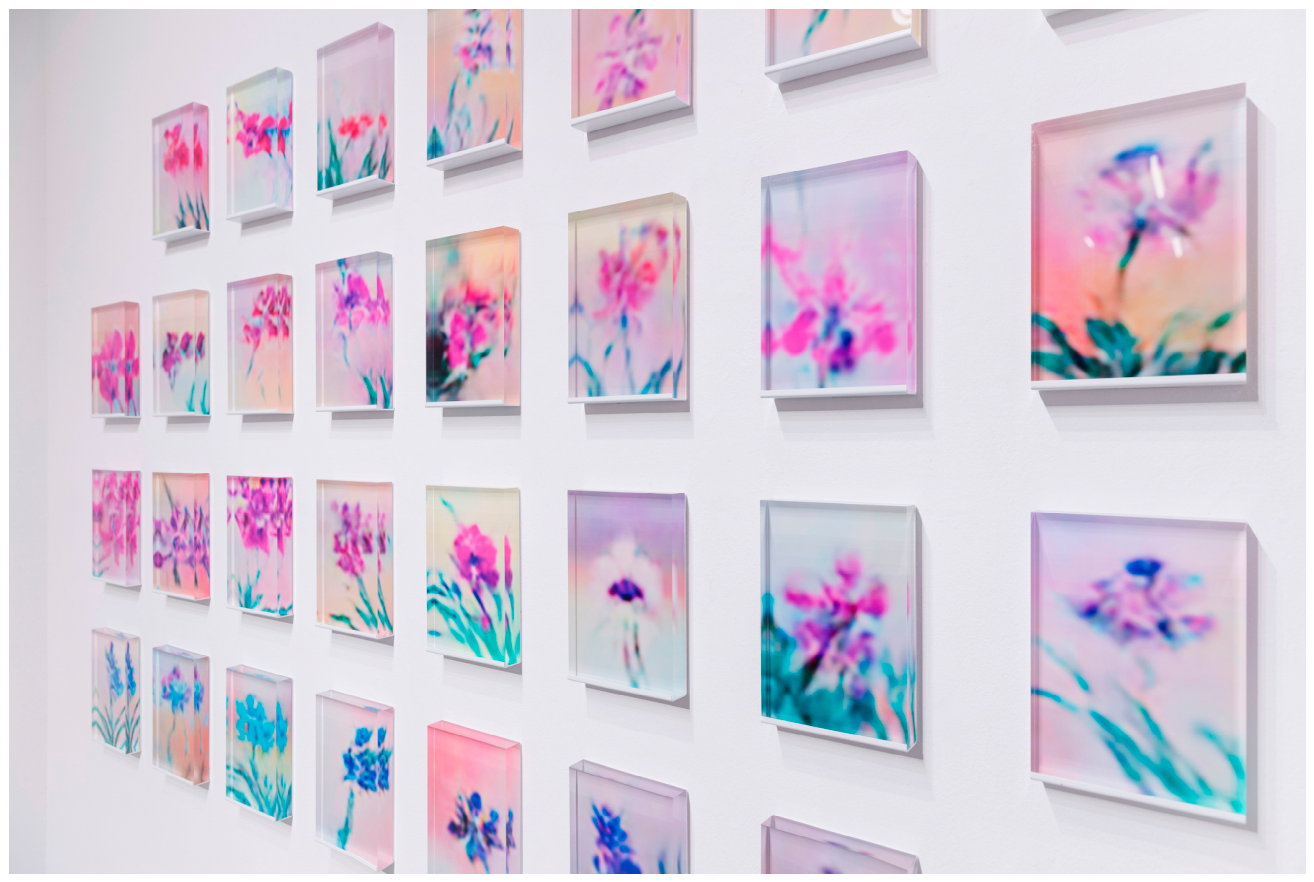
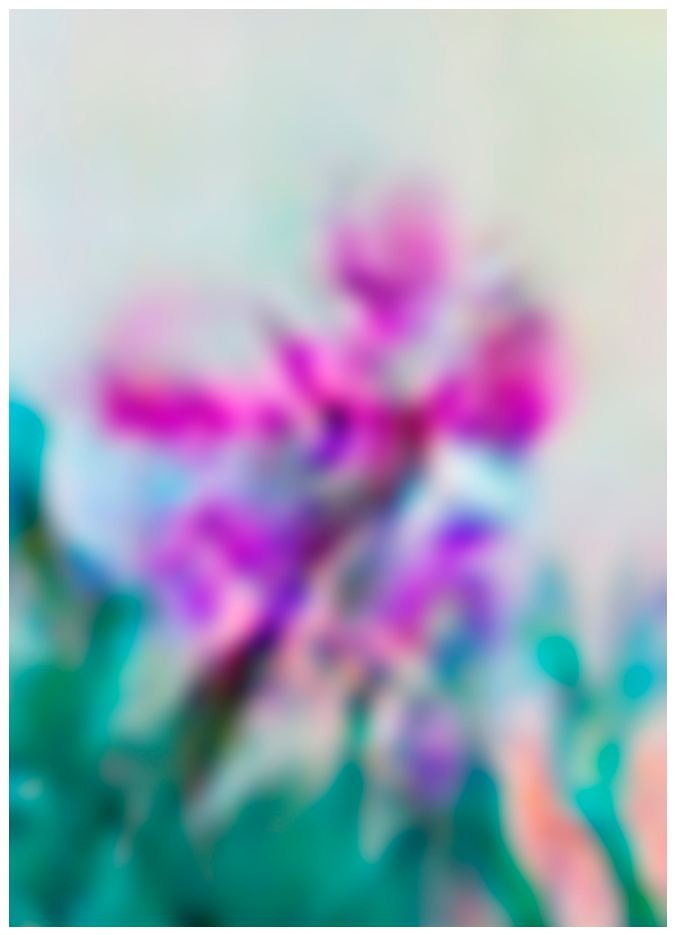
Hybrids consists of 39 AI-generated images of orchids hung in four rows of ten images (one with only nine, however), each image covered with a 2.5 cm screen of acrylic block. The specific number, again, references the 1981 selection of
Vanda Miss Joachim as Singapore’s national flower from among 40 blooms, most of them orchids. The one missing image perhaps suggests that the “ideal” flower has not yet been created. To generate these images, Tang worked with a researcher who was doing a PhD at the time with an earlier version of AI called GAN (Generative Adversarial Networks).
16 The artist wished to make his own data set of orchid images, so they photographed about 2000 plants of around 90–100 different orchid species in local commercial nurseries as well as the National Orchid Garden, and from this data set, generated about 10,000 variations, only a few of which ended up looking like the real thing. From this output, Tang chose 39 images, including a few blue orchids—hallucinations, since these do not exist in nature. He notes that today’s hybridization process can only use two orchids at a time, but with AI, he can “mesh together 50 different orchids to create a new orchid” (
Tang et al. 2022). He also specifically links their aesthetic, e.g., covered in a thick block of acrylic resin, to the innumerable tourist souvenirs in Singapore of orchids, particularly the
Vanda Miss Joachim, which have been preserved in lucite (a clear acrylic, plastic resin) and sold as paperweights or desk decorations. With these, each person can have an image of the nation in their office.
Yet Tang offers a striking modification to his AI-generated images: he blurred them before setting them behind the acrylic blocks (
Figure 8). In this way, he effectively highlights them as impaired through the technologically advanced AI-generation process, and in parallel, through their extreme genetic modification in laboratories. The orchids are no longer recognizable as “natural” or “normal” at all. Instead, gazing at them is like using a set of eyeglasses with the wrong prescription, or as someone who is themself visually impaired. The plastic resin preserves their general, colorful (amazingly blue!) forms for viewers to witness, but through an imposed device of visual impairment, refutes a traditional “beauty contest” framework for evaluating, or valuing, the “fittest” or most “ideal” orchid. Moreover, the issue of natural or climatic adaptation—of orchid species organically changing to evolve and thrive in shifting environments—is here rendered moot. Orchids are remarkably adaptive to diverse environments, from deserts to rainforests, largely due to their own unique reproductive strategies and floral structures (
Wei et al. 2025). However, controlled hybridization and breeding programs, with a eugenicist bent, have arrogantly placed (or denied) questions of orchid adaptation in human hands, to such a degree that the physical reality of reproducing life in actual environments hardly registers as a matter of serious consideration, but rather, one to be farmed out for artificial intelligence. In contrast, the Director of the Singapore Botanic Gardens, Nigel P. Taylor, explains that since 1999, an orchid reintroduction program has attempted to reestablish rare, endangered, and locally extinct orchids all over the island, from within its parks to along its main highways. He touts the program’s success: “…orchids are propagated initially in the laboratory by science teams, then ‘weaned’ from their life in septic media and grown on in more conventional horticultural nursery conditions, before being lifted by man and crane, fixed into their new epiphytic habitat, and monitored for years thereafter” (
N. P. Taylor 2014, pp. 136–37). Yet such a program facilitated and fixed “by man and crane” here sounds arrogantly controlled and administered for an aesthetically pleasing garden environment for humans, not necessarily geared toward orchids’ own natural adaptation to the changing environment. In blurring the orchids in
Hybrids, Tang highlights the idea that physical impairments may themselves be socio-environmentally constructed, and that an eco-ableist, technologically “enhanced” vision of the nation may, in fact, be socio-environmentally disabling. Let me now turn to the work of Woong Soak Teng, who, through the lens of her own disability of scoliosis, offers ways to further, generatively conceive of disability as a mode of entangled impairment between human and more-than-human bodies.
3. Curative Violence and Disabled Ecologies: Binding Environmental and Human Health in Woong Soak Teng’s Art
Woong’s photobook
Ways to Tie Trees (2018) harks back to the historical images of early postcolonial Singapore as depicted in Tang’s
A Guide to Tree Planting (
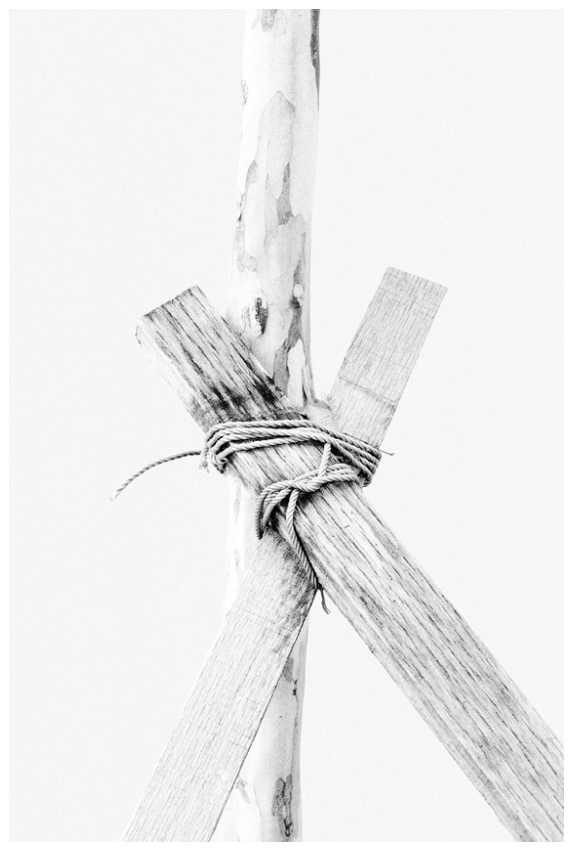
Woong 2018). Her stark, black-and-white photos specifically conjure up the archival images of staked trees, however, rather than the more general act of planting them. They evoke the necessary, continued maintenance of the trees’ lives, or the years-long process of ensuring that they grow upright, strong, and beautiful in the Garden City. There are thirty images in the photo-book, depicting staked trees from all over the country. Yet notably, the photobook consists of thirty separate leaves,
not bound as a book and not staked like the trees themselves. Each photo zooms in on a few feet of an individual tree’s middle section, where it has been braced with pieces of wood, cord, and/or cloth in order to help it grow upright. Most trees in Singapore are grown in nurseries and then uprooted and transplanted, so they need support devices to keep them upright in new locations.
17 In her series, Woong only offers one image that shows any foliage. Rather, the focus is on the textured bark of the trees and the diverse binding structures that enwrap them. On the back of each page, there is a geographical location noted in small, unassuming text. The background environment of each photograph is also erased, leaving only the relatively abstracted lines of a tree and its binding architecture. A sense of time only registers in the different sizes of tree trunks and the weathering of the human-made assemblages. In a way, the photographic series recalls the modernist photographic typologies of German photographers Bernd and Hilla Becher, notably published as it is by the prominent German photography publisher Steidl. Like the Bechers’ work, it is the formal, austere beauty of the Woong’s repetitive yet different compositions that takes center stage.
However, the abstracted beauty of the photographs also draws attention to the ubiquitous, more invisible violence involved in staking trees in order to “cure” them of their bent forms and oblique lines, to make them grow upright. One image, for instance, depicts a young, mottled trunk perfectly centered along a vertical axis, roped up tightly with a crisscross formation of two hand-cut planks of wood, as if it has been “X”-ed out (24) (
Figure 9). On the back, the caption reads, “In front of IPP Wealth Management Center, 78 Shenton Way,” which, according to its website, is “one of the first and largest licensed Financial Advisers with the Monetary Authority of Singapore.”
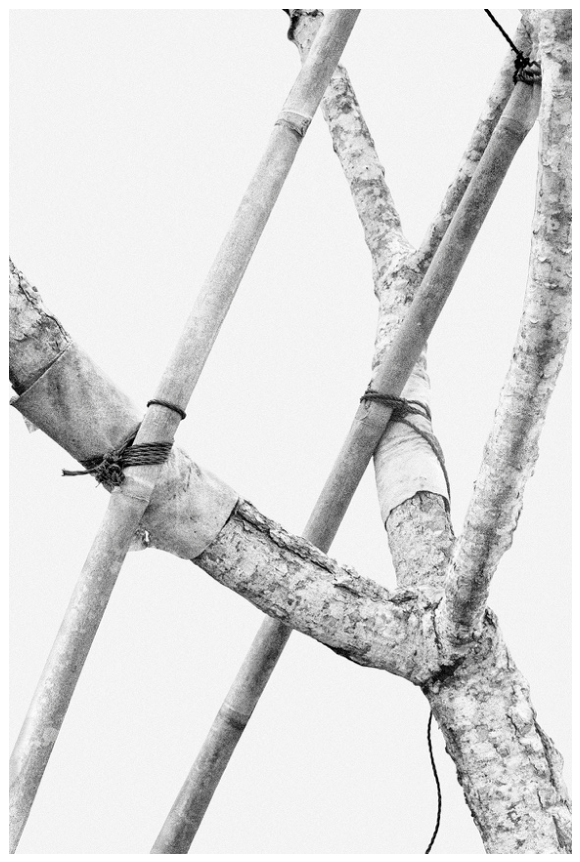
18 The tree is located not too far from Mount Faber in central Singapore, where then Deputy Prime Minister Goh planted the first official tree of Tree Planting Day in 1971. The earlier iconic photo recalls the nation-state’s long-term commitment to greening and aestheticizing the landscape to attract corporate financial investment, exemplified by businesses such as the Investment Protection Planning (IPP) Financial Advisors. Many of the trees are dispersed more locally throughout Housing and Development Board (HDB) complexes, but certain key institutions are implicated as well. In the second-to-last image, for example, shot “opposite National Gallery Singapore, along St. Andrew’s Road,” a trunk diverging into multiple branches is staked by two diagonal, parallel bamboo rods (29) (
Figure 10). Bunches of cord bind the tree in three different places, two of which are covered by a type of protective cloth. The angled lines of the bamboo provide an elegant dynamism to the composition but also recall the violent act of caning as a form of discipline. The tree looks both medically treated and wounded by the “corrective” apparatus, exemplifying an image, as Eunjung Kim might attest, of curative violence, or a type of harm rendered invisible in the name of cure (
Kim 2017, p. 9).
Woong explicitly connects the curative violence of tree-staking to that of the treatment of scoliosis, or the side-to-side curvature of a human spine. In her art book,
Rules for Photographing a Scoliotic Patient (2022), she includes 18th–20th century European medical prints of staked trees, for example, which are meant to represent the “orthopaedics or the art of preventing and correcting deformities of the body in children” (
Woong 2022, p. 8). The first half of the book offers a compilation of various photographs by the artist, blown-up text excerpts, and archival and documentary images (X-rays, diagrams, photos) related to scoliosis from the Wellcome Collection in the United Kingdom.
19 Most of the archival documents present “scientific,” apparently objective records that, in fact, belie forms of violence historically normalized in the medical establishment. They register a medical model of disability that views disability as “an individual deficit or pathology to be corrected through professional intervention,” as Eunjung Kim describes it, denying disability as a valuable element of human differentiation (
Kim 2017, p. 6). Reprinted text in
Rules for Photographing a Scoliotic Patient, for example, from books on scoliosis originally published in the 1960s and 1970s, offers a list of “deformities” related to scoliosis (from “body chemistry has gone haywire” to “cannot look straight with their eyes” and “do not talk intelligently”) (
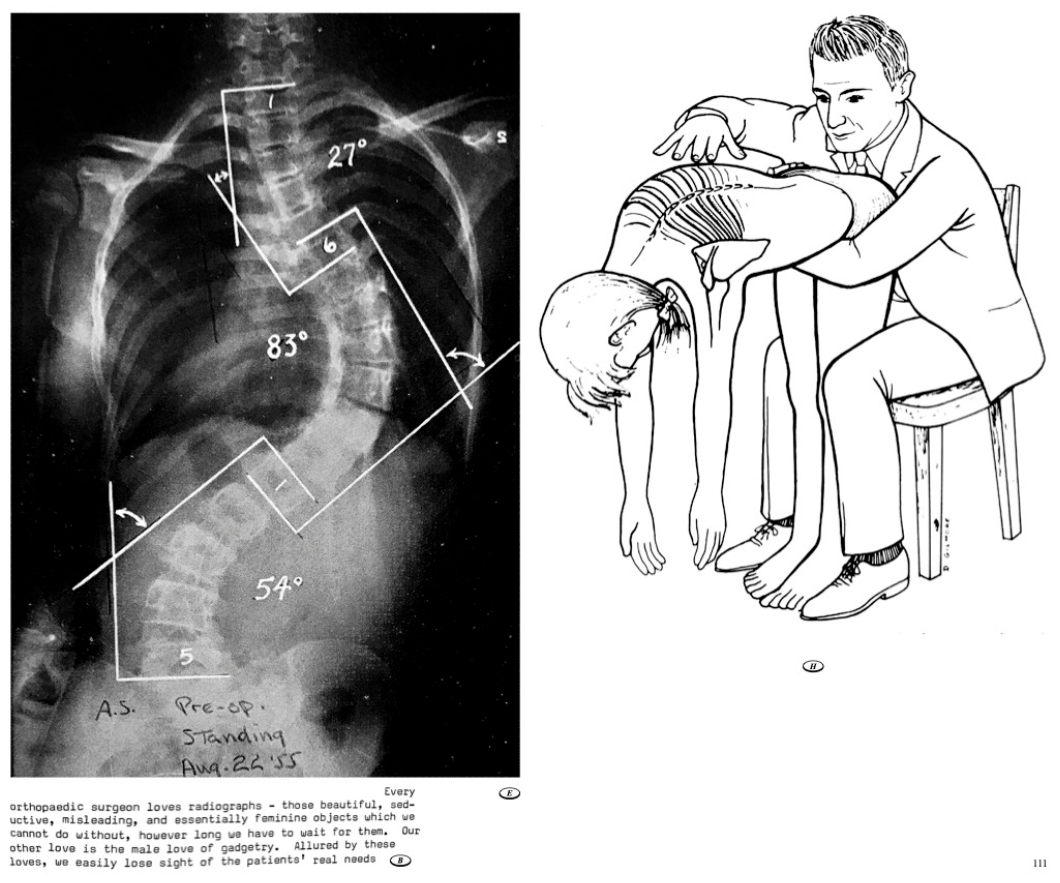
Woong 2022, p. 1), and archival images demonstrate the physical violence involved in different “corrective” medical procedures, such as stretching the spine in various ways (racking patients on beds or dangling them upside) and bracing patients through elaborate metal-and-leather contraptions or stiff plaster casts. Some of these look like constricting corsets, but others seem to veer toward torture devices. Moreover, many of the images hold sexualized overtones, including photographs of people bending over naked (to evidence the curvature in their backs) as well as a drawing of a seated male doctor with a young girl bent over between his legs (110–111) (
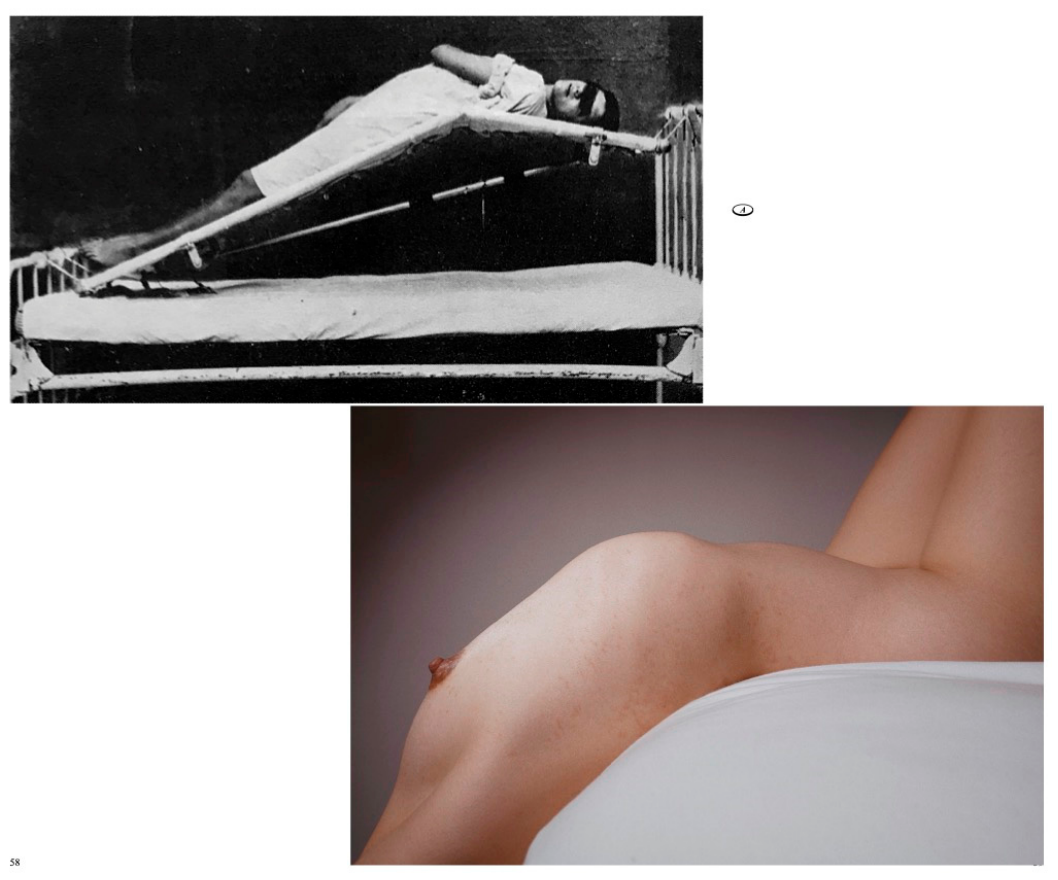
Figure 11). Another page juxtaposes a black-and-white photo of a woman stretched and racked over a medical bed (her eyes censored and blacked out in the photograph) with another lithe and supple, feminine body bending open and outward, her red, glistening nipple quite prominent against the young, taut skin (58–59) (
Figure 12). Many of the metal-and-leather braces also suggest BDSM, a form of erotic play involving bondage, discipline, dominance and submission, and sadomasochism. Informed consent in such practice is a guiding principle, and Woong’s allusive images likewise raise the crucial question of consent for such seemingly violent, “curative” medical procedures for scoliosis.
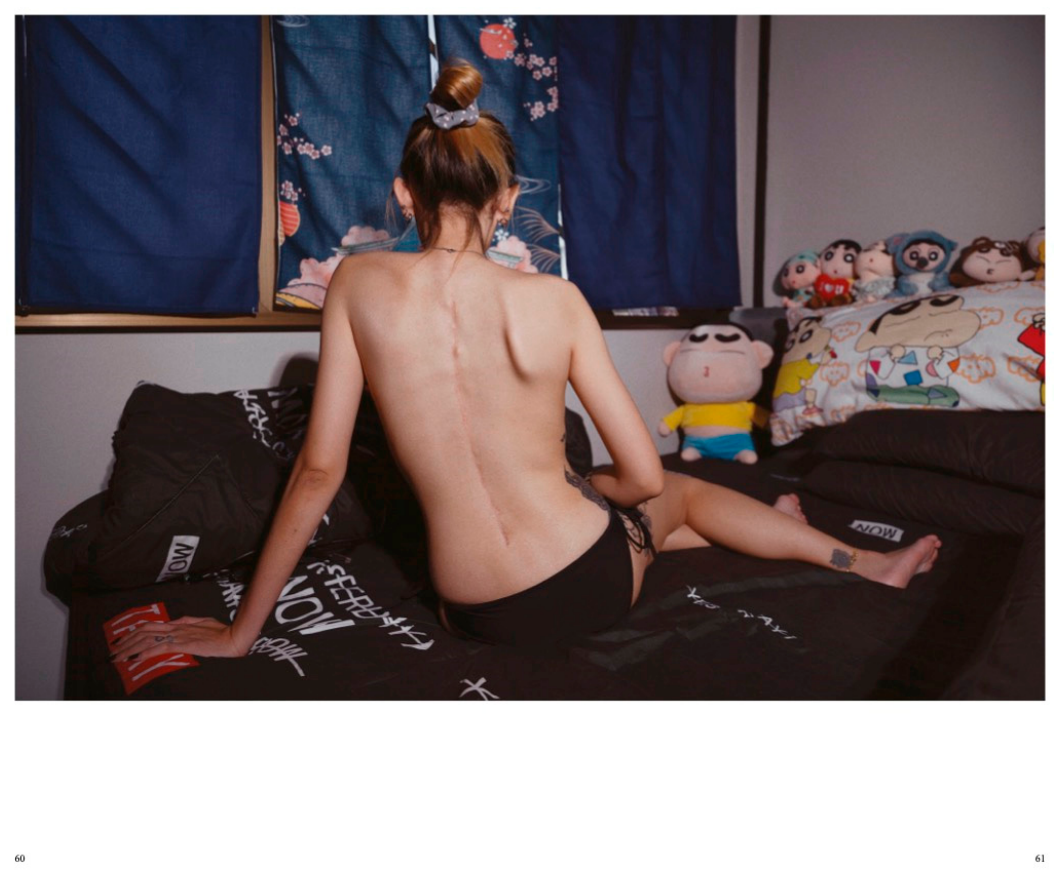
The book, however, also counters the curative violence of such historical practices and descriptions of “abhorrent deformity” with photographs of, and interviews with, contemporary Singaporeans with scoliosis (64). The second half of the book includes ten interview transcripts, including nine with people in Singapore who have been diagnosed with scoliosis, and one with an orthotist, a specialist in creating assistive devices such as spinal braces. Small, ID-sized portrait photos of the people’s bare backs and surgical scars accompany each transcript, captured in intimate domestic spaces with the individual typically sitting on a bed in their bedroom. In turn, larger, more expansive photos of the interviewees in their home environments are provided throughout the book as well (
Figure 13). In contrast to the sexualization of other photographs, in their own bedrooms, these people are often surrounded by childlike stuffed animals and teddy bears. The interviews reveal how most were diagnosed in their early adolescent years, and their parents decided for them whether they would have surgery or not, raising the issue of consent, again, within the context of familial norms and expectations. Many wore braces for years (one for 23 h every day) and/or had multiple surgeries and implants to straighten their spines. If the angle of curvature becomes too severe, surgery is often necessary in order for the person to be able to breathe. Some interviewees had more positive experiences, and some more negative ones, with the medical establishment. Each case is unique. Woong lets each individual relay their own personal experience and the difficulties involved (e.g., back pain, insomnia from wearing the braces at night, playing sports or not, etc.). Yet in most cases, issues of appearing “normal,” especially in their adolescent years, were ubiquitous. Eight of the nine people with scoliosis interviewed, moreover, are women. They describe issues such as diminished self-esteem tied to appearance and eating disorders due to their disability, as well as matters concerning pain in pregnancy and difficulties with labor (e.g., receiving an epidural in the spine). Some families were quite supportive, while others, like some schoolmates, belittled them with insults—calling them “weird creature,” “robot,” “hunchback,” or “nenek si bongkok tiga” (“‘Nenek’ is grandma, ‘bongkok’ means bend. Maybe because she’s holding a cane, and ‘tiga’ is three, she’s standing in threes.” 8–9) What becomes apparent through the transcripts, is the fact that each person’s experience is different, dealing with multifarious issues due to scoliosis, but that with growing awareness and connection through their stories, less stigmatization, and more familial and institutional support, each has grown from their experience of living with the disability. They have adapted to and with it in subtle and transformative ways.
Recently, Woong’s projects,
Trying to Straighten a Branch (2022) and
Studies of Trees and Gauze (2025), further imbricate human and environmental health through sculptural form.
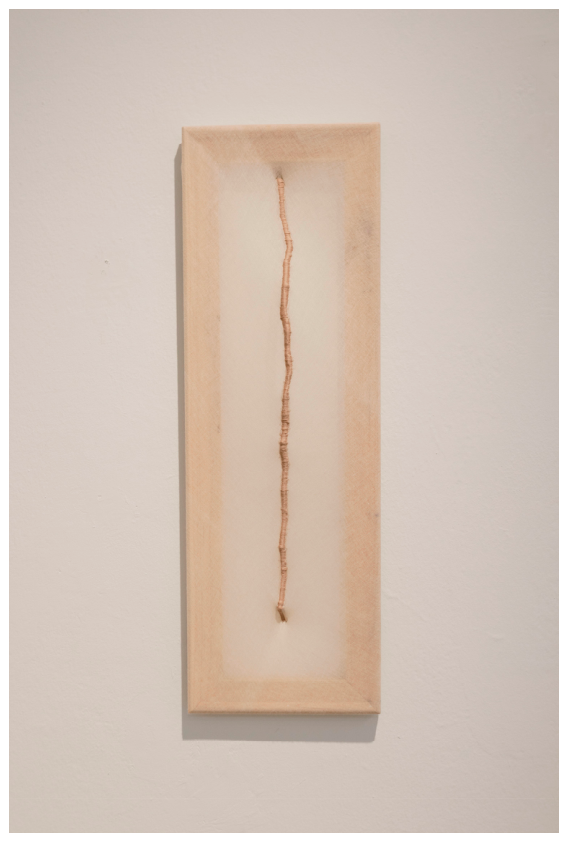
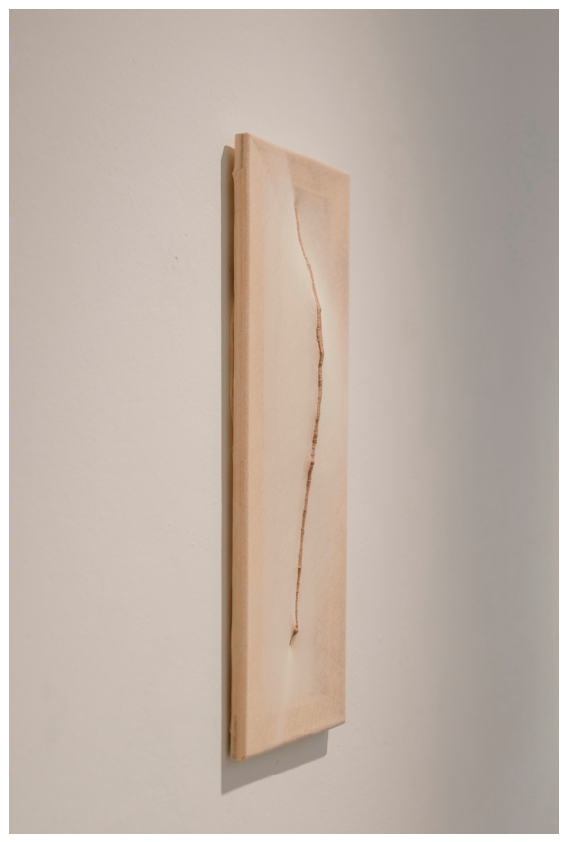
Trying to Straighten a Branch includes single vertical tree branches embroidered in the center of unique, otherwise empty canvases. Thick, white nylon thread—meticulously wrapped around the entire length of the branches—constrains and forces them into erect lines, but small glimpses of their brown texture also break through where the branches resist such straightening. In short, on a broader symbolic level, this recalls gendered conceptions of feminized embroidery as “craft” versus the masculinized action of making (straight, territorializing) marks on a “blank” canvas, as well as racialized notions of white/brown human skin and botanical-colonial resistance. In turn,
Studies of Trees and Gauze, experiments with the same method of straightening branches, but employs finer embroidery thread on stretched and framed gauze instead of canvas (
Figure 14 and
Figure 15). For this latter piece, in the exhibition
Second Nature (near to Tang’s gesturing, medical-prop-like hands), she included a ghostly, drooping sculptural piece created after layering and removing gauze from a scoliosis brace. Next to this were juxtaposed photographs of living trees wrapped in weathered burlap, meant to protect them from sun and disease. In other words, her work connecting the bracing of trees and spines still continues, aiming to further illuminate less immediately visible connections between human and ecological health, disability, and care. For her, it is an ongoing conversation about entangled human-and-environmental spectrums of both chronic pain and resilience, of both the difficulties of and the transformative possibilities for mutually disabled or impaired, human and ecological health. Recalling the more-than-human, braced figures of Raffles and Wallich “in conversation” about Singapore’s botanical life, Woong and Tang also offer deeply ambivalent visions for human–environmental adaptation.
4. Framing the Future: From Eco-Ableism to More-than-Human Adaptation
In disability studies, a question of “cure” or “improvement”—or the idea that disability should or can be eliminated in order to better approximate able-bodiedness—is understood as damaging, because “cure” is almost always a complex negotiation that involves both drawbacks and benefits (
Kim 2017, p. 7). Cure presumes a normative state of being that works to reinforce prejudice against disabled people (5). In the case of Woong’s interviewees, many experienced deep insecurities regarding their physical “abnormality” and painful repercussions from it, but many also developed a transformative sense of self-worth, identity, and resilience from their experiences as well. “Improvement” and “cure” are subjectively charged terms. An idea of adaptation, however, seems more able to hold the capacious contradictions and negotiations involved in dealing with a chronic disability that may, on the one hand, include pain or loss, and on the other hand, lead to a transformed existence related to the conditions and surroundings of one’s life. In this sense, it resonates with the notion of adaptation in climate science—where lives and systems adjust to environmental changes to survive, build resilience, and thrive.
It is about coping with the difficulties of (often unfair or unjust) forces beyond one’s control and moving into new ways of being and living with them, in contrast to a notion like ecological restoration, which, while admirable and perhaps something to still strive for in some cases, implies a return to a pre-disturbed environment that may no longer be feasible or practical. As disability theorist Eli Clare reflects on the “restoration” of a cornfield back into a prairie grasslands, asking what is now normal or abnormal, he opines: “Sometimes we can return a place to some semblance of its former self before the white colonialist, capitalist, industrial damage was done,” but “sometimes restoration is a bandage trying to mend a gaping wound” (2017, p. 255). Now the climate crisis has had the effect—beyond simply immeasurable environmental damage—of obliterating the preconceived terms of our relations with a more-than-human world, or what it might mean to be “normal” or “natural” anymore. These are also the terms by which ableist systems and conventions may cause great damage. In this sense, adaptation, more broadly extrapolated from discourse on climate adaptation (rather than evolutionary biology), could be a useful concept that overlaps between disability studies and the environmental humanities, pushing us to imagine socio-environmentally ethical ways of coexisting and transforming amid the increasing impairment of ecosystems worldwide.
In the case of Singapore, the almost obsessive state-driven project to plant millions of trees and seemingly “restore” the island to a kind of precolonial natural condition, as a rebranded City in Nature, is arguably less about climate adaptation—given the country’s apparently disavowed or suppressed environmental issues—than a desire to “fix” and superficially treat a more deeply hewn, socio-environmental wound inflicted on the postcolonial people and living land. Put another way, it is not only a “bandage trying to mend a gaping wound” (
Clare 2017, p. 255). Rather, it is a surface-level cauterization that controls the bleeding while also destroying tissue in the process. The Singaporean government’s eco-ableist vision and policies obscure other, more entrenched problems for sustainability and climate resilience on the island.
Marvin Tang’s
Guide to Tree Planting highlights the underlying paternalistic eco-able-bodiedness of Singapore’s extensive historical tree-planting campaigns, where, as Woong’s
Ways to Tie Trees further reveals, young nursery-cultivated trees are uprooted, transplanted, and staked to make sure that they grow upright and aesthetically pleasing in their administered environments. The majority of trees in Singapore do not “naturally” grow or adapt from wind-swept seeds or animal movement. Rather, they are meticulously controlled and managed by the state to project an image and brand of eco-ability, against the long-term disabling of ecologies on the island and rising concerns of the climate crisis.
20 Tang’s
Hybrids, furthermore, demonstrates the extreme degree to which attempts at anthropogenic control could upend the natural world—where orchids are no longer allowed to organically adapt to their changing environments but instead are eugenically or AI-generatively created to visualize an ideal, technologically advanced or “fixed” nature. In these works, there is a clear gendering and sexing of (phallic) trees and (yonic) orchids in the production and reproduction of the Singaporean nation-state.
Rules for Photographing a Scoliotic Patient, in turn, highlights familial and social constructs of gender/sex in its comparison of the practices of binding trees and bracing humans, while also scrambling and challenging any clear, heterosexist divisions. It resists normative, stigmatized notions of disability to allow space for more expansive and generative understandings of disability to emerge, which crucially includes more-than-human disabled ecologies.
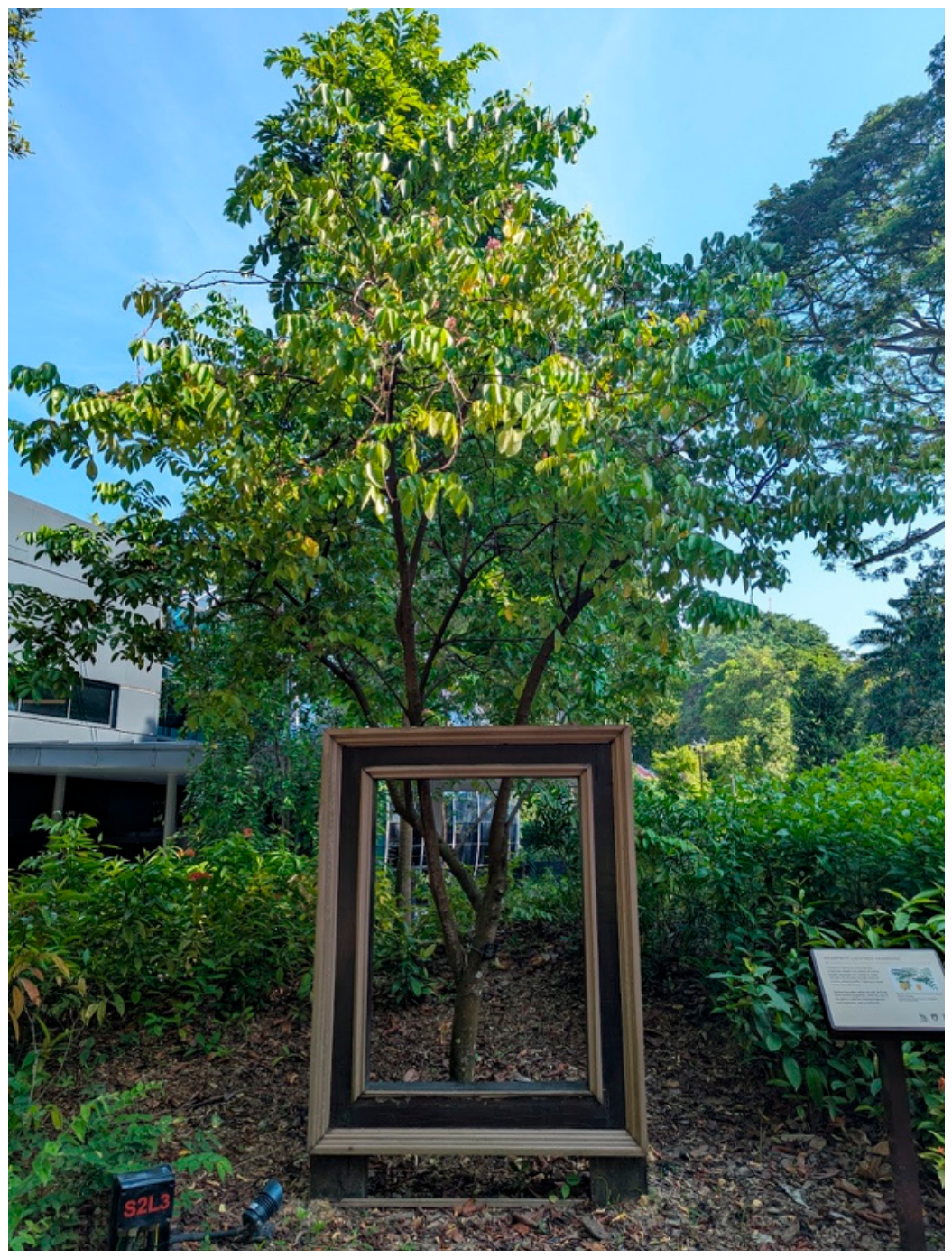
By way of conclusion, I would like to juxtapose their artwork with one last set of images from Fort Canning Park, set adjacent to the memorial—a series of oddly framed pictures in the Farquhar Garden (named for the first British Resident and Commandant of Singapore, Major-General William Farquhar, 1774–1839). In this garden, like the framed branches in
Trying to Straighten a Branch and
Studies of Trees and Gauze, numerous living plants are centered within the borders of “empty,” standing picture frames. It is a bizarre sight. Serpentine branches like those of the guava plant twist around and grow far beyond the confines of the artificially imposed picture planes. The starfruit tree, indeed, rises three times higher than the frame in front of its trunk (
Figure 16). And many of the displayed plants are known for their historical and contemporary exploitation in cash crop plantations in Singapore and Southeast Asia more generally, such as coffee, cocoa, gambier, and sugarcane plants. Their vibrant growth beyond the strictures of the grid-like frames implies a type of slow-growing political resistance. The aestheticizing gesture of framing these plants may be well-intentioned—perhaps wishing to “beautify” them or mark their importance/value. Six months after I first viewed them in June 2025, NParks has indeed added a new placard about how these
contemplative landscapes may improve mental health, offering a three-step, “how-to” guide for using them as a palliative against hectic urban living: “A contemplative landscape is an environment that improves our mental health by encouraging contemplation and cultivating a positive approach towards life in our City of Nature.”
21 Yet this framing, imposed on and ill-suited to the actual changing forms of the trunks and branches themselves, is rendered absurd. Like the Singaporean government with its eco-ableist tree-planting campaigns, these pictured landscapes appear to be stuck in a particular moment, limited in their ability to adapt to or with the living environment itself. Rather, it is artwork like that of Marvin Tang and Woong Soak Teng, which may offer more salubrious and nuanced visions of mutually intertwined human and ecological health, disability, and care, based not on a type of curative violence to “fix” vulnerable bodies, but instead grounded in long-term resilience and adaptation to the transforming realities of our pressing climate crisis.