1. Introduction
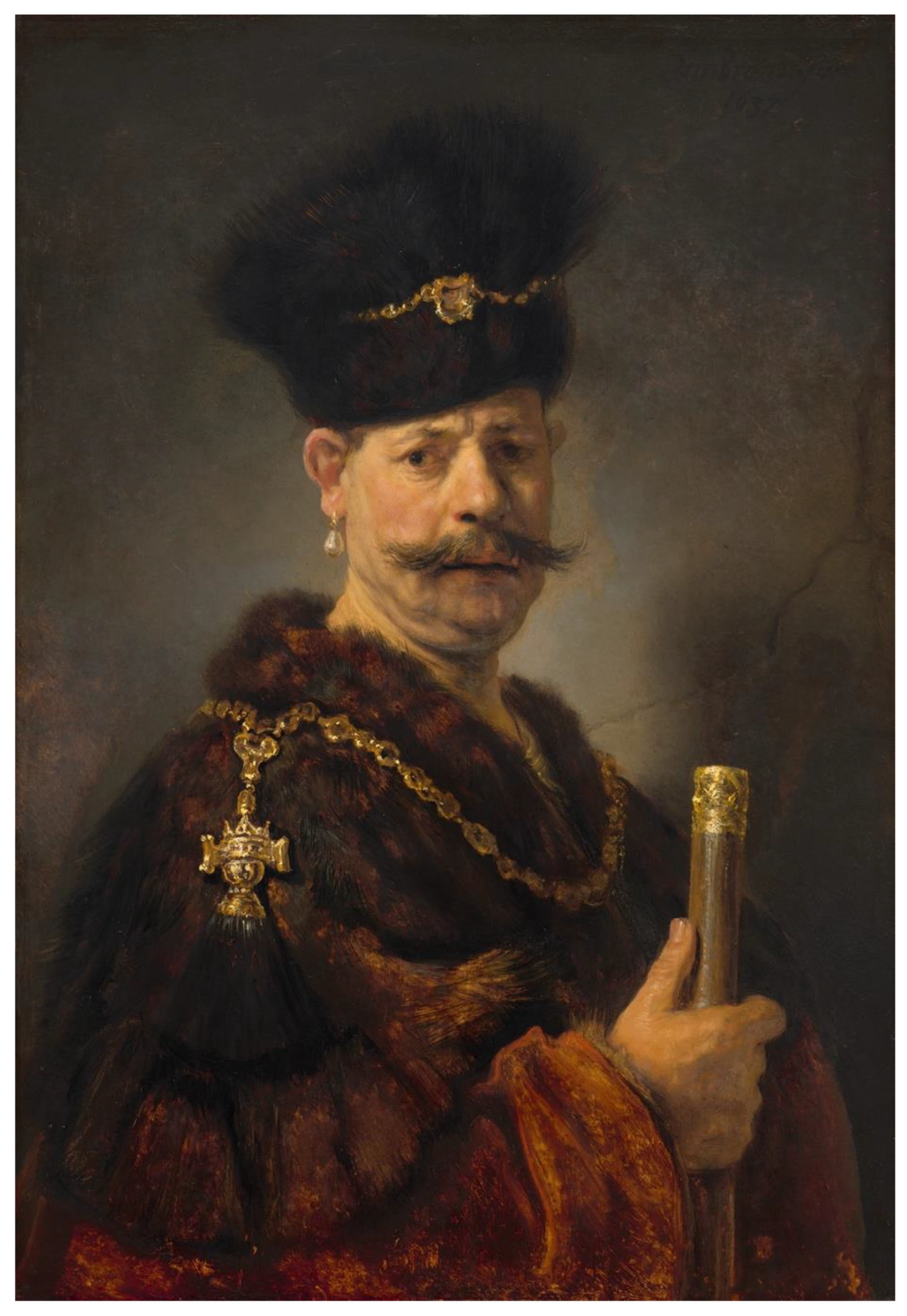
A Polish Nobleman by Rembrandt (1637,
Figure 1) is an elusive painting. It likely belongs to the category of the
tronie: a study of character rather than a commissioned portrait, not a concrete person but a model transformed through costume into a type (
Wheelock 2014). Yet the face insists on individuality, and art historians have long tried to anchor the figure within a concrete historical setting. Some have taken it to be a self-portrait (
Vosmaer 1877, p. 515); others have identified the sitter as Rembrandt’s brother Adriaen (
Bauch 1960, p. 168); some have called it a likeness of an unidentifiable Polish notable (
Bode 1883, p. 464); still others have claimed that it represents a specific Polish nobleman, Andrzej Rej (1584–1641), who in late 1637 stayed in The Hague during his return journey from a diplomatic mission to England (
Odlozilik 1963).
The assumption that the figure is Polish derives from the costume worn. Yet the costume seems to have little grounding in Polish dress.
1 Fur, after all, was worn across Europe (
Cranston 2024, p. 117). The painting invites conjecture: a fur coat, silk beneath, a high fur
kalpak hat—details that, for those only vaguely familiar with regional fashions, might point toward Poland, where fur, due to climate, was in high demand; toward Russia, where the painting sat in the collection of Empress Catherine II; or perhaps—given the jewels, the heavy chains, the gleam of a pearl—toward some broader and more nebulous East, a register hovering between geographies and suggesting “oriental” excess (
Bruyn et al. 1989, pp. 246–47).
2 The visual signs offer interpretive possibilities but refuse to settle. In a 1707 Amsterdam sale list it appeared—very likely this painting—as “een Ambassadeur van Moscovien, van Rembrant kragtig geschildert” (an ambassador from Muscovy, vigorously painted by Rembrandt); yet in the collection catalogue of Catherine II for the years 1773–1783 it features not as a Muscovite but as “un Turc ou quelqu’autre Asiatique” (a Turk or some other Asiatic) (
Bruyn et al. 1989, p. 247). The Polish reading goes back to the nineteenth century (
Smith 1836, p. 310), but the association with Poland now embedded in the title dates from its acquisition by Andrew W. Mellon in 1937—perhaps influenced by the more established Polish claim attached to Rembrandt’s
Polish Rider (ca. 1650), acquired by Henry Frick and bequeathed to the Frick Collection in 1910 (
Salomon 2019, pp. 47–53). Each interpretation arises not from secure evidence but from the restless effort to read the painting’s visual fragments and imputed contexts as reliable clues.
In this sense, the work illuminates a familiar habit of looking at paintings. Faced with an image whose meaning is not immediately given, one begins to assemble a narrative from what is available: a garment, a gesture, a gaze. It is the representation—the painted world—that matters. The impulse is as old as it is expected. Leon Battista Alberti imagined painting as an
istoria, a pictorial drama in which figures converse and meaning unfolds from one action to the next (
Alberti 2004, pp. 74–80). Nothing so explicit occurs in the
Polish Nobleman; we have only one body to make sense of. Even so, the same logic persists. If not among figures, then among elements—the costume, the jewels, the face—we search for an interplay that might yield a story. A painting becomes legible only insofar as such a story begins to form, slowly gathering around the figure, the prop, the pose (
Berger 1994).
But what would it mean to turn the panel over—to begin not with the figure, but with the wood that holds it? To follow that surface back into the tree, and the tree into the forest from which it was taken? The painting, after all, does not begin with the visible image. It begins with the ligneous matter that sustains it. Perhaps, then, the story we have been trying to tell has been mislocated. Not wrong, exactly, but incomplete—too closely tethered to the surface and to the insistence of representation. There is another narrative here, less obvious and less immediately available: one that does not unfold at the level of the figure but gathers along the material conditions of the image. This essay lingers with that possibility. It hesitates at the image, allowing other relations to come into focus—relations of timber, labour, movement, and infrastructure. What happens if we follow them? What kind of story might become imaginable?
To follow that thread requires first pausing with the habits that have brought us this far—with the persistence of narrative itself and the hold that the pictorial field continues to exert on the discipline. The
Polish Nobleman is useful precisely at this moment of reorientation. Not because it leads us back to a particular tree in a specific forest, nor because the painting’s conventional Polish identification withstands scrutiny. It does not.
3 But between that long-assumed attribution and the geographic origins of the oak panel that supports the image lies another set of relations. The representational claim may falter; the material one opens elsewhere. And so, this
tronie—already a capacious and deliberately elastic genre—becomes a way of testing how much evidence is needed for a different narrative to begin taking shape. What emerges here is not certainty, so much as method: an experiment in telling materially grounded stories from partial remains and in asking what such a shift might make possible for art history going forward.
2. Narrative Art
Narrative art has been the backbone of art history until the emergence of abstraction in modernism. And even since then, historians of early modern art have continued wringing their stories from the image. There is something understandable about this habit. Narrative pulls us in; representation holds our attention with remarkable persistence. Even when painting may appear to resist that gravity, it continues to exert its force. Michel Foucault famously began his meditation on representation with
Las Meninas by Diego Velázquez—a painting that turns representation back on itself, staging the painter, the sitter, the viewer, and the act of looking in a recursive circuit of unsettling complexity (
Foucault 2002, pp. 3–18). In this instance, a painting that reflexively exposes the mechanics of representation—the apparatus of depiction laid bare on the reverse of the canvas—does not dissolve representation so much as complicate it. The representational impulse remains intact. Representation hooks us in.
But this impulse comes with a cost. When we focus on representation—on the figures, gestures, and narratives that appear on the painted surface—we implicitly bracket the material substrate that makes the image possible. We ignore that behind the pictorial field another world awaits: a quieter one, but no less consequential. Return, then, to Rembrandt’s
Polish Nobleman: it rests on Baltic oak (
Bruyn et al. 1989, p. 244), much of it extracted from the forests of the Polish–Lithuanian Commonwealth, one of the principal early modern suppliers of Baltic hardwoods to western Europe (
Wazny 2002). These forests once stretched across a vast territory of northeastern Europe, supplying timber to shipwrights, joiners, carpenters, and artists (
Hedemann 1934, pp. 1–98). That wood is the painting’s support. It is the condition of its possibility. Without it, the image could not exist.
The painting, in other words, begins in a forest. Yet that forest rarely enters art-historical interpretation. Our attention typically settles on the medium—oil paint, pigments, brushwork—while the panel itself recedes into the background. Even the terminology encourages this relegation. The panel is the “support,” a structural element whose purpose is simply to hold the image in place.
4 It functions as infrastructure: necessary but conceptually secondary. This hierarchy reflects a deeper assumption about artistic production. Art is generally imagined as additive. The artist builds an image by applying material—layer upon layer of pigment—to an inert ground. Creation proceeds as an act of accumulation.
This account is misleading. Pigments are mined, harvested, or processed from plants, minerals, and animals. Panels require timber that must be felled, transported, cut, seasoned, and prepared. Binding media derive from oils or resins extracted from living systems. Every stage in the making of a painting involves acts of removal. An image comes into being by dismantling something else—a point that emerges with particular clarity in Albrecht Dürer’s watercolours of quarries, recently reconsidered by Christopher Heuer as deposits of disappearance: visually, in their depiction of stone hewn from the earth; and materially, in the evaporation of water required for the work itself to take shape. These images record landscapes literally carved from rock through processes analogous to those by which matter was drawn out and transformed into the substance of art and architecture. Materials are displaced, reshaped, reduced. In that sense, art making is not only additive; it is subtractive (
Heuer 2021). Something vanishes so that something else may appear. Loss is built into the image.
The Polish Nobleman—like countless early modern works—thus carries with it an environmental cost. A tree was taken down. A forest diminished. A resource removed from an ecosystem and reworked into a surface for representation. The panel painting before us is not simply an autonomous image but the endpoint of a chain of extraction.
For all that, we rarely notice what lies behind the artwork. Early modern art history, after all, developed as a discipline around the interpretation of images rather than materials. Students still inherit this approach through exercises in identifying iconographic motifs associated with Erwin Panofsky (
Panofsky [1939] 1962, pp. 3–31), or through the attentive practice of visual description best articulated by Svetlana Alpers, who famously argued that Dutch painting operates less as narrative
istoria or symbolic programme than as a descriptive record of the visible world—an art concerned with surfaces, textures, light, and the patient registration of things (
Alpers 1983). The interpretation of painted surfaces comes to structure how paintings are read, appearing less as one method among others than as the discipline’s natural point of departure. Even approaches shaped by the critical turns of recent decades that ask new questions of images still take the image itself as their primary object. Representation continues to organise the field. Perhaps nowhere is this clearer than in W. J. T. Mitchell’s provocative question:
what do pictures want? Pictures, in that formulation, possess a kind of agency (
Mitchell 2005). They beckon, demand, call us closer. And we respond.
This remains true even now, in an age when Jean Baudrillard’s vision of simulacra—images detached from any original (
Baudrillard 1994)—seems eerily close to reality. Artificial intelligence produces images assembled from countless digital fragments, patterns drawn from the endless visual archive of the internet. These pictures may have no single referent in the world. And yet we still read them as if they did. We arrange them into sequences. We read stories into them. We remain committed to representation even when representation itself becomes unstable.
Attempts to resist that commitment are not entirely new. In the mid-twentieth century, Clement Greenberg insisted on the integrity of the picture plane, arguing that painting must turn toward its own conditions—its flatness, its support, its limits—rather than sustain the illusion of depth (
Greenberg 1982). What came into view, in that account, was not the image alone but the surface that made it possible. Painting, under this logic, became newly aware of itself as an object. Though this was a reflexivity confined to the medium, the work turned inward, toward its own formal conditions, rather than outward, toward the material relations that sustain it. If anything, the problem has only intensified in recent decades. The digital images we encounter today appear increasingly immaterial—seamless, weightless, detached from any obvious support. Yet beneath them lie vast infrastructures: servers, cables, energy networks, and data centres scattered across the globe. The image floats before us, while the material apparatuses that sustain it remain out of view. Only in the last few years have we begun to take notice, as concerns about the energy demands of data processing systems enter public consciousness.
Art history may now require a comparable awakening. For early modernists, resisting representation would mean questioning the methodological habits that organise the discipline. As Ariella Aïsha Azoulay has suggested, the practice of “unlearning” involves dismantling inherited frameworks of knowledge—the structures that shape how we see and interpret the world—and replacing them with others that reveal what those frameworks once obscured (
Azoulay 2019). In the case of art history, unlearning might begin by redirecting attention from the image to its material basis. If we follow the painting backward—from representation to support, from support to tree, and from tree to forest—a different archive begins to present itself.
The Polish Nobleman’s story would then become less a matter of assembling a narrative from visual cues than of reconstructing the material histories that made the painting possible at all. What we find here is story matter. The forest no longer serves merely as a distant backdrop to art; it becomes one of its conditions. In the finished painting the forest disappears, even as it remains indexically lodged within the panel. Recovering it would allow us to tell a different kind of story—one that remains connected to the image while rethinking how art history narrates the past, and how art itself is not only an archive of what has been, but a means of reckoning with the present.
3. Forest as Story Matter
Stories require components if we are to follow Alberti, whose conception of painting drew directly on the traditions of classical rhetoric (
Puttfarken 2000, pp. 45–68). From Aristotle to Cicero and Quintilian, persuasive narrative depended not only on
logos, the substance of the argument, but also on
ethos and
pathos—the credibility and affect that make persuasion possible (
Toye 2013, pp. 42–45). The forest, however, offers few such elements ready to hand. Much of the seventeenth-century oak from which Baltic timber was drawn is long gone. The primaeval forests themselves have largely disappeared, with Białowieża Forest—today divided between Poland and Belarus—often cited as one of the few surviving remnants (
Blavascunas 2020, pp. 1–2). Yet this absence is not total. The forests that supplied early modern timber were not untouched wilderness (
Vera 2000, pp. 102–88). They were landscapes already worked over—managed, shaped, and exploited to varying degrees (
Hedemann 1934, pp. 1–35). Sound Toll registers for ships hailing from Danzig (Gdańsk), Königsberg (Kaliningrad), Memel (Klaipėda), and Riga record large quantities of timber, pitch, and tar leaving the region, attesting to the scale of Baltic exports and, by extension, to the intensity of extraction across its hinterland (
Mączak 1972). Economic instructions issued for royal and magnate estates in Poland and Lithuania reveal how the industry was organised (
Falkowski 2017). Agronomic manuals printed in Poland, their pages often illustrated with woodcuts, include sections devoted to forests and trees (
Podraza 1999;
Jakóbczyk-Gola 2021, pp. 198–202). They do not offer the systematic treatment that later eighteenth-century German silvicultural treatises would provide (
Carlowitz 1713;
Radkau 1996). But they do give us glimpses of how the forest was conceived—above all in terms of its utility. What these works offer are not stories in themselves but their components: traces, records, and residues that do not narrate on their own but may be made to do so in relation.
Taken separately, such sources resist narration. Economic figures register volume but not texture. Royal and noble directives for estate management articulate intention rather than life as it was lived. Manuals offer advice that conforms to the conventions of the genre—prescriptive, authoritative, faintly repetitive, as if the same counsel could be addressed to all. And yet, taken together, these materials begin to gather force. What appears inert in isolation acquires charge in proximity. In combination, these scattered traces become, in effect, story matter: a dispersed archive of Albertian elements awaiting arrangement—not yet a story, but becoming narratable in context. The task is not to reconstruct a lost scene, as if it once stood whole before us, but to draw a narrative out of fragments—to place them in relation, to let them touch, to see what begins to settle between them. Meaning does not reside in any single source. It emerges in the intervals, in the acts of composition, where these partial records begin, tentatively, to cohere into something that can be followed.
One entry point appears in Helena Unglerowa’s 1549 Cracow edition of Pietro de’ Crescenzi’s agronomic classic
Ruralia commoda (c. 1305), published in Polish as
Księgi o gospodarstwie [Books on Estate Management]. The volume translated humanist learning into local terms attentive to environment. Drawing on Palladius and other ancient authorities, it functioned both as manual and mirror: a guide for landowners and a means of knowing the land. The text describes a wild forest that grows “without any help of man, from seed which falls from neighbouring trees, or from rivers, or is borne by birds into far regions” (
Crescenzi 1549, p. 483).
5 It then turns to the uses of trees—for building, for fuel. The following section, “Of Groves Made by the Industry of Man,” shifts the focus to managed landscapes. Here appear orchards—plums, walnuts, pears, apples—as well as timber species: poplar, alder, elm, birch, ash, pine, and oak. A lot of this information is repeated in later manuals, including in Jakub Haur’s
Oekonomika ziemiańska generalna [
General Estate Economy], first published in Cracow in 1675 (
Haur 1675, pp. 59–60;
Haur 1679, pp. 161–62).
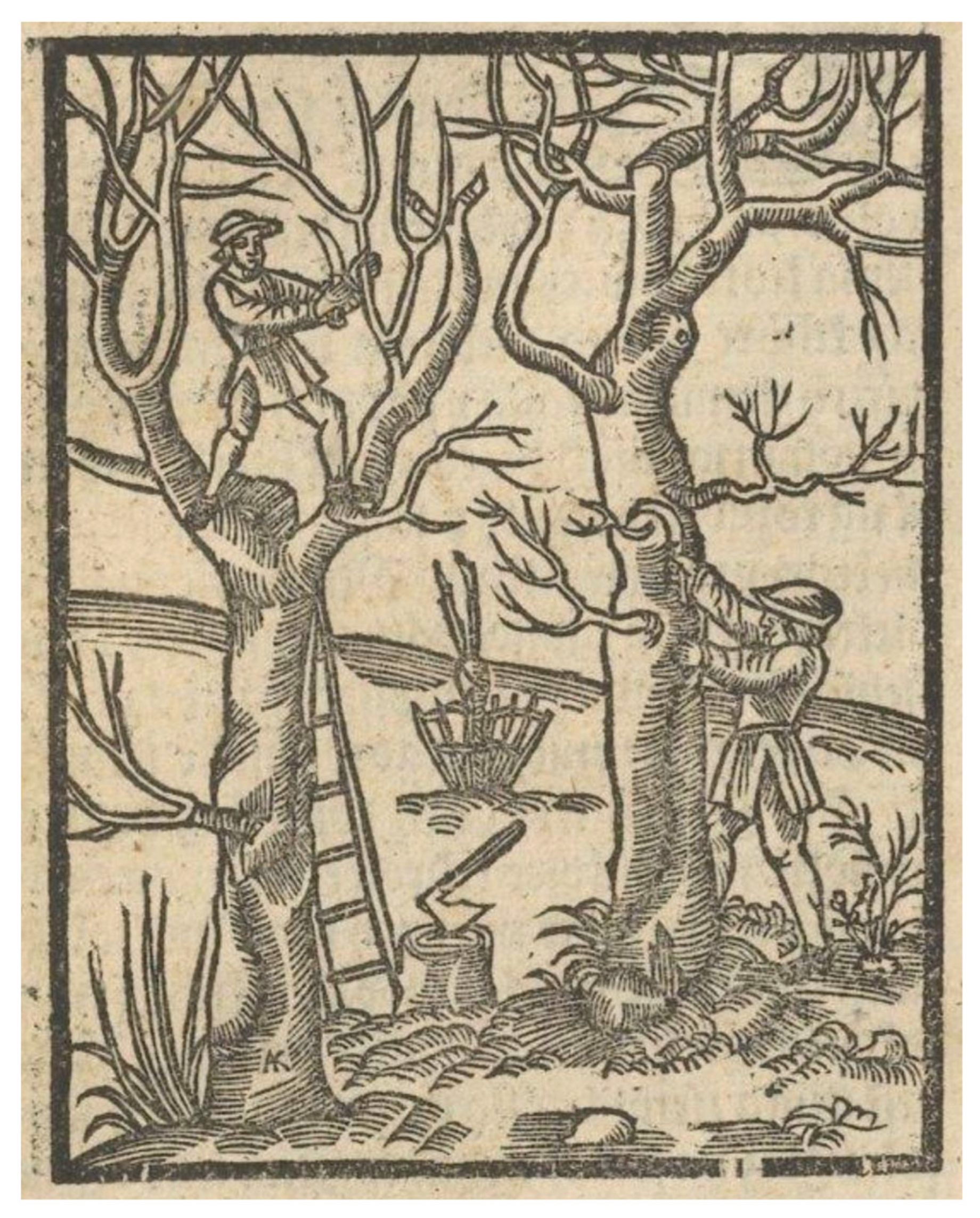
The woodcut that accompanies the section on managed woods in Unglerowa (
Figure 2) bears only a loose relation to the text and was likely drawn from the workshop’s existing stock of blocks.
6 Even so, the image stages a small scene of forestry. Two men work among leafless trees, their bare branches suggesting winter. One stands balanced high in the fork of a trunk, pruning boughs with a billhook. Below him a ladder leans against the bark. Nearby, another man trims a neighbouring tree. At the centre of the clearing a basket receives the cut wood. An axe lies driven into a stump—a quiet indication that felling may follow pruning. Only two trees appear within the frame, yet, in keeping with the section on managed woods, the scene implies woodland extending beyond the edges of the block. What the print makes unmistakable is labour. The wood here is not a wilderness but a worked landscape, shaped by human hands. Such work was typically carried out by those living within or along the margins of forests. In the Polish–Lithuanian Commonwealth, it fell most often to peasants bound by labour obligations, though in some regions they paid rent rather than performing corvée.
7 Their seasonal work—cutting, trimming, hauling—stood behind the material flows of Baltic timber, including the oak that would eventually travel westward and become the support for paintings such as Rembrandt’s
Polish Nobleman.
Oak itself receives extended treatment earlier in the book, in the sixth section devoted to trees and their properties (
Crescenzi 1549, pp. 401–3). Three varieties are listed in Latin—
quercus,
robur, and
cerrus. The last is described as tall and slender, its branches clustered toward the crown, with few knots; for building, it is said, this wood is best. The text notes the uses of acorns, oak galls, and sap, attributing to them medicinal qualities in the language of Galenic physiology. The passage ends with a simple observation: oak is exceedingly durable, both above ground and in the earth, suitable for posts and bridges, and therefore good for timberwork. The same information appears in truncated form in Haur (
Haur 1679, p. 166). What the text does not say is equally revealing. Nowhere do we learn of oak used for painting panels. Such an application remained a minor and specialised destination for the wood, barely visible within the much larger economies of construction, fuel, and infrastructure that structured the life of the forest. As art historians, we tend to focus on art. And yet art, as a refined form of artifice, stands near the upper limit of this system. It does not drive it. It does not sustain it. But it marks its reach. And in doing so, it allows us—indirectly—to trace the system that made it possible.
If Unglerowa’s Crescenzi offers a language of description—one that names, classifies, and assigns properties—Anzelm Gostomski’s
Gospodarstwo [
Estate Management] (1588) speaks in a different register. It is a manual for administration: direct, procedural, concerned less with describing the forest than with organising the work that passes through it. In the section devoted to winter, the estate manager is instructed to oversee threshing (the processing of grain) alongside the cutting of wood and the gathering of brush for hedges and fence stakes, while also arranging their transport (
Gostomski 1621, chap. 8). Timber does not move on its own; it must be moved. As Stephanie Porras makes clear, objects do not travel of their own accord—motion is always the work of others, the sum of hands, systems, and habits that carry things along (
Porras 2023). Each
włodarz, or village steward, is to gather the peasants of his village and lead them together into the forest. There the trees are cut, trimmed, and loaded onto wagons. The steward must see that they are evenly filled and that the labour moves in concert, the forest entered and left as a coordinated task. What appears later in port registers as timber is the result of peasant labour among the trees. Once felled, the wood enters a system of measurement and movement. Timber destined for the lord is received, stacked between stakes, and carefully tallied. From there it is allocated according to the number of peasants attached to the estate and reserved for the manor’s needs. Winter is the season for gathering materials—those produced locally as well as those purchased elsewhere. Gostomski’s instructions sketch an economy of labour and value: forests yield timber, and trees are precious: “The forests and woods must be guarded as one guards the eye itself, and they must not be left to the foresters alone, for they often become the cause of damage instead of protection. Such loss is greater than when grain is destroyed: grain grows again within a year, but when a tree is cut down it is as if a man had been killed” (
Gostomski 1621, chap. 1). What we find in these instructions is not simply advice on rural management, but a way of seeing the estate as integrated into wider systems. The estate manager is taught to think infrastructurally: to understand forest, road, river, and port as parts of a chain through which materials—and the labour that underlies it all—are set in motion.
In this period, the forests of Poland and Lithuania were among the richest in Europe and formed a vast reservoir of raw materials (
Falkowski 2017). Their exploitation was facilitated by an extensive river network that carried timber and other forest products toward the Baltic. The Vistula, together with its tributaries, linked much of Poland’s interior to the sea. At its mouth, Danzig held a near-monopoly over Polish maritime trade, becoming the principal outlet through which these resources entered the Baltic economy (
Bogucka 1970). Further east, the ports of Königsberg, Memel, and Riga, situated at the mouths of the Pregel (Pregola), the Niemen (Nemunas), and the Western Dvina (Daugava), gained in importance as Lithuania’s forest industries expanded (
Hedemann 1934, pp. 55–59).
Given the scale of this activity, fears of forest depletion took hold, as elsewhere in Europe. Writing in the early seventeenth century, Szymon Starowolski, in his
Description of Poland (1632), observed that forests had once covered almost all of the kingdom, but by his own time farming and settlement had spread widely across the land and forests were largely confined to Lithuania (
Starowolski 1976, p. 61). Concern about the loss of woodland prompted attempts at regulation. The Volok Reform of 1557 under Sigismund Augustus reorganised Lithuanian territory, resettling populations away from forests and strengthening administrative oversight through officials responsible for monitoring grand-ducal woodlands (
Frost 2015, pp. 424–32). Surveys such as Hryhory Volovich’s 1558 register mapped forest boundaries and recorded their resources, reflecting a growing interest in managing woodland exploitation (
Reviziia pushch 1867). These efforts did not necessarily aim at strict conservation so much as at maintaining productive use. Surveyors often documented local abuses—such as excessive felling, poaching, or the destruction of beehives—while recommending administrative measures to preserve the ruler’s forests (
Hedemann 1933). By the later sixteenth century, amid what historians have sometimes called the “wooden age,” when timber underpinned both daily life and economic activity, concerns over woodland depletion had become increasingly difficult to ignore (
Warde 2006). Across the continent, governments responded with forestry regulations as forest resources remained vital for construction, fuel, and maritime industries (
Appuhn 2009;
Wing 2015;
Pluymers 2021). Yet for all these fears, timber continued to flow out of the region, and Amsterdam plays an important role in that story, pointing us once again—albeit indirectly—to Rembrandt’s
Polish Nobleman.
Amsterdam’s economy was intrinsically linked to Polish and Lithuanian raw materials (
Bogucka 1973). In the city, Baltic merchants known as the “eastern nation” (
de Oistersche Natie) filled their warehouses with grain, sawn wood, and other exports from the Polish–Lithuanian Commonwealth (
Dillen 1964, pp. 470–71). Staples of the forest—timber, tar, and pitch—sustained Poland-Lithuania’s export economy and, no less decisively, Amsterdam’s wealth, building the ships that carried Dutch trade across the world (
Bogucka 1983). The connection ran in both directions: Dutch merchants were a regular presence in Danzig, just as traders from the Commonwealth appeared in Amsterdam’s markets. At the city’s stock exchange, Philipp von Zesen observed that “in this Bourse, the entire world can be seen trading. In addition to the high- and low-German-speaking merchants, one can easily find Poles … and other foreign nations” (
Zesen 1664, p. 233).
8 To secure a steady flow of these commodities, Amsterdam merchants established trading houses across Prussian ports, with their greatest concentration in Danzig. (
Bogucka 1995;
North 1995;
Tielhof 1995, pp. 177–80;
Tielhof 2002, p. 137). By the 1640s, Dutch and Dutch-Prussian partnerships controlled nearly eighty percent of Danzig’s overseas trade (
Bogucka 1991, pp. 24–25).
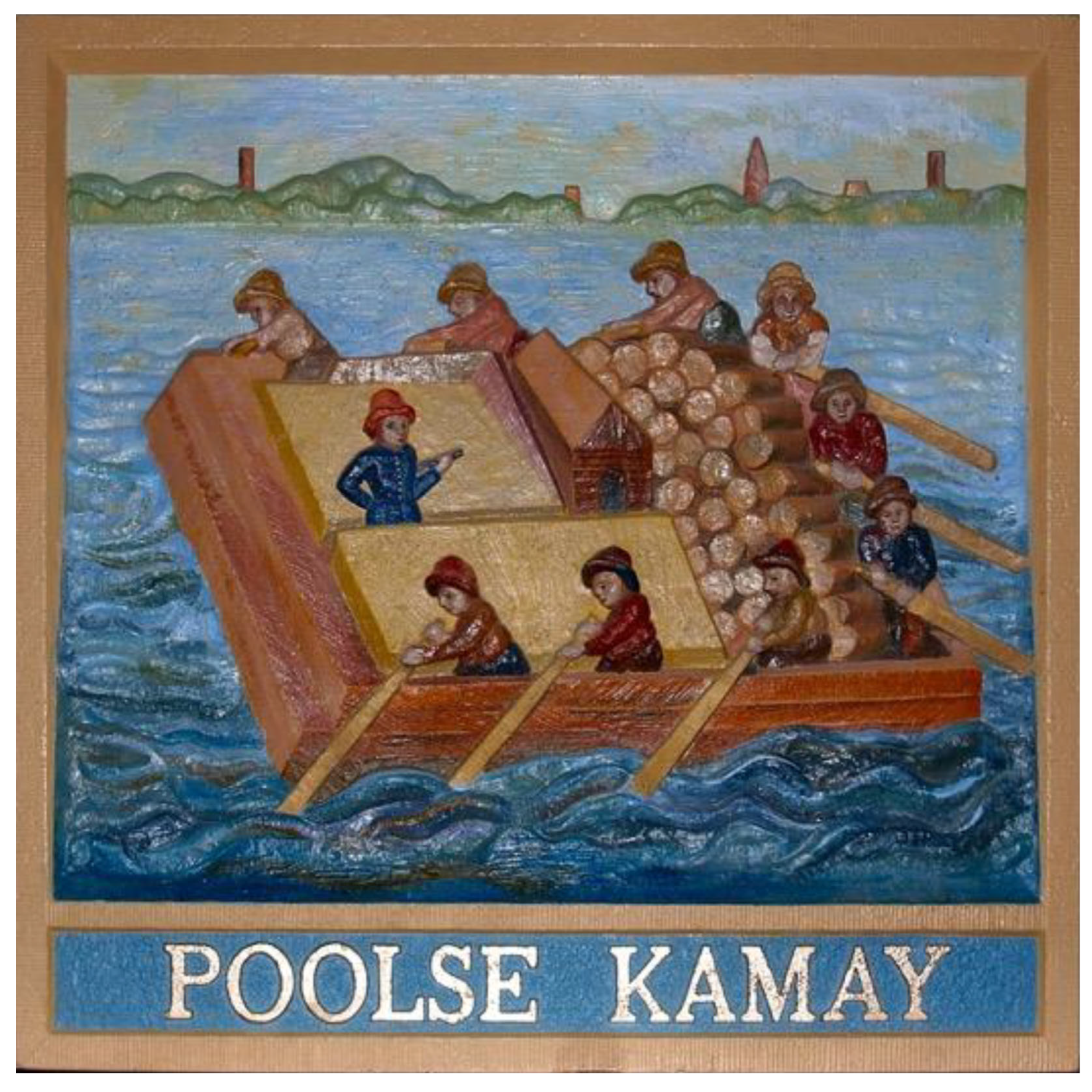
The painted house-sign stone on Spuistraat 42 inscribed
Poolse Kamay—“Polish Barge” (
komięga) (
Figure 3) shows the very commodities that sustained Amsterdam’s rise: Polish grain for bread and Baltic timber for ships (
Boers 2007, p. 144). Missing from view are pitch and tar for the hulls that carried the Dutch Republic’s empire abroad, though they may perhaps be concealed within the covered holds at the centre. The house sign marked a building that, according to a 1663 title transfer, belonged to Jan Martsz Cameij; the surname—homonymous with the barge itself—may suggest a family with ties, at least at some point, to the Polish commodity trade
9. The carving depicts a great raft-barge built of timber logs, divided into compartments to keep the grain from spilling, framed by stacked wood along its sides (
Śląski 1916, p. 6). Such vessels were assembled deep in the Polish interior, floated down the Vistula to Prussia and on to Danzig, where the cargo was sold and the rafts dismantled for lumber—commerce reduced to its simplest material logic (
Małowist 2010, p. 79). The tablet condenses that journey into a single scene: grain heaped to the left, logs piled to the right, raftsmen in fur caps steering with long paddles. Set along an Amsterdam street, the
Poolse Kamay would have rendered Poland’s staple exports visible to the passerby. In doing so, it registers—without quite declaring—the extent to which Dutch prosperity depended on these eastern flows. Images such as this did more than record exchange: they gave it form. Almost a token vignette, the Spuistraat house sign compresses an entire economy into a compact visual form. The
Poolse Kamay stands as a kind of index—a reminder, carved in stone, of how deeply Amsterdam’s prosperity rested on the movement of raw materials from the east.
This brings us, by way of a detour, back to Rembrandt’s Polish Nobleman, painted in Amsterdam. The sitter may not be Polish at all; the painting is almost certainly a tronie. Yet the oak panel on which it was painted reached the city through the Baltic timber trade, likely from a forest somewhere in Mazovia or Lithuania. If the Poolse Kamay renders such movements visible, the painting does not. Its support carries the same histories of management, labour, and extraction, though now withdrawn from view. Wood here is not shown as resource but already transformed—cut, transported, and worked into a surface. Around that transformation lies an infrastructure: systems of ownership, labour, transport, and trade that convert living forests into circulating commodities. Some of that wood became ships, some houses, and some the panels of paintings.
Here the problem of narrative returns: how to render such dispersed relations and processes narratable? Infrastructure, as Brian Larkin reminds us, tends to disappear into its own functioning (
Larkin 2013). Amsterdam, as the saying went, “stood on Norway”—its seventeenth-century urban fabric founded on a submerged forest of imported timber (
Sogner 2004, p. 47;
Moore 2010, p. 34). The city’s brick townhouses and civic edifices rested, quite literally, on this invisible, subterranean infrastructure of wooden piles. Trade routes, supply systems, and labour regimes operate precisely by remaining unseen. It is no surprise that the material histories that sustain artworks rarely appear within the images themselves. The visible infrastructure is only the surface; the rest lies beyond sight, dispersed across geographies. To reconstruct it requires another kind of storytelling—one that does not begin with representation but with matter. The painting is not the end of the story but one of its afterlives: an object borne by deeper supports, where distant forests, peasant labour, river transport, and long-distance trade persist materially, even as they withdraw from sight.
4. Material Storytelling
How, then, to tell a story out of materials—one that might begin to unlearn art history’s overreliance on visual narratives? Michael Baxandall’s study of German limewood sculpture offers an early attempt (
Baxandall 1980). It proceeds from a simple but generative premise: that matter is never mute, that the working of wood encodes both tacit and explicit forms of knowledge. What follows is not merely the recovery of a neglected medium and its internal logic, but a recalibration of the discipline around the conditions of making—around the pressures, resistances, and affordances of material. Baxandall thus marks an early articulation of what has since become a broader methodological turn. A comparable insistence structures Byron Hamann’s
Art Bulletin article, “The Mirrors of
Las Meninas,” which extends this impulse further (
Hamann 2010). Here, cochineal, burnished ceramics, and silver—materials both depicted and operative at the Madrid court—are made to bear the weight of the painting’s historical determinations. The image resolves into a surface thick with extraction, a work sustained by the flows of colonial wealth into the Spanish metropole. Matter, in this account, is not declarative but constitutive: it underwrites the image even as it eludes it. The red curtain,
búcaro, and silver tray that anchor Hamann’s reading are plainly visible within Velázquez’s composition, if only as painted details. Yet their visibility does not exhaust their significance. On the contrary, Velázquez’s efforts to render their distinct material affordances—the lustre of silk, the absorption of light by ceramic, the reflective sheen of silver—depend on the capacity of oil paint itself to approximate those effects. The painting stages a material encounter in which one substance mediates others, while the labour and extraction that brought those objects into being remain partially obscured.
More recently, Dana Leibsohn and Aaron Hyman, in their essay on a “shipwreck’s art history,” press this logic further still (
Hyman and Leibsohn 2021). Refusing the gravitational pull of objects art history recognises and knows how to stabilise—portraits, jewellery—they turn instead to residues: wax unearthed from the soil, fragments of porcelain scattered along the Pacific coast, carried inland by a tsunami following the wreck of the
Santo Cristo de Burgos. Such materials acquire significance not despite their fragmentary condition, but because of it, insofar as they index circuits of exchange, catastrophe, and survival that extend beyond the limits of the object. Jewellery, by contrast, risks appearing merely ornamental—especially in portraiture—economically and socially negligible within this expanded field of a global economy spanning the Asia-Pacific, the Americas, and Europe. Wax and shards are drawn into a different kind of narrative, one that moves laterally across events: a shipwreck, a tsunami, Indigenous acts of recovery and reuse, porcelain refashioned into arrowheads. The result is not simply an expanded archive but a redistribution of narrative weight—a story carried, and at times redirected, by matter itself.
What these approaches begin to make clear, in different ways, is that such a shift in how art history engages its objects demands a corresponding capacity: the ability to read matter—a need for material literacy. Ann-Sophie Lehmann, Edward S. Cooke, and others have shown that materials can be read as historical evidence—not as neutral supports, but as carriers of origin, process, and transformation (
Lehmann 2016;
Cooke 2022a, pp. 15–19;
Gerritsen 2024;
Lehmann and Fricke 2024). To be materially literate is to ask where something comes from, how it was made, what it passed through, and at what cost. It is not to interpret the image but to follow a substance: to trace its passage, its pressures, its transformations before it arrives as object, even when it serves as the “support” for painting. Material literacy is not a matter of theory but of proximity—an intimate understanding of materials, a way of knowing that passes through the hand (
Ingold 2007). To recover it is not an ancillary exercise but a method. It redirects attention away from the finished object and toward the conditions that make it possible, returning the object to a field of relations that are anything but stable. Materials do not settle; they carry traces of elsewhere—of forests cleared, resources drawn, bodies put to work. Read in this way, the artwork does not simply signify. It presses back. It insists. It becomes a site where the world’s fragility—its dependencies, its asymmetries—comes briefly, if uneasily, into view.
All the same, as Cooke points out, in an age of screens and digital saturation—when “knowledge workers” eclipse makers—we risk a slow, almost imperceptible loss: a drift into material illiteracy (
Cooke 2022b). We handle things constantly and yet do not quite grasp them. Their origins recede. We do not know where they come from, what they are, how they have been processed, or what social and environmental costs attend their use. Nor do we register their intrinsic properties—the grain, the weight, the tensile limit—or how those properties quietly condition both form and function. What results is not ignorance in any simple sense but a thinning of attention. Consumption becomes unreflective, habit proceeds without friction, and matter itself is reduced to a neutral substrate—interchangeable, inconsequential.
And yet it is anything but. Materials carry histories; they bind together environment, labour, technology, and commerce. To overlook this is not a minor lapse. It is a failure of imagination. Materials matter. They always have. They are not peripheral to culture but at its very heart (
Munteán and Plate 2023). And still, in the world’s advanced economies we live among things whose origins we scarcely know. We understand, vaguely, that much of what surrounds us is made or assembled in East and Southeast Asia—but the awareness stops there. We do not know what these things are made of, where their materials were drawn from the earth, who laboured to bring them forth, or at what human and environmental cost.
That lack of material literacy lies, in part, in our difficulty telling stories centred on materials rather than on human-driven events—images, gestures, and other forms we recognise as representation. We know how to construct Albertian
istorie, how to animate them from their components, how to move within their frames. But when it comes to raw materials—to their backstories, their prior lives, their possible futures—we hesitate. The narrative thins. We know, abstractly, that plastics will outlast us by thousands of years. We can theorise this—plastic as “hyperobject,” for example (
Morton 2013)—but we struggle to render it as narrative. This is slowly beginning to change. We are increasingly urged to look again at the very stuff that surrounds us, not as a backdrop but as a repository of story matter. Mark Miodownik’s
Stuff Matters offers a suggestive example. He begins with a modest scene: coffee on a rooftop (
Miodownik 2014). From that vantage, he turns to what is at hand—steel, paper, concrete, plastic, glass. These are not abstractions, but materials woven into the grain of everyday life. The force of the book lies in the way it animates them, almost as if they were protagonists. It becomes unexpectedly compelling to learn about things as seemingly unremarkable as concrete—materials most of us rarely attend to, in part because we lack the language to do so. Other studies invite us to follow the hidden systems—the infrastructures, carbon footprints, and supply chains—behind bananas, processed foods, fast fashion, the internet, fossil fuels, and more, in order to animate what stands before us into meaningful stories that help explain how and why our lives are shaped as they are (
Pollan 2006;
Berners-Lee 2011;
Schlossberg 2019;
Thomas 2019;
Parsons 2023;
Kumekawa 2025). In doing so, they begin to attune us to a different way of telling stories about the world we are part of.
Attunement is at stake here. For Timothy Morton, it names a condition of being, a mode of attention—a re-sensitisation to the material relations that sustain the objects we handle (
Morton 2018, pp. 139–49). We are already inside these relations, always already “ecological.” There is no vantage from which “nature” might be observed at a distance, no exterior from which to take its measure. The nature–culture divide is itself a narrative. The task, then, is not to acquire new knowledge so much as to notice differently: to register, however faintly at first, one’s implication in systems unfolding around us. Attunement does not bring us into ecology; it lays bare that we were never outside it. What comes to matter here are the conditions we already inhabit—relations that precede us and exceed us. A shift in perception through which the world, long structured by these relations, begins gradually to register otherwise. As Claire Farago has recently demonstrated, art theory at its inception was also, at the same time, a form of climate theory and a theory of race (
Farago 2025, pp. 141–82). It is there, in plain sight, though not always seen. To read it requires a certain openness of attention. Attunement proves necessary—not as a programme, but as a disposition—if we are to begin reading ecologies into art histories.
Let us step back to Rembrandt’s
Polish Nobleman. Seen under this attunement, the painting invites a different kind of reading—one that passes through the veneer of representation in order to attend to what it organises and occludes; a reading that moves past what images “want” (pace Mitchell), not to dismiss them, but to see what else might begin to take shape. In the twenty-first century, as the planet edges toward ecological strain, such associations present themselves with a certain inevitability. They are difficult to refuse, and I am hardly alone in finding them inescapable (
Whyte 2020;
Latour and Schultz 2022). The
Polish Nobleman’s oak panel—like most human-made things, the product of long supply lines and resource-hungry economies—does not stand apart from these forces. It gathers them, quietly. It holds within it traces not immediately visible yet not entirely absent either. What damage was done, and where, is not stated. Instead, Baltic oak gives us history
in potentia: pressed into substance, there for those willing to follow it. The forest persists within the work not despite its erasure, but because of it. The tree from which the panel was cut is long gone, though the conditions of its extraction persist, if only faintly, legible. To attend to them—to follow the material where it leads—is to encounter the object differently, to read it in light of the relations it both conceals and sustains. Material literacy—a mode of attention attuned to substances, extraction chains, and ecological entanglements that precede and exceed visual representation—is not something brought to the image but something drawn out from it. And with it returns a question not easily set aside: must historical narration stay tethered to representation, or might other forms of storytelling begin to take shape—ones that move across materials and systems rather than through the image alone?
Of course, the difficulty with Rembrandt’s
Polish Nobleman is, as we have already noted, that so little holds fast. The circumstances of its commission remain obscure; what Rembrandt knew of the materials he used—or whether he cared to know—recedes beyond recovery. Yet this opacity need not be disabling. It is the condition under which the work comes down to us, and therefore the condition within which it must be read (
Glissant 2025, pp. 187–93). We cannot peel back every layer. We proceed instead by following what can be followed—traces, fragments, lines of connection that extend only so far before thinning out. The attempt itself—the act of wondering, of staying with a trail as long as it holds—becomes part of the work. Something shifts there, however slightly. Almost without noticing, we find ourselves reattuned to the extractive conditions of the world we inhabit, not as background but as structure. If this seems to fall short of art history’s usual demands for precision, it is worth recalling that visual interpretation has rarely rested on more secure footing. Panofsky has often been taken to read too much into representation, aligning text and image with undue rigidity (
Baxandall 1987). The point, then, is simple: narratives drawn from representation are no more certain than those emerging from materials. If anything, they organise uncertainty differently rather than dispel it altogether. What they offer is not resolution but a particular kind of coherence—one that can obscure as much as it reveals. Uncertainty proves not a lapse in method but its ground. To think ecologically is not to seek hard evidence at all cost, but to remain with relations that cannot be fully known. What matters is the persistence of the question—where things come from—asked again and again, without guarantee of closure. It is there, in that persistence—an attunement to material conditions—that critical thought takes hold, and with it an awareness not without political consequence.
We can continue to ask after the identity of the “Polish nobleman,” but such questions do not bring us onto firmer ground than those posed by the oak panel and its material histories—whether the man is Polish, as the title suggests (unlikely), whether the painting is a
tronie (very likely), what costume he wears (difficult to say). It is an engaging line of inquiry, one that quickens the mind and casts us, with a certain satisfaction, as detectives—a conception of the art historian’s
raison d’être often associated with Panofsky (
Ventrella 2011). There is, too, a measure of escape in it, something perhaps increasingly necessary in a world edging toward new conflicts over access to resources that will shape the next phase of global capitalism—likely organised around rare earths essential to the energy transition and to digital infrastructures. But there is another way of being a detective available to us. Not of iconography, but of material: of stories that begin to take shape when we follow trajectories, trace circuits, attend to transformations.
One such story begins in a forest on a noble or crown estate—somewhere in northeast Poland or northern Lithuania. With the peasants who worked that land; perhaps even with one of them alone, whose name we will never know, but who must have felled the tree. From there, the timber would move—downriver to Danzig, Königsberg, Riga, or another southern Baltic port. A contract, likely arranged in advance. More hands, more labour. Then the sea journey. Amsterdam. A joiner’s workshop, where Rembrandt, relying on someone else’s expertise, would have acquired the panel before it received layers of paint and became what is now known as A Polish Nobleman.
The panel has been closely studied by the Rembrandt Research Project, whose dendrochronological work has done much to catalyse a more materially literate understanding of early modern art, even if largely in the service of connoisseurship (
Grasman 1999). Cut from a single piece of oak, the
Polish Nobleman retains a vertical grain and was later reinforced with a cradle, visible when the painting is turned over (
Bruyn et al. 1989, p. 244). Yet the very features that mark the work’s earlier life as a tree—its knots, its fibres, and the fractures formed over time—are deliberately concealed beneath layers of primer and gesso so that the surface might receive the affordances of oil paint.
10 Our material literacies (or illiteracies, as the case may be), then, have been shaped not only by art history’s longstanding preference for visual narrative, but also by the hierarchies that organise the materials placed in its service. The analysis of the panel’s oak opens onto other ways of telling the
Polish Nobleman’s story. We know, for instance, that at least two other Rembrandts were made from the same tree: the
River Landscape with a Windmill in Kassel (Staatliche Kunstsammlungen, Gemäldegalerie, no. B 12) and the
Concord of the State in Rotterdam (Museum Boijmans Van Beuningen, no. A 135). That tree was felled no earlier than 1629, with a statistical felling date of around 1635 (
Bruyn et al. 1989, p. 244). The panels must have entered the workshop together, drawn from the same stock. Before it became the support for the
Polish Nobleman, the oak belonged to a larger material history shared with other paintings in Rembrandt’s workshop. The traces are all there, awaiting an act of attention that might bring them into motion.
What we encounter in these works is a story that emerges as we learn where to look—the material terminus of a much longer chain: extraction, infrastructure, labour, commerce, all steadily sustaining the rhythms of early modern northern European life. Art does not stand apart from this system; it moves within it. To understand it is to attend to the relations that make it possible. Once we begin, however tentatively, to unlearn our Alberti and our Panofsky—whose inherited optics draw us back, almost imperceptibly, to the primacy of representation—the material stories come into view. They do not offer themselves up; they have to be actively drawn out. And as they are, perception shifts: we become, in turn, more finely attuned—to the materials before us, and to the world they help hold together.