

The Distance from the Immortals: The Evolution of Immortals in Northwestern China During the Han Dynasty
Abstract
1. Introduction
2. Dual Evidence for the Evolution of Xiwangmu’s Immortal Function
2.1. Changes in the Symbols and Iconographic Features of Immortals
2.2. Pictorial Spatial Representations of Yin–Yang Cosmology
3. The Development of Therianthropic Deity Images
4. Reasons Behind the Changes in the Functions of the Immortals
5. Conclusions
Supplementary Materials
Author Contributions
Funding
Institutional Review Board Statement
Informed Consent Statement
Data Availability Statement
Acknowledgments
Conflicts of Interest
| 1 | Some studies focus on the iconographic evolution of specific deities. See, for example, (X. Wang and S. Wang 2022; Wallace 2011; Yue 2025; Yang 2025; Z. Liu et al. 2018; Song 2024). |
| 2 | Some studies focus on ideas of immortality and conceptions of life and death, such as (Loewe 2018; Q. Liu 2018; Loewe 2022; Yu Wang 2020). |
| 3 | Cahill, Transcendence and Divine Passion, 24. |
| 4 | (G. Wang 2022). See also (X. Wang and S. Wang 2022), who distinguish two Han-era forms of Xiwangmu: an elite goddess of longevity and immortality, and a popular deity associated with both the mortal and immortal realms. |
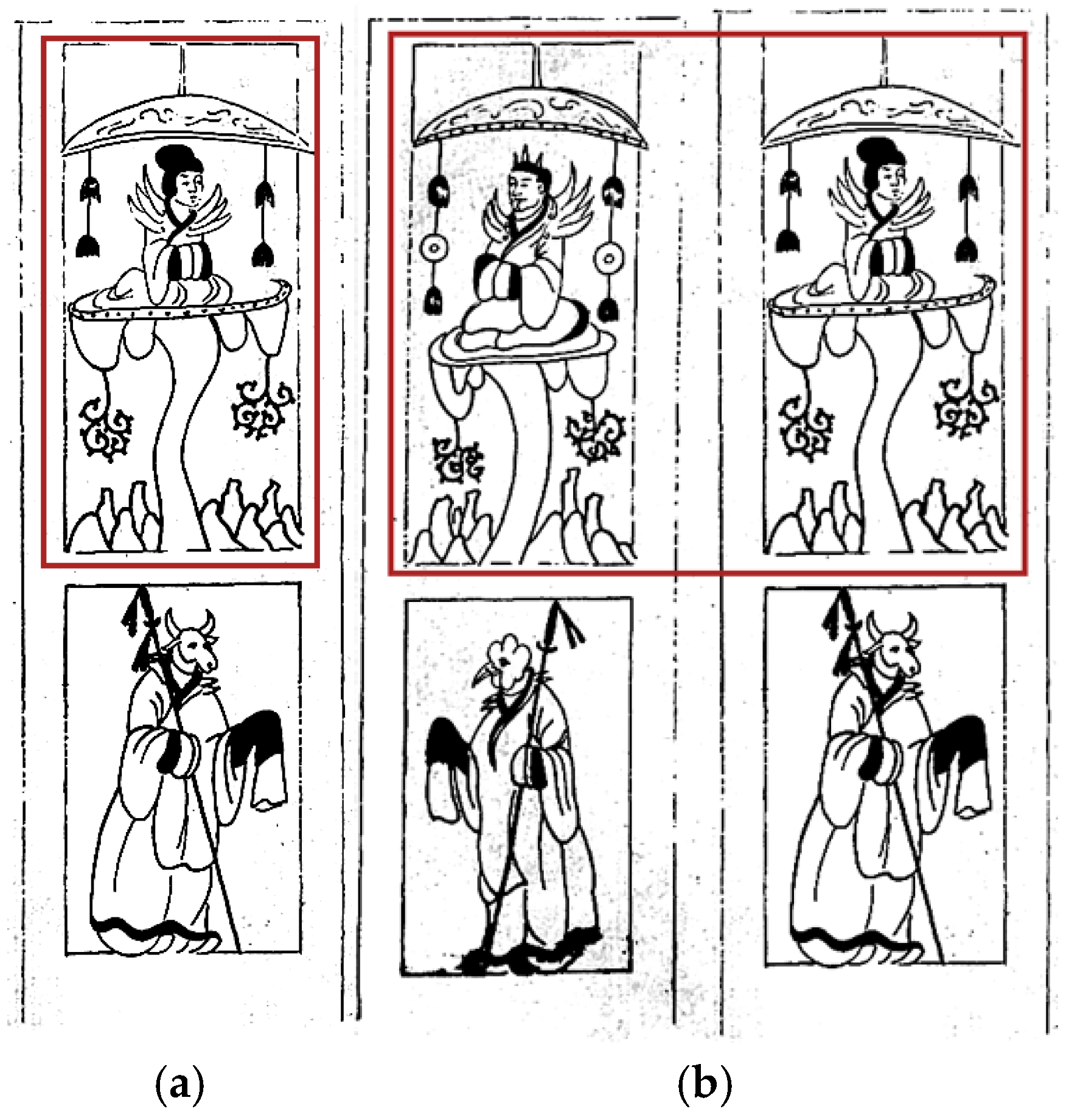
| 5 | Shuijingzhu 水经注 states: “昆仑之山有铜柱焉,其高入天,所谓天柱也.” See (D. Li 2020). |
| 6 | Huainanzi 淮南子 states: “昆仑之丘,或上倍之,是谓凉风之山,登之而不死。或上倍之,是谓悬圃,登之乃灵,能使风雨。或上倍之,乃维上天,登之乃神,是谓太帝之居。” See (A. Liu 2016), edited by Chen Guangzhong. |
| 7 | The Book of Han 汉书 states: “黄帝时建华盖以登仙。” See (Ban 1962). |
| 8 | This description is based on the account preserved in Yuefu shiji 乐府诗集, compiled by Guo Maoqian郭茂倩 of the Northern Song dynasty. Yuefu shiji states: “采取神药若木端,白兔长跪捣药虾蟆丸。” See (Guo 1993). |
| 9 | The Book of Han 汉书 states: “哀帝建平四年正月,民惊走,持稿或棷一枚,传相付与,曰‘行诏筹’。……其夏,京师郡国民聚会里巷阡陌,设祭张博具,歌舞祠西王母,又传书曰:‘母告百姓,佩此书者不死。不信我言,视门枢下,当有白发。’” See (Ban 1962). |
| 10 | Shanhaijing 山海经 states: “西王母其状如人,豹尾虎齿而善啸,蓬发戴胜。” See (Yuan 1985). |
| 11 | Shanhaijing 山海经 states:“司天之厉及五残。” See (Yuan 1985). |
| 12 | Lunheng jiaozhu 论衡校注 states: “墓者,鬼神所在,祭祀之处” See (C. Wang 2010). |
| 13 | Huainanzi 淮南子states: “日者,阳之主也。月者,阴之宗也。” See (A. Liu 2016), Edited by Chen, Guangzhong. |
| 14 | Loewe, Ways to Paradise, 125. |
| 15 | The Book of Han records: “Nine years after the establishment of the Fu Altar (Fu Zhi), Duke Wen of Qin obtained an object that resembled a stone. He enshrined and offered sacrifices to it at the Northern Slope City of Chencang. It arrived from the east and descended upon the sacrificial shrine, taking a form like that of a male pheasant; its cry was similar to that of a wild pheasant. The deity was worshiped with the ritual offering of Yi-lao (a set of sacrificial animals) and was formally named the ‘Chen Treasure’ (Chen Bao). 作鄜畤后九年,文公获若石云,于陈仓北阪城祠之。…从东方来,集于祠城,若雄雉,其声殷殷云,野鸡夜鸣。以一牢祠之,名曰陈宝。” See (Ban 1962). |
| 16 | The Shiji records: “In the twenty-seventh year of Duke Wen, he ordered the felling of a giant catalpa tree on the Southern Mountains. A massive ritual bull manifested from within the tree. 文公二十七年,伐南山大梓,丰大特。” See (Sima 1959). |
| 17 | Liu et al., “Shanxi lishi mamaozhuang donghan huaxiangshimu.” |
| 18 | The transformation of death conceptions and soul beliefs during the Han dynasty originated from imperial religious activities under Emperor Wu (汉武帝) and gradually spread to popular practice. The emperor conducted religious activities related to afterlife beliefs, and by the time of Emperor Ai (汉哀帝), these practices had erupted on a large scale among the populace. The Book of Han records: “In the first month of the fourth year of the Jianping reign of Emperor Ai, the people held stalks of mugwort, and passed them among one another, … In the capital and throughout the commanderies and kingdoms, people gathered in streets and fields, set up offerings and elaborate ritual displays, and performed songs and dances to worship Xiwangmu. 哀帝建平四年正月,民惊走,持蒿或一枚,传相付与,曰行诏筹。…京师郡国聚会里巷阡陌,设祭张博具,歌舞祠西王母。” See (Ban 1962). |
| 19 | The instability and conflict in this region during the Later Han period are documented in the Book of Later Han: “In autumn, Goulong Wusi and others set up Goulong Wang Che niu as the Chanyu. To the east he allied with the Wuhuan, and to the west he gathered the Qiang, Rong, and various Hu tribes, numbering tens of thousands. They attacked and destroyed the Huya Camp in Jingzhao, killed the commandant of Shang Commandery and the army adjutant, and then raided and plundered the four provinces of Bing, Liang, You, and Ji. 秋,句龙吾斯等立句龙王车纽为单于。东引乌桓,西收羌戎及诸胡等数万人,攻破京兆虎牙营,杀上郡都尉及军司马,遂寇掠并、凉、幽、冀四州。” The same source records administrative relocations: “The seat of Xihe was moved to Lishi, the seat of Shang was moved to Xiayang, and the seat of Shuofang was moved to Wuyuan. 乃徙西河治离石,上郡治夏阳,朔方治五原。” See (Ban 1962). |
| 20 | This description is based on records from Han dynasty historical texts. The Book of Han (Hanshu 汉书) records that the ShuoFang Inspectorate governed five commanderies: … Shang Commandery with its seat at Fushi, and Xihe Commandery at Pingding 西汉时期, 朔方刺史部辖五个郡: … 北地郡治马领, 上郡治肤施, 西河郡治平定, 五原郡治九原, 朔方郡治朔方. See (Ban 1962). Also, Book of Later Han (Houhanshu 后汉书) records: “Xihe Commandery was established by Emperor Wu. It lay 1,200 li north of Luoyang, comprising thirteen cities, 5,698 households, and 20838 individuals, including Lishi, Pingding, and Zhongyang … 西河郡武帝置. 雒阳北千二百里也. 十三城, 户五千六百九十八, 口二万八百三十八. 离石, 平定…中阳…” See (Fan 1965). |
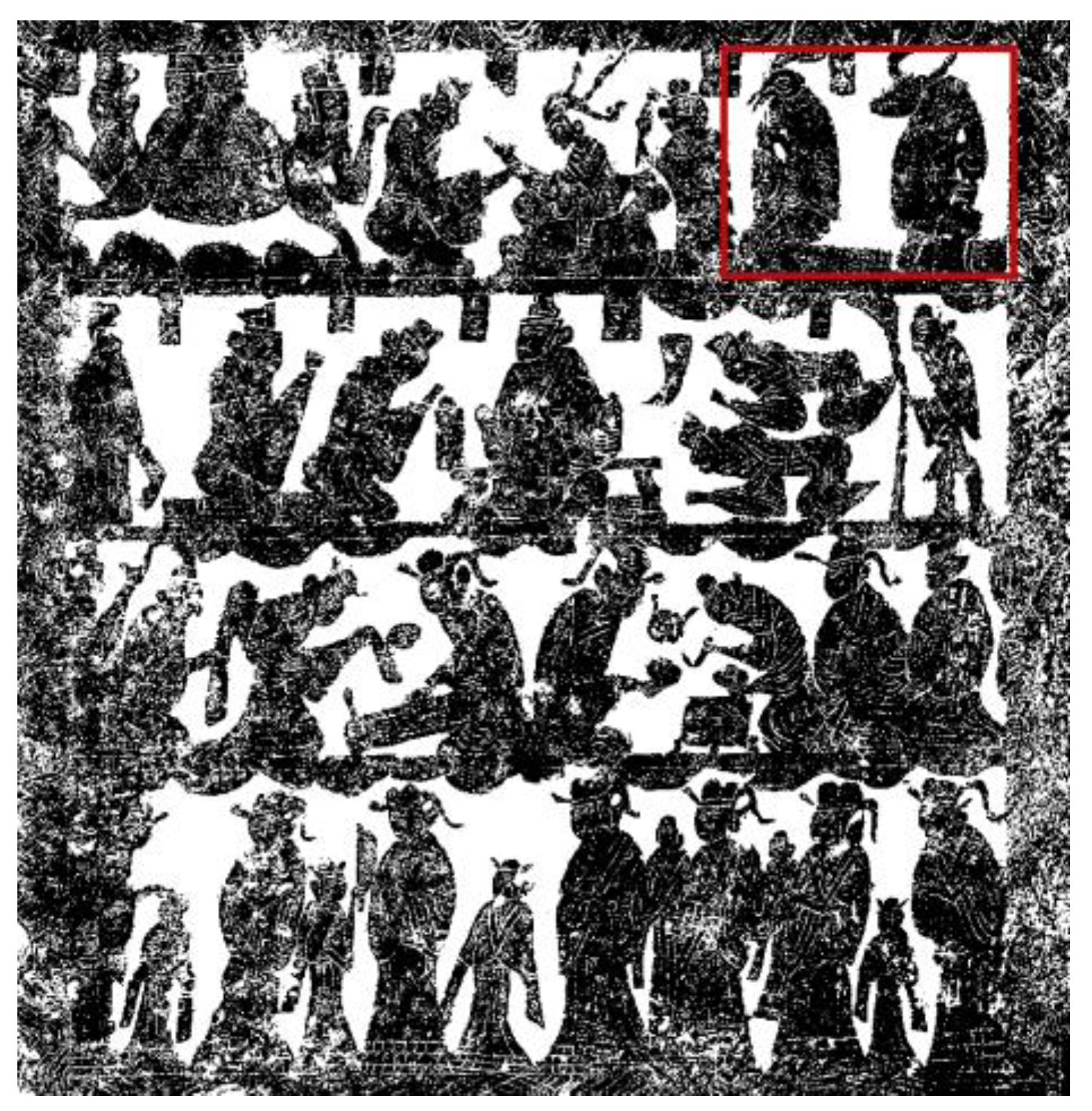
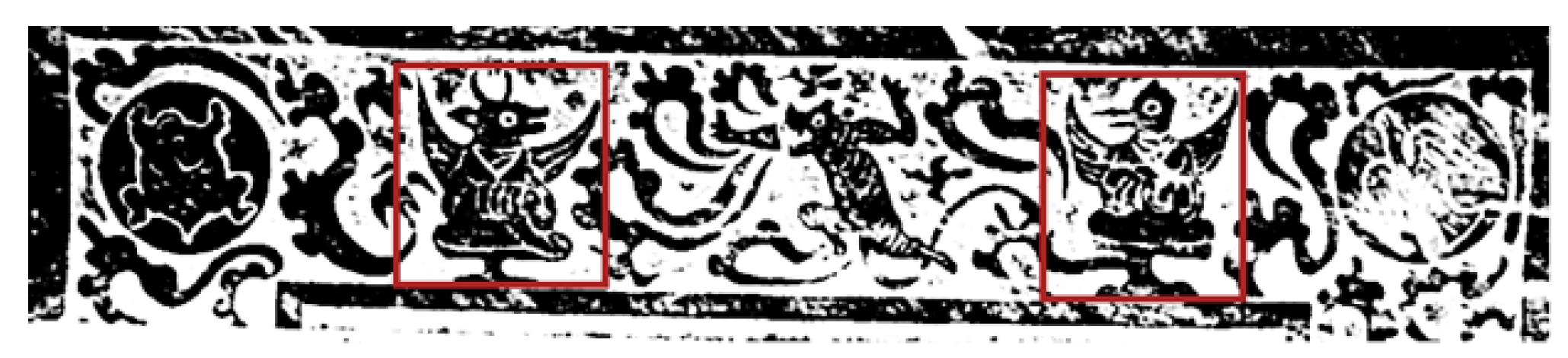
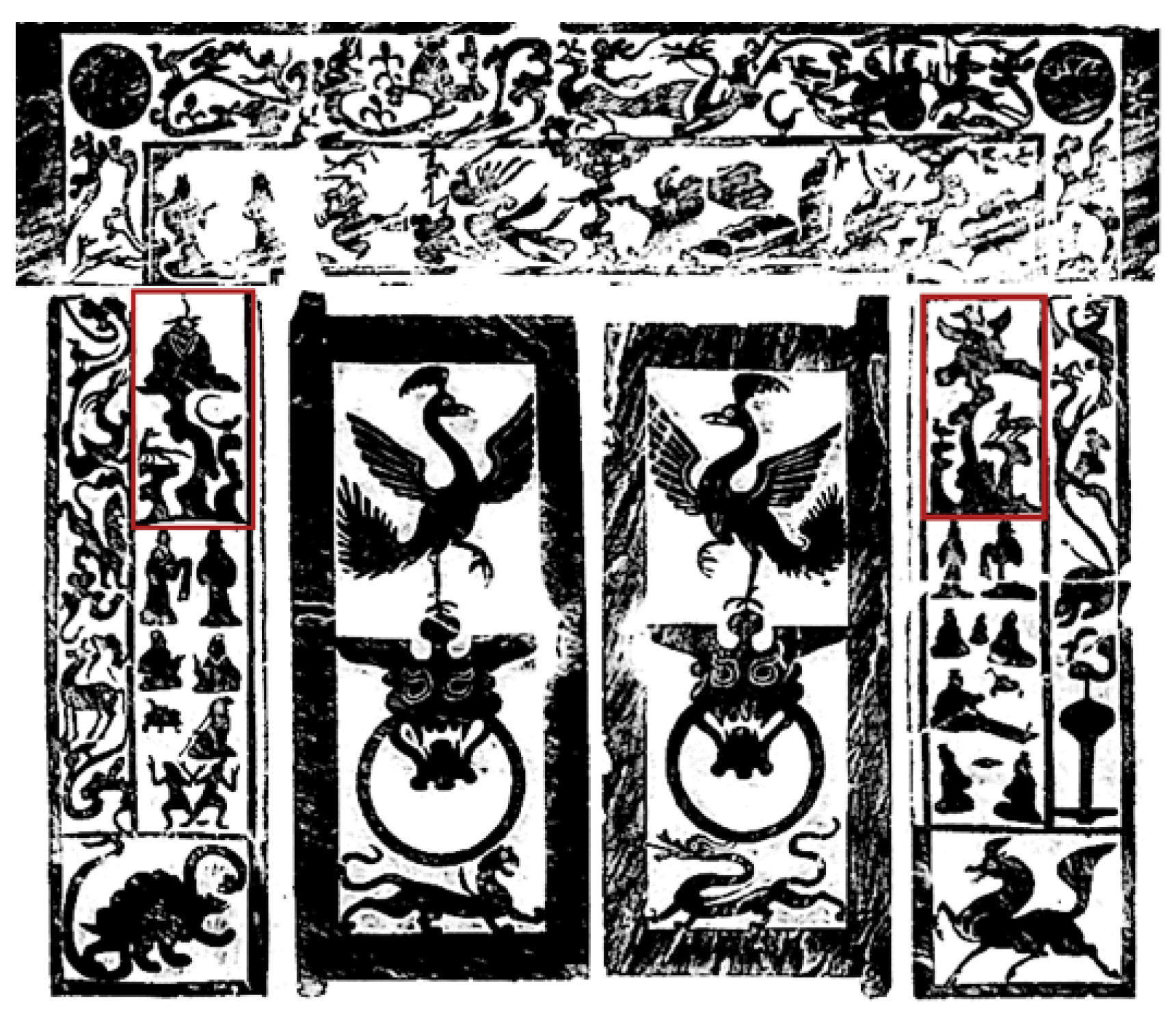
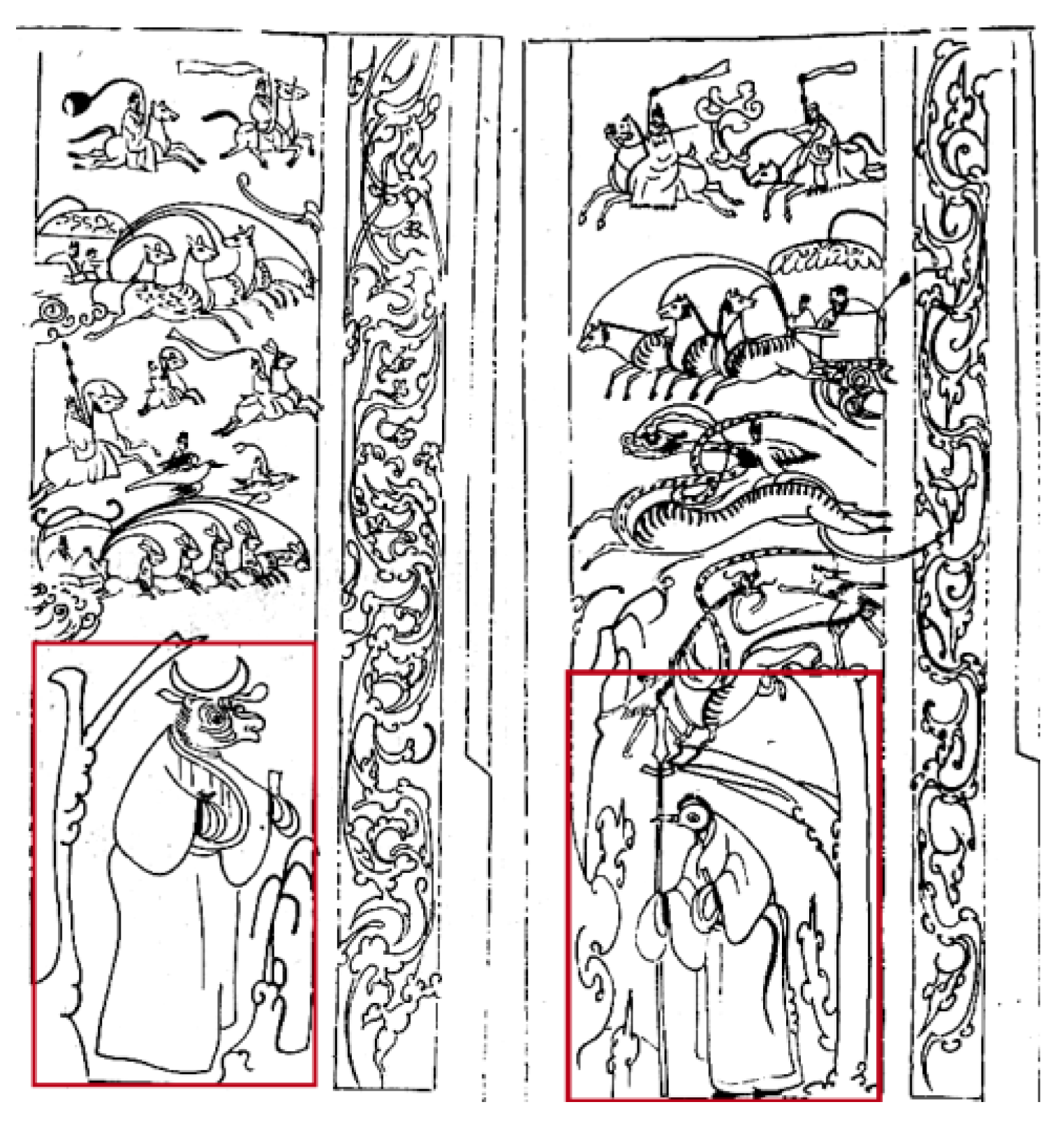
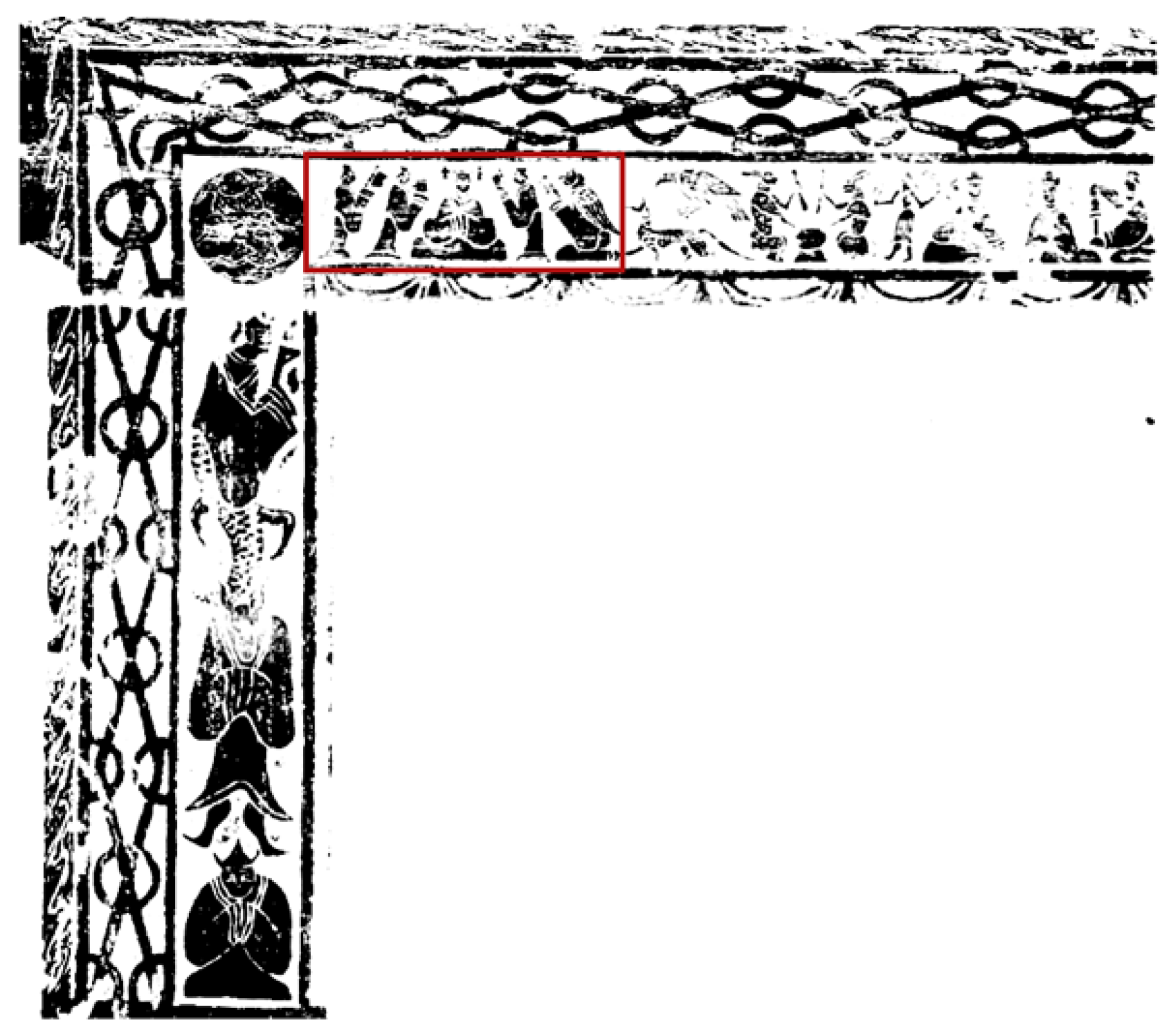
| 21 | The development of therianthropic imagery in the northwest region was influenced by various local cults, including the worship of the “Chenbao deity” (陈宝神), the “Fengdate” (丰大特), and bovine deity worship among the Rong and Qiang peoples. |
References
- Ban, Gu 班固. 1962. Han shu 漢書. Beijing: Zhonghua Shuju. [Google Scholar]
- Cahill, Suzanne E. 1993. Transcendence and Divine Passion: The Queen Mother of the West in Medieval China. Stanford: Stanford University Press. [Google Scholar]
- Editorial Committee of the Complete Collection of Han Pictorial Stones of China 中国画像石全集编辑委员会, and Chi Tang. 2000. Zhongguo huaxiangshi quanji: Volume 5, Shaanxi and Shanxi Han Huaxiangshi 中国画像石全集 第5卷 陕西 山西汉画像石. Jinan: Shandong Meishu Chubanshe. [Google Scholar]
- Fan, Ye 范晔. 1965. Hou Hanshu 后汉书. Beijing: Zhonghua Shuju. [Google Scholar]
- Feng, Shi 冯时. 2018. Continuity of the Illustrious Culture: Astronomy, Thoughts and Institutions in Ancient China 文明以止:上古的天文、思想与制度. Beijing: China Social Sciences Press 中国社会科学出版社. [Google Scholar]
- Guo, Maoqian 郭茂倩. 1993. Yuefu shiji 乐府诗集. Shanghai: Shanghai Classics Publishing House. [Google Scholar]
- Huang, Minglan 黄明兰. 1977. Luoyang xihan buqianqiu bihuamu fajue jianbao 洛阳西汉卜千秋壁画墓发掘简报. Wenwu 文物 6: 1–12, 81–83. [Google Scholar]
- James, Jean M. 1995. An iconographic study of Xiwangmu during the Han Dynasty. Artibus Asiae 55: 17–41. [Google Scholar] [CrossRef]
- Kang, Lanying 康兰英, and Zhian Wang 王志安. 2002. Shaanxi suidexian sishilipu huaxiangshimu diaocha jianbao 陕西绥德县四十里铺画像石墓调查简报. Kaogu Yu Wenwu 考古与文物 3: 19–26. [Google Scholar]
- Kristoffersen, Siv. 2010. Half beast–half man: Hybrid figures in animal art. World Archaeology 42: 261–72. [Google Scholar] [CrossRef]
- Li, Daoyuan 郦道元. 2020. Shuijing zhu 水经注. Annotated by Qiaoyi Chen 陈桥驿 and Dong Wang 王东. Beijing: Zhonghua Shuju. [Google Scholar]
- Li, Lin, Lanying Kang, and Liguang Zhao, eds. 1995. Shaanbei Handai Huaxiangshi (Han Dynasty Stone Reliefs from Northern Shaanxi), 1st ed. Xi’an: Shaanxi People’s Press. [Google Scholar]
- Liu, An 刘安. 2016. Huainanzi 淮南子. Edited by Guangzhong Chen 陈广忠. Beijing: Zhonghua Shuju. [Google Scholar]
- Liu, Qian. 2018. The Evolution of the Belief of Afterlife in the Han Dynasty and the Rise of Han Pictorial Carvings. Chinese Studies in History 51: 210–28. [Google Scholar] [CrossRef]
- Liu, Yongsheng 刘永生, Chuanxun Wang 王传勋, Tongliu Shang 商彤流, Jinle Hai 海金乐, Jinzhong Xing 邢晋中, Mingyuan Fu 傅明元, and Hongxia Chang 畅红霞. 1992. Shanxi lishi mamaozhuang donghan huaxiangshimu 山西离石马茂庄东汉画像石墓. Wenwu 文物 4: 14–40. [Google Scholar]
- Liu, Ziliang 刘子亮, Jun Yang 杨军, and Changqing Xu 徐长青. 2018. Han dai Dongwanggong chuanshuo yu tuxiang xintan: Yi Xi Han Haihunhou Liu He mu chutu ‘Kongzi yijing’ wei xiansuo 汉代东王公传说与图像新探——以西汉海昏侯刘贺墓出土“孔子衣镜”为线索. Wenwu 文物 11: 81–86. [Google Scholar]
- Loewe, Michael. 2018. Chinese Ideas of Life and Death: Faith, Myth and Reason in the Han Period (202 BC–AD 220). London: Routledge. [Google Scholar]
- Loewe, Michael. 2022. Ways to Paradise: The Chinese Quest for Immortality. London: Routledge. [Google Scholar]
- Mao, Na 毛娜. 2016. Han hua Xiwangmu tuxiang yanjiu 汉画西王母图像研究. Ph.D. dissertation, Zhengzhou University, Zhengzhou, China. [Google Scholar]
- Niu, Tianwei 牛天伟, and Yifan Niu 牛一帆. 2018. Hanjin shiqi de Jishou niushou renshen shenxiang xinjie 汉晋时期的鸡首、牛首人身神像新解. Huazhongguoxue 华中国学 2: 10–27. [Google Scholar]
- Pang, Zheng 庞政. 2020. Cong Haihunhou mu yijing kan Xiwangmu, Dongwanggong tuxiang de chuxian ji xiangguan wenti 从海昏侯墓衣镜看西王母、东王公图像的出现及相关问题. Jianghan Kaogu 江汉考古 5: 78–84. [Google Scholar]
- Pang, Zheng 庞政. 2021. Shilun Shaanbei hanhuaxiang zhong de ‘Xianren Liubo’ shi dongwanggong ji xiangguan wenti 试论陕北汉画像中的“仙人六博”式东王公及相关问题. Kaogu Yu Wenwu 考古与文物 3: 86–91. [Google Scholar]
- Peking University Han Painting Research Institute. 2026a. The Images Database of Han China. Database. Record numbers: SSX-SD-059-01; SSX-MZ-019-20; SSX-MZ-019-21; SSX-SD-039. Beiijng: Peking University Han Painting Research Institute. [Google Scholar]
- Peking University Han Painting Research Institute, ed. 2006b. Zhongguo Hanhua Yanjiu (Chinese Han Painting Research). Guilin: Guangxi Normal University Press, vol. 2. [Google Scholar]
- Rose, Jenny. 2019. Zoroastrianism: An Introduction. London: Bloomsbury Academic. [Google Scholar]
- Shaanxi Provincial Cultural Relics Administration. 1959. Shanbei Donghan Huaxiang Shike Xuanji (Selected Eastern Han Stone Carvings from Northern Shaanxi). Xi’an: Shaanxi People’s Press. [Google Scholar]
- Shaanxi sheng bowuguan 陕西省博物馆, and and Shaanxi sheng wenguanhui 陕西省文管会. 1972. Mizhi donghan huaxiangshimu fajue jianbao 米脂东汉画象石墓发掘简报. Wenwu 文物 3: 69–73. [Google Scholar]
- Shaanxi Sheng Kaogu Yanjiusuo 陕西省考古研究所, and and Yulin Wenwu Guanli Weiyuanhui Bangongshi 榆林市文物管理委员会办公室. 2001. Shenmu Dabao Dang: Handai chengzhi yu muzang kaogu baogao 神木大保当:汉代城址与墓葬考古报告. Beijing: Kexue Chubanshe. [Google Scholar]
- Sima, Qian 司马迁. 1959. Shi ji 史记. Beijing: Zhonghua Shuju. [Google Scholar]
- Song, Yanping 宋艳萍. 2024. Handai huaxiang zhong de jishou renshen niushou renshen shenling kao 汉代画像中的鸡首人身、牛首人身神灵考. Xingxiang Shixue 形象史学 2: 161–83. [Google Scholar]
- Sowden, Laura. 2022. Woman in Early Imperial China: The Socio-Political Forces and Gender Norms Surrounding Elite Women in the Han Dynasty. Ph.D. dissertation, Macquarie University, Sydney, Australia. [Google Scholar]
- Suide Hanhuaxiangshi Zhanlanguan 绥德汉画像石展览馆, comp. 2001. Suidi Handai huaxiangshi 绥德汉代画像石. Edited by Guilong Li 李贵龙 and Jianqin Wang 王建勤. Xi’an: Shaanxi Renmin Meishu Chubanshe. [Google Scholar]
- Tang, Chi 汤池. 2000. Zhongguo huaxiangshi quanji 5: Shaanxi, Shanxi Han huaxiangshi 中国画像石全集5:陕西、山西汉画像石. Jinan: Shandong Fine Arts Publishing House. [Google Scholar]
- Wallace, Leslie V. 2011. BETWIXT AND BETWEEN: Depictions of Immortals (Xian) in Eastern Han Tomb Reliefs. Ars Orientalis 41: 73–101. Available online: http://www.jstor.org/stable/23075960 (accessed on 4 April 2026).
- Wang, Chong 王充. 2010. Lunheng jiaozhu 论衡校注. Shanghai: Shanghai Ancient Books Publishing House. [Google Scholar]
- Wang, Gang 王刚. 2022. Budaisheng de Xiwangmu: Haihunhou mu ‘Kongzi yijing’ de tuxiang biaoda, yiyi zhixiang ji xiangguan wenti 不戴胜的西王母:海昏侯墓“孔子衣镜”的图像表达、意义指向及相关问题. Chuantong Zhongguo Yanjiu Jikan 传统中国研究集刊, 43–63. [Google Scholar]
- Wang, Jinyuan 王金元, Jinping Liu 刘晋平, and Shuangbin Wang 王双斌. 2013. Lvliang Handai huaxiangshi xuan 吕梁汉代画像石选. Taiyuan: Shanxi Renmin Chubanshe. [Google Scholar]
- Wang, Xiaoyang, and Shixiao Wang. 2022. On the Differences between Han Rhapsodies and Han Paintings in Their Portrayal of the Queen Mother of the West and Their Religious Significance. Religions 13: 327. [Google Scholar] [CrossRef]
- Wang, Yile 王意乐, Changqing Xu 徐长青, Jun Yang 杨军, and Li Guan 管理. 2016. Haihunhou Liu He mu chutu Kongzi yijing 海昏侯刘贺墓出土孔子衣镜. Nanfang Wenwu 南方文物 3: 61–70. [Google Scholar]
- Wang, Yu 王煜. 2020. Kunlun, Tianmen, Xiwangmu yu Tiandi: Shilun Han dai de ‘Xifang xinyang’ 昆仑、天门、西王母与天帝——试论汉代的“西方信仰”. Wenshi Zhe 文史哲 4: 58–69, 166. [Google Scholar]
- Wu, Hung. 1989. The Wu Liang Shrine: The Ideology of Early Chinese Pictorial Art. Stanford: Stanford University Press. [Google Scholar]
- Yan, Lin 燕林, and Guang Guo 国光. 1990. Xuzhou faxian Donghan Yuanhe sannian huaxiangshi 徐州发现东汉元和三年画像石. Wenwu 文物 9: 64–73. [Google Scholar]
- Yang, Yanping 杨延平. 2025. Han dai Xiwangmu shenhua Jiahe tuxiang xinyi 汉代西王母神画嘉禾图像新议. Dongnan Wenhua 东南文化 4: 78–89. [Google Scholar]
- Yuan, Ke 袁珂. 1985. annot. Shanhaijing jiaoyi 山海经校译. Shanghai: Shanghai Ancient Books Publishing House. [Google Scholar]
- Yue, Jiabao 岳嘉宝. 2025. ‘Daisheng’ yu ‘Bu daisheng’: Han huaxiangshi zhong Xiwangmu de fajishi “戴胜”与“不戴胜”——汉画像石中西王母的发式. Meishu Daguan 美术大观 5: 117–24. [Google Scholar]
- Yulin Municipal Institute of Cultural Relics Protection and Mizhi County Museum, ed. 2009. Mizhi Guanzhuang Huaxiangshi Mu (The Pictorial Stone Tomb at Guanzhuang, Mizhi). Beijing: Science Press. [Google Scholar]
- Yulin Shi Wenguanhui 榆林市文管会, and and Suidexian Bowuguan 绥德县博物馆. 2006. Suidexian Xindian xiang Haojiagou cun Han huaxiangshi mu qingli jianbao 绥德县辛店乡郝家沟村汉画像石墓清理简报. In Zhongguo Hanhua yanjiu 中国汉画研究. Guilin: Guangxi Shifan Daxue Chubanshe, vol. 2. [Google Scholar]
- Yü, Ying-shih. 1987. ‘O soul, come back!’ A study in the changing conceptions of the soul and afterlife in Pre-Buddhist China. Harvard Journal of Asiatic Studies 47: 363–95. [Google Scholar] [CrossRef]
- Zheng, Hongli 郑红莉. 2010. Shaanbei hanhuaxiangshi suojian Jishou renshen niushou renshen tuxiang bianxi 陕北汉画像石所见“鸡首人身”“牛首人身”图像辨析. In Zhongguo hanhuaxuehui dishierjie nianhui 中国汉画学会第十二届年会. Xi’an: Beilin Bowuguan. [Google Scholar]
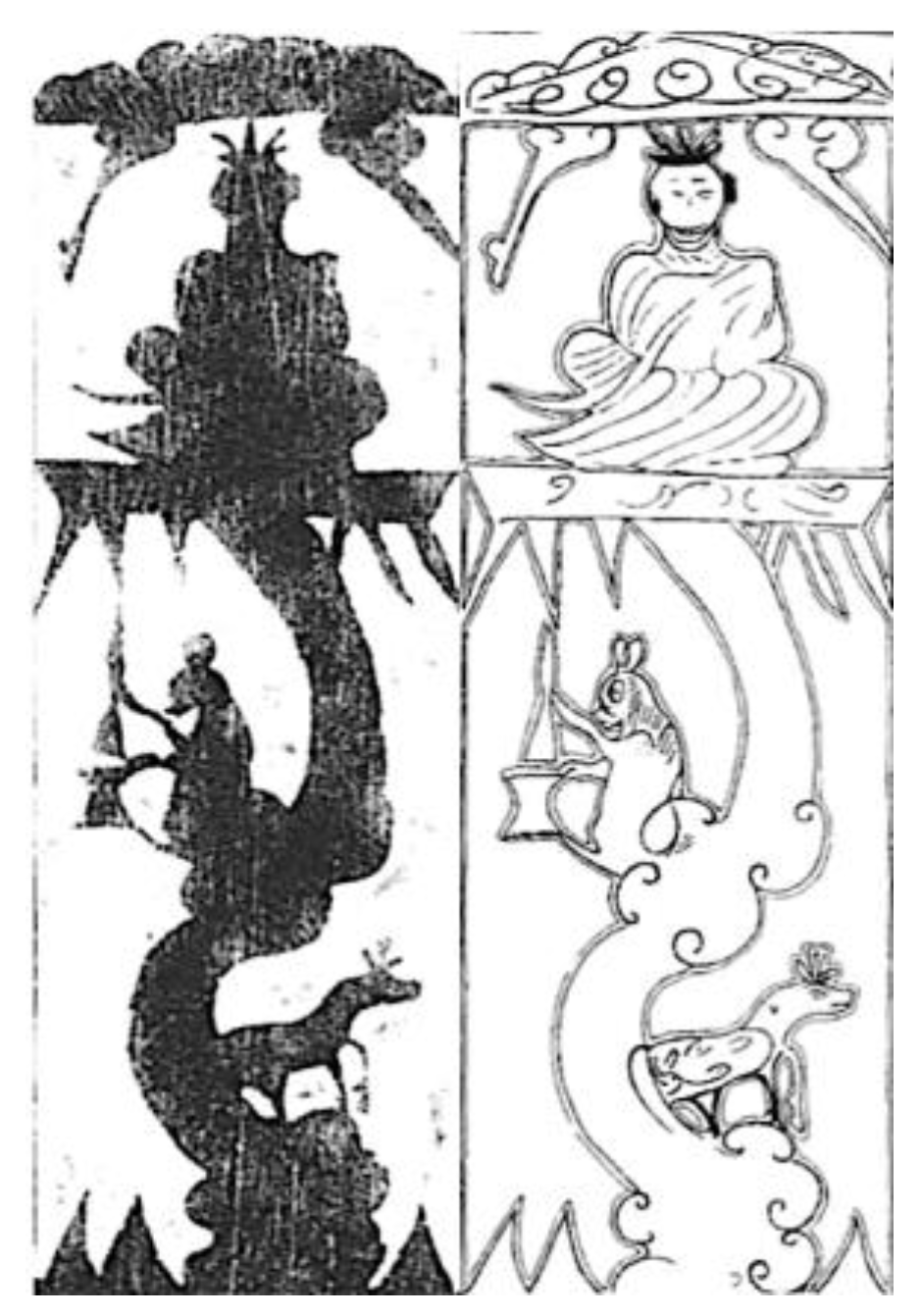



| Image Features | Headdress Features | Common Accompanying Motifs | Description | Main Areas | Examples |
|---|---|---|---|---|---|
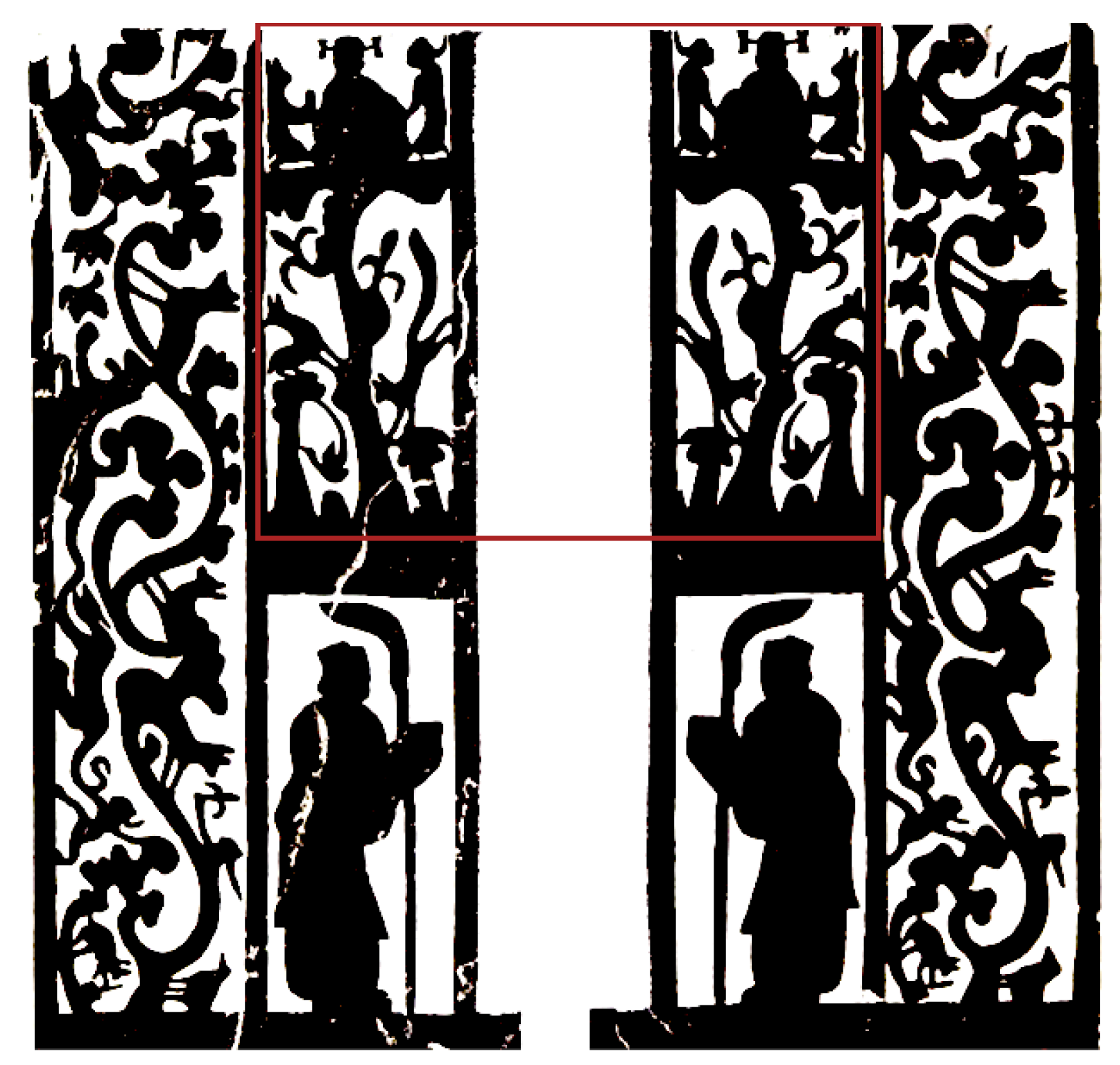
| Xiwangmu accompanied by relatively rich immortal-realm imagery | Wearing a sheng胜 (a) | Multiple immortal realm motifs (jade hare, attendants, nine-tailed fox, huagai, etc.) | Accompanied by more immortal realm motifs; stronger sense of sanctity. | Most commonly seen in northern Shaanxi | Door pillar stone from Wang Deyuan Tomb (Tang 2000, fig. 72), Huangjiata Tomb 4 (Suide Hanhuaxiangshi Zhanlanguan 2001, fig. 107), Zhaishan Village 1, etc. |
| Without a sheng, with a transverse ji髻 hairstyle (b) | Fewer immortal realm motifs than Type (a); jade hare, attendants, and huagai may appear. | Fewer accompanying motifs; tendency toward simplification. | Common in northern Shaanxi; rare in western Shanxi. | Door pillar stone from Mizhi Tomb 1 (Shaanxi sheng bowuguan and Shaanxi sheng wenguanhui 1972); Huangjiata Tomb 3 (Suide Hanhuaxiangshi Zhanlanguan 2001, p. 149, fig. 80); Wangjipo Tomb (J. Wang et al. 2013, p. 17), etc. | |
| Without a sheng, wearing a mountain-shaped crown (c) | Fewer motifs than Type (a); jade hares, attendants, and huagai still appear. | Fewer accompanying motifs; tendency toward simplification. | Rare in both northern Shaanxi and western Shanxi | Door pillar stone from Haojiagou Tomb (Yulin Shi Wenguanhui and Suidexian Bowuguan 2006, p. 15, fig. 4), Dabaodang Tomb 9 (Shaanxi Sheng Kaogu Yanjiusuo and Yulin Wenwu Guanli Weiyuanhui Bangongshi 2001, p. 79), Xishanyuan Tomb (J. Wang et al. 2013, p. 44), etc. | |
| Image highly simplified | Without a sheng, with a transverse ji hairstyle | Almost no motifs apart from the double que towers and huagai. | Markedly simplified; immortal-realm motifs greatly reduced. | Most common in western Shanxi; almost absent in northern Shaanxi | Door pillar stone from Mamaozhuang Tomb 2 (Y. Liu et al. 1992), Tomb 14 (J. Wang et al. 2013, p. 27), etc. |
| Type | Occupies the Central Position | Deities Appearing Simultaneously | Number in Different Regions | Representative Examples |
|---|---|---|---|---|
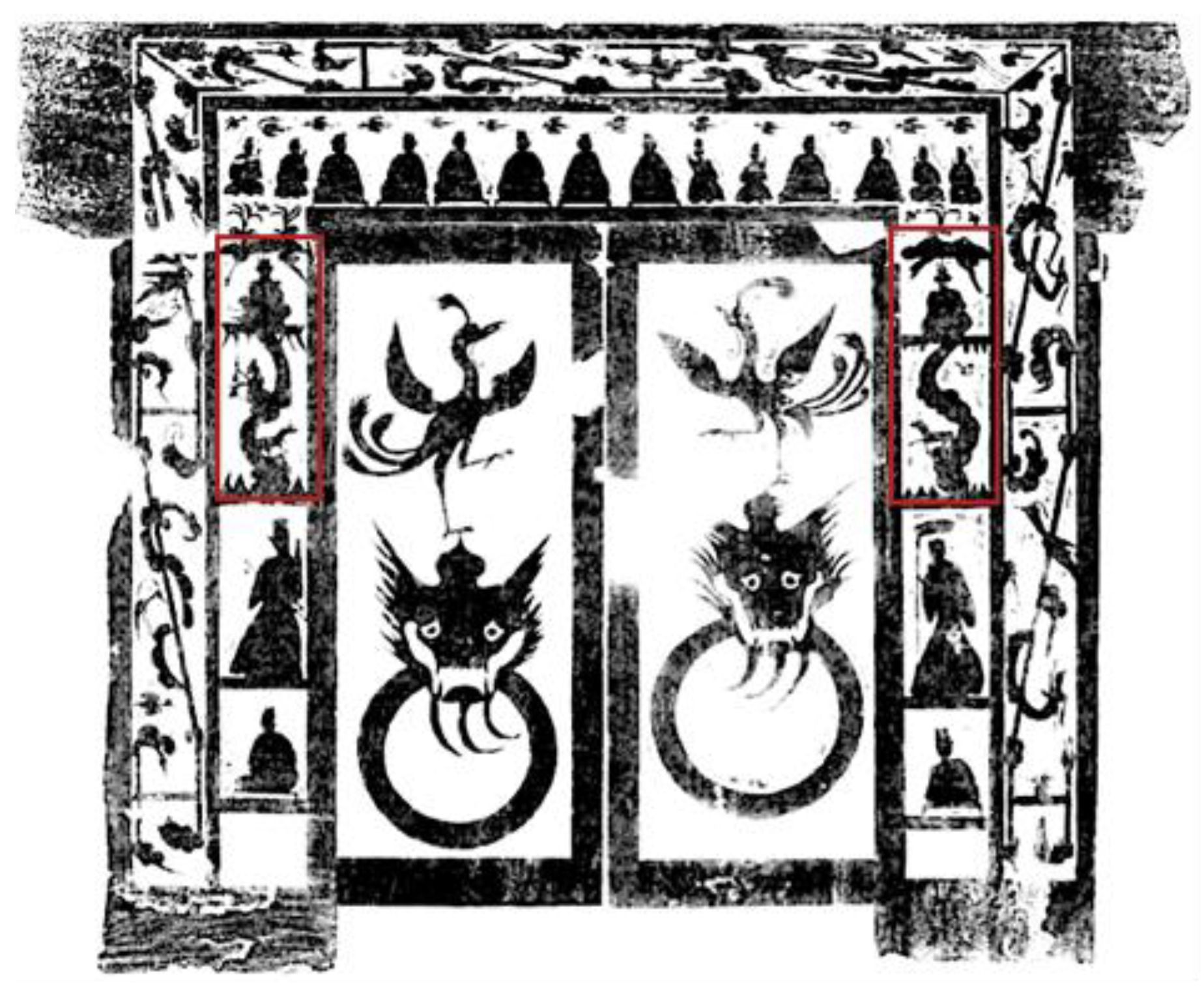
| Subordinate position | No | Xiwangmu and Dongwanggong; Fuxi and Nüwa | 6 groups, all in northern Shaanxi | Figure 7 |
| Attendant/guardian position | No | Xiwangmu and Dongwanggong | 4 groups in northern Shaanxi; 4 groups in western Shanxi | Figure 9 |
| Principal deity position | Yes | No major deity appears together | 19 groups in northern Shaanxi; only 1 group in western Shanxi | Figure 8 |
Disclaimer/Publisher’s Note: The statements, opinions and data contained in all publications are solely those of the individual author(s) and contributor(s) and not of MDPI and/or the editor(s). MDPI and/or the editor(s) disclaim responsibility for any injury to people or property resulting from any ideas, methods, instructions or products referred to in the content. |
© 2026 by the authors. Licensee MDPI, Basel, Switzerland. This article is an open access article distributed under the terms and conditions of the Creative Commons Attribution (CC BY) license.
Share and Cite
Liu, L.; Jiang, L. The Distance from the Immortals: The Evolution of Immortals in Northwestern China During the Han Dynasty. Arts 2026, 15, 126. https://doi.org/10.3390/arts15060126
Liu L, Jiang L. The Distance from the Immortals: The Evolution of Immortals in Northwestern China During the Han Dynasty. Arts. 2026; 15(6):126. https://doi.org/10.3390/arts15060126
Chicago/Turabian StyleLiu, Luoyao, and Lu Jiang. 2026. "The Distance from the Immortals: The Evolution of Immortals in Northwestern China During the Han Dynasty" Arts 15, no. 6: 126. https://doi.org/10.3390/arts15060126
APA StyleLiu, L., & Jiang, L. (2026). The Distance from the Immortals: The Evolution of Immortals in Northwestern China During the Han Dynasty. Arts, 15(6), 126. https://doi.org/10.3390/arts15060126