
Article

The Distance from the Immortals: The Evolution of Immortals in Northwestern China During the Han Dynasty
School of Art and Archaeology, Zhejiang University, Hangzhou 310058, China
*
Author to whom correspondence should be addressed.
Arts 2026, 15(6), 126; https://doi.org/10.3390/arts15060126
Submission received: 15 December 2025 / Revised: 2 May 2026 / Accepted: 27 May 2026 / Published: 1 June 2026

Abstract

A significant transformation in the Chinese pictorial tradition took place during the Han Dynasty. Stone reliefs, considered here as a representative art form, recorded the evolution of social thought, funeral concepts, and religious beliefs. Images of immortals on stone reliefs from the northwest region of the Han Realm—an area that included both northern Shaanxi and northwestern Shanxi—combined the belief system of the Central Plains with local characteristics. This research explores how divine images in stone reliefs were adapted to local contexts and took on new functions within the frontier environment and what social forces and beliefs drove these changes.

1. Introduction

In China, early beliefs in immortals (神仙信仰) can be traced back to the pre-Qin period. By the Qin Dynasty, practices (fangshu 方术) and beliefs relating to the immortals had been affirmed in the official system. During the Han Dynasty, these beliefs were adopted widely, and their influence extended from the ruling class to commoners. The system of beliefs was centered around the concepts of yin and yang (阴阳) and immortality and the construction of imagery relating to the universe, life and death, and the immortals. Han dynasty art flourished against this ideological background. Among various art forms, stone reliefs, a representative art form, recorded the evolution of social thought, funeral concepts, and religious beliefs.
The northwest region of the Han Dynasty examined in this study mainly includes northern Shaanxi and northwestern Shanxi. Situated in a frontier zone where Han Chinese culture intersected with steppe cultures, this region’s stone relief art inherited the basic framework of the immortal belief system developed in the eastern regions while gradually forming distinct local characteristics through long-term transmission and local adaptation. It therefore provides important material for discussing the localized evolution of divine imagery in the Han Dynasty.
Regarding the study of divine imagery in the northwest region, scholarship has already accumulated a considerable body of research, and existing discussions have mainly focused on the following aspects. First, many studies have concentrated on the textual origins, the formation of belief, and the evolution of images relating to figures such as Xiwangmu and the therianthropic deities, with particular attention to the process through which these figures were transformed in Han tomb art and to the symbolic meanings of specific visual elements.1 Second, other studies have examined ideas such as ascension to immortality and the order of yin and yang in the Han Dynasty, as well as their representation in tomb imagery, thereby revealing the deeper connection between divine images and Han conceptions of the cosmos and of life and death.2 Although these studies have laid an important foundation for understanding the formation and development of divine imagery in the northwest during the Han Dynasty, further inquiry remains necessary. First, existing research has tended to focus on the evolution of individual deities while paying comparatively less attention to the ways in which different types of deities interacted with and responded to one another within the same immortal system. Second, explanations of image transformation have largely centered on mythological origins or on iconographic types themselves and have not sufficiently clarified the relationship between changes in divine function and the practical needs of society.
In fact, among the immortals depicted in stone reliefs from the northwest region, Xiwangmu (西王母) and Dongwanggong (东王公) still occupied central positions, serving as significant symbols of the ideal of immortality and the order of yin and yang within the Eastern Han burial system. The relevant images did not depart from the established iconographic patterns of Xiwangmu in the Central Plains. More precisely, the pictorial practice of the northwest was based on the existing visual system developed in the eastern regions and involved the active selection and recombination of motifs relating to the Xiwangmu, Dongwanggong, and Kunlun (昆仑) immortal realm. At the same time that the modes of pictorial combination and the hierarchy of visual relations in Xiwangmu imagery were being adjusted, the therianthropic deities also underwent corresponding changes. In some eastern images, they usually appeared as attendants, or subsidiary figures, whereas in tomb imagery from the northwest, they were often placed in more prominent spatial positions and could even appear alongside the principal deities.
This study combines pictorial and textual materials from the Han dynasty and explores the patterns of evolution through comparative analysis of divine images across different temporal and spatial contexts. Focusing on the transformation of Xiwangmu’s world and therianthropic deities, this research examines how divine images achieved localized evolution in the northwest region through two dimensions, the transformation of celestial symbols and the evolution of divine functions, thereby revealing the ideological motivations underlying the transformation of divine imagery in Han dynasty stone reliefs from the northwest region.

2. Dual Evidence for the Evolution of Xiwangmu’s Immortal Function

In Han cosmology, Mount Kunlun was conceptualized as a “cosmic mountain” that connected heaven and earth, and its Tianzhu (天柱) served as a channel through which souls could ascend and descend between the human and divine realms. This sacred space was not only the dwelling place of fantastical beings such as Kaimingshou (开明兽) and the Busishu (不死树) but also the ultimate destination for the souls of human beings after death, whose existence transcends time. It became the symbolic center of eternity and cosmic order. As a supreme immortal of the Kunlun, Xiwangmu symbolized eternal life; she was both the guardian of universal balance and the sovereign of human fate and life (Cahill 1993, pp. 17–25).
The duality of Hun (魂) and Po (魄) in the Han Dynasty concept of the soul further strengthened Xiwangmu’s ritual function. According to the Huainanzi (淮南子), every person possesses both hun and po. Hun originates from the sky, provides vitality, and returns to its origins in the sky after death, where it can continue to receive offerings from a person’s descendants. Po originates from the earth and returns to it after death, as the body eventually merges with the land (Yü 1987). Xiwangmu’s divine power is also reflected in the fact that she can determine the fate of the soul after death and can grant immortality to the soul. This formidable power gave her an important role in the ancestral worship system (Sowden 2022, p. 20). The Han people believed that Xiwangmu was a composite deity who fulfilled multiple roles, and her beneficence extended to both the living and the souls of the dead (James 1995). The living prayed for her protection in the present through rituals, and the dead relied on her authority to ensure the immortality of their souls.
Through a stylized visual language, Han artists shaped Xiwangmu into an icon, a religious figure with defined attributes. They created not merely a reproduction of a divine image but also a representation structured by ritual elements that guided the viewer toward the contemplation of divine power and its meaning within a life of devotion (James 1995). The key to this stylized design was its universality. The pursuit of the Kunlun paradise was highly adaptable, allowing the belief in Xiwangmu to permeate all levels of Han society from peasants to the elite (the imperial family, great clans, bureaucracy, and military). Her image was widely reproduced across media, including murals, stone reliefs, bronze mirrors, and lacquerware, all created as offerings for the deceased. Her figure was associated with creation, cosmic harmony, immortality, and the communication between the divine and human realms3. The widespread nature of this belief was essentially a response to the concept of life and death associated with her. As concrete modes of expression, images not only conveyed religious ideas but also transcended social class boundaries in some contexts. Through a shared visual language, different social groups were able to establish shared ideas of deities and the world after death.
From the archeological record, the image of Xiwangmu had already become relatively clear by the early Western Han period, in the first half of the first century BCE. In the Marquis of Haihun tomb in Jiangxi (Yile Wang et al. 2016), a dressing mirror was unearthed. A vermilion bird is depicted at the upper center of the mirror, with Xiwangmu and Dongwanggong shown on either side, while the frame is encircled by images of mythical beasts and immortals. In the roughly contemporaneous mural of the Buqianqiu (卜千秋) tomb in Luoyang (Huang 1977), by contrast, Xiwangmu is depicted seated above the clouds at the top of the mural in the tomb chamber, surrounded by the celestial imagery of an immortal realm. Although the images of Xiwangmu in these two materials appeared at nearly the same time, they differ considerably in form and appearance. The Xiwangmu in the Marquis of Haihun tomb is closer to an ordinary human figure, whereas the Xiwangmu in the Buqianqiu tomb possesses a more transcendent and otherworldly quality. In response to this difference, some scholars have suggested that two distinct tendencies in the representation of Xiwangmu already coexisted in the Han dynasty.4 One was a more divine form of Xiwangmu rooted in the Shanhaijing (山海经); the other was shaped more strongly by the Confucian textual tradition and presented a more humanized appearance. This suggests that “standardization” did not imply a single fixed form but rather a shared symbolic framework of belief within which different media, contexts, and cultures could place different emphases on her image. The spread of Xiwangmu imagery did not stop with the regions discussed above. As the rulers of the Han Dynasty continued to expand their domains and develop the northwestern frontier, her image and the belief system connected to it spread to the northwest. Xiwangmu gradually became associated with the local cultural context—a social environment in which nomadic and Central Plains cultures intertwined—and her image was given local characteristics.

2.1. Changes in the Symbols and Iconographic Features of Immortals

During the Han Dynasty, a relatively stable iconographic pattern for Xiwangmu developed at an early stage in the eastern regions. Xiwangmu is seated at the center of the picture on an immortal platform or a divine seat, wearing a headdress called a sheng (胜). She is often accompanied by divine or mythical beings such as divine birds, the feathered people (yuren羽人), the jade hare (yutu 玉兔), and the nine-tailed fox (jiuweihu 九尾狐). This formula, with its world of immortals, was especially prevalent on stone reliefs from Henan, Shandong, and Jiangsu.
The imagery of Xiwangmu in northern Shaanxi largely follows this iconographic pattern while simplifying and recombining the motifs of the immortal realm. Motifs that had originally appeared within larger narrative scenes of immortals were brought together and concentrated on locations such as the tomb entrance and the inner doorframes of the tomb chamber, where they gradually formed relatively fixed combinations. Among these celestial symbols, the Tianzhu Xuanpu (天柱悬圃) and the Huagai (华盖) appear with particular frequency. These designs echoed the description in Shenyijing (神异经), which stated, “On Kunlun stands a bronze pillar, rising to the heavens.”5 In these images, the Tianzhu was often depicted as a curved, mountain-shaped column, interspersed with immortal beings and surrounded by clouds (yunqi 云气), creating a sacred space with clear vertical hierarchy and defined boundaries. This arrangement reproduced the structure of the Kunlun fairyland described in the Huainanzi (淮南子).
Above the Kunlun Hill lies the Mountain of Cool Breezes; those who ascend it shall not die. Higher still is the Xuanpu, where those who reach it become numinous, capable of commanding wind and rain. Above that lies the heavenly link, where ascendants become true deities.6
The Huagai (华盖), which was usually placed over Xiwangmu’s head, reinforced the sacred spatial order. According to the Book of Han (Hanshu汉书), “In the time of the Yellow Emperor, the Huagai was built to ascend to immortality.”7 This suggests that the Huagai was closely related to the belief in ascension to immortality and had supernatural significance. Wang Mang (王莽) once attempted to emulate the Yellow Emperor by constructing a nine-tiered Huagai, demonstrating its close association with imperial authority. In the stone reliefs of northern Shaanxi, the Tianzhu Xuanpu and the Huagai were often used in combination and became important images in the construction of Xiwangmu’s immortal realm. This does not mean that these motifs were unique to northern Shaanxi. Rather, it shows that, among the various symbols used to represent Xiwangmu’s world, this region was more inclined to use these two motifs to reinforce the hierarchical order of the immortal realm and the authority of Xiwangmu as a supernatural immortal.
The jade hare was another important element in the world of Xiwangmu. It derived from a Han yuefu (乐府) ballad: “gathering divine herbs at the tip of the tree, the white hare kneels long and pounds the pills.”8 From the late Western Han period onward, the jade hare was an important attendant of Xiwangmu and a status symbol. Xiwangmu was in charge of the elixir of immortality, and the jade hare helped her make it. Divine herbs, as the core ingredients in immortality medicine, were related to Xiwangmu’s attribute of bestowing eternal life. In Han portraits, immortal attendants were often depicted holding up these divine herbs, symbolizing the dual meaning of making an offering to the deity and accepting her blessings. The Book of Han records that in the first month of Jianping 4 (under Emperor Ai, 3 BCE), a religious ceremony was held to worship Xiwangmu, during which people carried branches, set up offerings and ritual tables, and performed songs and dances in her honor.9 This ritual practice can be interpreted as a real-life expression of divine herb worship. Plants as symbols of prayer also appeared in religious traditions beyond the Han culture. For instance, worshipers in Zoroastrian rituals held twigs called barsôm, typically taken from tamarisk or pomegranate trees, as ritual instruments for communicating with the divine (Rose 2019, p. 84). Such examples show that religious symbols in the form of branches or plants were common to different cultures. The difference is that Xiwangmu’s immortality plant was not only a symbol of sanctity and divine power but also a medium that connected the mortal world with the immortal realm. Compared with its role in other traditions, this botanical motif in Han culture was tied more explicitly to divine authority, forming an essential component of Xiwangmu’s divine system.
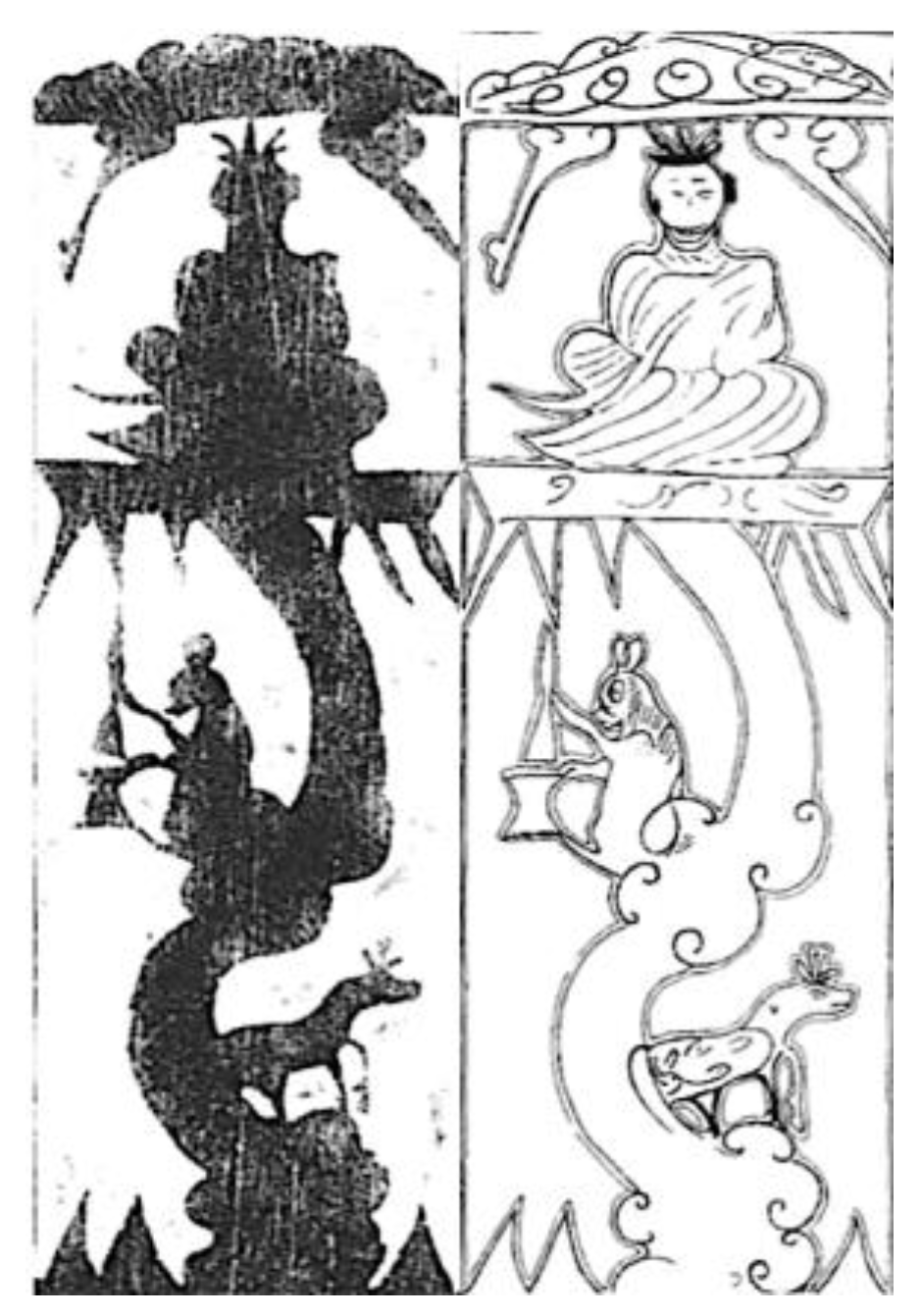
Han craftsmen further enhanced Xiwangmu’s divinity by surrounding her with other immortal symbols. In the Tianfang tomb, an Eastern Han stone chamber tomb at Suidexian in Shaanxi (92 CE), a stone relief depicts a classic image of Xiwangmu: she wears a sheng crown and sits on a high platform, surrounded by attendants, as well as feathered immortals presenting divine herbs and mythical animals such as the nine-tailed fox, the three-legged bird, and the jade hare (Kang and Wang 2002) (see Figure 1). The composition offers a comprehensive picture of the immortal world and emphasizes Xiwangmu’s elevated status within it. The image of her wearing the sheng was also consistent with her appearance in the Shanhaijing: “Xiwangmu resembles a human, with a leopard’s tail, tiger’s teeth, and her hair disheveled, and wears a sheng on her head.”10 The sheng serves not only as a symbol of her original divine appearance but also as a visual marker of her celestial authority and punitive power (Loewe 2022, p. 103). This iconographic formula is found in other depictions of the goddess, such as the image of Xiwangmu in Tomb 2 at Guanzhuang, Mizhi County, where she sits atop a xupu under a Huagai; the composition also includes the jade hare and fantastical beasts, and the goddess retains the feather of a tail (Shaanxi sheng bowuguan and Shaanxi sheng wenguanhui 1972) (see Figure 2). These elements emphasized her nonhuman characteristics, highlighting her supernatural nature in line with the Shanhaijing, which states that she “governs celestial punishments and calamities.”11, and then clarified the boundaries between primitive divinity and the mundane.
Together, these symbols constitute a visual language for identifying Xiwangmu and her world. However, during their transmission in the northwest, the formation of some images did not rely entirely on textual descriptions, but was expressed more through the reception, transformation, and reorganization of existing visual traditions, especially the mature iconographic models developed in the eastern regions. Through this process, many motifs originally attached to complex, multi-thematic compositions were gradually extracted from such scenes and, through repeated use, transformed into visual symbols with independent iconographic significance. Based on the combinations of these motifs and the manner in which they were represented, Xiwangmu images in the northwest can be broadly divided into two types (see Table 1).
More specifically, these two types of images exhibit clear differences in both compositional arrangement and the organization of visual symbols. The first type is characterized by a relatively complete scene of the immortal realm. Xiwangmu usually occupies the center of the composition and is surrounded by feathered beings, divine animals, and various immortal realm motifs, together forming a hierarchically structured immortal space. Images of this type preserve a relatively strong sense of narrative and compositional wholeness, emphasizing Xiwangmu’s supreme authority as the principal deity of the immortal realm. On this basis, it can be further subdivided into three subtypes according to the form of Xiwangmu’s headdress and the richness of the accompanying immortal realm motifs.
The first subtype is Xiwangmu wearing a sheng (a). In this type, Xiwangmu wears the sheng, and the surrounding immortal motifs are the richest. Common combinations include feathered beings, the jade hare, the nine-tailed fox, the three-legged bird, and attendants. The overall composition is complete and clearly layered, offering a relatively full representation of the immortal realm. This subtype is the most widely distributed in northern Shaanxi and constitutes the principal form of Xiwangmu imagery in the region. The second subtype depicts Xiwangmu without a sheng, with her hair dressed in a ji bun (b). Compared to subtype (a), the immortal motifs in this type are somewhat reduced, though key symbols such as the jade hare and attendants remain visible. While the image retains the basic meaning of the immortal realm, it already shows a certain tendency toward simplification. This subtype is also relatively common in northern Shaanxi and is found in small numbers in western Shanxi as well. The third subtype depicts Xiwangmu without a sheng but wearing a mountain-shaped crown (c). In terms of composition, this subtype is relatively close to subtype (b), with fewer immortal realm motifs and an overall tendency toward simplicity; however, its headdress form is distinctively unusual. This subtype is rare in both northern Shaanxi and western Shanxi.
In general, these three subtypes share a consistent compositional framework, all belonging to a mode of representation grounded in complete immortal realm scenes; however, they display a gradual shift from richness to relative simplification in terms of headdress selection and symbolic configuration.
The second type, by contrast, displays a more pronounced tendency toward symbolization. Unlike the first type, which centers on a relatively complete scene of the immortal realm, this type further condenses the various elements that originally constituted that sacred space, often reducing them to a simplified combination of Xiwangmu with a few core symbols, such as the Tianzhu, the Huagai, and wings. This type places greater emphasis on symbolic function, conveying the religious significance associated with ascension to immortality and eternal life through a small number of key symbols. In terms of regional distribution, this second type is found mainly in western Shanxi and is almost absent in northern Shaanxi.
A further comparison shows that the difference between the two types is not only a formal shift from complexity to simplification but also a difference in representational emphasis. The former tends to reproduce a complete immortal realm space, while the latter constructs a symbolic one. This transformation reflects an active reworking of Xiwangmu imagery in different regions and under different cultural conditions.
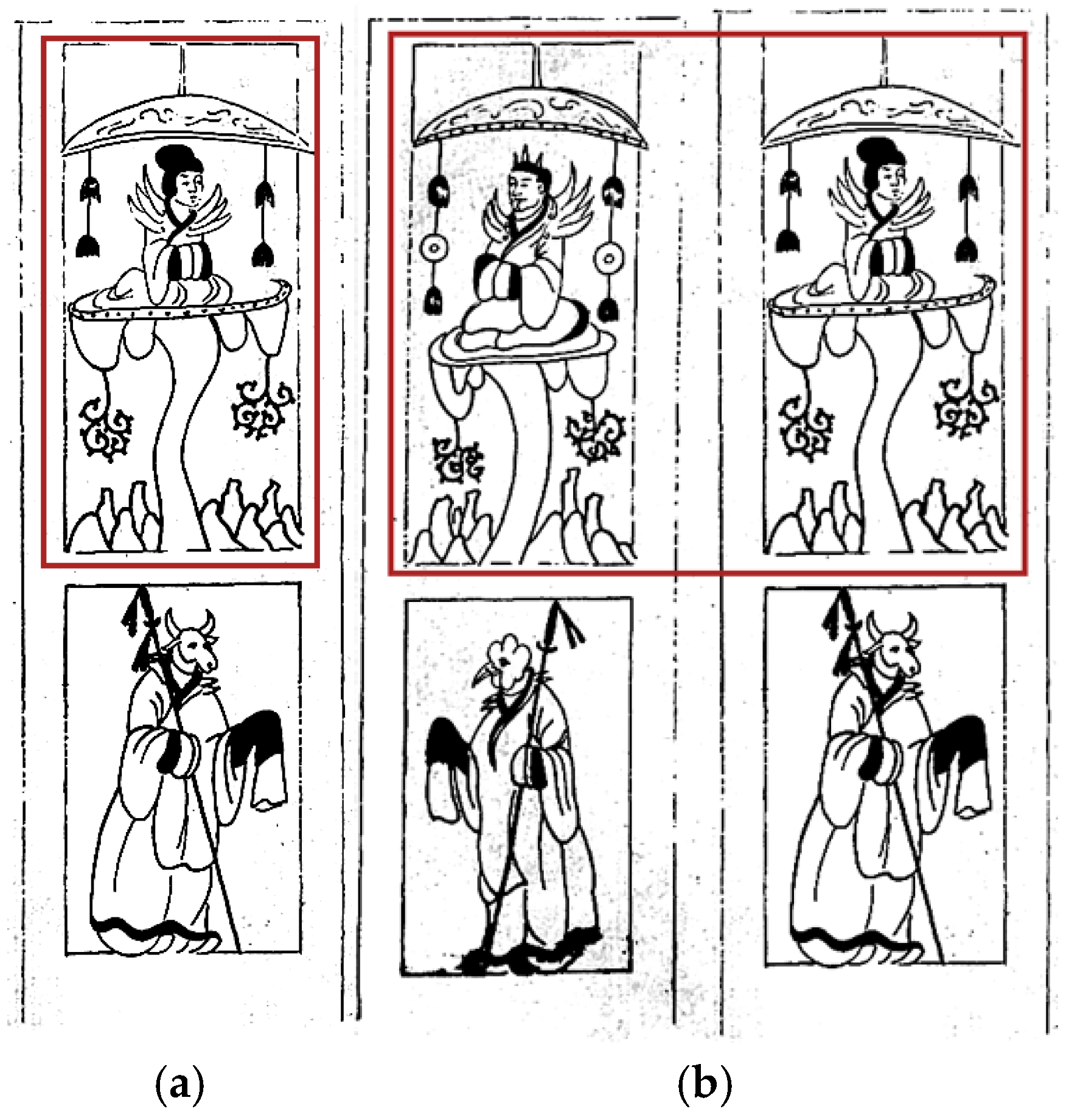
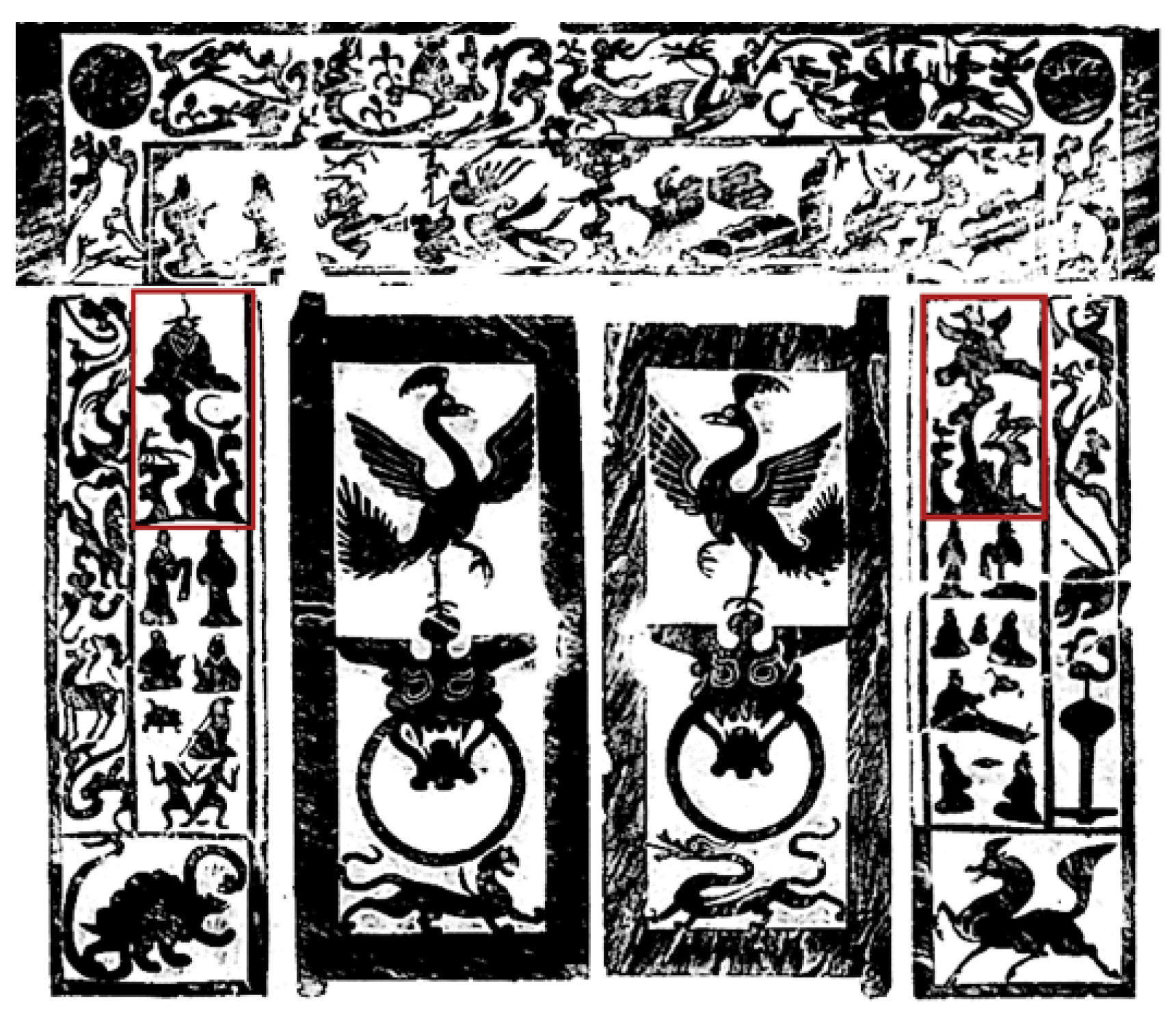
On this basis, when the discussion is further confined to material from western Shanxi in the late Eastern Han period, the second type of Xiwangmu imagery appears with particular concentration. In terms of regional distribution, stone relief art in the late Eastern Han appears to have shifted from northern Shaanxi toward western Shanxi. Around 150 CE, the production and use of stone reliefs in northern Shaanxi began to decline. Xiwangmu imagery tended to take the form of a simplified combination built around a few core symbols, which constitutes the typical expression of the second type discussed above. For example, the image of Xiwangmu in Mamaozhuang Tomb 2 (147–189 CE) shows her sitting alone atop the Tianzhu and Xuanpu, with a Huagai hanging above her head and wings emerging from her shoulders (Y. Liu et al. 1992). However, the Tianzhu is simplified into undulating lines that symbolically outline mountains, and there are virtually no elements of the immortal world, such as the divine beasts, feathered people, or the jade hare that were common in the early period. The image as a whole shows a tendency toward simplification (see Figure 3a). Xiwangmu’s features have also changed. She wears a high bun, which makes her look more like a Han woman. Her clearly defined facial contours and natural posture, with her hands placed in front of her chest and her body bent slightly forward, give her a gentle demeanor. Early symbolic features like the leopard tail and tiger teeth are absent. The removal of the symbols of Xiwangmu’s immortality did not imply a weakening of the divine character but rather a change in how divinity was expressed. Instead of depending on many supernatural elements, Xiwangmu’s divinity was condensed into two core symbols: the wings and the Huagai. The wings symbolize her ability to transcend the mundane, life, and death and reflect her function: guiding and protecting the soul of the tomb owner. The Huagai continues to represent her sanctity and nobility, referring to her elevated status in the immortal world. These changes enabled Xiwangmu to better embody her functions of comfort and guidance while continuing to assume the role of guardian of the tomb.
Therefore, the evidence suggests that the images of Xiwangmu found in northern Shaanxi during the Eastern Han did not follow a single unified pattern but instead displayed at least two different representational tendencies. One type preserved a stronger sense of divinity and was often accompanied by a richer array of immortal-realm motifs; the other showed a more pronounced tendency toward simplification and personification, with some immortal-realm elements significantly reduced. If material from western Shanxi is brought into the comparison, it becomes clear that the latter type was more commonly represented there, whereas the former did not develop a scale of continuity comparable to that seen in northern Shaanxi. This may suggest that, in the course of its transmission from northern Shaanxi to western Shanxi, not all types of Xiwangmu imagery were preserved to the same extent. Rather, it was the more simplified and personified mode of representation that achieved wider circulation and acceptance.

2.2. Pictorial Spatial Representations of Yin–Yang Cosmology

The development of tomb images in Han dynasty tombs was deeply influenced by the form and structure of the tombs. The shape of the stone relief tombs in the northwest region was a mature chamber tomb in the Han Dynasty. Unlike earlier coffin tombs constructed with tightly joined stone slabs and characterized by enclosed layouts, chambered tombs benefited from more flexible use of building materials, resulting in greater architectural variety. This, in turn, created expanded possibilities for the arrangement and expression of tomb imagery. The widespread use of two distinct types of tombs, stone chamber tombs and mixed brick and stone structures, allowed for the design and arrangement of stone reliefs to be adapted to different functional zones within the tomb. This significantly strengthened the interplay between visual themes and spatial organization.
With the transformation of religious beliefs and the development of visual narrative during the Han dynasty, the tomb chamber gradually came to be regarded as a microcosmic representation of cosmic order. Belief in spirits and deities became increasingly widespread. As noted in the Lunheng: “The tomb is the dwelling place of spirits and the site of offerings,”12 indicating that the tomb was not only a place for housing the dead, but also a space that embodied the living’s understanding of divinity, the cosmos, and the hope for eternal life. Within this conceptual framework, imagery functioned as a vital medium linking the visible world with the invisible. Through the symbolic function of images, Han people placed the heavenly realm, human society, and the underworld within the limited space of the tomb, constructing a visual system that integrated mythological imagination, religious belief, and cosmic order. Within this system, the spatial arrangement of divine imagery was particularly significant, as it played a key role in defining the character of each zone within the tomb.
The placement of Xiwangmu’s image within tomb spaces was not random but rather closely tied to Han cosmology and hierarchical order, reflecting the ideological concepts and ceremonial connotations of the image. The cosmic space shown in the Han portraits of the goddess was constructed from a variety of themes and motifs to convey a sense of spatial order in the tombs. Han cosmology treated tombs as vertically stratified world systems that were divided into three realms: the celestial, the human, and the underworld. This structure was reflected through the orderly configuration of the images. Themes symbolizing the celestial or immortal realm were often arranged in the upper area of the tomb. This area represented the space of the gods and spirits in line with Han beliefs. In the tomb of Tianfang, for example, a single image of Xiwangmu was placed above the lintel of the tomb chamber. Similar configurations have been found in other excavated tombs (Suide Hanhuaxiangshi Zhanlanguan 2001). As the main deity of the immortal world, Xiwangmu was placed in the area symbolizing the immortal world to highlight her status in the immortal realm and to structure the cosmic space of the tomb in tiers.
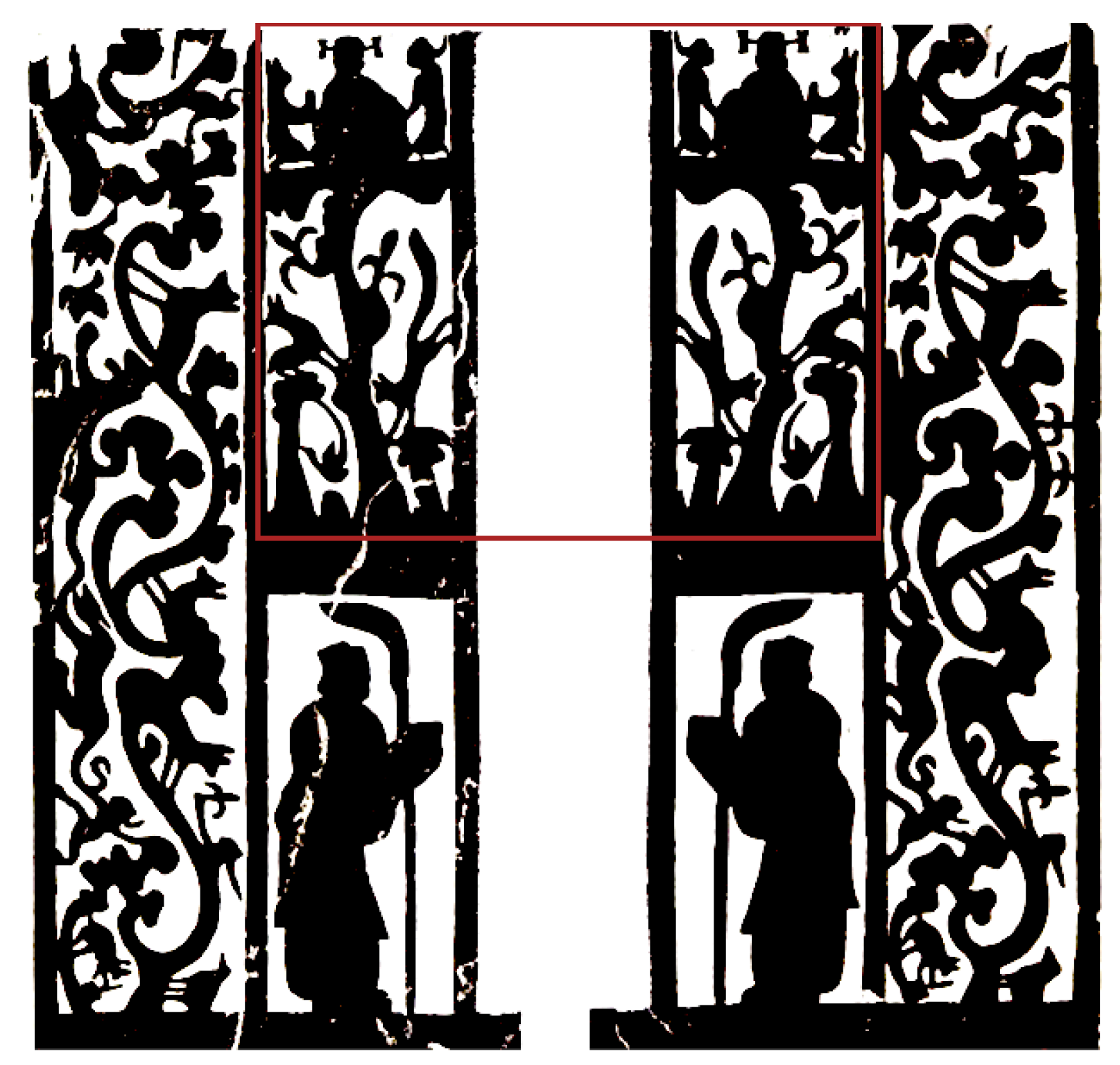
In addition to being placed on the horizontal lintel stone, Xiwangmu more often appeared on the vertical stones or doorframe stones on either side of the tomb entrance. To achieve a balance in both visual arrangement and pictorial content, the designers introduced immortality-related images on the opposite side as well. For example, mirror images of Xiwangmu, or almost identical images of her, were placed on the two side pillars, with one image on each side of the picture space. These pairs of figures are highly consistent in their postures, dress, and other elements of the immortal world and are symmetrical only directionally (Editorial Committee of the Complete Collection of Han Pictorial Stones of China and Tang 2000, p. 65) (see Figure 4). In addition to the symmetrical composition of the two Xiwangmus, the designer chose other images from the immortal world to complete the symmetrical layout. In some of the designs, the mountain Kunlun, on which stood two feathered people, was placed opposite Xiwangmu and was surrounded by auspicious beasts and clouds.
By the 2nd century CE, two distinct types of paired deities had appeared in succession. The first was the “Immortals Playing liubo (六博)” image. Some scholars believe that this motif represented a transitional stage in the formation of the figure of Dongwanggong and preceded the establishment of his formal image in northern Shaanxi. However, this transitional image did not remain popular for long and was not the most appropriate counterpart to Xiwangmu (Pang 2021). In the later Eastern Han period, the figure of Dongwanggong was standardized. Wu Hung argues that the emergence of Dongwanggong was primarily a result of Han cosmological thought, especially the yin–yang doctrine; Dongwanggong filled the symbolic void of the yang element, balancing Xiwangmu’s yin identity, and their symmetrical visual arrangement gave concrete form to the cosmic order on the pictorial level (Wu 1989, pp. 110–26). However, recent archeological evidence indicates that the pairing of Xiwangmu and Dongwanggong can be traced back at least to the middle and late Western Han period, where it already appears in the decorative systems of high-status funerary objects. As mentioned above, the image on the dressing mirror unearthed from the Marquis of Haihun tomb already presents the two figures in a symmetrical arrangement. Owing to the limited amount of material, however, this cannot be taken as evidence of a widespread social phenomenon. Some scholars have argued that this form may have first developed within the elite culture of the court or the ranks of the marquises and was probably related to the upper classes’ fascination with the immortal realm of the Eastern Sea during the Western Han period. This would suggest that belief in Dongwanggong in the Western Han was largely limited to upper-class society and the eastern coastal regions (Pang 2020). It was only after entering the Eastern Han period, with the maturation of tomb image art, that the combination of Xiwangmu and Dongwanggong came to be increasingly reinforced by the demands of symmetrical composition and eventually developed into a relatively stable visual pattern.
Based on the foregoing analysis of Xiwangmu imagery, it can be argued that Dongwanggong should not be understood as a deity newly created in the tomb reliefs of northern Shaanxi during the Eastern Han. Rather, he was a figure drawn from existing pictorial resources and repurposed to fulfill the spatial demands of the funerary context. Because the image system of northern Shaanxi was secondary in nature, its pictorial combinations were not direct copies of those in the eastern regions but were instead based on the reselection and recombination of established visual models. In the process of achieving a symmetrical composition, the designers had several possible choices for creating spatial balance, including the paired Xiwangmu, the immortal mountain with feathered beings, and Dongwanggong. This suggests that the appearance of Dongwanggong was one option among several pictorial solutions, one that was gradually adopted and increasingly reinforced over time.
When Xiwangmu and her counterpart appeared together in an image, the sun and moon usually appeared in each of the two top corners of the image above the respective deities. Positioned above the deities and occupying the highest position within the spatial hierarchy, the sun and moon suggested their supreme status within the cosmic order. This arrangement also reflects a continuation of Central Plains artistic traditions, as seen in the tomb of Buqianqiu at Luoyang. As scholars have pointed out, a fundamental principle in traditional Chinese thought is that “space determines time,” meaning that spatial structure not only defines the physical location of images or rituals but also underpins temporal rhythms and systemic orders. The establishment of spatial orientation within the composition, integrated with the concept of yin and yang, thus became essential for constructing a visual system that expressed the structure of the universe (Feng 2018, pp. 534–52). It is said in Huainanzi, “The sun is the ruler of yang; the moon is the ancestor of yin.”13 The sun and moon represented not only the dual forces of yin and yang but also the very presence of the cosmos. The sun typically appeared above Dongwanggong, aligning with his yang nature, while the moon was usually positioned above Xiwangmu, corresponding to her yin attributes. This symmetrical arrangement mirrored the dual structure of yin and yang embodied by Xiwangmu and Dongwanggong in terms of both gender and cosmic function. Together, they formed a visual system grounded in spatial orientation and governed by the principles of yin and yang. In other words, the pairing of Xiwangmu and Dongwanggong gradually became established among various symmetrical options precisely because it was better suited than other choices to accommodate concepts such as the sun and moon, yin and yang, the east–west orientation, and the operation of the cosmic order.
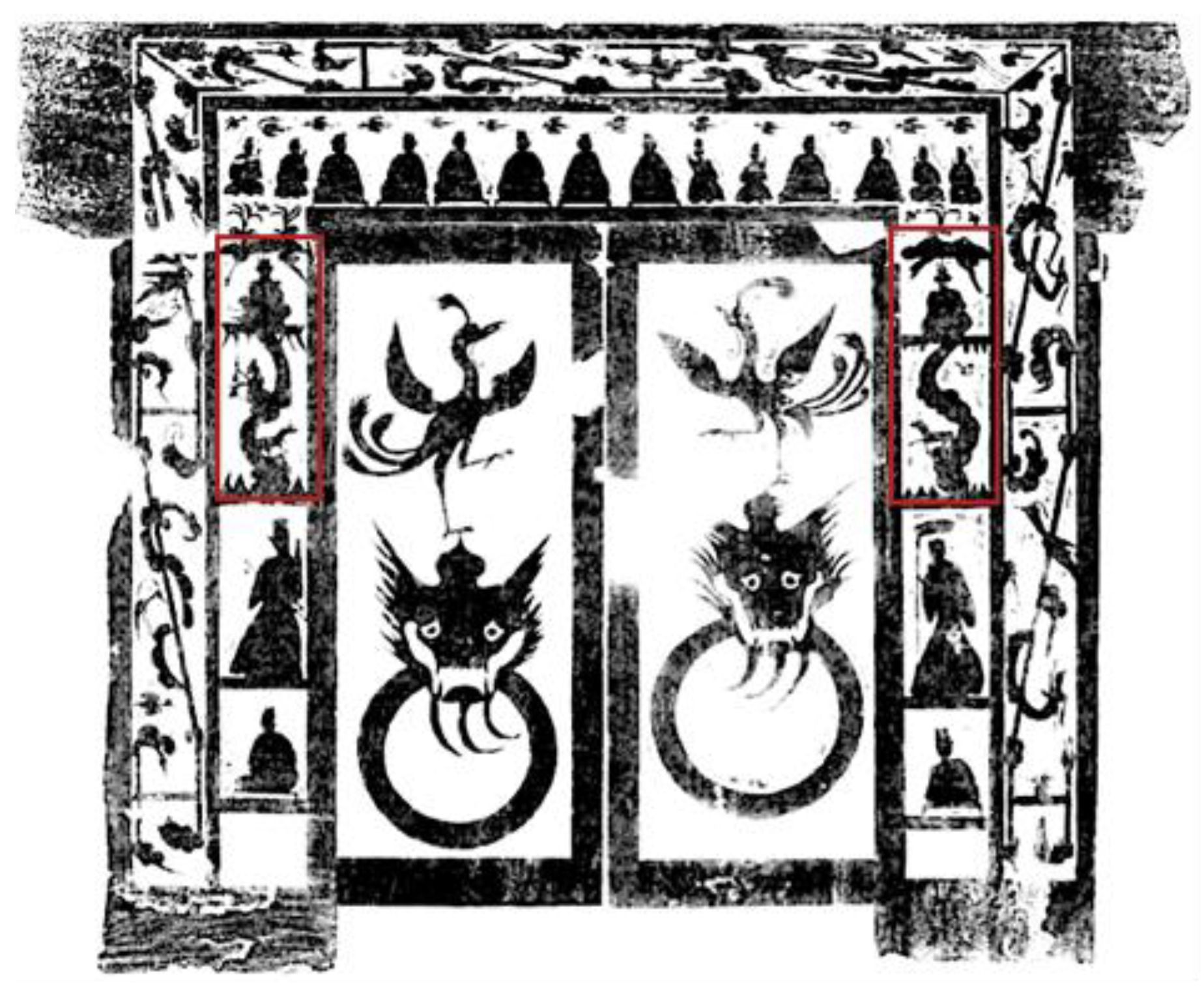
As constant markers of time in the universe, the movements of the sun and moon symbolized the order and permanence of the celestial way. Positioned beneath them, the deities served as intermediaries embodying the unity of natural and social order, with each assigned a specific functional role. The deities not only manifested cosmic order but also visually inherited the eternal power symbolized by the sun and moon. Furthermore, the dual symbol of Xiwangmu and Dongwanggong could help the dead to establish a connection with the cosmos: through the power of the dual immortals, the soul of the deceased was believed to gain strength and protection in the afterlife14. In Tomb 2 at Guanzhuang, the two deities are seated symmetrically on the Tianzhu and Xuanpu, each wearing the Huagai, forming a yin–yang relationship (see Figure 5). Xiwangmu wears a pointed Huasheng, with her tail exposed, and the Tianzhu is surrounded by a jade hare crushing herbs and an immortal deer. Dongwanggong, likewise, wears a pointed Huasheng, and an immortal deer stands around the Tianzhu. The two deities mirror each other in their costumes and postures, reflecting their equal relationship and complementary functions.
In the course of the formation of this relatively stable paired system, the adjustment of Dongwanggong’s image remained broadly consistent with that of Xiwangmu. Because the two figures jointly fulfilled the compositional function of symmetrical arrangement on either side of the picture, their modes of representation often tended to correspond visually. Compared with the earlier material, the richer elements of the immortal realm in the later images were gradually reduced. The divine beasts, feathered beings, and other immortal symbols surrounding the deities were no longer as densely displayed as before, and the visual focus of the composition shifted more toward the figures themselves and a small number of key markers (see Figure 3b). In this process, both Xiwangmu and Dongwanggong came to be designed in a more human-like manner. Their earlier supernatural features were weakened, and their postures became more natural. As with Xiwangmu, this change did not imply a weakening of Dongwanggong’s divine character, but rather a transformation in the mode through which divinity was expressed. Instead of relying on the extensive external display of immortal-realm symbols, divinity came to be concentrated in the figure itself and in its combination with core elements such as the Tianzhu and wings.
Centered around the Tianzhu, Xiwangmu and Dongwanggong represented yin and yang, respectively. Through its symmetry, this design not only maintained cosmic order but also provided the deceased with a pathway to the afterlife (Wallace 2011). Such an arrangement further emphasized the roles of both deities within the funerary space as protectors and guides of the soul.

3. The Development of Therianthropic Deity Images
The half-beast and half-man deity is similar in composition to the early therianthropic form of Xiwangmu. Xiwangmu originally appeared as a “leopard’s tail and tiger’s teeth” (Huainanzi). Other Han ethnic tradition deities, such as Fuxi and Nüwa, also incorporated animal features in their bodies. In ancient society, the relationship between humans and animals was understood as an open, variable, and dynamic whole, and there were many indications that this perception was general (Kristoffersen 2010). Almost from the Neolithic period to the Western Han Dynasty, deities with bizarre forms were depicted in diverse media, including painted pottery, jade, bronzes, lacquerware, murals, and paintings on silk. Typical examples include the human-faced fish motif on a pottery basin from the Yangshao culture and the therianthropic figures on the painted lacquer coffin from the tomb of Marquis Yi of Zeng in Hubei. The integration of human and animal forms breaks away from conventional human appearances through the incorporation of animal elements, endowing the deity with an otherworldly strangeness. As a result, the divine image acquires a sense of mystery and majesty that transcends human experience.
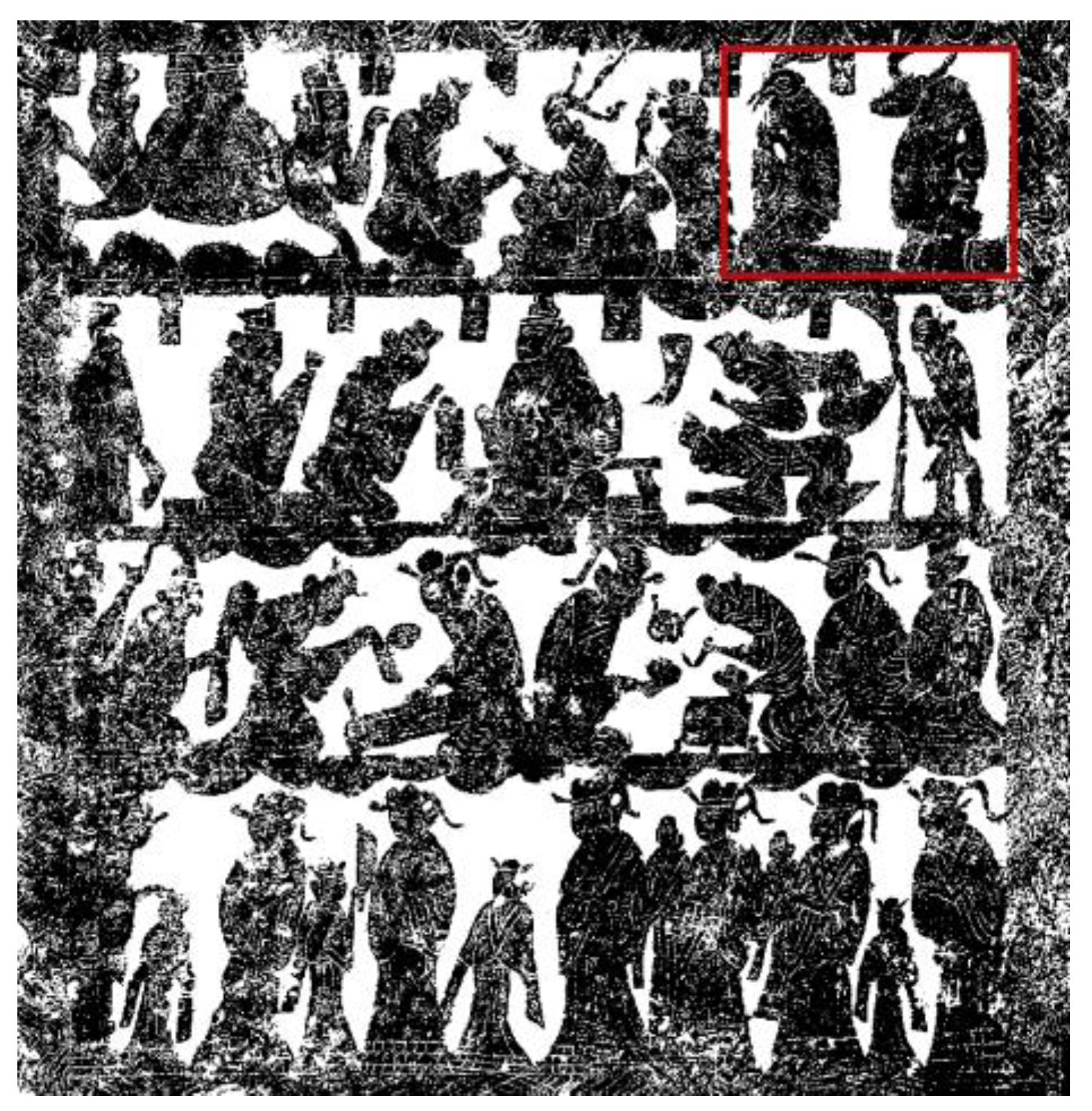
Among the therianthropic figures found in the eastern regions, the most common was a rooster-headed and half-bodied figure kneeling in worship before Xiwangmu; there were also horse-headed, dog-headed, human-headed, and serpent-bodied figures. However, animal-headed deities were not prominently represented in the eastern region’s deity system; there were only a few depictions of figures with ox heads and human bodies (See Figure 6) (Yan and Guo 1990). The animal-headed deities, especially rooster-headed deities and ox-headed deities, were also different in northern Shaanxi, which was distant from the eastern region. The development of these two types of beast-headed deities can be traced to local ethnic and religious traditions. Prior to the Han dynasty, Shaanxi Province was a major region of the state of Qin. Historical records indicate that the people of Qin practiced the worship of a deity known as Chenbao (陈宝), whose image was that of a rooster. The Qin regarded Chenbao as an auspicious symbol.15 Therefore, the widespread depiction of rooster-headed deities in the northwest can be directly attributed to local popular customs surrounding the veneration of the rooster god. Another relevant tradition is the legend of Fengdate (丰大特), a divine ox encountered by Duke Wen of Qin (秦文公) while cutting catalpa trees in the southern mountains. This ox, known as the Great Catalpa Ox, was said to appear in the form of a green bull and was closely associated with the Feng River in present-day Shaanxi. Beginning in the Qin period, a temple named the Nuteci (怒特祠) was built to worship this divine ox.16 By the Han dynasty, the deity had evolved into a figure depicted with the head of an ox and the body of a man. The imagery of ox-headed figures was also shaped by broader cultural influences, including that of the Qiang and other ethnic groups, among whom the worship of ox deities was a longstanding tradition (Niu and Niu 2018). During the Han dynasty, many Qiang communities lived in the Shaanxi region. Overall, the popularity of rooster-headed and ox-headed deities in the northwest was thus closely tied to the cultural and historical context of the time. These local beliefs and animal god worship originated in the pre-Qin period, laying the foundation for the popularity of animal head gods and human images in Han Dynasty portrait stones in Northwest China. In the continuation and adaptation of the existing tradition, the animal gods originally believed in by the people were gradually absorbed into the Han Dynasty tomb image system in the northwest region under the influence of the eastern region.
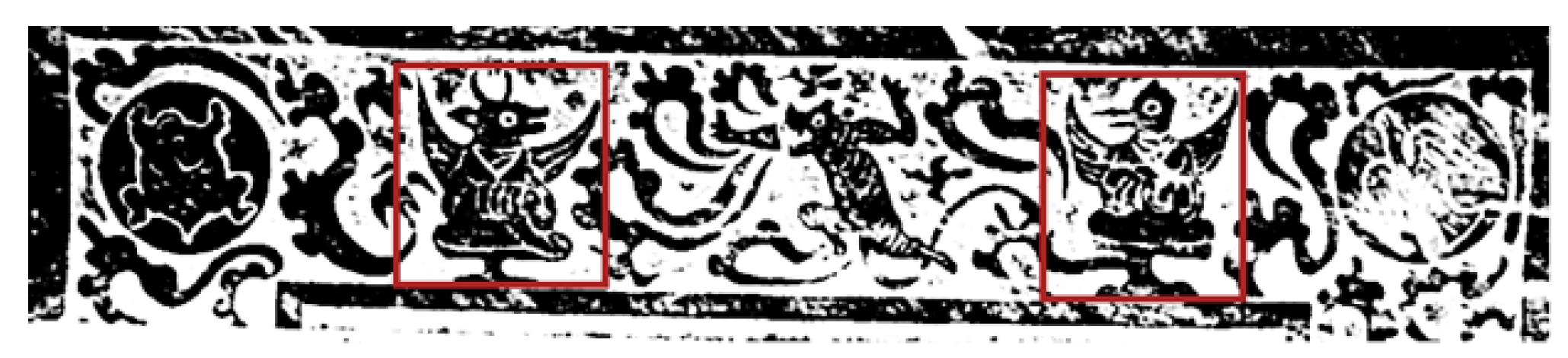
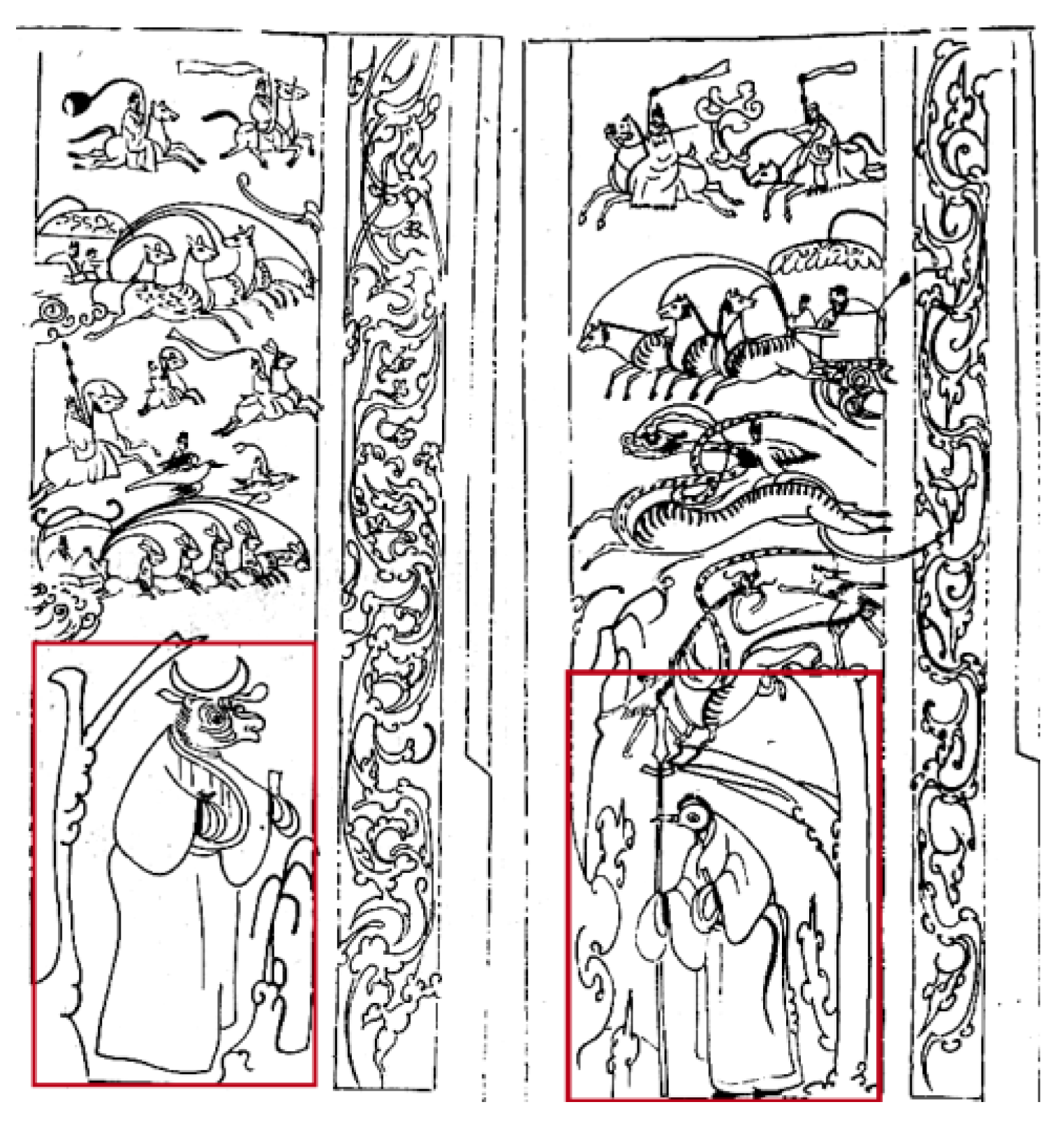
In the tomb reliefs of northern Shaanxi, therianthropic deities appeared mainly in the upper parts of the burial chambers, and their iconographic evolution closely followed that of Xiwangmu. Initially, the animal-headed deities appeared as subordinate characters in the immortal world and were usually depicted as attendants in Xiwangmu’s Kunlun paradise. For instance, in the tomb of Tian Fang, a rooster-headed deity was shown kneeling in reverence at Xiwangmu’s right (see Figure 1), while an ox-headed deity appeared below Fuxi, standing with its hands folded in its sleeves and its head slightly bowed. This design revealed that beast-headed figures occupied lower positions in the composition compared to high-ranking deities such as Xiwangmu. Their postures often conveyed obedience and humility, indicating their subordinate roles within the celestial hierarchy. These figures symbolized deities of different ranks and functions within the immortal realm, thereby reinforcing the hierarchical structure between major deities like Xiwangmu and other divine beings. This arrangement was not accidental but consciously expressed an ordered system of immortals, consistent with the specific depictions and placements of beast-headed figures in the eastern regions in terms of both imagery and status. Over time, the influence of local ethnic cultures in the northwest on tomb imagery grew increasingly pronounced. The rooster- and ox-headed deities came to possess independent divine identities. They often appeared on the lintel stones of tomb chambers, seated on divine thrones with wings extending from their shoulders. They were surrounded by clouds and celestial images, flanked on one side by the sun and on the other by the moon (see Figure 7). This spatial arrangement retained the design principles associated with Xiwangmu’s celestial world while incorporating elements of local frontier culture, suggesting that the animal-headed deities gradually acquired an independent divine status. During the same period, the animal-headed deities appeared in another arrangement. They were depicted on the border stones of the tomb, seated and arranged symmetrically like Xiwangmu and Dongwanggong. The ox-headed deity sits on a Xuanpu at the summit of a Tianzhu, surrounded by mythic foxes and birds. It is faced on the opposite side by a rooster-headed being, also enthroned on a Tianzhu and Xuanpu and accompanied by deer and birds (Shaanxi Sheng Kaogu Yanjiusuo and Yulin Wenwu Guanli Weiyuanhui Bangongshi 2001, p. 60) (see Figure 8). These two layouts suggest that the therianthropic deities took over Xiwangmu’s and Dongwanggong’s functions as the masters of the Immortal Mountain and confirm their transition from subordinate to principal deities. Beast-headed deities had fully departed from the design patterns established in the eastern regions (see Table 2).
Figure 9. Tomb 3 at Mamaozhuang, Lishi County, during the reigns of Emperor Huan and Emperor Ling of the Eastern Han Dynasty, 147–189 CE. (Red box: ox-headed deity and rooster-headed deity).
Arts 15 00126 g009
The early representations of beast-headed figures in the northwest were also closely tied to ancient conceptions of cosmic order. In Han society, understandings of the operation of heaven and earth and the harmony of yin and yang directly shaped the arrangement of imagery and the construction of symbolic systems within tomb spaces. A prominent example was the Four Divine Beasts system, widely used in Han architecture and tombs. The Azure Dragon, White Tiger, Vermilion Bird, and Black Tortoise symbolized the four cardinal directions—east, west, south, and north—serving to protect the deceased and ensure the peace and tranquility of their souls in both the living world and the afterlife. Simultaneously, they symbolized the balance between heaven and earth. The sun and moon also played a role in marking direction and temporal cycles within the visual system. Often placed at the top of the tomb chamber or along central visual axes, they represented the eternal alternation of day and night and the continuous flow of time. Within this cosmological worldview, the initial placement of beast-headed figures reflected a broader understanding of universal order. These figures were typically positioned in the upper zones of tombs. When considered alongside other divine figures within the same system, this arrangement suggested that Han people sought to construct an idealized model of the universe, reflecting their views on life, death, and the cosmos. In this model, beast-headed deities became integrated into the larger cosmic framework of sun, moon, stars, and seasonal rotation, participating in the overall order as essential components. As the immortal system evolved, the role of beast-headed figures also underwent significant changes. At first, they primarily functioned as symbolic elements within the cosmic order, without yet possessing clearly defined and independent divine roles. Only later did they gradually develop into deities with more explicit functions and sacred status and become integrated into the celestial hierarchy centered on Xiwangmu.
As previously mentioned, Xiwangmu underwent a process of secular transformation that profoundly influenced both the imagery and divinity of the therianthropic figures. By the late Eastern Han period, these figures were depicted wearing long robes and holding ritual objects, standing beneath the Tianzhu of Xiwangmu and Dongwanggong, where they replaced the former doorkeepers and attendants (Figure 3). Some scholars have suggested that this transformation in role reflects the fact that these therianthropic beings initially served as Xiwangmu’s subordinates, later filled her position and attained independent divinity, and eventually returned to playing subordinate roles as ordinary doorkeepers (Zheng 2010). In fact, the therianthropic deities played important roles in the immortal world of Xiwangmu from the beginning to the end. Their shift from the upper to the lower parts of the tomb should be understood primarily as reflecting the changing functions they embodied.
In earlier periods, therianthropic deities served as attendants to Xiwangmu, maintaining the order of the celestial realm. As Xiwangmu’s image gradually came closer to the human world, the beast-headed divine beings began to undertake more specific and practical responsibilities, becoming key figures who guided the spirits of the deceased to the immortal realm and facilitated their path to immortality. The Book of Rites (Liji 礼记) states, “Among the five rites, none is more important than sacrifice,” and the Lunheng (论衡) asserts, “View death as life.” These ideas reflected the deep social emphasis on death and the continuation of the soul during the Qin and Han periods. Within this worldview, death was not an end but a transition to another world. Therefore, the design of deities in imagery served not only decorative or symbolic purposes but also to ensure the fate and belonging of the deceased. In this context, the placement of therianthropic deities in prominent positions at the lower part of the tomb’s central axis and beneath the main deity precisely embodied their role as guardians of the immortal realm and guides for the soul. They maintained the order of the celestial realm and directly participated in the soul’s journey to transcendence, acting as intermediaries between humans and gods and between life and death. This transformation in role represented not a decline in status but rather a deepening of function and a shift in religious focus.17 (See Figure 9).

4. Reasons Behind the Changes in the Functions of the Immortals

A comparative analysis of the evolution of the two types of images of immortals discussed above reveals that their developmental paths echoed each other and reflected the localized construction of the divine system in the northwestern Han realm. After appearing in northern Shaanxi and spreading to northwestern Shanxi, the therianthropic deities underwent several transformations in function in the immortal system before taking on fixed forms. Similarly, Xiwangmu and her counterpart, Dongwanggong, completed a process of secular transformation. Although there were differences in their evolutionary paths, both ultimately aimed to make the realization of worldly aspirations more attainable for people and contributed to the continuous refinement of a deity system that conformed to local beliefs.
The evolution of divine imagery is first and foremost determined by changes in religious function. Han dynasty pictorial art served as an important medium through which people expressed their religious beliefs. As the cult of immortals developed comprehensively across society, Han people’s beliefs regarding death and the afterlife underwent repeated expansion and transformation (Q. Liu 2018). In the case of Xiwangmu, although early textual sources still depict her with strong primordial and numinous characteristics, by the Han period, she had gradually come to function primarily as a presiding deity associated with guiding the deceased to immortality and protecting the departed soul. At the same time, rulers continually made use of her popular influence to strengthen the legitimacy of their rule18. During the Eastern Han period, the images of Xiwangmu transmitted into northern Shaanxi displayed two distinct tendencies. One retained a stronger sense of the numinous, while the other showed a more pronounced tendency toward personification, and it was the latter that achieved more sustained transmission and continuity. The underlying reason lies in the fact that in the northwest frontier regions, this functional transformation carried a more pronounced practical significance. As border warfare intensified, society fell into disorder, and population migration increased,19 the deity was no longer merely understood as an exalted natural divinity or a symbol of cosmic order. Instead, she gradually assumed the role of a guardian deity with more direct relevance to human life. Divine imagery moved from representations with abundant immortal-realm elements toward more simplified and personified forms. This tendency may also reflect Xiwangmu imagery’s response to contemporary social realities and social needs. Furthermore, by the late Eastern Han period, funerary pictorial art itself had gradually come to serve the additional function of displaying the tomb occupant’s status, wealth, and cultural identity. Divine images thus functioned not only as objects of religious belief but also as outward symbols of the tomb occupant’s social standing and spiritual aspirations.
Secondly, in the northwest, the evolution of divine imagery was closely related to local cultural integration and regional belief traditions. Shang Jun (上郡) and Xihe Jun (西河郡) during the Han Dynasty, that is, the area of present-day northern Shaanxi and northwestern Shanxi20, had long been a frontier zone between the Central Plains regimes and northern nomadic groups. To ensure border security, the state had stationed large military forces here as early as the Qin Dynasty, accompanied by an inland migration policy aimed at supplementing military resources, developing agriculture, and enhancing animal-powered transportation. Groups of immigrants familiar with the culture and handicraft traditions of the Central Plains brought the technical basis and cultural elements for the development of stone reliefs to the border areas. From the Western Han Dynasty to the early Eastern Han period, with the backdrop of a strong central government and relative stability along the northern frontier, the Central Plains agricultural civilization became integrated with steppe nomadic cultures in northern Shaanxi. The intermingling and intermarriage of the Xiongnu (匈奴) and the Han people prompted locals to influence each other’s customs and spiritual concepts. Against this background, the already mature image of Xiwangmu in the eastern regions was not simply copied after its transmission into the northwest. Instead, it was integrated with local traditions of numinous beings21, such as animal deities, and developed into new regional forms of expression. As discussed above, the selective adoption and transformation of Xiwangmu and Dongwanggong also had a profound effect on other deities associated with them, especially on the function and representation of the therianthropic figures. In the earlier images, these animal-headed beings appeared as attendants within the world of Xiwangmu and symbolized the movement of the stars and the order of the celestial realm. As the images of Xiwangmu and Dongwanggong gradually became more closely aligned with the human world and the pictorial structure was adjusted accordingly, these therianthropic figures began to assume more concrete and practical functions. They became key beings who guided the soul of the deceased toward the immortal realm and helped complete the journey to immortality. In other words, local numinous traditions were not excluded after the establishment of the Xiwangmu system. On the contrary, they were incorporated into the world of immortals itself and became an important component of the divine image system of the frontier regions.
It should also be noted that the evolution of divine imagery was closely related to advances in artistic techniques and the maturation of funerary spatial conditions. With the development of stone relief art in the northwest, relatively stable systems of image arrangement gradually took shape on such parts of the tomb as the entrance, lintel, and pillars, and divine figures became an important element in the construction of spatial order within the tomb. The formal transformation of divine imagery in Han pictorial art was simultaneously driven by esthetic considerations and the internal logic of pictorial composition. For instance, in the more mature phase, Xiwangmu imagery increasingly drew upon formal principles such as the combination of point, line, and plane, alongside repetition, symmetry, balance, and contrast, in order to achieve a sense of order and symbolism (Mao 2016). In this process, with many elements nearly vanishing from the pictorial field while a small number of symbols most capable of conveying sanctity and spatial hierarchy were retained, it does not appear to be a simple case of content loss but is rather related to the development of artistic thinking toward abstraction and symbolization. For this reason, another possible reason for secularization may have been related to changes in production techniques. In the making of images, technical practice developed from the mixed use of multiple carving methods in northern Shaanxi, including intaglio carving, relief carving, and incised lines, toward a greater reliance on painting, through which brushes and pigments could be used to present more detail. At this stage, images were already able to convey equally complex sacred meanings within a limited space through more mature compositional methods and more condensed modes of representation.
In summary, the evolution of the immortal in northwestern China was the result of multiple factors acting together. Xiwangmu imagery was transmitted from the eastern regions to the northwest in two distinct forms and, through its interaction with local beliefs and pictorial traditions, gave rise to a diversity of representational modes in northern Shaanxi. At the same time, under the impact of eastern religious traditions, the therianthropic deities were gradually incorporated into the Xiwangmu–Dongwanggong system and, together with them, developed into a system better suited to local needs. As this process continued, the more humanized forms of Xiwangmu and Dongwanggong were preferentially transmitted into western Shanxi, where they underwent further adaptation to local realities. In parallel, the therianthropic deities were likewise transformed, and together they ultimately formed the divine system as it appears in the region.

5. Conclusions

An overview of the images of gods and immortals on stone reliefs that were crafted at various stages of the Han Dynasty in the northwestern part of the realm reveals that they were cultural symbols shaped by historical developments and intercultural interactions. The constant interactions between the Han state and ethnic groups on the frontier encouraged local peoples to express their spiritual needs through divine imagery. These changes were, in essence, part of a broader process of adjustment among the modes of expressing divinity, the functions of the deities, and the spatial order of the tomb. This process reflects the ways in which immortal imagery in the Han frontier actively adapted to a historical context shaped by political instability and cultural interaction.
As social conditions and psychological needs changed, the function of the immortals experienced corresponding transformations. From divine beings symbolizing the cosmic order, they first became immortals who sheltered individuals from social unrest and then symbols of wealth and status. These transformations can be seen in images. By modifying the features of deities and how they were arranged compositionally, people sought to narrow the distance between mortals and immortals and approach the divine realm. Such practices also enhanced the possibility of the soul’s ascension to immortality after death, reflecting the Han Dynasty’s distinct conception of life and death.

Supplementary Materials

The following supporting information can be downloaded at: https://www.mdpi.com/article/10.3390/arts15060126/s1, Table S1: Positional Types and Regional Distribution of Therianthropic Deities. References (L. Li et al. 1995; Peking University Han Painting Research Institute 2026a, 2006b; Shaanxi Provincial Cultural Relics Administration 1959; Yulin Municipal Institute of Cultural Relics Protection and Mizhi County Museum 2009) are cited in Supplementary Materials.

Author Contributions

Conceptualization, L.L. and L.J.; Methodology, L.L.; Software, L.L.; Validation, L.L. and L.J.; Formal analysis, L.L.; Investigation, L.L.; Resources, L.J.; Data curation, L.L.; Writing—original draft preparation, L.L.; Writing—review and editing, L.L. and L.J.; Visualization, L.L.; Supervision, L.J.; Project administration, L.J. All authors have read and agreed to the published version of the manuscript.

Funding

The authors received no financial support for the research, authorship, and/or publication of this article.

Institutional Review Board Statement

Not applicable.

Informed Consent Statement

Not applicable.

Data Availability Statement

No new data were created or analyzed in this study. Data sharing is not applicable to this article.

Acknowledgments

The authors would like to thank the editors and reviewers for their valuable comments and suggestions on this manuscript.

Conflicts of Interest

The authors declared no potential conflicts of interest with respect to the research, authorship, and/or publication of this article.

Notes

1
Some studies focus on the iconographic evolution of specific deities. See, for example, (X. Wang and S. Wang 2022; Wallace 2011; Yue 2025; Yang 2025; Z. Liu et al. 2018; Song 2024).
2
Some studies focus on ideas of immortality and conceptions of life and death, such as (Loewe 2018; Q. Liu 2018; Loewe 2022; Yu Wang 2020).
3
Cahill, Transcendence and Divine Passion, 24.
4
(G. Wang 2022). See also (X. Wang and S. Wang 2022), who distinguish two Han-era forms of Xiwangmu: an elite goddess of longevity and immortality, and a popular deity associated with both the mortal and immortal realms.
5
Shuijingzhu 水经注 states: “昆仑之山有铜柱焉,其高入天,所谓天柱也.” See (D. Li 2020).
6
Huainanzi 淮南子 states: “昆仑之丘,或上倍之,是谓凉风之山,登之而不死。或上倍之,是谓悬圃,登之乃灵,能使风雨。或上倍之,乃维上天,登之乃神,是谓太帝之居。” See (A. Liu 2016), edited by Chen Guangzhong.
7
The Book of Han 汉书 states: “黄帝时建华盖以登仙。” See (Ban 1962).
8
This description is based on the account preserved in Yuefu shiji 乐府诗集, compiled by Guo Maoqian郭茂倩 of the Northern Song dynasty. Yuefu shiji states: “采取神药若木端,白兔长跪捣药虾蟆丸。” See (Guo 1993).
9
The Book of Han 汉书 states: “哀帝建平四年正月,民惊走,持稿或棷一枚,传相付与,曰‘行诏筹’。……其夏,京师郡国民聚会里巷阡陌,设祭张博具,歌舞祠西王母,又传书曰:‘母告百姓,佩此书者不死。不信我言,视门枢下,当有白发。’” See (Ban 1962).
10
Shanhaijing 山海经 states: “西王母其状如人,豹尾虎齿而善啸,蓬发戴胜。” See (Yuan 1985).
11
Shanhaijing 山海经 states:“司天之厉及五残。” See (Yuan 1985).
12
Lunheng jiaozhu 论衡校注 states: “墓者,鬼神所在,祭祀之处” See (C. Wang 2010).
13
Huainanzi 淮南子states: “日者,阳之主也。月者,阴之宗也。” See (A. Liu 2016), Edited by Chen, Guangzhong.
14
Loewe, Ways to Paradise, 125.
15
The Book of Han records: “Nine years after the establishment of the Fu Altar (Fu Zhi), Duke Wen of Qin obtained an object that resembled a stone. He enshrined and offered sacrifices to it at the Northern Slope City of Chencang. It arrived from the east and descended upon the sacrificial shrine, taking a form like that of a male pheasant; its cry was similar to that of a wild pheasant. The deity was worshiped with the ritual offering of Yi-lao (a set of sacrificial animals) and was formally named the ‘Chen Treasure’ (Chen Bao). 作鄜畤后九年,文公获若石云,于陈仓北阪城祠之。…从东方来,集于祠城,若雄雉,其声殷殷云,野鸡夜鸣。以一牢祠之,名曰陈宝。” See (Ban 1962).
16
The Shiji records: “In the twenty-seventh year of Duke Wen, he ordered the felling of a giant catalpa tree on the Southern Mountains. A massive ritual bull manifested from within the tree. 文公二十七年,伐南山大梓,丰大特。” See (Sima 1959).
17
Liu et al., “Shanxi lishi mamaozhuang donghan huaxiangshimu.”
18
The transformation of death conceptions and soul beliefs during the Han dynasty originated from imperial religious activities under Emperor Wu (汉武帝) and gradually spread to popular practice. The emperor conducted religious activities related to afterlife beliefs, and by the time of Emperor Ai (汉哀帝), these practices had erupted on a large scale among the populace. The Book of Han records: “In the first month of the fourth year of the Jianping reign of Emperor Ai, the people held stalks of mugwort, and passed them among one another, … In the capital and throughout the commanderies and kingdoms, people gathered in streets and fields, set up offerings and elaborate ritual displays, and performed songs and dances to worship Xiwangmu. 哀帝建平四年正月,民惊走,持蒿或一枚,传相付与,曰行诏筹。…京师郡国聚会里巷阡陌,设祭张博具,歌舞祠西王母。” See (Ban 1962).
19
The instability and conflict in this region during the Later Han period are documented in the Book of Later Han: “In autumn, Goulong Wusi and others set up Goulong Wang Che niu as the Chanyu. To the east he allied with the Wuhuan, and to the west he gathered the Qiang, Rong, and various Hu tribes, numbering tens of thousands. They attacked and destroyed the Huya Camp in Jingzhao, killed the commandant of Shang Commandery and the army adjutant, and then raided and plundered the four provinces of Bing, Liang, You, and Ji. 秋,句龙吾斯等立句龙王车纽为单于。东引乌桓,西收羌戎及诸胡等数万人,攻破京兆虎牙营,杀上郡都尉及军司马,遂寇掠并、凉、幽、冀四州。” The same source records administrative relocations: “The seat of Xihe was moved to Lishi, the seat of Shang was moved to Xiayang, and the seat of Shuofang was moved to Wuyuan. 乃徙西河治离石,上郡治夏阳,朔方治五原。” See (Ban 1962).
20
This description is based on records from Han dynasty historical texts. The Book of Han (Hanshu 汉书) records that the ShuoFang Inspectorate governed five commanderies: … Shang Commandery with its seat at Fushi, and Xihe Commandery at Pingding 西汉时期, 朔方刺史部辖五个郡: … 北地郡治马领, 上郡治肤施, 西河郡治平定, 五原郡治九原, 朔方郡治朔方. See (Ban 1962). Also, Book of Later Han (Houhanshu 后汉书) records: “Xihe Commandery was established by Emperor Wu. It lay 1,200 li north of Luoyang, comprising thirteen cities, 5,698 households, and 20838 individuals, including Lishi, Pingding, and Zhongyang … 西河郡武帝置. 雒阳北千二百里也. 十三城, 户五千六百九十八, 口二万八百三十八. 离石, 平定…中阳…” See (Fan 1965).
21
The development of therianthropic imagery in the northwest region was influenced by various local cults, including the worship of the “Chenbao deity” (陈宝神), the “Fengdate” (丰大特), and bovine deity worship among the Rong and Qiang peoples.

References

  1. Ban, Gu 班固. 1962. Han shu 漢書. Beijing: Zhonghua Shuju. [Google Scholar]
  2. Cahill, Suzanne E. 1993. Transcendence and Divine Passion: The Queen Mother of the West in Medieval China. Stanford: Stanford University Press. [Google Scholar]
  3. Editorial Committee of the Complete Collection of Han Pictorial Stones of China 中国画像石全集编辑委员会, and Chi Tang. 2000. Zhongguo huaxiangshi quanji: Volume 5, Shaanxi and Shanxi Han Huaxiangshi 中国画像石全集 第5卷 陕西 山西汉画像石. Jinan: Shandong Meishu Chubanshe. [Google Scholar]
  4. Fan, Ye 范晔. 1965. Hou Hanshu 后汉书. Beijing: Zhonghua Shuju. [Google Scholar]
  5. Feng, Shi 冯时. 2018. Continuity of the Illustrious Culture: Astronomy, Thoughts and Institutions in Ancient China 文明以止上古的天文、思想与制度. Beijing: China Social Sciences Press 中国社会科学出版社. [Google Scholar]
  6. Guo, Maoqian 郭茂倩. 1993. Yuefu shiji 乐府诗集. Shanghai: Shanghai Classics Publishing House. [Google Scholar]
  7. Huang, Minglan 黄明兰. 1977. Luoyang xihan buqianqiu bihuamu fajue jianbao 洛阳西汉卜千秋壁画墓发掘简报. Wenwu 文物 6: 1–12, 81–83. [Google Scholar]
  8. James, Jean M. 1995. An iconographic study of Xiwangmu during the Han Dynasty. Artibus Asiae 55: 17–41. [Google Scholar] [CrossRef]
  9. Kang, Lanying 康兰英, and Zhian Wang 王志安. 2002. Shaanxi suidexian sishilipu huaxiangshimu diaocha jianbao 陕西绥德县四十里铺画像石墓调查简报. Kaogu Yu Wenwu 考古与文物 3: 19–26. [Google Scholar]
  10. Kristoffersen, Siv. 2010. Half beast–half man: Hybrid figures in animal art. World Archaeology 42: 261–72. [Google Scholar] [CrossRef]
  11. Li, Daoyuan 郦道元. 2020. Shuijing zhu 水经注. Annotated by Qiaoyi Chen 陈桥驿 and Dong Wang 王东. Beijing: Zhonghua Shuju. [Google Scholar]
  12. Li, Lin, Lanying Kang, and Liguang Zhao, eds. 1995. Shaanbei Handai Huaxiangshi (Han Dynasty Stone Reliefs from Northern Shaanxi), 1st ed. Xi’an: Shaanxi People’s Press. [Google Scholar]
  13. Liu, An 刘安. 2016. Huainanzi 淮南子. Edited by Guangzhong Chen 陈广忠. Beijing: Zhonghua Shuju. [Google Scholar]
  14. Liu, Qian. 2018. The Evolution of the Belief of Afterlife in the Han Dynasty and the Rise of Han Pictorial Carvings. Chinese Studies in History 51: 210–28. [Google Scholar] [CrossRef]
  15. Liu, Yongsheng 刘永生, Chuanxun Wang 王传勋, Tongliu Shang 商彤流, Jinle Hai 海金乐, Jinzhong Xing 邢晋中, Mingyuan Fu 傅明元, and Hongxia Chang 畅红霞. 1992. Shanxi lishi mamaozhuang donghan huaxiangshimu 山西离石马茂庄东汉画像石墓. Wenwu 文物 4: 14–40. [Google Scholar]
  16. Liu, Ziliang 刘子亮, Jun Yang 杨军, and Changqing Xu 徐长青. 2018. Han dai Dongwanggong chuanshuo yu tuxiang xintan: Yi Xi Han Haihunhou Liu He mu chutu ‘Kongzi yijing’ wei xiansuo 汉代东王公传说与图像新探——以西汉海昏侯刘贺墓出土“孔子衣镜”为线索. Wenwu 文物 11: 81–86. [Google Scholar]
  17. Loewe, Michael. 2018. Chinese Ideas of Life and Death: Faith, Myth and Reason in the Han Period (202 BC–AD 220). London: Routledge. [Google Scholar]
  18. Loewe, Michael. 2022. Ways to Paradise: The Chinese Quest for Immortality. London: Routledge. [Google Scholar]
  19. Mao, Na 毛娜. 2016. Han hua Xiwangmu tuxiang yanjiu 汉画西王母图像研究. Ph.D. dissertation, Zhengzhou University, Zhengzhou, China. [Google Scholar]
  20. Niu, Tianwei 牛天伟, and Yifan Niu 牛一帆. 2018. Hanjin shiqi de Jishou niushou renshen shenxiang xinjie 汉晋时期的鸡首、牛首人身神像新解. Huazhongguoxue 华中国学 2: 10–27. [Google Scholar]
  21. Pang, Zheng 庞政. 2020. Cong Haihunhou mu yijing kan Xiwangmu, Dongwanggong tuxiang de chuxian ji xiangguan wenti 从海昏侯墓衣镜看西王母、东王公图像的出现及相关问题. Jianghan Kaogu 江汉考古 5: 78–84. [Google Scholar]
  22. Pang, Zheng 庞政. 2021. Shilun Shaanbei hanhuaxiang zhong de ‘Xianren Liubo’ shi dongwanggong ji xiangguan wenti 试论陕北汉画像中的“仙人六博”式东王公及相关问题. Kaogu Yu Wenwu 考古与文物 3: 86–91. [Google Scholar]
  23. Peking University Han Painting Research Institute. 2026a. The Images Database of Han China. Database. Record numbers: SSX-SD-059-01; SSX-MZ-019-20; SSX-MZ-019-21; SSX-SD-039. Beiijng: Peking University Han Painting Research Institute. [Google Scholar]
  24. Peking University Han Painting Research Institute, ed. 2006b. Zhongguo Hanhua Yanjiu (Chinese Han Painting Research). Guilin: Guangxi Normal University Press, vol. 2. [Google Scholar]
  25. Rose, Jenny. 2019. Zoroastrianism: An Introduction. London: Bloomsbury Academic. [Google Scholar]
  26. Shaanxi Provincial Cultural Relics Administration. 1959. Shanbei Donghan Huaxiang Shike Xuanji (Selected Eastern Han Stone Carvings from Northern Shaanxi). Xi’an: Shaanxi People’s Press. [Google Scholar]
  27. Shaanxi sheng bowuguan 陕西省博物馆, and and Shaanxi sheng wenguanhui 陕西省文管会. 1972. Mizhi donghan huaxiangshimu fajue jianbao 米脂东汉画象石墓发掘简报. Wenwu 文物 3: 69–73. [Google Scholar]
  28. Shaanxi Sheng Kaogu Yanjiusuo 陕西省考古研究所, and and Yulin Wenwu Guanli Weiyuanhui Bangongshi 榆林市文物管理委员会办公室. 2001. Shenmu Dabao Dang: Handai chengzhi yu muzang kaogu baogao 神木大保当汉代城址与墓葬考古报告. Beijing: Kexue Chubanshe. [Google Scholar]
  29. Sima, Qian 司马迁. 1959. Shi ji 史记. Beijing: Zhonghua Shuju. [Google Scholar]
  30. Song, Yanping 宋艳萍. 2024. Handai huaxiang zhong de jishou renshen niushou renshen shenling kao 汉代画像中的鸡首人身、牛首人身神灵考. Xingxiang Shixue 形象史学 2: 161–83. [Google Scholar]
  31. Sowden, Laura. 2022. Woman in Early Imperial China: The Socio-Political Forces and Gender Norms Surrounding Elite Women in the Han Dynasty. Ph.D. dissertation, Macquarie University, Sydney, Australia. [Google Scholar]
  32. Suide Hanhuaxiangshi Zhanlanguan 绥德汉画像石展览馆, comp. 2001. Suidi Handai huaxiangshi 绥德汉代画像石. Edited by Guilong Li 李贵龙 and Jianqin Wang 王建勤. Xi’an: Shaanxi Renmin Meishu Chubanshe. [Google Scholar]
  33. Tang, Chi 汤池. 2000. Zhongguo huaxiangshi quanji 5: Shaanxi, Shanxi Han huaxiangshi 中国画像石全集5:陕西、山西汉画像石. Jinan: Shandong Fine Arts Publishing House. [Google Scholar]
  34. Wallace, Leslie V. 2011. BETWIXT AND BETWEEN: Depictions of Immortals (Xian) in Eastern Han Tomb Reliefs. Ars Orientalis 41: 73–101. Available online: http://www.jstor.org/stable/23075960 (accessed on 4 April 2026).
  35. Wang, Chong 王充. 2010. Lunheng jiaozhu 论衡校注. Shanghai: Shanghai Ancient Books Publishing House. [Google Scholar]
  36. Wang, Gang 王刚. 2022. Budaisheng de Xiwangmu: Haihunhou mu ‘Kongzi yijing’ de tuxiang biaoda, yiyi zhixiang ji xiangguan wenti 不戴胜的西王母:海昏侯墓“孔子衣镜”的图像表达、意义指向及相关问题. Chuantong Zhongguo Yanjiu Jikan 传统中国研究集刊, 43–63. [Google Scholar]
  37. Wang, Jinyuan 王金元, Jinping Liu 刘晋平, and Shuangbin Wang 王双斌. 2013. Lvliang Handai huaxiangshi xuan 吕梁汉代画像石选. Taiyuan: Shanxi Renmin Chubanshe. [Google Scholar]
  38. Wang, Xiaoyang, and Shixiao Wang. 2022. On the Differences between Han Rhapsodies and Han Paintings in Their Portrayal of the Queen Mother of the West and Their Religious Significance. Religions 13: 327. [Google Scholar] [CrossRef]
  39. Wang, Yile 王意乐, Changqing Xu 徐长青, Jun Yang 杨军, and Li Guan 管理. 2016. Haihunhou Liu He mu chutu Kongzi yijing 海昏侯刘贺墓出土孔子衣镜. Nanfang Wenwu 南方文物 3: 61–70. [Google Scholar]
  40. Wang, Yu 王煜. 2020. Kunlun, Tianmen, Xiwangmu yu Tiandi: Shilun Han dai de ‘Xifang xinyang’ 昆仑、天门、西王母与天帝——试论汉代的“西方信仰”. Wenshi Zhe 文史哲 4: 58–69, 166. [Google Scholar]
  41. Wu, Hung. 1989. The Wu Liang Shrine: The Ideology of Early Chinese Pictorial Art. Stanford: Stanford University Press. [Google Scholar]
  42. Yan, Lin 燕林, and Guang Guo 国光. 1990. Xuzhou faxian Donghan Yuanhe sannian huaxiangshi 徐州发现东汉元和三年画像石. Wenwu 文物 9: 64–73. [Google Scholar]
  43. Yang, Yanping 杨延平. 2025. Han dai Xiwangmu shenhua Jiahe tuxiang xinyi 汉代西王母神画嘉禾图像新议. Dongnan Wenhua 东南文化 4: 78–89. [Google Scholar]
  44. Yuan, Ke 袁珂. 1985. annot. Shanhaijing jiaoyi 山海经校译. Shanghai: Shanghai Ancient Books Publishing House. [Google Scholar]
  45. Yue, Jiabao 岳嘉宝. 2025. ‘Daisheng’ yu ‘Bu daisheng’: Han huaxiangshi zhong Xiwangmu de fajishi “戴胜”与“不戴胜”——汉画像石中西王母的发式. Meishu Daguan 美术大观 5: 117–24. [Google Scholar]
  46. Yulin Municipal Institute of Cultural Relics Protection and Mizhi County Museum, ed. 2009. Mizhi Guanzhuang Huaxiangshi Mu (The Pictorial Stone Tomb at Guanzhuang, Mizhi). Beijing: Science Press. [Google Scholar]
  47. Yulin Shi Wenguanhui 榆林市文管会, and and Suidexian Bowuguan 绥德县博物馆. 2006. Suidexian Xindian xiang Haojiagou cun Han huaxiangshi mu qingli jianbao 绥德县辛店乡郝家沟村汉画像石墓清理简报. In Zhongguo Hanhua yanjiu 中国汉画研究. Guilin: Guangxi Shifan Daxue Chubanshe, vol. 2. [Google Scholar]
  48. Yü, Ying-shih. 1987. ‘O soul, come back!’ A study in the changing conceptions of the soul and afterlife in Pre-Buddhist China. Harvard Journal of Asiatic Studies 47: 363–95. [Google Scholar] [CrossRef]
  49. Zheng, Hongli 郑红莉. 2010. Shaanbei hanhuaxiangshi suojian Jishou renshen niushou renshen tuxiang bianxi 陕北汉画像石所见“鸡首人身”“牛首人身”图像辨析. In Zhongguo hanhuaxuehui dishierjie nianhui 中国汉画学会第十二届年会. Xi’an: Beilin Bowuguan. [Google Scholar]
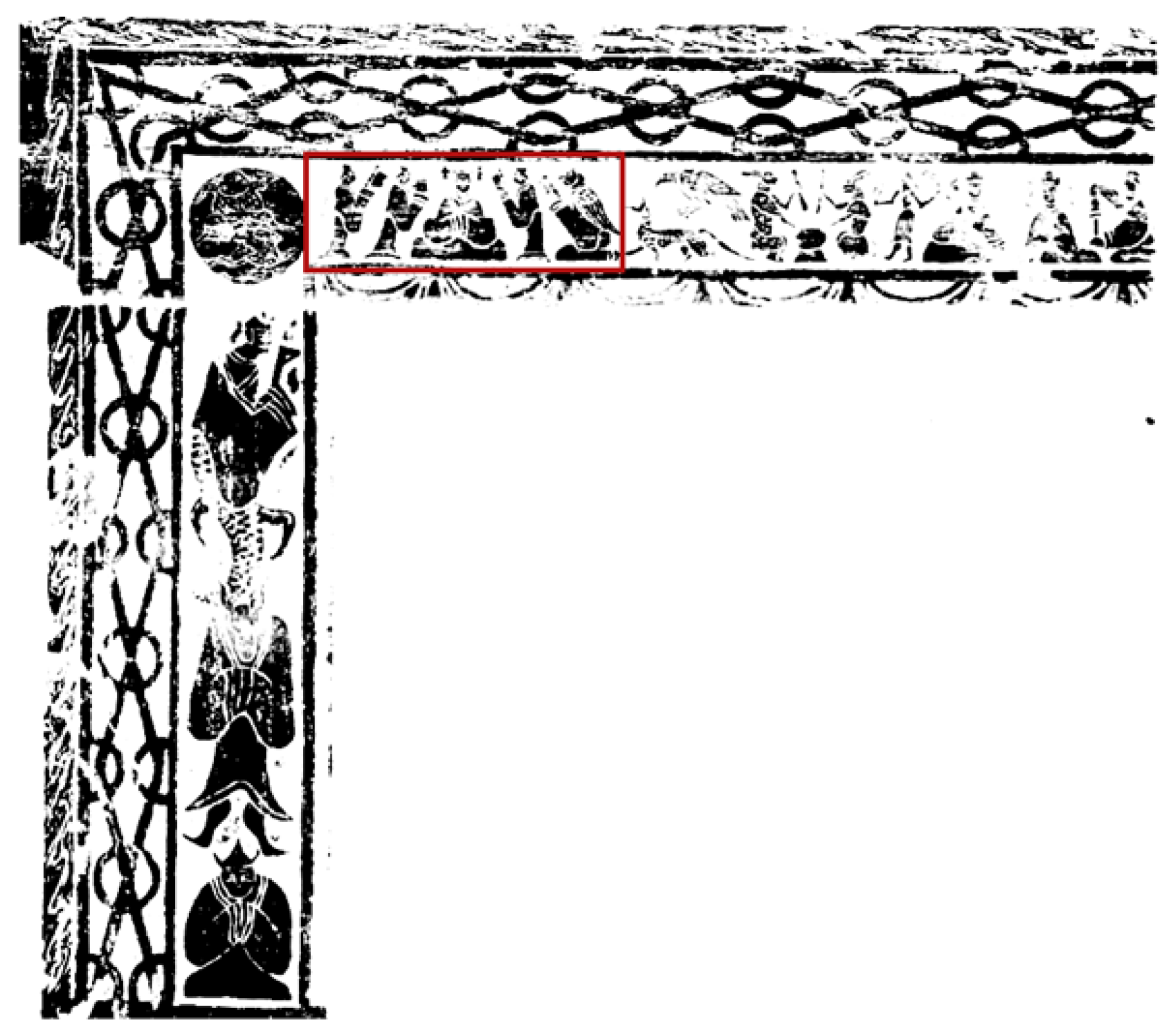
Figure 1. Tianfang tomb in northern Shaanxi, 92 CE. (Red box: imagery of Xiwangmu).
Arts 15 00126 g001
Figure 2. Tomb 2 at Guanzhuang, Mizhi County, during the reign of Emperor An of the Eastern Han Dynasty, 106–125 CE.
Arts 15 00126 g002
Figure 3. (a) Tomb 2 at Mamaozhuang, Lishi County, during the reigns of Emperor Huan and Emperor Ling of the Eastern Han Dynasty, 147–189 CE. (Red box: imagery of Xiwangmu). (b) Tomb 2 at Mamaozhuang, Lishi County, during the reigns of Emperor Huan and Emperor Ling of the Eastern Han Dynasty, 147–189 CE. (Red box: later depictions of Xiwangmu and Dongwanggong).
Arts 15 00126 g003
Figure 4. The tomb of Yangmengyuan at Suide County, 96 CE. (Red box: two sets of mirror-image Xiwangmu figures).
Arts 15 00126 g004
Figure 5. Tomb 2 at Guanzhuang, Mizhi County, during the reign of Emperor An of the Eastern Han Dynasty, 106–125 CE. (Red box: Xiwangmu and Dongwanggong).
Arts 15 00126 g005
Figure 6. Unearthed in Tongshan County, Jiangsu Province, early Eastern Han Dynasty, around 86 CE. (Red box: rooster-headed deity and ox-headed deity).
Arts 15 00126 g006
Figure 7. Tomb 18 at Dabaodang, Shenmu County, later phase of the Middle Eastern Han period. 75–147 CE. (Red box: ox-headed deity and rooster-headed deity).
Arts 15 00126 g007
Figure 8. Tomb 16 at Dabaodang, Shenmu County, later phase of the Middle Eastern Han period, 75–147 CE. (Red box: ox-headed deity and rooster-headed deity).
Arts 15 00126 g008
Table 1. Classification of Xiwangmu Images in the Northwest.
Image FeaturesHeaddress FeaturesCommon Accompanying MotifsDescriptionMain AreasExamples
Xiwangmu accompanied by relatively rich immortal-realm imageryWearing a sheng胜 (a)Multiple immortal realm motifs (jade hare, attendants, nine-tailed fox, huagai, etc.)Accompanied by more immortal realm motifs; stronger sense of sanctity.Most commonly seen in northern ShaanxiDoor pillar stone from Wang Deyuan Tomb (Tang 2000, fig. 72), Huangjiata Tomb 4 (Suide Hanhuaxiangshi Zhanlanguan 2001, fig. 107), Zhaishan Village 1, etc.
Without a sheng, with a transverse ji髻 hairstyle (b)Fewer immortal realm motifs than Type (a); jade hare, attendants, and huagai may appear.Fewer accompanying motifs; tendency toward simplification.Common in northern Shaanxi; rare in western Shanxi.Door pillar stone from Mizhi Tomb 1 (Shaanxi sheng bowuguan and Shaanxi sheng wenguanhui 1972); Huangjiata Tomb 3 (Suide Hanhuaxiangshi Zhanlanguan 2001, p. 149, fig. 80); Wangjipo Tomb (J. Wang et al. 2013, p. 17), etc.
Without a sheng, wearing a mountain-shaped crown (c)Fewer motifs than Type (a); jade hares, attendants, and huagai still appear.Fewer accompanying motifs; tendency toward simplification.Rare in both northern Shaanxi and western ShanxiDoor pillar stone from Haojiagou Tomb (Yulin Shi Wenguanhui and Suidexian Bowuguan 2006, p. 15, fig. 4), Dabaodang Tomb 9 (Shaanxi Sheng Kaogu Yanjiusuo and Yulin Wenwu Guanli Weiyuanhui Bangongshi 2001, p. 79), Xishanyuan Tomb (J. Wang et al. 2013, p. 44), etc.
Image highly simplifiedWithout a sheng, with a transverse ji hairstyleAlmost no motifs apart from the double que towers and huagai.Markedly simplified; immortal-realm motifs greatly reduced.Most common in western Shanxi; almost absent in northern ShaanxiDoor pillar stone from Mamaozhuang Tomb 2 (Y. Liu et al. 1992), Tomb 14 (J. Wang et al. 2013, p. 27), etc.
1 Tang, Zhongguo huaxiangshi quanji 5, fig. 233.
Table 2. Positional Types and Regional Distribution of Therianthropic Deities 1.
TypeOccupies the Central PositionDeities Appearing SimultaneouslyNumber in Different RegionsRepresentative Examples
Subordinate positionNoXiwangmu and Dongwanggong; Fuxi and Nüwa6 groups, all in northern ShaanxiFigure 7
Attendant/guardian positionNoXiwangmu and Dongwanggong4 groups in northern Shaanxi; 4 groups in western ShanxiFigure 9
Principal deity positionYesNo major deity appears together19 groups in northern Shaanxi; only 1 group in western ShanxiFigure 8
1 The full list of cases included in this statistical table is provided in Supplementary Table S1.
Disclaimer/Publisher’s Note: The statements, opinions and data contained in all publications are solely those of the individual author(s) and contributor(s) and not of MDPI and/or the editor(s). MDPI and/or the editor(s) disclaim responsibility for any injury to people or property resulting from any ideas, methods, instructions or products referred to in the content.