3. Description of Items
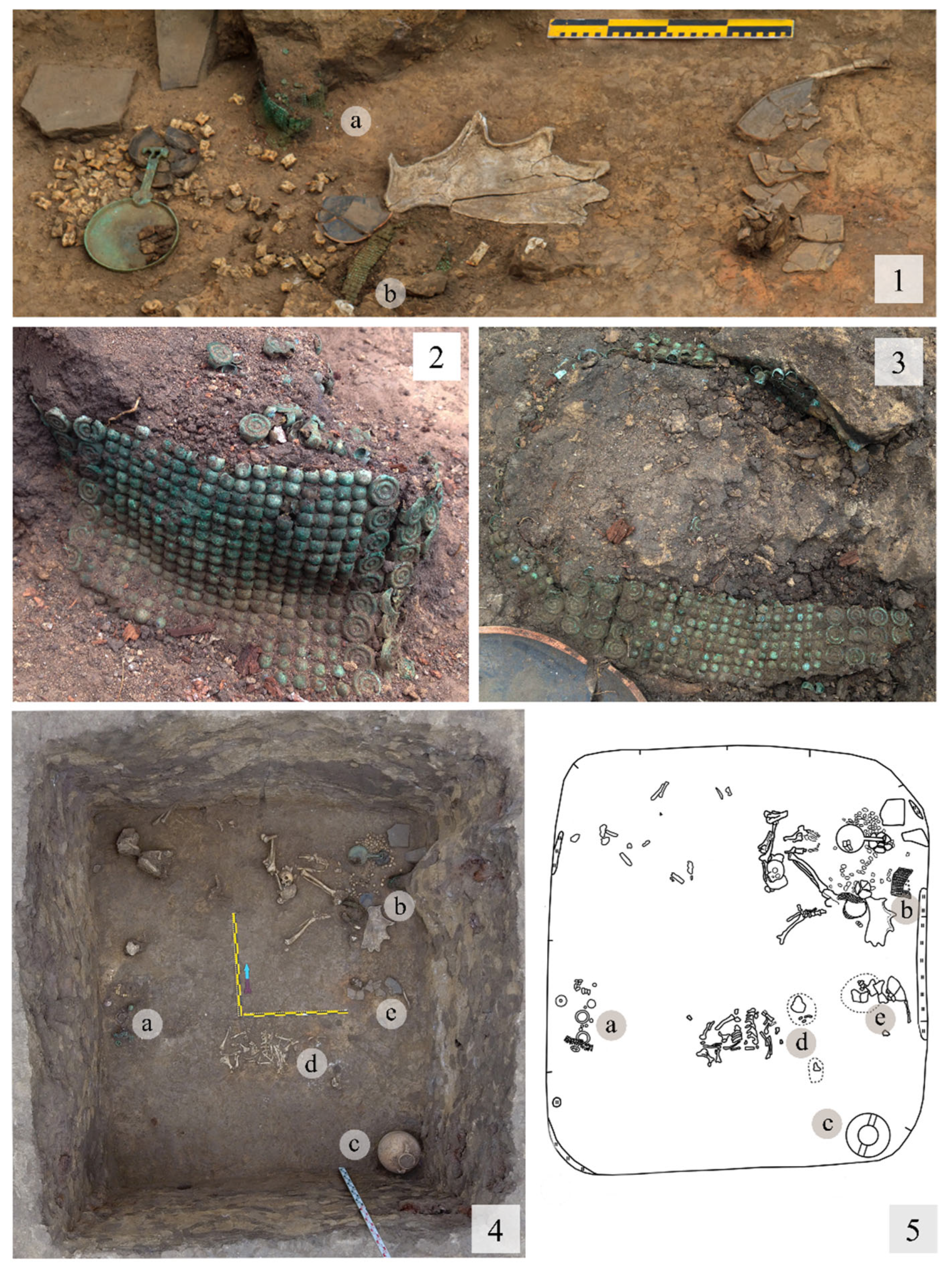
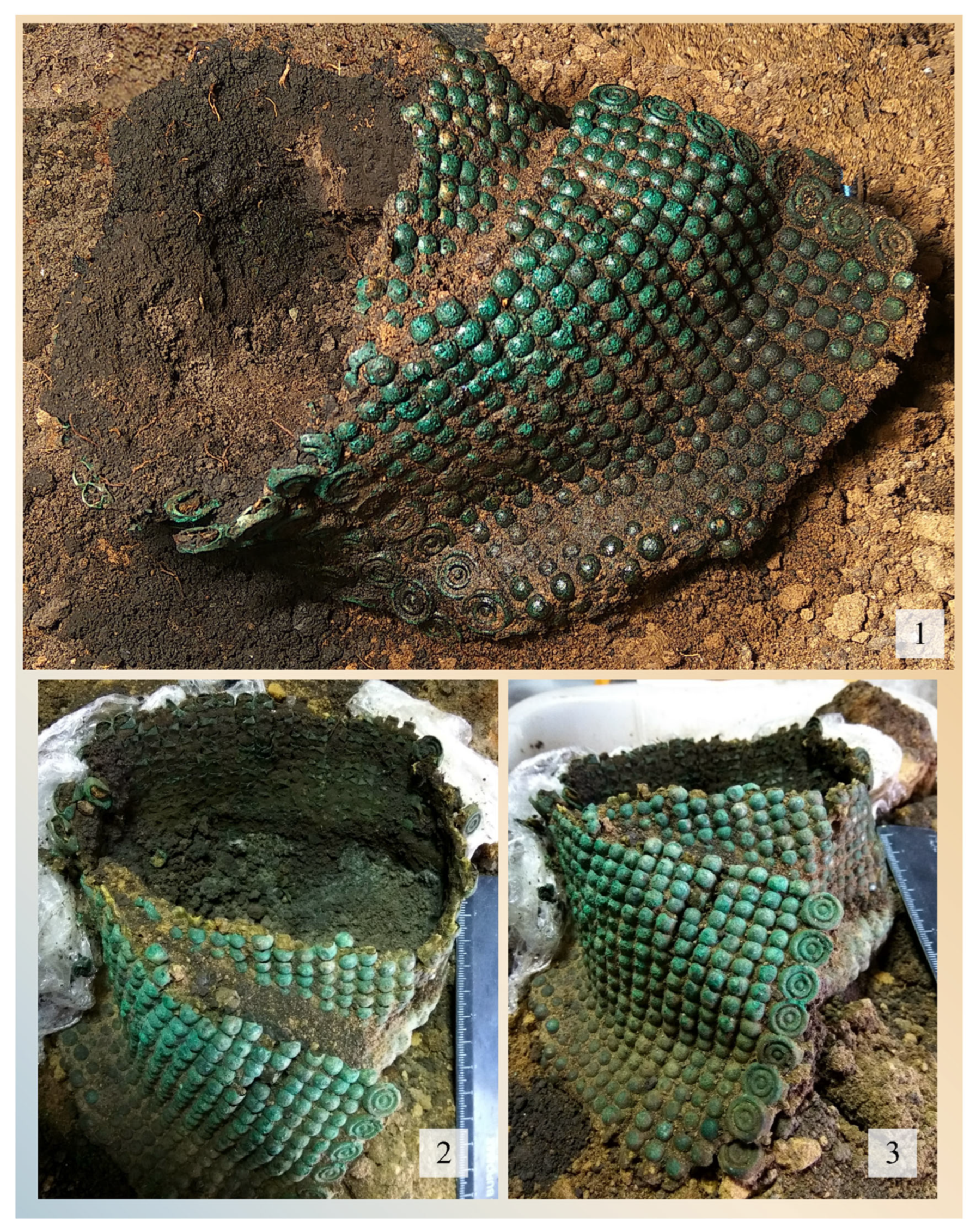
Object no. 13 was found near the eastern wall of the burial chamber, partially covered by collapsed soil (
Figure 2(1a)), rolled up one and a half turns. In this condition (
Figure 2(2)), it measured 20 × 15 cm, with a height of 10–11 cm. After the object and the surrounding soil had been treated with conservation materials, a decision was made to take it out as a single block. Further cleaning (
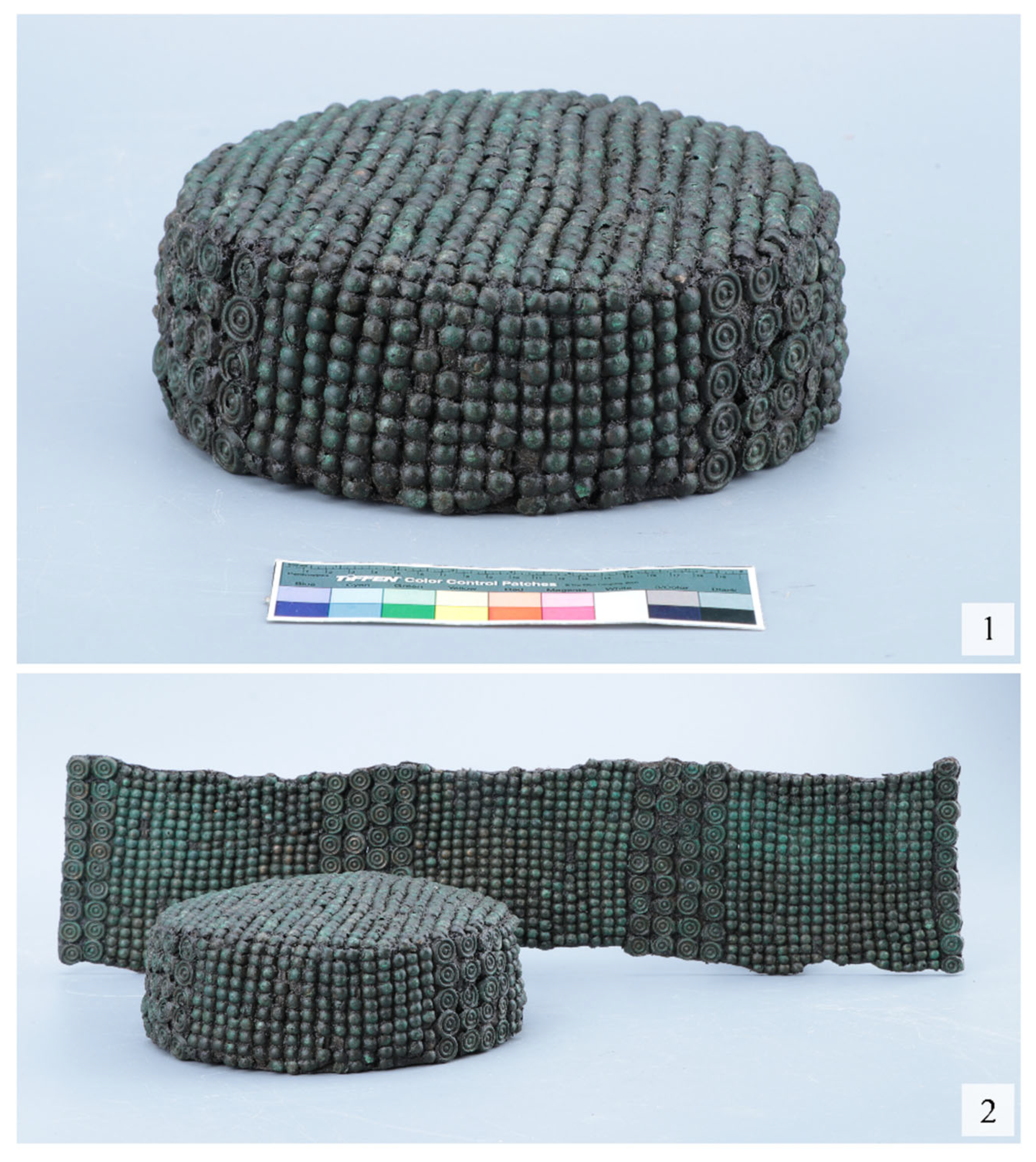
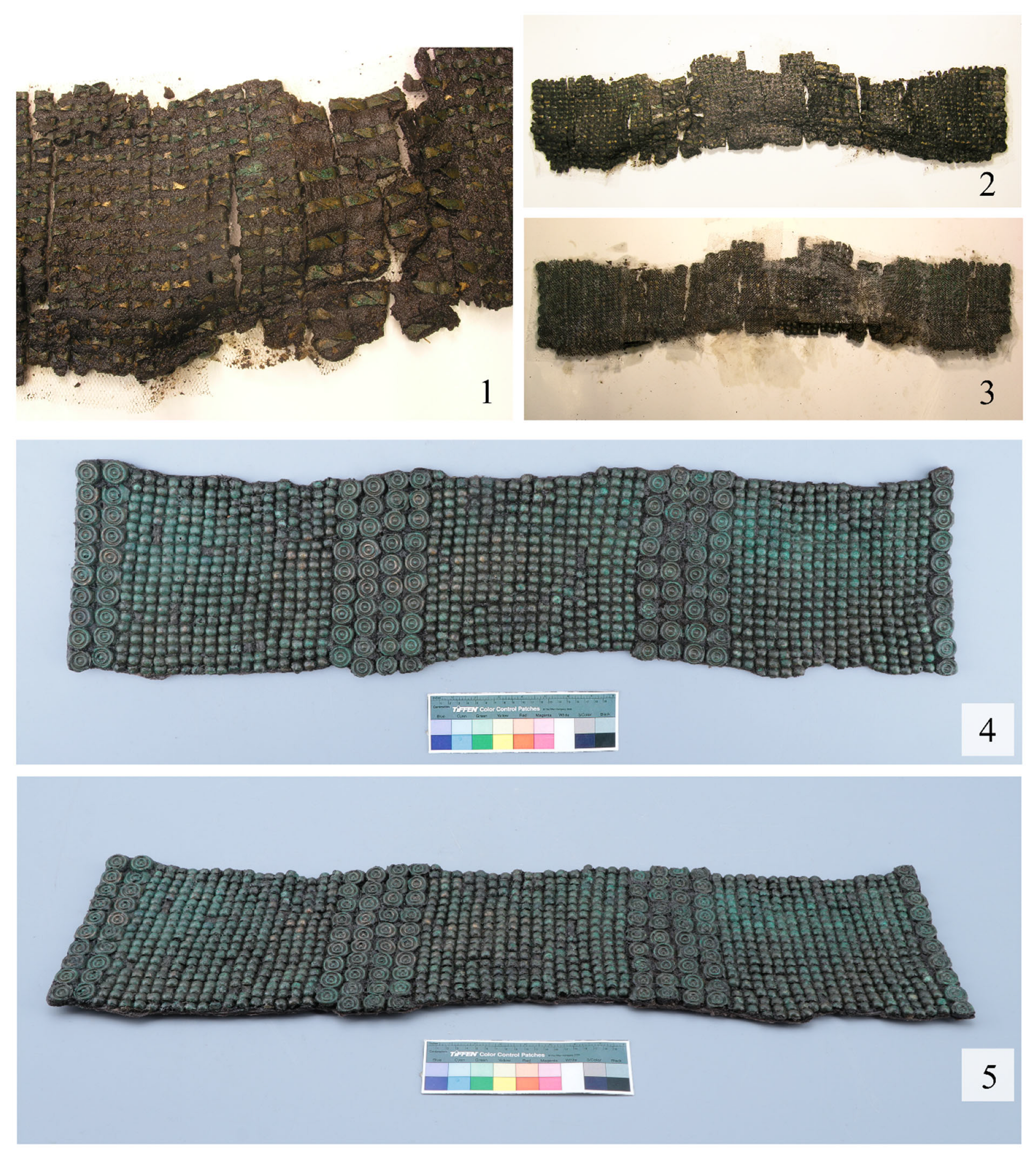
Figure 3(1–3)) revealed that only a fragment of a leather item had been placed in the grave, which, judging by its proportions and length, was a belt (
Figure 4(1–4)). Determining either its original length or the type of fastening is impossible. The preserved part of the item is 44 cm long, with a maximum width of 10 cm. In the course of the study, the initial assumption that the belt has a leather base to which two types of bronze plaques are attached was confirmed (
Figure 4(4,5) and
Figure 5(1,2)).
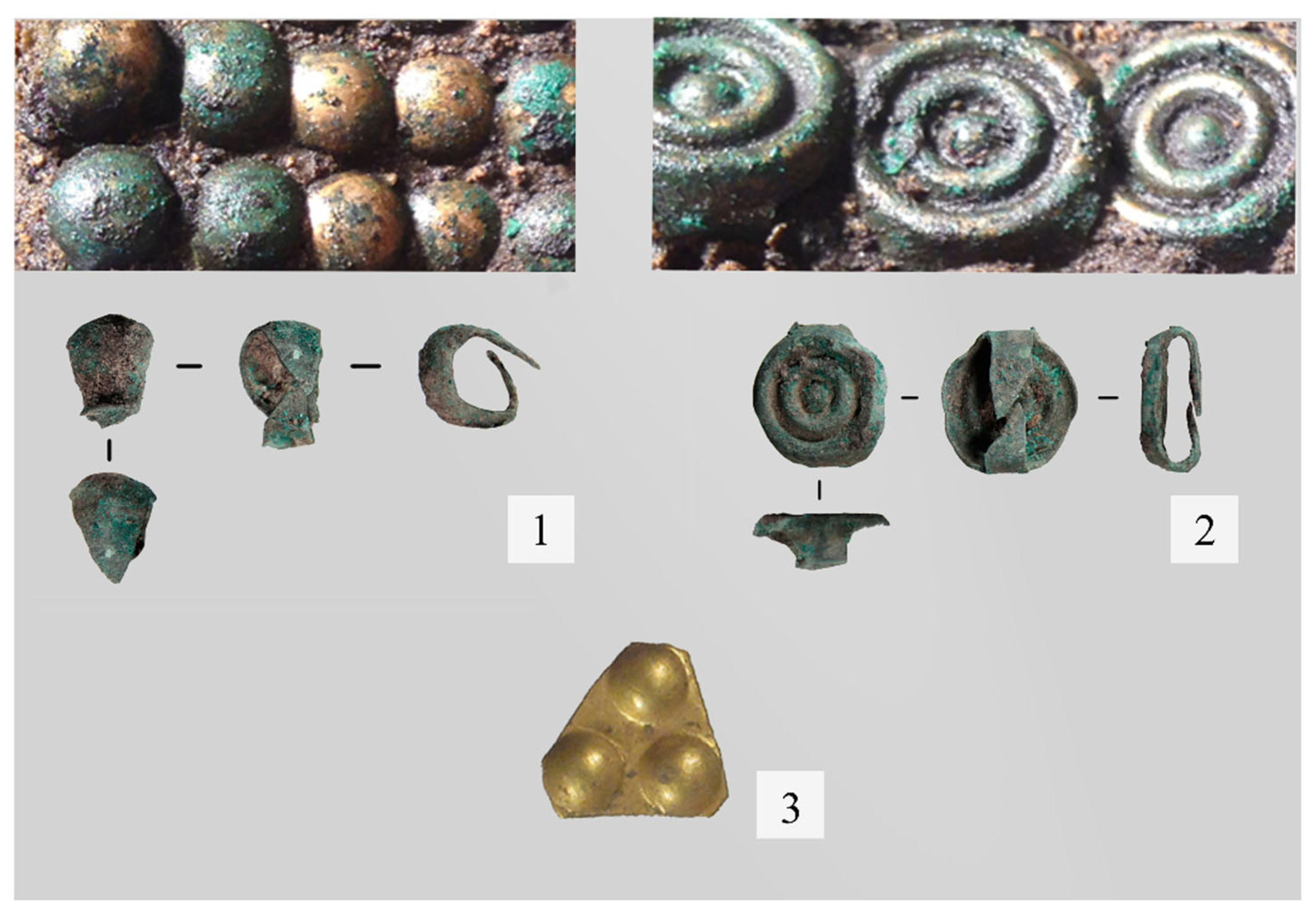
Type 1. Small, hemispherical, smooth plaques, 0.5 cm in diameter and 0.3 cm high (
Figure 5(1)).
Type 2. Larger, flat plaques, circular in plan, 1.0 cm in diameter and 0.3 cm high, decorated with relief concentric circles (
Figure 5(2)).
The fastening system was clearly visible on the reverse side of the item (
Figure 4(1,2)). The plaques were attached to the base in a specific order, in rows forming sectors, by using triangular clamps. Three sectors with small plaques (Type 1) and two sectors with larger plaques (Type 2) were preserved in their entirety. The sectors with larger plaques adjoining the sectors of small hemispherical plaques at both ends survived only partially (one and two vertical rows).
Object no. 24 was likewise found near the eastern wall of the burial chamber (
Figure 2(1b)). At the time of cleaning, the object appeared as a narrow leather strip 5 cm wide, bent into a loop (
Figure 2(3)) measuring 23 × 18 cm, which, like the belt, was decorated with bronze plaques of two types. The integrity of the object had already been compromised in ancient times. Bronze elements covered the entire surface of the item, which is why bronze corrosion products permeated the leather base and protected it from complete disintegration.
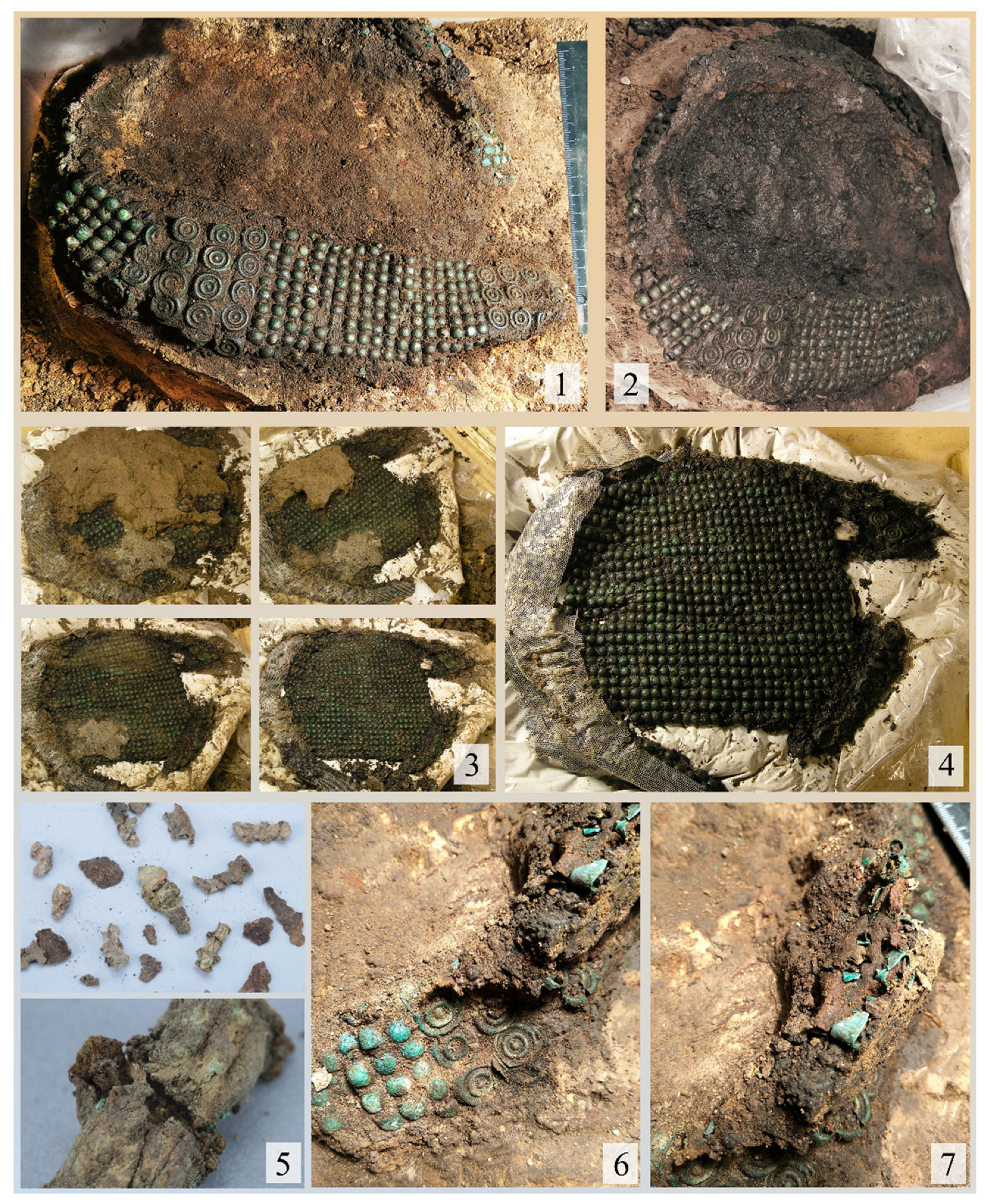
During further uncovering of the object, it became clear that it was better preserved than had been expected during the initial examination. The degree of preservation made it possible to reconstruct its original appearance. Thus, once the artifact had been freed from the undisturbed soil (
Figure 6), it proved to be a leather headdress, which, like the belt, was adorned with the two types of bronze staple plaques described above. As in the first case, plaques of both types were attached to the base in a specific order.
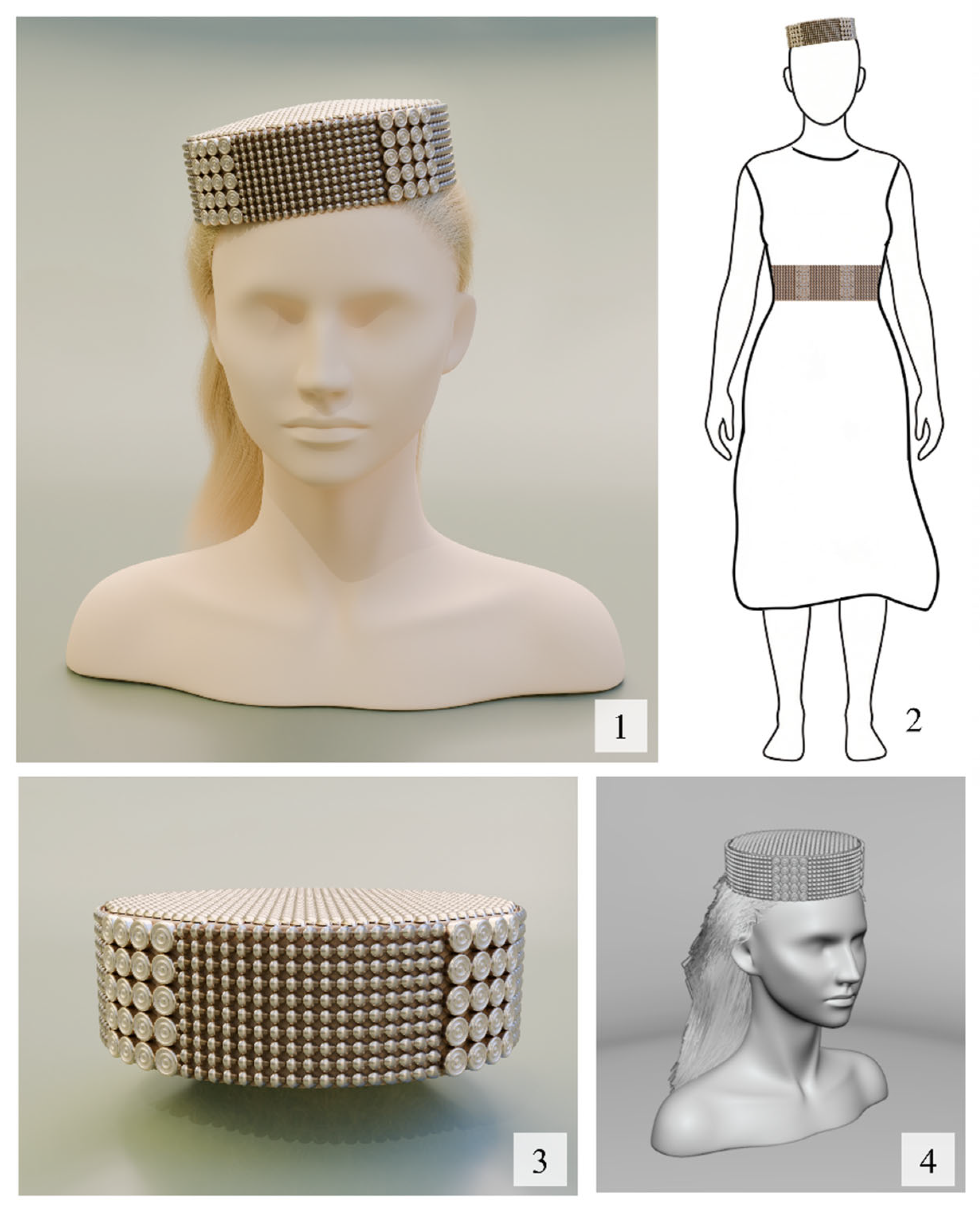
The object is a leather cap with a soft crown in the form of a low cylinder with a flat top, covered with bronze decorative plaques (
Figure 7). The cap had a thin leather lining on the inside, fragments of which were recorded in the course of conservation (
Figure 6(2,5)). The lining not only gave the finished object a neat, presentable appearance and made it more comfortable to wear, but also protected the head from the sharp ends of the metal staples.
The cap had a simple cut and was constructed from two main components: a circular crown top about 16 cm in diameter and a vertical leather strip up to 50 cm long and about 5–6 cm wide forming its side. The cap had no brim; its soft, leather-based top followed the shape of the head when worn, although it was constrained by the overall rigidity of the construction. The top of the crown was covered with continuous parallel rows of plain bronze hemispherical plaques of Type 1 (
Figure 6(4)). The side of the crown was decorated with the two identified types of bronze plaques arranged according to a specific scheme, which imparted a distinct rhythm to the ornament (
Figure 7(1)).
The ornamental panels on the side of the crown are formed by large plaques (Type 2), arranged in rows 4 wide and 5 high. Between the panels, small plaques (Type 1) are attached in well-preserved areas occurring in rows of 17 horizontally and 10 vertically. At the same time, in two areas, the strong fragmentation of the side parts of the crown makes it difficult to specify the exact number of Type 1 plaques, although it may be assumed that there were likewise 17 of them in each sector. Thus, the large plaques formed four sectors, with five plaques in each vertical row and four in each horizontal row. Since the width of the side of the crown is half that of the belt, the numbers of plaques in a vertical row on the two objects stand in a 1:2 ratio, that is, 5 and 10 large plaques, and 10 versus 20 small ones, respectively. Between the panels formed by large plaques on the side of the crown, there are 10 small hemispherical plaques in the vertical direction and 17 in the horizontal direction. During uncovering, it was possible to record not only fragments of the thin leather lining (
Figure 6(2,5)) but also the seams at the junction of the top and side parts of the crown (
Figure 6(6,7)).
Overall, the circumference of the cap was 50 cm, with a crown height of 5 cm and an upper-part diameter of about 16 cm.
The plaques were attached to the leather base of the belt and the cap by means of short triangular fasteners operating on the principle of a stapler (
Figure 5(1,2)). The sharp ends of each fastener pierced the leather base and were then bent inwards toward the center so that their tips touched. The fasteners were clearly visible on the inside of the items (
Figure 4(1,2) and
Figure 6(6,7)), which made it possible to establish the principle of attachment and the manufacturing technique. In particular, it was possible to observe the following:
The use of a broader strip of sheet bronze as the blank for Type 2 plaques;
The shaping of the plaques with punches of different types;
A clearly visible cut line in the metal used to obtain the sharp ends;
For Type 2 plaques, the asymmetry of the ends and their precise meeting at the point of the cut;
The manufacture of Type 1 plaques from a narrower strip of sheet bronze, possibly swaged on a former or pressed out with a punch with a rounded head;
For Type 1 plaques, the symmetry of the projecting triangular ends, which partly overlap with one another (
Figure 4(1)).
5. Results and Discussion
The set of leather items (
Figure 7(2)) found in the grave displays a number of features that align it with the Central European Hallstatt period tradition, which involved the use of individual small plaques to decorate various categories of objects, including clothing, as well as the inclusion of belts and headgear in the funerary costume. Having been deposited among objects that were generally used in various rituals, the cap and belt from the Skorobir barrow may be regarded as elements of ceremonial dress belonging to a woman who was perhaps associated in life with the performance of priestly functions. Moreover, the set, which bears features of traditional costume, may point to the woman’s affiliation with a particular ethnic group. The gold plaque (
Figure 5(3)), which probably came from a funerary headdress and was found in the area of the head, indicates a high social status and membership of the local elite. A gold diadem (
I. Shramko 2024, p. 20, Figure 9) belonging to a young woman buried in the second quarter of the 6th century BC in kurgan no. 2/2019 of the Skorobir cemetery was adorned with similar gold plaques, together with other decorative elements, namely, temporal rings.
Despite the obvious features of the burial rite established during the excavations and the significance of the discovered complex, attributing the leather items found in the grave was difficult because they were not worn by the deceased woman, but lay separately and were not included in the burial costume.
Object no. 1 (the belt) turned out to be only a fragment of a fairly wide leather item, possibly a ceremonial belt (
Figure 4(4)), about 10 cm wide. It may be assumed that some of the artifacts found nearby, such as the gaming set and the bronze mirror, could have been attached to it as ritual accessories.
The tradition of wearing leather belts and including them in the funerary costume was widespread in Hallstatt culture, especially in its western zone. Leather belts similar in design and manufacturing technique to the Skorobir example, decorated with bronze plaques, were popular in the Ha D1–D2 period in southern Germany. In burial contexts, they are usually found in situ, worn on the body, which allows them to be regarded as part of the funerary costume, in most cases by women (
Spindler 1971, Taf. 33: 9; Taf. 40: 1;
1972, Taf. 11–12;
1973, Taf. 17; 3. Taf. 28: 1; Taf. 38: 3; Taf. 42: 1). One of the leather belts discovered in a barrow in southwestern Germany (
Arnold 2012, p. 100, Figure 2) is similar in its decorative style and buckle type to a belt from the grave of an Etruscan warrior of the late 6th century BC near Rome (
Zevi 1993, p. 417, Figure 6;
Lipkin 2014, p. 52, Figure 13), as well as to a leather belt from a barrow in the northern Balkans (
Iapodes 2014, cat. 14), outlining the area of their distribution in the Hallstatt world. However, although they are similar in design (notably the use of a series of small clasp-shaped plaques with hemispherical heads in the decoration), they still display some differences from our specimen, which will be discussed below.
Object no. 2 (the cap) was found with the upper part of the crown facing down, and its side was torn and slightly deformed. Externally, it resembled a narrow belt folded into a loop (
Figure 2(3)), which is why the item was initially also attributed as a “leather belt,” bearing some resemblance to a series of leather belts found in several burials in the West Hallstatt region, which served as the basis for the hypothesis of the advancement of nomadic Scythians in the mid-6th century BC far to the west of the Hallstatt world, their participation in the defeat of the Heuneburg settlement, and their return to the Dnipro Left Bank, with trophies found in the burial of a participant in these campaigns in the third quarter of this century (
Grechko et al. 2020, pp. 55–59;
D. Grechko 2021, p. 23). However, in the course of further study of the artifact, new evidence that disproved the initial interpretation emerged. The upper part of the crown (
Figure 6(3,4)) was revealed by the restorers beneath a layer of natural clay, which is why it became clear that object no. 2 had a different functional purpose and in fact represents a closed cap of a Central European type (
Figure 7(1)), a headgear tradition that is not known in the western Hallstatt zone. It thus became apparent that the place of manufacture of the headgear in question should be sought further to the east, probably in those parts of the Hallstatt world where not only such a tradition existed but whose cultural links can be demonstrated for the tribes of the forest-steppe Scythia in general and the Bilsk fortified settlement in particular, also on the basis of other categories of finds (
Shramko and Zadnikov 2021, pp. 121–31).
Currently, researchers of the Hallstatt culture have traced certain features of the use of decorative clasp-shaped plaques to adorn objects of material culture. Thus, in the territories north of the Alps, in the early period (Ha C periods), plaques–brackets were used primarily to decorate carts and horse bridle parts (
Trachsel 2004, p. 440). In the later period, in Ha D, small bronze plaques–brackets were more often used to decorate belts, combining these elements with various types of clasps, which were usually made of sheet bronze.
South of the Alps, in the southeastern Alpine zone in the Ha C period, small bronze plaques of geometric shapes with various types of fastenings (clasp, loop, pin) were used exclusively to decorate clothing, primarily headgear, dresses, belts, and helmets (
Škoberne and Šoln 2001, figure on p. 8;
Tecco Hvala 2017, pp. 167, 251, Pl. 24: 4, etc.). Subsequently, in a number of cases, the applied decorative elements were replaced by punched ornaments (
Balen-Letunić 2004, p. 232, Figure 13; p. 242, Figure 20). In Croatia in the 7th–6th centuries BC, women’s headgear made of bronze rings or of thin bronze sheet decorated with punched ornaments was particularly popular (
Iapodes 2014, cat. 20–21, 24;
Bakarić 2017, cat. 39-40).
In the Dolenjska region, in the Sava river basin, a group of female burials of the Ha C and Ha D1 periods has been distinguished, characterized by gold ornaments, as well as gold plates and plaques of various shapes that adorned the funerary costume, in which headgear occupied a particularly important place (
Guštin and Preložnik 2005, pp. 120–23)
. One of the most striking complexes is the high-status burial of a “princess” in the Stična barrow (Slovenia), dating to the Ha C2 period (
Helmuth-Kramberger 2015, p. 146, Figure 3; pp. 154–57, Figure 12); the finds from this grave, together with the various gold ornaments and cult objects recovered from other burial complexes in the Dolenjska region (
Guštin and Preložnik 2005, pp. 115–19, Figure 4), point to the prominent role of women in society and their belonging to the local elite and priestly stratum (
Guštin and Preložnik 2005, p. 115). Thus, within Central Europe, burials with women’s headgear in the Ha C and Ha D1 periods are known exclusively from the southeastern Alpine zone.
In the territory of forest-steppe Scythia, burials of women of high social status, whose burial attire included headdresses decorated with several types of gold plaques, belong to the Early Scythian period and are dated to the first half of the 6th century BC (
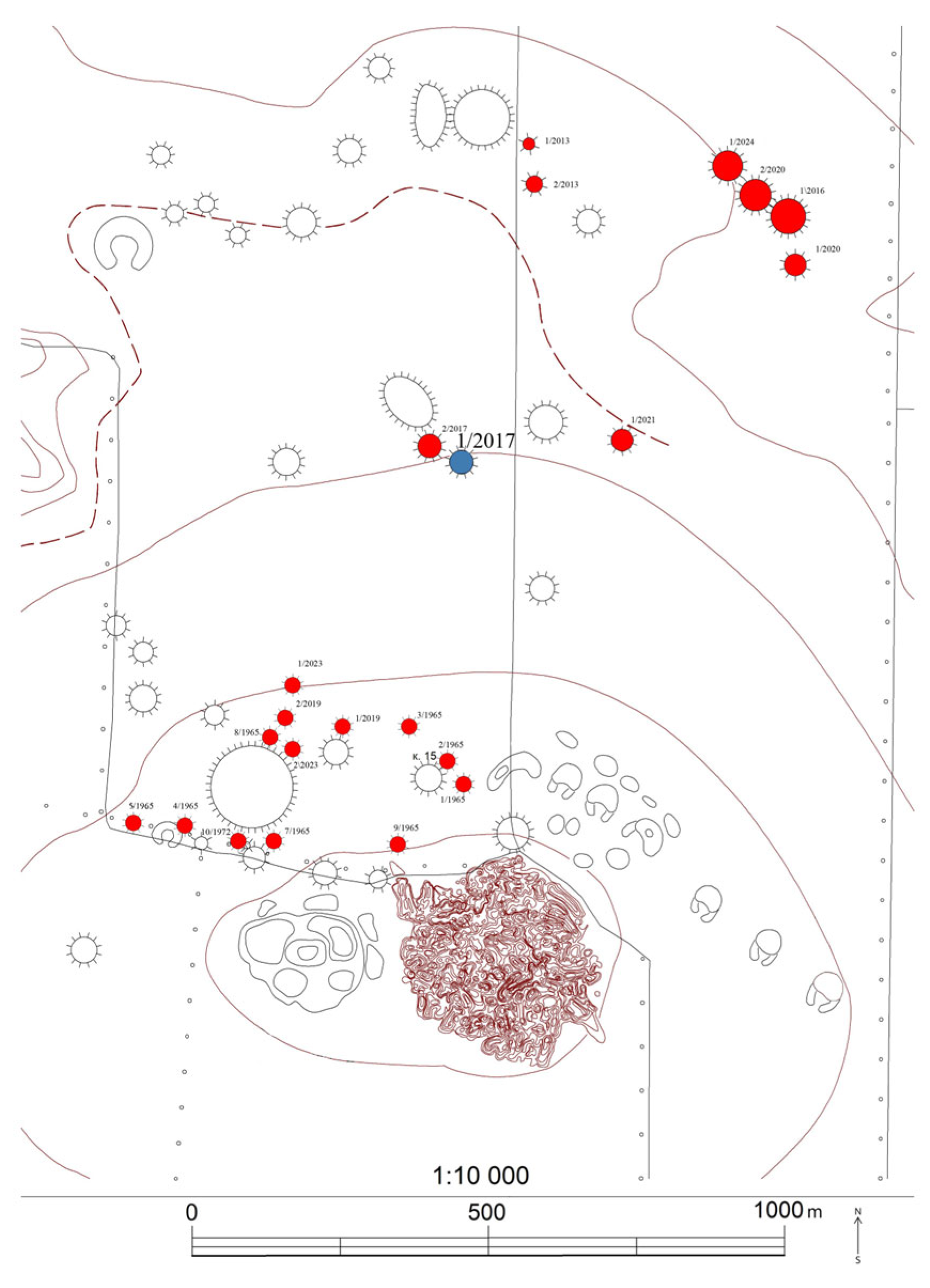
I. Shramko 2024, pp. 24–25). A female burial discovered in burial mound No. 1/2017 demonstrates that even in the second half of the century, women continued to occupy a high position in local society, being involved in the sacred sphere of its life.
Both leather items found at Skorobir share the same archaeological context and are executed in the same style; thus, they undoubtedly represent a single set of women’s clothing (
Figure 7(2) and
Figure 8(2)). A distinctive feature of its decorative technique is the use of small bronze clasp-shaped plaques of two types, attached to the leather base in a specific arrangement (
Figure 4(4,5);
Figure 6(1);
Figure 8(3,4)). This method of attachment is not attested in forest-steppe Scythia; however, already in the early Scythian period, there is a tradition of adorning funerary vessels and headgear with gold geometric plaques of various shapes, such as groups of three circles, triangles with hemispherical bosses, and flat round “checker-piece” plaques (
Daragan 2011, pp. 604–15;
I. Shramko 2024, p. 23, Figure 11). The emergence and spread of this fashion for decoration in the forest-steppe have been linked by scholars to the influence of eastern Hallstatt traditions, in particular to sites of the Eastern Alpine region and to the Dolenjska group (
Fialko 2006, pp. 70–72;
Daragan 2010, pp. 96–99;
Shramko and Zadnikov 2021;
I. Shramko 2024, p. 145).
In the areas occupied by the Hallstatt culture in the Ha C–Ha D periods, the use of rivets with convex round heads to decorate a range of objects is well attested, as are combinations of small plaques of geometric shapes (triangles, groups of three circles, “chequer-pieces,” and others) attached to the base in various ways (by loop, pin, clasp, threaded fastener, or applique), whereas in Scythia, decorative plaques, usually made of gold, were applied to the base and fixed with an adhesive mass or sewn on, without employing fastening systems such as clasps or staples. The cut of women’s headgear was also different: Reconstructions suggest felt caps similar in shape to Scythian bashlyks (
Miroshina 1977, pp. 79–94, Figure 3;
Klochko 1986, pp. 21–43;
Klochko 2008, Figures 1 and 2) or diadems (
Klochko 1982, pp. 37–39;
I. Shramko 2024, p. 21, Figure 10), while a belt as an element of the funerary costume is not attested.
Thus, both leather items from barrow no. 1/2017 of the Skorobir necropolis not only differ from the women’s garments known in Scythia but also exhibit a different decorative principle. Their finish employs a large number of small staple-like plaques and a particular method of attaching them to the base, which is unknown in the Scythian world but is quite common in the Hallstatt sphere.
The ornamental field is divided into several sectors. Two types of bronze staple plaques were used to decorate the belt and cap (
Figure 5(1,2)).
Staple plaques of the first type resemble in the shape of their heads the widely used Hallstatt-period rivets that were employed on a large scale to decorate various objects, including items of clothing. Such plaques were used in the decoration of helmets (
Škoberne and Šoln 2001, figure on p. 8;
Tecco Hvala 2017, pp. 167, 251, Pl. 24: 4) and leather belts (
Iapodes 2014, cat. 20–21, 24;
Bakarić 2017, cat. 39-40). Bronze plaques possibly belonging to a woman’s costume from grave 17 at Im Riede-Ost, dated to Ha D1b in Bavaria, are similar in appearance to our specimens (
Hoppe 2005, Taf. 4). Closer typological and chronological parallels for the Skorobir pieces can be drawn with bronze staple plaques from the burial complex of Rovná (Southern Bohemia), dating to the Ha D/La 1 period, which represents the easternmost point of distribution of staple plaques in Central Europe. However, these have been interpreted by researchers as ornaments from bridle straps (
Chytráček et al. 2015, Abb. 10: 1–4, 13–22, 27–29). More recently, bronze staple plaques, including examples similar to ours in shape, design, and method of attachment but somewhat larger in size, were discovered in a hoard of the Ha D period at Hastrup in central Jutland (
Felding et al. 2026, pp. 3–4, Figure 4; p. 8–9). This assemblage included small bronze plaques with smooth convex heads (rivets) and staple-type fittings, for which analogies are known even beyond the Hallstatt culture, at sites of the Lusatian culture and the Nordic Bronze Age culture, and in one case, they decorated a fragment of a belt (
Felding et al. 2026, p. 2, Figure 2; pp. 7–8, Figures 5 and 8; Figure 7: 14–18).
In addition to their flat circular shape and the presence of triangular prongs, a distinctive feature of the Type 2 plaques is the decoration of the head with raised concentric circles. For the decoration of clothing, similarly designed plaques with various fastening systems were popular in the Ha C2–Ha D1 periods in the southeastern Alpine zone, in the region of Lower Carniola. They were used to adorn women’s headgear and could appear as individual “chequer-pieces” decorated with concentric circles, as “buttons”, or as triple arrangements of concentric circles. The gold diadem of the “princess” from the well-known grave 27 in barrow 48 at Stična (Slovenia) was decorated with plaques in the form of triple circles (
Helmuth-Kramberger 2015, Figure 12: 3). Direct analogies for the Type 2 bronze staple plaques in the context of a women’s funerary costume are not yet known; however, such plaques have been recorded at sites of the Lusatian culture and in the Ha D-period Hastrup hoard (
Felding et al. 2026, p. 2, Figure 2; pp. 7–8, Figures 5 and 8; Figure 7: 13).
The discovered leather items form a single outfit that was produced in one and the same workshop. Small plaques of similar types were used solely to decorate headgear and belts in the southeastern Alpine zone, whereas in the rest of the Hallstatt world, they served mainly to adorn wagons, horse harnesses, and women’s belts. Therefore, it is evident that the southeastern Hallstatt periphery is the most promising area in which to seek the origin of our set.
Another argument in favor of a southeastern Alpine origin for our set of leather items is provided by the genetic study of bone samples from the woman buried in barrow no. 1/2017. DNA analysis
6 indicates her central–southern European genetic roots, close to those of the Early Iron Age population that presumably inhabited the territory of present-day Croatia.
If we turn to the history of dress in this region, we see that the national headgear of modern Croats is the “Lika” cap (
Kolak and Rogić 2013), whose cut is similar to the cap from barrow no. 1/2017 of the Skorobir necropolis. With reference to the analyzed archaeological material and available ethnographic data, we created a 3D model of the headgear (
Figure 8(1,3,4)) and demonstrated the position of the leather set within the ensemble of women’s costume (
Figure 8(2)).
The history of this headgear may be connected with the cultural traditions of the ancient Iapodes, who in the Early Iron Age inhabited the mountainous areas of present-day Croatia (
Iapodes 2014). The cultural tradition of this people is characterized by the use of several types of headgear, including forms decorated with small bronze plaques of various types and with punched designs imitating such plaques (
Iapodes 2014, cat. 13–17). Two points deserve particular attention here. First, the headgear made in the form of a broad plate resembles the lateral part of the crown of our cap. Second, the punched pattern on some of them—for example, on the headgear from grave 169 at Kompolje (Croatia)—is divided into sectors in a way that is comparable to the designs on the belt and cap from Skorobir. This example may point to a similar underlying idea in their decoration and serves as indirect evidence that the Skorobir set could likewise have been produced in one of the workshops in this region, to which the woman buried in barrow no. 1/2017 was possibly linked by descent.
It is also significant that the Iapode women’s costume included a wide sheet bronze belt, decorated—like the headgear—with punched ornaments that imitate earlier domed nail-head plaques, “which makes it plausible to assume that these were worn together with the caps, forming a harmonious unit of a picturesque costume” (
Balen-Letunić 2004, p. 237, cat. 31.3). Broad belts are likewise depicted on female clay figurines from Cult Location I of the Turska Kosa necropolis (Topusko Group, Colapiani community) in central Croatia (
Balen-Letunić 2004, pp. 22–31, 185–87, cats. 17.2, 20.4).
Moreover, over many centuries, the Carpatho-Danubian region played an important role in the historical and cultural development of the forest-steppe territories east of the Carpathians, whose cultural profile was significantly shaped by periodic migration flows, direct contacts, networks, and influences, as well as by the influx of imported objects and the circulation of new ideas (
Kashuba 2000, pp. 140–47; 2012, pp. 241–44;
Fialko 2006, pp. 70–72;
Daragan 2011, pp. 97–98, 616–17, 759–60;
Bandrivsky 2014, pp. 404–15). The emergence and development of the Bilsk hillfort over the course of two centuries, beginning in the last quarter of the 8th century BC, were closely connected with these processes (
Kashuba 2012, pp. 246–47;
I. B. Shramko 2006;
2013, pp. 135–36). In the material of the 6th century BC, links with cultural groups of the southeastern Alpine zone can be traced (
Shramko and Zadnikov 2021;
I. Shramko 2024). It is evident that the woman buried in the barrow did not belong to the nomadic population but was part of the local elite engaged in the sacred sphere of life of the sedentary communities of the Dnipro Left Bank forest-steppe, who used her traditional costume in ritual practices, possibly as an heirloom of her lineage. The part of the Central European region under discussion was located away from the routes of nomadic raids (
Bruyako 2005, pp. 254–56, Figure 66;
Chochorowski 2013, p. 61, Figure 4;
Grechko et al. 2020, p. 56, Figure 1;
Filipović 2015, p. 90, Figure 1; p. 95); thus, it may be assumed that the young woman arrived at the Bilsk hillfort with one of the groups of incomers. The presence of these groups at the site is traceable in a wide range of material culture, which includes not only imported objects but also local imitations (
Shramko and Zadnikov 2021, pp. 124–26).
The new evidence obtained in the course of studying the finds makes it possible to discard the initial hypothesis that both leather items were belts brought to the Bilsk hillfort by a nomadic Scythian as war trophies. One of the arguments in favor of this conclusion was the absence of similar items at intermediate sites between the western Hallstatt region, where they have exact analogies, and Bilsk (
Grechko et al. 2020, pp. 55–56). However, the following points need to be raised:
First, as elements of traditional costume, the leather garments decorated not with gold but with bronze plaques are unlikely to have been attractive to a nomadic warrior.
Second, although the idea of decorating straps, including belts, with bronze hemispherical staple plaques was widespread in the Hallstatt world and is also attested in northern Europe, exact analogies for our set are not known.
Third, because one of the items is a piece of headgear (a cap), the origin of the set (belt and cap) cannot be linked to the western Hallstatt area, where caps are not found in burial contexts at all. In this region, staple plaques of the “chequer-piece” type (type 2) were not employed in the decoration of objects, whereas they are known from the eastern Hallstatt zone and the southeastern Alpine area, as well as from sites in northern Europe and within the Lusatian culture.
Fourth, the genetic profile of the buried woman, together with the ethnographic parallels, demonstrates that the outfit was made in the tradition of the population of ancient Croatia, a region where only isolated sites with Scythian-type objects are known (
Teržan 1998, p. 524, Abb. 8: 4–6). However, material from Bilsk dating to the 8th–6th centuries BC clearly attests to cultural links between the settlement and the Carpatho-Danubian region, the Eastern Hallstatt zone, and the southeastern Alpine region. The Central European-type plaques we have identified above occur only in the territory of forest-steppe Scythia, where links with the Hallstatt world can be traced back to the Late Bronze Age.
The analyzed materials also show that the social and ethnic composition of the inhabitants of the Bilsk hillfort was quite complex. Its barrow necropoleis contain the remains of representatives of various groups of the local aristocracy with diverse origins (nomadic Scythians and sedentary populations). Among this local elite, women held a high social status throughout the archaic period.
6. Conclusions
The western vector of cultural contacts of the Bilsk hillfort remained predominant for two centuries, from the last quarter of the 8th century BC to the end of the 6th century BC.
This vector involved not only the inflow of imported goods but also complex migration processes, as a result of which bearers of the Middle Hallstatt Basarabi cultural complex founded, in the last quarter of the 8th century BC, an entire network of settlements east of the Dnipro in the basin of the Sukhaya Grun River (a tributary of the Psel) and the middle Vorskla (a tributary of the Dnipro). The Balkan–Danubian center of cultural genesis emerged as the principal hub and source of cultural influence, the spread of innovative ideas, and the reception of Hallstatt traditions. The features of the material culture of the Bilsk hillfort and its necropoleis from the last quarter of the 8th to the end of the 6th century BC clearly demonstrate contacts and links with this area of the Hallstatt world. This western vector of cultural influence—reflected in tableware, cult buildings, types of iron tools, bronze ornaments, and decorative elements of funerary costume and vessels—became perceptible across forest-steppe Scythia from the third quarter of the 7th century BC and was reinforced by trade links with Greek centers in the northern Black Sea region such as Berezan and Olbia, which retained priority in commerce over several centuries. The Scythian cultural component is attested from the last quarter of the 7th to the first quarter of the 6th century BC and is expressed in a relatively stable assemblage of artifacts, above all items decorated in the animal style, a characteristic range of weapons and horse harness fittings, supplemented by imports from the Near East and objects of Caucasian and Central Asian origin.
The grave inventories of the Bilsk necropoleis typically include a standard set of locally made pottery, more rarely ancient imports, elements of horse harness often decorated in the Scythian animal style, weapons of Scythian types, mirrors, and a stone dish or slab. Central European imports are rare, which is why the Central European leather set discovered in barrow no. 1/2017 among sacral objects (mirror, gaming set, stone slab, antler dish, and others) was a sensational find. As parts of a woman’s costume that are uncharacteristic of the Scythian population, the belt and cap have enabled a number of important refinements to our understanding of Bilsk’s links with the Hallstatt world, of the composition of the local population, and of the formation of the local elite. Moreover, because the leather artifacts decorated in the Hallstatt tradition with bronze staple plaques were well preserved, identifying a previously unknown type of European women’s headgear has been possible for the first time. DNA analysis of the skeletal remains has helped narrow down the probable place of manufacture of the set to the territory of Croatia, where the Iapodes lived in the Early Iron Age and with whom the buried woman was probably genetically affiliated.
An additional, indirect argument in favor of this interpretation is the external similarity and cut of the cap to the traditional “Lika” cap of the population of modern Croatia. The absence of evidence of military activity by nomadic Scythians in this region does not allow the finds to be associated with their campaigns in Central Europe. The discovered belt and cap may instead be regarded as a traditional costume that belongs to the lineage of the buried woman and brought to the hillfort by one of the migrant groups from the West. Belonging to the local elite as a descendant of migrants, the young woman occupied a special position in the community, possibly as a member of the priestly stratum.
The burial in barrow no. 1/2017, dated to the last quarter of the 6th century BC, can therefore be placed alongside the previously discovered graves of priestesses in the Skorobir necropolis, whose headgear was adorned with gold plaques, and it significantly extends the chronological span of elite women’s burials in forest-steppe Scythia, whose upper limit may now be set in the last quarter or the very end of the 6th century BC.