2. Discussion
While Robertson’s hospital room serves as a useful metaphor for work on damage and healing alike, decolonization itself is not a metaphor. Eve Tuck and K. Wayne Yang’s “Decolonization is Not a Metaphor” (
Tuck and Yang 2012) has useful activist edges in the literature classroom, especially when considering decolonial pedagogies. Tuck and Yang make it clear that the question of land itself exceeds liberal recognition and that symbolic strategies can be tools in the settler arsenal for critics as well. There is no easy innocence in white settler criticism of the work of a Cree writer. There can, however, be respectful contributions in creative and engaged forms.
Inclusive education is an aspirational goal that is easy to talk about but hard to reach. It is a pedagogical strength to acknowledge that difficulty at the start of a semester. One direct and respectful approach to disability inclusion in the classroom is simply to ask what people want to see and hear about, in an area that is often intimidating to students. This is easier for me because of my own complex embodiment, as I am physically disabled and willing to talk about it. I also have a degree of faceblindness (prosopagnosia), something that is more common on the autism spectrum but that people can be born with or ‘injured into,’ and I am willing to talk about that, too. In my own very personal discursive terms, the engaged classroom starts with openness and tries to stay open about both lived realities and academic expectations. Disability justice itself, which includes issues such as underfunding, becomes part of course planning. All of these things land well on Robertson’s brief short story “Perfectly You.”
“Perfectly You” is set in a hospital room, a static environment. There are three points to make in and about this story’s blank space: 1. Spatial transitions are in themselves more important than the word-based thinker comprehends, ways that are often overlooked by the neurotypical teacher; 2. medical spaces can usefully remind students and professors alike that doctors do not know everything and that listening is important work; 3. the hospital room is a settler space, funded by the government, so pedagogically, how blank is blank? On this point, in the classroom, I point readers to work done by Sebastian A. Srugo, Christina Ricci, Jennifer Leason, Ying Jiang, Wei Luo, Chantal Nelson and the Indigenous Advisory Committee comparing disparities in primary and emergency health care amongst Indigenous and non-Indigenous females in Canada (
Srugo et al. 2023).
Turning to the story itself, in this story, Emma, who is Cree, goes to a medical office, where she tells a psychiatrist about meeting Cassie once at a coffee shop, someone she really liked but never called. Emma arranges for a medically induced “dream” to see Cassie again. She goes to a “similar” room, or maybe the same room, for the dream. Things seem to go wrong, with Emma screaming and waking up 68 years later. But Cassie has visited her in the hospital in her coma. Cassie also had a wife who died of old age when Cassie finally talks to an awake Emma. Emma dies of old age, with Cassie, who has learned some Cree words, there in the room. In fact, the ‘real’ experiment starts at 10:34 and ends at 10:36. Emma dies in the dream world, wakes in real life, and is fine. She still does not call Cassie.
For my own teaching purposes, I use this short story to make the classroom a queer-friendly environment, to talk about the collapse of time as a common science fiction plot structure. It is also an opportunity to bring in critical disability studies through the late-age, geriatric-care hospital scenes for Emma, who dies in the hospital in her fantasy-space old age. Just as a technician is smarter and nicer than a doctor early in the story, the nurses and staff are smart and proactive toward the end of Emma’s life and help her to finally reach out to Cassie and to work through her relationship fears by talking about them at last. Cassie had a marriage to another woman, which lasted until that woman died. So same-sex marriage is real, in this fantasy-space, and lasts until death; “Perfectly You” offers possibilities for same-sex forever love and for mutual support through illness and ‘care work’, to use Leah Lakshmi Piepzna-Samarasinha’s phrase from
Care work: Dreaming Disability Justice (
Piepzna-Samarasinha 2018). In
The Future is Disabled: Prophecies, Love Notes, and Mourning Songs, Piepzna-Samarasinha self-describes as “one of many late-realized autistic people for whom my autistic community was the #ActuallyAutistic hashtag and autistic Instagram, years before I had autistic friends” (
Piepzna-Samarasinha 2022, p. 41). In a class open to ideas from critical disability studies, it is pedagogically important to prioritize the academic work of people writing from
within disability communities. Piepzna-Samarasinha is “a queer femme sick and disabled Sri Lankan/Irish/Roma writer, performance artist, educator, and hellraiser,” (
Contractor 2017) who is also a Lambda and ALA Stonewall Award–winning author. It matters that the author occupies multiple positions at once. Books and stories are community-building tools, as well as classroom-building tools, and “[b]ooks are a particular kind of disability justice organizing tool” (
Piepzna-Samarasinha 2022, p. 42).
While queer love and care work are my own teaching priorities for this short story, every short story has a different life in the mind of a new student, and creative reading assignments make that clear in fresh ways, ways that can remain respectful and conciliatory. To use Eve Tuck’s phrase from her letter “Suspending Damage: A Letter to Communities” in the Harvard Educational Review, this visual thinking project suspends damage and turns to “recognizing complex personhood,” turning the short story into a space for resistance of expectations (
Tuck 2009). This particular project ends with an emphasis on being one’s authentic self, as does Robertson’s resistant heroine Emma. Robertson’s story starts with the line “Emma was in a room that explicitly reminded her of a hospital” (
Robertson 2016, p. 38). This project uses tools and skills that already exist to move beyond stock hospital rooms, inspired by the work on the arts-based and creative participatory storytelling of Carla Rice, Eliza Chandler, and Nadine Changfoot in “Imagining Otherwise” (
Rice et al. 2016).
In the classroom, the base tool for an assignment like this is a short story, which the student then picks through in a mind-mapping process, selecting an arbitrary number of scenes as verbal cues to become visual scenes. It is important to discuss the visual approaches that the student desires, trusting that the student has creative ideas of their own, which they do, though they may not have confidence in them. It is ideal to pick a process with which the student is already familiar, e.g., comics for a comics artist, PhotoVoice for a documentary-minded student, artistic photography for someone who already has an existing praxis, paints work for someone who is a painter, digital storytelling for an experienced gamer, etc. It is not the job of the teacher to list or imagine all the possible skills, but instead to listen and leave the creativity to the student and ask what skills the students choose to use. These are visual close-reading exercises and should be described that way to the class. They bring visual pleasure into places where students do not expect it.
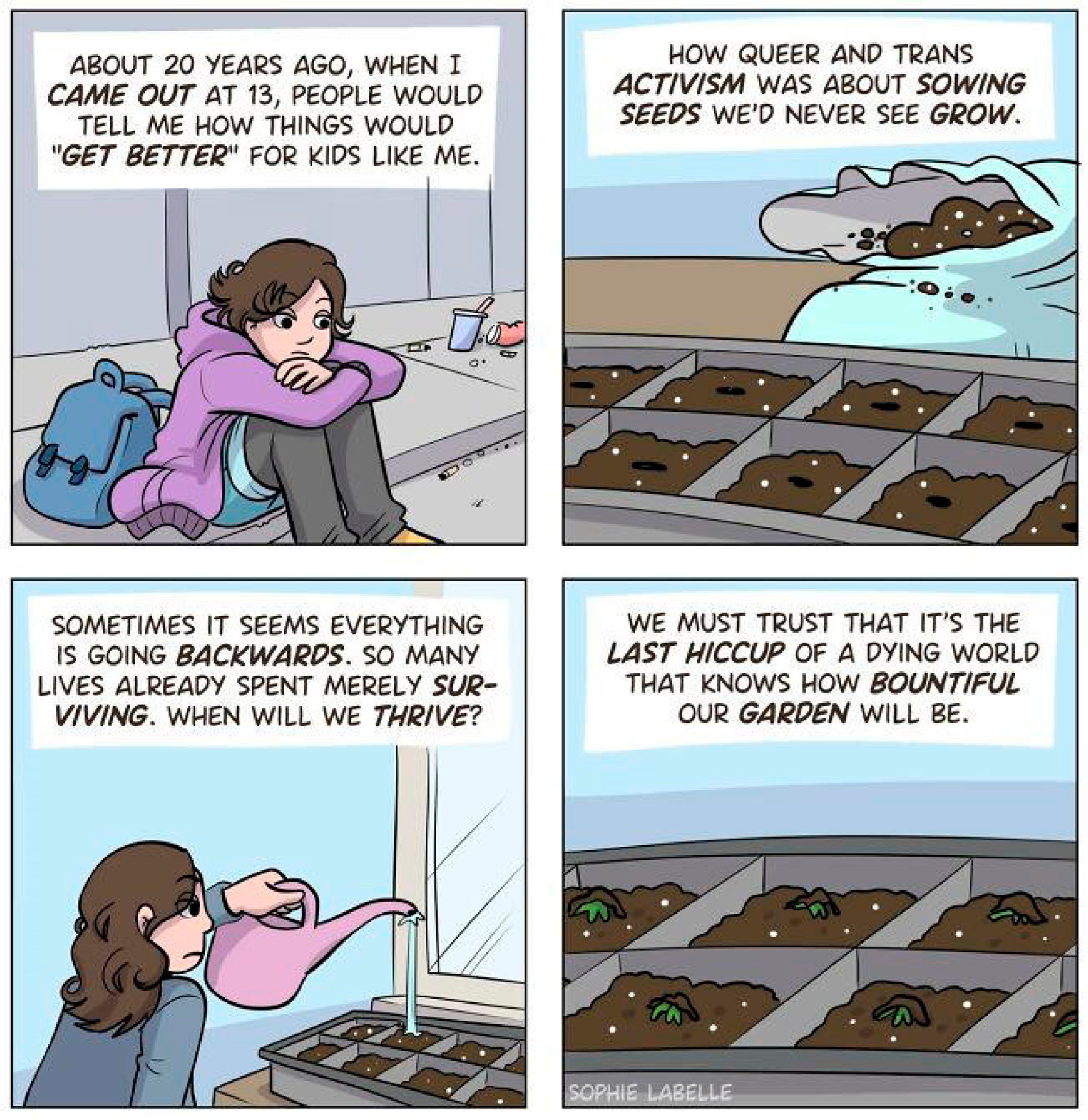
Canadian comic artist and trans activist Sophie Labelle, creator of the series “Assigned Male,” is neurodivergent herself and is on the autism spectrum. She, knowing of the specifics of this collaborative article and of its goals of making the classroom a queer-friendly space and one open to arts-based storytelling, shared a comic about queer life (
Figure 1) that makes it clear that things do not ‘get better’ unless you do the work that is necessary to plant seeds and grow new and better things.
Building on a shared love of science fiction, independent artist William Caroll and I picked Robertson’s story as a good ‘blank’ space to use for a visual thinking exercise. We then picked an arbitrary number of ‘around 10’ response points, working together on a goal of more inclusive education in the literature classroom. What is called creative self-efficacy in business models, referring to an individual’s belief in their ability to produce creative outcomes or solutions, can be developed in and through classroom activities. Here I am referring to “…the construct of creative self-efficacy” (
Shalley et al. 2004), defined as the self-view “that one has the ability to produce creative outcomes” (
Tierney and Farmer 2002). Material designed around workplace creativity is just as valuable in the engaged classroom. The assignment goal is for the student to select a set of themes, story-line points, emotions, or other affective/effective short story moments, to re-story parts of the story in new and different ways that comment on the story itself and offer possibilities for research-creation, that is, for creative interventions that are actually research outputs themselves. This is a form of visual mind-mapping.
While visual thinking work is simple to include in my usual wheelhouse of the comics studies classroom, it is slightly more intimidating for students in the straight-up literature classroom. The results, however, are stunning and bring new insights into the literary-critical world. There is a back story to this set of pedagogical assertions. William Carroll (they/them) and I (she/her) first explored a visual thinking approach as we were writing a talk for a conference at Queen’s, grounded in the science fiction and fantasy class I was teaching at the time, GNDS 335: Science Fiction and Fantasy, 2024. We gave our talk together, on arts-based approaches to the science fiction classroom, at the Desiring Autism and Neurodivergence Symposium (2024). Our title was “Perfectly You: On Indigenous Sci-fi, Making Space for Neurodiversity, and Lack of Closure.” We later gave the same talk to my actual Queen’s 335 class, where it was warmly received, and students agreed on the phrase ‘visual close readings’ for this sort of exercise.
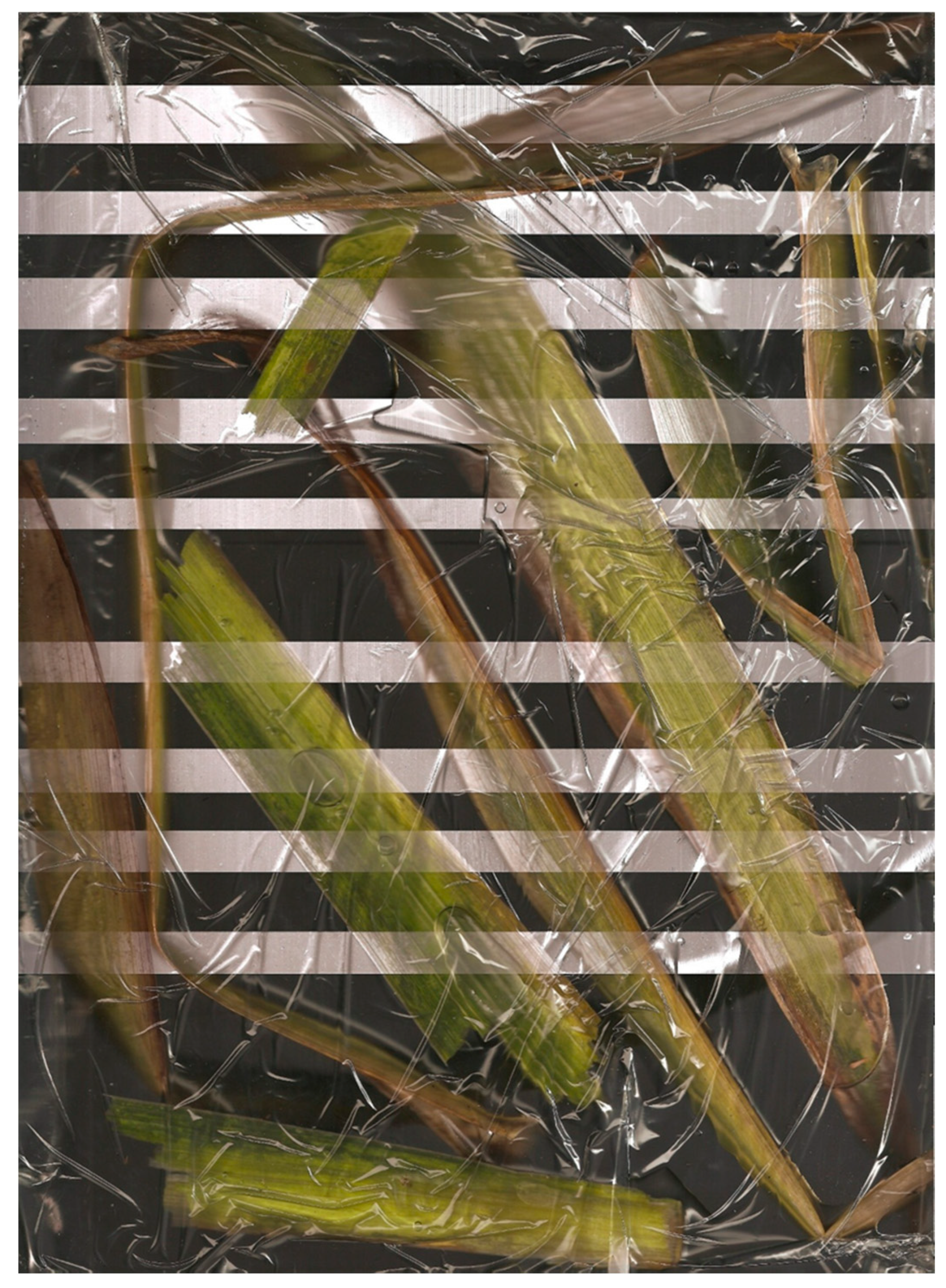
While my own approach to the story focuses on queer love and care work, William’s is quite different and is about the authenticity of the self, informed by experiential knowledge of autistic masking. William is an artist. They are queer and non-binary, and also a landscaper and gardener, often bringing botany and alternative nature-based perspectives into their work, e.g., with thought-provoking work on mould and decay, as both objects and discursive (and political) subjects. The opening image of this series of ten images, however, is all about plastic. The images are produced with an HP DeskJet F2120 printer–scanner, which is part of William’s art praxis in which texture is a visible focus. An image taken with a scanner is a form of a photograph, but it is different from camera work. A scanner captures a physical image, like a document or photo, and reproduces it digitally. William’s art practice, which is about both touch and sight, rises well to the challenge of a blank stock hospital room. Every image in this article is an act of re-storying.
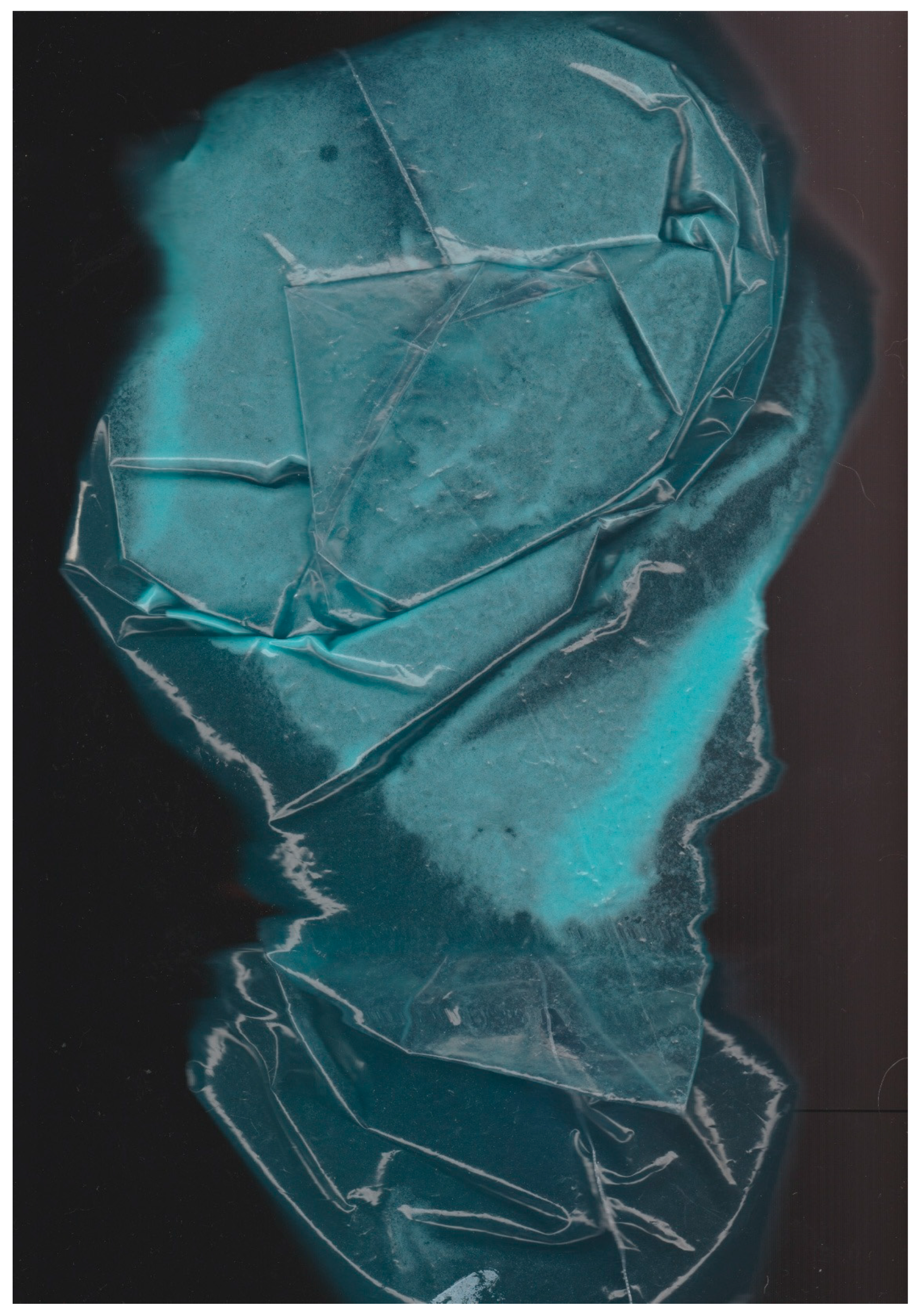
Figure 2, “Talking Heads,” is a simultaneous invocation of professorial arrogance and of medical-expert arrogance, with a touch of political arrogance. Talking about disability is political, as people with disabilities both belong and matter in society, and the current president of the United States, Donald Trump, engaged in a visual mockery of a person with disability, in what, in the ‘thinking in pictures’ world, would become a caricature, on the campaign trail for 2016, with no repercussions.
3 Trump performed an impression of Serge Kovaleski, who suffers from a congenital joint condition, at a rally. He also used a 2001 article by Kovaleski to back up widely disputed claims that thousands of Muslims in New Jersey celebrated the 9/11 attacks.
4Visual work has power in the classroom as well as on the news. While anecdotal evidence of the popularity of visual exercises in classroom space is easy to produce, and is also supported in writing by course evaluations from my students, I have yet to conduct a formal survey that gives a sense of scale. My usual science fiction and fantasy class has around fifty students and features a weekly journal exercise that always has a choice of analytic and creative options to introduce students to creativity as analysis. It is important to note that not all creative options for this class are visual or imagined for the sighted world; the range of assignments is broad. For a final project, a creative paper like this article is an option, but it is not collaborative and is thesis-based.
As Natalie Loveless observes of research-creation, authorial tone is a problem, especially for a collaborative venture with autoethnographic tendencies. It is my hope that the collaborative creative work done in this sample exercise can be offered as a form of ongoing truth and reconciliation work. Loveless addresses the problem of format in
How To Make Art at the End of the World: A Manifesto for Research-Creation, saying: “A research-creational approach not only asks us to attend to whether we personalise our writerly voice, render it poetic, or write in a ‘neutral’ voice of authority; it asks us to question whether writing, on a page, in an article or book format, is, indeed, the appropriate, most effective, persuasive, or interesting way to ‘write’ our research” (
Loveless 2019, p. 41). This work, being mixed media and collaborative, is indeed a challenge to format in accessible ways.
The project’s first image (
Figure 2) deals artistically with a moment in the story in which a medical doctor, Dr. Samuels, speaking to the Cree main character, Emma, asks a stupid question. William’s image, texturally and visually—faceless, filled up, and plastic—embodies Dr. Samuels being intrusive and inappropriate.
William observes that this image stands for how “people like Emma and I view individuals like cogs in the machine of each institution, and the way that they kind of perpetuate institutional ideals of gatekeeping, racism, ableism, et cetera.” William is not reading Emma as someone who is also on the spectrum, but as someone who also resists expectations and so also resists masking. The scene is part of an interview that precedes a medical process Emma has won for herself in a contest, so the doctor is asking her to talk about herself:
“Is that a cultural trait?”
“Huh?”
“Scaling trees.” Dr. Samuels checked his extensive notes, perusing what he’d written a few pages back. “You told me you were…Cree.”
“I mean, I was being facetious, but that’s kinda ignorant.”
[. . . ] She decided that from here on in she would robotically answer the man, and he could shove the pen up his ass.
Figure 2, William’s “Talking Heads,” serves as general positioning for an indifferent medical establishment, in which the doctors themselves are much like plastic bags, and the actual experimentation work and interesting human-engagement work is done by secondary characters, in this story a young female technician and experiment designer named Pyper, who with “dyed pink and blue hair in a pixie cut” and a Thundercats t-shirt, is less predictable and institutionally aligned (
Robertson 2016, p. 41). She is not another plastic bag.
Pyper is the designer of the experimental science stuff that sends Emma into the mental vacation she has won in her contest. Emma’s goal is to meet (again), in her mind, a woman named Cassie, someone she does not, for her own reasons, ever call back after falling for her in a one-time accidental meeting in a coffee shop. She wants to find both herself and Cassie in her mental dream vacation. Readers know all the time that Emma has Cassie’s phone number, so the project is not about real life, except that it is for those who do not want to perform as expected—those who do not want to mask.
Dr. Samuels’ tone is one of indifference and ignorance, culturally and medically. It serves well as a teaching tool around disability justice. It is the same tone used, in 2025, by the U.S. Health and Human Services Secretary Robert F. Kennedy Jr., who describes autism as an “epidemic” and asserts that “These are kids who will never pay taxes. They’ll never hold a job. They’ll never play baseball. They’ll never write a poem. They’ll never go out on a date.”
5 A rhetoric of disposability and of a lack of value—interestingly, specifically including creative value—is recognizable to both news watchers and to science fiction readers, simultaneously aware of real histories, of painful representational/creative histories, of eugenics and supremacy. RFK Jr’s dangerous generalizations about persons on the autism spectrum, in which he discusses the creation of an autism registry, are not part of science fiction but are still uncomfortably reminiscent of the proposed Mutant Registry Act in Marvel’s X-Men, among other forms of forced registration in the superhero worlds of both Marvel and DC. According to RFK, Jr.
6, the NIH will create a disease registry to track autistic Americans, and like the imaginary ones in the Marvel universe, the registration process is one of surveillance and potential abuse of governmental power.
7 The idea of a disability registration act is real and unreal at the same time; it is real but hardly credible to the casual reader. It is akin to what Rosemary Jackson defines in
Fantasy: The Literature of Subversion as “the paraxial” or the spectral region of the fantastic “whose imaginary world is neither entirely ‘real’ (object), or entirely ‘unreal’ (image), but is located somewhere indeterminately between the two” (
Jackson 2009, p. 12). Jackson suggests that by “[p]resenting that which cannot be, but is, fantasy exposes a culture’s definitions of that which can be: it traces the limits of its epistemological and ontological frame” (
Jackson 2009, p. 14; original emphasis).
Robertson’s story “Perfectly You” appears in
Love: Beyond Body, Space & Time: An Indigenous LGBT Sci-Fi Anthology, published by Bedside Press in 2016 and edited by Hope Nicholson. It is not a simple task to find such an anthology in terms of curriculum development and decolonization work.
8 I note that Bedside Press has since shut down, and that work in this area continues to be difficult to find for the classroom.
9 William and I chose to explore this short piece by Robertson, a member of the Norway House Cree Nation, “Perfectly You,” as a teaching tool about respect for Indigenous speculative fiction in the Canadian classroom for the two of us together.
10 The work of Patty Douglas et al. in the
International Journal of Inclusive Education offers several models for “re-storying” autism beyond “received cultural scripts,” and for considering “implications for inclusive educators in Canada and elsewhere” through multimedia methods (
Douglas et al. 2019).
One of the goals of this project is slow and respectful work towards the decolonization of the science fiction classroom, which tends to overlook Indigenous ways of thinking about difference, including disability. Both William and I are white settlers, and as Chimamanda Ngozi Adichie reminds us, there is the “danger of a single story.”
11 The creative interventions in this project are forms of re-telling that attempt to be respectful of both Indigenous and Western knowledge systems. Robertson’s own work frequently takes the form of YA fiction texts set in educational spaces, and as the authors of
Pulling Together: A Guide for Indigenization of Post-Secondary Institutions: Curriculum Developers point out, indigenization is not a replacement strategy or even an Indigenous issue as it “benefits everyone; we all gain a richer understanding of the world and of our specific location in the world through awareness of Indigenous knowledge and perspectives” (
Antoine et al. 2018, p. 10).
Petra Fachinger observes that “[t]elling stories about Cree identity and colonial violence is part of Robertson’s journey,” noting that Robertson’s own memoir,
Black Water: Family, Legacy, and Blood Memory (
Robertson 2020), is an extended exploration of the meaning of Cree identity for himself and his family (
Fachinger 2022).
Black Water takes its name from the northern Manitoba trapline where Robertson’s father, Don, lived, trapped, and fished as a child. The trapline later becomes a space for family intergenerational reconnection, through a father–son journey towards both healing and autoethnography.
Black Water also deals directly with racism and internalized racism in Canada and in the author himself, and deals with Robertson’s own journey through and past denial and “hiding” in relation to his own Cree identity (
Robertson 2020, p. 197). It is a compelling work on moving past damage towards intergenerational healing, while reflecting on the lasting effects of colonization.
Eve Tuck advocates a move away from damage-centred research towards desire, and Robertson’s story works well with that shift, while also leaving a blank space of irresolution for future possibilities. Tuck is an Associate Professor of Critical Race and Indigenous Studies in the Department of Social Justice Education at the Ontario Institute for Studies in Education. She is Unanga and is an enrolled member of the Aleut Community of St. Paul Island, Alaska. In an open letter for the Harvard Educational Review, she says:
One alternative to damage-centered research is to craft our research to capture desire instead of damage. I submit that a desire-based framework is an antidote to damage-centered research. An antidote stops and counteracts the effects of a poison, and the poison I am referring to here is not the supposed damage of Native communities, urban communities, or other disenfranchised communities but the frameworks that position these communities as damaged.
Thinking in pictures, to return to Grandin’s phrase about her own experiential life and that of many others on the autism spectrum, opens up ways to move past damage. Invitations to produce image-based responses to dense bodies of text, whether through comics or other forms of image production, open up classrooms to new explorations of human potential and neurodiversity. William’s work explores texture as well as sights, and Grandin talks about the importance of touch and the value of work done by teachers with tactile systems (
Grandin 2006, p. 43). Grandin comments that “[a]ll autistic children have problems with long strings of verbal information” (
Grandin 2006, p. 44). While the word “all” raises doubts, as every experience on the spectrum is individual, the observation pushes the neurotypical literature teacher to respond in new ways, to find ways to bring in textures and images, and to enact break-outs from the stock hospital room of uninterrupted prose. I repeat here the warning that, as S. Marek Muller and Zane McNeill (
Muller and McNeill 2021) point out of Grandin’s work, “ableism and speciesism are not only related but mutually constitutive phenomena” (p. 199). Grandin’s continued grounding of her work in an autistic–animal analogy is problematic, in ways that can be discussed openly in a classroom that is open both to critical disability studies broadly and to critical autism studies more specifically.
Here I turn to Dr. Maureen Dunne’s work on the limitations of institutional standards. In her introduction to The Neurodiversity Edge, cognitive scientist Dunne considers built-in biases, social scripts, and institutional standards, and argues for a neurodiversity paradigm and a mission that can be couched “within an actionable framework for diversity, equity, and inclusion (DEI),” offering this challenge:
We can live in a world where millions of uniquely talented but quirky people are left to suffer massive underemployment and ostracism, while masking who they really are, and perhaps getting by through government assistance. Or we can proactively support the actualization of human potential for everyone, reaping the benefits of a wellspring of creativity and new perspectives that could open the door to untold future innovations, better hedging against groupthink, and the knowledge that millions of would-be outcasts have been accepted into the fold, finding a productive and self-affirming place in the fabric of our culture and economy.
Self-affirmation as a literary critic can take visual forms. Visual thinking offers new answers to the same old questions of speculative fiction, which are, as Neil Gaiman reminds us: “what if, if only, and if this goes on…”
12In the case of “Perfectly You,” visual creative responses also contribute meaningfully to the slow, careful, ongoing work of decolonization in the classroom. William’s artwork offers research-creation in relation to conciliation, rather than reconciliation, inspired by a Métis artist’s perspective. David Garneau writes about art within his discussion of what he calls possibilities for “Living Apology,” in his article Imaginary Spaces of Conciliation and Reconciliation. He argues for ongoing conciliation, in which non-Indigenous people consider privilege and work toward non-colonial practices:
I want to signal that something interesting is going on beyond the colonial gaze. At the same time, by using dominant culture vernacular, I want to show that what happens in these spaces is very like what happens in similar spaces but with different people. While the core of Indigeneity is incompletely available to non-Native people, those who come to spaces of conciliation not to repair “Indians” but to heal themselves, who come not as colonisers but with a conciliatory attitude to learn and share as equals, may be transformed.
The engaged classroom does not need a dense plot to work towards transformation. The story depends on a lack of closure, a lack of genuine human interaction, and a photograph of Cassie, which Emma described to her as “perfectly you,” hence the title of the story itself. The fantasy of queer love remains a fantasy. Authenticity remains a fantasy. Spatially, visually, and in terms of action, the story is very limited, with the main focus on a hospital-like room or two rooms. The stock room is a space in which to take up Dunne’s challenge to us both as educators, William in youth diversion and the Maltby Centre arts programme, and me in the literature and comics classrooms.
Together, William and I now offer some imaginary spaces of conciliation, as forms of living apology, using participatory arts-based methods of digital storytelling with the printer–scanner and narrative elaboration, and we do “not hold assumptions about what forces and circumstances might make one feel insecure and, therefore, what (artistic or other) avenues one must take to mobilise justice” (
Rice et al. 2016, p. 60). As
Manning (
2016, p. 28) observes of research-creation in
The Minor Gesture: “[i]t is a mode of activity that is at its most interesting when it is constitutive of new processes.” (p. 28) Refusals of sexuality, and of queer sexuality, are part of the condescension Dr. Samuels offers, asking Emma, “Would you have sat there if there was, say, an older gentleman there?”, to which she responds, “You mean a man.” Emma refuses to engage with the question, to perform as directed, saying, “I don’t have to imaging other scenarios. She was there.” (
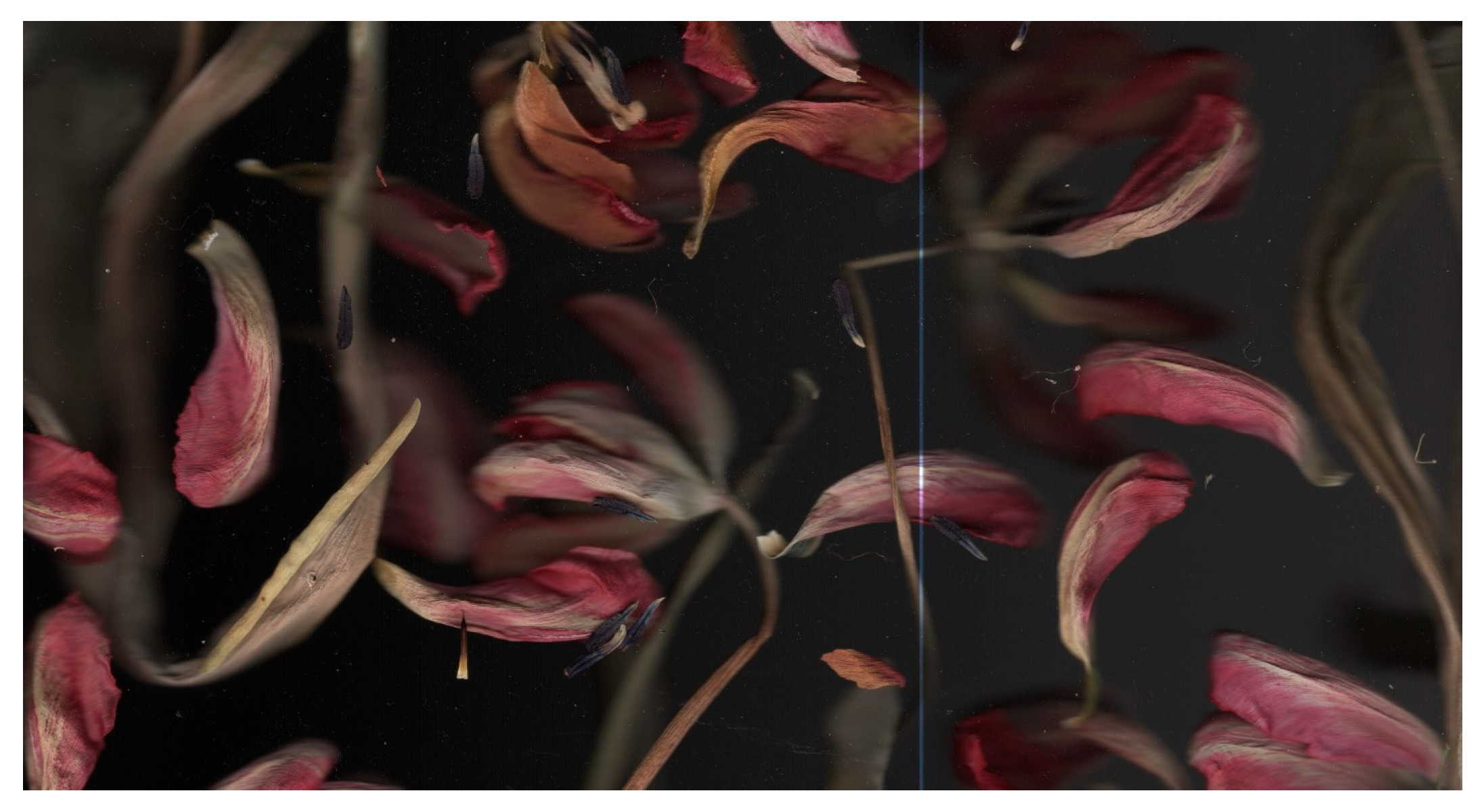
Robertson 2016, p. 40). William’s response to this invasive line of questioning is called “The Interview.”,
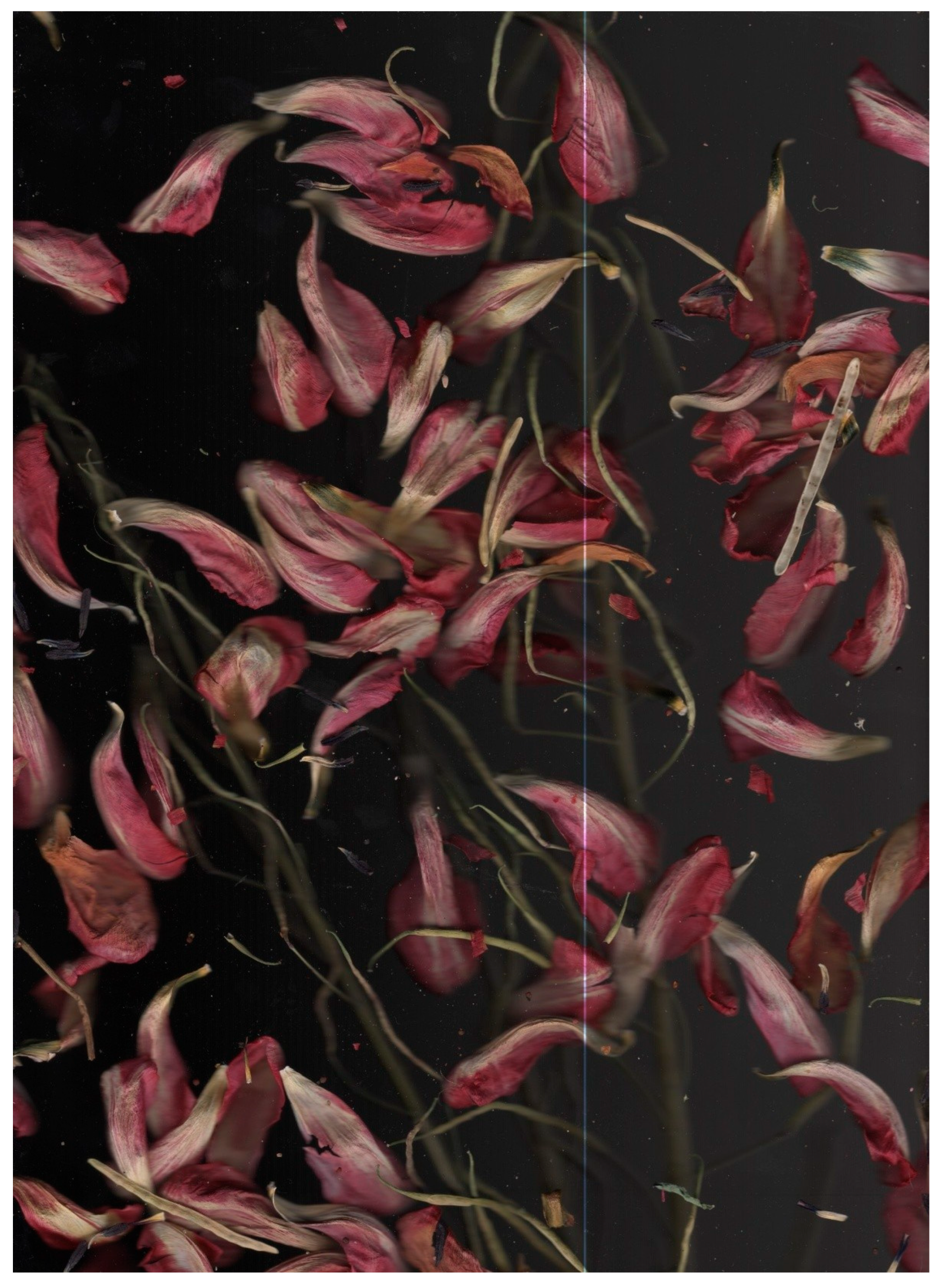
Figure 3.
*William, on
Figure 3: “The Interview” represents Emma’s feelings in the moment of the interview itself. The flower petals are like rose-tinted glasses, as Emma thinks about Cassie. It does not matter that anybody else could have been there. There was only this one person whom she became fascinated with in that moment. In the background, there is some green stuff, and those are kale stalks, the queer bodies that are present in the individual scene.
I turn to Gloria Anzaldúa to ground our project in a body of queer theory that is attentive to sensation, image, touch, and difference, including disability, based on her own lived experiences, noting that her autotheory work can be characterized as “crip-queer-mestiza-subjectivity” (
Ramlow 2006, p. 175). Anzaldúa says that “the work of mestiza consciousness is to break down the subject-object duality that keeps her a prisoner and to show in the flesh and through the images in her work how duality is transcended” (
Anzaldúa 2010, p. 102). An image-oriented, multimodal classroom that is open about complex embodiment opens up fresh possibilities for student engagement with creative works, and her foundational text
Borderlands/La Frontera: The New Mestiza is all about breaking boundaries of class, race, and ability, and about working in multiple genres and languages. Anzaldúa is attentive to touch, as well as sound and light: “Soy un amasamiento, I am an act of kneading, of uniting and joining that not only has produced both a creature of darkness and of light, but also a creature that questions the definitions of light and dark and gives them new meanings (
Anzaldúa 2010, p. 103). The in-between-ness of Anzaldúa’s work is an invitation to students to break down dualities and to embrace work that “makes us crazy” (
Anzaldúa 2010, p. 103).
Messiness is important because the arts-based classroom is always asking for multiple things at once, and thus is also a source of stress and insecurity. I have written about a sense of inadequacy that is a common feature in any comics studies classroom that includes hands-on comic work: “Every time we start working on portraits in class, I am deeply shocked by the depth to which students have internalized and are intimidated by a whole series of assumptions and assertions about art, quality, self-worth, and the value of creativity. As with many important things in the classroom, it then becomes a series of processes of unlearning. All good teachers and indeed activists know that unlearning, as in decolonization or antiracism, is just as important as learning, in fact usually more so.” (
Tolmie 2022, p. 6). William’s work with youth in arts programmes also routinely encounters this same internalized self-doubt and anxiety about the label of artist. Creativity is praxis, not inspiration, not genius, not inaccessible. It is key to present creativity as praxis rather than as a state of being, which is a problematic alignment that leads to weak criticism and weak pedagogy alike. Barb Cohen, educator and mother of a child on the spectrum, calls attention to the need to rethink creativity and is critical of how creativity is measured and written about, saying, “My daughter Sam forced me to start rethinking creativity years ago as I realized that she could envision things that I would never, literally, imagine.”.
13Emma imagines new things for herself. The next image,
Figure 4, “Isekai,” responds to a sense of excited sameness, and the comment that “It might been the same room, for all she knew” (
Robertson 2016, p. 41).
*William, on
Figure 4: “Isekai” is a Japanese word for a specific sub-genre of anime, manga, and film, where the main character is transported to another world. One of the hallmarks of this genre is that the main character can only return to where they came from if they are to die, similar to Cassie at the end of this story. The image itself is very similar to “The Interview,” but there is a feeling of momentum and of the moment. It is kind of that Wizard of Oz moment that you find in films, where the colour and lighting will change, and characters transport themselves from where they were in reality to this magical-realism-based environment. You often see flowers in medical buildings, so they appear throughout the following.
“Perfectly You” is a work of medical magical realism. Pyper, as the designer of this dream “vacation,” has tried it out herself as the “guinea pig” (
Robertson 2016, p. 42). The dream-to-come, Pyper says, is going to feel like a long time, “[b]ut in reality, it’ll be a few minutes at most” (
Robertson 2016, p. 43). William’s image captures the sense of imagining something new while staying in the same place. Once Emma starts her vacation, is she in the same room? Is she alone in that room?
The answer is no, she is not alone in the room she is now in, and “[s]omeone entered the room from Emma’s left, and she struggled to move her head to face that direction” (
Robertson 2016, p. 45). The image of response to this transition (
Figure 5) is one of sameness, titled “Stationary.”
*William, on
Figure 5: “Stationary” is similar to “Isekai,” because readers are still in the same kind of state, in terms of emotional knowledge and understanding. I tried to create a sense of stopped movement, stationariness.
In the dreamscape that Emma now inhabits, she is still hospitalized. What is different is that she has travelled to the future. She has a headache, a nurse, and it is 68 years later in time. William’s image response is “Spirited Away.”,
Figure 6.
*William, on
Figure 6: “Spirited Away” is a reference to a Studio Ghibli movie of the same title, which is about rejecting material and materialist value, and facing fear. In the back, the kale has returned, and it is representing the reintroduction of Cassie in the background. The dream has fully begun. Things have started sort of shifting. Nothing feels real or grounded, and yet at the same time, it is very tangible.
As Emma looks around, she “couldn’t help but notice that, here in the future, nothing seemed like it belonged in a sci-fi movie” (
Robertson 2016, p. 47). Emma asks, “What’s different now?”, and the answer is both reassuring and depressing in ecocritical terms: “Not much. Not really. We’re still waiting for our flying cars, you know… a little hotter, maybe.” (
Robertson 2016, p. 47). Emma, however, does see some real and tangible change in other ways or in ways that give hope for a queer futurity of “forever” love (
Robertson 2016, p. 50). Cassie visits regularly, and in a key development, Cassie has learned some Cree words from Emma’s parents, who are now dead. Cassie’s wife is also now dead, in a convenient way that makes Cassie clearly and legibly gay, but not unfaithful. Long-term, committed, queer love is possible, and William’s image “Idyllic”,
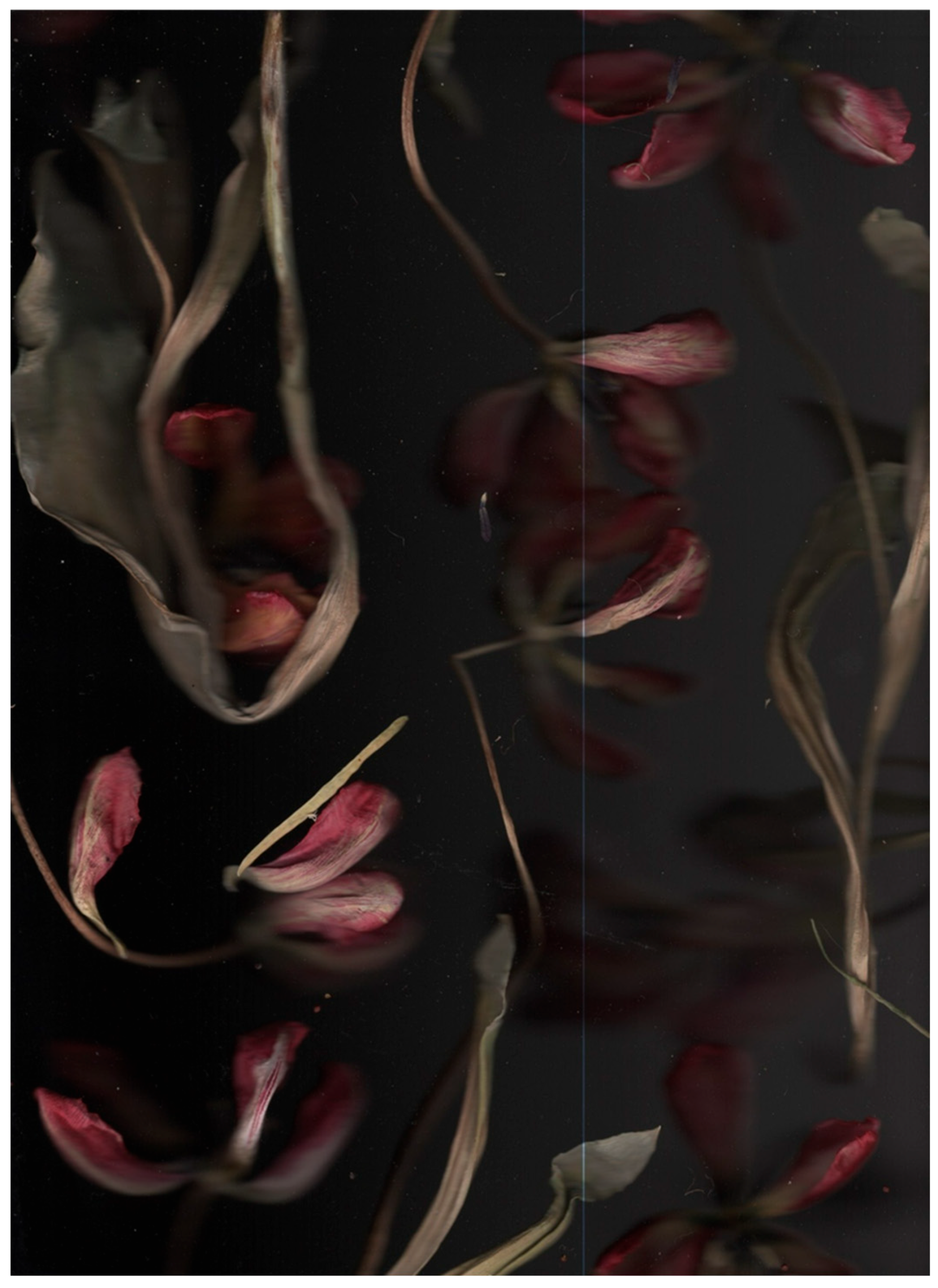
Figure 7, captures a sense of positive positionality for Emma.
*William, on
Figure 7: In “Idyllic”, the kale stalks move forward in the frame. They are now the centre focus. The petals that were referencing rose-coloured glasses and the general medical environment are still there, but they are no longer the focus. The image is entirely about Emma with Cassie and the way that they are interacting together. Emma’s dream of togetherness is becoming her reality.
The image “Idyllic” avoids affective criticism by focusing on what Anzaldúa calls emotional “tenderness, a sign of vulnerability” in the main queer character, Emma (
Anzaldúa 2010, p. 106). Rather than a focus on the reader’s emotional response, it is a response to Emma’s limited ability to express her vulnerability in a magical escape room she has built for herself. This is the only time Emma’s emotional state is clearly described: “For the next few weeks, Emma was happy to see Cassie every day.” (
Robertson 2016, p. 50). She is happy. William’s work is a queer artist’s response to limited options, to vulnerability. Anzaldúa stresses the importance of acknowledging “the political and artistic contribution of [the] queer”, which the classroom can also aim to do (
Anzaldúa 2010, p. 107). Language learning, a positive, active response to cultural genocide, is key to better futures. Cassie learns some Cree. Cassie’s willingness to learn a new language is an opportunity to introduce the science fiction class to Indigenous Futurism, a phrase coined by Anishinaabe professor Grace Dillon in the Indigenous science fiction anthology
Walking the Clouds. Dillon states that all Indigenous Futurisms “involve discovering how personally one is affected by colonization, discarding the emotional and psychological baggage carried from its impact, and recovering ancestral traditions in order to adapt in our post–Native Apocalypse world” (
Dillon 2012, p. 10).
Emma never makes the choice to call Cassie in the real world of the story, and she explains this to the future Cassie who visits her in the hospital in her old age: “I loved you so much when we met. I kept thinking how much it would hurt if I lost you, if I only kept loving you more” (
Robertson 2016, p. 51). It is fear of future vulnerability that keeps Emma quiet. It is awareness of the possibilities and realities, both at once, of pain and rejection. William’s recognition of a sense of peril to “personhood” appears in
Figure 8, the image “La Douleur Exquise” (
Anzaldúa 2010, p. 110). Early in the story, Emma does not “verbalize” her reasoning for not calling Emma when speaking to Dr. Samuels because it would “hurt too much” (
Robertson 2016, p. 41).
*William, on
Figure 8: “La Douleur Exquise” means exquisite pain. I thought about the kind of fear that a lot of queer people face when they want to interact with somebody that they have a crush on, or are interested in. But they do not necessarily have confirmation that the other person is queer, or that the person is even interested in them. And there is social stigma. I was trying to visualize the painful, unreachable, unknown aspects of that emotion, which is not necessarily possible to do. It is a very intangible experience, and very unique to each person. One kale stalk is a focus, is Emma, in the intermingling chaos of the moment.
Critical autism studies, a field developed in dialogue with critical disability studies more broadly, question the deficit model of autism. The Canadian Re•Storying Autism in Education project focuses on the criticality of critical autism studies, which Patty Douglas describes as “contested and multiple” in nature (
Douglas 2025, p. 63).
14 Within this contestation, it is valuable to prioritize the voices of autistic persons both as critics and creators, which this project aims to do with new classroom assignment designs and discursive openness. An opening up of classroom possibilities is free, in a climate of austerity, and makes literature classes appealing and accessible to a wider range of students. These exercises are not replacements for literacy skills or critical writing skills; they are ways to add variety and depth within systems that routinely exclude visual thinkers. It is visual thinking from William that brought pain to my attention in the story, as I did not see it myself.
Back in the story, for her own reasons, Emma rejects discursive openness. While there is possibility and even happiness in the dream space of Emma’s vacation, it is finite. Emma admits that “[o]ne day, the phone number would rub off. But that didn’t matter. She’d memorized it, and would never forget it” (
Robertson 2016, p. 53). William’s response to the end of the dream is
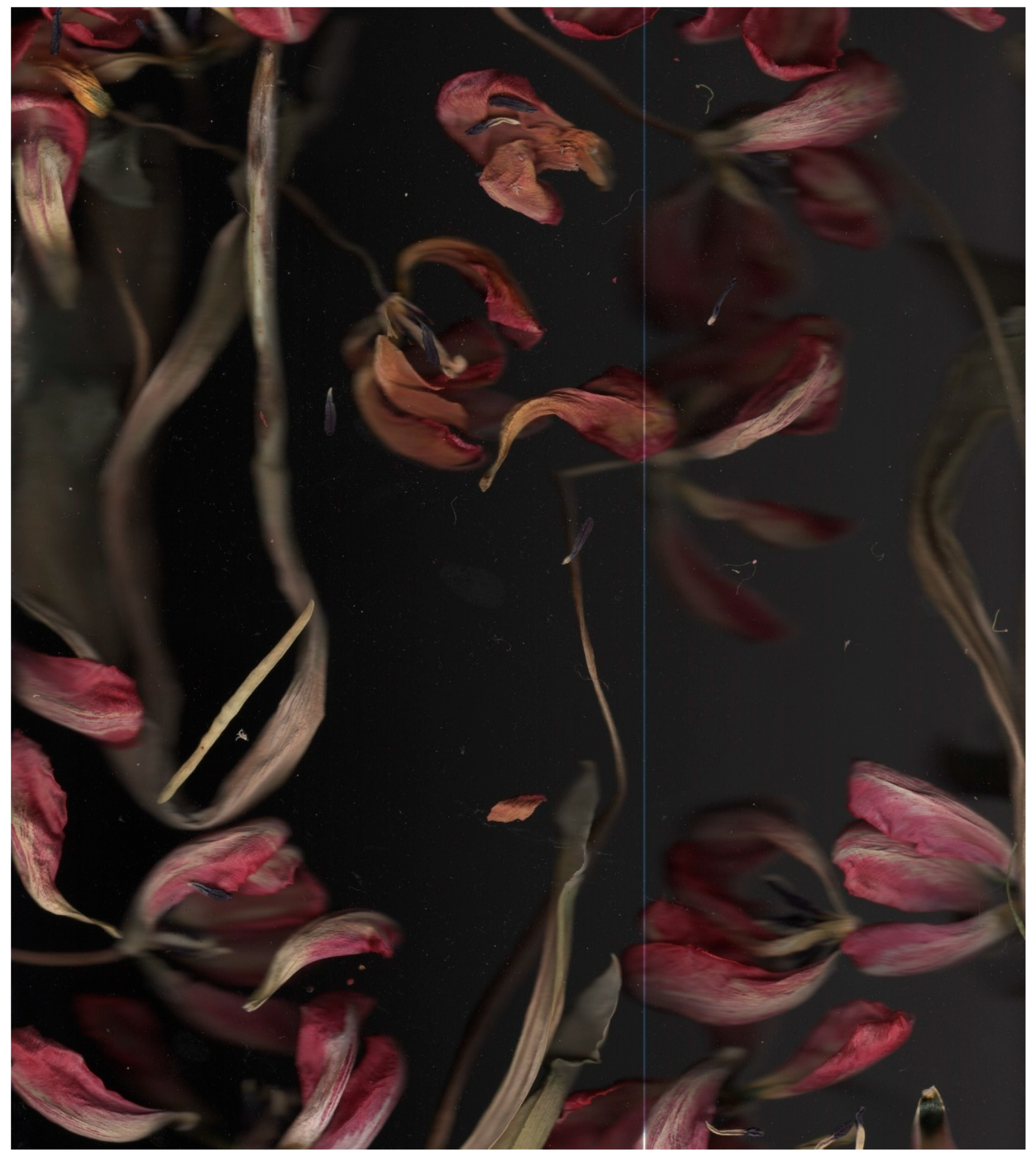
Figure 9, “The Wake-Up Call.”
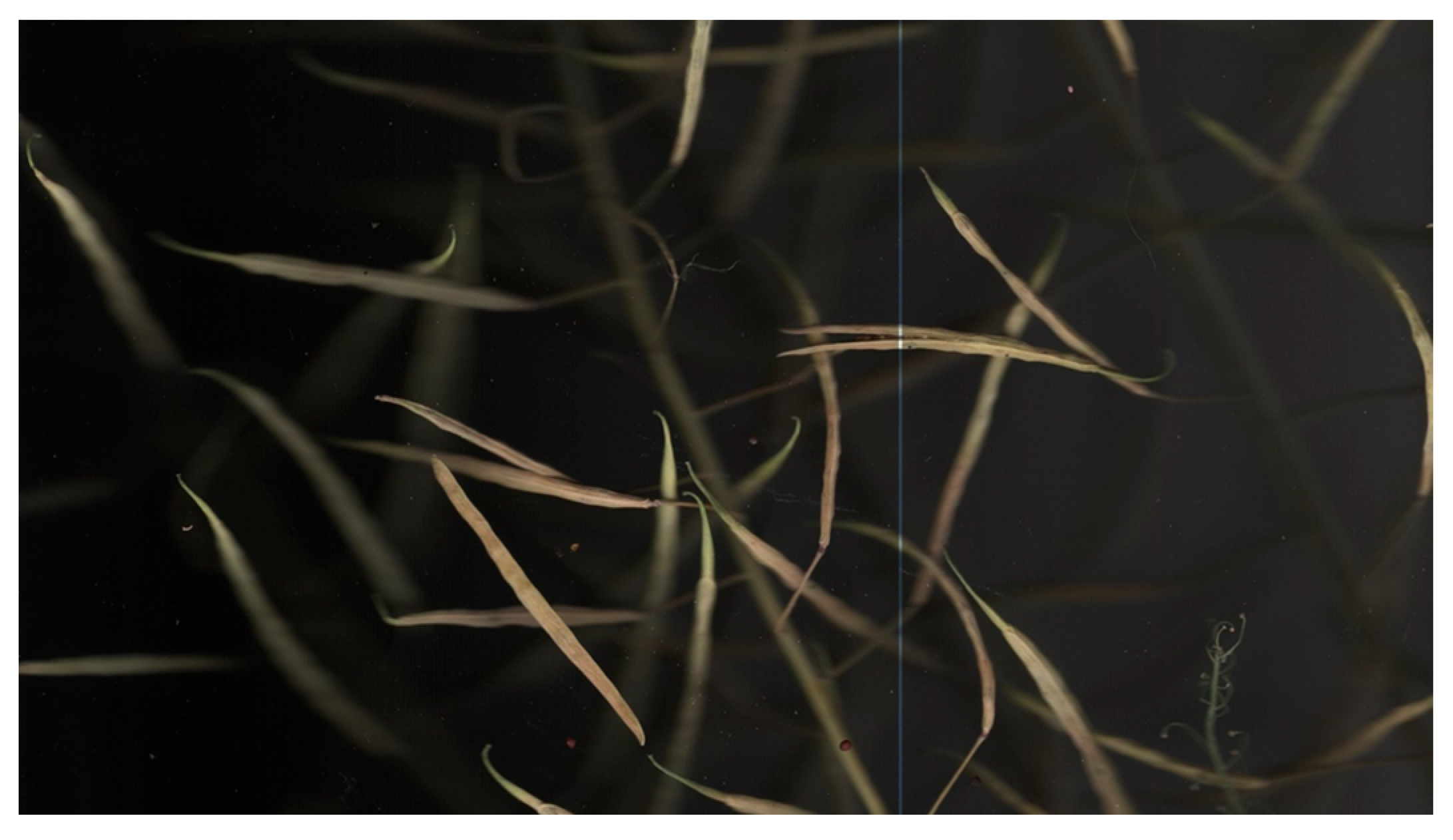
*William, on
Figure 9: I call this “The Wake-Up Call.” Future-Emma dies, but real-Emma wakes up. The last thing that dreaming Emma sees in the story is Cassie’s face, as she is passing away. As she is waking up from the dream, what is the last thing that she’s thinking? That none of that was real.
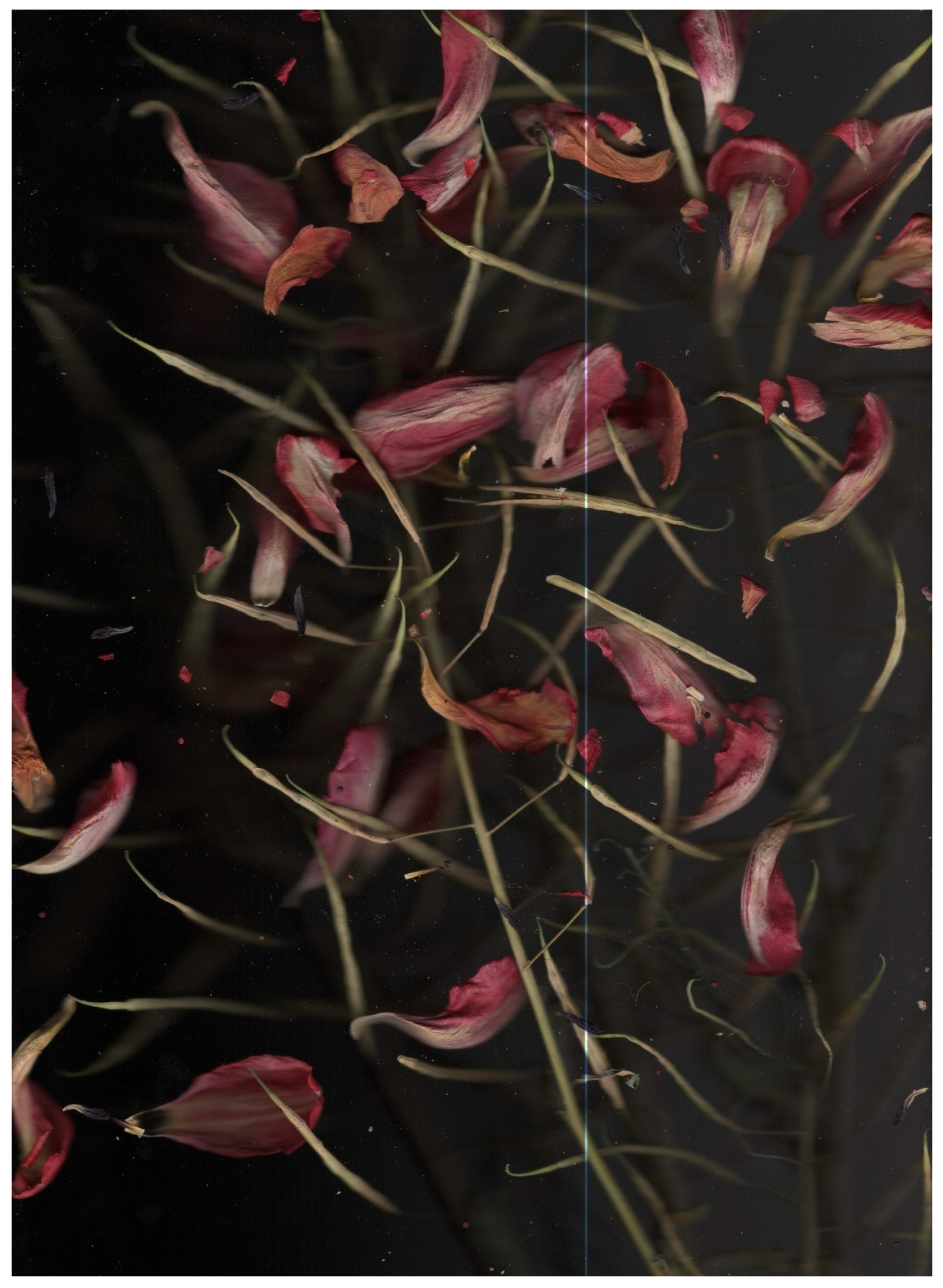
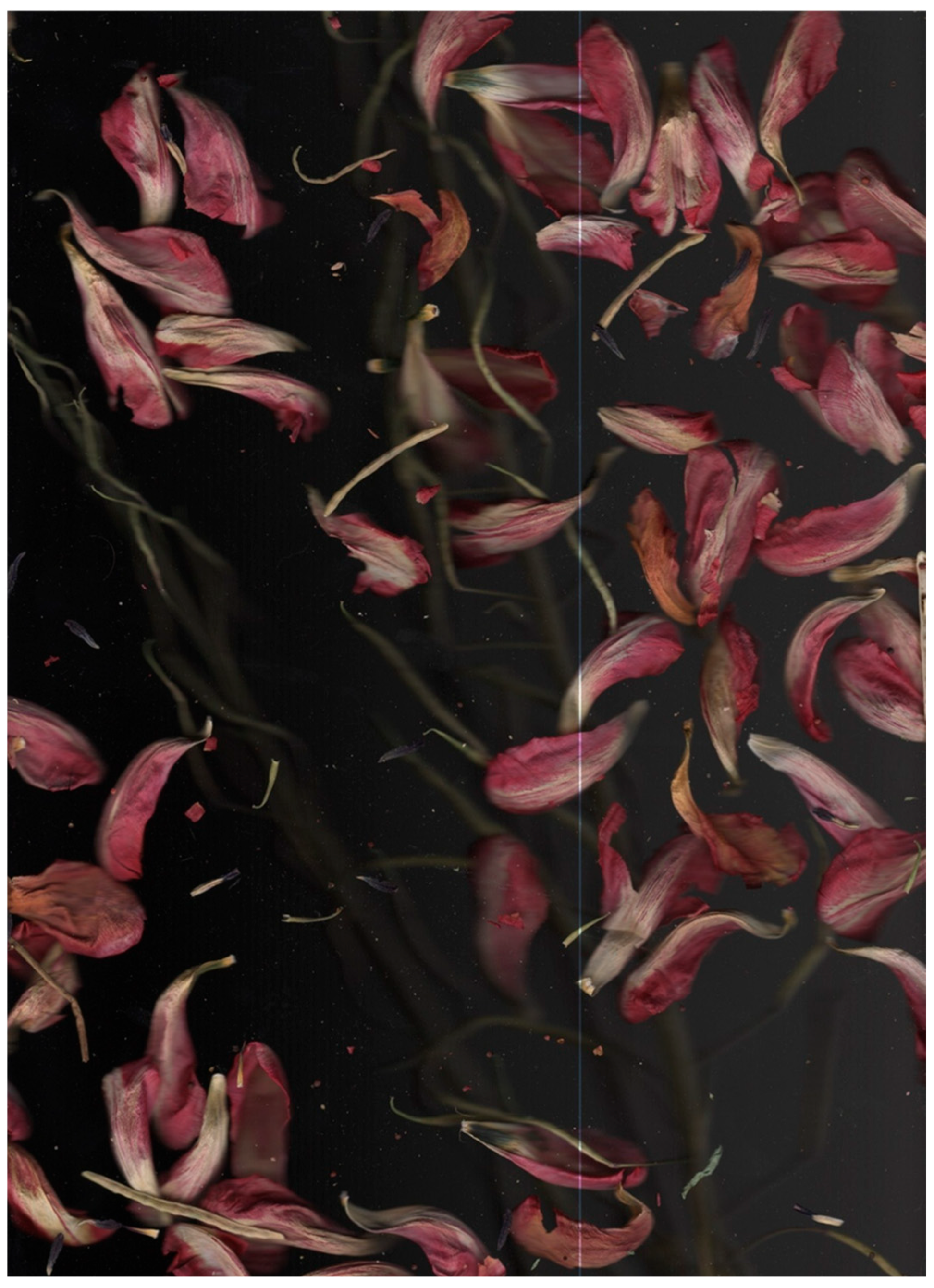
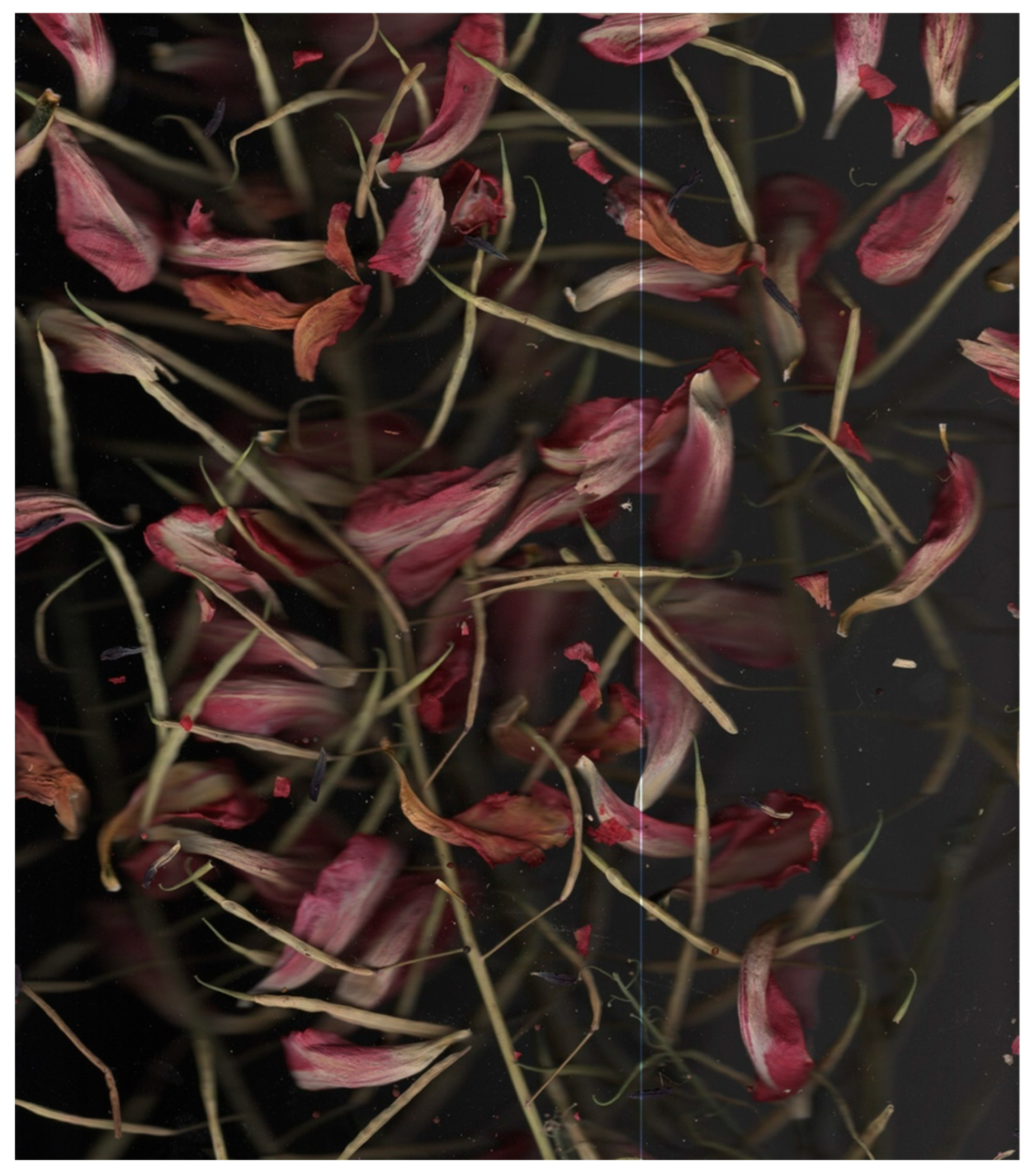
The kale pods and stalks of “The Wake-Up Call” are blunt and interruptive. Against a dark background, they are a call to reality. The closeness of the real and unreal is central to a story about a phone call that is never made. William’s final image (
Figure 10) of pinkness and petals is about happiness, and an ideal space in which the real and the unreal briefly coexist, “Idealized Reality.”
*William, on
Figure 10: “Idealized Reality” has no quotation source. It is a final showcase of beauty and unpleasantness. All the flower petals died ages ago. It is a reminder to appreciate what we have, and an acknowledgement that, to achieve true happiness, a lot of the time, we have to experience a great amount of unpleasantness on some level.
“Idealized Reality” offers a turn away from lack, from damage, to desire, returning to Tuck’s aspirational work and to the story itself, which leaves readers with possibility but nothing else. William and I have worked together to move past damage to desire with this set of close readings by getting rid of the lack of closure as a problem, just as we reject the defect model for autism. The open ending of the story, the uncalled number, is not a problem. It makes space for possibility. For a futurity of difference, of non-compliance with expectations, of finding one’s true self or personhood, and of making space for others’ true selves in the classroom and elsewhere. This shift from lack to possibility is one from damage or insufficiency to desire, is a celebration of Emma as a resistant subject, who does not perform to expectations, who does not mask, who thinks the doctor should shove his pen up his ass. William and I offer the final reflection that Emma is perfectly fine just as she is.