
Article

Curating and Creating Collective Artistic Experiences: The Role of the Choral Conductor

1
School of Theology, Philosophy, and Music, Dublin City University, D09 N920 Dublin, Ireland
2
School of Creative Arts, Trinity College, D02 F227 Dublin, Ireland
*
Authors to whom correspondence should be addressed.
Arts 2026, 15(3), 43; https://doi.org/10.3390/arts15030043
Submission received: 14 September 2025 / Revised: 2 February 2026 / Accepted: 13 February 2026 / Published: 26 February 2026
(This article belongs to the Special Issue Creating Musical Experiences)

Abstract

The commonly recognised image of a choral conductor is of a person who stands in front of a group of singers and uses a set of gestures to direct them in performance. In order to arrive at this moment of shared musical experience, however, there is a long journey of preparation that must take place, from devising an artistic concept, to formulating a coherent and stimulating programme of repertoire, to realising such a programme by engaging in an extended period of rehearsal that encompasses vocal, musical, expressive, linguistic, and emotional facets and gathers diverse individual singers into a unified choral instrument with a common expressive purpose. In this article, two experienced choral conductors present structured reflective exegeses on artistic projects undertaken with their respective chamber choirs. Drawing on reflective approaches aligned with practice-based/artistic research, and on leading voices in repertoire programming and choral studies more broadly, the authors articulate and analyse their creative processes, highlighting considerations and goals for choral conductors both in designing programmes as a basis for impactful collective musical experiences and in enacting these experiences in a spirit of co-creation with choir members and other artistic contributors.

1. Introduction

‘The task is daunting, but the reward lies in the many magical moments—when time seems to stand still and the entire choir becomes one organism, one body, one breath, one thought’.
(Dahl 2008, p. 9)
Norwegian conductor Tone Bianca Sparre Dahl vividly captures the ‘magic’ of the collective experience that can be shared by a choir in performance. The commonly recognised image of the choral conductor is of the person who stands in front of a group of singers and uses a set of gestures to direct such a performance (Yoo 2016, p. 114). However, in order to arrive at this moment of shared musical endeavour, there is a long journey of preparation that must take place, from devising the initial artistic concept, to formulating a coherent and stimulating programme, to engaging in an extended period of rehearsal that encompasses vocal, musical, expressive, linguistic, and emotional facets and gathers diverse individual singers into a unified choral instrument.
In this article, two artistic projects are juxtaposed: a live concert project entitled Natural History; and Ghost Songs: Contemporary Music and Words from Ireland, a recording project involving a 35-track multi-genre album. Through structured reflections on these distinct projects, we highlight considerations and goals for choral conductors with regard to designing artistic programmes as a basis for impactful collective musical experiences, and to enacting these experiences in a spirit of co-creation with choir members and other project contributors. The remainder of Section 1 outlines our professional context and methodological approach. In Section 2, we collectively explore our priorities in selecting and realising artistic programmes as key stages in creation and co-creation; and Section 3 presents our respective structured reflections on the artistic projects introduced above.

1.1. Professional Context

We are two choral conductors and academic practitioner-researchers based in Dublin, Ireland. Between us we have in excess of forty years of choral leadership experience and have curated and conducted upwards of 500 performances across diverse choir types, including amateur and professional chamber choirs, university choirs, church and cathedral choirs, community choirs, and children’s choirs, as well as participating in assorted further choral activities such as competitions, recordings, festival adjudication, teaching, and course leadership. In our work, we seek to create and curate artistically coherent, impactful choral events that are significant and memorable for singers and audiences alike. With respect to musical style, our professional activities principally involve Western classical music, and our choral leadership is influenced significantly but not exclusively by our training in the Kodály approach to music teaching and learning. The projects explored in this article were undertaken with our respective mixed chamber choirs. Each of these choirs is made up of approximately forty adults—sopranos, altos, tenors, and basses—who sight-read music with a relatively high level of fluency and are experienced in performing a broad repertoire from the Renaissance to the present day. The choirs are independent entities, unconnected to any religious, educational, or cultural institution.

1.2. Methodological Approach

Estelle Barrett observes that ‘Creative arts research is often motivated by emotional, personal and subjective concerns; it operates not only on the basis of explicit and exact knowledge, but also on that of tacit and experiential knowledge.’ (Barrett 2007, p. 115). In this article we seek to assess the multifaceted, often experience-based nature of research in choral leadership by presenting structured reflections on artistic projects from the perspective of the conductor. The methodology borrows from the concept of ‘reflective exegesis’ (Shumack 2008), which itself builds on prior exegetical models by Brady (2000), Bartlett and Mercer (2001), Kroll (2004), and Arnold (2005), as well as on Schön’s idea of ‘reflection-on-action’ (Schön 1983). Shumack explains that the reflective exegesis, rather than serving as a written accompaniment to a practice-based project, instead provides a means of developing structured reflections on completed practice-based projects, enabling the practitioner-researcher to form meaningful insights from their creative practice and to understand the integrated nature of their process (Shumack 2008). The artistic projects explored in this article align with Candy and Edmond’s definition of creative practice as combining ‘the act of creating something novel with the necessary processes and techniques belonging to a given field, […] conceiving ideas and realizing them in some form as artifacts, musical compositions, designs or performances,’ and as an activity ‘characterized not only by a focus on creating something new but also by the way that the making process itself leads to a transformation in the ideas’ (Candy and Edmonds 2018, p. 64). Acknowledging the collective, co-created aspects of what we as conductors produce artistically, we draw on scholars of choral studies (Dahl 2008; Durrant 2009; Jansson 2018) and also connect with Vygotsky’s theory of the zone of proximal development, which has been applied to choral/ensemble contexts by, for example, Abrahams and Abrahams (2017, see Section 3.1.3 below), Hopkins (2013), and Henton (2022). Within the paradigm of conductor-led creative practice, we use structured reflections to facilitate ‘an understanding about how to map one’s creative process as a series of linked stages; and a further delving into the roles and micro-workings of different kinds of knowledge and knowing’ (Shumack 2008, p. 62).
Through these reflections, we aim to cast light on ‘the tacit dimension of knowledge embedded in artistic processes and works’ (Hultberg 2013, p. 80),1 drawing out insights from the choral conductor’s perspective in a manner that captures what Hultberg frames as ‘on the one hand, planning and carrying through a creative process and presenting the artistic work—the product representing the result of the process—and, on the other hand, exploring the process and the product’ (Hultberg 2013, p. 81). We also endeavour to answer Robin Nelson’s call for arts-based research to encompass critical reflection on process (Nelson 2013, p. 29); and seek to address two core problems he identifies with regard to such research: ‘the problem of knowledge’ and the ‘ephemerality of performance’ (Nelson 2006, p. 107), by helping to create, in the context of choral leadership, a means through which we may extract enduring knowledge from artistic activities and articulate this knowledge in an accessible way. In doing so, we respond to a challenge that Nelson poses to those of us involved in arts-based research of diverse kinds: ‘if practitioner-researchers wish their embodied cognitions to be better recognized, means of identifying and disseminating them must be sought’ (Nelson 2013, p. 39).
Our decision to include two artistic projects led by separate conductors is influenced by Susan Stanford Friedman’s ‘juxtapositional model of comparison’, whereby the ‘distinctiveness of each [project] is maintained, while the dialogue of voices that ensues brings commonalities into focus’ (Friedman 2011, p. 758). These commonalities led us to devise the following three-part structure for reflection that aims to capture the holistic and integrated nature of artistic leadership. Using this structure, we articulate and analyse the multi-stage journey from original concept and development through the creative processes of programming, rehearsal, and collaboration, and onwards to artistic experience.

1.3. Framework for Structured Reflection

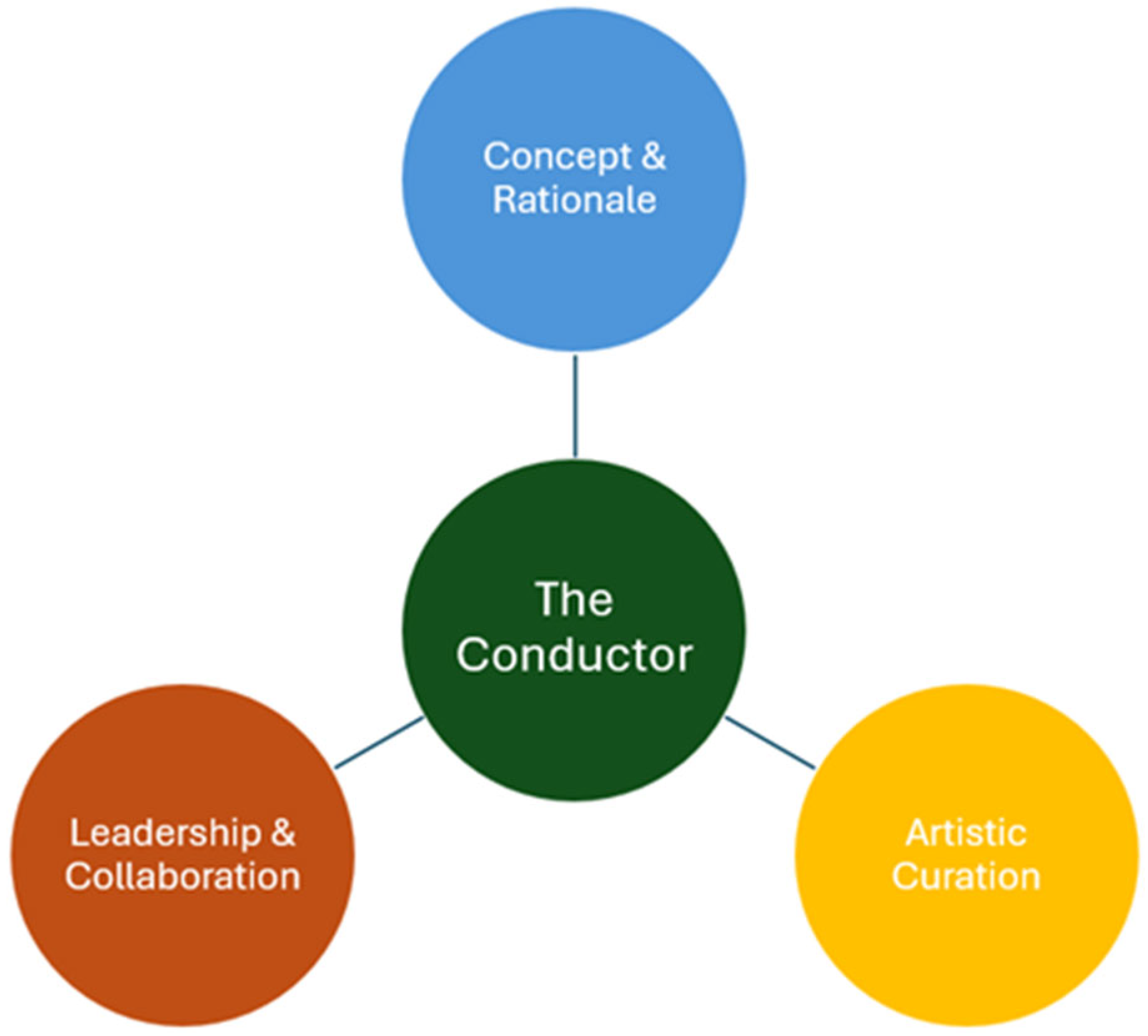
The framework foregrounds the distinct but connected conductor-led project areas of Concept and Rationale; Artistic Curation; and Leadership and Collaboration (Figure 1).

1.3.1. Concept and Rationale

Under this heading, we explore artistic vision; influences and precedents; goals and priorities.

1.3.2. Artistic Curation

Here, we explore repertoire selection and programme formulation; themes, threads and resonances; and a selection of aesthetic and practical considerations.

1.3.3. Leadership and Collaboration

Finally, we reflect on the creative processes involved; on interpretation and implementation; and on aspects of collective engagement, experience, and reception.
Within the projects presented here, as is often the case more broadly, the conductor’s role is multifaceted, incorporating the following complementary activities:
-
Artistic director: planning and shaping the choir’s artistic and technical development in the short, medium, and longer terms;
-
Conductor in rehearsal: leading the musical, textual, and interpretative learning of the repertoire throughout the rehearsal period;
-
Conductor in performance: conducting the choir in the concert/recording; presenting the concert;
-
Project manager: leading the project in various artistic and logistical respects, in conjunction with a committee and other contributors.
Richard Bjella asserts that ‘too many concert programs are presented without enough concern for the overall flow, purpose, and direction of the concert itself. Often many wonderful selections are included, but rarely do they work together in tandem or with enough significant diversity and color changes to warrant the complete attention of the audience,’ and argues, further, that ‘in this age of diminishing crowds, fiscal resources, and rehearsal time, our ability to creatively weave the material to capture our singers and our audiences at the same time is extremely critical’ (Bjella 2017, p. 281). By exploring two artistic projects through the lens of the framework outlined above, we consider possibilities that may assist choral conductors in responding to observations such as Bjella’s, while foregrounding constructive music leadership in the cultivation of collective artistic significance. Drawing on key scholars of choral studies, we posit that the conductor’s art of creating and leading meaningful collective experiences, while largely intentional, is also partly intuitive.

2. Artistic Programming: Principles and Priorities

Programming is a central part of the choral conductor’s role. It forms the basis for the significant artistic experiences that we aim to create for our choirs and for the audiences that attend our performances and engage with our music by other means. In this section we explore the principles and priorities involved in the stages of programme development and implementation that underpin the concert and recording projects outlined in Section 3.

2.1. Selecting and Formulating the Programme

Programming a concert or a recording essentially has two stages: selection—researching and choosing the repertoire, and formulation—putting the repertoire in the optimal order. These stages are informed by numerous considerations, including, among others, quality and artistic value, suitability for the ensemble and for the occasion, level of challenge at the micro and macro levels, unity and variety, style, language, balance, keys, tempos, overall coherence, ensemble development, and budget—for buying music scores and for other expenses (Apfelstadt 2000; Ryan 2024, p. 188). As Kari Turunen states, once the pieces have been selected, ‘conductors must use their skills and imagination to organize the material of any given concert in an effective, sustainable, and meaningful way; sustainable in the sense that performers are at their best throughout the programme; and meaningful in the sense that the order of works maximizes the connotative web that connects the works and conveys the intention behind the programme’ (Turunen 2024, p. 146). Turunen puts forward five possibilities for organising a programme, including chronological; thematic; storytelling; formalistic designs such as Aristotelian (with a beginning, middle, end) or mirror structure; and structures derived from musical forms such as sonata and rondo (Turunen 2024). David Brunner adds further suggestions, such as grouping by various musical or textual commonalities, juxtaposition of contrasts, and use of the golden section (Brunner 1994). Aside from more explicit thematic connections that might contribute to the ‘connotative web’ mentioned above, Bjella notes that more implicit resonances and threads within the repertoire may be found through the practice of studying the musical scores in detail:
Score study itself unfolds so many stories and treasures for us all. Often, unexpected connections are found in unexpected avenues of our study. That harmonic progression in the Brahms may lead to a find of a contemporary composer with the same bent. The text to that Italian madrigal from 1580 touches the hem of a late 20th century composer as well. The folk tune melodic structure from 17th-century Latvia is surprisingly seen in an English folk song from the 19th century. The counterpoint in an Ockeghem motet may trigger a new look at a secular cantata of J. S. Bach. All of our study, however oblique, helps us in that journey towards the best piece for the ensemble.
(Bjella 2017, pp. 282–83)
In addition to the practical and aesthetic considerations and the thematic nuances of programme building outlined thus far, we drew on two further, related priorities in the creation of the artistic programmes that form the basis of the projects below: representation, and the promotion of new artworks. In choosing repertoire, conductors and choirs in a meaningful sense platform the music (and the composers) involved, not only because we present this material to an audience in a public forum, but because the music is normally rehearsed in detail and with conviction over the period of time that we invest in it. The selection of repertoire has the capacity to impact diversity, inclusion, variety, and equity in an artform that historically has lacked these qualities (Flanagan 2024; Callaghan 2024). Similarly, we can bring previously unperformed or neglected works into being by giving the world or national premiere performance, and, furthermore, we are ideally positioned both to encourage the creation of new artworks by commissioning composers to write pieces for our choirs, and to champion these new works through performance in concerts, choral festivals at home and abroad, and for recordings, ideally with subsequent radio play (Flanagan 2024). Scottish composer James MacMillan captures the significance of new choral music from the composer’s perspective with his observation that ‘It is a huge thing for a composer to hear their work come alive in the hands and voices of interpreters. Up until the first rehearsal the composition remains in the inner imagination of the composer. But it comes to life, incarnationally, when conductor and singers […] start to transform it into live musical flesh’ (MacMillan 2017).2
Taking into account the various considerations outlined above, the work of compiling an effective artistic experience is captured by Bjella’s assertion that ‘the art of successful programming is a long, arduous, circuitous, and yet most rewarding task that requires a constant study of literature of all types’ (Bjella 2017, p. 291). The conductor’s practice in this regard, Turunen argues, is itself something that can evolve over time: ‘Initially, the process is based on rational considerations, but with time and experience it can become more intuitive’ (Turunen 2024, p. 154). As we note in both structured reflections below, artistic projects may be prepared over a long period, building on a variety of previous activities and ideas, whether consciously or subconsciously.3

2.2. Realising the Programme

The two stages of selecting and formulating a programmemust of course be followed by the process of bringing the music to life through rehearsal and performance, and sometimes also recording. A great deal of literature is available on the art and craft of the choral rehearsal, and how particular structural elements can lead to certain musical, technical, and pedagogical outcomes (Dahl 2008; Emmons and Chase 2006; Blunnie 2024; Paul 2020; Flanagan 2024; Jordan 2007; Ryan 2024; Howard Jones 2012; Sherlock 2024; Jansson 2018; Carrington 2012). Here, we focus on aspects of rehearsal that underpin this article’s concern with the role of the conductor as it pertains to creating collective artistic experiences. By its nature, the choral rehearsal is a collaborative encounter between conductor and singers. Liz Garnett describes the ‘conductor–choir bond’ as a ‘symbiotic relationship that is actively maintained by all participants’ (Garnett 2009, p. 193). Though conductors are in essence leaders, their work is achievable only with the input of singers in a co-creational process, as emphasised by Durrant: ‘Let us not forget that the word ‘conductor’ has a Latin derivation conducare—to lead (ducare) together (con)’ (Durrant 2009, p. 327). In our practice, we seek to put in place the circumstances in which singers can contribute effectively to the collective vocal sound and expressive purpose of the choir. These circumstances consist of multiple ingredients, but from our point of view, the quality of the artistic plan and musical preparation of the conductor for every project and for each piece undertaken in rehearsal plays a key part, particularly when combined with an emotional understanding of singers as participants in the creative process. As Garnett observes:
People experience themselves as performing musicians through the act of musical participation, and the choral practitioner’s task is to help singers engage with the music they sing in a way that not only respects the needs of the music, but that can be accepted and embraced by the singer as true to themselves as well…[T]he ways in which people sing, and the terms in which they understand it, not only connect out into their wider social identities but also extend deep into their affective and imaginative states
(Garnett 2009, p. 199).
In our respective chamber choirs, once-weekly rehearsals mean that meeting for communal singing has an established regularity in the lives of the members. Jonathan Arnold, in his book Music and Faith: Conversations in a Post-Secular Age, draws on an interview with Robert Dunbar, Emeritus Professor of Evolutionary Psychology at the University of Oxford, to comment on the ritualistic function of such regular musical gatherings. Arnold notes that Dunbar’s research ‘points to a deep human need for meaning through experience, relationship and feeling’, concluding that it illustrates ‘the fundamental nature of communal singing and ritual to human flourishing, and that, even when religious belief has been lost from society, the practice of coming together for regular ritualistic music-making is as strong as ever’ (Arnold 2019, p. 100). As conductors, we navigate the journey through the stages of the rehearsal process and on to performance and/or recording in a constant responsive dialogue with the choir members. We coordinate the combination of our own musical and interpretative ideas with the essential individual and collective contributions of the singers within a continuum of development. Dag Jansson encapsulates the leadership function of the conductor within this progressive dialogic relationship, observing that, ‘Given the role’s depth of involvement with the music material and impact upon the crafting of the sound, the conductor is uniquely able to energise and guide the ensemble through the preparation process, as well as lead the eventual performance’. These parts of the role, Jansson argues, involve ‘unleashing the musicality and competence which are inherent in the ensemble, and unifying individual efforts towards those ends’ via ‘a tricky balance between diversity and cohesion, freedom and discipline, enthusing and influencing—in short, between empowerment and control’ (Jansson 2018, p. 35). At the culmination of this conductor-led, collaborative, co-creative journey, as Kristy Lynn Juliano observes about performance, and which, we argue, applies also to recording, conductors draw a wide range of artistic elements together and ‘become effective facilitators and conduits for the communication, expressivity and transcendence of the music, establishing and nourishing an interconnectivity amongst the music, composers, poets, music-makers, and their audiences’ (Juliano 2014, p. 106).

3. Structured Reflections on Artistic Projects

In this section, we use the framework for structured reflection introduced in Section 1.3 above to analyse two artistic projects—a live concert, and an album recording—under the headings Concept and Rationale; Artistic Curation; and Leadership and Collaboration; as we examine the role of the conductor in combining artistic leadership with collective co-creation in a choral context.

3.1. Project I: Natural History

Mornington Singers
Conductor: Orla Flanagan

3.1.1. Concept and Rationale

The imposed exile from my choir during the COVID-19 pandemic afforded me an opportunity to focus on the slow knowledge acquisition and research that can be difficult to achieve in our fast-paced musical world (Beyer 2014). One artistic priority that emerged from this unexpected time of reflection and recalibration is the exploration of thematic possibilities broadly inspired by the natural world and our existence within a greater universe. The kernel of inspiration for Natural History came when Irish composer Emma O’Halloran (b.1985) sent me her score of the same name. This choral work, composed in 2015 and revised in 2022, sets an extract from British explorer Alfred Russel Wallace’s The Malay Archipelago. The chosen text reads as an inventory of the species discovered by Wallace on his travels, and the composer contextualises it in her programme note with a quotation from Wallace that highlights the relevance of environmental concerns even in Wallace’s late nineteenth century world:
To pollute a spring or a river, to exterminate a bird or beast, should be treated as moral offences and as social crimes; … Yet during the past century, which has seen those great advances in the knowledge of Nature of which we are so proud, there has been no corresponding development of a love or reverence for her works; so that never before has there been such widespread ravage of the earth’s surface by destruction of native vegetation and with it of much animal life, and such wholesale defacement of the earth by mineral workings and by pouring into our streams and rivers the refuse of manufactories and of cities; and this has been done by all the greatest nations claiming the first place for civilisation and religion!4
I find it useful to spend several concert seasons exploring music of a related theme. Over time, the choir builds a common repertoire on this theme, from which recordings and competition performances can be curated. As the COVID pandemic restrictions eased, and choir rehearsals and concerts once again started to take place in-person, it seemed more important than ever to forge a sense of connection and engagement with singers and audiences alike. I chose to do this by employing a thematic approach that explored topics of universal contemporary relevance, creating a sense of shared ownership and engagement with the singers and audience through carefully curated text and music choices. Thus, over the period from 2022 to 2025, most of my concert programmes with Mornington Singers explored earth-related subjects: Night on Earth, Autumn Landscapes, O Schöne Nacht, Mille regretz, The Arrow and the Song, Longwave, and Natural History.5 These represented something of a departure from our previous general tendency towards mainly sacred music, which makes up a considerable portion of Western classical choral repertoire. Instead, I sought out texts which set poetry or other secular themes, with the aim of enhancing the audience’s spiritual experience in a different way.

3.1.2. Artistic Curation

For Natural History, starting from the O’Halloran piece, I formulated a programme comprising ten musical works: five contemporary pieces and five from the late Romantic period. When selecting and structuring the concert programme, my priorities were to achieve a sense of overall narrative and flow, and to highlight the individual expressive features, resonances and connections between the pieces. The five contemporary pieces take diverse compositional approaches, whereas it can be said that the five earlier pieces are more stylistically homogeneous (in terms of harmonic language, type of text, and homophony). The decision to intersperse the newer music with earlier Romantic pieces rather than present them in two blocks meant that the latter pieces functioned as a unifying device for the whole programme, by way of their approachable and broadly similar harmonic language. This also had the effect of ensuring that the innovations of the newer music stood in sharp relief. Furthermore, it allowed the singers to pace themselves with regard to the demands of the music. This aligns with Turunen’s assertion that ‘making sure the most technically or vocally demanding works are placed economically will help the performers reach their optimal level’ (Turunen 2024, p. 154).
In terms of the narrative arc, the programme represents a journey through the tangible and evocative terrestrial imagery of the natural world (an evening scene, a host of daffodils, birds, bees, and an inventory of species), towards the more esoteric and existential themes explored in the texts of Hildegard, Shelley, and Tennyson. Thought was also given to creating a sense of flow in the key sequence (see Table 1); there are no jarring transitions of tonality between pieces, with the exception of that from Stanford to Elgar (D to E flat), the latter of which opens with a passionate outburst akin to the Wild West Wind it is evoking.
The vast majority of the music selected for this programme is in the English language. This is not always the case; it is typical for our concert programmes to include many different languages. The decision to focus mostly on English texts this time was conscious: it gave the expression a directness for both the singers and audience, who could more readily access the meaning of the music. A notable exception was the opening piece in the programme, Swedish composer Hugo Alfvén’s Aftonen (‘Evening’). In rehearsal, we experimented with singing this in the original Swedish and in an English version; the Swedish was favoured by both the singers and the conductor due to the quality of the Swedish vowels, which lent the opening piece of the concert a purity of tone that evoked the evening scene we wished to portray through the music. Thus, the communication of the text was less of a priority in this piece, as the music seemed to evoke the meaning, and its contemplative atmosphere served as an entry point into the rest of the concert programme. The other piece in the programme that does not set English text is Chris Sivak’s Alouette Meets Her Maker; this seven-minute piece is almost entirely wordless, with Sivak opting to set just one extract from the French nursery rhyme: ‘Alouette, gentille Alouette, je te plumerai’ (‘Lark, gentle lark, I will pluck you’). The absence of text is more than compensated for by the innovative singing techniques explored (nasal vowels, Morse code imitation, murmuring, beeping, etc.) which effectively conjure the image of a dying satellite.
Throughout the programme, I sought to highlight textual and thematic resonances between the older and newer works presented; for example, Laura Sheils’s choice of the Romantic poetry of Wordsworth speaks to the Shelley and Tennyson settings of Bridge, Stanford, and Elgar; the ‘fiery life’ and ‘voice of God in the wind’ in Eoghan Desmond/Hildegard of Bingen’s text are echoed in the ‘tiny spark of being’ and ‘fiery clash of meteorites’ (Tennyson/Stanford) and the ‘ashes and sparks’ and ‘wild West Wind’ (Shelley/Elgar); and various birds pervade the programme (the turtle dove (Vaughan Williams), the lark (Sivak), the whip-poor-will (Panufnik), and ‘eight thousand and fifty specimens of bird’ (O’Halloran)). The notion of collaboration across centuries not only appears in the choice of programme, but also in Eoghan Desmond’s choice of text. Desmond writes in his programme note: ‘For this piece I took as my starting point some meditations on the nature of the Holy Spirit by the medieval composer and saint Hildegard of Bingen. I selected lines from her writings primarily describing the Holy Spirit as it relates to the natural world, and freely translated them into modern English. I expanded on some areas by adding reflections of my own, so it is difficult to say where Hildegard’s writing ends and mine begins. In a real sense, we have collaborated on the text across the ages.’6

3.1.3. Leadership and Collaboration

While it is typically the conductor that curates and directs the musical programme, there are benefits to involving the singers in the interpretative journey from rehearsals to concert. As Durrant writes: ‘In an ensemble context it is clearly necessary for there to be a vision of the musical product; the process along the way involves a series of goals and sub-goals moving towards achieving that vision […] communication is about interaction, exchange of ideas and consultation between people’ (Durrant 2009, pp. 327–28). When leading an ensemble, it is important that singers feel invested in the creation of an interpretation. Although this is potentially problematic with limited rehearsal time, it is my experience that facilitating discussions among the singers about the meaning of the music they are singing results in a greater sense of commitment to the performance (Flanagan 2024). For the Natural History project, I experimented with a rehearsal exercise during which the choir members were invited to select one of the pieces from the programme. The singers were then grouped together according to their choices and each group examined and discussed the text of their chosen piece of music before presenting their thoughts and reflections to the full choir in an informal, collaborative manner. This provoked interesting responses and resulted in a deeper sense of engagement with the text and music, and an increased sense of attachment to the concert theme, through a process of agency and collaboration. In doing so I sought to align with the link Abrahams and Abrahams have drawn with Vygotsky’s theory that learning occurs in a zone of proximal development: ‘Choral pedagogy is grounded within a community of practice. The conductor’s goal is to create an ensemble where singers become members of a community through situated experiences in rehearsal’ (Abrahams and Abrahams 2017, p. 206). This spirit of collaboration has the added advantage of strengthening the feeling of coherence and unity in the group as it strives for a common expressive goal.
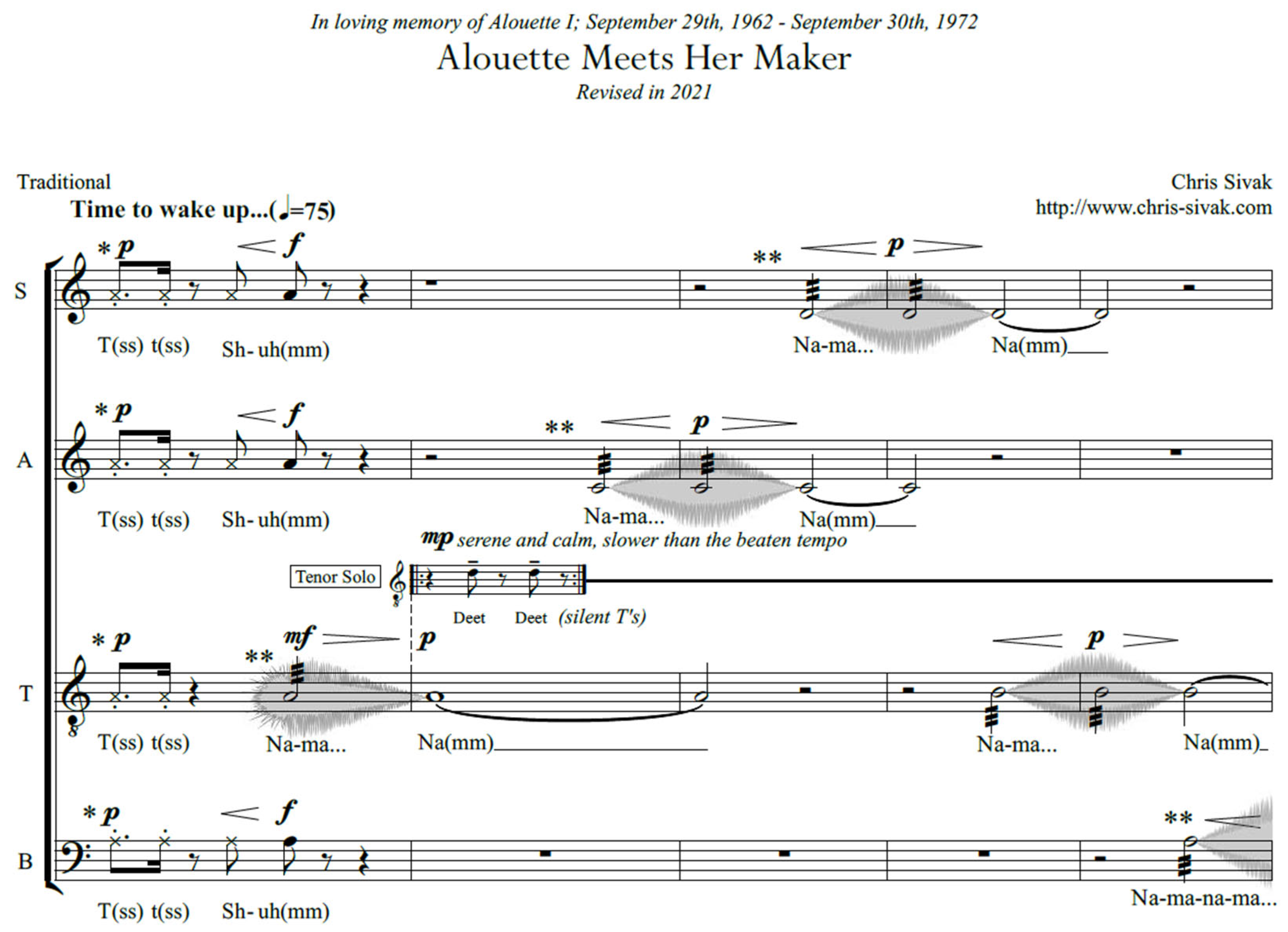
A spirit of experimentation during rehearsals can also be a potent part of a conductor’s toolkit. I find that it is wise to enter a rehearsal period with a flexible approach to the desired interpretation or result. Contemporary music in particular raises challenges in terms of how it is notated and realised; often the composer is trying to achieve something that is entirely new or is difficult to express in standard music notation. For example, in the case of Sivak’s Alouette Meets Her Maker (Figure 2), the score indicates nonstandard features such as panicked Morse-code distress calls, giggling, stamping, and reading random text, as well as modification of vowel sounds and vocal tone to vary the nasality of the sound—evident in the distinctive markings shown here in the opening bars:
In order to ensure that the composer’s vision was realised as intended, the singers and I collaborated in a process of experimentation during rehearsals, and I arranged a meeting with the composer to exchange ideas about the details of the performance.
The creativity of the singers and dialogue with living composers played an important role in the crafting of Natural History as a whole and aided my capacity as the conductor to convey the essence of the programme. As Durrant states, ‘One of the more elusive phenomena in creating an effective and successful musical event concerns communication. Not the relaying of information, but rather imparting the subtle nuances of the character […] is integral to the communication system of those leading, directing and conducting music’ (Durrant 2009, p. 327).

3.2. Project II: Ghost Songs: Contemporary Music and Words from Ireland

Laetare Vocal Ensemble and guest artists
Conductor: Róisín Blunnie

3.2.1. Concept and Rationale

The starting point of what became Ghost Songs was an assortment of distinctive new choral works by Irish composers that my choir, Laetare Vocal Ensemble, had been performing and enjoying in the immediately preceding years. Some had been commissioned and/or premiered by us and performed in concerts and competitions. I felt that we as a choir had a strong affinity with these pieces and that they should be captured in recording as an act of musical preservation for ourselves, as a means of bringing them to a wider audience, and as the basis for a broader artistic project. I was, moreover, struck by the thematic resonances that seemed to me to connect the works at a deep level. In addition to such choral impetus, I was influenced by cross-genre arts events in which the choir had participated, and particularly by occasions where the text of a poem had been read by the experienced performance poet Paula Meehan prior to the performance of its musical setting, or, in the case of bilingual Irish poet Dairena Ní Chinnéide and harpist and traditional singer Síle Denvir, where poetry and music were intertwined in an innovative collaboration that I felt was profoundly impactful.7 Finally, I drew inspiration from two CD albums that I had long enjoyed and that had each made a strong artistic impression on me in terms of their content and structure, and the experience of listening:
-When Love Speaks (Gelardi and Kamen 2002), a 53-track compilation album of spoken and sung interpretations of Shakespeare’s sonnets and excerpts from his plays, performed by, among many others, John Hurt, Annie Lennox, Des’ree, John Gielgud, Alan Rickman, Imelda Staunton, Kenneth Branagh, Richard Attenborough, Fiona Shaw, Rufus Wainwright, Bryan Ferry, and Barbara Bonney.8
-The Poet and the Piper (Heaney and O’Flynn 2003), a 27-track album that combined, through both juxtaposition and superimposition, the words and voice of poet Seamus Heaney with the evocative sound of virtuoso uilleann piper Liam O’Flynn.9
Building on the above sources and influences, I approached poets Paula Meehan and Dairena Ní Chinnéide, musician and singer Síle Denvir, and playwright Marina Carr to collaborate on the project and to contribute their creations and their performances to Ghost Songs. To perform the words of poets unknown or no longer living, I asked Irish broadcaster and established radio voice Carl Corcoran to join the line-up.

3.2.2. Artistic Curation

Ghost Songs is built around nine choral pieces, each preceded by a reading of its text. The pieces were in most cases already quite well-known to the choir, though they still required rehearsal and fine-tuning for recording. Some had been prepared to a high level of memorised performance for competitions, including The Old Woman, by Rhona Clarke; The Destroyer, It’s Strange About Stars, and Under-Song, by Seán Doherty; and Bagairt na Marbh (‘The Threat of the Dead’), by Michael Holohan. Others were learned for previous concerts, while Do Not Stand at My Grave and Weep, a setting by Rhona Clarke of the well-known poem attributed to Mary Elizabeth Frye, had been recorded for an earlier album. As the choir had developed significantly since then, and we were now in a different venue with a different acoustic using different recording equipment, I felt it was important for the sake of musical and technical coherence and for the album’s artistic integrity to record a new version so as to present a consistent sound quality across all the choral tracks.
Thematically, the point of departure for the artistic concept was a set of allusive topics and evocative threads evident in or suggested by the choral pieces (and their texts). The pieces were then interspersed with emotionally resonant readings by Carr, Meehan, and Ní Chinnéide, the latter at times in partnership with the harp and vocals of Denvir. In collaborating with these guest artists, an important principle for me was the freedom and integrity of each in selecting their own contribution. To balance such individual choice with the overall character and coherence of the project concept, I shared a list of themes and subthemes with the contributors and asked them to draw from their own creative oeuvres in response to these. During the recording and editing stages, I noted ideas for connections and groupings that would lead to the final track order, and once these stages were complete, I engaged in extensive close listening to formulate the running order in the way that I felt would best represent the artistic concept and would create a fluent, balanced, and evocative listening experience (Table 2):
From my perspective, the tracks’ connective threads included ghostly encounters, liminal spaces, Ireland, elsewhere, anywhere; earth and otherworld; time and timelessness; natural and supernatural; allusion, elusion, and illusion; islands and sea; sky, moon, and stars; presence and absence; essence, ethereality, and intangibility. On a more concrete level, I was keen to incorporate and integrate material in both the English and Irish languages, as this seemed an authentic representation of the artists involved and of my own artistic milieu.10 From the outset of the project, I had imagined that the album would begin with a choral track of an expressively and compositionally impactful nature, to start with a bang, as it were (Turunen 2024, p. 149). However, my own deep engagement with all the tracks through recording and close listening led me to a different decision. I chose to open Ghost Songs with the gentle, evocative unfolding of Numinosity, where a perfect 4th interval on the low drones of the shruti box, balanced with higher triadic movement on harp, underpins the highly unusual spoken-and-sung interaction of Ní Chinnéide and Denvir:
  • I see sketches of islands
  • half revealed
  • like deities
  • in a haze
  • sun shines on sea
  • like errant particles
  • glittering
  • in their own glory
  • the presence of numinous beings
  • reflect of the surface
  • brown rushes turn gold
  • on cliffs.
(Numinosity, by Dairena Ní Chinnéide, from her collection Deleted (Cliffs of Moher, Co Clare: Salmon Poetry), where it bears the dedication ‘for Síle Denvir’ (Ní Chinnéide 2019). Reprinted with permission.)
Numinosity introduces images and allusions that I hoped would set the tone and whet the appetite for the album as a whole.
Grouping the tracks by theme allowed me to create implicit “chapters” throughout. For example, tracks 5 to 9 are linked by references to liminality, particularly the blurred threshold between the living and the dead. In track 5, an extract from her play Woman and Scarecrow, Marina Carr reads, ‘The old people at home used say when a person was mortally fading, if they could hold on till the tide turns, they’ll surely make it. […] The day she died, I saw her walking across the sand’; while in track 8, An Aimsir Láithreach (‘The Present Tense’), Dairena Ní Chinnéide recounts (in Irish) hearing the voice of her late mother on Raidió na Gaeltachta, Ireland’s national Irish-language radio station:
  • my heart lifted
  • you were in the present tense
  • for a while11
Between these tracks, the poem and choral piece Do Not Stand at My Grave and Weep conclude with ‘I am not there, I did not die’, while in The Last Thing, Paula Meehan speculates about what caused her dying father to slip below ‘the horizon of his morphine dream’. Was it her mother’s voice ‘helming him home’, or a ‘ferocious winged creature at the ward’s window.12 Sky, moon, and stars connect tracks 10, 11, and 12, including Carr’s reference to ‘Rusalka on the radio, her song to the moon’, and Meehan’s recollection of a magical trip to the well, the cottage light ‘like a star that’s gone astray.’ Tracks 14–19 feature ethereal or supernatural encounters, while towards the end of the album, tracks 29–33 are linked by the idea of burial. Tracks 29 and 30 reference the Arbour Hill Cemetery in Dublin, where fourteen of the executed leaders of Ireland’s 1916 Rising are buried; track 30 features the traditional song Amhrán Mhuínse, in which a woman pleads that when she dies, she will be buried not on the mainland, but in her island home of Muínis, off the coast of Connemara, Co. Galway;13 and in track 32, Bagairt na Marbh, the writer feels the threatening presence of the newly dead:
  • The room is tense with the threat of the dead,
  • Their anger cannot be assuaged.
  • There is no living person with me,
  • But I feel her near me,
  • Though she is buried three months.
  • There is no sound that I can make
  • That does not put her on edge,
  • Ready to emerge, awakened, into my presence.
  • Be quiet, and let not the person who is newly dead,
  • Newly fallen into the stupor of death,
  • Hear you.
  • (Seán Ó Ríordáin, Bagairt na Marbh, translated by Róisín Blunnie)
Bagairt na Marbh harks back to the liminal space between death and life, evoked earlier by An Aimsir Láithreach and The Last Thing, and its musical setting, by Michael Holohan (track 33) also presages the album’s final track, with which it shares a more implicit feature: the divergence of the musical setting from the original text. Holohan’s vivid composition interrupts Ó Ríordáin’s Irish-language poem with phrases from the Latin Requiem: ‘Lux aeterna luceat eis, Domine, cum sanctis tuis in aeternam, quia pius es’,14 concluding with the words ‘requiem aeternam’; while in track 35, composer Seán Doherty sets just seven of the words of Paula Meehan’s poem heard in track 34: ‘I learn to breathe your ghost song’.15 Beyond the examples given here, the listener is free to draw on their own life experiences and interests to find further threads and evocations within the album content.

3.2.3. Leadership and Collaboration

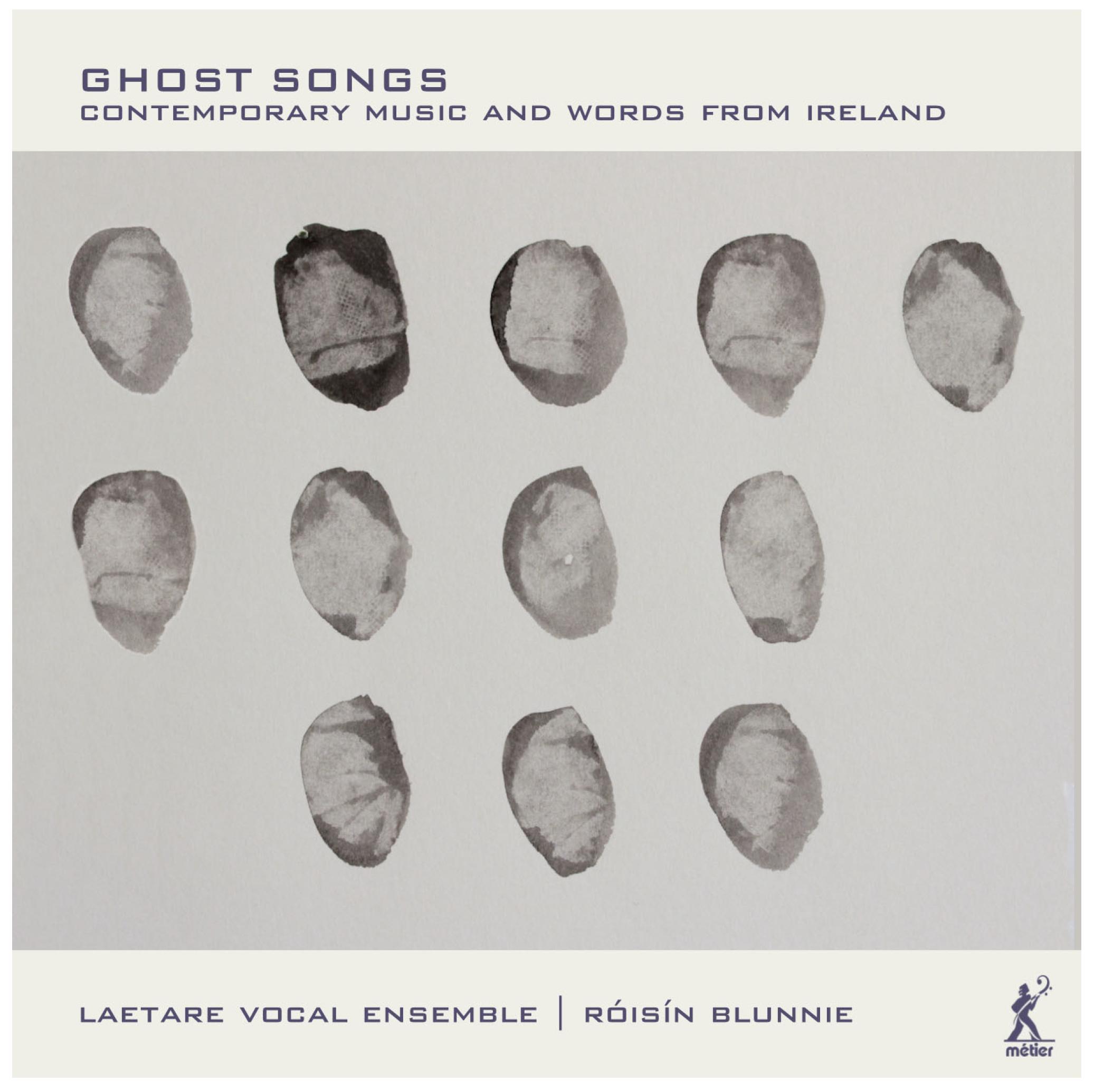
My aims for the album were to create a significant and memorable artistic experience for the performers, and to construct an immersive musical and literary journey for the listener. I sought not to prescribe an interpretation, but merely to allude, suggest, and conjure ideas that might spark the interest and engage the imagination. To encapsulate the idea of a multiplicity of possible interpretations, I asked Irish visual artist Marie Hanlon to provide a cover image that would align with the album’s overall theme and goals (Blunnie 2021b). Her image, All These Others (Figure 3), represents a further distinct stage on the album’s interpretative path, a path which travels from poems and dramatic excerpts (writing, performing), through music composition, rehearsal process (conducting, singing, playing), first and subsequent performances, recording (of both music and readings; engineers, acoustic spaces, technical set-ups; and editorial and post-production decisions), visual art, sleeve notes, and finally, listening.
In a review of Ghost Songs for Choir and Organ, Brian Morton captured key aspects of my intentions for the project, highlighting the relationship of music and text as presented on the album, and the effect of including the poems and the choral pieces as separate tracks:
There ought to be more recordings like this. The art of setting words and delivering them musically is widely discussed, but the words as a starting point are often left behind. Here three contemporary Irish poets, with the earlier Lola Ridge and W.B. Yeats read by broadcaster Carl Corcoran, are given the opportunity to present their work in isolation, cadenced as written rather than as they are then sung. It makes for fascinating listening and far from generating any tension between the written and the sung form, the juxtaposition illuminates both.
(Morton 2021, pp. 67, 69).
Colin Clarke, in Fanfare, noted the centrality of the choral works to the album’s architecture and responded to the interaction of words and music: ‘The choral pieces form major articulating points in the listener’s experience and, just as in the case of the poems, convey a series of emotions evoked by the central themes…The concept of alternations of poetry and music works on the profoundest level’ (Clarke 2022, p. 493).
The choral conductor is forever engaged in managing the aesthetic and the practical, the expected and the unexpected, and the recording of Ghost Songs was no different. Significant storms over Dublin brought an unavoidable and at times clearly audible backdrop to both choral recording weekends, although in my view the resultant sonic layer is well-suited to the album’s character. Relatedly, the unexpected illness of a determined soloist on the day of recording brought a quality to her voice that was much more ghostly than usual on Do Not Stand at My Grave and Weep. Harold Rosenbaum’s book, A Practical Guide to Choral Conducting, includes a helpful chapter called ‘Making Recordings’, covering topics such as finding a recording space, selecting an engineer, scheduling sessions, balance and progress; editing and post-production (Rosenbaum 2018, pp. 84–90). Such guides can prepare the conductor for a great deal of what happens in recording, but unexpected occurrences will invariably present challenges, whether human, meteorological, or otherwise, and the navigation, or incorporation, of such factors is necessary for the successful achievement of the intended artistic outcome. Rosenbaum’s aforementioned chapter begins with his own perspective on the purpose of recording a choir: ‘Preserving the final product after working so diligently to present a beautiful concert is important and fulfilling’ (Rosenbaum 2018, p. 84). Thus, for Rosenbaum, the concert is the immediate goal, with the recording as a further step. In the case of Ghost Songs, the album itself was the objective, and the process from artistic concept to realisation was designed and executed accordingly.

4. Conclusions

Through the structured reflections presented above, this article highlights inspirations, considerations, and goals for choral conductors: in assembling artistic programmes to create impactful collective experiences, and in enacting these experiences in a spirit of co-creation with choir members and other contributors. Borrowing from Shumack’s exegetical model, the juxtaposed reflections on two artistic projects enable us to draw out experience-based insights across the continuum from concept and rationale, through artistic curation, to leadership and collaboration in concert and recording, respectively, exploring the multifaceted role of the choral conductor both as an individual music leader and as a facilitator of artistic co-creation.
With this article, we provide a choral leadership perspective that responds to Skains’ call for an expansion of research approaches in the area of creative practice: ‘As creative practice expands as a field of academic research, there is a need to establish an ongoing discourse on and resource for appropriate practice-based methodologies.’ (Skains 2018, p. 84). We model a three-part reflective framework that may assist choral conductors or other ensemble leaders in overcoming ‘the problem of knowledge’ and ‘the ephemerality of performance’ (Nelson 2006) in the context of artistic research, and that may influence future practice, future thinking about practice, or future reflection on practice. By articulating the work of choral conductors as artistic project leaders, we access the ‘tacit dimension of knowledge’ intrinsic to creative processes and works (Hultberg 2013). Our purpose in presenting these reflections is to provide and analyse examples of collective artistic experiences that, as they are primarily musical in nature, can be difficult to express in words. Interestingly, Durrant advocates for the embracing of such expressive challenges in the context of choral leadership, reminding us that ‘Those who are leaders of musical activity are given the responsibility of making music meaningful in some way or other—technically, emotionally and socially. However, it might also be salutary for us to be reminded of music’s enigmatic nature—and it may be that we do not always need to explain meanings verbally or instructively’ (Durrant 2009, p. 326). With structured reflections on artistic projects, we perhaps capture elements of both the explicit and the implicit.
Our priorities in building an artistic programme are captured by Bjella, who asserts that the choice of repertoire ‘must touch the mind and heart as well as the voice of the singers’ (Bjella 2017, p. 284), and by Turunen, who argues that ‘a well-forged programme will create a musical flow and deliver the ideas behind the programme in an effective way’ (Turunen 2024, p. 153). Founded on a fluent, cohesive, meaningful programme, and brought to life via conductor-led, collaborative creative processes, we may achieve profound collective artistic experiences, as vividly conjured here by Dahl: ‘It is as if all the people there exist within the same energy field. In moments like this, it is as if every boundary between us is erased and we take part in and become part of something greater than ourselves’ (Dahl 2008, p. 9).

Author Contributions

Conceptualization, R.B. and O.F.; methodology, R.B. and O.F.; writing—original draft, review, and editing, R.B. and O.F. All authors have read and agreed to the published version of the manuscript.

Funding

This research received no external funding.

Data Availability Statement

The original contributions presented in this study are included in the article. Further inquiries can be directed to the corresponding authors.

Conflicts of Interest

The authors declare no conflicts of interest.

Notes

1
Hultberg draws on Borgdorff’s more tightly defined concept of ‘tacit knowledge’, as ‘situated and embodied in specific artworks and artistic processes’. See Borgdorff (2006).
2
Cited in Corbett (2018).
3
On the topic of intuition in the work of conductors, see Baxter (2024).
4
Wallace’s text is cited in the Composer’s Note in the preface to the score of O’Halloran’s Natural History.
5
For programme details for previous concerts, see ‘Mornington Singers: Archive’, https://www.morningtonsingers.org/concerts/archive (accessed on 3 January 2026)
6
Composer’s Note, preface to I Am by Eoghan Desmond. Used with permission. For further reading on Desmond’s compositional approaches, see Sheils (2024).
7
These events were ‘The Beauty of It’, part of the Bealtaine Age and Opportunity Festival at Poetry Ireland, Dublin, in 2017, and ‘Tairseach: Threshold’, part of the Anam Arts Festival at Dublin City University in 2018.
8
For full list of tracks and performers, see When Love Speaks. https://en.wikipedia.org/wiki/When_Love_Speaks (accessed on 3 January 2026).
9
For track list and album details, see Seamus Heaney and Liam O’Flynn, ‘The Poet and the Piper’, https://claddaghrecords.com/products/cd-seamus-heaney-and-liam-oflynn-the-poet-and-the-piper (accessed on 4 January 2026).
10
Both Ní Chinnéide and Denvir are native Irish speakers, from the West Kerry and Connemara Gaeltacht areas, respectively. While Denvir’s artistic output is almost entirely in Irish, Ní Chinnéide identifies as a bilingual poet and has published collections in both languages. For my own part, I am not a native speaker, but have a keen interest in the language and speak it regularly, as well as partaking in its musical traditions.
11
Translated by Dairena Ní Chinnéide, Ghost Songs sleeve notes (Blunnie 2021a). Original Irish version published in Tairseach (Ní Chinnéide 2021, p. 27). The poet’s reading on Ghost Songs is preceded by the phrase ‘i gcuimhne mo mháthair’ (‘in memory of my mother’).
12
For the full poem, see ‘The Last Thing’, in her collection As If By Magic (Meehan 2020, p. 248).
13
For further detail on this song, see Ghost Songs sleeve notes (Blunnie 2021a). Amhrán Mhuínse also links back musically to the island theme of Numinosity via the perfect 4th-based drone of the shruti box.
14
May eternal light shine upon them, O Lord, with your saints forever, for you are faithful.
15
For a performance of the complete poem by Paula Meehan with introduction by the poet, see ‘The Ghost Song by Paula Meehan’, https://www.youtube.com/watch?v=C4Vvf7IdkuY (accessed on 4 January 2026).

References

  1. Abrahams, Frank D., and Daniel Abrahams. 2017. Choral Pedagogy and the Construction of Meaning. In The Oxford Handbook of Choral Pedagogy. Edited by Frank D. Abrahams and Paul D. Head. New York: Oxford University Press Inc., pp. 205–218. [Google Scholar]
  2. Apfelstadt, Hilary. 2000. First Things First: Selecting Repertoire. Music Educators Journal 87: 19–46. [Google Scholar] [CrossRef]
  3. Arnold, Jonathan. 2019. Music and Faith: Conversations in a Post-Secular Age. Woodbridge: Boydell. [Google Scholar]
  4. Arnold, Josie. 2005. The PhD In Writing Accompanied By An Exegesis. Journal of University Teaching and Learning Practice 2: 36–50. [Google Scholar] [CrossRef]
  5. Barrett, Estelle. 2007. Experiential Learning in Practice as Research: Context, Method, Knowledge. Journal of Visual Art Practice 6: 115–24. [Google Scholar] [CrossRef] [PubMed]
  6. Bartlett, Alison, and Gina Mercer. 2001. Postgraduate Research Supervision: Transforming (R)Elations. New York: Peter Lang Publishing. [Google Scholar]
  7. Baxter, Hannah. 2024. Intuition: The Missing Piece? In Perspectives on Conducting. Edited by Róisín Blunnie and Ciarán Crilly. New York and Abingdon: Routledge, pp. 119–32. [Google Scholar]
  8. Beyer, Bud. 2014. Completing the Circle: Considerations for Change in the Performance of Music. Chicago: GIA Publications. [Google Scholar]
  9. Bjella, Richard. 2017. The Art of Successful Programming: Study, Selection, and Synthesis. In The Oxford Handbook of Choral Pedagogy. Edited by Frank Abrahams and Paul D. Head. Oxford and New York: Oxford University Press, pp. 281–302. [Google Scholar]
  10. Blunnie, Róisín. 2021a. Ghost Songs: Contemporary Music and Words from Ireland. Album with Sleeve Notes. Vermont: Divine Art Records. Digital Booklet. Available online: https://divineartrecords.com/recording/ghost-songs-contemporary-music-and-words-from-ireland (accessed on 7 June 2025).
  11. Blunnie, Róisín. 2021b. Ghost Songs—Where Irish Literature and Choral Music Meet. Available online: https://www.rte.ie/culture/2021/1027/1253955-ghost-songs-where-irish-literature-choral-music-meet (accessed on 16 June 2025).
  12. Blunnie, Róisín. 2024. Together from the Start: The Collective Power of the Choral Warm-Up. In Perspectives on Conducting. Edited by Róisín Blunnie and Ciarán Crilly. New York and Abingdon: Routledge, pp. 156–68. [Google Scholar]
  13. Borgdorff, Henk. 2006. The Debate on Research in the Arts. Bergen: Kunsthøgskolen i Bergen, vol. 2, Available online: https://www.esmuc.cat/wp-content/uploads/2022/02/The-debate-on-research-in-the-arts.pdf (accessed on 21 June 2025).
  14. Brady, Tess. 2000. A Question of Genre: De-mystifying the Exegesis. Text 4: 1. Available online: https://textjournal.scholasticahq.com/article/35896-a-question-of-genre-de-mystifying-the-exegesis (accessed on 3 January 2026).
  15. Brunner, David L. 1994. Choral Program Design: Structure and Symmetry. Music Educators Journal 80: 46–49. [Google Scholar] [CrossRef]
  16. Callaghan, Lynsey. 2024. Voices for Change: Socially Responsible Programming in Youth Choral Music Education. In Perspectives on Conducting. Edited by Róisín Blunnie and Ciarán Crilly. New York and Abingdon: Routledge, pp. 252–63. [Google Scholar]
  17. Candy, Linda, and Ernest Edmonds. 2018. Practice-Based Research in the Creative Arts: Foundations and Futures from the Front Line. Leonardo 51: 63–69. [Google Scholar] [CrossRef]
  18. Carrington, Simon. 2012. Small Ensemble Rehearsal Techniques for Choirs of All Sizes. In The Cambridge Companion to Choral Music. Edited by André de Quadros. Cambridge: Cambridge University Press, pp. 281–91. [Google Scholar]
  19. Clarke, Colin. 2022. Ghost Songs: Contemporary Music and Words from Ireland. Fanfare, 493. [Google Scholar]
  20. Corbett, George. 2018. TheoArtistry, and a Contemporary Perspective on Composing Sacred Choral Music. Religions 9: 7. [Google Scholar] [CrossRef]
  21. Dahl, Tone Bianca. 2008. The Choir: Singing, Leading, Communicating. Translated by Andrew Smith. Stavanger: Cantando. [Google Scholar]
  22. Durrant, Colin. 2009. Communicating and Accentuating the Aesthetic and Expressive Dimension in Choral Conducting. International Journal of Music Education 27: 326–40. [Google Scholar] [CrossRef]
  23. Emmons, Shirlee, and Constance Chase. 2006. Prescriptions for Choral Excellence: Tone, Text, Dynamic Leadership. Oxford: Oxford University Press. [Google Scholar]
  24. Flanagan, Orla. 2024. Playing the Long Game: Strategies for Building Consistency in the Chamber Choir. In Perspectives on Conducting. Edited by Róisín Blunnie and Ciarán Crilly. New York and Abingdon: Routledge, pp. 135–45. [Google Scholar]
  25. Friedman, Susan Stanford. 2011. Why Not Compare? PMLA 126: 753–762. Available online: http://www.jstor.org/stable/41414149 (accessed on 3 January 2026). [CrossRef]
  26. Garnett, Liz. 2009. Choral Conducting and the Construction of Meaning: Gesture, Voice, Identity. Aldershot: Ashgate. [Google Scholar]
  27. Gelardi, Joy, and Michael Kamen. 2002. When Love Speaks. London: EMI Classics. [Google Scholar]
  28. Heaney, Seamus, and Liam O’Flynn. 2003. The Poet and the Piper. Dublin: Claddagh Records. Available online: https://claddaghrecords.com/products/cd-seamus-heaney-and-liam-oflynn-the-poet-and-the-piper (accessed on 22 June 2025).
  29. Henton, Mary Elizabeth. 2022. Choosing Repertoire for Your Orchestra. American String Teacher 72: 23–26. [Google Scholar] [CrossRef]
  30. Hopkins, Michael. 2013. Programming in the Zone: Repertoire Selection for the Large Ensemble. Music Educators Journal 99: 69–74. [Google Scholar] [CrossRef]
  31. Howard Jones, Ann. 2012. A Point of Departure for Rehearsal Preparation and Planning. In The Cambridge Companion to Choral Music. Edited by André de Quadros. Cambridge: Cambridge University Press, pp. 272–80. [Google Scholar]
  32. Hultberg, Cecilia K. 2013. Artistic Processes in Music Performance A Research Area Calling for Inter-Disciplinary Collaboration. Swedish Journal of Music Research/Svensk Tidskrift för Musikforskning 95: 79–94. Available online: https://publicera.kb.se/stm-sjm/article/view/33877/27004 (accessed on 28 June 2025).
  33. Jansson, Dag. 2018. Leading Musically. SEMPRE Studies in the Psychology of Music. New York: Routledge. [Google Scholar]
  34. Jordan, James. 2007. Evoking Sound: The Choral Rehearsal: Volume 1: Techniques and Procedures. Chicago: GIA Publications. [Google Scholar]
  35. Juliano, Kristy Lynn. 2014. Facilitating Transformative Music Experiences: A Wholehearted Approach for Choral Leaders. Unpublished Master’s dissertation, California State University, Los Angeles, CA, USA. Available online: https://www.proquest.com/docview/1626021110 (accessed on 21 June 2025).
  36. Kroll, Jeri. 2004. The Exegesis and the Gentle Reader/Writer. Text. Available online: https://fac.flinders.edu.au/dspace/api/core/bitstreams/d1aa1544-d20a-4c5b-b795-9e3f63f6bcb5/content (accessed on 3 January 2026).
  37. MacMillan, James. 2017. A New Generation of Christian Artists. Catholic Herald, 21. [Google Scholar]
  38. Meehan, Paula. 2020. The Last Thing. In As If By Magic. Dublin: Dedalus. [Google Scholar]
  39. Morton, Brian. 2021. Ghost Songs: Contemporary Music and Words from Ireland. Choir and Organ 29: 67–69. [Google Scholar]
  40. Nelson, Robin. 2006. Practice-as-research and the Problem of Knowledge. Performance Research 11: 105–16. [Google Scholar] [CrossRef]
  41. Nelson, Robin. 2013. Practice as Research in the Arts: Principles, Protocols, Pedagogies and Resistances. New York: Palgrave MacMillan. [Google Scholar]
  42. Ní Chinnéide, Dairena. 2019. Deleted. County Clare: Salmon Poetry. [Google Scholar]
  43. Ní Chinnéide, Dairena. 2021. Tairseach. Dublin: Éabhóid. [Google Scholar]
  44. Paul, Sharon J. 2020. Art and Science in the Choral Rehearsal. New York: Oxford University Press. [Google Scholar]
  45. Rosenbaum, Harold. 2018. A Practical Guide to Choral Conducting. New York: Routledge. [Google Scholar]
  46. Ryan, Amy. 2024. Facilitating Connections: Leading and Developing University Choirs. In Perspectives on Conducting. Edited by Róisín Blunnie and Ciarán Crilly. New York and Abingdon: Routledge, pp. 184–200. [Google Scholar]
  47. Schön, Donald A. 1983. The Reflective Practitioner: How Professionals Think in Action. New York: Basic Books. [Google Scholar]
  48. Sheils, Laura. 2024. A Choral Meditation: Fusing Past and Present in the Sacred Music of Eoghan Desmond. Religions 15: 135. [Google Scholar] [CrossRef]
  49. Sherlock, Bernie. 2024. The Kodály Route to Becoming a Choral Conductor. In Perspectives on Conducting. Edited by Róisín Blunnie and Ciarán Crilly. New York and Abingdon: Routledge, pp. 45–61. [Google Scholar]
  50. Shumack, Kaye. 2008. Learning as experience: A model for teaching the ‘reflective exegesis’ for communication design practice. Art, Design & Communication in Higher Education 7: 59–72. [Google Scholar] [CrossRef]
  51. Skains, R. Lyle. 2018. Creative Practice as Research: Discourse on Methodology. Media Practice and Education 19: 82–97. [Google Scholar] [CrossRef]
  52. Turunen, Kari. 2024. The Other Side of Programming: How to Shape a Choral Concert Programme. In Perspectives on Conducting. Edited by Róisín Blunnie and Ciarán Crilly. New York and Abingdon: Routledge, pp. 146–55. [Google Scholar]
  53. Yoo, Hyesoo. 2016. A Web-Based Environment for Facilitating Reflective Self Assessment of Choral Conducting Students. Contributions to Music Education 41: 113–30. Available online: http://www.jstor.org/stable/24711131 (accessed on 27 June 2025).
Figure 1. Structured reflection framework.
Arts 15 00043 g001
Figure 2. Title and opening bars of Alouette Meets Her Maker by Chris Sivak. Reprinted with permission.
Arts 15 00043 g002
Figure 3. Ghost Songs album cover, featuring All These Others by Marie Hanlon.
Arts 15 00043 g003
Table 1. Programme order for Natural History.
ComposerTitleKey
Hugo AlfvénAftonenF major
Laura SheilsThe DaffodilsF minor—E flat major
Frank BridgeThe BeeE flat major
Roxanna PanufnikCelestial BirdC minor—C major
Ralph Vaughan WilliamsThe Turtle DoveB flat minor
Emma O’HalloranNatural HistoryB flat major—C major
Chris SivakAlouette Meets her MakerA minor
Eoghan DesmondI AmF minor/A flat major
Charles Villiers StanfordGod and the UniverseD minor—D major
Edward ElgarO Wild West WindE flat
Table 2. Ghost Songs: Contemporary Music and Words from Ireland—track list and information.
No.TitleTypePoet/Composer/AuthorPerformer(s)Duration
1NuminosityP, S, IDairena Ní Chinnéide & Síle DenvirDairena Ní Chinnéide; Síle Denvir1:35
2The Solace of ArtemisPPaula MeehanPaula Meehan1:38
3The DestroyerPLola RidgeCarl Corcoran0:42
4The DestroyerCSeán DohertyLaetare Vocal Ensemble3:48
5Extract from Woman and ScarecrowRMarina CarrMarina Carr1:14
6Do Not Stand at My Grave and WeepPAttrib. Mary E. FryeCarl Corcoran0:55
7Do Not Stand at My Grave and WeepCRhona ClarkeLaetare Vocal Ensemble3:14
8An Aimsir LáithreachPDairena Ní ChinnéideDairena Ní Chinnéide1:06
9The Last ThingPPaula MeehanPaula Meehan0:55
10Extract from Woman and ScarecrowRMarina CarrMarina Carr1:54
11WellPPaula MeehanPaula Meehan1:22
12It’s Strange About StarsPLola RidgeCarl Corcoran0:39
13It’s Strange About StarsCSeán DohertyLaetare Vocal Ensemble4:30
14Extract from Phaedra BackwardsRMarina CarrMarina Carr1:00
15Teorainn LeasaPDairena Ní ChinnéideDairena Ní Chinnéide1:26
16Sister TraumaPPaula MeehanPaula Meehan1:29
17Extract from IndigoRMarina CarrMarina Carr6:38
18Down by the Salley GardensPW. B. YeatsCarl Corcoran0:53
19Down by the Salley GardensCSeán DohertyLaetare Vocal Ensemble2:46
20Tairseach Toinne—Morning RagaP, IDairena Ní Chinnéide & Síle DenvirDairena Ní Chinnéide; Síle Denvir3:55
21Under-SongPLola RidgeCarl Corcoran1:21
22Under-SongCSeán DohertyLaetare Vocal Ensemble5:32
23Extract from Phaedra BackwardsRMarina CarrMarina Carr1:03
24The Old WomanPTraditional rhymeCarl Corcoran1:11
25The Old WomanCRhona ClarkeLaetare Vocal Ensemble3:43
26The Old NeighbourhoodPPaula MeehanPaula Meehan0:49
27LiosPDairena Ní ChinnéideDairena Ní Chinnéide1:12
28At the Spring EquinoxPPaula MeehanPaula Meehan3:46
29The Graves at Arbour HillPPaula MeehanPaula Meehan0:49
30The Graves at Arbour HillCSeán DohertyLaetare Vocal Ensemble3:32
31Oileán—Amhrán MhuínseP, SDairena Ní Chinnéide; trad.Dairena Ní Chinnéide; Síle Denvir3:40
32Bagairt na MarbhPSeán Ó RíordáinDairena Ní Chinnéide0:49
33Bagairt na MarbhCMichael HolohanLaetare Vocal Ensemble4:44
34The Ghost SongPPaula MeehanPaula Meehan1:04
35The Ghost SongCSeán DohertyLaetare Vocal Ensemble4:35
P = poem; C = choral piece; R = reading; S = song; I = instrumental piece/accompaniment.
Disclaimer/Publisher’s Note: The statements, opinions and data contained in all publications are solely those of the individual author(s) and contributor(s) and not of MDPI and/or the editor(s). MDPI and/or the editor(s) disclaim responsibility for any injury to people or property resulting from any ideas, methods, instructions or products referred to in the content.