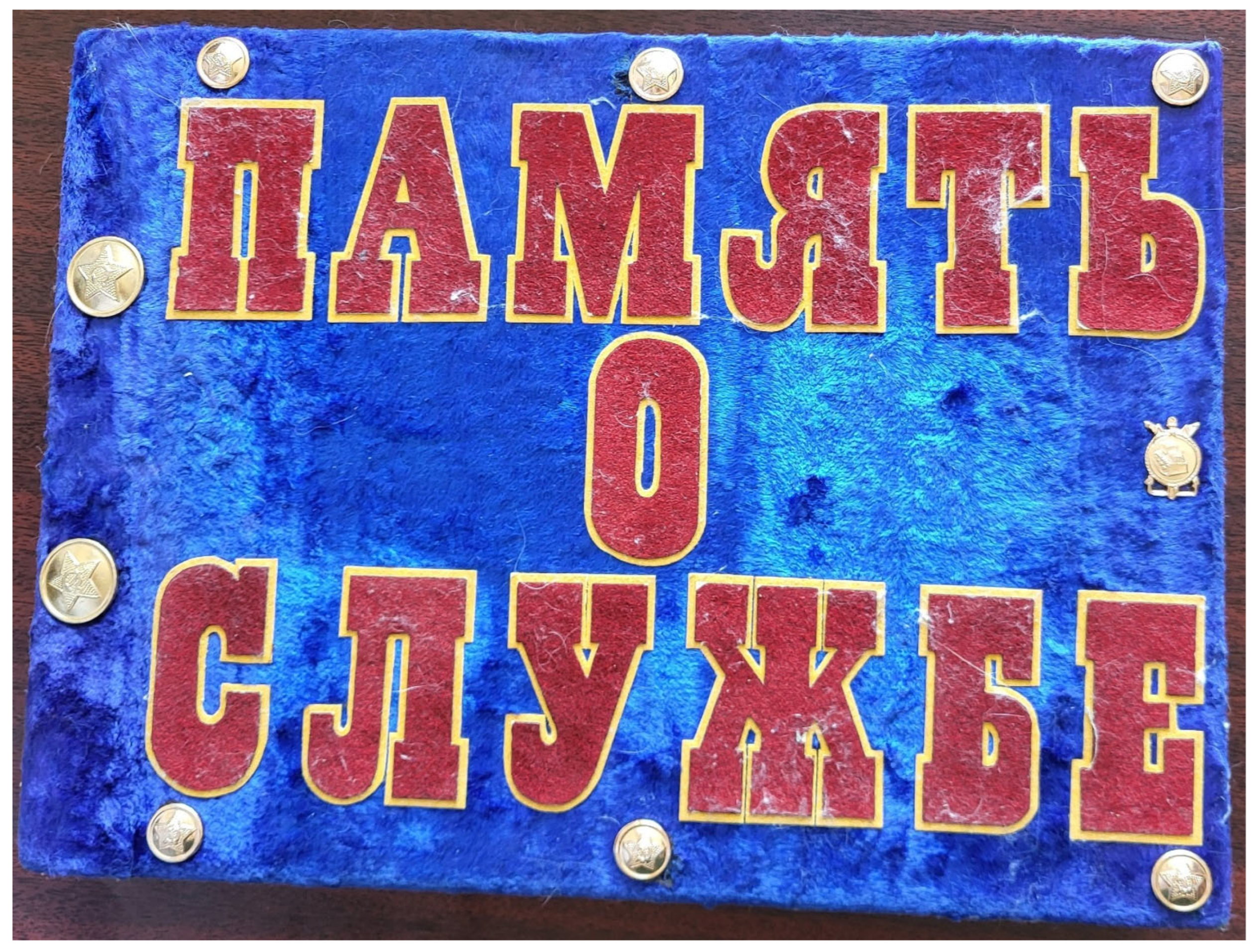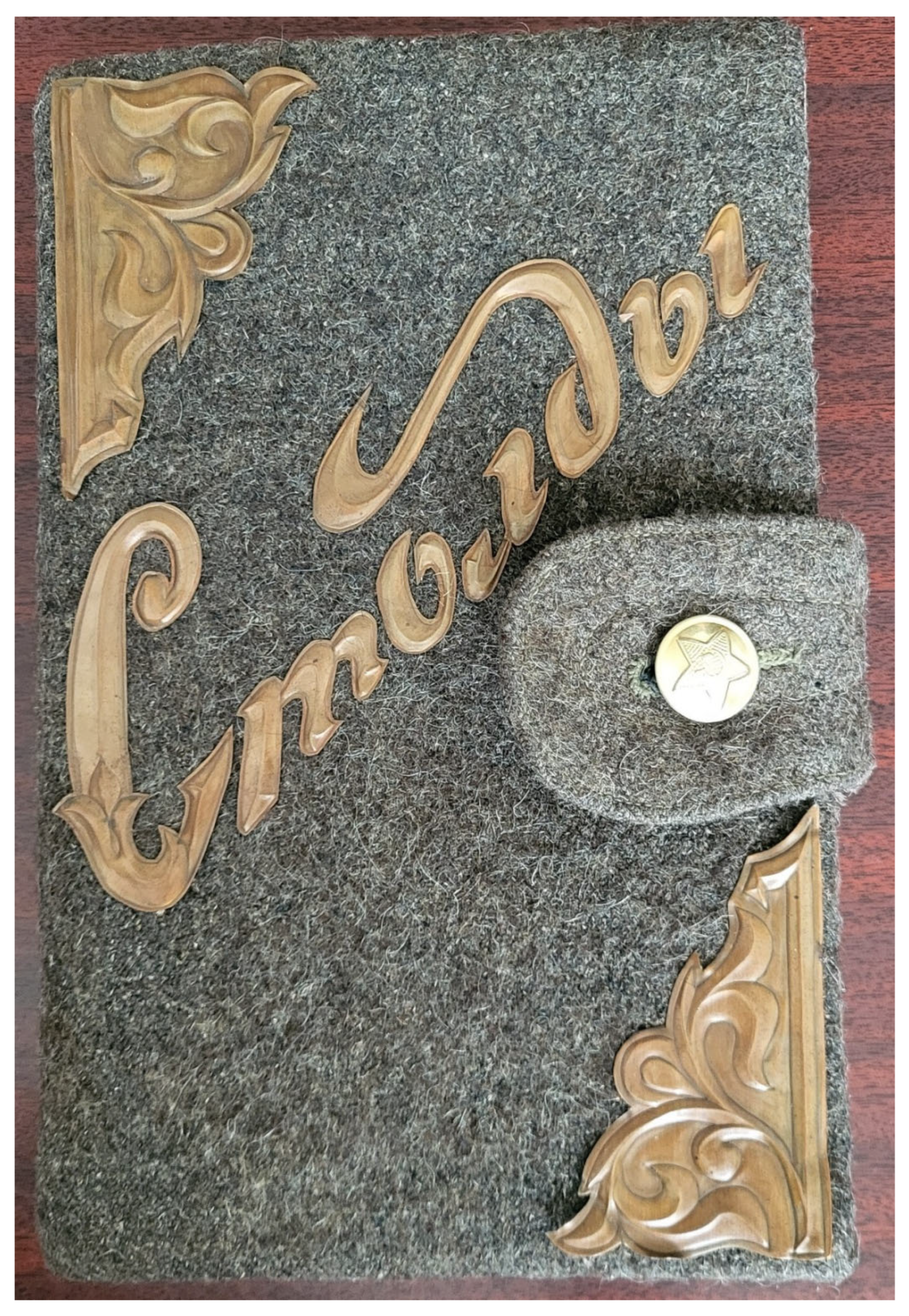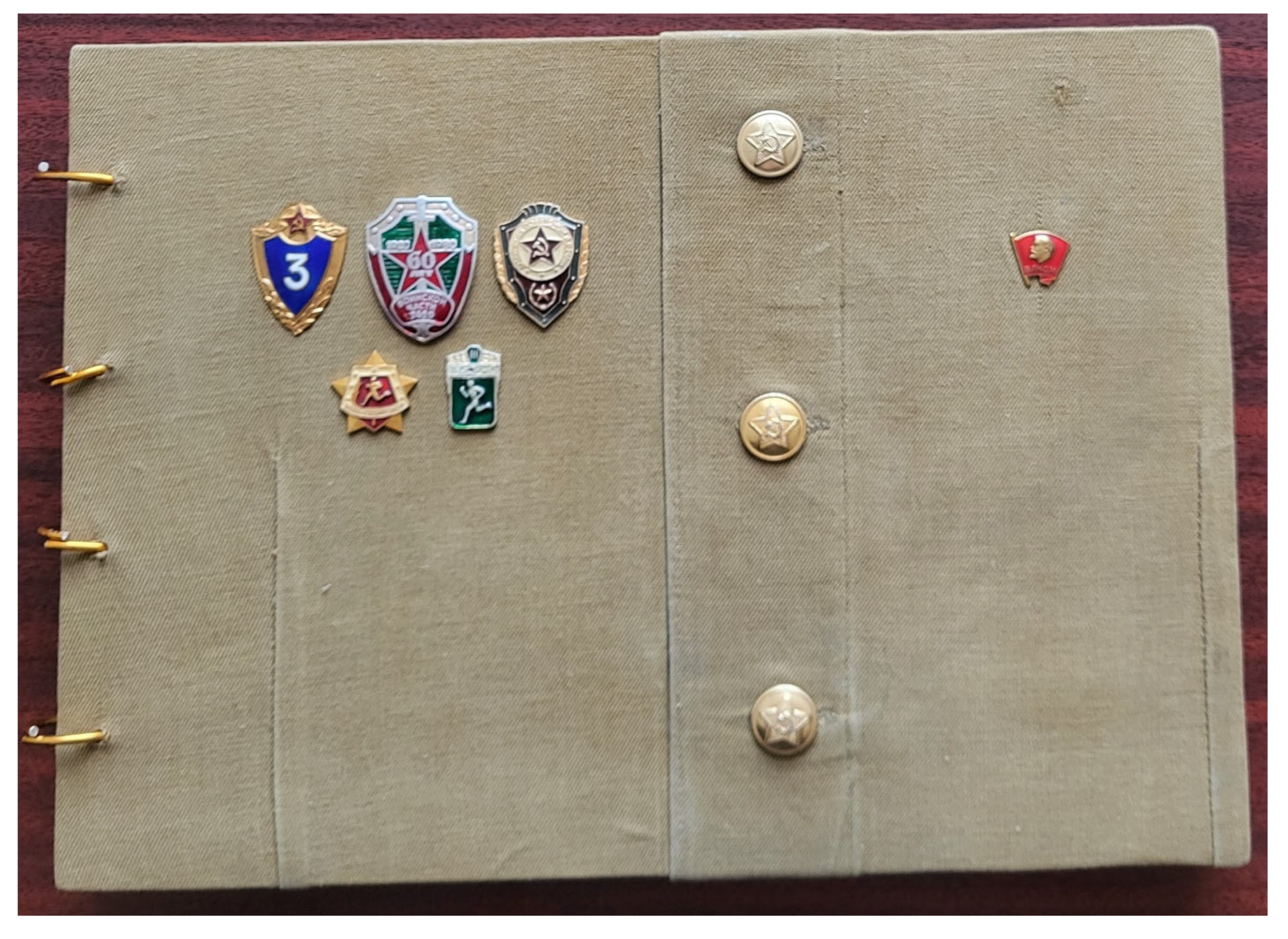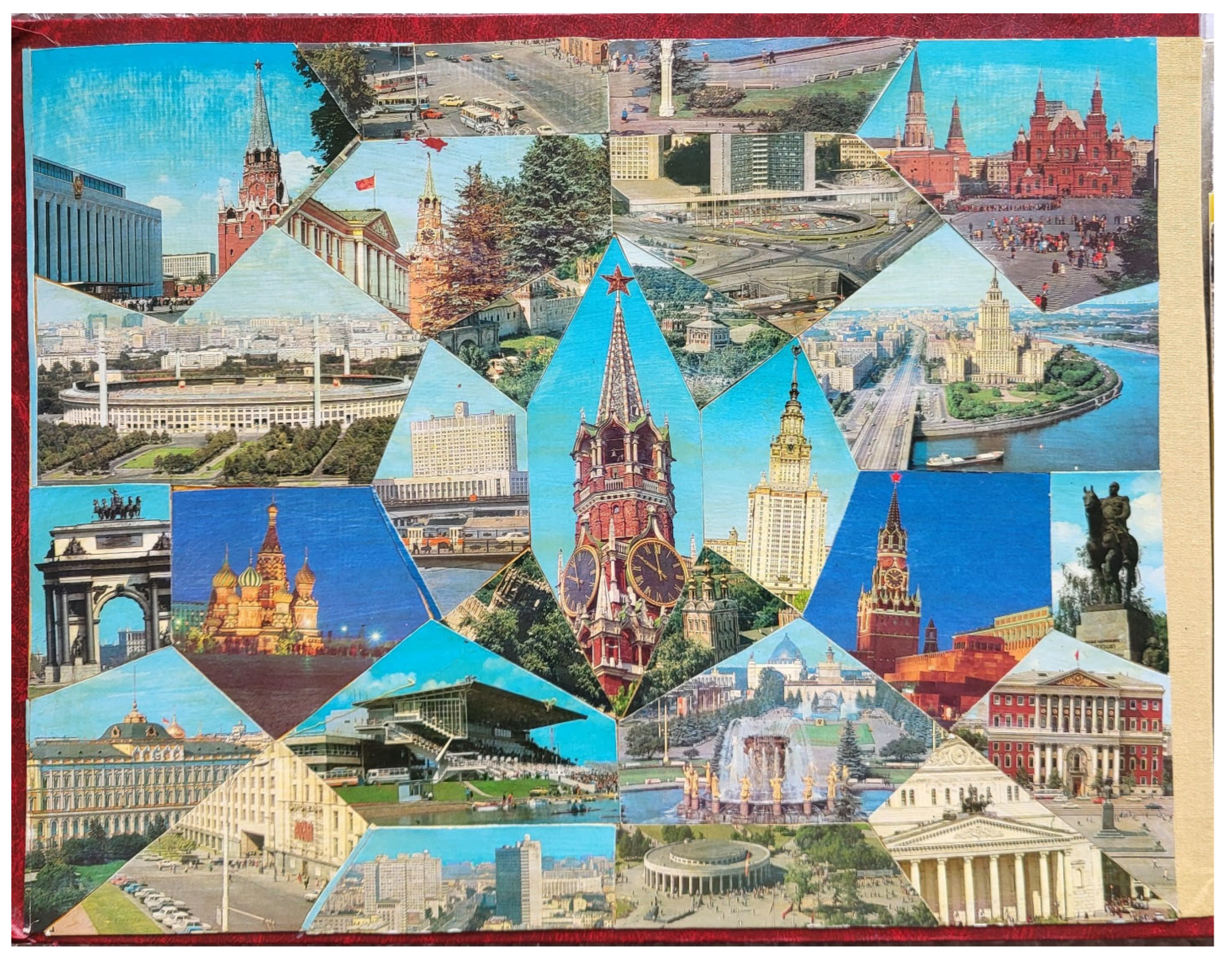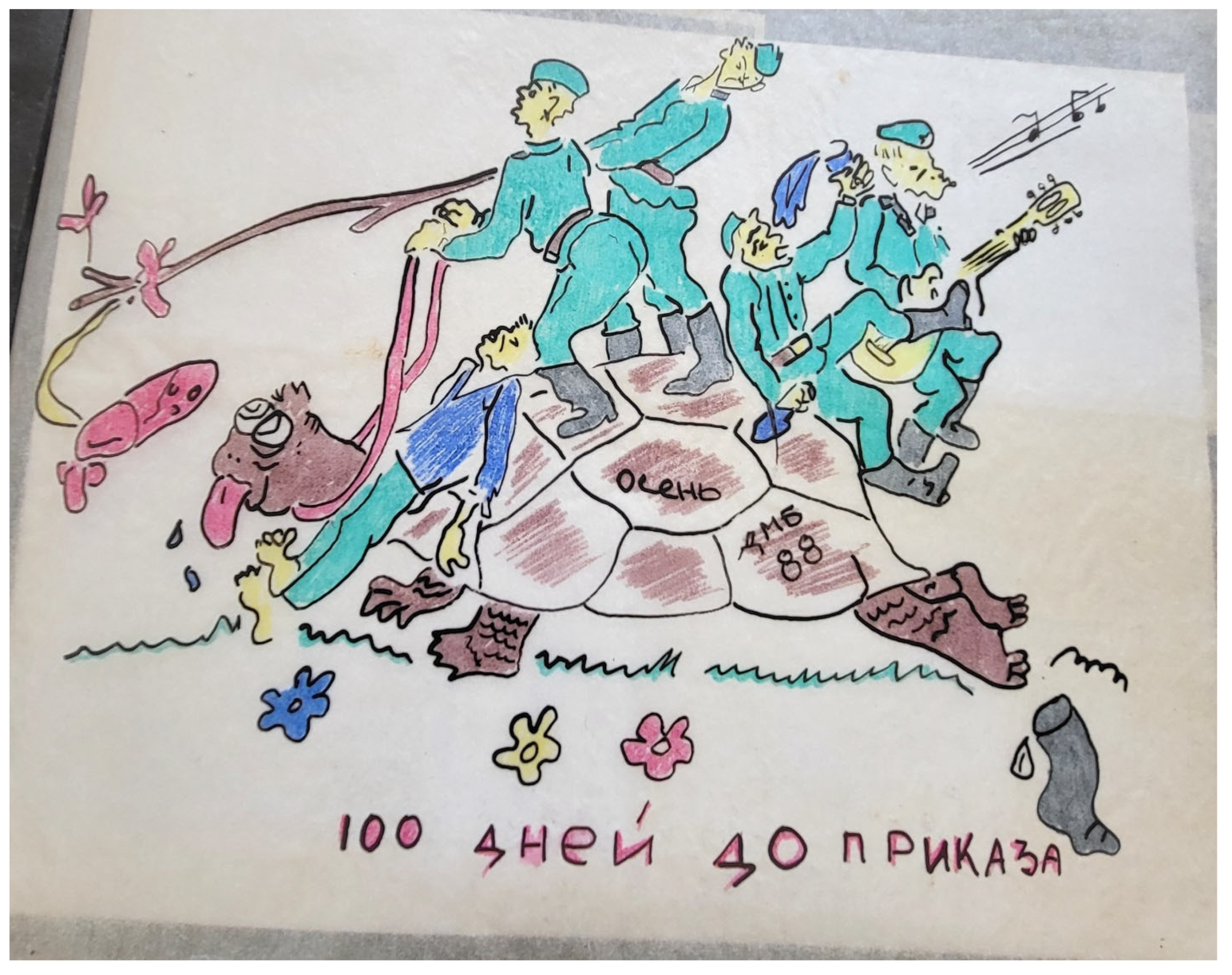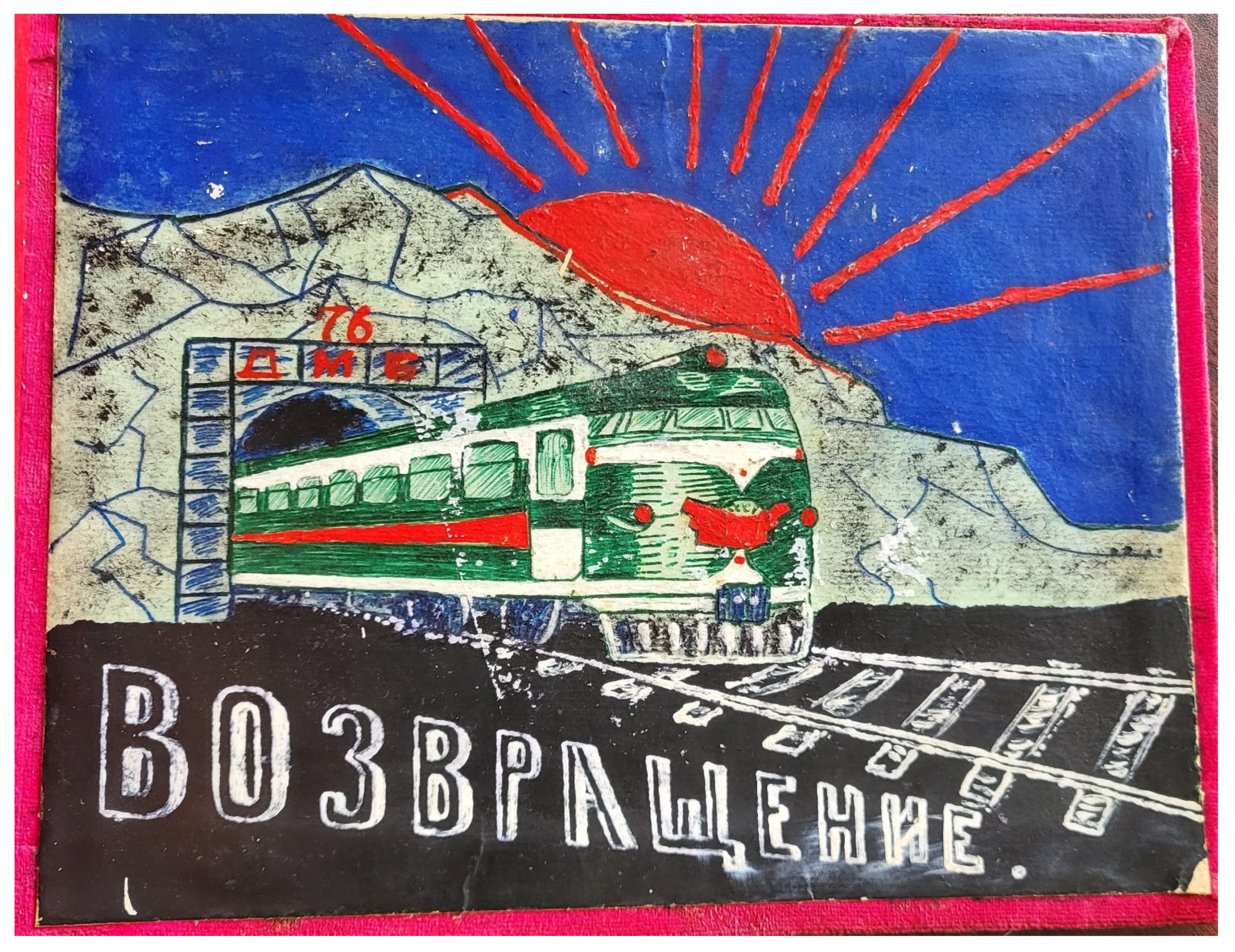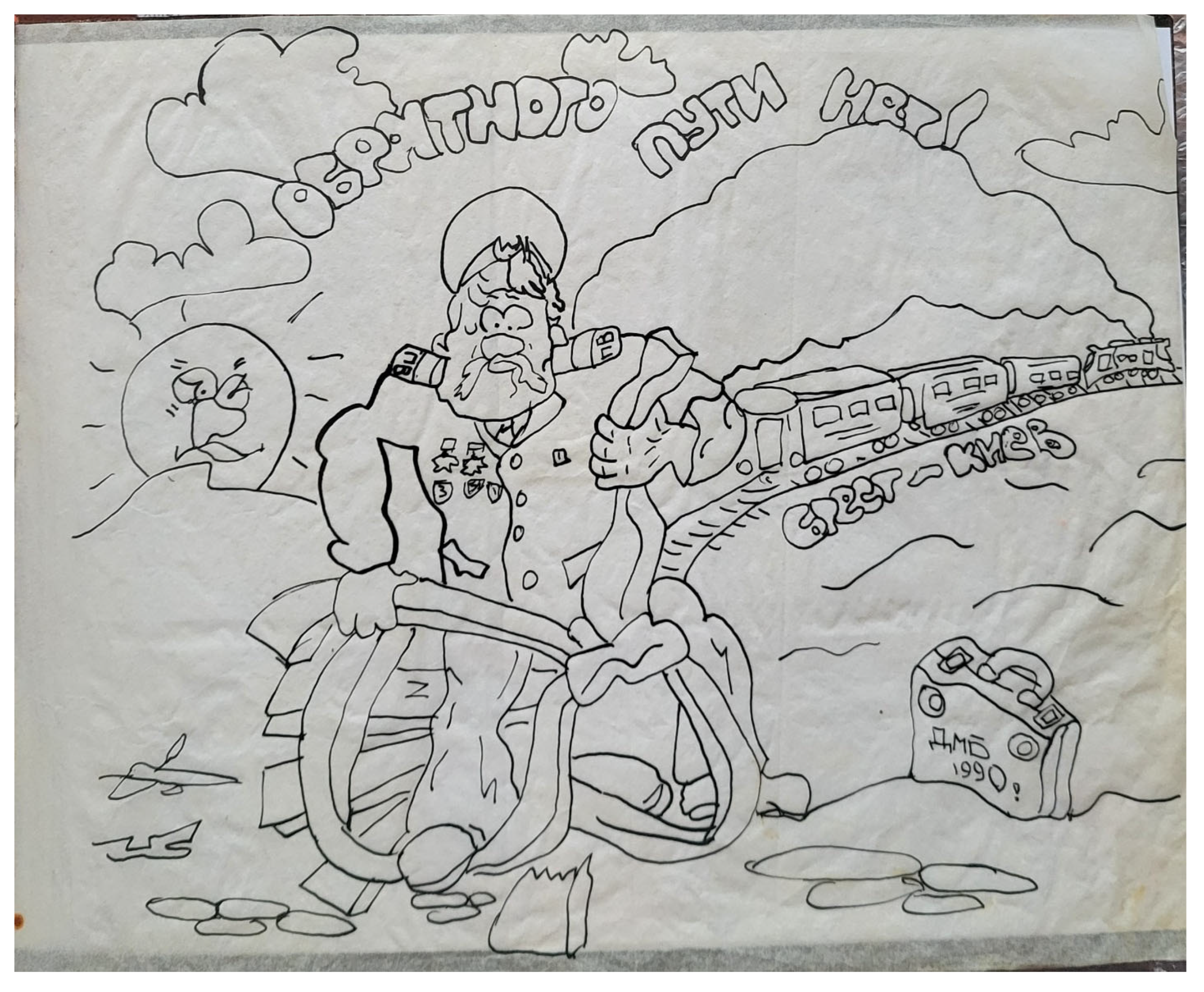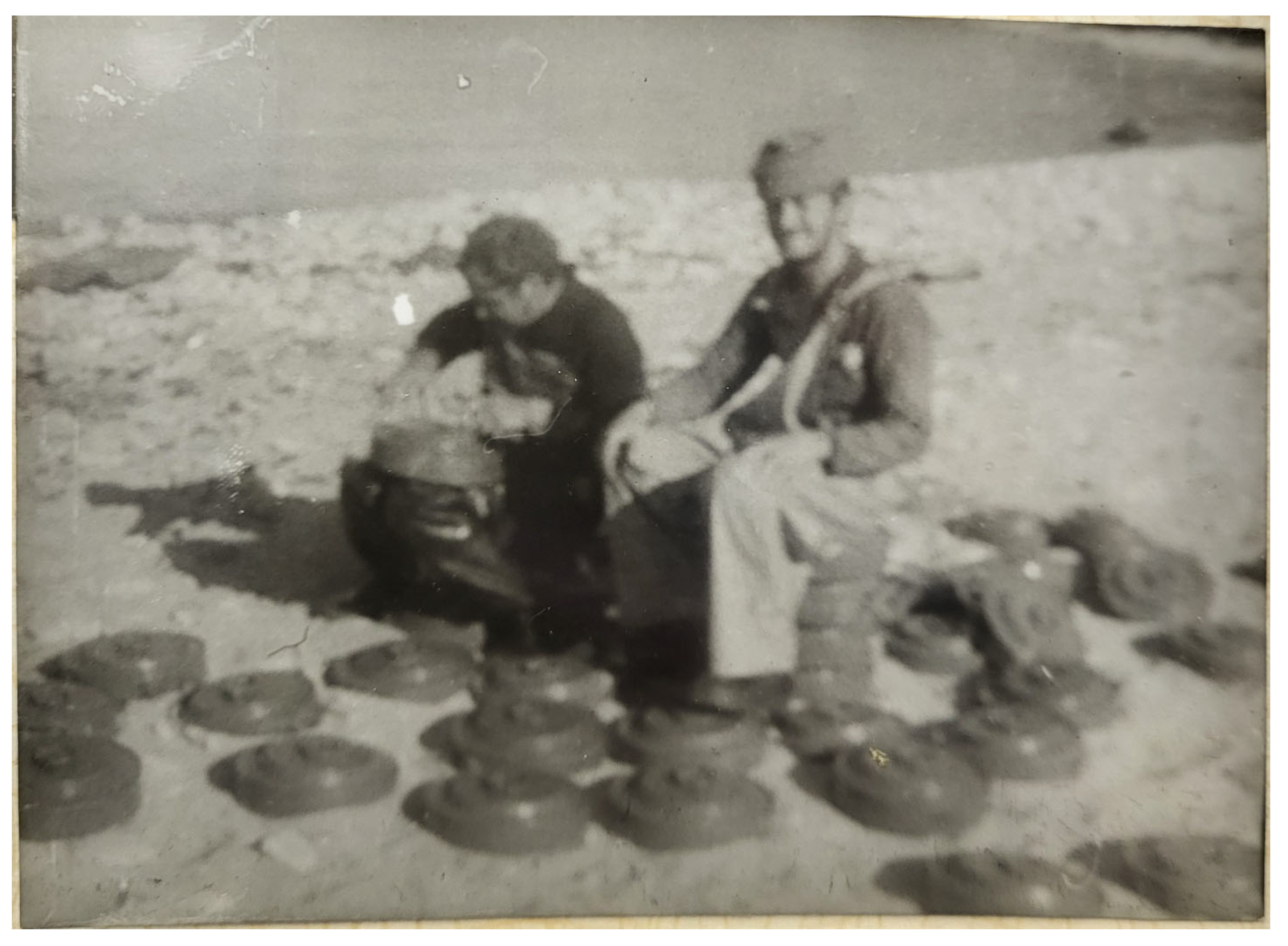

Art Hiding in Plain Sight: Soviet Conscript Demobilization Albums and Artistic Forms of Commemoration †

Abstract
1. Introduction
2. Dembel’ Albums and Embodied Forms of Commemoration
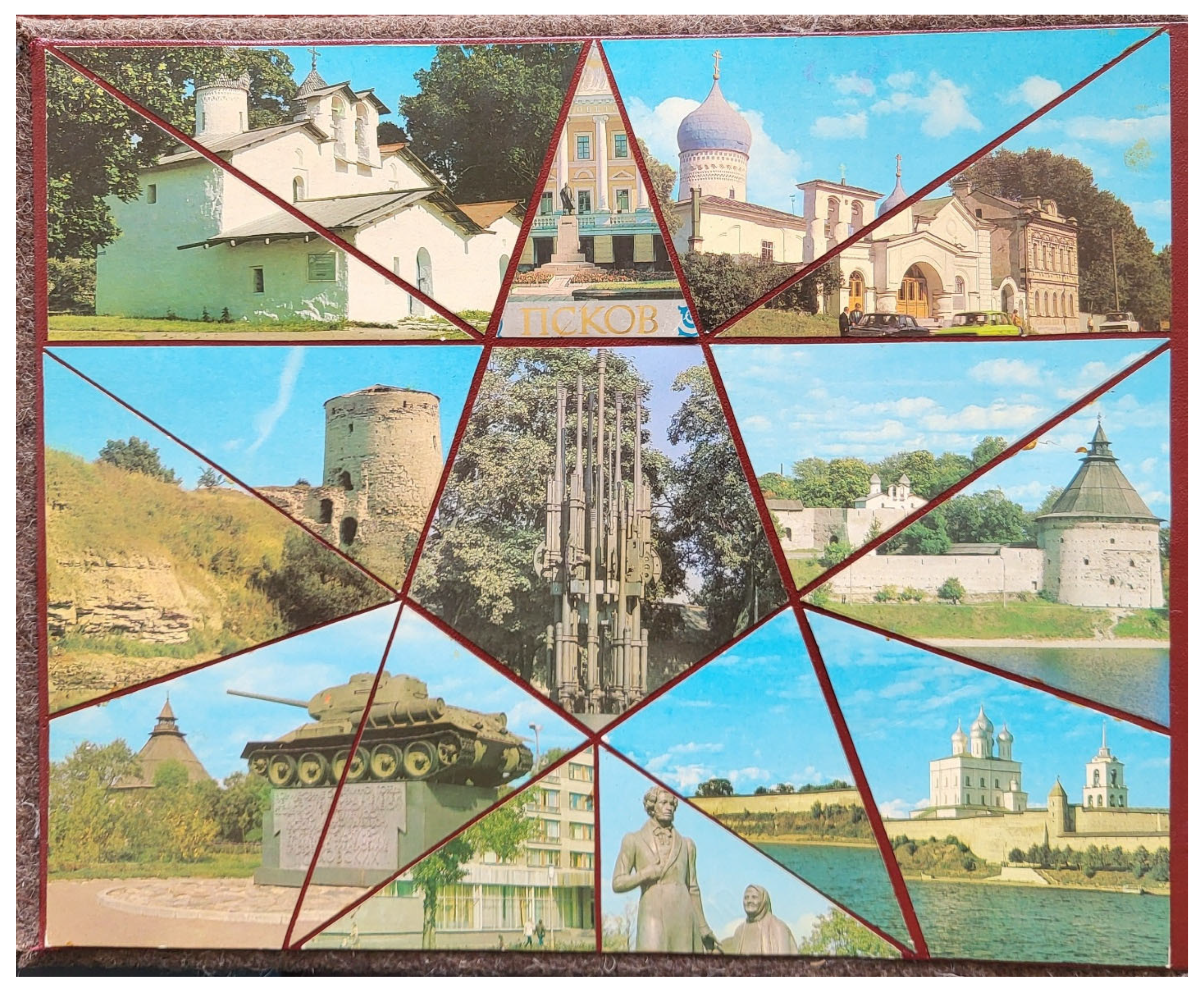
3. Collages and Conceptions of Geographic Space in Demobilization Albums
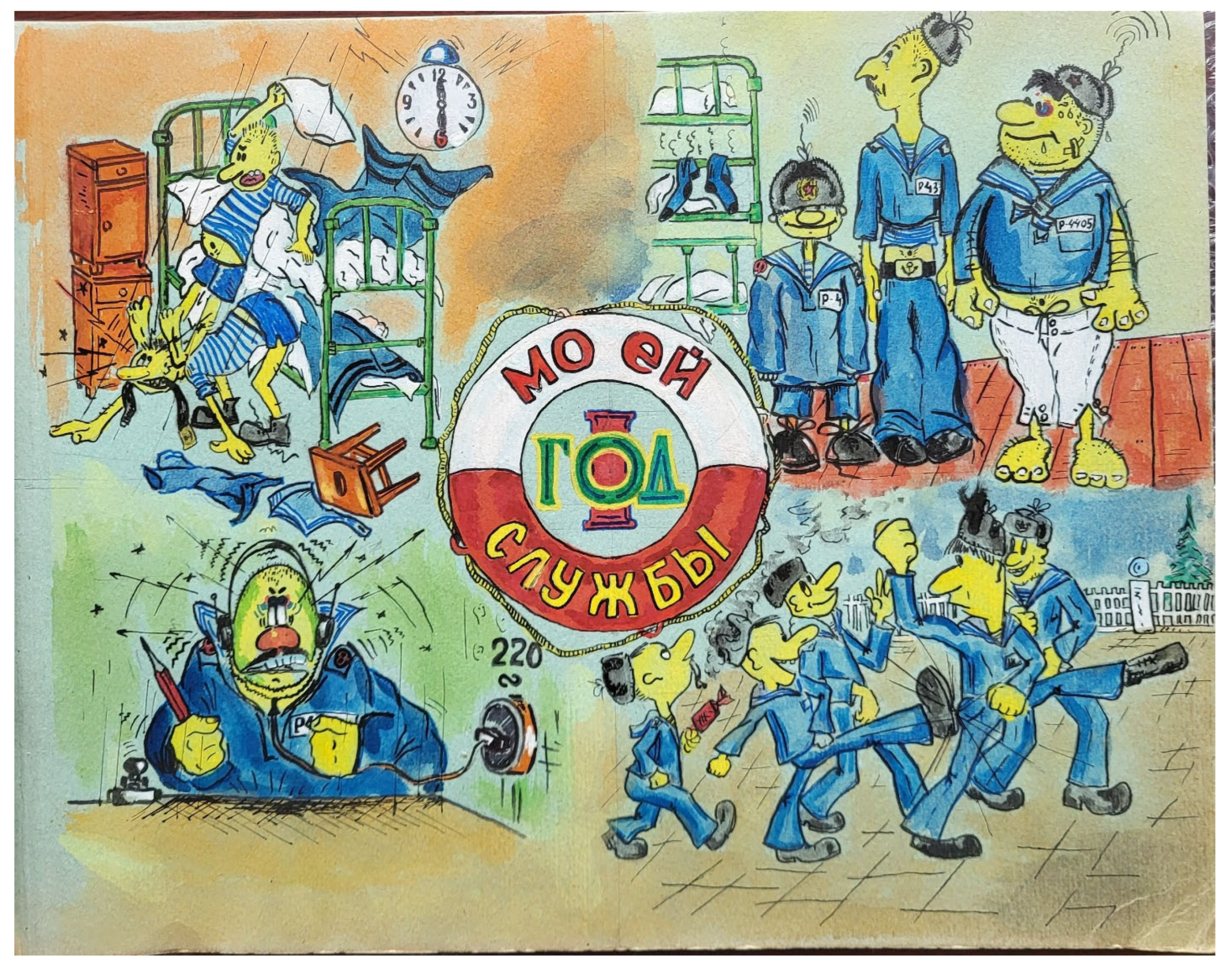
4. Time Served—Commemorating 730 Days Spent in Uniform
5. The Commemorative Power of Photographs
6. Conclusions
Author Contributions
Funding
Institutional Review Board Statement
Informed Consent Statement
Data Availability Statement
Conflicts of Interest
| 1 | In Russian, the full terminology is dembel’skii al’bom, which means album in the possession of a demobilized soldier. However, in common usage, people simply refer to them as dembel’ albums. |
| 2 | European University in St. Petersburg has a modest collection of albums; however, given the war in Ukraine we are unable to access them and they have not been digitized. |
| 3 | The role played by artists in dembel’ production was discussed at length in our 12 November 2025 oral history interview with Iouri Stepanov, who served in a communications unit in the Soviet Far East from 1989 to 1991. |
| 4 | In the interest of clarity and easier referencing, albums have been assigned titles by the authors. |
| 5 | Established in 1925, the site was submitted to UNESCO for consideration as a World Heritage Site (the application is currently on pause) and in 2019 the nature preserve was upgraded to the status of national park by the Russian government. |
| 6 | For the full text of the order, see https://www.vedomstva-uniforma.ru/forma1969/1969.html (accessed on 15 October 2025). |
| 7 | Komsomol refers to the Communist Union of Youth, an organization established by the Soviet state in 1918. Boys and girls could join at age fourteen and serve until the end of their twenties. |
| 8 | The biographical information was obtained during the authors’ interview with Viktor Skorokhodov, 11 September 2025. |
| 9 | Census data is available here: Всесoюзная перепись населения 1989 г. Численнoсть наличнoгo населения сoюзных и автoнoмных республик, автoнoмных oбластей и oкругoв, краёв, oбластей, райoнoв, гoрoдских пoселений и сёл-райцентрoв, [https://www.demoscope.ru/weekly/ssp/rus89_reg2.php] (accessed on 15 October 2025). |
| 10 | The ways in which time is expressed in dembel’ album photographs is a subject that will be dealt with in detail in the book that we are presently writing. |
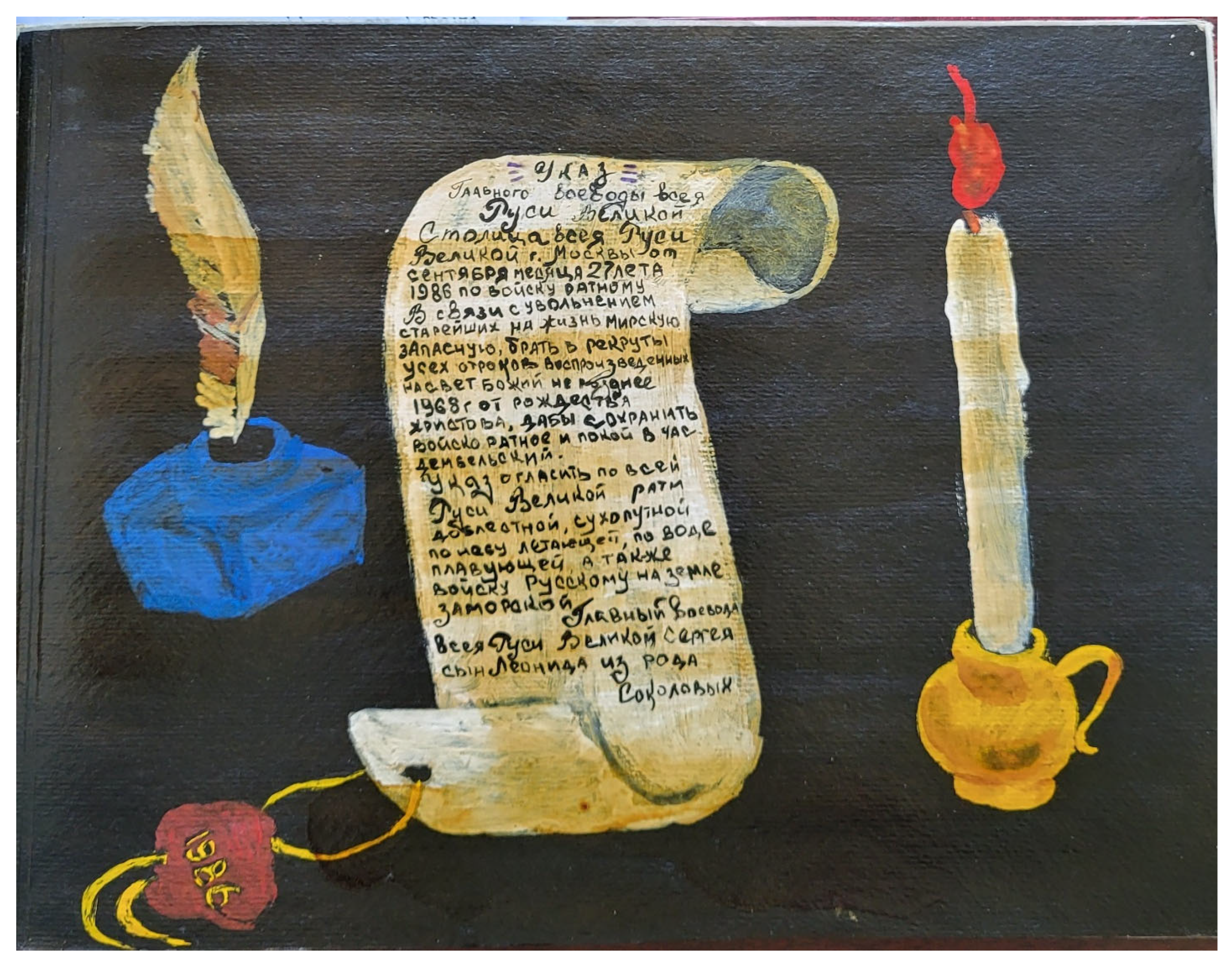
| 11 | As it reads here the document in the painting is signed by the “Chief Voevoda of All of the Rus’ Great Sergei, son of Leonid, from the clan of the Sokolovs.” Viktor Skorokhodov’s real document would have been signed in a more modern fashion and simply given Sokolov’s title as Minister of Defense. Voevoda was the term used for a military commander who was also entrusted with administrative matters, particularly in the provinces. The rank was abolished in 1708, but the word continued to be used colloquially until the end of the 18th century. |
| 12 | On the SSV 33 Ural, see “Soviet communications ship SSV-33,” Wikipedia.org, [https://en.wikipedia.org/wiki/Soviet_communications_ship_SSV-33#:~:text=SSV%2D33%20Ural%20(%D0%A1%D0%A1%D0%92%2D,battlecruisers%20with%20nuclear%20marine%20propulsion] (accessed on 31 October 2025). |
| 13 | The ways in which Soviet adolescents in the Cold War era slacked off and violated school dress codes as their graduation day approached is a topic covered in Donald Raleigh’s oral history Soviet Baby Boomers (Raleigh 2012). |
| 14 | Although dealing with another place and time, Watson’s work notes that not all men who served in the trenches during the First World War were disillusioned by their experiences and her ideas have shaped our thinking in this article. |
References
- Applebaum, Rachel. 2013. A Test of Friendship: Soviet-Czechoslovak Tourism and the Prague Spring. In The Socialist Sixties. Edited by Diane P. Koenker and Anne E. Gorsuch. Bloomington: Indiana University Press, pp. 213–32. [Google Scholar]
- Ashkenazi, Ofer, Rebekka Grossmann, Shira Miron, and Sarah Wobick-Segev. 2025. Still Lives: Jewish Photography in Nazi Germany. Philadelphia: University of Pennsylvania Press. [Google Scholar]
- Druzhinina, Svetlana, ed. 2001. Dembel’skii al’bom—Russkii Art Brut. Moscow: M.K. & Karmsizdat. [Google Scholar]
- Elkner, Julie. 2004. Dedovshchina and the Committee of Soldiers’ Mothers under Gorbachev. The Journal of Power Institutions in Post-Soviet Societies. [Google Scholar] [CrossRef]
- Elliott, Patrick, ed. 2019. Cut and Paste: 400 Years of Collage. Edinburgh: National Galleries of Scotland. [Google Scholar]
- Gorsuch, Anne E. 2006. Time Travelers: Soviet Tourists to Eastern Europe. In Turizm: The Russian and East European Tourist Under Capitalism and Socialism. Edited by Anne E. Gorsuch and Diane Koenker. Ithaca: Cornell University Press, pp. 205–26. [Google Scholar] [CrossRef]
- Gorsuch, Anne E. 2011. All This Is Your World: Soviet Tourism at Home and Abroad After Stalin. Oxford: Oxford University Press. [Google Scholar]
- Gowrley, Freya. 2024. Fragmentary Forms: A New History of Collage. Princeton: Princeton University Press. [Google Scholar]
- Gross, Natalie. 1990. Youth and the Army in the USSR in the 1980s. Soviet Studies 42: 481–98. [Google Scholar] [CrossRef]
- Guerin, Frances. 2012. Memory through the Perpetrator’s Lens: Witnessing via Images Taken by Wehrmacht Soldiers and Officers on the Eastern Front. In Rhetoric, Remembrance, and Visual Form: Sighting Memory. Edited by Anne T. Demo and Bradford Vivian. New York: Routledge, pp. 163–79. [Google Scholar]
- Helfand, Jessica. 2008. Scrapbooks: An American History. Hew Haven: Yale University Press. [Google Scholar]
- Hollingdale, Richard. 2016. Soviet Military Badges: A History and Collector’s Guide. Stroud: Amberley Publishing. [Google Scholar]
- Johnson, Reed. 2025. Last Stop, Communism: Time as Space in Early Soviet Political Posters. In Time and Material Culture: Rethinking Soviet Temporalities. Edited by Julie Deschepper, Antony Kalashnikov and Federica Rossi. London: Routledge, pp. 99–123. [Google Scholar]
- Joseph, Nathan, and Nicholas Alex. 1972. The Uniform: A Sociological Perspective. American Journal of Sociology 77: 719–30. [Google Scholar] [CrossRef]
- Kikkert, Sean. 2005. Military Uniforms: The Psychological Dimension. Australian Army Journal 2: 245–51. Available online: https://researchcentre.army.gov.au/library/australian-army-journal-aaj/volume-2-number-2/military-uniforms-psychological-dimension (accessed on 19 September 2025).
- Maklak, Alena. 2015. Dedovshchina on Trial. Some Evidence Concerning the Last Soviet Generation of ‘Sons’ and ‘Grandfathers’. Nationalities Papers 43: 682–99. [Google Scholar] [CrossRef]
- Pratt, Mary Louise. 1992. Imperial Eyes: Travel Writing and Transculturation. London: Routledge. [Google Scholar]
- Raleigh, Donald J. 2012. Soviet Baby Boomers: An Oral History of Russia’s Cold War Generation. Oxford: Oxford University Press. [Google Scholar]
- Rowley, Alison. 2013. Open Letters: Russian Popular Culture and the Picture Postcard, 1880–1922. Toronto: University of Toronto Press. [Google Scholar]
- Sarkisova, Oksana, and Olga Shevchenko. 2023. Travel, Space, and Belonging in Soviet Domestic Photo Collections of the Cold War Era. In Cold War Camera. Edited by Thy Phu, Erina Duganne and Andrea Noble. Durham: Duke University Press, pp. 297–325. [Google Scholar]
- Sarkisova, Oksana, Olga Shevchenko, and M. G. 2025. Military Farewells: The Legacies of the Soviet-Era Dembel’ Album. Journal of War & Culture Studies 18: 104–25. [Google Scholar] [CrossRef]
- Saunders, Nicholas J. 2009. People in Objects: Individuality and the Quotidian in the Material Culture of War. In The Materiality of Individuality: Archaeological Studies of Individual Lives. Edited by Carolyn L. White. New York: Springer Science, pp. 37–55. [Google Scholar] [CrossRef]
- Skopin, Denis. 2002. Photography and Political Repression in Stalin’s Russia: Defacing the Enemy. London: Routledge. [Google Scholar]
- Spivak, Andrew L., and William Alex Pridemore. 2004. Conscription and Reform in the Russian Army. Problems of Post-Communism 51: 33–43. [Google Scholar] [CrossRef]
- Struk, Janina. 2011. Private Pictures: Soldiers’ Inside View of War. London: I.B. Tauris. [Google Scholar]
- Ulrich, Laurel Thatcher. 2001. The Age of Homespun. New York: Alfred A. Knopf. [Google Scholar]
- Voronina, Olga. 2025. Poets’ “Hand” on Display: Soviet Literary Museums as Curators of Sacral Materiality. In Time and Material Culture: Rethinking Soviet Temporalities. Edited by Julie Deschepper, Antony Kalashnikov and Federica Rossi. London: Routledge. [Google Scholar]
- Watson, Janet. 2004. Fighting Different Wars: Experience, Memory, and the First World War in Britain. Cambridge: Cambridge University Press. [Google Scholar]
- Werneke, Jessica. 2019. ‘Nobody understands what is beautiful and what is not’: Governing Soviet Amateur Photography, Photography Clubs and the Journal Sovetskoe Foto. Photography and Culture 12: 47–68. [Google Scholar] [CrossRef]
- Wexler, Laura, Karintha Lowe, and Guigui Yao. 2023. Urban Albums, Village Forms: Chinese Family Photographs and the Cold War. In Cold War Camera. Edited by Thy Phu, Erina Duganne and Andrea Noble. Durham: Duke University Press, pp. 263–95. [Google Scholar]






Disclaimer/Publisher’s Note: The statements, opinions and data contained in all publications are solely those of the individual author(s) and contributor(s) and not of MDPI and/or the editor(s). MDPI and/or the editor(s) disclaim responsibility for any injury to people or property resulting from any ideas, methods, instructions or products referred to in the content. |
© 2026 by the authors. Licensee MDPI, Basel, Switzerland. This article is an open access article distributed under the terms and conditions of the Creative Commons Attribution (CC BY) license.
Share and Cite
Rowley, A.; Stepanov, D. Art Hiding in Plain Sight: Soviet Conscript Demobilization Albums and Artistic Forms of Commemoration. Arts 2026, 15, 35. https://doi.org/10.3390/arts15020035
Rowley A, Stepanov D. Art Hiding in Plain Sight: Soviet Conscript Demobilization Albums and Artistic Forms of Commemoration. Arts. 2026; 15(2):35. https://doi.org/10.3390/arts15020035
Chicago/Turabian StyleRowley, Alison, and Dennis Stepanov. 2026. "Art Hiding in Plain Sight: Soviet Conscript Demobilization Albums and Artistic Forms of Commemoration" Arts 15, no. 2: 35. https://doi.org/10.3390/arts15020035
APA StyleRowley, A., & Stepanov, D. (2026). Art Hiding in Plain Sight: Soviet Conscript Demobilization Albums and Artistic Forms of Commemoration. Arts, 15(2), 35. https://doi.org/10.3390/arts15020035