
‘ART’: What Pollock Learned from Hayter

Department of Art, Central Connecticut State University, New Britain, CT 06050, USA
Arts 2026, 15(1), 12; https://doi.org/10.3390/arts15010012
Submission received: 5 October 2025
/
Revised: 12 December 2025
/
Accepted: 19 December 2025
/
Published: 4 January 2026
(This article belongs to the Section Visual Arts)
Abstract
Experimental prints made by Jackson Pollock in Stanley William Hayter’s Atelier 17 in 1944–45 were crucial to the evolution of his modernist style, an evolution quite different from Clement Greenberg’s conception of it. Hayter said “Pollock always claimed that he had two masters, Benton and me.” Following Charles Darwent’s Surrealists in New York: Atelier 17 and the Birth of Abstract Expressionism 2023 and Christina Weyl’s The Women of Atelier 17 2019, this article examines a 1944–45 engraving in which Pollock inscribed the letters A, R, T. This examination reveals the experimental techniques and the gendered themes that shaped Pollock’s continued exploration of his art as erotic dialogue. Absorbing Hayter’s technical understanding of the three-dimensionality of an engraved line as it produced and moved through “the space of the imagination,” Pollock succeeded in mediating between male and female tensions, stated in underlying imagery, as he began in ‘ART’ to generate his abstract and unifying all-over linear webs, culminating in such works as Autumn Rhythm 1950.
1. The Three-Dimensionality of Pollock’s Poured Lines
Frank O’Hara’s 1959 description of the finesse that Pollock exercised in his process of drawing with flowing paint remains a challenge: “There has never been enough said about Pollock’s draughtsmanship, that amazing ability to quicken a line by thinning it, to slow it by flooding, to elaborate that simplest of elements, the line—to change, to reinvigorate, to extend, to build up an embarrassment of riches in the mass by drawing alone” (O’Hara 1959, p. 26).
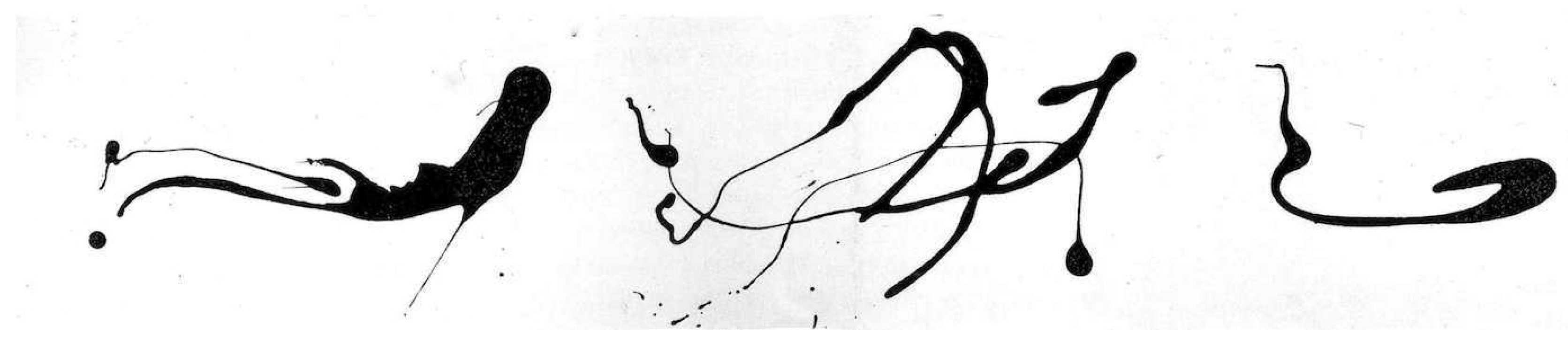
In this untitled enamel drawing of 1950, CR 797 (Figure 1), each individual “throw” of the paint, as it hits the hard surface of the horizontal support, torques in space, alive on all the axes of the pictorial plane, whether moving up or down its vertical axis, whether moving left or right on its horizontal axis, whether thickening or thinning to create a third-dimensional in and out axis, whether slowing or speeding. T.J. Clark concurs: “I think expressiveness in Pollock often hinges on the kind or degree of three-dimensionality that is given the throws of paint” (Clark 1999, p. 337). The painter Brice Marden paid an extraordinary tribute to this drawing, describing it as among the most “powerful objects in the world” (Richardson 1999).
Such throws of paint accumulate to create the all-over rhythmic web of the mature poured paintings, here in Autumn Rhythm 1950 (Figure 2), generating the complexity of balancing between left and right within the frieze composition, up and down, or in and out along the literally three-dimensional space created by layering.1
2. Atelier 17 and Pollock’s ‘ART’
How did Pollock arrive at such extraordinary lines? I want to claim that the experimental prints he made in Stanley William Hayter’s New York Atelier 17 in 1944–45 were crucial to the evolution of his mature style. Charles Darwent in his recent book Surrealists in New York: Atelier 17 and the Birth of Abstract Expressionism affirms the ground for this assertion which I will now pursue in some detail.2 While Darwent emphasizes the tension between figuration and a growing all-over linear web in the experimental engravings, I will emphasize Pollock’s absorption of what Hayter named the “concrete construction of space” that ultimately lies behind the extraordinary ductility of Pollock’s mature poured lines, and their ability to express the erotic drives that animate his art.
Hayter himself downplayed the role of the workshop for future Abstract Expressionists: “most of the big names, like de Kooning, Motherwell, Rothko, Pollock…didn’t do anything outstanding when working with us” (Paul 1978, p. 73). But he also said “Pollock always claimed that he had two masters, Benton and me” (Halasz 1984, p. 73). Examination of one 1944–45 engraving in particular, CR 1077 (Figure 3), reveals the experimental techniques and the gendered themes that provided the basis for the continued evolution of Pollock’s abstract style.3
Hayter had first established Atelier 17, his printmaking workshop, in Paris in 1927 and, due to the upheaval of World War II, moved it in 1940 to New York City, finding a home for it in New School for Social Research at 66 West 12th Street (Sweeney 1944, p. 3; Moser 1978). Patronized by the likes of André Masson, Miró, Matta, and Isamu Noguchi, the workshop functioned as a European cafe providing a place to meet and talk, just the sort of clubby place Pollock tended to avoid. But persuaded by his friend Reuben Kadish, who had by late 1944 become one of Hayter’s assistants, Pollock in the fall of 1944 and the spring of 1945 did engrave eleven intaglio prints.4 He became familiar with Hayter’s ideas during the summer of 1944, when Kadish introduced him to Hayter in Provincetown (Landau 2014, p. 17). Kadish remembers “I inveigled Jackson into trying it because I thought his work had a kinship to Hayter’s prints.” He also recalls Pollock “wasn’t happy with the prints.”5 When Hayter suggested that Pollock consider printing editions, he was not interested. But an examination of one print in particular, CR 1077, probably produced near the end of this period of experimentation and printed by Pollock and Hayter together, suggests a leap in Pollock’s artistic evolution that points forward to the animated throws of paint and all-over rhythmic web of the mature poured paintings.6
The special place of this print among the engravings, and indeed in Pollock’s entire oeuvre, is signaled by his inscription in the print’s lower left of the letters, reading from right to left: “A” (upside down), “R”, “T”. The sequence of letters would have been correct when he actually engraved them, but were reversed when printed. The upside down “A” suggests that Pollock may have rotated the plate, while working on it. This inscription is unique in Pollock’s work and suggests that he felt that he had hit on something he wished to celebrate as an embodiment of his understanding of “art.” In this article I shall refer to this print by the title ‘ART’.7
3. Benton’s Space Stage vs. Hayter’s “Space of the Imagination”
What did Pollock learn from Hayter? Wasn’t what Pollock learned from Thomas Hart Benton enough? Already in the summer of 1943 when he created Mural (Figure 4), Pollock had taken a huge step towards creating the new abstract rhythmic all-over space that was to characterize his mature paintings. Faced with the challenge of animating the large roughly 9 × 19 foot surface, Pollock did turn, as has long been recognized, to what he had learned from his first teacher.8
As seen in his teaching diagrams (Figure 5 and Figure 6) to explain the role of line in generating space, Benton positions the curves and counter curves around a central vertical axis on a “space stage,” a phrase he notes verbally on one of the diagrams.9 As can be seen in Pollock’s copy of such diagrams in the lower right of CR 434r, c. 1937–38 (Figure 7), he appropriated Benton’s space stage.
Mural invites interpretation as an application of Benton’s “principle of extended organization.” Retaining the principle of a greatly flattened Renaissance space stage that has an up and a down and in which lines move to still hint at the illusion of space, Pollock relies on Benton’s principle of linear rhythm organized around vertical poles to animate the long surface.
Hayter advocated a very different understanding of space: a space of the imagination to be created using the principle of what he called the “concrete construction of space,” in which line in engraving takes on a literal three-dimensionality. Pollock had many opportunities to learn from Hayter, whether seeing his works in the June–October 1944 exhibition at the Museum of Modern Art “Hayter and Studio 17: New Directions in Gravure” or in the workshop itself. Since Hayter intended Atelier 17 to be a place where mature artists had the facilities to make prints and could experiment with various printmaking techniques, his habit was to give basic technical instruction, answer questions, and make suggestions, most often in respect to a particular print being worked on. In the case of Pollock, who mostly came in the evening, the two men often drank beer together at neighborhood bars. During this period Hayter was writing intensively, producing five articles in 1944–46; their insights undoubtedly made their way into their conversations.10 For the December 1944 issue of View Hayter wrote “Line and Space of the Imagination,” illustrated by this untitled work (Figure 8).
A long-time surrealist Hayter concentrated on the challenge of exploring what he called the “space of the imagination,” with its subjective, yet universal dimensions. The kinship of such space with the Jungian conception of a collective unconscious, pointed out by Darwent, would have appealed to Pollock, who had been in Jungian psychoanalysis from 1939–43.11 “In the unconscious mind one might expect to find trace of the experience of space derived from other species from which the human has evolved, the freedom of movement in three dimensions in water reconquered in some respect by the conquest of the air … It can travel forward or backward in time as it can travel inward or outward or both, or into an unlimited series of dimensions … Thus the space of the imagination contains an essential mutation and ambiguity; that order of ambiguity that permits the poet to imply an infinite series of linked consequences in a single phrase” (Hayter 1944b, p. 127).
How does an artist create such a fluid multi-dimensional and suggestive space-time? In another article, “The Language of Kandinsky” (May 1945), rather than criticize Kandinsky, as the critic Clement Greenberg later did for a failure “to grasp the pictorial logic that guided the Cubist-Cézannian analysis of appearances,” Hayter spoke of Kandinsky’s “different order of space”: “the basal plane is eliminated and the space figured appears not only to be continuous in all directions, but its coordinates are no longer referred to a solid plane. Like inter-stellar space it is to be referred only to remote points in terms of motion” (Figure 9).12
In such space, up and down do not have the old significance. If you rotate ‘ART’ upside down, you will see that Pollock has created such a “space of the imagination”: less earth bound, more stellar, the play of lines and shadows dispersed all over the surface.
4. “The Concrete Construction of Space”
How does Pollock start to create this space of the imagination? Engraving is, as Hayter says, essentially the art of line. He understood how to express, not only motion across a surface (left-right, up-down, on diagonal), but in and out of the surface. He pointed out that certain types of curving lines are not seen as lying on the surface on which they are drawn or printed, but are immediately understood as being convex or concave and, if intersected by other linear elements, can be made to be seen in reverse or ambiguously, both as convex or concave (Figure 10).
These spatial sensations are still somewhat like those generated by Benton in his diagrams showing how to create the illusion of 3-dimensional space on a 2-dimensional surface. But a second principle involves something very different: the “concrete construction of space.” Hayter emphasized the literal 3-dimensionality of an engraved line that results from the very process of engraving. Because in engraving the artist creates space by digging with the burin into metal material, the artist discovers how line changes its quality as you dig into the plate. Depending on the pressure exerted, the physical fact of digging thickens or thins a line, altering its character. Depending on the pressure put on the burin, the depth of the cut in the metal plate varies, and consequently the height of the relief of the printed line. The artist’s action constitutes, in Hayter’s words, a “concrete construction of space” (Hayter 1944b, p. 140). As James Johnson Sweeney remarked, “line engraving exists in a middle realm between relief-sculpture and drawing” (Sweeney 1944, p. 4). We become very aware of the three-dimensionality of the line itself.
It should be noted that this understanding of pictorial space is very different from that being formulated by the critic Greenberg at about the same time, and that has come to dominate the understanding of Pollock’s art as “modernist” in Greenberg’s sense. In 1939 as a cultural critic for Partisan Review Greenberg expressed his dismay at the state of painting in the United States: a narrative art that thrived on the illusionistic 3-dimensional space rooted in academic art that lent itself to banal, unthinking, commercialization: kitsch. To counter kitsch, he made a call to arms, to reground art in the eighteenth-century aesthetician Lessing’s distinction between sculpture and painting. Sculpture should be the realm of three-dimensional art; painting of a two-dimensional art. Hence, he directed his attention to the Cubist art of Picasso and Braque, in particular to its flatter stage in Synthetic Cubism. “The first problem these young Americans [naming Arshile Gorky, Willem de Kooning, Adolph Gottlieb, and Jackson Pollock] seemed to share was that of loosening up the relatively delimited illusion of shallow depth that the three master Cubists—Picasso, Braque, Leger—had adhered to since the closing out of Synthetic Cubism” (Greenberg 1961b, pp. 211, 217). Indeed, Pollock was in his art of 1942–43 pursuing a challenge to Picasso’s art of the early 1930s, a late flat Cubism inflected by Surrealist metamorphic imagination. See, for example, Male and Female 1942 and Male and Female in Search of a Symbol 1943 illustrated below. The degree to which Pollock was in Mural 1943 able to loosen this space with Bentonesque rhythms attracted Greenberg. When he saw Mural, probably sometime early in 1944, he celebrated Pollock’s achievement, saying to him, ‘That is great art.’ … I went for his all-over approach from Mural on.”13 The first critic to stake out a claim in 1945 for Pollock as the rising star in modern art, Greenberg’s aesthetic understanding of Pollock’s painting as advancing a post-Cubist art has become the standard modernist account.14 Greenberg never admitted the impact of Hayter and Kandinsky on Pollock’s art which I pursue here, and which when admitted offers a fuller account of the growth of Pollock’s modern art.
Pollock’s interest in the “concrete construction of space” is especially evident in CR 1080 (P18) (Figure 11).15
There he engraves the plate with lines of distinctly different depths, creating effects of layered depth. The deeper gouges are amplified by drypoint. Such lines have the capacity for spatial ambiguity: the printed line in higher relief can be read as nearer to the plane of the image than the line in lower relief; on the other hand, it can just as easily be read as more remote. Pollock’s pronounced turn away from the Renaissance conception of 3-dimensional pictorial space, a shallow version of which persisted in Benton’s teaching, in the engravings meant for him a new sense of spatial freedom.
Because the act of engraving lines traditionally entails turning the plate as the cutting tool digs into the plate, this process invites further multi-dimensionality. Engraved lines not only exist ambiguously in depth but also along the vertical and horizontal axes of the surface being worked on. Looking once again at ‘ART’, the upside down “A” inscribed by Pollock into the plate for ART suggests rotational turning, inviting the viewer to turn the print upside down and to reverse the normal direction of reading. Such multi-directionality reflects a changed understanding of the pictorial surface, now to be approached from above and all four sides, a change that points forward to the all-over space in Pollock’s mature poured paintings. Kandinsky’s “different order of space” and its subversion of the traditional significance of up and down also comes to mind.
The process of both putting pressure on the burin to gouge into the metal and of turning the plate as you do so makes you newly aware of the way process matters. We have a different understanding of what it is to do art, bringing the body into art in a way that traditional art had not done. In what might initially look like a doodle, CR 1079, we get a synopsis of Pollock’s concerns (Figure 12).
The complex dynamic linear trace, moving left to right, down to up, on diagonals, and in and out (thick to thin), anticipates the fluid poured gestures that are so important in his mature work (see Figure 2). By virtue of its central position on the plate, this doodle also makes you aware of the entirety of the pictorial plane and its axial structure, an awareness that underpins both CR 1080 and ‘ART’. Hayter introduced all newcomers to the workshop to principles that he later elaborated in the essay “Orientation, Direction, Cheirality [right- or left-handedness], Velocity and Rhythm” (Moser 1978, pp. 3–4; Hayter 1965, pp. 71–80). He chose to illustrate this essay with Pollock’s CR 797 (see Figure 1). But how did Pollock advance from CR 1079, c. 1944–45 to CR 797, c. 1950?
5. Erotic Meaning of Engravings
In Hayter’s workshop gender was an issue. The recent scholarship of Christina Weyl has emphasized that Hayter transformed, in his teaching and writing, the burin, into a highly masculinized object (Weyl 2016, p. 4; Weyl 2019, p. 96). Responding to this, some of the women artists working at Atelier 17 used soft-ground etching as a technical means to explore female themes, challenging the masculinity of the gouging burin. For example, Minna Citron in Squid Under Pier, 1948 (Figure 13) used both techniques to explore her disquiet over a failed marriage: forceful gouging of the copper plate with the burin to suggest male aggression, a “feminine” soft ground etching to picture her own subconscious struggles (Weyl 2016, p. 7; Weyl 2019, p. 129).
Pollock, too, had long explored erotic tension in his art, for example in Male and Female 1942 (Figure 14) and in Male and Female in Search of a Symbol 1943 (Figure 15).
Whereas in Male and Female fluid automatist paint circulates around a rectilinear center of a thickly painted white proto-canvas, where the diamond shapes are symbols of a desired union, and in the 1943 painting male and female are, as the title states, in search of a unifying symbol, with only a straight blue line suggesting the desired link, in ‘ART’ Pollock embraces the burin as a masculinized tool, but also seeks to mediate between sexual and formal opposites. To dramatize that sexual problems were very much in the foreground at this point in Pollock’s life (he had begun a relationship with Lee Krasner in 1942), I will point to several of the engravings.16
In CR1085 (P21) (Figure 16), printed only as a trial proof, Pollock’s sexual fears are pronounced. There the phallus of a male figure is engraved with deep dark lines, its tip struck through with another deep dark line. In CR1083 (P20) (Figure 17) the white finger/phallus of the central figure is again struck through by an emphatically deep dark line that then rises upward to reveal a white waving hand—a positive impulse that is strengthened in CR 1086 (P22) (Figure 18). There a vaguely circular configuration with the suggestion of an eye is placed above a dark triangle, suggestive of the pubic area of a larger female figure which dominates the surface with pendulous breast in the upper right and triangular head to the upper left. This composition, oriented around the central circle with eye above a darker triangular patch, is repeated at an even more abstract level in CR 1080 (P18) (see Figure 11) where I have already noted Pollock’s forceful use of the “concrete construction of space”. This spatial ambiguity in the engraved lines now serves to more abstractly convey the underlying eroticism, a driving force in Pollock’s exploration of the techniques of engraving line and all-over composition in the space of the imagination. In ‘ART’ figuration symbolizing male and female opposites advances the resolution of erotic drama into formal and ultimately abstract opposites and their mediation.
Unaware of the meaning of Pollock’s symbolic figuration, Darwent simply describes the relationship between figuration and the growing abstraction of the linear web as a “defacement”. Referring to ‘ART’ he states: “The feel in Untitled (4) is of Pollock at first attempting to deface an image he had found unsatisfyingly traditional and then realizing that his defacement had actually enhanced it: that the scrawled line was more powerful, more immediate, than the image behind it.”17 However, attention to the meaning of Pollock’s figures leads us to understand this linear web as not so much a defacement as a vehicle of mediation. A light male figure dominates the entire left-hand side of the print, his head pierced by a downward pointing feathered arrow, his phallus an animated creature with two small circles that suggest eyes. Luminous, he presides over and seems to orchestrate the passage of automatic linear rhythms, in the flickering shadows of which lurk at the top of the print Pollock’s symbols for the female: the horizontal crescent moon to the right of the male’s head, the triangular head with an eye, the coiling serpent, arrayed along the top edge of the print moving from left to right. Further down opposite the male’s chest we detect the dark maw of a she-beast.18 To the right the voluptuous curves suggest a humanoid female. The theme remains a union of male and female: the movement of lines and play of lights and darks between male and female opposites help to establish a rhythmic and all-over relationship between them. Repeated pendulum swings between male and female opposites come to mind. Hayter and Pollock actually experimented together using a compound pendulum to explore the dynamic balancing of opposites (Halasz 1984, pp. 74–75; Darwent 2023, pp. 141–42). The space being explored is “the space of imagination”, but more particularly that of an erotic imagination.
In ‘ART’ Pollock began to make good on his dream of art as an erotic dialogue mediating between opposites whether between male and female figures, or simply between formal opposites, left-right, up-down, in-out, invested with erotic energy. Hayter taught him the techniques he needed to begin to make good on this dream. No wonder Pollock inscribed the letters A, R, T on this print.
6. Conclusions
Pollock himself did not find the process of printmaking sufficiently rewarding to continue his experiments and abandoned engraving, partly because the material of the obdurate metal plate was not responsive enough. The challenge was to realize the promise of what he had learned in Hayter’s workshop within the material of paint. For example, in the early 1945 canvas There were 7 in 8 he made a self-conscious choice to cover an initial layer of imagery with coiling diagonal black lines. When questioned by Krasner, Pollock responded “I choose to veil the imagery.”19 To veil is not to eliminate. Imagery continued to be very important right into 1946, explicitly advancing the story of male and female relations.
In the summer of 1945, Pollock and Krasner, although still worried by Jackson’s drinking, spent a happy time with Reuben and Barbara Kadish exploring the beautiful countryside around Springs on the far eastern end of Long Island.20 That October, Pollock and Krasner married, and moved out to Springs. Pollock’s hopes for a child, evident in Development of the Foetus 1946 (Figure 19), dated on the back 1–46, were, however, dashed when Krasner made it clear, certainly by the summer of 1946, that she did not want a child because Jackson “couldn’t be counted on for the long haul.”21 At this juncture Pollock’s erotic instincts broadened into a desire for a union with nature. He gave expression to his feelings of oneness with nature in a now decidedly abstract mode.22 See, for example, Shimmering Substance (Figure 20) in the Sounds in the Grass series.
This decisive embrace of abstraction was quickly followed by a renewed turn to the pouring of paint onto a horizontally positioned canvas. He had in 1943 experimented with this technique in Composition with Pouring II, CR 94 (Figure 21) where the libidinal force of the male’s presence is explicit: a white phallus outlined in red depicted moving towards the lower center of the canvas, its ejaculatory triumph marked with a passage of poured white paint.23 That a similar eroticism characterizes his turn to pouring paint in 1947 is confirmed by a conservator’s discovery of a real key lodged at the crotch of a figure that underpins the composition of Full-Fathom Five (Figure 22), an abstract canvas executed using poured oil paint (Coddington 1999, pp. 103–4).
But it is only when Pollock turns to the use of enamel paint that he was able to translate what he had learned from Hayter about the “concrete construction of space” as synopsized in the “doodle” engraving CR 1079. He had begun to buy enamel paints in 1947 from the local country store of Dan Miller, where he could buy these household paints in large quantities and more cheaply than oil paints (Naifeh and Smith 1989, p. 553). Pouring with enamel down onto a hard surface meant that he could actualize not only fluid movement on horizontal and vertical axes but most importantly on the in-out axis, giving a flexible three-dimensional vitality to the poured line. In Number 14, 1948 (Gray), 1948 (Figure 23), for example, as Pollock pours the black enamel paint into a prepared ground of wet white paint, the black and the white interact (Coddington 1999, p. 102). The black line, poured fast and thin, is sometimes swallowed by white; poured more slowly or in greater volume, the paint thickens and takes on a more substantial presence. The trajectory of a pour often picks up the energy stream of another pour. Moving black linear impulses turn back again and again into the white paint, engaging it in constant dialogue. The erotic charge of these energies pulsing throughout the field seems inescapable, as figure and ground, black and white, thick and thin, merge in a continuing and omni-directional play of opposites.
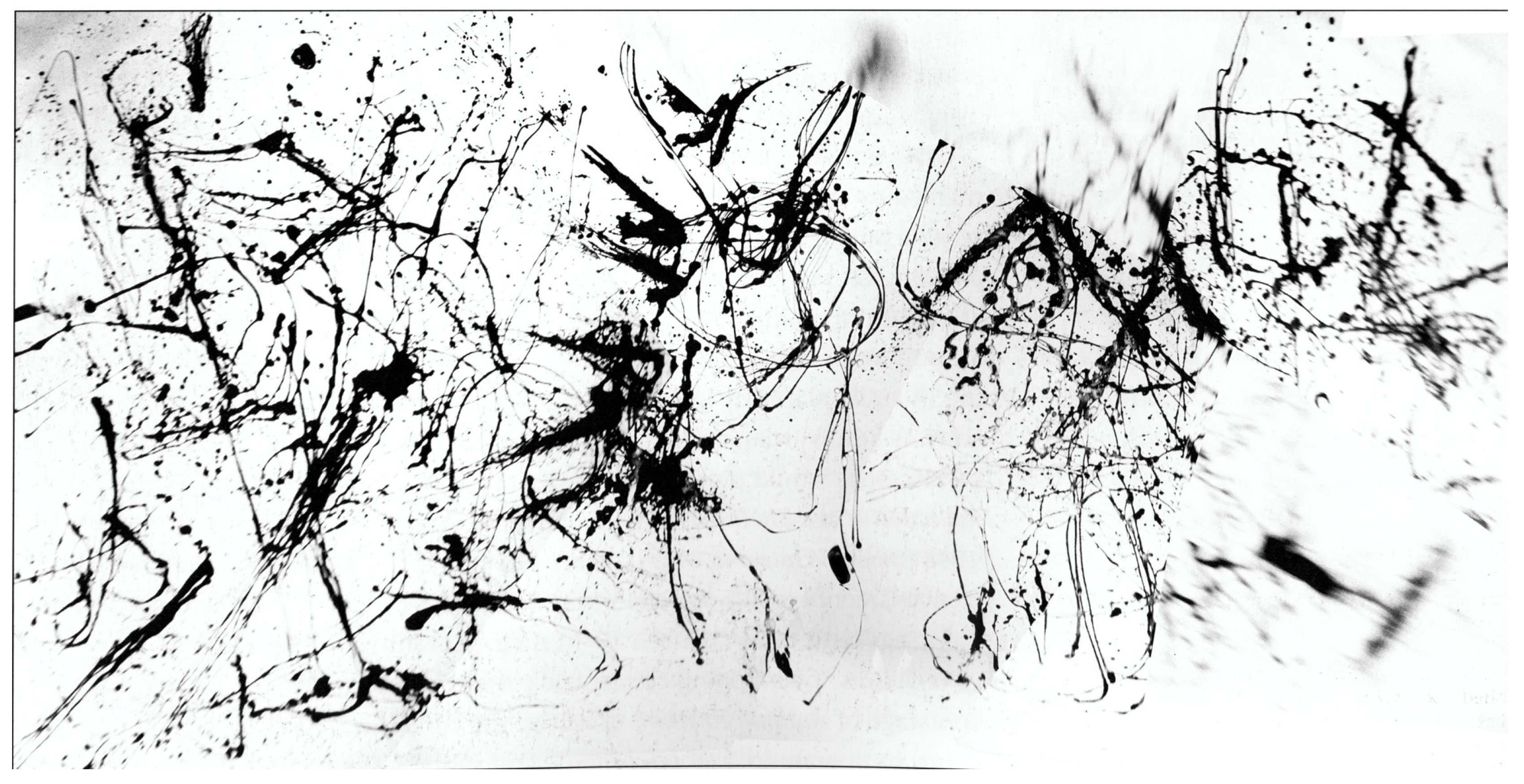
The untitled enamel drawing on paper, CR 797, 1950 (see Figure 1), that Hayter used to illustrate the principles of his essay “Orientation, Direction, Cheirality [right- or left-handedness], Velocity and Rhythm” displays a variation of the erotic energy that animates this abstract work. In its tripartite composition a strong black pulse leads in from the left rising up on a diagonal to a head, its energy then breaking into a differentiated dance that plays upon left to right, up and down, in and out, which then in the right hand coda pulses down and towards the lower right only to rise again and turn decidedly back to the left, as though to begin again. That in 1950 the energy that continues to animate even his largest compositions, such as Autumn Rhythm, this time an oil on canvas, is confirmed when Pepe Karmel discovered in his analysis of the creation of Autumn Rhythm the outline of a vaguely female full-length central figure against which Pollock then lodged some bold and masculine “splats” entering from the left (Figure 24) (Karmel 1998, p. 121).
In the final painting, this underpinning is no longer visible, although we once again sense the erotic energy that animates Pollock’s abstract poured paintings from 1947–50. In assessing Pollock’s achievement in the great paintings of 1950, Greenberg wrote: “I do not think it exaggerated to say that Pollock’s 1946–1950 manner really took up Analytical Cubism from the point at which Picasso and Braque had left it when, in their collages of 1912 and 1913, they drew back from the utter abstractness for which Analytical Cubism seemed headed” (Greenberg 1961b, pp. 218–19). Clearly, Greenberg’s modernist assessment does not do justice to Pollock’s exploration of the space of the imagination, the motivating force of eros, and the endless variation in Pollock’s poured lines. I return to CR 797, where this energy is presented in stunning purity, its expressiveness hinging, as T.J. Clark put in, “on the kind or degree of three-dimensionality that is given the throws of paint,” a three-dimensionality of line first learned in Hayter’s studio.
Funding
This research received no external funding.
Data Availability Statement
The data used in this study are available in published sources.
Conflicts of Interest
The author declares no conflict of interest.
| 1 | See formal analysis in (Carmean 1978, p. 140). |
| 2 | See (Darwent 2023, ch. 5) “Pollock Makes a Print”, pp. 132–59. For an overview of Pollock’s printmaking throughout his career, see (Williams and Williams 1988). |
| 3 | I refer to the prints by their Catalogue Raisonné [abbreviated as CR] numbers, as given in (O’Connor and Thaw 1978, vols. 1–4). For the history of the eighteen prints reproduced in the Catalogue Raisonné see p. 142. |
| 4 | See (Fitzgerald 1999). Moser writes that Pollock knew about Hayter since the late 1930’s, first through his work, and through reports from their mutual friend John Graham; (Moser 1978, p. 6). |
| 5 | Quoted in (Solomon 1987, pp. 149–50). |
| 6 | (Fichner-Rathus 1982, p. 165) also points to CR 1077 as “the most ambitious and accomplished print in the series.” Appreciating CR 1077 as a breakthrough work, Bernice Rose provides a thorough formal analysis of it in terms of cubism expanded by an awareness of Masson, Miro and Kandinsky; (Rose 1980, pp. 13, 15). |
| 7 | (Meier 1984, p. 137) also notes the presence of the word “art” in this print. For another instance of a significant play with letters, see Pollock’s signature in CR 1024, c. 1943. |
| 8 | Following the Getty Museum’s intensive conservation of Mural, Y. Szafran, L. Rivers, A. Phenix, and T. Learner observe: “The dark brown Bentonian structure of Mural—the tall, thin, stick figures that process across the work from right to left become more calligraphic as they proceed—can be readily sensed in normal viewing of the painting.” See Y. Szafran, L. Rivers, A. Phenix, and T. Learner, Jackson Pollock’s Mural: Myth and Substance, in (Szafran et al. 2014, p. 49). Both Ellen Landau and David Anfam recognize Benton’s influence on Mural, while Landau additionally proposes that of Hayter. Both emphasize the important influence of motion photography, and Anfam that of aerial photography; (Landau 2014, pp. 19–20, 22, 29 n.30); (Anfam 2015, pp. 37, 58ff, 97–98). |
| 9 | Thomas Hart Benton presented his theory of pictorial composition in a series of articles: (Benton 1926, 1927). |
| 10 | |
| 11 | (Darwent 2023, p. 148). On a growing interest in Jungian psychology in Surrealist circles in New York in the early 1940s, see (Darwent 2023, pp. 67, 71–72, 117). For the impact of Jungian thought on Pollock’s art, see (Langhorne 2023). |
| 12 | See (Greenberg 1961a, p. 111). Also see (Hayter 1945b). Kandinsky’s Light Picture, illustrated here, was since 1939 in the collection of the Museum of Non-Objective Art, where Pollock worked in 1943. |
| 13 | Quoted in (Potter 1985, pp. 76, 80). |
| 14 | On Pollock as the rising star in modern art, see (Greenberg 1945, p. 16). On advancing a post-cubist art, see (Greenberg 1947, pp. 124–25). For Pollock’s position in his history of modernism, see (Greenberg 1955, pp. 225–26). |
| 15 | Note that Darwent illustrates CR 1081 (P18) only as it was printed posthumously in 1967. He titles it Untitled (6), c.1944–5, appreciating it as a moment in Pollock’s oeuvre when figuration gives way to an all-over linear mark making. See (Darwent 2023, pp. 156, 190). |
| 16 | In the spring of 1944 Kadish remembers the discord in the relationship between Pollock and Krasner. See Naifeh and Smith, Interview with Kadish, quoted in (Naifeh and Smith 1989, pp. 483–84). |
| 17 | (Darwent 2023, pp. 156, 188, 190). With Untitled (4) Darwent refers to the first state of ‘ART’ which was printed by Pollock and Hayter at Atelier 17; see (O’Connor and Thaw 1978, vol. 4, p. 146). In this article I discuss the second and more developed state of ‘ART’, CR 1077 (P16), which was printed by Pollock and Hayter at Atelier 17. |
| 18 | On earlier manifestations of the female beast in She-Wolf, see (Langhorne 2013, pp. 155–56). |
| 19 | Lee Krasner, quoted in (Rubin 1979, p. 86). |
| 20 | Interview with Barbara Kadish, (Potter 1985, p. 81). |
| 21 | Interview with May Tabak, (Potter 1985, p. 190). For date of Development of the Foetus, see (O’Connor and Thaw 1978, vol. 1, p. 138). See also (Naifeh and Smith 1989, p. 531). |
| 22 | For a more extensive discussion of Pollock’s relationship to nature, especially in late 1944, see (Langhorne 2012, pp. 118–34) and and especially in 1949, see (Langhorne 2011, pp. 227–38). |
| 23 | For further discussion of experimental poured paintings in 1943, see (Langhorne 2023). |
References
- Anfam, David. 2015. Jackson Pollock’s Mural: Energy Made Visible. London: Thames and Hudson. [Google Scholar]
- Benton, Thomas Hart. 1926. The Mechanics of Form Organization in Painting, Parts I–II. The Arts 10: 285–89, 340–42. [Google Scholar]
- Benton, Thomas Hart. 1927. The Mechanics of Form Organization in Painting, Parts III–V. The Arts 11: 43–44, 95–96, 145–48. [Google Scholar]
- Carmean, E. A. 1978. Jackson Pollock: Classic Paintings of 1950. In American Art at Mid-Century: The Subjects of the Artist. Washington, DC: National Gallery of Art, pp. 127–53. [Google Scholar]
- Clark, T. J. 1999. Farewell to an Idea: Episodes from a History of Modernism. New Haven: Yale University Press. [Google Scholar]
- Coddington, James. 1999. No Chaos Damn It. In Jackson Pollock: New Approaches. Edited by Kirk Varnedoe and Pepe Karmel. New York: Harry N. Abrams, pp. 101–15. [Google Scholar]
- Darwent, Charles. 2023. Surrealists in New York: Atelier 17 and the Birth of Abstract Expressionism. New York: Thames and Hudson. [Google Scholar]
- Fichner-Rathus, Lois. 1982. Pollock at Atelier 17. The Print Collector’s Newsletter 13: 162–65. [Google Scholar]
- Fitzgerald, J. 1999. ‘Biographical Note’, A Finding Aid to the Reuben Kadish Papers, 1851–1995. Washington, DC: Smithsonian Archives of American Art. [Google Scholar]
- Greenberg, Clement. 1945. Review of Exhibitions of Mondrian, Kandinsky, and Pollock. The Nation, 7 April 1945. In The Collected Essays and Criticism. Edited by John O’Brian. Chicago: University of Chicago Press, vol. 2, pp. 14–18. [Google Scholar]
- Greenberg, Clement. 1947. Review of Exhibitions of Jean Dubuffet and Jackson Pollock. The Nation, 1 February 1947. In The Collected Essays and Criticism. Edited by John O’Brian. Chicago: University of Chicago Press, vol. 2, pp. 122–25. [Google Scholar]
- Greenberg, Clement. 1955. American-Type Painting, Partisan Review, Spring 1955. In The Collected Essays and Criticism. Edited by John O’Brian. Chicago: University of Chicago Press, vol. 3, pp. 217–36. [Google Scholar]
- Greenberg, Clement. 1961a. Kandinsky (1948/1957). In Art and Culture: Critical Essays. Boston: Beacon Press, pp. 111–14. [Google Scholar]
- Greenberg, Clement. 1961b. American Type Painting (1955/1958). In Art and Culture: Critical Essays. Boston: Beacon Press, pp. 208–229. [Google Scholar]
- Halasz, P. 1984. Stanley William Hayter: Pollock’s Other Master. Arts Magazine 59: 73–75. [Google Scholar]
- Hayter, Stanley William. 1944a. Techniques of Gravure. Museum of Modern Art Bulletin 12: 6–13. [Google Scholar] [CrossRef]
- Hayter, Stanley William. 1944b. Line and Space of the Imagination. View 4: 126–28, 140. [Google Scholar]
- Hayter, Stanley William. 1945a. The Convention of Line. American Magazine of Art 38: 92–95. [Google Scholar]
- Hayter, Stanley William. 1945b. The Language of Kandinsky. American Magazine of Art 38: 176–79. [Google Scholar]
- Hayter, Stanley William. 1945c. Paul Klee: Apostle of Empathy. American Magazine of Art 39: 127–30. [Google Scholar]
- Hayter, Stanley William. 1965. Orientation, Direction, Cheirality, Velocity and Rhythm. In The Nature and Art of Motion. Edited by Gyorgy Kepes. New York: G. Braziller, pp. 71–80. [Google Scholar]
- Karmel, Pepe. 1998. Pollock at Work: The Films and Photographs of Hans Namuth. In Jackson Pollock. Exhibition. New York: Museum of Modern Art, pp. 87–137. [Google Scholar]
- Landau, Ellen. 2014. Still Learning from Pollock. In Jackson Pollock’s Mural: The Transitional Moment. Los Angeles: J. Paul Getty Museum, pp. 7–29. [Google Scholar]
- Langhorne, Elizabeth L. 2011. Pollock’s Dream of a Biocentric Art: The Challenge of His and Peter Blake’s Ideal Museum. In Biocentrism and Modernism. Edited by O. A. I. Botar and I. Wünsche. Burlington: Ashgate, pp. 227–38. [Google Scholar]
- Langhorne, Elizabeth L. 2012. Jackson Pollock: The Sin of Images. In Meanings of Abstract Art: Between Nature and Theory. Edited by P. Crowther and I. Wünsche. New York: Rutledge, pp. 118–34. [Google Scholar]
- Langhorne, Elizabeth L. 2013. Jackson Pollock- Kunst als Sinnsuche: Abstraktion, All-Over, Action Painting. Wallerstein: Havel Verlag. English Manuscript Online. Available online: https://www.academia.edu/108515122/Jackson_Pollock_Art_as_a_Search_for_Meaning (accessed on 18 December 2025).
- Langhorne, Elizabeth L. 2023. Self-Betrayal or Self-Deception? The Case of Jackson Pollock. Arts 12: 54. Available online: https://www.mdpi.com/2076–0752/12/2/54 (accessed on 18 December 2025). [CrossRef]
- Meier, A. P. 1984. Jackson Pollock’s Prints, 1944–45. Arts Magazine 58: 136–37. [Google Scholar]
- Moser, J. 1978. The Impact of Stanley William Hayter on Post-War American Art. Archives of American Art Journal 18: 2–11. [Google Scholar] [CrossRef]
- Naifeh, Steven, and Gregory White Smith. 1989. Jackson Pollock: An American Saga. New York: Clarkson N. Potter. [Google Scholar]
- O’Connor, Francis V., and Eugene V. Thaw, eds. 1978. Jackson Pollock: A Catalogue Raisonné of Paintings, Drawings, and Other Works. 4 vols, New Haven and London: Yale University Press, A number following CR refers to the number designated to each of Pollock’s works in this Catalogue Raisonné. [Google Scholar]
- O’Hara, Frank. 1959. Jackson Pollock. New York: George Braziller. [Google Scholar]
- Paul, C. 1978. Printmaking Pioneer: Stanley William Hayter. Art News 77: 70–74. [Google Scholar]
- Potter, Jeffrey. 1985. To a Violent Grave: An Oral Biography of Jackson Pollock. New York: G.P. Putnam. [Google Scholar]
- Richardson, Brenda. 1999. Brice Marden. In Abstraction, Gesture, Écriture: Paintings from the Daros Collection. New York: Scalo, p. 94. [Google Scholar]
- Rose, Bernice. 1980. Jackson Pollock: Drawing into Painting. New York: Museum of Modern Art and Harper & Row. [Google Scholar]
- Rubin, William. 1979. Pollock as Jungian Illustrator: The Limits of Psychological Criticism, Part II. Art in America 67: 72–91. [Google Scholar] [PubMed]
- Solomon, Deborah. 1987. Jackson Pollock: A Biography. New York: Simon and Schuster. [Google Scholar]
- Sweeney, James Johnson. 1944. New Directions in Gravure. The Bulletin of the Museum of Modern Art 12: 3–5. [Google Scholar] [CrossRef]
- Szafran, Yvonne, L. Rivers, A. Phenix, and T. Learner. 2014. Jackson Pollock’s Mural: Myth and Substance. In Jackson Pollock’s Mural: The Transitional Moment. Los Angeles: J. Paul Getty Museum, pp. 31–89. [Google Scholar]
- Weyl, Christina. 2016. Innovation and Abstraction: Women Artists and Atelier 17. Exhibition Catalogue. East Hampton: Pollock-Krasner House & Study Center. [Google Scholar]
- Weyl, Christina. 2019. The Women of Atelier 17: Modernist Printmaking in Midcentury New York. New Haven: Yale University Press. [Google Scholar]
- Williams, Reba, and Dave Williams. 1988. The Prints of Jackson Pollock. Print Quarterly 5: 347–73. [Google Scholar]
Figure 1.
Jackson Pollock, Untitled, CR 797, 1950. Enamel on paper, 28.2 × 150 cm. Staatsgalerie, Stuttgart. Photo Credit: Jackson Pollock Catalogue Raisonné Archives, Pollock-Krasner Study Center. © 2026 The Pollock-Krasner Foundation/Artists Rights Society (ARS), New York. The artworks and reproductions thereof are expressly excluded from any open-access or open license grant of rights. All rights are expressly reserved by ARS on behalf of the Artist, Estate or Foundation.
Figure 1.
Jackson Pollock, Untitled, CR 797, 1950. Enamel on paper, 28.2 × 150 cm. Staatsgalerie, Stuttgart. Photo Credit: Jackson Pollock Catalogue Raisonné Archives, Pollock-Krasner Study Center. © 2026 The Pollock-Krasner Foundation/Artists Rights Society (ARS), New York. The artworks and reproductions thereof are expressly excluded from any open-access or open license grant of rights. All rights are expressly reserved by ARS on behalf of the Artist, Estate or Foundation.

Figure 2.
Jackson Pollock, Autumn Rhythm: 30 Number 1950, 1950. Oil on canvas, 266.7 × 525.8 cm. The Metropolitan Museum of Art, New York. George A. Hearn Fund, 1957. © 2026 The Pollock-Krasner Foundation/Artists Rights Society (ARS), New York. The artworks and reproductions thereof are expressly excluded from any open-access or open license grant of rights. All rights are expressly reserved by ARS on behalf of the Artist, Estate or Foundation.
Figure 2.
Jackson Pollock, Autumn Rhythm: 30 Number 1950, 1950. Oil on canvas, 266.7 × 525.8 cm. The Metropolitan Museum of Art, New York. George A. Hearn Fund, 1957. © 2026 The Pollock-Krasner Foundation/Artists Rights Society (ARS), New York. The artworks and reproductions thereof are expressly excluded from any open-access or open license grant of rights. All rights are expressly reserved by ARS on behalf of the Artist, Estate or Foundation.
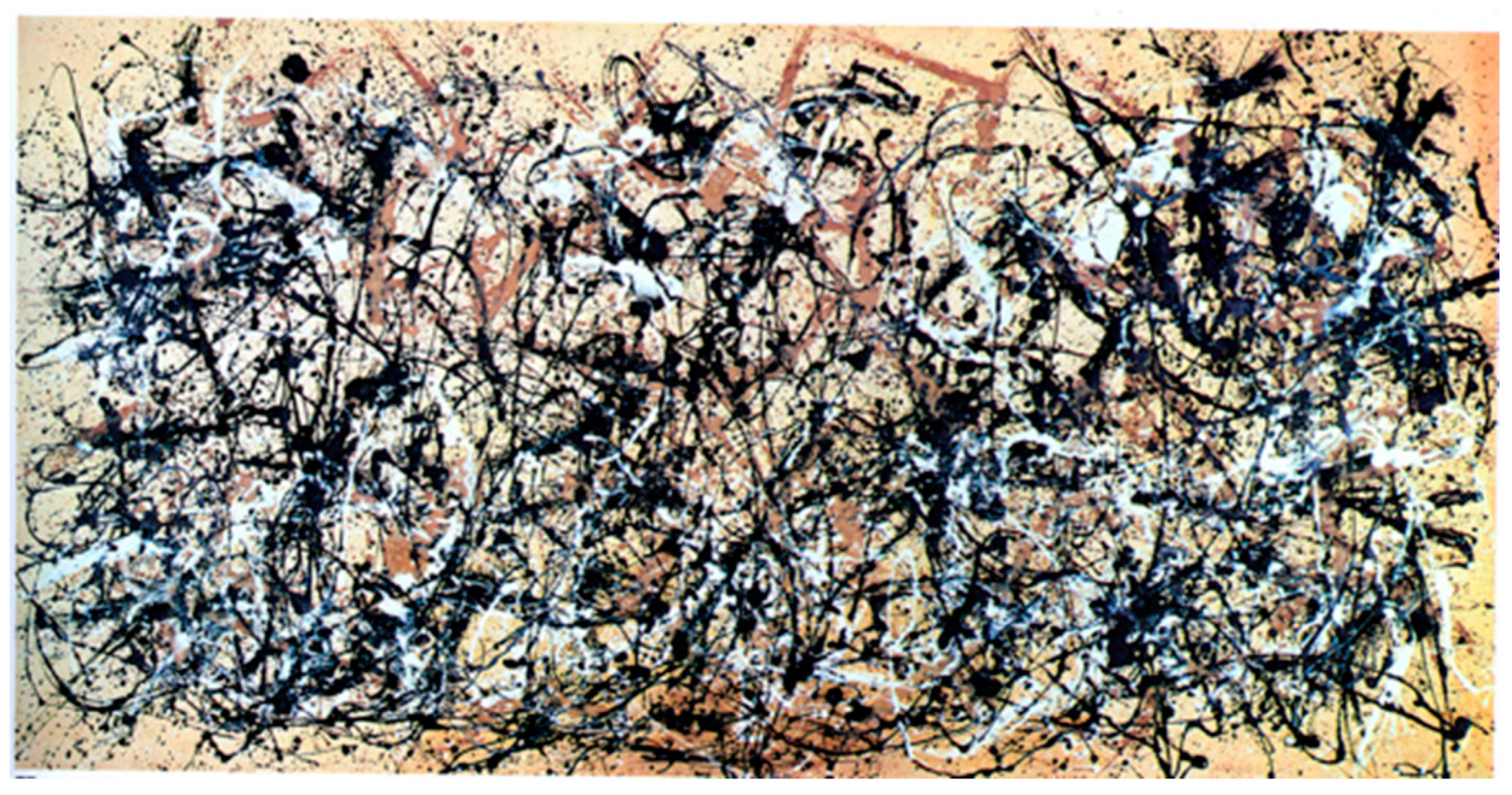
Figure 3.
Jackson Pollock, Untitled [henceforth referred to as ‘ART’], CR 1077, c. 1944–45. Engraving and drypoint, printed in black, second state printed by Pollock and S. W. Hayter at Atelier 17, 38 × 44.8 cm. The Museum of Modern Art, New York. Gift of Lee Krasner Pollock, 1969. Photo Credit: Jackson Pollock Catalogue Raisonné Archives, Pollock-Krasner Study Center. © 2026 The Pollock-Krasner Foundation/Artists Rights Society (ARS), New York. The artworks and reproductions thereof are expressly excluded from any open-access or open license grant of rights. All rights are expressly reserved by ARS on behalf of the Artist, Estate or Foundation.
Figure 3.
Jackson Pollock, Untitled [henceforth referred to as ‘ART’], CR 1077, c. 1944–45. Engraving and drypoint, printed in black, second state printed by Pollock and S. W. Hayter at Atelier 17, 38 × 44.8 cm. The Museum of Modern Art, New York. Gift of Lee Krasner Pollock, 1969. Photo Credit: Jackson Pollock Catalogue Raisonné Archives, Pollock-Krasner Study Center. © 2026 The Pollock-Krasner Foundation/Artists Rights Society (ARS), New York. The artworks and reproductions thereof are expressly excluded from any open-access or open license grant of rights. All rights are expressly reserved by ARS on behalf of the Artist, Estate or Foundation.
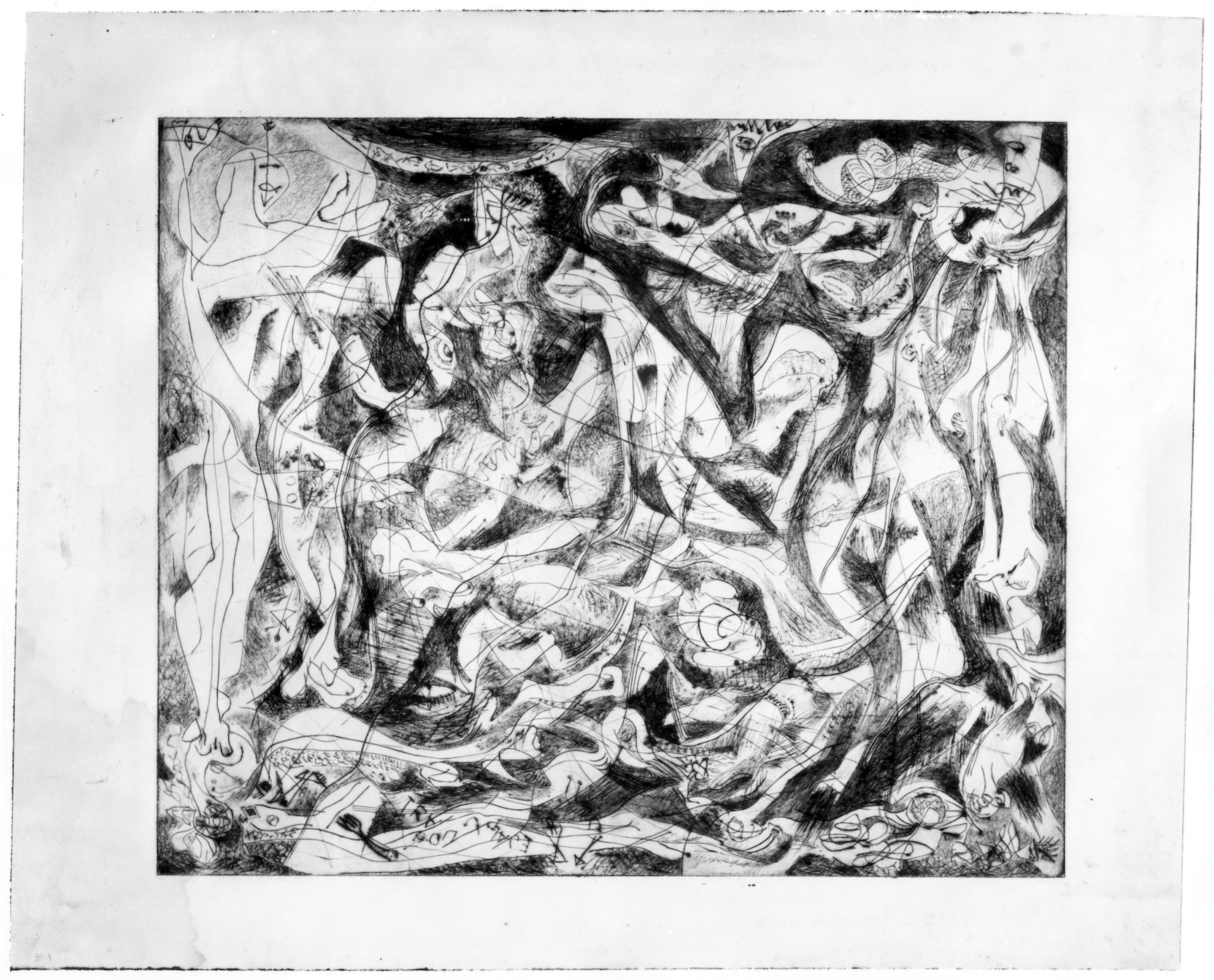
Figure 4.
Jackson Pollock, Mural, 1943. Oil on canvas, 243.2 × 603.2 cm. University of Iowa Museum of Art, Iowa City, Gift of Peggy Guggenheim. Photo: University of Iowa Museum of Art. © 2026 The Pollock-Krasner Foundation/Artists Rights Society (ARS), New York. The artworks and reproductions thereof are expressly excluded from any open-access or open license grant of rights. All rights are expressly reserved by ARS on behalf of the Artist, Estate or Foundation.
Figure 4.
Jackson Pollock, Mural, 1943. Oil on canvas, 243.2 × 603.2 cm. University of Iowa Museum of Art, Iowa City, Gift of Peggy Guggenheim. Photo: University of Iowa Museum of Art. © 2026 The Pollock-Krasner Foundation/Artists Rights Society (ARS), New York. The artworks and reproductions thereof are expressly excluded from any open-access or open license grant of rights. All rights are expressly reserved by ARS on behalf of the Artist, Estate or Foundation.
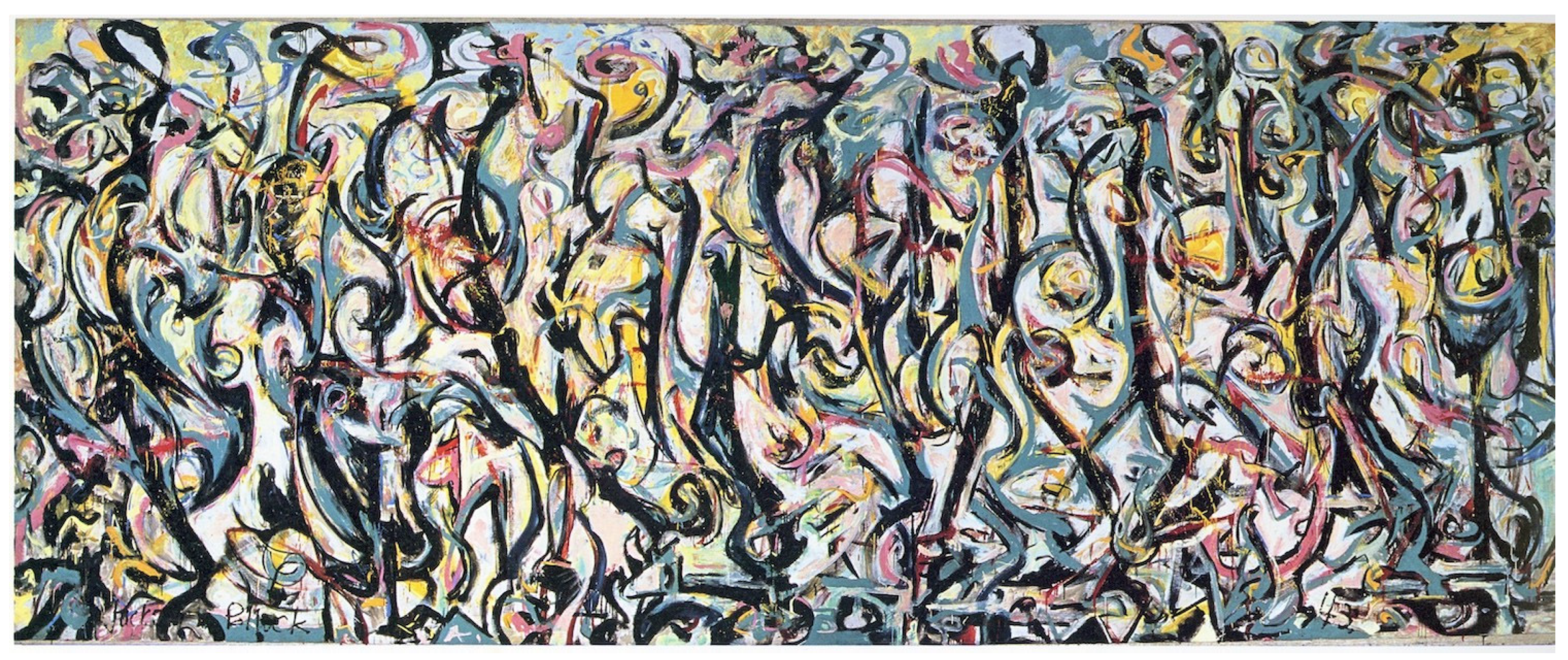
Figure 5.
Thomas Hart Benton, Shape Fittings, n.d. Drawing. Collection of The Benton Trust, UMB Bank, Kansas City, Missouri. © The Benton Trust/Licensed by VAGA, New York, NY.
Figure 5.
Thomas Hart Benton, Shape Fittings, n.d. Drawing. Collection of The Benton Trust, UMB Bank, Kansas City, Missouri. © The Benton Trust/Licensed by VAGA, New York, NY.
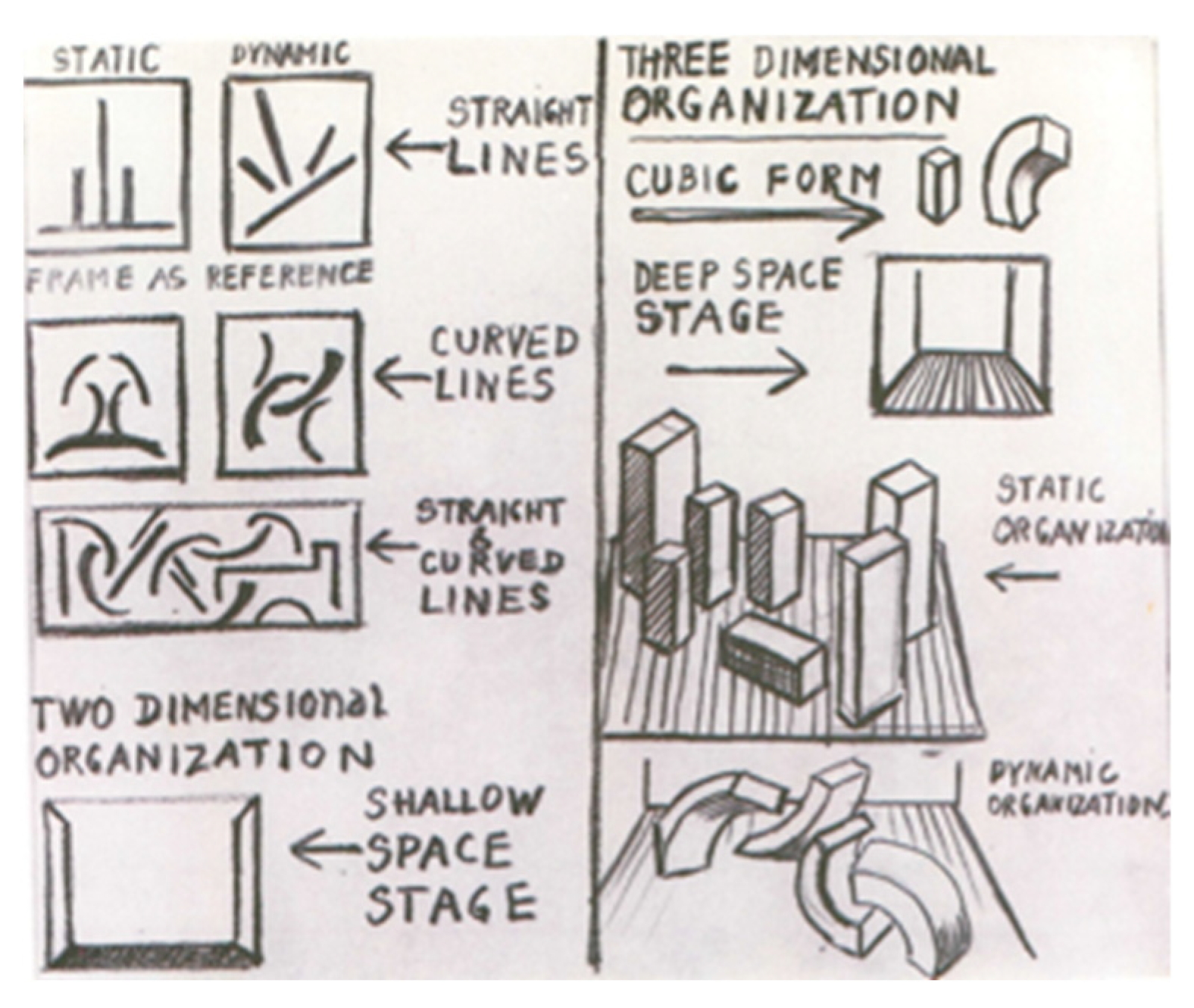
Figure 6.
Thomas Hart Benton, Mechanics of Form, n.d. Drawing. Collection of The Benton Trust, UMB Bank, Kansas City, Missouri. © The Benton Trust/Licensed by VAGA, New York, NY.
Figure 6.
Thomas Hart Benton, Mechanics of Form, n.d. Drawing. Collection of The Benton Trust, UMB Bank, Kansas City, Missouri. © The Benton Trust/Licensed by VAGA, New York, NY.
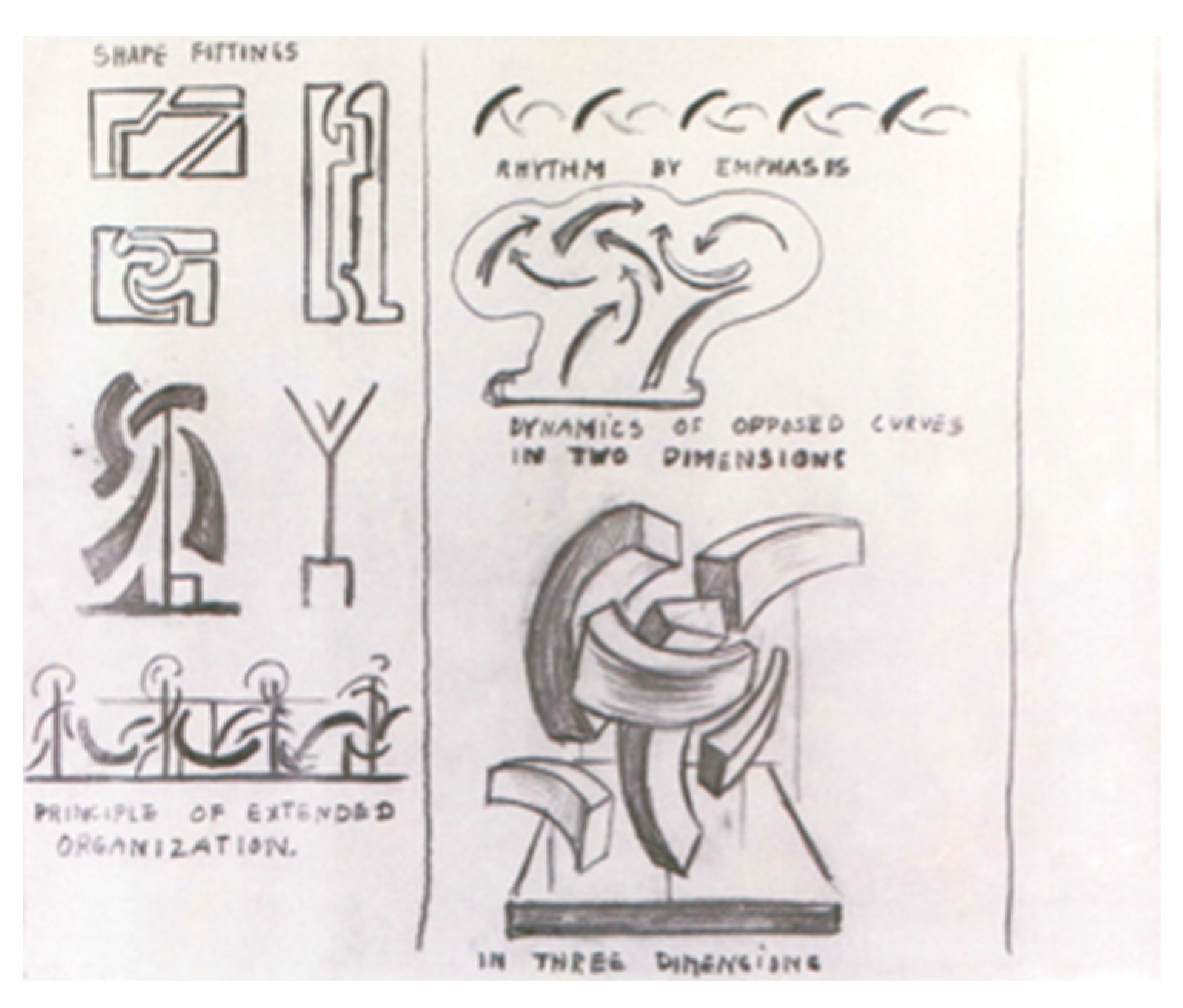
Figure 7.
Jackson Pollock, Untitled, CR 434r, c. 1937–38. Pencil and color pencil on paper, 43.2 × 34.9 cm. The Metropolitan Museum of Art, New York. Purchase, anonymous gift, 1990. Photo Credit: Jackson Pollock Catalogue Raisonné Archives, Pollock-Krasner Study Center. © 2026 The Pollock-Krasner Foundation/Artists Rights Society (ARS), New York. The artworks and reproductions thereof are expressly excluded from any open-access or open license grant of rights. All rights are expressly reserved by ARS on behalf of the Artist, Estate or Foundation.
Figure 7.
Jackson Pollock, Untitled, CR 434r, c. 1937–38. Pencil and color pencil on paper, 43.2 × 34.9 cm. The Metropolitan Museum of Art, New York. Purchase, anonymous gift, 1990. Photo Credit: Jackson Pollock Catalogue Raisonné Archives, Pollock-Krasner Study Center. © 2026 The Pollock-Krasner Foundation/Artists Rights Society (ARS), New York. The artworks and reproductions thereof are expressly excluded from any open-access or open license grant of rights. All rights are expressly reserved by ARS on behalf of the Artist, Estate or Foundation.
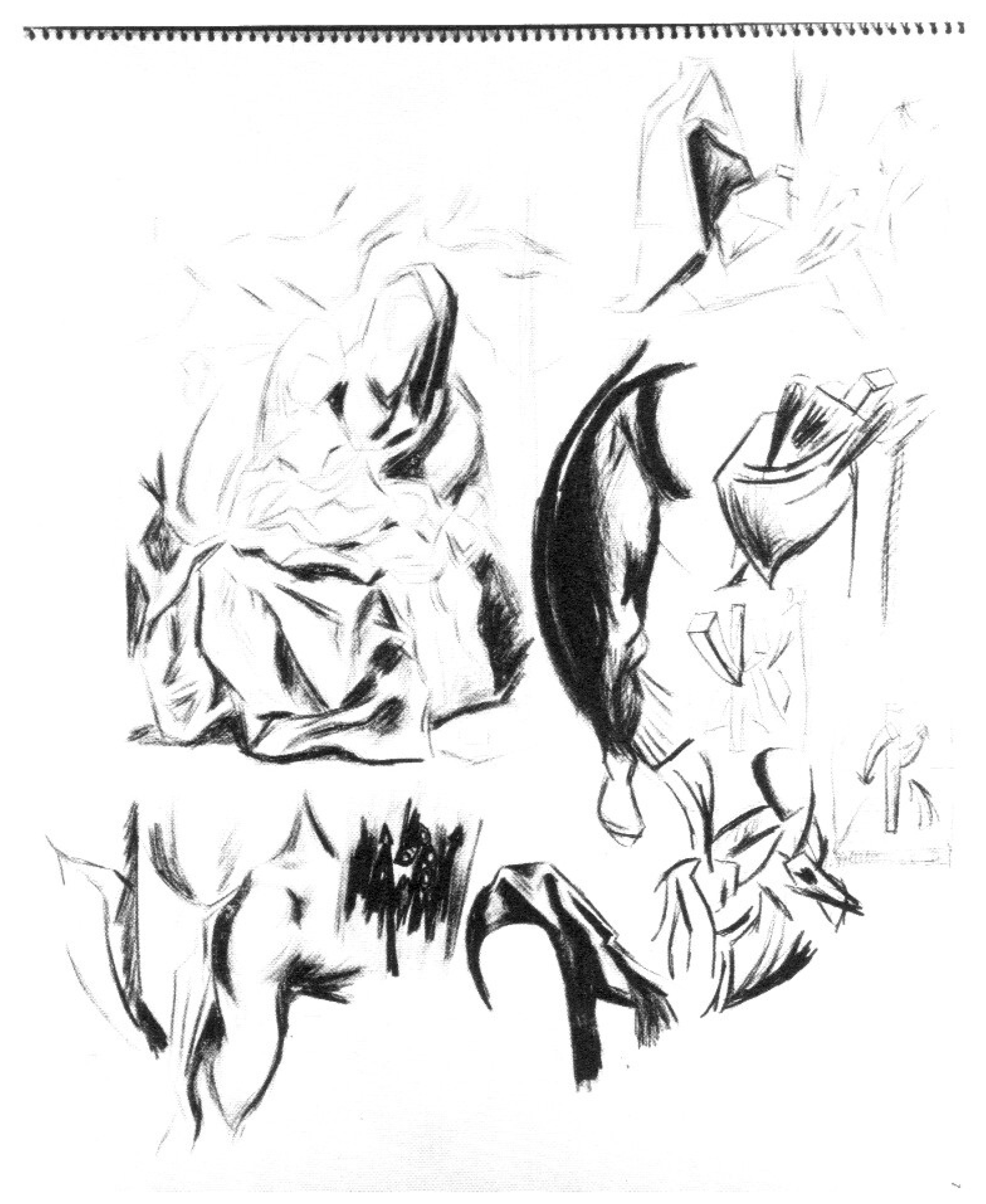
Figure 8.
Stanley W. Hayter, Untitled, 1944. Illustration in View 4 (1944). © 2026 Artists Rights Society (ARS), New York/ADAGP, Paris. The artworks and reproductions thereof are expressly excluded from any open-access or open license grant of rights. All rights are expressly reserved by ARS on behalf of the Artist, Estate or Foundation.
Figure 8.
Stanley W. Hayter, Untitled, 1944. Illustration in View 4 (1944). © 2026 Artists Rights Society (ARS), New York/ADAGP, Paris. The artworks and reproductions thereof are expressly excluded from any open-access or open license grant of rights. All rights are expressly reserved by ARS on behalf of the Artist, Estate or Foundation.
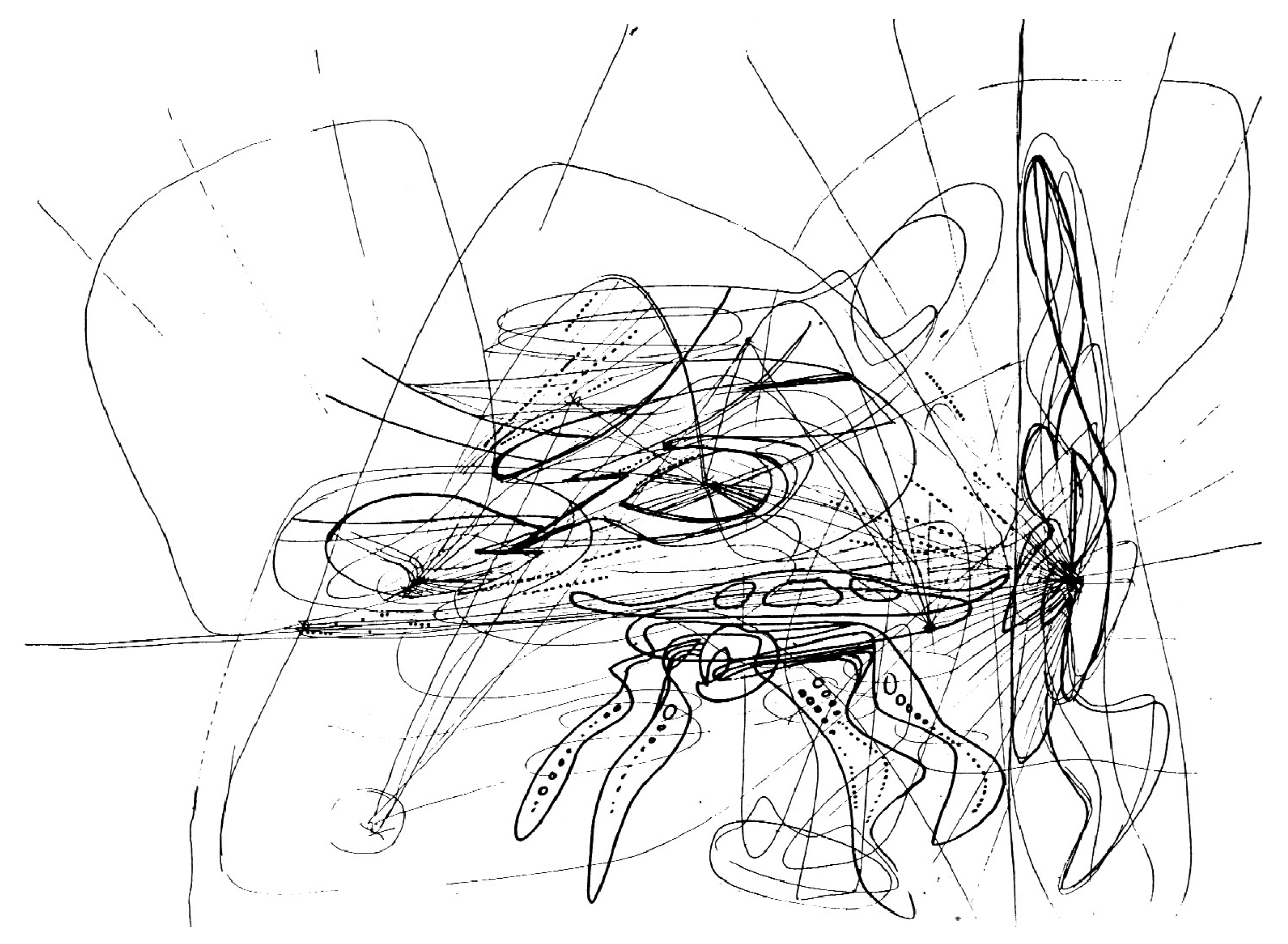
Figure 9.
Wassily Kandinsky, Light Picture (Helles Bild), December 1913. Oil and natural resin on canvas, 77.8 × 100.2 cm. Solomon R. Guggenheim Museum, New York, Solomon R. Guggenheim Founding Collection. By gift 37.244. © 2025 Artists Rights Society (ARS), New York. The artworks and reproductions thereof are expressly excluded from any open-access or open license grant of rights. All rights are expressly reserved by ARS on behalf of the Artist, Estate or Foundation.
Figure 9.
Wassily Kandinsky, Light Picture (Helles Bild), December 1913. Oil and natural resin on canvas, 77.8 × 100.2 cm. Solomon R. Guggenheim Museum, New York, Solomon R. Guggenheim Founding Collection. By gift 37.244. © 2025 Artists Rights Society (ARS), New York. The artworks and reproductions thereof are expressly excluded from any open-access or open license grant of rights. All rights are expressly reserved by ARS on behalf of the Artist, Estate or Foundation.
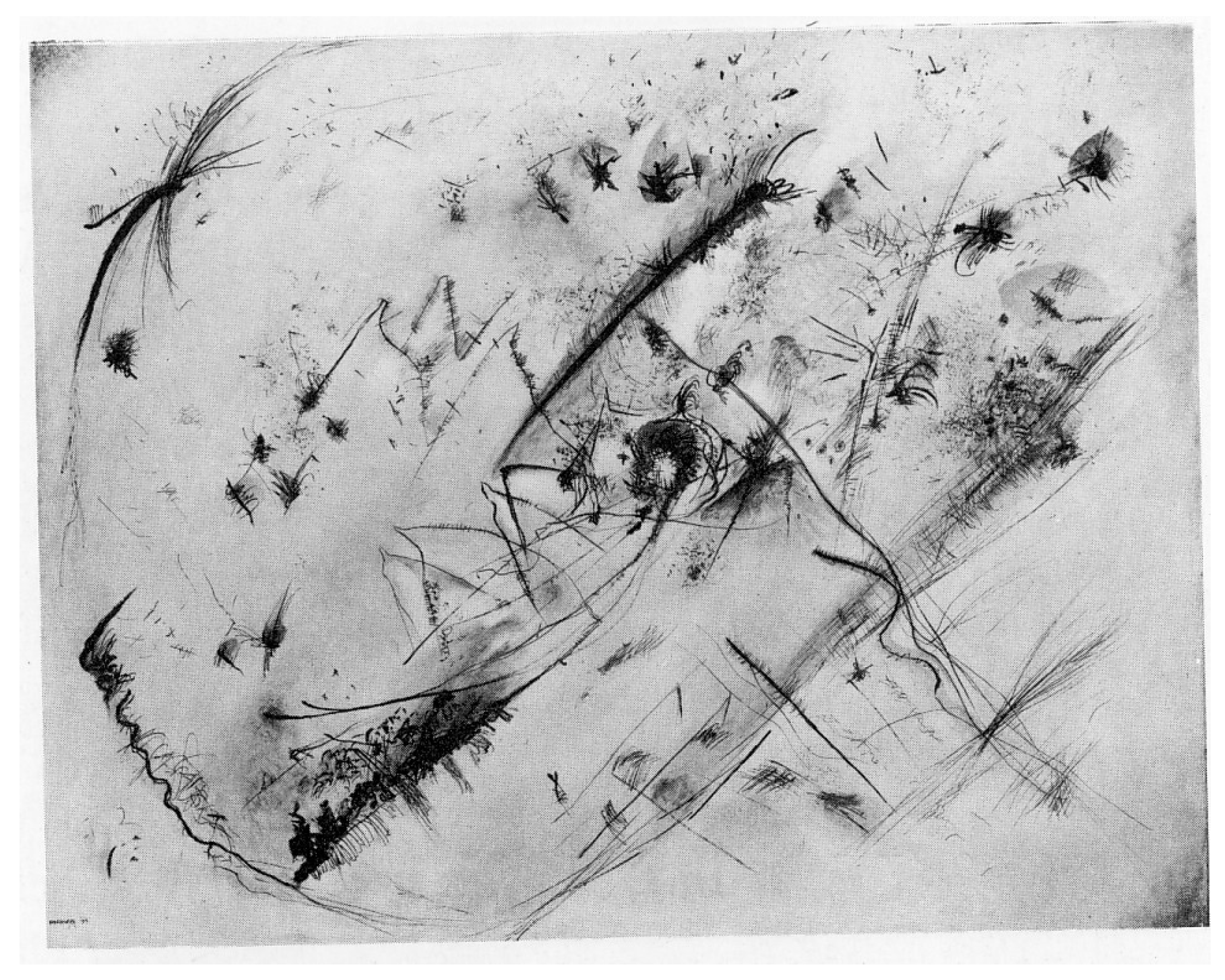
Figure 10.
Stanley W. Hayter, Diagram showing the perception of curves as concave or convex. Illustrated in Hayter, “Orientation, Direction, Cheirality, Velocity and Rhythm,” The Nature and Art of Motion, ed. Gyorgy Kepes, New York 1965. © 2026 Artists Rights Society (ARS), New York/ADAGP, Paris. The artworks and reproductions thereof are expressly excluded from any open-access or open license grant of rights. All rights are expressly reserved by ARS on behalf of the Artist, Estate or Foundation.
Figure 10.
Stanley W. Hayter, Diagram showing the perception of curves as concave or convex. Illustrated in Hayter, “Orientation, Direction, Cheirality, Velocity and Rhythm,” The Nature and Art of Motion, ed. Gyorgy Kepes, New York 1965. © 2026 Artists Rights Society (ARS), New York/ADAGP, Paris. The artworks and reproductions thereof are expressly excluded from any open-access or open license grant of rights. All rights are expressly reserved by ARS on behalf of the Artist, Estate or Foundation.
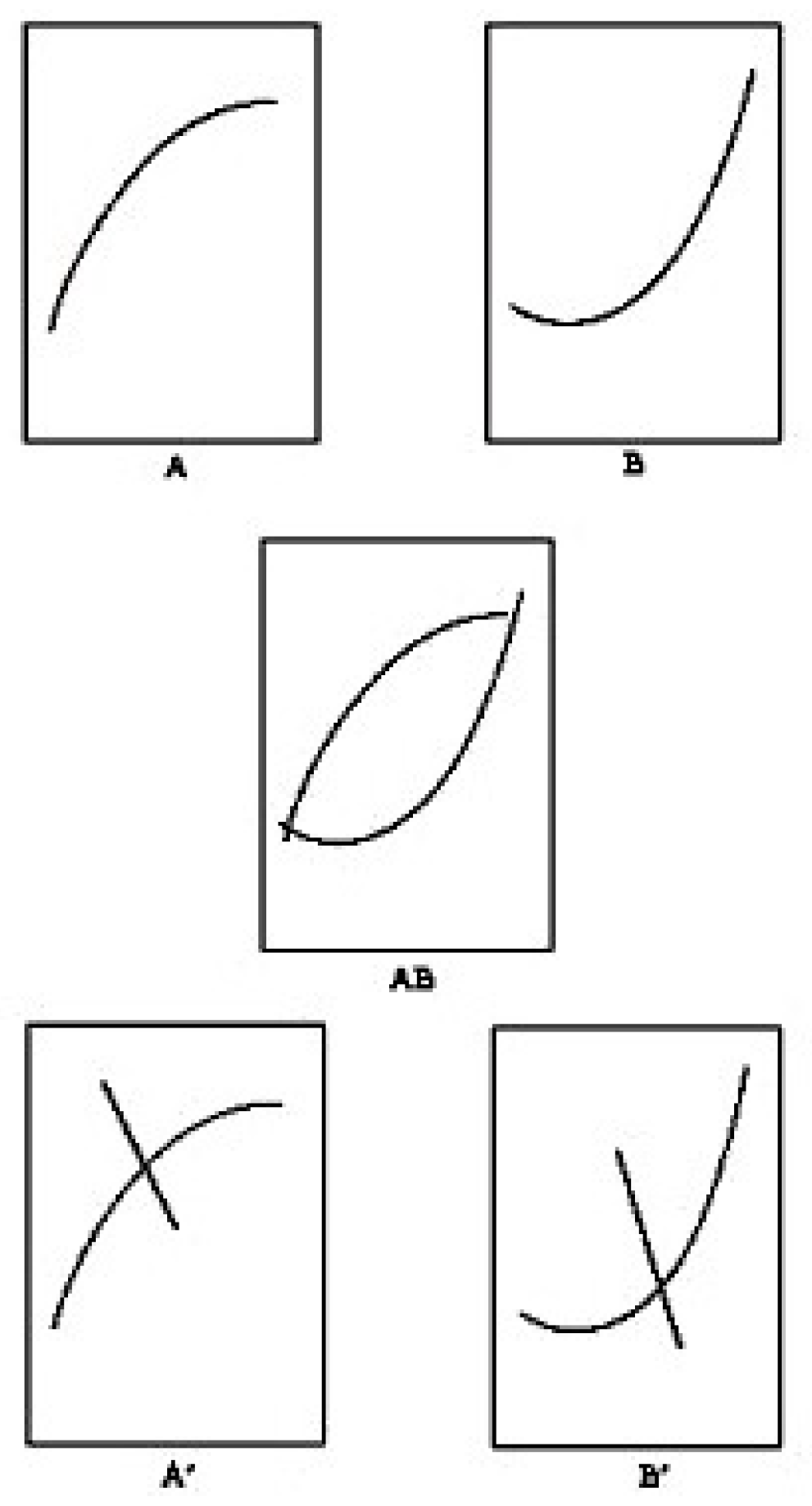
Figure 11.
Jackson Pollock, Untitled, CR 1080 (P18), c. 1944–45. Engraving and drypoint, printed in black. First state, printed by Pollock and S. W. Hayter at Atelier 17, 29.8 × 22.2 cm. Collection of Mr. and Mrs. Harold Rosenberg. Gift of the artist. Photo Credit: Jackson Pollock Catalogue Raisonné Archives, Pollock-Krasner Study Center. © 2026 The Pollock-Krasner Foundation/Artists Rights Society (ARS), New York. The artworks and reproductions thereof are expressly excluded from any open-access or open license grant of rights. All rights are expressly reserved by ARS on behalf of the Artist, Estate or Foundation.
Figure 11.
Jackson Pollock, Untitled, CR 1080 (P18), c. 1944–45. Engraving and drypoint, printed in black. First state, printed by Pollock and S. W. Hayter at Atelier 17, 29.8 × 22.2 cm. Collection of Mr. and Mrs. Harold Rosenberg. Gift of the artist. Photo Credit: Jackson Pollock Catalogue Raisonné Archives, Pollock-Krasner Study Center. © 2026 The Pollock-Krasner Foundation/Artists Rights Society (ARS), New York. The artworks and reproductions thereof are expressly excluded from any open-access or open license grant of rights. All rights are expressly reserved by ARS on behalf of the Artist, Estate or Foundation.
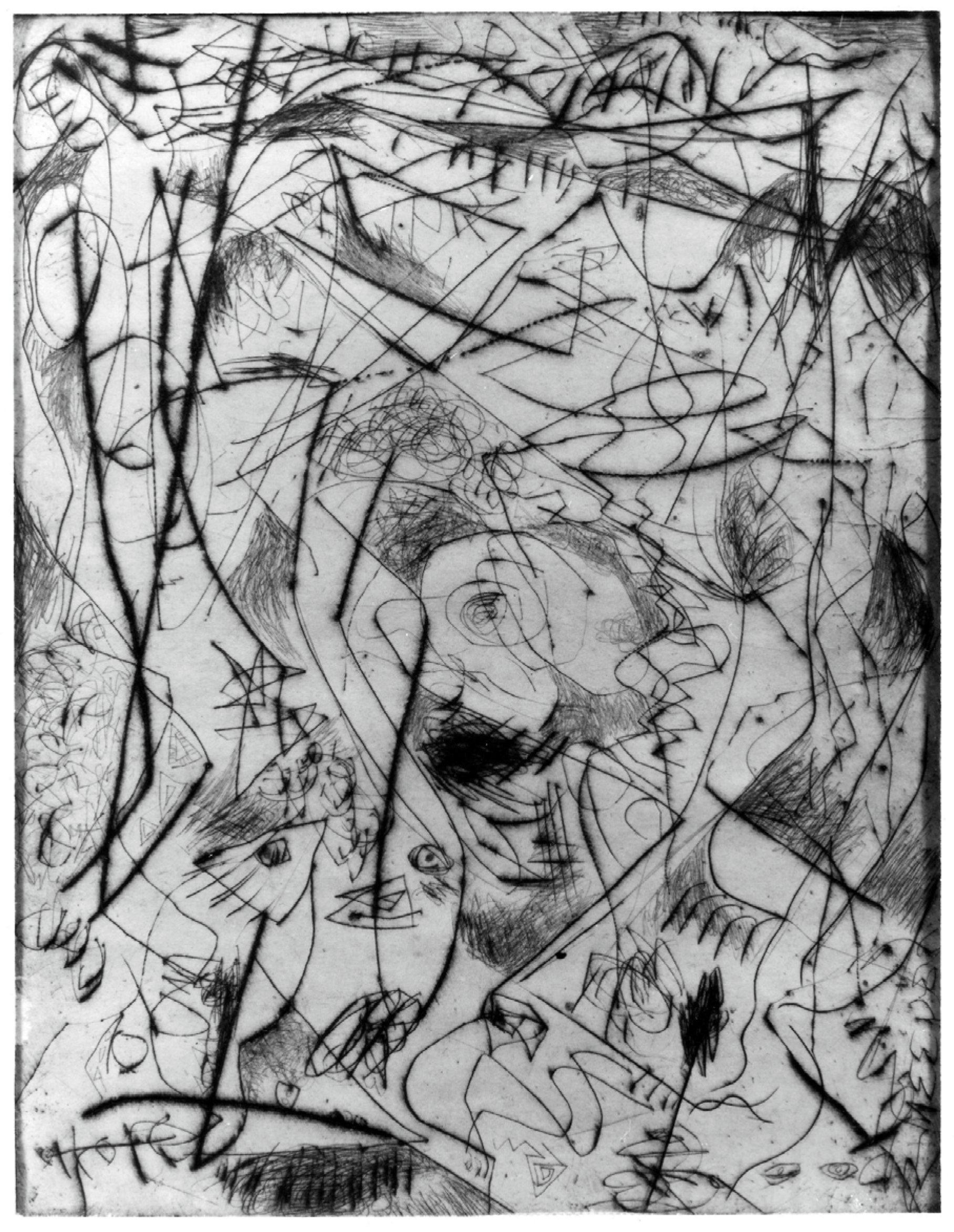
Figure 12.
Jackson Pollock, Untitled, CR 1079 (P17), c. 1944–45 (printed posthumously 1967). Engraving and drypoint, printed in brown ink, 22.3 × 30.2 cm. Museum of Modern Art. Gift of Lee Krasner Pollock. Photo Credit: Jackson Pollock Catalogue Raisonné Archives, Pollock-Krasner Study Center. © 2026 The Pollock-Krasner Foundation/Artists Rights Society (ARS), New York. The artworks and reproductions thereof are expressly excluded from any open-access or open license grant of rights. All rights are expressly reserved by ARS on behalf of the Artist, Estate or Foundation.
Figure 12.
Jackson Pollock, Untitled, CR 1079 (P17), c. 1944–45 (printed posthumously 1967). Engraving and drypoint, printed in brown ink, 22.3 × 30.2 cm. Museum of Modern Art. Gift of Lee Krasner Pollock. Photo Credit: Jackson Pollock Catalogue Raisonné Archives, Pollock-Krasner Study Center. © 2026 The Pollock-Krasner Foundation/Artists Rights Society (ARS), New York. The artworks and reproductions thereof are expressly excluded from any open-access or open license grant of rights. All rights are expressly reserved by ARS on behalf of the Artist, Estate or Foundation.
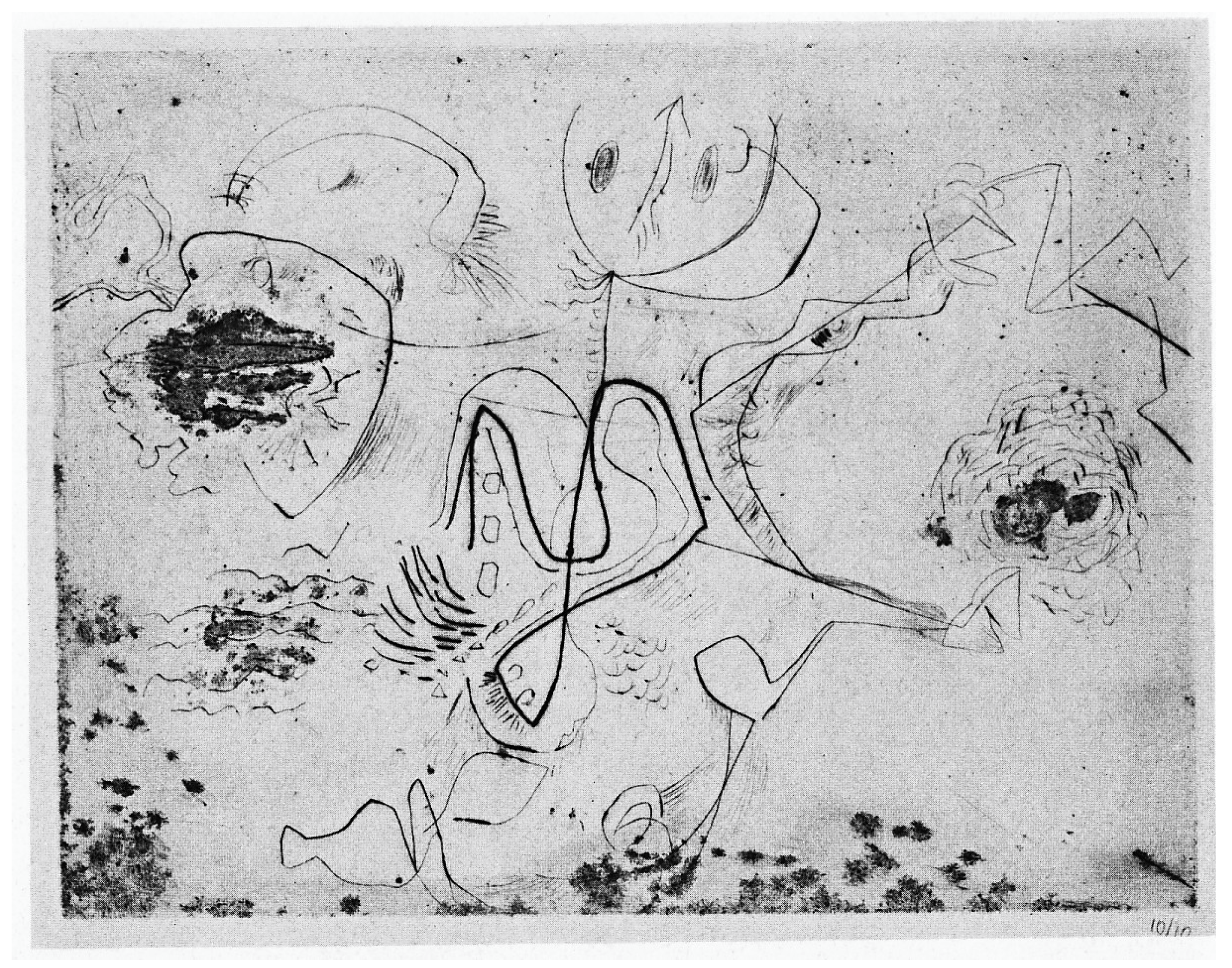
Figure 13.
Minna Citron, Squid Under Pier, 1948. Engraving and etching, 38.26 × 46.67 cm. © Estate of Minna Citron/Licensed by VAGA, New York, NY. © 2026 Estate of Minna Citron/Licensed by VAGA at Artists Rights Society (ARS), NY. The artworks and reproductions thereof are expressly excluded from any open-access or open license grant of rights. All rights are expressly reserved by ARS on behalf of the Artist, Estate or Foundation.
Figure 13.
Minna Citron, Squid Under Pier, 1948. Engraving and etching, 38.26 × 46.67 cm. © Estate of Minna Citron/Licensed by VAGA, New York, NY. © 2026 Estate of Minna Citron/Licensed by VAGA at Artists Rights Society (ARS), NY. The artworks and reproductions thereof are expressly excluded from any open-access or open license grant of rights. All rights are expressly reserved by ARS on behalf of the Artist, Estate or Foundation.
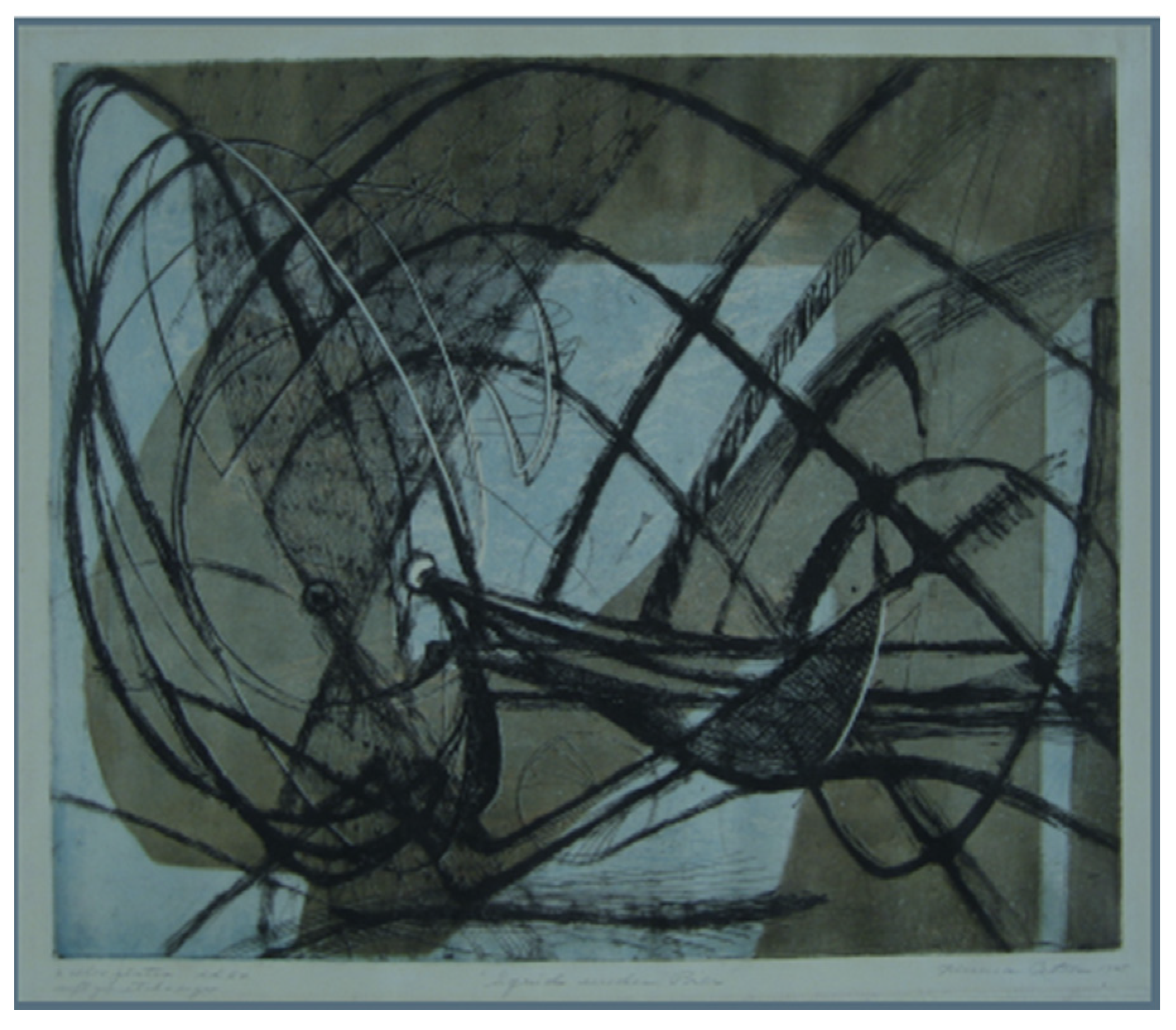
Figure 14.
Jackson Pollock, Male and Female, c. 1942. Oil on canvas, 186.1 × 124.3 cm. Philadelphia Museum of Art. Gift of Mr. and Mrs. H. Gates Lloyd, 1974. Photo Credit: The Philadelphia Museum of Art/Art Resource, NY. © 2026 The Pollock-Krasner Foundation/Artists Rights Society (ARS), New York. The artworks and reproductions thereof are expressly excluded from any open-access or open license grant of rights. All rights are expressly reserved by ARS on behalf of the Artist, Estate or Foundation.
Figure 14.
Jackson Pollock, Male and Female, c. 1942. Oil on canvas, 186.1 × 124.3 cm. Philadelphia Museum of Art. Gift of Mr. and Mrs. H. Gates Lloyd, 1974. Photo Credit: The Philadelphia Museum of Art/Art Resource, NY. © 2026 The Pollock-Krasner Foundation/Artists Rights Society (ARS), New York. The artworks and reproductions thereof are expressly excluded from any open-access or open license grant of rights. All rights are expressly reserved by ARS on behalf of the Artist, Estate or Foundation.
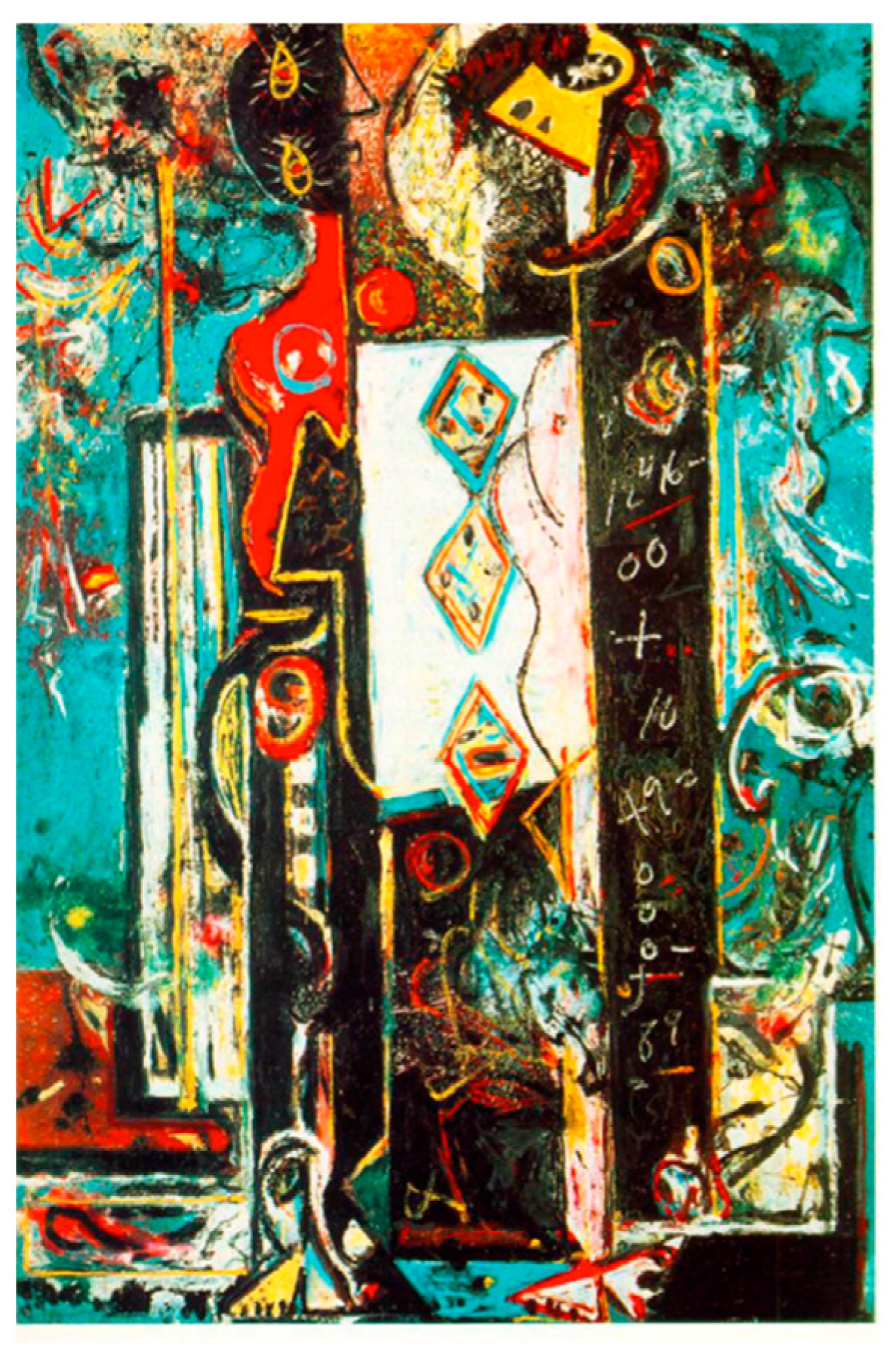
Figure 15.
Jackson Pollock, Male and Female in Search of a Symbol, 1943. Oil on canvas, 109.2 × 170.1 cm. Marlborough Gallery, Rome. © 2026 The Pollock-Krasner Foundation/Artists Rights Society (ARS), New York. The artworks and reproductions thereof are expressly excluded from any open-access or open license grant of rights. All rights are expressly reserved by ARS on behalf of the Artist, Estate or Foundation.
Figure 15.
Jackson Pollock, Male and Female in Search of a Symbol, 1943. Oil on canvas, 109.2 × 170.1 cm. Marlborough Gallery, Rome. © 2026 The Pollock-Krasner Foundation/Artists Rights Society (ARS), New York. The artworks and reproductions thereof are expressly excluded from any open-access or open license grant of rights. All rights are expressly reserved by ARS on behalf of the Artist, Estate or Foundation.
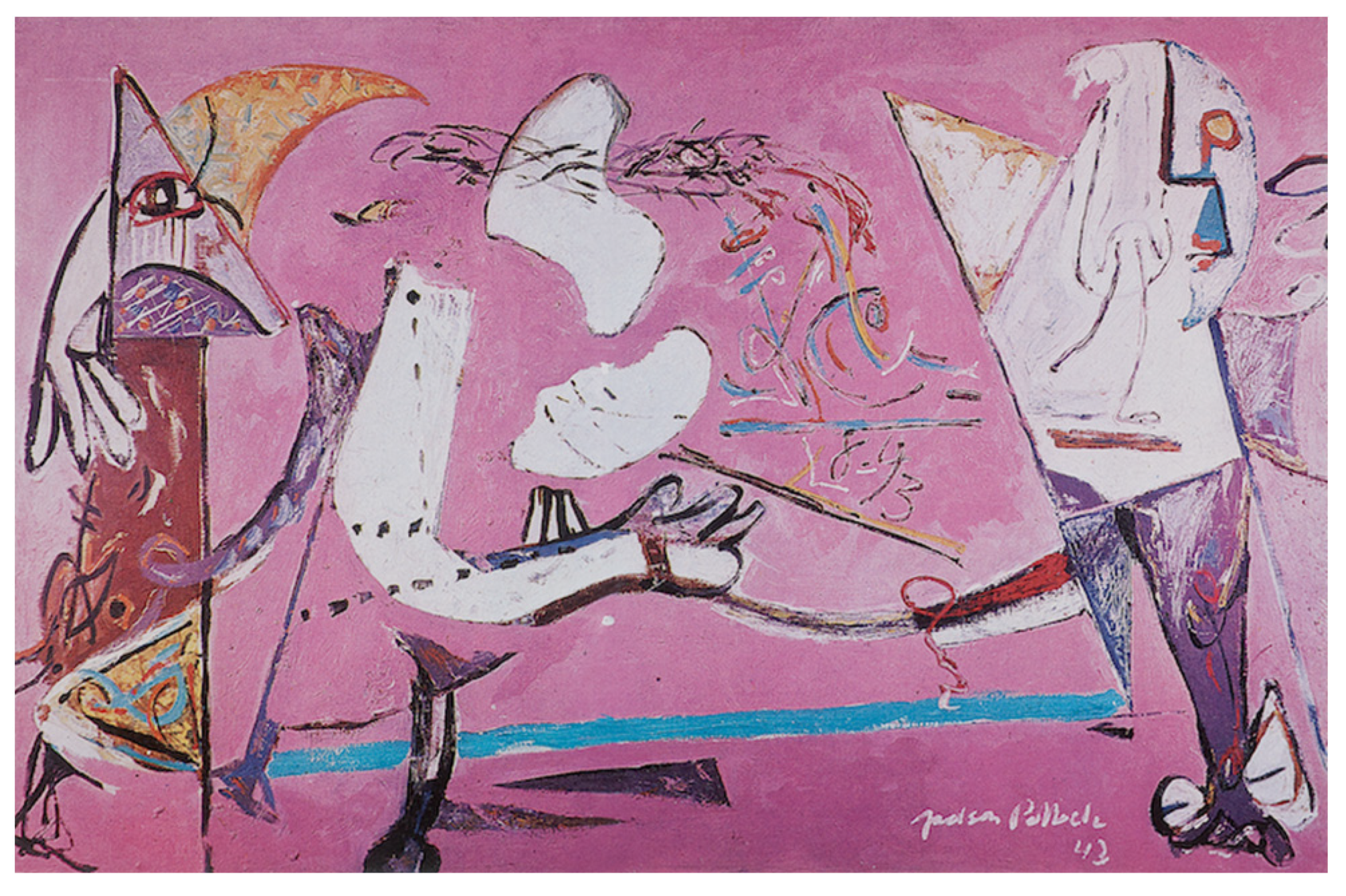
Figure 16.
Jackson Pollock, Untitled, CR1085 (P21), c. 1944–45 (printed posthumously 1967). Engraving and drypoint, printed in black, 30.4 × 22.5 cm. Museum of Modern Art. Gift of Lee Krasner Pollock. Photo Credit: Jackson Pollock Catalogue Raisonné Archives, Pollock-Krasner Study Center. © 2026 The Pollock-Krasner Foundation/Artists Rights Society (ARS), New York. The artworks and reproductions thereof are expressly excluded from any open-access or open license grant of rights. All rights are expressly reserved by ARS on behalf of the Artist, Estate or Foundation.
Figure 16.
Jackson Pollock, Untitled, CR1085 (P21), c. 1944–45 (printed posthumously 1967). Engraving and drypoint, printed in black, 30.4 × 22.5 cm. Museum of Modern Art. Gift of Lee Krasner Pollock. Photo Credit: Jackson Pollock Catalogue Raisonné Archives, Pollock-Krasner Study Center. © 2026 The Pollock-Krasner Foundation/Artists Rights Society (ARS), New York. The artworks and reproductions thereof are expressly excluded from any open-access or open license grant of rights. All rights are expressly reserved by ARS on behalf of the Artist, Estate or Foundation.
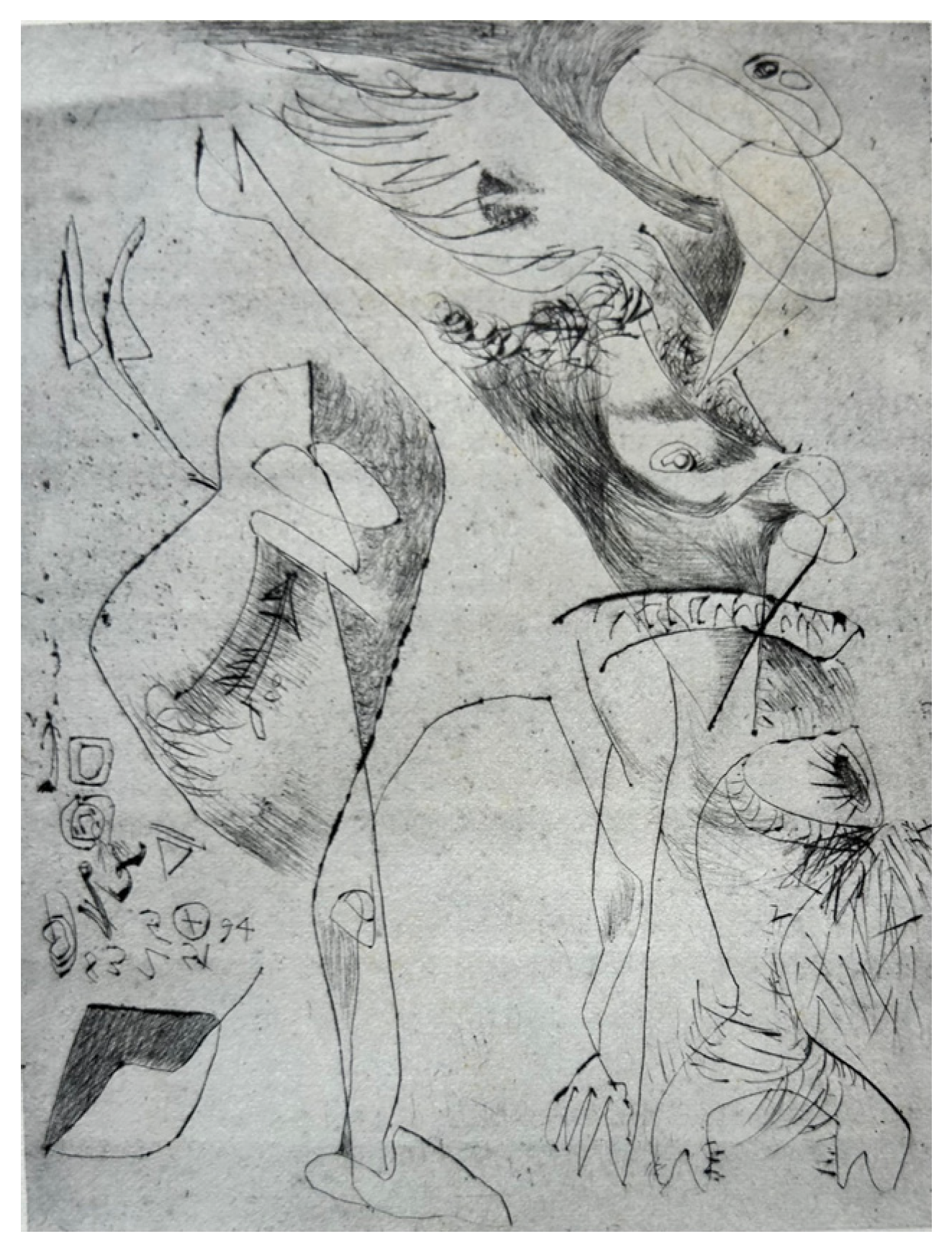
Figure 17.
Jackson Pollock, Untitled, CR1083 (P20), c. 1944–45 (first state, printed by Pollock and S.W. Hayter at Atelier 17). Engraving and drypoint, printed in black, 30 × 22.8 cm. Museum of Modern Art. Gift of Lee Krasner Pollock. Photo Credit: Jackson Pollock Catalogue Raisonné Archives, Pollock-Krasner Study Center. © 2026 The Pollock-Krasner Foundation/Artists Rights Society (ARS), New York. The artworks and reproductions thereof are expressly excluded from any open-access or open license grant of rights. All rights are expressly reserved by ARS on behalf of the Artist, Estate or Foundation.
Figure 17.
Jackson Pollock, Untitled, CR1083 (P20), c. 1944–45 (first state, printed by Pollock and S.W. Hayter at Atelier 17). Engraving and drypoint, printed in black, 30 × 22.8 cm. Museum of Modern Art. Gift of Lee Krasner Pollock. Photo Credit: Jackson Pollock Catalogue Raisonné Archives, Pollock-Krasner Study Center. © 2026 The Pollock-Krasner Foundation/Artists Rights Society (ARS), New York. The artworks and reproductions thereof are expressly excluded from any open-access or open license grant of rights. All rights are expressly reserved by ARS on behalf of the Artist, Estate or Foundation.
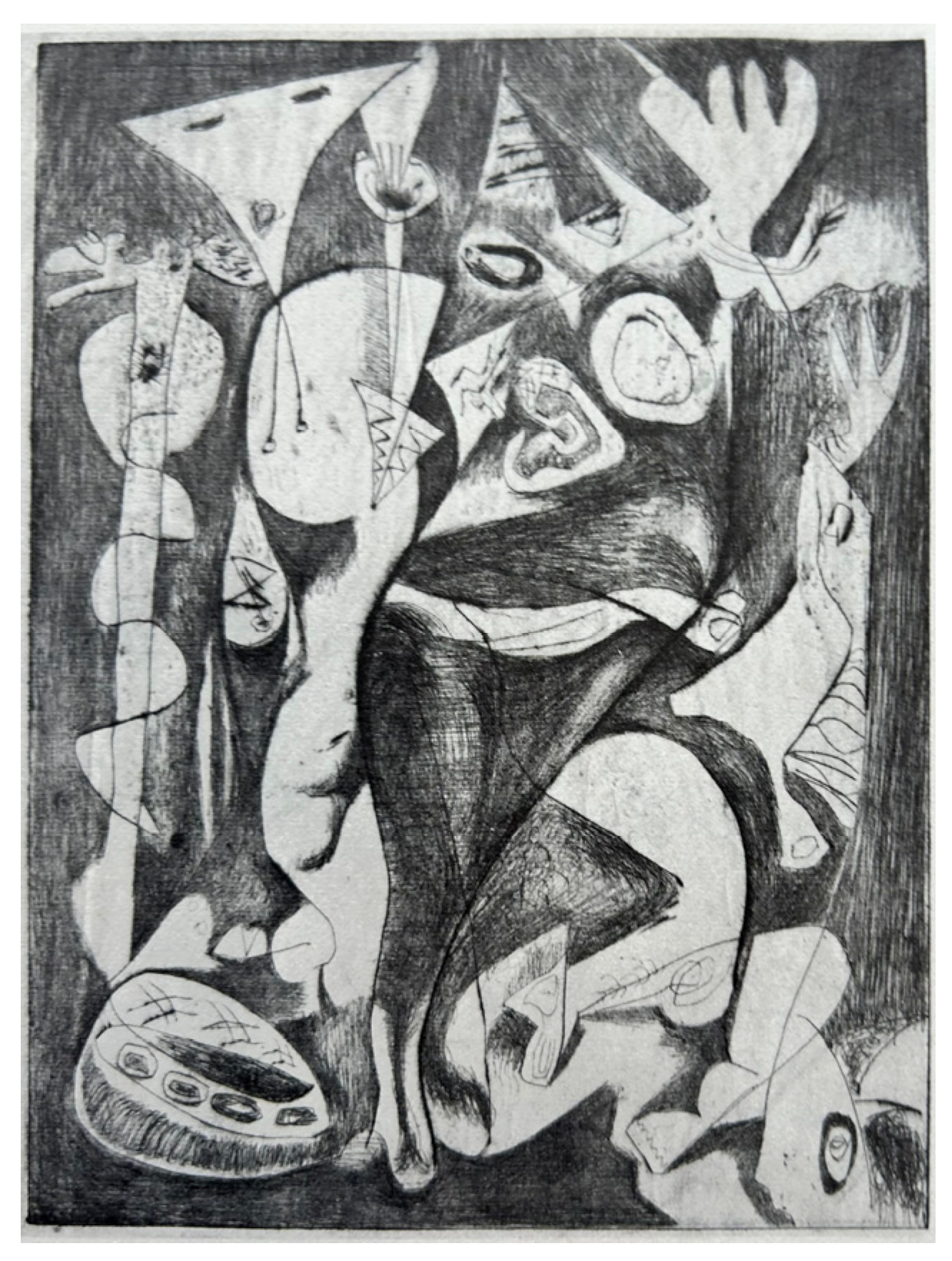
Figure 18.
Jackson Pollock, Untitled, CR1086 (P22), c. 1944–45 (only state, trial proof from lost plate printed by Pollock and S.W. Hayter at Atelier 17). Engraving and drypoint, printed in black, 20 × 12.2 cm. Museum of Modern Art. Gift of Lee Krasner Pollock. Photo Credit: Jackson Pollock Catalogue Raisonné Archives, Pollock-Krasner Study Center. © 2026 The Pollock-Krasner Foundation/Artists Rights Society (ARS), New York. The artworks and reproductions thereof are expressly excluded from any open-access or open license grant of rights. All rights are expressly reserved by ARS on behalf of the Artist, Estate or Foundation.
Figure 18.
Jackson Pollock, Untitled, CR1086 (P22), c. 1944–45 (only state, trial proof from lost plate printed by Pollock and S.W. Hayter at Atelier 17). Engraving and drypoint, printed in black, 20 × 12.2 cm. Museum of Modern Art. Gift of Lee Krasner Pollock. Photo Credit: Jackson Pollock Catalogue Raisonné Archives, Pollock-Krasner Study Center. © 2026 The Pollock-Krasner Foundation/Artists Rights Society (ARS), New York. The artworks and reproductions thereof are expressly excluded from any open-access or open license grant of rights. All rights are expressly reserved by ARS on behalf of the Artist, Estate or Foundation.
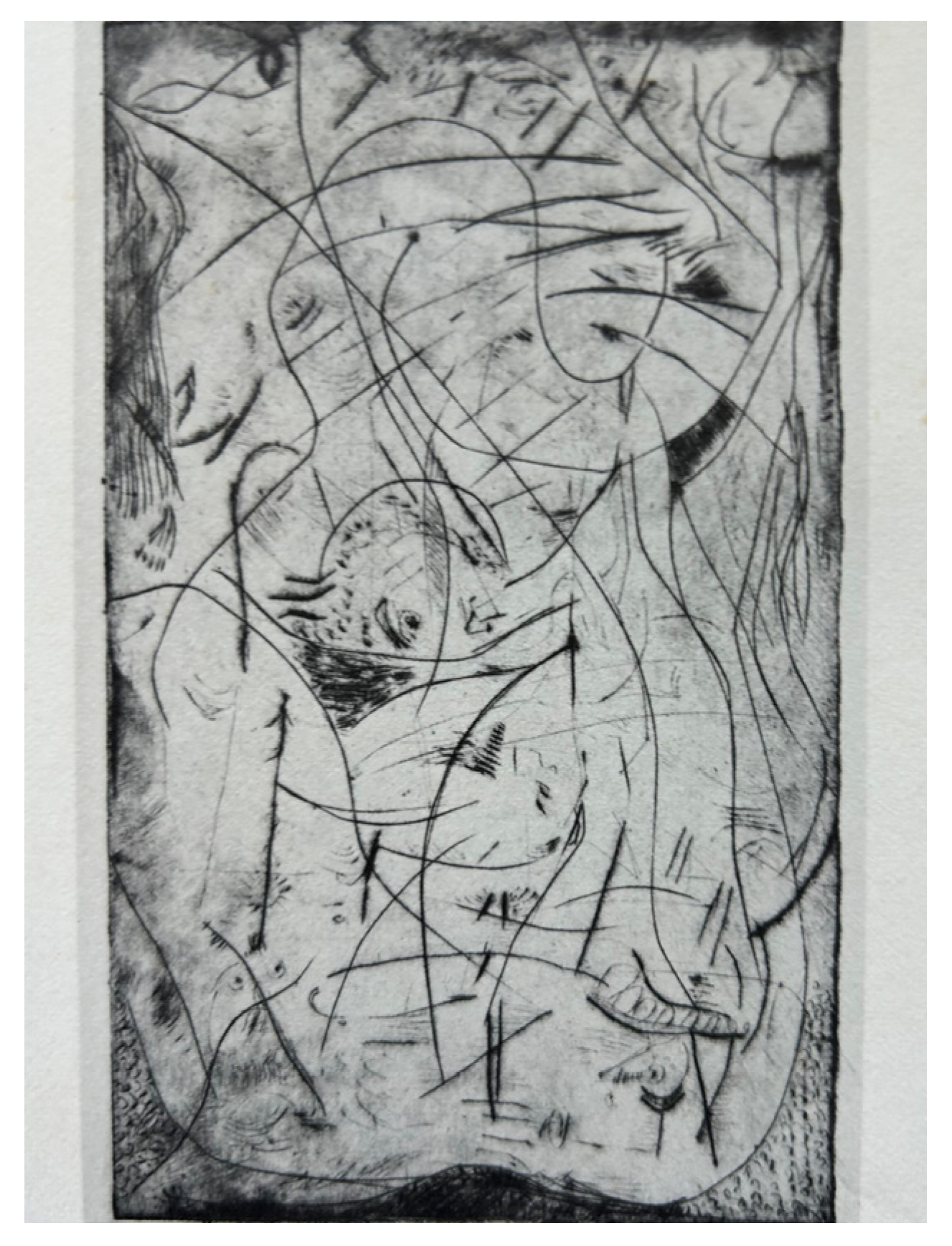
Figure 19.
Jackson Pollock, The Child Proceeds (sometimes known as Development of the Foetus), 1946. Oil on canvas, 3 × 22 in. Location unknown. © 2026 The Pollock-Krasner Foundation/Artists Rights Society (ARS), New York. The artworks and reproductions thereof are expressly excluded from any open-access or open license grant of rights. All rights are expressly reserved by ARS on behalf of the Artist, Estate or Foundation.
Figure 19.
Jackson Pollock, The Child Proceeds (sometimes known as Development of the Foetus), 1946. Oil on canvas, 3 × 22 in. Location unknown. © 2026 The Pollock-Krasner Foundation/Artists Rights Society (ARS), New York. The artworks and reproductions thereof are expressly excluded from any open-access or open license grant of rights. All rights are expressly reserved by ARS on behalf of the Artist, Estate or Foundation.
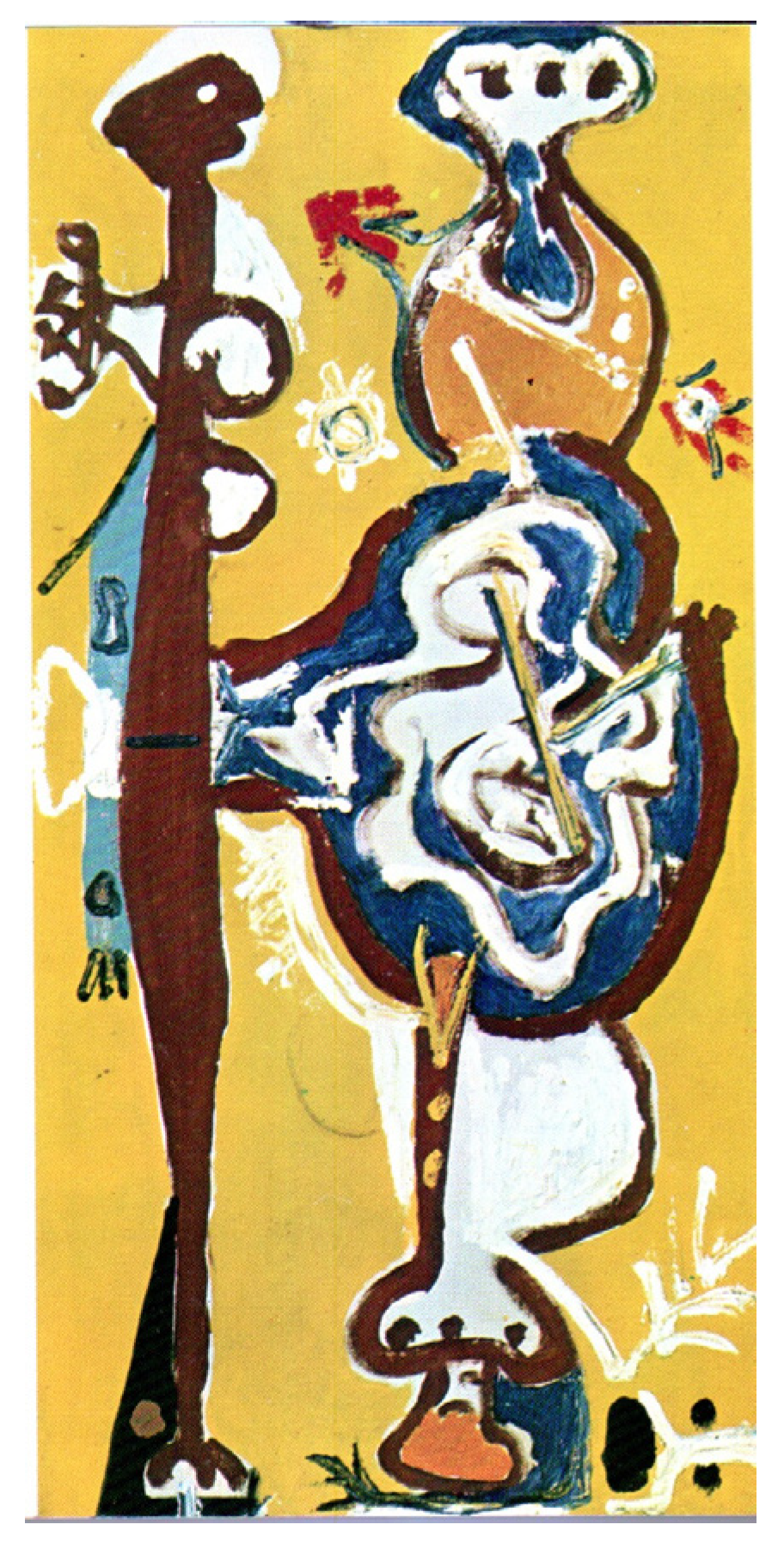
Figure 20.
Jackson Pollock, Shimmering Substance, c. 1946. Oil on canvas, 30 1/8 × 24 1/4 in. The Museum of Modern Art, New York. Mr. and Mrs. Albert Lewin and Mrs. Sam A. Lewisohn Funds. © 2026 The Pollock-Krasner Foundation/Artists Rights Society (ARS), New York. The artworks and reproductions thereof are expressly excluded from any open-access or open license grant of rights. All rights are expressly reserved by ARS on behalf of the Artist, Estate or Foundation.
Figure 20.
Jackson Pollock, Shimmering Substance, c. 1946. Oil on canvas, 30 1/8 × 24 1/4 in. The Museum of Modern Art, New York. Mr. and Mrs. Albert Lewin and Mrs. Sam A. Lewisohn Funds. © 2026 The Pollock-Krasner Foundation/Artists Rights Society (ARS), New York. The artworks and reproductions thereof are expressly excluded from any open-access or open license grant of rights. All rights are expressly reserved by ARS on behalf of the Artist, Estate or Foundation.
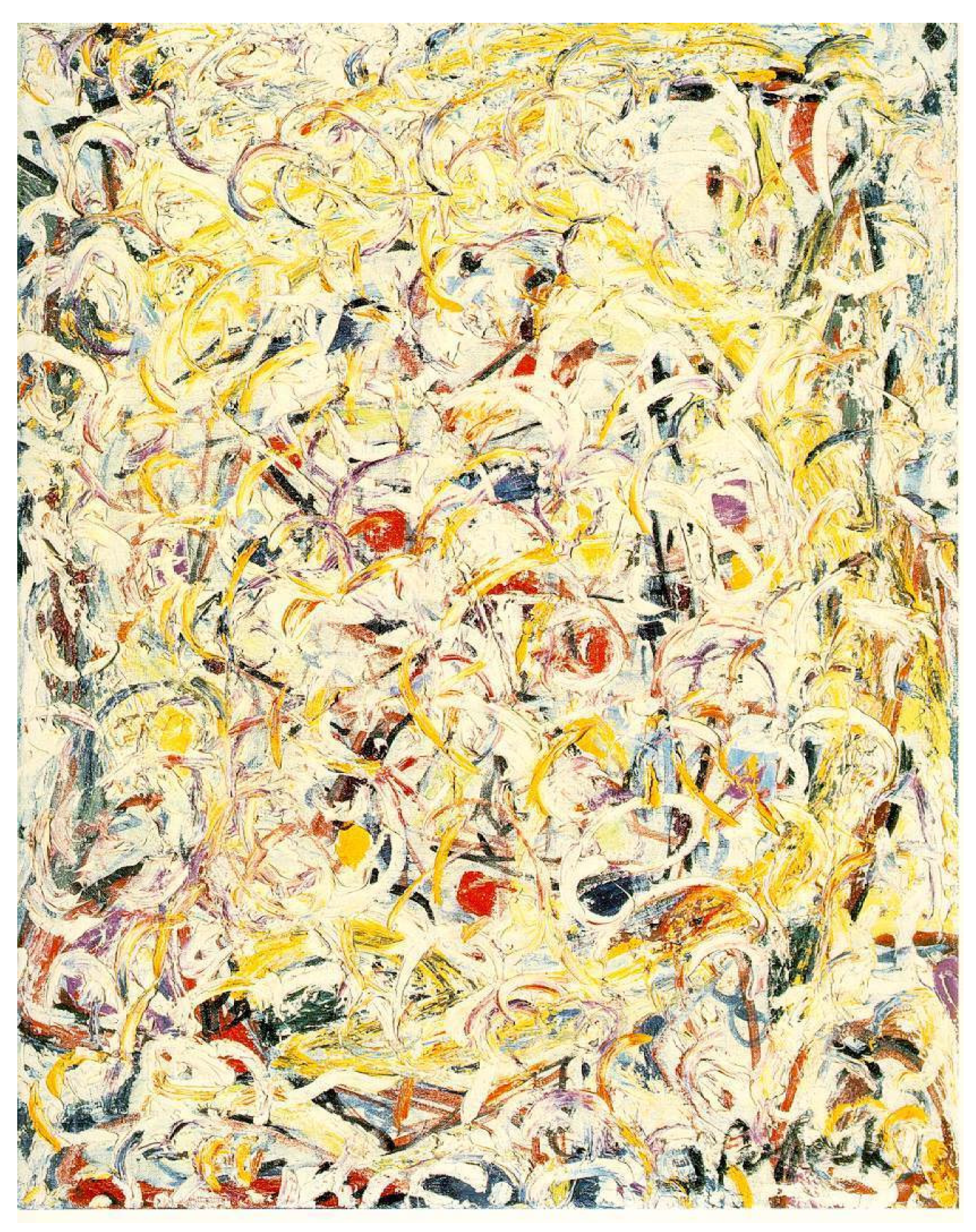
Figure 21.
Jackson Pollock, Composition with Pouring II, 1943. Oil and enamel paint on canvas, 25 × 22 1/8 in. Hirshhorn Museum and Sculpture Garden, Smithsonian Institution. Gift of Joseph H. Hirshhorn, 1966. © 2026 The Pollock-Krasner Foundation/Artists Rights Society (ARS), New York. The artworks and reproductions thereof are expressly excluded from any open-access or open license grant of rights. All rights are expressly reserved by ARS on behalf of the Artist, Estate or Foundation.
Figure 21.
Jackson Pollock, Composition with Pouring II, 1943. Oil and enamel paint on canvas, 25 × 22 1/8 in. Hirshhorn Museum and Sculpture Garden, Smithsonian Institution. Gift of Joseph H. Hirshhorn, 1966. © 2026 The Pollock-Krasner Foundation/Artists Rights Society (ARS), New York. The artworks and reproductions thereof are expressly excluded from any open-access or open license grant of rights. All rights are expressly reserved by ARS on behalf of the Artist, Estate or Foundation.
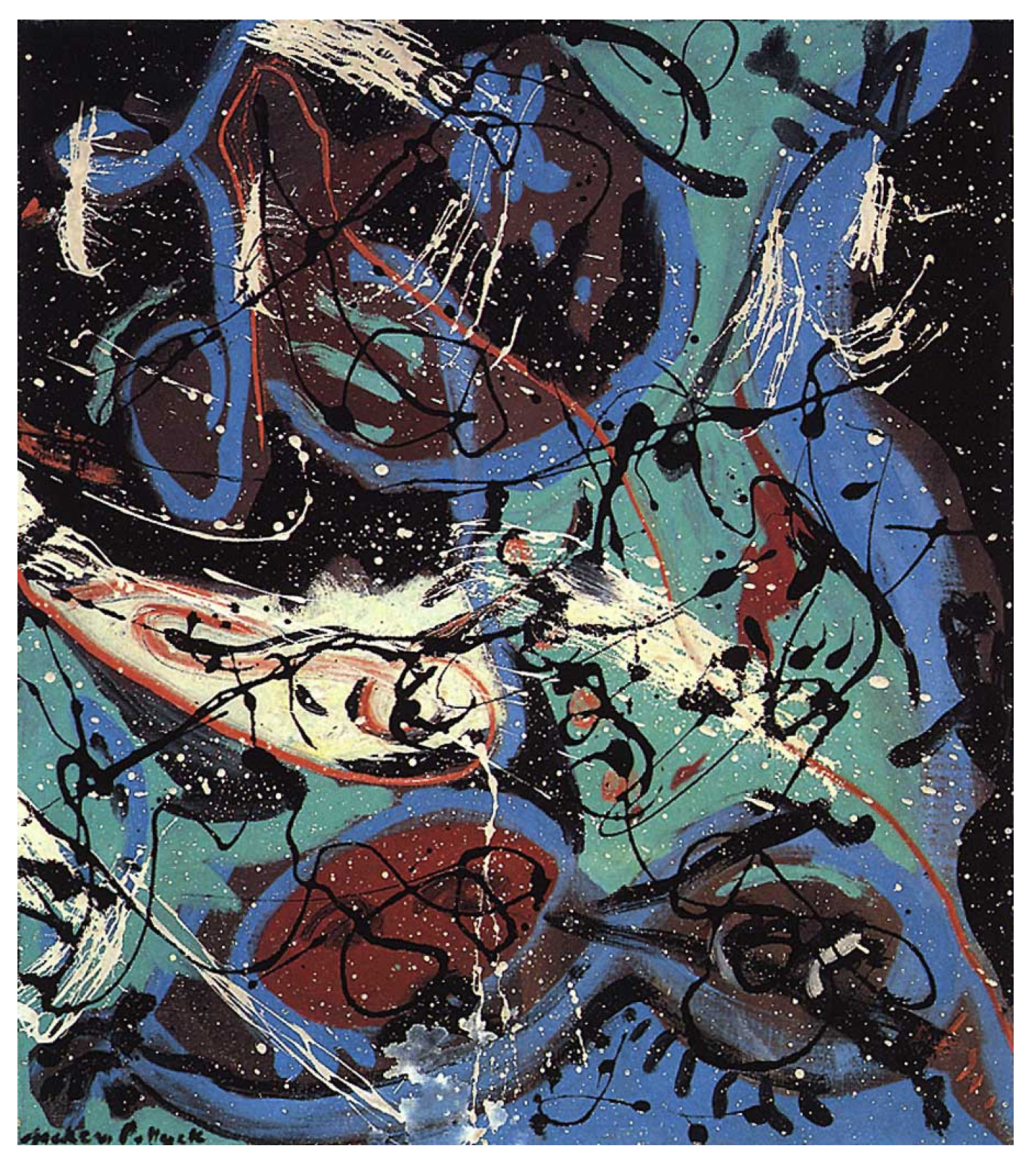
Figure 22.
Jackson Pollock, Full Fathom Five, 1947. Oil on canvas with nails, tacks, buttons, keys, combs, cigarettes, matches etc., 50 7/8 × 30 1/8 in. The Museum of Modern Art, New York. Gift of Peggy Guggenheim, 1952. © 2026 The Pollock-Krasner Foundation/Artists Rights Society (ARS), New York. The artworks and reproductions thereof are expressly excluded from any open-access or open license grant of rights. All rights are expressly reserved by ARS on behalf of the Artist, Estate or Foundation.
Figure 22.
Jackson Pollock, Full Fathom Five, 1947. Oil on canvas with nails, tacks, buttons, keys, combs, cigarettes, matches etc., 50 7/8 × 30 1/8 in. The Museum of Modern Art, New York. Gift of Peggy Guggenheim, 1952. © 2026 The Pollock-Krasner Foundation/Artists Rights Society (ARS), New York. The artworks and reproductions thereof are expressly excluded from any open-access or open license grant of rights. All rights are expressly reserved by ARS on behalf of the Artist, Estate or Foundation.
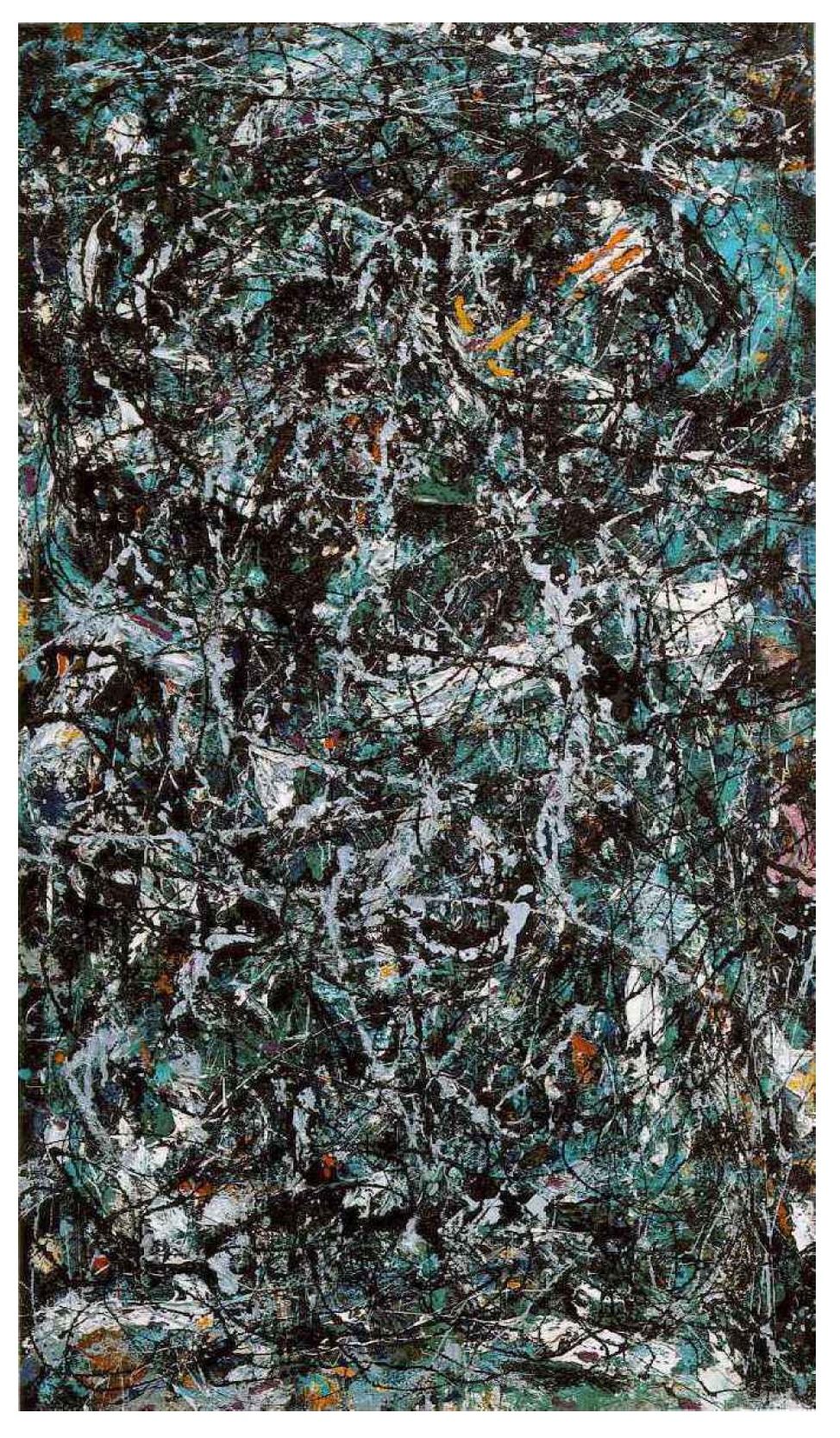
Figure 23.
Jackson Pollock, Number 14, 1948 (Gray), 1948. Enamel on gesso on paper, 22 7/16 × 30 7/8 in. Yale University Art Gallery, New Haven, Connecticut. © 2026 The Pollock-Krasner Foundation/Artists Rights Society (ARS), New York. The artworks and reproductions thereof are expressly excluded from any open-access or open license grant of rights. All rights are expressly reserved by ARS on behalf of the Artist, Estate or Foundation.
Figure 23.
Jackson Pollock, Number 14, 1948 (Gray), 1948. Enamel on gesso on paper, 22 7/16 × 30 7/8 in. Yale University Art Gallery, New Haven, Connecticut. © 2026 The Pollock-Krasner Foundation/Artists Rights Society (ARS), New York. The artworks and reproductions thereof are expressly excluded from any open-access or open license grant of rights. All rights are expressly reserved by ARS on behalf of the Artist, Estate or Foundation.
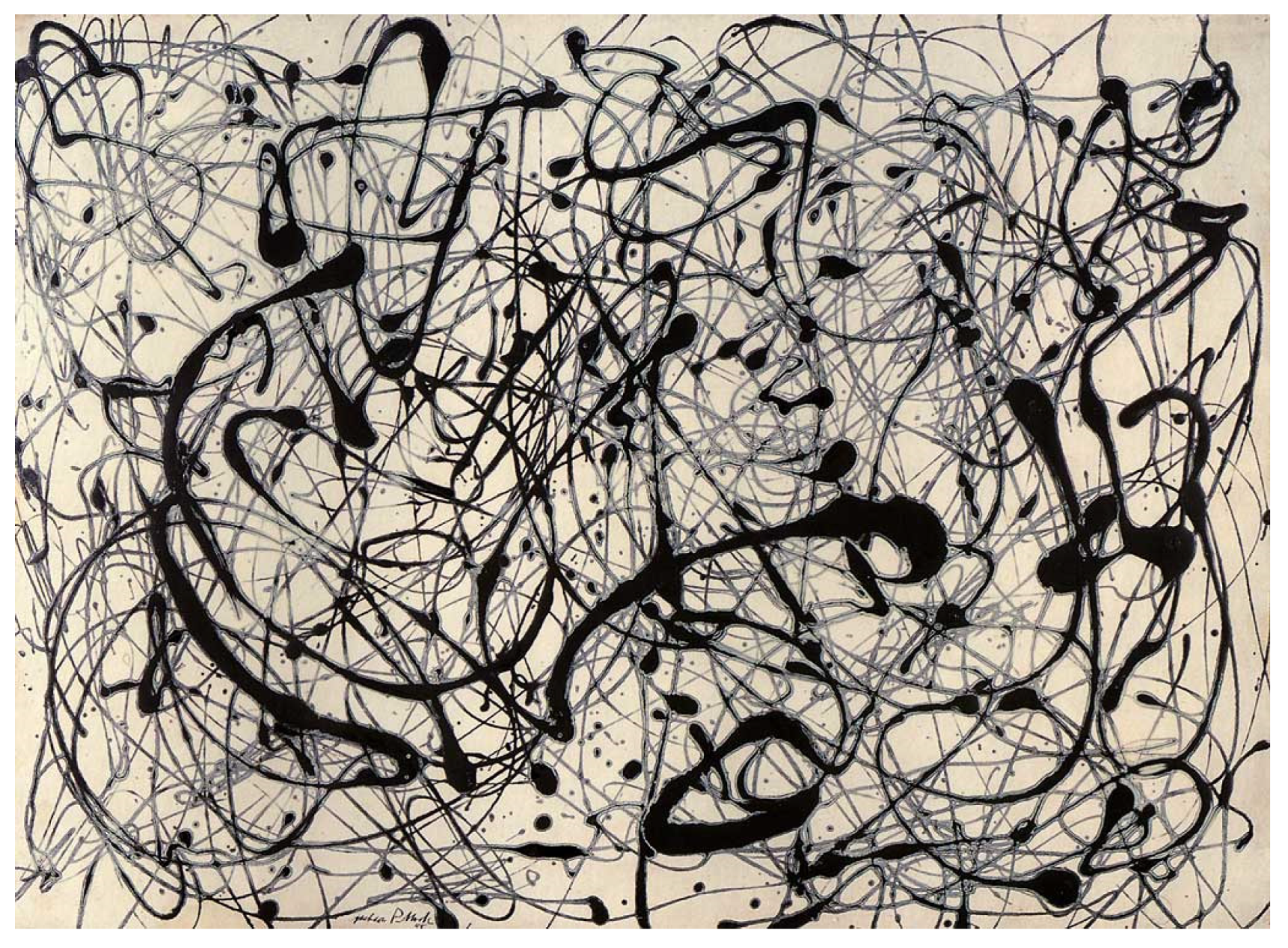
Figure 24.
Autumn Rhythm in an intermediate state, after the completion of the configuration at the left end. Still photograph composite. Illustration in Karmel 1998, p. 121, Figure 89. © 2026 The Pollock-Krasner Foundation/Artists Rights Society (ARS), New York. The artworks and reproductions thereof are expressly excluded from any open-access or open license grant of rights. All rights are expressly reserved by ARS on behalf of the Artist, Estate or Foundation.
Figure 24.
Autumn Rhythm in an intermediate state, after the completion of the configuration at the left end. Still photograph composite. Illustration in Karmel 1998, p. 121, Figure 89. © 2026 The Pollock-Krasner Foundation/Artists Rights Society (ARS), New York. The artworks and reproductions thereof are expressly excluded from any open-access or open license grant of rights. All rights are expressly reserved by ARS on behalf of the Artist, Estate or Foundation.
Disclaimer/Publisher’s Note: The statements, opinions and data contained in all publications are solely those of the individual author(s) and contributor(s) and not of MDPI and/or the editor(s). MDPI and/or the editor(s) disclaim responsibility for any injury to people or property resulting from any ideas, methods, instructions or products referred to in the content. |
© 2026 by the author. Licensee MDPI, Basel, Switzerland. This article is an open access article distributed under the terms and conditions of the Creative Commons Attribution (CC BY) license.
Share and Cite
MDPI and ACS Style
Langhorne, E.L. ‘ART’: What Pollock Learned from Hayter. Arts 2026, 15, 12. https://doi.org/10.3390/arts15010012
AMA Style
Langhorne EL. ‘ART’: What Pollock Learned from Hayter. Arts. 2026; 15(1):12. https://doi.org/10.3390/arts15010012
Chicago/Turabian StyleLanghorne, Elizabeth L. 2026. "‘ART’: What Pollock Learned from Hayter" Arts 15, no. 1: 12. https://doi.org/10.3390/arts15010012
APA StyleLanghorne, E. L. (2026). ‘ART’: What Pollock Learned from Hayter. Arts, 15(1), 12. https://doi.org/10.3390/arts15010012
Note that from the first issue of 2016, this journal uses article numbers instead of page numbers. See further details here.