

Application of Computer Vision and Parametric Design Algorithms for the Reuse of Construction Materials

 , , , , ,
Abstract
1. Introduction
1.1. Context, Research Gap and Objectives
1.2. State of the Art
2. Materials and Methods
2.1. Material Selection and Preparation
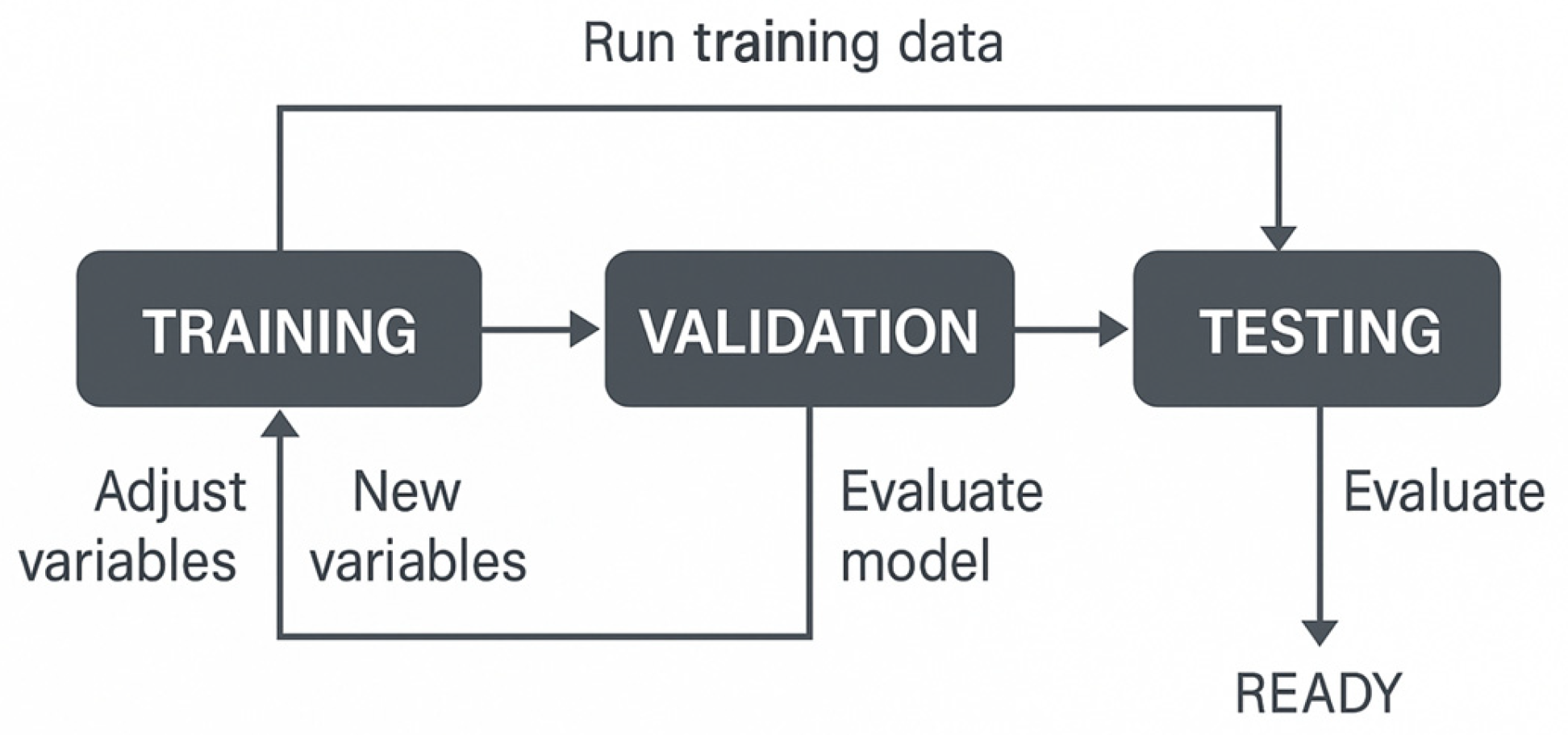
2.2. Image Processing and Artificial Intelligence Training
2.3. Parametric and Generative Design Workflow
- Design area perimeter (cm2).
- Selected granulometric range.
- Packing density coefficients (0.65, 0.75, 0.85).
- Chromatic clustering derived from RGB values.
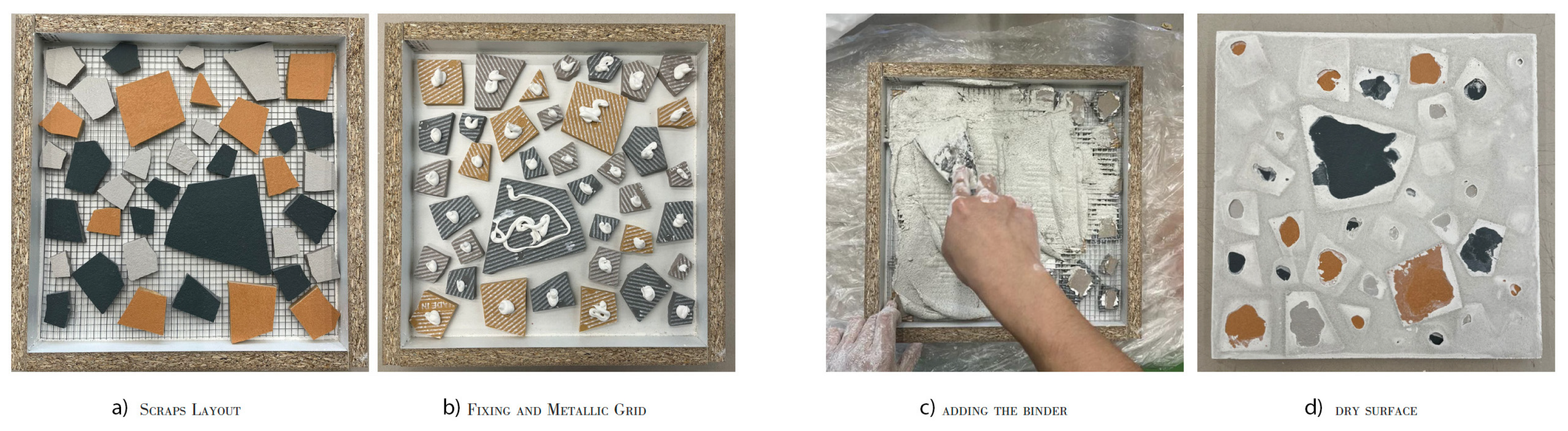
2.4. Prototyping Workflow and Validation Protocol
- Assembly time (minutes per m2).
- Interstitial void percentage.
- Effective surface coverage.
- Dimensional consistency.
- Material waste rate.
2.5. Environmental Assessment Framework
- Collection and transport of CDW materials.
- Mechanical crushing and sieving.
- Pattern design and digital fabrication.
- Assembly and resin binding.
3. Results
3.1. AI-Based Material Classification
3.2. Algorithmic Pattern Generation
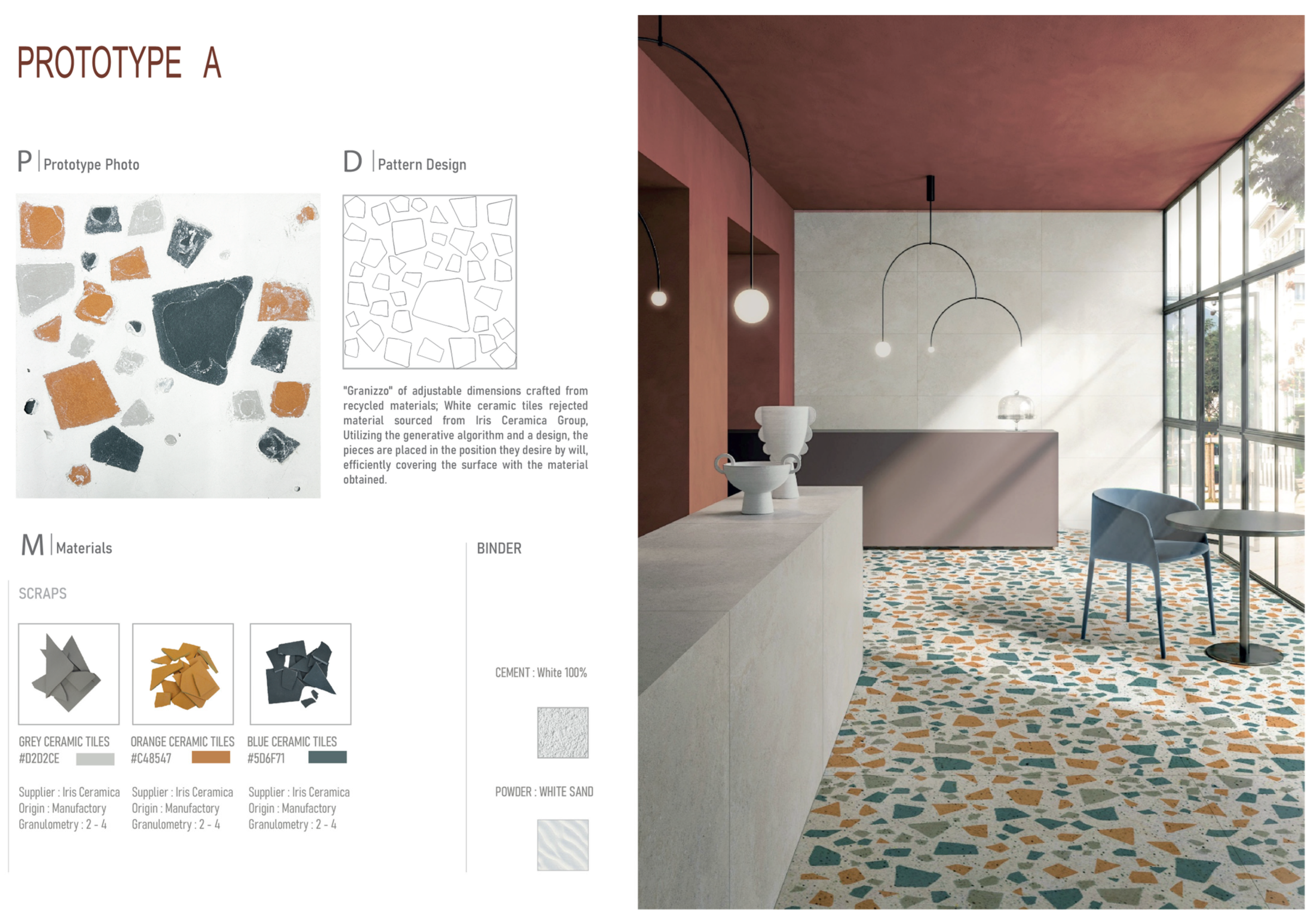
3.3. Experimental Prototyping and Validation
3.4. Environmental Performance Assessment
3.5. Summary of Findings
- The AI model achieved > 90% reliability, demonstrating suitability for heterogeneous material recognition.
- The generative design stage delivered patterns with 92% surface coverage and significant material savings.
- CNC-based prototyping validated production repeatability with 35% lower assembly times.
- The preliminary LCA highlighted 22% CO2 reduction and 18% energy savings compared to conventional methods.
4. Discussion
4.1. Integration of AI into Circular Material Systems
4.2. Parametric Design as an Optimization Interface
4.3. Hybrid Craft and Human–Machine Collaboration
4.4. Environmental and Methodological Implications
4.5. Limitations and Future Directions
5. Conclusions
Author Contributions
Funding
Data Availability Statement
Acknowledgments
Conflicts of Interest
References
- Langley, A.; Lonergan, M.; Huang, T.; Azghadi, M.R.; Mostafa, C.; Azghadi, R. Analyzing Mixed Construction and Demolition Waste in Material Recovery Facilities: Evolution, Challenges, and Applications of Computer Vision and Deep Learning. Resour. Conserv. Recycl. 2025, 217, 108218. [Google Scholar] [CrossRef]
- Liu, X.; Farshadfar, Z.; Khajavi, S.H. Computer Vision-Enabled Construction Waste Sorting: A Sensitivity Analysis. Appl. Sci. 2025, 15, 10550. [Google Scholar] [CrossRef]
- Stabile, P.; Radica, F.; Ranza, L.; Carroll, M.R.; Santulli, C.; Paris, E. Dimensional, Mechanical and LCA Characterization of Terrazzo Tiles along with Glass and Construction and Demolition Waste (CDW). Recent. Prog. Mater. 2021, 3, 006. [Google Scholar] [CrossRef]
- Mesa, J.A.; Fúquene, C.E.; Maury-Ramírez, A. Life Cycle Assessment on Construction and Demolition Waste: A Systematic Literature Review. Sustainability 2021, 13, 7676. [Google Scholar] [CrossRef]
- Akinade, O.O.; Oyedele, L.O.; Ajayi, S.O.; Bilal, M.; Alaka, H.A.; Owolabi, H.A.; Arawomo, O.O. Designing out Construction Waste Using BIM Technology: Stakeholders. Expect. Ind. Deploy. J. Clean. Prod. 2018, 180, 375–385. [Google Scholar] [CrossRef]
- Osmani, M. Design Waste Mapping: A Project Life Cycle Approach. Waste Resour. Manag. 2013, 166, 114–127. [Google Scholar] [CrossRef]
- Superti, V.; Houmani, C.; Hansmann, R.; Baur, I.; Binder, C.R. Strategies for a Circular Economy in the Con-Struction and Demolition Sector: Identifying the Factors Affecting the Recommendation of Recycled Concrete. Sustainability 2021, 13, 4113. [Google Scholar] [CrossRef]
- Chen, K.; Wang, J.; Yu, B.; Wu, H.; Zhang, J. Critical Evaluation of Construction and Demolition Waste and Associated Environmental Impacts: A Scientometric Analysis. J. Clean. Prod. 2021, 287, 125071. [Google Scholar] [CrossRef]
- Poon, C.S.; Yu, A.T.W.; Jaillon, L. Reducing Building Waste at Construction Sites in Hong Kong. Constr. Manag. Econ. 2004, 22, 461–470. [Google Scholar] [CrossRef]
- Kabirifar, K.; Mojtahedi, M.; Wang, C.; Tam, V.W.Y. Construction and Demolition Waste Management Contributing Factors Coupled with Reduce, Reuse, and Recycle Strategies for Effective Waste Management: A Review. J. Clean. Prod. 2020, 263, 121265. [Google Scholar] [CrossRef]
- Antunes, A.; Silvestre, J.; Costa, H.; do Carmo, R.; Júlio, E. Reducing the Environmental Impact of the End-of-Life of Buildings Depending on Interrelated Demolition Strategies, Transport Distances and Disposal Scenarios. J. Build. Eng. 2024, 82, 108197. [Google Scholar] [CrossRef]
- Lee, J.C.; Thedy, W.H.; Chong, Z.; Ng, J.L.; Moon, W.C. A Study on Recycling Waste Materials in Construction Industry. J. Adv. Res. Appl. Sci. Eng. Technol. 2024, 3, 190–204. [Google Scholar] [CrossRef]
- Putra, R.; Pahlevi, R.; Bunyamin, B. Challenges and Solutions for Using Waste Materials in Various Construction Applications. J. Build. Eng. 2025, 1, 108197. [Google Scholar] [CrossRef]
- Zhang, L.; Wang, W.; Wang, C.; Li, M.; Wang, Z.; Su, Z.; Fu, B. Interaction of ACP and MDP and Its Effect on Dentin Bonding Performance. J. Mech. Behav. Biomed. Mater. 2019, 91, 301–308. [Google Scholar] [CrossRef] [PubMed]
- Heo, S.; Han, S.; Shin, Y.; Na, S. Challenges of Data Refining Process during the Artificial Intelligence De-Velopment Projects in the Architecture, Engineering and Construction Industry. Appl. Sci. 2021, 11, 10919. [Google Scholar] [CrossRef]
- Baduge, S.K.; Thilakarathna, S.; Perera, J.S.; Arashpour, M.; Sharafi, P.; Teodosio, B.; Shringi, A.; Mendis, P. Artificial Intelligence and Smart Vision for Building and Construction 4.0: Machine and Deep Learning Methods and Applications. Autom. Constr. 2022, 141, 104440. [Google Scholar] [CrossRef]
- Lopes, C.d.M.N.; Cury, A.A.; Mendes, J.C. Construction and Demolition Waste Management and Artificial Intelligence—A Systematic Review. Rev. Gestão Soc. E Ambient. 2024, 18, e08810. [Google Scholar] [CrossRef]
- Farshadfar, Z.; Khajavi, S.H.; Mucha, T.; Tanskanen, K. Machine Learning-Based Automated Waste Sorting in the Construction Industry: A Comparative Competitiveness Case Study. Waste Manag. 2025, 194, 77–87. [Google Scholar] [CrossRef]
- Dong, Z.; Chen, J.; Lu, W. Computer Vision to Recognize Construction Waste Compositions: A Novel Boundary-Aware Transformer (BAT) Model. J. Environ. Manag. 2022, 305, 114405. [Google Scholar] [CrossRef]
- Lu, W.; Chen, J.; Xue, F. Using Computer Vision to Recognize Composition of Construction Waste Mixtures: A Semantic Segmentation Approach. Resour. Conserv. Recycl. 2022, 178, 106022. [Google Scholar] [CrossRef]
- Na, S.; Heo, S.; Han, S.; Shin, Y.; Lee, M. Development of an Artificial Intelligence Model to Recognise. Buildings 2022, 12, 175. [Google Scholar] [CrossRef]
- Toğaçar, M.; Ergen, B.; Cömert, Z. Waste Classification Using AutoEncoder Network with Integrated Feature Selection Method in Convolutional Neural Network Models. Measurement 2020, 153, 107459. [Google Scholar] [CrossRef]
- Pacheco-Torgal, F.; Ding, Y.; Colangelo, F. Advances in Construction and Demolition Waste Recycling: Management, Processing and Environmental Assessment; Woodhead Publishing: Cambridge, UK, 2021. [Google Scholar]
- Masi, S.; Moya, G.A. Integrating AI into the Creative Process Using Construction Waste Material. Master’s Thesis, Politecnico di Milano, Milan, Italy, 2021. [Google Scholar]
- Teijón-López-Zuazo, E.; Vega-Zamanillo, Á.; Calzada-Pérez, M.Á.; Robles-Miguel, Á. Use of Recycled Ag-Gregates Made from Construction and Demolition Waste in Sustainable Road Base Layers. Sustainability 2020, 12, 6663. [Google Scholar] [CrossRef]
- Nguyen, T.D.; Cherif, R.; Mahieux, P.Y.; Lux, J.; Aït-Mokhtar, A.; Bastidas-Arteaga, E. Artificial Intelligence Algorithms for Prediction and Sensitivity Analysis of Mechanical Properties of Recycled Aggregate Concrete. A Review. J. Build. Eng. 2023, 66, 105929. [Google Scholar] [CrossRef]
- Yu, Y.; Zhao, X.; Xu, J.; Chen, C.; Deresa, S.T.; Zhang, J. Machine Learning-Based Evaluation of Shear Capacity of Recycled Aggregate Concrete Beams. Materials 2020, 13, 4552. [Google Scholar] [CrossRef]
- De Alwis, A.M.L.; Bazli, M.; Arashpour, M. Automated Recognition of Contaminated Construction and Demolition Wood Waste Using Deep Learning. Resour. Conserv. Recycl. 2025, 219, 108278. [Google Scholar] [CrossRef]
- Raghu, D.; Bucher, M.J.J.; De Wolf, C. Towards a ‘Resource Cadastre’ for a Circular Economy—Urban-Scale Building Material Detection Using Street View Imagery and Computer Vision. Resour. Conserv. Recycl. 2023, 198, 107140. [Google Scholar] [CrossRef]
- Naboni, R.; Paoletti, I. Advanced Customization in Architectural Design and Construction; Springer: Berlin/Heidelberg, Germany, 2015; pp. 1–174. [Google Scholar]
- Menges, A. Material Computation: Higher Integration in Morphogenetic Design. Archit. Des. 2012, 82, 14–21. [Google Scholar] [CrossRef]
- Gips, J. Shape Grammars and the Generative Specification of Painting and Sculpture; Cambridge, MA, USA, 1971. [Google Scholar]
- Eversmann, P.; Gramazio, F.; Kohler, M. Robotic Prefabrication of Timber Structures: Towards Automated Large-Scale Spatial Assembly. Constr. Robot. 2017, 1, 49–60. [Google Scholar] [CrossRef]
- Kolarevic, B. Architecture in the Digital Age Design and Manufacturing; Spon Press: London, UK, 2003; ISBN 0415278201. [Google Scholar]
- Pomponi, F.; Moncaster, A. Embodied Carbon Mitigation and Reduction in the Built Environment—What Does the Evidence Say? J. Environ. Manag. 2016, 181, 687–700. [Google Scholar] [CrossRef]
- Haupt, M.; Hellweg, S. Measuring the Environmental Sustainability of a Circular Economy. Environ. Sustain. Indic. 2019, 1–2, 100005. [Google Scholar] [CrossRef]



| Metric | Average (%) | Best Class (Glass) | Lowest Class (Brick) |
|---|---|---|---|
| Accuracy | 91.8 | – | – |
| Precision | 92.5 | 95.2 | 88.4 |
| Recall | 90.7 | 94.1 | 86.9 |
| F1-Score (macro) | 91.6 | 94.6 | 87.6 |
| Indicator | Traditional Method | Hybrid Method (AI + Waste) | Improvement (%) |
|---|---|---|---|
| Assembly time (min/m2) | 60 | 39 | −35% |
| Interstitial voids (%) | 12.5 | 10.0 | −20% |
| Effective coverage (%) | 78 | 90 | +15% |
| Material waste (%) | 14 | 8 | −43% |
Disclaimer/Publisher’s Note: The statements, opinions and data contained in all publications are solely those of the individual author(s) and contributor(s) and not of MDPI and/or the editor(s). MDPI and/or the editor(s) disclaim responsibility for any injury to people or property resulting from any ideas, methods, instructions or products referred to in the content. |
© 2025 by the authors. Licensee MDPI, Basel, Switzerland. This article is an open access article distributed under the terms and conditions of the Creative Commons Attribution (CC BY) license.
Share and Cite
Moya-Jiménez, R.; Goyes-Balladares, A.; Moya-Jiménez, G.; Medina-Moncayo, A.; Chávez-Ortiz, B.; Obando-Navas, C.; Arias-Granda, S. Application of Computer Vision and Parametric Design Algorithms for the Reuse of Construction Materials. Buildings 2026, 16, 184. https://doi.org/10.3390/buildings16010184
Moya-Jiménez R, Goyes-Balladares A, Moya-Jiménez G, Medina-Moncayo A, Chávez-Ortiz B, Obando-Navas C, Arias-Granda S. Application of Computer Vision and Parametric Design Algorithms for the Reuse of Construction Materials. Buildings. 2026; 16(1):184. https://doi.org/10.3390/buildings16010184
Chicago/Turabian StyleMoya-Jiménez, Roberto, Andrea Goyes-Balladares, Gen Moya-Jiménez, Andrés Medina-Moncayo, Bolívar Chávez-Ortiz, Carolina Obando-Navas, and Santiago Arias-Granda. 2026. "Application of Computer Vision and Parametric Design Algorithms for the Reuse of Construction Materials" Buildings 16, no. 1: 184. https://doi.org/10.3390/buildings16010184
APA StyleMoya-Jiménez, R., Goyes-Balladares, A., Moya-Jiménez, G., Medina-Moncayo, A., Chávez-Ortiz, B., Obando-Navas, C., & Arias-Granda, S. (2026). Application of Computer Vision and Parametric Design Algorithms for the Reuse of Construction Materials. Buildings, 16(1), 184. https://doi.org/10.3390/buildings16010184