


Development of an FMI-Based Data Model to Support a BIM-Integrated Building Performance Analysis Framework



Abstract
1. Introduction
2. Literature Reviews
2.1. Object-Oriented Physical Modeling and Simulation Data Exchange Standards for Sustainable Design and Building Energy Analysis
2.2. Integrated Building Performance Analysis Using BIM, OOPM, and FMI Standards
2.3. Limitations of Existing Data Exchange Methods
2.3.1. Classification by Input Building Information Type
2.3.2. Dependency on Modelica Libraries in Data Exchange Methods
2.3.3. Incompatibility of Intermediate Data Models Between BIM and Modelica Libraries
2.3.4. Development of a Data Exchange Method Between BIM and Modelica Libraries Using the FMI Standard
3. Framework Development
3.1. Methodology and Tools and Data for the Development of the Framework
3.2. Development of the Process Model
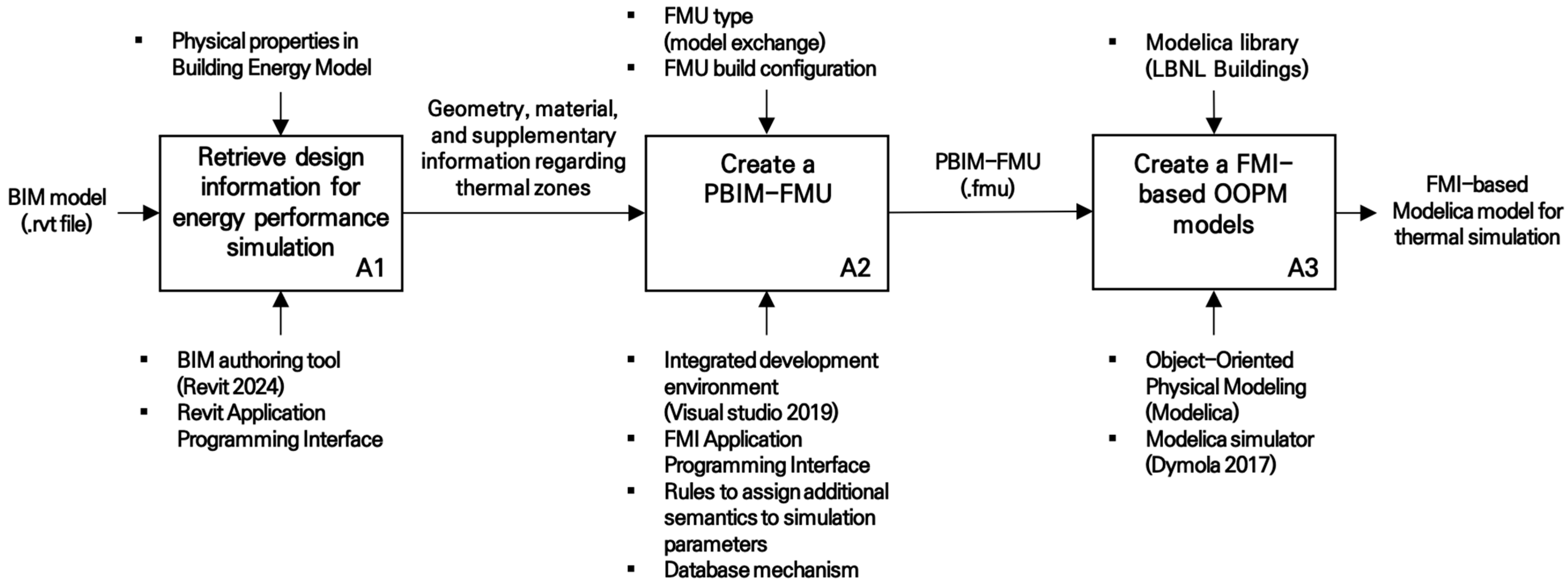
- A1: Extraction of Building Design InformationThis activity extracts the physical design information required for generating a BEM model from the BIM model (Revit). To do so, physical properties not originally defined in the BIM data schema were additionally specified, and functionality was developed to input and access these properties within the BIM model.
- A2: Generation of PBIM-FMUBased on the data obtained in A1, this activity generates a PBIM-FMU. The PBIM-FMU structure is designed to preserve the semantics and data structure of the original BIM model. Its internal variables are defined according to the FMI standard so that they are semantically compatible with the corresponding variables in the Modelica library (in terms of variable type, causality, variability, etc.).
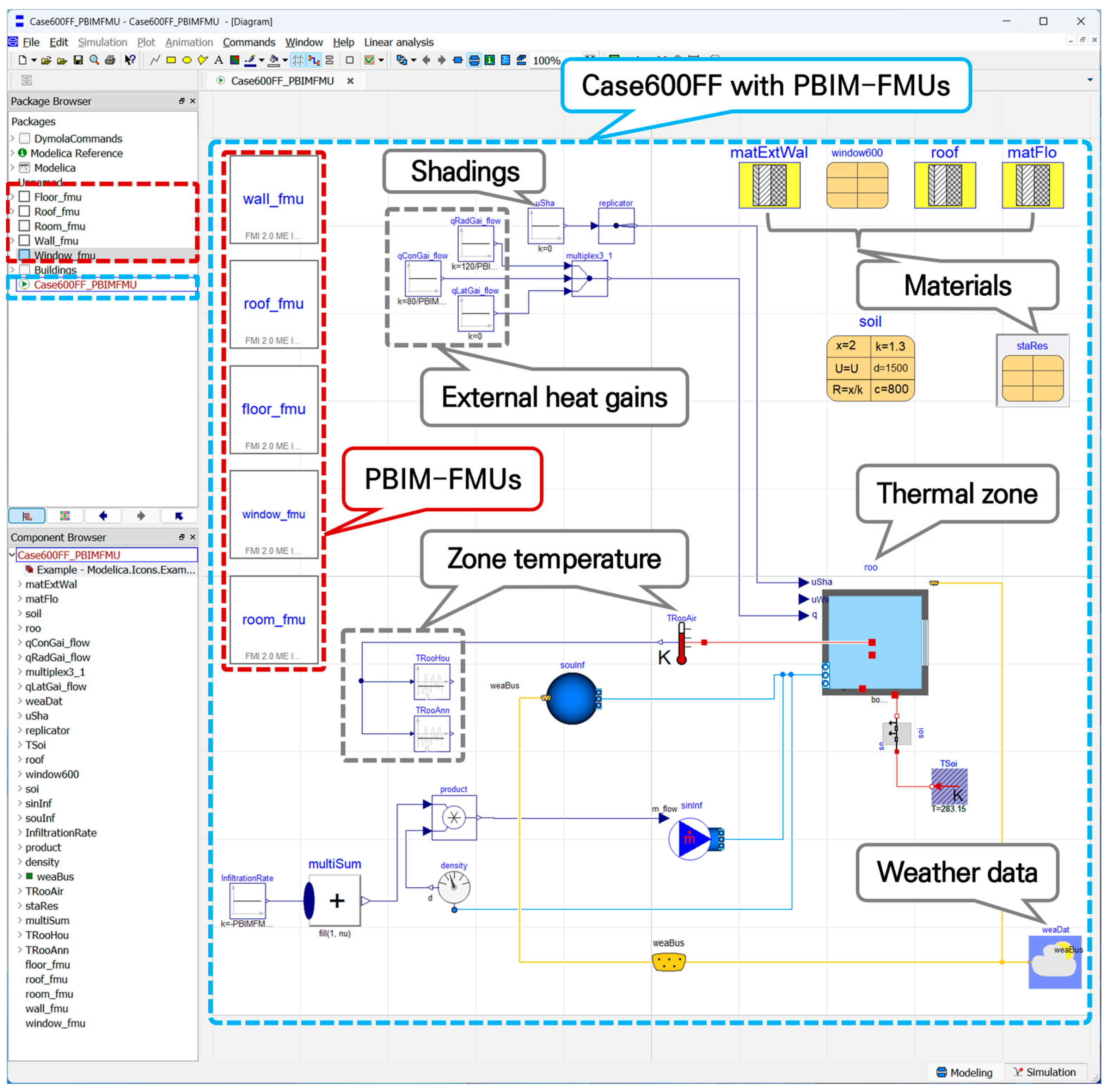
- A3: Generation of an FMI-Based OOPM ModelIn this activity, the PBIM-FMU and the Modelica library are coupled using a Modelica-based simulation environment to create an FMI-compliant OOPM model, which serves as the integrated building performance simulation model. This model enables the estimation of building energy performance through simulation execution.
4. Framework Implementation
4.1. Implementation of the Building Design Information Extraction System for Energy Simulation (Activity A1)
4.2. Implementation of the PBIM-FMU Generation System (Activity A2)
4.2.1. Definition of PBIM-FMU Variable Semantics
4.2.2. Definition of PBIM-FMU Data Structure
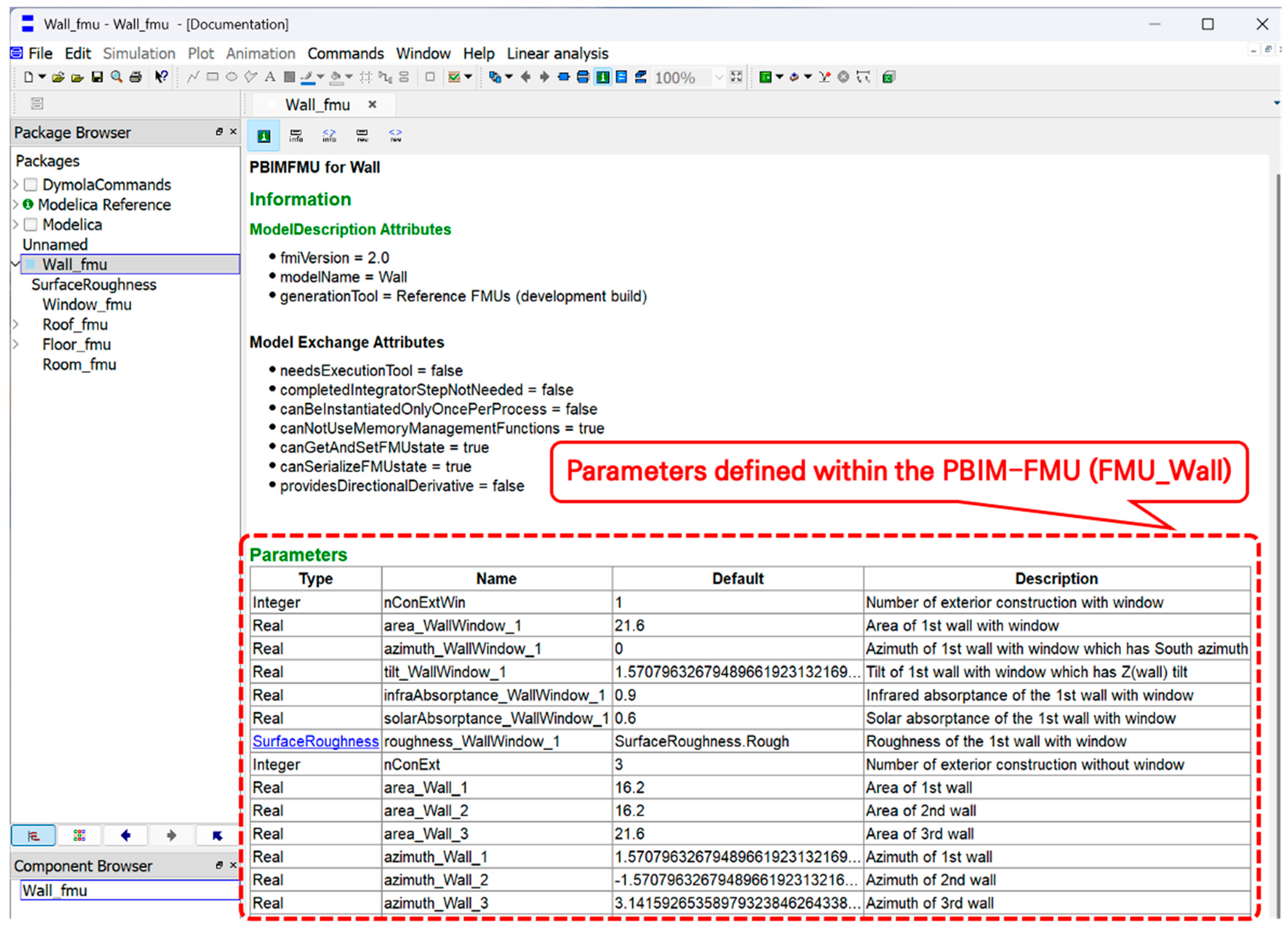
4.2.3. PBIM-FMU Implementation
| Listing 1. Example of an XML-formatted PBIM-FMU model description file automatically generated by the Revit add-in. | |
| 1 | <ModelVariables> |
| 2 | <ScalarVariable name="nConExtWin" valueReference="0" causality="parameter" variability="fixed" initial="exact" description="Number of exterior construction with window"> |
| 3 | <Integer start="1"/> |
| 4 | </ScalarVariable> |
| 5 | <ScalarVariable name="area_WallWindow_1" valueReference="1" causality="parameter" variability="fixed" initial="exact" description="Area of 1st wall with window"> |
| 6 | <Real start="21.6"/> |
| 7 | </ScalarVariable> |
| 8 | </ModelVariables> |
| Listing 2. Example of an PBIM-FMU internal C source code automatically generated by the Revit add-in. | |
| 1 | void setStartValues(ModelInstance* comp) { M(nConExtWin)=1; } |
| 2 | Status getFloat64(ModelInstance* comp, const ValueReference vr, double values[], size_t nValues, size_t* index) { |
| 3 | UNUSED(nValues); |
| 4 | switch (vr) { |
| 5 | case vr_areawallwindow1: |
| 6 | values[(*index)++] = M(area_WallWindow_1); |
| 7 | return OK; |
| 8 | default: |
| 9 | return Error; } } |
4.3. Generation of FMI-Based OOPM Model (Activity A3)
5. Validation
5.1. Case Model Selection and Experimental Setup
5.2. Application of the Framework
5.3. Comparison of Simulation Results
6. Conclusions
Author Contributions
Funding
Data Availability Statement
Conflicts of Interest
References
- International Energy Agency (IEA). World Energy Outlook 2023. Available online: https://www.iea.org/reports/world-energy-outlook-2023 (accessed on 5 August 2025).
- U.S. Energy Information Administration (EIA). International Energy Outlook 2023. Available online: https://www.eia.gov/outlooks/ieo/index.php (accessed on 5 August 2025).
- Fonseca Arenas, N.; Shafique, M. Recent Progress on BIM-Based Sustainable Buildings: State of the Art Review. Dev. Built. Environ. 2023, 15, 100176. [Google Scholar] [CrossRef]
- Ebrahim, A.; Wayal, A.S. Green BIM for Sustainable Design of Buildings. In Proceedings of the ICRRM 2019—System Reliability, Quality Control, Safety, Maintenance and Management; Gunjan, V.K., Singh, S.N., Duc-Tan, T., Rincon Aponte, G.J., Kumar, A., Eds.; Springer: Singapore, 2020; pp. 185–189. [Google Scholar] [CrossRef]
- Pan, X.; Mateen Khan, A.; Eldin, S.M.; Aslam, F.; Kashif Ur Rehman, S.; Jameel, M. BIM Adoption in Sustainability, Energy Modelling and Implementing Using ISO 19650: A Review. Ain. Shams. Eng. J. 2024, 15, 102252. [Google Scholar] [CrossRef]
- Maglad, A.M.; Houda, M.; Alrowais, R.; Khan, A.M.; Jameel, M.; Rehman, S.K.U.; Khan, H.; Javed, M.F.; Rehman, M.F. Bim-Based Energy Analysis and Optimization Using Insight 360 (Case Study). Case Stud. Constr. Mater. 2023, 18, e01755. [Google Scholar] [CrossRef]
- Visby Fjerbæk, E.; Seidenschnur, M.; Kücükavci, A.; Michael Smith, K.; Anker Hviid, C. Coupling BIM and Detailed Modelica Simulations of HVAC Systems in a Common Data Environment. J. Build. Perform. Simul. 2023, 17, 306–321. [Google Scholar] [CrossRef]
- Richter, V.E.; Syndicus, M.; Frisch, J.; van Treeck, C. Extending the IFC-Based Bim2sim Framework to Improve the Accessibility of Thermal Comfort Analysis Considering Future Climate Scenarios. Appl. Sci. 2023, 13, 12478. [Google Scholar] [CrossRef]
- Qiu, K.; Yang, J.; Gao, Z.; Xu, F. A Review of Modelica Language in Building and Energy: Development, Applications, and Future Prospect. Energy Build. 2024, 308, 113998. [Google Scholar] [CrossRef]
- Afzal, M.; Liu, Y.; Cheng, J.C.; Gan, V.J. Reinforced Concrete Structural Design Optimization: A Critical Review. J. Clean. Prod. 2020, 260, 120623. [Google Scholar] [CrossRef]
- Wetter, M.; Benne, K.; Tummescheit, H.; Winther, C. Spawn: Coupling Modelica Buildings Library and EnergyPlus to Enable New Energy System and Control Applications. J. Build. Perform. Simul. 2024, 17, 274–292. [Google Scholar] [CrossRef]
- Wetter, M.; van Treeck, C. IEA EBC Annex 60: New Generation Computational Tools for Building & Community Energy Systems; International Energy Agency: Paris, France, 2017; ISBN 978-0-692-89748-5. Available online: https://www.iea-annex60.org/final-report.html (accessed on 5 August 2025).
- Eckstädt, E.; Huang, C.; Liersch, C.; Paepcke, A.; Hoch, R.; Nicolai, A.; Grunewald, J.; Majetta, K.; Borchert, D.; Schumann, F.; et al. FMI4BIM—Standardisierte Schnittstelle für Analysemodelle von Anlagen- und Gebäudekomponenten für BIM-Basierte Planung und Betrieb; Fraunhofer IIS EAS: Dresden, Germany, 2023; ISBN 978-3-95908-323-2. Available online: https://publica.fraunhofer.de/entities/publication/b31b4fc7-f284-4d03-bd19-06aa69e16ac2 (accessed on 5 August 2025).
- Wetter, M. Modelica-Based Modelling and Simulation to Support Research and Development in Building Energy and Control Systems. J. Build. Perform. Simul. 2009, 2, 143–161. [Google Scholar] [CrossRef]
- Blochwitz, T.; Otter, M.; Åkesson, J.; Arnold, M.; Clauss, C.; Elmqvist, H.; Friedrich, M.; Junghanns, A.; Mauss, J.; Neumerkel, D. Functional Mockup Interface 2.0: The Standard for Tool Independent Exchange of Simulation Models. In Proceedings of the 9th International Modelica Conference, München, Germany, 3–5 September 2012; pp. 173–184. [Google Scholar] [CrossRef]
- Fishwick, P.A. Integrating Continuous and Discrete Models with Object Oriented Physical Modeling. In Proceedings of the 1997 Western Simulation Multiconference, Phoenix, AZ, USA, 12–15 January 1997. [Google Scholar]
- Elmqvist, H.; Mattsson, S.E.; Otter, M. Modelica—A language for physical system modeling, visualization and interaction. In Proceedings of the 1999 IEEE International Symposium on Computer Aided Control System Design (CACSD), Big Island, HI, USA, 22–27 August 1999; pp. 630–639. [Google Scholar] [CrossRef]
- Mattsson, S.E.; Elmqvist, H.; Otter, M. Physical System Modeling with Modelica. Control Eng. Pract. 1998, 6, 501–510. [Google Scholar] [CrossRef]
- Brück, D.; Elmqvist, H.; Mattsson, S.E.; Olsson, H. Dymola for Multi-Engineering Modeling and Simulation. In Proceedings of the Modelica 2002 Conference, Munich, Germany, 18–19 March 2002; pp. 55–64. [Google Scholar]
- Wetter, M.; Zuo, W.; Nouidui, T.S.; Pang, X. Modelica Buildings Library. J. Build. Perform. Simul. 2014, 7, 253–270. [Google Scholar] [CrossRef]
- Jorissen, F.; Reynders, G.; Baetens, R.; Picard, D.; Saelens, D.; Helsen, L. Implementation and Verification of the IDEAS Building Energy Simulation Library. J. Build. Perform. Simul. 2018, 11, 669–688. [Google Scholar] [CrossRef]
- Nicolai, A.; Söhnchen, A. FMI Co-Simulation between 2D/3D Component Models and HVAC/Control Models. In Proceedings of the Building Simulation 2021, Brugge, Belgium, 1–3 September 2021; pp. 1983–1990. [Google Scholar] [CrossRef]
- Nicolai, A.; Paepcke, A. Co-Simulation between Detailed Building Energy Performance Simulation and Modelica HVAC Component Models. In Proceedings of the 12th International Modelica Conference, Prague, Czech Republic, 15–17 May 2017; pp. 63–72. [Google Scholar] [CrossRef]
- Jeong, W.; Kim, J.B.; Clayton, M.J.; Haberl, J.S.; Yan, W. A Framework to Integrate Object-Oriented Physical Modelling with Building Information Modelling for Building Thermal Simulation. J. Build. Perform. Simul. 2016, 9, 50–69. [Google Scholar] [CrossRef]
- Kim, J.B.; Jeong, W.; Clayton, M.J.; Haberl, J.S.; Yan, W. Developing a Physical BIM Library for Building Thermal Energy Simulation. Autom. Constr. 2015, 50, 16–28. [Google Scholar] [CrossRef]
- Remmen, P.; Cao, J.; Ebertshäuser, S.; Frisch, J.; Lauster, M.; Maile, T.; O Donnell, J.; Pinheiro, S.; Rädler, J.; Thorade, M.; et al. An open framework for integrated BIM-based building performance simulation using Modelica. In Proceedings of the Building Simulation 2015: 14th Conference of IBPSA, Hyderabad, India, 7–9 December 2015. [Google Scholar] [CrossRef]
- Thorade, M.; Rädler, J.; Remmen, P.; Maile, T.; Wimmer, R.; Cao, J.; Lauster, M.; Nytsch-Geusen, C.; Müller, D.; Van Treeck, C. An open toolchain for generating Modelica code from Building Information Models. In Proceedings of the 11th International Modelica Conference, Versailles, France, 21–23 September 2015; pp. 383–391. [Google Scholar] [CrossRef]
- Andriamamonjy, A.; Saelens, D.; Klein, R. An Automated IFC-Based Workflow for Building Energy Performance Simulation with Modelica. Autom. Constr. 2018, 91, 166–181. [Google Scholar] [CrossRef]
- Nytsch-Geusen, C.; Rädler, J.; Thorade, M.; Tugores, C.R. BIM2Modelica—An open source toolchain for generating and simulating thermal multi-zone building models by using structured data from BIM models. In Proceedings of the 13th International Modelica Conference, Regensburg, Germany, 4–6 March 2019; pp. 33–38. [Google Scholar] [CrossRef]
- Seidenschnur, M.; Kücükavci, A.; Fjerbæk, E.V.; Smith, K.M.; Pauwels, P.; Hviid, C.A. A Common Data Environment for HVAC Design and Engineering. Autom. Constr. 2022, 142, 104500. [Google Scholar] [CrossRef]
- Jansen, D.; Hering, D.; Müller, D. BIM2SIM for Hydraulic-Focussed Energy Simulations—Automatic Generation of Pre Parametrized Simulation Models. In Proceedings of the 36th International Conference on Efficiency, Cost, Optimization, Simulation and Environmental Impact of Energy Systems (ECOS 2023), Las Palmas de Gran Canaria, Spain, 25–30 June 2023; pp. 3229–3240. [Google Scholar] [CrossRef]
- Autodesk. Revit 2024: Release Notes. Available online: https://help.autodesk.com/view/RVT/2024/ENU/?guid=RevitReleaseNotes_2024release_html (accessed on 5 August 2025).
- Gao, H.; Koch, C.; Wu, Y. Building Information Modelling Based Building Energy Modelling: A Review. Appl. Energy 2019, 238, 320–343. [Google Scholar] [CrossRef]
- Lawrence Berkeley National Laboratory. Buildings Library 11.0.0—Release Notes. Available online: https://simulationresearch.lbl.gov/modelica/releases/v11.0.0/help/Buildings_UsersGuide_ReleaseNotes.html#Buildings.UsersGuide.ReleaseNotes.Version_1_3_build1 (accessed on 5 August 2025).
- Nytsch-Geusen, C.; Inderfurth, A.; Kaul, W.; Mucha, K.; Rädler, J.; Thorade, M.; Tugores, C.R. Template Based Code Generation of Modelica Building Energy Simulation Models. In Proceedings of the 12th International Modelica Conference, Prague, Czech Republic, 15–17 May 2017; pp. 199–207. [Google Scholar] [CrossRef]
- Hejlsberg, A.; Torgersen, M.; Wiltamuth, S.; Golde, P. The C# Programming Language (Covering C# 4.0); Addison-Wesley Professional: Boston, MA, USA, 2010; ISBN 978-0-13-248172-4. [Google Scholar]
- Yang, Z.; Du, H.; Chen, J.; Shen, J. Design of High-Precision Solver Based on FMI Specification. In Proceedings of the 2023 IEEE 18th Conference on Industrial Electronics and Applications (ICIEA), Ningbo, China, 18–22 August 2023; pp. 527–532. [Google Scholar]
- National Institute of Standards and Technology (NIST). FIPS Publication 183: Integration Definition for Function Modeling (IDEF0); NIST: Gaithersburg, MD, USA, 1993. Available online: https://nvlpubs.nist.gov/nistpubs/Legacy/FIPS/fipspub183.pdf (accessed on 5 August 2025).
- Object Management Group (OMG). Unified Modeling Language (UML). Available online: http://www.uml.org/#Links-Tools (accessed on 5 August 2025).
- Modelica Association. Reference FMUs: Functional Mock-Up Units for Development, Testing, and Debugging (Repository). Available online: https://github.com/modelica/reference-fmus (accessed on 5 August 2025).
- American Society of Heating, Refrigerating, and Air-Conditioning Engineers, Inc. ANSI/ASHRAE 140-2017: Standard Method of Test for the Evaluation of Building Energy Analysis Computer Programs. Atlanta, GA, USA, 2017. Available online: https://codehub.building.govt.nz/resources/ansiashrae-140-2017 (accessed on 5 August 2025).
- Nouidui, T.S.; Phalak, K.; Zuo, W.; Wetter, M. Validation and Application of the Room Model of the Modelica Buildings Library. In Proceedings of the 9th International Modelica Conference, Munich, Germany, 3–5 September 2012; pp. 727–736. [Google Scholar] [CrossRef]

| Author. | Year | Building Data Format/Input | Data Exchange Method/Tool | Target Modelica Library or Fledged Tool/Output | Development Level | ||
|---|---|---|---|---|---|---|---|
| Building Geometry | Material | HVAC | |||||
| Kim et al. [25] | 2015 | Revit Model | ModelicaBIM | Buildings | Developed | Developed | N/A |
| Remmen et al. [26] | 2015 | IFC | SimModel | AixLib | Developed | N/A | Developed |
| Thorade et al. [27] | 2015 | IFC | SimModel | AixLib, BuildingSystems | Developed | N/A | Developed |
| Jeong et al. [24] | 2016 | Revit Model | ModelicaBIM | Buildings | Developed | Developed | N/A |
| Nicolai and Paepcke [23] | 2017 | Implicitly BIM-based | N/A | Exported FMU from NANDRAD | N/A | N/A | N/A |
| Andriamamonjya et al. [28] | 2018 | IFC | Ifc2Modelica | IDEAS | Developed | Developed | Developed |
| Nytsch-Geusen et al. [29] | 2019 | IFC | BIM2Modelica | BuildingSystems | Developed | Developed | N/A |
| Seidenschnur et al. [30] | 2022 | Revit Model | VC CDE (FSC exporter) | FSC object model | N/A | N/A | N/A |
| Jansen et al. [31] | 2023 | IFC | BIM2SIM | AixLib, HKESim | N/A | N/A | Developed |
| Visby Fjerbæk et al. [7] | 2023 | Revit Model | VC CDE | Customized Buildings | N/A | N/A | Developed |
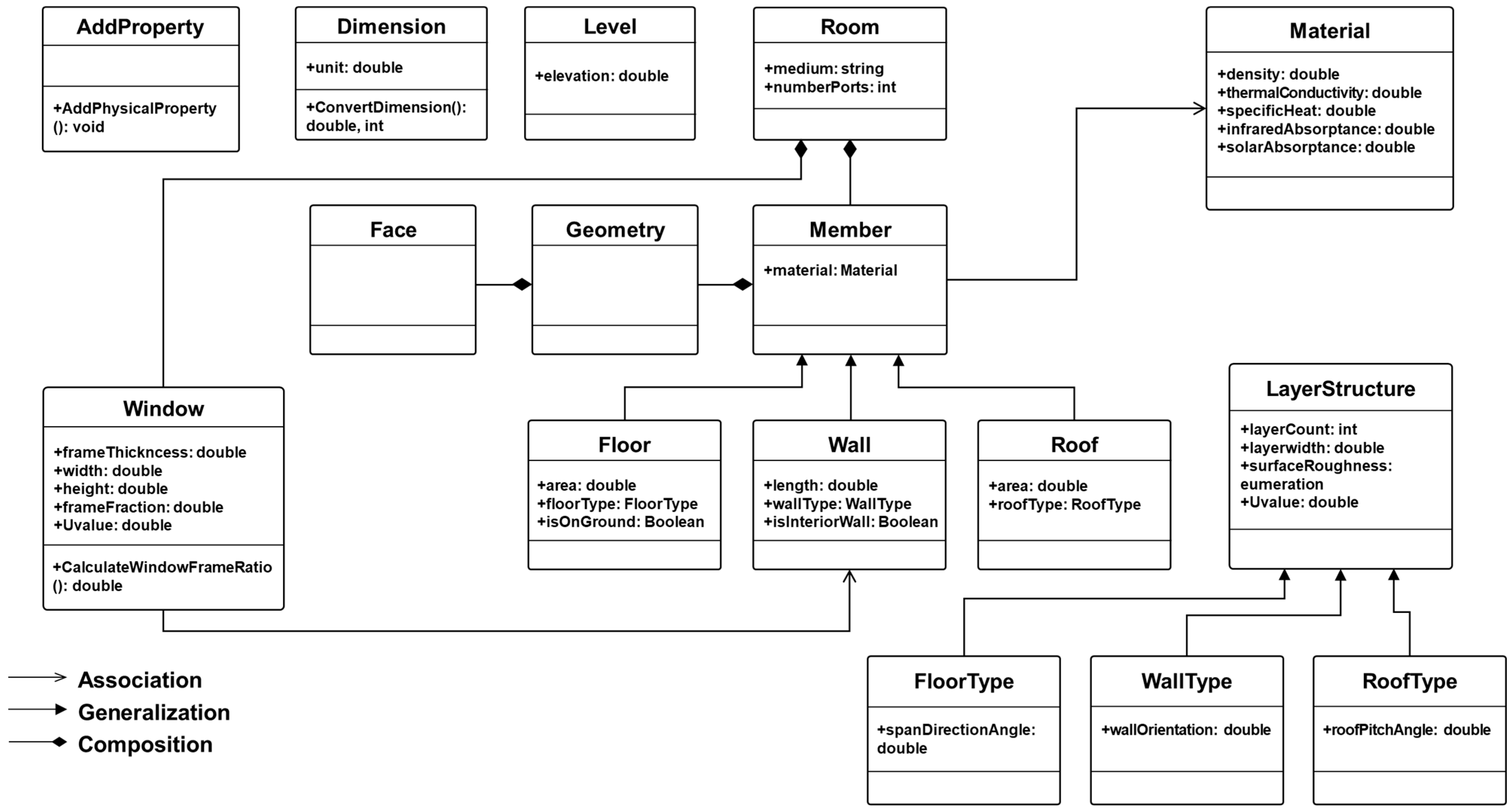
| PBIM-FMU Property Name | Model Variable | Related BIM Class or Property Name | ||||
|---|---|---|---|---|---|---|
| Variable Type | Causality | Variability | Initial | Declared Type | ||
| nConExtWin | Integer | parameter | fixed | exact | N/A | Member.Wall, Window |
| nConExt | Integer | parameter | fixed | exact | N/A | Member.Wall, Member.Roof |
| nConPar | Integer | parameter | fixed | exact | N/A | Member.Wall, Member.Wall.isInteriorWall |
| nSurBou | Integer | parameter | fixed | exact | N/A | Member.Wall, Room |
| nConBou | Integer | parameter | fixed | exact | N/A | Member.Floor, Level.elevation, Room |
| areaWall | Real | parameter | fixed | exact | N/A | Member.Wall.length, Level.elevation |
| areaFloor | Real | parameter | fixed | exact | N/A | Member.Floor.area |
| areaRoof | Real | parameter | fixed | exact | N/A | Member.Roof.area |
| azimuthWall | Real | parameter | fixed | exact | N/A | WallType.wallOrientation |
| tiltWall | Real | parameter | fixed | exact | N/A | Member.Wall, Face |
| tiltFloor | Real | parameter | fixed | exact | N/A | FloorType.spanDirectionAngle |
| azimuthRoof | Real | parameter | fixed | exact | N/A | Member.Roof, Face |
| tiltRoof | Real | parameter | fixed | exact | N/A | Member.Roof, Member.Roof.roofPitchAngle |
| infraredAbsorptance | Real | parameter | fixed | exact | N/A | Material.infraredAbsorptance |
| solarAbsorptance | Real | parameter | fixed | exact | N/A | Material.solarAbsorptance |
| roughness | Enumeration | parameter | fixed | exact | SurfaceRoughness | LayerStructure.surfaceRoughness |
| layerCount | Integer | parameter | fixed | exact | N/A | LayerStructure.layerCount |
| thickness | Real | parameter | fixed | exact | N/A | LayerStructure.layerWidth |
| thermalConductivity | Real | parameter | fixed | exact | N/A | Material.thermalConductivity |
| specificHeat | Real | parameter | fixed | exact | N/A | Material.specificHeat |
| density | Real | parameter | fixed | exact | N/A | Material.density |
| widthWindow | Real | parameter | fixed | exact | N/A | Window.width |
| heightWindow | Real | parameter | fixed | exact | N/A | Window.height |
| fractionFrame | Real | parameter | fixed | exact | N/A | Window.frameFraction |
| UvalueFrame | Real | parameter | fixed | exact | N/A | Window.Uvalue |
| heightRoom | Real | parameter | fixed | exact | N/A | Level.elevation |
| nPort | Integer | parameter | fixed | exact | N/A | Room.numberPorts |
| Medium | String | parameter | fixed | exact | N/A | Room.medium |
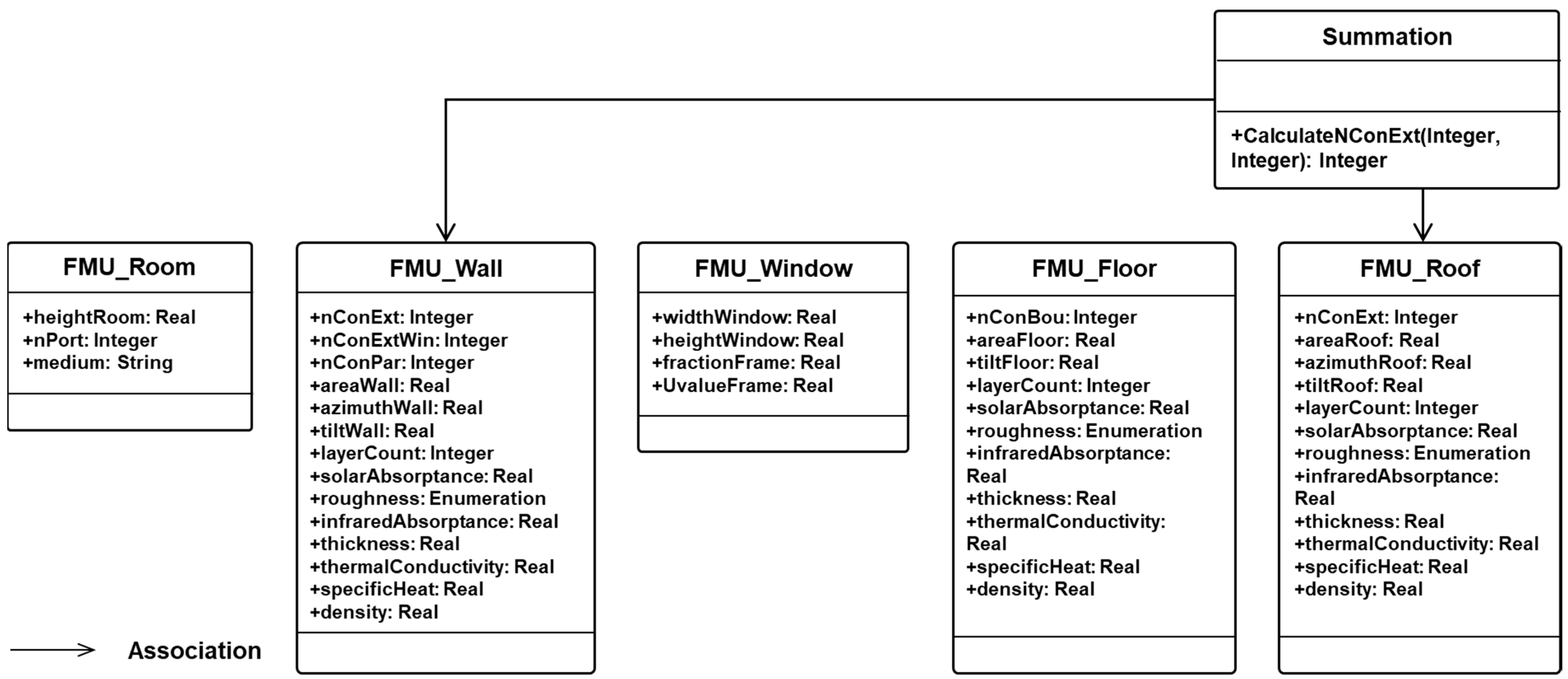
| PBIM-FMU Property Name | Related BIM Class or Property Name | Data Exchange Method | Exchange Mechanism |
|---|---|---|---|
| nConExtWin | Member.Wall, Window | Translation | Count the number of walls that serve as hosts for windows. |
| nConExt | Member.Wall, Member.Roof | Translation | Count the number of walls without windows and the number of roofs. |
| nConPar | Member.Wall, Member.Wall.isInteriorWall | Translation | Count the number of walls with the isInteriorWall property set to true. |
| nSurBou | Member.Wall, Room | Translation | Count the number of walls that bound a room but are adjacent either to the exterior environment or to spaces not defined as separate rooms. |
| nConBou | Member.Floor, Level.elevation, Room | Translation | Count the number of floors that separate two defined rooms (zones) at adjacent levels. |
| areaWall | Member.Wall.length, Level.elevation | Calculation | Calculate the area by multiplying the wall length by the room height. |
| areaFloor | Member.Floor.area | Application | Extract the area directly from the floor’s area attribute. |
| areaRoof | Member.Roof.area | Application | Extract the area directly from the roof’s area attribute. |
| azimuthWall | WallType.wallOrientation | Application | Extract the angle (wallOrientation attribute) directly from the WallType object. |
| tiltWall | Member.Wall, Face | Calculation | Calculate the angle between the normal of the exterior side face of the wall and the vertical axis. |
| tiltFloor | FloorType.spanDirectionAngle | Application | Extract the angle (spanDirectionAngle attribute) directly from the FloorType object. |
| azimuthRoof | Member.Roof, Face | Calculation | Calculate the angle by obtaining the exterior side face from each roof, projecting its normal vector onto the horizontal plane, and calculating the angle between the projection and the north axis. |
| tiltRoof | Member.Roof, Member.Roof.roofPitchAngle | Application | Extract the angle (roofPitchAngle attribute) directly from the RoofType object. |
| infraredAbsorptance | Material.infraredAbsorptance | Application | Extract the infrared absorptance directly from the Material object associated with each building component. |
| solarAbsorptance | Material.solarAbsorptance | Application | Extract the solar absorptance directly from the Material object associated with each building component. |
| roughness | LayerStructure.surfaceRoughness | Application | Extract the roughness directly from the LayerStructure object associated with each building component. |
| layerCount | LayerStructure.layerCount | Application | Extract the number of layers directly from the LayerStructure object associated with each building component. |
| thickness | LayerStructure.layerWidth | Application | Extract the thickness of layers directly from the LayerStructure object associated with each building component. |
| thermalConductivity | Material.thermalConductivity | Application | Extract the thermal conductivity directly from the Material object associated with each building component. |
| specificHeat | Material.specificHeat | Application | Extract the specific heat directly from the Material object associated with each building component. |
| density | Material.density | Application | Extract the density directly from the Material object associated with each building component. |
| widthWindow | Window.width | Application | Extract the width directly from the Window object. |
| heightWindow | Window.height | Application | Extract the height directly from the Window object. |
| fractionFrame | Window.frameFraction | Calculation | Calculate the window area as the product of height and width, estimate the frame area from the frame thickness along the perimeter with corner corrections, and calculate the frame ratio as the frame area divided by the window area. |
| UvalueFrame | Window.Uvalue | Application | Extract the U-value directly from the Window object. |
| heightRoom | Level.elevation | Application | Extract the elevation directly from the Level object. |
| nPort | Room.numberPorts | Application | Extract the number of ports directly from the Room object. |
| Medium | Room.medium | Application | Extract the medium directly from the Room object. |
| Simulation Engine | Peak Heating Load (Day-Month, Time) [kWh] | Peak Cooling Load (Day-Month, Time) [kWh] |
|---|---|---|
| ESP | 3.437 (4-January, 5) | 6.194 (17-October, 13) |
| BLAST | 3.940 (4-January, 5) | 5.965 (16-October, 14) |
| DOE21D | 4.045 (4-January, 5) | 6.656 (16-October, 13) |
| SRES-SUN | 4.258 (4-January, 2) | 6.827 (16-October, 14) |
| S3PAS | 4.037 (4-January, 2) | 6.286 (25-November, 14) |
| TRANSYS | 3.931 (4-January, 6) | 6.486 (16-October, 14) |
| TASE | 4.354 (4-January, 2) | 6.812 (17-October, 14) |
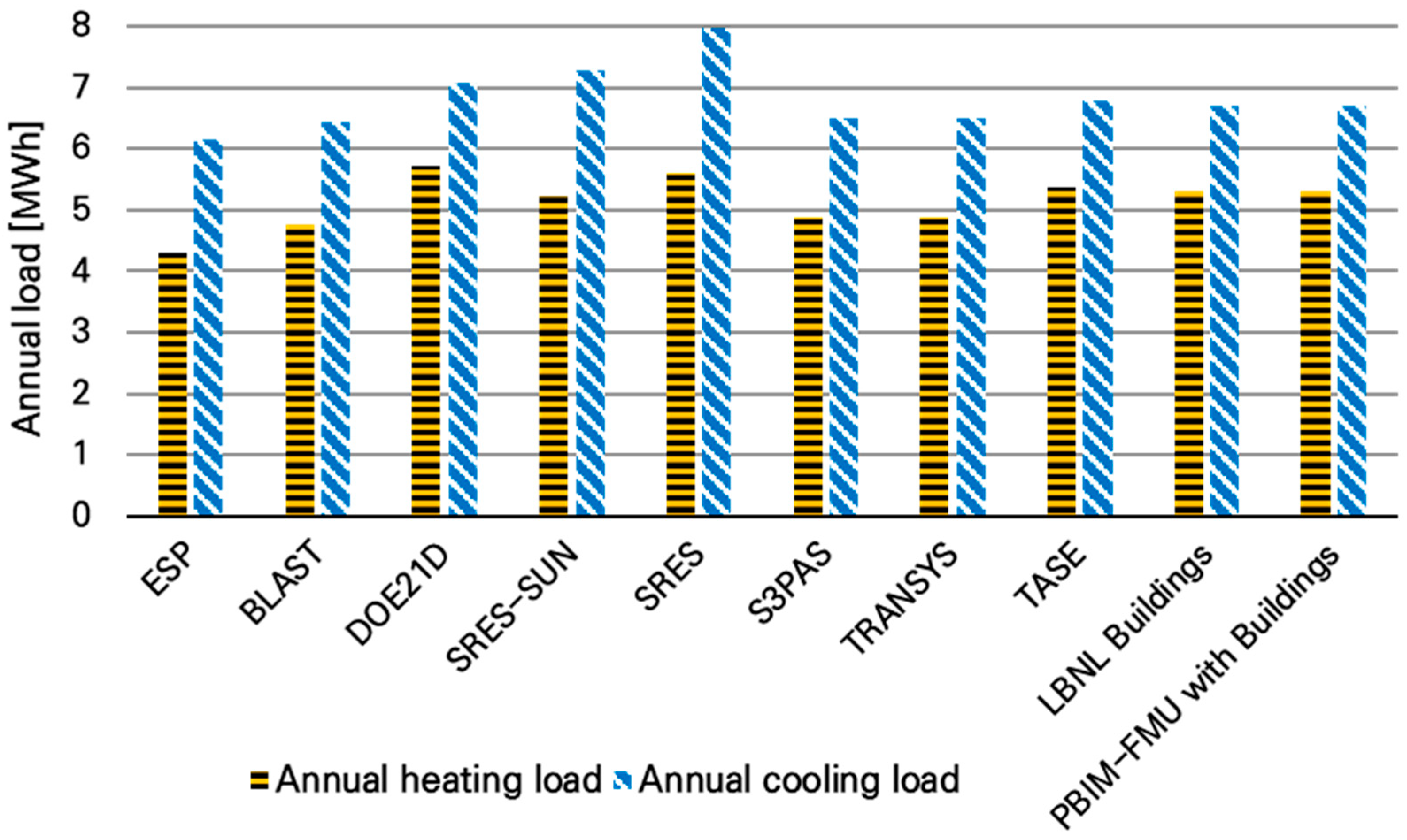
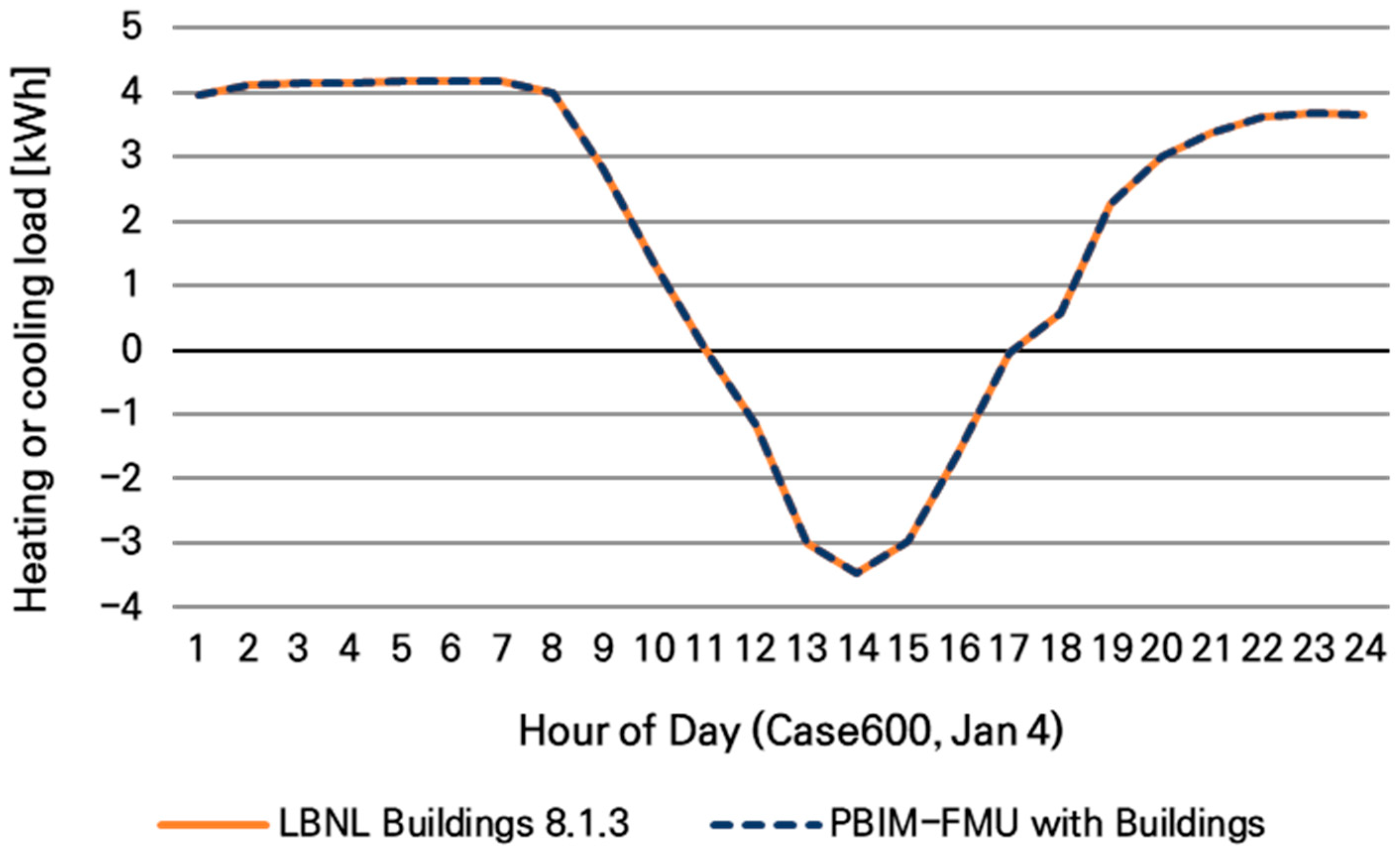
| LBNL Buildings 8.1.3 | 4.172 (4-January, 6) | 6.669 (17-October, 13) |
| PBIM-FMU with Buildings 8.1.3 | 4.172 (4-January, 6) | 6.669 (17-October, 13) |
Disclaimer/Publisher’s Note: The statements, opinions and data contained in all publications are solely those of the individual author(s) and contributor(s) and not of MDPI and/or the editor(s). MDPI and/or the editor(s) disclaim responsibility for any injury to people or property resulting from any ideas, methods, instructions or products referred to in the content. |
© 2025 by the authors. Licensee MDPI, Basel, Switzerland. This article is an open access article distributed under the terms and conditions of the Creative Commons Attribution (CC BY) license (https://creativecommons.org/licenses/by/4.0/).
Share and Cite
Kong, B.; Jeong, W. Development of an FMI-Based Data Model to Support a BIM-Integrated Building Performance Analysis Framework. Buildings 2025, 15, 3200. https://doi.org/10.3390/buildings15173200
Kong B, Jeong W. Development of an FMI-Based Data Model to Support a BIM-Integrated Building Performance Analysis Framework. Buildings. 2025; 15(17):3200. https://doi.org/10.3390/buildings15173200
Chicago/Turabian StyleKong, ByungChan, and WoonSeong Jeong. 2025. "Development of an FMI-Based Data Model to Support a BIM-Integrated Building Performance Analysis Framework" Buildings 15, no. 17: 3200. https://doi.org/10.3390/buildings15173200
APA StyleKong, B., & Jeong, W. (2025). Development of an FMI-Based Data Model to Support a BIM-Integrated Building Performance Analysis Framework. Buildings, 15(17), 3200. https://doi.org/10.3390/buildings15173200

