1. Introduction
Corporate tax systems normally accept that business activity is cyclical. A company may suffer a loss in one year and earn taxable profits in later years. Loss carryforward rules are therefore not a concession in the ordinary sense; they are a mechanism for measuring income over a realistic business horizon rather than within an artificial annual slice. In the United Arab Emirates, this principle is reflected in the corporate tax regime, which defines tax loss as negative taxable income for a tax period and permits relief against subsequent taxable income subject to limits and conditions (
United Arab Emirates 2022b;
Federal Tax Authority 2023). The policy objective is reasonable: a tax system should not penalize investment merely because profits and losses arise in different years. Yet the same mechanism can become a base-eroding device where losses are sold, shifted, inflated, or transferred from one entity to another without genuine economic continuity.
The risk becomes more acute when the loss arises from virtual assets. Bitcoin and later blockchain-based assets were designed to transfer value without the intermediation structures that tax systems traditionally use for information, documentation, and enforcement (
Nakamoto 2008;
Narayanan et al. 2016). Virtual assets can be traded through centralized exchanges, decentralized protocols, private wallets, cross-border custodians, or self-custody arrangements. They can represent payment tokens, utility tokens, security-like instruments, stablecoins, governance tokens, non-fungible tokens, or hybrid rights that do not map neatly onto conventional categories of inventory, investment, currency, security, or intangible asset (
Ooi 2022;
De Filippi and Wright 2018). The legal effect is that a single corporate taxpayer may report a virtual-asset loss that raises multiple questions at once: Is the asset held on capital or revenue account? Is the loss realized or merely a fair-value movement? Is the wallet controlled by the taxpayer? Was the transaction with a related party? Can the exchange data be verified? Should the loss be available for transfer to a related profitable entity? These questions are not peripheral; they determine whether a tax loss reflects a genuine reduction in corporate income or a planning opportunity.
The UAE is an especially important jurisdiction for this inquiry because it has built both a modern corporate tax regime and a rapidly developing virtual-asset regulatory framework. Federal Decree-Law No. 47 of 2022 introduced corporate tax for corporations and businesses, while the Ministry of Finance and Federal Tax Authority guidance explain the computation of taxable income, filing duties, accounting starting points, and adjustments (
United Arab Emirates 2022b;
Ministry of Finance 2026;
Federal Tax Authority 2024). In parallel, Cabinet Resolution No. 111 of 2022 regulates virtual assets and related service providers at the federal level; Dubai Law No. 4 of 2022 established a specialized Dubai regulator; and the Dubai Virtual Assets Regulatory Authority has issued a detailed rulebook architecture for virtual-asset service providers (
United Arab Emirates 2022a;
Dubai 2022;
Dubai Virtual Assets Regulatory Authority 2023). ADGM and DIFC have also developed financial-services frameworks for virtual assets and crypto-tokens (
Abu Dhabi Global Market Financial Services Regulatory Authority 2022;
Dubai Financial Services Authority 2026). These developments mean that virtual-asset business is not outside the UAE legal order. The more difficult question is whether the tax law should treat virtual-asset losses in the same way as ordinary business losses.
Virtual-asset losses present three analytically distinct risk channels. Measurement risk arises from volatility, fragmented markets, illiquidity, and unsettled accounting classification (
IFRS Interpretations Committee 2019;
Baur and Dimpfl 2021). Identity and evidence risk arises where beneficial ownership, wallet control, custody, exchange records, or protocol-level data are incomplete (
Financial Action Task Force 2021;
Houben and Snyers 2018). Corporate-transfer risk arises where related-party dealings, acquisitions, or ownership changes detach a claimed loss from the activity or taxpayer that economically incurred it (
United Arab Emirates 2022b;
Ooi 2024). These are risk hypotheses requiring transaction-level verification; the presently available sources do not demonstrate that such abuse is widespread among UAE taxpayers.
The article advances four calibrated arguments. First, tax neutrality is the baseline: a genuine, realized, measurable business loss should not receive less favorable treatment merely because it involves a virtual asset (
Baer et al. 2023). Second, the distinctive features of some virtual-asset transactions justify enhanced substantiation and enforcement when identifiable risk markers are present, but not a presumption that the entire asset class is abusive. Third, Articles 37–40, transfer-pricing rules, the general anti-abuse framework, and regulated VASP records should be applied before creating new substantive restrictions. Fourth, the comparators support functional classification, documentation, valuation, realization, and information exchange rather than a general crypto-only loss basket. The article’s narrower originality therefore lies in connecting these principles to the UAE’s loss-transfer, ownership-continuity, free zone, company-governance, and virtual-asset-supervision architecture.
The remainder of the article proceeds as follows.
Section 2 reviews the literature and conceptual background.
Section 3 explains the methodology.
Section 4 analyzes the UAE and Egyptian legal frameworks.
Section 5 examines virtual-asset classification, valuation, residency, and loss evidence.
Section 6 develops comparative lessons from selected jurisdictions and international standards.
Section 7 presents findings and a reform model for UAE law.
Section 8 concludes with policy recommendations for tax legislators, regulators, corporate taxpayers, and virtual-asset service providers.
2. Literature Review and Conceptual Framework
The literature on virtual assets has developed across several fields: finance, technology, tax law, financial regulation, and corporate governance. The economic literature emphasizes that crypto-assets are characterized by volatility, market segmentation, information asymmetry, and uncertain monetary function.
Yermack (
2015) argued that Bitcoin struggles to perform the core functions of money because its price volatility undermines its use as a unit of account and store of value.
Baur and Dimpfl (
2021) similarly found that Bitcoin volatility is far higher than the volatility of major exchange rates, which supports the legal concern that virtual-asset losses may be larger, more frequent, and less predictable than losses in conventional commercial assets.
Dyhrberg (
2016),
Urquhart (
2016),
Härdle et al. (
2020) add that crypto-markets display distinctive risk and efficiency features, while
Kristoufek (
2015) shows that Bitcoin prices are influenced by heterogeneous drivers rather than by a single fundamental valuation model.
Foundational technology and policy literature also confirms that the tax analysis cannot be separated from market architecture.
Böhme et al. (
2015) explain how Bitcoin combines economic, technological, and governance features that differ from ordinary payment systems.
He et al. (
2016) and the
International Monetary Fund (
2021) situate virtual currencies within broader financial-stability and supervisory concerns.
Arner et al. (
2017) show that digital finance requires new regulatory technology and supervisory capacity, while
Zetzsche et al. (
2020) demonstrate that decentralized finance can disintermediate traditional compliance gates.
Auer and Claessens (
2018) further show that regulatory signals affect crypto-markets, which means tax and market rules may influence asset behavior as well as legal compliance.
These market features have direct tax significance. Where an asset is extremely volatile, the timing of realization, the valuation source, and the distinction between realized and unrealized losses become central. IFRS Interpretations Committee guidance states that holdings of cryptocurrencies may fall under IAS 2 when held for sale in the ordinary course of business, and otherwise under IAS 38 as intangible assets (
IFRS Interpretations Committee 2019). This classification matters because tax systems often begin from accounting income but then make statutory adjustments. In the UAE, taxable income starts from accounting income prepared under accepted accounting standards, subject to adjustments required by the Corporate Tax Law and ministerial decisions (
United Arab Emirates 2022b,
2023;
Federal Tax Authority 2024). Therefore, crypto-accounting classification is not merely technical; it is the gateway through which gains, impairments, fair-value movements, and disposals enter the tax computation.
The tax-law literature has moved beyond the early question of whether cryptocurrency is legal money.
Marian (
2013) described cryptocurrencies as potential instruments of tax evasion because they can combine value transfer with pseudonymity and reduced dependence on financial intermediaries.
Ooi (
2022) argued that digital tokens are not a single monolithic asset class and that tax treatment should depend on the legal and economic features of the taxable event.
Ooi (
2024) later defended stronger scrutiny of crypto-loss deductibility and the shifting of losses across time and companies. That source-matching argument precedes this study. The present contribution is narrower: it tests when, and by what UAE institutions, heightened scrutiny can be implemented without displacing neutrality.
Baer et al. (
2023) provide the counterweight by beginning from ordinary tax principles and neutrality while recognizing the implementation difficulties created by pseudonymity and the dual investment/payment functions of crypto-assets.
Regulatory literature and international standards also emphasize that virtual-asset risks are not confined to tax. FATF guidance focuses on anti-money-laundering and counter-terrorist-financing risks and VASP information obligations (
Financial Action Task Force 2021). The Financial Stability Board, IOSCO, and the Basel Committee address market integrity, custody, conflicts, disclosure, prudential treatment, and cross-border supervision (
Financial Stability Board 2023;
International Organization of Securities Commissions 2023;
Basel Committee on Banking Supervision 2022). These instruments do not determine corporate tax deductibility and should not be used as proxies for a substantive loss restriction. Their relevance is evidentiary and institutional: regulated records may improve verification of ownership, valuation, and transaction history.
A competing institutional literature also cautions against treating decentralization only as a source of opacity.
McIntosh (
2024) traces Hayek’s competitive-currency project to later cryptocurrency experimentation and emphasizes spontaneous monetary order and private experimentation. This tradition does not validate every token or deduction, but it identifies potential benefits—discovery, competition, resilience, and decentralized information—that an innovation-sensitive tax policy should acknowledge. The policy question is consequently not whether decentralization is inherently beneficial or harmful but whether a particular claimed loss satisfies ordinary legal requirements and any proportionate, fact-based evidentiary demand.
The legal problem can be conceptualized as a conflict between neutrality and base protection. Neutrality requires recognition of economically genuine losses regardless of whether they arise from tangible goods, intangible rights, financial assets, or virtual assets (
Baer et al. 2023). Base protection requires denial or adjustment where a claim is unrealized, unverifiable, artificially shifted, connected with exempt income, or separated from genuine economic ownership. The appropriate sequence is therefore important: ordinary classification and loss rules apply first; enhanced proof, valuation, source attribution, transfer pricing, and anti-abuse review follow when facts justify them; a special substantive restriction is a residual measure requiring independent evidence and proportional justification. The UAE’s 75% utilization cap, excluded-loss rules, Article 38 conditions, Article 39 continuity test, transfer-pricing provisions, tax-group rules, and general anti-abuse rule already provide a substantial first line of control (
United Arab Emirates 2022b;
Federal Tax Authority 2023).
Virtual assets destabilize this balance because they can be held, transferred, or controlled in ways that do not resemble ordinary assets. A corporate taxpayer may hold tokens through a local exchange, foreign custodian, cold wallet, decentralized protocol, investment fund, tokenized debt instrument, or a related-party treasury company. A loss may arise from market decline, exchange failure, private-key loss, token delisting, smart-contract exploit, rug pull, forced liquidation, or impairment of a receivable against a platform. Each event raises different tax questions. A price decline is not necessarily a realized loss. A hacked wallet may be a casualty, theft, impairment, or uninsured operational loss depending on facts and governing law. A token transfer to a related company may be a commercial sale, capital contribution, distribution, reorganization, or artificial loss crystallization event. The conceptual framework of this article therefore treats virtual-asset loss relief as a three-layer inquiry: classification, verification, and transferability.
Table 1 presents the main doctrinal problem. It shows that the weakness of a general tax-loss rule is not that it ignores virtual assets entirely but that it answers only part of the question. It permits loss relief after taxable income has been determined, while virtual assets require careful analysis before taxable income is finalized: the legal character of the asset, the evidence of ownership, the valuation source, the realization event, and the corporate relationship through which the loss is carried or transferred must all be tested.
3. Methodology
This study adopts a doctrinal, comparative, and policy-oriented legal methodology. The doctrinal component analyzes the UAE Corporate Tax Law, corporate law, commercial law, and virtual-asset regulations. The principal legal materials are Federal Decree-Law No. 47 of 2022 on the Taxation of Corporations and Businesses, Ministerial Decision No. 134 of 2023, Federal Tax Authority corporate tax guidance, Federal Decree-Law No. 32 of 2021 on Commercial Companies, Federal Decree-Law No. 50 of 2022 on Commercial Transactions, Cabinet Resolution No. 111 of 2022 regulating virtual assets and service providers, Dubai Law No. 4 of 2022, and VARA regulations (
United Arab Emirates 2021,
2022b,
2022a,
2022c,
2023;
Dubai 2022;
Dubai Virtual Assets Regulatory Authority 2023). The analysis is doctrinal because it interprets legal texts, identifies conditions and exclusions, and evaluates whether the legal rules coherently address the issue of virtual-asset losses.
The comparative component serves a functional rather than a transplanting purpose. Egypt is one benchmark because Article 29 of its Income Tax Law uses a simpler five-year carryforward rule and its regulatory treatment of cryptocurrencies differs materially from the UAE model (
Egypt 2005;
Central Bank of Egypt 2022). The United States is selected because general property principles apply to digital assets; the United Kingdom and Singapore because administrative guidance applies existing tax categories to different activities and token functions; and the EU and OECD because MiCA and CARF show how market regulation and information reporting can support compliance (
Internal Revenue Service 2014,
2019;
HM Revenue & Customs 2021;
Inland Revenue Authority of Singapore 2020;
European Parliament and Council 2023;
OECD 2022,
2023). The comparison asks what each system can contribute to classification, evidence, and administration; it does not treat those systems as authority for a general crypto-loss ring-fence.
The policy-oriented component evaluates how UAE law could develop without undermining legitimate innovation or ordinary group organization. The proposed sequence is neutrality first and risk-triggered scrutiny second. A properly realized and evidenced loss remains governed by ordinary law. Enhanced disclosure or audit review is triggered by facts such as self-custody without reliable records, illiquid or non-independently valued tokens, related-party crystallization, unlicensed platforms, abrupt ownership changes, acquisition of a loss company, or lack of commercial purpose. Existing transfer-pricing, ownership-continuity, business-purpose, and anti-abuse tools should be tested before any asset-class restriction is adopted. Ring-fencing or a special continuity rule is retained only as a possible last-resort response if future UAE data demonstrate a material residual risk that those tools cannot address proportionately.
The source base consists of legislation, official tax and regulatory guidance, international standards, and peer-reviewed or publisher-verifiable scholarship. Because this is a legal doctrinal article, it does not collect taxpayer data, conduct interviews, identify adjudicated UAE crypto-loss disputes, or estimate revenue effects. Its claims are therefore framed as analysis of legal capacity and prospective vulnerability, not as proof of observed abuse or institutional demand.
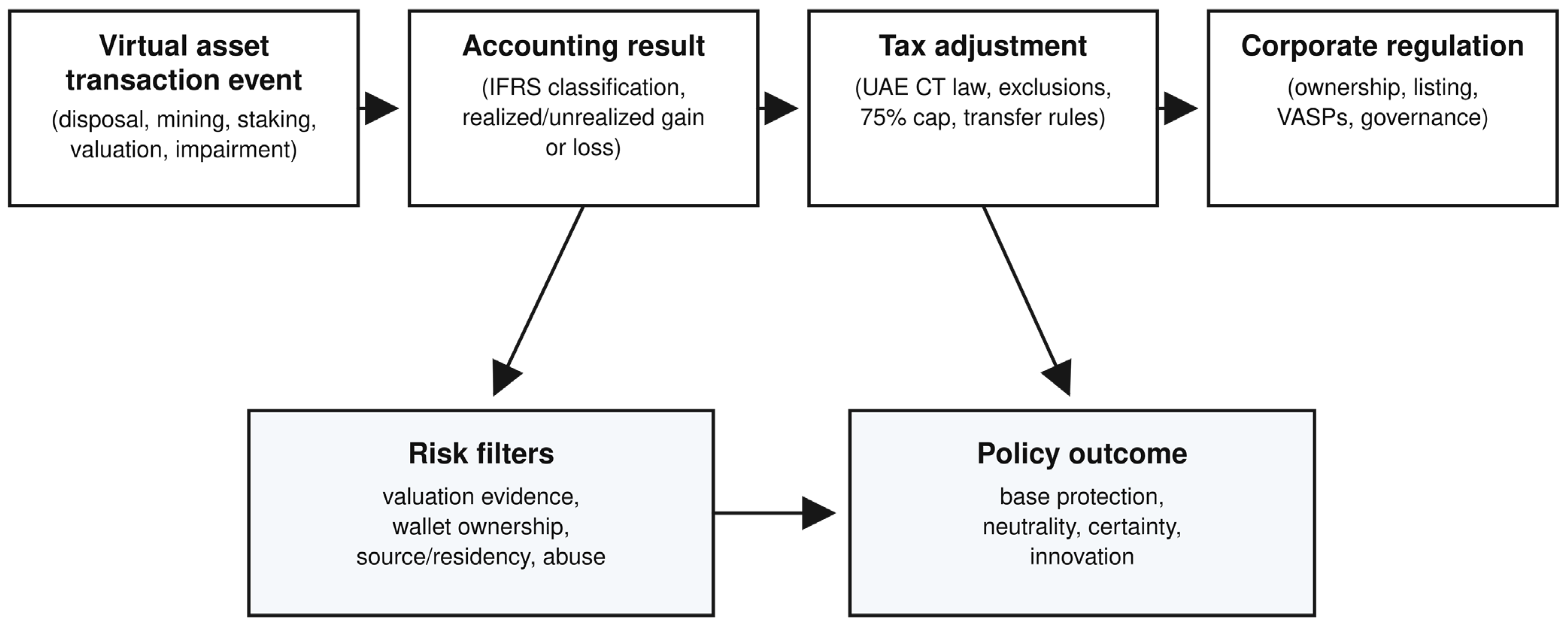
Figure 1 summarizes the analytical framework by connecting the transaction event to accounting classification, tax adjustment, company regulation, risk filters, and policy outcomes.
4. UAE and Egyptian Legal Frameworks
The UAE Corporate Tax Law creates a structured regime for tax loss relief. Article 37 permits a tax loss to be offset against taxable income of subsequent tax periods, but the amount used in any subsequent period cannot exceed 75% of taxable income before tax-loss relief, unless a different percentage is specified by Cabinet decision (
United Arab Emirates 2022b). This is a significant safeguard because it prevents a company from reducing taxable income to zero solely through prior-year losses. Article 37 also excludes losses incurred before the commencement of corporate tax, losses incurred before a person became a taxable person, and losses from assets or activities whose income is exempt or otherwise not taken into account. These exclusions are directly relevant to virtual assets because a taxpayer may hold tokens before entering the UAE corporate tax system, may hold exempt assets in parallel with taxable activities, or may seek to crystallize losses after a change in tax status.
Article 38 permits transfer of tax losses between taxable persons only under cumulative conditions. Both must be resident juridical persons; at least 75% ownership must connect them directly or through a common owner; that connection must continue from the beginning of the loss period through the end of the utilization period; neither may be an Exempt Person or a Qualifying Free Zone Person; and both must use the same financial year and accounting standards (
United Arab Emirates 2022b). These safeguards already address much conventional loss trafficking. Accordingly, a treasury affiliate’s genuine virtual-asset loss should not be disqualified merely because another group member conducts a different business. Heightened review should instead focus on arm’s-length pricing, commercial purpose, beneficial ownership, traceability, abrupt changes in ownership or activity, and whether the loss-producing entity was acquired principally for its losses.
The free zone interaction is especially important because virtual-asset, treasury, fund-management, and technology activities may be organized in UAE free zones. A Qualifying Free Zone Person may benefit from a 0% rate on Qualifying Income, while non-qualifying income and income attributable to a domestic or foreign permanent establishment may fall within the ordinary 9% regime; non-qualifying revenue is also subject to the de minimis conditions (
Ministry of Finance 2023). Article 38 already prevents a Qualifying Free Zone Person from transferring tax losses to another taxable person. The practical issue is therefore allocation: the taxpayer must connect income, expenses, and losses to the qualifying, non-qualifying, permanent-establishment, and other taxable components using consistent accounting, arm’s-length pricing, and activity records. A virtual-asset label does not decide whether income is qualifying. The function performed—such as regulated fund management, wealth and investment management, treasury services to related parties, or an excluded/non-qualifying activity—and the applicable free zone decisions do. Guidance should clarify this allocation without creating a crypto-only loss rule.
Article 39 requires continuous ownership of at least 50% from the beginning of the loss period to the end of the utilization period, or continuation of the same or a similar business after a greater ownership change (
United Arab Emirates 2022b). Listed companies are outside this limitation because ordinary market turnover makes shareholder-level continuity impracticable. The exception does not itself establish a crypto-specific loophole. Where any listed company carries a material loss involving an illiquid, manipulable, related-party, or weakly documented asset, proportionate disclosure and ordinary anti-abuse review may be justified on a technologically neutral basis. The existence of a virtual asset alone should not create a special Article 39 substantive condition.
Article 40 allows tax groups where a resident parent company owns at least 95% of the share capital, voting rights, and profits/net assets of resident subsidiaries, subject to further conditions (
United Arab Emirates 2022b). Tax groups are important because they can consolidate results and simplify compliance, but they can also concentrate virtual-asset losses in a structure where gains and losses from different business segments are blended. Company law also matters because Federal Decree-Law No. 32 of 2021 regulates incorporation, governance, share capital, management, and restructuring of commercial companies (
United Arab Emirates 2021). Corporate tax loss rules cannot be understood without company regulation because ownership continuity, group relationships, restructuring, listing, and governance determine whether a loss is tied to a genuine business or detached from it.
The UAE virtual-asset framework supplies additional context. Cabinet Resolution No. 111 of 2022 defines and regulates virtual assets and virtual-asset service providers, imposes licensing and registration expectations, and requires compliance with anti-money-laundering and counter-terrorist-financing legislation (
United Arab Emirates 2022a). Dubai Law No. 4 of 2022 applies to virtual-asset services across Dubai except the DIFC and establishes the legal basis for VARA’s regulatory role (
Dubai 2022). VARA’s 2023 regulatory framework creates a rulebook architecture for virtual-asset activities, including company, compliance, technology, market conduct, advisory, broker-dealer, custody, exchange, lending, borrowing, payments, remittance, and asset-management activities (
Dubai Virtual Assets Regulatory Authority 2023). ADGM and DFSA frameworks further reinforce the UAE’s regulatory pluralism in virtual assets (
Abu Dhabi Global Market Financial Services Regulatory Authority 2022;
Dubai Financial Services Authority 2026). These rules do not themselves determine tax loss deductibility, but they generate evidence that tax authorities can use: licensing status, client-asset segregation, transaction records, custody controls, compliance systems, and audit trails.
Egypt supplies a limited but useful benchmark rather than the article’s principal comparative focus. Article 29 of Income Tax Law No. 91 of 2005 permits a loss to be deducted from the succeeding year’s profits and carried forward for no more than five years (
Egypt 2005). Article 30 also authorizes adjustment of related-party taxable profits where agreed conditions differ from those between independent persons, providing a general arm’s-length control relevant to artificial loss crystallization. Egypt does not appear to have published a dedicated corporate crypto-loss regime. Its wider regulatory setting is materially restrictive: the Central Bank of Egypt has stated that Law No. 194 of 2020 prohibits issuing, trading, or promoting cryptocurrencies, operating trading platforms, or carrying out related activities without authorization, and it reiterated that no trading license had been issued in the Egyptian market (
Central Bank of Egypt 2022). Thus, the Egyptian comparison shows a general time limit, related-party control, and a restrictive market context; it cannot supply affirmative support for a crypto-specific UAE loss basket.
The comparison therefore does not establish that the UAE requires more restrictive substantive treatment. It shows instead that the UAE combines flexible loss relief with comparatively developed company, free zone, and virtual-asset institutions. That institutional sophistication can support risk-based verification through regulated records, transfer pricing, beneficial-ownership evidence, and targeted anti-abuse review.
Table 2 presents Egypt as one benchmark and adds the distinct free zone interaction relevant to the UAE.
5. Virtual Assets, Tax Classification, and Loss Evidence
The relevant connecting factors concern persons, permanent establishments, activities, and income rather than the ‘residency’ of a virtual asset. The legal questions are whether the claimant is resident or non-resident, whether the loss is attributable to a UAE business or permanent establishment, whether the activity is carried on in the UAE, and whether the asset or right is connected with taxable income (
United Arab Emirates 2022b;
Ministry of Finance 2026). Self-custody or use of a foreign platform does not by itself change the taxpayer’s residence, although it may affect source, attribution, evidence, and enforcement.
Classification is the second issue. The IFRS Interpretations Committee concluded that cryptocurrencies may be inventory under IAS 2 if held for sale in the ordinary course of business and otherwise intangible assets under IAS 38 (
IFRS Interpretations Committee 2019). However, tax classification need not always follow accounting classification. UAE law begins from accounting income but permits adjustments under the Corporate Tax Law and ministerial decisions (
Federal Tax Authority 2024;
United Arab Emirates 2023). In practical terms, a licensed virtual-asset exchange may hold tokens as inventory or trading stock; a corporate treasury company may hold tokens as investment assets; a technology company may receive tokens as consideration for services; and a decentralized finance participant may hold governance tokens, liquidity-pool positions, or tokenized claims. The tax law should not assume that all token losses are the same. The relevant classification should depend on the function of the asset in the taxpayer’s business, the legal rights embedded in the token, the accounting treatment, and the factual taxable event (
Ooi 2022).
Valuation is the third issue. Virtual-asset markets are global, continuous, and fragmented. A token may trade at different prices across exchanges; liquidity may disappear rapidly; stablecoins may de-peg; and tokens may be suspended, delisted, or manipulated. Empirical studies document volatility, inefficiency, and price dynamics that differ from ordinary currencies and securities (
Baur and Dimpfl 2021;
Urquhart 2016;
Kristoufek 2015). Consequently, a tax-loss regime should specify acceptable valuation evidence. A taxpayer claiming virtual-asset loss relief should provide exchange transaction records, wallet addresses, timestamps, fiat conversion rates, custody statements, blockchain transaction hashes where available, board or treasury approvals, and evidence that the loss is realized rather than merely a temporary fair-value decline. Where the token is illiquid, related-party traded, or valued from a non-independent source, additional scrutiny should apply.
The fourth issue is realization. A market decline should not automatically become a deductible loss. Tax systems generally distinguish unrealized valuation changes from realized disposals, impairments, or identifiable loss events. UAE law allows certain elections and adjustments concerning unrealized gains and losses under the taxable-income rules, but the application to crypto requires clear administrative guidance (
United Arab Emirates 2022b;
Federal Tax Authority 2024). A realized loss might arise from a sale for fiat currency, exchange of one token for another, transfer to settle a liability, liquidation of collateral, abandonment of an unrecoverable claim, or documented theft or exploit. Each event requires a different evidentiary standard. For example, a sale on a regulated exchange may be evidenced by trade confirmations, but a private wallet-to-wallet transfer to a related party requires proof of arm’s-length price, beneficial ownership, and business purpose.
The fifth issue is loss use and transfer. The doctrinal concern is that a loss might be set against income unrelated to the loss-producing activity, shifted through a related-party transaction, or preserved after an acquisition. These possibilities are not unique to virtual assets; derivatives, distressed debt, commodities, closely held securities, intellectual property, and real estate can also be illiquid, manipulable, or transferred within groups. The relevant question is therefore transactional: do the facts show a genuine economic loss, arm’s-length terms, continuing ownership or business, and commercial purpose?
Ooi (
2024) and the
United Nations Department of Economic and Social Affairs (
2023) justify close attention to set-off and shifting, but the available materials do not demonstrate a widespread UAE pattern or establish that ordinary safeguards are inadequate.
A neutrality-first model should replace presumptive asset-class ring-fencing. Genuine realized losses should remain eligible under the ordinary Corporate Tax Law, whether incurred by a regulated VASP, a diversified group’s treasury affiliate, a startup, or another lawful business. Risk markers should trigger enhanced substantiation: independent valuation, wallet and beneficial-ownership evidence, source attribution, recovery analysis, transfer-pricing documentation, and commercial-purpose review. Denial or deferral should follow when the taxpayer cannot establish a legally recognizable and measurable loss under existing law. A targeted ring-fence may be considered only after the Federal Tax Authority identifies a material residual risk through audits, rulings, or other evidence and demonstrates that transaction-neutral tools are insufficient.
Related-party transactions require special care, but the inquiry should remain technologically neutral. Transfer-pricing analysis should examine price, timing, liquidity, market depth, exchange selection, custody, beneficial ownership, and commercial purpose. The same enhanced evidence should apply to any unusually illiquid or manipulable asset transferred during market disruption. A virtual-asset label is a relevant factual signal, not a substitute for proving non-arm’s-length dealing or abuse.
Custody and control also influence tax evidence. A company may claim a loss from exchange failure, hacking, or private-key loss. The tax authority should require proof of legal entitlement, wallet control, custody terms, recovery efforts, insurance claims, accounting treatment, and whether any compensation was received or expected.
Foley et al. (
2019) and
Houben and Snyers (
2018) show that crypto-assets have been associated with illicit activity and enforcement concerns, which reinforces the need for clear ownership and transaction evidence. FATF guidance on VASPs and the travel rule also supports the tax administration’s need for reliable originator and beneficiary information (
Financial Action Task Force 2021).
Table 3 operationalizes the foregoing analysis by mapping the principal categories of virtual-asset losses to their typical fact patterns, risk levels, and recommended tax.
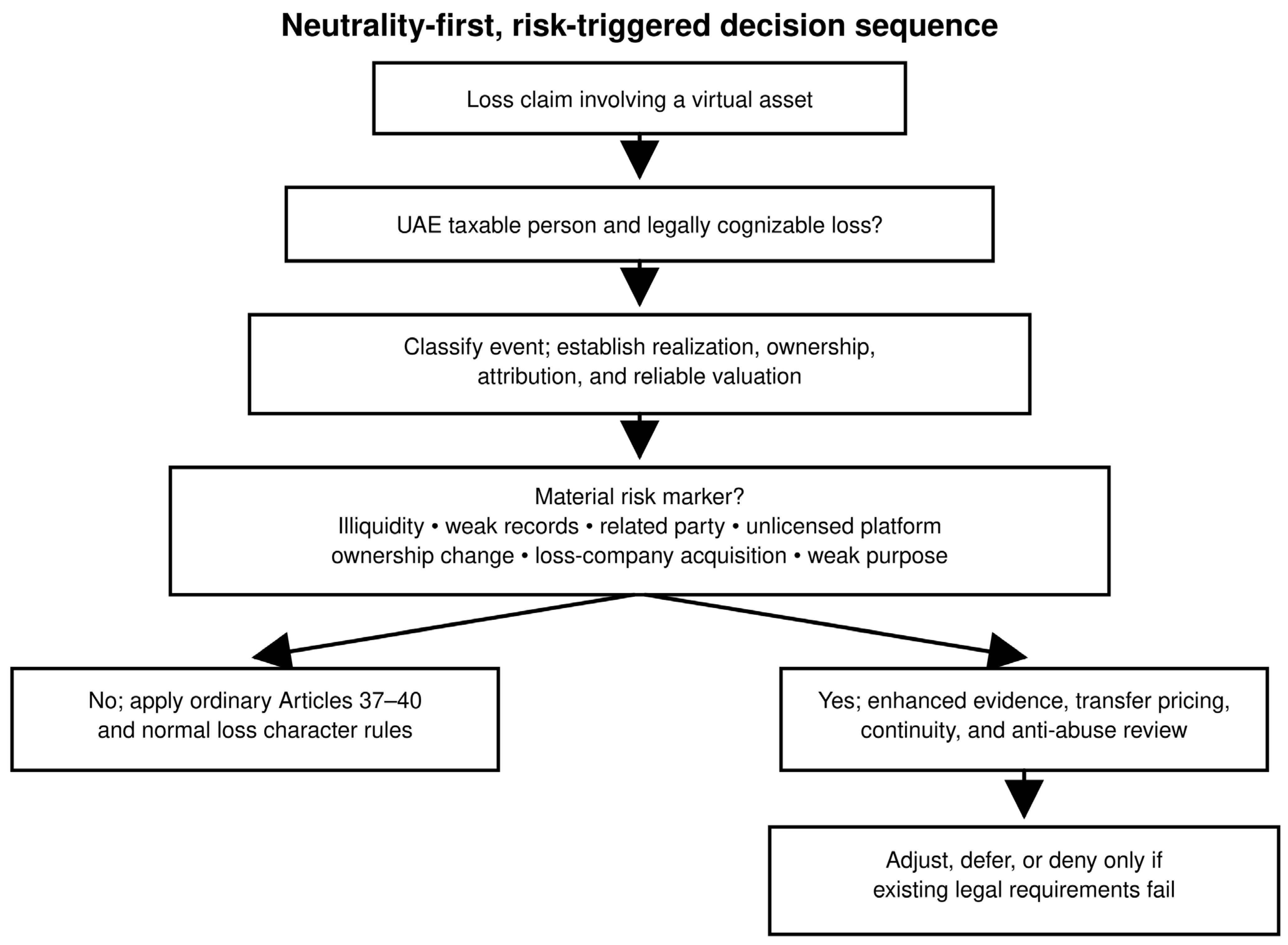
Figure 2 translates these principles into a decision sequence. After confirming that the claimant and loss fall within UAE corporate tax, the decision-maker classifies the transaction and tests realization, measurement, ownership, and attribution. If no material risk marker exists, ordinary Articles 37–40 apply. If a marker exists, enhanced evidence, transfer-pricing, and anti-abuse review follow. Relief is adjusted, deferred, or denied only where the existing legal requirements are not satisfied. The figure deliberately treats asset-specific ring-fencing as a possible future legislative response requiring evidence, rather than an automatic consequence of a virtual-asset loss.
6. Comparative Lessons for UAE Reform
The United States provides a property-based starting point. IRS Notice 2014-21 states that virtual currency is treated as property and that general federal tax principles governing property transactions apply (
Internal Revenue Service 2014). Loss limitations therefore follow generally applicable distinctions—such as capital, ordinary, inventory, business, or personal treatment—not a rule confining digital-asset losses to digital-asset income. Revenue Ruling 2019-24 adds event-specific guidance for hard forks and airdrops (
Internal Revenue Service 2019). The UAE lesson is to clarify taxable events and evidence while preserving ordinary classification unless a separately justified rule is enacted.
The United Kingdom similarly applies existing categories according to the taxpayer’s activity and the asset’s function, including trading profits, intangible fixed assets, and chargeable gains. HMRC’s Cryptoassets Manual explains allowable costs and record requirements but does not create a general crypto-only loss basket (
HM Revenue & Customs 2021). The UAE can use the administrative form of this model—a practical FTA chapter on classification, realization, valuation, custody failures, and records—without importing a substantive restriction that the comparator does not impose.
Singapore provides a fact-and-function model. IRAS guidance distinguishes payment, utility, and security tokens while applying normal income-tax principles and asking whether a receipt or loss is revenue or capital in the taxpayer’s circumstances (
Inland Revenue Authority of Singapore 2020). It does not provide general support for crypto ring-fencing. The UAE lesson is functional classification and coherent treatment of the taxable event, not exceptional treatment based only on the technological form of the asset.
The European Union and OECD demonstrate the importance of information infrastructure. MiCA regulates issuers and service providers, while CARF supports automatic exchange of crypto-asset transaction information (
European Parliament and Council 2023;
OECD 2022,
2023). Neither instrument establishes corporate loss deductibility or a substantive crypto-loss restriction. Their proper use in this analysis is evidentiary: reliable records, beneficial-owner identification, and cross-border transaction data can make ordinary tax rules more enforceable.
International regulatory standards likewise support coordination, not automatic tax disallowance. FSB, IOSCO, FATF, and Basel materials address governance, custody, conflicts, disclosure, prudential treatment, AML/CFT, and supervision (
Financial Stability Board 2023;
International Organization of Securities Commissions 2023;
Financial Action Task Force 2021;
Basel Committee on Banking Supervision 2022). Regulated records may strengthen a loss claim, while missing or contradictory records may increase the taxpayer’s evidentiary burden. Regulatory status and corporate governance are relevant evidence; neither should become a conclusive substantive condition for recognizing an otherwise genuine loss.
Egypt’s five-year carryforward rule, related-party adjustment power, and restrictive cryptocurrency setting provide a bounded comparison (
Egypt 2005;
Central Bank of Egypt 2022). They do not support a dedicated virtual-asset loss basket. For the UAE, the useful lesson is that duration limits and transaction-level anti-avoidance are distinct design choices. Any new time limit or category restriction would require independent UAE justification rather than inference from Egyptian law.
The comparative synthesis yields a neutrality-first sequence. First, classify by legal and economic function. Second, establish realization, ownership, attribution, and independent valuation. Third, use wallet, exchange, custody, and beneficial-ownership records to test the claim. Fourth, apply transfer pricing, continuity, commercial-purpose, and general anti-abuse rules to identify risk markers. Fifth, coordinate tax administration with VASP supervision and CARF reporting. Sixth, reserve new substantive restrictions for demonstrated residual risks and formulate them, where possible, by reference to technologically neutral characteristics such as illiquidity, manipulability, weak documentation, or loss-company acquisition.
Table 4 consolidates these comparative lessons and translates each benchmark into a corresponding implication for UAE virtual-asset tax-loss reform.
7. Findings and Proposed UAE Reform Model
The analysis produces five main findings. First, UAE corporate tax law already contains substantial loss-control architecture: the 75% utilization cap, exclusions for pre-tax and exempt-activity losses, Article 38’s 75% ownership and continuity conditions, the exclusion of Exempt Persons and Qualifying Free Zone Persons from loss transfer, Article 39’s continuity or same-business test, transfer-pricing provisions, and the general anti-abuse rule (
United Arab Emirates 2022b;
Federal Tax Authority 2023). Second, some virtual-asset transactions create heightened measurement and evidentiary risk. Third, the study identifies a prospective legal vulnerability, not an observed UAE abuse pattern or an expressed institutional demand. Fourth, the comparators support guidance and information infrastructure but not a general crypto-loss ring-fence. Fifth, UAE reform should begin with ordinary law plus risk-triggered substantiation.
Neutrality should therefore govern genuine losses. A regulated VASP may usually have stronger records, but a startup, a smaller company, a lawful user of a foreign platform, or a diversified group treasury entity may also incur a real, realized, measurable loss. Conversely, regulated status cannot validate a fictitious or mispriced transaction. The decisive factors are legal entitlement, realization, measurement, attribution, arm’s-length terms, and commercial purpose. Unsupported or abusive claims should be adjusted under existing law; the taxpayer’s sector or business model should not decide the result by itself.
The listed-company exception in Article 39 should not be qualified solely because a loss involves virtual assets. Where a listed taxpayer reports a material loss involving any unusually illiquid, related-party, manipulable, or weakly documented asset, the FTA may reasonably require enhanced disclosure of source, valuation, ownership, and business continuity. This technology-neutral trigger preserves the commercial rationale of the listing exception while allowing ordinary anti-abuse rules to address acquired loss shells or transactions lacking commercial purpose.
The fourth finding is that tax administration should use regulatory data. UAE virtual-asset regulation already requires licensing, risk disclosure, compliance systems, and cooperation with authorities (
United Arab Emirates 2022a;
Dubai Virtual Assets Regulatory Authority 2023). These systems can support tax verification. The Federal Tax Authority should coordinate with SCA, VARA, ADGM FSRA, DFSA, and other competent authorities to verify whether a taxpayer’s virtual-asset activity was licensed, whether the VASP was compliant, and whether transaction records exist. OECD CARF implementation and international exchange of information will further improve the ability to verify cross-border transactions (
OECD 2022,
2023).
Corporate governance should operate as evidence, not as a substantive condition of economic loss. Board approvals, treasury policies, custody safeguards, risk limits, internal controls, and audit-committee oversight can strengthen proof of authorization, ownership, ordinary business purpose, and reliable measurement. Their absence may justify questions, penalties for record failures, or a higher evidentiary burden, but it does not convert a genuine realized loss into a non-existent one. The same principle applies to regulated and unregulated businesses.
The revised reform model has four layers. Layer one is ordinary legal classification by the asset’s function and the taxable event. Layer two is proof of realization, acquisition cost, proceeds, wallet or custodial control, source attribution, and valuation. Layer three is risk-triggered review: related-party dealings, illiquidity, non-independent pricing, self-custody without reliable records, unlicensed platforms, ownership changes, loss-company acquisitions, or missing commercial purpose prompt enhanced transfer-pricing and anti-abuse scrutiny. Layer four is proportionate outcome: ordinary relief where the claim is established; adjustment, deferral, or denial where existing requirements fail; and consideration of a new substantive restriction only if future evidence demonstrates a material residual risk.
Table 5 presents an implementation roadmap led by FTA guidance, disclosure schedules, audit protocols, inter-agency coordination, and safe harbors for immaterial claims. Legislative amendment is placed last and conditioned on an evidence-based review. This sequencing protects the tax base while avoiding unnecessary cost to legitimate innovation, diversified group structures, free zone investment, and the UAE’s competitive position.
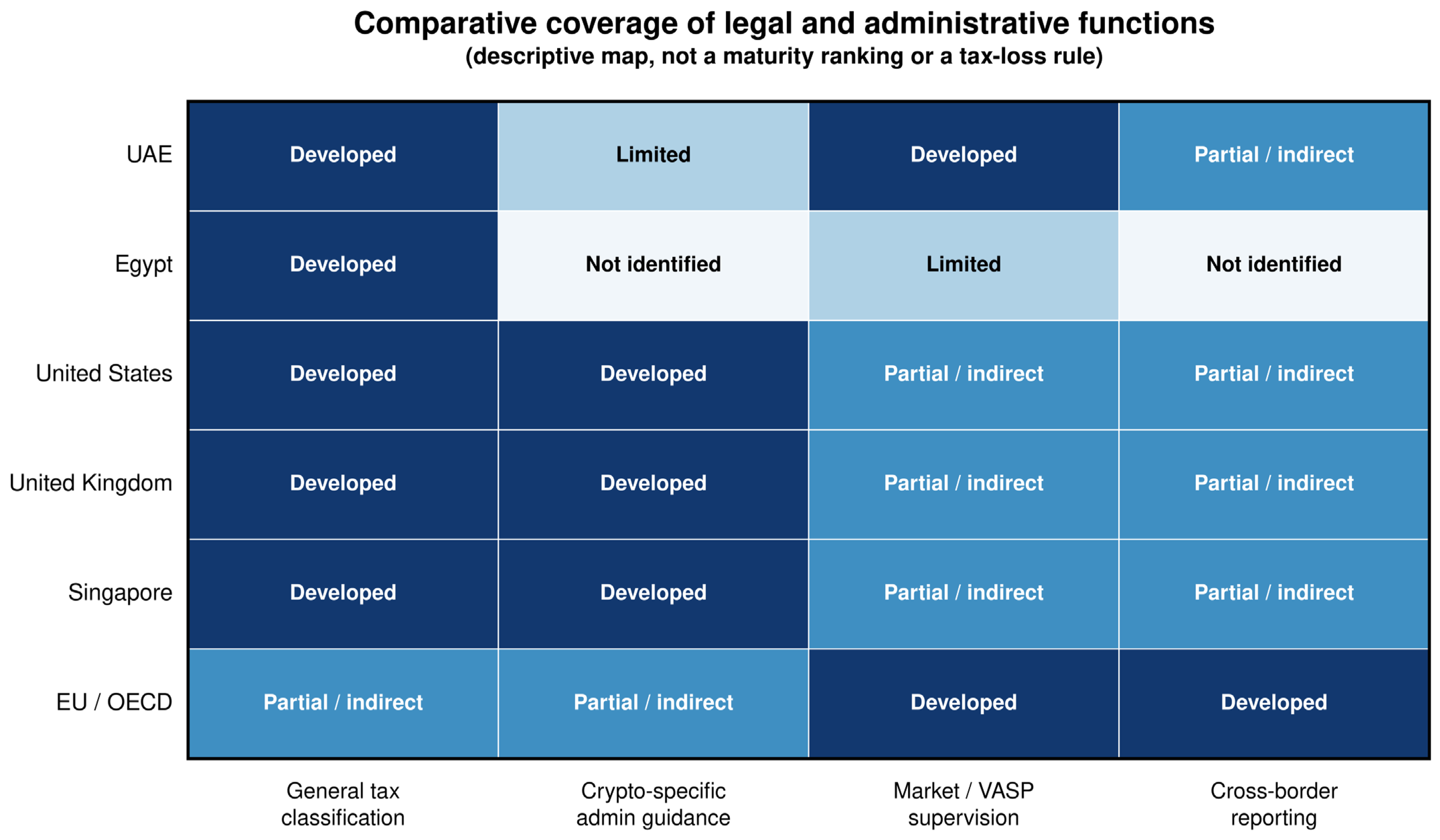
Figure 3 is recast as a descriptive comparative coverage map rather than a maturity ranking. It shows which legal functions the selected systems emphasize—general tax classification, crypto-specific administrative guidance, market supervision, and reporting infrastructure. The map does not score jurisdictions or imply that regulatory instruments establish tax-loss restrictions. Its purpose is to identify administratively useful functions while keeping the normative case for any UAE substantive restriction separate.
8. Implications
The theoretical implication is that virtual-asset loss analysis should combine neutrality with risk-sensitive administration. Loss carryforward is not only computational, but governance evidence must not displace the legal question whether an economic loss exists. The appropriate model separates (i) substantive recognition under ordinary tax law, (ii) the quality of evidence supporting ownership, realization, valuation, and attribution, and (iii) anti-abuse review of transfer or acquisition. This structure can apply to virtual assets and to other illiquid, manipulable, or weakly documented assets.
Corporate taxpayers should prepare reliable evidence before a loss occurs: wallet-control records, reconciled blockchain and accounting data, independent valuation sources, custody terms, related-party documentation, and recovery records. Board-approved policies, risk limits, and regulated intermediaries are prudent and can strengthen credibility, but they are not automatic conditions of deductibility. A claimant must establish acquisition cost, beneficial ownership, realization, attribution, and the amount of loss under the ordinary law.
The Federal Tax Authority should issue a dedicated administrative chapter addressing income recognition, disposal, exchange, mining, staking, airdrops, hard forks, DeFi, tokenized instruments, impairment, theft, valuation, and loss carryforward. The chapter should identify objective risk markers and proportionate evidence, coordinate with virtual-asset regulators, and clarify the Qualifying Free Zone Person interaction. Regulatory classification or licensing should be relevant evidence, not the final answer to tax classification or loss recognition.
Legislative amendment should be considered only after administrative experience shows that guidance, disclosure, transfer pricing, continuity rules, and the general anti-abuse rule leave a material residual risk. Any enabling provision should define objective, preferably technology-neutral triggers and authorize proportionate responses to illiquid, manipulable, related-party, or weakly documented transactions. A crypto-specific ring-fence should not be the default; it would require published UAE evidence, an assessment of competitiveness and compliance costs, and a reasoned explanation of why narrower tools are inadequate.
9. Limitations and Future Research
This study is limited by its doctrinal and comparative design. It uses no taxpayer or exchange data, UAE tax cases, interviews with the Federal Tax Authority, auditor evidence, enforcement patterns, estimated fiscal exposure, or existing UAE legislative proposal for crypto-loss restrictions. It therefore distinguishes three categories: documented legal rules and regulatory records; institutionally identified risks in international materials; and theoretically possible UAE vulnerabilities. The reform model is preventive and conditional, not evidence that abuse has occurred or that UAE institutions demand a more restrictive regime.
Future research should examine how UAE companies currently account for virtual-asset holdings, how auditors verify wallet ownership and valuation, how VASPs preserve transaction records, and how corporate groups structure digital-asset activities. Comparative research across Gulf Cooperation Council jurisdictions would also be valuable because cross-border token activity is likely to involve regional groups, free zones, and foreign exchanges. Another important research direction is the taxation of decentralized finance, where the legal status of liquidity pools, staking rewards, governance tokens, and smart-contract losses remains unsettled. Finally, future studies should analyze the interaction between OECD CARF implementation, UAE tax administration, and VASP reporting obligations.
10. Conclusions
The UAE Corporate Tax Law provides a strong general foundation for loss relief: carryforward, a 75% utilization cap, group-transfer conditions, ownership-continuity rules, transfer pricing, and general anti-abuse control. Article 38 also excludes Qualifying Free Zone Persons from loss transfer. Egypt is one limited benchmark through its five-year carryforward, related-party adjustment power, and restrictive cryptocurrency setting; the United States, United Kingdom, Singapore, EU, and OECD contribute other functional lessons.
The comparative evidence supports a neutrality-first conclusion. Some virtual-asset transactions create heightened problems of realization, valuation, ownership, custody, source attribution, and traceability, but those risks are neither universal across the asset class nor unique to crypto. A genuine, realized, measurable loss should remain subject to ordinary law. Objective risk markers should trigger enhanced proof and anti-abuse review, not presumptive exceptional treatment.
The UAE should begin with FTA guidance, targeted disclosure, transfer-pricing review, technologically neutral risk markers, and coordination with VASP and CARF information systems. Governance arrangements can strengthen evidence but should not become substantive conditions of recognition. Different group businesses, listed status, startup scale, foreign-platform use, or free zone location should not by themselves defeat an otherwise valid loss. Adjustment, deferral, or denial should follow from failure to establish the loss or from application of existing anti-abuse rules.
Ring-fencing, special group-transfer conditions, or special Article 39 rules should be reserved for a later evidence-based stage. Before adopting them, policymakers should identify a demonstrated residual UAE risk, explain why enhanced proof and ordinary safeguards are inadequate, and assess effects on innovation, diversified business groups, free zones, and jurisdictional attractiveness. The study’s contribution is therefore a UAE-focused implementation architecture that integrates tax law, company regulation, accounting evidence, and market supervision while preserving neutrality and proportionality.




 ,
,