1. Introduction
In response to the ever-escalating environmental challenges, the European Union has committed to reducing greenhouse gas emissions by at least 55% by 2030. One of the key mechanisms to achieve this goal is the Carbon Border Adjustment Mechanism (CBAM), established by Regulation (EU) 2023/956 of the European Parliament and of the Council, as amended by Regulation (EU) 2025/2083 of the European Parliament and of the Council of 8 October 2025.
Since the adoption of Regulation (EU) 2023/956, the legal framework governing the CBAM has undergone several significant amendments. The most substantial change was introduced by Regulation (EU) 2025/2083, which implemented the simplification of the CBAM framework with effect from 1 January 2026. The amendment to the original 2023 Regulation introduced a single annual threshold of 50 tonnes for goods subject to the CBAM. It also revised the reporting obligations and amended the timetable for the submission of CBAM certificates. Unless otherwise indicated, this article analyses the CBAM within the legal framework applicable before 1 January 2026.
The primary objective of the CBAM is to reduce global greenhouse gas emissions through economic incentives aimed at third countries to adopt stricter environmental policies (
European Commission 2025). Based on Professor Mehling’s arguments, it is clear that the CBAM is not primarily protectionist in nature, but its aim is to put pressure on other states to adopt stricter environmental laws, following the example of the EU. In this context, he draws attention to the possible emerging tensions in trade policy and the risk of retaliatory measures in accordance with public international law by non-EU countries. In terms of environmental effectiveness, however, the effectiveness of the CBAM is contingent upon the accuracy of embedded emissions measurement, the scope of the sectors covered, and coordination with global climate policies.
The aim of this article is to provide a comprehensive overview of the Carbon Border Adjustment Mechanism (CBAM) in terms of its legal nature, environmental implications, as well as customs-law implications at the intersection of international trade law, customs law and environmental protection. Particular attention will be paid to its compliance with the rules of the World Trade Organisation (hereinafter referred to as “WTO”) and its effectiveness in accordance with environmental regulations.
From a customs law perspective, this represents a fundamental paradigm shift, as customs authorities are assuming a new regulatory and administrative role in the implementation of the CBAM, particularly through import controls, verification procedures, and cooperation with the competent national authorities. This transformation raises questions about the effectiveness of environmental regulation.
1.1. Research Methodology
The present article focuses on the doctrinal analysis of the CBAM. The legal analysis was based on Regulation (EU) 2023/956 as amended by Regulation (EU) 2025/2083 together with the related implementing and delegated legislation governing the final phase of the CBAM. Given its nature, the CBAM gives rise to several theoretical legal and practical legal questions. In the present article, we specifically focused on (1) the question of the legal nature of the CBAM; (2) the assessment of potential incompatibility with WTO law; (3) the analysis of the procedural aspects of the implementation of the CBAM with regard to the legal status of customs authorities; and (4) the consequences for global trade management and climate policy. Given the qualitative nature of the issue under examination, the methods of doctrinal legal research were employed.
Initially, the research employed a literature review method and a descriptive–analytical method, through which the relevant academic literature was systematically analysed. The analysis of the relevant literature allowed the identification of various theoretical approaches to the legal qualification of the CBAM, as well as to the issue of its legitimacy in the context of WTO rules. However, legal analysis was used as the main methodological approach.
The subject of the analysis comprised the provisions of relevant legal acts, international treaties, and other legal sources. The analysis of the relevant legal sources was conducted to identify the legal nature of the CBAM, its systematic incorporation into EU law and determining its character from the point of view of international trade law and customs law. The research focused on interpretative criteria relating to the prohibition of discrimination, proportionality of environmental measures, flexibility of regulatory mechanisms and the application of exceptions under Article XX GATT. Through the analysis of case law, it was possible to identify the fundamental limits of environmental regulation within the international trade system and subsequently apply them to the CBAM under examination.
The authors of the article also used a comparative method. The comparative method analysed the approaches of the European Union, the United States of America and Canada to the implementation of carbon or environmental trade policy measures. The comparison focused on the methodology for calculating carbon-related costs, the scope of regulated sectors, the powers of national authorities and the degree of compatibility of individual models with WTO rules. The aim of the comparison was to identify common features and differences in environmental trade policy instruments and to assess the risk of fragmentation of international trade law, which would have negative consequences for international trade law and the sustainable management of international trade.
The research also used the method of legal induction, which, based on a legal analysis of relevant regulations and case law, allowed for the assessment of the potential environmental, economic and trade-policy consequences of the implementation of the CBAM mechanism. The study focused mainly on the impacts on the competitiveness of European industry, the risk of trade disputes, the administrative complexity of implementing the mechanism, as well as the potential negative consequences for developing economies.
1.2. Literature Review and Discussion
The Carbon Border Adjustment Mechanism (CBAM) has emerged as a significant subject at the intersection of international trade law, environmental law, and European Union law. It may be observed that, notwithstanding the rapid development of academic discourse following the adoption of Regulation (EU) 2023/956 of the European Parliament and of the Council, which established the first comprehensive mechanism of its kind at the global level, the academic literature addressing the legal nature of the CBAM remains relatively limited. Existing academic contributions primarily focus on three principal areas: the legal character of the CBAM, its compatibility with the rules of the World Trade Organisation (WTO), and its environmental and economic effectiveness.
Within the legal doctrine, several theoretical approaches to the legal characterisation of the CBAM may be identified. A significant number of authors conceptualise the mechanism primarily as an environmental regulatory instrument designed to prevent carbon leakage and to promote the global decarbonisation of industry. A particularly influential contribution has been made by Mehling and Pirlot, who argue that the CBAM cannot be understood solely as an instrument of trade policy but rather as an integral component of the European Union’s climate policy. Mehling emphasises that the principal objective of the CBAM is to eliminate distortions arising from differences in national climate policies and to ensure a level playing field between domestic and foreign producers.
Authors have also identified a research gap concerning the compatibility of the CBAM with WTO law. Legal doctrine generally proceeds on the assumption that the mere existence of environmentally motivated trade measures is not incompatible with WTO law, provided that such measures are applied in a non-discriminatory and proportionate manner. Authors such as van Asselt contend that CBAM should primarily be assessed in light of the principles of national treatment and the prohibition of arbitrary discrimination under Articles I and III of the General Agreement on Tariffs and Trade (GATT). At the same time, they underline the importance of the general exceptions contained in Article XX GATT, which permit the adoption of environmental measures for the protection of human, animal or plant life or health, as well as the conservation of exhaustible natural resources. The authors also highlight the relevance of production methods, which may influence the environmental impact of otherwise similar products (
Weckenborg et al. 2024).
A more critical strand of the literature draws attention to the potentially protectionist character of the CBAM. Authors such as Bachmann and FJG Nellen highlight the considerable administrative complexity of the mechanism, the challenges associated with calculating embedded emissions, and the risk of imposing a disproportionate regulatory burden on foreign economic operators. They particularly criticise the limited recognition of non-pricing climate measures adopted in third countries and the restricted scope for acknowledging foreign carbon pricing mechanisms.
The literature also addresses practical challenges relating to the implementation of the CBAM. Mehling and Ritz argue that the effectiveness of the mechanism depends upon the accurate determination of the embedded emissions contained in traded goods. In their view, reliance on default emission values may distort the economic rationale underlying carbon pricing and diminish the incentive effect of the mechanism. They further emphasise that an improperly designed methodology for measuring emissions may give rise to legal disputes under the WTO dispute settlement system.
The foregoing demonstrates that the existing academic literature does not provide a uniform view regarding the legal and economic nature of the CBAM. While some strands of legal doctrine conclude that the mechanism may, subject to certain conditions, be compatible with WTO law, they simultaneously identify several implementation risks, particularly those relating to the principle of non-discrimination, the methodology for calculating embedded emissions, and the position of developing countries. The literature further suggests that the CBAM represents a fundamental shift in the relationship between environmental regulation and international trade, and that its future development is likely to play a decisive role in shaping the evolution of global climate policy (
Olasehinde-Williams and Akadiri 2025;
Yu et al. 2021). Moreover, the literature highlights the growing need to strengthen environmental competencies, commonly referred to as green skills, among customs authorities responsible for the implementation and enforcement of the CBAM framework (
Kuko 2025).
2. Legal Framework of the Carbon Border Adjustment Mechanism
The CBAM was established by Regulation (EU) 2023/956 as one of the key instruments supporting the European Union’s climate policy. The Regulation introduced a legal framework designed to address the risk of carbon leakage by ensuring that imported goods are subject to a carbon pricing mechanism comparable to that applicable to products manufactured within the European Union.
The implementation of the CBAM was divided into two phases. The first phase, referred to as the transitional period, lasted until 31 December 2025. During this period, importers were required to submit reports on the embedded emissions of imported goods but were not yet required to purchase and surrender CBAM certificates.
Before the commencement of the second phase, the CBAM framework was substantially amended by Regulation (EU) 2025/2083. Among the most significant amendments was the introduction of a single annual threshold of 50 tonnes for goods subject to the CBAM. The amendment also revised the reporting obligations and the requirements relating to the submission of annual CBAM declarations. These changes form part of the legal framework applicable from 1 January 2026.
From a legal–theoretical point of view, the question arises whether the CBAM constitutes a duty within the meaning of Article II of the GATT, or whether it is an internal measure regulated by Article III of the GATT. Legal doctrine in the field of international trade law generally considers that the CBAM has the character of an internal regulatory measure that is applied at borders and therefore must meet the requirements of non-discriminatory treatment (
Pirlot 2021, pp. 25–52;
Leonelli 2022, pp. 696–714). When researching the CBAM in the context of the conceptual features of a duty and an internal measure, it is necessary to analyse and compare the principle of national treatment (Article III of the GATT), the most-favoured-nation principle (Article I of the GATT) and the exceptions listed in Article XX of the GATT.
According to Article I of the GATT, import duties and fees imposed by individual states under a preferential regime are also obliged to be imposed by states on other subjects of international trade if the same products are involved. In this context, we would like to point out that the abolition of customs duties between the Member States results from the establishment of the customs union under Articles 28–32 of the Treaty on the Functioning of the European Union, rather than from the Schengen acquis. While the Schengen area concerns the abolition of controls at internal borders and the free movement of persons, the customs union establishes a common customs territory in which customs duties between the Member States are prohibited and a Common Customs Tariff is applied in respect of imports from third countries.
The above does not apply to third countries to which the above provision cannot naturally apply if it concerns trade with an EU Member State or the EU as a whole. Therefore, it is clear that the CBAM is applied to imports from third countries whose environmental regulation does not reach the level of regulation in the EU. In the above context, an interpretation of Article II of the GATT is necessary, which legalises the imposition of duties and fees that apply to a similar product at the national level. EU secondary legislation (regulations and directives) regulates strict environmental requirements, which are reflected in the final price of goods produced in the Union (
Olasehinde-Williams and Akadiri 2025). The reaction to increased environmental standards is subsequently the relocation of production to countries with more ambivalent environmental regulations, which results in the “effective import” of carbon emissions (
Yu et al. 2021). Based on the above and in accordance with Article II, paragraph 2(a), the application of the CBAM is therefore permissible, or may be permissible. This particularly applies in the context of Article II, paragraph 2(a), which does not automatically justify the CBAM, but only allows for the imposition of a charge on imports corresponding to an internal tax or other internal charge, provided that certain conditions are met. Whether the CBAM meets these conditions is determined only by an analysis under Article III GATT (national treatment) or a subsequent analysis of Article XX GATT.
It is Article III of the GATT that provides for the possibility of applying the “WTO compatibility test.” In accordance with Article 3(1), it is necessary to answer the question of whether the CBAM is an instrument for protecting domestic products or is only intended to equalise the costs between domestic and imported products. In this context, it is necessary to emphasise that the CBAM balances the disparity in environmental requirements for production, thereby fulfilling the requirements of a regulatory instrument in ensuring the same rules for entities participating in economic competition on the supply and demand sides in business and consumer relations. The second part of the “WTO compatibility test” is the question of whether they are so-called “like products”. From the WTO decision-making -Japan—Alcoholic Beverages II (
WTO 1996a) (it can be stated that the fundamental criteria for assessing “like products” are considered to be the physical properties of the products, their end use, consumer preferences and customs classification. The above calculation is not final, and the WTO allows its extension (European Communities—Measures Affecting Asbestos and Asbestos-Containing Products WT/DS135/AB/R (2001)). Despite the above, WTO case law has not yet provided a clear answer to the question of whether the carbon intensity of production processes (carbon-related PPMs) can represent a separately relevant criterion when assessing ‘like products’ under Article III of the GATT. Therefore, it may be argued that doctrinal recognition of carbon-related PPMs as an independent criterion for assessing the compatibility of the CBAM with Article III of the GATT is not possible.
Given that WTO case law has not yet clearly determined whether the CBAM is incompatible with the obligations laid down in Article III of the GATT, it is necessary to examine,
obiter dictum, whether the mechanism may be justified under Article XX of the GATT. The environmental exceptions set out in Articles XX(b) and XX(g) of the GATT are potentially relevant to the assessment of the compatibility of the CBAM with WTO law. Whereas Article XX(b) concerns measures necessary to protect human, animal or plant life or health (
Kaufmann and Weber 2011), Article XX(g) applies to measures relating to the conservation of exhaustible natural resources. In view of the climate-related objectives pursued by the CBAM, both provisions may become relevant depending on the legal characterisation of the mechanism and the manner in which it is implemented. It is beyond dispute that the CBAM mechanism is also intended to protect human life and health in the context of the right to a healthy environment (e.g., Convention on Access to Information, Public Participation in Decision-making and Access to Justice in Environmental Matters).
As
Mehling and Ritz (
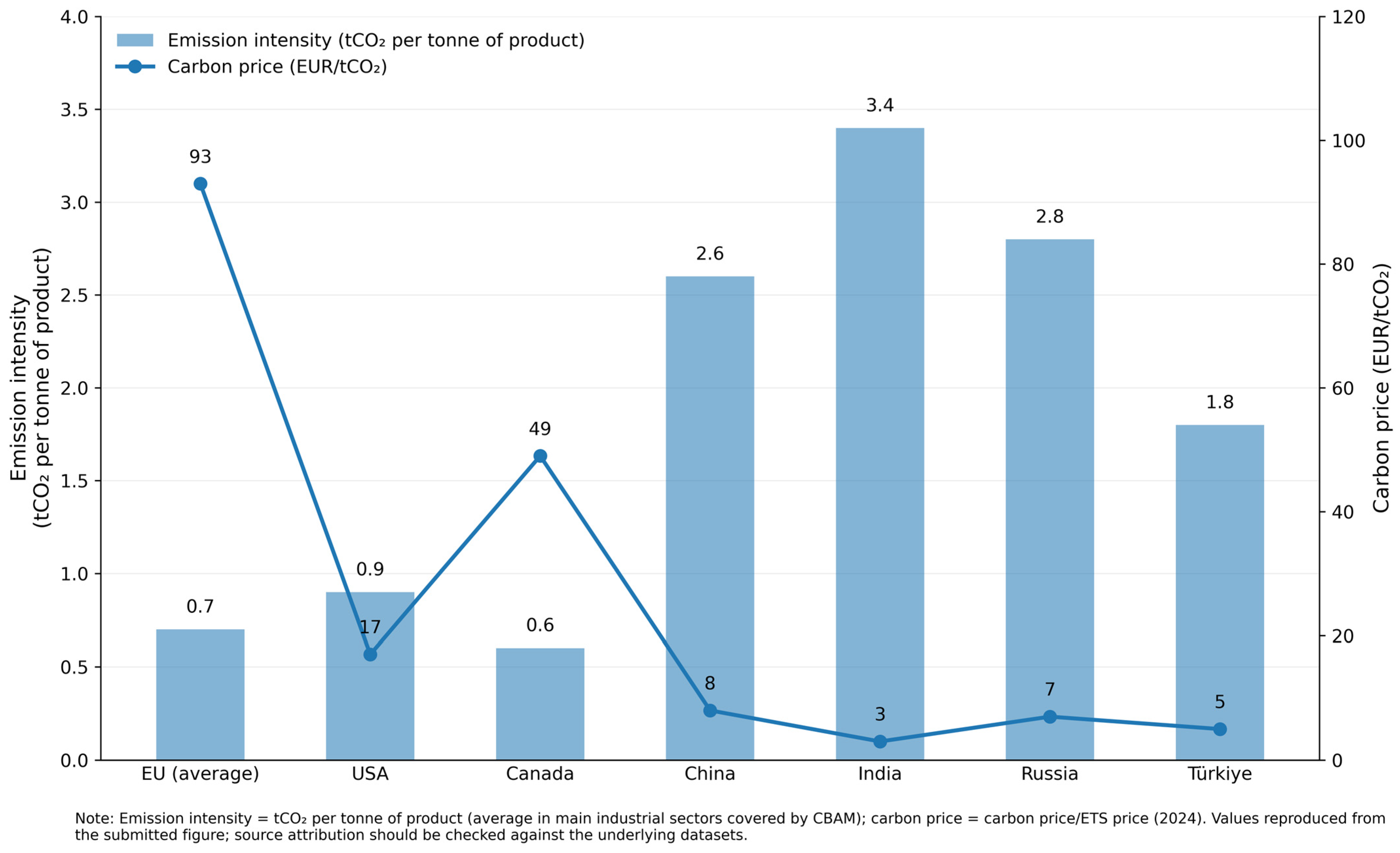
2023, pp. 123–33) point out, there is a risk of discrimination between domestic and foreign producers, mainly due to different emission calculation methods. While domestic producers are subject to the EU ETS system based on real emissions, foreign importers can be assessed on the basis of standardised values. The comparison of carbon prices between the EU ETS and emission intensity in third countries is presented in
Figure 1.
This difference can be considered a violation of the principle of equal treatment under the General Agreement on Tariffs and Trade (GATT). The opposing line of argument is the theory supporting the compliance of the CBAM with international trade law, based on the absence of an explicit prohibition on discrimination based on process and production methods (PPMs). The science of international trade law points out that environmental measures based on PPMs can be legitimate and legal as long as they pursue a legitimate environmental protection objective and comply with the principle of proportionality (
Pirlot 2021, pp. 25–52). A practical legal aspect confirming the theory of the CBAM’s compliance with international trade law is the principle of taking into account the carbon fee paid in the country of origin. Such a process naturally reduces the risk of double taxation, thereby confirming the legality of the CBAM.
The CBAM constitutes a specific regulatory instrument of a hybrid nature, exhibiting the characteristics of both an environmental tax and a regulatory (policy) instrument. As a regulatory (policy) instrument, it is designed to prevent carbon leakage by applying a carbon price to imported goods based on their carbon footprint. Its objective is to ensure that imported goods comply with environmental standards comparable to those applicable to products manufactured within the European Union (Goldwin Olasehinde–Williams). Its hybrid nature is further reflected in the fact that the CBAM exhibits certain characteristics of an environmental tax, which may be regarded as an indirect economic instrument for achieving environmental objectives through the reduction in environmental burdens (
Csikosova et al. 2019).
In addition to the foregoing, it may be observed that, in the form in which it has been adopted, the CBAM also constitutes a particular type of trade policy measure (
Mehling et al. 2019, pp. 433–81). Its hybrid nature is also manifested in the fact that the CBAM functions as a trade policy measure, since its application is exclusively linked to the import of goods into the customs territory of the European Union.
Following the above WTO law analysis, the example of steel production may be used to illustrate, in the broader context, how differences may arise in relation to the concept of “like products”. Products possessing identical physical characteristics may nevertheless be manufactured under fundamentally different environmental conditions. Notwithstanding the traditional interpretation of “like products” in WTO jurisprudence, the issue of process and production methods (PPMs) remains unresolved. The CBAM is based on addressing market distortions arising from the operation of the EU Emissions Trading System (EU ETS) within the European Union and the insufficient environmental regulation, or complete absence of such regulation from the perspective of the European Union, in third countries.
Empirical evidence clearly supports this proposition. According to Hasanbeigi’s methodology, the average carbon intensity of crude steel production in China amounted to 2148 kg CO
2 per tonne of crude steel, whereas in Germany it was 708 kg CO
2 per tonne of crude steel. For the sake of completeness, corresponding figures for Mexico and the United States were 1708 kg CO
2 and 1736 kg CO
2 per tonne of crude steel, respectively (
Hasanbeigi et al. 2016). These differences are not attributable to the nature of the product itself but rather to differences in production methods, in particular between blast furnace–basic oxygen furnace (BF–BOF) technology and electric arc furnace (EAF) technology (
Weckenborg et al. 2024). Having regard to these statistical data, the possibility of applying the CBAM as an instrument for addressing market distortions, while simultaneously contributing to environmental protection beyond the European Union, cannot be excluded. From this perspective, the CBAM may be understood as a mechanism that does not assess the product itself but rather internalises the external environmental costs generated during its production outside the European Union.
European Union. According to the explanatory memorandum to EU Regulation 2023/956, customs authorities have the infrastructure, control mechanisms, as well as the necessary experience in the field of so-called “green skills” necessary for the management of cross-border obligations when importing and exporting goods. According to the currently valid Article 46 of the Customs Code (Regulation 952/2013), customs authorities carry out activities such as collecting data and information, analysing and assessing risks, determining and adopting measures also for the purpose of protecting environmental standards applicable in the EU (
Kuko 2025). For the above reasons, the CBAM is implemented through a customs procedure, while the importer is obliged to declare the amount of embedded emissions and submit the so-called CBAM certificate.
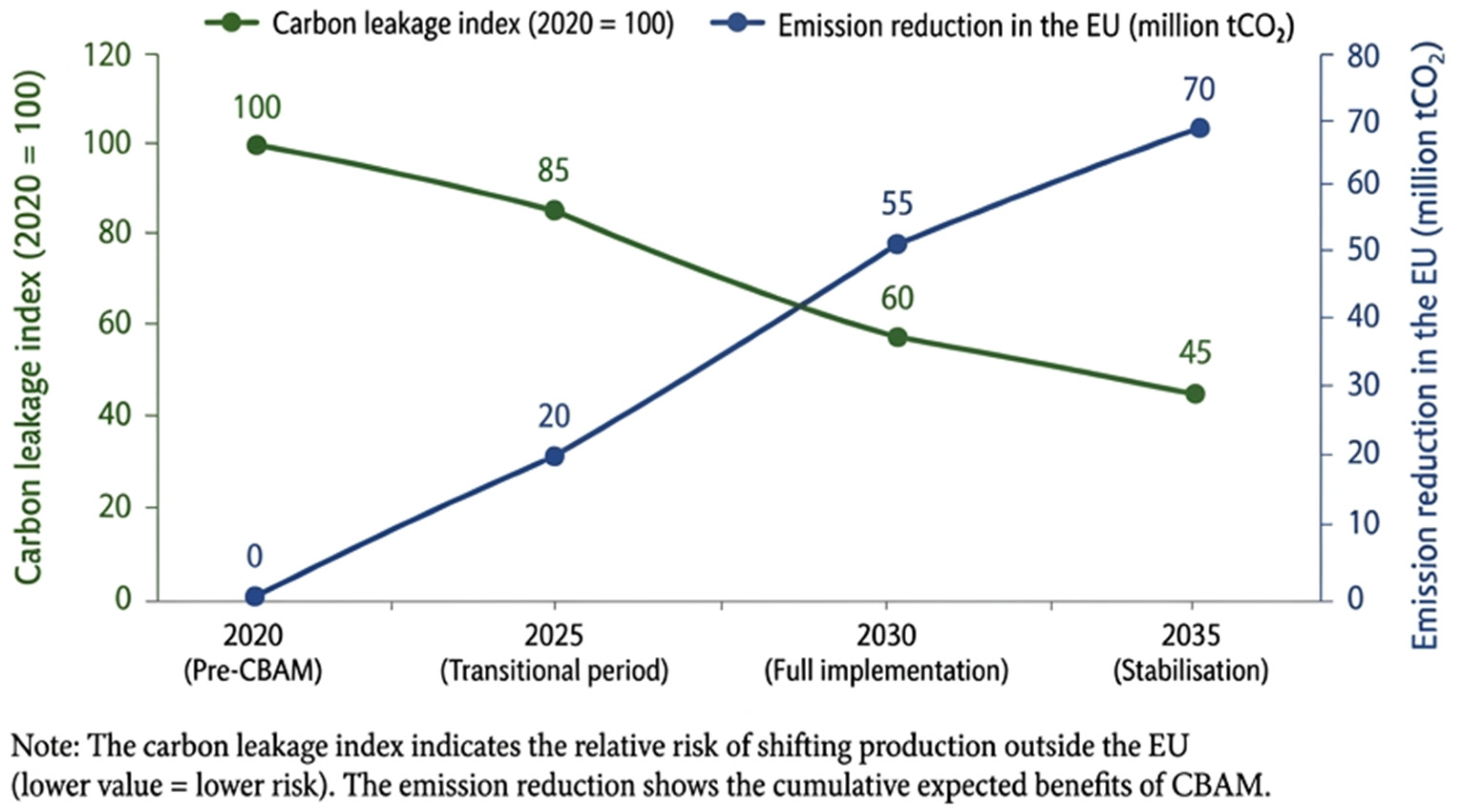
The CBAM faces regulatory limits as well as potential environmental consequences. The CBAM has the potential to significantly contribute to reducing global emissions, as its main benefits are the elimination of so-called carbon leakage, stimulating third countries to adopt climate standards, as well as protecting the competitiveness of the European economy (
European Commission 2025). The expected impact of CBAM on preventing carbon leakage in the EU is illustrated in
Figure 2.
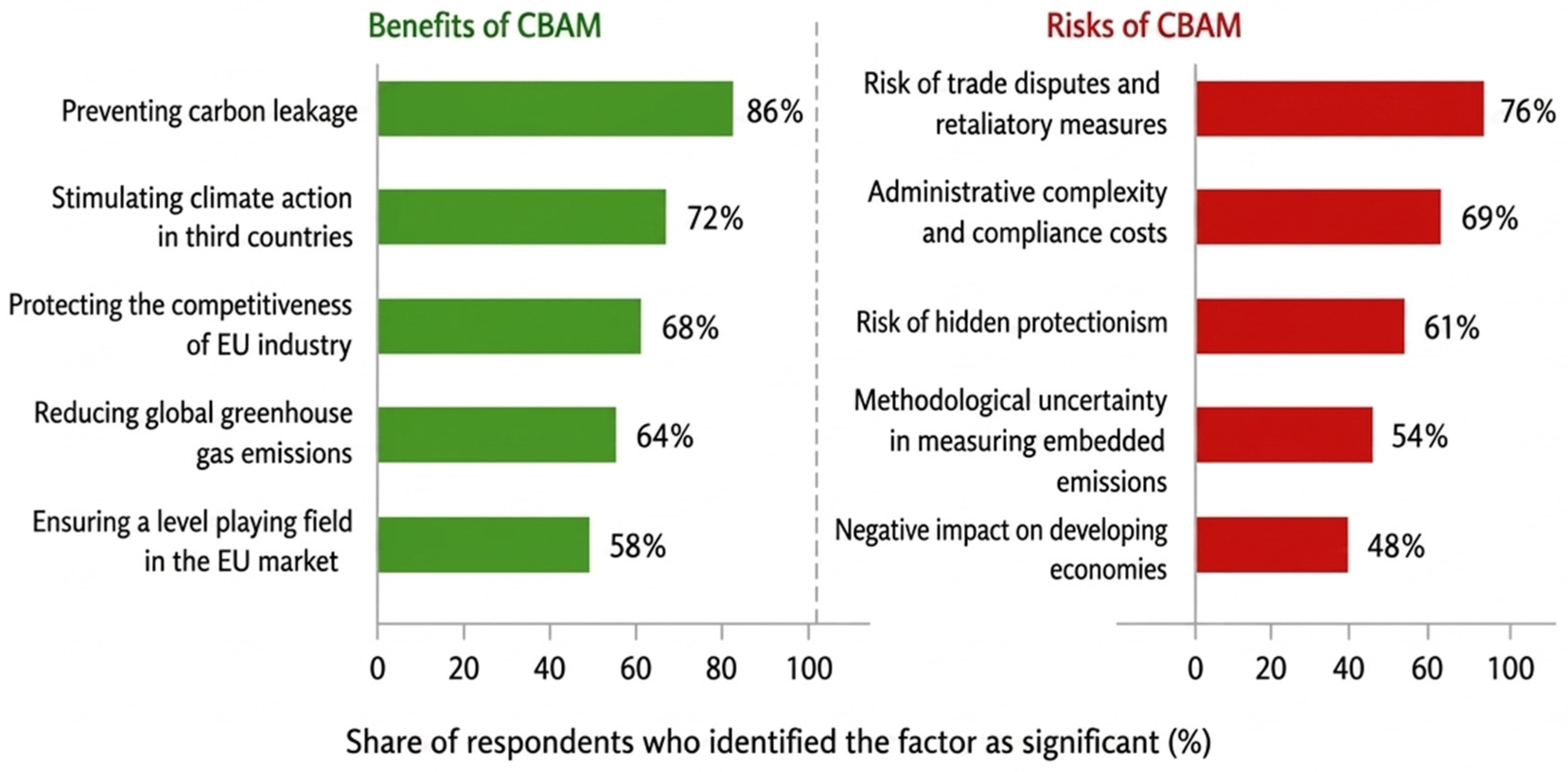
The main risks include trade disputes and retaliation from other major economies, such as China or India, administrative burdens and, last but not least, the risk of circumventing the CBAM itself. The key benefits and risks associated with CBAM are summarized in
Figure 3.
Although the CBAM represents an ambitious and innovative environmental regulation tool, its implementation is accompanied by several economic and systemic risks.
One of the risks is the so-called hidden protectionism, as one of the most common objections is the claim that it is a form of so-called green protectionism (
Lim et al. 2021, pp. 1–18). The claim that the mechanism actually serves to protect European industry from cheaper imports from countries with lower environmental standards (
Marcu et al. 2020, pp. 1–67) is often made at the political level. This argument is based mainly on the fact that the CBAM applies exclusively to imports, not exports, as well as on the fact that domestic producers are gradually deprived of free emission quotas, while the application of the CBAM creates an asymmetry in the administrative burden between domestic and foreign entities. From the perspective of international trade law, the fact that the CBAM increases the costs of foreign producers, which negatively affects their competitiveness on the European Union market, may be particularly problematic. On the other hand, it is essential to mention that the CBAM is designed as a complement to the EU ETS and its aim is to ensure a level playing field.
Another critical argument is the method of calculating embedded emissions. The CBAM allows in certain cases to use standardised values that may not reflect the actual production conditions of a particular producer. However, this calculation may violate the principle of individual assessment as established in international trade law in the US—Shrimp case. This means that even if the system were formulated neutrally, a lack of flexibility may lead to de facto discrimination, which would constitute a violation of international trade law (
Pirlot 2021, pp. 25–52). An equally important, critical argument is the issue of the burden of proof, as the importer is obliged to prove emissions, which can be difficult in practice to determine, control and calculate by customs authorities. In addition to the above arguments, there are also critical economic arguments related mainly to global justice. Developing countries argue that the CBAM does not reflect the principle of common but differentiated responsibilities, increases their export costs and limits their economic development. The CBAM can negatively affect export-oriented economies, especially in Africa and Southeast Asia (
Marcu et al. 2020, pp. 1–67).
Developing countries cannot be considered a homogeneous group in terms of the impacts of the CBAM. The most significant impacts can naturally be expected in those countries whose exports to the European Union are primarily oriented towards sectors that are carbon-intensive and are included in Regulation 2023/956. Such sectors include mainly the production of steel, cement, aluminium and fertilisers. Vice versa, other developing countries that have diversified their economies or are characterised by a lower export share to the European Union will be affected by the CBAM mechanism to a lesser extent (
Magacho et al. 2023). A special group is represented by the least developed economies that are characterised mainly by limited investment potential and high dependence on the export of primary commodities or industrial products. In the case of these economies, the introduction of the CBAM can threaten competitiveness on the European Union market and indirectly limit their economic development (
Lin and Zhao 2024). A specific group of countries is India, Brazil, Indonesia, Malaysia, as these countries are among the major producers of greenhouse gas emissions, but they are gradually introducing their own regulations in the area of trading in emission quotas, as well as excessive carbon generation (
Stek et al. 2025). These countries, including China, are a group where it is impossible to argue about limiting their economic development, since their export competitiveness is based on lower environmental standards, which is also associated with lower production costs of their products intended for export (
Li et al. 2025). It follows from the above that the issue set by the “WTO compatibility test” on the compliance of the CBAM mechanism with international law must be assessed individually for all developing countries.
Jurisprudence of international law (
de Stefano 2026, pp. 276–88), however, points to the inconsistency of Regulation 2023/956 with the international climate protection regime based on the Convention on Climate Change and the Paris Agreement. Regulation 2023/956 insufficiently reflects the application of the principle of common but differentiated responsibilities and respective capabilities (CBDR-RC), which is one of the basic principles in international environmental law. The essence of the above-mentioned principle is the common but differentiated responsibilities of all states for environmental protection, which stems from the historical and economic circumstances of individual states. Less developed countries do not benefit from strict environmental standards, as such standards may hinder their further development and economic growth, which may be inconsistent with international trade law. In other words, because the CBAM does not provide a sufficiently clear preferential framework for developing economies, such developing countries may initiate dispute settlement proceedings within the WTO by requesting consultations under the Dispute Settlement Understanding (DSU), followed, where appropriate, by the establishment of a panel to assess the consistency of the CBAM with WTO law. For the sake of completeness, the WTO does not have the power to annul legislation or interfere with EU law, but it can find that specific parts of the Regulations are not in accordance with the GATT (within the meaning of Article 3(2) and Article 19(1) of the Dispute Settlement Understanding (hereinafter referred to as the “DSU”).
Given the outlined contradictory views in the theory of international trade law in connection with the assessment of the compliance of the CBAM with international trade law, it is necessary to point out the relevant case law. In the case of United States—Gasoline, the World Trade Organisation stated that environmental measures may be legitimate, but their application must not be discriminatory (
WTO 1996b, WT/DS2/AB/R). Another relevant case is United States—Shrimp, in which the WTO recognised regulation based on production processes, but only on the condition that the assessment of such processes will be flexible and individual (
WTO 1998, WT/DS58/AB/R). In the case of European Communities—Asbestos—the relatively broad possibilities of state regulation for the purpose of protecting health and the environment were confirmed, which in the context of European Union law significantly supports the legitimacy of the CBAM (
WTO 2001, WT/DS135/AB/R). The carbon border compensation mechanism must be consistent with the internal policies of the European Union (in particular in relation to the EU ETS) in order to maintain the principle of proportionality and consistency, as clarified by the World Trade Organisation in the Brazil—Retreaded Tyres case (
WTO 2007, WT/DS332/AB/R).
Based on the case law examined, it can be provisionally stated that the CBAM appears to be compatible with international trade law and is generally consistent in line with EU law. A conflict with international trade law could only arise in a situation where the way it is implemented within the existing customs structures in the individual Member States of the European Union is not in line with the focus of Regulation 2023/956 itself.
We believe that the CBAM is an important tool for eliminating the shift in production from EU Member States to third countries with lower environmental standards, while at the same time motivating third countries to adopt stricter climate standards in order to increase their own gross domestic product. Last but not least, we believe that the CBAM is an instrument for reducing global greenhouse gas emissions, as the European Union is one of the largest trading blocs in the world (
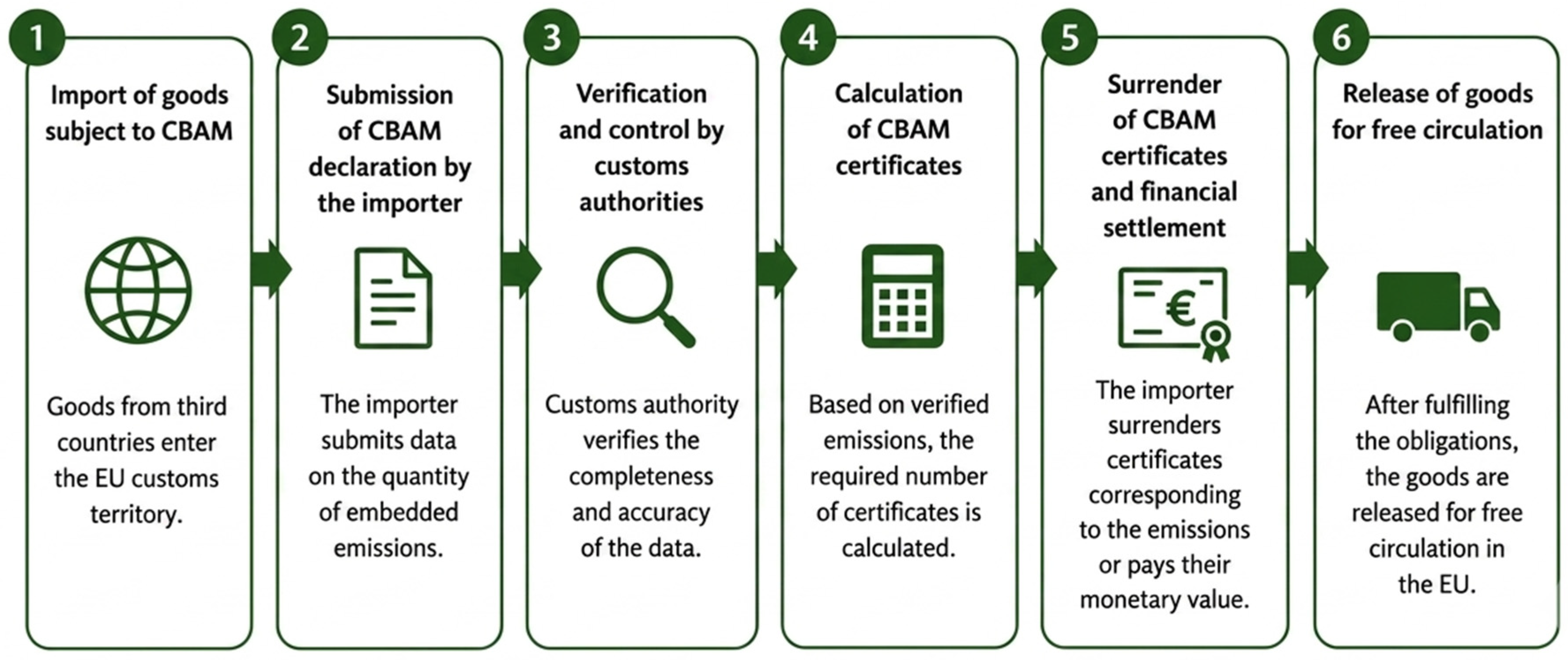
European Commission 2023). The CBAM mechanism within the customs procedure and its main procedural steps are illustrated in
Figure 4.
3. Procedural Aspects of the CBAM in Customs Procedures
Proper implementation of the CBAM necessarily requires the transformation of procedural practices throughout the entire customs procedure.
We believe that customs authorities were not prepared for the full implementation of the CBAM at the time of the entry into force of Regulation 2023/956. Science and practice understand customs law as a tool for collecting duties and other fees in order to ensure trade policy (
Prievozníková 2008, pp. 10–11). For historical context, it should be noted that the collection of taxes and other charges was similar in the territory of the former Kingdom of Hungary as well (
Štenpien 2008, p. 9). The CBAM introduces a new and completely different type of obligations, which are of a financial nature, but their basis lies primarily in environmental regulation (
Rodrigues Aldeia 2025, pp. 85–101). In other words, the importer of goods subject to CBAM is obliged to submit a declaration containing data on the amount of emissions, and these data must be verified on the basis of specific methods set out in Regulation 2023/956. The application of the CBAM represents a fundamental shift from traditional customs procedures, which are by default based mainly on quantitative data on goods (
Wirdyansyah 2025, pp. 162–76).
From a procedural point of view, several theoretical and application questions arise. These are mainly questions related to the burden of proof, since the responsibility for proving the correctness of the emission data lies solely with the importer (
Marín Durán 2023, pp. 73–103). This means that there is no joint and several liability between the importer and the manufacturer. In practical terms, this means that the importer should have comprehensive and truthful data on the production process in the third country, which will pose problems especially in the case of global supply chains with multiple interconnected entities, as the CBAM imposes an obligation on all importers to monitor, report and verify emissions (
André and Pirlot 2024, pp. 305–25).
Another issue is the aspect of control and verification of data by customs authorities. By default, customs authorities are not entities with expertise in the field of environmental auditing, which will result in either the creation of new national institutions or close cooperation with existing institutions, for example, at the level of the European Union, represented by the European Environment Agency (
Bachmann and Nellen 2025, pp. 519–30). We believe that the creation of new authorities would, however, naturally lead to an increased administrative burden, as well as to a prolongation of customs procedures, which may affect interest in goods originating from countries outside the European Union Member States, and thus also limit consumers’ rights to choose goods. A special procedural issue is the submission of remedies, the existence of which was also assumed by Regulation 2023/956 itself. Decisions regarding the CBAM will have a significant financial impact on importers, and it is therefore essential to ensure effective and expeditious judicial protection mechanisms (
Meyer and Tucker 2021, pp. 109–20).
To create an overall picture in international trade law, it is also appropriate to compare the CBAM with other mechanisms of third countries, which are not as developed and precise as the CBAM, but their goal is similar. For comparative purposes, it is worth noting the legislative efforts in the USA or Canada, which are considering similar instruments. Legislative proposals have been introduced in the USA (American Action Forum), which would establish a system similar to the CBAM in the future; however, these proposals have not been fully implemented at the federal level. The US approach to introducing taxes and fees in an environmental context is characterised by a greater emphasis on protecting domestic industry, which may, once implemented, be inconsistent with WTO rules. This applies, for example, to the introduction of a tax on “GHG emissions” (
Flannery et al. 2018, pp. 1–18). Similar efforts can also be identified in Canadian policy; however, Canada is considering a model similar to the CBAM, particularly with regard to the basic methodologies for carbon pricing. For the sake of completeness, we add that in Canadian policy, it is primarily about agricultural products (
Rivers and Schaufele 2014, pp. 235–57), while in the EU, the primary objective of the CBAM is to regulate the import of goods manufactured from raw materials extracted in an environmentally intensive manner. The above comparison demonstrates the risk of fragmentation in international trade law, as individual states may adopt different approaches to environmental protection, which may lead to increased regulatory uncertainty for entities with universal or regional scope in the field of import and export (
Howse and Eliason 2009, pp. 48–94).
4. Conclusions
The Carbon Border Offset Mechanism represents one of the most significant EU interventions in the functioning of international trade in recent decades, with its significance going beyond purely environmental regulation and affecting not only customs but also trade law. Based on the analysis carried out, it can be concluded that the CBAM is not only a technical tool for reducing greenhouse gas emissions, but also a complex regulatory mechanism that changes the traditional understanding of the relationship between environmental policy and international trade (
Ren and Du 2025, pp. 228–49). From a legal perspective, the CBAM can be characterised as a hybrid instrument that combines elements of an environmental tax, a regulatory fee and a trade policy measure, while its application at the borders of the European Union raises fundamental questions regarding its qualification in the context of international trade law. The majority of legal doctrine tends to conclude that the CBAM is an internal measure applied at borders, which means that its compliance with WTO law will need to be assessed primarily from the perspective of the principle of national treatment and the prohibition of discrimination (
Lydgate 2023, pp. 484–96).
An analysis of the relevant WTO case law shows that environmental measures can in principle be compatible with international trade rules, as long as they pursue a legitimate objective of environmental protection and are applied in a non-discriminatory, transparent and proportionate manner. The decisions in the cases of United States—Gasoline, United States—Shrimp, European Communities—Asbestos and Brazil—Retreaded Tyres show that the key criterion is not the existence of an environmental objective per se, but the manner in which a particular measure is implemented. In this context, it can be stated that the CBAM has the potential to stand up before the WTO authorities, but only on the condition that its application respects the principles of proportionality, flexibility and individual assessment.
From the perspective of customs law, the CBAM represents a fundamental paradigm shift, as customs authorities cease to be solely tools for collecting duties and become active participants in environmental regulation. This transformation requires not only legislative amendments, but also a fundamental strengthening of the professional capacities of customs authorities, especially in the area of verification of emissions data and environmental auditing. At the same time, new procedural issues arise, especially with regard to the burden of proof, data control and ensuring effective judicial protection for the entities concerned. The issue of the burden of proof under the CBAM deserves a special attention, as it is set to the detriment of the importer, who bears the responsibility for proving the correctness of the data on embedded emissions. In practice, this means that the importer must have detailed information about the production process in a third country, which can be extremely problematic in the case of complex global supply chains. This aspect may lead not only to create additional administrative burdens, but also to potential disputes between economic operators and customs authorities.
From an environmental perspective, the CBAM represents an important tool for reducing global greenhouse gas emissions, as it eliminates the incentive to shift production to countries with lower environmental standards and at the same time creates economic incentives for third countries to adopt stricter climate policies (
Leonelli 2022, pp. 619–32). However, its effectiveness will depend on several factors, particularly the accuracy of emissions measurement, the scope of its application, and the ability to coordinate with global climate initiatives. At the same time, however, it is necessary to point out significant limits of the CBAM that may affect its effectiveness.
At the same time, a critical analysis of the CBAM points to several risks associated with its implementation. One of the most frequently discussed issues is the risk of hidden protectionism, as the mechanism increases the costs of foreign producers and may affect their competitiveness in the European Union market (
Acar et al. 2021, pp. 8162–94). This aspect is particularly sensitive from the point of view of international trade law, as it may lead to trade disputes and retaliatory measures by third countries. Another significant issue is the methodological imprecision in the calculation of embedded emissions, which may lead to discrimination, especially if standardised values are used instead of individual data. This approach may be at odds with WTO case law, which emphasises the need for individual assessment and flexibility in the application of environmental measures.
From a global justice perspective, it is important to emphasise that the CBAM may have a negative impact on developing countries that do not have sufficient capacity to implement strict environmental standards. Increasing export costs may limit their economic development and deepen existing economic inequalities (
Kolev 2021, pp. 310–16). This aspect points to the need to complement the CBAM with compensatory mechanisms that would mitigate its negative impacts. In the broader context of the international trading system, the CBAM represents a potential factor of fragmentation, as it may lead to the adoption of similar measures in other countries and the emergence of parallel regulatory regimes. Such a development could weaken the multilateral trading system based on WTO rules and increase the level of legal uncertainty for economic operators (
Mehling et al. 2019, pp. 433–81). On the other hand, the CBAM can also be seen as a catalyst for global climate cooperation, as it creates pressure to harmonise environmental standards and fosters discussion on the introduction of a global carbon pricing system. In this sense, the CBAM can contribute to the long-term goal of creating an effective and fair global framework for combating climate change.
In conclusion, it can be stated that the CBAM represents an ambitious and innovative instrument, which has the potential to fundamentally influence the international trade and environmental policy. However, its success will depend on the EU’s ability to ensure its transparent, non-discriminatory and effective implementation, as well as on the willingness of the international community to accept new forms of regulation at the interface of trade and environmental protection. If these conditions are met, the CBAM can become not only an instrument of European climate policy, but also a model for the future development of global environmental regulation. By introducing the CBAM, the EU also demonstrates its efforts to prevent the transfer of production outside the EU, thereby protecting the interests of European economic policy.