Article

Ductility Potential and Quality Index for Aluminum Alloy Castings: An Update

by
Murat Tiryakioğlu
1,* and
John Campbell
2
1
School of Engineering and Technology, Jacksonville University, 2,800 University Blvd N, Jacksonville, FL 32211, USA
2
School of Metallurgy and Materials, University of Birmingham, Edgbaston B15 2TT, UK
*
Author to whom correspondence should be addressed.
Metals 2026, 16(4), 383; https://doi.org/10.3390/met16040383
Submission received: 10 March 2026 / Revised: 28 March 2026 / Accepted: 29 March 2026 / Published: 31 March 2026

Abstract

An update to the ductility potential of Al-Si and all other cast aluminum alloys is provided. Through analysis of extreme data in the literature, it is demonstrated that the highest elongation values in cast aluminum alloys are quite similar to those in wrought aluminum alloys. Through meticulous attention to all details of liquid metal quality throughout the entire production system, castings with exceptional quality can be produced.

1. Introduction

During a tensile test, there is competition within the specimen between further deformation and fracture [1], the outcome of which is determined by its defect content. If the energy needed by the largest defect to cause premature fracture exceeds that needed for further deformation, tensile testing continues and the specimen remains deforming, reaching higher levels of strain. Otherwise, metal fractures prematurely due to stress concentration near the largest defects. Therefore, the energy absorbed by the specimen during a tensile test is a function of the structural quality of the metal, i.e., the extent of damage given to the metal in liquid state. Liquid metal damage refers to entrainment of the surface oxide film into the bulk liquid during the entire production chain, including ingot production, melting, melt processing and mold filling, resulting in common casting problems, such as pores, hot tears and low ductility and fatigue life. The lower the liquid metal damage, the higher stresses and strains are reached during tensile testing, resulting in larger amounts of energy absorbed. Conversely, castings with a high level of liquid metal damage absorb much less energy during tensile testing, because of the higher number of defects that are large enough to win the competition to fracture early during tensile testing.
Strain energy density, alternatively referred to as toughness, is the area under the true stress–true strain curve, and represents the energy absorbed by the material per unit volume. It has been shown [2,3] that elongation (eF) is an excellent estimate of strain energy density in A357 and A206 aluminum alloy specimens. Elongation is known to be quite sensitive to the presence of defects [4], whereas yield strength (σY) is minimally affected. Therefore, the authors [5,6,7] plotted data from aerospace and premium quality castings with elongation as the y-axis and yield strength as the x-axis, as recommended by Staley [8] and Lloyd [9]. Castings with the higher elongation at the same yield strength are considered to have fewer defects, i.e., higher structural quality. The authors have reported [5,6,7,10,11] that the maximum points for the Al-7%Si-Mg alloy family, A201 and 206 alloys, had a linear trend. The authors developed the concept of the ductility potential, eF(max), for aluminum alloy castings:
e F ( m a x ) = β 0 β 1 σ Y
where β0 (%) and β1 (%/MPa) are constants for each alloy. The originally reported values of these constants for the three alloy families are provided in Table 1.
The authors provided a quality index, QT, as the ratio of actual elongation to the ductility potential:
Q T = e F e F ( m a x )
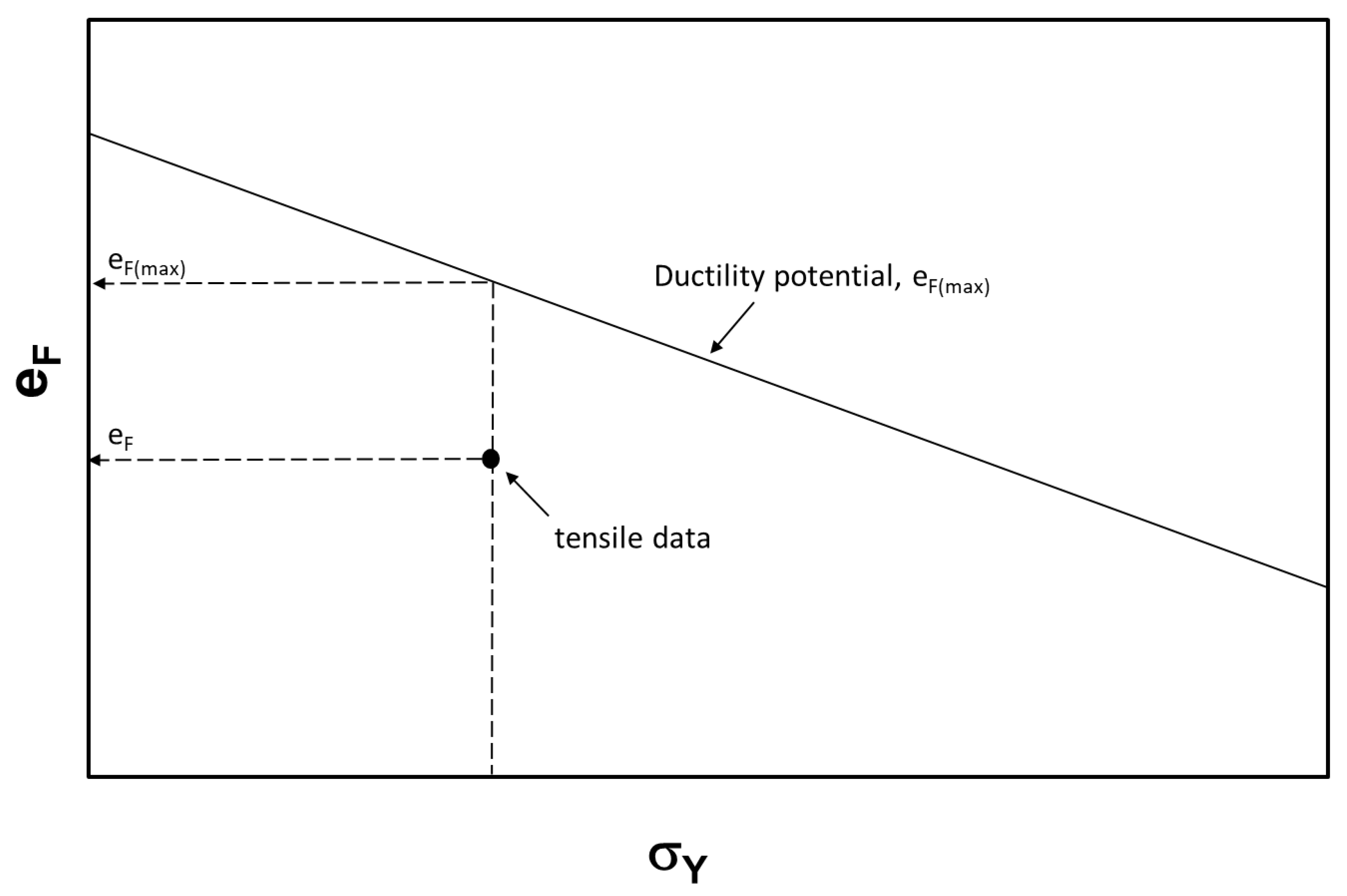
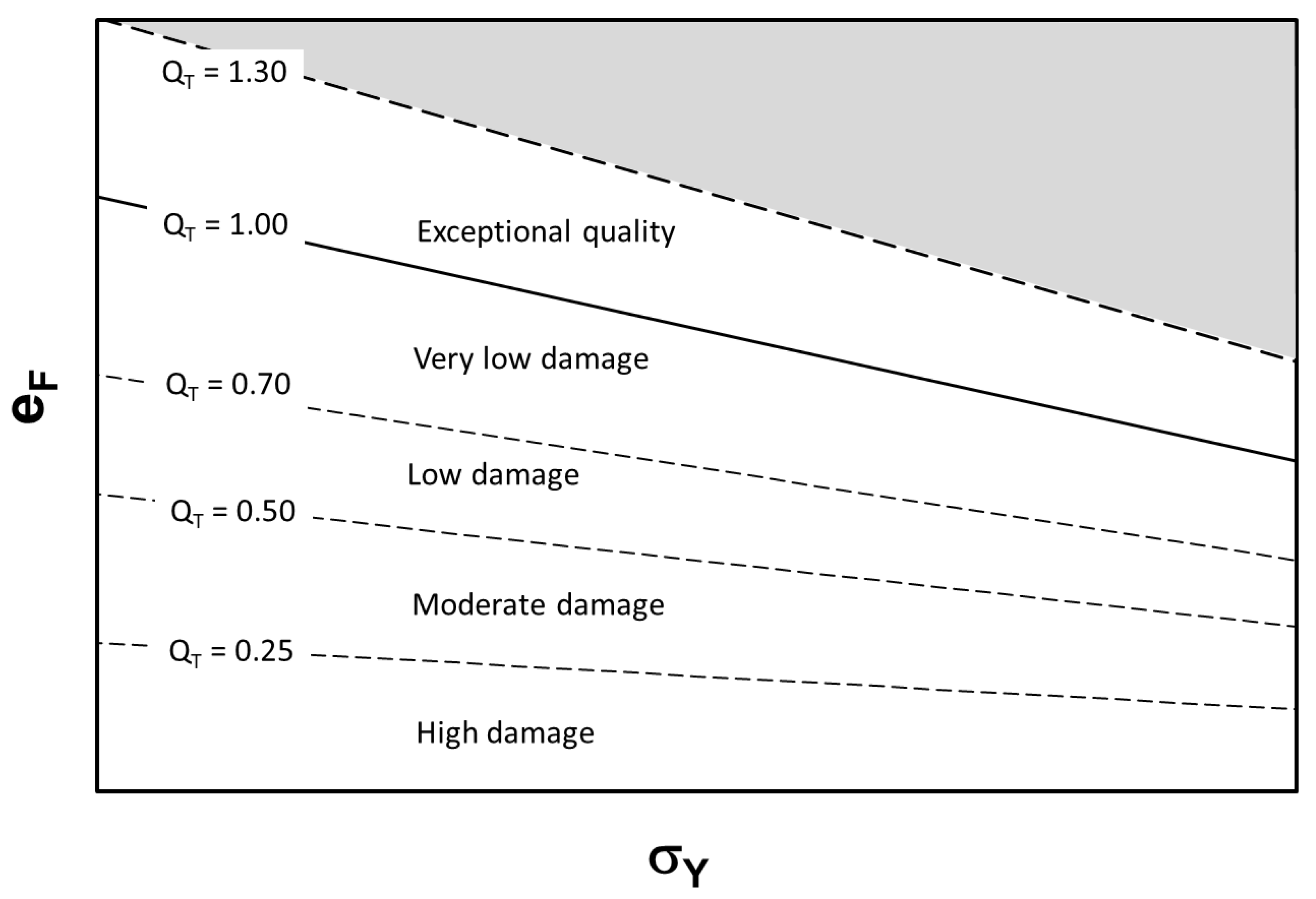
This quality index is shown schematically in Figure 1. This index provides a metric based on the actual energy absorbed by the specimen as opposed to how much energy it would absorb if there were minimal or no defects. Hence, QT is a measure of the damage given to liquid aluminum. Since its introduction, QT has been used with increasing popularity in research and production settings.
When the ductility potentials for the three alloys were initially established, there were no data available above these lines. Since then, several datasets have emerged, especially for the Al-Si alloys. This present study is motivated by the need for an update in ductility potential and the interpretation of quality index values.

2. Ductility Potential Update

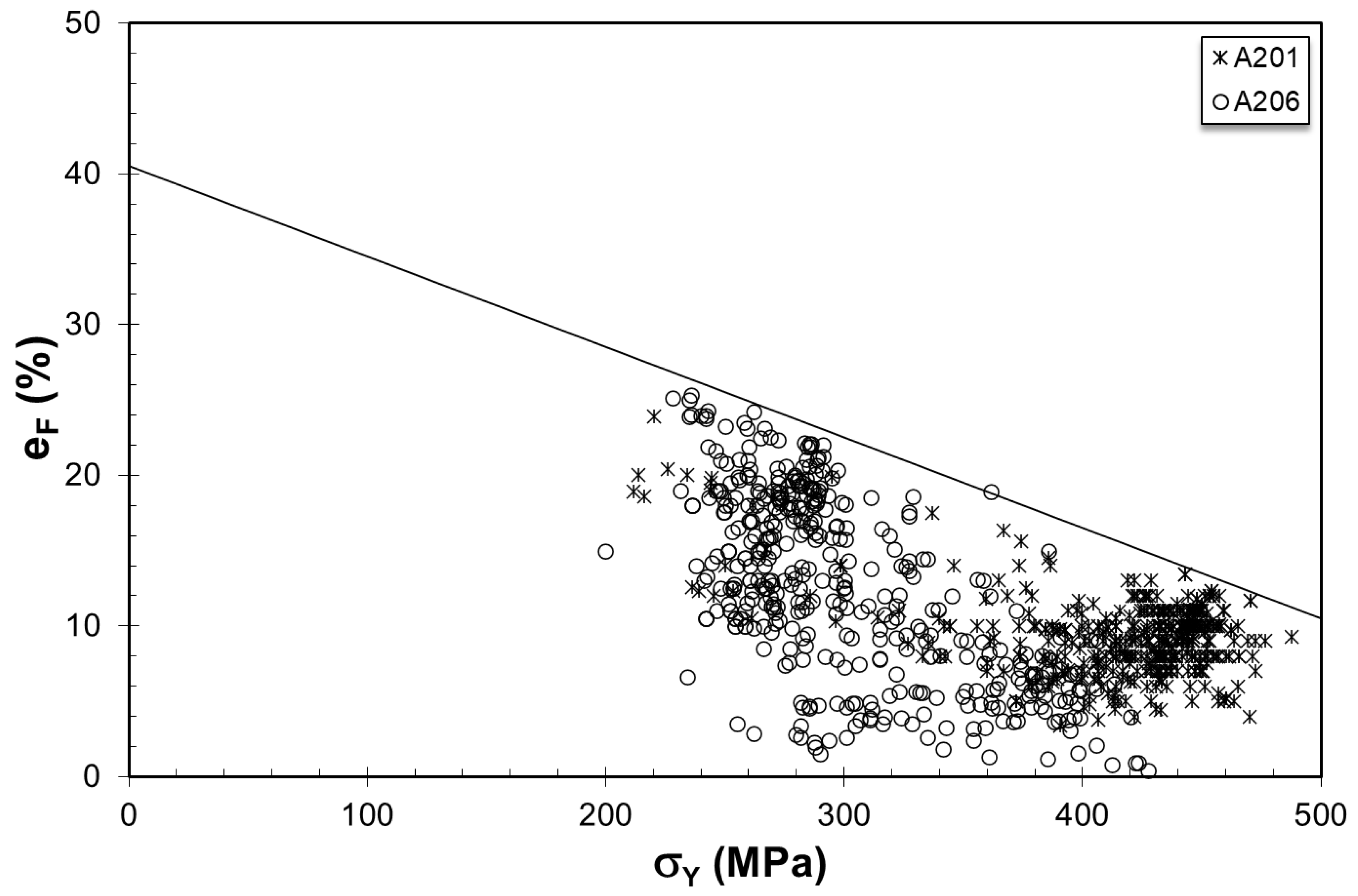
The update in the present study is given in two categories: Al-Si alloys and Al alloys without Si. The latter consists of Al-Cu, Al-Mg, and Al-Zn alloy families, although only Al-Cu alloys are used in aerospace and premium castings. Therefore, only Al-Cu data are analyzed in the present study. However, all three alloy families have counterparts as wrought aluminum alloys. Therefore, the previously analyzed data for A201 and A206 are first combined and then compared with typical elongation values for all wrought aluminum alloys, as documented by Kaufman [12]. The combination of the data from the two Al-Cu-Mg alloys is presented in Figure 2. Note that the two datasets yield a single ductility potential line. The values for β0 and β1 for the updated ductility potential line for all cast Al alloys (excluding Al-Si) are provided in Table 2. Note that the slope for all cast aluminum alloys, including Al-Si, is now proposed as 0.060 (%/MPa). The common slope between the two datasets emerged during the reanalysis of data for the present study.
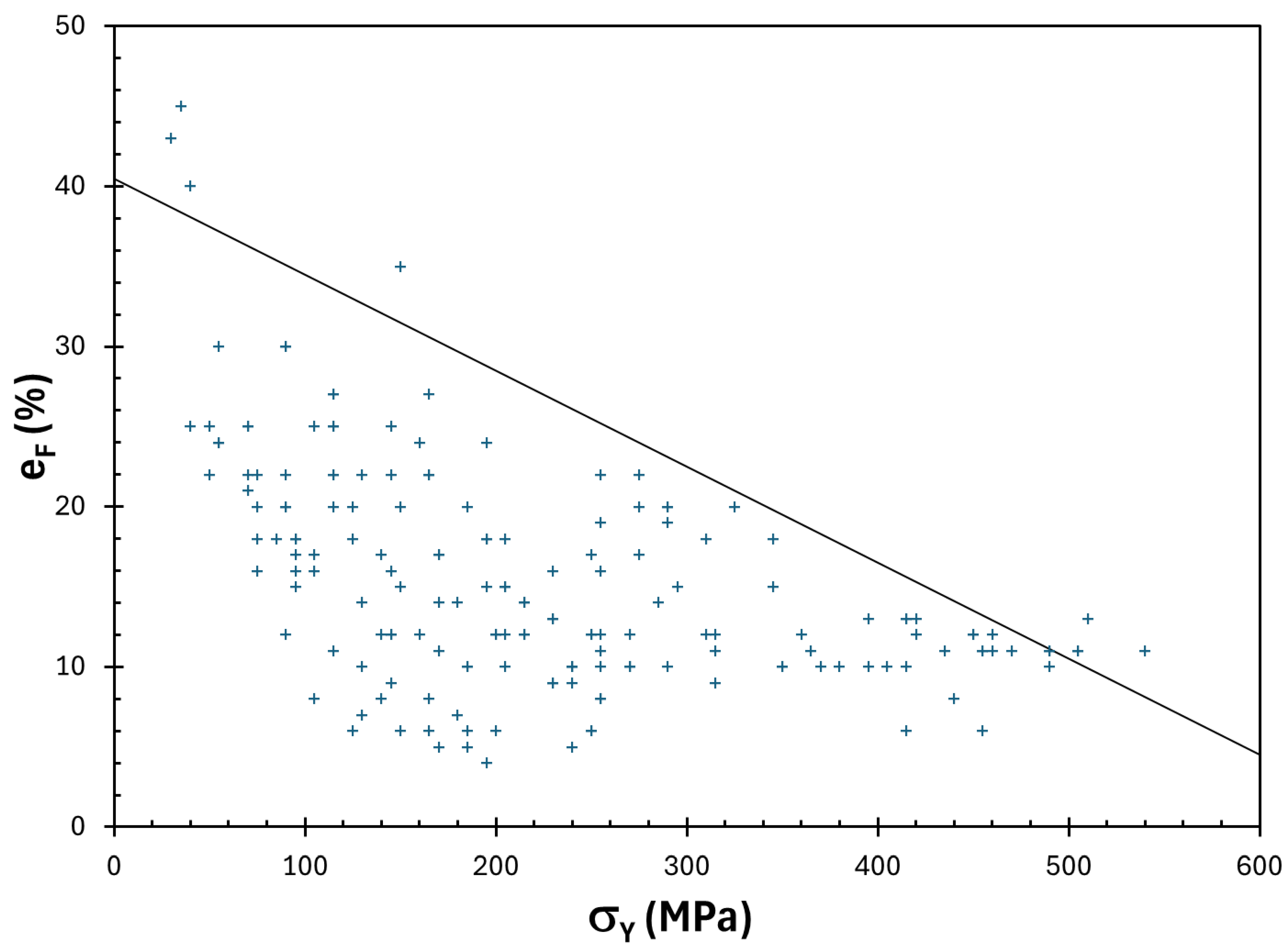
Typical elongation values at their corresponding yield strengths of commercial wrought aluminum alloys, as listed by Kaufman [12], are shown in Figure 3. Also indicated is the revised ductility potential for all aluminum alloys, excluding Al-Si. The ductility potential line in Figure 2 exceeds most of the data for wrought aluminum alloys. Only several data points are above the ductility potential line. When the metal has very low to no liquid metal damage, the ductility of cast and wrought alloys are at the same level, as can be expected.
Turning our attention to Al-Si alloys, these alloys (with Si above 1.6 wt.%) are by far the most commonly used alloys in castings and have a microstructure that consists of a primary aluminum matrix and an Al-Si eutectic. Unmodified eutectic Si particles have been observed [13] in situ to fracture early in tensile plastic deformation, and their fractures propagate and coalesce into macroscopic failure. This premature fracture is attributed to their size and shape, and Si particles are considered to be weak and brittle. As a result, ductility in cast Al-Si alloys has been believed [14] to be controlled by the morphology and size of Si particles. In situ mechanical testing of Si particles [15,16] has shown that, while some particles reach the theoretical strength of 16 GPa [17,18], others have fractured at significantly lower stresses. This is consistent with other studies [19,20,21] in the literature, although the lowest fracture stress reported varies between studies. This reduction in strength can be attributed to defects inside the Si particles, suggested at times to be pinhole defects [22], but are almost certainly usually bifilms [23] on which they have been found [24,25,26,27] to nucleate heterogeneously. Hence, some Si particles exhibit poor mechanical performance due to these artifacts from liquid metal damage during the casting process [28].
Modified eutectic Si behaves somewhat differently, growing not on bifilms but forming by a coupled growth with aluminum, the Si taking a coral-like form. In this case the bifilms are still present, and act to initiate the final failure from their random locations in the eutectic [29]. However, of course, liquid damage is still exerting its major influence, albeit in somewhat different ways, in both modified and unmodified Al-Si alloys.
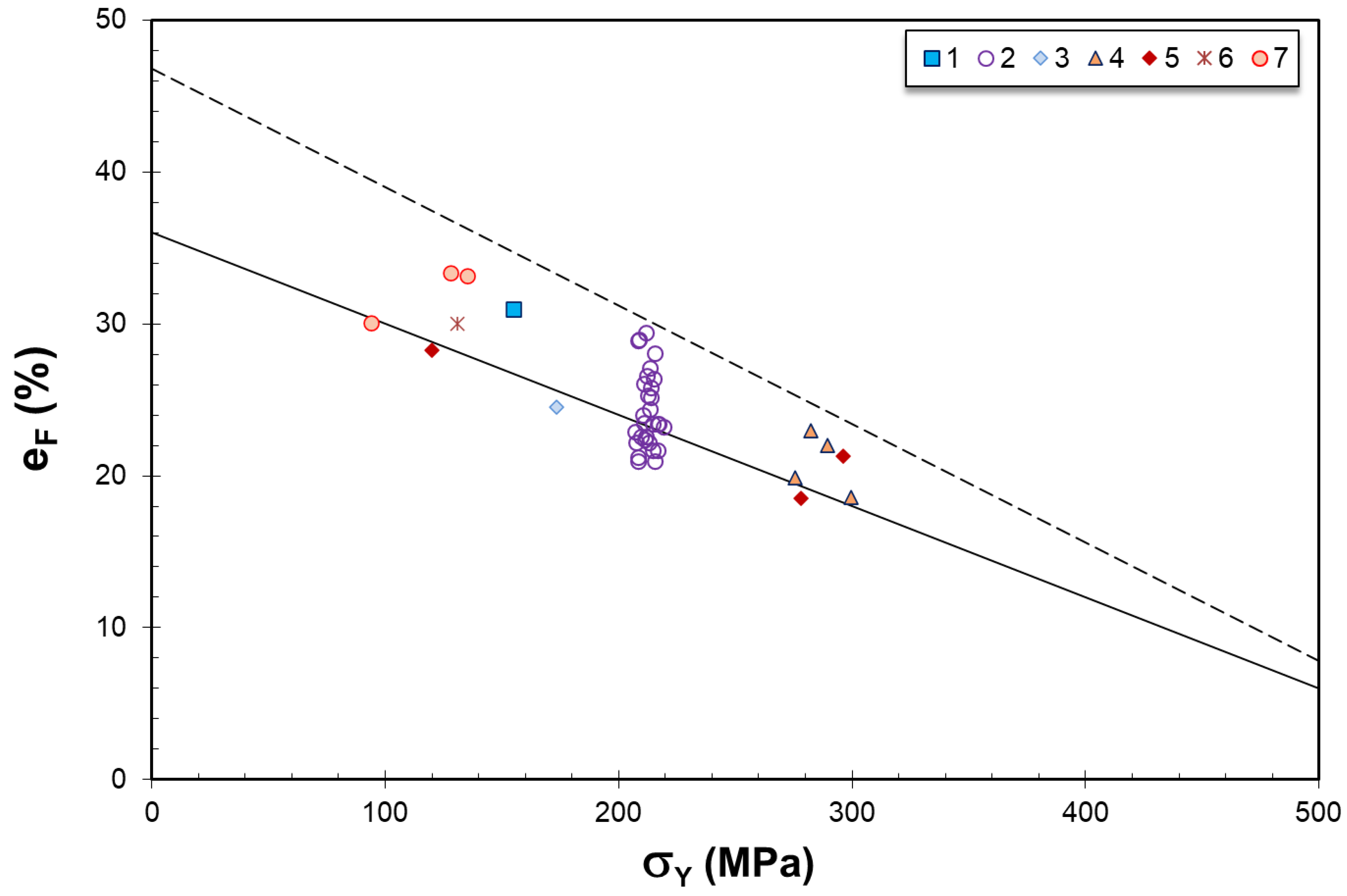
Seven datasets are included in the present update for the Al-Si alloys. These new data are presented in Figure 4, with the previously analyzed data shown in black squares. The details of these datasets, including alloy composition and the casting method, are given in Table 3. Note that most data come from studies on Al-7%Si alloys, such as A356 alloy. In addition to sand and investment casting, two semi-solid casting processes, strain-induced melt activation (SIMA) and thixocasting, are included in this analysis. The dashed line in Figure 4 represents QT = 1.30. Therefore, an excellent combination of strength and ductility, beyond what was reported previously only in aerospace and premium quality castings, is achievable in these alloys, provided that liquid metal damage is minimized or even eliminated.

3. Interpretation of Quality Index Numbers

With the update provided above, a revised interpretation of quality index values is also recommended, as presented in Figure 5. The values for QT < 0.25 remain as High Damage, indicating very poor melt quality consisting of major old oxides and poor metal handling processes. QT values between 0.25 and 0.50 indicate Moderate Damage, the presence of some old oxides, and additional damage in metal processing, such as melt transfers and turbulent degassing practices. QT values between 0.50 and 0.70 indicate Low Damage. Melts are free from major oxides and damage from metal processing and mold filling is low. When QT is between 0.70 and 1.00, the level of damage given to liquid metal is very low. Only very careful processing and mold filling practices will enable foundrymen to achieve these QT values. The authors think that values that exceed 1.00 can only be categorized as Exceptional Quality. This new region was coined to keep the potential ductility line for Al-Si alloys (almost) intact since it has gained wide acceptance in industry since its inception. More discussion about this region is provided below.

4. Microstructural Effects

It is well established that secondary dendrite arm spacing, λ2, is a function of local solidification time [37,38,39,40]. Moreover, elongation has been found [41,42] to decrease with increasing secondary arm spacing in cast aluminum alloys. That is why measuring λ2 in aluminum castings has even been suggested as a new nondestructive test in aerospace castings [43].
In one of the original studies [6] in which ductility potentials were established, the authors provided λ2 numbers for the tensile data that were on or around the ductility potential line. Those data came from castings in which λ2 varied between 13 and 45 μm. This has led the authors to conclude that λ2 mattered only when bifilms are present in the metal. With increased local solidification time, bifilms that are compact at the end of mold filling unfurl under negative pressures developed during solidification, hydrogen diffusion and/or nucleation, and the growth of intermetallics on them. In the absence of bifilms, longer local solidification times did not matter.
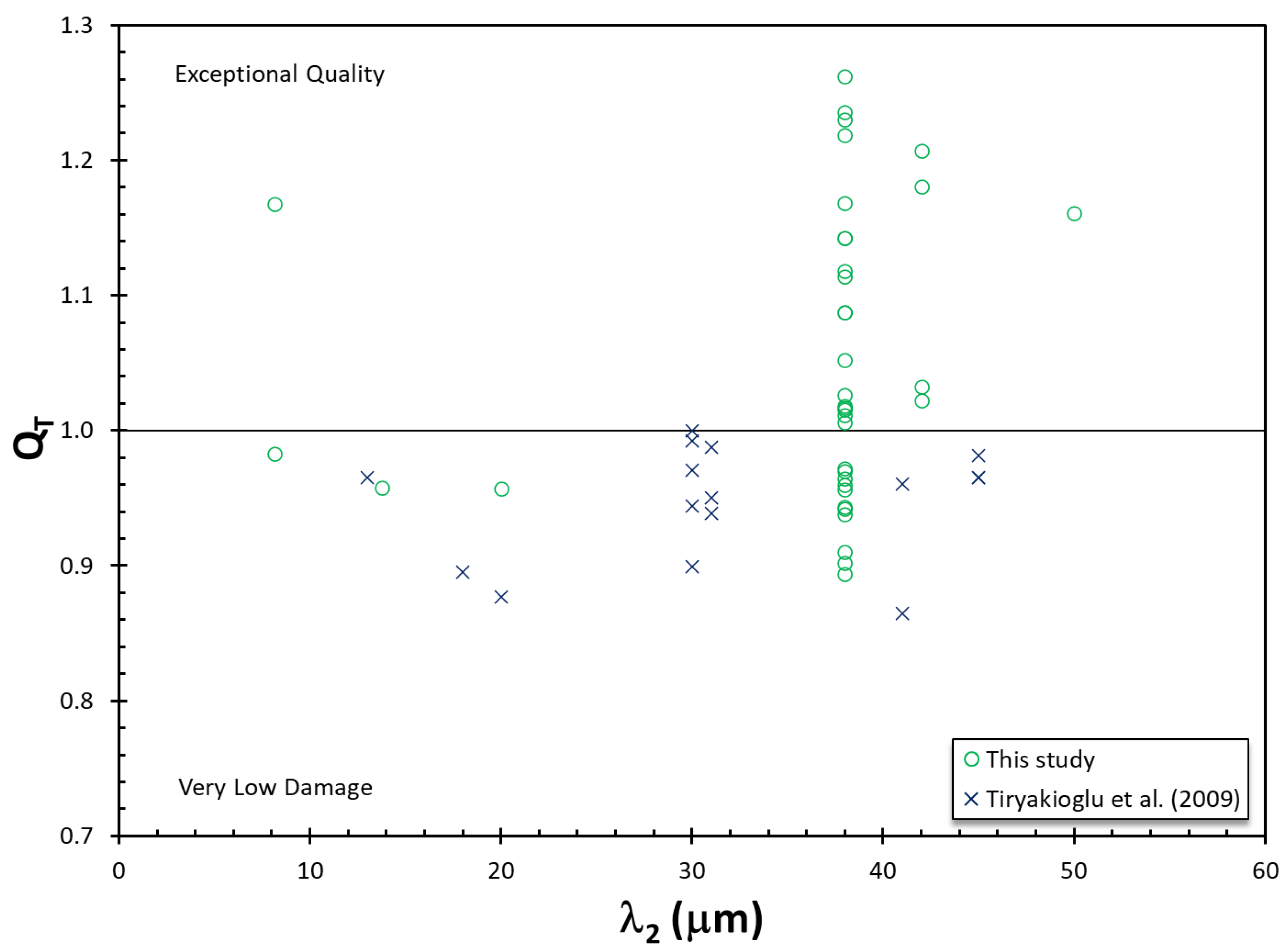
The secondary dendrite arm spacing values of the new casting data are included in Table 3. These values, along with those originally reported [6] by the authors are presented in Figure 6. There is no correlation between λ2 and QT in the “Very Low Damage” and “Exceptional Quality” regions. The solidification time of aluminum castings does not affect ductility when the metal is clean.
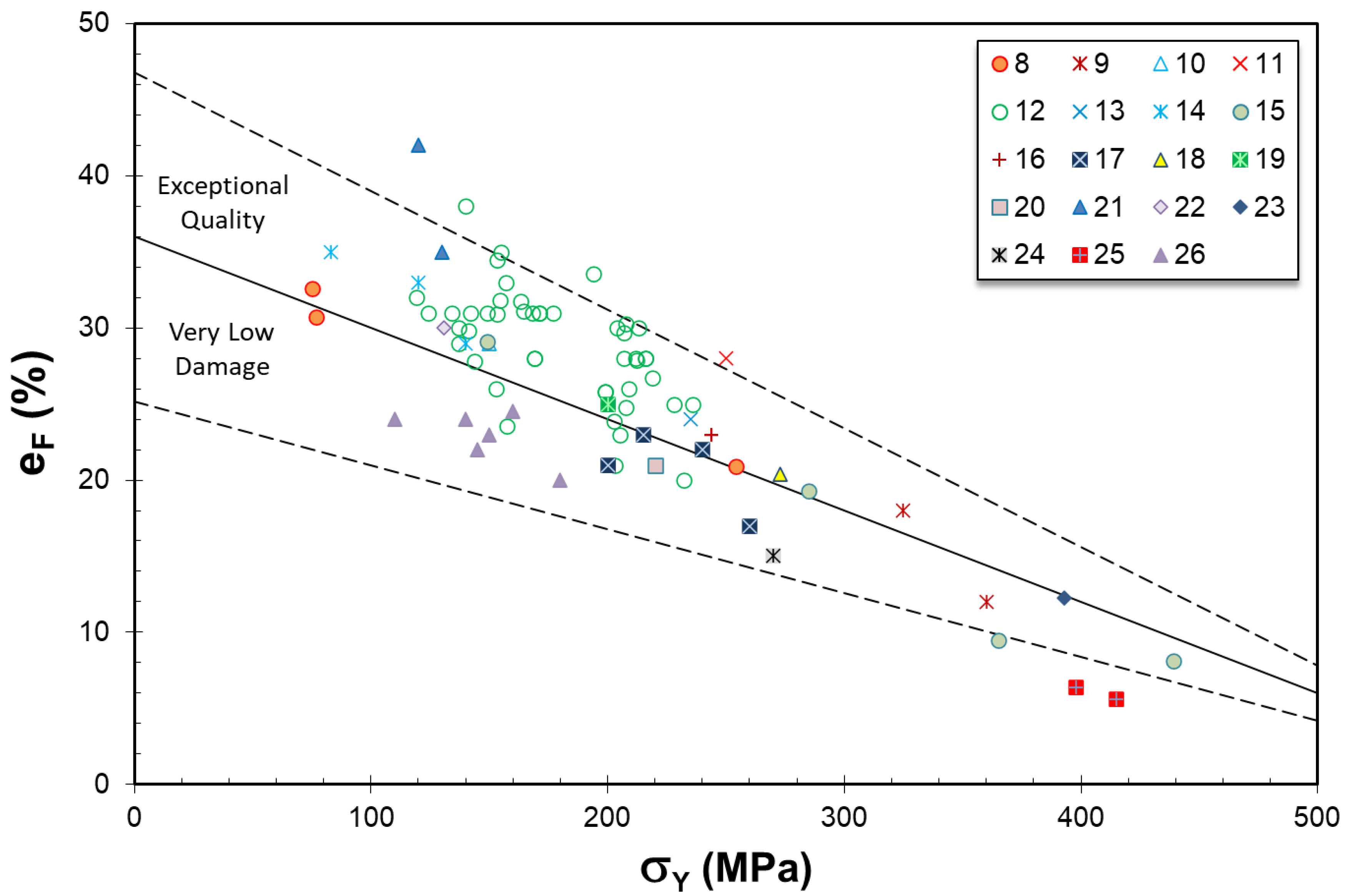
Although Al-Si alloys are widely used in castings, their use is limited as wrought alloys (4xxx series). As a result, only scarce data are available for wrought Al-Si alloys. Moreover, ductility data for Al-Si alloys that have gone through manufacturing processes other than casting are not readily available in handbooks. To provide a comparison between cast and wrought alloys similar to the one given in Figure 3, a literature survey was conducted. Nineteen datasets from the same number of independent studies have been collected. The details are provided in Table 4. Most data come from Al-7%Si alloys such as A356 and A357, but data from Si contents as low as 1.5 and as high as 20% are also included. Moreover, data for two 4xxx alloys are also reported. A total of ten different manufacturing methods have been used in these studies, including equal channel angular processing (ECAP) and friction stir processing (FSP). The results are presented in Figure 7. It is noteworthy that a majority of the data falls into the “Exceptional Quality” region defined earlier, with some data even exceeding QT = 1.30. There are many datapoints that fall in the Very Low Damage region. These are mostly the data for 4xxx alloys. Only two datapoints, both for the extruded 4032, fall below the Very Low Damage region.
It would be obvious to any metallurgist that the microstructures obtained in these processes would be vastly different from each other, and definitely from the microstructures of cast alloys in Figure 4. Yet, the yield strength–ductility correlation overlap almost completely. Moreover, two datapoints, one with no eutectic (1.5%Si) and the other eutectic with primary Si particles (Al-20%Si) fall in the same scatter band. The fact that the same excellent combination of strength and ductility can be obtained through various processes, which produce vastly different microstructures, suggests that the true effect of microstructure is at best, limited. It is noteworthy that processes that produce severe deformation, including ECAP and FSP, are known to increase the ductility of Al-Si alloys. This increase in ductility can be attributed to the destruction of bifilms, and not necessarily due to any refinement of Si particle size [44]. Obviously, more research is needed to determine the true microstructure–property relationships in Al-Si alloys.
Based on the analysis above, it can be stated that Exceptional Quality is an extension of the Very Low Damage region. Here, microstructural parameters, such as secondary dendrite arm spacing, Si particle size, and grain size are no longer correlated with mechanical properties. Alloy composition and processing determine the yield strength, which is always coupled with excellent ductility.
Table 4. Details of the datasets of other Al-Si alloys included in this study.
DatasetAlloyProcessRef.
8Al-10Si-MgElectron beam melting[45]
9Al-6Si-CuHot extrusion[46]
10Al-7SiECAP[47]
11Al-20SiECAP[48]
12A356FSP[49,50]
13A356Hot extrusion[51]
14A356Hot extrusion[52]
15A356ECAP, cryo-rolled[53]
16A356Twin roll cast[54]
17Al-3%Si-FeTwin roll cast[55]
18A356Spinning deformed[56]
19A357Selective recrystallization[57]
20Al-7SiECAP[58]
21Al-7SiFSP[58]
22Al-1.5SiECAP[59]
234032Hot extrusion[60]
244032Hot extrusion[61]
254032Hot extrusion[62]
264043Rolling[63]

5. Conclusions

Ductility potential lines for cast aluminum alloys have been updated. This update presents only two equations, one for Al-Si alloys and the other for all other cast aluminum alloys. Al-Si alloys can show exceptional ductility for any yield strength level independent of the Si content and processing route, indicating the weak effect of microstructure. The ductility potential of cast aluminum alloys is comparable to the maximum ductility levels obtained in wrought alloys. Through meticulous attention to liquid metal quality throughout the entire production system, it seems entirely possible to produce castings with exceptional ductility.

Author Contributions

Conceptualization, M.T.; Methodology, M.T. and J.C.; Validation, M.T. and J.C.; Formal analysis, M.T. and J.C.; Investigation, M.T.; Data curation, M.T.; Writing—original draft, M.T.; Writing—review & editing, M.T. and J.C.; Visualization, M.T. All authors have read and agreed to the published version of the manuscript.

Funding

This research received no external funding.

Data Availability Statement

The original contributions presented in this study are included in the article. Further inquiries can be directed to the corresponding authors.

Acknowledgments

The authors are indebted to Roger Lumley of AW Bell Pty, Ltd. in Australia for kindly sharing his data.

Conflicts of Interest

The authors declare no conflicts of interest.

References

  1. Courtney, T.H. Mechanical Behavior of Materials; Waveland Press: Long Grove, IL, USA, 2005. [Google Scholar]
  2. Alexopoulos, N.D.; Tiryakioğlu, M. Relationship between Fracture Toughness and Tensile Properties of A357 Cast Aluminum Alloy. Metall. Mater. Trans A 2009, 40, 702–716. [Google Scholar] [CrossRef]
  3. Tiryakioğlu, M.; Staley, J.T.; Campbell, J. The effect of structural integrity on the tensile deformation characteristics of A206-T71 alloy castings. Mater. Sci. Eng. A 2008, 487, 383–387. [Google Scholar] [CrossRef]
  4. Surappa, M.K.; Blank, E.; Jaquet, J.C. Effect of macro-porosity on the strength and ductility of cast Al-7Si-0.3Mg alloy. Scr. Metall. 1986, 20, 1281–1286. [Google Scholar] [CrossRef]
  5. Tiryakioğlu, M.; Campbell, J. Ductility, structural quality, and fracture toughness of Al–Cu–Mg–Ag (A201) alloy castings. Mater. Sci. Technol. 2009, 25, 784–789. [Google Scholar] [CrossRef]
  6. Tiryakioğlu, M.; Campbell, J.; Alexopoulos, N.D. On the ductility of cast Al-7 pct Si-Mg alloys. Metall. Mater. Trans. A 2009, 40, 1000–1007. [Google Scholar] [CrossRef]
  7. Tiryakioğlu, M.; Campbell, J.; Alexopoulos, N.D. On the ductility potential of cast Al–Cu–Mg (206) alloys. Mater. Sci. Eng. A 2009, 506, 23–26. [Google Scholar] [CrossRef]
  8. Staley, J.T. (Bodycote Materials Testing, Chicago, IL, USA). Personal Communication, 1999.
  9. Lloyd, D.J. The scaling of the tensile ductile fracture strain with yield strength in Al alloys. Scr. Mater. 2003, 48, 341–344. [Google Scholar] [CrossRef]
  10. Tiryakioğlu, M.; Campbell, J.; Alexopoulos, N.D. Quality indices for aluminum alloy castings: A critical review. Metall. Mater. Trans. B 2009, 40, 802–811. [Google Scholar] [CrossRef]
  11. Tiryakioğlu, M.; Campbell, J. Quality index for aluminum alloy castings. Int. J. Met. 2014, 8, 39–42. [Google Scholar] [CrossRef]
  12. Kaufman, J.G. Properties of Aluminum Alloys: Fatigue Data and the Effects of Temperature, Product Form, and Processing; ASM International: Materials Park, OH, USA, 2008. [Google Scholar]
  13. Gangulee, A.; Gurland, J. On the Fracture of Silicon Particles in Aluminum-Silicon Alloys. Trans. TMS-AIME 1967, 239, 269–272. [Google Scholar]
  14. Zhang, D.L.; Zheng, L.H.; StJohn, D.H. Effect of solution treatment temperature on tensile properties of AI-7Si-O.3Mg (wt-%) alloy. Mater. Sci. Technol. 2013, 14, 619–625. [Google Scholar] [CrossRef]
  15. Mueller, M.G.; Fornabaio, M.; Žagar, G.; Mortensen, A. Microscopic strength of silicon particles in an aluminium–silicon alloy. Acta Mater. 2016, 105, 165–175. [Google Scholar] [CrossRef]
  16. Mueller, M.G.; Žagar, G.; Mortensen, A. In-situ strength of individual silicon particles within an aluminium casting alloy. Acta Mater. 2018, 143, 67–76. [Google Scholar] [CrossRef]
  17. Umeno, Y.; Kushima, A.; Kitamura, T.; Gumbsch, P.; Li, J. Ab initio study of the surface properties and ideal strength of (100) silicon thin films. Phys. Rev. B 2005, 72, 165431. [Google Scholar] [CrossRef]
  18. Dubois, S.M.M.; Rignanese, G.M.; Pardoen, T.; Charlier, J.C. Ideal strength of silicon: An ab initio study. Phys. Rev. B 2006, 74, 235203. [Google Scholar] [CrossRef]
  19. Finlayson, T.; Griffiths, J.; Viano, D.; Fitzpatrick, M.; Oliver, E.; Wang, Q. Stresses in the Eutectic Silicon Particles of Strontium-Modified A356 Castings Loaded in Tension. In Shape Casting: 2nd International Symposium; The Minerals, Metals & Materials Society: Pittsburgh, PA, USA, 2007; pp. 127–134. [Google Scholar]
  20. Joseph, S.; Kumar, S.; Bhadram, V.S.; Narayana, C. Stress states in individual Si particles of a cast Al–Si alloy: Micro-Raman analysis and microstructure based modeling. J. Alloys Compd. 2015, 625, 296–308. [Google Scholar] [CrossRef]
  21. Harris, S.J.; O’Neill, A.; Boileau, J.; Donlon, W.; Su, X.; Majumdar, B. Application of the Raman technique to measure stress states in individual Si particles in a cast Al–Si alloy. Acta Mater. 2007, 55, 1681–1693. [Google Scholar] [CrossRef]
  22. Mueller, M.G.; Fornabaio, M.; Mortensen, A. Silicon particle pinhole defects in aluminium–silicon alloys. J. Mater. Sci. 2016, 52, 858–868. [Google Scholar] [CrossRef]
  23. Davidson, C.J.; Finlayson, T.R.; Fitzpatrick, M.E.; Griffiths, J.R.; Oliver, E.C.; Wang, Q. Observations of the stress developed in Si inclusions following plastic flow in the matrix of an Al–Si–Mg alloy. Philos. Mag. 2017, 97, 1398–1417. [Google Scholar] [CrossRef]
  24. Campbell, J. Entrainment defects. Mater. Sci. Technol. 2006, 22, 127–145. [Google Scholar] [CrossRef]
  25. Dispinar, D.; Campbell, J. Supercooling of metal in fine filters. J. Mater. Sci. 2007, 42, 10296–10298. [Google Scholar] [CrossRef]
  26. Gyarmati, G.; Bogoly, L.; Stawarz, M.; Fegyverneki, G.; Kéri, Z.; Tokár, M.; Mende, T. Grain Refiner Settling and Its Effect on the Melt Quality of Aluminum Casting Alloys. Materials 2022, 15, 7679. [Google Scholar] [CrossRef]
  27. Gyarmati, G.; Fegyverneki, G.; Kéri, Z.; Molnár, D.; Tokár, M.; Varga, L.; Mende, T. Controlled precipitation of intermetallic (Al,Si)3Ti compound particles on double oxide films in liquid aluminum alloys. Mater. Charact. 2021, 181, 111467. [Google Scholar] [CrossRef]
  28. Tiryakioğlu, M. Intrinsic and Extrinsic Effects of Microstructure on Properties in Cast Al Alloys. Materials 2020, 13, 2019. [Google Scholar] [CrossRef] [PubMed]
  29. Campbell, J. An overview of the effects of bifilms on the structure and properties of cast alloys. Metall. Mater. Trans. B 2006, 37, 857–863. [Google Scholar] [CrossRef]
  30. Lumley, R.N. (AWBell Pty Ltd., Dandenong South, Australia). Personal Communication, 2026.
  31. Taylor, J.; St John, D.; Barresi, J.; Couper, M. An empirical analysis of trends in mechanical properties of T6 heat treated Al-Si-Mg casting alloys. Int. J. Cast Met. Res. 2000, 12, 419–430. [Google Scholar] [CrossRef]
  32. Yoshida, K.A.; Arrowood, R.M. Microstructure and mechanical properties of A 356 aluminum castings as related to various T 6-type heat treatments. Light Weight Alloys Aerosp. Appl. III 1995, 77–88. [Google Scholar]
  33. Yoshida, K.A. Effects of Solutionizing Temperature on the Structure and Properties of Strontium-Modified A356 Aluminum Castings. Master’s Thesis, The University of Texas at El Paso, El Paso, TX, USA, 1995. [Google Scholar]
  34. Dang, B.; Zhang, X.; Chen, Y.Z.; Chen, C.X.; Wang, H.T.; Liu, F. Breaking through the strength-ductility trade-off dilemma in an Al-Si-based casting alloy. Sci. Rep. 2016, 6, 30874. [Google Scholar] [CrossRef]
  35. Choudhary, C.; Pramanick, A.; Sahoo, K.; Mandal, D. Evaluation of microstructure and mechanical properties of M-SIMA processed Al–7Si alloy. Mater. Sci. Technol. 2022, 38, 912–925. [Google Scholar] [CrossRef]
  36. Boostani, A.F.; Tahamtan, S. Microstructure and mechanical properties of A356 thixoformed alloys in comparison with gravity cast ones using new criterion. Trans. Nonferrous Met. Soc. China 2010, 20, 1608–1614. [Google Scholar] [CrossRef]
  37. Kurz, W.; Fisher, D.J. Fundamentals of Solidification; Trans Tech Publications: Aedermannsdorf, Switzerland, 1986; Volume 1. [Google Scholar]
  38. Kirkwood, D. A simple model for dendrite arm coarsening during solidification. Mater. Sci. Eng. 1985, 73, L1–L4. [Google Scholar] [CrossRef]
  39. Bardes, B.; Flemings, M. Dendrite arm spacing and solidification time in a cast aluminum-copper alloy. AFS Trans. 1966, 74, 406–412. [Google Scholar]
  40. Kattamis, T.; Coughlin, J.; Flemings, M. Influence of coarsening on dendrite arm spacing of aluminum-copper alloys. Trans. Metall. Soc. AIME 1967, 239, 1504–1511. [Google Scholar]
  41. Miguelucci, E. The aluminum association cast alloy test program: Interim report. AFS Trans 1985, 93, 913–916. [Google Scholar]
  42. Wang, Q.; Caceres, C. On the strain hardening behaviour of Al-Si-Mg casting alloys. Mater. Sci. Eng. A 1997, 234, 106–109. [Google Scholar] [CrossRef]
  43. Oswalt, K.; Misra, M. Dendrite Arm Spacing(DAS): A Nondestructive Test to Evaluate Tensile Properties of Premium-Quality Aluminum Alloy (Al-Si-Mg) Castings. AFS Trans. 1980, 88, 845–862. [Google Scholar]
  44. Tiryakioğlu, M.; Netto, N.; Eason, P.D. On the Effect of Multi-Pass Friction Stir Processing on Microstructure-Tensile Deformation Behavior Relationships in Cast Al-7%Si-0.4%Mg Specimens. Metals 2025, 15, 1309. [Google Scholar] [CrossRef]
  45. Bian, H.; Aoyagi, K.; Zhao, Y.; Maeda, C.; Mouri, T.; Chiba, A. Microstructure refinement for superior ductility of Al–Si alloy by electron beam melting. Addit. Manuf. 2020, 32, 100982. [Google Scholar] [CrossRef]
  46. Xu, C.; Zheng, R.; Hanada, S.; Xiao, W.; Ma, C. Effect of hot extrusion and subsequent T6 treatment on the microstructure evolution and tensile properties of an Al-6Si-2Cu-0.5Mg alloy. Mater. Sci. Eng. A 2018, 710, 102–110. [Google Scholar] [CrossRef]
  47. Natori, K.; Utsunomiya, H.; Tanaka, T. Improvement in formability of semi-solid cast hypoeutectic Al-Si alloys by equal-channel angular pressing. J. Mater. Process. Technol. 2017, 240, 240–248. [Google Scholar] [CrossRef]
  48. Yoon, S.C.; Hong, S.-J.; Hong, S.I.; Kim, H.S. Mechanical properties of equal channel angular pressed powder extrudates of a rapidly solidified hypereutectic Al-20 wt% Si alloy. Mater. Sci. Eng. A 2007, 449, 966–970. [Google Scholar] [CrossRef]
  49. Ma, Z.Y.; Sharma, S.R.; Mishra, R.S. Microstructural modification of as-cast Al-Si-Mg alloy by friction stir processing. Metall. Mater. Trans. A 2006, 37, 3323–3336. [Google Scholar] [CrossRef]
  50. Ma, Z.Y.; Sharma, S.R.; Mishra, R.S. Effect of multiple-pass friction stir processing on microstructure and tensile properties of a cast aluminum–silicon alloy. Scr. Mater. 2006, 54, 1623–1626. [Google Scholar] [CrossRef]
  51. Wei, Z.; Lei, Y.; Yan, H.; Xu, X.; He, J. Microstructure and mechanical properties of A356 alloy with yttrium addition processed by hot extrusion. J. Rare Earths 2019, 37, 659–667. [Google Scholar] [CrossRef]
  52. Guerrero-Seañez, P.A.; Garay-Reyes, C.G.; Martínez-García, A.; Atanacio-Sánchez, X.; Ruiz-Esparza-Rodriguez, M.A.; Estrada-Guel, I.; Mendoza-Duarte, J.M.; Martínez-Sánchez, R. Effect of Hot Extrusion on a Li-modified A356 Al Alloy. Microsc. Microanal. 2025, 31, ozaf048-179. [Google Scholar] [CrossRef]
  53. Zhang, X.; Huang, L.K.; Zhang, B.; Chen, Y.Z.; Duan, S.Y.; Liu, G.; Yang, C.L.; Liu, F. Enhanced strength and ductility of A356 alloy due to composite effect of near-rapid solidification and thermo-mechanical treatment. Mater. Sci. Eng. A 2019, 753, 168–178. [Google Scholar] [CrossRef]
  54. Haga, T. High Speed Roll Caster for Aluminum Alloy. Metals 2021, 11, 520. [Google Scholar] [CrossRef]
  55. Haga, T.; Ikawa, M.; Watari, H.; Kumai, S. High speed twin roll casting of recycled Al-3Si-0.6 Mg strip. J. Achiev. Mater. Manuf. Eng. 2007, 21, 7–12. [Google Scholar]
  56. Wang, H.M.; Li, K.; Li, G.R.; Su, W.X.; Chou, S.S.; Wu, T.T.; Fan, X. Microstructure and properties of spinning deformed A356 alloy subject to the solution-DCT-aging multiplex heat treatment. J. Mater. Res. Technol. 2023, 23, 5520–5533. [Google Scholar] [CrossRef]
  57. Zhu, C.; Wang, Z.; Zhou, K.; Wu, Q.; Zhao, P.; Fan, X.; Li, J.; Wang, J. Triple the ductility of as-cast Al–Si alloys by phase-selective recrystallization. Mater. Sci. Eng. A 2022, 855, 143902. [Google Scholar] [CrossRef]
  58. García-Infanta, J.; Zhilyaev, A.; Carreño, F.; Ruano, O.A.; Su, J.; Menon, S.; McNelley, T. Strain path and microstructure evolution during severe deformation processing of an as-cast hypoeutectic Al–Si alloy. J. Mater. Sci. 2010, 45, 4613–4620. [Google Scholar] [CrossRef]
  59. Zhang, W.; Chen, Y.; Zhou, L.; Zhao, T.; Wang, W.Y.; Liu, F.; Huang, X. Simultaneous increase of tensile strength and ductility of Al-Si solid solution alloys: The effect of solute Si on work hardening and dislocation behaviors. Mater. Sci. Eng. A 2023, 869, 144792. [Google Scholar] [CrossRef]
  60. Luo, Y.; Zhang, Z.; Huang, Z.; He, H.; Wang, K.; Cao, Y.; Dong, L.; Wu, Z. Temperature dependence of mechanical properties of 4032 aluminum alloy. J. Alloys Compd. 2026, 1050, 185680. [Google Scholar] [CrossRef]
  61. Tian, H.; Ma, D.-M.; Zhao, X.; Meng, J.; Li, H.; Liu, X.; Zhao, G.; Zhang, G.; Zhao, R.; Wu, F. Effect of double deformation extrusion on the microstructure and properties of 4032 aluminum alloy. Mater. Today Commun. 2025, 42, 111396. [Google Scholar] [CrossRef]
  62. Barekar, N.S.; Skalicky, I.; Wang, S.; Shurkin, P.; Adole, O.; Babu, N.H.; Jarrett, M. Comparative Analysis of Structure and Properties of Nb-B Inoculated Direct Chill Cast AA4032 Alloy Extruded from As-Cast and Homogenized Conditions. JOM 2022, 74, 1218–1227. [Google Scholar] [CrossRef]
  63. Huang, B.-C.; Hung, F.-Y. Effect of High Temperature and Thermal Cycle of 4043 Al Alloy Manufactured through Continuous Casting Direct Rolling. Materials 2023, 16, 7176. [Google Scholar] [CrossRef]
Figure 1. Schematic description of the quality index.
Metals 16 00383 g001
Figure 2. The combined data for A201 and A206 alloys.
Metals 16 00383 g002
Figure 3. The yield strength–elongation data from Ref. [12] for all aluminum wrought alloys. The ductility potential line for cast Al alloys is also indicated as a solid line.
Metals 16 00383 g003
Figure 4. Datasets added to the analysis in this study, presented along with previously reported castings data (black squares). Datasets are defined in Table 3. The dashed line represents QT = 1.30.
Metals 16 00383 g004
Figure 5. The updated zones for quality index values.
Metals 16 00383 g005
Figure 6. The cross-plot of secondary dendrite arm spacing and QT in this study and reported in Ref. [6].
Metals 16 00383 g006
Figure 7. Yield strength–elongation data for Al-Si alloys manufactured in processes other than casting. Datasets are defined in Table 4. The Exceptional Quality and Very Low Damage regions are also indicated.
Metals 16 00383 g007
Table 1. The coefficients of Equation (1) for Al-7%Si-Mg, A201, and A206 alloys as originally presented [11].
β0 (%)β1 (%/MPa)
A356-35736.00.064
A20134.50.047
A20647.80.085
Table 2. Values of the two coefficients for the ductility potential lines.
Alloy Familyβ0 (%)β1 (%/MPa)
Al alloys (no Si)40.50.060
Al-Si36.0
Table 3. Details of the datasets of cast Al-Si alloys included in this study.
DatasetAlloyProcessRef.λ2 (μm)Additional Notes
1A356Sand casting 50 *Commercial foundry, slowly cooled, heat treated to T4
2C355Investment casting[30]38Heat treated to T6
3Al-7Si-MgLow-pressure casting[31]20Heat treated to T6
4A356Casting **[32,33]42Heat treated to T6
5A356Sand casting with end chill[34]8–14Heat treated to T6
6Al-7SiPermanent mold semi-solid casting[35]N/AHeat treatment according to modified strain-induced melt activation (M-SIMA) process
7A356Thixocasting[36]N/ANot heat treated
*: estimated. **: type of casting process not provided.
Disclaimer/Publisher’s Note: The statements, opinions and data contained in all publications are solely those of the individual author(s) and contributor(s) and not of MDPI and/or the editor(s). MDPI and/or the editor(s) disclaim responsibility for any injury to people or property resulting from any ideas, methods, instructions or products referred to in the content.