Article

Investigation on the Viscosity and Fluidity of FeO-CaO-SiO2 Ternary Primary Slag in Cohesive Zone of Blast Furnace


by
Qingyu Wang
1,2,
Xin Jiang
1,2,*,
Yongqiang Li
2,3,
Kai Fan
2,
Haiyan Zheng
1,2,
Qiangjian Gao
1,2 and
Fengman Shen
1,2
1
Key Laboratory for Ecological Metallurgy of Multimetallic Mineral (Ministry of Education), Northeastern University, Shenyang 110819, China
2
School of Metallurgy, Northeastern University, Shenyang 110819, China
3
Benxi Steel Group Iron Factory, Benxi 117017, China
*
Author to whom correspondence should be addressed.
Metals 2026, 16(1), 35; https://doi.org/10.3390/met16010035 (registering DOI)
Submission received: 13 November 2025 / Revised: 13 December 2025 / Accepted: 26 December 2025 / Published: 27 December 2025

Abstract

The permeability of cohesive zone plays an important role in the stable operation and production efficiency of blast furnace. Fluidity of the primary slag in the cohesive zone is an important factor affecting the permeability and is usually characterized by the so-called fluidity index. In order to describe the relationship between the viscosity and the fluidity index of the FeO-CaO-SiO2 ternary slag system (similar to the primary slag) generated by sinter, the fluidity and viscosity of FeO-CaO-SiO2 ternary slag system was studied in this paper. It includes testing the fluidity under different temperatures and different compositions, calculating the viscosity of FeO-CaO-SiO2 ternary slag system through the solid–liquid coexistence-phase viscosity model, and coupling the relationship between fluidity index and viscosity. The results show the following: (1) For the FeO-CaO-SiO2 ternary slag system, when the temperature is constant, the fluidity index of primary slag in non-three-phase region increases with the increase in w (FeO), while that in three-phase region decreases with the increase in w (FeO). (2) The Kondratiev model and the Batchelor model were jointly employed to calculate the primary slag viscosity in the cohesive zone. (3) In FeO-CaO-SiO2 ternary slag system, there is an approximate power function correlation between the solid–liquid coexistence-phase viscosity and the fluidity index. The research content and results of this paper have a certain theoretical guiding value for further research on more complex cohesive zone slag system and enhanced blast furnace smelting.

1. Introduction

The area in the blast furnace where the iron ore begins to soften until it drops is defined as the cohesive zone. Metallurgists at home and abroad, by dissecting blast furnaces, have discovered that as the iron ore descends in the furnace, its temperature gradually rises, and then it is gradually reduced. When the iron ore reaches a certain temperature and is reduced to a certain degree, the ore begins to soften–melt–drip, and a cohesive zone is formed [1,2,3]. The temperature interval of the cohesive zone is determined by the thermal stability of the mixture and their melting interval, which includes softening, deformation, and liquidus temperature. About 60–80% of the pressure difference in the blast furnace is caused by the gas passing through the cohesive zone, where the solid–liquid two-phases coexist [4]. In the cohesive zone, slag and hot metal begin to separate. It can also be considered that the cohesive zone is the area where the slag of the blast furnace smelting process is generated. The smooth operation of the blast furnace is controlled by a series of physicochemical reactions in the cohesive zone that have a great influence on the enhanced smelting of the blast furnace [5]. In order to ensure the smooth passage of gas in the blast furnace, the primary slag of the cohesive zone must have appropriate fluidity to alleviate the deterioration of the permeability of the cohesive zone [6,7]. Therefore, it is of great significance to study the influence of temperature and composition on the fluidity of the cohesive zone in the blast furnace.
In view of this, Zheng et al. [8] found that with the increase in MgO mass fraction in sinter, the initial softening temperature gradually increased, and the initial softening temperature of samples was above 1120 °C, the softening temperature range gradually widened with the increase in MgO content, and the permeability of the cohesive zone deteriorated. Sunahara et al. [9] studied the blast furnace smelting situation with high Al2O3 content and found that reducing the basicity of slag could improve the gas permeability of the cohesive zone of iron ore. Nakamoto et al. [10] found that the reduction rate of FeO in the slag phase containing FeO increased with the increase in the liquid phase and was independent of the composition of the slag system. Tsunehisa et al. [11] found that the increase in the reduction degree of sinter led to the formation of a solid phase containing FeO and gangue, which hindered the contact between the liquid phase and coke and hindered the reaction. Du et al. [12] took the blast furnace of Angang as the research object and obtained the relationship between the permeability index of the cohesive zone and the width and porosity of the cohesive zone. Ding et al. [13] studied the influence of soft melt zone type on the distribution of unburned powder in blast furnace by using the “Euler–Euler” method, and found that the distribution of unburned powder in soft melt zone with W shape is more uniform, which is the best blast furnace operation mode for gas permeability. Fu et al. [14] developed a fluid mechanics model and iterated based on the temperature distribution of the material layer, which can effectively predict the shape of the cohesive zone. Based on the simulation of fluent software, Dong et al. [15] studied the influence of different shape parameters of cohesive zone on the pressure field in the lower part of blast furnace and practical significance on the gas permeability in the lower part of blast furnace.
As mentioned in the literature, the main research methods on the cohesive zone of blast furnaces can be divided into two categories: (1) summarizing the influence rule iron ore composition change on gas permeability of cohesive zone; and (2) determining the influence of characteristic parameters of the cohesive zone on gas permeability is obtained by numerical simulation.
However, because the cohesive zone in blast furnaces cannot be observed directly or monitored by instruments in blast furnaces, the direct quantitative prediction and research on the fluidity of the primary slag through experiments are still lacking. Therefore, the FeO-CaO-SiO2 ternary slag system formed by sinter in the cohesive zone is taken as the research object in this study, mainly because sinter is the most important blast furnace charge in Asia. The research contents and innovations of this manuscript are as follows: (1) The quantity of solid-phase and liquid-phase composition of the primary slag of FeO-CaO-SiO2 ternary slag system at different temperatures and FeO content levels were analyzed. (2) The Kondratiev model and the Batchelor model were jointly employed to calculate the primary slag viscosity in the cohesive zone. Based on this, the influence of w (FeO) in primary slag at different characteristic temperatures on the fluidity index of FeO-CaO-SiO2 ternary slag system was analyzed. (3) The viscosity of the primary slag was calculated based on the temperature and composition of the primary slag. The relationship between fluidity and viscosity of primary slag in FeO-CaO-SiO2 ternary slag system is discussed, and then the fluidity of primary slag in a blast furnace is predicted. The research content and results of this manuscript may give some guidance on how to create a better understanding of the cohesive zone and improve blast furnace smelting.

2. Materials and Methods

2.1. Raw Materials

In general, except for iron oxide, CaO, and SiO2, other substances, such as Al2O3 and MgO, are less compared with CaO and SiO2 in sinter, so in this experiment, a FeO-CaO-SiO2 ternary slag system is used as the primary slag composition formed in the soft melting process of sinter. The primary slag formed from sinter and pellet is mixed together and still mainly consists of the FeO-CaO-SiO2 ternary slag system. Therefore, the FeO-CaO-SiO2 ternary slag system has significant research value. In the FeO-CaO-SiO2 ternary slag system, the CaO and SiO2 used in the experiment were prepared with chemical reagents (analytical grade). Because FeO is easily oxidized to Fe3O4 and Fe2O3 in the air [16]. In this experiment, FeO prepared from ferrous oxalate (FeC2O4·2H2O) was immediately applied to the experiment [17].
It was found that the traditional preparation method of directly replacing FeO with an equal molar amount of FeC2O4·2H2O and adding Ar to prevent oxidation during heating could not obtain a FeO reagent with ideal purity [18,19,20,21]. The FeO reagent was prepared by a new and improved method. According to the figure of advantage region of the Fe-C-O system, it can be seen that when the temperature is 570 °C~810 °C and CO:CO2 is 1:1, FeO is in the stable region, which can ensure the purity of FeO in the roasted products and the accuracy of subsequent experiments. It is found that FeC2O4·2H2O can obtain the ideal purity of FeO at 810 °C for 30 min under the protection of 80%Ar, 10%CO, and 10%CO2 atmosphere. The product obtained after roasting FeC2O4·2H2O under the new preparation method was analyzed by XRD, and the results are shown in Figure 1, showing no characteristic peaks of other impurities.

2.2. Experimental Design

In the present work, the variation range of w (FeO) in the primary slag of FeO-CaO-SiO2 ternary slag system formed by sinter is designed to be 0~80%. With 20% as the gradient, the basicity is maintained at a constant 1.8, and 5 component points are formed. The collocation of each component point is shown in Table 1. Each component point was roasted at 1200 °C, 1240 °C, 1280 °C, and 1320 °C, respectively, for 30 min, and the system was basically no longer in a state of continuous fluxion under these conditions.

2.3. Fluidity Tests

Based on a large number of works on the literature related to the fluidity tests [22,23,24,25], the fluidity index was characterized by the flow area of the sample at a certain temperature and a certain calcining time. This part of the experiment was divided into three main steps.
(1) Sample preparation: Prepare 0.8 g primary slag sample with analytical pure chemical reagent according to the proportion in Table 1 and mix it evenly. The prepared primary slag was pressed into a cylindrical mold with a diameter of 4 mm and kept under a pressure of 5 MPa for 3 min to obtain the cylindrical preliminary slag sample.
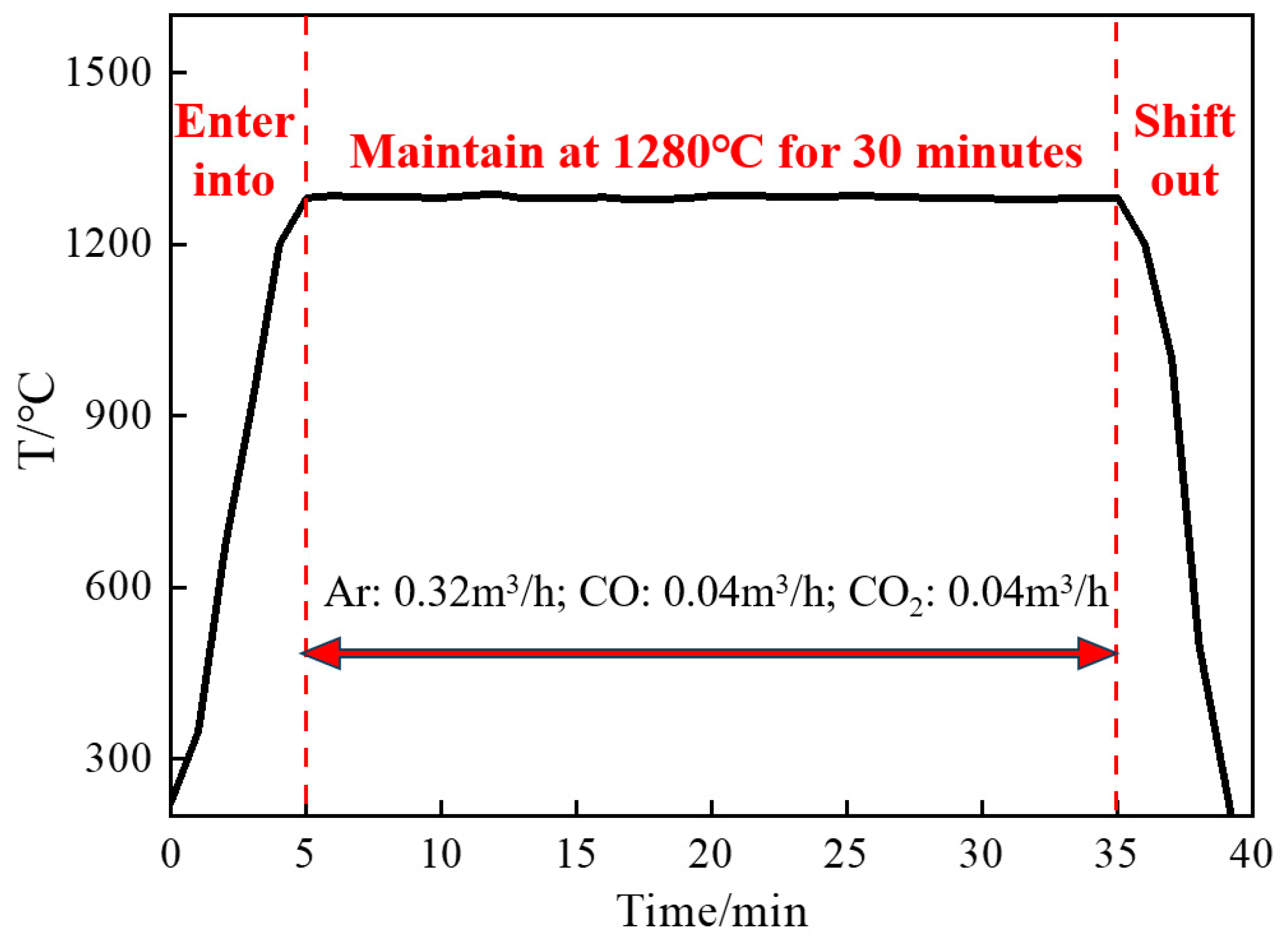
(2) Calcine: The temperature of samples in the FeO-CaO-SiO2 ternary slag system was maintained at 1200 °C, 1240 °C, 1280 °C, and 1320 °C. Preheat the furnace to the appropriate temperature, and then place the sample into the furnace. In the calcining process, 0.4 m3·h−1 (80%Ar, 10%CO, and 10%CO2) protective gas is injected, and the calcining time is 30 min. During the calcination process, no chemical reaction was observed between the FeO-CaO-SiO2 ternary slag system and the carrier. Taking the calcination at 1280 °C as an example, the temperature variation in the sample and the composition of the protective gas are shown in Figure 2.
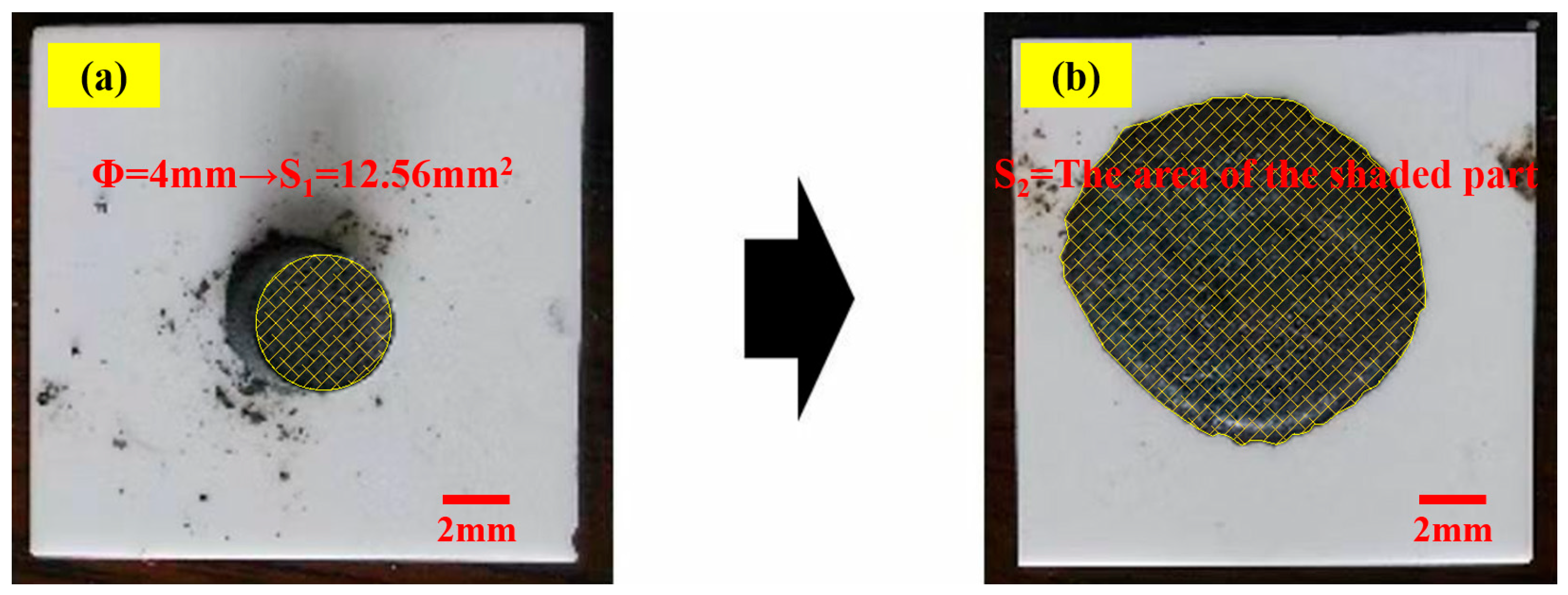
(3) Calculation: After calcining according to the above method, the sample will flow as shown in Figure 3. The sample before calcining is shown in Figure 3a, and the sample after calcining is shown in Figure 3b. The fluidity index (F) is the ratio of the sample area after calcining to the sample area before calcining, as shown in Equation (1). In this experiment, the color-extraction function of Photoshop software (2020 version)was used to determine the area of irregular shape after sample flow. The shaded area represents the area calculated by the Photoshop software, as shown in Figure 3b. The calculated area is highly consistent with the actual area.
F = S 1 S 2
In the Equation, F is the fluidity index; S 1 is the area of the sample before calcination, mm2; and S 2 is the area of the sample after calcination, mm2.

2.4. Determination of Solid–Liquid Coexistence-Phase Viscosity

2.4.1. Determination of System Composition and the Quantity of Solid Phase

In the present work, the isothermal section diagram of FeO-CaO-SiO2 ternary slag system and the lever law are used to determine the composition liquid phase and the quantity of solid phase [26,27]. The isothermal section diagrams of typical temperatures can be obtained through classic phase diagrams, while the isothermal section diagrams of other temperatures are obtained through the FactSage thermodynamic software (2020 version). By comparing with the isothermal section diagrams of typical temperatures, it was found that the isothermal section diagrams at different temperatures obtained by the FactSage thermodynamic software were highly accurate and can meet the requirements of the experiment. (The calculation results of FactSage thermodynamic software need to be verified against experimental data to ensure their accuracy.)
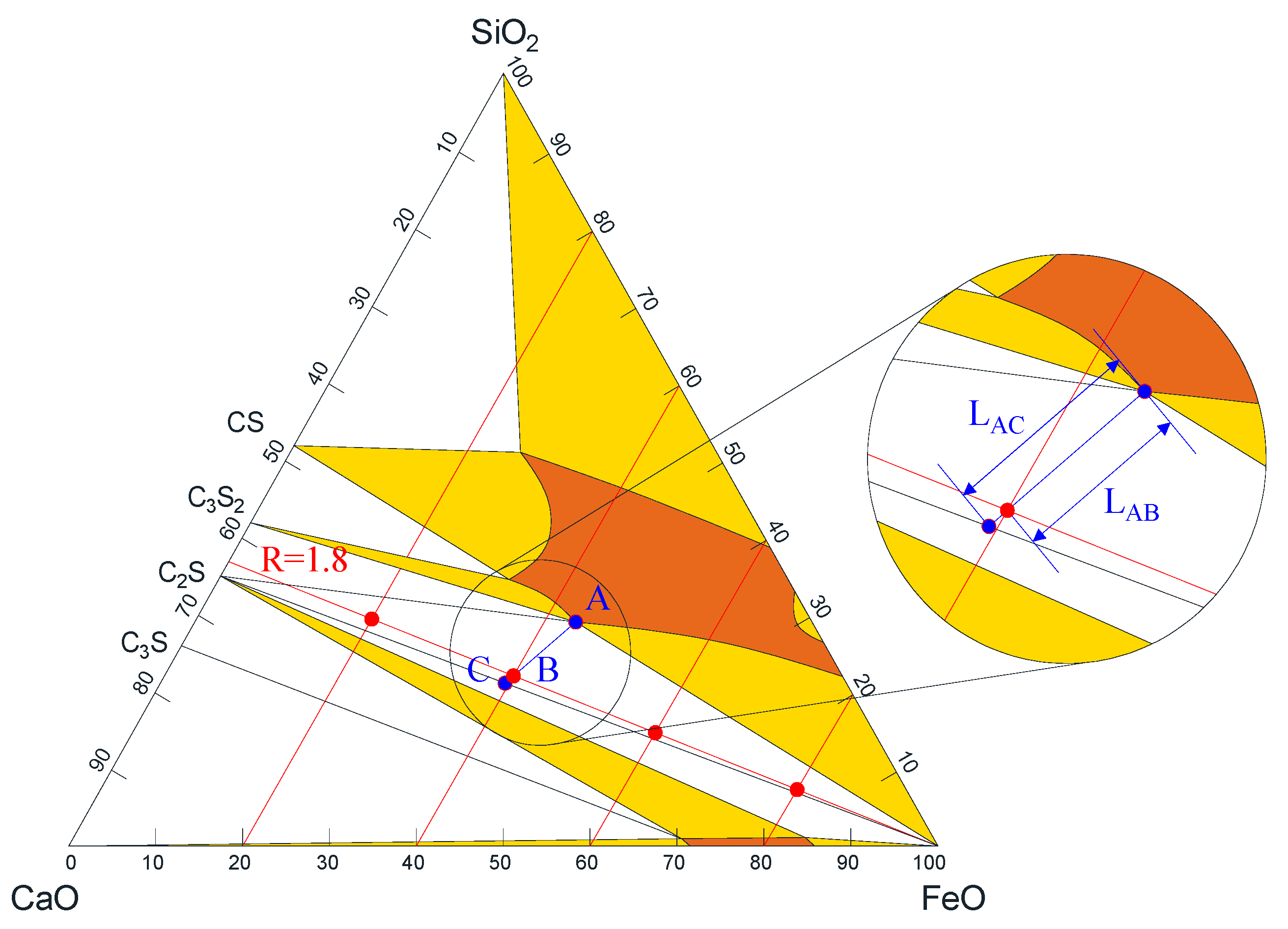
For example, the system composition and the quantity of solid phase of each sample point are determined by the 1200 °C isothermal cross-section diagrams of the FeO-CaO-SiO2 ternary slag system and the lever law, as shown in Figure 4. Taking the sample point (B) with w (FeO) = 40% as an example, point B (solid–liquid coexistence phase) is composed of point A (liquid phase) and point C (solid phase). The liquid-phase component of point A is the liquid-phase component of point B, and the solid-phase component of point C is the solid-phase component of point B. The quantity of solid phase at point B is calculated as shown in Equation (2) (lever law). It is worth noting that the difference between the percentage of solid mass calculated by the lever law here and the quantity of solid phase in the model (percentage of volume) is negligible.
f = L A B L A C
In the Equation, f is the quantity of solid phase at point B (mass %), L A C is the relative length of line segment AC in the phase diagram, L A B is the relative length of line segment AB in the phase diagram.

2.4.2. Calculation Model of Liquid-Phase Viscosity

The solid–liquid two-phase viscosity is mainly controlled by the liquid-phase primary slag viscosity ( η L ) and the quantity of solid phase (f). The liquid-phase primary slag viscosity, η L , can be calculated by Kim, Riboud, Chen, Iida, NPL, Urbain, Kondratiev et al., and other models. The relevant literature shows that the Kondratiev model optimized by Kondratiev on Urbain model has a high accuracy in calculating the viscosity ( η L ) of liquid-phase primary slag [28,29,30,31,32,33,34,35,36,37,38]. Therefore, the Kondratiev model is used to calculate the viscosity, η L , of liquid-phase primary slag.
Kondratiev viscosity calculation model is shown in Equation (3):
η L = AT e 1000 B T
In the Equation, η L is the liquid-phase primary slag viscosity, Pa·s; A is the predigital factor; T is the Kelvin temperature, K; and B is the viscous flow activation energy, J/mol.
The calculation method of predigital factor A is shown in Equation (4):
l n A = m B + n
In the Equation, m and n are the calculation parameters.
The value of parameter n is 9.322, and the calculation method of parameter m is shown in Equation (5):
m   =   m A X A + m C X C + m F X F + m S X S
In the Equation, m A , m C , m F , and m S are the correction coefficients of Al2O3, CaO, FeO, and SiO2 to parameter m, and the correction coefficient values are shown in Table 2; and X A , X C , X F , and X S are the mole fractions of Al2O3, CaO, FeO, and SiO2.
Viscous flow activation energy, B, is shown in Equation (6):
B = i = 0 3 b i 0 X S i + i = 0 3 j = 1 2 b i C j X C X C + X F + b i F j X F X C + X F α j X S i
In the Equation, b i 0 is the correction coefficient of parameter B of the Al2O3-SiO2 binary system; and b i C and b i F —are the correction coefficients of parameter B of CaO and FeO. The correction coefficient values are shown in Table 2.
The calculation method of α in Equation (6) is shown in Equation (7):
α = X C + X F X C + X F + X A

2.4.3. Calculation Model of Solid–Liquid Coexistence-Phase Viscosity

The primary slag contains a large number of unmelted solid particles. The primary slag mainly exists in the form of solid–liquid coexistence phase, which makes the viscosity of the primary slag too high, and it is difficult to use the traditional viscosity detection equipment to directly determine the viscosity of the primary slag. In the present work, the solid–liquid two-phase viscosity prediction model is used to calculate the primary slag viscosity at different compositions and temperatures. According to the relevant literature [39,40,41], the calculation model of solid–liquid coexistence phase viscosity was summarized, as shown in Table 3. It can be seen from Table 3 that the solid–liquid coexistence phase viscosity of each model is controlled by two variables: liquid-phase viscosity and percentage of solid-phase volume (the quantity of solid phase).
In the Table 3, η is the solid–liquid coexistence-phase viscosity, Pa·s; η L is the liquid-phase viscosity, Pa·s; and f is the percentage of solid-phase volume (the quantity of solid phase).

3. Results

3.1. Fluidity Index Test Result

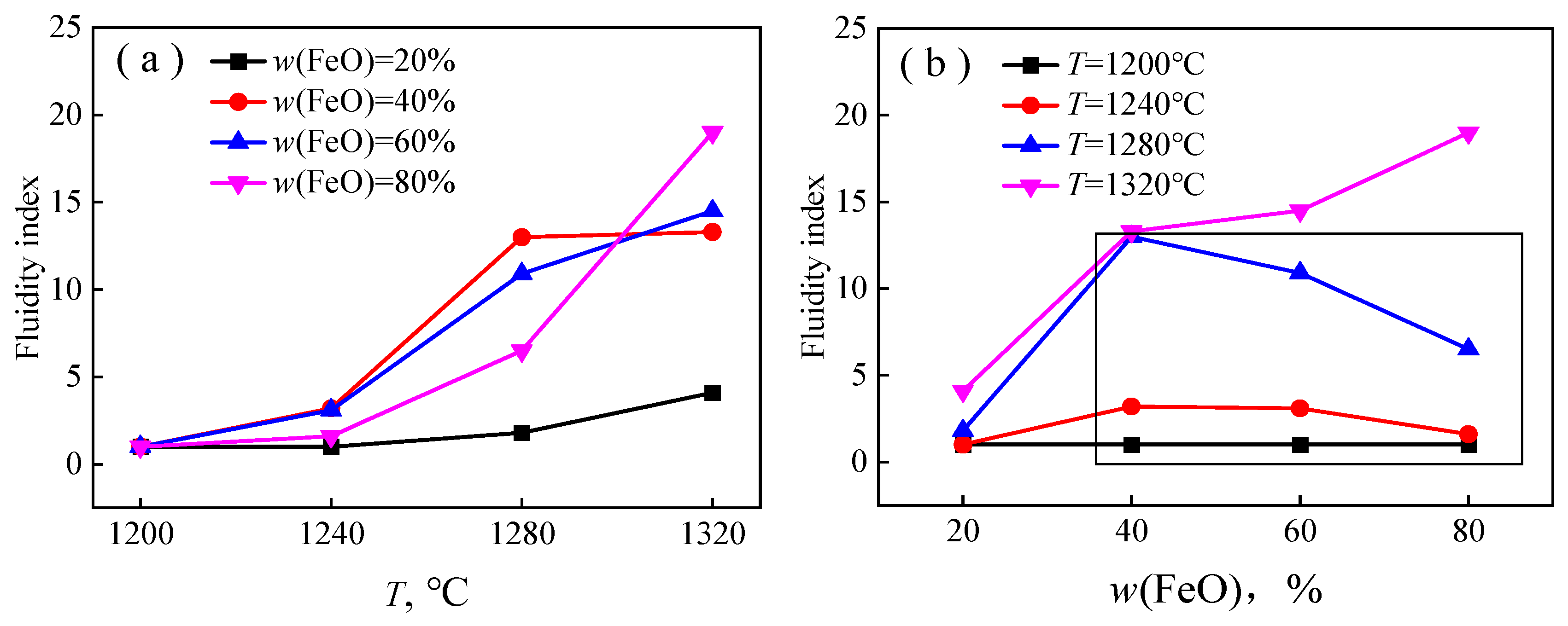
According to the above experimental method, the fluidity index of each component point at 1200 °C, 1240 °C, 1280 °C, and 1320 °C was determined, as shown in Figure 5. It can be seen from Figure 5b that when w (FeO) is constant, the fluidity index of each primary slag sample increases with the increase in temperature, T. When the temperature (T) is constant, the fluidity index of the samples in the non-three-phase region increases with the increase in w (FeO), while the fluidity index of the samples in the three-phase region decreases with the increase in w (FeO) (the region framed in Figure 5b, excluding T = 1320 °C). This is mainly because with the increase in w (FeO)/w (CaO), the reaction of CaO and FeO will produce calcium–iron olivine with a higher melting point, while reducing the solubility of tridymite in the saturated liquid phase. Therefore, the increase in w (FeO) in the system reduces the formation of liquid phase and inhibits the flow of the sample.
The different reducibility of sinter leads to the difference of w (FeO) in the primary slag, and then it affects the fluidity index of the primary slag at a certain temperature, which is the fundamental reason for the different fluidity of the primary slag of different sinters. The primary slag with a high fluidity index can complete the soft-melting within a narrower temperature range, resulting in a thinner cohesive zone and, thus, thinner coke window, which is the fundamental reason for the different permeability of the cohesive zone of blast furnace.

3.2. Calculation Results of Solid–Liquid Coexistence-Phase Viscosity

3.2.1. Calculation Results of Liquid-Phase Viscosity

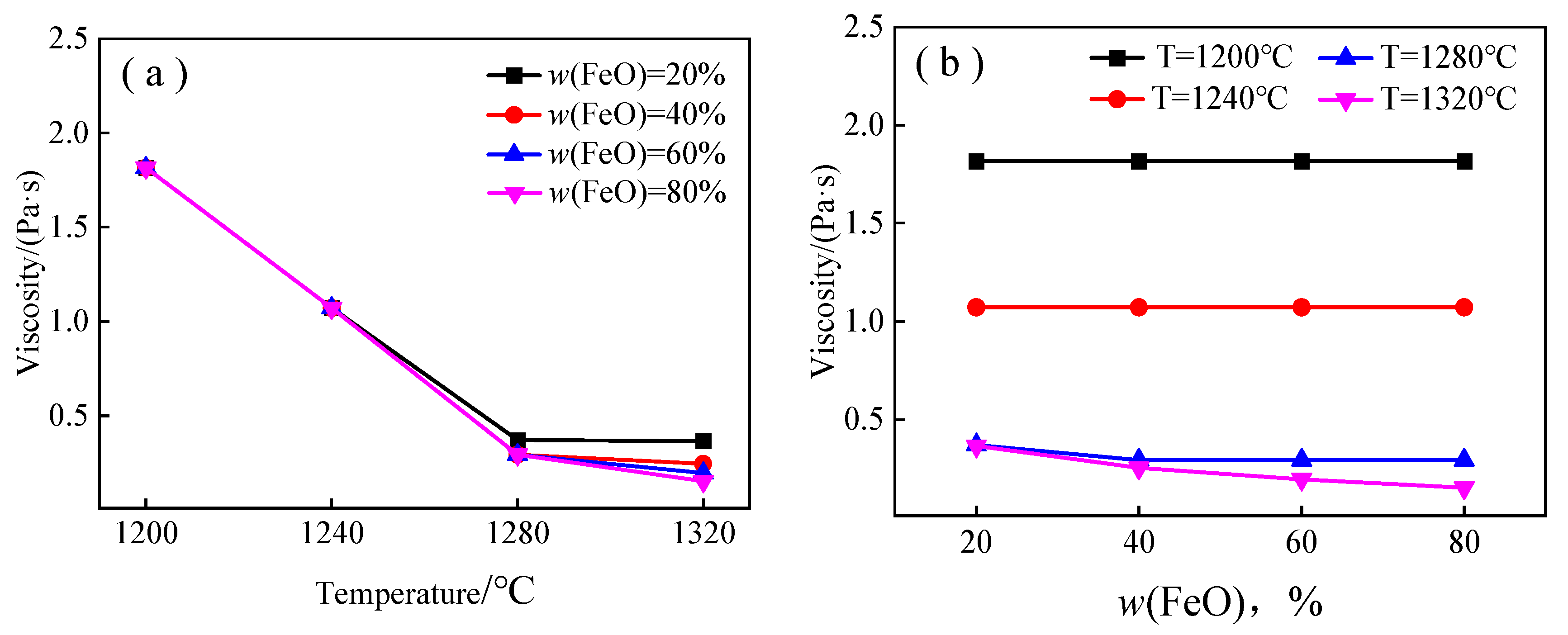
According to the method mentioned above for determining the liquid-phase composition in the solid–liquid coexistence phase, the liquid-phase composition of each component point at 1200 °C, 1240 °C, 1280 °C, and 1320 °C was determined, and the liquid-phase composition of each component point was substituted into the Kondratiev model to calculate the viscosity of various mixture, as shown in Figure 6. It can be seen from the figure that when w (FeO) is constant, the viscosity of each mixture decreases with the increase in temperature, T; when the temperature is 1200 °C and 1240 °C, the viscosity value is constant and does not change with w (FeO). This is mainly because the liquid-phase composition is not affected by changes in the FeO content, and the solid–liquid coexistence-phase viscosity value is mainly affected by the quantity of solid phase (at the same temperature). When the temperature rises to 1280 °C, the viscosity decreases slightly as w (FeO) increases from 20% to 40%, and then it remains constant. When the temperature rises to 1320 °C, the viscosity decreases with the increase in w (FeO). This is mainly because the increase in FeO will simplify the complexity of the [SiO4] space network. Secondly, the melting point of FeO is relatively low, and the increase in w (FeO) will also dilute the viscosity.

3.2.2. Calculation Results of the Quantity of Solid Phase

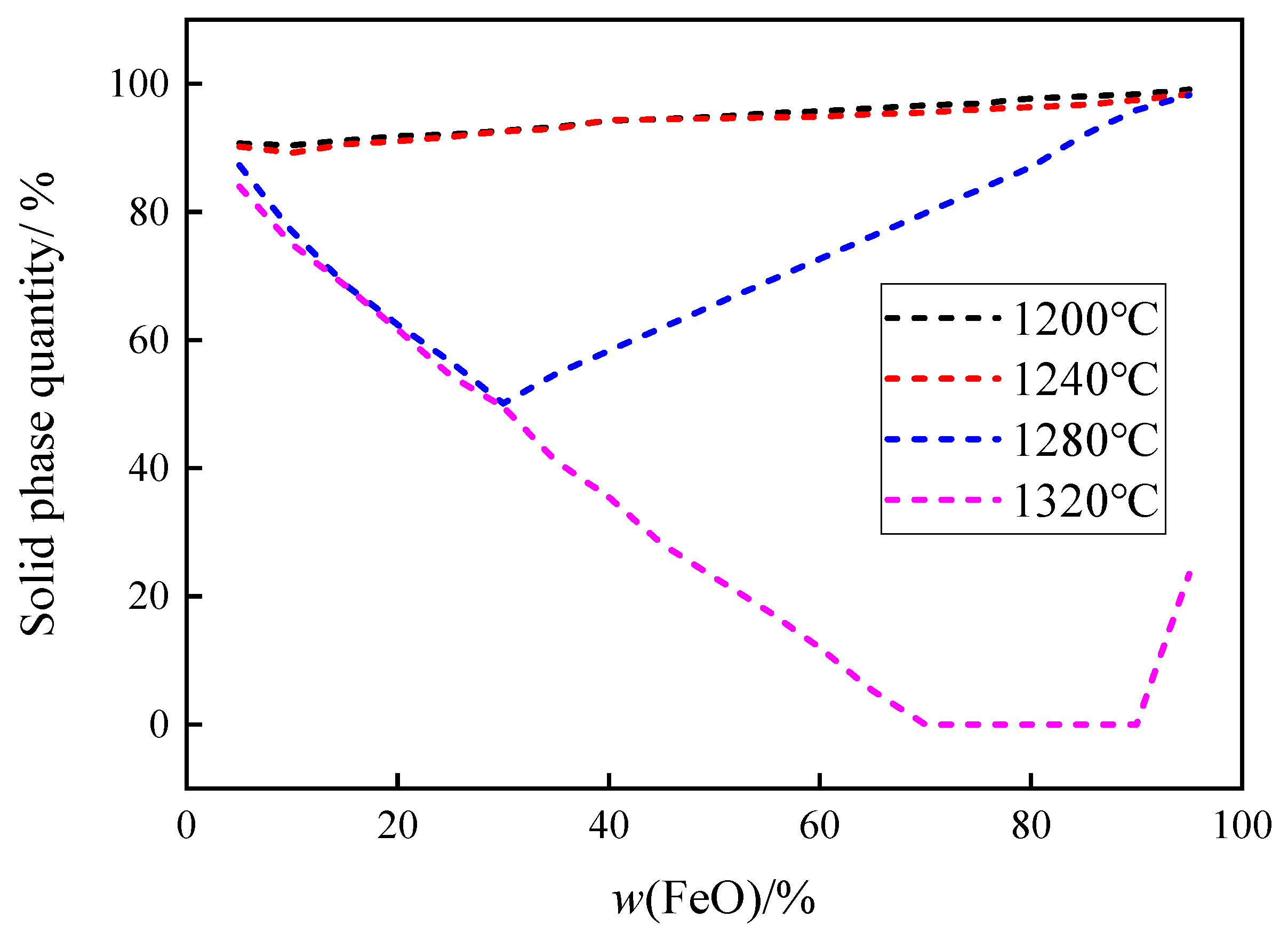
According to the calculation method of the quantity of solid phase mentioned above (the lever law), the quantity of solid phase of each component point at 1200 °C, 1240 °C, 1280 °C, and 1320 °C was calculated, and the results are shown in Figure 7. As can be seen from the figure, when T = 1200 °C and 1240 °C, and w (FeO) = 5~95%, all component points are in the three-phase region composed of liquid phase + 2CaO·SiO2 + FeO, and the quantity of solid phase gradually increases with the increase in w (FeO). When T = 1280 °C and w (FeO) = 5~30%, all the component points are in the two-phase region composed of liquid phase + 2CaO·SiO2, and the quantity of solid phase gradually decreases with the increase in w (FeO). The minimum value is obtained when w (FeO) = 30%, and the quantity of solid phase is fmin = 53.26%. When T = 1280 °C and w (FeO) = 30–95%, all the component points are in the three-phase region composed of liquid phase + 2CaO·SiO2 + FeO, and the quantity of solid phase gradually increases with the increase in w (FeO). When T = 1320 °C, with the increase in w (FeO), the phase region where the component points are located can be divided into three sections. The first section is a two-phase region composed of liquid phase + 2CaO·SiO2, the second section is a single-phase region of liquid phase, and the third section is a two-phase region composed of liquid phase + FeO. In the first section, the change trend of the solid phasor is opposite to that of w (FeO), and it reaches the minimum value of 0% when the component point is in the single-phase region. In the second section, the change in w (FeO) does not cause the change in the quantity of solid phase, and its value is constant 0%. In the third section, the trend of change in the quantity of solid phase is the same as that of w (FeO).

3.2.3. Accuracy Comparison of Solid–Liquid Coexistence-Phase Viscosity Models

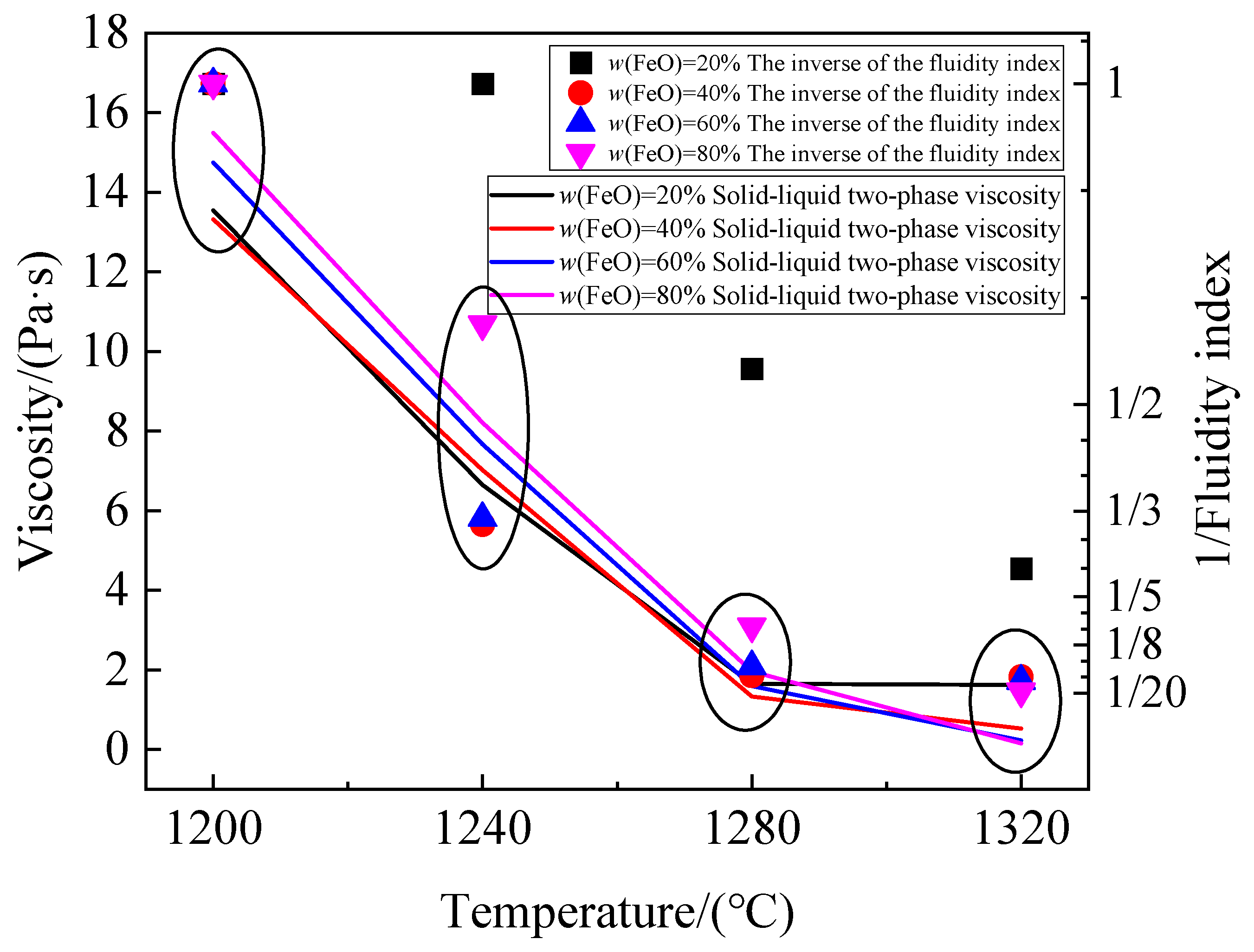
Based on the known liquid-phase viscosity and the quantity of solid phase of each sample point of FeO-CaO-SiO2 ternary slag system, the solid–liquid coexistence-phase viscosity of FeO-CaO-SiO2 ternary slag system was calculated by substituting them into the solid–liquid coexistence-phase viscosity model in Table 2. Due to the limitation of the use range of the quantity of solid phase, only Roscoe-2, Batchelor, and Monney models are applicable to the sample points in this experiment, and the calculation results are shown in Table 4. In Table 4, η L is defined as the viscosity of liquid phase, f is defined as the quantity of solid phase, and F is defined as fluidity index. It can be seen from the table that the viscosity of each sample point calculated by the Roscoe-2 model and the Monney model is inaccurate; this is mainly because the change in viscosity is much greater than that of the fluidity index. The viscosity value of each sample point calculated by the Batchelor model has a similar change rule to the reciprocal fluidity index of each sample point measured in the experiment, as shown in Figure 8. As can be seen from the figure, when w (FeO) is between 40% and 80%, the fit degree calculated by the Batchelor model is the highest (12 circled places), and the Batchelor model is the most accurate in calculating the solid–liquid coexistence-phase viscosity of the FeO-CaO-SiO2 ternary slag system. The Kondratiev model and the Batchelor model were jointly employed to calculate the primary slag viscosity in the cohesive zone. When w (FeO) = 20%, 40%, 60%, and 80%, the viscosity of the FeO-CaO-SiO2 ternary slag system at 1200 °C is 13.55 Pa·s, 13.32 Pa·s, 14.74 Pa·s, and 15.49 Pa·s, respectively; and the viscosity of the FeO-CaO-SiO2 ternary slag system at 1320 °C is 1.62 Pa·s, 0.53 Pa·s, 0.23 Pa·s, and 0.15 Pa·s, respectively. At the same temperature, the solid–liquid coexistence-phase viscosity of FeO-CaO-SiO2 ternary slag system is mainly controlled by the quantity of solid phase (w (FeO)). The different w (FeO) in the primary slag formed by different sinters is the main reason for the different permeability of the cohesive zone.

4. Discussion

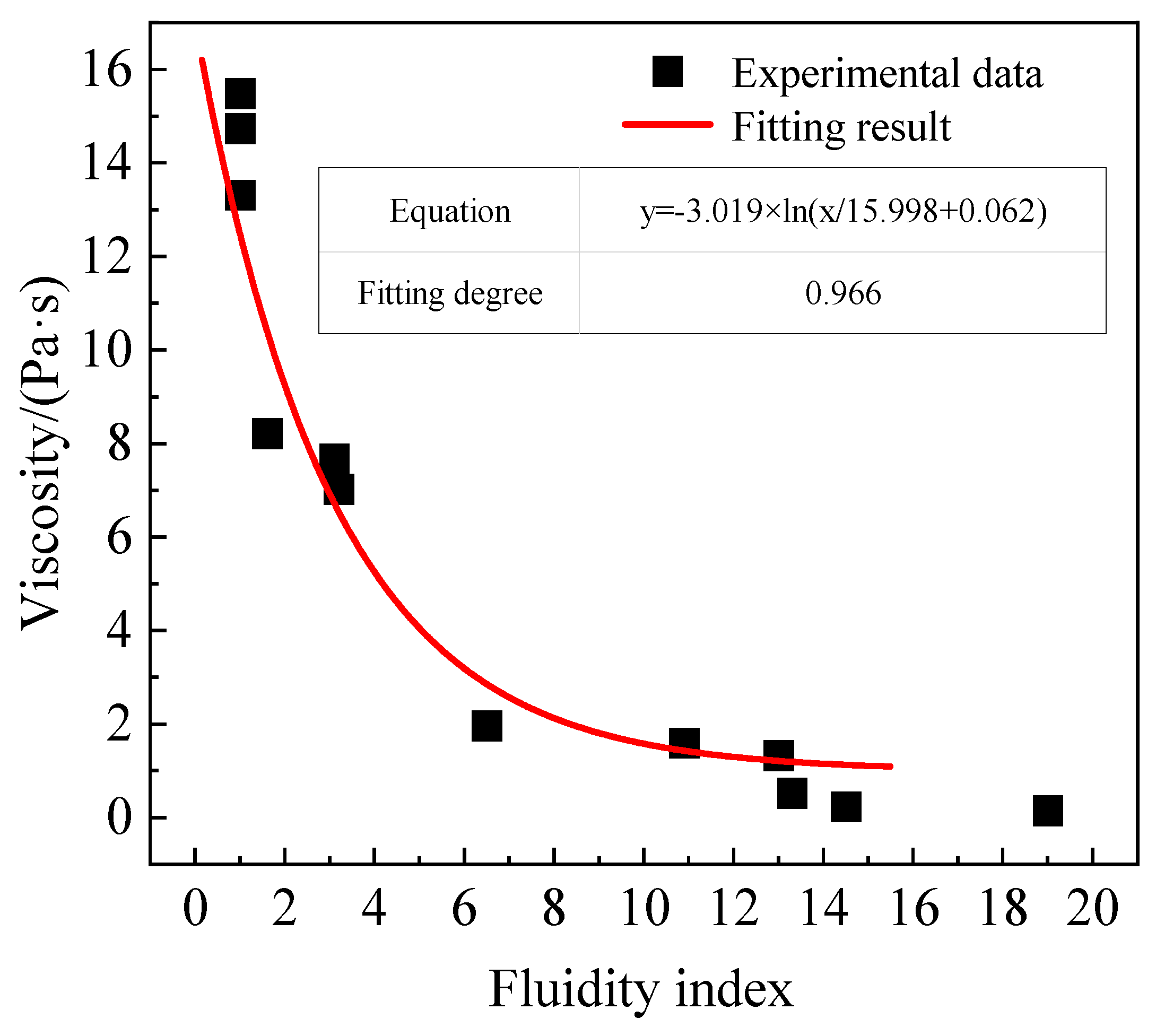
The calculation results of the Batchelor model were selected and combined with the viscosity and fluidity index data of sample points with w (FeO) in 40–80% (12 circled places in Figure 8) to establish the relationship between viscosity and fluidity index. The results are shown in Figure 9. As can be seen from the figure, there is a power function relationship between the fluidity index (F) and the solid–liquid coexistence-phase viscosity (η), and the fitting degree of the two reaches 0.966. The relationship is shown in Equation (8). According to the formula, the viscosity of the FeO-CaO-SiO2 ternary slag system can be calculated by the composition and temperature of the primary slag, and then the fluidity index of the slag system can be obtained. The viscosity of the primary slag is difficult to determine, but it can be obtained by measuring the fluidity index.
η = 3.019 × ln   ( F 15.998 ) + 0.062
In the Equation, η is the viscosity of solid–liquid coexistence phase, Pa·s; and F is the fluidity index.
Based on the method described in the previous text, the viscosities of the FeO-SiO2 binary slag system in the solid–liquid coexistence phase at 1200 °C, 1240 °C, and 1280 °C were calculated when the w (FeO) was 60% and 80%, as shown in Table 5. In Table 5, η L is defined as the viscosity of liquid phase (calculated by the Kondratiev model), f is defined as the quantity of solid phase, η is defined as the viscosity of solid–liquid coexistence phase (calculated by the Batchelor model), FC is defined as the fluidity index calculated through Equation (8), and FT is defined as the fluidity index obtained through experimental testing. The fluidity index calculated through Equation (8) (FC) was compared with the fluidity index obtained through the experimental test (FT). The relative error value was calculated according to Equation (9), and the calculation results are also shown in Table 5.
σ = F C F T F T
In the Equation, σ is the relative error, F C is the fluidity index obtained through calculation, and F C is the fluidity index obtained through experimental test.
It can be seen that the maximum relative error is 8.43%. The relevant literature indicates that the relative error of some model calculation results is above 25% [42]. Thus, it can be concluded that using this method to predict the fluidity of the slag system has a relatively high accuracy.
In the FeO-CaO-SiO2 ternary slag system studied in this research, the content range of FeO is quite wide. By using this method, not only can the fluidity of the cohesive zone in the blast furnace be predicted, but it can also be applied to the slag system of converter steelmaking. The application scope is relatively broad, which is also one of the characteristics of this research.

5. Conclusions

The fluidity and viscosity of primary slag of FeO-CaO-SiO2 ternary slag system formed by sinter in cohesive zone of blast furnace were studied. The influence of composition and temperature on the fluidity were analyzed. Combined with the liquid phase and solid–liquid coexistence-phase viscosity model, the relationship between the fluidity of the primary slag and the solid–liquid coexistence-phase viscosity in a certain range was determined. The relative errors between the calculated and tested values of the fluidity index of the FeO-SiO2 binary slag system were compared. The conclusions can be summarized as below:
(1)
For the primary slag of the FeO-CaO-SiO2 ternary slag system, when w (FeO) is constant, the fluidity index of each primary slag increases with the increase in temperature, T. When the temperature (T) is constant, the fluidity index of primary slag in non-three-phase region increases with the increase in w (FeO), while that in the three-phase region decreases with the increase in w (FeO).
(2)
The Kondratiev model and the Batchelor model were jointly employed to calculate the primary slag viscosity in the cohesive zone. According to this model, when w (FeO) = 20%, 40%, 60%, and 80%, the viscosity of the FeO-CaO-SiO2 ternary slag system at 1200 °C is 13.55 Pa·s, 13.32 Pa·s, 14.74 Pa·s, and 15.49 Pa·s, respectively. The viscosity of FeO-CaO-SiO2 ternary slag system at 1320 °C is 1.62 Pa·s, 0.53 Pa·s, 0.23 Pa·s, and 0.15 Pa·s, respectively. At the same temperature, the solid–liquid coexistence-phase viscosity of FeO-CaO-SiO2 ternary slag system is mainly controlled by the quantity of solid phase (w (FeO)). The different w (FeO) in the primary slag formed by different sinters is the main reason for the different permeability of cohesive zone.
(3)
In the FeO-CaO-SiO2 ternary slag system, there is an approximate logarithmic correlation between the solid–liquid coexistence-phase viscosity and the fluidity index. The relationship between them is determined by coupling as follows: η = 3.019 × ln ( F 15.998 ) + 0.062   ( η —solid–liquid coexistence-phase viscosity; and F —fluidity index), and the fitting degree can reach 0.966. According to the formula, the viscosity of FeO-CaO-SiO2 ternary slag system can be calculated by the composition and temperature of the primary slag, and then the fluidity index of the slag system can be obtained. Also, the viscosity of the primary slag is difficult to test, but it can be obtained by measuring the fluidity index. The relative error value of predicting the fluidity of the slag system using this method is only about 8.43%.

Author Contributions

Conceptualization, data curation, writing—original draft preparation, Q.W.; methodology, validation, formal analysis, funding acquisition, X.J.; investigation, software, Y.L. and K.F.; visualization, Supervision, Q.G.; writing—review and editing, Supervision, H.Z. and F.S. All authors have read and agreed to the published version of the manuscript.

Funding

The National Natural Science Foundation of China (NSFC 52274322), the China Baowu Low Carbon Metallurgy Innovation Foundation (BWLCF 202303), and the National Key Research and Development Program of China (Grant No. 2021YFC2902401).

Institutional Review Board Statement

Not applicable.

Data Availability Statement

The original contributions presented in this study are included in the article. Further inquiries can be directed toward the corresponding author.

Acknowledgments

The financial support from the National Natural Science Foundation of China, the China Baowu Low Carbon Metallurgy Innovation Foundation, and the National Key Research and Development Program of China is much appreciated.

Conflicts of Interest

Author Yongqiang Li was employed by the company Benxi Steel Group Iron Factory. The remaining authors declare that the research was conducted in the absence of any commercial or financial relationships that could be construed as a potential conflict of interest.

References

  1. Chang, Z.Y.; Jiao, K.X.; Zhang, J.L. Graphitization Behavior of Coke in the Cohesive Zone. Metall. Mater. Trans. B 2018, 49, 2956–2962. [Google Scholar] [CrossRef]
  2. Fan, X.Y.; Jiao, K.X.; Zhang, J.L.; Wang, K.D.; Chang, Z.Y. Phase Transformation of Cohesive Zone in a Water-quenched Blast Furnace. ISIJ Int. 2018, 58, 1775–1780. [Google Scholar] [CrossRef]
  3. Inada, T. Dissection Investigation of Blast Furnace Hearth—Kokura No. 2 Blast Furnace (2nd Campaign). ISIJ Int. 2009, 49, 470–478. [Google Scholar] [CrossRef]
  4. Wang, Y.F.; Qie, Y.N.; Zhang, S.H.; Zhu, J.Q.; Liu, R.; Ji, H. Research status and prospect of softening-melting properties for blast furnace charge. China Metall. 2024, 34, 1–9. [Google Scholar]
  5. Zhang, S.L.; Chen, Z.C.; Zhan, W.L.; Lui, J.H.; Zhang, J.H.; He, Z.J. Influence of different initial slag basicity on the retention performance of slag and iron in blast furnace. Energy Metall. Ind. 2025, 44, 1–6. [Google Scholar]
  6. Zhang, X.; Wang, N.; Zhou, Z.; Ning, Z.; Chen, M. Effect of combined ferrous burden composition and ore-coke interaction on blast furnace burden distribution. Powder Technol. 2025, 449, 120416. [Google Scholar] [CrossRef]
  7. Fang, L.; Wu, H.Z.; Hu, Z.W.; Zhang, J.L. Influence of high basicity slag on BF smelting and corresponding operating system suggested. Ironmaking 2025, 44, 15–20. [Google Scholar]
  8. Zheng, A.Y.; Liu, Z.J.; Chang, D.Q. Effects of MgO on the mineral structure and softening-melting property of Ti-containing sinter. Chin. J. Eng. 2018, 40, 184–191. [Google Scholar]
  9. Kohei, S.; Masahiko, H. Effect of High Al2O3 Slag on the Blast Furnace Operations. ISIJ Int. 2008, 48, 420–429. [Google Scholar] [CrossRef]
  10. Nakamoto, M.; Ono-Nakazato, H.; Kawabata, H.; Usui, T.; Tanaka, T. Reduction Behavior of FeO Compact Including Molten Slag. ISIJ Int. 2004, 44, 2100–2104. [Google Scholar] [CrossRef]
  11. Nishimura, T.; Higuchi, K.; Naito, M.; Kunitomo, K. Evaluation of Softening, Shrinking and Melting Reduction Behavior of Raw Materials for Blast Furnace. ISIJ Int. 2011, 51, 1316–1321. [Google Scholar] [CrossRef]
  12. Wei, G.; Shen, F.M.; Du, G.; Du, H.G. Thermal strength requirement and testing method for blast furnace coke. J. Mater. Metall. 2011, 10, 237–240. [Google Scholar]
  13. Ding, Z.M.; Jiang, X.; Wei, G.; Shen, F.M. Numerical Simulation for the Influence of Cohesive Zone Shape on Distribution of Unburned Pulverized Coal in Blast Furnace. J. Northeast Univ. (Nat. Sci.) 2018, 39, 1242–1247. [Google Scholar]
  14. Fu, D.; Chen, Y.; Zhao, Y.F.; Alessio, J.D.; Ferron, K.J.; Zhou, C.Q. CFD modelling of multiphase reacting flow in blast furnace shaft with layered burden. Appl. Therm. Eng. 2014, 66, 298–308. [Google Scholar] [CrossRef]
  15. Dong, X.F.; Pinson, D.; Zhang, S.J.; Yu, A.B.; Zulli, P. Gas-powder flow in blast furnace with different shapes of cohesive zone. Appl. Math. Model. 2006, 30, 1293–1309. [Google Scholar] [CrossRef]
  16. Liu, T.; Li, T.L.; Sun, C.Y.; Wang, Q. Effect of FeO and Al2O3 contents on viscosity of primary slag. J. Univ. Sci. Technol. Liaoning 2017, 40, 81–84. [Google Scholar]
  17. Hou, L.M.; Liu, L.L.; Zhang, Z.T.; Wang, X.D. Experimental Research and Prediction Model on Viscosity of High FeO Content Slag. Iron Steel 2012, 47, 20–25. [Google Scholar]
  18. She, W.W.; Liu, Z.J.; Chen, X.M.; Yang, J.L. Effect of FeO, Al2O3 and MgO mass fraction on viscosity of blast furnace primary slag. China Metall. 2019, 29, 13–16. [Google Scholar]
  19. Carles, V.; Alphonse, P.; Tailhades, P.; Rousset, A. Study of thermal decomposition of FeC2O4·2H2O under hydrogen. Thermochem. Acta 1999, 334, 107–113. [Google Scholar] [CrossRef]
  20. Jiao, K.X.; Zhang, J.L.; Wang, Z.Y.; Chen, C.L.; Liu, Y.X. Effect of TiO2 and FeO on the Viscosity and Structure of Blast Furnace Primary Slags. Steel Res. Int. 2017, 88, 1600296. [Google Scholar] [CrossRef]
  21. Li, T.; Sun, C.Y.; Song, S.; Wang, Q. Influences of Al2O3 and TiO2 Content on Viscosity and Structure of CaO-8%MgO-Al2O3-SiO2-TiO2-5%FeO Blast Furnace Primary Slag. Metals 2019, 9, 743–751. [Google Scholar] [CrossRef]
  22. Wang, X.A.; Jiang, X.; Gao, Y.; Huo, H.Y.; Shen, F.M. Investigation on fluidity of SFCA and sintering strength based on phase diagram. Iron Steel 2019, 54, 5–13. [Google Scholar]
  23. Jiang, X.; Zhao, J.D.; Wang, L.; An, H.W.; Gao, Q.J.; Zheng, H.Y.; Shen, F.M. Effects of Liquidus Temperature and Liquid Amount on the Fluidity of Bonding Phase and Strength of Sinter. ISIJ Int. 2020, 61, 86–92. [Google Scholar] [CrossRef]
  24. Wu, S.L.; Pei, Y.D.; Chen, H.; Peng, P.; Yang, F. Evaluation on liquid phase fluidity of iron ore in sintering. J. Univ. Sci. Technol. Beijing 2008, 30, 1095–1100. [Google Scholar]
  25. Wu, S.L.; Du, J.X.; Ma, H.B.; Tian, Y.Q.; Xu, H.F. Fluidity of liquid phase in iron ores during sintering. J. Univ. Sci. Technol. Beijing 2011, 27, 291–293. [Google Scholar]
  26. Fan, X.Y.; Zhang, J.L. Relationship between Slag Phase and Softening & Melting Properties of Cohesive Zone. ISIJ Int. 2023, 63, 1919–1922. [Google Scholar] [CrossRef]
  27. Jiang, X.; Zhang, H.Y.; Zheng, H.Y.; Gao, Q.J.; Shen, F.M. Three-segment control theory of MgO/Al2O3 ratio based on viscosity experiments and phase diagram analyses at 1500 °C. J. Iron Steel Res. Int. 2020, 27, 624–630. [Google Scholar] [CrossRef]
  28. Han, C.; Chen, M.; Zhang, W.D.; Zhao, Z.X.; Evans, T.; Nguyen, A.V.; Zhao, B. Viscosity Model for Iron Blast Furnace Slags in SiO2-Al2O3-CaO-MgO System. Steel Res. Int. 2015, 86, 678–685. [Google Scholar] [CrossRef]
  29. Iida, T.; Sakai, H.; Kita, Y.; Shigeno, K. An Equation for Accurate Prediction of the Viscosities of Blast Furnace Type Slags from Chemical Composition. ISIJ Int. 2000, 40, 110–114. [Google Scholar] [CrossRef]
  30. Iida, T.; Sakai, H.; Kita, Y.; Murakami, K. Equation for estimating viscosities of industrial mold fluxes. High Temp. Mater. Process. 1999, 19, 153–165. [Google Scholar] [CrossRef]
  31. Pati, A.; Sahoo, S.K.; Mishra, B.; Mohanty, U.K. Viscosity of Industrial Blast Furnace Slag in Indian Scenario. Trans. Indian Inst. Met. 2018, 71, 801–812. [Google Scholar] [CrossRef]
  32. Chen, M.; Zhang, D.W.; Kou, M.Y.; Zhao, B.J. Viscosities of Iron Blast Furnace Slags. ISIJ Int. 2014, 54, 2025–2030. [Google Scholar] [CrossRef]
  33. Kondratiev, A.; Jak, E. Review of experimental data and modeling of the viscosities of fully liquid slags in the Al2O3-CaO-FeO-SiO2 system. Metall. Mater. Trans. B 2001, 32, 1015–1025. [Google Scholar] [CrossRef]
  34. Kondratiev, A.; Hayes, P.C.; Jak, E. Development of a Quasi-chemical Viscosity Model for Fully Liquid Slags in the Al2O3-CaO-FeO-MgO-SiO2 System. Part 3. Summary of the Model Predictions for the Al2O3-CaO-MgO-SiO2 System and Its Sub-systems. ISIJ Int. 2006, 46, 375–384. [Google Scholar] [CrossRef]
  35. Kondratiev, A.; Hayes, P.C.; Jak, E. Development of a Quasi-chemical Viscosity Model for Fully Liquid Slags in the Al2O3-CaO-FeO-MgO-SiO2 System. The Experimental Data for the FeO-MgO-SiO2, CaO-FeO-MgO-SiO2 and Al2O3-CaO-FeO-MgO-SiO2 Systems at Iron Saturation. ISIJ Int. 2008, 48, 7–16. [Google Scholar] [CrossRef]
  36. Suzuki, M.; Jak, E. Development of a Quasi-chemical Viscosity Model for Fully Liquid Slags in the Al2O3-CaO-FeO-MgO-SiO2 System: The Revised Model to Incorporate Ferric Oxide. ISIJ Int. 2014, 54, 2134–2143. [Google Scholar] [CrossRef]
  37. Tang, X.L.; Zhang, M.; Guo, M.; Wang, X.D. Structurally-based viscosity model for multicomponent slag systems. Chin. J. Eng. 2020, 42, 1149–1156. [Google Scholar]
  38. Tang, X.L.; Guo, M.; Wang, X.D.; Zhang, T.Z.; Zhang, M. Estimation model of viscosity based on modified (NBO/T) ratio. J. Univ. Sci. Technol. Beijing 2010, 32, 1542–1546. [Google Scholar]
  39. Bai, C.G.; Yan, Z.M.; Pang, Z.D.; Jiang, Y.Y.; Ling, J.W.; Lu, X.W. Advances of measurement and calculation model of slag viscosity. Iron Steel 2020, 55, 27–37. [Google Scholar]
  40. Batchelor, G.K. The effect of Brownian motion on the bulk stress in a suspension of spherical particles. J. Fluid Mech. 2006, 83, 97–117. [Google Scholar] [CrossRef]
  41. Hinch, E.J.; Leal, L.G. The effect of Brownian motion on the rheological properties of a suspension of non-spherical particles. J. Fluid Mech. 2006, 52, 683–712. [Google Scholar] [CrossRef]
  42. Tang, X.L.; Ma, M.S. A description of slag viscosity model and the prediction capability. China Nonferrous Metall. 2015, 44, 18–23. [Google Scholar]
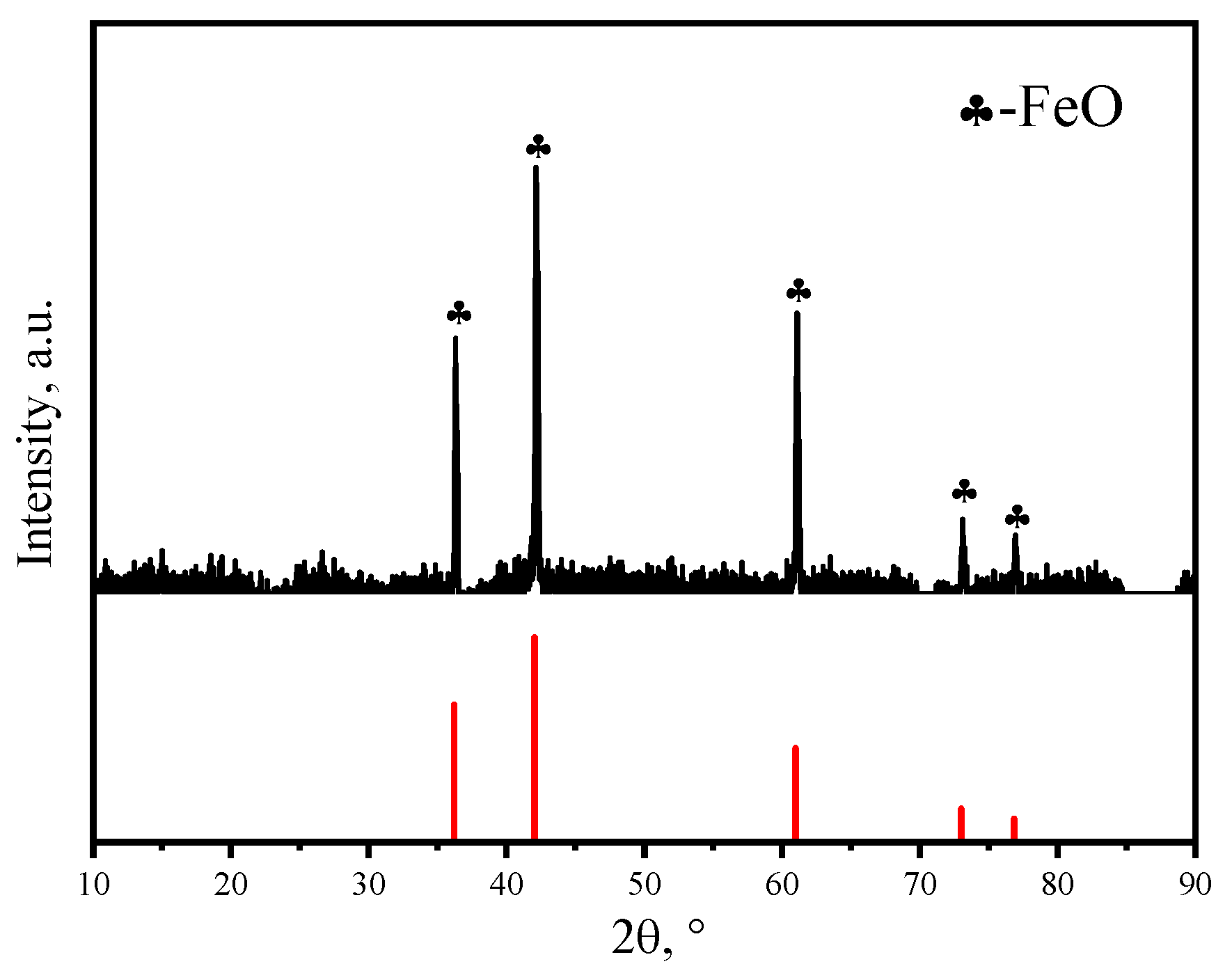
Figure 1. XRD analysis of product after roasting FeC2O4·2H2O.
Metals 16 00035 g001
Figure 2. Heating schedule and the composition of the protective gas.
Metals 16 00035 g002
Figure 3. Schematic diagram of liquid phase fluidity index: (a) before calcination and (b) after calcination.
Metals 16 00035 g003
Figure 4. Isotherm section of FeO-CaO-SiO2 ternary diagram at 1200 °C.
Metals 16 00035 g004
Figure 5. Variation rule of fluidity of primary slag of FeO-CaO-SiO2 ternary slag system: (a) the variation in fluidity with temperature and (b) the variation in fluidity with w (FeO).
Metals 16 00035 g005
Figure 6. Variation rule of liquid-phase viscosity of primary slag of FeO-CaO-SiO2 ternary slag system: (a) the variation in viscosity with temperature and (b) the variation in viscosity with w (FeO).
Metals 16 00035 g006
Figure 7. Relationship between the quantity of solid phase and w (FeO).
Metals 16 00035 g007
Figure 8. Relationship between viscosity and fluidity index.
Metals 16 00035 g008
Figure 9. Relationship between fluidity and viscosity.
Metals 16 00035 g009
Table 1. The collocation of FeO-CaO-SiO2 ternary slag system (mass%).
No.w (CaO)w (SiO2)w (FeO)R2
164.2935.7101.8
251.4328.57201.8
338.5721.43401.8
425.7114.29601.8
512.857.15801.8
Table 2. Parameters values of the Kondratiev viscosity model.
i 0123Correction Coefficient
j
b i 0 013.3136.98−177.70190.03n9.322
b i C j 15.5096.20117.94−219.56 m A 0.370
2−4.68−81.60−109.80196.00 m C 0.587
b i F j 134.30−143.64368.94−254.85 m F 0.665
2−45.63129.96−210.28121.20 m S 0.212
Table 3. Summary of calculation models of solid–liquid coexistence-phase viscosity.
Model Name Expression Scope of Use
Einstein η = ( 1 + 2.5 f ) fsolid < 0.05
Roscoe-1 η = ( 1 1.35 f ) 2.5 fsolid < 0.73
Roscoe-2 η = ( 1 f ) 2.5 unrestricted
Alex η = 1 1.35 f 1.29 fsolid < 0.49
Batchelor η = ( 1 + 2.5 f + 6.21 f 2 ) unrestricted
Monney η = e 2.5 f ( 1 + 1.35 f ) unrestricted
Table 4. Calculation results of solid–liquid coexistence-phase viscosity of FeO-CaO-SiO2 ternary slag system.
T/°Cw (FeO)/% η L /Pa·sf/%1/FViscosity/Pa·s
Roscoe-2BatchelorMonney
1200201.8291.831/1.00765.8413.55296.18
1200401.8294.221/1.00588.5013.32271.74
1200601.8295.691/1.005815.6214.74460.13
1200801.8297.691/1.00186,100.0015.49604.23
1240201.0791.051/1.0077.996.6580.55
1240401.0794.361/3.20123.027.02102.82
1240601.0794.851/3.11339.007.67156.53
1240801.0796.331/1.601215.678.21221.78
1280200.3762.381/1.825.121.657.84
1280400.2958.331/13.004.361.336.66
1280600.2972.661/10.919.411.6012.80
1280800.2987.001/6.4940.091.9630.63
1320200.3761.631/4.115.051.627.74
1320400.2535.491/13.290.690.530.85
1320600.1911.981/14.710.260.230.26
1320800.150.001/18.870.150.150.15
Table 5. Calculation and test results of solid–liquid coexistence-phase viscosity of FeO-SiO2 binary slag system.
T/°Cw (FeO)/% η L /Pa·sf/% η / Pa·sFCFTRelative Error/%
1200 °C601.3751.4810.8111.052.17
1200 °C800.7500.7513.5212.934.56
1240 °C601.1841.2512.5812.104.00
1240 °C800.5900.5914.1513.058.43
1280 °C600.9921.0612.2611.942.68
1280 °C800.4700.4714.6913.677.46
Disclaimer/Publisher’s Note: The statements, opinions and data contained in all publications are solely those of the individual author(s) and contributor(s) and not of MDPI and/or the editor(s). MDPI and/or the editor(s) disclaim responsibility for any injury to people or property resulting from any ideas, methods, instructions or products referred to in the content.