Effect of Microstructural Evolution on Plasticity of GH4065A Superalloy Cast Ingot During Homogenization Hot Treatment



Abstract
1. Introduction
2. Experiments
2.1. Materials and Methods
2.2. Microstructural Characterization
3. Results and Discussion
3.1. Solidification Calculations
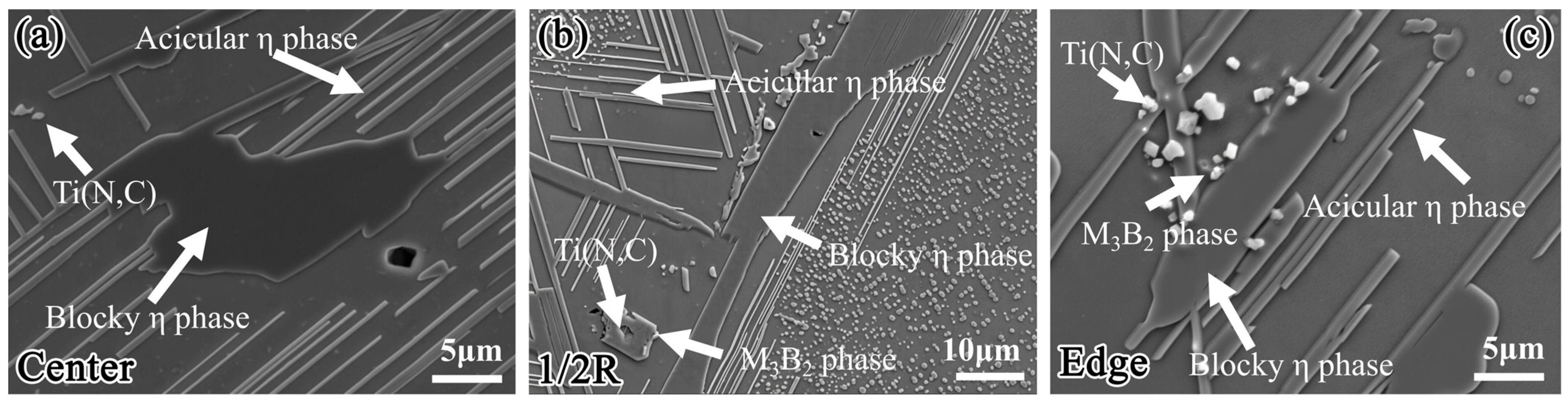
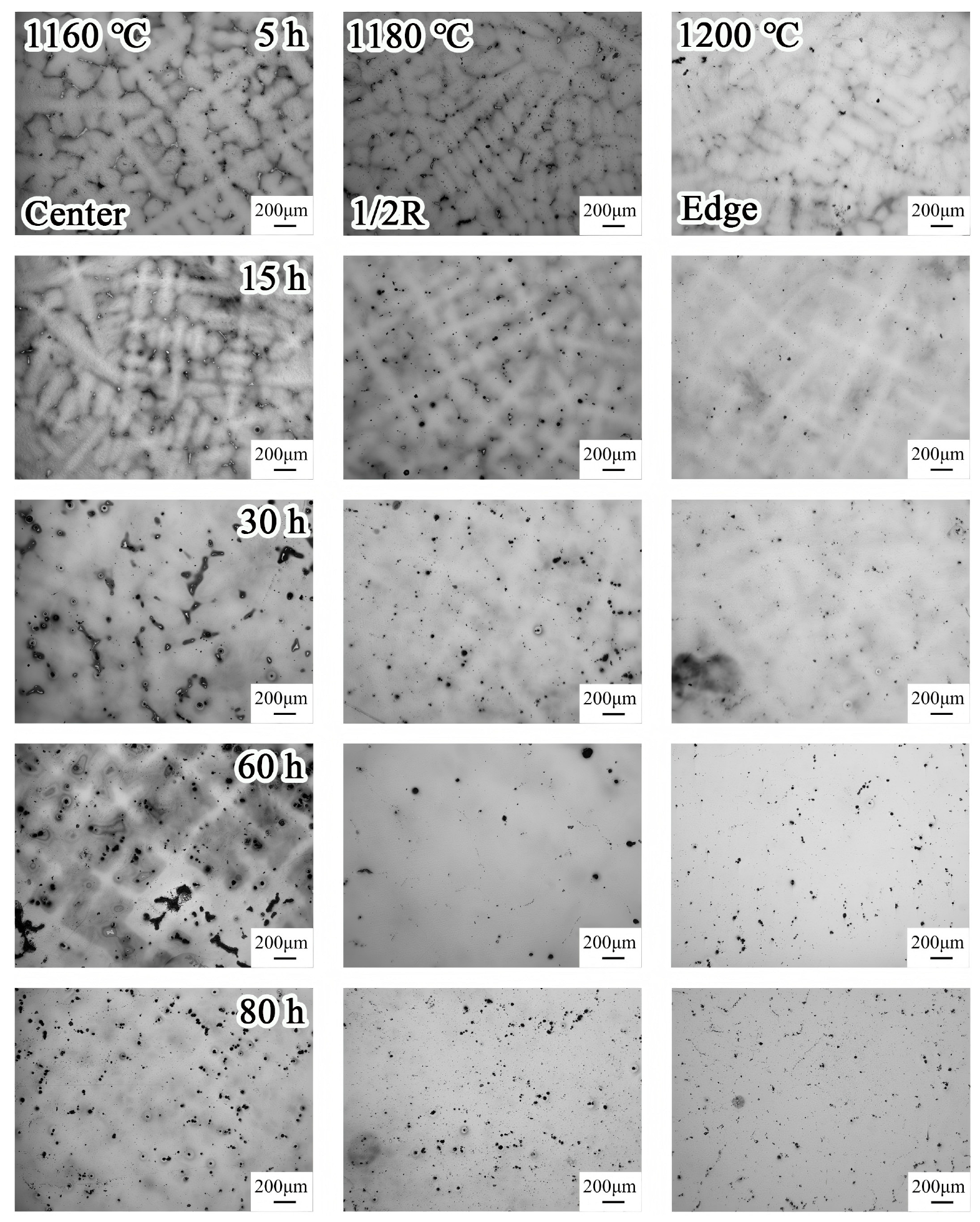
3.2. Effect of Temperature on Microstructural Evolution
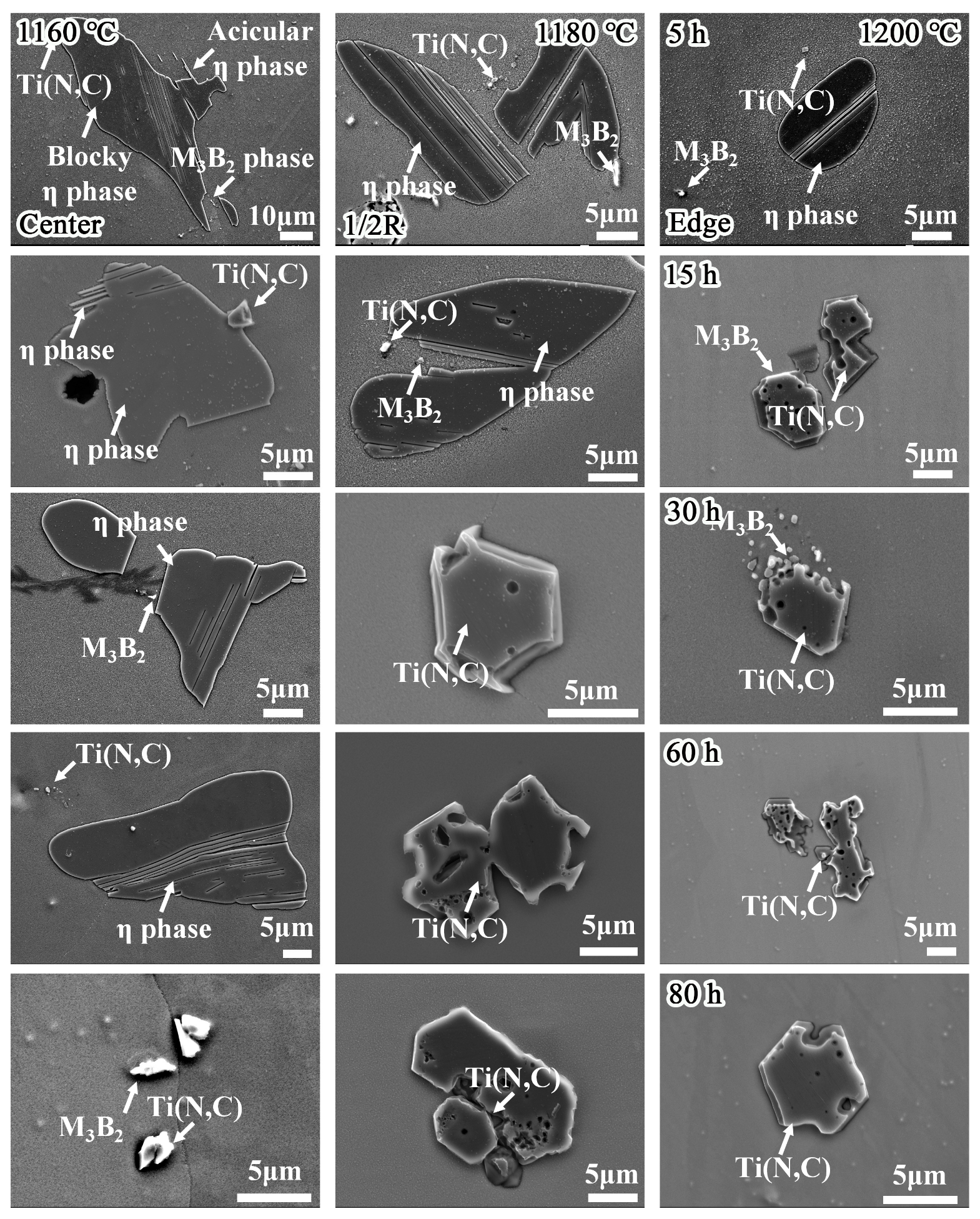
3.3. Dissolution Process of Dendrites and Precipitation Phases
3.4. Plasticity Enhancement Associated with Elemental Diffusion and Homogenization
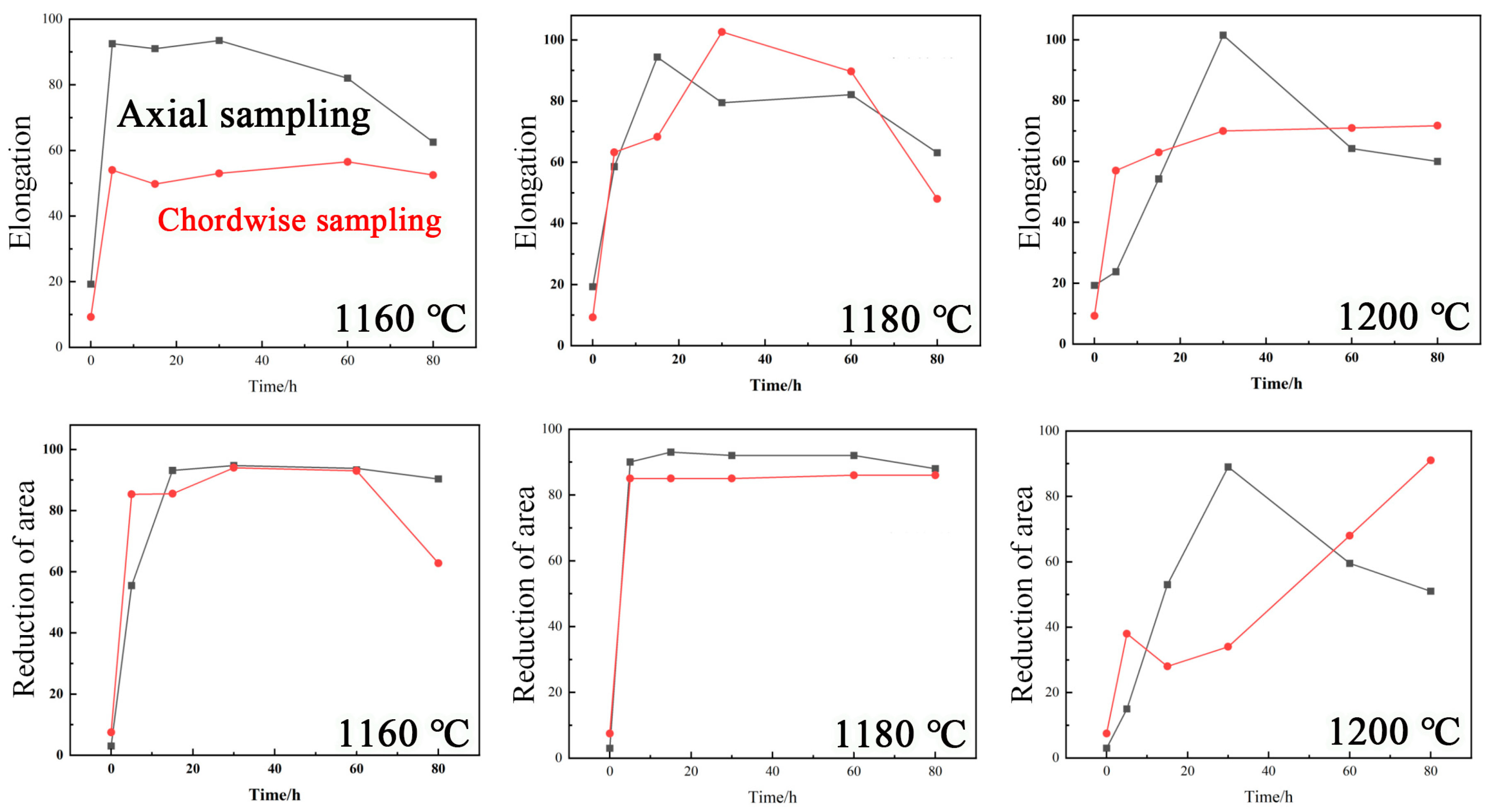
3.4.1. Elongation and Reduction of Area Associated with Microstructure Evolution
3.4.2. Effect of Temperature on Elemental Diffusion and Homogenization
4. Conclusions
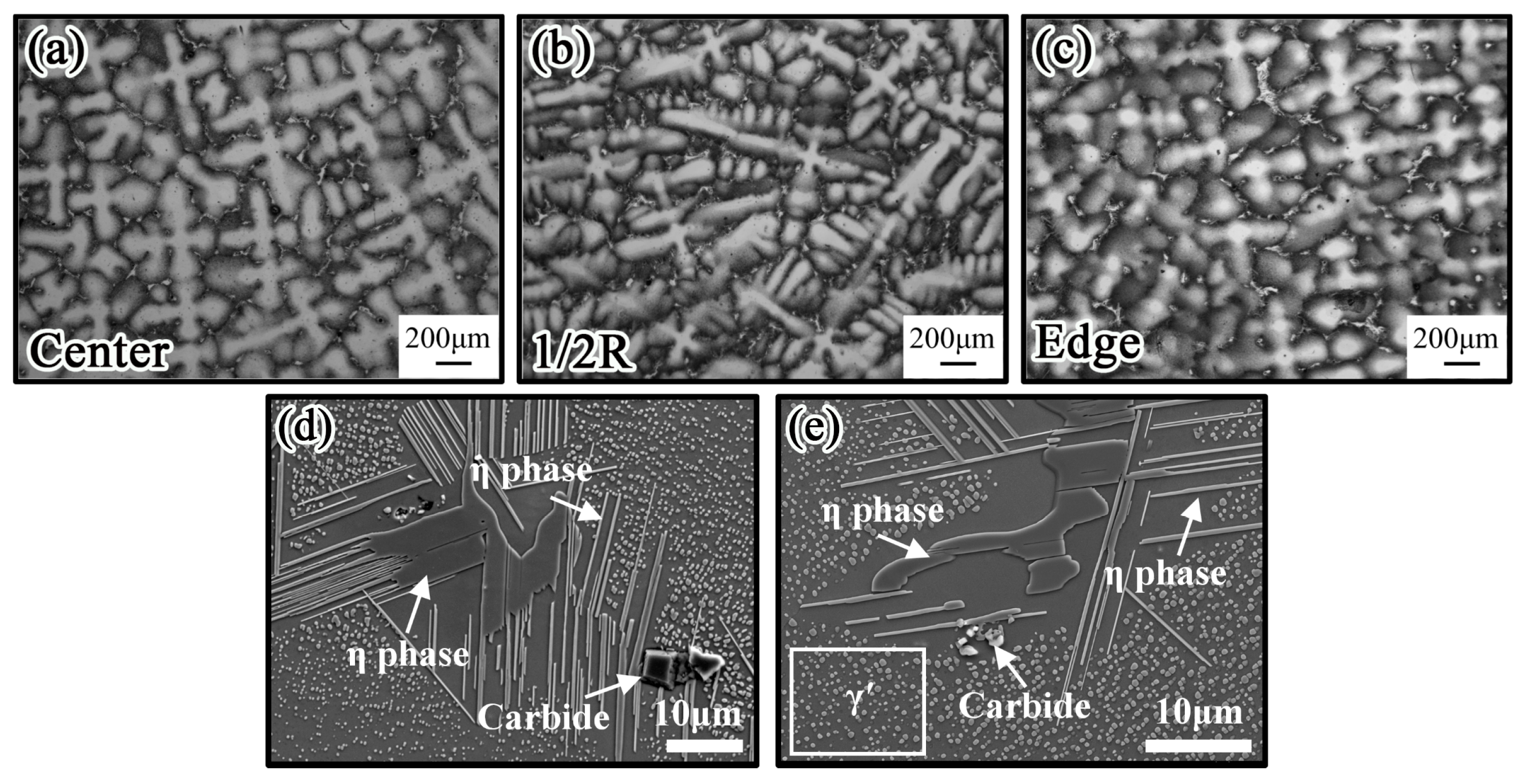
- The as-cast superalloy ingot exhibits a microstructure composed of dendritic crystals and various precipitates, including carbides, borides, and η phases;
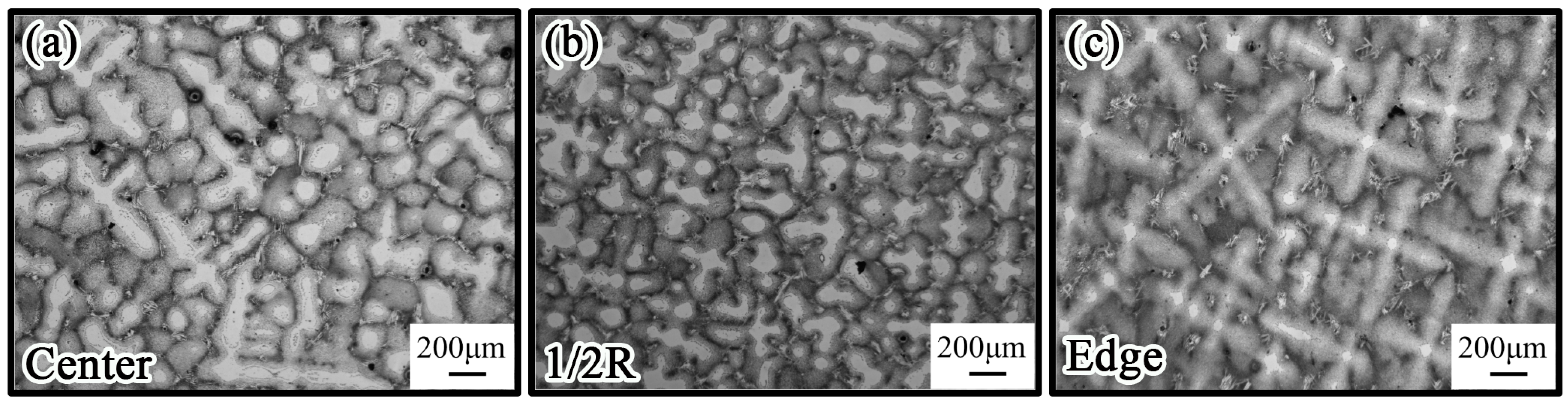
- Temperature defines the evolution of grains and precipitates. An increase to 1160 °C significantly modifies the microstructure, while at 1200 °C, precipitates undergo rapid and extensive dissolution, leading to pronounced changes in carbide size and volume fraction;
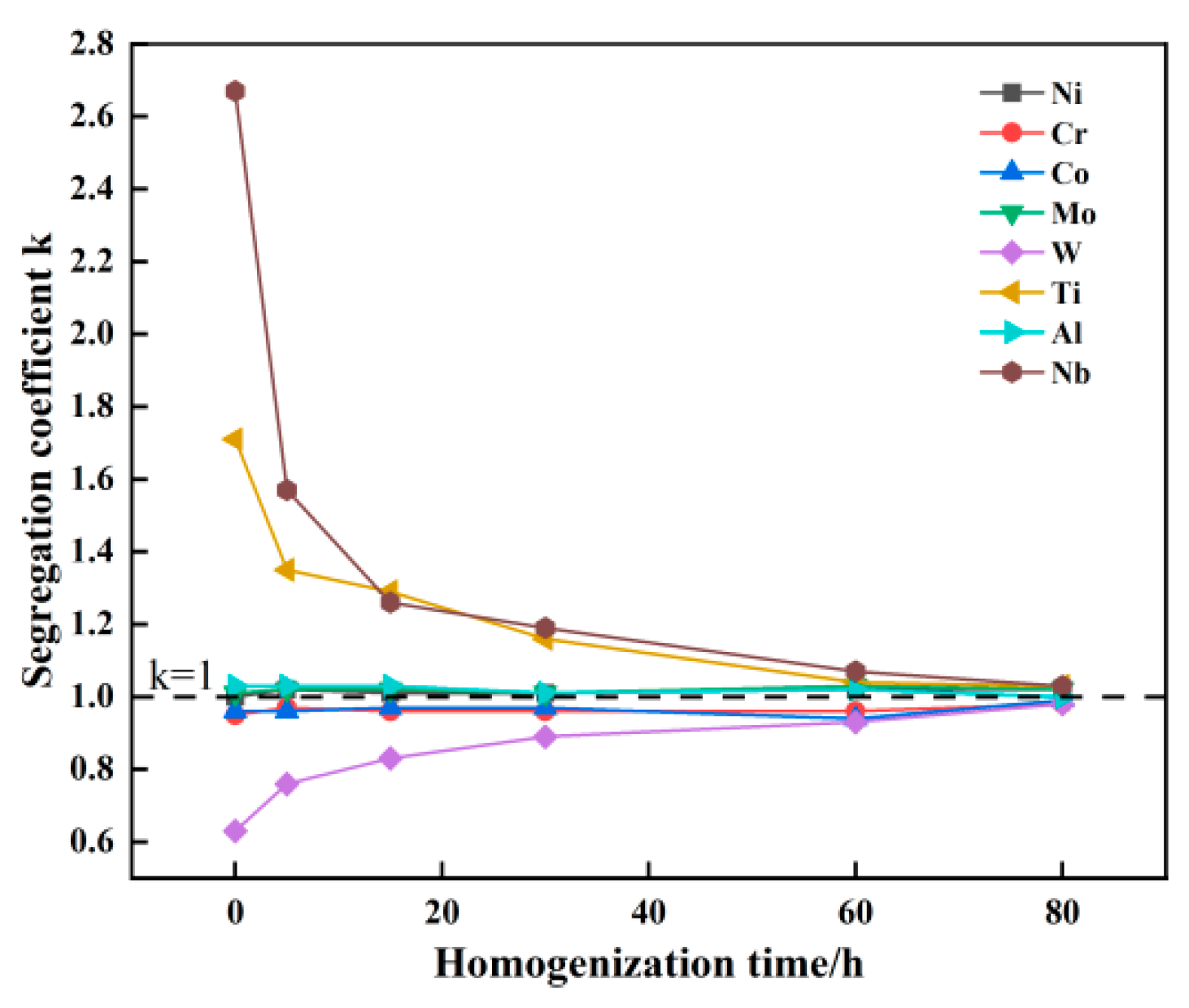
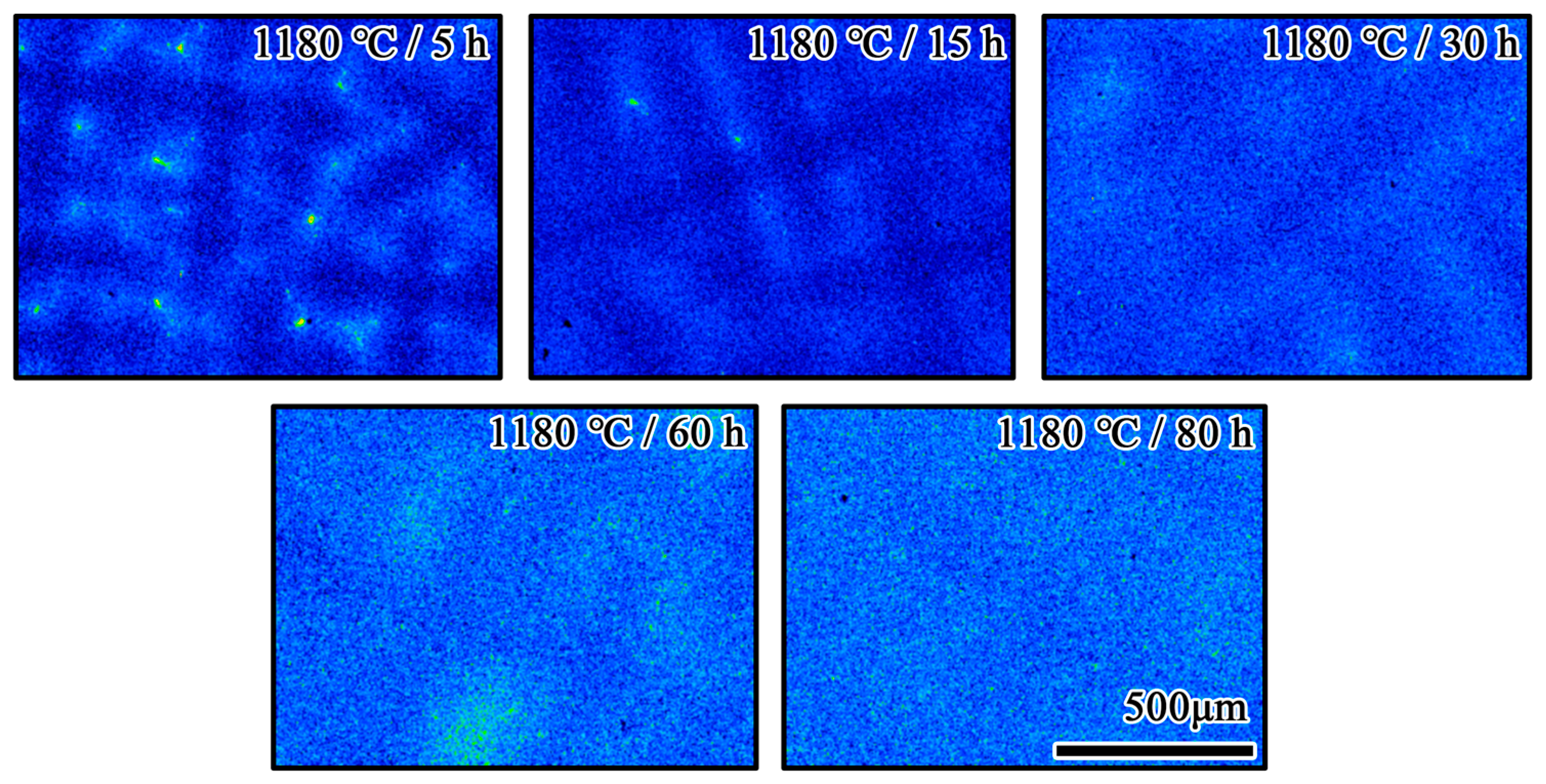
- The homogenization heat-treatment revealed Nb exhibited the most pronounced segregation tendency, followed by Ti and W, with negligible changes in other elements. This confirms that Nb segregation is the most severe in the ingot and has a detrimental effect on the plasticity;
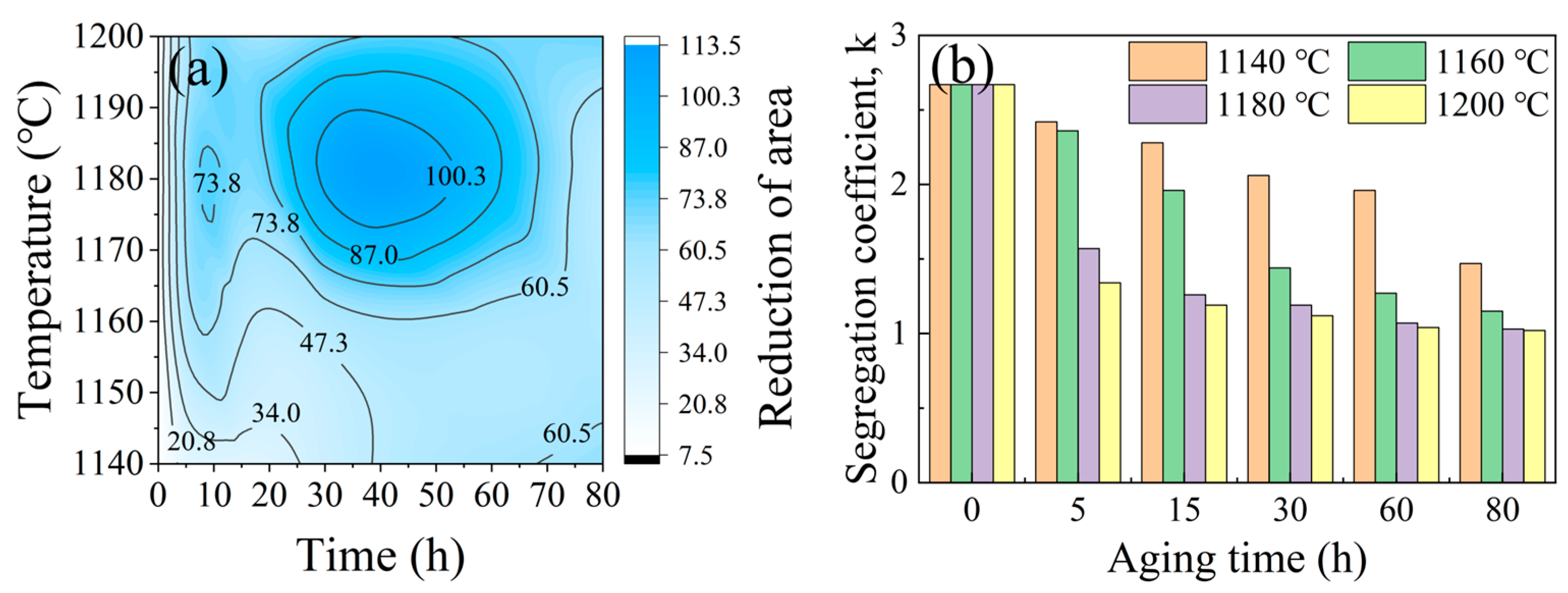
- The aging window of 15 to 60 h at 1180 °C was identified as optimal for grain and precipitates. It enables effective elemental homogenization (Nb) and controlled precipitation, which consequently leads to a remarkable improvement in the plasticity.
Author Contributions
Funding
Data Availability Statement
Conflicts of Interest
References
- Su, W.; Zhao, C.; Zhang, H.F.; Feng, Y.H.; Gu, T.H. Design strategy and strengthening mechanisms of a novel ultra-hard titanium-based alloy. Acta Mater. 2026, 303, 121706. [Google Scholar] [CrossRef]
- Yuan, S.C.; Liu, Y.H.; Zhang, H.; Li, H.; Li, Q.; Li, J.S. Hot deformation behavior and dynamic recrystallization mechanism of GH3230 superalloy. Metals 2025, 15, 1220. [Google Scholar] [CrossRef]
- Jing, T.; Yu, Y. Fatigue Prediction method of superalloy based on the improved largest lyapunov exponent. Metals 2025, 15, 945. [Google Scholar] [CrossRef]
- López-Galilea, I.; Weber, S. Development of super-solidus heat treatments for the second-generation single-crystal Ni-based superalloy ERBO/1: Experiments and 1D kinetic simulations. J. Mater. Res. Technol. 2025, 39, 6794–6805. [Google Scholar] [CrossRef]
- Yang, M.W.; Sun, D.J.; Zhou, Q.; Mao, G.; Li, X.Y.; Yan, X.W.; Gao, Y.; Fan, L.; Li, F.L. Microstructural evolution and mechanical property response of ESR-CDS processed superalloy ingots to homogenization heat treatment. Mater. To. Commun. 2025, 47, 113269. [Google Scholar] [CrossRef]
- Jeong, H.T.; Han, S.Y.; Ryu, C.W.; Kim, W.J. Balancing strength and ductility in MP159 superalloy (Co–Ni–Cr–Fe–Mo–Ti–Al–Nb) through severe plastic deformation and multistage heat treatments. J. Alloy. Compd. 2025, 1047, 184852. [Google Scholar] [CrossRef]
- Wang, Z.T.; Ning, Y.Q.; Di, P.; Zhang, B.Y.; Yu, H.; Xie, B.C. Understanding the fracture mechanisms of Ni–Co–Cr–type superalloys: Role of precipitate evolution and strength degradation. Mater. Sci. Eng. A 2024, 902, 146623. [Google Scholar] [CrossRef]
- Yao, J.; Wu, J.K.; Wu, H.B.; Wang, Z.; Wang, W.L.; Tan, L.M.; Huang, L.; Liu, F. Effect of heat treatment temperature on the microstructure and properties of high Ti/Al ratio nickel-based superalloys fabricated by laser powder bed fusion. Intermetallics 2025, 187, 109020. [Google Scholar] [CrossRef]
- Yang, Y.P.; Gao, Y.T.; Liu, C.; Dong, J.S.; Lou, L.H. Synergistic evolution of MC/M23C6 carbides in a polycrystalline Ni-based superalloy during long-term aging: Elemental diffusion and interaction mechanisms. Mater. Charact. 2025, 229, 115462. [Google Scholar] [CrossRef]
- Zhang, X.; Liang, J.J.; Zhao, Y.S.; Mu, Y.H.; Zhang, H.; Li, J.G. Carbide precipitation in a Ni-based superalloy fabricated by DED and cast after long-term thermal exposure. Mater. Lett. 2025, 384, 138061. [Google Scholar] [CrossRef]
- Chang, L.Z.; Yao, L.F.; Su, Y.L.; Wang, Y.; Li, H.W.; Shi, X.F. Evolution of inclusions in Inconel 718 superalloy during vacuum induction melting with 30% Inconel 625 revert. Vacuum 2026, 244, 114859. [Google Scholar] [CrossRef]
- Prashanth, M.; Kumaraswamidhas, L.A.; Karunanithi, R.; Sivasankaran, S. A comprehensive investigation on precipitation, microstructure evolution and mechanical behavior of Inconel 718 superalloy fabricated by mechanically alloying and vacuum arc melting process. Mater. To. Commun. 2025, 49, 113895. [Google Scholar] [CrossRef]
- Li, S.; Zhao, Z.; Zhang, T.; Li, X.; Chen, T.X.; Jiang, H.; Dong, J.X. Integrated simulation method and experimental validation for the vacuum induction melting process. J. Mater. Res. Technol. 2024, 33, 1764–1775. [Google Scholar] [CrossRef]
- Yu, H.; Fu, J.B.; Wang, C.C.; Chen, Y.P.; Wang, L.Y.; Fang, H.X.; Li, J.G.; Zwaag, S.V.D.; Xu, W. Robust additive manufacturable Ni superalloys designed by the integrated optimization of local elemental segregation and cracking susceptibility criteria. Acta Mater. 2024, 266, 119658. [Google Scholar] [CrossRef]
- Xie, B.C.; Li, H.; Ning, Y.Q.; Fu, M.W. Discontinuous dynamic recrystallization and nucleation mechanisms associated with 2–, 3– and 4–grain junctions of polycrystalline nickel-based superalloys. Mater. Des. 2023, 231, 112041. [Google Scholar] [CrossRef]
- Zhang, X.P.; Hong, Z.; Zhou, Y.; Zhao, X.B.; Yang, H.J.; Yu, Q.; Wang, J.W.; Zhang, Z. Interfacial chemical fluctuation induced planar defects and topologically close-packed phase formation in nickel-based superalloys. J. Mater. Sci. Technol. 2026, 253, 87–97. [Google Scholar] [CrossRef]
- Zhao, Y.P.; Chen, Y.J.; Zhao, X.B.; Pua, C.L.; Cheng, Y.; Gu, L.; Fu, X.Q.; Fang, Y.; Zou, J.W.; Qi, X.; et al. Cr–Re diffusion-pair initiated nucleation of topologically close-packed phases in Ni-based superalloys. Acta Mater. 2026, 303, 121662. [Google Scholar] [CrossRef]
- Kitaguchi, H.S.; Small, L.; Jones, I.P.; Chiu, Y.L.; Hardy, M.C.; Bowen, P. MC decomposition and boride formation in a next generation polycrystalline Ni based superalloy during isothermal exposure at 900 °C. Mater. Charact. 2024, 209, 113721. [Google Scholar] [CrossRef]
- Schulz, B.; Leitner, T.; Primig, S. In-situ observation of the incipient melting of borides and its effect on the hot-workability of Ni-based superalloys. J. Alloy. Compd. 2023, 956, 170324. [Google Scholar] [CrossRef]
- Ou, M.Q.; Hou, K.L.; Zhu, H.Y.; Wang, M.; Hao, X.C.; Xing, W.W.; Ma, Y.C. Microstructure and stress rupture properties of a cast nickel-based superalloy with different Hf content after long-term aging. Mater. Sci. Eng. A 2025, 943, 148833. [Google Scholar] [CrossRef]
- Chaithanya, P.V.S.; Jena, P.S.M.; Pradhan, S.K.; Singh, R.; Sahu, J.K. Influence of γ’-Ni3(Al, Ti) precipitate morphology and lattice misfit on the oxidation behavior of Ni-based superalloy IN740H. Corros. Sci. 2025, 257, 113268. [Google Scholar] [CrossRef]
- Wang, N.; Liu, J.D.; Xu, W.; Li, J.G. Unraveling the dual role of yttrium in the creep deformation mechanism of Ni-based single crystal superalloys: A synergistic effect of lattice misfit and atomic diffusion. J. Mater. Sci. Technol. 2026, 263, 129–139. [Google Scholar] [CrossRef]
- Zhang, P.; Lan, C.X.; Wang, L.; Liu, C.H.; Zhang, H.B.; Zhou, H.P. Influence of hot deformation parameters on the microstructure evolution of low-expansion GH2909 superalloy. Mater. Charact. 2025, 220, 114705. [Google Scholar] [CrossRef]
- Wu, J.R.; Wang, J.Q.; Zhao, Z.P.; Guan, X.J.; Wu, Y.S.; Qin, X.Z.; Zhou, L.Z. Primary carbide evolution and homogenization behavior of a novel Fe-Ni-based superalloy for advanced nuclear reactor. Mater. Charact. 2025, 221, 114706. [Google Scholar] [CrossRef]
- Ma, Y.Q.; Ji, Q.Y.; Ngai, S.; Li, J.Z.; Pavel, M.J.; Weaver, M.L.; Zhang, P.; Li, W.; Wu, Y.; Vogel, F. Influence of the Nb-Al ratio on homogenization behavior and hierarchical microstructures in high-entropy superalloys. Intermetallics 2024, 172, 108380. [Google Scholar] [CrossRef]
- Morales, L.Á.; Förner, A.; Bezold, A.; Neumeier, S.; Körner, C.; Zenk, C.H. Elemental partitioning, defect segregation, and Cu clustering in an Fe-based BCC superalloy. Mater. Charact. 2025, 230, 115621. [Google Scholar] [CrossRef]
- Ding, Z.L.; Wang, X.M.; Li, H.T.; Sun, S.Y.; Yang, W.Z. Quantitative study of thickness debit effect on the microstructure and elemental segregation characteristics in as-cast and heat-treated nickel-based single crystal superalloys. J. Alloy. Compd. 2025, 1010, 177136. [Google Scholar] [CrossRef]
- Laidler, K.L. The development of the Arrhenius equation. J. Chem. Educ. 1984, 61, 494. [Google Scholar] [CrossRef]
- Yue, X.D.; Li, J.R.; Shi, Z.X.; Wang, X.G. Designing of the homogenization-solution heat treatment for advanced single crystal superalloys. Rare Met. Mater. Eng. 2017, 46, 1530–1535. [Google Scholar] [CrossRef]
- Karunaratne, M.S.A.; Carter, P.; Reed, R.C. Interdiffusion in the face-centred cubic phase of the Ni–Re, Ni–Ta and Ni–W systems between 900 and 1300 °C. Mater. Sci. Eng. A 2000, 281, 229–233. [Google Scholar] [CrossRef]
- Karunaratne, M.S.A.; Reed, R.C. Interdiffusion of the platinum-group metals in nickel at elevated temperatures. Acta Mater. 2003, 51, 2905–2919. [Google Scholar] [CrossRef]
- Jung, S.B.; Yaman, T.; Minamino, Y.; Hirao, K.; Araki, H.; Saji, S. Interdiffusion and its size effect in nickel solid-solution of Ni–Co, Ni–Cr and Ni–Ti systems. J. Mater. Sci. Lett. 1992, 11, 1333–1337. [Google Scholar] [CrossRef]



| Elements | C | Cr | Co | W | Mo | Al | Ti | Nb | B | Fe | Zr | Ni |
| wt.% | 0.011 | 16.0 | 13.0 | 4.0 | 4.0 | 2.1 | 3.7 | 0.7 | 0.015 | 1.0 | 0.05 | Bal. |
Disclaimer/Publisher’s Note: The statements, opinions and data contained in all publications are solely those of the individual author(s) and contributor(s) and not of MDPI and/or the editor(s). MDPI and/or the editor(s) disclaim responsibility for any injury to people or property resulting from any ideas, methods, instructions or products referred to in the content. |
© 2025 by the authors. Licensee MDPI, Basel, Switzerland. This article is an open access article distributed under the terms and conditions of the Creative Commons Attribution (CC BY) license.
Share and Cite
Zhang, W.; Wang, Z.; Zhang, B.; Zhang, J.; Ning, Y. Effect of Microstructural Evolution on Plasticity of GH4065A Superalloy Cast Ingot During Homogenization Hot Treatment. Metals 2026, 16, 26. https://doi.org/10.3390/met16010026
Zhang W, Wang Z, Zhang B, Zhang J, Ning Y. Effect of Microstructural Evolution on Plasticity of GH4065A Superalloy Cast Ingot During Homogenization Hot Treatment. Metals. 2026; 16(1):26. https://doi.org/10.3390/met16010026
Chicago/Turabian StyleZhang, Wenyun, Zhaotian Wang, Beijiang Zhang, Ji Zhang, and Yongquan Ning. 2026. "Effect of Microstructural Evolution on Plasticity of GH4065A Superalloy Cast Ingot During Homogenization Hot Treatment" Metals 16, no. 1: 26. https://doi.org/10.3390/met16010026
APA StyleZhang, W., Wang, Z., Zhang, B., Zhang, J., & Ning, Y. (2026). Effect of Microstructural Evolution on Plasticity of GH4065A Superalloy Cast Ingot During Homogenization Hot Treatment. Metals, 16(1), 26. https://doi.org/10.3390/met16010026