


Abstract
Here, we report a soft magnetic nanocrystalline alloy with high electric resistivity (ρ) up to 221 μΩ·cm. The (Fe82Si3B14Cu1)100−xCax (x = 0, 0.12, 0.36, and 0.6) alloys were prepared by melt spinning. The effects of Ca addition and annealing treatment on the microstructure and properties of the alloys have been investigated. It was found that Fe82Si3B14Cu1 alloys without Ca doping contain mainly one nanocrystalline phase of α-Fe, but both α-Fe and Fe3B nanophases coexist in the as-prepared alloys with relatively high Ca contents (x = 0.36 and 0.6) and annealed Ca co-doped alloys. The presence of Fe3B nano-crystals leads to high resistivity without significantly reducing the soft magnetic properties. The saturated magnetic induction Bs of (Fe82Si3B14Cu1)100−xCax (x = 0, 0.12, 0.36, and 0.6) alloys ranges from 1.75 T to 1.80 T, and the coercivity Hc of annealed alloys shows a tendency to increase with an increase in Ca content. Meanwhile, the resistivity of both as-prepared and annealed alloys increases with increasing Ca content. The as-prepared (Fe82Si3B14Cu1)99.4Ca0.6 alloy exhibits an excellent combination of soft magnetic properties with ρ = 221 μΩ·cm, Hc = 20.3 A/m, and Bs = 1.57 T. After annealing, these values changed to 158 μΩ·cm, 21.6 A/m, and 1.79 T, respectively. We believe that this work is helpful for developing nanocrystalline soft magnetic alloys for high-frequency applications.
1. Introduction
Innovative breakthroughs in modern electronic and microelectronic technologies are propelling the development of critical functional materials, such as soft magnetic materials, toward higher operating frequencies, greater power efficiency, reduced energy consumption, and lighter weight [1,2]. High permeability and low magnetic loss are general requirements for soft magnetic materials used in various fields. High saturation magnetization is also crucial for soft magnetic cores in order to achieve device miniaturization and elevated power density [3,4]. Magnetic loss is normally divided into hysteresis loss, eddy current loss, and residual loss. Under high-frequency operating conditions, the eddy current loss Pe becomes the dominant contribution to the total magnetic core loss Ps. As is well known, the value of Pe is inversely proportional to electrical resistivity (ρ) and proportional to the square of the frequency. Hence, it is extremely important to increase the ρ of soft magnets for high-frequency applications. Among various types of soft magnetic materials, Fe-based amorphous and nanocrystalline alloys have been widely used in different electric devices and components, such as transformers and inductors, due to their relatively high saturation magnetization and high electric resistivity [5,6,7,8,9,10,11]. For example, the well-known nanocrystalline alloy FINEMET [12] shows a saturation magnetic induction Bs of 1.35 T and an electrical resistivity of ~120 μΩ·cm. For comparison, the permalloy has values of only Bs = 0.75 T and ρ = 55 μΩ·cm. Hence, the amorphous and nanocrystalline soft magnetic alloys are currently used in the mid-frequency range. Since high electric resistivity is desired for higher frequency applications in order to reduce the eddy current loss, further increasing the resistivity of Fe-based nanocrystalline alloys is thus technologically important. Consequently, developing advanced soft magnetic materials that combine high Bs value with high ρ is necessary for the advancement of high-frequency, high-power, and miniaturized electronic components.
As we know, the electric resistance of an alloy is closely dependent on its composition, phase constitution, and microstructure. In amorphous and nanocrystalline alloys, low-temperature, short-time annealing can modify the relative fractions of the amorphous and nanocrystalline phases, thereby adjusting the electrical resistivity of the alloy [13,14]. However, this process typically fails to fully relieve the internal stresses introduced during rapid quenching due to the relatively low annealing temperature. In addition, enhancing the resistivity by composition modification has been found difficult for these amorphous and nanocrystalline alloys since it is hard to maintain high magnetic properties while increasing their resistivity. Although many previous works [2,15,16,17] have been successful in increasing the Bs value of nanocrystalline alloys by element addition, increasing the resistivity and maintaining a high Bs level is found to be challenging, since the addition of solution elements typically leads to a magnetic dilution effect [18]. Fortunately, a few recent investigations have shown that the addition of a small amount of Ca may increase the resistivity of nanocrystalline Fe-Based alloys [19,20], but the underlying mechanism is still not fully revealed. On the other hand, as we know, Cu addition in Fe-based amorphous and nanocrystalline alloys can induce not only the precipitation of α-Fe nanoparticles but also possibly Fe2B or Fe3B precipitates [12,21,22,23]. Both Fe2B and Fe3B compounds have a relatively high electric resistivity of 200–300 μΩ·cm, which thus provides a feasible approach to enhance the resistivity of nanocrystalline soft magnetic alloys. However, so far, a resistivity higher than 200 μΩ·cm has not been achieved in Fe-based amorphous and nanocrystalline alloys by Cu addition only.
In this work, aiming to develop amorphous and nanocrystalline Fe-based alloys for high-frequency applications, both Cu and Ca additions are employed to modify the resistivity of the FeSiBCu alloy. The effect of Ca addition on the phase structure of the alloy is investigated. The dependences of both the resistivity and soft magnetic properties on the phase variation are also discussed. A soft magnetic nanocrystalline alloy with very high electric resistivity and relatively high Bs has been finally developed, and it has potential for employment in high-frequency electric devices.
2. Materials and Methods
(Fe82Si3B14Cu1)100−xCax (x = 0, 0.12, 0.36, and 0.6) alloy ingots were prepared by argon arc melting using high-purity metals or alloys of Fe, Si, Cu, Ca, and FeB. The ribbons with a thickness of 20–25 μm were prepared by melt spinning in an argon atmosphere with the copper wheel speed of 50 m/s. The selected ribbons were annealed at 420 °C for 10 min in a tube furnace under a vacuum atmosphere to modify the grain structure and phase constitution. The saturation magnetization MS (or the saturation magnetic induction Bs) of the ribbons was characterized by a vibrating sample magnetometer (VSM) in a physical property measurement system (PPMS-9, Quantum Design, San Diego, CA, USA). The densities ρa of the alloys were measured using the Archimedes method with distilled water as the immersion medium. The Bs was then derived from the measured specific magnetization (σs, in emu/g) using the relation Bs = 4πρaσs, ensuring that the variation in sample mass and density across different compositions (x) was fully accounted for. The coercivity Hc of the alloys was measured using an automatic DC hysteresisgraph (Model MATS-2010SD, Hunan Linkjoin Technology Co., Ltd., Loudi, China). The electric resistivity ρ of the ribbons was obtained by the well-known four-probe method. To ensure accuracy, the data of ρ were calculated from the average of at least twelve measured values. The chemical compositions of the alloys were checked using an energy dispersive spectrometer (EDS) according to scanning electron microscopy (SEM, Quanta 200, FEI Company, Eindhoven, The Netherlands). The phase constitution was characterized by X-ray diffraction (XRD, Philips X’Pert, Amsterdam, The Netherlands) with a scanning degree from 20° to 90° and a step size of 0.2°/min using Cu Kα radiation with λ = 1.5406 Å. The microstructures of the alloys were examined by transmission electron microscopy (TEM) and high-resolution transmission electron microscopy (HRTEM, Tecnai G2 F20 S-TWIN, FEI Company, Eindhoven, The Netherlands). The TEM and HRTEM samples were prepared directly by ion milling the alloy ribbons.
3. Results and Discussion
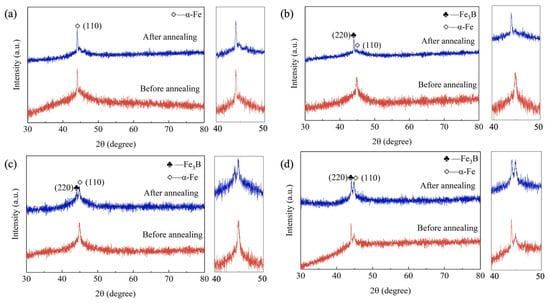
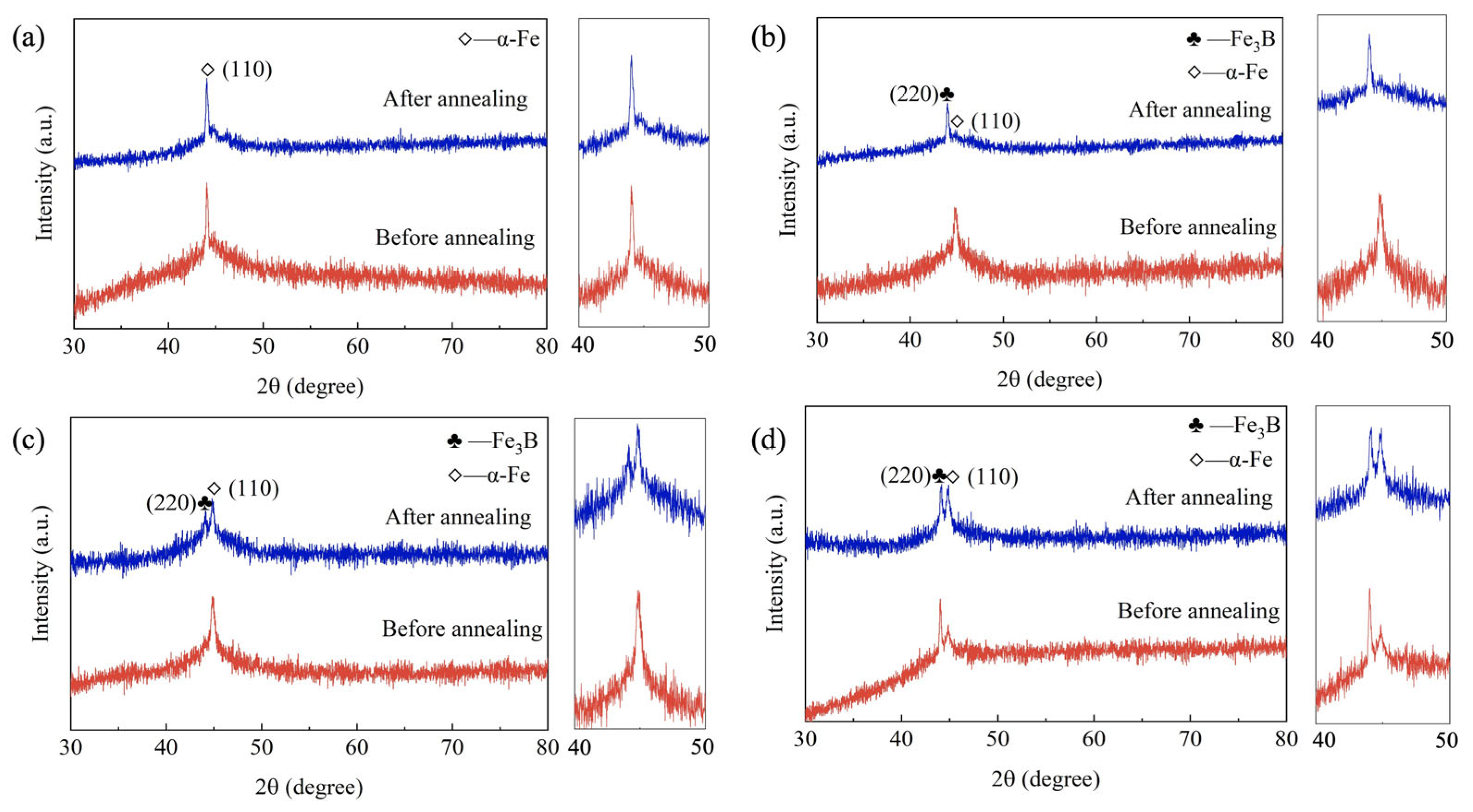
Figure 1a,b show the XRD patterns of (Fe82Si3B14Cu1)100−xCax (x = 0, 0.12, 0.36, and 0.6) alloys before and after annealing, respectively. The relatively low peak densities and strong background signal for all alloys indicated that the alloys are composed of amorphous and nanocrystalline phases. Only a very weak peak for α-Fe (110) is observed in both as-prepared (Fe82Si3B14Cu1)100−xCax alloys without and with lower Ca addition (x = 0 and 0.12). The before-annealing (Fe82Si3B14Cu1)99.64Ca0.36 alloy exhibits a very weak Fe3B (the orthorhombic structure, Space group Pnma) and α-Fe (the cubic structure, Space group Im3m) peak, and the before-annealing (Fe82Si3B14Cu1)99.4Ca0.6 alloy shows relatively strong Fe3B and α-Fe peaks. After 420 °C annealing, the significant crystallization of the α-Fe phase occurred, which led to the appearance of a sharp α-Fe (110) peak in the XRD pattern. The annealed Fe82Si3B14Cu1 alloys without Ca addition show a nearly single crystalline phase of α-Fe. For all Ca-doped compositions, the Fe3B phase appeared. Based on the relative intensity of the diffraction peaks and the background halo, the annealed Ca-doped alloys can be described as a nanocomposite structure with nanocrystalline phases embedded in a residual amorphous matrix. The formation of the nanocomposite structure should be attributed to the relatively low annealing temperature employed in this work. Both Fe3B and α-Fe phases exist in the (Fe82Si3B14Cu1)99.4Ca0.6 alloys before and after annealing, and the peak intensity for the Fe3B phase is relatively stronger than that for (Fe82Si3B14Cu1)100−xCax (x = 0.12) alloys, which indicates that more Fe3B phase formed in the Ca-doped alloys with relatively high Ca contents before and after annealing.
Figure 1.
XRD patterns for melt-spun (Fe82Si3B14Cu1)100−xCax (x = 0, 0.12, 0.36, and 0.6) alloys before and after annealing: (a) x = 0, (b) x = 0.12, (c) x = 0.36, and (d) x = 0.6.
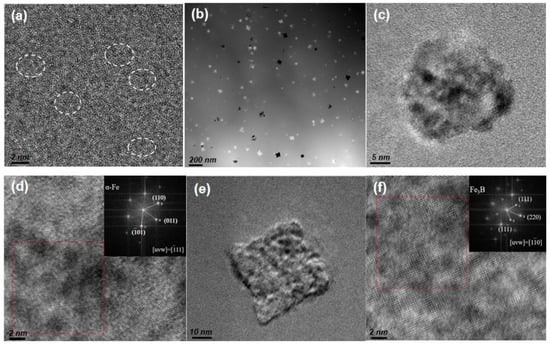
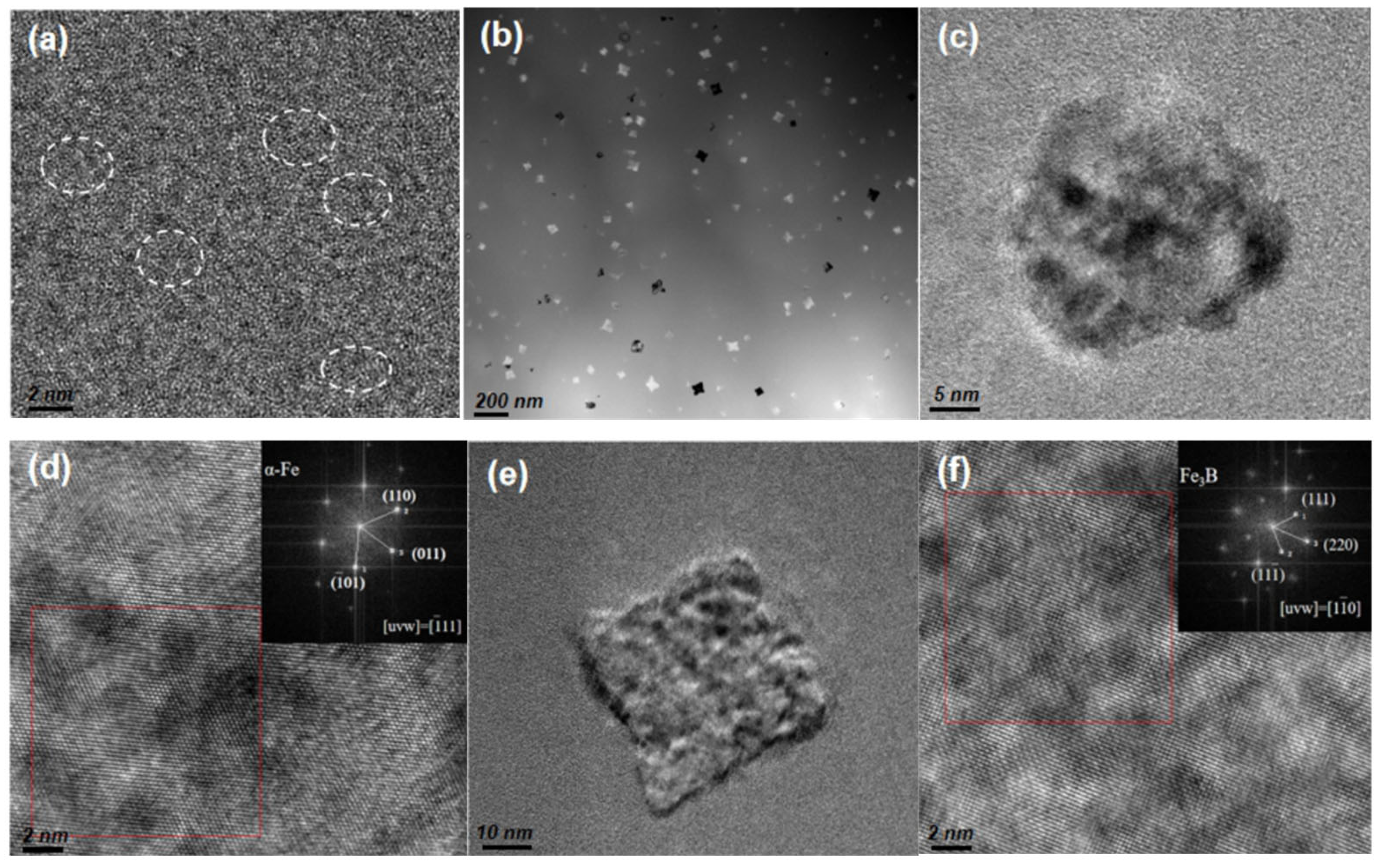
Figure 2 shows the TEM and HRTEM images for the (Fe82Si3B14Cu1)99.4Ca0.6 alloys before and after annealing. In Figure 2a, it is found that the nanocrystals with a very small size of 1–2 nm are embedded in the amorphous matrix in the as-spun alloy, indicated by white circles. Based on the above XRD data, these nano-phases should be the α-Fe and Fe3B phases. Figure 2b shows that these crystalline nanophases were randomly distributed in the amorphous matrix. Figure 2c,e show the morphologies of two single crystals, each approximately 20–30 nm in size, and their HRTEM images are shown in Figure 2d,f, respectively. The electron diffraction patterns in Figure 2d,f’s inset confirmed that these two nanocrystals are the α-Fe and Fe3B phases, respectively. In particular, the square-shaped Fe3B phase in Figure 2e was verified to have an orthorhombic structure. These TEM results are in good agreement with the XRD profiles, further confirming the coexistence of the nanocrystalline α-Fe and Fe3B phases in the annealed alloys with Ca doping. The earlier study [13] found that Si addition can significantly reduce the nucleation activation energy of the α-Fe phase. The Fe85.2B10−xP4Cu0.8Six alloys with x ≥ 2.0 contained only α-Fe nanocrystals, but both Fe-B phases and α-Fe phase can be formed in as-spun Fe83B17−xSix alloys with higher B content [24]. The present work indicates that both Fe3B and α-Fe phases precipitate in the as-spun FeSiB-based alloys with relatively high B content and low Si content. Hence, this work indicated that the composition has a significant effect on the phase constitution of rapidly solidified FeSiB-based alloys.
Figure 2.
HRTEM image for (Fe82Si3B14Cu1)99.4Ca0.6 alloys before annealing, the white dashed circle relating to the α-Fe (a) and the bright field image for the alloy after annealing (b). HRTEM image for the single crystals of α-Fe (c) with electron diffraction patterns (d) and Fe3B (e) with electron diffraction patterns of the red square (f) after annealing.
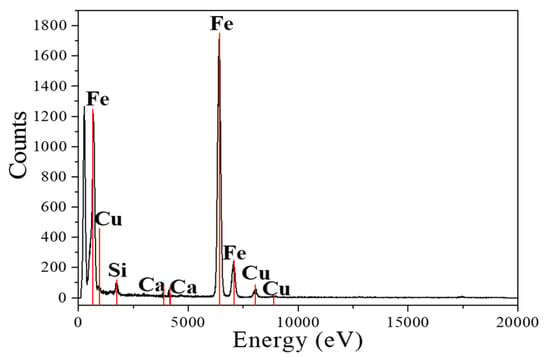
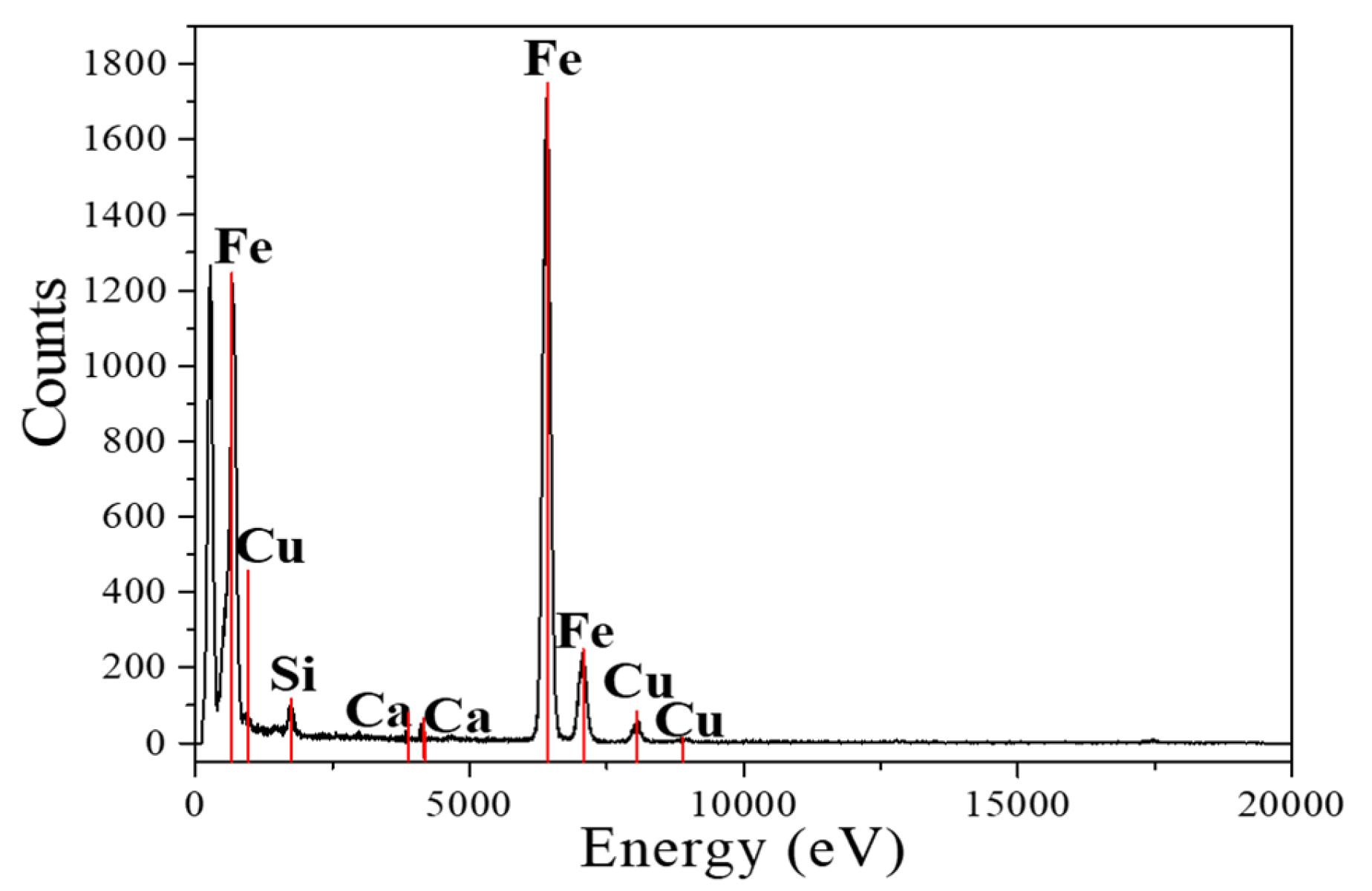
Figure 3 shows the EDS result obtained from the annealed (Fe82Si3B14Cu1)99.4Ca0.6 alloy. Small Ca peaks can be observed on the spectrum. The result demonstrated that Ca was successfully alloyed in the materials. However, due to the very small amount of Ca, it is very difficult to clearly figure out the accurate percentage of Ca content. As it will be further shown, the small amount of doped Ca atoms will considerably influence the properties of the alloys.
Figure 3.
EDS spectrum for (Fe82Si3B14Cu1)99.4Ca0.6 alloy.
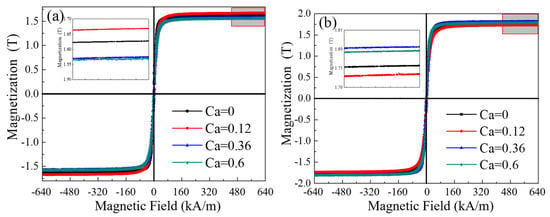
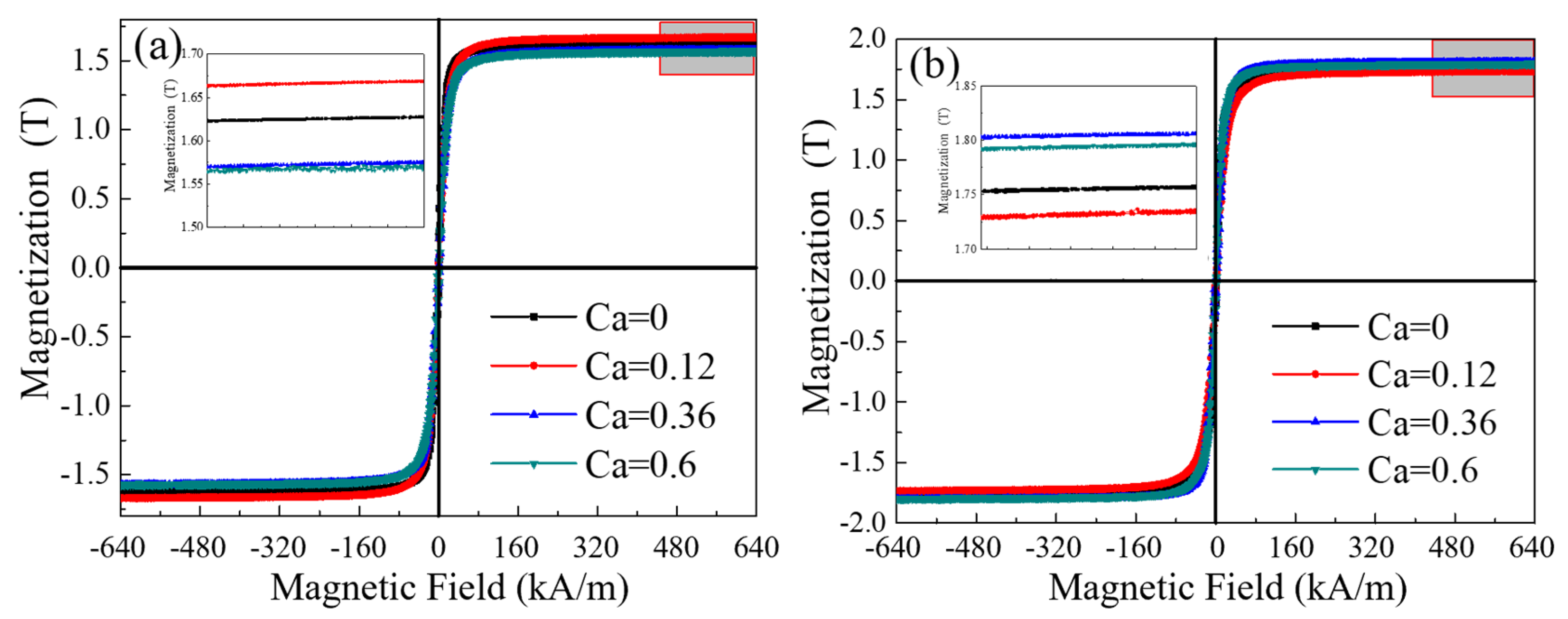
Figure 4a shows the magnetic hysteresis loops of as-prepared (Fe82Si3B14Cu1)100−xCax (x = 0, 0.12, 0.36, and 0.6) alloys. The very narrow loops indicate that all alloys exhibit good soft magnetic behavior. From the enlarged parts of the curves (Figure 4a inset), the Ms (or Bs) of the as-prepared alloys are around 1.57 T to 1.66 T. MS shows a slight decreasing trend with increasing Ca content, which is partly due to the magnetic dilution by nonmagnetic Ca addition. The lowest Bs was obtained in the (Fe82Si3B14Cu1)100−xCax (x = 0.36 and 0.6) alloys, which are both ~1.57 T. Figure 4b shows the magnetic hysteresis loops of annealed (Fe82Si3B14Cu1)100−xCax alloys. Figure 4b’s inset shows that the Bs value ranges between 1.73 T and 1.80 T. The higher Bs of annealed alloys than the as-spun alloys should result from the precipitation of more nanocrystals. The precipitations of nano-clusters or short-range ordered structures in the alloys can be observed from the XRD patterns. The Bs value exhibits only a small variation among different compositions. Interestingly, the Bs values of the annealed (Fe82Si3B14Cu1)100−xCax alloys with x = 0.36 and 0.6 are up to 1.80 T and 1.79 T, respectively, which are much higher than those of many reported Fe-based nanocrystalline alloys. It is believed that the relatively high Fe content and crystallite content contribute to the high magnetic induction. These results demonstrated that the annealing treatment could improve the soft magnetic properties of Ca-doped FeSiBCu nanocrystalline alloys. This should be a result of the modification of the phase constitution.
Figure 4.
The magnetization curves of (Fe82Si3B14Cu1)100−xCax (x = 0, 0.12, 0.36, and 0.6) alloys before (a) and after (b) annealing. Insets show the partially enlarged patterns.
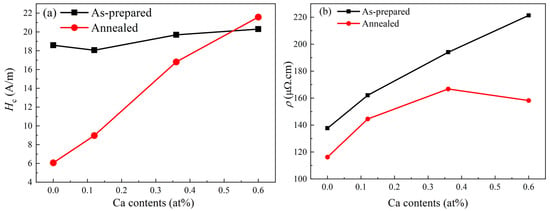
The effects of Ca addition on the magnetic properties and electric resistance of as-spun and annealed (Fe82Si3B14Cu1)100−xCax (x = 0, 0.12, 0.36, and 0.6) alloys are shown in Figure 5. Figure 5a indicates that Ca additions had no significant effect on the coercivity Hc of the as-prepared alloys, and the Hc values are from 18.9 A/m to 20.3 A/m. The reason for this is that the as-spun alloys are mainly composed of an amorphous phase, and the volume fractions of the crystal Fe3B and α-Fe phases, which have relatively high intrinsic coercivity, are much lower than that of the amorphous phase. Therefore, Hc is mainly determined by the amorphous phase. For the annealed alloys, Figure 5a shows that Hc increases with the increasing addition of Ca. It seems that Ca is not beneficial for the soft magnetic properties of annealed nanocrystalline alloys. The reason may be attributed to the increased domain wall motion resistance by Ca doping. After annealing, the Hc of the alloy without Ca doping decreases to 6.06 A/m, but that of the alloy with Cu and Ca doping gradually increases to 21.6 A/m. It is worthy of noting that the annealed (Fe82Si3B14Cu1)100−xCax (x = 0, 0.12, and 0.36) has a lower coercivity than its as-spun counterpart, which may be caused by the reduction in internal stress after annealing, and this has been well understood. However, with the addition of Ca, there may be more Fe3B and α-Fe grains precipitated after annealing, which also leads to increased coercivity. In particular, the Fe3B compound has a much higher magnetocrystalline anisotropy field than α-Fe, and the precipitation of the Fe3B phase will lead to a significant increase in Hc. Hence, the combined effect of the above two factors could explain why the coercivity of the annealed alloys is relatively low at low Ca content and becomes higher with increased Ca addition. Thus, the annealed alloy with x = 0.6 shows higher coercivity than its as-spun counterparts.
Figure 5.
The coercivity (a) and electric resistivity (b) variations with respect to Ca content for the (Fe82Si3B14Cu1)100−xCax (x = 0, 0.12, 0.36, and 0.6) alloys before and after annealing.
Figure 5b shows the resistivity variation of (Fe82Si3B14Cu1)100−xCax alloys with Ca content. The resistivity ρ of the as-prepared alloys is higher than that of their annealed counterparts, but for both of them, ρ shows an increasing trend with an increase in Ca content. For the as-prepared alloys, the highest ρ can be obtained in the (Fe82Si3B14Cu1)99.4Ca0.6 alloy, which is up to 221 μΩ·cm, much higher than the Ca-free alloy. The enhanced resistivity should result from the coexistence of α-Fe and Fe3B nanophases. The ρ of bulk α-Fe is reported to be 9.78 μΩ·cm, but it may increase significantly in nanocrystals. On the other hand, the Fe3B alloy shows a resistivity of 282 μΩ·cm, much higher than that of the α-Fe phase. Therefore, the coexistence of the α-Fe and Fe3B phases results in a significantly high resistivity. After annealing, the ρ of the (Fe82Si3B14Cu1)99.4Ca0.6 alloy decreases to 158 μΩ·cm, slightly higher than that of the Fe-based amorphous alloy. The decrease in resistivity may be due to the grain growth and reduced amorphous phase. For the alloy without Ca addition, the values of ρ are 138 μΩ·cm before annealing and 116 μΩ·cm after annealing, which indicates that the high resistivity of 221 μΩ·cm is indeed caused by both Ca and Cu additions. This resistivity value is much higher than that of Fe-based amorphous alloys and of nanocrystalline alloys containing only the crystalline phase of α-Fe, and it is beneficial for lowering the magnetic loss of the device.
It is generally expected that higher Bs will be obtained in alloys containing nanophases, such as α-Fe, embedded in an amorphous matrix. In this work, ρ = 221 μΩ·cm is obtained for the as-prepared (Fe82Si3B14Cu1)99.4Ca0.6 alloy; both α-Fe and Fe3B nanophases could be found in the as-prepared alloy; the coexistence of the two magnetic phases also has a clear effect on the magnetic properties. As discussed before, the relatively high Hc of the (Fe82Si3B14Cu1)99.4Ca0.6 alloy is due to the higher magnetocrystalline anisotropy field of the Fe3B phase than that of the α-Fe phase [25,26]. The as-spun (Fe82Si3B14Cu1)99.4Ca0.6 alloy has a Bs value of 1.57 T due to its high content of Fe, and it further increases to 1.79 T after annealing, due to the increase in the α-Fe phase. Similarly, the Bs of the Fe82Si3B14Cu1 alloy increased from 1.62 T to 1.75 T after annealing.
Table 1 also summarizes the values of the saturation magnetic induction Bs, coercivity Hc, and electric resistivity ρ for the studied alloys in this work and for some typical soft magnetic alloys reported by other researchers. The ρ values of conventional Fe-based amorphous alloys are 130–150 μΩ·cm, and those for the nanocrystalline alloys are generally around 110–120 μΩ·cm. The present (Fe82Si3B14Cu1)99.4Ca0.6 alloy has a relatively higher Hc value compared to other similar compositions. At the same time, the values for both Bs and Hc are not deteriorated significantly. The results thus indicate that the simultaneous precipitation of the α-Fe phase and Fe3B is a feasible approach to enhance the electrical resistivity of Fe-Si-based amorphous or nanocrystalline alloys. The (Fe82Si3B14Cu1)99.4Ca0.6 alloy can work at relatively high frequencies as a soft magnetic material. By further development, Ca-doped Fe-Si-B alloys may be employed in high-frequency device applications.
Table 1.
The saturation magnetic induction Bs, coercivity Hc, and resistivity ρ of the soft magnetic alloys obtained in this work and those reported in the literature.
4. Conclusions
Here, we show that the electric resistivity of nanocrystalline FeSiB alloys can be enhanced by Cu and Ca co-doping based on phase constitution modifications. The as-spun (Fe82Si3B14Cu1)99.4Ca0.6 alloy exhibits a very high resistivity of 221 μΩ·cm, much higher than that of the Fe82Si3B14Cu1 alloy and other reported Fe-based amorphous or nanocrystalline alloys due to the coexistence of the α-Fe and Fe3B nanophases. With enhanced resistivity, this alloy also shows relatively good soft magnetic properties, including an Hc of 20.3 A/m and Bs of 1.57 T. After annealing, resistivity reduces to 158 μΩ· cm; coercivity and saturation magnetization change to 21.6 A/m and 1.79 T, respectively, due to microstructure modifications. The annealed (Fe82Si3B14Cu1)99.64Ca0.36 alloy shows the highest Bs of 1.81T, resulting from an optimal balance between ferromagnetic phase precipitation and magnetic dilution. It is expected that the Ca-doped FeSiBCu alloy may serve as a good soft magnetic material for high-frequency applications, though further investigation is needed.
Author Contributions
Conceptualization, X.L. and Z.L.; methodology, H.Y. and Z.L.; validation, X.L. and L.Z.; formal analysis, X.L., Y.Z., J.H. and L.Z.; investigation, J.H. and X.L.; resources, H.Y., L.Z. and Z.L.; data curation, Y.Z., C.W. and L.Z.; writing—original draft preparation, J.H. and Y.Z.; writing—review and editing, S.X. and Z.L.; visualization, S.X. and C.W.; supervision, Z.L.; project administration, H.Y. and Z.L.; funding acquisition, C.W. and Z.L. All authors have read and agreed to the published version of the manuscript.
Funding
This work is partly supported by the Key Technologies R&D Program of NEEII (Foshan) (No. JBGS2024010).
Data Availability Statement
The original contributions presented in this study are included in this article. Further inquiries can be directed to the corresponding authors.
Conflicts of Interest
Author Xiaohong Lei was employed by the company Qingyuan Time Aluminum Co., Ltd. The remaining authors declare that the research was conducted in the absence of any commercial or financial relationships that could be construed as a potential conflict of interest.
References
- Liu, C.; Li, R.; Bi, J.; Ma, D.; Liu, X.; Zhang, T. Formation Mechanism of Fe-Based Amorphous Powders Produced by Spark Erosion. J. Mater. Sci. Technol. 2024, 170, 33–46. [Google Scholar] [CrossRef] [Scilit]
- Li, X.; Zhou, J.; Shen, L.; Sun, B.; Bai, H.; Wang, W. Exceptionally High Saturation Magnetic Flux Density and Ultralow Coercivity via an Amorphous–Nanocrystalline Transitional Microstructure in an FeCo-Based Alloy. Adv. Mater. 2023, 35, 2205863. [Google Scholar] [CrossRef] [Scilit] [PubMed]
- Parsons, R.; Li, Z.; Suzuki, K. Nanocrystalline Soft Magnetic Materials with a Saturation Magnetization Greater than 2 T. J. Magn. Magn. Mater. 2019, 485, 180–186. [Google Scholar] [CrossRef] [Scilit]
- Yang, S.; Zang, B.; Xiang, M.; Shen, F.; Song, L.; Gao, M.; Zhang, Y.; Huo, J.; Wang, J.-Q. Designing Fe-Based Amorphous Alloys With Both Ultra-High Magnetization and Ultra-Low Coercivity Through Artificial Intelligence. Adv. Funct. Mater. 2025, 35, 2425588. [Google Scholar] [CrossRef] [Scilit]
- Li, F.C.; Liu, T.; Zhang, J.Y.; Shuang, S.; Wang, Q.; Wang, A.D.; Wang, J.G.; Yang, Y. Amorphous–Nanocrystalline Alloys: Fabrication, Properties, and Applications. Mater. Today Adv. 2019, 4, 100027. [Google Scholar] [CrossRef] [Scilit]
- Hasegawa, R. Applications of Amorphous Magnetic Alloys in Electronic Devices. J. Non-Cryst. Solids 2001, 287, 405–412. [Google Scholar] [CrossRef] [Scilit]
- McHenry, M.E.; Willard, M.A.; Laughlin, D.E. Amorphous and Nanocrystalline Materials for Applications as Soft Magnets. Prog. Mater. Sci. 1999, 44, 291–433. [Google Scholar] [CrossRef] [Scilit]
- McHenry, M.E.; Laughlin, D.E. Nano-Scale Materials Development for Future Magnetic Applications. Acta Mater. 2000, 48, 223–238. [Google Scholar] [CrossRef] [Scilit]
- Jiang, M.; Wang, J.; Cai, M.; Li, J.; Dong, W.; Guo, Z.; Shen, B. Improvement of Soft Magnetic Properties for Fe-Based Amorphous/Nanocrystalline Alloy by Longitudinal Magnetic Field Annealing. J. Non-Cryst. Solids 2025, 650, 123382. [Google Scholar] [CrossRef] [Scilit]
- Choi, K.; Jung, C.; Yi, S. Improved Thermal Stability of FeNiCo-Based Nanocrystalline Soft Magnetic Alloys Enabled by Ni Segregation in the Amorphous Matrix. J. Alloys Compd. 2025, 1014, 178690. [Google Scholar] [CrossRef] [Scilit]
- Kang, S.-J.; Chen, Z.; Zhu, Q.-K.; Zhang, K.-W.; Guo, Z.-H.; Yan, Z.-J. Microalloying and Pre-Annealing Co-Modulation of the Nanocrystalline Structure and Soft Magnetic Properties of Fe(Co)SiBPCu Alloys. Rare Met. 2025, 44, 6547–6561. [Google Scholar] [CrossRef] [Scilit]
- Yoshizawa, Y.; Oguma, S.; Yamauchi, K. New Fe-based Soft Magnetic Alloys Composed of Ultrafine Grain Structure. J. Appl. Phys. 1988, 64, 6044–6046. [Google Scholar] [CrossRef] [Scilit]
- Zhang, Z.; Sharma, P.; Makino, A. Role of Si in High Bs and Low Core-Loss Fe85.2B10−XP4Cu0.8SiX Nano-Crystalline Alloys. J. Appl. Phys. 2012, 112, 103902. [Google Scholar] [CrossRef] [Scilit]
- Gautam, R.; Hiramoto, S.; Kulesh, N.; Mamiya, H.; Okamoto, S.; Ono, N.; Ogasawara, T.; Ohkubo, T.; Sepehri-Amin, H. Ultra-Low Core Loss in Fe-Enriched Soft Magnetic Ribbons Enabled by Nanostructure and High-Frequency Domain Engineering. Nat. Commun. 2025, 16, 8022. [Google Scholar] [CrossRef] [Scilit]
- Dai, F.; Cheng, X.; Rong, M.; Yao, Q.; Wang, J. Phase Formation and Magnetic Properties of La- and Ce-Substituted (Nd1−2xRExPrx)2.28Fe13.58B1.14 Melt-Spun Ribbons. Phys. Status Solidi A 2021, 218, 2100371. [Google Scholar] [CrossRef] [Scilit]
- Saini, S.; Srivastava, A.P.; Ghosh, P.S.; Sagdeo, A.; Ghosh, A.; Babu, D.A.; Madge, S.V.; Neogy, S. Investigation of Microstructural and Magnetic Property Evolution in Mechanically Milled Co–Zr Metallic Ribbon. J. Mater. Sci. 2025, 60, 16480–16496. [Google Scholar] [CrossRef] [Scilit]
- Sun, Q.; Zhang, K.; Zhang, S.; Chen, C.; Wei, R.; Cai, Y.; Wu, S.; Li, F.; Wang, T. Optimizing the Glass Forming Ability and Soft Magnetic Properties of FeNiB Nanocrystalline Alloys through Carbon Addition. Intermetallics 2025, 182, 108781. [Google Scholar] [CrossRef] [Scilit]
- Xue, J.; Li, Y.; Zhu, Z.; Jiang, L.; Luan, J.; Zhang, H.; Zhang, W. Optimizing Nanostructure and Magnetic Softness of Fe-Si-B-Cu Nanocrystalline Alloys via Tailoring Melt-Spun Structure by Al Microalloying. Mater. Today Nano 2025, 29, 100567. [Google Scholar] [CrossRef] [Scilit]
- Kim, M.-R.; Kim, S.-I.; Kim, K.S.; Sohn, K.Y.; Park, W.-W. Effect of Ca Addition on Soft Magnetic Properties of Nanocrystalline Fe-Based Alloy Ribbons. Met. Mater. Int. 2012, 18, 185–188. [Google Scholar] [CrossRef] [Scilit]
- Zheng, Z.G.; Zhang, J.S.; Yu, H.Y.; Li, B.; Zeng, D.C.; Xiao, F.M.; Sun, T.; Tang, R.H. Enhanced Electrical Resistivity and Soft Magnetic Properties in Ca-Doped Fe-B-Cu Alloy Ribbons. Mater. Sci. Forum 2016, 873, 23–27. [Google Scholar] [CrossRef] [Scilit]
- Makino, A.; Suzuki, K.; Inoue, A.; Masumoto, T. Low Core Loss of a Bcc Fe86Zr7B6Cu1 Alloy with Nanoscale Grain Size. Mater. Trans. JIM 1991, 32, 551–556. [Google Scholar] [CrossRef] [Scilit]
- Makino, A.; Inoue, A.; Masumoto, T. Nanocrystalline Soft Magnetic Fe–M–B (M=Zr, Hf, Nb) Alloys Produced by Crystallization of Amorphous Phase (Overview). Mater. Trans. JIM 1995, 36, 924–938. [Google Scholar] [CrossRef] [Scilit]
- Makino, A.; Bitoh, T.; Inoue, A.; Masumoto, T. Nb-Poor Fe–Nb–B Nanocrystalline Soft Magnetic Alloys with Small Amount of P and Cu Prepared by Melt-Spinning in Air. Scr. Mater. 2003, 48, 869–874. [Google Scholar] [CrossRef] [Scilit]
- Yang, C.; Huang, H.; Song, Q.; Zhang, J.; Liu, F. Effect of Si Addition on the Nano-Structure and Soft Magnetic Properties of Bulk Fe–B-Based Alloys. J. Magn. Magn. Mater. 2016, 403, 41–46. [Google Scholar] [CrossRef] [Scilit]
- Coene, W.; Hakkens, F.; Coehoorn, R.; de Mooij, D.B.; de Waard, C.; Fidler, J.; Grössinger, R. Magnetocrystalline Anisotropy of Fe3B, Fe2B and Fe1.4Co0.6B as Studied by Lorentz Electron Microscopy, Singular Point Detection and Magnetization Measurements. J. Magn. Magn. Mater. 1991, 96, 189–196. [Google Scholar] [CrossRef] [Scilit]
- Wallisch, W.; Fidler, J.; Toson, P.; Sassik, H.; Svagera, R.; Bernardi, J. Synthesis and Characterisation of (Fe,Co)2–3B Microcrystalline Alloys. J. Alloys Compd. 2015, 644, 199–204. [Google Scholar] [CrossRef] [Scilit]
- Zhang, W.; Li, R.; Wang, J.; Zhang, T.; Gao, Y.; Zhang, T. Tailoring Microstructure in a Soft-Magnetic Fe-Based Amorphous-Nanocrystalline Alloy for High Resistivity According to Electrical Percolation Threshold. Mater. Des. 2024, 246, 113311. [Google Scholar] [CrossRef] [Scilit]
- Parsons, R.; Zang, B.; Onodera, K.; Kishimoto, H.; Shoji, T.; Kato, A.; Suzuki, K. Core Loss of Ultra-Rapidly Annealed Fe-Rich Nanocrystalline Soft Magnetic Alloys. J. Magn. Magn. Mater. 2019, 476, 142–148. [Google Scholar] [CrossRef] [Scilit]
- Zhu, M.; Zhang, M.; Yao, L.; Nan, R.; Jian, Z.; Chang, F. Effect of Mo Substitution for Nb on the Glass-Forming Ability, Magnetic Properties, and Electrical Resistivity in Fe80(Nb1–xMox)5B15 (X=0–0.75) Amorphous Ribbons. Vacuum 2019, 163, 368–372. [Google Scholar] [CrossRef] [Scilit]

Disclaimer/Publisher’s Note: The statements, opinions and data contained in all publications are solely those of the individual author(s) and contributor(s) and not of MDPI and/or the editor(s). MDPI and/or the editor(s) disclaim responsibility for any injury to people or property resulting from any ideas, methods, instructions or products referred to in the content. |
© 2025 by the authors. Licensee MDPI, Basel, Switzerland. This article is an open access article distributed under the terms and conditions of the Creative Commons Attribution (CC BY) license.