
From Human to Hybrid: Artificial Intelligence and the Transformation of Language Services




Abstract
1. Introduction
2. Theoretical Background
2.1. The Evolution of Translation Technologies
2.2. Machine Translation: MT vs. LLMs
2.3. Adoption of AI in Language Services
3. Related Research
4. Materials and Methods
4.1. Research Design
- Degree of familiarity and use (Effective Use);
- Quality perception (Quality Perception);
- Impact on language professions (Impact on Language Professions);
- Ethical issues related to the integration of LLMs in the industry (Ethical Issues of LLM Integration in the Industry);
- Training and skills for LLM use (Training and Skills for LLM Use);
- Future implications for the profession (Future Implications for the Profession).
4.2. Research Tools, Data and Procedures
4.3. Sample and Participants
- The European Union of Associations of Translation Companies (EUATC)
- European Master’s in Translation (EMT)
- Networks of professional translators in forums and online platforms (Professional Translators and Interpreters (Proz.com), All Translators and Interpreters Together; Tradutores com Vida; International Association of Professional Translators and Interpreters (IAPTI))
- Direct contact with professionals via LinkedIn and email
4.4. Procedures
5. Results and Discussion
5.1. Characterisation
5.2. Effective Use and Familiarity
5.3. Quality Perception
5.4. Impact on Language Professionals
5.5. Ethical Issues of LLMs Integration in the Industry
5.6. Training and Skills for LLMs Usage
5.7. Future Implications for Professionals
6. Conclusions
Author Contributions
Funding
Institutional Review Board Statement
Informed Consent Statement
Data Availability Statement
Conflicts of Interest
Appendix A. Survey
- Do you work with a company that is an EUATC member?
- Yes
- No
- I don’t know
- What are your working languages?(Please specify both source and target languages.)Example: English → Portuguese
- Are you a member of any of the following associations?
- QSD—Qualitäts-Sprachendienste Deutschlands e.V.
- AATC—Austrian Association of Translation Companies
- BQTA—Belgian Quality Translation Association
- ACTA—Association of Czech Translation Agencies
- ATCSK—Association of Translation Companies of Slovakia
- SATC (ZPP)—Slovenian Association of Translation Companies
- ASPROSET—Asociación Sectorial de Proveedores de Servicios de Traducción
- SKY—Suomen kielipalveluyrityset ry
- CNET—Chambre Nationale des Entreprises de Traduction
- PROFORD—Hungarian Association of Professional Language Service Providers
- UNILINGUE—Associazione Nazionale di Imprese di Servizi Linguistici
- ALTC—Association of Lithuanian Translation Companies
- VVIN—Netherlands Association of Translation Agencies
- PSBT—Polish Association of Translation Companies
- APET—Associação Portuguesa de Empresas de Tradução
- ATC—Association of Translation Companies
- AFIT—Romanian Association of Translation and Interpreting Companies
- ATC RF—Association of Translation Companies Russian Federation
- SATC (UPPS)—Serbian Association of Translation Companies
- CID—Turkish Association of Translation Companies
- I don’t know
- Country—(List of European countries.)
- Age—(Open numerical response.)
- Gender
- Female
- Male
- I prefer not to answer
- You are:
- Freelance Translator (full time)
- Freelance Translator (part time)
- In-house Translator
- Project Manager
- Translation Agency Owner
- Interpreter
- Editor/Proofreader
- Subtitler/Captioner
- Localizer
- Developer of linguistic technology
- Other
- How many years have you worked in the translation industry?(Open response.)
- Education level
- Less than high school
- High school graduate
- Some college or vocational training
- University/College non-completion
- Bachelor’s degree
- Advanced degree (Master’s, PhD)
- In which field? (Open response.)
- 11.
- How familiar are you with the use of Artificial Intelligence (AI) in language-related areas (translation, interpretation, etc.)?
- Not familiar at all
- Slightly familiar
- Moderately familiar
- Very familiar
- Extremely familiar
- 12.
- Do you use:
- Predominantly NMT
- A combination of NMT and LLM
- Predominantly LLM
- I use none
- 13.
- How often do you use LLMs?
- Never (0%)
- Rarely (up to 25%)
- Sometimes (26–50%)
- Frequently (51–75%)
- Very frequently (76–99%)
- Always (100%)
- 14.
- For what purposes do you use LLMs?
- Speed
- To comprehend cultural references
- To comprehend specific terminology
- To obtain more translation options
- To save research time
- To verify clarity of translated text
- To reduce production costs
- To evaluate the potential of the technology
- Other
- 15.
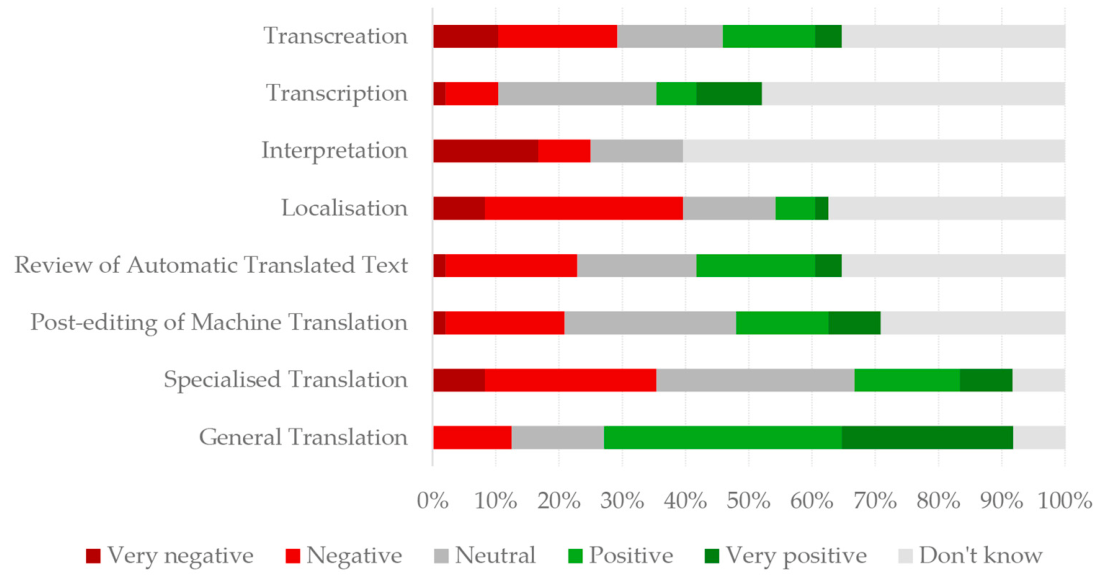
- How do you evaluate the efficiency of LLMs in the following activities?Activities:
- General text translation
- Specialised translation
- Post-editing of machine translation
- Review of automatically translated text
- Localization
- Interpretation
- Transcription
- Transcreation
Scale:- Very Negative
- Negative
- Neutral
- Positive
- Very Positive
- I don’t know
- 16.
- How does the quality of LLM-supported work compare to human-only work?
- Much worse
- Slightly worse
- About the same
- Slightly better
- Much better
- 17.
- What factor most influences your perception of quality? (Open response.)
- 18.
- Have you noticed changes in work practices/tasks due to the introduction of LLMs?
- Yes, significantly
- Yes, moderately
- No, not much change
- No change at all
- 19.
- Which services are most affected? (Open response.)
- 20.
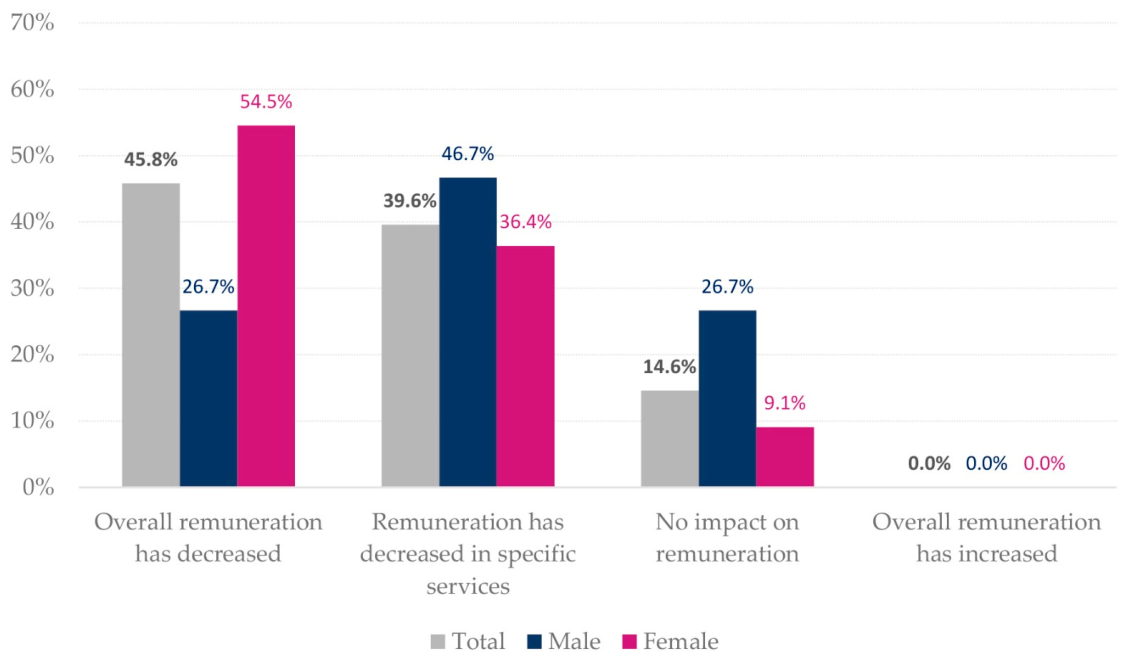
- Have you noticed any change in salaries or fees due to AI?
- Yes, the value has decreased
- Yes, but only for certain services
- No, the impact is neutral
- No, the value has increased
- 21.
- To what extent do you believe LLM usage raises ethical concerns?
- No concerns
- Minor concerns
- Moderate concerns
- Major concerns
- I don’t know
- 22.
- Which ethical concerns do you associate with LLMs?
- Intellectual property violations
- Misinformation or factual inaccuracies
- Bias or stereotyping
- De-skilling of professionals
- Untransparent authorship
- Over-reliance on non-human tools
- Environmental/energy consumption
- Other
- 23.
- What kind of training have you received?
- Formal course
- Online short course
- In-house/company training
- Self-taught
- None
- Other
- 24.
- How confident are you in using LLMs effectively?
- Not confident
- Slightly
- Moderately
- Very
- Extremely
- 25.
- Which competencies will be essential for language service providers?
- Critical engagement with AI
- Prompt engineering
- Specialised review and post-editing
- MT engineering
- AI literacy
- Technology competence
- Terminology competence/management
- Quality Assurance
- Ethical Safeguard
- None of these
- Other
- 26.
- When do you expect LLMs to significantly transform language services?
- Already happening
- Within the next 1–2 years
- In 3–5 years
- In 6–10 years
- Not for at least a decade
- Never
- 27.
- Which language professions will be most affected? (Select up to three.)
- Translators (general)
- Translators (specialised)
- Interpreters
- Subtitlers/Captioners
- Post-editors
- Project Managers
- Proofreaders
- Localizers
- Other
- 28.
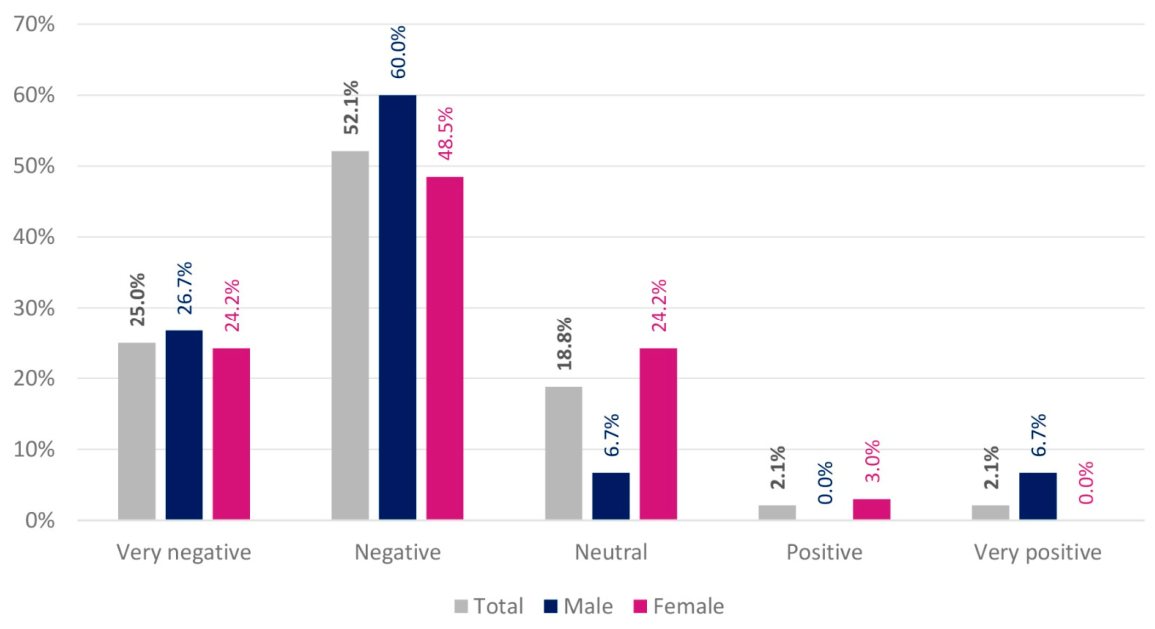
- For the professions most affected, do you believe the change will be:
- Very negative
- Negative
- Neutral
- Positive
- Very positive
- 29.
- Which opportunities do you see as being brought by LLMs?
- Automating repetitive tasks
- Expanding service offerings
- Enhancing productivity
- Other
- 30.
- How are you preparing for this transition?
- Training and learning
- Exploring automation and AI-driven solutions
- Keeping up with industry trends through research
- Learning and using new software/tools
- Other
- 31.
- Any other thoughts (concerns or opportunities) about the future of the language industry? (Open response.)
References
- Pym, A. On the End of Translation Studies as We Know It. In Proceedings of the Major Problems of Translation Studies and Translator/Interpreter Training, Kharkiv, Ukraine, 19–20 April 2024. [Google Scholar]
- ELIS Research. European Language Industry Survey; ELIS Research: Munich, Germany, 2024. [Google Scholar]
- ELIS Research. European Language Industry Survey; ELIS Research: Munich, Germany, 2025. [Google Scholar]
- Kornacki, M.; Pietrzak, P. Hybrid Workflows in Translation: Integrating GenAI into Translator Training; Routledge Focus on Translation and Interpreting Studies; Routledge Taylor & Francis Group: New York, NY, USA, 2025. [Google Scholar]
- Pym, A. Conceptual Tools in Translation History. In The Routledge Handbook of Translation History; Routledge: New York, NY, USA, 2021. [Google Scholar]
- Chan, S. The Development of Translation Technology: 1967–2023. In Routledge Encyclopedia of Translation Technology; Routledge: New York, NY, USA, 2023. [Google Scholar]
- Bowker, L. Computer-Aided Translation Technology: A Practical Introduction; University of Ottawa Press: Ottawa, ON, Canada, 2002. [Google Scholar]
- Kenny, D. Machine Translation for Everyone: Empowering Users in the Age of Artificial Intelligence; Translation and Multilingual Natural Language Processing; Language Science Press: Berlin, Germany, 2022. [Google Scholar]
- Liu, X.; Li, C. Artificial Intelligence and Translation. In Routledge Encyclopedia of Translation Technology; Routledge: New York, NY, USA, 2023. [Google Scholar]
- ISO 18587:2017. Available online: https://www.iso.org/standard/62970.html (accessed on 24 January 2026).
- Son, J.; Kim, B. Translation Performance from the User’s Perspective of Large Language Models and Neural Machine Translation Systems. Information 2023, 14, 574. [Google Scholar] [CrossRef]
- Stryker, C. What Are Large Language Models (LLMs)?|IBM. Available online: https://www.ibm.com/think/topics/large-language-models (accessed on 3 February 2026).
- Hendy, A.; Abdelrehim, M.; Sharaf, A.; Raunak, V.; Gabr, M.; Matsushita, H.; Kim, Y.J.; Afify, M.; Awadalla, H.H. How Good Are GPT Models at Machine Translation? A Comprehensive Evaluation. arXiv 2023, arXiv:2302.09210. [Google Scholar]
- Oliveira, L.; Tavares, C.; Strzelecki, A.; Silva, M. Prompting Minds: Evaluating How Students Perceive Generative AI’s Critical Thinking Dispositions. Electron. J. e-Learn. 2025, 23, 1–18. [Google Scholar] [CrossRef]
- White, J.; Fu, Q.; Hays, S.; Sandborn, M.; Olea, C.; Gilbert, H.; Elnashar, A.; Spencer-Smith, J.; Schmidt, D.C. A Prompt Pattern Catalog to Enhance Prompt Engineering with ChatGPT. arXiv 2023, arXiv:2302.11382. [Google Scholar]
- Siu, S.C. ChatGPT and GPT-4 for Professional Translators: Exploring the Potential of Large Language Models in Translation. SSRN Electron. J. 2023. [Google Scholar] [CrossRef]
- Ye, L. The Feasibility Study of Artificial Intelligence ChatGPT in Translation Field. Front. Comput. Intell. Syst. 2024, 8, 52–57. [Google Scholar] [CrossRef]
- Hariri, W. Unlocking the Potential of ChatGPT: A Comprehensive Exploration of Its Applications, Advantages, Limitations, and Future Directions in Natural Language Processing. arXiv 2023, arXiv:2304.02017. [Google Scholar]
- Jiao, W.; Wang, W.; Huang, J.; Wang, X.; Shi, S.; Tu, Z. Is ChatGPT A Good Translator? Yes With GPT-4 As The Engine. arXiv 2023, arXiv:2301.08745. [Google Scholar]
- Peng, K.; Ding, L.; Zhong, Q.; Shen, L.; Liu, X.; Zhang, M.; Ouyang, Y.; Tao, D. Towards Making the Most of ChatGPT for Machine Translation. arXiv 2023, arXiv:2303.13780. [Google Scholar]
- Bang, Y.; Ji, Z.; Schelten, A.; Hartshorn, A.; Fowler, T.; Zhang, C.; Cancedda, N.; Fung, P. HalluLens: LLM Hallucination Benchmark. In Proceedings of the 63rd Annual Meeting of the Association for Computational Linguistics (Volume 1: Long Papers); Association for Computational Linguistics: Vienna, Austria, 2025; pp. 24128–24156. [Google Scholar]
- Sakib, S.K.; Bijoy Das, A. Challenging Fairness: A Comprehensive Exploration of Bias in LLM-Based Recommendations. In Proceedings of the 2024 IEEE International Conference on Big Data (BigData); IEEE: Washington, DC, USA, 2024; pp. 1585–1592. [Google Scholar]
- The Business Research Company. Language Services Global Market Research. Available online: https://www.thebusinessresearchcompany.com/report/language-services-global-market-report (accessed on 3 February 2026).
- Esselink, B. Multinational Language Service Provider as User. In The Routledge Handbook of Translation and Technology; Routledge: New York, NY, USA, 2019. [Google Scholar]
- ELIS Research. European Language Industry Survey; ELIS Research: Munich, Germany, 2026. [Google Scholar] [CrossRef]
- CSA Research. 2025 Market Forecast; CSA Research: Cambridge, MA, USA, 2025. [Google Scholar]
- Varga, L. The 2024 Nimdzi 100; Nimdzi: Washington, DC, USA, 2024. [Google Scholar]
- Davis, F.D.; Granić, A. The Technology Acceptance Model: 30 Years of TAM; Human–Computer Interaction Series; Springer International Publishing: Cham, Switzerland, 2024. [Google Scholar]
- Venkatesh, V.; Morris, M.G.; Davis, G.B.; Davis, F.D. User Acceptance of Information Technology: Toward A Unified View1. MIS Q. 2003, 27, 425–478. [Google Scholar] [CrossRef]
- European Commission. European Master’s in Translation EMT Competence Framework 2022; European Commission: Brussels, Belgium, 2022. [Google Scholar]
- Lacruz Mantecón, M.L. Authorship and Rights Ownership in the Machine Translation Era. In Towards Responsible Machine Translation; Moniz, H., Parra Escartín, C., Eds.; Machine Translation: Technologies and Applications; Springer International Publishing: Cham, Switzerland, 2023; Volume 4, pp. 71–92. [Google Scholar]
- Moorkens, J. Ethics and Machine Translation. In Machine Translation for Everyone: Empowering Users in the Age of Artificial Intelligence; Language Science Press: Berlin, Germany, 2022. [Google Scholar]
- Cadwell, P.; O’Brien, S.; Teixeira, C.S.C. Resistance and Accommodation: Factors for the (Non-) Adoption of Machine Translation among Professional Translators. Perspectives 2018, 26, 301–321. [Google Scholar] [CrossRef]
- Guerberof, A.; Moorkens, J. Machine Translation and Post-Editing Training as Part of a Master’s Programme. J. Spec. Transl. 2019, 217–238. [Google Scholar] [CrossRef]
- Koponen, M. How to Teach Machine Translation Post-Editing? Experiences from a Post-Editing Course. In Proceedings of the 4th Workshop on Post-Editing Technology and Practice, Miami, FL, USA, 30 October–3 November 2015. [Google Scholar]
- Moorkens, J.; O’brien, S. Assessing User Interface Needs of Post-Editors of Machine Translation. In Human Issues in Translation Technology; Routledge: New York, NY, USA, 2017. [Google Scholar]
- Tavares, C.; Oliveira, L.; Duarte, P.; Silva, M. Artificial Intelligence: A Blessing or a Threat for Language Service Providers in Portugal. Informatics 2023, 10, 81. [Google Scholar] [CrossRef]
- Association of Translation Companies. End of Year Report 2025; Association of Translation Companies: Colchester, UK, 2025. [Google Scholar]
- Clark, T.; Foster, L.; Sloan, L.; Bryman, A.; Clark, T. Bryman’s Social Research Methods, 6th ed.; Oxford University Press: Oxford, UK, 2021. [Google Scholar]
- Creswell, J.W.; Creswell, J.D. Research Design: Qualitative, Quantitative, and Mixed Methods Approaches, 6th ed.; SAGE: Los Angeles, CA, USA, 2023. [Google Scholar]
- Phakiti, A.; De Costa, P.I.; Plonsky, L.; Starfield, S. (Eds.) The Palgrave Handbook of Applied Linguistics Research Methodology; Palgrave Macmillan Limited: London, UK, 2018. [Google Scholar]
- Bardin, L. Análise de Conteúdo; Edição Revista e Actualizada; Edições 70: Lisboa, Portugal, 2010. [Google Scholar]
- Etikan, I. Comparison of Convenience Sampling and Purposive Sampling. Am. J. Theor. Appl. Stat. 2016, 5, 1–4. [Google Scholar] [CrossRef]
- Hill, M.J. Social Policy: A Comparative Analysis; Prentice-Hall/Harvester Wheatsheaf: New York, NY, USA, 1996. [Google Scholar]
- Johanson, G.A.; Brooks, G.P. Initial Scale Development: Sample Size for Pilot Studies. Educ. Psychol. Meas. 2010, 70, 394–400. [Google Scholar] [CrossRef]



| Dimensions | Objectives | Questions |
|---|---|---|
| Effective Use | To understand the level of familiarity, frequency of use, purposes, and professional perceptions regarding the implementation of AI-supported tools in the language services sector. | - How familiar are you with the use of Artificial Intelligence (AI) in language-related areas (translation, interpretation, other)? - Do you use NMT (Neural Machine Translation) tools (e.g., Google Translate, DeepL) or LLMs (Large Language Models) (e.g., ChatGPT, Gemini, Copilot)? - How often do you use LLMs? - For what purpose do you use LLMs? |
| Quality perception | To assess the perceived quality and performance of LLMs, as well as the factors that facilitate or hinder their use. | - How do you evaluate the efficiency of LLMs in the following activities? |
| - How does the quality of LLM-supported work compare with that of fully human work? | ||
| - What factors most influence your perception of quality? | ||
| Impact on Language Professions | To evaluate the impacts of AI penetration in the language services industry. | - Have you noticed changes in work practices/tasks due to the introduction of LLMs? |
| - Which services are most affected? | ||
| - Have you noticed any changes in the salaries or fees of language services providers due to the penetration of AI in the job? | ||
| Ethical issues of LLMs integration in the industry | To highlight the ethical issues associated with the use of LLMs in language services and their implications for professional practice. | - To what extent do you believe that the use of LLMs in language services raises ethical concerns? |
| - Which of the following ethical concerns do you associate with LLMs in language services? | ||
| Training and skills for LLMs usage | To identify the training and competencies required for proficiency in AI-based tools. | - What kind of training have you received on the use of LLMs? - How confident are you in using LLMs effectively in your professional tasks? - Which of these competencies do you believe will be essential for language service providers? |
| Future Implications for the profession | To anticipate the transformations brought about by the integration of large language models (LLMs) in the language services industry. | - When do you expect LLMs to significantly transform language services? - Which language professions do you believe will be most affected by LLMs? - For the professions most affected, do you believe the change will be mostly positive or negative? - Which of the following do you see as opportunities brought by LLMs? - How are you preparing for this transition? - Do you have any other thoughts, concerns, or perceived opportunities regarding the future of the language-services industry that you would like to share? |
| Purpose of LLM Use | N | % |
|---|---|---|
| Obtaining more translation options | 22 | 19.5 |
| Speed | 20 | 17.7 |
| Assessing the potential of the technology | 18 | 15.9 |
| Saving time on research in general | 15 | 13.3 |
| Checking the clarity of translated text, particularly in long and complex sentences | 13 | 11.5 |
| Understanding specialised terminology | 12 | 10.6 |
| Understanding cultural references | 6 | 5.3 |
| Reducing production costs for the client | 2 | 1.8 |
| Themes | Factors | N | % | Verbatim |
|---|---|---|---|---|
| Linguistic Norm | Grammar | 5 | 6.5 | “(…) grammar is good but sometimes there is a lot of redundancy.”(ID29) “(…) because grammar and fluency look quite good (…)” (ID41) |
| Syntax | 3 | 3.9 | “(…) Syntax is correct. (…)” (ID88) “(…) Especially for Danish, I should invert most sentences because the syntax remains English, and it does not sound right.” (ID108) | |
| Fluency/ Cohesion | Semantics | 2 | 2.6 | “(…) and it changes the meaning to various degrees and approaches (additions, omissions, paraphrases, etc.)” (ID 15) “Semantic aspects of the text may be shifted (…)” (ID10) |
| Precision | 1 | 1.3 | “Accuracy and fluency, and specifically consistency.” (ID28) | |
| Meaning/Context | 4 | 5.2 | “I have found that LLMs often twists the meaning focus in sentences and that its primary goal is standard (…)” (ID78) “Understanding of context very weak.” (ID110) | |
| Fluency | 15 | 19.5 | “Fluency is superficially achieved but there are plenty of errors (…)” (ID24) “Fluency is relatively good (depending on the text and language combination) (…)” (ID65) | |
| Technical-scientific language | Terminology | 18 | 23.4 | “Terminology very weak.” (ID22) “(…) LLMs commits fatal mistakes sometimes and consistancy of technical terminology is bad.” (ID45) |
| Acronyms | 1 | 1.3 | “(…) unable to handle spécialisés terminology or acronyms.”(ID100) | |
| Translation theories | Communicative function and functionalist theory | 3 | 3.9 | “Fluency, consistency, customisation, target text and end-user functionalities, functionalism, tone, register, text type orientation”. (ID23) “Consisitency and functional adequacy” (ID 70) |
| Cultural adequacy | Idiomatic variety | 3 | 3.9 | “Mostly, incorrect language variant, (…)” (ID133) “The wording is not fully idiomatic, e.g., always slightly “off”” (ID27) |
| Idiomatic expressions | 1 | 1.3 | “Weak on idiomatic expressions.” (ID124) | |
| Cultural references | 3 | 3.9 | “(…) many problems with cultural reference (…)” (ID9) “Poor linguistic quality, no cultural depth.” (ID90) | |
| Number conversion | 1 | 1.3 | “(…) transfer of numbers (not always correct).” (ID125) | |
| Artificiality | Literal translation | 5 | 6.5 | “(…) it is sometimes too literal.” (ID79) |
| Lack of reliability | Hallucinations | 5 | 6.5 | “Hallucinations are a problem.” (ID110) “Can sometimes be really awkward and off the subject.” (ID52) |
| Productivity | Brainstorming | 1 | 1.3 | “AI is a productive tool for term extraction, ideas for better wording, etc.” (ID6) |
| Speed | 1 | 1.3 | “While it does speed the translation mechanically, i.e., in terms of text quantity (…)” (ID78) | |
| Effectiveness | Solving lexical problems | 1 | 1.3 | “It gives me equivalents that I am not able to find alone.” (ID40) |
| Creativity | 1 | 1.3 | “Semi-useful for creating puns and play on words—results rarely usable, (…)” (ID53) | |
| Efficiency | Efficiency imbalance | 3 | 3.9 | “The gain in efficiency is minimal, sometimes there is even a loss in efficiency.” (ID55) “In the end the translation speed we gain is lost in revision.” (ID24) |
| Issue | N | % |
|---|---|---|
| Misinformation or factual inaccuracies | 43 | 19.5 |
| Infringement of intellectual property rights | 35 | 15.9 |
| Transparency regarding copyright | 31 | 14.1 |
| Over-reliance on non-human tools | 28 | 12.7 |
| Bias or stereotypes in the results | 27 | 12.3 |
| Discrediting of professionals | 26 | 11.8 |
| Environmental/energy consumption | 22 | 10 |
Other:
| 8 | 3.6 |
| Skill | N | % |
|---|---|---|
| Critical engagement with AI (ability to evaluate AI outputs) | 42 | 16.2 |
| Quality assurance | 34 | 13.1 |
| Specialist proofreading and post-editing | 32 | 12.4 |
| AI literacy | 29 | 11.2 |
| Ethical safeguards | 28 | 10.8 |
| Prompt engineering | 28 | 10.8 |
| Terminology management | 27 | 10.4 |
| Technical skills | 22 | 8.5 |
| Machine translation engineering | 14 | 5.4 |
Other:
| 2 | 0.8 |
| Themes | Future-Oriented Considerations | N | % | Verbatim |
|---|---|---|---|---|
| Professional retraining | 6 | 21.4 | “The need to reconceptualise professional profiles, upskilling and reskilling.” (ID23) “Humans must learn new competences” (ID59) | |
| Job cuts | 5 | 17.9 | “Ultimately, there is no future for either translators or interpreters.” (ID30) “The number of freelance translators and also translation companies will decline in the next years.” (ID124) | |
| Standardisation | 3 | 10.7 | “I am quite worried about decreasing literacy levels in general public, if the only thing they will read will be machine-translated, flat, and boring.” (ID53) “I am afraid that IA in Language industry, and more generally, contributes to standardise thought and way of thinking.” (ID88) | |
| Decline in quality standards | 2 | 7.1 | “Using LLMs in sub-titeling and litterary translation is rather inappropriate, (very often the MT has to be deleted and written a new) but some clients refuse to see the danger, they just wish to reduce budget.” (ID41) “I’m concerned about quality. (...) Average translations are sent out as MTPE assignments, paid at just 50% of the standard rate, yet clients still expect “human quality.” (ID108) | |
| Inequality in industry | 1 | 3.6 | “It seems that mostly big companies (50,000,000 plus) are benefiting from the change as their clients do have a good concept of how to use an LLMs-Output and that it should not go unchecked. Small and midsized LSPs are suffering the most, because they are basically just losing revenue without the opportunity to recuperate it.” (ID14) | |
| Valuing human labour | 6 | 21.4 | “As long as people are trained and customers understand that AI cannot replace human translators, the shift in practices should be possible to manage.” (ID9) “(...) Human translation will survive for minority languages spoken by small communities e for legal translation for trials.” (ID40) | |
| Industrial recovery/innovation | 4 | 14.3 | “Hopefully, the AI hype will be over soon and the language industry can recover from the significant decrease in sales.” (ID6) “Language industry will expand in new modalities and with incorporation of AI.” (ID72) | |
| Professional rights | 1 | 3.6 | “As always, regulation (copyright, privacy, quality safeguards) is the key, similarly to social networks and other tech platforms.” (ID133) |
Disclaimer/Publisher’s Note: The statements, opinions and data contained in all publications are solely those of the individual author(s) and contributor(s) and not of MDPI and/or the editor(s). MDPI and/or the editor(s) disclaim responsibility for any injury to people or property resulting from any ideas, methods, instructions or products referred to in the content. |
© 2026 by the authors. Licensee MDPI, Basel, Switzerland. This article is an open access article distributed under the terms and conditions of the Creative Commons Attribution (CC BY) license.
Share and Cite
Tavares, C.; Oliveira, L.; Neves, R. From Human to Hybrid: Artificial Intelligence and the Transformation of Language Services. Societies 2026, 16, 236. https://doi.org/10.3390/soc16080236
Tavares C, Oliveira L, Neves R. From Human to Hybrid: Artificial Intelligence and the Transformation of Language Services. Societies. 2026; 16(8):236. https://doi.org/10.3390/soc16080236
Chicago/Turabian StyleTavares, Célia, Luciana Oliveira, and Rosalinda Neves. 2026. "From Human to Hybrid: Artificial Intelligence and the Transformation of Language Services" Societies 16, no. 8: 236. https://doi.org/10.3390/soc16080236
APA StyleTavares, C., Oliveira, L., & Neves, R. (2026). From Human to Hybrid: Artificial Intelligence and the Transformation of Language Services. Societies, 16(8), 236. https://doi.org/10.3390/soc16080236