Review

Migration Health and the Foucauldian Framework: A Scoping Review

1
Department of Basic and Clinical Sciences, Medical School, University of Nicosia-UNIC Athens, No. 17, 29th Street, 167 77 Elliniko, Greece
2
Department of Public Health Policy, School of Public Health, University of West Attica, 196 Alexandras Avenue, 115 21 Athens, Greece
3
INTERSOS Hellas–Humanitarian Organization, 25 Solomou Str. 5th Floor, 106 82 Athens, Greece
4
Medical School, National and Kapodistrrian University of Athens, 15 Mikras Asias Str., 115 27 Athens, Greece
5
Department of Communication and Media Studies, National and Kapodistrian University of Athens, 1 Sofokleous Str., 105 59 Athens, Greece
6
Department of Sociology, School of Social Sciences, Panteion University, 136 Syngrou Avenue, 176 71 Kallithea, Greece
*
Author to whom correspondence should be addressed.
Societies 2026, 16(7), 214; https://doi.org/10.3390/soc16070214
Submission received: 14 May 2026 / Revised: 23 June 2026 / Accepted: 1 July 2026 / Published: 9 July 2026

Abstract

The governance of migrant and refugee health is increasingly shaped by political rationalities of risk, belonging, and control, yet critical analyses using Foucauldian notions remain fragmented across disciplines. This scoping review systematically maps how health interventions, services, and policies directed at migrant and refugee populations have been examined through the Foucauldian framework. Following PRISMA-ScR guidelines, MEDLINE (PubMed), Scopus, CINAHL (EBSCO), and APA PsycINFO were searched, identifying 270 records. After deduplication, 115 unique records were screened, and 56 full-text articles were assessed for eligibility. Thirty-seven studies (n = 37) met the inclusion criteria, spanning multiple countries across five continents and employing qualitative research methods. Thematic synthesis revealed four dominant analytic categories: (a) migration health as biopolitical strategy in neoliberal contexts; (b) health literacy as a technology of governmentality; (c) disciplinary and surveillance practices in migration health settings; and (d) resistance, counter-conduct, and emancipatory health practices. Findings indicate that while biopolitical and governmentality analyses predominate, later Foucauldian concepts—particularly care of the self and counter-conduct—remain underutilized. Health literacy is rarely theorized explicitly as governance, despite its frequent implicit deployment as a normalizing technology. This review advances theoretical application in migration health, identifies critical gaps in the literature, and offers a foundation for rethinking policies, professional practice, and advocacy with migrant populations.

1. Introduction

The governance of migrant and refugee health is a contested political domain in which questions of life, security, and belonging are negotiated. Migration is actively constituted as a problem requiring governance through specific political and epistemic frameworks. It becomes intelligible through governmental rationalities that translate mobility into an object of intervention and control, linking it to broader concerns of insecurity, economic instability, and social disorder [1]. However, analyses that foreground the centrality of governance risk reproducing the assumption that migration is inherently a problem to be managed, rather than interrogating how this problematization itself is produced. This tension is particularly evident in migration health, where interventions are often framed as humanitarian necessities, while simultaneously functioning as mechanisms through which populations are regulated and differentiated [2]. As a result, the governance of migration health emerges as a critical site in which care and control are not opposing logics but deeply intertwined practices.
Recent displacement and border-control data illustrate how migrant and refugee health is governed within broader regimes of biopolitical control. An estimated 123.2 million people were forcibly displaced worldwide by the end of 2024 [3]. Simultaneously, the International Organization for Migration (IOM) has continued to document thousands of migrant deaths and disappearances along migration routes, with the Mediterranean remaining one of the world’s deadliest borders [4]. In Europe, migration governance is increasingly framed through securitisation logics: Frontex reported approximately 239,000 irregular border crossings into the European Union in 2024 [5]. Human rights organisations and monitoring bodies have also documented systematic pushbacks at European borders, practices that frequently deny migrants access to asylum procedures and healthcare protections [6,7,8].
Foucault’s work provides a framework for understanding how power operates through the production of knowledge, norms, and subjectivities rather than solely through coercion or state authority. Central to this perspective is the notion that power and knowledge are mutually constitutive: populations become objects of observation, classification, and intervention through specific regimes of truth and expert forms of knowledge [9]. The concepts of disciplinary power [10], biopolitics [11], and governmentality [12] have been extensively used in the literature to uncover how individuals and populations become governable through surveillance, normalisation, and regulatory interventions. Rather than functioning exclusively through repression, power operates through the production of knowledge, social norms, and forms of subjectivity that shape how individuals understand themselves and others.
While his earlier work focused primarily on the governance of bodies and populations, his later writings expanded this analysis through the concepts of pastoral power [13], technologies of the self [14], care of the self [15], and counter-conduct [13]. These draw attention to the ways individuals are guided through practices of care, expertise, and moral responsibility, while also retaining the capacity to reflect upon, negotiate, and resist dominant modes of governance. Taken together, these concepts provide a comprehensive framework for examining how health systems regulate populations, construct categories of belonging and exclusion, and shape identities, behaviours, and agency of migrants and refugees.
Within the field of migration and health, this framework can be applied through concepts such as biopolitics, governmentality, discourse, surveillance, and power/knowledge [16]. Biopolitics captures how modern forms of governance operate through the regulation of life at the level of populations, relying on techniques such as statistical measurement, classification, and normalisation [17]. However, biopower operates not only through direct intervention, but through the structuring of possible actions, whereby individual freedom itself becomes a means of governing populations [18]. Similarly, governmentality draws attention to the multiplicity of practices, institutions, and forms of expertise through which conduct is shaped [19]. These perspectives are particularly valuable for analysing migration and health because they illuminate how categories of vulnerability, risk, deservingness, and citizenship are produced and mobilised within health and migration governance.
Within this framework, migration is understood not as a pre-given social phenomenon but as a field of categorisation, knowledge production, and governance. Migration is constituted through epistemological and political categories such as “population” and “people,” which enable states to classify, monitor, and regulate mobile subject [20]. From this angle migration is not external to social order but is actively produced through the same governmental rationalities that organise modern societies. This insight is complemented by analyses of discourse, which demonstrate how migrants are represented and governed through particular narratives and systems of meaning. For instance, it has been demonstrated how EU migration policy constructs migrants through interrelated identity, threat, and power discourses, reinforcing representations of migrants as both vulnerable and dangerous [21].
Similarly, discourse operates as a key mechanism through which migration is rendered intelligible and governable. Migration is frequently associated with crisis, deviance, and risk, contributing to the construction of “we/them” dichotomies that position migrants as external to the national community [22]. Such representations do not merely reflect social realities but actively shape policy responses and institutional practices by defining who is considered deserving of protection, care, or exclusion. While both governmental and discursive approaches emphasize the socially constructed nature of migration, they differ in their analytical focus—whether on the administrative categorisation of populations or the production of meanings and identities. Together, these perspectives illuminate the multiple mechanisms through which migrants are governed within contemporary societies.
According to the recent relevant report of the WHO, migration policies tied to legal status shape healthcare access through mechanisms of inclusion, exclusion, and administrative control. Undocumented migrants often face restricted healthcare entitlement, while identity requirements, language barriers, limited health information, and discriminatory practices create further obstacles to care. These barriers reflect broader processes through which healthcare systems participate in the governance and regulation of migrant populations [23].
Public health measures such as health screenings at borders, quarantine procedures, vaccination controls, and differential healthcare entitlements often function simultaneously as mechanisms of care and instruments of surveillance and exclusion. For instance, precarious migrant labour in Greece is associated with limited healthcare access and exploitative working conditions, while dominant public discourse constructs migrants as potential threats to public health, reinforcing Foucauldian dynamics of categorisation, securitisation, and biopolitical governance [24].
These tensions become particularly pronounced in the domain of migration health interventions and policies. Public health frameworks often rely on the identification of vulnerable populations, a process that involves classification, risk assessment, and targeted intervention [25]. At the same time, the governance of migration cannot be reduced to a single, coherent logic. Migration regimes are characterised by multiple, overlapping, and sometimes contradictory rationalities, involving a range of actors and institutions. This perspective challenges more unified accounts of biopolitical control by highlighting the complexity and contingency of power relations [26]. It also raises questions about how these diverse rationalities cohere in practice, particularly in fields such as health where policy interventions appear highly structured and targeted.
Despite the growing application of Foucauldian concepts in migration and border studies, their use in analysing migration health remains fragmented and uneven. While existing studies provide valuable insights into biopolitics, securitization, and the discursive construction of migrant identities, they often remain analytically separated, with limited synthesis across these perspectives. This scoping review therefore asks: How are Foucauldian concepts—particularly biopower, governmentality, discourse, power/knowledge, and later concepts such as care of the self and counter-conduct—used in the analysis of migration health? This work aims to systematically map the literature, identify points of convergence and tension, and critically examine how these frameworks contribute to understanding the governance of migrant and refugee health.
At the same time, health literacy has become a central organizing concept in migration health policy worldwide [27,28]. Migrants are often constructed as subjects in need of education, behavioral guidance, and self-management skills. Such framings generate forms of migrant subjectivity while legitimising professional authority and neoliberal expectations of individual responsibility for health in contexts of structural vulnerability. However, despite the ubiquity of health literacy discourses in policy and practice, explicit Foucauldian analyses of health literacy as a technology of governmentality remain rare [29]. This gap is significant, as health literacy interventions are prime sites where biopower, disciplinary techniques, and neoliberal self-governance converge.
To date, no scoping review has systematically mapped the application of the Foucauldian framework to health interventions, services and policies directed at migrant and refugee populations. Previous reviews have examined migration health through other lenses and Foucauldian concepts have been applied to health promotion more broadly. This gap needs our attention given the rapid global increase in forced displacement and the concomitant intensification of health governance measures targeting migrant bodies. Without a critical understanding of the power relations embedded in these measures, there is a risk that health interventions may inadvertently reproduce exclusion, stigma, and control rather than advancing equity and care.

2. Materials and Methods

2.1. Research Design

This scoping review addresses these gaps by systematically mapping and critically analyzing the literature that employs Foucauldian concepts to examine health interventions, services, and policies directed at migrant and refugee populations.
Scoping reviews aim to map the existing literature on a topic and identify key concepts, theories, sources of evidence, and gaps in the research, irrespective of study quality. We employed the methodological framework proposed by Arksey and O’Malley [30] refined by Levac [31]. This framework comprises six stages: (1) identifying the research question; (2) identifying relevant studies; (3) selecting studies; (4) charting the data; (5) collating, summarizing and reporting results; and (6) consultation with experts. The review adheres to the PRISMA extension for Scoping Reviews (PRISMA-ScR) [32,33]. The completed PRISMA-ScR checklist is provided as Supplementary File.
The research question was formulated using the PCC mnemonic (Population, Concept, Context):
Population: Migrant and refugee populations (including asylum seekers, undocumented migrants, internally displaced persons, and forced migrants).
Concept: Health interventions, services, and policies analyzed through the Foucauldian theoretical framework (encompassing biopower, biopolitics, governmentality, disciplinary power, pastoral power, technologies of the self, care of the self, counter-conduct, and power/knowledge).
Context: Any world region or country.
The research questions that frame the objectives of this study are the following:
  • Which Foucauldian concepts are deployed, and with what degree of theoretical precision?
  • Does the analysis use Foucault’s concepts as descriptive labels, or as analytical tools that reveal power mechanisms, subject formation, and conditions of possibility?
  • What analytical work does the Foucauldian framework perform in interpreting migration health policies and services—i.e., what new insights does it generate that would be invisible under other frameworks?
The sixth stage—consultation with external experts—was not conducted due to the scoping nature of this review and the absence of dedicated funding; however, the research team included authors with expertise in migration health, Foucauldian theory, and public health policy, which served an analogous function in refining the thematic synthesis.

2.2. Search Strategy

Systematic searches were conducted on March to April 2026 in four electronic databases: MEDLINE (accessed via PubMed), Scopus, CINAHL (accessed via EBSCOhost), and APA PsycINFO. No date limits were applied to ensure inclusion of foundational texts. The search was restricted to peer-reviewed articles and to the English language due to the research team’s language proficiency.
The search strategy combined two concept blocks using the Boolean operator AND. The first block captured migration populations; the second block captured Foucauldian concepts. Truncation (*) was used to capture variant endings. The following search string was adapted for each database:
(migrant OR refugee* OR “asylum seeker” OR undocumented OR “irregular migrant” ORforced migrant” OR immigrant* OR displaced) AND (Foucault OR biopower OR biopolitics OR governmentality OR “disciplinary power” OR “pastoral power” OR “technologies of the self” OR “care of the self” OR “counter-conduct” OR “power/knowledge”)*
Database-specific adjustments were made for subject headings (MeSH in MEDLINE, CINAHL Subject Headings, PsycINFO Descriptors) where applicable.

2.3. Eligibility Criteria

Studies were included if they met all of the following criteria: (1) explicitly employed the Foucauldian theoretical framework as a central analytical lens (i.e., Foucault’s concepts were used to structure the analysis, not merely mentioned in passing); (2) focused on health interventions, services, policies, or practices directed at migrant or refugee populations (including asylum seekers, undocumented migrants, internally displaced persons, and forced migrants); (3) were original research (qualitative, quantitative, or mixed-methods), theoretical or conceptual papers, policy analyses, or historical analyses; (4) were published in English; (5) were published in peer-reviewed indexed journals.
Studies were excluded if they met any of the following criteria: (1) mentioned Foucault or Foucauldian concepts only in a single sentence or footnote without substantive theoretical engagement; (2) focused on migrant health professionals (e.g., migrant doctors, nurses, or care workers) as the population of interest rather than migrant patients or service users; (3) had no health focus (e.g., legal refugee determination, labor market integration, or border policing without health outcomes); (4) were conference abstracts, editorials, book reviews, dissertations, theses, or book chapters; (5) were not published in English as shown in Table 1.

2.4. Selection Process

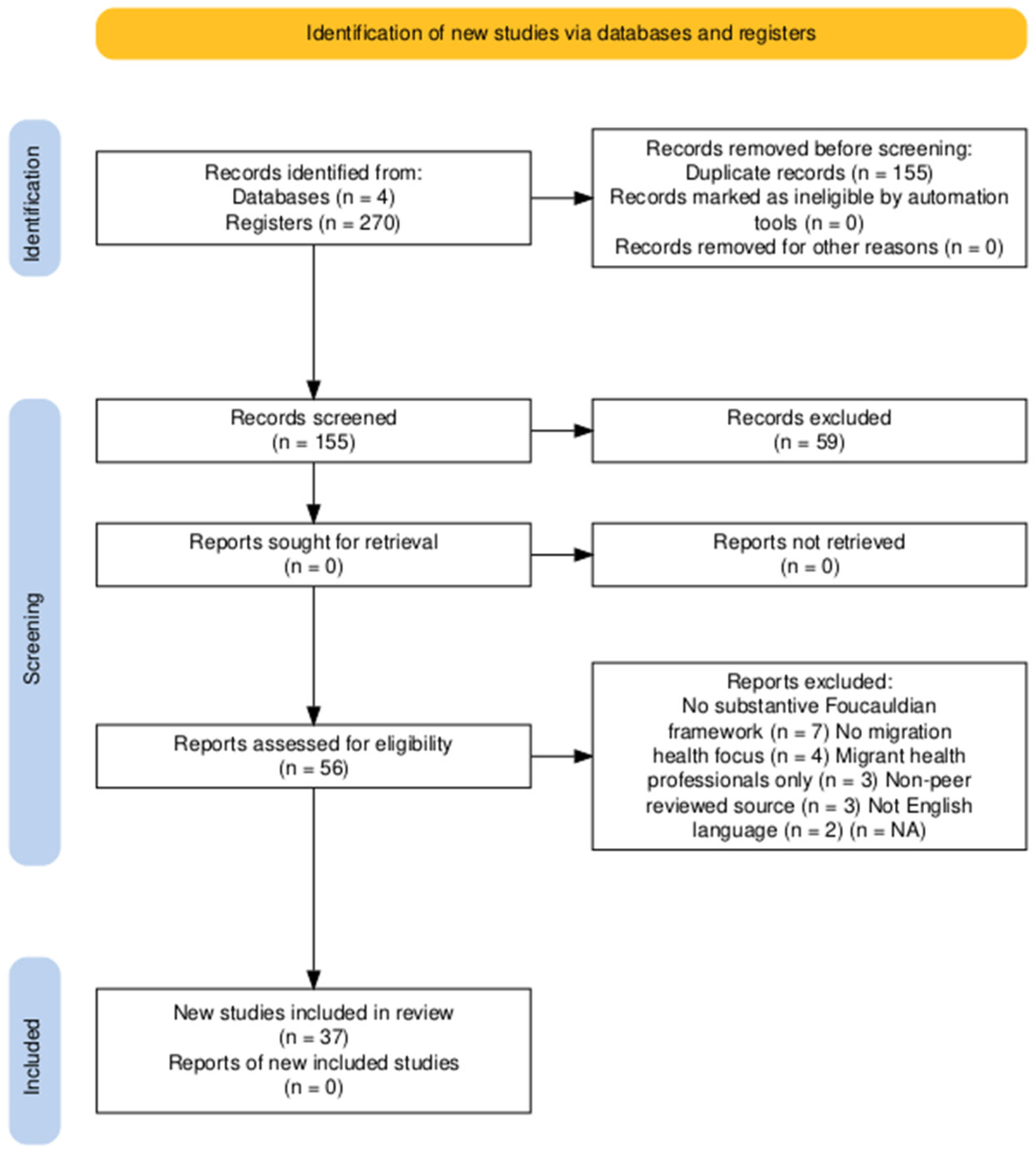
The selection process followed the PRISMA guidelines. After the database searches, all records were exported to Zotero, and duplicate records were removed. Two independent reviewers screened the titles and abstracts of all remaining records against the inclusion and exclusion criteria. Records that clearly did not meet the criteria were excluded. The full texts of all remaining records were retrieved and assessed for eligibility independently by the same two reviewers. Any disagreement between reviewers at either stage was resolved through discussion. If consensus could not be reached, a third reviewer made the final decision. The reasons for exclusion of full-text articles were recorded and are reported in the PRISMA flow diagram [32] presented in Figure 1 below.

2.5. Data Extraction

A standardized data extraction form was developed and piloted on five randomly selected included studies. The form was refined after piloting. Data were extracted independently by two reviewers using the final form. The following information was extracted from each included study: author(s); year of publication; country or countries where the research was conducted; migrant/refugee population(s) studied; health focus (e.g., mental health, maternity care, HIV, access to healthcare); method (e.g., ethnography, discourse analysis, policy analysis, historical analysis); specific Foucauldian concepts used (e.g., biopower, governmentality, panopticon); degree of Foucauldian engagement (coded as: fully Foucauldian—Foucault’s concepts form the central analytical framework; informed by Foucault—Foucault used alongside other theorists; or partial—mentions Foucault but not as primary framework); health literacy relevance (whether the study explicitly or implicitly addresses health literacy as a concept or practice); and key findings. Any disagreements in data extraction were resolved by the third reviewer.
The degree of Foucauldian engagement was coded using a three-tier rubric developed iteratively by the research team. Studies were coded as fully Foucauldian when Foucault’s concepts formed the central analytical framework, structured the research questions, methods, and interpretation, and were engaged with sustained theoretical precision. Studies were coded as informed by Foucault when Foucauldian concepts were used alongside other theoretical frameworks (e.g., Agamben, Butler, postcolonial feminism, structural violence) with substantive engagement, but not as the sole or primary lens. Studies were coded as partial when Foucault was mentioned or cited but concepts were not systematically deployed in the analysis. Two reviewers independently coded all included studies; disagreements (n = 4) were resolved through discussion with the third reviewer, yielding 100% agreement after reconciliation.

2.6. Data Synthesis

The synthesis was conducted in two stages: numerical (quantitative) and thematic (qualitative).
Numerical synthesis: Descriptive statistics were used to summarize the characteristics of the included studies. Specifically, the following were calculated: total number of studies per year of publication; geographic distribution (continent and country); methodological approaches (e.g., ethnography, discourse analysis, policy analysis, theoretical); migrant populations studied (e.g., refugees, asylum seekers, undocumented migrants, farmworkers, domestic workers); and health domains addressed (e.g., mental health, maternal health, infectious disease, access to care).
Thematic synthesis: Following the numerical synthesis, a thematic analysis was conducted to identify patterns in how Foucauldian concepts had been applied to migration health. The analysis was guided by the research question but was also open to emergent themes. The first stage of thematic synthesis involved line-by-line reading of the key finding sections of all included studies. Initial codes were generated inductively (e.g., “state control over migrant bodies”, “resistance through activism”, “health literacy as normalization”). These codes were then grouped into broader categories. Through iterative discussion between reviewers, the categories were refined and organized into four final analytic themes, which are presented in the Section 3. These themes are (1) migration health as biopolitical strategy in the neoliberal context; (2) health literacy as a technology of governmentality; (3) disciplinary and surveillance practices in migration health settings; and (4) resistance, counter-conduct, and emancipatory health practices among migrant communities.

3. Results

3.1. Numerical Synthesis of Included Studies

A total of 37 studies met the inclusion criteria and were included in the final qualitative synthesis. The earliest study was published in 1995, and the most recent in 2026, reflecting sustained scholarly engagement with Foucauldian concepts in migration health over three decades. Publication frequency increased notably after 2010, with 29 of the 37 studies (78.4%) published between 2010 and 2026. The publication year distribution is summarized in Table 2.
As shown in Table 3, the included studies spanned 15 countries across five continents. The most frequently represented countries were the United States (n = 7 studies), the United Kingdom (n = 6), Belgium (n = 4), and Australia (n = 3). Studies also originated from Canada, Sweden, Norway, Denmark, the Netherlands, France, Spain, Greece, New Zealand, Israel, Thailand, and South Africa. Two studies were multi-sited or cross-national.
In terms of methodology, as presented in Table 4, qualitative approaches predominated. Ethnography (n = 12) and Foucauldian or critical discourse analysis (n = 9) were the most common methods. The remaining studies employed policy analysis, historical analysis, theoretical/philosophical analysis, and secondary analysis of qualitative data. One study used a scoping review methodology, and one employed a mixed-methods design (quantitative cross-sectional survey combined with qualitative interviews).
In Table 5 is summarized the population disctribution in the examined studies. Specifcally, refugees and asylum seekers (n = 16), undocumented or irregular migrants (n = 12), labour migrants (including farmworkers, domestic workers, and construction workers) (n = 8), and forced migrants (mixed categories) (n = 4) have been included in the examined studies. Several studies addressed multiple categories simultaneously.
Health domains, as shown in Table 6, addressed included mental health (n = 9), access to healthcare and health coverage (n = 8), maternal and reproductive health (n = 6), infectious diseases (HIV, tuberculosis, COVID-19) (n = 5), chronic and occupational health (pesticide exposure, food, physical activity) (n = 6), and general health governance or policy (n = 8).

3.2. Thematic Synthesis of Included Studies

The thematic synthesis addressed three core questions: Which Foucauldian concepts are deployed? How are they used—descriptively or analytically? What interpretive work does the Foucauldian framework perform that other frameworks cannot? Four distinct modes of engagement emerged. A complete summary of the included studies is found in Appendix A.

3.2.1. Biopolitics and Governmentality: Denaturalising State Rationalities in Migration Health

In this group of studies (n = 17), Foucault’s concepts of biopolitics—the regulation of populations through techniques of security—and governmentality—the “conduct of conduct”—were deployed to analyse how states rationalise migration health policies as technical, humanitarian, or empowering while simultaneously enacting exclusion, control, and discipline.
Mladovsky [34] provides a paradigmatic example. Using governmentality as the primary analytical framework, she demonstrates how the English National Health Service’s formal entitlement to PTSD treatment for forced migrants is rendered “hypothetical” through social triage, austerity-driven rationing, and differential racialisation. The Foucauldian lens reveals a gap between policy language (universal coverage) and everyday practice (exclusion) that purely quantitative access studies cannot capture. Similarly, Wets and colleagues [35] employ Foucauldian discourse analysis to examine Belgian policy documents on depression in general practice. They identify a “health literacy discourse” that positions migrant patients as deficient in self-management skills, thereby legitimising general practitioners as agents of governance rather than neutral clinicians. Here, Foucault is used to denaturalise policy language: what appears as “patient education” or “empowerment” is shown to be a technology of population management. Kmak [36] argues that migration governance increasingly relies on exceptional legal and administrative measures that normalise exclusion and deportability.
Geeraert [37] traces the socio-historical construction of “irregular migrants” as a category of exclusion in the French healthcare system, linking formal inclusion to de facto marginalisation through the logic of sovereignty and governmentality. Other studies in this theme include Van Natta [38], Lam et al. [39], Bendixsen [40], Kline [41], Kapilashrami and John [42], and Bakuri [43], all of which demonstrate how migration health policies produce the very subjectivities they claim merely to serve.
Similarly, studies of food control, labour migration, domestic work, healthcare entitlement, and maternal service provision show how biopolitical and governmental rationalities operate through everyday infrastructures such as nutrition, employment, eligibility algorithms, referral systems, and social-service categorisation [39,44,45,46,47].

3.2.2. Disciplinary Power and Surveillance: The Micro-Physics of Control in Clinical and Custodial Settings

A second group of studies (n = 10) draws primarily on Discipline and Punish—particularly the panopticon, disciplinary power, and surveillance—to examine how migration health services operate as sites of bodily regulation, visibility, and normalisation. Unlike the macro-level focus on population rationalities, these studies attend to the micro-techniques of power exercised on individual migrant bodies within clinics, detention centres, and hospitals.
McLoughlin and Warin [48] apply the panopticon concept to Australian immigration detention centres, showing that the architecture and surveillance regimes produce “suspended liminality”—a chronic state of uncertainty, boredom, and helplessness that directly causes mental health deterioration. The Foucauldian framework reveals that mental illness in detention is not merely an individual pathology but an embodied effect of spatial and temporal control.
Sahraoui [49] examines midwives in the French overseas department of Mayotte, who are required to assess pregnant women intercepted at sea to determine whether their health is “compatible with detention”. Using biopolitics and governmentality, she shows how clinical judgement is transformed into border enforcement. Midwives undergo “socialisation by the repressive migration regime”, gradually implementing a minimal version of care. This analysis exposes the entanglement of care and custody—a finding that would be invisible under a conventional medical ethics framework.
Jenkins and colleagues [50] draw on both Foucault and Agamben to analyse nursing care in US immigration detention. They argue that detainees are reduced to “bare life”, their healthcare decisions (including end-of-life care) made by wardens rather than clinicians. The panopticon concept is extended to show how digital surveillance systems enable the state to “make live and let die” without direct violence. Other studies in this theme include Butchart [51], who analyses mining medicine as an industrial panopticon, and Potter and Meier [52], who conceptualise distanciation within the UK hostile environment as a technology of control.

3.2.3. Health Literacy as a Technology of Governmentality: From Empowerment to Normalisation

A smaller but theoretically significant group of studies (n = 6) deploys Foucault’s governmentality to reframe health literacy. Wets et al. [35] explicitly identify a “health literacy discourse” in Belgian policy that constructs migrant patients as lacking the knowledge and skills to manage their health. The proposed remedy—strengthening patients’ health literacy through GP guidance—is shown to be a form of pastoral power and disciplinary normalisation rather than genuine empowerment. The Foucauldian analysis reveals that health literacy functions as a technique for aligning migrant conduct with biomedical and neoliberal norms.
Amroussia [53] draws on Foucault’s power/knowledge to examine Swedish healthcare providers’ perceptions of migrant patients in sexual and reproductive health services. Providers consistently described migrants as lacking “basic knowledge about the body and sexuality”, which led to patient passivity and reduced involvement in decision-making. The study shows how medical knowledge operates as a truth regime, positioning the provider as the knower and the migrant as the ignorant recipient. Although the term “health literacy” is not explicitly used, the analysis directly implicates health literacy practices in the reproduction of power asymmetries.
Voelkner [54] provides a complementary analysis of migrant health surveillance in Thailand. Burmese migrants are trained as community health workers to deliver health education, monitor disease trends, and map their communities. A Migrant Health Information System digitises health data, making migrants governable as a population. The paper argues that “health awareness campaigns” and “self-care guidelines” are techniques of biopolitical governmentality that depoliticise migrant health, transforming structural violence into a technical problem of individual behaviour change. The fourth study in this theme is DeSouza [55,56], which analyses how Plunket nurses in New Zealand position migrant mothers as lacking information and awareness, thereby legitimising professional surveillance. Michlig et al. [57] further show how competing biomedical and community discourses shape Somali refugees’ understandings of mental health and service use, demonstrating that health knowledge is never neutral but embedded in identity, stigma, faith, and institutional power. Peprah et al. [29] extend this analysis by showing how African refugees in Australia actively resist biomedical normalisation through community knowledge and faith-based practices, demonstrating that health literacy can also be a site of counter conduct rather than mere normalisation.

3.2.4. Resistance, Counter-Conduct, and Emancipatory Health Practices: Recovering Migrant and Practitioner Agency

The fourth group of studies draws on Foucault’s later work—particularly resistance, counter-conduct, and care of the self—to examine how migrants and healthcare workers actively contest, subvert, or refuse governmental health practices. These studies resist the tendency in some Foucauldian analyses to portray migrants as passive objects of biopower.
Lafaut [58] explicitly engages Foucault’s later work on care of the self to analyse how Belgian healthcare workers navigate ethical dilemmas when caring for undocumented migrants. Through semi-structured interviews and ethnography, he identifies “techniques of the self”: strategic ignorance (deliberately not knowing patients’ immigration status), mastery of affective responses, practical mental exercises (e.g., “act as if it’s your own patient”), and the cultivation of “minimalistic medicine” (finding professional excellence with fewer resources). The analysis moves beyond biopolitical determinism to show that healthcare workers exercise ethical agency even within restrictive policy environments.
Rozakou [59] examines volunteers working with refugees in Greece. In official camps, asylum seekers are produced as “worthy guests”—passive, apolitical, and subject to surveillance. However, street volunteers attempt to “reverse hospitality”, casting refugees as hosts and themselves as guests, thereby restoring agency and political subjectivity. Although the volunteers’ practices are shown to reproduce some hierarchies, the Foucauldian framework reveals that resistance is always possible, even within the most biopolitically saturated spaces.
A foundational study [60] analyses how Cambodian refugees in California resist biomedical normalisation through strategic silence, faking illness, self-regulating medication, and seeking traditional healers. The paper challenges the view that the medical gaze is a diffused hegemonic power, arguing instead that it is generated through the complex contestation of refugee subjects pursuing their own goals.
McLoughlin [61] evaluates mental health promotion in Australian immigration detention, distinguishing between internally organised biomedical services (which risk “unhealthy alliance” with the detention system) and externally organised advocacy and community support (which subvert or emancipate). Using a Foucauldian approach to power, she shows that effective mental health promotion requires subverting the detention system itself, not merely treating individual symptoms.
Other studies in this theme include Apostolidou [62], DeSouza [55,56], Morville et al. [63], Morville and Jessen-Winge [64], and Olakivi [65], all of whom highlight how migrant patients, practitioners, or care workers negotiate institutional expectations and generate partial forms of agency within restrictive health and welfare systems.

3.2.5. Comparative Characteristics of Studies

As presented in Table 7, comparison of studies employing Foucault’s mid-career and later concepts revealed several notable patterns. In particular, earlier Foucauldian notions such as biopolitics, governmentality, and disciplinary power dominated the literature and were applied across all publication periods, geographical settings, migrant populations, and methodological approaches. Studies engaging with later Foucauldian concepts such as care of the self, technologies of the self, and counter-conduct were comparatively rare and appeared primarily after 2010. The latter set of studies was more likely to employ qualitative and ethnographic methodologies and focused on questions of agency, resistance, ethical self-formation, and professional practice. Earlier Foucaudian concepts were used predominantly to analyse surveillance, categorisation, and the governance of migrant populations, whereas later concepts illuminated how migrants and practitioners negotiate, resist, and sometimes transform governing rationalities.

3.3. Summary of Foucauldian Engagement

Across the included studies, four distinct modes of Foucauldian engagement were identified. The majority (n = 22) deployed Foucault analytically—i.e., concepts were used to perform specific interpretive work that generated insights unavailable under other frameworks. A smaller number (n = 6) used Foucauldian concepts descriptively—mentioning biopower or governmentality without sustained analysis. Eight studies engaged Foucault partially, combining his concepts with other theoretical frameworks such as structural violence or postcolonial feminism.

4. Discussion

This scoping review set out to systematically map and critically analyze how the Foucauldian framework has been deployed to interpret health interventions, services, and policies directed at migrant and refugee populations. The synthesis of studies, spanning three decades and fifteen countries, reveals a field that has drawn productively—though unevenly—on Foucault’s conceptual arsenal.
Foucauldian studies of health systems have generally shown how healthcare institutions operate through surveillance, normalisation, risk management, and the production of responsible health subjects. The present review identified similar dynamics in migration-health research. However, studies focusing on migrants and refugees additionally emphasised bordering practices, legal status, detention, deportability, and securitisation, demonstrating how healthcare becomes intertwined with migration control and the differential inclusion or exclusion of mobile populations.
While previous reviews have examined the use of Foucauldian concepts in health promotion more broadly, particularly in relation to governmentality, biopower, neoliberal health practices, and resistance, they have not focused specifically on migrant and refugee health governance [66]. This review therefore extends existing Foucauldian health scholarship by mapping how these concepts are applied to migration, borders, categorisation, securitisation, and differentiated access to healthcare.
The reviewed studies also suggest that migrants are frequently represented through discourses of vulnerability, risk, and trauma. While such framings may facilitate access to protection and services, they can also contribute to the construction of migrants as passive subjects requiring expert intervention, protection and management. From a Foucauldian perspective, these representations may be understood as forms of subjectification through which particular identities become recognised, governed, and legitimised within health and migration systems.

4.1. Predominance of Biopolitics and Governmentality

The first key finding is the overwhelming dominance of concepts from Foucault’s middle period—biopolitics, governmentality, and disciplinary power—in migration health research. Of the included studies, 17 deployed biopolitics and governmentality as central analytical tools, and a further 10 drew primarily on disciplinary power and surveillance. This pattern reflects a broader trend in critical public health scholarship, where Foucauldian concepts have often been used to expose the rationalities of neoliberal governance and the production of “docile bodies” within institutional settings.
Mladovsky [34] and Wets and colleagues [35] exemplify the analytical power of this approach. By reframing universal health coverage and health literacy as technologies of population management, they show that what appears as humanitarian or empowering policy can simultaneously be a vehicle for exclusion, normalization, and the production of governable migrant subjects. Studies on undocumented migrants further demonstrate how healthcare systems function as technologies of governmentality by differentiating access to care according to legal status, deservingness, and administrative visibility [62,63]. The Foucauldian lens reveals gaps between policy language and everyday practice that purely quantitative access studies cannot capture—a finding congruent with Mattioni et al.’s scoping review of health promotion [66], which similarly found that health promotion practices predominantly operate as biopolitical strategies in neoliberal contexts.
This pattern is reinforced by studies showing how access to healthcare is stratified through legal status, bureaucratic eligibility, labour discipline, and risk classification. Geeraert’s [37] analysis of irregular migrants in the French healthcare system, Greaves’s work on age assessment [67], Moore and Souleymanov’s [68] study of risk discourse, and Saxton’s [69] account of farmworker health all demonstrate how health governance produces differentiated subjects through categories of eligibility, risk, productivity, and deservingness.
Recent evidence suggests that immigration detention functions as a pathogenic environment that produces physical and mental deterioration through isolation, uncertainty, and deprivation, while simultaneously embedding healthcare practices within broader systems of surveillance and migration control [70].

4.2. The Relative Neglect of Later Foucauldian Concepts

A second, more striking finding is the underutilization of Foucault’s later work on ethics, care of the self, and counter-conduct. Nine studies engaged substantively with resistance or counter-conduct, and only three [48,58,62] explicitly drew on technologies of the self. This asymmetry is not merely a matter of scholarly fashion. It has substantive consequences: a field that privileges biopolitical analysis risks reproducing a vision of migrants as passive objects of power, their bodies merely inscribed by state rationalities, their agency reduced to moments of protest or non-compliance.
Foucault himself insisted that where there is power, there is resistance. The later work, particularly The Care of the Self and the lectures on Security, Territory, Population, offers a rich vocabulary for theorizing how subjects work on themselves, refuse governmental direction, and craft alternative modes of living. The absence of these concepts in migration health research means that every day, mundane forms of migrant agency—strategic silence, self-medication, the use of traditional healers, the creation of mutual aid networks—remain largely untheorized. Studies such as Ong [60] and Rozakou [59] provide important exceptions, but they remain isolated. Future research should therefore attend more systematically to the micro-politics of migrant self-formation and the ethical labor of healthcare practitioners who navigate restrictive policy environments.

4.3. Health Literacy

The third major finding is health literacy as a technology of governmentality. Despite the centrality of health literacy in international migration health policy, only six studies in this review addressed it through a Foucauldian lens, whereas Wets et al. [35] and Peprah et al. [29] explicitly named health literacy as a discourse that positions migrant patients as deficient and legitimizes professional guidance as a normalizing intervention. Amroussia [53] shows how Swedish providers perceive migrants as lacking “basic knowledge”, but without using the term “health literacy”. Peprah et al. [29] provide a counter-example, showing how African refugees in Australia actively resist biomedical normalisation by drawing on community knowledge and faith-based practices—a finding that aligns with Ong’s [60] earlier analysis of Cambodian refugees and extends it into the domain of health literacy.”
Health literacy campaigns, patient education materials, and self-management programs are paradigmatic sites of neoliberal governmentality. They interpellate migrants as responsible, reflexive, choice-making subjects while simultaneously disciplining them into conformity with biomedical and public health norms. The absence of explicit Foucauldian critique suggests either a missed opportunity or a disciplinary division of labor in which critical health literacy scholarship has developed in parallel, without substantive integration. Health literacy interventions risk becoming technologies of responsibility that obscure structural determinants of health. Future research should subject health literacy policies and measurement instruments to explicit Foucauldian discourse analysis, examining how they produce migrant subjectivities, allocate responsibility, and render structural violence invisible.

4.4. Geographical Skew and the Coloniality of Knowledge

The review also revealed a significant geographical imbalance. Europe (21 studies) and North America (11 studies) accounted for the majority of the literature, while Asia, Africa, the Middle East, and Latin America were markedly under-represented. Only three studies originated from Asia, two from Africa, one from the Middle East, and none from Latin America. This skew is not merely a matter of uneven academic production; it reflects what might be called the coloniality of knowledge in migration health research. Theoretical frameworks developed in the global North—often in the context of European and North American institutions—are applied to populations predominantly located in the global South, but rarely produced from the South.
Some studies, notably Ong on Cambodian refugees in California and Sahraoui on Mayotte (a French overseas department), explicitly address post-colonial dimensions. However, they remain exceptions. Such an approach would attend to how colonial histories shape contemporary migration health governance, how racialized hierarchies are reproduced through ostensibly neutral health policies, and how migrant resistance draws on non-Western epistemologies and practices.
Nevertheless, the included studies from South Africa, Pakistan/Gulf migration, Tanzania, Thailand, Hong Kong, and South Asia show the value of extending Foucauldian migration-health analysis beyond Euro-American settings [39,42,45,47,51,54].

4.5. Limitations

Several limitations of this review should be acknowledged. First, despite a comprehensive search of four major databases, relevant studies may have been missed due to the exclusion of grey literature, books, and dissertations, as well as the restriction to English-language publications. The latter is particularly significant given that important Foucauldian migration health research may exist in French, Spanish, German, or Portuguese. Second, the review’s focus on peer-reviewed journal articles excludes book-length monographs—a limitation given that several foundational texts exist in this area. Although this decision was made to ensure methodological consistency and reproducibility, it may have excluded influential theoretical contributions, particularly within Foucauldian migration scholarship, where many foundational analyses have been published in book-length form. Third, the review did not systematically assess the quality of included studies, consistent with scoping review methodology, which means that theoretically weak or methodologically flawed studies are given the same weight as robust ones. Finally, the geographical and linguistic biases noted above limit the generalizability of the findings to non-Anglophone and non-Western contexts.

4.6. Implications for Policy, Practice, and Research

For policy, the finding that many migration health policies function as technologies of biopolitical governance suggests the need for reform that moves beyond the “health literacy deficit” model. Policymakers should scrutinize whether ostensibly empowering interventions (patient education, health literacy campaigns, self-care programs) inadvertently reproduce exclusion by locating the problem in migrants’ supposed deficiencies rather than in structural barriers. A Foucauldian-informed policy analysis would ask not only “does this intervention work?” but also “what subject does it produce? whose interests does it serve? what forms of resistance does it foreclose?”
For practice, healthcare practitioners working with migrant populations can draw on the concept of counter-conduct to carve out spaces of ethical agency within restrictive institutional environments. As it is emphasized, techniques of the self—strategic ignorance, affective mastery, minimalistic medicine—are not merely coping mechanisms but forms of ethical resistance. Professional associations and clinical ethics committees should acknowledge these practices as legitimate adaptations rather than as deviations from protocol. Moreover, practitioners should be trained to recognize health literacy interventions not as neutral education but as sites of potential normalization, and to actively involve migrant patients in shaping the form and content of health information.
For research, future work should pursue four directions. First, studies that engage substantively with Foucault’s later work on ethics, care of the self, and counter-conduct in migration health contexts are urgently needed. How do migrants—particularly those excluded from formal health systems—craft alternative health practices, build mutual aid networks, and refuse governmental direction without recourse to formal political mobilization? Second, the under-theorization of health literacy as a technology of governmentality demands explicit Foucauldian analysis of health literacy policies, programs, and measurement instruments. Third, comparative research across geopolitical contexts—including the global South—is needed to assess whether Foucauldian concepts travel, how they are transformed, and what their limits are in non-European institutional settings. Fourth, methodological innovation is required: most included studies relied on one-off interviews or policy document analysis; longitudinal ethnographies that follow migrants over time, and participatory action research that centres migrant voices, would offer richer accounts of subjectification and counter-conduct.

5. Conclusions

This scoping review systematically mapped how the Foucauldian framework has been applied to health interventions, services, and policies directed at migrant and refugee populations. The synthesis of the included studies reveals that Foucauldian concepts—particularly biopolitics, governmentality, and disciplinary power—have been deployed as genuine analytical tools that expose the power relations, subject formation, and hidden rationalities embedded in migration health governance. These analyses denaturalize policy language, revealing that what appears as universal health coverage or health literacy empowerment often operates as a technology of population management, exclusion, and normalization.
The review identifies a striking imbalance: concepts from Foucault’s middle period dominate, while his later work on ethics, care of the self, and counter-conduct remains severely underutilized. This asymmetry risks reproducing a vision of migrants as passive objects of power. The convergence of this finding with a previous scoping review of health promotion suggests a structural feature of Foucauldian health research: biopolitical critique is more readily mobilized than the labor of theorizing resistance, especially when populations are marginalized and power relations are stark.
The review also exposes a significant blind spot: the under-theorization of health literacy as a technology of governmentality. Despite its centrality in migration health policy, only six studies engaged with health literacy through a Foucauldian lens, whilst two explicitly named it as a normalizing discourse. This silence is problematic because health literacy interventions are paradigmatic sites where neoliberal self-governance and biopower converge. Finally, the review highlights a geographical skew that reflects the coloniality of knowledge in migration health research. Europe and North America dominate, while the global South is markedly under-represented.
Theoretically, this review advances the application of Foucauldian concepts—including later work on care of the self—in a field where critical theory remains underutilized. Empirically, it provides the first comprehensive map of the literature, identifying both achievements and critical gaps. Practically, it offers a foundation for rethinking policies and interventions directed at migrant populations, moving beyond biopolitical critique towards recognizing migrant agency and the ethical labor of healthcare workers as forms of counter-conduct.

Supplementary Materials

The following supporting information can be downloaded at: https://www.mdpi.com/article/10.3390/soc16070214/s1.

Funding

This research received no external funding.

Institutional Review Board Statement

Not applicable.

Informed Consent Statement

Not applicable.

Data Availability Statement

No new data created.

Conflicts of Interest

The authors declare no conflicts of interest.

Abbreviations

The following abbreviations are used in this manuscript:
IDCImmigration Detention Centers
IOMInternational Organization Migration
NGONon-Governmental Organization
NHSNational Health System
PRISMAPreferred Reporting Items for Systematic reviews and Meta-Analyses
PRISMA-ScRPRISMA extension for Scoping Reviews
PTSDPost-traumatic stress disorder
UNHCRUnited Nations High Commissioner for Refugees
WHOWorld Health Organization

Appendix A. Summary of Included Studies (n = 37)

IdentityStudy PurposeStudy DesignGeographic LocationMigrant PopulationHealth FocusKey Foucauldian Concepts
Amir & Barak-Bianco, 2019 [44]To show how food is used as biopower to control asylum seekersEthnography; in-depth interviews; participant observation; document analysisIsraelAsylum seekers (Eritrean and Sudanese)Food as biopower; nutrition control; physical and mental health consequencesBiopower, biopolitics of population, anatamo-politics, discipline, governmentality, resistance
Amroussia, 2022 [53]To examine healthcare providers’ experiences when providing sexual and reproductive health services to migrantsQualitative thematic analysis; semi-structured interviewsSweden (Scania County)Migrant patients (asylum seekers, undocumented, foreign-born)Sexual and reproductive health services; cultural competency; power/knowledgePower/knowledge, truth regime, medical knowledge as social privilege
Apostolidou, 2015 [62]To investigate how working with asylum seekers and refugees constructs practitioners’ professional identitySemi-structured interviews; Foucauldian discourse analysisUK (London)Asylum seekers and refugees (clients of specialist mental health services)Mental health; psychosocial practice; professional identity; advocacyPower/knowledge, discourse, subjectivity, institutions, regimes of truth
Bakuri, 2024 [43]To examine biopolitics of physical activities among Somali-Dutch and Ghanaian-Dutch communitiesEthnographic researchNetherlandsSomali-Dutch and Ghanaian-Dutch communitiesPhysical activities; health; well-being; biopolitical regulation of bodies; racialisationBiopolitics
Bendixsen, 2020
[40]
To explore irregular migrants’ experiences of embodied un/belonging in NorwayEthnography; interviews; participant observation with protesters; collaboration with Healthcare Center for Paperless ImmigrantsNorway (Oslo and Bergen)Irregular migrants (rejected asylum seekers from Ethiopia, Eritrea, Palestine, Iran)Mental health (depression, anxiety, insomnia, “going mad”); healthcare access (emergency only)Governmentality, biopolitics, biopower, discipline, subjectification
Butchart, 1996
[51]
To analyse South African mining medicine as a manifestation of disciplinary powerHistorical analysis using archival sourcesSouth AfricaMigrant African labourers (Mozambique, Malawi, Zambia, Zimbabwe, South Africa)Mining medicine; tuberculosis, pneumonia, heat tolerance; medical examination; compound designDisciplinary power, panopticon, surveillance, clinical gaze, political anatomy
Cocco et al., 2026
[70]
To examine immigration detention as a health-producing and health-damaging institution, focusing on the systemic conflict between medical ethics and restrictive migration policies.Critical ethical and policy analysisEurope/immigration detention contextsMigrants, asylum seekers, and refugees held in immigration detentionPhysical and mental health deterioration; healthcare in detention; medical ethics; harmful migration policyBiopolitics; disciplinary power; surveillance; care–control nexus; state governance of migrant bodies; “make live/let die”
DeSouza, 2013
[56]
To analyse discourses used by Plunket nurses to frame migrant mothersDiscourse analysis; focus group with 8 nursesNew ZealandMigrant mothers (primarily Chinese and Indian)Maternity care; breastfeeding; infant sleep; surveillance of motheringDiscourse, power/knowledge, disciplinary power, surveillance, governmentality, biopower
DeSouza, 2014
[55]
To critically analyse power relations in NZ maternity through discourses of Korean migrant mothersSecondary discourse analysis of focus group; postcolonial feminist and Foucauldian lensNew ZealandKorean migrant mothers (recent migrants)Maternity care; pregnancy surveillance; labour and birth; postpartum careBiopower, anatamo-politics, biopolitics, disciplinary power, surveillance, normalisation, technologies of the self
Enumah, 2022
[45]
To examine triage and referral health care for refugees in TanzaniaEthnography (6 months); participant observation; medical referral committee meetings; review of clinical recordsTanzania (Kigoma refugee camp)Refugees (Burundian and Congolese)Referral health care; triage; access to specialised care (surgery, cardiology, neurosurgery)Biopower, biopolitics, therapeutic citizenship, therapeutic privilege, sovereignty
Geeraert, 2018
[37]
To reconstruct socio-historical processes of inclusion/exclusion of irregular migrants in French healthcareSocio-historical reconstruction; empirical research on PASS units in public hospitalsFranceIrregular migrantsHealthcare reforms; public health insurance access; exclusion; marginalisationSovereignty, governmentality, stratified society
Greaves, 2026
[67]
To critically examine age assessments as technologies of control for unaccompanied asylum-seeking childrenCritical conceptual desk-based review; Foucauldian discourse analysis of policy documents (2005–2024)UK (England)Unaccompanied asylum-seeking children (UASC)Mental health impacts of age assessments; safeguarding; child welfare; traumaBiopower, governmentality, disciplinary power, normalising gaze, care-control nexus
Jenkins et al., 2020
[50]
To theorise power dynamics in nursing care for ICE detaineesTheoretical/philosophical analysis using first-hand nurse accountsUSADetained immigrants in ICE custodyNursing ethics; end-of-life care; consent; detention conditionsSovereign power, biopolitics, disciplinary power, panopticon, “making live and letting die”
Kapilashrami & John, 2023
[42]
To map dimensions of precarity and pathways to health for low-wage migrants in South AsiaScoping review and content analysis (2000–2021)South Asia (India, Bangladesh, Nepal, Pakistan, Sri Lanka; also GCC)Low-wage labour migrants, internally displaced persons, refugeesHealth outcomes; healthcare access; social determinants; COVID-19Governmentality, biopolitics, biopower
Kline, 2017
[41]
To examine biopolitics of immigrant policing and its health effectsEthnography; interviews with undocumented immigrants and providers; participant observationUSA (Atlanta, Georgia)Undocumented Latino immigrants (Mexico, Central/South America)Fear-based health behaviours; healthcare avoidance; mental health (trauma, PTSD-like symptoms); preventive healthBiopolitics, governmentality, self-governance, fear as mechanism of control
Kmak, 2015
[36]
To examine rationality behind differential treatment of EU citizens and bogus asylum seekersTheoretical/legal analysis of EU Communications, Directives, case lawEuropean UnionEU citizens and asylum seekers (third-country nationals)Migration law; subjectivity; moral governance; implications for health governanceHomo economicus, governmentality, biopolitics, subjectivation, technology of morality
Lafaut, 2021
[58]
To understand how healthcare workers navigate ethical dilemmas when caring for undocumented migrants using later FoucaultMulti-site ethnography; semi-structured interviewsBelgium (Brussels)Undocumented migrantsAccess to healthcare; emergency and primary care; ethical dilemmas; strategic ignorance; minimalistic medicineCare of the self (later Foucault), techniques of the self, counter-conduct, governmentality
Lam et al., 2025
[39]
To examine biopower and governmentality in health inequities of migrant domestic workers in Hong KongEthnography; participant observation; oral history interviewsHong KongMigrant domestic workers (MDWs)—Indonesia and PhilippinesCancer, stroke, schizophrenia, pneumothorax; healthcare access; legal remediesBiopower, governmentality, power/knowledge, regime of truth, algorithmic governance
McLoughlin, 2006
[61]
To question whether mental health promotion is possible in immigration detentionTheoretical/critical analysis using health promotion theory and Foucauldian power theoryAustraliaAsylum seekers detained in IDCsMental health promotion; effectiveness of internally organised vs externally organised servicesPanopticon, discipline, surveillance, power/knowledge, normalisation
McLoughlin & Warin, 2008
[48]
To examine relationship between detention architecture and mental healthTheoretical/philosophical analysis; review of HREOC inquiries and clinical studiesAustraliaAsylum seekers detained under mandatory detentionMental health (depression, PTSD, self-harm, suicide, psychosis); effects of prolonged detention; hunger strikes, lip-sewingPanopticon, disciplinary power, surveillance, visibility, confinement, governmentality
Michlig et al., 2022
[57]
To understand mental health service use resistances among Somali refugees using discourse analysisCritical discourse analysis; focus groupsUSASomali refugeesMental health service use; cultural vs biomedical knowledgePower/knowledge, subjectivation, discourse, sites of resistance
Mladovsky, 2023
[34]
To explore everyday governance of mental health coverage for forced migrants in EnglandEthnography; participant observation; semi-structured interviewsEngland (London)Forced migrants (asylum seekers, undocumented, refugees)Mental health (PTSD); NHS/NGO coverage gapsGovernmentality, biolegitimacy, ethico-politics, neoliberal citizen-subject formation, assemblage
Montenegro & Montenegro, 2013
[46]
To analyse governmentality practices in service provision for migrated women in SpainTheoretical analysis; review of migration and gender studies in SpainSpainMigrated women (“Third World Women” as constructed category)Service provision; categorisation; discrimination; integration into low-waged work marketGovernmentality, categorisation, discourse, subjectivation
Moore & Souleymanov, 2025
[68]
To analyse risk as governance among key and priority populations in CanadaSecondary Foucauldian discourse analysis of four qualitative studiesCanada (Manitoba and Saskatchewan)Migrants (as part of KPP: 2SGBQ+ men, Indigenous Peoples, ACB communities)HIV, STBBIs; risk perception; healthcare access; discrimination in healthcare; substance use; overdoseBiopower, governmentality, discourse, risky subjectivities, subjugated knowledges
Morville et al., 2018
[63]
To assess ADL performance among Danish asylum seekersCross-sectional quantitative studyDenmarkAsylum seekersActivities of daily living (ADL); stress; trauma; institutional conditionsGovernmentality, disciplinary power
Morville & Jessen-Winge, 2019
[64]
To understand asylum seeker’s view of social exclusionQualitative; long interview over 5 daysDenmarkAsylum seekerSocial exclusion; occupational deprivation; shared responsibilitiesGovernmentality, biopolitics, power/knowledge
Olakivi, 2017
[65]
To examine discursive mobilisation of migrant care workers as productive professionalsQualitative interviews; interpretive constructionism; Foucauldian governmentalityFinlandMigrant care workers (health professionals)Professional discourse; care work organisation; subjectivationGovernmentality, productive power, subjectivation, discourse
Ong, 1995
[60]
To analyse refugee medicine as biopolitical subject formationEthnography; interviews with Khmer refugees and health professionalsUSA (California)Cambodian (Khmer) refugeesMental health (PTSD, depression, somatisation); refugee medicine; biomedicalization of trauma; psychiatric diagnosis; drug therapyBiopolitics, biopower, governmentality, medical gaze, disciplinary power, surveillance, normalisation, truth regimes
Peprah et al., 2025
[29]
To critically examine health literacy among African refugees using a Foucauldian-informed frameworkQualitative; semi-structured interviewsAustralia (Melbourne)Refugees from African backgrounds (South Sudan, Ethiopia, Eritrea, Somalia, DRC)Health literacy; access to healthcare; community health knowledgePower/knowledge; governmentality; counter-conduct; resistance
Potter & Meier, 2024
[52]
To analyse distanciation as technology of control in UK hostile environmentPolicy analysis; thematic analysis; governmentality lensUK (England)People racialised and criminalised as migrantsAccess to NHS healthcare; charging regulations; Immigration Health Surcharge; digital surveillanceGovernmentality, distanciation (spatial, legal, emotional), biopolitics, necropolitics
Qureshi, 2013
[47]
To examine biopolitics of HIV and labour migration from Pakistan to the GulfMulti-sited organisational ethnography; interviewsPakistan and Gulf Cooperation Council countriesPakistani labour migrants (mostly male, temporary)HIV; deportation; medical screening; lack of counsellingBiopolitics (partial); structural violence
Rozakou, 2012
[59]
To relate biopolitics of humanitarianism with Greek notion of hospitalityEthnographic fieldwork in camp and street volunteer groupGreeceAsylum seekers and refugees (Afghanistan, Iraq, Iran, Somalia)Mental health and well-being in detention and camp settings; humanitarian care as governanceBiopolitics, biopower, governmentality, sovereignty, production of subjectivity
Sahraoui, 2020
[49]
To analyse medical ethics of midwives involved in detention and deportationEthnography; interviews with healthcare professionals and NGO officersFrance (Mayotte)Undocumented pregnant Comorian womenPregnancy; fitness-for-detention assessments; deportation; dual loyaltyBiopolitics, biopower, governmentality, minimal biopolitics
Saxton, 2015
[69]
To examine ecobiopolitics of farmworker health in California strawberry fieldsEthnography; interviews with farmworkers, growers, regulators, activistsUSA (California, Pájaro Valley)Immigrant farmworkers (Mexican, Central American, indigenous)Pesticide exposure; chronic diseases (cancer, diabetes, neurological); occupational healthBiopolitics, ecobiopolitics, governmentality, normalisation, risk
Van Natta, 2019
[38]
To examine how healthcare bureaucracies produce medical-legal violence for undocumented immigrantsEthnography; in-depth interviews; grounded theoryUSA (Coral County)Undocumented and mixed-status Latinx immigrantsAccess to healthcare; Medicaid; safety-net clinicsBiopolitics, surveillance, disciplinary power, panopticism
Voelkner, 2011
[54]
To trace human security as biopolitical strategy for managing pathogenic circulation in ThailandEthnography; interviews with WHO/IOM officers, Thai public health officials, MCHWs; document analysisThailand (Ranong and Samutsakorn)Burmese migrant workers (legal and undocumented)Communicable diseases (cholera, diarrhoea, HIV, TB, malaria, avian flu); health surveillance; self-careGovernmentality, biopolitics, biopower, assemblage, techno-politics, self-governance
Wets et al., 2024
[35]
To identify professional discourses in Belgian policy on migrants with depression and analyse powerFoucauldian discourse analysis (FDA) of 18 policy documentsBelgiumPatients with migration background (asylum seekers, refugees, undocumented)Depression in general practice; GP bias; mental health accessDiscourse, power/knowledge, disciplinary power, clinical gaze, governmentality

References

  1. Tazzioli, M. Troubling Mobilities: Foucault and the Hold over ‘Unruly’ Movements and Life-Time. In Foucault and the History of Our Present; Fuggle, S., Lanci, Y., Tazzioli, M., Eds.; Palgrave Macmillan: London, UK, 2015; pp. 159–175. [Google Scholar]
  2. Soultatou, P. Refugees as a Key Representation of Vulnerability: Politics and Biopolitics. J. Humanit. Appl. Soc. Sci. 2022, 4, 469–480. [Google Scholar] [CrossRef]
  3. UNHCR. Key Statistical Trends on Forced Displacement, Including the Latest Official Global Figures on Refugees, Internally Displaced and Stateless People; United Nations: Manhattan, NY, USA, 2025. [Google Scholar]
  4. IOM. Missing Migrants Project; International Organization Migration: Geneva, Switzerland, 2026. [Google Scholar]
  5. Frontex. Irregular Border Crossings Down 40% in Q1 2026; Frontex: Warsaw, Poland, 2026. [Google Scholar]
  6. Amnesty International. Human Rights of Migrants: Submission to the Report of the Secretary General Pursuant to Resolution A/RES/78/217; Amnesty International: London, UK, 2025. [Google Scholar]
  7. Human Rights Watch. EU: Migration Policies Fuel Abuses Across Borders; Human Rights Watch: New York, NY, USA, 2025. [Google Scholar]
  8. Commissioner for Human Rights. Pushed beyond the Limits—Four Areas for Urgent Action to End Human Rights Violations at Europe’s Borders; Commissioner for Human Rights: Geneva, Switzerland, 2022. [Google Scholar]
  9. Rose, N. Powers of Freedom. Reframing Political Thought; Cambridge University Press: Cambridge, UK, 1999. [Google Scholar]
  10. Foucault, M. Discipline and Punish: The Birth of the Prison, 2nd Vintage Books ed.; Vintage Books: New York, NY, USA, 1995. [Google Scholar]
  11. Foucault, M. The History of Sexuality; Vintage Books: New York, NY, USA, 1978; Volume I: An Introduction. [Google Scholar]
  12. Senellart, M.; Ewald, F.; Fontana, A. (Eds.) The Birth of Biopolitics; Palgrave Macmillan: London, UK, 2008. [Google Scholar]
  13. Foucault, M. Security, Territory, Population: Lectures at the Collège de France, 1977–1978; St Martin’s Press: New York, NY, USA, 2009. [Google Scholar]
  14. Martin, L.H. (Ed.) Technologies of the Self: A Seminar with Michel Foucault; University of Massachusetts Press: Amherst, MA, USA, 1988. [Google Scholar]
  15. Foucault, M. The Care of Self; Pantheon Books: New York, NY, USA, 1986; Volume 3: History of Sexuality. [Google Scholar]
  16. Foucault, M.; Gordon, C. Power/Knowledge: Selected Interviews and Other Writings, 1972–1977, 1st American ed.; Pantheon Books: New York, NY, USA, 1980. [Google Scholar]
  17. Means, A.J. Foucault, Biopolitics, and the Critique of State Reason. Educ. Philos. Theory 2022, 54, 1968–1969. [Google Scholar] [CrossRef]
  18. Newheiser, D. Foucault, Gary Becker and the Critique of Neoliberalism. Theory Cult. Soc. 2016, 33, 3–21. [Google Scholar] [CrossRef]
  19. Walters, W. On the Road with Michel Foucault: Migration, Deportation and Viapolitics. In Foucault and the History of Our Present; Fuggle, S., Lanci, Y., Tazzioli, M., Eds.; Palgrave Macmillan: London, UK, 2015; pp. 94–110. [Google Scholar]
  20. Schwiertz, H. Foucauldian Perspectives on Migration and Society: The Epistemological-Political Grids of “People” and “Population”. Eur. J. Soc. Theory 2025, 28, 393–413. [Google Scholar] [CrossRef]
  21. Niemann, A.; Zaun, N. Introduction: EU External Migration Policy and EU Migration Governance: Introduction. J. Ethn. Migr. Stud. 2023, 49, 2965–2985. [Google Scholar] [CrossRef]
  22. Konstantinidou, C.; Michailidou, M. Foucauldian Discourse Analysis: Photography and the Social Construction of Immigration in the Greek National Press. In Visual Communication; Handbooks of communication science; De Gruyter Mouton: Berlin, Germany; Boston, MA, USA, 2014. [Google Scholar]
  23. WHO. World Report on Promoting the Health of Refugees and Migrants: Monitoring Progress on the WHO Global Action Plan; World Health Organization: Geneva, Switzerland, 2026. [Google Scholar]
  24. Fouskas, T. Repercussions of Precarious Employment on Migrants’ Perceptions of Healthcare in Greece. Int. J. Hum. Rights Healthc. 2018, 11, 298–311. [Google Scholar] [CrossRef]
  25. Leta, K.; Verloigne, M.; Bradt, L.; Sabbe, S.; Demeester, B.; Lauwerier, E.; Willems, S. The Challenge of Assessing the Needs of Vulnerable Populations in Public Health: Promoting an Approach Grounded in Proportionate Universalism Principles. Scand. J. Public Health 2025, 14034948251352643. [Google Scholar] [CrossRef] [PubMed]
  26. Wiertz, T. Biopolitics of Migration: An Assemblage Approach. Environ. Plan. C Polit. Space 2021, 39, 1375–1388. [Google Scholar] [CrossRef]
  27. Nutbeam, D. The Evolving Concept of Health Literacy. Soc. Sci. Med. 2008, 67, 2072–2078. [Google Scholar] [CrossRef] [PubMed]
  28. Sørensen, K.; Van Den Broucke, S.; Fullam, J.; Doyle, G.; Pelikan, J.; Slonska, Z.; Brand, H. (HLS-EU) Consortium Health Literacy Project European Health Literacy and Public Health: A Systematic Review and Integration of Definitions and Models. BMC Public Health 2012, 12, 80. [Google Scholar] [CrossRef] [PubMed]
  29. Peprah, P.; Lloyd, J.; Gitau, L.; Harris, M. Migration and Health Literacy: A Qualitative Analysis of Health Literacy among Africans from Refugee Backgrounds in Australia. BMC Public Health 2025, 25, 2432. [Google Scholar] [CrossRef] [PubMed]
  30. Arksey, H.; O’Malley, L. Scoping Studies: Towards a Methodological Framework. Int. J. Soc. Res. Methodol. 2005, 8, 19–32. [Google Scholar] [CrossRef]
  31. Levac, D.; Colquhoun, H.; O’Brien, K.K. Scoping Studies: Advancing the Methodology. Implement. Sci. 2010, 5, 69. [Google Scholar] [CrossRef] [PubMed]
  32. Haddaway, N.R.; Page, M.J.; Pritchard, C.C.; McGuinness, L.A. PRISMA 2020: An R Package and Shiny App for Producing PRISMA 2020-compliant Flow Diagrams, with Interactivity for Optimised Digital Transparency and Open Synthesis. Campbell Syst. Rev. 2022, 18, e1230. [Google Scholar] [CrossRef] [PubMed]
  33. Page, M.J.; McKenzie, J.E.; Bossuyt, P.M.; Boutron, I.; Hoffmann, T.C.; Mulrow, C.D.; Shamseer, L.; Tetzlaff, J.M.; Akl, E.A.; Brennan, S.E.; et al. The PRISMA 2020 Statement: An Updated Guideline for Reporting Systematic Reviews. BMJ 2021, 372, n71. [Google Scholar] [CrossRef] [PubMed]
  34. Mladovsky, P. Mental Health Coverage for Forced Migrants: Managing Failure as Everyday Governance in the Public and NGO Sectors in England. Soc. Sci. Med. 2023, 319, 115385. [Google Scholar] [CrossRef] [PubMed]
  35. Wets, C.; Bracke, P.; Delaruelle, K.; Ceuterick, M. ‘Through a Kaleidoscope’: A Foucauldian Discourse Analysis of Belgian Policy Regarding Patients with a Migration Background and Depression in General Practices. Health Interdiscip. J. Soc. Study Health Illn. Med. 2024, 28, 897–917. [Google Scholar] [CrossRef] [PubMed]
  36. Kmak, M. Between Citizen and Bogus Asylum Seeker: Management of Migration in the EU through the Technology of Morality. Soc. Identities 2015, 21, 395–409. [Google Scholar] [CrossRef]
  37. Geeraert, J. Healthcare Reforms and the Creation of Ex-/Included Categories of Patients—“Irregular Migrants” and the “Undesirable” in the French Healthcare System. Int. Migr. 2018, 56, 68–81. [Google Scholar] [CrossRef]
  38. Van Natta, M. First Do No Harm: Medical Legal Violence and Immigrant Health in Coral County, USA. Soc. Sci. Med. 2019, 235, 112411. [Google Scholar] [CrossRef] [PubMed]
  39. Lam, B.C.; Chen, J.; Ku, H.B. Biopower, Governmentality and the Making of Health Inequities of Migrant Domestic Workers in Hong Kong. Soc. Sci. Med. 2025, 383, 118449. [Google Scholar] [CrossRef] [PubMed]
  40. Bendixsen, S.K.N. Existential Displacement: Health Care and Embodied Un/Belonging of Irregular Migrants in Norway. Cult. Med. Psychiatry 2020, 44, 479–500. [Google Scholar] [CrossRef] [PubMed]
  41. Kline, N. Pathogenic Policy: Immigrant Policing, Fear, and Parallel Medical Systems in the US South. Med. Anthropol. 2017, 36, 396–410. [Google Scholar] [CrossRef] [PubMed]
  42. Kapilashrami, A.; John, E.A. Pandemic, Precarity and Health of Migrants in South Asia: Mapping Multiple Dimensions of Precarity and Pathways to States of Health and Well-Being. J. Migr. Health 2023, 7, 100180. [Google Scholar] [CrossRef] [PubMed]
  43. Bakuri, A.Z. Renegotiating the Biopolitics of Physical Activities among Ethnic Minority Groups in the Netherlands. Somatechnics 2024, 14, 266–284. [Google Scholar] [CrossRef]
  44. Amir, T.; Barak-Bianco, A. Food as a Biopower Means of Control: The Use of Food in Asylum Regimes. Am. J. Law. Med. 2019, 45, 57–79. [Google Scholar] [CrossRef] [PubMed]
  45. Enumah, Z.O. Therapeutic Citizens or Therapeutic Refugees? An Examination of Triage, Refugeehood, and Referral Health Care in Tanzania. Soc. Sci. Med. 2022, 298, 114837. [Google Scholar] [CrossRef] [PubMed]
  46. Montenegro, K.; Montenegro, M. Governmentality in Service Provision for Migrated Women in Spain. Soc. Personal. Psychol. Compass 2013, 7, 331–342. [Google Scholar] [CrossRef]
  47. Qureshi, A. Structural Violence and the State: HIV and Labour Migration from Pakistan to the Persian Gulf. Anthropol. Med. 2013, 20, 209–220. [Google Scholar] [CrossRef] [PubMed]
  48. McLoughlin, P.; Warin, M. Corrosive Places, Inhuman Spaces: Mental Health in Australian Immigration Detention. Health Place 2008, 14, 254–264. [Google Scholar] [CrossRef] [PubMed]
  49. Sahraoui, N. Challenges to Medical Ethics in the Context of Detention and Deportation: Insights from a French Postcolonial Department in the Indian Ocean. Soc. Sci. Med. 2020, 258, 113073. [Google Scholar] [CrossRef] [PubMed]
  50. Jenkins, D.; Holmes, D.; Burton, C.; Murray, S.J. ‘This Is Not a Patient, This Is Property of the State’: Nursing, Ethics, and the Immigrant Detention Apparatus. Nurs. Inq. 2020, 27, e12358. [Google Scholar] [CrossRef] [PubMed]
  51. Butchart, A. The Industrial Panopticon: Mining and the Medical Construction of Migrant African Labour in South Africa, 1900–1950. Soc. Sci. Med. 1996, 42, 185–197. [Google Scholar] [CrossRef] [PubMed]
  52. Potter, J.L.; Meier, I. Distanciation as a Technology of Control in the UK Hostile Environment. Crit. Soc. Policy 2024, 44, 263–284. [Google Scholar] [CrossRef] [PubMed]
  53. Amroussia, N. Providing Sexual and Reproductive Health Services to Migrants in Southern Sweden: A Qualitative Exploration of Healthcare Providers’ Experiences. BMC Health Serv. Res. 2022, 22, 1562. [Google Scholar] [CrossRef] [PubMed]
  54. Voelkner, N. Managing Pathogenic Circulation. Secur. Dialogue 2011, 42, 239–259. [Google Scholar] [CrossRef]
  55. DeSouza, R. One Woman’s Empowerment Is Another’s Oppression: Korean Migrant Mothers on Giving Birth in Aotearoa New Zealand. J. Transcult. Nurs. 2014, 25, 348–356. [Google Scholar] [CrossRef] [PubMed]
  56. DeSouza, R. Regulating migrant maternity: Nursing and midwifery’s emancipatory aims and assimilatory practices. Nurs. Inq. 2013, 20, 293–304. [Google Scholar] [CrossRef] [PubMed]
  57. Michlig, G.J.; Johnson-Agbakwu, C.; Surkan, P.J. “Whatever You Hide, Also Hides You”: A Discourse Analysis on Mental Health and Service Use in an American Community of Somalis. Soc. Sci. Med. 2022, 292, 114563. [Google Scholar] [CrossRef] [PubMed]
  58. Lafaut, D. Beyond Biopolitics: The Importance of the Later Work of Foucault to Understand Care Practices of Healthcare Workers Caring for Undocumented Migrants. BMC Med. Ethics 2021, 22, 157. [Google Scholar] [CrossRef] [PubMed]
  59. Rozakou, K. The Biopolitics of Hospitality in Greece: Humanitarianism and the Management of Refugees. Am. Ethnol. 2012, 39, 562–577. [Google Scholar] [CrossRef]
  60. Ong, A. Making the Biopolitical Subject: Cambodian Immigrants, Refugee Medicine and Cultural Citizenship in California. Soc. Sci. Med. 1995, 40, 1243–1257. [Google Scholar] [CrossRef] [PubMed]
  61. McLoughlin, P.J. Serve, Subvert or Emancipate? Promoting Mental Health in Immigration Detention. Aust. E-J. Adv. Ment. Health 2006, 5, 145–154. [Google Scholar] [CrossRef]
  62. Apostolidou, Z. Politicised Notions of Professional Identity and Psychosocial Practice among Practitioners Working with Asylum Seekers and Refugees. Br. J. Guid. Couns. 2015, 43, 492–503. [Google Scholar] [CrossRef]
  63. Morville, A.-L.; Erlandsson, L.-K.; Eklund, M.; Danneskiold-Samsøe, B.; Christensen, R.; Amris, K. Activity of Daily Living Performance amongst Danish Asylum Seekers: A Cross-Sectional Study. Torture J. 2018, 24, 16. [Google Scholar] [CrossRef]
  64. Morville, A.-L.; Jessen-Winge, C. Creating a Bridge: An Asylum Seeker’s Ideas for Social Inclusion. J. Occup. Sci. 2019, 26, 53–64. [Google Scholar] [CrossRef]
  65. Olakivi, A. Unmasking the Enterprising Nurse: Migrant Care Workers and the Discursive Mobilisation of Productive Professionals. Sociol. Health Illn. 2017, 39, 428–442. [Google Scholar] [CrossRef] [PubMed]
  66. Mattioni, F.C.; Nakata, P.T.; Dresh, L.C.; Rollo, R.; Brochier, L.S.B.; Rocha, C.F. Health Promotion Practices and Michel Foucault: A Scoping Review. Am. J. Health Promot. 2021, 35, 845–852. [Google Scholar] [CrossRef] [PubMed]
  67. Greaves, A. Between Care and Control: Age Assessments and the Regulation of Unaccompanied and Asylum-Seeking Children. Child Fam. Soc. Work 2026, Early View. [Google Scholar] [CrossRef]
  68. Moore, S.; Souleymanov, R. Risky Subjectivities and ‘Risk’ as Governance among Key and Priority Populations in Canada: A Foucauldian Discourse Analysis. Crit. Public Health 2025, 35, 2532633. [Google Scholar] [CrossRef]
  69. Saxton, D.I. Strawberry Fields as Extreme Environments: The Ecobiopolitics of Farmworker Health. Med. Anthropol. 2015, 34, 166–183. [Google Scholar] [CrossRef] [PubMed]
  70. Cocco, N.; Marchese, V.; Nicoli, F.; Russo, G.; Testa, J.; Corsaro, A.; Mazzetti, M. The Pathogenicity of Immigration Detention: A Systemic Conflict between Medical Ethics and Harmful Migration Policies. Lancet Reg. Health-Eur. 2026, 64, 101680. [Google Scholar] [CrossRef] [PubMed]
Figure 1. PRISMA 2020 Flow Diagram.
Societies 16 00214 g001
Table 1. Inclusion and exclusion criteria.
Inclusion CriteriaExclusion Criteria
Explicitly employs the Foucauldian theoretical framework Mentioned Foucault or Foucauldian concepts only in a single sentence or footnote without substantive theoretical engagement;
Focused on health interventions, services, policies, or practices directed at migrant or refugee populations Focused on migrant health professionals
Original research (qualitative, quantitative, or mixed-methods), theoretical or conceptual papers, policy analyses, or historical analysesHad no health focus
Published in EnglishConference abstracts, editorials, book reviews, dissertations, theses, or book chapters;
Published in peer reviewed indexed journalNot published in English
Table 2. Publication Year Distribution.
Year RangeNumber of Studies (n)
1995–1999n = 2
2000–2004n = 3
2005–2009n = 3
2010–2014n = 10
2015–2019n = 9
2020–2026n = 10
Table 3. Geographic Distribution.
ContinentNumber of Studies (n)
Europen = 21
North American = 11
Oceanian = 6
Asian = 3
African = 2
Middle Eastn = 1
Note: Two studies were multi-sited or cross-national and are counted in multiple continents; therefore, the sum of percentages exceeds 100%. The denominator for each percentage is the total number of included studies (n = 37).
Table 4. Methodological Distribution.
MethodNumber of Studies (n)
Ethnographyn = 12
Critical discourse analysisn = 9
Theoretical/philosophical analysisn = 4
Policy analysisn = 3
Historical analysisn = 2
Scoping reviewn = 1
Mixed methodn = 1
Case studyn = 1
Secondary analysis of qualitative datan = 1
Table 5. Population Distribution.
Population CategoryNumber of Studies (n)
Refugees and asylum seekersn = 17
Undocumented migrantsn = 12
Labor migrants (farmworkers, domestic workers, construction) n = 8
Forced migrants (mixed categories)n = 4
Migrant patients (unspecified legal status)n = 3
Migrant mothersn = 2
Internally displaced personsn = 1
Table 6. Health Domain.
Health DomainNumber of Studies (n)
Mental health (including PTSD, depression, anxiety, detention impacts)n = 9
Access to healthcare/health coveragen = 9
Maternal and reproductive healthn = 6
Infectious diseases (HIV, TB, COVID-19)n = 5
Chronic and occupational health (pesticides, food, physical activity)n = 6
General health governance/policy analysisn = 8
Table 7. Comparative characteristics of studies employing mid- and late-Foucauldian concepts.
CharacteristicMid-Career Concepts (Biopolitics, Governmentality, Disciplinary Power)Late-Career Concepts (Care of the Self, Technologies of the Self, Counter-Conduct)
Number of studiesDominant in the literature (approximately 27 studies)Limited representation (9 studies; technologies of the self explicitly identified in 3 studies)
Publication periodPresent throughout 1995–2026Predominantly published after 2010
Geographic distributionEurope, North America, Oceania, Asia, Africa, and the Middle EastPrimarily Europe and Oceania
Study populationsRefugees/asylum seekers, undocumented migrants, labour migrants, migrant patientsRefugees/asylum seekers, undocumented migrants, migrant patients
Methodological approachesEthnography, discourse analysis, policy analysis, historical analysis, theoretical analysisPredominantly ethnography and qualitative interview-based studies
Health domainsMental health, healthcare access, maternal health, infectious diseases, occupational health, health governanceMental health, healthcare access, professional ethics, care practices
Primary analytical concernSurveillance, regulation, categorisation, bordering, population managementAgency, resistance, ethical self-formation, care practices, negotiation of governance
Disclaimer/Publisher’s Note: The statements, opinions and data contained in all publications are solely those of the individual author(s) and contributor(s) and not of MDPI and/or the editor(s). MDPI and/or the editor(s) disclaim responsibility for any injury to people or property resulting from any ideas, methods, instructions or products referred to in the content.