1. Introduction
Understanding displacement requires attending to the deep connection between identity and place and to the psychological consequences that emerge when that connection is threatened. Research on urban renewal and forced relocation demonstrates that displacement generates emotional and relational trauma alongside material instability, including grief, disorientation, and loss of social continuity [
1,
2,
3]. These harms can unfold even without physical relocation, as uncertainty and anticipatory loss destabilize residents’ sense of belonging and future security. For social work, displacement therefore represents not only a housing outcome but a multidimensional form of structural harm with implications for mental health, informal care networks, community stability, and intergenerational well-being.
From a social work policy perspective, major urban investments must be understood as structural interventions that reorganize risk, opportunity, and belonging. Policymakers and planners frequently present transit-oriented development (TOD) and mobility investments as equity-enhancing strategies intended to expand access and opportunity. Yet emerging research identifies associated harms, including rising housing costs, speculative acquisition, and displacement pressures in historically marginalized neighborhoods [
4,
5,
6]. When accessibility improvements increase land values and rents, displacement risk disproportionately affects low-income communities and communities of color, reflecting long-standing racialized patterns of urban development. These shifts directly implicate social work concerns related to housing instability, economic precarity, and psychosocial stress.
Although scholarship on mobility, immobility, and gentrification has expanded, much of the literature remains centered on a Black–white analytic frame, marginalizing the experiences of Latina/o communities [
7]. In this article, Latina/o is used to reflect co-collaborators’ self-identification during interviews, consistent with qualitative research practices that prioritize community-defined language. For many Latinas/os, planning and infrastructure policy have contributed to segregation, underinvestment, and constrained residential choice. Despite national demographic growth and expansion in rapidly developing metropolitan regions of the U.S. Southwest, Latina/o communities remain highly vulnerable to displacement linked to urban redevelopment and transit investment. These vulnerabilities are not peripheral to social work; they shape the conditions under which families access housing, sustain cultural networks, and maintain economic stability [
8,
9,
10,
11,
12].
Existing TOD studies often rely on census-tract or ZIP code indicators that obscure how displacement is produced and experienced [
13,
14]. Such approaches fail to capture anticipatory displacement, commercial precarity, and disruption of cultural and relational ties that frequently precede formal relocation [
15,
16]. As a result, the mechanisms through which infrastructure policy generates housing instability, economic strain, and psychosocial harm remain insufficiently theorized within social work scholarship. Without such analysis, infrastructure planning remains outside social work’s analytic and advocacy domains despite its profound implications for community well-being. This study advances a social work–grounded, mechanism-focused examination of how a transit infrastructure intervention produced displacement risk during implementation in a historically marginalized Latina/o community.
1.1. The Current Study
This U.S. Southwestern metro area provides a critical case for examining these dynamics. In 2018, voters approved ballot measures authorizing the extension of the city’s light rail system into this majority-Latina/o neighborhood with a long history of disinvestment and a high concentration of small businesses [
17]. Community opposition emerged prior to construction, with residents raising concerns about business survival, housing stability, and misalignment between public investment priorities and local needs [
18,
19]. Despite these concerns, construction began in 2019. Drawing on interviews conducted during construction, this research examines how co-collaborators understood the light rail extension as a policy intervention shaping displacement risk and place-based belonging. Co-collaborators were community members who participated in in-depth pláticas/interviews, conversational and culturally grounded interviews rooted in Latina/o oral traditions that emphasize relational knowledge-sharing [
20,
21]. While co-collaborators’ lived knowledge shaped the analytic focus, the researcher retained responsibility for study design, analysis, and interpretation.
1.2. Literature Review
This literature review situates transit-oriented development within broader scholarship on gentrification, racialized urban governance, and displacement, with particular attention to how infrastructure investment operates as a structural determinant of housing instability and community well-being. Rather than treating transit expansion as a neutral technical intervention, this section examines how TOD policies activate market processes, redistribute risk, and intersect with histories of racialized disinvestment. By synthesizing research on capitalization, demographic turnover, and exclusionary mobility systems, the review establishes the foundation for analyzing transit infrastructure as an etiological mechanism of displacement. This framing emphasizes social work’s focus on addressing structural inequality, prevention, and the harms caused by policy.
1.2.1. Transit-Oriented Development and Gentrification
Over the past two decades, metropolitan regions across the United States have increasingly invested in light rail and transit-oriented development (TOD) as strategies to promote economic growth, environmental sustainability, and equitable access to opportunity. Federal and regional planning agencies routinely frame transit expansion as a means of connecting residents to employment, reducing transportation burdens, and revitalizing underinvested neighborhoods [
22,
23]. TOD policies concentrate residential and commercial development near transit stations and are often presented as tools to expand affordable housing and advance climate-responsive planning [
24]. Within policy discourse, light rail expansion is therefore positioned as a public good capable of generating shared community benefits.
Transit-oriented development (TOD) concentrates residential, commercial, and office growth within approximately a half mile of transit stations and is typically accompanied by zoning changes that permit increased density [
24]. Although framed as environmentally sustainable and socially equitable, accessibility gains are frequently capitalized into rising rents, higher property values, and speculative acquisition [
25]. As land values escalate, the benefits of reinvestment are unevenly distributed, often privileging property owners, investors, and higher-income newcomers over long-term residents in historically marginalized communities. This capitalization process operates as an etiological mechanism through which public investment destabilizes housing stability and generates displacement risk prior to physical relocation.
Emerging evidence suggests that transit investment is frequently accompanied by measurable increases in nearby property values and rents, particularly within a half-mile of new rail stations [
4,
26]. Studies of multiple U.S. metropolitan areas document that housing cost escalation often begins following project announcement, well before completion, intensifying affordability pressures for renters and low-income homeowners [
27]. Longitudinal analyses of transit corridors further identify shifts in neighborhood composition, including declines in low-income households and households of color in station-adjacent tracts [
22]. In some contexts, increases in speculative property acquisition and investor ownership have preceded demographic turnover [
25], indicating that infrastructure planning can activate market dynamics that redistribute housing stability. These patterns position transit-oriented development not only as a transportation strategy but also as a structural policy intervention with implications for housing instability, community continuity, and psychosocial well-being.
From a social work policy perspective, TOD functions as a structural intervention that reorganizes housing stability, economic security, and social connection. Decisions about upzoning, neighborhood redevelopment, and infrastructure investment do not merely shape urban form; they redistribute risk and opportunity in ways that can intensify housing instability, economic precarity, and psychosocial stress for long-term residents [
5]. These dynamics position infrastructure planning as a determinant of community well-being, particularly in neighborhoods historically subjected to racialized disinvestment [
4]. Concerns about TOD go beyond transportation planning, addressing fundamental social work issues such as structural inequality, governance, and the prevention of policy-related harm.
These dynamics are unevenly distributed throughout urban space. Historically, under-resourced communities have experienced transportation planning as a mechanism of exclusion rather than access. In the United States, mobility systems have long been racialized, with public investment favoring white and affluent communities while reinforcing segregation elsewhere [
28,
29]. Wealthier neighborhoods have frequently resisted transit expansion, limiting connectivity for low-income communities and constraining access to employment and services [
30,
31]. Consequently, infrastructure planning reproduces and entrenches existing racial and economic hierarchies rather than functioning as an impartial technical process. For social work, this history underscores that transit expansion must be analyzed not only as transportation policy but as a site where structural inequality, displacement risk, and community well-being are actively shaped.
1.2.2. Gentrification, Displacement, and the Production of Social Conditions
Gentrification is a multidimensional process shaped by local context, political economy, and racialized power relations [
10]. At its core, gentrification reorients urban space toward capital accumulation, often at the expense of existing residents and community institutions. Moskowitz [
32] argues that gentrification shifts cities away from serving working- and middle-class populations toward serving investors and affluent newcomers. Drawing on a human-rights critique, Bartlett [
33] situates gentrification in terms of loss of community control over land and shared life, linking it to systemic processes that undermine residents’ authority over place and expose them to both material displacement and symbolic losses of belonging.
Displacement within gentrifying neighborhoods occurs through multiple pathways. Prior to relocation, residents may experience anticipatory displacement as rising costs and visible neighborhood change signal a shrinking ability to remain [
34]. Wealthier newcomers often exert influence through political engagement and consumer demand, reshaping service provision, school enrollment patterns, and public investment priorities [
10,
35,
36]. While these shifts may improve neighborhood amenities, they frequently redistribute risk in ways that undermine affordability and stability for long-term residents.
Gentrification disproportionately affects communities that have already experienced structural disadvantages. Segregated and under-resourced neighborhoods face compounding vulnerabilities, including limited access to healthcare, employment, and educational opportunities, as well as heightened exposure to environmental and social stressors [
37]. As reinvestment accelerates, residents may encounter increasing precarity, surveillance, and housing insecurity. These dynamics reflect cumulative housing instability, economic strain, and psychosocial stress, all of which are directly relevant to social work practice and policy interventions.
Latina/o communities are particularly affected due to the central role of social networks, cultural institutions, and place-based ties in sustaining collective well-being. Prior research shows that dense networks of reciprocity and mutual support buffer against structural inequality [
12,
38,
39]. Disruption of these networks through gentrification can generate cascading harms, even without immediate physical displacement [
40]. This study builds on this literature by examining how these dynamics unfold in real time within the neighborhood’s primary commercial corridor, which is simultaneously undergoing transit construction and rapid reinvestment.
1.2.3. Rail Extension as a Corridor Intervention
A major expansion of light rail in a Southwestern U.S. city provides a useful example for examining transit investment as a place-based policy, especially when redevelopment focuses on a neighborhood’s main commercial corridor. Approved through joint federal and municipal transportation agreements, the project demonstrates how multi-level public funding operates as a structural mechanism, channeling redevelopment pressures into targeted areas and reshaping risks and opportunities within adjacent communities. Supported through a federal transit capital program with required municipal matching funds, the initiative reflects how competitive infrastructure financing can incentivize geographically concentrated growth strategies. In the study area, these structural shifts were experienced not merely as policy changes but also as tangible impacts on housing stability, small-business viability, and place-based belonging. These effects unfolded in a neighborhood long shaped by racial segregation, limited public services, and contentious local politics, conditions that further complicate large-scale infrastructure implementation [
41,
42].
Although proponents emphasized economic development and access to opportunity, community opposition emerged before construction. Residents and business owners raised concerns about the survival of small businesses, the loss of culturally important spaces, and increased investor interest along the neighborhood’s primary commercial corridor, widely regarded as its cultural and economic center [
18]. These concerns reflected broader anxieties about whether public investment would benefit existing residents or accelerate displacement pressures.
During construction, these anxieties intensified as residents and community institutions confronted prolonged disruption and uncertainty. Research suggests that such disruptions can lead to loss and alienation even without immediate physical displacement [
43]. In this U.S. Southwestern neighborhood, these experiences were shaped by long-standing mistrust of government institutions rooted in historical exclusion and unfulfilled commitments. As the corridor’s spatial and symbolic identity shifted, residents raised questions about cultural erasure and the conditions under which a neighborhood continues to function as a place of belonging, particularly for Spanish-speaking communities.
Together, these conditions position the light rail extension as a policy intervention with significant implications for displacement risk, economic stability, and community well-being, highlighting infrastructure planning as a critical site for social work advocacy and policy intervention. By examining the corridor during construction, this research examines how infrastructure investment influences social conditions related to housing stability, economic justice, and community life, which are key concerns of social work.
1.3. Conceptual Framework
The analysis is guided by Critical Race Ecological Systems Theory (CrEST), which integrates Ecological Systems Theory with Critical Race Theory (CRT) and Latina/o Critical Race Theory (LatCrit) to examine how racialized policy interventions shape multilevel conditions of belonging, displacement risk, and well-being in historically marginalized communities [
44,
45]. CrEST explains how structural forces embedded in policy, planning, and governance translate into lived social conditions within place-based contexts shaped by racialized disinvestment and reinvestment.
CrEST builds on ecological systems perspectives and focuses on interactions that extend macro-, exo-, meso-, and micro-level environments while centering race, power, and historical context as constitutive forces. Whereas traditional ecological frameworks emphasize adaptation, CrEST foregrounds policies as interventions that reorganize risk, opportunity, and belonging along racialized lines. This orientation is well-suited to examining infrastructure investments, often treated as neutral despite their profound social consequences.
Within CrEST, infrastructure interventions operate at the macrosystem level, reflecting racial capitalism, market-oriented development, and state governance. These interventions filter through exosystem processes such as zoning, land-use regulation, housing finance, and mitigation programs, shaping community stability or precarity. At the mesosystem level, interactions among public agencies, developers, and community organizations mediate implementation through uneven engagement, limited language access, and tokenistic participation. These processes manifest at the microsystem level as housing insecurity, commercial disruption, psychosocial stress, and erosion of place-based belonging. The chronosystem situates these dynamics within histories of segregation, disinvestment, and episodic reinvestment that shape interpretations of contemporary policy change.
In this research, CrEST functions as a sensitizing analytic framework that guides examination of how a transit infrastructure intervention materializes as lived social conditions. Guided by a structural understanding of displacement, the analysis adopts an abductive approach to trace how infrastructure policy operates through interrelated mechanisms, including anticipatory displacement, commercial precarity, and erosion of place-based belonging. CrEST extends Critical Race Theory and Ecological Systems Theory by integrating racialized power, historical disinvestment, and policy design into a multilevel model that links macro-level infrastructure decisions to downstream housing instability, economic strain, and psychosocial stress. Through iterative engagement with theory and community knowledge, the framework supports identification of how displacement risk is produced across ecological levels prior to formal relocation.
Applying CrEST to the light rail extension examined in this study contributes to social work scholarship in two ways. First, it advances an etiological explanation by tracing how infrastructure policy produces downstream harms in housing, the economy, and psychosocial outcomes. Second, it demonstrates CrEST’s utility for examining infrastructure as a social work concern beyond individual or organizational settings. The framework highlights light rail expansion projects as important yet insufficiently theorized spaces within social work scholarship and practice.
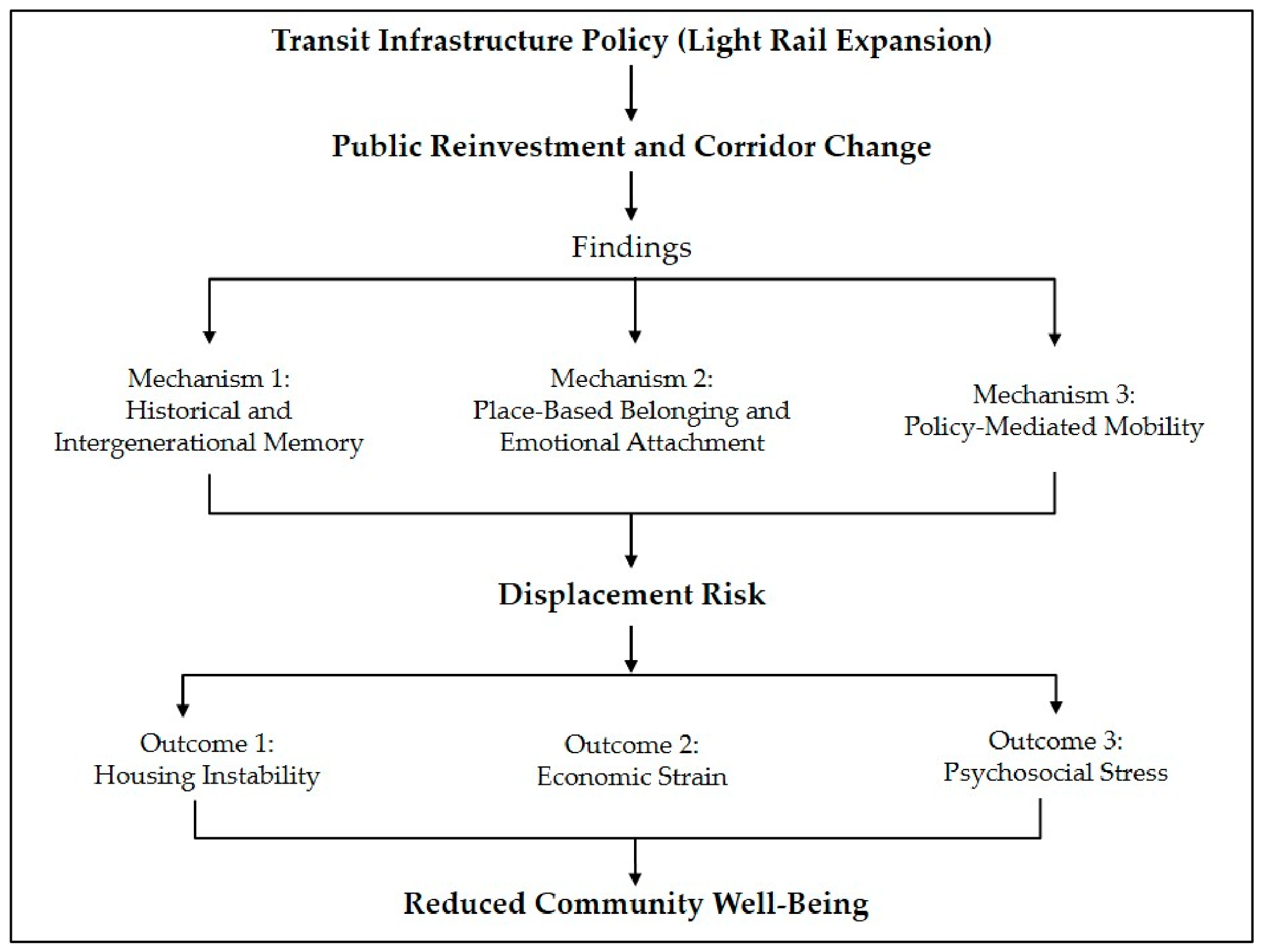
Figure 1 illustrates how transit infrastructure policy, through public reinvestment and corridor change, contributes to displacement risk through three interrelated mechanisms: historical and intergenerational memory, place-based belonging, and policy-mediated mobility. These mechanisms shape displacement risk, which in turn contributes to housing instability, economic strain, and psychosocial stress, collectively reducing community well-being.
2. Materials and Methods
The community-engaged qualitative research approach examined how a large-scale transit infrastructure project affected displacement risk, economic instability, and place-based belonging among residents in a majority-Latina/o neighborhood in a rapidly growing Southwestern metropolitan area in the U.S. Before any study activities were implemented, the author’s affiliated university’s Institutional Review Board determined the protocol exempt pursuant to 45 CFR 46.104(d)(2) (determination date: 8 July 2021). Pseudonyms are used throughout to protect the identities of co-collaborators. Spanish-language interviews were translated into English by the author. While translation necessarily involves interpretation, quotations are presented with minimal editorial modification, and linguistic variations are retained to preserve participants’ voice and intent.
2.1. Researcher Positionality
Consistent with qualitative and community-engaged social work research, this research explicitly acknowledges the role of researcher positionality in knowledge production. My engagement with residents spanned five years and included active participation in neighborhood-based organizing initiatives and cross-sector displacement- prevention collaboratives. Having lived in the study neighborhood for eight years, I occupied a dual positionality as both an insider with lived experience and an outsider conducting formal research [
46]. This positionality facilitated trust, access, and sustained dialogue while requiring ongoing reflexivity regarding power, representation, and interpretation. Throughout the research process, analytic decisions prioritized co-collaborators’ interpretations of neighborhood change and minimized extractive research practices. These commitments align with social work’s ethical emphasis on collaboration, respect for lived experience, and accountability to communities affected by policy decisions.
2.2. Data Collection
To capture how displacement risk and neighborhood change were experienced and interpreted during the light rail construction period, the broader research project employed multiple qualitative methods, including (1) individual pláticas/interviews, (2) participatory mapping activities, and (3) intergenerational pláticas conducted as focus groups. The present analysis draws primarily on individual and intergenerational pláticas to examine residents’ interpretations of transit development, while other data sources informed contextual understanding of the neighborhood’s main commercial corridor.
The overarching analytic question asked how Latina/o residents experienced and interpreted neighborhood change, stability, and displacement risk during the construction of the light rail extension, while the larger project integrated multiple qualitative data sources. The present analysis focuses on ten in-depth individual pláticas/interviews within a single transit redevelopment context to examine how co-collaborators interpreted mechanisms operating at the household and neighborhood levels.
Eligibility criteria required that co-collaborators: (1) be 18 years of age or older; (2) currently reside in or have previously resided within the neighborhood boundaries as defined by city planning maps; (3) self-identify as Latina/o; and (4) be fluent in English or Spanish. A non-probability purposive sampling strategy was employed, incorporating snowball and respondent-driven sampling techniques to recruit co-collaborators with varied socio-demographic characteristics and housing experiences (see
Table 1). Recruitment efforts sought variation in age, gender, income, housing tenure (renters and homeowners), length of residence in the neighborhood, and experiences of neighborhood change to capture multiple perspectives on displacement risk and community stability. Recruitment was conducted through community-based organizations and local neighborhood networks, thereby facilitating sustained engagement and trust-building. Attention to language justice was central to the research design. Recruitment materials and consent procedures were provided in English and Spanish. As a native Spanish speaker, I conducted interviews in the co-collaborators’ preferred language and translated all excerpts included in this manuscript into English.
Data collection was paused in 2020 due to COVID-19 restrictions and the institutional suspension of in-person research. At the request of co-collaborators, the pause was extended due to heightened stress, caregiving responsibilities, and the demands many essential workers faced during the pandemic. During this period, regular communication was maintained through text messages and phone calls using a secure project phone line.
Formal data collection resumed in early 2021. Ten individual pláticas/interviews were conducted between August 2021 and October 2021: six in English and four in Spanish. One plática/interview was held in person for the co-collaborator’s convenience, while the remaining nine took place via Zoom due to pandemic restrictions. Spanish-language interviews were translated into English by the author, with attention to preserving conceptual meaning and cultural nuance.
Demographic characteristics of the ten co-collaborators included in the present analysis are presented in
Table 1. Co-collaborators had lived in the neighborhood for an average of 15 years or more, enabling the analysis to capture longitudinal perspectives on neighborhood change, stability, and displacement risk.
2.3. Analysis
Data analysis followed an abductive qualitative approach in which empirical data and conceptual insights from Critical Race Ecological Systems Theory (CrEST) were iteratively engaged to identify mechanisms linking transit infrastructure investment to displacement-related outcomes. CrEST functioned as a sensitizing framework that guided analytic attention to multilevel processes shaping housing insecurity, economic precarity, and place-based belonging without imposing predetermined categories.
Two iterative, line-by-line coding cycles were conducted on all interviews to document co-collaborators’ perspectives in their own words and to identify recurring processes that influence experiences of neighborhood change. In the first cycle, open coding documented descriptions of housing insecurity, business disruption, neighborhood change, and shifts in belonging using in vivo and descriptive codes. In the second cycle, focused coding identified cross-case patterns and organized codes into higher-order analytic categories while remaining attentive to variation in experience.
Saturation was assessed through iterative coding, analytic memo-writing, and cross-case comparison. By the final interviews, additional data elaborated the three identified mechanisms rather than producing new mechanism categories. The adequacy of the sample was therefore assessed in relation to the study’s qualitative and mechanism-focused aims, with emphasis on depth, recurrence, variation, and coherence across co-collaborators’ accounts rather than statistical representativeness.
The analytic strategy integrated interpretive phenomenological analysis [
47] and qualitative counter-storytelling to foreground co-collaborators’ meaning-making processes and situate individual narratives within broader structural and policy contexts [
48,
49]. Rather than treating interviews as illustrative accounts, the analysis traced how participants linked transit development to changes in housing stability, economic conditions, and social cohesion.
Consistent with qualitative and theory-building research traditions, analytic rigor was assessed by the depth, saturation, and coherence of the identified mechanisms rather than by sample size [
50]. The analytic categories derived from this process are presented below as mechanisms through which the light rail extension reshaped experiences of place and community stability.
3. Results
The results are organized around three interrelated mechanisms through which the light rail extension reshaped displacement risk and community stability. First, historical and intergenerational memory structured how residents interpreted reinvestment and anticipated displacement. Second, threats to place-based belonging generated psychosocial stress and anticipatory loss prior to physical relocation. Third, mobility functioned as a policy-mediated mechanism that redistributed economic and social opportunity, altering residents’ ability to remain or benefit from reinvestment. Together, these findings illustrate how transit-oriented development operated as a policy intervention with downstream housing, economic, and psychosocial consequences for Latina/o residents and their communities.
3.1. Displacement Risk Rooted in Historical Disinvestment
Displacement risk was interpreted by co-collaborators through collective memories of prior disinvestment, exclusion, and loss. Participants assessed current transit development not in isolation but in relation to earlier experiences with land-use change, institutional access, and shifting power relations in the study community. These historical reference points shaped how reinvestment was understood, producing anticipatory displacement as participants recognized familiar patterns in which public investment had previously preceded exclusion. Rather than reflecting nostalgia, these memories functioned as evidence that reinvestment has historically disrupted community stability rather than secured it.
Across all interviews, co-collaborators described the neighborhood as once characterized by open land, informal access, and communal use of space. Juan, age 33, a resident for 18 years who identifies as “100% South Sider,” recalled having access to orchards and open areas as a child that were informally shared among neighborhood children. “When I was young, I just remember always going over there [to the neighborhood]… Back then, there was nothing out there… they knew people were walking through it, but they didn’t care.” Juan’s account contrasts an earlier landscape of permeability with current development patterns that restrict access and formalize space. These memories reflect how value has been reassigned to land in ways that signal exclusion and threaten place-based stability.
Other co-collaborators referenced historical changes in racial composition and institutional access as interpretive benchmarks. Olivia, age 51, born in Sonora, Mexico, and a neighborhood resident for 36 years, compared her schooling experiences with those of her children, “The public school is still heavy minority, but the charter schools are more Caucasian… it’s definitely different than when I was coming up.” Her comparison situates transit development within broader processes of demographic sorting and institutional differentiation. Reinvestment was interpreted not as neutral improvement, but as a reordering of racialized access to opportunity.
Historical anchoring also shaped interpretations of commercial change. Sofia, age 49, born and raised in the neighborhood, described the loss of family-owned businesses during construction, “These little mom-and-pop shops have been passed down for generations and are now closing or going up for sale because of the light rail.” For Sofia, intergenerational knowledge of local business ownership framed construction as a moment of impending loss rather than opportunity. Business closures were understood as evidence that the neighborhood’s primary commercial corridor no longer prioritized long-standing community presence.
Collectively, historical anchoring functioned as an interpretive lens that intensified perceptions of displacement risk. Co-collaborators evaluated the light rail in relation to past losses and prior exclusions rather than anticipated benefits. By situating present change within collective memory, participants identified transit investment as a turning point signaling a shift toward externally driven redevelopment.
3.2. Place-Based Belonging and Psychosocial Stress
Neighborhood change generated fear, anxiety, and anticipatory loss by threatening the everyday relationships and routines through which residents experienced belonging in their community. Co-collaborators described place-based belonging as grounded in daily practices of care, reciprocity, and cultural continuity that provided emotional security and stability. As neighborhood conditions shifted during construction, participants reported heightened psychosocial distress associated with the potential loss of these relational anchors. These responses reflect early psychosocial harm emerging prior to physical displacement and align with social work’s emphasis on prevention and community stability.
All co-collaborators described their neighborhood as a site of safety, familiarity, and interdependence. Sofia, aged 49 and born and raised in the study community, described a close-knit network of neighbors who relied on one another for everyday support. Reflecting on her relationships with long-term elderly residents on her block, she explained:
I have a neighbor, she’s a viejita [elder] and she’ll come knocking on my door, ‘Mija [a term of endearment meaning “my daughter”], you have any fill in the blank?’ It feels good because we still have our tight little community of like 10 houses around here. Especially during the pandemic, we all made sure that everyone had the essentials if they couldn’t drive to the store.
Sofia’s account illustrates how belonging was enacted through informal caregiving and reciprocal responsibility. These relationships provided emotional security and practical support, particularly during periods of crisis. Anticipated neighborhood changes heightened vulnerability by threatening housing stability and informal care infrastructures.
Other co-collaborators showed concern about losing cultural identity. Karla, 32, who grew up in the neighborhood, worried that redevelopment and resulting demographic changes could break links to their shared history and cultural practices. She stated:
My biggest fear is that the demographics [in the neighborhood] are going to change in a way that we lose the connection to our roots and our culture. Because this place has been populated by a lot of minorities, we’ve built rituals, there’s murals, and there’s art that I’m afraid we’re going to lose sight of if we’re not here anymore. In the name of ‘bettering the community,’ they’re actually going to change the culture and history and the people that created it.
Karla’s narrative highlights cultural displacement as an emotionally taxing process unfolding alongside physical and economic change. Her language underscores the psychosocial burden of anticipating loss of identity, memory, and visibility. The threat extended beyond individual displacement to the erosion of collective cultural presence.
Similarly, Ramon, age 56 and a neighborhood resident for 12 years, described unease tied to the neighborhood’s transformation into an unfamiliar space, “I’m a little scared, to be quite honest. I’m afraid that [the neighborhood] is going to lose some of its charm. Some of the businesses and corporations are moving in, and there’s definitely some fear of gentrification.” Ramon was the only participant who explicitly used the term “gentrification,” though the underlying psychosocial responses he articulated were reflected in other residents’ accounts. His professional proximity to the business sector heightened his awareness of corporate influence, reinforcing his perception of an erosion of community control over the future of place.
Throughout participant stories, a sense of belonging tied to place strengthened the psychosocial impact of neighborhood changes. Fear, anxiety, and anticipatory grief emerged as residents contemplated losing social ties, cultural markers, and routines sustaining belonging. These responses represent downstream psychosocial outcomes of a policy intervention reshaping both the physical landscape and residents’ sense of security, continuity, and collective identity.
3.3. Mobility as a Policy-Mediated Mechanism of Displacement Risk
In the United States, transit development reshapes neighborhood economies, culture, and movement patterns, generating new opportunities while also increasing the risk of displacement. Co-collaborators emphasized that mobility is not simply an individual choice or neutral benefit but is structured by infrastructure policy, housing markets, and existing inequalities. In this context, light rail enabled certain forms of access while constraining residents’ ability to remain in place or benefit from reinvestment. As a result, mobility operated less as an expanded opportunity and more as a policy-driven mechanism that redistributed displacement risk unevenly across the community. Economic mobility emerged as a primary site through which reinvestment narrowed housing options and intensified the risk of displacement.
Dolores, age 52 and a neighborhood resident for 10 years, expressed ambivalence toward the new investment. While she described redevelopment as long overdue, she emphasized how rising costs disproportionately threatened older residents with limited relocation options:
I like the change, like I think it’s well overdue, but there’s a part of me that feels for those who may get run out. But oftentimes when the investors come in or when the government starts building, they buy people out of their houses and then where are these families going to go? Older generations, you know 60 plus who have been living there for generations, inherit the home from their parents or grandparents. Because the value of their home isn’t enough to get them where they need to be to get fully situated and find another house to buy.
Dolores’ account illustrates how infrastructure-driven reinvestment disrupted intergenerational pathways to housing stability. Rather than expanding mobility options, rising property values constrained residents’ ability to convert housing equity into continued homeownership, thereby transforming asset appreciation into a risk of displacement.
Other co-collaborators described similar constraints through class positions. Sofia explained that affordability, rather than formal eviction, posed the greatest threat to her ability to remain in her neighborhood: “If I were to sell my current home right now, I would make money off of it, but I wouldn’t be able to afford to live somewhere else.” Despite being a middle-class homeowner, Sofia anticipated displacement due to broader housing-market pressures.
Similarly, Karla, who was born, raised, and works in the neighborhood, described how escalating housing costs outpaced local wages:
A lot of us are being forced out because we can’t afford to live here anymore. There are houses down the street that are in the half-million-dollar range that some of us who work in [the neighborhood] won’t be able to afford on our salary.
Together, these accounts show how transit-related reinvestment narrowed viable housing options, even for residents with stable employment or homeownership. In this context, mobility has become less a matter of choice than a condition of forced adjustment.
Co-collaborators also described divergent experiences of social mobility associated with the light rail. Laura, aged 48, who was born and raised in the study site and previously lived in public housing, reported optimism about the project’s potential benefits:
I think, you know, why not over here? I think there’s a lot of opportunity to make [our neighborhood] beautiful, and I see that happening with investors coming in, bringing in their money. I think that’s great. I like the change. I think it’s well overdue.
Laura linked transit investment to her own upward mobility, which she attributed to her transition from public housing to business ownership. However, this optimism contrasted with accounts from business owners who experienced immediate economic disruption during construction. One participant described the project as detrimental to existing commercial activity.
I think it’s a hindrance. It’s something we’re not going to use. Right now it’s a headache for a lot of people, and it’s decreasing the income of people who have businesses in this area. All that [construction] makes people not want to go to that place [the neighborhood’s primary commercial corridor].
These contrasting accounts illustrate how social mobility outcomes were shaped by positionality, timing, and proximity to capital, with transit investment creating opportunities for some while undermining economic viability for others.
Transportation mobility further revealed the gap between policy intent and lived experience. Although the light rail expansion was framed as expanding access, co-collaborators primarily reported disruptions to everyday navigation rather than anticipated use of the train. Residents emphasized avoiding routes, managing congestion, and adjusting travel routines during construction. As Maura explained, “I think it depends on people’s needs. There are many people who need to use it. But the traffic. Because of the traffic, I take 7th Street or 7th Avenue so I don’t get stuck on [primary commercial corridor].” Taken together, displacement associated with the light rail expansion emerged as a complex process rather than a single event, unfolding over time and within social networks. Historical memory shaped residents’ interpretations of reinvestment and their assessments of displacement risk, while threats to place-based belonging generated psychosocial stress and anticipatory loss prior to physical relocation.
At the same time, mobility functioned as a policy-mediated mechanism that redistributed opportunity and constraint, altering who could remain in place or benefit from redevelopment. Viewed collectively, these mechanisms reveal how transit investment operated as a structural intervention that reorganized risk, belonging, and stability within a neighborhood shaped by long-standing racial and economic exclusion. The following discussion situates these findings within social work scholarship on displacement, policy-generated harm, and community well-being, and considers implications for theory, policy, and practice.
4. Discussion
Examining the light rail extension during its construction phase reveals that transit-oriented development does not simply expand access but reorganizes risk and opportunity through identifiable social mechanisms. Participant accounts illuminate three interrelated processes: historical memory shaping anticipatory displacement, place-based belonging intensifying psychosocial stress, and policy-mediated mobility constraining residents’ ability to remain or benefit from reinvestment. Although grounded in a single commercial corridor, these mechanisms specify how infrastructure projects produce predictable patterns of harm in marginalized communities, with variation shaped by institutional arrangements and market conditions.
First, residents’ understanding of current transit projects was influenced by historical and intergenerational memories. Co-collaborators evaluated the light rail expansion through lived knowledge of neighborhood redevelopment change, racialized exclusion, and institutional neglect, rather than through official narratives of revitalization. This temporal framing intensified displacement risk by signaling reinvestment without accountability to those who had endured prolonged disinvestment. Anticipatory displacement thus emerged not from speculation, but from historically grounded interpretations of how public investment had previously reorganized power and access.
Second, place-based belonging functioned as a psychosocial mechanism that amplified the emotional consequences of neighborhood change. Relational ties, informal caregiving networks, and cultural touchpoints provided stability and meaning, while simultaneously intensifying fear, anxiety, and grief as redevelopment threatened disruption. Displacement-related harm extends beyond relocation to include emotional labor, psychosocial stress, and erosion of informal care infrastructures. For social work, these outcomes represent early indicators of harm that precede formal displacement and warrant preventive intervention.
Third, mobility emerged as a policy-driven process that constrained rather than expanded opportunity. Although transit expansion promised more transportation options, rising rents, business disruptions, and construction barriers prevented residents from benefiting from reinvestment. Instead of experiencing mobility as greater access or flexibility, residents described having to adapt to higher rents, relocate businesses, accept longer commutes, or eventually leave the neighborhood. These dynamics show how infrastructure development can turn increased transportation options into a pathway toward displacement when governance and market priorities favor future users over existing communities.
Together, these mechanisms position infrastructure policy as a determinant of housing instability, economic precarity, and psychosocial harm, outcomes often attributed to individual circumstances or market forces rather than policy design. By tracing the temporal, relational, and spatial pathways through which public investment generates displacement risk, this analysis advances social work scholarship on structural harm and situates transit-oriented development as a policy intervention warranting sustained analytic scrutiny.
Limitations
This study focuses on a specific historical moment, analyzing residents’ interpretations of transit development during the construction of the light rail extension. As a qualitative single-case study, the findings are grounded in the experiences and interpretations of ten co-collaborators within a specific transit redevelopment context. The mechanisms identified should therefore be understood as analytically transferable rather than statistically generalizable. Since displacement risk and psychosocial responses depend on the timing of redevelopment, these findings represent experiences specific to this project phase and may not directly apply to earlier planning stages or later post-construction periods. Additionally, the study focuses on residents’ personal interpretations rather than tracking policy outcomes over time, emphasizing depth and process over long-term results. As a result, the findings illuminate mechanisms through which displacement risk emerges rather than documenting longer-term residential or economic trajectories.
Although the findings are grounded in a specific neighborhood and transit infrastructure project, the mechanisms identified may have relevance beyond the study context. In particular, the ways in which historical memory, place-based belonging, and policy-mediated mobility shape displacement risk may be transferable to other redevelopment and infrastructure interventions in historically marginalized communities. Future research should examine the extent to which these mechanisms operate across different geographic settings, infrastructure projects, and community contexts.
5. Conclusions
These findings invite a reconsideration of infrastructure planning as a central domain of social work policy analysis rather than a peripheral planning concern. Because displacement-related harm emerged during implementation through anticipatory stress and constrained mobility, policy evaluation frameworks should account for pre-displacement psychosocial and relational effects rather than focusing solely on post-relocation outcomes. The analysis also calls into question mitigation strategies centered primarily on relocation assistance, suggesting the need to assess how reinvestment redistributes risk, belonging, and stability over time, particularly in communities shaped by racialized disinvestment. Finally, the study underscores the value of mechanism-focused, community-engaged qualitative research for identifying early indicators of structural harm and strengthening prevention-oriented policy debates.
This study establishes transit infrastructure as a policy determinant of displacement that operates through temporal, relational, and spatial mechanisms identifiable during implementation. For social work, this finding calls for expanding analytic attention beyond housing and criminal justice policy to include infrastructure planning as a site where displacement risk, economic instability, and community disruption take shape and where prevention remains possible. Future research should examine whether these mechanisms operate similarly across other infrastructure interventions, including school closures, hospital consolidation, and highway expansion, and in communities with different racial compositions and political economies. By analyzing the processes that generate displacement rather than only its consequences, social work scholarship can act at earlier stages of policy development rather than intervene after harm has already occurred.