1. Introduction
Organizations have increasingly begun to adopt artificial intelligence (AI) and view it as a transformative capability that reshapes how value is created, operations are optimized, and decisions are made. Perceptions regarding the changes AI may bring to organizational activities—such as improved efficiency, fairer decision-making, greater accuracy, and reduced costs—reflect how managers and employees evaluate the benefits of AI systems. These perceptions influence the extent to which AI systems are effectively integrated into organizational processes [
1,
2]. Such perceptions are critical, as performance gains from AI cannot be realized unless users trust the technology and actively engage with AI systems and related processes. Recent research conceptualizes AI not merely as a technological tool but as an organizational capability that reshapes information processing, coordination, and decision-making structures across firms [
1,
3,
4].
While prior research has largely emphasized the technological and performance-related implications of artificial intelligence, emerging perspectives suggest that AI also shapes how organizations operate within AI-enabled work environments. In particular, employees’ perceptions of AI systems may influence how these technologies are integrated into organizational processes and how their potential value is realized.
However, the impact of AI on performance is not uniform across organizations. The effectiveness of AI varies depending on the presence of dynamic capabilities such as organizational agility (OAG). OAG refers to the capability to detect environmental changes, rapidly adapt processes, and overcome obstacles to maintain progress. Within the framework of Dynamic Capabilities Theory (DCT), agility represents a key mechanism through which digital technologies—particularly AI—contribute to improved organizational performance [
5,
6]. Dynamic Capabilities Theory emphasizes that performance gains from digital technologies arise from firms’ abilities to sense environmental changes, seize opportunities, and reconfigure resources, rather than from technology adoption alone [
7,
8].
Leadership commitment has also been associated with positive outcomes in digital transformation initiatives, as strong leadership support helps foster a supportive organizational culture and allocate the resources necessary for technological adoption [
9]. However, recent studies suggest that in AI-driven environments, employees may increasingly rely on algorithmically generated insights rather than managerial recommendations, potentially weakening the moderating influence of leadership [
10,
11]. Consequently, questions remain as to whether management commitment consistently strengthens the pathways through which AI influences the development of organizational capabilities. As AI-enabled systems become embedded in routine organizational processes, employees may increasingly depend on algorithmic outputs rather than managerial guidance when responding to environmental changes [
2,
12].
Despite the growing body of research on artificial intelligence adoption and its organizational consequences, two important gaps remain. First, although prior studies acknowledge that perceived benefits of AI may enhance organizational performance, the mechanisms through which these perceptions translate into performance outcomes remain insufficiently theorized, particularly regarding the mediating role of organizational agility as a dynamic capability. Second, while leadership and management commitment are often assumed to strengthen digital transformation outcomes, their moderating role in AI-intensive environments remains theoretically ambiguous and empirically inconclusive. Existing research provides limited insight into whether management commitment consistently conditions the pathways through which AI-related benefits are translated into organizational agility and performance, particularly as algorithmic systems increasingly guide operational decision-making.
In contrast to prior studies that treat artificial intelligence primarily as a direct driver of organizational capabilities and performance, this study argues that the value of AI is not automatically realized but must first be cognitively appraised by organizational actors. This implies that the same AI resource may lead to different outcomes across organizations depending on how they are perceived and enacted by employees and managers. Building on these gaps, the study advances three theoretical contributions. First, it conceptualizes perceived benefits of AI (PB-AI) as a cognitive appraisal mechanism through which the value of AI resources is subjectively interpreted and activated, rather than assumed to be inherently realized, thereby complementing RBV’s resource value logic with an employee/manager perception lens. Second, it theorizes organizational agility as the capability-conversion mechanism through which cognitively activated AI resources are transformed into performance outcomes, thereby strengthening the micro-foundations of Dynamic Capabilities Theory in AI-enabled contexts. Third, by testing management commitment as a moderator of the indirect effect, it provides boundary-condition evidence suggesting that leadership influence may be less consequential when AI-enabled routines and algorithmic decision support become embedded in day-to-day operations.
Medium-sized firms in Saudi Arabia provide a particularly relevant context for examining AI adoption and its organizational implications, as they operate under resource constraints while simultaneously playing a central role in national digital transformation initiatives. This combination makes them well-suited for investigating how perceived benefits of AI are translated into organizational agility and performance outcomes.
The objective of this research is to develop and empirically test a moderated mediation model that explains how perceived benefits of AI (PB-AI) influence organizational performance (OGP) both directly and indirectly through organizational agility (OAG), while examining whether this relationship is moderated by management commitment (MC). By integrating the Resource-Based View (RBV) and Dynamic Capabilities Theory (DCT), this study clarifies the mechanisms through which AI generates organizational value while examining the role of leadership in shaping these outcomes, particularly in contexts where the influence of management commitment may diminish when AI systems become embedded in organizational processes [
13]. Specifically, RBV explains the value potential of AI as a strategic organizational resource, while DCT clarifies how such value is dynamically translated into performance outcomes through organizational agility as a higher-order capability.
2. Theoretical Framework
Although the Resource-Based View (RBV) explains how artificial intelligence (AI) can serve as a valuable organizational resource, it does not fully account for how such value is recognized and enacted by organizational members. Similarly, Dynamic Capabilities Theory (DCT) explains how resources are transformed into performance outcomes but pays limited attention to the cognitive processes that precede capability development.
To address this limitation, this study introduces a perception-based perspective by conceptualizing perceived benefits of AI (PB-AI) as a cognitive appraisal mechanism through which the value of AI resources is interpreted and activated. This perspective links the resource-based logic of RBV with the capability transformation processes of DCT through an intermediate cognitive layer.
2.1. Perceived Benefits of Artificial Intelligence Technologies (PB-AI) and Organizational Agility (OAG)
Perceived benefits of artificial intelligence technologies (PB-AI) refer to how employees and managers evaluate the usefulness of AI systems and the extent to which these systems improve the efficiency, effectiveness, and overall performance of organizational processes. The existing literature suggests that perceptions of technological usefulness play a key role in technology acceptance, and technology acceptance ultimately determines its impact on organizational outcomes [
1,
14]. Following the principles of Technology Affordance Theory, benefits such as reduced bias, improved matching, cost-effectiveness, perceived fairness, time efficiency, and better resource utilization influence how AI is integrated into organizational tasks [
6,
15,
16].
Moreover, Ref. [
17] argue that the potential of organizational resources to generate competitive advantage depends on how these resources are recognized, valued, and assimilated by key organizational actors. Accordingly, PB-AI represents a cognitive mechanism that determines whether AI is perceived as a valuable operational resource capable of enhancing organizational capabilities [
14]. As such, PB-AI may initiate a series of effects that influence both organizational agility and overall performance in organizations that adopt AI technologies.
Organizational agility (OAG) refers to the capability of organizations to detect environmental changes, identify required adjustments, and reconfigure internal processes to respond effectively to dynamic conditions [
3] AI tools contribute to maintaining such agility by providing real-time insights, predictive analytics, and automated decision-making capabilities that help organizations mitigate uncertainty and respond more rapidly to environmental changes [
6,
15]. The integration of AI into operational routines enhances organizational responsiveness and adaptability, particularly when employees perceive AI as beneficial—that is, when they believe AI improves process efficiency, fairness in decision-making, accuracy of outputs, and overall task support.
Dynamic Capabilities Theory (DCT) conceptualizes agility as a higher-order capability that enables organizations to sense opportunities, seize them, and reconfigure resources in environments characterized by constant change [
8,
18]. When employees perceive AI as beneficial, their reliance on AI-supported processes increases, thereby enhancing organizational coordination and accelerating decision-making processes. Consequently, when AI is cognitively appraised as beneficial, organizations are more likely to integrate AI into their operational routines, thereby enhancing responsiveness, coordination, and adaptability—key elements of organizational agility. Based on this theoretical reasoning, the following hypothesis is proposed:
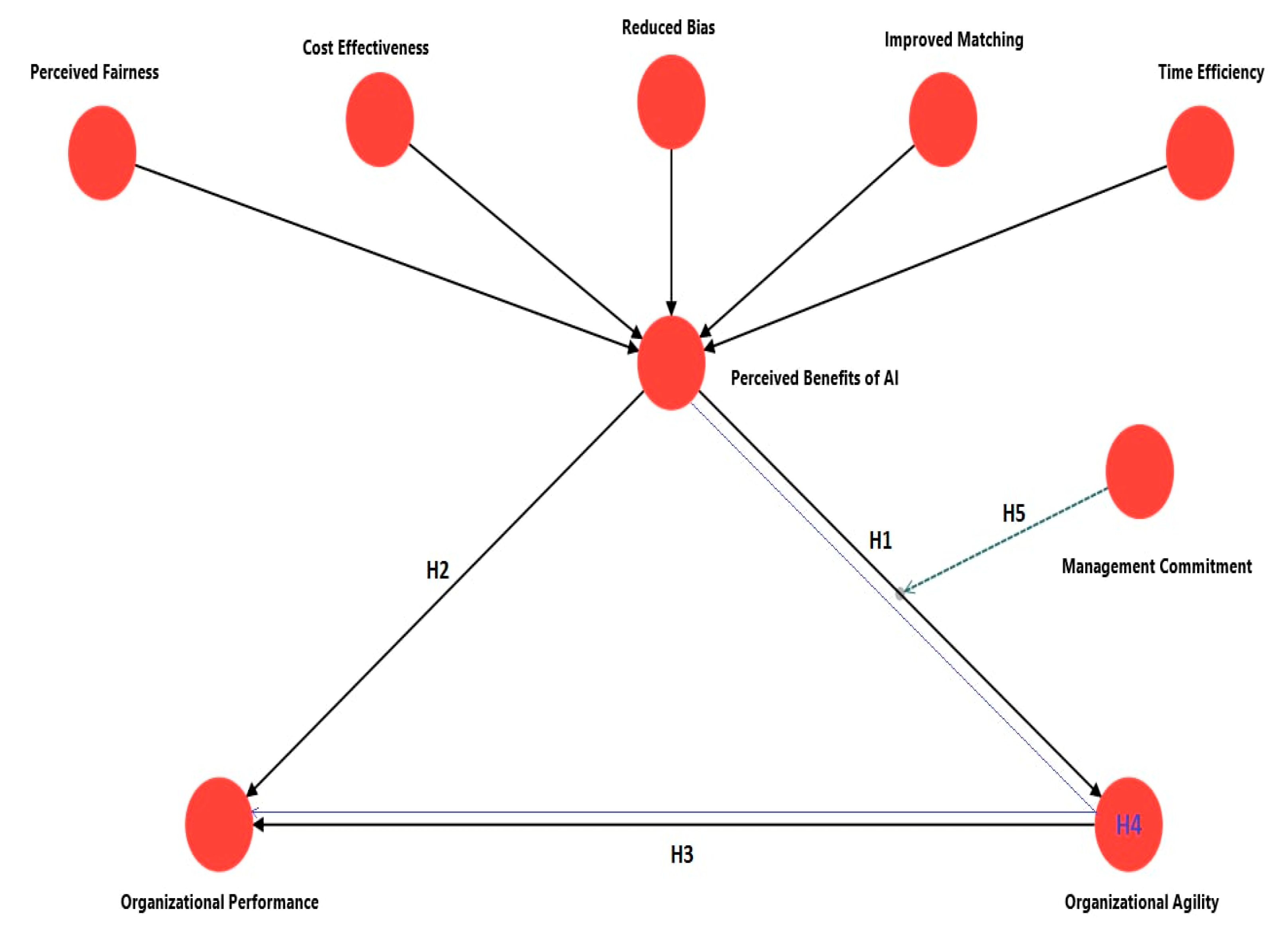
H1. Perceived benefits of AI positively influence organizational agility (OAG) as perceived by managers.
2.2. PB-AI and Organizational Performance (OGP)
Organizational performance (OGP) encompasses outcomes such as efficiency, productivity, quality, innovation, and overall organizational effectiveness. When AI technologies are cognitively appraised as beneficial, organizations are more likely to leverage them effectively, thereby improving organizational performance through task automation, enhanced decision accuracy, reduced operational costs, and more efficient allocation of organizational resources. When employees perceive AI systems as beneficial and trustworthy, they are more likely to adopt AI-driven processes, which in turn contribute to improved performance outcomes [
19,
20].
According to the Resource-Based View (RBV), AI can be conceptualized as a strategic organizational resource that contributes to performance when it is valuable, rare, and effectively integrated into organizational processes [
17]. Additionally, algorithmic decision-making theory highlights that AI can enhance organizational performance by reducing human error, improving decision consistency, and increasing transparency in organizational processes and structures [
2,
12]. Taken together, the reviewed studies provide preliminary evidence suggesting that PB-AI may have a direct and positive influence on organizational performance. Based on this theoretical reasoning, the following hypothesis is proposed:
H2. Perceived benefits of AI positively influence Organizational Performance (OGP) as perceived by managers.
2.3. Organizational Agility (OAG) and Organizational Performance (OGP)
Organizations with lower levels of agility are often outperformed by more agile competitors. Agile organizations are able to adjust operational activities and reallocate resources with minimal disruption, enabling them to maintain continuity and respond effectively to dynamic environmental conditions [
15]. Access to timely information—facilitated by AI technologies—allows organizations to improve forecasting accuracy and adjust operational processes accordingly. Consequently, organizational agility serves as an important determinant of operational efficiency [
5,
6].
Dynamic Capabilities Theory views agility as a critical capability that enables firms to sustain competitive advantage over time. Agility enhances organizational responsiveness, supports innovation, and accelerates organizational learning processes [
8]. Firms with AI-enabled agility may also benefit from faster decision-making cycles and improved identification of opportunities and risks [
1]. Therefore, agility strengthens the effectiveness of other organizational resources—such as digital technologies and employee capabilities—in improving performance. Based on this reasoning, the following hypothesis is proposed:
H3. Organizational agility (OAG) has a positive effect on organizational performance (OGP) as perceived by managers.
2.4. Organizational Agility as a Mediating Mechanism
The perceived benefits of AI (PB-AI) may influence organizational performance (OGP) through the mediating role of organizational agility. Within the framework of Dynamic Capabilities Theory (DCT), technologies such as AI possess the potential to improve organizational performance; however, this potential is realized only when organizations possess the dynamic capabilities required to sense opportunities, seize them, and reconfigure resources effectively [
21,
22].
When employees perceive AI systems as beneficial for enhancing productivity, they are more likely to integrate these systems into their decision-making processes. This integration enhances organizational speed, flexibility, and responsiveness—key elements of organizational agility [
5]. Increased agility, in turn, contributes to improved organizational performance by enhancing operational efficiency, fostering innovation, and strengthening responsiveness to market conditions [
15]. Accordingly, organizational agility is expected to mediate the relationship between PB-AI and organizational performance.
H4. Organizational agility (OAG) mediates the relationship between PB-AI and organizational performance (OGP) as perceived by managers.
2.5. Management Commitment as a Moderating Factor
Management commitment (MC) refers to the extent to which top executives demonstrate support for AI adoption through the allocation of organizational resources, alignment of strategic objectives, and promotion of the adoption and integration of AI-based technologies. Previous research on leadership and digital transformation highlights managerial commitment as a critical factor influencing employees’ attitudes toward technology adoption, reducing organizational resistance to change, and fostering an innovative organizational climate [
23,
24]. In this sense, committed leadership is often viewed as a key driver in transforming technological initiatives into organizational capabilities.
However, emerging research on algorithmic management and AI-based decision-making systems suggests that the influence of managerial commitment may become less influential in AI-driven environments. As AI systems become embedded in organizational operations, decision authority may increasingly shift toward technological systems, reducing employees’ reliance on managerial guidance for routine operational adjustments [
2,
12]. In such contexts, the perceived value and utility of AI systems may play a more significant role in fostering organizational agility than managerial commitment. Consequently, managerial commitment may function as a boundary condition whose moderating influence diminishes as AI-driven organizational routines become institutionalized.
From an algorithmic management perspective, AI-enabled systems may standardize and guide operational decisions, thereby reducing variability in leadership influence across organizational contexts and potentially weakening moderating effects associated with managerial commitment [
2,
12].
H5. Management commitment moderates the indirect relationship between perceived benefits of AI (PB-AI) and organizational performance (OGP) through organizational agility (OAG) as perceived by managers.
Figure 1 shows all direct and indirect relationships among all study constructs.
3. Materials and Methods
3.1. Study Constructs
In the context of this study, artificial intelligence (AI) adoption refers to the organizational use of AI-enabled applications that support decision-making, automate processes, and enhance human resource and operational functions. Specifically, the study considers AI tools such as predictive analytics and decision-support systems, process automation technologies (e.g., robotic process automation), AI-based human resource applications (e.g., recruitment screening and performance analytics), and customer-oriented intelligent systems (e.g., chatbots and recommendation engines). These applications collectively form what is referred to as an AI-enabled work environment, in which AI technologies are integrated into daily organizational processes and managerial activities.
The measurement scales for the study constructs were derived from the comprehensive literature review. The construct of perceived benefits of AI (PB-AI) technologies was measured through 5 dimensions, with each dimension measured by a 4-item scale. The scale of time efficiency dimension was adopted from [
3]. The scale of improved matching dimension was adopted from [
25,
26]. The scale of reduced bias dimension was adopted from [
2,
19]. The scale of cost effectiveness dimension was adopted from [
3], and finally the scale of perceived fairness dimension was adopted from) [
2,
12]. Perceived benefits of AI (PB-AI) were conceptualized as a higher-order construct comprising five first-order dimensions: time efficiency, improved matching, reduced bias, cost effectiveness, and perceived fairness. Following established methodological guidance in PLS-SEM, the higher-order construct was modeled using the repeated indicators approach, whereby all indicators of the lower-order dimensions were assigned to the higher-order construct. This approach is appropriate when the dimensions are conceptually related and allows for capturing the overall perception of AI benefits while preserving measurement validity and model parsimony. As for the second construct of this study, the organizational agility (OAG), it was measured with a multidimensional 4-item scale adapted from [
15] with the original instrument, the items formulated for this study included the following: AI facilitates faster responses to new business challenges, and AI contributes to greater flexibility in decision-making processes. Regarding organizational performance, it was measured with a reflective 4-item scale adapted from [
19,
20]. Consistent with the original instrument, the items formulated for this study included the following: AI helped us streamline key operational processes, and overall business performance increased with AI integration. As for management commitment, it was measured with a reflective 4-item scale adapted [
23,
27]. Consistent with the original instrument, the items formulated for this study included the following: Management allocates resources to support AI initiatives, and AI is recognized as a strategic priority by top management.
Although some measurement items refer to specific functional applications of AI (e.g., HR processes or operational activities), these are intended to capture different manifestations of AI use within the organization. In this study, AI adoption is conceptualized at the organizational level, where such functional applications collectively reflect broader organization-wide AI-enabled processes. Therefore, the measurement approach is consistent with the theoretical framework, as it captures the overall organizational integration and impact of AI rather than focusing on a single application domain.
3.2. Description of Study Population
This study targets the medium-sized enterprises in the Kingdom of Saudi Arabia, and according to the latest official data issued by the Small and Medium Enterprises General Authority “Monsha’at” in the Kingdom of Saudi Arabia, by the end of the fourth quarter of 2023, the number of medium enterprises in the Kingdom reached approximately 18,723, which are enterprises with 50 to 249 employees or revenues ranging between 40 and 200 million Saudi riyals Monshaat [
28]. The participating firms operate across a range of sectors within the Saudi Arabian economy, including service, retail, manufacturing, and technology-related industries. This sectoral diversity enhances the generalizability of the findings by capturing variations in how AI technologies are adopted and utilized across different business contexts. In terms of organizational context, AI applications in these firms are primarily used to support operational process optimization, decision-making activities, human resource management functions, and customer service operations.
3.3. Sample Selection Method
A stratified random sampling technique was employed in this study to ensure representativeness across various regions in Saudi Arabia, to reduce sampling bias and enhance the generalizability of the results within medium-sized companies [
29]. The appropriate equation to determine sample size incorporates the finite population correction (FPC) applied to Cochran’s sample size formula [
30]
where n
0 = sample size for infinite population;
n = required sample size; N = population size;
p = estimated proportion of the population (commonly 0.5); Z = confidence level at 1.96; and e = margin of error (±5%).
Accordingly, the appropriate study sample size is 377 respondents from a population of 18,723 medium-sized companies in Saudi Arabia.
3.4. Data-Collection and Analysis Techniques
This study applied a quantitative research design and used a self-administered questionnaire to collect primary data from medium-sized companies in Saudi Arabia. To improve the tool’s validity and ensure its significance and applicability for use, the questionnaire was piloted with a small sample of 30 managers at medium-sized companies to check reliability (Cronbach’s alpha, composite reliability) and item loadings, to ensure there was no bias in Arabic translations. Based on the pilot study results, minor revisions were made to improve the clarity and comprehensibility of several questionnaire items. Specifically, ambiguous wording was refined, some items were rephrased to better suit the organizational context, and adjustments were made to ensure consistency in the Arabic translation. No major structural changes to the measurement scales were required, as the reliability and validity indicators were within acceptable thresholds. Moreover, anonymity and safe data-collection procedures were ensured. Furthermore, the questionnaire was later reviewed and developed by a panel of academics and experts. Managers were selected as key informants in this study because they are directly involved in strategic decision-making and the implementation of AI technologies within their organizations. Their roles provide them with a comprehensive understanding of organizational processes, resource allocation, and performance outcomes, making them well-positioned to evaluate AI adoption and its impact. Consequently, their responses are considered appropriate proxies for organizational-level perceptions, as commonly adopted in organizational and information systems research. Data was collected during September, October and November 2025, and the questionnaires were distributed to 420 managers at medium-sized companies in Saudi Arabia. In the end, 381 completed surveys were returned, resulting in a response rate of 90.7%, and were analyzed statistically. The high response rate can be attributed to the targeted survey administration strategy adopted in this study. Questionnaires were distributed directly to identify managers in medium-sized firms through professional networks and institutional contacts, with follow-up reminders used to encourage participation. In addition, respondents were assured of anonymity and informed that the data would be used exclusively for academic research purposes, which helped enhance engagement and reduce non-response. These procedures contributed to minimizing potential sample selection bias. To achieve the objectives of the study, the questionnaire was organized into five distinct sections. The first section of the questionnaire was dedicated to collecting demographic data, while the rest of the sections were dedicated to collecting all required data about the study’s key constructs, which are perceived benefits of AI (PB-AI) technologies “PB-AI”, organizational performance “OGP”, organizational agility “OAG”, and management commitment “MC”. The items related to the four constructs were assessed using a five-point Likert scale. See
Appendix A. Although digital maturity was not measured as a separate construct in this study, all participating firms had at least initiated the adoption of AI technologies within their organizational processes. This indicates a baseline level of digital readiness, as the implementation of AI applications requires a minimum degree of technological infrastructure and managerial support.
As for data analysis techniques, the descriptive statistical analyses were employed using SPSS v.29.2022 and Microsoft Excel v.15.2013. In addition, the structural equation modeling (Smart-PLS-SEM.V.4.1.1.6) was used to examine the study hypotheses, due to its suitability for predictive and exploratory research models involving complex relationships among multiple constructs. It is particularly appropriate for this study given the use of a higher-order construct (perceived benefits of AI), the relatively moderate sample size, the non-normal distribution typically associated with survey data, and its suitability for examining mediation effects and maximizing the explained variance of key endogenous constructs, which aligns with the objectives of this study. Given that data were collected using a single self-reported questionnaire, potential common method bias (CMB) was assessed following recommended procedures in PLS-SEM research. First, several procedural remedies were implemented during data collection, including respondent anonymity, voluntary participation, and careful questionnaire design to reduce evaluation apprehension. Second, a full collinearity variance inflation factor (VIF) test was conducted as suggested by [
31]. The results indicated that all VIF values were below the conservative threshold of 3.3, suggesting that common method bias is unlikely to be a serious concern in this study.
4. Results
4.1. Demographic Characteristics of Respondents
The authors took deliberate measures to ensure diversity and representativeness within the study sample. Out of the 381 completed responses, 286 (75.1%) were male and 95 (24.9%) were female. Additionally, 86.1% of the sample, or most of the respondents, were at a high level of management. The managers at medium-sized companies who received the questionnaire were chosen according to their locations to guarantee that the study sample included respondents from every area of the Kingdom of Saudi Arabia (North, South, Central, West, and East of the Kingdom). Results of descriptive statistics analysis show that mean values ranged from 3.48 to 4.28, and the standard deviation scores ranged from 0.988 to 1.214, indicating that the data was more dispersed and less intense than its mean value. Furthermore, skewness and kurtosis values remained within ±2, confirming the univariate normality of the data [
32].
4.2. The Outer Model
4.2.1. Validation of Measurement Constructs
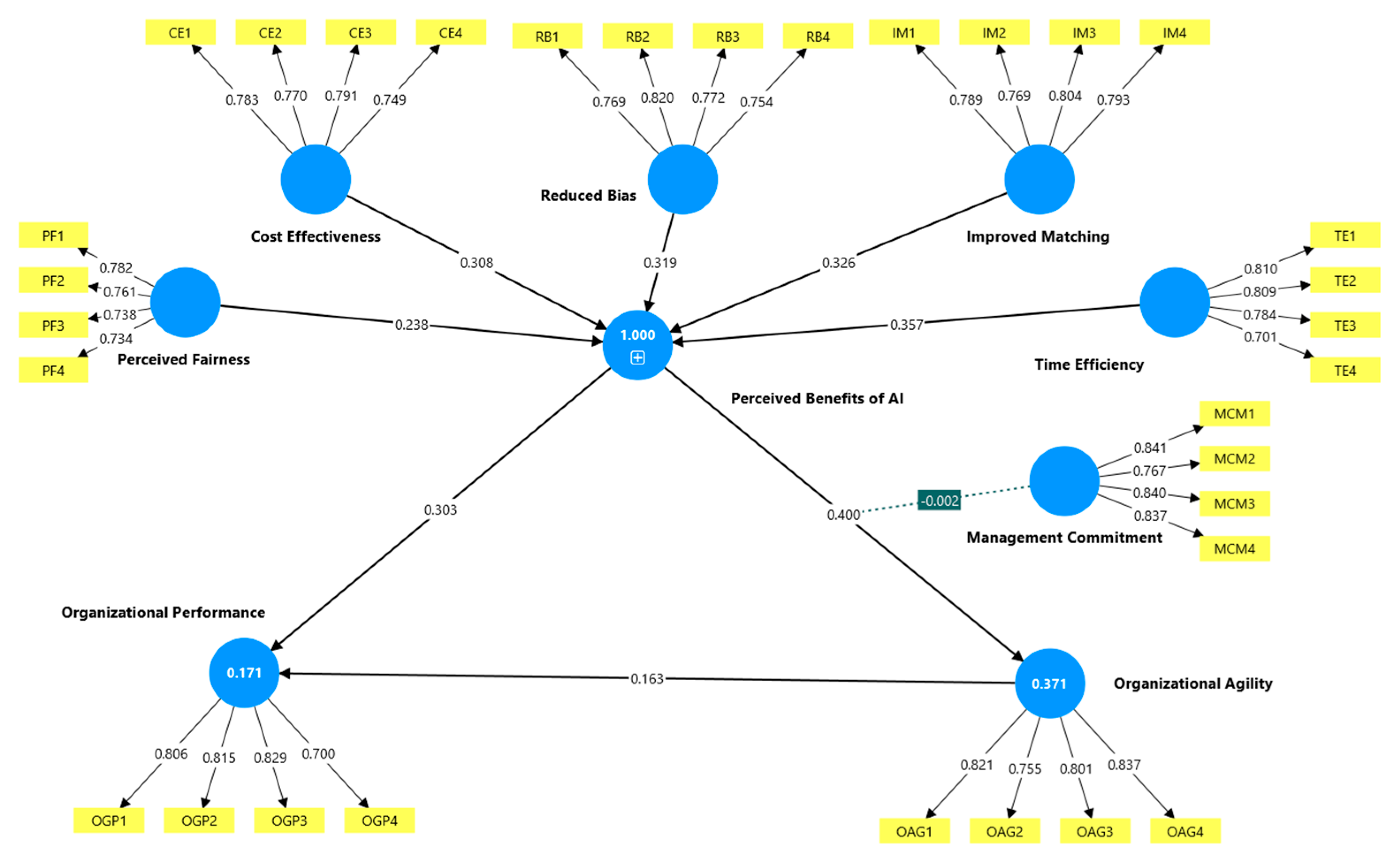
To determine whether items created to measure a particular construct were related to other items measuring the same construct, convergent validity was assessed. As all standardized factor loadings met the thresholds suggested by [
33], with all values surpassing the lowest acceptable level of 0.50 and the majority approaching or surpassing the ideal threshold of 0.70, the results confirmed satisfactory construct validity. Also, the internal consistency was examined for all measurement scales of the study, and all results met the cut-off point (0.70) recommended by [
32,
33], confirming the composite reliability for all constructs. Additionally, the average variance extracted (AVE) was conducted to examine the measurement model’s convergent validity. All results exceed the value of 0.50 recommended by [
34]. See
Table 1.
The results of the statistical analysis, presented in
Table 1, indicate that all standardized load factor values were higher than the recommended value (0.70), confirming a satisfactory level of reliability for the index. The average extracted variance values ranged from 0.598 to 0.675, also higher than the recommended value (0.50), confirming a statistically sufficient level of convergence [
33]. Furthermore, all Cronbach’s alpha values ranged from 0.776 to 0.840, and the composite reliability values ranged from 0.782 to 0.848 (all higher than the recommended value of 0.70), indicating strong internal consistency among the model’s various variables. Taken together, these results confirm that the measurement model possesses acceptable convergence and reliability in internal consistency, providing a solid foundation for subsequent structural model analysis.
4.2.2. Evaluation of Construct Distinctiveness
To determine the distinctiveness of each model construct, discriminatory validity was examined. Discriminant validity does not require the absence of correlations among constructs; rather, it is established when each construct is empirically distinct from the others. Based on the procedures described by [
35], the cross-loading method and the Fornell & Larcker [
34] method were applied to verify the discriminatory validity of the model constructs. The statistical results confirmed the distinctiveness of the model constructs, showing that each construct differs sufficiently from the others. See
Table 2 and
Figure 2 for further details.
Table 2 shows that each factor in the proposed model is clearly distinct from the other factors. All the diagonal values (the square root of the AVE. “PB-AI” = 0.689; “OGP” = 0.789; “OAG” = 0.804; “MC” = 0.822) are higher than the correlation values (off-diagonal), confirming the discriminant validity across all constructs, which is in line with the standards set by [
33,
34,
36] guidelines for the sufficient discriminant validity. Furthermore, the discriminant validity was further investigated using the heterotrait–monotrait ratio. See
Table 3 and
Figure 2.
According to the recommended threshold suggested by [
37] for heterotrait-monotrait (HTMT) ratios of 0.90, and as shown in
Table 3, all HTMT values were below the cut-off point, ranging from 0.297 to 0.631. The interaction term (MC × PB-AI) also exhibited very low HTMT ratios (0.011–0.100), indicating that the structure of the intermediate differed from its constituent variables. Accordingly, the heterotrait–monotrait (HTMT) ratios results indicate that all structures in the model possess satisfactory discrimination validity and are experimentally distinct, thus supporting the suitability of the measurement model.
4.2.3. Explanation Power of the Model (R2)
To test the explanatory power of the suggested model and the variance in the dependent variables accounted for by the independent variables, the coefficient of determination (R
2) was utilized. This number varies from 0 to 1, with a value of 1 signifying perfect prediction accuracy and a value of 0 denoting a lack of explanatory ability. Based on the thresholds established by [
36], the R
2 values in
Table 4 demonstrate that the independent variables impact the dependent variables, exhibiting predictive power from weak to moderate. These statistical data indicate that the model has acceptable explanatory power.
As shown in
Table 4, the predictors explained 37.1% of the variance in “OAG” (R
2 = 0.371), representing a moderate level of explanatory power, and 17.1% of the variance in “OGP” (R
2 = 0.171), indicating a weak to moderate level [
33]. These results suggest that the model explains a substantial portion of the variance in both structures, providing acceptable explanatory power in the context of behavioral and organizational research. Therefore, according to [
33,
36], it can be pointed out that the model has acceptable explanatory power and is suitable for hypothesis testing.
4.2.4. The Effect Size (f2)
An effect size test (f
2) was performed to evaluate the extent of influence that each independent variable (IV) had on the dependent variable (DV) in the proposed model. According to [
38] criteria, the statistical results in
Table 5 demonstrate that the effect sizes of the independent factors on the dependent variables range from negligible to small and medium levels. These findings offer more understanding of the comparative impact and practical importance of each predictor within the model.
As shown in
Table 5, “PB-AI” had a moderate effect on “OAG” (f
2 = 0.207) and a negligible effect on “OGP” (f
2 = 0.079). “OAG” exerted a negligible influence on “OGP” (f
2 = 0.023), while “MC” showed a nearly moderate effect on “OAG” (f
2 = 0.133). The moderating interaction term (MC × PB-AI) had no significant effect (f
2 = 0.000). According to the criteria of [
33,
38], these results indicate that the main effects, particularly of PB-AI and MC, are large in predicting organizational agility (OAG), while the interaction between “MC” and “PB-AI” does not substantially explain the additional variance in “OGP”, so the moderating effect is negligible.
4.2.5. Model Fit Evaluation
Model goodness-of-fit assessment was performed to evaluate the appropriateness and sufficiency of the suggested model within the measurement model, structural model, and the overall framework. See
Table 6.
As shown in
Table 6, the Standardized Root Mean Square Residual (SRMR) values indicate an excellent level of model fit. The SRMR for the saturated model is 0.0127, while the SRMR for the estimated model is 0.0128. Both values are well below the commonly accepted threshold of 0.08 [
33,
39], demonstrating that the discrepancies between the observed and predicted covariance matrices are minimal. The near-identical SRMR values for the saturated and estimated models further confirm the robustness and adequacy of the proposed structural model.
4.3. Hypotheses Evaluation-Significance of Path Coefficients
The test of path coefficient significance was conducted to assess how effectively the proposed theoretical model is compatible with the primary data. The results of each hypothesis test are presented in
Table 5 and
Table 7.
The results of the study’s hypothesis testing confirmed strong direct relationships between the variables, further supporting the study’s conceptual model. The full results are shown in
Table 5 and
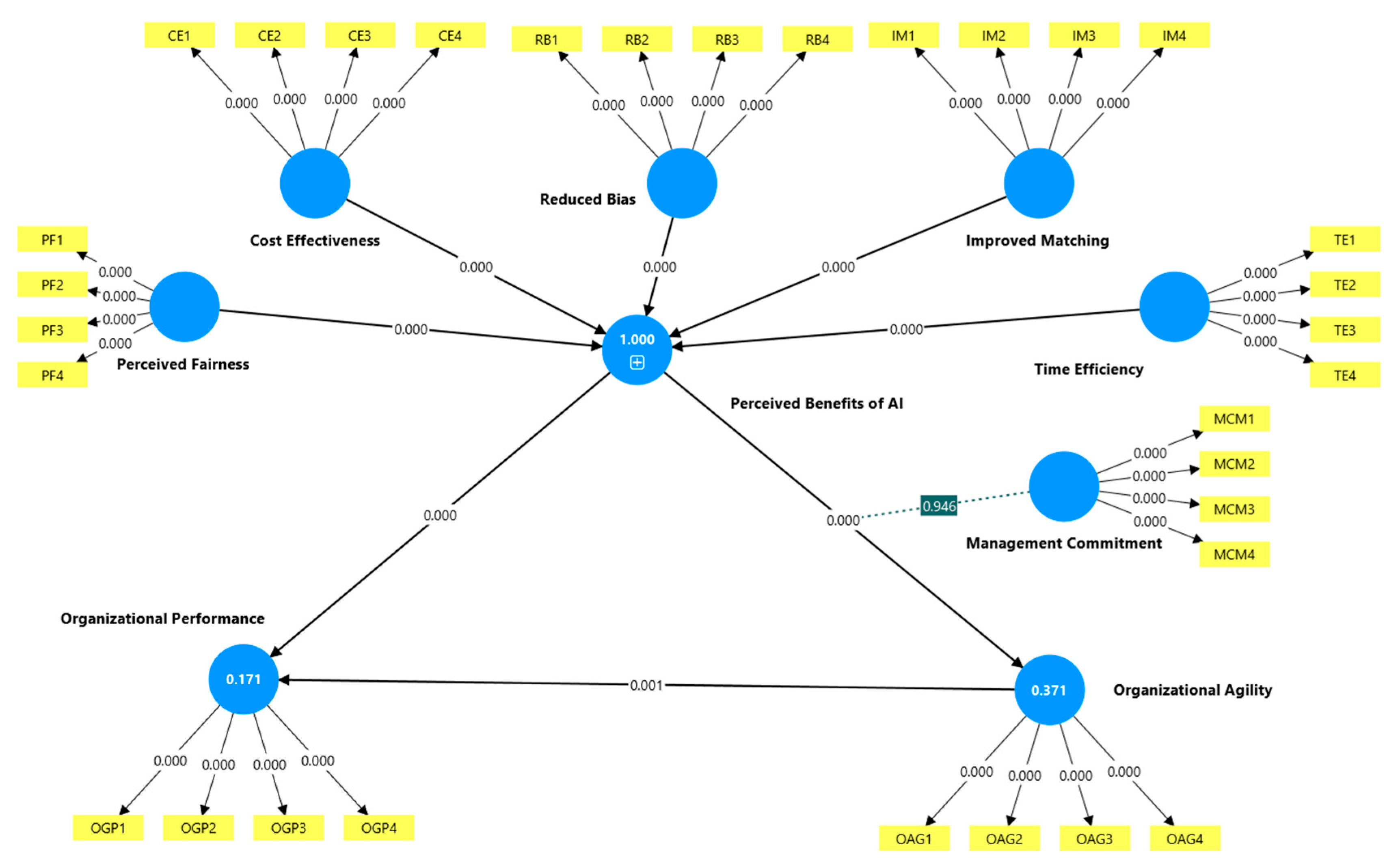
Table 7. PB-AI demonstrates a significant direct positive effect on OAG (β = 0.400, f
2 = 0.207,
p = 0.000), confirming that organizations that are more aware of the benefits of AI technologies tend to exhibit higher levels of organizational agility (OAG), meaning they become more adaptable and responsive to environmental changes. For example, a medium-sized firm utilizing AI-based demand forecasting or process automation tools may be able to adjust production schedules or service delivery more rapidly in response to market fluctuations, thereby enhancing its agility. Similarly, PB-AI shows a significant direct positive effect on OGP (β = 0.303, f
2 = 0.079,
p = 0.000), indicating that the perceived benefits of AI (PB-AI) directly improve organizational performance. Organizations that effectively integrate AI insights and automation tend to achieve better overall performance outcomes. In practical terms, organizations that integrate AI-driven insights into decision-making—such as predictive analytics for sales or customer behavior—can achieve improved efficiency, cost reduction, and better strategic outcomes. Furthermore, the OAG index shows a significant direct positive effect on the OGP index (β = 0.163, f
2 = 0.023,
p = 0.001), supporting the idea that organizational flexibility is a key factor in improving organizational performance. Flexible organizations are better able to respond quickly to market changes, embrace innovation, and optimize resource utilization, leading to superior overall organizational performance. For instance, firms that leverage AI to enable faster internal communication and adaptive workflows are better positioned to respond to environmental uncertainty, which ultimately leads to enhanced performance outcomes. Overall, hypotheses H1, H2, and H3 were accepted. See
Figure 3.
As for examining the indirect relationships between the study variables, as shown in
Table 8, the results indicate that “OAG” has a significant partial positive mediating effect on the relationship between “PB-AI” and “OGP” (β = 0.065, t = 3.349,
p = 0.001), which confirms that the effect of AI perceptions on organizational performance (OGP) outcomes is not entirely direct but also works indirectly through the development of organizational agility (OAG) capabilities. This finding reinforces the idea that agility is a strategic mechanism through which AI-driven advantages are transformed into tangible performance improvements. For example, an organization adopting AI-powered analytics may not immediately realize performance gains unless it simultaneously develops the agility to act on those insights quickly and effectively. Collectively, hypothesis H-4 was significantly supported.
In contrast, the assumed moderated mediating effect in H5 was not supported (β = −0.000, t = 0.065,
p = 0.948). This result suggests that managerial commitment “MC” does not significantly influence the mediating relationship between “PB-AI” and “OAG” and “OGP”. In practice, the strength of the indirect effect of “PB-AI” on “OGP” via “OAG” does not differ across levels of managerial commitment. This indicates that while managerial commitment is important for overall organizational performance, it does not significantly alter the extent to which AI perceptions translate into agility-driven performance outcomes. In practical terms, even in organizations where top management strongly supports AI initiatives, the transformation of AI benefits into performance outcomes still depends primarily on the organization’s agility rather than on variations in managerial commitment levels. So hypothesis H-5 was rejected. See
Figure 3.
4.4. Simple Slope Examination
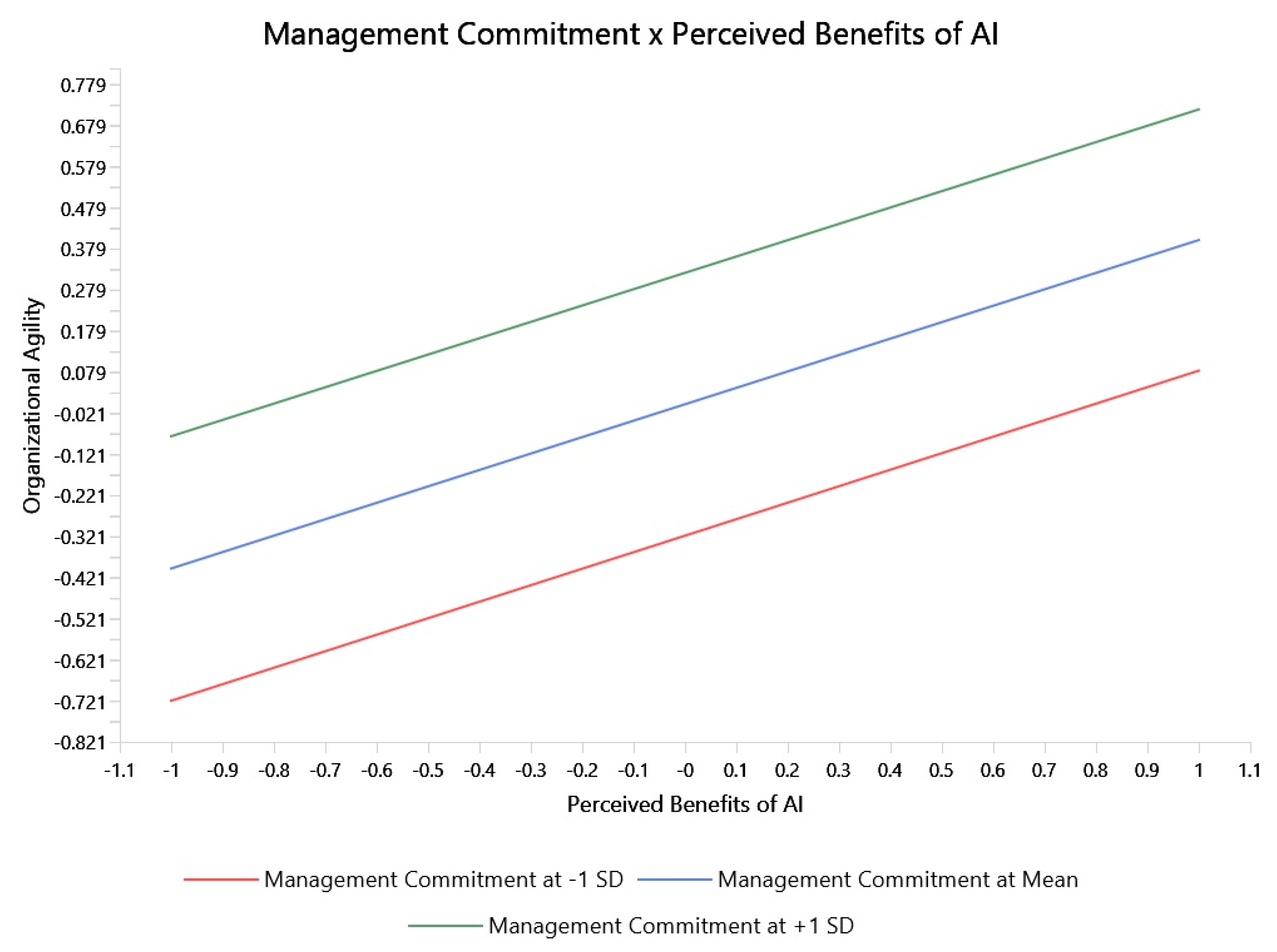
To further examine the interaction effect, the simple slope examination was conducted to investigate the moderating impact of “MC” on the relationship between “PB-AI” and “OGP” through “OAG”. The analysis assessed the indirect effect at three levels of management commitment (MC). See
Table 9 and
Figure 4.
The results show that the indirect effect of “PB-AI” on “OGP” through “OAG” remains almost constant across all levels of management commitment (MC). Specifically, the indirect effect is 0.066 at +1 standard deviation, 0.065 at the mean, and 0.065 at −1 standard deviation. These small and consistent values indicate that management commitment (MC) does not significantly alter the strength or direction of the mediating pathway. In other words, regardless of whether management commitment (MC) is high or low, the positive indirect effect of PB-AI on organizational performance (OGP) through agility remains constant. This finding is consistent with the results in
Table 8, where the moderate mediation hypothesis (H-5) was not supported. The simple slope results also confirm that management commitment (MC) does not significantly moderate the mediating role of organizational agility (OAG). In practice, this suggests that while management commitment (MC) may play an important role in overall organizational performance, it does not significantly enhance or weaken the mechanism by which AI-related benefits enhance performance through agility.
5. Discussion
This research investigated the influence of perceived benefits of artificial intelligence (PB-AI) on organizational agility (OAG) and organizational performance (OGP), as well as the potential moderating effect of management commitment (MC) on these relationships. The results provide several insights into the mechanisms through which AI capabilities influence organizational performance.
In addition to these findings, the results provide further insight into how AI-related practices are interpreted and enacted within organizational contexts. In particular, the perceived benefits of AI reflect how managers evaluate and engage with AI systems, which may influence their reliance on AI-supported processes and their responsiveness to organizational changes. This perspective suggests that organizational agility is shaped not only by structural capabilities but also by how organizations adapt to AI-enabled processes in practice.
Beyond testing the proposed relationships, this study contributes to the growing literature on artificial intelligence and organizational performance by clarifying the mechanisms through which AI-related value is realized within organizations. Specifically, the findings highlight the role of organizational agility as the dynamic capability that enables firms to convert the perceived benefits of AI into tangible performance outcomes. This perspective extends prior research that has largely focused on AI adoption by emphasizing the importance of perception-driven capability development in AI-enabled organizational environments.
The findings confirm that perceived benefits of AI (PB-AI) positively influence organizational agility (OAG). When employees and managers perceive AI as beneficial—such as reducing bias, improving matching, enhancing cost effectiveness, increasing perceived fairness, and improving time efficiency—they are more likely to cognitively integrate AI into their work processes. This increased reliance on AI contributes to greater organizational agility (β = 0.400,
p < 0.001). These findings are consistent with prior research suggesting that AI improves organizational responsiveness by enhancing firms’ ability to process information and generate predictions more rapidly [
6,
15]. Furthermore, Dynamic Capabilities Theory suggests that digital technologies strengthen an organization’s ability to sense opportunities and reconfigure resources, thereby enhancing agility. Accordingly, the results support H1 and highlight the importance of positive perceptions of AI as a key driver of organizational transformation.
The results also confirm a direct and significant influence of PB-AI on organizational performance (β = 0.303,
p < 0.001). Employees’ positive perceptions of AI are associated with improvements in operational efficiency, including faster processes, reduced errors, enhanced responsiveness to customer needs, and greater accuracy of outcomes. These findings are consistent with the Resource-Based View, which emphasizes the performance implications of strategically aligned technological resources [
40]. Prior research has also demonstrated a relationship between AI adoption and improvements in organizational productivity and efficiency [
19]. In this context, existing studies often emphasize operational and process-level improvements associated with AI adoption rather than broad organizational performance outcomes, which aligns with the interpretation adopted in this study. Accordingly, PB-AI emerges as an important contributing factor to organizational performance outcomes as well as related behavioral outcomes.
Although the explanatory power of the model for organizational performance (R
2 = 0.171) indicates a modest level of variance explained, such values are not uncommon in studies examining complex organizational and behavioral phenomena. According to established guidelines in PLS-SEM research [
33], outcomes in organizational research are typically influenced by multiple contextual and organizational factors. Organizational performance is inherently multidimensional and shaped by a wide range of determinants, including leadership practices, organizational culture, technological capabilities, environmental uncertainty, and resource availability. In this study, the model intentionally focuses on the role of PB-AI mechanisms in influencing organizational performance. Therefore, while the explanatory power is moderate, the findings remain theoretically meaningful by highlighting the specific contribution of AI-related governance and design factors within the broader set of determinants affecting organizational outcomes. Accordingly, the model should be interpreted as providing a focused explanation of AI-related mechanisms rather than a comprehensive account of organizational performance.
In addition, the effect sizes associated with some relationships in the model, particularly those related to organizational performance, are relatively small. This suggests that while the relationships are statistically significant, they represent partial effects within a broader system of factors influencing performance outcomes. This further supports interpreting the model as providing a partial yet meaningful explanation of performance outcomes in complex organizational settings.
Organizational agility (OAG) also demonstrated a significant positive effect on organizational performance (β = 0.163,
p = 0.001). This finding supports the argument that agile organizations are better equipped to scan their environments, reallocate resources, and reconfigure operations in response to changing conditions. The positive relationship between agility and organizational performance has been widely documented in the digital transformation literature. AI-enabled agility equips organizations with tools that accelerate decision-making processes, reduce uncertainty, and enable more effective responses to disruptions [
5]. Therefore, the support for H3 suggests that agility serves as a mechanism through which firms can enhance competitiveness and operational efficiency.
The results further indicate that organizational agility partially mediates the relationship between PB-AI and organizational performance (β = 0.065,
p = 0.001). This finding suggests that the influence of AI perceptions on performance is partly explained through improvements in organizational agility. In other words, AI contributes to performance not only through automation and analytical capabilities but also by enhancing the organization’s ability to adapt, respond, and innovate. This interpretation aligns with Dynamic Capabilities Theory, which posits that performance improvements from digital technologies emerge through the development of organizational capabilities such as agility. Consequently, PB-AI fosters a more adaptive organizational mindset that contributes to improved performance outcomes, supporting previous research highlighting the role of agility in translating digital capabilities into tangible organizational results [
1]
An important finding of this study is the absence of a significant moderated mediation effect of management commitment on the relationship between perceived benefits of AI, organizational agility, and organizational performance. Although management commitment has traditionally been regarded as a critical success factor in technological change initiatives, the present results suggest that its influence may be more context-dependent and less pronounced in AI-driven environments than previously assumed. The findings indicate that the translation of AI-related benefits into performance gains appears to depend primarily on organizational capabilities—particularly agility—rather than leadership support alone. This may be explained by the increasing role of algorithmic decision-making in AI-enabled environments, where employees rely more on data-driven insights than on managerial directives, thereby reducing the relative influence of leadership commitment.
One possible explanation is that AI implementation often requires continuous learning, decentralized decision-making, and cross-functional process adaptation, which extend beyond the scope of formal managerial endorsement. Consequently, the effectiveness of AI technologies may depend more on employees’ perceptions of their usefulness and on the organization’s ability to respond flexibly to technological opportunities than on the level of managerial commitment. Theoretically, this finding challenges conventional assumptions in change management literature and suggests that, in highly digitalized environments, leadership commitment may play a supportive rather than decisive role. These findings contribute to a more nuanced understanding of leadership influence in AI adoption by highlighting the boundary conditions under which management commitment may not exert a significant moderating effect and highlight the need for future research to reconsider the boundary conditions under which management commitment facilitates or constrains AI-enabled organizational transformation. Another possible explanation relates to the standardization of decision processes in AI-enabled environments, where AI systems reduce variability in managerial influence and limit the moderating role of leadership commitment.
The findings of this study should also be interpreted in light of the institutional context of Saudi Arabia. Medium-sized enterprises in Saudi Arabia operate within a policy environment characterized by strong governmental support for digital transformation, particularly under initiatives aligned with Vision 2030. Such institutional conditions may facilitate AI adoption and shape how organizations develop agility and leverage technological capabilities.
Consequently, the relationships observed in this study may be influenced by context-specific factors, including regulatory support, digital infrastructure, and national innovation policies. While the core mechanisms identified—such as the role of perceived benefits of AI and organizational agility—are likely to be relevant across contexts, their strength and manifestation may vary in environments with different levels of technological maturity or institutional support.
Therefore, caution should be exercised when generalizing the findings to other countries or firm sizes. Future research is encouraged to examine these relationships across different institutional settings and firm sizes to enhance external validity.
6. Conclusions
The purpose of this study was to examine the impact of the perceived benefits of artificial intelligence (PB-AI) on organizational agility (OAG) and organizational performance (OGP). PB-AI was identified as a cognitive resource that helps organizations realize the benefits of AI by enhancing agility and performance. Organizational agility emerged as a key dynamic capability that enables organizations to extract value from AI technologies. The findings highlight the importance of fostering organizational capabilities that are supported by positive perceptions of AI.
Furthermore, the study found no empirical support for the moderating role of management commitment in the relationship between perceived benefits of AI and organizational performance. This suggests that, in AI-intensive environments, performance improvements are driven primarily by organizational agility and technology-enabled processes rather than traditional top-down leadership influence. The findings imply that successful AI adoption depends more on adaptive organizational structures and decentralized capabilities than on formal managerial endorsement. Accordingly, organizations should focus on strengthening agility-oriented systems and processes in order to fully realize the performance potential of AI technologies.
This study also contributes to the literature by positioning organizational agility as a critical mechanism through which AI generates value and sustains organizational capabilities. The results emphasize the importance of integrating AI into organizational processes while cultivating positive perceptions of AI and implementing agility-oriented practices. Consequently, the research provides valuable insights for both academics and practitioners interested in AI adoption and competitive advantage. However, the generalizability of these findings may be influenced by the specific institutional and policy context of Saudi Arabia, suggesting the need for further validation across different countries and organizational settings.
7. Practical Implications
This study offers practical implications for managers, policymakers, and organizations seeking to leverage artificial intelligence (AI) to improve organizational outcomes. The findings indicate that employees’ perceptions of the benefits of AI—such as improved efficiency, reduced bias, and enhanced decision-making—play an important role in increasing organizational agility and performance. Therefore, organizations should prioritize not only the adoption of AI systems but also strategies that strengthen employees’ understanding, trust, and perceived value of these technologies through training programs and effective internal communication.
Given the absence of a significant moderating effect of management commitment, the results suggest that, in AI-driven environments, organizational agility may emerge more from system-level and data-driven routines than from direct managerial intervention. Accordingly, managers should focus on strengthening data governance, system interoperability, integrated digital infrastructures, and ethical AI practices that support flexible and autonomous decision-making rather than relying exclusively on top-down control.
Finally, the findings highlight the importance of supporting medium-sized firms in developing AI-related capabilities. Policymakers and practitioners in emerging economies, such as Saudi Arabia, should consider initiatives that encourage AI adoption, strengthen digital infrastructure, and promote the development of organizational capabilities that enable firms to benefit from AI technologies.
8. Limitations and Directions for Future Research
This study is subject to several limitations that provide opportunities for future research. First, the model explains a modest proportion of the variance in organizational performance (R2 = 0.171), suggesting that additional factors beyond those examined in this research may also influence performance outcomes. Organizational performance is shaped by a wide range of structural, technological, and managerial variables that were outside the scope of the present study. Future research could extend the model by incorporating additional constructs such as organizational culture, digital maturity, leadership orientation, or environmental dynamism to provide a more comprehensive explanation of performance outcomes. Examining these factors may enhance the predictive power of the model and deepen understanding of how AI-related capabilities interact with broader organizational conditions.
Second, the cross-sectional research design limits the ability to observe how the relationships among the study variables evolve over time. As a result, the findings should be interpreted with caution regarding temporal dynamics. Future research could employ longitudinal research designs to examine how perceptions, capabilities, and organizational processes associated with AI develop and interact over time.
Third, the study relies on self-reported and perceptual measures of organizational performance. Although such measures are common in organizational research, they may be influenced by respondent bias. Future studies could incorporate objective performance indicators where available in order to provide a more comprehensive assessment of organizational outcomes.
Finally, the study focuses on medium-sized enterprises in Saudi Arabia. While this context provides valuable insights into AI adoption in emerging digital economies, it may limit the generalizability of the findings to larger organizations or firms operating in more developed economies. Future research could replicate the model across different countries, industries, and organizational sizes in order to further validate and extend the proposed relationships.