1. Introduction: Mental Health, Migration, and Structural Determinants
Mental health inequities affecting migrant populations stem from structural determinants that hierarchize access to resources, recognition, and opportunities. These determinants correspond to social, political, and economic arrangements that shape the conditions in which people are born, grow, live, work, and age [
1,
2]. The relevance of this discussion becomes even more evident considering the global intensification of migratory flows. It is estimated that more than 280 million people currently reside outside their countries of origin, representing approximately 3.6% of the world’s population, nearly half of whom are women. In the European context, more than 87 million migrants live on the continent, consolidating Europe as one of the primary global migration destinations [
3].
Within this scenario, Portugal stands out due to the significant growth of its foreign resident population over the past decades. In 2024, the number of regularized foreign residents surpassed 1.5 million, corresponding to approximately 15% of the total population, with Brazil representing the largest nationality (31% of all foreign residents) [
4]. Despite this substantial presence, the absence of race-/ethnicity-disaggregated data limits the understanding of racial inequalities structuring access to rights and public policies. This gap reflects institutional decisions regarding which inequalities may be named, monitored, and addressed. By rendering racial markers invisible within information systems, the state constrains the possibility of identifying structural discrimination and contributes to the reproduction of hierarchies that expose certain populations to persistent contexts of precarity and exclusion [
5].
Within this context of structural invisibilisation, mental health constitutes a social and political field marked by power relations, in which decisions are made regarding who can be heard, which forms of suffering are recognized as legitimate, and who effectively gains access to culturally responsive and ethically grounded care practices [
6]. This understanding aligns with the concept of structural competency, defined as the capacity of health professionals and systems to recognize and intervene in the economic, political, and historical forces that shape both the production of symptoms and trajectories of care [
7,
8]. By shifting the focus from cultural differences to the hierarchies that organize the distribution of resources and opportunities, this approach expands the analysis of health inequities. Through this lens, psychological distress is understood as an expression of institutional and political arrangements that unequally distribute protection, recognition, and access to rights [
7,
8].
In the case of migrant populations, this perspective proves particularly relevant. Reports from the World Health Organization indicate a higher risk of depressive and anxiety symptoms among migrants, associated with cumulative exposure to economic instability, racial discrimination, and social isolation [
9]. In Portugal, data from a cross-sectional study conducted in 2022 with 322 Brazilian immigrants found that 28.6% reported high levels of psychological distress, measured using the Mental Health Inventory, a rate that is significantly higher than that observed among Cape Verdean immigrants in the same study (11.7%), with women showing disproportionately higher odds of both psychological distress and depressive symptomatology [
10]. While this evidence was produced in a pandemic context and with a non-probabilistic sample, it points to the role of cumulative structural vulnerabilities, including perceived discrimination and financial precarity, as determinants of the mental health of this population.
1.1. Intersectionality, Racism, and Intertwined Vulnerabilities
Intersectionality constitutes a central framework for analyzing the structural determinants of health, as it highlights that systems of oppression operate simultaneously and are mutually constitutive [
11,
12]. In its structural dimension, intersectionality is not limited to the analysis of overlapping identities but examines how systems of power, namely racism, sexism, and colonialism, interact to produce specific positions of vulnerability that cannot be understood through any single axis of analysis [
11,
13]. Gender, race, class, nationality, and migration status function as social markers that position specific groups within unequal dynamics of exclusion, access to rights, and social recognition [
13]. From this perspective, psychological illness cannot be understood through isolated markers, but rather through the social positions produced at their intersection.
Racialisation constitutes a socio-historical and relational process through which differences are produced and converted into hierarchies, enabling populations to be classified and governed based on physical, cultural, and linguistic markers that acquire meaning within colonially situated relations of power [
14,
15]. Racialisation, therefore, does not name a property of groups but produces social positions, historically constructed and contingent, that regulate access to rights, spaces, and recognition [
16]. This process materially organizes the conditions of existence and inscribes itself on bodies and lived experiences in ways that vary according to geopolitical and historical contexts, producing vulnerabilities that are not attributes of groups but effects of structures of power [
17].
From the production of these racialised positions, structural racism emerges as a determinant of mental health, not through the accumulation of individual discriminatory episodes but as a system of historical, institutional, and symbolic arrangements that sustain racial inequalities independently of individual intentions, unequally distributing protection, recognition, and access to rights [
5,
18,
19]. Institutional racism, although articulated with this broader system, follows its own logic, materialising in the policies, norms, and practices of concrete institutions that produce racially unequal outcomes precisely because their apparent neutrality conceals the discriminatory character that sustains them [
19,
20]. In the field of mental health, this invisibility is not limited to conditioning access to services but traverses clinical practices themselves, shaping who is recognised as a legitimate subject of distress and care and which forms of suffering become intelligible and amenable to intervention [
8,
21].
Among racialised migrant women, these dynamics assume specific contours. International evidence indicates high prevalence rates of psychological distress across diverse migration contexts. In Canada, Ref. [
22] identified that 27.5% of African immigrant women experienced depression during the perinatal period and 12.1% reported symptoms of anxiety, with higher prevalence among recent arrivals and among those reporting a low sense of belonging within the host community. In the United States, Ref. [
23] observed elevated levels of depressive and anxiety symptoms among Latina immigrant women, strongly associated with stressors linked to the migration experience. Also, within the North American context [
24], found that Black immigrant women experience disproportionate levels of stress, related both to racial discrimination processes and to structural barriers in accessing mental health services.
These findings converge in demonstrating that distress emerges at the intersection of structural racism, gender inequalities, and institutional exclusion, often exacerbated by restrictive migration policies [
12,
25]. These patterns resonate with the weathering hypothesis, which conceptualises how sustained exposure to racialised stressors produces cumulative physiological and psychological deterioration over time [
26]. In this study, it is mobilised as an analytical lens to understand how vulnerability accumulates across migratory trajectories marked by racialisation.
Furthermore, racialised migrant women face specific forms of gender-based violence, such as hypersexualization, labour exploitation, and domestic violence, that intertwine with processes of racialisation and social marginalization [
6,
27].
Migration, shaped by these power relations, constitutes an ambivalent experience: it may expand horizons and possibilities, yet it can also produce new forms of vulnerability [
28,
29]. Understanding how these structures shape psychological illness requires situating distress within the material and symbolic conditions that organize the lives of racialised migrant women.
1.2. Brazilian Women in Portugal: Between Expectations and Exclusions
In the Portuguese context, the racialisation of Brazilian women operates through specific mechanisms that interwine race, gender, and nationality in an inseparable way. Skin colour, accent, nationality, and certain cultural practices function as markers of difference that reactivate colonial imaginaries, producing the figure of the Brazilian woman as hypersexualised, exoticised, and sexually available [
30,
31]. Far from being confined to the public sphere, this construction extends to institutional, labour, and clinical contexts, where nationality is mobilised as a moral and sexual marker that anticipates behaviour, justifies interventions, and positions these women as subjects requiring surveillance rather than recognition [
6,
10]. It is these overlapping structures of racism, sexism, and coloniality that configure a specific structural vulnerability, for which its effects extend from the material conditions of existence to the relationships established within mental health services [
16,
27].
The migratory experience in the Portuguese context is marked by a persistent gap between the expectations that motivate migration, improved living conditions, professional recognition, and access to rights and the reality encountered upon arrival. This reality is characterised by labour precarity, bureaucratic obstacles to documentation regularisation, and restricted access to basic rights in a scenario further aggravated by the rise of anti-immigration discourses and the strengthening of far-right parties that legitimise hostile narratives directed specifically at racialised populations [
28,
32,
33,
34].
Paradoxically, the shared language and historical ties between Brazil and Portugal, frequently mobilised as facilitators of integration, may also operate as mechanisms of linguistic racialisation, obscuring colonial hierarchies beneath the appearance of familiarity and cultural proximity [
17,
30]. This appearance of welcome does not dissolve colonial hierarchies but tends to render them more opaque and therefore more difficult to name and contest, both for those who experience them and for the institutions that reproduce them [
35]. These dynamics reveal the persistence of colonial boundaries within contemporary migration trajectories and demonstrate how the coloniality of power, knowledge, and being continues to structure inequalities in access to healthcare [
15,
36]. In the field of mental health, these hierarchies shape both the institutional barriers that limit access to services and the relational dynamics established within therapeutic encounters, creating a context in which care may either reproduce or challenge structural inequalities [
21,
37].
1.3. Between Illness and the Search for Care
Repeated exposure to structural inequalities produces a progressive subjective erosion marked by fear, invisibilization, and a sense of non-belonging, as well as by the erosion of self-esteem and the destabilization of identities constructed prior to migration [
25,
38]. In this context, seeking psychological support may constitute an act of resistance and an affirmation of the right to be heard, recognized, and treated with dignity [
39]. However, access to mental health care in Portugal remains shaped by multiple barriers that compromise not only entry into the system but also the continuity and quality of care. The high cost of private services, the absence of a designated primary care physician, long waiting lists within the National Health Service (SNS), and the scarcity of professionals adequately prepared to address migratory contexts and processes of racialisation [
10,
40] constitute obstacles that affect both the initiation and maintenance of care.
These barriers are not limited to access but extend to the quality of the listening offered. When racialised migrant women manage to initiate psychological care, they frequently encounter clinical practices that reproduce, within the therapeutic space itself, the same hierarchies already experienced in other institutional contexts. The absence of structural competency, understood as the capacity of health professionals and systems to recognise and intervene in the economic, political, and historical forces that produce distress, leads to the individualisation and depoliticisation of psychological suffering [
7,
8]. Clinical frameworks that displace race and migration from the centre of psychological work tend to reinterpret experiences of exclusion as individual vulnerabilities or difficulties in adaptation, reflecting a logic of colour-blindness that obscures the role of structural racism in how suffering is named, heard, and treated [
18,
41].
By disconnecting distress from its historical and material conditions, such practices operate as forms of epistemic violence that delegitimise the experiences of racialised women and reproduce, within the very space of care, the logics of exclusion that produced the suffering in the first place [
16,
21,
37]. Institutional racism thus manifests not only through restricted access to services but also through clinical interpretations that determine which trajectories are recognised as legitimate and which are minimised, depoliticised, or pathologised.
1.4. Gaps, Objectives, and Contributions of This Study
Although the international literature recognizes structural racism as a central determinant of mental health among racialised migrant populations, many studies continue to focus primarily on identifying barriers to access and measuring the prevalence of mental disorders [
42,
43]. In the Portuguese context, this gap is particularly evident. Despite the significant growth of the Brazilian population and the expansion of public debates on racism and migration, existing research has documented the psychosocial impacts of migration and the gap between expectations and lived realities among Brazilian immigrant women in Portugal [
44], but investigations that comprehensively analyze how structural racism operates as a health determinant through specific mechanisms, simultaneously shaping psychological distress, care trajectories, and relationships between service users and professionals, remain scarce, especially qualitative studies centred on the voices of the women themselves.
Considering this scenario, the present study is guided by the following research question: In what ways does racism, as a structural determinant of health, permeate the experiences of psychological distress among racialised Brazilian women in Portugal, and how do these women navigate their trajectories in seeking and experiencing psychological care? This study pursues two interrelated objectives. The first is to analyze how structural racism operates as a determinant of mental health through specific mechanisms that simultaneously traverse the material conditions of life, trajectories of psychological distress, and experiences of psychological care among racialised Brazilian women in Portugal. The second is to examine how these women respond to the limitations of mental health services and psychological intervention practices, identifying in their narratives the conditions for a form of psychological listening committed to racial equity and social justice.
Grounded in an intersectional feminist and decolonial epistemology [
11,
13,
27], this research recentres the voices of women from the Global South to displace individualizing interpretations of distress and foreground the historical and material conditions that structure access to care. Drawing on the theoretical framework guiding this study and on existing scholarship documenting the relationship between structural racism and mental health in migratory contexts, this investigation is grounded in the understanding that the psychological distress of racialised Brazilian women in Portugal is traversed by simultaneous hierarchies of race, gender, nationality, and migratory condition; that inequalities in psychological care manifest both in structural barriers to accessing services and within therapeutic relationships themselves; and that the forms of resistance and care constructed by these women in the face of such limitations reveal what a psychologically and ethically committed practice still has to learn. In doing so, this study contributes across three interrelated dimensions: it repositions structural racism as a constitutive axis of mental health in migration contexts; it provides empirical evidence on how clinical practices and institutional arrangements may reproduce or confront inequalities; it identifies pathways for reorganizing care based on the narratives and recommendations of the participants themselves.
3. Results
Reflexive Thematic Analysis identified three central themes shaping the experiences of racialisation, psychological distress, and access to psychological care among racialised Brazilian women in Portugal. The identified patterns connect individual lived experiences to structural dynamics of power, demonstrating how racism operates as a determinant of mental health throughout migratory trajectories.
The analyzed trajectories constitute cumulative processes of delegitimisation, precarisation, and institutional exclusion, producing profound subjective effects. The analysis reveals both the specific mechanisms through which distress is produced and the ways in which psychological care may either reproduce or challenge structures of inequality. Across the three themes, a consistent pattern emerges: distress emerges as the cumulative outcome of structures that organize exclusion as an ordinary feature of daily life.
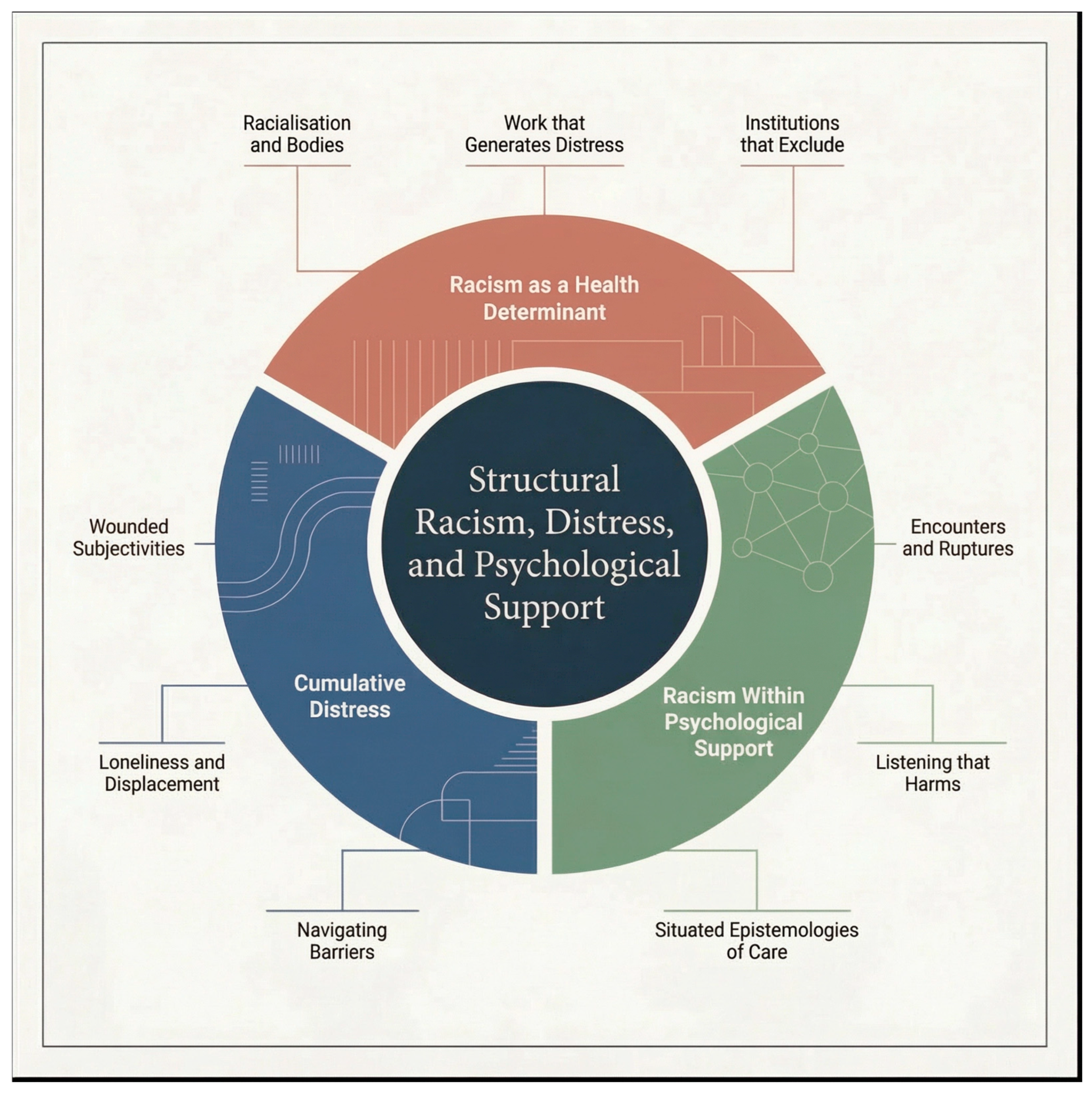
The findings are organized into three interpretive axes: (1) racism as a health determinant, examined through specific mechanisms operating across everyday life, labour, and institutions; (2) the cumulative production of psychological distress through structural conditions of displacement and precarity; and (3) structural racism within psychological care, from epistemic violence to situated knowledge.
Figure 1 presents the thematic structure of the analysis, illustrating how structural racism simultaneously organizes experiences of illness and care pathways.
3.1. Racism as a Health Determinant: Mechanisms of Racialisation Across Everyday Life, Labour, and Institutions
Structural racism does not operate as a background condition that occasionally surfaces in discriminatory episodes. In participants’ narratives, it functions as a set of interlocking mechanisms that organize daily life, labour markets, and institutional encounters, producing cumulative psychological effects that precede and sustain illness. Although not always explicitly named as “racism,” these processes function as structural determinants of health, producing devaluation, surveillance, and exclusion through gazes, silences, comments, and institutional practices that regulate who is authorized to occupy certain spaces with legitimacy.
This theme examines three specific mechanisms through which structural racism operates as a health determinant. The first is the racialisation of bodies and language, which regulates presence and erodes subjectivity. The second is labour conditions structured by racial and gender hierarchies, which precarise material existence and professional identity. The third is institutional arrangements that suspend rights and produce precarious citizenship. Across these three axes, the analysis demonstrates how distress is not a personal response to migration but the cumulative effect of structures that simultaneously organize exclusion and deny its recognition.
3.1.1. Racialisation as a Structural Mechanism: Bodies, Sexualisation, and Linguistic Hierarchies
Racialisation operates in participants’ trajectories as a persistent structural mechanism that regulates whose presence is legitimate, whose body is available, and whose voice carries authority. Its effects on mental health accumulate across interactions, spaces, and time, producing a progressive erosion of self-esteem, professional confidence, and the capacity to inhabit social space without constant self-monitoring.
Hypersexualization emerges as one of the most persistent markers of this process. IMG12 summarized this experience by stating that “being a Brazilian woman is being discriminated against by nature”. IMG14 reported having experienced “a lot, a lot of harassment from Portuguese men” and being seen as “the Brazilian, the slut,” describing situations in nightclubs where men, upon hearing her accent, assumed “access to my body, like slapping my butt”. This sexualization also extends into institutional settings: IMG15 was advised by a physician to receive the HPV vaccine “because I was Brazilian,” despite stating that she was married and had only one partner. Across these accounts, nationality functions as a moral and sexual marker that anticipates behaviour and positions these women as subjects requiring surveillance rather than care, regardless of the institutional context.
In response to this exposure, IMG12 explained that she felt compelled to “say that I am a married woman” so that men “don’t harass me,” emphasizing, “just because I’m Brazilian doesn’t mean I’m going to flirt with you.” In the workplace, this demand intensified. She described having to mention her husband constantly across professional contexts as a form of protection and connected this directly to a broader experience of erosion. After more than a year in Portugal, she described having lost what she called “the sparkle in my eyes”, a sense of vitality and forward momentum that had characterised her life before migration. The persistent demand to manage how one is perceived, rather than simply to work and exist, constitutes a form of psychological labour with measurable cumulative effects.
The linguistic dimension also plays a central role. IMG08 reported being “read as white until I opened my mouth,” at which point she was identified as the “mulata from Sargentelli.” IMG13 was rejected in recruitment processes because “they thought the client wouldn’t understand my accent.” IMG06 described a more active dimension of this mechanism. Before job applications and apartment visits, she and her partner would strategise about how to minimise the markers of her Brazilian identity, adjusting vocabulary toward European Portuguese, letting her white partner take the lead in conversations, and concealing her natural hair. She named this work as violent not because of any single episode but because of its constancy. Over time, it produced what she described as a state of inertia and generalised sadness, a gradual withdrawal from the social world that she attributed directly to the continuous effort of self-concealment. Accent functions as an immediate marker of alterity, reorganizing hierarchies and delimiting who may occupy more visible and prestigious positions.
Phenotypic characteristics intensify these dynamics. IMG12 described that, being “Black” with “curly hair,” she returned to straightening her hair because “people look at me sideways on the street when I wear my natural hair.” IMG15, who in Brazil moved “freely without being noticed,” began being stopped by supermarket security in Portugal, questioning whether this occurred “because I am a Black person, because I am Brazilian.” The change in context does not merely expose pre-existing racial hierarchies. It actively reconfigures participants’ racial positioning, producing new forms of surveillance and vulnerability that had no equivalent in their previous lives.
Nationality and racialisation operate as mechanisms of continuous suspicion. Upon arriving at the airport, IMG01 was told, “go back to your country,” with the feeling that “you shouldn’t be here.” IMG07 described a professor who would say, “ask the Brazilians, they know about corruption.” IMG06 had her hair searched at the airport, reporting that she felt “animalized.” IMG06 reflected on this episode not only as a violation but as a moment that drained her capacity to act. The decision to remain silent and the guilt that followed were, in her account, characteristic of the daily psychological toll of inhabiting a context that treats her body as suspect.
Delegitimization also extends to professional recognition. IMG01 stated that everything she had built in Brazil was “erased (…) what I studied doesn’t matter, what I know doesn’t matter.” IMG14 is not recognized as a nurse because “they’re used to seeing Brazilians in positions socially considered inferior.” IMG12 recounted that a colleague expressed a desire to “tie everyone to the whipping post and… whip them,” justifying it by saying, “your country’s history is slavery.” This episode, narrated in a professional context, illustrates how colonial logics are not historical residues but active mechanisms that subordinate professional authority and erode the psychological safety necessary for functioning in institutional settings.
Taken together, these mechanisms generate distress not through dramatic ruptures but through the accumulation of demands. Participants were required to justify their presence, manage how their bodies were perceived, conceal linguistic and phenotypic markers, and defend professional competence in contexts structured to question it. The psychological effects, including erosion of self-esteem, social withdrawal, exhaustion, and loss of professional identity, emerge as the cumulative outcome of structures that organize exclusion as an ordinary feature of daily life.
3.1.2. Work That Generates Distress: Precarity, Deskilling, and Labour Violence
Work emerges in participants’ accounts as one of the primary sites to produce inequality in the migratory context, functioning as an arena in which racial, colonial, and gender hierarchies materialize through occupational downgrading, exploitation, and professional delegitimization.
Professional deskilling appears regardless of educational level. IMG11, trained in accounting, was unable to secure employment in her field and transitioned into factory work. During job interviews, she perceived that “they clearly give preference to people who are from Portugal” and that when she said, “good afternoon,” the interviewer “looked at me with that surprised face because he heard my accent.” IMG14, an obstetric nurse in Brazil, had to “almost redo” her undergraduate degree to practice in Portugal and, even then, was unable to validate her specialization. In the hospital, she feels “discredited” and receives “a different kind of treatment because of that, you know, for being Brazilian.” IMG14 named this experience with precision. It was as if she had been born as an adult in a place where nothing she had done before counted, where years of formation, hundreds of hours of clinical practice, and a professional identity built over a decade were rendered invisible by a system that positioned her as a beginner. Nationality thus ceases to function solely as an identity marker and becomes an implicit criterion for professional hierarchization.
Inequalities are also expressed through working conditions. IMG05, previously a teacher, described her experience in the restaurant industry as “super-exploitation,” a “totally mechanical and exhausting” job, having worked for a year without being paid overtime. IMG11 characterized factory work as “really very heavy” and “inhumane,” marked by long shifts and injuries, noting that “everyone who has more than five years has some kind of injury.”
Moral and sexual harassment intensify this context. IMG11 stated that there is “a lot of abuse in factories in Portugal.” IMG12 explained that she must “mention my husband” and “bring up my husband all the time” to avoid male advances in the workplace. IMG10 reported having experienced “moral harassment” in all her jobs. IMG12 described a cumulative effect of navigating a professional environment where her competence was systematically questioned. She recounted that colleagues reacted with visible surprise when she produced her laptop at a meeting, as though her ownership of professional equipment was implausible, and she connected this directly to the broader pattern of “being seen as someone whose professional authority required constant defence” The intersection of gender, race, and nationality renders these women’s positions particularly vulnerable to disrespect and control.
The subjective effects are progressive. IMG05 stated that the super-exploitation is “killing” her and that she feels “like a headless chicken” regarding her future. IMG10 reported that in Brazil she had “good professional and academic self-esteem,” whereas, in Portugal, she perceives herself as “professionally a beginner.” IMG14 described an “absurd cycle of anxiety and self-criticism” associated with the constant need for validation.
Work thus functions as a site where structural racism produces measurable psychological effects. The erosion of professional identity, the internalisation of inferiority, and the exhaustion generated by the continuous demand to prove competence in contexts structured to question it accumulate into forms of distress that are inseparable from the material and symbolic conditions of labour.
3.1.3. Institutions That Exclude: Bureaucracies, Barriers, and Denied Citizenship
Public institutions appear in participants’ accounts as spaces in which migratory status is continuously contested and placed in suspension. Bureaucracy is experienced as a mechanism of control, uncertainty, and restriction of rights, producing a persistent sense of instability.
Documentation regularization emerges as an intense source of anguish. IMG01 remained for months “without documentation,” feeling “illegal.” IMG13 described the experience as “anguishing” and marked by the feeling of being “trapped,” particularly due to the impossibility of traveling: “that feeling that you can’t travel (…) was very stressful.” IMG11 characterized the process as “horrible,” marked by inconsistent information and successive failed attempts.
The sense of living in institutional “limbo” is recurrent. IMG05 reported repeated rejections in the family reunification process, “there were no spots, no spots, there are no spots.” IMG04 described that only upon receiving her residence card did she feel the following: “wow (…) I’m part of this too (…) now no one is going to yell at me, now no one is going to humiliate me.” The document represents not merely legal formalization, but the possibility of existing without constant threat.
Interactions with public healthcare services are also marked by mistrust. IMG09 described the health centre as a space of “confusion,” with “security guards who already look at you the wrong way,” stating, “as long as I can avoid these contexts, I will.” IMG04 does not have a designated primary care physician and questions: “Who am I supposed to look for? Where am I supposed to go?”
These accounts indicate that institutions, rather than guaranteeing rights, condition access to recognition and protection. Citizenship is experienced as provisional, negotiated, and constantly threatened, intensifying the vulnerability embedded within migratory trajectories.
3.2. The Cumulative Production of Distress: How Structural Conditions Shape Psychological Suffering
If, in the previous theme, racism materializes in bodily, labour, and institutional dimensions, this analytical axis examines its effects on the organization of psychic life. The findings presented here demonstrate that psychological distress among these women emerges as the cumulative outcome of structural conditions that organize precarity, invisibilisation, and exclusion as ordinary features of daily life. The search for psychological care emerges within this same landscape, shaped by financial, institutional, and symbolic barriers that reflect the same hierarchies that produced the distress in the first place.
The findings are organized into three dimensions: the production of depression, anxiety, and mental exhaustion as effects of structural conditions; the experience of loneliness and displacement as structurally generated forms of suffering; and the barriers and strategies involved in navigating access to psychological care.
3.2.1. Wounded Subjectivities: Depression, Anxiety, and Mental Exhaustion
Participants’ accounts reveal experiences of anxiety, depression, and mental exhaustion that intensify in the face of accumulated everyday violence and fragile support networks. Depression emerges forcefully:
“I felt completely invisibilized, I felt completely incapable. I fell into a depression (…) I thought several times about committing suicide. (…) There was no reason to exist. (…) I had left everything in Brazil. I no longer wanted to return to what I was living before. But here I couldn’t build anything either.”
(IMG01)
This account situates suicidal ideation not as an individual psychological crisis but as the endpoint of a cumulative process of erasure, in which the inability to build a legitimate place in the new context progressively dismantled the conditions for meaning making. IMG02 described a parallel trajectory: Within the first months of arrival, she entered what she called “a terrible, terrible depression”, marked by hair loss, sleeplessness, and continuous crying. Looking back, she reflected that “at the time I had no help from a psychologist, nothing like that.” The absence of care did not reflect a lack of need but the structural inaccessibility of services at a moment of acute vulnerability.
Anxiety appears linked to prolonged uncertainty and the anticipation of conflict. IMG11 explained how the expectation of humiliation shapes her behavior: “Every time I go to a public service, I expect them to treat me badly (…) I already go in wearing my armor.” This anticipatory anxiety, produced not by individual fragility but by repeated institutional hostility, generates a form of chronic psychological mobilisation that accumulates into the mental exhaustion described by other participants. IMG10 emphasized, “when I’m mentally exhausted, even the smallest thing affects me.” According to IMG14, “I arrive home exhausted, mentally exhausted, because I have to be proving all the time that I am competent.”
These accounts share a common structure. The distress described is not a generalised emotional response to the challenges of relocation. It is tied to specific structural conditions, the anticipation of institutional hostility, the demand for continuous self-justification, and the erosion of professional identity, each of which operates as a mechanism that produces and sustains psychological suffering over time.
3.2.2. Loneliness and Displacement: The Pain of Not Belonging
Loneliness and displacement constitute structuring dimensions of the migratory trajectory, intensified by the absence of support networks, the loss of professional status, and the persistent experience of non-belonging.
The absence of meaningful social ties is described as one of the most painful aspects of migration. IMG01 emphasized, “I had no one, I had no family, I had no friends, I had nothing, I was alone, completely alone.” IMG07 shared, “It’s been four days since I left the house, since I’ve seen anyone, and I’m even missing the building’s doorman.” Physical distance from family deepens this isolation. IMG06 described the impossibility of being present during critical moments: “my mother got sick and I couldn’t go, my grandmother passed away and I couldn’t go.”
IMG03 described a moment that crystallised the structural nature of this non-belonging. Arriving at her daughter’s school to find all the other children dressed for a celebration while her daughter wore ordinary clothes, she later reflected, “it wasn’t the situation itself, it was realising how little integrated into the context I was.” The failure to receive routine school communications was not incidental. It was the visible surface of a deeper exclusion that permeated her daily life, the experience of inhabiting a context whose ordinary functioning was not built to include her.
The loss of professional status represents another central dimension of displacement. IMG05 stated, “In Brazil I was a teacher, I had status, I had recognition, and here I am just an immigrant who washes dishes.” IMG07 asserted, “In Brazil I had a career, I had a name, I had recognition, and here I am nobody, I am just another Brazilian.” According to IMG10, “professionally, which was the most important thing to me, I am nothing special, I am professionally a beginner.”
These accounts reveal that displacement involves not only geographical relocation but a structural rupture in the conditions that sustain psychological well-being. Social isolation, professional deskilling, and the persistent sense of illegitimacy are not produced by individual difficulties in adaptation. They emerge from the same hierarchies of race, nationality, and migratory condition that organize access to belonging, recognition, and social protection. The cumulative effect is a form of suffering that is simultaneously relational, professional, and existential.
3.2.3. Navigating Barriers: Motivations, Obstacles, and Strategies for Accessing Psychological Care
The search for psychological support unfolds amid multiple barriers that affect both initial access and the continuity of care. Motivations for seeking help are directly related to the distress previously described. IMG01 stated, “I was very unwell, I was thinking about suicide, I needed help.” According to IMG05, “it was either that or I was going to smash a stack of plates and get fired.” IMG13 sought support because “I was very depressed; I couldn’t get out of bed.”
These motivations signal that the search for psychological care among these women typically occurs at points of acute crisis, after sustained exposure to the structural conditions described in the previous sections. Seeking help is not a routine act of self-care but a response to distress that has already reached a threshold of acute disruption.
Financial barriers emerge as a central obstacle. IMG06 reported that she attempted to access private services but found that “it’s very expensive.” IMG11 opted for online sessions with a professional based in Brazil because “the cost in Brazil is cheaper.”
Mistrust toward public services is also significant. IMG09 declared, “I don’t trust the National Health Service (SNS), I’ve had very bad experiences.” IMG03 avoided the public system because she “already knew I would be mistreated.” The absence of a designated primary care physician constitutes another limitation. IMG10 was unable to schedule an appointment: “I tried to book an appointment at the health center, but they said I needed to have a family doctor, and I don’t.”
These barriers are not merely practical obstacles. They reflect the same structural conditions that produced the distress in the first place. A system that requires a family doctor for access to mental health care effectively excludes those whose documentation instability makes registration difficult. Financial barriers disproportionately affect individuals who are already precarious through occupational downgrading. The symbolic barriers of mistrust emerge from prior experiences of institutional racism. Each layer of difficulty in accessing care reproduces the logic of exclusion that characterises these women’s broader migratory experience.
In the face of these barriers, access occurs predominantly through private care, often with Brazilian professionals in an online format. IMG12 highlighted, “I did online therapy with a psychologist from Brazil because I knew she would understand me better.” IMG13 explained, “I looked for a Brazilian psychologist because I needed someone who understood what I was going through.” When available services systematically fail to recognise the racialised and migratory dimensions of distress, seeking care outside those services becomes a necessary response to institutional inadequacy.
Difficulties in maintaining continuity of care are recurrent. IMG10 mentioned, “I had to stop because I couldn’t afford it anymore.” In IMG04’s words, “I attended a few sessions, but then I couldn’t continue because the schedule didn’t match my work.” The therapeutic trajectory is thus marked by instability. Interruptions driven by financial constraints, incompatible working schedules, and the precarious conditions of migratory life reveal that access to psychological care is shaped by the same structural inequalities that organize the production of distress. Continuity of care is not simply a clinical challenge but a structural one that is dependent on material conditions that many of these women do not have.
3.3. Structural Racism Within Psychological Care: From Epistemic Violence to Situated Knowledge
The previous themes demonstrate how structural racism operates as a health determinant across everyday life, labour, and institutions. This theme examines how the same hierarchies extend into the space of psychological care itself, shaping both the conditions under which distress is or is not recognised and the possibilities for a practice committed to equity. Care emerges not as a neutral space but as a site traversed by the same racial, gender, and migratory dynamics that organize participants’ broader social experience.
The findings are organized into three dimensions: how the quality of therapeutic encounters is determined by the professional’s capacity to recognise structural dimensions of distress; clinical practices that minimise, depoliticise, and invalidate racialised suffering; and what participants’ responses to these limitations reveal about the conditions for a structurally competent psychological practice.
3.3.1. Encounters and Ruptures: When Therapy Heals or Harms
Participants’ accounts reveal that the quality of psychological care is not determined primarily by technical training but by whether the professional can recognise the structural dimensions of distress. When that recognition is present, even partially, the therapeutic encounter becomes a space where suffering is validated, and continuity of care becomes possible. When it is absent, the therapeutic space reproduces the same dynamics of invisibilisation that participants experience elsewhere.
Some described positive trajectories in which they felt heard and validated. IMG15, speaking about her Portuguese therapist, stated: “I felt welcomed (…) she was truly a very good person, she left a very positive mark on me, so much so that I recommended her to a friend.” Yet she also identified a structural limitation: “prepared, no, because I think that maybe someone who truly understood would first need to be racialised (…) she didn’t have lived experience, even though she was quite supportive.” This account captures a distinction that runs through participants’ narratives: affective attunement and structural competence are not the same thing. A professional can be warm and supportive while still lacking the analytical framework to recognise racism and migratory violence as determinants of the distress being brought to the session.
In contrast, other participants described situations of rupture and misunderstanding. IMG01 stated, “she didn’t understand anything I was going through (…) she kept asking me, ‘but why did you come here?’ as if I had made a wrong choice.” IMG04 reported, “I felt that she didn’t understand anything about racism, about what it means to be a Black woman here in Portugal (…) she kept trying to convince me that I was exaggerating.” IMG09 exemplified the incomprehension of migratory specificities: “she didn’t understand what saudade is, what it means to be far from your family (…) she kept saying ‘but you can call, you can do a video call,’ as if that solved it.”
The consequences of these ruptures were concrete. IMG03 discontinued therapy because she felt she was “paying not to be understood.” IMG10 stated that she stopped therapy because she felt she was “getting worse, not better.” In both cases, the decision to discontinue was not a failure of individual motivation but a rational response to a therapeutic relationship that was reproducing, rather than addressing, the conditions of invalidation these women already experienced outside the consulting room.
3.3.2. Listening That Harms: Minimization, Depoliticization, and Invalidation
Several participants reported therapeutic encounters marked by the minimization and delegitimization of their experiences of racism. These practices share a common logic: they relocate the problem from the structural conditions that produce distress to the individual’s perception, interpretation, or attitude, effectively reproducing, within the clinical space, the same mechanisms of invisibilisation documented in the previous themes.
According to IMG02, “when I talked about racism, she would say, ‘but are you sure it was racism? Sometimes people are rude to everyone’ (…) she always tried to convince me that I was interpreting it wrong.” IMG08 stated, “she said, ‘but Portugal is not racist’ (…) how am I supposed to talk about what I live through if she doesn’t even acknowledge that racism exists?” These responses do not merely reflect ignorance. They constitute a clinical practice that actively denies the material reality of structural racism, making it impossible for participants to process their experiences within the therapeutic relationship.
The depoliticisation of distress also manifests in other ways. IMG01 argued, “she kept saying that I needed to change the way I think (…) as if the problem were me, not the racism I experience every day.” IMG04 shared that her therapist insisted on gratitude exercises even in the face of workplace humiliations.
The difficulty in understanding the intersection of gender, race, and migration was also mentioned. IMG09 reported, “she didn’t understand that being a woman, Brazilian, racialised, and an immigrant is all together, she wanted to separate things (…) she would say, ‘let’s focus first on the migration issue,’ as if it were possible to separate them.” IMG07 described a parallel experience: When she tried to explain the cumulative weight of occupying multiple positions outside the norm simultaneously, she perceived that “he didn’t understand the weight of it (…) it was always left as secondary.” IMG12 explained, “she didn’t understand that racism isn’t only when someone insults you, it’s structural, it’s in everything (…) she kept waiting for me to describe violent episodes, but she didn’t understand everyday violence.”
IMG15 synthesized these gaps:
“There is a huge lack of training on what the life of an immigrant is really like, especially for those who are going to work helping people with these demands. About race, I won’t even get into that because I think there is a total lack of knowledge about racialised people”.
These accounts reveal a pattern of epistemic violence operating within the clinical space: the systematic failure to recognise racialised and gendered suffering as legitimate, politically situated, and structurally produced. The effect is a double exposure: participants must manage both the distress that brought them to therapy and the additional burden of defending the validity of that distress to the professional who is supposed to help.
3.3.3. Situated Epistemologies of Care: What Women’s Strategies Reveal About Structural Competence
Facing these institutional and clinical failures, participants developed their own forms of psychological support. These strategies are analytically significant not only as evidence of resilience but as situated knowledge about what a structurally competent psychological practice would need to offer.
Support networks among Brazilian women became fundamental spaces of mutual care, functioning as sites of recognition and collective processing of distress. IMG09 reported, “we created a group of Brazilian women here and we meet once a month (…) that’s where I truly feel welcomed, because they understand what I go through.” What these spaces provided was not a substitute for professional care but something that professional care rarely offered: recognition without prior justification. Participants did not need to explain why racism is painful or why migration involves loss. That shared understanding was the foundation of the listening they received.
The preference for Brazilian or racialised professionals followed the same logic. IMG08 described what that recognition meant in practice: “her Brazilian psychologist ‘made me see my resilience (…) recognise that potential, that resilience I have’”. She connected it to the specific trajectory she had navigated as an immigrant rather than treating it as an individual trait. IMG13 explained her choice with similar precision: “I looked for a Brazilian psychologist because I needed someone who understood what I was going through.”
When reflecting on what genuinely competent care would require, participants were specific. IMG01 argued, “psychologists need to be trained about racism, about migration, about what it means to be an immigrant (…) they need to understand that our suffering is not individual.” IMG02 was direct: “the psychologist needs to acknowledge that racism exists, that it’s not something in our heads (…) without that, there’s no way to have good care.” IMG07 expanded the following: “psychological care cannot be neutral, it needs to recognize power structures, racism, sexism (…) otherwise it ends up reproducing the same forms of violence.”
Representation within services was also identified as necessary. IMG04 suggested, “it would be important to have more racialised psychologists, more psychologists who understand what it is like to suffer racism in your own skin.” IMG13 proposed, “there should be a specific service for immigrants, with professionals who understand our demands.”
Taken together, these accounts produce situated knowledge about what psychological care committed to equity requires. Participants do not merely identify failures. They specify the conditions under which care becomes possible: recognition of structural racism as a determinant of distress, a framework capable of holding intersecting dimensions of vulnerability without separating them, and an ethical–political positioning that refuses neutrality in the face of inequality. These are not supplementary qualities. According to participants’ accounts, they are its foundation.
4. Discussion
The findings consolidate structural racism as an organizing axis of the mental health experiences of racialised Brazilian women in Portugal. Psychological distress emerges as the cumulative effect of social positions produced at the intersection of race, gender, nationality, and migration status, in alignment with the structural determinants of health framework [
1,
2,
5]. Bodily devaluation, professional deskilling, documentation instability, and institutional mistrust accumulate and progressively reshape how these women experience and inhabit social space. Erosion precedes symptoms and contributes to their maintenance over time.
Racialisation manifests across participants’ trajectories as a continuous mechanism that interwines race, gender, and nationality in an inseparable way [
11,
13]. Hypersexualisation emerges as one of its most persistent axes, not as an isolated episode but as a structure that regulates how these women are received, read, and treated in the spaces they inhabit, undermining professional recognition, institutional legitimacy, and possibilities of belonging [
30,
31]. In the Portuguese context, the figure of the Brazilian woman as sexually available and morally suspect is not confined to the public sphere but extends to labour environments, health institutions, and the therapeutic space itself, where nationality continues to function as a marker that anticipates behaviour and positions these women as subjects requiring surveillance rather than care [
10,
21].
The invalidation of degrees and the delegitimisation of professional trajectories constitute expressions of the same colonial process that hierarchises bodies, knowledge, and presences. These mechanisms do not operate in isolation but overlap and reinforce one another, producing forms of exclusion that simultaneously affect material life, professional identity, and access to psychological care [
25,
30,
31].
These dynamics converge with international evidence linking racial discrimination, labour precarity, and social isolation to the worsening of mental distress among racialised migrant women [
22,
23,
24]. In the Portuguese context, shaped by specific colonial legacies, the intensification of anti-immigration discourses and the strengthening of far-right movements further amplify insecurity and fear [
33,
34]. These findings deepen the evidence previously reported for this population [
10] by demonstrating how such factors materialize in everyday life: delays in documentation regularization, insertion into precarious labour, and fragile support networks that both precede and sustain psychological illness [
25,
28,
32].
The weathering framework helps make sense of a recurring pattern across these trajectories: Several women with higher educational attainment and formal employment continued to report significant psychological distress, suggesting that socioeconomic resources do not necessarily offset the cumulative physiological and psychological toll of sustained exposure to racialised stressors [
26].
Although the Portuguese context is historically and racially distinct from the North American settings in which weathering was originally theorised, it reflects a similar structural dynamic in which racialisation operates through everyday interactions that require ongoing negotiations of belonging and legitimacy. This continuous exposure produces a form of wear that accumulates over time—not through exceptional events, but through the repetition of seemingly ordinary encounters.
The findings demonstrate that structural racism does not operate as an occasional backdrop but as a set of specific mechanisms that intersect across everyday life, labour, and institutions, producing cumulative psychological effects that precede and sustain illness. The historical and linguistic proximity between Brazil and Portugal, frequently mobilised as a facilitator of integration, paradoxically operates as one of the mechanisms through which colonial hierarchies reorganize themselves in less visible and therefore more difficult to contest ways. Accent functions as an immediate marker of alterity, triggering professional rejection, moral suspicion, and infantilisation, in a dynamic that resonates with [
17] analysis of everyday racism and [
30] discussion of subtle discrimination sustained under discourses of cultural proximity.
This pattern, in which cultural familiarity masks systematic forms of exclusion, is not exclusive to the Portuguese context but has been documented in other migratory contexts that present themselves as multicultural and tolerant [
35]. Beyond documenting experiences of distress, this study advances theoretical debates across three interconnected fields. In migration studies, it expands the analysis of structural health determinants to incorporate symbolic and linguistic dimensions, including accent-mediated racialisation and the paradox of colonial proximity, that remain largely absent from existing scholarship. In public health, it demonstrates that mental health equity requires more than service expansion, challenging frameworks that locate the problem primarily in access barriers rather than in the clinical practices that reproduce racial hierarchies within care itself. In critical race scholarship, it repositions racialised migrant women as producers of knowledge about the systems that serve them, contributing to decolonial epistemologies that centre situated expertise as a foundation for structural transformation.
The cumulative production of psychological distress extends from the material conditions of existence to the interior of the therapeutic space itself. The literature tends to focus on barriers to access or the prevalence of disorders [
42,
43], but the findings indicate that initiating psychological care does not guarantee its maintenance or effectiveness. Interruptions driven by high costs, incompatible schedules, and experiences of invalidation reveal that mental health equity requires relational stability and material conditions that sustain the therapeutic bond over time. Discontinuity of care, therefore, reflects the same structural inequalities that organize the production of distress, demonstrating that mental health equity cannot be resolved through the formal expansion of access to services alone [
6,
8].
In the face of the institutional and clinical failures documented, participants constructed collective strategies of care and mutual support whose contours illuminate the conditions for a structurally competent psychological practice [
38]. Support networks among Brazilian women, the search for racialised professionals, and articulated recommendations for professional training are not merely adaptive responses to gaps in the system. They are precise formulations about the conditions under which care becomes possible, grounded in an ethical–political positioning that refuses neutrality in the face of inequality [
8]. By positioning these women as producers of knowledge about the systems that serve them, this study aligns with intersectional feminist and decolonial epistemology [
11,
13,
27] and reinforces that transforming care requires revisiting the criteria through which distress and intervention are interpreted.
Clinical interactions constitute a central dimension of these findings. The situations described as “
listening that harms” illustrate a systematic pattern of minimisation and depoliticisation of racialised suffering, in which episodes of discrimination are reinterpreted as individual hypersensitivity or difficulties in adaptation, making it impossible to process these experiences within the therapeutic relationship [
18,
21,
41]. This pattern constitutes a form of epistemic violence, understood as the systematic contestation of the legitimacy of those who name their own experiences [
16], which operates with intensity when the experience in question simultaneously intersects racism, gender, and migratory conditions. Participants describe professionals who insisted on separating what is inseparable, treating migration, racism, and gender as distinct issues to be addressed sequentially, without recognising that it is precisely their simultaneous interplay that produces the suffering.
The absence of structural competency in mental health services does not merely reflect gaps in individual training but manifests a logic of institutional racism in which the policies, norms, and practices that organize clinical care produce racially unequal outcomes precisely because they present themselves as neutral and universal, rendering their discriminatory character invisible [
19,
20]. This invisibility has specific clinical consequences: the absence of structural competency leads not only to the individualisation of distress but to the reproduction, within the very space of care, of the hierarchies that produced it [
7,
8].
When race and migration remain peripheral in the interpretation of distress, the therapeutic space ceases to be perceived as safe, compromising trust, adherence, and continuity of care [
37]. What is at stake is not an additional technical competency but a reorientation of clinical listening as an ethical and political position, committed to recognising that the distress of these women is not a past event to be worked through but a present condition sustained by structures that remain active [
16,
21].
By articulating structural determinants, intersectionality, and psychological practice, this study demonstrates that the field of mental health participates in the same hierarchies that regulate labour, citizenship, and belonging. The structures that determine who may circulate with legitimacy or have a diploma recognised are the same ones that determine who is heard, believed, and cared for. The experiences of depression, anxiety, exhaustion, and suicidal ideation reported by participants do not constitute individual responses to migration but expressions of structural conditions of exclusion that international evidence has consistently associated with cumulative exposure to racism, precarity, and isolation [
9,
25,
38]. In this context, seeking psychological support emerges as an act of resistance and affirmation of the right to be heard and treated with dignity [
39].
Mental health thus constitutes a terrain of political dispute: between the silencing and historical recognition of racialised suffering, between apparent neutrality and ethical commitment, and between formal expansion of access and substantive transformation of practice. What is at stake are the foundational premises through which distress and care are interpreted. Addressing inequalities in this field requires ethical and political commitment to revising the assumptions that sustain psychological practice, recognizing racial justice as a structuring dimension of public policy, professional training, and mental health care.
5. Strengths and Limitations
This qualitative study, grounded in Reflexive Thematic Analysis, did not aim to achieve theoretical saturation but rather to produce a situated, dense, and contextualized understanding of the trajectories of racialised Brazilian women in Portugal. In alignment with this epistemological framework, the research prioritized the exploration of meanings and processes of psychological illness as lived and narrated by participants, contributing to a field that remains underexplored within the Portuguese context. Interpretive depth was therefore privileged over empirical exhaustiveness.
Some limitations warrant acknowledgment. The sample consisted exclusively of cisgender women, predominantly heterosexual, limiting the understanding of the experiences of transgender, non-binary individuals, and people of other sexual orientations, whose processes of racialisation and access to care may assume specific configurations. The temporal scope of the interviews also captures moments within migratory trajectories, restricting the analysis of transformations over time.
The requirement of having sought psychological support as an inclusion criterion introduces another relevant limitation. Access to mental health care in Portugal is unevenly distributed and deeply shaped by class-based barriers. Given the difficulties in accessing public services, private care often depends on financial resources. Women experiencing migration-related distress but lacking the material conditions to seek professional support may therefore be underrepresented. This limitation highlights how social class operates as a structural determinant not only of care but also of the visibility of experiences within research contexts.
The predominance of participants with higher education levels must also be considered. Greater educational attainment may expand individuals’ repertoires for naming processes of racialisation and may be associated with improved conditions for sustaining therapeutic care. Women with lower levels of education or those embedded in more precarious labour contexts may experience these dynamics differently, particularly regarding the possibility of initiating and maintaining care.
Among this study’s primary strengths is the articulation of structural racism, linguistic racialisation, and continuity of psychological care, dimensions that remain insufficiently integrated in the international literature and are virtually absent in an articulated form within the Portuguese context. By examining not only formal access to services but also the quality of listening, the validation of lived experiences, and the stability of the therapeutic bond, this research expands the debate on mental health equity, demonstrating how inequalities are reproduced both in structural living conditions and in clinical practice.
The positionality of the first author—a racialised Brazilian immigrant woman residing in Portugal—facilitated rapport during interviews while simultaneously requiring reflexive attention to internal differences within the group and to the power relations embedded in the research process. The composition of the research team, bringing together Brazilian and Portuguese scholars, enabled critical dialogue from distinct national positions, strengthening interpretive robustness. The density of the empirical material—1350 min of interviews and 420 pages of transcripts—supported in-depth analysis. Instrument validation through the Vali-Quali protocol and adherence to COREQ criteria contributed to methodological rigor and transparency.
6. Implications and Future Directions
Psychological distress cannot be dissociated from the structural conditions that organize citizenship, recognition, and access to rights. Labour precarity, documentation instability, persistent racialisation, and institutional exclusion do not merely accompany distress; they constitute conditions for its production. In this context, exclusively therapeutic responses prove insufficient when unaccompanied by structural transformation, and the findings point to the need for articulated changes across three interdependent levels.
In the domain of public policy, the absence of disaggregated data on race and ethnicity in Portugal continues to render systematic patterns of exclusion invisible, limiting the formulation of evidence-based responses. Accessible documentation, regularisation, and effective labour protection constitute preconditions for psychological care, given that material precarity directly compromises the possibility of initiating and maintaining therapeutic support.
Within mental health services, expanding access within the SNS is necessary but insufficient if not accompanied by professional training that incorporates intersectional, decolonial, and structural competency perspectives, enabling practitioners to recognise structural racism, in its intersectional dimension, as a determinant of distress rather than a peripheral contextual variable.
In clinical practice, training in generic cultural competency proves equally insufficient. Transforming care requires revising the criteria through which distress is interpreted, avoiding the pathologisation of behaviours that constitute coherent responses to contexts that remain hostile, and developing an ethical and political positioning that refuses neutrality in the face of inequality. Professional training should explicitly address how gender-based constructions, including hypersexualisation, operate as mechanisms that traverse public, labour, and clinical spaces, shaping how racialised migrant women are received and treated across institutional contexts. The presence of racialised professionals within services, the creation of institutional responses specifically oriented towards migrant populations, and the recognition of community networks among Brazilian women as legitimate sites of care are conditions that participants themselves identified as fundamental for care to become possible.
Future Directions
The findings also indicate important avenues for future research. Longitudinal studies may track transformations in trajectories of distress and coping across different stages of the migratory process. Investigations centred on the perspectives of mental health professionals may deepen understanding of how institutional practices interpret—or silence—race and migration within clinical contexts. Research that expands the diversity of profiles within the Brazilian population in Portugal, including transgender and non-binary individuals and different class positions, may reveal additional intersectional articulations.
Evaluations of interventions grounded in structural competency would contribute to examining their impact on therapeutic alliance and continuity of care. Finally, comparative studies across European contexts may explore how distinct colonial legacies and migration regimes differentially shape the mental health trajectories of racialised migrant populations.
7. Conclusions
This study demonstrates that the mental health of racialised Brazilian women in Portugal is shaped by power structures that organize recognition, mobility, and belonging. The psychological distress analyzed here is inscribed within hierarchies that unequally distribute rights, legitimacy, and social protection. Linguistic racialisation, professional deskilling, documentation instability, and institutional exclusion not only condition material living circumstances but also delimit the institutional frameworks through which distress is, or is not, recognized as legitimate.
The findings confirm that structural racism intersects with gender, class, nationality, and migration status, producing vulnerabilities that simultaneously traverse both psychological illness and care trajectories. Inequalities manifest not only in the distribution of access to services but also in clinical dynamics, particularly when experiences of discrimination are reinterpreted as individual excesses or stripped of their historical and structural density. In such cases, care operates within the same frameworks that sustain the production of distress.
At the same time, the strategies mobilized by participants, support networks, shared narratives, and the search for racialised professionals introduce alternative frameworks for rethinking care. By centring recognition within the therapeutic experience, these practices reveal that mental health production involves not only technical intervention but also symbolic legitimacy, validation, and the possibility of belonging.
In dialogue with scholarship on structural determinants of health and structural competency, this study illuminates the specificities of the Portuguese context, particularly the way in which race and gender intersect in an inseparable manner in the production of distress, manifesting from accent-mediated racialisation to hypersexualisation that traverses labour, institutional, and clinical spaces. By recentring historically marginalized voices, the research reaffirms mental health as a privileged terrain for understanding how colonial and gendered structures simultaneously inscribe themselves in subjective experience.
Promoting mental health equity, considering these findings, requires more than expanding services. It demands revising the frameworks that define what is recognized as legitimate suffering, who is considered a subject of care, and which trajectories are authorized to produce knowledge about the system itself. It also requires recognising that behaviours frequently read as symptoms may be coherent responses to a world that remains hostile and that treating them as pathology without questioning the conditions that produce them is a form of violence. Within this horizon, racial justice moves from a peripheral concern to a structuring principle of public policy, professional training, and mental health practice.